
RO e-Factura Romania 2026: Foreign Company Guide
RO e-Factura in Romania is no longer only a local accounting issue. A foreign company may be affected because it has a Romanian subsidiary, a fixed establishment, a Romanian VAT registration, domestic transactions or Romanian customers. The correct result depends on the company’s VAT status and the transaction—not simply on the country in which the parent company is incorporated.
Key points for 2026:
- From 1 January 2026, the statutory transmission deadline is generally five working days, subject to the separate legal deadline for issuing the invoice.
- A Romanian VAT number alone does not necessarily mean that a foreign company is established in Romania.
- Domestic B2B clearance, reporting by a non-established supplier and invoices to a foreign Romanian-VAT-registered customer must be classified separately.
- When RO e-Factura is mandatory, a PDF is not a substitute for the validated structured electronic invoice.
- The operational record should preserve the XML, the Ministry of Finance electronic seal or validation response, submission evidence and any corrected invoice.
This guide updates the existing Atrium article for the 2026 rules and is intended for foreign investors, finance teams, Romanian subsidiaries and non-resident businesses with Romanian VAT exposure. It should be read together with advice on Romanian tax law and, where a foreign entity needs a local fiscal identifier, the guide to obtaining a Romanian NIF tax identification number.
What changed for RO e-Factura in 2026?
The most important operational change is the move from five calendar days to five working days. The change was introduced through Government Emergency Ordinance no. 89/2025, which amended OUG no. 120/2021 and replaced the previous five-calendar-day transmission deadline with a five-working-day deadline effective from 1 January 2026. See also the explanatory summaries published by Contabilul and VATupdate. The deadline runs from the invoice issue date, but it cannot extend beyond five working days calculated from the statutory deadline for issuing that invoice under the Romanian Fiscal Code. Public holidays and the precise date from which the period is calculated should therefore be built into the company’s controls.
| 2026 point | Practical meaning | Control to implement |
|---|---|---|
| Five working days | The transmission period is counted in working days from 1 January 2026, subject to the invoice-issuance backstop. | Use a Romanian working-day calendar and escalate before the final day. |
| Foreign VAT customers | A Romanian-established supplier may have reporting duties for domestic invoices issued to a non-established customer registered for VAT in Romania. | Separate establishment, VAT registration and invoice-delivery status in customer master data. |
| Special B2C exceptions | From 1 June 2026, Law 88/2026 introduced optional treatment for certain natural persons and specifically listed categories. | Do not treat every individual customer record as identical. |
| Older guidance | Materials referring to the calendar-day deadline, future 2025 B2C implementation or obsolete registration forms may be outdated. | Version-control procedures and use current ANAF forms and legislation. |
Select the closest profile. The explanation below is a screening result, not a substitute for transaction-level VAT analysis.
A Romanian company making domestic B2B supplies is ordinarily within the mandatory domestic system. Map invoice types, credentials, software and recipient status before go-live.
Does RO e-Factura apply to a foreign company?
There is no reliable yes-or-no answer based only on the existence of a Romanian VAT number. The analysis should identify the supplier, customer, place of supply, establishment used for the transaction, VAT-registration status and invoice category.
A Romanian subsidiary is a Romanian-established taxable person. A foreign company may also have a Romanian fixed establishment if the relevant VAT tests concerning sufficient permanence and human and technical resources are met. By contrast, a foreign company can be registered for Romanian VAT without being established in Romania.
Particular care is required where a foreign company is not established in Romania but holds a Romanian VAT registration. Such businesses should not automatically be analysed under the same mandatory domestic B2B clearance rules that apply to taxable persons established in Romania. Their obligations must be verified separately under the specific provisions applicable to non-established VAT-registered persons and any optional RO e-Factura registration route.
| Business situation | Likely RO e-Factura treatment | Question requiring verification |
|---|---|---|
| Romanian subsidiary invoices a Romanian business | Domestic B2B clearance is generally mandatory. | Are any statutory exclusions or special invoice rules relevant? |
| Foreign company supplies through a Romanian fixed establishment | The entity may be treated as established for the relevant transaction. | Is the Romanian establishment actually involved in the supply? |
| Foreign company has only a Romanian VAT registration | VAT registration alone does not create a Romanian establishment. Any reporting obligations should be assessed separately from the mandatory domestic B2B clearance regime applicable to established taxable persons. | What is the place of supply and has the company opted into the system? |
| Romanian supplier invoices a non-established customer registered for Romanian VAT | Reporting obligations should be analysed under the specific rules applicable from 1 January 2026. Additional commercial transmission arrangements may still be required depending on the recipient’s status and access to the system. | Is the recipient participating in RO e-Factura or only VAT-registered? |
| Export, intra-Community supply or service with place of supply abroad | Generally outside the domestic B2B exchange rule, subject to transaction-specific reporting. | Is the VAT classification and evidence supporting the cross-border treatment correct? |
Important distinction: an obligation to report invoice data is not always identical to full platform exchange between supplier and recipient. A non-established business should confirm whether it is reporting a domestic transaction, voluntarily registered in RO e-Factura or subject to the domestic clearance route because of a Romanian establishment.
How does the electronic invoice flow work?
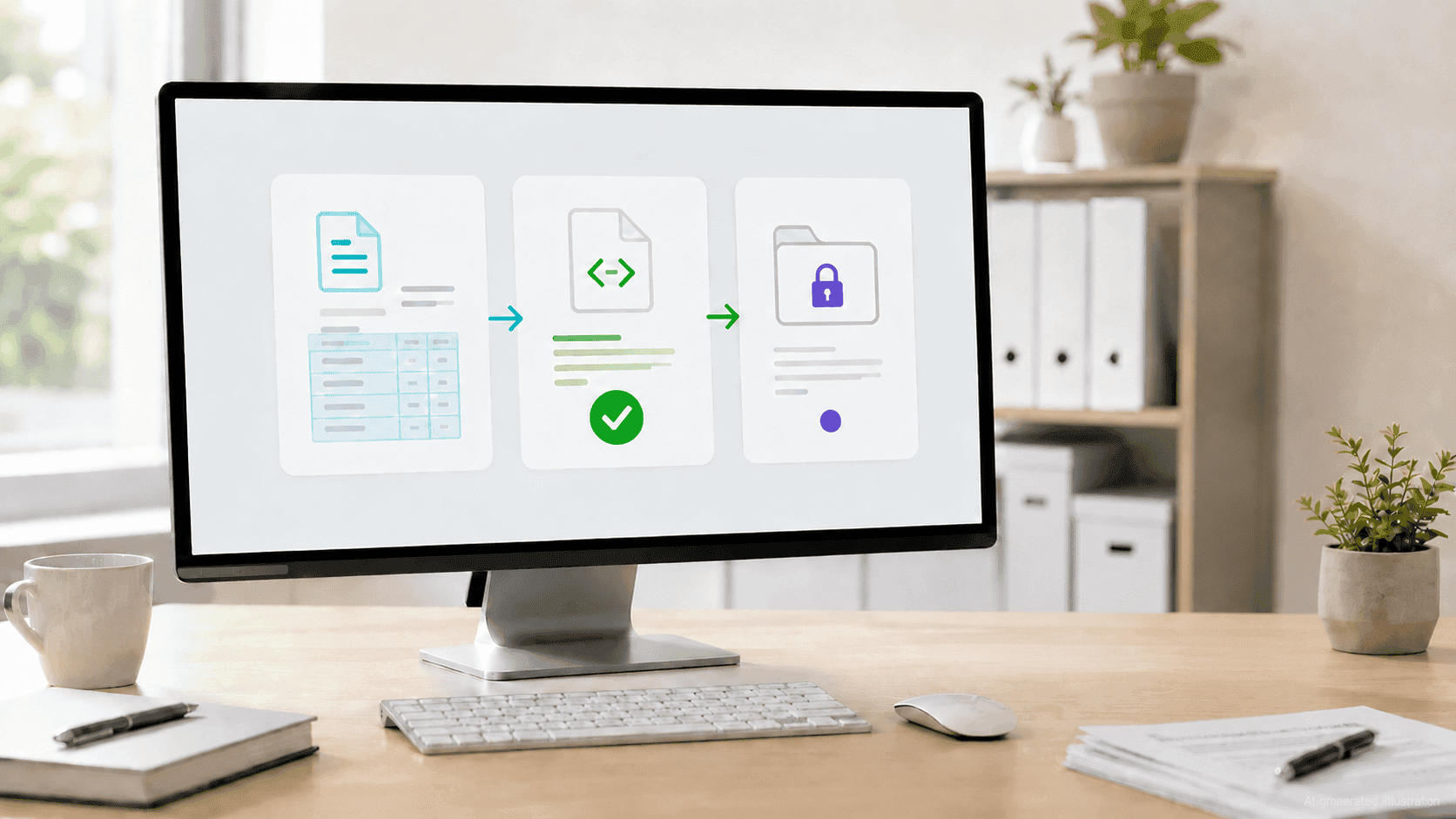
The invoice is prepared as structured data compliant with the Romanian semantic model, based on the European e-invoicing standard. It is transmitted through the Ministry of Finance infrastructure, commonly through SPV-integrated software or an authorised technical solution. The system validates the file. If validation succeeds, the electronic seal is applied and the validated file becomes the system invoice. If it fails, the issuer receives an error response and must correct and resubmit it.
Select a control point to see what the finance or IT team should retain.
Generate the invoice from accurate supplier, customer, VAT and line-item data using the current RO_CIUS technical rules.
The official platform makes files available for download for a limited operational period. This is not a substitute for the company’s own legally compliant archive. The archive should allow the original XML, seal or validation status, readable representation, correction trail and accounting entry to be matched.
Technical specifications, validators and official web applications are published through the Ministry of Finance technical information page and the RO e-Factura web applications page.
Which transactions are in scope?
The Romanian rules cover several legally distinct streams: B2B, B2G and B2C reporting, as well as particular reporting obligations for non-established persons. Companies should not use a single ERP flag called “Romanian customer” as a substitute for the legal analysis.
The B2C reporting regime introduced for suppliers established in Romania should not automatically be assumed to apply to every non-resident supplier. For foreign businesses without a Romanian establishment, the legal position should be verified separately based on the applicable provisions and transaction structure.
| Transaction | 2026 starting position | Operational note |
|---|---|---|
| Domestic B2B between persons established in Romania | Mandatory platform exchange, unless a statutory exclusion applies. | The validated XML is the legally relevant electronic invoice. |
| B2G invoice within the statutory regime | Mandatory according to the public-procurement and e-invoicing rules. | Check public authority identifiers and contract references. |
| B2C invoice issued by an established supplier | Reporting is generally mandatory, with specific 2026 exceptions. | The consumer does not need SPV access for the commercial invoice. |
| Domestic transaction by a non-established VAT-registered supplier | A reporting obligation may apply; optional system registration changes the mechanics. | Confirm current registration form and recipient-delivery channel. |
| Export or intra-Community supply | Generally outside the domestic B2B exchange obligation. | Retain evidence supporting the VAT treatment and destination. |
| Simplified invoice or other statutory exception | Treatment depends on the specific legal exception. | Do not infer exclusion merely because the amount is small. |
How is the five-working-day deadline calculated?
From 1 January 2026, the invoice must generally be transmitted within five working days from the issue date, but no later than five working days after the last legal date on which the invoice should have been issued. The day of the triggering event, weekends and Romanian public holidays can affect the calculation under the applicable time-computation rules.
A delayed invoice issue date does not automatically postpone the transmission deadline. Where the invoice is issued after the statutory issuance deadline under Article 319 of the Romanian Fiscal Code, the five-working-day transmission period must be assessed by reference to the legal issuance deadline rather than the late issuance date. This backstop is also explained in the 2026 deadline summary.
Select a card to see the control that prevents a false deadline.
Use the date actually stated on the invoice and reconcile it with the accounting event. Backdating or delayed batch creation can create an immediate compliance risk.
For example, if an invoice is issued on a Monday and there is no public holiday, Tuesday is ordinarily the first working day and the following Monday is the fifth. This is only an illustration: the statutory invoice-issuance deadline and Romanian public holidays must also be checked.
What happens if an invoice fails validation?
A technically rejected file has not completed the required process. The response should be triaged immediately: identify whether the problem concerns syntax, master data, tax codes, totals or a business-rule conflict; correct the source data; regenerate the XML; resubmit it; and preserve both the failed and successful responses.
A successfully communicated invoice cannot simply be “returned” inside the system. Commercial objections should be handled separately, and corrections should follow Article 330 of the Romanian Fiscal Code. The corrective document must itself be transmitted when the RO e-Factura obligation applies.
What penalties and audit risks should foreign companies consider?
The penalty analysis depends on the legal obligation that has been breached. Late reporting can attract fixed fines by taxpayer category. For mandatory domestic B2B exchange, issuing or accepting an invoice outside the system can trigger a percentage-based sanction. The 15% sanction should not be applied mechanically to every cross-border or non-resident scenario without first confirming that the relevant statutory route covers the transaction and party.
The applicability of the 15% sanction should always be assessed by reference to the specific statutory obligation governing the transaction, including the supplier’s establishment status and the legal route under which the invoice was required to be transmitted.
| Risk | Possible consequence | Preventive evidence |
|---|---|---|
| One or more late invoices in a calendar month | Generally RON 5,000–10,000 for large taxpayers; RON 2,500–5,000 for medium taxpayers; RON 1,000–2,500 for other legal persons and individuals. | Deadline dashboard, submission timestamps and exception log. |
| Mandatory domestic B2B invoice issued outside the system | A sanction equal to 15% of the total invoice value may apply to the issuer under the relevant rule. | ERP block preventing off-system finalisation of in-scope invoices. |
| Recipient records an in-scope domestic B2B invoice received outside the system | A corresponding 15% sanction may apply to the recipient, subject to the statutory conditions. | Accounts-payable validation against the system record. |
| Validation failure left unresolved | The invoice may remain untransmitted and become late. | Error queue, named owner, retry log and successful response. |
| Wrong establishment or customer classification | Incorrect platform route, missing report or duplicate delivery. | Documented VAT and establishment decision tree. |
Select a risk to see the corresponding control.
Maintain separate fields for country, Romanian VAT number, establishment status, customer type and participation in RO e-Factura. One “foreign” flag is not enough.
Implementation checklist for a foreign company
- Map the Romanian footprint. Identify subsidiaries, branches, fixed establishments, VAT registrations and fiscal representatives.
- Classify transaction flows. Separate domestic B2B, B2G, B2C, exports, intra-Community supplies, local reverse-charge cases and other cross-border services.
- Confirm access and authority. Verify SPV access, qualified certificates, mandates and the persons authorised to submit or retrieve files.
- Update master data. Record establishment status, Romanian VAT identifiers, customer type and system-participation status separately.
- Test XML generation. Validate tax codes, units, discounts, advance invoices, credit notes, currency and rounding rules.
- Build deadline monitoring. Use Romanian working days, identify the statutory issue-date backstop and prevent submission only on the final day.
- Create an error workflow. Route rejected files to a named owner and require documented resubmission.
- Control incoming invoices. Reconcile accounts payable with RO e-Factura where domestic B2B exchange is mandatory.
- Archive the evidence. Preserve XML, seal or response, readable copy, corrections and submission logs under the applicable accounting and tax-retention rules.
- Review changes. Monitor the official Ministry of Finance RO e-Factura hub, current legislation and ANAF technical announcements.
Official registration and verification resources
At the time of publication, ANAF documentation refers to Form 081 for the optional register, Form 082 for the mandatory register and Form 083 for certain non-resident operators. Companies should verify the current ANAF form catalogue before implementation, as registration procedures and form numbering may change over time.
At the time of publication, Form 083 is generally used by certain non-established operators wishing to opt into RO e-Factura. Companies should verify the current ANAF requirements before filing because registration procedures may change.
Use the official ANAF forms catalogue and the ANAF online registers. For the governing framework, consult the current consolidated text of Government Emergency Ordinance no. 120/2021, together with subsequent amendments including Law no. 88/2026.
Need a transaction-specific RO e-Factura review?
A focused review can determine whether a foreign company is established, merely VAT-registered or subject to a separate domestic reporting route, and translate that conclusion into an implementable invoice workflow.
Book a ConsultationFrequently asked questions
Does a Romanian VAT number make a foreign company established in Romania?
No. VAT registration and establishment are separate concepts. A fixed-establishment analysis considers permanence and appropriate human and technical resources, as well as whether that establishment is involved in the transaction. A Romanian VAT registration obtained through direct registration or fiscal representation does not in itself create a Romanian fixed establishment for VAT purposes.
Are all invoices involving a foreign company reported through RO e-Factura?
No. The result depends on the supplier, customer, place of supply, establishment status, Romanian VAT registration and invoice category. Exports and intra-Community supplies are generally outside the domestic B2B exchange rule, although other reporting obligations may apply.
What is the RO e-Factura deadline in 2026?
From 1 January 2026, the general transmission deadline is five working days from issue, but no later than five working days calculated from the statutory deadline for issuing the invoice. Romanian public holidays and the applicable time-computation rules must be included.
Is a PDF invoice sufficient?
Not where mandatory RO e-Factura exchange applies. The structured XML validated through the system and accompanied by the Ministry of Finance electronic seal is the legally relevant electronic invoice. A PDF may remain useful as a readable copy.
Can a recipient reject an invoice in RO e-Factura?
The system invoice cannot simply be returned. The recipient may communicate objections, while any correction should follow Article 330 of the Fiscal Code and be transmitted through RO e-Factura when the obligation applies.
What should a company do after a validation error or platform problem?
Preserve the response and technical logs, identify and correct the error, resubmit promptly and retain the successful confirmation. A company should not assume that a technical issue automatically extends the statutory deadline; any official unavailability procedure should be checked on the facts.
This article provides general information on Romanian electronic invoicing and tax compliance. The result depends on the transaction, place of supply, establishment, VAT status, invoice type, technical implementation and legislation in force. It does not replace legal or tax advice on a specific invoice flow.
AI Notice: AI-assisted content, reviewed and approved by a qualified Romanian lawyer.