Laptop displaying source code beside a green agenda and storage device in a dark office.

Source-Code Escrow in a Romanian Software Project: What the Contract Must Resolve

IT contracts · Software procurement · Business continuity

Your company is about to commit to software that will run a critical part of its business. The supplier offers source-code escrow. Before signing, establish what will be deposited, how you can obtain it and whether another team will have the rights and materials needed to keep the application running.

This guide is for foreign companies procuring software from Romanian developers, Romanian businesses licensing critical systems and suppliers negotiating a proportionate escrow commitment. Cross-border projects require a separate check of governing law, insolvency rules and the locations of the rights-holder, provider and deposited materials.

What does source-code escrow protect in a Romanian software transaction?

Escrow creates a contractual route to specified materials when an agreed release condition is established. It should connect custody of those materials to a usable continuity plan. The customer, supplier and independent escrow provider commonly have separate obligations concerning deposit, confidentiality, verification and release.

For procurement, ask what the company expects to achieve after release. Maintaining an installed application, recreating a hosted environment and replacing a cloud service are different tasks. A deposit suitable for the first task may be inadequate for the others. Providers such as Escode distinguish software escrow, SaaS escrow and technical verification; their service descriptions are commercial examples, rather than Romanian legal requirements.

Where Romanian law governs, the Romanian Civil Code supplies the general contractual framework. Articles 1169 and 1170 address contractual freedom within legal limits and good faith in negotiation, conclusion and performance. Where the arrangement qualifies as an unnamed contract, Article 1168 applies the general contract rules and, where insufficient, the rules for the closest analogous contract. Classification depends on the obligations, not the title. A code deposit alone does not create a security interest, insurance cover or an assignment of copyright.

The financial decision comes before failure. Management may accept a long licence term or a substantial implementation payment because it believes escrow reduces dependence on the supplier. That belief should be supported by a defined deposit schedule, a rights analysis and a recovery exercise. Ask the technical team what it could actually do with the materials, and ask counsel whether the contracts permit that use.

When should escrow be negotiated?

Negotiate it while the software scope, licence and payment schedule can still change. Raising escrow after deployment may leave the supplier with little incentive to provide additional rights or verification work without a new charge.

Useful decision points include signing a custom-development agreement, licensing a specialist application, renewing a system that has become operationally essential, or acquiring a business dependent on proprietary software. The company should identify the beneficiary precisely. A licence granted to the Romanian subsidiary may not cover its foreign parent, affiliated companies or a future purchaser. Align any rights for affiliates, successors and replacement contractors with authorised-user restrictions, assignment, change-of-control and confidentiality clauses. A share sale and an asset transfer can raise different questions.

Compare escrow with other available controls. Direct delivery of source code with adequate rights, customer-controlled repositories, tested backups, independent hosting, documented interfaces and contractual transition support can address different dependencies. The appropriate combination depends on the delivery model. A criticality assessment should record replacement lead time, available alternatives and what happens to orders, payroll or customer service while the application is unavailable.

Supplier Failure Simulator

Select a failure scenario to reveal the contractual checks your team should make before signing.

Support failure needs a defined obligation

Identify the support service, the failure evidence, notice and cure requirements. A slower reply is not automatically an agreed release event.

  • Compare the support schedule and escrow trigger.
  • Preserve tickets, notices and proof of delivery.
  • Check release rights for a replacement maintenance team.

These scenarios identify review questions. They do not determine that a release condition exists or that the provider must release the deposit.

Does receiving the source code give the customer ownership?

Physical access to code and copyright ownership are separate questions. The licence or assignment must define what the customer may do, including what a replacement contractor may do on its behalf.

Chapter IX of Romania’s Copyright Law no. 8/1996 governs computer programs. In the republished and amended text, Article 74 covers exclusive rights; Article 76(1)(b) restricts onward transfer of use rights unless otherwise agreed, and Article 76(2) separates those rights from copyright ownership. Articles 77 and 78 cover necessary lawful-use acts and specified backup, study and testing permissions.

The EU framework in Directive 2009/24/EC on the legal protection of computer programs also distinguishes restricted acts and specific exceptions. These limited exceptions do not promise delivery of a complete source-code package or resolve every third-party permission.

Negotiate express permissions for access, copying, compilation, deployment, maintenance and necessary modifications, including controlled access by a replacement contractor. Article 40(6) requires the assignor’s express consent for onward assignment by a non-exclusive assignee. Article 40(8) dispenses with that consent where the assignee is a legal person undergoing a transformation through one of the methods provided by law. Engaging a contractor is not necessarily a transfer of the licence; define whose behalf it acts on and its permitted activities. Identify beneficiary entities, duration and continuing rights. Our guide to software licence agreements for Romania explains the wider issues. The Romanian Copyright Office (ORDA) provides official copyright information.

Check the supplier’s chain of rights

Article 75 generally allocates economic rights in employee-created programs to the employer when created in the course of duties or under its instructions, unless otherwise agreed. Do not extend that employment rule automatically to freelancers or subcontractors. For assignments, Article 42 specifies required contractual content; Article 43 concerns written proof.

Request evidence of ownership or sufficient permissions for employee and contractor contributions, reused modules, documentation and third-party components. Review assigned rights, permitted uses, duration, territorial scope and remuneration where applicable. A warranty should be supported by the relevant records. Check whether the supplier can authorise deposit, disclosure and the customer’s planned recovery, including contractor access. Paying development invoices alone does not settle those questions.

What should the deposit contain?

The schedule should describe the materials needed for the agreed recovery task and identify the relevant production version. A generic promise to deposit “the source code” leaves important questions unanswered. Reconcile the production version, accepted deliverable and maintained release with the version covered by the licence, and define how they stay aligned.

Identify the application and its dependencies

Specify repositories, release identifiers, modules, build scripts, toolchain versions, configuration templates and documentation. Record third-party libraries and the permissions needed to obtain and use them. An essential commercial component may require a separate licence that the supplier cannot transfer through escrow. An open-source component may carry licence obligations that continue after release.

Capture operational know-how

Source files may omit the knowledge needed to operate them. Decide whether architecture documents, runbooks, deployment procedures, database migration instructions and maintenance manuals belong in the recovery package. Document work that currently depends on an individual developer’s memory. Test whether a replacement team can follow those instructions without undocumented assistance.

Separate recovery materials from live secrets and personal data

Ask the engineers to define a secure access and recovery process. Credentials, encryption keys and certificates may require protected custody, rotation or customer-controlled accounts rather than inclusion in an ordinary archive. Configuration examples should avoid unnecessary production secrets. Test environments should use appropriate test data. A usable package needs to reflect the actual security model without casually duplicating sensitive live information.

Require updates and evidence of receipt

Set the initial deposit deadline, update events, responsibility for uploads and proof of receipt. Link updates to production releases or other agreed milestones, and decide what happens when an update fails verification. If a supplier delivers a new version while the deposit still contains an earlier version, management needs a documented correction process. A custody receipt may evidence delivery without proving completeness, integrity, production-version conformity, compilation or sufficient legal rights. Establish what the contracted verification covers and what remains for legal or technical review.

Can Another Team Run It?

Mark what is documented in your proposed arrangement. Each choice updates the review brief below. “Documented” means you have a record to review, not that it has been verified.

Application scope, repositories and the production release identifier.

Scripts, toolchain versions, architecture documents and runbooks.

Component list, contributor rights, access arrangements and licences.

Infrastructure, configuration and secure access recovery.

The dataset, backup or export route needed for the planned service.

Permitted use, maintenance, modification and contractor access.

Trigger evidence, notices, cure and resolution of objections.

The test scope, report, update schedule and correction process.

0 document groups marked as documented; 8 unconfirmed.

Records to examine

  • No group marked as documented yet.

Questions still open

  • Confirm the deposit, rights, release procedure and recovery test with the relevant teams.

A “not applicable” choice also needs a reason in the eventual review. Selections stay in this page and are not uploaded or saved. Do not enter code, credentials or confidential documents here.

What should verification prove before you rely on escrow?

Choose the test that matches the promised recovery and require a report of its limits. File existence, successful compilation and an independent deployment are different levels of assurance.

An inventory check may establish that specified files are present. A build test asks whether the deposit produces the agreed application. A recovery test asks whether an independent team can deploy and run it in the intended environment using the authorised materials. EscrowTech’s description of verification levels illustrates why the scope must be selected expressly; verification should not be assumed to follow automatically from storage.

Agree who supplies the environment, who performs the test, which functions must work and how discrepancies are reported. Require remediation and retesting where appropriate. If the exercise depended on undocumented help from the original developer, record that dependency. The customer should know whether the test demonstrated recovery without undocumented supplier assistance, and whether it ran in the intended recovery environment or only inside the supplier’s own environment.

Which release conditions and procedures need legal review?

A release trigger must be specific enough to establish, and its procedure must fit the company’s operational needs. Define the triggering conduct, required evidence, recipients, notice method, cure opportunity and the consequences of an objection.

Possible negotiated events include permanent cessation of a relevant business activity, a defined failure to provide maintenance, or specified insolvency developments. Their legal effect is case-dependent. A disputed support ticket, a late deposit update and total service abandonment should not be treated as equivalent without the agreed wording. Separate the right to request release from the provider’s authority to release.

Define the escrow provider’s decision role. Its service may involve custody, document checks or a contractual assessment of a release request; the agreement should identify which tasks it undertakes. Does it assess facts, follow an agreed certification process or wait for a court or arbitral decision after an objection? Who pays the dispute and verification costs? What temporary access or other relief can lawfully be sought while a dispute is pending? A long objection mechanism may defeat the intended continuity timetable even when the substantive trigger is well drafted.

Why insolvency needs separate analysis

Under Article 123(1) of Law no. 85/2014 on insolvency proceedings, ongoing contracts are maintained when proceedings open. Clauses providing for termination, loss of the benefit of the term, debtor-adverse modification or acceleration because proceedings open are treated as unwritten, subject to statutory exceptions.

To maximise the debtor’s estate, the judicial administrator or liquidator may exercise the statutory power to denounce a qualifying contract (denunțare) within the three-month limitation period from opening, provided it has not been fully or substantially performed by all parties. This insolvency mechanism differs from ordinary contractual termination. Under Article 123(1), a counterparty may send a notice requesting denunciation within those first three months. If the administrator or liquidator does not respond within 30 days of receipt, Article 123(1)(a) treats the contract as denounced when that period expires. Article 123(4) permits a damages action against the debtor before the insolvency judge, with payment governed by statutory rules.

Article 123(3) separately provides that the debtor loses the benefit of the term if, within the first three months, the counterparty notifies the judicial administrator of its intention concerning denunciation or early maturity. This is distinct from deemed denunciation following an unanswered notice. Review the notice’s wording, recipient and delivery date; neither effect by itself establishes an escrow release condition.

Assess the licence, maintenance agreement, deposit obligations and provider agreement separately. Identify which rights have already been granted and which depend on future performance. A claim for compensation may leave the customer needing another continuity solution. Neither every software agreement nor every released licence automatically has the same fate.

A trigger based on opening proceedings and one based on an actual maintenance failure require separate analyses. Do not assume that changing the trigger’s label avoids mandatory rules. Review its timing, evidence, contract structure and the debtor’s obligations. This discussion does not decide whether a particular release clause is valid.

Separate contractual governing law from insolvency law

For projects within their scope, the Rome I Regulation addresses the law applicable to contractual obligations. Article 7 of Regulation (EU) 2015/848 on insolvency proceedings generally points to the law of the state opening the proceedings for their effects, subject to the Regulation’s exceptions. Article 7(2)(e) expressly addresses effects on ongoing contracts to which the debtor is a party. A governing-law clause does not alone settle the insolvency analysis. Identify each party, proceeding and relevant rights before relying on a foreign provider’s template.

How should the software agreement and escrow terms fit together?

Use one consistent contract package with a clear order of precedence. A generous release clause is of limited value if the software licence separately prohibits the intended maintenance or ends the necessary rights at the critical moment.

Contract layerReview firstQuestion before commitment
Software licenceBeneficiary, permitted acts and duration.May the customer and its replacement team use the released materials?
Deposit scheduleApplication scope, versions and updates.Will the deposit match the system actually used?
Verification serviceTest scope, report and correction duties.What was independently demonstrated?
Release procedureEvidence, notices, objections and forum.What happens if the supplier disputes the request?
Provider termsFees, custody, liability and exit.What protects continuity if the provider relationship ends?
Security and dataAccess, locations and recovery controls.Can the transfer and use occur lawfully and securely?

Allocate ongoing fees, update work, verification, retesting, release and dispute costs. Check the provider’s liability limits and whether they are commercially acceptable for the custody task. Agree advance notice, cooperation, continued custody during transition and transfer to a replacement provider. Define treatment of unpaid fees and when materials may be returned or deleted. Someone should own these obligations after signature; a negotiated clause can lose practical value when nobody tracks deposits.

Review standard terms and liability exclusions

Where Romanian law applies, Article 1203 requires express written acceptance of the specified unusual standard terms. These include liability limitations benefiting their proposer, governing-law provisions, arbitration clauses and departures from court-jurisdiction rules. Check whether the terms are standard clauses included without negotiation, how they were incorporated and whether the required acceptance occurred. Article 1355(1) prohibits excluding or limiting liability for material damage caused intentionally or through gross negligence. Assess the actual wording, loss and applicable mandatory rules. A contractual cap is not automatically effective in every circumstance.

Define confidentiality, authorised recipients and permitted recovery uses for code and operational knowledge. Cover the replacement contractor’s security duties and what happens to copies after its engagement ends. Deposit and release should each have an access-control process.

Our commercial contract review checklist provides the wider framework for payment, liability, termination and dispute provisions.

Does a hosted application require more than source-code escrow?

Yes, where continued operation depends on hosting, data or services outside the code package. The recovery design should identify infrastructure, backups, deployment automation, integrations, domains and authorised access.

Ask who controls each cloud account and whether the customer can lawfully recreate the service elsewhere. Source code may compile successfully but still depend on a proprietary API, unavailable commercial library or supplier-managed database. Data export should be defined by format, frequency and completeness, and should be tested against the intended replacement system. Escrow should fit the broader transition plan rather than become the sole promise that the service will continue.

First identify whether the deposit or recovery service contains personal data at all. Logs, backups, test datasets and configuration files may contain it. Determine what is necessary and who decides the purposes and means of each processing operation.

Where the arrangement processes personal data, apply the General Data Protection Regulation to the actual roles and operations. Article 28 requirements matter where a party processes data on behalf of a controller; Article 32 addresses security. An escrow label alone does not determine the parties’ roles. Check any international transfer separately. The Romanian data protection authority (ANSPDCP) publishes official information, and our data processing agreement guide explains the contractual classification.

Apply data minimisation and storage limitation to the actual package. Agree retention, secure return or deletion, access controls and incident notification responsibilities. Check whether hosting, remote access or disclosure takes place outside the EEA and, where relevant, apply the GDPR rules governing international transfers. Article 28 applies to the actual controller-processor relationship, rather than automatically to every escrow provider.

Continuity Cost Calculator

Enter your own assumptions, or load the illustrative example, to estimate one interruption scenario.

Use contribution after costs avoided during interruption, rather than gross revenue. Enter only additional response costs so the same loss is not counted twice. Currency selection changes the label only.

Lost contribution0 EUR
Additional response costs0 EUR
Illustrative total0 EUR

Formula: hours × lost contribution per hour + hours × additional workaround cost per hour + one-off recovery cost. This is an internal budgeting estimate. It does not calculate recoverable damages, legal fees, tax, probability of failure or savings attributable to escrow.

Illustrative scenario: the code is released, but recovery stalls

A foreign-owned retailer is negotiating a specialist inventory application with a Romanian developer. The proposal includes escrow, and procurement initially treats that as sufficient continuity protection. The deposit schedule identifies source files but leaves the production version, commercial dependencies and deployment documentation unclear.

In the hypothetical failure scenario, the customer obtains the deposited materials under an established release route. Its replacement team then discovers that the package references a component requiring a separate licence and that the deployment process relied on undocumented supplier assistance. The company still has work to do before restoring the system.

Before signature, a coordinated review would ask the supplier to define the recovery package, identify third-party permissions and agree a suitable independent test. Counsel would align the release procedure and maintenance permissions with the software licence. Procurement would clarify fees, correction obligations and payment milestones; the technical team would document the environment and recovery dependencies.

The resulting work product can be a negotiated deposit schedule, a rights matrix, a verification plan and a list of unresolved conditions for management’s decision. This scenario is hypothetical. It does not describe an Atrium client or promise that escrow will prevent downtime.

What should the company send for a preliminary escrow review?

Send the complete proposed contract package and explain the commercial decision that is approaching. A short description should identify the software, the contracting entities, deployment model and signing or payment date.

  • Collect the software agreement, licence, statement of work and maintenance schedule.
  • Include the escrow agreement, beneficiary enrolment and provider terms.
  • Identify the proposed deposit schedule, production version and update obligations.
  • Provide the verification proposal or report and unresolved technical findings.
  • Summarise contributor agreements, third-party components, rights and hosting dependencies.
  • Describe the intended replacement-team access and recovery timetable.
  • Record the relevant milestone payments, recurring charges and internal decision date.

Keep sensitive code, credentials and production data out of an initial public enquiry. Agree an appropriate transfer channel for the document review. The commercial lead, technical lead and legal contact should each identify what they can verify, including uncertainties that remain with the supplier.

How Atrium can assist with the transaction

A defined escrow and continuity review can examine the software licence, escrow terms and provider arrangement together, identify conflicting obligations, map release and dispute procedures and prepare proposed amendments. The mandate can cover negotiation of beneficiary rights, deposit obligations, confidentiality, third-party permissions, fees, liability and exit arrangements.

Technical verification remains work for appropriately qualified engineers or an agreed verification provider. Legal advice can frame what the test should evidence contractually, but cannot establish that code compiles or that a system is secure. Where insolvency or foreign-law issues are material, the scope should include the relevant specialist advice.

For an initial document review, the scope and fee are agreed in writing before work begins. A fixed or capped fee can be discussed once the document set, jurisdictions and requested deliverables are known. Negotiation, technical testing, provider charges and disputes should be scoped separately where they fall outside that engagement.

Frequently Asked Questions

Does source-code escrow transfer software ownership?

No automatic transfer follows from depositing or releasing code. Copyright ownership, permitted use and access to materials are separate questions. Review the licence or assignment and specify the rights required for the intended maintenance and recovery.

Can the supplier’s insolvency guarantee immediate release?

No. Opening proceedings does not guarantee release. Review the trigger, objection process, licence and contract performance. Romanian insolvency rules can affect opening-based clauses and permit statutory denunciation of qualifying ongoing contracts; the consequences require a separate analysis.

Is a source-code archive enough for a SaaS application?

It may be insufficient. Recovery can also depend on infrastructure, configuration, data, third-party services and authorised access. Define and test the package needed for the actual hosted application rather than assuming that possession of code restores the service.

Does the escrow provider automatically verify the deposit?

Check the contracted service. Custody, inventory inspection, compilation and independent recovery testing are different tasks. Specify the test, reporting, correction process and retesting obligations before relying on the deposit.

Can another developer maintain the released software?

The intended contractor access and maintenance rights should be reviewed expressly, together with applicable statutory permissions and third-party licences. Receiving materials does not settle every permission needed to copy, modify, deploy or use components.

What does an initial escrow legal review require?

Provide the software agreement, licence, escrow terms, deposit schedule and verification documents, together with the deployment model, contracting entities and next signing or payment date. The legal and technical review scopes should be identified separately.

Review the continuity arrangement before signing

Tell Atrium which software your company will depend on, what the supplier has proposed and when you need to commit. A focused review can identify the rights, deposit requirements and unresolved contractual points that should inform that decision.

AI-assisted content.

Architectural model and notebook illustrating legal review for a PUZ in Romania.

PUZ in Romania: Legal Support Before a Development Plan Application

Romanian property development · Investor file review

A PUZ application can shape a development project long before a building permit is requested. Before committing capital, confirm the planning route, the documents supporting it and the obligations your investment would assume.

What this guide helps you decide: whether your next step should be document collection, a coordinated legal and planning review, contractual protection before purchase, or clarification of an existing administrative file. A zonal urban plan does not itself authorise construction.

Which decision are you facing?

Select a situation below. Your choice updates the questions in the PUZ Project Review Dashboard; you can change it at any time.

What is a PUZ in Romania?

A zonal urban plan (Plan urbanistic zonal, PUZ) regulates planning at the scale of an area. Its practical relevance extends beyond a drawing of the proposed building: land use, circulation, infrastructure, development parameters and implementation obligations can affect the commercial viability of the investment.

Romania’s Code of Spatial Planning, Urbanism and Construction (Codul amenajării teritoriului, urbanismului și construcțiilor, CATUC), adopted by Law no. 169/2026, provides the current statutory framework. The law was published in Official Gazette no. 661 of 10 August 2026; the Code entered into force on 25 August 2026. Article 62 defines the PUZ’s role, situations for its preparation and successive procedural stages. Read it together with the relevant initiation, endorsement, approval and transitional provisions. Changes to approved planning rules require the justification and initiation route specified by the Code; a private preference for a larger project does not establish an entitlement to approval.

Legal framework checked as at 7 October 2026.

The statutory references below are starting points for a file review. Read them with the current consolidated Code, applicable local planning instruments and complete administrative record. An authority-hosted Code copy is available through Caraș-Severin County Council’s urbanism legislation page.

This guide concerns the investor’s legal decisions around a PUZ. The technical preparation of planning documentation belongs to appropriately qualified specialists. The Romanian Register of Urban Planners provides information about professionals with signing rights. Legal review should work alongside the planner’s assessment, with each professional’s responsibilities clearly defined.

Read the planning instruments together

A general urban plan (Plan urbanistic general, PUG) provides the wider planning framework. The PUZ regulates a defined area within the wider framework established by the PUG. Article 81 of the Code uses Proiect urbanistic de detaliu (PUD) for the detailed urban design instrument; older documents may use the former expression Plan urbanistic de detaliu.

Keep the Romanian labels, approval references and dates visible in the file. Translating every instrument as a “development plan” can conceal differences that matter to the application route.

When should a developer investigate the PUZ route?

Investigate it when the intended project does not fit the rules evidenced by the available documents, when the planning framework requires area-level coordination, or when the authority identifies a PUZ stage. The first task is to compare the proposed investment with the applicable instruments and the written position of the competent authority.

Do not infer the route from a neighbouring project, a broker’s description or the fact that the land is inside the built-up area. A neighbouring development may rely on different boundaries, an earlier approval, distinct restrictions or infrastructure arrangements that are unavailable to your site.

Ask the planner to explain the precise mismatch: use, height, density, setbacks, access, subdivision, infrastructure or another constraint. Ask the lawyer to identify what the proposed solution requires legally, who must participate and what your contracts should say while the outcome remains unresolved. This produces a clearer decision than simply asking whether a PUZ is “possible”.

Subdivision and bringing land into intravilan

Articles 216 and 218 address planning subdivision for new construction, including division into three or more plots. Article 218(1) identifies the prior approved-PUZ route for the specified subdivision situations within intravilan, subject to the statutory conditions and the specific one-time PUD exception for individual housing in Article 218(2). This planning operation is distinct from a purely cadastral split; purpose and applicable conditions matter alongside the number of plots.

Article 151 allows the intravilan boundary to be established or updated through the PUG or a PUZ. Bringing land into intravilan is therefore not accurately described as requiring a separate PUZ in every case. The applicable planning route, infrastructure capacity and funding must be established. Under Article 151(7), expansion outside the urbanisation or de-urbanisation zones established by the PUG can proceed only through planning documentation initiated by the public authority.

Check the permitted change, not just the desired increase

Article 66(1)(d)–(f) sets different limits for specified privately initiated PUZ routes. For changes at the level of a territorial reference unit (UTR), point (e) caps increases in POT and CUT at 20% against their initially approved values, once. Point (f) caps indicator changes for parts of protected areas at 10% against the initially approved values, once, while retaining the area’s character. Point (d) separately addresses functional conversion or other projects and a maximum 20% increase in POT and CUT. These ceilings apply only in the specified statutory cases and subject to their other conditions. They do not create general development rights or guarantee initiation or approval.

POT is the site-coverage percentage; CUT is the floor-area ratio. A percentage increase is different from adding percentage points to POT. As arithmetic only, a 20% increase on POT of 40% gives 48%, not 60%; that example does not establish the legally available increase for a site. Ask the planner to identify the applicable provision, baseline and previous changes before valuing the site.

Could a PUD be the appropriate route?

Articles 81–85 provide a detailed instrument with limited scope. Article 82 permits certain changes only in specified situations. Its up-to-20% POT/CUT rule is restricted to the purposes listed there; it is not a general replacement for a PUZ. Article 82(2)(d) provides a one-time subdivision into up to 12 lots for individual housing and related uses (locuințe individuale și funcțiuni conexe), with cumulative conditions: the resulting plots must follow the applicable PUG or PUZ provisions on plot characteristics and building regulations, and have access to an existing road and/or a road regulated through planning documentation. Read it together with Article 218(2); the threshold is not a general subdivision entitlement.

A PUD is approved by the mayor or, in the cases specified by Article 85, the county council president. Confirm the instrument and competent authority before commissioning the file. Do not apply a single parcel-count rule to every subdivision without checking its purpose and the relevant provisions.

PUZ Project Review Dashboard

Tick only the documents you actually hold. Availability is a starting point: each document still needs to be checked for completeness, relevance, date and consistency with the proposed project.

Build your review file

What can your advisers review today?

This checklist is for preparing a review. It is not an exhaustive document list, the authority’s statutory filing list or an approval assessment. A full progress bar means only that all listed document groups have been marked available. It does not establish that they are complete, valid, current or sufficient for filing.

0 of 8 document groups available

Preliminary review enabled by currently available documents

  • Select the documents you hold to build this list.

Documents to request or clarify

    Questions for your selected situation

      Which documents change the legal analysis?

      Three files deserve particular attention: the ownership file, the applicable planning package and the contractual commitments. They answer different questions, and none substitutes for the others.

      Ownership and cadastral identity

      Match the proposed development area to the registered land and the seller’s rights. Review burdens, access rights and the involvement of other owners. A planning boundary can extend beyond the land you intend to acquire, so the commercial perimeter and the regulatory perimeter need to be compared.

      The National Agency for Cadastre and Land Registration is the official institutional starting point for cadastral and land-book services. Registration information does not establish that the proposed development is permitted. Our guide to real estate due diligence in Romania explains the broader buyer review.

      The complete planning package

      Request the complete approved PUZ documentation package: approving decision, local urban planning regulation, drawings, annexes, implementation conditions and relevant subsequent amendments. A cropped map or a single extract from a local regulation may omit conditions that change the investment assumptions.

      Compare the project against that complete package with the planner. Record every unresolved point in a shared issues list: what the document says, what is missing, who will clarify it and which spending decision depends on the answer.

      Check the certificate’s purpose and mandatory content

      Article 253(3) distinguishes five certificate categories: information; cadastral operations; building or demolition for buildings and arrangements; building or demolition for engineering works; and special-character constructions. The certificate’s stated purpose matters when assessing the route indicated for the project.

      Under Article 253(9), certificates in categories (b)–(d) issued without the legally required content elements are subject to the statutory nullity rule; the competent administrative court establishes that nullity under the law. This concerns the certificate itself. It should not be confused with the separate nullity rule for specified cadastral operations and their associated legal acts under Article 256(2).

      The contract that allocates the risk

      A promise that the seller will “help obtain a PUZ” needs to be translated into specific obligations. Identify documents to be delivered, cooperation to be provided, permitted access for studies, milestones, payment triggers and consequences if the intended planning outcome cannot be achieved.

      A purchase condition should describe the outcome the buyer actually needs. “PUZ approved” may be commercially inadequate if the approved parameters, infrastructure duties or timing no longer support the proposed project.

      From initiation to approval: what should be tracked?

      Article 62 identifies successive stages of initiation, preparation, endorsement and approval, with public information and consultation. Keep a dated register of submissions, versions, requests and responses. It should be possible to identify which version each endorsement concerns and whether later revisions change the material already examined.

      Private initiation requires a defined justification

      For a private proposal requiring changed approved regulations, examine the initiation request, the opportunity study and the prior initiation endorsement as distinct steps. Articles 66, 68 and 69 address this route. The opportunity study should substantiate the proposal and its implications; the initiation endorsement defines the area, parameters and conditions for the next stage.

      Agree who prepares the study, commissions supporting work and pays for revisions. Initiation does not guarantee final approval. Publicly initiated plans have a different initiation framework.

      Articles 75 and 76 of the Code address endorsement and approval. The distinction matters: a technical endorsement is not the approving council decision. A planning certificate, a favourable discussion with an official and inclusion on a meeting agenda also represent different events.

      The Code provides a maximum of 15 working days for the chief architect’s technical endorsement from submission of complete and correct documentation under Article 75(2). Article 76(4) addresses inclusion on the council agenda within a maximum of 45 calendar days from obtaining that endorsement, subject to the statutory conditions. Neither provision is a promise that your entire PUZ process will conclude within those periods.

      For the applicable forms and procedure, consult official authority materials. For example, Arad County Council’s planning-documentation forms under Order no. 1022/2026 distinguish initiation and PUZ endorsement documents. This is an official example, not a filing instruction for every Romanian locality. Confirm the competent authority and current requirements for your site.

      Document response map

      Select a document to see the review questions behind it.

      Documents, immediate checks and limits of reliance
      DocumentReview firstDo not assume
      Purpose, content, date and applicable route.That it permits construction or guarantees a PUZ.
      Scope, parameters, conditions and relevant parties.That initiation decides the final approval.
      Endorsed version and outstanding conditions.That it is the council’s approving decision.
      Decision, regulations, drawings, implementation duties and later amendments or proceedings.That every permit or infrastructure issue is resolved.
      Read the whole certificate against the intended project. Establish what it records and which further procedure is indicated.

      Who should do what in the project team?

      The investor sets the commercial brief and spending limits. The planner assesses the technical planning route and prepares the documentation within their professional competence. The lawyer examines legal conditions, property rights, contracts, administrative records and remedies. Other specialists may be needed for surveys, infrastructure, environmental issues, heritage or financing.

      Ask each adviser for a defined output. “Handle the PUZ” can conceal disagreements about who obtains property records, commissions studies, answers authority requests, deals with revised drawings or reviews land-access arrangements. Assign responsibility before those gaps cause delays.

      Consult implementation materials issued by the Ministry of Development, Public Works and Administration and the competent local authority. Local administrative practice should be checked against the applicable legal framework, rather than treated as a substitute for it.

      Public consultation and implementation duties

      Public consultation belongs within the procedure. Keep the notices, disclosed versions, observations received, responses and the consultation record. The public-information and consultation methodology approved by Order no. 2701/2010 is expressly referenced in Article 62(5) of the Code. Check the applicable local participation regulation and the project-specific consultation requirements as well.

      From an investor’s perspective, consultation is also a way to identify issues that affect deliverability: neighbouring access, circulation, infrastructure or the relationship between proposed and existing uses. A careful team distinguishes a legally relevant issue from a commercial preference and records how the former is addressed.

      The approved package may bring implementation duties as well as development parameters. After approval by council decision, Article 76(9) makes the investment programme and implementation action plan binding on initiators, local public authorities, natural and legal persons and other bodies involved. Identify the duties allocated to each participant in the approved package. Review who must deliver infrastructure, how phases depend on one another and whether your contracts and budget reflect those obligations.

      Infrastructure funding and public charges

      Article 63(4) allows the local authority, through a negotiating committee, to negotiate urbanisation or urban-restructuring contracts with the private PUZ initiator for infrastructure funding beyond the investor’s minimum obligations. Review the scope, funding, land arrangements, delivery stages and conditions before accepting them. Establish any contractual obligation from the applicable legal framework, local decision-making process and signed documents; negotiation alone does not establish an agreed commitment.

      Article 63(3) envisages territorial-equipment charges being established through the Fiscal Code, while Article 576(4) allows local councils, Bucharest’s General Council and, where applicable, county councils to institute a local territorial-equipment charge from the Code’s entry into force, under the conditions prescribed by law. Its revenue is reserved exclusively for the public infrastructure specified there. Read these provisions together and verify the applicable fiscal rules and council decision before treating a charge as payable or assigning an amount. The Code reference alone does not establish the amount, liable person, payment trigger or first date of application for a particular project.

      Article 63(3) also envisages differentiated charges for persons who did not initiate the planning documentation, according to the benefit created. Buying inside an area regulated by another investor’s PUZ does not, by itself, settle the charge question. Request the relevant local decision, charging basis, liable person and payment trigger, and include evidenced charges and infrastructure commitments in the budget.

      Before You Commit: compare your spending stages

      Use your own figures to compare committing the whole listed budget before review with a staged approach. Enter the planned amount and the portion you would commit before completing the initial review for each category.

      Investor spending planner

      How much would you commit before review?

      Changing the currency changes the label only. There is no exchange-rate conversion: convert all entries consistently before using the tool. Start with zero or load the illustrative figures.

      Land advance or reservation
      Design and planning consultants
      Surveys and specialist studies
      Other early project commitments
      Public charges and infrastructure commitments, if applicable
      If all listed amounts are committed now EUR 0.00
      Your staged commitment before review EUR 0.00
      Amount deferred to later stages EUR 0.00

      Enter amounts to compare the two commitment schedules.

      These figures describe timing only. Deferred expenditure is not a saving; committed expenditure is not necessarily lost or non-refundable. Refundability depends on your contracts. Include applicable taxes within your own figures consistently and avoid double counting infrastructure already entered elsewhere. A zero entry is not confirmation that no charge applies. The tool does not estimate professional fees, approval chances, tax or project duration.

      Illustrative scenario: a commercial project before purchase

      A foreign investor is considering a Romanian plot for a small commercial development. The seller supplies a land-book extract and a presentation showing a larger building than the documents reviewed so far appear to support. The investor has not yet confirmed the applicable planning package, documented access to a public road or another legally available access route, or the need for a PUZ.

      This is a hypothetical scenario, not a client testimonial or a report of a completed mandate. Select a next action to explore the questions it creates. You can compare all four choices.

      What would you do next?

      Start with the evidence

      Obtain the complete applicable planning package and authority correspondence. Ask the planner to compare the intended commercial use and scale with those documents.

      Decision to clarify: Can the concept proceed under the evidenced rules, or does a further planning procedure need investigation?

      The useful outcome is a documented decision: proceed with a defined scope, renegotiate the transaction, obtain further evidence or reconsider the site. The example does not imply that the plan can be approved or that one sequence suits every investment.

      Existing files and the transition to the Code

      Start by reconstructing the file’s chronology. Record the initiation documents, submission references, planning certificates, endorsements, approving decisions and later requests. The date on one document does not necessarily settle the legal regime for every subsequent step.

      Article 582(1) retains the previous legal framework for planning-documentation procedures initiated before the Code entered into force. Article 582(2) allows a simplified integrated-endorsement route for outstanding endorsements, taking account of valid endorsements already obtained. Under Article 582(6), initiation is tied to the administrative act starting the procedure being brought to the attention of third parties. Identify and retain the relevant administrative documents; a consultant’s appointment or an informal enquiry is insufficient evidence of statutory initiation.

      The MDLPA implementation clarifications reproduced by Seimeni Commune’s local authority express the ministry’s administrative interpretation that, for the privately initiated planning-documentation route addressed there, the initiation date is the date the planning certificate was issued. They also distinguish requests registered up to 24 August 2026 inclusive from later requests: later submissions use the new forms, while substantive examination follows the law applicable to the procedure.

      The same clarifications say that the Code’s POT definition does not apply to planning documentation approved before 25 August 2026 that remains in force. The clarification document provides administrative guidance; it is not a legislative amendment or a substitute for the statutory text and official procedural record. Article 582(6) remains the statutory reference for initiation; the certificate date is the administrative interpretation given for the private route addressed in the guidance. Review the certificate, initiation act, evidence of communication to third parties, submission dates and approved documents together when determining the applicable regime.

      Articles 576(1)–(2) set a maximum 45-working-day period from publication for establishing and operationalising the national and local integrated-endorsement commissions. Article 92(10) separately provides 60 working days from entry into force for organising the local commission. These differently framed organisation periods should not be confused with application-processing deadlines or treated as proof that a commission is operational.

      Confirm from official records the commission actually handling the file, its constitution, competence and operating arrangements, and the route for any transitional application. Where the two organisation periods overlap, expiry of either period alone does not establish those facts. Article 91(3) provides for the county-level integrated-endorsement commission to take over competence for planning-documentation endorsement where the local integrated-endorsement commission has not been constituted, within the scope of that provision. Strategic environmental assessment and the relevant defence, public-order and national-security endorsements follow the exceptions in Article 86.

      If an approved PUZ is central to a purchase, review its complete approved package and any material later developments, including amendments, suspension or litigation identified through the available records. A seller’s assurance that “the plan is approved” does not answer whether your particular proposal can rely on it.

      What if the file is delayed, refused or challenged?

      Identify the administrative event before choosing a response. An incomplete-file request, a technical objection, an unfavourable endorsement, failure to act and an approving decision challenged by someone else raise different issues. Preserve the full communication and proof of receipt.

      Legal review should establish the act or omission, the competent authority, the applicable procedure and any deadline. Avoid treating a general project delay as proof that an actionable unlawful refusal has occurred. Conversely, do not let ongoing informal discussions obscure a formal communication requiring a response.

      Where the issue reaches the construction-permit stage, our guide to a building permit refused in Romania explains how to organise that separate file. A challenge to a planning act and a challenge to a permit should not be assumed to follow an identical factual analysis.

      How Atrium can structure a PUZ file review

      Begin with the site, project brief, documents you hold and the decision you need to make. A focused mandate can examine the applicable legal route, property and access issues, contractual commitments, administrative correspondence and questions requiring input from the planner.

      The proposed output should be agreed before work begins: for example, a written issues list, questions for the authority and technical team, and amendments to planning-related transaction conditions. Application assistance, negotiations, extended title investigation and litigation require an expressly agreed scope.

      Professional fees should be confirmed in writing for that scope, together with applicable tax and disbursements. A “from” price requires a defined starting service; an “up to” cap requires clear assumptions and exclusions. Request a scoped quotation rather than treating a legal-review fee as the total cost of obtaining a PUZ or delivering the project.

      For your first enquiry: identify the locality and cadastral references, intended use, current planning stage, documents available and any payment or response date already approaching. The dashboard’s copyable file can help organise this information.

      Related Guides

      Frequently asked questions

      Does an approved PUZ allow construction to begin?

      No. An approved PUZ establishes planning rules and may include implementation obligations. It does not replace the building permit or the other procedures applicable to the works.

      Is every commercial development required to obtain a new PUZ?

      No universal answer follows from the commercial label. Compare the specific project with the applicable planning framework and the circumstances identified in the Code. Existing planning rules may suffice; a narrowly defined PUD route may apply in some cases, while others require a PUZ. Confirm the legal basis with the planner and competent authority.

      Should I buy the land before reviewing the planning route?

      Review the material planning and property issues before accepting substantial binding commitments wherever practicable. If review remains outstanding, negotiate precise document-delivery, cooperation, payment and withdrawal conditions. Their effectiveness depends on the agreed contract.

      Does a complete dashboard mean my application is ready?

      No. The dashboard counts available document groups for an adviser’s review. It does not verify their content, reproduce the statutory filing requirements or certify that an application is complete.

      Can the calculator predict the cost or timing of a PUZ?

      No. It compares only the commitment schedules you enter. It does not supply market prices, estimate approval duration, assess refund rights or calculate tax.

      Can a lawyer replace the planning specialist?

      No. Legal and technical planning work have distinct functions. The useful approach coordinates the lawyer’s review of rights, obligations and procedure with the qualified specialist’s planning assessment.

      This page provides general information only and does not constitute legal advice, a legal opinion or the creation of a lawyer-client relationship. Legal solutions depend on the specific facts and documents involved.

      AI-assisted content.

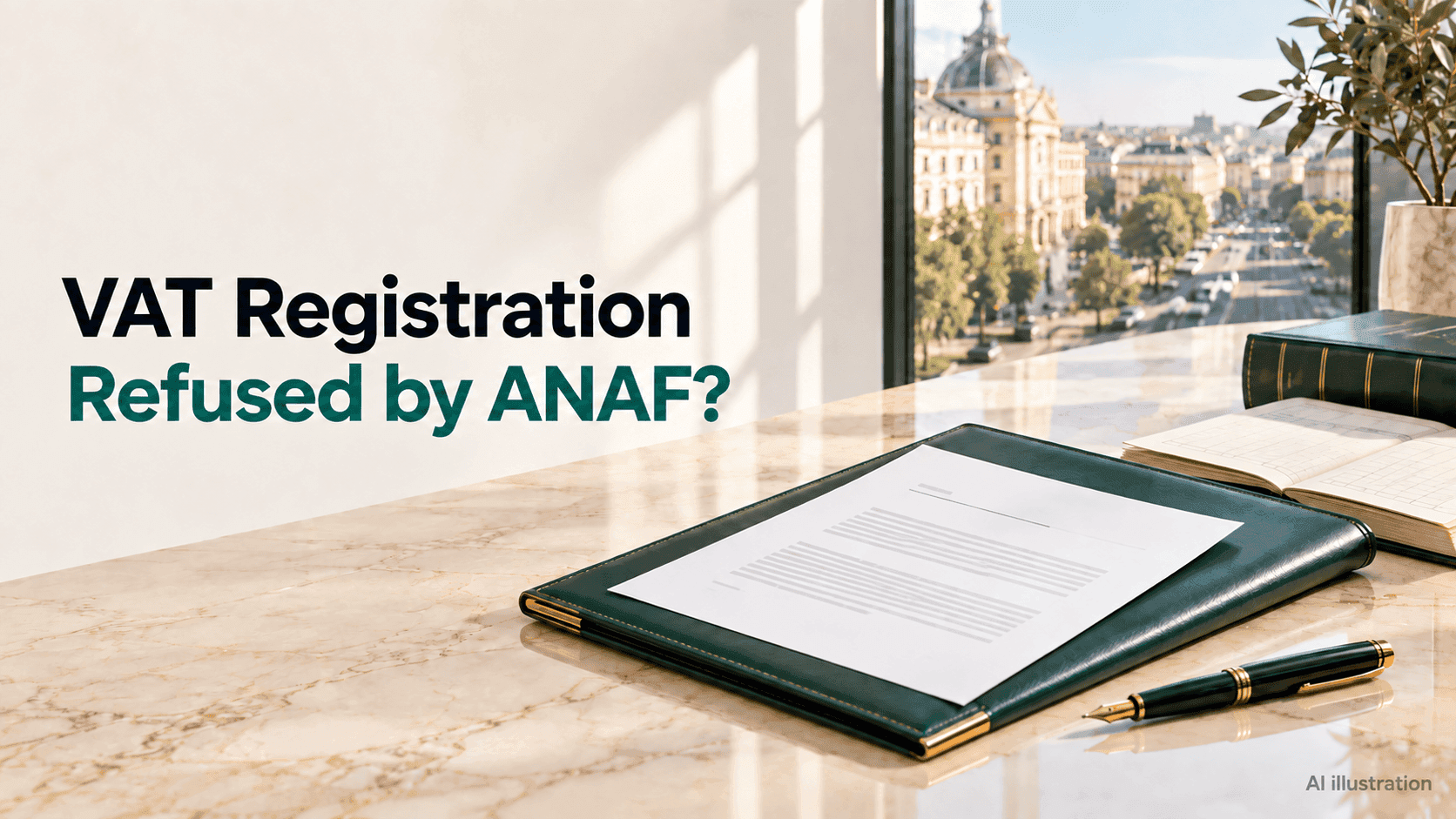
      Legal editorial illustration of a Romanian VAT decision file on a desk, titled VAT Registration Refused by ANAF and marked AI illustration

      ANAF Refuses or Blocks VAT Registration in Romania: What Foreign-Owned Companies Should Review

      Romanian VAT / ANAF decisions / foreign-owned companies

      ANAF Refuses or Blocks VAT Registration in Romania: What Foreign-Owned Companies Should Review

      A blocked VAT registration is a document problem before it is a strategy problem. Identify precisely what ANAF issued, when it was communicated, the legal route used for the application, and the facts stated in the decision.

      This guide addresses a Romanian company with foreign owners whose VAT application has stalled, or whose finance team says that ANAF “refused the VAT number”. It also explains why a Romanian branch or an overseas business may need a different analysis. It is a framework for triage, not a conclusion about a particular company’s entitlement to register.

      First, name the document you actually received

      The phrase “ANAF refused VAT registration” can hide several distinct acts. For taxable persons with their place of business in Romania, ANAF Order 239/2021 governs the registration routes in Article 316(1)(a), (b) and (c) of the Fiscal Code. Under its special procedure for applications based on Article 316(1)(b) or (c), a VAT certificate may, in the specified cancellation situations, be communicated together with a cancellation decision. Read the ground and effective date in the decision. That is not the stated outcome for the Article 316(1)(a) route in this procedure. If ANAF has declined an initial filing, obtain its actual communication and identify the legal basis and remedy; neither a portal error nor an informal description proves that an appealable refusal decision has been issued. By contrast, Order 393/2021 expressly provides for a formal refusal decision in the separate Article 316(12)(e) re-registration route after specified cancellations under Article 316(11)(h). A request for information or a portal validation message is different again. ANAF Order 239/2021 procedure on the Romanian Legislative Portal and ANAF Order 393/2021 risk procedure on the Romanian Legislative Portal.

      Select a situation below to add it to your review file, or combine several situations in the builder.

      Ask the local finance team for the complete communication, including attachments and delivery record, rather than a screenshot of the taxpayer registry. A registry search is useful for checking current public status, but it cannot substitute for the legal grounds or the date on which an administrative act was communicated. The same word “rejection” in internal email may describe a technical filing error, a substantive decision or a missed request for information.

      Build a review file from the facts you have

      Select every situation that applies. The board combines the documents and questions to take into a review meeting. It makes no eligibility finding and calculates no deadline. The choices stay in your browser and are not sent to us.

      VAT decision file builder

      Your facts

      No situations selected

      Your review packet

      Start with the core record below; select a situation to add focused items.

      Documents to collect
      • The full ANAF communication and evidence of when and how it was received.
      • The filed VAT application, attachments and filing acknowledgement.
      Questions for the review
      • Which entity applied, under which provision, and what administrative act exists?

      Which legal route did the company use?

      Article 316 of the Fiscal Code is the starting point, but the correct paragraph depends on the applicant and the registration history. Order 239/2021 covers certain applications by taxable persons with their place of business in Romania: registration around the start of operations, on crossing the small-business exemption threshold, or by opting for the normal VAT regime below that threshold. The current Article 3 differentiates the effective VAT registration date by the route used under Article 316. It was amended by ANAF Order 2633/2025, Article I, on the Romanian Legislative Portal, published on 16 December 2025. Do not assume that all applications take effect on the day ANAF finally communicates a certificate. ANAF Order 239/2021, Article 3, on the Romanian Legislative Portal.

      Foreign ownership of a Romanian SRL does not, by itself, turn the SRL into a non-resident applicant. Examine the legal person that will make the supplies, its place of business, the Romanian branch if any, and the transaction flow. Point 1(2) of the risk-evaluation procedure in Annex 2 to Order 393/2021 excludes Romanian branches of taxpayers whose place of business is outside Romania and who must register under Article 316(2). This is an exclusion from that particular procedure, not a general exemption from Romanian VAT identification. A foreign parent’s VAT position, a Romanian subsidiary’s position and a branch’s position therefore should not be merged into one application narrative. Article 317 concerns a separate, limited VAT identification for specified intra-Community transactions or services; its code does not itself confer normal registration under Article 316. Test the transactions before assuming which route applies. ANAF procedure for Article 317 identification on the Romanian Legislative Portal. ANAF Order 393/2021, Annex 2, point 1(2), on the Romanian Legislative Portal.

      Document → review → next question

      ANAF document response map

      Select a row for the review focus ↓
      Document in handReview firstDo not assume
      Response channel, scope, deadline and evidence requested.A final appealable refusal already exists.
      Cancellation ground, legal basis, effective date and communication.The certificate proves continuing active VAT status.
      Prior cancellation and the applicable re-registration route.Every application follows the same procedure.
      Filing history and complete SPV communications.A registry screenshot starts or settles a challenge period.
      Review focusRespond to the request

      Preserve the invitation and its delivery record. Answer the specific questions ANAF asked, using dated and consistent supporting documents.

      Review the stated grounds, not a generic “ANAF risk” label

      The grounds must be tied to the actual act. Under the consolidated Order 239 procedure, specified checks may include fiscal inactivity and the fiscal-record circumstances identified for the taxable person and relevant persons in the applicable provision. For applications under Article 316(1)(b) or (c), points 5–10 of the consolidated procedure address checks for fiscal inactivity and certain fiscal-record entries and, where the stated cancellation conditions apply, communication of the certificate together with a cancellation decision. These filters must be applied to the precise entity, persons and facts identified by the relevant provision. The checks relating to shareholders or administrators deserve their own evidence review: compare the persons, dates, fiscal-record entries and company-register data with the condition actually invoked, and document any correction rather than assuming that foreign ownership is itself an adverse finding. The dates and consequences must be read from the exact provision and documents; a generic assertion that ANAF can always refuse a new foreign-owned company for “lack of substance” is too broad. ANAF Order 239/2021 procedure, sections II–III, on the Romanian Legislative Portal.

      Order 393/2021 addresses a narrower situation: particular Romanian companies seeking registration again after cancellation under Article 316(11)(h), including the prior intention-and-capacity or fiscal-risk circumstances specified in Annex 2, point 1(1). Other cancellation grounds can engage other re-registration rules under Article 316(12); do not apply the high-risk route to them by default. For the particular Article 316(12)(e) route covered by its risk-evaluation annex, the procedure sets out risk assessment and, before a proposed refusal in the specified high-risk scenario, an opportunity for the taxpayer to be heard and provide information and documents. The applicable criteria must be checked against the current legal text and the ground of the earlier cancellation. The decision is to state the concrete reasons of fact and law. That is a useful review lens for a decision under this route; it is not a universal promise of the same sequence for every VAT filing. ANAF Order 393/2021 risk-evaluation procedure, points 8–13, on the Romanian Legislative Portal.

      For a foreign-owned group, evidence may include signed customer arrangements, the activities performed by the Romanian entity, premises or operating arrangements, personnel or service providers, purchasing and sales records, management roles and the origin of funds. Which items matter depends on ANAF’s stated objection. Submit accurate documents that address the question actually put, with a clear explanation of dates and entities. A stack of unrelated contracts can obscure a simple discrepancy between the application and the trade register.

      Preserve the communication date and assess the challenge route

      A formal fiscal administrative act may be challenged through the administrative objection mechanism in the Fiscal Procedure Code. Article 268 recognizes the objection, Article 269 sets its written content and provides for filing with the issuing tax body, and Article 270(1) sets a 45-day period from communication. Article 270(4) provides a three-month period if the act lacks the appeal information required by Article 46(2)(i). Whether a particular letter or portal event is an administrative act, and how it was communicated, must be examined before applying these rules. Romanian Fiscal Procedure Code, Articles 268–270, on the Legislative Portal.

      Article 278(1) says that lodging an administrative objection does not suspend enforcement of a fiscal administrative act. Article 278(2) preserves the possibility of seeking judicial suspension under Law 554/2004, subject to its conditions; an objection or a suspension request should not be treated as automatic restoration of VAT status. A subsequent court challenge may be available under the applicable fiscal and administrative litigation rules after the administrative objection is resolved. Fiscal Procedure Code, Article 278, on the Romanian Legislative Portal.

      Save the SPV message, the complete PDF, transmission receipt and any postal proof. Record the date the document was legally communicated, not simply the date a manager first forwarded it to headquarters. Have local counsel or a tax specialist verify the applicable computation and any special provision in the decision. The file builder intentionally avoids a deadline calculator because it cannot determine the legally relevant communication event from a date typed into a webpage.

      A corrected filing may be sensible where the problem is a missing item or a mistaken route. A formal objection may be necessary where a decision is legally or factually disputed. These are not interchangeable: filing a new application should not be assumed to preserve an objection period, and lodging an objection should not be assumed to activate VAT status. The decision should be based on the act, the current status and the costs of delay.

      What should headquarters, finance and local management do now?

      1. Freeze the record. Export the full filing, SPV and correspondence trail. Do not overwrite the version originally filed; keep a separate corrected draft.
      2. Assign one owner for the timeline. List applications, ANAF requests, hearings, decisions, communication dates, registry changes and invoices issued. Include who received each notice and on whose behalf.
      3. Confirm the entity and its transactions. Identify the Romanian applicant, the foreign parent or branch, the intended supplies and the place-of-supply assumptions. Check whether the group’s commercial team used “VAT registration” to refer to a different identification or reporting obligation.
      4. Compare every reason in the act with evidence. Make a two-column matrix: ANAF’s finding and the dated document that confirms, corrects or disputes it. Identify gaps rather than inventing explanations.
      5. Choose a procedural response. Determine whether ANAF is asking for more information, has cancelled a registration or has issued a formal refusal decision under the applicable route, including whether an initial application is actually at issue. Verify the decision’s appeal instructions and the available remedy before sending a letter labelled “appeal”.
      6. Control the commercial consequences. Ask finance to assess invoicing, VAT treatment, input VAT and contractual promises during any period of cancellation or pending registration. Consult the current ANAF’s public VAT registry for status, while preserving the underlying decisions as the legal record.

      Illustrative case: a Romanian subsidiary with a cancelled VAT registration

      What the document review can reveal

      Illustrative scenario, not a client testimonial: A foreign-owned Romanian subsidiary prepares its first invoices. Its finance team reports that “ANAF refused the VAT number”, but the file contains a VAT certificate and a separate cancellation decision. The lawyers first identify the application route, compare the two acts and their communication dates, and ask the tax adviser to map invoices against the effective cancellation date.

      The legal review then tests the actual cancellation ground against the company and relevant persons, preserves any objection period and sets out the evidence needed for a response or challenge. The next step depends on the documents and the tax position; this example makes no claim about an actual Atrium mandate or a guaranteed result.

      How a focused legal review can help

      A scoped review can examine the ANAF act, the submitted application, the communications trail and the relevant corporate documents; identify the registration route and procedural clock; and provide a reasoned choice between responding to a request, correcting the record and challenging a decision. For a one-off VAT decision review, the scope and fee are quoted after examining the act and the filing record, and agreed in writing before work begins. For companies needing recurring authority-facing legal support, Atrium publishes an Exclusive subscription from €1,800 per month plus applicable taxes; the hours and exact services are agreed for that mandate. This subscription price is not a quoted fee for a standalone VAT objection. Tax computations, accounting corrections and filings can be coordinated with the company’s tax adviser. No professional can guarantee an ANAF outcome on an unseen record.

      If a transaction depends on the VAT position, send the decision and communication evidence before asking for a fixed commercial timetable. The team can then separate the legal dispute from accounting implementation and give headquarters a list of assumptions that require confirmation.

      Request a review of the ANAF decision   Discuss the file online

      Frequently asked questions

      Can a foreign-owned Romanian company register for VAT?

      Foreign ownership alone is not the deciding criterion. Examine the Romanian company’s activities, Article 316 route and any applicable cancellation conditions. A non-resident entity or branch needs its own analysis.

      Is an ANAF information request a refusal?

      Not necessarily. Read the communication and preserve its response instructions. A request, a refusal decision and a cancellation decision have different procedural implications.

      How long is there to challenge a VAT decision?

      For an applicable fiscal administrative act, the general objection period in Article 270(1) of the Fiscal Procedure Code is 45 days from communication. Article 270(4) addresses an act missing the required appeal information. Verify the act and legally relevant communication date for the case.

      Does a challenge reactivate a cancelled VAT code?

      Do not assume so. Check the registry and the effective terms of the cancellation and seek specific tax advice for transactions during the affected period.

      Should the company apply again or object?

      That depends on whether there is a final act, its grounds, the filing record and the available time. A new filing should not be treated as a substitute for preserving an objection period.

      Disclaimer: This page provides general information only and does not constitute legal advice, a legal opinion or the creation of a lawyer-client relationship. Legal solutions depend on the specific facts and documents involved.

      AI-assisted content.

      Urban planning certificate in Romania illustrated over a property development plan with five certificate routes

      Urban Planning Certificate in Romania: Five Routes Under the 2026 Code

      ROMANIAN PROPERTY & DEVELOPMENT COUNSEL

      The urban planning certificate is often the first document a seller sends to support a proposed Romanian development. Its purpose, contents and validity can change the transaction, the design brief and the route to a building permit. Before committing capital, confirm which certificate you have, what it establishes and which further approvals or procedures your project requires.

      Planning a purchase or project?

      Under Romania’s Code of Spatial Planning, Urbanism and Construction, adopted by Law no. 169/2026 (the “Code”), there are five categories of urban planning certificate. The information certificate is useful for preliminary research; certificates for cadastral operations, buildings and arrangements, engineering works and special constructions address different purposes. None is itself a building permit. Atrium’s lawyers can review a certificate against the title, local planning rules, project assumptions and transaction timetable, then identify the questions for your architect and the issuing authority.

      ONE PROPERTY OR PROJECT

      Request a certificate and planning review

      Send the certificate or proposed request, land-book extract, location plan and a short project brief. We will agree the scope and an upper fee limit before starting.

      Request a defined review
      RECURRING INVESTMENTS

      Discuss ongoing Romanian legal support

      For investors with several sites, align certificate reviews with acquisitions, leases, permit conditions and commercial milestones under one agreed legal-support arrangement.

      Explore monthly support

      Which urban planning certificate does your project need?

      Article 253(3) of the Code classifies certificates by the purpose of the request. Choose the route that matches the proposed legal or construction operation, not merely the document a seller already happens to hold.

      The selector below uses short commercial labels for the five statutory categories: certificate for information, cadastral operations, building or demolition of buildings and arrangements, engineering works, and special constructions. It is a review aid. A certificate can cover more than one purpose under Article 253(5), so the wording and documents submitted with the request still matter.

      Certificate route selector

      Select a purpose to see what the legal review should test.

      Showing: Pre-purchase information

      Information before a commitment

      Obtain a certificate for information and compare its legal, economic and technical data with the investor’s intended use. Under Article 254(1), it gives general information rather than project-specific conditions and is not a substitute for a later building-route certificate when that route is required. For a purchase, check the approved plan, protected status, permissible function, access, utilities and any stated building restrictions before treating the advertised development potential as a transaction assumption.

      What changed under Romania’s 2026 planning and construction Code?

      Law no. 169/2026 and the Code of Spatial Planning, Urbanism and Construction came into force on 25 August 2026. Under Article 576(3)(a)–(b), the Code repealed Law no. 350/2001 and Law no. 50/1991 when it entered into force, subject to the transitional provisions, including Article 582. The certificate is now described by category in Articles 253–258; Article 253(3) lists five categories, including special constructions.

      The certificate remains an instrument for informing the applicant of current rules, permissions and restrictions. Article 253(2) states that it does not give the right to execute construction or demolition works. The information certificate is different in legal character from the other listed certificates: Article 253(1) describes the certificate as an administrative act, except for the information certificate under paragraph (3)(a). The response to a restrictive or negative certificate depends on its legal effects, reasons and procedural context and should be assessed before choosing a challenge route. Under Article 253(9), certificates in categories (b)–(d) issued without content elements required by law are void; the competent administrative court establishes that nullity under the statutory conditions. This concerns the certificate itself and is distinct from the nullity of specified cadastral operations and related acts under Article 256(2).

      The commercial change is that the purpose of the request becomes harder to overlook. The Ministry of Development’s CATUC page provides information about the new Code. For the site itself, check the approved planning documents and the issuing authority’s file. If a purchaser wants only to understand a site, an information certificate can support early diligence. A developer preparing a concrete project should work with the architect on the certificate for buildings and arrangements or the engineering route as applicable. A planned parcel division calls for a separate cadastral analysis. In each case the approved local planning documentation and the actual certificate control the project-level answer.

      Can a certificate for information establish that the plot is buildable?

      It can reveal current planning parameters, but it does not confirm that a particular design can be authorised. Article 254 describes a general information document, not a certificate tailored to the investment proposal.

      The information route is available to any interested individual or company. It addresses the property’s legal, economic and technical regime and may help before a land purchase, lease negotiation or development feasibility decision. Article 253(4) sets out content elements for urban planning certificates generally, including property status and rights known to the issuer, approved planning rules, permitted or prohibited functions, occupancy and floor-area parameters, access, parking, height and utilities information held by the authority. The information certificate does not certify that the seller has good title or that the proposed building satisfies all technical rules.

      Under Article 254(6)–(7), the information certificate is to be issued within five working days where the local authority has a functional information system, or within ten working days until that system operates. Those periods concern this category, not every certificate. Check the actual local filing channel. For registered property, the application identifies the cadastral number; the Code has separate location-plan and land-book provisions for property with incomplete cadastral data. For a property entered in the land book but lacking updated cadastral data, Article 254(11) also requires an updated land-book extract. Under paragraph (12), that extract must be no older than 30 days when the certificate request is submitted. The ANCPI online land-book service provides access to extracts; compare the extract with the cadastral identifier on the certificate.

      For the purchaser, the question is whether the contractual promise is narrower or wider than the verified planning position. A seller’s assertion that land is “buildable” does not establish that the purchaser’s specific project, access arrangement, parking count or required utility capacity can be authorised. Before paying a substantial non-refundable deposit, connect the current certificate and approved plans to an architect’s feasible design and the purchase agreement’s conditions. Our real estate due diligence guide for Romanian buyers explains the wider title and transaction review.

      When does a cadastral operation need its own certificate?

      The Code uses a distinct certificate for the operations listed in Article 256(1): division, merger, registration of passage servitudes, and recording or re-recording properties in the land book (evidențieri/reevidențieri de imobile în cartea funciară). Under Article 256(2), those listed operations and their related legal acts carried out without the required certificate or in breach of its conditions are subject to absolute nullity. Paragraphs (10)–(11) state exceptions for certain nationally significant transport infrastructure works and operations in special-destination areas. The first task is to determine whether the proposed operation falls within the provision. This can be a material acquisition risk where the investment model depends on creating separate plots or access rights.

      For the application, Article 256(7) refers to an up-to-date land-book extract or location plan where no cadastral registration exists, an owner’s authorisation if the applicant is not the owner, and cadastral documentation prepared by an authorised person based on a proposal from an architect or urban planner. The Code states a ten-working-day issuance period in paragraph (4). Under Article 256(8), the authority may issue a reasoned negative certificate, reject an incomplete file with reasons or, for a division into more than three parcels, issue the certificate with a PUZ requirement in the circumstances stated there. Paragraph (9) requires a PUZ obligation for the particular urban-planning operations referred to in Article 214(1). Those routes should be checked against the proposed survey and the precise statutory case.

      A purchase agreement should therefore avoid assuming that a parcel split or right of access will be completed simply because a survey plan exists. The urban planning certificate, cadastral documentation and land-book entry are distinct steps. Confirm the applicable registration procedure with the National Agency for Cadastre and Land Registration (ANCPI) and the surveyor for the particular operation. Check the sequencing with the surveyor and notary: certificate, technical documentation, any planning condition, cadastral registration and final transfer may fall on different dates. If the transaction is conditional on a particular parcel configuration, state who bears the work, the cost and the risk if the authority’s conditions differ from the negotiated plan.

      What should an investor check in a building-route certificate?

      Article 257 deals with a certificate for building, demolition, changes to construction in progress and regularisation. It is addressed to a holder of a real right over the property under the conditions of that provision. The application for new construction and horizontal extensions is supported by a current land-book extract, a proposed site plan and a concise description of the investment, with distinct rules for other works. A preliminary sale agreement alone does not give the prospective buyer a real right over the property. If the purchase depends on a building-route certificate, distinguish the qualifying applicant from the person filing on that applicant’s behalf. An authorised representative should identify the existing right-holder and the basis of representation; the authorisation does not itself give the buyer the right required of the applicant. Allocate the certificate condition in the purchase contract, and do not assume that a lease or development agreement automatically supplies the required right.

      Right, property and applicant. Compare the land-book entry, parcel identifier, ownership or other qualifying right, applicant and any consent. A mismatch may require a transaction step before the application is ready.

      Planning fit. Compare the project’s proposed use, footprint, height, access and parking with the certificate and the approved local planning documents. The architect should confirm whether the design works within those limits.

      Required planning procedure. Article 257(9) contemplates a direct certificate, a PUD requirement, a PUZ requirement in the cases provided by law, or a reasoned negative certificate. These outcomes have very different costs and timings.

      Endorsements and validity. Check the full list of opinions and approvals, any distinction between planning-stage and permit-stage items, and the certificate’s actual expiry. A loan or lease timetable should not assume that all endorsements are interchangeable.

      The Code sets a 15-working-day issuance period from registration of the request for this certificate in Article 257(4). Under paragraphs (15)–(17), the authority generally sets validity at 12–36 months. The holder must request an extension at least 15 working days before expiry; the extension can last up to 24 months, after which a new certificate is required. For public-investment projects, paragraph (18) allows validity up to 60 months, with a special rule for national transport infrastructure. Check the printed expiry and the statutory extension deadline against the transaction timetable. Do not confuse the State Inspectorate in Construction’s supervisory role with that of the authority legally competent to issue the certificate for the particular project.

      If the certificate requires a PUZ or PUD, ask whether the demand is supported by the approved general plan and the Code. Article 257(10) provides that, where a PUD or PUZ is required, the certificate can be used for the requested purpose only under the relevant conditions and after the planning document is approved; it remains valid for another 12 months after that approval. A negative certificate must be read with its factual and legal reasons; it is not the same thing as an incomplete application or a final refusal of a building permit. A targeted legal review can establish what to ask the authority to clarify, whether redesign or planning work is needed, and which procedural route should be assessed with counsel. If a later application is rejected, our building-permit refusal guide explains the next legal questions.

      How do engineering works and special constructions differ?

      Article 258 gives engineering works a distinct certificate. It addresses construction, demolition, modification and regularisation of those works and states that the beneficiary need not hold a principal real right over all affected properties merely to request that certificate. That is a rule about obtaining the certificate, not a general licence to enter, occupy or build on someone else’s land. Project rights, consents, easements, expropriation routes and the later permit still require separate analysis.

      The general period in Article 258(2) is 15 working days from filing the request. Paragraph (4) sets a distinct 15-calendar-day period for the specified transport-infrastructure works, with listed information about affected properties, planning conditions, studies and endorsement authorities. These different units of time should not be collapsed into one deadline. For public engineering investment, Article 258(5) allows validity up to 60 months, subject to the separate national transport rule. For special constructions, Article 253(3)(e) and (7) assign the special certificate to competent defence, public-order and national-security institutions on the basis of a local information certificate; the applicable procedural deadline must be checked for that special route.

      In a private development, these distinctions can surface when a building requires roads, utility extensions or works crossing several properties. The building file and the infrastructure file may involve different applicants, consents, authorities and contract responsibilities. Ask the engineers to describe each package and counsel to align the rights and agreements. A certificate for the principal building should not be assumed to resolve every utility or access work.

      What does the certificate comparison mean for the investment decision?

      The table links each document to a commercial decision. Select a row to see the practical review question beneath it.

      Certificate and transaction decision map
      Project positionDocument to testCommercial exposureDecision to make
      Information certificate, approved plan, land book, design briefAdvertised potential may not match the intended scheme.Condition the purchase on an adequate legal and technical review.
      Cadastral certificate, survey plan, owner’s authorityThe target parcel or access structure may not be registrable.Align surveyor, notary and transaction deadlines.
      Building certificate, title, project, endorsement listExtra planning work or a negative position changes the budget.Revisit the design, price and long-stop dates.
      Engineering certificate, easements, utility agreementsAccess or utilities may depend on third-party property.Assign rights, consents and infrastructure work in writing.
      Issue date, printed validity, earlier approvals and file historyWrong transition assumptions may derail a live application.Document the applicable authority and surviving endorsements.
      Buying a siteTreat the information certificate as an initial planning signal, then verify the design and purchase conditions separately.

      Can a certificate issued before August 2026 still be used?

      A pre-Code certificate can retain its validity, but the subsequent permit route requires a separate check. Article 582(4) preserves certificates issued before the Code entered into force and addresses the permit authority and endorsements associated with those certificates. Paragraph (5) addresses a later change in the authority competent to issue the permit. Paragraphs (1)–(2) concern planning and territorial-planning documentation already in progress and a possible simplified route for outstanding endorsements in those procedures. They should not be treated as a general reset of every building-permit file. Reconstruct the filing dates, certificate, competent issuer and endorsement history for the particular project.

      For a pending acquisition, request the actual certificate, original application, issuer’s correspondence, planning history, endorsement list and proof of expiry or extension. Compare the certificate’s purpose with the buyer’s planned works. An earlier certificate for a different scope is not made suitable simply because it is still within its validity period. The building-permit refusal guide deals with the different situation where the authority has already declined a later permit application.

      What would an Atrium review cost, up to a defined limit?

      Proposed initial scope: up to €500, including taxes, for no more than five hours of legal work. This cap covers one property and one certificate or draft certificate request, a land-book extract, the relevant available planning documents, a concise project description, and a written list of legal issues and next questions. This proposed capped engagement is subject to written acceptance of the scope and fee before work begins. It is not a statutory fee, an automatic quote for every project or a promise to obtain a certificate.

      The figure is consistent with Atrium’s published hourly range of €60–€100 including taxes when the reviewed work is limited to five hours. A narrower review may require less time and a lower agreed fee. If a multi-site portfolio, historical planning file, contested certificate or extensive negotiations require more work, we would first define a new scope and fee with the client. Architect, surveyor, engineer, authority, notary, registry and litigation costs are outside this proposed legal-review cap unless expressly included in the engagement. Municipal certificate fees are separate and depend on the applicable fiscal and local rules; Article 253(10) refers to the relevant Fiscal Code provisions.

      For repeated acquisitions and operational questions, a scoped monthly arrangement may be more useful than commissioning unrelated reviews. Atrium’s Romanian law office subscription options set out available monthly allocations and terms. Real-estate transactions and development projects should be expressly included in the engagement scope rather than assumed to fall within a general monthly allocation. Project-specific technical services and authority charges still require separate budgeting.

      What documents should management send for a first review?

      Send what already exists; an initial conversation need not wait for a perfect file. A compact index is more useful than an unlabelled archive. For a proposed purchase, the most valuable items are the current land-book extract, cadastral identification, seller’s planning materials, approved plan references, certificate and project brief. For a submitted request, include the exact filed version and all authority communications with dates and proof of receipt.

      Open each card to see what to send and what the review tests.

      Property and rightsWho may apply for this project?

      Land-book and cadastral documents, title or lease, relevant servitudes, seller correspondence and identity of the proposed applicant.

      Why it matters: Compare the applicant’s right with the works and the parcel described in the request.

      Planning and proposalWhat can the certificate answer?

      Existing certificate, request draft, applicable plans, architect’s short brief, desired use, footprint, access and estimated timing.

      Why it matters: Identify the planned use and any gap between the certificate and the actual design brief.

      Contracts and deadlinesWhich commitment depends on approval?

      Purchase or lease draft, deposit terms, financing milestones, contractor timetable, authority notices and endorsement status.

      Why it matters: Map the deposit, long-stop dates and exit conditions against the real planning route.

      The review can then ask one useful question: which unverified assumption is most capable of changing the investment decision? For one client it may be title or access. For another it may be a zoning-plan requirement, validity date, protected status or the wrong type of certificate. The right response may be a clarification request, a redesign, a condition precedent or a decision to postpone the transaction. A Romanian lawyer advising on property development can connect those legal consequences to the documents; the technical feasibility of a design remains with the qualified architect and engineers.

      Illustrative Scenario: Reviewing a Site Before Acquisition

      The situation. Consider a company evaluating land near Bucharest before paying a non-refundable deposit. The seller describes the site as suitable for development, but the certificate supplied contains general planning information rather than project-specific conditions.

      The legal review. A Romanian lawyer would compare the certificate with the land-book extract, applicable planning documents and proposed purchase terms. Questions about access, permitted use and a project-specific application would be separated from design issues for the architect and points requiring confirmation by the issuing authority.

      The decision point. Management could make the purchase conditional while the architect tests the design against planning rules. The legal review would help allocate planning risk in the transaction without guaranteeing that a building permit will be issued.

      This is a hypothetical scenario for general information. It does not describe a verified Atrium client mandate or predict an outcome in another project.

      Frequently asked questions

      Is an information certificate enough to apply for a building permit?

      Do not assume so. The information certificate under Article 254 provides general property information. The building-route certificate under Article 257 concerns the conditions for a specific investment and identifies necessary studies and endorsements. Check the precise scope and current Code requirements with the designer and competent authority.

      Can a buyer request a certificate before becoming the owner?

      An information certificate can be requested by any interested person under Article 254(2). The building-route certificate under Article 257(1) is framed around the holder of a real right. A preliminary purchase agreement alone does not create that right. Other categories have their own application rules, so identify the purpose and how the application will be made with or through the existing right-holder before filing.

      Does a negative certificate mean that no project can ever proceed?

      No universal conclusion follows from that label alone. Article 257(9)(d) addresses a reasoned negative certificate in specified circumstances. Read its factual and legal reasons against the approved plans, project description and possibility of lawful changes. The correct response could be clarification, redesign or a procedural challenge, depending on the document and circumstances.

      Are all five categories subject to the same issuance deadline?

      No. Articles 254, 256, 257 and 258 give distinct periods: five or ten working days for information depending on the authority’s functional information system, ten working days for cadastral operations, fifteen working days for buildings and generally fifteen working days for engineering works, with a fifteen-calendar-day transport rule in the specified case. The special-construction category is separate; do not assume one of those ordinary periods applies without checking its governing procedure.

      Is the proposed €500 cap the total cost of a development file?

      No. It is a proposed ceiling for a defined first-stage legal review of up to five hours, if accepted in the engagement terms. It does not include technical design, cadastral work, official fees, outside advice, later applications or disputes unless separately agreed. The scope and fee must be confirmed before work starts.

      Related Guides

      NEXT PROJECT DECISION

      Test the certificate before a deposit or design commitment

      Share the certificate, land-book extract and proposed use. We can define a capped first-stage legal review and identify the technical questions to discuss with your architect.

      Contact Atrium

      Disclaimer: This page provides general information only and does not constitute legal advice, a legal opinion or the creation of a lawyer-client relationship. Legal solutions depend on the specific facts and documents involved.

      AI Notice: AI-assisted content.

      Building Permit Review: architectural plans and an indexed permit dossier on a Romanian legal-office desk.

      Building Permit Application in Romania: Legal Review Before Filing

      ROMANIAN CONSTRUCTION & REAL ESTATE COUNSEL

      A building-permit application can be technically impressive and still be commercially unready. Before a developer commits to a construction start, funding drawdown or tenant opening date, the title, urbanism certificate, project, endorsements and transaction documents need to tell the same story.

      Considering a filing?

      Atrium can review the legal side of a Romanian building-permit file alongside your architect and technical team: the applicant’s right to build, the planning and endorsement route, documentary inconsistencies, transition issues under the 2026 Urbanism and Construction Code, and the conditions in the contracts that depend on authorisation. The output is a prioritised issue list and a filing decision, not a promise that an authority will grant a permit.

      PROJECT REVIEW

      Request a building-permit file review

      Send the urbanism certificate, land-book extract, project index and endorsement status for a scoped first assessment.

      Discuss a pre-filing review
      PORTFOLIO SUPPORT

      Discuss ongoing legal support

      For developers handling repeated acquisitions, planning files and construction milestones, ask about a continuing legal contact for the project pipeline.

      Discuss ongoing support

      Is your building-permit file ready for a legal review?

      A useful review begins with the project stage. The legal questions differ if the plot has not been acquired, a valid certificate was issued under the previous legislation, an application is almost ready, or the authority has already requested corrections.

      Choose the position closest to your project. The panel changes to show the first documents and commercial decision to examine. It is a triage aid; it does not determine whether a permit must be issued.

      Project stage selector

      Select a stage to see the legal review route.

      Before you buy or commit

      Obtain the current land-book and cadastral extracts, planning position, access evidence, utility assumptions and a precise description of the proposed use. Ask whether the seller actually holds the rights, certificates or endorsements being marketed. The immediate commercial task is to connect the proposed price and closing timetable to a realistic authorisation route. A statement that a plot is “buildable” does not, by itself, establish that the proposed works can be authorised under the applicable planning, title, access, infrastructure and endorsement requirements.

      Which law governs a Romanian building-permit application now?

      Law no. 169/2026 enacted the Code on territorial planning, urbanism and construction. It was published in Official Gazette no. 661 on 10 August 2026. Under Article 575, it entered into force 15 days later, on 25 August 2026. Article 576(3) repealed Law no. 50/1991 and Law no. 350/2001 on entry into force, subject to the Code’s transitional provisions. A current filing should therefore start with the Code rather than an old checklist that treats Law no. 50/1991 as the ordinary live permitting regime.

      The transition is more nuanced than a simple change of label. Article 582(1) keeps certain procedures for preparing, endorsing and approving planning documents that began before entry into force under the law applicable when they were initiated, while paragraph (2) permits a simplified route for some outstanding endorsements. Under paragraph (4), urbanism certificates issued earlier retain their validity; paragraphs (4) and (5) also address the authority competent to issue a later permit where responsibilities change. These rules should not be read as a blanket instruction to process every later permit application under the previous law. Counsel should identify the type and date of each step, the certificate’s continuing validity and the applicable issuing authority.

      Check the Code on Romania’s Legislative Portal, the applicable certificate, approved planning documentation and the authority’s operative submission requirements for the specific site. The State Inspectorate for Construction’s legislation page also lists the 2026 Code. Article 575(2) expressly states that application of the Code is not conditional on secondary or tertiary legislation. That rule is separate from the practical availability of forms, implementing procedures or a digital filing platform. Confirm the filing channel and documentary requirements with the competent authority for the specific project.

      What does a pre-filing legal review actually test?

      The review is a decision tool for the investor, not a second architectural project. Article 262 lists at least the application; recent cadastral and land-book extracts and, where applicable, evidence of the right allowing construction; the project registration evidence explained by the Romanian Order of Architects for buildings; the project for authorising construction; relevant complementary documentation; environmental acts and other required endorsements; certain neighbour-related studies where relevant; the estimate, timing and value of the investment; and applicable project-verification reports. Article 263 specifies information to be included in the application, including the applicant, property, certificate, designer, proposed works and urban-planning parameters. These are not interchangeable documents.

      First, the applicant’s right to build. The name on the application should be compared with the land book, the actual title or other right relied upon and the proposed contractual structure. The National Agency for Cadastre and Land Registration’s online service provides access to land-book and cadastral documents. Article 245 and Article 248, read with Article 262, require the applicant’s legal entitlement to fit the proposed works. Ownership is not the only possible basis, but rights of claim support construction only in the cases and conditions provided by law, including specified temporary works, repairs and non-structural interior works with the owner’s consent. A standard lease or development agreement does not automatically entitle its holder to build a permanent new structure. Check the right’s scope, duration, evidence and necessary consents before relying on it. A share deal may leave the property-owning company unchanged; an asset deal may introduce a new applicant. The timing of that change can affect the file.

      Second, the planning position. The certificate of urbanism and approved plans must be read against the actual design brief. A project advertised as residential, logistics or mixed use may encounter different restrictions on function, setbacks, height, access, parking or protected status. Counsel should flag any discrepancy between contractual assumptions and the applicable planning documents for the architect and urban planner to resolve. The certificate’s effect depends on its type, content, issue date, validity and applicable planning documents. Under Article 253(2), a certificate does not itself confer the right to execute works or assure approval of a later design.

      Third, the endorsement route. Article 266 links required opinions and approvals to the site’s location, complexity, risk and type of work, with the list communicated through the certificate. Article 269 sets rules for obtaining certain opinions through the single-agreement commission and for other routes, with exceptions and conditions. A timeline that treats every endorsement as identical is unreliable. Review which authority issues each item, whether the supporting documentation is ready, what conditions have been imposed and whether an earlier planning-stage opinion remains usable at permit stage under the precise conditions of the Code.

      Fourth, the technical-to-legal handover. Article 264 requires the project for authorising construction to comply with applicable planning and technical rules and to be prepared and signed by the responsible specialists. The lawyer should not certify structural design, fire calculations or a geotechnical study. The lawyer can, however, compare the versions submitted to different bodies, identify a legal condition omitted from the project brief and ensure the investor understands what the specialist must confirm. A coherent file has one controlled version of the location, function, area, elevations and proposed works across the application and its annexes.

      Pre-filing decision map: what the document means for the investment
      Review pointDocument to compareBusiness exposureDecision before filing
      Land book, cadastral plan, title or other qualifying right, applicant detailsThe intended applicant may lack the necessary legal basis for the proposed works.Confirm the right and any transaction step needed before submission.
      Urbanism certificate, approved planning rules, current design briefA redesign may affect usable area, tenant requirements or price.Resolve the planning gap with the architect and update the financial model.
      Certificate list, application history, issued opinions and conditionsAn assumed clearance may be missing, expired, conditional or irrelevant.Assign an owner and evidence for every required route.
      SPA or lease, financing term sheet, construction programmeA fixed closing, rent or drawdown date may arrive before authorisation.Align conditions, long-stop dates and termination rights with real dependencies.
      Dates of earlier certificate, planning steps, prior correspondenceThe parties may cite the wrong statute or approach the wrong authority.Document the applicable route under Article 582 and identify the issuer.
      Right to buildVerify who will apply, the legal right permitting the proposed works and any closing step needed to put that right in place.

      When should a developer bring counsel in?

      The most valuable moment is often before a land purchase, long lease or major design spend becomes unconditional. If the economic model assumes a particular gross floor area, use class, delivery date or street access, ask for a legal review of those assumptions while the contract still has room for conditions precedent. Real estate due diligence should connect title and encumbrances to the actual permit strategy, rather than deliver a land-book report in isolation.

      For a purchase, identify exactly what is being acquired: land with no certificate, a certificate, a planning approval, an application in progress or an issued permit. Define who owns the designs and studies, whether their use can be transferred, who will answer authority requests and who bears the cost of a required redesign. If the buyer’s desired use depends on a planning change or endorsement, a vague “subject to obtaining permits” clause may not allocate the risk adequately. The condition should identify the permit or objective standard, the responsible party, a workable long-stop date and the consequences if the desired authorisation is not obtained.

      A lease for a retail, industrial or hospitality site adds a different issue: the build-out approval and the business’s operating approval can be separate legal tracks. The landlord may own the shell while the tenant bears fit-out obligations and an opening deadline. Counsel should map the permitted use, responsibility for works, access to plans, landlord consents and rent commencement against the required construction and operational approvals. The local operating-approval guide addresses the distinct municipal trading authorisation; neither approval should be presented as a substitute for the other.

      Funding documents and development contracts deserve the same alignment. A lender may require a valid permit before first drawdown. A contractor may assume unobstructed site access by a fixed date. A forward purchaser or tenant may have remedies if the project is delayed. The review should translate permit uncertainty into conditions, evidence requirements, extension mechanics and reporting obligations. It should also assign a person to monitor the certificate’s validity and any expiry or condition attached to an endorsement.

      How do the new filing and clarification rules affect the timetable?

      Article 270 provides for submission to the competent authority or, after it becomes operational, the national one-stop desk. It permits written or digital filing and contains signature rules for digital documents. Do not assume a platform feature is already operational for a particular municipality. Confirm the local filing channel and preserve the submission receipt, versioned index and proof of every transmitted annex.

      Article 271(1) requires the authority, when it finds the documentation incomplete or requiring technical clarification or modification, to notify the applicant in writing of all identified deficiencies within a maximum of ten working days from registration. The notice sets a completion period of no more than three months from receipt. Under paragraph (3), that cap does not apply when the requested change concerns acts of the environmental authority; the authority must set a period allowing the applicant to obtain the necessary completion. Article 273(1) provides a maximum of 30 calendar days for issuance from submission of complete documentation. Under paragraph (3), where the applicant opts for the final single agreement through the commission, that period runs from issuance of the agreement. Paragraph (2) provides a requested urgent procedure of up to seven working days, for which the local authority may charge a special fee. These statutory periods are procedural benchmarks, not guaranteed approval or opening dates; their operation depends on the complete file, endorsements, lawful clarification requests and the project’s history.

      When a notice arrives, prepare a response matrix: each deficiency; the document or explanation that addresses it; the responsible architect, engineer, environmental consultant or lawyer; and the deadline supported by proof of receipt. If the authority asks for something apparently outside the certificate or the law, record the basis of the request and obtain a reasoned response rather than silently changing the project. If an item is genuinely missing, file a corrected version with an index that makes the change easy to locate. Article 273 addresses what happens when documentation is not completed within the set period and the possibility of completing and resubmitting during the certificate’s validity.

      A permit and a site start are different decisions.

      Article 264(5)–(6) distinguishes the project used for authorisation from the technical execution project and prohibits starting construction without the latter, except where the Code provides otherwise. Article 246(3) also ties the start of authorised works to the technical execution project, subject to Code exceptions. Before starting, confirm the execution documentation, applicable statutory notifications, site-management requirements and project-specific permit conditions. A positive permit decision does not replace them.

      Can silence on an endorsement rescue a delayed application?

      The Code includes a conditional tacit-endorsement mechanism under Article 269(14)–(16); it does not apply to every opinion or approval. It depends on the applicable route and deadline, a complete and correct file, and whether the issuer requested clarification or issued a reasoned rejection in time. Paragraph (15) excludes opinions from the specified defence, public-order and national-security institutions from tacit issuance. Paragraph (16) addresses the filing evidence and beneficiary declaration needed where the authorisation procedure continues without an express opinion. When the paragraph (14) conditions are met and the beneficiary validly invokes tacit approval, that paragraph says a later-issued opinion has no legal effect. Environmental, heritage and other specialist requirements still need review under their applicable procedures. Do not infer from silence alone that every missing approval exists.

      Most importantly, an endorsement treated as granted is not the building permit. The application must still satisfy the Code’s requirements, the project must comply with applicable planning and technical law, and the competent authority must determine the permit application. If an endorsement has substantive safety, heritage or environmental implications, ask the technical team to verify compliance even where a procedural rule may allow the authorisation process to continue. The commercial cost of a later challenge can exceed the time saved by a poorly evidenced tacit-approval argument.

      Representative Experience: A permit-dependent commercial opening

      The situation. Atrium advised a company after a Romanian local authority refused the operating approval required for a new commercial location. The proposed opening depended on that municipal authorisation, and the business had already undertaken a significant lease commitment with a planned launch timetable.

      Our work. The lawyers reviewed the refusal, the applicable provisions of OG no. 99/2000, the local council rules and the documents submitted with the application. The work included regulatory due diligence, analysis of available remedies, document review and advice on the commercial and timing consequences. The review distinguished requirements that needed evidence or clarification from risks embedded in the client’s opening plan.

      Why it matters here. That matter concerned an operating approval, not an application for a building permit. It illustrates a recurring development issue: a lease, design and opening programme may depend on several different public-law approvals. For a construction project, a pre-filing legal review should identify each separate authorisation, its responsible party and its place in the contract timetable. We do not suggest that this operating-approval engagement establishes a particular result for a construction-permit application.

      This anonymised description omits client-identifying information and does not set out every aspect of the matter or any litigation outcome. Past engagements do not predict future outcomes; each matter depends on its own facts, documents and applicable law.

      What should management send for a first review?

      A focused first instruction saves time. Send what already exists and mark what is missing; do not postpone contact until the application looks perfect. Atrium can scope a single-file review or discuss ongoing legal support for a portfolio. The architect and specialist consultants remain responsible for their respective technical designs and certifications.

      Site and rights

      Land-book and cadastral extracts, acquisition or lease documents, easements, co-owner arrangements and the identity of the intended applicant.

      Planning and design

      The urbanism certificate, approved planning references, current project brief, project for authorising construction and a document index with version dates.

      Approvals and schedule

      All issued or pending endorsements, authority correspondence, environmental position, desired filing and opening dates, and the contract milestones linked to the permit.

      State the business decision in one sentence: “We want to sign for this land next month,” “We need to file before a lender condition expires,” or “The authority has asked for a response by a certain date.” That allows counsel to prioritise the issues that affect the decision, rather than produce a general recital of the statute. A first review can identify documents to obtain, questions for the architect, contract clauses to adjust and whether a more detailed opinion is necessary.

      For repeat projects, a continuing arrangement can cover the recurring legal layer: early site screens, certificate and title checks, contract milestone review, tracking of formal authority correspondence and coordination with the specialist team. The appropriate scope depends on the number and type of active sites. Atrium’s real estate practice can discuss the mix of one-off and ongoing legal support for companies that fits the pipeline.

      Frequently asked questions

      Does a certificate of urbanism guarantee a building permit?

      No. It identifies the planning and documentary framework applicable to the proposed works. The application, qualifying right, project and relevant endorsements must still meet the Code and site-specific requirements.

      Can a certificate issued before the 2026 Code still be used?

      Article 582(4) preserves the validity of certificates issued before the Code entered into force. Check the certificate’s own validity, the earlier file, outstanding endorsements and the competent issuing authority. It does not automatically place every later permit application under the old law.

      Is the statutory 30-day period a guaranteed approval date?

      No. Article 273(1) measures its general period from complete documentation, while paragraph (3) starts that period from issuance of the final single agreement where that route is chosen. A clarification notice, outstanding endorsement or other applicable procedure affects the practical timetable.

      Can our company rely on a tacit endorsement and start works?

      Article 269 may treat certain endorsements as granted if its conditions are met, with exclusions. That does not itself grant a building permit or satisfy the requirements for starting construction. The precise documents, filing evidence and technical obligations need separate review.

      Should the architect or a lawyer handle the file?

      Both roles can be necessary. The architect and engineers prepare and certify technical documentation. Counsel reviews the right to build, statutory route, legal consistency, authority correspondence and the contracts or financing commitments tied to authorisation.

      Related Guides

      NEXT PROJECT DECISION

      Review the file before the commercial deadline becomes fixed

      Share the certificate, title and document index. We can discuss a defined pre-filing review or continuing legal support across multiple Romanian sites.

      Contact Atrium

      Disclaimer: This page provides general information only and does not constitute legal advice, a legal opinion or the creation of a lawyer-client relationship. Legal solutions depend on the specific facts and documents involved.

      AI Notice: AI-assisted content.

      Term-sheet documents on a law-office table overlooking Bucharest, illustrating a Romanian company acquisition.

      Negotiating a Term Sheet for a Romanian Company Acquisition

      Romanian M&A · Pre-acquisition negotiation

      The first signed document in a Romanian company acquisition can shape the price, timetable and negotiating leverage long before the share purchase agreement is ready. A term sheet should tell both sides what they are exploring, what remains open and which limited commitments take effect immediately.

      In brief: Identify the buyer, seller, target and proposed transaction before discussing a headline price. State precisely which provisions are binding, especially confidentiality, exclusivity, costs and dispute resolution, and which commercial terms remain subject to due diligence and final documents. Define the valuation assumptions, access to information, necessary approvals and a realistic process timetable. Review the target’s company form and articles of association early. A term sheet can help a deal move faster, but careless drafting can create an unintended commitment or an expensive exclusivity period.

      Need a term sheet reviewed before signature?

      A focused review can usually start with the proposed term sheet, the target’s company form, the proposed ownership percentage, the latest accounts and the intended signing date. Atrium can identify the clauses that are binding now, the commercial assumptions that need definition and the Romanian-law checks that affect the transaction timetable.

      A brief description of the parties and proposed deal is enough for an initial enquiry. Sensitive financial or employee files can follow through an agreed secure process.

      What does a term sheet do in a Romanian company acquisition?

      A term sheet records the principal negotiating parameters before the definitive acquisition documents are prepared. Its legal effect depends on the actual wording and parties’ conduct, rather than its title alone.

      It may be called a letter of intent, memorandum of understanding, heads of terms or indicative offer. The useful question is not which label appears at the top. Ask whether it is a framework for continuing discussions, a set of immediately enforceable process obligations, or a commitment to enter into a future transaction on sufficiently settled terms. Romanian Civil Code rules on negotiations, confidentiality and promises to contract make that distinction important.

      This article concentrates on a private acquisition of shares or social parts in a Romanian company, particularly an SRL (limited liability company). For an SRL the interests are părți sociale and the owners are asociați; an SA has shares (acțiuni) and shareholders (acționari). “Share purchase agreement” or SPA is a common international deal label; the definitive instrument for an SRL must reflect the actual transfer of social parts. An acquisition of specified assets, a minority investment, a joint venture or a regulated-company takeover can require a different document set and approval analysis. Our guide to the Romanian share purchase agreement covers warranties, conditions, closing and post-signing risk allocation in the later contract. The term sheet should set the negotiating direction without trying to replace that work.

      The best early draft also names the real decision-makers. A founder might be negotiating, while another shareholder must approve the sale. A parent might propose to buy, while a different group company will sign the SPA. Identifying the parties avoids vague promises that cannot be carried into final documents without reopening the commercial deal.

      Which term-sheet provisions can bind the parties?

      A clearly drafted term sheet can leave the proposed sale non-binding while making specified process clauses binding. Each binding clause should be identified expressly, with its parties, start date, duration and consequences.

      Article 1183 of the Romanian Civil Code recognises freedom to begin, continue and end negotiations, subject to good faith. Starting or continuing talks without a genuine intention to conclude a contract is an example of conduct contrary to good faith. Ending talks, or simply failing to complete the acquisition, does not itself create liability: a claim requires conduct contrary to good faith and proof of the resulting loss under the applicable rules. Article 1184 addresses confidential information communicated during negotiations. A separate non-disclosure agreement can make scope, permitted recipients, use, return or destruction of materials and remedies more practical. It should also address information shared with lenders, advisers and potential co-investors.

      A general heading that says “non-binding” may sit awkwardly beside mandatory language such as “the parties shall sell and purchase” or “the seller irrevocably agrees”. Article 1279 governs a promise to contract where the required elements of the promised contract are sufficiently identified. A detailed term sheet does not automatically become a promise: its wording, the parties’ intention, the applicable law and their conduct determine which, if any, commitments were undertaken. A duty to negotiate in good faith differs from a promise to conclude the transaction, and both differ from the definitive sale contract. Confidentiality or exclusivity may bind even while the proposed acquisition does not. Counsel should inspect any deposit, break fee or commitment to sign as a possible obligation in its own right.

      Draft the boundary directly: identify the paragraphs that bind immediately and state that the contemplated acquisition remains subject to final documentation and any listed approvals. A good-faith negotiation clause should not be used to imply that either party must accept unresolved price, warranty or liability terms. Equally, a non-binding sale proposal does not authorise misleading conduct or misuse of confidential material.

      Term-sheet route selector

      Select a deal posture to see the first drafting question.

      Buyer: preserve conditionality

      State what accounts and operating assumptions support the indicative value. Reserve a defined diligence and approval process, and explain whether findings can change price or structure. Avoid wording that fixes an unconditional acquisition obligation before share title, liabilities and approvals have been examined.

      How should the proposed deal be described?

      Specify the target entity, seller’s interest, acquisition percentage, legal route and any debt or assets treated separately. The same headline percentage can produce very different economic and control outcomes.

      For an SRL, social parts are governed by Company Law no. 31/1990. Under Article 202(2), unless the articles of association provide otherwise, a transfer of social parts to a person outside the company requires approval by associates (asociați) representing at least three quarters of the share capital. Article 203 requires entry in the Trade Register and the company’s register of associates; the transfer produces effects against third parties only from its entry in the Trade Register. The timing and effects between buyer and seller depend on the transaction documents and the steps actually completed, while third-party opposability follows the statutory registration rule. Older guides may still describe an opposition and publication procedure removed by Law no. 223/2020; check the current filing route. Read the actual articles before treating a founder’s agreement as sufficient. Other associates may have contractual pre-emption, consent or drag rights that also need checking.

      Clarify whether the term sheet describes a purchase of all the shares, a majority stake, a staged acquisition or a capital increase. In a subscription, the money may go into the company; in a purchase of existing interests, the purchase price generally goes to the seller. Combining the two changes dilution, governance and the sources of funds available to grow the business. Any shareholder loan, founder current account, intercompany balance or guarantee should be listed separately rather than assumed to pass with the shares.

      For an asset deal, specify which assets, contracts, employees, permits, liabilities and intellectual property are intended to move. Different assignment, consent, employment and tax questions can arise. If the transaction transfers an undertaking, business unit or part of one within the scope of Law no. 67/2006, employment rights and obligations may transfer by operation of law and information and consultation duties may arise; the result depends on what actually moves, not only the deal label. The investment-screening rules can also reach certain acquisitions of tangible or intangible assets in specified sensitive sectors, so an asset structure does not automatically avoid that review. Reclassifying a deal later can make a negotiated price or exclusivity period unworkable. The initial description should be accurate enough to guide due diligence, but can expressly preserve alternative structures pending tax and legal review.

      How much of the price mechanism belongs in the term sheet?

      Record the basis of the headline value and the main adjustments. A number without a definition of debt, cash, working capital and transaction perimeter does not tell either side what will be paid.

      Distinguish enterprise value from equity value. Ask whether the business is sold on a cash-free, debt-free basis, whether a normalised working-capital level is assumed and how financial debt, tax debt, leases, shareholder loans, unpaid dividends and transaction expenses will be treated. If the target has multiple entities, name exactly which interests the price covers and whether real estate, IP or non-core assets stay inside the perimeter.

      A locked-box approach normally uses a historic accounts date and protection against value leaving the business before completion. Completion accounts instead adjust the consideration using agreed closing-date metrics. At term-sheet stage, decide which route is intended, what information supports it and what remains to be defined in the SPA. The accounts date, accounting policies, debt and working-capital definitions and dispute mechanism require detailed drafting later.

      Where part of the price is an earn-out, specify the performance period, metric and who controls decisions that affect it. A founder seller may expect an additional payment after staying with the target; the buyer may want operational freedom. A vague “up to EUR X based on future results” can move a major disagreement to after closing. Likewise, a deposit, escrow or holdback needs an identified holder, release condition, use and return mechanism. Do not transfer money solely because a short indicative document contains a headline price.

      What does the commercial response map show?

      Each line in the term sheet should connect to a document, a decision and an owner. Select a row to see the question management should resolve before signature.

      Term-sheet negotiation map: convert a headline into a decision
      ClauseCommercial questionEvidence to requestDrafting decision
      What takes effect on signature?Draft, prior NDA, correspondence, signatory authority.List binding and non-binding clauses expressly.
      What is the cash payment and for what perimeter?Accounts, debt schedule, working-capital history.Define value basis and open adjustment items.
      How long is the seller off-market?Sale process plan, data-room status, buyer resources.Define duration, scope, milestones and expiry.
      What can the buyer inspect and when?Document index, NDA, access permissions.Agree scope, secure access and escalation.
      Which condition can delay closing?Articles, sector licences, turnover, investor profile.Screen, allocate filings and set long-stop logic.
      What happens if the deal stops?Adviser budget, financing stage, expense schedule.Set cost allocation, expiry and permitted exit.
      Legal effectIdentify which exact clauses bind now; do not rely only on the document title or a general non-binding label.

      How should exclusivity and confidentiality work?

      Exclusivity should be limited in time and scope, tied to an actionable diligence timetable. Confidentiality should control information use and permitted recipients, even if the acquisition never signs.

      A seller gives something valuable when it removes the business from the market. Define whether the promise prevents soliciting new offers, continuing existing talks, furnishing information to other bidders or concluding a competing deal. Identify the companies, shareholders and advisers covered, and carve out disclosures required by law or already owed to third parties. A buyer should have enough time for meaningful diligence, financing and approvals, while the seller needs a clear end date and objective progress points.

      One workable structure is a short initial period that expires automatically unless the buyer supplies a defined diligence request, completes a management meeting or delivers a draft SPA by agreed dates. These are commercial examples, not default legal deadlines. Extensions should require an affirmative written decision rather than pass unnoticed. A “break fee” is not automatically a penalty clause. Its legal character depends on the trigger, purpose, drafting, relationship to loss and applicable law. Where Romanian law applies and the provision is a penalty clause, Articles 1538 and 1541 of the Civil Code may matter: a court can reduce it under the statutory conditions if the penalty is manifestly excessive compared with the loss the parties could foresee when the contract was made.

      For the data room, limit access to identified team members and advisers. Decide whether the buyer may contact employees, customers, banks or suppliers, and whether the parties are competitors. Sensitive pricing and strategy data may require a restricted review team. When employee or customer personal data are involved, the EU General Data Protection Regulation requires the parties to identify their actual roles, purposes and lawful basis, limit access to necessary information and meet applicable transparency and security duties. Use anonymised or aggregated data where it will answer the diligence question; give particular care to payroll, evaluations and health information. Access from outside the EEA may also require a separate international-transfer analysis. An NDA or confidential data room does not replace these obligations.

      Which conditions and approvals should be screened before signing?

      The term sheet should identify plausible deal-stoppers and allocate who investigates them. A definitive condition can be drafted later, but a promised completion date is unreliable if the parties ignore corporate, tax, competition or investment approvals now.

      Start with corporate title, associate or shareholder rights, pledges, financing restrictions, change-of-control clauses and licences. A seller may control a majority economically but still need a corporate resolution or third-party consent. For merger control, check whether the deal is a concentration and whether the relevant turnover and jurisdictional thresholds under Competition Law no. 21/1996 or, where applicable, the EU Merger Regulation are met. Purchase price alone does not establish whether notification is required; a non-notifiable arrangement may still need a separate competition-law review of its clauses or conduct.

      Romanian investment screening under Emergency Ordinance no. 46/2022, as amended by Emergency Ordinance no. 17/2026, can cover foreign direct, EU and certain new investments where the statutory definitions and sector conditions are met. Article 3 sets a general value threshold exceeding EUR 5 million, calculated using the prescribed exchange-rate date. An investment at or below that amount may still be examined under the specific security, public-order or EU-interest conditions. Under Article 3(22), certain interdependent operations within one year are treated as one investment and a filing duty arises when their combined value reaches EUR 5 million. The 2026 amendments also cover defined acquisitions of tangible or intangible assets in sensitive sectors. Screen the actual investor, target activity or assets, rights acquired, value, connected transactions and the applicable published procedural rules. The Competition Council’s 2025 investment-screening instructions address valuation, notification and control; their application must be checked against the amended 2026 framework and any subsequent rules. Those instructions envisage a filing after the material deal terms are settled but before implementation, supported by a document evidencing the intended investment. A signed term sheet does not substitute for an authorisation; where clearance is required, do not implement the investment before authorisation. Unauthorised implementation can attract statutory sanctions.

      An SRL social-part transfer also needs a registration and tax workstream. The ONRC’s current transfer checklist includes the registration application, corporate resolution, updated articles, identification documents, proof of notifying the central tax authority, a tax attestation certificate and other documents according to the case. Under Article V of Law no. 239/2025, as amended, the seller, buyer or company must notify that authority of the transfer instrument and updated articles within 15 days of the transfer. If the company has the tax debts or budgetary claims specified there, security and proof of the tax authority’s agreement to that security may be needed for registration. ONRC currently says that, until the joint implementing order enters into force, the applicant supplies the tax attestation certificate. This fiscal opposability process is separate from the third-party registration effect under Article 203(2) of Company Law. Check the live ONRC list and tax procedure before filing. Existing shareholder-change guidance covers the procedural stage; a separate SPA guide explains definitive closing conditions. In the term sheet, assign responsibility for the tax notice, certificate, any security and registry filing, and set a realistic sequence and long-stop mechanism.

      What should the buyer investigate during the exclusivity period?

      Diligence should test assumptions that could change price, structure, closing conditions or the decision to proceed. A long list of documents is useful only when findings feed back into the deal.

      Start with a prioritised request list: corporate records and shareholder title; recent accounts and debt; material customer and supplier contracts; security and guarantees; tax filings and disputes; permits; employment and key-person arrangements; property and leases; intellectual property; technology and data processing. Sector-specific issues can take priority. For a licensed operator, regulatory continuity may matter more than a minor contract warranty. For a software target, source-code ownership and contractor assignments may be central.

      Do not make all diligence an undefined subjective escape route. A buyer can reserve a satisfactory-review condition, but the parties should understand whether the indicative value assumes no material undisclosed debt, no loss of a major contract and a defined financial baseline. Where there is a known issue, record whether it must be fixed, priced, insured, specifically indemnified or expressly accepted. The SPA can carry the final mechanism once evidence is available.

      Data-room access should have a clear beginning and end. Preserve document versions and a Q&A log, distinguish information supplied by the target from informal remarks, and give both teams a controlled channel for new disclosures. This reduces disputes about what was shown and when. For a cross-border buyer, agree translation priorities early so the limited review time is spent on material Romanian documents rather than a last-minute full archive.

      How do governing law, costs and the timetable fit together?

      Choose the law and dispute mechanism for binding term-sheet clauses, allocate exploratory costs and distinguish target dates from enforceable obligations. The term sheet and definitive SPA can have different governing-law choices, but their interaction must be clear.

      Cross-border parties often reuse an overseas template. This can create uncertainty if the binding provisions name one law, the later SPA is expected to use another and Romanian corporate steps cannot be displaced by either choice. Specify which court or agreed dispute forum addresses exclusivity or confidentiality disputes, and check the formal validity of the clause. A proposal to arbitrate should be assessed alongside interim protection for sensitive information.

      Ordinarily each side pays its own advisers unless the parties agree otherwise. If one party asks for reimbursement, a deposit or a break payment, identify the trigger, calculation, cap, exclusions and relationship with proven loss. Avoid an undefined undertaking to cover “all transaction costs” merely because negotiations fail. Legal diligence, financial diligence, translation and any regulatory filing should be costed early, even if precise fees are not yet known.

      A practical timetable uses milestones for data-room opening, diligence questions, first SPA draft, approvals analysis and target signing, with a separate expectation for closing. It names the party responsible for each step. “Completion within 30 days” may be commercially attractive but unworkable where investment screening, merger clearance, consents or seller remediation are required. A long-stop date belongs in the final contractual framework once the conditions are understood.

      What are the most common negotiation errors?

      A fixed price without a defined perimeter

      The buyer assumes debt is deducted; the seller assumes the quoted sum is paid in full. Define the valuation basis and treatment of cash, debt, working capital and shareholder balances before the number becomes a public or board commitment.

      An open-ended exclusivity promise

      The seller stops talking to others while the buyer has no dated obligation to investigate, draft or seek approval. Tie exclusivity to a fixed expiry, scope and progress milestones.

      Non-binding language that contradicts the operative clauses

      The label says “indicative”, while later paragraphs use language of a concluded sale or promise. State the binding carve-outs expressly and review the entire document for inconsistent commitments.

      Risk: A rushed term sheet can consume negotiating leverage without moving the deal toward an executable SPA. The contract’s name, an expected timetable and an indicative value cannot cure a missing corporate consent or a prohibited early implementation of a regulated acquisition.

      What should management send for a first legal review?

      A short, organised starter file is enough to identify the first red flags. Use the checklist to track what the team has assembled; it does not transmit information or give an automated legal opinion.

      Select each document group as it becomes available. The count updates locally.

      0 of 8 items selectedChoose a document group to start the review file.

      What can Atrium’s focused term-sheet review deliver?

      A useful first review turns the draft into a decision list: clauses that bind now, issues that require evidence and terms that should stay open until the SPA. The deliverables and fee should be defined for the proposed matter.

      Depending on the mandate, Atrium can review the identity and authority of the signatories, mark up the binding and non-binding division, sharpen price assumptions and exclusivity, identify the diligence priorities and flag Romanian corporate or regulatory dependencies. Management can then decide which commercial concessions are acceptable before the document goes back to the other side. This early work can be followed by a separately scoped due diligence exercise and SPA negotiation if the parties proceed.

      For a company making repeated acquisitions or running multiple Romanian contracts, ongoing legal support may help maintain a consistent approach to NDAs, board approvals, local filings and recurring commercial documents. A monthly arrangement should state what work is covered and what separate transaction or dispute work needs a distinct mandate. The immediate decision for a single deal remains whether the proposed term sheet should be signed in its current form.

      Related Guides

      Frequently asked questions

      Is a term sheet legally binding in Romania?

      Its effect depends on wording, applicable law and the transaction context. Parties often intend the proposed sale and price to be non-binding while making confidentiality, exclusivity, cost or dispute clauses binding. A term sheet that resembles a sufficiently definite promise to contract needs particular care under Article 1279 of the Romanian Civil Code. Have counsel assess the whole document, not its title alone.

      Can we agree a price before due diligence?

      Yes, as an indicative value linked to stated assumptions. Record the acquisition perimeter, accounts basis, treatment of cash, debt and working capital, and the right to revisit structure or price if material findings emerge. The final price formula and dispute procedure belong in the definitive agreement.

      How long should exclusivity last?

      There is no single statutory period for a private acquisition term sheet. The period should match the realistic time for access, diligence, financing, drafting and necessary approvals. Set a clear start, expiry, scope and any extension mechanism. A seller should also consider whether progress milestones are needed during the no-shop period.

      Does a foreign buyer need approval before signing a term sheet?

      Signing an indicative document is a different question from implementing an acquisition. The parties should nevertheless screen investment, merger and sector-specific approval requirements before promising a signing or closing date. Any binding pre-closing control rights or operational directions need separate scrutiny. The applicable rules depend on investor identity, target activity, transaction structure and value.

      What happens if one party walks away?

      The answer turns on binding clauses, conduct during negotiations and applicable law. Romanian law permits parties to end negotiations, but requires good faith and protects confidential information. An exclusivity breach, an agreed cost provision or an enforceable promise may create a different exposure. Do not assume that failure to sign an SPA always gives rise to a break fee or that it can never lead to a claim.

      Make the next signature a deliberate decision

      Send the draft term sheet and a short note on the target, proposed stake, valuation basis and signature deadline. Atrium can discuss a focused Romanian-law review before you agree exclusivity or launch the data room. If your company needs recurring corporate and contract support, a monthly arrangement can be discussed separately.

      Disclaimer: This page provides general information only and does not constitute legal advice, a legal opinion or the creation of a lawyer-client relationship. Legal solutions depend on the specific facts and documents involved.

      AI Notice: AI-assisted content.

      Architectural plans and a model building on a legal office desk beneath the words “Building Permit Refused”.

      Building Permit Refused in Romania: A Decision Checklist for Developers

      Romanian property law · Developer decision guide

      A refused building permit can put a land acquisition, financing drawdown, contractor appointment and launch date at risk. The useful first question is precise: did the authority reject a complete permit application, request missing material, withhold an upstream approval or simply fail to decide?

      In brief: Preserve the refusal and proof of communication. Compare its reasons with the urbanism certificate, approved planning rules, land rights, technical documentation and endorsements in the submitted file. Classify the authority’s response before choosing a correction, a new submission or an administrative-law challenge. Keep the project’s commercial deadlines in a separate register. A planning certificate and silence alone do not authorise construction.

      Building permit refused in Romania: what can Atrium review?

      If a Romanian project has a live refusal or an approaching land, loan or contractor deadline, the first useful engagement is a defined review of the actual file. The scope and fee are agreed for the matter.

      One project, one urgent decision

      We can review the authority’s letter, service date, urbanism certificate, submitted plans and endorsements, then identify the legal issue, available response routes and deadlines. The resulting advice can help management decide whether to complete, revise, reapply or assess a challenge.

      Request a permit-file review →

      Several projects or recurring legal work

      Where permits sit alongside repeated land, lease, contractor, supplier and authority matters, we can discuss an ongoing Romanian-law mandate. The covered entities, workstreams, hours and any separate project or court work are agreed in advance.

      Explore monthly legal support →

      To start a focused discussion, send the refusal or latest authority response, the urbanism certificate, the filed-document index and the next commercial deadline. Avoid sending a large unindexed archive at first contact.

      What exactly was refused?

      Identify the document and the stage of the procedure. A negative urbanism certificate, an objection from an endorsing body, an incompleteness notice and a final refusal to issue a building permit present different legal and practical questions.

      Under Law no. 50/1991 on the authorisation of construction works, the urbanism certificate (certificat de urbanism) informs the applicant about the legal, economic and technical regime of the plot, applicable urban-planning requirements and the endorsements or agreements needed for authorisation. It does not itself confer a right to build. The building permit (autorizație de construire) is the act that authorises the works described in the approved documentation. An investor who has a favourable certificate has taken an important step but has not cleared every subsequent condition.

      Start with the full correspondence rather than the subject line of the last email. The authority might have asked for a revised drawing, identified an expired endorsement, rejected the proposed use under a local planning regulation, or signed a reasoned refusal. For the developer, all four can stop a project. For legal analysis, the distinction determines whether the response is a request to complete a file, an administrative operation, an individual act or potentially an unjustified refusal within the meaning of Law no. 554/2004 on administrative litigation. The actual wording, legal effect and relevant special rules control that characterisation.

      Ask for the official document, not a verbal summary. Record its number, issue and communication dates, signatory, legal grounds, factual objections and any invitation to submit further material. Keep the original electronic message, registry receipt and envelope where relevant. Those records can become as important as the design file when calculating a procedural deadline.

      Document route selector: where is the block?

      The four cards help the project team choose the first file to review. They are a planning aid; the legal classification of any actual document still requires reading it.

      Select the document you received

      Click a card to see the immediate review route.

      Express refusal

      Preserve proof of communication; map each stated reason to the legal rule and the exact document submitted. Assess whether the communication constitutes an individual administrative act, a lawful refusal, an allegedly unlawful refusal, or an unjustified refusal within the meaning of Article 2(2) of Law no. 554/2004. Its wording and legal effect determine the procedural route.

      What should the application file contain?

      The file must evidence the legal right or legal basis required by Law no. 50/1991 for obtaining the building permit and carrying out the proposed works, alongside a technical proposal that fits the planning framework. Article 7 of Law no. 50/1991 lists the core components for an ordinary building-permit application, including the urbanism certificate, proof of title or other qualifying right over the property, the technical documentation for authorisation, the endorsements and agreements required by the certificate and evidence of the relevant fees. The precise documents depend on the work, the land, the authority and the special regulatory regime. A project in a protected area, for example, calls for a different approval analysis from a routine industrial fit-out.

      The architect should compare the actual submitted version of the drawings with the urbanism certificate, applicable urban plans and local planning regulations. Site coverage, floor-area ratio, height, setbacks, use, access, parking and utility solutions can each become a point of disagreement. The legal review should also compare cadastral identifiers and plot boundaries with the land register, the site plan and the rights relied on in the application. A technically elegant proposal does not cure a missing legal right, while a sound title does not cure a scheme that breaches binding urban-planning rules.

      Keep an indexed copy of the file as filed: forms, signed design documents, plan revisions, cover letters, registry number, fee receipts, opinions and written clarifications. A later version prepared to answer the authority should be clearly marked as a later version. If litigation follows, the review must establish what the authority actually had when it made the decision. Developers often have multiple CAD files and revised PDFs; the version history can determine whether an alleged defect existed at the relevant time.

      Article 7(1) of Law no. 50/1991 states a general 30-day period from submission of the building-authorisation documentation, subject to any applicable special procedure. Under Article 7(3), an incomplete file or a need for technical clarification or modification is notified in writing within five working days of registration. Article 7(32) provides that, from the notification, the issuance period is extended by the number of days the applicant needs to prepare, submit and register the requested changes or additions, provided they are submitted within three months of receiving the notice. Check the registered application, the content and timing of a lawful notification, and the actual completion date; do not treat every informal request as a fresh 30-day period. The deadlines for endorsements and the urbanism certificate are separate.

      Business response map: documents and deadlines to verify

      Use this comparison with the project schedule. Select a row to see what the decision memo should answer. The table is a triage tool, not a calculation of the deadline in a particular case.

      Connect the authority’s document to the project decision
      IssueEvidence to pullImmediate decisionTiming to verify
      Signed refusal, service record, submitted dossier and local regulation.Correct the scheme, assess a statutory prior complaint or consider litigation.Classify the act before applying Law no. 554/2004.
      Notice, filing index, stamped submission and design version history.Supply a documented completion or dispute a demand outside the rules.Check the Law no. 50/1991 notice rule and the actual filing chronology.
      Certificate, application purpose, PUG/PUZ/PUD, local regulation and maps.Clarify the planning position or assess a targeted challenge.Apply the route for the actual document and its legal effect.
      Certificate list, endorsement request, proof of filing and replies.Obtain, correct or legally assess the upstream approval.Check the specific issuer and exceptions in current Law no. 50/1991.
      Registry receipt, complete-file proof, all correspondence and diary.Seek a decision and assess the failure-to-decide route.Verify the lawful decision period and Article 11 starting event.
      SPA, financing, lease, construction contract and condition precedents.Preserve extension or notice rights and update the project forecast.Record private-contract deadlines separately from public-law periods.
      Written permit refusalSeparate a reasoned final decision from an informal letter. Check service, cited rule, submitted file and the applicable prior-complaint route.

      How do you test the refusal against planning law?

      A strong review has two layers. First, does the authority cite a rule that applies to this plot and project? Second, do the facts and drawings in the filed dossier actually breach it? The relevant framework may include Law no. 50/1991, Law no. 350/2001 on territorial planning and urbanism, the approved general or zonal urban plan, the local urban-planning regulation and a special protection regime. The current approved version of the plan matters, as do its maps and written regulations. Ask the architect and urban planner to prepare a short matrix pairing each objection with the relevant drawing and regulation.

      A refusal saying only that a project is “inappropriate” should prompt a request to identify the legal and factual basis. That does not mean every broadly worded letter is unlawful: its complete text and the administrative file must be evaluated. Conversely, a detailed explanation is not automatically valid merely because it names a law. The question is whether the cited requirement applies and whether the authority applied it consistently to the proposal actually submitted.

      Planning changes are especially sensitive when the investment was priced on an earlier certificate or zoning assumption. Confirm which plan was in force at each relevant date, how the certificate described the regime and whether any applicable transitional provision affects the file. A land-purchase agreement may allocate the risk of obtaining authorisation to one party even though the public-law test is determined elsewhere. These are related decisions, but they have different evidence and remedies.

      Check also whether the rejection really arises from a third-party endorsement or from the authority’s own assessment. Emergency Ordinance no. 31/2025 introduced a special mechanism for certain endorsements and agreements in the construction authorisation process, subject to its categories, exceptions and procedural conditions and subsequent amendments; Law no. 50/1991 contains those amended rules. Identify the issuer, the request, any clarification, the statutory timeline and any excluded category. In particular, Article 5(111)–(115) contains important exceptions and conditions, including for national defence, public order and national security bodies. The possibility of tacit endorsement must not be presented as tacit issue of the building permit itself. A developer should not commence works simply because an endorsing body or the permit authority has missed a period.

      Where the specific conditions of Article 5(110) are met, endorsements issued after the beneficiary invokes tacit approval do not produce legal effects under that provision. Preserve the filing and invocation record. Article 5(114) also requires the beneficiary, designers and builders to comply with applicable construction, urbanism, heritage and related rules when a permit is based on tacit endorsements. The resulting permit may still face a legally grounded third-party challenge; tacit endorsement does not cure substantive design or land-right defects.

      For an endorsement governed by Article 5, paragraph (17), of Law no. 50/1991, as amended by Government Ordinance no. 7/2026 (OG no. 7/2026), a beneficiary who receives a request for corrections or additions must respond within 60 days of receiving it, either with revised documentation, clarifications or a legally and technically grounded explanation for not adopting the comments. Failure to respond can close that endorsement procedure, requiring a fresh application. This is a deadline in the endorsement process; verify that Article 5 applies to the particular document and do not confuse it with the separate building-permit application.

      For documentation still undergoing endorsement when OG no. 7/2026 entered into force on 2 February 2026 and for which an endorsement or agreement had not yet been obtained, Article VII provides that the relevant procedural periods amended by Emergency Ordinance no. 31/2025 run from that commencement date. This transitional rule concerns the qualifying pending endorsement files, not a universal reset of building-permit application periods.

      Can a developer challenge the refusal?

      Potentially, but the route depends on the legal nature of the document. Law no. 554/2004 treats an unjustified refusal to resolve a request concerning a right or legitimate interest, and failure to answer within the legal period, as equivalent to unilateral administrative acts for judicial-review purposes.

      Do not label every negative answer “unjustified”. An authority may have a lawful reason to refuse a project that lacks a required right or breaches an applicable plan. A challenge should identify the precise legal error, disputed fact or procedural defect and support it with the filed documents. Ask whether a revised plan and fresh application could fix a real problem more efficiently. The decision is both legal and commercial: litigation costs time, while a redesign may affect lettable area, construction cost and commitments to tenants or lenders.

      For an individual administrative act addressed to the applicant, Article 7(1) of Law no. 554/2004 generally requires a prior complaint asking the issuing authority, or a hierarchical superior where one exists, to revoke the act within 30 days of communication. For well-founded reasons, a later complaint may be possible within the statutory six-month outer limit described in that provision. Article 7(5) says a prior complaint is not compulsory in the Article 2(2) cases concerning unjustified refusal or failure to answer. An express, reasoned refusal is not automatically an Article 2(2) unjustified refusal; its legal character and the authority’s statutory duties must be assessed. Where that classification is genuinely uncertain, counsel should consider whether to file a timely prior complaint expressly requesting revocation, while independently calculating any potentially applicable judicial deadline. The prior complaint should not be treated as automatically preserving, extending or replacing every other procedural route. Do not use a single “30-day appeal” rule for every kind of permit blockage.

      Article 11(1) generally sets a six-month period for bringing the relevant administrative action, calculated from the event specified for that procedural route: for example, the answer to a prior complaint, communication of an unjustified refusal, or expiry of the legally applicable response period. Article 11(2) may allow an action concerning an individual administrative act after the ordinary period for well-founded reasons, but subject to the statutory one-year limit and the specific starting event prescribed by law; this is an exception, not a routine extra six months. The competent court and territorial venue also need to be checked under Article 10 and any special legislation. In many local-authority permit cases the administrative and fiscal section of the tribunal hears the matter at first instance, but the subject, the parties and any special rule determine the correct court. Put all possible dates in a written timeline before communicating strategy to the project team.

      Under Article 18, the court may, where the legal conditions are met, annul an unlawful act or order an authority to issue an act or perform an administrative operation. The requested remedy should fit the file and the relief the court can give. A claim for damages may require separate proof of loss and causation. Filing proceedings does not itself give the developer a permit or authorise construction. Interim suspension under Articles 14–15 addresses the execution of an administrative act under defined conditions; it does not automatically transform a refusal into a building permit.

      How should the project team manage the commercial timetable?

      Build two linked but separate timelines. The public-law timeline records the urbanism certificate, each endorsement, permit application, completion notice, refusal, service date and procedural step. The commercial timeline records the land option, conditions precedent, loan availability, lease long-stop date, mobilisation payment, contractor price validity, pre-sales and any construction milestone. A deadline in one agreement does not pause because an administrative complaint is being drafted.

      Review who bears permitting risk under the acquisition and financing documents. Does the buyer have an option to extend closing? Is the building permit a condition precedent to first drawdown? Must a tenant receive a notice by a certain date? Is there a performance bond or non-refundable reservation payment? Legal counsel can coordinate those decisions, while the design team measures whether a redesign is feasible. Management needs a decision memo showing likely options and dependencies, not only an opinion that the authority’s letter is poorly reasoned.

      If the proposal must change, document the cost and ask whether the modification would trigger a fresh certificate, new endorsements or a new permit file. If the project continues through a challenge, preserve correspondence with third parties about extensions and mitigation. Avoid promising a revised opening date before the planning position and the technical programme are aligned.

      When does a permit problem justify monthly legal support?

      A single disputed building permit usually calls for a defined project mandate. A monthly arrangement makes more sense when the same company regularly needs Romanian-law decisions across several developments or operating sites. Typical recurring work could include reviewing land and lease commitments, negotiating contractor and supplier terms, responding to authority correspondence and coordinating the legal parts of project changes. The company should be able to name its expected monthly workload before choosing a plan.

      Atrium’s legal subscriptions for companies provide different monthly allocations and service mixes. A development business may need a tailored scope rather than assuming that a standard plan covers a complex permit dispute, technical design work or litigation. An initial conversation can separate the urgent file review from recurring advisory needs, define the companies and projects covered and identify any work requiring a separate mandate.

      What a focused permit-file review can deliver

      The first work product should answer management’s immediate choice. A legal review can classify the authority’s communication, identify which filing and service dates matter, and separate a curable documentation issue from a disputed planning interpretation. It should use the exact version of the drawings and documents that reached the authority.

      A reason-to-evidence matrix pairs each ground in the authority’s letter with the applicable law, local plan or regulation, the relevant drawing and any endorsement. The architect or urban planner addresses technical design questions; legal counsel tests whether the authority relied on the correct rule and followed the applicable procedure. An issue without supporting evidence should be flagged for further fact gathering.

      A procedural timetable records the registered permit application, requests to complete the file, endorsements, communication of any refusal and the possible administrative or court dates. It distinguishes a prior complaint against an individual administrative act from an unjustified-refusal or failure-to-answer claim, subject to the legal character of the document and any special rule.

      A management decision note compares completion, clarification, redesign, a new application and a legal challenge against the land, financing, lease and contractor deadlines. It can identify where further technical advice or extensions are needed. The scope of each review depends on the available file, and no route guarantees a permit or a particular court outcome.

      What belongs in the developer’s response file?

      Build one controlled set of documents for the architect, management and lawyers. Use the interactive checklist locally while assembling it; selections are not stored or sent anywhere.

      Click a card when its document group has been located.

      0 of 8 items selectedChoose a document group to start the response file.

      Give every document a date, source and version. A table that merely says “approval pending” hides whether the issuing body received a complete request, asked for clarification or rejected it. Legal arguments should refer to the filed plan and actual correspondence; commercial projections should use the same factual chronology. If a new document is supplied, preserve the earlier one and explain the change rather than silently replacing history.

      When is legal advice most useful?

      Seek a focused review as soon as the negative document is communicated or a statutory decision period may have passed. Early legal work can classify the instrument, preserve the relevant clock, test the authority’s legal basis and help the project team choose between completion, redesign, renewed application and litigation. The lawyer needs to work with the architect or urban planner on technical planning points, and with the commercial team on transaction deadlines.

      Atrium’s real estate and construction counsel can review the permit record, identify the administrative-law route, coordinate the evidence with project advisers and advise on the affected deal documentation. If court proceedings are justified, the firm’s litigation practice can assess the pleadings and requested relief. This describes the work that may be undertaken; each mandate is scoped to the actual project and documents.

      Related Guides

      Frequently asked questions

      Does an urbanism certificate allow construction to begin?

      No. Article 6 of Law no. 50/1991 describes it as an information document setting out the planning framework and required endorsements; it does not grant the right to execute building works. Check whether the planned works require a building permit and obtain the lawful authorisation before commencing.

      Is a request for missing documents the same as a permit refusal?

      Usually it is a different step. Examine the written notice, its legal basis and its actual effect. Preserve the filed version and document a lawful completion. An authority cannot be assessed fairly from an informal description of the notice alone.

      Is a building permit issued automatically after 30 days?

      Do not assume that. Law no. 50/1991 sets a general issuance period in relation to the authorisation documentation, but completeness and special rules matter. A failure to decide can raise an administrative-law remedy; it is not, by itself, permission to build. The amended tacit-endorsement rules concern qualifying endorsements and have their own conditions and exceptions.

      Must the developer file a prior complaint?

      It depends on the document’s legal character. Article 7(1) of Law no. 554/2004 ordinarily requires a prior complaint for an individual administrative act addressed to the applicant, generally within 30 days of communication. Article 7(5) removes that obligation in the Article 2(2) refusal and failure-to-answer cases. An express refusal does not automatically fit the latter category. Where classification is uncertain, consider both procedural routes with counsel and calculate each deadline independently.

      What is the court filing deadline?

      Article 11(1) of Law no. 554/2004 generally provides six months from the event specified for the relevant route, such as the answer to a prior complaint, an unjustified refusal or expiry of the legal response period. Article 11(2) may allow a later claim concerning an individual administrative act for well-founded reasons, subject to its one-year limit and the starting event specified by law. That exception is not an automatic extension. Check any special rule and the actual chronology.

      Can a court order the authority to issue the permit?

      Article 18 permits appropriate orders against the authority, including an order to issue an administrative act, when the legal conditions are met. The evidence and remedy must be assessed case by case. Neither a filed claim nor interim relief automatically supplies the building permit.

      Get a decision on the permit file

      Tell us which authority responded, what document you received and your next project deadline. Send the letter and proof of communication, urbanism certificate and index of the filed documents. Atrium can discuss a defined review of the refusal and, if your company has recurring Romanian legal work, a separately scoped monthly arrangement.

      Disclaimer: This page provides general information only and does not constitute legal advice, a legal opinion or the creation of a lawyer-client relationship. Legal solutions depend on the specific facts and documents involved.

      AI Notice: AI-assisted content.

      Sunlit Romanian corporate law office with governance papers and the headline “Changing an SRL Administrator”.

      Changing an SRL Administrator in Romania: Shareholder Decisions, ONRC Documents and Handover

      Romanian corporate law · Practical guide for shareholders

      Changing an SRL administrator in Romania involves more than signing a shareholder decision. A company must identify who has authority to decide, record the appointment and departure correctly, prepare the Trade Register file, and hand over the practical controls that keep the business running.

      In brief: For a Romanian limited liability company (SRL), the shareholders’ meeting exercises the power to appoint and revoke administrators under Article 194 of Law no. 31/1990, while Article 197 governs SRL administration. The constitutive act and voting rules matter. ONRC requires a registration application and the competent body’s decision, with identity documents and further items according to the case. Where the change involves an amending instrument, the general filing rule is 15 days, unless another legal rule applies. Bank access, signatures and contract notices should be planned separately.

      What does changing an SRL administrator in Romania mean?

      In Romanian company law, the office relevant here is the administrator of an SRL. International shareholders sometimes use “company director” as an English shorthand, but “director” may describe a different corporate or employment role in Romanian law, especially in an SA. The SRL administrator’s legal powers, term and method of representation are set by statute and the company’s constitutive act (act constitutiv). A general manager, an employee whose job title contains “director,” and an SRL administrator are not necessarily the same person. Identify the office that is changing before preparing the documents.

      Article 194(1)(b) of Law no. 31/1990 gives the shareholders’ meeting the power to appoint and revoke SRL administrators. Article 197(1) governs SRL administration: one or more administrators may serve, and they may be shareholders or persons from outside the ownership group. In a single-shareholder SRL, the sole shareholder exercises the powers of the general meeting and records decisions in writing under Article 1961.

      A change of administrator does not by itself transfer shares or necessarily change the beneficial owner. Examine who ultimately owns or controls the company and whether the registered beneficial-owner information has changed. The change also does not automatically terminate a separate employment agreement, settle an outgoing administrator’s mandate-related claims, or transfer personal access to a bank account. Those questions deserve a separate document review. For the wider risk landscape, see our guide to Romanian company director liability.

      Which administrator-change route fits the company?

      Start with the event that creates the vacancy or change of powers. The same ONRC category can cover several materially different governance situations.

      Administrator-change route selector

      Select the event to reveal the first documents to check.

      Who can appoint or remove the administrator?

      For an SRL with several shareholders, Article 192(1) of Law no. 31/1990 sets the ordinary rule of an absolute majority of both shareholders and share capital, unless the constitutive act provides otherwise. In practical terms, more than 50% of all shareholders must vote for the decision, and those shareholders must together hold more than 50% of the share capital. For example, in an SRL with five shareholders, three voting in favour still need to hold over half the share capital between them. Do not use an old template demanding unanimous consent for every amendment: Article 192(2), which previously addressed amendments, was repealed in 2022. Equally, do not assume a bare majority works where the company’s own act provides a different threshold or the meeting was called incorrectly.

      Review the notice clause and the proposed agenda before circulating a decision. Article 195(3) refers first to the form in the constitutive act; without a special provision, it provides for registered-letter notice at least ten days before the meeting, stating the agenda. The court’s interpretation of when that period starts may matter where an attendee contests service. The current Article 1951 of Law no. 31/1990 permits remote participation where the constitutive act provides for it, the shareholders decide by the Article 192 majority, or all shareholders agree in writing. The means used must allow identification, effective participation, continuous transmission of deliberations and verification of votes; the adopted resolutions are signed by hand or electronically in accordance with the law. A foreign parent company’s wish to sign remotely is therefore a document and procedure question, not a reason to skip formalities.

      Where one administrator is removed and another appointed, draft the decision around both acts. Make the precise change to any named administrators in the constitutive act, state the new term and method of representation, and confirm who may implement the filing. A decision that says merely “appoint our new administrator” can leave registrable facts uncertain. If shareholders disagree over the process, consider whether the meeting, vote and grounds for any challenge need legal review before a filing is attempted.

      Which documents go into the ONRC filing?

      The ONRC guidance on changes to management bodies lists the registration application, the competent corporate body’s decision, identity documents for incoming members, and an updated constitutive act for an SRL where applicable. Its additional items are explicitly conditional. Use the current checklist and the facts of your case, including the identity and tax status of a foreign appointee.

      Select a row to see the practical filing check.

      Administrator change response map: decision, documents and action
      StepCore documentPractical actionRisk to check
      Constitutive act; current ONRC record; shareholder details.Confirm convening, votes, office, term and representation.Wrong body, wrong majority or an outdated shareholder list.
      Meeting resolution or written sole-shareholder decision.Record removal or cessation and appointment with precise dates and powers.Ambiguous effective dates or missing authority of a foreign signer.
      Incoming person’s identity copy; updated act if applicable; conditional statements.Match the current ONRC checklist to the person and company.Treating every optional document as mandatory or overlooking a required one.
      Signed application, decision, annexes and any payable publication proof.Choose the appropriate ONRC submission route and retain the receipt.Late or incomplete filing and assuming a filing number equals approval.
      Updated Trade Register evidence; board pack; operational handover log.Update bank, payroll, contracts and access on a controlled timetable.Former signatories retaining practical access or a new administrator lacking it.
      Select a stepIts first filing or operational check will appear here.

      The ONRC page says applicable fiscal-record information is obtained by the office from ANAF ex officio. Depending on the case, ONRC also lists a foreign individual’s declaration where the individual is not registered for Romanian tax purposes, a signature specimen, a declaration that the new administrator meets legal conditions, evidence for a legal-entity office holder, required sector authorisations and an attorney’s authority. A beneficial-owner declaration is listed if applicable. Replacing an administrator does not necessarily change beneficial ownership, but the company must assess the actual ownership and control structure, any change to registered beneficial-owner data and the ONRC requirements for a beneficial-owner declaration applicable when it files. A person’s management role should not be treated as a universal answer to who ultimately controls the company.

      What should the shareholder resolution actually say?

      Clear drafting reduces both registration questions and disputes about who may act for the company. Identify the Romanian company by its full legal name, registration number and registered office. Identify the decision-maker, how the meeting was convened or the sole shareholder’s authority, the date, attendees and vote. Then state the outgoing administrator’s name and reason or legal mechanism for cessation without implying that a dispute is resolved merely by using a label.

      Set out the incoming person’s full identifying details, the appointment, its effective date and duration, and whether the administrator represents the company alone or together with another named office holder. If a specific approval is needed for certain transactions, distinguish internal authorisation from the registered external representation rule. Decide whether discharge of management activity is on the agenda; appointment and discharge are related but distinct shareholder decisions under Article 194.

      Where the constitutive act names the administrator or states the representation method, attach an updated full text reflecting the amendment, consistent with Article 204(4) of Law no. 31/1990 and the ONRC checklist. Ask counsel to check whether the particular appointment requires an act amendment; not every change presents an identical filing set. Keep signing authority, dates and spelling the same throughout the decision, constitutive act, identity copy and application.

      How soon must the change be filed, and how is it submitted?

      ONRC’s current guidance states the general rule that an application for a legal entity’s registration is filed within 15 days from conclusion of the constitutive or amending act, unless the law provides otherwise. Determine what instrument actually changes this company and whether a special provision applies. Put the decision date, signature date, proposed start of office and filing date on a single timetable. Do not treat fifteen days as a promise that a bank or counterparty will update its records within the same period.

      ONRC lists physical submission, postal or courier submission and electronic transmission among the available routes. It states that electronic submissions require a qualified electronic signature in the relevant format; paper and electronic requirements should not be conflated. The same guidance notes that filings can be made at any Trade Register office under Article 85 of Law no. 265/2022. A representative filing on a company’s behalf needs the appropriate authority document. For a broader overview of digital company filings, see our guide to online company registration and electronic signatures.

      The guidance describes a one-working-day decision period for the registrar calculated from registration of the application, with power to request further documentary evidence. That is a procedural decision standard, not a guarantee that the entire corporate change, publication, banking update and business handover will be complete the next day. Check the actual case status and retrieve the updated registration evidence before presenting a new signatory to counterparties.

      How do foreign shareholders or foreign administrators sign?

      International groups commonly have a Romanian SRL owned by a foreign company and want its parent-level officers to approve an administrator change without travelling. The corporate decision still has to be made by the correct Romanian company’s decision-maker, represented by someone authorised to act for the foreign shareholder. Review the foreign parent’s current registry evidence, internal powers and any power of attorney before settling the Romanian resolution. A job title alone does not always prove authority to sign.

      Document language, certification, translation and any apostille or legalisation question depend on where the document originates and how it will be used. ONRC states that documents submitted for registration must be typed in Romanian and legible; foreign source documents may require additional formalities under the relevant rules. Do not assume every foreign document requires an apostille or that an electronic signature substitutes for all underlying evidence of authority. Clarify the exact package before circulating originals internationally.

      If the proposed administrator is a foreign individual, compare the ONRC conditions for identity, fiscal status, declarations and specimen of signature with the individual’s actual situation. Appointment as administrator is a company-law question; the person’s immigration, work, residency and tax position may create additional questions that are outside the registry filing itself. Build time for those checks if the administrator will manage operations from Romania.

      Does a resignation or contested removal require a different approach?

      A voluntary resignation and a shareholder revocation may lead to the same need to update registered management, but the underlying evidence and possible private claims differ. Preserve the resignation communication, proof of receipt, mandate or service agreement and relevant shareholder decision. Check whether the company will still have a person who can represent it during transition. If the former administrator is also a shareholder or employee, treat those capacities separately.

      If shareholders are divided, meeting procedure, voting rights, access to records and the accuracy of the existing register become central. Article 196 of Law no. 31/1990 addresses challenge of an SRL general-meeting decision, applying rules from joint-stock companies and a specific knowledge-based starting point for the fifteen-day period stated there. A dispute over the decision calls for case-specific litigation analysis; a Trade Register filing should not be portrayed as settling all private-law disputes.

      Revoking an administrator does not automatically extinguish liability for conduct during an earlier mandate, just as a disagreement over performance does not itself invalidate every corporate decision. Conversely, the outgoing administrator may have contractual claims even where the shareholder resolution is valid. Keep evidence of the handover, account access and communications in a controlled file, particularly when control of financial information or customer contracts is disputed.

      What should the company put in its handover file?

      A registry update is one part of continuity. The incoming administrator may need to approve payroll, tax submissions, supplier payments, litigation instructions or an imminent lease. Create an indexed file and assign a named person to confirm each handover. The following checklist is interactive for planning only; selecting an item does not save or upload company information.

      Click each card as you assemble the file.

      0 of 8 items selectedChoose a document to start the handover checklist.

      The checklist does not imply that all eight documents must be submitted to ONRC. Bank forms, contract notices and IT credentials belong to an operational workstream. The registry workstream has its own legally required papers. Separating the two prevents a common problem: the new administrator appears in the public record but still cannot release a payment, or the former administrator retains access after their authority has changed.

      How should the handover be sequenced with the bank and counterparties?

      Before the shareholder decision, identify urgent transactions and who can sign them. Then align the effective date in the decision with any necessary acceptance, the outgoing administrator’s access changes and the planned ONRC submission. After the registrar has decided and the public record is updated, obtain the extract the bank needs and follow its own mandate process. Banks and contract partners may require additional identity or corporate documents under their own procedures.

      Review loan agreements, leases, licences, supplier frameworks and insurance policies for named signatories, notification duties or key-person conditions. An administrator change is not automatically a change of share ownership, but a contractual notice clause may still respond to a management or control event as defined in that contract. Record notices and acknowledgments. In regulated sectors, check whether an authority’s approval or notification must precede the registration or a person beginning their functions; the ONRC checklist itself flags prior sector authorisations where the law requires them.

      Give the incoming administrator a concise briefing on pending payment runs, deadlines, tax correspondence, pending claims and employment decisions. Where a departure is contentious, a neutral inventory of company assets and records protects the integrity of the transition. Avoid copying personal material unrelated to company duties; the point is a complete business record that another authorised person can actually use.

      How Atrium assists with an SRL administrator change

      A cross-border change works best when the legal decision, filing papers and operating handover are built from the same verified facts. Our corporate-law work can include reading the current constitutive act and registry extract, mapping the shareholder approval route, drafting the decision and updated act where required, reviewing documents signed abroad, and coordinating the ONRC application with the company’s implementation timetable.

      That review can also identify a separate question that should not be buried in the filing: the departing administrator’s mandate or employment terms, a disputed shareholder vote, a bank access problem, or a regulated activity that needs its own approval. The aim is to give management a usable decision pack and a clear record of what has been filed and what still requires action.

      The description above outlines a service process. It is not a report of a particular client matter or a promise of registration or dispute outcome.

      Two illustrative administrator-change situations

      A foreign parent replaces its Romanian subsidiary’s sole administrator. The parent wants the new appointee to begin signing contracts next week. Counsel first checks its authority to sign the sole-shareholder decision, the Romanian constitutive act and the proposed representation date. The filing pack includes the decision, the incoming person’s identification and any additional ONRC documents triggered by the facts. The bank’s mandate timetable is checked separately so a legal appointment is not mistaken for immediate payment access.

      Two shareholders disagree after an administrator resigns. The company has a time-sensitive supplier payment and conflicting views on who can call the meeting. The team preserves the resignation, the current articles, notices, voting evidence and bank-authority records. It then decides what valid corporate action can fill the vacancy, whether a challenge risk arises and how the Trade Register and temporary operational controls should be managed. These scenarios are illustrations, not claims about actual clients or guaranteed outcomes.

      Related Guides

      Frequently asked questions

      Can a foreign national be an administrator of a Romanian SRL?

      Law no. 31/1990 allows an SRL administrator to be a non-shareholder. ONRC’s checklist expressly contemplates documents for foreign individuals in relevant cases. The person’s eligibility, tax-status declarations and any separate immigration or regulated-sector requirements need checking.

      Must every shareholder agree to remove or appoint an administrator?

      Not necessarily. Article 192(1) generally requires votes from more than 50% of shareholders who together hold more than 50% of share capital, unless the constitutive act provides otherwise. Check the company’s own voting and meeting provisions; the old Article 192(2) amendment rule has been repealed.

      Is an updated constitutive act always required?

      ONRC lists an updated act for an SRL where applicable. If the change amends the company’s act, Article 204(4) requires filing the amending instrument and consolidated text. Review the actual document and the nature of the change rather than assuming a single universal filing set.

      How long does the company have to file the change with ONRC?

      ONRC states the general 15-day rule from conclusion of the constitutive or amending instrument for legal entities unless the law provides otherwise. Confirm the instrument, its date and any special rule for the specific filing.

      Does appointing a new administrator automatically change beneficial ownership?

      No. The appointment alone does not necessarily change who ultimately owns or controls the company. Check the actual ownership and control arrangements, whether registered beneficial-owner data changed, and the ONRC declaration requirements applicable at the time of filing.

      Can the new administrator immediately access the company’s bank account?

      Do not assume so. Corporate appointment, registration and the bank’s own mandate and verification process can occur on different timetables. Arrange the bank documents and existing signatory controls before urgent payments fall due.

      Plan an SRL administrator change in Romania

      Send the current constitutive act, latest Trade Register extract, shareholder structure, proposed effective date and any resignation or dispute correspondence. Atrium can review the approval route, prepare a coherent corporate document set and identify the ONRC and operational handover steps for your company.

      Contact Atrium about your administrator change
      Disclaimer: This page provides general information only and does not constitute legal advice, a legal opinion or the creation of a lawyer-client relationship. Legal solutions depend on the specific facts and documents involved.

      AI Notice: AI-assisted content, reviewed by a qualified Romanian lawyer.

      Distribution agreement in Romania illustrated by contract papers, delivery parcels and a European market map on an office desk

      Distribution Agreement in Romania: What Foreign Suppliers Should Negotiate

      Commercial contracts · Foreign suppliers

      A foreign supplier is ready to appoint a Romanian distributor. The commercial team has agreed a territory and a margin, but the draft contract still leaves open who owns the customer relationship, which online sales are permitted and what happens to inventory if the appointment ends.

      In brief

      A distribution agreement in Romania should define the distributor’s actual role, territory, sales channels, purchase commitments, supply and payment terms, brand use, product compliance and a workable exit. Exclusivity and online restrictions need a competition-law review under EU Regulation 2022/720, not a generic “Romania only” clause. The foreign supplier should also choose the governing law and forum expressly. Before signing, have the agreement, annexes and expected sales model reviewed together so commercial promises and contractual rights match.

      This guide is for a supplier negotiating a business-to-business distribution arrangement for goods sold into Romania. It is a negotiation guide rather than a standard form. Regulated products, sector-specific networks and a contract involving a non-EU jurisdiction may require additional analysis. Where a purchase order, agency appointment or franchise arrangement is being labelled “distribution”, first identify what the parties will actually do.

      What can Atrium review before you sign?

      A defined review can compare the draft agreement with the territory plan, pricing model, order process and intended sales channels, then produce a negotiation mark-up and a short list of decisions for management. Send the current draft, annexes, product list and signing timetable when making the first enquiry. For recurring distributor or retailer contracts, we can also discuss whether an ongoing legal-support scope fits the expected workload.

      Is this a distributor, an agent or a reseller under individual purchase orders?

      The label is not enough. Ask who buys the goods, who invoices the Romanian customer, who bears stock and credit risk, and whether the local business may bind the foreign supplier.

      A distributor generally purchases goods and resells them in its own name and for its own account. The commercial risk, margin and customer contract can sit with the distributor, although the supplier may still have product-related obligations. An intermediary who has continuing authority to negotiate or conclude sales on another party’s behalf may instead be a commercial agent. That distinction matters at exit: Directive 86/653/EEC and the Romanian Civil Code regulate the agency agreement in Articles 2072–2095, including the conditions for a post-termination indemnity under Article 2091. An Article 2091 termination indemnity is conditional, including on new customers or substantially increased business with existing customers, continuing substantial benefits for the principal and an equitable assessment. The indemnity is subject to a statutory maximum based on the average annual remuneration received by the agent during the relevant reference period; the amount payable is determined by the statutory conditions and the circumstances of the case, and is not automatically equal to one year’s remuneration. Those rules do not automatically give an independent distributor an equivalent statutory payment. If the parties only exchange separate purchase orders without an enduring market-development commitment, a supply framework may be the better description. The differences affect remuneration, customer data, liability and potentially the legal consequences of termination.

      Do not assume that calling a contract “independent distribution” settles the classification. Review the actual authority granted to the local party, ownership of inventory, ability to negotiate price with customers, marketing commitments and risk of non-payment. The European Commission’s Guidelines on Vertical Restraints also distinguish genuine agency from independent distribution for competition analysis by looking at the agent’s relevant financial and commercial risks. A hybrid arrangement deserves close review before the parties adopt clauses copied from either model.

      Distribution model selector

      Choose the intended appointment to see the commercial decision and the competition-law question it creates.

      Commercial question: What exactly is reserved: Romania, a customer category, a channel, or identified accounts? Agree measurable launch duties, resources and a review point before promising exclusivity.

      Legal question: Article 4 of Regulation 2022/720 permits defined restrictions on active sales into an exclusively allocated territory or customer group under its conditions. A general restriction on passive sales, including unsolicited cross-border orders, is normally a hardcore restriction. Check the treatment of the distributor’s direct customers and any online rule separately.

      What should the exclusivity clause actually cover?

      Define the products, territory, customer groups, channels, reserved accounts and supplier’s direct-sales rights separately. “Exclusive in Romania” leaves too many commercial questions unanswered.

      A foreign supplier may wish to retain existing multinational accounts, direct e-commerce, government tenders or sales to a particular industry. The distributor may expect protection for its investment in local staff, stock and marketing. Put those expectations into a schedule that names the protected customer category and the channels where the distributor is expected to invest. Clarify whether the supplier may appoint another distributor, whether an affiliate may sell directly and whether exclusivity is conditional on performance.

      Sales restrictions require more than careful wording. Under Regulation (EU) 2022/720 on vertical agreements, the vertical block exemption (VBER) offers a conditional safe harbour. Among its conditions, the supplier and the buyer must each stay at or below 30% on the relevant market identified for that party, and the agreement must avoid the hardcore restrictions in Article 4. Crossing 30% does not itself make an agreement unlawful. Article 8(d) preserves the exemption for two consecutive calendar years after the year in which a party first exceeds 30%, where its share was initially no more than 30%; thereafter an individual assessment may be needed. An Article 4 hardcore restriction generally removes the benefit of the block exemption for the entire agreement, rather than just that clause. Loss of the exemption is not itself proof of an Article 101 TFEU infringement: the agreement and any possible individual exemption require a separate competition-law assessment. Article 4 contains distinct exceptions for exclusive, selective and other distribution systems. Under the Regulation, an exclusive territory or customer group may be allocated to the supplier itself or to no more than five buyers; a permitted active-sales restriction may in certain circumstances extend to the buyer’s direct customers. That does not create a general right to prohibit passive sales responding to unsolicited demand.

      Link exclusivity to a realistic implementation plan. State when the distributor must launch, which products it must carry, what information it must report and what follows if an agreed target is missed. A shortfall might trigger a negotiated cure or conversion to non-exclusivity, if the contract so provides. Avoid a clause that promises permanent market protection while leaving the minimum effort, supplier stock availability and target measurement undefined.

      Can the supplier control resale prices and online sales?

      The distributor’s resale pricing and its ability to use the internet need a separate EU competition review. A target margin or brand policy does not justify fixing the distributor’s minimum resale price.

      Article 4(a) of Regulation 2022/720 treats restrictions on the buyer’s ability to determine its sale price as a hardcore restriction for the block exemption. A supplier may set a maximum or recommend a resale price only if the arrangement does not operate as a fixed or minimum resale price through pressure or incentives. That means the clause, emails, discount approvals, monitoring and threatened consequences all matter. A “recommended” price list backed by penalties can create a different legal picture from a genuinely non-binding recommendation.

      Online sales also need a clear channel map. Will the distributor run its own Romanian website, sell through marketplaces, advertise on search engines, or fulfil an order from a customer in another EU Member State? Article 4(e) addresses restrictions that prevent the effective use of the internet for selling the contract goods or services. A proportionate marketplace condition is not necessarily equivalent to an effective ban on internet selling; restrictions on the distributor’s own website, online advertising channels and cross-border passive sales must be examined separately. The effects and distribution model determine the analysis. State brand, service and presentation standards without copying an absolute online-sales ban.

      If the supplier sells directly to Romanian customers as well as through the distributor, it should also examine its own distribution activities and any sensitive information exchanged with a downstream competitor. Under Article 2(5) VBER, the dual-distribution exemption does not cover an exchange of information unless it is directly related to implementing the vertical agreement and necessary to improve production or distribution of the contract goods or services. A competition assessment cannot be reduced to checking the distributor’s signature on a standard territorial appendix. Romanian Competition Law no. 21/1996 and the role of the Romanian Competition Council (Consiliul Concurenței) also matter; where trade between Member States may be affected, EU and national competition rules can be applied in parallel.

      How long can a non-compete obligation last?

      An exclusive appointment is not automatically the same as a non-compete obligation. Check whether the distributor is barred from competing products or required to source more than 80% of its relevant purchases from the supplier.

      Under Article 5 of the VBER, a non-compete obligation of indefinite duration or more than five years is generally excluded from the block exemption. This is an exclusion of that obligation, not the same rule as an Article 4 hardcore restriction that removes the exemption for the entire agreement. The Commission’s Vertical Guidelines explain that a tacit renewal beyond five years can still benefit where the buyer can effectively renegotiate or terminate on reasonable notice and at reasonable cost, allowing it to switch supplier. There is also a limited exception for supplier-owned or qualifying supplier-leased premises. Do not state an automatic five-year ban without examining the arrangement.

      A post-contract non-compete receives the block exemption only under narrower cumulative conditions, including a one-year limit, a restriction to the premises and land from which the buyer operated, and necessity to protect the supplier’s transferred know-how. Continuing confidentiality protection for non-public know-how is a separate question. Review these obligations with the exit plan rather than adding an unrestricted ban to the template.

      Which commercial terms deserve the most negotiation time?

      Price and territory are prominent, but the difficult disputes often come from the mechanics of ordering and performance. The table below turns a draft into a decision list. It is a negotiation tool, not a statement that every item is mandatory in every distribution relationship.

      Foreign supplier negotiation map
      DecisionDocuments and facts to reviewContract outcome to negotiate
      Orders and forecastsForecast history, minimum order quantities, order acceptance and lead timesWhich forecast is binding, when an order becomes accepted and who carries shortage risk
      Price and paymentPrice list, currency, tax assumptions, credit terms and rebate schedulePrice-change mechanism, invoice dispute route, credit limit and security if needed
      Delivery and riskTransport model, agreed delivery term, warehouse and insurance arrangementsPlace of delivery, transfer of risk, inspection and short-delivery procedure
      Market investmentLaunch plan, local team, promotional spend and performance dataMeasurable duties, reporting frequency and proportionate target review
      Product and customer issuesInstructions, traceability, customer complaints and safety escalationWho investigates, notifies, preserves records and funds corrective action
      Exit and stockAgreement duration, notice, unsold stock, open orders and brand assetsExit route, transition supply, inventory treatment, data and trademark handover

      In particular, identify which document controls if a framework, quotation, purchase-order acknowledgement and distributor terms conflict. A list of “standard terms” attached after negotiations can reverse the agreed allocation of risk. Version the annexes and make the order of precedence deliberate. Where Romanian law governs, Article 1202(3) of the Civil Code gives individually negotiated clauses priority over standard clauses. Article 1203 may require express written acceptance of certain unusual standard clauses, depending on the circumstances. Applicable-law, arbitration and jurisdiction clauses must also satisfy the specific formal and substantive requirements of the applicable international, EU and national rules.

      For payment terms, consider Law no. 72/2013 where it applies. Article 5(1) uses 60 calendar days as the general B2B maximum, subject to an expressly agreed longer term that is not abusive under the detailed provisions of the Law. Articles 3 and 4 address when late-payment interest accrues and the applicable statutory interest where no rate was agreed. Discuss credit limits, advance payment, a bank guarantee or a carefully documented retention-of-title arrangement when the distributor carries substantial stock. A retention-of-title clause needs a separate review of identification, applicable property and security rules, third-party effect and insolvency exposure. Check the chosen law and cross-border enforceability before relying on a form clause.

      Who handles product compliance, complaints and recalls?

      Allocate operational tasks in the agreement, but first establish each party’s legal role in the supply chain. A contract cannot remove duties imposed directly by applicable product law.

      For consumer products within its scope, Regulation (EU) 2023/988 on general product safety, applicable from 13 December 2024, imposes obligations on manufacturers, importers and distributors. A Romanian business established in the EU that places a product from a third country on the EU market may be an importer even if the commercial agreement calls it a distributor; simply reselling goods already placed on that market does not automatically give it that role. Whether the Romanian business is an importer depends on the applicable definition and the actual supply-chain arrangements, including who places the product on the Union market and who is identified in the relevant import and compliance documentation. A business that markets a product under its own name or trademark, or substantially modifies it, may assume manufacturer obligations. Article 16 requires an economic operator established in the EU to be responsible for specified tasks for products covered by the Regulation. Products intended exclusively for professional or industrial use require their own regulatory assessment, but goods reasonably foreseeable for consumer use can fall within the GPSR even if also sold to professionals. Sector-specific legislation may also apply. The contract should identify the entity responsible for relevant product documentation, language of instructions, traceability, handling a safety alert, notifying the other side and contacting authorities when legally required.

      The distributor needs a reliable path to escalate complaints and stop affected stock from moving while facts are checked. The supplier needs batch, shipment and customer information sufficient to trace affected products, subject to the applicable law and the information actually held by the parties. Agree who controls consumer-facing statements and who pays for transport, inspection, replacement or a recall when responsibility is established. Financial indemnities and insurance should be tested against the actual legal roles and the available cover, not inserted as a blanket promise that one party will absorb every event.

      For non-safety complaints, specify the first response owner, the evidence record and the approval path for customer communications. If the Romanian seller is approached by ANPC or a competent sector-specific market-surveillance authority, the contract should support prompt access to product and transaction records and identify who coordinates any legally required notification or corrective measure. If an actual contravention report is issued, our guide to challenging an ANPC fine addresses that separate sanction stage.

      How should the contract handle the brand and customer information?

      A distributor needs permission to present the products, but that does not require ownership of the supplier’s trademark or unrestricted use of brand assets. Specify permitted marks, approved materials, translations, domain names, social accounts, quality controls and who may register or renew a local domain. Prohibit registration of the supplier’s trademark in the distributor’s own name without express consent, and agree how control of local domains and accounts is transferred at exit. Describe what happens to signs, listings and marketing assets on termination. A local distributor should not be left with an unclear right to keep using a supplier’s mark after the appointment ends.

      Customer data deserves its own practical map. If each business decides independently why and how it processes personal data, an automatic “processor” label is unreliable. If one party processes information on the other’s documented instructions, a data-processing agreement may be required under Article 28 of the GDPR. If the parties jointly determine purposes and means, Article 26 may require a joint-controller arrangement instead. Transfers of personal data to a country outside the EEA require a separate Chapter V analysis where applicable. Determine which company collects the customer’s details, who sends marketing, who keeps complaint and warranty records, whether information crosses borders and what may be transferred at exit. The site’s data-processing agreement guide covers the role distinction in more detail.

      A customer list is also a commercial asset. Define access to leads generated by the supplier and those developed by the distributor, and the rights to use them after termination. This needs to fit competition, confidentiality, data-protection and actual customer-contract arrangements. A contractual claim to “own all Romanian customers” is too crude to answer any of those questions.

      What must be agreed about duration and exit?

      State the term, renewal process, notice route, breach remedies and the fate of accepted orders and inventory. The supplier’s right to appoint someone else after exit is only useful if the transition can be carried out in practice.

      A fixed term may support launch investment, but management should see the renewal and break points on a calendar. An indefinite-term arrangement requires a different notice analysis. Under Article 1277 of the Romanian Civil Code, either party may unilaterally end an indefinite-term contract with reasonable notice. Reasonableness depends on the relationship, its duration, investment, replacement arrangements and the practical transition; there is no universal 30-day rule. Article 1277 treats a contrary clause, or a payment required merely in exchange for exercising that withdrawal right, as unwritten. This does not erase accrued invoices, accepted orders or liability for a separate breach. Article 1276 regulates the exercise of a contractual or statutory right of unilateral withdrawal (denunțare unilaterală) where such a right exists; it does not give either party a general right to abandon a fixed-term contract.

      The contract should also say what constitutes a serious breach, whether a cure opportunity applies, where notices must be sent and when they are effective. Under Romanian law, breach-based termination (reziliere) and its notice mechanics should be distinguished from unilateral withdrawal; Articles 1550–1553 of the Civil Code address available routes and express termination clauses (pacte comisorii). An Article 1553 clause should identify the obligations whose non-performance triggers termination and should state whether termination operates automatically or requires notice, subject to the Civil Code and the wording of the clause. Rights must be exercised in good faith under Articles 15 and 1170. A negotiated penalty or damages clause needs its own assessment rather than being treated as a fee for exercising Article 1277. The supplier should plan for accepted orders, returns, spare parts, warranties, prepaid promotions, demonstration stock, tooling, customer communications and the removal of its branding. The distributor may need an orderly stock solution rather than an abrupt write-off; the supplier may need protection against damaged or obsolete inventory being returned at full price.

      An independent distributor has no automatic Romanian statutory goodwill indemnity equivalent to the agency indemnity in Article 2091. A genuine agency relationship may engage that rule only if its conditions are met, subject to its statutory cap; an “independent distributor” label will not resolve a different factual arrangement. The parties may negotiate stock buy-back, transition payments or other exit arrangements expressly; a separate claim based on breach or abusive exercise of rights depends on its own facts and legal basis. The classification and governing law require a document-specific assessment. Our separate supplier contract exit guide explains early termination routes after a relationship is already underway.

      Which law and court will govern a cross-border dispute?

      Choose governing law and the dispute forum deliberately. Under Rome I Regulation, Article 3, the parties can generally choose the law applicable to contractual obligations. If they make no effective choice, Article 4(1)(f) provides a specific connecting rule for a distribution contract: the law of the country of the distributor’s habitual residence. For a company, Article 19 generally locates habitual residence at its central administration, with a branch-related rule in specified cases; classification and Article 4(3) may displace the default if the contract is manifestly more closely connected with another country. Rome I also preserves the role of overriding mandatory provisions in Article 9 and, in the intra-EU circumstances covered by Article 3(4), EU rules that cannot be derogated from. A Romanian distributor may therefore bring Romanian law into the analysis even when the supplier’s template assumes its home law will apply by default.

      The chosen law does not by itself decide which court hears a dispute. An EU cross-border jurisdiction clause should be assessed under Regulation (EU) 1215/2012, including Article 25 where applicable. A jurisdiction agreement must meet Article 25’s consent and form requirements, which include writing or an equivalent electronic communication providing a durable record. Article 25 does not require a general factual connection between the selected Member State court and the parties. Exclusive jurisdiction rules and other applicable limits still require checking. Without an effective choice, Article 7(1)(b) may be relevant to the place of performance; the Court of Justice’s Corman-Collins judgment (C-9/12) treated a distribution arrangement involving characteristic distribution obligations as a supply of services for the predecessor rule. That classification depends on characteristic obligations in the actual agreement; the place of performance must be established on its facts. Arbitration has a different framework. Consider where the distributor’s assets and records are, where performance occurs, language and evidence costs, and how a judgment or award would be enforced. The choice of foreign law cannot simply switch off overriding mandatory rules or EU competition provisions that apply to conduct in the market.

      Representative Experience: Appointing a Distributor in Romania

      The commercial situation

      A European manufacturer planned to appoint a Romanian distributor for a new product line. The supplier wanted the distributor to invest in local sales and stock, while retaining the ability to serve existing multinational customers directly. The draft agreement described the appointment as “exclusive in Romania” but did not clearly define reserved accounts, online channels, sales targets or the treatment of unsold inventory at exit.

      Atrium’s work

      Atrium reviewed the intended sales model alongside the contract wording. Our lawyers worked on the definition of the protected territory and customer groups, reviewed the proposed sales restrictions under EU competition rules, aligned purchase commitments with supply capacity and clarified responsibilities for product information, customer complaints and brand use. The revised exit provisions addressed accepted orders, remaining stock, notice and the handover of local marketing assets.

      The practical result

      The supplier received a revised negotiation draft and a short decision list identifying the points management needed to settle with the distributor. The work gave the parties a clearer basis for negotiating the appointment and planning its implementation.

      The client’s identity is omitted. This summary describes one matter and does not imply that another engagement will have the same outcome.

      When does monthly legal support make sense?

      A single distribution appointment may be handled as a defined drafting or review matter. Ongoing counsel is more useful where the supplier repeatedly appoints dealers, changes pricing and marketing programmes, adds product lines, reviews exclusivity targets or manages several customer and compliance escalations in Romania. The recurring work might include contract amendments, order-term consistency, brand-use approvals and a response process for product complaints. It should have a named business owner and an agreed scope, not an assumption that every dispute and authority proceeding is included.

      Atrium’s monthly legal support for companies can be discussed once the expected volume and type of work are clear. The first step remains the concrete contract in front of management. It can reveal whether the business needs one negotiated agreement, a reusable set of distributor terms or continuing assistance across several relationships.

      What should management send for a first review?

      Start with a short description of the products, the intended Romanian territory and the proposed local partner. Attach or identify the current agreement and annexes, price and rebate schedule, distribution plan, product-compliance documents available for review and any existing customer or online-channel commitments. Note the proposed signing date and the issues that are still disputed. If some files are confidential or too large for the initial enquiry, describe them first and agree a suitable transfer route.

      A lawyer’s first review can then identify whether the appointment is really distribution, map mandatory and negotiable issues, mark clauses that conflict with the commercial model and identify a small number of decisions for the supplier. The work product may be a clause mark-up, a negotiation matrix and an implementation note on notices, sales-channel controls and product responsibilities. This is a scope to agree, not a promise about the distributor’s acceptance or the outcome of negotiations.

      Related Guides

      Frequently asked questions

      Can a foreign supplier appoint one exclusive distributor for Romania?

      Potentially, but the appointment needs precise scope and a competition review. Identify the products, territory, customer groups, direct-sales exceptions, distributor obligations and exit conditions. Regulation 2022/720 contains conditions and exceptions for exclusive distribution; it does not approve every restriction on sales into or out of Romania.

      Can the supplier impose a minimum resale price?

      A restriction on the distributor’s ability to set its resale price is a hardcore restriction for the VBER. A maximum or recommended price is treated differently only if it does not become a fixed or minimum price through pressure or incentives. Review the actual pricing practice as well as the wording of the contract.

      Does a distribution agreement need to be governed by Romanian law?

      The parties can generally choose the contract law under Rome I. Without an effective choice, Article 4(1)(f) points to the distributor’s habitual residence for a distribution contract, subject to classification and exceptions. A foreign-law clause does not by itself exclude overriding mandatory rules or applicable EU competition law.

      Can the supplier prevent the distributor from selling online?

      An absolute online-sales prohibition can be problematic under Article 4(e) of Regulation 2022/720. Some quality or channel restrictions may be possible, depending on their content, effect and distribution system. Map the website, marketplaces and advertising channels, then assess the proposed rule rather than relying on a standard ban.

      What happens to unsold stock when the appointment ends?

      Start with the contract, accepted purchase orders and applicable law. Agree in advance whether stock may be sold for a limited period, bought back under defined conditions or otherwise handled, with rules for damaged, obsolete and promotional goods. Address customer claims, warranties and brand removal at the same time.

      Review the Romanian appointment before signing

      Tell us who will sell to the Romanian customer, the proposed territory, whether exclusivity or online restrictions are requested, and when the contract needs to be signed. Atrium can discuss a defined negotiation review. If your group expects recurring distributor agreements or product and sales-channel questions, mention the expected workload so we can discuss an appropriate ongoing scope.

      Disclaimer: This page provides general information only and does not constitute legal advice, a legal opinion or the creation of a lawyer-client relationship. Legal solutions depend on the specific facts and documents involved.

      AI Notice: AI-assisted content. Legal information should be checked against the current law and the specific facts before reliance.

      NPC complaint response file, consumer order records and green legal folder on a law office desk in Bucharest.

      ANPC Complaint Against Your Business in Romania: Evidence and Legal Response

      Consumer protection · Company response

      A consumer has complained to Romania’s National Authority for Consumer Protection (ANPC) about your business. Management needs to decide what to send, what to correct and who will own the response before a customer dispute becomes a broader inspection issue.

      In brief: First identify the document received: a customer complaint copied to you, an authority request for information, an inspection notice, or an inspection report. Preserve the underlying transaction and the version of customer-facing information that was live at the relevant time. Review the legal basis and any date stated in ANPC’s correspondence; respond to the actual allegations with a coherent evidence file. A complaint is not itself a fine, and the 15-day contravention challenge period applies only if a sanction report is subsequently served under the relevant procedure.

      Would a review of the ANPC correspondence help?

      If your company has received a request from ANPC, you can send us a short description of the issue, the date on the authority’s letter and any deadline. We can then discuss whether a consultation or a review of the complaint file is the appropriate next step. The scope of any document review and the fee are agreed before work begins.

      Contact Atrium about this matter or book an online consultation. If similar questions arise regularly in your business, mention that when you get in touch; we can discuss how ongoing support might work after understanding the workload.

      What exactly has your business received?

      The company’s first decision depends on the document. A consumer allegation, an ANPC request, an inspection record and a sanction report trigger different work and potentially different procedures.

      Ask the recipient to forward the full email or letter, not a screenshot of one paragraph. Record the sender, registration number, addressee, attachments, time of receipt, request made and any stated reply date. Check whether the authority asks for a written position, supporting documents, access during a control or implementation of a measure. If the letter refers to an earlier complaint, locate the original customer correspondence and the identity of the legal entity that sold the product or service.

      Some complaints concern an online sale by one group company while delivery, repair or a shop interaction was handled by another. Do not let an internal allocation problem produce an inaccurate answer to ANPC. Establish which company contracted with the customer, which entity issued the invoice and who made the challenged representation. A marketplace may need to distinguish its own customer obligations from those of a third-party trader without assuming the platform has no exposure. If the disputed sale took place online, review the website, marketplace and customer-facing terms alongside the actual transaction.

      Document route selector

      Choose the document you have received to see the next management decision.

      Customer complaint: verify the sale, legal claim, applicable product or service regime and remedy offered. A customer’s threat to complain to ANPC is not yet an authority decision. Keep the complete reply and evidence of delivery.

      What should be preserved before responding?

      Preserve the original record of the transaction and the customer-facing representation. An e-commerce listing or promotion can change after a complaint; an offer’s wording may differ between the webpage, checkout, order confirmation and invoice. Keep dated captures, content-version history if available, terms and conditions applicable when the order was placed, campaign rules, payment and delivery records, support tickets, warranty documents, repair diagnostics and return tracking. Note who collected each item and when.

      Preservation does not prevent a lawful correction. If the business finds a misleading product description or a genuine service failure, make an appropriate operational change and document when and why it was made. Keep the prior version. Do not overwrite records to make a later response look consistent with a webpage or procedure that was different at the time. Avoid sending a large undifferentiated export containing unrelated customers’ personal data; identify the information necessary to answer the specific allegation and handle it securely.

      Interview the staff involved separately where memories matter. An informal customer-service note may explain what happened but should not be converted into a definitive factual claim without checking the order history. If the consumer supplied photographs or technical material, retain those in the same chronology. The response file needs both favourable and adverse documents: counsel can assess the position only if gaps and discrepancies are visible.

      Which legal issue is the complaint really about?

      Classify the allegation before choosing a remedy. Product conformity, withdrawal from a distance sale, misleading commercial claims and the wording of consumer terms are different legal questions.

      For defective goods sold to consumers, Emergency Ordinance no. 140/2021 governs conformity and associated remedies within its scope. Its transitional rule applies its provisions to contracts concluded after 1 January 2022; for an older transaction, establish the contract date and the legal regime applicable to it rather than applying today’s remedies retrospectively. Compare what was promised, when the goods were delivered, the reported defect, inspections or repairs already undertaken and what remedy was requested. Do not treat a manufacturer’s voluntary commercial guarantee as if it replaced the seller’s statutory obligations.

      Where a complaint concerns a consumer-facing app, downloadable content or digital service, consider Emergency Ordinance no. 141/2021 on digital content and services. A good with integrated digital elements may fall under the goods regime instead; identify the actual contract, product and statutory exclusions before selecting a response.

      For a distance or off-premises contract, Emergency Ordinance no. 34/2014 addresses pre-contract information and withdrawal rights, subject to its scope and exceptions. A customer’s request to withdraw can be different from an allegation that the goods are defective. The familiar 14-day period is neither a universal return right for every purchase nor the deadline for replying to every ANPC request; in specified circumstances the withdrawal period and its calculation differ.

      Where the complaint concerns a discount, product availability, service claim or cancellation statement, Law no. 363/2007 on unfair commercial practices may matter. Assess the law as amended, including changes arising from the Omnibus transposition, against the date and presentation of the campaign. Capture the mobile display, previous-price claim where relevant and checkout path, not merely the internal campaign brief.

      Government Ordinance no. 21/1992 on consumer protection is a foundational instrument for this review. Article 7 sets out obligations of economic operators concerning products and services; Article 18 requires complete, correct and precise information about essential characteristics. Articles 50 and 51 address contraventions, while Articles 55 and 56 provide for distinct protective measures and complementary sanctions in specified conditions. A missing consumer-facing disclosure, an unsafe product and a refusal to cooperate call for different evidence and legal analysis. Identify the exact statutory provision cited by ANPC rather than treating “consumer complaint” as one offence. Sector-specific and product-safety rules may also apply.

      How should the company organise its reply to ANPC?

      Give one coordinator control of the response, with a factual owner for each question. The customer-service team can assemble order history; the website team can preserve publication history; operations can verify deliveries and repair handling; legal counsel can test the legal basis and draft the authority-facing position. A single chronology and document index reduces the risk that several people send inconsistent explanations. ANPC also publishes its official legislation and consumer-complaint procedures; check the current procedural material together with the request actually sent to your company.

      Structure the reply around the authority’s numbered questions, where provided. Identify the legal entity, the transaction, what the business can establish from contemporaneous evidence, what it disputes and what remedial action has actually been completed. Cite an attachment against each material statement. State uncertainty honestly if an event cannot be reconstructed. Ask for clarification through the appropriate channel when the request is materially unclear, while separately protecting any stated deadline.

      Separate a response to the consumer from a response to the authority. A goodwill refund may resolve a commercial dispute, but it does not automatically determine whether an earlier advertised claim complied with the law. Conversely, challenging an allegation should not prevent a company from correcting a genuine error. Avoid telling ANPC that the customer “accepted” a resolution without evidence of what was offered and accepted. Preserve proof that the reply was filed or received by the authority.

      A consumer’s petition to ANPC and the business’s response to an ANPC request run on different clocks. Government Ordinance no. 27/2002 on petitions governs the public authority’s handling and response to petitioners; its general 30-day authority response period is not a default 30-day deadline for the company. Read the request’s actual instructions and any applicable special rule. Failure to provide records under a lawful inspection request or obstruction of authorised staff can itself have consequences under Article 51(1) of OG no. 21/1992. Failure to implement measures ordered by the authority within the applicable deadline may constitute a separate infringement where the applicable legislation so provides. The legal basis should be verified against the specific act communicated to the company. Classify the conduct and the instrument; mere delay should not automatically be described as obstruction.

      Deadline control: Read the date and route in the actual ANPC request. Do not borrow the 15-day term for challenging a contravention report as a general period for answering an information request. If a formal sanction report is later communicated, have its own service date and challenge route assessed immediately.

      Business response map: evidence, decision and owner

      This map is an internal decision tool. It does not replace the specific requests in the ANPC document or the terms of a particular customer contract.

      One complaint, five decisions
      Decision pointEvidence to verifyResponsible teamPotential work product
      Who sold the product?Invoice, seller identity, marketplace listing, customer confirmationFinance and e-commerceEntity and transaction chronology
      What was the customer told?Offer, archived webpage, terms, checkout and campaign versionMarketing and digitalRepresentation comparison
      What actually happened?Dispatch, delivery, service logs, returns and communicationsOperations and supportDated evidence index
      Which rules apply?Product or service type, channel of sale, alleged breach, special regimeLegal and complianceIssue and remedy matrix
      What changes now?Open cases, current listing, customer exposure and proposed correctionManagement and operationsResponse, correction log and owner

      What can Atrium deliver on a defined complaint mandate?

      A useful instruction produces a decision file rather than a long generic memo. Depending on the documents and scope agreed with the company, Atrium can review the ANPC correspondence and consumer transaction, map the allegations to the relevant statutory and contractual obligations, identify missing evidence, draft or review the authority-facing response and coordinate the position with the business team. Where a measure or sanction has already been issued, the instruction may need to expand to a separate assessment through administrative and regulatory dispute counsel.

      The deliverable can include a response chronology, an indexed attachment set, a legal-issue matrix, a draft submission for the company’s approval and a short operational correction list. Those are examples of work to scope, not promises about a particular inspection or decision. The facts remain with the company; counsel should not attest to a warehouse check, repair or customer conversation that was never verified by a responsible employee.

      At intake, send the authority’s complete message and annexes, the date received, the customer’s complaint, the relevant order or contract, existing proposed reply and the next internal decision deadline. If a safety concern, broad campaign issue or multiple similar complaints is involved, say so at the outset. These facts can change both the urgency and the legal work required.

      Can the customer dispute be resolved outside ANPC proceedings?

      Direct resolution may still matter even when ANPC has been contacted. Where a consumer dispute has not been resolved following a direct complaint to the trader, Article 25 of OG no. 38/2015 on alternative dispute resolution (SAL) may require the consumer to be informed about the possibility of using a competent ADR/SAL entity on paper or another durable medium. Additional information obligations may apply where the trader has committed to using ADR procedures. Keep the consumer’s complaint, the offer made and the information provided distinct from any submission to ANPC. Do not rely automatically on a historical EU ODR platform link. Verify the current ADR/SAL framework and the available dispute-resolution bodies before providing information to consumers.

      What if consumer complaints recur?

      For a single live complaint, start with that file. If similar questions recur across products, stores or marketing campaigns, the company may also benefit from a consistent internal process: customer service records the facts, commercial teams own the proposed remedy, and legal counsel reviews unusual cases and sensitive authority correspondence. Keep dated versions of offers and terms so the next response can be built from evidence already available.

      The arrangement can be discussed when there is enough information about the monthly workload. Atrium’s ongoing legal support for companies is one possible route; the scope, responsible contacts and any authority or court work would be agreed separately. There is no need to choose a plan before we understand the immediate matter.

      Can ANPC require action that affects sales or services?

      Yes, where the facts and statutory conditions support it. Article 55 of OG no. 21/1992 may allow certain consumer-protection measures in the circumstances expressly provided by law. Depending on the case, these include the definitive cessation of sales and withdrawal from the consumption circuit of specified products, or the temporary cessation of services or product sales pending remediation. Article 56 provides for separate complementary sanctions, subject to its statutory conditions; these may concern the operation of a unit or an authorisation. Other applicable sectoral provisions may supply a different power.

      For management, a product or service restriction needs its own workstream: identify the affected goods, batches, listing or premises; secure the exact act, annexes and proof of service; stop the prohibited conduct when the measure requires it; preserve pre-correction evidence; and record the remediation owner and any stated deadline. A withdrawal from circulation is not interchangeable with a temporary sales pause. Review the legal basis, scope and challenge route of each act with counsel. The consumer complaint itself is not an order to close the business.

      What if the complaint leads to a fine or an operational measure?

      A consumer complaint can lead to a control, but the authority’s eventual documents must be examined on their own terms. A contravention report, any complementary sanction and a separate operational measure should be listed individually with their legal basis, service date, required action and review route. Under Government Ordinance no. 2/2001, a contravention complaint generally has a 15-day period from handover or communication of the report. A contravention complaint should be filed within the period provided by OG no. 2/2001 before the competent judecătorie determined under Article 32 and any applicable special rule. Territorial competence should be verified against the current version of the legislation. Article 28 generally permits payment of half the statutory minimum fine within 15 days of receiving the report; verify the particular offence and report before paying. Payment does not itself resolve a distinct operational measure or prevent a timely court complaint. The customer’s original complaint is not a court filing, and not every operational instruction follows the ordinary fine-appeal route.

      The effect of a contravention complaint on any separate protective measure, operational restriction or complementary sanction should be assessed independently. A challenge to a fine does not automatically mean that every related measure is suspended in the same way.

      Preserve the earlier response file even after corrective actions. The same archived webpage and transaction chronology may be needed to assess the sanction, while later changes document remediation. If the authority restricts sales or imposes a separate measure, get advice on that instrument promptly rather than assuming a challenge to the fine suspends everything. Our separate guide to challenging an ANPC fine

      Build a short brief for the first enquiry

      Mark each document group as Available or To locate. Each choice explains why that record matters and updates a brief you can copy into your first message. You can leave an item unmarked if it does not apply or has not been checked.

      Authority document

      ANPC correspondence

      Letter, annexes, receipt date and any stated response deadline.

      Consumer record

      Complaint history

      Original complaint and complete customer-service exchange.

      Transaction

      Order and delivery

      Contract or order, invoice, payment, dispatch and delivery.

      Published information

      Offer and terms

      Dated listing, promotion, consumer terms and checkout version.

      Action taken

      Remedy record

      Inspection, testing, repair, return or refund, where relevant.

      Company decision

      Draft and deadline

      Proposed answer, changes already made and response owner.

      Your working brief

      Select a document status to see why it matters and what to find next.

      Available

      • Nothing marked yet.

      Still to locate

      • Nothing marked yet.

      This tool runs only in your browser. It does not upload, save or send documents. For the first enquiry, describe the issue and deadline; arrange secure transfer of the full file after the scope is agreed.

      Related Guides

      Frequently asked questions

      Does every consumer complaint mean ANPC has fined the company?

      No. A customer can complain to the company or authority without any sanction having been issued. Identify what ANPC has actually sent and respond to that document. A fine requires a formal contravention act, which has a different challenge procedure.

      How long does a business have to answer ANPC?

      Read the authority’s request and the applicable sectoral or procedural rules. There is no sound basis to assume that the 15-day court-challenge period for a contravention report is the deadline for every information request or consumer complaint. Record the stated date, seek clarification where necessary and avoid an unapproved late submission.

      Can a refund close the ANPC file automatically?

      No automatic result follows. A refund may resolve a customer’s individual claim, but the authority may still consider whether the trader’s information, practices or conduct complied with applicable rules. Document the offer, acceptance and any wider corrective action accurately.

      Can the company correct its website while the complaint is pending?

      Yes, appropriate corrections should be considered when an issue is identified. Preserve the version relevant to the complaint and record when the change was made. A later edit does not establish what a customer saw on the original transaction date.

      What should the company include in its first enquiry to a lawyer?

      Identify the company and the authority, describe the complaint briefly, and give the date the correspondence was received and any stated deadline. Say whether you need a consultation or a document review. The full file can be shared through an agreed channel once the scope and any necessary conflict checks are clear.

      Discuss the response before it is sent

      Tell us what ANPC has asked for, when you received the correspondence and when you need to reply. We can discuss the appropriate next step for this file. If your company also has recurring consumer-protection questions, you can raise them in the same conversation.

      Contact AtriumBook an online consultation
      Disclaimer: This page provides general information only and does not constitute legal advice, a legal opinion or the creation of a lawyer-client relationship. Legal solutions depend on the specific facts and documents involved.

      AI Notice: AI-assisted content.