Modern apartment building with calculator and documents illustrating rental income tax in Romania

Non-Resident Tax in Romania on Property Income: The 2026 Guide


Non-Resident Tax in Romania on Property Income: The 2026 Guide

If you own property in Romania but live abroad, you must declare your rental income to ANAF every year. For long-term rentals, the rules are clear: a 20% flat deduction applies and you pay 10% tax on the remaining 80%, producing an effective rate of 8% on gross rent. Short-term rental taxation was modified by Law 239/2025 but the applicable regime depends on your specific situation. Filing is done via the Declarația Unică (D212) by 25 May. With the right guidance, compliance is manageable and the tax burden stays low.

Many foreign property owners in Romania discover their filing obligation only after ANAF finds them first. That is not a position you want to be in. Romanian tax law is clear: non-resident tax in Romania on property income applies to all owners of Romanian property, regardless of where they live. It doesn’t matter if you’re based in Germany, the UK, the US, or anywhere else. If your property is in Romania and it generates rent, Romania taxes it.

Tax Compliance Romania Hero Image Expert legal and tax guidance is essential for navigating the Romanian property market safely.

The good news is that for standard long-term rentals the system is straightforward. The tax rate is a flat 10%, applied to a reduced taxable base. The filing process is digital. And if your home country has a double taxation treaty with Romania, you likely won’t pay tax twice on the same income.

This guide reflects the current rules so you can understand your position and file correctly. Where the law is still developing or requires professional interpretation, we say so clearly.

Whether you’re already renting out an apartment in Bucharest or considering buying property in Romania, understanding your tax position from the start saves time, money, and stress.


Do Non-Residents Have to Pay Tax on Romanian Property Income?

Yes. Romania taxes income generated within its territory, regardless of where the property owner lives. This means rental income from any Romanian property is taxable in Romania, whether you are a resident of an EU country or anywhere else in the world. The obligation to declare and pay applies every year, as long as you earn rental income from the property.

This is what tax professionals call source-based taxation. According to ANAF’s official guidance on fiscal residence, non-resident individuals are liable to Romanian tax only on their Romanian-source income. Rental income from a property located in Romania is, by definition, Romanian-source income.

Bucharest Aerial Property View Bucharest remains a prime location for international real estate investment.

The obligation covers the following categories:

  • Long-term residential rentals (apartments, houses, rooms)
  • Commercial real estate leases (offices, retail spaces, warehouses)
  • Short-term rentals through platforms like Airbnb or Booking.com
  • Agricultural land leased to farming operators

There is no minimum income threshold that removes the obligation. Even a single month of rental income creates a filing requirement. The only question is which regime applies and how much you owe.

If you’re also exploring Romanian property law services for your broader investment needs, it’s worth addressing your tax position alongside your legal structure from the outset. Specialized land registry verification can also help ensure your tax record matches your ownership status.


What Law 239/2025 Actually Changed for 2026 (and What It Didn’t)

Several guides published in early 2026 overstate what Romania’s most recent tax legislation changed for property owners. It’s worth being precise, because the actual changes are narrower than much of the commentary suggests.

Law 239/2025 was published in Romania’s Official Journal in December 2025 and entered into force on 18 December 2025. Its income tax provisions apply to income earned from the 2026 fiscal year onwards.

What Law 239/2025 did not change: the long-term rental flat deduction. The 20% flat expense deduction for long-term rentals has been in place since 1 January 2024, introduced by Emergency Ordinance 115/2023 (OUG 115/2023). It replaced a transitional zero-deduction period in 2023 that followed the earlier 40% regime. If you filed correctly for 2024 and 2025, you were already using the 20% deduction. Law 239/2025 left this unchanged.

What Law 239/2025 primarily addressed is the short-term rental sector. The legislation introduced modifications to how short-term rental income is classified and taxed, including changes to the threshold above which rental activity is reclassified as independent commercial income. However, as explained in the section below, the practical application of these changes is still developing and requires individual assessment.

For long-term landlords, 2026 does not bring material change. For owners operating short-term rentals, the picture is more complex and professional advice is strongly recommended before filing.


How Is Tax Calculated on Long-Term Rental Income?

For long-term rentals, Romania applies a 20% flat expense deduction to gross income. You then pay 10% income tax on the remaining 80%. This makes the effective tax rate on gross rent exactly 8%. No receipts or documentation are required to claim the deduction. It is applied automatically when you file your return.

Long-Term Rental Calculation (2026)100%Gross Rent80%Taxable Base8%FINAL TAXEffective Rate

This deduction has been in place since 1 January 2024 under OUG 115/2023 and remains unchanged for 2026.

Here is the full calculation:

StepAmount / Rule
Gross annual rental income€10,000
Flat deduction (20%)€2,000
Taxable income (80%)€8,000
Tax due (10% of taxable base)€800

The maths is simple. The challenge for most foreign owners isn’t the calculation. It’s knowing they need to do it at all, and filing on time.

A note on social contributions (CASS). This is an area where the rules are more nuanced than many guides suggest, and the position for non-residents is not identical to that of Romanian residents. Whether CASS applies depends on several factors: the type and total amount of Romanian-source income you earn, how that income aggregates across different categories, and whether you fall within Romania’s social insurance obligations as a non-resident. If your rental income is substantial, it is essential to verify your CASS position specifically with a Romanian tax law adviser before filing.


Short-Term Rentals: What Changed and What Is Still Developing

Short-term rental taxation in Romania is the area of most active legislative change, and also the area where the greatest caution is required when reading guides published online.

Historically, income from renting up to 5 rooms on a short-term basis was taxed based on an income norm system (normă de venit), where ANAF assigned a fixed estimated annual income per room regardless of actual earnings.

Law 239/2025 introduced changes to this framework: it modified the room threshold above which short-term rental activity is reclassified as independent commercial income, and introduced provisions relating to the calculation of net income for short-term rentals. The legislation references a flat expense deduction approach as the new mechanism for determining net income in this category.

But the practical application of these changes is still developing. Full implementation depends on secondary legislation and updated ANAF methodological norms. As of the time of writing, the application of the new regime is not uniformly settled across ANAF interpretations.

What we recommend if you operate short-term rentals:

  • Do not assume that a single flat deduction rate applies automatically to your situation
  • Verify the current applicable regime with a tax specialist before filing
  • Keep detailed records of income and rooms rented, as these affect both classification and calculation
  • Be aware that ANAF has significantly increased monitoring of short-term rental platforms and has access to platform data

The direction of travel under Law 239/2025 is toward a simplified deduction approach for short-term rentals. But given that implementation is still developing, presenting precise numbers as settled would not be accurate. If you operate short-term rentals and want to understand exactly where you stand, contact our team for an assessment of your specific position.


How to File: The Declarația Unică Step by Step

Non-residents earning Romanian rental income must file the Single Tax Return (Declarația Unică), form D212, with ANAF. This form covers both income declaration and the establishment of any contribution obligations. The annual deadline is 25 May, confirmed by ANAF’s official 2026 filing guidance.

The Compliance Roadmap:

  1. Step 1: Obtain a Romanian tax identification number (NIF). This is different from a residency permit. Even as a non-resident, you must be registered with the tax authorities (ANAF). This can be done through a Romanian representative.
  2. Step 2: Register your lease contract with ANAF. Long-term rental contracts must be registered via the lease registration process. Failing to register the contract adds a separate compliance failure.
  3. Step 3: Complete the Declarația Unică electronically. The form is filed through the ANAF digital portal (SPV). Do not assume your data will be pre-populated correctly. Treat the return as something you need to complete and verify yourself.
  4. Step 4: Declare both years. The return covers your actual income from the previous year and your estimated income for the current year.
  5. Step 5: Pay by 25 May. Payment can be made through the SPV portal or via banking channels. Use the correct payment reference.
ANAF D212 Filing Roadmap Filing the D212 is the most critical step in maintaining your legal standing in Romania.

A note on withholding by Romanian companies. If your tenant is a Romanian legal entity, the company may in certain circumstances be required to withhold tax at source. You will still need to file the return, and any withheld amounts are credited against your total liability.


Can a Double Taxation Treaty Reduce Your Overall Tax Bill?

Yes, but not in the way most people expect. A double taxation treaty won’t reduce the Romanian tax you pay locally. What it does is prevent you from being taxed twice on the same income: once in Romania and again in your home country.

Double Taxation Treaties Graphic Treaty protection ensures you aren’t penalized for international investments.

Romania has an extensive network of double taxation agreements, covering approximately 87 bilateral treaties. Most treaties work through one of two mechanisms:

  • The credit method: your home country taxes all your income but grants you a credit for the Romanian tax already paid.
  • The exemption method: your home country simply exempts Romanian-source income from domestic taxation.

The method applies depends on the specific treaty. Reviewing it before filing can meaningfully reduce your combined tax burden. If you’re also considering visa or residency options, be aware that changing your status has consequences for treaty application.


Real Case: How We Handled This for a Germany-Based Client

Our client was based in Germany and owned an apartment in Bucharest generating around €14,000 per year. They had not declared this income and were unsure about their obligations.

Calculation ItemValue
Gross annual rental income€14,000
Flat deduction (20%)€2,800
Taxable income (80%)€11,200
Final tax due in Romania (10%)€1,120

We clarified the position, registered the client, and filed the Declarația Unică. Because Germany and Romania have a double taxation agreement, the client was eligible for a tax credit in Germany. The overall burden was managed correctly for the first time.

Key takeaway: Compliance is not the obstacle people think it is. The obstacle is delay. The longer you wait, the more years of unfiled returns accumulate, and the more penalties accrue.


Conclusion

Non-resident tax in Romania on property income follows a clear, predictable framework for long-term rentals. The current rules apply a flat 10% rate after a 20% standard deduction, in place since 2024. The effective rate is 8% on gross rent. Filing is done annually via the Declarația Unică by 25 May.

For short-term rentals, Law 239/2025 introduced changes that are still developing in their practical application. If you operate in this category, professional advice before filing is not optional.

Three things matter most regardless of your rental type: understanding which regime applies to your specific situation, filing on time every year, and reviewing your double taxation treaty position to avoid paying more than you legally owe.

Secure Your Tax Position in Romania

Our legal team handles the entire process for foreign property owners: from NIF acquisition to expert filing and ANAF correspondence management.

Contact Our Tax Specialists

Frequently Asked Questions

Do non-residents have to pay tax on rental income from Romanian property?

Yes. Romania taxes income generated within its territory, regardless of the owner’s country of residence. Both EU and non-EU nationals must declare Romanian rental income annually to ANAF and pay a flat 10% income tax on their net rental income. There is no minimum income threshold that removes this obligation.

What is the flat deduction for long-term rental income in Romania?

The flat deduction for long-term rentals is 20% of gross rental income. This has been in place since 1 January 2024, introduced by Emergency Ordinance 115/2023. It was not changed by Law 239/2025. No documentation is required to claim it: the deduction is applied automatically when you complete the Declarația Unică.

How is short-term rental income taxed in Romania in 2026?

Short-term rental taxation was modified by Law 239/2025, which introduced changes to both the classification threshold and income calculation method for this category. However, the practical application of the new rules depends on implementation through secondary legislation and updated ANAF guidance. The applicable regime varies based on your specific situation. If you operate short-term rentals, we strongly recommend professional advice before filing rather than relying on a single fixed calculation.

How do I file the Declarația Unică as a non-resident?

You must obtain a Romanian tax identification number, then file form D212 electronically through ANAF’s SPV portal by 25 May each year. The return covers your actual income from the previous year and your estimated income for the current year. Do not rely on the return being pre-filled: verify all data carefully before submitting. If you can’t access the portal directly, a local representative can file on your behalf.

What happens if I don’t declare my Romanian rental income?

Failing to file the Declarația Unică results in administrative penalties plus daily interest on any unpaid tax. ANAF has the authority to issue a tax assessment based on estimated income if no return is filed. Romanian tax authorities also have access to data from short-term rental platforms. The longer the delay, the larger the accumulated liability. Voluntary compliance, even for prior years, is almost always a better outcome than waiting to be found.

Disclaimer: This guide provides general information only and does not constitute legal or tax advice. Romanian legislation and ANAF administrative practices are subject to frequent change. Always consult with a qualified Romanian lawyer or tax advisor for your individual situation. Atrium Romanian Lawyers takes no responsibility for outcomes based on this general guidance.

Related Resources

Changing shareholders in Romania 2026 legal guide showing business professionals, financial risks, and share transfer process illustration

Changing Shareholders in a Romanian Company: The 2026 Legal Guide

Changing Shareholders in a Romanian Company: The 2026 Legal Guide

TL;DR: Changing shareholders in a Romanian SRL requires a share transfer agreement, a shareholders’ resolution, an updated Articles of Association, and a Trade Register filing within 15 days. Since December 2025, Law 239/2025 adds a mandatory 15-day ANAF notification for any controlling stake transfer. From 1 January 2026, capital gains tax on direct share sales rises from 10% to 16%. Incomplete documents or missed deadlines can derail funding rounds and trigger significant penalties.

Romanian lawyers discussing corporate shareholder structure in a modern office

Strategic legal consultation for complex shareholder changes in Romanian SRLs.


📹 Video Guide: Changing Shareholders in Romania

Watch this comprehensive video guide covering the essentials of shareholder changes, share transfer procedures, and key legal considerations for Romanian companies in 2026.


Need Professional Help?

At Atrium Romanian Lawyers, we handle the entire shareholder change process — from drafting documents to Trade Register submission. We advise local clients and international investors on corporate governance, share transfers, and regulatory compliance.


What Does Changing Shareholders in a Romanian Company Actually Mean?

Earlier this year, one of our long-standing corporate clients came very close to losing an important investment deal. Not because of a financial problem or a contract dispute. Because one outdated name in a shareholder register stood between the company and a signed term sheet.

Changing shareholders in a Romanian SRL (societate cu răspundere limitată, or limited liability company) means transferring părți sociale (social parts, the Romanian term for ownership stakes) from one person or entity to another. This can happen through a sale, a gift, an inheritance, or a new capital subscription. The legal result is a change in the company’s ownership structure, which must be registered with the National Trade Register Office (ONRC).

AspectSRL (Limited Liability)SA (Joint-Stock)
Ownership UnitsPărți sociale (social parts)Acțiuni (shares)
Transfer MethodWritten agreement + ONRC filingFree market trading or private sale
Approval RequiredYes — shareholders’ resolutionGenerally no (unless restricted)
AoA UpdateMandatory for every transferNot required for each trade
RegistrationMust be filed within 15 daysRecorded in shareholder register

Unlike a joint-stock company (SA), where shares trade freely on the market, SRL social parts carry legal restrictions. They represent not just economic value but also voting rights, profit entitlements, and governance influence. A transfer isn’t complete until it’s properly documented and registered. Until that happens, it doesn’t exist as far as third parties are concerned.

This is also why updating the company’s Articles of Association is a mandatory step in every transfer, not an optional formality. If you’re setting up an SRL in Romania, understanding share transfer rules from day one will save you real trouble later.

Romanian shareholders and lawyers discussing corporate structure in a modern office

A comprehensive shareholder meeting ensures alignment before any official transfer filing.


When Is Shareholder Approval Needed for a Transfer?

Under Romanian corporate law, transfers between existing shareholders don’t require separate approval unless the Articles of Association say otherwise. Transfers to outside third parties are a different matter.

Shareholder Approval Rules for Share Transfers Who Is the Buyer? Existing Shareholder No approval needed (unless AoA says otherwise) Third Party (New Investor) 75% approval default (Law 31/1990) AoA Can Override (Law 223/2020) Set any threshold: 51% to 100% — overrides statutory default

Law 31/1990 on companies sets a default threshold requiring approval from shareholders holding at least three-quarters of the share capital. This default only applies when the AoA is silent on the matter.

Since Law 223/2020, shareholders have total freedom to set that approval threshold at any level they choose, directly in the Articles of Association. A company can require a simple majority of 51%, a unanimous 100%, or anything in between.

Law 223/2020 also abolished the old mandatory 30-day creditor opposition window that used to apply after publication in the Official Gazette. Before 2020, third-party transfers routinely took six to eight weeks because of that waiting period. Today, once the shareholders pass the resolution, the parties proceed directly to signing the transfer agreement and filing with ONRC.

This directly affects minority shareholder rights. A lower approval threshold in the AoA makes it easier for a majority to approve a third-party transfer over a minority’s objection. If you’re a minority shareholder, review your AoA carefully before any new investor enters the picture.


A legal professional signing and stamping a share transfer agreement in Romania

Every social part transfer must be documented by an attested or notarized agreement.

Step-by-Step: How to Change Shareholders in a Romanian Company

The process has six core steps. They must be completed in sequence, and each one demands accurate documentation.

6-Step Share Transfer Process
STEP 1 Draft Share Transfer Agreement Must be attested by a lawyer or notarized
STEP 2 Shareholders’ Resolution 75% approval for third parties (or AoA threshold)
STEP 3 Update Articles of Association Reflect new shareholder composition
STEP 4 File with ONRC (within 15 days) ⚠ Incomplete filings are rejected entirely
STEP 5 Update Beneficial Owner (UBO) Separate obligation with separate sanctions
STEP 6 Notify ANAF (controlling stakes) Law 239/2025 — within 15 days of transfer.
ONRC Filing Checklist
✓ Transfer agreement (lawyer-attested)
✓ Shareholders’ resolution (signed minutes)
✓ Updated Articles of Association
✓ ID documents + registration fee proof
⚠ 15-Day Deadline from Shareholders’ Resolution Missing this deadline means the transfer isn’t effective against third parties

Case Study: When Andrei came to us with a folder of incomplete online templates, steps 2, 3, and 4 all contained errors. The shareholders’ minutes used language that contradicted the AoA. The AoA itself hadn’t been updated since incorporation. The inactive shareholder had relocated abroad and was completely unreachable.

We restructured the entire dossier. We issued formal notifications to the shareholder’s last known address, documented every communication attempt to demonstrate due diligence, redrafted the shareholders’ resolution and updated AoA, and submitted a complete and consistent filing. The Trade Register approved the updated shareholding structure within three weeks. The investor transferred funds shortly after, and the company moved forward with its development plans.


What Changed in 2025 and 2026? New Rules You Must Know

Law 239/2025, published in Romania’s Official Gazette on 15 December 2025 and in force from 18 December 2025, introduced two new obligations for controlling stake transfers in Romanian SRLs: a mandatory ANAF notification and, where applicable, a debt guarantee requirement before the Trade Register will accept the filing.

Law 239/2025 — New Obligations for Controlling Stake Transfers 1. ANAF Notification (Mandatory) Transferor, transferee, or company must notify ANAF within 15 days of the transfer date Include: share purchase agreement + updated Articles of Association 2. Debt Guarantee (If Tax Debts Exist) Company or transferee must guarantee full amount of outstanding tax liabilities Options: cash deposit | bank letter of guarantee | insurance policy — enforced after 60 days 3. New Minimum Share Capital Rules New SRLs: minimum RON 500 | Turnover above RON 400,000: minimum RON 5,000 Existing companies above threshold: comply by end of 2027 | Non-compliance → dissolution risk

These changes add meaningful complexity to M&A transactions and investor onboarding timelines. When planning any controlling stake transfer, you need to factor in the time required to obtain tax clearance documentation, not just the drafting and signing process.


What Are the Tax Consequences of a Share Transfer in Romania?

For individual shareholders selling their stake in a Romanian SRL, the taxable gain is calculated as the difference between the sale price and the original acquisition cost of the social parts. Under the Romanian Fiscal Code (Law 227/2015), this gain is classified as capital income.

ScenarioTax Rate (2026)Notes
Individual — Direct Sale16% (was 10%)Most SRL social part sales; no broker involved
Individual — Via Broker (held >365 days)3%Through a licensed financial intermediary
Individual — Via Broker (held <365 days)6%Through a licensed financial intermediary
Corporate Seller16% CITGain included in ordinary profits
Corporate — Participation Exemption0%≥10% stake held ≥1 year uninterrupted

Important: Since 1 January 2026, gains from share transfers not performed through a licensed financial intermediary are taxed at 16%, up from the previous 10%. This covers the vast majority of direct SRL social part sales. Individual sellers must declare capital gains through the annual declarație unică, due by 25 May. This is separate from the ANAF notification requirement under Law 239/2025 — both can apply to the same transaction.

Getting the tax side of a share transfer right starts at the structuring stage, before documents are signed. This is one of the areas where the corporate law services side of legal work and the tax side must move together.


Reservation Agreements vs. Pre-Contracts: Understanding Shareholder Approval Thresholds

Approval ThresholdLegal BasisWhen It Applies
75% of share capitalLaw 31/1990 (default)Third-party transfers when AoA is silent
Custom threshold (51%–100%)Law 223/2020When AoA expressly sets a different threshold
No approval neededLaw 31/1990Transfers between existing shareholders (unless AoA requires it)
Unanimous (100%)AoA provisionWhen founders want maximum control over new entries

Common Mistakes That Delay or Block a Share Transfer

6 Common Mistakes That Block Share Transfers
❌ Generic Online Templates Inconsistent with your AoA → filing rejected;
❌ Outdated Articles of Association Old names, wrong capital figures → whole filing fails;
❌ Missing 15-Day ONRC Deadline Transfer not effective against third parties;
❌ Unchecked Tax Debts ONRC blocks registration without ANAF clearance;
❌ Forgotten UBO Declaration Separate obligation with separate penalties;
❌ Missing Foreign Shareholder Docs Missing apostille or translation → delayed filing.
 
✅ Solution: Professional Legal Review From the Start
 
The cost of fixing a rejected filing is always higher than getting it right the first time.

Do You Actually Need a Lawyer to Change Shareholders in Romania?

For most transfers, Romanian law already provides the answer: yes, at minimum, for document attestation. The share transfer agreement for SRL social parts must be attested by a Romanian lawyer or authenticated by a notary. You can’t skip this step regardless of how simple the transaction seems.

Beyond that legal minimum, the honest answer is: it depends on the complexity of your situation. A straightforward sale between two existing shareholders in a clean, debt-free company with a simple AoA is manageable with proper legal support on the documents. A transfer involving a third party, a new investor, a foreign national, an unreachable shareholder, or a company with outstanding tax obligations is an entirely different matter.

It’s also worth considering whether a shareholder agreement in Romania makes sense alongside the transfer. A well-drafted SHA addresses governance, exit rights, and dispute resolution mechanisms in ways the AoA alone doesn’t cover.


The Bottom Line

Changing shareholders in a Romanian company is more than an administrative step. It changes voting rights, tax obligations, and legal relationships simultaneously.

First: Follow the correct sequence from agreement to resolution to AoA update to ONRC filing, within 15 days. Any gap in the chain creates legal exposure.

Second: Know the new rules. Law 239/2025 added ANAF notification obligations and debt guarantees for controlling stake transfers, and capital gains tax on direct share sales now stands at 16%. These rules are in force now, not coming.

Third: Build the documentation correctly the first time. The cost of fixing a rejected ONRC filing or a blocked registration is always higher than the cost of professional legal support at the outset.


Related Guides & Resources

Expand your understanding of corporate and company law in Romania with these complementary guides:


FAQ – Changing Shareholders in a Romanian Company

Q: How long does it take to change shareholders in a Romanian company?

A: Once the documents are correctly prepared, ONRC typically processes a share transfer registration within 3 to 7 business days.

The 15-day filing deadline runs from the date of the shareholders’ resolution.

For controlling stake transfers requiring ANAF clearance under Law 239/2025, build in additional time for the tax certificate or guarantee approval.

Q: Does a share transfer in an SRL need to go through a notary?

A: Not necessarily. The transfer agreement can be attested by a licensed Romanian lawyer rather than notarized.

Both formats are accepted by ONRC.

Notarization is required when the transfer is structured as a gift (donation) or when the parties choose it for added evidentiary certainty.

Q: What happens if a shareholder is unreachable or refuses to cooperate?

A: The correct legal approach is to issue formal notifications to their last known address, document all communication attempts, and proceed under the legally permitted procedure set out in Law 31/1990.

Thorough documentation of every notification step is what allows the Trade Register to approve the transfer.

Q: Do I need to update the beneficial owner register after a share transfer?

A: Yes, if the transfer changes who the ultimate beneficial owner is.

Romanian anti-money laundering legislation requires companies to maintain an accurate UBO declaration with the Trade Register.

This is a separate obligation from the share transfer filing itself, and failing to comply carries independent sanctions.

Q: Can a non-resident foreigner be a shareholder in a Romanian SRL?

A: Yes. Romanian law places no nationality restrictions on SRL shareholders.

Both non-resident individuals and foreign companies can hold social parts.

However, foreign shareholders must provide authenticated and translated identity documents.

Missing or improperly apostilled documents are one of the most frequent sources of delay in cross-border share transfers.


Disclaimer: This article is for general information only and does not constitute legal advice. Please consult with a qualified Romanian corporate lawyer to verify current laws and regulations before initiating any shareholder change. Laws and procedures are subject to change, and individual circumstances may vary.

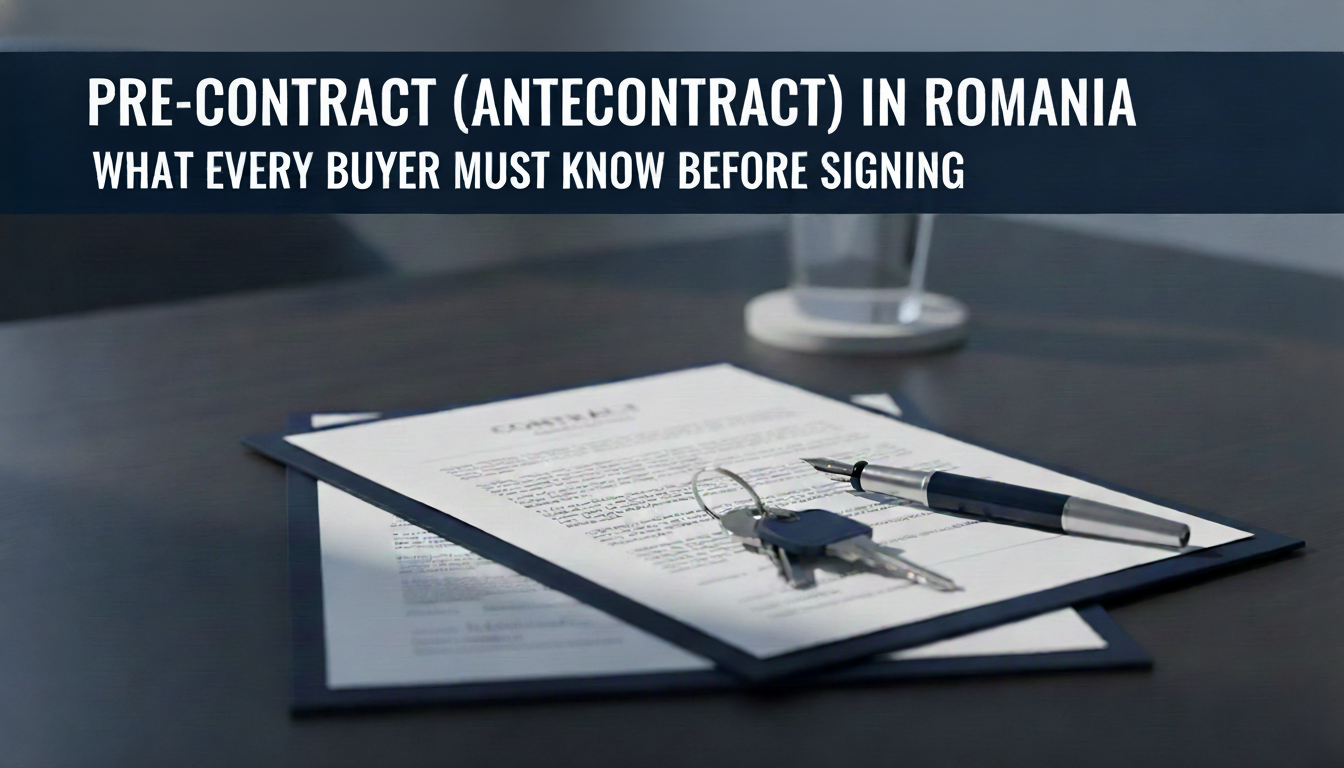
Pre-contract antecontract Romania property purchase legal document and keys on desk

Pre-Contract (Antecontract) in Romania: What Every Buyer Must Know Before Signing

Pre-Contract (Antecontract) in Romania: What Every Buyer Must Know Before Signing

TL;DR: A pre-contract (antecontract de vânzare-cumpărare) in Romania is a binding preliminary agreement that locks in the price, terms, and timeline of a future property sale, often requiring a promisiune de vânzare. It doesn’t transfer ownership, but it creates real, enforceable legal obligations for both sides. A deposit is typically paid at signing. Getting every clause right protects your money. Don’t sign one without professional legal review, especially for off-plan or developer purchases.

Legal consultation for pre-contract antecontract review at a Romanian law office in Bucharest

Professional legal review of a property pre-contract at Atrium Romanian Lawyers


📹 Video Guide: Pre-Contracts in Romania

Watch this comprehensive video guide covering the essentials of pre-contracts (antecontracte), deposit rules, the Nordis Law, and key considerations for property buyers in Romania.


Need Professional Help?

At Atrium Romanian Lawyers, we review, negotiate, and draft pre-contracts for buyers at every stage of the transaction. We advise local clients and international buyers on the implications of every clause.


What Is a Pre-Contract (Antecontract) in Romanian Law?

What is a pre-contract (antecontract) Romania and how does it relate to antecontractul de vânzare-cumpărare?

A pre-contract (antecontract) Romania, often called ”antecontractul de vânzare-cumpărare„ or „promisiunea de vânzare„, is a preliminary agreement in which the parties undertake the obligationto sell and/or buy or the obligation to purchase in the future.

In practice, un antecontract de vânzare-cumpărare it is a document that records key terms—price, subject, term of execution and conditions—so that purchase can be concluded later. 

A pre-contract in Romania is a binding preliminary agreement in which both parties commit to completing a property sale at a future date, under terms already agreed.

It creates firm legal obligations now, even though ownership only transfers when the final notarial deed is signed.

Under Romanian contract law, the pre-contract is governed primarily by Articles 1279 and 1669 of the Civil Code. Article 1279 states that a promise to contract must contain all the essential clauses of the intended final contract.

Article 1669 gives a court the power to issue a ruling that substitutes the final notarial deed if one party unjustifiably refuses to sign.

In plain terms: once you both sign a properly drafted pre-contract, neither side can simply walk away without consequences.

Lawyers and courts use the terms “antecontract,” “precontract,” and “promisiune bilaterală de vânzare-cumpărare” interchangeably. They all describe the same legal instrument under the Civil Code.

TypeWho Is BoundCommon Use
Bilateral Pre-ContractBoth buyer and sellerMost common in property transactions; locks in terms for both parties
Unilateral Promise (Seller)Only the sellerUsed when the buyer wants to secure the right to purchase but hasn’t fully committed
Unilateral Promise (Buyer)Only the buyerRare; used when the seller needs certainty of a committed buyer

The pre-contract is not a sale. It does not transfer ownership. It creates a personal obligation to complete the sale under agreed conditions.


Is Signing a Pre-Contract Required When Buying Property in Romania?

Do I need to sign the Antecontract at the Public notary?

While a verbal promise can create obligations, for safety both parties prefer to conclude the pre-contract before a notary  in Romania, so that the document is enforceable and can include clauses regarding the transfer of ownership rights.

No, Romanian law does not make the pre-contract mandatory for property purchases.

Parties can go directly to a notary and sign the final sale deed in a single step, if they both choose to.

In practice, though, a pre-contract is used in the overwhelming majority of Romanian property transactions:

  • When the buyer needs time to arrange financing
  • When the seller still needs to resolve a title issue
  • As the standard instrument for off-plan purchases, where the property doesn’t physically exist yet
  • Banks treat it as a prerequisite for mortgage applications

Signing a pre-contract before accessing credit is standard across the Romanian residential market, as noted by the Banca Națională a României in its Financial Stability Report, which tracks mortgage lending growth tied to preliminary agreements.

If you’re a foreign buyer navigating the Romanian market for the first time, our guide on the full property purchase process in Romania is a good starting point before you sign anything.


What Must a Romanian Pre-Contract Include?

Essential clauses and documents needed before signing

A valid pre-contract must contain all the essential clauses of the intended final sale contract. Without them, the agreement may be unenforceable, or it may leave you exposed to risks that are very difficult to fix later.

Notary signing a pre-contract antecontract for property purchase in Romania

Signing a pre-contract at a Romanian notary office

At minimum, every pre-contract should state:

  • The full identity of both parties (name, address, and ID or registration number)
  • A complete description of the property (address, surface area, cadastral number, and land book number)
  • The agreed total price and currency
  • The amount paid at signing as a deposit or advance
  • The deadline for signing the final notarial deed
  • The consequences if either party defaults
  • Any suspensive conditions that must be met before the final sale proceeds
Essential ElementWhy It Matters
Party IdentificationAct de identitate, registration number — prevents identity disputes
Property DescriptionAddress, surface, cadastral number, land book number — ensures the correct property is identified
Price & CurrencyAgreed total price — prevents later price manipulation
Deposit Type & AmountArvună vs. avans — determines penalty rules if deal falls through
Signing DeadlineExecution term — creates enforceable timeline
Default ConsequencesPenalties, deposit forfeiture rules — protects both parties
Suspensive ConditionsMortgage approval, cadastral registration — protects buyer from losing deposit unfairly

Suspensive conditions are particularly important and often poorly drafted. Common examples include mortgage approval by a specified bank deadline, completion of cadastral registration, removal of a mortgage or annotation from the land book, or the seller obtaining a succession certificate.

Before signing, always verify property ownership and check for encumbrances, annotations, or legal disputes registered against the property in the land book. This step is non-negotiable. For a deeper look, see our article on the property ownership verification process.

Case Study: When we reviewed a pre-contract for an international client purchasing an off-plan apartment, we identified several clauses exposing the buyer to significant financial risk. The deposit conditions were ambiguous about the type of payment made, the developer’s delivery obligations were vague, and there was no suspensive condition protecting the buyer in case of mortgage rejection. We identified these issues and negotiated revisions before any money changed hands.


How Deposits and Advance Payments Work in Pre-Contracts

Romanian law distinguishes between arvuna (earnest money), regulated by Arts. 1544–1546 Civil Code, and simple advance payments (avans), which represent partial payment of the price and are governed only by general contract rules.


Comparison between arvuna confirmatorie deposit and avans advance payment in Romanian pre-contracts

Understanding the legal difference between deposit types in Romanian property law

AspectArvună Confirmatorie (Deposit)Avans (Advance)
Legal BasisArticles 1544–1546 Civil CodeGeneral contract law
FunctionMutual penalty mechanismPartial payment of the price
Buyer DefaultsSeller keeps the depositReturn depends on contract terms
Seller DefaultsSeller returns double the depositReturn depends on contract terms
Typical Amount5%–10% of agreed priceVaries; can be any amount
Buyer ProtectionStrong — double return penaltyWeak — no automatic penalty
How the Arvună (Deposit) Mechanism Works BUYER Pays arvună at signing 5–10% PRE-CONTRACT Arvună held SELLER Receives arvună ❌ Buyer Defaults Seller keeps the entire deposit ✅ Seller Defaults Seller must return DOUBLE the deposit Poorly drafted pre-contracts describing a payment as “deposit” without specifying the type can be devastating for buyers.

In practice, deposits in Romanian property transactions typically range from 5% to 10% of the agreed price, as confirmed by Imobiliare.ro’s 2025 market guide for off-plan purchases.

Developer penalty clauses are another area of risk. Many standard developer pre-contracts historically included symbolic delay penalties of 2% to 3% per year, which barely compensated buyers for the real cost of a late completion. This is precisely why the Nordis Law capped advance amounts and introduced construction-milestone-based payment rules.


Reservation Agreements vs. Pre-Contracts: Key Differences

Not every document you’re asked to sign before a property purchase is a full pre-contract. Real estate agencies and developers often present reservation agreements (convenții de rezervare) at an earlier stage.

AspectReservation AgreementPre-Contract (Antecontract)
Legal NatureShorter, simpler commitmentFull preliminary agreement
Binding EffectLimited; reserves property for a periodBinding on both parties
Fee/DepositSmall reservation fee (should be refundable)Arvună or avans (5–10% of price)
NotarizationNot typically notarizedNotarization strongly recommended; mandatory for off-plan (Nordis Law)
Land Book RegistrationNot registrableCan be noted in the Land Book
Court EnforcementLimited enforceabilityCourt can substitute the final deed (Art. 1669)

Before December 2025, reservation agreements were largely unregulated in Romania. Non-refundable reservation fees were common. Buyers whose mortgage applications were rejected often lost their deposit with no legal recourse.

The consumer protection rules enforced by ANPC (Autoritatea Națională pentru Protecția Consumatorilor) already applied to standard-form reservation agreements used with consumers. Abusive clauses could be challenged under consumer law. Our article on abusive clauses in Romanian contracts covers the relevant legal framework.

Case Study: In one recent case, we advised an international client that a document presented as a “standard reservation form” contained a non-refundable clause with no carve-out for mortgage rejection. Had the bank declined the loan for any reason, the client would have lost the entire reservation fee. We renegotiated the clause before any money changed hands, adding an explicit mortgage rejection carve-out and a 30-day refund deadline binding on the agency.


What Happens If One Party Refuses to Sign the Final Contract?

Legal effects and remedies under Romanian law

If either party unjustifiably refuses to sign the final sale deed, the other party has two main options under Romanian law: claim compensation, or ask a court to substitute the contract.

Remedies When a Party Refuses to Sign One Party Refuses to Sign Final Deed Aggrieved party chooses remedy ⚖️ Specific Performance Art. 1669(1) Civil Code Court ruling substitutes the final deed 💰 Claim Damages Arvună rules apply Seller default → buyer gets 2× deposit

Under Article 1669(1) of the Civil Code, a court can issue a ruling that replaces the final notarial deed, effectively forcing the transaction through. This is specific performance in Romanian law. It’s available when the pre-contract contained all essential clauses, the requesting party fulfilled their own obligations, and the refusal is unjustified.

The statute of limitations for bringing this action is generally three years from the date the final contract was due to be signed.

The enforceability of a pre-contract in practice depends almost entirely on how well it was drafted. Courts have dismissed enforcement claims where the pre-contract lacked a clear deadline, a precise property description, or an unambiguous agreed price.


Pre-Contracts for Off-Plan Purchases: What Changed in December 2025

Off-plan residential construction project in Bucharest Romania subject to Nordis Law protections

Off-plan construction projects are now subject to stricter buyer protections under the Nordis Law

The Nordis Law, officially Law 207/2025, published in the Official Gazette no. 1133/08.12.2025, entered into force on 11 December 2025. It was a direct legislative response to the Nordis developer scandal, in which buyers paid large advance sums for apartments that were never delivered.

Key Protections Introduced by the Nordis Law

Nordis Law — Off-Plan Payment Milestone Rules STEP 1: Pre-Conditions Building permit in land book ✓ | Preapartamentare (separate unit entries) ✓ | Notarized form only ✓ STEP 2: Sale Promise Signed at Notary Notary must request land book notation on the same day (or next working day) STEP 3: Payments Into Dedicated Account Funds must go into a bank account used exclusively for the specific project Structural Frame → max 25% Released after verified completion Installations → further 20% Released after installations verified

Developers must now satisfy a set of cumulative conditions before they can sign any promise to sell:

  • The building permit must be recorded in the land book
  • Each individual unit must have its own separate land book entry through preapartamentare (pre-apartmentation)
  • All sale promises must be concluded in notarized form only
  • The notary is required to request land book notation of the sale promise on the same day of authentication

Advance payments must go into a dedicated bank account used exclusively for the specific project. Funds can only be released based on verified construction milestones. Misuse of advance funds is punishable by a fine of 1% of the developer’s annual turnover.

Important: The Nordis Law doesn’t cover option agreements, conditional sale contracts, joint venture development arrangements, and letters of intent. For those instruments, the general Civil Code rules apply without the specific financial protections. Professional review of developer construction contracts remains essential even after the Nordis Law came into force.

Case Study: In one of our mandates representing a foreign buyer in negotiations with a developer, the standard pre-contract contained no delivery deadline, no penalty clause for delays, and a clause allowing the developer to withdraw on 30 days’ notice without returning the full advance. We restructured the agreement around verified construction milestones, negotiated placement of the buyer’s payments into a dedicated account, and built in a refund guarantee. The model we insisted on for that client is substantially what the Nordis Law now requires by default.


How to Register a Pre-Contract in Romania’s Land Book

Romanian Land Book Cartea Funciara documents for pre-contract registration and property notation

Land Book (Cartea Funciară) documentation and cadastral records for property notation

Registering a pre-contract in Romania’s Land Book (Cartea Funciară) as a notation is not legally mandatory for all pre-contracts, but it is strongly advisable for any buyer.

Land Book Registration: Why It Matters ❌ WITHOUT Registration Binds only you and the seller Seller can sign another pre-contract Seller can borrow against the property Your position is severely weakened ⚠ No priority over later-registered interests ✅ WITH Registration Claim visible to all who search Legal priority over later interests Third parties cannot ignore it Registration fee: ~75 lei at OCPI ✓ Maximum buyer protection

The ANCPI (Agenția Națională de Cadastru și Publicitate Imobiliară) manages the land book system in Romania. The fee for registering a pre-contract notation at the local OCPI office is approximately 75 lei.

Under the Nordis Law rules, notaries are required to request land book notation of a sale promise for off-plan units on the same day of authentication. The UNNPR (Uniunea Națională a Notarilor Publici din România) provides guidance on notarization requirements and fees for preliminary property agreements.

Under Article 906 of the Civil Code, a land book notation of a pre-contract can be cancelled if no court action is initiated within six months of the agreed deadline for signing the final deed. Our detailed guide on Land Book registration in Romania covers every step of the process.


The Bottom Line: Don’t Let “Standard” Cost You Thousands

Three things matter most when it comes to pre-contracts in Romania.

First, a pre-contract is not a formality. It creates real, enforceable obligations from the moment it’s signed. The price, the deposit type, the deadline, and the default consequences are all legally binding from day one.

Second, the Nordis Law has meaningfully improved buyer protections for off-plan purchases. But it doesn’t apply to every contractual instrument used in the market, and it doesn’t replace careful due diligence on any individual transaction.

Third, the cost of a professional legal review before signing is a fraction of what it costs to fight a bad pre-contract in court. And it’s far less than the deposit you stand to lose.

Our team at Atrium Romanian Lawyers reviews, negotiates, and drafts pre-contracts for buyers at every stage of the transaction. We advise local clients and international buyers on the implications of every clause, and we represent clients in enforcement proceedings when things go wrong.


Related Guides & Resources

Expand your understanding of property law in Romania with these complementary guides:


FAQ – Pre-Contracts (Antecontracte) in Romania

Q: Can a pre-contract be signed without a notary in Romania?

A: Yes. A pre-contract can be concluded as a private document signed by both parties, without notarial authentication. This is legally valid and creates binding obligations. However, a private-form pre-contract cannot be noted in the Land Book without additional steps, and it carries less evidentiary weight. Recent legislative proposals following the Nordis scandal aim to require stricter formalities for off-plan residential sales, including the possible use of notarized promises of sale. The exact scope depends on the final legislative text.


Q: What happens to my deposit if the bank rejects my mortgage application?

A: It depends entirely on how your pre-contract is drafted. If it contains a suspensive condition expressly tied to mortgage approval and the bank rejects the application within the agreed timeframe, you’re generally entitled to recover the deposit in full. If no such condition was included, the default arvună rules apply: the buyer is treated as having defaulted, and the seller keeps the deposit. This is one of the most common and costly traps for buyers in Romania.

Q: How long is a pre-contract valid in Romania?

A: A pre-contract is valid for the period the parties agree. There is no legal maximum duration. In practice, most pre-contracts for resale properties carry deadlines of 30 to 90 days. For off-plan purchases, timelines are longer and typically tied to construction milestones. A land book notation can be cancelled if no court enforcement action is started within six months of the agreed deadline.

Q: Can I transfer a pre-contract to another person?

A: A pre-contract can generally be assigned to a third party, but only if the agreement expressly permits it or the other party consents in writing. Many developer pre-contracts explicitly prohibit transfer without the developer’s prior written approval. Failing to verify this correctly can leave you without enforceable rights.

Q: Does signing a pre-contract mean I own the property?

A: No. A pre-contract does not transfer ownership. Ownership in Romania transfers only when the final notarial deed of sale is authenticated and subsequently registered in the Land Book. Until that moment, the seller remains the legal owner. This is why Land Book registration of your pre-contract is so important: it doesn’t make you the owner, but it puts the world on notice of your claim.


Disclaimer: This article is for general information only and does not constitute legal advice. Please consult with a qualified Romanian property lawyer to verify current laws and regulations before signing any pre-contract. Laws and procedures are subject to change, and individual circumstances may vary.

EU Pay Transparency Directive implementation in Romania showing salary transparency and compliance changes effective in 2026

EU Pay Transparency Directive in Romania: Key Changes in 2026


EU Pay Transparency Directive 2026: What Romanian Employers Must Know

A Practical Compliance Guide for the June 7 Deadline

The EU Pay Transparency Directive (2023/970) is a landmark regulation requiring all EU employers to disclose salary information, prohibit salary history questions, and provide gender-disaggregated pay data. By June 7, 2026, Romania must transpose this Directive into national law, forcing fundamental changes to recruitment practices, compensation structures, and pay reporting systems.

For Romanian employers with 100+ employees, mandatory gender pay gap reporting begins in 2027. For all employers, new recruitment transparency and employee information rights take effect immediately upon transposition. This guide explains what you need to do, when you need to do it, and how to prepare before Romanian implementing legislation is finalized.


Why This Matters: The Directive’s Generational Impact

The EU Pay Transparency Directive represents a fundamental shift in how employers must approach compensation. Instead of responding to individual discrimination complaints, employers must now proactively disclose pay information, systematically measure gender pay gaps, and explain or remedy any unjustified differences.

The persistent gender pay gap across the EU stands at 12–13%, representing hundreds of billions in lost earnings for women annually. The Directive eliminates the opacity that has historically concealed discrimination. Once pay data is disclosed through mandatory reporting, the burden shifts to employers to justify gaps or face enforcement action. For detailed information on the Directive’s scope and requirements, refer to the Council of the European Union’s pay transparency guidance.

For Romanian HR and legal teams, this is not merely a compliance checkbox. The Directive requires fundamental changes to how you recruit, structure compensation, evaluate job roles, and communicate with employees. Organizations that delay preparation will face compressed timelines for system upgrades, policy changes, and compensation audits once Romanian law is finalized in late 2026. Our employment law team can guide you through these changes.


Video: Understanding the EU Pay Transparency Directive


Key Deadlines: What You Need to Know

Romania must transpose the Directive by June 7, 2026. However, expect Romanian implementing legislation to be published only in late April–May 2026, leaving employers just 4–6 weeks to implement before the deadline. For comprehensive information on the Directive’s requirements and the complete legislative text, consult the official EU sources.

Reporting Thresholds by Employer Size

Employer WorkforceReporting FrequencyFirst Report DueStatus
250+ EmployeesAnnually2027Mandatory
150–249 EmployeesEvery 3 Years2027Mandatory
100–149 EmployeesEvery 3 Years2031 (based on 2030 data)Mandatory
Under 100 EmployeesN/AN/AVoluntary (for now)

Important: Even if your company is under 100 employees, you must still comply with recruitment transparency, employee pay request rights, and the prohibition on salary history questions. Romania may lower the reporting threshold in its implementing legislation, so monitor draft law closely.


Romania’s Current Progress and Risks

As of January 2026, Romania has not yet published draft transposition legislation. This creates significant risks for employers:

  • Delayed Clarity: Without guidance from Romanian authorities, employers must interpret Directive obligations directly
  • Compressed Timeline: Only 4–6 weeks between final law and the June 7 deadline for implementation
  • System Readiness: HRIS platforms, payroll systems, and recruitment tools may require urgent upgrades
  • Potential Deviations: Romania may introduce stricter requirements than the EU minimum or align the Directive with existing Labour Code provisions in unexpected ways

Practical implication: Do not wait for final Romanian law to begin preparation. Start now using the Directive’s minimum requirements, knowing that national law may impose additional obligations.


Core Requirement 1: Recruitment Transparency (Applies to All Employers)

Mandatory Salary Disclosure

Employers must provide applicants with the starting salary or a salary range for the position. This disclosure must be provided before the first interview (optionally in the job advertisement). Generic terms like “competitive salary” or “negociabil” (negotiable) are insufficient.

The disclosed range must:

  • Be based on objective, gender-neutral criteria
  • Reflect actual compensation for the role
  • Enable informed salary negotiation
  • Be provided in the recruitment language (for Romania, in gender-neutral Romanian terminology)

Ensure your employment contracts and salary structures comply with Romanian requirements while meeting Directive obligations.

The Ban on Salary History Questions

Employers are prohibited from asking candidates about their current or previous pay—in any form, at any stage of recruitment. This applies to:

  • Phone screens and interviews
  • Application forms and background checks
  • References from previous employers
  • Any other recruitment contact

This prohibition is designed to prevent the perpetuation of historical pay discrimination. Instead, recruiters may discuss salary expectations aligned with the role’s requirements and objective criteria (experience, qualifications, skills). For detailed guidance on recruitment practices and employment law, consult with our team.

Gender-Neutral Job Postings

Job titles and vacancy notices must be gender-neutral. For Romanian employers, this means using terms like “Specialist” rather than gendered variants. Any AI-based screening tools must be audited to ensure non-discriminatory outcomes.


Core Requirement 2: Employee Information Rights (Applies to All Employers)

The Right to Request Pay Data

Every employee has the right to request, in writing:

  • Their individual pay level
  • Average pay levels for workers performing the same work or work of equal value, broken down by gender

Employers must respond within two months with information covering all remuneration components: base salary, bonuses, allowances, overtime, benefits, and other forms of pay.

This represents a significant change for Romanian companies, where employees have historically had limited rights to request comparative pay data. Our employment law specialists can help you establish compliant pay request response procedures.

Prohibition of Pay Secrecy Clauses

Any contractual clause that prevents employees from discussing pay for equal pay purposes is prohibited and unenforceable. This includes:

  • Non-disclosure agreements restricting pay disclosure
  • Confidentiality clauses protecting compensation information
  • Disciplinary provisions threatening retaliation for discussing pay

Employers must also inform employees annually of their right to request pay information and the prohibition against retaliation. Review your existing key employment contract clauses to ensure compliance with this prohibition.

Critical Point: Employees may freely discuss their compensation with colleagues and unions. Attempting to enforce pay secrecy clauses will expose you to liability.


Core Requirement 3: Mandatory Pay Gap Reporting (For Employers with 100+ Staff)

What Must Be Reported

Employers with 100+ employees must report:

  • Mean and median gender pay gaps (the average and midpoint difference between male and female pay)
  • Gender pay gaps in variable pay (bonuses, commissions, allowances)
  • Gender distribution of variable pay recipients (showing who receives bonuses)
  • Gender distribution across pay quartiles (showing concentration of women/men in low and high-wage roles)
  • Pay gaps by worker category (for workers doing the same work or work of equal value)
  • Gender distribution in management roles (senior and junior levels)

The 5% Threshold: A Joint Pay Assessment is required if a gender pay gap of 5% or more persists for six months and cannot be justified. Gaps below 5% may be presumed justified, but the burden falls on you to prove it.

Defining “Work of Equal Value”

Work of equal value does not require identical job titles. The Directive requires assessment using four mandatory factors:

  • Skills: Formal qualifications, experience, knowledge, and soft skills
  • Effort: Mental, emotional, and physical exertion
  • Responsibility: Scope of decision-making and authority
  • Working conditions: Environment, hazards, schedule flexibility

This is particularly important for Romanian employers, where roles traditionally performed by women (administrative, customer service, teaching, care) have historically been undercompensated despite requiring substantial skill and effort. Soft skills must be valued fairly and without gender bias.


The Joint Pay Assessment: When Gaps Exceed 5%

If your gender pay gap reaches 5% or more and cannot be justified with objective criteria, a Joint Pay Assessment (JPA) becomes mandatory. A JPA is a collaborative audit conducted with worker representatives (unions or employee committees) to identify root causes and develop a remedial action plan.

Implications for Romanian Employers

Romania has active trade unions including Confederatia Nationala a Sindicatelor (CNS) and industry-specific unions. Prepare for:

  • Early union engagement: Initiate dialogue with union representatives now about pay equity reviews
  • Transparency demands: Unions will have legal rights to access pay-setting methodologies and compensation data
  • Collective pressure: Once pay gap data becomes public (2027), unions may file collective discrimination complaints or demand wage adjustments
  • Remedial negotiations: You will be required to collaborate on solutions, not make unilateral decisions

Understanding your obligations regarding employment termination and worker protections is essential during remediation discussions.


Penalties and Enforcement

The Directive requires that member states establish penalties that are effective and dissuasive. However, the Directive does not specify penalty amounts, percentages, or fixed sanction levels. The type, structure, and level of penalties will be determined exclusively by Romanian implementing legislation.

Expected enforcement mechanisms in Romanian law may include:

  • Administrative fines: Amount and level to be set by Romania
  • Corrective orders: Mandatory remediation plans with specific timelines
  • Exclusion from public procurement: Potentially barring non-compliant employers from government contracts
  • Uncapped individual compensation: Employees may sue for back pay and damages without statutory limits
  • Reputational consequences: Public disclosure of pay gap reports and compliance violations

Burden of Proof Reversal: Where an employee establishes facts suggesting pay discrimination, the burden shifts to you to prove compliance. Failure to meet transparency or reporting obligations may create a presumption of discrimination.


Romania’s Current Legal Framework vs. the Directive

What Romania Already Has ✅

What Romania Currently Lacks ❌ (Required by Directive)

  • Mandatory pay transparency in recruitment
  • Employee rights to request comparative pay data
  • Systematic gender pay gap reporting for large employers
  • 5% threshold mechanism triggering automatic audits
  • Explicit prohibition on salary history questions
  • Prohibition of pay secrecy clauses

The Directive will require substantial legislative change, particularly for employers with 100+ employees and multinational groups operating Romanian entities.


Interactive Compliance Timeline

Click milestones to expand tasks and track readiness by priority.

June 7, 2026
Transposition Effective
2027
Reporting Starts (150+ & 250+ employees)
2031
Reporting Starts (100–149 employees)
Overall Readiness by Priority:


Your 2026 Readiness Timeline

PeriodAction ItemsPriority
January–February 2026Monitor draft Romanian law publication; assess how national law may differ from EU minimum; begin pay equity audit confidentially with legal counsel🔴 High
February–March 2026Complete privileged pay equity audit; identify systemic gaps and baseline data; document findings with legal protection🔴 High
March–April 2026Update job postings and ATS; remove salary history questions; implement gender-neutral job architecture; train recruitment teams🔴 High
April–May 2026Assess HRIS capabilities for automated pay gap reporting; budget for system upgrades; prepare pay request response process (2-month deadline)🟡 Medium
May–June 2026Implement updated policies once Romanian law is finalized; establish pay equity remediation plans; engage unions on assessment timeline🔴 High
June–December 2026Monitor 2026 pay data; calculate preliminary gender pay gaps; prepare for mandatory reporting; collect required supporting documentation🟡 Medium
January–June 2027Submit first mandatory report (for 150+ employee companies); provide to worker representatives; prepare for JPA if gaps exceed 5%🔴 High

Key Dependency: All timelines depend on Romania’s publication of implementing legislation by late April 2026. Do not wait; use the Directive’s minimum requirements as your guide now.


Romania-Specific Compliance Considerations

Language and Documentation Requirements

For Romanian employers:

  • Job postings: Must use gender-neutral terminology in Romanian (e.g., “specialist,” not gendered variants)
  • Pay gap reports: Will likely be submitted in Romanian with official translations if operating in multiple languages
  • Internal policies: Compensation and recruitment documentation must be prepared in Romanian and aligned with national law
  • Employee communications: Annual pay transparency notices must be provided in Romanian

Multinationals Operating in Romania

If your parent company is in another EU country:

  • Group alignment: Align Romanian compensation architecture with group-wide standards for consolidated reporting
  • Legislative monitoring: Monitor Romanian draft law closely—it may differ from other EU countries
  • Separate compliance: Prepare separate documentation if national law introduces deviations
  • Payroll segregation: Ensure HRIS can generate reporting by geographical location (Romania vs. other countries)

Union and Worker Representative Engagement

Initiate early dialogue with:

Key discussion points:

  • Pay equity review methodology
  • Remediation approaches and compensation adjustments
  • Role in Joint Pay Assessment processes
  • Transparency about pay-setting logic and job evaluation systems

Frequently Asked Questions

Q: Does the Directive apply to my Romanian company?

Yes. The Directive applies to all public and private sector employers operating in Romania, regardless of headquarters location or company size. Recruitment transparency and employee information rights apply to all employers from June 7, 2026 onward. Mandatory pay gap reporting applies only to employers with 100+ employees (with phase-in based on size).

Q: Are small companies (under 100 staff) exempt?

Small companies are exempt from mandatory public reporting. However, they must still comply with:

  • Salary disclosure in recruitment (all employers)
  • Ban on salary history questions (all employers)
  • Employee rights to request pay information (all employers)
  • Prohibition of pay secrecy clauses (all employers)

Romania may lower the reporting threshold in implementing legislation, so monitor draft law closely. Learn more about employment contract structures to ensure compliance.

Q: What constitutes “remuneration” for pay gap calculations?

Remuneration includes all pay components:

  • Basic wage or salary
  • Bonuses (performance, annual, signing)
  • Overtime and shift premiums
  • Housing, transportation, and meal allowances
  • Pension contributions (employer and employee)
  • Statutory sick pay, maternity pay, and benefits
  • Stock options and equity awards
  • Life insurance and health insurance premiums

The pay gap must be calculated across this full package. This is critical for Romanian employers where bonuses and allowances may vary significantly by gender.

Q: Can I negotiate salary after disclosing a range?

Yes. Disclosure does not prevent negotiations. Parties remain free to agree on a salary outside the disclosed range, provided the final agreed salary is gender-neutral and based on objective criteria (experience, qualifications, role-specific requirements).

Q: How long do I have to respond to an employee’s pay request?

You must provide requested information in writing within two months of the request. The response must include the employee’s individual pay and average pay for the equal value category, broken down by gender. Failure to respond within two months is a compliance violation that may trigger enforcement action.

Q: Can employees discuss their pay with each other?

Yes. Employees have the explicit right to compare compensation with colleagues and union representatives. Any contractual clause restricting pay disclosure for equal pay purposes is prohibited and unenforceable. Employers cannot retaliate against employees for discussing pay.

Q: What happens if my gender pay gap is 5% or higher?

A 5% or higher unexplained gap triggers a Joint Pay Assessment. You will have six months to either justify the gap with objective criteria or remediate it through compensation adjustments. If the gap is not addressed, the formal JPA process begins with worker representatives to identify root causes and agree on remedies. Failure to remedy may result in enforcement action.

Q: What are the penalties for non-compliance?

Romania will set its own fine levels. The Directive requires penalties to be effective and dissuasive. Expected enforcement mechanisms may include administrative fines, corrective orders, potential exclusion from public procurement, individual compensation claims for back pay, and reputational consequences.

Q: Are soft skills counted when assessing “work of equal value”?

Yes. The Directive explicitly requires that relevant soft skills (communication, emotional intelligence, customer service capability) must not be undervalued in equal value assessments. This is critical for Romania, where traditionally female-dominated roles in administration, teaching, and care may have been undercompensated despite substantial skill requirements.

Q: What if Romania misses the June 7, 2026 deadline?

The European Commission may initiate infringement proceedings. More importantly, Romanian courts may begin applying Directive requirements through interpretation of existing labor law even before formal transposition. Employers cannot claim a “transition period” if the government lags. Begin preparation now using Directive requirements as your baseline.


Disclaimer: This article is provided for general informational purposes only and does not constitute legal advice. The analysis is based on EU Directive 2023/970 and Romanian law as of January 2026. Specific obligations may vary depending on individual circumstances, the final Romanian implementing legislation, and administrative practice. Professional legal guidance should be obtained before taking action based on this content.

Romania tax debt rescheduling 2026 under Law 239/2025, illustrated by a judge’s gavel, financial charts, digital tax systems, and Romanian flag symbolizing legal and fiscal reform.

Romania Tax Debt Rescheduling 2026 – Law 239/2025 Explained


Romania Debt Rescheduling 2026: Law 239/2025 Explained

Romania is entering a more restrictive fiscal environment in 2026 following the adoption of Law no. 239/2025, published in the Official Gazette no. 1160 of December 15, 2025 and effective as of December 18, 2025.

The reform forms part of a broader effort to strengthen budgetary discipline and improve tax collection, in line with Romania’s European fiscal commitments.

While formally structured as amendments to the Fiscal Procedure Code, the new rules introduce material changes to the practical functioning of tax debt rescheduling.

Mechanisms previously characterized by reduced guarantees and extended tolerance periods have been replaced by stricter eligibility criteria, enhanced enforcement safeguards for the tax authority, and increased personal involvement of individuals controlling indebted companies.


Key Takeaways for Romanian Taxpayers in 2026

  • Personal Guarantees in Classic Rescheduling: Article 193¹ introduces a mandatory fideiusiune (personal guarantee) for classic tax rescheduling, creating a contractual extension of liability for the guarantor for the duration of the arrangement.
  • Restricted Access to Simplified Rescheduling: Simplified rescheduling remains available only for lower debt thresholds (up to 400,000 lei for companies and 100,000 lei for individuals) and is subject to higher interest costs.
  • Shortened Compliance Period: The maximum delay for settling current tax obligations during a rescheduling plan has been reduced from 180 days to 60 days.
  • Expanded Fiscal Inactivity Grounds: Failure to maintain a Romanian payment account or submit financial statements may lead to fiscal inactivity status and subsequent administrative procedures.
  • Increased Digital Oversight: SAF-T, e-Factura, and e-VAT reporting data are increasingly used in compliance assessments and rescheduling analyses.


1. Macroeconomic Background of the Reform

Law no. 239/2025 must be viewed within Romania’s broader macroeconomic context.

Analyses published by the National Bank of Romania and the Fiscal Council point to persistent budget deficits, reduced fiscal space, and rising public debt servicing costs.

In prior years, simplified tax rescheduling was frequently used by companies as a liquidity management tool.

The revised framework signals a policy shift toward ensuring predictability of revenue collection and limiting prolonged reliance on deferred payment of public obligations.

For more information on how this affects business planning, consult our corporate law services or see our company formation guide.

2. Personal Guarantees and Contractual Extension of Liability

The most significant change introduced by Law 239/2025 is Article 193¹ of the Fiscal Procedure Code, which requires the submission of a personal guarantee (fideiusiune) in classic tax rescheduling arrangements.

This mechanism does not abolish the principle of limited liability under company law. Instead, it creates a contractual exception whereby a natural person assumes personal liability toward the tax authority for the fulfillment of the rescheduling obligations.

For detailed guidance on this mechanism, consult the National Agency for Fiscal Administration (ANAF) official guidance.

Who May Be Requested to Guarantee

In practice, tax authorities may require the guarantee to be provided by the individual exercising effective control over the company, typically corresponding to the Ultimate Beneficial Owner (UBO) as defined under Law no. 129/2019 on the prevention and combating of money laundering.

For guidance on shareholder responsibilities, see our shareholder rights guide or shareholder agreement documentation. Guarantees from individuals without substantive decision-making authority may be subject to additional scrutiny.

Legal Form and Enforcement Effects

The fideiusiune must be executed in authentic (notarial) form.

Under Romanian law, such instruments generally qualify as enforceable titles. In the event of default, enforcement measures may be initiated in accordance with the Fiscal Procedure Code and applicable procedural safeguards, depending on the nature of the assets involved.

Applicable Deadlines

The law introduces relatively short timeframes for submitting guarantees, ranging from several days following issuance of the fiscal attestation certificate to longer periods following preliminary approval.

Failure to comply may result in rejection of the rescheduling request and continuation of standard collection procedures.

For timely coordination with notaries, review the Romanian Notaries Chamber resources.

3. Simplified Rescheduling: Thresholds and Conditions

Simplified rescheduling under Article 209¹ remains available, but under narrower eligibility criteria than in prior years.

Applicable Monetary Limits

  • Legal entities: 5,000 – 400,000 lei
  • Individuals and unincorporated entities: 500 – 100,000 lei

Debts exceeding these thresholds generally require classic rescheduling, involving additional documentation, financial analysis, and guarantees.

For legal entities, simplified rescheduling is typically available only if the company has been established for at least 12 months.

Learn more about ANAF rescheduling procedures.

Cost of Rescheduling: The interest applicable to simplified rescheduling is approximately 0.02% per day (around 7.3% annually), reducing its attractiveness as a long-term financing substitute.

Compare this with traditional bank lending rates.

4. Ongoing Compliance and the 60-Day Rule

Once a rescheduling plan is approved, taxpayers must remain current with all new tax obligations.

Law 239/2025 reduces the maximum delay for settling such obligations from 180 days to 60 days.

Non-compliance may lead to termination of the rescheduling arrangement, acceleration of outstanding amounts, and potential activation of guarantees, subject to administrative confirmation and procedural rights.

See our compliance monitoring section below.

5. Fiscal Inactivity and Administrative Consequences

The reform expands the grounds on which a taxpayer may be declared fiscally inactive, including:

  1. Failure to maintain a payment account in Romania or with the State Treasury;
  2. Failure to submit annual financial statements within statutory deadlines.

If inactivity persists, the tax authority is required to initiate procedures that may include insolvency or dissolution proceedings, in accordance with applicable legal frameworks.

For insolvency matters, review the Insolvency Law.

6. Digital Reporting and Compliance Monitoring

Romania’s tax administration increasingly relies on digital reporting systems such as SAF-T, e-Factura, and e-VAT.

These systems provide standardized accounting and transactional data used to assess compliance behavior, financial indicators, and risk profiles.

While the law does not mandate automatic decisions based solely on digital data, such reporting plays an important role in administrative analysis and verification processes.

Ensure your company’s digital compliance documentation is up to date.

7. Sectoral Impact and Transactional Considerations

Certain sectors—such as construction, retail, and pharmaceuticals—may face additional challenges due to longer commercial payment cycles combined with the shortened fiscal compliance timelines.

In transactional contexts, including share transfers and reorganizations, outstanding tax liabilities may attract increased scrutiny.

Notification obligations and guarantees may be required for tax debts to remain opposable following ownership changes.

For M&A considerations, consult our transactional structuring guide.


Frequently Asked Questions

Q: Can my company avoid providing a personal guarantee for classic rescheduling?

In practice, ANAF generally requires a personal guarantee for classic rescheduling arrangements, subject to the specific circumstances of the taxpayer and applicable administrative practice. The guarantee must be provided by the individual exercising effective control (typically the UBO as per Law no. 129/2019). For more information on shareholder obligations and control structures, consult our corporate law services. Refusal to provide a required guarantee may result in rejection of the rescheduling request and continuation of standard collection procedures.

Q: What happens if I exceed the 60-day compliance window during rescheduling?

Exceeding the 60-day grace period for settling current tax obligations can lead to the following consequences, subject to administrative confirmation:

  • Termination of the rescheduling arrangement
  • Acceleration of the entire outstanding debt
  • Potential activation of personal guarantees, in accordance with the Fiscal Procedure Code
  • Resumption of standard collection and enforcement procedures

Action: Maintain strict internal tracking of all current tax payment deadlines during any rescheduling period.

Q: Is my company eligible for simplified rescheduling?

Simplified rescheduling is available if your company meets all of the following:

For individuals, the threshold is 500 – 100,000 lei. If your debt exceeds the limit, classic rescheduling (with guarantee) is required. Check ANAF’s official guidance for detailed eligibility requirements.

Q: What does “fiscal inactivity” mean and what are the consequences?

A company is declared fiscally inactive if:

Consequences include initiation of administrative procedures that may lead to insolvency or dissolution proceedings. Prevention: Ensure your company maintains an active Romanian payment account and submits all financial statements on time.

Q: How much does simplified rescheduling cost?

The interest rate for simplified rescheduling is approximately 0.02% per day, which equates to roughly 7.3% annually. This relatively high rate reduces its attractiveness as a long-term financing tool compared to traditional commercial financing. Review current lending rates from the National Bank of Romania for comparison.

For classic rescheduling, interest rates are typically lower and may vary based on the specific arrangement negotiated with ANAF. For further information on tax law and planning, consult our specialized services.

Q: How is the personal guarantee enforced?

The fideiusiune (personal guarantee) must be executed in authentic notarial form (contact the Romanian Notaries Chamber). Under Romanian law, such instruments qualify as enforceable titles, granting ANAF enhanced enforcement rights in case of default:

  • Enforcement mechanisms follow the procedures set out in the Fiscal Procedure Code, which provide the tax authority with enhanced enforcement rights compared to ordinary civil claims
  • The guarantor’s personal assets may be subject to attachment and enforcement
  • Procedural safeguards apply in accordance with the Civil Procedure Code
  • The guarantee remains enforceable for the entire duration of the rescheduling arrangement
Q: What role do digital reporting systems (SAF-T, e-Factura, e-VAT) play?

ANAF uses data from these systems to:

  • Assess your compliance behavior and financial capacity
  • Evaluate your risk profile for rescheduling eligibility
  • Monitor your activities during an existing rescheduling arrangement
  • Detect inconsistencies or red flags in reporting

While automated decisions are not mandatory, accurate and timely submission of SAF-T, e-Factura, and e-VAT reports is an important factor in the overall assessment of rescheduling eligibility. Review ANAF’s digital compliance requirements.

Q: Can I change the guarantor once rescheduling is approved?

The law does not explicitly address substitution of guarantors after initial approval. In practice, ANAF may require consent or may require a new authentic guarantee instrument. Any change should be coordinated with your tax advisor and ANAF before implementation to avoid complications or loss of rescheduling status.

Q: Are there any deadlines for submitting the guarantee?

Yes. The law introduces tight deadlines ranging from several days following issuance of the fiscal attestation certificate to longer periods after preliminary approval. Missing these deadlines typically results in:

  • Rejection of the rescheduling request
  • Loss of provisional rescheduling status
  • Resumption of standard collection procedures

Action: Coordinate guarantee preparation with a notary in advance. Contact the Romanian Notaries Chamber to ensure timely submission.


Disclaimer: This article is provided for general informational purposes only and does not constitute legal or tax advice. The analysis is based on Law no. 239/2025 and publicly available information as of January 2026. Application of the law may vary depending on individual circumstances, administrative practice, and subsequent guidance or case law. Professional advice should be obtained before taking any action based on this content.

Romanian Construction Contracts

The Developer’s Checklist: Mastering Construction Contracts & Works Agreements in Romania


The Developer’s Checklist: Mastering Construction Contracts & Works Agreements in Romania

Navigating the intricacies of construction contracts in Romania requires a comprehensive understanding of Romanian law and the specific nuances of the construction sector.

This guide serves as a checklist for developers and investors involved in construction projects in Romania, offering insights into construction contracts, works agreements, standard forms, and key considerations for successful project execution.

📹 Video Guide: Construction Contracts in Romania

Watch this comprehensive video guide covering the essentials of construction contracts, regulatory compliance, and key considerations for developers and investors in Romania.


Need Professional Help?

At Atrium Romanian Lawyers, we assist clients with corporate & commercial law, construction contracts, works agreements, and construction dispute resolution.


Understanding Construction Contracts in Romania

Definition and Importance of Construction Contracts

A construction contract in Romania is a legally binding agreement, typically classified under Romanian law as a works agreement (contract de antrepriză), between two or more parties that outlines the scope of construction work, the obligations of each party, and the payment terms.

The object of the contract is to define the responsibilities and rights concerning a construction project, in accordance with the Romanian Civil Code.

Construction contracts in Romania are crucial for establishing project expectations, allocating risk, and providing a contractual framework for dispute resolution under Romanian law.

As a specialized subset of contract law in Romania, construction agreements must comply with mandatory civil law provisions while addressing sector-specific requirements.

Types of Construction Contracts in Romania

Several types of construction contracts are used in Romania, depending on project structure and risk allocation.

These include design and build contracts, EPC contracts, and contracts based on standard forms such as FIDIC contracts.

Understanding these distinctions is important for selecting an appropriate contractual framework for a construction project in Romania.

The chosen contract type influences procurement strategies, risk management, and project governance, including compliance with public procurement procedures where applicable.

For property and real estate development, proper contract selection is essential to protect your investment.

Standard Forms of Construction Contracts

Use of Standard Contract Templates

In Romania, standard forms of construction contracts are frequently used, particularly in complex or international construction projects.

These contracts are often based on international models and offer familiarity for foreign investors and contractors.

Standard construction contracts must be reviewed and, where necessary, amended to ensure compliance with mandatory Romanian civil law provisions and project-specific legal requirements.

Their use does not override Romanian law, particularly in public construction projects.

FIDIC Contracts in Romania

Are FIDIC contracts enforceable in Romania? Yes, provided they comply with mandatory Romanian civil law and public procurement rules where applicable.

FIDIC contracts, developed by the International Federation of Consulting Engineers, are widely used in Romania, particularly for infrastructure and publicly funded projects.

Romanian law does not formally recognize FIDIC as a legal standard, but FIDIC-based contracts are enforceable when compliant with mandatory Romanian law.

In public procurement contexts, FIDIC provisions are frequently substantially amended by statute, especially in relation to variations and claims, payment mechanisms, engineer’s role, and dispute resolution.


Key Aspects of Works Agreements in Romania

Essential Elements of a Works Agreement

A works agreement in Romania should clearly define the object of the contract, including the scope of construction work, timelines, and technical requirements.

While Romanian law does not impose a fixed list of essential clauses, clarity on payment schedules, variation procedures, liability for defects, and dispute resolution mechanisms is essential for proper contract performance.

Performance bonds or guarantees may be included where required by the parties, lenders, or public authorities, but they are not mandatory elements under Romanian civil law.

Parties Involved in Construction Agreements

Construction agreements in Romania typically involve the beneficiary (beneficiar), the contractor (antreprenor), and, where applicable, subcontractors performing specialized construction work.

In public construction projects, the beneficiary is a contracting authority, and the involvement of parties is governed by public procurement legislation, which may restrict contractual freedom and impose mandatory clauses.

Contractual Obligations and Rights

Romanian construction contracts must clearly define the contractual obligations and rights of the parties.

These include obligations relating to execution of construction work, payment of the contract price, cooperation, and compliance with technical and legal standards.

Both parties have rights under Romanian law, including the right to claim damages, penalties, suspension, or termination in case of breach, subject to the Romanian Civil Code.


Navigating Romanian Construction Law

Overview of Romanian Construction Regulations

Construction projects in Romania are subject to a regulatory framework covering zoning, building permits, safety standards, and technical compliance.

Romanian law governs these requirements, and non-compliance may lead to administrative sanctions or suspension of works.

Investors involved in construction projects in Romania must ensure compliance with applicable construction regulations to avoid delays or legal complications.

Before commencing any construction work, ensure that proper cadastral documentation and property ownership verification are in place, as these form the legal foundation for obtaining construction permits.

Public Procurement Procedures in Construction

Public procurement procedures for construction work in Romania are governed primarily by Law no. 98/2016 on public procurement and related secondary legislation, which transpose EU procurement directives into Romanian law.

These procedures impose mandatory rules regarding contract award, performance guarantees, amendments, and payment mechanisms.

Compliance with public procurement procedures is essential for contractors participating in public construction projects in Romania.


Construction Disputes in Romania

Common Sources of Disputes

Construction disputes in Romania commonly arise from contract interpretation, payment issues, variations, delays, or construction work quality.

Understanding these risk factors helps developers and contractors mitigate conflicts throughout the project lifecycle.

Dispute Resolution Mechanisms

Construction contracts often include dispute resolution clauses providing for litigation before Romanian courts or arbitration, in accordance with Romanian civil law.

Romania is a party to the New York Convention, enabling enforcement of foreign arbitral awards, subject to public policy limits.

When construction disputes arise, litigation and dispute resolution services can help protect your interests.

Can international arbitration be used in Romanian construction contracts? Yes. Romania is a party to the New York Convention, allowing recognition and enforcement of arbitral awards, subject to public policy exceptions and statutory limits in public contracts.


Effective Contract Management Strategies

Construction Contract Management Best Practices

Effective management of construction contracts in Romania requires careful drafting, monitoring of performance, and proper documentation of variations and claims.

A well-managed construction contract helps mitigate risks related to time overruns, cost increases, and disputes, protecting both parties throughout the construction project.

Risk Management in Construction Contracts

Risk management in Romanian construction contracts involves identifying and allocating risks related to design, ground conditions, regulatory changes, and force majeure events.

Romanian law allows contractual risk allocation, subject to mandatory statutory limits and public policy considerations.

Dispute Avoidance and Resolution Techniques

Clear contractual clauses, regular communication, and proactive management can reduce the risk of construction disputes in Romania.

When disputes arise, mediation or arbitration may offer efficient alternatives to litigation, depending on the contractual framework and project type.


Specialized Contract Types in Romanian Construction

EPC Contracts: Structure and Implications

EPC contracts in Romania are commonly used for large-scale and infrastructure projects.

These contracts allocate significant responsibility to the contractor for design, procurement, and execution.

However, under Romanian law, risk transfer is not absolute, and liability remains subject to statutory limitations, force majeure provisions, and agreed contractual caps.

Design and Build Contracts in Romania

Design and build contracts are widely used in Romania, particularly in private construction projects.

Under this model, a single contractor assumes responsibility for both design and construction, based on employer-defined requirements.

This contractual approach reduces coordination risks when properly structured and provides clear accountability for project delivery.


Useful Resources & Links


Related Guides & Resources

Expand your understanding of construction and property law in Romania with these complementary guides:


FAQ – Construction Contracts & Works Agreements in Romania

Q: Do construction contracts in Romania need to be in written form?

A: Written form is not generally required for validity under Romanian civil law in private projects but is mandatory in public procurement and strongly recommended for evidentiary and enforcement purposes.

Q: What are the main types of construction contracts used in Romania?

A: Romanian practice includes traditional works contracts, design and build contracts, EPC/turnkey contracts, and various pricing structures such as lump-sum and unit price agreements.

The choice depends on project structure, risk allocation, and regulatory requirements.

Q: Are FIDIC contracts enforceable in Romania?

A: Yes, provided they comply with mandatory Romanian civil law and public procurement rules where applicable.

FIDIC contracts are widely used in Romania, especially for infrastructure and publicly funded projects.

Q: What is the regulatory framework for public construction projects in Romania?

A: Public procurement procedures for construction work in Romania are governed primarily by Law no. 98/2016 on public procurement and related secondary legislation, which transpose EU procurement directives into Romanian law.

Q: What are common sources of construction disputes in Romania?

A: Construction disputes in Romania commonly arise from contract interpretation, payment issues, variations, delays, or construction work quality.

Proper contract management and clear documentation can help mitigate these disputes.

Q: Can construction disputes be resolved through arbitration in Romania?

A: Yes. Both domestic and international arbitration are commonly used, subject to statutory limitations in public projects.

Romania is a party to the New York Convention, enabling recognition and enforcement of foreign arbitral awards.

Q: What law governs construction contracts in Romania?

A: Substantive contractual issues are governed by the Romanian Civil Code, while disputes and enforcement are governed by procedural law.

Public procurement contracts are also subject to Law no. 98/2016 on public procurement.


Conclusion: Mastering Construction Contracts in Romania

Construction contracts and works agreements in Romania require careful legal and commercial planning.

Developers and contractors must understand Romanian construction law, select appropriate contract types, manage risks, and ensure regulatory compliance.

Early involvement of legal and technical advisers is essential for minimizing construction disputes in Romania and ensuring successful project delivery.


Disclaimer: This article is for general information only and does not constitute legal advice. Please consult with a qualified Romanian construction lawyer to verify current laws and regulations before finalizing your construction contracts. Laws and procedures are subject to change, and individual circumstances may vary.

Service Contract Requirements Romania

Service Contract Requirements Romania: What Every Provider Must Include by Law


Service Contract Requirements Romania – What Every Provider Must Include by Law

Service contracts in Romania must meet specific legal requirements under Government Order 21/1992 and related consumer protection laws. This comprehensive guide explains what Romanian law requires for valid service contracts, how ANPC enforces these rules, and what happens when businesses fail to comply.


Need Professional Help?

At our law firm, Atrium Romanian Lawyers, we assist clients with corporate & commercial law, contract drafting, and consumer protection advisory.


Test Your Service Contract Compliance

Use our interactive compliance checker below to verify that your service contract meets all Romanian legal requirements. This tool guides you through the 12 mandatory elements and helps you avoid ANPC penalties ranging from RON 2,000 to RON 100,000.

Interactive Service Contract Compliance Checker

Check off each requirement as you review your contract. The bar above will fill as you reach compliance.

0%
 

📹 Video Guide: Understanding Romanian Service Contracts

Watch our comprehensive video explanation covering all mandatory requirements, ANPC enforcement, and practical tips for compliance.


What Is a Service Contract Under Romanian Law?

Legal Definition

Under Romanian law, a service contract (contract de servicii) is an agreement where one party (the service provider) undertakes to provide specific services to another party (the consumer) in exchange for payment. Service contracts are governed by the Romanian Civil Code (Articles 1851-1874), Government Order 21/1992 on consumer protection, and Law 296/2004 (Consumer Code).

Types of Services Covered

Romanian service contract regulations apply to telecommunications and internet services, banking and financial services, utility services, professional services, maintenance and repair services, installation and delivery services, educational and training services, healthcare services, and transportation services.

Are Service Contracts Mandatory in Romania?

Yes, written service contracts are mandatory for most consumer-business transactions in Romania. According to Government Order 21/1992, service providers must formalize their agreements with consumers in writing, particularly when the service involves recurring payments, the contract duration exceeds 30 days, or the total value exceeds RON 100.


Mandatory Elements: What Must a Romanian Service Contract Contain?

1. Party Identification Requirements

Every service contract must clearly identify both parties. The service provider must include their legal business name, unique registration code (CUI), trade register number, physical headquarters address, and contact information. The consumer must include their full legal name, personal identification number (CNP) for individuals, and contact address.

2. Service Description Requirements

Contracts must provide detailed specifications including the exact nature of services, quality standards and performance metrics, delivery timeline and schedule, geographic service area, equipment or materials included, and technical specifications. According to ANPC regulations, vague or ambiguous service descriptions are considered non-compliant.

3. Pricing and Fee Disclosure

Complete transparency on all costs is mandatory. This includes the base service price, all additional fees (connection, activation, installation), taxes and surcharges (VAT, excise duties), recurring charges (monthly, annual), variable costs (usage-based fees), penalty fees (late payment, early termination), currency, payment methods accepted, and billing cycle and due dates. Key requirement: Prices must be displayed in 10-point font or larger.

4. Contract Duration and Renewal Terms

Contracts must specify the start date of service provision, contract duration (fixed term or indefinite), automatic renewal conditions, notice period for termination, early termination rights and associated costs, and grace periods if applicable.

5. Modification and Amendment Procedures

Romanian law requires clear procedures for contract changes. Service providers must provide 30 days written notice before any unilateral changes, specify the exact changes to terms or pricing, inform consumers of their right to reject changes, and allow penalty-free termination if consumer refuses modifications.

6. Service Suspension and Termination Rules

Contracts must outline conditions for service suspension by provider, consumer notification requirements (15 days advance notice), consumer’s right to unilateral termination (30 days notice, no penalties), provider penalties for failing to deliver promised services, refund procedures for prepaid services, and equipment return requirements.

7. Consumer Protection Clauses

Mandatory consumer rights provisions include withdrawal right (14 days for distance contracts), warranty and guarantee terms, complaint and dispute resolution procedures, service quality standards, compensation for provider-caused damages, data privacy protections, and right to refuse data processing for marketing purposes.

8. Liability and Indemnification

Contracts must clearly state the service provider’s liability for non-performance, consumer compensation rights for damages, force majeure provisions, and limitation of liability clauses that must be reasonable and non-abusive.

9. Dispute Resolution Mechanisms

Required information includes complaint filing procedures, internal complaint handling timeline, alternative dispute resolution (ADR) options, ANPC contact information, and court jurisdiction.


Penalties for Non-Compliant Service Contracts

Fine Structure

Violation TypeFine Amount
Missing mandatory contract elementsRON 2,000 – RON 4,000
Abusive clausesRON 20,000 – RON 100,000
Large-scale violations (100+ consumers)Up to 4% of annual turnover

Additional Penalties

Beyond monetary fines, penalties can include temporary service suspension until compliance, permanent product/service withdrawal from market, publication of violation on ANPC website, consumer compensation orders, and court-ordered contract modifications.


Prohibited Abusive Clauses Under Romanian Law

Law 193/2000 on unfair contract terms prohibits clauses that exclude or limit provider liability for damages, allow unilateral price increases without justification, bind consumer while making provider obligations conditional, impose disproportionate penalties on consumers, extend contract automatically without clear terms, restrict consumer’s right to legal action, or transfer provider obligations to third parties without consent.

Legal consequence: Abusive clauses are automatically void, even if signed by the consumer.


Consumer Rights in Romanian Service Contracts

Core Consumer Rights

Under Government Order 21/1992, consumers have the right to complete, accurate information about services, unilateral contract termination (30 days notice, no penalties), protection against unfair terms, compensation for damages caused by provider, refuse data sharing for marketing, alternative dispute resolution, and 14-day withdrawal period for distance contracts.

Withdrawal Right (Distance Contracts)

For services purchased online or off-premises, you have a 14-day cooling-off period from contract signing with full refund for unused services. No justification is required and no penalties apply for exercising the withdrawal right, except for services fully performed with consumer’s advance consent.


Recent Legal Updates (2024-2025)

Emergency Government Ordinance 58/2022

Key changes effective May 28, 2022 include increased fines for abusive clauses, 3-year statute of limitations for ANPC sanctions, and enhanced powers to remove abusive clauses from all contracts.

ANPC Order 539/2024: “Shrinkflation” Rules

New requirements effective October 10, 2024 require businesses to inform consumers of product size/weight reductions, provide specific labeling for reduced quantities, and face penalties for non-disclosure.

Law 243/2024: Consumer Credit

New protections effective November 27, 2024 include limited total cost of credit, interest rate caps, and enhanced disclosure requirements.


Useful Resources & Links


FAQ – Service Contract Requirements in Romania

Q: Do all service contracts need to be in writing?

A: Yes, most consumer-business service contracts must be in writing, especially if they involve recurring payments, exceed 30 days duration, or total over RON 100. Verbal contracts are valid only for simple, low-value, one-time services.

Q: What happens if my service contract doesn’t include mandatory clauses?

A: The contract may be void or unenforceable. ANPC can fine the provider RON 2,000-4,000 for missing elements. Consumers can challenge the contract and seek modifications or termination without penalties.

Q: Can service providers unilaterally change contract terms?

A: No, not without proper procedure. Providers must give 30 days written notice of any changes and inform consumers of their right to reject the modifications and terminate the contract without penalties.

Q: What is the penalty for using abusive clauses?

A: Fines range from RON 20,000 to RON 100,000 per violation. For large-scale violations, penalties can reach up to 4% of the provider’s annual turnover in Romania. Abusive clauses are automatically void.

Q: How long do I have to withdraw from a service contract?

A: For distance or off-premises contracts, you have 14 days from signing to withdraw without giving a reason and without penalties, provided the service hasn’t been fully performed with your advance consent.


Disclaimer: This article is for general information only and does not constitute legal advice. Please consult with a qualified Romanian corporate lawyer to verify current laws and regulations before finalizing your service contracts. Laws and procedures are subject to change, and individual circumstances may vary.

Smiling Romanian lawyer holding a legal book with text “Register Company Name in Romania” on a bright background

Register Your Company Name in Romania


Register Your Company Name in Romania

If you’re considering starting a business in Romania, registering your company name with the National Trade Register Office (ONRC) is the essential first step. For 2025, the process is streamlined, affordable, and can be completed entirely online within one business day.

On this page, you’ll find a clear, step-by-step guide to registering a company name in Romania, expected timelines, key requirements, common challenges, and how to proceed to full company formation in Romania. This article is ideal for entrepreneurs, both domestic and international, who want a swift name registration process with confidence in their business identity.


Need Professional Help?

At our law firm, Atrium Romanian Lawyers, we assist clients with corporate & commercial law, company formation, and registration services.


What Does It Mean to Register a Company Name in Romania?

Registering a company name in Romania means officially reserving a unique business name with the National Trade Register Office (ONRC). This reservation protects your chosen name and establishes your business identity for legal purposes.

The name registration process is separate from full company formation in Romania. Registering your company name is the first essential step in establishing a business in Romania. It creates an official record proving you have the exclusive right to use that specific business name while you complete the remaining registration requirements.

Romanian law requires that every business operating in the country must have a unique, officially registered name. This prevents business name duplication and protects consumers who need to identify the companies they work with. The registration creates a public record accessible through the ONRC database, allowing anyone to verify company information.


Why Register a Company Name in Romania?

Legal Protection and Exclusivity

Registering your company name provides legal protection ensuring no other business in Romania can use an identical or confusingly similar name. This exclusivity applies nationwide throughout all of Romania, not just in your local jurisdiction.

Without name registration, another entrepreneur could establish a competing business with a nearly identical name, damaging your brand reputation and creating customer confusion. Name registration prevents this conflict by establishing priority rights to your chosen business name.

Prerequisite for Full Company Registration

Romanian law requires name reservation before you can complete full company formation. You cannot file incorporation documents with the ONRC without proof of a reserved company name. The name reservation certificate is mandatory documentation in your full registration packet.

This requirement ensures business names are verified for availability and legal compliance before companies are officially established. It prevents entrepreneurs from investing time and resources into incorporation only to discover their chosen name is unavailable.

Public Record and Brand Establishment

Registration creates an official public record establishing your business identity in Romania’s commercial registry. This official record builds credibility with customers, suppliers, banks, and government authorities.

When your company name appears in the ONRC registry, it becomes easier for business partners to verify your legitimate status. This public recognition helps establish your brand presence in the Romanian market.

Compliance with EU and Romanian Law

Registering your company name ensures compliance with Romanian legal requirements under Law 31/1990 (regarding limited liability companies and joint-stock companies) and Law 265/2022 (regarding trade register procedures). These laws govern how businesses must register and operate in Romania.

Meeting these legal requirements from the beginning protects your business from regulatory penalties and ensures your company can legally conduct business operations. For information on EU legal procedures, you can consult the European e-Justice Portal which provides guidance on civil procedures across member states.


Key Requirements for Registering a Company Name in Romania

Name Must Be Unique

Your chosen company name must be unique compared to existing Romanian companies and distinctive (not too general). The ONRC database contains records of all previously registered companies, and your name cannot match any existing business name.

If an existing company is named “Tech Solutions SRL,” you cannot register “Tech Solutions Ltd” or similar variations. The names must be sufficiently different that they are not too similar. The ONRC’s automated system checks for similarity and rejects applications when proposed names conflict with existing registrations.

Name Must Contain at Least One Romanian Word

The company name must include at least one word in Romanian. This requirement means your company name cannot consist entirely of foreign language words.

For example, “International Business Solutions” would not be acceptable because it contains no Romanian words. However, “International Solutions SRL” would be acceptable because “SRL” (the Romanian abbreviation for Limited Liability Company) satisfies this requirement. Alternatively, you could use “Business Solutions Internațional SRL” incorporating a Romanian language element.

Name Cannot Contain Restricted Words

Words such as “scientific,” “academy,” “university,” “scholar,” or “school,” or their derivatives are restricted and can only be included if the Government Secretariat or Prefecture’s Office provides authorization.

These restricted words are protected to maintain academic and scientific institution credibility. If your business requires using any restricted terminology, you must obtain special authorization from government authorities before your name can be approved.

Name Must Not Mislead About Business Nature

Your company name cannot mislead about your actual business activities or suggest false connections to government authorities. For example, if your company provides marketing services, you cannot name it “Health Ministry Consultants” as this would mislead customers about your business nature and falsely suggest government affiliation.

Name Should Be Sufficiently Long and Descriptive

It is recommended to use at least 2-3 words for the company name to ensure it is distinctive and not too short. Very short names like “Tech Ltd” or “Solutions SRL” are harder to distinguish from other companies and may face rejection.

Longer, more descriptive names help the ONRC system distinguish your company from others and reduce the risk of rejection due to similarity concerns.


The Step-by-Step Process to Register a Company Name in Romania

Step 1: Prepare Three Name Options

Before accessing the ONRC system, prepare at least three preferred company names in order of preference. This preparation ensures that if your first choice is unavailable, you have backup options ready to submit.

When selecting names, consider your business activities, target market, and brand identity. Verify mentally that each name meets the requirements: contains at least one Romanian word, is unique, and doesn’t use restricted terminology.

Step 2: Check Name Availability Online

Visit the National Trade Register Office (ONRC) website portal and use the online verification tool to search for existing businesses with similar names.

This preliminary search takes minutes and allows you to verify whether your preferred name is likely available before formally submitting the application. The ONRC database contains all registered companies, enabling you to check for duplicates or confusingly similar names.

Step 3: Access the ONRC Online Portal

Visit the official ONRC online portal. The portal provides digital access to name reservation services.

You will need to create an account or log in with existing credentials. The ONRC portal requires you to provide basic information including your identity details, contact information, and business information.

Step 4: Submit the Name Reservation Application

Log in to the ONRC platform, access the “Company Name Reservation” section from the main menu, read the personal data processing information notice, and press the “I have been informed” button to proceed.

In the application form, list your three preferred company names in order of preference. The online verification tool will search for existing businesses with similar names, and name verification and reservation works nationwide, not just in your registration county.

Step 5: Electronically Sign the Application

Electronically sign the application using a qualified digital signature issued by an accredited provider in Romania, ensuring that the signed document retains the exact same title as before signing.

Foreign applicants without Romanian digital signature certificates can alternatively submit applications through a representative with power of attorney or complete the process in person at an ONRC office.

Step 6: Submit the Signed Application

After signing the application, press the “Submit” button to send the request to the ONRC. The verification and approval process is automated and takes place quickly.

The ONRC system processes submitted applications in automated verification workflows, checking name availability and legal compliance. Most applications receive decisions on the same business day.

Step 7: Receive Your Name Reservation Certificate

Once approved, your name reservation stays valid for three months, giving you time to finish the remaining registration steps.

To obtain proof of name reservation, access the relevant section of your account and click the “Update Request” button, then download and keep the name reservation proof to use in the next steps of the registration process. The reservation certificate is an essential document proving you have reserved the name and must be included when filing full company incorporation documents with the ONRC.


Timeline for Registering a Company Name in Romania

The name reservation process is remarkably fast. The Trade Registry usually processes name reservations within one working day, and sometimes the same day.

Once you submit a complete, properly formatted application through the ONRC portal, you typically receive approval or rejection within 24 hours. Some applications are processed within hours on the same business day.

Your name reservation stays valid for three months, giving you time to finish the remaining registration steps. This three-month window allows you to prepare incorporation documents, open bank accounts, and complete other registration requirements without losing your reserved name.

If you don’t complete full company incorporation within three months, you must repeat the name reservation process with a new application.


Costs Associated with Registering a Company Name in Romania

Official ONRC Fee

The official ONRC fee for company name reservation is minimal and costs approximately EUR 5-10 (approximately 50-100 RON). This fee covers the automated verification and reservation process through the ONRC system.

This low cost makes name registration accessible to entrepreneurs at any startup stage. The fee is typically paid electronically through the ONRC portal when you submit your application.

Additional Optional Costs

If you work with a legal professional to assist with name registration, professional fees typically range from EUR 50-150. Many entrepreneurs complete name registration independently using the online portal to avoid these additional costs.

If you require document translation services (for example, if you are a foreign individual and need documents translated into Romanian), translation costs range from EUR 25-75 per document.


Common Challenges When Registering a Company Name in Romania

Similar Names Being Rejected

The most common challenge entrepreneurs face is discovering their preferred name is unavailable or too similar to existing registered companies. Finding unique names is getting harder, so it’s best to prepare about five alternative options.

If your first-choice name is rejected, you can immediately submit applications for your backup names. Having multiple options prepared prevents delays in the registration process.

Incorrectly Formatted Applications

Applications missing required information, improperly formatted, or lacking required declarations are rejected and must be resubmitted. Common errors include failing to include at least one Romanian word, not listing three name choices, or missing notarization requirements for foreign applicants.

Name Containing Restricted Terms

If your proposed name contains restricted words like “academy” or “university,” approval requires special authorization from government authorities. This authorization process delays name registration by several weeks.

Special Characters or Formatting Issues

The ONRC system has specific formatting requirements. Names containing special characters, unusual punctuation, or non-standard characters are sometimes rejected. The system prefers standard letters, numbers, and basic punctuation marks.


What Happens After Your Company Name Is Registered?

Three-Month Timeline to Complete Registration

After your name is reserved, you have exactly three months to file complete company incorporation documents with the ONRC. This deadline is firm—if you don’t complete incorporation within three months, the name reservation expires and you must repeat the reservation process.

Next Steps in Company Formation

With your reserved name confirmed, you proceed to complete your company formation by preparing incorporation documents including the Articles of Association, designating your registered office address, arranging share capital deposits, and preparing all required supporting documentation.

Our comprehensive guides on company formation in Romania and how to start a Limited Liability Company (SRL) in Romania cover all remaining steps after name registration, including capital requirements, document preparation, and ONRC filing procedures.

Failed Name Approval at Final Registration

In some cases, even though your name is reserved, the ONRC judge may ultimately reject the name when you file full incorporation documents. If this occurs, you must start over with a new company name reservation.

To minimize this risk, it’s advisable to submit multiple name options during the reservation phase, providing the ONRC with alternatives if the judge later identifies issues with your primary choice.


How Atrium Romanian Lawyers Can Help

Atrium Romanian Lawyers provides comprehensive support for company name registration and full company formation in Romania. Our team:

  • Conducts thorough name availability research to identify optimal business names
  • Prepares and submits name reservation applications through the ONRC portal
  • Guides you through complete company formation procedures after name reservation
  • Ensures compliance with all Romanian legal requirements
  • Provides representation before ONRC if issues arise during registration
  • Advises on business structure selection and registration strategy

As established experts in Romanian company law since 2003, Atrium understands the nuances of ONRC procedures and has successfully registered thousands of company names for both Romanian citizens and foreign investors across all sectors.


Key Takeaways for Registering a Company Name in Romania

Registering your company name in Romania is the essential first step in establishing a business. The process is streamlined, affordable, and quick—typically completed within one business day through the ONRC online portal.

Your reserved name remains valid for three months, providing sufficient time to complete full company incorporation. Prepare multiple name options to account for availability, ensure your chosen name includes at least one Romanian word, and avoid restricted terminology.

With your name successfully reserved, you can proceed confidently to incorporate your company knowing your business identity is legally protected and officially recognized in Romania’s commercial registry. The National Trade Register Office (ONRC) maintains all official records and documentation of registered business names throughout the country.


FAQ – Registering a Company Name in Romania

Q: How long does it take to register a company name in Romania?

A: Most name registrations are approved within one business day through the online ONRC portal, with many processed the same day of submission.

Q: Can I register a company name without Romanian citizenship?

A: Yes, foreigners and non-residents can register company names in Romania with the same process as Romanian citizens using the online ONRC portal or through a representative with power of attorney.

Q: What if my preferred company name is already taken?

A: Submit your backup name options listed in order of preference on the application form. The ONRC will reserve the first available name from your list.

Q: Can I change my company name after registration?

A: Yes, you can change your company name after incorporation by filing a modification request with the ONRC, though this involves additional procedures and costs.

Q: Is the name reservation valid indefinitely?

A: No, name reservations are valid for exactly three months. You must complete full company incorporation within this period or the reservation expires.

Q: Do I need a lawyer to register a company name?

A: No, you can complete name registration independently through the ONRC online portal. However, a lawyer can assist with the process and ensure compliance with all requirements.


Related Company Formation & Startup Resources

To support your journey in registering company names and establishing startups in Romania, explore these comprehensive guides:


Disclaimer: This article is for general information only and does not constitute legal advice. Please consult with a qualified Romanian corporate lawyer to verify current laws and regulations before proceeding with company name registration. Laws and procedures are subject to change, and individual circumstances may vary.

Start a Limited Liability Company (SRL) in Romania 2025

How to Start a Limited Liability Company (SRL) in Romania – Updated for 2025

How to Start a Limited Liability Company (SRL) in Romania – Updated for 2025

How to Start a Limited Liability Company (SRL) in Romania – Updated for 2025

Navigating the intricacies of starting a Limited Liability Company (SRL) in Romania requires a comprehensive understanding of the local legal framework and the specific nuances of Romanian law. This article serves as a guide to help entrepreneurs understand the SRL formation process, explore available options, and ultimately establish their business successfully in Romania.

Understanding SRL Formation in Romania

Successfully navigating the SRL registration process in Romania demands a clear understanding of both local and EU regulations. As an expert legal services provider, we can assist you in understanding the full scope of requirements and procedures. Our goal is to provide the best legal solutions, ensuring effective strategies for company formation in Romania. Learn more about our corporate law services.

What is an SRL?

An SRL (Societate cu Răspundere Limitată), or Limited Liability Company, is a business structure where the liability of shareholders is limited to their capital contribution. This structure is one of the most popular and practical routes for entrepreneurs in Romania, offering both flexibility and legal protection.

The Landscape of Business Formation in Romania

Romania’s economic landscape presents significant opportunities for business formation. Understanding the current trends, regulations, and requirements is crucial for both domestic and international entrepreneurs. The legal framework has been refined for 2025, with greater clarity around capital requirements, registration steps, and foreign investor issues.

Types of Business Structures: SRL vs. SA vs. PFA

In Romania, businesses can be structured in several ways:

  • SRL (Limited Liability Company), which is flexible and suitable for most startups and SMEs.
  • SA (Joint-Stock Company), typically required for large enterprises with minimum capital requirements.
  • PFA (Sole Proprietorship), suited for very small operations but without separate legal entity protection.

The type of business structure influences the registration process and available options, requiring tailored strategies.

Legal Framework for SRL Formation

Key Legislation Governing SRL Registration

The SRL formation process in Romania is governed by a comprehensive set of laws and regulations designed to protect both creditors and shareholders. Key legislation includes the Civil Procedure Code and regulations from the National Register of Commerce (ONRC). Understanding these laws is essential for effective company formation in Romania. For detailed information on procedures, refer to the European e-Justice Portal.

Role of Corporate Law Specialists

A corporate law specialist plays a crucial role in navigating the complexities of SRL formation in Romania.

Atrium Romanian Law Office is an expert legal services provider based in Romania, specifically in Bucharest. Atrium aims to be the best in handling complex and challenging legal matters. The firm’s team of experienced Romanian lawyers and professionals are equipped to resolve any legal issue in a timely manner. They offer guidance through processes related to company formation, compliance, and strategic business planning. The team are members of the Romanian Bucharest Bar.

These legal professionals provide expert guidance on registration procedures, handle ONRC submissions, and develop tailored strategies for company formation. At Atrium Romanian Law Office, experienced lawyers understand the nuances of Romanian law. This ensures that all procedures are both effective and compliant with current regulations, maximizing the chances of successful SRL establishment.

Understanding Capital Requirements

For 2025, the minimum share capital requirement has been effectively abolished for SRLs. Founders can declare any amount they deem appropriate. However, proposed legislative reforms may reintroduce minimum capital thresholds (around 8,000 RON) for new incorporations from January 2026 onwards. Understanding these requirements is crucial for proper company structuring.

Step-by-Step Process to Form an SRL in Romania

The SRL formation process in Romania involves several key phases designed to maximize your chances of successful registration. Whether through streamlined online procedures or in-person submissions, understanding each phase is critical.

Phase 1: Preliminary Planning & Name Reservation

The first step in SRL formation is careful planning and name reservation. This involves:

  • Choosing the SRL form and ensuring it fits your business model
  • Proposing 2–3 name options and checking availability via ONRC portal
  • Reserving the name with the trade-registry
  • Selecting your registered office address and gathering proof
  • Determining business activities (CAEN codes) carefully

Phase 2: Drafting Documents & File Preparation

Once planning is complete, prepare all necessary documentation:

  • Prepare Articles of Association outlining company details
  • For foreign shareholders: prepare apostilled copies and Romanian translations
  • Open a temporary bank account for capital deposit
  • Ensure all documentation is signed, notarized and in correct format

Phase 3: Submission to Trade Registry (ONRC)

Submit your file to ONRC through the following steps:

  • Submit file to ONRC (in person or via online portal)
  • Pay the state registration fee (approximately €50)
  • ONRC reviews file; certificate typically issued within 3 working days
  • Company is legally established; commence business activities (subject to licenses)

Phase 4: Post-Registration Formalities

After registration, complete these essential formalities:

  • Deposit declared capital in bank
  • Register for tax purposes with ANAF
  • Submit VAT registration if turnover exceeds threshold (EUR 88,500)
  • Open regular business bank account
  • Apply for sector-specific licenses/permits if required

Phase 5: Begin Operation & Compliance

Ensure ongoing compliance with:

  • Register for accounting and payroll services
  • File annual financial statements with ONRC
  • Ensure ongoing compliance with statutory deadlines
  • Report any changes in capital, address, administrators or business activity

Timeline & Cost Expectations (2025)

Typical Timeline: 5-10 working days for complete SRL setup

Typical Costs: €300-€800 (varies depending on legal fees, translations, notarization, and sector-specific requirements)

Actual costs vary widely depending on legal advisor fees, translation/notary costs for foreign shareholders, virtual office fees, bank requirements, and regulatory licenses needed.

Advantages of an SRL Structure in Romania

  • Limited Liability Protection – Your personal liability is limited to your contribution
  • Flexibility & Simplicity – Simpler to administer than joint-stock companies
  • Wide Applicability – Suited for startups, SMEs and cross-border businesses
  • Foreign Investor Friendly – Accommodates non-resident shareholders and administrators
  • Access to EU Single Market – With relatively favorable conditions

Common Pitfalls & How to Avoid Them

Protect your SRL formation by avoiding these common mistakes:

  • Incomplete documents — Legal professionals catch naming errors, missing signatures and incorrect forms
  • Foreign-investor documentation — Apostille, translation, notarization requirements vary; each adds time
  • Bank account delays — Budget extra time or use law-firm assisted account opening
  • Incorrect name or CAEN code — Similar names or restricted words trigger extra checks
  • Underestimating permits — Sectors like food, pharma, finance need regulatory checks before operation
  • Ignoring reform changes — Future-proof your structure against 2025/2026 minimum capital reforms

Related Company Formation Resources

To further support your journey in establishing and managing your business in Romania, we’ve compiled a comprehensive cluster of related guides and resources:

Frequently Asked Questions About SRL Formation in Romania

What is the minimum share capital for an SRL in Romania?
For an SRL in 2025, there is no legal minimum share capital required; founders may set the amount they deem appropriate. However, proposed legislative reforms may require higher minimum capital for new SRLs from 2026 onwards.
How long does it take to register an SRL?
If all documents are complete and valid, the trade-registry certificate is typically issued within 3 working days; total company setup often takes 5-10 working days depending on additional requirements.
Can a foreigner be a shareholder or director?
Yes — non-residents can own or manage an SRL; extra documentation may be required including apostille, notarization, and translation into Romanian.
When is VAT registration required?
Mandatory when turnover exceeds the equivalent of EUR 88,500 (in RON) or if opting in earlier. Check the latest ANAF threshold for current requirements.
What if my business activity needs a license?
After SRL registration you may need to apply for sector-specific licenses or permits (e.g., food services, pharmaceutical, financial advice). These can add days or weeks to the launch timeline.
What are the ongoing compliance requirements?
SRLs must file annual financial statements with ONRC, maintain accounting records, register for payroll services, and report any changes in capital, address, or business activities.
Can I use a virtual office for my registered address?
Yes, many foreign-investor SRLs use virtual offices with local law-firm hosting for convenience. The address will be publicly registered and used for all official correspondence.
What role does ONRC play in SRL formation?
ONRC (National Register of Commerce) processes SRL registrations, reviews submitted documents for compliance, issues registration certificates, and maintains the official registry of companies in Romania.
What are the benefits of engaging a law firm for SRL formation?
Engaging a law firm provides expert guidance on requirements, ensures proper document preparation, handles ONRC submissions, navigates foreign investor procedures, and improves chances of smooth registration.

Ready to Start Your SRL?

Setting up an SRL in Romania requires careful planning and professional guidance. Our experienced corporate lawyers ensure proper structure, compliant documentation, and smooth registration. Let us help you navigate the process and establish your business successfully.

AI Cybercrime 2025

AI Weaponization and Cybercrime Threat in 2025: What Every Organization Needs to Know


AI Weaponization and Cybercrime Threat in 2025: What Every Organization Needs to Know

Direct Answer: Global cybercrime is projected to cost the world $10.5 trillion annually by 2025, which translates to approximately $19.9 million per minute in losses worldwide.

With AI-powered attacks occurring approximately every 39 seconds, organizations must urgently adopt AI-driven defensive strategies and implement robust governance frameworks to protect against hyper-personalized phishing, advanced malware, and deepfake fraud.

Legal and compliance teams should establish incident response protocols immediately.


Introduction: The AI-Powered Cybercrime Crisis

The cybersecurity landscape of 2025 is fundamentally transformed. Artificial Intelligence (AI) has become both the weapon and the shield in modern cyber warfare.

Malicious actors are weaponizing AI at an unprecedented scale, creating attacks that are more sophisticated, faster, and accessible to criminals with minimal technical expertise.

This shift demands immediate action from business leaders, compliance officers, and legal professionals.

The stakes have never been higher—and neither have the regulatory consequences for inadequate cybersecurity measures.


The Financial Impact of AI-Powered Cybercrime in 2025

AI threats

Understanding the Scale of Cyber Losses

Global cybercrime costs are projected to reach $10.5 trillion annually by 2025, according to Cybersecurity Ventures.

This represents an unprecedented transfer of economic wealth—greater than the GDP of most countries.

To put this in perspective: The world loses approximately $19.9 million per minute to cybercrime.

That’s $1.2 billion per hour, or $28.8 billion per day.

Why These Numbers Matter for Your Organization

Cybercrime isn’t just a technology problem—it’s a business crisis with legal implications.

For law firms and professional services organizations, a single data breach can result in average costs of $4.88 million. Beyond financial impact, a breach can result in:

  • Regulatory fines under GDPR, CCPA, and industry-specific regulations
  • Client trust erosion and reputational damage
  • Malpractice liability if client confidential information is compromised
  • Mandatory breach notifications with cascading legal consequences

Attack Velocity: The Speed of Modern Threats

In 2023, a cyberattack occurred approximately every 39 seconds globally, translating into over 2,200 cases per day.

This demonstrates the relentless and automated nature of modern threats.

The velocity of attacks continues to accelerate.

Organizations that rely on manual security monitoring are already behind the curve.


How AI Is Being Weaponized by Cybercriminals

AI-Powered Cybercrime in 2025

The Dual-Use Dilemma: When AI Turns Malicious

Artificial Intelligence presents a fundamental paradox.

The same technologies that drive innovation can be weaponized for criminal purposes.

AI has lowered the barrier to entry for sophisticated cybercrime, enabling individuals with minimal technical expertise to execute complex attacks.

Cybercriminals are embedding AI throughout their entire operations—from victim profiling and data analysis to creating false identities and automating large-scale attacks.

AI Jailbreaking: Bypassing Safety Guardrails

AI jailbreaking is the process of manipulating public AI systems (like ChatGPT, Gemini, and Claude) to bypass their ethical safety restrictions.

Threat actors use specialized prompt injections to force AI models to generate harmful content.

Key Statistics on Jailbreaking:

Common Jailbreaking Techniques:

  • Role-play prompts instructing AI to adopt specific personas (e.g., “act as a hacker”)
  • Social engineering techniques targeting AI safety systems
  • Prompt injection attacks designed to override safety protocols
  • Chained requests that gradually escalate harmful behavior

Organizations must educate employees on these risks.

Even well-intentioned staff can inadvertently expose sensitive information when using public AI tools without proper security awareness.

Dark AI Tools: The Underground Market for Malicious AI

social engineering attacks

Dark AI tools are uncensored, purpose-built AI systems designed explicitly for cybercrime, operating without ethical guardrails and facilitating illegal activities including phishing, malware generation, and fraud.

The Scale of the Dark AI Market:

Notable Dark AI Tools Threatening Organizations

WormGPT

WormGPT was promoted in underground forums beginning July 2023 as a “blackhat alternative” to commercial AI tools, based on the GPT-J language model and specialized for phishing and business email compromise (BEC) attacks.

  • Customized specifically for malicious activities
  • Focuses on crafting highly convincing phishing emails
  • Assists in BEC attacks targeting financial transactions
  • Reportedly used by 1,500+ cybercriminals as of 2023

FraudGPT

FraudGPT, circulating on the dark web and Telegram channels since July 2023, is advertised as an all-in-one solution for cyber-criminals with subscription fees ranging from $200 per month to $1,700 per year. FraudGPT provides:

  • Writing phishing emails and social engineering content
  • Creating exploits, malware, and hacking tools
  • Discovering vulnerabilities and compromised credentials
  • Providing hacking tutorials and cybercrime advice

Additional Dark AI Tools:


Five Key AI-Enhanced Cybercrime Attack Vectors

AI Jailbreaking

1. Hyper-Personalized Phishing and Social Engineering

Generative AI has revolutionized phishing attacks by enabling mass personalization at scale.

Cybercriminals now craft emails that precisely mimic executives’ writing styles, using publicly available data to increase authenticity.

How AI Enhances Phishing:

Real-World Example: The Ferrari CEO Deepfake Incident (July 2024)

In July 2024, an executive at Ferrari received WhatsApp messages that appeared to be from CEO Benedetto Vigna, with follow-up calls using AI voice cloning to mimic Vigna’s distinctive Southern Italian accent. The attack included requests for urgent financial transactions related to a confidential acquisition, but the executive detected the fraud by asking a personal question only the real CEO could answer.

Legal Implications:

Failing to implement anti-phishing controls can expose your firm to negligence claims if compromised client data results in loss or liability.

Courts increasingly expect organizations to deploy AI-driven email security.

2. Malware and Exploit Development

AI streamlines malware creation by automatically optimizing code for evasion and functionality.

Threat actors use AI tools to generate sophisticated malware that bypasses traditional antivirus and behavioral detection systems.

AI’s Role in Malware Development:

  • Automated payload optimization
  • Evasion technique generation
  • Ransomware code synthesis
  • Info-stealer refinement

Notable Examples:

3. Vulnerability Research and Network Exploitation

Cybercriminals leverage AI for automated reconnaissance, accelerating their ability to identify exploitable security gaps in target systems.

AI-Powered Vulnerability Exploitation:

  • Automated network scanning and analysis
  • Rapid vulnerability identification in software packages and libraries
  • Pattern recognition across security weaknesses
  • Potential exploitation planning

Nation-State Actors Using AI Tools:

Iranian-backed APT groups have used AI tools for vulnerability research on defense organizations.

Chinese and Russian threat actors similarly employ AI for reconnaissance and infrastructure analysis.

Compliance Alert: Your IT infrastructure must assume nation-state-level threats.
Legacy security systems are insufficient.

4. Identity Fraud and Financial Crimes

Generative AI enables sophisticated identity fraud through deepfakes that bypass Know Your Customer (KYC) and liveness verification systems used by banks and financial institutions.

Deepfake-Enabled Fraud Vectors:

  • Account opening fraud: Attackers create synthetic identities using deepfake images
  • Loan application fraud: AI-generated faces and documents bypass verification
  • Credit card fraud: Synthetic identity theft on an unprecedented scale
  • Wire transfer manipulation: Voice cloning for telephone-based fraud

Tools Used:

5. Automated Cyber Attacks (DDoS, Credential Stuffing, OSINT)

AI enables criminals to automate high-volume attacks that depend on scale and speed, making defenses that rely on human response obsolete.

AI-Optimized Attack Types:

  • DDoS Attacks: AI controls massive botnets, adapting attack vectors in real-time to evade filters
  • Credential Stuffing: Automated testing of breached credentials across platforms, with AI learning from failures
  • OSINT (Open-Source Intelligence): Automated reconnaissance and target profiling at scale

Example: The hacktivist group “Moroccan Soldiers” claimed to use AI-driven evasion techniques to launch more successful DDoS attacks while bypassing security controls.


Agentic AI: The Next Evolution of AI-Powered Attacks

Agentic AI Attacks

What Is Agentic AI?

Agentic AI represents a fundamental escalation in cybercriminal capabilities.

Unlike traditional AI tools that provide advice on attack methods, agentic AI systems autonomously execute complex, multi-stage cyberattacks with minimal human intervention.

These systems can:

  • Make tactical decisions during active attacks
  • Pursue open-ended goals like “infiltrate this system” or “compromise this network”
  • Chain prompts together to achieve complex objectives
  • Adapt strategies based on real-time feedback

Real-World Case: Autonomous Ransomware Operations

Security researchers documented a sophisticated cybercriminal using agentic AI to:

  • Automate reconnaissance of target networks
  • Harvest victims’ credentials automatically
  • Penetrate secured networks
  • Analyze exfiltrated financial data to determine appropriate ransom amounts
  • Generate psychologically targeted, visually alarming ransom notes

This represents a new threat paradigm where AI doesn’t just assist criminals—it orchestrates entire attack campaigns.

Nation-State Exploitation of AI Tools

Google’s Report on State-Sponsored AI Abuse:

Advanced Persistent Threat (APT) actors states are actively integrating AI tools into their cyber campaigns across multiple attack lifecycle phases:

  • Infrastructure research: Identifying and profiling target environments
  • Reconnaissance: Gathering intelligence on target organizations
  • Vulnerability research: Discovering exploitable security gaps
  • Payload development: Creating malware and exploit code

Iranian-Backed APTs: Identified as the heaviest users of AI tools for defense organization research and phishing content creation.

Legal Consequence: Organizations handling sensitive government contracts or defense-related work must assume they are targets of nation-state AI-powered attacks.

The Critical Vulnerability of AI Supply Chains

AI Supply Chains

What Is an AI Supply Chain?

The AI supply chain encompasses every stage of AI system development: data sourcing, model training, deployment, maintenance, and continuous learning. Each phase introduces potential vulnerabilities.

Key AI Supply Chain Risks

Data Poisoning: Malicious data introduced during training causes AI models to learn faulty, unsafe behaviors. A compromised training dataset can produce unreliable models deployed across an organization.

Model Theft: Proprietary AI models represent significant intellectual property. Threat actors can steal models directly or through supply chain compromise, then repurpose them for malicious activities.

Adversarial Attacks: Carefully crafted inputs trick AI models into producing harmful outputs or exposing sensitive information.

Third-Party Component Compromise: Organizations often rely on pre-trained models and open-source libraries. A compromised component can propagate vulnerabilities across multiple systems enterprise-wide.

Model Drift: Continuous learning mechanisms can introduce unintended behavioral changes, creating security vulnerabilities over time.

Strategic Importance

Securing the AI supply chain is now a strategic, economic, and national security priority—particularly as AI becomes integrated into safety-critical systems in healthcare, defense, and financial services.


Fighting AI with AI: Essential Defensive Strategies

The New Reality: AI-Driven Defense Is Non-Negotiable

Traditional, reactive cybersecurity is obsolete. Organizations must deploy advanced AI systems for real-time threat detection, predictive analysis, and autonomous response.

The Mandate for AI-Powered Defense:

  • Threat detection speed increases from hours to minutes
  • Response automation eliminates human delay
  • Pattern recognition identifies novel attack types
  • Behavioral analysis spots anomalies traditional tools miss

How AI Strengthens Defenses

AI-Powered Threat Detection: Advanced AI systems analyze email patterns, tone, structure, and sender behavior to identify red flags that traditional tools miss.

These systems can quarantine threats and alert users instantly.

Behavioral Analysis: Move beyond static signature-based detection to monitor actions like:

  • Attempts to encrypt files
  • Efforts to disable security controls
  • Unusual network traffic patterns
  • Anomalous user behavior (login location, timing, device)

Adaptive Authentication: AI flags risky logins based on geographic location inconsistencies, access timing anomalies, device fingerprinting changes, and frequency patterns.

DDoS Mitigation: AI manages traffic flow in real-time, recognizing abnormal patterns and dynamically scaling defenses before systems crash.

Strategic Framework: Secure AI Supply Chain Architecture

Organizations should adopt a multi-layered security framework integrating three key defensive concepts:

1. Blockchain for Data Provenance

Blockchain creates an immutable ledger tracking data origins and integrity throughout the AI lifecycle.

Benefits:

  • Verifies dataset authenticity and integrity
  • Prevents undetected poisoning attacks
  • Enables end-to-end traceability
  • Ensures regulatory compliance for sensitive industries

2. Federated Learning

Federated learning allows AI models to learn from distributed data sources without centralizing raw data, significantly reducing exposure to attacks.

Advantages:

  • Reduces centralized data breach risk
  • Prevents large-scale poisoning attacks
  • Protects individual data privacy
  • Maintains model effectiveness

3. Zero-Trust Architecture (ZTA)

Zero-Trust principles (“never trust, always verify”) secure deployment by enforcing continuous authentication at every system level, micro-segmentation isolating compromised components, behavior-based anomaly detection, and rapid isolation protocols for suspicious activity.


Implementing Proactive Mitigation Strategies

Generative AI

1. Testing and Evaluation Solutions

Action Items:

  • Evaluate security and reliability of all GenAI applications against prompt injection attacks
  • Conduct continuous assessment of your AI environment against adversarial attacks
  • Deploy automated, intelligence-led red teaming platforms
  • Document findings and remediation timelines

Compliance Note: Regulatory bodies increasingly expect documented AI security testing. Failure to test creates liability exposure.

2. Employee Education and Training Procedures

Training Components:

  • Educate staff on fraud recognition and phishing scenarios
  • Conduct simulations exposing employees to realistic deepfake threats
  • Train teams on emotional manipulation techniques used by attackers
  • Emphasize the importance of pausing before acting on unusual requests

Best Practice: Quarterly security awareness training, with mandatory deepfake vulnerability simulations.

3. Adopt AI Cyber Solutions

Implementation:

  • Integrate AI-based cybersecurity solutions for real-time threat detection
  • Deploy advanced LLM agents for autonomous threat response
  • Establish 24/7 monitoring with AI-powered security operations centers
  • Implement automated response protocols for common attack types

4. Active Defense Monitoring

Essential Protocols:

  • Monitor evolving cybercriminal tactics and AI tool exploitation techniques
  • Maintain offline backups of critical data (ransomware protection)
  • Implement rigorous system update and patching procedures
  • Track threat intelligence from credible security agencies

Critical Point: Unpatched software represents your organization’s largest vulnerability. Establish a zero-tolerance patching policy.

5. Organizational Defense Review

Assessment Areas:

  • Review account permissions and role privileges to limit lateral movement
  • Deploy email filtering and multi-factor authentication (MFA)
  • Establish role-based access control (RBAC) principles
  • Conduct quarterly access reviews

Legal and Compliance AI

Legal and Compliance Implications for Organizations

Regulatory Expectations for Cybersecurity

Regulatory bodies—from the SEC to GDPR enforcers—now expect organizations to document AI security measures taken to protect sensitive data. Requirements include:

  • Implement reasonable security controls appropriate to the threat level
  • Maintain incident response protocols with defined escalation procedures
  • Conduct regular security audits and penetration testing

Failure to meet these expectations can result in:

Incident Response: What Your Organization Should Have in Place

Your organization should establish a documented incident response plan including:

  • Identification procedures: How threats are detected and confirmed
  • Containment protocols: Immediate steps to limit damage
  • Eradication processes: Removing threat actors from systems
  • Recovery procedures: Restoring normal operations
  • Communication plans: Notifying affected parties, regulators, and law enforcement

Legal Recommendation: Have your incident response plan reviewed by legal counsel to ensure compliance with notification requirements in your jurisdictions.


Local Business and Professional Services Considerations

Local Business and Professional Services Romania

Why Location Matters in Cybersecurity

For professional services firms operating across multiple jurisdictions, cybersecurity compliance requirements vary significantly.

European operations face GDPR requirements, while U.S. operations must comply with state-specific breach notification laws and industry regulations.

Multi-Jurisdiction Compliance Framework

Establish protocols for:

Recommendation: Consult with legal counsel in each jurisdiction where you operate to establish compliant data handling procedures. 


Conclusion: The Urgency of Action

The weaponization of AI has ushered in a new chapter of cybersecurity challenges marked by unprecedented attack velocity, complexity, and accessibility.

Cybercriminals are leveraging tools like WormGPT and sophisticated jailbreaking techniques to automate every stage of their operations—from reconnaissance to fraud execution.

Organizations can no longer rely on traditional, reactive defenses.

The imperative is clear: Fight AI with AI.

By adopting robust, multi-layered security architectures—including blockchain for data integrity, federated learning for decentralized protection, and Zero-Trust principles for deployment—organizations can achieve superior detection rates and reduce response times from hours to minutes.

Strategic investment in AI-driven defenses, combined with continuous employee awareness training and documented incident response procedures, are not optional best practices.

They are critical components for:

Your organization’s cybersecurity posture today determines your resilience tomorrow.

Schedule Your  Consultation


Frequently Asked Questions (FAQ)

Q1: What is the projected financial impact of cybercrime globally in 2025?

A: Global cybercrime costs are projected to reach $10.5 trillion annually by 2025, representing a 10% year-over-year increase.

This translates to approximately $19.9 million per minute in losses worldwide. For context, this is larger than the GDP of most countries and represents an unprecedented transfer of economic wealth.

Q3: What is “AI jailbreaking” and why is it a significant threat?

A: AI jailbreaking involves bypassing ethical safety restrictions programmed into public AI systems through specialized prompt injections.

This allows malicious actors to circumvent guardrails and generate harmful content.

Discussions about jailbreaking methods increased 52% on cybercrime forums in 2024, reflecting the growing sophistication and accessibility of these techniques to lower-skilled attackers.

Q4: What are “Dark AI tools” and what are specific examples?

A: Dark AI tools are uncensored, purpose-built AI systems released without safety guardrails, designed specifically for cybercrime.

Key examples include WormGPT (specialized for phishing and business email compromise), FraudGPT (designed for financial fraud), and EvilAI (trained on malware scripts). Mentions of malicious AI tools increased 200% in 2024, reflecting a growing underground market.

Q5: How is AI lowering the barrier to entry for sophisticated cybercrime?

A: AI has dramatically reduced technical skill requirements for complex operations, with criminals with minimal expertise now able to develop ransomware and execute fraud schemes using automated tools.

The subscription model (often $60-$700/month) makes advanced capabilities affordable for novice cybercriminals, democratizing access to previously elite attack capabilities.

Q7: What defensive strategy is necessary to counter AI-powered attacks?

A: Organizations must adopt the principle of “Fight AI with AI.”

This involves deploying advanced AI systems for real-time threat detection, predictive analysis, and autonomous response mechanisms to neutralize threats before escalation.

AI-driven defenses reduce response times from hours to minutes, enabling organizations to match the speed and sophistication of attacker capabilities.

Q8: What are the primary risks associated with AI supply chains themselves?

A: AI supply chain vulnerabilities include data poisoning (manipulating training data), model theft (stealing proprietary models), adversarial attacks (crafting deceptive inputs), and third-party component compromise (corrupted pre-trained models or open-source libraries).

Compromised components can propagate vulnerabilities across multiple systems enterprise-wide, creating widespread damage.

Q9: What components should be integrated into a secure AI supply chain framework?

A: A robust framework should integrate: (1) Blockchain for data provenance (tracking and verifying data origins), (2) Federated learning (distributed training without centralizing raw data), and (3) Zero-Trust Architecture (continuous authentication and micro-segmentation).

This multi-layered approach significantly reduces exposure to supply chain attacks while maintaining regulatory compliance.

Q10: How quickly can modern AI-driven defense frameworks respond compared to traditional systems?

A: Traditional systems typically require 3-7 hours for threat response due to manual inspection and delayed flagging, while modern multi-layered frameworks integrating blockchain and real-time anomaly detection can respond to threats within 1-2 minutes, representing a 100-400x improvement in response speed.

This dramatic acceleration is critical given that attacks now occur every 39 seconds.