Commercial invoice overlooking the Bucharest skyline, illustrating late payment in Romania

Late Payment in Romania: Penalties, Interest and Legal Remedies

When is a Romanian invoice late — and what can a creditor recover?

A missed payment deadline in Romania is not only a collections problem. It can trigger statutory penalty interest, a fixed recovery compensation and, with the right contract, a pre-agreed penalty clause — without the creditor having to prove any loss.

Overdue commercial invoice, payment deadline and legal documents in a Romanian law office

Late-payment claims may include interest, recovery compensation and documented collection costs.

Late payment in Romania is heavily regulated for business-to-business transactions. Under Law 72/2013, which transposes EU Directive 2011/7, a B2B invoice is generally payable within about 30 days unless the parties expressly agreed a longer term — capped at 60 days unless a longer term is not abusive. On late payment, provided the creditor has performed its obligations and the delay is imputable to the debtor, a professional creditor can claim the applicable statutory or contractual late-payment interest or penalty, together with the €40 flat recovery compensation and recoverable collection costs. For money obligations assumed in the exercise of an undertaking’s activity, the debtor is in delay by operation of law, so interest runs from maturity without a formal demand, subject to the statutory conditions. Exact figures depend on the contract and on the reference rate published by the National Bank of Romania.

Most foreign suppliers start with a practical question: when can you demand more than the unpaid principal, and how do you recover an unpaid invoice in Romania? This guide explains when a payment becomes late, which charges a creditor can add, which payment terms are valid (and which clauses are void), and the realistic recovery route from a first demand through to enforcement.

The rules below focus on business-to-business transactions governed by Romanian law. They apply on top of the general contract-law regime: the Romanian Civil Code and, for commercial transactions, the specific late-payment law, Law 72/2013, based on EU Directive 2011/7 on combating late payment.

What can a Romanian creditor charge on a late invoice?

Penalty interest, plus a fixed €40 recovery compensation, plus enforceable recovery costs — and, if the contract says so, a daily contractual penalty. Penalty interest, the €40 minimum compensation and a contractual penalty do not require proof of actual loss. Additional recovery costs, however, must be substantiated. These rights accrue provided the creditor has performed its obligations and the delay is imputable to the debtor.

Romanian law gives a creditor who is not paid at maturity a right to moratory damages — penalty interest — running from the due date until payment, at the rate agreed in the contract or, absent agreement, at the statutory rate, without having to prove any loss (Civil Code, Article 1535). The debtor cannot defend by showing the creditor suffered a smaller loss.

Depending on the contract, the creditor may claim the applicable statutory or contractual late-payment interest or penalty, together with the €40 minimum compensation and recoverable collection costs. Whether a contractual late-payment penalty may be cumulated with another form of moratory damages depends on the drafting and legal nature of the contractual remedies.

  1. Statutory or contractual penalty interest — at the rate agreed by the parties or, absent agreement, the statutory penalty interest at the reference rate plus 8 percentage points for professional relations, applied for each semester on the rate in force at the start of that semester (Law 72/2013, Article 4, read with OG 13/2011, Article 3).
  2. Fixed minimum compensation of €40 — a flat amount of recovery damages, payable in lei at the exchange rate on the payment date, in addition to the interest (Law 72/2013, Article 10).
  3. Substantiated recovery costs — collection expenses actually incurred and established can be claimed as damages (Law 72/2013, Article 9).
  4. Contractual penalty clause — a pre-agreed per-day penalty, enforceable without proof of loss (Civil Code, Article 1538), subject to the statutory reduction grounds in Civil Code, Article 1541. Whether it may be cumulated with other moratory damages depends on the contract’s drafting.

Risk: A creditor who ignores the interest route and waits silently may still recover the principal, but documentation matters. If the debtor later disputes the amount, the creditor must show when each sum became due. Keep invoices, delivery or acceptance evidence and the calculation of interest from maturity.

When is a payment legally late?

At the contractual due date, or generally 30 calendar days after the debtor receives the invoice when no term was agreed. In B2B contracts, an agreed payment term longer than 60 days is valid only if it is not abusive (grossly unfair) to the creditor.

The starting point is the term agreed in the contract. The parties may choose the payment date, subject to an important limit in business relations: the contractual payment term cannot exceed 60 calendar days, and a longer term is permitted only if the clause is not abusive under Law 72/2013, Article 5.

When the contract is silent, Law 72/2013, Article 3 fixes the moment from which penalty interest runs. For a professional creditor, interest runs after 30 calendar days from receipt by the debtor of the invoice or of any equivalent payment request. Where the date of receipt is uncertain or the invoice is received before the goods or services, the law uses the date of delivery of the goods or performance of the services as the reference point.

For money obligations assumed in the exercise of an undertaking’s activity, the debtor is in delay by operation of law: interest begins to run at maturity without any formal demand or notification (Civil Code, Article 1523). A written reminder still matters — it creates evidence of the claim and of the date from which the debtor was asked to pay, which becomes relevant in litigation.

These rights accrue only where the statutory conditions are met: in particular, the creditor and its subcontractors must have performed their contractual obligations, and the delay must be imputable to the debtor. The debtor must not have paid the amount due at maturity and must be unable to show that the delay is not attributable to it (Law 72/2013, Article 3(1)).

SituationInterest startsBasis
Payment term agreed in the contractOn the day after the contractual due date, generally without a formal demandCivil Code Art. 1535; Art. 1523 (enterprise money obligations)
No payment term agreed (B2B)30 calendar days after the debtor receives the invoice or equivalent payment requestLaw 72/2013, Art. 3(3)
Invoice received before delivery of goods or services30 calendar days after delivery or performanceLaw 72/2013, Art. 3(3)
Debtor is a public authorityGenerally 30 days; exceptionally up to 60 days where expressly stipulated and objectively justified; public healthcare institutions: maximum 60 daysLaw 72/2013, Art. 6–7

For public authorities, the general legal payment term is 30 calendar days. Exceptionally, the parties may stipulate a term of up to 60 calendar days if it is set out expressly in the contract and in the procurement documentation and is objectively justified by the nature or the specific characteristics of the contract (Law 72/2013, Article 7). For public healthcare institutions and public entities providing medical services, the legal payment term is capped at 60 calendar days (Law 72/2013, Article 6(4)).

The parties cannot contract around the invoice date itself: any clause fixing a term for issuing or receiving the invoice is absolutely void (Law 72/2013, Article 5(3)).

How is the interest rate calculated?

Parties may agree their own rate or penalty, but in transactions governed by Law 72/2013 a clause that excludes late-payment interest or sets it below the statutory penalty interest is treated as abusive. Absent an agreement, the statutory penalty interest in professional relations is set at the reference rate plus 8 percentage points per year.

  • Agreed rate or penalty clause. The contract may set a specific annual interest rate or a per-day penalty, for example 0.1% or 0.5% per day. Such clauses are valid and enforceable without proof of loss, subject to reduction by a court on the statutory grounds under Civil Code Article 1541. In transactions governed by Law 72/2013, a clause that excludes late-payment interest or sets it below the statutory penalty-interest level is treated as abusive under Article 14(a).
  • Statutory rate. If the parties did not agree a rate, Law 72/2013, Article 4 applies the statutory penalty interest calculated under Article 3 of OG 13/2011. For professional relations, the rate is the reference rate plus 8 percentage points, with the rate in force on the first calendar day of each semester applying for the whole semester.

The BNR reference rate in force on 1 July 2026 was 6.50%. Accordingly, the statutory B2B penalty interest applicable throughout the second semester of 2026 is 14.50% per annum. Because the reference rate moves, always confirm the rate currently in force on the National Bank of Romania website before relying on a figure.

Tip: For recurring commercial relationships, agree the interest or penalty rate in the contract. A clearly drafted penalty clause removes any argument about which statutory rate applies and creates a strong, predictable claim on each overdue invoice.

The €40 flat compensation and recovery costs

In B2B relations, a creditor is entitled to a flat minimum compensation of €40 per late payment, in addition to the applicable late-payment interest or penalty and to the costs of any enforcement procedure.

Law 72/2013, Article 10 gives the creditor the right to demand, when the conditions for late payment are met, the equivalent in lei at the exchange rate on the payment date of €40, representing flat-rate minimum damages for the costs of recovering the claim. The obligation to pay this amount matures at the same time as penalty interest starts running.

This flat amount is additional to the applicable late-payment interest or penalty and to the costs of any subsequent enforcement procedure. CJEU case law confirms that the fixed €40 minimum is payable for each commercial transaction not paid on time and evidenced by an invoice or an equivalent payment request, even where several invoices are pursued in a single claim (Case C-585/20, BFF Finance Iberia). Where a single contract provides for successive supplies or services subject to separate payment deadlines, the €40 minimum is payable for each late payment (Case C-419/21).

On top of the €40, Article 9 allows the creditor to claim recovery expenses actually incurred and established. By contrast, the €40 itself does not require proof of loss and remains the simplest element to assert on each unpaid invoice.

Which payment terms are valid — and which clauses are void?

A B2B payment term is capped at 60 days unless a longer term is not abusive. Clauses postponing the start of interest, requiring a formal demand before interest runs, or excluding penalty interest or recovery compensation are unenforceable.

Law 72/2013, Article 12 establishes the general test: a clause or practice is abusive where it creates, in a grossly unfair way (“vădit inechitabil”), rights and obligations significantly unbalanced to the creditor’s detriment. Article 13 sets the criteria a court considers, including serious deviation from established good practice, absence of objective reasons for derogating from the statutory payment terms or interest rate, and the counterparty’s dominant position towards an SME. Article 14 identifies clauses deemed abusive by law, without need for further assessment, and Article 15 sanctions abusive clauses by absolute nullity.

Clauses of the following type are deemed abusive by law and are therefore absolutely null under Law 72/2013, Articles 14 and 15:

  • clauses excluding penalty interest or setting it below the statutory penalty interest;
  • clauses fixing a moment for the interest to start later than the statutory moment;
  • clauses making interest depend on a formal putting-in-delay even though the debtor is in delay by operation of law;
  • in contracts between professionals and public authorities, a payment term exceeding what Article 7(1) allows when the exceptional conditions are not met;
  • clauses excluding the possibility of additional damages.

Mistake: relying on a 90-day payment term “because the client insisted”

In B2B contracts a term beyond 60 days is only valid if it is not abusive. A term imposed by the larger counterparty without objective justification is exposed to challenge and will not stop the statutory interest from running.

Mistake: waiting for a formal demand before recognising interest

For enterprise money obligations, delay arises by operation of law. The claim for interest starts at maturity. The creditor does not first have to send a formal notification.

Mistake: writing “0% interest” into the contract to keep the client happy

A clause that excludes penalty interest altogether is unenforceable against a professional creditor and can be disregarded. The statutory interest will still apply.

How to recover an unpaid invoice in Romania: the practical route

The route runs from a written demand, through the payment-order procedure for certain, liquid and due contractual claims, to court judgment and enforcement. Most commercial claims follow these steps, but timing, documents and evidence requirements should be checked against the specific contract before acting.

Documents illustrating the recovery of an unpaid invoice through demand, court proceedings and enforcement in Romania

Recovering an unpaid invoice normally progresses from a documented demand to court proceedings and, where necessary, enforcement.

  1. Commercial reminder. Send a payment request identifying the invoice, due date and interest accruing. Even where delay is automatic, this creates documentary evidence and often resolves the matter.
  2. Statutory summons. Before filing under the payment-order procedure, the creditor must serve a formal summons under Article 1015 of the Code of Civil Procedure through a judicial executor or by registered letter with declared contents and acknowledgment of receipt, granting 15 days to pay.
  3. Court action. If the debtor contests the claim or amount, recover through ordinary court proceedings for the principal, interest and costs.
  4. Enforcement. Once the creditor holds an enforceable title, a judicial executor can attach bank accounts, receivables or other debtor assets.

Risk: The payment-order procedure is not a substitute for litigation when determining the debtor’s defence requires evidentiary administration incompatible with the summary nature of the procedure. The claim must concern a certain, liquid and due contractual obligation established within the documentary framework. Otherwise, the creditor may have to pursue the claim through ordinary proceedings.

Which route fits which situation?

RouteBest forKey document or conditionMain business consideration
Written demand plus statutory interestOverdue but still cooperative counterpartiesInvoice, contract and evidence of deliveryPreserves the relationship while demonstrating the claim
Payment-order procedureCertain, liquid and due contractual claims for a sum of moneyWritten evidence establishing the contractual claim and proof of the mandatory Article 1015 summonsFaster track for clear claims; genuine disputes may derail it
Ordinary court actionDisputed liability, quantum or set-off argumentsFull evidence of the relationship, delivery and defaultLonger timeline; costs can include interest and fees
Enforcement by judicial executorDebtor with assets who does not pay voluntarilyEnforceable title, such as a payment order or judgmentAttachments and garnishment become available

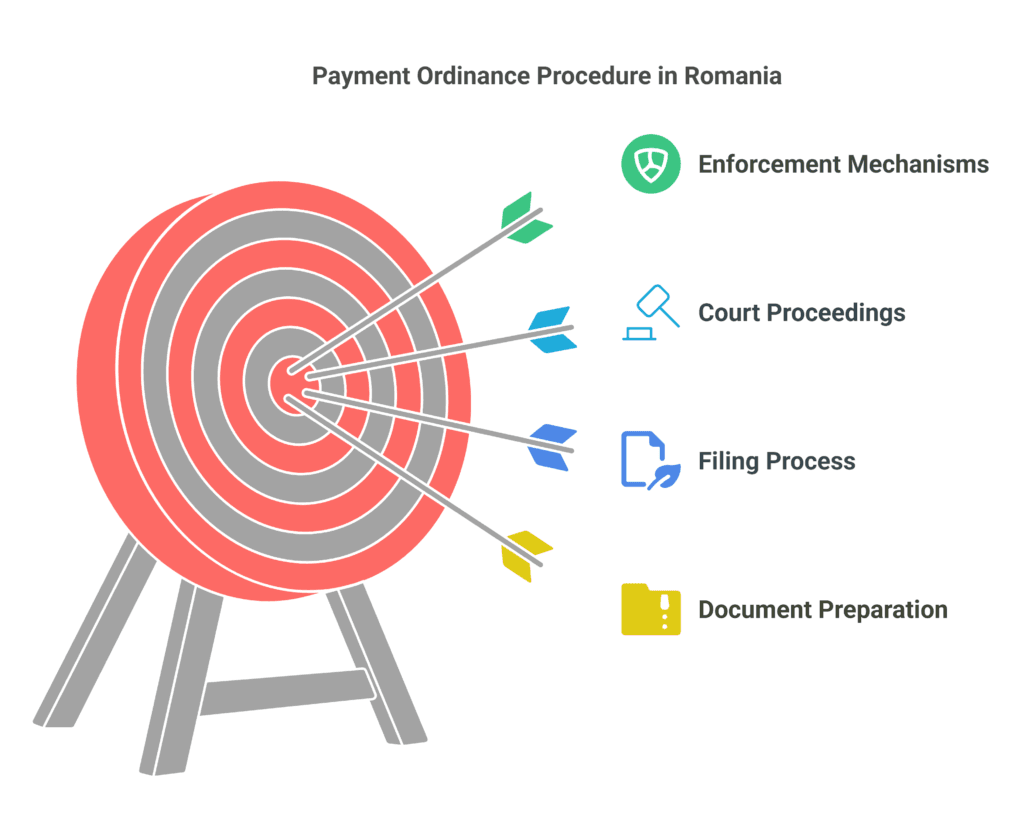
The payment-order and enforcement rules are contained in the Romanian Code of Civil Procedure. Our dedicated guide to the payment ordinance procedure in Romania explains the conditions and required documents. The broader debt recovery in Romania guide covers the complete collection strategy.

Illustrative scenarios

No penalty clause in the contract

A Romanian buyer does not pay a 30-day invoice of €10,000. Because the money obligation was assumed in a business activity, interest runs from maturity without a formal demand at the statutory B2B rate, and the €40 flat compensation applies. The supplier can demand the principal, interest and the €40 in one written request.

Contract with a 0.5% daily penalty

The parties agreed a daily penalty of 0.5% of the unpaid amount. On a disputed invoice, the creditor can claim the contractual penalty without proving any loss under Civil Code Article 1538. A court may reduce the penalty only on statutory grounds, such as partial beneficial performance or a penalty that is manifestly excessive compared with the foreseeable loss.

Debtor contests the invoice

The debtor claims the services were defective and refuses payment. Because the claim is genuinely disputed, the payment-order route may not resolve the matter. The supplier should prepare evidence of performance and acceptance and assess ordinary litigation against the amount at stake.

How to protect your position before and after maturity

The strongest position starts before the invoice is issued. Interest and penalties are easier to claim when the contract supports them and the documentation confirms what was delivered, when it was delivered and for which price.

  1. Set a compliant payment term. Align the due date with Law 72/2013, generally up to 60 days in B2B transactions, and state it clearly in the contract.
  2. Agree a penalty or interest rate. Include a per-day penalty clause or an agreed annual interest rate so there is no argument about the statutory rate.
  3. Invoice promptly and completely. Issue the invoice with an unambiguous due date and complete references to the contract and delivery documents.
  4. Confirm receipt and delivery. Keep signed delivery notes, acceptance records or other evidence that the goods or services were provided.
  5. Send a written reminder at maturity. Restate the amount, due date, interest formula and €40 compensation. This becomes part of the evidence supporting the claim.
  6. Calculate interest from the correct date. Use the contractual due date or the applicable 30-day statutory threshold, with the semester rate in force at the start of each semester.
  7. Assess the payment-order procedure early. For a certain, liquid and due contractual claim established through documentary evidence, consider the faster procedure rather than waiting while interest and costs accumulate.
  8. Preserve the enforcement option. If payment does not follow, instruct counsel or a judicial executor before the debtor transfers assets.

The Bottom Line

Late payment in Romania is not merely a collections nuisance. It is a regulated event that gives the creditor a defined set of remedies. A professional creditor can claim the applicable statutory or contractual late-payment interest or penalty, the €40 minimum compensation and substantiated recovery costs. Late-payment interest or a contractual penalty and the €40 minimum compensation do not require proof of actual loss, while additional recovery costs must be established. Getting the payment terms, penalty clause and paper trail right from the beginning converts an overdue invoice into a clearly quantified claim that can be pursued through the payment-order procedure or the ordinary courts.

Frequently asked questions

Do I have to send a formal notice before interest starts running?

For money obligations assumed in the exercise of an undertaking’s activity, the debtor is in delay by operation of law and interest runs from maturity without a formal demand. A written reminder is still advisable as evidence and may be required for other remedies.

What is the statutory interest rate for late payment in Romania?

In professional relations, it is the reference rate plus 8 percentage points per year. With the reference rate at 6.5%, that is approximately 14.5% per annum. Confirm the current reference rate published by the National Bank of Romania before relying on a figure.

Is the €40 compensation automatic?

In B2B relations, yes. When the conditions for late payment are met, the creditor may demand the lei equivalent of €40 as flat-rate minimum recovery damages, in addition to penalty interest and enforcement costs.

Can we agree a payment term longer than 60 days?

Only if the clause is not abusive or grossly unfair to the creditor. A longer term imposed without objective justification is exposed to challenge. Clauses fixing the invoice issue or receipt date are absolutely void.

Are contractual penalty clauses enforceable without proof of loss?

Yes. A penalty clause entitles the creditor to the agreed amount without proving any loss. A court may reduce the penalty only in limited statutory circumstances, including where the penalty is manifestly excessive compared with the foreseeable loss.

Does late payment allow the creditor to terminate the contract?

Non-performance can give rise to termination rights where the statutory conditions are met. Termination is assessed separately from the interest claim and carries its own consequences, so it should be considered with counsel before being used.

Disclaimer: This article provides general legal information about Romanian and EU late-payment rules and does not constitute legal or tax advice. Interest rates, deadlines and remedies depend on the contract, the parties’ status and the specific facts. Figures such as the reference rate change over time.

AI Notice: AI-assisted content, reviewed and approved by a qualified Romanian lawyer.

Unpaid invoices in Romania and commercial debt recovery

Unpaid Invoices in Romania (SRL Guide): Legal Recovery Options

Commercial debt recovery · Romania

Unpaid Invoices in Romania (SRL Guide): Legal Recovery Options

A Romanian company dealing with an unpaid invoice should decide quickly whether to request payment, negotiate, use the payment-order procedure, bring an ordinary claim or enter an insolvency proceeding as a creditor. The correct route depends on the contract, evidence, objections, debtor’s position and value of the claim.

This guide is general information for Romanian companies and foreign businesses with Romanian counterparties. The current procedural, tax and insolvency position should be checked for the specific claim before filing.

Primary procedural reference: Romanian Code of Civil Procedure. Law no. 72/2013 and Law no. 85/2014 should be checked in their current form in the Portal Legislativ.

What is the fastest legal route for an unpaid invoice in Romania?

There is no universally fastest route. A payment order under the Romanian Code of Civil Procedure can be suitable for a due, payable and undisputed monetary claim supported by written evidence. If the debtor raises a genuine defence, ordinary litigation may be necessary. If the debtor is insolvent, the creditor must follow the insolvency procedure and its deadlines.

Before court

Verify the contract, delivery or performance evidence, invoice, due date, notices, limitation issues and the debtor’s current solvency before choosing a procedure.

Payment order

Consider the special procedure when the debt is certain, liquid and due and the available documents support the claim. It is not a substitute for complex factual disputes.

Ordinary claim

Use a standard civil claim when the debt, performance, defects, set-off, termination or amount is genuinely disputed or the remedy goes beyond a payment-order application.

Important: a formal demand, a court application and enforcement are different steps. A lawyer should assess the evidence and debtor’s position before a company promises a recovery date or incurs filing costs.

How should an SRL assess an unpaid invoice?

The first task is to convert the invoice into an evidence file. The relevant question is not simply whether an invoice was issued, but whether the creditor can prove the underlying obligation, performance or delivery, acceptance, due date and amount still outstanding.

Select the point that determines the next legal decision.

Build the evidence

Collect the contract, purchase order, invoice, delivery or acceptance record, correspondence, account statement and proof of any partial payment.

QuestionEvidence to collectWhy it mattersPossible consequence
Was there a binding obligation?Signed contract, order, accepted offer or reliable correspondence.Shows the legal basis for payment and the parties’ agreed terms.Weak proof may require ordinary litigation rather than a simplified route.
Was performance completed?Delivery notes, acceptance, timesheets, reports, emails or technical records.Connects the invoice to the goods or services supplied.Defects, non-acceptance or set-off may create a genuine dispute.
Is the amount due?Invoice, due date, payment schedule, credits and account reconciliation.Clarifies the principal, interest, penalties and disputed balance.An uncertain or conditional amount may not fit a payment-order application.
Has the debtor’s position changed?Public insolvency information, returned mail, failed payments and enforcement data.Determines whether ordinary collection remains commercially sensible.Insolvency may redirect the creditor to a proof-of-claim process.

What legal recovery options are available?

A creditor may begin with a calibrated payment request or settlement proposal. This is not a universal mandatory pre-action step for every commercial claim, but it can clarify the debtor’s position, preserve the chronology and avoid proceedings where payment is still realistic.

Where the claim is due, liquid and supported by written evidence, the creditor may consider the payment-order procedure regulated by Articles 1014–1025 of the Romanian Code of Civil Procedure. The procedure is designed for payment claims based on a contract or another written instrument. The court may reject the application or direct the dispute toward ordinary litigation where the legal conditions are not satisfied or the defence requires a full examination.

An ordinary claim may be more appropriate where the debtor disputes delivery, quality, completion, termination, calculation, set-off or liability. It may also be required where the creditor seeks remedies that cannot be obtained through a payment-order application. The pleadings and evidence should be prepared around the actual dispute, not around the label placed on the invoice.

After an enforceable title is obtained, enforcement is a separate phase. The creditor may need an enforcement strategy based on identifiable assets, bank accounts, receivables, movable or immovable property and competing creditors. A judgment does not guarantee immediate recovery if the debtor has no recoverable assets.

Payment request

Use a clear statement of the amount, legal basis, due date, payment details and deadline, while preserving proof of delivery and avoiding unsupported threats.

Payment order

Assess whether the documentary record supports a due monetary claim and whether a genuine defence is likely to require ordinary proceedings.

Ordinary litigation

Use a standard claim for contested facts, complex contractual remedies, damages, set-off or evidence that cannot be fairly resolved in the special procedure.

Evidence, limitation and the commercial value of the claim

Invoice recovery should begin with a limitation and value assessment, not only with drafting a demand. The general limitation period for many civil claims is three years, but the starting point, interruption, suspension and applicable special rule depend on the legal relationship and the facts. The creditor should calculate the period from the relevant due date and review any acknowledgments, partial payments, settlement discussions or proceedings that may affect it.

Evidence must be preserved in the form in which it was created. Keep the original contract and annexes, order forms, delivery documents, acceptance records, correspondence, electronic metadata where relevant, payment history and proof that notices were received. A translated summary may help an international client, but it should not replace the underlying document when the original is needed to prove the transaction.

The debtor’s objection should be identified before a procedure is chosen. A refusal to pay is not always a legal defence, while an objection about non-performance, defects, delivery, authority, prescription, set-off or termination may change the entire case. The creditor should also check whether the invoice was issued by the contracting entity, whether the claim was assigned, whether guarantees exist and whether another company in the group is actually liable.

Finally, compare the expected recovery with the cost and time of action. A smaller debt may justify a formal demand and settlement process, while a larger or strategically important claim may justify litigation and enforcement preparation. Cross-border debt adds jurisdiction, service, applicable law, translation and recognition issues. No route should be presented as guaranteed merely because the invoice appears unpaid.

Recovery routeBest starting pointMain legal riskControl before filing
Payment request or settlementDebt is commercially recoverable and the debtor may still engage.Admission, waiver or unclear settlement language.State the legal basis, amount, reservation of rights and payment terms precisely.
Payment-order procedureDue monetary claim supported by written evidence.Genuine defence or insufficient documentary proof.Test certainty, liquidity, maturity and likely objections under the Code of Civil Procedure.
Ordinary civil claimDisputed performance, amount, liability or contractual remedy.Limitation, jurisdiction, evidence gaps or disproportionate cost.Map the cause of action, evidence, remedy, court fee and enforcement value.
Insolvency claimFormal insolvency proceedings have been opened against the debtor.Missed deadline, incomplete proof or low recovery ranking.Follow the court decision, administrator notices and creditor-table timetable.

Interest and recovery costs for late B2B payments

For commercial transactions within the scope of Law no. 72/2013, late-payment interest and the fixed recovery-cost compensation may be available under the statutory conditions. The applicable interest rate is not a permanent number. It depends on the reference rate in force for the relevant period and should be calculated for the actual dates, currency and transaction.

The contract may contain its own interest or penalty clause, but the clause must be checked for validity, proportionality, applicable mandatory rules and the relationship between contractual and statutory remedies. A creditor should not copy an old rate from an earlier article or assume that the same rate applies throughout a long period of delay.

The fixed recovery-cost amount is not a substitute for proving the principal debt, and it does not automatically resolve questions concerning legal costs, contractual penalties, VAT or damages. The invoice file should separate principal, contractual interest, statutory interest, fixed compensation and recoverable procedural costs.

Practical control: calculate interest only after confirming the due date, any grace period, partial payments, suspension or dispute, applicable reference rate and the legal basis for the amount claimed.

What if the debtor enters insolvency?

When insolvency proceedings are opened, the creditor must stop treating the matter as an ordinary collection exercise. The creditor should check the court decision, the insolvency administrator, the deadline fixed for lodging claims and the information published in the insolvency proceedings. The applicable deadline is not a universal 30-day period copied into every case. It is determined by the insolvency court’s decision and the applicable provisions of Law no. 85/2014.

The creditor should prepare the proof of claim with the contract, invoices, delivery evidence, account reconciliation, notices, interest calculation and any security. Missing the deadline, filing an incomplete claim or failing to monitor the creditor table can materially affect participation in the proceedings.

VAT treatment is a separate accounting and tax question. The creditor should coordinate any adjustment under the Romanian Fiscal Code with its accountant and verify the conditions, dates and documentation. A legal recovery strategy should not present a VAT correction as automatic merely because an invoice remains unpaid.

Select the debtor status to see the immediate control.

Still operating

Confirm the debt, send a measured demand, assess settlement and decide whether a payment order or ordinary claim is commercially justified.

Four mistakes that weaken invoice recovery

Using the wrong procedure

A payment order is not designed to decide every dispute about performance, defects, termination, set-off or complex damages.

Copying old rates

Interest rates, filing fees and procedural rules may change. Verify the current amount instead of relying on a previous calculation.

Promising a fixed result

A legal title and an actual recovery are different outcomes. Solvency, assets, security and competing creditors determine the practical result.

Other recurring problems include accepting partial payments without reconciling the balance, losing delivery evidence, sending notices from an unclear entity, overlooking a limitation issue, failing to preserve proof of receipt and treating a foreign debtor as if it were subject to the same jurisdiction and enforcement route.

Unpaid invoice recovery checklist for a Romanian company

  • Identify the contracting parties, signatory authority, applicable law, jurisdiction and any arbitration clause.
  • Collect the contract, order, invoice, delivery or acceptance documents, correspondence and payment record.
  • Reconcile the principal, credits, partial payments, interest, contractual penalties and fixed recovery compensation.
  • Check whether the debtor has raised a genuine defence concerning performance, quality, termination, set-off or amount.
  • Verify limitation, insolvency status, security, enforcement history and the likely value of the claim.
  • Choose proportionately among demand, settlement, payment order, ordinary litigation, European procedure or insolvency filing.
  • Preserve evidence of notices, filing, court communication, the enforceable title and enforcement steps.
  • Coordinate legal, accounting and tax treatment before making a VAT adjustment or settlement concession.

Frequently asked questions

What is the payment-order procedure in Romania?

It is a special court procedure for certain due monetary claims supported by written evidence, regulated by Articles 1014–1025 of the Romanian Code of Civil Procedure. Its suitability depends on the contract, evidence and whether the debtor raises a genuine defence.

Is a formal demand required before suing for an unpaid invoice?

Not for every commercial claim as a universal rule. A demand may nevertheless clarify the debtor’s position, support the chronology, encourage payment and help quantify the amount before proceedings. The contract and applicable procedure should be checked.

How much interest can a Romanian company claim?

The answer depends on the contract, applicable law, transaction, currency, due date and reference rate for the relevant period. For transactions within Law no. 72/2013, statutory late-payment interest may be available, but the current rate must be calculated rather than copied from an old source.

What happens if the debtor disputes the invoice?

A genuine dispute about delivery, quality, completion, termination, set-off or amount may make ordinary litigation more appropriate than a payment order. The creditor should preserve the evidence and assess the likely defence before choosing the procedure.

What should a creditor do if the debtor enters insolvency?

Check the insolvency court decision, the appointed administrator and the deadline fixed for lodging claims. Prepare and file the proof of claim with supporting documents, then monitor the creditor table and the relevant procedural publications.

Does winning a court case guarantee recovery?

No. An enforceable title establishes a legal basis for enforcement, but actual recovery depends on the debtor’s assets, security, ranking, competing creditors and the outcome of enforcement. The commercial value of the claim should be assessed before proceedings.

Need to recover an unpaid commercial invoice?

A focused review can assess the evidence, debtor status, available procedure, interest calculation and practical enforcement risk.

Book a consultation

Disclaimer: This article provides general information only and does not constitute legal, tax or accounting advice. The correct recovery route depends on the contract, evidence, debtor, amount, applicable law, procedural status and current legal requirements. Obtain a case-specific assessment before filing or making a tax adjustment.

AI Notice: AI-assisted content, reviewed by a qualified Romanian lawyer.

Recovering Unpaid Debts Romania

Debt Collection in Romania: Recovering Unpaid Debts

Debt Collection in Romania: Recovering Unpaid Debts

Debt Collection in Romania: Recovering Unpaid Debts

Navigating the intricacies of debt collection in Romania requires a comprehensive understanding of the local legal framework and the specific nuances of Romanian law. This article serves as a guide to help creditors understand the debt collection process, explore available options for debt recovery, and ultimately recover their unpaid invoices.

Understanding Debt Collection in Romania

Successfully navigating the debt collection process in Romania demands a clear understanding of both local and international regulations. As an expert legal services provider, we can assist you in understanding the full scope of the legal action you can take. Our goal is to provide the best legal solutions, ensuring effective strategies for debt recovery in Romania. Learn more about creditors’ rights and legal protections in Romania.

What is Debt Collection?

Debt collection is the process of pursuing debtors to pay outstanding debts owed to creditors. This can involve various methods, from sending reminders for unpaid invoices to initiating legal proceedings. The aim of debt collection in Romania is to recover receivables in a timely and cost-effective manner, while adhering to the Civil Procedure Code and other applicable laws. For detailed guidance on the complete debt collection process, visit our comprehensive guide to debt collection in Romania.

The Landscape of Debt in Romania

The economic landscape of Romania, like many other nations, faces challenges related to unpaid debts. Understanding the current trends and statistics related to non-payment and insolvency is crucial for both creditors and debtors in Romania. Factors such as economic downturns, business relationship strains, and inefficient payment systems contribute to the prevalence of unpaid invoices in Romania.

Types of Debts: Commercial vs. Personal

In Romania, debts can be broadly categorized into the following types:

  • Commercial debts, which typically arise from unpaid invoices between businesses.
  • Personal debts, which often involve loans, credit card balances, or other financial obligations of an individual.

The type of debt influences the debt collection process and the available legal action options, requiring tailored strategies from a debt recovery lawyer.

Legal Framework for Debt Recovery

Key Legislation Governing Debt Collection

The debt collection process in Romania is governed by a comprehensive set of laws and regulations designed to protect both creditors and debtors. Key legislation includes the Civil Procedure Code, which outlines the procedures for legal action, including filing a payment order. Understanding these laws is essential for effective debt recovery in Romania and for ensuring compliance throughout the debt collection process. Knowledge of the Romanian Law will help you recover your unpaid invoices. For detailed information on how to bring a case to court in Romania, refer to the European e-Justice Portal.

Role of Debt Recovery Lawyers

A debt recovery lawyer plays a crucial role in navigating the complexities of debt collection in Romania.

Atrium Romanian Law Office is an expert legal services provider based in Romania, specifically in Bucharest. Atrium aims to be the best in handling complex and challenging legal matters. The firm’s team of experienced Romanian lawyers and professionals are equipped to resolve any legal issue in a timely manner. They offer guidance through processes related to commercial transactions, dispute resolution, compliance, and even personal issues. The team are members of the Romanian Bucharest Bar.

These legal professionals provide expert guidance on legal proceedings, represent creditors in Romanian courts, and develop tailored strategies for debt recovery. At Atrium Romanian Law Office, experienced lawyers understand the nuances of Romanian law. This ensures that all legal action taken is both effective and compliant with the Civil Procedure Code, maximizing the chances of recovering outstanding debt.

Understanding the Statute of Limitations

The statute of limitations sets a time limit within which a creditor must initiate legal action to recover an outstanding debt. In Romania, understanding the limitation period for different types of debts is crucial for debt recovery. Once the limitation period expires, the debt becomes unenforceable in Romanian courts. Therefore, it is vital for creditors to act promptly and seek legal advice from a debt recovery lawyer to recover their unpaid invoices before the statute of limitations runs out. For more information on civil procedure requirements, consult the European e-Justice Portal on Romanian Civil Procedure.

Steps to Recover Unpaid Debts

The debt collection process in Romania involves several key steps designed to maximize your chances of successful recovery. Whether through amicable settlement or legal proceedings, understanding each phase is critical. For more details on the complete process, read our article on simplified cross-border debt collection in Romania.

Identifying Outstanding Amounts

The first step in the debt collection process in Romania is to accurately identify and document all outstanding debts. This involves reviewing unpaid invoices, contracts, and any other relevant documentation to determine the total amount owed by the debtor in Romania. Precise record-keeping is essential for initiating legal proceedings and demonstrating the validity of the claim in Romania to the competent court. Expert legal services providers can help you organize and verify your financial records.

Initiating Collection Procedures

Once the outstanding debt is identified, the next step involves initiating formal debt collection procedures. This typically begins with sending a formal demand letter to the debtor in Romania, outlining the unpaid invoices and requesting immediate payment. This initial communication aims to resolve the issue amicably, potentially avoiding costly legal action. If the debtor fails to respond or make payment, further steps such as involving a debt collection agency or a debt recovery lawyer may be necessary to recover their unpaid invoices. Our debt collection lawyer services can handle this entire process for you.

Filing a Payment Order

If amicable attempts to recover unpaid invoices fail, filing a payment order (Ordin de Plata) is a common legal action in Romania. A payment order is a simplified procedure for debt recovery that allows creditors to obtain a court order requiring the debtor in Romania to pay the outstanding debt. This process is particularly effective for straightforward cases where the debt is undisputed. It streamlines the debt collection process through the Romanian courts, offering a faster and more cost-effective route to debt recovery.

Handling Unpaid Invoices in Romania

Best Practices for Invoice Management

Effective invoice management is crucial for preventing unpaid invoices and ensuring smooth debt recovery in Romania. Creditors should implement clear and concise invoicing procedures, including detailed payment terms and due dates. Regular monitoring of outstanding debts and prompt follow-up on overdue invoices can help minimize the risk of non-payment. Maintaining a strong business relationship with debtors through open communication can also facilitate timely payments and prevent disputes.

Strategies for Unpaid Invoices

Creditors in Romania have several options for recovering unpaid invoices. Initially, they can try some direct approaches:

  • Sending reminder notices
  • Making phone calls
  • Offering payment plans

These steps can encourage debtors in Romania to settle their outstanding debt. If these amicable efforts are unsuccessful, engaging a debt collection agency or seeking assistance from a debt recovery lawyer may be necessary to initiate more formal legal action. Expert law firms ensure that all strategies comply with Romanian law.

Using Interim Measures in Debt Recovery

In certain cases, interim measures can be used during the debt collection process in Romania to protect the creditor’s interests. These measures may include freezing the debtor’s assets or obtaining a court order to prevent the transfer of funds. Such actions can provide leverage and increase the likelihood of debt recovery. It is essential to seek legal advice from a debt recovery lawyer before pursuing interim measures to ensure compliance with the Civil Procedure Code. The Romanian Courts oversee such measures. For more details on enforcement procedures, consult the e-Justice Portal on online case processing in Romania.

International Debt Collection in Romania

Challenges in International Debt Recovery

International debt collection in Romania presents unique challenges compared to domestic debt recovery. One significant hurdle is the lack of familiarity with Romanian law and procedures. Consider these common challenges for international business owners:

  • Lack of familiarity with Romanian laws
  • Potential language barriers
  • The complexity of setting up or managing a business in a foreign country

Language barriers, cultural differences, and logistical complexities can also impede the debt collection process. Engaging a law firm with experience in international debt collection is crucial for navigating these challenges and maximizing the chances of recovering outstanding debt from a Romanian debtor.

Legal Considerations for International Creditors

International creditors seeking debt recovery in Romania must carefully consider the applicable legal action. This includes understanding the relevant international treaties and agreements, as well as the specific requirements of Romanian law. For comprehensive guidance on international civil proceedings, refer to Book VII of Romania’s Code of Civil Procedure on International Civil Proceedings.

Atrium Romanian Law Office provides comprehensive legal services in multiple languages, including English, French, and German. The firm offers expertise in various practice areas, including Business law, Data Protection Compliance, and Tax Law, helping international business owners navigate the legal complexities of operating in Romania. Ensuring compliance with the Civil Procedure Code and the statute of limitations is essential for a successful debt collection process.

Resources for International Debt Collection

Several resources are available to assist international creditors with debt recovery in Romania. These include debt collection agencies specializing in international debt collection, law firms with expertise in Romanian law, and government agencies that provide support to foreign businesses. Leveraging these resources can streamline the debt collection process and improve the likelihood of recovering unpaid invoices. Expert legal services providers offer tailored solutions for international debt collection in Romania, ensuring compliance with all relevant regulations.

Conclusion: Effective Strategies for Debt Recovery

Key Takeaways for Creditors

For creditors seeking debt recovery in Romania, several key takeaways can enhance their success. To increase your chances of recovering unpaid debts, it’s crucial to:

  • Maintain thorough documentation of all transactions and unpaid invoices.
  • Act promptly and be aware of the statute of limitations.
  • Understand the Romanian legal framework governing debt collection.

Lastly, consider engaging a law firm with expertise in debt recovery in Romania to navigate the complexities of the legal proceedings and recover unpaid invoices.

Resources and Support for Debt Recovery

Various resources and support systems are available for debt recovery in Romania. Debt collection agencies can assist with the initial stages of debt collection, while debt recovery lawyers provide expert legal action. Government agencies and trade organizations also offer guidance on debt collection processes and insolvency procedures. Leveraging these resources can streamline the debt collection process, helping creditors recover their unpaid invoices effectively.

When to Seek Legal Action

Seeking legal action is advisable when amicable attempts to recover unpaid invoices have failed. If the debtor in Romania is unresponsive or unwilling to pay, initiating legal proceedings becomes necessary. Engaging a debt recovery lawyer ensures that all legal action is taken in compliance with the Civil Procedure Code and Romanian Law. This proactive approach increases the likelihood of debt recovery and protects the creditor’s financial interests against non-payment.

Additional Resources for Debt Collection in Romania

To support your debt recovery efforts, here are authoritative resources, references, and additional information from our blog:

Video: Understanding Debt Collection in Romania

Play

Frequently Asked Questions About Debt Collection in Romania

What should I do if I have unpaid invoices in Romania?
To address unpaid invoices in Romania, first communicate with the debtor to obtain payment. If this fails, consider hiring a Romanian law firm to assist with debt collection services, or initiate a court claim under the Romanian civil procedure code.
How can I substantiate my claim for unpaid invoices?
You can substantiate your claim by gathering all relevant documentation, including contracts, correspondence, and invoices. This evidence is crucial in a debt collection case in Romania to support your statement of claim.
What is the process for initiating a small claims procedure in Romania?
To initiate a small claims procedure in Romania, the value of the claim must not exceed RON 10,000 on the date of referral to court. You must file your claim within the statute of limitations period (typically 3 years from the date the debt became due). Once filed, the defendant has 30 days to respond to the court’s service of documents. Ensure you are familiar with the rules of civil procedure, as this will guide you through the necessary steps.
What are the costs involved in debt recovery?
Collection costs can vary depending on the complexity of the case and the amount of the claim. You may incur costs from your debtor if you successfully recover your unpaid invoices, as Romanian law provides for the recovery of outstanding collection costs.
How long does the limitation period last for debt collection cases?
The statute of limitations for debt collection in Romania typically lasts for three years from the date the debt became due. It’s important to act promptly to ensure your claim is still valid during this period.
Can I issue an order for payment for unpaid invoices?
Yes, you can issue an order for payment for unpaid invoices through the Romanian courts. This is a formal request that can expedite the recovery process and is often part of a debt recovery strategy.
What role does a bailiff play in debt collection?
A bailiff, or executor judiciar, in Romania can assist in enforcing court decisions related to unpaid invoices. They are authorized to seize assets if a debtor fails to comply with a payment order.
How does the relationship between the parties affect debt recovery?
The relationship between the parties can impact the debt recovery process. A more amicable relationship may lead to negotiations and settlements, while a contentious one might necessitate legal representation and formal court procedures.
What are the benefits of using a Romanian law firm for debt collection?
Engaging a top law firm in Romania can provide you with expert legal representation and a robust debt recovery strategy. They can navigate the complexities of the Romanian civil procedure code and improve your chances of recovering your receivables efficiently.
Debt recovery in Romania through payment order, court action and enforcement

Debt Recovery in Romania: 3 Legal Routes

Debt recovery in Romania is not a choice between three interchangeable remedies. The right route depends on what the creditor can prove, how the debtor responds and whether an enforceable title already exists.

Documents and calculator illustrating commercial debt recovery in Romania
Commercial debt recovery in Romania: documents, calculations and the route from claim to enforcement.

A clear invoice supported by a contract and proof of delivery may fit the payment-order procedure. A claim involving defective performance, disputed quantities, damages or set-off may require ordinary litigation. A judgment or another enforceable instrument moves the matter into enforcement, where the decisive question becomes whether the debtor has reachable assets.

This guide focuses on commercial money claims involving Romanian debtors or Romanian proceedings. It should be read together with the rules on late-payment interest and recovery costs in Romania.

Play
Video overview of the practical debt-recovery routes discussed in this guide.

Which debt recovery route should a creditor use in Romania?

Use a payment order for a documented contractual debt that is certain, liquid and due. Use ordinary court proceedings when the dispute needs broader evidence or a full examination of liability. Start enforcement only when an enforceable title already exists.
Route selector
Match the claim to the legal route

Choose the description that best matches the file. The result is a starting point, not a substitute for reviewing the documents and possible defences.

Consider the payment-order procedure

Where a contractual money claim is certain, liquid and due and the essential facts can be established from documents, Articles 1014 to 1025 of the Code of Civil Procedure provide a focused recovery route.

Route matrixChoose by claim profile
RouteBest suited toWhat the creditor needsPrincipal limitation
Negotiated paymentCommercially viable debtor who accepts the debtReconciled amount, written acknowledgment, realistic schedule and default consequencesA weak settlement can merely delay action and may not provide an enforceable title
Payment orderCertain, liquid and due contractual money claimWritten contractual basis, proof of performance, due date, calculation and Article 1015 summonsUnsuitable where the defence requires evidence beyond the summary documentary framework
Ordinary court actionDisputed liability, performance, amount, damages or set-offComplete factual and evidential case, jurisdiction analysis and properly quantified reliefUsually slower and subject to a value-based court fee
Small-claims procedureEligible claims not exceeding RON 50,000 at filingClaim within the statutory scope and a file suitable for the mainly written procedureExclusions apply and the procedure may not fit evidence-heavy disputes
EnforcementCreditor already holding an enforceable titleValid title, enforceable amount and timely application to a competent judicial executorA title does not create assets; recovery depends on what can lawfully be traced and attached

What should be checked before any recovery action?

The first legal question is whether the claimed amount is actually due. The invoice is important, but it rarely proves the entire case by itself. The underlying agreement, order, delivery or service records, acceptance documents, correspondence, account statements and payment history should be read together.

The creditor should also confirm the correct debtor, corporate identity, contractual notice method, governing law, jurisdiction or arbitration clause, due date, interest basis, limitation position and any security or guarantee. A focused review of the underlying Romanian contract can expose a jurisdiction clause, acceptance mechanism or liability provision that changes the recovery strategy.

Evidence map
What makes a commercial debt file stronger?

Select an evidence category to see what it should establish.

Prove the source of the obligation

The signed agreement, accepted order, framework contract and incorporated terms should identify the parties, the promised performance, the price and the payment mechanism.

Evidence fileWhat each document must prove
Document or factWhat it should proveTypical weakness to address
Contract, order and termsIdentity, scope, price, payment date, notices, law and forumUnsigned annexes, inconsistent entities or terms incorporated without proof
Invoice and calculationPrincipal amount, currency, VAT treatment, due date and credit notesInvoice differs from the contractual price or omits agreed milestones
Delivery or performance evidenceGoods delivered or services performed in the agreed mannerNo signed receipt, acceptance document or contemporaneous service record
Debtor correspondenceAcceptance, objections, promises, acknowledgment or proposed instalmentsCommercial discussions are treated as an admission when they remain conditional
Payments and reconciliationOutstanding balance after partial payments, credits and set-offClaim does not reflect payments or reciprocal amounts
Guarantees and securityAdditional debtor, collateral, promissory note or other recovery sourceFormalities, expiry, scope or enforcement conditions were not checked

Is a formal payment demand required before filing?

A documented demand is advisable in almost every commercial file. For the Romanian payment-order procedure, Article 1015 requires a specific summons giving the debtor 15 days to pay and served through a judicial executor or by registered letter with declared contents and acknowledgment of receipt.

The Article 1015 summons is not the same as an informal reminder. It should identify the agreement, principal, accessories, due date and payment account clearly. Proof of compliant service belongs in the court file. The statutory summons also has consequences for limitation under the payment-order rules.

A contract may impose an additional notice mechanism, address or cure period. The creditor should satisfy both the statutory requirement and any relevant contractual provision rather than assume one automatically replaces the other.

Response map
What does the debtor’s response change?

Choose the response received after the demand.

Test both procedure and recoverability

Silence may support moving forward, but it does not prove that the debtor has assets or that no defence will appear after filing. Review the documents and financial warning signs before choosing the route.

When is the Romanian payment-order procedure appropriate?

The payment-order procedure under Articles 1014 to 1025 of the Romanian Code of Civil Procedure applies to certain, liquid and due claims for payment of money arising from a civil contract and established through the documentary framework required by law. Commercial invoice claims commonly fit this structure when the underlying performance and amount are not genuinely in dispute.

“Certain” concerns the existence of the debt, “liquid” means the amount is determined or determinable, and “due” means the payment date has passed. These conditions must be established, not merely asserted. A debtor may contest the contractual basis, authority, delivery, acceptance, price, due date, payment, set-off or limitation.

What happens if the debtor raises a defence?

The existence of a defence does not automatically defeat the application. The court examines the documents and the parties’ explanations. It may reject the request if the debtor’s defence is well founded or if resolving the defence requires evidence that is admissible in ordinary proceedings but falls outside the payment-order framework. If the claim is established, the court may issue the payment order for the full amount or only for the part proved within the special procedure.

Rejection on either ground regulated by Article 1021 does not prevent the creditor from bringing an ordinary claim. If the court issues a payment order for only part of the claim, the creditor may use ordinary proceedings for the remainder. The Code also sets a procedural objective of issuing the order within 45 days from filing, but periods needed for service and delays attributable to the creditor are excluded. Actual duration depends on service, court workload, objections and the individual file.

Can the payment order be challenged?

The debtor may file an application for annulment within 10 days from communication of the payment order. Article 1024(2) also gives the creditor a narrowly defined annulment application against the rejection orders referred to in Article 1021(1)-(2) and against a payment order admitting only part of the claim. This limited remedy should be distinguished from the creditor’s separate right to bring ordinary proceedings after rejection or for the remainder not granted. The annulment application is not a general substitute for a full ordinary claim. The payment order remains enforceable while an annulment application is pending, although the debtor may request suspension subject to the statutory conditions and security.

When is an ordinary court action the better route?

Ordinary proceedings are usually the safer choice when the court must determine contested performance, contractual interpretation, defects, damages, causation, set-off or another issue requiring broader evidence.

Unlike the payment-order procedure, ordinary litigation can accommodate a fuller evidential process, including documents, witness evidence, party examination and expert evidence where admissible and relevant. This makes it better suited to construction, technology, professional services and supply disputes in which the unpaid invoice is only one part of a wider conflict. For broader procedural context, see our overview of the Romanian litigation process and court proceedings.

The claim should identify the legal basis and quantify principal, interest, contractual penalties and recoverable costs separately. Material jurisdiction is determined under the procedural law applicable when the proceedings are commenced. Claim value is only one criterion: the nature of the dispute, the relief sought and any special jurisdiction rules may displace the general allocation between district courts and tribunals. The competent court should therefore be verified against the claim as framed and the law applicable when the claim is registered with the court. Contractual arbitration clauses must also be checked before filing in a state court.

Ordinary court fees are normally calculated by reference to claim value under Government Emergency Ordinance no. 80/2013. The payment-order application has a fixed RON 200 court fee. Additional costs may include translations, experts, service, lawyer fees and enforcement advances. Recoverability of costs depends on the outcome, proof and the court’s assessment.

Can the small-claims procedure be used instead?

For eligible claims not exceeding RON 50,000 at the date of filing, the claimant may consider the Romanian small-claims procedure under Articles 1026 to 1033 of the Code of Civil Procedure. The threshold was increased to RON 50,000 by Law no. 57/2025. Interest, costs and other accessories are excluded when calculating the threshold.

The procedure is mainly written and uses standard forms, but statutory exclusions apply. It should not be treated as a smaller version of the payment order. A small claim may be disputed and still fit the procedure, while a payment-order claim is assessed against the special requirements for a certain, liquid and due contractual debt.

When can a creditor start enforcement in Romania?

Enforcement begins only when the creditor holds an enforceable title and the obligation is enforceable. The creditor applies to a competent judicial executor, who seeks court approval and uses the lawful method suited to the debtor’s assets.

An invoice, demand or favourable legal opinion is not by itself an enforceable title. A payment order, final or otherwise enforceable judgment, arbitral award, notarised instrument or another document given enforceable force by law may support enforcement, subject to its terms and any applicable formalities.

Possible methods include garnishment of bank accounts and third-party receivables, seizure and sale of movable property, enforcement against real estate and measures against security or guarantors where the title permits. The creditor should coordinate the title, outstanding calculation and asset information with the judicial executor. The European e-Justice Portal guidance on enforcing a court decision in Romania provides an official procedural overview.

Asset map
Where can enforcement produce value?

Select an asset category to review the practical control.

Garnishment may reach current and future funds

Bank-account garnishment can target the available credit balance and, subject to legal limits and exceptions, future incoming amounts. Speed matters where several creditors are competing.

Deadline radarTrigger, period and review point
IssueGeneral ruleWhy individual review matters
Article 1015 summonsGive the debtor 15 days to pay before filing the payment-order applicationService method and proof must meet the statutory requirements
Payment-order targetThe Code provides a 45-day target, excluding service time and creditor-caused delayIt is not a guaranteed completion date
Annulment applicationGenerally 10 days from communication in the situations regulated by Article 1024The party, decision and communication date must be checked
Limitation of the underlying claimOften three years from when the right of action aroseSpecial periods, suspension, interruption and contractual facts may change the analysis
Enforcement limitationGenerally three years from when the right to obtain enforcement arose; for judgments and arbitral awards, from finalitySpecial ten-year treatment applies to titles concerning rights in rem, and interruption rules matter
Enforcement challengeOften 15 days from the statutory triggering eventDifferent acts and grounds can produce different starting points
Creditor’s petition to open insolvency proceedings against the debtorClaim generally must exceed RON 50,000 and be unpaid for more than 60 daysInsolvency is a collective remedy and requires proof of the statutory conditions

Can the debtor challenge enforcement?

Yes. A debtor or another interested person may file an enforcement challenge on the grounds permitted by the Code. The ordinary period is often 15 days, but its start depends on the act challenged, knowledge of enforcement and the procedural situation. A challenge does not automatically mean the underlying debt never existed; it may concern the title, limitation, amounts, service, court approval or a specific enforcement act.

The general limitation period for obtaining enforcement is three years under Article 706 of the Code of Civil Procedure, unless the law provides otherwise. For court judgments and arbitral awards, it normally runs from finality. Acts of enforcement and other statutory events can interrupt the period.

What changes if the Romanian debtor is insolvent?

When insolvency proceedings open, Article 75 of Law no. 85/2014 generally suspends individual judicial, extrajudicial and enforcement measures for recovering claims against the debtor’s estate. The creditor must usually pursue the claim within the collective insolvency procedure and observe the deadline for filing its proof of debt. This general stay is subject to statutory exceptions, including certain proceedings against co-debtors or third-party guarantors, claims arising after the opening of insolvency and specific rules concerning secured funds or amounts already affected by enforcement. The position of secured creditors, including priority, distributions and any available relief from the stay, requires separate analysis under the insolvency legislation.

A creditor may apply to open insolvency if its claim satisfies the statutory requirements, including the RON 50,000 threshold and the presumption associated with a debt unpaid for more than 60 days. Insolvency should not be used merely as pressure where the debt is genuinely disputed or the statutory conditions are absent. It changes the recovery forum and priority structure rather than guaranteeing payment.

Security interests, guarantees, co-debtors and transactions concluded before insolvency require separate analysis. The opening of insolvency against the principal debtor does not necessarily eliminate every route against a guarantor or co-debtor. Our guide on Romanian company director liability explains why corporate debt and personal liability must not be treated as the same claim.

What interest and recovery costs can be claimed?

The creditor should distinguish principal, contractual penalty, statutory penalty interest, the EUR 40 minimum compensation and documented additional recovery costs. For qualifying B2B transactions, Law no. 72/2013 and Government Ordinance no. 13/2011 regulate statutory late-payment interest. Where Law no. 72/2013 applies and the parties have not agreed the level of late-payment interest, the legal penalty rate is the National Bank of Romania reference rate plus eight percentage points.

The EUR 40 minimum compensation under Law no. 72/2013 becomes due when the statutory conditions for late-payment interest are met. Additional recovery expenses must be substantiated. Contractual penalties require separate review under the Civil Code, including the court’s statutory power to reduce a manifestly excessive penalty in the circumstances allowed by law.

Recovery economicsAmounts, treatment and control
ItemHow it is treatedPractical control
PrincipalClaimed under the contract or other legal basisReconcile invoices, credits, partial payments and set-off before filing
Contractual penaltyDepends on valid contractual wording and Civil Code rulesCalculate transparently and test reduction risk
Statutory B2B interestReference rate plus eight percentage points where the statutory regime appliesUse the correct rate for each relevant semester
EUR 40 compensationMinimum additional compensation under Law no. 72/2013 when its conditions are metClaim separately and avoid presenting it as a substitute for all other costs
Court feeRON 200 for a payment-order request; ordinary claims are generally value-basedConfirm current fee and relief before filing
Lawyer, expert and translation costsMay be requested as litigation costs subject to proof and judicial assessmentKeep invoices, payment evidence and proportionality in view
Enforcement costsAdvanced through the enforcement process and allocated under the applicable rulesCompare expected asset value with the recovery budget

How do cross-border creditors recover Romanian debts?

A foreign creditor should first determine jurisdiction, governing law, service method and the place where assets are located. A Romanian proceeding may be appropriate when the debtor or assets are in Romania, but a valid jurisdiction or arbitration clause can change the route.

For qualifying uncontested cross-border pecuniary claims within the EU, Regulation (EC) no. 1896/2006 establishing a European order for payment may provide an alternative to the national payment-order procedure. Regulation (EU) no. 655/2014 may assist with a European Account Preservation Order in qualifying cross-border cases. Neither instrument replaces the need to establish jurisdiction, service and substantive entitlement.

Recognition and enforcement of judgments also depend on the country of origin and the applicable treaty or EU regulation. Our guide to the recognition and enforcement of foreign judgments in Romania explains that separate stage, while the guide to cross-border debt collection in Romania provides additional procedural context. The specific instrument should always be verified against the current parties and claim.

Common mistakes that weaken debt recovery

  • Treating the invoice as the complete case. The creditor still needs the legal basis, performance evidence, maturity and a correct calculation.
  • Using the payment order for an evidence-heavy dispute. A summary procedure cannot replace full litigation merely because the creditor wants speed.
  • Ignoring the contract’s forum and notice clauses. Filing in the wrong court or serving the wrong address can cause delay and cost.
  • Allowing limitation to drift. Commercial discussions do not always suspend or interrupt time. Each acknowledgment, notice and procedural step must be analysed legally.
  • Accepting informal instalments without protection. A settlement should state the admitted amount, schedule, interest, default consequences, security and costs.
  • Waiting until assets disappear. Litigation strategy should be coordinated with recoverability and lawful protective measures.
  • Confusing company debt with director liability. A director is not automatically personally liable for every unpaid company invoice.
  • Continuing individual enforcement after insolvency opens. The creditor may need to file in the insolvency proceedings instead.

A practical creditor checklist

  1. Identify the exact debtor, contractual basis, currency and outstanding balance.
  2. Collect the contract, orders, invoices, delivery records, acceptance evidence and correspondence.
  3. Check governing law, jurisdiction, arbitration, notice and limitation.
  4. Calculate principal, interest, penalties, EUR 40 compensation and documented costs separately.
  5. Review debtor objections, payments, set-off and any counterclaim.
  6. Assess assets, security, guarantors and insolvency indicators.
  7. Serve the correct commercial and statutory demand.
  8. Choose payment order, ordinary claim, small claims, settlement or insolvency participation deliberately.
  9. Prepare for enforcement before judgment rather than after assets have disappeared.
  10. Maintain one chronological file with originals, service records and calculations.

The Bottom Line

Debt recovery in Romania works best when procedure follows evidence. A payment order can be effective for a clear contractual money claim, but it is not a shortcut around a genuine dispute. Ordinary court proceedings provide the broader evidential framework required for contested cases. Enforcement comes after title and depends on identifiable assets, while insolvency can redirect the entire claim into a collective process.

For Romanian companies managing receivables, the earlier unpaid invoices guide for Romanian SRLs explains the operational starting point. Businesses can also reduce future disputes by strengthening the payment, acceptance, security and dispute clauses in their commercial contracts governed by Romanian law.

Frequently Asked Questions

What is the fastest procedure for debt recovery in Romania?

The payment-order procedure can be faster for a certain, liquid and due contractual money claim supported by documents. It is not automatically the best route when liability, performance or amount is genuinely disputed. The statutory timetable also excludes service time and delays attributable to the creditor.

Is an unpaid invoice enough to obtain a Romanian payment order?

Not necessarily. The creditor should prove the contractual basis, its own performance, the due date and the amount. A signed contract, accepted order, delivery record, acceptance document, account reconciliation and debtor correspondence may be important. The invoice should be read as part of the whole transaction file.

Must the creditor send a 15-day notice before applying for a payment order?

Yes. Article 1015 of the Code of Civil Procedure requires a summons giving the debtor 15 days to pay, served through a judicial executor or by registered letter with declared contents and acknowledgment of receipt. The creditor should retain compliant proof of service.

Can a Romanian payment order be enforced while it is challenged?

The payment order is enforceable even if an application for annulment is filed. The debtor may request suspension under the statutory conditions, which include the security required by law. The exact order and procedural status should be reviewed before enforcement begins.

How long is the limitation period for a commercial debt in Romania?

The general limitation period is often three years from the date on which the right of action arose, but special periods and rules on commencement, suspension and interruption may apply. The separate right to obtain enforcement is also generally subject to a three-year period under Article 706, calculated according to the type of title.

Can a creditor claim interest and the EUR 40 recovery compensation?

For transactions falling within Law no. 72/2013, the creditor may claim the applicable late-payment interest and the minimum EUR 40 compensation when the statutory conditions are met. Documented additional recovery costs may also be claimed. Contractual penalties and statutory interest require a careful calculation to avoid duplication or overstatement.

What happens to enforcement if the debtor enters insolvency?

Once insolvency proceedings open, individual judicial, extrajudicial and enforcement measures for recovering claims against the debtor’s estate are generally suspended under Article 75 of Law no. 85/2014. The creditor normally needs to file its claim in the insolvency proceedings within the applicable deadline.

Need to recover or defend a commercial debt in Romania?

Atrium Romanian Lawyers assists creditors and debtors with claim analysis, payment demands, payment-order proceedings, commercial litigation, settlement, insolvency-related claims and enforcement coordination.

AI Notice: AI-assisted content, reviewed and approved by a qualified Romanian lawyer.
Mapping Romania’s Legal Space: A Close-Up Examination of May 2025


🇷🇴 Romania’s Legal Landscape

Key Developments in May 2025

Impact Overview

5
Major Legal Changes
50,000
New Small Claims Limit (RON)
14
EU States Under Scrutiny
€869M
Suspended EU Funds
May 8
⚖️ Small Claims Revolution
Small claims procedure limit increased from RON 10,000 to RON 50,000 – a 5x expansion to streamline justice and reduce court backlogs.
Judicial Efficiency Business Impact
May 18
🗳️ Presidential Election Rerun
Nicușor Dan defeats George Simion in presidential runoff, following December 2024 court invalidation of first election due to interference concerns.
Democratic Stability Political Legitimacy
May 22
🏛️ Election Results Validated
Constitutional Court unanimously dismisses Simion’s fraud allegations as “unfounded,” affirming Nicușor Dan’s victory and ending electoral uncertainty.
Constitutional Law Rule of Law
May 22
🏥 EU Nursing Qualifications
European Commission launches infringement proceedings against 14 EU states, including Germany and France, over Romanian nursing diploma recognition.
Professional Mobility EU Integration
May 29
🔒 Transparency vs Privacy
Constitutional Court restricts public online access to wealth declarations of officials, citing privacy rights while maintaining filing requirements.
Anti-Corruption Privacy Rights

Ongoing Challenges

💰

Fiscal Reforms

Special pensions reform, public enterprise governance, and tax framework overhaul remain critical for EU funding compliance.

🇪🇺

EU Pressure

Romania faces Excessive Deficit Procedure with suspended PNRR funds pending reform implementation.

⚖️

Institutional Balance

Balancing transparency, privacy, and anti-corruption efforts while maintaining public trust.

Romania’s Legal Landscape in May 2025: Key Decisions and Reforms

Navigating the Currents of Change: A Pivotal Month for Romanian Law and Society

Romania, a nation steadily advancing amidst its unique constitutional principles and the broader European Union legal order, experienced a remarkably dynamic May 2025.

This period was defined by significant rulings from the country’s highest court and crucial legislative shifts that touch upon the core principles of transparency, judicial efficiency, and Romania’s ongoing alignment with European standards.

For citizens, businesses, and legal professionals alike, understanding these developments is not merely an academic exercise but a practical necessity for navigating the contemporary Romanian legal landscape.

This report delves into the five most impactful legal events of May 2025, examining their origins, immediate consequences, and potential long-term repercussions.

From constitutional debates on public officials’ wealth declarations to strategic judicial reforms aimed at reducing court backlogs, and from European Commission interventions on professional recognition to the final validation of presidential election results, May underscored Romania’s continuous journey towards legal refinement and institutional strengthening.

We will also touch upon the persistent efforts in fiscal and economic reforms, essential for the nation’s financial health and its commitments to the European Union.

1. The Constitutional Court and the Shroud of Transparency: Rethinking Public Disclosure of Wealth Statements

Transparency forms the bedrock of any robust democratic institution, particularly concerning the financial integrity of public officials.

Romania has long grappled with a legacy of corruption, a struggle marked by intermittent successes and consistent scrutiny from international bodies.

A key instrument in this fight has been the compulsory filing of asset and interest declarations by government officials, a requirement enshrined in Law 176/2010.

This law aimed to foster accountability by enabling the National Integrity Agency (ANI) and the public to monitor the financial lives of those in power, thereby preventing illicit enrichment and conflicts of interest.

Public access to these statements, typically via dedicated online platforms, has been widely lauded as a vital tool for citizen oversight and investigative journalism, contributing to more informed public discourse.

May 2025, however, introduced a dramatic shift in this ongoing saga.

On May 29, 2025, the Romanian Constitutional Court (CCR) issued a highly anticipated decision that sent ripples through the political and civic spheres.

The Court declared certain provisions of Law 176/2010 unconstitutional, specifically those stipulating the public disclosure of wealth declarations on various websites.

While the fundamental obligation for politicians and government officials to complete and submit these statements to ANI remains, public online access has been curtailed.

The CCR’s reasoning, fully disclosed in the ensuing days, was reportedly grounded in the “right to private life,” arguing that the unrestricted online dissemination of such sensitive financial data, particularly concerning the children and spouses of public officials, constituted a disproportionate interference with this right.

This stance represents a delicate legal balancing act between the broader public interest in openness and individual privacy – a tension not unique to Romania but particularly salient given its recent history.

The ruling elicited a vehement and divided response.

The National Integrity Agency (ANI), the very body tasked with overseeing these declarations, expressed serious reservations.

ANI reiterated that public access to these declarations was crucial for efficient oversight, significantly facilitating their work in detecting potential cases of illicit enrichment and conflicts of interest.

They warned that the decision could jeopardize Romania’s international anti-corruption commitments and be perceived as a setback in the country’s progress toward public integrity.

Furthermore, investigative journalists and civil society organizations, who have extensively relied on this public information to uncover potential wrongdoing, voiced strong dismay.

They emphasized that the decision effectively disables their capacity to act as watchdogs.

Their argument is that while ANI performs a valuable role, its resources are not infinite, and public scrutiny provides an invaluable additional layer of accountability.

Conversely, supporters of the ruling, often citing privacy concerns, hailed the decision as a much-needed rebalancing that safeguards public officials and their families from unwarranted publicity and potential harassment.

The burden now falls on the Romanian Parliament, which must amend the law to comply with the CCR’s ruling while endeavoring to uphold the spirit of transparency.

This legislative tightrope walk will determine whether alternative, equally effective mechanisms for public monitoring can be implemented, or if the process of monitoring public officials’ wealth will, in fact, become less transparent, potentially impacting public confidence and drawing criticism from the international transparency community.

The path chosen will undoubtedly have a profound impact on Romania’s anti-corruption drive and its standing in the European and international community.

2. Streamlining Justice: The Improved Small Claims Procedure

Judicial efficiency is a cornerstone of a harmoniously functioning state and a predictable business climate.

The Romanian judiciary, like many others, has grappled for decades with large caseloads, leading to lengthy proceedings that burden individuals and businesses.

The initial small claims procedure, as part of the Civil Procedure Code (Law 134/2010), represented a preliminary attempt to create a quicker, less onerous path to adjudicating minor disputes.

May 2025 witnessed a significant and widely welcomed amendment designed to boost this efficiency.

On May 8, 2025, President Nicușor Dan enacted Law no. 57/2025, which importantly modified Article 1026 (1) of the Civil Procedure Code.

The flagship alteration: the value limit for actions under the small claims procedure was radically raised from RON 10,000 to RON 50,000.

This five-fold increase signals a strong commitment to expanding the scope of simplified dispute resolution.

The justification for this significant increase is clear: to bring a much broader range of small money claims within an accelerated process, thereby alleviating the load on the general court system.

The advantages of this enhanced small claims procedure are numerous and directly benefit litigants.

The procedure is primarily written, with fewer physical court appearances, saving parties time and travel expenses.

Claims and responses are filed on pre-designed forms, simplifying legal documentation.

Most importantly, the small claims court fee is a flat and much lower fee (RON 200), significantly less than the typically prohibitive value-based fees of regular civil actions.

Additionally, orders passed under this procedure are enforceable at first instance, meaning they can be enforced even if an appeal is made (though enforcement can be stayed on a security deposit).

The absence of a second appeal (recurs) further expedites the ultimate disposal of such cases.

While the ambit of the small claims procedure has been widened, it is noteworthy that some types of cases remain exempted, such as tax, customs, administrative law, labor law, inheritance, insolvency, and family law proceedings.

This ensures that complex legal issues receive the detailed attention they necessitate.

The anticipated effect of this legislative change is overwhelmingly positive.

For small businesses and citizens, it offers the prospect of quicker conflict resolution, reducing the financial and emotional toll associated with protracted litigation.

For the courts, it provides an effective means of improved case management, freeing up judicial resources to concentrate on higher-stakes and more complicated cases.

This reform represents a concrete step forward in Romanian judicial modernization, with a clear intention to enhance access to justice and the efficiency and predictability of its justice system.

Its success will hinge on successful implementation and consistent application by the courts, but the intention to create a more responsive and nimble justice system is undeniable.

3. EU Scrutiny on Professional Qualifications: The Case of Romanian Nurses

The free movement of persons is a foundational principle of the European Union, enabling citizens to live, work, and study in any member state.

A crucial element of this freedom is the mutual recognition of professional qualifications, which allows professionals to practice their profession in another member state after having trained in a different EU state.

For nurses in Romania, this principle has been of particular interest, especially for those who graduated prior to Romania’s EU accession in 2007.

A number of such nurses have undergone specially designed “upgrading programs” to align their qualifications with the minimum standards established by Directive 2005/36/EC on the recognition of professional qualifications.

Despite these initiatives, persistent challenges have emerged in the recognition of these specific Romanian nursing diplomas in some EU Member States.

To overcome these obstacles and further enhance the mobility of these essential healthcare workers, Directive (EU) 2024/505 was passed, including specific amendments designed to facilitate the recognition of nurses who graduated from these upgrading courses.

Member States were required to transpose this directive into national law by March 4, 2025.

On May 22, 2025, the European Commission, as the guardian of the Treaties, took firm action. It launched infringement proceedings against 14 Member States, including prominent ones such as Germany, France, Italy, Spain, and Poland.

The reason for issuing the notices was their failure to fully notify the Commission of their national legislation transposing Directive (EU) 2024/505.

This action reaffirms the Commission’s strong determination to ensure complete compliance and eliminate the remaining hindrances to the recognition of Romanian nursing diplomas.

The concerned Member States have two months to reply and demonstrate full compliance; a negative answer could lead to the launch of subsequent stages in the infringement proceeding, including a reasoned opinion and, if necessary, referral to the Court of Justice of the European Union.

The implications of this move are profound.

For tens of thousands of Romanian nurses, this action by the European Commission offers the prospect of increased professional opportunity and freedom of movement across the EU.

It directly addresses a persistent barrier that, in certain cases, has limited their ability to fully utilize their qualifications and contribute to healthcare systems across the continent.

For the 14 Member States concerned, the application of the directive could help alleviate workforce shortages by facilitating the entry of qualified professionals into the profession.

More broadly, the Commission’s action reaffirms the importance of the free movement of professionals within the single market and the continuous effort required to ensure that EU law is applied uniformly and effectively in all member states.

This is a clear victory for professional mobility and a more integrated European healthcare workforce.

4. Electoral Integrity Preserved: Constitutional Court Affirms Presidential Election

The path to a legitimate and stable political landscape in Romania was strongly established in May 2025, following a period of high electoral instability.

This development was set against the backdrop of a rerun of the presidential election, necessitated by a historic Constitutional Court ruling in December 2024 that invalidated the first presidential ballot amidst severe complaints of electoral manipulation and even external interference.

This earlier invalidation had triggered a unique political crisis in Romania, highlighting the vulnerability of democratic processes to such extreme tests.

The rerun poll, which took place on May 18, 2025, pitted centrist pro-EU Nicușor Dan against far-right George Simion in a runoff.

After the poll, Simion, the defeated candidate, approached the Constitutional Court to request the annulment of the rerun’s outcome.

His case was based on numerous accusations, including purported foreign involvement (with France and Moldova named specifically, along with “other actors”), and unsubstantiated claims of fraud at the voting booth (e.g., “dead people” voting). Simion claimed to possess “irrefutable evidence” for these assertions, none of which was officially submitted to or received by the Court.

On May 22, 2025, the Romanian Constitutional Court issued its unanimous ruling: it dismissed George Simion’s appeal as “unfounded.”

The Court’s ruling was final and binding, effectively denying all claims of massive fraud or outside interference that would have justified another annulment.

Simultaneously, the Court formally legitimized Nicușor Dan’s election as Romania’s new President, validating his win in the May 18 runoff.

This decision was a landmark for Romanian democracy.

It brought an end to a cycle of bitter electoral dispute and uncertainty.

By reaffirming the legitimacy of the May 2025 election, the Constitutional Court ensured the stability of Romania’s democratic institutions and electoral processes.

The speedy validation of President-elect Nicușor Dan’s mandate allowed for a seamless transition of power, enabling him to proceed with the essential task of forming a government and tackling the nation’s pressing issues.

In a region of the continent often susceptible to political instability, the CCR’s strong position served to affirm the supremacy of the rule of law and Romania’s commitment to its constitutional order for resolving electoral controversies.

It was an important move toward restoring public faith in the democratic process following an atypically acrimonious election season.

5. The Way Forward: Unfinished Fiscal and Economic Reforms

Romania’s financial health and adherence to European Union fiscal criteria remain a continuous and challenging area of interest, with May 2025 highlighting persisting pressures and ongoing reform attempts.

The country continues to face one of the largest budget deficits in the EU, operating under an Excessive Deficit Procedure (EDP).

This fiscal imbalance necessitates resolute efforts to achieve fiscal consolidation and long-term economic stability.

One of the main pillars of Romania’s strategy to surmount these challenges and secure much-needed EU funding is the National Recovery and Resilience Plan (PNRR).

The PNRR is a comprehensive list of reforms and investments intended to aid member states in recovering from the pandemic and building more resilient, green, and digital economies, subject to the fulfillment of precise milestones and targets.

In May 2025, Romanian politics were dominated by ongoing negotiations for the formation of a new government following the presidential election.

These discussions were directly linked to the economic agenda, as any incoming government would immediately be confronted with the requirement to push through fiscal reforms.

Urgency was underscored by external pressures; on June 4, 2025, the European Commission adopted a recommendation stating that Romania had not taken effective corrective action by April 30, 2025, regarding its Excessive Deficit Procedure.

This indicates an urgent need for more ambitious and swift implementation of budgetary measures.

Indeed, in May, the European Commission partially suspended a payment of €869 million under the PNRR for unfulfilled reform milestones, namely those related to special pensions and SOE governance.

The suspension, while not the final loss of funds, was a stark reminder of the conditionality of PNRR disbursements and the need for accelerated progress.

The consequences of these ongoing budgetary and financial adjustments are far-reaching.

Advances in these areas are paramount to ensuring Romania’s long-term fiscal sustainability, closing its budget deficit, and maintaining investor confidence.

Most importantly, successful and timely achievement of the PNRR milestones is the doorway to tens of billions of euros of EU recovery funds that are necessary to stimulate economic growth and finance priority investments in infrastructure, digitalization, and green transition.

The May negotiations and legislation highlighted the fraught interplay of economic need, political resolve, and European Union pressure, all of which will remain influential on Romania’s economic path in the coming months and years.

Conclusion

May 2025 was a month of significant legal and political events in Romania, attesting to the dynamic nature of its institutional evolution.

From the Constitutional Court’s historic, and controversial, ruling on the public disclosure of wealth statements, which reignited debate on privacy and transparency, to the strategic legislative modification that dramatically extended the scope of small claims procedures in an attempt to introduce greater efficiency into the national justice system, the month was replete with changes affecting various sectors of Romanian society.

In addition, the swift move by the European Commission to recognize Romanian nursing diplomas helped highlight the ongoing process of EU accession and the importance of guaranteeing free movement of professionals within the EU.

Meanwhile, the quick and unanimous confirmation by the Constitutional Court of the result of the presidential elections offered much-needed stability after a spell of electoral indecision and guaranteed the precedence of democratic processes.

Behind all of these was the determined, but challenging, effort to propel the major fiscal and economic reforms necessary to secure the nation’s financial health and tap into much-needed EU recovery funds through the PNRR.

These discrete legal events, disparate as they may seem, are in fact deeply interrelated. Constitutional decisions on transparency have a direct effect on public trust and anti-corruption efforts, which can, in turn, affect investor confidence and economic stability.

Judicial reforms, aimed at efficiency, help to create a more predictable legal climate for business.

And conformity with EU directives and fiscal guidelines is not merely a matter of compliance but of Romania’s deeper integration within the European family and its long-term prosperity.

As Romania looks to the future, the debates and decisions of May 2025 will undoubtedly shape its legal system for years to come.

The need for a fair balance between public interest and individual rights, the imperative of continued judicial reform, and the unwavering commitment to economic stability and European integration will remain subtextual themes.

Keeping up with such underlying legal evolution is not only for Romanian lawyers; it is vital to all citizens and businesses operating in Romania.

Payment Ordinance Procedure in Romania – Bucharest Lawyers

Payment Ordinance Procedure in Romania – Bucharest Lawyers

Are you having trouble getting debts paid back in Romania?

You might want to know about the payment ordinance procedure.

It’s fast, with debtors needing to pay within 15 days after getting a notice.

Lawyers in Bucharest can guide you through this process, helping you understand the rules and laws.


payment ordinance procedure in Romania


Introduction to Payment Ordinance Procedure

The payment ordinance procedure in Romania helps creditors get their money back.

It starts with filing a payment ordinance with the court.

Then, the court sends a payment order to the debtor.

Our Lawyers in Bucharest can help you with this, making sure you follow the rules and laws.

Key Takeaways

  • The payment ordinance procedure in Romania is a fast method for debt recovery.
  • The debtor must pay the debt within 15 days of receiving the payment notice, as per the payment rules in Romania.
  • Lawyers in Bucharest, Romania can provide expert guidance on the payment ordinance procedure.
  • The payment ordinance procedure involves filing a payment ordinance with the court.
  • The court issues a payment order to the debtor, who must comply with the payment laws in Romania.
  • creditors can navigate the payment rules in Romania with the help of lawyers in Bucharest, Romania.

Understanding the Payment Ordinance Framework in Romania

To understand the payment ordinance procedure in Romania, knowing the legal basis is key.

The framework is based on the Romanian Civil Procedure Code.

It’s part of the broader laws on payments in Romania, aimed at making debt recovery efficient.

The payment ordinance procedure only applies to certain debts.

Not all debts can be recovered this way.

It’s important to know if a claim fits within this framework.

The laws and regulations in Romania help shape this framework, ensuring it meets European standards.

The payment ordinance framework is based on the Romanian Civil Procedure Code.

It applies to specific claims.

This makes it a simpler way to recover debts for individuals and businesses in Romania.

Understanding this framework helps in navigating debt recovery processes better.

payment ordinance framework

The payment ordinance procedure is governed by specific rules in the Romanian Civil Procedure Code.

This ensures it follows the payment legislation in Romania.

This framework is vital for the procedure’s integrity and effectiveness, providing a clear process for debt recovery.

Essential Requirements for Filing a Payment Ordinance

To file a payment ordinance, you need to follow certain rules.

The Romanian Civil Procedure Code outlines these rules.

You must show proof of the debt, like a written contract.

It’s important to know the Romanian payment laws and regulations.

This helps ensure the payment ordinance is filed right.

The payment legislation in Romania has specific rules.

The creditor must offer guarantees that cover the debt and any future interests.

Taxpayers have 30 days to provide these guarantees after agreeing to the payment plan.

Some key points to consider when filing a payment ordinance include:

  • Providing evidence of the debt, such as a written contract or agreement;
  • Meeting the requirements specified in the Romanian Civil Procedure Code;
  • Understanding the payment regulations in Romania and the payment legislation in Romania.


payment ordinance requirements

By following these essential steps, you can file the payment ordinance correctly.

This helps you recover the debt effectively.

Knowing the payment ordinance requirements and Romanian payment laws is key to success.

The Payment Ordinance Procedure in Romania: Step-by-Step Guide

The process begins with a formal demand letter to the debtor.

This letter asks for payment within 15 days.

The payment ordinance procedure has several steps.

These include preparing documents, filing them, going to court, and enforcing the order.

Following the Romanian payment laws is vital for a smooth process.

A well-drafted payment notice can greatly help in recovering debts.

payment ordinance procedure in Romania

  • Document preparation: The creditor must prepare the necessary documents, including the payment ordinance and supporting evidence.
  • Filing process: The creditor files the documents with the court, and the court issues a payment order to the debtor.
  • Court proceedings: If the debtor fails to pay, the creditor can initiate enforcement proceedings.
  • Enforcement mechanisms: The payment ordinance can be enforced if the debtor fails to comply within a specified period, usually 30 days.

Getting professional legal help is advised for the payment ordinance procedure.

A step-by-step guide can help creditors.

It ensures they follow the Romanian payment laws and payment legislation in Romania to recover debts effectively.

Payment Ordinance Romania

Legal Timeframes and Deadlines

Knowing the payment ordinance deadlines is key for both creditors and debtors in Romania.

The payment ordinance has specific times and deadlines.

For example, debtors have a certain time to pay their debts.

If they don’t, creditors can start enforcement actions.

The rules in Romania help the payment ordinance work well.

They make sure creditors can get their money back.

It’s important to know the rules, like when to file a payment ordinance and how long debtors have to respond.

These deadlines help keep the process fair and quick.

Some important deadlines include:

  • The timeframe for the debtor to pay the debt;
  • The deadline for the creditor to initiate enforcement proceedings;
  • The timeframe for the debtor to respond to the payment ordinance.

payment ordinance deadlines

Understanding the payment ordinance deadlines and rules in Romania helps both sides.

It’s vital to follow the law and meet deadlines for a good outcome.

Common Challenges in Payment Ordinance Cases

Dealing with payment ordinance cases in Romania can be tough.

Creditors often face hurdles in getting their debts back.

This is due to the complex Romanian payment laws and regulations.

Some common problems include issues with documents, procedural hurdles, and trouble enforcing payments.

Creditors must provide detailed documents to support their claims.

Any mistakes can cause delays or even stop the case.

Procedural issues, like problems with serving the debtor, can also happen.

Enforcement can be hard when debtors don’t follow the payment plan.

In these cases, creditors might need to take extra steps to get their money back.

To tackle these issues, creditors can get help from a law firm.

A Romanian law firm with experience in payment ordinance cases can guide them.

They can help understand the payment laws and regulations in Romania.

By getting professional help, creditors can improve their chances of recovering debts.

This way, they can also reduce the risks of facing payment ordinance challenges.

Some important statistics to keep in mind for payment ordinance cases in Romania include:

  • 6,022 undertakings filed for insolvency in Romania by the end of November 2022, representing a 10.64% increase compared to the previous year.
  • 143,828 legal entities or authorized natural persons registered with the Trade Registry as of November 2022, indicating a growth of 2.99% from 2021.
  • challenges debt collection

Role of Legal Representation in Payment Ordinance Procedures

Understanding the role of legal representation is key when dealing with payment ordinance procedures in Romania.

The process can be complex.

Creditors often find it helpful to get expert advice to make sure they’re on the right path.

Romanian payment laws and regulations can be hard to grasp, making legal help essential.

Lawyers who specialize in payment ordinance legal representation offer great support.

They help creditors understand the process and ensure they follow the right steps.

This way, creditors can avoid mistakes and make the most of their rights under Romanian payment laws.

Here are some benefits of getting professional legal help in payment ordinance procedures:

  • Expert guidance on payment regulations in Romania;
  • Assistance with navigating payment legislation in Romania;
  • Representation in court proceedings;
  • Help with enforcing payment ordinances.

Seeking advice from a Romanian law firm like Atrium can be very helpful.

Our debt collection Romanian Lawyers have deep knowledge of Romanian payment laws and regulations.

This means creditors can be confident their case is in capable hands.

Cost Considerations and Financial Implications

When dealing with the payment ordinance in Romania, costs are a big factor.

You’ll face court fees and enforcement costs.

Knowing the payment laws can help you save money.

The laws aim to help creditors get their money back, but be ready for the costs.

The economic growth in Romania, about 2% in 2023, might influence the payment process.

The country’s current account deficit went down from 9.3% of GDP in 2022 to 7.0% in 2023.

This change could affect the financial side of things. Getting advice from experts is key to understanding these costs.

Here’s a quick look at the main costs for the payment ordinance in Romania:

  • Court fees: These vary by court and procedure.
  • Enforcement costs: This includes fees for bailiffs, lawyers, and more.
  • Legal fees: A lawyer can be expensive but helps save money in the long run.

Knowing the payment rules in Romania and the costs can help you make smart choices.

It’s important to get advice to save money and get the best results.

Conclusion: Securing Your Interests Through Professional Legal Support

When dealing with the payment ordinance in Romania, getting professional legal help is key.

Lawyers in Bucharest, Romania, who know about Romanian payment laws, payment regulations, and payment legislation can guide you.

They help you recover your debts effectively.

The payment ordinance process is complex.

Creditors who get legal advice are more likely to get good results.

Experienced Romanian attorneys protect your rights and interests.

Our specialized team of Romanian Lawyers explain the payment ordinance procedure, help you follow the right steps, and solve any problems.

This helps you protect your financial interests and get the money you’re owed.

FAQ

What is the payment ordinance procedure in Romania?

In Romania, the payment ordinance procedure helps creditors get their money back from debtors.

It starts with filing a payment ordinance with the court.

The court then sends a payment order to the debtor.

The debtor must pay the debt within a certain time.

If they don’t, the creditor can start enforcement actions.

What is the legal basis for the payment ordinance procedure in Romania?

The payment ordinance process in Romania is based on the Romanian Civil Procedure Code.

This code gives the legal foundation for the process.

What are the key requirements for filing a payment ordinance in Romania?

To file a payment ordinance, the creditor needs to show proof of the debt.

This can be a written contract or agreement.

They must also follow the rules in the Romanian Civil Procedure Code.

What are the steps involved in the payment ordinance procedure in Romania?

The payment ordinance process in Romania has several steps.

First, the creditor prepares the necessary documents.

Then, they file these documents with the court.

The court issues a payment order to the debtor after this.

This order tells the debtor to pay the debt.

What are the legal timeframes and deadlines for the payment ordinance procedure in Romania?

The payment ordinance process in Romania has specific time limits.

The debtor has a certain time to pay the debt.

If they don’t, the creditor can start enforcement actions.

What are the common challenges in payment ordinance cases in Romania?

In Romania, common challenges in payment ordinance cases include issues with documents and procedural obstacles.

Enforcement difficulties are also common.

How can legal representation benefit creditors in the payment ordinance procedure in Romania?

Legal help is very important in the payment ordinance process in Romania.

Lawyers can guide creditors through the process.

They can also help creditors understand their rights and obligations.

Lawyers can make navigating the legal system easier for creditors.

What are the cost implications of the payment ordinance procedure in Romania?

The payment ordinance process in Romania can be costly.

There are court fees and enforcement costs.

Creditors should get expert advice to reduce these costs.

What is the Payment Ordinance procedure in Romania?

The Payment Ordinance procedure in Romania is a special legal procedure designed for debt recovery.

It is governed by the Romanian Civil Procedure Code and allows creditors to obtain a court decision for the payment of a debt in a faster and more efficient manner compared to regular litigation.

This procedure is particularly useful for undisputed debts and aims to simplify the debt collection process in Romania.

Who can use the Payment Ordinance procedure in Romania?

The Payment Ordinance procedure can be used by both individuals and legal entities acting as creditors.

It is available for creditors seeking to recover monetary debts that are certain, liquid, and due.

This procedure is particularly useful for businesses, including those represented by Bucharest lawyers, seeking to recover outstanding payments from their debtors.

What are the main advantages of using the Payment Ordinance procedure?

The main advantages of the Payment Ordinance procedure include:

1. Faster resolution compared to standard litigation;

2. Simplified procedure with less formal requirements;

3. Lower legal fees and court fees;

4. Possibility to obtain an enforceable court decision in a shorter timeframe;

5. Applicable for both domestic and cross-border debt recovery cases within the EU.

Simplified Cross-Border Debt Collection in Romania

Simplified Cross-Border Debt Collection in Romania

Are you having trouble getting debts back from clients or customers in Romania?

The process of debt collection in Romania can seem hard.

But, with the right help, it can be easier.

A professional cross-border debt lawyer in Bucharest can guide you through it.

For expert advice, reach out to a lawyer in Romania at (004) 0765366887.

They know the local laws and can help you.

A cross-border debt collection Romanian Law Office offers support and guidance every step of the way.


Cross-Border Debt Collection in Romania


Key Takeaways

  • Debt collection in Romania can be a complex process, but it can be simplified with the right guidance.
  • A professional cross-border debt collection agency can help you navigate the complexities of debt collection in Romania.
  • International debt recovery services can provide you with the necessary support and guidance throughout the process.
  • A cross-border debt collection agency can help you recover your debts and provide you with the necessary support and guidance.
  • The average timeline for the payment ordinance procedure in Romania is approximately 3 months.
  • The stamp duty for filing a payment ordinance is RON 200 (approximately EUR 40).
  • Courts are required to issue a decision within 45 days from the filing of the application for a payment ordinance.

debt collection in Romania

Understanding Cross-Border Debt Collection in Romania

Dealing with debt collection in Romania requires knowing the laws and process.

Debt recovery across countries can be tricky.

But, understanding local laws helps you manage the process better.

In Romania, debts can’t be collected after 3 years, as debtors can claim “prescription.”

But, you can stop or reset this time limit.

This includes written confirmations from debtors, starting legal actions, or making partial payments.

Romania’s debt collection process is governed by many laws.

Often, debts are settled outside of court.

debt collection laws in Romania

Success rates for enforcing judgments in Romania vary.

To boost success chances, get help from specialized lawyers in Romania, Bucharest.

Knowing Romania’s debt laws and process can help in recovering debts across countries.

Debt Collection StageSuccess RateCost
Out-of-court settlement70%5-10% of claim amount
Legal proceedings50%10-15% of claim amount

Legal Framework for International Debt Recovery

Understanding the legal framework is key when dealing with cross-border debt recovery.

In Romania, the rules are complex but manageable with the right help.

A debt collection law firm in Europe can offer valuable support.

The European Union’s rules greatly influence debt recovery laws.

For example, the European small claims procedure helps recover debts up to EUR 2,000 across EU countries.

A Romanian debt collection company can assist in using this procedure to efficiently collect debts.

Important aspects of Romania’s debt recovery laws include:

  • The new Romanian Civil Procedure Code, which updated debt collection rules;
  • The option to start debt recovery through common law trial, Ordinance of Payment, or a special low-value claim procedure;
  • The need to know about stamp duty and court fees for different recovery methods.


cross-border debt recovery services


In summary, Romania’s debt recovery laws are detailed, and businesses need expert help.

By understanding these laws and working with a Romanian debt collection Law Office, businesses can increase their chances of successful debt recovery.

Debt Recovery ProcedureApplicable Debt ValueCourt Fees
Common Law TrialNo limitVariable
Ordinance of PaymentNo limitRON 200
Small Claims ProcedureLess than RON 10,000Lower than Common Law Trial

The Romanian Debt Collection Process

Understanding the debt collection process in Romania is key to efficiently recover unpaid debts.

The process includes several steps, from initial assessment to court proceedings.

It’s important to follow the debt collection laws in Romania to recover debts.

The first step is an initial assessment of the debt.

The creditor checks if the debt is valid and if the debtor can pay.

This step helps decide the best way to recover the debt.

Sometimes, pre-legal steps can help without going to court.

Key Steps in the Debt Collection Process

  • Initial assessment and documentation: gathering all relevant information about the debt and the debtor.
  • Pre-legal collection procedures: attempting to recover the debt through negotiation and communication with the debtor.
  • Court proceedings: taking the case to court if the pre-legal procedures are unsuccessful.

The debt collection laws in Romania guide the recovery process.

The European small claims procedure makes cross-border debt recovery easier within the EU.

By following the process and laws, creditors can improve their chances of successful debt recovery.

debt collection process in Romania

Strategic Approaches to Cross-Border Debt Recovery

When dealing with international debt recovery, it’s key to use smart strategies.

This boosts the chances of getting the debt back.

Using cross-border debt recovery services helps tackle the challenges of collecting debts abroad.

A debt collection Law Firm in Romania with international experience is very helpful.

Important strategies include amicable debt recovery and using technology.

Amicable recovery saves money and keeps relationships good.

Knowing the local laws and culture of the debtor’s country is also vital.

international debt recovery

In Romania, for example, there are rules for small claims and common law procedures.

Creditors can join insolvency proceedings by registering assets and liabilities.

With the right strategies and a good debt collection agency, businesses can recover debts more effectively.

Enforcement of Foreign Judgments in Romania

Understanding how to enforce foreign judgments in Romania is key for businesses.

This involves recognizing and executing foreign court decisions.

Romania, being part of the European Union, follows EU rules like Regulation (EU) No 1215/2012.

This makes it easier to enforce judgments across the EU.

For foreign judgments to be recognized in Romania, there must be a mutual agreement.

The Romanian Civil Procedure Code handles judgments from outside the EU.

A court review checks if the judgment was fair and follows Romanian laws.

Key Considerations for Enforcement

  • Reciprocity between Romania and the issuing country;
  • Compliance with Romanian public policy;
  • Procedural fairness in the foreign judgment;
  • Execution procedures, including asset seizure and garnishment of wages.

Enforcing foreign judgments in Romania can help recover debts efficiently.

But, it’s important to know the legal steps well.

Getting legal help in Romania and having all the right documents is vital.

This way, businesses can handle debt collection across borders better and avoid risks.

Out-of-Court Settlement Options

Dealing with debt collection in Romania can be easier without going to court.

Debt settlement options like negotiation and mediation can help.

These methods aim to solve disputes peacefully.

They also reduce the need for long and expensive legal battles.

In Romania, creditors can enforce debts outside of court for non-real estate assets.

This includes things like equipment or inventory.

The process is usually quicker, taking less than a month, making it more efficient.

Out-of-court settlements have many benefits.

They are cheaper, faster, and help keep business relationships strong.

Using negotiation and mediation, creditors can get their money back while keeping things friendly.

This way, they avoid the high costs and time of court cases.

For the best results, creditors should work with a professional debt collection agency or lawyer.

These experts know how to handle the process and talk to debtors.

They help find agreements that work for everyone.

This way, creditors can get their money back quickly and keep their business relationships intact.

Professional Debt Collection Services in Romania

Dealing with unpaid debts in Romania requires professional help.

Debt collection lawyers offer efficient recovery solutions.

They have local knowledge and can handle international cases too.

Professional services bring expertise in local laws and a network of professionals.

They can tackle complex cases.

When using professional debt collection in Romania, consider these points:

* The time limit for business debts is 5 years.

* Late payments can hurt cash flow, affecting growth.

* Romanian companies must file annual accounts within 120 to 150 days after the financial year ends.

Using these services can boost debt recovery chances in Romania.

Preventive Measures for International Business

When you take your business global, it’s key to avoid debt collection problems.

You need to manage risks well.

Debt collection prevention and risk management are vital.

They help keep your cash flow smooth and your business safe.

To prevent debt issues, check your clients’ credit thoroughly.

Make sure payment terms are clear.

Keep an eye on what you’re owed.

Working with a local partner or a debt collection lawyer can also help.

It’s also important to know the local laws and rules.

For example, Romania’s Small Claims Procedure can help you get debts back quickly.

By being proactive, you can protect your business and aim for long-term success.

CountryDebt Recovery Rate
RomaniaApproximately 40%

By using these preventive steps and staying informed, you can lower debt collection risks.

This way, your international business can thrive.

Time Limitations and Statutory Considerations

When dealing with debt collection in Romania, knowing the time limits and laws is key.

You must act quickly to increase your chances of getting the debt back.

In Romania, most debts have a three-year limit to be collected.

It’s vital to start the process within this time to get the best results.

There are other laws you need to know about too.

For example, in Romania, you can only get back legal costs if you’ve already paid them.

The court fees can also be different from what you’re used to.

Many debt collection agencies work in Romania, helping creditors with lots of debts.

Some important things to remember about debt collection in Romania include:

  • Time limitations for debt collection: taking action within the three-year statute of limitations is key for success;
  • Statutory considerations: knowing the legal framework and costs is essential;
  • Documentation requirements: having all the right documents can make the recovery process smoother.

By understanding the time limits and laws for debt collection in Romania, you can act fast to recover your debts.

Knowing the specific rules in Romania is important to get the best outcome.

Technology and Modern Collection Methods

Technology is changing debt collection a lot. New methods are making it faster and better.

Tools like artificial intelligence and data analytics help a lot.

In Romania, digital banking is getting popular.

Now, 60% of banking services are online. This makes talking to creditors and debtors easier and safer.

Modern ways like mobile reminders and push notifications help too.

They make it more likely for people to pay back on time.

Some interesting facts about digital banking in Romania are:

  • 70% of Romanians use contactless bank cards;
  • 65% of Romanians access banking services through mobile banking apps;
  • 53% of Romanians utilize internet banking services.

Technology in debt collection is growing fast.

The global market for debt collection software is expected to double by 2026.

We’ll see even more new ways to make debt recovery better.

Conclusion: Securing Your Cross-Border Debt Recovery in Romania

When dealing with cross-border debt recovery in Romania, a strategic plan is key.

You need to understand the local laws and best practices.

This approach helps in successfully recovering debts.

Romanian law offers several ways for creditors to act.

From early collection efforts to court actions, there are options.

Working with legal experts who know the Romanian legal system well is very helpful.

Also, teaming up with top debt collection agencies in Romania can boost your success rate.

It’s important to watch out for time limits, document needs, and legal rules.

By focusing on these, you can increase your chances of success.

This ensures you get your cross-border debt back in Romania.

FAQ

What is the legal framework for cross-border debt collection in Romania?

Romania’s laws for collecting debts from other countries are complex.

It’s important for businesses to understand these laws to collect debts well.

What are the common challenges in cross-border debt collection in Romania?

Collecting debts across borders in Romania can be tough.

Language and cultural differences, legal system variations, and finding debtors are big challenges.

What is the Romanian debt collection process like?

The process in Romania starts with an initial check.

Then, there are steps before court and possible court actions.

Knowing this helps businesses get their money back.

How can businesses enforce foreign judgments in Romania?

To enforce judgments from other countries in Romania, you need to get the foreign decision recognized.

Then, you follow execution steps, keeping in mind time and cost.

It’s a complex process.

What are the out-of-court settlement options for debt collection in Romania?

Businesses can try mediation or negotiation to solve debt issues without court.

These methods can be effective in Romania.

How can professional debt collection services in Romania assist businesses?

Professional services in Romania offer local knowledge and help with the legal side.

They also find cost-effective ways to help businesses get their money back.

What are the preventive measures for international businesses to avoid debt collection issues?

To avoid debt problems, businesses can take steps like preventing debt and managing risks.

These actions help keep debt issues away.

What are the time limitations and statutory considerations for debt collection in Romania?

Businesses must know the time limits and what documents are needed for debt collection in Romania.

This knowledge helps in recovering debts efficiently.

How can technology and modern collection methods help with cross-border debt recovery in Romania?

Technology and new methods, like AI and data analytics, can make debt recovery in Romania better.

They help businesses get their money back more easily and well.

creditors rights in Romania

Creditors Rights in Romania: Legal Protections

Creditors Rights in Romania: Legal Protections

Ever wondered how creditors protect their interests in Romania’s financial world?

With debt recovery and insolvency proceedings changing, knowing about creditors’ rights is key for everyone.

Romania’s laws give strong protection to creditors, based on Civil Law.

The country has updated its rules to match EU directives, like the Recast Directive 2011/7/EU on late payments.

This change aims to make things fair for both sides and encourage honest business.

Creditors in Romania have many legal tools to protect their interests.

They can use personal guarantees, warranties, and collateral rights.

The laws in Romania balance things out, letting creditors chase debt while keeping things fair for everyone.

Listen to our newest Podcast on Creditor`s Rights in Romania:


creditors rights in romania

It’s important for creditors to understand Romania’s debt collection laws.

They have many ways to recover debt, from friendly talks to legal actions.

Insolvency proceedings in Romania also affect creditors’ rights, offering both challenges and chances to get paid back.

Key Takeaways

  • Romania’s creditor protection aligns with EU directives;
  • Personal guarantees and collateral rights are available to creditors;
  • Debt recovery options include amicable settlements and legal processes;
  • Insolvency proceedings significantly impact creditors’ rights;
  • Understanding Romanian debt collection laws is crucial for creditors.

Overview of Creditor Protection in Romania

Romania has a strong legal system for protecting creditors.

The Civil Code, Civil Procedure Code, and Law 72/2013 are key.

They help ensure lenders are treated fairly and businesses operate smoothly.

Legal Framework for Creditor Rights

Romania offers several ways to protect creditors.

Personal guarantees, autonomous warranties, and collateral are available.

For example, fideiusion lets a third party promise to pay a debt.

Letters of guarantee are another tool, making promises to pay third parties.

Importance of Understanding Creditor Protections

It’s vital for businesses to understand creditor protection in Romania.

The average time to pay bills is 65 days, with delays up to 25 days.

Knowing this helps creditors set realistic expectations and plan better.

creditor protection romania

Recent Developments in Romanian Creditor Laws

New laws in Romania have made creditor rights stronger.

Law 72/2013 requires payments within 30 days after receiving an invoice.

Payments can take up to 60 days.

Late payments now charge a 6% interest rate plus at least 8 percentage points.

Creditors can also claim a flat EUR 40 for minimum damages.

These changes aim to better enforce judgments and protect secured creditors’ rights.

AspectProvision
Payment Term30-60 days
Late Payment Interest6% + 8 percentage points
Minimum DamagesEUR 40

Types of Creditors in Romania

Romanian law has different types of creditors.

Each has its own rights and priorities.

Knowing these is key for effective debt recovery and protecting your interests in Romania.

Types of creditors romania

Secured creditors in Romania have rights over specific assets, like mortgages or pledges.

They get paid first in insolvency, using the sale of collateral.

The minimum debt to start insolvency is EUR 8,800, balancing creditor and debtor rights.

Unsecured creditors in Romania don’t have specific assets to claim.

Yet, they are crucial in insolvency. They must register their claims within 45 days, with a EUR 50 stamp duty.

Creditor priorities in Romania are set by law.

Secured creditors rank higher than unsecured ones.

This order is important when assets are sold, following the Insolvency Code’s rules.

Foreign creditors in Romania have the same rights as local ones.

They get equal treatment in insolvency, including voting on plans.

Creditor TypePriority LevelKey Rights
SecuredHighPriority in asset liquidation, specific collateral rights
UnsecuredLowerClaims on general assets, voting rights in reorganization
ForeignEqual to domesticEqual participation in proceedings, non-discriminatory treatment

Secured Creditors Rights

In Romania, secured transactions are key to protecting creditors.

The laws here offer strong ways to enforce collateral.

This helps lenders keep their investments safe.

Mortgages and Pledges

Secured deals in Romania often include mortgages and pledges.

A mortgage can be placed on real estate by registering it in the land book.

For movable goods, pledges are used.

These give lenders a clear claim on the assets.

Priority in Insolvency Proceedings

When a company goes bankrupt, secured creditors get a special advantage.

They get paid first from the collateral’s value.

This makes lending safer and boosts the economy.

Enforcement of Security Interests

Enforcing collateral in Romania has its own rules.

Creditors can go to court or use direct methods.

The steps are:

  • Notify the debtor of default;
  • Start the enforcement process;
  • Value and sell the assets;
  • Share the money with creditors.

Knowing these steps is vital for creditors in Romania.

It helps them protect their interests when debts are not paid or a company goes bankrupt.

Security TypeRegistration RequiredValidity Period
Immovable MortgageLand Book15 years (renewable)
Movable MortgageNational Register for Movable Publicity5 years
PledgeElectronic Archive5 years

Unsecured Creditors Rights

In Romania, unsecured creditors face unique challenges when trying to get back debts.

The legal rules, mainly from Law 85/2014, offer several ways for creditors to make claims.

Knowing these rights is key for successful debt collection.

Unsecured creditors must file their claims within 45 days after the insolvency starts.

This tight deadline shows how crucial quick action is.

To start insolvency, a claim must be over €8,800 and unpaid for more than 60 days.

In debt restructuring, unsecured creditors join meetings and vote on plans.

They get paid after secured creditors.

Though, they can use legal tools like promissory notes to improve their standing.

The time for liquidation varies.

Voluntary liquidation might last three months, but other cases can take years.

Unsecured creditors must stay involved to protect their interests.

Trade credit insurance adds extra protection, especially in IT.

It helps reduce risks for unsecured creditors in Romania, offering a safety net if the debtor goes bankrupt.

Creditors Rights in Romania: Legal Protections

Romania has laws to protect lenders’ interests.

These include personal guarantees, autonomous warranties, and collateral.

It’s important for creditors to know about these legal safeguards.

Personal Guarantees

Personal guarantees in Romania are key for creditor protection.

They add an extra layer of security.

If the borrower defaults, creditors can go after the guarantor for payment.

Autonomous Warranties

Autonomous warranties in Romania are independent promises to pay.

They include letters of guarantee and comfort letters.

Unlike personal guarantees, they stand on their own, giving creditors more confidence.

Privileges and Collateral

Collateral in Romania is vital for creditor protection.

It can be mortgages, pledges, or retention rights.

Privileges give some creditors priority in debt recovery.

These tools help secure loans and influence terms.

Protection TypeDescriptionBenefit to Creditors
Personal GuaranteesAncillary obligation by guarantorAdditional repayment source
Autonomous WarrantiesIndependent payment commitmentsSeparate assurance from primary obligation
CollateralAssets pledged as securityReduces risk of non-payment

Creditor protection laws in Romania are changing.

Recent updates include limits on default interest rates and rules for debt collection in Romania.

These changes aim to balance creditor rights with consumer protection, creating a more stable financial environment.

Debt Recovery Procedures in Romania

Debt recovery in Romania has several paths for creditors to get back unpaid debts.

The first step is usually amicable settlements.

This method is quick and effective for solving disputes.

Amicable Settlements

Creditors often start with amicable settlements in Romania.

This way, they can negotiate and agree without going to court. It saves time and money.

Legal Dunning Process

If talks fail, creditors can start a legal dunning process.

They send a formal Summons Letter to the debtor.

This letter asks for payment and outlines the debt.

This process lets creditors show evidence and ask for expert opinions.

It helps support their claims.

Payment Order Procedure

The payment order procedure in Romania is fast for undisputed debts. It’s called “ordonanta de plată.”

It’s for debts from agreements that are clear and need to be paid right away. The cost for this is about €40.

For debts under €2,000, there’s a special small claim procedure.

The cost for this is between €10 and €50.

For bigger debts, the common procedure is used.

Claims up to €45,000 are handled by the first court.

Debt collection in Romania can be tricky. But knowing these steps can help creditors succeed.

The right strategy can lead to successful debt recovery in Romania.

Insolvency Proceedings and Creditor Rights

Insolvency proceedings in Romania are complex.

They balance protecting creditors with trying to save businesses.

It’s key for creditors to understand these steps in bankruptcy procedures in Romania.

Creditors’ Role in Insolvency Procedures

Creditors are crucial in insolvency proceedings in Romania.

They can start the process if a debt is over 50,000 lei and is late by more than 60 days.

Employees can also be creditors if their claim is more than 6 average salaries.

Creditors get to vote on important decisions.

This helps shape the outcome of the proceedings.

Reorganization Plans and Creditor Approval

Reorganization plans are part of corporate restructuring in Romania.

These plans aim to save the debtor’s business.

They need creditor approval.

The time to carry out these plans can’t be longer than 3 years.

Creditors’ opinions are vital in making these plans fair and effective.

Liquidation Proceedings

If reorganization fails, liquidation proceedings in Romania take over.

In this step, the debtor’s assets are sold to pay off creditors. The order of payment follows a set priority.

Creditors with over 30% of the debts can take legal action against those responsible for the insolvency.

Those found guilty can’t hold administrative roles for 10 years.

AspectDetail
Minimum Debt Threshold50,000 lei
Employee Claim Threshold6 average gross salaries
Observation PeriodMaximum 20 days
Reorganization Plan DurationUp to 3 years
Liability Action Threshold30% of total debts

Cross-Border Debt Recovery in Romania

Romania’s EU membership has made it easier to recover debts across borders.

Foreign creditors have the same rights as local ones in Romanian courts.

This makes it simpler for creditors to get back what they’re owed, no matter where they are.

Cross-border debt recovery in Romania covers a few important areas:

  • Recognition of foreign insolvency proceedings;
  • Determination of center of main interests;
  • Cooperation with foreign courts;
  • Time frames for debt collection.

Romania offers several ways for effective cross-border debt recovery.

The European Payment Order and European Small Claims Procedure help EU creditors.

These EU rules make it easier for foreign creditors to collect debts in Romania.

AspectDetails
Informal out-of-court collectionUp to 60 days
General limitation period3 years (extendable)
International sale of goods4 years limitation (UN Convention)
Court hearing schedulingApproximately 100 days

But, collecting debts in Romania can still be tough.

Language issues and not knowing local rules can make things harder for foreign creditors.

Getting help from a local lawyer in Romania is usually a good idea to deal with these problems.

Legal Remedies for Creditors in Romania

In Romania, creditors have many ways to get back what they’re owed.

The key step is enforcing judgments.

This means using court bailiffs to seize assets and sell them off.

Laws in Romania let creditors attach a debtor’s property to pay off debts.

Enforcement of Judgments

There are several ways to enforce debts in Romania.

The Payment Ordinance is fast, taking just 30 days.

It’s great for speeding up getting your money back.

For debts under RON 10,000, the small claims procedure is quicker and cheaper.

Asset Seizure and Litigation

Creditors can use different legal actions to get what they’re owed.

If talking things out doesn’t work, you might need to go to court.

Our team of Romanian Lawyers in Bucharest can help with this.

Our lawyers can assist with gathering evidence, going to court, and enforcing judgments.

Getting a judgment is important, but it’s not the end.

The process in Romania can be long and complex.

Keeping good records and trying to settle out of court first is wise.

With the right help and knowledge of Romanian law, you can overcome these hurdles.

FAQ

What is the legal framework for creditor rights in Romania?

Romania’s laws for creditor rights include the Civil Code and the Civil Procedure Code.

Also, the Law 72/2013 on late payments is part of it.

The country has updated its laws to follow EU directives, like the Recast Directive 2011/7/EU on late payments.

What are the different types of creditors recognized in Romania?

Romania’s law divides creditors into secured and unsecured.

Secured creditors have rights to specific assets, like mortgages.

Unsecured creditors rely on the debtor’s general assets.

The law also sets a priority order for creditors in insolvency.

What rights do secured creditors have in Romania?

Secured creditors in Romania have strong legal rights.

They can secure mortgages on real estate or pledges on movable property.

In insolvency, they get paid first from the value of their collateral.

How are unsecured creditors’ rights protected in Romania?

Unsecured creditors in Romania have legal options like litigation and joining insolvency proceedings.

They can use documents like promissory notes to strengthen their claims.

In insolvency, they are paid after secured creditors and priority claims.

What forms of creditor protection are available in Romania?

Romania offers creditor protection through personal guarantees, warranties, and privileges.

Collateral can be in the form of mortgages, pledges, or retention rights.

What are the common debt recovery procedures in Romania?

Debt recovery in Romania starts with trying to settle the debt amicably.

If that fails, creditors can start legal action with a Summons Letter.

The Payment Order procedure is a fast way to collect undisputed debts.

How do insolvency proceedings work in Romania, and what is the role of creditors?

Romania’s insolvency law includes reorganization and liquidation.

Creditors are key, attending meetings and voting on decisions.

Reorganization plans need creditor approval.

In liquidation, assets are sold to pay creditors in a set order.

What are the options for cross-border debt recovery in Romania?

As an EU member, Romania uses EU rules for cross-border debt recovery.

This includes the European Payment Order and the European Small Claims Procedure.

Foreign creditors have the same rights as local ones in Romanian proceedings.

What legal remedies are available for creditors in Romania?

Creditors in Romania have many legal options.

They can enforce judgments, seize assets, and use special procedures.

These include regular court actions, the Payment Order procedure, and others for specific claims.

Debt Collection in Romania

Debt Collection in Romania: How to Protect Your Interests and Rights as a Creditor

Debt Collection in Romania: Protect Your Interests and Rights as a Creditor

Debt collection in Romania is the process of pursuing and collecting unpaid debts from delinquent debtors, either through extrajudicial or judicial means. It is a vital part of credit management and risk mitigation for any business.

Sometimes your customers or clients may fail to pay their invoices on time, or even refuse to pay at all. This can cause serious cash flow problems, damage your reputation, and affect your relationships with other stakeholders. If you are a business owner or manager, you know how important it is to get paid for your products or services. That’s why you need to know how to recover your debts effectively and efficiently.

However, debt recovery can also be challenging and complex, especially if you are dealing with debtors in a different country, such as debt collection in Romania. Romania is a member of the European Union, but it has its own legal system, culture, and business practices that may differ from yours. You need to be aware of the regulations, procedures, and best practices for debt recovery in Romania, as well as the potential risks and opportunities involved.

In this article, we will provide you with the ultimate guide to debt recovery in Romania. We will cover the following topics:

  • The legal framework and regulations for debt recovery in Romania
  • The extrajudicial phase of debt recovery in Romania
  • The judicial phase of debt recovery in Romania
  • The best practices and tips for debt recovery in Romania

Debt collection in Romania: By the end of this article, you will have a better understanding of how to recover your debts in Romania effectively and efficiently. You will also learn how to avoid common pitfalls and mistakes, and how to protect your interests and rights as a creditor.

The Legal Framework and Regulations for Debt Collection in Romania

The first thing you need to know about debt collection in Romania is the legal framework and regulations that govern it. There are several sources of law that apply to debt recovery in Romania, such as:

  • The Romanian Civil Code: This is the main source of law for civil matters, including contracts, obligations, and liabilities. It defines the rights and obligations of creditors and debtors, as well as the remedies available for breach of contract or non-payment of debts.
  • The Romanian Civil Procedure Code: This is the main source of law for civil litigation, including debt collection lawsuits. It regulates the jurisdiction, competence, procedure, and enforcement of court judgments and orders.
  • The Romanian  Insolvency Law: This is the main source of law for insolvency and bankruptcy cases, including those involving debtors who are unable to pay their debts. It establishes the conditions, procedure, and effects of insolvency proceedings, as well as the rights and obligations of creditors, debtors, and insolvency practitioners.
  • The Romanian Consumer Protection Law: This is the main source of law for consumer protection matters, including those involving consumer debts. It sets out the rules and principles for fair trade practices, consumer rights, and consumer disputes.

These sources of law are supplemented by various secondary legislation, such as decrees, orders, regulations, guidelines, and codes of conduct issued by relevant Romanian authorities or professional bodies.

As a creditor, you need to be familiar with these sources of law and how they apply to your specific case. You also need to comply with them when pursuing your debts in Romania.

Failure to do so may result in legal consequences, such as invalidity of your claim, dismissal of your lawsuit, or sanctions by the court or regulators.

The Extrajudicial Phase of Debt Collection in Romania

The second thing you need to know about debt collection in Romania is the extrajudicial phase. This is the phase where you try to recover your debts without involving the courts or other formal institutions. It is also known as the amicable phase or the pre-litigation phase.

The extrajudicial phase of debt recovery in Romania usually involves the following steps:

  • Sending reminders: This is the first step you should take when your debtor fails to pay their invoice on time. You should send them a friendly reminder by email or phone call, informing them about their overdue payment and requesting them to pay as soon as possible. You should also keep a record of your communication with them.
  • Sending demand letters: This is the second step you should take if your debtor does not respond to your reminders or still refuses to pay. You should send them a formal demand letter by registered mail or courier service, stating the amount and details of your claim, the deadline for payment (usually 15 days), and the consequences of non-payment (such as interest charges, legal action, or reporting to credit bureaus). You should also attach a copy of your invoice and any relevant documents (such as contracts or agreements) to support your claim.
  • Sending notices of default: This is the third step you should take if your debtor does not comply with your demand letter or still disputes your claim. You should send them a notice of default by registered mail or courier service, declaring that they are in default of their obligation and that you reserve your right to take further action against them (such as initiating a lawsuit or an insolvency proceeding). You should also inform them about the possibility of reaching an amicable settlement or a payment plan, if you are willing to do so.
  • Negotiating with the debtor: This is the fourth and final step you should take before resorting to judicial action. You should try to negotiate with your debtor in good faith and reach a mutually acceptable solution, such as a partial payment, a discount, a waiver, or a rescheduling of the debt. You should also document any agreement or arrangement you make with your debtor in writing and have it signed by both parties.

The extrajudicial phase of debt recovery in Romania is usually faster, cheaper, and more flexible than the judicial phase. It also helps you preserve your relationship with your debtor and avoid unnecessary conflicts. However, it also depends on the cooperation and willingness of your debtor to pay their debts. If your debtor is unresponsive, dishonest, or insolvent, you may need to escalate your case to the judicial phase.

The Judicial Phase of Debt Collection in Romania

The third thing you need to know about debt collection in Romania is the judicial phase. This is the phase where you involve the courts or other formal institutions to recover your debts. It is also known as the contentious phase or the litigation phase.

The judicial phase of debt recovery in Romania usually involves the following steps:

  • Filing a lawsuit: This is the first step you should take if you decide to pursue your claim through legal action. You should file a lawsuit against your debtor at the competent court, depending on the amount and nature of your claim. You should also pay the court fees and attach all the relevant documents and evidence to support your claim.
  • Obtaining a court order: This is the second step you should take after filing your lawsuit. You should wait for the court to examine your case and issue a court order, either granting or rejecting your claim. The court order may be issued after a hearing or without a hearing, depending on the type and complexity of your case.
  • Enforcing the court order: This is the third and final step you should take after obtaining a court order. You should enforce the court order against your debtor, either by yourself or with the help of a bailiff or an enforcement agent. You should also monitor the enforcement process and collect your debt from your debtor’s assets or income.

The judicial phase of debt recovery in Romania is usually more effective, reliable, and enforceable than the extrajudicial phase. It also helps you protect your interests and rights as a creditor and obtain legal recognition for your claim. However, it also involves more time, money, and resources than the extrajudicial phase. It also exposes you to more risks and uncertainties, such as procedural delays, appeals, counterclaims, or insolvency proceedings.

The Best Practices and Tips for Debt Recovery in Romania

The fourth and final thing you need to know about debt recovery in Romania is the best practices and tips for debt collection in Romania. These are some of the recommendations and suggestions that can help you recover your debts in Romania more effectively and efficiently:

  • Choose the right Romanian debt collection law office or Romanian attorney: If you need professional assistance or representation for debt recovery in Romania, you should choose a reputable and experienced debt collection attorney near you that can handle your case properly. You should also check their credentials, references, fees, and success rate before hiring them.
  • Use online platforms and tools: If you want to save time and money for debt recovery in Romania, you should use online platforms and tools that can facilitate your communication, documentation, and verification of your claims. For example, you can use e-invoicing, e-signature, e-delivery, e-payment, or e-verification services that are available in Romania.
  • Maintain good communication and documentation: If you want to avoid misunderstandings and disputes for debt collection in Romania, you should maintain good communication and documentation with your debtor throughout the process. You should also keep copies of all your correspondence, invoices, contracts, agreements, receipts, and evidence for future reference.
  • Avoid common pitfalls and mistakes: If you want to prevent problems and complications for debt recovery in Romania, you should avoid common pitfalls and mistakes that can jeopardize your claim or lawsuit. For example, you should not send abusive or threatening messages to your debtor, ignore their legitimate complaints or objections, violate their privacy or data protection rights, or act in bad faith or dishonesty.

Debt collection in Romania can be challenging and complex, but it can also be rewarding and satisfying if you know how to do it properly. By following this ultimate guide to debt recovery in Romania, you will be able to recover your debts effectively and efficiently.