
Category Company Formation in Romania

Changing shareholders in Romania 2026 legal guide showing business professionals, financial risks, and share transfer process illustration

Changing Shareholders in a Romanian Company: The 2026 Legal Guide

Changing Shareholders in a Romanian Company: The 2026 Legal Guide

TL;DR: Changing shareholders in a Romanian SRL requires a share transfer agreement, a shareholders’ resolution, an updated Articles of Association, and a Trade Register filing within 15 days. Since December 2025, Law 239/2025 adds a mandatory 15-day ANAF notification for any controlling stake transfer. From 1 January 2026, capital gains tax on direct share sales rises from 10% to 16%. Incomplete documents or missed deadlines can derail funding rounds and trigger significant penalties.

Romanian lawyers discussing corporate shareholder structure in a modern office

Strategic legal consultation for complex shareholder changes in Romanian SRLs.


📹 Video Guide: Changing Shareholders in Romania

Watch this comprehensive video guide covering the essentials of shareholder changes, share transfer procedures, and key legal considerations for Romanian companies in 2026.

Play

Need Professional Help?

At Atrium Romanian Lawyers, we handle the entire shareholder change process — from drafting documents to Trade Register submission. We advise local clients and international investors on corporate governance, share transfers, and regulatory compliance.


What Does Changing Shareholders in a Romanian Company Actually Mean?

Earlier this year, one of our long-standing corporate clients came very close to losing an important investment deal. Not because of a financial problem or a contract dispute. Because one outdated name in a shareholder register stood between the company and a signed term sheet.

Changing shareholders in a Romanian SRL (societate cu răspundere limitată, or limited liability company) means transferring părți sociale (social parts, the Romanian term for ownership stakes) from one person or entity to another. This can happen through a sale, a gift, an inheritance, or a new capital subscription. The legal result is a change in the company’s ownership structure, which must be registered with the National Trade Register Office (ONRC).

AspectSRL (Limited Liability)SA (Joint-Stock)
Ownership UnitsPărți sociale (social parts)Acțiuni (shares)
Transfer MethodWritten agreement + ONRC filingFree market trading or private sale
Approval RequiredYes — shareholders’ resolutionGenerally no (unless restricted)
AoA UpdateMandatory for every transferNot required for each trade
RegistrationMust be filed within 15 daysRecorded in shareholder register

Unlike a joint-stock company (SA), where shares trade freely on the market, SRL social parts carry legal restrictions. They represent not just economic value but also voting rights, profit entitlements, and governance influence. A transfer isn’t complete until it’s properly documented and registered. Until that happens, it doesn’t exist as far as third parties are concerned.

This is also why updating the company’s Articles of Association is a mandatory step in every transfer, not an optional formality. If you’re setting up an SRL in Romania, understanding share transfer rules from day one will save you real trouble later.

Romanian shareholders and lawyers discussing corporate structure in a modern office

A comprehensive shareholder meeting ensures alignment before any official transfer filing.


When Is Shareholder Approval Needed for a Transfer?

Under Romanian corporate law, transfers between existing shareholders don’t require separate approval unless the Articles of Association say otherwise. Transfers to outside third parties are a different matter.

Shareholder Approval Rules for Share Transfers Who Is the Buyer? Existing Shareholder No approval needed (unless AoA says otherwise) Third Party (New Investor) 75% approval default (Law 31/1990) AoA Can Override (Law 223/2020) Set any threshold: 51% to 100% — overrides statutory default

Law 31/1990 on companies sets a default threshold requiring approval from shareholders holding at least three-quarters of the share capital. This default only applies when the AoA is silent on the matter.

Since Law 223/2020, shareholders have total freedom to set that approval threshold at any level they choose, directly in the Articles of Association. A company can require a simple majority of 51%, a unanimous 100%, or anything in between.

Law 223/2020 also abolished the old mandatory 30-day creditor opposition window that used to apply after publication in the Official Gazette. Before 2020, third-party transfers routinely took six to eight weeks because of that waiting period. Today, once the shareholders pass the resolution, the parties proceed directly to signing the transfer agreement and filing with ONRC.

This directly affects minority shareholder rights. A lower approval threshold in the AoA makes it easier for a majority to approve a third-party transfer over a minority’s objection. If you’re a minority shareholder, review your AoA carefully before any new investor enters the picture.


A legal professional signing and stamping a share transfer agreement in Romania

Every social part transfer must be documented by an attested or notarized agreement.

Step-by-Step: How to Change Shareholders in a Romanian Company

The process has six core steps. They must be completed in sequence, and each one demands accurate documentation.

6-Step Share Transfer Process
STEP 1 Draft Share Transfer Agreement Must be attested by a lawyer or notarized
STEP 2 Shareholders’ Resolution 75% approval for third parties (or AoA threshold)
STEP 3 Update Articles of Association Reflect new shareholder composition
STEP 4 File with ONRC (within 15 days) ⚠ Incomplete filings are rejected entirely
STEP 5 Update Beneficial Owner (UBO) Separate obligation with separate sanctions
STEP 6 Notify ANAF (controlling stakes) Law 239/2025 — within 15 days of transfer.
ONRC Filing Checklist
✓ Transfer agreement (lawyer-attested)
✓ Shareholders’ resolution (signed minutes)
✓ Updated Articles of Association
✓ ID documents + registration fee proof
⚠ 15-Day Deadline from Shareholders’ Resolution Missing this deadline means the transfer isn’t effective against third parties

Case Study: When Andrei came to us with a folder of incomplete online templates, steps 2, 3, and 4 all contained errors. The shareholders’ minutes used language that contradicted the AoA. The AoA itself hadn’t been updated since incorporation. The inactive shareholder had relocated abroad and was completely unreachable.

We restructured the entire dossier. We issued formal notifications to the shareholder’s last known address, documented every communication attempt to demonstrate due diligence, redrafted the shareholders’ resolution and updated AoA, and submitted a complete and consistent filing. The Trade Register approved the updated shareholding structure within three weeks. The investor transferred funds shortly after, and the company moved forward with its development plans.


What Changed in 2025 and 2026? New Rules You Must Know

Law 239/2025, published in Romania’s Official Gazette on 15 December 2025 and in force from 18 December 2025, introduced two new obligations for controlling stake transfers in Romanian SRLs: a mandatory ANAF notification and, where applicable, a debt guarantee requirement before the Trade Register will accept the filing.

Law 239/2025 — New Obligations for Controlling Stake Transfers 1. ANAF Notification (Mandatory) Transferor, transferee, or company must notify ANAF within 15 days of the transfer date Include: share purchase agreement + updated Articles of Association 2. Debt Guarantee (If Tax Debts Exist) Company or transferee must guarantee full amount of outstanding tax liabilities Options: cash deposit | bank letter of guarantee | insurance policy — enforced after 60 days 3. New Minimum Share Capital Rules New SRLs: minimum RON 500 | Turnover above RON 400,000: minimum RON 5,000 Existing companies above threshold: comply by end of 2027 | Non-compliance → dissolution risk

These changes add meaningful complexity to M&A transactions and investor onboarding timelines. When planning any controlling stake transfer, you need to factor in the time required to obtain tax clearance documentation, not just the drafting and signing process.


What Are the Tax Consequences of a Share Transfer in Romania?

For individual shareholders selling their stake in a Romanian SRL, the taxable gain is calculated as the difference between the sale price and the original acquisition cost of the social parts. Under the Romanian Fiscal Code (Law 227/2015), this gain is classified as capital income.

ScenarioTax Rate (2026)Notes
Individual — Direct Sale16% (was 10%)Most SRL social part sales; no broker involved
Individual — Via Broker (held >365 days)3%Through a licensed financial intermediary
Individual — Via Broker (held <365 days)6%Through a licensed financial intermediary
Corporate Seller16% CITGain included in ordinary profits
Corporate — Participation Exemption0%≥10% stake held ≥1 year uninterrupted

Important: Since 1 January 2026, gains from share transfers not performed through a licensed financial intermediary are taxed at 16%, up from the previous 10%. This covers the vast majority of direct SRL social part sales. Individual sellers must declare capital gains through the annual declarație unică, due by 25 May. This is separate from the ANAF notification requirement under Law 239/2025 — both can apply to the same transaction.

Getting the tax side of a share transfer right starts at the structuring stage, before documents are signed. This is one of the areas where the corporate law services side of legal work and the tax side must move together.


Reservation Agreements vs. Pre-Contracts: Understanding Shareholder Approval Thresholds

Approval ThresholdLegal BasisWhen It Applies
75% of share capitalLaw 31/1990 (default)Third-party transfers when AoA is silent
Custom threshold (51%–100%)Law 223/2020When AoA expressly sets a different threshold
No approval neededLaw 31/1990Transfers between existing shareholders (unless AoA requires it)
Unanimous (100%)AoA provisionWhen founders want maximum control over new entries

Common Mistakes That Delay or Block a Share Transfer

6 Common Mistakes That Block Share Transfers
❌ Generic Online Templates Inconsistent with your AoA → filing rejected;
❌ Outdated Articles of Association Old names, wrong capital figures → whole filing fails;
❌ Missing 15-Day ONRC Deadline Transfer not effective against third parties;
❌ Unchecked Tax Debts ONRC blocks registration without ANAF clearance;
❌ Forgotten UBO Declaration Separate obligation with separate penalties;
❌ Missing Foreign Shareholder Docs Missing apostille or translation → delayed filing.
 
✅ Solution: Professional Legal Review From the Start
 
The cost of fixing a rejected filing is always higher than getting it right the first time.

Do You Actually Need a Lawyer to Change Shareholders in Romania?

For most transfers, Romanian law already provides the answer: yes, at minimum, for document attestation. The share transfer agreement for SRL social parts must be attested by a Romanian lawyer or authenticated by a notary. You can’t skip this step regardless of how simple the transaction seems.

Beyond that legal minimum, the honest answer is: it depends on the complexity of your situation. A straightforward sale between two existing shareholders in a clean, debt-free company with a simple AoA is manageable with proper legal support on the documents. A transfer involving a third party, a new investor, a foreign national, an unreachable shareholder, or a company with outstanding tax obligations is an entirely different matter.

It’s also worth considering whether a shareholder agreement in Romania makes sense alongside the transfer. A well-drafted SHA addresses governance, exit rights, and dispute resolution mechanisms in ways the AoA alone doesn’t cover.


The Bottom Line

Changing shareholders in a Romanian company is more than an administrative step. It changes voting rights, tax obligations, and legal relationships simultaneously.

First: Follow the correct sequence from agreement to resolution to AoA update to ONRC filing, within 15 days. Any gap in the chain creates legal exposure.

Second: Know the new rules. Law 239/2025 added ANAF notification obligations and debt guarantees for controlling stake transfers, and capital gains tax on direct share sales now stands at 16%. These rules are in force now, not coming.

Third: Build the documentation correctly the first time. The cost of fixing a rejected ONRC filing or a blocked registration is always higher than the cost of professional legal support at the outset.


Related Guides & Resources

Expand your understanding of corporate and company law in Romania with these complementary guides:


FAQ – Changing Shareholders in a Romanian Company

Q: How long does it take to change shareholders in a Romanian company?

A: Once the documents are correctly prepared, ONRC typically processes a share transfer registration within 3 to 7 business days.

The 15-day filing deadline runs from the date of the shareholders’ resolution.

For controlling stake transfers requiring ANAF clearance under Law 239/2025, build in additional time for the tax certificate or guarantee approval.

Q: Does a share transfer in an SRL need to go through a notary?

A: Not necessarily. The transfer agreement can be attested by a licensed Romanian lawyer rather than notarized.

Both formats are accepted by ONRC.

Notarization is required when the transfer is structured as a gift (donation) or when the parties choose it for added evidentiary certainty.

Q: What happens if a shareholder is unreachable or refuses to cooperate?

A: The correct legal approach is to issue formal notifications to their last known address, document all communication attempts, and proceed under the legally permitted procedure set out in Law 31/1990.

Thorough documentation of every notification step is what allows the Trade Register to approve the transfer.

Q: Do I need to update the beneficial owner register after a share transfer?

A: Yes, if the transfer changes who the ultimate beneficial owner is.

Romanian anti-money laundering legislation requires companies to maintain an accurate UBO declaration with the Trade Register.

This is a separate obligation from the share transfer filing itself, and failing to comply carries independent sanctions.

Q: Can a non-resident foreigner be a shareholder in a Romanian SRL?

A: Yes. Romanian law places no nationality restrictions on SRL shareholders.

Both non-resident individuals and foreign companies can hold social parts.

However, foreign shareholders must provide authenticated and translated identity documents.

Missing or improperly apostilled documents are one of the most frequent sources of delay in cross-border share transfers.


Disclaimer: This article is for general information only and does not constitute legal advice. Please consult with a qualified Romanian corporate lawyer to verify current laws and regulations before initiating any shareholder change. Laws and procedures are subject to change, and individual circumstances may vary.

Business lawyer assisting foreign company with branch office registration in Romania

How to Register a Branch Office of a Foreign Company in Romania


How to Register a Branch Office of a Foreign Company in Romania

Setting up a branch office in Romania offers foreign companies a strategic foothold in the European market. This comprehensive guide provides an overview of the process to register a branch in Romania, ensuring compliance with Romanian regulations and maximizing your business potential. From understanding the nuances of Romanian law to navigating the National Trade Register Office, we’ll walk you through each step.

Play

Need Professional Help?

At our law firm, Atrium Romanian Lawyers, we assist clients with corporate & commercial law, branch registration, and investor-friendly advisory services.


Understanding Branch Offices in Romania

A receptionist welcoming visitors at the front desk of the office.

What is a Branch Office?

A branch office in Romania serves as an extension of the parent company, allowing it to conduct activities in Romania without creating a separate legal personality. Essentially, registering a branch is establishing a physical office in Romania that operates under the umbrella of the existing foreign company. Unlike a Romanian subsidiary, the branch office shares the same legal entity as its parent company, simplifying administrative processes while expanding its reach.

Branch vs. Subsidiary: Key Differences

TypeDescription
Branch OfficeExtension of parent company without separate legal personality; parent is directly liable
SubsidiaryDistinct legal entity with own capital; provides liability protection to parent

Benefits of Establishing a Branch in Romania

  • Test the Romanian market and gain insights before committing to a full-fledged subsidiary
  • Simpler and faster registration process compared to forming a new Romanian legal entity
  • Lower initial setup costs and reduced administrative burden
  • Leverage the established brand and resources of the parent company
  • Direct representation in the European Union market

Legal Framework for Foreign Companies

A close-up of legal documents and a pen on a desk.

Romanian Companies Law 31/1990

The Romanian Companies Law 31/1990 is the cornerstone of corporate governance in Romania, influencing how foreign companies can establish a branch. This law defines the legal entities permitted to operate in Romania and outlines the requirements for company formation, including registering a branch. Understanding this legislation is vital for foreign investors aiming to register a branch in Romania, ensuring compliance with local regulations.

Foreign Branch Legal Requirements

To register a branch in Romania, foreign companies must meet specific legal requirements:

  • Submit parent company’s registration documents, translated and notarized, to the National Trade Register Office (ONRC)
  • Ensure the branch representative has power of attorney to register and legally bind the company
  • Provide a registered office address in Romania with proof of occupancy
  • Define the scope of activities through CAEN codes

Registration with ONRC Romania

The National Trade Register Office (ONRC) is the central authority for registering a branch in Romania. The process involves filing necessary documents, including the parent company’s details, the decision to open a branch, and the appointment of the branch representative. Once approved, the branch office receives a unique registration number and tax identification code, allowing it to operate legally.

Atrium Romanian Law Office is an expert legal services provider based in Romania, specifically in Bucharest. The firm’s team of experienced Romanian lawyers and professionals are equipped to resolve any legal issue in a timely manner. They offer guidance through the branch registration process, ensuring full compliance with Romanian law.


Step-by-Step Registration Process

A checklist with steps for registration is pinned on a bulletin board.

Phase 1: Preparation of Required Documents

  • Parent company’s articles of association and certificate of incorporation
  • Board resolution authorizing the establishment of the branch
  • Proof of legal existence of the parent company
  • Details of the branch representative and their power of attorney
  • Business plan detailing planned activities in Romania

All foreign documents must be officially translated into Romanian and notarized. This preparation is crucial for avoiding delays with ONRC.

Phase 2: Branch Registration with ONRC

  • Submit all prepared registration documents to ONRC (in person or online)
  • Pay the registration fee (typically €50-€100)
  • ONRC reviews documents for compliance with Romanian legal requirements
  • Upon approval, receive registration certificate and unique fiscal code
  • Branch receives official publication in the Commercial Register

Phase 3: Tax Registration with ANAF

Phase 4: Post-Registration Formalities

  • Open business bank account in Romania
  • Register for social security and employment purposes
  • Apply for sector-specific licenses or permits if required
  • Notify relevant authorities of branch operations

Key Responsibilities After Registration

A computer screen displaying a business registration form.

Role of the Branch Representative

The branch representative holds significant responsibilities:

  • Acts on behalf of the parent company in all matters related to the branch
  • Is authorized to make decisions and enter into contracts
  • Must be a resident of Romania or an EU citizen with valid residence permit
  • Ensures compliance with all Romanian legal and regulatory requirements
  • Serves as the main point of contact with Romanian authorities

Parent Company Obligations

The parent company maintains certain obligations:

  • Remains ultimately liable for all activities conducted by the Romanian branch
  • Must ensure the branch adheres to Romanian legal standards
  • Is responsible for financial reporting and tax compliance
  • Must promptly communicate changes to structure or articles of association
  • Must maintain adequate insurance coverage for branch operations

Common Pitfalls & How to Avoid Them

Two people are discussing documents in a meeting room.
  • Incomplete translations — Ensure all documents are properly translated and notarized by qualified professionals
  • Inadequate branch representative — Choose a qualified individual familiar with Romanian business practices
  • Tax compliance issues — Establish robust accounting and tax reporting procedures from the start
  • Incorrect CAEN codes — Define business activities carefully to match registration requirements
  • Delayed bank account opening — Prepare all documentation in advance to expedite the process
  • Missing sector licenses — Identify and obtain all required permits before commencing operations

Useful Resources & Links


FAQ – Branch Registration in Romania

Q: What is a branch office of a foreign company in Romania?

A: A branch office is an extension of the parent company located abroad. It operates under Romanian laws while representing the foreign legal person and can engage in various business activities.

Q: How long does it take to register a branch in Romania?

A: The registration process typically takes 2-4 weeks, depending on the completeness of submitted documents and ONRC processing time.

Q: What are the registration costs?

A: Costs typically range from €500-€1,500, including ONRC fees, translation and notarization services, publication fees, and optional legal advisory services.

Q: Can a foreign company open multiple branches in Romania?

A: Yes, a foreign company can open multiple branches. However, each branch must be registered separately and comply with local laws and regulations.

Q: What is the difference between a branch and a representative office?

A: A branch can engage in commercial activities and generate revenue, while a representative office is limited to promoting the parent company’s interests without engaging in direct business activities.

Q: Is the branch representative required to be Romanian?

A: The branch representative must be a resident of Romania or an EU citizen with a valid residence permit. They don’t need to be Romanian by nationality.

Q: What are the tax implications for a branch?

A: A branch is subject to corporate income tax on income generated within Romania. It must register for VAT if annual turnover exceeds EUR 88,500 and comply with Romanian tax regulations.

Q: What documents are required to register a branch?

A: Required documents include the parent company’s incorporation certificate, articles of association, proof of legal existence, branch representative details, power of attorney, and information about planned activities.

Q: Can changes be made to the branch after registration?

A: Yes, changes such as branch representative, registered office, or scope of activities must be reported to ONRC. The parent company must ensure all modifications are properly documented and filed.


Disclaimer: This article is for general information only and does not constitute legal advice. Please consult with a qualified Romanian corporate lawyer to verify current laws and regulations before proceeding with branch registration. Laws and procedures are subject to change, and individual circumstances may vary.

Smiling Romanian lawyer holding a legal book with text “Register Company Name in Romania” on a bright background

Register Your Company Name in Romania


Register Your Company Name in Romania

If you’re considering starting a business in Romania, registering your company name with the National Trade Register Office (ONRC) is the essential first step. For 2025, the process is streamlined, affordable, and can be completed entirely online within one business day.

On this page, you’ll find a clear, step-by-step guide to registering a company name in Romania, expected timelines, key requirements, common challenges, and how to proceed to full company formation in Romania. This article is ideal for entrepreneurs, both domestic and international, who want a swift name registration process with confidence in their business identity.

Play

Need Professional Help?

At our law firm, Atrium Romanian Lawyers, we assist clients with corporate & commercial law, company formation, and registration services.


What Does It Mean to Register a Company Name in Romania?

Registering a company name in Romania means officially reserving a unique business name with the National Trade Register Office (ONRC). This reservation protects your chosen name and establishes your business identity for legal purposes.

The name registration process is separate from full company formation in Romania. Registering your company name is the first essential step in establishing a business in Romania. It creates an official record proving you have the exclusive right to use that specific business name while you complete the remaining registration requirements.

Romanian law requires that every business operating in the country must have a unique, officially registered name. This prevents business name duplication and protects consumers who need to identify the companies they work with. The registration creates a public record accessible through the ONRC database, allowing anyone to verify company information.


Why Register a Company Name in Romania?

Legal Protection and Exclusivity

Registering your company name provides legal protection ensuring no other business in Romania can use an identical or confusingly similar name. This exclusivity applies nationwide throughout all of Romania, not just in your local jurisdiction.

Without name registration, another entrepreneur could establish a competing business with a nearly identical name, damaging your brand reputation and creating customer confusion. Name registration prevents this conflict by establishing priority rights to your chosen business name.

Prerequisite for Full Company Registration

Romanian law requires name reservation before you can complete full company formation. You cannot file incorporation documents with the ONRC without proof of a reserved company name. The name reservation certificate is mandatory documentation in your full registration packet.

This requirement ensures business names are verified for availability and legal compliance before companies are officially established. It prevents entrepreneurs from investing time and resources into incorporation only to discover their chosen name is unavailable.

Public Record and Brand Establishment

Registration creates an official public record establishing your business identity in Romania’s commercial registry. This official record builds credibility with customers, suppliers, banks, and government authorities.

When your company name appears in the ONRC registry, it becomes easier for business partners to verify your legitimate status. This public recognition helps establish your brand presence in the Romanian market.

Compliance with EU and Romanian Law

Registering your company name ensures compliance with Romanian legal requirements under Law 31/1990 (regarding limited liability companies and joint-stock companies) and Law 265/2022 (regarding trade register procedures). These laws govern how businesses must register and operate in Romania.

Meeting these legal requirements from the beginning protects your business from regulatory penalties and ensures your company can legally conduct business operations. For information on EU legal procedures, you can consult the European e-Justice Portal which provides guidance on civil procedures across member states.


Key Requirements for Registering a Company Name in Romania

Name Must Be Unique

Your chosen company name must be unique compared to existing Romanian companies and distinctive (not too general). The ONRC database contains records of all previously registered companies, and your name cannot match any existing business name.

If an existing company is named “Tech Solutions SRL,” you cannot register “Tech Solutions Ltd” or similar variations. The names must be sufficiently different that they are not too similar. The ONRC’s automated system checks for similarity and rejects applications when proposed names conflict with existing registrations.

Name Must Contain at Least One Romanian Word

The company name must include at least one word in Romanian. This requirement means your company name cannot consist entirely of foreign language words.

For example, “International Business Solutions” would not be acceptable because it contains no Romanian words. However, “International Solutions SRL” would be acceptable because “SRL” (the Romanian abbreviation for Limited Liability Company) satisfies this requirement. Alternatively, you could use “Business Solutions Internațional SRL” incorporating a Romanian language element.

Name Cannot Contain Restricted Words

Words such as “scientific,” “academy,” “university,” “scholar,” or “school,” or their derivatives are restricted and can only be included if the Government Secretariat or Prefecture’s Office provides authorization.

These restricted words are protected to maintain academic and scientific institution credibility. If your business requires using any restricted terminology, you must obtain special authorization from government authorities before your name can be approved.

Name Must Not Mislead About Business Nature

Your company name cannot mislead about your actual business activities or suggest false connections to government authorities. For example, if your company provides marketing services, you cannot name it “Health Ministry Consultants” as this would mislead customers about your business nature and falsely suggest government affiliation.

Name Should Be Sufficiently Long and Descriptive

It is recommended to use at least 2-3 words for the company name to ensure it is distinctive and not too short. Very short names like “Tech Ltd” or “Solutions SRL” are harder to distinguish from other companies and may face rejection.

Longer, more descriptive names help the ONRC system distinguish your company from others and reduce the risk of rejection due to similarity concerns.


The Step-by-Step Process to Register a Company Name in Romania

Step 1: Prepare Three Name Options

Before accessing the ONRC system, prepare at least three preferred company names in order of preference. This preparation ensures that if your first choice is unavailable, you have backup options ready to submit.

When selecting names, consider your business activities, target market, and brand identity. Verify mentally that each name meets the requirements: contains at least one Romanian word, is unique, and doesn’t use restricted terminology.

Step 2: Check Name Availability Online

Visit the National Trade Register Office (ONRC) website portal and use the online verification tool to search for existing businesses with similar names.

This preliminary search takes minutes and allows you to verify whether your preferred name is likely available before formally submitting the application. The ONRC database contains all registered companies, enabling you to check for duplicates or confusingly similar names.

Step 3: Access the ONRC Online Portal

Visit the official ONRC online portal. The portal provides digital access to name reservation services.

You will need to create an account or log in with existing credentials. The ONRC portal requires you to provide basic information including your identity details, contact information, and business information.

Step 4: Submit the Name Reservation Application

Log in to the ONRC platform, access the “Company Name Reservation” section from the main menu, read the personal data processing information notice, and press the “I have been informed” button to proceed.

In the application form, list your three preferred company names in order of preference. The online verification tool will search for existing businesses with similar names, and name verification and reservation works nationwide, not just in your registration county.

Step 5: Electronically Sign the Application

Electronically sign the application using a qualified digital signature issued by an accredited provider in Romania, ensuring that the signed document retains the exact same title as before signing.

Foreign applicants without Romanian digital signature certificates can alternatively submit applications through a representative with power of attorney or complete the process in person at an ONRC office.

Step 6: Submit the Signed Application

After signing the application, press the “Submit” button to send the request to the ONRC. The verification and approval process is automated and takes place quickly.

The ONRC system processes submitted applications in automated verification workflows, checking name availability and legal compliance. Most applications receive decisions on the same business day.

Step 7: Receive Your Name Reservation Certificate

Once approved, your name reservation stays valid for three months, giving you time to finish the remaining registration steps.

To obtain proof of name reservation, access the relevant section of your account and click the “Update Request” button, then download and keep the name reservation proof to use in the next steps of the registration process. The reservation certificate is an essential document proving you have reserved the name and must be included when filing full company incorporation documents with the ONRC.


Timeline for Registering a Company Name in Romania

The name reservation process is remarkably fast. The Trade Registry usually processes name reservations within one working day, and sometimes the same day.

Once you submit a complete, properly formatted application through the ONRC portal, you typically receive approval or rejection within 24 hours. Some applications are processed within hours on the same business day.

Your name reservation stays valid for three months, giving you time to finish the remaining registration steps. This three-month window allows you to prepare incorporation documents, open bank accounts, and complete other registration requirements without losing your reserved name.

If you don’t complete full company incorporation within three months, you must repeat the name reservation process with a new application.


Costs Associated with Registering a Company Name in Romania

Official ONRC Fee

The official ONRC fee for company name reservation is minimal and costs approximately EUR 5-10 (approximately 50-100 RON). This fee covers the automated verification and reservation process through the ONRC system.

This low cost makes name registration accessible to entrepreneurs at any startup stage. The fee is typically paid electronically through the ONRC portal when you submit your application.

Additional Optional Costs

If you work with a legal professional to assist with name registration, professional fees typically range from EUR 50-150. Many entrepreneurs complete name registration independently using the online portal to avoid these additional costs.

If you require document translation services (for example, if you are a foreign individual and need documents translated into Romanian), translation costs range from EUR 25-75 per document.


Common Challenges When Registering a Company Name in Romania

Similar Names Being Rejected

The most common challenge entrepreneurs face is discovering their preferred name is unavailable or too similar to existing registered companies. Finding unique names is getting harder, so it’s best to prepare about five alternative options.

If your first-choice name is rejected, you can immediately submit applications for your backup names. Having multiple options prepared prevents delays in the registration process.

Incorrectly Formatted Applications

Applications missing required information, improperly formatted, or lacking required declarations are rejected and must be resubmitted. Common errors include failing to include at least one Romanian word, not listing three name choices, or missing notarization requirements for foreign applicants.

Name Containing Restricted Terms

If your proposed name contains restricted words like “academy” or “university,” approval requires special authorization from government authorities. This authorization process delays name registration by several weeks.

Special Characters or Formatting Issues

The ONRC system has specific formatting requirements. Names containing special characters, unusual punctuation, or non-standard characters are sometimes rejected. The system prefers standard letters, numbers, and basic punctuation marks.


What Happens After Your Company Name Is Registered?

Three-Month Timeline to Complete Registration

After your name is reserved, you have exactly three months to file complete company incorporation documents with the ONRC. This deadline is firm—if you don’t complete incorporation within three months, the name reservation expires and you must repeat the reservation process.

Next Steps in Company Formation

With your reserved name confirmed, you proceed to complete your company formation by preparing incorporation documents including the Articles of Association, designating your registered office address, arranging share capital deposits, and preparing all required supporting documentation.

Our comprehensive guides on company formation in Romania and how to start a Limited Liability Company (SRL) in Romania cover all remaining steps after name registration, including capital requirements, document preparation, and ONRC filing procedures.

Failed Name Approval at Final Registration

In some cases, even though your name is reserved, the ONRC judge may ultimately reject the name when you file full incorporation documents. If this occurs, you must start over with a new company name reservation.

To minimize this risk, it’s advisable to submit multiple name options during the reservation phase, providing the ONRC with alternatives if the judge later identifies issues with your primary choice.


How Atrium Romanian Lawyers Can Help

Atrium Romanian Lawyers provides comprehensive support for company name registration and full company formation in Romania. Our team:

  • Conducts thorough name availability research to identify optimal business names
  • Prepares and submits name reservation applications through the ONRC portal
  • Guides you through complete company formation procedures after name reservation
  • Ensures compliance with all Romanian legal requirements
  • Provides representation before ONRC if issues arise during registration
  • Advises on business structure selection and registration strategy

As established experts in Romanian company law since 2003, Atrium understands the nuances of ONRC procedures and has successfully registered thousands of company names for both Romanian citizens and foreign investors across all sectors.


Key Takeaways for Registering a Company Name in Romania

Registering your company name in Romania is the essential first step in establishing a business. The process is streamlined, affordable, and quick—typically completed within one business day through the ONRC online portal.

Your reserved name remains valid for three months, providing sufficient time to complete full company incorporation. Prepare multiple name options to account for availability, ensure your chosen name includes at least one Romanian word, and avoid restricted terminology.

With your name successfully reserved, you can proceed confidently to incorporate your company knowing your business identity is legally protected and officially recognized in Romania’s commercial registry. The National Trade Register Office (ONRC) maintains all official records and documentation of registered business names throughout the country.


FAQ – Registering a Company Name in Romania

Q: How long does it take to register a company name in Romania?

A: Most name registrations are approved within one business day through the online ONRC portal, with many processed the same day of submission.

Q: Can I register a company name without Romanian citizenship?

A: Yes, foreigners and non-residents can register company names in Romania with the same process as Romanian citizens using the online ONRC portal or through a representative with power of attorney.

Q: What if my preferred company name is already taken?

A: Submit your backup name options listed in order of preference on the application form. The ONRC will reserve the first available name from your list.

Q: Can I change my company name after registration?

A: Yes, you can change your company name after incorporation by filing a modification request with the ONRC, though this involves additional procedures and costs.

Q: Is the name reservation valid indefinitely?

A: No, name reservations are valid for exactly three months. You must complete full company incorporation within this period or the reservation expires.

Q: Do I need a lawyer to register a company name?

A: No, you can complete name registration independently through the ONRC online portal. However, a lawyer can assist with the process and ensure compliance with all requirements.


Related Company Formation & Startup Resources

To support your journey in registering company names and establishing startups in Romania, explore these comprehensive guides:


Disclaimer: This article is for general information only and does not constitute legal advice. Please consult with a qualified Romanian corporate lawyer to verify current laws and regulations before proceeding with company name registration. Laws and procedures are subject to change, and individual circumstances may vary.
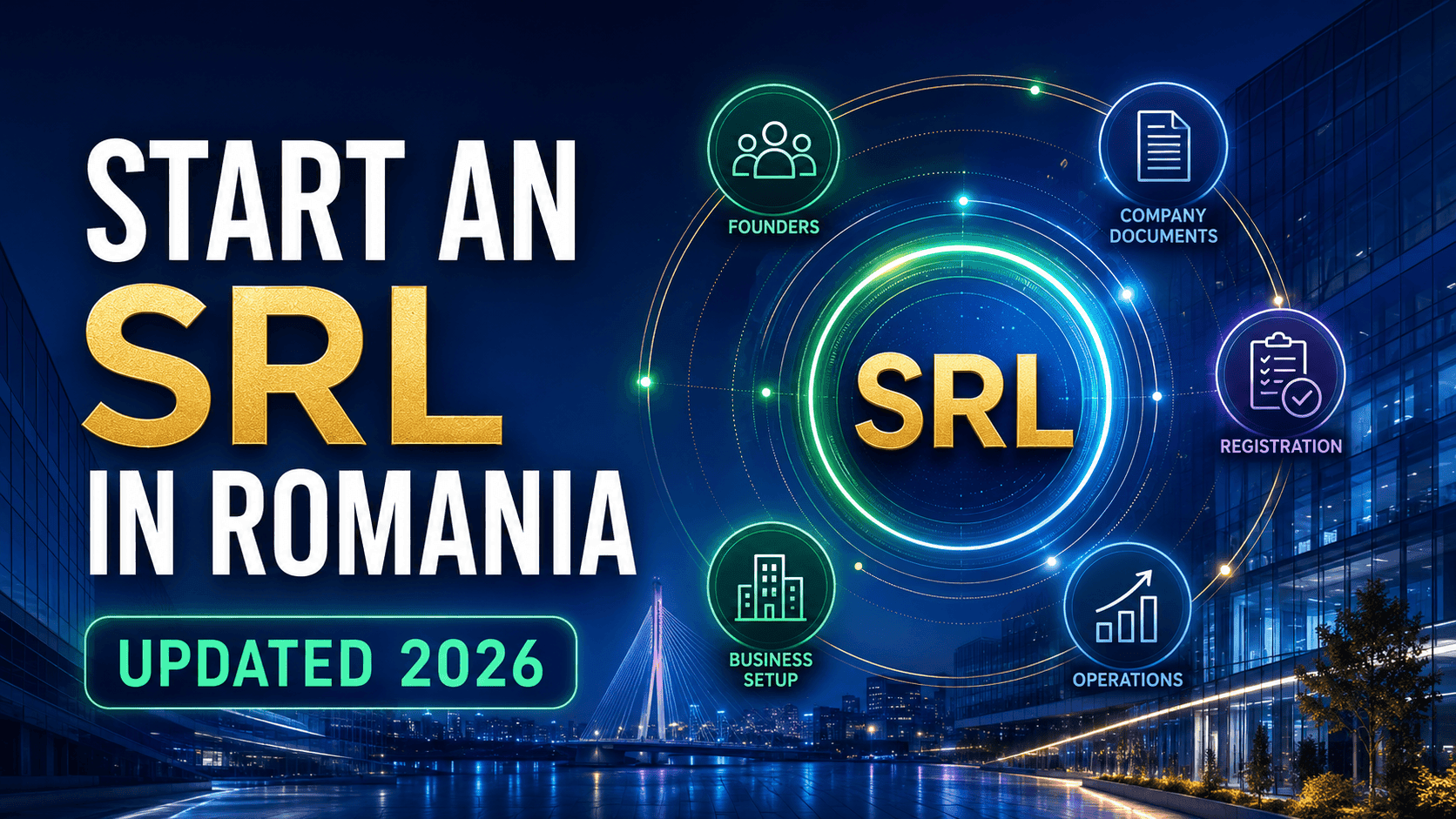
Start an SRL in Romania – Updated 2026

How to Start a Limited Liability Company (SRL) in Romania – Updated for 2026

How to establish a Romanian SRL in 2026

A Romanian limited liability company is not created by completing one standard form. The founders must settle the ownership, management, registered office, activities, capital and beneficial ownership before filing a consistent incorporation application with the Trade Register.

Romanian SRL formation ecosystem An animated orbital map showing the founders, registered office, company documents, capital, Trade Register and operational setup surrounding a Romanian SRL. ROMANIAN SRL • 2026 SRLROMANIA Foundersownership & control Capitalfunding structure ONRC filingregistration decision Operationsbank • tax • licences
A reliable incorporation file starts with coherent founder decisions and ends with the operational steps required after registration.

Short answer: an SRL is the most common Romanian company form for startups, SMEs and foreign-owned subsidiaries. In 2026, a newly incorporated SRL must have share capital of at least RON 500. Registration is only the first stage: banking, accounting, tax, employment and sector-specific requirements must be addressed separately.

What is a Romanian SRL?

An SRL, or societate cu răspundere limitată, is a Romanian legal entity whose share capital is divided into participation interests. As a general rule, the shareholders’ exposure is limited to their agreed contributions, while the company owns its assets and assumes its own contractual obligations.

Limited liability is not absolute protection against every personal risk. A shareholder or administrator may still face exposure under personal guarantees, director-liability rules, tax or insolvency provisions, unlawful distributions or abusive conduct. Governance and signing authority therefore matter from the incorporation stage.

This guide focuses only on the SRL. Foreign investors comparing an SRL with an SA, branch or representative office should first review our main page on company formation in Romania for foreign founders.

Which decisions must the founders make before filing?

OwnershipIdentify the shareholders, participation percentages, capital contributions and ultimate beneficial owners.
ManagementAppoint the administrator or administrators and define whether they represent the company separately or jointly.
ActivitiesSelect the principal and secondary activities under the official CAEN Rev.3 classification and check whether the proposed activity needs a Romanian business permit or licence.
Registered officeSecure a Romanian address and a legally valid document proving the company’s right to use it. Review the available registered-office options in Romania.
GovernanceAgree voting rules, reserved matters, profit distribution and procedures for conflicts. A 50/50 structure should include a workable shareholder-deadlock mechanism.
FundingSet the share capital and distinguish it from shareholder loans, future investment and working capital.
Common formation riskUsing a standard articles-of-association template without adapting representation powers, voting rules or transfer restrictions. Registration may succeed while the company is left with avoidable governance problems.

What is the minimum share capital for an SRL in 2026?

Following Law no. 239/2025, the minimum share capital for a newly incorporated SRL is RON 500. Older references stating that an SRL may be incorporated with RON 1 or without an effective minimum are no longer current.

Law no. 239/2025 also establishes a minimum share capital of RON 5,000 for an SRL whose reported net turnover for the previous financial year exceeds RON 400,000. Existing companies falling within that rule must observe the statutory adjustment period. The applicable amount should therefore be checked both at incorporation and when the company’s turnover changes. The implementation steps are discussed separately in our guide to a Romanian company capital increase.

SituationMinimum capitalPractical consequence
Newly incorporated SRLRON 500The articles of association and capital structure must reflect at least this amount.
SRL with reported net turnover above RON 400,000RON 5,000The company must bring its capital into line with the statutory rule within the applicable period.
Additional business fundingCommercial decisionShare capital should not be confused with shareholder loans or the actual operating budget.

Under Law no. 31/1990, an SRL must pay at least 30% of the subscribed capital no later than three months after registration and before commencing operations in its own name. The remaining cash contribution is payable within 12 months after registration, while the remaining in-kind contribution is payable within no more than two years.

Capital is not the complete formation budgetFounders should separately budget for translations, apostilles or legalisation, registered-office arrangements, professional fees, banking, accounting, publication charges and any licences required for the intended activity.

What documents are generally required?

The precise filing depends on the founders, administrator, office and activities. A standard SRL incorporation usually requires or relies on:

  • the Trade Register incorporation application;
  • proof of company-name reservation;
  • the articles of association;
  • documents proving the right to use the registered office;
  • identity documents for individual shareholders and administrators;
  • current registry extracts, constitutional documents and corporate approvals for a corporate shareholder;
  • statutory declarations concerning operating conditions and other legally required matters;
  • beneficial-owner information or a separate declaration, where required;
  • evidence of authority for the person signing or filing the application; and
  • any approvals, opinions or documents required by the proposed name or regulated activity.

The official list and current forms should be checked on the National Trade Register Office website immediately before filing. A missing mandatory element may result in rejection rather than an informal opportunity to complete the file. Founders can prepare the file using our separate checklists for reserving a Romanian company name and drafting Romanian articles of association.

What changes when a shareholder is foreign?

Foreign individuals and companies may generally hold participation interests in a Romanian SRL. Romanian citizenship or residence is not, by itself, a general ownership condition. However, foreign documents must be assessed for validity, authority, legalisation or apostille and authorised Romanian translation.

A foreign corporate shareholder may need a recent registry extract, its constitutional documents, a resolution approving the Romanian investment and evidence that the signatory can bind it. The exact formalities depend on the issuing state, applicable treaties and the document used. Our document checklist for foreign founders explains the preparation issues in more detail.

The ownership chain must also be traced to the natural persons who ultimately own or control the company. The applicable tests and filing deadlines are explained in our updated guide to the beneficial owner declaration in Romania.

Company ownership is not immigration statusIncorporating or owning an SRL does not automatically grant a foreign founder the right to enter, reside or work in Romania. Immigration and work-authorisation requirements require a separate analysis.

How does the Romanian SRL formation process work?

Formation map

From founder decisions to operational setup

Romanian SRL formation roadmap An animated six-card roadmap from company structure and documents through ONRC filing, registration and operational activation. SRL FORMATION ROADMAPROMANIA • 2026 01StructureOwnership • managementactivities • capital 02Name & officeName reservationregistered-office title 03DocumentsArticles • identitiesforeign formalities 04ONRC filingPortal • counterlawyer representation 05RegistrationRegistrar decisioncompany certificate 06ActivationBank • tax • accountinglicences • contracts
Trade Register approval creates the company, but banking, tax, accounting and operational compliance continue after registration.
Define the structureSet ownership, management, activities, capital, governance and the post-registration plan.
Reserve the nameSubmit suitable alternatives and obtain proof of availability through ONRC.
Secure the registered officePrepare the lease, loan-for-use agreement or other valid title to the premises.
Prepare the incorporation fileDraft the articles and collect the founder, administrator, corporate and beneficial-owner documents.
Submit the applicationFile at the counter, by post or courier, or electronically under the signature and format rules.
Complete operational setupAddress capital payment, bank onboarding, accounting, tax registrations, authorisations, contracts and employment.

Can the SRL application be submitted online or through a lawyer?

Yes. Under Law no. 265/2022 on the Trade Register, an incorporation application may be filed at the counter, through post or courier, or electronically. Electronic documents must comply with the qualified-electronic-signature requirements. A lawyer may sign or submit the application on the basis of a legal-services mandate and may transmit documents prepared by the lawyer under the statutory procedure.

The available electronic services can be accessed through ONRC MyPortal. Remote incorporation is possible in many cases, but foreign-document formalities, bank identification, regulated activities and immigration matters may require additional steps.

How long does SRL registration take?

The Trade Register states that a complete registration application is generally resolved by the registrar within one working day after registration of the application. This procedural period is not a guaranteed end-to-end formation time.

Name reservation, document preparation, foreign legalisation, translations, correcting inconsistent information, obtaining a registered office and responding to registrar requirements may extend the project. Bank onboarding and licences also occur outside the basic incorporation decision.

Use a two-part timelineSeparate the time required to obtain the Trade Register decision from the total time required for the company to become operational. A registered SRL may not yet be ready to invoice, employ staff or perform a regulated activity.

What does it cost to establish an SRL?

There is no reliable universal package price. The total depends on the founders and documents involved. A realistic budget may include:

  • the subscribed share capital;
  • official publication or registration-related charges generated for the file;
  • translations, apostilles, legalisation or notarial formalities;
  • legal assistance and representation;
  • registered-office costs;
  • bank, accounting and tax-advisory services; and
  • licensing or sector-specific costs.

According to the ONRC information published on 30 April 2026, the tariff for publication in the Official Gazette is calculated and paid after the registration application is admitted. A generic statement that every SRL has a fixed “state fee of EUR 50” should therefore not be used.

What must be done after the SRL is registered?

The registration certificate does not complete every business requirement. Depending on the project, the founders should address:

Post-registration areaQuestions to resolveMain risk if ignored
Capital and bankingCapital payment, operating account, signatories, bank KYC and the steps for a Romanian business bank account for a non-residentThe company cannot use the intended banking arrangements or misses a statutory contribution deadline.
Accounting and taxAccounting engagement, tax vector, VAT analysis, reporting calendar and ongoing Romanian tax registration and complianceLate filings, incorrect invoicing or unsuitable tax treatment.
Activity authorisationWhether the declared CAEN activities may be performed at the office, third-party sites or outside a fixed locationThe company is registered but not authorised to conduct the intended activity.
Contracts and governanceCustomer, supplier, employment, administrator and shareholder arrangementsOperational exposure and internal disputes begin before protections are documented.
Regulated sectorsLicences, notifications, professional requirements or foreign-investment screeningThe business starts an activity before regulatory clearance.

Tax positions should be checked against the current ANAF guidance and electronic services. VAT registration, payroll reporting and the applicable corporate or microenterprise regime depend on facts that are not resolved merely by incorporating the SRL.

Which SRL formation mistakes cause delays or future disputes?

  • choosing CAEN codes without checking whether the activity is regulated or may be authorised at the selected location;
  • submitting foreign documents that are outdated, improperly legalised or inconsistently translated;
  • using unclear joint or separate representation powers for multiple administrators;
  • treating share capital as the complete operating budget;
  • failing to identify indirect beneficial owners;
  • assuming that incorporation grants immigration or work rights;
  • using generic voting clauses in a 50/50 company without a workable deadlock solution; and
  • waiting until after registration to address banking, accounting, tax or licensing requirements.

Where there are several founders, the articles should be coordinated with a properly drafted Romanian shareholder agreement. Administrators should also understand the exposure explained in our guide to Romanian company director liability.

Need assistance establishing an SRL in Romania?

Atrium Romanian Lawyers assists Romanian and foreign founders with company structuring, articles of association, beneficial ownership, registered-office documentation, Trade Register filings and post-incorporation corporate work.

Frequently asked questions

What is the minimum share capital for a new Romanian SRL in 2026?

The minimum share capital for a newly incorporated SRL is RON 500. A separate RON 5,000 minimum applies to SRLs whose reported net turnover for the previous financial year exceeds RON 400,000, subject to the statutory adjustment rules.

Can a foreigner own 100% of a Romanian SRL?

In general, yes. Romanian citizenship or residence is not a general condition for owning an SRL. The founder’s documents, beneficial ownership, applicable foreign-investment rules and any regulated-sector restrictions must still be checked.

Can an SRL have one shareholder and one administrator?

Yes. An SRL may generally have a sole shareholder, who may also be appointed administrator. The articles should still regulate the company’s activities, capital, representation and beneficial-owner information correctly.

Is a Romanian bank account required before incorporation?

The banking sequence must be coordinated with the applicable capital-payment rules and the chosen bank. The company must pay the required portion of subscribed capital within the statutory period and before commencing operations in its own name.

Can the SRL be incorporated remotely?

Often, yes. The application may be submitted through an authorised representative or electronically where the signature and document-format requirements are met. Foreign formalities, bank KYC, licences or immigration steps may still require separate action.

Does Trade Register registration mean the SRL can immediately perform every declared activity?

No. Certain activities require additional authorisation, licences, notifications, qualified personnel or suitable premises. Registration and operational authorisation must be checked separately.

Disclaimer: This article provides general information and does not constitute legal or tax advice. The correct formation process depends on the founders, ownership structure, activities, documents and legislation in force when the application is prepared.

AI Notice: AI-assisted content, reviewed and approved by a qualified Romanian lawyer.

Essential Documents for Foreign Founders Starting a Business in Romania

Essential Documents for Foreign Founders Starting a Business in Romania

Play

Essential Documents for Foreign Founders Starting a Business in Romania

What if the fastest way to launch a European business isn’t where you’d expect?

Romania’s streamlined corporate framework allows entrepreneurs to establish an SRL company in just three working days with current minimum capital requirements that have recently undergone significant changes in 2025.

A stack of official documents and forms on a desk.

But beneath this efficiency lies a critical question:

How can international investors avoid hidden pitfalls in documentation processes that could derail their ambitions?

Romania’s open-market policies permit full foreign ownership without local partnership mandates, creating attractive opportunities for global entrepreneurs.

However, the registration process demands precise adherence to legal standards.

Corporate filings must align with Trade Register specifications, including certified translations into Romanian or bilingual formats.

Strategic document preparation forms the backbone of successful incorporation.

Errors in paperwork often lead to delays, financial penalties, or rejected applications.

Professional legal guidance from lawyers in Romania ensures compliance with corporate law frameworks while maintaining operational legitimacy from day one.

Investors benefit from understanding how each document interacts with regulatory systems.

Properly structured articles of association, shareholder agreements, and notarized identification papers establish transparent governance structures.

These elements collectively safeguard business interests within Romania’s evolving economic landscape.

Key Takeaways

  • Romania permits 100% foreign-owned companies with fast 3-day Trade Register approval timelines,
  • Document preparation requires strict compliance with Romanian language standards,
  • Legal expertise minimizes risks of administrative delays or non-compliance penalties,
  • Corporate filings must align with Trade Register specifications for approval,
  • Precise paperwork establishes long-term operational legitimacy,
  • VAT rate increased to 21% in August 2025, with registration threshold at RON 395,000,
  • Minimum capital requirements are undergoing reform, with new tiered structure proposed.

Introduction to Business Registration in Romania

A businessman reviewing papers at a desk.

Romania’s economic landscape presents a compelling proposition for global enterprises seeking competitive positioning in Europe.

As an EU member state, the country serves as a strategic crossroads connecting major continental markets.

This geographic advantage, combined with progressive regulatory frameworks, creates fertile ground for sustainable business growth.

Overview of the Romanian Market

A group of diverse business people reviewing documents around a table.

The local market distinguishes itself through a growing pool of skilled workforce, particularly in technology and engineering sectors.

Romania produces approximately 18.6 STEM graduates per 1,000 people aged 20-29, though this remains below the EU average of 23.0.

The country is actively working to expand its technical education programs.

Operational costs remain 34-51% lower than Western European averages without compromising service quality, with Romanian developer salaries approximately 40% below comparable Western rates.

Infrastructure development continues accelerating across transportation and digital networks.

Modern highways connect major cities to EU trade routes, while digital coverage expands nationwide.

These advancements enable companies to maintain efficient supply chains and regional operations.

Benefits for Foreign Entrepreneurs

Several colorful flags are displayed on a desk next to business papers.

Romania offers foreign investors streamlined processes through recent legal reforms.

The elimination of redundant permits and digital filing systems reduces Trade Register approval to approximately three working days.

EU membership guarantees alignment with continental standards while preserving local cost advantages.

Investors benefit from tax incentives for research-driven business initiatives and export-oriented activities.

Cultural adaptability further enhances market entry, with English widely spoken in professional environments.

These factors position the country as an attractive destination for scalable international ventures.

Why Start a Business in Romania?

A close-up of a business plan document with charts and graphs.

Romania’s tax and regulatory systems create a unique value proposition for commercial ventures targeting European markets.

Strategic fiscal policies combine with progressive legislative changes to support both startups and established enterprises.

Attractive Tax Environment

A smiling business person holding a briefcase and standing in front of a modern office building.

The country maintains one of Europe’s most competitive tax frameworks, though recent changes require careful attention.

Microenterprises benefit from a 1% revenue tax when employing at least one worker and earning up to €60,000 annually.

For revenues above €60,000 or for specific sectors like IT services (CAEN codes 6210, 6290) and restaurants, a 3% rate applies.

Traditional corporations face a flat 16% profit tax.

Tax TypeRateConditions
Microenterprise1%Revenue under €60K with 1+ employee
Microenterprise3%Revenue €60K-€250K (€100K from 2026) or IT/restaurant activities
Corporate Profit16%Standard companies
Dividends10%Increased from 8% in January 2025
Standard VAT21%Increased from 19% in August 2025
Reduced VAT11%Consolidated rate from August 2025

Favorable Legal Reforms

Recent legislative updates streamline operations for international investors.

Digital registration systems cut Trade Register processing times to 3 working days, while revised thresholds for micro-tax status continue until 2026, though the revenue limit decreases from €250,000 to €100,000 starting January 2026.

Enhanced transparency measures reduce bureaucratic hurdles.

Special support programs assist startups in navigating compliance requirements, ensuring smooth market entry.

However, investors must stay updated on frequent tax law changes, including the August 2025 VAT increase from 19% to 21%.

Understanding Legal Structures for Foreign Founders

Selecting the optimal legal framework forms the cornerstone of successful business operations.

Romania offers multiple corporate formats, each aligning with specific operational scales and strategic objectives.

Three primary options dominate commercial registrations, balancing legal safeguards with administrative practicality.

Limited Liability Company (SRL)

An open laptop displaying a business registration website.

The Societate cu Răspundere Limitată (SRL) remains the preferred choice for most ventures.

This structure provides limited liability protection, shielding personal assets from business debts.

Requirements include:

  • 1–50 shareholders
  • Minimum share capital currently ranges from RON 1 to RON 200 (sources vary), with a new tiered proposal for 2025-2026: RON 500 for new companies, increasing to RON 5,000 for revenues between RON 395,000-7 million, and RON 90,000 for revenues exceeding RON 7 million,
  • Simplified management structures.

Governance flexibility allows swift decision-making, ideal for small-to-medium enterprises. Annual reporting obligations remain manageable compared to complex entities.

StructureShareholdersCurrent CapitalProposed Capital (2025-2026)Best For
SRL1–50RON 1-200RON 500-90,000 (tiered)Startups/SMEs
SAUnlimitedRON 90,000RON 90,000 (€25,000)Large enterprises


Joint-Stock Company (SA) and Other Options

A group of diverse people discussing papers around a table.

The Societate pe Acțiuni (SA) suits ventures planning IPOs or major investments.

Key features include:

  • Minimum capital: RON 90,000 (approximately €25,000),
  • Public share trading capability,
  • Formal governance requirements.

Alternative structures like branches or partnerships serve niche scenarios.

Professional guidance ensures alignment between legal frameworks and long-term growth strategies, particularly given the evolving minimum capital requirements.

Required Documents for Foreign Founders in Romania

A person holding a passport and a business plan.

Navigating corporate registration demands meticulous attention to foundational paperwork.

Seven core submissions form the basis of compliant filings, supported by supplementary materials that address cross-border complexities.

The application form and tax annex require detailed operational data, including management structures and activity codes.

Identity verification for administrators ( directors) necessitates certified copies of passports or national IDs, translated into Romanian by authorized professionals.

Shareholder affidavits confirm tax status for individuals lacking local fiscal identification.

These declarations prevent delays during fiscal authority reviews.

Articles of Association drafted in Romanian establish governance protocols, requiring alignment with national corporate law frameworks.

Proof of registered office ranges from property deeds to virtual office contracts, validating a physical business address.

Beneficial ownership disclosures meet EU anti-money laundering directives, tracing control chains for transparency.

Optional apostille certifications authenticate foreign-signed documents.

While not mandatory, these additions streamline verification processes across jurisdictions.

Professional legal review ensures technical accuracy before Trade Register submission, particularly important given recent regulatory changes.

Preparing Your Articles of Association and Registered Office

A person is typing on a laptop with documents spread out on a table.

The foundation of a compliant Romanian enterprise lies in two critical components: constitutional documents and physical establishment.

These elements define operational boundaries while meeting legal obligations under national corporate frameworks.

Drafting the Articles of Association

A person reviews a document with a focused expression while sitting at a table.

Articles of Association act as a company’s operational blueprint.

This legally binding document must specify shareholder voting rights, capital distribution models, and decision-making hierarchies.

Romanian law mandates inclusion of NACE codes to classify business activities accurately.

Management roles require precise definitions of authority limits and appointment procedures.

Provisions for General Meetings must outline resolution processes and quorum requirements.

Legal professionals recommend embedding flexibility clauses to accommodate future growth scenarios, including provisions for the new tiered minimum capital requirements expected to phase in through 2026.

Establishing a Proof of Registered Office

All entities must maintain a verifiable registered office within Romania.

Valid proof includes notarized lease agreements or property ownership documents.

Virtual office contracts have gained traction for cost efficiency while fulfilling legal address requirements.

Service providers offering virtual solutions must issue compliance certificates recognized by the Trade Register.

Physical locations require utility bills or municipal confirmations.

Consistent address details across all filings prevent administrative delays during registration.

Steps in the Company Registration Process

A person filling out forms with a pen.

Establishing a corporate entity in Romania follows a precise sequence of regulatory actions.

This systematic approach ensures compliance while maintaining operational efficiency for new market entrants.

Name Reservation and Document Filing

The initial company name reservation occurs through the National Trade Register Office (ONRC) portal.

This free digital service verifies name availability against existing registrations within minutes.

Approved reservations remain valid for 30 calendar days, creating urgency for subsequent filings.

Document preparation requires alignment with ONRC specifications.

Essential materials include translated identification papers and notarized corporate agreements.

Submissions can occur physically at regional offices or digitally using qualified electronic signatures.

Processing with the Trade Register

Officials typically complete company registration reviews within three working days for the Trade Register approval.

This period allows thorough verification of statutory documents and legal compliance checks.

Delays usually stem from incomplete filings or translation discrepancies.

Successful applicants receive three critical identifiers: the Certificate of Incorporation, CUI tax code, and Certificat Constatator.

These enable immediate banking operations and contractual engagements across Romania.

Note that while Trade Register approval is fast, the complete registration process including VAT registration and full operational readiness typically takes 7-10 working days.

Navigating Tax and VAT Registration in Romania

An open laptop displaying a tax registration website with a cup of coffee nearby.

Understanding fiscal obligations marks a critical phase for enterprises establishing operations in emerging markets.

Romania’s integrated tax system combines automatic corporate registration with strategic VAT options, creating adaptable frameworks for diverse commercial needs.

Corporate and Microenterprise Tax Details

Newly registered companies receive tax IDs during incorporation, enabling immediate financial operations.

Important Update for 2025-2026:

Microenterprises benefit from preferential tax rates when maintaining at least one employee:

  • 1% tax rate on revenue up to €60,000
  • 3% tax rate on revenue from €60,000 to €250,000 (2025) or €100,000 (from January 2026)

Special activities including IT services (CAEN codes 6210, 6290), restaurants, and mobile food services are subject to the 3% rate regardless of revenue level.

Standard corporate tax applies at 16% for profits when companies exceed micro-company thresholds or don’t qualify for the regime.

The dividend withholding tax increased to 10% as of January 1, 2025 (previously 8%) for all recipients.

VAT Registration Requirements

Critical 2025 Updates:

Businesses must register for VAT when exceeding RON 395,000 annual turnover (effective September 1, 2025, increased from RON 300,000).

The standard VAT rate is 21% (increased from 19% in August 2025), with a consolidated reduced rate of 11% replacing the previous 5% and 9% rates.

Voluntary VAT registration remains available for smaller enterprises seeking input tax recovery.

Sector-specific rules apply, with businesses engaged in EU trade requiring VAT registration regardless of turnover thresholds.

FAQ

What legal structure is most common for foreign entrepreneurs in Romania?

The limited liability company (SRL) is preferred due to its flexibility and simplified compliance requirements.

Current minimum share capital varies between RON 1-200, with a new tiered proposal being implemented: RON 500 for new companies, increasing based on revenue thresholds to RON 5,000 (for revenues RON 395,000-7 million) and RON 90,000 (for revenues exceeding RON 7 million).

It allows full foreign ownership and limits liability to invested capital.

How does Romania’s tax environment benefit startups?

Romania offers a 16% corporate tax rate, one of the lowest in the EU.

Microenterprises with at least one employee pay only 1% on turnover up to €60,000 and 3% from €60,000 to €250,000 (reducing to €100,000 threshold from January 2026), making it ideal for early-stage businesses.

However, IT services and certain other sectors pay 3% regardless of revenue level.

Can a virtual office serve as proof of registered office?

Yes, foreign founders can use virtual office services compliant with Romanian law.

The address must be verifiable and included in the Articles of Association during company registration.

What are the VAT registration requirements for new businesses?

Updated for 2025: Companies must register for VAT if annual turnover exceeds RON 395,000 (effective September 1, 2025).

The standard VAT rate is 21% (increased from 19% in August 2025), with a reduced rate of 11%.

Voluntary registration is permitted, allowing input tax recovery.

Non-EU businesses require a fiscal representative for compliance.

How long does the company registration process take?

The Trade Register approval typically takes 3 business days with complete documentation.

However, the full registration process including VAT registration and complete operational setup takes 7-10 working days.

Delays often arise from incomplete documents or translation issues.

Are foreign shareholders required to visit Romania during incorporation?

No. A local lawyer can handle filings via power of attorney.

Notarized documents and apostilled/legalized identification (e.g., passports) must be submitted electronically or by courier.

What post-registration obligations apply to Romanian companies?

Firms must file annual financial statements, maintain accounting records, and submit monthly/quarterly tax declarations.

Important: As of 2025, the dividend tax is 10% (increased from 8%).

Companies must monitor the microenterprise revenue threshold, which decreases from €250,000 to €100,000 on January 1, 2026.

Hiring employees triggers additional labor law and social security compliance.

What are the current VAT rates in Romania?

Updated August 2025: The standard VAT rate is 21% (increased from 19%), and the reduced rate is 11% (consolidating the previous 5% and 9% rates).

These changes took effect August 1, 2025.

What documents are required to register a company in Romania as a foreigner?

To register a company in Romania, foreigners need to prepare and submit several necessary documents.

These include identification documents such as a valid passport, proof of address in Romania, and incorporation documents specific to the type of business structure chosen, whether it be a joint stock company or a limited liability company (SRL).

Additionally, an application for registration must be completed, and the unique company name must be verified through the trade registry.

How does the company registration process work for foreign entrepreneurs?

The company registration process for foreign entrepreneurs in Romania involves several key steps.

First, you must select a business structure and prepare the necessary documents.

Then, you will need to submit these documents to the trade registry for approval.

Following this, you will need to register your business office in Romania and meet the minimum share capital requirement.

Finally, once all documents are approved and the company is registered, you will receive a registration certificate, allowing you to start your business operations in Romania.

What are the benefits of starting a business in Romania as a foreigner?

Starting a business in Romania offers numerous benefits for foreign entrepreneurs.

Romania is situated in a strategic location within the European Union, providing access to a vast market.

The business environment is continually improving, with various incentives for foreign investment.

Additionally, the country offers a range of business structures available, allowing entrepreneurs to select the type of company that best fits their business needs.

This makes Romania an attractive destination for foreign founders looking to expand their operations in Europe.

 
Romanian Company Capital Increase 2025

Romanian Company Capital Increase: Streamlined Processes 2025

Play

Romanian Company Capital Increase: Streamlined Processes 2025

Recent draft reforms on Romanian company capital increase 2025 have reshaped foundational requirements for Romanian companies, requiring both entrepreneurs and established firms to act quickly to stay compliant and maintain operational continuity.

capital increase procedures Romanian Company

Recent proposed changes in corporate legislation will require soon a minimum financial commitment, times higher than before, significantly impacting how companies, especially limited liability companies, operate.

Proposed changes are still in draft form and have not been enacted.

The current minimum capital requirement is 1 RON, and the proposal would increase it to variable amounts (500-90,000 RON).

The draft of law links financial obligations to company size, establishing specific compliance tiers across industries.

These changes will come with tight deadlines, enhanced reporting for banking activities, and stricter registry submissions.

Non-compliance could lead to severe penalties like operational suspension or dissolution.

Seeking professional advice is important, particularly for Romanian company formation or making structural adjustments.

Key Takeaways

  • Romania’s draft of corporate laws will enforce significantly higher minimum financial commitments,
  • Three-tier compliance system will align obligations with business size and revenue,
  • Mandatory banking protocols will affect entity registration and reporting,
  • Legal expertise ensures adherence to strict deadlines and documentation requirements,
  • Non-compliance may result in operational restrictions or business dissolution.

Navigating Romanian Corporate Regulations

The recent legislative draft introduces structured financial benchmarks for commercial entities.

These changes will create clear financial parameters tied to operational scale, ensuring alignment between resources and business activities.

bank account setup requirements

Updated Financial Benchmarks for Businesses

The revised draft establishes three financial tiers based on annual revenue.

Microenterprises with earnings below 395,000 RON must maintain 500 RON in reserves.

Mid-sized organizations generating up to 7 million RON require 5,000 RON.

Larger enterprises surpassing this threshold need 90,000 RON in available funds.

Business SizeRevenue RangeFinancial Reserve
MicroUnder 395k RON500 RON
Medium395k – 7M RON5,000 RON
LargeOver 7M RON90,000 RON

Banking Compliance Essentials

Under recent reforms in Romanian company law, newly incorporated businesses will be required to open and maintain a bank account within 30 days of registration, with banks permitted to refuse only on grounds related to anti-money laundering compliance under Law 129/2019.

Companies that fail to comply risk being declared fiscally inactive by ANAF, a status that suspends tax rights and may trigger fines of up to RON 10,000 for related non-compliance.

In parallel, the draft law increases the minimum share capital for limited liability companies (SRL) in Romania to RON 8,000, obliging existing SRLs to align either at the first amendment of their articles of association or within two years of the law’s entry into force.

Legal specialists recommend that entrepreneurs and investors prepare early to ensure smooth company formation, compliance, and business continuity in Romania.

Step-by-Step: capital increase procedures Romanian Company

Strategic documentation preparation forms the foundation of successful compliance.

Organizations must balance legal precision with operational agility when modifying foundational documents to meet revised standards.

trade register documentation process

Drafting Constitutive Acts and Submissions

Modifying Articles of association requires shareholder approval through formal resolutions.

Romanian lawyers must draft updated Articles reflecting adjusted financial commitments while maintaining alignment with existing operational parameters.

Completed documentation packages must include shareholder agreements and bank deposit confirmations.

The trade register mandates electronic submission of these materials within 15 days of approval.

Common errors in draft versions often delay processing timelines.

Timelines and Compliance Deadlines

Compliance timelines under the proposed Romanian company law reforms focus on SRL share capital increases and related corporate compliance filings.

All limited liability companies (SRL) will be required to raise their minimum share capital to RON 8,000, either at the first amendment of their articles of association or within two years of the law’s entry into force.

Once approved, the shareholder resolution must be registered with the Romanian Trade Register within 15 days, with late submissions leading to administrative penalties.

Although no official deadlines apply to POS installation or payment infrastructure upgrades, businesses should align their banking arrangements and capital adjustments early to avoid being declared fiscally inactive by ANAF and facing operational delays.

Engaging professional legal and accounting services in Romania is strongly recommended to ensure smooth compliance and safeguard business continuity.

Professional guidance helps navigate overlapping requirements efficiently.

Managing Compliance and Fiscal Transparency for Business Success

Effective governance in Romania’s business environment requires close monitoring of regulatory updates and proactive adjustment to new fiscal rules.

The latest company law and tax reforms introduce obligations that connect corporate governance, banking compliance, and shareholder transactions, making coordinated management essential for business stability.

compliance risk management

Mitigating Risks and Avoiding Administrative Blockages

Under the draft reforms, share transfers involving controlling shareholders must be reported to the tax authorities within 15 days.

Where companies have outstanding debts to the state, the Romanian Trade Register may require financial guarantees from the company or incoming shareholders before registering the transfer.

At the same time, failure to maintain an active bank account or to meet the new minimum capital thresholds for SRLs may result in a declaration of fiscal inactivity by ANAF.

Companies declared inactive face serious tax consequences: they must continue paying taxes but lose the right to deduct expenses and face restrictions on VAT claims.

To prevent these risks, businesses should adopt three practical safeguards:

  • Regular audits of banking documentation and shareholder records

  • Immediate updates to Trade Register filings following ownership changes

  • Preemptive resolution of outstanding state debts before major corporate transactions

Specialized legal and accounting advisors in Romania provide real-time monitoring, representation during ANAF audits, and strategic planning to maintain compliance.

Prompt action is also critical when receiving notices from fiscal authorities: while deadlines vary by procedure, some ANAF processes grant only 30 days to submit corrective documentation, and missed deadlines may trigger enforcement measures such as account freezes or asset seizures.

Conclusion

Navigating Romania’s revised corporate framework demands strategic adaptation.

Limited liability companies in Romania face permanent operational changes rather than temporary fixes.

Successful adaptation requires proactive planning with legal specialists.

Organizations prioritizing these measures secure long-term viability in Romania’s transformed business environment.

Romanian legal expertise remains critical for interpreting evolving requirements while safeguarding growth opportunities.

FAQ – Romanian Company Law and Compliance (2025)

What is the minimum share capital for a limited liability company (SRL) in Romania?


Under the draft reforms to Law 31/1990, the minimum share capital for an SRL will increase from 1 RON to 8,000 RON.

Existing companies must align either at the first amendment of their articles of association or within two years of the law’s entry into force.

Certain regulated industries (e.g. banking, insurance) still require much higher thresholds under sector-specific rules.

How long does it take to open a bank account for a capital increase?


Romanian banks usually process share capital deposit accounts within 3–5 business days, provided that the company submits incorporation documents, shareholder identification, and complies with anti-money laundering (AML) checks under Law 129/2019.

What penalties apply for missing compliance deadlines during share transfers?


Failure to submit share transfer documentation to the Trade Register or ANAF within 15 days may result in fines of up to 5,000 RON.

Persistent non-compliance can also expose companies to fiscal inactivity status, which restricts VAT deductions and expense claims, though dissolution is not an automatic sanction.

Do constitutive acts and amendments require notarization?


Notarization is no longer mandatory for standard SRL incorporation or simple amendments since the 2020 simplification of Romanian company law.

However, notarization may still be required in special cases, such as share transfers involving real estate contributions or when parties choose additional contractual safeguards.

What tax obligations follow a capital increase?


Companies must notify ANAF and the Trade Register of any capital increase within 15 days.

While capital injections themselves are not subject to taxation, incomplete or incorrect documentation may trigger tax audits or reclassification of funds.

Can foreign shareholders participate in increasing share capital?


Yes. Foreign investors may contribute capital under the same conditions as Romanian nationals.

For cross-border transfers, companies must comply with AML documentation requirements, and transactions above €10,000 are subject to reporting obligations under Law 129/2019.

Micro Enterprise in Romania for 2025

Micro Enterprise Eligibility Criteria in Romania for 2025

Play

Micro Enterprise Eligibility Criteria in Romania for 2025

New regulations effective January 2025 will dramatically reshape fiscal strategies for small businesses.

Recent amendments to fiscal legislation through OUG No 156/2024 introduce unprecedented reductions in income thresholds for preferential tax treatment.

The revised framework slashes permitted earnings by 50% compared to prior limits, creating urgent compliance challenges.

micro enterprise eligibility criteria Romania 2025

These adjustments demand immediate attention from company leaders and financial advisors.

Organizations exceeding €250,000 in annual revenue now face critical decisions about restructuring operations or exploring alternative fiscal arrangements.

The changes particularly impact service-oriented businesses and startups scaling toward mid-market positions.

Key Takeaways

  • Income ceilings for a preferential tax treatment drop to €250,000 starting January 2025,
  • Additional reductions to €100,000 planned for 2026 under current legislation,
  • Mandatory operational reviews required for businesses near revised thresholds,
  • Strategic planning essential for maintaining fiscal efficiency,
  • Professional advisory services critical for compliance verification.

This analysis provides actionable insights into navigating the reformed fiscal landscape.

Understanding these modifications enables informed decision-making for sustainable business growth under updated regulatory conditions.

Introduction to Romania’s Fiscal Landscape in 2025

The year 2025 marks a pivotal shift in fiscal policy designed to stabilize national finances while supporting market adaptability.

Government measures prioritize efficient resource distribution through updated tax structures, creating a balanced framework for economic growth.

tax changes 2025

Revised tax laws align with broader EU financial strategies, ensuring competitive positioning within continental markets.

These adjustments focus on sustainable revenue streams without imposing excessive burdens on commercial operations.

Businesses in Romania must recognize these modifications as interconnected components of a long-term economic vision.

Key reforms emphasize strategic alignment between public spending controls and private sector innovation.

The updated law introduces refined compliance standards to enhance fiscal transparency.

This approach maintains investor confidence while addressing budgetary pressures through measured adjustments.

Organizations operating within this jurisdiction should reevaluate financial strategies to align with evolving requirements.

Proactive adaptation ensures continued competitiveness under the restructured fiscal system.

Professional guidance remains critical for navigating these systematic changes effectively.

Overview of the Micro Enterprise Tax Regime in Romania

Romania’s simplified fiscal system offers distinct advantages for qualifying organizations through a structured dual-rate approach.

This model replaces traditional profit-based taxation with turnover-focused calculations, particularly advantageous for ventures with limited operational complexity.

Key Features of the Simplified Structure

The 1% rate applies to entities generating under €60,000 annually, while those exceeding this threshold or operating in designated sectors face a 3% liability.

This tiered system allows precise financial planning while maintaining compliance with national revenue objectives.

Romanian tax regime 2025

Updated Fiscal Parameters

Recent adjustments emphasize stricter revenue monitoring to align with EU economic strategies.

The revised thresholds require businesses to implement enhanced tracking systems for real-time financial oversight.

These modifications aim to preserve the regime’s benefits while preventing misuse through improved accountability measures.

Organizations must now conduct quarterly reviews to verify compliance with updated earning limits.

This proactive approach helps maintain preferential rates while adapting to evolving market conditions.

Professional advisors strongly recommend automated accounting solutions for accurate reporting under the new requirements.

Micro enterprise eligibility criteria Romania 2025

Romanian Businesses seeking preferential fiscal treatment must meet six core conditions under Romania’s updated framework.

These requirements ensure alignment with national economic priorities while preventing system exploitation.

Romanian tax compliance 2025

Legal entities must satisfy these mandatory criteria throughout the fiscal year:

  • Annual revenue below €250,000,
  • Full private ownership of capital shares,
  • Active operational status (not in liquidation),
  • Social security payments for minimum one staff member or executive,
  • Single ownership restriction for major shareholders (25%+ stakes),
  • Annual financial reports submitted before legal deadlines.

The income ceiling forms the primary compliance checkpoint.

Organizations approaching this threshold require monthly monitoring systems to maintain eligibility.

Ownership rules prevent multiple benefit claims through subsidiary structures.

Employment obligations ensure active participation in Romania’s social security framework.

This condition applies even to single-member companies, requiring formal labor contracts for executives.

Late financial disclosures trigger immediate disqualification, regardless of other compliance factors.

Legal advisors recommend implementing automated tracking tools for real-time eligibility verification.

Non-compliance risks retroactive tax adjustments and potential audits.

Professional consultation remains essential for interpreting nuanced requirements.

Detailed Requirements for Qualified Micro Enterprises

Meeting workforce obligations forms a critical pillar of compliance under Romania’s preferential tax system.

Organizations must balance operational needs with strict regulatory mandates to maintain fiscal advantages.

employee documentation 2025

Staff Engagement and Social Security Rules

Companies must formalize employment contracts within 30 days of establishment.

This requirement applies equally to businesses hiring external staff or retaining directors who fulfill social security obligations.

The framework ensures active participation in national social programs.

Minimum gross wage standards (€814/month) apply to traditional employment arrangements.

This dual-path structure supports diverse operational models while maintaining workforce development goals.

Financial Reporting Deadlines

Timely submission of annual financial statements remains non-negotiable for continued eligibility.

Authorities require complete documentation before statutory deadlines to verify operational transparency.

Late filings trigger immediate disqualification from preferential rates.

Automated accounting systems prove vital for meeting these obligations.

Regular internal audits help prevent reporting delays that could jeopardize fiscal status.

Professional advisors emphasize proactive calendar management for critical submission dates.

Corporate Income Tax vs. Turnover Tax Explained

Understanding fiscal obligations requires clear differentiation between profit-based and revenue-based taxation models.

The choice between these systems determines financial planning strategies and compliance requirements for organizations operating under Romanian jurisdiction.

Transition from Turnover Tax to Profit Tax

Organizations exceeding specific operational parameters face automatic conversion to standard corporate income tax rules.

This irreversible transition occurs when companies surpass €250,000 in annual revenue or fail to meet employment requirements within 30 days of registration.

The shift triggers immediate application of a 16% tax rate on net profits.

Unlike the simplified turnover model, this system demands detailed expense tracking and comprehensive financial documentation.

Our team of lawyers in Romania stress the importance of quarterly monitoring to prevent unexpected regime changes.

Methods for Calculating Tax Liabilities

Turnover-based calculations apply fixed percentages to gross revenues, offering predictable fiscal outcomes.

In contrast, profit taxation requires subtracting verified business expenses from total income before applying the statutory corporate income tax rate.

Key differences include:

  • Documentation needs: Profit tax requires expense receipts,
  • Reporting frequency: Monthly vs quarterly declarations,
  • Compliance complexity: Advanced accounting systems recommended.

Financial planners emphasize proactive modeling of both scenarios to optimize fiscal outcomes.

Permanent ineligibility for preferential treatment makes strategic forecasting essential for sustainable operations.

Understanding Income Thresholds and Revenue Monitoring

Strategic revenue tracking becomes paramount for organizations navigating revised fiscal parameters.

The 2025 income ceiling drops to €250,000 – half the previous limit – with a further reduction to €100,000 planned for the following year.

Compliance hinges on annual earnings recorded by December 31, requiring continuous oversight to prevent unexpected tax regime changes.

Quarterly financial reviews now serve as essential safeguards against threshold breaches.

Advanced tracking systems enable businesses to project annual revenues using real-time data, identifying potential compliance risks months in advance.

Many firms implement alerts when reaching 75% of permitted earnings, allowing time for operational adjustments.

Three critical considerations guide effective threshold management:

  • Automated accounting tools for instant revenue visibility,
  • Scenario planning for different growth trajectories,
  • Regular cross-departmental financial reviews.

Organizations surpassing these limits face immediate transition to standard corporate tax rules.

This irreversible shift underscores the need for proactive measures rather than reactive corrections.

Financial teams must balance growth ambitions with strict fiscal boundaries to maintain preferential treatment.

The determination method based on prior-year totals adds complexity to strategic planning.

Companies approaching thresholds often benefit from staggered invoicing or temporary service adjustments to stay within permitted ranges.

Our team of lawyers in Bucharest  increasingly emphasize predictive analytics in maintaining compliance while pursuing sustainable expansion.

Special Industry Considerations in Taxation

Tax obligations under Romania’s updated framework vary significantly across commercial sectors.

Specific activities classified under CAEN codes trigger distinct fiscal treatment, requiring careful operational analysis.

The 3% rate applies regardless of revenue levels for ventures in technology and hospitality fields.

Software development and IT service activities face elevated rates due to their scalability and profit potential.

This includes custom programming solutions (CAEN 6210) and technical support operations (CAEN 6290).

Government policies aim to balance sector growth with equitable revenue collection.

Food-related businesses encounter similar tax treatment.

Restaurants, food trucks, and catering activities (CAEN 5611-5622) operate under the higher rate structure.

These rules reflect market dynamics and operational complexities in hospitality.

Three critical factors influence tax categorization:

  • Primary revenue-generating operations,
  • Secondary commercial engagements,
  • Accurate CAEN code alignment.

Organizations operating across multiple sectors must designate their principal activity through documented revenue analysis.

Our team of Romanian Lawyers play vital roles in verifying classifications and preventing compliance errors.

This structured approach supports strategic planning while meeting fiscal responsibilities.

Businesses offering combined food service activities with retail operations require particular attention.

Clear documentation separating revenue streams ensures proper rate application.

Regular operational reviews help maintain compliance as commercial portfolios evolve.

Impact of Employment and Minimum Wage Rules

Workforce management challenges intensify under updated labor regulations, requiring precise alignment between payroll practices and fiscal compliance.

Businesses must now navigate layered obligations spanning social contributions, sector-specific wage floors, and conditional tax benefits.

Social Contributions and Mandatory Hiring

Romanian Employers face dual responsibilities for health insurance and pension funds.

Construction sector staff require minimum gross wages of RON 4,582 monthly, while agricultural and food industry workers demand RON 4,050.

These figures represent baseline commitments before calculating employer contribution rates.

The RON 300 monthly tax exemption applies when two conditions align:

  • Gross salary matches the legal minimum for the sector,
  • Total employee earnings stay below RON 4,300 monthly.

Strategic Payroll Management

Automated systems prove essential for tracking variable wage thresholds across industries.

Companies combining multiple business activities must implement separate payroll calculations for each operational division.

Errors in contribution allocations risk penalties exceeding 5% of annual turnover.

Human resources teams should prioritize:

  • Monthly verification of sector-specific wage compliance,
  • Integration of tax exemption parameters into payroll software,
  • Cross-departmental audits for social security alignment.

This regulatory framework demands continuous coordination between financial and HR departments.

Our Emplyoment legal specialists in Romania increasingly recommend unified platforms that synchronize labor costs with tax eligibility requirements.

Financial Statement Compliance and Reporting Requirements

Accurate financial documentation serves as the cornerstone of maintaining fiscal benefits under revised regulations.

Organizations must submit annual financial statements by strict deadlines to qualify for preferential treatment.

The updated framework mandates timely preparation and submission of financial statements through authorized platforms.

Late filings trigger automatic disqualification from simplified tax regimes, regardless of operational performance.

This requirement applies even if other compliance standards appear satisfactory.

Effective compliance requires implementing reliable tracking systems to monitor reporting milestones.

Many firms now use automated tools to streamline annual financial documentation processes.

These solutions reduce errors while ensuring alignment with evolving submission protocols.

Our team of tax lawyers in Bucharest emphasize proactive calendar management for declaration deadlines.

Missing these dates risks retroactive tax adjustments and potential audits.

Maintaining eligibility demands continuous attention to both preparation quality and submission timing.

FAQ

What industries qualify for VAT exemptions under Romania’s micro-enterprise regime?

Companies in IT sectors like custom software development may benefit from VAT exemptions if they meet specific turnover thresholds.

Food service activities, including mobile food services, must comply with standard VAT rules unless operating under special fiscal provisions.

How does the 2025 tax rate change affect corporate income calculations?

Starting January 2025, eligible micro-enterprises face a revised corporate income tax rate of 16% on profits.

Businesses previously under the turnover tax system must transition to profit-based calculations, requiring updated financial statements and compliance with revised reporting standards.

What penalties apply for late submission of annual financial statements?

Legal entities failing to submit annual financial statements within 60 days of the fiscal year-end risk fines up to 10,000 RON.

Timely filing ensures eligibility for tax incentives and avoids disruptions to health insurance or social contribution benefits.

Are mobile food service operators subject to the same tax regime as brick-and-mortar businesses?

Mobile food service activities follow the same corporate income tax rules but may face additional municipal fees.

Compliance with hygiene standards and local permits remains critical, regardless of business structure.

How do minimum wage adjustments impact social contributions for micro-enterprises?

Employers must align salaries with Romania’s updated minimum wage RON 4,050/month, directly affecting social security and health insurance contributions.

Non-compliance may disqualify businesses from micro-enterprise benefits under Law No. 346/2004.

Can companies engaged in custom software development retain micro-enterprise status if revenue exceeds thresholds?

No. Firms surpassing 500,000 EUR annual revenue lose micro-enterprise eligibility and must transition to standard corporate taxation.

Regular revenue monitoring is essential to avoid unexpected tax rate changes or compliance audits.

What are the eligibility criteria for a micro-enterprise in Romania?

To qualify as a micro-enterprise in Romania, a company must meet specific criteria defined by the fiscal code.

These include having a turnover not exceeding €1 million, employing at least one full-time employee, and not being part of a larger group of companies.

Additionally, the company must be registered with the trade register and comply with the provisions related to share capital and business law.

What is the tax regime applicable to micro companies in Romania?

The tax regime for micro companies in Romania is quite favorable.

These firms benefit from a reduced tax rate of 1% on revenue if they employ at least one employee.

This micro company tax regime is designed to encourage new business formation and ease the tax burden on small enterprises.

Furthermore, micro-enterprises are generally exempt from corporate income tax and have simplified reporting obligations under the Romanian fiscal code.

How does a Romanian micro company handle dividend tax?

For a Romanian micro company, dividend distributions are subject to a dividend tax.

The standard dividend tax rate in Romania is 5%. However, micro-enterprises can benefit from tax exemptions or reductions under certain conditions, especially if they reinvest their profits into the business.

It’s essential for companies to consult with tax authorities to ensure compliance with current regulations.

What are the necessary steps to open a micro-company in Romania?

To open a micro-company in Romania, foreign investors or natural persons must follow several steps.

First, they need to choose the type of company, usually a limited liability company, and prepare the required documentation for company formation.

This includes drafting the company’s articles of incorporation and securing a corporate bank account.

After that, they must register the company with the trade register and ensure compliance with the fiscal code, including obtaining any necessary tax registrations.

open a Romanian business bank account

How to open a Romanian business bank account as non-resident

How to open a Romanian business bank account as non-resident


What if accessing European markets through a strategic financial gateway required fewer hurdles than commonly assumed?

Play

With over 40 financial institutions and seamless connectivity to 500 million EU consumers, Romania presents a compelling proposition for international entrepreneurs.

Romanian business bank account as non-resident


Establishing corporate financial operations here involves navigating specific regulatory frameworks distinct from other EU jurisdictions.

Over 70% of newly registered entities prioritize this step within their first operational month, leveraging the country’s extensive ATM networks and multi-currency solutions.

The process demands precise alignment with local compliance standards and EU banking directives.

Professional guidance proves critical when addressing documentation protocols, language considerations, and cross-border transaction requirements.

Key Takeaways:

  • Romania’s financial infrastructure supports access to expansive EU markets through 40+ institutions,
  • Successful account establishment requires understanding dual compliance with national and EU regulations,
  • Most new Romanian enterprises complete this process within their initial operational phase,
  • Multi-currency capabilities streamline international transactions for cross-border operations,
  • Expert assistance mitigates challenges related to documentation and institutional procedures.

Understanding the Requirements and Romanian Banking Regulations

Financial institutions maintain rigorous protocols to align with evolving European standards.

Companies must navigate dual-layer compliance systems that combine local laws with EU directives.

This layered approach ensures transparency while facilitating cross-border economic activities.

banking regulations and compliance


Overview of Local Financial Regulations

The regulatory landscape requires adherence to three core pillars:

Requirement TypeKey ComponentsFrequency
AML VerificationSource of funds analysisInitial setup + annual reviews
Ownership DisclosureBeneficiary identificationDuring registration
Tax ComplianceVAT registration proofOngoing

Financial authorities mandate transaction monitoring systems for all corporate entities.

These systems track cross-border payments and flag unusual activity patterns.

Compliance and Legal Considerations

Documentation requirements vary by industry sector.

Companies in regulated fields like finance or energy face additional licensing steps.

Essential materials include:

  • Certified articles of incorporation,
  • Shareholder structure diagrams,
  • Tax identification certificates.

Quarterly financial reporting remains mandatory for maintaining active status.

Institutions may request updated operational data during periodic audits.

Eligibility and Key Documentation for Non-Residents

Establishing financial operations in this EU jurisdiction requires precise preparation of foundational materials.

Authorities mandate comprehensive verification processes to confirm organizational legitimacy and stakeholder identities.

eligibility documentation for non-residents


Personal Identification Protocols

Legal representatives and shareholders must submit valid passports or national ID cards.

Non-EU nationals often need supplementary residence permits, which require apostille certification.

All foreign-issued identification requires notarized translations into the local language.

Corporate Formation Evidence

Authenticated Articles of Association and Trade Register certificates prove a company’s legal standing.

Financial institutions require proof of registered office addresses through utility bills or lease agreements.

Minimum capital deposits of 200 RON (€45) must be verified through bank transfer receipts.

Document TypeSpecificationsSpecial Notes
Passport/IDValid for 6+ monthsNon-EU requires apostille
Articles of AssociationNotarized copyTranslated version mandatory
Capital ProofBank deposit receiptMinimum 200 RON
Address VerificationRecent utility documentUnder company name

Third-country entities should anticipate extended processing times for document legalization.

Mismatched signatures or expired certifications remain primary causes for application rejections.

Romanian business bank account as non-resident

Efficient setup of financial infrastructure abroad requires understanding sequential protocols.

Institutions prioritize structured workflows that balance regulatory compliance with operational efficiency.

Digital solutions now enable remote completion of most stages, accelerating market entry timelines.

process and documentation checklist


Essential Steps of the Process

The procedure follows five distinct phases:

  1. Provider selection (1-2 days): Evaluate institutions based on transaction capabilities, digital tools, and cross-border support,
  2. Document preparation (3-5 days): Organize materials requiring translation, notarization, or apostille certification,
  3. Application submission (1 day): Utilize online portals with video identity confirmation features,
  4. Compliance review (5-10 days): Undergo anti-fraud checks and operational legitimacy assessments,
  5. Account activation (1-2 days): Finalize initial deposits and receive digital access credentials.

Important Documentation Checklist

Prepare these critical materials to ensure smooth processing:

Document TypeSpecificationsProcessing Tip
Company CharterNotarized translationInclude shareholder signatures
Identity ProofValid passport copiesNon-EU requires apostille
Address EvidenceRecent utility billIssued within 90 days
Capital ProofBank transfer receiptMinimum €45 equivalent

Maintain digital copies of all submissions for quick reference during follow-ups.

Institutions may request additional verification for complex ownership structures.

Choosing the Right Bank or Fintech Provider

Selecting appropriate financial partners significantly influences operational success in cross-border ventures.

Institutions vary in their capabilities, with distinct advantages for different organizational needs.

financial partners selection


Established Financial Institutions

Major domestic institutions provide comprehensive infrastructure through physical networks and localized expertise.

ING offers English-language digital platforms with fee-free debit cards, ideal for tech-driven enterprises.

Banca Transilvania specializes in SME support through tailored loan packages and insurance products.

BCR maintains the largest branch network nationwide, while BRD delivers multilingual mobile banking interfaces.

These organizations excel in regulatory compliance and long-term financial planning.

Modern Financial Technology Solutions

Digital platforms streamline operations with rapid onboarding and multi-currency management.

Wise Business supports transactions in 50+ currencies with API integrations for automated workflows.

Revolut provides real-time expense tracking across 30 currencies through intuitive dashboards.

Provider TypeKey AdvantageIdeal For
TraditionalRegulatory expertiseComplex compliance needs
FintechCost efficiencyStartups & remote teams

Hybrid approaches combining institutional stability with fintech agility are gaining popularity among scaling enterprises.

Decision-makers should evaluate transaction volumes, currency requirements, and growth timelines when selecting services.

Navigating Fees, Charges, and Exchange Rates

Financial efficiency depends on understanding how institutional pricing models impact cross-border operations.

Service providers employ diverse fee architectures that directly affect profitability, particularly for enterprises handling frequent international money movements.

fee structures and exchange rates


Understanding Fee Structures

Traditional institutions typically impose initial setup charges ranging from €50 to €200.

Monthly maintenance costs average €10-€30, with domestic transactions costing 0.15% (minimum 5 RON) at major providers.

International transfers often carry higher percentages and fixed minimums.

Modern fintech solutions disrupt this model through transparent pricing.

Platforms like Wise apply flat 1% fees for currency conversions, eliminating hidden markups.

This approach can reduce transfer costs by 80-85% compared to conventional banking margins.

Fee TypeTraditional BanksFintech ProvidersSavings Potential
Setup€50-€200€0100%
Monthly Maintenance€10-€30€0-€1550-100%
International Transfer0.1% + 15 EUR1% flat80-85%
Exchange Rate Margin3-10%0.5-1%70-90%

Comparing International Transfer Costs

Cross-border transfers outside Europe reveal stark contrasts between providers.

Traditional banks often add 10%+ through inflated exchange rates. For a €10,000 payment, this could mean €1,000 in hidden fees.

Digital alternatives use real-time mid-market rates with clear percentage-based charges.

This transparency enables accurate forecasting of money movement costs.

Businesses processing high volumes should prioritize providers offering bulk discount rates.

Regular audits of transaction statements help identify unnecessary charges.

Combining multiple services often optimizes payment processing expenses across different currency zones.

Securing Your Funds and Banking Services

Modern financial infrastructure prioritizes both asset protection and value-added solutions to support organizational growth.

Institutions deploy layered security frameworks while offering diverse tools to optimize capital utilization.

Data Protection and Security Measures

Advanced encryption protocols safeguard sensitive information across all digital platforms.

Multi-factor authentication remains mandatory for high-value transactions, with biometric verification options gaining traction.

Continuous monitoring systems analyze 100+ risk indicators to detect anomalies in real time.

Financial partners implement tokenization for payment cards and API integrations.

Below shows key security features:

FeatureFunctionBenefit
256-bit EncryptionData transmission securityMilitary-grade protection
Behavioral AnalyticsUser pattern trackingFraud prevention
Automated AlertsSuspicious activity notificationsImmediate response

Additional Financial Services Offered

Beyond core accounts, institutions provide tailored solutions for capital growth.

Credit lines with revolving limits help manage cash flow fluctuations.

Merchant services enable seamless e-commerce transactions through integrated POS systems.

Key offerings include:

  • Short-term financing with competitive interest rates,
  • Customized payroll management platforms,
  • High-yield savings instruments for idle funds.

Investment advisory services assist in portfolio diversification, while trade finance solutions reduce import/export risks.

These tools collectively enhance financial efficiency for enterprises and individuals alike.

Challenges for Non-Resident Entrepreneurs

Establishing financial operations in a foreign country presents unique obstacles requiring strategic navigation.

International entrepreneurs often encounter systemic friction points that demand careful resource allocation and expert guidance.

Many financial branches operate with limited English-speaking personnel, complicating basic inquiries and documentation processes.

Document Translation and Legalization Hurdles

Certification requirements add layers to administrative workflows.

Official papers demand notarized translations and apostille stamps, with processing often taking multiple weeks.

Common pitfalls involve:

  1. Incomplete certification chains for foreign-issued documents,
  2. Mismatched formatting between international and local standards,
  3. Delays in obtaining ministry approvals for specialized sectors.

Proactive planning mitigates these obstacles.

Engaging certified translation services early and verifying requirements through official channels prevents costly revisions.

Many institutions now provide digital checklists to streamline submission processes.

Leveraging Technology for a Seamless Process

Modern financial operations increasingly rely on digital solutions to bridge geographical gaps.

Institutions now deploy advanced systems that simplify complex procedures while maintaining strict compliance standards.

Remote Authentication Methods

Video verification has revolutionized account establishment processes.

BRD and other providers enable identity confirmation through secure live calls, reducing setup timelines by 40-60%.

This approach maintains regulatory requirements while eliminating travel obligations.

Digital submission portals allow instant upload of certified documents.

Applicants receive real-time updates through automated tracking systems.

Key advantages include:

  • 24/7 application progress monitoring,
  • Secure cloud storage for sensitive files,
  • Automated error detection in submissions.

Digital Management Capabilities

Mobile platforms provide comprehensive control over financial operations.

Users execute cross-border payments, monitor balances, and generate reports through intuitive interfaces.

API integrations connect banking data with accounting software for seamless reconciliation.

FeatureTraditional ProvidersFintech Solutions
Verification ProcessIn-person meetingsBiometric video calls
Document SubmissionPhysical deliveryEncrypted uploads
24/7 AccessLimited branch hoursMobile app availability
Third-Party IntegrationManual data entryAutomated API sync

Automated payment scheduling reduces administrative workloads for growing enterprises.

Batch processing handles multiple transactions simultaneously, improving operational efficiency by up to 70% compared to manual methods.

Comparing Banks and Fintech Solutions for Business Accounts

Financial service providers now offer diverse pathways for managing corporate funds, each with distinct operational benefits.

Decision-makers must weigh institutional stability against technological agility when structuring financial operations.

Traditional Institutions: Stability vs Flexibility

Established financial organizations provide local expertise through physical branches and personalized support.

Their comprehensive service portfolios often include specialized lending products and long-term investment strategies.

Processing timelines may extend due to manual verification steps and complex approval hierarchies.

Digital Platforms: Speed and Innovation

Modern financial technology solutions excel in transaction efficiency and cost management.

Leading providers support multi-currency operations across 50+ denominations with real-time exchange tools.

Automated compliance checks and API integrations reduce administrative burdens for cross-border enterprises.

While digital services lack physical locations, their 24/7 accessibility and transparent pricing models address core operational needs.

Hybrid approaches combining institutional credibility with fintech flexibility are emerging as strategic solutions for scaling ventures.

FAQ

What financial regulations apply to non-residents opening corporate accounts in Romania?

Non-residents must comply with Romania’s Anti-Money Laundering (AML) laws and EU banking directives.

Institutions require proof of business legitimacy, source of funds, and adherence to local tax reporting standards.

Which documents are mandatory for non-resident entrepreneurs?

Essential documents include valid passports, proof of address, company registration certificates, and share capital confirmation.

Translated and notarized versions may be required for non-English paperwork.

What steps are involved in opening an account remotely?

The process includes selecting a financial provider, submitting digital copies of identification and company documents, completing video verification, and depositing minimum capital if applicable.

Are fintech platforms legally recognized for corporate banking in Romania?

Yes.

Licensed electronic money institutions like Revolut Business or Wise offer compliant services, often with faster onboarding and multi-currency features compared to traditional banks.

How do exchange rates impact international transactions?

Banks and fintech providers apply varying margins to currency conversions.

Comparing real-time rates and transfer fees can reduce costs for cross-border payments.

What security measures protect account holders?

Institutions implement GDPR-compliant data encryption, two-factor authentication, and transaction monitoring systems.

Clients also receive guarantees under the EU Deposit Insurance Scheme up to €100,000.

Do Romanian banks provide services in English?

Major banks like Banca Transilvania and Raiffeisen Bank offer English-speaking support.

However, legal documents may require certified translations for compliance.

Can non-residents access credit or overdraft facilities?

Credit approvals depend on the company’s financial history and collateral.

Fintech solutions often provide quicker access to flexible credit lines than traditional lenders.

What are the advantages of digital onboarding tools?

Remote video verification, e-signatures, and automated document checks streamline approvals, often reducing processing times to under 10 business days.

How does share capital affect account eligibility?

Romanian LLCs must demonstrate a minimum share capital deposit.

Banks require notarized bank statements or auditor confirmations as proof during applications.

🏦 Romanian Business Banking Quiz

Test your knowledge about opening a business account in Romania


digital products and subscriptions Romania

Selling Digital Products and Subscriptions in Romania: Legal Steps & Compliance Tips

Selling Digital Products and Subscriptions in Romania: Legal Steps & Compliance Tips

A person sits at a desk with a laptop, looking at digital product listings.

Selling digital products and subscriptions in Romania requires careful planning and legal know-how.

Are you ready to start a digital business in Romania?

It’s a big step, but you can avoid legal issues if you follow the right procedures.

Romania’s digital market offers great opportunities for entrepreneurs.

As an EU member state, Romania strictly enforces e‑commerce and VAT regulations.

You’ll need to manage VAT correctly, protect consumers, and adhere to e‑commerce rules.

Selling digital products and subscriptions in Romania provides growth opportunities for SaaS platforms, creators, e‑learning providers, and other online businesses.

Key Takeaways

  • Understand Romania’s digital product sales regulations,

  • Comply with EU and Romanian VAT registration requirements,

  • Learn essential legal steps for Romanian e‑commerce platforms,

  • Develop strategic digital product marketing approaches,

  • Recognize consumer protection and documentation standards.

For personalized legal advice on selling digital products in Romania, email our expert team of Romanian Lawyers at office@theromanianlawyers.com.

Understanding Digital Product Sales Regulations in Romania

A stack of digital devices, like tablets and smartphones, displaying various digital products.

Starting a digital business in Romania means knowing the laws well.

If you sell eBooks or other digital goods, there are specific regulations you must follow.

These ensure a fair and safe market for everyone.

Key Legal Requirements for Digital Sellers

Digital sellers in Romania must:

  • Register for VAT if you cross the turnover threshold.

  • Apply correct VAT rates on digital product sales.

  • Classify products properly to comply with tax rules.

  • File VAT returns and maintain records as required.

Romanian E‑commerce Framework Overview

Romania enforces EU-aligned rules for digital downloads and services, which include VAT compliance and invoicing standards.

Digital Product Categories and Classifications

Digital products are grouped into categories, each with distinct tax and legal implications.

Proper classification helps avoid issues.

Main categories include:

  • Software and apps,

  • E‑books and digital publications,

  • Online courses and e-learning,

  • Digital media and streaming services.

Stay updated on legal changes and retain comprehensive records to operate smoothly.

VAT Registration and Compliance for Digital Products

A calendar marked with important tax deadlines and reminders.

Understanding VAT rules is essential for digital product sellers in Romania.

VAT Thresholds & Registration

Registration Steps

  • Register within 10 days after you exceed the turnover threshold.

  • Non‑EU businesses must appoint a fiscal (tax) representative.

Registration TypeKey RequirementsProcessing Time
Resident CompaniesLocal VAT registration if turnover > RON 300,0005–7 business days*
Non‑Resident CompaniesLocal VAT representative required~10–14 business days*
Digital Product Sellers*Provide product documentation and VAT forms~7–10 business days*

*Times are estimations for context.

VAT Returns & Reporting Deadlines

  • File VAT returns monthly or quarterly (if turnover below RON 300,000 or €88,500).

  • Return and payment deadline is the 25th of the month following the fiscal period.

Accurate record-keeping of invoices, VAT reports, and sales data is vital.

E‑Invoicing Requirements and Documentation

Romania mandates electronic invoicing (e‑invoicing) for B2B and public sector invoices via the national RO e‑Factura (RO_CIUS format) system.

  • B2B and B2G invoices must be sent within 5 working days of issuance via RO e‑Factura.

  • Since January 2025, B2C e‑invoice submissions to RO e‑Factura became mandatory (with exceptions for simplified invoices).

Invoices require digital signatures and must follow RO_CIUS XML format.

Romania also enforces SAF‑T reporting (standardized tax control file).

Non-resident taxpayers must submit SAF‑T starting January 2025.

Digital Subscription Models and Legal Framework

A group of diverse individuals discusses digital sales strategies around a table.

Subscription services in Romania must include:

This ensures trust and regulatory compliance in subscription offerings.

Payment Gateway Integration and Compliance

A close-up of a credit card being inserted into a card reader.

When integrating payment gateways in Romania, ensure:

Payment Gateway FeatureCompliance RequirementImportance Level
GDPR Data ProtectionEU regulatory complianceHigh
Anti‑Money LaunderingFinancial regulationCritical
VAT Auto‑CalculationTax complianceEssential

Select platforms compliant with both Romanian and EU regulations, and consider transaction fees, ease of use, and coverage.

Cross‑border Digital Sales and EU Regulations

A group of people discussing digital marketing strategies in a bright office.

Cross-border digital sales benefit from OSS:

  • OSS lets sellers centralize VAT registration and reporting across the EU WikipediaSovos.

  • Romania can serve as primary OSS registration country Sovos.

  • Applies to B2C digital services exceeding €10,000.

Implement strategies such as multilingual support and transparent currency pricing for effective international operations.

Digital Rights Management and Copyright Protection

O persoană stând la birou cu un laptop, analizând datele despre vânzările de produse digitale.

To protect digital content in Romania:

Protection MethodEffectivenessComplexity
Digital WatermarkingHighMedium
Content EncryptionVery HighHigh
Legal RegistrationHighLow

Keep documentation like contracts and licensing agreements for at least 10 years.

Marketing Digital Products in the Romanian Market

Un site de piață digitală afișat pe un ecran de computer.

To thrive in Romania, tailor your marketing:

Digital Marketing Channels:

  • Social media (Facebook, Instagram),

  • Local marketplaces,

  • Professional networks and Romanian ad platforms.

Comply strictly with GDPR in ads and influencer campaigns.

Marketing ChannelEffectivenessCompliance Level
Social Media AdvertisingHighStrict GDPR enforcement
Content MarketingMediumModerate regulation
Influencer PartnershipsHighRequires disclosure

Blend storytelling and creative localization with legal compliance for compelling promotion.

Conclusion

Selling digital products in Romania demands a solid grasp of legal frameworks, especially around VAT, e‑invoicing, consumer protections, and marketing.

A balanced strategy that combines compliance with innovation can help your digital venture succeed in Romania’s thriving online economy.

For tailored legal guidance, reach out to Atrium Romanian Lawyers at office@theromanianlawyers.com.


FAQ

What are the primary legal requirements for selling digital products in Romania?
Businesses must register for VAT if exceeding the threshold, use e‑invoicing, keep documentation, and follow EU consumer protection rules.

How does VAT registration work for digital product sellers?
Resident sellers register when turnover passes ~RON 300,000. Non‑resident sellers must register immediately.

Registration is done via the ANAF portal.

What digital product categories are most popular in Romania?
E‑books, online courses, software, digital design assets, and training materials are in high demand.

What is the standard VAT rate for digital products in Romania?
Typically 21%, though some categories may benefit from reduced rates (e.g., eBooks; check with a tax professional).

Are there specific e‑invoicing requirements?
Yes—B2B/B2G invoices must be sent via RO e‑Factura.

From 2025, B2C e‑invoices are also mandatory in many cases.

How do cross‑border digital sales work from Romania?
Use the EU OSS to streamline VAT collection and reporting across EU member states.

What payment gateways are recommended?
Use GDPR‑compliant platforms that support VAT auto‑calculation and meet AML standards; choose based on fees and local support.

How can creators protect their intellectual property?
Register copyrights, use DRM measures like watermarking and encryption, and keep legal records for at least 10 years.

What marketing strategies work best?
Localized content, compliant social media campaigns, influencer marketing (with disclosures), and channel-specific ads that respect GDPR.

What are the key considerations for subscription models?
Ensure clarity in terms, pricing, renewal, cancellation, and refunds, aligned with EU law for digital content.

Which platforms are good for digital product sales?
Use platforms like Shopify, WooCommerce, or specialized course LMSs that support Romanian VAT, multichannel localization, and secure delivery.

How can I automate email marketing?
Integrate with services like Mailchimp or ActiveCampaign that sync with your store, segment customers, and send follow-up or upsell campaigns.

How do I comply with VAT obligations?
Register appropriately, charge correct VAT, file returns on schedule, and maintain detailed records to mitigate risks.

How can I create standout digital products?
Offer high‑quality content tailored to Romanian needs, competitive pricing, and effective messaging—possibly via TikTok or other trending platforms.

What upselling strategies work?
Offer complementary products at checkout, use “pay‑what‑you‑want” models, or implement personalized onboarding to increase average order value.

Play
Remote company formation in Romania represented as a legal gateway to Bucharest

Remote Company Formation in Romania: 2026 Guide for Foreign Founders

Remote company formation in Romania is possible in many cases without the founders travelling to Romania. The incorporation filing can be handled electronically or through an authorised representative, but the correct route depends on how documents are signed, where the founders are based, who provides the registered office and what identification checks apply.

Cross-border legal process for remote company formation in Romania
Remote incorporation requires a coordinated bridge between foreign documents, Romanian registration and post-incorporation requirements.

This guide explains the remote procedure for foreign individuals and overseas companies. It focuses on the digital and cross-border execution issues that arise after the founder has decided to establish a Romanian company. For the broader choice of entity, capital and corporate structure, see our company formation in Romania guide.

Can you form a Romanian company entirely remotely?

Often yes, but “remote” must be assessed step by step. The Trade Register application can be filed online, and a lawyer or another properly authorised representative may handle the procedure, but foreign-document formalities, identity verification and bank onboarding can still create offline or jurisdiction-specific requirements.

Romania’s National Trade Register Office online portal offers services including company-name reservation and incorporation. Law No. 265/2022 also regulates online company formation and electronic communication with the Trade Register.

Under Article 105 of Law No. 265/2022, the registrar may exceptionally request physical presence if there is a suspicion of identity falsification. The same provision states that physical presence is not required when the incorporation application and supporting documents, including the articles of association, were prepared by a public notary or lawyer. If presence is exceptionally requested during online formation, the remaining stages may still be completed electronically.

StageCan it be handled remotely?Important qualification
Name reservationNormally yesThe proposed name must satisfy Trade Register availability and naming rules.
Preparation of incorporation documentsYesThe documents must reflect the chosen structure, activities, management and registered office.
Signing and representationOften yesThe route may use a qualified electronic signature or a compliant power of attorney, depending on the document and filing method.
Trade Register filingYesElectronic filing must meet the portal’s technical and signature requirements.
Bank account onboardingBank-dependentBanks apply their own know-your-customer, beneficial-owner and risk procedures.
Sector permitsDepends on the activityRegulated activities may require separate authorisations before or after incorporation.

What are the steps for remote company formation in Romania?

The legal sequence is straightforward, but the filing route should be chosen before documents are signed. Select each step below to see its practical purpose.

Remote formation roadmap
Six coordinated steps

Select a step to review what must be resolved before the next stage.

Confirm the structure

Choose the company type, shareholders, directors, activities, decision rules and capital before preparing the filing documents.

  1. Confirm the company structure. Decide the entity type, ownership, administrators, business activities and signing authority. An SRL is common, but it should not be selected automatically when investment, governance or regulated activities require another structure. See our 2026 guide to Romanian limited liability companies.
  2. Reserve the company name. Submit alternatives that comply with the Trade Register rules. Our separate guide explains how to register a company name in Romania.
  3. Establish the registered office. Every Romanian company needs a valid registered office and supporting title to use the address. Review the options in our registered office guide.
  4. Prepare, formalise and translate the documents. Coordinate the articles of association, identity or corporate records, declarations, beneficial-owner information, office evidence and powers of attorney. Foreign public documents may require apostille, legalisation or an applicable exemption, depending on the issuing state, bilateral treaties, EU legislation and the nature of the document, followed by an authorised Romanian translation where required.
  5. Sign and file through the selected route. If the electronic filing route is used, the signature and submission must satisfy the applicable ONRC technical and procedural requirements. A properly authorised representative may provide an alternative route, provided that the authority granted complies with the requirements applicable to the filing.
  6. Complete post-registration onboarding. After incorporation, organise accounting, tax registrations or options, bank onboarding, employment setup and any permits required for the actual activity.

Which documents do foreign founders usually need?

The exact file depends on whether the shareholder is an individual or a foreign company, the founder’s country, the administrators, the registered office and the intended activities. Do not sign foreign documents until their Romanian formality and translation route has been checked.

Founder or issueTypical documents or informationRemote-formation check
Foreign individual shareholderValid identity document, personal details, declarations and specimen/signing information as applicableConfirm legibility, validity, signature method and whether additional identification evidence is required.
Foreign corporate shareholderRecent company extract, constitutional documents, representation evidence and corporate approvalConfirm issue date, competent signatory, apostille or legalisation and Romanian translation.
AdministratorIdentity data, acceptance and statutory declarationsCheck eligibility, tax-identification implications and the signing route.
Company constitutionArticles of association specifying ownership, management, activities, capital and governanceAlign every translated or signed version. See our articles of incorporation guide.
Registered officeDocument proving the right to use the Romanian address and any required supporting recordsConfirm permitted use, term and consistency with the filing.
Beneficial ownerBeneficial-owner information and any declaration required under Romanian anti-money laundering legislationTrace the ownership chain and identify the natural persons who ultimately own or control the company.
RepresentativePower of attorney or lawyer’s authority, depending on the routeMatch the scope, form and authentication requirements to the acts the representative will perform.

Do founders need a qualified electronic signature?

A qualified electronic signature may support electronic filing, but its legal validity does not, by itself, make it sufficient for every ONRC submission. A founder may instead use a properly authorised representative, provided that the power of attorney complies with the form requirements applicable to the specific filing and the jurisdiction where it is executed.

The signature route should be tested before execution. Romania’s framework includes Law No. 214/2024 on electronic signatures and trust services, while the Trade Register procedure is governed specifically by Law No. 265/2022 and the portal’s filing requirements. The availability of electronic filing depends not only on the legal validity of the electronic signature but also on the technical and procedural requirements imposed by the National Trade Register Office.

Remote identity checks may also involve regulated identification services. The Romanian Authority for Digitalisation publishes information on remote identification by video means, but the availability and acceptance of a particular method still depend on the institution and transaction.

Is a Romanian notary always required?

No. Notarial involvement is not a universal requirement for every remote Romanian incorporation. It may nevertheless be necessary or useful for a particular power of attorney, foreign public document, contribution, identity issue or transaction-specific formality.

The correct answer depends on the document, the country where it is issued and the chosen filing route. For foreign founders, the practical question is usually not “Do I need a notary for the company?” but “Which document, if any, needs notarisation, apostille or legalisation, and in which country?”

How long does remote incorporation take?

Romanian law provides a short decision period for a complete Trade Register application, but that is not a guaranteed end-to-end formation time. Document collection, foreign formalities, translations, corrections, registered-office arrangements and bank checks sit outside that narrow decision window.

Articles 105 and 107 of Law No. 265/2022 provide, in principle, for the registrar to resolve the registration application on documents within one working day and, when the legal requirements are met, for admission within one working day. The entry is then operated according to the statutory procedure. This clock should not be advertised as the total time needed by a foreign founder.

If the file is incomplete or does not meet the legal requirements, Article 106 allows a remedy or completion period of up to 15 calendar days. The practical schedule should therefore separate:

  • preparation time for the corporate structure and registered office;
  • time for foreign documents, apostille or legalisation and translation;
  • the Trade Register review of a complete filing;
  • time needed to cure any filing defect; and
  • post-incorporation bank, accounting, tax and licensing steps.

Is the bank account part of the online incorporation?

No. Company registration and bank onboarding are separate processes. Incorporation by the Trade Register does not compel a bank to open an account remotely or remove its customer due-diligence requirements.

Each bank decides what identification, beneficial-owner, source-of-funds and business-model evidence it needs. Some institutions offer remote onboarding in eligible cases; others may request a video identification, additional documents or physical attendance. Founders should compare banking routes early, especially where the ownership chain is international or the activity carries heightened compliance risk. See our guide to opening a Romanian business bank account as a non-resident.

What most often delays a remote filing?

Common error 1

Signing before the route is confirmed. The founder signs documents that later require a different form, signature or authentication.

Common error 2

Using inconsistent identity or corporate data. Names, addresses, registration numbers or signatory capacities differ across extracts, translations and the articles of association.

Common error 3

Treating the bank as part of ONRC registration. The company is incorporated, but operations are delayed because bank onboarding was not planned separately.

Common error 4

Choosing activities without checking authorisations. A company may be registered while its actual regulated activity still requires a permit, approval or professional condition.

Remote formation checklist for a foreign founder

  1. Confirm the Romanian entity, ownership, administrators and business activities.
  2. Choose the online filing or legal-representation route before signing documents.
  3. Check each foreign document for issue date, apostille or legalisation and Romanian translation.
  4. Secure a compliant registered office and align the supporting document with the intended filing.
  5. Map the beneficial owners through the complete international ownership chain.
  6. Verify the signature and authority of every shareholder, administrator and representative.
  7. Submit one consistent, complete file through the National Trade Register Office route.
  8. Plan banking, accounting, tax and sector-specific compliance as separate workstreams.

The bottom line

Remote company formation in Romania is a workable route for many foreign founders, but it is not a single universal online form. The successful approach coordinates Romanian incorporation requirements with the founder’s home-country documents, a valid signing or representation route, registered-office evidence and separate post-registration onboarding.

Frequently asked questions

Can a foreigner open a company in Romania without travelling there?

Often yes. The filing can be completed electronically or through a properly authorised representative. The final route depends on the founder’s documents, their country of issue, the signing method, identity checks and the requirements of any bank or regulated authority involved after incorporation.

Does every foreign founder need a Romanian electronic signature?

No. A qualified electronic signature may support electronic filing, but acceptance also depends on the technical and procedural requirements imposed by the National Trade Register Office. Legal representation can provide another remote option, provided that the power of attorney satisfies the requirements applicable to the filing and place of execution.

Does a remote incorporation always require a notarised power of attorney?

No universal rule applies to every file. The required form depends on the representative’s acts, the document, the country of execution and applicable Romanian and international formalities. Some powers or foreign documents may require notarisation, apostille or legalisation; others may follow a different route.

Can the Romanian Trade Register ask a founder to appear in person?

Exceptionally, yes. Article 105 of Law No. 265/2022 permits a request for physical presence where there is a suspicion of identity falsification. The law also provides that presence is not required when the application and supporting documents, including the articles of association, were drawn up by a public notary or lawyer.

Is a Romanian bank account opened automatically after registration?

No. The Trade Register incorporates the company, while the chosen bank conducts its own onboarding and compliance review. Remote availability varies by bank and case, especially for non-resident founders, foreign corporate shareholders and complex beneficial-ownership structures.

How long does remote company formation in Romania take?

The registrar’s statutory decision period for a complete application is not the same as the total project time. Foreign-document formalities, translations, registered-office arrangements, corrections and bank onboarding can extend the schedule. A realistic estimate requires review of the specific founders and documents.

Planning to establish a Romanian company remotely?

Atrium Romanian Lawyers assists foreign individuals and international companies with structuring, document preparation, powers of attorney, Trade Register filings and coordinated post-incorporation steps.

Discuss your remote formation route

AI-assisted content, reviewed by a qualified Romanian lawyer.