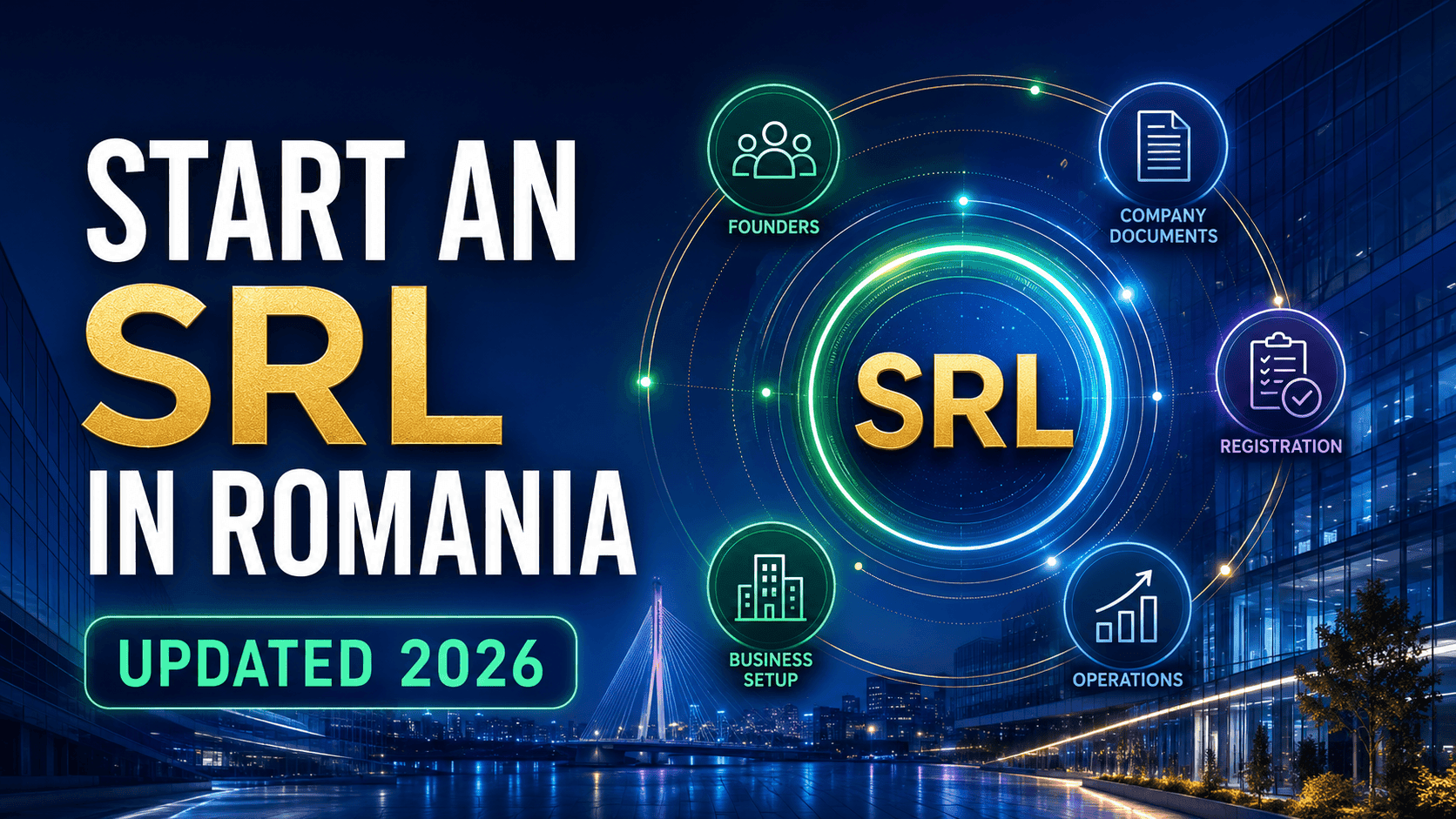
Start a Limited Liability Company (SRL) in Romania 2025

How to Start a Limited Liability Company (SRL) in Romania – Updated for 2025

How to Start a Limited Liability Company (SRL) in Romania – Updated for 2025

How to Start a Limited Liability Company (SRL) in Romania – Updated for 2025

Navigating the intricacies of starting a Limited Liability Company (SRL) in Romania requires a comprehensive understanding of the local legal framework and the specific nuances of Romanian law. This article serves as a guide to help entrepreneurs understand the SRL formation process, explore available options, and ultimately establish their business successfully in Romania.

Understanding SRL Formation in Romania

Successfully navigating the SRL registration process in Romania demands a clear understanding of both local and EU regulations. As an expert legal services provider, we can assist you in understanding the full scope of requirements and procedures. Our goal is to provide the best legal solutions, ensuring effective strategies for company formation in Romania. Learn more about our corporate law services.

What is an SRL?

An SRL (Societate cu Răspundere Limitată), or Limited Liability Company, is a business structure where the liability of shareholders is limited to their capital contribution. This structure is one of the most popular and practical routes for entrepreneurs in Romania, offering both flexibility and legal protection.

The Landscape of Business Formation in Romania

Romania’s economic landscape presents significant opportunities for business formation. Understanding the current trends, regulations, and requirements is crucial for both domestic and international entrepreneurs. The legal framework has been refined for 2025, with greater clarity around capital requirements, registration steps, and foreign investor issues.

Types of Business Structures: SRL vs. SA vs. PFA

In Romania, businesses can be structured in several ways:

  • SRL (Limited Liability Company), which is flexible and suitable for most startups and SMEs.
  • SA (Joint-Stock Company), typically required for large enterprises with minimum capital requirements.
  • PFA (Sole Proprietorship), suited for very small operations but without separate legal entity protection.

The type of business structure influences the registration process and available options, requiring tailored strategies.

Legal Framework for SRL Formation

Key Legislation Governing SRL Registration

The SRL formation process in Romania is governed by a comprehensive set of laws and regulations designed to protect both creditors and shareholders. Key legislation includes the Civil Procedure Code and regulations from the National Register of Commerce (ONRC). Understanding these laws is essential for effective company formation in Romania. For detailed information on procedures, refer to the European e-Justice Portal.

Role of Corporate Law Specialists

A corporate law specialist plays a crucial role in navigating the complexities of SRL formation in Romania.

Atrium Romanian Law Office is an expert legal services provider based in Romania, specifically in Bucharest. Atrium aims to be the best in handling complex and challenging legal matters. The firm’s team of experienced Romanian lawyers and professionals are equipped to resolve any legal issue in a timely manner. They offer guidance through processes related to company formation, compliance, and strategic business planning. The team are members of the Romanian Bucharest Bar.

These legal professionals provide expert guidance on registration procedures, handle ONRC submissions, and develop tailored strategies for company formation. At Atrium Romanian Law Office, experienced lawyers understand the nuances of Romanian law. This ensures that all procedures are both effective and compliant with current regulations, maximizing the chances of successful SRL establishment.

Understanding Capital Requirements

For 2025, the minimum share capital requirement has been effectively abolished for SRLs. Founders can declare any amount they deem appropriate. However, proposed legislative reforms may reintroduce minimum capital thresholds (around 8,000 RON) for new incorporations from January 2026 onwards. Understanding these requirements is crucial for proper company structuring.

Step-by-Step Process to Form an SRL in Romania

The SRL formation process in Romania involves several key phases designed to maximize your chances of successful registration. Whether through streamlined online procedures or in-person submissions, understanding each phase is critical.

Phase 1: Preliminary Planning & Name Reservation

The first step in SRL formation is careful planning and name reservation. This involves:

  • Choosing the SRL form and ensuring it fits your business model
  • Proposing 2–3 name options and checking availability via ONRC portal
  • Reserving the name with the trade-registry
  • Selecting your registered office address and gathering proof
  • Determining business activities (CAEN codes) carefully

Phase 2: Drafting Documents & File Preparation

Once planning is complete, prepare all necessary documentation:

  • Prepare Articles of Association outlining company details
  • For foreign shareholders: prepare apostilled copies and Romanian translations
  • Open a temporary bank account for capital deposit
  • Ensure all documentation is signed, notarized and in correct format

Phase 3: Submission to Trade Registry (ONRC)

Submit your file to ONRC through the following steps:

  • Submit file to ONRC (in person or via online portal)
  • Pay the state registration fee (approximately €50)
  • ONRC reviews file; certificate typically issued within 3 working days
  • Company is legally established; commence business activities (subject to licenses)

Phase 4: Post-Registration Formalities

After registration, complete these essential formalities:

  • Deposit declared capital in bank
  • Register for tax purposes with ANAF
  • Submit VAT registration if turnover exceeds threshold (EUR 88,500)
  • Open regular business bank account
  • Apply for sector-specific licenses/permits if required

Phase 5: Begin Operation & Compliance

Ensure ongoing compliance with:

  • Register for accounting and payroll services
  • File annual financial statements with ONRC
  • Ensure ongoing compliance with statutory deadlines
  • Report any changes in capital, address, administrators or business activity

Timeline & Cost Expectations (2025)

Typical Timeline: 5-10 working days for complete SRL setup

Typical Costs: €300-€800 (varies depending on legal fees, translations, notarization, and sector-specific requirements)

Actual costs vary widely depending on legal advisor fees, translation/notary costs for foreign shareholders, virtual office fees, bank requirements, and regulatory licenses needed.

Advantages of an SRL Structure in Romania

  • Limited Liability Protection – Your personal liability is limited to your contribution
  • Flexibility & Simplicity – Simpler to administer than joint-stock companies
  • Wide Applicability – Suited for startups, SMEs and cross-border businesses
  • Foreign Investor Friendly – Accommodates non-resident shareholders and administrators
  • Access to EU Single Market – With relatively favorable conditions

Common Pitfalls & How to Avoid Them

Protect your SRL formation by avoiding these common mistakes:

  • Incomplete documents — Legal professionals catch naming errors, missing signatures and incorrect forms
  • Foreign-investor documentation — Apostille, translation, notarization requirements vary; each adds time
  • Bank account delays — Budget extra time or use law-firm assisted account opening
  • Incorrect name or CAEN code — Similar names or restricted words trigger extra checks
  • Underestimating permits — Sectors like food, pharma, finance need regulatory checks before operation
  • Ignoring reform changes — Future-proof your structure against 2025/2026 minimum capital reforms

Related Company Formation Resources

To further support your journey in establishing and managing your business in Romania, we’ve compiled a comprehensive cluster of related guides and resources:

Frequently Asked Questions About SRL Formation in Romania

What is the minimum share capital for an SRL in Romania?
For an SRL in 2025, there is no legal minimum share capital required; founders may set the amount they deem appropriate. However, proposed legislative reforms may require higher minimum capital for new SRLs from 2026 onwards.
How long does it take to register an SRL?
If all documents are complete and valid, the trade-registry certificate is typically issued within 3 working days; total company setup often takes 5-10 working days depending on additional requirements.
Can a foreigner be a shareholder or director?
Yes — non-residents can own or manage an SRL; extra documentation may be required including apostille, notarization, and translation into Romanian.
When is VAT registration required?
Mandatory when turnover exceeds the equivalent of EUR 88,500 (in RON) or if opting in earlier. Check the latest ANAF threshold for current requirements.
What if my business activity needs a license?
After SRL registration you may need to apply for sector-specific licenses or permits (e.g., food services, pharmaceutical, financial advice). These can add days or weeks to the launch timeline.
What are the ongoing compliance requirements?
SRLs must file annual financial statements with ONRC, maintain accounting records, register for payroll services, and report any changes in capital, address, or business activities.
Can I use a virtual office for my registered address?
Yes, many foreign-investor SRLs use virtual offices with local law-firm hosting for convenience. The address will be publicly registered and used for all official correspondence.
What role does ONRC play in SRL formation?
ONRC (National Register of Commerce) processes SRL registrations, reviews submitted documents for compliance, issues registration certificates, and maintains the official registry of companies in Romania.
What are the benefits of engaging a law firm for SRL formation?
Engaging a law firm provides expert guidance on requirements, ensures proper document preparation, handles ONRC submissions, navigates foreign investor procedures, and improves chances of smooth registration.

Ready to Start Your SRL?

Setting up an SRL in Romania requires careful planning and professional guidance. Our experienced corporate lawyers ensure proper structure, compliant documentation, and smooth registration. Let us help you navigate the process and establish your business successfully.

Regulations governing foreign investments in Romania

Regulations governing foreign investments in Romania

In 2023, Romania gave 105 clearances for foreign direct investments.

This shows the growing interest in Eastern Europe’s economy.

Knowing the rules for foreign investments in Romania is key for investors.

foreign investments in Romania

Romania’s rules for foreign investment have changed a lot.

This is to balance economic growth with national security.

Stricter rules for non-EU investors started in April 2022.

These changes follow European trends and change the investment landscape in Romania.

Understanding Romania’s investment rules is crucial.

You need to know about the new screening process and how it treats EU and non-EU investors differently.

This guide will help you understand Romania’s foreign investment regulations.

It will aid in making smart investment choices in Romania.

Key Takeaways

  • Romania introduced stricter FDI rules in April 2022, particularly for non-EU investors.
  • A minimum investment value of €2 million triggers mandatory screening in sensitive sectors.
  • The FDI Screening Commission (CEISD) oversees the review process for foreign investments.
  • Strategic sectors under scrutiny include critical infrastructure, national security, and financial systems.
  • EU investors generally face a shorter screening period compared to non-EU investors.
  • Significant penalties can be imposed for non-compliance with FDI regulations.
  • Recent amendments have strengthened the enforcement mechanisms for FDI rules.

Overview of Romania’s Foreign Investment Framework

Romania’s foreign investment framework has changed a lot, shaping its economy.

The country works hard to make it easy for businesses to thrive.

It has a strong legal system and regulatory bodies to support this effort.

Current Investment Climate

Romania’s economy has grown steadily, with a 4.1% increase in 2022 and 2.1% in 2023.

It has a big market with 19 million consumers. In 2022, foreign investment reached $11.2 billion, a 6.6% increase from the year before.

The total foreign investment stock is $116 billion, which is 38.4% of its GDP.

Romania's investment incentives

Key Regulatory Bodies

Several groups watch over Romania’s investment rules:

These bodies make sure investments follow national security and public order rules.

They also follow EU laws.

Historical Development of FDI Regulations

Romania’s FDI rules have changed a lot, especially in 2022 and 2023. Important updates include:

  • Introduction of EU investor definitions;
  • New rules for investment screening;
  • A $2.17 million threshold for investment reviews.

These changes show Romania’s effort to attract foreign investment while protecting its interests.

The rules keep getting better, aiming to attract more investment while keeping things in check.

Legal Foundation for Foreign Investments in Romania

Romania’s laws for foreign investments have changed a lot.

This has made the country more welcoming to foreign investors.

The country’s laws and recent updates show its strong desire to attract foreign investment.

Primary Legislative Acts

The main laws for foreign investments in Romania are Law no. 164/2003 and Government Emergency Ordinance (GEO) no. 46/2022.

These laws set the stage for investment opportunities in Romania.

They also outline the rules for investing abroad.

Romania investment climate

Recent Amendments and Updates

In 2023, Romania made important changes to improve its business environment.

These updates include defining “EU Investors” and giving more power to the FDI Screening Commission.

Now, investments over €2 million must be reviewed under GEO no. 46/2022.

EU Regulation Integration

Romania has made its policies match EU standards by adopting FDI Regulation 2019/452.

This step makes the business environment stronger while following EU rules.

It helps attract investments while protecting Romania’s interests.

Foreign investors should know that not following GEO no. 46/2022 can lead to fines up to 10% of their global turnover.

These rules, in effect since April 18, 2022, show Romania’s dedication to responsible foreign investment.

Foreign Investments in Romania: Screening Process

Romania’s rules for foreign investments have changed a lot.

This affects how companies enter the Romanian market.

A new law, starting on July 18, 2024, now checks both EU and non-EU investors.

This changes the business landscape in Romania.

Now, any investment over €2 million in key sectors must be checked.

The FDI Screening Commission (CEISD) and the Romanian Competition Council are key in this.

Investors must give all needed info in 15 days.

CEISD then has 60 days to give an opinion.

Foreign investments screening process Romania

EU and non-EU investors have different timelines.

The Competition Council can clear EU investments in 10 days. For others, it’s 30 days.

This quick process for EU investors helps balance security with economic growth.

Investor TypeScreening FeeClearance Decision Timeline
EU Investors€10,00010 calendar days
Non-EU Investors€10,00030 calendar days

The screening looks at how investments affect national security and order.

Breaking these rules can lead to fines up to 10% of an investor’s global sales.

This shows how crucial following these rules is for entering the Romanian market.

Strategic Sectors Under Government Scrutiny

Romania closely watches certain sectors for foreign investment.

This helps balance business opportunities with national security.

Investments in key areas are carefully checked to match the country’s goals.

Critical Infrastructure

Romania’s infrastructure is a big focus for foreign investment.

The government keeps a close eye on energy, transport, and communications.

These sectors are crucial for growth and security.

Investors in these projects must follow strict rules.

National Security Sectors

Industries linked to national security get extra attention.

This includes weapons, ammunition, and toxic substances.

Workers in these fields need strict security checks.

Investments in these areas are thoroughly reviewed to protect national interests.

Financial and Banking Systems

The financial sector, like banking and insurance, is very important.

Tax incentives draw foreign investors here.

But, the Government watches these investments closely.

This is to keep the economy stable and secure.

Strategic SectorKey Focus AreasInvestment Scrutiny Level
Critical InfrastructureEnergy, Transport, CommunicationsHigh
National SecurityDefense, Weapons ProductionVery High
Financial SystemsBanking, InsuranceModerate to High

Knowing these strategic sectors is key for foreign investors in Romania.

While welcoming international business, Romania balances investment with national security.

Investment Thresholds and Requirements

Romania, a growing market in Eastern Europe and part of the EU, has clear rules for foreign investments.

These rules help attract investors while protecting the country’s interests.

Minimum Investment Values

The Romanian government has set a EUR 2 million minimum for foreign direct investments (FDI) in certain sectors.

Investments over this amount need government approval.

But, even smaller investments might be checked if they could affect national security or public order.

Documentation Requirements

Investors need to gather detailed documents for FDI screening.

These must be in both Romanian and English for the CEISD (Competition Council and Foreign Investments Screening Directorate).

Important sectors include energy, transport, critical infrastructure, and financial systems.

Compliance Standards

Romania’s FDI rules follow EU standards but also consider national security.

Investors from outside the EU or EU entities controlled by non-EU interests are checked more closely.

It’s important to provide accurate information to avoid big fines.

AspectRequirement
Investment ThresholdEUR 2 million
Application LanguagesRomanian and English
Review TimelineUp to 135 calendar days
Non-compliance FineUp to 10% of worldwide turnover

Review and Approval Procedures

Foreign investors looking to invest in Romania must go through a detailed review process.

This is key for FDI in Romania and helps shape the investment climate.

The review process has three main stages:

  1. Initial filing;
  2. CEISD review;
  3. RCC decision-making.

For simple cases, the timeline depends on where the investor is from.

Non-EU investors might wait up to 135 days, while EU investors could wait 70 days.

More complex cases, like those involving national security, might need extra review by the Romanian Government.

A standstill rule means investors can’t start their projects until they get approval.

As of December 2023, a €10,000 filing fee was introduced.

This fee is refundable if the investment doesn’t fall under the law’s scope.

Investor TypeReview TimelineInvestment Threshold
Non-EUUp to 135 days€2 million+
EUUp to 70 days€2 million+

The review process is for investments over €2 million in sensitive sectors.

These include energy, transport, critical infrastructure, IT, and finance.

Investors get benefits like a quick process for simple cases and clear rules to follow.

Sanctions and Enforcement Measures

Romania’s foreign investment scene has changed, affecting joint ventures and mergers.

The country has put in place strict rules to follow its investment laws.

Penalties for Non-compliance

Investors who break Romania’s investment rules face big penalties.

They can be fined up to 10% of their global sales.

These fines are for breaking rules like finishing deals too early or giving wrong info.

Regulatory Oversight

The FDI Screening Commission watches over foreign investments.

They can suggest canceling deals that might harm national security.

The Romanian Competition Council also checks to make sure the market is fair.

Appeal Procedures

Investors can appeal if they disagree with a decision.

This lets them challenge fines or bad rulings.

It tries to balance what’s good for investors with what’s good for Romania.

InfractionPenalty
Premature deal completionUp to 10% of worldwide turnover
Providing inaccurate informationFines and potential deal nullification
Failing to file for FDI clearanceAgreement considered null and void

Romania’s privatization program has drawn a lot of foreign interest.

But, investing in Romanian businesses means you have to know the rules.

It’s key for doing well in joint ventures and acquisitions in Romania’s changing market.

Special Provisions for EU vs Non-EU Investors

Romania has set up special rules for foreign investors.

These rules differ for EU and non-EU investors.

The goal is to attract more money from abroad while protecting Romania’s interests.

EU Investor Benefits

EU investors get a quick review in Romania.

This is for EU citizens and companies based in EU countries.

It makes it easier for them to invest in Romania.

Non-EU Investor Requirements

Non-EU investors have to go through a tougher check.

Any investment over €2 million in key areas needs a review.

This includes new projects, changes to current investments, and deals in critical areas.

Differential Treatment Aspects

The rules show clear differences in how investors are treated.

EU investors get a quicker review, while non-EU investors face longer waits.

For big investments in key sectors by non-EU investors, the EU Commission must agree first.

AspectEU InvestorsNon-EU Investors
Screening ProcessFast-trackMore stringent
Review PeriodShorterLonger
Investment ThresholdLower scrutiny€2 million in sensitive sectors
Strategic Sector InvestmentLess restrictivePrior consent for €2 billion+

Romania wants to draw in foreign investment but also keep control over important areas.

The rules aim to balance foreign money with national security.

They follow EU rules but also protect Romania’s interests.

Conclusion

Romania’s business climate has seen big changes, affecting its investment policies and chances.

Despite the COVID-19 pandemic, Romania’s economy has bounced back.

In 2021, its real GDP grew by 5.9% after a 3.9% drop in 2020.

This shows Romania’s strong potential for investors looking for new markets.

Romania’s investor relations have improved lately.

The creation of the Romanian Agency for Investment and Foreign Trade (ARICE) in 2023 shows the country’s effort to draw in foreign capital. In 2022, U.S.

Foreign Direct Investment in Romania reached $2.9 billion.

This makes Romania a great choice for international investors.

Romania also gets a lot of EU funding. It’s set to get up to $83.5 billion in EU funds by 2030.

A big part of this will go to green projects and digitalization.

This funding makes it easier for investors to find opportunities in sustainable and tech sectors.

When exploring Romania’s investment scene, keep up with new rules.

Now, investments over $2.17 million need to go through screening reviews.

These rules help protect national interests and ensure clear investor resources.

By staying updated and following the rules, you can make the most of Romania’s growing economy.


Our team of lawyers in Romania has a longstanding history of providing commercial legal services to both companies and individuals.

Our Romanian lawyers boast a robust and successful history of resolving a wide range of commercial legal issues and fulfilling various needs.

Our Romanian Law Office provide guidance to businesses of all sizes, from small and medium enterprises to large corporations.

Whether you require legal support for commercial transactions, dispute resolution, compliance issues, or personal matters, we are here to confidently guide you through the process. Please contact us, directly, for further information.

FAQ

What are the recent changes in Romania’s foreign investment regulations?

Romania made stricter rules for non-EU investors on April 18, 2022.

They introduced a new review process.

This process now covers more types of investments, including new projects and changes to existing ones.

In 2023, they also defined “EU Investors” more clearly.

They gave the FDI Screening Commission more power to review investments.

What are the key regulatory bodies overseeing foreign investments in Romania?

The main bodies are the FDI Screening Commission (CEISD), Romanian Competition Council (RCC), and the Romanian Government.

They work together to check and approve foreign investments, especially in key sectors.

What is the minimum investment value that triggers mandatory screening in Romania?

Investments worth at least €2 million need to be reviewed.

But, even smaller investments might be checked if they could affect national security or public order.

Which sectors are considered strategic and under government scrutiny in Romania?

Key sectors include critical infrastructure, energy, transport, communications, financial services, and national security.

The CSAT Decision lists 13 sensitive areas, like security, border security, and energy security.

How long does the review process typically take for foreign investments in Romania?

For simple cases, it takes up to 135 days for non-EU investors and 70 days for EU investors.

But, if there are national security concerns, it could take longer.

What are the penalties for non-compliance with Romania’s foreign investment regulations?

Breaking the rules can lead to fines up to 10% of the investor’s worldwide turnover.

Penalties apply for several reasons, including providing wrong information.

From July 2024, not filing for FDI clearance makes agreements null and void.

Are there different provisions for EU and non-EU investors in Romania?

Yes, EU investors get a quicker review process.

The definition of EU investors includes EU nationals and companies in EU Member States.

Non-EU investors face stricter checks and longer review times.

What documentation is required for the foreign investment screening process in Romania?

You need to provide detailed info about the investor, the investment, and its impact on sensitive sectors.

Giving accurate and complete information is crucial to avoid fines.

Is there a filing fee for the foreign investment screening process in Romania?

Yes, a €10,000 fee was introduced in December 2023.

This fee is returned if the investment doesn’t need to be reviewed.

How does Romania’s foreign investment framework align with EU regulations?

Romania’s rules now follow EU FDI Regulation 2019/452.

This ensures Romania’s policies match EU standards.

The goal is to attract foreign investment while protecting national interests and following EU directives.