
Do you need a lawyer to start a business in Romania illustration with legal scales, Romanian flag, and company registration document

Do You Need a Lawyer to Start and Run a Business in Romania?

Business law guide · Romania

Do You Need a Lawyer to Start and Run a Business in Romania?

A lawyer is not generally a statutory condition for incorporating or operating a Romanian company. The real question is whether the decisions being made are simple enough to handle safely without tailored legal review.

This guide separates Trade Registry filing from legal risk management and explains when a business lawyer, accountant or notary may be relevant. The current requirements of the competent authorities should be checked before filing.

Short answer: a founder may often register and run a straightforward Romanian business without retaining a lawyer. Legal support becomes particularly valuable where there are foreign or multiple shareholders, negotiated governance rules, regulated activities, employees, important contracts, intellectual-property assets, financing or cross-border operations.

Is a lawyer required to start a company in Romania?

No. Romanian company registration does not generally require a founder to retain a lawyer. The founder may prepare and submit the incorporation file personally or use an authorised representative, subject to the current filing, identification and signature requirements.

The National Trade Register Office (ONRC) administers company registrations and provides forms and procedural information. An uncomplicated file may therefore be handled without legal representation. This does not mean that a standard form resolves decisions about ownership, management authority, shareholder protection, financing or commercial risk.

The distinction matters because the Trade Registry examines the registration file. It does not design the founder’s commercial arrangements or assess whether a generic contract adequately protects the business. The wider framework may include Companies Law no. 31/1990, trade-register rules, beneficial-owner requirements, taxation, employment, data protection, intellectual property and any legislation applying to the chosen activity.

Filing is one task

Registration confirms that the file satisfies the applicable filing requirements. It does not validate every commercial decision.

Risk is another task

Ownership, authority, contracts, employees, data and financing may require tailored legal analysis before the business starts.

Support can be targeted

A founder does not always need a permanent lawyer. A focused review may be enough for a defined decision or transaction.

Important: successful registration does not confirm that the ownership structure, decision rules, contracts or compliance framework are suitable for the business.

What can a founder usually handle without a lawyer?

A founder can usually make the initial commercial choices, gather identification and ownership information, reserve a company name and use the Trade Registry’s filing route. Whether that is sensible depends on the number of founders, the documents, the activity and the consequences of getting the structure wrong.

Select the stage to see the main legal control.

Define the business

Identify the activity, founders, proposed ownership, administrator, registered office and expected operating model before choosing the filing route.

StageFounder can usually doRisk requiring reviewPractical control
PreparationIdentify activity, founders, ownership, administrator and office.The chosen structure may not fit control, funding or regulated activity needs.Test the structure before documents are signed.
DocumentsGather identity, office and ownership information.Foreign corporate authority, legalisation or beneficial-owner issues may delay the file.Check recency, consistency and translation requirements.
RegistrationUse the forms and official submission route.Signature, filing or activity conditions may be misunderstood.Follow the current ONRC instructions and retain proof of filing.
OperationArrange banking, accounting and initial administration.Registration does not replace tax, employment, licensing or data compliance.Create a launch checklist with the right professionals.

When should you involve a business lawyer in Romania?

A targeted legal review is most useful before the founders commit to a structure, sign an important agreement or start an activity carrying regulatory, employment, data or intellectual-property risk. The earlier review does not need to cover every future issue. It should focus on decisions that are difficult or expensive to reverse.

Before incorporation

Review legal form, ownership, administrator authority, registered office, activity codes and foreign documents.

Before signing

Review shareholder, financing, lease, customer, supplier, employment or technology agreements before commitment.

Before a major change

Assess investment, restructuring, share transfer, new activity, financing, exit or change of control.

A lawyer may also be useful when the founder is unfamiliar with Romanian procedure, is managing the business from abroad, has several investors, is negotiating with a stronger counterparty or needs one person to coordinate legal and commercial documents. The instruction can be limited to structure, contract review, filing support, negotiation or a specific compliance question.

Where does legal advice add the most value?

The value of legal advice is usually highest where a mistake affects ownership, control, money, people, data or the ability to exit. These areas are connected, so the review should reflect the actual business model rather than a generic start-up checklist.

Several founders or investors

Voting, reserved matters, funding obligations, transfers, deadlock and exit provisions should be considered before relationships become difficult.

Foreign shareholders

Corporate authority, legalisation, translations, beneficial ownership and parent-company relationships require coordination.

Material contracts

Payment, delivery, liability, warranties, intellectual property, confidentiality, termination and dispute clauses allocate real risk.

Employees and contractors

Employment documents, worker classification, management authority and workplace procedures should reflect the actual relationship.

Data, software and online services

Privacy roles, software ownership, licences, security responsibility, consumer terms and AI use may need review.

Investment or restructuring

Share issues, transfers, financing, reorganisations and exits require corporate approvals and transaction documents to align.

Business lawyer, accountant or notary: who does what?

These professionals perform different functions. An accountant does not replace legal review, and a lawyer does not replace accounting or tax compliance. A notary is involved only where the law or the chosen transaction requires a notarial form or authentication.

ProfessionalCore roleTypical questionsMain limitation
Business lawyerLegal structure, rights, obligations and risk allocation.Governance, contracts, employment, compliance, transactions and disputes.Does not replace accounting records or tax reporting.
Accountant or tax adviserAccounting, reporting and tax treatment.Bookkeeping, returns, payroll, financial statements and tax position.Does not design contractual rights or provide legal representation.
NotaryAuthentic instruments and other notarial formalities.Authentication and transactions requiring notarial intervention.Does not ordinarily provide ongoing commercial legal management.
Trade RegistryReceives and examines filings within its legal competence.Registration documents, changes and formal company information.Does not act as the company’s lawyer or commercial adviser.

Romanian companies must organise and maintain accounting records under Accounting Law no. 82/1991. The responsible accounting arrangement should be confirmed with a qualified accounting or tax professional. Where a decision has both legal and tax consequences, the lawyer and accountant should coordinate their work rather than treating one role as a substitute for the other.

Business start-up legal checklist

  • Confirm the route: compare an SRL, branch or another appropriate form against the intended activity.
  • Map ownership: identify shareholders, beneficial owners, voting rights and funding expectations.
  • Define authority: decide who represents the company and whether signatures or approvals are limited.
  • Check the activity: verify activity codes and any licence, notification or operating condition.
  • Secure the office: document the right to use the registered-office premises.
  • Prepare foreign documents: confirm recency, authority, legalisation and translation requirements.
  • Plan key contracts: prioritise shareholder, customer, supplier, lease, employment and intellectual-property documents.
  • Coordinate launch: align registration with banking, accounting, tax, employment and compliance steps.
  • Set a review point: reassess the legal structure when the business raises finance, hires, expands or changes control.

The checklist is not a substitute for the current ONRC procedure. It is a way to identify where a founder can proceed alone and where a focused legal review may prevent a larger problem.

How much does a business lawyer cost in Romania?

There is no reliable universal price for business legal work. The fee depends on the scope, documents, number of parties, urgency, negotiation, filing work, sector and whether the instruction is a one-off project or recurring support.

A useful fee discussion separates official or third-party costs from legal fees. Trade Registry charges, translations, legalisation, notarial work, accounting, banking and sector approvals may arise independently of the lawyer’s fee. Before work begins, ask for the scope, assumptions, exclusions and fee basis to be stated clearly.

A fixed fee may suit a defined incorporation or document review. Hourly or staged billing may be more appropriate where the facts may change or negotiation is involved. Businesses with recurring needs can compare a subscription or retainer, but the scope should still identify what is included, what is excluded and how urgent or unusual work is handled.

Common mistakes when starting without legal review

Using default rules without testing them

Standard documents may not address equal ownership, vetoes, funding, director authority, transfers or exit.

Signing before responsibilities are clear

A commercial relationship may begin before payment, acceptance, liability, IP ownership and termination rights are agreed.

Treating registration as permission to operate

The activity may still require tax choices, licences, consumer information, employment steps or data-protection measures.

Other recurring problems include leaving founder understandings undocumented, appointing an administrator without clarifying authority, assuming that a foreign company’s internal approval is never needed, relying on an old checklist, mixing personal and company commitments and failing to plan what happens when a founder leaves.

A legal review is not valuable because every business needs the same paperwork. It is valuable when it identifies the few decisions that determine control, liability, money or the ability to change direction later.

How should a foreign founder approach Romanian legal support?

A foreign founder should begin with a short factual brief: the intended activity, founders and ownership, expected investment, proposed administrator, registered-office position, target start date and any draft document already received. The brief should also identify whether the founder will work in Romania, hire people, sign local contracts, process personal data or operate in a regulated field.

The lawyer can then separate matters that require legal analysis from those that can be handled through the ordinary filing, accounting or administrative process. This reduces unnecessary work while ensuring that foreign corporate documents, translations, powers of attorney, beneficial-owner information and banking or tax questions are not treated as afterthoughts.

Remote support may be possible, but incorporation does not itself create a Romanian residence or work right. The founder should separately check immigration, tax residence and social-security implications where the business activity or personal presence requires it.

Select the issue that needs coordination.

Structure

Review the legal form, ownership, voting, administrator authority, registered office and funding expectations before incorporation.

Frequently asked questions

Do I legally need a lawyer to open an SRL in Romania?

No. Retaining a lawyer is not generally a condition for incorporating an SRL. A founder can prepare and submit the file personally, subject to the Trade Registry’s current document, signature and filing requirements. Legal advice may still be useful where ownership, governance, foreign documents or the proposed activity create issues that standard forms do not resolve.

Can a foreign founder start a Romanian company remotely?

Often, yes, but the correct route depends on the founders and documents. Electronic filing or an authorised representative may be available, while identity checks, foreign corporate records, translations, legalisation, banking or regulated-sector requirements may require additional steps. Incorporation does not itself create a Romanian residence or work right.

When is a shareholder agreement worth considering?

A shareholder agreement is particularly useful where there are several founders or investors and the parties need tailored rules on decisions, reserved matters, funding, transfers, confidentiality, deadlock or exit. It should be coordinated with the articles of association and mandatory Romanian company law.

Can my accountant handle all legal matters for the company?

No. The accountant manages accounting, financial reporting and tax-related work within the agreed professional scope. Contract rights, corporate governance, employment questions, regulatory obligations and legal disputes require separate legal analysis.

What should I send to a business lawyer in Romania?

Send a short description of the planned activity, the founders and ownership structure, the relevant deadline and any draft incorporation, shareholder, financing, customer or supplier documents. For an existing company, include the current corporate documents and identify the specific decision, transaction or risk requiring review.

Does company registration mean that the business can operate immediately?

Not necessarily. Registration is separate from tax, accounting, employment, licensing, consumer, data-protection, immigration and sector-specific requirements. The business should confirm the conditions applying to its actual activity before starting operations.

Need help with a Romanian business decision?

A focused review can identify the legal structure, documents, approvals and compliance points that matter for your next step.

Book a consultation

Disclaimer: This article provides general information only and does not constitute legal, tax or accounting advice or the creation of a lawyer-client relationship. The appropriate structure and professional support depend on the founders, activity, documents and intended transactions. Obtain a case-specific assessment before acting.

AI Notice: AI-assisted content, reviewed by a qualified Romanian lawyer.
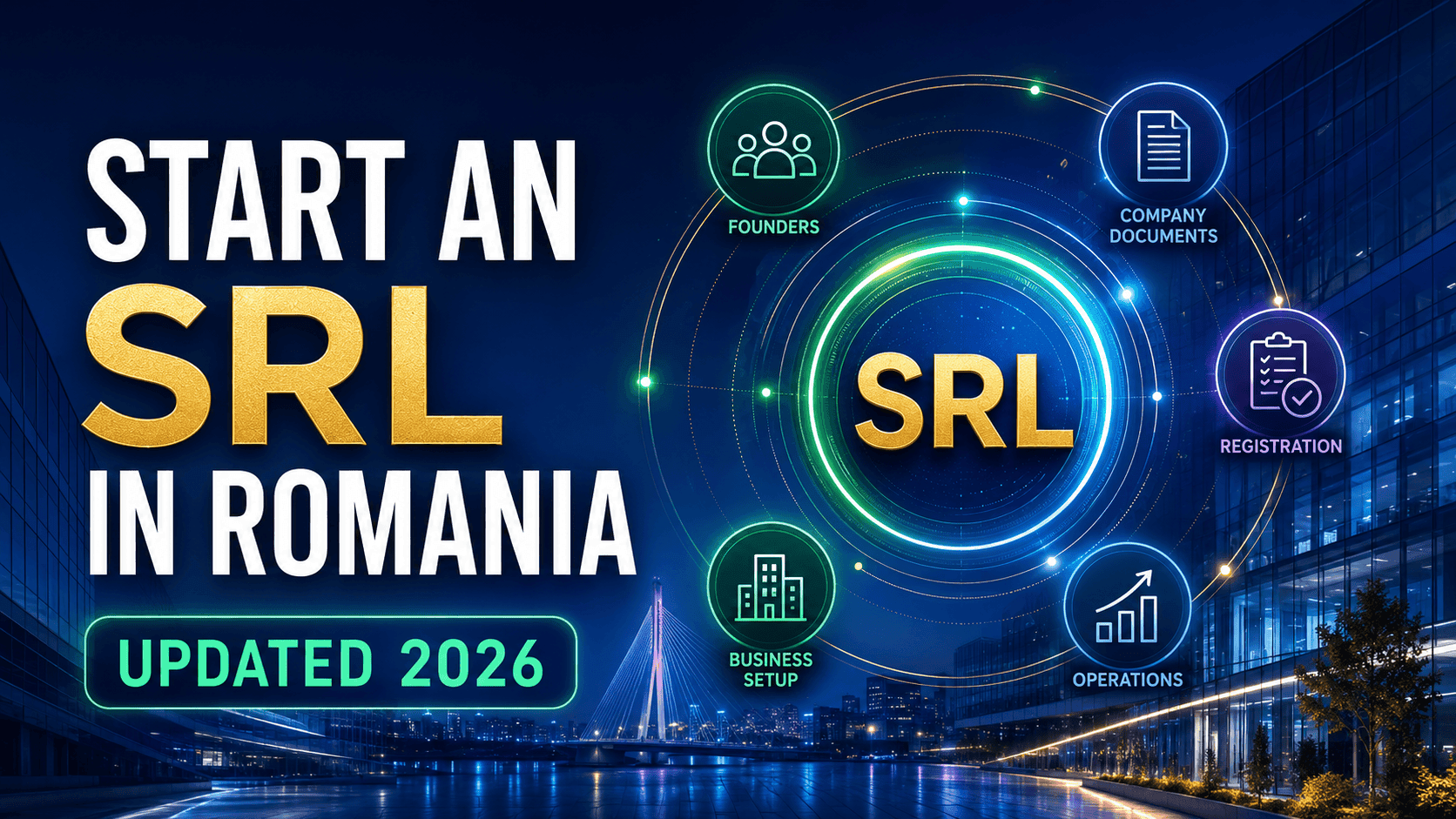
Start an SRL in Romania – Updated 2026

How to Start a Limited Liability Company (SRL) in Romania – Updated for 2026

How to establish a Romanian SRL in 2026

A Romanian limited liability company is not created by completing one standard form. The founders must settle the ownership, management, registered office, activities, capital and beneficial ownership before filing a consistent incorporation application with the Trade Register.

Romanian SRL formation ecosystem An animated orbital map showing the founders, registered office, company documents, capital, Trade Register and operational setup surrounding a Romanian SRL. ROMANIAN SRL • 2026 SRLROMANIA Foundersownership & control Capitalfunding structure ONRC filingregistration decision Operationsbank • tax • licences
A reliable incorporation file starts with coherent founder decisions and ends with the operational steps required after registration.

Short answer: an SRL is the most common Romanian company form for startups, SMEs and foreign-owned subsidiaries. In 2026, a newly incorporated SRL must have share capital of at least RON 500. Registration is only the first stage: banking, accounting, tax, employment and sector-specific requirements must be addressed separately.

What is a Romanian SRL?

An SRL, or societate cu răspundere limitată, is a Romanian legal entity whose share capital is divided into participation interests. As a general rule, the shareholders’ exposure is limited to their agreed contributions, while the company owns its assets and assumes its own contractual obligations.

Limited liability is not absolute protection against every personal risk. A shareholder or administrator may still face exposure under personal guarantees, director-liability rules, tax or insolvency provisions, unlawful distributions or abusive conduct. Governance and signing authority therefore matter from the incorporation stage.

This guide focuses only on the SRL. Foreign investors comparing an SRL with an SA, branch or representative office should first review our main page on company formation in Romania for foreign founders.

Which decisions must the founders make before filing?

OwnershipIdentify the shareholders, participation percentages, capital contributions and ultimate beneficial owners.
ManagementAppoint the administrator or administrators and define whether they represent the company separately or jointly.
ActivitiesSelect the principal and secondary activities under the official CAEN Rev.3 classification and check whether the proposed activity needs a Romanian business permit or licence.
Registered officeSecure a Romanian address and a legally valid document proving the company’s right to use it. For the documents commonly used in the incorporation file, see our foreign-founder document checklist.
GovernanceAgree voting rules, reserved matters, profit distribution and procedures for conflicts. A 50/50 structure should include a workable shareholder-deadlock mechanism.
FundingSet the share capital and distinguish it from shareholder loans, future investment and working capital.
Common formation riskUsing a standard articles-of-association template without adapting representation powers, voting rules or transfer restrictions. Registration may succeed while the company is left with avoidable governance problems.

What is the minimum share capital for an SRL in 2026?

Following Law no. 239/2025, the minimum share capital for a newly incorporated SRL is RON 500. Older references stating that an SRL may be incorporated with RON 1 or without an effective minimum are no longer current.

Law no. 239/2025 also establishes a minimum share capital of RON 5,000 for an SRL whose reported net turnover for the previous financial year exceeds RON 400,000. Existing companies falling within that rule must observe the statutory adjustment period. The applicable amount should therefore be checked both at incorporation and when the company’s turnover changes. The implementation steps are discussed separately in our guide to a Romanian company capital increase.

SituationMinimum capitalPractical consequence
Newly incorporated SRLRON 500The articles of association and capital structure must reflect at least this amount.
SRL with reported net turnover above RON 400,000RON 5,000The company must bring its capital into line with the statutory rule within the applicable period.
Additional business fundingCommercial decisionShare capital should not be confused with shareholder loans or the actual operating budget.

Under Law no. 31/1990, an SRL must pay at least 30% of the subscribed capital no later than three months after registration and before commencing operations in its own name. The remaining cash contribution is payable within 12 months after registration, while the remaining in-kind contribution is payable within no more than two years.

Capital is not the complete formation budgetFounders should separately budget for translations, apostilles or legalisation, registered-office arrangements, professional fees, banking, accounting, publication charges and any licences required for the intended activity.

What documents are generally required?

The precise filing depends on the founders, administrator, office and activities. A standard SRL incorporation usually requires or relies on:

  • the Trade Register incorporation application;
  • proof of company-name reservation;
  • the articles of association;
  • documents proving the right to use the registered office;
  • identity documents for individual shareholders and administrators;
  • current registry extracts, constitutional documents and corporate approvals for a corporate shareholder;
  • statutory declarations concerning operating conditions and other legally required matters;
  • beneficial-owner information or a separate declaration, where required;
  • evidence of authority for the person signing or filing the application; and
  • any approvals, opinions or documents required by the proposed name or regulated activity.

The official list and current forms should be checked on the National Trade Register Office website immediately before filing. A missing mandatory element may result in rejection rather than an informal opportunity to complete the file. Founders can prepare the file using our separate checklists for reserving a Romanian company name and drafting Romanian articles of association.

What changes when a shareholder is foreign?

Foreign individuals and companies may generally hold participation interests in a Romanian SRL. Romanian citizenship or residence is not, by itself, a general ownership condition. However, foreign documents must be assessed for validity, authority, legalisation or apostille and authorised Romanian translation.

A foreign corporate shareholder may need a recent registry extract, its constitutional documents, a resolution approving the Romanian investment and evidence that the signatory can bind it. The exact formalities depend on the issuing state, applicable treaties and the document used. Our document checklist for foreign founders explains the preparation issues in more detail.

The ownership chain must also be traced to the natural persons who ultimately own or control the company. The applicable tests and filing deadlines are explained in our updated guide to the beneficial owner declaration in Romania.

Company ownership is not immigration statusIncorporating or owning an SRL does not automatically grant a foreign founder the right to enter, reside or work in Romania. Immigration and work-authorisation requirements require a separate analysis.

How does the Romanian SRL formation process work?

Formation map

From founder decisions to operational setup

Romanian SRL formation roadmap An animated six-card roadmap from company structure and documents through ONRC filing, registration and operational activation. SRL FORMATION ROADMAPROMANIA • 2026 01StructureOwnership • managementactivities • capital 02Name & officeName reservationregistered-office title 03DocumentsArticles • identitiesforeign formalities 04ONRC filingPortal • counterlawyer representation 05RegistrationRegistrar decisioncompany certificate 06ActivationBank • tax • accountinglicences • contracts
Trade Register approval creates the company, but banking, tax, accounting and operational compliance continue after registration.
Define the structureSet ownership, management, activities, capital, governance and the post-registration plan.
Reserve the nameSubmit suitable alternatives and obtain proof of availability through ONRC.
Secure the registered officePrepare the lease, loan-for-use agreement or other valid title to the premises.
Prepare the incorporation fileDraft the articles and collect the founder, administrator, corporate and beneficial-owner documents.
Submit the applicationFile at the counter, by post or courier, or electronically under the signature and format rules.
Complete operational setupAddress capital payment, bank onboarding, accounting, tax registrations, authorisations, contracts and employment.

Can the SRL application be submitted online or through a lawyer?

Yes. Under Law no. 265/2022 on the Trade Register, an incorporation application may be filed at the counter, through post or courier, or electronically. Electronic documents must comply with the qualified-electronic-signature requirements. A lawyer may sign or submit the application on the basis of a legal-services mandate and may transmit documents prepared by the lawyer under the statutory procedure.

The available electronic services can be accessed through ONRC MyPortal. Remote incorporation is possible in many cases, but foreign-document formalities, bank identification, regulated activities and immigration matters may require additional steps.

How long does SRL registration take?

The Trade Register states that a complete registration application is generally resolved by the registrar within one working day after registration of the application. This procedural period is not a guaranteed end-to-end formation time.

Name reservation, document preparation, foreign legalisation, translations, correcting inconsistent information, obtaining a registered office and responding to registrar requirements may extend the project. Bank onboarding and licences also occur outside the basic incorporation decision.

Use a two-part timelineSeparate the time required to obtain the Trade Register decision from the total time required for the company to become operational. A registered SRL may not yet be ready to invoice, employ staff or perform a regulated activity.

What does it cost to establish an SRL?

There is no reliable universal package price. The total depends on the founders and documents involved. A realistic budget may include:

  • the subscribed share capital;
  • official publication or registration-related charges generated for the file;
  • translations, apostilles, legalisation or notarial formalities;
  • legal assistance and representation;
  • registered-office costs;
  • bank, accounting and tax-advisory services; and
  • licensing or sector-specific costs.

According to the ONRC information published on 30 April 2026, the tariff for publication in the Official Gazette is calculated and paid after the registration application is admitted. A generic statement that every SRL has a fixed “state fee of EUR 50” should therefore not be used.

What must be done after the SRL is registered?

The registration certificate does not complete every business requirement. Depending on the project, the founders should address:

Post-registration areaQuestions to resolveMain risk if ignored
Capital and bankingCapital payment, operating account, signatories, bank KYC and the steps for a Romanian business bank account for a non-residentThe company cannot use the intended banking arrangements or misses a statutory contribution deadline.
Accounting and taxAccounting engagement, tax vector, VAT analysis, reporting calendar and ongoing Romanian tax registration and complianceLate filings, incorrect invoicing or unsuitable tax treatment.
Activity authorisationWhether the declared CAEN activities may be performed at the office, third-party sites or outside a fixed locationThe company is registered but not authorised to conduct the intended activity.
Contracts and governanceCustomer, supplier, employment, administrator and shareholder arrangementsOperational exposure and internal disputes begin before protections are documented.
Regulated sectorsLicences, notifications, professional requirements or foreign-investment screeningThe business starts an activity before regulatory clearance.

Tax positions should be checked against the current ANAF guidance and electronic services. VAT registration, payroll reporting and the applicable corporate or microenterprise regime depend on facts that are not resolved merely by incorporating the SRL.

Which SRL formation mistakes cause delays or future disputes?

  • choosing CAEN codes without checking whether the activity is regulated or may be authorised at the selected location;
  • submitting foreign documents that are outdated, improperly legalised or inconsistently translated;
  • using unclear joint or separate representation powers for multiple administrators;
  • treating share capital as the complete operating budget;
  • failing to identify indirect beneficial owners;
  • assuming that incorporation grants immigration or work rights;
  • using generic voting clauses in a 50/50 company without a workable deadlock solution; and
  • waiting until after registration to address banking, accounting, tax or licensing requirements.

Where there are several founders, the articles should be coordinated with a properly drafted Romanian shareholder agreement. Administrators should also understand the exposure explained in our guide to Romanian company director liability.

Need assistance establishing an SRL in Romania?

Atrium Romanian Lawyers assists Romanian and foreign founders with company structuring, articles of association, beneficial ownership, registered-office documentation, Trade Register filings and post-incorporation corporate work.

Frequently asked questions

What is the minimum share capital for a new Romanian SRL in 2026?

The minimum share capital for a newly incorporated SRL is RON 500. A separate RON 5,000 minimum applies to SRLs whose reported net turnover for the previous financial year exceeds RON 400,000, subject to the statutory adjustment rules.

Can a foreigner own 100% of a Romanian SRL?

In general, yes. Romanian citizenship or residence is not a general condition for owning an SRL. The founder’s documents, beneficial ownership, applicable foreign-investment rules and any regulated-sector restrictions must still be checked.

Can an SRL have one shareholder and one administrator?

Yes. An SRL may generally have a sole shareholder, who may also be appointed administrator. The articles should still regulate the company’s activities, capital, representation and beneficial-owner information correctly.

Is a Romanian bank account required before incorporation?

The banking sequence must be coordinated with the applicable capital-payment rules and the chosen bank. The company must pay the required portion of subscribed capital within the statutory period and before commencing operations in its own name.

Can the SRL be incorporated remotely?

Often, yes. The application may be submitted through an authorised representative or electronically where the signature and document-format requirements are met. Foreign formalities, bank KYC, licences or immigration steps may still require separate action.

Does Trade Register registration mean the SRL can immediately perform every declared activity?

No. Certain activities require additional authorisation, licences, notifications, qualified personnel or suitable premises. Registration and operational authorisation must be checked separately.

Disclaimer: This article provides general information and does not constitute legal or tax advice. The correct formation process depends on the founders, ownership structure, activities, documents and legislation in force when the application is prepared.

AI Notice: AI-assisted content, reviewed by a qualified Romanian lawyer.