AI Cybercrime 2025

AI Weaponization and Cybercrime Threat in 2025: What Every Organization Needs to Know


AI Weaponization and Cybercrime Threat in 2025: What Every Organization Needs to Know

Table of Contents

Direct Answer: Global cybercrime is projected to cost the world $10.5 trillion annually by 2025, which translates to approximately $19.9 million per minute in losses worldwide.

With AI-powered attacks occurring approximately every 39 seconds, organizations must urgently adopt AI-driven defensive strategies and implement robust governance frameworks to protect against hyper-personalized phishing, advanced malware, and deepfake fraud.

Legal and compliance teams should establish incident response protocols immediately.


Introduction: The AI-Powered Cybercrime Crisis

The cybersecurity landscape of 2025 is fundamentally transformed. Artificial Intelligence (AI) has become both the weapon and the shield in modern cyber warfare.

Malicious actors are weaponizing AI at an unprecedented scale, creating attacks that are more sophisticated, faster, and accessible to criminals with minimal technical expertise.

This shift demands immediate action from business leaders, compliance officers, and legal professionals.

The stakes have never been higher—and neither have the regulatory consequences for inadequate cybersecurity measures.


The Financial Impact of AI-Powered Cybercrime in 2025

AI threats

Understanding the Scale of Cyber Losses

Global cybercrime costs are projected to reach $10.5 trillion annually by 2025, according to Cybersecurity Ventures.

This represents an unprecedented transfer of economic wealth—greater than the GDP of most countries.

To put this in perspective: The world loses approximately $19.9 million per minute to cybercrime.

That’s $1.2 billion per hour, or $28.8 billion per day.

Why These Numbers Matter for Your Organization

Cybercrime isn’t just a technology problem—it’s a business crisis with legal implications.

For law firms and professional services organizations, a single data breach can result in average costs of $4.88 million. Beyond financial impact, a breach can result in:

  • Regulatory fines under GDPR, CCPA, and industry-specific regulations
  • Client trust erosion and reputational damage
  • Malpractice liability if client confidential information is compromised
  • Mandatory breach notifications with cascading legal consequences

Attack Velocity: The Speed of Modern Threats

In 2023, a cyberattack occurred approximately every 39 seconds globally, translating into over 2,200 cases per day.

This demonstrates the relentless and automated nature of modern threats.

The velocity of attacks continues to accelerate.

Organizations that rely on manual security monitoring are already behind the curve.


How AI Is Being Weaponized by Cybercriminals

AI-Powered Cybercrime in 2025

The Dual-Use Dilemma: When AI Turns Malicious

Artificial Intelligence presents a fundamental paradox.

The same technologies that drive innovation can be weaponized for criminal purposes.

AI has lowered the barrier to entry for sophisticated cybercrime, enabling individuals with minimal technical expertise to execute complex attacks.

Cybercriminals are embedding AI throughout their entire operations—from victim profiling and data analysis to creating false identities and automating large-scale attacks.

AI Jailbreaking: Bypassing Safety Guardrails

AI jailbreaking is the process of manipulating public AI systems (like ChatGPT, Gemini, and Claude) to bypass their ethical safety restrictions.

Threat actors use specialized prompt injections to force AI models to generate harmful content.

Key Statistics on Jailbreaking:

Common Jailbreaking Techniques:

  • Role-play prompts instructing AI to adopt specific personas (e.g., “act as a hacker”)
  • Social engineering techniques targeting AI safety systems
  • Prompt injection attacks designed to override safety protocols
  • Chained requests that gradually escalate harmful behavior

Organizations must educate employees on these risks.

Even well-intentioned staff can inadvertently expose sensitive information when using public AI tools without proper security awareness.

Dark AI Tools: The Underground Market for Malicious AI

social engineering attacks

Dark AI tools are uncensored, purpose-built AI systems designed explicitly for cybercrime, operating without ethical guardrails and facilitating illegal activities including phishing, malware generation, and fraud.

The Scale of the Dark AI Market:

Notable Dark AI Tools Threatening Organizations

WormGPT

WormGPT was promoted in underground forums beginning July 2023 as a “blackhat alternative” to commercial AI tools, based on the GPT-J language model and specialized for phishing and business email compromise (BEC) attacks.

  • Customized specifically for malicious activities
  • Focuses on crafting highly convincing phishing emails
  • Assists in BEC attacks targeting financial transactions
  • Reportedly used by 1,500+ cybercriminals as of 2023

FraudGPT

FraudGPT, circulating on the dark web and Telegram channels since July 2023, is advertised as an all-in-one solution for cyber-criminals with subscription fees ranging from $200 per month to $1,700 per year. FraudGPT provides:

  • Writing phishing emails and social engineering content
  • Creating exploits, malware, and hacking tools
  • Discovering vulnerabilities and compromised credentials
  • Providing hacking tutorials and cybercrime advice

Additional Dark AI Tools:


Five Key AI-Enhanced Cybercrime Attack Vectors

AI Jailbreaking

1. Hyper-Personalized Phishing and Social Engineering

Generative AI has revolutionized phishing attacks by enabling mass personalization at scale.

Cybercriminals now craft emails that precisely mimic executives’ writing styles, using publicly available data to increase authenticity.

How AI Enhances Phishing:

Real-World Example: The Ferrari CEO Deepfake Incident (July 2024)

In July 2024, an executive at Ferrari received WhatsApp messages that appeared to be from CEO Benedetto Vigna, with follow-up calls using AI voice cloning to mimic Vigna’s distinctive Southern Italian accent. The attack included requests for urgent financial transactions related to a confidential acquisition, but the executive detected the fraud by asking a personal question only the real CEO could answer.

Legal Implications:

Failing to implement anti-phishing controls can expose your firm to negligence claims if compromised client data results in loss or liability.

Courts increasingly expect organizations to deploy AI-driven email security.

2. Malware and Exploit Development

AI streamlines malware creation by automatically optimizing code for evasion and functionality.

Threat actors use AI tools to generate sophisticated malware that bypasses traditional antivirus and behavioral detection systems.

AI’s Role in Malware Development:

  • Automated payload optimization
  • Evasion technique generation
  • Ransomware code synthesis
  • Info-stealer refinement

Notable Examples:

3. Vulnerability Research and Network Exploitation

Cybercriminals leverage AI for automated reconnaissance, accelerating their ability to identify exploitable security gaps in target systems.

AI-Powered Vulnerability Exploitation:

  • Automated network scanning and analysis
  • Rapid vulnerability identification in software packages and libraries
  • Pattern recognition across security weaknesses
  • Potential exploitation planning

Nation-State Actors Using AI Tools:

Iranian-backed APT groups have used AI tools for vulnerability research on defense organizations.

Chinese and Russian threat actors similarly employ AI for reconnaissance and infrastructure analysis.

Compliance Alert: Your IT infrastructure must assume nation-state-level threats.
Legacy security systems are insufficient.

4. Identity Fraud and Financial Crimes

Generative AI enables sophisticated identity fraud through deepfakes that bypass Know Your Customer (KYC) and liveness verification systems used by banks and financial institutions.

Deepfake-Enabled Fraud Vectors:

  • Account opening fraud: Attackers create synthetic identities using deepfake images
  • Loan application fraud: AI-generated faces and documents bypass verification
  • Credit card fraud: Synthetic identity theft on an unprecedented scale
  • Wire transfer manipulation: Voice cloning for telephone-based fraud

Tools Used:

5. Automated Cyber Attacks (DDoS, Credential Stuffing, OSINT)

AI enables criminals to automate high-volume attacks that depend on scale and speed, making defenses that rely on human response obsolete.

AI-Optimized Attack Types:

  • DDoS Attacks: AI controls massive botnets, adapting attack vectors in real-time to evade filters
  • Credential Stuffing: Automated testing of breached credentials across platforms, with AI learning from failures
  • OSINT (Open-Source Intelligence): Automated reconnaissance and target profiling at scale

Example: The hacktivist group “Moroccan Soldiers” claimed to use AI-driven evasion techniques to launch more successful DDoS attacks while bypassing security controls.


Agentic AI: The Next Evolution of AI-Powered Attacks

Agentic AI Attacks

What Is Agentic AI?

Agentic AI represents a fundamental escalation in cybercriminal capabilities.

Unlike traditional AI tools that provide advice on attack methods, agentic AI systems autonomously execute complex, multi-stage cyberattacks with minimal human intervention.

These systems can:

  • Make tactical decisions during active attacks
  • Pursue open-ended goals like “infiltrate this system” or “compromise this network”
  • Chain prompts together to achieve complex objectives
  • Adapt strategies based on real-time feedback

Real-World Case: Autonomous Ransomware Operations

Security researchers documented a sophisticated cybercriminal using agentic AI to:

  • Automate reconnaissance of target networks
  • Harvest victims’ credentials automatically
  • Penetrate secured networks
  • Analyze exfiltrated financial data to determine appropriate ransom amounts
  • Generate psychologically targeted, visually alarming ransom notes

This represents a new threat paradigm where AI doesn’t just assist criminals—it orchestrates entire attack campaigns.

Nation-State Exploitation of AI Tools

Google’s Report on State-Sponsored AI Abuse:

Advanced Persistent Threat (APT) actors states are actively integrating AI tools into their cyber campaigns across multiple attack lifecycle phases:

  • Infrastructure research: Identifying and profiling target environments
  • Reconnaissance: Gathering intelligence on target organizations
  • Vulnerability research: Discovering exploitable security gaps
  • Payload development: Creating malware and exploit code

Iranian-Backed APTs: Identified as the heaviest users of AI tools for defense organization research and phishing content creation.

Legal Consequence: Organizations handling sensitive government contracts or defense-related work must assume they are targets of nation-state AI-powered attacks.

The Critical Vulnerability of AI Supply Chains

AI Supply Chains

What Is an AI Supply Chain?

The AI supply chain encompasses every stage of AI system development: data sourcing, model training, deployment, maintenance, and continuous learning. Each phase introduces potential vulnerabilities.

Key AI Supply Chain Risks

Data Poisoning: Malicious data introduced during training causes AI models to learn faulty, unsafe behaviors. A compromised training dataset can produce unreliable models deployed across an organization.

Model Theft: Proprietary AI models represent significant intellectual property. Threat actors can steal models directly or through supply chain compromise, then repurpose them for malicious activities.

Adversarial Attacks: Carefully crafted inputs trick AI models into producing harmful outputs or exposing sensitive information.

Third-Party Component Compromise: Organizations often rely on pre-trained models and open-source libraries. A compromised component can propagate vulnerabilities across multiple systems enterprise-wide.

Model Drift: Continuous learning mechanisms can introduce unintended behavioral changes, creating security vulnerabilities over time.

Strategic Importance

Securing the AI supply chain is now a strategic, economic, and national security priority—particularly as AI becomes integrated into safety-critical systems in healthcare, defense, and financial services.


Fighting AI with AI: Essential Defensive Strategies

The New Reality: AI-Driven Defense Is Non-Negotiable

Traditional, reactive cybersecurity is obsolete. Organizations must deploy advanced AI systems for real-time threat detection, predictive analysis, and autonomous response.

The Mandate for AI-Powered Defense:

  • Threat detection speed increases from hours to minutes
  • Response automation eliminates human delay
  • Pattern recognition identifies novel attack types
  • Behavioral analysis spots anomalies traditional tools miss

How AI Strengthens Defenses

AI-Powered Threat Detection: Advanced AI systems analyze email patterns, tone, structure, and sender behavior to identify red flags that traditional tools miss.

These systems can quarantine threats and alert users instantly.

Behavioral Analysis: Move beyond static signature-based detection to monitor actions like:

  • Attempts to encrypt files
  • Efforts to disable security controls
  • Unusual network traffic patterns
  • Anomalous user behavior (login location, timing, device)

Adaptive Authentication: AI flags risky logins based on geographic location inconsistencies, access timing anomalies, device fingerprinting changes, and frequency patterns.

DDoS Mitigation: AI manages traffic flow in real-time, recognizing abnormal patterns and dynamically scaling defenses before systems crash.

Strategic Framework: Secure AI Supply Chain Architecture

Organizations should adopt a multi-layered security framework integrating three key defensive concepts:

1. Blockchain for Data Provenance

Blockchain creates an immutable ledger tracking data origins and integrity throughout the AI lifecycle.

Benefits:

  • Verifies dataset authenticity and integrity
  • Prevents undetected poisoning attacks
  • Enables end-to-end traceability
  • Ensures regulatory compliance for sensitive industries

2. Federated Learning

Federated learning allows AI models to learn from distributed data sources without centralizing raw data, significantly reducing exposure to attacks.

Advantages:

  • Reduces centralized data breach risk
  • Prevents large-scale poisoning attacks
  • Protects individual data privacy
  • Maintains model effectiveness

3. Zero-Trust Architecture (ZTA)

Zero-Trust principles (“never trust, always verify”) secure deployment by enforcing continuous authentication at every system level, micro-segmentation isolating compromised components, behavior-based anomaly detection, and rapid isolation protocols for suspicious activity.


Implementing Proactive Mitigation Strategies

Generative AI

1. Testing and Evaluation Solutions

Action Items:

  • Evaluate security and reliability of all GenAI applications against prompt injection attacks
  • Conduct continuous assessment of your AI environment against adversarial attacks
  • Deploy automated, intelligence-led red teaming platforms
  • Document findings and remediation timelines

Compliance Note: Regulatory bodies increasingly expect documented AI security testing. Failure to test creates liability exposure.

2. Employee Education and Training Procedures

Training Components:

  • Educate staff on fraud recognition and phishing scenarios
  • Conduct simulations exposing employees to realistic deepfake threats
  • Train teams on emotional manipulation techniques used by attackers
  • Emphasize the importance of pausing before acting on unusual requests

Best Practice: Quarterly security awareness training, with mandatory deepfake vulnerability simulations.

3. Adopt AI Cyber Solutions

Implementation:

  • Integrate AI-based cybersecurity solutions for real-time threat detection
  • Deploy advanced LLM agents for autonomous threat response
  • Establish 24/7 monitoring with AI-powered security operations centers
  • Implement automated response protocols for common attack types

4. Active Defense Monitoring

Essential Protocols:

  • Monitor evolving cybercriminal tactics and AI tool exploitation techniques
  • Maintain offline backups of critical data (ransomware protection)
  • Implement rigorous system update and patching procedures
  • Track threat intelligence from credible security agencies

Critical Point: Unpatched software represents your organization’s largest vulnerability. Establish a zero-tolerance patching policy.

5. Organizational Defense Review

Assessment Areas:

  • Review account permissions and role privileges to limit lateral movement
  • Deploy email filtering and multi-factor authentication (MFA)
  • Establish role-based access control (RBAC) principles
  • Conduct quarterly access reviews

Legal and Compliance AI

Legal and Compliance Implications for Organizations

Regulatory Expectations for Cybersecurity

Regulatory bodies—from the SEC to GDPR enforcers—now expect organizations to document AI security measures taken to protect sensitive data. Requirements include:

  • Implement reasonable security controls appropriate to the threat level
  • Maintain incident response protocols with defined escalation procedures
  • Conduct regular security audits and penetration testing

Failure to meet these expectations can result in:

Incident Response: What Your Organization Should Have in Place

Your organization should establish a documented incident response plan including:

  • Identification procedures: How threats are detected and confirmed
  • Containment protocols: Immediate steps to limit damage
  • Eradication processes: Removing threat actors from systems
  • Recovery procedures: Restoring normal operations
  • Communication plans: Notifying affected parties, regulators, and law enforcement

Legal Recommendation: Have your incident response plan reviewed by legal counsel to ensure compliance with notification requirements in your jurisdictions.


Local Business and Professional Services Considerations

Local Business and Professional Services Romania

Why Location Matters in Cybersecurity

For professional services firms operating across multiple jurisdictions, cybersecurity compliance requirements vary significantly.

European operations face GDPR requirements, while U.S. operations must comply with state-specific breach notification laws and industry regulations.

Multi-Jurisdiction Compliance Framework

Establish protocols for:

Recommendation: Consult with legal counsel in each jurisdiction where you operate to establish compliant data handling procedures. 


Conclusion: The Urgency of Action

The weaponization of AI has ushered in a new chapter of cybersecurity challenges marked by unprecedented attack velocity, complexity, and accessibility.

Cybercriminals are leveraging tools like WormGPT and sophisticated jailbreaking techniques to automate every stage of their operations—from reconnaissance to fraud execution.

Organizations can no longer rely on traditional, reactive defenses.

The imperative is clear: Fight AI with AI.

By adopting robust, multi-layered security architectures—including blockchain for data integrity, federated learning for decentralized protection, and Zero-Trust principles for deployment—organizations can achieve superior detection rates and reduce response times from hours to minutes.

Strategic investment in AI-driven defenses, combined with continuous employee awareness training and documented incident response procedures, are not optional best practices.

They are critical components for:

Your organization’s cybersecurity posture today determines your resilience tomorrow.

Schedule Your  Consultation


Frequently Asked Questions (FAQ)

Q1: What is the projected financial impact of cybercrime globally in 2025?

A: Global cybercrime costs are projected to reach $10.5 trillion annually by 2025, representing a 10% year-over-year increase.

This translates to approximately $19.9 million per minute in losses worldwide. For context, this is larger than the GDP of most countries and represents an unprecedented transfer of economic wealth.

Q3: What is “AI jailbreaking” and why is it a significant threat?

A: AI jailbreaking involves bypassing ethical safety restrictions programmed into public AI systems through specialized prompt injections.

This allows malicious actors to circumvent guardrails and generate harmful content.

Discussions about jailbreaking methods increased 52% on cybercrime forums in 2024, reflecting the growing sophistication and accessibility of these techniques to lower-skilled attackers.

Q4: What are “Dark AI tools” and what are specific examples?

A: Dark AI tools are uncensored, purpose-built AI systems released without safety guardrails, designed specifically for cybercrime.

Key examples include WormGPT (specialized for phishing and business email compromise), FraudGPT (designed for financial fraud), and EvilAI (trained on malware scripts). Mentions of malicious AI tools increased 200% in 2024, reflecting a growing underground market.

Q5: How is AI lowering the barrier to entry for sophisticated cybercrime?

A: AI has dramatically reduced technical skill requirements for complex operations, with criminals with minimal expertise now able to develop ransomware and execute fraud schemes using automated tools.

The subscription model (often $60-$700/month) makes advanced capabilities affordable for novice cybercriminals, democratizing access to previously elite attack capabilities.

Q7: What defensive strategy is necessary to counter AI-powered attacks?

A: Organizations must adopt the principle of “Fight AI with AI.”

This involves deploying advanced AI systems for real-time threat detection, predictive analysis, and autonomous response mechanisms to neutralize threats before escalation.

AI-driven defenses reduce response times from hours to minutes, enabling organizations to match the speed and sophistication of attacker capabilities.

Q8: What are the primary risks associated with AI supply chains themselves?

A: AI supply chain vulnerabilities include data poisoning (manipulating training data), model theft (stealing proprietary models), adversarial attacks (crafting deceptive inputs), and third-party component compromise (corrupted pre-trained models or open-source libraries).

Compromised components can propagate vulnerabilities across multiple systems enterprise-wide, creating widespread damage.

Q9: What components should be integrated into a secure AI supply chain framework?

A: A robust framework should integrate: (1) Blockchain for data provenance (tracking and verifying data origins), (2) Federated learning (distributed training without centralizing raw data), and (3) Zero-Trust Architecture (continuous authentication and micro-segmentation).

This multi-layered approach significantly reduces exposure to supply chain attacks while maintaining regulatory compliance.

Q10: How quickly can modern AI-driven defense frameworks respond compared to traditional systems?

A: Traditional systems typically require 3-7 hours for threat response due to manual inspection and delayed flagging, while modern multi-layered frameworks integrating blockchain and real-time anomaly detection can respond to threats within 1-2 minutes, representing a 100-400x improvement in response speed.

This dramatic acceleration is critical given that attacks now occur every 39 seconds.


Romanian business professional reviewing GDPR compliance checklist on laptop in Bucharest office

GDPR Compliance Checklist for Romanian Companies 2025

GDPR Compliance Checklist for Romanian Companies

What crucial step could protect your business from devastating fines while building customer trust?

Many organizations underestimate how Europe’s strict data protection laws apply to their operations.

While GDPR penalties can reach €20 million or 4% of global revenue, Romanian enforcement authorities have imposed fines ranging from €3,000 to €130,000 for violations, demonstrating that penalties scale with the severity of breaches and organizational size.

GDPR compliance checklist for Romanian companies

Romania’s evolving digital economy demands proactive measures to align with rigorous privacy standards.

Legal experts emphasize that proper adherence involves more than basic policy updates—it requires systematic data governance.

Companies must address consent protocols, breach response plans, and cross-border data flows to avoid regulatory scrutiny.

Specialized legal guidance helps businesses transform compliance into strategic advantages.

Firms adopting privacy-first approaches often see improved client relationships and operational resilience.

Those delaying action risk not only financial consequences but also long-term reputational damage in competitive markets.

For tailored strategies meeting international standards, contact our data protection lawyers in Bucharest.

Our team of legal professionals provide actionable frameworks to navigate complex requirements while prioritizing business growth.

Key Takeaways

  • Data protection laws apply regardless of a company’s physical location if EU resident information is processed,
  • Penalties can reach €20 million or 4% of global revenue, emphasizing the need for preventive measures,
  • Building customer trust through transparent data practices creates market differentiation,
  • Legal experts offer customized solutions to align business operations with regulatory demands,
  • Compliance involves continuous monitoring, not just one-time adjustments.

Understanding GDPR and Its Impact on Romanian Businesses

How can organizations in Romania turn regulatory demands into strategic opportunities?

The General Data Protection Regulation (GDPR) reshapes how businesses manage information, particularly for entities handling EU residents’ data.

Its extraterritorial scope means even non-EU-based firms must adhere to strict standards when processing personal details of European citizens.

Core Regulatory Foundations

The regulation establishes six foundational principles for data handling, plus an overarching accountability principle.

These mandate that organizations:

  • Process information lawfully and transparently,
  • Collect only necessary data for specific purposes,
  • Maintain accuracy and limit storage durations.

Such requirements demand technical safeguards like encryption and operational protocols for accountability.

Privacy-by-design methodologies ensure protections are embedded in all systems.

Strategic Advantages for Local Entities

Adhering to these standards transforms obligations into opportunities.

Firms prioritizing data protection report:

  • Enhanced client confidence through transparent practices,
  • Reduced breach-related costs and operational disruptions,
  • Differentiation in markets where privacy concerns influence decisions.

For tailored strategies aligning Romanian operations with these regulations, consult our team of Romanian Lawyers.

Proactive adaptation not only mitigates risks but positions businesses as trustworthy data stewards.

Exploring Key GDPR Roles and Terminology

Who holds ultimate accountability in data governance frameworks?

Clarifying responsibilities under privacy regulations helps organizations establish clear operational boundaries.

Three critical roles form the foundation of proper data management practices.

data protection officer

Data Controllers, Processors, and Data Subjects

Data controllers determine why and how personal information is handled.

They bear legal responsibility for compliance across all processing activities.

Third-party processors execute tasks under controller directives but must independently meet security standards.

Individuals whose data is collected, known as data subjects, retain rights to access or delete their information.

Organizations must implement systems to honor these requests efficiently.

The Essential Role of the Data Protection Officer (DPO)

A data protection officer oversees compliance strategies and acts as the regulatory liaison.

This role is mandatory for entities processing sensitive data or conducting large-scale monitoring.

Under Romanian Law 190/2018, organizations processing national identification numbers (CNP) based on legitimate interest must also appoint a DPO, even if they don’t meet the standard GDPR thresholds.

This additional requirement reflects Romania’s enhanced protection for sensitive national identifiers.

Romanian businesses uncertain about role allocations should consult office@theromanianlawyers.com.

Proper classification prevents overlapping liabilities and ensures alignment with cross-border standards.

Conducting a Comprehensive Data Audit and Mapping

Organizations handling personal information must first establish clarity in their data ecosystems.

A systematic audit reveals how data flows through operations, exposing vulnerabilities while ensuring alignment with legal obligations.

This foundational step transforms raw information into actionable insights for risk management.

data audit and mapping

Identifying What Personal Data You Collect

Begin by cataloging every category of personal data your organization processes.

Common examples include:

  • Contact details (names, email addresses).
  • Digital identifiers (IP addresses, device information).
  • Sensitive records (financial data, health information).

Document each data point’s purpose, collection method, and retention timeline.

Assess whether processing activities rely on valid legal grounds like contractual necessity or explicit consent.

Storage locations demand equal scrutiny—identify physical servers, cloud platforms, and third-party repositories holding sensitive materials.

Access controls form another critical audit component.

Map which employees or systems interact with personal data and verify authorization protocols.

This process highlights potential exposure points while streamlining responses to information requests.

Romanian entities seeking structured frameworks for these assessments may contact our data protection legal specialists.

Expert guidance ensures audits meet regulatory expectations while supporting operational efficiency.

GDPR Compliance Checklist for Romanian Companies

Businesses handling EU data face operational complexity when aligning processes with privacy standards.

Structured frameworks simplify adherence while minimizing risks of non-conformance.

Effective strategies combine procedural clarity with technological safeguards to meet evolving requirements.

data protection checklist steps

Actionable Protocols for Information Security

Organizations should prioritize these critical measures:

Action ItemResponsible PartyDeadline
Complete data flow mappingIT & Legal Teams30 Days
Implement encryption protocolsSecurity Department45 Days
Update third-party contractsCompliance Officer60 Days

Consent Management Best Practices

Valid authorization requires unticked checkboxes and separate permissions for distinct processing purposes.

Confirmation emails enhance verification, while centralized logging systems track user agreements with timestamps and purpose details.

Organizations must honor withdrawal requests without undue delay and provide confirmation within one month, as required by GDPR Article 12(3).

Automated systems should flag outdated records immediately upon withdrawal, ensuring ongoing alignment with transparency obligations and ceasing processing activities promptly.

Regular audits verify adherence to storage limitation principles and access controls.

Local enterprises seeking customized frameworks may contact office@theromanianlawyers.com.

Specialized guidance helps establish resilient processes that satisfy regulatory expectations while supporting operational scalability.

Ensuring Website Security and Transparent Privacy Policies

How do modern businesses balance robust security with user transparency?

Websites storing personal information require layered defenses against cyber threats.

Organizations must adopt technical safeguards while clearly communicating data handling practices to users.

website security and privacy policies

Implementing SSL, Strong Passwords, and Anti-Virus Measures

HTTPS encryption via SSL certificates forms the first line of defense.

Multi-factor authentication and complex passwords prevent unauthorized account access.

Regular vulnerability scans and firewall updates address emerging threats.

Advanced protections include:

  • Content Delivery Networks (CDNs) to mitigate DDoS attacks,
  • Intrusion detection systems monitoring server activity,
  • Automated backups stored in geographically separate locations.

Designing Clear and Accessible Privacy Notices

Privacy policies must explain data collection purposes in plain language.

Every page should feature a visible link to these documents. Essential disclosures include:

  • Types of information gathered (contact details, device data)
  • Legal basis for processing activities
  • Third-party data sharing arrangements

Entities developing their online platforms should consult office@theromanianlawyers.com for policy reviews.

Proper alignment with privacy standards builds credibility while reducing legal exposure.

Managing Third-Party Vendors and International Data Transfers

How can businesses ensure their partners meet strict data protection standards?

Organizations relying on external vendors must verify their adherence to privacy regulations.

This requires thorough evaluations and contractual safeguards to maintain accountability across supply chains.

Evaluating Vendor Requirements and Contracts

Entities handling personal information must catalog all service providers processing data.

This includes cloud platforms, payment systems, and marketing tools.

Assessments should examine vendors’ security certifications, breach response plans, and documentation of regulatory alignment.

Legally binding agreements define responsibilities between controllers and processors.

These contracts specify permitted activities, retention timelines, and security protocols.

Subcontractor arrangements require explicit approval to maintain oversight.

RequirementActionMechanism
Vendor AccountabilityReview security auditsAnnual assessments
Data TransfersImplement SCCsContractual clauses
Risk MitigationConduct impact analysesTransfer evaluations

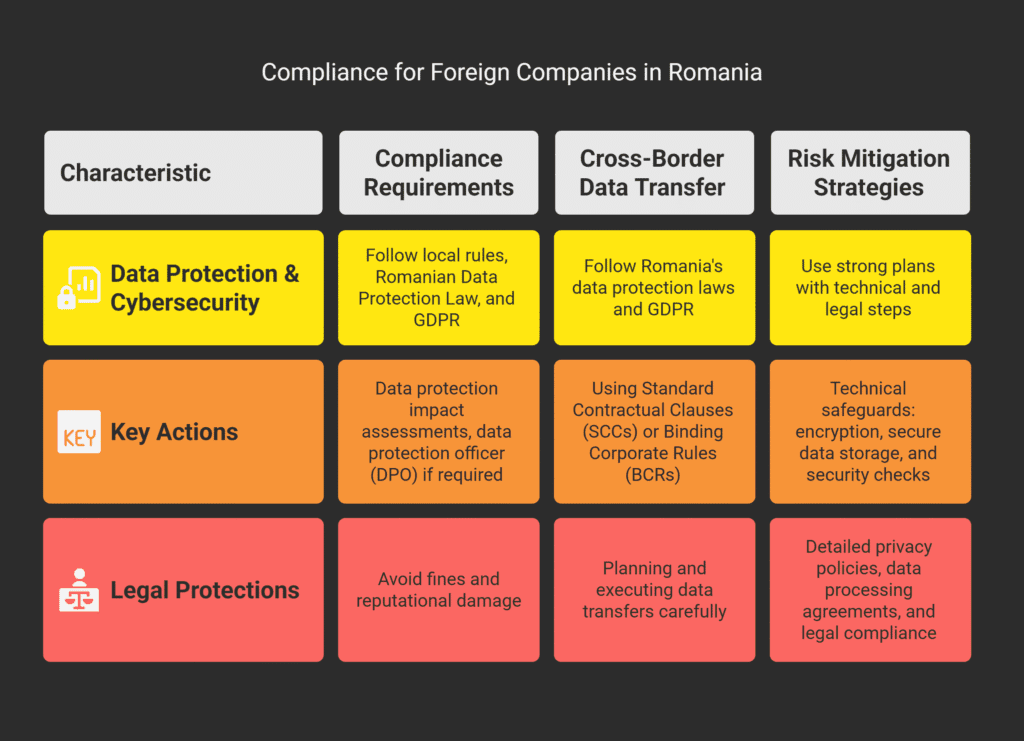
Cross-border data flows demand additional precautions.

Companies must confirm whether recipient countries have EU adequacy status.

For other regions, standardized contractual clauses or binding corporate rules become mandatory safeguards.

Romanian enterprises navigating these complexities should seek specialized Romanian Lawyer.

Proactive vendor management frameworks prevent regulatory violations while fostering trust with European partners.

Contact office@theromanianlawyers.com for tailored strategies addressing cross-border operational challenges.

Preparing for Data Breaches and Facilitating Data Subject Rights

What separates resilient organizations from vulnerable ones when cyber threats strike?

Proactive preparation for security incidents and efficient handling of individual rights form the backbone of modern data governance.

Organizations must balance rapid response capabilities with systematic processes to address user inquiries.

Developing a Robust Breach Response Plan

Effective incident management requires predefined protocols.

Immediate detection mechanisms trigger containment procedures within one hour of identifying unauthorized data access.

Forensic teams analyze breach scope while legal advisors determine notification obligations to authorities within 72 hours.

Regular simulation exercises test communication channels between IT, legal, and PR departments.

Documentation templates for breach reports ensure regulatory requirements are met without delays.

Continuous monitoring systems flag unusual activity patterns to prevent escalation.

Streamlining Data Subject Access Requests

Individuals increasingly exercise their right to review or delete personal information.

Centralized portals allow users to submit requests through secure authentication methods.

Automated workflows verify identities and route inquiries to appropriate teams within 24 hours.

Response templates maintain consistency while adhering to legal timelines.

Secure delivery channels protect sensitive information during transmission.

Audit trails demonstrate compliance with access rights obligations during regulatory inspections.

Entities requiring customized frameworks for incident management or user rights processes should contact office@theromanianlawyers.com.

Structured approaches transform regulatory demands into operational strengths while maintaining stakeholder trust.

FAQ

When must Romanian businesses appoint a data protection officer?

Organizations must designate a data protection officer if they systematically monitor individuals on a large scale or process sensitive categories like health records.

Public authorities in Romania also require this role regardless of data volume.

How long can companies retain customer information under EU regulations?

Storage periods must align with the original purpose for collection.

For example, transaction records may be kept for tax compliance periods specified by ANAF (Romania’s tax authority), while marketing contact lists require periodic reviews for relevance.

What technical safeguards are mandatory for website security?

Essential measures include SSL encryption, multi-factor authentication, regular penetration testing, and documented patch management processes.

Organizations should implement security measures proportionate to the risk level of data processing, following GDPR Article 32 requirements for appropriate technical and organizational measures.

Are international cloud providers like AWS or Microsoft Azure GDPR-compliant for Romanian data?

Providers operating under EU-approved mechanisms like Standard Contractual Clauses (SCCs) or binding corporate rules generally meet requirements.

However, companies must verify current certifications and update Data Processing Agreements (DPAs) annually.

What penalties apply for violating data subject rights in Romania?

The National Supervisory Authority for Personal Data Processing (ANSPDCP) can impose fines up to €20 million or 4% of global turnover.

Recent enforcement actions targeted improper consent practices and delayed breach notifications.

How should organizations handle data access requests from employees?

Businesses must respond within 30 days, providing free electronic copies of records.

Implement automated DSAR workflows in platforms like Microsoft 365 or specialized tools such as OneTrust to track and fulfill requests efficiently.

Digital Currency Authorization Financial Requirements

Data Protection Meets AI: GDPR Compliance When Using AI in Romania

Data Protection Meets AI: GDPR Compliance When Using AI in Romania

Table of Contents

The digital transformation in Romania brings new challenges for companies using artificial intelligence.

The country’s data protection laws create a complex regulatory landscape.

This demands careful navigation from organizations.

The National Authority for Personal Data Processing and Supervision (ANSPDCP) oversees these critical requirements.

The 2024-2027 National AI Strategy, approved by the Romanian Government, sets new priorities for technology governance.

office building with 2-3 men in suits passing by

Companies must balance innovation with strict regulatory adherence.

Romania’s artificial intelligence legal framework continues to evolve, influenced by EU directives.

Professional guidance is essential for businesses seeking sustainable solutions.

For expert consultation, organizations can contact office@theromanianlawyers.com.

qualified Romanian lawyer can offer tailored strategies for successful implementation. Our team ensures full regulatory adherence.

Key Takeaways

  • Romania relies on EU frameworks while developing specific AI legislation through its 2024-2027 National Strategy,
  • ANSPDCP compliance requirements govern data protection obligations for AI implementation,
  • The EU AI Act provides legal definitions that will be applied within Romanian jurisdiction,
  • Organizations need professional legal guidance to navigate complex regulatory requirements,
  • Current data protection laws must be carefully balanced with emerging AI regulations,
  • Romanian law firms offer specialized expertise for technology compliance matters.

Romania’s Data Protection Legal Landscape for AI Technologies

The legal framework for AI in Romania blends European standards with national rules.

This setup outlines clear duties for companies using AI to process personal data.

Romanian businesses must grasp how these laws shape their AI strategies.

Three main pillars form this framework.

They include GDPR implementation, national oversight, and EU AI Act integration.

Each pillar adds vital elements to the compliance structure.

romanian dpa guidelines for AI technologies

GDPR Implementation Through Romanian Law 190/2018

Romanian Law 190/2018 is key in applying GDPR within the country.

It sets out specific rules for AI systems handling personal data in Romania.

The law details how to develop, deploy, and maintain AI applications.

The law covers critical aspects of AI compliance, such as data processing rules and individual rights.

Romanian companies must align their AI with these laws and EU standards.

They need to focus on both GDPR and national specifics.

Law 190/2018 goes beyond GDPR in automated processing systems.

It requires more transparency, human oversight, and accountability in algorithms.

Companies must document their compliance and show they meet the law’s technical and organizational standards.

ANSPDCP Authority and AI Oversight Responsibilities

The National Authority for Personal Data Processing and Supervision (ANSPDCP) oversees AI in Romania.

It has the expertise to check AI systems for compliance.

The authority offers guidance, investigates, and enforces rules across sectors.

ANSPDCP reviews data protection impact assessments and offers consultation for high-risk AI projects.

It has guidelines for AI challenges.

These help companies understand their duties and implement necessary safeguards.

The authority works with other EU data protection bodies.

This ensures consistent application of EU data privacy rules.

Romanian companies benefit from this cooperation, getting clear regulatory expectations and compliance paths.

Integration with EU AI Act Requirements

Romania is making preparations to incorporate the regulations outlined in the EU AI Act into its legal framework.

This process aligns existing data protection rules with new AI-specific ones.

It ensures smooth compliance for AI systems processing personal data.

The EU AI Act introduces risk-based classifications for AI systems, building on GDPR.

Romanian regulations will address how these classifications fit with current AI rules.

Companies must prepare for more documentation, risk assessments, and governance.

Legal advice is vital for navigating this changing landscape.

The integration requires analyzing how new AI Act provisions affect existing rules.

Early preparation and strategic planning are key for Romanian businesses as these rules come into effect.

Regulatory ComponentPrimary FunctionKey RequirementsEnforcement Authority
Romanian Law 190/2018GDPR domestic implementationData processing principles, individual rights, accountability measuresANSPDCP
ANSPDCP OversightNational supervision and guidanceDPIA review, prior consultation, investigation proceduresNational DPA
EU AI Act IntegrationAI-specific regulatory frameworkRisk classification, governance systems, documentation requirementsCoordinated EU enforcement
GDPR Article 22Automated decision-making rulesHuman involvement, transparency, individual rights protectionANSPDCP coordination

Core Principles of GDPR and AI Compliance in Romania

The intersection of artificial intelligence and data protection regulations in Romania brings specific compliance obligations under GDPR’s core principles.

These foundational requirements establish the regulatory framework that Romanian organizations must follow when implementing AI systems that process personal data.

Romanian GDPR implementation requires businesses to embed these principles into their AI development lifecycle from the initial design phase.

Organizations cannot treat compliance as an afterthought but must integrate data protection considerations into every aspect of their artificial intelligence operations.

machine learning compliance standards romania

The GDPR establishes nine core principles that apply comprehensively to AI systems processing personal data within Romanian jurisdiction.

These principles create binding obligations that extend far beyond traditional data processing scenarios to encompass the unique challenges posed by automated systems and algorithmic decision-making processes.

Lawfulness, Fairness, and Transparency in Automated Systems

Lawfulness requires Romanian organizations to establish valid legal bases before implementing AI systems that process personal data.

Organizations must identify appropriate legal grounds such as consent, legitimate interests, contractual necessity, or compliance with legal obligations before initiating any AI-driven data processing activities.

Fairness extends beyond mere legal compliance to address ethical considerations in AI system design and operation.

Romanian businesses must ensure their artificial intelligence compliance EU standards prevent discriminatory outcomes and biased algorithmic decisions that could unfairly impact individuals or specific demographic groups.

Transparency obligations demand clear communication about AI system operations and decision-making processes.

Organizations must provide individuals with understandable information about:

  • The logic involved in automated decision-making,
  • The significance and consequences of such processing,
  • The categories of personal data being processed,
  • The purposes for which data is collected and used.

Purpose Limitation and Data Minimization for AI Applications

Purpose limitation requires Romanian organizations to collect and process personal data only for specified, explicit, and legitimate purposes.

AI systems cannot repurpose data collected for one objective to serve entirely different functions without establishing new legal bases and obtaining appropriate permissions.

Data minimization mandates that organizations limit data collection to what is directly relevant and necessary for their stated AI purposes.

This principle challenges traditional machine learning approaches that often rely on extensive data collection, requiring Romanian businesses to adopt more targeted data acquisition strategies.

Romanian GDPR implementation emphasizes that organizations must regularly review their AI systems to ensure continued compliance with purpose limitation requirements.

Any expansion of AI system functionality must undergo thorough assessment to verify alignment with original data collection purposes.

Accuracy and Storage Limitation in Machine Learning

Accuracy requirements mandate that personal data processed by AI systems remains correct and current.

Romanian organizations must implement technical and organizational measures to identify and rectify inaccurate data that could lead to erroneous automated decisions or unfair individual treatment.

Machine learning compliance standards require organizations to establish data quality management processes that include:

  1. Regular data validation and verification procedures,
  2. Automated error detection and correction mechanisms,
  3. Clear protocols for handling data accuracy complaints,
  4. Systematic review of training data quality.

Storage limitation principles impose temporal boundaries on data retention within AI systems.

Romanian businesses must establish clear data retention schedules that specify how long personal data will be maintained for AI training, operation, and improvement purposes.

Organizations must implement automated deletion processes that remove personal data when retention periods expire or when the data is no longer necessary for the original AI system purposes.

This requirement presents particular challenges for machine learning systems that rely on historical data patterns for ongoing algorithmic improvement.

The integration of these core principles into AI system architecture requires thorough planning and ongoing monitoring.

Romanian organizations must adopt privacy-by-design approaches that embed compliance considerations into every stage of AI development, deployment, and maintenance to ensure sustained adherence to data protection regulations in Romania.

Automated Decision-Making and Profiling Regulations

Article 22 of the GDPR sets strict limits on automated decision-making, impacting AI in Romania.

It outlines a detailed framework for using artificial intelligence in decision-making processes affecting individuals.

The framework emphasizes the importance of individual rights and procedural safeguards.

In Romania, automated decision-making means any process where technology makes decisions without human input.

This includes AI systems used for credit scoring, employment screening, insurance assessments, and content moderation.

Article 22 GDPR Requirements for AI Systems

The GDPR bans automated decision-making that has legal effects or significant impacts on individuals, unless certain conditions are met.

Organizations using AI systems must comply with these restrictions under Romanian data privacy laws.

This ban applies to AI applications across various sectors.

There are three exceptions to this ban.

First, organizations can use automated decision-making with explicit consent from the data subject.

Second, it’s allowed when necessary for contract performance between the organization and individual.

Third, applicable law may permit automated decision-making with appropriate safeguards.

Organizations must implement robust protection measures and maintain transparency about their systems.

The GDPR enforcement for AI systems requires strict adherence to these exceptions.

AI governance Romania automated decision-making compliance

Organizations must document which legal basis applies to their automated decision-making processes.

This documentation is critical during regulatory audits and individual rights requests.

The European Data Protection Authority stresses the importance of identifying the legal basis correctly.

Meaningful Human Involvement Standards

Meaningful human involvement requires genuine oversight, not just superficial reviews.

Human reviewers must have the authority and capability to assess automated decisions and override them when necessary.

This involvement cannot be superficial or ceremonial.

Organizations must train human reviewers to understand the automated system’s logic and biases.

Reviewers need access to relevant information to evaluate system outputs.

The AI governance framework in Romania emphasizes substantive human participation.

Technical implementation of meaningful human involvement includes providing reviewers with decision explanations and relevant data inputs.

Organizations should establish clear protocols for when human intervention is mandatory.

These standards ensure that automated systems remain accountable to human oversight.

Documentation requirements extend to recording human involvement instances and decision modifications.

Organizations must maintain records showing that human reviewers actively participated in the decision-making process.

Individual Rights Against Automated Processing

Individuals have specific rights when subject to automated decision-making processes under Romanian data privacy laws.

These rights include obtaining human intervention in automated decisions, expressing personal viewpoints about the decision, and contesting automated outcomes that affect their interests significantly.

The right to human intervention requires organizations to provide accessible channels for individuals to request human review of automated decisions.

Organizations must respond to these requests promptly and provide meaningful human evaluation of the contested decision.

This right extends beyond simple complaint mechanisms.

Individuals can express their viewpoints about automated decisions, requiring organizations to consider these perspectives during human review processes.

This right ensures that automated systems account for individual circumstances that algorithms might not properly evaluate.

The GDPR enforcement for AI systems mandates genuine consideration of individual input.

Organizations must establish robust procedures for handling individual rights requests related to automated processing.

These procedures should include clear timelines, communication protocols, and decision modification processes.

The AI ethics legal framework requires transparent and accessible rights enforcement mechanisms that protect individuals from inappropriate automated decision-making.

Legal Bases for AI Data Processing in Romania

Choosing the right legal bases for AI applications is a critical step in Romania’s data protection law.

Organizations must find valid legal grounds before processing personal data through AI systems.

This choice affects individual rights, data retention, and transfer mechanisms throughout the AI lifecycle.

Romanian personal data processing regulations require identifying one of six legal bases under GDPR Article 6.

Each basis has specific requirements and limitations that impact AI system design and operation.

Professional legal analysis is essential for determining the most suitable legal foundation for specific AI processing activities.

romania ai governance legal bases

The six legal bases include consent, contract performance, legal obligation compliance, vital interests protection, public task execution, and legitimate interests pursuit.

Organizations must carefully evaluate which basis aligns with their AI processing purposes and operational requirements.

This decision influences data subject rights, processing limitations, and overall compliance obligations.

Consent Mechanisms for AI Training Data

Consent is one of the most transparent legal bases for AI data processing activities.

Obtaining valid consent for AI training data presents unique challenges under Romanian GDPR standards.

Organizations must ensure that consent meets four key criteria: freely given, specific, informed, and unambiguous.

AI training datasets often contain vast amounts of personal information collected from multiple sources.

This complexity makes it difficult to provide specific information about processing purposes.

Organizations must clearly explain how personal data will be used in machine learning algorithms and model training processes.

The following requirements apply to consent mechanisms for AI applications:

  • Clear explanation of AI processing purposes and methodologies,
  • Specific information about data usage in training and inference stages,
  • Easy withdrawal mechanisms without negative consequences,
  • Regular consent renewal for ongoing processing activities,
  • Documentation of consent collection and management processes.

Individuals must understand the implications of their consent decision.

This includes information about automated decision-making capabilities and profiling activities.

Organizations should provide simple, accessible language that explains complex AI processes in understandable terms.

Consent withdrawal mechanisms must be as easy as the original consent process.

Organizations cannot make service access conditional on consent for AI processing unless absolutely necessary for service provision.

This requirement often complicates business models that rely heavily on data-driven personalization.

Legitimate Interest Assessments

Legitimate interest provides an alternative legal basis that offers greater flexibility for AI implementations.

This basis requires a three-part assessment that balances organizational interests against individual privacy rights.

Romanian organizations must conduct thorough legitimate interest assessments before relying on this legal foundation.

The three-part test examines purpose necessity, processing effectiveness, and proportionality of privacy impact.

Organizations must demonstrate that their AI processing serves genuine business interests that cannot be achieved through less intrusive means.

This analysis requires detailed documentation and regular review processes.

Key considerations for legitimate interest assessments include:

  1. Business necessity evaluation for AI processing activities,
  2. Assessment of alternative processing methods and their effectiveness,
  3. Analysis of individual privacy expectations and possible harm,
  4. Evaluation of existing safeguards and mitigation measures,
  5. Documentation of balancing test results and decision rationale.

Organizations must consider reasonable expectations of data subjects when conducting these assessments.

Individuals should not be surprised by AI processing activities based on the context of data collection.

Transparent privacy notices help establish appropriate expectations and support legitimate interest claims.

The proportionality analysis requires careful consideration of possible adverse effects from AI processing.

This includes risks from automated decision-making, profiling activities, and possible discrimination or bias.

Organizations should implement appropriate safeguards to minimize these risks and protect individual rights.

GDPR implementation for machine learning often relies on legitimate interest assessments for research and development activities.

Organizations must ensure that processing remains within the scope of their assessed legitimate interests and does not expand beyond documented purposes.

Public Task and Vital Interest Applications

Public task and vital interest legal bases serve specific governmental and essential service applications in AI implementations.

These bases support critical infrastructure systems, emergency response mechanisms, and public safety applications.

Romanian AI ethics standards recognize the importance of these applications while maintaining strict compliance requirements.

Public task applications must be based on legal obligations or official authority vested in the data controller.

This includes government agencies implementing AI systems for administrative efficiency or public service delivery.

Organizations must demonstrate clear legal mandates for their AI processing activities under this basis.

Vital interest applications address life-threatening situations where AI systems provide critical support.

Healthcare emergency response systems and disaster management applications often rely on this legal basis.

Organizations cannot use vital interests as a general justification for AI processing without demonstrating genuine emergency circumstances.

The Romanian data protection authority provides guidance on appropriate applications of these legal bases.

Organizations should consult official guidance and seek legal advice when determining whether their AI systems qualify for public task or vital interest justifications.

Documentation requirements for these legal bases include:

  • Legal mandates or official authority supporting public task claims,
  • Emergency circumstances justifying vital interest processing,
  • Scope limitations ensuring processing remains proportionate,
  • Regular review processes for continued necessity,
  • Safeguards protecting individual rights and freedoms.

Organizations must ensure that AI processing under these bases remains strictly necessary for the stated purposes.

Scope creep beyond original justifications can invalidate the legal basis and create compliance violations.

Regular legal review helps maintain appropriate boundaries and compliance standards.

Special Category Data and AI Applications

In Romania, processing sensitive personal information through AI applications demands enhanced legal safeguards.

Special category personal data under GDPR includes racial or ethnic origin, political opinions, religious beliefs, genetic data, biometric identifiers, health information, and data about sexual orientation.

These data types require additional protection measures beyond standard personal data processing requirements.

Organizations implementing AI systems must establish specific legal justifications for processing special category data.

The heightened protection requirements reflect the increased risks to individual privacy and fundamental rights.

Romanian privacy laws mandate that companies demonstrate both necessity and proportionality when processing sensitive information through automated systems.

AI governance in Romania special category data protection

Biometric Data Processing Requirements

Biometric data processing in AI systems faces strict regulatory controls under EU GDPR implementation Romania.

Facial recognition, fingerprint analysis, voice identification, and behavioral biometrics all qualify as special category data requiring enhanced protection.

Organizations must establish explicit legal bases before implementing biometric AI technologies.

Technical safeguards for biometric processing include encryption during transmission and storage.

Access controls must limit biometric data availability to authorized personnel only.

Regular security assessments help maintain protection standards throughout the data lifecycle.

Biometric template storage presents particular challenges for Anspdcp compliance.

Organizations should implement irreversible hashing techniques where possible.

Data retention periods must align with processing purposes, with automatic deletion mechanisms ensuring compliance with storage limitation principles.

Health Data in AI Healthcare Solutions

Healthcare AI systems processing patient information must navigate complex regulatory requirements.

Medical data enjoys special protection status, requiring careful balance between innovation benefits and privacy protection.

Healthcare providers implementing AI diagnostic tools must ensure patient consent mechanisms meet enhanced standards.

AI-powered medical research applications often qualify for public interest derogations.

Organizations must implement appropriate safeguards protecting patient rights.

Pseudonymization techniques help reduce privacy risks while enabling beneficial medical research outcomes.

  • Patient consent documentation requirements,
  • Medical professional oversight obligations,
  • Research ethics committee approvals,
  • Data sharing agreements with research partners.

Cross-border health data transfers require additional scrutiny under ai ethics framework Romania.

International medical AI collaborations must establish adequate protection levels for Romanian patient information.

Explicit Consent and Derogations

Explicit consent for special category data processing requires clear, specific agreement from data subjects.

Consent mechanisms must explain AI processing purposes, data types involved, and possible risks.

Pre-ticked boxes or implied consent do not satisfy explicit consent requirements for sensitive data categories.

Consent withdrawal procedures must remain accessible throughout the processing lifecycle.

Organizations should implement user-friendly mechanisms allowing individuals to revoke consent easily.

Withdrawal must not affect processing legality before consent removal.

Derogation TypeApplication ScopeAdditional Safeguards Required
Substantial Public InterestLaw enforcement AI, fraud detectionProportionality assessment, impact evaluation
Medical DiagnosisHealthcare AI diagnosticsMedical professional oversight, patient information
Preventive MedicinePublic health monitoring AIAnonymization techniques, limited access controls

Derogations from explicit consent requirements exist for specific circumstances under Romanian privacy laws.

Public interest applications, medical treatment purposes, and preventive healthcare activities may qualify for alternative legal bases.

Organizations must carefully evaluate whether their AI processing activities meet derogation criteria and implement appropriate additional safeguards.

Regular compliance reviews help ensure ongoing adherence to special category data requirements.

Legal counsel should evaluate AI system changes affecting sensitive data processing.

Documentation requirements extend beyond standard processing records to include derogation justifications and safeguard implementations.

Data Controller and Processor Obligations

In Romania, the roles of data controllers and processors are key to AI compliance.

Companies must set up clear legal frameworks.

These frameworks define roles, ensure accountability, and uphold data protection laws in AI development.

AI projects often involve many stakeholders with different data control levels.

This complexity demands precise legal documents and clear contracts.

Such agreements are essential for meeting privacy laws for AI systems in Romania.

Joint Controllership in AI Ecosystems

When multiple organizations work together on AI data processing, joint controllership arises.

They need detailed agreements outlining each party’s GDPR responsibilities in Romania.

Joint controllers must have clear procedures for handling data subject rights.

They must decide who will handle individual requests and how information will be shared.

Liability in AI joint controllership is complex.

Partners must agree on who is responsible for data breaches, violations, and penalties.

They need to address technical failures, biases, and security incidents in their agreements.

Processor Agreements for AI Service Providers

AI service providers must have thorough agreements that cover AI’s technical aspects.

These contracts should detail security measures, audit rights, and breach notification procedures specific to AI.

Agreements with processors should include sub-processor authorization clauses.

They must outline data retention, deletion, and return procedures upon contract end.

Cross-border data transfer clauses are critical in AI processor agreements.

Providers must show they comply with adequacy decisions or use standard contractual clauses for data outside the European Economic Area.

Accountability Documentation Requirements

Organizations must keep detailed records showing GDPR compliance in AI systems.

This includes records of AI processing activities and their data protection implications.

Data protection impact assessments are required for high-risk AI activities.

Companies must document risk assessments, mitigation steps, and ongoing monitoring to meet AI ethics standards in Romania.

Record-keeping includes privacy policies, consent records, and evidence of security measures.

These records must reflect AI’s unique characteristics and provide audit trails for inspections.

Responsibility AreaData Controller ObligationsData Processor ObligationsJoint Controller Requirements
Purpose DeterminationDefine AI processing purposes and legal basisProcess only according to controller instructionsJointly determine purposes through formal agreement
Data Subject RightsRespond to all individual rights requestsAssist controller with rights fulfillmentDesignate point of contact and response procedures
Security MeasuresImplement appropriate technical safeguardsMaintain security throughout processing lifecycleCoordinate security standards across organizations
Breach NotificationNotify authorities within 72 hoursAlert controller without undue delayEstablish notification protocols and responsibilities

Compliance records must show ongoing adherence to data minimization in AI training and deployment.

Companies should document how they limit data collection and implement retention policies suitable for AI.

Cross-Border Data Transfers and AI Systems

Organizations deploying AI systems internationally face complex data protection requirements.

The intersection of artificial intelligence and international data flows creates unique compliance challenges.

These challenges require specialized legal analysis under Romanian privacy legislation.

Cross-border AI implementations involve multiple layers of regulatory oversight.

These systems process vast amounts of personal data across different countries with varying protection standards.

Romanian organizations must ensure their data protection laws extend seamlessly to international AI operations.

The complexity increases when AI systems operate in real-time across multiple jurisdictions.

Data flows continuously between servers, processing centers, and analytical platforms located in different countries.

Each transfer point represents a compliance risk that organizations must address through appropriate safeguards.

Third Country AI Service Provider Compliance

Third country AI service providers present distinct compliance challenges for Romanian organizations.

These providers often operate under different legal frameworks that may not provide equivalent protection to GDPR standards.

Companies must conduct thorough due diligence assessments before engaging international AI vendors.

The evaluation process involves analyzing the provider’s data protection practices, security measures, and legal obligations in their home jurisdiction.

Romanian ai governance requires organizations to verify that third country providers implement adequate technical and organizational measures.

This assessment must consider government access to data and surveillance programs that could compromise personal data protection.

“The adequacy of protection must be assessed in light of all the circumstances surrounding a data transfer operation or set of data transfer operations.”

European Court of Justice, Schrems II ruling

Organizations must also evaluate the provider’s ability to comply with individual rights requests.

AI service providers must demonstrate capacity to facilitate access, rectification, and erasure rights across their international operations.

This capability becomes complex when AI systems process data through multiple interconnected platforms.

Standard Contractual Clauses Implementation

Standard Contractual Clauses serve as the primary mechanism for legitimizing AI data transfers to third countries.

These clauses must be carefully adapted to address the specific characteristics of artificial intelligence processing activities.

The implementation requires detailed consideration of AI system architectures and data processing flows.

Organizations must ensure that Standard Contractual Clauses accurately reflect their AI processing activities.

The clauses should specify data categories, processing purposes, and retention periods relevant to machine learning operations.

Technical measures for protecting transferred data must align with AI system requirements and capabilities.

The Romania artificial intelligence regulations framework requires organizations to supplement Standard Contractual Clauses with additional safeguards when necessary.

These supplementary measures may include encryption, pseudonymization, or access controls designed for AI environments.

Regular monitoring and review processes ensure ongoing compliance with contractual obligations.

Adequacy Decisions and Transfer Impact Assessments

European Commission adequacy decisions provide the foundation for unrestricted data transfers to approved countries.

Most AI service providers operate in countries without adequacy decisions, requiring alternative transfer mechanisms.

Organizations must stay informed about evolving adequacy determinations that may affect their AI operations.

Transfer Impact Assessments represent a critical compliance tool for AI data transfers.

These assessments evaluate specific risks associated with transferring personal data for AI processing purposes.

The data protection impact assessment Romania methodology must consider unique factors affecting artificial intelligence systems.

The assessment process examines government surveillance capabilities, data localization requirements, and available technical protections in the destination country.

Organizations must evaluate whether proposed safeguards provide effective protection for AI-processed data.

This analysis includes reviewing the enforceability of data protection rights and the independence of supervisory authorities.

Romanian privacy legislation requires organizations to document their transfer impact assessments and update them regularly.

Changes in political conditions, legal frameworks, or technical capabilities may necessitate reassessment of transfer arrangements.

Organizations must maintain evidence demonstrating ongoing compliance with transfer requirements throughout their AI system lifecycle.

Data Protection Impact Assessment for AI Projects

The use of artificial intelligence systems in Romania triggers the need for Data Protection Impact Assessments.

These assessments are critical for compliance, going beyond traditional privacy evaluations.

AI systems require a detailed risk analysis, addressing both established privacy concerns and new challenges.

Seeking professional legal advice is essential for thorough data protection impact assessments.

Romanian organizations must integrate DPIA processes into their AI development lifecycle.

This ensures compliance with GDPR standards and demonstrates a commitment to privacy protection.

Mandatory DPIA Triggers for AI Systems

GDPR Article 35 outlines clear triggers for Data Protection Impact Assessments.

These triggers include processing activities that pose high risks to individual rights and freedoms.

Organizations must evaluate their AI implementations against these triggers to determine if a DPIA is required.

Automated decision-making with legal or significant effects is a primary trigger.

This includes credit scoring, employment screening, and healthcare diagnostic applications.

The GDPR requires DPIAs for AI systems that make decisions affecting individual rights or legal status.

AI-powered surveillance systems also require DPIAs.

This includes video analytics, facial recognition, and behavioral monitoring technologies.

Large-scale processing of special category personal data through AI applications also necessitates DPIA completion before deployment.

Risk Assessment Methodologies and Mitigation

Risk assessment methodologies for AI systems must address traditional privacy risks and new challenges from machine learning.

Organizations implementing automated decision-making solutions must evaluate algorithmic bias, data accuracy, security vulnerabilities, and function creep.

These assessments require expertise from legal, technical, and ethical fields.

Comprehensive risk profiles must identify specific privacy threats associated with AI system operations.

Data quality risks arise from training datasets with inaccurate or biased information.

Security risks include unauthorized access, data poisoning attacks, and inference attacks revealing sensitive information about training data subjects.

Mitigation strategies must address identified risks through technical and organizational measures.

Technical safeguards include differential privacy, federated learning, and robust access controls.

Organizational measures include staff training, algorithm audits, and governance frameworks.

The AI compliance framework in Romania requires documenting these measures and monitoring their effectiveness.

Risk mitigation must also consider AI ethics in Romania.

Organizations should implement fairness testing, transparency mechanisms, and accountability measures.

These ethical considerations strengthen risk management and demonstrate responsible AI development.

Prior Consultation with ANSPDCP Procedures

Prior consultation with ANSPDCP is necessary when DPIAs identify high residual risks.

This consultation process requires detailed documentation of processing activities, risk assessment findings, proposed mitigation measures, and justifications for proceeding with high-risk AI implementations.

Organizations must prepare thorough consultation packages.

These packages should demonstrate consideration of privacy implications and commitment to implementing recommended safeguards.

The documentation should include technical specifications, data flow diagrams, risk assessment matrices, and proposed monitoring mechanisms.

ANSPDCP evaluates these submissions to determine if additional safeguards are necessary or if processing can proceed as planned.

The consultation timeline is typically eight weeks from submission of complete documentation.

Organizations cannot deploy AI systems requiring prior consultation until receiving ANSPDCP approval or recommendations.

This ensures that high-risk AI implementations receive appropriate regulatory oversight and incorporate necessary privacy protections.

Privacy by Design and Security Measures

Creating robust privacy safeguards in AI systems demands a holistic approach.

Organizations must embed protection mechanisms from the outset to the deployment phase.

This proactive stance ensures they meet Romanian data protection laws and establish strong security bases.

GDPR Article 25 mandates privacy by design and default.

These mandates go beyond mere compliance, influencing system architecture.

Romanian firms must show that data protection guides AI development and deployment fully.

“Data protection by design and by default requires that appropriate technical and organizational measures are implemented in such a manner that processing will meet the requirements of this Regulation and protect the rights of data subjects.”

GDPR Article 25

Technical Safeguards in AI Development

Technical safeguards are the core of compliant AI systems.

Data minimization limits personal data to what’s necessary for processing.

This prevents excessive data that could breach Romanian data security rules.

Pseudonymization and anonymization lower identification risks in machine learning.

Advanced encryption safeguards data during training and use.

Access controls limit data to authorized personnel and processes.

Secure data storage meets AI-specific needs.

Version control tracks data and model changes.

Audit trails document data access and processing for compliance checks.

Organizational Measures and Data Governance

Organizational measures are key to privacy in AI.

Clear roles and responsibilities are essential for data handling in AI projects.

Staff training on Romanian AI regulations is also vital.

Data governance frameworks set policies and procedures.

Compliance audits ensure ongoing adherence to laws.

Incident response plans handle privacy breaches and vulnerabilities.

Documentation is critical for accountability.

Organizations must keep detailed records of AI system design and privacy measures.

These records help with regulatory inspections and internal checks.

  • Staff training on data privacy Romania requirements,
  • Incident response protocols for AI systems,
  • Regular compliance monitoring and assessment,
  • Clear data handling procedures and responsibilities.

Security by Default Implementation

Security by default ensures AI systems apply maximum privacy settings automatically.

This approach eliminates the need for user configuration or technical expertise.

Default settings must protect data without hindering system performance.

GDPR Article 25 mandates default privacy settings that prioritize data subject rights.

Organizations cannot rely on users or administrators for privacy settings.

Automated privacy controls reduce human error in deploying protection mechanisms.

System updates must enhance privacy safeguards.

Configuration management prevents unauthorized security setting changes.

Protection LayerImplementation MethodCompliance Benefit
Data EncryptionEnd-to-end encryption protocolsConfidentiality protection
Access ControlsRole-based authentication systemsUnauthorized access prevention
Data MinimizationAutomated filtering mechanismsPurpose limitation compliance
Audit LoggingComprehensive activity trackingAccountability demonstration

Privacy by design and security measures need continuous improvement.

Organizations must regularly evaluate protection effectiveness and adapt to new threats.

This ongoing effort ensures compliance with Romanian data protection laws and emerging regulations.

Individual Rights in AI-Driven Environments

Romanian GDPR enforcement mandates that AI systems uphold fundamental data protection rights.

Organizations must deploy artificial intelligence with frameworks that safeguard data subject autonomy.

The legal framework for machine learning outlines clear obligations for protecting individual rights in automated environments.

Data subjects retain all GDPR rights when their personal information is processed by AI, regardless of system complexity.

These rights necessitate technical solutions that can locate, modify, or remove personal data from AI systems.

Organizations must strike a balance between algorithmic efficiency and individual privacy through carefully designed mechanisms.

Right to Explanation and Algorithmic Transparency

The right to explanation is a significant challenge in AI compliance under Romanian data protection law.

Individuals have the right to obtain meaningful information about automated decision-making logic that affects their interests.

This requirement goes beyond simple system descriptions, demanding specific explanations for individual automated decisions.

Organizations must provide clear, understandable explanations that enable data subjects to comprehend AI system operations.

These explanations should detail how personal data influences automated decisions without revealing proprietary algorithms.

Transparency measures must balance individual understanding with trade secret protection.

The explanation requirement encompasses both general AI system information and specific decision rationales.

Organizations must develop documentation that explains algorithmic logic in accessible language.

Technical complexity cannot excuse inadequate transparency when individual rights are at stake.

Access, Rectification, and Erasure Rights

Access rights in AI environments require organizations to provide detailed information about personal data processing activities.

Data subjects can request details about AI training datasets, processing purposes, and automated decision outcomes.

Organizations must implement systems that can locate personal data across distributed AI architectures and training datasets.

Rectification rights present significant technical challenges within machine learning systems where personal data may be embedded in trained models.

Organizations must develop mechanisms to correct inaccurate personal data without compromising system integrity.

The machine learning legal framework requires effective correction procedures that maintain AI system performance while ensuring data accuracy.

Erasure rights, commonly known as the “right to be forgotten,” require sophisticated technical implementations in AI contexts.

Personal data deletion must extend beyond primary datasets to include derived data and model parameters.

Organizations must implement data lineage systems that track personal information throughout AI processing pipelines.

  • Complete data mapping across AI system components,
  • Technical deletion mechanisms for embedded personal data,
  • Verification procedures for successful data removal,
  • Documentation of erasure implementation methods.

Data Portability in Machine Learning Contexts

Data portability rights enable individuals to receive their personal data in structured, commonly used formats.

In AI environments, determining portable data scope requires careful consideration of what constitutes personal data versus derived insights.

Organizations must distinguish between original personal data and AI-generated profiles or recommendations.

Cross-border data transfers complicate portability implementations when AI systems operate across multiple jurisdictions.

Organizations must ensure that portable data formats remain meaningful when transferred between different AI service providers.

Technical standards for data portability must preserve utility while protecting privacy interests.

Automated processing safeguards require that portable data includes relevant metadata about AI processing activities.

Data subjects should receive information about how their data contributed to automated decisions.

Biometric data protection considerations apply when AI systems process unique biological characteristics that require specialized portability measures.

Right CategoryAI Implementation ChallengeTechnical Solution
ExplanationComplex algorithm transparencyInterpretable AI models and decision logs
AccessDistributed data locationComprehensive data mapping systems
RectificationEmbedded model correctionsModel retraining and update procedures
ErasureComplete data removalData lineage tracking and deletion verification
PortabilityMeaningful data format transferStandardized export formats and metadata inclusion

Organizations must establish clear procedures for rights fulfillment that account for AI system complexity while meeting legal obligations.

Regular testing and validation of rights implementation mechanisms ensure continued compliance as AI systems evolve.

The integration of individual rights protection into AI development lifecycles represents essential compliance architecture for Romanian organizations.

Sector-Specific Compliance Challenges

Industry-specific AI applications face unique regulatory hurdles, going beyond the standard GDPR rules.

Companies must navigate a complex legal landscape.

This landscape combines general data protection rules with specific sector regulations.

Understanding both Romanian data protection laws and industry-specific legal requirements is essential.

Different sectors encounter varying levels of regulatory complexity with AI.

Healthcare must comply with medical device and privacy laws.

Financial sectors deal with consumer protection laws that overlap with data privacy.

Employment sectors balance worker rights with automated decision-making.

Healthcare AI and Medical Data Processing

Healthcare AI systems are subject to strict regulations.

These regulations combine medical device compliance with data protection.

Companies developing healthcare AI must adhere to clinical evidence standards and protect sensitive health data.

They need robust consent mechanisms for both medical treatment and data processing.

Medical AI applications must have detailed audit trails for accountability.

Healthcare providers must ensure data accuracy for medical decisions while following patient safety standards.

The integration of AI legal requirements with healthcare regulations is complex, needing specialized legal knowledge.

Clinical trial data processing adds challenges for healthcare AI.

Companies must balance research goals with patient privacy rights.

This requires compliance with medical research regulations, going beyond GDPR.

Financial Services and Credit Decision AI

Financial institutions using AI for credit decisions face multiple regulations.

Consumer credit protection laws and data protection intersect, creating complex compliance.

These systems must ensure fair lending and prevent algorithmic bias.

Credit decision AI needs transparency to meet consumer rights and regulatory oversight.

Financial organizations must document automated decision-making processes and protect customer financial data.

Implementing Anspdcp compliance in finance requires attention to anti-discrimination principles.

Prudential regulations add complexity to financial AI.

Banks and financial institutions must ensure AI systems comply with risk management and operational resilience.

This requires governance frameworks addressing data protection and financial stability.

Employment AI Tools and Worker Rights

Employment AI systems face emerging compliance challenges.

These challenges intersect data protection law with labor regulations.

Organizations must respect worker dignity and provide transparency in automated employment decisions.

They must consider collective bargaining and employee monitoring regulations.

Worker privacy rights are critical for employment AI.

Companies must balance business interests with employee privacy expectations. Compliance with labor law is essential.

The deployment of machine learning GDPR in employment requires attention to non-discrimination and worker consultation.

Employee evaluation AI systems must ensure fairness and transparency.

Organizations must provide meaningful human involvement in automated decisions.

The integration of EU data privacy law with employment regulations requires ongoing legal assessment.

Recent Regulatory Developments

The regulatory landscape for AI compliance continues evolving rapidly.

The European Data Protection Board’s Opinion 28/2024 on AI model development addresses critical questions about data minimization in training datasets, individual rights in AI systems, and cross-border data transfers for AI purposes.

Recent CJEU clarifications on automated decision-making rights provide important guidance on balancing GDPR transparency requirements with legitimate trade secret protection.

These developments emphasize the importance of staying current with evolving guidance as Romanian organizations implement AI systems under GDPR requirements.

Conclusion

The blend of artificial intelligence and data protection brings forth complex compliance duties under Romanian law.

Companies must navigate through GDPR implementation Romania rules.

They also need to prepare for new regulatory frameworks on automated decision-making GDPR applications.

Personal data processing ai Romania necessitates thorough risk assessment strategies.

The European Data Protection Board Opinion 28/2024 highlights the need for proactive AI governance.

It calls for organizations to implement strong technical and organizational measures from design to deployment.

The Romanian AI governance framework is rapidly evolving.

Companies using AI technologies face increasing pressure from GDPR enforcement for technology companies Romania.

This makes professional legal advice critical for maintaining compliance programs.

Automated decision-making Romanian regulations demand a blend of legal and technical expertise.

Organizations must invest in frameworks that uphold privacy by design, protect individual rights, and monitor regulations continuously.

Non-compliance can lead to more than just financial penalties.

It can also cause reputational damage and disrupt operations.

Professional legal support ensures AI deployments meet their goals while adhering to all regulations and protecting privacy rights.

For detailed GDPR and AI compliance advice, companies should reach out to legal experts at office@theromanianlawyers.com.

Our team of Romanian lawyers can offer customized legal solutions tailored to Romania’s specific regulations and the upcoming EU AI Act obligations.

FAQ

What is the primary legal framework governing AI data protection in Romania?

Romania’s AI data protection is governed by the General Data Protection Regulation (GDPR).

This is implemented through Law 190/2018.

The National Authority for Personal Data Processing and Supervision (ANSPDCP) oversees compliance.

They ensure AI applications that process personal data meet the necessary standards.

How does ANSPDCP oversee AI compliance requirements in Romania?

ANSPDCP has specific responsibilities for AI systems processing personal data.

They evaluate data protection impact assessments and enforce automated decision-making regulations.

They also monitor compliance, investigate violations, and provide guidance on AI data protection matters.

What role does the EU AI Act play in Romania’s regulatory framework?

The EU AI Act is a significant development in Romania’s regulatory landscape.

It requires coordination between GDPR obligations and AI-specific requirements.

This creates a framework addressing traditional privacy concerns and new AI challenges.

What are the core GDPR principles that AI systems must comply with in Romania?

AI systems must follow lawfulness, fairness, and transparency.

They must operate under valid legal bases and avoid discriminatory outcomes.

Organizations must implement purpose limitation and data minimization principles.

How does Article 22 of GDPR affect automated decision-making in AI systems?

Article 22 prohibits solely automated decision-making with legal effects or significant impacts.

This applies to AI applications like credit scoring, employment screening, and content moderation.

What constitutes meaningful human involvement in automated decision-making?

Meaningful human involvement requires genuine oversight, not just a pro forma review.

It must be substantive, allowing human reviewers to assess and override automated decisions when necessary.

What legal bases can organizations use for AI data processing in Romania?

Organizations can use consent, legitimate interests, contract performance, or other recognized bases for AI data processing.

Consent for AI training data must meet GDPR standards.

Legitimate interest assessments must balance organizational interests against individual privacy rights.

How are biometric data processing requirements handled in AI systems?

Biometric data processing in AI systems requires enhanced protection measures and specific legal justifications.

Organizations must establish explicit legal bases and implement technical safeguards.

Biometric data must remain secure throughout its lifecycle.

What are the requirements for health data processing in AI healthcare solutions?

AI systems processing health information must comply with GDPR and sector-specific healthcare regulations.

They must navigate medical data protection requirements while enabling healthcare innovations.

Patient privacy must be protected throughout legitimate medical research and treatment.

How do joint controllership arrangements work in AI ecosystems?

Joint controllership emerges when multiple organizations collaborate in determining AI processing purposes and means.

Detailed agreements are necessary, specifying responsibilities, individual rights procedures, and liability allocation.

These arrangements address complex scenarios involving shared datasets and collaborative model training.

What must processor agreements for AI service providers include?

Processor agreements must address AI processing activities comprehensively.

They must include data security measures, sub-processor authorization procedures, data retention and deletion obligations, and assistance with data subject rights fulfillment.

These agreements require attention to cross-border data transfers and audit rights.

How do cross-border data transfers work with AI systems?

Cross-border AI data transfers require evaluating international data protection standards and transfer mechanisms.

Organizations must assess whether third country AI providers maintain adequate protection levels.

They must implement Standard Contractual Clauses adapted to specific AI processing activities and technical architectures.

When is a Data Protection Impact Assessment required for AI projects?

Mandatory DPIA triggers for AI systems include automated decision-making with legal or significant impacts, systematic monitoring of publicly accessible areas, and large-scale processing of special category personal data.

Many AI applications require DPIAs due to their inherent processing characteristics.

What risk assessment methodologies should AI systems use?

Risk assessment methodologies must address traditional privacy risks and novel challenges posed by machine learning technologies.

They must consider algorithmic bias, data accuracy issues, security vulnerabilities, and function creep.

These assessments require interdisciplinary expertise combining legal analysis, technical evaluation, and ethical considerations.

What technical safeguards must be implemented in AI development?

Technical safeguards must be embedded throughout the AI system lifecycle.

They include data minimization techniques, pseudonymization and anonymization methods, access controls, encryption protocols, secure data storage mechanisms, and robust authentication systems.

These safeguards protect personal data throughout AI processing activities.

How does privacy by design apply to AI systems?

Privacy by design requires embedding compliance considerations into AI system architecture from initial development phases.

Organizations must adopt approaches that incorporate data protection principles throughout system design.

This ensures privacy protection is built into AI systems, not added as an afterthought.

What is the right to explanation in AI systems?

The right to explanation requires organizations to provide meaningful information about automated decision-making logic.

This includes general information about AI system operations and specific explanations for individual automated decisions affecting personal interests.

It enables individuals to understand how AI systems process their data.

How do access, rectification, and erasure rights work with AI systems?

These rights require technical implementations that can locate, modify, or delete specific personal data within complex AI systems and training datasets.

Organizations must develop robust data lineage tracking systems and implement technical measures enabling effective rights fulfillment without compromising system integrity or performance.

What special considerations apply to healthcare AI compliance?

Healthcare AI must comply with GDPR requirements, medical data protection regulations, clinical trial standards, and healthcare quality assurance obligations.

These systems must implement robust consent mechanisms, ensure data accuracy for medical decision-making, and maintain detailed audit trails for clinical accountability purposes.

How do employment AI tools affect worker rights under Romanian law?

Employment AI tools present compliance challenges intersecting data protection law with employment regulations.

They require consideration of worker privacy rights, non-discrimination principles, and collective bargaining obligations.

Organizations must ensure employment AI systems respect worker dignity and maintain compliance with labor law requirements regarding employee monitoring.

What are the consequences of non-compliance with AI data protection requirements?

Non-compliance can result in significant financial penalties, reputational damage, and operational disruptions.

The complexity of requirements necessitates a thorough compliance program addressing all aspects of AI data protection from initial system design through ongoing operations.

Why is professional legal guidance important for AI compliance in Romania?

Professional legal guidance is essential for navigating complex AI compliance requirements.

It combines legal knowledge, technical understanding, and practical implementation experience.

The regulatory landscape is rapidly evolving, with new guidance documents, enforcement actions, and legislative developments regularly updating compliance requirements for AI systems processing personal data.


online surveillance in Romania

Legal Aspects of Online Surveillance in Romania

Legal Aspects of Online Surveillance in Romania

Table of Contents

Exploring online surveillance in Romania is complex.

The country’s history deeply affects its laws and how it handles intelligence.

After 1989, Romania’s Securitate was broken up.

This move marked the start of its modern surveillance and data privacy rules.

Legal Aspects of Online Surveillance in Romania

Now, Romania’s laws on online surveillance are guided by cybersecurity regulations and data privacy laws.

These rules try to keep the country safe while also protecting people’s privacy.

For more details on Romania’s online surveillance laws, email office@theromanianlawyers.com.

Key Takeaways

  • Romania’s history influences its current surveillance laws.
  • Cybersecurity regulations play a key role in online surveillance.
  • Data privacy laws are vital for balancing security and privacy.
  • Romania’s intelligence community was reformed after 1989.
  • Understanding Romanian data privacy laws is key for following the rules.

The Current State of Online Surveillance in Romania

To understand online surveillance in Romania, we must look at its history and recent changes.

Romania’s surveillance has grown a lot, shaped by both national security and EU rules.

Historical Development of Surveillance Laws

The history of surveillance laws in Romania has seen big changes, mainly after communism fell.

Post-Communist Era Reforms

After communism ended, Romania made big legal changes.

These aimed to protect privacy while keeping the country safe.

Recent Legislative Changes

In recent years, Romania’s laws on surveillance have changed a lot.

Now, electronic surveillance needs court approval, which helps protect people’s rights.

For more details on Romania’s surveillance laws and their impact, email office@theromanianlawyers.com.

Key Government Agencies Involved in Surveillance

In Romania, three main agencies handle surveillance: the Romanian Intelligence Service (SRI), the Foreign Intelligence Service (SIE), and the Protection and Security Service (SPP).

Each agency does different things, working together to keep the country safe.

AgencyPrimary Responsibilities
SRI (Romanian Intelligence Service)Domestic intelligence and security
SIE (Foreign Intelligence Service)International intelligence gathering
SPP (Protection and Security Service)Protection of high-ranking officials and security for critical infrastructure

surveillance technology usage in romania

Knowing about these agencies helps us understand how surveillance works in Romania.

It’s important to know the laws and who does what to keep your online privacy safe.

Legal Framework Governing Online Surveillance in Romania

To understand online surveillance laws in Romania, we need to look at both local laws and EU rules.

The country’s laws on surveillance are based on its constitution, national security laws, and EU rules.

Legal Framework Governing Online Surveillance in Romania

Romanian Constitution and Privacy Protections

The Romanian Constitution is key to understanding privacy rights.

Article 26 of the Constitution protects privacy.

This right is important for online surveillance laws.

National Security Laws

National security laws in Romania are important for online surveillance.

They balance national security with privacy rights.

Law No.51/1991 on National Security

Law No.51/1991 is a major law on national security. It sets rules for intelligence work, including online surveillance.

This law makes sure surveillance respects privacy rights.

Criminal Procedure Code Provisions

The Criminal Procedure Code has rules on communication interception.

This is a form of online surveillance.

It needs court approval to balance privacy with investigation needs.

European Union Regulations Applicable in Romania

As an EU member, Romania follows EU rules on online surveillance.

The General Data Protection Regulation (GDPR) is a big rule for personal data handling.

The GDPR has strict rules for personal data, including online surveillance.

Companies in Romania must follow these rules.

They must handle personal data in a way that is open, safe, and respects individual rights.

RegulationDescriptionImpact on Online Surveillance
Romanian ConstitutionGuarantees the right to privacySets the foundation for privacy protections in online surveillance
Law No.51/1991Regulates national security activitiesProvides the legal basis for intelligence activities, including online surveillance
GDPRRegulates the processing of personal dataImposes strict requirements on the handling of personal data in online surveillance

For more information on online surveillance laws in Romania, email office@theromanianlawyers.com.

Data Protection and Privacy Legislation in Romania

Romania’s data protection laws come from both national rules and EU regulations.

This has led to a detailed framework to safeguard personal data.

Data Protection and Privacy Legislation in Romania

Romanian Data Protection Law

Romania has its own data protection law, working alongside the EU’s GDPR.

Law No. 190/2018 is the main law for data protection in Romania.

It makes sure Romanian laws match EU standards.

Key aspects of the Romanian Data Protection Law include:

GDPR Implementation in Romania

Romania, as an EU member, has fully adopted the GDPR.

The GDPR sets a common data protection level across the EU.

Romania’s adoption ensures it meets these standards.

Local Enforcement Mechanisms

The ANSPDCP enforces data protection laws in Romania.

It looks into complaints, does audits, and can impose penalties for breaking the rules.

Penalties for Non-Compliance

Companies that don’t follow data protection rules in Romania face big penalties.

The ANSPDCP can fine up to €20 million or 4% of the company’s global turnover, whichever is higher.

The following table summarizes the penalties for non-compliance with GDPR in Romania:

ViolationMaximum Fine
Failure to implement adequate security measures€10 million or 2% of global turnover
Non-compliance with data subject rights€20 million or 4% of global turnover
Failure to report data breaches€10 million or 2% of global turnover

Rights of Data Subjects Under Romanian Law

Data subjects in Romania have several rights under the GDPR and national law, including:

  • The right to access their personal data;
  • The right to rectify or erase their personal data;
  • The right to restrict or object to processing;
  • The right to data portability.

For more information on data protection and privacy legislation in Romania, you can contact office@theromanianlawyers.com.

Legal Aspects of Online Surveillance in Romania: Permitted Practices

Romania has clear rules for online surveillance.

It’s important for people and businesses to know these rules.

Legal Aspects of Online Surveillance in Romania

Lawful Interception Requirements

Lawful interception in Romania has strict rules.

To do surveillance, you must meet certain conditions.

Necessary Conditions for Surveillance

To start surveillance, you need judicial authorization.

This makes sure surveillance is legal and watched over.

  • Judicial authorization is needed for most surveillance;
  • The process checks the surveillance request carefully.

Types of Communications Subject to Monitoring

Many communications can be monitored, like electronic ones.

The law says which ones can be tapped.

Key aspects of lawful interception include:

  • Electronic communications can be monitored;
  • You need specific judicial authorization.

Judicial Authorization Process

The judicial authorization process is key in Romania’s surveillance laws.

It makes sure surveillance is legal and watched.

For more details on the judicial authorization process, email office@theromanianlawyers.com.

AspectDescription
Judicial AuthorizationNeeded for most surveillance activities
Types of CommunicationsElectronic communications can be monitored
Scope RestrictionsSurveillance is limited to certain situations

Time Limitations and Scope Restrictions

Surveillance in Romania has time limits and scope rules.

These rules make sure surveillance is fair and needed.

Knowing these rules is key for following the law.

The law sets out specific times and areas for surveillance.

Cybersecurity Regulations and Their Impact on Surveillance

The cybersecurity scene in Romania is changing fast.

New rules are shaping how we watch and record things.

Romania has set up a detailed plan to tackle cyber threats.

Cybersecurity Regulations and Their Impact on Surveillance

National Cybersecurity Strategy

Romania’s National Cybersecurity Strategy aims to keep its digital world safe.

It involves the government, private companies, and people working together.

Key parts of the strategy are:

  • Protecting key infrastructure;
  • Getting better at handling cyber attacks;
  • Teaching everyone about staying safe online.

Critical Infrastructure Protection Laws

Keeping critical infrastructure safe is a big part of Romania’s cyber plan.

Laws are in place to guard against cyber threats.

Some key steps are:

  1. Using strong security for key services;
  2. Doing regular checks for risks;
  3. Following EU cyber rules..

Reporting Requirements for Security Incidents

Romania has rules for reporting cyber attacks quickly.

This helps keep the country’s cyber safety strong.

Mandatory Notification Procedures

Companies must tell the right people fast if they spot a cyber attack.

This quick action helps fix problems fast.

Cooperation with Authorities

Working well with authorities is key to handling cyber attacks.

It helps share info and learn from each other.

For more on cybersecurity laws in Romania and how they affect watching and recording, email office@theromanianlawyers.com.

Electronic Communications Monitoring: Legal Boundaries

In Romania, there are clear legal rules for monitoring electronic communications.

ISPs and users must follow these rules to stay legal.

Internet Service Provider Obligations

ISPs in Romania must work with law enforcement under certain rules.

They need to have the right setup to intercept communications legally when asked.

For more details on ISP duties and their impact, email office@theromanianlawyers.com.

Data Retention Requirements

Data retention is key in monitoring electronic communications.

ISPs must keep certain data for a set time.

Types of Data Subject to Retention

The data ISPs must keep includes:

  • Subscriber information;
  • Traffic data;
  • Location data.

Storage Duration and Security Standards

Data is kept for 6 months to 2 years, depending on the type.

ISPs must follow strict security rules to keep data safe.

Encryption and Anonymity Regulations

Romania has rules on encryption and anonymity in online communications.

Encryption is usually okay, but there are times when decryption is needed by law.

Users have the right to stay anonymous, but this right can be limited.

This is true in cases like criminal investigations.

For advice on how these rules affect you, talk to legal experts in Romanian telecom law.

Practical Implications for Businesses and Individuals

It’s important for foreign companies to know about Romania’s online surveillance rules.

This knowledge helps them stay in line and avoid risks.

If you’re a business in Romania, you need to understand the country’s data protection and online surveillance laws.

Practical Implications for Businesses and Individuals

Compliance Requirements for foreign Companies Operating in Romania

Foreign companies in Romania must follow local data protection and cybersecurity rules.

This means they must stick to the Romanian Data Protection Law and the GDPR in Romania.

Following these rules is key to avoid big fines and harm to your reputation.

To meet these requirements, you should:

  • Do regular data protection impact assessments;
  • Use the right technical and organizational steps to keep data safe;
  • Have a Data Protection Officer (DPO) if the law says you must.

Cross-Border Data Transfer Considerations

When moving data across borders, foreign companies must follow Romania’s data protection laws and the GDPR.

This might mean using Standard Contractual Clauses (SCCs) or Binding Corporate Rules (BCRs) to protect data transfers.

Planning and executing cross-border data transfers carefully is essential for compliance.

You need to pick the best data transfer method for your business.

Risk Mitigation Strategies

To lower risks from online surveillance and data protection, foreign businesses in Romania should use strong risk mitigation plans.

These plans should include both technical and legal steps.

Technical Safeguards

Technical safeguards are key to protecting your business from data breaches and cyber threats.

Using encryption, secure data storage, and regular security checks can greatly reduce risks.

Legal Protections

Legal protections are also essential.

This includes having detailed privacy policies, data processing agreements, and making sure your business follows all relevant laws and regulations.

For more details on compliance and risk mitigation, reach out to a legal expert at office@theromanianlawyers.com.

Your Rights and Protections Against Unlawful Surveillance

In Romania, you have rights that protect you from unwanted spying.

Knowing these rights is key to keeping your privacy safe.

Constitutional Safeguards

The Romanian Constitution has strong protections against spying.

Article 30 guards your freedom of speech.

Article 26 protects your right to privacy.

These laws are the foundation of Romania’s rules on surveillance.

Legal Remedies for Privacy Violations

If you think your privacy has been broken, you have legal options. You can go to court for help with privacy issues.

Legal RemedyDescription
Judicial RecourseSeeking legal action through the courts for privacy violations.
Complaint to National Data Protection AuthorityFiling a complaint with the National Data Protection Authority for violations of data protection laws.

How to File Complaints with Romanian Authorities

If you think your privacy has been broken, you can report it to the right Romanian authorities.

National Data Protection Authority Process

The National Data Protection Authority watches over data protection laws in Romania.

To report a problem, write or use their online portal.

Judicial Recourse Options

You can also go to court for help.

A judge will look at your case and decide.

For more on your rights against spying in Romania, email a Romanian lawyer at office@theromanianlawyers.com.

Conclusion

You now know a lot about the laws that govern online surveillance in Romania.

The country’s laws on online surveillance, data protection, and cybersecurity are very important.

They shape how we use the internet.

Online surveillance laws in Romania are shaped by both national and European Union rules.

The data protection laws in Romania follow the General Data Protection Regulation (GDPR).

This means people’s personal data is well-protected.

Cybersecurity laws in Romania focus on keeping critical infrastructure safe and ensuring secure online communication.

If you’re doing business or living in Romania, it’s key to understand these laws.

This helps you stay in line with regulations and protect your rights.

For more details or help with these laws, you can reach out to the Romanian lawyers at office@theromanianlawyers.com.

FAQ

What is the current state of online surveillance in Romania?

Online surveillance in Romania is managed by a mix of laws.
These laws balance national security with privacy rights.
The country has laws like the Romanian Constitution and EU rules to oversee surveillance.

How does Romanian law protect individual privacy in the context of online surveillance?

Romanian law defends privacy in several ways.
It includes the Romanian Constitution and the GDPR.
People have the right to manage their data and seek help if their privacy is broken.

What are the requirements for lawful interception in Romania?

To legally intercept communications in Romania, a court order is needed.
The interception must be necessary and not too broad.
It must also be in line with a valid reason.

How do cybersecurity regulations in Romania impact online surveillance?

Romania’s cybersecurity laws aim to keep digital spaces safe.
They include the National Cybersecurity Strategy and laws for critical infrastructure.
These laws also affect surveillance by setting rules for data sharing and encryption.

What are the obligations of Internet Service Providers (ISPs) in Romania regarding online surveillance?

ISPs in Romania must help law enforcement get user data with a court order.
They also have to keep user data for a certain time.

How do online surveillance laws in Romania affect foreign businesses and individuals?

Foreign companies and people in Romania must follow the country’s surveillance laws.
They need to know the risks and take steps to protect themselves.

What are the rights and protections available to individuals against unlawful surveillance in Romania?

People in Romania have many rights against illegal surveillance.
These include constitutional protections and legal ways to fight privacy breaches.
They can also complain to Romanian authorities.

What is the role of the Romanian Constitution in protecting individual privacy?

The Romanian Constitution is key in protecting privacy.
It ensures the state respects privacy and sets rules for surveillance.

How does the GDPR apply in Romania?

The GDPR directly applies in Romania.
It offers strong data protection and strict rules for those handling personal data.

What are the key government agencies involved in online surveillance in Romania?

Important agencies for online surveillance in Romania are the Romanian Intelligence Service and the Ministry of Internal Affairs.
The National Authority for Management and Regulation in Communications also plays a role.
They enforce surveillance laws.
Artificial Intelligence Romania

6 Legal issues related to Artificial Intelligence (AI)

6 Legal Issues Related to Artificial Intelligence (AI)

A robot hand shakes hands with a human hand.

Artificial intelligence (AI) is rapidly transforming various sectors, presenting both unprecedented opportunities and complex legal challenges.

As AI technologies continue to evolve and become more integrated into our daily lives, it is crucial to understand the legal and ethical considerations that arise.

This article explores six significant legal issues related to AI, providing a comprehensive overview of the current landscape and potential future developments.

From data protection to intellectual property, we delve into the key areas that legal professionals and policymakers must address to ensure responsible AI implementation.

Understanding Artificial Intelligence and Its Legal Landscape

A magnifying glass over a circuit board with legal icons.

To navigate the complexities of AI’s legal landscape, it’s essential to first understand what artificial intelligence is.

In essence, artificial intelligence refers to the development of systems capable of performing tasks that typically require human intelligence, such as learning, problem-solving, and decision-making.

Machine learning, a subset of AI, involves algorithms that enable computers to learn from data without explicit programming, further complicating the legal issues related to AI.

Definition of Artificial Intelligence

Artificial intelligence (AI) is not a monolithic entity, rather it encompasses a range of technologies and techniques.

It involves the creation of software and algorithms designed to mimic human cognitive functions.

These functions include perception, reasoning, learning, and decision-making.

AI can be seen as a transformative force, capable of revolutionizing industries and reshaping our interaction with technology.

Generative AI tools like ChatGPT are creating unique outputs every second of the day.

Understanding the various forms and applications of AI is fundamental to addressing the specific legal challenges they present.

The Importance of Legal Frameworks

As the application of AI expands, the importance of establishing robust legal frameworks becomes increasingly evident.

These frameworks are necessary to address potential issues with AI and ensure that using AI aligns with ethical and societal values.

Without clear guidelines, the use of AI may lead to unintended consequences, including breaches of data protection laws, infringement of intellectual property rights, and biased decision-making processes.

Legal frameworks provide a structure for accountability and responsible AI development.

Overview of the Current Legal Environment

The current legal environment surrounding AI is still in its early stages of development.

While some jurisdictions have begun to implement specific regulations related to AI, others are relying on existing laws to address the legal and ethical concerns.

This patchwork approach presents both challenges and opportunities.

There is a growing recognition of the need for comprehensive AI laws and policies that promote innovation while safeguarding against potential risks, emphasizing the importance of legal research in this evolving field.

There is not one definitive answer as AI development continues to outpace the speed of lawmakers.

Key Legal Issues Surrounding AI

A magnifying glass hovers over a printed article about AI regulations on a desk.

Intellectual Property Rights

One of the critical 6 legal issues related to artificial intelligence (AI) revolves around intellectual property.

As AI systems become more sophisticated, the question of who owns the intellectual property created by these AI tools arises.

If an AI algorithm generates a novel invention or artistic work, determining inventorship or authorship can be highly complex.

This challenges traditional intellectual property laws and necessitates the development of new legal frameworks to address the use of AI and protect innovation while ensuring responsible AI development.

Liability and Accountability in AI Systems

Liability and accountability are significant ethical issues within the realm of AI.

When an AI system makes an error that causes harm, determining who is responsible can be difficult.

Is it the developer of the software, the user of the tool, or the AI system itself?

This is one of the AI legal issues that needs to be resolved.

Establishing clear lines of responsibility is essential to ensure that there are consequences for errors and to promote the safe and ethical use of AI, while taking into account the potential impact of AI on society and the economy.

Privacy and Data Protection Concerns

Data protection is an increasingly important area of legal research as AI and big data become more intertwined.

The development of artificial intelligence often requires vast amounts of personal data.

The collection, storage, and use of this data must comply with data protection laws such as GDPR.

There are AI legal issues here: ensuring the ethical use of AI and protecting individuals’ privacy rights.

The use of AI in analyzing personal data raises concerns about potential biases and discrimination, making data protection and compliance a key legal and ethical consideration related to AI applications.

Ethical Issues Related to AI

A person looking at a computer screen with warning signs about AI.

Bias and Discrimination in AI Algorithms

One of the critical ethical issues related to artificial intelligence arises from the potential for bias and discrimination in AI algorithms.

These biases often stem from biased training data, which can perpetuate and amplify existing societal inequalities when using AI tools.

An algorithm trained on data that underrepresents certain demographics may result in discriminatory outcomes.

Addressing these ethical issues requires careful attention to data collection, algorithm design, and ongoing monitoring to ensure fairness and equity in artificial intelligence systems.

Failing to address this risk can lead to legal ramifications and erode public trust in AI applications.

Transparency and Explainability Challenges

Transparency and explainability are significant hurdles in the responsible development of artificial intelligence.

Many AI systems, particularly those employing deep learning, operate as “black boxes,” making it difficult to understand how they arrive at their decisions.

This lack of transparency poses challenges for accountability and trust, especially in sensitive applications such as healthcare and finance.

To mitigate these issues, researchers are actively working on techniques to make AI decision-making processes more transparent and understandable.

Enhancing explainability is crucial for ensuring ethical use of AI and fostering greater confidence in its deployment.

Impact on Employment and Labor Laws

The increasing automation of tasks through AI technologies is raising serious concerns about the impact on employment and labor laws.

As AI systems become more capable, they may displace human workers in various industries, leading to job losses and economic disruption.

This shift necessitates a reevaluation of existing labor laws to address issues such as unemployment, retraining programs, and the changing nature of work.

Furthermore, there are ethical issues related to ensuring a just transition for workers affected by AI-driven automation, emphasizing the need for proactive policies to mitigate potential negative consequences and promote a more equitable distribution of opportunities in the age of artificial intelligence.

Legal research is needed to solve the potential impact of AI.

Generative AI: New Legal Challenges

A courtroom scene shows a judge looking at a holographic AI display while lawyers present their cases.

Copyright Issues with Generated Content

Generative AI presents novel copyright issues that challenge traditional legal frameworks.

When an AI tool creates original content, such as images, music, or text, questions arise about who owns the copyright.

Is it the developer of the software, the user who prompted the AI, or does the AI itself have any claim to ownership?

These questions have significant implications for intellectual property law and require careful consideration to balance the protection of creative works with the promotion of AI innovation.

Establishing clear guidelines on copyright ownership is essential for fostering responsible AI development and preventing potential disputes over generated content.

Regulation of AI-generated Media

The proliferation of AI-generated media, including deepfakes and synthetic content, raises critical concerns about misinformation and manipulation.

Regulating AI-generated media is essential to prevent the spread of false information, protect individuals from defamation, and safeguard democratic processes.

However, any regulatory approach must strike a delicate balance between addressing the potential harms of AI-generated content and protecting freedom of expression.

Developing effective regulations requires careful consideration of technical, legal, and ethical issues, as well as collaboration among stakeholders from various sectors to ensure responsible AI governance in the digital age.

More legal issues are bound to arise.

Ethical Considerations in Creative AI

Creative AI, which involves AI systems generating artistic content, raises profound ethical considerations.

One central question concerns the authenticity and originality of AI-generated art.

Can AI-created works truly be considered “art,” and how do they compare to human-created art in terms of value and meaning?

There are ethical issues related to the potential for AI to devalue human creativity or to perpetuate biases in artistic expression.

Addressing these concerns requires a thoughtful examination of the role of AI in the creative process and a commitment to ensuring that AI is used in a way that enhances, rather than diminishes, human artistic endeavors.

Using AI in a responsible manner is of the utmost importance.

Future Trends in AI Legislation

An infographic poster on a wall highlighting key AI legal issues, with icons and text.

Predicted Legal Developments and Reforms

The rapid advancement of artificial intelligence technologies necessitates continuous adaptation in legal frameworks.

Predicted legal developments and reforms include the establishment of specific AI laws and regulations addressing liability, data protection, and ethical use of AI.

There is also a need for standardization in AI governance to provide clarity for developers and users of AI systems.

These legal research efforts must keep pace with technological advancements to ensure that AI is deployed responsibly and ethically.

As an expert legal services provider, our firm closely monitors these developments to provide informed guidance.

The Role of International Cooperation

Addressing the 6 legal issues related to artificial intelligence requires international cooperation to harmonize regulations and standards.

Given the global nature of AI technologies, consistent legal frameworks across jurisdictions are essential to prevent regulatory arbitrage and ensure responsible AI development.

International agreements can facilitate data sharing, promote ethical guidelines, and establish mechanisms for cross-border enforcement.

The European Union’s AI Act is one example of this cooperation.

Our firm understands the importance of these international efforts and provides expertise in navigating the complexities of global AI law.

Emerging Technologies and Legal Adaptation

Emerging technologies such as generative AI, edge computing, and quantum computing present novel legal challenges that require adaptive legal frameworks.

These technologies raise questions about intellectual property, data security, and accountability.

As AI systems become more integrated into critical infrastructure, ensuring their reliability and resilience is crucial.

Legal adaptation must also consider the potential impact of AI on human rights, privacy, and democratic processes.

As these new issues of AI arise, our firm is dedicated to staying at the forefront of legal research and providing proactive solutions.

Conclusion: Navigating Legal Issues Related to AI

A gavel rests on a stack of law books next to a computer.

Summary of Key Legal Challenges

In summary, the key 6 legal issues related to artificial intelligence encompass a wide range of concerns, including intellectual property rights, liability and accountability, data protection, bias and discrimination, transparency, and the impact on employment.

These challenges require a multifaceted approach involving legal reforms, ethical guidelines, and technological solutions.

Effective AI governance must balance innovation with the need to safeguard individual rights and societal values.

To help with the use of AI, our firm offers comprehensive legal support to navigate these complexities.

Recommendations for Stakeholders

For stakeholders involved in the development and deployment of AI systems, we recommend prioritizing ethical considerations, implementing robust data protection measures, and promoting transparency in AI decision-making processes.

Collaboration between industry, government, and academia is essential to develop effective legal frameworks and standards.

Investing in education and training programs can help ensure that individuals have the skills needed to navigate the changing landscape of work.

As a trusted legal advisor, our firm provides tailored legal solutions to meet the unique needs of each client.

The Path Forward in AI Governance

The path forward in AI governance requires a proactive and adaptive approach.

Continuous monitoring of AI technologies and their potential impact is essential to identify emerging legal and ethical challenges.

Legal frameworks should be flexible enough to accommodate technological advancements while providing clear guidelines for responsible AI development and use.

By fostering collaboration, promoting transparency, and prioritizing ethical considerations, we can harness the benefits of AI while mitigating potential risks.

We are not the largest law firm, but we aim to be the best in handling complex and challenging legal matters related to AI.

Legal Issues Associated with AI

What are the primary legal issues associated with artificial intelligence?

The primary legal issues associated with artificial intelligence include liability issues, privacy concerns, ethical obligations, and challenges related to transparency and accountability.

These issues arise from the development of AI systems and their implications on society, requiring a careful approach to AI practices to ensure compliance with legal and policy frameworks.

How do liability issues affect the development of AI?

Liability issues in AI arise when AI systems cause harm or make erroneous decisions.

Determining who is responsible—whether it be the developer, user, or manufacturer—can be complex.

This complexity necessitates a clear understanding of legal obligations and the ethical framework guiding the use of AI solutions.

What are the security issues linked to AI software?

Security issues linked to AI software include vulnerabilities that can be exploited by malicious actors, leading to data breaches or unauthorized access to sensitive information.

Implementing strong security measures and adhering to privacy by design principles are essential to mitigate these risks and protect the right to privacy.

How does the General Data Protection Regulation (GDPR) impact AI practices?

The General Data Protection Regulation (GDPR) imposes strict requirements on the processing of personal data, impacting AI practices significantly.

It emphasizes the importance of transparency, accountability, and the need for users to have the ‘right to explanation’ regarding automated decisions made by AI systems.

What ethical obligations should developers consider when creating AI solutions?

Developers of AI solutions must consider ethical obligations such as preventing discrimination on the basis of race, gender, or other protected characteristics.

They should also prioritize transparency and accountability in their AI systems to build trust and ensure compliance with legal standards.

How can AI tools be used responsibly to mitigate legal issues?

Popular AI tools can be used responsibly by integrating ethical considerations into their design and implementation.

This includes adhering to guidelines on the use of information, ensuring data privacy, and developing AI systems that are transparent and accountable to users.

What are the implications of AI on privacy and data protection?

The implications of AI on privacy and data protection are significant, as AI systems often process large amounts of data.

This raises concerns about the potential for misuse of personal information and the need for robust safeguards to uphold the right to privacy and comply with legal requirements.

Book a Consultation

Get clear legal answers — fast, online, and confidential!

Start Now
Index