Archives June 2025

Mapping Romania’s Legal Space: A Close-Up Examination of May 2025


🇷🇴 Romania’s Legal Landscape

Key Developments in May 2025

Impact Overview

5
Major Legal Changes
50,000
New Small Claims Limit (RON)
14
EU States Under Scrutiny
€869M
Suspended EU Funds
May 8
⚖️ Small Claims Revolution
Small claims procedure limit increased from RON 10,000 to RON 50,000 – a 5x expansion to streamline justice and reduce court backlogs.
Judicial Efficiency Business Impact
May 18
🗳️ Presidential Election Rerun
Nicușor Dan defeats George Simion in presidential runoff, following December 2024 court invalidation of first election due to interference concerns.
Democratic Stability Political Legitimacy
May 22
🏛️ Election Results Validated
Constitutional Court unanimously dismisses Simion’s fraud allegations as “unfounded,” affirming Nicușor Dan’s victory and ending electoral uncertainty.
Constitutional Law Rule of Law
May 22
🏥 EU Nursing Qualifications
European Commission launches infringement proceedings against 14 EU states, including Germany and France, over Romanian nursing diploma recognition.
Professional Mobility EU Integration
May 29
🔒 Transparency vs Privacy
Constitutional Court restricts public online access to wealth declarations of officials, citing privacy rights while maintaining filing requirements.
Anti-Corruption Privacy Rights

Ongoing Challenges

💰

Fiscal Reforms

Special pensions reform, public enterprise governance, and tax framework overhaul remain critical for EU funding compliance.

🇪🇺

EU Pressure

Romania faces Excessive Deficit Procedure with suspended PNRR funds pending reform implementation.

⚖️

Institutional Balance

Balancing transparency, privacy, and anti-corruption efforts while maintaining public trust.

Romania’s Legal Landscape in May 2025: Key Decisions and Reforms

Navigating the Currents of Change: A Pivotal Month for Romanian Law and Society

Romania, a nation steadily advancing amidst its unique constitutional principles and the broader European Union legal order, experienced a remarkably dynamic May 2025.

This period was defined by significant rulings from the country’s highest court and crucial legislative shifts that touch upon the core principles of transparency, judicial efficiency, and Romania’s ongoing alignment with European standards.

For citizens, businesses, and legal professionals alike, understanding these developments is not merely an academic exercise but a practical necessity for navigating the contemporary Romanian legal landscape.

This report delves into the five most impactful legal events of May 2025, examining their origins, immediate consequences, and potential long-term repercussions.

From constitutional debates on public officials’ wealth declarations to strategic judicial reforms aimed at reducing court backlogs, and from European Commission interventions on professional recognition to the final validation of presidential election results, May underscored Romania’s continuous journey towards legal refinement and institutional strengthening.

We will also touch upon the persistent efforts in fiscal and economic reforms, essential for the nation’s financial health and its commitments to the European Union.

1. The Constitutional Court and the Shroud of Transparency: Rethinking Public Disclosure of Wealth Statements

Transparency forms the bedrock of any robust democratic institution, particularly concerning the financial integrity of public officials.

Romania has long grappled with a legacy of corruption, a struggle marked by intermittent successes and consistent scrutiny from international bodies.

A key instrument in this fight has been the compulsory filing of asset and interest declarations by government officials, a requirement enshrined in Law 176/2010.

This law aimed to foster accountability by enabling the National Integrity Agency (ANI) and the public to monitor the financial lives of those in power, thereby preventing illicit enrichment and conflicts of interest.

Public access to these statements, typically via dedicated online platforms, has been widely lauded as a vital tool for citizen oversight and investigative journalism, contributing to more informed public discourse.

May 2025, however, introduced a dramatic shift in this ongoing saga.

On May 29, 2025, the Romanian Constitutional Court (CCR) issued a highly anticipated decision that sent ripples through the political and civic spheres.

The Court declared certain provisions of Law 176/2010 unconstitutional, specifically those stipulating the public disclosure of wealth declarations on various websites.

While the fundamental obligation for politicians and government officials to complete and submit these statements to ANI remains, public online access has been curtailed.

The CCR’s reasoning, fully disclosed in the ensuing days, was reportedly grounded in the “right to private life,” arguing that the unrestricted online dissemination of such sensitive financial data, particularly concerning the children and spouses of public officials, constituted a disproportionate interference with this right.

This stance represents a delicate legal balancing act between the broader public interest in openness and individual privacy – a tension not unique to Romania but particularly salient given its recent history.

The ruling elicited a vehement and divided response.

The National Integrity Agency (ANI), the very body tasked with overseeing these declarations, expressed serious reservations.

ANI reiterated that public access to these declarations was crucial for efficient oversight, significantly facilitating their work in detecting potential cases of illicit enrichment and conflicts of interest.

They warned that the decision could jeopardize Romania’s international anti-corruption commitments and be perceived as a setback in the country’s progress toward public integrity.

Furthermore, investigative journalists and civil society organizations, who have extensively relied on this public information to uncover potential wrongdoing, voiced strong dismay.

They emphasized that the decision effectively disables their capacity to act as watchdogs.

Their argument is that while ANI performs a valuable role, its resources are not infinite, and public scrutiny provides an invaluable additional layer of accountability.

Conversely, supporters of the ruling, often citing privacy concerns, hailed the decision as a much-needed rebalancing that safeguards public officials and their families from unwarranted publicity and potential harassment.

The burden now falls on the Romanian Parliament, which must amend the law to comply with the CCR’s ruling while endeavoring to uphold the spirit of transparency.

This legislative tightrope walk will determine whether alternative, equally effective mechanisms for public monitoring can be implemented, or if the process of monitoring public officials’ wealth will, in fact, become less transparent, potentially impacting public confidence and drawing criticism from the international transparency community.

The path chosen will undoubtedly have a profound impact on Romania’s anti-corruption drive and its standing in the European and international community.

2. Streamlining Justice: The Improved Small Claims Procedure

Judicial efficiency is a cornerstone of a harmoniously functioning state and a predictable business climate.

The Romanian judiciary, like many others, has grappled for decades with large caseloads, leading to lengthy proceedings that burden individuals and businesses.

The initial small claims procedure, as part of the Civil Procedure Code (Law 134/2010), represented a preliminary attempt to create a quicker, less onerous path to adjudicating minor disputes.

May 2025 witnessed a significant and widely welcomed amendment designed to boost this efficiency.

On May 8, 2025, President Nicușor Dan enacted Law no. 57/2025, which importantly modified Article 1026 (1) of the Civil Procedure Code.

The flagship alteration: the value limit for actions under the small claims procedure was radically raised from RON 10,000 to RON 50,000.

This five-fold increase signals a strong commitment to expanding the scope of simplified dispute resolution.

The justification for this significant increase is clear: to bring a much broader range of small money claims within an accelerated process, thereby alleviating the load on the general court system.

The advantages of this enhanced small claims procedure are numerous and directly benefit litigants.

The procedure is primarily written, with fewer physical court appearances, saving parties time and travel expenses.

Claims and responses are filed on pre-designed forms, simplifying legal documentation.

Most importantly, the small claims court fee is a flat and much lower fee (RON 200), significantly less than the typically prohibitive value-based fees of regular civil actions.

Additionally, orders passed under this procedure are enforceable at first instance, meaning they can be enforced even if an appeal is made (though enforcement can be stayed on a security deposit).

The absence of a second appeal (recurs) further expedites the ultimate disposal of such cases.

While the ambit of the small claims procedure has been widened, it is noteworthy that some types of cases remain exempted, such as tax, customs, administrative law, labor law, inheritance, insolvency, and family law proceedings.

This ensures that complex legal issues receive the detailed attention they necessitate.

The anticipated effect of this legislative change is overwhelmingly positive.

For small businesses and citizens, it offers the prospect of quicker conflict resolution, reducing the financial and emotional toll associated with protracted litigation.

For the courts, it provides an effective means of improved case management, freeing up judicial resources to concentrate on higher-stakes and more complicated cases.

This reform represents a concrete step forward in Romanian judicial modernization, with a clear intention to enhance access to justice and the efficiency and predictability of its justice system.

Its success will hinge on successful implementation and consistent application by the courts, but the intention to create a more responsive and nimble justice system is undeniable.

3. EU Scrutiny on Professional Qualifications: The Case of Romanian Nurses

The free movement of persons is a foundational principle of the European Union, enabling citizens to live, work, and study in any member state.

A crucial element of this freedom is the mutual recognition of professional qualifications, which allows professionals to practice their profession in another member state after having trained in a different EU state.

For nurses in Romania, this principle has been of particular interest, especially for those who graduated prior to Romania’s EU accession in 2007.

A number of such nurses have undergone specially designed “upgrading programs” to align their qualifications with the minimum standards established by Directive 2005/36/EC on the recognition of professional qualifications.

Despite these initiatives, persistent challenges have emerged in the recognition of these specific Romanian nursing diplomas in some EU Member States.

To overcome these obstacles and further enhance the mobility of these essential healthcare workers, Directive (EU) 2024/505 was passed, including specific amendments designed to facilitate the recognition of nurses who graduated from these upgrading courses.

Member States were required to transpose this directive into national law by March 4, 2025.

On May 22, 2025, the European Commission, as the guardian of the Treaties, took firm action. It launched infringement proceedings against 14 Member States, including prominent ones such as Germany, France, Italy, Spain, and Poland.

The reason for issuing the notices was their failure to fully notify the Commission of their national legislation transposing Directive (EU) 2024/505.

This action reaffirms the Commission’s strong determination to ensure complete compliance and eliminate the remaining hindrances to the recognition of Romanian nursing diplomas.

The concerned Member States have two months to reply and demonstrate full compliance; a negative answer could lead to the launch of subsequent stages in the infringement proceeding, including a reasoned opinion and, if necessary, referral to the Court of Justice of the European Union.

The implications of this move are profound.

For tens of thousands of Romanian nurses, this action by the European Commission offers the prospect of increased professional opportunity and freedom of movement across the EU.

It directly addresses a persistent barrier that, in certain cases, has limited their ability to fully utilize their qualifications and contribute to healthcare systems across the continent.

For the 14 Member States concerned, the application of the directive could help alleviate workforce shortages by facilitating the entry of qualified professionals into the profession.

More broadly, the Commission’s action reaffirms the importance of the free movement of professionals within the single market and the continuous effort required to ensure that EU law is applied uniformly and effectively in all member states.

This is a clear victory for professional mobility and a more integrated European healthcare workforce.

4. Electoral Integrity Preserved: Constitutional Court Affirms Presidential Election

The path to a legitimate and stable political landscape in Romania was strongly established in May 2025, following a period of high electoral instability.

This development was set against the backdrop of a rerun of the presidential election, necessitated by a historic Constitutional Court ruling in December 2024 that invalidated the first presidential ballot amidst severe complaints of electoral manipulation and even external interference.

This earlier invalidation had triggered a unique political crisis in Romania, highlighting the vulnerability of democratic processes to such extreme tests.

The rerun poll, which took place on May 18, 2025, pitted centrist pro-EU Nicușor Dan against far-right George Simion in a runoff.

After the poll, Simion, the defeated candidate, approached the Constitutional Court to request the annulment of the rerun’s outcome.

His case was based on numerous accusations, including purported foreign involvement (with France and Moldova named specifically, along with “other actors”), and unsubstantiated claims of fraud at the voting booth (e.g., “dead people” voting). Simion claimed to possess “irrefutable evidence” for these assertions, none of which was officially submitted to or received by the Court.

On May 22, 2025, the Romanian Constitutional Court issued its unanimous ruling: it dismissed George Simion’s appeal as “unfounded.”

The Court’s ruling was final and binding, effectively denying all claims of massive fraud or outside interference that would have justified another annulment.

Simultaneously, the Court formally legitimized Nicușor Dan’s election as Romania’s new President, validating his win in the May 18 runoff.

This decision was a landmark for Romanian democracy.

It brought an end to a cycle of bitter electoral dispute and uncertainty.

By reaffirming the legitimacy of the May 2025 election, the Constitutional Court ensured the stability of Romania’s democratic institutions and electoral processes.

The speedy validation of President-elect Nicușor Dan’s mandate allowed for a seamless transition of power, enabling him to proceed with the essential task of forming a government and tackling the nation’s pressing issues.

In a region of the continent often susceptible to political instability, the CCR’s strong position served to affirm the supremacy of the rule of law and Romania’s commitment to its constitutional order for resolving electoral controversies.

It was an important move toward restoring public faith in the democratic process following an atypically acrimonious election season.

5. The Way Forward: Unfinished Fiscal and Economic Reforms

Romania’s financial health and adherence to European Union fiscal criteria remain a continuous and challenging area of interest, with May 2025 highlighting persisting pressures and ongoing reform attempts.

The country continues to face one of the largest budget deficits in the EU, operating under an Excessive Deficit Procedure (EDP).

This fiscal imbalance necessitates resolute efforts to achieve fiscal consolidation and long-term economic stability.

One of the main pillars of Romania’s strategy to surmount these challenges and secure much-needed EU funding is the National Recovery and Resilience Plan (PNRR).

The PNRR is a comprehensive list of reforms and investments intended to aid member states in recovering from the pandemic and building more resilient, green, and digital economies, subject to the fulfillment of precise milestones and targets.

In May 2025, Romanian politics were dominated by ongoing negotiations for the formation of a new government following the presidential election.

These discussions were directly linked to the economic agenda, as any incoming government would immediately be confronted with the requirement to push through fiscal reforms.

Urgency was underscored by external pressures; on June 4, 2025, the European Commission adopted a recommendation stating that Romania had not taken effective corrective action by April 30, 2025, regarding its Excessive Deficit Procedure.

This indicates an urgent need for more ambitious and swift implementation of budgetary measures.

Indeed, in May, the European Commission partially suspended a payment of €869 million under the PNRR for unfulfilled reform milestones, namely those related to special pensions and SOE governance.

The suspension, while not the final loss of funds, was a stark reminder of the conditionality of PNRR disbursements and the need for accelerated progress.

The consequences of these ongoing budgetary and financial adjustments are far-reaching.

Advances in these areas are paramount to ensuring Romania’s long-term fiscal sustainability, closing its budget deficit, and maintaining investor confidence.

Most importantly, successful and timely achievement of the PNRR milestones is the doorway to tens of billions of euros of EU recovery funds that are necessary to stimulate economic growth and finance priority investments in infrastructure, digitalization, and green transition.

The May negotiations and legislation highlighted the fraught interplay of economic need, political resolve, and European Union pressure, all of which will remain influential on Romania’s economic path in the coming months and years.

Conclusion

May 2025 was a month of significant legal and political events in Romania, attesting to the dynamic nature of its institutional evolution.

From the Constitutional Court’s historic, and controversial, ruling on the public disclosure of wealth statements, which reignited debate on privacy and transparency, to the strategic legislative modification that dramatically extended the scope of small claims procedures in an attempt to introduce greater efficiency into the national justice system, the month was replete with changes affecting various sectors of Romanian society.

In addition, the swift move by the European Commission to recognize Romanian nursing diplomas helped highlight the ongoing process of EU accession and the importance of guaranteeing free movement of professionals within the EU.

Meanwhile, the quick and unanimous confirmation by the Constitutional Court of the result of the presidential elections offered much-needed stability after a spell of electoral indecision and guaranteed the precedence of democratic processes.

Behind all of these was the determined, but challenging, effort to propel the major fiscal and economic reforms necessary to secure the nation’s financial health and tap into much-needed EU recovery funds through the PNRR.

These discrete legal events, disparate as they may seem, are in fact deeply interrelated. Constitutional decisions on transparency have a direct effect on public trust and anti-corruption efforts, which can, in turn, affect investor confidence and economic stability.

Judicial reforms, aimed at efficiency, help to create a more predictable legal climate for business.

And conformity with EU directives and fiscal guidelines is not merely a matter of compliance but of Romania’s deeper integration within the European family and its long-term prosperity.

As Romania looks to the future, the debates and decisions of May 2025 will undoubtedly shape its legal system for years to come.

The need for a fair balance between public interest and individual rights, the imperative of continued judicial reform, and the unwavering commitment to economic stability and European integration will remain subtextual themes.

Keeping up with such underlying legal evolution is not only for Romanian lawyers; it is vital to all citizens and businesses operating in Romania.

e-commerce Romania

Legal Requirements for E-commerce Stores in Romania

Legal Requirements for E-commerce Stores in Romania

What separates thriving online businesses from those facing legal penalties in Romania’s competitive digital market?

The answer lies in understanding and implementing non-negotiable regulatory standards.

With industry leaders like emag.ro generating $970.5 million in 2024 revenue alone, compliance isn’t optional—it’s the foundation of sustainable success.

E-commerce Stores in Romania

Romania’s top three digital retailers control 31.7% of the market, a statistic underscoring the critical role of adherence to local laws.

Legal frameworks here prioritize consumer rights, payment security, and transparent data practices.

Romanian Businesses must align with these mandates to avoid fines, build trust, and secure long-term growth.

For example, strict data protection rules require retailers to safeguard customer information rigorously.

Payment processing systems must meet EU security standards, while return policies need explicit clarity under national consumer laws.

Professional guidance from experts like office@theromanianlawyers.com ensures seamless compliance across these areas.

This article provides actionable insights into Romania’s regulatory landscape, helping businesses navigate obligations while maximizing opportunities.

From market trends to operational best practices, readers will gain the knowledge needed to operate confidently in this dynamic environment.

Key Takeaways

  • Market leaders demonstrate the revenue potential of compliant operations.
  • Consumer rights and data security form the core of Romania’s digital retail laws.
  • Top-performing businesses allocate resources to legal consultation for risk mitigation.
  • Payment processing standards directly impact customer trust and regulatory standing.
  • Understanding market share dynamics helps shape competitive compliance strategies.

Understanding the Romanian Legal Landscape

Romania’s digital retail sector operates under a precise regulatory framework enforced by multiple oversight bodies.

Three primary authorities govern compliance: the National Authority for Consumer Protection (ANPC), the National Supervisory Authority for Personal Data Processing (ANSPDCP), and the Competition Council.

Romanian online store regulations

Regulatory Authorities and Operational Mandates

ANPC monitors adherence to consumer rights laws, including 14-day return policies and transparent pricing.

ANSPDCP enforces GDPR compliance, requiring businesses to implement robust data encryption and breach notification protocols.

The Competition Council ensures fair market practices, particularly crucial as top platforms collectively hold 27% of the market share.

AuthorityJurisdiction2024 Enforcement Actions
ANPCConsumer rights1,240 resolved complaints
ANSPDCPData protection€3.2M in GDPR fines
Competition CouncilMarket fairness12 antitrust investigations

Legislation Shaping Digital Retail

Law 363/2007 mandates clear product descriptions and delivery timelines, while EU Directive 2019/771 requires warranty transparency.

Non-compliant businesses risk fines up to 4% of annual revenue.

For example, a major electronics store faced €86,000 penalties last year for inadequate return policy disclosures.

Annual legal updates remain critical as platforms evolve.

Consultation with specialists like office@theromanianlawyers.com helps businesses align operations with current standards while optimizing market performance.

Essential Compliance Checklist for E-commerce Stores in Romania

Operating a successful digital retail platform demands more than market awareness—it requires rigorous adherence to legal frameworks.

Leading platforms  demonstrate how compliance fuels growth while securing customer trust.

Romanian online store compliance checklist

Consumer Protection and Data Privacy Regulations

Businesses must implement these critical measures:

  • 14-day return policies with clear instructions per Law 363/2007;
  • GDPR-compliant data encryption for all customer interactions;
  • Detailed product descriptions meeting ANPC transparency standards.

Payment Systems, Security Measures, and Shipping Guidelines

Top performers use this operational blueprint:

  1. PCI DSS-certified payment gateways to prevent fraud;
  2. SSL encryption for transactions exceeding EU Directive 2019/771 requirements;
  3. Tracked shipping with delivery confirmation within 48 hours.

Platforms updating policies quarterly see 23% fewer legal disputes.

Legal specialists like office@theromanianlawyers.com provide tailored audits to align operations with 2024 market shifts.

Regular reviews help maintain 98% compliance rates among top-tier sellers.

Practical Guidance for Navigating Legal and Market Challenges

How can romanian businesses transform regulatory compliance into competitive advantage?

Strategic analysis of market leaders reveals actionable patterns.

Platforms ranking in Romania’s top 10 allocate 15% of annual budgets to compliance infrastructure.

Romanian ecommerce market data analysis

Expert Resources and Legal Consultation

Top performers implement these practices:

  • Quarterly compliance audits with office@theromanianlawyers.com
  • Real-time monitoring of ANPC policy updates;
  • Data-driven adjustments to return policies.

Legal specialists provide tailored frameworks for tax optimization and contract management.

Platforms combining these strategies report 31% faster dispute resolution times.

Conclusion

Navigating Romania’s digital marketplace successfully hinges on merging legal precision with strategic business practices.

Market leaders like emag.ro—with 18.4% market share and $970.5M in annual sales—prove that compliance drives growth.

Strict adherence to consumer protection laws, data privacy standards, and payment security protocols remains non-negotiable for online stores.

Key authorities like ANPC and ANSPDCP enforce regulations requiring transparent return policies and GDPR-compliant data handling.

Platforms ranking in Romania’s top 10 allocate 15% of budgets to compliance, resulting in 23% fewer disputes.

A detailed list of requirements ensures alignment with evolving standards.

Legal experts like office@theromanianlawyers.com provide tailored frameworks to navigate these challenges.

Their guidance helps businesses optimize market performance while building trust with customers.

Regular audits and policy updates position platforms for sustained success in competitive sectors.

Proactive compliance transforms regulatory obligations into opportunities for share expansion.

For actionable strategies and risk mitigation, consult legal professionals to future-proof operations.

FAQ

What legal registrations are required to operate an online store in Romania?

Businesses must register with the Trade Register, obtain a VAT number if applicable, and comply with consumer protection laws.
Sector-specific permits may apply depending on product categories like pharmaceuticals or electronics.

Which authorities oversee compliance for digital retailers in the country?

The National Authority for Consumer Protection (ANPC) monitors adherence to consumer rights, while the National Supervisory Authority for Personal Data Processing (ANSPDCP) enforces GDPR compliance.
Tax obligations fall under ANAF jurisdiction.

How do Romania’s consumer protection laws affect return policies?

Under Law 449/2003, buyers have 14 days to return products purchased online.
Retailers must clearly display return conditions and handle refunds within 14 days of receipt.

Are there specific security standards for payment processing systems?

Online sellers must implement PCI DSS-compliant payment gateways.
Two-factor authentication is mandatory for transactions exceeding €150 under EU Directive 2015/2366 (PSD2).

What penalties apply for non-compliance with data privacy regulations?

GDPR violations can result in fines up to €20 million or 4% of global annual turnover.
ANSPDCP audits frequently target improper cookie consent mechanisms and data storage practices.

Where can businesses access market share data for strategic planning?

The National Institute of Statistics publishes quarterly ecommerce reports.

How can legal experts assist with cross-border shipping compliance?

Specialized firms like Atrium Romanian Lawyers review customs documentation, ensure INCOTERM alignment, and resolve disputes via email consultations at office@theromanianlawyers.com.

What are the primary legal requirements for starting an e-commerce store in Romania in 2024?

Setting up an e-commerce shop in Romania requires compliance with several key legal requirements.

First, you must register your company with the National Trade Register Office (ONRC) and obtain a unique registration code.

For online stores, you need to register as either a limited liability company (SRL) or a sole trader (PFA), depending on your business model.

As of 2024, all e-commerce websites in Romania must clearly display the company‘s identification details, including the company name, registration number, VAT identification number, and physical address.

Additionally, you must register with the National Authority for Consumer Protection (ANPC) before commencing sales.

Romanian law also requires e-commerce operators to obtain specific authorizations depending on the product category they sell – for example, food products require authorization from the National Sanitary Veterinary and Food Safety Authority.

Finally, ensure your website has comprehensive terms and conditions, privacy policies, and cookie policies that comply with both Romanian and European regulations.

How does GDPR affect e-commerce operations in Romania?

The General Data Protection Regulation (GDPR) significantly impacts e-commerce operations in Romania, as it does across the European Union.

As a Romanian online store owner, you must implement comprehensive data protection measures.

This includes obtaining explicit consent before collecting customer data, explaining clearly how the data will be used, and providing options to opt out.

Your e-commerce platform must have a detailed privacy policy accessible from all pages of your website.

Romanian online stores must appoint a Data Protection Officer (DPO).

online surveillance in Romania

Legal Aspects of Online Surveillance in Romania

Legal Aspects of Online Surveillance in Romania

Exploring online surveillance in Romania is complex.

The country’s history deeply affects its laws and how it handles intelligence.

After 1989, Romania’s Securitate was broken up.

This move marked the start of its modern surveillance and data privacy rules.

Legal Aspects of Online Surveillance in Romania

Now, Romania’s laws on online surveillance are guided by cybersecurity regulations and data privacy laws.

These rules try to keep the country safe while also protecting people’s privacy.

For more details on Romania’s online surveillance laws, email office@theromanianlawyers.com.

Key Takeaways

  • Romania’s history influences its current surveillance laws.
  • Cybersecurity regulations play a key role in online surveillance.
  • Data privacy laws are vital for balancing security and privacy.
  • Romania’s intelligence community was reformed after 1989.
  • Understanding Romanian data privacy laws is key for following the rules.

The Current State of Online Surveillance in Romania

To understand online surveillance in Romania, we must look at its history and recent changes.

Romania’s surveillance has grown a lot, shaped by both national security and EU rules.

Historical Development of Surveillance Laws

The history of surveillance laws in Romania has seen big changes, mainly after communism fell.

Post-Communist Era Reforms

After communism ended, Romania made big legal changes.

These aimed to protect privacy while keeping the country safe.

Recent Legislative Changes

In recent years, Romania’s laws on surveillance have changed a lot.

Now, electronic surveillance needs court approval, which helps protect people’s rights.

For more details on Romania’s surveillance laws and their impact, email office@theromanianlawyers.com.

Key Government Agencies Involved in Surveillance

In Romania, three main agencies handle surveillance: the Romanian Intelligence Service (SRI), the Foreign Intelligence Service (SIE), and the Protection and Security Service (SPP).

Each agency does different things, working together to keep the country safe.

AgencyPrimary Responsibilities
SRI (Romanian Intelligence Service)Domestic intelligence and security
SIE (Foreign Intelligence Service)International intelligence gathering
SPP (Protection and Security Service)Protection of high-ranking officials and security for critical infrastructure

surveillance technology usage in romania

Knowing about these agencies helps us understand how surveillance works in Romania.

It’s important to know the laws and who does what to keep your online privacy safe.

Legal Framework Governing Online Surveillance in Romania

To understand online surveillance laws in Romania, we need to look at both local laws and EU rules.

The country’s laws on surveillance are based on its constitution, national security laws, and EU rules.

Legal Framework Governing Online Surveillance in Romania

Romanian Constitution and Privacy Protections

The Romanian Constitution is key to understanding privacy rights.

Article 26 of the Constitution protects privacy.

This right is important for online surveillance laws.

National Security Laws

National security laws in Romania are important for online surveillance.

They balance national security with privacy rights.

Law No.51/1991 on National Security

Law No.51/1991 is a major law on national security. It sets rules for intelligence work, including online surveillance.

This law makes sure surveillance respects privacy rights.

Criminal Procedure Code Provisions

The Criminal Procedure Code has rules on communication interception.

This is a form of online surveillance.

It needs court approval to balance privacy with investigation needs.

European Union Regulations Applicable in Romania

As an EU member, Romania follows EU rules on online surveillance.

The General Data Protection Regulation (GDPR) is a big rule for personal data handling.

The GDPR has strict rules for personal data, including online surveillance.

Companies in Romania must follow these rules.

They must handle personal data in a way that is open, safe, and respects individual rights.

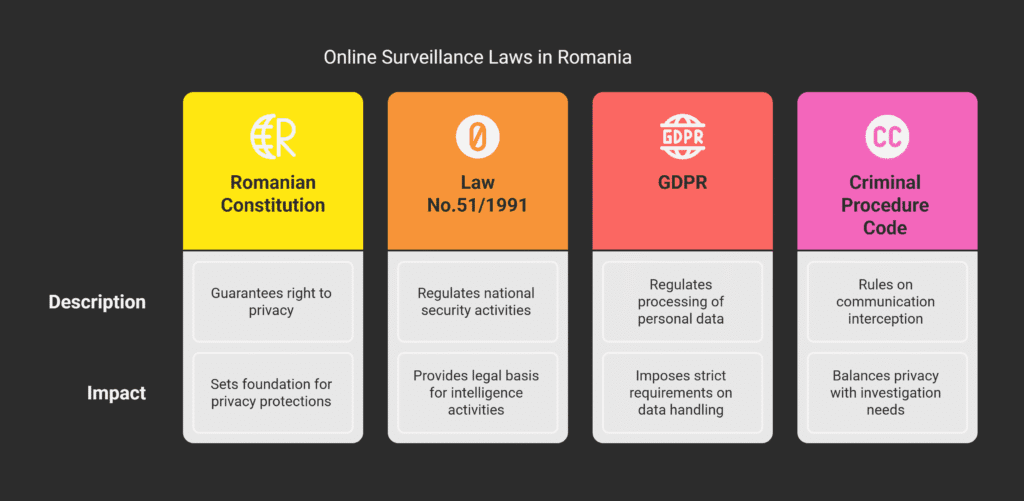
RegulationDescriptionImpact on Online Surveillance
Romanian ConstitutionGuarantees the right to privacySets the foundation for privacy protections in online surveillance
Law No.51/1991Regulates national security activitiesProvides the legal basis for intelligence activities, including online surveillance
GDPRRegulates the processing of personal dataImposes strict requirements on the handling of personal data in online surveillance

For more information on online surveillance laws in Romania, email office@theromanianlawyers.com.

Data Protection and Privacy Legislation in Romania

Romania’s data protection laws come from both national rules and EU regulations.

This has led to a detailed framework to safeguard personal data.

Data Protection and Privacy Legislation in Romania

Romanian Data Protection Law

Romania has its own data protection law, working alongside the EU’s GDPR.

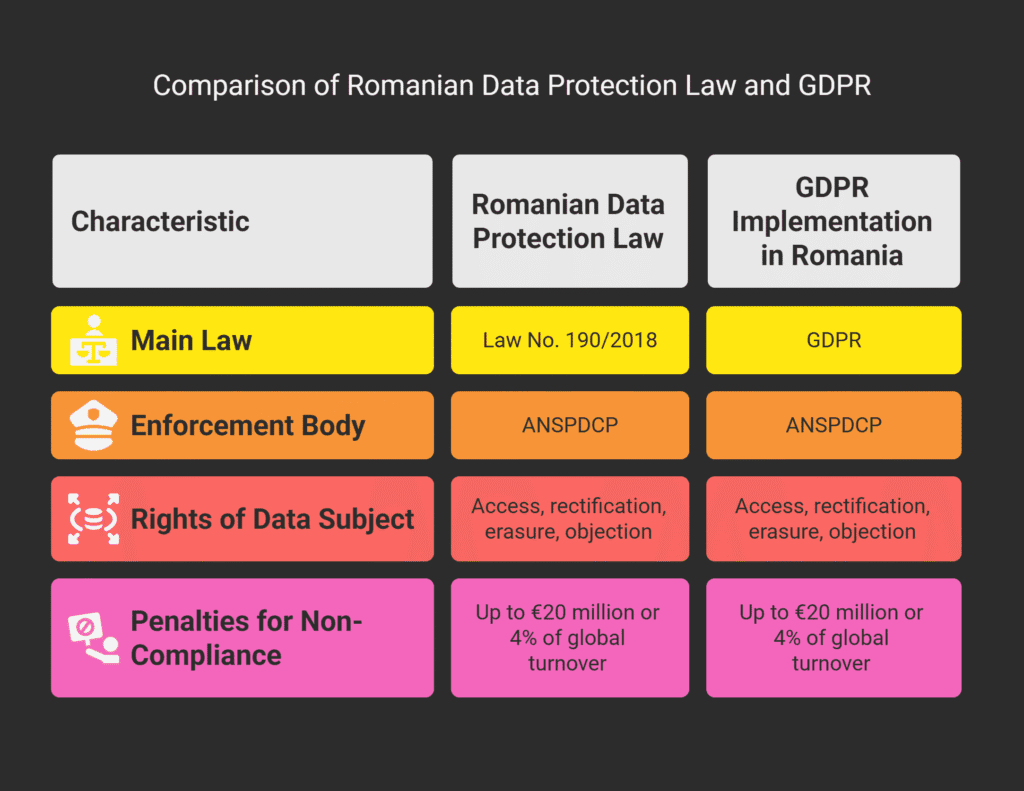
Law No. 190/2018 is the main law for data protection in Romania.

It makes sure Romanian laws match EU standards.

Key aspects of the Romanian Data Protection Law include:

GDPR Implementation in Romania

Romania, as an EU member, has fully adopted the GDPR.

The GDPR sets a common data protection level across the EU.

Romania’s adoption ensures it meets these standards.

Local Enforcement Mechanisms

The ANSPDCP enforces data protection laws in Romania.

It looks into complaints, does audits, and can impose penalties for breaking the rules.

Penalties for Non-Compliance

Companies that don’t follow data protection rules in Romania face big penalties.

The ANSPDCP can fine up to €20 million or 4% of the company’s global turnover, whichever is higher.

The following table summarizes the penalties for non-compliance with GDPR in Romania:

ViolationMaximum Fine
Failure to implement adequate security measures€10 million or 2% of global turnover
Non-compliance with data subject rights€20 million or 4% of global turnover
Failure to report data breaches€10 million or 2% of global turnover

Rights of Data Subjects Under Romanian Law

Data subjects in Romania have several rights under the GDPR and national law, including:

  • The right to access their personal data;
  • The right to rectify or erase their personal data;
  • The right to restrict or object to processing;
  • The right to data portability.

For more information on data protection and privacy legislation in Romania, you can contact office@theromanianlawyers.com.

Legal Aspects of Online Surveillance in Romania: Permitted Practices

Romania has clear rules for online surveillance.

It’s important for people and businesses to know these rules.

Legal Aspects of Online Surveillance in Romania

Lawful Interception Requirements

Lawful interception in Romania has strict rules.

To do surveillance, you must meet certain conditions.

Necessary Conditions for Surveillance

To start surveillance, you need judicial authorization.

This makes sure surveillance is legal and watched over.

  • Judicial authorization is needed for most surveillance;
  • The process checks the surveillance request carefully.

Types of Communications Subject to Monitoring

Many communications can be monitored, like electronic ones.

The law says which ones can be tapped.

Key aspects of lawful interception include:

  • Electronic communications can be monitored;
  • You need specific judicial authorization.

Judicial Authorization Process

The judicial authorization process is key in Romania’s surveillance laws.

It makes sure surveillance is legal and watched.

For more details on the judicial authorization process, email office@theromanianlawyers.com.

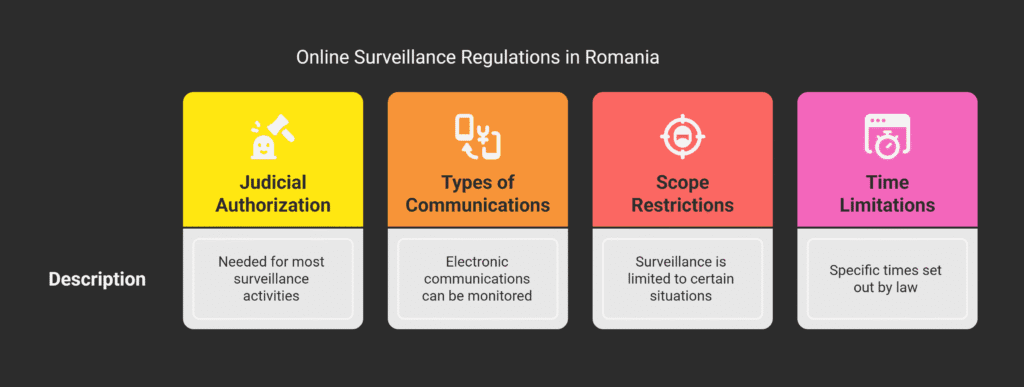
AspectDescription
Judicial AuthorizationNeeded for most surveillance activities
Types of CommunicationsElectronic communications can be monitored
Scope RestrictionsSurveillance is limited to certain situations

Time Limitations and Scope Restrictions

Surveillance in Romania has time limits and scope rules.

These rules make sure surveillance is fair and needed.

Knowing these rules is key for following the law.

The law sets out specific times and areas for surveillance.

Cybersecurity Regulations and Their Impact on Surveillance

The cybersecurity scene in Romania is changing fast.

New rules are shaping how we watch and record things.

Romania has set up a detailed plan to tackle cyber threats.

Cybersecurity Regulations and Their Impact on Surveillance

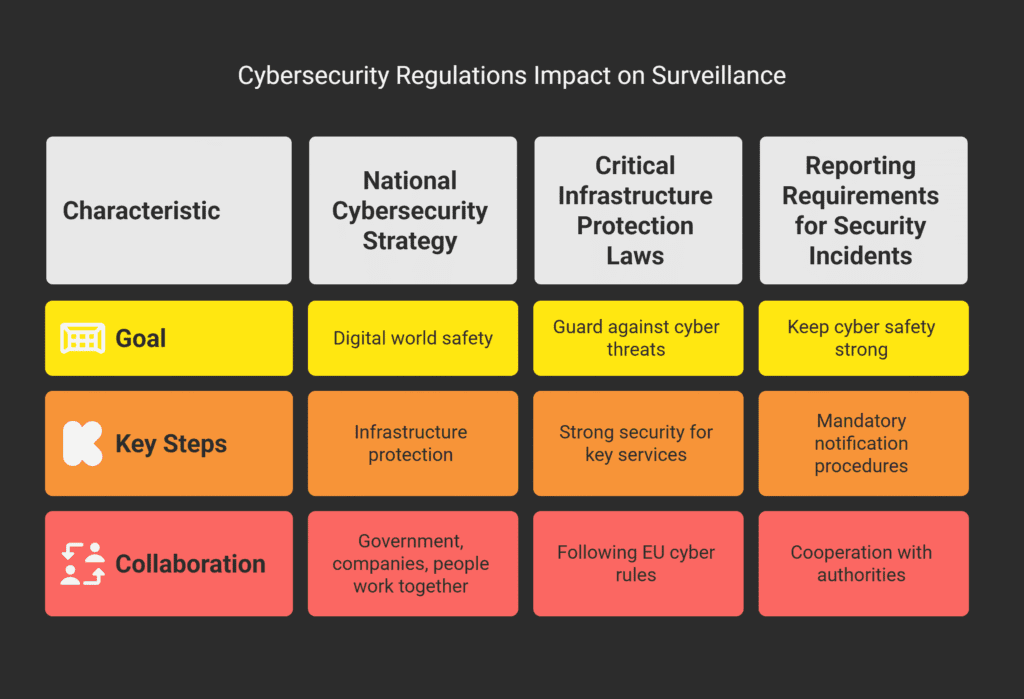
National Cybersecurity Strategy

Romania’s National Cybersecurity Strategy aims to keep its digital world safe.

It involves the government, private companies, and people working together.

Key parts of the strategy are:

  • Protecting key infrastructure;
  • Getting better at handling cyber attacks;
  • Teaching everyone about staying safe online.

Critical Infrastructure Protection Laws

Keeping critical infrastructure safe is a big part of Romania’s cyber plan.

Laws are in place to guard against cyber threats.

Some key steps are:

  1. Using strong security for key services;
  2. Doing regular checks for risks;
  3. Following EU cyber rules..

Reporting Requirements for Security Incidents

Romania has rules for reporting cyber attacks quickly.

This helps keep the country’s cyber safety strong.

Mandatory Notification Procedures

Companies must tell the right people fast if they spot a cyber attack.

This quick action helps fix problems fast.

Cooperation with Authorities

Working well with authorities is key to handling cyber attacks.

It helps share info and learn from each other.

For more on cybersecurity laws in Romania and how they affect watching and recording, email office@theromanianlawyers.com.

Electronic Communications Monitoring: Legal Boundaries

In Romania, there are clear legal rules for monitoring electronic communications.

ISPs and users must follow these rules to stay legal.

Internet Service Provider Obligations

ISPs in Romania must work with law enforcement under certain rules.

They need to have the right setup to intercept communications legally when asked.

For more details on ISP duties and their impact, email office@theromanianlawyers.com.

Data Retention Requirements

Data retention is key in monitoring electronic communications.

ISPs must keep certain data for a set time.

Types of Data Subject to Retention

The data ISPs must keep includes:

  • Subscriber information;
  • Traffic data;
  • Location data.

Storage Duration and Security Standards

Data is kept for 6 months to 2 years, depending on the type.

ISPs must follow strict security rules to keep data safe.

Encryption and Anonymity Regulations

Romania has rules on encryption and anonymity in online communications.

Encryption is usually okay, but there are times when decryption is needed by law.

Users have the right to stay anonymous, but this right can be limited.

This is true in cases like criminal investigations.

For advice on how these rules affect you, talk to legal experts in Romanian telecom law.

Practical Implications for Businesses and Individuals

It’s important for foreign companies to know about Romania’s online surveillance rules.

This knowledge helps them stay in line and avoid risks.

If you’re a business in Romania, you need to understand the country’s data protection and online surveillance laws.

Practical Implications for Businesses and Individuals

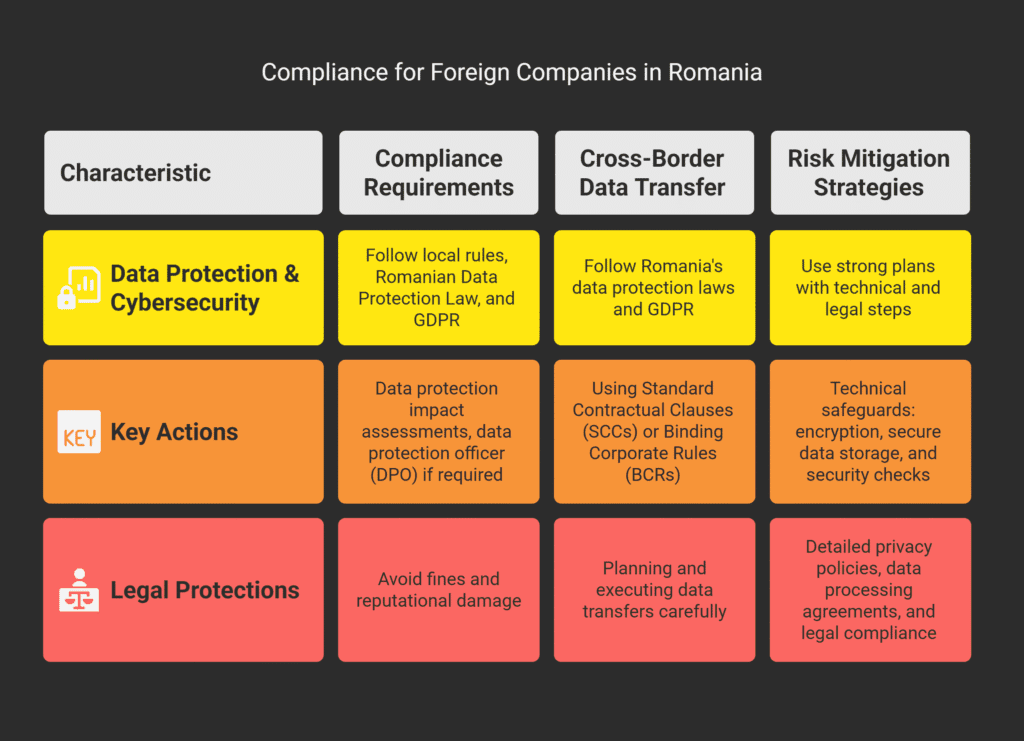
Compliance Requirements for foreign Companies Operating in Romania

Foreign companies in Romania must follow local data protection and cybersecurity rules.

This means they must stick to the Romanian Data Protection Law and the GDPR in Romania.

Following these rules is key to avoid big fines and harm to your reputation.

To meet these requirements, you should:

  • Do regular data protection impact assessments;
  • Use the right technical and organizational steps to keep data safe;
  • Have a Data Protection Officer (DPO) if the law says you must.

Cross-Border Data Transfer Considerations

When moving data across borders, foreign companies must follow Romania’s data protection laws and the GDPR.

This might mean using Standard Contractual Clauses (SCCs) or Binding Corporate Rules (BCRs) to protect data transfers.

Planning and executing cross-border data transfers carefully is essential for compliance.

You need to pick the best data transfer method for your business.

Risk Mitigation Strategies

To lower risks from online surveillance and data protection, foreign businesses in Romania should use strong risk mitigation plans.

These plans should include both technical and legal steps.

Technical Safeguards

Technical safeguards are key to protecting your business from data breaches and cyber threats.

Using encryption, secure data storage, and regular security checks can greatly reduce risks.

Legal Protections

Legal protections are also essential.

This includes having detailed privacy policies, data processing agreements, and making sure your business follows all relevant laws and regulations.

For more details on compliance and risk mitigation, reach out to a legal expert at office@theromanianlawyers.com.

Your Rights and Protections Against Unlawful Surveillance

In Romania, you have rights that protect you from unwanted spying.

Knowing these rights is key to keeping your privacy safe.

Constitutional Safeguards

The Romanian Constitution has strong protections against spying.

Article 30 guards your freedom of speech.

Article 26 protects your right to privacy.

These laws are the foundation of Romania’s rules on surveillance.

Legal Remedies for Privacy Violations

If you think your privacy has been broken, you have legal options. You can go to court for help with privacy issues.

Legal RemedyDescription
Judicial RecourseSeeking legal action through the courts for privacy violations.
Complaint to National Data Protection AuthorityFiling a complaint with the National Data Protection Authority for violations of data protection laws.

How to File Complaints with Romanian Authorities

If you think your privacy has been broken, you can report it to the right Romanian authorities.

National Data Protection Authority Process

The National Data Protection Authority watches over data protection laws in Romania.

To report a problem, write or use their online portal.

Judicial Recourse Options

You can also go to court for help.

A judge will look at your case and decide.

For more on your rights against spying in Romania, email a Romanian lawyer at office@theromanianlawyers.com.

Conclusion

You now know a lot about the laws that govern online surveillance in Romania.

The country’s laws on online surveillance, data protection, and cybersecurity are very important.

They shape how we use the internet.

Online surveillance laws in Romania are shaped by both national and European Union rules.

The data protection laws in Romania follow the General Data Protection Regulation (GDPR).

This means people’s personal data is well-protected.

Cybersecurity laws in Romania focus on keeping critical infrastructure safe and ensuring secure online communication.

If you’re doing business or living in Romania, it’s key to understand these laws.

This helps you stay in line with regulations and protect your rights.

For more details or help with these laws, you can reach out to the Romanian lawyers at office@theromanianlawyers.com.

FAQ

What is the current state of online surveillance in Romania?

Online surveillance in Romania is managed by a mix of laws.
These laws balance national security with privacy rights.
The country has laws like the Romanian Constitution and EU rules to oversee surveillance.

How does Romanian law protect individual privacy in the context of online surveillance?

Romanian law defends privacy in several ways.
It includes the Romanian Constitution and the GDPR.
People have the right to manage their data and seek help if their privacy is broken.

What are the requirements for lawful interception in Romania?

To legally intercept communications in Romania, a court order is needed.
The interception must be necessary and not too broad.
It must also be in line with a valid reason.

How do cybersecurity regulations in Romania impact online surveillance?

Romania’s cybersecurity laws aim to keep digital spaces safe.
They include the National Cybersecurity Strategy and laws for critical infrastructure.
These laws also affect surveillance by setting rules for data sharing and encryption.

What are the obligations of Internet Service Providers (ISPs) in Romania regarding online surveillance?

ISPs in Romania must help law enforcement get user data with a court order.
They also have to keep user data for a certain time.

How do online surveillance laws in Romania affect foreign businesses and individuals?

Foreign companies and people in Romania must follow the country’s surveillance laws.
They need to know the risks and take steps to protect themselves.

What are the rights and protections available to individuals against unlawful surveillance in Romania?

People in Romania have many rights against illegal surveillance.
These include constitutional protections and legal ways to fight privacy breaches.
They can also complain to Romanian authorities.

What is the role of the Romanian Constitution in protecting individual privacy?

The Romanian Constitution is key in protecting privacy.
It ensures the state respects privacy and sets rules for surveillance.

How does the GDPR apply in Romania?

The GDPR directly applies in Romania.
It offers strong data protection and strict rules for those handling personal data.

What are the key government agencies involved in online surveillance in Romania?

Important agencies for online surveillance in Romania are the Romanian Intelligence Service and the Ministry of Internal Affairs.
The National Authority for Management and Regulation in Communications also plays a role.
They enforce surveillance laws.

Urban and Agricultural Property Laws in Romania

Differences Between Urban and Agricultural Property Laws in Romania

Ever wondered why owning property in Romania seems like solving a puzzle?

The laws for urban and agricultural properties are different.

These differences affect your rights and duties as a property owner.

It’s key to know these differences if you’re in the Romanian real estate market.

In Romania, property laws have a long history and keep changing. You should know the rules for urban and agricultural lands.

This guide will help you understand these laws better.

It will also give you the tools to deal with these legal areas well.

Urban and Agricultural Property Laws in Romania

Key Takeaways

  • Urban and agricultural property laws differ significantly in Romania.
  • Understanding the legal framework for property in Romania is essential for property ownership.
  • Property regulations in Romania influence rights and responsibilities differently based on land type.
  • Historic legislation shapes current property laws.
  • Awareness of these differences can benefit real estate transactions.

Introduction to Property Laws in Romania

Understanding Romanian property laws is key for investors in Romania.

After communism fell, Romania changed its laws to make real estate more open.

This change aimed to make buying and selling property easier and clearer.

The laws about owning property in Romania come from the Constitution and the Civil Code.

These laws set out what property rights are, how to buy and sell, and what owners must do.

Knowing these property ownership laws in Romania helps you make smart choices when buying property.

Buying property in Romania means you need to know the local laws well.

Knowing your rights and duties can help your investment go smoothly. It also helps avoid legal problems.

Romanian property laws overview

Legal Framework for Property Ownership in Romania

The laws about owning property in Romania are complex.

They are shaped by several important laws.

The Civil Code is at the heart of these rules, explaining key rights and how to transfer property.

There are laws about returning land that was taken during communism.

These laws mix with today’s rules for owning property.

Also, laws about urban development set rules for using and building on land.

This makes sure land use fits with city plans.

In Romania, there’s a big difference between public and private property.

Public property is managed by the state or local governments.

Private property lets owners use, sell, or develop their land as they wish.

Knowing this is key for those looking to buy property in Romania.

These laws help protect property rights.

They create a stable place for investments and deals.

They are important for property owners to know and follow.

land ownership laws in Romania

Urban and Agricultural Property Laws in Romania

It’s key to know the differences in owning and managing land in Romania.

Urban and agricultural laws cover various aspects of land use and ownership.

Each area has its own rules for landowners and investors.

Differences in Ownership Rights

Property rights in Romania change a lot between cities and farms.

Urban laws allow for many uses of land, like homes and businesses.

But, farm laws focus on land for growing crops.

Urban areas have rules on building heights and how close buildings can be.

Farms have rules to keep land good for growing crops.

These rules help keep cities and farms organized.

Property Regulations and Administrative Procedures

Understanding the rules for land is important.

In cities, you need permits for building and follow zoning laws.

These rules help cities grow in an orderly way.

Farms have their own rules, like keeping land good for farming.

You might need to register plans with local officials.

This ensures developments are safe for the environment and farming.

urban property regulations Romania

Types of Property: Urban vs. Agricultural

Knowing the difference between urban and agricultural property in Romania is key.

It affects how you can use and develop your land.

Urban areas include homes, businesses, and factories, each with its own rules.

Residential areas are for living, commercial spaces are for businesses, and industrial areas are for making things.

These rules help keep everything organized and safe.

Agricultural land, like fields, pastures, and forests, is different.

Fields grow crops, pastures are for animals, and forests help the environment. Each has its own role and rules.

In Romania, laws control what you can build on your land.

These laws help keep the environment and community safe.

It’s important to know these rules if you want to invest or develop property here.

types of urban and agricultural property

Property Acquisition Regulations for Foreigners

It’s important to know the rules for buying property in Romania if you’re a foreigner.

The laws in Romania are clear about who can own property.

They treat EU citizens and non-EU citizens differently.

This affects what international buyers can do with urban and agricultural land.

Restrictions on Foreign Ownership

Foreigners face certain rules when buying property in Romania.

EU citizens can buy property like locals.

But, non-EU citizens have to jump through more hoops, like starting a business or following special rules for buying land.

  • EU citizens can buy property without many restrictions.
  • Non-EU citizens might need to start a business or make other legal plans to buy property.
  • Buying agricultural land comes with extra rules that buyers must follow.

Foreign buyers should learn about these rules to buy property smoothly.

Knowing the laws helps avoid problems and makes the buying process easier.

Urban Development Laws and Agricultural Land Regulations

The rules for urban development and agricultural land in Romania are complex.

They greatly affect how land is used and developed.

It’s important for property owners, developers, and farmers to understand these rules well.

Impact of Urban Planning on Property Development

Urban planning laws cover many aspects of property development.

These include zoning, environmental rules, and planning for infrastructure.

These factors are key in deciding how land can be used in cities.

Zoning laws decide what can be built on certain lands.

This affects homes, businesses, and factories.

Environmental rules make sure projects are green and don’t harm nature.

  • Zoning Regulations: Dictate what types of buildings and businesses are allowed.
  • Environmental Policies: Aim to protect natural resources during urban expansion.
  • Infrastructure Planning: Involves ensuring adequate transportation, utilities, and services for new developments.

Distinct Regulatory Frameworks for Agricultural Land Use

Agricultural land in Romania has its own set of rules.

These rules help keep farmland productive and follow certain policies.

There are limits on building on these lands to keep them useful for farming.

Regulation TypeUrban DevelopmentAgricultural Land Use
Zoning PoliciesDefines permissible land uses in urban areasRestricts non-agricultural development
Environmental ReviewsMandatory for urban projectsFocus on soil conservation and sustainable practices
Land Use Change ApprovalStringent for residential and commercial transitionsGuarded against conversion to non-agricultural usage

Expropriation Procedures in Urban and Agricultural Contexts

Expropriation laws in Romania set rules for taking private property for public use.

This is key for urban and agricultural projects.

These laws make sure property owners get fair pay.

They help balance the needs of projects with property rights.

The process starts with a public interest declaration.

This must explain why the property is needed, like for new roads or farms.

Owners must be told and given details about what will happen to their land.

Fair pay is a big part of expropriation. Experts figure out the property’s value to pay owners fairly.

The way properties are valued can change based on their use.

For example, city properties might be valued differently than farm land.

Urban and farm expropriations have their own rules.

This is because of the different types of properties and how they affect people.

The idea is to help the community by using public interest.

Knowing these rules helps property owners protect their rights.

Importance of Land Registration in Romania

Land registration is key in Romania for protecting property rights.

It confirms who owns what, making real estate deals safer.

Knowing the land registration laws in Romania helps users feel secure and clear about their property rights.

Impact of the Land Register on Property Rights

A strong land registration system proves who owns a property.

This is vital for buying, selling, or investing in land.

Without it, property rights are shaky, leading to legal issues.

Land registration laws in Romania make sure ownership is recognized by others.

This makes owning property safer and more secure.

But, dealing with land registration can be tricky.

Owners might run into rules that make it hard to follow the law.

Keeping up with changes in land registration laws in Romania helps avoid problems caused by bad or late registrations.

Conclusion

Property laws in Romania show big differences between city and countryside.

It’s key to know these differences to handle them well.

We’ve looked at how ownership, buying, and rules vary, which is important for understanding city vs countryside property laws in Romania.

Real estate rules in Romania are complex and need careful thought.

As city laws change, they affect property rights and investment chances.

It’s vital to stay updated.

Property owners or investors should work with legal experts to follow rules and make smart choices.

Learning more about laws and duties will help you trust your real estate plans in Romania, no matter if it’s in the city or countryside.

Knowing these differences helps you make better choices and succeed in Romania’s property market.

FAQ

What are the key differences between urban and agricultural property laws in Romania?

Urban and agricultural properties in Romania have different rules.
Urban areas have laws for homes and businesses.
Agricultural lands focus on keeping them productive.

How does post-communism history affect property laws in Romania?

After communism, Romania changed its property laws.
These changes helped return properties taken during the communist era.
Knowing both old and new laws is key for real estate.

What legal documents govern property rights in Romania?

The Constitution and Civil Code are key.
They explain who owns what and how to develop land.
They protect property owners’ rights.

Are there specific regulations for foreign individuals looking to acquire property in Romania?

Yes, there are rules for foreigners.
EU citizens can buy like locals.
But, non-EU citizens face more rules, like limits on owning farmland.

How does urban planning impact property development in Romania?

Urban planning is very important. It decides what you can do with land and how to build.
Following these rules is needed to get permits and meet local policies.

What is the process of expropriation for property in Romania?

Expropriation lets the government take land for public use.
Owners must get fair pay. Rules for taking urban and farmland differ.

Why is land registration important in Romania?

Land registration proves who owns what. It’s key for buying and selling.
But, problems with registration can cause legal issues.

What are the implications of zoning laws in property ownership?

Zoning laws control what you can do with land.
They affect how you can use your property.
Knowing these laws is important to avoid problems.

How can I navigate property disputes in Romania?

To deal with property disputes, you need to know the laws. It’s best to talk to a Romanian lawyer.
They can help with issues like ownership, zoning, or expropriation.

What are the main differences between urban and agricultural property ownership in Romania?

The ownership regime in Romania differs significantly between urban and agricultural properties.

Agricultural land in Romania is subject to special protective regulations that don’t apply to urban real estate.

While urban properties can generally be freely traded on the market, agricultural land transactions are restricted by the pre-emption right system.

This means that when a landowner wants to sell Romanian agricultural land, certain categories of buyers have priority purchase rights before the land can be offered on the open market.

The new law introduced in 2020 has strengthened these restrictions, particularly for agricultural land located outside built-up areas.

Additionally, urban property transactions typically don’t require proof of qualification or intent to use the property for specific purposes, whereas those who want to buy agricultural land must often demonstrate their ability to carry out agricultural activities or have qualifications related to agriculture.

How does the pre-emption right system work for agricultural land sales in Romania?

The pre-emption right system for the sale of agricultural land in Romania is a hierarchical priority system that gives certain categories of buyers the first option to purchase the land before it can be sold on the open market.

According to the new law, when a landowner decides to sell agricultural land, they must first submit a sale offer to the city hall of the administrative-territorial unit where the land is located.

The registration of the sale offer initiates a process where potential buyers with pre-emption rights have 45 days to express their intention to purchase.

The priority order includes: co-owners, tenants, neighboring landowners, young farmers, the Academy of Agricultural and Forestry Sciences, and only then other natural persons or legal entities.

If no pre-emptors exercise their right within the specified timeframe, the seller can proceed with selling to any interested buyer, but at a price no lower than the one stated in the sale offer.

Any attempt to circumvent this procedure can result in the nullity of the sale and purchase agreement.

Crypto Romania 2025

What is a Beneficial Owner and How to Declare It in Romania

Who is the beneficial owner of a Romanian company?

The beneficial owner is the natural person who ultimately owns or controls a company. Romanian companies must identify that person correctly, record the means of control and update the Trade Register when the relevant information changes.

Beneficial ownership structure in Romania A corporate ownership structure leading from companies to the natural person who ultimately owns or controls them. Shareholder Adirect ownershipHolding entityindirect ownershipRomanian companyownership and controlUltimate natural person
Ownership must be traced through intermediate entities until the natural person exercising ultimate ownership or control is identified.

Key point: most Romanian companies do not file a beneficial-owner declaration every year. The usual filing moments are incorporation and any later change concerning the beneficial owner or that person’s identification data. Annual filing applies only to the special category described in Article 56(1³) of Law no. 129/2019.

How is a beneficial owner identified in Romania?

Article 4 of Law no. 129/2019 defines a beneficial owner as any natural person who ultimately owns or controls a legal entity, or the natural person on whose behalf a transaction or activity is conducted.

For a company, identification normally follows three levels:

Direct or indirect ownershipA holding of 25% plus one share, or a participation of more than 25% in the capital, is an indication of direct ownership when held by a natural person. Indirect ownership may exist through one or more controlled entities.
Control through other meansA person may be the beneficial owner even without crossing the ownership threshold if that person ultimately controls the company through voting arrangements, contractual rights or other means.
Senior managing officialIf no natural person is identified after all possible means have been exhausted, and there is no ground for suspicion, the law uses the natural person or persons holding the position of senior managing official as the fallback.
Document the conclusionThe company should be able to explain the ownership chain, the applicable criterion and the manner in which control is exercised. A percentage alone may not answer the question in a complex structure.
Common mistakeTreating every shareholder owning exactly 25% as an automatic beneficial owner. The statutory ownership indicator is 25% plus one share or a capital participation exceeding 25%; control through other means must still be analysed separately.

Which Romanian entities must declare their beneficial owners?

Persons subject to registration with the Romanian Trade Register must provide beneficial-owner information under Article 56 of Law no. 129/2019. At incorporation, the obligation may also be fulfilled by including the required identification data and means of control in the articles of association.

The person making the declaration is the company’s legal representative. The analysis behind the declaration should cover the full ownership and control structure, particularly where the Romanian company has foreign corporate shareholders, nominee arrangements or several intermediate holding companies.

For foreign founders incorporating locally, beneficial-owner identification should be coordinated with the wider Romanian company formation process and the supporting corporate documents collected from each jurisdiction.

When must a beneficial-owner declaration be filed?

Filing eventWho is affected?DeadlinePractical point
IncorporationLegal entities subject to registration with the Trade RegisterAs part of the incorporation filingThe obligation may be fulfilled through the articles of association if all required data and means of control are included.
Change of beneficial owner or identification dataRegistered legal entities affected by the changeWithin 15 days from the date of the changeA share transfer, restructuring or change of personal data should trigger an immediate review.
Annual declarationOnly entities within Article 56(1³)Within 15 days after approval of the annual financial statementsThis is not a universal annual obligation.
Existing companiesAccording to the official ONPCSB guidance, a company that has filed at least one declaration after Law no. 129/2019 entered into force generally files a new declaration only when the beneficial owner or the relevant identification data changes, unless it belongs to the special annual-filing category.

Who has an annual filing obligation?

Annual filing applies only where the registered entity has, in its shareholding structure, entities incorporated, registered or fiscally resident in:

  • non-cooperative jurisdictions for tax purposes;
  • jurisdictions presenting a high money-laundering or terrorist-financing risk; or
  • jurisdictions monitored by relevant international bodies for money-laundering or terrorist-financing risk.

The lists are not static. They are updated by the competent international bodies and published through official channels. For that reason, a legal article should not treat a short list of named countries as permanent. The structure must be checked against the current official lists at the relevant filing date.

Do not assume an annual declaration is requiredA Romanian SRL with a straightforward Romanian or EU ownership structure will not normally fall within the annual-filing rule merely because it has foreign shareholders. The precise jurisdiction and every entity in the shareholding chain must be checked.

What information must the declaration contain?

Article 56(4) requires the declaration of each beneficial owner’s identification data and the manner in which control is exercised. The information includes:

  • full name;
  • date and place of birth;
  • personal numerical code, where applicable;
  • series and number of the identity document;
  • citizenship;
  • domicile or residence; and
  • the manner in which the person exercises ultimate ownership or control.

The control description should identify the relevant legal criterion and the ownership chain. Generic wording may be insufficient where control is indirect or based on contractual or voting rights.

How can the declaration be signed and submitted?

The form of the document and the delivery channel are separate questions. Article 56(5) and (6) permits several combinations:

Document or signature formAvailable submission routeImportant condition
Private-signature documentTrade Register counter, post or courierThe filing must comply with the applicable representation and registration rules.
Electronic documentElectronic submission through the Trade Register’s online servicesThe electronic transmission must carry the required electronic signature.
Declaration given before the Trade Register representativeAt the competent Trade Register officeThe declarant follows the office procedure and uses the applicable form.
Document with a date certified by a notary or attested by a lawyerFiled personally or through a representativeThe document form and the representative’s authority must satisfy the applicable legal requirements.

Electronic filings and online access are available through the ONRC MyPortal. The current form, technical requirements and filing category should be checked immediately before submission.

Which corporate changes require a new UBO review?

A formal review should take place whenever an event can change ultimate ownership, control or the identification data already recorded. Examples include:

  • a transfer of shares or participation interests;
  • an issue, cancellation or redistribution of shares;
  • a change in the foreign ownership chain;
  • a shareholder agreement changing voting or appointment rights;
  • a merger, demerger or internal group reorganisation;
  • a change concerning the person used as senior managing official; or
  • a change in a beneficial owner’s identity-document, residence or other declared data.

A transaction may therefore require both the corporate registration steps explained in our guide to changing shareholders in a Romanian company and a separate beneficial-owner filing. Rights created in a Romanian shareholder agreement should also be checked for control through other means.

What are the penalties for non-compliance?

Under Article 57 of Law no. 129/2019, failure by the legal representative to submit the declaration constitutes an administrative offence punishable by a fine from RON 5,000 to RON 10,000.

If the declaration is still not submitted within 30 days after the sanction is applied, the competent tribunal may order the company’s dissolution at the request of the National Trade Register Office. The ground for dissolution can be remedied before final submissions on the merits.

Correction to a frequent online claimLaw no. 129/2019 does not establish separate beneficial-owner fines of RON 10,000–20,000 for non-filing or RON 20,000–50,000 for incomplete information. The specific sanction under Article 57(1) is RON 5,000–10,000, followed by the possible dissolution procedure described above.

Beneficial owner Romania: practical filing workflow

Filing map

From ownership review to Trade Register update

Romanian beneficial-owner filing stagesA five-stage process covering ownership mapping, legal testing, document preparation, filing and ongoing monitoring.1Map ownership2Test control3Prepare data4File with ONRC5Monitor changes
A reliable filing starts with the complete ownership chain, not with the declaration form.

Checklist for foreign-owned Romanian companies

Collect the ownership chartTrace every corporate shareholder to the ultimate natural persons.
Verify current documentsUse up-to-date registry extracts, identity documents and constitutional records.
Calculate direct and indirect holdingsDo not stop at the first foreign holding company.
Review other control rightsCheck voting agreements, vetoes, appointment powers and contractual control.
Check the filing triggerConfirm whether the event is incorporation, a change or the limited annual obligation.
Check current jurisdiction listsDo not rely on an old article or a fixed list copied from another source.
Use consistent dataNames, addresses and identification details should match the supporting records.
Keep evidence of filingRetain the submitted declaration, registration proof and the ownership analysis.

Need assistance with a Romanian beneficial-owner filing?

Atrium Romanian Lawyers assists Romanian companies, foreign founders and international groups with beneficial-owner analysis, declarations, shareholding changes and Trade Register filings.

Frequently asked questions

Does every Romanian company file a beneficial-owner declaration annually?

No. Annual filing applies only to the entities described in Article 56(1³) of Law no. 129/2019. Most companies file at incorporation and when the beneficial owner or the declared identification data changes.

What is the ownership threshold for a beneficial owner in Romania?

Holding 25% plus one share, or a participation exceeding 25% of the capital, indicates direct ownership by a natural person. Indirect ownership and control through other means must also be considered.

What is the deadline after a change?

The declaration must be filed within 15 days from the date on which the beneficial owner or the relevant identification data changes.

Can the declaration be submitted online?

Yes. It may be transmitted electronically with the required electronic signature through the Trade Register’s online services. The law also permits filing at the counter or by post or courier, subject to the applicable form and representation requirements.

Can a lawyer assist with the declaration?

Yes. A Romanian lawyer can analyse the ownership and control chain, prepare or attest the declaration where appropriate, represent the company in the filing and coordinate it with related corporate registrations.

What happens if the declaration is not filed?

The legal representative may receive a fine from RON 5,000 to RON 10,000. Continued non-compliance for 30 days after the sanction may lead to a court dissolution request by the National Trade Register Office.

Disclaimer: This article provides general information and does not constitute legal advice. Beneficial-owner status and filing obligations depend on the current legislation, ownership structure, control rights and facts of each company.

AI Notice: AI-assisted content, reviewed and approved by a qualified Romanian lawyer.