IP protection for creators and startups in Romania, illustrated by a shield with the Romanian map, technology and innovation icons

IP Protection in Romania for Startups & Creators | Legal Guide


IP Protection for Creators & Startups in Romania


IP Protection for Creators & Startups in Romania

Beyond Registration – A Strategic Legal Perspective

Romanian intellectual property law is aligned with EU legislation and protects patents, trademarks, copyrights, industrial designs, and trade secrets through distinct legal regimes. Trademark and patent protection require registration with the Romanian State Office for Inventions and Trademarks (OSIM) or relevant EU authorities. Copyright protection arises automatically upon the creation of an original work and does not require registration, although voluntary evidentiary deposit may be used.

Ownership of intellectual property depends on the type of right and contractual arrangements. Software created by employees generally vests in the employer unless otherwise agreed, while other copyrighted works require explicit assignment. Contractors do not transfer intellectual property rights automatically.


Why Intellectual Property Is No Longer a Formality in Romania

For many founders and creators entering the Romanian market, intellectual property is still perceived as a bureaucratic checkbox: register a trademark, maybe file a patent, move on. This mindset is outdated and increasingly dangerous.

In today’s Romanian and EU business environment, IP is not merely a legal formality. It is a strategic asset, a valuation driver, and often a risk factor capable of blocking investment, scaling, or exit. For startups, creative professionals, and technology-driven companies, intellectual property is no longer something you “deal with later”—it is something that shapes the business from day one.

Romania offers a robust, EU-aligned IP framework. Yet many disputes, failed funding rounds, and blocked transactions stem not from lack of law, but from poor IP decisions made early. This guide explains how IP actually works in Romania, where founders make mistakes, and how a strategic approach changes outcomes.


Understanding Intellectual Property in Romania: The Practical Reality

At a conceptual level, intellectual property refers to creations of the mind: inventions, software, brands, designs, artistic works, and confidential know-how. In practice, Romanian IP law divides these creations into distinct legal regimes, each with its own logic, risks, and enforcement mechanisms.

A recurring mistake among startups is treating IP as a single category. It is not. A trademark does not behave like copyright. Software is not treated like a patent. Trade secrets disappear the moment confidentiality is lost. Understanding these differences is essential, because the law applies differently depending on the asset. For expert guidance on intellectual property protection in Romania, consult with experienced legal advisors.

Key Institutions in Romanian IP

  • OSIM – State Office for Inventions and Trademarks, responsible for patents, trademarks, and industrial designs
  • ORDA – Romanian Copyright Office, administers copyright registration and evidentiary matters
  • Romanian Courts – enforce IP rights through civil and criminal proceedings
  • EUIPO – European Union Intellectual Property Office, handles EU trademark and design registrations

Startups and IP: Where Strategy Matters More Than Law

The Early-Stage IP Trap

Most Romanian startups fail to address IP strategically at the incorporation or MVP stage. Founders focus on product-market fit and funding, assuming legal structuring can wait. In reality, early IP decisions determine whether later protection is even possible.

Common irreversible mistakes include:

  • Public disclosure before patent assessment
  • Launching under an unprotected or unregistrable brand
  • Using contractors without IP assignment clauses
  • Mixing open-source code without license control

These are not technicalities. They directly affect ownership, enforceability, and valuation.

IP as an Investment Filter

From an investor’s perspective, IP is not about certificates—it is about control and exclusivity. During due diligence, investors focus on:

  • Who owns the code
  • Whether trademarks are registered or merely used
  • Whether patents are filed or still possible
  • Whether key assets can be legally transferred

A startup with weak IP rarely fails because of infringement; it fails because no one is willing to invest in legally uncertain assets. For a deeper analysis of IP due diligence in startup funding, see our comprehensive IP protection guides.


Trademarks in Romania: Brand Protection as Market Control

In Romania, trademarks protect signs capable of distinguishing goods or services: names, logos, slogans, and sometimes non-traditional marks. Protection is obtained only through registration—use alone offers limited and risky protection.

Strategic Timing of Trademark Registration

Many founders wait until traction appears. Legally, this is a mistake. Romania applies a first-to-file system, meaning that the party who files first acquires rights, regardless of who used the mark first.

Delays can result in:

  • Forced rebranding
  • Opposition proceedings
  • Loss of domain or social media alignment

National vs EU Trademark Protection

Romanian businesses may choose:

  • National registration via OSIM: Focused protection with faster enforcement locally
  • EU-wide registration via EUIPO: Broader coverage but higher risk of opposition

Copyright in Romania: Automatic Protection, Complex Ownership

Copyright Exists Without Registration—But Ownership Is Not Automatic

Under Romanian law, copyright arises automatically upon creation of an original work. No registration is required. This includes software, written content, designs, audiovisual works, and databases.

However, ownership and economic rights are frequently misunderstood.

Employees vs Contractors: A Legal Fault Line

Romanian law draws a sharp distinction:

Software created by employees: Economic rights generally belong to the employer, unless otherwise agreed

Other copyrighted works: Economic rights remain with the author unless expressly assigned

Contractors: Nothing transfers automatically. Without a written assignment, the company may lawfully use the work—but does not own it

This distinction becomes critical in litigation, exits, and acquisitions.

Evidentiary Registration and ORDA

Romania allows voluntary deposit or registration of works with ORDA for evidentiary purposes. This does not create rights, but it can significantly strengthen proof of authorship and creation date in disputes.


Patents in Romania: Powerful, Rare, and Often Misused

Patent protection in Romania follows EU standards: novelty, inventive step, and industrial applicability.

Software and Patents: The Hard Truth

Software as such is not patentable. Patent protection is available only where software contributes to a technical solution producing a technical effect.

Many startups assume their algorithm is patentable. Most are wrong. A proper patentability assessment must be conducted before disclosure, or the opportunity is permanently lost.

National vs European Patents

Romanian inventors may file:

  • National patents via OSIM: Lower cost, focused protection
  • European patents via the European Patent Office: Broader coverage, higher cost

The choice depends on commercial scope, budget, and enforcement strategy.


Trade Secrets: The Most Fragile IP Asset

Trade secrets protect confidential business information with economic value, provided reasonable secrecy measures are in place.

In practice, Romanian courts examine:

  • Confidentiality clauses
  • Access limitations
  • Internal security measures

Once information becomes public, protection is lost—irreversibly. Protect your trade secrets with proper legal frameworks. Learn more about confidentiality agreements and trade secret protection.


Licensing and Monetization: Turning IP into Revenue

IP has little value if it cannot be commercialized.

Licensing allows IP owners to retain ownership while granting usage rights. Romanian law recognizes exclusive and non-exclusive licenses, sublicensing, and cross-licensing arrangements.

These contracts must be carefully drafted to avoid antitrust, tax, and enforcement issues. For startups, licensing is often the bridge between innovation and market entry.


Enforcement of IP Rights in Romania: What Actually Works

Enforcement options include:

  • Civil litigation: Injunctions and damages
  • Criminal proceedings: For counterfeiting and piracy
  • Customs measures: Seizure of infringing goods at the border

In practice, early intervention and evidence preservation matter more than aggressive litigation. Many disputes are resolved through injunction pressure rather than final judgments.


IP Audits: The Missing Discipline in Romanian Businesses

Regular IP audits are still rare in Romania, yet they are one of the most effective risk management tools.

An IP audit clarifies:

  • Ownership of all IP assets
  • Validity and enforceability
  • Licensing obligations
  • Exposure to infringement claims

Audits are essential before funding, mergers, or international expansion.


The Future of IP in Romania: From Formal Rights to Strategic Assets

As Romania’s startup ecosystem matures, IP disputes are shifting from registration issues to ownership, valuation, and enforcement complexity.

AI-generated content, software licensing conflicts, and cross-border enforcement will dominate future litigation.

Businesses that treat IP strategically—not administratively—will have a decisive advantage. For guidance on developing a comprehensive IP strategy, consult with our IP and technology law team.


Final Thoughts: IP as Business Infrastructure

In Romania, intellectual property is not just about protecting ideas. It is about controlling risk, enabling growth, and securing value.

The law provides the tools, but strategy determines outcomes.

For creators and startups, the question is no longer whether to protect IP—but whether your IP strategy is strong enough to support your ambitions. Schedule a consultation with our legal team to assess your IP position and develop a protection strategy tailored to your business.


Frequently Asked Questions

Q: What types of intellectual property can be protected in Romania?

Romanian law protects patents, trademarks, industrial designs, copyrights, and trade secrets. Each category follows a different legal regime, registration logic, and enforcement mechanism. Choosing the correct form of protection is essential for enforceability and valuation.

Q: Is trademark registration mandatory in Romania?

Yes, effective trademark protection requires registration. Romania applies a first-to-file system, meaning prior use alone offers limited protection and does not prevent third parties from registering identical or similar marks.

Q: Can startups rely only on EU trademark or patent registration?

EU registrations provide broader territorial coverage, but national Romanian enforcement, local language proceedings, and procedural rules still apply. Many businesses use a combined national and EU IP strategy.

Q: Is software protected by copyright or patent law in Romania?

Software is automatically protected by copyright as an original work. Patent protection is available only when software forms part of a technical invention that produces a technical effect and meets patentability criteria.

Q: Who owns intellectual property created by employees in Romania?

Ownership depends on the IP type. For employee-created software, economic rights generally vest in the employer unless otherwise agreed. For other works, rights remain with the author unless expressly assigned by contract.

Q: Are contractors’ works automatically owned by the company?

No. Romanian law does not provide automatic transfer of IP rights from contractors. Without a written assignment, the contractor usually retains ownership, even if the company paid for the work.

Q: Do I need to register copyright in Romania?

No registration is required for copyright protection. Voluntary deposit or registration with ORDA is available for evidentiary purposes only and does not create rights.

Q: How long does IP protection last in Romania?
IP TypeDuration
Trademarks10 years, renewable indefinitely
PatentsUp to 20 years
CopyrightGenerally 70 years after the author’s death
Industrial DesignsUp to 25 years
Q: How are IP rights enforced in Romania?

Rights can be enforced through civil litigation, criminal proceedings in cases of counterfeiting or piracy, and customs measures to stop infringing goods at the border.

Q: What is an IP audit and why is it important?

An IP audit reviews ownership, registrations, licenses, and risks related to intellectual property. It is essential before investment, mergers, international expansion, or restructuring.

Q: When should a startup involve an IP lawyer in Romania?

Ideally before public disclosure, branding decisions, fundraising, or signing development contracts. Early legal input prevents irreversible IP loss and costly disputes.

Q: Can foreign companies protect IP in Romania?

Yes. Foreign companies may register and enforce IP rights in Romania directly or through EU mechanisms, subject to the same legal standards and enforcement rules.

Q: How do trade secrets differ from other IP rights?

Trade secrets are protected only as long as confidentiality is maintained. Once information becomes public, protection is permanently lost, unlike registered IP rights.

Q: Are domain names and social media handles protected as IP?

Domain names and handles are not IP rights themselves but may infringe trademarks or be protected indirectly through trademark enforcement and unfair competition law.

Q: Does Romanian IP law apply to AI-generated content?

Romanian law currently protects works created by human authors. AI-generated content raises unresolved legal questions, particularly regarding authorship and ownership, and should be assessed case by case.


Disclaimer: This article is provided for general informational purposes only and does not constitute legal or intellectual property advice. The analysis is based on Romanian IP law and EU legislation as of January 2026. Application of the law may vary depending on individual circumstances, administrative practice, and subsequent guidance or case law. Professional advice should be obtained before taking any action based on this content.

Key Clauses Romanian Labor Law

Key Clauses in Romanian Employment Contracts

Key Clauses in Romanian Employment Contracts

What makes a Romanian employment contract legally binding and compliant with local labor regulations?

The answer lies in understanding the intricacies of Romanian labor law and the essential clauses that protect both employers and employees.

Romanian employment legislation mandates specific protocols that distinguish valid contracts from those destined for legal challenges.

The Contract Individual de Muncă (CIM Romania) serves as the foundation of every employment relationship.

Each contract must be drafted in Romanian and registered through the Reges electronic system before the first day of work.

Special clauses in Romanian employment contracts go beyond basic terms to address unique workplace scenarios and protect business interests.

These provisions require careful consideration.

They often benefit from guidance by experienced Romanian lawyers who understand the nuances of local employment practices.

Without proper medical certification confirming fitness for the specific role, even the most detailed contract becomes null and void under Romanian law.

The complexity of Romanian employment contracts demands professional expertise during negotiation and drafting phases.

An employment lawyer in Romania can ensure compliance with mandatory requirements.

They can also incorporate protective clauses that serve both parties’ interests.

For specialized assistance with employment contract matters, interested parties may contact office@theromanianlawyers.com.

special clauses in Romanian Employment Contracts

special clauses in Romanian Employment Contracts

Key Takeaways

  • Romanian employment contracts must be written in Romanian language and registered with Reges before work begins,
  • Medical certificates confirming job fitness are mandatory for valid employment contracts,
  • The Contract Individual de Muncă (CIM) establishes fundamental rights and obligations under Romanian Labor Code,
  • Special contractual clauses address specific workplace scenarios beyond standard employment terms,
  • Professional legal assistance ensures compliance with Romanian employment legislation requirements,
  • Invalid contracts lacking proper documentation face nullification under Romanian law.

Understanding Romanian Employment Contract Requirements

Romanian workplace regulations set strict rules for employment contracts.

These rules protect both employers and employees.

They ensure that all employment relationships adhere to specific legal standards.

This brings transparency and legal certainty to all parties involved.

Mandatory Written Form and Romanian Language

Employment contracts in Romania must be concluded in written form and in the Romanian language, regardless of the employee’s nationality or the employer’s origin.

This requirement ensures clarity and helps prevent any misunderstandings regarding the terms and conditions of employment.

Before signing, employers must inform candidates about key contract details.

This includes salary, working hours, job duties, and location.

Employers can assess professional abilities beforehand but must inform applicants first.

They must also notify applicants before contacting previous employers for references.

Registration with REGES Electronic System

Employers must register employment contracts with Reges, Romania’s electronic employee registry.

This must happen before the employment starts.

The system tracks compliance with Romanian labor law and employment regulations.

Romanian employment contract requirements

Romanian employment contract requirements

Registration RequirementDeadlinePenalty for Non-Compliance
New Employment ContractBefore first working day5,000 – 10,000 RON
Contract ModificationsWithin 3 working days3,000 – 5,000 RON
Contract TerminationWithin 24 hours3,000 – 5,000 RON

Medical Certificate Requirements

Medical certificates are a must under Romanian workplace regulations.

Employers need these certificates before finalizing contracts.

The medical exam confirms the candidate’s fitness for the job.

Without a valid medical certificate confirming the employee’s fitness for the job, the employer may not legally allow the employee to begin work.

According to Article 31(1) of the Romanian Labor Code, the employment contract is deemed null and void.

Essential Mandatory Clauses Under Romanian Labor Code

The Romanian labor code outlines key requirements for employment contracts.

These are designed to safeguard both employers and employees.

Mandatory clauses are essential for legal compliance and clarity in the employment relationship.

Party Identification and Workplace Details

Employment contracts must clearly list all parties involved.

This includes the full legal names of employer and employee, along with the employer’s headquarters.

The workplace location is also specified, with details on transportation if there are multiple sites.

Romanian labor code special provisions emphasize the need for precise documentation of work locations.

Job Description and COR Classification

Each job must be classified using the Romanian Classification of Occupations (COR) system.

The contract must detail the job description, outlining duties and responsibilities.

Professional evaluation criteria should be clearly stated to set performance expectations.

Risk factors associated with the job must also be documented for safety compliance.

Mandatory clauses Romanian labor law requirements

Mandatory clauses Romanian labor law requirements

Salary Components and Payment Terms

Salary compensation clauses in Romania require detailed information on base salary and payment frequency.

Bonuses, allowances, and additional compensation must be clearly outlined.

The payment method, whether bank transfer or cash, must be documented.

Overtime compensation clauses should detail rates and conditions for extra hours.

Salary ComponentRequired DetailsPayment Frequency
Base SalaryGross amount in RONMonthly
Performance BonusPercentage or fixed amountQuarterly/Annual
Meal VouchersDaily valueMonthly
Transportation AllowanceFixed amount or reimbursementMonthly

Working Hours and Annual Leave Entitlements

Standard working hours are capped at 40 hours weekly, as per Romanian regulations.

The contract must outline daily and weekly schedules, including shift arrangements if necessary.

Annual paid leave entitlements start at 20 working days minimum.

Employment termination clauses must include notice period requirements based on position type and length of service.

Special Clauses in Romanian Employment Contracts

Romanian employment agreements go beyond the basics.

They include special clauses that address specific workplace needs.

These provisions create a detailed framework for both employers and employees.

They establish clear expectations for various work situations.

Professional Training Provisions

Professional training clauses are key for workforce development in Romania.

They outline the rights and obligations of both parties regarding skill enhancement.

Employers can specify training requirements, cost-sharing, and retention periods after educational investments.

Employees gain clear development opportunities.

They also understand their commitments after receiving company-sponsored training.

special clauses in romanian employment contracts

special clauses in romanian employment contracts

Mobility Clauses and Geographic Flexibility

Mobility clauses in Romania offer employers operational flexibility while protecting employee interests.

These clauses specify conditions for changes in workplace locations.

The mobility clause must detail geographic boundaries, compensation for relocation, and notice periods.

Romanian law requires these provisions to be reasonable and clearly defined.

This ensures they are enforceable.

Additional Benefits and Compensation

Salary and benefits clauses go beyond basic wage agreements.

They include performance bonuses, profit sharing, or commission structures.

Variable compensation arrangements require precise calculation methods and payment schedules.

Common additional benefits include:

  • Private medical insurance coverage,
  • Company car or transportation allowances,
  • Meal vouchers and daily allowances,
  • Private pension contributions,
  • Flexible working arrangements.

These provisions boost employee satisfaction.

They also help companies attract and retain talent in competitive markets.

Non-Compete Agreements and Restrictive Covenants

In Romania, non-compete provisions must be carefully crafted to be legally valid.

Employment law allows for restrictive covenants under certain conditions.

These conditions aim to safeguard employer interests while respecting employee rights.

The key is to find a balance between protection and fair compensation for restricted workers.

Maximum Duration and Geographic Limitations

The Labor Code sets strict time limits for non-compete clauses in Romania.

Agreements can last up to 24 months after employment ends.

The geographic scope must be reasonable, reflecting the employer’s legitimate business interests.

Courts assess if the territorial restrictions are proportionate to the employer’s concerns.

Non-compete agreements in Romania legal framework

Non-compete agreements in Romania legal framework

Mandatory Compensation Requirements

For a non-compete clause to be valid, it must include monthly payments to the restricted employee.

To be legally valid, a non-compete clause must include financial compensation for the employee.

According to Article 21(3) of the Romanian Labor Code, this compensation must amount to at least 50% of the average gross monthly income the employee personally earned in the six months prior to contract termination.

This payment is required throughout the restriction period.

Compensation ElementLegal RequirementPayment Frequency
Minimum Amount50% of employee’s average gross monthly incomeMonthly
Calculation PeriodLast 6 months of employee’s own incomeThroughout restriction
Payment CessationEnds clause validityImmediate effect

Enforceability Conditions Under Romanian Law

Several factors determine if a non-compete clause is enforceable in Romania.

Agreements must clearly outline prohibited activities, geographic scope, duration, and compensation terms.

If any of these are missing, the agreement is void.

Courts evaluate if the restrictions are reasonable and do not unfairly restrict career paths.

Confidentiality Provisions and Trade Secret Protection

Confidentiality clauses in Romanian labor law are vital for safeguarding sensitive business information.

These clauses set clear limits on what employees can share during and after their employment.

Employers in Romania use these clauses to keep their competitive edge and safeguard their proprietary knowledge.

Employers must clearly outline what information is confidential under Romanian labor law.

This includes trade secrets, client databases, financial data, business strategies, and technical processes.

The confidentiality clause in a contract must differentiate between truly confidential information and public knowledge.

Confidentiality provisions cover several critical areas that need protection:

  • Customer lists and contact information,
  • Pricing strategies and profit margins,
  • Manufacturing processes and formulas,
  • Marketing plans and business development strategies,
  • Research and development projects,
  • Salary confidentiality provisions between employees.

Confidentiality agreements in Romania remain binding even after employment ends, if they meet legal standards.

The length of these obligations must be reasonable and clearly outlined in the employment contract.

The Labor Code does not set legal maximum time limits, but judicial practice favors reasonable durations (1–2 years).

For longer periods (e.g., 5 years), a clear justification and the express agreement of the parties are required.

Information TypeProtection PeriodBreach Consequences
Trade SecretsUnlimited durationCivil damages and criminal liability
Client Lists2-5 years post-employmentMonetary compensation
Business Strategies1-3 years post-employmentInjunctive relief and damages
Technical Information3-5 years post-employmentLegal action and compensation

Confidentiality clauses in Romania must strike a balance between protecting business interests and respecting employee rights.

Courts assess their enforceability based on clarity, reasonableness, and the legitimate need for protection.

Probationary Period Regulations

The probation period in Romania is a critical evaluation phase for employers and employees.

It is governed by clear guidelines that protect both parties and ensure fair job performance assessment.

Understanding these regulations is essential for companies to establish effective employment relationships from the start.

Duration Limits by Position Type

Probationary period contracts in Romania have strict duration limits, depending on the position and contract length.

The terms for probation periods vary widely:

  • Standard positions: maximum 90 calendar days,
  • Managerial positions: maximum 120 calendar days,
  • Disabled employees: maximum 30 calendar days.

For fixed-term contracts, the probation period rules differ.

Contracts under three months allow only 5 working days of probation.

Also, contracts between three and six months permit 15 working days.

Contracts exceeding six months allow 30 working days, extending to 45 days for executive positions.

Termination Rights During Probation

Probationary period conditions offer both parties significant flexibility.

Either party can terminate the employment relationship with written notice.

No motivation or advance notice is required during this evaluation phase.

This approach balances the need for assessment with individual rights.

Special Provisions for Disabled Employees

Probationary period restrictions ensure fair treatment for disabled workers.

The reduced 30-day maximum acknowledges their unique circumstances while maintaining evaluation opportunities.

Employers cannot extend this period or impose different probationary period provisions for disabled staff.

Each person can undergo probation only once for the same position with the same employer.

Fixed-Term vs. Open-Ended Contract Distinctions

Understanding contract types in Romania requires grasping the key differences between temporary and permanent employment.

Open-ended contracts are the core of Romanian employment, providing indefinite agreements without set end dates.

They offer stability and are the standard in many industries.

Romanian fixed-term contracts meet specific business needs but are subject to strict legal limits.

Employers can only use these contracts in certain situations:

  • Replacing employees on maternity leave or sick leave,
  • Covering seasonal business peaks in tourism or agriculture,
  • Completing specific projects with defined timelines,
  • Filling temporary skill gaps during organizational transitions.

Fixed-term contract limitations safeguard workers from being stuck in temporary roles.

Romanian law caps any single fixed-term contract at 36 months.

Employers and employees cannot have more than three consecutive contracts with the same parties.

Once these limits are hit, the contract automatically converts to an open-ended one.

Fixed-term contract restrictions demand employers to justify temporary hiring in writing.

Each contract must outline the legal basis, explain the need for temporary employment, and state exact start and end dates.

Without proper justification, labor authorities might classify it as permanent employment.

These measures ensure fixed-term contracts in Romania balance business needs with worker security.

Companies gain flexibility through temporary staffing, while employees are protected from endless precarious employment.

Contract Modification and Termination Procedures

Romanian labor law outlines strict rules for altering and ending employment contracts.

Both employers and employees must adhere to these legal guidelines when making contract changes or ending employment.

These rules aim to safeguard both parties and ensure fair treatment during employment transitions.

Written Addendum Requirements

In Romania, contract addendums must be in writing and signed by both employer and employee.

Any changes to critical contract elements require formal agreement through these addendums. Key elements include:

  • Salary and compensation packages,
  • Working hours and schedules,
  • Job title and responsibilities,
  • Workplace location.

Employers cannot unilaterally alter these terms.

The only exception is in cases of force majeure, as defined by Romanian law.

Notice Period Obligations

The length of notice periods in Romania depends on who initiates the termination and the employee’s position.

Termination conditions in employment contracts set a minimum:

  • Employer dismissals: minimum 20 working days,
  • Employee resignations: maximum 20 days for standard positions,
  • Management resignations: maximum 45 days.

Disciplinary dismissals and terminations due to arrest exempt employers from notice obligations.

Employers can choose to waive employee notice periods.

Dismissal Procedures and Employee Rights

Employers must follow strict procedures for termination.

Valid reasons for dismissal include professional misconduct, incompetence, or redundancy.

Each reason requires specific documentation and notification processes for employees.

Mutual Agreement and Resignation Protocols

Romanian labor law recognizes several termination methods.

Mutual agreement is the simplest, requiring only written consent from both parties.

Resignations must meet notice requirements unless the employer waives them.

Automatic termination can occur due to retirement age or contract expiration.

Conclusion

Creating compliant Romanian work contracts demands meticulous attention to legal specifics.

A well-crafted employment agreement safeguards both parties and sets clear expectations.

Romanian labor laws dictate essential elements for every contract’s validity and enforceability.

Engaging with seasoned employment lawyers in Romania is critical for tackling these complexities.

Their expertise helps avoid pitfalls that could result in disputes or penalties.

A Romanian law office focused on employment can guarantee all necessary clauses adhere to current legal standards.

  • Proper registration in the Reges electronic system,
  • Clear salary structures and payment terms,
  • Appropriate probationary period definitions,
  • Valid non-compete and confidentiality clauses,
  • Correct termination procedures and notice periods.

Compliance with Romanian labor law goes beyond initial contract creation.

Laws evolve, necessitating regular review of agreements.

A skilled Romanian lawyer keeps you updated on employment law changes.

This proactive stance averts compliance issues before they occur.

For assistance with employment contracts, turn to specialists well-versed in local and international regulations.

Professional legal advice ensures contracts fulfill all requirements while aligning with business goals.

For expert guidance on Romanian employment law, contact office@theromanianlawyers.com.

FAQ

What are the specific clauses in Romanian employment contracts?

Specific clauses in Romanian employment contracts include provisions related to work hours, remuneration, job responsibilities, and termination conditions.

The Romanian Labor Code mandates that certain information must be included to ensure clarity and compliance with the law.

How do collective bargaining agreements affect employment contracts in Romania?

Collective bargaining agreements can influence employment contracts in Romania by establishing minimum standards for wages, working conditions, and additional benefits.

Employers and employees must adhere to these agreements when drafting individual employment contracts.

What types of employment are recognized under Romanian labor law?

Romanian labor law recognizes various types of employment including full-time, part-time, temporary, and apprenticeship contracts.

Each type has specific regulations and requirements that must be adhered to in the employment contract.

What must an individual employment contract contain according to Romanian legislation?

An individual employment contract must contain specific information such as the type of work, place of work, working hours, and remuneration details.

These elements are essential to ensure the contract is valid and enforceable under Romanian law.

What is the probationary period in Romanian employment contracts?

The probationary period in Romanian employment contracts may last up to 90 days, during which both the employer and employee can assess the suitability of the employment relationship.

This period should be clearly stated in the contract.

How is the termination of the employment contract regulated in Romania?

Termination of the employment contract in Romania is regulated by the Labor Code, which specifies the grounds for dismissal and the required notice period.

Employers must follow legal procedures to avoid potential disputes or claims.

What are the legal provisions regarding overtime work in Romania?

Legal provisions regarding overtime work in Romania stipulate that employees are entitled to additional compensation for hours worked beyond the standard working hours.

Overtime must be agreed upon in the individual employment contract and cannot exceed certain limits set by law.

Can an employment contract be concluded in writing for temporary work in Romania?

Yes, an employment contract may be concluded in writing for temporary work in Romania.

Such contracts must specify the duration of employment, the type of work, and comply with provisions set forth in the Labor Code.

What role does the Ministry of Labor play in employment contracts in Romania?

The Ministry of Labor oversees the implementation of labor laws in Romania, ensuring that employment contracts comply with national regulations.

They also provide guidance on drafting work contracts and resolving disputes between employers and employees.

Employment Contracts in Romania: Tips for Drafting Work Contracts


Employment Contracts in Romania: Tips for Drafting Work Contracts

Drafting Work Contracts in Romania

Ever thought about what makes a Romanian employment contract legally strong?

Knowing the details of labor contracts in Romania can help avoid legal issues.

Creating work contracts in Romania needs careful focus on legal rules in the Romanian Labor Code.

As an employer or professional, you must understand complex employment laws in Romania.

This ensures your contracts follow all rules.

The Romanian Standard Individual Employment Contract offers a clear structure.

It protects both employers and employees.

Your contract must be carefully made to meet Romanian labor laws’ strict standards.

Key Takeaways

  • Romanian employment contracts must be written in Romanian and registered before work begins;
  • Contracts are governed by Law No. 53/2003, with the latest republication in November 2024;
  • Employment agreements must cover both private and public sector employees;
  • Contracts require specific mandatory elements and legal compliance;
  • Professional guidance is key for creating strong employment agreements.

For personalized legal help in making your Romanian employment contracts, contact our expert team at office@theromanianlawyers.com.

Understanding Romanian Employment Contract Requirements

Romanian Employment Contract Legal Framework

Getting to know the rules for employment contracts in Romania is key.

The Romanian Labor Code sets out the rules for making and using these contracts.

When you make employment contracts in Romania, you must follow important legal points.

These points help you meet the national standards for contracts.

Legal Framework and Basic Requirements

The Labor Code of 2003 is the base for Romania’s employment contract rules.

It has been updated several times. Employers must follow strict rules to start work relationships.

  • Minimum working age is 16 years;
  • Written contracts are mandatory;
  • Contracts must be in Romanian language;
  • Registration with ReviSal is required before work begins.

Mandatory Contract Elements

Your employment contracts in Romania must have certain key parts to be valid.

These parts help protect both sides by clearly outlining the work relationship.

  1. Job description and responsibilities;
  2. Exact remuneration details;
  3. Working hours and schedule;
  4. Location of work;
  5. Start date of employment.

Language and Registration Requirements

When drafting contracts in Romania, pay close attention to language and registration rules.

Contracts must be in Romanian.

They also need to be registered online through ReviSal before the first day of work.

Knowing these rules for contracts in Romania helps ensure your agreements follow the law.

This protects both your company and your employees’ rights.

Types of Employment Contracts in Romania

Types of Employment Contracts in Romania

It’s key for businesses and workers to know about the different employment contracts in Romania.

The law here offers many contract options for various work setups.


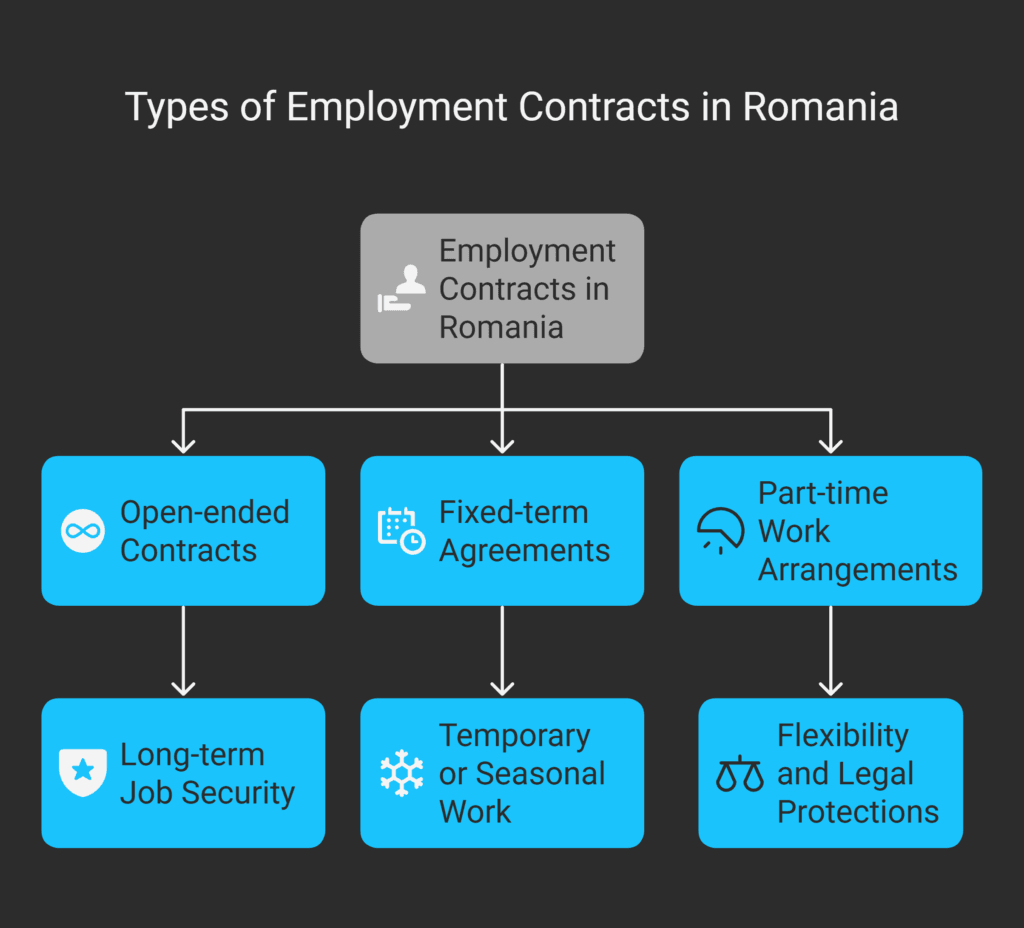
Romania has six main types of employment contracts.

Each is made for different work needs.

These contracts help with agreements for independent contractors, temporary jobs, and freelancers.

Open-ended Contracts

Open-ended contracts are the most common in Romania.

They offer long-term job security with no end date.

They include:

Fixed-term Agreements

Fixed-term contracts are for temporary jobs or seasonal work.

Romanian laws have rules for these contracts:

  1. Maximum contract duration: 36 months;
  2. Maximum of three contract renewals;
  3. Specific conditions for temporary work contracts;
  4. Detailed documentation requirements.

Part-time Work Arrangements

Part-time contracts offer flexibility.

They allow for fewer working hours while keeping legal protections.

They include:

  • Flexible working hours;
  • Proportional salary and benefits;
  • Suitable for freelance work contracts;
  • Clearly defined work schedules.

Choosing the right employment contract in Romania is vital.

It should match your business needs and workforce requirements.

Essential Components of Romanian Work Contracts

Creating a strong employment contract needs careful focus on key details.

These details protect both employers and employees.

Knowing how to draft contracts well is very important in Romania.

Your contract must have several important parts to follow the law and be clear.

These parts are the foundation of the employment agreement.

  • Employee and employer full identification details;
  • Precise job title and detailed job description;
  • Exact workplace location;
  • Detailed working hours specification;
  • Complete salary and compensation structure;
  • Contract duration and termination conditions;
  • Notice periods for contract termination.

The terms and conditions should be clear to avoid confusion.

Romania’s labor laws require certain things in employment contracts.

For example, contracts must be registered within a day before starting work.

Don’t forget about pay details.

Your contract must say how much you’ll earn in Romanian lei.

It should also cover any raises, bonuses, or extra pay.

By focusing on these key points, you’ll make a detailed employment agreement.

This agreement will meet legal standards and protect both sides.

Drafting Work Contracts in Romania

Creating strong employment contracts in Romania needs careful attention to legal details.

Your contract services must understand Romanian employment laws well.

This ensures both employer and employee are protected.

Creating a good contract means knowing the legal templates Romania offers.

It’s important to get professional legal advice to avoid mistakes in the drafting process.

Contract Structure and Format

Romanian employment contracts have a specific structure.

They must include important elements:

  • Detailed job description;
  • Compensation and benefits information;
  • Work location and responsibilities;
  • Duration of employment.

Legal Compliance Considerations

When making employment agreements, you must follow Romanian labor laws closely. Key compliance points include:

  1. Written confirmation of all contract terms;
  2. Precise job role definition;
  3. Clear compensation structure;
  4. Adherence to mandatory social protections.

Common Pitfalls to Avoid

When drafting contracts, knowing common mistakes is important. Key areas to watch out for include:

PitfallPotential Consequence
Vague Job DescriptionsLegal disputes and unclear expectations
Incomplete Compensation DetailsPotential salary conflicts
Missing Mandatory ClausesContract invalidity

Using professional legal templates from Romania can help avoid these issues.

Working with experienced contract drafting services ensures your agreements are solid and legally correct.

This protects both your organization and your employees.

Employee Rights and Protections

Employee Rights and Protections

It’s important to know about employee rights and protections in Romania.

The Romanian labor law has rules to protect workers’ rights.

These rules help make sure workplaces are fair and follow the law.

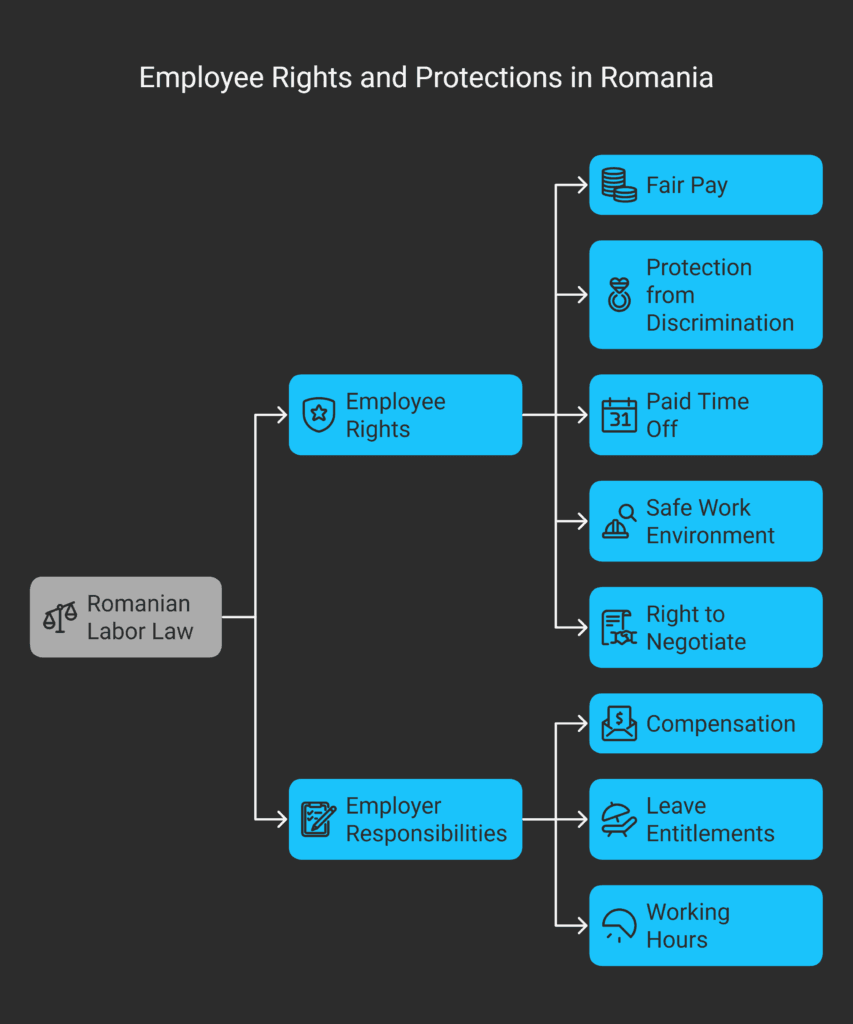
Some main employee rights in Romania include:

  • Fair pay and a minimum wage;
  • Protection from workplace discrimination;
  • Paid time off and vacation days;
  • A safe place to work;
  • The right to negotiate with employers.

Employers need to follow certain rules when making employment contracts.

These rules help make sure workers are treated fairly in all industries.

Right CategoryKey ProvisionsLegal Protection
CompensationMinimum monthly wage of 3,700 RONLabor Code Article 39
Leave EntitlementsMinimum 20 paid vacation days annuallyNational Labor Regulations
Working HoursMaximum 40-hour workweekEmployment Protection Laws

When following employer guidelines in Romania, companies should be open and respect workers’ rights.

This not only keeps them legal but also makes the workplace better for everyone.

By focusing on these rights, you can make your workplace more welcoming, productive, and legally correct in Romania.

Working Hours and Compensation Structures

Understanding wage regulations in Romania is key.

You need to know about employment law and workplace compliance.

This includes working hours, pay, and benefits.

Knowing these details helps avoid labor disputes.

Romanian work contracts outline the rules for work hours.

The standard week is 40 hours over five days.

Workers get fair pay and benefits.

Standard Working Hours

  • Maximum 40 hours per week;
  • 8-hour daily work limit;
  • Minimum rest period of 12 consecutive hours between work shifts.

Overtime Regulations

Overtime pay in Romania is clear.

Workers get 75% more than their regular pay for extra hours.

There are rules for overtime:

  1. Overtime must be approved in advance;
  2. Maximum 48 hours per week, including overtime;
  3. Compensation can be monetary or time off.

Salary and Benefits Requirements

As of January 2025, the minimum wage is RON 4,050 monthly.

Employers must also offer benefits and pay social security.

Important pay elements include:

  • Mandatory social security contributions;
  • Minimum 20 paid vacation days annually;
  • 15 public holidays with paid time off;
  • Non-taxable benefits like voluntary pension fund contributions.

Knowing these rules keeps your company legal and competitive in Romania.

Focus on fair pay and benefits to attract and keep good workers. This way, you avoid legal issues.

Probationary Periods and Contract Termination

Understanding termination clauses in Romania is key for employers and employees.

The Romanian Labor Code outlines rules for probation and contract end.

It protects both sides.

Probationary periods are a big part of jobs in Romania.

Here’s what you need to know:

  • Non-managerial jobs have a 90-day probation period.
  • Managerial jobs have a 120-day probation period.
  • Probation lets both sides check if they fit well together.

When it comes to contract termination in Romania, there are important points to remember:

  1. Termination is allowed for reasons like:
    • Company closure;
    • Redundancy;
    • Performance problems;
    • Major misconduct.
  2. Termination is not allowed during:
    • Pregnancy;
    • Maternity leave;
    • Parental leave.

Severance pay in Romania applies in certain cases:

Termination ScenarioSeverance Pay Requirement
Company CessationMinimum one month’s salary
Role RedundancyMinimum one month’s salary
Company RelocationMinimum one month’s salary

When ending a contract, follow the notice rules.

For regular jobs, it’s 20 working days.

For management roles, it’s 45 working days.

Always stick to the Romanian Labor Code to safeguard rights.

Special Clauses and Additional Provisions

Special Clauses and Additional Provisions

When making employment contracts in Romania, special clauses are key.

They protect both the employer and the employee.

Knowing these clauses helps manage workplace relationships and follow the law.

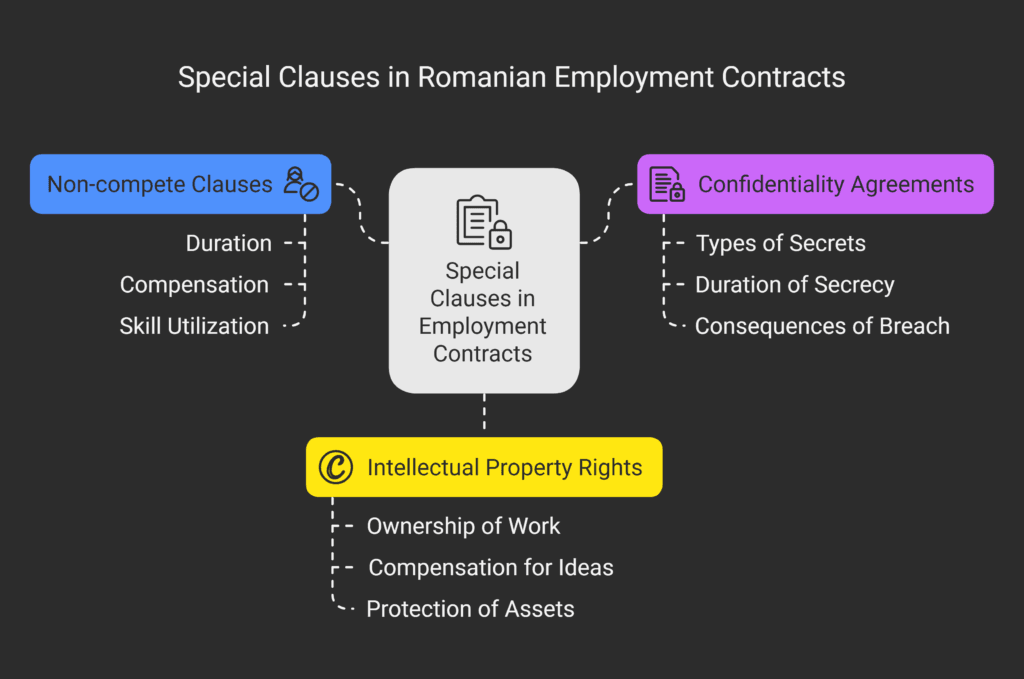
Non-compete Clauses in Romania

Non-compete clauses in Romania are important.

They stop employees from working for competitors after they leave.

These clauses have specific rules:

  • They can last up to 2 years after the contract ends;
  • The employee must get at least 50% of their average salary each month;
  • They can’t completely stop the employee from using their skills.

Confidentiality Agreements Romania

Confidentiality agreements in Romania keep business secrets safe.

You need to make sure:

  1. The types of secrets are clear;
  2. How long the secrecy lasts;
  3. What happens if someone breaks the agreement.

Intellectual Property Rights

Intellectual property in Romania needs careful planning.

Your contracts should cover:

  • Who owns work done while employed;
  • How to pay for new ideas;
  • How to protect creative assets.

By using these special clauses, you can make strong contracts.

They protect your business and follow Romanian laws.

Remote Work and Teleworking Agreements

Romania has changed its work policies to welcome digital nomads.

The country’s telework scene has grown a lot.

This change started in July 2017, when the Ministry of Labor suggested new rules for remote work.

It’s important to know the visa rules for digital nomads in Romania.

The new work laws offer a clear guide for remote work agreements.

They ensure both flexibility and legal safety.

  • Telework is defined as work done outside the usual office using technology;
  • Employees must sign a special agreement or addendum to work remotely;
  • Remote workers get the same rights as those in the office.

When making a remote work contract in Romania, you need to think about a few things.

The new work rules require specific details.

These include:

  1. What equipment is provided;
  2. How flexible work hours can be;
  3. How work performance is checked;
  4. How communication should happen.

Remote work is appealing because of the financial benefits.

Employers save on office space, utilities, and travel costs.

Employees enjoy better work-life balance and save time.

The pandemic made Romania adopt remote work faster.

About 50% of workers started teleworking during this time.

Now, digital nomads and local workers have clear, safe work rules.

Collective Bargaining Agreements and Their Impact

Collective bargaining agreements are key in Romania’s workforce rules.

They set out detailed rules for work and employee rights.

This is important for labor contracts in Romania.

To understand these agreements in Romania, you need to know their legal side and real-world effects.

Employers must see how these agreements can change individual work contracts.

  • Employers with 10 or more employees must engage in collective bargaining;
  • Negotiations must start 45 calendar days before the current agreement expires;
  • Collective agreements typically last between 12-24 months.

Following workplace rules in Romania means paying close attention to collective bargaining.

Important things to think about include:

RequirementSpecification
Minimum Negotiation MeetingsThree face-to-face meetings
Maximum Negotiation Period60 calendar days
Penalty for Non-ComplianceRON 5,000 to RON 10,000 fine

Your company needs to get ready well for collective bargaining.

Make a detailed first proposal, know the law, and negotiate smartly.

This helps protect both employer and employee interests.

Legal Consultation and Contract Review

Professional legal consulting in Romania is key to protecting your business.

When making employment contracts, getting help from experienced legal services in Romania can lower risks.

Studies show that companies with legal help in contract talks are 50% more likely to get good terms.

Contract review in Romania can spot unclear parts that might cause future problems.

About 60% of contract issues come from unclear terms.

Working with a specialized team of lawyers in Romania can make sure your contracts are clear, legal, and fit your business needs.

Understanding Romania’s legal system is complex.

With 80% of companies seeing regulatory changes as big risks, getting legal advice is vital.

Our team of Romanian Lawyers can craft contracts that cover important points like how to end a contract, who owns what, and how to deal with market changes.

For personalized advice and expert contract review, contact our team at office@theromanianlawyers.com.

We offer detailed legal services to safeguard your business and ensure you follow Romanian employment laws.

FAQ

What is the primary legal document governing employment contracts in Romania?

The Labor Code (Codul Muncii) is the main law for employment contracts in Romania.

It sets the rules for making, following, and ending employment agreements.

This ensures everyone follows the national labor laws.

Are written contracts mandatory in Romania?

Yes, written contracts are a must in Romania.

Every job must have a written contract (contract individual de muncă).

It must be in Romanian and registered with ReviSal, the online employee registry.

What are the main types of employment contracts in Romania?

Romania has three main types of employment contracts.

These are open-ended contracts, fixed-term agreements, and part-time work.

Each type has its own rules about how long it lasts and if it can be renewed.

What mandatory elements must be included in a Romanian work contract?

A Romanian work contract must have key details. These include:

– Who the employer and employee are;

– What the job is and what’s expected;

– Where the job is;

– How many hours to work;

– How much money is paid;

– How long the contract lasts;

– How much notice is needed to end the contract.

How long can probationary periods last in Romania?

In Romania, probationary periods depend on the job’s complexity.

– Up to 30 days for simple jobs;

– Up to 90 days for professional jobs;

– Up to 120 days for management jobs.

Are non-compete clauses legal in Romanian employment contracts?

Yes, non-compete clauses are legal in Romania.

But they must follow certain rules:

– The agreement must be in writing

– It must have reasonable limits in time and place

– The employee must get paid for it

– It must protect the employer’s real business interests

What are the rules for overtime in Romania?

Romanian laws say overtime can’t be more than 8 hours a week.

It must be:

– Agreed to by the employee

– Paid extra (usually 75% more than normal pay)

– Documented and approved by the employer

How does Romania handle remote work contracts?

Romania has rules for remote work under Law No. 81/2018.

It requires:

– A detailed remote work agreement;

– Clear ways to check work;

– Equipment and pay for remote work;

– Flexible hours.

What is the minimum wage in Romania for 2024?

In 2025, the minimum wage in Romania is  4,050 RON (about €814.18).

This must be in the contract and paid on time.

Can foreign companies hire employees in Romania?

Yes, foreign companies can hire in Romania.

They must:

– Set up a legal entity;

– Register with local authorities;

– Follow Romanian labor laws;

– Make contracts in Romanian;

– Pay all social contributions.

What protections exist for employees during contract termination?

Romanian laws protect employees when contracts end.

They include:

– Required notice periods;

– Possible severance pay;

– Protection from unfair dismissal;

– Right to appeal in court.

What are the key elements that must be included in an employment contract in Romania?

In Romania, an individual employment contract must contain several essential elements as per the Romanian Labor Code.

These include:

1. The identities of the parties

2. The workplace

3. Job description and duties

4. Working conditions and occupational hazards

5. Working hours

6. Holiday entitlements

7. Base salary and other compensation elements

8. Notice period for termination

9. The applicable collective labor agreement, if any 10.

Probationary period, if applicable the employment contract must be concluded in writing, in the Romanian language, before the employee starts work.

Both the employer and employee should sign the contract, with each party receiving a copy.

What are the different types of employment contracts available under Romanian law?

Romanian employment law recognizes several types of employment contracts:

1. Indefinite-term contracts: The most common type, with no specified end date;

2. Fixed-term contracts: Limited to a maximum of 36 months, with specific conditions for use;

3. Part-time contracts: For work less than 8 hours per day or 40 hours per week;

4. Temporary work contracts: For employees hired through temporary work agencies;

5. Home-based work contracts: For employees working from home;

6. Apprenticeship contracts: For professional training purposes Each type of contract has specific regulations and limitations under the Romanian Labour Code, and employers must ensure compliance with the relevant provisions when drafting these agreements.

How should the job description be formulated in a Romanian employment contract?

The job description is a crucial element of any employment contract in Romania.

It should be detailed and specific, outlining the employee’s main responsibilities, tasks, and duties.