Identifying Abusive Clauses in Romanian Consumer Contracts for Better Protection

Identifying Abusive Clauses in Romanian Consumer Contracts for Better Protection

Do you know that hidden, unfair terms in contracts could risk your consumer rights?

In Romania, the fight against these clauses is getting stronger.

Courts are dealing with more cases related to this issue.

This shows how important it is to be careful when signing agreements.

This is true, but even more so in banking and finance.

The Romanian civil code and consumer protection laws protect you from unfair terms.

But, many people don’t know their rights or how to spot these clauses.

Knowing the law is your best defense against unfair practices that could harm your finances.

Abusive Clauses in Romanian Consumer Contracts

Recently, the European Court of Justice made a big change.

Now, Romanian judges must check agreements for unfairness on their own.

This is a big step to make things fairer for consumers.

When dealing with consumer agreements, knowing is key.

By learning about common abusive clauses and your legal rights, you can make better choices.

You can also challenge unfair terms when needed.

For help with consumer rights and contract reviews, contact office@theromanianlawyers.com.

Key Takeaways

  • Romanian courts are seeing an increase in cases related to abusive clauses;
  • The European Court of Justice mandates ex officio assessment of unfair terms;
  • Law no. 193/2000 defines abusive clauses in consumer contracts;
  • Judges are required to restore contractual balance in unfair agreements;
  • Consumers should be aware of their rights under Romanian consumer protection laws;
  • Legal assistance is available for reviewing and challenging unfair contract terms.

Understanding Romanian Consumer Protection Framework

Romania’s consumer protection has grown a lot after joining the EU.

It aims to protect consumers from unfair contracts and ensure clear terms.

Let’s look at the main points of this framework.

Key Legislative Acts and Regulations

The Romanian consumer credit market has seen big changes to protect consumers better.

In 2021, 10 new rules were added to make contracts clearer.

These laws help make sure contracts are fair for everyone.

Scope of Consumer Protection Laws

Consumer laws in Romania cover many areas, like credit and financial services.

Yet, a 2023 survey found that 40% of consumers don’t know their rights.

This shows we need to teach more about the legal help available to consumers.

Romanian consumer protection framework

Regulatory Bodies and Enforcement Agencies

The National Authority for Consumer Protection (ANPC) and the Financial Supervisory Authority (ASF) are key in enforcing laws.

The ANPC said 25% of complaints in 2021 were about unfair contract terms.

The ASF works to prevent and solve problems, helping to educate consumers.

AspectData
Consumers encountering abusive clauses30%
Contracts with unclear terms35%
Consumers seeking legal advice15%
Consumers reading terms before signing20%

Legal Definition of Abusive Clauses under Romanian Law

Romanian law says abusive clauses are terms that make deals unfair.

These clauses often sneak into contracts without the consumer’s say.

The law, no. 193/2000, helps protect consumers from these unfair practices.

Predatory lending often uses these unfair terms.

These terms usually favor the business a lot.

For instance, clauses that let one side change the deal or impose huge penalties are seen as unfair.

Predatory clauses in consumer contracts

  • Lack of direct negotiation with the consumer;
  • Significant imbalance in rights and obligations;
  • Violation of good faith principles.

Knowing this law helps you spot unfair terms in contracts.

If you find terms that seem unfair or one-sided, they might be abusive.

Always check agreements well and get legal help if you think there are unfair clauses.

Abusive Clauses in Romanian Consumer Contracts
Abusive Clauses in Romanian Consumer Contracts

The Romanian legal system has become tougher on abusive clauses in consumer contracts.

Recent changes aim to protect consumers from unfair practices.

The Emergency Government Ordinance no. 58/2022, which took effect on May 28, 2022, brought significant updates to regulatory enforcement.

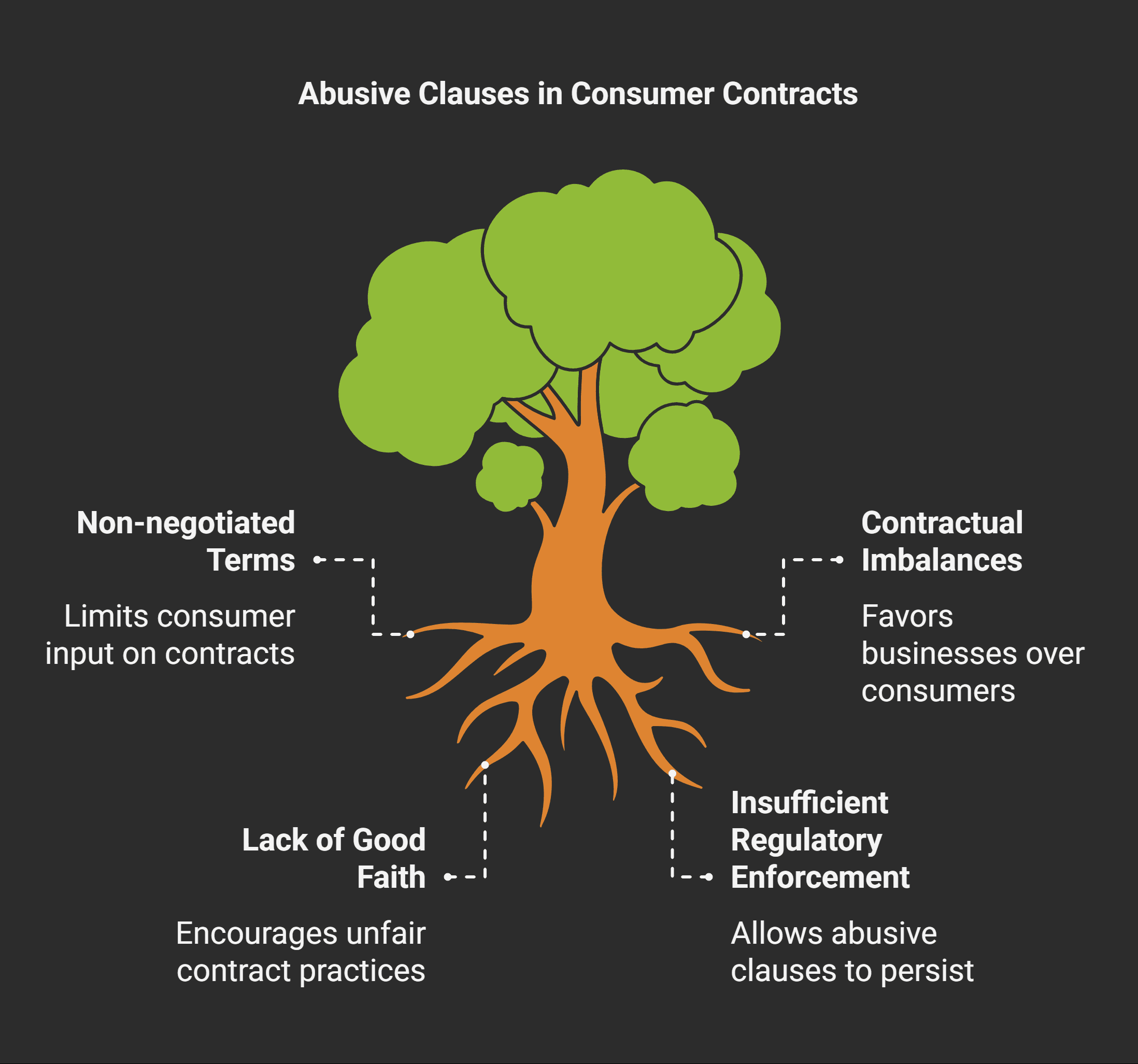
Non-negotiated Contract Terms

Non-negotiated terms often appear in standard form contracts.

These clauses can be problematic for consumers who have little say in their content.

The Romanian legal system now requires courts to analyze potentially abusive clauses as soon as they have enough legal and factual evidence.

Significant Contractual Imbalances

Contractual imbalances that heavily favor businesses over consumers are now subject to stricter scrutiny.

Sanctions for abusive clauses range from RON 20,000 to RON 100,000.

For large-scale violations, fines can reach up to 4% of a company’s turnover in Romania.

Good Faith Requirements

Businesses must act in good faith when drafting contracts.

The new regulations address issues like dual-quality products, with fines doubling if more than 100 consumers are affected.

Courts now have the power to order the removal of abusive clauses from all current contracts.

Violation TypeFine Range (RON)Maximum Fine for Large-scale Violations
Abusive Clauses20,000 – 100,000Up to 4% of annual turnover
Dual-quality Products20,000 – 100,000Up to 4% of annual turnover
Non-fulfillment of Court Orders5,000 – 200,000N/A

These changes reflect Romania’s commitment to aligning with EU standards and protecting consumers from unfair practices.

The increased fines and stricter enforcement measures aim to deter businesses from including abusive clauses in their contracts.

Common Types of Predatory Clauses in Consumer Agreements
Predatory Clauses in Consumer Agreements

Many consumer contracts have clauses that are unfair.

These clauses can harm consumer rights and lead to unfair practices.

Let’s look at some common types found in Romanian consumer agreements.

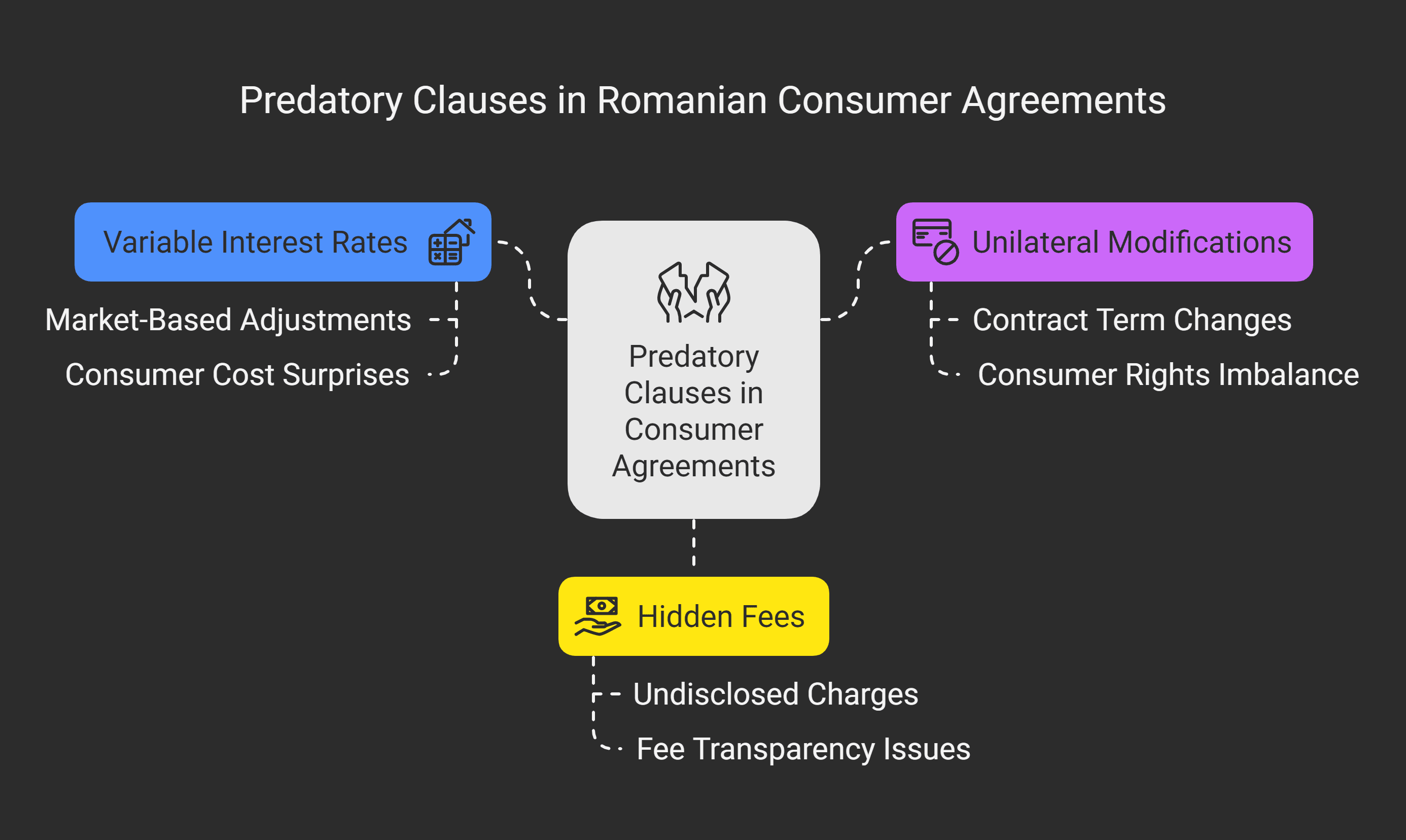
Variable Interest Rate Provisions

Variable interest rate clauses let lenders change rates based on the market.

They seem fair but can surprise consumers with higher costs.

Banks might use this to their advantage, violating consumer rights and needing legal action.

Unilateral Contract Modifications

Some agreements let companies change terms without asking the consumer.

This creates a big imbalance, usually in favor of the business.

It’s important for regulators to watch out for this to protect consumer rights.

Hidden Fees and Charges

Many contracts hide extra costs in small print or hard-to-understand language.

These hidden fees can make things much more expensive.

Consumers should watch out and seek legal help if they find these tricks.

Clause TypePotential ImpactConsumer Protection Measure
Variable Interest RatesUnexpected cost increasesInterest rate caps
Unilateral ModificationsUnfavorable contract changesMandatory notification periods
Hidden FeesHigher than advertised costsClear fee disclosure requirements

The National Authority for Consumer Protection (ANPC) has been cracking down on hidden fees and changes in consumer contracts.

This includes actions in the banking sector.

Their goal is to make sure consumer rights are respected and to fix unfair contract terms in different industries.

Consumer Rights and Legal Protections

Romanian consumers have strong legal protections against unfair terms and predatory practices.

The Consumer Protection Law No. 21/1992 is key to these safeguards.

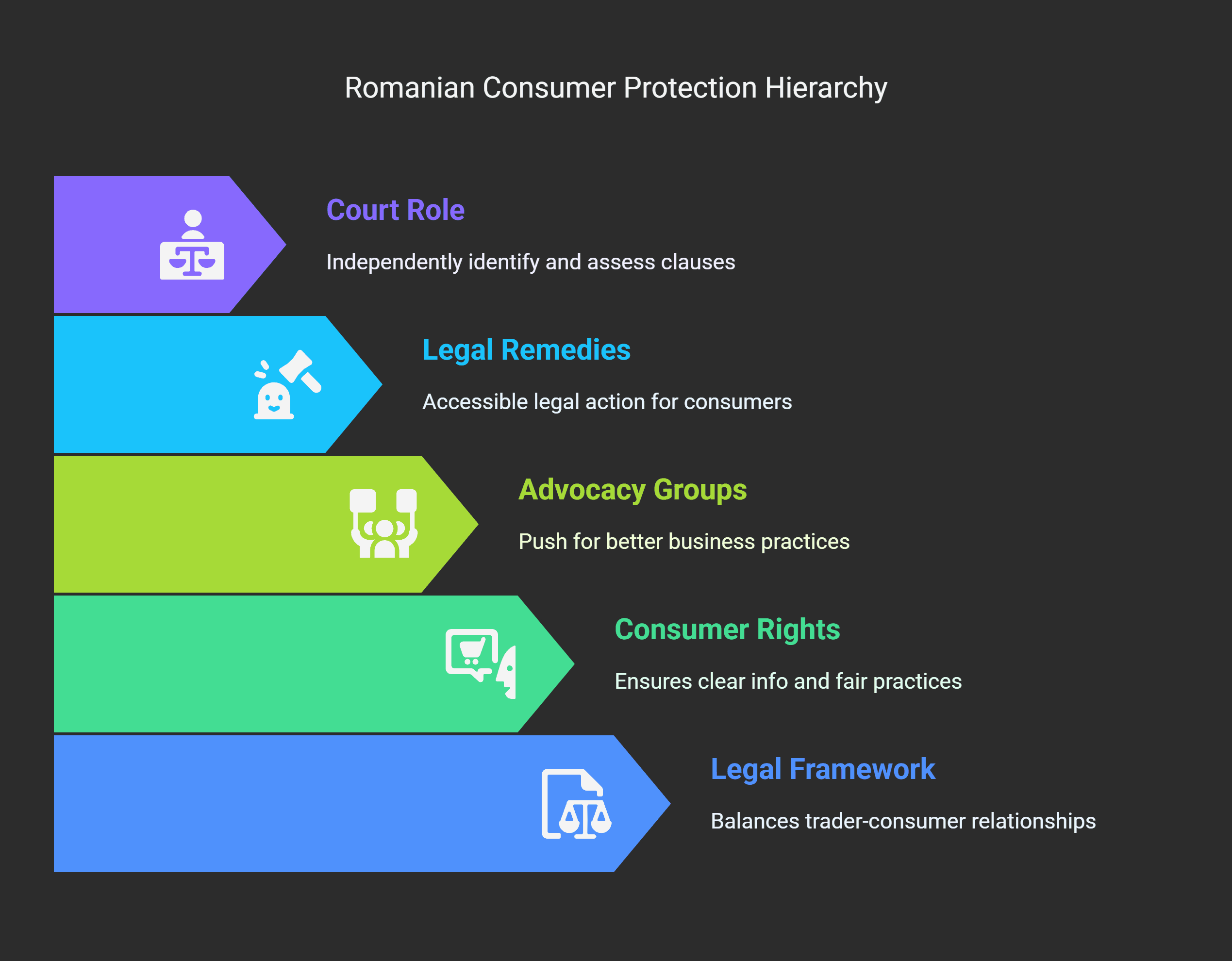
It aims to balance the relationship between traders and consumers.
Consumer Rights and Legal Protections in Romania

Your rights as a consumer in Romania include:

  • Clear information about products and services;
  • Compensation for damages;
  • Safety from harmful goods;
  • Protection against unfair trading practices;
  • Shield from abusive contract clauses.

Consumer rights advocacy groups are vital in pushing for better business practices.

They offer support and guidance when dealing with unfair contract terms.

Legal remedies for consumers have been improved.

Fines for unfair terms now range from RON 20,000 to RON 100,000.

In cases affecting over 100 consumers, these fines can double.

If you face predatory practices, you can challenge them.

Consumer associations can publish final court judgments within 45 days.

This increases transparency.

You’re also exempt from court bond payments if your monthly income is below two minimum wages.

This makes legal action more accessible.

Consumer RightLegal BasisProtection Offered
Right to InformationLaw No. 21/1992Clear, comprehensible contract terms
Right to NegotiateEmergency Ordinance No. 58/2022Protection against non-negotiated terms
Right to ChallengeLaw No. 193/2000Ability to contest unfair clauses

Role of Courts in Identifying Abusive Clauses

Romanian courts are key in protecting consumers from unfair terms.

They can check if contract clauses are abusive, even if no one complains.

This power comes from EU laws and helps protect consumers.

Ex Officio Assessment Powers

Romanian courts can find and fix unfair terms in contracts on their own.

This helps keep consumers safe, even if they don’t know they’re being taken advantage of.

The courts look closely at contracts to make sure they’re fair.

Judicial Interpretation Guidelines

Romanian courts have rules to follow when checking contracts.

They look at who gets what, if the contract is clear, and how it affects consumers.

They also watch out for clauses that change things without notice and hidden fees.

Legal Precedents and Case Law

Important court decisions guide how Romanian courts deal with contracts. For example, the European Court of Justice said courts must check if terms are unfair on their own. This has made Romanian courts more careful with consumer contracts.

Key AspectCourt’s Role
Ex Officio AssessmentIndependently identify abusive clauses
Interpretation GuidelinesEvaluate balance, clarity, and economic impact
Legal PrecedentsApply ECJ rulings to national cases

Banking and Financial Contract Protections

Romania has strong laws for banking and financial contracts.

These laws protect consumers by making sure contracts are clear and fair.

The Romanian Civil Code and laws like O.U.G. no. 50/2010 and O.U.G. no. 52/2016 are key to these protections.

Foreign Currency Loan Agreements

Foreign currency loans can be risky for consumers.

The Civil Code says borrowers must pay back the full amount, no matter the currency’s value.

This can be tough when currency values change.

The case of Șerban vs. Banca Transilvania SA showed the challenges of foreign currency loans.

It highlighted the need for better consumer protection.

Credit Agreement Safeguards

Credit agreements in Romania must follow strict rules.

O.U.G. no. 50/2010 makes sure interest rates, fees, and repayment terms are fair.

For mortgage loans, O.U.G. no. 52/2016 adds extra protections based on EU rules.

Risk Disclosure Requirements

Transparency is very important in financial contracts.

Banks must tell consumers about the risks of their products.

The Financial Supervisory Authority (A.S.F.) makes sure this happens, so consumers know what they’re getting into.

LawPurposeKey Provisions
Civil CodeGeneral loan regulationNominal amount repayment, interest rules
O.U.G. no. 50/2010Consumer credit agreementsInterest rates, fees, repayment terms
O.U.G. no. 52/2016Mortgage loansResidential property credit protections

Knowing about these protections helps you make better choices when dealing with financial agreements.

Always check the contract terms and ask for help if something is unclear.

This way, you can make sure your rights are looked after under Romanian contract law.

Remedies and Legal Actions Available to Consumers
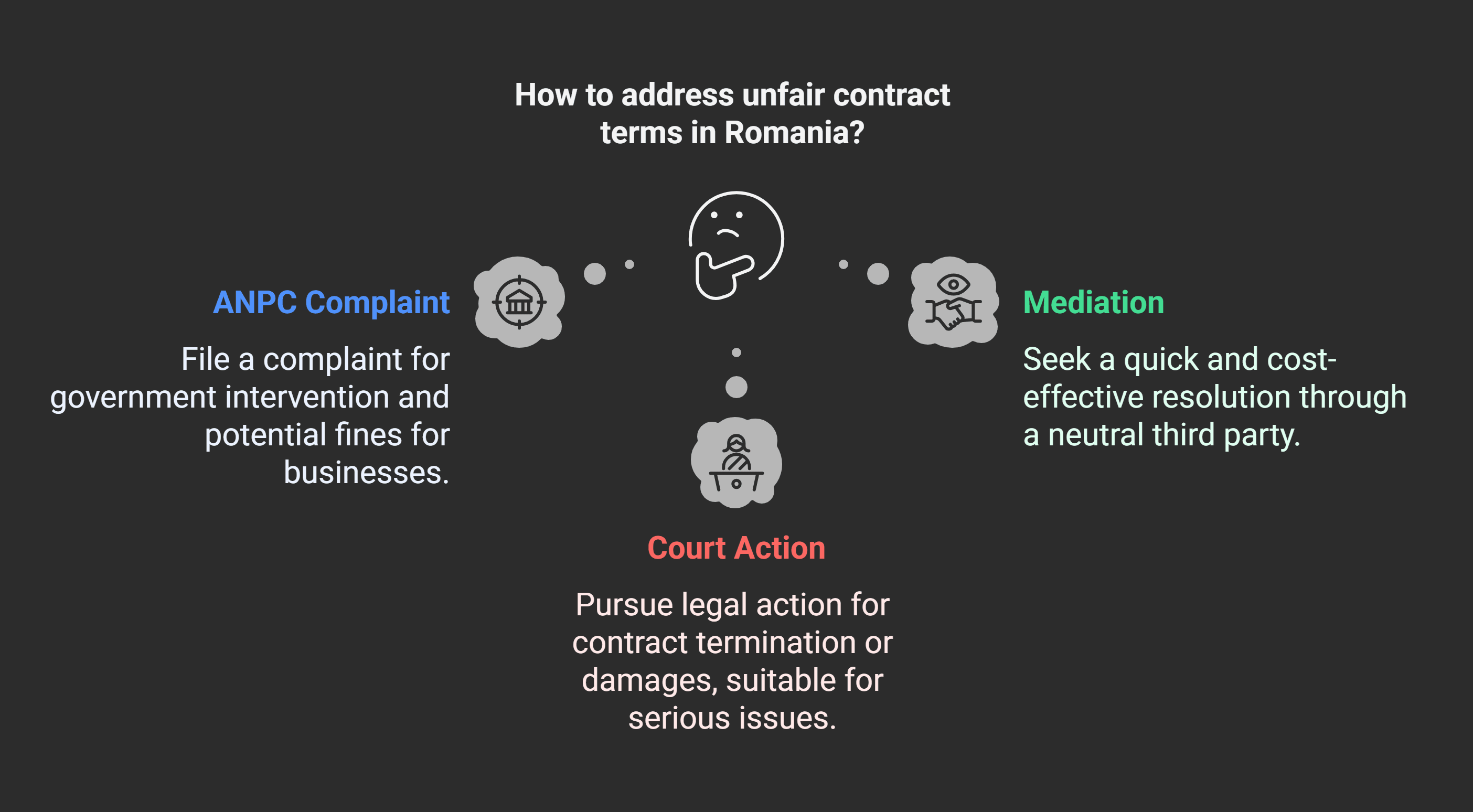
Remedies and Legal Actions Available to Consumers in Romania

Romanian laws help consumers deal with unfair contract terms.

The National Authority for Consumer Protection (ANPC) is key in keeping things fair.

It protects your rights as a consumer.

If you find unfair terms, you can report it to ANPC.

They check businesses and can fine them if they break the law.

In 2022, they even fined hotels for not being clean or serving bad food.

Mediation is another way to solve problems without going to court.

It’s quicker and cheaper than legal battles.

For bigger issues, you can go to court.

Romanian law lets you ask for fixes, refunds, or to cancel the contract.

Consumer groups can also sue on your behalf.

RemedyDescriptionTimeframe
ANPC ComplaintFile a complaint with the National Authority for Consumer Protection15-30 days for initial response
MediationSeek resolution through a neutral third partyVaries, typically 1-3 months
Court ActionFile a lawsuit for contract termination or damagesCan take several months to years

Remember, EU law makes unfair contract terms invalid.

This means you keep your rights, even when faced with unfair contracts.

European Union Influence on Romanian Consumer Protection

The European Union has greatly influenced Romania’s consumer protection laws.

This has led to better protection against unfair contract terms and predatory business practices.

EU Directives Implementation

Romania has adopted key EU directives to boost consumer rights.

Law no. 193/2000, for example, makes sure consumer contracts are fair.

It aims to protect consumers from unfair business tactics.

Cross-border Consumer Protection

EU rules also protect Romanian consumers when they deal with businesses from other EU countries.

This safeguard helps prevent unfair treatment in international deals.

Harmonization with EU Standards

The Romanian legal system works closely with the European Court of Justice.

This ensures EU consumer protection laws are applied correctly.

The court’s decisions have been key in clarifying what makes a contract unfair.

EU DirectiveRomanian ImplementationKey Provisions
Directive 2011/83/EC (Consumer Rights)Government Emergency Ordinance no. 34/201414-day withdrawal period for distance contracts
Directive 93/13/EEC (Unfair Terms)Law no. 193/2000Protection against significant contractual imbalances
Directive 2005/29/EC (Unfair Commercial Practices)Law no. 363/2007Regulation of misleading and aggressive practices

These EU laws have made consumer protection in Romania stronger.

They address unfair contract terms and business practices.

The ongoing effort to align with EU standards ensures Romanian consumers get the best legal protection.

Steps to Challenge Abusive Contractual Terms

Dealing with unfair contract terms?

You have rights as a consumer in Romania.

Here’s how to fight back:

  1. Check your contract for any unfair changes, unclear language, or high fees.
  2. Collect all important documents, like emails or letters from the company.
  3. Report the issue to the National Authority for Consumer Protection (ANPC) within 15 days.
  4. If ANPC doesn’t help, you can take legal action in court.
  5. Get advice from a Romanian lawyer who specializes in consumer rights to guide you.

Remember, bank loans often have strict rules.

Watch out for high interest rates, hidden costs, and sudden payment changes.

Knowing your rights under the Romanian Civil Procedure Code is key.

When fighting foreclosure, act fast.

You must defend yourself within 15 days at the local court.

Winning can cancel the foreclosure and refund your costs.

But losing means you’ll have to pay more and court fees.

By acting quickly and getting legal advice, you can defend against unfair contracts.

This way, you make sure your consumer rights are respected.

Conclusion

As Romania gets closer to EU standards, protecting consumers gets even better.

Laws like the one on abusive clauses are being updated.

Keep an eye out, know your rights, and help make sure contracts are fair in Romania.

It’s important to know the laws in Romania about protecting consumers.

You might ask, what are abusive clauses?

These are terms that make it unfair for you and favor the trader too much.

Examples include changes made without your agreement, harsh penalties, and hidden fees.

If you think your contract has unfair terms, get legal help fast.

The Consumer Protection Law No. 21/1992 helps keep you safe from unfair practices.

Also, remember, traders can’t make you agree to terms you don’t understand.

Breaking these rules can lead to big fines.

Companies might have to pay up to 5% of their income.

The ANPC can also fine them and even close their business if they keep breaking the rules.

For expert advice, you can reach out to Atrium Romanian Lawyers.

Our team of lawyers in Romania is known for their business law expertise in Romania.

Romania’s consumer protection laws follow EU standards.

You have 15 days to ask for fixes or new products if something is wrong.

If you need help with unfair liability clauses, there are many legal resources to help protect your rights.

FAQ

What constitutes an abusive clause under Romanian law?

In Romania, an abusive clause is a term in a contract that wasn’t negotiated individually.

It creates a big imbalance in the rights and duties of the parties, hurting the consumer.

These clauses are often in standard contracts and go against the principle of good faith.

How can I identify potentially abusive clauses in my contracts?

Look for terms that limit your rights or impose harsh penalties.

Also, watch out for clauses that let one side change the contract without your consent.

If a term seems unfair or unclear, it might be abusive.

What should I do if I suspect a contract I’ve signed contains abusive clauses?

First, carefully review the contract and find the clauses you think are abusive.

Then, you can file a complaint with the National Authority for Consumer Protection (ANPC) or get legal advice.

You might also challenge the clause in court or through alternative dispute resolution.

Can I negotiate or modify standard form contracts?

Yes, you can ask for changes in standard contracts. Some businesses might agree to modify certain terms.

If they say no and you think the terms are unfair, you can get help from consumer protection agencies or lawyers.

What are the most common types of abusive clauses in Romanian consumer contracts?

Common abusive clauses include terms that let one side change the contract without your consent.

They also include harsh penalties for breaking the contract, limits on the business’s liability, and unfair dispute resolution mechanisms.

Variable interest rates and hidden fees are also often problematic.

How long do I have to challenge an abusive clause after signing a contract?

There’s no time limit in Romania to challenge abusive clauses.

It’s best to act quickly when you find out about the issue.

The time limit for contractual claims is usually three years, but it can vary based on your case.

What are the possible consequences for businesses that use abusive clauses?

Businesses using abusive clauses might face fines from the ANPC.

Courts can also declare these clauses invalid, affecting the whole contract.

Repeated offenses can lead to harsher penalties and harm the company’s reputation.

In some cases, the business might have to pay affected consumers.

How does Romanian consumer protection law compare to EU standards?

Romanian consumer protection laws are mostly in line with EU standards.

Romania has adopted key EU directives, like Directive 93/13/EEC on unfair terms in consumer contracts.

The country keeps aligning its laws with EU regulations, ensuring Romanian consumers get similar protections as those in other EU countries.

Are there any specific industries or sectors where abusive clauses are more common?

Abusive clauses are often seen in banking and financial services, telecommunications, utility contracts, and rental agreements.

These sectors use standard contracts a lot, making them more likely to include unfair terms.

Where can I find legal assistance if I need help with an abusive clause issue?

You can get help from consumer protection associations, legal aid groups, or lawyers who specialize in consumer law.

The National Authority for Consumer Protection (ANPC) also offers support.

Some universities and non-profit groups have free legal clinics for consumer rights issues.

What are abusive clauses in consumer contracts and how are they defined under Romanian law?

In Romania, abusive clauses (also known as unfair terms) in consumer contracts are defined by Law No. 193/2000 regarding unfair terms in consumer contracts.

An abusive clause is a contractual provision that has not been directly negotiated with the consumer and which, contrary to the requirement of good faith, creates a significant imbalance between the rights and obligations of the parties, to the detriment of the consumer.

The Romanian legislation is aligned with the European Union Directive 93/13/EEC. A clause is abusive when it creates this imbalance, giving the professional (seller or service provider) an unfair advantage over the consumer.

It’s important to note that abusive terms are not binding on consumers, even if they have signed the contract.

What is the comprehensive list of abusive clauses recognized under Romanian consumer law?

Romanian Law No. 193/2000 regarding consumer protection against unfair terms provides a non-exhaustive list of abusive provisions.

Some examples of abusive clauses in consumer contracts include:

1. Terms that exclude or limit the legal liability of the professional for damages caused to the consumer

2. Clauses that restrict the consumer’s right to terminate the contract

3. Terms that allow the professional to unilaterally modify the contract terms without a valid reason

4. Clauses that bind the consumer while making the professional’s obligations subject to conditions whose realization depends solely on their will

5. Terms imposing disproportionate penalties on consumers for breach of contractual obligations

6. Clauses allowing professionals to transfer the contract without the consumer’s consent when this might reduce guarantees.
Inheritance in Romania: Succession, Tax, and Navigating Romanian Law

Inheritance in Romania: Succession, Tax, and Navigating Romanian Law

Ever thought about how inheritance laws in Romania could affect your family’s future?

Understanding Romanian inheritance laws can be tough, even for those who know the country well.

It’s key to grasp succession laws and estate planning to protect your assets and make sure your wishes are followed.

Starting in 1990, Romania has seen more people asking about inheritance laws.

This change, along with the EU Regulation 650/2012 in 2015, has made Romanian succession laws more complex.

Whether you live in Romania or own property there, knowing these laws is vital for planning your estate.

Inheritance in Romania

Romanian inheritance laws follow a civil law system, focusing on statutory rights for heirs.

This means children and spouses have guaranteed shares, even if a will says differently.

Without a will, the estate goes to relatives in a specific order, as the Romanian Civil Code dictates.

Getting help from a legal expert is often necessary when dealing with inheritance in Romania.

The rules for cross-border inheritance, taxes, and property transfers can be very complex.

An expert can guide you through your rights, legal steps, and ensure your assets are passed on smoothly to your loved ones.

Key Takeaways

  • Romanian inheritance laws prioritize statutory rights and forced heirship;
  • EU Regulation 650/2012 impacts succession rules for cases after August 17, 2015;
  • Intestate succession follows a predetermined order established by the Romanian Civil Code;
  • Professional legal assistance is key for complex inheritance procedures;
  • Regular updates to estate plans are recommended to align with changing laws and personal circumstances.

Understanding Romanian Inheritance Law Framework

The Romanian Civil Code is key to understanding inheritance laws in Romania.

It outlines the rules and procedures for succession rights.

It covers testamentary dispositions and intestate succession, providing a clear framework for inheritance.

Legal Basis and Civil Code Provisions

Romanian inheritance law is based on the Civil Code.

It defines legal heirs and their rights.

The code gives priority to family members, like children, spouses, and parents.

It also sets a hierarchy for succession without a will.

This includes descendants, ascendants, and collaterals.

Romanian inheritance law framework

Jurisdiction and Applicable Laws

Inheritance laws in Romania apply to both residents and non-residents with assets here.

The Romanian legal system has jurisdiction over all property within its borders.

This ensures consistent handling of succession matters for Romanian-based assets.

Key Legal Principles in Romanian Succession

Several key principles guide succession rights in Romania.

These include the recognition of three types of testaments: holographic, notarial, and secret.

For a will to be valid, it must be written, signed, and dated by the testator.

The law also protects certain heirs through reserved portion rights.

This limits a testator’s freedom to dispose of their entire estate.

Understanding these legal principles is vital for anyone dealing with inheritance in Romania.

They provide a solid foundation for navigating succession complexities and ensuring compliance with Romanian law.

Types of Succession Under Romanian Law

Romanian inheritance law has two main types: testamentary and intestate succession.

Knowing these is key for handling inheritance in Romania.

Types of inheritance romania

Testamentary succession in Romania happens with a valid will.

It lets people decide how their assets are shared after they pass away.

Wills in Romania can be handwritten, notarized, or made in special cases.

Intestate succession in Romania is for when there’s no will.

The law then decides how assets are split, usually favoring family first.

This means children, spouses, and parents get priority.

Succession TypeKey Features
TestamentaryBased on a valid will, allows personal asset distribution choices
IntestateFollows legal provisions, prioritizes family members

Both types of succession in Romania have rules.

For example, children and spouses have guaranteed shares of the estate.

Inheritance tax is low, at 1% if the transfer is after two years of the decedent’s death.

Knowing about these succession types helps you understand Romanian inheritance law better.

It ensures your estate is planned and distributed correctly.

Legal Heirs and Their Rights in Romania

It’s important to know about legal heirs in Romania and their rights.

Romanian law has four classes of legal heirs.

Each class has its own rights and order in the inheritance process.

Classes of Legal Heirs

The Romanian Civil Code clearly lists the order of inheritance:

  • First Class: Descendants (children, grandchildren);
  • Second Class: Parents and siblings;
  • Third Class: Grandparents and other ascendants;
  • Fourth Class: Extended family members.

Heirs in higher classes get priority over those in lower classes.

Closer relatives get more than distant ones within each class.

Legal heirs romania

Reserved Portion Rights

Reserved portion rights in Romania protect some heirs from being left out.

These rights make sure close family members get a fair share of the estate.

This is true even if the deceased wanted to leave them out.

HeirReserved Portion
Children1/2 of legal share
Surviving Spouse1/4 of estate
Parents1/4 of estate (if no children)

Disinheritance Rules

Disinheritance rules in Romania let testators exclude heirs under certain conditions.

Reasons include serious wrongs against the deceased or their family.

Courts can check these cases to make sure they follow the law.

Inheritance in Romania: Process and Procedures

The inheritance process in Romania is detailed and follows the Civil Code.

It involves notaries and courts working together.

This ensures assets are passed on to the right heirs.

Knowing the steps can help you understand this complex journey.

Opening the Succession

The first step is opening the succession.

A notary public must start this in the court area where the deceased lived.

The notary checks the family situation and verifies property documents and any will.

Notarial Proceedings

Notarial proceedings are key in the probate process in Romania.

The notary’s office is in the court area where the deceased lived.

Heirs have choices during these proceedings:

  • Accept the inheritance;
  • Accept under the benefit of inventory;
  • Renounce the inheritance.

Inheritance procedure in Romania

Required Documentation

To finish the inheritance process in Romania, you need certain documents.

These include:

  • Death certificate of the deceased;
  • Proof of kinship for heirs;
  • Property ownership documents;
  • The will, if one exists.

Heirs have one year to claim their inheritance after it’s opened.

If there are disputes, the court may step in.

Getting legal help can make navigating the process easier in Romania.

Romanian Testament Requirements

Romanian will and testament requirements

Making a valid will in Romania is key to passing on your assets as you wish.

Romanian laws allow for three types of wills: holographic, notarial, and secret.

Each has its own rules for being valid in Romania.

A holographic will is handwritten, dated, and signed by you.

It’s simple to make but less secure.

Notarial wills, made by a public notary, are safer.

Secret wills mix both, keeping your wishes private but legal.

When making a Romanian will, keep these points in mind:

  • Be clear about who gets what;
  • Choose someone to handle your estate;
  • Follow rules for spouses and children;
  • Make sure it’s dated and signed right.

Don’t think a printed document with a signature is enough under Romanian law.

For a will that’s legally sound, get help from a professional.

This can prevent arguments and make sure your wishes are followed.

Intestate Succession Rules

Intestate succession in Romania means how assets are shared when someone dies without a will.

The law has rules for who gets what and how much.

This ensures a fair split among family members.

Order of Inheritance

In Romania, the order of inheritance is clear.

First, children and spouses get the assets.

If there are no children, then parents, siblings, and more distant relatives get a share.

This way, everyone gets a fair piece of the estate.

Distribution of Assets

The rules for dividing up an estate are strict.

If there are multiple heirs in the same class, they get an equal share.

For example, if a person leaves a spouse and two kids, the estate is split into three parts.

The 2009 civil code also allows for dealing with heirs who don’t want to claim their share.

State’s Rights in Vacant Succession

If there are no legal heirs or they don’t claim the inheritance, the state takes it.

This is called vacant succession.

It makes sure that unclaimed assets benefit the public, not just sit idle.

Heir ClassInheritance ShareConditions
ChildrenEqual partsFirst in line
SpouseEqual to child’s shareInherits alongside children
ParentsEqual partsIf no children
SiblingsEqual partsIf no children or parents
StateEntire estateIf no legal heirs

Inheritance Tax Obligations in Romania

In Romania, the inheritance tax is quite low.

This makes the country a good place for passing on wealth.

It’s important to know about the tax rules to plan your estate well.

The tax rate on inheritance in Romania is 1% of the estate’s value.

This rule applies to assets received after two years of the person’s death.

If you settle the inheritance within two years, you won’t have to pay this tax.

When you claim your inheritance can affect your taxes.

There’s no strict deadline to start the process.

But, settling within two years can save you a lot of money.

This gives heirs more control over their inheritance.

Time FrameTax Rate
Within 2 years0%
After 2 years1%

For court procedures, you’ll need to pay a judicial stamp duty of 5% of the estate’s value.

Notarial procedures are quicker but cost more based on the estate’s value.

The authority for notarial procedures depends on the deceased’s last home or where the assets are if they lived abroad.

Getting professional help is key when dealing with inheritance taxes in Romania.

The rules can be tricky, and experts can guide you.

They help you manage your inheritance legally and efficiently.

Cross-Border Inheritance Issues

Handling international inheritance in Romania can be tricky.

The EU Succession Regulation makes things easier for EU citizens.

But, those outside the EU might face different rules.

It’s key to know these rules when dealing with Romanian assets or heirs.

EU Succession Regulation

The EU Succession Regulation lets people choose the law of their nationality for inheritance.

This rule applies in the EU and some non-EU countries, except for Denmark and Ireland.

Romanian authorities can reject rules that go against local policies, like discrimination.

International Property Rights

Cross-border inheritance in Romania includes all assets, no matter where they are.

This means cars, bank accounts, and houses are all covered.

The law of the deceased’s last home decides who gets what, who can’t be left out, and special shares for family members.

Conflict of Laws

Conflicts can happen when different laws apply to inheritance.

The EU Succession Regulation tries to reduce these by using the law of the deceased’s last home.

But, things like inheritance tax, marital status, and property rules are not covered by EU rules.

This makes international inheritance in Romania more complex.

For smooth asset transfers in cross-border inheritance, getting legal advice is vital.

It helps follow both Romanian and international laws.

This protects your rights and makes the inheritance process easier.

Role of Public Notaries in Romanian Inheritance

Public notaries are key in the Romanian inheritance process.

They manage notarial proceedings and help people through the complex probate process.

Their knowledge ensures wills are executed correctly, assets are distributed fairly, and disputes are solved.

In Romania, notaries are vital for many life events, including inheritance.

They help protect the rights of minors and the elderly during succession.

Public notaries in Romania verify and authenticate legal documents like wills and contracts.

AspectNotarial ServicesLitigation
Cost0.5% – 1% of transaction valueSeveral times higher
TimeFew hours to several daysMonths to years
Legal CertaintyHighUncertain

For help with notarial proceedings in Romanian inheritance, contact office@theromanianlawyers.com.

They can guide you through the probate process, ensuring a smooth and legal inheritance.

Inheritance Disputes and Resolution

Inheritance disputes in Romania can be complex and emotionally charged.

Understanding the common causes, legal remedies, and court procedures can help you navigate these challenging situations more effectively.

Common Causes of Disputes

Inheritance disputes in Romania often arise from contested wills, disagreements over asset valuation, or conflicts between heirs.

These disputes can strain family relationships and complicate the mourning process.

Legal Remedies

When facing inheritance disputes in Romania, you have several legal options.

Mediation offers a less adversarial approach to resolving conflicts.

If mediation fails, you may need to pursue court proceedings.

Consulting with a specialist in probate and estate planning is key for understanding your rights and the best course of action.

Court Procedures

Court procedures for inheritance disputes in Romania involve filing a claim with the competent court.

The court can intervene to pronounce the opening of inheritance and resolve disputes between heirs.

It’s important to maintain detailed records of all communications and decisions related to the estate, as these can be key in court proceedings.

If you’re facing inheritance disputes in Romania, seeking professional legal assistance is essential.

Contact our team of lawyers in Bucharest for expert guidance in navigating the complexities of Romanian inheritance law and resolving disputes effectively.

Property Transfer and Registration

Handling property transfer in Romania can be tricky.

There are several ways to transfer assets, like agreements or court decisions.

Knowing these options is key for a smooth process.

Legal succession follows Romanian law if there’s no will.

Testamentary succession follows the will of the deceased.

Both need careful legal handling.

The Romanian Law Firm Atrium Romanian Lawyers advises getting a real estate lawyer. Our team of Romanian lawyers guide through property acquisition and transfer.

We make sure everything follows the law and help with reports.

Important points for property registration in Romania include:

  • Heir Certificates from the old Civil Code need the succession author’s property title for first-time land book registration.
  • New Civil Code Heir Certificates serve as property titles themselves.
  • Registration rejections can occur due to missing Land Book Extracts or unpaid property transfer fees.
  • Certificates of Heir must be issued by Romanian Public Notaries.
  • Successors are registered as joint owners with shared quotas in land books.

Remember, the official language for submissions in public institutions is Romanian.

This affects how foreign documents are processed in property transfer Romania cases.

Acquisition MethodDescription
AgreementMutual consent between parties
Legal InheritanceDistribution according to law
Testamentary InheritanceDistribution as per will
AccessionNatural or artificial attachment
Usucaption30-year possession minimum
Court DecisionsLegal rulings on ownership

Special Rules for Agricultural Land Inheritance

In Romania, inheriting agricultural land has its own set of rules.

The country’s land registry and rules on foreign ownership play a big role.

It’s important to know these rules to make the inheritance process smooth.

Land Registry Requirements

To inherit agricultural land in Romania, you must register it with the land registry.

You’ll need to provide certain documents to prove the transfer of ownership.

The registry keeps detailed records of the property, like its size and location.

Foreign Ownership Restrictions

Romania has rules on who can own agricultural land.

If you’re not from Romania, inheriting farmland might be harder.

The goal is to protect local farming interests.

Foreigners and companies need to meet specific conditions to own land in Romania.

Here are some important things to remember about agricultural land inheritance in Romania:

  • Heirs must register inherited land within specific timeframes;
  • Non-EU citizens face stricter regulations on agricultural land ownership;
  • Unclaimed agricultural land may revert to local authorities after a set period.

Understanding these rules is key.

You’ll need to pay close attention to legal details and deadlines.

Getting help from a professional Romanian Lawyer can make sure you follow Romania’s inheritance laws for agricultural land.

Rights of Surviving Spouses

In Romania, surviving spouse rights are key in marital inheritance.

The Romanian Civil Code has rules for spousal inheritance rights.

These rules make sure widows and widowers are treated fairly.

Surviving spouses in Romania get a share of the estate.

This share depends on the number of other heirs.

They inherit alongside the deceased’s relatives, based on kinship and inheritance rules.

If there are children, the surviving spouse gets a quarter of the estate.

Without descendants, the spouse’s share can grow.

It might reach half the estate when inheriting with the deceased’s parents.

ScenarioSurviving Spouse’s ShareOther Heirs’ Share
With children1/4 of estate3/4 divided among children
With parents, no children1/2 of estate1/2 to parents
No children or parents3/4 of estate1/4 to other relatives

Marital inheritance in Romania also gives special rights to surviving spouses.

They can live in the marital home for a year after their spouse’s death.

This is true even if other heirs want to claim it.

It’s important to understand spousal inheritance rights in Romania for estate planning.

Couples might make wills or prenuptial agreements.

These help clarify how assets will be divided and protect their partner’s interests after death.

Time Limits and Deadlines

Knowing the time limits in Romanian inheritance law is key for heirs.

The inheritance acceptance period in Romania is very important.

Heirs must choose to accept or renounce their inheritance within a certain time.

Acceptance Period

In Romania, heirs have a short time to accept their inheritance.

This time is usually one year from when the person who died passed away.

You must tell the court you want to accept the inheritance during this time.

If you don’t, you might lose your right to the estate.

Renunciation Terms

If you decide to give up your inheritance in Romania, you must do it within one year.

You need to make a formal statement in front of a notary public.

After renouncing, you can’t claim your inheritance rights again.

Statute of Limitations

The time limit for inheritance claims in Romania is three years.

This means you have three years from the date of death to take legal action for your inheritance.

But, some situations might change this time, so it’s wise to talk to a lawyer.

It’s very important to meet these deadlines.

Missing them can mean losing your inheritance rights.

If you’re dealing with Romanian inheritance law, getting help from a Romanian legal expert can make sure you follow all the rules and deadlines.

Professional Legal Assistance

Understanding inheritance laws in Romania can be tough.

That’s why getting legal help is key.

Inheritance lawyers in Romania guide you through the complex process, making sure your rights are looked after.

A law firm in Romania focuses on inheritance law.

They help with making wills, preparing documents, and representing you in legal proceedings.

They know both Romanian and EU laws, including human rights and the Charter of Fundamental Rights.

The Romanian Law Firm Atrium Romanian Lawyers offers full support in the inheritance process.

We are experts in:

  • Drafting and contesting wills;
  • Handling cross-border inheritance issues;
  • Resolving inheritance disputes;
  • Managing property transfers and registration.

Getting professional legal help can prevent problems and make the inheritance process smoother.

For expert advice, email office@theromanianlawyers.com.

Remember, good legal advice is vital for protecting your inheritance rights and solving disputes fairly.

Conclusion

Understanding the Romanian inheritance process is key.

The Civil Code outlines the rules for succession and estate distribution.

Knowing these basics is essential for estate planning in Romania.

The process includes several steps, like opening succession and transferring property.

It’s important to recognize legal heirs and follow testament rules.

Also, remember you have one year to accept or decline an inheritance.

Estate planning in Romania is more than just making a will.

It involves understanding taxes, cross-border issues, and rules for agricultural land.

Getting legal help is vital.

It helps avoid disputes and ensures your legacy is protected.

FAQ

What are the main types of succession under Romanian law?

Romanian law has two main types of succession.

The first is testamentary succession, which is based on a valid will.

The second is intestate succession, where assets are divided by law if there’s no will.

Who qualifies as a legal heir in Romania?

In Romania, legal heirs are based on their relationship to the deceased.

They are divided into classes.

This includes spouses, descendants, ascendants, and collateral relatives.

Closer relations get priority.

What is the reserved portion in Romanian inheritance law?

The reserved portion is a protected part of the estate.

It must go to certain heirs, usually close family.

This part can’t be freely given away by the testator in their will.

How long do heirs have to accept or renounce an inheritance in Romania?

Heirs have one year from the succession’s start to accept or renounce an inheritance in Romania.

It’s important to meet this deadline to keep inheritance rights.

Is there an inheritance tax in Romania?

Romania doesn’t have a specific inheritance tax.

But, there might be other taxes and fees when transferring inherited assets.

For example, property transfer taxes.

How does the EU Succession Regulation apply to inheritance cases in Romania?

As an EU member, Romania follows the EU Succession Regulation.

This regulation lets EU citizens choose the law of their nationality for their succession.

It makes handling cross-border inheritance simpler.

What role do public notaries play in the Romanian inheritance process?

Public notaries are key in Romanian inheritance.

They manage notarial proceedings, verify documents, and ensure assets are distributed correctly.

This is based on the will or intestate rules.

How are inheritance disputes typically resolved in Romania?

In Romania, inheritance disputes can be solved through mediation or court.

The choice depends on the dispute’s nature and if the parties want to negotiate.

Are there special rules for inheriting agricultural land in Romania?

Yes, there are special rules for agricultural land in Romania.

These include specific land registry rules and restrictions on foreign ownership.

These rules can make inheriting agricultural land complex.

What rights do surviving spouses have in Romanian inheritance law?

Surviving spouses in Romania have strong rights.

They get a share of the estate, which changes based on other heirs.

Sometimes, they have priority over others.

How can I get professional legal assistance for inheritance matters in Romania?

For help with Romanian inheritance, contact our law firm that specializes in this area.

You can reach out to office@theromanianlawyers.com for expert advice and services.

What are the succession rules in Romania and how does Romanian law govern inheritance?

In Romania, succession is governed by the Civil Code which sets out a comprehensive framework for inheritance.

According to Romanian law, there are two types of succession:

-legal succession (when there is no will) and

-testamentary inheritance (when there is a valid will).

Romanian inheritance laws establish a hierarchy of heirs who are entitled to inherit, with priority given to close family members.

The inheritance procedure in Romania follows specific rules where the deceased’s assets are transferred to their legal heirs or beneficiaries named in the will.

Romanian succession law recognizes four classes of heirs:

  • descendants (children, grandchildren),
  • privileged ascendants and privileged collaterals (parents, siblings),
  • ordinary ascendants (grandparents), and ordinary collaterals (uncles, aunts, cousins).

The first existing class excludes the subsequent ones.

It’s important to note that inheritance in Romania is governed by the principle of universal succession, meaning heirs inherit both assets and liabilities.

The Romanian inheritance system also provides for reserved portions (legitim) of the estate that must go to certain heirs regardless of the deceased’s wishes, thus limiting the freedom to dispose of one’s property through a will.

Is there an inheritance tax in Romania and how is it calculated?

One of the most favorable aspects of inheritance in Romania is that there is effectively no inheritance tax as understood in many other countries.

Instead, heirs are required to pay a notary fee and a property transfer tax when finalizing the inheritance process.

The notary fee is calculated based on the value of the estate and typically ranges from 0.5% to 1% of the estate’s value, with some fixed fees for lower-value estates.

Additionally, there is a 1% tax for the transfer of real estate properties within the 2 year term.

Understanding Romania’s Protection Order Law: Rights, Procedures, and Challenges

Understand the Protection Order Process in Romania

Romania’s protection order system has grown a lot in recent years.

It aims to protect victims of domestic violence.

But, how well does it really work?

Knowing about restraining orders and court steps is key when you’re dealing with legal protection in Romania.

The protection order system in Romania is a big help for those facing domestic abuse.

It’s based on Law No. 217/2003.

Recent changes, like Law No. 174/2018, have made it better and more effective.

protection order process in Romania

Victims can get quick safety with provisional protection orders.

These orders can be given fast, even if the aggressor isn’t there.

They last up to five days and can be extended while a longer solution is found.

For longer protection, civil protection orders can be given for up to six months. You can also apply again for more protection.

Romania is serious about stopping domestic violence.

It joined the Istanbul Convention in 2016.

This move has brought in better measures and a plan to fight sexual violence.

But, there are problems with collecting data and digital skills, which are important for good support.

Key Takeaways

  • Provisional protection orders provide immediate safety for up to five days;
  • Long-term protection orders can last up to six months and are renewable;
  • Law No. 174/2018 expanded police authority in domestic violence cases;
  • The Istanbul Convention ratification strengthened Romania’s legal framework;
  • Challenges persist in data collection and digital literacy for effective support.

Introduction to Protection Orders in Romania

Romania has made big steps in stopping abuse and helping victims.

The key law is Law 217/2003.

It sets the rules for protection orders in the country.

Legal Framework and Foundations

Law 217/2003 fights domestic violence in Romania.

It broadened what counts as domestic violence.

This includes words, actions, and even economic harm.

It’s the base for Romania’s safety plans for victims.

Types of Protection Available

Romania has two main protection orders:

  • Provisional Protection Orders: These are quick fixes lasting up to 5 days
  • Long-term Protection Orders: These can last up to 6 months

Both types help keep victims safe. They can mean kicking the aggressor out and stopping contact with the victim.

Protection orders Romania

Recent Legal Developments

In 2018, Law No. 174 updated Romania’s family law.

It brought in provisional protection orders.

This shows Romania’s dedication to better laws and support for victims.

Protection Order Process in Romania

The protection order process in Romania is designed to keep victims of domestic violence safe.

If you’re looking to get a restraining order in Romania, knowing the court steps is key.

The first step is to file a petition at your local court.

Anyone affected by domestic violence can apply for a protection order.

This includes victims, their lawyers, or social workers.

The good news is that there’s no tax on the application, making it free for everyone.

Courts must act fast, issuing orders within 72 hours to protect victims quickly.

restraining order application Romania

In court, judges look at many factors.

They might ask the aggressor to leave the shared home or stop contacting the victim.

These orders can last up to 6 months, giving victims a much-needed break.

Legal aid services in Romania can help you through this tough time.

For specific advice, reach out to Romanian lawyers at office@theromanianlawyers.com.

Also, don’t forget about the victim support and emergency shelters available in Romania.

Protection Order StatisticValue
Maximum duration6 months
Time limit for issuance72 hours
Female petitioners94%
Withdrawal rate10.80%

Eligibility Requirements for Protection Orders

Romania has laws to protect victims of family violence.

It’s important to know who can get help and what situations qualify.

This information is key for those seeking legal aid and support in Romania.

Who Can Apply for Protection

In Romania, anyone affected by family violence can get a protection order.

This includes family members, spouses, ex-spouses, and those living together.

These rules help protect women’s rights in Romania.

Qualifying Circumstances

To get a protection order, you must show you’ve been abused.

This abuse can be physical, verbal, psychological, sexual, or economic.

Support services can help you gather evidence for your case.

Documentation Requirements

When you apply for a protection order, you’ll need to provide certain documents.

These include:

  • Personal identification documents;
  • Evidence of abuse (like medical or police reports);
  • Any previous protection orders;
  • Proof of your relationship to the abuser.
Type of OrderAverage Processing TimeMaximum Duration
Civil Protection Order33.3 days6 months
Emergency Protection OrderSame day (urgent cases)Varies
Criminal Protection OrderUpon conviction2 years

Abuse prevention measures Romania

Remember, there are support services and legal aid in Romania to help you.

These resources are vital for your safety and rights.

Emergency Protection Orders

In Romania, emergency protection orders are key for abuse victims’ safety.

They provide fast help when danger is near.

The process focuses on the victim’s rights and moves quickly through court.

Immediate Safety Measures

Emergency protection orders in Romania aim to keep victims safe fast.

Courts can issue these orders in 72 hours.

In urgent cases, orders can be given the same day.

These measures might include removing the abuser from the home or setting a distance between them.

Emergency protection orders Romania

Police Intervention Process

Police are key in emergency protection.

They can give provisional orders for up to 5 days.

This helps keep victims safe while court actions continue.

Police also watch if the abuser follows the order.

Duration of Emergency Orders

Emergency protection orders in Romania last up to 6 months.

Victims can apply again if needed.

This time lets for long-term safety plans and more support.

During this period, many safety measures stay in place to keep victims safe.

Protection Order TypeDurationIssuing Authority
ProvisionalUp to 5 daysPolice
EmergencyUp to 6 monthsCourt

Civil Protection Orders

Civil protection orders in Romania are key for keeping victims safe from domestic violence.

They offer a legal shield, giving victims a sense of security.

Knowing how to get one can help if you need protection.

Application Procedures

To get a civil protection order in Romania, start by filing at the district court where you live.

The process is easy, with no need for a judicial stamp.

This helps victims get help without worrying about money.

Court Proceedings

After applying for an injunction in Romania, the court moves fast.

Hearings are private to keep your information safe.

The judge will look at your case and might give a temporary order right away.

This ensures you’re safe quickly.

Duration and Renewal

A civil protection order in Romania lasts up to six months.

If you need more protection, you can renew it before it ends.

Remember, while you can’t appeal a protection order, you can challenge a rejection within five days.

Order TypeDurationAppeal Period
Civil Protection OrderUp to 6 monthsNot applicable
Rejected ApplicationNot applicable5 days after notification

Legal Rights and Responsibilities

In Romania, court orders against abuse and legal restraints against harassment are key in protecting against domestic violence.

Both victims and offenders have certain rights and duties during the protection order process.

Victims can get free legal aid to help them in court.

This ensures they have the right support during safety order procedures.

For more legal advice, contact office@theromanianlawyers.com.

Offenders also have rights.

They get free legal aid to ensure they are fairly represented.

This balance helps keep justice while protecting victims.

Important duties for both sides include:

  • Following the protection order’s rules;
  • Telling the truth during court;
  • Going to all court hearings;
  • Telling authorities about any changes.

Knowing these rights and duties is vital for those dealing with domestic violence protection cases.

Getting professional help is key to understanding the complex legal landscape of protection orders in Romania.

Enforcement Mechanisms

Romania uses a mix of laws and practical steps to enforce protection orders.

This system protects victims of domestic violence while also considering the rights of the accused.

Police Enforcement

Police play a key role in enforcing protection orders.

They act fast when a violation happens to keep victims safe.

They can arrest offenders and start criminal cases.

This quick action stops more violence from happening.

Violation Consequences

Breaking a protection order has serious penalties.

Offenders might get fines or even jail time.

The court decides the punishment based on how bad the violation was.

These punishments help keep people safe and show the legal system’s dedication to protecting victims.

Monitoring Systems

Romania uses different ways to check if protection orders are followed.

They do regular visits with victims, use electronic tracking for offenders, and work together with law enforcement and support services.

This helps make protection orders more effective.

Enforcement AspectDescriptionImpact
Police ResponseImmediate intervention upon violation reportIncreased victim safety
Legal ConsequencesFines and potentially imprisonmentDeterrent for possible violators
Monitoring SystemsElectronic tracking and regular check-insImproved order compliance

Support Services for Victims

Romania has many support services for those affected by domestic violence.

These services help those who need emergency protection orders.

They aim to assist those dealing with family law issues in Romania.

Legal Assistance Programs

Free legal aid is available for those with low incomes.

It helps with legal procedures, like getting restraining orders.

For more information, email office@theromanianlawyers.com.

Shelter Services

Romania has 756 places in shelters for adult victims and their kids.

There are 34 emergency centers, 10 rehab centers, and 36 counseling centers.

Victims can find these places through local social services or the police.

Counseling Resources

Law no. 211 of 2004 offers free counseling for victims.

Adults can get up to 3 months of counseling, and minors up to 6 months.

These services are vital for recovery and can be found through local social assistance departments.

The National Agency for Equal Opportunities for Women and Men leads in preventing domestic violence.

They also help victims.

There’s a national helpline for immediate support and help finding protection services.

Special Provisions for Child Protection

Romania’s legal system focuses a lot on protecting children from domestic violence.

The Romanian Law on the protection and promotion of the rights of the child (Law no. 272/2004) is the base for these rules.

It puts the child’s best interests first, making sure kids are safe in court.

Children in Romania get a lot of protection from domestic violence.

The law says local authorities must act fast to protect kids.

Courts can also order special measures, like who gets custody and visitation rules.

Preventing abuse in Romania is a big deal.

The law makes it a must for professionals to report suspected child abuse.

Employers also have to tell the right people if someone who cares for kids is abusing them.

This helps keep kids safe.

Children’s rights in Romania are very important.

They can keep in touch with family members unless it’s not good for them.

A family law lawyer in Bucharest can help make sure the child’s best interests are looked after.

ProvisionRequirement
Age of Child ProtectionUnder 18 years
Reporting Child AbandonmentWithin 24 hours
Police Investigation for Abandoned ChildWithin 30 days
Reporting Missing ChildWithin 24 hours

Temporary and Permanent Orders

In Romania, there are two main types of protection orders: temporary and permanent.

It’s important to know the difference if you’re looking for legal safety.

Lawyers in Romania can help you understand each type better.

Differences Between Order Types

Temporary orders, or provisional protection orders, provide quick safety.

They can be issued in 72 hours and last up to five days.

Permanent orders, or civil protection orders, offer longer protection for up to six months.

Application Requirements

To get a temporary order, you or your representative must show there’s an immediate danger.

For a permanent order, you need to apply to court.

Both steps require help from Romanian law offices for the right paperwork and legal support.

Duration Periods

Temporary orders help until a permanent order is granted.

Permanent orders last up to six months.

You can apply again if you’re in danger.

Romania’s enforcement mechanisms help keep victims safe during these periods.

For advice on protection orders, email office@theromanianlawyers.com.

Romania’s emergency protective measures aim to protect quickly and effectively.

Conclusion

Protection orders are key in keeping victims of domestic violence safe in Romania.

The laws have grown stronger, with both temporary and permanent orders.

These court actions are fast when danger is near.

Child custody is a big part of these orders, keeping kids safe from abuse.

There’s legal aid for those facing abuse, helping them through the legal maze.

Romania’s laws against harassment are getting better, protecting victims more.

If you’re dealing with domestic violence, get help right away.

For advice on protection orders and legal issues, email office@theromanianlawyers.com.

Your safety is the most important thing, and help is out there.

FAQ

Who can apply for a protection order in Romania?

People affected by domestic violence can apply.

This includes spouses, former spouses, partners, and children.

Parents and other family members living together can also apply.

Legal representatives or social workers can apply for victims in some cases.

What types of protection orders are available in Romania?

Romania has several protection orders.

There are emergency, civil, and criminal orders.

Each has its own purpose and process.

How long does it take to obtain a protection order?

The time it takes varies.

Emergency orders are immediate and last 5 days.

Civil orders take up to 72 hours.

Criminal orders can take longer, depending on the case.

What measures can be included in a protection order?

Orders can include several measures.

The abuser might be ordered to leave the home.

Contact with the victim can be prohibited.

Access to certain areas can be restricted.

Counseling and temporary custody arrangements for children are also possible.

Is legal representation required to obtain a protection order?

Legal help is not required but is recommended.

Free legal aid is available for those who qualify.

For professional help, contact office@theromanianlawyers.com.

What happens if someone violates a protection order?

Breaking a protection order is a crime.

Penalties can include fines and jail time.

Victims should report violations to the police.

Can a protection order be extended or renewed?

Yes, orders can be extended or renewed.

The victim or their lawyer must apply before the order ends.

Are there special provisions for protecting children in domestic violence cases?

Yes, there are special measures for children.

Orders can include custody arrangements and visitation restrictions.

Child protection services may also be involved to ensure the child’s safety.

What support services are available for victims seeking protection orders?

Victims have access to various services.

These include free legal aid, emergency shelters, counseling, and advocacy programs.

For more information, contact office@theromanianlawyers.com.

Can non-Romanian citizens apply for protection orders in Romania?

Yes, non-Romanian citizens in Romania can apply.

This includes temporary residents and refugees.

They can apply if they are victims of domestic violence in the country.

What is a Protection Order in Romania and how does it help victims of domestic violence?

A protection order in Romania is a legal document designed to safeguard victims of domestic violence from further harm.

Introduced through Law 217/2003 for preventing and combating domestic violence, it represents a critical tool in fighting domestic violence within the Romanian legal system.

The protection order establishes certain protection measures that restrict the aggressor’s actions and create a safety zone for the victim.

When a protection order is granted, it can include various restrictions such as requiring the aggressor to maintain a minimum distance from the victim, prohibiting any form of contact, temporarily removing the aggressor from the shared residence, or mandating participation in counseling programs.

These protection measures are specifically tailored to address different types of domestic violence, including physical, psychological violence, verbal violence, and sexual violence.

Since Romania’s ratification of the Istanbul Convention in 2016, the country has strengthened its legal provisions regarding protection orders, making them more accessible and effective for victims.

This legal instrument is vital in breaking the cycle of violence in Romania by providing immediate legal protection while giving victims time to seek longer-term solutions.

How can a victim of domestic violence obtain a protection order in Romania?

In Romania, a victim of domestic violence can obtain a protection order through two main pathways, depending on the urgency of the situation.

For standard protection orders, the victim must file a petition to the civil court in their jurisdiction.

This petition can be submitted personally by the victim, by a prosecutor, by representatives from social assistance agencies, or by child protection authorities when minors are involved.

The court will examine evidence including medical records, witness statements, and previous police reports before deciding on the issuing the protection order.

Double Taxation Treaties in Romania- Foreign Investment Insights

Double Taxation Treaties in Romania- Foreign Investment Insights

Double Taxation Treaties in Romania

Romania has over 80 double taxation treaties (DTTs).

These treaties help attract global investors by providing international tax relief.

With about 20 million people, Romania is a key player in the European Union.

Double taxation treaties in Romania prevent businesses from being taxed twice on the same income.

They are key to your international investment strategy.

These treaties help reduce tax burdens and make cross-border transactions smoother.

Romania’s adoption of EU fiscal legislation in 2007 changed its tax approach.

Foreign investors can use these tax treaties to improve their financial structures.

This helps reduce tax complexities when working in Romania.

Key Takeaways

  • Romania has over 80 double taxation treaties with EU and third-state partners;
  • Tax treaties help prevent duplicate taxation for international businesses;
  • EU membership enhances Romania’s fiscal transparency and investment attractiveness;
  • Bilateral tax conventions offer strategic financial advantages;
  • Understanding international taxation rules is key for foreign investors.

Understanding Romania’s Tax Treaty Network and Framework

Romania has built a wide tax treaty network to help with cross-border investments and avoid double taxation.

With over 85 tax treaties worldwide, it offers a solid base for international tax dealings.

These agreements are key in setting up clear tax rules for foreign investors.

Romania Tax Treaty Network

The Romanian tax treaty system follows international standards, mainly the OECD Model Convention.

This ensures that tax policies are clear and consistent across different countries.

Current Status of Tax Treaties

Romania’s tax treaty network includes important partnerships with many countries.

The main goals of these agreements are:

  • Preventing double taxation for individuals and corporations;
  • Setting clear rules for where taxes are paid;
  • Lowering taxes on money sent across borders;
  • Making it easier for tax authorities to share information.

OECD Model Convention Implementation

Romania has made the OECD guidelines a part of its tax treaty system.

This helps make tax rules consistent and clear for investors worldwide.

Romanian tax treaties cover important topics like how income is taxed and how to solve disputes.

Key Treaty Partners and Jurisdictions

Romania has key tax treaties with big economic partners like Germany, Austria, and the United States.

These agreements offer lower taxes on money sent across borders and clear rules for business activities.

This makes Romania a great place for international investment.

Corporate Income Tax Structure for Foreign Investors

Foreign investors need a smart plan to deal with Romania’s corporate taxes.

The country has a clear tax system.

It aims to draw in international businesses while keeping taxes fair.

Romania Corporate Tax Structure

Romania’s corporate income tax is competitive and easy to understand for global investors.

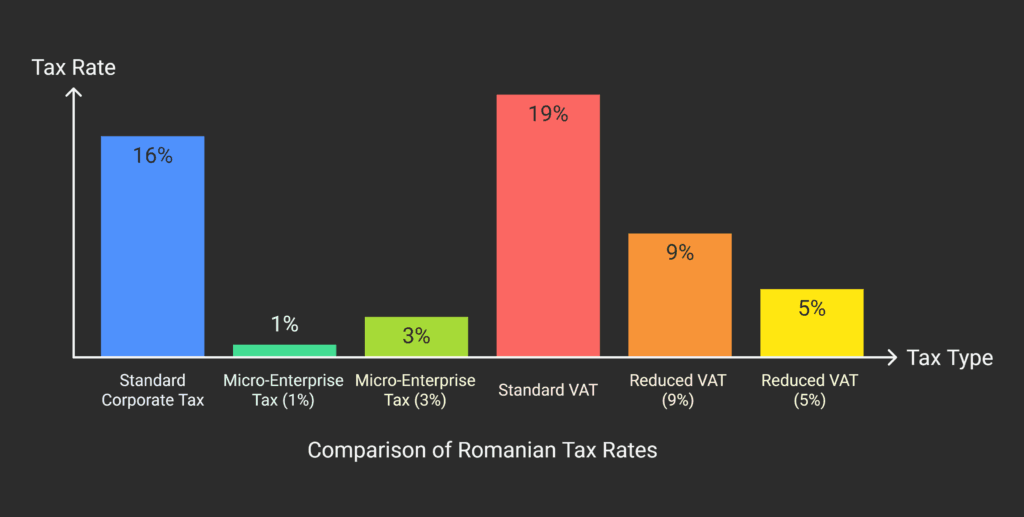
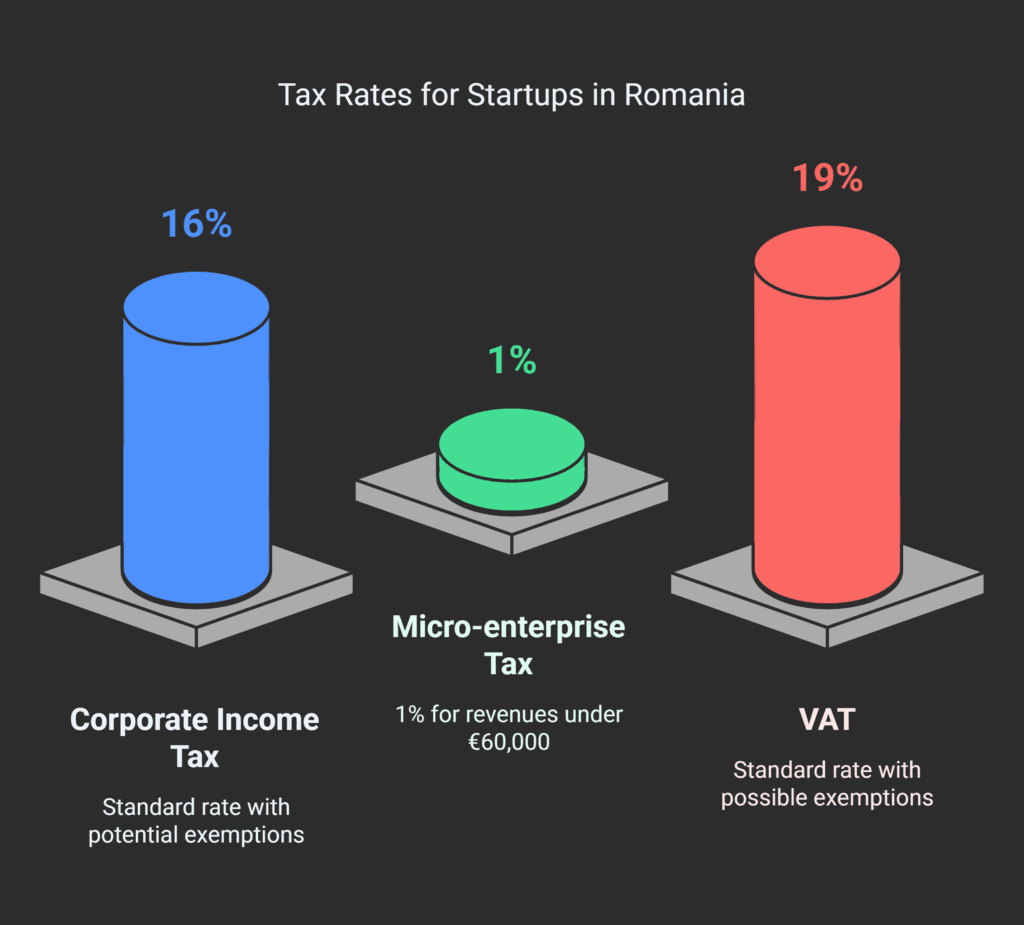
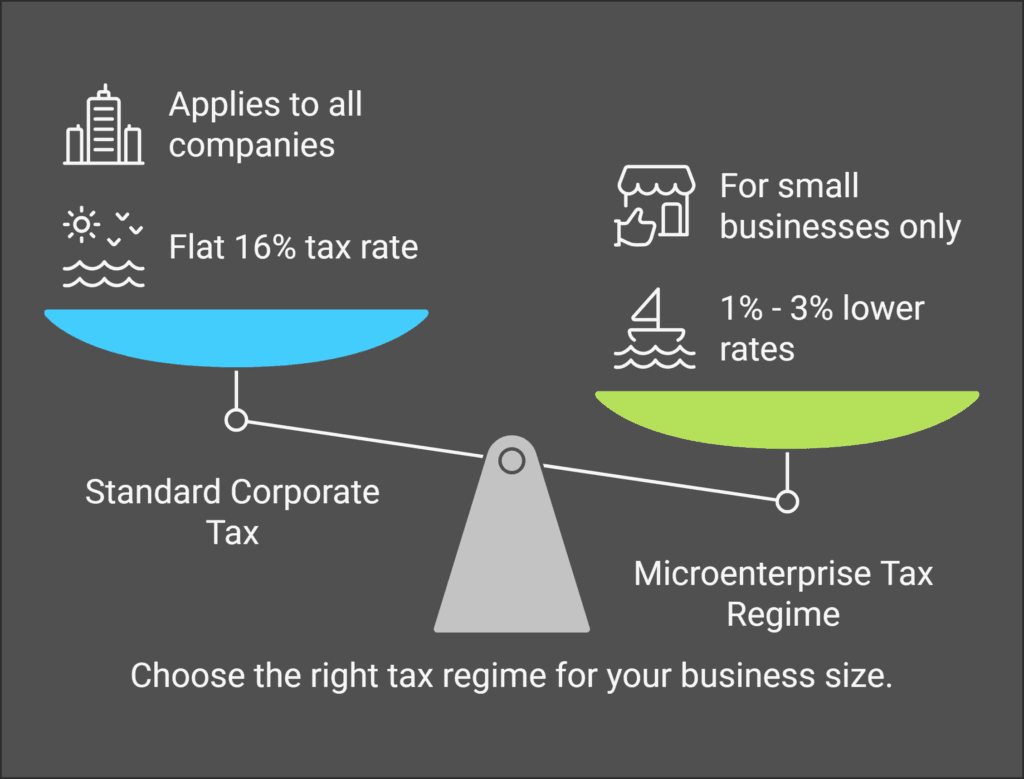
The main tax rate is 16% for most companies.

This makes it easier to plan and invest in Romania.

Corporate Income Tax Structure for Foreign Investors

Standard Corporate Tax Rates

Romania has a flat 16% corporate income tax rate.

This rate is applied to profits.

It shows Romania’s effort to make it attractive for investors.

  • 16% flat tax rate for standard corporate income;
  • 25% tax rate for income from specific gambling activities;
  • 50% tax rate for revenues from countries without information exchange agreements.

Microenterprise Tax Regime

Small businesses can enjoy a special tax regime. This system has lower taxes for companies with less than €500,000 in annual revenue. It’s a good option for small businesses.

Annual RevenueTax RateEligibility
Up to €500,0001% – 3%Optional for qualifying microenterprises

Profit Taxation and Reporting Requirements

Foreign investors must know the detailed reporting rules for taxes.

Non-residents need to get tax residence certificates.

They also have to meet certain document requirements to get treaty benefits and avoid tax issues.

  1. Submit tax residence certificate within 60 calendar days;
  2. Provide documentation for permanent establishment verification;
  3. Maintain accurate records for fiscal conventions compliance.
  4. Effective tax planning requires a thorough understanding of Romania’s complex corporate taxation framework and international fiscal conventions.

Double Taxation Treaties in Romania

Double Taxation Treaties in Romania

Romania has a strong network of tax treaties to help foreign investment and cross-border deals.

With over 80 double tax avoidance agreements, it offers multinational companies great tax benefits.

Investors can use these treaties to lower their tax bills.

They do this by setting up international business plans.

The main benefits are lower withholding taxes and avoiding double taxation on corporate income.

  • Romania has signed tax treaties with 87 countries;
  • Dividend tax rates can be as low as 3-5% under specific treaties;
  • Holding companies can optimize tax positioning.

These treaties help with tax planning for expats and international investors.

Companies often set up holding structures in places like the Netherlands or Luxembourg.

This helps them get the most from treaty benefits.

CountryDividend Tax RateInterest RateRoyalty Rate
Italy5%5%5%
Norway5-10%5%5%
UAE3%3%3%

Knowing about these tax treaties can improve your investment plan.

It can also lower your tax bill when working in Romania.

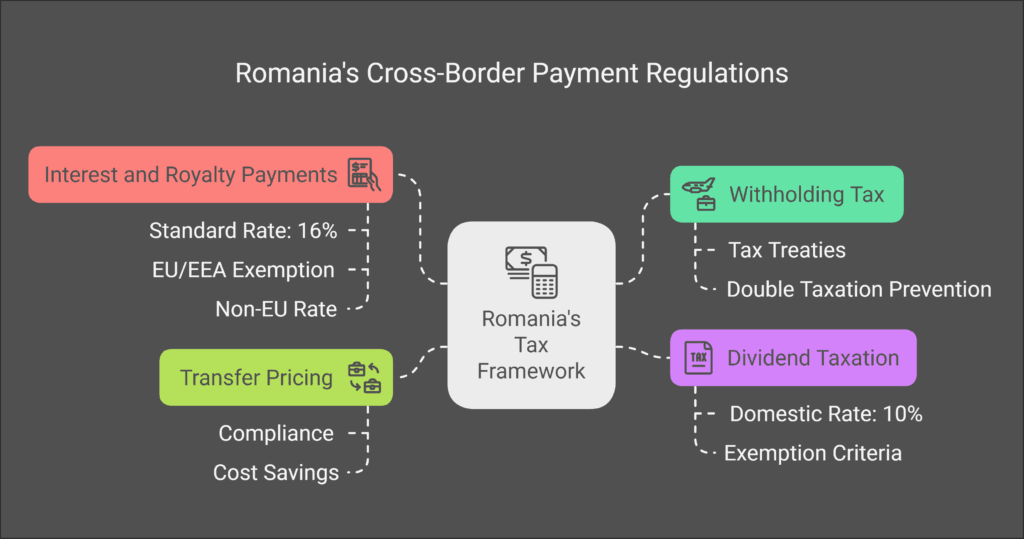
Cross-Border Payment Regulations and Withholding Taxes

Cross-Border Payment Regulations and Withholding Taxes Romania

Understanding withholding tax in Romania is key for international businesses.

The country’s tax treaties help manage payments across borders.

This ensures fair taxes and prevents double taxation.

Romania’s tax agreements help manage payments abroad.

They make sure taxes are collected fairly and prevent double taxation.

Dividend Taxation Dynamics

Changes in dividend taxes affect foreign investors.

Starting January 2025, there are new rules:

  • Domestic dividend tax rate: 10%;
  • Minimum shareholding for tax exemption: 10%;
  • Minimum uninterrupted holding period: 1 year.

Interest and Royalty Payment Considerations

Romania has specific tax rates for interest and royalties:

  • Standard withholding tax rate: 16%;
  • Zero withholding tax for EU/EEA companies meeting specific criteria;
  • 50% tax rate for payments to countries without tax information exchange agreements.

Transfer Pricing Insights

Romania ensures fair prices in transactions between related parties.

When making payments abroad, follow Romania’s tax rules.

This keeps you compliant and saves on taxes.

Understanding Romania’s complex tax treaties is vital for international success.

Tax Residency and Permanent Establishment Rules

Understanding tax residency rules is key for foreign investors in Romania.

Romania has clear criteria for tax residency.

These rules affect your tax duties and corporate income tax liability.

For businesses in Romania, tax residency involves several important factors:

  • Place of incorporation in Romania;
  • Primary business location;
  • Management and control headquarters;
  • Duration of business activities.

Permanent establishment rules are also vital.

They can lead to more taxes, affecting your double taxation avoidance plans.

Criteria for Permanent EstablishmentTax Implications
Fixed Business LocationSubject to Corporate Income Tax
Sustained Business OperationsMandatory Tax Registration
Management Control in RomaniaFull Fiscal Residency Requirements

Foreign companies must understand their income tax rules and fiscal residency.

The corporate income tax rate is 16% for permanent establishments.

There are special rules for different business types.

Proactive tax planning can help optimize your tax position while ensuring compliance with Romanian bilateral tax agreements.

International Tax Relief Mechanisms

International Tax Relief Mechanisms

Understanding international taxation is complex.

For foreign investors in Romania, there are ways to reduce double taxation.

These strategies help in managing taxes and staying compliant with global rules.

Romania’s tax treaties are key in lowering taxes on foreign investments.

They help businesses deal with taxes from abroad.

This ensures they follow international tax laws.

Foreign Tax Credits

Foreign tax credits are vital for cutting down tax bills in cross-border deals.

Romanian tax authorities offer credits for taxes paid overseas.

But, there are certain rules to follow:

  • Credits apply only if documented in relevant tax treaties;
  • Maximum credit cannot exceed Romanian tax on equivalent income;
  • Requires submission of official tax residence certificates.

Treaty Benefits and Applications

Investors can use treaty benefits to lower withholding tax.

This prevents tax avoidance. Important points to remember include:

  1. Providing detailed documentation;
  2. Understanding specific treaty provisions;
  3. Maintaining accurate financial records.

Mutual Agreement Procedures

When tax disputes happen between Romania and its treaty partners, mutual agreement procedures help.

They solve interpretation issues and ensure fair tax treatment for investors.

Value-Added Tax Implications for Foreign Businesses

Romanian Value-Added Tax Implications for Foreign Businesses

Understanding Romania’s Value-Added Tax (VAT) is key for foreign businesses.

The VAT system in Romania has its own rules and benefits.

It’s part of the country’s tax treaty network.

Romania has a standard VAT rate of 19%.

There are also lower rates for certain goods and services.

Foreign businesses need to know about these rates and rules.

  • VAT registration threshold of RON 300,000 (approximately EUR 88,500)
  • Reduced VAT rates for specific goods and services:
    • 9% for food, beverages, entertainment, and green energy
    • 5% for educational materials and certain publications
  • Quarterly or monthly VAT return submissions.

Foreign businesses must follow special VAT rules.

These include the reverse-charge system and cash accounting schemes.

Keeping track of these rules helps in managing taxes and getting tax relief.

VAT AspectDetails
Standard VAT Rate19%
VAT Registration ThresholdRON 300,000 (EUR 88,500)
Reduced VAT Rates9% and 5% for specific goods/services
Filing Deadline25th day of following month

Knowing the tax rules in Romania helps businesses run smoothly.

Planning well can also help them use tax treaties to their advantage.

Recent Developments in Romanian Tax Treaties

Romania’s tax laws are changing, with new rules in bilateral tax agreements and double taxation avoidance.

It’s key for businesses to understand these changes in cross-border taxation.

Implementation of Multilateral Instrument (MLI)

Romania signed the Multilateral Instrument on July 7, 2017.

This was a big step in its tax strategy.

But, it’s yet to ratify the treaty fully.

This shows how hard it is to adopt global tax standards.

  • Signed MLI on July 7, 2017;
  • Ratification status: Pending;
  • Potential implementation: Near future.

BEPS Action Plan Integration

The BEPS Action Plan is changing how tax authorities share information.

Romania is updating its tax treaties to follow OECD guidelines.

This aims to stop tax avoidance.

YearMutual Agreement ProceduresCase Resolution
202246 total cases37 cases closed
2022 Resolution Rate89.2% rejectionNo full double taxation elimination

Future Treaty Updates

Romania’s tax scene is seeing big changes.

With a 187.5% jump in transfer pricing requests, it’s showing strong commitment to tax compliance.

Your business needs to keep up with these changes.

They will affect cross-border deals, mutual agreements, and tax planning in Romania.

Conclusion

Romania has strong rules to prevent double taxation through its tax agreements.

It’s important for foreign investors to know these rules well.

The Romanian Fiscal Code, or Law no. 227/2015, makes sure taxes are fair and protect businesses.

Investors can use Romania’s tax relief by looking at treaty details.

Withholding tax rates change in different agreements.

So, planning carefully is key.

Getting help from experts is a good idea to understand Romania’s tax rules.

The Romanian Lawyers ( e-mail address: office@theromanianlawyers.com) can offer detailed advice.

Our Romanian Law Office can help with tax procedures and how to save on taxes in Romania.

Keeping up with changes in global tax laws is important.

Knowing about Romania’s tax updates and international tax news is vital.

Your knowledge will help your investment plans succeed.

FAQ

What are double taxation treaties, and why are they important for foreign investors in Romania?

Double taxation treaties help prevent being taxed twice on the same income in two countries.

For investors in Romania, these treaties are key.

They remove tax barriers, lower withholding tax rates, and help avoid double taxation.

How many double taxation treaties does Romania currently have?

Romania has over 90 double taxation treaties worldwide.

These agreements are based on the OECD Model Convention.

They help international trade and investment by setting clear tax rules for cross-border deals.

What is the standard corporate tax rate in Romania for foreign investors?

The standard corporate tax rate in Romania is 16%.

But, there are special tax systems for small businesses.

These could offer tax benefits for smaller companies in Romania.

How does Romania determine tax residency for foreign businesses?

Romania checks several things to decide if a business is tax resident.

It looks at where the business is set up, where it’s managed, and how long it’s been there.

A business might be considered tax resident if it’s managed in Romania or meets certain Romanian tax law criteria.

What are the withholding tax rates for dividends in Romania?

The dividend withholding tax rate in Romania is now 8%.

This rate can drop or even go away, thanks to tax treaties and EU rules.

This is true for certain parent-subsidiary relationships.

How can foreign investors claim tax credits under Romania’s double taxation treaties?

Investors can claim tax credits by showing they’ve paid tax in another country.

They need to provide documents like proof of foreign tax paid and tax residence certificates.

This shows they’ve been taxed in both countries, allowing for tax relief.

What is the Value-Added Tax (VAT) rate in Romania for foreign businesses?

Romania’s VAT rate is 19%. But, there are lower rates of 9% and 5% for some goods and services.

Foreign businesses must register for VAT if they earn over a certain amount.

They also need to follow local invoicing and reporting rules.

How do Romania’s tax treaties address permanent establishment?

Romania’s tax treaties follow the OECD Model Convention on permanent establishment.

A permanent establishment is a fixed place of business or significant presence.

It can also be certain economic activities that show a business is really there.

What recent developments are affecting Romania’s tax treaty network?

Romania is working on the Multilateral Instrument (MLI) and OECD BEPS recommendations.

These efforts aim to update tax treaties, stop tax avoidance, and make international tax clearer.

Are there special tax considerations for holding companies in Romania?

Romania gives good tax treatment to holding companies, like those under the EU Parent-Subsidiary Directive.

These companies get dividend exemptions, lower withholding tax rates, and other tax benefits when set up right.

What is the Purpose of Double Taxation Treaties in Romania?

The primary purpose of double tax treaties or double taxation agreements that Romania has entered into is to eliminate or reduce the burden of being taxed twice on the same income.

When individuals or companies operate across borders, they may be subject to taxation in both Romania and the other contracting state. A double tax treaty provides clear rules on which country has the right to tax specific types of income and outlines methods for tax relief.

These agreements typically cover various types of income such as business profits, dividends, interest, royalties, and employment income.

By establishing these frameworks, Romania aims to create a favorable environment for international business and investment while ensuring tax certainty and preventing tax evasion.

The treaties also typically contain provisions for the exchange of information between tax authorities to enhance transparency and compliance with tax laws.

How Many Double Tax Treaties Has Romania Signed and With Which Countries?

Romania has developed an extensive network of double tax treaties, having signed agreements with over 90 countries worldwide.

This comprehensive coverage includes major economic partners such as EU member states, the United States, China, Russia, Japan, and Canada.

Romania has also established tax treaties with countries in the Middle East including Kuwait and the United Arab Emirates.

In recent years, Romania has continued to expand its treaty network, with some of the newer agreements being concluded or renegotiated to align with the latest international tax standards, particularly those developed under the OECD’s Base Erosion and Profit Shifting (BEPS) initiative.

Each treaty is individually negotiated, so specific provisions may vary from one agreement to another.

Corporate Restructuring Options Under Romanian Law: Mergers, Divisions, and Transformations

Corporate Restructuring Options Under Romanian Law: Mergers, Divisions, and Transformations

Did you know that Romania has seen a big rise in corporate restructuring?

This includes more mergers and acquisitions in 2025.

These changes are key for companies to stay competitive and efficient in a fast-changing market.

It’s important to know how these restructuring processes work.

This knowledge helps companies follow Romanian laws well.

This article will dive deep into the restructuring options in Romania.

It will show how these options can help your business grow.

corporate restructuring options under romanian law

Key Takeaways

  • Corporate restructuring is increasingly vital for businesses in Romania.
  • Mergers, divisions, and transformations are the key options available for restructuring.
  • Compliance with Romanian corporate laws is essential for successful restructuring.
  • Understanding the legal framework can guide effective restructuring strategies.
  • The Romanian market experiences dynamic changes impacting restructuring processes.

Understanding Corporate Restructuring in Romania

Types of Corporate Restructuring Options Under Romanian Law

In Romania, corporate restructuring is key for companies facing challenges.

It helps solve financial issues and opens up growth chances.

By restructuring, companies can improve operations, cut debts, and boost their competitive edge.

Definition and Importance of Restructuring

Corporate restructuring means changing a company’s financial or operational setup to tackle challenges or seize new chances.

It’s vital for boosting efficiency, managing debts, and aligning resources with market needs.

Companies that restructure can cut their debt by about 40%, helping them through tough times.

Context Within Romanian Corporate Law

In Romania, the legal framework for restructuring is clear.

The law provides ways for companies to reorganize, like voluntary liquidations and preventive compositions.

It sets rules for businesses, ensuring creditors can start legal actions if needed.

On average, restructuring in Romania takes about 12 months due to its complexity.

Romanian Legal experts are key in guiding companies through this process.

They help reduce risks and ensure compliance with current corporate laws.

understanding corporate restructuring

Types of Corporate Restructuring Options Under Romanian Law

Businesses in Romania can improve their efficiency and competitiveness through various restructuring options.

Mergers, divisions, and transformations are key strategies.

Each has its own purpose and must be carefully considered under Romanian law.

A thorough approach helps companies adapt well to market changes and operational needs.

Mergers: Consolidating Business Operations

Mergers combine two or more companies to make operations smoother and boost market presence.

This method can lead to bigger market shares and shared resources.

Romanian law requires detailed planning and negotiations to follow merger and acquisition rules.

Divisions: Splitting Companies for Increased Efficiency

Divisions let companies split into separate entities for better focus and efficiency.

Assets can be fully or partially transferred to new or existing companies.

Romanian law demands a structured spin-off process, including a detailed plan for asset distribution.

This plan must be decided within three months by the companies involved.

types of corporate restructuring options

Transformations: Altering the Legal Structure

Transformations change a company’s legal structure to fit new strategies and market conditions.

This strategy is vital for adapting to regulatory changes and operational needs.

Whether it’s changing corporate form or adjusting governance, transformations can greatly affect a company’s future success.

Legal Framework for Corporate Restructuring in Romania

The legal framework for corporate restructuring in Romania is based on several laws.

These laws outline the processes and protections for companies going through big changes.

Knowing the key laws helps companies understand their changes better.

Key Romanian Legislation on Corporate Reorganization

The main laws for restructuring include the Romanian Company Law no. 31/1990 and insolvency rules.

These laws protect creditors and help businesses reorganize.

The Company Law sets the rules for mergers and divisions, including what’s needed for these steps.

It’s important for companies to follow these rules.

This ensures their restructuring is legal.

Regulations Affecting Restructuring Processes

There are more rules for restructuring in Romania.

The Romanian Trade Register requires companies to submit detailed documents, like changes to their articles of association.

Changes to the Fiscal Code can also impact a company’s financial plans during restructuring.

Legislation or RegulationKey Provisions
Romanian Company Law no. 31/1990Outlines processes for mergers and divisions, and protects shareholder rights.
Insolvency RegulationsOffers guidelines on restructuring processes, ensuring fair treatment of creditors.
Romanian Trade RegisterMandates documentation requirements for altering company structures.

Restructuring Strategies for Businesses in Romania

Understanding and using effective restructuring strategies is key for businesses in Romania.

Companies facing financial issues find that strategic planning helps.

It aligns goals with legal needs and boosts efficiency.

By making a detailed plan, businesses can tackle their financial challenges.

This plan helps them overcome unique obstacles.

Corporate Restructuring Romania

Strategic Planning for Effective Restructuring

Strategic planning is the core of restructuring.

Businesses need to create a plan that shows why restructuring is needed.

It should outline how to reach the desired outcomes.

This plan must include how to involve stakeholders, set a timeline, and allocate resources.

It’s vital to get approval from shareholders for any job changes.

Clear communication and alignment among stakeholders are key for success.

Addressing Financial Challenges and Optimizing Operations

Dealing with financial issues in Romania needs careful attention and flexibility.

Companies should review their operations to find ways to improve.

This helps make smart decisions about cutting jobs while following local laws.

If restructuring means laying off workers, companies must follow legal steps.

This includes giving enough notice and telling the labor authorities.

Knowing labor laws well and planning for layoffs helps avoid problems and keeps employees happy.

The Restructuring Process in Romania

The restructuring process in Romania involves several steps for businesses to follow.

A step-by-step guide to corporate restructuring is essential for firms looking to improve their operations.

Working with corporate restructuring specialists can offer valuable insights and expertise.

The Restructuring Process in Romania

Step-by-Step Guide to Corporate Restructuring

The first step is to assess your business’s current state.

This includes looking at its financial health, operational efficiency, and market position.

After identifying the need for restructuring, you can start the next steps.

  • Developing a detailed restructuring strategy;
  • Sharing the plan with all stakeholders;
  • Starting legal procedures, like submitting a restructuring agreement;
  • Proposing a reorganization plan to creditors within set timeframes;
  • Negotiating with creditors to get a fair agreement;
  • Putting the approved restructuring plan into action and tracking progress;

Engaging Corporate Restructuring Specialists

Corporate restructuring specialists play a key role in guiding businesses through the restructuring process in Romania.

Our team of Romanian Lawyers can help you:

  • Understand the legal rules for restructuring;
  • Prepare the necessary documents for filing;
  • Negotiate with creditors to avoid conflicts;
  • Make sure you follow all legal rules during restructuring;
  • Keep an eye on how well the restructuring plan is working.

Working with specialists can increase your chances of success.

It also helps you prepare for future challenges.

The right guidance can make the restructuring journey smoother.

Benefits of Corporate Restructuring Under Romanian Law

Benefits of Corporate Restructuring Under Romanian Law

Corporate restructuring is key for companies in Romania to tackle challenges.

It can help your business grow and stay ahead.

By restructuring, you can improve your finances and how you operate, making your company more adaptable to market changes.

Improving Financial Performance and Competitiveness

One big plus of restructuring in Romania is better finances.

Companies often struggle with money due to market shifts or poor management.

A good restructuring plan can help use resources better and make operations smoother.

This can lead to more money for your business and make you more competitive.

Enhancing Operational Efficiency

Another big benefit is making your operations more efficient.

Restructuring helps find and fix problems in how you work.

This makes your company stronger and encourages ongoing improvement.

Your business will be quicker to respond to new needs or rules.

Legal Implications of Corporate Restructuring in Romania

Understanding the legal side of corporate restructuring in Romania is key.

It involves looking at creditors’ rights and the liabilities that come with them.

Knowing this helps protect your interests and ensures a smooth transition during restructuring.

Dealing with Creditors’ Rights and Liabilities

In Romania, creditors’ rights are shaped by Law No 85/2014.

Any restructuring plan needs approval from creditors who hold at least 30% of the affected receivables.

Creditors can keep pursuing claims against co-debtors or guarantors, even if they agree to a plan.

This shows how important it is to keep in touch with creditors during this time.

Compliance with Corporate Insolvency Procedures

Following corporate insolvency procedures in Romania is vital to avoid legal issues.

The restructuring process needs careful planning and must follow strict rules.

For example, the temporary stay of enforcement actions can last from three to 12 months, giving time for negotiations.

Also, a creditor arrangement must offer prospects that allow creditors to get at least what they would in bankruptcy, based on a recent valuation report.

Not following these rules can lead to the court dismissing the restructuring or creditors not approving it, which could harm the restructuring efforts.

AspectDescription
Approval RequirementMinimum 30% of affected receivables must approve the restructuring agreement.
Rights of CreditorsCreditors can pursue claims against co-debtors and guarantors despite agreeing to restructuring.
Duration of Enforcement StayStay lasts from 3 to a maximum of 12 months.
Valuation ReportsMust be no older than 6 months for ensuring creditor agreements in reorganizational plans.
Non-compliance RisksCan lead to dismissal of proceedings or disapproval by creditors.

Best Practices for Corporate Restructuring in Romania

Effective corporate restructuring in Romania needs careful planning and following best practices.

Businesses should focus on strategies that reduce legal risks.

Working with experienced professionals is key to success.

Strategies to Minimize Legal Risks

To lower legal risks, conducting independent business reviews (IBRs) is essential.

These reviews check financial, operational, and strategic performance.

They help find the best ways forward.

Pre-lending reviews also help set financial limits.

This impacts overall strategies.

It shows the need for legal solutions that match business goals.

Collaborating with Legal and Financial Experts

Working with financial experts in Romania can improve restructuring.

Firms like Atrium Romanian Lawyers are great examples.

They offer a team approach to handle various issues.

This way, companies can deal with complex laws better.

They can also aim for better results.

Conclusion

Understanding corporate restructuring in Romania is key.

You have options like mergers, divisions, and transformations.

Each one has legal aspects that affect your business’s health.

Delaying these steps can harm your business.

It can lead to lower sales and more debt.

This article shows why businesses need to think about restructuring early.

Working with experts can help you understand Romanian law better.

This way, you can use your resources wisely and stay up-to-date with new laws.

Thinking about restructuring can help your business.

It can make your operations better and save jobs.

It’s a chance to get through tough times and come out stronger.

FAQ

What is corporate restructuring?

Corporate restructuring means a company changes how it works, its money setup, or its legal form.

This can be through mergers, divisions, or changes in legal status.

It aims to make the company more efficient, financially stable, and competitive.

What are the primary options for corporate restructuring in Romania?

In Romania, companies can choose from mergers, divisions, or transformations.

Mergers combine companies to simplify operations.

Divisions split companies to boost performance.

Transformations change a company’s legal form.

How do Romanian laws govern corporate restructuring?

Romanian laws, like the Companies Law and insolvency rules, guide corporate restructuring.

These laws set the rules for mergers, divisions, or transformations.

They protect everyone involved legally.

What are the benefits of corporate restructuring?

Restructuring can make a company’s finances better, more competitive, and efficient.

It helps companies adjust to market changes, cut costs, and get stronger in the market.

What are the legal implications of restructuring for creditors?

When restructuring, it’s key to think about creditors’ rights and duties.

Following insolvency rules helps avoid legal issues and ensures fairness for everyone.

Why is strategic planning important in corporate restructuring?

Strategic planning is vital.

It makes sure restructuring goals match legal needs.

This helps companies tackle financial issues and improve operations during restructuring.

How can businesses ensure compliance during restructuring?

Working with restructuring experts and lawyers is helpful.

They offer advice and detailed checks.

This ensures the restructuring follows Romanian laws and rules.

What are best practices for corporate restructuring in Romania?

Good practices include carefully checking what restructuring is needed.

Working with legal and financial experts is also key.

Using strategies that reduce legal risks helps achieve success while following the law.

What are the main types of restructuring and insolvency procedures in Romania?

In Romania, there are several key restructuring and insolvency procedures available:

1. Preventive composition: This is a restructuring procedure aimed at companies facing financial difficulties but not yet insolvent.

It involves negotiations with creditors to reach a restructuring agreement.

2. Ad-hoc mandate: A confidential procedure where a mandatary is appointed to negotiate with creditors to overcome financial distress.

3. Insolvency proceedings: This is the main procedure for companies unable to pay its debts.

It can lead to reorganization or liquidation.

4. Simplified insolvency proceedings: A faster procedure for certain categories of debtors, typically leading to liquidation.

5. Restructuring procedure: Introduced by the implementation of the restructuring directive, this procedure aims to help companies in financial difficulties or facing imminent insolvency.

Each of these procedures has specific requirements and outcomes under Romanian insolvency law.

How does the new restructuring procedure work in Romania?

The new restructuring procedure in Romania, introduced through the implementation of the restructuring directive, works as follows:

1. Eligibility: The debtor must be facing financial difficulties or imminent insolvency but still be viable.

2. Initiation: The debtor proposes a restructuring and applies to the court.

3. Restructuring practitioner: The court appoints a restructuring practitioner.

EU AI Act for Small Businesses: Staying Compliant

EU AI Act for Small Businesses: Staying Compliant

EU AI Act Compliance for Small Businesses

Are you ready to navigate the complex landscape of AI regulation for small businesses in Romania?

The EU AI Act is set to change how SMEs use artificial intelligence.

It presents both challenges and opportunities for startups and small firms.

As the digital world grows, machine learning compliance for small firms is key.

The EU AI Act introduces a detailed framework.

This framework directly affects how small businesses use and manage AI technologies.

For Romanian entrepreneurs and tech innovators, knowing the EU artificial intelligence rules for startups is essential.

The new rules require a strategic approach to AI use. This balance is between innovation and following the rules.

Key Takeaways

  • The EU AI Act creates a detailed framework for AI regulation in SMEs;
  • Small businesses must prepare for different risk classifications of AI systems;
  • Compliance requires strategic planning and possible technology changes;
  • Penalties for not following the rules can be big for unprepared businesses;
  • Regulatory sandboxes offer help for small businesses dealing with AI rules.

Understanding the EU AI Act’s Impact on SMEs

The European Union’s AI Act is a big step in regulating AI.

It affects small and medium enterprises (SMEs) in Romania and the EU.

This act is the first global law for AI, bringing important rules for businesses using AI.

EU AI Act Impact on Small Businesses

The AI regulation in EU  aims to make sure SMEs are fair and accountable.

It’s important for your business to understand this law for planning.

Definition of Small and Medium Enterprises

EU standards define SMEs as follows:

  • Fewer than 250 employees;
  • Annual turnover less than €50 million;
  • Annual balance sheet total less than €43 million.

Scope of Application for Small Businesses

The European AI rules for smes cover all businesses in the EU.

This includes those that develop, use, import, or distribute AI systems.

Even small businesses need to be ready.

Timeline for Implementation

Important dates for ai governance Smbs include:

  1. 2 February 2025: First big rules start;
  2. 2 August 2025: Penalties for not following rules start;
  3. Transition periods of 6, 12, and 24 months for different rules.

Knowing these ai ethics small enterprises rules helps you get ready for the new rules.

Risk Classification System for AI Technologies


The EU AI Act has a new risk classification system for small businesses.

It divides AI systems into four risk levels.

This helps small firms manage AI better and follow rules.

Knowing these risk levels is key for your AI strategy.

The system makes it easier for small companies to handle AI.

AI Risk Classification Small Businesses Romania

It brings more confidence and clarity to AI use.

  • Unacceptable Risk: AI systems completely banned, including:
    • Cognitive behavioral manipulation;
    • Social scoring systems;
    • Biometric identification technologies.
  • High Risk: AI systems needing careful checks, such as:
    • Critical infrastructure applications;
    • Employment screening processes;
    • Credit scoring systems;
    • Automated insurance claims processing.
  • Limited Risk: Applications needing clear rules;
  • Minimal Risk: Systems with few rules.

In Romania, small businesses must watch AI closely.

High-risk AI needs detailed records and checks.

This means you’ll need to track your AI’s actions and effects.

By following these risk levels, your small business can use AI wisely.

It also meets the EU AI Act’s strict rules.

EU AI Act Small Businesses: Key Compliance Requirements

For small businesses, following the EU AI Act can be tough.

It’s key to know the main rules to use AI right and stay legal and ethical.

The EU AI Act has clear guidelines for small businesses.

EU AI ACT Compliance Small Businesses Romania

Your plan should cover three main points:

Documentation and Record Keeping

Keeping good records is vital for AI Regulation.

You must keep detailed records that show:

  • Comprehensive risk assessments;
  • System design and development processes;
  • Training data quality and selection criteria;
  • Performance monitoring logs.

Technical Requirements

AI in small businesses must meet strict standards.

Your ai rules for startups should include:

  1. Implementing risk management systems;
  2. Establishing human oversight mechanisms;
  3. Ensuring system transparency;
  4. Maintaining cybersecurity protocols.

Quality Management Systems

AI governance needs a solid quality management framework.

This means creating a system for:

  • Continuous risk assessment;
  • Performance monitoring;
  • Regular system audits;
  • Compliance documentation.

By focusing on ai ethics, you meet rules and gain trust.

The EU AI Act helps you use AI responsibly.

This keeps your business innovative and ethical.

Special Considerations and Exemptions for SMEs

The EU AI Act understands the challenges small and medium enterprises (SMEs) face.

It offers exemptions to help with artificial intelligence rules.

This makes it easier for SMEs to manage AI risks.

Small businesses get several benefits in the EU’s AI rules:

  • Simplified consultation requirements for impact assessments;
  • More flexible technical documentation standards;
  • Proportional compliance cost calculations;
  • Reduced administrative documentation needs.

The Act also helps with AI transparency for small businesses.

SMEs can submit alternative documentation that meets key goals.

National authorities can approve these alternatives, helping startups and small businesses with AI accountability.

The exemptions aim to balance AI oversight for small businesses.

They recognize the limited resources of smaller companies.

This way, the EU lets innovative companies develop AI without too many rules.

Key benefits for SMEs include:

  1. Lower-cost conformity assessments;
  2. Streamlined documentation processes;
  3. Proportional financial penalties;
  4. Access to regulatory support mechanisms.

These special considerations show the EU’s support for innovation.

It ensures responsible AI development for all business sizes.

Regulatory Sandboxes and Innovation Support

The EU AI Act brings new ways to help small businesses with AI technology.

For Romanian startups and small enterprises, these sandboxes are a big chance.

They can work on AI solutions and handle risks.

Regulatory sandboxes are special places for AI companies to test and improve their tech.

They are watched by experts.

This helps small firms manage risks and test new AI ideas safely.

Access to Testing Facilities

SMEs get first chance to use these special testing areas.

The main benefits are:

  • Free entry to regulatory sandboxes;
  • Guidance on compliance requirements for AI businesses;
  • Opportunity to validate ethical AI guidelines for SMEs;
  • Reduced financial barriers to AI technology development.

Financial Support Mechanisms

The EU knows small businesses face big challenges in AI.

So, the Act offers financial help:

Support TypeDetails
Reduced Compliance FeesLower costs for conformity assessments
Sandbox AccessFree entry for qualifying AI startups
Technical GuidanceSpecialized support for AI accountability for small enterprises

Guidance and Resources

Small businesses get lots of help for AI development.

The Act makes sure there are special channels for SMEs.

This way, you always have the latest info and support for your AI projects.

Using these new support tools, your business can dive into AI safely.

You can stay in line with rules and handle risks well.

Cost Implications and Financial Planning

Understanding AI regulations can be tough for small businesses.

The EU AI Act brings big costs that need careful planning.

Small and medium enterprises must get ready for expenses linked to ai transparency and risk management.

High-risk AI systems come with big compliance costs.

Cost Implications and Financial Planning EU AI ACT

Businesses might spend between €9,500 to €14,500 per system.

The European Commission says only 10% of AI systems will face these costs, which helps SMEs a bit.

  • Estimated compliance costs for high-risk systems: €6,000 – €7,000;
  • Conformity assessment expenses: €3,500 – €7,500;
  • Potential total compliance costs: €9,500 – €14,500 per system.

When planning for trustworthy ai governance, consider a few things.

The Act looks at your business size and market share when assessing costs.

Setting up a Quality Management System could cost between €193,000 to €330,000. You’ll also need €71,400 for yearly upkeep.

Not following the rules can cost a lot.

Fines can go up to €35 million or 7% of your global sales.

This shows how important it is to plan ahead and know the AI rules.

Here are some steps for SME financial planning:

  1. Do a full risk assessment;
  2. Set aside money for initial costs;
  3. Plan for ongoing system upkeep;
  4. Save for possible fines.

Though the start might look expensive, planning early can help control costs.

It also keeps your business competitive in the changing AI world.

Compliance Strategy and Implementation Steps

Small businesses need a smart plan to follow the EU AI Act.

This ensures they use AI ethically and protect data.

The steps are designed to make sure your AI is transparent and safe.

To make a strong compliance plan, you must understand the EU AI law well.

Compliance Strategy and Implementation Steps EU AI ACT

The steps to follow are key to meeting the rules.

Risk Assessment Protocol

Your AI risk plan should find and fix weaknesses in your systems.

Important steps include:

  • Do deep risk checks for each AI use;
  • Write down any ethical AI issues;
  • Make plans to fix found risks;
  • Set up clear who’s responsible.

Documentation Requirements

Keeping detailed records is vital for SMEs to follow AI rules.

Your records should have:

  1. Full details of your AI systems;
  2. Risk assessment reports;
  3. Proof you’re following the rules;
  4. Logs of incidents and how your AI performs.

Staff Training Needs

Getting your team ready is key for success.

Focus on:

  • Training on AI ethics;
  • Workshops on following the rules;
  • Improving technical skills;
  • Learning about data protection.

By 2026, your business must follow the EU AI Act fully.

Start these steps now to adapt smoothly and avoid big fines.

Penalties and Enforcement Measures

The EU AI Act has strict rules for small firms.

If they don’t follow these rules, they could face big fines.

It’s key for startups to know these rules to avoid financial trouble.

Penalties for not following ai transparency and accountability rules vary.

They depend on how serious the violation is:

  • Severe violations can result in fines up to €35 million;
  • Moderate infractions may incur penalties around €15 million;
  • Minor non-compliance could trigger €7.5 million in penalties.

For small businesses and startups, the risks are higher.

The fines are based on a company’s total yearly sales.

This can be a big hit for them.

Violation CategoryMaximum FinePercentage of Turnover
Prohibited AI Practices€35,000,0007%
Specific Operational Violations€15,000,0003%
Incorrect Information Submission€7,500,0001%

The rules start on August 2, 2025. This gives businesses time to get ready.

Romanian startups need to plan well to avoid big fines.

The European Commission has strong powers to check on businesses.

They can take documents and do deep audits.

Keeping good records and being open is key to avoiding trouble.

Support Resources and Available Assistance

For small businesses in Romania, the EU AI Act can be tough to handle.

But, there are many support resources to help with ai governance and compliance.

This ensures you follow ai risk management and ai ethics for SMEs.

The European landscape has a lot to offer entrepreneurs with EU artificial intelligence rules.

Businesses can use different channels to make their AI compliance easier.

Government Support Programs

Romanian small businesses can find help through government support programs.

These programs are made for SMEs to understand ai ethics for Smes.

They offer:

  • Free consultation services for AI regulation compliance;
  • Workshops on ai transparency for small firms;
  • Online guidance materials and webinars;
  • Direct communication channels with national supervisory authorities.

Industry Networks and Associations

Professional networks are key for small businesses in the AI regulatory world.

They provide:

  1. Peer knowledge sharing;
  2. Regular compliance update seminars;
  3. Access to expert consultation;
  4. Collaborative learning platforms.

Professional Services

Specialized consulting firms offer specific support for AI Act compliance.

They help with:

Creating risk assessment strategies, necessary documentation, and AI governance frameworks.

With the right help, Romanian small businesses can tackle the EU AI Act’s challenges and turn them into advantages.

Conclusion

The EU AI Act is set to be fully implemented in 2026.

Romanian entrepreneurs need to focus on ai oversight and understand AI ethics well.

It’s important for your startup to follow the new rules for using AI technologies.

The EU policy brings both challenges and chances for SMEs.

By focusing on ai transparency, your business can turn legal issues into advantages.

Being compliant is not just about avoiding fines.

It’s about gaining trust and showing you’re committed to innovation.

Embracing ai accountability means knowing the risks and preparing your tech.

Small businesses that focus on ethical AI will do well in the changing rules.

For help or questions about the EU AI Act, contact our expert team at office@theromanianlawyers.com.

Being proactive with AI rules can make your Romanian business stand out.

Stay updated, be flexible, and see these changes as a chance to show your commitment to leading-edge tech.

FAQ

What is the EU AI Act and how does it affect small businesses in Romania?

The EU AI Act is a set of rules for artificial intelligence.

It helps small businesses in Romania by focusing on safety and ethics.

It also gives special help to small and medium-sized enterprises (SMEs).

How are small and medium enterprises (SMEs) defined under the EU AI Act?

SMEs in the EU are companies with 250 employees or less.

They also have to make less than €50 million a year or have a balance sheet under €43 million.

The Act helps these businesses by making rules easier for them.

What are the risk categories for AI systems under the Act?

The Act divides AI systems into four risk levels.

These are unacceptable risk, high risk, limited risk, and minimal risk.

Each level has its own rules for how businesses must use AI.

What are the key compliance requirements for small businesses?

Small businesses must keep detailed records and manage risks well.

They also need to have people check AI systems and keep logs of how they work.

They must be clear about how AI makes decisions.

Are there any exemptions or special considerations for small businesses?

Yes, the Act has special rules for SMEs.

These include easier record-keeping, access to testing areas, and financial help.

This makes it easier for small businesses to follow the rules without spending too much money.

What are regulatory sandboxes, and how can they benefit my business?

Regulatory sandboxes are places where businesses can test AI safely.

They help businesses innovate and learn about rules.

This can make it easier to understand and follow the Act.

What are the possible financial costs of following the Act?

The cost of following the Act depends on your AI systems.

You might need to do risk assessments, keep records, and train staff.

But the Act tries to make sure these costs are fair for small businesses.

What penalties exist for non-compliance?

If you don’t follow the Act, you could face big fines.

These fines can be up to €30 million or 6% of your yearly sales.

The size of the fine depends on how serious the problem is.

What support resources are available for Romanian small businesses?

There are many resources to help small businesses in Romania.

These include government help, industry groups, and online guides.

The Romanian government and the EU are working together to support SMEs.

When does the EU AI Act come into full effect?

The Act will be fully in place by 2025.

But it’s a good idea to start getting ready now.

This will help you adjust smoothly and follow the rules.

How can small businesses start preparing for the EU AI Act?

Start by checking your AI systems and planning how to follow the Act.

Train your staff and keep records of your AI processes. Also, stay up to date with new rules.

You might want to get advice from experts in AI compliance.

What is the EU AI Act and how does it affect small and medium-sized enterprises?

The EU AI Act, formally known as the European Union Artificial Intelligence Act, is the world’s first comprehensive legislative framework designed to regulate artificial intelligence systems across the European Union.

Enacted in 2024 with a phased implementation approach continuing into 2025 and beyond, the Act categorizes AI systems based on their risk levels and imposes varying requirements accordingly.

For SMEs and small and medium-sized enterprises, the EU AI Act provides some tailored provisions that recognize their limited resources while still ensuring they meet necessary safety and ethical standards.

Notably, the Act includes specific exemptions and support mechanisms for SMEs, such as reduced fees, simplified compliance procedures for lower-risk applications, and access to regulatory sandboxes where innovations can be tested in controlled environments.

However, even with these accommodations, small and medium-sized enterprises must understand their obligations under the Act, particularly if they develop or deploy high-risk AI systems that might impact fundamental rights or safety of EU citizens.

When will small and medium-sized enterprises need to comply with the EU AI Act?

The EU AI Act follows a gradual implementation timeline that gives businesses time to adjust their operations.

After its formal adoption in 2024, different provisions will become applicable at various stages throughout 2025 and beyond.

For SMEs, the key implementation dates are particularly important to note.

The prohibited practices provisions will apply six months after the Act enters into force, while regulations for general-purpose AI models with systemic risk will apply nine months after entry into force.

Most other provisions, including those for high-risk AI systems, will become applicable 24 months after entry into force, likely in 2025 or early 2026.

The European Commission and member states have acknowledged the potential burden on small and medium-sized enterprises and have indicated that additional guidance resources

Corporate documentation requirements in Romania for company governance and compliance

Corporate Documentation Requirements in Romania

Corporate law guide · Romania

Corporate Documentation Requirements in Romania

A practical guide to the documents that establish, govern and evidence a Romanian company, with specific points for foreign shareholders, directors and international groups.

The correct document set depends on the legal form, ownership structure, activity, transaction and filing route. Current forms and procedural requirements should be checked with the National Trade Register Office (ONRC).

In short: corporate documentation in Romania is not limited to the incorporation file. A company should maintain a coherent record of its constitutional documents, shareholder and director decisions, ownership and beneficial-owner information, powers of representation, material contracts and filings made when its structure or registered information changes.

What counts as corporate documentation in Romania?

Corporate documentation is the connected set of records that shows how a company was formed, who owns or controls it, who may represent it, how decisions are adopted and which changes have been registered or implemented. It includes the constitutional documents, meaning the articles of association and their amendments, together with the records that support the company’s ongoing operation.

The phrase covers more than documents sent to the Trade Register. Some records create or modify the company’s legal position. Others prove that a decision was properly authorised, that a director had signing power, or that the company reviewed a matter before entering into a material transaction.

For a foreign founder or international group, the practical issue is consistency. The company name, legal form, shareholders, capital, registered office, administrators, beneficial-owner information and activity should not appear differently across the articles of association, shareholder resolutions, powers of attorney, registry extracts, banking documents and commercial contracts.

Constitutional documents

The articles of association, amendments and registered information define the company’s identity, ownership, activities, capital and representation framework.

Decision records

Shareholder resolutions, general meeting minutes and management decisions evidence approvals, appointments, transactions and changes that require internal authority.

Compliance records

Beneficial-owner information, filings, registers, powers of attorney and supporting evidence help the company demonstrate an accurate and current corporate position.

Which documents belong in the company’s core file?

The core file should be organised around the company’s legal identity, ownership, authority and ongoing decisions. The exact documents vary, but the categories below are a reliable starting point.

Document categoryWhat it establishes or provesWhen to review itTypical responsibility
Constitutional fileLegal form, company name, registered office, activities, capital, shareholders and core representation rules.Incorporation, amendment, restructuring or change of registered information.Shareholders, administrators and filing representative.
Ownership and control fileShareholder identity, ownership percentages, control arrangements and beneficial-owner information.Share transfer, restructuring, new investor, control change or identification-data change.Shareholders and legal representative.
Authority fileAppointment, mandate, signing power, joint or individual representation and powers of attorney.Appointment, expiry, resignation, delegation or material change in authority.Shareholders, directors and authorised representatives.
Decision fileApprovals for reserved matters, capital operations, contracts, appointments, filings and transactions.Before and after each material corporate decision.Shareholders, board or administrator, depending on the legal form and articles.

A document may be retained internally even where it is not filed with ONRC. Filing requirements and internal approval requirements are related but not identical questions.

What should be resolved at incorporation?

At incorporation, the documents should reflect the business structure the founders actually intend to operate, not only the minimum wording needed to obtain registration.

The incorporation file commonly includes the application, proof of company-name availability, the articles of association, identification documents, declarations, evidence concerning the registered office, information about shareholders and administrators, beneficial-owner information and documents required for the proposed activities.

Where a shareholder is a foreign company, the file may also require a current registry extract or equivalent evidence of legal existence, corporate approvals evidencing the decision to establish or invest in the Romanian entity where required by the foreign company’s constitutional documents or governing law, proof of the signatory’s authority and a power of attorney for the Romanian filing representative. The issuing jurisdiction determines whether apostille, legalisation, authentication or a particular translation format is required.

A representative office operates under a different legal regime and typically does not conduct commercial trading activities in the same manner as a Romanian subsidiary. The chosen structure should therefore be reflected consistently in the incorporation documents, the activity description and the filing strategy.

The articles should also be reviewed as an operating document. Shareholder percentages, voting arrangements, administrator powers, representation, profit distribution, transfer mechanics and decision rules should be aligned with the commercial plan. Private arrangements may additionally belong in a shareholders’ agreement rather than in the public constitutional document.

Select the document stage to see the question that should be resolved before moving forward.

Choose the structure

Confirm whether the project requires a Romanian subsidiary, branch, representative office or another establishment route before drafting the corporate documents.

What are the current SRL capital and formation-document issues?

According to the framework introduced by Law no. 239/2025, newly incorporated Romanian SRLs are generally required to have a minimum share capital of RON 500, while separate capital requirements may apply to existing SRLs depending on statutory turnover thresholds.

That figure should not be copied into every corporate document without checking the company’s status. A new incorporation, an amendment to an existing SRL and a company whose turnover has crossed the statutory threshold may raise different questions.

The share capital is also only one element of the corporate documentation. The file should state the subscribed capital, contributions, number and nominal value of the shares, and each shareholder’s participation. Those details must match the application, the articles and any later shareholder resolution.

Tip: Before filing, reconcile the capital figure, shareholder percentages and number of shares across every document. An outdated template can create an avoidable inconsistency even where the founders’ commercial agreement is clear.

Current capital rules, forms and implementation details should be checked against the legislation in force and the live ONRC procedure at the time of filing. Do not rely on old references to RON 1, RON 200 or a general statement that no minimum capital applies.

Which governance documents should a Romanian company maintain?

A company should be able to show who made a decision, under which authority, on what information and with what effect on the company’s records.

For an SRL, the central governance records are usually the articles of association, shareholder resolutions, administrator decisions, management records and other internal approvals. The precise approval route depends on the legal form, the articles and the nature of the decision. A document should not describe a board structure that the company does not actually have.

For an SA, the governance structure is more formal and may involve a board of directors or a two-tier system, depending on the applicable model. The documents should reflect the selected structure and the mandates actually granted. The rules that apply to an SA should not be presented as universal requirements for every SRL.

Select the governance issue that most often creates a documentation gap.

Authority

Check the articles, appointment decision, mandate and any power of attorney before a director, employee or external representative signs for the company.

Governance recordQuestion it should answerTypical triggerControl to apply
Shareholder resolutionWhich shareholders approved the matter and with what voting basis?Appointment, capital operation, amendment, major transaction or reserved matter.Check quorum, majority and wording against the articles and applicable law.
Administrator decisionWas the decision within the administrator’s mandate and signing authority?Operational contract, delegation, bank instruction or implementation step.Match the decision to the registered representation rules and mandate period.
Power of attorneyWho may act, for which purpose and for how long?Remote filing, foreign shareholder representation or a specific transaction.State scope, duration, signatory authority and any authentication or translation requirement.
Corporate register copyWhat information is currently registered and available to third parties?Banking, contracting, due diligence, investment or authority check.Obtain a current extract before relying on historic company information.

What must foreign shareholders and international groups prepare?

Foreign corporate documents should prove existence, authority and the decision to participate in the Romanian structure. A translation alone cannot cure a missing corporate approval or an expired registry extract.

The document chain commonly includes the foreign shareholder’s registry evidence, constitutional or equivalent records, a resolution approving the investment, the appointment of a representative and proof that the person signing the Romanian documents has authority to do so.

The form of each document depends on the country of issue, the document type, applicable treaties and the current ONRC procedure. Some documents may be accepted without apostille or legalisation. Others may require authentication, apostille, legalisation or a specific certified translation. The correct answer should be checked document by document.

International groups should also distinguish the Romanian company’s documents from the parent company’s documents. A Romanian subsidiary has its own legal personality and corporate records. A branch is not a separate legal person in the same way, so the foreign parent’s authority and responsibility become central to the file.

Foreign registry evidence

Use a current official extract or equivalent evidence showing the foreign company’s legal existence, registered office and relevant representatives.

Corporate approval

Record the parent company’s decision to invest, establish the Romanian presence, appoint representatives and approve the necessary documents.

Formalities and translation

Check authentication, apostille, legalisation and Romanian translation requirements before the filing package is assembled.

When must corporate documentation be updated?

Review the corporate file whenever a change affects ownership, control, representation, registered information, activities or a decision that requires formal approval or registration.

  • Shareholder change: update the transfer or subscription documents, resolutions, articles and relevant ownership and beneficial-owner information.
  • Administrator change: record the appointment, mandate, representation rules and any related Trade Register filing.
  • Registered-office change: retain the new right-to-use document and complete the applicable registration steps.
  • Activity change: verify the current CAEN classification and whether the activity requires licences, approvals or professional authorisation.
  • Beneficial-owner change: review whether a beneficial-owner declaration, notification or update filing is required under the legislation in force at the time of the change.
  • Capital or governance change: align the resolution, amended articles, shareholder register and public filing with the decision actually adopted.
Risk: an internal decision does not automatically replace a registration, notification or filing required by law. Before implementing a material change, identify which record must be signed, which authority must approve it and which authority must receive it.

Can corporate documents be signed and filed electronically?

Electronic filing may be available, but the accepted signature, document format, representation route and platform requirements must be checked for the specific filing.

Law no. 265/2022 and the current ONRC procedures provide the framework for registration applications and electronic interaction with the Trade Register. The fact that a document is a PDF or carries an electronic signature does not by itself answer whether it is accepted for every corporate act or filing.

For a remote filing, confirm who is signing, whether the person has authority, whether a qualified electronic signature is required, whether the underlying corporate document needs a particular form and whether foreign documents require separate formalities. Keep the submitted version, proof of transmission and any correction request with the corporate file.

Remote incorporation, bank onboarding, tax registration, immigration status and authorisation to conduct a regulated activity are separate questions. Incorporating a company does not automatically give a founder a right to reside or work in Romania, and filing electronically does not remove the substantive requirements of the transaction.

Common corporate-documentation mistakes

Using an old template

Historic capital figures, outdated activity classifications or obsolete forms can make an otherwise coherent file inconsistent with current requirements.

Confusing public and private documents

The articles and Trade Register extract do not replace a private shareholders’ agreement, and a private agreement does not replace a mandatory filing.

Assuming a title proves authority

A person described as director, manager or representative still needs the mandate and signing power required for the act in question.

Ignoring the ownership chain

Foreign corporate shareholders and indirect control require a documented analysis, not only the name of the immediate shareholder.

Mixing legal forms

Rules for an SA, SRL, branch and representative office are not interchangeable. The document set must follow the selected structure.

Keeping no decision trail

A signed contract may not show whether the right company body approved it. Retain the resolution, decision or delegation that supports the act.

Corporate documentation checklist

Before incorporation, investment, restructuring or a material contract, use the following review sequence.

  1. Confirm the legal form and whether the Romanian presence will be a subsidiary, branch or another establishment route.
  2. Identify all shareholders, administrators, representatives and the natural persons who ultimately own or control the company.
  3. Check the current articles, registered information, capital, activity codes, office evidence and representation rules.
  4. Collect foreign registry extracts, any corporate approvals required by the foreign company’s constitutional documents or governing law, powers of attorney, translations and required legalisation formalities.
  5. Match each proposed decision to the correct company body, voting rule, signature and registration or notification requirement.
  6. Retain the signed documents, submitted versions, proof of filing, authority responses and the dates for the next review.

Frequently asked questions

What is the most important corporate document in Romania?

The articles of association are the central constitutional document, but they are not sufficient on their own. The company also needs accurate shareholder and beneficial-owner information, resolutions, administrator records, authority documents and filings connected with later changes.

Does every corporate document have to be filed with ONRC?

No. Some documents are filed or registered because the law requires public disclosure. Others, such as internal decisions, delegations and private shareholder arrangements, may need to be retained by the company without being filed in full. The applicable requirement depends on the document and event.

What documents does a foreign shareholder usually need?

A foreign corporate shareholder may need current registry evidence, a corporate approval, proof of signatory authority, a power of attorney and a Romanian translation. Apostille or legalisation requirements depend on the issuing country, document and applicable procedure.

Is the minimum capital for a new Romanian SRL RON 500?

According to the framework introduced by Law no. 239/2025, newly incorporated Romanian SRLs are generally required to have a minimum share capital of RON 500. Existing SRLs and companies affected by statutory turnover thresholds should be analysed separately, and the position should be checked against the current filing requirements.

Can a Romanian company use electronic corporate documents?

Electronic documents and electronic filing may be available, subject to the applicable signature, format, representation and platform requirements. A qualified electronic signature or a PDF alone does not automatically satisfy every corporate formality.

When should a lawyer review the corporate file?

A targeted review is particularly useful before incorporation by foreign founders, an investment, a share transfer, a director change, a restructuring, a material contract or a filing involving several ownership layers and cross-border documents.

Need to review a Romanian corporate file?

A focused legal review can map the documents, authority, ownership information and filing steps before the company signs, invests, restructures or submits an application.

Book a consultation

Disclaimer: This article provides general information only and does not constitute legal advice, a legal opinion or the creation of a lawyer-client relationship. Romanian corporate, Trade Register, tax, electronic-signature and document-formality requirements may change and depend on the company, transaction, documents and circumstances involved.

AI Notice: AI-assisted content, reviewed by a qualified Romanian lawyer.

Property Taxes in Romania: A Helpful Overview

Property Taxes in Romania: A Helpful Overview

Ever thought about how property taxes affect your investments in Romania’s lively real estate market?

Knowing about property taxes in Romania is key for following the law and making smart money choices.

As a property owner, you help fund local services by paying taxes each year.

These taxes are based on your property’s value in your town.

The rules for property taxes in Romania are complex.

It can be hard to understand the system, with different rates for homes and businesses.

For example, property taxes usually range from 0.08% to 0.2% of your property’s value, depending on its type.

Also, dealing with property taxes in Romania can be tricky.

Getting help from real estate lawyers is a good idea.

They can make sure you pay the right amount of taxes and avoid any problems.

This guide is a starting point for understanding the big responsibilities and chances that come with owning property in Romania.

property taxes in Romania

Key Takeaways

  • Property taxes in Romania are essential for local budgets and community services.
  • The property tax rates can vary significantly between residential and non-residential properties.
  • Understanding Romanian real estate tax laws is critical for compliance and investment success.
  • Expert guidance can assist in accurately assessing and paying your property taxes.
  • Tax obligations are based on the municipal value of your property, which is periodically evaluated.

Introduction to Property Taxes in Romania

Property taxes in Romania are a key part of the country’s finances.

They are collected every year based on a property’s value.

All property owners, individuals or businesses, need to know about these taxes to follow the law.

Property taxes help fund local services like roads and government offices.

They are a big source of money for local governments.

This money helps them meet the needs of their communities.

The tax rates vary based on the property type and where it’s located.

Homes usually pay between 0.1% and 0.3% of their value each year.

For example, a 100,000 lei home might pay around 100 to 300 lei annually.

This shows how property taxes can affect homeowners.

introduction to Romanian property taxes

Understanding Property Tax Laws in Romania

Property tax laws in Romania are key for both property owners and local governments.

These laws have changed over time, keeping up with the real estate market and economy.

Knowing these laws is important for following rules and understanding your rights and duties as a taxpayer.

The current laws set maximum tax rates.

Residential properties can’t be taxed more than 0.2%.

Non-residential buildings face a maximum of 1.3%.

Starting in 2023, there are new minimum rates: 0.1% for homes and 0.5% for businesses.

Local governments can raise these rates by up to 50%, so it’s vital to keep up with local changes.

Property values depend on several factors, like size, type of building, and specific laws.

For homes owned by individuals, the value is based on documented features.

For businesses, it’s based on construction costs or recent valuations.

Knowing how values are set is key to understanding your tax bill.

Also, you must pay property taxes twice a year.

The first payment is due by March 31, and the second by September 30.

This helps fund local projects and services, showing the importance of paying on time.

Looking into these laws, we see how they balance the duties of taxpayers and local governments.

This balance helps support community growth.

Romanian property tax laws

Romanian Property Tax Rates

It’s important to know the property tax rates in Romania.

The tax system has two main parts: residential and non-residential properties.

The government keeps changing these rates to make taxes fairer and address regional differences.

Residential Property Tax Rates

The tax on homes in Romania is set up to be affordable.

The rates range from 0.08% to 0.2% of the property’s value.

In January 2023, the top rate was lowered to 0.1%.

Local areas can also change these rates a bit.

This means taxes can vary in different places.

Non-residential Property Tax Rates

Non-residential properties have different tax rates.

These rates depend on the property’s type and how much it contributes to the economy.

The rates start at 0.2% and can reach up to 1.3%.

Starting in January 2023, the maximum rate was set at 0.5%.

This change aims to help the commercial property market grow.

It also lets local governments adjust taxes as they see fit.

How to Calculate Property Taxes in Romania

Calculate Property Taxes in Romania

Figuring out property taxes in Romania is complex.

It depends on several factors.

Local authorities use the property’s taxable value to calculate taxes.

This value is based on the property’s type, location, and size.

This section will explain how property taxes are assessed.

We will also look at the key factors that affect these assessments.

Methods of Property Tax Calculations

There are a few main ways to calculate property taxes in Romania:

  • Market Value Assessment: This method looks at the property’s market value. It considers recent sales in the area.
  • Cost Approach: It calculates the cost to replace the property, adjusted for wear and tear.
  • Income Approach: For rental properties, it looks at the property’s income. This helps determine the tax.

Getting the taxable value right is key.

It ensures accurate property tax calculations in Romania.

Factors Affecting Property Tax Assessment

Several factors can change how much you pay in property taxes.

Here are some important ones:

  • Property Type: Homes are taxed less than commercial buildings.
  • Location: Taxes can be higher in cities than in the countryside.
  • Building Age and Condition: The age and condition of a building affect depreciation. For example, industrial buildings depreciate faster.

Knowing these factors helps you understand how property values can change. This way, you can adjust your budget for local trends.

Property TypeDepreciation Range (Years)Current Tax Rate Range
ResidentialN/A0.1% – 0.2%
Non-ResidentialN/A0.5% – 1.3%
Industrial40 – 60N/A
Warehouse32 – 48N/A
Lightweight Constructions16 – 24N/A

Property Taxes in Romania: Legal Framework

The Romanian property tax legal framework is made up of many laws and rules.

These laws help make sure everyone follows the same rules about property taxes.

The Constitution of Romania protects private property and lets local governments tax it.

Important laws like Law No. 71/2011 help with property deals and rights.

Laws No. 7/1996 and No. 50/1991 deal with property records and building permits.

These laws together help guide property owners and those interested in Romania’s real estate.

Local councils decide how much property tax to charge.

This means tax rates can vary based on property value.

This approach helps local areas set taxes that fit their needs.

Legal changes keep happening to make taxes more efficient.

They also help keep everyone in line and adjust to changes in the market.

This makes the rules around property taxes in Romania strong and reliable.

How to Pay Property Taxes in Romania

Knowing how to pay property taxes in Romania is key for homeowners.

It’s important to pay on time to avoid fines.

The tax is split into two parts, with the first due by March 31st and the second by September 30th.

Payment Deadlines

Property owners must pay their taxes by specific dates.

The first part is due by March 31st, and the second by September 30th.

Staying on schedule helps you avoid penalties and keeps your finances in order.

Payment Methods Available

There are many ways to pay property taxes in Romania.

You can pay online, by bank transfer, or in person at tax offices.

Online platforms like Ghiseul.ro make digital payments easy.

These options make paying your taxes simpler and more convenient.

Property Tax Exemptions in Romania

Property Tax Exemptions in Romania

Knowing about property tax exemptions in Romania can help property owners a lot.

These exemptions can reduce financial stress, making owning property more attractive.

To get these exemptions, owners need to meet certain rules set by local laws.

There are different exemptions for various situations and groups of people.

Eligibility for Property Tax Exemptions

Property owners need to look at several key points to qualify for exemptions.

Properties used for charity or outside city limits often get special treatment.

Senior citizens might also get help due to their age.

Knowing these rules can help figure out if your property qualifies.

You’ll need to gather documents like property deeds and proof of usage.

Types of Exemptions Available

There are many types of property tax exemptions in Romania.

These include:

  • Charitable organization exemptions;
  • Senior citizen property tax relief;
  • Exemptions for properties outside city limits;
  • Special provisions for community service properties.

Each exemption has its own rules for applying, documents needed, and deadlines.

It’s important to check with local authorities for the latest on exemptions.

This way, you can make sure you’re taking advantage of any exemptions you’re eligible for.

Type of ExemptionEligibility CriteriaDocumentation Required
Charitable Organization ExemptionProperty used exclusively for charitable purposesProof of charity registration
Senior Citizen ReliefProperty owned by individuals above a specific ageIdentification and proof of age
Outside City Limits ExemptionProperties not within municipal boundariesDocumentation verifying location
Community Service ExemptionProperties serving community needsProof of usage for communal services

Understanding property tax exemptions in Romania is key for property owners.

Being aware and prepared can greatly impact your financial situation.

Working with local authorities and knowing the details of each exemption is essential.

Property Tax Deductions in Romania

Property Tax Deductions in Romania

Property owners in Romania can find relief in property tax deductions.

These deductions help lower taxable income.

They include maintenance costs, improvements, and other eligible expenses.

Maintenance costs, like repairs and updates, are often deductible.

To get these benefits, owners must meet certain criteria and keep detailed records.

These records are needed to prove expenses are eligible for deductions.

Calculating these deductions can be tricky.

It may require the help of a tax professional.

To illustrate, the table below outlines common deductions available:

Deduction TypeEligible ExpensesDocumentation Required
Maintenance CostsRepairs and upkeep of propertyReceipts and invoices
RenovationsImprovements that increase property valueBefore and after valuations
Property Management FeesCosts associated with property management servicesContract and payment proof
Utilities in Rental PropertiesWater, electricity, and heating costsPayment statements

Understanding property tax deductions in Romania can help owners save money.

It might seem complicated, but with the right guidance, it can be done.

By planning ahead, you can reduce your taxes and save a lot in the long run.

Understanding Property Tax Appeals in Romania

Appeal Property Tax Assessment Romania

If you disagree with your property tax in Romania, knowing how to appeal is key.

Start by filing your appeal at the local tax office where your property is listed.

You have 30 days from when you get the tax notice to appeal.

You’ll need your tax notice, proof of ownership, and any evidence to support your appeal.

Process for Filing a Property Tax Appeal

The appeal process in Romania might change depending on where you are.

But, it usually goes like this: after you appeal, the local tax office will look at your case.

They might ask for more info or documents. If you’re not happy with the outcome, you can take it to court.

But, think carefully about this step because it can take more time and money.

Common Reasons for Appeals

Many people appeal their property taxes in Romania for a few reasons.

One big reason is if your property is overvalued.

Assessments can be wrong if they’re based on old or wrong data.

Also, if you’ve changed how you use your property, like turning a house into a business, you might need to appeal.

Knowing these reasons can help you fight your tax assessment better.

FAQ

What are property taxes in Romania?

Property taxes in Romania are yearly taxes on property owners.

They depend on the property’s location and value.

These taxes help fund local budgets.

How are property tax rates determined in Romania?

Local authorities set property tax rates in Romania.

Rates can differ by region.

Usually, homes have a lower tax rate than business properties.

What is the process for calculating property taxes in Romania?

Local authorities calculate property taxes in Romania.

They use the property’s taxable value.

This value is based on size, location, and market trends.

What deadlines should I be aware of for paying property taxes?

In Romania, property taxes are due in two parts.

The first is by March 31st.

The second is by September 30th each year.

What payment methods are available for property taxes in Romania?

You can pay property taxes in Romania online, by bank transfer, or in person.

You can visit local tax offices.

Are there any exemptions available for property owners in Romania?

Yes, some property owners in Romania may get tax breaks.

This includes properties used for charity or by senior citizens.

How can I reduce my property taxes in Romania?

You might lower your property taxes by claiming deductions.


For example, for maintenance costs. It’s wise to get professional help.

What is the appeal process for property tax assessments in Romania?

If you disagree with your tax assessment, you can appeal.

Do this at local tax offices.

You’ll need to provide evidence like if your property was overvalued.

What is the basic structure of property tax in Romania?

The property tax system in Romania is primarily based on the ownership of immovable property.

The tax is levied annually and is calculated based on several factors, including the value of the building or land, its location, and its purpose (residential, commercial, or agricultural).

The Romanian tax system distinguishes between building tax and land tax, both of which fall under the broader category of property tax.

These taxes are typically administered by local councils and form a significant part of local government revenue.

The rates and specific regulations may vary depending on the municipality, as local authorities have some discretion in setting tax rates within limits established by national legislation.

How is building tax calculated for residential buildings in Romania?

For residential buildings, the building tax is typically calculated as a percentage of the value of the building.

As of 2023, the standard tax rate for residential properties ranges from 0.08% to 0.2% of the taxable value, which is determined by factors such as the building’s size, location, and construction materials.

The specific rate within this range is set by the local council.

It’s important to note that the taxable value is not necessarily the market value or purchase price of the property. Instead, it’s often based on a standardized valuation system that takes into account various characteristics of the building.

Property owners are required to pay this tax annually, and the tax is due typically in two equal installments, by March 31 and September 30 of each year.


Tax Benefits for Startups in Romania: Incentives, Grants, and R&D Deductions

Tax Benefits for Startups in Romania: Incentives, Grants, and R&D Deductions

Did you know Romania has one of Europe’s lowest corporate income tax rates at just 16%?

This is just the beginning of the tax benefits for startups in Romania.

The country is dedicated to supporting entrepreneurship and innovation, offering many opportunities for new businesses.

Romania’s tax system has many startup tax incentives to help businesses grow and attract investors.

There are tax options based on revenue for small businesses and big R&D deductions.

These benefits make Romania a great place for startups, especially in tech and innovation.

tax benefits for startups in romania

Knowing about these benefits is key to growing your business in Romania.

Whether you’re starting a business here or investing from abroad, understanding taxes is crucial.

For advice on using these incentives, contact expert legal counsel at office@theromanianlawyers.com.

Key Takeaways

  • Romania offers a competitive 16% corporate tax rate;
  • Micro-enterprises can benefit from revenue-based tax rates as low as 1%;
  • R&D expenses qualify for an additional 50% tax deduction;
  • IT sector enjoys specific tax advantages, including potential VAT exemptions;
  • Various EU funding opportunities are available for innovative startups;
  • Local tax benefits exist in tech parks and free economic zones.

Overview of Romanian Corporate Taxation System

Romanian Corporate Taxation System

Romania’s corporate tax system is good for both startups and established businesses.

It aims to attract foreign investment and boost the economy.

Knowing these policies is key for startups wanting to start in Romania.

Standard Corporate Tax Rate and Structure

Romania has a flat corporate tax rate of 16%. This is lower than many European countries.

All companies pay this rate, no matter their size or industry. For startups, this makes planning finances easier.

Micro-Enterprise Tax Framework

The micro-enterprise tax is great for Romanian startups.

Companies with less than €500,000 in annual revenue can pay 1% or 3% tax.

This helps startups keep more of their earnings, especially when they’re growing fast.

VAT Regulations and Thresholds

Romania’s VAT system has benefits for startups.

The standard VAT rate is 19%, but there are lower rates for some goods and services.

Startups need to know the VAT registration threshold, which is €88,500 in annual turnover.

If they’re below this, they might not have to pay VAT, which helps with finances.

Tax TypeRateApplicability
Standard Corporate Tax16%All companies
Micro-Enterprise Tax1% or 3%Revenue up to €500,000
Standard VAT19%General goods and services
Reduced VAT9% or 5%Specific goods and services

corporate tax benefits romania

Romanian tax policies for startups aim to boost entrepreneurship and innovation.

They offer lower tax rates for micro-enterprises and VAT benefits.

This creates a good environment for new businesses to grow and help the economy.

Tax Benefits for Startups in Romania

Tax Benefits for Startups in Romania

Romania has a great tax setup for startups.

It offers many benefits to help entrepreneurs grow.

These advantages make Romania a great place for startups to start.

First-Year Tax Advantages

New businesses in Romania get big tax breaks in their first year.

They might not have to pay corporate income tax or pay less.

This lets them put more money into growing and improving.

Revenue-Based Tax Options

Romania has a special tax for small businesses.

If a company makes less than 1 million euros a year, it pays just 1% tax.

This is good for businesses that make a lot but don’t make much profit.

tax advantages for new businesses romania

Special Economic Zone Benefits

Startups in special economic zones get even more benefits.

They might pay less tax, get customs duty breaks, and more.

These perks make these zones even more appealing for new businesses.

Benefit TypeDescriptionEligibility
Corporate Income Tax16% standard rate, potential exemptions for startupsAll registered businesses
Micro-enterprise Tax1% on turnover for revenues up to €60,000Companies with revenues under €500,000
VAT19% standard rate, exemptions availableBased on turnover thresholds

Romania’s tax benefits, growing startup scene, and EU funding make it great for new businesses.

Cities like Bucharest, Cluj-Napoca, and Timișoara are especially good for startups.

They offer lots of resources and chances for entrepreneurs.

Research and Development Tax Incentives

Romania offers great R&D tax incentives to boost innovation and tech growth.

These incentives make Romania a top spot for startups and tech companies.

They focus on research and development.

50% Extra Deduction on R&D Expenses

Companies investing in R&D can get a 50% extra deduction on eligible expenses.

This R&D tax relief for startups in Romania cuts down the cost of innovation projects.

Eligible costs include salaries for R&D staff, equipment, and materials for research.

Accelerated Depreciation for R&D Equipment

Romania also offers accelerated depreciation for R&D equipment.

This helps startups by reducing taxable income early on.

The rate of depreciation depends on the equipment type and its lifespan.

Innovation-Related Tax Credits

Romania has various innovation tax credits to boost tech advancement.

These credits can be applied to corporate tax, lowering the tax burden.

The credit amount varies based on the project’s nature and scale.

Tax IncentiveBenefitEligibility
R&D Expense Deduction50% extra deductionAll companies with eligible R&D expenses
Accelerated DepreciationFaster write-off of R&D equipmentCompanies using equipment for R&D activities
Innovation Tax CreditsReduction in corporate tax liabilityCompanies engaged in innovative projects

These tax incentives make Romania a great place for tech startups and innovation companies. By using these benefits, businesses can lower their taxes. This lets them focus more on research and development.

Government Grants and Financial Support Programs

Romania has many government programs to help startups.

The StartUp Nation 2025 program gives non-refundable grants of 250,000 RON.

This helps create two jobs over two years.

It’s part of the broader support for startups in Romania.

Seed funding tax deductions in Romania are also supported by EU funds.

The Innovation Romania program has 106.7 million EUR for startups and SMEs.

Micro-enterprises in Bucharest-Ilfov can get grants from €25,000 to €300,000.

Venture investment tax credits in Romania get a boost from programs like SME Eco-Tech.

It has a budget of 53,924,286 CHF. Grants up to 50,000 CHF cover 40% of eligible costs.

This support is for sustainability and digital projects.

ProgramBudgetGrant AmountFocus Area
StartUp Nation 2025295,750,000 EUR250,000 RONJob Creation
Innovation Romania106.7 million EURVariesInnovation
SME Eco-Tech53,924,286 CHFUp to 50,000 CHFSustainability
PNRR28.5 billion EURVariesDigital & Green Transition

IT Sector-Specific Tax Advantages

Romania offers great tax benefits for tech startups and software companies.

These benefits make it a top spot for digital innovation and IT growth.

Software Development Tax Exemptions

Romania has tax breaks for software companies.

They don’t have to pay corporate tax if they make enough from software.

Companies need to make at least 10,000 EUR per employee each year.

New startups get a break.

They don’t have to meet the revenue rule for their first two years.

Tech Industry Employee Benefits

There are tax perks for tech employees in Romania too.

Until recently, IT pros got a 10% tax break. Jobs like database admins, IT managers, and software engineers were eligible.

Both Romanian and foreign workers could get this benefit.

They just had to meet certain education standards.

Digital Innovation Incentives

Romania is serious about digital innovation.

It offers many incentives to grow its digital economy.

This economy is still behind the EU’s average.

Only 31% of Romanians have basic digital skills, compared to the EU’s 56%.

These incentives are key to closing this gap.

The government is really pushing for digital innovation in Romania.

Despite being last in the 2021 Digital Economy and Society Index, Romania does well in some areas.

For example, its fixed very high capacity network coverage is 76%, higher than the EU’s 59%.

Investment and Capital Gains Tax Benefits

Romania offers great tax breaks for startup investments.

The corporate income tax rate is 16%, but there are incentives to lower this for new companies.

Angel investor tax breaks in Romania make early funding more attractive, helping startups grow.

Capital gains tax in Romania is 16%, which is good compared to the EU.

Sometimes, dividend income can be tax-free, boosting investor returns.

New companies in Romania can use fiscal losses for up to 7 years.

This lets startups use future profits to cover early losses, giving them financial breathing room.

Romania has about 87 tax treaties to avoid double taxation.

This makes it a great place for foreign investors.

These treaties can reduce withholding taxes and offer other financial perks for international deals.

Tax BenefitRate/Provision
Standard Corporate Income Tax16%
Capital Gains Tax16%
Micro-company Tax (Revenue ≤ €60,000)1%
Micro-company Tax (Revenue > €60,000)3%
Loss Carry-forwardUp to 7 years

Employment-Related Tax Incentives for New Businesses

Employment Tax Incentives for New Businesses in Romania

Romania has great payroll tax incentives for startups and new businesses.

These incentives help boost employment and support workforce development.

Let’s look at the main employment-related tax benefits for entrepreneurs in Romania.

Social Security Contribution Reductions

Startups in Romania can enjoy lower social security contributions.

This helps new businesses cut their payroll costs and invest more in growth.

The exact reduction depends on company size and industry sector.

Workforce Development Benefits

Romania offers benefits to encourage hiring and training new employees.

There are tax credits for job creation and deductions for employee training.

These incentives help startups build strong teams while keeping costs down.

Training Program Deductions

Investing in your workforce is key for business success.

Romania has deductions for training programs to support this.

Startups can deduct training expenses from their taxable income.

This encourages continuous learning and skill development.

Employment-Related Tax IncentiveBenefit
Social Security Contribution ReductionsLower payroll costs for startups
Workforce Development BenefitsTax credits for job creation and training
Training Program DeductionsDeduct employee training expenses from taxable income

These employment-related tax incentives in Romania make it great for startups to grow their teams.

By using these benefits, new businesses can cut costs, attract skilled workers, and encourage innovation.

Regional Development Incentives and Local Tax Benefits

Romania has many incentives and tax benefits to draw new businesses and boost the economy.

These benefits vary by region, helping entrepreneurs get the most out of their finances.

The Romanian government gives tax breaks to new businesses in key areas.

These breaks can cut down on taxes, letting startups focus more on growing and innovating.

Local governments also offer extra perks to bring businesses to their areas, like lower property taxes.

When picking a place for your startup in Romania, look into the local incentives.

Some places have lower tax rates or tax exemptions.

These can greatly help your company’s finances, especially when you’re just starting out.

  • Standard corporate income tax rate: 16%;
  • Micro-enterprise tax rates: 1% or 3% (based on annual turnover);
  • VAT rates: 19% standard, 9% and 5% reduced rates.

To make the most of these incentives in Romania, compare what different places offer.

Think about things like infrastructure, the local workforce, and how close you are to markets.

Choosing the right location can help your business grow strong from the start.

European Union Funding and Tax Advantages

Romania’s EU membership brings big benefits.

It offers financial help and tax breaks for startups.

This mix of EU grants and Romanian tax laws makes starting a business easier.

EU Grant Programs Integration

Romanian startups can get into various EU grant programs Romania.

Horizon Europe supports research and innovation. Startups working on digital and green projects can get help from structural funds.

These programs often come with tax breaks.

This makes them even more attractive for new businesses.

Cross-Border Tax Benefits

Romania’s tax benefits are a big plus for startups.

With Romania joining the Schengen Area, travel and trade will get easier.

This will help businesses grow across the EU.

Romania’s 16% corporate tax rate is also good.

It’s lower than the EU average of 21%.

European Investment Initiatives

European investment in Romania is key for startups.

Romania will get almost 80 billion euros from the EU Resilience Fund.

This money will go to projects like infrastructure, digitalization, and green initiatives.

Startups that fit these areas can get a lot of funding.

Funding SourceFocus AreaPotential Benefits
Horizon EuropeResearch and InnovationGrants, Tax Incentives
EU Structural FundsDigital Transformation, SustainabilityFinancial Support, Tax Benefits
EU Resilience FundInfrastructure, Digitalization, Green ProjectsLarge-scale Funding, Growth Opportunities

Conclusion

Romania’s startup scene is booming, with VC funding hitting €101.7M in 2022.

This is a 54.3% jump from 2021.

The country is now the 5th biggest in CEE for VC funding.

This shows how attractive Romania is for entrepreneurs.

Romania has many tax perks for startups.

For example, there’s a 50% extra deduction on R&D expenses.

There are also tax breaks for software development.

The corporate tax rate is 16%, and personal tax is 10%, both of which are low in the EU.

A Romanian tax specialist can guide you through these benefits.

They help your startup get the most out of these advantages.

Romania’s location and growing economy make it great for new businesses.

It has a good tax environment too. If you’re looking into IT or regional incentives, a Romanian tax lawyer can offer great advice.

For more on Romanian tax law and startup benefits, email a lawyer in romania at office@theromanianlawyers.com.

Romania is working to cut its budget deficit and introduce new tax reforms.

Keeping up with these changes is key.

A trusted Romanian law office can help you stay on top of regulations.

With the right help, your startup can do well in Romania’s lively business world.

FAQ

What is the standard corporate tax rate in Romania?

In Romania, the standard corporate tax rate is 16%.

This rate is quite competitive when compared to other European countries.

How does the micro-enterprise tax framework benefit startups in Romania?

The micro-enterprise tax framework in Romania offers lower tax rates based on turnover.

This is very beneficial for small businesses and startups in their early stages.

Are there any first-year tax advantages for new businesses in Romania?

Yes, Romania provides tax benefits for new companies in their first year.

These benefits may include exemptions or reductions in corporate income tax.

What R&D tax incentives are available for startups in Romania?

Romania offers several R&D tax incentives for startups.

These include a 50% extra deduction on R&D expenses and accelerated depreciation for R&D equipment.

There are also innovation-related tax credits to encourage research and development.

Are there any government grants available for startups in Romania?

Yes, Romania has various government grants and financial support programs.

These include state aid schemes and EU-funded programs to support startups and innovative businesses.

What tax benefits are available for the IT sector in Romania?

The IT sector in Romania enjoys several tax benefits.

These include income tax exemptions for IT professionals and corporate tax exemptions for software development companies that meet specific criteria.

Are there any tax incentives for reinvesting profits in Romania?

Yes, Romania offers exemptions for reinvested profits.

This allows startups to grow while reducing their tax burden.

What employment-related tax incentives are available for new businesses in Romania?

New businesses in Romania can benefit from several employment-related tax incentives.

These include reductions in social security contributions, tax credits for hiring and training new employees, and deductions for training programs.

Are there regional tax benefits for startups in Romania?

Yes, Romania offers regional development incentives and local tax benefits.

These may include reduced tax rates, exemptions, or other fiscal advantages depending on the startup’s location.

How can Romanian startups benefit from European Union funding?

Romanian startups can access various EU grant programs.

They can also leverage cross-border tax benefits and take advantage of European investment initiatives.

These can provide significant financial and tax advantages.

Employment contract being signed in a bright Romanian office

Employment Contracts in Romania: Mandatory Clauses and Employer Checklist

Employment contracts in Romania must be concluded in writing and in Romanian, signed using wet-ink or a legally valid electronic signature, contain the mandatory information required by the Labour Code and be recorded in REGES-ONLINE before the employee starts work. A compliant template is only the starting point: the contract must also match the actual role, schedule, workplace, pay structure and working arrangement.

In brief: The employer is responsible for the written contract, pre-contract information, medical fitness check, delivery of a signed copy and timely REGES-ONLINE registration. An indefinite full-time contract is the default. Fixed-term, part-time, mobile and telework arrangements require additional wording. Clauses on probation, confidentiality, mobility, training and non-compete protection must be drafted within statutory limits. Changes to core terms generally require an addendum before they take effect, while REGES reporting follows separate deadlines.

This guide is written for foreign companies, founders, HR teams and managers hiring personnel in Romania. It explains what the contract should contain, which clauses require special care and how contract execution connects with the employer’s registration and personnel-file obligations.

Employment contract and employer checklist prepared in a Romanian office
Employment documentation and onboarding checklist prepared for a new employee in Romania.

Must an employment contract be in writing in Romania?

Yes. Article 16 of the Romanian Labour Code requires the individual employment contract to be concluded in writing and in Romanian. Written form is mandatory under the Labour Code and must be completed before work begins. The employer bears responsibility for concluding the document.

The contract must be signed using wet ink or a legally valid electronic signature, provided to the employee and entered in REGES-ONLINE before work begins. Where electronic signing is used, the parties must use the same type of signature for the document. Registration alone does not replace the signed contract, and a signed contract does not excuse late registration. Foreign-language versions may be used for convenience, but the Romanian version should control or the documents should state clearly how inconsistencies are resolved.

Contract route
Which employment contract fits the role?

Select a route to see the main drafting consequence.

Indefinite full-time

This is the statutory default and usually the simplest route when the business need is ongoing and the normal schedule is eight hours per day and 40 hours per week.

Contract typeWhen it may be usedDrafting control
IndefiniteDefault route for an ongoing role.State start date, role, workplace, schedule, salary and all Article 17 information.
Fixed-termOnly in cases permitted by the Labour Code.State the legal basis and exact duration or objective end event. General maximum: 36 months.
Part-timeWhere the agreed normal hours are below full time.State hours, distribution, change conditions and the statutory overtime restriction.
TeleworkRegular voluntary work outside employer premises using ICT.Include the additional clauses required by Law no. 81/2018.
Mobile workThe duties are not performed at a stable workplace.Define the mobility area and any cash or in-kind mobility benefit.

What mandatory clauses must Romanian employment contracts contain?

The contract must cover the information required by Article 17 of the Labour Code and the applicable framework employment-contract model. The employer should not merely copy headings. Each field must describe the real employment arrangement.

Clause map
Map the mandatory terms to the real job

Select a clause group to review the main control.

Identity and employer

Use the correct legal employer, registered details and authorised signatory. A group brand or foreign parent is not a substitute for identifying the employing entity.

Clause groupWhat should be statedFrequent error
Parties and workplaceIdentity, employer headquarters, workplace or absence of a fixed workplace.Naming a business unit without identifying the legal employer.
Role and dutiesCOR occupation, job description, duties, professional-evaluation criteria and job-specific risks.Using a generic job description unrelated to actual authority or tasks.
Duration and startStart date; indefinite or fixed duration; fixed-term basis and end point where applicable.Using a fixed term without a statutory case supporting it.
Working timeHours per day/week, schedule distribution and conditions for changing the schedule.Using an unequal schedule without expressly providing for it.
PayGross base salary, allowances, bonuses, benefits and payment frequency.Calling a recurring salary component discretionary while administering it as guaranteed.
Leave and noticeAnnual leave, applicable notice conditions and duration, probation period.Contractual notice exceeding the legal maximum for resignation.
Other informationCollective agreement, training rights, employer-provided benefits and applicable procedures.Referring to policies that were not communicated or do not exist.

What must be completed before the employee starts work?

The employer should treat hiring as a controlled sequence. Before the first working day, it must verify identity and work entitlement, obtain the medical fitness certificate, complete the required information process, sign the contract, provide the employee’s copy and transmit the required data to REGES-ONLINE.

Pre-hire control
Employer checklist before work begins

Select each control to see why its order matters.

Identity and status

Verify the person’s identity, qualifications and any immigration or work-authorisation condition before promising a start date that cannot legally be met.

A non-EU national may require a work authorisation and immigration steps before employment can lawfully begin. The employment document should align with the approved position, salary and working conditions. See our guide to recruiting non-EU personnel in Romania.

How does REGES-ONLINE connect with the employment contract?

REGES-ONLINE is the statutory employee register governed by Government Decision no. 295/2025. From 2026, employers should use the online register for new hires and subsequent reportable events. The register reflects the legal documents; it does not create or amend the parties’ agreement by itself.

Reporting calendar
When should the employer report an event?

Select an event to review the general reporting rule.

Before work begins

The new employment contract and required employee data must be transmitted no later than the day before activity starts, including when that day is not a working day.

EventGeneral reporting deadlineInternal control
New employmentNo later than the day before activity starts.Do not permit access to work until signature and transmission are confirmed.
Function, contract type, duration, workplace or working timeGenerally no later than the day before the change takes effect.Align the addendum date, effective date and register entry.
Salary, allowances, bonuses and other additionsWithin 20 working days from the change under Article 5(4) of Government Decision no. 295/2025.Reconcile contract/addendum, payroll and REGES; verify any special rule applying to the source of the change.
TerminationGenerally no later than the termination date or the applicable date of knowledge.Record the correct legal ground and retain the supporting document.

The table states the main operational rules. For salary changes, Article 5(4) of Government Decision no. 295/2025 provides a 20-working-day deadline; a change resulting from a court judgment is subject to the specific 10-working-day rule calculated from the employer’s knowledge of the judgment. Particular suspensions, transfers and corrections also have specific rules. Employers should verify the current REGES-ONLINE guidance for the event concerned.

2026 salary note: Government Decision no. 146/2026 set the national gross minimum base salary at RON 4,325 per month from 1 July 2026. This is a dated statutory amount verified in the official legislation portal. Employers should nevertheless recheck the minimum immediately before implementation, together with sector-specific rules and the 24-month limitation applicable to keeping an employee at the general minimum level.

How should probation, confidentiality and non-compete clauses be drafted?

Optional clauses are enforceable only within the Labour Code. They should solve a real business need and should not attempt to remove statutory employee rights.

ClauseLegal controlDrafting point
ProbationGenerally up to 90 calendar days for execution roles and 120 for management roles.State the period clearly. Probation operates inside a signed employment contract.
ConfidentialityMay protect confidential information during and after employment.Define protected information and permitted disclosures; do not obstruct statutory rights.
Non-competeRequires prohibited activities, third parties, geographic area, duration and monthly indemnity.A generic ban is insufficient. Post-termination effect cannot generally exceed two years.
MobilityApplies where duties are not performed at a stable workplace.Describe the area and the additional cash or in-kind benefits.
TrainingTraining costs and retention consequences require lawful, proportionate wording.Use a separate addendum for significant employer-funded training where appropriate.

A post-employment non-compete obligation requires payment of a monthly non-compete indemnity. The contract must identify the activities prohibited, relevant third parties, geographic area and period. It cannot impose an absolute ban on the employee’s profession. Confidentiality and intellectual-property provisions should also distinguish employee-created works, employer resources, trade secrets and lawful whistleblowing or regulatory disclosures.

What additional clauses are required for telework and part-time work?

Telework and part-time arrangements require more than changing the workplace or number of hours in a standard form.

Under Law no. 81/2018, telework must be expressly agreed. The contract or addendum should address the periods spent at employer premises, how activity may be checked, the method for recording daily start and end working hours in line with Article 119 of the Labour Code, health and safety responsibilities, equipment, data protection, measures against isolation and the treatment of telework expenses.

A part-time contract must state the duration and distribution of hours, the conditions under which the schedule may be changed and the restriction on overtime, subject to narrow statutory emergencies. Omitting mandatory part-time elements may expose the employer to the risk of reclassification and labour-inspector sanctions.

Can the employer change the contract unilaterally?

As a rule, no. Core terms such as role, workplace, salary, working time and contract duration are modified by agreement, normally through a written addendum concluded before the change takes effect. The Labour Code provides narrow exceptions. In addition to delegation and secondment, Article 48 permits the employer temporarily to modify the workplace and type of work without consent in cases of force majeure, as a disciplinary sanction or as a measure to protect the employee, only in the cases and under the conditions provided by law.

Telework under Law no. 81/2018 remains, as a rule, consensual. An employer should not rely on Article 48 as a general power to impose remote work. Any exceptional unilateral remote-work measure must have a specific legal basis applicable at that time.

A policy cannot silently rewrite a contractual benefit or core term. Before changing a package, the employer should classify each item as statutory, contractual, collectively agreed, policy-based or genuinely discretionary. The correct document and employee-consent requirement follow from that classification.

Employer checklist for Romanian employment contracts

  1. Identify the real employer. Confirm the Romanian employing entity and authorised signatory.
  2. Classify the role. Select the correct COR occupation and align it with the job description.
  3. Choose the lawful contract type. Document any fixed-term or part-time basis and special clauses.
  4. Verify the employee. Check identity, qualifications, medical fitness and work authorisation.
  5. Define the workplace. Distinguish office work, mobility, homeworking and telework.
  6. State working time precisely. Include distribution, unequal schedules, shifts or part-time restrictions where relevant.
  7. Map compensation. Separate base salary, allowances, bonuses, benefits and reimbursement of expenses.
  8. Review optional protections. Tailor confidentiality, IP, non-compete, mobility and training clauses.
  9. Sign and deliver the contract. Complete this before the employee starts work, using wet-ink signatures or the same legally valid electronic-signature type for both parties.
  10. Transmit REGES data. Preserve proof and reconcile the register with payroll and personnel-file documents.

Risk: A contract can appear complete and still fail in practice when the job description, actual schedule, payroll treatment and REGES record contradict it. Employers should audit the whole employment file, not only the signature page.

Frequently asked questions

Can a Romanian employment contract be signed only in English?

No. The Labour Code requires the individual employment contract to be concluded in Romanian. A bilingual version may be used for a foreign employee or group process, but the Romanian text must be included and the parties should address which version prevails if wording differs.

When must a new employment contract be registered in REGES-ONLINE?

The required employee and contract data must generally be transmitted no later than the day before the employee starts activity, even if that preceding day is not a working day. The employer should complete registration only after the contract reflects the terms agreed and has been signed.

Is an indefinite employment contract mandatory?

An indefinite contract is the statutory default. A fixed-term contract is lawful only in the situations listed by the Labour Code and must state its duration or objective end point. The general maximum duration is 36 months, subject to the specific rules governing successive contracts.

Can an employee work during the probation period without a contract?

No. Probation takes place within an employment contract. The document must be signed, using wet ink or a legally valid electronic signature, and registered before work starts. The general maximum is 90 calendar days for execution positions and 120 calendar days for management positions, with special rules for certain categories and fixed-term contracts.

Does every remote employee qualify as a teleworker?

Not necessarily. Legal classification depends on how and where work is organised and whether information and communication technology is used regularly outside the employer’s workplace. Where Law no. 81/2018 applies, telework must be expressly agreed and the contract must contain its additional mandatory elements.

Does a salary increase always require an addendum?

A negotiated salary change normally requires a written addendum before it takes effect. Where the change follows directly from legislation, the Labour Code exception to the addendum rule may apply. The employer must still update payroll and transmit the reportable salary data to REGES-ONLINE within the applicable deadline.

Hiring employees or reviewing employment contracts in Romania?

We assist Romanian and international employers with employment-contract drafting, HR documentation, telework arrangements, REGES compliance and cross-border hiring.

Book a Consultation

Disclaimer: This article provides general information and does not constitute legal advice. Contract requirements depend on the role, working arrangement, applicable collective rules and the employee’s status.

AI Notice: AI-assisted content, reviewed and approved by a qualified Romanian lawyer.