Service Contract Requirements Romania

Service Contract Requirements Romania: What Every Provider Must Include by Law


Service Contract Requirements Romania – What Every Provider Must Include by Law

Service contracts in Romania must meet specific legal requirements under Government Order 21/1992 and related consumer protection laws. This comprehensive guide explains what Romanian law requires for valid service contracts, how ANPC enforces these rules, and what happens when businesses fail to comply.


Need Professional Help?

At our law firm, Atrium Romanian Lawyers, we assist clients with corporate & commercial law, contract drafting, and consumer protection advisory.


Test Your Service Contract Compliance

Use our interactive compliance checker below to verify that your service contract meets all Romanian legal requirements. This tool guides you through the 12 mandatory elements and helps you avoid ANPC penalties ranging from RON 2,000 to RON 100,000.

Interactive Service Contract Compliance Checker

Check off each requirement as you review your contract. The bar above will fill as you reach compliance.

0%
 

📹 Video Guide: Understanding Romanian Service Contracts

Watch our comprehensive video explanation covering all mandatory requirements, ANPC enforcement, and practical tips for compliance.


What Is a Service Contract Under Romanian Law?

Legal Definition

Under Romanian law, a service contract (contract de servicii) is an agreement where one party (the service provider) undertakes to provide specific services to another party (the consumer) in exchange for payment. Service contracts are governed by the Romanian Civil Code (Articles 1851-1874), Government Order 21/1992 on consumer protection, and Law 296/2004 (Consumer Code).

Types of Services Covered

Romanian service contract regulations apply to telecommunications and internet services, banking and financial services, utility services, professional services, maintenance and repair services, installation and delivery services, educational and training services, healthcare services, and transportation services.

Are Service Contracts Mandatory in Romania?

Yes, written service contracts are mandatory for most consumer-business transactions in Romania. According to Government Order 21/1992, service providers must formalize their agreements with consumers in writing, particularly when the service involves recurring payments, the contract duration exceeds 30 days, or the total value exceeds RON 100.


Mandatory Elements: What Must a Romanian Service Contract Contain?

1. Party Identification Requirements

Every service contract must clearly identify both parties. The service provider must include their legal business name, unique registration code (CUI), trade register number, physical headquarters address, and contact information. The consumer must include their full legal name, personal identification number (CNP) for individuals, and contact address.

2. Service Description Requirements

Contracts must provide detailed specifications including the exact nature of services, quality standards and performance metrics, delivery timeline and schedule, geographic service area, equipment or materials included, and technical specifications. According to ANPC regulations, vague or ambiguous service descriptions are considered non-compliant.

3. Pricing and Fee Disclosure

Complete transparency on all costs is mandatory. This includes the base service price, all additional fees (connection, activation, installation), taxes and surcharges (VAT, excise duties), recurring charges (monthly, annual), variable costs (usage-based fees), penalty fees (late payment, early termination), currency, payment methods accepted, and billing cycle and due dates. Key requirement: Prices must be displayed in 10-point font or larger.

4. Contract Duration and Renewal Terms

Contracts must specify the start date of service provision, contract duration (fixed term or indefinite), automatic renewal conditions, notice period for termination, early termination rights and associated costs, and grace periods if applicable.

5. Modification and Amendment Procedures

Romanian law requires clear procedures for contract changes. Service providers must provide 30 days written notice before any unilateral changes, specify the exact changes to terms or pricing, inform consumers of their right to reject changes, and allow penalty-free termination if consumer refuses modifications.

6. Service Suspension and Termination Rules

Contracts must outline conditions for service suspension by provider, consumer notification requirements (15 days advance notice), consumer’s right to unilateral termination (30 days notice, no penalties), provider penalties for failing to deliver promised services, refund procedures for prepaid services, and equipment return requirements.

7. Consumer Protection Clauses

Mandatory consumer rights provisions include withdrawal right (14 days for distance contracts), warranty and guarantee terms, complaint and dispute resolution procedures, service quality standards, compensation for provider-caused damages, data privacy protections, and right to refuse data processing for marketing purposes.

8. Liability and Indemnification

Contracts must clearly state the service provider’s liability for non-performance, consumer compensation rights for damages, force majeure provisions, and limitation of liability clauses that must be reasonable and non-abusive.

9. Dispute Resolution Mechanisms

Required information includes complaint filing procedures, internal complaint handling timeline, alternative dispute resolution (ADR) options, ANPC contact information, and court jurisdiction.


Penalties for Non-Compliant Service Contracts

Fine Structure

Violation TypeFine Amount
Missing mandatory contract elementsRON 2,000 – RON 4,000
Abusive clausesRON 20,000 – RON 100,000
Large-scale violations (100+ consumers)Up to 4% of annual turnover

Additional Penalties

Beyond monetary fines, penalties can include temporary service suspension until compliance, permanent product/service withdrawal from market, publication of violation on ANPC website, consumer compensation orders, and court-ordered contract modifications.


Prohibited Abusive Clauses Under Romanian Law

Law 193/2000 on unfair contract terms prohibits clauses that exclude or limit provider liability for damages, allow unilateral price increases without justification, bind consumer while making provider obligations conditional, impose disproportionate penalties on consumers, extend contract automatically without clear terms, restrict consumer’s right to legal action, or transfer provider obligations to third parties without consent.

Legal consequence: Abusive clauses are automatically void, even if signed by the consumer.


Consumer Rights in Romanian Service Contracts

Core Consumer Rights

Under Government Order 21/1992, consumers have the right to complete, accurate information about services, unilateral contract termination (30 days notice, no penalties), protection against unfair terms, compensation for damages caused by provider, refuse data sharing for marketing, alternative dispute resolution, and 14-day withdrawal period for distance contracts.

Withdrawal Right (Distance Contracts)

For services purchased online or off-premises, you have a 14-day cooling-off period from contract signing with full refund for unused services. No justification is required and no penalties apply for exercising the withdrawal right, except for services fully performed with consumer’s advance consent.


Recent Legal Updates (2024-2025)

Emergency Government Ordinance 58/2022

Key changes effective May 28, 2022 include increased fines for abusive clauses, 3-year statute of limitations for ANPC sanctions, and enhanced powers to remove abusive clauses from all contracts.

ANPC Order 539/2024: “Shrinkflation” Rules

New requirements effective October 10, 2024 require businesses to inform consumers of product size/weight reductions, provide specific labeling for reduced quantities, and face penalties for non-disclosure.

Law 243/2024: Consumer Credit

New protections effective November 27, 2024 include limited total cost of credit, interest rate caps, and enhanced disclosure requirements.


Useful Resources & Links


FAQ – Service Contract Requirements in Romania

Q: Do all service contracts need to be in writing?

A: Yes, most consumer-business service contracts must be in writing, especially if they involve recurring payments, exceed 30 days duration, or total over RON 100. Verbal contracts are valid only for simple, low-value, one-time services.

Q: What happens if my service contract doesn’t include mandatory clauses?

A: The contract may be void or unenforceable. ANPC can fine the provider RON 2,000-4,000 for missing elements. Consumers can challenge the contract and seek modifications or termination without penalties.

Q: Can service providers unilaterally change contract terms?

A: No, not without proper procedure. Providers must give 30 days written notice of any changes and inform consumers of their right to reject the modifications and terminate the contract without penalties.

Q: What is the penalty for using abusive clauses?

A: Fines range from RON 20,000 to RON 100,000 per violation. For large-scale violations, penalties can reach up to 4% of the provider’s annual turnover in Romania. Abusive clauses are automatically void.

Q: How long do I have to withdraw from a service contract?

A: For distance or off-premises contracts, you have 14 days from signing to withdraw without giving a reason and without penalties, provided the service hasn’t been fully performed with your advance consent.


Disclaimer: This article is for general information only and does not constitute legal advice. Please consult with a qualified Romanian corporate lawyer to verify current laws and regulations before finalizing your service contracts. Laws and procedures are subject to change, and individual circumstances may vary.

Employment Contracts in Romania: Tips for Drafting Work Contracts


Employment Contracts in Romania: Tips for Drafting Work Contracts

Drafting Work Contracts in Romania

Ever thought about what makes a Romanian employment contract legally strong?

Knowing the details of labor contracts in Romania can help avoid legal issues.

Creating work contracts in Romania needs careful focus on legal rules in the Romanian Labor Code.

As an employer or professional, you must understand complex employment laws in Romania.

This ensures your contracts follow all rules.

The Romanian Standard Individual Employment Contract offers a clear structure.

It protects both employers and employees.

Your contract must be carefully made to meet Romanian labor laws’ strict standards.

Key Takeaways

  • Romanian employment contracts must be written in Romanian and registered before work begins;
  • Contracts are governed by Law No. 53/2003, with the latest republication in November 2024;
  • Employment agreements must cover both private and public sector employees;
  • Contracts require specific mandatory elements and legal compliance;
  • Professional guidance is key for creating strong employment agreements.

For personalized legal help in making your Romanian employment contracts, contact our expert team at office@theromanianlawyers.com.

Understanding Romanian Employment Contract Requirements

Romanian Employment Contract Legal Framework

Getting to know the rules for employment contracts in Romania is key.

The Romanian Labor Code sets out the rules for making and using these contracts.

When you make employment contracts in Romania, you must follow important legal points.

These points help you meet the national standards for contracts.

Legal Framework and Basic Requirements

The Labor Code of 2003 is the base for Romania’s employment contract rules.

It has been updated several times. Employers must follow strict rules to start work relationships.

  • Minimum working age is 16 years;
  • Written contracts are mandatory;
  • Contracts must be in Romanian language;
  • Registration with ReviSal is required before work begins.

Mandatory Contract Elements

Your employment contracts in Romania must have certain key parts to be valid.

These parts help protect both sides by clearly outlining the work relationship.

  1. Job description and responsibilities;
  2. Exact remuneration details;
  3. Working hours and schedule;
  4. Location of work;
  5. Start date of employment.

Language and Registration Requirements

When drafting contracts in Romania, pay close attention to language and registration rules.

Contracts must be in Romanian.

They also need to be registered online through ReviSal before the first day of work.

Knowing these rules for contracts in Romania helps ensure your agreements follow the law.

This protects both your company and your employees’ rights.

Types of Employment Contracts in Romania

Types of Employment Contracts in Romania

It’s key for businesses and workers to know about the different employment contracts in Romania.

The law here offers many contract options for various work setups.


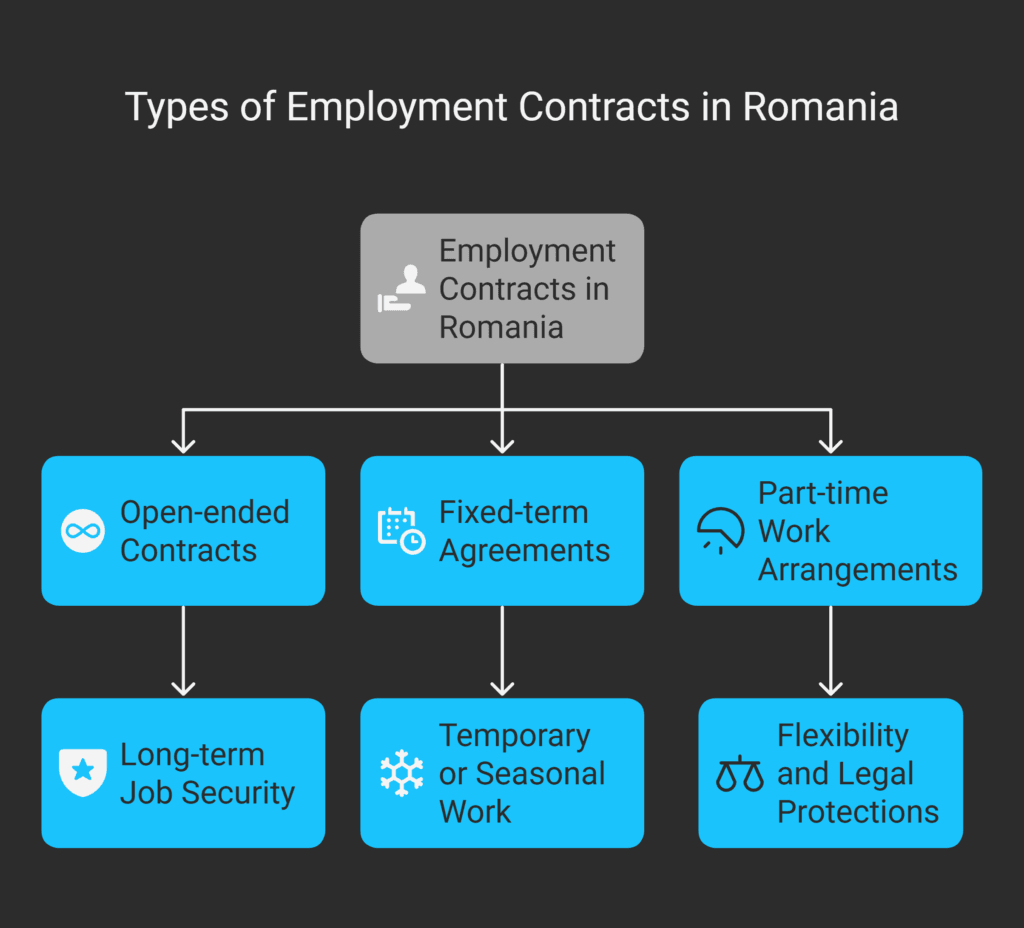
Romania has six main types of employment contracts.

Each is made for different work needs.

These contracts help with agreements for independent contractors, temporary jobs, and freelancers.

Open-ended Contracts

Open-ended contracts are the most common in Romania.

They offer long-term job security with no end date.

They include:

Fixed-term Agreements

Fixed-term contracts are for temporary jobs or seasonal work.

Romanian laws have rules for these contracts:

  1. Maximum contract duration: 36 months;
  2. Maximum of three contract renewals;
  3. Specific conditions for temporary work contracts;
  4. Detailed documentation requirements.

Part-time Work Arrangements

Part-time contracts offer flexibility.

They allow for fewer working hours while keeping legal protections.

They include:

  • Flexible working hours;
  • Proportional salary and benefits;
  • Suitable for freelance work contracts;
  • Clearly defined work schedules.

Choosing the right employment contract in Romania is vital.

It should match your business needs and workforce requirements.

Essential Components of Romanian Work Contracts

Creating a strong employment contract needs careful focus on key details.

These details protect both employers and employees.

Knowing how to draft contracts well is very important in Romania.

Your contract must have several important parts to follow the law and be clear.

These parts are the foundation of the employment agreement.

  • Employee and employer full identification details;
  • Precise job title and detailed job description;
  • Exact workplace location;
  • Detailed working hours specification;
  • Complete salary and compensation structure;
  • Contract duration and termination conditions;
  • Notice periods for contract termination.

The terms and conditions should be clear to avoid confusion.

Romania’s labor laws require certain things in employment contracts.

For example, contracts must be registered within a day before starting work.

Don’t forget about pay details.

Your contract must say how much you’ll earn in Romanian lei.

It should also cover any raises, bonuses, or extra pay.

By focusing on these key points, you’ll make a detailed employment agreement.

This agreement will meet legal standards and protect both sides.

Drafting Work Contracts in Romania

Creating strong employment contracts in Romania needs careful attention to legal details.

Your contract services must understand Romanian employment laws well.

This ensures both employer and employee are protected.

Creating a good contract means knowing the legal templates Romania offers.

It’s important to get professional legal advice to avoid mistakes in the drafting process.

Contract Structure and Format

Romanian employment contracts have a specific structure.

They must include important elements:

  • Detailed job description;
  • Compensation and benefits information;
  • Work location and responsibilities;
  • Duration of employment.

Legal Compliance Considerations

When making employment agreements, you must follow Romanian labor laws closely. Key compliance points include:

  1. Written confirmation of all contract terms;
  2. Precise job role definition;
  3. Clear compensation structure;
  4. Adherence to mandatory social protections.

Common Pitfalls to Avoid

When drafting contracts, knowing common mistakes is important. Key areas to watch out for include:

PitfallPotential Consequence
Vague Job DescriptionsLegal disputes and unclear expectations
Incomplete Compensation DetailsPotential salary conflicts
Missing Mandatory ClausesContract invalidity

Using professional legal templates from Romania can help avoid these issues.

Working with experienced contract drafting services ensures your agreements are solid and legally correct.

This protects both your organization and your employees.

Employee Rights and Protections

Employee Rights and Protections

It’s important to know about employee rights and protections in Romania.

The Romanian labor law has rules to protect workers’ rights.

These rules help make sure workplaces are fair and follow the law.

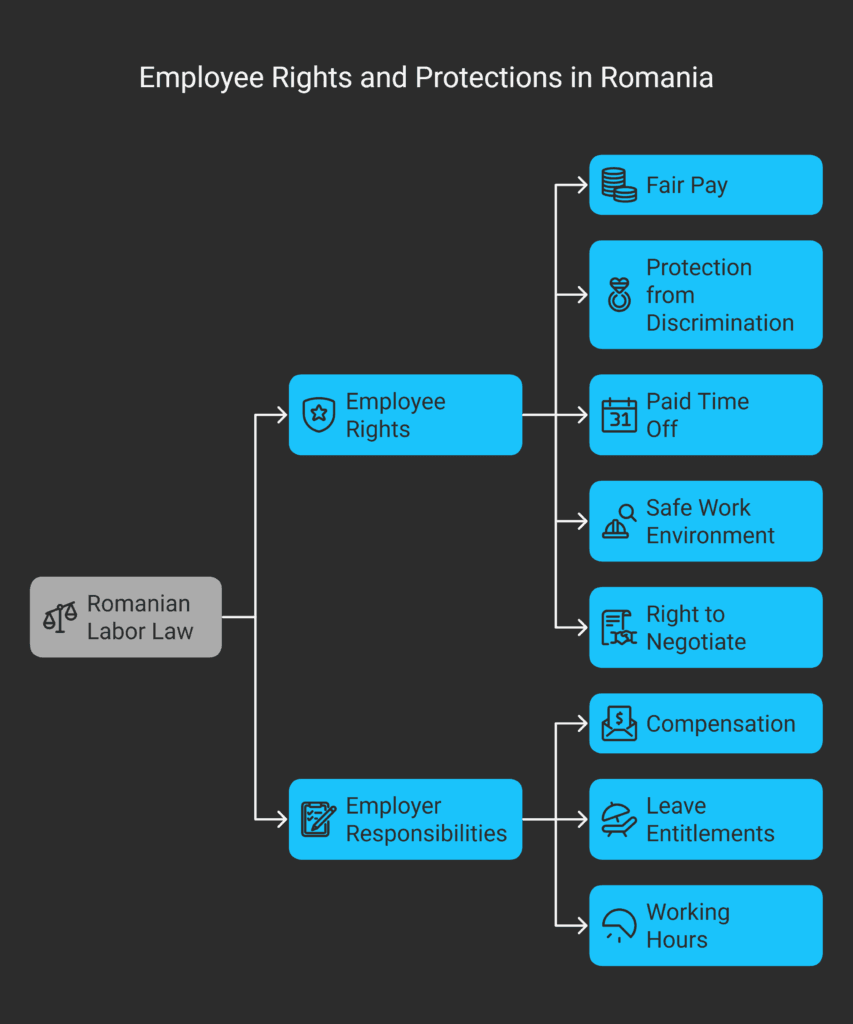
Some main employee rights in Romania include:

  • Fair pay and a minimum wage;
  • Protection from workplace discrimination;
  • Paid time off and vacation days;
  • A safe place to work;
  • The right to negotiate with employers.

Employers need to follow certain rules when making employment contracts.

These rules help make sure workers are treated fairly in all industries.

Right CategoryKey ProvisionsLegal Protection
CompensationMinimum monthly wage of 3,700 RONLabor Code Article 39
Leave EntitlementsMinimum 20 paid vacation days annuallyNational Labor Regulations
Working HoursMaximum 40-hour workweekEmployment Protection Laws

When following employer guidelines in Romania, companies should be open and respect workers’ rights.

This not only keeps them legal but also makes the workplace better for everyone.

By focusing on these rights, you can make your workplace more welcoming, productive, and legally correct in Romania.

Working Hours and Compensation Structures

Understanding wage regulations in Romania is key.

You need to know about employment law and workplace compliance.

This includes working hours, pay, and benefits.

Knowing these details helps avoid labor disputes.

Romanian work contracts outline the rules for work hours.

The standard week is 40 hours over five days.

Workers get fair pay and benefits.

Standard Working Hours

  • Maximum 40 hours per week;
  • 8-hour daily work limit;
  • Minimum rest period of 12 consecutive hours between work shifts.

Overtime Regulations

Overtime pay in Romania is clear.

Workers get 75% more than their regular pay for extra hours.

There are rules for overtime:

  1. Overtime must be approved in advance;
  2. Maximum 48 hours per week, including overtime;
  3. Compensation can be monetary or time off.

Salary and Benefits Requirements

As of January 2025, the minimum wage is RON 4,050 monthly.

Employers must also offer benefits and pay social security.

Important pay elements include:

  • Mandatory social security contributions;
  • Minimum 20 paid vacation days annually;
  • 15 public holidays with paid time off;
  • Non-taxable benefits like voluntary pension fund contributions.

Knowing these rules keeps your company legal and competitive in Romania.

Focus on fair pay and benefits to attract and keep good workers. This way, you avoid legal issues.

Probationary Periods and Contract Termination

Understanding termination clauses in Romania is key for employers and employees.

The Romanian Labor Code outlines rules for probation and contract end.

It protects both sides.

Probationary periods are a big part of jobs in Romania.

Here’s what you need to know:

  • Non-managerial jobs have a 90-day probation period.
  • Managerial jobs have a 120-day probation period.
  • Probation lets both sides check if they fit well together.

When it comes to contract termination in Romania, there are important points to remember:

  1. Termination is allowed for reasons like:
    • Company closure;
    • Redundancy;
    • Performance problems;
    • Major misconduct.
  2. Termination is not allowed during:
    • Pregnancy;
    • Maternity leave;
    • Parental leave.

Severance pay in Romania applies in certain cases:

Termination ScenarioSeverance Pay Requirement
Company CessationMinimum one month’s salary
Role RedundancyMinimum one month’s salary
Company RelocationMinimum one month’s salary

When ending a contract, follow the notice rules.

For regular jobs, it’s 20 working days.

For management roles, it’s 45 working days.

Always stick to the Romanian Labor Code to safeguard rights.

Special Clauses and Additional Provisions

Special Clauses and Additional Provisions

When making employment contracts in Romania, special clauses are key.

They protect both the employer and the employee.

Knowing these clauses helps manage workplace relationships and follow the law.

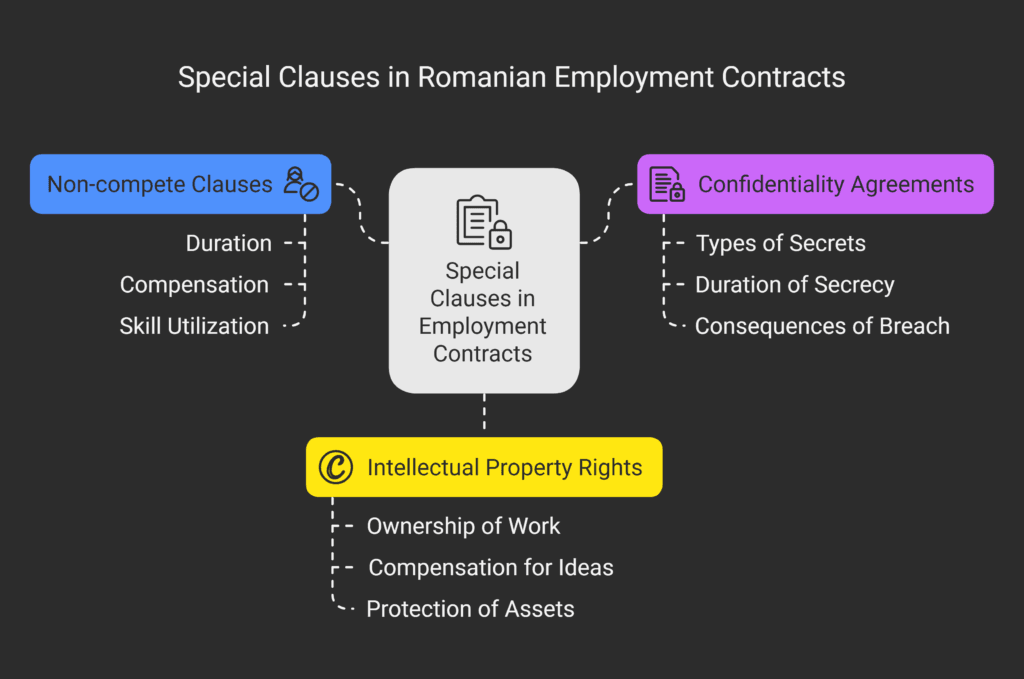
Non-compete Clauses in Romania

Non-compete clauses in Romania are important.

They stop employees from working for competitors after they leave.

These clauses have specific rules:

  • They can last up to 2 years after the contract ends;
  • The employee must get at least 50% of their average salary each month;
  • They can’t completely stop the employee from using their skills.

Confidentiality Agreements Romania

Confidentiality agreements in Romania keep business secrets safe.

You need to make sure:

  1. The types of secrets are clear;
  2. How long the secrecy lasts;
  3. What happens if someone breaks the agreement.

Intellectual Property Rights

Intellectual property in Romania needs careful planning.

Your contracts should cover:

  • Who owns work done while employed;
  • How to pay for new ideas;
  • How to protect creative assets.

By using these special clauses, you can make strong contracts.

They protect your business and follow Romanian laws.

Remote Work and Teleworking Agreements

Romania has changed its work policies to welcome digital nomads.

The country’s telework scene has grown a lot.

This change started in July 2017, when the Ministry of Labor suggested new rules for remote work.

It’s important to know the visa rules for digital nomads in Romania.

The new work laws offer a clear guide for remote work agreements.

They ensure both flexibility and legal safety.

  • Telework is defined as work done outside the usual office using technology;
  • Employees must sign a special agreement or addendum to work remotely;
  • Remote workers get the same rights as those in the office.

When making a remote work contract in Romania, you need to think about a few things.

The new work rules require specific details.

These include:

  1. What equipment is provided;
  2. How flexible work hours can be;
  3. How work performance is checked;
  4. How communication should happen.

Remote work is appealing because of the financial benefits.

Employers save on office space, utilities, and travel costs.

Employees enjoy better work-life balance and save time.

The pandemic made Romania adopt remote work faster.

About 50% of workers started teleworking during this time.

Now, digital nomads and local workers have clear, safe work rules.

Collective Bargaining Agreements and Their Impact

Collective bargaining agreements are key in Romania’s workforce rules.

They set out detailed rules for work and employee rights.

This is important for labor contracts in Romania.

To understand these agreements in Romania, you need to know their legal side and real-world effects.

Employers must see how these agreements can change individual work contracts.

  • Employers with 10 or more employees must engage in collective bargaining;
  • Negotiations must start 45 calendar days before the current agreement expires;
  • Collective agreements typically last between 12-24 months.

Following workplace rules in Romania means paying close attention to collective bargaining.

Important things to think about include:

RequirementSpecification
Minimum Negotiation MeetingsThree face-to-face meetings
Maximum Negotiation Period60 calendar days
Penalty for Non-ComplianceRON 5,000 to RON 10,000 fine

Your company needs to get ready well for collective bargaining.

Make a detailed first proposal, know the law, and negotiate smartly.

This helps protect both employer and employee interests.

Legal Consultation and Contract Review

Professional legal consulting in Romania is key to protecting your business.

When making employment contracts, getting help from experienced legal services in Romania can lower risks.

Studies show that companies with legal help in contract talks are 50% more likely to get good terms.

Contract review in Romania can spot unclear parts that might cause future problems.

About 60% of contract issues come from unclear terms.

Working with a specialized team of lawyers in Romania can make sure your contracts are clear, legal, and fit your business needs.

Understanding Romania’s legal system is complex.

With 80% of companies seeing regulatory changes as big risks, getting legal advice is vital.

Our team of Romanian Lawyers can craft contracts that cover important points like how to end a contract, who owns what, and how to deal with market changes.

For personalized advice and expert contract review, contact our team at office@theromanianlawyers.com.

We offer detailed legal services to safeguard your business and ensure you follow Romanian employment laws.

FAQ

What is the primary legal document governing employment contracts in Romania?

The Labor Code (Codul Muncii) is the main law for employment contracts in Romania.

It sets the rules for making, following, and ending employment agreements.

This ensures everyone follows the national labor laws.

Are written contracts mandatory in Romania?

Yes, written contracts are a must in Romania.

Every job must have a written contract (contract individual de muncă).

It must be in Romanian and registered with ReviSal, the online employee registry.

What are the main types of employment contracts in Romania?

Romania has three main types of employment contracts.

These are open-ended contracts, fixed-term agreements, and part-time work.

Each type has its own rules about how long it lasts and if it can be renewed.

What mandatory elements must be included in a Romanian work contract?

A Romanian work contract must have key details. These include:

– Who the employer and employee are;

– What the job is and what’s expected;

– Where the job is;

– How many hours to work;

– How much money is paid;

– How long the contract lasts;

– How much notice is needed to end the contract.

How long can probationary periods last in Romania?

In Romania, probationary periods depend on the job’s complexity.

– Up to 30 days for simple jobs;

– Up to 90 days for professional jobs;

– Up to 120 days for management jobs.

Are non-compete clauses legal in Romanian employment contracts?

Yes, non-compete clauses are legal in Romania.

But they must follow certain rules:

– The agreement must be in writing

– It must have reasonable limits in time and place

– The employee must get paid for it

– It must protect the employer’s real business interests

What are the rules for overtime in Romania?

Romanian laws say overtime can’t be more than 8 hours a week.

It must be:

– Agreed to by the employee

– Paid extra (usually 75% more than normal pay)

– Documented and approved by the employer

How does Romania handle remote work contracts?

Romania has rules for remote work under Law No. 81/2018.

It requires:

– A detailed remote work agreement;

– Clear ways to check work;

– Equipment and pay for remote work;

– Flexible hours.

What is the minimum wage in Romania for 2024?

In 2025, the minimum wage in Romania is  4,050 RON (about €814.18).

This must be in the contract and paid on time.

Can foreign companies hire employees in Romania?

Yes, foreign companies can hire in Romania.

They must:

– Set up a legal entity;

– Register with local authorities;

– Follow Romanian labor laws;

– Make contracts in Romanian;

– Pay all social contributions.

What protections exist for employees during contract termination?

Romanian laws protect employees when contracts end.

They include:

– Required notice periods;

– Possible severance pay;

– Protection from unfair dismissal;

– Right to appeal in court.

What are the key elements that must be included in an employment contract in Romania?

In Romania, an individual employment contract must contain several essential elements as per the Romanian Labor Code.

These include:

1. The identities of the parties

2. The workplace

3. Job description and duties

4. Working conditions and occupational hazards

5. Working hours

6. Holiday entitlements

7. Base salary and other compensation elements

8. Notice period for termination

9. The applicable collective labor agreement, if any 10.

Probationary period, if applicable the employment contract must be concluded in writing, in the Romanian language, before the employee starts work.

Both the employer and employee should sign the contract, with each party receiving a copy.

What are the different types of employment contracts available under Romanian law?

Romanian employment law recognizes several types of employment contracts:

1. Indefinite-term contracts: The most common type, with no specified end date;

2. Fixed-term contracts: Limited to a maximum of 36 months, with specific conditions for use;

3. Part-time contracts: For work less than 8 hours per day or 40 hours per week;

4. Temporary work contracts: For employees hired through temporary work agencies;

5. Home-based work contracts: For employees working from home;

6. Apprenticeship contracts: For professional training purposes Each type of contract has specific regulations and limitations under the Romanian Labour Code, and employers must ensure compliance with the relevant provisions when drafting these agreements.

How should the job description be formulated in a Romanian employment contract?

The job description is a crucial element of any employment contract in Romania.

It should be detailed and specific, outlining the employee’s main responsibilities, tasks, and duties.