Minority Shareholder Rights in Romanian Companies

Minority Shareholder Rights in Romanian Companies: Legal Protections and Limits

Minority Shareholder Rights in Romanian Companies: Legal Protections and Limits

Can minority shareholders in Romanian companies protect their investments against decisions by controlling shareholders?

This question is vital for thousands of investors who contribute capital and oversight but own less than fifty percent of shares.

Minority shareholder rights in Romanian companies are a delicate balance between business efficiency and investor protection.

The legal framework, including Law No. 31/1990 on Commercial Companies, the Civil Code, and court precedents, offers safeguards.

These protections are for investors without voting control but with essential capital and market credibility.

Minority Shareholder Rights in Romanian Companies

Shareholder protection laws in Romania acknowledge the unique vulnerabilities of minority investors.

Majority shareholders might pursue strategies that benefit them at the expense of smaller shareholders.

The legal system counters these risks with mandatory information rights, judicial remedies, and procedural safeguards for fair treatment within corporate structures.

EU standards significantly influence Romanian legislation on minority investor rights. European directives dictate how Romanian companies must treat all shareholders, regardless of ownership percentage.

These protections go beyond basic voting rights to include access to corporate information, dividend distributions, and legal recourse against decisions harming minority interests.

A Romanian law office specializing in corporate matters offers critical guidance for minority shareholders.

Professional assistance helps investors understand their rights, evaluate corporate actions, and pursue remedies when necessary.

For expert legal services combining Romanian expertise with international standards, contact office@theromanianlawyers.com.

Key Takeaways

  • Romanian law defines minority shareholders as those holding less than 50% of company shares with specific legal protections
  • Law No. 31/1990 on Commercial Companies provides the primary framework for shareholder rights and corporate governance,
  • Minority investors possess information rights, voting privileges, and access to judicial remedies against unfair treatment,
  • EU directives strengthen minority investor protections through enhanced transparency and governance standards
  • Professional legal counsel helps minority shareholders understand and exercise their rights effectively,
  • Romanian courts offer multiple remedies including resolution annulment, compensation, and forced company dissolution.

Understanding the Legal Framework for Minority Shareholders in Romania

The protection of minority shareholders in Romania is rooted in detailed business legislation.

This legislation sets out clear guidelines for corporate governance.

It ensures that even those with smaller stakes receive fair treatment and have a say in company decisions.

The level of protection depends on the company type and the percentage of shares held.

Law No. 31/1990 on Commercial Companies as the Primary Legislation

Law 31/1990 is the cornerstone of corporate law in Romania, covering all private companies and outlining fundamental shareholder rights.

This legislation, backed by the  Civil Code, strikes a balance in corporate governance.

It deals with essential topics like shareholder meetings, voting, access to information, and legal recourse for minority shareholders.

Romanian companies law framework

Distinction Between Limited Liability Companies (SRL) and Joint Stock Companies (SA)

Romanian companies law 31/1990 distinguishes between two main types of commercial entities.

Each has its own governance structure:

Company TypeMinimum CapitalShareholder RightsMeeting Requirements
SRL (Limited Liability)1 RONAll shareholders can propose agenda itemsSimple majority decisions
SA (Joint Stock)90,000 RON5% threshold for special rightsQualified majority for major decisions

Definition and Thresholds for Minority Shareholders

In Romania, minority shareholders are those with less than 50% of shares.

The law sets specific thresholds for enhanced rights.

In joint stock companies, those with at least 5% can call for a general meeting and suggest agenda items.

Even single-share owners in SRLs have significant rights, including the right to challenge unlawful decisions in court.

Fundamental Information Rights and Corporate Transparency

Information access is key to protecting shareholders in Romania.

The Romanian Company Law outlines detailed rights for shareholders.

These rights allow them to track company activities and make informed choices.

This ensures that even small investors can monitor their investments and hold management accountable.

Access to Financial Statements and Corporate Records

Romanian law ensures all shareholders can access critical company documents.

This includes annual financial statements, board meeting minutes, and corporate registers.

It’s vital for protecting minority shareholders to review balance sheets, profit and loss statements, and audit reports.

Companies must keep these records at their registered office and make them available during business hours.

minority shareholder protection documents

Rights to Request Explanations from Directors

Shareholders also have the right to ask directors for explanations.

They can pose questions about business operations, financial transactions, or strategic decisions.

Directors must respond clearly within 15 days.

This strengthens shareholder protection in Romania by ensuring management is accountable.

Notification Requirements for Shareholders’ Meetings

Meeting notification is another essential aspect of protecting minority shareholders in Romania.

Companies must announce general meetings at least 30 days in advance through official channels.

Notifications must include:

  • Complete meeting agenda,
  • Proposed resolutions text,
  • Voting procedures,
  • Documentation access details.

These rules prevent majority shareholders from making surprise decisions that could harm minority shareholders.

Courts actively enforce these rules, often annulling resolutions passed without proper notification.

Minority Shareholder Rights in Romanian Companies

Romanian corporate law offers vital mechanisms for minority shareholders to protect their interests.

These legal safeguards are key in preventing corporate abuse and ensuring fairness for all shareholders.

This fairness is not based on the size of their ownership stake.

Challenging Unlawful Resolutions Under Article 132

Article 132 of Law No. 31/1990 gives shareholders the power to challenge decisions that break the law or company statutes. This provision is a cornerstone in Romania’s fight against minority shareholder oppression.

Shareholders can seek court annulment of resolutions under these conditions:

  • Decisions breach Romanian commercial law
  • Articles of association are violated
  • Individual shareholder rights face infringement
  • Private interests override company welfare

Legal Standing and Time Limits for Court Actions

Any shareholder can challenge board decisions in Romanian courts.

The law sets a strict deadline—actions must be filed within 15 days from the date the resolution is published in the Monitorul Oficial al României, Part IV .

This tight timeframe demands constant vigilance and quick action against minority shareholder oppression.

shareholder remedies romania

Protection Against Abusive or Self-Interested Decisions

Romania’s corporate abuse protection goes beyond just procedural issues.

Courts also look at the substance of decisions affecting minority shareholders:

Type of AbuseExamplesAvailable Remedies
Financial OppressionWithholding dividends despite profitabilityCourt-ordered distributions
Dilution TacticsUnjustified share capital increasesResolution annulment
Exclusion PracticesBarring minorities from strategic decisionsGovernance reforms
Self-DealingUndisclosed related-party transactionsTransaction reversal

Romanian courts are active in reviewing cases of challenging majority decisions.

Judges determine if resolutions are for legitimate business reasons or just to benefit the majority at the expense of minorities.

Voting Rights and Meeting Participation

Protecting voting rights for minority shareholders is key in corporate governance in Romanian companies.

Romanian corporations must follow specific legal rules to ensure all shareholders, regardless of their share percentage, have a say in corporate decisions.

The law on voting rights in Romanian corporations sets clear thresholds.

This allows minority groups to influence major decisions.

Shareholders with at least 5% of shares can call for general meetings.

This ensures minority shareholders’ rights are protected, even without a majority.

voting rights shareholders romania

Voting rights in Romanian corporations vary between Limited Liability Companies (SRL) and Joint Stock Companies (SA).

In SRLs, every shareholder has more rights. They can:

  • Propose agenda items for general meetings,
  • Contest decisions deemed unlawful,
  • Exercise corporate voting rights Romania guarantees by statute.

Shareholders in Romania face some limitations.

Amendments to Law 31/1990 now allow electronic or correspondence voting, particularly in joint-stock companies (SAs)—especially when listed or when permitted under the articles of association.

For SRLs, remote voting remains subject to stricter interpretation and typically requires express provisions in the company statute.

Major corporate decisions need qualified majorities to protect minority shareholders’ rights.

Changes to company charters, liquidation, and major asset sales need at least three-quarters of voting shares approval.

Recent reforms have introduced cumulative voting.

Cumulative voting (permitting concentration of votes on a single board candidate) remains entirely optional, made possible only where provided in the articles of association.

While corporate governance codes for listed companies might encourage it, no legal mandate exists.

This strengthens minority shareholders’ voting power in board elections and improves their role in corporate governance.

Legal Remedies for Minority Oppression and Abuse

In Romanian companies, minority shareholders facing corporate minority oppression have legal recourse.

The courts aim to safeguard small investor rights from majority abuse.

This includes withholding dividends, excluding from decision-making, and unfair share dilution.

Remedies span from financial compensation to restructuring the company.

Financial Compensation and Annulment of Resolutions

Romanian courts can annul resolutions that harm minority investors.

Claims often stem from preferential treatment of directors through secret deals.

Shareholders receive financial compensation when corporate governance is breached.

oppression remedies romania

Company Dissolution and Enforced Exit Mechanisms

In severe cases, courts may dissolve the company.

They assess if operations are justified amidst ongoing conflicts.

Fair compensation is ensured in minority squeeze-out procedures, with judicial oversight.

Exit MechanismTrigger ConditionsCourt Requirements
Forced BuyoutSystematic exclusion from managementFair market valuation
Company DissolutionIrreparable deadlockNo viable alternatives
Squeeze-Out Rights95% ownership threshold (for listed companies) | Independent price assessment.
In unlisted companies, squeeze-out rights are not statutory and must be defined through shareholder agreements or pursued through court action in cases of abuse
Independent price assessment

Judicial Administrator Appointments in Governance Deadlocks

Courts appoint judicial administrators in governance deadlocks.

This addresses conflicts where squeeze-out procedures fail.

Administrators have temporary power to resolve issues, ensuring compliance with regulations.

Dividend Rights and Corporate Distribution Policies

Minority shareholder rights in Romanian companies are crucial for ensuring equitable treatment and protection against potential abuses by majority shareholders.

Under Romanian company law, minority shareholders often face challenges related to voting influence, dividend distribution, and participation in corporate governance.

The articles of association play a central role in defining the procedures for passing shareholder resolutions and transferring shares, which can significantly affect minority influence in the general meeting of shareholders.

In mergers, demergers, or corporate reorganizations, minority shareholders are entitled to receive fair treatment, including compensation where applicable, particularly if their shareholding is affected by structural changes or exit scenarios.

 Although share buybacks are legally permitted under strict conditions, they are not a typical tool for minority exits.

The Romanian courts have acknowledged the importance of safeguarding minority shareholder rights, and affected shareholders may bring legal actions to challenge unlawful decisions or seek remedies under Law No. 31/1990 on Companies.

The Trade Register (ONRC) ensures public access to essential information such as company capital, registered shareholders, and changes to governing documents, contributing to transparency for both limited liability companies (SRL) and joint stock companies (SA).

As Romania continues to align its corporate governance framework with EU directives and international standards, the development of more effective enforcement mechanisms remains key.

Ensuring meaningful participation and protection for minority shareholders is essential to building trust and accountability in the Romanian business environment.

Shareholder Agreements and Contractual Protections

Shareholders’ agreements in Romania offer vital protections beyond what’s mandated by law.

These agreements fortify minority positions with specific clauses addressing common issues in Romanian business structures.

Tag-Along Rights and Cumulative Voting Provisions

Tag-along rights safeguard minority investors during majority shareholder sales.

They ensure minority shareholders can sell at the same price and terms as the majority.

Cumulative voting rights, on the other hand, boost board representation by allowing concentrated voting on certain candidates.

Protection TypeKey BenefitsApplication in Romania
Tag-Along RightsEqual sale conditionsCommonly included in Romanian shareholder agreements—especially in joint ventures, private equity deals, or closely held companies—to protect minority investors during ownership changes
Cumulative VotingEnhanced board representationMandatory for listed companies
Drag-Along RightsFacilitates complete salesStandard in PE investments

Preemptive Rights in Share Transfers and Capital Increases

Preemptive rights in Romania safeguard shareholders from dilution.

These rights apply during capital increases and share transfers, ensuring ownership percentages remain proportional.

Exit Options for Minority Investors

Minority investors have exit options, including mandatory buyouts triggered by certain events.

Romanian agreements typically include valuation mechanisms for fair pricing.

Derivative Actions and Corporate Litigation Rights

Romanian law empowers minority shareholders to defend corporate interests through derivative actions.

These actions allow shareholders to sue on behalf of the company when directors act against its best interests.

This is a key part of resolving disputes in corporate settings, ensuring management is held accountable.

Derivative actions in Romania have strict rules.

Shareholders must prove that directors have not pursued rightful claims against wrongdoers.

The law allows for actions against directors for breaches of duty, conflicts of interest, and transactions that favor certain shareholders over the company.

Romanian courts assess both the process and fairness of minority shareholder lawsuits.

They check if claims are for the company’s benefit or personal gain.

This ensures only valid disputes are addressed, preventing frivolous lawsuits.

Type of ClaimLegal Standing RequirementsTime Limits
Breach of Fiduciary Duty5% ownership in SA, 10% in SRL3 years from discovery
Conflict of Interest TransactionsAny shareholder regardless of stake6 months from transaction
Corporate Asset Misappropriation5% ownership minimum5 years from occurrence

Despite its benefits, enforcing these rights in Romania is challenging.

Courts demand robust evidence and legal expertise in local commercial law.

Success in shareholder disputes hinges on grasping procedural details and presenting strong cases that clearly show corporate harm.

Evolution of Romanian Corporate Governance Standards

Corporate governance in Romania has seen major changes with the shift to a market economy.

The reopening of the Bucharest Stock Exchange in 1995 was a key moment.

It opened up the Romanian capital markets after a 50-year hiatus.

This event laid the groundwork for modern shareholder protection laws and opened doors for both local and international investors.

Impact of EU Directives on Shareholder Protection

Romania’s path toward European Union membership led to significant legislative improvements.

The Pistor index, a measure of investor protection, jumped from 13 points in 1996 to 17.75 between May 2002 and November 2006.

EU directives brought in essential protections for minority shareholders in Romanian joint stock companies:

  • Mandatory takeover bid thresholds protecting minority investors,
  • Independent share registries ensuring transparent ownership records,
  • Strict insider trading prohibitions,
  • Enhanced disclosure obligations for major transactions.

Bucharest Stock Exchange Requirements for Listed Companies

The exchange introduced a three-tier listing system with increasing strictness.

First-tier companies face the most demanding corporate governance standards.

These standards aim to boost transparency and accountability.

They also enhance minority protections through mandatory disclosure and regular financial reports.

Recent Legislative Developments and Reform Initiatives

Law No. 441/2006 brought significant changes to minority protections in Romanian Companies.

It reduced the quorum needed for certain decisions to one-quarter.

This change slightly lowered the protection index to 17.25.

Yet, recent reforms have tackled key areas like cumulative voting, compulsory takeover offers, and detailed transaction disclosure.

These steps reflect the growing demand for better governance from investors in Romania.

Conclusion

Romanian corporate law, as outlined in Law No. 31/1990, provides a robust framework for minority shareholder rights.

This legislation ensures that minority shareholders have access to corporate information and can participate in meetings.

They also have the right to challenge unfair resolutions and seek judicial remedies when their rights are violated.

These protections align with EU standards, solidifying Romania’s standing in the global business arena.

Despite these legal safeguards, minority shareholders face practical hurdles in Romanian corporate governance.

Companies often distribute minimal dividends, limiting returns for minority investors.

Share issuance restrictions also hinder market oversight, which could discipline management decisions.

Minority shareholders must remain vigilant, documenting governance failures and asserting their statutory rights.

The dynamic nature of shareholder protection laws in Romania necessitates ongoing monitoring of legislative changes and court interpretations.

Seeking professional legal representation is essential for minority shareholders facing complex corporate disputes.

A skilled Romanian lawyer is well-versed in both the statutory framework and practical strategies to protect minority interests.

Whether it’s pursuing annulment actions, seeking compensation, or negotiating exit arrangements, experienced counsel is vital.

For expert guidance on shareholder disputes and protection strategies, contact a reputable Romanian law office at office@theromanianlawyers.com.

The future of minority shareholder protection hinges on ongoing legislative refinement and judicial enforcement.

As Romania’s corporate landscape evolves, the balance between majority control and minority rights must be constantly adjusted.

Collaborating with knowledgeable lawyers in Romania ensures minority shareholders can effectively exercise their rights.

This contributes to enhanced corporate governance standards.

For tailored advice and protection strategies for your investments, contact experienced Romanian lawyers at office@theromanianlawyers.com.

FAQ

What percentage of shares qualifies someone as a minority shareholder under Romanian law?

Romanian corporate law defines minority shareholders as those owning less than 50% of shares.

This rule applies to both Limited Liability Companies (SRLs) and Joint Stock Companies (SAs).

Specific rights and thresholds can differ between these company types.

How long do minority shareholders have to challenge unlawful corporate resolutions in Romania?

Article 132 of Law No. 31/1990 states that minority shareholders must start legal actions within 15 days after a resolution is adopted.

This tight deadline is critical for shareholders to act quickly when they spot legal breaches or decisions that harm their rights.

What information rights do minority shareholders have in Romanian companies?

Romanian Company Law ensures minority shareholders can access corporate records like financial statements and meeting minutes.

They have the right to ask directors about company operations and must be informed about shareholders’ meetings and decisions.

Denying access to this information can lead to legal action.

Can minority shareholders in Romanian SRLs propose agenda items for general meetings?

Yes, in Limited Liability Companies (SRLs), any shareholder can suggest agenda items and challenge decisions, regardless of their shareholding percentage.

This gives them more participation rights than in Joint Stock Companies (SAs), where at least 5% is needed to request a general meeting.

What remedies exist for minority shareholders facing dividend withholding in profitable Romanian companies?

Romanian courts can order financial compensation or annul abusive resolutions.

In extreme cases, they might dissolve the company if majority shareholders consistently withhold dividends despite profitability.

Studies show companies with majority shareholders over 50% pay lower dividends, making judicial remedies key for minority protection.

How do tag-along rights protect minority shareholders in Romania?

Tag-along rights in shareholder agreements allow minority shareholders to sell their shares at the same price and conditions as majority stakeholders.

Can minority shareholders bring derivative actions against directors in Romanian companies?

Yes, Romanian law allows minority shareholders to take legal action on behalf of the company against directors who fail to pursue claims.

They can seek compensation for damages caused by directors’ breach of duties or conflicts of interest.

Courts assess both procedural and substantive fairness.

What voting threshold is required for fundamental corporate decisions affecting minority shareholders?

Romanian law demands a 3/4 qualified majority for key decisions like charter changes, liquidation, and major asset sales.

This supermajority ensures minority shareholders can block significant corporate changes that might harm their interests.

How has EU membership affected minority shareholder protections in Romania?

Romania’s EU accession boosted corporate governance standards, with the Pistor index increasing from 13 in 1996 to 17.25 in 2008.

EU directives introduced takeover bid thresholds, independent registries, insider trading bans, and enhanced disclosure, strengthening minority investor rights.

What are preemptive rights and how do they protect minority shareholders from dilution?

Preemptive rights prevent dilution by allowing minority shareholders to buy new shares proportional to their existing holdings during capital increases or share transfers.

Romanian courts uphold these rights, ensuring that minority positions are not unfairly diluted without participation opportunities.

What are the rights of minority shareholders in Romanian companies?

Minority shareholders in Romanian companies have several rights established by law that provide them protection in the company’s governance.

These rights include the ability to attend and vote in the general meetings of shareholders, access to the company’s financial information, and the right to propose resolutions.

Additionally, minority shareholders may request the court to intervene if their rights are violated or if they believe the company is not acting in its best interests.

How does the law protect minority shareholders during a merger?

The law provides specific protections for minority shareholders during a merger in Romania.

Minority shareholders have the right to fair compensation for their shares if they do not agree with the merger.

The company must publish the merger details in the official gazette and provide adequate information to all shareholders, ensuring transparency throughout the process.

Furthermore, minority shareholders may challenge the merger in court if they believe it violates legal provisions or the company’s articles of association.

Can minority shareholders influence decisions made at the general meeting of shareholders?

Yes, minority shareholders have the right to influence decisions made at the general meeting of shareholders.

They can vote on shareholder resolutions and may request to hold extraordinary general meetings if they hold at least a certain number of shares as established by the articles of association.

This ensures that even minority shareholders can contribute to significant decisions affecting the company, including changes in the share capital or the transfer of shares.

What is the significance of the trade registry for minority shareholders?

The trade registry plays a crucial role in protecting the rights of minority shareholders in Romanian companies.

It serves as the official record of the company’s structure, including the number of shareholders, their contributions to the share capital, and any changes to the company’s articles of association.

Minority shareholders can verify the company’s compliance with corporate governance rules and ensure that any resolutions or actions taken are legally binding and in their best interests.

What legal forms of companies exist that impact minority shareholder rights?

In Romania, there are two main types of companies that impact minority shareholder rights: joint-stock companies and limited liability companies.

Each legal form has specific regulations regarding shareholder rights, governance, and share capital.

For instance, in a joint-stock company, minority shareholders may have greater rights to information and participation in decision-making compared to a limited liability company.

Understanding these distinctions is essential for minority shareholders to navigate their rights effectively.

Romania’s Administrative Fines: What You Need to Know Before You Pay

Romania’s Administrative Fines: What You Need to Know Before You Pay

Ever get a notice to pay for a rule you didn’t know about?

Dealing with fines can be tough, even more so if you don’t know the rules.

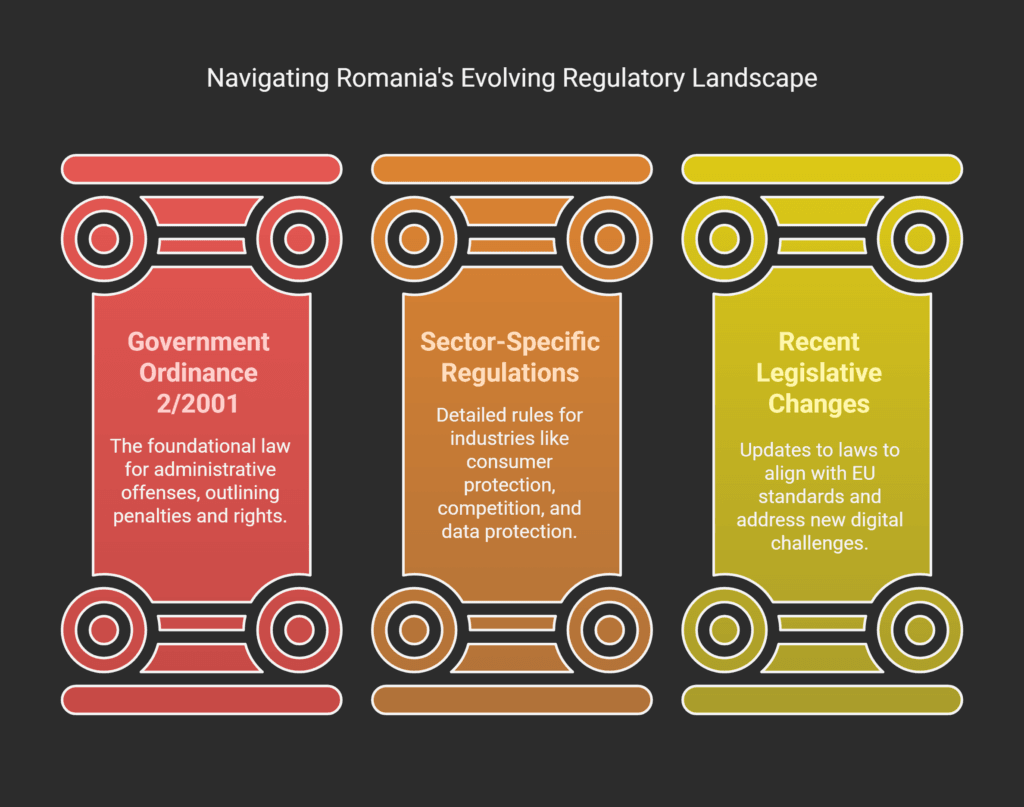
In Romania, fines follow rules set by Government Ordinance No. 2/2001.

This law outlines what fines are for and how much they cost.

It’s very important for both people and businesses in the country to understand this.

Romania’s Administrative Fines

Romania’s Administrative Fines

The way fines work in Romania has changed a lot.

Now, fines are the main way authorities make sure everyone follows the rules.

This is a big change from when fines were mostly for serious crimes.

If you get a fine, knowing your rights can help a lot.

The rules tell you how to figure out, pay, and even fight fines that seem unfair.

In this guide, you’ll learn all you need to know about fines in Romania.

This is true whether you live, work, or run a business here.

Key Takeaways

  • Government Ordinance No. 2/2001 establishes the framework for contraventional offenses in Romania;
  • Administrative penalties evolved from being part of the Criminal Code to administrative law;
  • Understanding the regulatory framework is essential for both individuals and businesses;
  • Legal sanctions serve as enforcement mechanisms to ensure compliance with regulations;
  • Specific procedures exist for calculation, payment, and contesting administrative fines;
  • Knowing your rights regarding regulatory penalties can save time, money, and stress.

Understanding Romania’s Administrative Fines

Getting to know Romania’s fine system is key.

It’s based on laws and the groups that enforce them.

If you live or work in Romania, you might face Romanian administrative sanctions.

These fines are different from criminal penalties and help keep things in order.

Definition and Legal Basis

In Romania, fines for small mistakes are called contraventional sanctions.

They’re not as serious as crimes.

The rules for these fines come from Government Ordinance No. 2/2001.

This ordinance says a contravention is a small mistake done on purpose or by accident.

It must be listed as a contravention in the law. And it’s not as big of a deal as a crime.

These fines are meant to help people follow the rules, not to punish them.

They’re not like criminal fines.

Instead, they aim to fix the problem and make sure everyone follows the rules.

Romanian administrative sanctions framework

Romanian administrative sanctions framework

There are also laws for specific areas that add to the main rules.

These laws list what’s wrong and what the fines are for those mistakes.

Key Regulatory Authorities in Romania

Many government groups watch over the rules and give out Romanian corporate compliance fines when needed.

Each group looks after a certain area.

The National Authority for Consumer Protection (ANPC) checks on the market and protects consumers.

They deal with unsafe products, false ads, and unfair business practices.

They focus on businesses that don’t follow the rules for consumers.

The National Environmental Guard and local agencies handle environmental issues.

They make sure companies follow the rules about pollution and waste.

Breaking these rules can lead to big fines.

The Labor Inspectorate (Inspecția Muncii) looks after work places.

They make sure employers follow the rules about safety, fair pay, and working hours.

If employers don’t follow these rules, they can face big fines.

Tax authorities, like the National Agency for Fiscal Administration (ANAF), deal with tax issues.

They handle things like not reporting income or keeping bad records.

This can lead to fines and extra taxes.

Local police and special teams enforce local rules and handle small public order issues.

They deal with things like noiseunauthorized building, and breaking local rules.

Knowing who to talk to when you get a fine in Romania is important.

Each group has its own way of doing things, but they all follow the main rules set by Government Ordinance No. 2/2001.

Common Types of Administrative Violations in Romania

Knowing the common administrative infractions in Romania can save you from big fines and legal trouble.

The country has rules for both businesses and individuals.

Knowing these rules helps you stay compliant and avoid penalties.

Romanian compliance violations

Romanian compliance violations

Corporate and Business Infractions

Businesses in Romania must follow strict rules to avoid Romanian corporate fines.

These fines help keep businesses in line and protect everyone involved.

Labor law violations are a big problem.

Issues like bad employment contracts, too many working hours, and safety problems are common.

The Romanian Labor Inspectorate checks these and fines can be from 1,500 to 20,000 RON.

Consumer protection infractions are also a big deal.

This includes false ads, unfair contracts, and not honoring warranties.

The National Authority for Consumer Protection is getting tougher on these issues.

Tax reporting mistakes are a top concern for Romanian authorities.

This includes late tax filings, wrong revenue reports, and VAT issues.

These mistakes can lead to fines and extra taxes with penalties.

Business Infraction TypeRegulatory AuthorityTypical Fine Range (RON)Common Examples
Labor Law ViolationsLabor Inspectorate1,500 – 20,000Undocumented workers, safety violations
Consumer ProtectionANPC2,000 – 50,000Misleading advertising, unfair terms
Tax ComplianceANAF5,000 – 100,000Late filings, incorrect reporting
EnvironmentalEnvironmental Guard30,000 – 80,000Waste disposal violations, emissions

Individual Administrative Offenses

People in Romania face their own set of rules that can lead to fines.

Knowing these can help you avoid trouble.

Traffic violations are a big issue.

This includes speedingillegal parking, and not wearing seatbelts.

Fines can be from 290 to 2,900 RON, with serious cases leading to losing your license.

Public disturbance offenses are another common problem.

This includes loud noise, bad waste disposal, and acting out in public.

Local police can fine you from 100 to 500 RON for these.

Age matters when it comes to fines in Romania.

Kids under 14 can’t be fined.

Those 14 to 18 face smaller fines than adults, showing Romania’s approach to responsibility.

GDPR and Data Protection Violations

With the GDPR in place, data protection is a big deal in Romania.

Both businesses and public bodies must follow strict rules to avoid fines.

Processing data without permission is a serious mistake.

This includes collecting data without consent, using it for the wrong reasons, or keeping it too long.

The National Supervisory Authority for Personal Data Processing can fine up to 20 million euros or 4% of global turnover for the worst cases.

Not telling people about data breaches fast enough is another big no-no.

Companies must tell the authority and those affected within 72 hours if data is at risk.

Not protecting data well enough is also a big problem.

Companies must have good security measures to keep data safe, based on the risk involved.

Not respecting people’s data rights is another common issue.

This includes not giving access to data, not fixing wrong data, erasing data, and not letting people take their data with them.

Companies must respond to these requests within a month, with some exceptions.

Knowing about these common violations helps with business risk management and personal compliance in Romania.

By spotting problems before they happen, you can avoid fines and protect your business’s reputation.

The Romanian Regulatory Framework

Romania has a detailed legal system for handling administrative offenses.

It combines general rules with specific ones for different areas.

Knowing these rules is key for businesses and residents, as they cover everything from traffic rules to corporate rules.

 Romanian Regulatory Framework Fines

Government Ordinance No. 2/2001

At the heart of Romania’s administrative offenses legislation is Government Ordinance No. 2/2001.

It’s the main law for handling contraventions.

This ordinance is as important as laws passed by parliament, but it comes from the government.

GO 2/2001 sets up three main types of punishments for contraventions:

  • Warnings (verbal or written cautions);
  • Contraventional fines (monetary penalties);
  • Community service (remedial work for the public benefit).

This ordinance makes contraventions a separate category from crimes.

It outlines how fines are given, sets rules for penalties, and protects the rights of those facing charges.

Sector-Specific Regulations

While GO 2/2001 is the base, many specific rules add complexity to the Romanian regulatory framework.

These rules cover different industries and activities.

Traffic laws, for example, have detailed rules on driving and vehicle requirements.

Consumer protection laws set rules for businesses on product safety and advertising.

SectorPrimary LegislationKey Regulatory AuthorityCommon Violations
Consumer ProtectionLaw No. 296/2004National Authority for Consumer ProtectionMisleading advertising, unfair contract terms
CompetitionLaw No. 21/1996Competition CouncilCartel formation, abuse of dominant position
Data ProtectionLaw No. 190/2018National Supervisory AuthorityGDPR violations, data breaches
EnvironmentalGEO No. 195/2005Environmental GuardPollution, waste management failures

Environmental laws are strict about pollution and waste.

The GDPR compliance fines in Romania can be up to 4% of global turnover for big violations.

Financial laws, overseen by the National Bank of Romania and the Financial Supervisory Authority, have their own penalties.

These rules work with GO 2/2001 for matters not covered in specific laws.

Recent Legislative Changes

Romania’s fine system has changed a lot in recent years.

Fine amounts have gone up in many areas, showing a focus on stopping violations.

In 2021, changes to GO 2/2001 gave more rights to those accused of offenses.

New EU rules have also led to updates in areas like unfair competition and consumer protection.

The rise of digital services has brought new violations, like in ecommerce and online marketing.

Romania has updated laws to handle these new challenges.

Romania’s laws are getting closer to EU standards, making it easier for businesses in Europe.

This means new rules but also a more stable environment for international companies.

It’s important to keep up with these changes to avoid fines.

Romania’s laws are always evolving, so staying informed is key for everyone.

How Administrative Fines Are Calculated and Imposed

Knowing how Romanian authorities set and apply fines is key for individuals and businesses.

The Romanian legal system has a clear method to make sure fines match the violation’s severity.

This helps you understand and avoid risks, and prepare for compliance.

Penalty Assessment Criteria

Romanian agencies look at several factors to decide on fines.

These penalty assessment criteria make sure fines are fair based on the violation’s impact.

The main things considered are:

  • The seriousness of the violation and its impact;
  • If the violation was intentional or by mistake;
  • The offender’s history of following rules;
  • The economic gain from the violation;
  • The harm caused to others or public interests.

Fines are set based on the violation’s seriousness.

For example, a small paperwork mistake gets a lower fine than a serious violation.

Also, extra sanctions might be added based on the violation’s severity.

It’s important to know that for one offense, there’s one main penalty and one or more extra sanctions if needed.

Fine Calculation Methods

 Administrative Fines in Romania

The fine calculation methods in Romania follow strict rules.

The system sets both a minimum and a maximum for fines, guiding how fines are applied.

The smallest fine for any violation is 25 lei (about 6 Euros).

But, the maximum fine varies based on who set the rule:

Authority LevelMaximum Fine (Lei)Maximum Fine (Euros)Typical ApplicationLegal Basis
Law or Government Ordinance100,00025,000Serious national violationsPrimary legislation
Government Decision50,00012,500Significant regulatory breachesSecondary legislation
County Authorities5,0001,250Regional administrative violationsCounty regulations
Municipal/Communal Authorities2,500600Local ordinance violationsLocal council decisions

For repeat offenders, fines get higher with each offense.

Young offenders (ages 14-18) usually get lower fines than adults for the same violations.

Notification Process

After finding a violation and calculating the fine, Romanian authorities send a formal notice.

This step is key in administrative proceedings and must follow legal rules.

The notice, called a “Proces-Verbal de Contravenție” (contravention report), must include important details:

  • The date, time, and place of the violation;
  • A detailed description of the violation;
  • The laws broken;
  • The fine amount and how to pay;
  • Info on appealing and deadlines;
  • Details of the offender and the authority.

This document is usually given in person at the time of the violation.

If not possible, it’s sent by registered mail with proof of delivery.

You have the right to receive this notice within 30 days of the violation being found.

The notice will tell you when to pay the fine, usually 15 days after getting it.

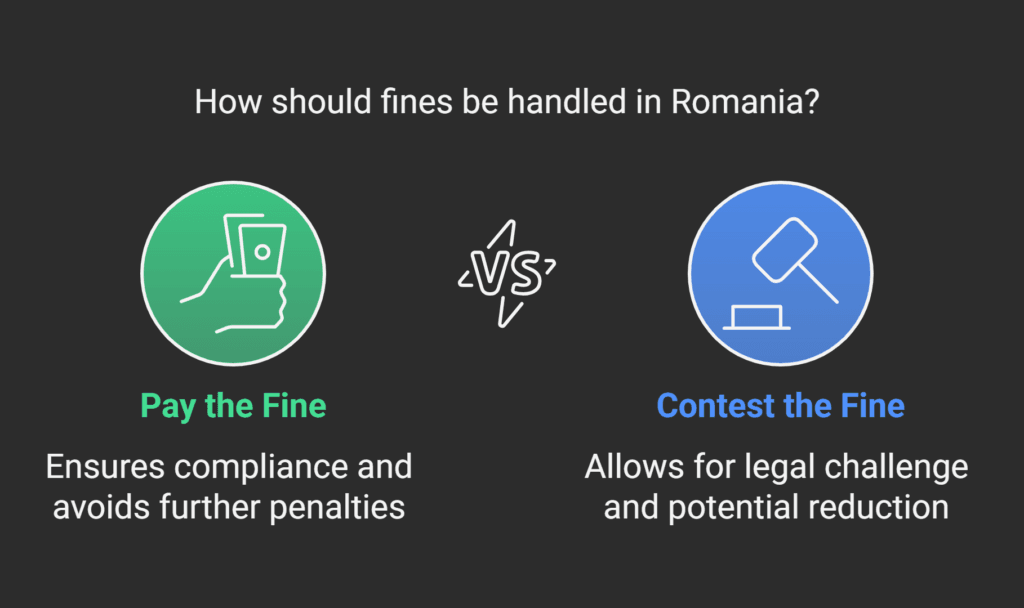
You can either pay the fine or contest it legally during this time.

Ignoring this can lead to more penalties and actions.

Knowing about assessment criteria, calculation methods, and the notification process helps you understand Romania’s fine system.

This knowledge helps you avoid penalties and follow Romanian laws correctly.

The Payment Process for Romanian Administrative Fines

When you get an administrative fine in Romania, knowing how to pay it is key.

It saves you money and avoids legal trouble.

Romania has clear steps for paying fines, important for both individuals and businesses.

The Romanian system has standard payment ways and chances for lower payments.

But, these benefits need you to follow the rules on time.

Let’s look at how to handle administrative sanctions in Romania.

Payment Deadlines and Options

Payment Romania Fine

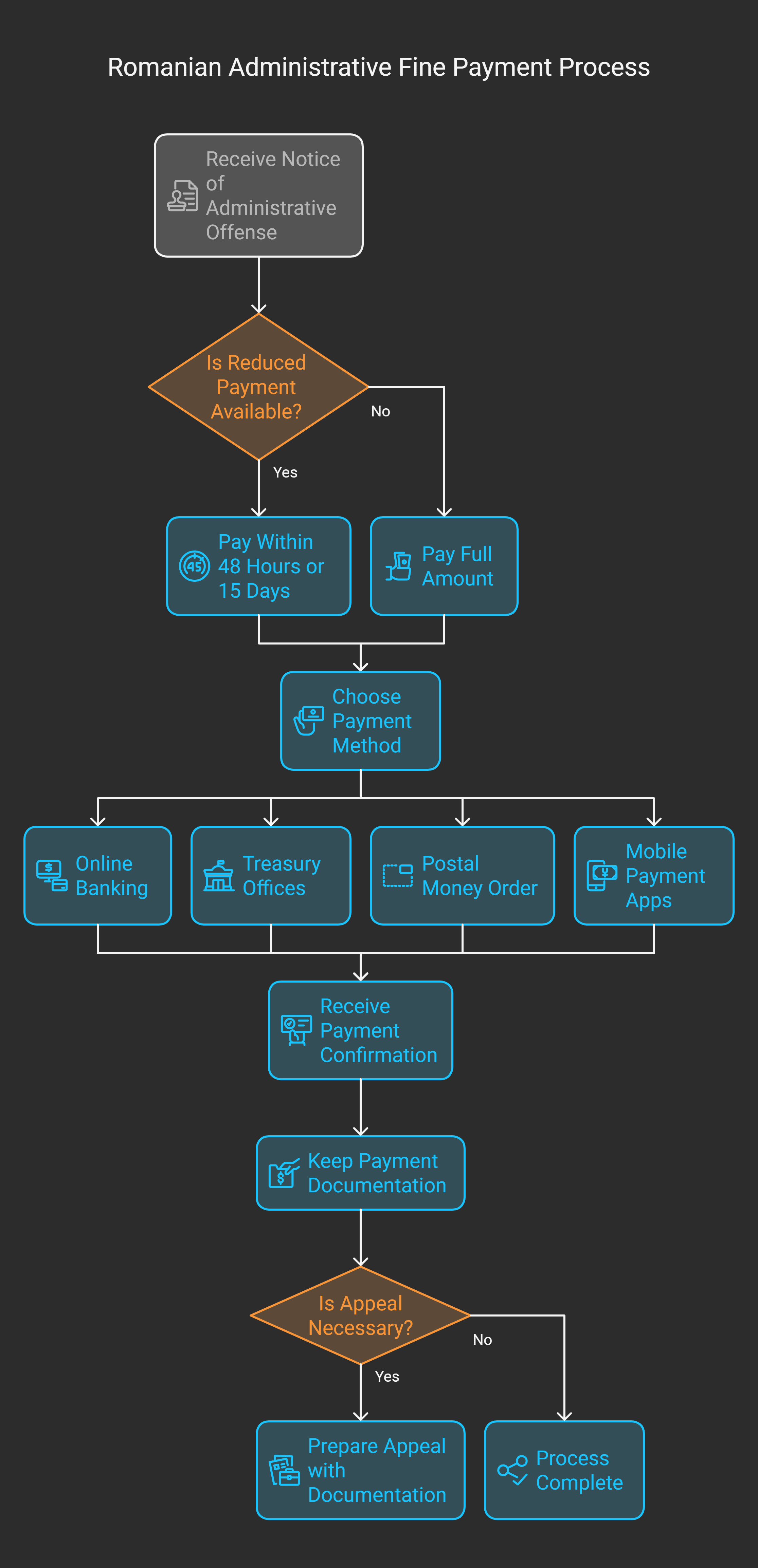
When you get a notice of an administrative offense, you have 15 to 30 days to pay.

The exact time depends on the violation and who issued it.

Always check the deadline on your notice to avoid trouble.

Romania has many ways to pay penalty fees.

You can use online banking, visit a bank, send a postal money order, or use mobile apps.

Each method has its own time, which might affect your deadline.

If you miss the payment deadline, the authorities can take action.

They might take your money directly from your accounts.

This can add extra fees and interest, making the fine even higher.

Payment MethodProcessing TimeAdvantagesDocumentation Provided
Online Banking1-2 business daysConvenient, accessible 24/7Electronic receipt, transaction ID
Treasury OfficesImmediateOfficial confirmation, guidance availableOfficial stamped receipt
Postal Money Order3-5 business daysNo bank account neededPostal receipt with tracking number
Mobile Payment Apps1-3 business daysConvenience, digital recordDigital receipt, confirmation code

Reduced Payment Opportunities

Romanian law gives big savings for quick payment of fines.

For many fines, you can pay half the amount if you pay within 48 hours or 15 days.

This depends on the type of violation.

Not all fines offer this chance.

Minor and some moderate infractions qualify, but serious ones don’t.

Your notice will say if you can pay less.

To get the reduced payment, follow the steps in your notice carefully.

Use the right payment details and pay on time.

Any mistake or delay means you can’t get the reduced payment.

Documentation Requirements

Keeping the right documents is key when dealing with fines in Romania.

Always save the original notice.

It has important details about the fine, payment, and deadlines.

After paying, keep all payment receipts safe.

Include the date, amount, payment reference, and confirmation from the authority.

For online payments, save electronic receipts and bank statements.

For in-person payments, ask for a stamped receipt.

Documentation is vital if you need to appeal a fine or if there’s a payment mistake.

Romanian authorities might not always record payments correctly.

Having all your documents ready helps solve problems fast and avoids legal trouble.

If you’re a business, organize all fine-related documents well.

This includes letters from authorities, payment records, and any supporting evidence.

Good organization helps with penalty appeals and shows you’re following the law.

Contesting Administrative Fines in Romania

If you get an administrative fine in Romania, you can fight it under certain conditions.

The legal system in Romania uses civil procedure for these challenges.

But, some fines might need criminal law if they seem too harsh.

Knowing your rights and the right steps can really help your appeal.

Contesting Administrative Fines in Romania

Legal Grounds for Appeals

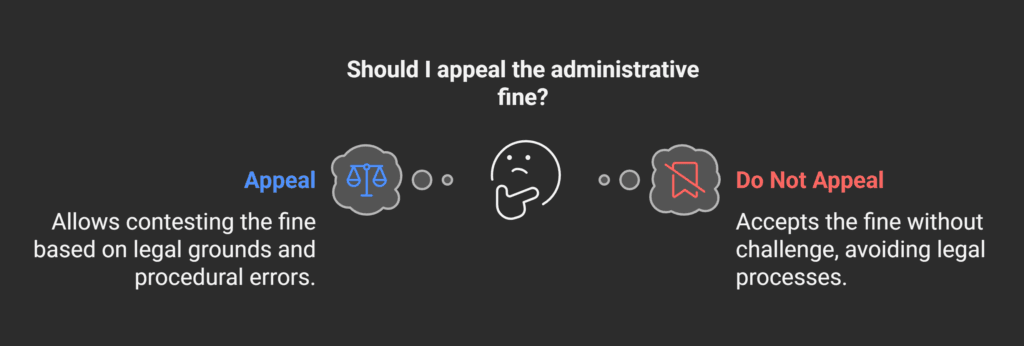
There are several good reasons to appeal an administrative fine in Romania.

It’s important to know which one fits your situation best.

Procedural errors are a common reason.

This includes wrong noticeswrong info, or not following due process when the fine was given.

Also, if the fine report got the facts wrong, you can appeal.

If you have evidence that shows the report was wrong, you can use it to challenge the fine.

Another reason is if the fine is too big for the crime.

Romanian laws say fines should match the crime.

If your fine seems too high, you can appeal based on this.

The European Court of Human Rights has set important rules for fines in Romania.

They’ve said Romania can’t ignore the idea that you’re innocent until proven guilty.

These rules help if you’re appealing because of rights issues.

The Appeals Process Timeline

Time is key when you’re appealing a fine in Romania.

You have 15 days from when you get the fine notice to appeal.

If you miss this, you can’t appeal anymore.

The appeal process has a clear schedule:

1. Within 15 days of getting the notice: Send your appeal in writing to the fine issuer or the court.

2. Within 5 days after you send it: The court will register your appeal and give it a number.

3. 20-30 days later: You’ll have your first court hearing (estimated).

4. 1-3 months: The first court decision will take this long, depending on the case (estimated).

5. Within 30 days of the first decision: You can appeal to a higher court if you need to (estimated).

For simple cases, the whole process can take 3-6 months.

But, if it’s more complicated, it might take longer.

Required Documentation for Appeals

Having the right documents is key for a good appeal.

Get everything ready before you start.

This will help your case and avoid delays.

Here’s what you need for an appeal in Romania:

Document TypePurposeRequired CopiesSpecial Requirements
Original Fine NotificationShows why you’re appealing1 original + 2 copiesMust include all pages and attachments
Written Appeal StatementExplains why you’re appealing3 copiesMust say what you want to happen
Supporting EvidenceBacks up your appeal3 copies of each documentTranslated if not in Romanian
Power of AttorneyAllows someone to represent you1 original + 2 copiesNotarized if represented by attorney
Proof of Payment (court fees)Shows you’ve paid to appeal1 original + 2 copiesFee amount varies by fine value

Your appeal statement should clearly say why you’re appealing.

Include any witness statements that support your side, if you’re questioning the facts of the violation.

Reports from experts can be very helpful, too.

They’re good for fines in areas like construction or environmental rules.

These reports give a third view that courts often find convincing.

When you appeal, you can send it to the fine issuer or the court.

For most fines, you should appeal to the local court (Judecătoria) where the fine was given or where you live.

Remember, all documents must be in Romanian or have a certified translation if they’re not.

Consequences of Non-Payment

Not paying Romanian administrative fines can lead to bigger problems.

You could face more penaltieslegal actions, and even disruptions to your business.

It’s important to manage risks in Romania well, whether you’re an individual or a company.

The Romanian legal system is strict about fines.

They have rules to make sure everyone follows the law.

Consequences of Non-Payment of Fines in Romania

Legal Enforcement Actions

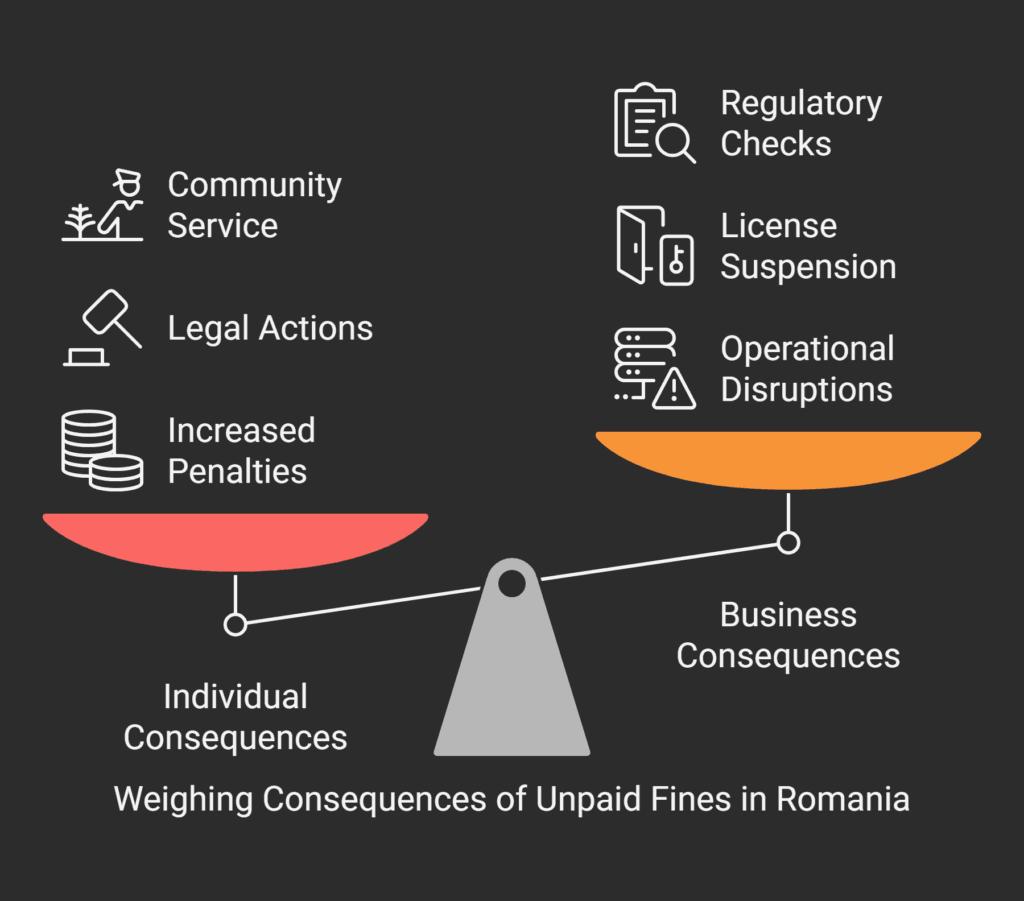
If you don’t pay your fine in 30 days, Romanian regulatory authorities will start legal actions.

They will send you a writ of execution.

This is the first step in enforcing the fine.

Authorities have several ways to enforce fines:

  • They can seize your property, both movable and immovable.
  • They can take money directly from your wages.
  • They can freeze your bank accounts and take money from them.
  • They can make you do community service instead of paying the fine.

If you can’t pay the fine and don’t have property, you can ask the court for community service.

You can also ask for more time to pay the fine at your first court appearance.

Doing community service can mean up to 300 hours of work.

Before, you had to agree to this.

But now, the court can decide it’s necessary to enforce the law.

Additional Penalties and Interest

Not paying your fine adds more costs.

You’ll have to pay interest every day.

The rate depends on the type of fine.

These extra costs can add up:

  • Penalties for late payment get higher over time.
  • There are costs for the enforcement officers.
  • You’ll have to pay court fees for the enforcement process.
  • Legal fees if you fight the enforcement in court.

For example, a 5,000 RON fine can grow to over 7,500 RON in six months.

This is a 50% increase. Paying on time is usually the best option.

Impact on Business Operations

Unpaid fines can hurt businesses a lot.

They can disrupt operations and affect your reputation.

Romania’s corporate governance requires following the law, including paying fines on time.

Businesses that ignore fines might face:

  • Their licenses or permits could be suspended or taken away.
  • They might not be able to get government contracts.
  • They could face more checks from regulators.
  • They might be listed as non-compliant in public records.
  • They could lose clients and partners because of bad publicity.

Financial institutions are hit hard too.

Unpaid fines for anti-money laundering or other financial rules can lead to more checks.

This includes more audits, programs to fix problems, and more reports.

Companies should have plans for dealing with fines.

This can stop small problems from becoming big issues.

It’s part of following Romanian business regulations.

Ignoring fines can hurt your business’s credit score, relationships with suppliers, and even employee morale.

For companies outside Romania, ignoring fines can make dealing with Romanian authorities harder in the future.

Compliance Strategies to Avoid Romanian Administrative Fines

Businesses in Romania need to be proactive about following the rules.

The rules are getting more complex, and companies must find ways to avoid fines.

It’s cheaper and better for your reputation to prevent problems than to fix them after they happen.

Compliance Strategies to Avoid Romanian Administrative Fines

Preventive Measures for Businesses

Start by knowing what laws you must follow.

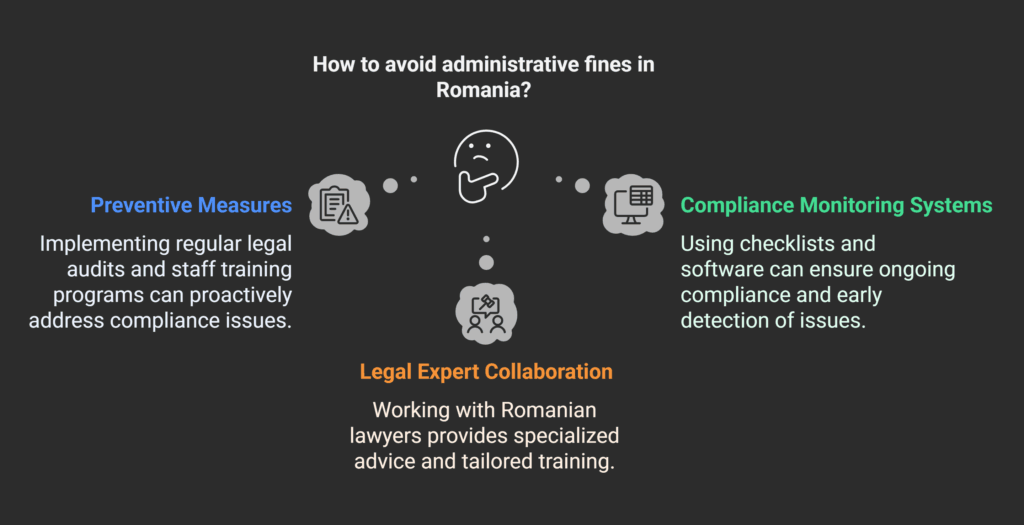
Regular legal audits help find and fix problems before they become big issues.

These audits check if your business is following the latest laws.

Make clear rules for your team based on Romanian laws.

These rules should cover specific areas and be updated when laws change.

Staff training programs are key to avoiding fines.

Make sure your team knows the basics and the specific rules for their jobs.

Training should happen often, like when laws change or new people join.

Keep up with new laws in Romania.

Sign up for updates from the government and industry groups.

This way, you’ll know about changes that might affect your business.

Compliance Monitoring Systems

Use strong systems to check if you’re following the rules.

Compliance checklists are a good way to make sure you’re doing things right.

They should be easy to use but cover all important points.

Do regular checks to find and fix problems early.

Look at both your documents and how things are done to make sure they match the laws.

Use software to help with monitoring.

It can check things automatically and alert you to any problems.

This is really helpful for keeping up with Romania’s changing rules.

Make it easy for employees to report any issues.

A culture that encourages openness helps find problems early, when they’re easier to fix.

Keep good records of your compliance efforts.

This is important if someone says you’re not following the rules.

Keep track of training, policy updates, and any fixes you’ve made.

Working with Legal Experts in Romania

Working with Romanian lawyers can really help.

They know the local laws well and can give advice that fits your business.

Legal experts can do special audits to find and fix problems before they cost you money.

They often spot things that regular checks miss.

They can also create training that’s just right for your business.

This kind of training is usually more effective than general courses.

Good legal advisors in Romania offer practical solutions that work for your business.

Work closely with your legal team all the time, not just when you have a problem.

Regular talks help keep your business in line with the rules as they change.

This is really important for dealing with Romania’s complex rules.

By following these strategies, your business can avoid fines and run smoothly in Romania.

Remember, staying on top of compliance is an ongoing job that needs constant attention and changes as the rules do.

International Context: Romania vs. EU Administrative Penalties

It’s important to know how Romania’s fines compare to other EU countries.

Romania’s EU membership has shaped its rules, but it also keeps its own way of handling fines.

This helps you understand Romania’s place in the EU’s rules better.

International Context_ Romania vs. EU Administrative Penalties

Comparative Severity of Romanian Fines

Looking at administrative sanctions in Romania shows some patterns.

In some areas, Romania’s fines are not as high as Western Europe’s.

But in others, they can be strict.

In data protection, Romania’s fines for GDPR breaches are lower than France or Germany’s.

But, Romania has been getting tougher, with more investigations.

For environmental rules, penalties in Romania are about average in the EU.

But how they enforce these rules can vary.

Romania’s fines for pollution are similar to Hungary and Bulgaria’s but less than Austria or Sweden’s.

Regulatory AreaRomania (Average Fine)Western EU (Average Fine)Eastern EU (Average Fine)
Data Protection10,000-20,000 EUR50,000-200,000 EUR5,000-15,000 EUR
Consumer Protection2,000-10,000 EUR15,000-50,000 EUR1,000-8,000 EUR
Environmental5,000-50,000 EUR25,000-100,000 EUR3,000-30,000 EUR
Labor Law1,500-7,500 EUR10,000-40,000 EUR1,000-5,000 EUR

One key thing about government fines in Romania is the process.

While fines might be lower, the rules can be stricter.

This includes shorter appeal times and more detailed paperwork.

EU Harmonization Efforts

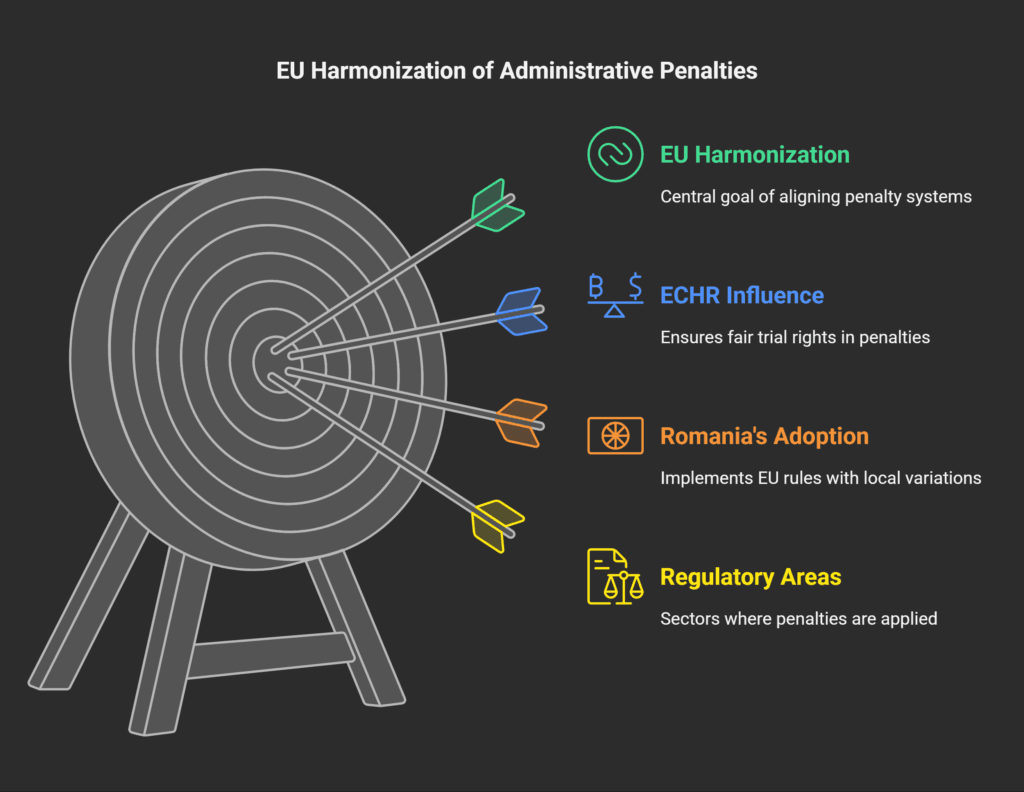
The EU wants all countries to have similar rules for fines.

This helps businesses in different countries know what to expect.

Romania has followed EU rules in areas like consumer protection and financial services.

For example, it adopted a new law on unfair business practices in 2018.

But, how strictly these rules are enforced can vary.

The European Court of Human Rights (ECHR) has also played a big role.

It says some fines in Romania are like criminal penalties.

This means certain rights must be respected, even if the fine is called administrative.

This includes the right to a fair trial, being presumed innocenthaving a lawyer, and seeing witnesses.

Romania’s Competition Council has started to follow these rules more closely.

This means better protection during investigations.

This process of making rules more similar is both a challenge and an opportunity.

It might make things more complicated for a while.

But in the long run, it should make things clearer for everyone.

Knowing about these international aspects is key to dealing with Romania’s fine system.

As Romania works to meet EU standards, staying up to date is important.

This helps you avoid fines and stay on the right side of the law.

Conclusion

Understanding Romania’s fine system is key for businesses and individuals.

Government Ordinance No. 2/2001 sets the rules for fines.

This knowledge helps you handle fines better.

Paying fines on time can lower the cost.

You can also appeal if a fine was wrongly given.

Keeping good records is your strongest defense.

Using smart compliance strategies can prevent fines.

By taking steps to avoid violations, businesses can save a lot.

This is cheaper than paying fines later.

For complex rules, get help from a Romanian administrative law expert.

A good law firm knows the system well.

They can guide you through it, even as Romania meets EU standards.

Whether you run a business or are an individual, a Bucharest lawyer is very helpful.

They know local laws and EU rules. Many law offices also do audits to find and fix problems before fines are issued.

Stay up to date with rules and get help when you need it.

This way, you can deal with Romania’s fine system well.

And you’ll reduce your chances of getting fined.

FAQ

What is an administrative fine in Romania?

An administrative fine in Romania is a fine for minor offenses.

It’s not as serious as a criminal act.

These fines are based on Government Ordinance No. 2/2001.

They are for breaking laws or decisions made by the government or local councils.

Which authorities can issue administrative fines in Romania?

Many bodies in Romania can give out fines.

This includes the National Authority for Consumer Protection (ANPC) and environmental agencies.

Also, labor inspectoratestax authorities (ANAF), and local police can issue fines.

Each one deals with different types of violations.

What are the most common business violations that result in administrative fines?

Businesses often face fines for labor law issues and unfair practices.

They can also get fined for not following consumer protection laws or tax rules.

Environmental and GDPR breaches, as well as competition law issues, are also common.

Not having the right licenses can lead to fines too.

What are the typical administrative violations for individuals in Romania?

Individuals might get fined for traffic offenses or disturbing the peace.

Not reporting personal status changes is also a violation.

Minor property issues and littering can lead to fines.

Local ordinances are another area where fines can be given.

How are administrative fine amounts determined in Romania?

The amount of a fine depends on several things.

This includes how serious the offense is and if it was intentional.

The offender’s history and any benefits from the violation also play a part.

There are minimum and maximum fines based on who made the rule.

What is the deadline for paying an administrative fine in Romania?

You usually have 15 days to pay a fine. But this can change based on the rule broken.

If you don’t pay on time, the fine can be collected by the authorities.

This might cost you more money.

Can I pay a reduced amount for an administrative fine in Romania?

Yes, you can pay less for many fines.

You can pay half the minimum fine within 48 hours or 15 days.

This chance is available for many fines but not all.

You need to pay on time and keep proof of payment.

What payment methods are available for administrative fines in Romania?

There are several ways to pay fines in Romania.

You can use online platforms, bank transfers, postal money orders, or pay in person.

The details for payment will be on your fine notice.

Always save your payment receipt.

What are valid grounds for appealing an administrative fine in Romania?

You can appeal a fine for several reasons.

This includes mistakes in the fine notice or if the fine is too high.

You can also appeal if there’s no legal basis for the fine.

The European Court of Human Rights has also set rules for fair fines.

What is the process for contesting an administrative fine in Romania?

To appeal a fine, you need to file a complaint within 15 days.

You’ll need the fine notice and any evidence you have.

The court will hold a hearing.

You can represent yourself or get a lawyer.

You can appeal the court’s decision to a higher court within 30 days.

What happens if I don’t pay an administrative fine in Romania?

If you don’t pay, the authorities can take action.

They might seize your property or garnish your wages.

You could also be ordered to do community service.

Unpaid fines can also cost you more money.

Can administrative fines in Romania be converted to community service?

Yes, fines can be turned into community service.

The court can order up to 300 hours of service.

This is usually based on the minimum wage.

It’s a way to avoid paying the fine.

How can businesses prevent administrative fines in Romania?

Businesses can avoid fines by being proactive.

They should check their compliance regularly and train staff.

They should also have systems in place to monitor and report any issues.

Working with legal experts is also helpful.

Keeping records of compliance efforts is important.

How do Romania’s administrative fines compare to those in other EU countries?

Romania’s fines vary compared to other EU countries.

For GDPR, Romania’s fines are often lower.

But for consumer and environmental issues, fines can be higher.

Romania is trying to align its fines with EU standards.

The European Court of Human Rights has also influenced Romania’s approach to fines.

Are there special provisions for foreign individuals or companies facing administrative fines in Romania?

Foreigners face the same fine system as locals.

But they might find it harder due to language barriers.

Foreign companies should have a local representative.

Enforcement against foreign entities might involve extra steps.

What documentation should I keep related to an administrative fine in Romania?

Keep all documents related to a fine.

This includes the fine notice, any evidence, payment proof, and court documents.

Keep these for at least 5 years.

They might be needed to prove payment or to address any errors.

Corporate Documentation Requirements in Romania

Corporate Documentation Requirements in Romania

Corporate Documentation in Romania

Did you know Romania lets companies be fully owned by foreigners?

This shows how welcoming Romania is to businesses.

Knowing the legal documents and rules is key for any company wanting to start here.

Getting through Romania’s business laws needs careful focus.

The process includes setting up a company and following rules.

Your success relies on knowing all the details of doing business here.

Whether you’re new or already big, learning the law is vital.

Romania has great chances for those willing to learn its business rules.

Key Takeaways

  • Romania supports 100% foreign company ownership;
  • Company incorporation typically takes 5-10 working days;
  • Minimum share capital varies by company type;
  • All companies must have a registered Romanian office;
  • Comprehensive documentation is critical for legal compliance.

Understanding Legal Entity Types in Romania

In Romania, you’ll find two main types of legal entities for starting a business:

Joint Stock Companies (JSC) and Limited Liability Companies (LLC).

These options differ in how they handle corporate governance.

They also offer flexibility for those setting up businesses in Romania.

Legal Entity Types in Romania


Romania’s business scene is diverse, with JSCs and LLCs being the top choices for investors.

Knowing what each offers is key to choosing the right structure for your business.

Joint Stock Companies (JSC)

Joint Stock Companies are known for their strength and several important features:

  • Minimum of 2 shareholders with no maximum limit;
  • Limited personal liability for shareholders;
  • Fiscal registration through the Trade Registry;
  • Potential for public trading of shares.

Limited Liability Companies (LLC)

Limited Liability Companies are known for their simplicity and benefits:

  • Up to 50 shareholders possible;
  • Simplified management structure;
  • Lower minimum capital requirements;
  • Faster incorporation process.

Key Differences Between Entity Types

CharacteristicJoint Stock CompanyLimited Liability Company
Minimum Shareholders2 shareholders1 shareholder
Minimum CapitalRON 90,000RON 200
Maximum ShareholdersUnlimited50
Share ClassesMultiple possibleSingle class only

Choosing between a JSC and LLC depends on your business goals, available capital, and future plans.

Each type has its own advantages for managing documents and corporate governance in Romania.

Corporate Documentation Requirements Under Romanian Law

Corporate Documentation in Romania

Understanding corporate law in Romania is key.

You must know the legal rules to follow.

When  starting a business in Romania, you’ll need to gather important documents that follow Romanian laws.

The process of getting these documents involves several steps.

These steps make sure your company follows all the rules.

Romanian law has specific rules for different types of businesses.

It’s important to know these rules well.

  • Prepare detailed company formation documents;
  • Get the needed registration certificates;
  • Follow local legal rules;
  • Keep your corporate records up to date.

Foreign investors need to grasp legal rules in Romania.

The process includes at least six important documents.

These include articles of association and financial statements.

Each document must be carefully made to meet Romanian rules.

Key documentation needs change based on your business type and goals.

Here are some specific documents you’ll need:

  1. Company incorporation papers;
  2. Tax identification documents;
  3. VAT registration forms;
  4. Records of shareholder information.

The Law No. 265/2022 on the Trade Registry has brought changes.

From November 26, 2022, companies must follow new rules.

These include easier ways to start and updated business registration rules.

Essential Business Registration Documents

Starting a business in Romania is complex.

You need to know a lot about company formation paperwork and corporate rules.

You’ll have to prepare important documents to follow the law and start your business smoothly.

Registering your business means filling out several key documents.

These documents are the base of your company’s policies and structure.

Business Registration Documents Romania

Company Formation Papers

Here are the documents you’ll need for your business registration:

  • Articles of Incorporation;
  • Shareholder Agreement;
  • Proof of Initial Capital Deposit;
  • Company Bylaws.

Regulatory Compliance Forms

You’ll also need to fill out important compliance forms:

  1. Trade Registry Registration Form;
  2. Tax Registration Application;
  3. Social Security and Health Insurance Registration;
  4. Employment Documentation.

Registration Certificates

Once you’ve submitted your documents, you’ll get important certificates:

Certificate TypePurposeProcessing Time
Trade Registry CertificateOfficial Business Registration5-7 Business Days
Tax Identification NumberTax Authority Registration3-5 Business Days
VAT RegistrationEnable Legal Business Transactions2-4 Business Days

It’s important to keep these documents in order.

Getting help from a professional can make this process easier.

Management Structure Documentation

Starting a company in Romania means you need to know about management structure documents.

These are key for following the law and keeping your business in order.

Romanian company law is strict about how your business is set up.

Romanian Management Hierarchy Romania

Romanian companies usually have one of two main management systems:

  • One-Tier Management System;
  • Two-Tier Management System.

The one-tier system has one board that does everything.

This board is chosen by the shareholders.

They can also pass on some tasks to others.

One-Tier Management Structure Characteristics

ComponentAppointment MethodKey Responsibilities
DirectorsAppointed by ShareholdersStrategic Decision Making
ManagersAppointed by Board of DirectorsOperational Management

The two-tier system splits the work into two boards.

The supervisory board, chosen by shareholders, watches over the executive board.

This board is picked by the supervisory board.

It adds more control and balance in how the company is run.

Proper documentation of management structures is essential for ensuring Romanian corporate compliance and maintaining transparent business operations.

Your legal papers in Romania must clearly show who does what in each management level.

This is a big part of following the law and keeping your business clear.

Corporate Governance and Compliance Standards

Getting to know corporate governance in Romania means dealing with many rules and documents.

Companies here must follow strict standards.

These ensure their management is clear and works well.

The laws that guide corporate governance come from two main sources.

Companies Law No. 31/1990 and Trade Registry Law No. 26/1990 set the rules.

They cover what each business type needs and how they should be managed.

Corporate Governance & Compliance Structure in Romania

Board of Directors Requirements

Setting up a Board of Directors in Romania comes with important rules. Companies must follow these to stay legal:

  • Minimum board size varies depending on company type;
  • Joint-stock companies typically require at least three directors;
  • Independent board members are key for clear management;
  • Professional liability insurance is a must for board members.

Supervisory Board Documentation

The Supervisory Board is vital in a two-tier management system.

It needs to keep detailed records.

This includes:

  1. Detailed meeting minutes;
  2. Annual performance reports;
  3. Compliance verification documents;
  4. Risk management assessments.

Executive Management Papers

Executive management in Romania has its own set of rules.

You must keep detailed records.

These show you’re responsible and strategic.

By following these corporate governance rules, your Romanian business can stay legal.

It also keeps things transparent and has a strong management system.

Single Administrative Document (SAD) Requirements

Understanding the Single Administrative Document (SAD) is key for businesses in international trade.

The SAD is a standardized customs declaration form used in many places, including the European Union and some partner countries.

Your business needs to know how important the SAD is in legal and corporate law in Romania.

It’s vital for tracking and managing goods, mainly for deals outside the EU or with non-EU goods.

  • Covers multiple customs procedures including export and transit;
  • Consists of eight distinct copies with specific functions;
  • Used for trade with non-EU countries and movement of non-EU goods;
  • Essential for proving goods origin during customs clearance.

Business documentation laws demand careful filling out of the SAD.

The form needs to have all the details about the goods, their origin, and the customs procedure.

Being accurate is key for easy customs processing and following Romanian and EU rules.

Businesses bear ultimate responsibility for the accuracy and completeness of customs declarations submitted on their behalf.

There’s a move towards fully electronic customs declarations.

Your business must get used to new digital submission rules.

Knowing these changes helps keep your international trade smooth and legal.

Economic Operator Registration and Identification (EORI)

Understanding the Economic Operator Registration and Identification (EORI) system is key in Romania.

If your business wants to do customs work in the European Union, you need an EORI number.

It’s important for managing your corporate documents.

The EORI system started in Romania on July 1, 2009.

It helps identify economic operators in international trade.

Your business must follow these rules for easy customs dealings.

Application Process

To get your EORI number, follow these steps:

  • Register with your national customs authority;
  • Prepare necessary business documentation;
  • Submit your application electronically;
  • Receive your unique EORI identifier.

Required Supporting Documents

You’ll need these documents for legal compliance in Romania:

  1. Company registration certificate;
  2. VAT registration proof;
  3. Identification documents for company representatives;
  4. Proof of business address.

Registration Timeline

The EORI registration is quick.

Romanian customs usually process applications in two days.

And it’s free.

Your EORI number is good for 10 years for businesses, keeping you in line with EU customs rules.

Knowing and following EORI rules helps your business with international trade.

It reduces customs problems.

Record-Keeping and Documentation Maintenance

Keeping records well is key for businesses in Romania.

Your company needs to keep detailed records to follow the law and work smoothly.

The National Trade Register Office gives important rules for keeping business documents.

Record-Keeping and Documentation Maintenance in Romania

Romanian laws require keeping documents in order across many areas.

Your company’s rules should cover:

  • Financial records retention;
  • Meeting minutes documentation;
  • Employee file management;
  • Compliance documentation.

Digital storage is now vital in Romania.

The Ministry of Communications and Information Society says companies need special approvals for digital documents.

You must tell the authorities 30 days before starting digital archiving.

Your systems must also meet strict rules.

Proper documentation is not just a legal requirement, but a strategic asset for your business.

Important steps for good documentation include:

  1. Use safe digital storage systems;
  2. Make clear filing rules;
  3. Check and update records often;
  4. Train staff on document handling.

By focusing on keeping good records, you help your business avoid legal problems.

You also make your operations clear and efficient.

Conclusion

Mastering corporate record keeping in Romania is complex.

It requires a deep understanding of legal frameworks.

Your business’s success depends on following corporate compliance rules and keeping accurate records.

The Romanian business world needs strict paperwork management.

This must follow national legal standards.

Effective business paperwork in Romania does more than follow rules.

It protects your company, sets clear rules, and makes communication clear.

Getting help from legal experts can guide you through this complex area.

They ensure your business stays compliant and competitive.

Keeping up with Romanian business laws is key for growth.

Work with legal pros who know Romanian corporate rules well.

They can give you specific advice, explain complex laws, and reduce risks from mistakes.

For help with your corporate documents, contact Romanian legal experts.

They can help with creating, checking, and keeping your documents up to date.

Reach out to our Romanian Law Office to make sure your documents are top-notch and effective.

FAQ

What are the main legal entity types in Romania?

In Romania, there are two main types of legal entities.

Joint Stock Companies (JSC) are for bigger businesses with many shareholders.

Limited Liability Companies (LLC) are better for smaller businesses with fewer shareholders.

What essential documents are required for business registration in Romania?

You’ll need several important documents for business registration.

These include articles of incorporation and shareholder agreements.

You’ll also need a company registration certificate, tax number (CUI), and proof of a registered office.

Depending on your business type, you might need more documents.

How long must I retain corporate documents in Romania?

Romanian law says you must keep most corporate documents for at least 10 years.

This includes financial records and meeting minutes.

Keeping these documents well is key for audits and following the law.

What is the Single Administrative Document (SAD), and why is it important?

The SAD is a key document for international trade.

It’s used for customs declarations when moving goods in or out.

It gives detailed info about the goods, their value, and where they’re going.

This helps with smooth customs clearance in Romania and the EU.

What is an EORI number, and do I need one?

An EORI number is vital for EU customs operations.

If your business trades internationally, you’ll need one.

It helps with customs procedures and tracking your trade activities.

What are the management structure documentation requirements in Romania?

Romanian businesses must keep detailed records of their management structure.

This includes documents for directors and board members.

You’ll need meeting minutes and records of shareholder decisions for both one-tier and two-tier systems.

How difficult is it to set up a company in Romania?

Setting up a company in Romania is relatively easy but needs careful attention to legal details.

You’ll need to prepare incorporation documents and register with local authorities.

You’ll also need to get business permits and a tax ID.

What are the key compliance standards for corporate governance in Romania?

Romanian corporate governance requires detailed documentation.

This includes annual reports and meeting minutes.

Companies must show they follow local and EU rules through transparent records.

Are there specific documentation requirements for foreign investors?

Foreign investors need extra documents.

This includes translated and apostilled corporate documents and proof of registration in their home country.

It’s wise to work with a local legal expert to ensure you meet all requirements.

What penalties exist for non-compliance with documentation requirements?

Not following the rules can lead to big fines and even business suspension.

Penalties can be financial or more severe, like canceling your business registration for serious breaches.

What are the main documents required for incorporating a Romanian company (SRL)?

To incorporate a limited liability company (SRL) in Romania, you need to prepare and submit several documents required to the Trade Register.

The primary documents include:

1. Articles of Association

2. Proof of registered office;

3. Shareholder identification documents;

4. Criminal record certificates for company representatives;

5. Specimen signatures of company representatives;

6. Proof of share capital deposit;

7. Company name reservation certificate;

8. Declaration of honor from company representatives;

9. Power of attorney (if applicable);

10. Fiscal record certificate;

These necessary documents are crucial for setting up a company in Romania and ensuring compliance with Romanian law.

How do I prepare the Articles of Association for a Romanian company?

The Articles of Association is a fundamental document for company formation in Romania.

It should include:

1. Company name and type of company (SRL);

2. Registered address;

3. Object of activity (using NACE codes);

4. Share capital amount and distribution;

5. Shareholder information;

6. Administrator details and responsibilities;

7. Duration of the company (if not indefinite);

8. Profit distribution method;

9. General meeting of shareholders procedures;

The document must be submitted to the Trade Register Office and should be drafted according to the Romanian legislation.

It’s advisable to seek legal assistance to ensure all legal requirements are met.