Do you need a lawyer to start a business in Romania illustration with legal scales, Romanian flag, and company registration document

Do You Need a Lawyer to Start and Run a Business in Romania?

Do You Need a Lawyer to Start and Run a Business in Romania? (Complete 2026 Guide for Entrepreneurs)

TL;DR: You don’t legally need a lawyer to start a business in Romania, but hiring one reduces legal risks, ensures compliance, and protects your business long-term.

Starting a business in Romania is one of the fastest and most affordable in the EU—but that doesn’t mean it’s risk-free. Many entrepreneurs underestimate legal complexity, only to face costly issues later.

Starting a business in Romania legal planning

This guide explains when you need a lawyer, when you don’t, and how to make the smartest decision for your business.


Do You Need a Lawyer to Start a Business in Romania?

No, you do not legally need a lawyer to start a business in Romania. However, hiring one helps prevent legal mistakes, ensures compliance, and protects long-term business growth.

Romania has simplified company registration through the ONRC (National Trade Register Office), allowing entrepreneurs to register businesses quickly—often within a few days.

  • You can submit documents yourself;
  • You can use standard templates;
  • You are not required to hire legal representation.

However, this simplicity applies only to registration—not to running a compliant and scalable business.


What Is Required to Start a Business in Romania?

To start a business in Romania, you must register with ONRC, choose a legal structure, set up accounting, and comply with Romanian and EU regulations.

Company registration documents Romania ONRC

The most common structure is an SRL (limited liability company), preferred for its flexibility and low startup costs.

  • Register company with ONRC (full guide)
  • Choose company structure (SRL)
  • Open business bank account
  • Hire accountant
  • Ensure compliance with GDPR regulations
  • Follow Romanian business law and contract law

While these steps are straightforward, mistakes in any of them can lead to long-term consequences.


Why Do Entrepreneurs Hire a Business Lawyer in Romania?

Entrepreneurs hire business lawyers to avoid costly mistakes, structure their company correctly, and ensure legal protection from the start.

Business lawyer consultation Romania startup

Most successful founders don’t wait for problems—they prevent them.

  • Correct legal structure from day one
  • Strong, enforceable contracts
  • Compliance with Romanian and EU law
  • Protection against disputes

Legal mistakes made early often become expensive problems later.


What Are the Risks of Starting Without a Lawyer?

Without legal guidance, businesses face risks such as incorrect structure, weak contracts, compliance violations, and disputes.

Legal risks for startups Romania

1. Incorrect Company Structure

The wrong structure can affect taxes, liability, and investment potential.

2. Weak Contracts

Generic templates often fail to protect your business. Learn more about contract drafting in Romania.

3. Compliance Issues

Ignoring GDPR or labor law can result in fines and penalties.

4. Business Disputes

Poor agreements lead to shareholder conflicts and legal disputes.


When Can You Start a Business Without a Lawyer?

You can start without a lawyer if your business is simple, low-risk, and has a single founder.

Many entrepreneurs begin this way and add legal support later.


When Should You Hire a Business Lawyer in Romania?

You should hire a lawyer when your business involves partners, employees, contracts, or legal complexity.

Signing business contracts Romania legal support
  • Multiple shareholders
  • Foreign investors
  • Hiring employees
  • Complex contracts
  • Regulated industries

Explore our corporate legal services for full support.


What Does a Business Lawyer Do?

A business lawyer structures your company, drafts contracts, ensures compliance, and prevents legal issues.

  • Company formation
  • Contract drafting
  • Legal compliance
  • Dispute resolution

They act as a strategic partner—not just a problem solver.


How Much Does a Business Lawyer Cost in Romania?

Costs typically range from €50–€150 per consultation and €200–€800 for company setup.

  • Consultation: €70–€250
  • Setup: €200–€800
  • Contracts: €100–€500
  • Ongoing: €50–€200/hour

Many businesses use legal subscriptions to reduce costs.


Is It Better to Start With or Without a Lawyer?

Starting with a lawyer reduces risk and builds a strong foundation, while starting without one saves money but increases long-term risk.

  • Without lawyer → cheaper, riskier
  • With lawyer → safer, scalable

Lawyer vs Accountant: What’s the Difference?

A lawyer handles legal matters, while an accountant manages taxes and financial reporting.

  • Lawyer → contracts, compliance
  • Accountant → taxes, bookkeeping

Business Startup Checklist in Romania

To start a business legally, follow these steps: register, structure, comply, and protect your company.

  1. Choose SRL structure
  2. Register with ONRC (guide)
  3. Draft agreements (contracts)
  4. Hire accountant
  5. Ensure GDPR compliance
  6. Prepare contracts

Common Legal Mistakes Entrepreneurs Make

Most business owners repeat the same legal mistakes, which can be avoided with proper planning.

  • Using generic contracts
  • Ignoring GDPR
  • No shareholder agreements
  • Mixing personal and business finances
  • Delaying legal advice

The Bottom Line

You can start a business in Romania without a lawyer, but hiring one significantly reduces risk and supports long-term success.

If your business is simple, you can start alone. If it involves growth, investment, or complexity, legal guidance is essential.

Service Contract Requirements Romania

Service Contract Requirements Romania: What Every Provider Must Include by Law


Service Contract Requirements Romania – What Every Provider Must Include by Law

Service contracts in Romania must meet specific legal requirements under Government Order 21/1992 and related consumer protection laws. This comprehensive guide explains what Romanian law requires for valid service contracts, how ANPC enforces these rules, and what happens when businesses fail to comply.


Need Professional Help?

At our law firm, Atrium Romanian Lawyers, we assist clients with corporate & commercial law, contract drafting, and consumer protection advisory.


Test Your Service Contract Compliance

Use our interactive compliance checker below to verify that your service contract meets all Romanian legal requirements. This tool guides you through the 12 mandatory elements and helps you avoid ANPC penalties ranging from RON 2,000 to RON 100,000.

Interactive Service Contract Compliance Checker

Check off each requirement as you review your contract. The bar above will fill as you reach compliance.

0%
 

📹 Video Guide: Understanding Romanian Service Contracts

Watch our comprehensive video explanation covering all mandatory requirements, ANPC enforcement, and practical tips for compliance.

Play

What Is a Service Contract Under Romanian Law?

Legal Definition

Under Romanian law, a service contract (contract de servicii) is an agreement where one party (the service provider) undertakes to provide specific services to another party (the consumer) in exchange for payment. Service contracts are governed by the Romanian Civil Code (Articles 1851-1874), Government Order 21/1992 on consumer protection, and Law 296/2004 (Consumer Code).

Types of Services Covered

Romanian service contract regulations apply to telecommunications and internet services, banking and financial services, utility services, professional services, maintenance and repair services, installation and delivery services, educational and training services, healthcare services, and transportation services.

Are Service Contracts Mandatory in Romania?

Yes, written service contracts are mandatory for most consumer-business transactions in Romania. According to Government Order 21/1992, service providers must formalize their agreements with consumers in writing, particularly when the service involves recurring payments, the contract duration exceeds 30 days, or the total value exceeds RON 100.


Mandatory Elements: What Must a Romanian Service Contract Contain?

1. Party Identification Requirements

Every service contract must clearly identify both parties. The service provider must include their legal business name, unique registration code (CUI), trade register number, physical headquarters address, and contact information. The consumer must include their full legal name, personal identification number (CNP) for individuals, and contact address.

2. Service Description Requirements

Contracts must provide detailed specifications including the exact nature of services, quality standards and performance metrics, delivery timeline and schedule, geographic service area, equipment or materials included, and technical specifications. According to ANPC regulations, vague or ambiguous service descriptions are considered non-compliant.

3. Pricing and Fee Disclosure

Complete transparency on all costs is mandatory. This includes the base service price, all additional fees (connection, activation, installation), taxes and surcharges (VAT, excise duties), recurring charges (monthly, annual), variable costs (usage-based fees), penalty fees (late payment, early termination), currency, payment methods accepted, and billing cycle and due dates. Key requirement: Prices must be displayed in 10-point font or larger.

4. Contract Duration and Renewal Terms

Contracts must specify the start date of service provision, contract duration (fixed term or indefinite), automatic renewal conditions, notice period for termination, early termination rights and associated costs, and grace periods if applicable.

5. Modification and Amendment Procedures

Romanian law requires clear procedures for contract changes. Service providers must provide 30 days written notice before any unilateral changes, specify the exact changes to terms or pricing, inform consumers of their right to reject changes, and allow penalty-free termination if consumer refuses modifications.

6. Service Suspension and Termination Rules

Contracts must outline conditions for service suspension by provider, consumer notification requirements (15 days advance notice), consumer’s right to unilateral termination (30 days notice, no penalties), provider penalties for failing to deliver promised services, refund procedures for prepaid services, and equipment return requirements.

7. Consumer Protection Clauses

Mandatory consumer rights provisions include withdrawal right (14 days for distance contracts), warranty and guarantee terms, complaint and dispute resolution procedures, service quality standards, compensation for provider-caused damages, data privacy protections, and right to refuse data processing for marketing purposes.

8. Liability and Indemnification

Contracts must clearly state the service provider’s liability for non-performance, consumer compensation rights for damages, force majeure provisions, and limitation of liability clauses that must be reasonable and non-abusive.

9. Dispute Resolution Mechanisms

Required information includes complaint filing procedures, internal complaint handling timeline, alternative dispute resolution (ADR) options, ANPC contact information, and court jurisdiction.


Penalties for Non-Compliant Service Contracts

Fine Structure

Violation TypeFine Amount
Missing mandatory contract elementsRON 2,000 – RON 4,000
Abusive clausesRON 20,000 – RON 100,000
Large-scale violations (100+ consumers)Up to 4% of annual turnover

Additional Penalties

Beyond monetary fines, penalties can include temporary service suspension until compliance, permanent product/service withdrawal from market, publication of violation on ANPC website, consumer compensation orders, and court-ordered contract modifications.


Prohibited Abusive Clauses Under Romanian Law

Law 193/2000 on unfair contract terms prohibits clauses that exclude or limit provider liability for damages, allow unilateral price increases without justification, bind consumer while making provider obligations conditional, impose disproportionate penalties on consumers, extend contract automatically without clear terms, restrict consumer’s right to legal action, or transfer provider obligations to third parties without consent.

Legal consequence: Abusive clauses are automatically void, even if signed by the consumer.


Consumer Rights in Romanian Service Contracts

Core Consumer Rights

Under Government Order 21/1992, consumers have the right to complete, accurate information about services, unilateral contract termination (30 days notice, no penalties), protection against unfair terms, compensation for damages caused by provider, refuse data sharing for marketing, alternative dispute resolution, and 14-day withdrawal period for distance contracts.

Withdrawal Right (Distance Contracts)

For services purchased online or off-premises, you have a 14-day cooling-off period from contract signing with full refund for unused services. No justification is required and no penalties apply for exercising the withdrawal right, except for services fully performed with consumer’s advance consent.


Recent Legal Updates (2024-2025)

Emergency Government Ordinance 58/2022

Key changes effective May 28, 2022 include increased fines for abusive clauses, 3-year statute of limitations for ANPC sanctions, and enhanced powers to remove abusive clauses from all contracts.

ANPC Order 539/2024: “Shrinkflation” Rules

New requirements effective October 10, 2024 require businesses to inform consumers of product size/weight reductions, provide specific labeling for reduced quantities, and face penalties for non-disclosure.

Law 243/2024: Consumer Credit

New protections effective November 27, 2024 include limited total cost of credit, interest rate caps, and enhanced disclosure requirements.


Useful Resources & Links


FAQ – Service Contract Requirements in Romania

Q: Do all service contracts need to be in writing?

A: Yes, most consumer-business service contracts must be in writing, especially if they involve recurring payments, exceed 30 days duration, or total over RON 100. Verbal contracts are valid only for simple, low-value, one-time services.

Q: What happens if my service contract doesn’t include mandatory clauses?

A: The contract may be void or unenforceable. ANPC can fine the provider RON 2,000-4,000 for missing elements. Consumers can challenge the contract and seek modifications or termination without penalties.

Q: Can service providers unilaterally change contract terms?

A: No, not without proper procedure. Providers must give 30 days written notice of any changes and inform consumers of their right to reject the modifications and terminate the contract without penalties.

Q: What is the penalty for using abusive clauses?

A: Fines range from RON 20,000 to RON 100,000 per violation. For large-scale violations, penalties can reach up to 4% of the provider’s annual turnover in Romania. Abusive clauses are automatically void.

Q: How long do I have to withdraw from a service contract?

A: For distance or off-premises contracts, you have 14 days from signing to withdraw without giving a reason and without penalties, provided the service hasn’t been fully performed with your advance consent.


Disclaimer: This article is for general information only and does not constitute legal advice. Please consult with a qualified Romanian corporate lawyer to verify current laws and regulations before finalizing your service contracts. Laws and procedures are subject to change, and individual circumstances may vary.

change company office Romania

How to Change the Registered Office of a Romanian Company: Complete Guide


How to Change the Registered Office of a Romanian Company: Complete Guide

O persoană completează documente la birou cu un laptop.

Changing the registered office of a Romanian company is a critical process that requires careful attention to detail.

This guide provides a comprehensive overview of the steps involved in changing the registered office of a Romanian company, ensuring compliance with Romanian law and regulations.

Whether you’re a seasoned entrepreneur or new to the Romanian business landscape, understanding this process is essential for maintaining the legal standing of your business.


Need Professional Help?

At our law firm, Atrium Romanian Lawyers, we assist clients with corporate & commercial law, company registration, and office relocation services.


Understanding the Registered Office in Romania

O persoană stă la birou cu un laptop deschis, revizuind documente.

The registered office, also known as the company headquarters, is the official address of a Romanian company.

It is where all official correspondence from the Romanian authorities, such as ANAF (the National Agency for Fiscal Administration), and other legal entities is sent.

In Romania, the registered office must be a physical address; a P.O. box is not sufficient.

The registered office is a crucial detail recorded in the Trade Registry and on the registration certificate, making it essential to keep this information current.

Definition of Registered Office

The registered office in Romania serves as the official address for all legal and administrative purposes for a company in Romania.

It’s more than just a mailing address; it’s the legally recognized location where the Romanian authorities can contact the company.

According to Romanian law, every Romanian company, whether it is a limited liability company (SRL) or another type of legal entity, must have a registered office.

The address must be accurately registered with the Trade Registry, and any change of the registered office requires a formal amendment to the company’s registration documents.

Importance of the Registered Office for a Romanian Company

The registered office is paramount for a Romanian company’s legal standing and operational efficiency.

It’s the address to which all official communications, including tax notifications from ANAF and legal notices, are sent.

Failing to maintain an accurate registered office can lead to missed communications, fines, or even legal complications. For a Romanian company, it’s a critical element of compliance.

The Trade Registry maintains records of all registered offices, ensuring transparency and accountability within the Romanian business environment.

Legal Framework Surrounding Registered Offices in Romania

The legal framework governing registered offices in Romania is primarily defined by the Company Law No. 31/1990, as subsequently amended, and other related regulations issued by the Trade Registry.

These laws dictate the requirements for registration, documentation, and procedures for changing the registered office of a company.

The articles of association of a Romanian company must include details of the registered office.

When changing the registered office, a formal decision of the sole associate (if it is a sole proprietorship) or a general meeting of shareholders is required, followed by an application for registration with the Trade Registry.


Steps to Change the Registered Office of a Romanian Company

A stack of documents is placed next to a pen and a notepad.

Initial Considerations Before Changing Headquarters

Before embarking on the process of changing the registered office of your Romanian company, several crucial factors need careful consideration.

Firstly, determine the reasons for the change of registered office, whether it’s due to expansion, cost reduction, or operational streamlining.

Secondly, evaluate the implications for your company in Romania, including the potential impact on your Romanian trade relationships, tax obligations, and overall business strategy.

Consulting with Romanian lawyers is highly advisable to navigate these complexities and ensure compliance.

For more information on remote company formation and business setup, visit our comprehensive guide.

Necessary Documents for Changing the Registered Office

A comprehensive set of documents is essential when changing the registered office.

This includes the decision of the sole shareholder or the general meeting of shareholders approving the change of the registered office, the updated articles of association reflecting the new registered office address, and proof of the right to use the new registered office space.

This proof can be a lease agreement or a title deed if the company headquarters owns the property.

Depending on the specific circumstances, additional documents may be required by the Trade Registry, making it crucial to consult with Romanian lawyers to ensure all formality requirements are met.

The updated registration certificate must accurately reflect the updated address.

Filing Requirements with Romanian Authorities

The final step involves submitting the necessary documents to the Romanian Trade Registry (ONRC) where the company in Romania is registered.

This includes filing an application for registration of the change of registered office along with all supporting documents.

The Trade Registry will review the application and, if everything is in order, will issue a revised registration certificate reflecting the new registered office.

It’s also essential to notify several relevant Romanian authorities, such as:

  • ANAF, to avoid any potential issues with tax compliance or official communications.
  • Other relevant authorities, depending on the specific company.

Some companies might also need to consider changing the headquarters of a company from one county to another.

For detailed information on business registers in EU countries and Romania, consult the European e-Justice Portal.


Legal Aspects of Changing the Registered Office

O persoană stă la birou cu documente întinse, părea concentrată.

Relevant Laws and Regulations in Romania

Navigating the legal landscape is crucial when changing the registered office of a Romanian company.

Several key laws and regulations in Romania govern this process, primarily the Romanian Company Law No. 31/1990, as amended.

Compliance with these laws and regulations is essential to ensure the legality of the change of registered office and avoid potential penalties or legal complications for the company in Romania.

For more information on tax registration and compliance, explore our detailed guides.

Role of Lawyers in Romania during the Process

The role of Romanian lawyers is invaluable during the process of changing the registered office.

A law firm specialized in Romanian law and corporate matters can provide expert guidance on navigating the complex legal requirements and procedures.

Lawyers in Romania can assist with drafting the necessary decision of the sole shareholder or the general meeting of shareholders, updating the articles of association, and preparing the application for registration with the Trade Registry.

They can also ensure compliance with all applicable Romanian regulations, represent the company headquarters before the Trade Registry, and address any legal issues that may arise during the process.

Atrium Romanian Lawyers offers legal services and their experienced team can resolve any legal issue in a timely manner. The team provides comprehensive legal services in multiple languages.

Potential Legal Implications of Changing Headquarters

Changing the headquarters of a company carries potential legal implications that must be carefully considered.

Failure to properly notify the ANAF and other relevant authorities can lead to fines or penalties.

If the company headquarters is changing from one county to another, it may affect the jurisdiction for legal proceedings.

Additionally, the change of registered office may impact existing contracts and agreements that specify the previous address.

Consulting with Romanian lawyers is crucial to assess these implications and ensure compliance with all applicable laws.

The law firm can help mitigate potential risks and ensure a smooth transition.

The registration certificate must accurately reflect the new address.

Making changes regarding the registered office requires due diligence to avoid future legal issues.


Common Challenges and Solutions

Un grup de oameni discutând în jurul unei mese cu laptopuri.

Obstacles in Changing the Registered Office

Navigating the process of changing the registered office of a Romanian company can present several obstacles.

One common challenge is incomplete or inaccurate documentation, which can lead to delays or rejection by the Trade Registry.

Another hurdle is ensuring compliance with all applicable Romanian laws and regulations, which can be complex and subject to change.

Additionally, coordinating the change with various stakeholders, such as ANAF and other legal entities, requires careful planning and communication.

Seeking guidance from experienced Romanian lawyers can help overcome these obstacles and ensure a smooth and compliant change of the registered office.

Our firm understands these hurdles and offers expert assistance.

As an expert legal services provider, we aim to provide the best solution when making changes to your Romanian company.

How to Overcome Common Issues

To overcome common issues associated with changing the registered office, a proactive and meticulous approach is essential.

Thoroughly review all documentation requirements and ensure accuracy before submitting to the Trade Registry.

Engage with Romanian lawyers familiar with Romanian law and corporate regulations to navigate the legal complexities and ensure compliance.

Establish clear communication channels with ANAF and other relevant authorities to facilitate a seamless transition.

Additionally, consider conducting a preliminary legal audit to identify and address any potential issues before initiating the registration process.

By taking these steps, company headquarters can minimize delays, avoid penalties, and ensure a successful change of the registered office.

For companies undergoing more significant changes, you may want to explore our guide on company restructuring processes in Romania.

We at our law firm understand the importance of compliance when changing the registered office in Romania, and we help you along the way.

Case Studies: Successful Changes of Headquarters

Examining case studies of successful changes regarding company headquarters can provide valuable insights and practical guidance.

For instance, a Romanian company undergoing expansion successfully changed the headquarters from one county to another by meticulously documenting the rationale behind the move, ensuring all necessary amendments to the articles of association were in place, working with Romanian lawyers and proactively communicating with ANAF and local authorities.

Companies in specialized sectors have also successfully navigated address changes while maintaining their SRL or SA structure.

These case studies highlight the importance of thorough planning, attention to detail, and expert legal support in achieving a smooth and compliant change of the registered office.

We believe in our quality over quantity when providing legal services in Romania.


After the Change of Registered Office

Un birou cu un computer și o plantă, simbolizând un nou început.

Updating Business Registrations and Licenses

Following the approval of the change of the registered office by the Trade Registry, several crucial steps must be taken to ensure continued compliance.

One of the most important steps is updating all relevant business registration certificates and licenses to reflect the new registered office address. This involves:

  • Notifying ANAF and other relevant Romanian authorities of the change.
  • Updating the registration information with the Trade Registry.
  • Amending any licenses or permits that specify the previous address.

Failure to update these documents can result in fines, penalties, or even the suspension of business operations.

As an expert legal services provider, our law firm ensures all paperwork is followed through formality.

Informing Stakeholders and Clients

Communicating the change of registered office to all stakeholders and clients is a critical step in maintaining transparency and trust.

This includes several important actions:

  • Notifying customers, suppliers, partners, and other relevant parties about the new registered office address.
  • Updating the company headquarters website, business cards, letterheads, and other marketing materials to reflect the changes in your Romanian company.

Send out a formal announcement to all clients and partners, informing them of the change and providing the new registered office address.

Clear and proactive communication can help minimize confusion and maintain positive relationships.

We understand the unique needs and requirements of each client and provide tailored legal solutions; it’s about being the best when making changes to your registered office.

Monitoring Compliance Post-Change

After the change of registered office, it is essential to establish a system for monitoring compliance with all applicable Romanian laws and regulations.

Regularly review all business licenses and permits to ensure they are up to date and accurately reflect the new registered office address.

For companies with employees, ensure your HR practices and employment agreements reference the correct office address.

Stay informed about any changes to Romanian law that may impact the company in Romania and take appropriate action to ensure continued compliance.

Conduct periodic internal audits to identify and address any potential issues.

By proactively monitoring compliance, a Romanian company can minimize the risk of fines, penalties, or legal complications.

We ensure that the decision of the sole shareholder or the general meeting of shareholders is respected with regards to the registered office and articles of association.


FAQ – Changing the Registered Office of a Romanian Company

Q: What are the key steps to change the registered office of a Romanian company?

A: To change the registered office of a Romanian company, you need to follow several key steps.

First, ensure that the decision to relocate is approved by the general assembly of shareholders.

Next, prepare the necessary documents, including an addendum to the articles of association, and submit them to the National Trade Register Office (ONRC).

Additionally, you must obtain a new certificate reflecting the new registered office and publish the change in the official gazette.

Q: What documents must be submitted for changing the headquarters to another county?

A: When changing the headquarters to another county, the documents that must be submitted include the original registration certificate, the decision of the general assembly, the addendum to the articles of association, and documents attesting to the right to use the new space.

If applicable, a request for availability check may also be required to ensure no conflicts with the new address.

Q: Do I need legal assistance to change the registered office in Romania?

A: While it is possible to change the registered office without legal assistance, it is highly recommended to seek legal consultation, especially if you are unfamiliar with the law in Romania.

Legal professionals can help navigate the legal procedures, ensure compliance, and assist with the necessary documents.

Q: Can individuals and legal entities change the headquarters in another county?

A: Yes, individuals and legal entities can change the headquarters in another county.

The process is similar for both, requiring the approval of a general assembly, the preparation of specific documents, and registration with the ONRC.

It is important to ensure that the new location aligns with the company’s object of activity and complies with local regulations.

Q: What is the role of the ONRC in changing the registered office?

A: The National Trade Register Office (ONRC) plays a crucial role in the change of registered office.

It is responsible for processing the submitted documents, updating the trade register, and issuing the new registration certificate.

The ONRC also ensures that the change is published in the official gazette, making it publicly accessible.

Q: What are the implications of non-compliance when changing the registered office?

A: Non-compliance with the legal procedures for changing the registered office can lead to penalties, including fines or the inability to conduct business legally.

It is essential to adhere to all requirements, such as submitting the correct documents and adhering to timelines, to avoid any legal complications.

Q: How does the electronic signature facilitate the process of changing a registered office?

A: The use of an electronic signature simplifies the process of changing a registered office by allowing for quicker submission of documents to the ONRC and other relevant authorities.

It eliminates the need for physical signatures and can expedite the processing time for the necessary legal documents.

Q: What are the assistance services available for companies relocating their headquarters?

A: Various assistance services are available for companies relocating their headquarters, including secretarial assistance, legal advice, and real estate law consultations.

These services can help streamline the process, ensuring compliance with regulations and aiding in the selection of suitable office space.


Disclaimer: This article is for general information only and does not constitute legal advice. Please consult with a qualified Romanian corporate lawyer to verify current laws and regulations before proceeding with changing your company’s registered office. Laws and procedures are subject to change, and individual circumstances may vary.

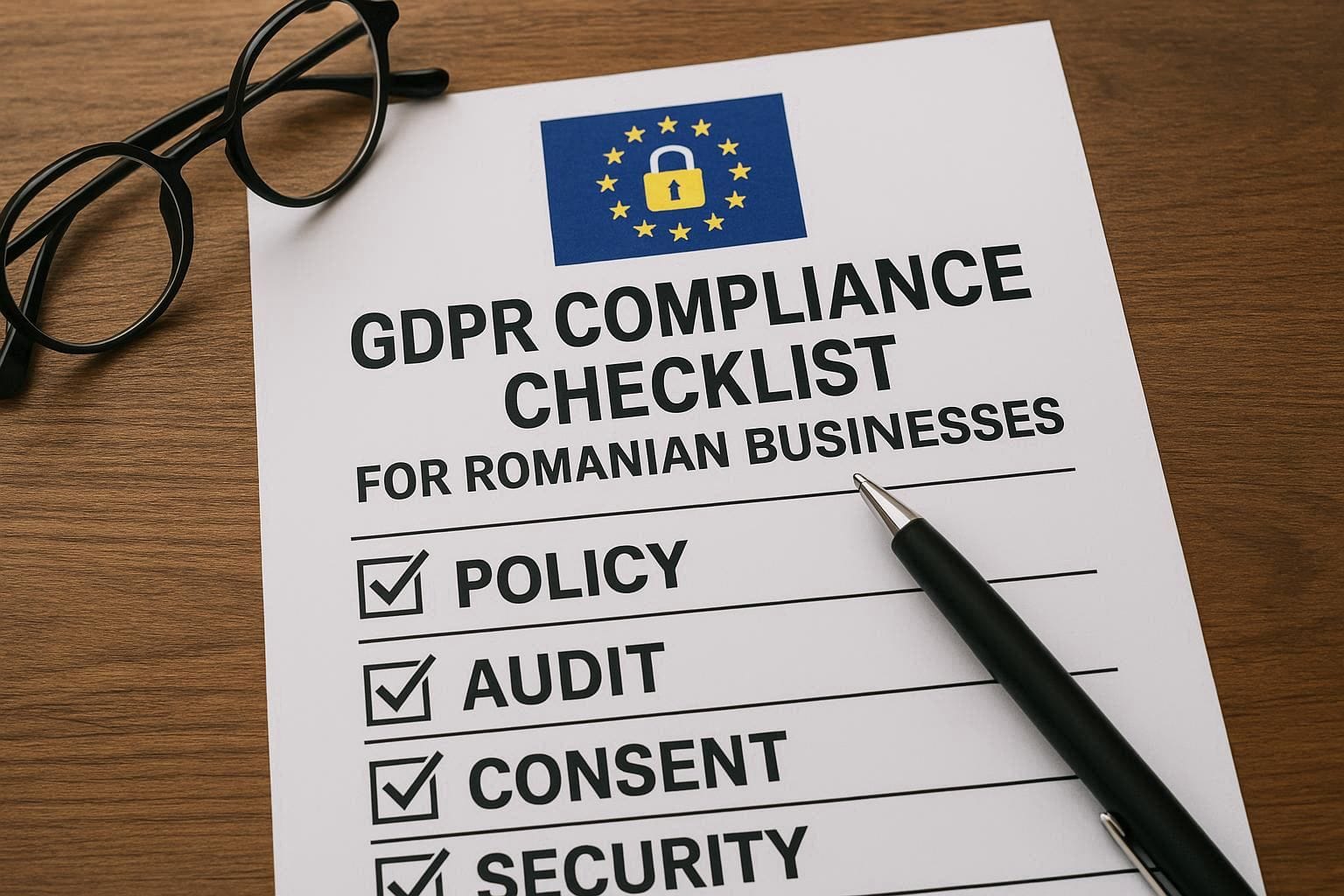
Romanian business professional reviewing GDPR compliance checklist on laptop in Bucharest office

GDPR Compliance Checklist for Romanian Companies 2025

GDPR Compliance Checklist for Romanian Companies

What crucial step could protect your business from devastating fines while building customer trust?

Many organizations underestimate how Europe’s strict data protection laws apply to their operations.

While GDPR penalties can reach €20 million or 4% of global revenue, Romanian enforcement authorities have imposed fines ranging from €3,000 to €130,000 for violations, demonstrating that penalties scale with the severity of breaches and organizational size.

GDPR compliance checklist for Romanian companies

Romania’s evolving digital economy demands proactive measures to align with rigorous privacy standards.

Legal experts emphasize that proper adherence involves more than basic policy updates—it requires systematic data governance.

Companies must address consent protocols, breach response plans, and cross-border data flows to avoid regulatory scrutiny.

Specialized legal guidance helps businesses transform compliance into strategic advantages.

Firms adopting privacy-first approaches often see improved client relationships and operational resilience.

Those delaying action risk not only financial consequences but also long-term reputational damage in competitive markets.

For tailored strategies meeting international standards, contact our data protection lawyers in Bucharest.

Our team of legal professionals provide actionable frameworks to navigate complex requirements while prioritizing business growth.

Key Takeaways

  • Data protection laws apply regardless of a company’s physical location if EU resident information is processed,
  • Penalties can reach €20 million or 4% of global revenue, emphasizing the need for preventive measures,
  • Building customer trust through transparent data practices creates market differentiation,
  • Legal experts offer customized solutions to align business operations with regulatory demands,
  • Compliance involves continuous monitoring, not just one-time adjustments.

Understanding GDPR and Its Impact on Romanian Businesses

How can organizations in Romania turn regulatory demands into strategic opportunities?

The General Data Protection Regulation (GDPR) reshapes how businesses manage information, particularly for entities handling EU residents’ data.

Its extraterritorial scope means even non-EU-based firms must adhere to strict standards when processing personal details of European citizens.

Core Regulatory Foundations

The regulation establishes six foundational principles for data handling, plus an overarching accountability principle.

These mandate that organizations:

  • Process information lawfully and transparently,
  • Collect only necessary data for specific purposes,
  • Maintain accuracy and limit storage durations.

Such requirements demand technical safeguards like encryption and operational protocols for accountability.

Privacy-by-design methodologies ensure protections are embedded in all systems.

Strategic Advantages for Local Entities

Adhering to these standards transforms obligations into opportunities.

Firms prioritizing data protection report:

  • Enhanced client confidence through transparent practices,
  • Reduced breach-related costs and operational disruptions,
  • Differentiation in markets where privacy concerns influence decisions.

For tailored strategies aligning Romanian operations with these regulations, consult our team of Romanian Lawyers.

Proactive adaptation not only mitigates risks but positions businesses as trustworthy data stewards.

Exploring Key GDPR Roles and Terminology

Who holds ultimate accountability in data governance frameworks?

Clarifying responsibilities under privacy regulations helps organizations establish clear operational boundaries.

Three critical roles form the foundation of proper data management practices.

data protection officer

Data Controllers, Processors, and Data Subjects

Data controllers determine why and how personal information is handled.

They bear legal responsibility for compliance across all processing activities.

Third-party processors execute tasks under controller directives but must independently meet security standards.

Individuals whose data is collected, known as data subjects, retain rights to access or delete their information.

Organizations must implement systems to honor these requests efficiently.

The Essential Role of the Data Protection Officer (DPO)

A data protection officer oversees compliance strategies and acts as the regulatory liaison.

This role is mandatory for entities processing sensitive data or conducting large-scale monitoring.

Under Romanian Law 190/2018, organizations processing national identification numbers (CNP) based on legitimate interest must also appoint a DPO, even if they don’t meet the standard GDPR thresholds.

This additional requirement reflects Romania’s enhanced protection for sensitive national identifiers.

Romanian businesses uncertain about role allocations should consult office@theromanianlawyers.com.

Proper classification prevents overlapping liabilities and ensures alignment with cross-border standards.

Conducting a Comprehensive Data Audit and Mapping

Organizations handling personal information must first establish clarity in their data ecosystems.

A systematic audit reveals how data flows through operations, exposing vulnerabilities while ensuring alignment with legal obligations.

This foundational step transforms raw information into actionable insights for risk management.

data audit and mapping

Identifying What Personal Data You Collect

Begin by cataloging every category of personal data your organization processes.

Common examples include:

  • Contact details (names, email addresses).
  • Digital identifiers (IP addresses, device information).
  • Sensitive records (financial data, health information).

Document each data point’s purpose, collection method, and retention timeline.

Assess whether processing activities rely on valid legal grounds like contractual necessity or explicit consent.

Storage locations demand equal scrutiny—identify physical servers, cloud platforms, and third-party repositories holding sensitive materials.

Access controls form another critical audit component.

Map which employees or systems interact with personal data and verify authorization protocols.

This process highlights potential exposure points while streamlining responses to information requests.

Romanian entities seeking structured frameworks for these assessments may contact our data protection legal specialists.

Expert guidance ensures audits meet regulatory expectations while supporting operational efficiency.

GDPR Compliance Checklist for Romanian Companies

Businesses handling EU data face operational complexity when aligning processes with privacy standards.

Structured frameworks simplify adherence while minimizing risks of non-conformance.

Effective strategies combine procedural clarity with technological safeguards to meet evolving requirements.

data protection checklist steps

Actionable Protocols for Information Security

Organizations should prioritize these critical measures:

Action ItemResponsible PartyDeadline
Complete data flow mappingIT & Legal Teams30 Days
Implement encryption protocolsSecurity Department45 Days
Update third-party contractsCompliance Officer60 Days

Consent Management Best Practices

Valid authorization requires unticked checkboxes and separate permissions for distinct processing purposes.

Confirmation emails enhance verification, while centralized logging systems track user agreements with timestamps and purpose details.

Organizations must honor withdrawal requests without undue delay and provide confirmation within one month, as required by GDPR Article 12(3).

Automated systems should flag outdated records immediately upon withdrawal, ensuring ongoing alignment with transparency obligations and ceasing processing activities promptly.

Regular audits verify adherence to storage limitation principles and access controls.

Local enterprises seeking customized frameworks may contact office@theromanianlawyers.com.

Specialized guidance helps establish resilient processes that satisfy regulatory expectations while supporting operational scalability.

Ensuring Website Security and Transparent Privacy Policies

How do modern businesses balance robust security with user transparency?

Websites storing personal information require layered defenses against cyber threats.

Organizations must adopt technical safeguards while clearly communicating data handling practices to users.

website security and privacy policies

Implementing SSL, Strong Passwords, and Anti-Virus Measures

HTTPS encryption via SSL certificates forms the first line of defense.

Multi-factor authentication and complex passwords prevent unauthorized account access.

Regular vulnerability scans and firewall updates address emerging threats.

Advanced protections include:

  • Content Delivery Networks (CDNs) to mitigate DDoS attacks,
  • Intrusion detection systems monitoring server activity,
  • Automated backups stored in geographically separate locations.

Designing Clear and Accessible Privacy Notices

Privacy policies must explain data collection purposes in plain language.

Every page should feature a visible link to these documents. Essential disclosures include:

  • Types of information gathered (contact details, device data)
  • Legal basis for processing activities
  • Third-party data sharing arrangements

Entities developing their online platforms should consult office@theromanianlawyers.com for policy reviews.

Proper alignment with privacy standards builds credibility while reducing legal exposure.

Managing Third-Party Vendors and International Data Transfers

How can businesses ensure their partners meet strict data protection standards?

Organizations relying on external vendors must verify their adherence to privacy regulations.

This requires thorough evaluations and contractual safeguards to maintain accountability across supply chains.

Evaluating Vendor Requirements and Contracts

Entities handling personal information must catalog all service providers processing data.

This includes cloud platforms, payment systems, and marketing tools.

Assessments should examine vendors’ security certifications, breach response plans, and documentation of regulatory alignment.

Legally binding agreements define responsibilities between controllers and processors.

These contracts specify permitted activities, retention timelines, and security protocols.

Subcontractor arrangements require explicit approval to maintain oversight.

RequirementActionMechanism
Vendor AccountabilityReview security auditsAnnual assessments
Data TransfersImplement SCCsContractual clauses
Risk MitigationConduct impact analysesTransfer evaluations

Cross-border data flows demand additional precautions.

Companies must confirm whether recipient countries have EU adequacy status.

For other regions, standardized contractual clauses or binding corporate rules become mandatory safeguards.

Romanian enterprises navigating these complexities should seek specialized Romanian Lawyer.

Proactive vendor management frameworks prevent regulatory violations while fostering trust with European partners.

Contact office@theromanianlawyers.com for tailored strategies addressing cross-border operational challenges.

Preparing for Data Breaches and Facilitating Data Subject Rights

What separates resilient organizations from vulnerable ones when cyber threats strike?

Proactive preparation for security incidents and efficient handling of individual rights form the backbone of modern data governance.

Organizations must balance rapid response capabilities with systematic processes to address user inquiries.

Developing a Robust Breach Response Plan

Effective incident management requires predefined protocols.

Immediate detection mechanisms trigger containment procedures within one hour of identifying unauthorized data access.

Forensic teams analyze breach scope while legal advisors determine notification obligations to authorities within 72 hours.

Regular simulation exercises test communication channels between IT, legal, and PR departments.

Documentation templates for breach reports ensure regulatory requirements are met without delays.

Continuous monitoring systems flag unusual activity patterns to prevent escalation.

Streamlining Data Subject Access Requests

Individuals increasingly exercise their right to review or delete personal information.

Centralized portals allow users to submit requests through secure authentication methods.

Automated workflows verify identities and route inquiries to appropriate teams within 24 hours.

Response templates maintain consistency while adhering to legal timelines.

Secure delivery channels protect sensitive information during transmission.

Audit trails demonstrate compliance with access rights obligations during regulatory inspections.

Entities requiring customized frameworks for incident management or user rights processes should contact office@theromanianlawyers.com.

Structured approaches transform regulatory demands into operational strengths while maintaining stakeholder trust.

FAQ

When must Romanian businesses appoint a data protection officer?

Organizations must designate a data protection officer if they systematically monitor individuals on a large scale or process sensitive categories like health records.

Public authorities in Romania also require this role regardless of data volume.

How long can companies retain customer information under EU regulations?

Storage periods must align with the original purpose for collection.

For example, transaction records may be kept for tax compliance periods specified by ANAF (Romania’s tax authority), while marketing contact lists require periodic reviews for relevance.

What technical safeguards are mandatory for website security?

Essential measures include SSL encryption, multi-factor authentication, regular penetration testing, and documented patch management processes.

Organizations should implement security measures proportionate to the risk level of data processing, following GDPR Article 32 requirements for appropriate technical and organizational measures.

Are international cloud providers like AWS or Microsoft Azure GDPR-compliant for Romanian data?

Providers operating under EU-approved mechanisms like Standard Contractual Clauses (SCCs) or binding corporate rules generally meet requirements.

However, companies must verify current certifications and update Data Processing Agreements (DPAs) annually.

What penalties apply for violating data subject rights in Romania?

The National Supervisory Authority for Personal Data Processing (ANSPDCP) can impose fines up to €20 million or 4% of global turnover.

Recent enforcement actions targeted improper consent practices and delayed breach notifications.

How should organizations handle data access requests from employees?

Businesses must respond within 30 days, providing free electronic copies of records.

Implement automated DSAR workflows in platforms like Microsoft 365 or specialized tools such as OneTrust to track and fulfill requests efficiently.

Essential Documents for Foreign Founders Starting a Business in Romania

Essential Documents for Foreign Founders Starting a Business in Romania

Essential Documents for Foreign Founders Starting a Business in Romania

What if the fastest way to launch a European business isn’t where you’d expect?

Romania’s streamlined corporate framework allows entrepreneurs to establish an SRL company in just three working days with current minimum capital requirements that have recently undergone significant changes in 2025.

A stack of official documents and forms on a desk.

But beneath this efficiency lies a critical question:

How can international investors avoid hidden pitfalls in documentation processes that could derail their ambitions?

Romania’s open-market policies permit full foreign ownership without local partnership mandates, creating attractive opportunities for global entrepreneurs.

However, the registration process demands precise adherence to legal standards.

Corporate filings must align with Trade Register specifications, including certified translations into Romanian or bilingual formats.

Strategic document preparation forms the backbone of successful incorporation.

Errors in paperwork often lead to delays, financial penalties, or rejected applications.

Professional legal guidance from lawyers in Romania ensures compliance with corporate law frameworks while maintaining operational legitimacy from day one.

Investors benefit from understanding how each document interacts with regulatory systems.

Properly structured articles of association, shareholder agreements, and notarized identification papers establish transparent governance structures.

These elements collectively safeguard business interests within Romania’s evolving economic landscape.

Key Takeaways

  • Romania permits 100% foreign-owned companies with fast 3-day Trade Register approval timelines,
  • Document preparation requires strict compliance with Romanian language standards,
  • Legal expertise minimizes risks of administrative delays or non-compliance penalties,
  • Corporate filings must align with Trade Register specifications for approval,
  • Precise paperwork establishes long-term operational legitimacy,
  • VAT rate increased to 21% in August 2025, with registration threshold at RON 395,000,
  • Minimum capital requirements are undergoing reform, with new tiered structure proposed.

Introduction to Business Registration in Romania

A businessman reviewing papers at a desk.

Romania’s economic landscape presents a compelling proposition for global enterprises seeking competitive positioning in Europe.

As an EU member state, the country serves as a strategic crossroads connecting major continental markets.

This geographic advantage, combined with progressive regulatory frameworks, creates fertile ground for sustainable business growth.

Overview of the Romanian Market

A group of diverse business people reviewing documents around a table.

The local market distinguishes itself through a growing pool of skilled workforce, particularly in technology and engineering sectors.

Romania produces approximately 18.6 STEM graduates per 1,000 people aged 20-29, though this remains below the EU average of 23.0.

The country is actively working to expand its technical education programs.

Operational costs remain 34-51% lower than Western European averages without compromising service quality, with Romanian developer salaries approximately 40% below comparable Western rates.

Infrastructure development continues accelerating across transportation and digital networks.

Modern highways connect major cities to EU trade routes, while digital coverage expands nationwide.

These advancements enable companies to maintain efficient supply chains and regional operations.

Benefits for Foreign Entrepreneurs

Several colorful flags are displayed on a desk next to business papers.

Romania offers foreign investors streamlined processes through recent legal reforms.

The elimination of redundant permits and digital filing systems reduces Trade Register approval to approximately three working days.

EU membership guarantees alignment with continental standards while preserving local cost advantages.

Investors benefit from tax incentives for research-driven business initiatives and export-oriented activities.

Cultural adaptability further enhances market entry, with English widely spoken in professional environments.

These factors position the country as an attractive destination for scalable international ventures.

Why Start a Business in Romania?

A close-up of a business plan document with charts and graphs.

Romania’s tax and regulatory systems create a unique value proposition for commercial ventures targeting European markets.

Strategic fiscal policies combine with progressive legislative changes to support both startups and established enterprises.

Attractive Tax Environment

A smiling business person holding a briefcase and standing in front of a modern office building.

The country maintains one of Europe’s most competitive tax frameworks, though recent changes require careful attention.

Microenterprises benefit from a 1% revenue tax when employing at least one worker and earning up to €60,000 annually.

For revenues above €60,000 or for specific sectors like IT services (CAEN codes 6210, 6290) and restaurants, a 3% rate applies.

Traditional corporations face a flat 16% profit tax.

Tax TypeRateConditions
Microenterprise1%Revenue under €60K with 1+ employee
Microenterprise3%Revenue €60K-€250K (€100K from 2026) or IT/restaurant activities
Corporate Profit16%Standard companies
Dividends10%Increased from 8% in January 2025
Standard VAT21%Increased from 19% in August 2025
Reduced VAT11%Consolidated rate from August 2025

Favorable Legal Reforms

Recent legislative updates streamline operations for international investors.

Digital registration systems cut Trade Register processing times to 3 working days, while revised thresholds for micro-tax status continue until 2026, though the revenue limit decreases from €250,000 to €100,000 starting January 2026.

Enhanced transparency measures reduce bureaucratic hurdles.

Special support programs assist startups in navigating compliance requirements, ensuring smooth market entry.

However, investors must stay updated on frequent tax law changes, including the August 2025 VAT increase from 19% to 21%.

Understanding Legal Structures for Foreign Founders

Selecting the optimal legal framework forms the cornerstone of successful business operations.

Romania offers multiple corporate formats, each aligning with specific operational scales and strategic objectives.

Three primary options dominate commercial registrations, balancing legal safeguards with administrative practicality.

Limited Liability Company (SRL)

An open laptop displaying a business registration website.

The Societate cu Răspundere Limitată (SRL) remains the preferred choice for most ventures.

This structure provides limited liability protection, shielding personal assets from business debts.

Requirements include:

  • 1–50 shareholders
  • Minimum share capital currently ranges from RON 1 to RON 200 (sources vary), with a new tiered proposal for 2025-2026: RON 500 for new companies, increasing to RON 5,000 for revenues between RON 395,000-7 million, and RON 90,000 for revenues exceeding RON 7 million,
  • Simplified management structures.

Governance flexibility allows swift decision-making, ideal for small-to-medium enterprises. Annual reporting obligations remain manageable compared to complex entities.

StructureShareholdersCurrent CapitalProposed Capital (2025-2026)Best For
SRL1–50RON 1-200RON 500-90,000 (tiered)Startups/SMEs
SAUnlimitedRON 90,000RON 90,000 (€25,000)Large enterprises


Joint-Stock Company (SA) and Other Options

A group of diverse people discussing papers around a table.

The Societate pe Acțiuni (SA) suits ventures planning IPOs or major investments.

Key features include:

  • Minimum capital: RON 90,000 (approximately €25,000),
  • Public share trading capability,
  • Formal governance requirements.

Alternative structures like branches or partnerships serve niche scenarios.

Professional guidance ensures alignment between legal frameworks and long-term growth strategies, particularly given the evolving minimum capital requirements.

Required Documents for Foreign Founders in Romania

A person holding a passport and a business plan.

Navigating corporate registration demands meticulous attention to foundational paperwork.

Seven core submissions form the basis of compliant filings, supported by supplementary materials that address cross-border complexities.

The application form and tax annex require detailed operational data, including management structures and activity codes.

Identity verification for administrators ( directors) necessitates certified copies of passports or national IDs, translated into Romanian by authorized professionals.

Shareholder affidavits confirm tax status for individuals lacking local fiscal identification.

These declarations prevent delays during fiscal authority reviews.

Articles of Association drafted in Romanian establish governance protocols, requiring alignment with national corporate law frameworks.

Proof of registered office ranges from property deeds to virtual office contracts, validating a physical business address.

Beneficial ownership disclosures meet EU anti-money laundering directives, tracing control chains for transparency.

Optional apostille certifications authenticate foreign-signed documents.

While not mandatory, these additions streamline verification processes across jurisdictions.

Professional legal review ensures technical accuracy before Trade Register submission, particularly important given recent regulatory changes.

Preparing Your Articles of Association and Registered Office

A person is typing on a laptop with documents spread out on a table.

The foundation of a compliant Romanian enterprise lies in two critical components: constitutional documents and physical establishment.

These elements define operational boundaries while meeting legal obligations under national corporate frameworks.

Drafting the Articles of Association

A person reviews a document with a focused expression while sitting at a table.

Articles of Association act as a company’s operational blueprint.

This legally binding document must specify shareholder voting rights, capital distribution models, and decision-making hierarchies.

Romanian law mandates inclusion of NACE codes to classify business activities accurately.

Management roles require precise definitions of authority limits and appointment procedures.

Provisions for General Meetings must outline resolution processes and quorum requirements.

Legal professionals recommend embedding flexibility clauses to accommodate future growth scenarios, including provisions for the new tiered minimum capital requirements expected to phase in through 2026.

Establishing a Proof of Registered Office

All entities must maintain a verifiable registered office within Romania.

Valid proof includes notarized lease agreements or property ownership documents.

Virtual office contracts have gained traction for cost efficiency while fulfilling legal address requirements.

Service providers offering virtual solutions must issue compliance certificates recognized by the Trade Register.

Physical locations require utility bills or municipal confirmations.

Consistent address details across all filings prevent administrative delays during registration.

Steps in the Company Registration Process

A person filling out forms with a pen.

Establishing a corporate entity in Romania follows a precise sequence of regulatory actions.

This systematic approach ensures compliance while maintaining operational efficiency for new market entrants.

Name Reservation and Document Filing

The initial company name reservation occurs through the National Trade Register Office (ONRC) portal.

This free digital service verifies name availability against existing registrations within minutes.

Approved reservations remain valid for 30 calendar days, creating urgency for subsequent filings.

Document preparation requires alignment with ONRC specifications.

Essential materials include translated identification papers and notarized corporate agreements.

Submissions can occur physically at regional offices or digitally using qualified electronic signatures.

Processing with the Trade Register

Officials typically complete company registration reviews within three working days for the Trade Register approval.

This period allows thorough verification of statutory documents and legal compliance checks.

Delays usually stem from incomplete filings or translation discrepancies.

Successful applicants receive three critical identifiers: the Certificate of Incorporation, CUI tax code, and Certificat Constatator.

These enable immediate banking operations and contractual engagements across Romania.

Note that while Trade Register approval is fast, the complete registration process including VAT registration and full operational readiness typically takes 7-10 working days.

Navigating Tax and VAT Registration in Romania

An open laptop displaying a tax registration website with a cup of coffee nearby.

Understanding fiscal obligations marks a critical phase for enterprises establishing operations in emerging markets.

Romania’s integrated tax system combines automatic corporate registration with strategic VAT options, creating adaptable frameworks for diverse commercial needs.

Corporate and Microenterprise Tax Details

Newly registered companies receive tax IDs during incorporation, enabling immediate financial operations.

Important Update for 2025-2026:

Microenterprises benefit from preferential tax rates when maintaining at least one employee:

  • 1% tax rate on revenue up to €60,000
  • 3% tax rate on revenue from €60,000 to €250,000 (2025) or €100,000 (from January 2026)

Special activities including IT services (CAEN codes 6210, 6290), restaurants, and mobile food services are subject to the 3% rate regardless of revenue level.

Standard corporate tax applies at 16% for profits when companies exceed micro-company thresholds or don’t qualify for the regime.

The dividend withholding tax increased to 10% as of January 1, 2025 (previously 8%) for all recipients.

VAT Registration Requirements

Critical 2025 Updates:

Businesses must register for VAT when exceeding RON 395,000 annual turnover (effective September 1, 2025, increased from RON 300,000).

The standard VAT rate is 21% (increased from 19% in August 2025), with a consolidated reduced rate of 11% replacing the previous 5% and 9% rates.

Voluntary VAT registration remains available for smaller enterprises seeking input tax recovery.

Sector-specific rules apply, with businesses engaged in EU trade requiring VAT registration regardless of turnover thresholds.

FAQ

What legal structure is most common for foreign entrepreneurs in Romania?

The limited liability company (SRL) is preferred due to its flexibility and simplified compliance requirements.

Current minimum share capital varies between RON 1-200, with a new tiered proposal being implemented: RON 500 for new companies, increasing based on revenue thresholds to RON 5,000 (for revenues RON 395,000-7 million) and RON 90,000 (for revenues exceeding RON 7 million).

It allows full foreign ownership and limits liability to invested capital.

How does Romania’s tax environment benefit startups?

Romania offers a 16% corporate tax rate, one of the lowest in the EU.

Microenterprises with at least one employee pay only 1% on turnover up to €60,000 and 3% from €60,000 to €250,000 (reducing to €100,000 threshold from January 2026), making it ideal for early-stage businesses.

However, IT services and certain other sectors pay 3% regardless of revenue level.

Can a virtual office serve as proof of registered office?

Yes, foreign founders can use virtual office services compliant with Romanian law.

The address must be verifiable and included in the Articles of Association during company registration.

What are the VAT registration requirements for new businesses?

Updated for 2025: Companies must register for VAT if annual turnover exceeds RON 395,000 (effective September 1, 2025).

The standard VAT rate is 21% (increased from 19% in August 2025), with a reduced rate of 11%.

Voluntary registration is permitted, allowing input tax recovery.

Non-EU businesses require a fiscal representative for compliance.

How long does the company registration process take?

The Trade Register approval typically takes 3 business days with complete documentation.

However, the full registration process including VAT registration and complete operational setup takes 7-10 working days.

Delays often arise from incomplete documents or translation issues.

Are foreign shareholders required to visit Romania during incorporation?

No. A local lawyer can handle filings via power of attorney.

Notarized documents and apostilled/legalized identification (e.g., passports) must be submitted electronically or by courier.

What post-registration obligations apply to Romanian companies?

Firms must file annual financial statements, maintain accounting records, and submit monthly/quarterly tax declarations.

Important: As of 2025, the dividend tax is 10% (increased from 8%).

Companies must monitor the microenterprise revenue threshold, which decreases from €250,000 to €100,000 on January 1, 2026.

Hiring employees triggers additional labor law and social security compliance.

What are the current VAT rates in Romania?

Updated August 2025: The standard VAT rate is 21% (increased from 19%), and the reduced rate is 11% (consolidating the previous 5% and 9% rates).

These changes took effect August 1, 2025.

What documents are required to register a company in Romania as a foreigner?

To register a company in Romania, foreigners need to prepare and submit several necessary documents.

These include identification documents such as a valid passport, proof of address in Romania, and incorporation documents specific to the type of business structure chosen, whether it be a joint stock company or a limited liability company (SRL).

Additionally, an application for registration must be completed, and the unique company name must be verified through the trade registry.

How does the company registration process work for foreign entrepreneurs?

The company registration process for foreign entrepreneurs in Romania involves several key steps.

First, you must select a business structure and prepare the necessary documents.

Then, you will need to submit these documents to the trade registry for approval.

Following this, you will need to register your business office in Romania and meet the minimum share capital requirement.

Finally, once all documents are approved and the company is registered, you will receive a registration certificate, allowing you to start your business operations in Romania.

What are the benefits of starting a business in Romania as a foreigner?

Starting a business in Romania offers numerous benefits for foreign entrepreneurs.

Romania is situated in a strategic location within the European Union, providing access to a vast market.

The business environment is continually improving, with various incentives for foreign investment.

Additionally, the country offers a range of business structures available, allowing entrepreneurs to select the type of company that best fits their business needs.

This makes Romania an attractive destination for foreign founders looking to expand their operations in Europe.

 

Corporate Documentation Requirements in Romania

Corporate Documentation Requirements in Romania

Corporate Documentation in Romania

Did you know Romania lets companies be fully owned by foreigners?

This shows how welcoming Romania is to businesses.

Knowing the legal documents and rules is key for any company wanting to start here.

Getting through Romania’s business laws needs careful focus.

The process includes setting up a company and following rules.

Your success relies on knowing all the details of doing business here.

Whether you’re new or already big, learning the law is vital.

Romania has great chances for those willing to learn its business rules.

Key Takeaways

  • Romania supports 100% foreign company ownership;
  • Company incorporation typically takes 5-10 working days;
  • Minimum share capital varies by company type;
  • All companies must have a registered Romanian office;
  • Comprehensive documentation is critical for legal compliance.

Understanding Legal Entity Types in Romania

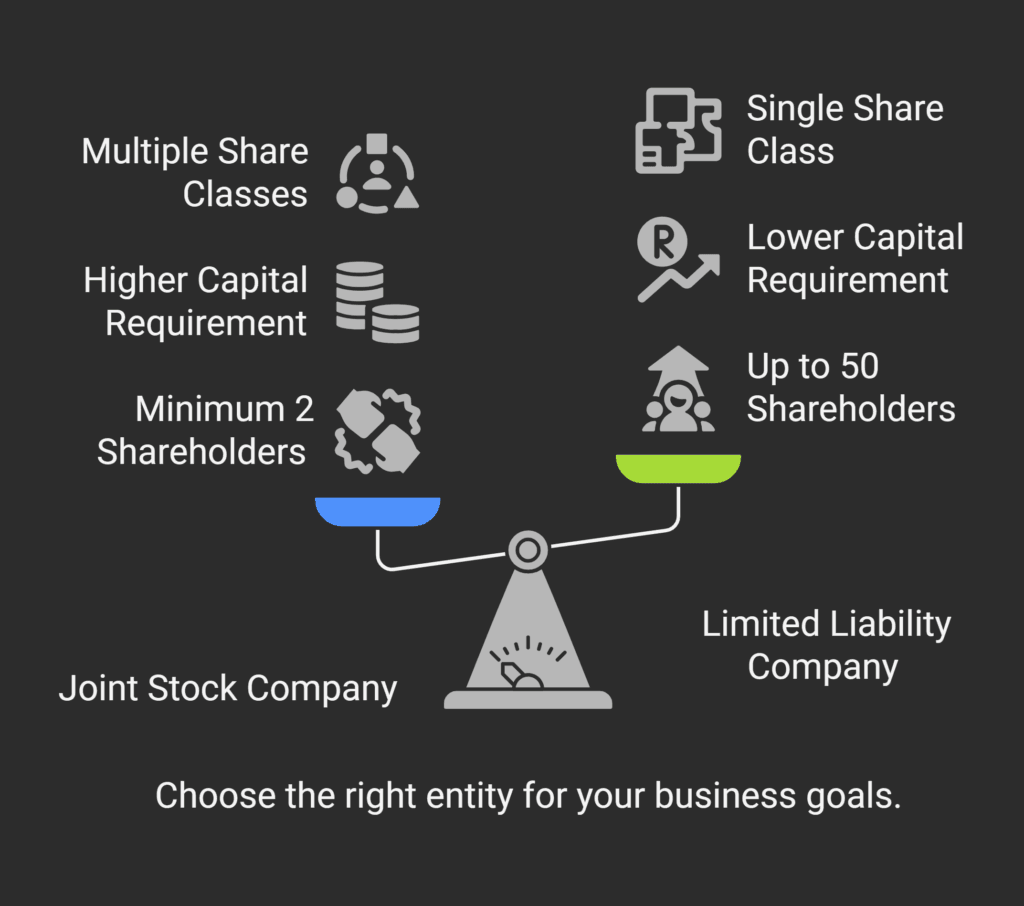
In Romania, you’ll find two main types of legal entities for starting a business:

Joint Stock Companies (JSC) and Limited Liability Companies (LLC).

These options differ in how they handle corporate governance.

They also offer flexibility for those setting up businesses in Romania.

Legal Entity Types in Romania


Romania’s business scene is diverse, with JSCs and LLCs being the top choices for investors.

Knowing what each offers is key to choosing the right structure for your business.

Joint Stock Companies (JSC)

Joint Stock Companies are known for their strength and several important features:

  • Minimum of 2 shareholders with no maximum limit;
  • Limited personal liability for shareholders;
  • Fiscal registration through the Trade Registry;
  • Potential for public trading of shares.

Limited Liability Companies (LLC)

Limited Liability Companies are known for their simplicity and benefits:

  • Up to 50 shareholders possible;
  • Simplified management structure;
  • Lower minimum capital requirements;
  • Faster incorporation process.

Key Differences Between Entity Types

CharacteristicJoint Stock CompanyLimited Liability Company
Minimum Shareholders2 shareholders1 shareholder
Minimum CapitalRON 90,000RON 200
Maximum ShareholdersUnlimited50
Share ClassesMultiple possibleSingle class only

Choosing between a JSC and LLC depends on your business goals, available capital, and future plans.

Each type has its own advantages for managing documents and corporate governance in Romania.

Corporate Documentation Requirements Under Romanian Law

Corporate Documentation in Romania

Understanding corporate law in Romania is key.

You must know the legal rules to follow.

When  starting a business in Romania, you’ll need to gather important documents that follow Romanian laws.

The process of getting these documents involves several steps.

These steps make sure your company follows all the rules.

Romanian law has specific rules for different types of businesses.

It’s important to know these rules well.

  • Prepare detailed company formation documents;
  • Get the needed registration certificates;
  • Follow local legal rules;
  • Keep your corporate records up to date.

Foreign investors need to grasp legal rules in Romania.

The process includes at least six important documents.

These include articles of association and financial statements.

Each document must be carefully made to meet Romanian rules.

Key documentation needs change based on your business type and goals.

Here are some specific documents you’ll need:

  1. Company incorporation papers;
  2. Tax identification documents;
  3. VAT registration forms;
  4. Records of shareholder information.

The Law No. 265/2022 on the Trade Registry has brought changes.

From November 26, 2022, companies must follow new rules.

These include easier ways to start and updated business registration rules.

Essential Business Registration Documents

Starting a business in Romania is complex.

You need to know a lot about company formation paperwork and corporate rules.

You’ll have to prepare important documents to follow the law and start your business smoothly.

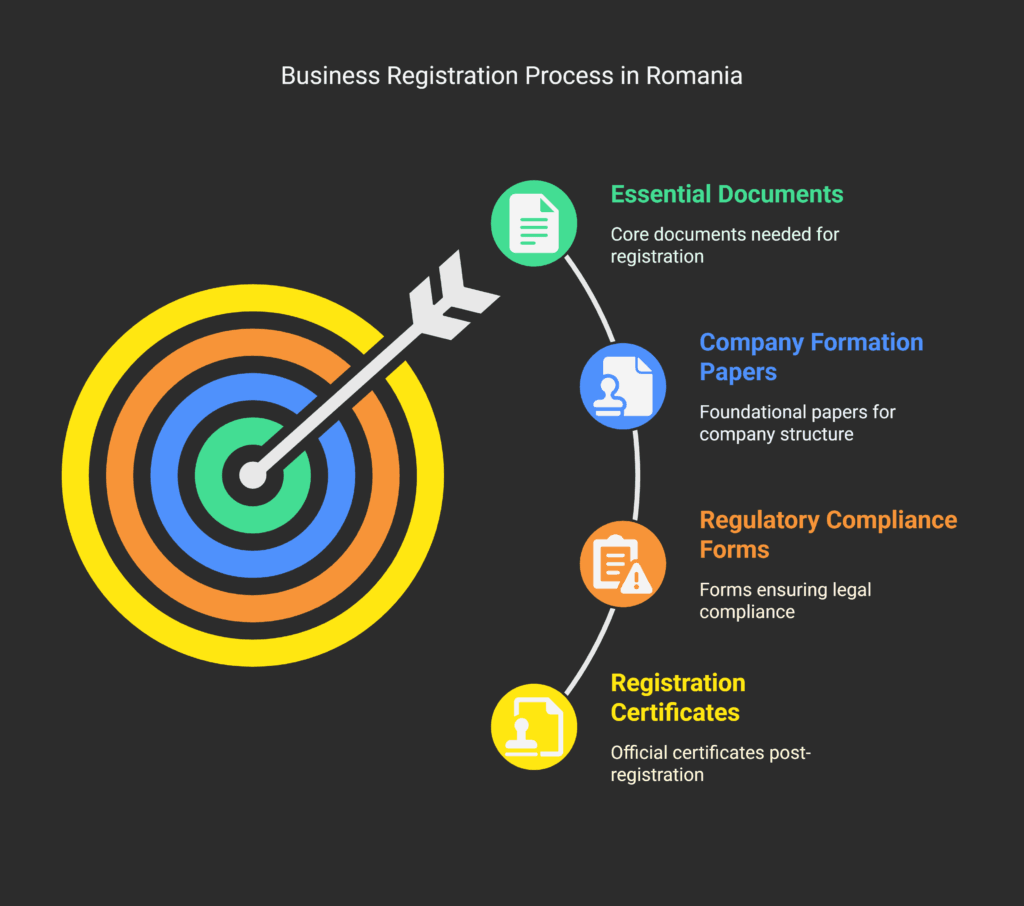
Registering your business means filling out several key documents.

These documents are the base of your company’s policies and structure.

Business Registration Documents Romania

Company Formation Papers

Here are the documents you’ll need for your business registration:

  • Articles of Incorporation;
  • Shareholder Agreement;
  • Proof of Initial Capital Deposit;
  • Company Bylaws.

Regulatory Compliance Forms

You’ll also need to fill out important compliance forms:

  1. Trade Registry Registration Form;
  2. Tax Registration Application;
  3. Social Security and Health Insurance Registration;
  4. Employment Documentation.

Registration Certificates

Once you’ve submitted your documents, you’ll get important certificates:

Certificate TypePurposeProcessing Time
Trade Registry CertificateOfficial Business Registration5-7 Business Days
Tax Identification NumberTax Authority Registration3-5 Business Days
VAT RegistrationEnable Legal Business Transactions2-4 Business Days

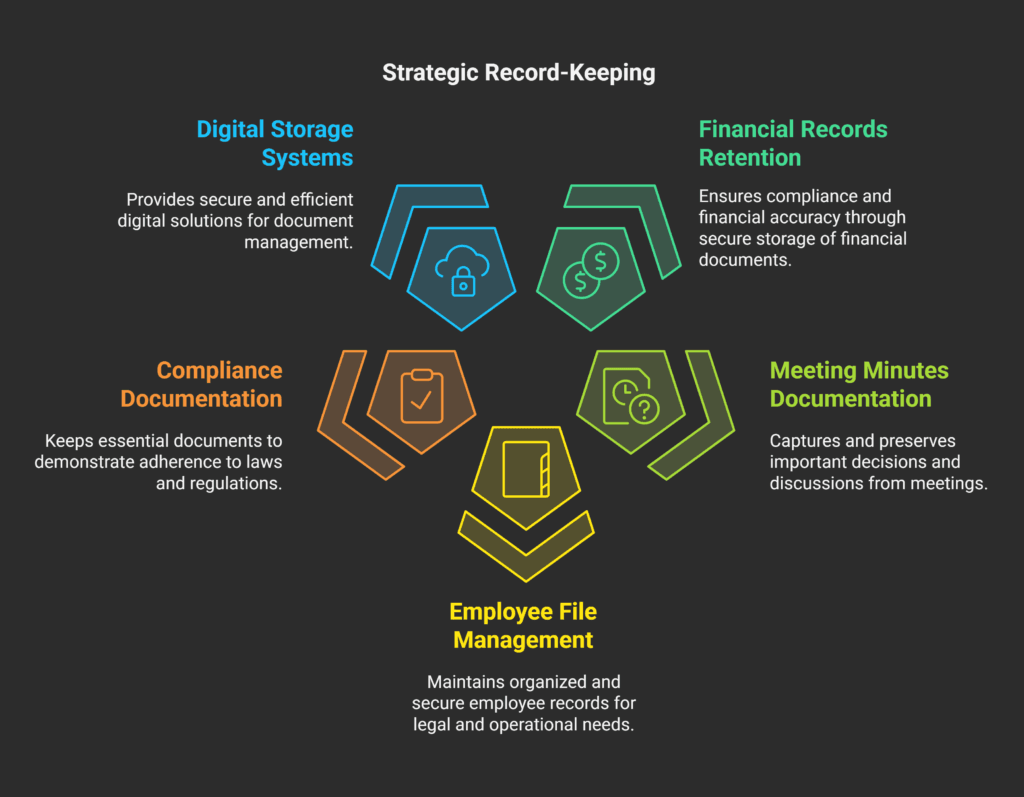
It’s important to keep these documents in order.

Getting help from a professional can make this process easier.

Management Structure Documentation

Starting a company in Romania means you need to know about management structure documents.

These are key for following the law and keeping your business in order.

Romanian company law is strict about how your business is set up.

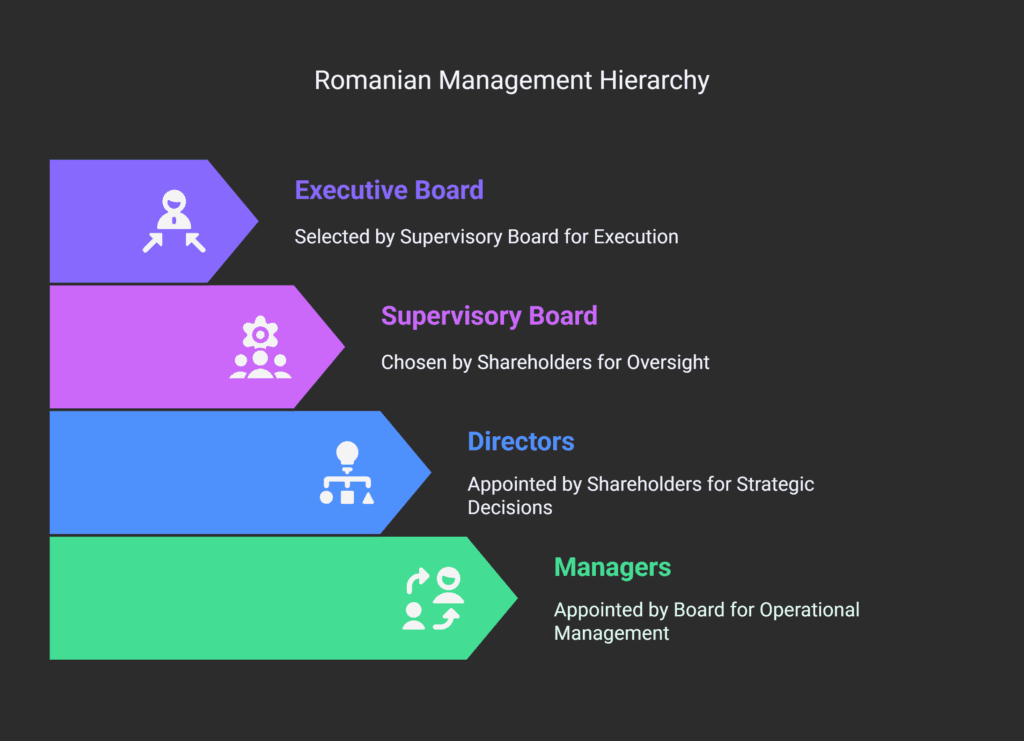
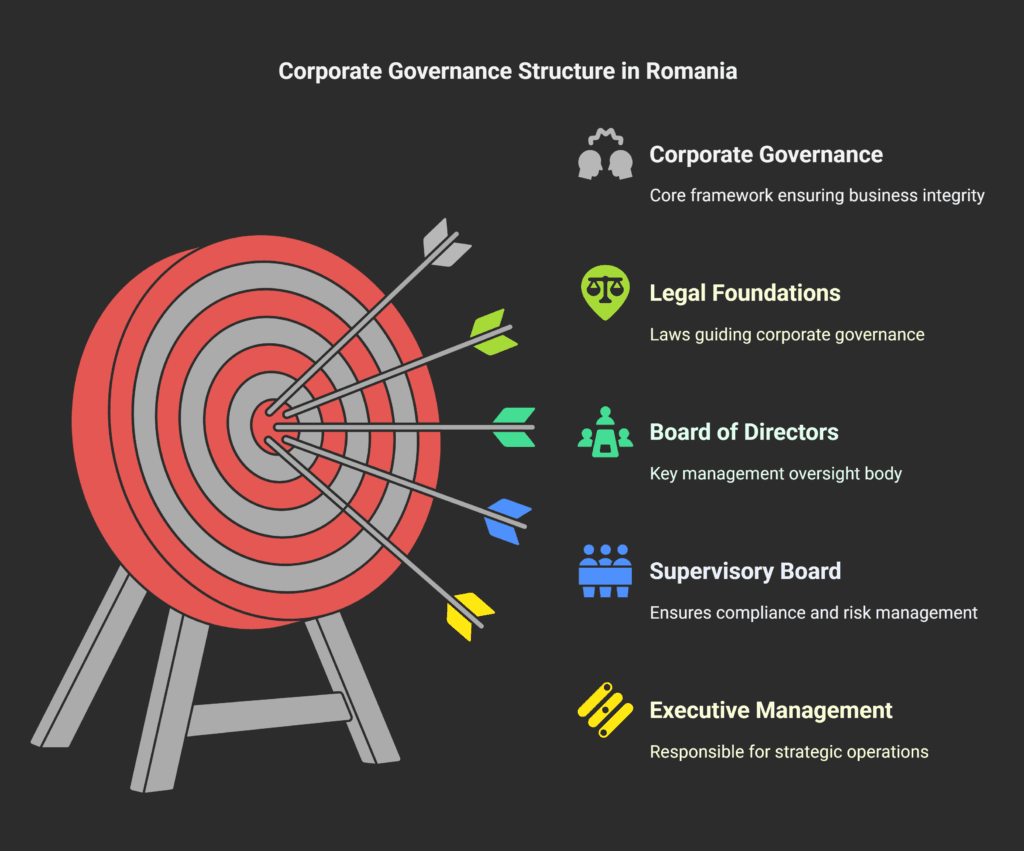
Romanian Management Hierarchy Romania

Romanian companies usually have one of two main management systems:

  • One-Tier Management System;
  • Two-Tier Management System.

The one-tier system has one board that does everything.

This board is chosen by the shareholders.

They can also pass on some tasks to others.

One-Tier Management Structure Characteristics

ComponentAppointment MethodKey Responsibilities
DirectorsAppointed by ShareholdersStrategic Decision Making
ManagersAppointed by Board of DirectorsOperational Management

The two-tier system splits the work into two boards.

The supervisory board, chosen by shareholders, watches over the executive board.

This board is picked by the supervisory board.

It adds more control and balance in how the company is run.

Proper documentation of management structures is essential for ensuring Romanian corporate compliance and maintaining transparent business operations.

Your legal papers in Romania must clearly show who does what in each management level.

This is a big part of following the law and keeping your business clear.

Corporate Governance and Compliance Standards

Getting to know corporate governance in Romania means dealing with many rules and documents.

Companies here must follow strict standards.

These ensure their management is clear and works well.

The laws that guide corporate governance come from two main sources.

Companies Law No. 31/1990 and Trade Registry Law No. 26/1990 set the rules.

They cover what each business type needs and how they should be managed.

Corporate Governance & Compliance Structure in Romania

Board of Directors Requirements

Setting up a Board of Directors in Romania comes with important rules. Companies must follow these to stay legal:

  • Minimum board size varies depending on company type;
  • Joint-stock companies typically require at least three directors;
  • Independent board members are key for clear management;
  • Professional liability insurance is a must for board members.

Supervisory Board Documentation

The Supervisory Board is vital in a two-tier management system.

It needs to keep detailed records.

This includes:

  1. Detailed meeting minutes;
  2. Annual performance reports;
  3. Compliance verification documents;
  4. Risk management assessments.

Executive Management Papers

Executive management in Romania has its own set of rules.

You must keep detailed records.

These show you’re responsible and strategic.

By following these corporate governance rules, your Romanian business can stay legal.

It also keeps things transparent and has a strong management system.

Single Administrative Document (SAD) Requirements

Understanding the Single Administrative Document (SAD) is key for businesses in international trade.

The SAD is a standardized customs declaration form used in many places, including the European Union and some partner countries.

Your business needs to know how important the SAD is in legal and corporate law in Romania.

It’s vital for tracking and managing goods, mainly for deals outside the EU or with non-EU goods.

  • Covers multiple customs procedures including export and transit;
  • Consists of eight distinct copies with specific functions;
  • Used for trade with non-EU countries and movement of non-EU goods;
  • Essential for proving goods origin during customs clearance.

Business documentation laws demand careful filling out of the SAD.

The form needs to have all the details about the goods, their origin, and the customs procedure.

Being accurate is key for easy customs processing and following Romanian and EU rules.

Businesses bear ultimate responsibility for the accuracy and completeness of customs declarations submitted on their behalf.

There’s a move towards fully electronic customs declarations.

Your business must get used to new digital submission rules.

Knowing these changes helps keep your international trade smooth and legal.

Economic Operator Registration and Identification (EORI)

Understanding the Economic Operator Registration and Identification (EORI) system is key in Romania.

If your business wants to do customs work in the European Union, you need an EORI number.

It’s important for managing your corporate documents.

The EORI system started in Romania on July 1, 2009.

It helps identify economic operators in international trade.

Your business must follow these rules for easy customs dealings.

Application Process

To get your EORI number, follow these steps:

  • Register with your national customs authority;
  • Prepare necessary business documentation;
  • Submit your application electronically;
  • Receive your unique EORI identifier.

Required Supporting Documents

You’ll need these documents for legal compliance in Romania:

  1. Company registration certificate;
  2. VAT registration proof;
  3. Identification documents for company representatives;
  4. Proof of business address.

Registration Timeline

The EORI registration is quick.

Romanian customs usually process applications in two days.

And it’s free.

Your EORI number is good for 10 years for businesses, keeping you in line with EU customs rules.

Knowing and following EORI rules helps your business with international trade.

It reduces customs problems.

Record-Keeping and Documentation Maintenance

Keeping records well is key for businesses in Romania.

Your company needs to keep detailed records to follow the law and work smoothly.

The National Trade Register Office gives important rules for keeping business documents.

Record-Keeping and Documentation Maintenance in Romania

Romanian laws require keeping documents in order across many areas.

Your company’s rules should cover:

  • Financial records retention;
  • Meeting minutes documentation;
  • Employee file management;
  • Compliance documentation.

Digital storage is now vital in Romania.

The Ministry of Communications and Information Society says companies need special approvals for digital documents.

You must tell the authorities 30 days before starting digital archiving.

Your systems must also meet strict rules.

Proper documentation is not just a legal requirement, but a strategic asset for your business.

Important steps for good documentation include:

  1. Use safe digital storage systems;
  2. Make clear filing rules;
  3. Check and update records often;
  4. Train staff on document handling.

By focusing on keeping good records, you help your business avoid legal problems.

You also make your operations clear and efficient.

Conclusion

Mastering corporate record keeping in Romania is complex.

It requires a deep understanding of legal frameworks.

Your business’s success depends on following corporate compliance rules and keeping accurate records.

The Romanian business world needs strict paperwork management.

This must follow national legal standards.

Effective business paperwork in Romania does more than follow rules.

It protects your company, sets clear rules, and makes communication clear.

Getting help from legal experts can guide you through this complex area.

They ensure your business stays compliant and competitive.

Keeping up with Romanian business laws is key for growth.

Work with legal pros who know Romanian corporate rules well.

They can give you specific advice, explain complex laws, and reduce risks from mistakes.

For help with your corporate documents, contact Romanian legal experts.

They can help with creating, checking, and keeping your documents up to date.

Reach out to our Romanian Law Office to make sure your documents are top-notch and effective.

FAQ

What are the main legal entity types in Romania?

In Romania, there are two main types of legal entities.

Joint Stock Companies (JSC) are for bigger businesses with many shareholders.

Limited Liability Companies (LLC) are better for smaller businesses with fewer shareholders.

What essential documents are required for business registration in Romania?

You’ll need several important documents for business registration.

These include articles of incorporation and shareholder agreements.

You’ll also need a company registration certificate, tax number (CUI), and proof of a registered office.

Depending on your business type, you might need more documents.

How long must I retain corporate documents in Romania?

Romanian law says you must keep most corporate documents for at least 10 years.

This includes financial records and meeting minutes.

Keeping these documents well is key for audits and following the law.

What is the Single Administrative Document (SAD), and why is it important?

The SAD is a key document for international trade.

It’s used for customs declarations when moving goods in or out.

It gives detailed info about the goods, their value, and where they’re going.

This helps with smooth customs clearance in Romania and the EU.

What is an EORI number, and do I need one?

An EORI number is vital for EU customs operations.

If your business trades internationally, you’ll need one.

It helps with customs procedures and tracking your trade activities.

What are the management structure documentation requirements in Romania?

Romanian businesses must keep detailed records of their management structure.

This includes documents for directors and board members.

You’ll need meeting minutes and records of shareholder decisions for both one-tier and two-tier systems.

How difficult is it to set up a company in Romania?

Setting up a company in Romania is relatively easy but needs careful attention to legal details.

You’ll need to prepare incorporation documents and register with local authorities.

You’ll also need to get business permits and a tax ID.

What are the key compliance standards for corporate governance in Romania?

Romanian corporate governance requires detailed documentation.

This includes annual reports and meeting minutes.

Companies must show they follow local and EU rules through transparent records.

Are there specific documentation requirements for foreign investors?

Foreign investors need extra documents.

This includes translated and apostilled corporate documents and proof of registration in their home country.

It’s wise to work with a local legal expert to ensure you meet all requirements.

What penalties exist for non-compliance with documentation requirements?

Not following the rules can lead to big fines and even business suspension.

Penalties can be financial or more severe, like canceling your business registration for serious breaches.

What are the main documents required for incorporating a Romanian company (SRL)?

To incorporate a limited liability company (SRL) in Romania, you need to prepare and submit several documents required to the Trade Register.

The primary documents include:

1. Articles of Association

2. Proof of registered office;

3. Shareholder identification documents;

4. Criminal record certificates for company representatives;

5. Specimen signatures of company representatives;

6. Proof of share capital deposit;

7. Company name reservation certificate;

8. Declaration of honor from company representatives;

9. Power of attorney (if applicable);

10. Fiscal record certificate;

These necessary documents are crucial for setting up a company in Romania and ensuring compliance with Romanian law.

How do I prepare the Articles of Association for a Romanian company?

The Articles of Association is a fundamental document for company formation in Romania.

It should include:

1. Company name and type of company (SRL);

2. Registered address;

3. Object of activity (using NACE codes);

4. Share capital amount and distribution;

5. Shareholder information;

6. Administrator details and responsibilities;

7. Duration of the company (if not indefinite);

8. Profit distribution method;

9. General meeting of shareholders procedures;

The document must be submitted to the Trade Register Office and should be drafted according to the Romanian legislation.

It’s advisable to seek legal assistance to ensure all legal requirements are met.