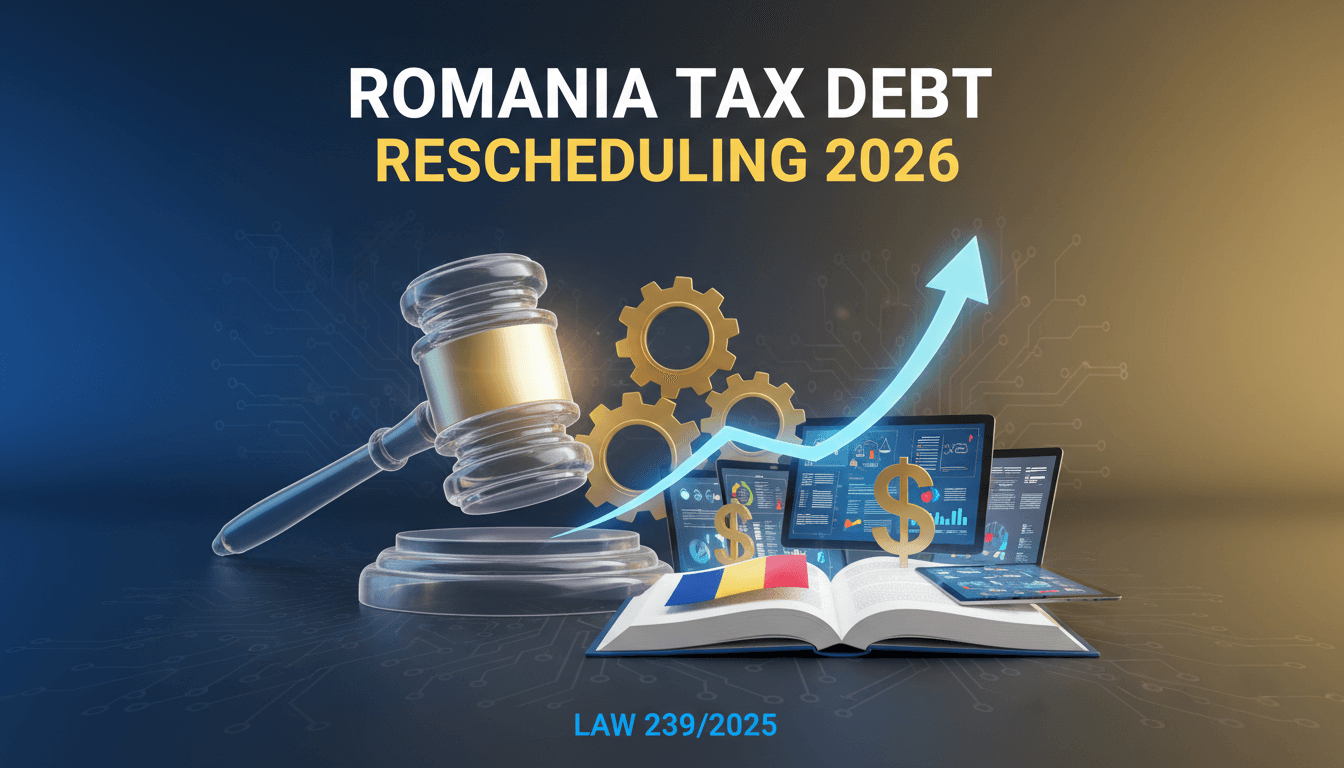
Romania tax debt rescheduling 2026 under Law 239/2025, illustrated by a judge’s gavel, financial charts, digital tax systems, and Romanian flag symbolizing legal and fiscal reform.

Romania Tax Debt Rescheduling 2026 – Law 239/2025 Explained


Romania Debt Rescheduling 2026: Law 239/2025 Explained

Romania is entering a more restrictive fiscal environment in 2026 following the adoption of Law no. 239/2025, published in the Official Gazette no. 1160 of December 15, 2025 and effective as of December 18, 2025.

The reform forms part of a broader effort to strengthen budgetary discipline and improve tax collection, in line with Romania’s European fiscal commitments.

While formally structured as amendments to the Fiscal Procedure Code, the new rules introduce material changes to the practical functioning of tax debt rescheduling.

Mechanisms previously characterized by reduced guarantees and extended tolerance periods have been replaced by stricter eligibility criteria, enhanced enforcement safeguards for the tax authority, and increased personal involvement of individuals controlling indebted companies.


Key Takeaways for Romanian Taxpayers in 2026

  • Personal Guarantees in Classic Rescheduling: Article 193¹ introduces a mandatory fideiusiune (personal guarantee) for classic tax rescheduling, creating a contractual extension of liability for the guarantor for the duration of the arrangement.
  • Restricted Access to Simplified Rescheduling: Simplified rescheduling remains available only for lower debt thresholds (up to 400,000 lei for companies and 100,000 lei for individuals) and is subject to higher interest costs.
  • Shortened Compliance Period: The maximum delay for settling current tax obligations during a rescheduling plan has been reduced from 180 days to 60 days.
  • Expanded Fiscal Inactivity Grounds: Failure to maintain a Romanian payment account or submit financial statements may lead to fiscal inactivity status and subsequent administrative procedures.
  • Increased Digital Oversight: SAF-T, e-Factura, and e-VAT reporting data are increasingly used in compliance assessments and rescheduling analyses.


1. Macroeconomic Background of the Reform

Law no. 239/2025 must be viewed within Romania’s broader macroeconomic context.

Analyses published by the National Bank of Romania and the Fiscal Council point to persistent budget deficits, reduced fiscal space, and rising public debt servicing costs.

In prior years, simplified tax rescheduling was frequently used by companies as a liquidity management tool.

The revised framework signals a policy shift toward ensuring predictability of revenue collection and limiting prolonged reliance on deferred payment of public obligations.

For more information on how this affects business planning, consult our corporate law services or see our company formation guide.

2. Personal Guarantees and Contractual Extension of Liability

The most significant change introduced by Law 239/2025 is Article 193¹ of the Fiscal Procedure Code, which requires the submission of a personal guarantee (fideiusiune) in classic tax rescheduling arrangements.

This mechanism does not abolish the principle of limited liability under company law. Instead, it creates a contractual exception whereby a natural person assumes personal liability toward the tax authority for the fulfillment of the rescheduling obligations.

For detailed guidance on this mechanism, consult the National Agency for Fiscal Administration (ANAF) official guidance.

Who May Be Requested to Guarantee

In practice, tax authorities may require the guarantee to be provided by the individual exercising effective control over the company, typically corresponding to the Ultimate Beneficial Owner (UBO) as defined under Law no. 129/2019 on the prevention and combating of money laundering.

For guidance on shareholder responsibilities, see our shareholder rights guide or shareholder agreement documentation. Guarantees from individuals without substantive decision-making authority may be subject to additional scrutiny.

Legal Form and Enforcement Effects

The fideiusiune must be executed in authentic (notarial) form.

Under Romanian law, such instruments generally qualify as enforceable titles. In the event of default, enforcement measures may be initiated in accordance with the Fiscal Procedure Code and applicable procedural safeguards, depending on the nature of the assets involved.

Applicable Deadlines

The law introduces relatively short timeframes for submitting guarantees, ranging from several days following issuance of the fiscal attestation certificate to longer periods following preliminary approval.

Failure to comply may result in rejection of the rescheduling request and continuation of standard collection procedures.

For timely coordination with notaries, review the Romanian Notaries Chamber resources.

3. Simplified Rescheduling: Thresholds and Conditions

Simplified rescheduling under Article 209¹ remains available, but under narrower eligibility criteria than in prior years.

Applicable Monetary Limits

  • Legal entities: 5,000 – 400,000 lei
  • Individuals and unincorporated entities: 500 – 100,000 lei

Debts exceeding these thresholds generally require classic rescheduling, involving additional documentation, financial analysis, and guarantees.

For legal entities, simplified rescheduling is typically available only if the company has been established for at least 12 months.

Learn more about ANAF rescheduling procedures.

Cost of Rescheduling: The interest applicable to simplified rescheduling is approximately 0.02% per day (around 7.3% annually), reducing its attractiveness as a long-term financing substitute.

Compare this with traditional bank lending rates.

4. Ongoing Compliance and the 60-Day Rule

Once a rescheduling plan is approved, taxpayers must remain current with all new tax obligations.

Law 239/2025 reduces the maximum delay for settling such obligations from 180 days to 60 days.

Non-compliance may lead to termination of the rescheduling arrangement, acceleration of outstanding amounts, and potential activation of guarantees, subject to administrative confirmation and procedural rights.

See our compliance monitoring section below.

5. Fiscal Inactivity and Administrative Consequences

The reform expands the grounds on which a taxpayer may be declared fiscally inactive, including:

  1. Failure to maintain a payment account in Romania or with the State Treasury;
  2. Failure to submit annual financial statements within statutory deadlines.

If inactivity persists, the tax authority is required to initiate procedures that may include insolvency or dissolution proceedings, in accordance with applicable legal frameworks.

For insolvency matters, review the Insolvency Law.

6. Digital Reporting and Compliance Monitoring

Romania’s tax administration increasingly relies on digital reporting systems such as SAF-T, e-Factura, and e-VAT.

These systems provide standardized accounting and transactional data used to assess compliance behavior, financial indicators, and risk profiles.

While the law does not mandate automatic decisions based solely on digital data, such reporting plays an important role in administrative analysis and verification processes.

Ensure your company’s digital compliance documentation is up to date.

7. Sectoral Impact and Transactional Considerations

Certain sectors—such as construction, retail, and pharmaceuticals—may face additional challenges due to longer commercial payment cycles combined with the shortened fiscal compliance timelines.

In transactional contexts, including share transfers and reorganizations, outstanding tax liabilities may attract increased scrutiny.

Notification obligations and guarantees may be required for tax debts to remain opposable following ownership changes.

For M&A considerations, consult our transactional structuring guide.


Frequently Asked Questions

Q: Can my company avoid providing a personal guarantee for classic rescheduling?

In practice, ANAF generally requires a personal guarantee for classic rescheduling arrangements, subject to the specific circumstances of the taxpayer and applicable administrative practice. The guarantee must be provided by the individual exercising effective control (typically the UBO as per Law no. 129/2019). For more information on shareholder obligations and control structures, consult our corporate law services. Refusal to provide a required guarantee may result in rejection of the rescheduling request and continuation of standard collection procedures.

Q: What happens if I exceed the 60-day compliance window during rescheduling?

Exceeding the 60-day grace period for settling current tax obligations can lead to the following consequences, subject to administrative confirmation:

  • Termination of the rescheduling arrangement
  • Acceleration of the entire outstanding debt
  • Potential activation of personal guarantees, in accordance with the Fiscal Procedure Code
  • Resumption of standard collection and enforcement procedures

Action: Maintain strict internal tracking of all current tax payment deadlines during any rescheduling period.

Q: Is my company eligible for simplified rescheduling?

Simplified rescheduling is available if your company meets all of the following:

For individuals, the threshold is 500 – 100,000 lei. If your debt exceeds the limit, classic rescheduling (with guarantee) is required. Check ANAF’s official guidance for detailed eligibility requirements.

Q: What does “fiscal inactivity” mean and what are the consequences?

A company is declared fiscally inactive if:

Consequences include initiation of administrative procedures that may lead to insolvency or dissolution proceedings. Prevention: Ensure your company maintains an active Romanian payment account and submits all financial statements on time.

Q: How much does simplified rescheduling cost?

The interest rate for simplified rescheduling is approximately 0.02% per day, which equates to roughly 7.3% annually. This relatively high rate reduces its attractiveness as a long-term financing tool compared to traditional commercial financing. Review current lending rates from the National Bank of Romania for comparison.

For classic rescheduling, interest rates are typically lower and may vary based on the specific arrangement negotiated with ANAF. For further information on tax law and planning, consult our specialized services.

Q: How is the personal guarantee enforced?

The fideiusiune (personal guarantee) must be executed in authentic notarial form (contact the Romanian Notaries Chamber). Under Romanian law, such instruments qualify as enforceable titles, granting ANAF enhanced enforcement rights in case of default:

  • Enforcement mechanisms follow the procedures set out in the Fiscal Procedure Code, which provide the tax authority with enhanced enforcement rights compared to ordinary civil claims
  • The guarantor’s personal assets may be subject to attachment and enforcement
  • Procedural safeguards apply in accordance with the Civil Procedure Code
  • The guarantee remains enforceable for the entire duration of the rescheduling arrangement
Q: What role do digital reporting systems (SAF-T, e-Factura, e-VAT) play?

ANAF uses data from these systems to:

  • Assess your compliance behavior and financial capacity
  • Evaluate your risk profile for rescheduling eligibility
  • Monitor your activities during an existing rescheduling arrangement
  • Detect inconsistencies or red flags in reporting

While automated decisions are not mandatory, accurate and timely submission of SAF-T, e-Factura, and e-VAT reports is an important factor in the overall assessment of rescheduling eligibility. Review ANAF’s digital compliance requirements.

Q: Can I change the guarantor once rescheduling is approved?

The law does not explicitly address substitution of guarantors after initial approval. In practice, ANAF may require consent or may require a new authentic guarantee instrument. Any change should be coordinated with your tax advisor and ANAF before implementation to avoid complications or loss of rescheduling status.

Q: Are there any deadlines for submitting the guarantee?

Yes. The law introduces tight deadlines ranging from several days following issuance of the fiscal attestation certificate to longer periods after preliminary approval. Missing these deadlines typically results in:

  • Rejection of the rescheduling request
  • Loss of provisional rescheduling status
  • Resumption of standard collection procedures

Action: Coordinate guarantee preparation with a notary in advance. Contact the Romanian Notaries Chamber to ensure timely submission.


Disclaimer: This article is provided for general informational purposes only and does not constitute legal or tax advice. The analysis is based on Law no. 239/2025 and publicly available information as of January 2026. Application of the law may vary depending on individual circumstances, administrative practice, and subsequent guidance or case law. Professional advice should be obtained before taking any action based on this content.

Service Contract Requirements Romania

Service Contract Requirements Romania: What Every Provider Must Include by Law


Service Contract Requirements Romania – What Every Provider Must Include by Law

Service contracts in Romania must meet specific legal requirements under Government Order 21/1992 and related consumer protection laws. This comprehensive guide explains what Romanian law requires for valid service contracts, how ANPC enforces these rules, and what happens when businesses fail to comply.


Need Professional Help?

At our law firm, Atrium Romanian Lawyers, we assist clients with corporate & commercial law, contract drafting, and consumer protection advisory.


Test Your Service Contract Compliance

Use our interactive compliance checker below to verify that your service contract meets all Romanian legal requirements. This tool guides you through the 12 mandatory elements and helps you avoid ANPC penalties ranging from RON 2,000 to RON 100,000.

Interactive Service Contract Compliance Checker

Check off each requirement as you review your contract. The bar above will fill as you reach compliance.

0%
 

📹 Video Guide: Understanding Romanian Service Contracts

Watch our comprehensive video explanation covering all mandatory requirements, ANPC enforcement, and practical tips for compliance.


What Is a Service Contract Under Romanian Law?

Legal Definition

Under Romanian law, a service contract (contract de servicii) is an agreement where one party (the service provider) undertakes to provide specific services to another party (the consumer) in exchange for payment. Service contracts are governed by the Romanian Civil Code (Articles 1851-1874), Government Order 21/1992 on consumer protection, and Law 296/2004 (Consumer Code).

Types of Services Covered

Romanian service contract regulations apply to telecommunications and internet services, banking and financial services, utility services, professional services, maintenance and repair services, installation and delivery services, educational and training services, healthcare services, and transportation services.

Are Service Contracts Mandatory in Romania?

Yes, written service contracts are mandatory for most consumer-business transactions in Romania. According to Government Order 21/1992, service providers must formalize their agreements with consumers in writing, particularly when the service involves recurring payments, the contract duration exceeds 30 days, or the total value exceeds RON 100.


Mandatory Elements: What Must a Romanian Service Contract Contain?

1. Party Identification Requirements

Every service contract must clearly identify both parties. The service provider must include their legal business name, unique registration code (CUI), trade register number, physical headquarters address, and contact information. The consumer must include their full legal name, personal identification number (CNP) for individuals, and contact address.

2. Service Description Requirements

Contracts must provide detailed specifications including the exact nature of services, quality standards and performance metrics, delivery timeline and schedule, geographic service area, equipment or materials included, and technical specifications. According to ANPC regulations, vague or ambiguous service descriptions are considered non-compliant.

3. Pricing and Fee Disclosure

Complete transparency on all costs is mandatory. This includes the base service price, all additional fees (connection, activation, installation), taxes and surcharges (VAT, excise duties), recurring charges (monthly, annual), variable costs (usage-based fees), penalty fees (late payment, early termination), currency, payment methods accepted, and billing cycle and due dates. Key requirement: Prices must be displayed in 10-point font or larger.

4. Contract Duration and Renewal Terms

Contracts must specify the start date of service provision, contract duration (fixed term or indefinite), automatic renewal conditions, notice period for termination, early termination rights and associated costs, and grace periods if applicable.

5. Modification and Amendment Procedures

Romanian law requires clear procedures for contract changes. Service providers must provide 30 days written notice before any unilateral changes, specify the exact changes to terms or pricing, inform consumers of their right to reject changes, and allow penalty-free termination if consumer refuses modifications.

6. Service Suspension and Termination Rules

Contracts must outline conditions for service suspension by provider, consumer notification requirements (15 days advance notice), consumer’s right to unilateral termination (30 days notice, no penalties), provider penalties for failing to deliver promised services, refund procedures for prepaid services, and equipment return requirements.

7. Consumer Protection Clauses

Mandatory consumer rights provisions include withdrawal right (14 days for distance contracts), warranty and guarantee terms, complaint and dispute resolution procedures, service quality standards, compensation for provider-caused damages, data privacy protections, and right to refuse data processing for marketing purposes.

8. Liability and Indemnification

Contracts must clearly state the service provider’s liability for non-performance, consumer compensation rights for damages, force majeure provisions, and limitation of liability clauses that must be reasonable and non-abusive.

9. Dispute Resolution Mechanisms

Required information includes complaint filing procedures, internal complaint handling timeline, alternative dispute resolution (ADR) options, ANPC contact information, and court jurisdiction.


Penalties for Non-Compliant Service Contracts

Fine Structure

Violation TypeFine Amount
Missing mandatory contract elementsRON 2,000 – RON 4,000
Abusive clausesRON 20,000 – RON 100,000
Large-scale violations (100+ consumers)Up to 4% of annual turnover

Additional Penalties

Beyond monetary fines, penalties can include temporary service suspension until compliance, permanent product/service withdrawal from market, publication of violation on ANPC website, consumer compensation orders, and court-ordered contract modifications.


Prohibited Abusive Clauses Under Romanian Law

Law 193/2000 on unfair contract terms prohibits clauses that exclude or limit provider liability for damages, allow unilateral price increases without justification, bind consumer while making provider obligations conditional, impose disproportionate penalties on consumers, extend contract automatically without clear terms, restrict consumer’s right to legal action, or transfer provider obligations to third parties without consent.

Legal consequence: Abusive clauses are automatically void, even if signed by the consumer.


Consumer Rights in Romanian Service Contracts

Core Consumer Rights

Under Government Order 21/1992, consumers have the right to complete, accurate information about services, unilateral contract termination (30 days notice, no penalties), protection against unfair terms, compensation for damages caused by provider, refuse data sharing for marketing, alternative dispute resolution, and 14-day withdrawal period for distance contracts.

Withdrawal Right (Distance Contracts)

For services purchased online or off-premises, you have a 14-day cooling-off period from contract signing with full refund for unused services. No justification is required and no penalties apply for exercising the withdrawal right, except for services fully performed with consumer’s advance consent.


Recent Legal Updates (2024-2025)

Emergency Government Ordinance 58/2022

Key changes effective May 28, 2022 include increased fines for abusive clauses, 3-year statute of limitations for ANPC sanctions, and enhanced powers to remove abusive clauses from all contracts.

ANPC Order 539/2024: “Shrinkflation” Rules

New requirements effective October 10, 2024 require businesses to inform consumers of product size/weight reductions, provide specific labeling for reduced quantities, and face penalties for non-disclosure.

Law 243/2024: Consumer Credit

New protections effective November 27, 2024 include limited total cost of credit, interest rate caps, and enhanced disclosure requirements.


Useful Resources & Links


FAQ – Service Contract Requirements in Romania

Q: Do all service contracts need to be in writing?

A: Yes, most consumer-business service contracts must be in writing, especially if they involve recurring payments, exceed 30 days duration, or total over RON 100. Verbal contracts are valid only for simple, low-value, one-time services.

Q: What happens if my service contract doesn’t include mandatory clauses?

A: The contract may be void or unenforceable. ANPC can fine the provider RON 2,000-4,000 for missing elements. Consumers can challenge the contract and seek modifications or termination without penalties.

Q: Can service providers unilaterally change contract terms?

A: No, not without proper procedure. Providers must give 30 days written notice of any changes and inform consumers of their right to reject the modifications and terminate the contract without penalties.

Q: What is the penalty for using abusive clauses?

A: Fines range from RON 20,000 to RON 100,000 per violation. For large-scale violations, penalties can reach up to 4% of the provider’s annual turnover in Romania. Abusive clauses are automatically void.

Q: How long do I have to withdraw from a service contract?

A: For distance or off-premises contracts, you have 14 days from signing to withdraw without giving a reason and without penalties, provided the service hasn’t been fully performed with your advance consent.


Disclaimer: This article is for general information only and does not constitute legal advice. Please consult with a qualified Romanian corporate lawyer to verify current laws and regulations before finalizing your service contracts. Laws and procedures are subject to change, and individual circumstances may vary.

Articles of Incorporation Romania

Articles of Incorporation in Romania – How to Draft the Constitutive Act (2025 Guide)


Articles of Incorporation in Romania – How to Draft the Constitutive Act (2025 Guide)

Setting up a company in Romania involves several crucial steps, with the drafting and registration of the Articles of Incorporation, also known as the Act Constitutiv, being paramount. This document serves as the foundational legal framework for Romanian companies, outlining the company’s structure, objectives, and operational guidelines. This guide provides a comprehensive overview of drafting the Articles of Incorporation in Romania, ensuring compliance with Romanian law and optimizing your business for success in 2025.


Need Professional Help?

At our law firm, Atrium Romanian Lawyers, we assist clients with corporate & commercial law, company formation, and articles of incorporation services.


What Are the Articles of Incorporation (Act Constitutiv) in Romania?

Un ecran de computer care afișează un șablon pentru actele de constituire.

Legal meaning under Romanian Company Law

Under Romanian company law, the Articles of Incorporation, or Act Constitutiv, is a legally binding document that establishes a company as a distinct legal entity. This document, essential for company incorporation in Romania, specifies the company’s core attributes, including its company name, registered office, and business activities. The Act Constitutiv details the share capital, the number of shareholders, and their respective contributions. It also outlines the rules governing the management and representation of the company. Furthermore, the Articles of Incorporation includes provisions for profit distribution and conditions for the company’s dissolution, making it a comprehensive guide for the company’s operations under Romanian law.

Difference between Articles of Incorporation and Articles of Association

While both Articles of Incorporation and Articles of Association are vital for company formation, they serve distinct purposes. The Articles of Incorporation, or Act Constitutiv in the Romanian context, primarily focuses on the fundamental aspects of the company. On the other hand, the Articles of Association, often referred to as the bylaws, detail the internal rules and procedures for governing the company.

DocumentFocus
Articles of Incorporation (Act Constitutiv)Company name, registered office, share capital, and business activities
Articles of Association (Bylaws)Internal rules and procedures for governing the company

The Articles of Incorporation are a prerequisite for registering a company in Romania with the National Trade Register Office, while the Articles of Association provide a more detailed operational framework.


Mandatory Elements of the Romanian Constitutive Act

A stack of legal documents is placed on a wooden desk.

Company name, registered office, and object of activity

One of the primary components of the Articles of Incorporation for any Romanian company is the clear specification of the company name. This name must comply with Romanian law and be unique, distinguishing the new entity from existing Romanian companies registered in the Trade Register. Additionally, the registered office, the official address of the business in Romania, needs to be precisely stated. The business activities, or object of activity, must also be detailed, outlining the scope of operations the company will undertake, ensuring compliance with the regulations set by the Romanian Trade Register Office. These elements are crucial during the company incorporation process.

Share capital and shareholders’ contributions

The Articles of Incorporation must meticulously define the share capital of the Romanian company, specifying the total amount and the contribution of each shareholder. The document needs to clearly state the number of shares, their nominal value, and the method of contribution, whether in cash or in-kind. Proper documentation of these elements ensures compliance with Romanian trade regulations, and transparent records are maintained during company registration in Romania.

Company TypeShare Capital Requirements
Limited Liability Company (SRL)No minimum capital requirement (abolished in November 2020). Companies can be established with minimal share capital of as little as 1 RON.
Joint Stock Company (SA)Share capital requirements differ from SRLs, with higher minimum capital mandates.

Management and representation provisions

Defining the management structure and representation provisions is essential within the Articles of Incorporation of any Romanian company. For Romanian companies, ensuring that these provisions comply with Romanian law is critical for the company’s proper governance and to avoid any legal complications related to the Romanian Trade Register.

AreaDetails
ManagementOutlines who is authorized to manage the company, detailing the powers and responsibilities of the directors or administrators.
RepresentationSpecifies how the company will be represented in legal and business transactions, whether by a single director or a board.

Profit distribution and dissolution clauses

The Act Constitutiv must include clear clauses regarding profit distribution among shareholders and the conditions under which the company may be dissolved. These provisions dictate how profits will be allocated based on the number of shares held by each shareholder in the Romanian company. The document also outlines the procedures for dissolution, including liquidation processes and the distribution of assets. Properly drafted profit distribution and dissolution clauses ensure compliance with Romanian law, providing a transparent and equitable framework for all stakeholders during company formation in Romania.


Step-by-Step: How to Draft the Articles of Incorporation

A close-up of hands typing on a laptop keyboard.

Templates and examples used by Romanian lawyers

Drafting the Articles of Incorporation, or Act Constitutiv, for a Romanian company involves careful consideration of Romanian law and best practices. Many lawyers in Romania utilize standardized templates as a starting point. These templates provide a structured framework, covering essential elements such as the company name, registered office, share capital, and business activities. However, it is crucial to tailor these templates to reflect the specific requirements and objectives of each Romanian company. Consulting with lawyers in Romania ensures that the Articles of Incorporation comply with all legal requirements and company incorporation requirements, optimizing the company’s operational framework.

Common mistakes to avoid when drafting your Act Constitutiv

When drafting the Act Constitutiv for a company in Romania, avoiding common mistakes is essential to ensure a smooth company registration process and long-term legal compliance. One frequent error is failing to accurately define the business activities, which can lead to operational limitations. Another common pitfall is neglecting to specify the share capital correctly, particularly the number of shareholders and their contributions. Ambiguous or incomplete management and representation provisions can also cause governance issues within the company. It is important to seek legal advice to avoid these errors and ensure the Articles of Incorporation are legally sound for the Romanian Trade Register.


Articles of Incorporation for SRL vs. SA Companies

A group of businesspeople discussing a document in a meeting room.

Differences in structure and legal requirements

The Articles of Incorporation for a Romanian SRL (limited liability company in Romania) differ significantly from those of an SA (joint stock company) due to variations in structure and legal requirements. An SRL, common for smaller businesses, benefits from simpler management and flexible share capital requirements with no mandatory minimum. The Act Constitutiv for an SRL reflects this, with straightforward provisions for management and share transfer. In contrast, an SA, typically used by larger enterprises, has more complex corporate governance structures, requiring a board of directors and greater regulatory compliance. Therefore, the Articles of Incorporation for an SA are more detailed, covering extensive reporting and shareholder rights, aligning with Romanian law.

How foreign investors can adapt templates

Foreign investors looking to set up a company in Romania can effectively use standard Articles of Incorporation templates, but adaptation is key to ensure compliance with Romanian law and alignment with their specific business needs. These templates often need modification to accurately reflect the intended business activities and management structure. Furthermore, foreign investors must ensure that the share capital and shareholder contributions comply with Romanian regulations. Consulting with lawyers in Romania is vital for navigating these nuances and tailoring the Articles of Incorporation to meet the unique requirements of international business practices and ensure a smooth registration in Romania.


Filing and Registering the Constitutive Act in Romania

A stack of folders labeled legal documents.

Required documents and ONRC registration procedure

Filing and registering the Act Constitutiv involves a detailed procedure with the National Trade Register Office (ONRC) in Romania. The first step in company registration in Romania requires submitting several essential documents, including the drafted Articles of Incorporation, proof of the company name availability, and the identification documents of the shareholders. For limited liability companies, demonstrating the Romanian minimum share capital deposit is necessary. Once all documents are submitted to the Romanian Trade Register, the ONRC reviews them for compliance with Romanian law. Upon approval, the company is registered, and a certificate of incorporation is issued, marking the official company formation in Romania.

Legal fees and translation requirements

When setting up a company in Romania, understanding the associated legal fees and translation requirements is essential for proper budgeting and compliance. Legal fees typically cover the cost of drafting the Articles of Incorporation, legal advice, and representation during the Romanian Trade Register Office registration. If the original documents are not in Romanian, certified translations are mandatory and must be provided during company incorporation. These translation requirements add to the overall expense, so it’s crucial to account for these costs in the initial investment plan for your business in Romania. Engaging lawyers in Romania who are experienced in company formation in Romania can help navigate these requirements.


Expert Tips for Foreign Entrepreneurs

A stack of official papers with a seal and signature on top.

How to align your Articles with Romanian business law

For foreign entrepreneurs aiming to establish a business in Romania, aligning the Articles of Incorporation with Romanian law is paramount for a seamless company incorporation process. Foreign investors should ensure their Articles of Incorporation comply with specific legal provisions governing various Romanian companies, such as limited liability companies and joint stock companies. This includes adherence to regulations related to share capital, the number of shareholders, and the registered office. Consulting with lawyers in Romania is crucial to navigate these legal nuances and ensure your business activities are accurately reflected in the Act Constitutiv and comply with Romanian law.

Legal review by a Romanian lawyer

Engaging a Romanian lawyer to review the Articles of Incorporation is an essential step for both local and foreign entrepreneurs to ensure full compliance with Romanian law. A legal expert can identify potential issues and provide tailored advice to align the document with current legal standards and the specific type of company being established. They can verify that all required elements, such as the company name, share capital, and business activities, are accurately defined, minimizing the risk of rejection by the Romanian Trade Register. This legal review safeguards against future legal challenges, providing a solid foundation for the registration of the company and its subsequent operations.


Conclusion: Why the Constitutive Act Matters in 2025

A close-up of a signature being written on a contract.

In 2025, the Articles of Incorporation remain a critical document for any company in Romania, serving as the cornerstone of its legal and operational framework. Properly drafting and registering the Act Constitutiv ensures compliance with Romanian law, enabling the company to conduct business activities smoothly and without legal impediments. As regulations evolve, staying updated with the latest legal requirements is crucial. For foreign investors, understanding these nuances is particularly important to navigate the company incorporation process effectively and ensure a successful start for their business in Romania.


Useful Resources & Links


FAQ – Articles of Incorporation in Romania

Q: What are the articles of incorporation in Romania?

A: The articles of incorporation in Romania are legal documents that establish a company as a distinct legal entity. They outline the company’s name, purpose, registered office, share capital, and structure. This document is essential for the registration of the company in the Romanian trade registry.

Q: How do I set up a company in Romania?

A: To set up a company in Romania, you need to choose a business form, prepare the articles of incorporation, and submit them along with other necessary documents to the Romanian trade register. You must also obtain a unique registration code and a registration certificate to legally operate your business in Romania.

Q: What is the process of company registration in Romania?

A: The process of company registration in Romania involves several steps, including selecting a company name, preparing the articles of incorporation, paying the required fees, and registering with the Romanian trade registry. Once registered, the company will receive a registration number and be legally recognized to conduct business operations. The standard registration timeline is 7 to 10 working days, though recent technical difficulties at the Trade Registry have occasionally extended this process beyond the typical timeframe.

Q: What types of businesses can I register in Romania?

A: In Romania, you can register various types of businesses, including limited liability companies (SRL), joint stock companies (SA), and micro companies. The choice of business form depends on factors like the number of shareholders and the capital required for incorporation.

Q: Do I need a Romanian bank account to register a company?

A: Yes, opening a Romanian bank account is necessary to deposit the share capital required for company incorporation. The bank will provide a certificate confirming the deposit, which is needed for the registration process with the Romanian trade register.

Q: What is the minimum number of shareholders required to start a business in Romania?

A: The minimum number of shareholders required to start a limited liability company in Romania is one. However, for joint stock companies, at least two shareholders are necessary. This structure allows both Romanian and foreign individuals to establish a company in Romania.

Q: How long does the registration process take for a company in Romania?

A: The registration process for a company in Romania typically takes about 7 to 10 working days, provided all documents are correctly submitted and comply with Romanian law. However, recent technical difficulties at the Trade Registry have occasionally extended registration procedures beyond this typical timeframe. Delays may also occur if additional information is required by the Romanian authorities.

Q: What is the significance of the registration certificate?

A: The registration certificate is a crucial document that proves your company is legally registered with the Romanian trade registry. It contains important information, such as the registration number, date of registration, and details about the company’s structure, which are necessary for conducting business operations in Romania.

Q: Is VAT registration necessary for all companies in Romania?

A: VAT registration is mandatory for companies in Romania whose taxable turnover exceeds the threshold set by the Romanian tax authorities. However, businesses can also opt for VAT registration voluntarily, which allows them to reclaim VAT on their expenses, benefiting their overall business operations.


Disclaimer: This article is for general information only and does not constitute legal advice. Please consult with a qualified Romanian corporate lawyer to verify current laws and regulations before proceeding with drafting your company’s articles of incorporation. Laws and procedures are subject to change, and individual circumstances may vary.

Recovering Unpaid Debts Romania

Debt Collection in Romania: Recovering Unpaid Debts

Debt Collection in Romania: Recovering Unpaid Debts

Debt Collection in Romania: Recovering Unpaid Debts

Navigating the intricacies of debt collection in Romania requires a comprehensive understanding of the local legal framework and the specific nuances of Romanian law. This article serves as a guide to help creditors understand the debt collection process, explore available options for debt recovery, and ultimately recover their unpaid invoices.

Understanding Debt Collection in Romania

Successfully navigating the debt collection process in Romania demands a clear understanding of both local and international regulations. As an expert legal services provider, we can assist you in understanding the full scope of the legal action you can take. Our goal is to provide the best legal solutions, ensuring effective strategies for debt recovery in Romania. Learn more about creditors’ rights and legal protections in Romania.

What is Debt Collection?

Debt collection is the process of pursuing debtors to pay outstanding debts owed to creditors. This can involve various methods, from sending reminders for unpaid invoices to initiating legal proceedings. The aim of debt collection in Romania is to recover receivables in a timely and cost-effective manner, while adhering to the Civil Procedure Code and other applicable laws. For detailed guidance on the complete debt collection process, visit our comprehensive guide to debt collection in Romania.

The Landscape of Debt in Romania

The economic landscape of Romania, like many other nations, faces challenges related to unpaid debts. Understanding the current trends and statistics related to non-payment and insolvency is crucial for both creditors and debtors in Romania. Factors such as economic downturns, business relationship strains, and inefficient payment systems contribute to the prevalence of unpaid invoices in Romania.

Types of Debts: Commercial vs. Personal

In Romania, debts can be broadly categorized into the following types:

  • Commercial debts, which typically arise from unpaid invoices between businesses.
  • Personal debts, which often involve loans, credit card balances, or other financial obligations of an individual.

The type of debt influences the debt collection process and the available legal action options, requiring tailored strategies from a debt recovery lawyer.

Legal Framework for Debt Recovery

Key Legislation Governing Debt Collection

The debt collection process in Romania is governed by a comprehensive set of laws and regulations designed to protect both creditors and debtors. Key legislation includes the Civil Procedure Code, which outlines the procedures for legal action, including filing a payment order. Understanding these laws is essential for effective debt recovery in Romania and for ensuring compliance throughout the debt collection process. Knowledge of the Romanian Law will help you recover your unpaid invoices. For detailed information on how to bring a case to court in Romania, refer to the European e-Justice Portal.

Role of Debt Recovery Lawyers

A debt recovery lawyer plays a crucial role in navigating the complexities of debt collection in Romania.

Atrium Romanian Law Office is an expert legal services provider based in Romania, specifically in Bucharest. Atrium aims to be the best in handling complex and challenging legal matters. The firm’s team of experienced Romanian lawyers and professionals are equipped to resolve any legal issue in a timely manner. They offer guidance through processes related to commercial transactions, dispute resolution, compliance, and even personal issues. The team are members of the Romanian Bucharest Bar.

These legal professionals provide expert guidance on legal proceedings, represent creditors in Romanian courts, and develop tailored strategies for debt recovery. At Atrium Romanian Law Office, experienced lawyers understand the nuances of Romanian law. This ensures that all legal action taken is both effective and compliant with the Civil Procedure Code, maximizing the chances of recovering outstanding debt.

Understanding the Statute of Limitations

The statute of limitations sets a time limit within which a creditor must initiate legal action to recover an outstanding debt. In Romania, understanding the limitation period for different types of debts is crucial for debt recovery. Once the limitation period expires, the debt becomes unenforceable in Romanian courts. Therefore, it is vital for creditors to act promptly and seek legal advice from a debt recovery lawyer to recover their unpaid invoices before the statute of limitations runs out. For more information on civil procedure requirements, consult the European e-Justice Portal on Romanian Civil Procedure.

Steps to Recover Unpaid Debts

The debt collection process in Romania involves several key steps designed to maximize your chances of successful recovery. Whether through amicable settlement or legal proceedings, understanding each phase is critical. For more details on the complete process, read our article on simplified cross-border debt collection in Romania.

Identifying Outstanding Amounts

The first step in the debt collection process in Romania is to accurately identify and document all outstanding debts. This involves reviewing unpaid invoices, contracts, and any other relevant documentation to determine the total amount owed by the debtor in Romania. Precise record-keeping is essential for initiating legal proceedings and demonstrating the validity of the claim in Romania to the competent court. Expert legal services providers can help you organize and verify your financial records.

Initiating Collection Procedures

Once the outstanding debt is identified, the next step involves initiating formal debt collection procedures. This typically begins with sending a formal demand letter to the debtor in Romania, outlining the unpaid invoices and requesting immediate payment. This initial communication aims to resolve the issue amicably, potentially avoiding costly legal action. If the debtor fails to respond or make payment, further steps such as involving a debt collection agency or a debt recovery lawyer may be necessary to recover their unpaid invoices. Our debt collection lawyer services can handle this entire process for you.

Filing a Payment Order

If amicable attempts to recover unpaid invoices fail, filing a payment order (Ordin de Plata) is a common legal action in Romania. A payment order is a simplified procedure for debt recovery that allows creditors to obtain a court order requiring the debtor in Romania to pay the outstanding debt. This process is particularly effective for straightforward cases where the debt is undisputed. It streamlines the debt collection process through the Romanian courts, offering a faster and more cost-effective route to debt recovery.

Handling Unpaid Invoices in Romania

Best Practices for Invoice Management

Effective invoice management is crucial for preventing unpaid invoices and ensuring smooth debt recovery in Romania. Creditors should implement clear and concise invoicing procedures, including detailed payment terms and due dates. Regular monitoring of outstanding debts and prompt follow-up on overdue invoices can help minimize the risk of non-payment. Maintaining a strong business relationship with debtors through open communication can also facilitate timely payments and prevent disputes.

Strategies for Unpaid Invoices

Creditors in Romania have several options for recovering unpaid invoices. Initially, they can try some direct approaches:

  • Sending reminder notices
  • Making phone calls
  • Offering payment plans

These steps can encourage debtors in Romania to settle their outstanding debt. If these amicable efforts are unsuccessful, engaging a debt collection agency or seeking assistance from a debt recovery lawyer may be necessary to initiate more formal legal action. Expert law firms ensure that all strategies comply with Romanian law.

Using Interim Measures in Debt Recovery

In certain cases, interim measures can be used during the debt collection process in Romania to protect the creditor’s interests. These measures may include freezing the debtor’s assets or obtaining a court order to prevent the transfer of funds. Such actions can provide leverage and increase the likelihood of debt recovery. It is essential to seek legal advice from a debt recovery lawyer before pursuing interim measures to ensure compliance with the Civil Procedure Code. The Romanian Courts oversee such measures. For more details on enforcement procedures, consult the e-Justice Portal on online case processing in Romania.

International Debt Collection in Romania

Challenges in International Debt Recovery

International debt collection in Romania presents unique challenges compared to domestic debt recovery. One significant hurdle is the lack of familiarity with Romanian law and procedures. Consider these common challenges for international business owners:

  • Lack of familiarity with Romanian laws
  • Potential language barriers
  • The complexity of setting up or managing a business in a foreign country

Language barriers, cultural differences, and logistical complexities can also impede the debt collection process. Engaging a law firm with experience in international debt collection is crucial for navigating these challenges and maximizing the chances of recovering outstanding debt from a Romanian debtor.

Legal Considerations for International Creditors

International creditors seeking debt recovery in Romania must carefully consider the applicable legal action. This includes understanding the relevant international treaties and agreements, as well as the specific requirements of Romanian law. For comprehensive guidance on international civil proceedings, refer to Book VII of Romania’s Code of Civil Procedure on International Civil Proceedings.

Atrium Romanian Law Office provides comprehensive legal services in multiple languages, including English, French, and German. The firm offers expertise in various practice areas, including Business law, Data Protection Compliance, and Tax Law, helping international business owners navigate the legal complexities of operating in Romania. Ensuring compliance with the Civil Procedure Code and the statute of limitations is essential for a successful debt collection process.

Resources for International Debt Collection

Several resources are available to assist international creditors with debt recovery in Romania. These include debt collection agencies specializing in international debt collection, law firms with expertise in Romanian law, and government agencies that provide support to foreign businesses. Leveraging these resources can streamline the debt collection process and improve the likelihood of recovering unpaid invoices. Expert legal services providers offer tailored solutions for international debt collection in Romania, ensuring compliance with all relevant regulations.

Conclusion: Effective Strategies for Debt Recovery

Key Takeaways for Creditors

For creditors seeking debt recovery in Romania, several key takeaways can enhance their success. To increase your chances of recovering unpaid debts, it’s crucial to:

  • Maintain thorough documentation of all transactions and unpaid invoices.
  • Act promptly and be aware of the statute of limitations.
  • Understand the Romanian legal framework governing debt collection.

Lastly, consider engaging a law firm with expertise in debt recovery in Romania to navigate the complexities of the legal proceedings and recover unpaid invoices.

Resources and Support for Debt Recovery

Various resources and support systems are available for debt recovery in Romania. Debt collection agencies can assist with the initial stages of debt collection, while debt recovery lawyers provide expert legal action. Government agencies and trade organizations also offer guidance on debt collection processes and insolvency procedures. Leveraging these resources can streamline the debt collection process, helping creditors recover their unpaid invoices effectively.

When to Seek Legal Action

Seeking legal action is advisable when amicable attempts to recover unpaid invoices have failed. If the debtor in Romania is unresponsive or unwilling to pay, initiating legal proceedings becomes necessary. Engaging a debt recovery lawyer ensures that all legal action is taken in compliance with the Civil Procedure Code and Romanian Law. This proactive approach increases the likelihood of debt recovery and protects the creditor’s financial interests against non-payment.

Additional Resources for Debt Collection in Romania

To support your debt recovery efforts, here are authoritative resources, references, and additional information from our blog:

Video: Understanding Debt Collection in Romania

Frequently Asked Questions About Debt Collection in Romania

What should I do if I have unpaid invoices in Romania?
To address unpaid invoices in Romania, first communicate with the debtor to obtain payment. If this fails, consider hiring a Romanian law firm to assist with debt collection services, or initiate a court claim under the Romanian civil procedure code.
How can I substantiate my claim for unpaid invoices?
You can substantiate your claim by gathering all relevant documentation, including contracts, correspondence, and invoices. This evidence is crucial in a debt collection case in Romania to support your statement of claim.
What is the process for initiating a small claims procedure in Romania?
To initiate a small claims procedure in Romania, the value of the claim must not exceed RON 10,000 on the date of referral to court. You must file your claim within the statute of limitations period (typically 3 years from the date the debt became due). Once filed, the defendant has 30 days to respond to the court’s service of documents. Ensure you are familiar with the rules of civil procedure, as this will guide you through the necessary steps.
What are the costs involved in debt recovery?
Collection costs can vary depending on the complexity of the case and the amount of the claim. You may incur costs from your debtor if you successfully recover your unpaid invoices, as Romanian law provides for the recovery of outstanding collection costs.
How long does the limitation period last for debt collection cases?
The statute of limitations for debt collection in Romania typically lasts for three years from the date the debt became due. It’s important to act promptly to ensure your claim is still valid during this period.
Can I issue an order for payment for unpaid invoices?
Yes, you can issue an order for payment for unpaid invoices through the Romanian courts. This is a formal request that can expedite the recovery process and is often part of a debt recovery strategy.
What role does a bailiff play in debt collection?
A bailiff, or executor judiciar, in Romania can assist in enforcing court decisions related to unpaid invoices. They are authorized to seize assets if a debtor fails to comply with a payment order.
How does the relationship between the parties affect debt recovery?
The relationship between the parties can impact the debt recovery process. A more amicable relationship may lead to negotiations and settlements, while a contentious one might necessitate legal representation and formal court procedures.
What are the benefits of using a Romanian law firm for debt collection?
Engaging a top law firm in Romania can provide you with expert legal representation and a robust debt recovery strategy. They can navigate the complexities of the Romanian civil procedure code and improve your chances of recovering your receivables efficiently.

Terminate with Confidence: How to End a Contract Legally in Romania

Terminate with Confidence: How to End a Contract Legally in Romania

Ever found yourself lost in Romanian contract law, unsure how to terminate an agreement? You’re not alone.

Understanding how to legally end a contract in Romania is key to protecting your rights and avoiding legal trouble.

In Romania, ending a contract isn’t just a simple goodbye.

It’s governed by laws like the Romanian Civil Code.

Knowing these laws is vital for anyone doing business here, whether you’re a local or an international company.

We’ll help you through the complex world of contract termination in Romania.

You’ll learn how to protect your interests.

We’ll cover everything from the legal reasons for ending a contract to the steps you need to take.

terminate a contract under Romanian law

Let’s explore Romanian contract law and learn how to end agreements legally and confidently.

This guide will help you, whether you’re dealing with employment contracts, commercial agreements, or other legal agreements.

You’ll find it easier to navigate the termination process.

Key Takeaways

  • Romanian contract termination is governed by specific legal frameworks;
  • Understanding legal grounds for termination is crucial;
  • Procedural requirements must be followed for valid contract termination;
  • Notice periods vary based on contract type and employee position;
  • Special considerations apply to commercial and international contracts;
  • Dispute resolution mechanisms are available for termination conflicts.

Understanding Contract Termination Basics in Romanian Law

Romanian civil code contracts are key in business relationships here.

The legal rules for contracts in Romania are detailed and varied.

We’ll look at the main points of ending a contract under Romanian commercial law.

Types of Contracts Under Romanian Legislation

Romanian law has many contract types, each with its own rules.

Employment contracts, for both short and long terms, are common.

The Labor Code, from 2003, guides these contracts.

Romanian contract termination grounds

Legal Framework for Contract Termination

Ending a contract in Romania follows specific laws and rules.

The Labor Code outlines what’s needed, like age and documents.

The grounds for ending a contract depend on the agreement and situation.

Key Regulatory Bodies and Their Roles

Many bodies watch over contracts in Romania.

The Romanian Immigration Office deals with contracts for non-EU workers.

The Romanian Health Insurance House handles medical leave pay.

These groups make sure everyone follows the law and protects everyone’s rights.

Regulatory BodyPrimary Role
Romanian Immigration OfficeOversees contracts for non-EU employees
Romanian Health Insurance HouseManages medical leave compensation
Labor InspectorateEnforces labor laws and regulations

Legal Grounds to Terminate a Contract Under Romanian Law

In Romania, ending a contract has its own rules.

We’ll look at the reasons for ending a contract, like both sides agreeing, one side ending it, or a court order.

Mutual Agreement Termination

A mutual termination in Romania lets both sides agree to end a contract peacefully.

This way, they avoid fights and keep their professional relationship good.

They talk about things like who pays what or how to move on.

Unilateral Termination Rights

In Romania, one side can end a contract under certain conditions.

This could be because of a broken promise or if something specific happens.

For jobs, employers have to follow strict rules:

  • For collective redundancies, at least 10% of employees must be dismissed within 30 days for companies with 100-300 workers;
  • Employers must consult with trade unions or employee representatives before initiating collective redundancies;
  • Whistleblowers are protected against retaliation under Law No. 361/2022.

Court-Ordered Termination

Court-ordered termination in Romania happens when a judge steps in.

This is usually because of disagreements or if someone doesn’t do their part.

The judge looks at the facts and decides if ending the contract is right.

contract termination Romania

Knowing these rules is key for businesses in Romania.

Atrium Romanian Law Firm can help with contract ending issues.

Notice Periods and Procedural Requirements

In Romania, ending a contract has its rules.

We’ll look at the notice period, what’s needed for a termination notice, and how to end a contract.

Standard Notice Period Guidelines

The Labor Code has clear rules for notice periods.

Employers must give 20 working days’ notice to end contracts.

If an employee wants to leave, they also need 20 working days’ notice.

But, for managers, it’s 45 working days.

Documentation Requirements

Having the right documents is key in ending a contract in Romania.

All notices must be in writing.

Contracts with a set end date need to clearly state when they end.

If an employer fires someone, they must give written reasons and offer another job if there is one.

Service of Notice Procedures

It’s important to serve notice the right way.

Notices can be given in person or by registered mail.

The countdown starts the day after it’s received.

For big layoffs, employers must tell employee reps and the labor office.

notice period Romania

Contract TypeEmployer NoticeEmployee Notice
Standard Positions20 working days20 working days
Managerial Positions20 working days45 working days
Probationary PeriodNo notice requiredNo notice required

Force Majeure and Contract Termination in Romania

Force majeure in Romania is key for ending contracts.

The force majeure clause in agreements deals with unexpected events that stop contract work.

Romanian law lets contracts be ended if these events happen under certain conditions.

The Romanian Civil Code says force majeure is an outside event that’s hard to predict and can’t be stopped.

Courts say economic crises aren’t always force majeure. Even in emergencies, a direct link to not doing contract work is needed.

Force majeure Romania

In Romania, business groups can give opinions on force majeure.

The Ministry of Economy can also confirm if an event is force majeure.

These confirmations are important in contract termination disputes.

Force majeure doesn’t excuse past due payments.

To end a contract because of force majeure, parties must tell the other side quickly.

Romanian law’s strict rules mean not all events, like the coronavirus, automatically excuse contracts.

If force majeure doesn’t apply, parties might use the doctrine of frustration of purpose in Romania.

This idea lets contracts be changed if they become too hard because of special situations.

Courts can adjust contracts fairly if parties can’t agree.

Breach of Contract and Termination Rights

In Romania, knowing about breach of contract and termination rights is key.

We’ll look at the main points, like what a material breach is, how to fix it, and what compensation you might get.

Material Breach Definitions

In Romania, a material breach occurs when a party fails to fulfill their obligations as stipulated in a contract.

This can cause a contract to end, especially in jobs where serious mistakes can lead to being fired.

Remedies for Breach

If there’s a breach of contract in Romania, you have choices. You can:

  • End the contract;
  • Ask for money for any losses;
  • Ask the other side to do what they agreed to.

The Romanian Civil Code says how to cancel a contract.

It’s necessary to inform the other party that they are failing to fulfill their duties and must continue to neglect them for the situation to remain unchanged.

Compensation Rights

Getting damages for a breach of contract in Romania depends on agreements between groups or individuals.

While there’s no law that says you must get severance pay, some exceptions exist.

These are for layoffs due to company changes, health reasons, or retirement.

breach of contract Romania

It’s good to know that trying to solve problems through mediation is encouraged in Romania.

But, it might not always mean the contract ends. If it doesn’t, you might have to go to court to end the contract.

Because of how complex these issues can be, it’s smart to talk to a Romanian lawyer.

They can help you understand your rights and protect them.

Special Considerations for Commercial Contracts

Commercial contracts in Romania have their own set of challenges.

We’ll look at the specific needs of different industries and the global aspects that affect ending contracts in Romania.

Industry-Specific Requirements

Each sector in Romania has its own rules for ending contracts.

Sale contracts, which are common, have detailed rules.

The freedom to agree on terms within legal limits is a key principle.

Termination can happen through mutual agreement, rescission, or annulment.

International Business Considerations

For companies from abroad, ending contracts in Romania requires more steps.

Non-EU citizens need approval from the Romanian Immigration Office to work.

EU citizens must register if they stay over 180 days.

These rules affect how international companies write their contracts and termination clauses.

AspectRomanian Law Requirement
Consumer Withdrawal Period14 days for distance and off-premises contracts
Contract RescissionCourt-ordered or unilateral declaration
Annulment GroundsConsent defects (error, deceit, duress)
Non-EU Employee HiringRomanian Immigration Office approval required

It’s vital to understand the specific contract rules in Romania.

Each industry might have its own termination rules and notice periods.

For international businesses, knowing the legal details in Romania helps manage contracts smoothly.

Damages and Compensation Upon Termination

In Romania, employment law covers damages and compensation when contracts end.

Employees might get different kinds of pay based on the situation.

Severance pay is for when companies change or jobs get cut.

It’s usually set in agreements, with a base of one month’s salary.

For example, if a company moves or closes, workers can get this pay.

Wrongful termination in Romania can lead to big payouts.

If a court sides with an employee, they might get their job back and money for lost time.

Sometimes, they also get extra for emotional harm.

Termination TypeNotice PeriodPotential Compensation
DismissalMinimum 20 working daysSeverance pay, back pay if wrongful
ResignationUp to 20 days (45 for management)N/A
Unlawful TerminationN/AReinstatement, back pay, moral damages

It’s key to remember that Romanian laws protect workers from unfair firing.

The Territorial Labor Inspectorate makes sure these rules are followed.

This ensures fair treatment and right compensation when jobs end.

Dispute Resolution and Legal Remedies

In Romania, there are many ways to solve contract disputes.

The legal system offers several paths for dealing with contract breaches and terminations.

We will look at the main ways to resolve disputes in Romania.

Court Proceedings

The Romanian civil court system has four levels: first court, Tribunal, Court of Appeal, and High Court of Cassation and Justice.

Most cases are decided at the first level, with appeals allowed under the New Civil Procedure Code of 2013.

Judges lead the case, without a jury.

Alternative Dispute Resolution

Before going to court, Romanian law requires certain steps.

These include mediation, conciliation, and inquiries at a notary public.

These methods can solve disputes faster than court cases.

Enforcement of Decisions

Enforcing legal decisions in Romania has its own rules.

The process starts when a claim is filed with the court.

The time to bring a civil claim varies from one to ten years, with three years being the usual limit.

AspectDetails
Legal FrameworkNew Civil Code (2011), New Civil Procedure Code (2013)
Court LevelsFirst Court, Tribunal, Court of Appeal, High Court of Cassation and Justice
Judges per Proceeding1 (First Instance), 2 (Appeal), 3 (Second Appeal)
Preliminary ProceduresMediation, Conciliation, Notary Public Inquiries

Knowing these steps is key when looking for legal help for contract breaches in Romania.

The rules for ending contracts ensure fair dispute resolution, protecting everyone’s rights.

Early Termination and Penalty Clauses

In Romanian contract law, early termination clauses and penalty provisions are key.

They are covered by the Civil Code and are common in business deals.

Let’s look at the main points of early termination penalties in Romania and termination for convenience.

Valid Penalty Provisions

Contracts in Romania often have penalty clauses for early termination.

These clauses aim to cover damages if a party doesn’t follow the contract.

The Civil Code, specifically articles 1538-1543, sets the rules for these clauses.

Penalty clauses have two main goals:

  • To estimate potential damages ahead of time;
  • To make sure parties stick to the contract.

Limitations on Penalties

While early termination penalties are allowed in Romania, there are limits.

Courts can change penalty clauses if they seem too high compared to the expected harm.

This ensures fairness in contract law.

AspectDetails
Legal BasisCivil Code Articles 1538-1543
Court InterventionPossible if penalties are excessive
Partial ExecutionMay lead to penalty reduction
PurposeCover damages, ensure timely execution

It’s important to understand these rules when making or negotiating contracts in Romania.

Parties should make sure early termination clauses and penalties follow the law to stay enforceable.

Conclusion

Ending contracts legally in Romania needs a good grasp of the country’s laws.

We’ve looked at different parts of contract dissolution in Romania.

It is evident that written contracts are more secure than oral agreements, particularly for significant transactions.

Romanian laws on ending contracts stress the need for clear, detailed clauses and proper documents.

The role of authentic forms and notaries is key to legal compliance.

The growing ICT sector in Romania has made legal services for contracts more important.

When ending contracts in Romania, parties must think about notice periods, compensation, and how to solve disputes.

It’s crucial to include specific rules for liability, when to end the contract, and keeping secrets.

With changing laws and the impact of GDPR, getting professional legal advice is key to handling contract dissolution in Romania well.

FAQ

What are the main legal grounds for terminating a contract in Romania?

In Romania, you can end a contract through mutual agreement or if one side decides to end it (if the contract allows).

The court can also order a contract to end.

Additionally, if something outside of your control happens, like a natural disaster, you might not have to follow the contract.

What is the standard notice period for contract termination in Romania?

The notice time in Romania depends on the type of contract and the job.

For jobs, you must give 20 working days’ notice if you’re the employer.

If you’re the employee, you need 20 days for most jobs and 45 for management roles.

Business contracts might have different times set in them.

How does force majeure affect contract termination in Romania?

Force majeure in Romania means you might not have to follow the contract if something big happens.

Contracts usually have a clause for this.

It outlines what counts as a big event, how to tell the other side, and what happens next, like ending the contract.

What constitutes a material breach of contract in Romania?

In Romania, it is considered a significant mistake when someone fails to fulfill their agreed-upon commitments, especially in matters of importance.

In the workplace, committing a serious mistake or underperforming can result in termination of employment.

The definition of a significant mistake may vary depending on the terms of the contract.

Are there special considerations for terminating commercial contracts in Romania?

Yes, ending business contracts in Romania can have special rules.

Business contracts often have their own rules for ending them and might need longer notice than job contracts.

How are disputes related to contract termination resolved in Romania?

Disputes over ending contracts in Romania can go to court or be solved through other ways like mediation.

If you’re fired, you can take it to court.

The choice of how to solve the problem depends on the contract and the issue.

Are early termination penalty clauses enforceable in Romanian contracts?

Romanian contracts can include penalties for ending early, but there are limits.

The penalty must be fair and not just to punish.

Whether it’s fair and if it can be enforced depends on the contract and Romanian law.

What compensation might be due upon contract termination in Romania?

In Romania, the compensation received upon the termination of a contract varies based on the reason for its conclusion.

You might get severance pay if the company is restructuring or if you can’t work because of health reasons.

If you have been unfairly dismissed, you may be entitled to compensation through legal proceedings.

How much you get is usually decided by agreements between workers and employers or by the contract itself.

How does Romanian law protect employees in case of contract termination?

Romanian law helps protect workers when contracts end.

It sets a minimum notice time, lists reasons for firing, and protects certain groups like pregnant women.

Workers can also go to court if they think they were fired unfairly.

What role do regulatory bodies play in contract termination in Romania?

In Romania, important groups like the Immigration Office and the Health Insurance House help with ending contracts.

They make sure rules are followed, especially for workers from outside the EU or those on medical leave.

What are the legal grounds for terminating an individual employment contract in Romania?

Under Romanian law, there are several legal grounds for termination of an individual employment contract.

These include:

1. Mutual agreement between the employer and employee

2. Expiration of a fixed-term contract

3. Dismissal initiated by the employer

4. Resignation by the employee

5. Death of the employee

The Romanian Labor Code provides specific provisions for each of these grounds.

It’s important to note that termination must always comply with the legal provisions and contractual obligations set forth in the employment agreement and applicable collective labor agreement.

Consulting with a lawyer specialized in labor law or a reputable Romanian law firm is advisable to ensure proper termination procedures are followed.

How can an employer legally terminate an employment contract in Romania?

An employer can legally terminate an employment contract in Romania through dismissal, which can be either for reasons related to the employee or for reasons not related to the employee.

The process typically involves:

1. Providing a written decision of the competent body within the company

2. Clearly stating the reasons for dismissal

3. Observing the mandatory notice period (usually 30 days)

4. Offering the employee the opportunity to defend themselves

5. Considering any applicable collective bargaining agreements.

It’s crucial to follow the procedures outlined in the Romanian Labor Code and seek legal advice from a Romanian law firm or lawyer specialized in employment in Romania to avoid potential litigation.