Key Clauses in Romanian Employment Contracts
Key Clauses in Romanian Employment Contracts
What makes a Romanian employment contract legally binding and compliant with local labor regulations?
The answer lies in understanding the intricacies of Romanian labor law and the essential clauses that protect both employers and employees.
Romanian employment legislation mandates specific protocols that distinguish valid contracts from those destined for legal challenges.
The Contract Individual de Muncă (CIM Romania) serves as the foundation of every employment relationship.
Each contract must be drafted in Romanian and registered through the Reges electronic system before the first day of work.
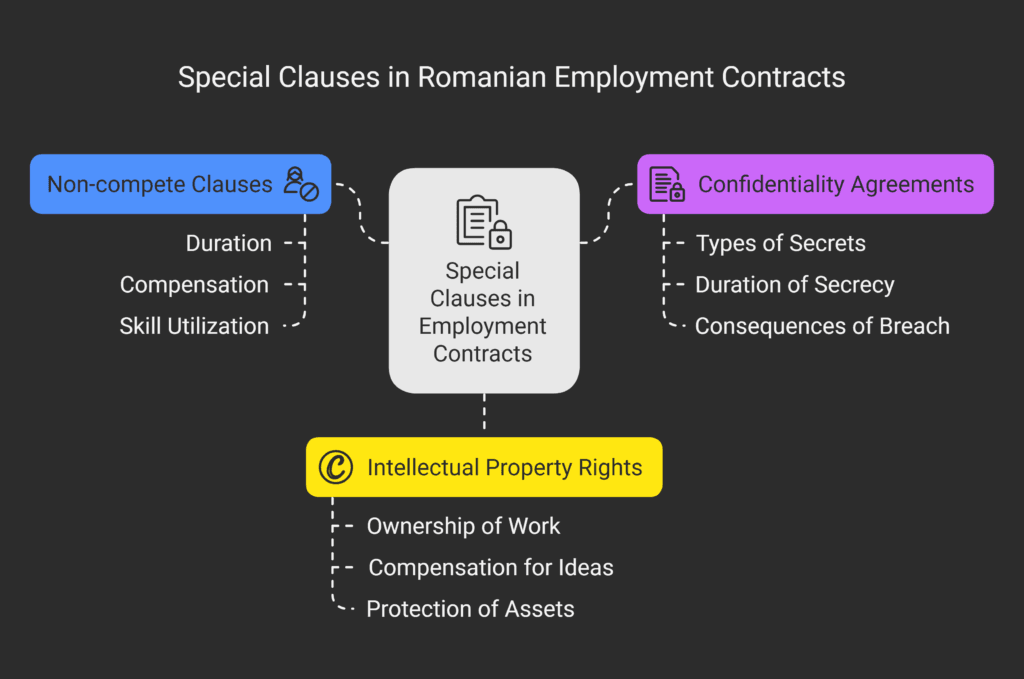
Special clauses in Romanian employment contracts go beyond basic terms to address unique workplace scenarios and protect business interests.
These provisions require careful consideration.
They often benefit from guidance by experienced Romanian lawyers who understand the nuances of local employment practices.
Without proper medical certification confirming fitness for the specific role, even the most detailed contract becomes null and void under Romanian law.
The complexity of Romanian employment contracts demands professional expertise during negotiation and drafting phases.
An employment lawyer in Romania can ensure compliance with mandatory requirements.
They can also incorporate protective clauses that serve both parties’ interests.
For specialized assistance with employment contract matters, interested parties may contact office@theromanianlawyers.com.

special clauses in Romanian Employment Contracts
Key Takeaways
- Romanian employment contracts must be written in Romanian language and registered with Reges before work begins,
- Medical certificates confirming job fitness are mandatory for valid employment contracts,
- The Contract Individual de Muncă (CIM) establishes fundamental rights and obligations under Romanian Labor Code,
- Special contractual clauses address specific workplace scenarios beyond standard employment terms,
- Professional legal assistance ensures compliance with Romanian employment legislation requirements,
- Invalid contracts lacking proper documentation face nullification under Romanian law.
Understanding Romanian Employment Contract Requirements
Romanian workplace regulations set strict rules for employment contracts.
These rules protect both employers and employees.
They ensure that all employment relationships adhere to specific legal standards.
This brings transparency and legal certainty to all parties involved.
Mandatory Written Form and Romanian Language
Employment contracts in Romania must be concluded in written form and in the Romanian language, regardless of the employee’s nationality or the employer’s origin.
This requirement ensures clarity and helps prevent any misunderstandings regarding the terms and conditions of employment.
Before signing, employers must inform candidates about key contract details.
This includes salary, working hours, job duties, and location.
Employers can assess professional abilities beforehand but must inform applicants first.
They must also notify applicants before contacting previous employers for references.
Registration with REGES Electronic System
Employers must register employment contracts with Reges, Romania’s electronic employee registry.
This must happen before the employment starts.
The system tracks compliance with Romanian labor law and employment regulations.

Romanian employment contract requirements
| Registration Requirement | Deadline | Penalty for Non-Compliance |
| New Employment Contract | Before first working day | 5,000 – 10,000 RON |
| Contract Modifications | Within 3 working days | 3,000 – 5,000 RON |
| Contract Termination | Within 24 hours | 3,000 – 5,000 RON |
Medical Certificate Requirements
Medical certificates are a must under Romanian workplace regulations.
Employers need these certificates before finalizing contracts.
The medical exam confirms the candidate’s fitness for the job.
Without a valid medical certificate confirming the employee’s fitness for the job, the employer may not legally allow the employee to begin work.
According to Article 31(1) of the Romanian Labor Code, the employment contract is deemed null and void.
Essential Mandatory Clauses Under Romanian Labor Code
The Romanian labor code outlines key requirements for employment contracts.
These are designed to safeguard both employers and employees.
Mandatory clauses are essential for legal compliance and clarity in the employment relationship.
Party Identification and Workplace Details
Employment contracts must clearly list all parties involved.
This includes the full legal names of employer and employee, along with the employer’s headquarters.
The workplace location is also specified, with details on transportation if there are multiple sites.
Romanian labor code special provisions emphasize the need for precise documentation of work locations.
Job Description and COR Classification
Each job must be classified using the Romanian Classification of Occupations (COR) system.
The contract must detail the job description, outlining duties and responsibilities.
Professional evaluation criteria should be clearly stated to set performance expectations.
Risk factors associated with the job must also be documented for safety compliance.

Mandatory clauses Romanian labor law requirements
Salary Components and Payment Terms
Salary compensation clauses in Romania require detailed information on base salary and payment frequency.
Bonuses, allowances, and additional compensation must be clearly outlined.
The payment method, whether bank transfer or cash, must be documented.
Overtime compensation clauses should detail rates and conditions for extra hours.
| Salary Component | Required Details | Payment Frequency |
| Base Salary | Gross amount in RON | Monthly |
| Performance Bonus | Percentage or fixed amount | Quarterly/Annual |
| Meal Vouchers | Daily value | Monthly |
| Transportation Allowance | Fixed amount or reimbursement | Monthly |
Working Hours and Annual Leave Entitlements
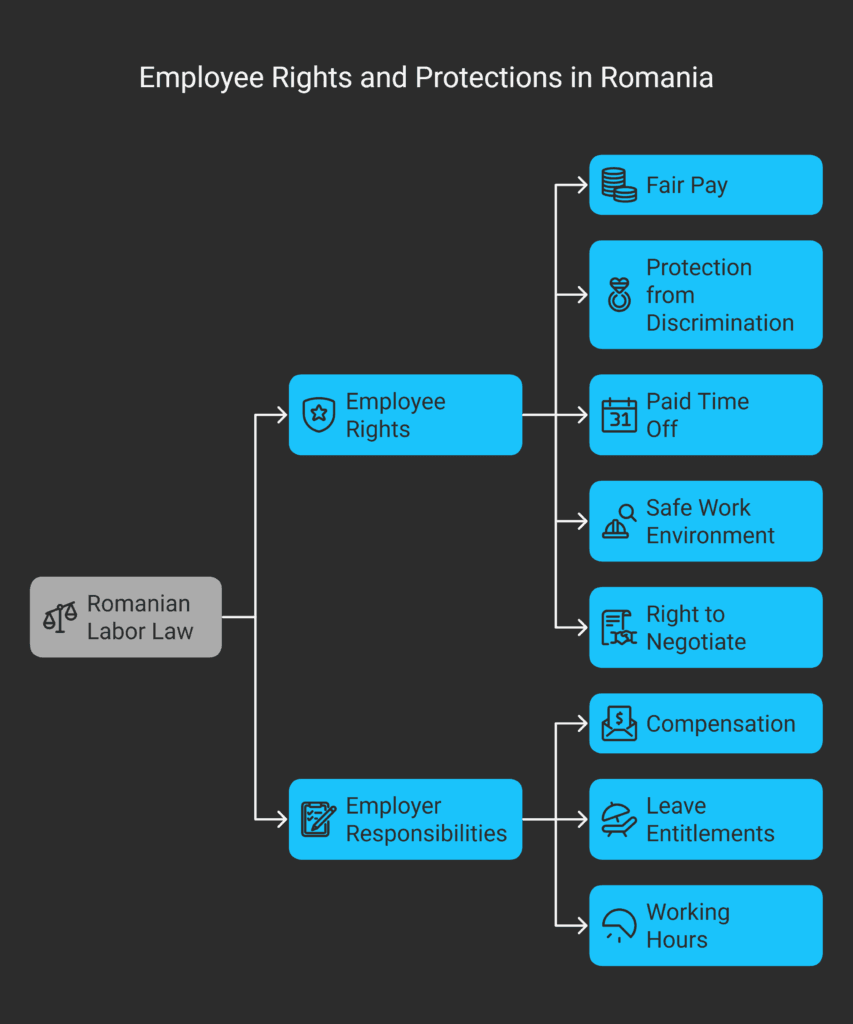
Standard working hours are capped at 40 hours weekly, as per Romanian regulations.
The contract must outline daily and weekly schedules, including shift arrangements if necessary.
Annual paid leave entitlements start at 20 working days minimum.
Employment termination clauses must include notice period requirements based on position type and length of service.
Special Clauses in Romanian Employment Contracts
Romanian employment agreements go beyond the basics.
They include special clauses that address specific workplace needs.
These provisions create a detailed framework for both employers and employees.
They establish clear expectations for various work situations.
Professional Training Provisions
Professional training clauses are key for workforce development in Romania.
They outline the rights and obligations of both parties regarding skill enhancement.
Employers can specify training requirements, cost-sharing, and retention periods after educational investments.
Employees gain clear development opportunities.
They also understand their commitments after receiving company-sponsored training.

special clauses in romanian employment contracts
Mobility Clauses and Geographic Flexibility
Mobility clauses in Romania offer employers operational flexibility while protecting employee interests.
These clauses specify conditions for changes in workplace locations.
The mobility clause must detail geographic boundaries, compensation for relocation, and notice periods.
Romanian law requires these provisions to be reasonable and clearly defined.
This ensures they are enforceable.
Additional Benefits and Compensation
Salary and benefits clauses go beyond basic wage agreements.
They include performance bonuses, profit sharing, or commission structures.
Variable compensation arrangements require precise calculation methods and payment schedules.
Common additional benefits include:
- Private medical insurance coverage,
- Company car or transportation allowances,
- Meal vouchers and daily allowances,
- Private pension contributions,
- Flexible working arrangements.
These provisions boost employee satisfaction.
They also help companies attract and retain talent in competitive markets.
Non-Compete Agreements and Restrictive Covenants
In Romania, non-compete provisions must be carefully crafted to be legally valid.
Employment law allows for restrictive covenants under certain conditions.
These conditions aim to safeguard employer interests while respecting employee rights.
The key is to find a balance between protection and fair compensation for restricted workers.
Maximum Duration and Geographic Limitations
The Labor Code sets strict time limits for non-compete clauses in Romania.
Agreements can last up to 24 months after employment ends.
The geographic scope must be reasonable, reflecting the employer’s legitimate business interests.
Courts assess if the territorial restrictions are proportionate to the employer’s concerns.

Non-compete agreements in Romania legal framework
Mandatory Compensation Requirements
For a non-compete clause to be valid, it must include monthly payments to the restricted employee.
To be legally valid, a non-compete clause must include financial compensation for the employee.
According to Article 21(3) of the Romanian Labor Code, this compensation must amount to at least 50% of the average gross monthly income the employee personally earned in the six months prior to contract termination.
This payment is required throughout the restriction period.
| Compensation Element | Legal Requirement | Payment Frequency |
|---|---|---|
| Minimum Amount | 50% of employee’s average gross monthly income | Monthly |
| Calculation Period | Last 6 months of employee’s own income | Throughout restriction |
| Payment Cessation | Ends clause validity | Immediate effect |
Enforceability Conditions Under Romanian Law
Several factors determine if a non-compete clause is enforceable in Romania.
Agreements must clearly outline prohibited activities, geographic scope, duration, and compensation terms.
If any of these are missing, the agreement is void.
Courts evaluate if the restrictions are reasonable and do not unfairly restrict career paths.
Confidentiality Provisions and Trade Secret Protection
Confidentiality clauses in Romanian labor law are vital for safeguarding sensitive business information.
These clauses set clear limits on what employees can share during and after their employment.
Employers in Romania use these clauses to keep their competitive edge and safeguard their proprietary knowledge.
Employers must clearly outline what information is confidential under Romanian labor law.
This includes trade secrets, client databases, financial data, business strategies, and technical processes.
The confidentiality clause in a contract must differentiate between truly confidential information and public knowledge.
Confidentiality provisions cover several critical areas that need protection:
- Customer lists and contact information,
- Pricing strategies and profit margins,
- Manufacturing processes and formulas,
- Marketing plans and business development strategies,
- Research and development projects,
- Salary confidentiality provisions between employees.
Confidentiality agreements in Romania remain binding even after employment ends, if they meet legal standards.
The length of these obligations must be reasonable and clearly outlined in the employment contract.
The Labor Code does not set legal maximum time limits, but judicial practice favors reasonable durations (1–2 years).
For longer periods (e.g., 5 years), a clear justification and the express agreement of the parties are required.
| Information Type | Protection Period | Breach Consequences |
| Trade Secrets | Unlimited duration | Civil damages and criminal liability |
| Client Lists | 2-5 years post-employment | Monetary compensation |
| Business Strategies | 1-3 years post-employment | Injunctive relief and damages |
| Technical Information | 3-5 years post-employment | Legal action and compensation |
Confidentiality clauses in Romania must strike a balance between protecting business interests and respecting employee rights.
Courts assess their enforceability based on clarity, reasonableness, and the legitimate need for protection.
Probationary Period Regulations
The probation period in Romania is a critical evaluation phase for employers and employees.
It is governed by clear guidelines that protect both parties and ensure fair job performance assessment.
Understanding these regulations is essential for companies to establish effective employment relationships from the start.
Duration Limits by Position Type
Probationary period contracts in Romania have strict duration limits, depending on the position and contract length.
The terms for probation periods vary widely:
- Standard positions: maximum 90 calendar days,
- Managerial positions: maximum 120 calendar days,
- Disabled employees: maximum 30 calendar days.
For fixed-term contracts, the probation period rules differ.
Contracts under three months allow only 5 working days of probation.
Also, contracts between three and six months permit 15 working days.
Contracts exceeding six months allow 30 working days, extending to 45 days for executive positions.
Termination Rights During Probation
Probationary period conditions offer both parties significant flexibility.
Either party can terminate the employment relationship with written notice.
No motivation or advance notice is required during this evaluation phase.
This approach balances the need for assessment with individual rights.
Special Provisions for Disabled Employees
Probationary period restrictions ensure fair treatment for disabled workers.
The reduced 30-day maximum acknowledges their unique circumstances while maintaining evaluation opportunities.
Employers cannot extend this period or impose different probationary period provisions for disabled staff.
Each person can undergo probation only once for the same position with the same employer.
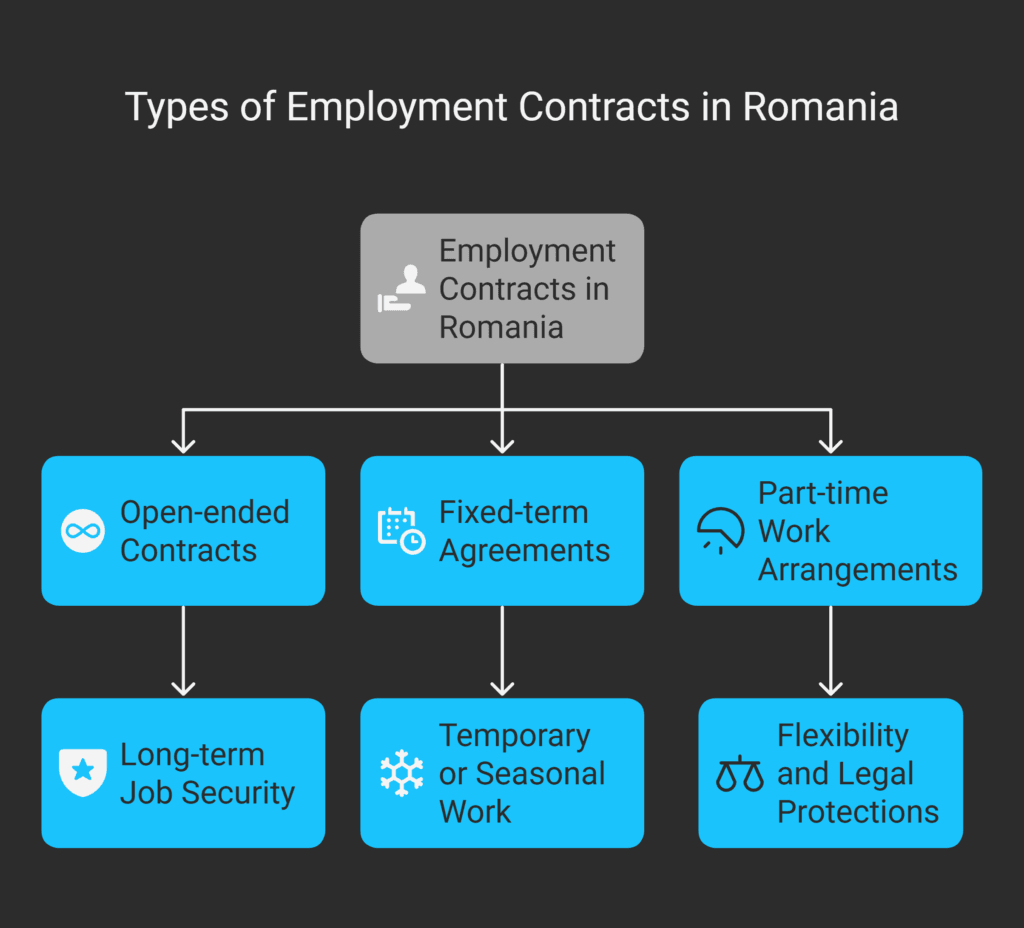
Fixed-Term vs. Open-Ended Contract Distinctions
Understanding contract types in Romania requires grasping the key differences between temporary and permanent employment.
Open-ended contracts are the core of Romanian employment, providing indefinite agreements without set end dates.
They offer stability and are the standard in many industries.
Romanian fixed-term contracts meet specific business needs but are subject to strict legal limits.
Employers can only use these contracts in certain situations:
- Replacing employees on maternity leave or sick leave,
- Covering seasonal business peaks in tourism or agriculture,
- Completing specific projects with defined timelines,
- Filling temporary skill gaps during organizational transitions.
Fixed-term contract limitations safeguard workers from being stuck in temporary roles.
Romanian law caps any single fixed-term contract at 36 months.
Employers and employees cannot have more than three consecutive contracts with the same parties.
Once these limits are hit, the contract automatically converts to an open-ended one.
Fixed-term contract restrictions demand employers to justify temporary hiring in writing.
Each contract must outline the legal basis, explain the need for temporary employment, and state exact start and end dates.
Without proper justification, labor authorities might classify it as permanent employment.
These measures ensure fixed-term contracts in Romania balance business needs with worker security.
Companies gain flexibility through temporary staffing, while employees are protected from endless precarious employment.
Contract Modification and Termination Procedures
Romanian labor law outlines strict rules for altering and ending employment contracts.
Both employers and employees must adhere to these legal guidelines when making contract changes or ending employment.
These rules aim to safeguard both parties and ensure fair treatment during employment transitions.
Written Addendum Requirements
In Romania, contract addendums must be in writing and signed by both employer and employee.
Any changes to critical contract elements require formal agreement through these addendums. Key elements include:
- Salary and compensation packages,
- Working hours and schedules,
- Job title and responsibilities,
- Workplace location.
Employers cannot unilaterally alter these terms.
The only exception is in cases of force majeure, as defined by Romanian law.
Notice Period Obligations
The length of notice periods in Romania depends on who initiates the termination and the employee’s position.
Termination conditions in employment contracts set a minimum:
- Employer dismissals: minimum 20 working days,
- Employee resignations: maximum 20 days for standard positions,
- Management resignations: maximum 45 days.
Disciplinary dismissals and terminations due to arrest exempt employers from notice obligations.
Employers can choose to waive employee notice periods.
Dismissal Procedures and Employee Rights
Employers must follow strict procedures for termination.
Valid reasons for dismissal include professional misconduct, incompetence, or redundancy.
Each reason requires specific documentation and notification processes for employees.
Mutual Agreement and Resignation Protocols
Romanian labor law recognizes several termination methods.
Mutual agreement is the simplest, requiring only written consent from both parties.
Resignations must meet notice requirements unless the employer waives them.
Automatic termination can occur due to retirement age or contract expiration.
Conclusion
Creating compliant Romanian work contracts demands meticulous attention to legal specifics.
A well-crafted employment agreement safeguards both parties and sets clear expectations.
Romanian labor laws dictate essential elements for every contract’s validity and enforceability.
Engaging with seasoned employment lawyers in Romania is critical for tackling these complexities.
Their expertise helps avoid pitfalls that could result in disputes or penalties.
A Romanian law office focused on employment can guarantee all necessary clauses adhere to current legal standards.
- Proper registration in the Reges electronic system,
- Clear salary structures and payment terms,
- Appropriate probationary period definitions,
- Valid non-compete and confidentiality clauses,
- Correct termination procedures and notice periods.
Compliance with Romanian labor law goes beyond initial contract creation.
Laws evolve, necessitating regular review of agreements.
A skilled Romanian lawyer keeps you updated on employment law changes.
This proactive stance averts compliance issues before they occur.
For assistance with employment contracts, turn to specialists well-versed in local and international regulations.
Professional legal advice ensures contracts fulfill all requirements while aligning with business goals.
For expert guidance on Romanian employment law, contact office@theromanianlawyers.com.
FAQ
What are the specific clauses in Romanian employment contracts?
Specific clauses in Romanian employment contracts include provisions related to work hours, remuneration, job responsibilities, and termination conditions.
The Romanian Labor Code mandates that certain information must be included to ensure clarity and compliance with the law.
How do collective bargaining agreements affect employment contracts in Romania?
Collective bargaining agreements can influence employment contracts in Romania by establishing minimum standards for wages, working conditions, and additional benefits.
Employers and employees must adhere to these agreements when drafting individual employment contracts.
What types of employment are recognized under Romanian labor law?
Romanian labor law recognizes various types of employment including full-time, part-time, temporary, and apprenticeship contracts.
Each type has specific regulations and requirements that must be adhered to in the employment contract.
What must an individual employment contract contain according to Romanian legislation?
An individual employment contract must contain specific information such as the type of work, place of work, working hours, and remuneration details.
These elements are essential to ensure the contract is valid and enforceable under Romanian law.
What is the probationary period in Romanian employment contracts?
The probationary period in Romanian employment contracts may last up to 90 days, during which both the employer and employee can assess the suitability of the employment relationship.
This period should be clearly stated in the contract.
How is the termination of the employment contract regulated in Romania?
Termination of the employment contract in Romania is regulated by the Labor Code, which specifies the grounds for dismissal and the required notice period.
Employers must follow legal procedures to avoid potential disputes or claims.
What are the legal provisions regarding overtime work in Romania?
Legal provisions regarding overtime work in Romania stipulate that employees are entitled to additional compensation for hours worked beyond the standard working hours.
Overtime must be agreed upon in the individual employment contract and cannot exceed certain limits set by law.
Can an employment contract be concluded in writing for temporary work in Romania?
Yes, an employment contract may be concluded in writing for temporary work in Romania.
Such contracts must specify the duration of employment, the type of work, and comply with provisions set forth in the Labor Code.
What role does the Ministry of Labor play in employment contracts in Romania?
The Ministry of Labor oversees the implementation of labor laws in Romania, ensuring that employment contracts comply with national regulations.
They also provide guidance on drafting work contracts and resolving disputes between employers and employees.