Articles of Incorporation Romania

Articles of Incorporation in Romania – How to Draft the Constitutive Act (2025 Guide)


Articles of Incorporation in Romania – How to Draft the Constitutive Act (2025 Guide)

Setting up a company in Romania involves several crucial steps, with the drafting and registration of the Articles of Incorporation, also known as the Act Constitutiv, being paramount. This document serves as the foundational legal framework for Romanian companies, outlining the company’s structure, objectives, and operational guidelines. This guide provides a comprehensive overview of drafting the Articles of Incorporation in Romania, ensuring compliance with Romanian law and optimizing your business for success in 2025.


Need Professional Help?

At our law firm, Atrium Romanian Lawyers, we assist clients with corporate & commercial law, company formation, and articles of incorporation services.


What Are the Articles of Incorporation (Act Constitutiv) in Romania?

Un ecran de computer care afișează un șablon pentru actele de constituire.

Legal meaning under Romanian Company Law

Under Romanian company law, the Articles of Incorporation, or Act Constitutiv, is a legally binding document that establishes a company as a distinct legal entity. This document, essential for company incorporation in Romania, specifies the company’s core attributes, including its company name, registered office, and business activities. The Act Constitutiv details the share capital, the number of shareholders, and their respective contributions. It also outlines the rules governing the management and representation of the company. Furthermore, the Articles of Incorporation includes provisions for profit distribution and conditions for the company’s dissolution, making it a comprehensive guide for the company’s operations under Romanian law.

Difference between Articles of Incorporation and Articles of Association

While both Articles of Incorporation and Articles of Association are vital for company formation, they serve distinct purposes. The Articles of Incorporation, or Act Constitutiv in the Romanian context, primarily focuses on the fundamental aspects of the company. On the other hand, the Articles of Association, often referred to as the bylaws, detail the internal rules and procedures for governing the company.

DocumentFocus
Articles of Incorporation (Act Constitutiv)Company name, registered office, share capital, and business activities
Articles of Association (Bylaws)Internal rules and procedures for governing the company

The Articles of Incorporation are a prerequisite for registering a company in Romania with the National Trade Register Office, while the Articles of Association provide a more detailed operational framework.


Mandatory Elements of the Romanian Constitutive Act

A stack of legal documents is placed on a wooden desk.

Company name, registered office, and object of activity

One of the primary components of the Articles of Incorporation for any Romanian company is the clear specification of the company name. This name must comply with Romanian law and be unique, distinguishing the new entity from existing Romanian companies registered in the Trade Register. Additionally, the registered office, the official address of the business in Romania, needs to be precisely stated. The business activities, or object of activity, must also be detailed, outlining the scope of operations the company will undertake, ensuring compliance with the regulations set by the Romanian Trade Register Office. These elements are crucial during the company incorporation process.

Share capital and shareholders’ contributions

The Articles of Incorporation must meticulously define the share capital of the Romanian company, specifying the total amount and the contribution of each shareholder. The document needs to clearly state the number of shares, their nominal value, and the method of contribution, whether in cash or in-kind. Proper documentation of these elements ensures compliance with Romanian trade regulations, and transparent records are maintained during company registration in Romania.

Company TypeShare Capital Requirements
Limited Liability Company (SRL)No minimum capital requirement (abolished in November 2020). Companies can be established with minimal share capital of as little as 1 RON.
Joint Stock Company (SA)Share capital requirements differ from SRLs, with higher minimum capital mandates.

Management and representation provisions

Defining the management structure and representation provisions is essential within the Articles of Incorporation of any Romanian company. For Romanian companies, ensuring that these provisions comply with Romanian law is critical for the company’s proper governance and to avoid any legal complications related to the Romanian Trade Register.

AreaDetails
ManagementOutlines who is authorized to manage the company, detailing the powers and responsibilities of the directors or administrators.
RepresentationSpecifies how the company will be represented in legal and business transactions, whether by a single director or a board.

Profit distribution and dissolution clauses

The Act Constitutiv must include clear clauses regarding profit distribution among shareholders and the conditions under which the company may be dissolved. These provisions dictate how profits will be allocated based on the number of shares held by each shareholder in the Romanian company. The document also outlines the procedures for dissolution, including liquidation processes and the distribution of assets. Properly drafted profit distribution and dissolution clauses ensure compliance with Romanian law, providing a transparent and equitable framework for all stakeholders during company formation in Romania.


Step-by-Step: How to Draft the Articles of Incorporation

A close-up of hands typing on a laptop keyboard.

Templates and examples used by Romanian lawyers

Drafting the Articles of Incorporation, or Act Constitutiv, for a Romanian company involves careful consideration of Romanian law and best practices. Many lawyers in Romania utilize standardized templates as a starting point. These templates provide a structured framework, covering essential elements such as the company name, registered office, share capital, and business activities. However, it is crucial to tailor these templates to reflect the specific requirements and objectives of each Romanian company. Consulting with lawyers in Romania ensures that the Articles of Incorporation comply with all legal requirements and company incorporation requirements, optimizing the company’s operational framework.

Common mistakes to avoid when drafting your Act Constitutiv

When drafting the Act Constitutiv for a company in Romania, avoiding common mistakes is essential to ensure a smooth company registration process and long-term legal compliance. One frequent error is failing to accurately define the business activities, which can lead to operational limitations. Another common pitfall is neglecting to specify the share capital correctly, particularly the number of shareholders and their contributions. Ambiguous or incomplete management and representation provisions can also cause governance issues within the company. It is important to seek legal advice to avoid these errors and ensure the Articles of Incorporation are legally sound for the Romanian Trade Register.


Articles of Incorporation for SRL vs. SA Companies

A group of businesspeople discussing a document in a meeting room.

Differences in structure and legal requirements

The Articles of Incorporation for a Romanian SRL (limited liability company in Romania) differ significantly from those of an SA (joint stock company) due to variations in structure and legal requirements. An SRL, common for smaller businesses, benefits from simpler management and flexible share capital requirements with no mandatory minimum. The Act Constitutiv for an SRL reflects this, with straightforward provisions for management and share transfer. In contrast, an SA, typically used by larger enterprises, has more complex corporate governance structures, requiring a board of directors and greater regulatory compliance. Therefore, the Articles of Incorporation for an SA are more detailed, covering extensive reporting and shareholder rights, aligning with Romanian law.

How foreign investors can adapt templates

Foreign investors looking to set up a company in Romania can effectively use standard Articles of Incorporation templates, but adaptation is key to ensure compliance with Romanian law and alignment with their specific business needs. These templates often need modification to accurately reflect the intended business activities and management structure. Furthermore, foreign investors must ensure that the share capital and shareholder contributions comply with Romanian regulations. Consulting with lawyers in Romania is vital for navigating these nuances and tailoring the Articles of Incorporation to meet the unique requirements of international business practices and ensure a smooth registration in Romania.


Filing and Registering the Constitutive Act in Romania

A stack of folders labeled legal documents.

Required documents and ONRC registration procedure

Filing and registering the Act Constitutiv involves a detailed procedure with the National Trade Register Office (ONRC) in Romania. The first step in company registration in Romania requires submitting several essential documents, including the drafted Articles of Incorporation, proof of the company name availability, and the identification documents of the shareholders. For limited liability companies, demonstrating the Romanian minimum share capital deposit is necessary. Once all documents are submitted to the Romanian Trade Register, the ONRC reviews them for compliance with Romanian law. Upon approval, the company is registered, and a certificate of incorporation is issued, marking the official company formation in Romania.

Legal fees and translation requirements

When setting up a company in Romania, understanding the associated legal fees and translation requirements is essential for proper budgeting and compliance. Legal fees typically cover the cost of drafting the Articles of Incorporation, legal advice, and representation during the Romanian Trade Register Office registration. If the original documents are not in Romanian, certified translations are mandatory and must be provided during company incorporation. These translation requirements add to the overall expense, so it’s crucial to account for these costs in the initial investment plan for your business in Romania. Engaging lawyers in Romania who are experienced in company formation in Romania can help navigate these requirements.


Expert Tips for Foreign Entrepreneurs

A stack of official papers with a seal and signature on top.

How to align your Articles with Romanian business law

For foreign entrepreneurs aiming to establish a business in Romania, aligning the Articles of Incorporation with Romanian law is paramount for a seamless company incorporation process. Foreign investors should ensure their Articles of Incorporation comply with specific legal provisions governing various Romanian companies, such as limited liability companies and joint stock companies. This includes adherence to regulations related to share capital, the number of shareholders, and the registered office. Consulting with lawyers in Romania is crucial to navigate these legal nuances and ensure your business activities are accurately reflected in the Act Constitutiv and comply with Romanian law.

Legal review by a Romanian lawyer

Engaging a Romanian lawyer to review the Articles of Incorporation is an essential step for both local and foreign entrepreneurs to ensure full compliance with Romanian law. A legal expert can identify potential issues and provide tailored advice to align the document with current legal standards and the specific type of company being established. They can verify that all required elements, such as the company name, share capital, and business activities, are accurately defined, minimizing the risk of rejection by the Romanian Trade Register. This legal review safeguards against future legal challenges, providing a solid foundation for the registration of the company and its subsequent operations.


Conclusion: Why the Constitutive Act Matters in 2025

A close-up of a signature being written on a contract.

In 2025, the Articles of Incorporation remain a critical document for any company in Romania, serving as the cornerstone of its legal and operational framework. Properly drafting and registering the Act Constitutiv ensures compliance with Romanian law, enabling the company to conduct business activities smoothly and without legal impediments. As regulations evolve, staying updated with the latest legal requirements is crucial. For foreign investors, understanding these nuances is particularly important to navigate the company incorporation process effectively and ensure a successful start for their business in Romania.


Useful Resources & Links


FAQ – Articles of Incorporation in Romania

Q: What are the articles of incorporation in Romania?

A: The articles of incorporation in Romania are legal documents that establish a company as a distinct legal entity. They outline the company’s name, purpose, registered office, share capital, and structure. This document is essential for the registration of the company in the Romanian trade registry.

Q: How do I set up a company in Romania?

A: To set up a company in Romania, you need to choose a business form, prepare the articles of incorporation, and submit them along with other necessary documents to the Romanian trade register. You must also obtain a unique registration code and a registration certificate to legally operate your business in Romania.

Q: What is the process of company registration in Romania?

A: The process of company registration in Romania involves several steps, including selecting a company name, preparing the articles of incorporation, paying the required fees, and registering with the Romanian trade registry. Once registered, the company will receive a registration number and be legally recognized to conduct business operations. The standard registration timeline is 7 to 10 working days, though recent technical difficulties at the Trade Registry have occasionally extended this process beyond the typical timeframe.

Q: What types of businesses can I register in Romania?

A: In Romania, you can register various types of businesses, including limited liability companies (SRL), joint stock companies (SA), and micro companies. The choice of business form depends on factors like the number of shareholders and the capital required for incorporation.

Q: Do I need a Romanian bank account to register a company?

A: Yes, opening a Romanian bank account is necessary to deposit the share capital required for company incorporation. The bank will provide a certificate confirming the deposit, which is needed for the registration process with the Romanian trade register.

Q: What is the minimum number of shareholders required to start a business in Romania?

A: The minimum number of shareholders required to start a limited liability company in Romania is one. However, for joint stock companies, at least two shareholders are necessary. This structure allows both Romanian and foreign individuals to establish a company in Romania.

Q: How long does the registration process take for a company in Romania?

A: The registration process for a company in Romania typically takes about 7 to 10 working days, provided all documents are correctly submitted and comply with Romanian law. However, recent technical difficulties at the Trade Registry have occasionally extended registration procedures beyond this typical timeframe. Delays may also occur if additional information is required by the Romanian authorities.

Q: What is the significance of the registration certificate?

A: The registration certificate is a crucial document that proves your company is legally registered with the Romanian trade registry. It contains important information, such as the registration number, date of registration, and details about the company’s structure, which are necessary for conducting business operations in Romania.

Q: Is VAT registration necessary for all companies in Romania?

A: VAT registration is mandatory for companies in Romania whose taxable turnover exceeds the threshold set by the Romanian tax authorities. However, businesses can also opt for VAT registration voluntarily, which allows them to reclaim VAT on their expenses, benefiting their overall business operations.


Disclaimer: This article is for general information only and does not constitute legal advice. Please consult with a qualified Romanian corporate lawyer to verify current laws and regulations before proceeding with drafting your company’s articles of incorporation. Laws and procedures are subject to change, and individual circumstances may vary.

Corporate Documentation Requirements in Romania

Corporate Documentation Requirements in Romania

Corporate Documentation in Romania

Did you know Romania lets companies be fully owned by foreigners?

This shows how welcoming Romania is to businesses.

Knowing the legal documents and rules is key for any company wanting to start here.

Getting through Romania’s business laws needs careful focus.

The process includes setting up a company and following rules.

Your success relies on knowing all the details of doing business here.

Whether you’re new or already big, learning the law is vital.

Romania has great chances for those willing to learn its business rules.

Key Takeaways

  • Romania supports 100% foreign company ownership;
  • Company incorporation typically takes 5-10 working days;
  • Minimum share capital varies by company type;
  • All companies must have a registered Romanian office;
  • Comprehensive documentation is critical for legal compliance.

Understanding Legal Entity Types in Romania

In Romania, you’ll find two main types of legal entities for starting a business:

Joint Stock Companies (JSC) and Limited Liability Companies (LLC).

These options differ in how they handle corporate governance.

They also offer flexibility for those setting up businesses in Romania.

Legal Entity Types in Romania


Romania’s business scene is diverse, with JSCs and LLCs being the top choices for investors.

Knowing what each offers is key to choosing the right structure for your business.

Joint Stock Companies (JSC)

Joint Stock Companies are known for their strength and several important features:

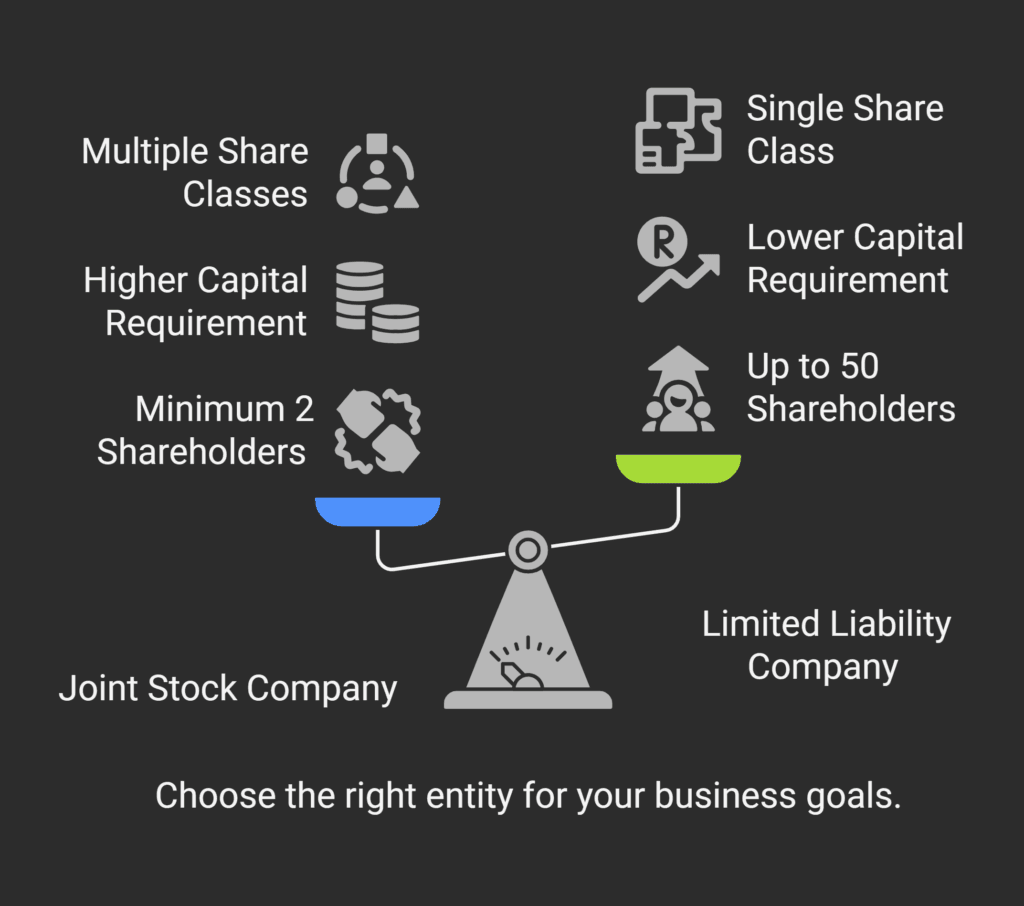
  • Minimum of 2 shareholders with no maximum limit;
  • Limited personal liability for shareholders;
  • Fiscal registration through the Trade Registry;
  • Potential for public trading of shares.

Limited Liability Companies (LLC)

Limited Liability Companies are known for their simplicity and benefits:

  • Up to 50 shareholders possible;
  • Simplified management structure;
  • Lower minimum capital requirements;
  • Faster incorporation process.

Key Differences Between Entity Types

CharacteristicJoint Stock CompanyLimited Liability Company
Minimum Shareholders2 shareholders1 shareholder
Minimum CapitalRON 90,000RON 200
Maximum ShareholdersUnlimited50
Share ClassesMultiple possibleSingle class only

Choosing between a JSC and LLC depends on your business goals, available capital, and future plans.

Each type has its own advantages for managing documents and corporate governance in Romania.

Corporate Documentation Requirements Under Romanian Law

Corporate Documentation in Romania

Understanding corporate law in Romania is key.

You must know the legal rules to follow.

When  starting a business in Romania, you’ll need to gather important documents that follow Romanian laws.

The process of getting these documents involves several steps.

These steps make sure your company follows all the rules.

Romanian law has specific rules for different types of businesses.

It’s important to know these rules well.

  • Prepare detailed company formation documents;
  • Get the needed registration certificates;
  • Follow local legal rules;
  • Keep your corporate records up to date.

Foreign investors need to grasp legal rules in Romania.

The process includes at least six important documents.

These include articles of association and financial statements.

Each document must be carefully made to meet Romanian rules.

Key documentation needs change based on your business type and goals.

Here are some specific documents you’ll need:

  1. Company incorporation papers;
  2. Tax identification documents;
  3. VAT registration forms;
  4. Records of shareholder information.

The Law No. 265/2022 on the Trade Registry has brought changes.

From November 26, 2022, companies must follow new rules.

These include easier ways to start and updated business registration rules.

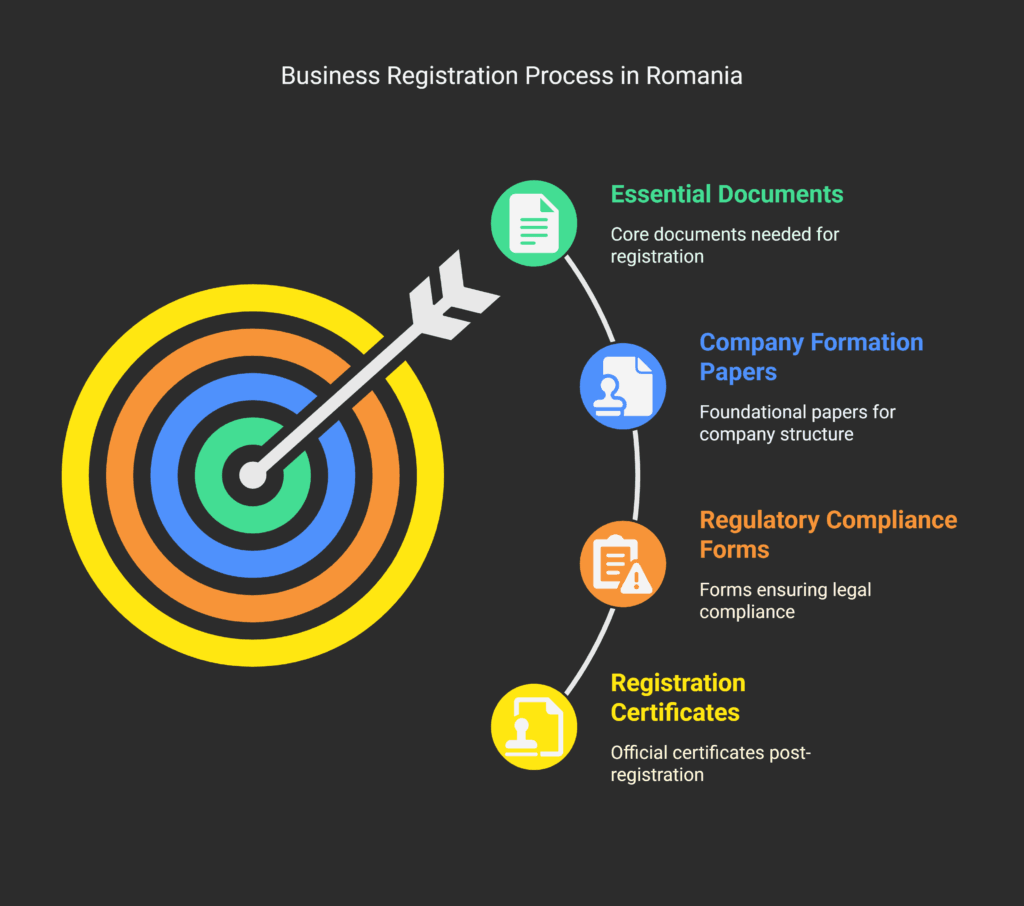
Essential Business Registration Documents

Starting a business in Romania is complex.

You need to know a lot about company formation paperwork and corporate rules.

You’ll have to prepare important documents to follow the law and start your business smoothly.

Registering your business means filling out several key documents.

These documents are the base of your company’s policies and structure.

Business Registration Documents Romania

Company Formation Papers

Here are the documents you’ll need for your business registration:

  • Articles of Incorporation;
  • Shareholder Agreement;
  • Proof of Initial Capital Deposit;
  • Company Bylaws.

Regulatory Compliance Forms

You’ll also need to fill out important compliance forms:

  1. Trade Registry Registration Form;
  2. Tax Registration Application;
  3. Social Security and Health Insurance Registration;
  4. Employment Documentation.

Registration Certificates

Once you’ve submitted your documents, you’ll get important certificates:

Certificate TypePurposeProcessing Time
Trade Registry CertificateOfficial Business Registration5-7 Business Days
Tax Identification NumberTax Authority Registration3-5 Business Days
VAT RegistrationEnable Legal Business Transactions2-4 Business Days

It’s important to keep these documents in order.

Getting help from a professional can make this process easier.

Management Structure Documentation

Starting a company in Romania means you need to know about management structure documents.

These are key for following the law and keeping your business in order.

Romanian company law is strict about how your business is set up.

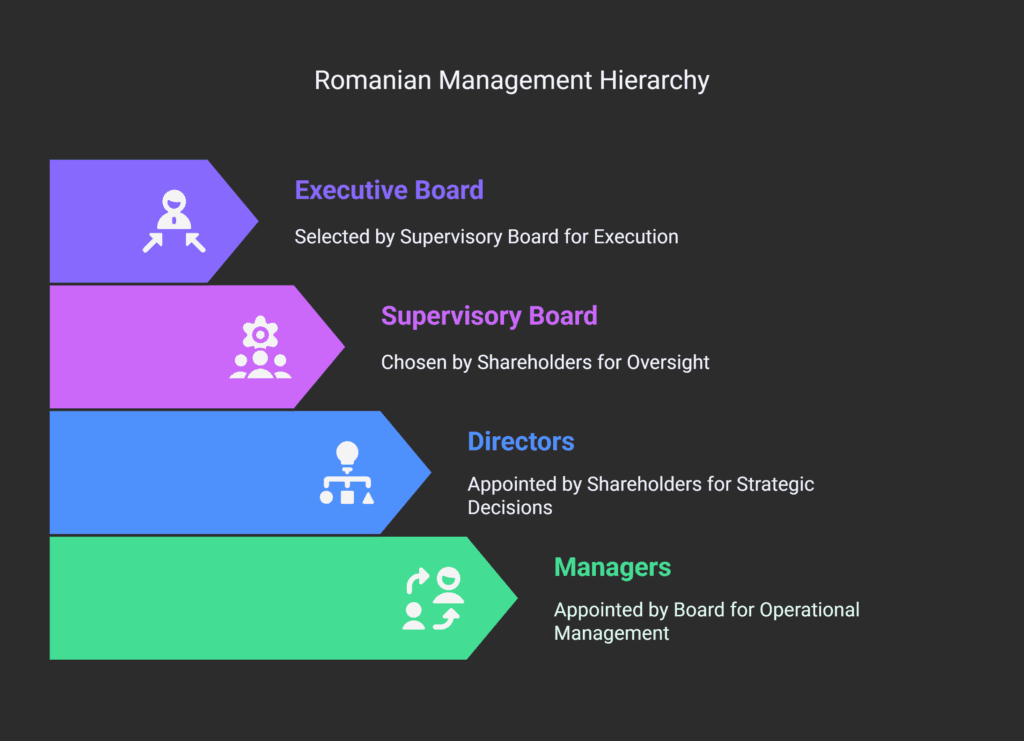
Romanian Management Hierarchy Romania

Romanian companies usually have one of two main management systems:

  • One-Tier Management System;
  • Two-Tier Management System.

The one-tier system has one board that does everything.

This board is chosen by the shareholders.

They can also pass on some tasks to others.

One-Tier Management Structure Characteristics

ComponentAppointment MethodKey Responsibilities
DirectorsAppointed by ShareholdersStrategic Decision Making
ManagersAppointed by Board of DirectorsOperational Management

The two-tier system splits the work into two boards.

The supervisory board, chosen by shareholders, watches over the executive board.

This board is picked by the supervisory board.

It adds more control and balance in how the company is run.

Proper documentation of management structures is essential for ensuring Romanian corporate compliance and maintaining transparent business operations.

Your legal papers in Romania must clearly show who does what in each management level.

This is a big part of following the law and keeping your business clear.

Corporate Governance and Compliance Standards

Getting to know corporate governance in Romania means dealing with many rules and documents.

Companies here must follow strict standards.

These ensure their management is clear and works well.

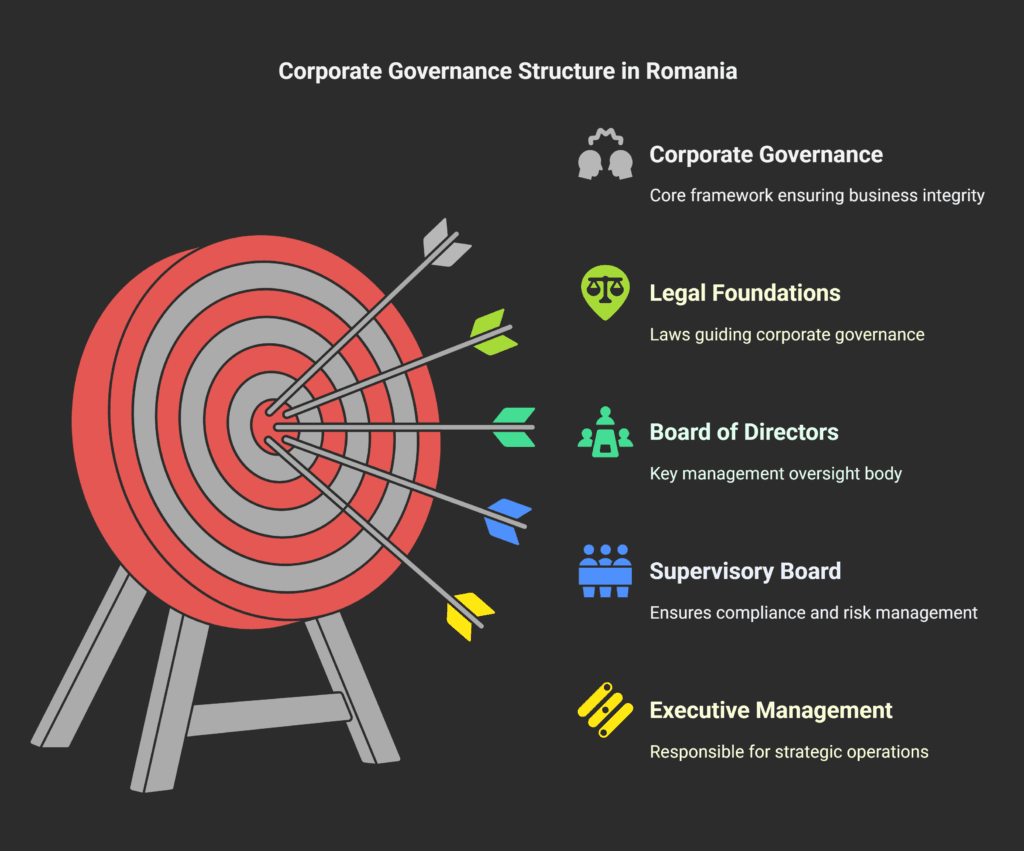
The laws that guide corporate governance come from two main sources.

Companies Law No. 31/1990 and Trade Registry Law No. 26/1990 set the rules.

They cover what each business type needs and how they should be managed.

Corporate Governance & Compliance Structure in Romania

Board of Directors Requirements

Setting up a Board of Directors in Romania comes with important rules. Companies must follow these to stay legal:

  • Minimum board size varies depending on company type;
  • Joint-stock companies typically require at least three directors;
  • Independent board members are key for clear management;
  • Professional liability insurance is a must for board members.

Supervisory Board Documentation

The Supervisory Board is vital in a two-tier management system.

It needs to keep detailed records.

This includes:

  1. Detailed meeting minutes;
  2. Annual performance reports;
  3. Compliance verification documents;
  4. Risk management assessments.

Executive Management Papers

Executive management in Romania has its own set of rules.

You must keep detailed records.

These show you’re responsible and strategic.

By following these corporate governance rules, your Romanian business can stay legal.

It also keeps things transparent and has a strong management system.

Single Administrative Document (SAD) Requirements

Understanding the Single Administrative Document (SAD) is key for businesses in international trade.

The SAD is a standardized customs declaration form used in many places, including the European Union and some partner countries.

Your business needs to know how important the SAD is in legal and corporate law in Romania.

It’s vital for tracking and managing goods, mainly for deals outside the EU or with non-EU goods.

  • Covers multiple customs procedures including export and transit;
  • Consists of eight distinct copies with specific functions;
  • Used for trade with non-EU countries and movement of non-EU goods;
  • Essential for proving goods origin during customs clearance.

Business documentation laws demand careful filling out of the SAD.

The form needs to have all the details about the goods, their origin, and the customs procedure.

Being accurate is key for easy customs processing and following Romanian and EU rules.

Businesses bear ultimate responsibility for the accuracy and completeness of customs declarations submitted on their behalf.

There’s a move towards fully electronic customs declarations.

Your business must get used to new digital submission rules.

Knowing these changes helps keep your international trade smooth and legal.

Economic Operator Registration and Identification (EORI)

Understanding the Economic Operator Registration and Identification (EORI) system is key in Romania.

If your business wants to do customs work in the European Union, you need an EORI number.

It’s important for managing your corporate documents.

The EORI system started in Romania on July 1, 2009.

It helps identify economic operators in international trade.

Your business must follow these rules for easy customs dealings.

Application Process

To get your EORI number, follow these steps:

  • Register with your national customs authority;
  • Prepare necessary business documentation;
  • Submit your application electronically;
  • Receive your unique EORI identifier.

Required Supporting Documents

You’ll need these documents for legal compliance in Romania:

  1. Company registration certificate;
  2. VAT registration proof;
  3. Identification documents for company representatives;
  4. Proof of business address.

Registration Timeline

The EORI registration is quick.

Romanian customs usually process applications in two days.

And it’s free.

Your EORI number is good for 10 years for businesses, keeping you in line with EU customs rules.

Knowing and following EORI rules helps your business with international trade.

It reduces customs problems.

Record-Keeping and Documentation Maintenance

Keeping records well is key for businesses in Romania.

Your company needs to keep detailed records to follow the law and work smoothly.

The National Trade Register Office gives important rules for keeping business documents.

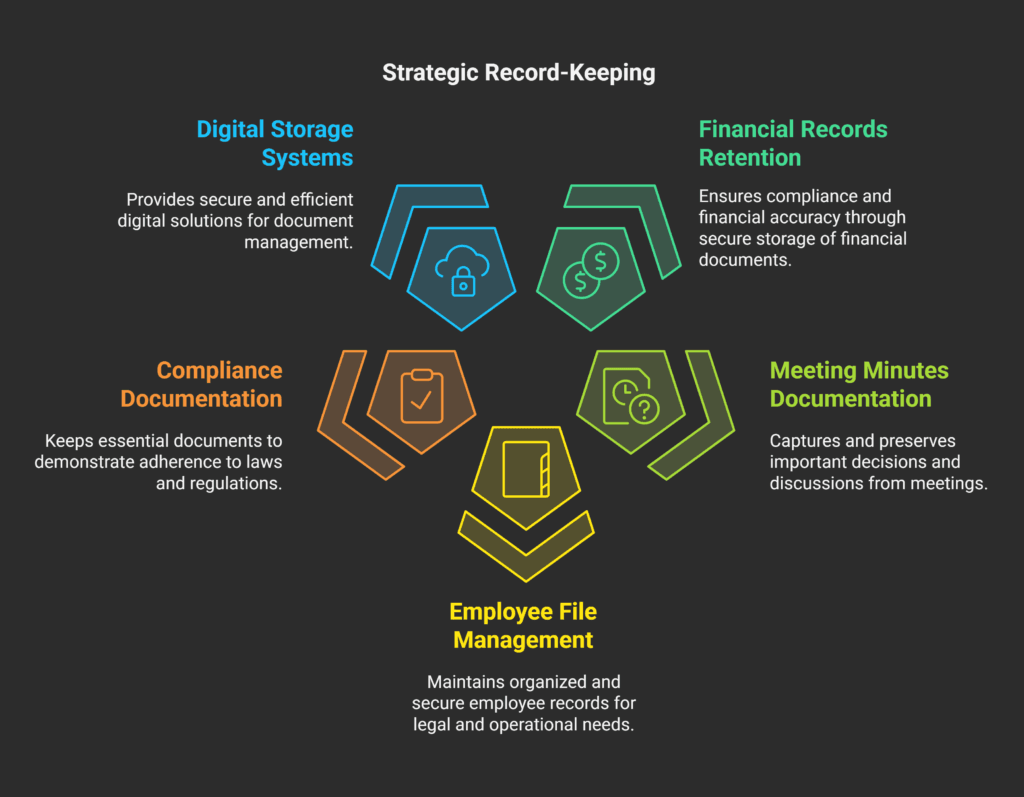
Record-Keeping and Documentation Maintenance in Romania

Romanian laws require keeping documents in order across many areas.

Your company’s rules should cover:

  • Financial records retention;
  • Meeting minutes documentation;
  • Employee file management;
  • Compliance documentation.

Digital storage is now vital in Romania.

The Ministry of Communications and Information Society says companies need special approvals for digital documents.

You must tell the authorities 30 days before starting digital archiving.

Your systems must also meet strict rules.

Proper documentation is not just a legal requirement, but a strategic asset for your business.

Important steps for good documentation include:

  1. Use safe digital storage systems;
  2. Make clear filing rules;
  3. Check and update records often;
  4. Train staff on document handling.

By focusing on keeping good records, you help your business avoid legal problems.

You also make your operations clear and efficient.

Conclusion

Mastering corporate record keeping in Romania is complex.

It requires a deep understanding of legal frameworks.

Your business’s success depends on following corporate compliance rules and keeping accurate records.

The Romanian business world needs strict paperwork management.

This must follow national legal standards.

Effective business paperwork in Romania does more than follow rules.

It protects your company, sets clear rules, and makes communication clear.

Getting help from legal experts can guide you through this complex area.

They ensure your business stays compliant and competitive.

Keeping up with Romanian business laws is key for growth.

Work with legal pros who know Romanian corporate rules well.

They can give you specific advice, explain complex laws, and reduce risks from mistakes.

For help with your corporate documents, contact Romanian legal experts.

They can help with creating, checking, and keeping your documents up to date.

Reach out to our Romanian Law Office to make sure your documents are top-notch and effective.

FAQ

What are the main legal entity types in Romania?

In Romania, there are two main types of legal entities.

Joint Stock Companies (JSC) are for bigger businesses with many shareholders.

Limited Liability Companies (LLC) are better for smaller businesses with fewer shareholders.

What essential documents are required for business registration in Romania?

You’ll need several important documents for business registration.

These include articles of incorporation and shareholder agreements.

You’ll also need a company registration certificate, tax number (CUI), and proof of a registered office.

Depending on your business type, you might need more documents.

How long must I retain corporate documents in Romania?

Romanian law says you must keep most corporate documents for at least 10 years.

This includes financial records and meeting minutes.

Keeping these documents well is key for audits and following the law.

What is the Single Administrative Document (SAD), and why is it important?

The SAD is a key document for international trade.

It’s used for customs declarations when moving goods in or out.

It gives detailed info about the goods, their value, and where they’re going.

This helps with smooth customs clearance in Romania and the EU.

What is an EORI number, and do I need one?

An EORI number is vital for EU customs operations.

If your business trades internationally, you’ll need one.

It helps with customs procedures and tracking your trade activities.

What are the management structure documentation requirements in Romania?

Romanian businesses must keep detailed records of their management structure.

This includes documents for directors and board members.

You’ll need meeting minutes and records of shareholder decisions for both one-tier and two-tier systems.

How difficult is it to set up a company in Romania?

Setting up a company in Romania is relatively easy but needs careful attention to legal details.

You’ll need to prepare incorporation documents and register with local authorities.

You’ll also need to get business permits and a tax ID.

What are the key compliance standards for corporate governance in Romania?

Romanian corporate governance requires detailed documentation.

This includes annual reports and meeting minutes.

Companies must show they follow local and EU rules through transparent records.

Are there specific documentation requirements for foreign investors?

Foreign investors need extra documents.

This includes translated and apostilled corporate documents and proof of registration in their home country.

It’s wise to work with a local legal expert to ensure you meet all requirements.

What penalties exist for non-compliance with documentation requirements?

Not following the rules can lead to big fines and even business suspension.

Penalties can be financial or more severe, like canceling your business registration for serious breaches.

What are the main documents required for incorporating a Romanian company (SRL)?

To incorporate a limited liability company (SRL) in Romania, you need to prepare and submit several documents required to the Trade Register.

The primary documents include:

1. Articles of Association

2. Proof of registered office;

3. Shareholder identification documents;

4. Criminal record certificates for company representatives;

5. Specimen signatures of company representatives;

6. Proof of share capital deposit;

7. Company name reservation certificate;

8. Declaration of honor from company representatives;

9. Power of attorney (if applicable);

10. Fiscal record certificate;

These necessary documents are crucial for setting up a company in Romania and ensuring compliance with Romanian law.

How do I prepare the Articles of Association for a Romanian company?

The Articles of Association is a fundamental document for company formation in Romania.

It should include:

1. Company name and type of company (SRL);

2. Registered address;

3. Object of activity (using NACE codes);

4. Share capital amount and distribution;

5. Shareholder information;

6. Administrator details and responsibilities;

7. Duration of the company (if not indefinite);

8. Profit distribution method;

9. General meeting of shareholders procedures;

The document must be submitted to the Trade Register Office and should be drafted according to the Romanian legislation.

It’s advisable to seek legal assistance to ensure all legal requirements are met.