Service Contract Requirements Romania

Service Contract Requirements Romania: What Every Provider Must Include by Law


Service Contract Requirements Romania – What Every Provider Must Include by Law

Service contracts in Romania must meet specific legal requirements under Government Order 21/1992 and related consumer protection laws. This comprehensive guide explains what Romanian law requires for valid service contracts, how ANPC enforces these rules, and what happens when businesses fail to comply.


Need Professional Help?

At our law firm, Atrium Romanian Lawyers, we assist clients with corporate & commercial law, contract drafting, and consumer protection advisory.


Test Your Service Contract Compliance

Use our interactive compliance checker below to verify that your service contract meets all Romanian legal requirements. This tool guides you through the 12 mandatory elements and helps you avoid ANPC penalties ranging from RON 2,000 to RON 100,000.

Interactive Service Contract Compliance Checker

Check off each requirement as you review your contract. The bar above will fill as you reach compliance.

0%
 

📹 Video Guide: Understanding Romanian Service Contracts

Watch our comprehensive video explanation covering all mandatory requirements, ANPC enforcement, and practical tips for compliance.


What Is a Service Contract Under Romanian Law?

Legal Definition

Under Romanian law, a service contract (contract de servicii) is an agreement where one party (the service provider) undertakes to provide specific services to another party (the consumer) in exchange for payment. Service contracts are governed by the Romanian Civil Code (Articles 1851-1874), Government Order 21/1992 on consumer protection, and Law 296/2004 (Consumer Code).

Types of Services Covered

Romanian service contract regulations apply to telecommunications and internet services, banking and financial services, utility services, professional services, maintenance and repair services, installation and delivery services, educational and training services, healthcare services, and transportation services.

Are Service Contracts Mandatory in Romania?

Yes, written service contracts are mandatory for most consumer-business transactions in Romania. According to Government Order 21/1992, service providers must formalize their agreements with consumers in writing, particularly when the service involves recurring payments, the contract duration exceeds 30 days, or the total value exceeds RON 100.


Mandatory Elements: What Must a Romanian Service Contract Contain?

1. Party Identification Requirements

Every service contract must clearly identify both parties. The service provider must include their legal business name, unique registration code (CUI), trade register number, physical headquarters address, and contact information. The consumer must include their full legal name, personal identification number (CNP) for individuals, and contact address.

2. Service Description Requirements

Contracts must provide detailed specifications including the exact nature of services, quality standards and performance metrics, delivery timeline and schedule, geographic service area, equipment or materials included, and technical specifications. According to ANPC regulations, vague or ambiguous service descriptions are considered non-compliant.

3. Pricing and Fee Disclosure

Complete transparency on all costs is mandatory. This includes the base service price, all additional fees (connection, activation, installation), taxes and surcharges (VAT, excise duties), recurring charges (monthly, annual), variable costs (usage-based fees), penalty fees (late payment, early termination), currency, payment methods accepted, and billing cycle and due dates. Key requirement: Prices must be displayed in 10-point font or larger.

4. Contract Duration and Renewal Terms

Contracts must specify the start date of service provision, contract duration (fixed term or indefinite), automatic renewal conditions, notice period for termination, early termination rights and associated costs, and grace periods if applicable.

5. Modification and Amendment Procedures

Romanian law requires clear procedures for contract changes. Service providers must provide 30 days written notice before any unilateral changes, specify the exact changes to terms or pricing, inform consumers of their right to reject changes, and allow penalty-free termination if consumer refuses modifications.

6. Service Suspension and Termination Rules

Contracts must outline conditions for service suspension by provider, consumer notification requirements (15 days advance notice), consumer’s right to unilateral termination (30 days notice, no penalties), provider penalties for failing to deliver promised services, refund procedures for prepaid services, and equipment return requirements.

7. Consumer Protection Clauses

Mandatory consumer rights provisions include withdrawal right (14 days for distance contracts), warranty and guarantee terms, complaint and dispute resolution procedures, service quality standards, compensation for provider-caused damages, data privacy protections, and right to refuse data processing for marketing purposes.

8. Liability and Indemnification

Contracts must clearly state the service provider’s liability for non-performance, consumer compensation rights for damages, force majeure provisions, and limitation of liability clauses that must be reasonable and non-abusive.

9. Dispute Resolution Mechanisms

Required information includes complaint filing procedures, internal complaint handling timeline, alternative dispute resolution (ADR) options, ANPC contact information, and court jurisdiction.


Penalties for Non-Compliant Service Contracts

Fine Structure

Violation TypeFine Amount
Missing mandatory contract elementsRON 2,000 – RON 4,000
Abusive clausesRON 20,000 – RON 100,000
Large-scale violations (100+ consumers)Up to 4% of annual turnover

Additional Penalties

Beyond monetary fines, penalties can include temporary service suspension until compliance, permanent product/service withdrawal from market, publication of violation on ANPC website, consumer compensation orders, and court-ordered contract modifications.


Prohibited Abusive Clauses Under Romanian Law

Law 193/2000 on unfair contract terms prohibits clauses that exclude or limit provider liability for damages, allow unilateral price increases without justification, bind consumer while making provider obligations conditional, impose disproportionate penalties on consumers, extend contract automatically without clear terms, restrict consumer’s right to legal action, or transfer provider obligations to third parties without consent.

Legal consequence: Abusive clauses are automatically void, even if signed by the consumer.


Consumer Rights in Romanian Service Contracts

Core Consumer Rights

Under Government Order 21/1992, consumers have the right to complete, accurate information about services, unilateral contract termination (30 days notice, no penalties), protection against unfair terms, compensation for damages caused by provider, refuse data sharing for marketing, alternative dispute resolution, and 14-day withdrawal period for distance contracts.

Withdrawal Right (Distance Contracts)

For services purchased online or off-premises, you have a 14-day cooling-off period from contract signing with full refund for unused services. No justification is required and no penalties apply for exercising the withdrawal right, except for services fully performed with consumer’s advance consent.


Recent Legal Updates (2024-2025)

Emergency Government Ordinance 58/2022

Key changes effective May 28, 2022 include increased fines for abusive clauses, 3-year statute of limitations for ANPC sanctions, and enhanced powers to remove abusive clauses from all contracts.

ANPC Order 539/2024: “Shrinkflation” Rules

New requirements effective October 10, 2024 require businesses to inform consumers of product size/weight reductions, provide specific labeling for reduced quantities, and face penalties for non-disclosure.

Law 243/2024: Consumer Credit

New protections effective November 27, 2024 include limited total cost of credit, interest rate caps, and enhanced disclosure requirements.


Useful Resources & Links


FAQ – Service Contract Requirements in Romania

Q: Do all service contracts need to be in writing?

A: Yes, most consumer-business service contracts must be in writing, especially if they involve recurring payments, exceed 30 days duration, or total over RON 100. Verbal contracts are valid only for simple, low-value, one-time services.

Q: What happens if my service contract doesn’t include mandatory clauses?

A: The contract may be void or unenforceable. ANPC can fine the provider RON 2,000-4,000 for missing elements. Consumers can challenge the contract and seek modifications or termination without penalties.

Q: Can service providers unilaterally change contract terms?

A: No, not without proper procedure. Providers must give 30 days written notice of any changes and inform consumers of their right to reject the modifications and terminate the contract without penalties.

Q: What is the penalty for using abusive clauses?

A: Fines range from RON 20,000 to RON 100,000 per violation. For large-scale violations, penalties can reach up to 4% of the provider’s annual turnover in Romania. Abusive clauses are automatically void.

Q: How long do I have to withdraw from a service contract?

A: For distance or off-premises contracts, you have 14 days from signing to withdraw without giving a reason and without penalties, provided the service hasn’t been fully performed with your advance consent.


Disclaimer: This article is for general information only and does not constitute legal advice. Please consult with a qualified Romanian corporate lawyer to verify current laws and regulations before finalizing your service contracts. Laws and procedures are subject to change, and individual circumstances may vary.

e-commerce Romania

Legal Requirements for E-commerce Stores in Romania

Legal Requirements for E-commerce Stores in Romania

What separates thriving online businesses from those facing legal penalties in Romania’s competitive digital market?

The answer lies in understanding and implementing non-negotiable regulatory standards.

With industry leaders like emag.ro generating $970.5 million in 2024 revenue alone, compliance isn’t optional—it’s the foundation of sustainable success.

E-commerce Stores in Romania

Romania’s top three digital retailers control 31.7% of the market, a statistic underscoring the critical role of adherence to local laws.

Legal frameworks here prioritize consumer rights, payment security, and transparent data practices.

Romanian Businesses must align with these mandates to avoid fines, build trust, and secure long-term growth.

For example, strict data protection rules require retailers to safeguard customer information rigorously.

Payment processing systems must meet EU security standards, while return policies need explicit clarity under national consumer laws.

Professional guidance from experts like office@theromanianlawyers.com ensures seamless compliance across these areas.

This article provides actionable insights into Romania’s regulatory landscape, helping businesses navigate obligations while maximizing opportunities.

From market trends to operational best practices, readers will gain the knowledge needed to operate confidently in this dynamic environment.

Key Takeaways

  • Market leaders demonstrate the revenue potential of compliant operations.
  • Consumer rights and data security form the core of Romania’s digital retail laws.
  • Top-performing businesses allocate resources to legal consultation for risk mitigation.
  • Payment processing standards directly impact customer trust and regulatory standing.
  • Understanding market share dynamics helps shape competitive compliance strategies.

Understanding the Romanian Legal Landscape

Romania’s digital retail sector operates under a precise regulatory framework enforced by multiple oversight bodies.

Three primary authorities govern compliance: the National Authority for Consumer Protection (ANPC), the National Supervisory Authority for Personal Data Processing (ANSPDCP), and the Competition Council.

Romanian online store regulations

Regulatory Authorities and Operational Mandates

ANPC monitors adherence to consumer rights laws, including 14-day return policies and transparent pricing.

ANSPDCP enforces GDPR compliance, requiring businesses to implement robust data encryption and breach notification protocols.

The Competition Council ensures fair market practices, particularly crucial as top platforms collectively hold 27% of the market share.

AuthorityJurisdiction2024 Enforcement Actions
ANPCConsumer rights1,240 resolved complaints
ANSPDCPData protection€3.2M in GDPR fines
Competition CouncilMarket fairness12 antitrust investigations

Legislation Shaping Digital Retail

Law 363/2007 mandates clear product descriptions and delivery timelines, while EU Directive 2019/771 requires warranty transparency.

Non-compliant businesses risk fines up to 4% of annual revenue.

For example, a major electronics store faced €86,000 penalties last year for inadequate return policy disclosures.

Annual legal updates remain critical as platforms evolve.

Consultation with specialists like office@theromanianlawyers.com helps businesses align operations with current standards while optimizing market performance.

Essential Compliance Checklist for E-commerce Stores in Romania

Operating a successful digital retail platform demands more than market awareness—it requires rigorous adherence to legal frameworks.

Leading platforms  demonstrate how compliance fuels growth while securing customer trust.

Romanian online store compliance checklist

Consumer Protection and Data Privacy Regulations

Businesses must implement these critical measures:

  • 14-day return policies with clear instructions per Law 363/2007;
  • GDPR-compliant data encryption for all customer interactions;
  • Detailed product descriptions meeting ANPC transparency standards.

Payment Systems, Security Measures, and Shipping Guidelines

Top performers use this operational blueprint:

  1. PCI DSS-certified payment gateways to prevent fraud;
  2. SSL encryption for transactions exceeding EU Directive 2019/771 requirements;
  3. Tracked shipping with delivery confirmation within 48 hours.

Platforms updating policies quarterly see 23% fewer legal disputes.

Legal specialists like office@theromanianlawyers.com provide tailored audits to align operations with 2024 market shifts.

Regular reviews help maintain 98% compliance rates among top-tier sellers.

Practical Guidance for Navigating Legal and Market Challenges

How can romanian businesses transform regulatory compliance into competitive advantage?

Strategic analysis of market leaders reveals actionable patterns.

Platforms ranking in Romania’s top 10 allocate 15% of annual budgets to compliance infrastructure.

Romanian ecommerce market data analysis

Expert Resources and Legal Consultation

Top performers implement these practices:

  • Quarterly compliance audits with office@theromanianlawyers.com
  • Real-time monitoring of ANPC policy updates;
  • Data-driven adjustments to return policies.

Legal specialists provide tailored frameworks for tax optimization and contract management.

Platforms combining these strategies report 31% faster dispute resolution times.

Conclusion

Navigating Romania’s digital marketplace successfully hinges on merging legal precision with strategic business practices.

Market leaders like emag.ro—with 18.4% market share and $970.5M in annual sales—prove that compliance drives growth.

Strict adherence to consumer protection laws, data privacy standards, and payment security protocols remains non-negotiable for online stores.

Key authorities like ANPC and ANSPDCP enforce regulations requiring transparent return policies and GDPR-compliant data handling.

Platforms ranking in Romania’s top 10 allocate 15% of budgets to compliance, resulting in 23% fewer disputes.

A detailed list of requirements ensures alignment with evolving standards.

Legal experts like office@theromanianlawyers.com provide tailored frameworks to navigate these challenges.

Their guidance helps businesses optimize market performance while building trust with customers.

Regular audits and policy updates position platforms for sustained success in competitive sectors.

Proactive compliance transforms regulatory obligations into opportunities for share expansion.

For actionable strategies and risk mitigation, consult legal professionals to future-proof operations.

FAQ

What legal registrations are required to operate an online store in Romania?

Businesses must register with the Trade Register, obtain a VAT number if applicable, and comply with consumer protection laws.
Sector-specific permits may apply depending on product categories like pharmaceuticals or electronics.

Which authorities oversee compliance for digital retailers in the country?

The National Authority for Consumer Protection (ANPC) monitors adherence to consumer rights, while the National Supervisory Authority for Personal Data Processing (ANSPDCP) enforces GDPR compliance.
Tax obligations fall under ANAF jurisdiction.

How do Romania’s consumer protection laws affect return policies?

Under Law 449/2003, buyers have 14 days to return products purchased online.
Retailers must clearly display return conditions and handle refunds within 14 days of receipt.

Are there specific security standards for payment processing systems?

Online sellers must implement PCI DSS-compliant payment gateways.
Two-factor authentication is mandatory for transactions exceeding €150 under EU Directive 2015/2366 (PSD2).

What penalties apply for non-compliance with data privacy regulations?

GDPR violations can result in fines up to €20 million or 4% of global annual turnover.
ANSPDCP audits frequently target improper cookie consent mechanisms and data storage practices.

Where can businesses access market share data for strategic planning?

The National Institute of Statistics publishes quarterly ecommerce reports.

How can legal experts assist with cross-border shipping compliance?

Specialized firms like Atrium Romanian Lawyers review customs documentation, ensure INCOTERM alignment, and resolve disputes via email consultations at office@theromanianlawyers.com.

What are the primary legal requirements for starting an e-commerce store in Romania in 2024?

Setting up an e-commerce shop in Romania requires compliance with several key legal requirements.

First, you must register your company with the National Trade Register Office (ONRC) and obtain a unique registration code.

For online stores, you need to register as either a limited liability company (SRL) or a sole trader (PFA), depending on your business model.

As of 2024, all e-commerce websites in Romania must clearly display the company‘s identification details, including the company name, registration number, VAT identification number, and physical address.

Additionally, you must register with the National Authority for Consumer Protection (ANPC) before commencing sales.

Romanian law also requires e-commerce operators to obtain specific authorizations depending on the product category they sell – for example, food products require authorization from the National Sanitary Veterinary and Food Safety Authority.

Finally, ensure your website has comprehensive terms and conditions, privacy policies, and cookie policies that comply with both Romanian and European regulations.

How does GDPR affect e-commerce operations in Romania?

The General Data Protection Regulation (GDPR) significantly impacts e-commerce operations in Romania, as it does across the European Union.

As a Romanian online store owner, you must implement comprehensive data protection measures.

This includes obtaining explicit consent before collecting customer data, explaining clearly how the data will be used, and providing options to opt out.

Your e-commerce platform must have a detailed privacy policy accessible from all pages of your website.

Romanian online stores must appoint a Data Protection Officer (DPO).

Romania’s Administrative Fines: What You Need to Know Before You Pay

Romania’s Administrative Fines: What You Need to Know Before You Pay

Table of Contents

Ever get a notice to pay for a rule you didn’t know about?

Dealing with fines can be tough, even more so if you don’t know the rules.

In Romania, fines follow rules set by Government Ordinance No. 2/2001.

This law outlines what fines are for and how much they cost.

It’s very important for both people and businesses in the country to understand this.

Romania’s Administrative Fines

Romania’s Administrative Fines

The way fines work in Romania has changed a lot.

Now, fines are the main way authorities make sure everyone follows the rules.

This is a big change from when fines were mostly for serious crimes.

If you get a fine, knowing your rights can help a lot.

The rules tell you how to figure out, pay, and even fight fines that seem unfair.

In this guide, you’ll learn all you need to know about fines in Romania.

This is true whether you live, work, or run a business here.

Key Takeaways

  • Government Ordinance No. 2/2001 establishes the framework for contraventional offenses in Romania;
  • Administrative penalties evolved from being part of the Criminal Code to administrative law;
  • Understanding the regulatory framework is essential for both individuals and businesses;
  • Legal sanctions serve as enforcement mechanisms to ensure compliance with regulations;
  • Specific procedures exist for calculation, payment, and contesting administrative fines;
  • Knowing your rights regarding regulatory penalties can save time, money, and stress.

Understanding Romania’s Administrative Fines

Getting to know Romania’s fine system is key.

It’s based on laws and the groups that enforce them.

If you live or work in Romania, you might face Romanian administrative sanctions.

These fines are different from criminal penalties and help keep things in order.

Definition and Legal Basis

In Romania, fines for small mistakes are called contraventional sanctions.

They’re not as serious as crimes.

The rules for these fines come from Government Ordinance No. 2/2001.

This ordinance says a contravention is a small mistake done on purpose or by accident.

It must be listed as a contravention in the law. And it’s not as big of a deal as a crime.

These fines are meant to help people follow the rules, not to punish them.

They’re not like criminal fines.

Instead, they aim to fix the problem and make sure everyone follows the rules.

Romanian administrative sanctions framework

Romanian administrative sanctions framework

There are also laws for specific areas that add to the main rules.

These laws list what’s wrong and what the fines are for those mistakes.

Key Regulatory Authorities in Romania

Many government groups watch over the rules and give out Romanian corporate compliance fines when needed.

Each group looks after a certain area.

The National Authority for Consumer Protection (ANPC) checks on the market and protects consumers.

They deal with unsafe products, false ads, and unfair business practices.

They focus on businesses that don’t follow the rules for consumers.

The National Environmental Guard and local agencies handle environmental issues.

They make sure companies follow the rules about pollution and waste.

Breaking these rules can lead to big fines.

The Labor Inspectorate (Inspecția Muncii) looks after work places.

They make sure employers follow the rules about safety, fair pay, and working hours.

If employers don’t follow these rules, they can face big fines.

Tax authorities, like the National Agency for Fiscal Administration (ANAF), deal with tax issues.

They handle things like not reporting income or keeping bad records.

This can lead to fines and extra taxes.

Local police and special teams enforce local rules and handle small public order issues.

They deal with things like noiseunauthorized building, and breaking local rules.

Knowing who to talk to when you get a fine in Romania is important.

Each group has its own way of doing things, but they all follow the main rules set by Government Ordinance No. 2/2001.

Common Types of Administrative Violations in Romania

Knowing the common administrative infractions in Romania can save you from big fines and legal trouble.

The country has rules for both businesses and individuals.

Knowing these rules helps you stay compliant and avoid penalties.

Romanian compliance violations

Romanian compliance violations

Corporate and Business Infractions

Businesses in Romania must follow strict rules to avoid Romanian corporate fines.

These fines help keep businesses in line and protect everyone involved.

Labor law violations are a big problem.

Issues like bad employment contracts, too many working hours, and safety problems are common.

The Romanian Labor Inspectorate checks these and fines can be from 1,500 to 20,000 RON.

Consumer protection infractions are also a big deal.

This includes false ads, unfair contracts, and not honoring warranties.

The National Authority for Consumer Protection is getting tougher on these issues.

Tax reporting mistakes are a top concern for Romanian authorities.

This includes late tax filings, wrong revenue reports, and VAT issues.

These mistakes can lead to fines and extra taxes with penalties.

Business Infraction TypeRegulatory AuthorityTypical Fine Range (RON)Common Examples
Labor Law ViolationsLabor Inspectorate1,500 – 20,000Undocumented workers, safety violations
Consumer ProtectionANPC2,000 – 50,000Misleading advertising, unfair terms
Tax ComplianceANAF5,000 – 100,000Late filings, incorrect reporting
EnvironmentalEnvironmental Guard30,000 – 80,000Waste disposal violations, emissions

Individual Administrative Offenses

People in Romania face their own set of rules that can lead to fines.

Knowing these can help you avoid trouble.

Traffic violations are a big issue.

This includes speedingillegal parking, and not wearing seatbelts.

Fines can be from 290 to 2,900 RON, with serious cases leading to losing your license.

Public disturbance offenses are another common problem.

This includes loud noise, bad waste disposal, and acting out in public.

Local police can fine you from 100 to 500 RON for these.

Age matters when it comes to fines in Romania.

Kids under 14 can’t be fined.

Those 14 to 18 face smaller fines than adults, showing Romania’s approach to responsibility.

GDPR and Data Protection Violations

With the GDPR in place, data protection is a big deal in Romania.

Both businesses and public bodies must follow strict rules to avoid fines.

Processing data without permission is a serious mistake.

This includes collecting data without consent, using it for the wrong reasons, or keeping it too long.

The National Supervisory Authority for Personal Data Processing can fine up to 20 million euros or 4% of global turnover for the worst cases.

Not telling people about data breaches fast enough is another big no-no.

Companies must tell the authority and those affected within 72 hours if data is at risk.

Not protecting data well enough is also a big problem.

Companies must have good security measures to keep data safe, based on the risk involved.

Not respecting people’s data rights is another common issue.

This includes not giving access to data, not fixing wrong data, erasing data, and not letting people take their data with them.

Companies must respond to these requests within a month, with some exceptions.

Knowing about these common violations helps with business risk management and personal compliance in Romania.

By spotting problems before they happen, you can avoid fines and protect your business’s reputation.

The Romanian Regulatory Framework

Romania has a detailed legal system for handling administrative offenses.

It combines general rules with specific ones for different areas.

Knowing these rules is key for businesses and residents, as they cover everything from traffic rules to corporate rules.

 Romanian Regulatory Framework Fines

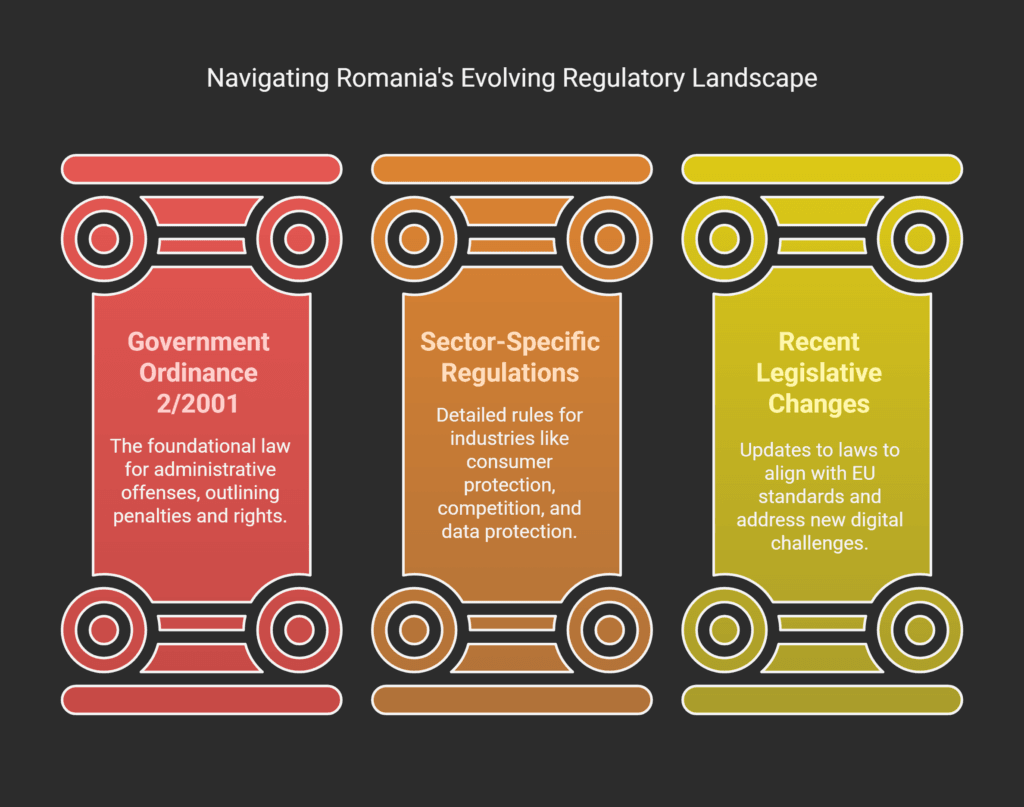
Government Ordinance No. 2/2001

At the heart of Romania’s administrative offenses legislation is Government Ordinance No. 2/2001.

It’s the main law for handling contraventions.

This ordinance is as important as laws passed by parliament, but it comes from the government.

GO 2/2001 sets up three main types of punishments for contraventions:

  • Warnings (verbal or written cautions);
  • Contraventional fines (monetary penalties);
  • Community service (remedial work for the public benefit).

This ordinance makes contraventions a separate category from crimes.

It outlines how fines are given, sets rules for penalties, and protects the rights of those facing charges.

Sector-Specific Regulations

While GO 2/2001 is the base, many specific rules add complexity to the Romanian regulatory framework.

These rules cover different industries and activities.

Traffic laws, for example, have detailed rules on driving and vehicle requirements.

Consumer protection laws set rules for businesses on product safety and advertising.

SectorPrimary LegislationKey Regulatory AuthorityCommon Violations
Consumer ProtectionLaw No. 296/2004National Authority for Consumer ProtectionMisleading advertising, unfair contract terms
CompetitionLaw No. 21/1996Competition CouncilCartel formation, abuse of dominant position
Data ProtectionLaw No. 190/2018National Supervisory AuthorityGDPR violations, data breaches
EnvironmentalGEO No. 195/2005Environmental GuardPollution, waste management failures

Environmental laws are strict about pollution and waste.

The GDPR compliance fines in Romania can be up to 4% of global turnover for big violations.

Financial laws, overseen by the National Bank of Romania and the Financial Supervisory Authority, have their own penalties.

These rules work with GO 2/2001 for matters not covered in specific laws.

Recent Legislative Changes

Romania’s fine system has changed a lot in recent years.

Fine amounts have gone up in many areas, showing a focus on stopping violations.

In 2021, changes to GO 2/2001 gave more rights to those accused of offenses.

New EU rules have also led to updates in areas like unfair competition and consumer protection.

The rise of digital services has brought new violations, like in ecommerce and online marketing.

Romania has updated laws to handle these new challenges.

Romania’s laws are getting closer to EU standards, making it easier for businesses in Europe.

This means new rules but also a more stable environment for international companies.

It’s important to keep up with these changes to avoid fines.

Romania’s laws are always evolving, so staying informed is key for everyone.

How Administrative Fines Are Calculated and Imposed

Knowing how Romanian authorities set and apply fines is key for individuals and businesses.

The Romanian legal system has a clear method to make sure fines match the violation’s severity.

This helps you understand and avoid risks, and prepare for compliance.

Penalty Assessment Criteria

Romanian agencies look at several factors to decide on fines.

These penalty assessment criteria make sure fines are fair based on the violation’s impact.

The main things considered are:

  • The seriousness of the violation and its impact;
  • If the violation was intentional or by mistake;
  • The offender’s history of following rules;
  • The economic gain from the violation;
  • The harm caused to others or public interests.

Fines are set based on the violation’s seriousness.

For example, a small paperwork mistake gets a lower fine than a serious violation.

Also, extra sanctions might be added based on the violation’s severity.

It’s important to know that for one offense, there’s one main penalty and one or more extra sanctions if needed.

Fine Calculation Methods

 Administrative Fines in Romania

The fine calculation methods in Romania follow strict rules.

The system sets both a minimum and a maximum for fines, guiding how fines are applied.

The smallest fine for any violation is 25 lei (about 6 Euros).

But, the maximum fine varies based on who set the rule:

Authority LevelMaximum Fine (Lei)Maximum Fine (Euros)Typical ApplicationLegal Basis
Law or Government Ordinance100,00025,000Serious national violationsPrimary legislation
Government Decision50,00012,500Significant regulatory breachesSecondary legislation
County Authorities5,0001,250Regional administrative violationsCounty regulations
Municipal/Communal Authorities2,500600Local ordinance violationsLocal council decisions

For repeat offenders, fines get higher with each offense.

Young offenders (ages 14-18) usually get lower fines than adults for the same violations.

Notification Process

After finding a violation and calculating the fine, Romanian authorities send a formal notice.

This step is key in administrative proceedings and must follow legal rules.

The notice, called a “Proces-Verbal de Contravenție” (contravention report), must include important details:

  • The date, time, and place of the violation;
  • A detailed description of the violation;
  • The laws broken;
  • The fine amount and how to pay;
  • Info on appealing and deadlines;
  • Details of the offender and the authority.

This document is usually given in person at the time of the violation.

If not possible, it’s sent by registered mail with proof of delivery.

You have the right to receive this notice within 30 days of the violation being found.

The notice will tell you when to pay the fine, usually 15 days after getting it.

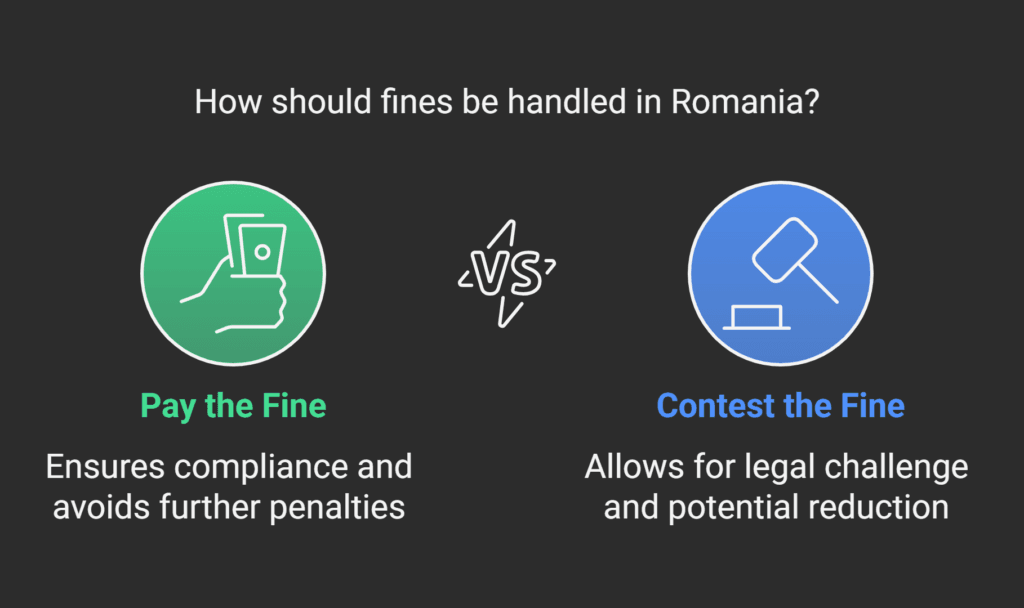
You can either pay the fine or contest it legally during this time.

Ignoring this can lead to more penalties and actions.

Knowing about assessment criteria, calculation methods, and the notification process helps you understand Romania’s fine system.

This knowledge helps you avoid penalties and follow Romanian laws correctly.

The Payment Process for Romanian Administrative Fines

When you get an administrative fine in Romania, knowing how to pay it is key.

It saves you money and avoids legal trouble.

Romania has clear steps for paying fines, important for both individuals and businesses.

The Romanian system has standard payment ways and chances for lower payments.

But, these benefits need you to follow the rules on time.

Let’s look at how to handle administrative sanctions in Romania.

Payment Deadlines and Options

Payment Romania Fine

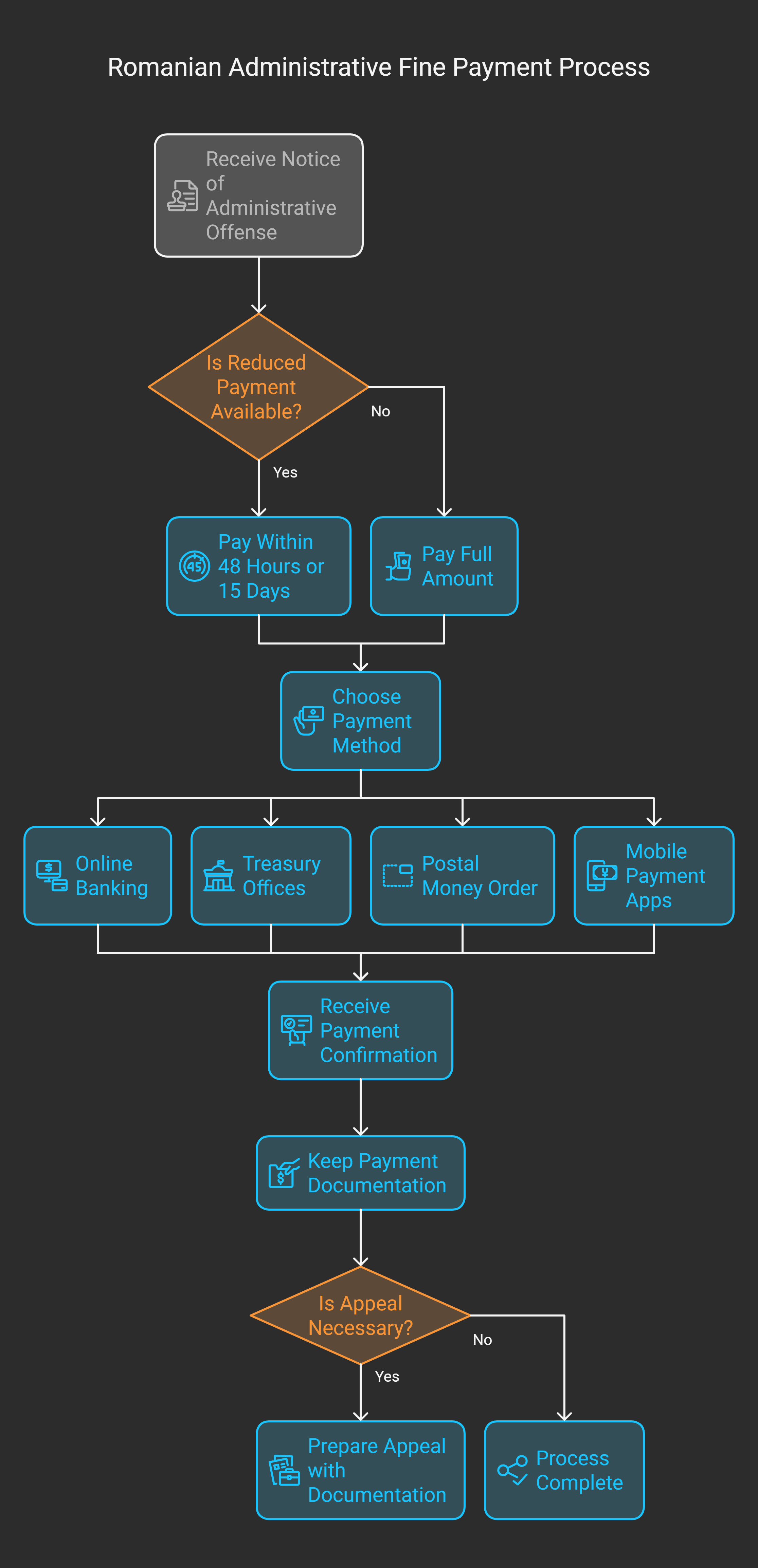
When you get a notice of an administrative offense, you have 15 to 30 days to pay.

The exact time depends on the violation and who issued it.

Always check the deadline on your notice to avoid trouble.

Romania has many ways to pay penalty fees.

You can use online banking, visit a bank, send a postal money order, or use mobile apps.

Each method has its own time, which might affect your deadline.

If you miss the payment deadline, the authorities can take action.

They might take your money directly from your accounts.

This can add extra fees and interest, making the fine even higher.

Payment MethodProcessing TimeAdvantagesDocumentation Provided
Online Banking1-2 business daysConvenient, accessible 24/7Electronic receipt, transaction ID
Treasury OfficesImmediateOfficial confirmation, guidance availableOfficial stamped receipt
Postal Money Order3-5 business daysNo bank account neededPostal receipt with tracking number
Mobile Payment Apps1-3 business daysConvenience, digital recordDigital receipt, confirmation code

Reduced Payment Opportunities

Romanian law gives big savings for quick payment of fines.

For many fines, you can pay half the amount if you pay within 48 hours or 15 days.

This depends on the type of violation.

Not all fines offer this chance.

Minor and some moderate infractions qualify, but serious ones don’t.

Your notice will say if you can pay less.

To get the reduced payment, follow the steps in your notice carefully.

Use the right payment details and pay on time.

Any mistake or delay means you can’t get the reduced payment.

Documentation Requirements

Keeping the right documents is key when dealing with fines in Romania.

Always save the original notice.

It has important details about the fine, payment, and deadlines.

After paying, keep all payment receipts safe.

Include the date, amount, payment reference, and confirmation from the authority.

For online payments, save electronic receipts and bank statements.

For in-person payments, ask for a stamped receipt.

Documentation is vital if you need to appeal a fine or if there’s a payment mistake.

Romanian authorities might not always record payments correctly.

Having all your documents ready helps solve problems fast and avoids legal trouble.

If you’re a business, organize all fine-related documents well.

This includes letters from authorities, payment records, and any supporting evidence.

Good organization helps with penalty appeals and shows you’re following the law.

Contesting Administrative Fines in Romania

If you get an administrative fine in Romania, you can fight it under certain conditions.

The legal system in Romania uses civil procedure for these challenges.

But, some fines might need criminal law if they seem too harsh.

Knowing your rights and the right steps can really help your appeal.

Contesting Administrative Fines in Romania

Legal Grounds for Appeals

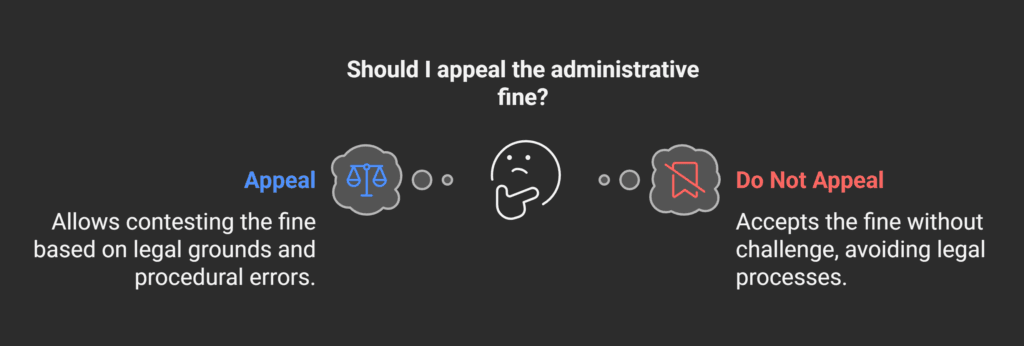
There are several good reasons to appeal an administrative fine in Romania.

It’s important to know which one fits your situation best.

Procedural errors are a common reason.

This includes wrong noticeswrong info, or not following due process when the fine was given.

Also, if the fine report got the facts wrong, you can appeal.

If you have evidence that shows the report was wrong, you can use it to challenge the fine.

Another reason is if the fine is too big for the crime.

Romanian laws say fines should match the crime.

If your fine seems too high, you can appeal based on this.

The European Court of Human Rights has set important rules for fines in Romania.

They’ve said Romania can’t ignore the idea that you’re innocent until proven guilty.

These rules help if you’re appealing because of rights issues.

The Appeals Process Timeline

Time is key when you’re appealing a fine in Romania.

You have 15 days from when you get the fine notice to appeal.

If you miss this, you can’t appeal anymore.

The appeal process has a clear schedule:

1. Within 15 days of getting the notice: Send your appeal in writing to the fine issuer or the court.

2. Within 5 days after you send it: The court will register your appeal and give it a number.

3. 20-30 days later: You’ll have your first court hearing (estimated).

4. 1-3 months: The first court decision will take this long, depending on the case (estimated).

5. Within 30 days of the first decision: You can appeal to a higher court if you need to (estimated).

For simple cases, the whole process can take 3-6 months.

But, if it’s more complicated, it might take longer.

Required Documentation for Appeals

Having the right documents is key for a good appeal.

Get everything ready before you start.

This will help your case and avoid delays.

Here’s what you need for an appeal in Romania:

Document TypePurposeRequired CopiesSpecial Requirements
Original Fine NotificationShows why you’re appealing1 original + 2 copiesMust include all pages and attachments
Written Appeal StatementExplains why you’re appealing3 copiesMust say what you want to happen
Supporting EvidenceBacks up your appeal3 copies of each documentTranslated if not in Romanian
Power of AttorneyAllows someone to represent you1 original + 2 copiesNotarized if represented by attorney
Proof of Payment (court fees)Shows you’ve paid to appeal1 original + 2 copiesFee amount varies by fine value

Your appeal statement should clearly say why you’re appealing.

Include any witness statements that support your side, if you’re questioning the facts of the violation.

Reports from experts can be very helpful, too.

They’re good for fines in areas like construction or environmental rules.

These reports give a third view that courts often find convincing.

When you appeal, you can send it to the fine issuer or the court.

For most fines, you should appeal to the local court (Judecătoria) where the fine was given or where you live.

Remember, all documents must be in Romanian or have a certified translation if they’re not.

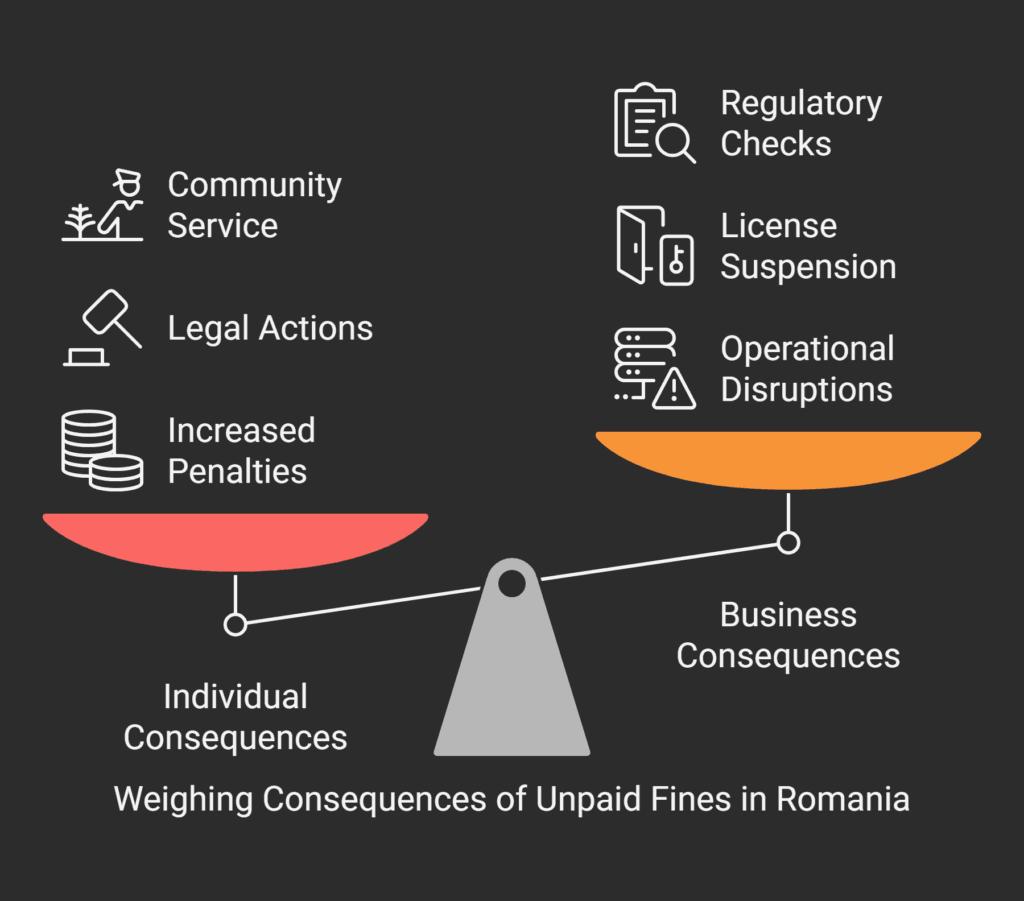
Consequences of Non-Payment

Not paying Romanian administrative fines can lead to bigger problems.

You could face more penaltieslegal actions, and even disruptions to your business.

It’s important to manage risks in Romania well, whether you’re an individual or a company.

The Romanian legal system is strict about fines.

They have rules to make sure everyone follows the law.

Consequences of Non-Payment of Fines in Romania

Legal Enforcement Actions

If you don’t pay your fine in 30 days, Romanian regulatory authorities will start legal actions.

They will send you a writ of execution.

This is the first step in enforcing the fine.

Authorities have several ways to enforce fines:

  • They can seize your property, both movable and immovable.
  • They can take money directly from your wages.
  • They can freeze your bank accounts and take money from them.
  • They can make you do community service instead of paying the fine.

If you can’t pay the fine and don’t have property, you can ask the court for community service.

You can also ask for more time to pay the fine at your first court appearance.

Doing community service can mean up to 300 hours of work.

Before, you had to agree to this.

But now, the court can decide it’s necessary to enforce the law.

Additional Penalties and Interest

Not paying your fine adds more costs.

You’ll have to pay interest every day.

The rate depends on the type of fine.

These extra costs can add up:

  • Penalties for late payment get higher over time.
  • There are costs for the enforcement officers.
  • You’ll have to pay court fees for the enforcement process.
  • Legal fees if you fight the enforcement in court.

For example, a 5,000 RON fine can grow to over 7,500 RON in six months.

This is a 50% increase. Paying on time is usually the best option.

Impact on Business Operations

Unpaid fines can hurt businesses a lot.

They can disrupt operations and affect your reputation.

Romania’s corporate governance requires following the law, including paying fines on time.

Businesses that ignore fines might face:

  • Their licenses or permits could be suspended or taken away.
  • They might not be able to get government contracts.
  • They could face more checks from regulators.
  • They might be listed as non-compliant in public records.
  • They could lose clients and partners because of bad publicity.

Financial institutions are hit hard too.

Unpaid fines for anti-money laundering or other financial rules can lead to more checks.

This includes more audits, programs to fix problems, and more reports.

Companies should have plans for dealing with fines.

This can stop small problems from becoming big issues.

It’s part of following Romanian business regulations.

Ignoring fines can hurt your business’s credit score, relationships with suppliers, and even employee morale.

For companies outside Romania, ignoring fines can make dealing with Romanian authorities harder in the future.

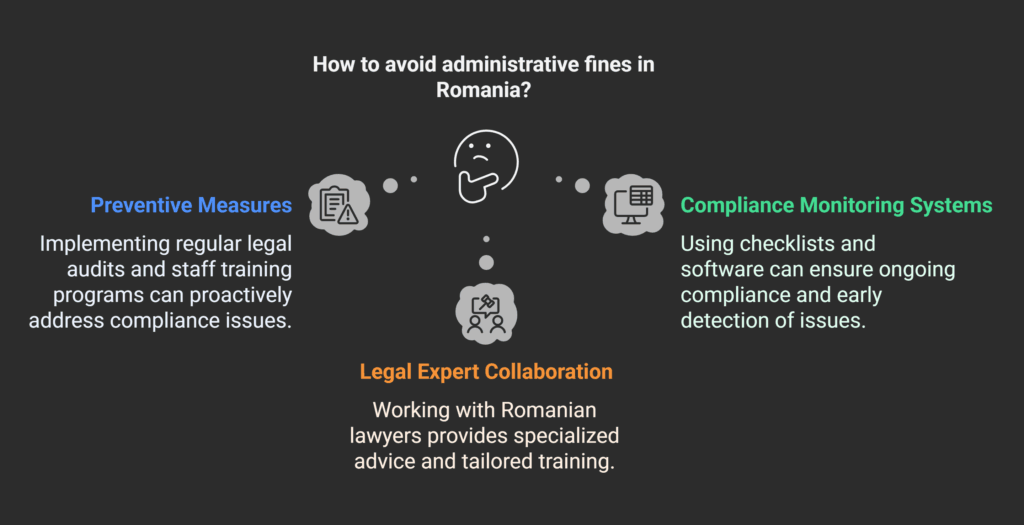
Compliance Strategies to Avoid Romanian Administrative Fines

Businesses in Romania need to be proactive about following the rules.

The rules are getting more complex, and companies must find ways to avoid fines.

It’s cheaper and better for your reputation to prevent problems than to fix them after they happen.

Compliance Strategies to Avoid Romanian Administrative Fines

Preventive Measures for Businesses

Start by knowing what laws you must follow.

Regular legal audits help find and fix problems before they become big issues.

These audits check if your business is following the latest laws.

Make clear rules for your team based on Romanian laws.

These rules should cover specific areas and be updated when laws change.

Staff training programs are key to avoiding fines.

Make sure your team knows the basics and the specific rules for their jobs.

Training should happen often, like when laws change or new people join.

Keep up with new laws in Romania.

Sign up for updates from the government and industry groups.

This way, you’ll know about changes that might affect your business.

Compliance Monitoring Systems

Use strong systems to check if you’re following the rules.

Compliance checklists are a good way to make sure you’re doing things right.

They should be easy to use but cover all important points.

Do regular checks to find and fix problems early.

Look at both your documents and how things are done to make sure they match the laws.

Use software to help with monitoring.

It can check things automatically and alert you to any problems.

This is really helpful for keeping up with Romania’s changing rules.

Make it easy for employees to report any issues.

A culture that encourages openness helps find problems early, when they’re easier to fix.

Keep good records of your compliance efforts.

This is important if someone says you’re not following the rules.

Keep track of training, policy updates, and any fixes you’ve made.

Working with Legal Experts in Romania

Working with Romanian lawyers can really help.

They know the local laws well and can give advice that fits your business.

Legal experts can do special audits to find and fix problems before they cost you money.

They often spot things that regular checks miss.

They can also create training that’s just right for your business.

This kind of training is usually more effective than general courses.

Good legal advisors in Romania offer practical solutions that work for your business.

Work closely with your legal team all the time, not just when you have a problem.

Regular talks help keep your business in line with the rules as they change.

This is really important for dealing with Romania’s complex rules.

By following these strategies, your business can avoid fines and run smoothly in Romania.

Remember, staying on top of compliance is an ongoing job that needs constant attention and changes as the rules do.

International Context: Romania vs. EU Administrative Penalties

It’s important to know how Romania’s fines compare to other EU countries.

Romania’s EU membership has shaped its rules, but it also keeps its own way of handling fines.

This helps you understand Romania’s place in the EU’s rules better.

International Context_ Romania vs. EU Administrative Penalties

Comparative Severity of Romanian Fines

Looking at administrative sanctions in Romania shows some patterns.

In some areas, Romania’s fines are not as high as Western Europe’s.

But in others, they can be strict.

In data protection, Romania’s fines for GDPR breaches are lower than France or Germany’s.

But, Romania has been getting tougher, with more investigations.

For environmental rules, penalties in Romania are about average in the EU.

But how they enforce these rules can vary.

Romania’s fines for pollution are similar to Hungary and Bulgaria’s but less than Austria or Sweden’s.

Regulatory AreaRomania (Average Fine)Western EU (Average Fine)Eastern EU (Average Fine)
Data Protection10,000-20,000 EUR50,000-200,000 EUR5,000-15,000 EUR
Consumer Protection2,000-10,000 EUR15,000-50,000 EUR1,000-8,000 EUR
Environmental5,000-50,000 EUR25,000-100,000 EUR3,000-30,000 EUR
Labor Law1,500-7,500 EUR10,000-40,000 EUR1,000-5,000 EUR

One key thing about government fines in Romania is the process.

While fines might be lower, the rules can be stricter.

This includes shorter appeal times and more detailed paperwork.

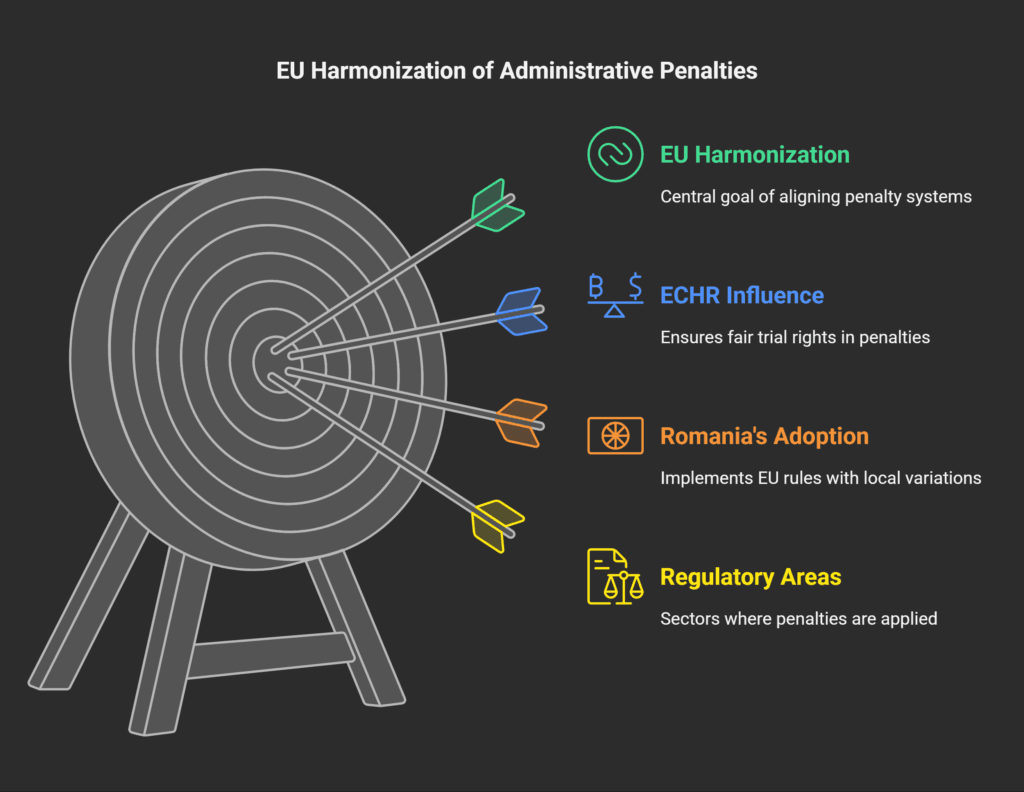
EU Harmonization Efforts

The EU wants all countries to have similar rules for fines.

This helps businesses in different countries know what to expect.

Romania has followed EU rules in areas like consumer protection and financial services.

For example, it adopted a new law on unfair business practices in 2018.

But, how strictly these rules are enforced can vary.

The European Court of Human Rights (ECHR) has also played a big role.

It says some fines in Romania are like criminal penalties.

This means certain rights must be respected, even if the fine is called administrative.

This includes the right to a fair trial, being presumed innocenthaving a lawyer, and seeing witnesses.

Romania’s Competition Council has started to follow these rules more closely.

This means better protection during investigations.

This process of making rules more similar is both a challenge and an opportunity.

It might make things more complicated for a while.

But in the long run, it should make things clearer for everyone.

Knowing about these international aspects is key to dealing with Romania’s fine system.

As Romania works to meet EU standards, staying up to date is important.

This helps you avoid fines and stay on the right side of the law.

Conclusion

Understanding Romania’s fine system is key for businesses and individuals.

Government Ordinance No. 2/2001 sets the rules for fines.

This knowledge helps you handle fines better.

Paying fines on time can lower the cost.

You can also appeal if a fine was wrongly given.

Keeping good records is your strongest defense.

Using smart compliance strategies can prevent fines.

By taking steps to avoid violations, businesses can save a lot.

This is cheaper than paying fines later.

For complex rules, get help from a Romanian administrative law expert.

A good law firm knows the system well.

They can guide you through it, even as Romania meets EU standards.

Whether you run a business or are an individual, a Bucharest lawyer is very helpful.

They know local laws and EU rules. Many law offices also do audits to find and fix problems before fines are issued.

Stay up to date with rules and get help when you need it.

This way, you can deal with Romania’s fine system well.

And you’ll reduce your chances of getting fined.

FAQ

What is an administrative fine in Romania?

An administrative fine in Romania is a fine for minor offenses.

It’s not as serious as a criminal act.

These fines are based on Government Ordinance No. 2/2001.

They are for breaking laws or decisions made by the government or local councils.

Which authorities can issue administrative fines in Romania?

Many bodies in Romania can give out fines.

This includes the National Authority for Consumer Protection (ANPC) and environmental agencies.

Also, labor inspectoratestax authorities (ANAF), and local police can issue fines.

Each one deals with different types of violations.

What are the most common business violations that result in administrative fines?

Businesses often face fines for labor law issues and unfair practices.

They can also get fined for not following consumer protection laws or tax rules.

Environmental and GDPR breaches, as well as competition law issues, are also common.

Not having the right licenses can lead to fines too.

What are the typical administrative violations for individuals in Romania?

Individuals might get fined for traffic offenses or disturbing the peace.

Not reporting personal status changes is also a violation.

Minor property issues and littering can lead to fines.

Local ordinances are another area where fines can be given.

How are administrative fine amounts determined in Romania?

The amount of a fine depends on several things.

This includes how serious the offense is and if it was intentional.

The offender’s history and any benefits from the violation also play a part.

There are minimum and maximum fines based on who made the rule.

What is the deadline for paying an administrative fine in Romania?

You usually have 15 days to pay a fine. But this can change based on the rule broken.

If you don’t pay on time, the fine can be collected by the authorities.

This might cost you more money.

Can I pay a reduced amount for an administrative fine in Romania?

Yes, you can pay less for many fines.

You can pay half the minimum fine within 48 hours or 15 days.

This chance is available for many fines but not all.

You need to pay on time and keep proof of payment.

What payment methods are available for administrative fines in Romania?

There are several ways to pay fines in Romania.

You can use online platforms, bank transfers, postal money orders, or pay in person.

The details for payment will be on your fine notice.

Always save your payment receipt.

What are valid grounds for appealing an administrative fine in Romania?

You can appeal a fine for several reasons.

This includes mistakes in the fine notice or if the fine is too high.

You can also appeal if there’s no legal basis for the fine.

The European Court of Human Rights has also set rules for fair fines.

What is the process for contesting an administrative fine in Romania?

To appeal a fine, you need to file a complaint within 15 days.

You’ll need the fine notice and any evidence you have.

The court will hold a hearing.

You can represent yourself or get a lawyer.

You can appeal the court’s decision to a higher court within 30 days.

What happens if I don’t pay an administrative fine in Romania?

If you don’t pay, the authorities can take action.

They might seize your property or garnish your wages.

You could also be ordered to do community service.

Unpaid fines can also cost you more money.

Can administrative fines in Romania be converted to community service?

Yes, fines can be turned into community service.

The court can order up to 300 hours of service.

This is usually based on the minimum wage.

It’s a way to avoid paying the fine.

How can businesses prevent administrative fines in Romania?

Businesses can avoid fines by being proactive.

They should check their compliance regularly and train staff.

They should also have systems in place to monitor and report any issues.

Working with legal experts is also helpful.

Keeping records of compliance efforts is important.

How do Romania’s administrative fines compare to those in other EU countries?

Romania’s fines vary compared to other EU countries.

For GDPR, Romania’s fines are often lower.

But for consumer and environmental issues, fines can be higher.

Romania is trying to align its fines with EU standards.

The European Court of Human Rights has also influenced Romania’s approach to fines.

Are there special provisions for foreign individuals or companies facing administrative fines in Romania?

Foreigners face the same fine system as locals.

But they might find it harder due to language barriers.

Foreign companies should have a local representative.

Enforcement against foreign entities might involve extra steps.

What documentation should I keep related to an administrative fine in Romania?

Keep all documents related to a fine.

This includes the fine notice, any evidence, payment proof, and court documents.

Keep these for at least 5 years.

They might be needed to prove payment or to address any errors.
Identifying Abusive Clauses in Romanian Consumer Contracts for Better Protection

Identifying Abusive Clauses in Romanian Consumer Contracts for Better Protection

Table of Contents

Do you know that hidden, unfair terms in contracts could risk your consumer rights?

In Romania, the fight against these clauses is getting stronger.

Courts are dealing with more cases related to this issue.

This shows how important it is to be careful when signing agreements.

This is true, but even more so in banking and finance.

The Romanian civil code and consumer protection laws protect you from unfair terms.

But, many people don’t know their rights or how to spot these clauses.

Knowing the law is your best defense against unfair practices that could harm your finances.

Abusive Clauses in Romanian Consumer Contracts

Recently, the European Court of Justice made a big change.

Now, Romanian judges must check agreements for unfairness on their own.

This is a big step to make things fairer for consumers.

When dealing with consumer agreements, knowing is key.

By learning about common abusive clauses and your legal rights, you can make better choices.

You can also challenge unfair terms when needed.

For help with consumer rights and contract reviews, contact office@theromanianlawyers.com.

Key Takeaways

  • Romanian courts are seeing an increase in cases related to abusive clauses;
  • The European Court of Justice mandates ex officio assessment of unfair terms;
  • Law no. 193/2000 defines abusive clauses in consumer contracts;
  • Judges are required to restore contractual balance in unfair agreements;
  • Consumers should be aware of their rights under Romanian consumer protection laws;
  • Legal assistance is available for reviewing and challenging unfair contract terms.

Understanding Romanian Consumer Protection Framework

Romania’s consumer protection has grown a lot after joining the EU.

It aims to protect consumers from unfair contracts and ensure clear terms.

Let’s look at the main points of this framework.

Key Legislative Acts and Regulations

The Romanian consumer credit market has seen big changes to protect consumers better.

In 2021, 10 new rules were added to make contracts clearer.

These laws help make sure contracts are fair for everyone.

Scope of Consumer Protection Laws

Consumer laws in Romania cover many areas, like credit and financial services.

Yet, a 2023 survey found that 40% of consumers don’t know their rights.

This shows we need to teach more about the legal help available to consumers.

Romanian consumer protection framework

Regulatory Bodies and Enforcement Agencies

The National Authority for Consumer Protection (ANPC) and the Financial Supervisory Authority (ASF) are key in enforcing laws.

The ANPC said 25% of complaints in 2021 were about unfair contract terms.

The ASF works to prevent and solve problems, helping to educate consumers.

AspectData
Consumers encountering abusive clauses30%
Contracts with unclear terms35%
Consumers seeking legal advice15%
Consumers reading terms before signing20%

Legal Definition of Abusive Clauses under Romanian Law

Romanian law says abusive clauses are terms that make deals unfair.

These clauses often sneak into contracts without the consumer’s say.

The law, no. 193/2000, helps protect consumers from these unfair practices.

Predatory lending often uses these unfair terms.

These terms usually favor the business a lot.

For instance, clauses that let one side change the deal or impose huge penalties are seen as unfair.

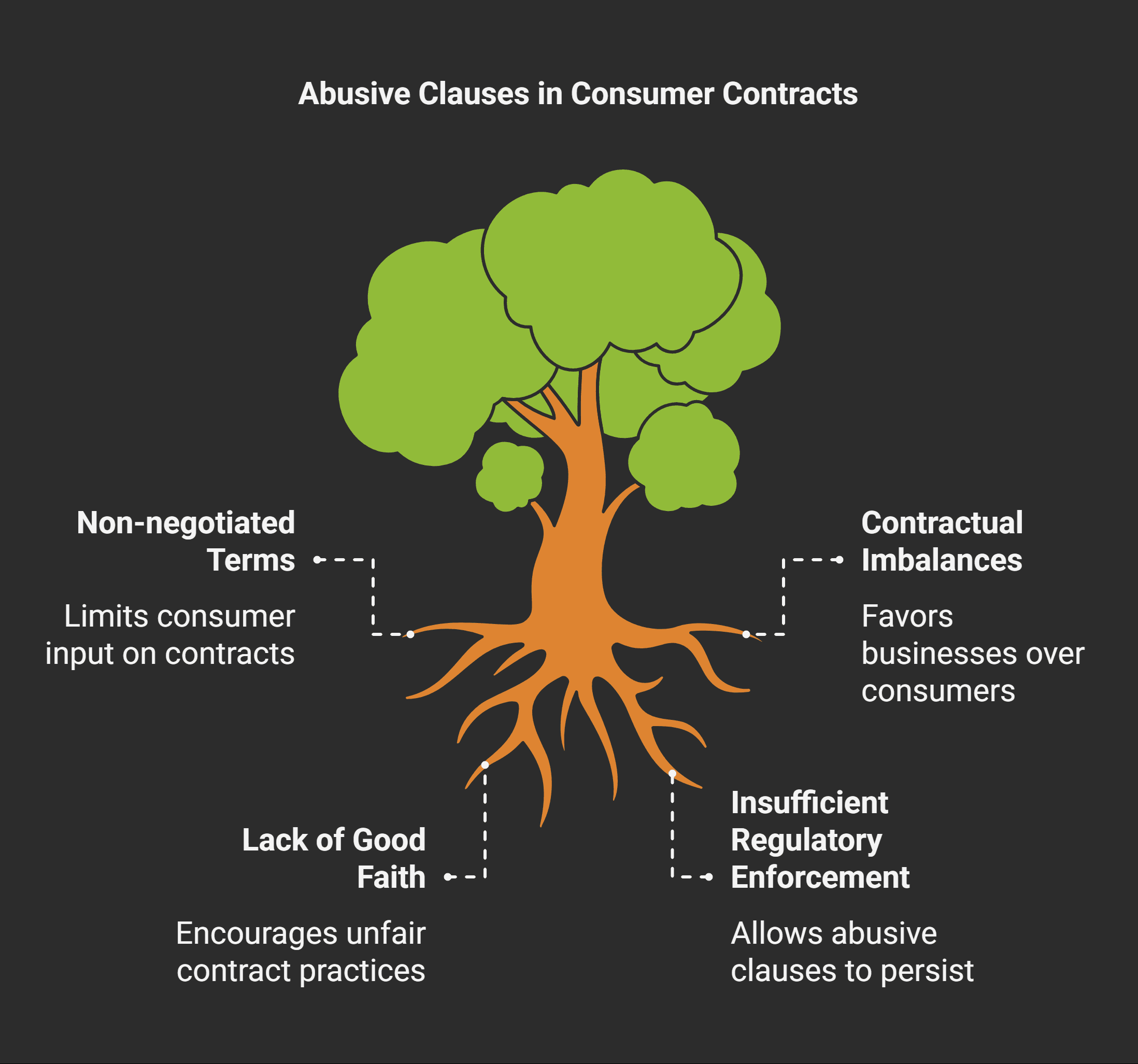
Predatory clauses in consumer contracts

  • Lack of direct negotiation with the consumer;
  • Significant imbalance in rights and obligations;
  • Violation of good faith principles.

Knowing this law helps you spot unfair terms in contracts.

If you find terms that seem unfair or one-sided, they might be abusive.

Always check agreements well and get legal help if you think there are unfair clauses.

Abusive Clauses in Romanian Consumer Contracts

Abusive Clauses in Romanian Consumer Contracts

The Romanian legal system has become tougher on abusive clauses in consumer contracts.

Recent changes aim to protect consumers from unfair practices.

The Emergency Government Ordinance no. 58/2022, which took effect on May 28, 2022, brought significant updates to regulatory enforcement.

Non-negotiated Contract Terms

Non-negotiated terms often appear in standard form contracts.

These clauses can be problematic for consumers who have little say in their content.

The Romanian legal system now requires courts to analyze potentially abusive clauses as soon as they have enough legal and factual evidence.

Significant Contractual Imbalances

Contractual imbalances that heavily favor businesses over consumers are now subject to stricter scrutiny.

Sanctions for abusive clauses range from RON 20,000 to RON 100,000.

For large-scale violations, fines can reach up to 4% of a company’s turnover in Romania.

Good Faith Requirements

Businesses must act in good faith when drafting contracts.

The new regulations address issues like dual-quality products, with fines doubling if more than 100 consumers are affected.

Courts now have the power to order the removal of abusive clauses from all current contracts.

Violation TypeFine Range (RON)Maximum Fine for Large-scale Violations
Abusive Clauses20,000 – 100,000Up to 4% of annual turnover
Dual-quality Products20,000 – 100,000Up to 4% of annual turnover
Non-fulfillment of Court Orders5,000 – 200,000N/A

These changes reflect Romania’s commitment to aligning with EU standards and protecting consumers from unfair practices.

The increased fines and stricter enforcement measures aim to deter businesses from including abusive clauses in their contracts.

Common Types of Predatory Clauses in Consumer Agreements

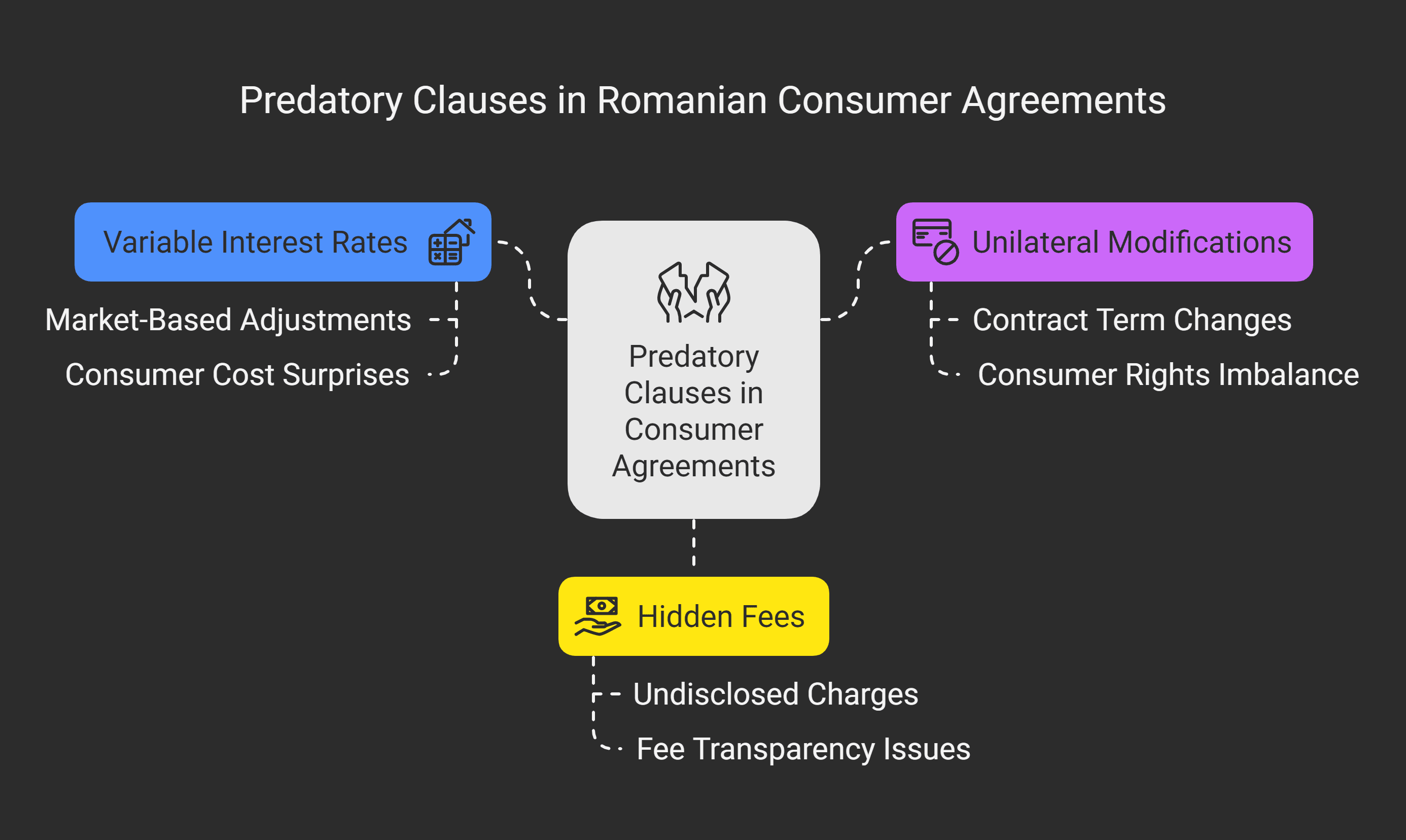
Predatory Clauses in Consumer Agreements

Many consumer contracts have clauses that are unfair.

These clauses can harm consumer rights and lead to unfair practices.

Let’s look at some common types found in Romanian consumer agreements.

Variable Interest Rate Provisions

Variable interest rate clauses let lenders change rates based on the market.

They seem fair but can surprise consumers with higher costs.

Banks might use this to their advantage, violating consumer rights and needing legal action.

Unilateral Contract Modifications

Some agreements let companies change terms without asking the consumer.

This creates a big imbalance, usually in favor of the business.

It’s important for regulators to watch out for this to protect consumer rights.

Hidden Fees and Charges

Many contracts hide extra costs in small print or hard-to-understand language.

These hidden fees can make things much more expensive.

Consumers should watch out and seek legal help if they find these tricks.

Clause TypePotential ImpactConsumer Protection Measure
Variable Interest RatesUnexpected cost increasesInterest rate caps
Unilateral ModificationsUnfavorable contract changesMandatory notification periods
Hidden FeesHigher than advertised costsClear fee disclosure requirements

The National Authority for Consumer Protection (ANPC) has been cracking down on hidden fees and changes in consumer contracts.

This includes actions in the banking sector.

Their goal is to make sure consumer rights are respected and to fix unfair contract terms in different industries.

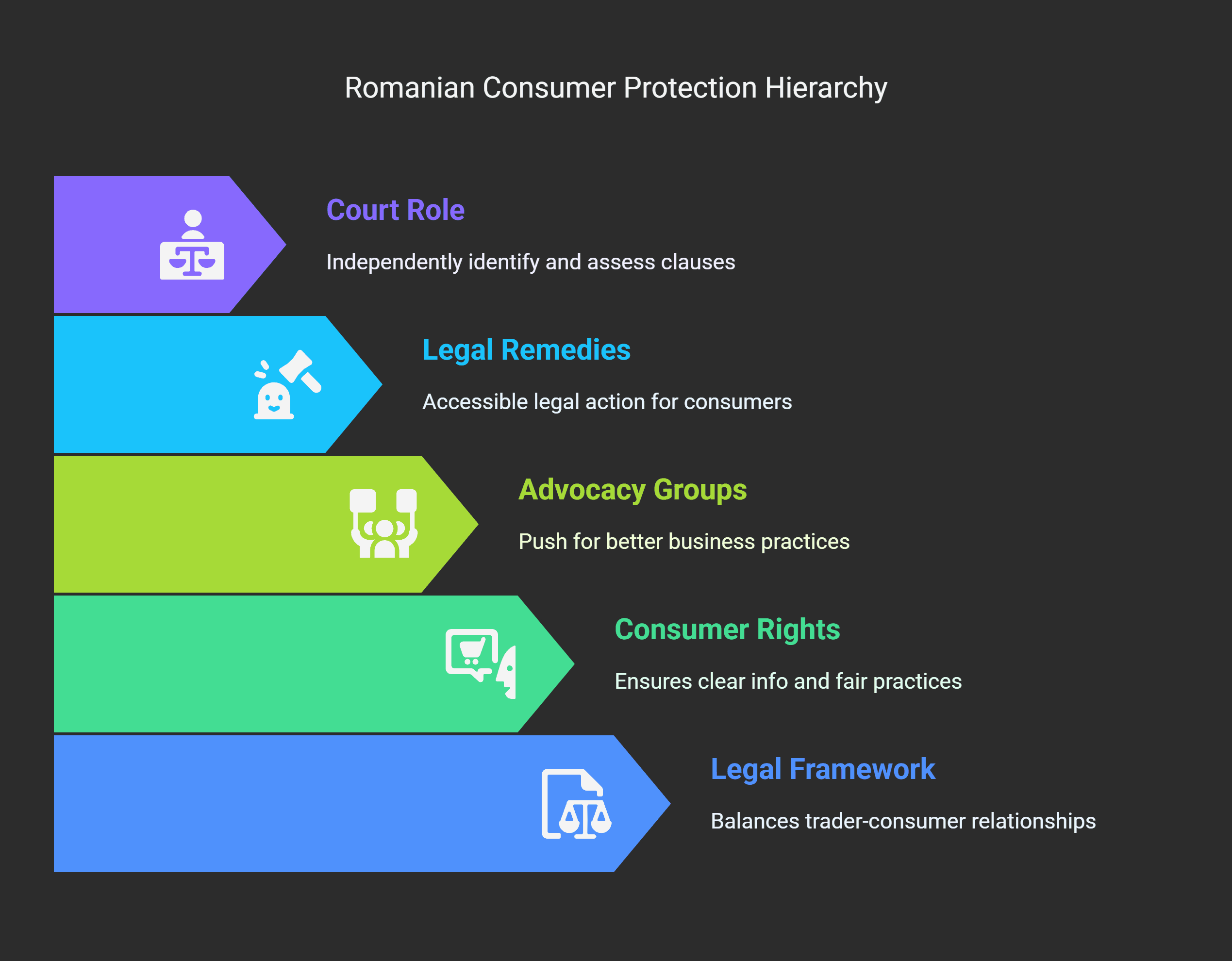
Consumer Rights and Legal Protections

Romanian consumers have strong legal protections against unfair terms and predatory practices.

The Consumer Protection Law No. 21/1992 is key to these safeguards.

It aims to balance the relationship between traders and consumers.

Consumer Rights and Legal Protections in Romania

Your rights as a consumer in Romania include:

  • Clear information about products and services;
  • Compensation for damages;
  • Safety from harmful goods;
  • Protection against unfair trading practices;
  • Shield from abusive contract clauses.

Consumer rights advocacy groups are vital in pushing for better business practices.

They offer support and guidance when dealing with unfair contract terms.

Legal remedies for consumers have been improved.

Fines for unfair terms now range from RON 20,000 to RON 100,000.

In cases affecting over 100 consumers, these fines can double.

If you face predatory practices, you can challenge them.

Consumer associations can publish final court judgments within 45 days.

This increases transparency.

You’re also exempt from court bond payments if your monthly income is below two minimum wages.

This makes legal action more accessible.

Consumer RightLegal BasisProtection Offered
Right to InformationLaw No. 21/1992Clear, comprehensible contract terms
Right to NegotiateEmergency Ordinance No. 58/2022Protection against non-negotiated terms
Right to ChallengeLaw No. 193/2000Ability to contest unfair clauses

Role of Courts in Identifying Abusive Clauses

Romanian courts are key in protecting consumers from unfair terms.

They can check if contract clauses are abusive, even if no one complains.

This power comes from EU laws and helps protect consumers.

Ex Officio Assessment Powers

Romanian courts can find and fix unfair terms in contracts on their own.

This helps keep consumers safe, even if they don’t know they’re being taken advantage of.

The courts look closely at contracts to make sure they’re fair.

Judicial Interpretation Guidelines

Romanian courts have rules to follow when checking contracts.

They look at who gets what, if the contract is clear, and how it affects consumers.

They also watch out for clauses that change things without notice and hidden fees.

Legal Precedents and Case Law

Important court decisions guide how Romanian courts deal with contracts. For example, the European Court of Justice said courts must check if terms are unfair on their own. This has made Romanian courts more careful with consumer contracts.

Key AspectCourt’s Role
Ex Officio AssessmentIndependently identify abusive clauses
Interpretation GuidelinesEvaluate balance, clarity, and economic impact
Legal PrecedentsApply ECJ rulings to national cases

Banking and Financial Contract Protections

Romania has strong laws for banking and financial contracts.

These laws protect consumers by making sure contracts are clear and fair.

The Romanian Civil Code and laws like O.U.G. no. 50/2010 and O.U.G. no. 52/2016 are key to these protections.

Foreign Currency Loan Agreements

Foreign currency loans can be risky for consumers.

The Civil Code says borrowers must pay back the full amount, no matter the currency’s value.

This can be tough when currency values change.

The case of Șerban vs. Banca Transilvania SA showed the challenges of foreign currency loans.

It highlighted the need for better consumer protection.

Credit Agreement Safeguards

Credit agreements in Romania must follow strict rules.

O.U.G. no. 50/2010 makes sure interest rates, fees, and repayment terms are fair.

For mortgage loans, O.U.G. no. 52/2016 adds extra protections based on EU rules.

Risk Disclosure Requirements

Transparency is very important in financial contracts.

Banks must tell consumers about the risks of their products.

The Financial Supervisory Authority (A.S.F.) makes sure this happens, so consumers know what they’re getting into.

LawPurposeKey Provisions
Civil CodeGeneral loan regulationNominal amount repayment, interest rules
O.U.G. no. 50/2010Consumer credit agreementsInterest rates, fees, repayment terms
O.U.G. no. 52/2016Mortgage loansResidential property credit protections

Knowing about these protections helps you make better choices when dealing with financial agreements.

Always check the contract terms and ask for help if something is unclear.

This way, you can make sure your rights are looked after under Romanian contract law.

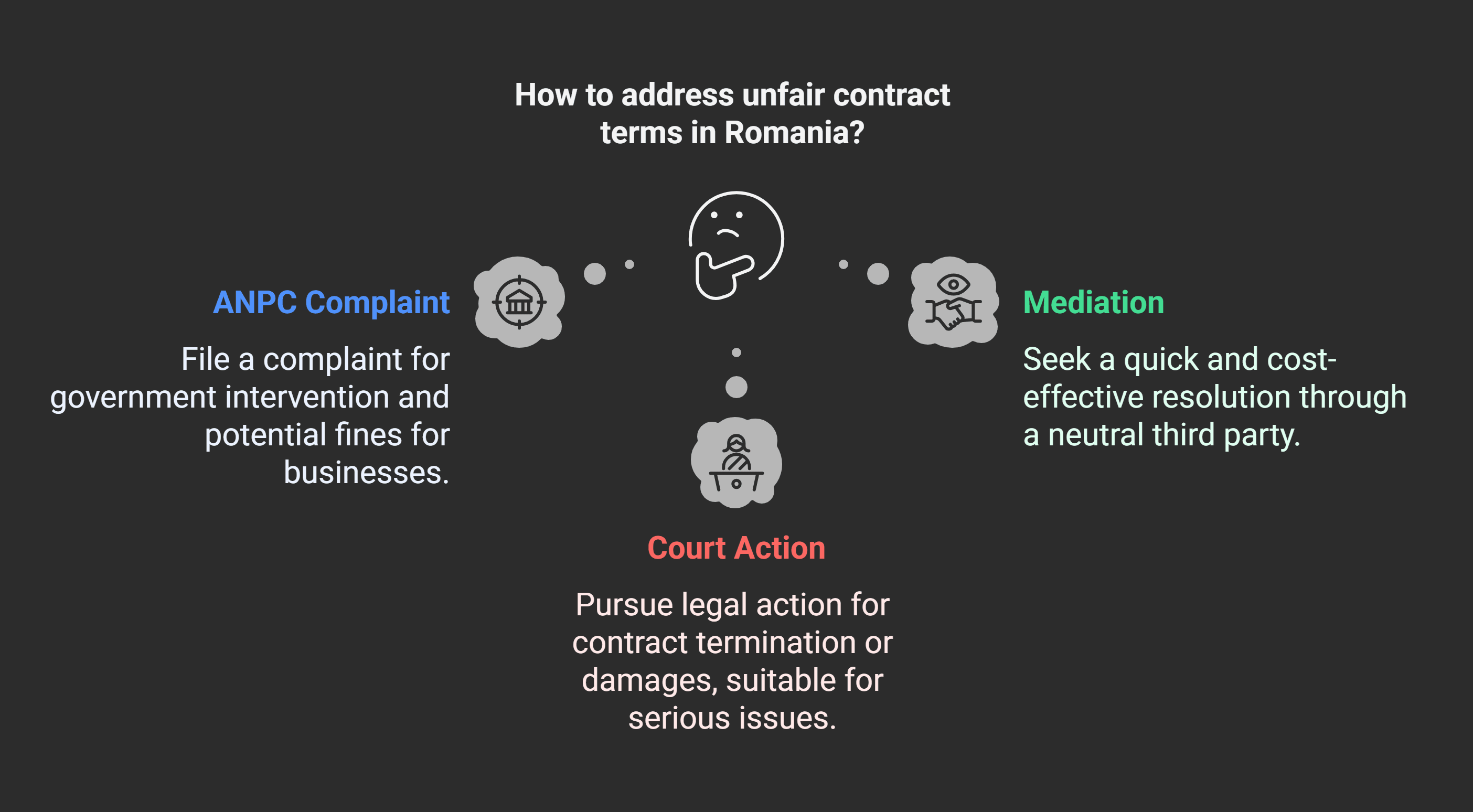
Remedies and Legal Actions Available to Consumers

Remedies and Legal Actions Available to Consumers in Romania

Romanian laws help consumers deal with unfair contract terms.

The National Authority for Consumer Protection (ANPC) is key in keeping things fair.

It protects your rights as a consumer.

If you find unfair terms, you can report it to ANPC.

They check businesses and can fine them if they break the law.

In 2022, they even fined hotels for not being clean or serving bad food.

Mediation is another way to solve problems without going to court.

It’s quicker and cheaper than legal battles.

For bigger issues, you can go to court.

Romanian law lets you ask for fixes, refunds, or to cancel the contract.

Consumer groups can also sue on your behalf.

RemedyDescriptionTimeframe
ANPC ComplaintFile a complaint with the National Authority for Consumer Protection15-30 days for initial response
MediationSeek resolution through a neutral third partyVaries, typically 1-3 months
Court ActionFile a lawsuit for contract termination or damagesCan take several months to years

Remember, EU law makes unfair contract terms invalid.

This means you keep your rights, even when faced with unfair contracts.

European Union Influence on Romanian Consumer Protection

The European Union has greatly influenced Romania’s consumer protection laws.

This has led to better protection against unfair contract terms and predatory business practices.

EU Directives Implementation

Romania has adopted key EU directives to boost consumer rights.

Law no. 193/2000, for example, makes sure consumer contracts are fair.

It aims to protect consumers from unfair business tactics.

Cross-border Consumer Protection

EU rules also protect Romanian consumers when they deal with businesses from other EU countries.

This safeguard helps prevent unfair treatment in international deals.

Harmonization with EU Standards

The Romanian legal system works closely with the European Court of Justice.

This ensures EU consumer protection laws are applied correctly.

The court’s decisions have been key in clarifying what makes a contract unfair.

EU DirectiveRomanian ImplementationKey Provisions
Directive 2011/83/EC (Consumer Rights)Government Emergency Ordinance no. 34/201414-day withdrawal period for distance contracts
Directive 93/13/EEC (Unfair Terms)Law no. 193/2000Protection against significant contractual imbalances
Directive 2005/29/EC (Unfair Commercial Practices)Law no. 363/2007Regulation of misleading and aggressive practices

These EU laws have made consumer protection in Romania stronger.

They address unfair contract terms and business practices.

The ongoing effort to align with EU standards ensures Romanian consumers get the best legal protection.

Steps to Challenge Abusive Contractual Terms

Dealing with unfair contract terms?

You have rights as a consumer in Romania.

Here’s how to fight back:

  1. Check your contract for any unfair changes, unclear language, or high fees.
  2. Collect all important documents, like emails or letters from the company.
  3. Report the issue to the National Authority for Consumer Protection (ANPC) within 15 days.
  4. If ANPC doesn’t help, you can take legal action in court.
  5. Get advice from a Romanian lawyer who specializes in consumer rights to guide you.

Remember, bank loans often have strict rules.

Watch out for high interest rates, hidden costs, and sudden payment changes.

Knowing your rights under the Romanian Civil Procedure Code is key.

When fighting foreclosure, act fast.

You must defend yourself within 15 days at the local court.

Winning can cancel the foreclosure and refund your costs.

But losing means you’ll have to pay more and court fees.

By acting quickly and getting legal advice, you can defend against unfair contracts.

This way, you make sure your consumer rights are respected.

Conclusion

As Romania gets closer to EU standards, protecting consumers gets even better.

Laws like the one on abusive clauses are being updated.

Keep an eye out, know your rights, and help make sure contracts are fair in Romania.

It’s important to know the laws in Romania about protecting consumers.

You might ask, what are abusive clauses?

These are terms that make it unfair for you and favor the trader too much.

Examples include changes made without your agreement, harsh penalties, and hidden fees.

If you think your contract has unfair terms, get legal help fast.

The Consumer Protection Law No. 21/1992 helps keep you safe from unfair practices.

Also, remember, traders can’t make you agree to terms you don’t understand.

Breaking these rules can lead to big fines.

Companies might have to pay up to 5% of their income.

The ANPC can also fine them and even close their business if they keep breaking the rules.

For expert advice, you can reach out to Atrium Romanian Lawyers.

Our team of lawyers in Romania is known for their business law expertise in Romania.

Romania’s consumer protection laws follow EU standards.

You have 15 days to ask for fixes or new products if something is wrong.

If you need help with unfair liability clauses, there are many legal resources to help protect your rights.

FAQ

What constitutes an abusive clause under Romanian law?

In Romania, an abusive clause is a term in a contract that wasn’t negotiated individually.

It creates a big imbalance in the rights and duties of the parties, hurting the consumer.

These clauses are often in standard contracts and go against the principle of good faith.

How can I identify potentially abusive clauses in my contracts?

Look for terms that limit your rights or impose harsh penalties.

Also, watch out for clauses that let one side change the contract without your consent.

If a term seems unfair or unclear, it might be abusive.

What should I do if I suspect a contract I’ve signed contains abusive clauses?

First, carefully review the contract and find the clauses you think are abusive.

Then, you can file a complaint with the National Authority for Consumer Protection (ANPC) or get legal advice.

You might also challenge the clause in court or through alternative dispute resolution.

Can I negotiate or modify standard form contracts?

Yes, you can ask for changes in standard contracts. Some businesses might agree to modify certain terms.

If they say no and you think the terms are unfair, you can get help from consumer protection agencies or lawyers.

What are the most common types of abusive clauses in Romanian consumer contracts?

Common abusive clauses include terms that let one side change the contract without your consent.

They also include harsh penalties for breaking the contract, limits on the business’s liability, and unfair dispute resolution mechanisms.

Variable interest rates and hidden fees are also often problematic.

How long do I have to challenge an abusive clause after signing a contract?

There’s no time limit in Romania to challenge abusive clauses.

It’s best to act quickly when you find out about the issue.

The time limit for contractual claims is usually three years, but it can vary based on your case.

What are the possible consequences for businesses that use abusive clauses?

Businesses using abusive clauses might face fines from the ANPC.

Courts can also declare these clauses invalid, affecting the whole contract.

Repeated offenses can lead to harsher penalties and harm the company’s reputation.

In some cases, the business might have to pay affected consumers.

How does Romanian consumer protection law compare to EU standards?

Romanian consumer protection laws are mostly in line with EU standards.

Romania has adopted key EU directives, like Directive 93/13/EEC on unfair terms in consumer contracts.

The country keeps aligning its laws with EU regulations, ensuring Romanian consumers get similar protections as those in other EU countries.

Are there any specific industries or sectors where abusive clauses are more common?

Abusive clauses are often seen in banking and financial services, telecommunications, utility contracts, and rental agreements.

These sectors use standard contracts a lot, making them more likely to include unfair terms.

Where can I find legal assistance if I need help with an abusive clause issue?

You can get help from consumer protection associations, legal aid groups, or lawyers who specialize in consumer law.

The National Authority for Consumer Protection (ANPC) also offers support.

Some universities and non-profit groups have free legal clinics for consumer rights issues.

What are abusive clauses in consumer contracts and how are they defined under Romanian law?

In Romania, abusive clauses (also known as unfair terms) in consumer contracts are defined by Law No. 193/2000 regarding unfair terms in consumer contracts.

An abusive clause is a contractual provision that has not been directly negotiated with the consumer and which, contrary to the requirement of good faith, creates a significant imbalance between the rights and obligations of the parties, to the detriment of the consumer.

The Romanian legislation is aligned with the European Union Directive 93/13/EEC. A clause is abusive when it creates this imbalance, giving the professional (seller or service provider) an unfair advantage over the consumer.

It’s important to note that abusive terms are not binding on consumers, even if they have signed the contract.

What is the comprehensive list of abusive clauses recognized under Romanian consumer law?

Romanian Law No. 193/2000 regarding consumer protection against unfair terms provides a non-exhaustive list of abusive provisions.

Some examples of abusive clauses in consumer contracts include:

1. Terms that exclude or limit the legal liability of the professional for damages caused to the consumer

2. Clauses that restrict the consumer’s right to terminate the contract

3. Terms that allow the professional to unilaterally modify the contract terms without a valid reason

4. Clauses that bind the consumer while making the professional’s obligations subject to conditions whose realization depends solely on their will

5. Terms imposing disproportionate penalties on consumers for breach of contractual obligations

6. Clauses allowing professionals to transfer the contract without the consumer’s consent when this might reduce guarantees.

Consumer protection in Romania

Consumer Protection in Romania: EU Rights Under Romanian Law

Consumer Protection Law in Romania: Key Insights and Regulations 2024

Ever wondered how your rights as a consumer are protected in Romania?

This includes both local and EU laws.

Consumer protection in Romania is linked to EU rights, aiming for a fair market for everyone.

It’s important to know your rights in the Romanian market, shaped by laws that follow EU standards.

This section will show how Romanian law uses EU consumer rights to protect you.

We’ll look at the history and growth of consumer protection in Romania.

This will highlight how it affects your rights as a consumer in the country.

Basic rights of consumers in Romania

Key Takeaways

  • Consumer protection in Romania is rooted in EU consumer rights legislation.
  • Law no. 193/2000 addresses unfair terms in consumer contracts.
  • The National Authority for Consumer Protection (ANPC) enforces consumer rights.
  • Romanian laws ensure prompt resolution of consumer complaints within a 30-day frame.
  • Specific regulations target misleading advertising practices under Law no. 158/2008.
  • Consumer protections extend to diverse sectors, including finance and agriculture.
  • Statutory guarantees are implemented through Government Emergency Ordinance no. 140/2021.

Introduction to Consumer Protection in Romania

Consumer protection in Romania is shaped by EU directives.

It focuses on consumer rights in Romania to protect consumers in different transactions.

The Consumer Protection Law No. 21/1992 is the base, adapting to market changes.

A consumer in Romania is someone buying goods or services for personal use, not for business.

They have rights, like knowing product details and getting compensation for damages.

Clear rules govern trades, making sure everything is fair and open.

Unfair terms in contracts can threaten consumer protection.

Laws fight these issues, making the market fairer.

Our team of Romanian lawyers can help consumers with legal advice on protection and rights.

Keeping strong consumer protection is key for a better life in Romania.

If consumer rights are broken, it affects people a lot.

They must report to the right authorities.

Breaking price rules can lead to big fines, showing the government’s strong support for consumer protection laws in Romania and your rights.

Directive (EU) 2019/2161 has brought big changes to consumer rights in Romania.

It makes online marketplaces more transparent.

Now, traders must show clear price details, helping consumers make better choices.

consumer rights in Romania

As more people learn about the Romanian consumer rights act, getting legal advice is more important.

Both consumers and traders should get help to understand new rules and follow consumer protection laws in Romania.

The Role of EU Law in Romanian Consumer Protection

Since 1991, EU laws have greatly impacted Romanian consumer rights.

The Romanian government has adopted many EU consumer protection laws.

This ensures that local rules match the European Union’s goals.

Now, policies aim to boost consumer rights across Europe.

EU directives have brought many benefits for consumers in Romania.

The country set up the Consumer Affairs Authority to handle complaints and enforce standards.

This body makes companies responsible for faulty products, not consumers.

With more people in Romania having money, they’re learning about their consumer rights.

Class actions were rare before, but new laws are changing that.

Law No 414/2023 introduced actions for groups, marking a big change in Romanian law.

This change matches Directive 2020/1828, which aims for a common approach to group actions in Europe.

Now, qualified groups can represent consumers in court.

This system is similar to the US class action model, allowing courts to check claims.

EU consumer protection laws in Romania

As people learn more about their rights, we’ll see more public claims.

Retailers need to be aware of this trend and think about insurance.

The new rules offer both legal steps and ways to fix problems, showing a big step forward in Romania.

Basic Rights of Consumers in Romania

Knowing your basic rights in Romania protects you when you shop.

This part talks about your right to get important info and the quality of what you buy.

Knowing these rights also makes sure companies follow the law and respect your rights.

Right to Basic Information

You have the right to clear and full info about what you buy.

This means you should get correct details on prices and how things work.

If you’re not getting the info you need, talking to a lawyer in Romania who knows about consumer rights might help.

Right to Safety and Quality

Your safety and getting quality products are top priorities.

Everything sold must be safe and up to standard.

If not, you can tell the authorities.

Following safety rules keeps you and others safe.

RightDescriptionLegal Reference
Right to Basic InformationConsumers should receive accurate and clear information about products prior to purchase.Emergency Ordinance No 93/2012
Right to SafetyAll products must adhere to safety standards to prevent harm to consumers.Law No 113/2013
Right to QualityConsumers are entitled to products that meet quality standards as advertised.Emergency Ordinance No 93/2012

Knowing your rights in Romania helps you make smart choices and keep businesses in check.

It’s all about making sure everyone follows the rules and values your rights.

This makes shopping better for everyone.

Key Consumer Protection Laws in Romania

Romania has made big changes in consumer protection to match European standards.

Consumer protection laws are key in setting consumer rights and business duties.

Laws like Government Ordinance no. 21/1992 and Law no. 363/2007 protect consumer rights.

Government Ordinance no. 21/1992 sets out consumer rights, like keeping them safe from health risks.

It requires traders to give clear information, making transactions open.

This law is a base for more improvements in Romanian consumer rights legislation.

Law no. 363/2007 fights against unfair business practices.

It stops misleading ads and sets fair trade rules.

This law makes sure trading is fair and open for everyone.

Consumer rights laws also cover product guarantees and liabilities.

The Producers’ Liability Law under Law No. 240/2004 lets consumers get compensation for product defects.

This makes producers more responsible and builds trust with consumers.

The Romanian Civil Code is also key in consumer protection laws.

It protects consumers with quality guarantees and shields them from bad contract terms.

This shows how important it is to protect consumers in today’s market.

Institutions Responsible for Consumer Protection

In Romania, consumer protection relies on key institutions.

These groups make sure laws are followed and consumer rights are respected.

Knowing about these groups is key for understanding your rights and duties as a consumer.

The main groups looking out for consumers in Romania are the Ministry of the Economy, Energy and the Business Environment and the National Authority for Consumer Protection (ANPC).

They are crucial in making and enforcing consumer protection laws.

Ministry of the Economy, Energy and the Business Environment

The Ministry of the Economy, Energy and the Business Environment is vital for consumer protection.

It helps put laws into action that protect consumers.

The Ministry works with others to make sure everything is transparent and follows the law.

It aims to support economic activities that respect consumer rights, making the market safer and fairer.

National Authority for Consumer Protection (ANPC)

The National Authority for Consumer Protection is the main agency that checks and enforces consumer protection laws.

ANPC looks into consumer complaints to make sure their rights are protected in areas like cars, electronics, and clothes.

They check if products meet safety standards and help consumers get accurate info.

Their work includes:

  • Conducting inspections and investigations in markets
  • Facilitating consumer education programs
  • Providing a platform for consumers to express complaints and seek remedies
  • Implementing safety standards for products
  • Enforcing regulations against abusive trade practices

The National Authority for Consumer Protection boosts consumer trust and market honesty in Romania.

They do this by defending consumer rights and making sure everyone follows the rules.

InstitutionRoleKey Responsibilities
Ministry of the Economy, Energy and the Business EnvironmentPolicy DriverDevelop consumer protection policies and collaborate with stakeholders
National Authority for Consumer Protection (ANPC)Regulatory AgencyMonitor compliance, handle consumer complaints, and enforce safety standards

Consumer Rights Legislation Under EU Directives

In Romania, laws protect consumers by following EU rules.

These laws cover contracts and how businesses act.

Laws like Government Emergency Ordinance no. 34/2014 and Law no. 363/2007 show Romania’s commitment to consumer rights.

Government Emergency Ordinance no. 34/2014

This law helps protect consumers in online and remote sales.

Companies must give clear information before making deals.

Consumers can cancel online purchases within 14 days without giving a reason.

Law no. 363/2007 on Unfair Business Practices

Law no. 363/2007 fights against unfair business acts.

It follows the EU’s Unfair Commercial Practices Directive.

It ensures fair marketing and bans misleading ads and unfair contract terms.

These laws make the market fair and protect consumers from being taken advantage of.

LegislationKey Provisions
Government Emergency Ordinance no. 34/2014Protection in distance contracts, 14-day cooling-off period, transparency in pre-contractual information.
Law no. 363/2007Regulation against unfair business practices, ethical marketing, prohibition of misleading advertisements.
EU Directives in RomaniaMinimum 2-year guarantee on new and second-hand goods, rights to repairs and refunds for faulty goods.

These laws make Romania follow EU rules and protect consumers better.

They let consumers shop safely, knowing they are protected from unfair acts.

The Role of Consumer Rights Organizations in Romania

Consumer rights groups in Romania are key to protecting your rights.

They work hard to make people aware of laws and places that help you.

Sadly, many Romanians don’t know about their legal protections, which can make them unhappy and less safe.

These groups teach people about their rights and push for fair markets.

They give important info and help when companies might take advantage of you.

This includes selling old or harmful products, lying in ads, and not showing prices and product details.

Let’s look at how these groups make a difference.

The table below shows where people don’t follow consumer rights rules.

It talks about faulty products, getting info, shopping access, and getting legal help.

Economic SectorLevel of Non-Compliance
New Motor VehiclesHigh
Non-Alcoholic BeveragesModerate
Household Electrical EquipmentHigh
Meat ProductsModerate
Entertainment and Leisure GoodsLow
ClothingModerate

This data shows why consumer rights groups in Romania are so important.

They help educate people, which can stop sellers from taking advantage of them.

These groups fight for better rights and make shopping better for everyone.

Consumer Rights Violations and Remedies

In Romania, consumer rights are often broken in many ways.

This affects people in different areas.

Issues like false ads, unfair contracts, and bad products are common.

Knowing about these problems helps you fight back and get your rights.

Common Consumer Rights Violations in Romania

There are several ongoing issues with consumer rights in Romania.

Some of the main problems are:

  • Misleading Advertising: Companies sometimes lie about what they’re selling or how much it costs.
  • Unfair Contract Terms: Some contracts have rules that help the company more than the consumer.
  • Defective Goods: Many people get products that are not safe or not what they were promised.

The Consumer Protection Act is here to help you.

It makes it easier to complain and get help from companies that break the rules.

This law lets you sue companies that don’t respect your rights, helping you get back what you lost.

Here’s a table that shows the main violations and what you can do about them:

Consumer Rights ViolationTypical Remedies
Misleading AdvertisingRefunds or replacements, legal action for deceptive practices
Unfair Contract TermsNegotiations for contract amendments, legal guidance, or complaints to regulatory bodies
Defective GoodsFull refunds, exchange options, or repair services

More people are filing complaints, especially about online sales.

This shows how important it is to know your rights.

By being informed, you can help make a stronger consumer culture.

This leads to better protection for you and others.

How to File Consumer Rights Complaints in Romania

Filing consumer rights complaints in Romania is easy if you know the right steps.

If you face problems with products or services, it’s key to understand how to complain.

This knowledge helps you stand up for your rights.

Steps for Filing a Complaint

Here are the steps to make sure your complaint gets looked at quickly:

  1. Gather Documentation: Collect important documents like receipts, contracts, and photos of the problem. This proof is key when you complain in Romania.
  2. Identify the Right Authority: Figure out if you should send your complaint to the ANPC or a consumer group. This depends on your specific issue.
  3. Submit Your Complaint: Write a clear complaint letter that explains the problem. Include your details, the store’s info, and your evidence. You can send your complaint to the ANPC by mail or on their website.
  4. Follow Up: After you send your complaint, make sure to check back with the authority. Keeping an eye on your complaint helps get it solved.
  5. Explore Alternative Dispute Resolution: Think about using European Consumer Centers (ECC-net) for issues with sellers from other EU countries. They can help settle disputes, making it easier to fix the problem.

Knowing these steps is crucial for dealing with consumer rights complaints in Romania.

Working with the right authorities can lead to good outcomes, protecting your consumer rights.

StepDescription
1Gather all relevant documents and evidence.
2Identify the correct authority to submit your complaint.
3Compose and submit a detailed complaint letter.
4Follow up on the status of your complaint.
5Consider alternative dispute resolution options if needed.

Consumer Education and Advocacy in Romania

Consumer education in Romania is key to empowering people to know their rights and duties.

The government and NGOs work together to teach people about their consumer rights.

They offer programs that help people understand legal protections and make smart choices.

Groups like Info Cons Romania share important info on consumer rights.

This helps people make better choices in the market.

Since 2014, the Consumer Rights Awareness Campaign has been teaching people about their rights in Romania and the EU.

These campaigns show a strong effort to improve how well people understand consumer rights.

They reach out to many groups, including schools.

Cases from the CJEU, like CJEU Case C-598/21, help solve consumer disputes.

This shows how advocacy for consumer rights works across the EU.

Countries like Slovakia and Spain are part of big legal fights over consumer rights.

This shows how complex these issues are.

People are urged to use the resources available to them.

This helps create a place where they can stand up for their rights.

YearCampaign Launch CountriesSignificant Events
2014Romania, Greece, SpainInitial consumer rights awareness campaigns initiated
2015Latvia, Czech Republic, Lithuania, Estonia, Slovakia, Hungary, SloveniaCampaign extended to additional EU Member States
2016All previously involved countriesTwo-week information campaign on Facebook for European Consumer Day

Conclusion

In this overview, we’ve looked at how Romania protects your rights as a consumer.

The National Authority for Consumer Protection (ANPC) is key in making sure you’re safe from unfair business practices.

They work hard to keep the market fair.

Groups like nine non-governmental organizations and ten media outlets help spread the word about your rights.

They teach people about consumer protection and how to stand up for themselves.

Even though there’s been progress, there’s still work to do.

Romania has laws and groups that help you solve problems and get fair treatment.

You have the right to make choices, know what you’re buying, and get help if things go wrong.

To wrap up, it’s important to see how everyone works together to protect consumers.

With more support for strong laws and teaching people about their rights, Romania can keep improving.

This will make the market fairer for everyone.

FAQ

What are the basic rights of consumers in Romania?

In Romania, consumers have rights like getting information, safe products, and the right to cancel purchases.

These rights help consumers make smart choices when buying things.

How do EU consumer rights influence Romanian laws?

EU laws on consumer protection affect Romania’s consumer rights.

Romania follows EU directives to protect consumers like those in other EU countries.

What institutions are responsible for enforcing consumer protection in Romania?

The Ministry of the Economy, Energy and the Business Environment leads in consumer protection policy.

The National Authority for Consumer Protection (ANPC) handles complaints and ensures consumer rights are respected.

How can I file a complaint regarding consumer rights violations in Romania?

Start by collecting your evidence and send it to the ANPC.

You can also try to solve the issue without going to court, giving you more ways to fix the problem.

What are some common consumer rights violations in Romania?

Often, consumers face false ads, unfair contracts, and faulty products.

They can use laws and consumer groups to fight these problems.

What consumer rights organizations operate in Romania?

Many groups in Romania work for consumer rights.

They help with complaints, spread information, and push for better laws.

These groups are key in teaching consumers about their rights.

What consumer education initiatives are available in Romania?

Romania has programs to teach people about consumer rights and duties.

These are run by the government, NGOs, and schools.

They help consumers make better choices.

Return Items Purchased Online in Romania

How to Return Items Purchased Online in Romania

How to Return Items Purchased Online in Romania

Did you know that almost 52% of online shoppers in Romania return items because they’re not up to par?

It’s key to know how to return items purchased online in Romania.

This knowledge helps protect your rights and makes shopping better.

With more people shopping online in Romania, it’s vital to understand return policies.

This guide will cover your rights under EU laws and local rules.

You’ll learn about the legal basis for returns, the cooling-off period, and how to start a return.

Get ready to handle online returns in Romania with ease!

return items purchased online in Romania

Key Takeaways

  • Understanding your rights is essential for smooth online returns.
  • Most e-commerce businesses operate as Limited Liability Companies in Romania.
  • Refunds are usually processed back to your original payment method.
  • A significant percentage of online retailers fail to inform about return rights.
  • Advanced tracking services are increasingly available for better customer satisfaction.
  • Be aware of specific exceptions for returns, especially regarding hygiene-related products.

Understanding Your Rights for Online Purchases in Romania

Online shopping in Romania comes with its own set of rules.

You have the right to a 2-year guarantee on products bought online.

This means sellers must fix, replace, or refund faulty items. Your money is safe.

If you’re not happy with your purchase, you can return it within 14 days. No need to explain why.

This is part of Romania’s online shopping laws.

Some shops might offer more than the law requires.

They could give you extra return options or longer warranties. This makes shopping online in Romania even better.

But, some products and services have exceptions.

For example, sealed items or custom-made goods might not be returnable.

Knowing these rules helps you shop online in Romania wisely.

With over 10 million people shopping online in Romania by 2023, knowing your rights is key.

This knowledge helps you shop smarter and more confidently.

EU Consumer Protection Regulations

The consumer protection EU framework sets key rules to protect online shoppers.

It gives each consumer in Romania a strong 14-day cooling-off period.

This lets you return items bought online or by phone without explaining why.

This period helps uphold your online shopping rights in the EU.

It gives you enough time to decide if you really want what you bought.

EU law also requires a two-year warranty on new goods bought from sellers.

This warranty helps if a product doesn’t meet your expectations.

You can ask for repair, replacement, or a refund.

Legislation covers different problems that can happen.

These include issues that arise in the first year, the second year, or even after two years.

Not all purchases get the same protection, though.

Some items, like plane or train tickets, custom-made goods, and opened software, are not covered.

Also, buying from private sellers, unless they sell professionally, doesn’t fall under EU rules.

If the goods don’t match what you ordered, you can still get help.

The laws also let countries add extra protections.

Knowing your rights makes shopping online more secure.

Return Items Purchased Online in Romania

Knowing your return rights in Romania is key for a good online shopping experience.

Romania has strong laws that help consumers when returning items.

Learning about these rules can save you time and avoid confusion.

Legal Basis for Returns

In Romania, the law protects you when buying online.

You can return items within a certain time, ensuring you’re happy with your purchase.

If an item is not as described or is faulty, you can get it fixed, replaced, or get a full refund.

The law in Romania guarantees goods for at least 2 years.

If a product doesn’t meet quality standards or isn’t as described, you can get it fixed or replaced. You might even get a full refund.

14-Day Cooling-Off Period

The 14-day return policy in Romania lets you return items without giving a reason.

This time starts when you get your order.

Make sure items are unworn, in their original packaging, and tags are attached for a refund.

During this time, you can return most items.

But, some special or sale items might not be returnable.

If you want to exchange an item, it will be checked before being sent back to you.

Customers must pay for return shipping, which will be taken off the refund.

Refunds usually take 1 to 7 business days after the item is returned and checked.

Knowing how to return items in Romania can make your online shopping smoother.

Rights for Online Purchases in Romania

Key Steps to Return Online Purchases

To return online purchases, follow a few key steps.

First, document your purchase.

This makes the return process easier.

Keep receipts, order confirmations, and tracking details handy.

After gathering this information, contact the seller for return instructions in Romania.

This is the next step.

Documenting Your Purchase

It’s important to document your purchase details.

Start by noting the order number, item description, and purchase date.

Saving receipts and confirmation emails is also crucial.

This documentation will help you when discussing your return with the seller.

It ensures you have all the necessary information.

Contacting the Seller for Return Instructions

With your documents ready, contact the seller for return instructions in Romania.

Good communication is vital in this step.

Ask about their return policies and any deadlines.

Some sellers might need you to fill out forms or verify your order.

Keeping in touch with the seller can make the return process smoother.

how to document purchase

Online Returns Process in Romania

The online returns process in Romania has several key steps.

Knowing how to return items online can save you time and stress.

First, you need to tell the seller you want to return the product within 10 working days after you get it.

This step is important to start the return process.

After you’ve told the seller, fill out a return form if they give you one.

You might also need to include some extra documents.

It’s important to pack your return correctly.

Remember, you have to pay for the return shipping unless the seller made a mistake.

When you’re ready to return items, you have 10 days to do it.

If you return it later, it might not be accepted.

Make sure the items are in their original packaging.

Returns that look used or lack original labels might not be accepted.

Try to send the items back within 48 hours after you’ve told the seller.

Here’s a breakdown of important aspects of the online returns process Romania:

StepDescription
Notify SellerContact the seller within 10 working days of receipt.
Complete Return FormIf applicable, fill out the return form provided by the seller.
Return ShipmentPackage the product appropriately and send it via the specified courier.
Return ConditionsEnsure products are unsealed and in original packaging to avoid rejection.
Shipping CostsAll return shipping costs must be covered by you, the customer.

By understanding how to return items online in Romania, you can make returns easy.

This way, you can enjoy shopping more, knowing returns are handled smoothly.

Understanding Return Policies in Romania

When you shop online in Romania, knowing about return policies is key.

These policies help you return items smoothly.

They outline your rights and what you need to do.

Typical Terms and Conditions

In Romania, you can cancel your purchase within 14 days of getting the item.

This time is crucial for using your cancellation rights.

The rules for returning items usually include:

  • All products must be in their original condition.
  • Return shipping costs are generally your responsibility unless the product arrived defective.
  • Refunds for change-of-mind purchases may incur deductions for loss due to unnecessary handling.

Keep packaging and other materials to keep the product in good shape.

This can affect the refund amount.

Common Exceptions to Return Policies

Not every item can be returned.

Common exceptions in Romania include:

  • Custom-made or personalized products.
  • Items that have been unsealed or opened.
  • Products not returned in their original condition or damaged for reasons unrelated to the seller.

Knowing these exceptions helps avoid problems when returning items.

return policies Romania

Return Shipping Procedures in Romania

Understanding return shipping in Romania is key for a good online shopping experience.

When you want to return an item, start by choosing a reliable shipping method.

Returning items usually involves getting a return label.

You can use your own courier to send it back to a local address in Romania.

It’s important to track your shipment.

Keep the proof of return to show the item was received by the seller, protecting your consumer rights.

Here’s a breakdown of key aspects related to return shipping in Romania:

Remember, you have 14 days to return products after receiving them.

Make sure items are in perfect condition, unworn, and with all labels attached for successful returns.

After your return is checked and verified, the refund process usually takes up to 14 working days.

Knowing these return shipping procedures will improve your online shopping in Romania.

Continuous Supply and Digital Content

In Romania, buying digital content and services comes with its own set of rules.

The process of returning or getting a refund for digital items is more complicated than for physical ones.

Consumers in Romania enjoy a 2-year guarantee for any digital content or service that doesn’t work right.

If fixing the problem is not possible, they can ask for a price cut or cancel the contract.

This rule applies to many continuous supply digital content Romania, like cloud storage, online software, and streaming services.

For online digital purchases Romania, like one-time downloads or e-books, there’s a 14-day cooling-off period. During this time, consumers can return digital content Romania and get a full refund.

This is only if they haven’t used or accessed the content.

Understanding the difference between one-time buys and ongoing services is key to consumer rights for digital products Romania.

For ongoing services, the supplier must fix any problems that come up during the contract, even after the initial buy.

If a refunds for digital purchases Romania is needed, consumers should follow the supplier’s online subscriptions and returns Romania process.

This usually means submitting a request and giving details about the purchase and the problem.

Digital Content TypeReturn/Refund EligibilityGuarantee Period
One-Time Purchases (e.g., e-books, downloads)14-day cooling-off period, full refund if unused2-year minimum guarantee on defective content
Continuous Supply Services (e.g., cloud storage, subscriptions)Refund or price reduction if supplier unable to fix defects2-year minimum guarantee on defective services

Second-Hand and Used Items

If you’re in Romania and looking to buy second-hand or used items online, you’re in luck.

Your consumer rights are protected just like with new products.

Items bought second-hand come with a minimum 2-year guarantee.

But, the seller and buyer can agree on a shorter time, at least 1 year.

But, goods bought from private people don’t have this guarantee.

So, you must check the items well and talk about the sale terms with the seller before buying.

When it comes to returning used items in Romania, the rules are similar to new products.

You can return an item within 14 days of getting it, if it’s in the same shape as when you got it.

The seller pays for the return, and you should get your money back within 14 days after the item is returned.

If you’re purchasing used products online in Romania, know the seller’s return and refund rules.

Some sites, like Flip.ro, offer extra guarantees and warranties on their second-hand items.

This gives you more protection as a buyer.

Refund Process in Romania

After returning an item, knowing the refund process in Romania is key.

Retailers usually process refunds quickly, following online refund timelines.

In Romania, refunds must be made within 14 days after the seller gets the returned item.

This rule only changes if the store has set a different time frame in their policies.

Timelines for Refunds

Expect your refund to start once the store confirms they got your returned item.

For most online buys, you should get your money back within 14 days.

But, the time it takes can vary based on how you paid.

Remember, bank times can slow down when you see the money in your account.

Addressing Delayed Refunds

If your refund is late, there are steps to take.

First, contact the store’s customer service to check on your refund.

Keeping a record of all your talks with the seller is smart.

If the problem doesn’t get fixed, you can complain to the European Consumer Centre.

This agency helps with refund problems, especially for faulty items or digital content.

Standing up for your rights is important.

Knowing the refund process helps you as a consumer in Romania.

Conclusion

Returning items bought online in Romania is easy, but knowing your rights is key.

Understanding EU laws and e-commerce return policies helps.

This way, Romanian shoppers can get a refund or a new item without trouble.

Returning a faulty item or changing your mind is straightforward.

Just follow the time limits and the right steps.

Many online stores offer a 14-day cooling-off period and a 30-day return policy.

Shopping online in Romania is safe when you know your rights. Any problems can be solved quickly.

If you encounter legal issues, consulting lawyers in Romania or seeking assistance from a Romanian Law Office can provide valuable guidance.

With some planning, returning items is a smooth part of online shopping.


FAQ

What rights do I have when returning items purchased online in Romania?

You can return any online purchase within 14 days without giving a reason.

You also have the right to a 2-year guarantee on products.

Sellers must fix, replace, or refund faulty items.

How long do I have to return an online purchase in Romania?

You have 14 days to return your purchase under EU Consumer Protection Regulations.

You don’t need to give a reason.

What steps should I take to ensure a smooth return process?

First, document your purchase with receipts and order details.

Then, contact the seller for return instructions.

Follow their process carefully.

What should I know about return shipping procedures in Romania?

Pick your shipping method wisely.

Get tracking information and proof of return shipping.

This confirms the seller received your items.

Is a return authorization necessary when returning online purchases in Romania?

Yes, many retailers need you to start a return authorization before they process your return.

It helps both parties understand the return process.

How long will it take to receive a refund after returning an item?

Refund times vary by retailer.

But, you should get your refund within 14 days after the seller processes your return.

Are there any exceptions to the general return policies?

Yes, some items like personalized goods or those opened from sealed packaging might have exceptions.

Always check the retailer’s return policy for these cases.

What should I do if my refund is delayed?

If your refund is late, contact the seller to ask about the delay.

Keep a record of your communication for future use.

What are the basic consumer rights for returning items purchased online in Romania?

As an EU consumer, Romanian law protects your right to return items purchased from online shops.

The basic rights include:

1. A 14-day cooling-off period for most products purchased online.

2. The right to withdraw from the purchase without giving a reason.

3. Full refund, including standard shipping costs.

4. Protection under the Romanian Consumer Protection Authority.

These rights apply to purchases made from online stores established in Romania or those targeting Romanian customers.

It’s important to note that these rights have been reinforced since 2021, with e-commerce in Romania experiencing accelerated growth in recent years.

 How long do I have to return an item purchased online in Romania?

In Romania, as per EU regulations, you have 14 calendar days to return most items purchased online.

This period starts from the day you receive the product.

During this time, you can withdraw from the purchase without providing any reason.

This cooling-off period is part of the guarantees and returns policy that protects online shoppers in Romania and other EU countries.

It’s worth noting that this period may be extended by some online stores as a competitive advantage, especially since 2022 when e-commerce in Romania saw significant growth.

Are there any exceptions to the 14-day return policy for online purchases in Romania?

Yes, there are several exceptions to the 14-day return policy for online purchases in Romania.

These include:

1. Perishable goods (e.g., food items)

2. Customized or personalized products

3. Sealed goods that have been opened and can’t be returned for health or hygiene reasons

4. Accommodation, transport, or leisure services booked for a specific date

Index