Two corporate professionals reviewing AI transparency controls, compliance dashboards, and synthetic content verification tools on screens in an office setting.

EU AI Act in Romania: 2026 Guide for Foreign Companies

EU AI Act compliance representation with glowing neural networks in a modern legal setting
Preparing for the EU AI Act: foreign companies operating in Romania must align their AI deployment with the new regulatory framework starting August 2026.

The compliance question is no longer whether a business “uses AI”. Most international groups do. The practical questions are which legal entity controls each use, whether the system affects people in Romania, and whether the company is a provider, deployer, importer or distributor for that system.

This guide is written for foreign companies, investors and employers with Romanian operations. It reflects legislation and official information available on 31 July 2026 and explains the rules applicable from 2 August 2026.

What Changes on 2 August 2026?

The immediate operational change is the application of Article 50 transparency duties, not the full high-risk regime for HR and other Annex III systems.

Regulation (EU) 2026/1744, the AI Omnibus, entered into force on 27 July 2026. It moved the Annex III high-risk deadline to 2 December 2027 and the deadline for high-risk AI embedded in regulated products to 2 August 2028. The European Commission’s updated AI Act timeline confirms these dates.

DateRulePractical consequence
2 February 2025Prohibited AI practices and AI literacyCompanies must stop prohibited uses and support AI literacy for personnel and other people operating AI on their behalf.
2 August 2025General-purpose AI model rules and parts of the enforcement frameworkMainly relevant to model providers; ordinary business users are usually deployers, subject to role-specific duties.
2 August 2026Article 50 transparency obligationsCertain AI interactions and AI-generated or manipulated outputs require disclosure, marking or labelling.
3 August 2026Supervision and enforcement of AI literacyThe Commission states that Article 4 supervision and enforcement rules apply from this date.
2 December 2026Limited legacy grace periodProviders of generative systems placed on the market before 2 August 2026 must meet the machine-readable marking duty from this date.
2 December 2027Annex III high-risk rulesCovers listed uses in employment, education, credit, biometrics, essential services and other areas.
2 August 2028Annex I product-related high-risk rulesCovers qualifying AI safety components or AI products under listed EU product legislation.

The original Artificial Intelligence Act remains Regulation (EU) 2024/1689, but it must now be read together with the enacted AI Omnibus.

Minimalist representation of AI transparency and regulation
Understanding the core boundaries: the AI Act imposes tiered obligations depending on the specific use case and risk level.

Does the AI Act Apply to a Foreign Company Operating in Romania?

Yes, potentially even when the provider or parent company is outside the EU. Location alone does not remove a business from scope.

The Act applies to providers that place AI systems or general-purpose AI models on the EU market, deployers established or located in the EU, importers and distributors, and certain product manufacturers. It can also apply to providers and deployers outside the EU where the system’s output is used in the Union. The Commission’s AI Act scope page sets out the territorial rules.

A foreign group should map the role of each entity rather than treat “the company” as a single actor.

Business positionTypical example in RomaniaCore question
ProviderA group develops a recruitment tool and releases it under its own name.Who controls development, intended purpose and market placement?
DeployerA Romanian subsidiary uses a third-party CV-screening or productivity tool under its authority.Who decides how the system is used and on whom?
ImporterAn EU entity first places a third-country AI system on the Union market.Who brings the system into the EU supply chain?
DistributorA reseller makes an AI system available in the EU without being the provider or importer.Does the reseller alter the system, branding or intended purpose?
Provider by reclassificationA business substantially modifies a system, changes its intended purpose or markets it under its own name.Has the business assumed provider obligations despite buying the original tool?

Contracting with a US or other non-EU vendor does not automatically transfer the Romanian deployer’s responsibilities. Conversely, white-labelling, materially modifying or repurposing a tool may move a company into the provider role.

Which AI Uses Should a Company Classify First?

Start with the intended use and its effect on people, then identify the company’s role. Product labels such as “AI-powered” or “assistant” are not a legal classification.

An operational inventory can use four screening groups, but the legal analysis should remain tied to the Act:

  • Prohibited practices: uses that must not be deployed, subject to narrow statutory exceptions.
  • High-risk systems: Annex III uses and certain AI safety components or regulated products, subject to the revised future dates.
  • Article 50 systems: interactive or generative uses and certain emotion-recognition, biometric or synthetic-content uses with transparency duties.
  • Other AI systems: systems outside those rules may still be subject to AI literacy, GDPR, consumer, employment, intellectual-property, confidentiality and sector-specific law.

This last point matters. “Minimal risk” does not mean “no compliance”. A low-impact writing assistant may still require staff guidance, data controls and human review.

Which Workplace AI Uses Are Already Prohibited?

An employer must not infer workers’ emotions through AI except where a narrow medical or safety exception applies. Other Article 5 prohibitions may also affect workplace or customer systems.

The Commission identifies prohibited practices including manipulative or exploitative AI, certain social scoring, certain biometric categorisation, untargeted facial-image scraping, individual predictive policing based solely on profiling, and emotion recognition in workplaces and education, subject to specific exceptions. The AI Omnibus also added a prohibition targeting AI that generates non-consensual sexually explicit or intimate content and child sexual abuse material. See the Commission’s prohibited-practices guidance.

For employers, the label used by a vendor is not decisive. A video-interview tool, wellness platform or workforce-monitoring service may claim to detect engagement, stress, attitude or sentiment without calling the function “emotion recognition”. Review the actual inputs, inferences and purpose.

A professional contract signing session in a modern office
Structuring vendor relationships: clear contracts and allocation of roles are essential for compliance when using third-party AI tools.

What Transparency Duties Apply from 2 August 2026?

Article 50 applies to specified uses regardless of whether the system is high-risk. The duty depends on whether the company is the provider or deployer and on the type of interaction or output.

The Commission published final Article 50 transparency guidance in July 2026.

SituationResponsible actorRequired control
AI system directly interacts with a personProviderDesign the system so the person is informed from the first interaction, unless the AI interaction is obvious under the restrictive exception.
Generative AI produces synthetic text, image, audio or videoProviderApply effective, interoperable, robust and reliable machine-readable marking, subject to statutory exceptions and technical feasibility.
Emotion recognition or biometric categorisation is used lawfullyDeployerInform exposed natural persons at first exposure and comply with applicable data-protection law.
AI generates or manipulates a deepfakeDeployerClearly disclose that the content is artificially generated or manipulated; a machine-readable mark alone is insufficient.
AI-generated text informs the public on a matter of public interestDeployerLabel the text unless it received substantive human review or editorial control and a person holds editorial responsibility.

Does a Customer-Facing Chatbot Need a Disclosure?

Usually, the system should inform a person at the start of the first interaction that they are interacting with AI, unless this is obvious to a reasonably well-informed, observant and circumspect person. The provider bears the design obligation. A business deploying a third-party chatbot should nevertheless verify that the notice is implemented in its actual interface and allocate responsibility in the contract.

Must AI-Assisted Business Content Be Labelled?

Not every AI-assisted text requires a public label. Article 50 focuses on text published to inform the public on matters of public interest. The Commission states that substantive human review or editorial control, together with editorial responsibility, can qualify for an exemption. Spell-checking, formatting or superficial approval is not enough.

For images, audio and video, a deployer must separately assess whether the output is a deepfake. Where disclosure is required, it must be clear to people at first exposure; embedded technical metadata alone does not satisfy the deployer’s obligation.

Is There a Grace Period?

The Commission confirms a narrow grace period only for providers’ machine-readable marking obligation for generative AI systems placed on the market before 2 August 2026. Those systems must comply from 2 December 2026. Content generated before 2 August 2026 need not be labelled retroactively. Other Article 50 duties do not receive a general grace period.

Legal compliance documents and checklists on a desk
Detailed documentation is key: companies must keep records of AI literacy programs and Article 50 transparency notices.

What Must Employers Know About Recruitment and Employee-Management AI?

Recruitment and worker-management AI remains a priority compliance area, but the principal Annex III high-risk duties now apply from 2 December 2027.

The AI Act’s Annex III lists systems intended to:

  • place targeted job advertisements;
  • analyse and filter applications;
  • evaluate candidates;
  • make decisions affecting work terms, promotion or termination;
  • allocate tasks based on behaviour, traits or characteristics; or
  • monitor and evaluate worker performance or behaviour.

Some listed systems may fall outside high-risk treatment if they do not create a significant risk and satisfy Article 6(3), for example because they perform a narrow procedural or preparatory task and do not materially influence a decision. Systems that profile natural persons remain high-risk. Providers relying on an exclusion must document the assessment. As of 31 July 2026, the Commission’s detailed high-risk classification guidelines were still in draft following consultation.

What Duties Arrive in December 2027?

Depending on role and use, the high-risk regime includes risk management, data governance, technical documentation, record-keeping, information for deployers, human oversight, accuracy, robustness, cybersecurity, quality management, conformity assessment, registration, post-market monitoring and incident reporting.

Deployers must follow instructions, assign competent human oversight, monitor operation, retain logs under their control, and use relevant and sufficiently representative input data where they control those inputs. Employer deployers must inform workers’ representatives and affected workers before putting a high-risk workplace system into service or use, in accordance with applicable law.

The delay should be used to obtain the documentation and contractual rights that cannot be created at the end of procurement.

What Does AI Literacy Require After the AI Omnibus?

AI literacy remains a legal obligation. The AI Omnibus removed the idea that every person must reach a prescribed “sufficient” level, but providers and deployers must still take measures that support staff and other operators in using AI appropriately.

Article 4 has applied since 2 February 2025. The Commission’s updated AI literacy questions and answers recommend a risk-based approach that considers the organisation’s role, the systems used, staff knowledge and the people affected.

There is no mandatory certificate or prescribed course. A defensible programme may include:

  • an approved-AI-tools register;
  • role-based training for management, HR, procurement, IT, marketing and ordinary users;
  • rules on personal, confidential and privileged information;
  • verification requirements for AI output;
  • escalation for high-impact decisions;
  • specific human-oversight training for high-risk systems; and
  • internal records of training and guidance.

Reading a vendor’s instructions may be insufficient, particularly where human oversight or affected persons’ rights are at stake. The Commission states that supervision and enforcement of Article 4 begins on 3 August 2026.

How Does the AI Act Interact with GDPR and Employment Law?

AI Act compliance does not replace data-protection or employment compliance. The same project can trigger several legal regimes at once.

Where an AI system processes candidate, worker, customer or other personal data, the GDPR continues to apply. The company must identify a lawful basis, provide transparent information, observe purpose limitation and data minimisation, manage processors and international transfers, protect data, and assess automated decision-making. A data protection impact assessment may be required where processing is likely to create a high risk.

The European Data Protection Board’s Opinion 28/2024 addresses anonymity, legitimate interests and the consequences of unlawfully processed training data. For a Romania-specific overview, see our guide to GDPR compliance when using AI.

Employment projects also require review of discrimination, monitoring, employee information and consultation, collective arrangements and the validity of decisions under Romanian law. A human approval click does not automatically remove automated-decision or discrimination risk if the human reviewer cannot meaningfully change the outcome.

What Should a Foreign Investor Check in AI Due Diligence?

AI due diligence should test legal role, actual use and evidence—not only whether the target has an “AI policy”.

An investor or buyer of a Romanian business should request:

  1. the AI systems inventory and owners;
  2. provider, deployer, importer and distributor role assessments;
  3. the prohibited-practices review;
  4. Article 50 notices, labels and technical marking evidence;
  5. AI literacy materials and attendance records;
  6. vendor contracts, data-processing agreements, audit rights and change notices;
  7. GDPR records, data protection impact assessments and automated-decision analysis;
  8. the roadmap for Annex III and Annex I systems;
  9. complaints, incidents, regulator correspondence and known bias issues; and
  10. insurance coverage, warranties, indemnities and remediation budgets.

Representations should be tied to disclosed systems and evidence. A generic warranty that the target “complies with all AI laws” is unlikely to identify which party must remediate a specific tool or fund a delayed conformity project.

Who Supervises the AI Act in Romania?

Romania has proposed a multi-authority model, but the final national implementing framework should be checked before any filing or regulator engagement.

In March 2026, the Romanian Government approved a memorandum proposing the National Authority for Management and Regulation in Communications (ANCOM) as market-surveillance authority and single point of contact, with sectoral roles for other bodies including the National Bank of Romania, the Financial Supervisory Authority, the national data-protection authority and the Authority for the Digitalisation of Romania.

ANCOM’s own June 2026 notice describes ANCOM as proposed for that role. The national implementing law was therefore still a point to verify as of this guide’s preparation. GDPR matters remain within the competence of the Romanian data-protection authority, while financial and product-sector regulators may have parallel powers.

What Penalties Can Apply?

The AI Act sets high maximum ceilings, but the actual measure must be effective, proportionate and dissuasive and must reflect the circumstances of the infringement.

The Article 99 penalty framework includes:

  • up to EUR 35 million or 7% of worldwide annual turnover for prohibited practices, whichever is higher for undertakings;
  • up to EUR 15 million or 3% for specified operator obligations, including Article 50 transparency duties, whichever is higher for undertakings; and
  • up to EUR 7.5 million or 1% for incorrect, incomplete or misleading information supplied to competent authorities or notified bodies, whichever is higher for undertakings.

For SMEs, including start-ups, the applicable ceiling is the lower of the fixed amount and percentage. Authorities must consider factors such as gravity, duration, harm, company size, cooperation, responsibility, mitigation and intent. These are maximum ceilings, not automatic fines.

A lawyer explaining compliance steps to a client
Developing a strategic roadmap: proactive compliance helps foreign investors mitigate risks under the new enforcement regime.

A Practical Compliance Checklist for August 2026

  1. Inventory every AI system used or supplied by the Romanian business, including embedded features in HR, CRM, finance, security, marketing and productivity tools.
  2. Map the provider, deployer, importer, distributor and product-manufacturer role for each legal entity.
  3. Screen intended and actual uses against Article 5, with specific attention to workplace emotion inference and manipulative functions.
  4. Implement Article 50 notices, labels and marking controls for systems in scope from 2 August 2026.
  5. Document the narrow legacy grace period separately; do not treat it as a general Article 50 delay.
  6. Support AI literacy with risk-based policies, role-specific guidance and internal records.
  7. Review HR tools against Annex III and create a 2 December 2027 readiness plan.
  8. Align vendor contracts on role, intended purpose, documentation, changes, audit, logs, incidents, cooperation and exit.
  9. Integrate the AI review with GDPR, employment, consumer, intellectual-property, confidentiality and sector requirements.
  10. Verify the final Romanian competent-authority and penalty implementation framework before notification or regulator contact.
  11. Assign an accountable business owner and legal escalation path for every material system.
  12. Reassess systems after material updates, new use cases or changes in provider instructions.

The Bottom Line

The 2 August 2026 milestone is narrower than many early compliance plans assumed, but it is not optional. Article 50 transparency controls must work, prohibited uses must remain excluded, and AI literacy must be demonstrable. The AI Omnibus gives companies additional time for the high-risk regime; it does not remove the need to classify HR and other Annex III systems, secure vendor evidence and build human oversight.

A targeted legal review can map the group’s roles, identify the controls required now and convert the 2027 high-risk deadline into a procurement and governance plan.

Frequently Asked Questions

Does the AI Act apply if our parent company is outside the EU?

It can. The Act covers providers placing systems or general-purpose models on the EU market, deployers located in the EU, and certain non-EU providers and deployers where AI output is used in the Union. A foreign parent and Romanian subsidiary may have different roles for the same system, so the assessment should be performed entity by entity.

Are AI recruitment tools high-risk from 2 August 2026?

Recruitment and worker-management uses remain listed in Annex III, but the enacted AI Omnibus moved the application of the relevant high-risk rules to 2 December 2027. Existing obligations under GDPR, discrimination, employment and Article 5 continue to apply, and Article 50 may apply to particular features before then.

Must employees disclose every use of ChatGPT or another writing assistant?

The AI Act does not impose a general public disclosure for every AI-assisted internal document. The employer should nevertheless control approved tools, confidential and personal data, verification and human responsibility. Article 50 labelling may apply to public-interest text without substantive human review, while AI literacy applies more broadly to professional use.

Is an AI officer mandatory in Romania?

The AI Act does not generally require every company to appoint an AI officer or AI governance board. A company should still assign accountable owners for inventory, legal classification, procurement, security, data protection and human oversight. The most suitable structure depends on the organisation’s size, systems and risk profile.

Does using a human reviewer remove AI Act and GDPR risk?

No. Human oversight must be meaningful. If the reviewer lacks information, authority, time or competence to challenge the output, the review may not address the risk. Under GDPR, a nominal human step may also be insufficient where a decision is effectively determined by automated processing.

Can we rely entirely on the AI vendor’s compliance statement?

No. A vendor statement is evidence, not a substitute for the deployer’s own assessment. The customer should verify the system’s intended purpose, instructions, data and logging controls, Article 50 implementation, prohibited features, changes, incident cooperation and the documentation needed for future high-risk obligations.

AI Deepfakes: Understanding the Legal Implications.

AI Deepfakes: Understanding the Legal Implications.

Imagine this: by 2025, almost 90% of online deepfake content will be non-consensual pornography.

This is a huge jump in AI misuse.

It has big legal problems that go beyond just privacy.

The fast growth of AI-generated media, like AI deepfakes, is a big challenge for laws.

We need to act fast to deal with these legal issues.

Legal Implications of AI Deepfakes

Legal Implications of AI Deepfakes

“AI deepfakes” means making fake media that looks and sounds like someone else, using AI.

This tech shows how smart AI can be.

But it also brings up big legal problems.

These problems touch on things like defamationrights to ideas, and privacy.

With more deepfake use, we really need to update our laws to protect everyone.

Key Takeaways

  • AI deepfakes involve replacing a person’s likeness and voice using advanced AI.
  • 90% of deepfake content online in 2023 was non-consensual pornography.
  • The rise in deepfake technology demands new legal frameworks.
  • Key legal challenges include defamation, privacy violations, and intellectual property rights.
  • There’s an urgent need for regulations to combat the misuse of AI-generated media.

Introduction to AI Deepfakes

AI deepfakes are a new technology that changes how we see and interact with media.

They use advanced artificial intelligence to make fake content.

This technology has grown fast, affecting our society in big ways.

Definition of AI Deepfakes

So, what are AI deepfakes? They are fake media that look real, like photos or videos.

They use machine learning to change someone’s image or voice.

This makes it hard to tell what’s real and what’s not, leading to trust issues and fake news.

definition of AI deepfakes

definition of AI deepfakes

Development and Evolution of Deepfake Technology

Deepfake technology has grown fast.

It started in research but now it’s everywhere.

At first, it was simple, but now it’s very realistic.

This fast growth means we need to understand its power and how it can be used wrongly.

Legal Challenges Posed by AI Deepfakes

AI deepfakes raise many legal issues because they can change and fake reality.

They touch on several legal areas, making it hard to find solutions.

New rules are needed to handle these problems.

Defamation Laws and Deepfakes

Deepfake defamation law is a big worry.

These AI-made videos and images can show people in bad situations.

This can hurt someone’s reputation and career.

The law is slow to adapt to deepfake tech.

This makes it hard to get justice for those who have been defamed.

Privacy Violations and Deepfakes

Privacy issues with AI deepfakes are serious.

They often use someone’s image or voice without asking.

This can lead to big privacy problems.

As deepfakes get better, protecting privacy gets harder.

But it’s very important to keep people’s personal info safe.

privacy issues with AI deepfakes

privacy issues with AI deepfakes

Intellectual Property Rights Issues

AI deepfakes also raise concerns about intellectual property.

They can copy or change protected works without permission.

This is a big problem for creators.

Deepfakes are easy to make and share.

This makes it hard to protect original content.

New laws are needed to keep creators’ rights safe.

Impact on the Entertainment Industry

AI deepfakes have changed the entertainment world a lot.

They affect both celebrities and people watching movies and TV.

These fake images and voices challenge stars’ rights and spread false information.

deepfake impact on Hollywood

deepfake impact on Hollywood

Cases Involving Celebrities

Many famous cases show how deepfakes are changing Hollywood.

Stars like Tom Cruise and Scarlett Johansson have seen their images used without permission.

This harms their careers and personal images.

Potential for Misinformation

Deepfakes can make fake videos that look real.

This is a big problem for spreading lies in the entertainment world.

It can confuse fans and journalists, making it hard to know what’s real.

Legal Implications of AI Deepfakes

The rise of deepfake technology has led to a need for new laws worldwide.

Countries are working hard to stop the harm caused by AI deepfakes.

This includes privacy issues and losing trust in digital media.

Regulatory Frameworks Worldwide

Many countries are making new rules to control deepfakes.

In the United States, some states have laws against using deepfakes in politics and explicit content.

The European Union is pushing for the AI Act, which sets strict rules for deepfakes.

China and Australia are also making their own rules to stop deepfakes from being misused.

deepfake regulation worldwide

deepfake regulation worldwide

Country/RegionRegulatory InitiativeFocus Areas
United StatesState LawsPolitical Campaigns, Explicit Content
European UnionAI ActGeneral AI Governance, Deepfake Guidelines
ChinaCountrywide RegulationsContent Authenticity, Media Integrity
AustraliaNational PoliciesDigital Identity, Media Usage

Proposed Legislation and Policies

Many new laws are being made to deal with deepfakes.

These laws aim to stop bad uses of deepfakes and protect people’s digital identities.

The United Kingdom’s Online Safety Bill is an example, aiming to keep harmful deepfakes off the internet.

Japan is also thinking about strong rules for AI-generated content.

These efforts show that countries worldwide agree on the need for action against deepfakes.

Creating strong laws and standards is key to fighting deepfakes.

It helps protect people and ensure justice for those affected.

Ethical Guidelines Surrounding Deepfake Technology

Deepfake technology is advancing fast, raising many ethical concerns.

One big issue is consent.

People often find their images used without their okay, which raises questions about their rights.

Deepfakes can also cause harm, like blackmail and spreading false information, affecting many.

Another concern is the trustworthiness of digital media.

Deepfakes make it hard to know what’s real and what’s not.

This can hurt public trust, democracy, and how we share information.

To tackle these problems, we need clear rules for using AI deepfakes.

These rules should cover getting consent, checking media facts, and holding people accountable for misuse.

By setting global standards, we can manage the ethics of deepfake tech and reduce its harm.

Ethical ConcernsConsiderationsGuidelines for AI Deepfake Use
ConsentEnsure individuals have given explicit permissionImplement stringent consent protocols
Potential for HarmAddress the risks of blackmail, defamation, and misinformationEstablish accountability for misuse
AuthenticityMaintain the integrity of media contentValidate media integrity rigorously
Public TrustPreserve trust in digital informationSet global ethical standards

AI Deepfakes in the Legal Field

AI technology is growing fast, and deepfakes are becoming a big worry in law.

These fake videos and sounds can look very real.

They can make people question the truth of important evidence in court.

This makes legal systems rethink how they check and trust evidence.

It’s a big change needed because of deepfakes.

Impact on Legal Proceedings

Deepfakes in court are a big problem for lawyers.

They can be used to trick people or change what witnesses say.

This makes the legal process harder.

Prosecutors and defense lawyers need to learn more about spotting and checking deepfakes.

Knowing about deepfakes helps keep trials fair.

Use of Deepfakes as Evidence

Using deepfakes as evidence in court is very tricky.

They can look so real that they might fool anyone.

This could ruin fair trials.

Courts need to find ways to check this evidence well.

They need new tools to spot fake content.

Keeping up with tech is key to keeping justice fair.

Protecting Intellectual Property and Publicity Rights

Deepfake technology has become a big worry for protecting rights.

It’s mainly because people’s images and creative work are being used without permission.

This has led to more cases of intellectual property infringement.

High-profile lawsuits have shown how urgent it is to have strong laws.

These laws need to protect people from misuse of their images and work.

Case Studies and Legal Precedents

Celebrities like Scarlett Johansson have faced issues with their images being used without consent.

These cases are important because they show the need for new laws.

They help us understand how courts are trying to protect people’s rights.

Future Legal Trends

Experts think we’ll see better laws to fight deepfake threats in the future.

Lawmakers are working on new rules to handle digital manipulation and unauthorized content.

By looking at current cases, we can see how laws are changing.

It’s important to create strong laws fast because deepfake tech is getting better quickly.

We need to keep working on protecting rights against deepfakes.

New laws will aim to keep up with tech while protecting our rights online.

CaseInvolvementOutcome
Scarlett JohanssonUnauthorized deepfake videosRaised awareness, push for new laws
Tom CruiseDeepfake impersonationIncreased scrutiny on privacy laws
Keanu ReevesMisappropriated likenessLegal action and advocacy for rights

Combating Deepfake Technology

Fighting deepfake technology needs a mix of new tech and strict laws.

We must use advanced tools and strict legal rules to tackle fighting deepfakes.

This is key to stopping the misuse of deepfake tech.

Technological Solutions

New tech is leading the fight against deepfakes.

Tools like deepfake detection algorithms and blockchain help verify digital content.

AI models also help tell real from fake media.

These tools keep getting better, thanks to ongoing updates.

Big tech companies like Google and Microsoft, along with places like MIT, are key players in this fight.

Legal Measures and Enforcement

From a legal standpoint, we need to enforce laws better and create new ones to keep up with deepfake tech.

This is a job for both national and international efforts.

The U.S.EU, and other places are working together to fight deepfakes.

Legal steps include harsh penalties for those who misuse deepfakes.

We also need ways to quickly check if content is real or fake.

And we need laws that can change as tech evolves.

AspectTechnological SolutionsLegal Measures
ToolsDeepfake detection algorithms, Blockchain, AI modelsEnforcement of existing laws, New legislation
Key PlayersGoogle, Microsoft, MITU.S. authorities, EU, International organizations
ApproachProactive, continuous updatesReactive and preventative, international cooperation

Conclusion

AI deepfakes pose big challenges that need a strong and changing legal response.

As this tech grows, so must our laws to fight deepfake risks.

Deepfakes touch many legal areas, like defamation and privacy, making strong rules key.

The future of AI deepfakes in law depends on how well laws can keep up.

Governments need to make clear, forward-looking laws.

This way, deepfakes won’t harm our rights or trust in society.

With the right laws and ethics, we can keep up with tech while protecting our rights.

To tackle deepfake issues, we need both tech and law to work together.

We must keep improving detection tech and have strict laws and enforcement.

Working together, we can protect our digital world and keep laws up to date with tech.

FAQ

What are AI deepfakes?

AI deepfakes are synthetic media that replace a person’s likeness and voice with someone else’s. 
This is done using artificial intelligence and machine learning. 
They are created by superimposing images and videos onto source content with a technique called generative adversarial networks (GANs).

How has deepfake technology evolved?

Deepfake technology has grown from a new idea to a sophisticated tool.
 It can now create very realistic and hard-to-spot media. 
This growth is thanks to advances in machine learning and artificial intelligence, making deepfakes more convincing.

What legal challenges do deepfakes pose?

Deepfakes raise legal issues like defamation, privacy violations, and intellectual property rights. 
They can impersonate people, leading to defamation and damage to reputation. 
Privacy is also at risk from unauthorized use of someone’s likeness. 
Intellectual property rights can be violated too.

How have deepfakes impacted the entertainment industry?

Deepfakes have had a big impact on the entertainment world. 
Unauthorized AI-generated videos and images of celebrities are common. 
These deepfakes can infringe on publicity and image rights, spreading misinformation and causing confusion.

What regulatory frameworks are in place to address deepfake challenges?

Laws to tackle deepfake challenges are being developed worldwide. 
New laws aim to stop malicious use of deepfakes and protect digital identity. 
It’s important to have strong international standards and national policies to fight this issue.

What are the ethical guidelines surrounding deepfake technology?

Ethical guidelines for deepfakes include consent, harm, authenticity, and trust.
 It’s key to set global ethical standards for deepfakes to navigate their moral implications.

How do deepfakes impact the legal field, particular concerning legal proceedings?

Deepfakes pose challenges for the legal field by potentially creating fake evidence. 
This can complicate legal cases and lead to unfair outcomes. 
Courts need to adapt to these new challenges to keep legal processes fair.

How are intellectual property and publicity rights protected against deepfakes?

Protecting against deepfakes involves legal steps to stop unauthorized use of likenesses and creative works. 
Legal cases have shown the need for updated laws to handle deepfakes.

What technological solutions exist to combat deepfakes?

To fight deepfakes, advanced technologies like detection tools and authentication methods are being developed. 
These are key for identifying and stopping harmful deepfake content.

What legal measures can be enforced to combat the misuse of deepfakes?

To fight deepfake misuse, existing laws need to be enforced, and new ones created. 
International cooperation is also vital to address and mitigate deepfake challenges.

What is a deepfake?

A deepfake is a type of synthetic media where a person’s likeness is digitally manipulated using artificial intelligence and deep learning technologies.

The term “deepfake” combines “deep learning” and “fake,” highlighting how these convincing forgeries are created using sophisticated AI algorithms, particularly generative adversarial networks.

Deepfake technology can swap faces in videos, manipulate speech, or create entirely fabricated scenarios that appear authentic.

Since their emergence, deepfakes have evolved from crude manipulations to remarkably realistic fake content that can be difficult to distinguish from genuine online content, raising significant legal and ethical implications for society.

How do deepfakes work?

Deepfakes function through advanced AI technologies known as generative adversarial networks (GANs).

This deepfake technology involves two competing neural networks: one that creates the fake images or videos, and another that tries to detect the forgery.

Through this competitive process, the system continuously improves at creating more convincing fakes.

The technology requires substantial training data—typically numerous images or video frames of the target person—to learn facial expressions, movements, and speech patterns.

Modern deepfake systems powered by artificial intelligence and deep learning can now generate highly convincing deepfake videos with minimal source material, making the distribution of deepfakes increasingly accessible to those using AI without specialized technical expertise.

What are the main legal issues surrounding deepfakes?

The legal issues surrounding deepfakes are complex and evolving.

Current legal challenges include addressing defamation when someone’s likeness is used without consent, particularly in sexually explicit deepfakes.

Privacy laws are often challenged as deepfakes frequently involve the unauthorized use of personal data.

Intellectual property concerns arise with the manipulation of copyrighted images or likenesses.

GDPR Compliance for AI-Powered Tools

GDPR Compliance for AI-Powered Tools

As Romanian businesses use more AI, knowing how to follow GDPR for AI tools is key.

Did you know AI can make compliance work 50 times faster than old methods?

This shows how AI can change the game in data privacy rules.

The General Data Protection Regulation (GDPR) changed how we handle personal data in 2018.

AI’s fast growth brings new chances for growth, but also new challenges in following GDPR and AI rules.

In Romania, getting good at GDPR for AI tools is more than just avoiding trouble.

It’s about winning customer trust and using privacy-friendly AI to stay ahead.

Let’s see how you can handle these rules and use AI’s power.

GDPR Compliance for AI-Powered Tools

Key Takeaways

  • AI can speed up compliance efforts by 50 times compared to manual methods;
  • GDPR outlines 6 legal grounds for processing personal data;
  • AI systems require large volumes of data, necessitating careful dataset compilation;
  • Data retention periods must be proportional and not indefinite;
  • Continuous learning AI systems raise questions about data protection;
  • Transparency in AI processing is key for GDPR compliance;
  • Organizations can save time by using AI for regulatory research and compliance mapping.

Understanding GDPR and Its Impact on AI Technologies

The General Data Protection Regulation (GDPR) sets strict guidelines for data handling in the European Union.

It was enacted on May 25, 2018.

It shapes how organizations collect, store, and process personal information.

This framework has significant implications for AI technologies, which often rely on vast amounts of data.

Definition and Scope of GDPR

GDPR aims to protect individual privacy rights and ensure responsible data practices.

It applies to any organization processing EU residents’ personal data, regardless of the company’s location.

The regulation grants individuals rights such as data access, erasure, and informed consent.

AI Processing Under GDPR Framework

AI systems face unique challenges under GDPR.

The regulation’s emphasis on data minimization conflicts with AI’s need for large datasets.

About 70% of AI projects struggle to comply with this principle.

GDPR also requires transparency in automated decision-making, impacting AI applications in finance, healthcare, and hiring.

AI governance framework

Key GDPR Principles Affecting AI Systems

Several GDPR principles directly influence AI development and deployment:

  • Data minimization and purpose limitation;
  • Transparency and accountability;
  • Secure data processing;
  • Algorithmic bias mitigation.

Organizations must implement robust AI governance frameworks to ensure compliance.

This includes adopting data anonymization techniques and prioritizing ai transparency and accountability.

By focusing on these areas, businesses can navigate the complex landscape of GDPR and AI integration effectively.

GDPR PrincipleImpact on AICompliance Strategy
Data MinimizationLimits dataset sizeImplement data anonymization techniques
TransparencyRequires explainable AIDevelop ai transparency measures
ConsentAffects data collectionDesign clear consent mechanisms
SecurityMandates data protectionEmploy secure data processing methods

GDPR Compliance for AI-Powered Tools

AI tools must follow GDPR when handling EU citizen data or working in the EU.

Not following this can lead to big fines, up to €10 million or 2% of annual income.

Businesses in Romania need to grasp the details of GDPR for their AI systems.

Starting with data minimization is key to responsible AI. GDPR says only use data needed for specific tasks.

AI systems should use methods like anonymization and pseudonymization to keep data safe while gaining insights.

Algorithmic fairness is critical in AI decision-making.

AI systems must let people see their data, understand how decisions were made, and have the right to be forgotten.

This openness is essential for trust and meeting GDPR standards.

GDPR compliance for AI-powered tools

Data protection impact assessments are needed for risky AI activities.

These assessments help spot and fix privacy risks.

Companies must do regular checks and use strong security to avoid data leaks.

GDPR RequirementAI Implementation
Explicit ConsentClear, specific consent for AI data processing
Data MinimizationUse only necessary data for AI models
TransparencyExplainable AI decision-making processes
Right to ErasureAbility to remove personal data from AI systems

To uphold artificial intelligence ethics, companies must train staff on privacy, bias, and ethics.

Using access controls and a privacy-first design are key to integrating data protection into AI tools.

Data Privacy Requirements for AI Systems

AI systems must follow strict data privacy rules under GDPR.

These rules protect personal info and let AI tech grow.

It’s key for Romanian businesses using AI tools to know these rules.

AI Data Privacy Compliance

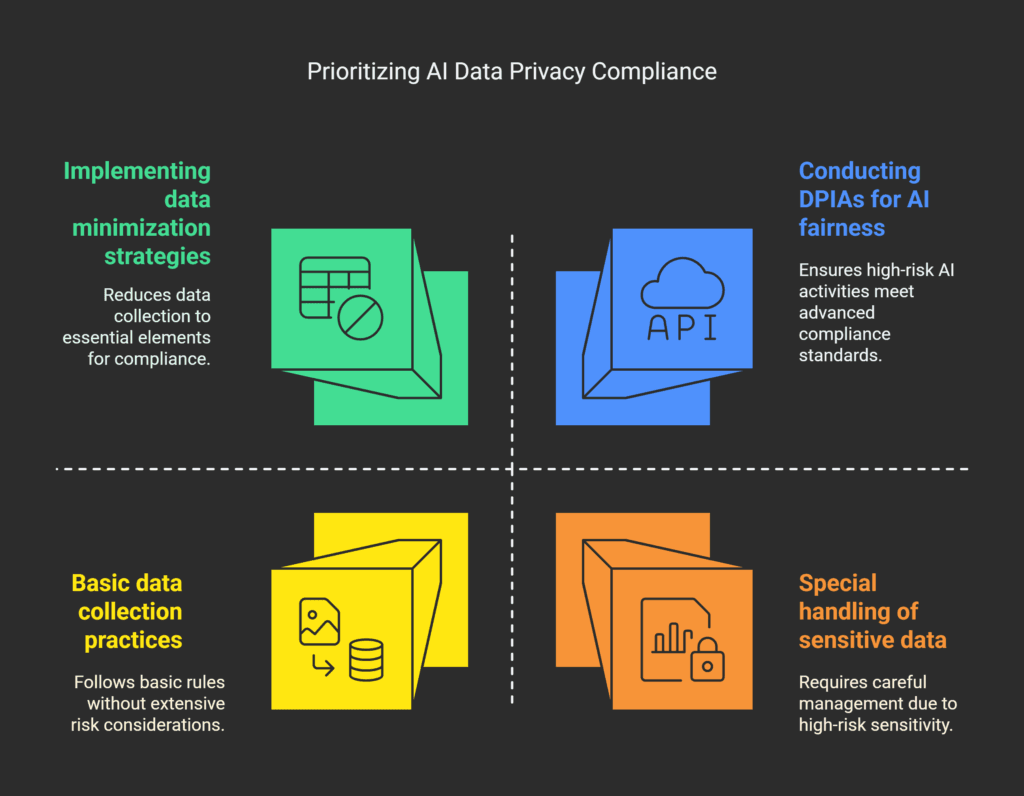
Data Minimization and Purpose Limitation

GDPR says organizations should only collect data needed for specific tasks.

This rule, data minimization, is key for AI systems that need lots of data.

You must figure out the least amount of personal data your AI tools need.

Purpose limitation means data can only be used for its original purpose.

Your AI rules should make sure data isn’t misused.

This makes AI more trustworthy and ethical.

Special Categories of Personal Data

AI systems handling sensitive data, like health info or biometrics, need extra care.

You must have strong security and get clear consent for these data types.

Data Protection Impact Assessments (DPIAs)

DPIAs are needed for high-risk AI activities.

They help spot and fix data protection risks.

Your DPIA should check on AI fairness and GDPR compliance.

Doing DPIAs shows you’re serious about safe AI use.

It protects people’s rights and makes sure your AI meets legal and ethical standards.

AI Transparency and Accountability Measures

AI Transparency and Accountability Measures

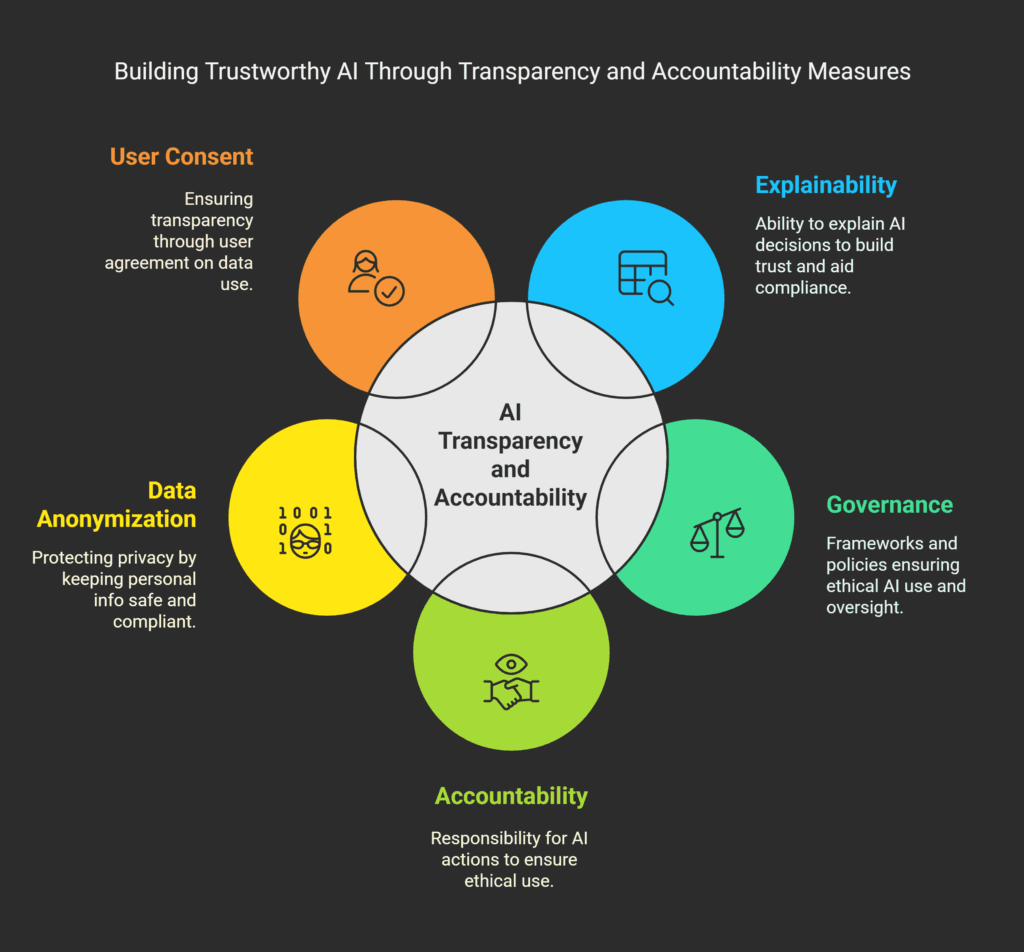
AI transparency is key to trustworthy AI systems.

It includes explainability, governance, and accountability.

As AI models grow more complex, keeping things transparent gets harder.

Data anonymization is vital for privacy in AI.

It keeps personal info safe while AI works well.

This helps Romanian businesses meet GDPR rules.

User consent is essential for AI transparency.

Companies must tell users how data is used and get their okay.

This builds trust and follows data protection laws.

Companies can use many tools for AI transparency:

  • Explainability tools;
  • Fairness toolkits;
  • Auditing frameworks;
  • Data provenance tools.

These tools help with different parts of AI transparency.

They help businesses make AI systems more accountable.

Transparency RequirementDescriptionImportance
ExplainabilityAbility to explain AI decisionsBuilds trust, aids compliance
InterpretabilityUnderstanding how AI worksEnhances user confidence
AccountabilityResponsibility for AI actionsEnsures ethical use of AI

By using these steps, Romanian businesses can make trustworthy AI.

They will follow GDPR and keep user trust and privacy safe.

Automated Decision-Making and Profiling Rights

AI tools have made automated decision-making and profiling big issues in data protection.

GDPR has strict rules for these, focusing on ethics and clear AI systems.

Automated Decision-Making and Profiling Rights

Individual Rights Under GDPR

GDPR gives you rights over automated processing of your data.

You can ask to see your data, stop its use, or fix or delete it.

AI must protect these rights, mainly with sensitive info.

Automated Processing Restrictions

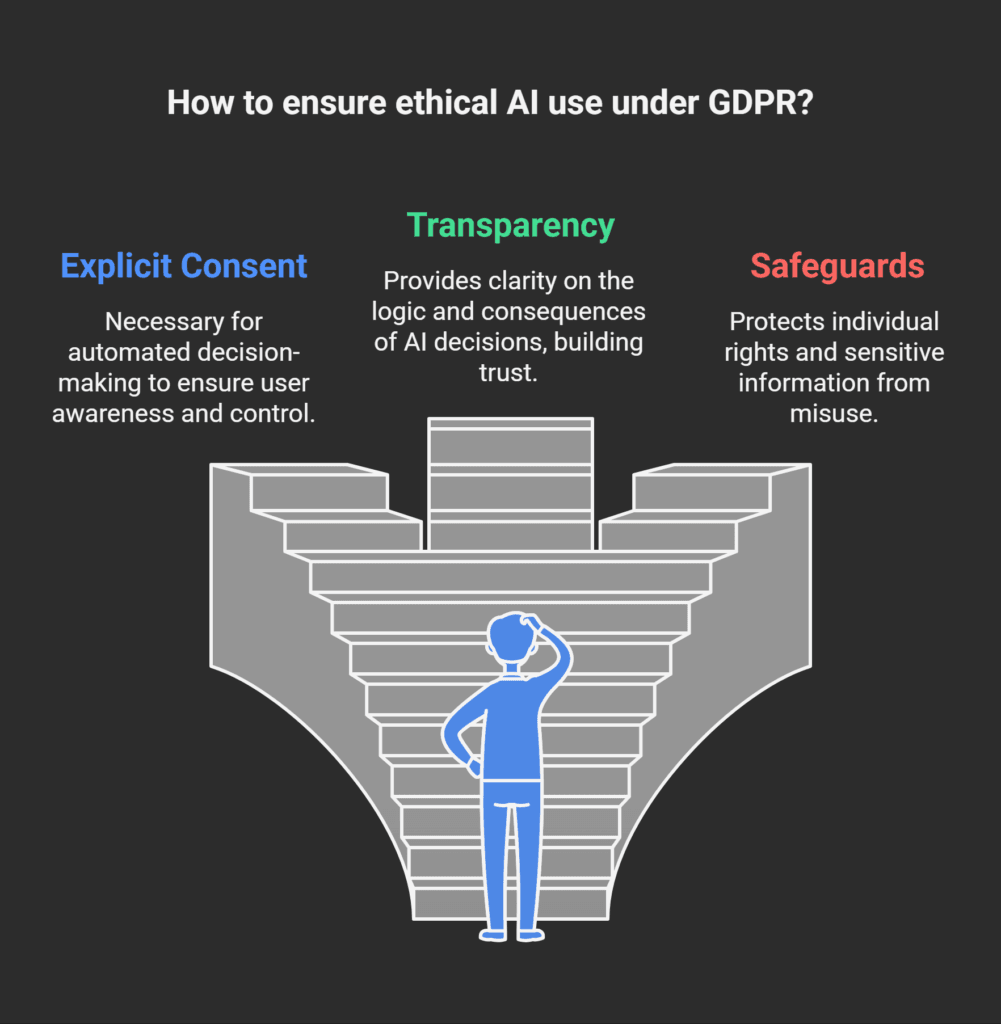
Companies need your clear consent for automated decisions on personal data.

They must tell you the reasons and possible outcomes.

This makes AI trustworthy and keeps data protection key.

RequirementDescription
Explicit ConsentMandatory for automated decision-making
TransparencyInform about logic and consequences
SafeguardsImplement measures to protect rights
DPIAsRegular assessments to mitigate risks

Right to Human Intervention

GDPR gives you the right to human review in automated decisions.

This means AI can’t decide everything important in your life.

Companies must let you share your views and challenge automated decisions.

Following these rules, Romanian businesses can use AI responsibly.

They keep ethics and protect individual rights.

The aim is to make AI that’s efficient yet respects human values and privacy.

Data Security and Risk Management for AI Tools

AI tools introduce new security and risk challenges.

In Romania, companies must focus on secure data handling and managing AI risks to follow GDPR.

They need to use strong technical and organizational controls.

Data Privacy Requirements for AI Systems

Technical Security Measures

Companies should use encryption, access controls, and security tests.

These steps protect AI system data from unauthorized access and breaches.

Organizational Security Controls

Good data governance is key.

This means having clear policies, procedures, and training for employees.

A solid framework helps keep compliance and lowers AI risks.

Breach Notification Requirements

GDPR requires quick breach reports. Companies must have systems for fast detection and notification.

This is very important for AI systems that handle lots of personal data.

Risk Management AspectImportance
AI Accountability75% of CROs see AI as a reputational risk
Consent Management70% of consumers concerned about data use
Data Governance2.5x more likely to achieve compliance

By focusing on these areas, Romanian businesses can improve their GDPR compliance for AI tools.

Proper risk management not only avoids fines but also builds customer trust and protects your reputation.

Privacy by Design in AI Development

Privacy by Design is key in AI under GDPR.

It means building data protection into AI systems from the start.

This way, you protect data rights while using AI.

To start Privacy by Design, do data protection impact assessments.

These help spot and fix risks early. 92% of companies see the need for new risk handling with AI.

AI governance frameworks are vital for Privacy by Design.

They guide AI development and use, ensuring GDPR rules are followed.

They help with the 69% of companies facing legal issues with AI.

Algorithmic transparency is also important.

It makes AI decisions clear and fair. This builds trust and stops AI bias.

AI bias mitigation strategies are key too.

They make sure AI is fair and unbiased.

Regular checks and reviews can find and fix biases.

By using these steps, you can make AI systems that respect privacy.

This not only follows GDPR but also builds trust in your AI tools.

Cross-Border Data Transfers for AI Processing

AI tools often use data from different countries.

This creates legal challenges under GDPR.

Romanian businesses using AI must follow strict rules for moving data across borders.

Cross-Border Data Transfers for AI Processing

International Data Transfer Mechanisms

GDPR restricts data transfers outside the EU to protect privacy.

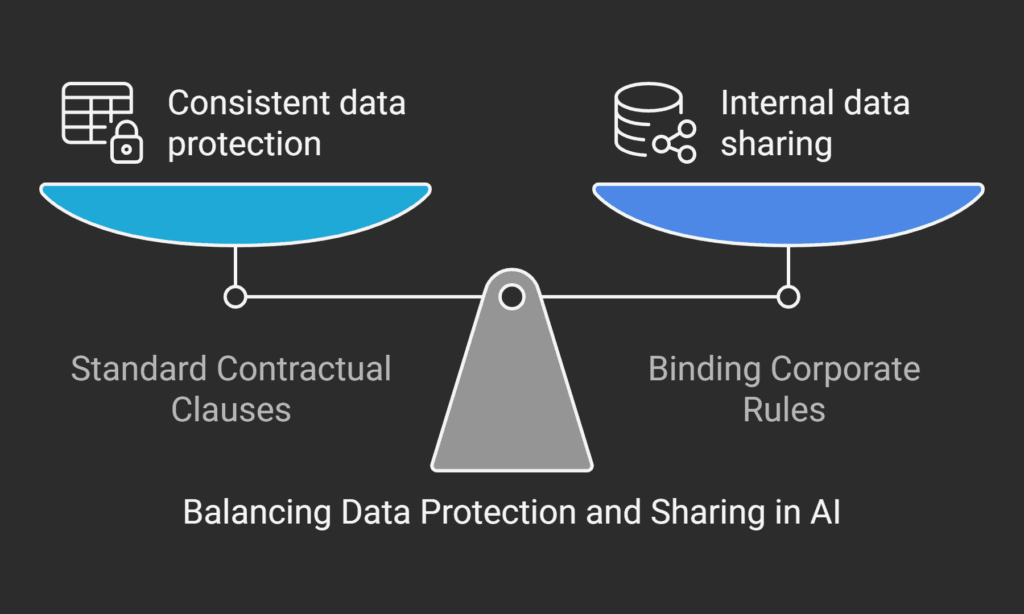
Companies can use approved methods like Standard Contractual Clauses (SCCs) or Binding Corporate Rules (BCRs).

These ensure data stays safe during transfers.

Proper use of these tools is key for ethical AI governance.

Standard Contractual Clauses

SCCs are pre-approved contracts that set rules for data transfers.

They’re a popular choice for Romanian firms working with non-EU partners.

SCCs spell out data protection duties and rights.

This helps maintain AI accountability measures across borders.

Adequacy Decisions

Some countries meet EU privacy standards through adequacy decisions.

This allows easier data flows.

For AI projects, working with adequate countries can simplify compliance.

It supports AI transparency and explainability by ensuring consistent rules.

Cross-border transfers pose unique challenges for AI systems.

Data anonymization and privacy-preserving machine learning techniques are vital.

They help protect personal data while allowing AI to learn from global datasets.

Romanian companies must balance innovation with strict GDPR compliance in their AI strategies.

Transfer MechanismKey FeatureBenefit for AI Processing
Standard Contractual ClausesPre-approved legal agreementsEnsures consistent data protection across borders
Binding Corporate RulesInternal company policiesFacilitates data sharing within multinational AI companies
Adequacy DecisionsEU-approved countriesSimplifies data transfers for AI training and deployment

Documentation and Record-Keeping Requirements

GDPR compliance for AI tools requires detailed records.

You need to document data processing, impact assessments, and security steps.

This helps show you’re following the rules and improves data handling.

To manage AI risks well, keep detailed logs of AI system use.

Record data flows, why you’re processing it, and how long you keep it.

Also, track user consent and data access requests.

These steps are key for following privacy and AI rules.

Explainable AI is very important.

You must document how AI makes decisions to be clear.

This should include how you avoid bias, showing you use AI fairly and ethically.

  • Data Protection Impact Assessments: Update before major changes;
  • Processing Activities Records: Monitor continuously;
  • Security Measure Documentation: Outline quarterly;
  • User Consent Records: Update in real-time.

Not following GDPR can lead to big fines, up to €20 million or 4% of your yearly sales.

Good documentation helps avoid these fines and makes your work smoother.

In fact, 31% of companies say they work better after keeping good records.

Conclusion

GDPR compliance is key for Romanian businesses using AI.

Ethical AI principles are the base for responsible AI.

They make sure AI respects privacy while pushing innovation.

Regular checks on AI models and privacy risk assessments are vital.

They help spot weaknesses and keep AI in line with data protection rules.

Also, clear machine learning models build trust and show a commitment to ethical AI.

Data protection by design is a big part of GDPR for AI tools.

Adding privacy safeguards early on helps avoid risks and boosts competitiveness.

The AI-enabled e-commerce market is expected to grow to $16.8 billion by 2030.

This shows how important GDPR-compliant AI is.

GDPR Compliance ElementAI Implementation
Data MinimizationAI algorithms identify essential data
TransparencyAI-generated plain language notices
Consent ManagementAI-powered platforms automate processes
Risk AssessmentAI conducts efficient DPIAs

By following these GDPR-compliant AI practices, Romanian businesses can innovate while protecting individual rights in the digital world.

Contact: office@theromanianlawyers.com

FAQ

Understanding GDPR for AI tools in Romania can be tough.

This FAQ tackles main worries about ai explainability and data protection.

We’ll look at how to make AI decisions clear while following responsible ai rules.

AI audits and monitoring are key for GDPR. Regular checks help ensure AI uses only needed data.

This follows the data minimization rule. Also, GDPR says no decisions can be made just by AI that affect people.

So, add human checks and explain AI choices clearly.

Being open about ai and data handling is essential for GDPR. You must tell people how their data is used by AI.

Think about doing Data Protection Impact Assessments (DPIAs) for risky AI projects.

These help spot and fix privacy risks, making sure your AI meets GDPR standards.

For help on GDPR for AI tools in Romania, email office@theromanianlawyers.com.

Keep up with the latest in AI explainability to stay compliant and gain customer trust.

FAQ

What are the key GDPR principles that affect AI systems?

GDPR principles for AI systems include data minimization and purpose limitation.

These mean AI systems should only collect and use data needed for their purpose.

They should also keep data only as long as necessary.

How can Romanian businesses ensure algorithmic fairness in their AI systems?

Romanian businesses should use bias mitigation techniques and audit AI models regularly.

They should also use diverse training data and transparent machine learning models.

This helps ensure fairness in AI systems.

What is a Data Protection Impact Assessment (DPIA) and when is it required for AI systems?

A DPIA is a process to identify and minimize data protection risks in AI systems.

It’s needed when an AI system poses a high risk to individuals’ rights and freedoms.

This includes systems that make automated decisions or handle sensitive data on a large scale.

How can businesses implement privacy-preserving machine learning techniques?

Businesses can use data anonymization, differential privacy, federated learning, and secure multi-party computation.

These methods help protect individual privacy while allowing AI processing to comply with GDPR.

What are the requirements for obtaining valid user consent for AI processing under GDPR?

To get valid consent for AI processing, businesses must ensure it’s freely given and specific.

Users must be clearly told how their data will be used in AI systems.

Consent should be given through a clear affirmative action.

How can Romanian businesses ensure AI transparency and accountability?

Romanian businesses can ensure AI transparency by using explainable AI and maintaining detailed documentation.

Regular audits of AI systems and clear communication to data subjects are also key.

This helps maintain accountability.

What are the restrictions on automated decision-making under GDPR?

GDPR limits automated decision-making that affects individuals legally or significantly.

Such processing needs explicit consent, is necessary for a contract, or is authorized by law.

Individuals have the right to human intervention and to contest decisions.

What security measures should be implemented to protect personal data processed by AI systems?

AI systems should have data encryption, access controls, and regular security testing.

Robust policies and procedures are also essential.

Businesses should protect against adversarial attacks and ensure training data integrity.

How can Privacy by Design be incorporated into AI development?

Privacy by Design should be considered from the start of AI system design.

This includes minimizing data collection and implementing strong security measures.

It also involves ensuring data accuracy and limiting retention.

Features that support individual rights are also important.

What are the implications of cross-border data transfers for AI processing under GDPR?

Cross-border data transfers for AI processing must follow GDPR rules.

This might involve using Standard Contractual Clauses or obtaining Adequacy Decisions.

Businesses must ensure the recipient country’s data protection is similar to the EU’s.

What documentation should Romanian businesses maintain for their AI systems to demonstrate GDPR compliance?

Romanian businesses should keep records of processing activities, Data Protection Impact Assessments, and security measures.

They should also document consent, data breaches, and AI governance frameworks.

This includes AI risk management, bias mitigation, and measures for transparency and accountability.