Illustration of three business professionals discussing company funding around a table.

Shareholder Loans in Romania: Legal Requirements and Tax Considerations

Corporate finance · Shareholder funding · Romania

Funding a Romanian company through a shareholder loan requires clear terms for the money going in and a lawful route for repayment.

A focused legal review can turn the proposed funding arrangement into an agreement, the necessary corporate documents and a clear list of tax and reporting questions.

This guide concerns money lent by a shareholder to a Romanian company, including funding from a foreign parent company.

Loans made by the company to its shareholders involve different restrictions and require a separate assessment.

The discussion focuses on ordinary company funding rather than professional lending, cash pooling or regulated financial services.

What can a shareholder-loan lawyer help you prepare?

The legal work should match the funding decision you need to make.

For a new loan, the scope may include drafting or reviewing the agreement, checking representation and identifying any necessary approvals.

For an existing balance, the starting point is the signed record, actual transfers, amendments and accounting reconciliation.

For repayment, the review should address contractual maturity, current legal restrictions and the proposed payment.

Depending on the agreed mandate, the deliverables may be a revised agreement, replacement clauses, supporting resolutions or a written issues list for management and the accountant.

Our corporate legal support for Romanian companies covers governance and transaction documentation alongside the funding contract.

Select the cards that match your transaction to add the relevant areas to the review packet below.

Should the funding be a loan or a capital contribution?

Choose the legal structure around the intended funding and repayment.

Under Article 2158 of the Romanian Civil Code published on the courts portal, a money loan involves an obligation to return the amount lent.

A capital contribution serves a different corporate function and should not be treated as an interchangeable payment label.

Record whether the shareholder expects repayment, when the company could repay and whether permanent capital is needed.

Ask the accountant to explain how the proposed transaction affects liabilities, equity and the company’s financial position.

A further loan does not, by itself, repair a net-asset deficit merely because cash enters the bank account.

Where the funding is part of incorporation, our guide to starting a Romanian SRL explains the separate share-capital framework.

What should the shareholder-loan agreement contain?

The contract should explain the funding, its cost and how the debt will be managed.

Article 15 of Companies Law no. 31/1990 on Romania’s official legislation portal requires contracts between an SRL and its sole shareholder to be in writing, under penalty of absolute nullity.

That specific rule applies whether the sole shareholder is an individual or a legal entity.

Article 15 requires written form rather than imposing a general notarisation requirement, while security and other transaction formalities need separate assessment.

A written agreement is also the practical starting point for reviewing other shareholder-funding arrangements.

  • Parties and capacity: identify the actual lender, Romanian borrower and authorised signatories.
  • Funding: define the amount or facility limit, currency, purpose, drawdown conditions and transfer account.
  • Interest: state whether interest applies and address calculation, payment dates and default interest separately.
  • Repayment: specify maturity, instalments, early repayment, extension and treatment of legally restricted payments.
  • Protection: review any security, subordination, existing bank covenants and restrictions on other funding.
  • Administration: address amendments, assignment, notices, governing law, disputes and any bilingual versions.

This is a drafting checklist rather than a statement that every listed clause is mandatory in every loan.

Our Romanian contract-review guide provides wider context on authority, payment and dispute clauses.

If the same person proposes to sign for both parties, assess representation and conflicts before execution.

Check the company’s articles of incorporation and corporate governance provisions, registered representation powers and applicable decision-making rules to determine which approvals are needed.

Our guide to Romanian company directors’ duties and liability explains why authority, corporate decisions and financial distress need separate attention.

Can the loan be interest-free?

The agreement should state the intended interest treatment expressly.

Article 2159(2) of the Civil Code presumes a money loan to be for consideration unless the contrary is established.

Silence should therefore not be treated as a reliable interest-free clause.

Under Article 2 of the official text of Government Ordinance no. 13/2011 on interest, the statutory rate applies where interest is due by law or contract but its rate is unspecified.

Article 6 requires agreed interest to be recorded in writing and limits recovery to statutory interest in the absence of that written stipulation.

Distinguish an expressly agreed interest-free loan from an agreement that leaves the rate unspecified.

Assess interest for using the funds separately from interest arising on late repayment.

Article 5’s interest ceiling applies only to legal relationships that do not arise from the operation of a profit-making enterprise.

It should not be treated as a general cap on shareholder-loan interest.

Assess the nature of the financing relationship rather than the lender’s individual or corporate status alone.

Where that restricted rule applies, the agreed annual rate is capped at 1.5 times the statutory rate in force when the interest clause is agreed.

A clause breaching that ceiling is void, and the creditor also forfeits the right to claim statutory interest.

Tax treatment requires a separate assessment even where the contractual intention is clear.

Interest-free intercompany loans may raise transfer-pricing issues where the lender and borrower are affiliated parties.

Which tax questions should be resolved?

Review the actual parties and tax regime rather than applying one assumed tax result.

Transfer pricing

The ANAF transfer-pricing guide explains the arm’s-length principle for related-party transactions.

For affiliated parties, assess whether the financing terms and supporting evidence meet that principle.

The assessment is not limited to the interest rate and may extend to the commercial rationale and other terms of the financing.

Deductibility of borrowing costs

For corporate-income-tax purposes, Article 40² of the Romanian Fiscal Code consolidated by ANAF regulates the deductibility of exceeding borrowing costs.

Signing a valid loan agreement does not establish that every interest expense is deductible.

Tax on interest payments

Before paying interest, determine the lender’s residence and status, any withholding obligations, available relief and reporting duties.

ANAF’s official tax forms and explanations include documents relevant to residence and qualifying EU interest-payment exemptions.

Do not assume that a foreign parent or EU shareholder automatically qualifies for an exemption.

Agree who obtains the evidence, confirms the treatment and handles any withholding or returns.

Shareholder-loan review-file builder

Your transaction

No areas selected

Tick the areas that apply, then select “Copy review packet” to copy the document list and questions.

Your review packet

Start with the core record; selections add focused items.

Documents to collect
  • The company and lender identities, ownership relationship and proposed transaction.
  • The amount, currency, purpose, intended timing and current funding balance.
Questions for review
  • Are you arranging funding, changing terms, documenting a balance or preparing repayment?

This tool generates the review packet locally and contains no submission function.

It does not determine tax treatment, calculate deadlines or approve funding or repayment.

What changes when the shareholder is abroad?

Identify the foreign lender and assess the particular cross-border transaction.

Obtain the corporate lender’s identity and authority documents, complete agreement and proposed payment schedule.

BNR Regulation no. 4/2021 on reporting statistical data and information to the National Bank of Romania, as subsequently amended, including by BNR Regulation no. 3/2025, contains specific external-debt reporting duties.

Assess the lender’s and borrower’s residence under the regulation, together with maturity and transaction structure, rather than nationality alone.

Articles 82–83 cover qualifying private external debt, including financial loans exceeding one year from non-residents and indefinite-term debt treated as long-term.

Article 83(1) requires relevant resident borrowers to submit F1 and F2 within 30 calendar days of concluding the contract, rather than the first drawdown.

Specified identification or contract changes require F1 within 15 calendar days under Article 83(2).

Under Article 83(3¹), changes to funding, principal, interest or fee schedules require an updated F2 within 15 calendar days of the change.

Article 84 requires borrowers selected by BNR to submit F3 within 15 calendar days after the reference month ends, except months without operations.

F3 is not a universal monthly filing for every borrower, and statistical reporting is distinct from prior loan authorisation.

Foreign governing law does not remove the need to assess Romanian corporate, tax and reporting requirements.

Can the company repay the shareholder whenever cash is available?

No, available cash and contractual maturity do not settle every repayment condition.

Article 67(2⁴) of Companies Law no. 31/1990 prohibits repayment of loans from shareholders or accounting-defined affiliates where annual financial statements approved according to law show net assets below half the subscribed share capital.

Net assets are different from the company’s bank balance.

The prohibition took effect on 18 December 2025, as shown in ANAF’s comparison of the Companies Law amendments.

ANAF’s statement of 13 May 2026 announces checks on repayments made after approval of annual financial statements with filing deadlines in 2026.

The prudent approach is not to treat that enforcement statement as postponing the statutory commencement.

Assess the relevant approved accounts and the law in force on the proposed or historical repayment date.

Article 67(2⁶) provides for a fine of RON 10,000–200,000, without the option to pay half the minimum fine under Article XXV of Law no. 239/2025.

A breach may result in the company and recipient shareholder being held jointly and severally liable, under Article 67(2⁵), for the company’s outstanding budgetary liabilities administered by the central tax authority, up to the amount of the prohibited loan repayment.

For loan receipts and repayments between a company within Article 1(1) and an individual, Article 4(4) of Law no. 70/2015 on cash-payment discipline requires non-cash payment instruments.

Check the law’s scope and any specific statutory exemption before relying on a different payment route.

Where the company faces financial distress, obtain a separate assessment before repayment, security enforcement or restructuring.

When can a shareholder loan require conversion into capital?

The conversion mechanism has its own conditions and does not apply automatically to every shareholder loan.

Where dissolution is not decided, Article 153²⁴(4) of Companies Law no. 31/1990 requires capital reduction by at least the losses not covered from reserves if net assets have not been restored to at least half the share capital within the statutory period.

That period ends at the close of the financial year following the year in which losses were established, subject to Article 10.

For companies falling within Article 153²⁴(1) that have outstanding shareholder loans or other shareholder financing, paragraph (4²) provides for a capital increase through conversion of those claims where the obligation under paragraph (4) has not been complied with within the statutory two-year period, calculated from the end of the financial year following the year in which losses were established.

Assess the applicable deadline against the company’s financial year, the relevant approved annual financial statements and any applicable transitional provisions.

The procedure must respect other shareholders’ rights, and paragraph (4⁴) extends the relevant rules to SRLs.

Paragraphs (4⁹) and (4¹⁰) contain specific exceptions, including categories subject to a four-year non-repayment condition.

Check the precise investor or funding category rather than assuming that every parent company qualifies.

Failure to restore net assets can attract a RON 10,000–200,000 fine, while failure to comply with the conversion obligation can attract RON 40,000–300,000 under paragraphs (4¹) and (4³).

Article XXV of Law no. 239/2025 also excludes the half-minimum fine payment option for these breaches.

Under paragraph (4⁵), ANAF’s ascertainment and penalties for those obligations start in 2027, relating to annual accounts for financial years beginning on or after 1 January 2025.

This timetable does not defer the separate repayment prohibition in Article 67(2⁴), and a conversion exception does not automatically permit repayment.

Transaction review

Shareholder-loan decision map

Select a situation to see the first review action.

Select a button in the first column, then read the action panel beneath the table.

On a small screen, scroll the table sideways to read every column.

Match the review to the transaction
SituationReview firstPoint to resolve
Terms, parties and authorityWhich documents and approvals fit the proposed funding?
Transfers, agreement and ledgerWhat was actually agreed and what evidence is missing?
Lender status, term and residenceWhich tax and statistical reporting rules apply?
Current maturity and proposed changesWhat must be amended, approved or reported?
Debt balance and financial positionIs the proposed action lawful and properly documented?
First review action Set the funding terms and document route

Confirm the lender, borrower, proposed terms and authority before settling the agreement and supporting documents.

What if the money has already been transferred?

Reconstruct the existing arrangement before proposing corrective documents.

Collect payment records, correspondence, signed agreements and the accountant’s reconciliation of principal and interest.

A ledger entry or payment reference alone may not resolve all questions about the agreement and its terms.

Identify what was agreed, when funds moved and whether any reporting or payment obligations were missed.

Use the actual dates and obtain advice on appropriate confirmation or amendment documents.

Do not backdate signatures or assume a new document automatically cures an earlier validity problem.

Request drafting or review of a shareholder loan

Atrium Romanian Lawyers assists with Romanian corporate documents and contract drafting, review and negotiation.

For a shareholder-loan matter, the proposed scope can cover the agreement, representation, necessary approvals, repayment restrictions and coordination of tax questions with your accountant or tax adviser.

To request a review, describe whether you need a new agreement, an amendment, a review of earlier transfers or advice before repayment.

Include the parties’ countries, proposed amount and currency, timing, interest terms and whether funds have already moved.

For repayment, indicate whether approved financial statements show a net-asset issue.

The scope and fee should be agreed after the documents and required work are identified.

Related guides

Select a guide for the related document or corporate decision you need to review.

Frequently asked questions

Select a question to open its answer, and select it again to close it.

Can you review a loan agreement prepared by the foreign parent?

Yes, the proposed review can address the draft and its Romanian corporate implications, with identified tax and reporting questions referred for the appropriate assessment.

Send the complete agreement, annexes, parties’ details and intended funding or repayment timetable.

Is a shareholder resolution required for every loan?

The required approval and signature route depends on the company’s structure, constitutional documents, representation powers and applicable rules.

The review should identify the necessary decisions rather than assume one universal resolution template.

Is a loan from a shareholder automatically interest-free?

No, a money loan is presumed to be for consideration unless the contrary is established.

State any intended interest-free treatment expressly and assess the separate tax implications.

Can a repayment date override the net-asset restriction?

Do not assume that contractual maturity permits payment despite a statutory restriction.

Review the applicable accounts, outstanding balance and proposed payment before authorising repayment.

Can an existing shareholder loan be converted into capital?

Conversion requires assessment of the claim, corporate procedure, shareholder rights and any applicable statutory obligation or exception.

A private agreement to convert does not by itself complete the corporate steps.

What determines the cost of a shareholder-loan review?

The scope depends on whether the work involves drafting, redlining, missing historical records, foreign parties, security or repayment restrictions.

The documents and expected deliverables should be identified before the fee and mandate are agreed.
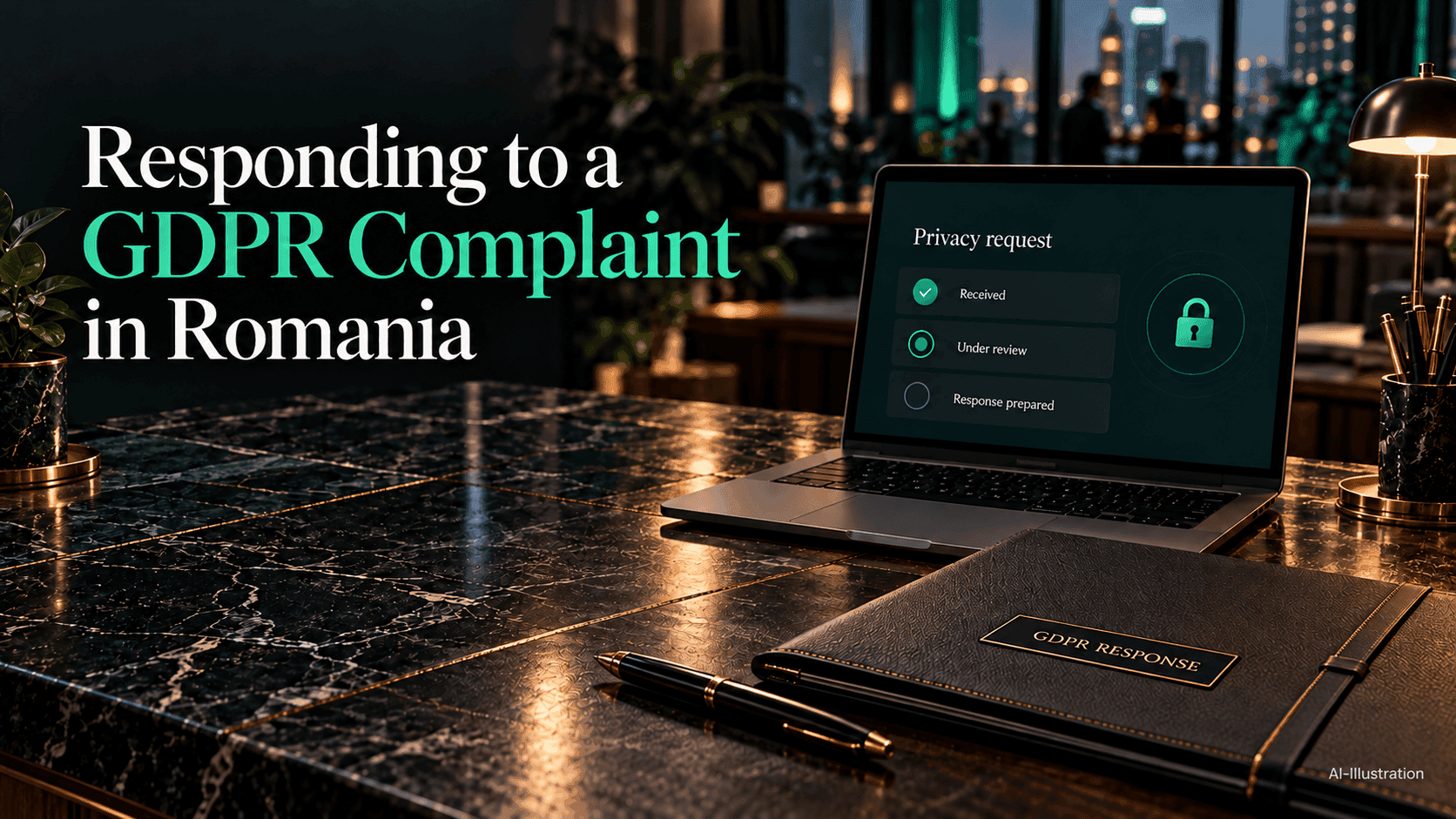

Responding to a GDPR complaint in Romania: a laptop with a privacy-request interface and a closed case folder in a dark office.

Responding to a GDPR Complaint in Romania: Legal Steps for a Company

Data protection · Company response · Romania

A GDPR complaint in Romania can reach your company through customer support, HR, a supplier or the data protection authority.

Before sending a standard reply, identify what the person is asking, preserve the relevant record and establish who must respond.

This guide is for Romanian companies, foreign-owned subsidiaries and managers handling an initial personal-data complaint.

It distinguishes three situations often described as GDPR complaints: a complaint addressed directly to the company, a request to exercise GDPR rights and a communication received from ANSPDCP.

It focuses on organising the response file, with separate escalation points for an authority investigation, a security incident or a formal decision.

The applicable framework includes the General Data Protection Regulation (GDPR) and Romanian supervisory procedures.

What has the company actually received?

Classify the message before choosing a reply or a deadline.

A customer may describe unlawful sharing and request deletion in the same email.

An employee may complain about monitoring while also asking for a copy of their personal data.

One message can therefore require several connected actions.

The European Data Protection Board’s guide to individual remedies distinguishes contacting a company, complaining to a supervisory authority and bringing proceedings.

A person’s statement that they have complained to ANSPDCP is different from an actual communication issued by that authority.

Romania’s National Supervisory Authority for Personal Data Processing is referred to below as ANSPDCP.

Its official complaints guidance also distinguishes rights requests addressed to an organisation from complaints lodged with the authority.

Preserve each document separately, including all attachments and the original delivery record.

Select one or more cards to add the relevant situations to your review packet.

Which response deadline applies?

There is no single 30-day deadline for every document described as a GDPR complaint.

Under Article 12(3) GDPR, information on action taken on requests under Articles 15–22 must be provided without undue delay and within one month of receipt.

The period may be extended by two further months where necessary, taking account of the complexity and number of requests.

The controller must explain the extension and its reasons within the original month.

ANSPDCP’s guidance on complaints repeats that distinction between the initial month and a conditional extension.

Record when the request reached the controller through an appropriate contact channel, rather than treating a later internal referral to legal or the DPO as a fresh starting date.

The EDPB’s access guidelines explain that a dedicated request channel cannot be made compulsory where the person uses another appropriate official or regular contact channel.

Calculate the one-month period under the EU time-calculation rules identified in those guidelines, rather than substituting 30 days or the Romanian court rules for periods expressed in days.

An acknowledgement confirms receipt but does not complete the substantive response or automatically extend the period.

If the controller takes no action on a rights request, Article 12(4) GDPR requires it to explain its reasons without delay and at the latest within one month of receipt of the request, and to inform the individual of the possibility of lodging a complaint with a supervisory authority and seeking a judicial remedy.

Where a message raises concerns without requesting a right under Articles 15–22, identify any other applicable duties and respond promptly as a practical complaint-handling measure.

If ANSPDCP has requested a written response, its official investigation procedure requires the company to answer within the period set by the authority.

Do not borrow the individual’s one-month period for that correspondence or assume that asking for more time suspends the stated deadline.

What should the response file contain?

Preserve evidence that explains the disputed processing and the company’s handling of the complaint.

As a practical measure, identify relevant email threads, request tickets, privacy notices, consent or preference records, access logs, contracts and earlier replies before routine deletion removes useful evidence.

Ask the system owner which records exist, how long they remain available and whether a controlled preservation step is needed.

Keep originals and create an indexed working copy, recording who collected each item and when.

Separate confirmed facts, allegations and points still being investigated.

Evidence preservation must remain proportionate and lawful.

The EDPB’s explanation of processing principles covers purpose limitation, data minimisation, storage limitation and security.

A complaint does not justify retaining every record indefinitely or continuing unrelated use of the person’s data.

Document the purpose, legal basis, access restrictions and review date for any retained complaint evidence.

For an erasure request, assess any applicable exception under Article 17(3) GDPR, including necessary retention for a legal obligation or the establishment, exercise or defence of legal claims.

An erasure exception does not replace the need for a lawful processing basis or justify indefinite retention.

The EDPB’s access guidelines explain how controllers should prevent routine deletion from defeating access to data held when the request was received.

GDPR complaint review-file builder

Your situations

No situations selected

Tick the situations that apply, then use “Copy review packet” to copy the document list and review questions.

Your review packet

Start with the core record; selections add focused items.

Documents to collect
  • The complete complaint, attachments, earlier correspondence and receipt evidence.
  • A short chronology identifying the entity, processing activity, systems and responsible contacts.
Questions for review
  • What is alleged, what action is requested and who must answer?

This tool generates the review packet locally and contains no submission function.

This tool organises a review file; it does not classify a document, calculate a deadline or provide a legal conclusion.

Who is responsible when a vendor or foreign parent is involved?

Establish the role for the disputed activity before assigning the response.

The EDPB’s controller and processor guidance explains that a controller decides the purposes and means of processing, while a processor processes data on its behalf.

The company receiving the complaint may need a supplier’s assistance without transferring away its own responsibilities.

Where your company acts only as processor for the activity, escalate the request to the controller under the agreed procedure and provide the required assistance.

Check the factual role even if the contract uses a convenient label.

Under Article 26(3) GDPR, the person may exercise their rights against each joint controller regardless of the controllers’ internal allocation of responsibilities.

Our data processing agreement guide for Romania explains how assistance, instructions and evidence obligations should operate in a controller–processor relationship.

For a complaint involving an AI service, use the actual settings, contractual documents and supplier information alongside our guide to AI vendor contracts.

Request the relevant logs and explanations early, with a clear operational contact and an agreed delivery format.

If a DPO has been appointed, involve them alongside the business and technical teams.

The DPO’s advisory and monitoring tasks under Article 39 GDPR do not transfer the controller’s responsibility to the DPO.

A foreign parent company should help reconstruct the facts without assuming that group ownership alone decides regulatory competence.

The EDPB’s guidance on supervisory authorities and cross-border cooperation explains why the relevant processing and main establishment matter.

Regulation (EU) 2025/2518 lays down additional procedural rules for GDPR enforcement in cases concerning cross-border processing.

It applies from 2 April 2027, subject to the transitional provisions in Article 36.

Check its applicability to the particular investigation or cooperation procedure.

How should the company answer the individual?

Address the allegation and each requested action using verified facts and clear language.

The EDPB’s guidance on respecting individual rights covers identity checks, clear communication and reasons for refusing a request.

Under Article 12(6) GDPR, request additional identity information where there are reasonable doubts, limiting it to what is necessary.

Avoid requesting a full identity-document copy where a less intrusive verification method is sufficient.

Use a response structure that makes the record easy to follow:

  1. Identify the message. Record its receipt date and the issues or rights addressed.
  2. Explain the relevant facts. Describe the processing, data, purpose and recipients that the review has established.
  3. Answer each request. State what has been done, what remains necessary and any supported reason for refusing action.
  4. Describe corrections. Identify completed measures and distinguish them from planned work.
  5. Provide the next contact. Include applicable complaint and judicial-remedy information where required.

For access under Article 15 GDPR, confirm whether personal data are processed and, where they are, provide access and a copy together with the information required by that provision.

Check purposes, data categories, recipients, retention periods or criteria, applicable rights and complaint information, the available source where data were not collected from the person, relevant automated decision-making information and transfer safeguards where applicable.

Under the CJEU’s judgment in Case C-154/21, normally provide recipients’ actual identities where personal data have been or will be disclosed.

The Court permits recipient categories where identification is impossible or the controller demonstrates that the access request is manifestly unfounded or excessive.

Before sending the material, verify the recipient and assess any actual adverse effect on other people’s rights and freedoms under Article 15(4) GDPR.

Use justified redaction or separation of affected information rather than refusing the whole access request automatically.

Under Article 12(5) GDPR, rights-related information and action are generally free of charge.

A reasonable administrative fee or refusal is permitted for a manifestly unfounded or excessive request only where the controller can demonstrate that exception.

A dispute with the company or an intention to use the data in litigation does not by itself justify refusing access.

Keep the approved response, attachments and proof of dispatch together.

What changes when ANSPDCP requests information?

Build a separate authority response that follows the actual questions, deadline and documentary requirements.

Under Article 33(1) of the investigation procedure approved by Decision no. 161/2018, written investigations request information, data and documents needed for the case.

The response must be written, accompanied by copies certified as conforming to the originals, and provided within the period set by ANSPDCP.

Article 31 GDPR requires controllers and processors to cooperate with the supervisory authority on request.

As a practical preparation step, map each question to the answer, supporting annex, responsible person and any unresolved point.

Explain missing records accurately and identify the work underway to obtain them.

Do not backdate a policy or present a newly introduced control as evidence of an earlier practice.

Under Article 19(e) of the investigation procedure, the investigated entity must provide complete requested information and cannot oppose its confidential character, subject to the law.

A contractual confidentiality clause or commercial-sensitivity label is therefore not a blanket reason to withhold material lawfully requested by ANSPDCP.

Assess any specific statutory or professional-secrecy protection with counsel before submission.

Retain the submitted version and proof of filing, then monitor follow-up communications.

Document → review → next question

Complaint response map

Select a document type in the left column to see what to review next.

On narrow screens, swipe the table sideways to read all columns.

Document in handReview firstDo not assume
Allegations, requested action, receipt and earlier replies.The subject line determines whether a GDPR right was requested.
Right invoked, identity, scope and the applicable response period.An acknowledgement completes the request.
Questions, deadline, response channel and certified annexes.The individual’s one-month period applies.
What happened, affected data, awareness and risk to individuals.Every privacy complaint is a notifiable breach.
Full act, communication evidence, measures and challenge route.A reply to the authority substitutes for a court challenge.
Review focusSeparate allegations from requested action

Preserve the complete message and identify each concern and requested action.

Does the complaint also reveal a personal data breach?

Assess a possible security incident in parallel with the complaint response.

An allegation about an unclear privacy notice does not by itself establish a personal data breach.

A message describing files sent to the wrong recipient may require an immediate incident assessment.

The EDPB’s breach guidance explains documentation, notification and communication duties.

A controller must notify the competent authority without undue delay and, where feasible, within 72 hours of awareness, unless the breach is unlikely to create a risk to individuals’ rights and freedoms.

A processor must notify its controller without undue delay after becoming aware of a breach.

A notification made after 72 hours must include reasons for the delay, and Article 33(4) GDPR permits information to be supplied in phases where it cannot be provided together, without undue further delay.

Where the breach is likely to result in a high risk to individuals’ rights and freedoms, Article 34 GDPR requires communication to affected individuals without undue delay, subject to the exceptions in Article 34(3).

Under Article 33(5) GDPR, document every personal data breach, including its facts, effects and remedial action, even where authority notification is not required.

Record the reasons supporting the notification assessment so that the authority can verify compliance.

If an assessed suspicion proves not to be a personal data breach, retaining the reasoning is a prudent accountability measure.

Use our separate GDPR data breach guide for Romania for the incident process, including the distinct high-risk test for informing affected individuals.

Do not wait for the ordinary complaint reply to complete an urgent breach assessment.

What if a sanction or corrective measure has already arrived?

Review the formal act and available remedy immediately, alongside any compliance work.

Article 17(1) of Law no. 102/2005, republished provides a 15-day challenge period from delivery or communication for the sanction report and/or corrective-measure decision covered by that provision.

The challenge is brought before the administrative litigation section of the competent tribunal.

Under Article 181 of the Romanian Code of Civil Procedure, procedural periods expressed in days are generally calculated by counting the prescribed number of full intervening days, excluding both the day on which the period starts and the day on which it expires.

If the final filing day is a non-working day, the deadline extends to the next working day, unless a special rule applies.

The act may be filed on that final day, subject to the applicable filing rules.

Calculate the final filing date immediately upon service and check the filing method and any applicable special rule.

Under Article 17(2) of Law no. 102/2005, bringing that challenge suspends only payment of the fine until the final judgment.

Do not assume that corrective measures are automatically suspended.

Check the complete act, service evidence, jurisdiction, calculation rules and any separate suspension request with counsel.

The investigation procedure separately permits objections to the finding or sanction report within 15 days under Article 32(4) or Article 33(4), depending on the investigation route.

Sending those objections to ANSPDCP does not substitute for the required court challenge or preserve its deadline.

A complaint is an allegation, and receipt does not itself establish an infringement or guarantee a fine.

The EDPB’s supervisory-authority guidance explains that corrective measures and sanctions depend on the findings and circumstances.

Illustrative scenario: one message, two response tracks

A customer emails a Romanian subsidiary alleging that a supplier disclosed their account details and asks for a copy of their data.

The company should organise the access response while its technical and privacy teams assess the alleged disclosure.

If ANSPDCP subsequently asks for the correspondence and system records, that request creates a separate authority-response task.

This hypothetical example illustrates sequencing and does not predict an outcome or describe an Atrium client matter.

What should management approve before the response is sent?

Approve a response that matches the evidence and assigns ownership of remaining actions.

  • Confirm the correct entity, recipient, signatory and secure delivery channel.
  • Check that every allegation and requested right has been addressed.
  • Verify the applicable deadline and any justified extension or separate filing.
  • Align legal, technical and customer-facing statements on the same facts.
  • Record completed corrections, outstanding work and the responsible contacts.
  • Keep the final response, annexes, dispatch evidence and follow-up dates.

For recurring requests and vendor issues, review the workflow after the immediate matter has been handled.

Repeated complaint handling may fit ongoing legal support for companies, with scope and urgent work agreed separately.

Request a focused GDPR complaint review

Atrium Romanian Lawyers can review the complaint, processing documents, correspondence and proposed reply, and help identify the appropriate response and escalation steps.

Start with the complete message, proof of receipt, earlier replies, a short processing description and any authority correspondence.

The agreed work may include a response plan, evidence index, draft reply or review of an authority submission.

Any court representation or incident-response mandate should be defined expressly.

Frequently asked questions

Select a question to show or hide its answer.

Does a complaint have to mention GDPR to require action?

Read the substance of the message.

A request for access or deletion can be embedded in a customer or employee complaint.

Identify the action requested and assess the relevant rights, rather than relying on the subject line or the absence of an article number.

Can we wait for the supplier before replying?

Plan supplier cooperation early while tracking the company’s own response duties.

A vendor investigation does not automatically extend a GDPR rights-request period or an ANSPDCP deadline.

Identify the missing information, escalate the evidence request and assess any extension under the specific applicable rules.

Should we delete everything when the person requests erasure?

Assess which data and purposes the request concerns, including any applicable lawful-retention exception.

There is no blanket permission to preserve everything because a complaint exists.

Document the basis and limits of any retention and explain the decision to the person where required.

Does every complaint require a notification within 72 hours?

No.

The 72-hour framework concerns notification of a personal data breach after awareness, where the notification conditions are met.

Review alleged unauthorised access or disclosure promptly, while keeping the complaint and any rights request on their own response tracks.

Does correcting the problem end an ANSPDCP investigation?

Correction may address the current problem, but it does not guarantee that the authority will close the matter.

Preserve the earlier record and explain accurately what changed and when.

Answer any outstanding authority request and keep evidence of the remedial work.

What should we send Atrium Romanian Lawyers first?

Send the complete complaint or authority document, attachments, receipt evidence and earlier replies.

Add the relevant privacy notice, processing description, supplier documents and proposed response.

Identify any deadline already stated and any suspected security incident so the review can be scoped promptly.

Green TM symbol inside a transparent glass sphere, with a pencil-drawn path around an amber obstacle, illustrating OSIM trademark refusal in Romania.

OSIM Trademark Refusal in Romania: Review the Notice and Response Options

Intellectual property · Trademark examination · Romania

An OSIM trademark refusal in Romania can arrive when packaging, a website or a product launch is already under way.

Before changing the brand or sending a quick reply, establish exactly what the office has communicated, what it objects to and which procedural step remains available.

This guide is for businesses and foreign applicants responding to objections in a Romanian national trademark application.

It focuses on OSIM’s examination response and the next steps after refusal.

The legislative references below use Law no. 84/1998 as republished in Official Gazette no. 277 of 7 April 2026.

In this national procedure, “provisional refusal” refers to the examination objection notice called aviz de refuz provizoriu in Article 17¹(4) of the implementing regulation.

A third-party opposition, an EUIPO refusal and a Madrid-system notification need their own procedural assessment.

For the initial filing process, see our separate guide to registering a trademark in Romania.

What should you check first in the OSIM communication?

Identify the document and procedural stage before drafting the reply.

Collect every page and attachment, the envelope or electronic delivery record, the application number and earlier correspondence.

A screenshot of the first page can omit the objection’s reasoning, a request for documents or the relevant instructions.

Separate a request to correct missing application information from a provisional refusal following examination and from a reasoned refusal decision.

Record the issuing date and the evidence of communication separately.

Ask who received it: the applicant, an existing representative or an address previously designated for the proceedings.

Internal forwarding to a manager should not be treated as automatically starting a fresh period.

Then check whether the objection concerns the whole specification or particular goods or services.

Compare the communication with the actual filed wording and representation of the mark.

The name used in advertising may differ from the sign submitted to OSIM.

A response prepared for the marketing version can leave the filed application’s problem unanswered.

OSIM Refusal Response Navigator

Select the communication type, then confirm the ground, affected specification and applicant profile to organise a review brief.

Answer the examination objection while the application is pending

A provisional refusal notice gives an opportunity to address OSIM’s examination grounds. Review each objection against the filed sign and goods or services, then decide whether arguments, evidence or an admissible restriction can help.

  • Map each objection to the goods or services it concerns.
  • Verify the response deadline and whether a timely extension request is needed.
  • Prepare a reasoned response with indexed evidence and a precise request.

Your response-file review

  • Confirm the communication type and details before choosing a response.

This navigator organises questions for review. It does not classify your actual notice, calculate deadlines, validate evidence or determine whether a response will succeed.

Which deadline applies to an examination response?

The examination response period and the challenge period are separate.

Under Article 17¹(4)–(5) of the implementing regulation, a provisional refusal invites a response within 30 days.

The procedure provides one additional 30-day period on request with the statutory fee; the request and payment evidence must be filed before the initial period expires under the applicable submission rules.

It does not provide automatic or successive rolling extensions.

Article 25(2) of Law no. 84/1998 is the corresponding statutory provision.

Under Article 8(1)–(4) of the implementing regulation, the period runs from receipt of the communication by the applicant or representative, as applicable, rather than simply from the notice’s issue date.

Day-based periods count calendar days, excluding the starting and expiry days; an expiry falling on a public holiday or non-working day moves to the end of the next working day.

For procedural documents sent by post, Article 8(4) treats handover to the post office before expiry as timely submission.

Keep proof of receipt and timely filing, and check the rules for the submission channel actually used.

Ask for a written deadline assessment tied to the actual communication and the applicable calculation rules.

Distinguish the last day for filing from the internal date for approving arguments, arranging translations and obtaining a mandate.

A notice period can be consumed quickly if the applicant and its records are in different countries.

Do not treat a telephone discussion, an informal request for clarification or a message saying that evidence will follow as an extension.

Confirm the proper submission route and preserve the filing acknowledgement.

If time is already short, send the complete notice for review immediately rather than waiting to assemble a perfect commercial history.

Under Article 17¹(6)–(8), a missing or unsuccessful response may lead to admission with a restricted specification or refusal, depending on the grounds and file.

If a response period has already been missed, obtain an urgent assessment of the procedural position and any available remedy.

Different communications require different review steps
CommunicationReview firstDo not assume
Missing information or formal deficiencyThe requested item, applicable provision, payment records and filing-date position.That the provisional-refusal extension rule applies to every notice.
Provisional examination refusalEach ground, affected goods or services, response period and any timely extension request.That the application is already finally lost or extra time is automatic.
Communicated refusal decisionThe reasons, communication evidence and administrative challenge requirements.That another informal examiner reply replaces a challenge.
Commission decision after challengeThe operative decision, communication evidence and court-review route.That the initial examination timetable controls this later stage.

This comparison is a reading aid, not a deadline calculator.

Review the complete document and applicable law before deciding what to file.

Why can the office object to the proposed mark?

Start with the exact ground cited in the notice.

Article 5 of the Trademark Law covers absolute refusal grounds, including lack of distinctiveness, customary or descriptive signs, deception and protected symbols.

The appropriate response depends on the ground and requested goods or services.

Third-party observations concern absolute grounds and do not make their author a party to examination, under Article 20.

An opposition based on relative grounds follows the separate Articles 26–28 opposition procedure.

For descriptive wording, examine what the expression communicates to the relevant customers in relation to the specified activity.

A term can describe a feature, intended purpose or geographic origin for one product while raising a different question for another.

Explain that relationship precisely; stating that the brand is important to the business does not address the examiner’s reasoning.

Read the sign as filed.

If the application contains both wording and graphical elements, identify what the overall presentation contributes to the argument.

An intention to introduce a distinctive design later does not supply a graphical element missing from the pending application.

Keep proposed future branding separate from the assessment of the existing file.

Do not reduce every refusal to a distinctiveness dispute.

An objection concerning a misleading claim, a protected designation or an official symbol requires a different analysis and potentially different evidence.

A response should address every outstanding ground, rather than concentrating on the easiest paragraph in the notice.

Will the company name, domain or foreign registration help?

Those records can provide context, but they do not settle Romanian trademark registrability.

OSIM’s trademark guidance distinguishes company-name and domain registration from trademark protection.

A name accepted for a company can still encounter a trademark objection.

If you have a foreign registration, give counsel the actual certificate or registry extract, the representation of the sign and its goods or services.

Identify whether the Romanian application concerns the same wording and scope.

Present the record as part of the factual background and assess its relevance to the particular ground; avoid presenting it as automatic approval for the Romanian file.

For brand teams, this distinction helps separate two decisions: whether to pursue the requested registration and whether to keep using the commercial name.

Launch expenditure, distributor commitments and domain ownership matter to the business choice, but should be set out in a separate commercial note alongside the legal arguments.

Can evidence of use support a distinctiveness argument?

Potentially, where the statutory route applies.

Article 5(2)–(3) allows acquired distinctiveness for Article 5(1)(b), (c) and (d): lack of distinctiveness, customary signs and descriptive signs.

The provisions cover distinctiveness acquired before filing and, under Article 5(3), after filing but before registration.

Its relevance and proof require a file-specific assessment; use does not cure every refusal ground.

That route does not cure the shape or characteristic exclusions in Article 5(1)(e), deception under (f), or public-order and morality objections under (m).

Build an evidence index explaining what each record demonstrates.

Useful material to assess may include dated packaging, catalogues, sales records, advertising campaigns, geographical distribution and reliable information about customer recognition.

These are potential evidence categories, not a statutory checklist or an assurance that a particular document will be sufficient.

For each item, identify the date, territory, goods or services, applicant or user of the sign and version of the mark shown.

Separate activity outside Romania from evidence relevant to the Romanian assessment.

Explain gaps rather than combining unrelated screenshots into a large attachment and expecting their significance to be obvious.

Trading under a name and showing that customers identify it as a commercial origin are different evidential questions.

A large turnover figure may need context, such as the products concerned and how the sign appeared to buyers.

Ask counsel to assess the argument before commissioning research or collecting sensitive business records at considerable cost.

Can narrowing the specification resolve the objection?

A restriction is worth assessing if it leaves useful commercial protection.

Article 30 permits restrictions and limited corrections, while substantial changes require a new application.

Review the proposed wording before filing it.

Under Article 7(2), an absolute refusal ground affecting only some goods or services leads to refusal for those goods or services.

Map the affected terms before treating an objection as covering the whole application.

Article 22 also addresses an OSIM-requested declaration disclaiming exclusivity in a nonessential nondistinctive element where its statutory conditions are met.

Such a declaration is not a universal cure for descriptive branding, and a voluntary declaration is disregarded where those conditions are absent, under Article 17¹(13).

Prepare a comparison showing the original specification, affected terms, proposed wording and business activities that would remain covered.

Avoid casually removing an entire class when the real issue concerns a narrower activity.

Conversely, do not retain broad wording merely because it was inexpensive to include if it keeps the objection unresolved.

Ask the operational team which products are already sold, which are about to launch and which are speculative future plans.

A restriction can be commercially sensible for one applicant and unacceptable for another.

The instruction should make those priorities visible before a representative submits wording that changes the protection sought.

A new name, a redesigned logo or an expanded goods list belongs in a separate filing assessment where the changes exceed the pending application’s limits.

Compare the new sign, scope, filing date, applicable priority position and fresh costs.

Refiling should never be described as automatically carrying forward the old application’s position.

How should the response be organised?

Use a reasoned response that answers the notice point by point.

Begin with the applicant and application identifiers, the communication being answered and a clear statement of the requested outcome.

Follow the examiner’s grounds in a consistent order so each argument can be connected to the relevant part of the file.

Separate legal analysis from evidence and commercial background.

Where the response proposes an admissible restriction, reproduce the exact revised specification and explain its relationship to the objection.

Where it relies on existing use, cross-reference the evidence index rather than repeating unsupported claims about reputation.

Check names, application numbers, the filed representation, dates, attachments, signatures and mandate details before submission.

Resolve language and translation needs early.

Retain the final submitted version, proof of payment where required and the acknowledgement of filing together, so a later review does not rely on an unsubmitted draft.

Use the builder below to distinguish records already available from questions still open.

Its output is a preliminary brief for counsel.

Marking an item documented does not establish its authenticity, legal relevance or sufficiency, and selecting a notice category does not classify the actual OSIM document.

Trademark Refusal File Builder

Mark the records available for review. “Documented” describes availability; it does not confirm legal sufficiency.

Selected communication: Provisional refusal.

Complete communication, attachments and evidence of when it was received.

Application number, exact mark representation and filed specification.

Earlier replies, examiner communications, fees and filing acknowledgements.

Dated material relevant to the particular objection, if that argument is available.

Applicant identity, signatory capacity and any relevant mandate.

Essential products, launch plans, acceptable restrictions and alternative names.

0 of 6 review areas documented.

Records to examine

  • No area marked documented yet.

Questions still open

  • Which document was received, and when was it communicated?
  • Which sign and goods or services are actually under examination?
  • What has already been submitted, paid, accepted or left unresolved?
  • Which argument does each document support, for which goods and period?
  • Who may respond or challenge the decision for this applicant?
  • Which protection matters most, and what would narrowing or refiling change?

Selections remain on this page. This tool sends no documents to Atrium. A record marked outside scope still needs its applicability checked.

What changes after OSIM issues a refusal decision?

Review the decision as a new procedural step.

Article 106(1) provides a 30-day challenge to OSIM from communication, with the statutory fee.

Under Article 108(1), the commission’s decision can be challenged at the Bucharest Tribunal within 30 days of communication.

The Tribunal’s judgment may be challenged by an ordinary appeal to the Bucharest Court of Appeal.

Article 50 of the implementing regulation addresses the written Romanian-language challenge, grounds, signature, supporting documents, fee evidence and relevant mandate.

Check the applicable requirements against the file.

An informal disagreement with an examiner is not a substitute for preparing the appropriate challenge.

Compare the refusal’s reasons with the response actually filed.

Identify which arguments were considered, which points remain disputed and whether the application’s commercially essential scope can still be defended.

A challenge assessment should explain the available case and its evidential limits, together with the cost and commercial consequences of proceeding.

The OSIM Trademark Appeals Commission page publishes procedural information about its work.

Check the actual file and official communications for your case.

Public schedules do not replace communication evidence or establish that a filing deadline has been preserved.

What should foreign applicants and brand teams prepare?

Confirm the applicant and authorised representation before the deadline becomes urgent.

Under Article 15(2), representation is compulsory when the applicant has no domicile, registered office or effective and functioning industrial or commercial establishment in the EU or EEA, except for filing the registration application.

Law no. 30/2024 amended Article 3(j) so that an authorised representative includes a lawyer or an industrial-property adviser.

Under Article 6(2) of the implementing regulation, an unrepresented applicant without the relevant domicile, office or establishment in Romania must designate a correspondence address in Romania.

Check mandates, signatory authority, language and communication arrangements early.

Identify the legal entity that owns the application, even if a different group company markets the products.

Give counsel the entity’s accurate name and registration details, the person providing instructions and any existing representative.

Avoid parallel submissions by the marketing team, headquarters and a local adviser without an agreed lead for the file.

Assign internal responsibility for approving the response, obtaining records, paying confirmed fees and monitoring further communications.

A practical timetable should show dependencies and leave time for a final consistency check.

The legal route and evidence should be settled before arranging optional specialist work.

Check OSIM’s official trademark legislation and fee resources for the applicable charge and payment instructions.

Separate official fees from professional fees, translations and evidence preparation.

Under Article 7 of Government Ordinance no. 41/1998, Romanian natural and legal persons pay the statutory fees in lei, foreign natural and legal persons pay in euros, and fees jointly owed by Romanian and foreign applicants or holders are paid in euros.

Confirm the applicable payment currency and current OSIM instructions for the applicant before paying.

A fee table’s description should not be used by itself to determine a statutory response period.

Response Budget Planner

Enter your own quotes and confirmed fees in euros, using the same VAT basis throughout. Calculate a planning total once the proposed scope is clear.

Entered costs€0.00
Contingency€0.00
Planning total€0.00

No estimate calculated yet.

This planner uses euros only as a common budgeting unit and supplies no rates, exchange rates or official fees. Convert any lei-denominated estimate yourself using a stated planning rate. Confirm the actual payment currency and amount separately. Unknown costs left at zero are excluded. The total is not an Atrium quote or a prediction of litigation costs.

Illustrative scenario: descriptive wording and a planned launch

How Atrium can assist with an OSIM refusal review

A defined review through our Romanian trademark legal services can connect the notice, procedural stage, filed sign and commercial priorities.

The scope may cover the objections, available arguments and evidence, an admissible specification change, a response or challenge, and the representation needed for submission.

Send the full communication and attachments, delivery evidence, application, goods or services list, earlier submissions and relevant payments.

Identify any known deadline immediately.

Add a short note explaining what the business needs to protect and whether alternative wording or a new design is commercially acceptable.

Sensitive records should follow an agreed sharing channel.

Sending a notice or using the contact form does not suspend or extend any procedural deadline.

Responsibility for a filing or deadline must be expressly agreed when Atrium accepts the engagement and confirms its scope.

Agree the scope and fee before work begins.

A useful work product is a document-specific assessment and an action sequence showing what the applicant, counsel and internal team each need to do.

A review cannot guarantee registration, success in a challenge or a particular completion date.

Frequently Asked Questions

Does an OSIM provisional refusal mean my application has already been finally rejected?

A provisional refusal notice invites an examination response.

Check its grounds and deadline before assuming the application is lost.

A subsequent refusal decision calls for a separate challenge assessment.

Can I request more time to answer a provisional refusal?

The examination procedure permits a further 30 days on request with payment of the statutory fee.

The extension request and proof of payment must be filed before the initial period expires, in accordance with the applicable submission and time-limit rules.

Keep evidence of timely submission.

Do not assume an informal email extends time.

Will an ONRC company name or domain registration overcome the objection?

Company-name and domain registrations serve different purposes.

They do not establish that the filed sign meets trademark registration requirements.

A response should address the actual examination ground and affected goods or services.

Can I replace my filed word mark with a new logo?

A substantial change to the filed mark requires a new application.

Assess any proposed correction against the statutory limits before submitting it.

A new logo may also protect a different sign from the wording originally requested.

Which documents should I send for a refusal review?

Send the full notice or decision, attachments, delivery evidence, application, exact filed sign, goods or services list, earlier correspondence and payments.

Add relevant dated evidence, applicant details and commercial priorities.

Is a third-party opposition the same as an examiner’s refusal notice?

No.

An opposition based on earlier rights has a separate procedure.

Check whether OSIM is communicating its examination objection, a third-party observation or an opposition before selecting the response route.

Does continuing to use the brand guarantee registration?

No.

Continued use does not guarantee registration or freedom from third-party claims.

Discuss the objection, any evidence-based argument and the separate risks of use before committing to further launch expenditure.

Review the notice before choosing the next move

Bring the complete OSIM communication, delivery evidence and application together first.

Atrium can assess the procedural stage, objections and response options against the protection your business needs, then define the documents and decisions required for the next step.

AI-assisted content.

Shareholder Resolutions: Signing from Abroad, with a green agenda, fountain pen and corporate documents on a light marble desk.

Signing Shareholder Resolutions from Abroad for a Romanian Company

Corporate governance · Foreign shareholders · Romanian companies

Your group needs to approve a change in its Romanian company, but the shareholder’s signatories are abroad. Before circulating a resolution, establish who can make the decision, who can sign for the foreign shareholder and which document form the Romanian filing will require. A convenient signature method is useful only if the underlying decision and representation are sound.

This guide is primarily for foreign owners of Romanian SRLs and international groups preparing an administrator change, a registered-office change or another corporate decision. Joint-stock companies (SAs), listed companies and regulated transactions require their own procedural review. Atrium can examine the proposed decision and prepare a document-specific signing and filing plan before the group arranges signatures abroad.

What should the foreign owner decide before arranging signatures?

Identify the company, decision-maker and proposed legal change first. A foreign parent’s internal board approval may authorise its representative to act, but it does not automatically replace the Romanian subsidiary’s shareholder decision. Similarly, the Romanian administrator’s authority to run the business does not automatically include exercising rights held by the foreign shareholder.

Start with the Romanian company’s current articles, ownership record and registry details. Identify the matter requiring approval and whether it belongs to the shareholders, the administrator or another body. Keep the Romanian resolution separate from any parent-level approval required under the foreign company’s law or constitutional documents. The guide to corporate documentation requirements in Romania explains the wider governance file.

A useful instruction to counsel is specific: review this draft decision, confirm the signatories and list the documents needed for the intended implementation. Include the commercial deadline, such as a departing administrator’s handover or a lease commencement date. That allows the legal route to be assessed before courier, translation or notarial arrangements become expensive to change.

Cross-Border Signing Navigator

Select the decision route, signatory, signing country and operation to build a preliminary document checklist.

One shareholder, one documented decision

Confirm who holds the sole-shareholder rights and who can act for that person or entity. The decision must be promptly recorded in writing. Its signature and supporting evidence must fit the transaction and filing route.

  • Current articles and sole-shareholder identification.
  • Foreign corporate signatory powers, including joint representation.
  • Exact decision text, signature form and implementation authority.

Your signing-file review

  • Select the signing details to update the document checklist.

This navigator organises a preliminary review. It does not validate a resolution, decide representation powers or determine which formalities are legally required.

How does a sole-shareholder decision differ from an SRL meeting?

Under Article 196¹ of Romania’s Companies Law no. 31/1990, the sole shareholder exercises the general meeting’s powers and must promptly record each decision in writing. For a corporate sole shareholder, identify the authorised individual or individuals acting for that entity. A group email saying “approved” is an inadequate starting point for a filing pack unless the required decision and authority are properly documented.

Where an SRL has several shareholders, review its meeting and voting procedure. Article 191(2) allows the articles to provide for correspondence voting. Check that the current articles authorise correspondence voting. Review any procedural provisions in the articles and determine how votes will be requested, submitted, counted and evidenced, including the applicable deadline. Successive signatures on the same PDF do not automatically constitute valid correspondence voting. Distinguish the vote, the record of the adopted resolution and the person authorised to sign that record.

Do not import an SA procedure into an SRL merely because a foreign group uses it elsewhere. A shareholder agreement may also contain consent or reserved-matter provisions. Compare those contractual commitments with the articles and mandatory corporate law; treating them as interchangeable can obscure both corporate-validity and contractual-breach issues.

Can several SRL shareholders meet and vote remotely?

Yes, where the statutory route and safeguards are satisfied. Article 195¹(1)–(3) of Law no. 31/1990, introduced by Law no. 299/2024 with effect from 6 December 2024, governs physical or remote participation and voting. Under Article 195¹(2), the remote route can be based on the articles, a shareholder decision with the majority under Article 192, or the written agreement of all shareholders. An express remote-meeting clause is therefore not the only possible basis.

Read the full operative text of Article 195¹ together with the applicable notice, representation and voting rules. The technology must support participant identification, effective participation, continuous transmission of deliberations, addressing the meeting, voting, later verification of how votes were cast and each shareholder’s ability to verify their own vote. Choose a process that preserves those safeguards and the evidence needed to demonstrate them. A video invitation alone does not answer whether every participant had the necessary authority or could exercise their rights.

Keep the notice, agenda, delivery evidence, participation record, powers of representation, vote record and signed resolution together. Resolve language needs and access arrangements before the meeting. If a participant loses connectivity or the vote cannot be verified, record what happened and assess the appropriate procedural response rather than describing the meeting as completed without qualification.

Which notice and majority rules can disrupt a remote approval?

Remote participation does not remove the ordinary corporate checks. Under Article 195(3), the SRL notice follows the form specified in the articles. In the absence of a special provision in the articles, the fallback is a registered letter identifying the agenda, with at least ten days before the meeting. The High Court of Cassation and Justice’s preliminary ruling, Decision no. 55 of 21 September 2020, published in Official Gazette, Part I, no. 969 of 21 October 2020, holds that this period runs from the registered-letter notice reaching the recipients, unless the articles or a special legal provision specify another communication method. Registered letters are therefore not a universal requirement. Check the applicable method and retain delivery evidence, allowing for delivery abroad.

Article 192(1) sets a default absolute majority of both shareholders and social parts unless the articles provide otherwise. Calculate the two limbs separately: supporting shareholders must exceed half the total shareholder headcount, and their social parts must exceed half the total social parts. For example, with three shareholders holding 60%, 25% and 15%, the 60% owner alone satisfies only the capital limb; the other two together satisfy only the headcount limb. This example assumes the default rule, no voting exclusions and no special decision-specific rule. Check the current articles and applicable statutory provisions before applying it.

Article 193(3) provides a specific rule for a meeting convened again where a lawfully constituted general meeting cannot adopt a valid resolution because the required majority is not met. Its application must be assessed against the circumstances of the first meeting, the reconvening procedure, the agenda, the articles and any decision-specific statutory rule.

Distinguish meeting constitution and participation requirements from the votes needed to adopt the particular decision. Under Article 193(1), each social part carries one vote; Article 193(2) restricts a shareholder’s voting on their own contributions in kind and legal acts between that shareholder and the company. The former Article 192(2) default unanimity rule for constitutional amendments was repealed from 26 November 2022 by Article 129, point 39 of Law no. 265/2022. An older template may reproduce it, and the current articles may still impose their own requirement.

Signing logistics should follow that analysis. Collecting signatures from everyone does not justify omitting the legal review of the adoption procedure, agenda or voting restrictions. Nor should the parties assume that a late signature retrospectively supplies a missing vote or fixes an earlier procedural defect.

Who can sign for a foreign corporate shareholder?

The individual’s position and powers must be evidenced for the particular act. Review a current foreign registry extract or equivalent official evidence, constitutional provisions, joint-signature rules and any necessary internal approval or mandate. A job title such as group CFO or country manager does not itself settle the representation question.

If two directors must represent the foreign shareholder jointly, prepare for both to act in the required way. If a representative is appointed, check who grants the mandate, whether that person can grant it and whether its wording covers the actual vote and signature. Review scope, duration, substitution and any limits. The foreign entity’s governing law matters when assessing its capacity and representation.

Separate the shareholder’s representative from the person signing or submitting the Romanian company’s registry application. Article 81(1) of Law no. 265/2022 identifies the signatories for a legal entity’s application for registry amendments: its legal representative, a representative with a special or general authentic power of attorney, or a lawyer with a professional mandate. That filing authority does not automatically authorise the same person to vote for the foreign shareholder.

Should you use handwritten or electronic signatures?

Decide the signature route document by document. A resolution, updated articles, foreign extract, power of attorney and registry application may have different requirements. Article 195¹(3) permits resolutions adopted under its remote-meeting provisions to be signed by hand or electronically in accordance with law.

Under Article 4(1) of Law no. 214/2024, a qualified electronic signature has the legal effects of a handwritten signature, and the electronically signed document is treated as a private-signature document. This does not dispense with authentic form where the underlying act requires it; Article 4(11) preserves the applicable authentication rules.

Advanced and simple electronic signatures may have recognised legal effects under the specific conditions of Law no. 214/2024. Do not assume that a platform’s signature label establishes handwritten-signature equivalence or acceptance for an ONRC filing. Assess the signature, the document and the applicable statutory conditions separately.

The eIDAS framework, as amended, addresses signature effects in Article 25 and cross-border recognition of qualified signatures in Article 24a. A qualified signature supported by a qualified certificate issued in one Member State is recognised under the EU rules in the others. Confirm the actual signature’s qualification and validation evidence. The country where the signatory sits, the provider’s branding and a platform’s generic completion certificate are not enough to establish that status.

For the registry application, Article 82(1) of Law no. 265/2022 provides for handwritten or qualified electronic signature. Its electronic-submission provisions must also be followed. A permissible internal approval method does not automatically meet those filing requirements. Our guide to online company registration and electronic signatures in Romania provides context, while a post-incorporation decision needs its own supporting pack.

Preserve the original electronically signed files and their validation evidence. Printing them does not preserve a verifiable electronic signature. Conversely, scanning a handwritten original creates a copy; adding the filing representative’s qualified signature to that copy does not turn it into a shareholder-signed electronic original.

Article 84(3) of Law no. 265/2022 permits electronic submission of documents signed with a qualified electronic signature or, where applicable, copies certified by the party using a qualified electronic signature. Where the party acts through a representative, verify the representative’s authority and any document-specific filing requirements. The special transmission route for documents drawn up by notaries or lawyers under Article 84(2) has its own conditions. Neither route dispenses with a document-specific original, authentic-form, foreign-official-document or translation requirement. Retain the underlying original.

When are notarisation, apostille and translation required?

Signing abroad does not create one universal notarisation requirement. Identify whether the underlying act requires authentic form. Article 204(2) of Law no. 31/1990 requires authentic form for the amending act in the cases it lists: a capital increase through a contribution in kind consisting of real estate, conversion into a general or limited partnership, and a capital increase by public subscription. Those listed cases do not exhaust every special-form requirement that may arise under another applicable provision or for a supporting document. Do not confuse signature authentication, notarisation of a copy and authentic form of the corporate act itself.

Foreign official documents have a separate treatment. Article 76(1)(a)–(d) of Law no. 265/2022 distinguishes originals covered by treaty or applicable EU exemptions, originals bearing an apostille and originals supported by legalisation where the other routes do not apply. Article 76(2) requires a legalised Romanian translation for the official documents within its scope, with the prescribed original or electronic notarial-transmission route. Check the issuing state, nature of the document and applicable international or EU instrument individually. The country where the shareholder happens to sign is not, by itself, the test for these formalities.

The HCCH Apostille Convention concerns public documents, including notarial acts and specified official certifications placed on privately signed documents. An ordinary private resolution is not automatically a public document merely because it is destined for another country. Where a notarial certification is used, identify exactly what it certifies. An apostille concerns origin formalities; it does not establish the corporate validity of the underlying decision.

Do not assume every corporate document issued in the EU is apostille-exempt. Regulation (EU) 2016/1191 addresses specified categories of public documents, rather than a blanket exemption for commercial registry extracts or corporate mandates. Other applicable EU rules or bilateral treaties may matter and should be checked for the file.

Article 75 of Law no. 265/2022 addresses Romanian-language filing documents and specified translated submissions. Distinguish its authorised-translation rules from the legalised-translation requirement for foreign official documents under Article 76. A bilingual resolution can help the signatories understand the decision, but it does not dispense with formalities attached to supporting official documents. Review both language versions and settle the final text before signing.

What belongs in the cross-border signing file?

Use one indexed file that connects the decision to the signatory and the implementation. Reconcile names, company identifiers, shareholdings, dates and representation capacities across the draft and supporting documents. Separate evidence already available from matters still awaiting confirmation. The following builder produces a preliminary review brief for those records.

Cross-Border Signing File Builder

Mark the records you already have. Each choice updates the brief below. “Documented” means available for review, rather than legally verified.

Current articles, amendments and registry identification.

Shareholder identity, social parts and relevant voting restrictions.

Corporate extract, representation rules and any internal approval.

Notice, agenda, delivery evidence and remote-meeting arrangements.

Paper originals or signed electronic files; document-specific formalities.

Updated articles, application, mandate and required supporting documents.

0 of 6 review areas documented.

Records to examine

  • No area marked documented yet.

Questions still open

  • Do the articles permit the proposed route and impose special voting rules?
  • Who may vote on this decision, and which majority applies?
  • Must two representatives act jointly or obtain a prior approval?
  • Which adoption procedure is supported by the company documents?
  • Does each document require private signature, authentic form or a particular certification?
  • Which event triggers filing, and what remains after registration?

Selections stay in this browser page. The tool sends no documents to Atrium and confirms no legal requirement as inapplicable.

Which documents are easiest to confuse?

A single phrase such as “we have the power of attorney” can hide several unanswered questions. The table separates the purpose of each document. Use it to identify which evidence belongs to the shareholder decision and which supports the separate filing process.

Document or stepReview firstDo not assume
Foreign parent approvalCompetent body, authority granted and foreign-law requirements.It automatically replaces the subsidiary’s shareholder decision.
Romanian shareholder decisionDecision-maker, adoption procedure, voting record and required form.Every person who receives the draft has authority to sign it.
Corporate voting mandateGrantor’s powers, the specific corporate act and applicable form.A filing mandate necessarily permits shareholder voting.
Foreign official extractCurrent representation evidence, issuing country, formalities and translation.A translation alone resolves apostille or legalisation requirements.
ONRC applicationArticle 81 authority, application signature and complete supporting pack.A valid electronic submission cures a defective underlying decision.

What happens after the resolution is signed?

Signing is one stage in the implementation. Determine whether the decision requires registry amendment, updated articles, publication or another procedure. Under Article 204(4), constitutional amendments require submission of the amending act and the complete updated articles. The exact pack depends on the change. An administrator appointment also raises acceptance, eligibility, representation and handover questions; see our guide to changing an SRL administrator in Romania.

Article 87 of Law no. 265/2022 sets a general fifteen-day filing period from conclusion of the constitutive or amending act for legal persons, unless the law provides otherwise. Identify the act producing the change that is subject to registration and check any special rule before setting the calendar. Not every shareholder resolution or internal document is automatically an amending act triggering this period. Do not automatically use the day a courier arrives or the day management first discusses the change as the starting point.

Keep the submitted pack, filing receipt, registry observations, final order and updated company evidence. Assess the decision’s effective date and third-party effects under the applicable rules, then coordinate practical updates with banks, counterparties or internal records where needed. A registry receipt proves submission, rather than completion of every implementation step. For an address change, the registered-office guide explains the related premises documentation.

How should the group budget for signatures abroad?

Obtain a document-specific formalities list before requesting quotes. Depending on the file, the budget may include legal preparation, notarial work, apostille or legalisation, translation, delivery and applicable official or publication charges. Some items may be unnecessary; others may arise in more than one jurisdiction. Ask advisers to identify the included documents, VAT basis, excluded work and assumptions.

The planner below uses the group’s own estimates. It does not select the legal route or infer that all listed services are required. Avoid a fixed-cost promise before the country, document form, signatory powers and implementation scope are known.

Signing Logistics Cost Planner

Enter your own quotes or estimates, use the same VAT basis throughout, then calculate a planning total. Leave an unknown cost at zero only if you understand it is excluded.

Entered costs€0.00
Contingency€0.00
Planning total€0.00

No estimate calculated yet.

No rates or official fees are supplied. The total uses only your inputs and is not an Atrium quote, a list of mandatory formalities or a prediction of the final cost. A zero field may represent an unknown cost. Confirm scope, VAT and actual charges separately.

Illustrative scenario: two foreign directors must act jointly

How Atrium can assist before you sign abroad

A Romanian corporate lawyer can connect the shareholder’s decision to the signatory evidence and the local implementation. A defined review can cover the proposed resolution, the articles, decision-specific procedure, foreign representation evidence and a document-by-document signing plan. Where foreign-law advice, notarial services or technical signature validation is needed, identify that dependency before fixing the signing timetable.

Send the current Romanian articles and registry information, ownership structure, draft decision, target date, signatory details and available foreign corporate records. Explain whether the group plans handwritten originals, electronic signatures or representation. Initial instructions can identify the documents available; sensitive records should be shared through an agreed channel.

The work product can be a revised decision and implementation pack, a formalities list and a sequence of actions for the shareholder, representative and filing lawyer. Agree the scope and fee before work begins. Registration, third-party acceptance and a particular completion date depend on the file and applicable procedure.

Frequently Asked Questions

Can I sign a Romanian company resolution without travelling to Romania?

Often yes, but the route depends on the company, the decision, representation and document form. A sole-shareholder decision, an SRL remote meeting, correspondence voting and representation are different routes. Check the constitutional documents and the filing requirements before arranging signatures.

Does an SRL need an express remote-meeting clause in its articles?

Not in every case. Article 195¹(2) of Law no. 31/1990 also permits the route where shareholders decide on it with the majority under Article 192 or where all shareholders agree in writing. The meeting must still satisfy the statutory identification, participation, deliberation and voting safeguards.

Is a scanned handwritten signature the same as a qualified electronic signature?

No. A scan reproduces a paper document. A qualified electronic signature is a distinct legal and technical signature. Article 84(3) of Law no. 265/2022 permits party-certified electronic copies where applicable, using a qualified electronic signature. Check the document category, the certifying party’s authority and the applicable procedure; this does not replace an original or authentic-form requirement.

Must every resolution signed abroad be notarised and apostilled?

No universal rule applies. Check whether the resolution requires authentic form and distinguish it from a foreign official extract or notarised power of attorney. Article 76 of Law no. 265/2022 sets the foreign-official-document routes, including treaty exemptions, apostille or legalisation and legalised Romanian translation.

Can the lawyer who submits the file also vote for the foreign shareholder?

Only if the relevant representation authority has been granted and is sufficient for that separate task. Authority to sign or submit a Trade Register application does not by itself establish authority to exercise the foreign shareholder’s corporate rights.

Is 51% of the share capital always enough to approve an SRL resolution?

No. Under Article 192(1), the default rule requires an absolute majority both by shareholder headcount and by social parts, unless the articles provide otherwise. Check decision-specific statutory rules, voting restrictions and the conditions for a reconvened meeting under Article 193(3). The former Article 192(2) unanimity rule for constitutional amendments was repealed in 2022; the current articles may impose their own requirement.

What should I send Atrium before arranging a signature abroad?

Send the Romanian company’s current articles and registry information, the proposed decision and deadline, the ownership structure, the foreign shareholder’s authority evidence, any proposed mandate and the intended paper or electronic signature route. The required document form and next steps can then be defined for the particular file.

Review the signing pack before circulating the final version

Share the draft decision, company articles and foreign signatory evidence. Atrium can define a review of the adoption procedure, representation and document formalities before the group arranges signatures or commits to a filing date.

AI-assisted content.

Green agenda, product checklist and parcel on a bright marble desk, illustrating product safety and recall review in Romania.

Product Safety Complaint in Romania: What a Seller Should Do Before a Recall

Romanian business counsel · Product safety and supplier contracts

A customer reports that a product sold by your Romanian business may be unsafe. The immediate decisions concern affected stock, consumer protection, authority notification and evidence. Your supply contract then determines which costs you may be able to recover from another party.

In brief: Identify the product, reported hazard, affected batches and your actual role in the supply chain. Assess the applicable safety rules and take required protective measures and notifications promptly. A withdrawal stops affected products moving through distribution; a recall seeks the return of products already supplied to consumers. Contractual cost allocation does not replace statutory duties. Preserve one incident file and coordinate legal, technical and operational work.

This guide is for retailers, distributors and importers managing consumer-product safety concerns in Romania. Food, medicines and other excluded or specially regulated categories need their own framework. “Before a recall” means preparing the response, not postponing a recall or notification that is already required.

Need a product-incident review?

Atrium can review the complaint, authority correspondence, supply agreement and available product records to identify legal responsibilities, notice requirements and contractual exposure.

Is this a customer dispute or a product-safety incident?

A poor-quality item, late delivery and a potentially dangerous product raise different questions. A request for a refund does not exclude a safety issue: read what happened, how the product was used and whether injury, overheating, breakage, choking or another hazard is reported.

Preserve the original message, photographs, product identifiers, purchase details and the first response. Separate reported facts from verified findings. A technical specialist should assess the hazard and possible causes; counsel should identify the applicable duties and the response required from your company. Do not require multiple complaints or a completed laboratory report before considering measures justified by the information already available.

Product Incident Response Navigator

Select the signal your business received. The panel shows the first documents and decisions to review.

Customer safety complaint

Preserve the complaint and identify the product, batch, reported hazard and sales channels. Assess protective measures and any immediate notification duty against the information available.

  • Complaint, photographs and purchase record.
  • Product identification, instructions and supplier contact.
  • Decision log recording facts, uncertainties and actions.

This navigator organises a review. It does not classify product risk or determine whether a recall or notification is legally required.

Which product-safety rules apply in Romania?

Regulation (EU) 2023/988 on general product safety, known as the GPSR, applies from 13 December 2024. Article 2 defines its scope and its relationship with product-specific EU safety rules. Identify that relationship before relying on an obligation assigned to manufacturers, importers or distributors. Consult the consolidated GPSR text for the amendments incorporated into the regulation.

For products subject to EU harmonisation legislation, Article 2 excludes specified parts of the GPSR, including Chapter III, Section 1. Consequently, Articles 9–18 are not a universal checklist for every product carrying a CE mark. For many CE-marked products, sector-specific legislation is the primary source of operator obligations. The legal classification and covered risks, rather than the CE mark alone, determine the relationship between the regimes; other GPSR provisions can remain relevant. The European Commission’s general product-safety standards page is a useful starting point for the technical framework.

Depending on the product category and issue, competence may belong to the National Authority for Consumer Protection (ANPC) or another Romanian market-surveillance authority designated under the applicable legislation. Harmonised products are not automatically outside ANPC’s remit. For example, ANCOM’s radio-equipment surveillance guidance identifies responsibilities for both ANCOM and ANPC. The Romanian medicines and medical-devices agency (ANMDMR) has a specialist market-surveillance role for medical devices.

A consumer complaint to ANPC, a business notification and a formal enforcement measure are separate procedural events. Article 44 GPSR requires Member States to establish effective, proportionate and dissuasive penalties. For an inspection or sanction, verify the Romanian provision in force, the authority’s competence, the alleged breach and the applicable challenge deadline; the GPSR does not supply a single Romanian fine schedule.

Does being “only the retailer” remove responsibility?

No. Under the applicable framework, a retailer may be a distributor with its own duties. A Romanian company placing a product from a third country on the EU market may be an importer. Under Article 13 GPSR, placing a product on the market under your own name or trademark can bring manufacturer obligations; substantial modification has its own conditions.

Where Article 12 GPSR applies: paragraph (3) requires a distributor to withhold a product it considers or has reason to believe is dangerous or fails the specified requirements until it is brought into conformity. Paragraph (4) addresses a product already made available: the distributor must immediately inform the manufacturer or importer, ensure appropriate corrective measures and ensure immediate notification of the relevant market-surveillance authorities through the Safety Business Gateway. The authority-notification duty is in Article 12(4)(c).

That provision also covers the identification and safety-information requirements expressly listed there. A failure in those requirements is not, by itself, proof of a physical hazard. Determine the non-compliance and appropriate corrective measures; do not assume every missing label requires a consumer recall.

The Commission’s Safety Business Gateway guidelines explain that, for the distributor route, the manufacturer or importer may submit the information, but the distributor must do so if they have not. Retain evidence of the actual submission and its scope. An email asking the supplier to “handle compliance” does not demonstrate that notification occurred.

What if the manufacturer is outside the EU?

Identify the actual importer and the EU responsible economic operator before relying on a foreign supplier’s assurances. For non-harmonised consumer products where Article 16 GPSR applies, the product must have an operator established in the EU responsible for the specified tasks. The eligible roles are identified through Article 4(2) of Regulation (EU) 2019/1020 on market surveillance: an EU manufacturer, an importer where the manufacturer is outside the EU, a duly mandated authorised representative, or a fulfilment service provider in the circumstances specified there.

These roles are not interchangeable. A distributor does not automatically become the importer, and naming a responsible person does not remove other operators’ own duties. For harmonised products, check the sector rules and the applicable requirements of Regulation 2019/1020, rather than applying Article 16 GPSR indiscriminately.

What is the difference between withdrawal and recall?

Withdrawal: control distribution

Article 3 GPSR defines withdrawal by reference to preventing a product in the supply chain from being made available on the market. Identify warehouse stock, goods in transit, store inventory and active online offers.

Implement and record the relevant stock and sales controls. A listing removed from one website does not establish that every sales channel is controlled.

Recall: reach consumers

A recall aims to obtain the return of a product already supplied to consumers. It requires a workable identification, communication and remedy process.

Some incidents require both withdrawal of remaining inventory and recall of sold units. The correct measures depend on the risk, distribution history and applicable law.

Can you trace the affected batch through the business?

Build a product-specific distribution record. Connect supplier identifiers to internal stock codes, shipment records, stores, online orders and customer contact information lawfully held. Record uncertain quantities explicitly; avoid presenting a partial stock search as a complete batch reconciliation.

Use consumer contact data to the extent necessary for safety communications and handle it under the General Data Protection Regulation (GDPR). Article 35(1) GPSR requires economic operators and, where applicable, online marketplaces collecting customer personal data to use that information for recalls and safety warnings. This supports necessary direct contact with affected customers, not unrestricted use of every item of customer data. Where processing is necessary to fulfil an applicable legal obligation, Article 6(1)(c) GDPR can provide the legal basis; that does not justify unrelated marketing or unrestricted disclosure. Keep the processing transparent, restrict access and retain the data only as justified by the applicable purpose and legal requirements.

Article 35(2) separately requires businesses with product-registration systems or loyalty programmes identifying purchases for other purposes to offer customers the option of providing separate contact details solely for safety communications.

Injury reports may include health data, which require a separate applicable condition under Article 9 GDPR as well as an Article 6 basis. Collect only necessary information, restrict access and arrange secure disclosure to advisers and authorities. Do not include identifiable medical records in a public recall notice.

Batch Traceability Explorer

Tick each stage only when its records are available for review. Copy the resulting document-gap list for your team.

0 of 4 document stages marked available.

Documents still to collect

  • Supplier: product and batch identifiers, invoices and shipment records.
  • Warehouse: stock reconciliation, transfers and recorded stock controls.
  • Sales channels: affected listings, store allocations and order exports.
  • Consumers: lawful contact route, communication log and remedy records.

Availability is not evidence that the records are complete or accurate.

Selections remain in this page and reset when it is reloaded. The tool does not upload records or verify traceability compliance.

When must the business notify authorities or report an accident?

The trigger and responsible actor depend on the product regime, your role and the information received. Where the relevant GPSR duties apply, notification can be immediate. A commercial approval process or dispute over reimbursement must not postpone a required submission.

The European Commission’s Safety Business Gateway is the business notification portal. The public Safety Gate portal provides information on dangerous products and alerts. These have different functions: searching public alerts does not submit your business notification.

Article 20 GPSR separately addresses accidents associated with product use. Paragraph (2) covers death or serious adverse effects on health and safety, whether permanent or temporary, including injury, illness and chronic health effects. Under paragraph (1), the manufacturer must ensure notification through the Safety Business Gateway to the competent authority of the Member State where the accident occurred, without undue delay from learning of it.

Under Article 20(3), importers and distributors that know of an accident caused by a product they placed or made available on the market must inform the manufacturer without undue delay. The manufacturer must notify under paragraph (1) or instruct the importer or one of the distributors to notify. Where the manufacturer is outside the EU, paragraph (4) requires the responsible person within Article 16(1) GPSR or Article 4(1) of Regulation 2019/1020, if aware of the accident, to ensure notification. Verify the reporting actor, timeline and authority against the product regime and facts. A separate dangerous-product notification may be required even where no accident or injury has occurred.

Keep the notification record

Identify the submitting entity, products, countries, reported risk, measures and updates. Keep the submission confirmation and correspondence. If quantities or findings change, coordinate the necessary updates rather than leaving incompatible versions with different authorities.

What must a consumer-facing recall communication contain?

Under Article 35 GPSR, affected consumers who can be identified must be notified directly and without undue delay, according to the actors’ respective obligations. Where direct contact cannot reach everyone, use appropriate additional channels to achieve the widest possible reach.

Article 36 governs written recall notices, including identification of the product and hazard, the action consumers should take, available remedies and a contact route. Use the Commission’s recall-notice template under Implementing Regulation (EU) 2024/1435. Prepare the notice in the relevant languages, including Romanian for the Romanian consumer audience.

Article 36(2)(c) requires a clear hazard description and excludes wording that reduces consumers’ perception of risk, including “precautionary” and statements that no accidents have been reported. Make the product and batch identifiable without requiring the consumer to interpret an internal stock code. Provide accessible formats: important product identifiers shown in an image should also appear as machine-readable text. Ensure the contact team can explain and implement the stated remedy.

Article 37 requires the economic operator responsible for the safety recall to offer an effective, cost-free and timely remedy. As a general rule, that operator must offer a choice between at least two of repair, replacement with a safe equivalent and an adequate refund at least equal to the price paid. The limited exception for impossible or disproportionately costly remedies requires assessment under the provision’s conditions; a budget preference alone is insufficient. As an operational check, confirm that each offered option can actually be delivered through the recall process.

The remedy must not cause significant inconvenience. Consumers must not bear shipping or other return costs; for products that are not portable by their nature, the operator must arrange collection. Consumers remain entitled to a refund if repair or replacement is not completed within a reasonable time and without significant inconvenience. These logistics belong in the response plan and budget.

Are recall remedies the same as warranty or injury claims?

No. Article 37 preserves the relevant consumer sales rights. In Romania, Emergency Ordinance No. 140/2021 on consumer sales of goods provides the separate framework for conformity and remedies in the sales relationship, subject to its own conditions and time limits. Do not assume a commercial warranty period defines the limits of a product-safety recall.

Regulatory safety duties are also separate from potential civil liability for injuries or property damage caused by a defective product. Romanian Law No. 240/2004 on liability for defective products transposes Directive 85/374/EEC, as amended by Directive 1999/34/EC, and addresses that liability alongside potentially relevant contractual or non-contractual claims. Liability requires its own assessment of the defect, damage, causation and responsible parties. Recall expenditure and compensation for injury should not be treated as the same insured loss.

Directive (EU) 2024/2853 on liability for defective products sets a transposition deadline of 9 December 2026. Article 2(1), as corrected by the 7 May 2026 corrigendum, applies the directive to products placed on the market or put into service after 8 December 2026. Under Article 21, Directive 85/374/EEC is repealed with effect from 9 December 2026 but continues to apply to products placed on the market or put into service before that date. Before relying on the new regime in Romania, check whether the implementing legislation has been adopted, its effective date and the provisions applicable to the particular product and claim.

Who pays, and what should the supply agreement resolve?

Separate the immediate regulatory response from later contractual recovery. Examine the executed supply or distribution agreement, purchase orders, product specifications, insurance and notice provisions together. Responsibility for a defect and entitlement to reimbursement need evidence and an applicable contractual or legal basis.

Product-incident costs: contract review map
Cost or taskReview firstDo not assume
Stock and transportQuarantine, collection, storage and return arrangements.Every logistics cost is included in the supplier’s indemnity.
Testing and evidenceExpert appointment, samples, scope and access to findings.A supplier’s short assurance resolves the technical issue.
Consumer remediesRefund, replacement and repair funding; operational owner.The lowest-cost option is always legally sufficient.
CommunicationsNotice drafting, languages, customer contact and channels.Supplier approval can delay mandatory communication.
Insurance and recoveryPolicy cover, exclusions, notification and evidence requirements.Product-liability insurance necessarily covers recall costs.
Recovery proceedingsGoverning law, jurisdiction, arbitration, limitation periods and notice deadlines.The supplier’s location determines the forum or every claim has the same deadline.

Send contractual notices in the agreed form and within the applicable deadlines while continuing required safety measures. Review liability caps and exclusions for enforceability. Where Romanian law applies, Article 1355(1) of the Romanian Civil Code prohibits excluding or limiting liability for material damage caused intentionally or through gross negligence. Under paragraph (3), liability for harm to physical or psychological integrity or health cannot be excluded or reduced except under the conditions provided by law. The enforceability of a particular cap or exclusion depends on the clause, the parties, the type of harm and any applicable mandatory rules. An indemnity or cap does not remove mandatory duties or automatically bind an injured consumer.

The negotiation should also address incident cooperation, data access, record retention, authority communications, reimbursement timing and disputes over causation. Our guide to negotiating a Romanian distribution agreement explains how these duties fit the wider commercial relationship.

Recall Cost & Responsibility Planner

Enter one budgeting scenario, then select Calculate. Use a weighted remedy allowance if customers may choose different remedies.

Gross scenario budget

€0.00
  • Consumer remedies€0.00
  • Returns and handling€0.00
  • Testing and communication€0.00
  • Contingency€0.00

No estimate has been calculated. Enter your assumptions and select Calculate.

Formula: units × (remedy + logistics) + testing + communication, then your contingency percentage. This is a gross planning estimate, not a recall recommendation, legal fee, recoverable claim or insurance assessment. It excludes taxes, penalties, injury claims, lost sales, disposal and costs not entered. Use a consistent VAT basis for inputs; the tool does not determine VAT adjustments or deductibility. A return estimate must not limit the required scope of a recall.

Illustrative scenario: a supplier alert reaches a Romanian retailer

Hypothetical example. This is not a client matter or a reported outcome.

The information received

A Romanian retailer receives a supplier alert about a structural defect in a batch of folding chairs. Some units remain in its warehouse, some are displayed in stores and others have been sold online. The supplier offers replacement stock but asks the retailer to wait before contacting customers.

The review questions

The team identifies the applicable product regime, verifies the batch and maps sold and unsold units. It assesses the required controls, notifications and consumer communication promptly. Supplier cost negotiations proceed alongside those duties.

The contractual question

The agreement refers to “defective product replacement” without expressly addressing collection, customer contact or testing. Counsel examines whether other clauses and the governing law support recovery, and preserves notices and cost evidence.

The useful work product

A coordinated review can produce an incident chronology, responsibility map, document-gap list, reviewed notices and a contractual recovery analysis. The technical assessment and authority’s response remain separate parts of the process.

How Atrium can assist with a product-safety response

Our commercial contract review services can support the analysis of supplier responsibilities, notices, indemnities and recovery provisions. For an active incident, a defined legal mandate can also cover the applicable notification route, authority correspondence and consumer-facing documents, coordinated with your technical and operational advisers.

For the first discussion, identify the product, your role, countries of sale, allegation, any injury reported and any deadline in authority correspondence. Describe the available complaint, supplier agreement, batch records, technical findings and actions already taken. Agree a secure transfer route before sending sensitive customer or medical information.

Scope and fee: Ask for a written proposal for the initial document review or incident-response work. A starting fee or fee cap should relate to specified documents and tasks; technical testing, translations, recall logistics and separate proceedings need their own allocation. No case-specific price is stated here.

Related Guides

Frequently asked questions

Does every product complaint require a recall?

No. The reported facts, product regime, hazard and distribution history determine the appropriate response. A quality complaint may have no safety dimension, while one credible safety report can require prompt protective action. A recall assessment should not be postponed until several customers report the same problem.

Can a retailer leave notification entirely to the supplier?

Not simply by assuming the supplier will act. Where Article 12 GPSR applies, the distributor must ensure the relevant authorities are informed. The manufacturer or importer may make the submission, but the distributor should verify it and act if it has not occurred. Product-specific rules may require a different analysis.

Who is responsible if the manufacturer is outside the EU?

Identify the importer and the EU responsible economic operator required by the applicable regime. For non-harmonised consumer products where Article 16 GPSR applies, eligible roles follow Article 4(2) of Regulation (EU) 2019/1020. A responsible person does not replace the manufacturer’s, importer’s or distributor’s own duties, and a retailer is not automatically the importer. Sector-specific rules may require a different assessment.

Is removing an online listing enough?

Removing a listing can help control further sales through that channel. It does not address warehouse stock, other listings, store inventory or products already with consumers. The response must cover the affected supply chain and any required consumer communication, remedies and notifications.

Must the supplier reimburse every recall cost?

That is not automatic. Recovery depends on the agreement, governing law, cause of the incident, evidence, notice requirements and any enforceable limits. Identify which expenses are covered and preserve the supporting records. A reimbursement dispute does not postpone mandatory product-safety measures.

Can the business offer only a refund?

Article 37 GPSR generally requires the responsible operator to offer a choice between at least two specified remedies. A single remedy can be offered under the provision’s limited impossibility or disproportionate-cost exception. The conditions need a case-specific assessment; the cheapest option is not automatically sufficient.

Does the calculator estimate legal fees or insurance recovery?

No. It totals the operational assumptions you enter for one scenario. It does not decide which remedy is lawful, whether a recall is required, what a lawyer will charge or what the supplier or insurer must pay. Those questions require separate review.

Disclaimer: This page provides general information only and does not constitute legal advice, a legal opinion or the creation of a lawyer-client relationship. Legal solutions depend on the specific facts and documents involved.

AI-assisted content.

Laptop displaying source code beside a green agenda and storage device in a dark office.

Source-Code Escrow in a Romanian Software Project: What the Contract Must Resolve

IT contracts · Software procurement · Business continuity

Your company is about to commit to software that will run a critical part of its business. The supplier offers source-code escrow. Before signing, establish what will be deposited, how you can obtain it and whether another team will have the rights and materials needed to keep the application running.

This guide is for foreign companies procuring software from Romanian developers, Romanian businesses licensing critical systems and suppliers negotiating a proportionate escrow commitment. Cross-border projects require a separate check of governing law, insolvency rules and the locations of the rights-holder, provider and deposited materials.

What does source-code escrow protect in a Romanian software transaction?

Escrow creates a contractual route to specified materials when an agreed release condition is established. It should connect custody of those materials to a usable continuity plan. The customer, supplier and independent escrow provider commonly have separate obligations concerning deposit, confidentiality, verification and release.

For procurement, ask what the company expects to achieve after release. Maintaining an installed application, recreating a hosted environment and replacing a cloud service are different tasks. A deposit suitable for the first task may be inadequate for the others. Providers such as Escode distinguish software escrow, SaaS escrow and technical verification; their service descriptions are commercial examples, rather than Romanian legal requirements.

Where Romanian law governs, the Romanian Civil Code supplies the general contractual framework. Articles 1169 and 1170 address contractual freedom within legal limits and good faith in negotiation, conclusion and performance. Where the arrangement qualifies as an unnamed contract, Article 1168 applies the general contract rules and, where insufficient, the rules for the closest analogous contract. Classification depends on the obligations, not the title. A code deposit alone does not create a security interest, insurance cover or an assignment of copyright.

The financial decision comes before failure. Management may accept a long licence term or a substantial implementation payment because it believes escrow reduces dependence on the supplier. That belief should be supported by a defined deposit schedule, a rights analysis and a recovery exercise. Ask the technical team what it could actually do with the materials, and ask counsel whether the contracts permit that use.

When should escrow be negotiated?

Negotiate it while the software scope, licence and payment schedule can still change. Raising escrow after deployment may leave the supplier with little incentive to provide additional rights or verification work without a new charge.

Useful decision points include signing a custom-development agreement, licensing a specialist application, renewing a system that has become operationally essential, or acquiring a business dependent on proprietary software. The company should identify the beneficiary precisely. A licence granted to the Romanian subsidiary may not cover its foreign parent, affiliated companies or a future purchaser. Align any rights for affiliates, successors and replacement contractors with authorised-user restrictions, assignment, change-of-control and confidentiality clauses. A share sale and an asset transfer can raise different questions.

Compare escrow with other available controls. Direct delivery of source code with adequate rights, customer-controlled repositories, tested backups, independent hosting, documented interfaces and contractual transition support can address different dependencies. The appropriate combination depends on the delivery model. A criticality assessment should record replacement lead time, available alternatives and what happens to orders, payroll or customer service while the application is unavailable.

Supplier Failure Simulator

Select a failure scenario to reveal the contractual checks your team should make before signing.

Support failure needs a defined obligation

Identify the support service, the failure evidence, notice and cure requirements. A slower reply is not automatically an agreed release event.

  • Compare the support schedule and escrow trigger.
  • Preserve tickets, notices and proof of delivery.
  • Check release rights for a replacement maintenance team.

These scenarios identify review questions. They do not determine that a release condition exists or that the provider must release the deposit.

Does receiving the source code give the customer ownership?

Physical access to code and copyright ownership are separate questions. The licence or assignment must define what the customer may do, including what a replacement contractor may do on its behalf.

Chapter IX of Romania’s Copyright Law no. 8/1996 governs computer programs. In the republished and amended text, Article 74 covers exclusive rights; Article 76(1)(b) restricts onward transfer of use rights unless otherwise agreed, and Article 76(2) separates those rights from copyright ownership. Articles 77 and 78 cover necessary lawful-use acts and specified backup, study and testing permissions.

The EU framework in Directive 2009/24/EC on the legal protection of computer programs also distinguishes restricted acts and specific exceptions. These limited exceptions do not promise delivery of a complete source-code package or resolve every third-party permission.

Negotiate express permissions for access, copying, compilation, deployment, maintenance and necessary modifications, including controlled access by a replacement contractor. Article 40(6) requires the assignor’s express consent for onward assignment by a non-exclusive assignee. Article 40(8) dispenses with that consent where the assignee is a legal person undergoing a transformation through one of the methods provided by law. Engaging a contractor is not necessarily a transfer of the licence; define whose behalf it acts on and its permitted activities. Identify beneficiary entities, duration and continuing rights. Our guide to software licence agreements for Romania explains the wider issues. The Romanian Copyright Office (ORDA) provides official copyright information.

Check the supplier’s chain of rights

Article 75 generally allocates economic rights in employee-created programs to the employer when created in the course of duties or under its instructions, unless otherwise agreed. Do not extend that employment rule automatically to freelancers or subcontractors. For assignments, Article 42 specifies required contractual content; Article 43 concerns written proof.

Request evidence of ownership or sufficient permissions for employee and contractor contributions, reused modules, documentation and third-party components. Review assigned rights, permitted uses, duration, territorial scope and remuneration where applicable. A warranty should be supported by the relevant records. Check whether the supplier can authorise deposit, disclosure and the customer’s planned recovery, including contractor access. Paying development invoices alone does not settle those questions.

What should the deposit contain?

The schedule should describe the materials needed for the agreed recovery task and identify the relevant production version. A generic promise to deposit “the source code” leaves important questions unanswered. Reconcile the production version, accepted deliverable and maintained release with the version covered by the licence, and define how they stay aligned.

Identify the application and its dependencies

Specify repositories, release identifiers, modules, build scripts, toolchain versions, configuration templates and documentation. Record third-party libraries and the permissions needed to obtain and use them. An essential commercial component may require a separate licence that the supplier cannot transfer through escrow. An open-source component may carry licence obligations that continue after release.

Capture operational know-how

Source files may omit the knowledge needed to operate them. Decide whether architecture documents, runbooks, deployment procedures, database migration instructions and maintenance manuals belong in the recovery package. Document work that currently depends on an individual developer’s memory. Test whether a replacement team can follow those instructions without undocumented assistance.

Separate recovery materials from live secrets and personal data

Ask the engineers to define a secure access and recovery process. Credentials, encryption keys and certificates may require protected custody, rotation or customer-controlled accounts rather than inclusion in an ordinary archive. Configuration examples should avoid unnecessary production secrets. Test environments should use appropriate test data. A usable package needs to reflect the actual security model without casually duplicating sensitive live information.

Require updates and evidence of receipt

Set the initial deposit deadline, update events, responsibility for uploads and proof of receipt. Link updates to production releases or other agreed milestones, and decide what happens when an update fails verification. If a supplier delivers a new version while the deposit still contains an earlier version, management needs a documented correction process. A custody receipt may evidence delivery without proving completeness, integrity, production-version conformity, compilation or sufficient legal rights. Establish what the contracted verification covers and what remains for legal or technical review.

Can Another Team Run It?

Mark what is documented in your proposed arrangement. Each choice updates the review brief below. “Documented” means you have a record to review, not that it has been verified.

Application scope, repositories and the production release identifier.

Scripts, toolchain versions, architecture documents and runbooks.

Component list, contributor rights, access arrangements and licences.

Infrastructure, configuration and secure access recovery.

The dataset, backup or export route needed for the planned service.

Permitted use, maintenance, modification and contractor access.

Trigger evidence, notices, cure and resolution of objections.

The test scope, report, update schedule and correction process.

0 document groups marked as documented; 8 unconfirmed.

Records to examine

  • No group marked as documented yet.

Questions still open

  • Confirm the deposit, rights, release procedure and recovery test with the relevant teams.

A “not applicable” choice also needs a reason in the eventual review. Selections stay in this page and are not uploaded or saved. Do not enter code, credentials or confidential documents here.

What should verification prove before you rely on escrow?

Choose the test that matches the promised recovery and require a report of its limits. File existence, successful compilation and an independent deployment are different levels of assurance.

An inventory check may establish that specified files are present. A build test asks whether the deposit produces the agreed application. A recovery test asks whether an independent team can deploy and run it in the intended environment using the authorised materials. EscrowTech’s description of verification levels illustrates why the scope must be selected expressly; verification should not be assumed to follow automatically from storage.

Agree who supplies the environment, who performs the test, which functions must work and how discrepancies are reported. Require remediation and retesting where appropriate. If the exercise depended on undocumented help from the original developer, record that dependency. The customer should know whether the test demonstrated recovery without undocumented supplier assistance, and whether it ran in the intended recovery environment or only inside the supplier’s own environment.

Which release conditions and procedures need legal review?

A release trigger must be specific enough to establish, and its procedure must fit the company’s operational needs. Define the triggering conduct, required evidence, recipients, notice method, cure opportunity and the consequences of an objection.

Possible negotiated events include permanent cessation of a relevant business activity, a defined failure to provide maintenance, or specified insolvency developments. Their legal effect is case-dependent. A disputed support ticket, a late deposit update and total service abandonment should not be treated as equivalent without the agreed wording. Separate the right to request release from the provider’s authority to release.

Define the escrow provider’s decision role. Its service may involve custody, document checks or a contractual assessment of a release request; the agreement should identify which tasks it undertakes. Does it assess facts, follow an agreed certification process or wait for a court or arbitral decision after an objection? Who pays the dispute and verification costs? What temporary access or other relief can lawfully be sought while a dispute is pending? A long objection mechanism may defeat the intended continuity timetable even when the substantive trigger is well drafted.

Why insolvency needs separate analysis

Under Article 123(1) of Law no. 85/2014 on insolvency proceedings, ongoing contracts are maintained when proceedings open. Clauses providing for termination, loss of the benefit of the term, debtor-adverse modification or acceleration because proceedings open are treated as unwritten, subject to statutory exceptions.

To maximise the debtor’s estate, the judicial administrator or liquidator may exercise the statutory power to denounce a qualifying contract (denunțare) within the three-month limitation period from opening, provided it has not been fully or substantially performed by all parties. This insolvency mechanism differs from ordinary contractual termination. Under Article 123(1), a counterparty may send a notice requesting denunciation within those first three months. If the administrator or liquidator does not respond within 30 days of receipt, Article 123(1)(a) treats the contract as denounced when that period expires. Article 123(4) permits a damages action against the debtor before the insolvency judge, with payment governed by statutory rules.

Article 123(3) separately provides that the debtor loses the benefit of the term if, within the first three months, the counterparty notifies the judicial administrator of its intention concerning denunciation or early maturity. This is distinct from deemed denunciation following an unanswered notice. Review the notice’s wording, recipient and delivery date; neither effect by itself establishes an escrow release condition.

Assess the licence, maintenance agreement, deposit obligations and provider agreement separately. Identify which rights have already been granted and which depend on future performance. A claim for compensation may leave the customer needing another continuity solution. Neither every software agreement nor every released licence automatically has the same fate.

A trigger based on opening proceedings and one based on an actual maintenance failure require separate analyses. Do not assume that changing the trigger’s label avoids mandatory rules. Review its timing, evidence, contract structure and the debtor’s obligations. This discussion does not decide whether a particular release clause is valid.

Separate contractual governing law from insolvency law

For projects within their scope, the Rome I Regulation addresses the law applicable to contractual obligations. Article 7 of Regulation (EU) 2015/848 on insolvency proceedings generally points to the law of the state opening the proceedings for their effects, subject to the Regulation’s exceptions. Article 7(2)(e) expressly addresses effects on ongoing contracts to which the debtor is a party. A governing-law clause does not alone settle the insolvency analysis. Identify each party, proceeding and relevant rights before relying on a foreign provider’s template.

How should the software agreement and escrow terms fit together?

Use one consistent contract package with a clear order of precedence. A generous release clause is of limited value if the software licence separately prohibits the intended maintenance or ends the necessary rights at the critical moment.

Contract layerReview firstQuestion before commitment
Software licenceBeneficiary, permitted acts and duration.May the customer and its replacement team use the released materials?
Deposit scheduleApplication scope, versions and updates.Will the deposit match the system actually used?
Verification serviceTest scope, report and correction duties.What was independently demonstrated?
Release procedureEvidence, notices, objections and forum.What happens if the supplier disputes the request?
Provider termsFees, custody, liability and exit.What protects continuity if the provider relationship ends?
Security and dataAccess, locations and recovery controls.Can the transfer and use occur lawfully and securely?

Allocate ongoing fees, update work, verification, retesting, release and dispute costs. Check the provider’s liability limits and whether they are commercially acceptable for the custody task. Agree advance notice, cooperation, continued custody during transition and transfer to a replacement provider. Define treatment of unpaid fees and when materials may be returned or deleted. Someone should own these obligations after signature; a negotiated clause can lose practical value when nobody tracks deposits.

Review standard terms and liability exclusions

Where Romanian law applies, Article 1203 requires express written acceptance of the specified unusual standard terms. These include liability limitations benefiting their proposer, governing-law provisions, arbitration clauses and departures from court-jurisdiction rules. Check whether the terms are standard clauses included without negotiation, how they were incorporated and whether the required acceptance occurred. Article 1355(1) prohibits excluding or limiting liability for material damage caused intentionally or through gross negligence. Assess the actual wording, loss and applicable mandatory rules. A contractual cap is not automatically effective in every circumstance.

Define confidentiality, authorised recipients and permitted recovery uses for code and operational knowledge. Cover the replacement contractor’s security duties and what happens to copies after its engagement ends. Deposit and release should each have an access-control process.

Our commercial contract review checklist provides the wider framework for payment, liability, termination and dispute provisions.

Does a hosted application require more than source-code escrow?

Yes, where continued operation depends on hosting, data or services outside the code package. The recovery design should identify infrastructure, backups, deployment automation, integrations, domains and authorised access.

Ask who controls each cloud account and whether the customer can lawfully recreate the service elsewhere. Source code may compile successfully but still depend on a proprietary API, unavailable commercial library or supplier-managed database. Data export should be defined by format, frequency and completeness, and should be tested against the intended replacement system. Escrow should fit the broader transition plan rather than become the sole promise that the service will continue.

First identify whether the deposit or recovery service contains personal data at all. Logs, backups, test datasets and configuration files may contain it. Determine what is necessary and who decides the purposes and means of each processing operation.

Where the arrangement processes personal data, apply the General Data Protection Regulation to the actual roles and operations. Article 28 requirements matter where a party processes data on behalf of a controller; Article 32 addresses security. An escrow label alone does not determine the parties’ roles. Check any international transfer separately. The Romanian data protection authority (ANSPDCP) publishes official information, and our data processing agreement guide explains the contractual classification.

Apply data minimisation and storage limitation to the actual package. Agree retention, secure return or deletion, access controls and incident notification responsibilities. Check whether hosting, remote access or disclosure takes place outside the EEA and, where relevant, apply the GDPR rules governing international transfers. Article 28 applies to the actual controller-processor relationship, rather than automatically to every escrow provider.

Continuity Cost Calculator

Enter your own assumptions, or load the illustrative example, to estimate one interruption scenario.

Use contribution after costs avoided during interruption, rather than gross revenue. Enter only additional response costs so the same loss is not counted twice. Currency selection changes the label only.

Lost contribution0 EUR
Additional response costs0 EUR
Illustrative total0 EUR

Formula: hours × lost contribution per hour + hours × additional workaround cost per hour + one-off recovery cost. This is an internal budgeting estimate. It does not calculate recoverable damages, legal fees, tax, probability of failure or savings attributable to escrow.

Illustrative scenario: the code is released, but recovery stalls

A foreign-owned retailer is negotiating a specialist inventory application with a Romanian developer. The proposal includes escrow, and procurement initially treats that as sufficient continuity protection. The deposit schedule identifies source files but leaves the production version, commercial dependencies and deployment documentation unclear.

In the hypothetical failure scenario, the customer obtains the deposited materials under an established release route. Its replacement team then discovers that the package references a component requiring a separate licence and that the deployment process relied on undocumented supplier assistance. The company still has work to do before restoring the system.

Before signature, a coordinated review would ask the supplier to define the recovery package, identify third-party permissions and agree a suitable independent test. Counsel would align the release procedure and maintenance permissions with the software licence. Procurement would clarify fees, correction obligations and payment milestones; the technical team would document the environment and recovery dependencies.

The resulting work product can be a negotiated deposit schedule, a rights matrix, a verification plan and a list of unresolved conditions for management’s decision. This scenario is hypothetical. It does not describe an Atrium client or promise that escrow will prevent downtime.

What should the company send for a preliminary escrow review?

Send the complete proposed contract package and explain the commercial decision that is approaching. A short description should identify the software, the contracting entities, deployment model and signing or payment date.

  • Collect the software agreement, licence, statement of work and maintenance schedule.
  • Include the escrow agreement, beneficiary enrolment and provider terms.
  • Identify the proposed deposit schedule, production version and update obligations.
  • Provide the verification proposal or report and unresolved technical findings.
  • Summarise contributor agreements, third-party components, rights and hosting dependencies.
  • Describe the intended replacement-team access and recovery timetable.
  • Record the relevant milestone payments, recurring charges and internal decision date.

Keep sensitive code, credentials and production data out of an initial public enquiry. Agree an appropriate transfer channel for the document review. The commercial lead, technical lead and legal contact should each identify what they can verify, including uncertainties that remain with the supplier.

How Atrium can assist with the transaction

A defined escrow and continuity review can examine the software licence, escrow terms and provider arrangement together, identify conflicting obligations, map release and dispute procedures and prepare proposed amendments. The mandate can cover negotiation of beneficiary rights, deposit obligations, confidentiality, third-party permissions, fees, liability and exit arrangements.

Technical verification remains work for appropriately qualified engineers or an agreed verification provider. Legal advice can frame what the test should evidence contractually, but cannot establish that code compiles or that a system is secure. Where insolvency or foreign-law issues are material, the scope should include the relevant specialist advice.

For an initial document review, the scope and fee are agreed in writing before work begins. A fixed or capped fee can be discussed once the document set, jurisdictions and requested deliverables are known. Negotiation, technical testing, provider charges and disputes should be scoped separately where they fall outside that engagement.

Frequently Asked Questions

Does source-code escrow transfer software ownership?

No automatic transfer follows from depositing or releasing code. Copyright ownership, permitted use and access to materials are separate questions. Review the licence or assignment and specify the rights required for the intended maintenance and recovery.

Can the supplier’s insolvency guarantee immediate release?

No. Opening proceedings does not guarantee release. Review the trigger, objection process, licence and contract performance. Romanian insolvency rules can affect opening-based clauses and permit statutory denunciation of qualifying ongoing contracts; the consequences require a separate analysis.

Is a source-code archive enough for a SaaS application?

It may be insufficient. Recovery can also depend on infrastructure, configuration, data, third-party services and authorised access. Define and test the package needed for the actual hosted application rather than assuming that possession of code restores the service.

Does the escrow provider automatically verify the deposit?

Check the contracted service. Custody, inventory inspection, compilation and independent recovery testing are different tasks. Specify the test, reporting, correction process and retesting obligations before relying on the deposit.

Can another developer maintain the released software?

The intended contractor access and maintenance rights should be reviewed expressly, together with applicable statutory permissions and third-party licences. Receiving materials does not settle every permission needed to copy, modify, deploy or use components.

What does an initial escrow legal review require?

Provide the software agreement, licence, escrow terms, deposit schedule and verification documents, together with the deployment model, contracting entities and next signing or payment date. The legal and technical review scopes should be identified separately.

Review the continuity arrangement before signing

Tell Atrium which software your company will depend on, what the supplier has proposed and when you need to commit. A focused review can identify the rights, deposit requirements and unresolved contractual points that should inform that decision.

AI-assisted content.

Architectural model and notebook illustrating legal review for a PUZ in Romania.

PUZ in Romania: Legal Support Before a Development Plan Application

Romanian property development · Investor file review

A PUZ application can shape a development project long before a building permit is requested. Before committing capital, confirm the planning route, the documents supporting it and the obligations your investment would assume.

What this guide helps you decide: whether your next step should be document collection, a coordinated legal and planning review, contractual protection before purchase, or clarification of an existing administrative file. A zonal urban plan does not itself authorise construction.

Which decision are you facing?

Select a situation below. Your choice updates the questions in the PUZ Project Review Dashboard; you can change it at any time.

What is a PUZ in Romania?

A zonal urban plan (Plan urbanistic zonal, PUZ) regulates planning at the scale of an area. Its practical relevance extends beyond a drawing of the proposed building: land use, circulation, infrastructure, development parameters and implementation obligations can affect the commercial viability of the investment.

Romania’s Code of Spatial Planning, Urbanism and Construction (Codul amenajării teritoriului, urbanismului și construcțiilor, CATUC), adopted by Law no. 169/2026, provides the current statutory framework. The law was published in Official Gazette no. 661 of 10 August 2026; the Code entered into force on 25 August 2026. Article 62 defines the PUZ’s role, situations for its preparation and successive procedural stages. Read it together with the relevant initiation, endorsement, approval and transitional provisions. Changes to approved planning rules require the justification and initiation route specified by the Code; a private preference for a larger project does not establish an entitlement to approval.

Legal framework checked as at 7 October 2026.

The statutory references below are starting points for a file review. Read them with the current consolidated Code, applicable local planning instruments and complete administrative record. An authority-hosted Code copy is available through Caraș-Severin County Council’s urbanism legislation page.

This guide concerns the investor’s legal decisions around a PUZ. The technical preparation of planning documentation belongs to appropriately qualified specialists. The Romanian Register of Urban Planners provides information about professionals with signing rights. Legal review should work alongside the planner’s assessment, with each professional’s responsibilities clearly defined.

Read the planning instruments together

A general urban plan (Plan urbanistic general, PUG) provides the wider planning framework. The PUZ regulates a defined area within the wider framework established by the PUG. Article 81 of the Code uses Proiect urbanistic de detaliu (PUD) for the detailed urban design instrument; older documents may use the former expression Plan urbanistic de detaliu.

Keep the Romanian labels, approval references and dates visible in the file. Translating every instrument as a “development plan” can conceal differences that matter to the application route.

When should a developer investigate the PUZ route?

Investigate it when the intended project does not fit the rules evidenced by the available documents, when the planning framework requires area-level coordination, or when the authority identifies a PUZ stage. The first task is to compare the proposed investment with the applicable instruments and the written position of the competent authority.

Do not infer the route from a neighbouring project, a broker’s description or the fact that the land is inside the built-up area. A neighbouring development may rely on different boundaries, an earlier approval, distinct restrictions or infrastructure arrangements that are unavailable to your site.

Ask the planner to explain the precise mismatch: use, height, density, setbacks, access, subdivision, infrastructure or another constraint. Ask the lawyer to identify what the proposed solution requires legally, who must participate and what your contracts should say while the outcome remains unresolved. This produces a clearer decision than simply asking whether a PUZ is “possible”.

Subdivision and bringing land into intravilan

Articles 216 and 218 address planning subdivision for new construction, including division into three or more plots. Article 218(1) identifies the prior approved-PUZ route for the specified subdivision situations within intravilan, subject to the statutory conditions and the specific one-time PUD exception for individual housing in Article 218(2). This planning operation is distinct from a purely cadastral split; purpose and applicable conditions matter alongside the number of plots.

Article 151 allows the intravilan boundary to be established or updated through the PUG or a PUZ. Bringing land into intravilan is therefore not accurately described as requiring a separate PUZ in every case. The applicable planning route, infrastructure capacity and funding must be established. Under Article 151(7), expansion outside the urbanisation or de-urbanisation zones established by the PUG can proceed only through planning documentation initiated by the public authority.

Check the permitted change, not just the desired increase

Article 66(1)(d)–(f) sets different limits for specified privately initiated PUZ routes. For changes at the level of a territorial reference unit (UTR), point (e) caps increases in POT and CUT at 20% against their initially approved values, once. Point (f) caps indicator changes for parts of protected areas at 10% against the initially approved values, once, while retaining the area’s character. Point (d) separately addresses functional conversion or other projects and a maximum 20% increase in POT and CUT. These ceilings apply only in the specified statutory cases and subject to their other conditions. They do not create general development rights or guarantee initiation or approval.

POT is the site-coverage percentage; CUT is the floor-area ratio. A percentage increase is different from adding percentage points to POT. As arithmetic only, a 20% increase on POT of 40% gives 48%, not 60%; that example does not establish the legally available increase for a site. Ask the planner to identify the applicable provision, baseline and previous changes before valuing the site.

Could a PUD be the appropriate route?

Articles 81–85 provide a detailed instrument with limited scope. Article 82 permits certain changes only in specified situations. Its up-to-20% POT/CUT rule is restricted to the purposes listed there; it is not a general replacement for a PUZ. Article 82(2)(d) provides a one-time subdivision into up to 12 lots for individual housing and related uses (locuințe individuale și funcțiuni conexe), with cumulative conditions: the resulting plots must follow the applicable PUG or PUZ provisions on plot characteristics and building regulations, and have access to an existing road and/or a road regulated through planning documentation. Read it together with Article 218(2); the threshold is not a general subdivision entitlement.

A PUD is approved by the mayor or, in the cases specified by Article 85, the county council president. Confirm the instrument and competent authority before commissioning the file. Do not apply a single parcel-count rule to every subdivision without checking its purpose and the relevant provisions.

PUZ Project Review Dashboard

Tick only the documents you actually hold. Availability is a starting point: each document still needs to be checked for completeness, relevance, date and consistency with the proposed project.

Build your review file

What can your advisers review today?

This checklist is for preparing a review. It is not an exhaustive document list, the authority’s statutory filing list or an approval assessment. A full progress bar means only that all listed document groups have been marked available. It does not establish that they are complete, valid, current or sufficient for filing.

0 of 8 document groups available

Preliminary review enabled by currently available documents

  • Select the documents you hold to build this list.

Documents to request or clarify

    Questions for your selected situation

      Which documents change the legal analysis?

      Three files deserve particular attention: the ownership file, the applicable planning package and the contractual commitments. They answer different questions, and none substitutes for the others.

      Ownership and cadastral identity

      Match the proposed development area to the registered land and the seller’s rights. Review burdens, access rights and the involvement of other owners. A planning boundary can extend beyond the land you intend to acquire, so the commercial perimeter and the regulatory perimeter need to be compared.

      The National Agency for Cadastre and Land Registration is the official institutional starting point for cadastral and land-book services. Registration information does not establish that the proposed development is permitted. Our guide to real estate due diligence in Romania explains the broader buyer review.

      The complete planning package

      Request the complete approved PUZ documentation package: approving decision, local urban planning regulation, drawings, annexes, implementation conditions and relevant subsequent amendments. A cropped map or a single extract from a local regulation may omit conditions that change the investment assumptions.

      Compare the project against that complete package with the planner. Record every unresolved point in a shared issues list: what the document says, what is missing, who will clarify it and which spending decision depends on the answer.

      Check the certificate’s purpose and mandatory content

      Article 253(3) distinguishes five certificate categories: information; cadastral operations; building or demolition for buildings and arrangements; building or demolition for engineering works; and special-character constructions. The certificate’s stated purpose matters when assessing the route indicated for the project.

      Under Article 253(9), certificates in categories (b)–(d) issued without the legally required content elements are subject to the statutory nullity rule; the competent administrative court establishes that nullity under the law. This concerns the certificate itself. It should not be confused with the separate nullity rule for specified cadastral operations and their associated legal acts under Article 256(2).

      The contract that allocates the risk

      A promise that the seller will “help obtain a PUZ” needs to be translated into specific obligations. Identify documents to be delivered, cooperation to be provided, permitted access for studies, milestones, payment triggers and consequences if the intended planning outcome cannot be achieved.

      A purchase condition should describe the outcome the buyer actually needs. “PUZ approved” may be commercially inadequate if the approved parameters, infrastructure duties or timing no longer support the proposed project.

      From initiation to approval: what should be tracked?

      Article 62 identifies successive stages of initiation, preparation, endorsement and approval, with public information and consultation. Keep a dated register of submissions, versions, requests and responses. It should be possible to identify which version each endorsement concerns and whether later revisions change the material already examined.

      Private initiation requires a defined justification

      For a private proposal requiring changed approved regulations, examine the initiation request, the opportunity study and the prior initiation endorsement as distinct steps. Articles 66, 68 and 69 address this route. The opportunity study should substantiate the proposal and its implications; the initiation endorsement defines the area, parameters and conditions for the next stage.

      Agree who prepares the study, commissions supporting work and pays for revisions. Initiation does not guarantee final approval. Publicly initiated plans have a different initiation framework.

      Articles 75 and 76 of the Code address endorsement and approval. The distinction matters: a technical endorsement is not the approving council decision. A planning certificate, a favourable discussion with an official and inclusion on a meeting agenda also represent different events.

      The Code provides a maximum of 15 working days for the chief architect’s technical endorsement from submission of complete and correct documentation under Article 75(2). Article 76(4) addresses inclusion on the council agenda within a maximum of 45 calendar days from obtaining that endorsement, subject to the statutory conditions. Neither provision is a promise that your entire PUZ process will conclude within those periods.

      For the applicable forms and procedure, consult official authority materials. For example, Arad County Council’s planning-documentation forms under Order no. 1022/2026 distinguish initiation and PUZ endorsement documents. This is an official example, not a filing instruction for every Romanian locality. Confirm the competent authority and current requirements for your site.

      Document response map

      Select a document to see the review questions behind it.

      Documents, immediate checks and limits of reliance
      DocumentReview firstDo not assume
      Purpose, content, date and applicable route.That it permits construction or guarantees a PUZ.
      Scope, parameters, conditions and relevant parties.That initiation decides the final approval.
      Endorsed version and outstanding conditions.That it is the council’s approving decision.
      Decision, regulations, drawings, implementation duties and later amendments or proceedings.That every permit or infrastructure issue is resolved.
      Read the whole certificate against the intended project. Establish what it records and which further procedure is indicated.

      Who should do what in the project team?

      The investor sets the commercial brief and spending limits. The planner assesses the technical planning route and prepares the documentation within their professional competence. The lawyer examines legal conditions, property rights, contracts, administrative records and remedies. Other specialists may be needed for surveys, infrastructure, environmental issues, heritage or financing.

      Ask each adviser for a defined output. “Handle the PUZ” can conceal disagreements about who obtains property records, commissions studies, answers authority requests, deals with revised drawings or reviews land-access arrangements. Assign responsibility before those gaps cause delays.

      Consult implementation materials issued by the Ministry of Development, Public Works and Administration and the competent local authority. Local administrative practice should be checked against the applicable legal framework, rather than treated as a substitute for it.

      Public consultation and implementation duties

      Public consultation belongs within the procedure. Keep the notices, disclosed versions, observations received, responses and the consultation record. The public-information and consultation methodology approved by Order no. 2701/2010 is expressly referenced in Article 62(5) of the Code. Check the applicable local participation regulation and the project-specific consultation requirements as well.

      From an investor’s perspective, consultation is also a way to identify issues that affect deliverability: neighbouring access, circulation, infrastructure or the relationship between proposed and existing uses. A careful team distinguishes a legally relevant issue from a commercial preference and records how the former is addressed.

      The approved package may bring implementation duties as well as development parameters. After approval by council decision, Article 76(9) makes the investment programme and implementation action plan binding on initiators, local public authorities, natural and legal persons and other bodies involved. Identify the duties allocated to each participant in the approved package. Review who must deliver infrastructure, how phases depend on one another and whether your contracts and budget reflect those obligations.

      Infrastructure funding and public charges

      Article 63(4) allows the local authority, through a negotiating committee, to negotiate urbanisation or urban-restructuring contracts with the private PUZ initiator for infrastructure funding beyond the investor’s minimum obligations. Review the scope, funding, land arrangements, delivery stages and conditions before accepting them. Establish any contractual obligation from the applicable legal framework, local decision-making process and signed documents; negotiation alone does not establish an agreed commitment.

      Article 63(3) envisages territorial-equipment charges being established through the Fiscal Code, while Article 576(4) allows local councils, Bucharest’s General Council and, where applicable, county councils to institute a local territorial-equipment charge from the Code’s entry into force, under the conditions prescribed by law. Its revenue is reserved exclusively for the public infrastructure specified there. Read these provisions together and verify the applicable fiscal rules and council decision before treating a charge as payable or assigning an amount. The Code reference alone does not establish the amount, liable person, payment trigger or first date of application for a particular project.

      Article 63(3) also envisages differentiated charges for persons who did not initiate the planning documentation, according to the benefit created. Buying inside an area regulated by another investor’s PUZ does not, by itself, settle the charge question. Request the relevant local decision, charging basis, liable person and payment trigger, and include evidenced charges and infrastructure commitments in the budget.

      Before You Commit: compare your spending stages

      Use your own figures to compare committing the whole listed budget before review with a staged approach. Enter the planned amount and the portion you would commit before completing the initial review for each category.

      Investor spending planner

      How much would you commit before review?

      Changing the currency changes the label only. There is no exchange-rate conversion: convert all entries consistently before using the tool. Start with zero or load the illustrative figures.

      Land advance or reservation
      Design and planning consultants
      Surveys and specialist studies
      Other early project commitments
      Public charges and infrastructure commitments, if applicable
      If all listed amounts are committed now EUR 0.00
      Your staged commitment before review EUR 0.00
      Amount deferred to later stages EUR 0.00

      Enter amounts to compare the two commitment schedules.

      These figures describe timing only. Deferred expenditure is not a saving; committed expenditure is not necessarily lost or non-refundable. Refundability depends on your contracts. Include applicable taxes within your own figures consistently and avoid double counting infrastructure already entered elsewhere. A zero entry is not confirmation that no charge applies. The tool does not estimate professional fees, approval chances, tax or project duration.

      Illustrative scenario: a commercial project before purchase

      A foreign investor is considering a Romanian plot for a small commercial development. The seller supplies a land-book extract and a presentation showing a larger building than the documents reviewed so far appear to support. The investor has not yet confirmed the applicable planning package, documented access to a public road or another legally available access route, or the need for a PUZ.

      This is a hypothetical scenario, not a client testimonial or a report of a completed mandate. Select a next action to explore the questions it creates. You can compare all four choices.

      What would you do next?

      Start with the evidence

      Obtain the complete applicable planning package and authority correspondence. Ask the planner to compare the intended commercial use and scale with those documents.

      Decision to clarify: Can the concept proceed under the evidenced rules, or does a further planning procedure need investigation?

      The useful outcome is a documented decision: proceed with a defined scope, renegotiate the transaction, obtain further evidence or reconsider the site. The example does not imply that the plan can be approved or that one sequence suits every investment.

      Existing files and the transition to the Code

      Start by reconstructing the file’s chronology. Record the initiation documents, submission references, planning certificates, endorsements, approving decisions and later requests. The date on one document does not necessarily settle the legal regime for every subsequent step.

      Article 582(1) retains the previous legal framework for planning-documentation procedures initiated before the Code entered into force. Article 582(2) allows a simplified integrated-endorsement route for outstanding endorsements, taking account of valid endorsements already obtained. Under Article 582(6), initiation is tied to the administrative act starting the procedure being brought to the attention of third parties. Identify and retain the relevant administrative documents; a consultant’s appointment or an informal enquiry is insufficient evidence of statutory initiation.

      The MDLPA implementation clarifications reproduced by Seimeni Commune’s local authority express the ministry’s administrative interpretation that, for the privately initiated planning-documentation route addressed there, the initiation date is the date the planning certificate was issued. They also distinguish requests registered up to 24 August 2026 inclusive from later requests: later submissions use the new forms, while substantive examination follows the law applicable to the procedure.

      The same clarifications say that the Code’s POT definition does not apply to planning documentation approved before 25 August 2026 that remains in force. The clarification document provides administrative guidance; it is not a legislative amendment or a substitute for the statutory text and official procedural record. Article 582(6) remains the statutory reference for initiation; the certificate date is the administrative interpretation given for the private route addressed in the guidance. Review the certificate, initiation act, evidence of communication to third parties, submission dates and approved documents together when determining the applicable regime.

      Articles 576(1)–(2) set a maximum 45-working-day period from publication for establishing and operationalising the national and local integrated-endorsement commissions. Article 92(10) separately provides 60 working days from entry into force for organising the local commission. These differently framed organisation periods should not be confused with application-processing deadlines or treated as proof that a commission is operational.

      Confirm from official records the commission actually handling the file, its constitution, competence and operating arrangements, and the route for any transitional application. Where the two organisation periods overlap, expiry of either period alone does not establish those facts. Article 91(3) provides for the county-level integrated-endorsement commission to take over competence for planning-documentation endorsement where the local integrated-endorsement commission has not been constituted, within the scope of that provision. Strategic environmental assessment and the relevant defence, public-order and national-security endorsements follow the exceptions in Article 86.

      If an approved PUZ is central to a purchase, review its complete approved package and any material later developments, including amendments, suspension or litigation identified through the available records. A seller’s assurance that “the plan is approved” does not answer whether your particular proposal can rely on it.

      What if the file is delayed, refused or challenged?

      Identify the administrative event before choosing a response. An incomplete-file request, a technical objection, an unfavourable endorsement, failure to act and an approving decision challenged by someone else raise different issues. Preserve the full communication and proof of receipt.

      Legal review should establish the act or omission, the competent authority, the applicable procedure and any deadline. Avoid treating a general project delay as proof that an actionable unlawful refusal has occurred. Conversely, do not let ongoing informal discussions obscure a formal communication requiring a response.

      Where the issue reaches the construction-permit stage, our guide to a building permit refused in Romania explains how to organise that separate file. A challenge to a planning act and a challenge to a permit should not be assumed to follow an identical factual analysis.

      How Atrium can structure a PUZ file review

      Begin with the site, project brief, documents you hold and the decision you need to make. A focused mandate can examine the applicable legal route, property and access issues, contractual commitments, administrative correspondence and questions requiring input from the planner.

      The proposed output should be agreed before work begins: for example, a written issues list, questions for the authority and technical team, and amendments to planning-related transaction conditions. Application assistance, negotiations, extended title investigation and litigation require an expressly agreed scope.

      Professional fees should be confirmed in writing for that scope, together with applicable tax and disbursements. A “from” price requires a defined starting service; an “up to” cap requires clear assumptions and exclusions. Request a scoped quotation rather than treating a legal-review fee as the total cost of obtaining a PUZ or delivering the project.

      For your first enquiry: identify the locality and cadastral references, intended use, current planning stage, documents available and any payment or response date already approaching. The dashboard’s copyable file can help organise this information.

      Related Guides

      Frequently asked questions

      Does an approved PUZ allow construction to begin?

      No. An approved PUZ establishes planning rules and may include implementation obligations. It does not replace the building permit or the other procedures applicable to the works.

      Is every commercial development required to obtain a new PUZ?

      No universal answer follows from the commercial label. Compare the specific project with the applicable planning framework and the circumstances identified in the Code. Existing planning rules may suffice; a narrowly defined PUD route may apply in some cases, while others require a PUZ. Confirm the legal basis with the planner and competent authority.

      Should I buy the land before reviewing the planning route?

      Review the material planning and property issues before accepting substantial binding commitments wherever practicable. If review remains outstanding, negotiate precise document-delivery, cooperation, payment and withdrawal conditions. Their effectiveness depends on the agreed contract.

      Does a complete dashboard mean my application is ready?

      No. The dashboard counts available document groups for an adviser’s review. It does not verify their content, reproduce the statutory filing requirements or certify that an application is complete.

      Can the calculator predict the cost or timing of a PUZ?

      No. It compares only the commitment schedules you enter. It does not supply market prices, estimate approval duration, assess refund rights or calculate tax.

      Can a lawyer replace the planning specialist?

      No. Legal and technical planning work have distinct functions. The useful approach coordinates the lawyer’s review of rights, obligations and procedure with the qualified specialist’s planning assessment.

      This page provides general information only and does not constitute legal advice, a legal opinion or the creation of a lawyer-client relationship. Legal solutions depend on the specific facts and documents involved.

      AI-assisted content.

      Legal editorial illustration of a Romanian VAT decision file on a desk, titled VAT Registration Refused by ANAF and marked AI illustration

      ANAF Refuses or Blocks VAT Registration in Romania: What Foreign-Owned Companies Should Review

      Romanian VAT / ANAF decisions / foreign-owned companies

      ANAF Refuses or Blocks VAT Registration in Romania: What Foreign-Owned Companies Should Review

      A blocked VAT registration is a document problem before it is a strategy problem. Identify precisely what ANAF issued, when it was communicated, the legal route used for the application, and the facts stated in the decision.

      This guide addresses a Romanian company with foreign owners whose VAT application has stalled, or whose finance team says that ANAF “refused the VAT number”. It also explains why a Romanian branch or an overseas business may need a different analysis. It is a framework for triage, not a conclusion about a particular company’s entitlement to register.

      First, name the document you actually received

      The phrase “ANAF refused VAT registration” can hide several distinct acts. For taxable persons with their place of business in Romania, ANAF Order 239/2021 governs the registration routes in Article 316(1)(a), (b) and (c) of the Fiscal Code. Under its special procedure for applications based on Article 316(1)(b) or (c), a VAT certificate may, in the specified cancellation situations, be communicated together with a cancellation decision. Read the ground and effective date in the decision. That is not the stated outcome for the Article 316(1)(a) route in this procedure. If ANAF has declined an initial filing, obtain its actual communication and identify the legal basis and remedy; neither a portal error nor an informal description proves that an appealable refusal decision has been issued. By contrast, Order 393/2021 expressly provides for a formal refusal decision in the separate Article 316(12)(e) re-registration route after specified cancellations under Article 316(11)(h). A request for information or a portal validation message is different again. ANAF Order 239/2021 procedure on the Romanian Legislative Portal and ANAF Order 393/2021 risk procedure on the Romanian Legislative Portal.

      Select a situation below to add it to your review file, or combine several situations in the builder.

      Ask the local finance team for the complete communication, including attachments and delivery record, rather than a screenshot of the taxpayer registry. A registry search is useful for checking current public status, but it cannot substitute for the legal grounds or the date on which an administrative act was communicated. The same word “rejection” in internal email may describe a technical filing error, a substantive decision or a missed request for information.

      Build a review file from the facts you have

      Select every situation that applies. The board combines the documents and questions to take into a review meeting. It makes no eligibility finding and calculates no deadline. The choices stay in your browser and are not sent to us.

      VAT decision file builder

      Your facts

      No situations selected

      Your review packet

      Start with the core record below; select a situation to add focused items.

      Documents to collect
      • The full ANAF communication and evidence of when and how it was received.
      • The filed VAT application, attachments and filing acknowledgement.
      Questions for the review
      • Which entity applied, under which provision, and what administrative act exists?

      Which legal route did the company use?

      Article 316 of the Fiscal Code is the starting point, but the correct paragraph depends on the applicant and the registration history. Order 239/2021 covers certain applications by taxable persons with their place of business in Romania: registration around the start of operations, on crossing the small-business exemption threshold, or by opting for the normal VAT regime below that threshold. The current Article 3 differentiates the effective VAT registration date by the route used under Article 316. It was amended by ANAF Order 2633/2025, Article I, on the Romanian Legislative Portal, published on 16 December 2025. Do not assume that all applications take effect on the day ANAF finally communicates a certificate. ANAF Order 239/2021, Article 3, on the Romanian Legislative Portal.

      Foreign ownership of a Romanian SRL does not, by itself, turn the SRL into a non-resident applicant. Examine the legal person that will make the supplies, its place of business, the Romanian branch if any, and the transaction flow. Point 1(2) of the risk-evaluation procedure in Annex 2 to Order 393/2021 excludes Romanian branches of taxpayers whose place of business is outside Romania and who must register under Article 316(2). This is an exclusion from that particular procedure, not a general exemption from Romanian VAT identification. A foreign parent’s VAT position, a Romanian subsidiary’s position and a branch’s position therefore should not be merged into one application narrative. Article 317 concerns a separate, limited VAT identification for specified intra-Community transactions or services; its code does not itself confer normal registration under Article 316. Test the transactions before assuming which route applies. ANAF procedure for Article 317 identification on the Romanian Legislative Portal. ANAF Order 393/2021, Annex 2, point 1(2), on the Romanian Legislative Portal.

      Document → review → next question

      ANAF document response map

      Select a row for the review focus ↓
      Document in handReview firstDo not assume
      Response channel, scope, deadline and evidence requested.A final appealable refusal already exists.
      Cancellation ground, legal basis, effective date and communication.The certificate proves continuing active VAT status.
      Prior cancellation and the applicable re-registration route.Every application follows the same procedure.
      Filing history and complete SPV communications.A registry screenshot starts or settles a challenge period.
      Review focusRespond to the request

      Preserve the invitation and its delivery record. Answer the specific questions ANAF asked, using dated and consistent supporting documents.

      Review the stated grounds, not a generic “ANAF risk” label

      The grounds must be tied to the actual act. Under the consolidated Order 239 procedure, specified checks may include fiscal inactivity and the fiscal-record circumstances identified for the taxable person and relevant persons in the applicable provision. For applications under Article 316(1)(b) or (c), points 5–10 of the consolidated procedure address checks for fiscal inactivity and certain fiscal-record entries and, where the stated cancellation conditions apply, communication of the certificate together with a cancellation decision. These filters must be applied to the precise entity, persons and facts identified by the relevant provision. The checks relating to shareholders or administrators deserve their own evidence review: compare the persons, dates, fiscal-record entries and company-register data with the condition actually invoked, and document any correction rather than assuming that foreign ownership is itself an adverse finding. The dates and consequences must be read from the exact provision and documents; a generic assertion that ANAF can always refuse a new foreign-owned company for “lack of substance” is too broad. ANAF Order 239/2021 procedure, sections II–III, on the Romanian Legislative Portal.

      Order 393/2021 addresses a narrower situation: particular Romanian companies seeking registration again after cancellation under Article 316(11)(h), including the prior intention-and-capacity or fiscal-risk circumstances specified in Annex 2, point 1(1). Other cancellation grounds can engage other re-registration rules under Article 316(12); do not apply the high-risk route to them by default. For the particular Article 316(12)(e) route covered by its risk-evaluation annex, the procedure sets out risk assessment and, before a proposed refusal in the specified high-risk scenario, an opportunity for the taxpayer to be heard and provide information and documents. The applicable criteria must be checked against the current legal text and the ground of the earlier cancellation. The decision is to state the concrete reasons of fact and law. That is a useful review lens for a decision under this route; it is not a universal promise of the same sequence for every VAT filing. ANAF Order 393/2021 risk-evaluation procedure, points 8–13, on the Romanian Legislative Portal.

      For a foreign-owned group, evidence may include signed customer arrangements, the activities performed by the Romanian entity, premises or operating arrangements, personnel or service providers, purchasing and sales records, management roles and the origin of funds. Which items matter depends on ANAF’s stated objection. Submit accurate documents that address the question actually put, with a clear explanation of dates and entities. A stack of unrelated contracts can obscure a simple discrepancy between the application and the trade register.

      Preserve the communication date and assess the challenge route

      A formal fiscal administrative act may be challenged through the administrative objection mechanism in the Fiscal Procedure Code. Article 268 recognizes the objection, Article 269 sets its written content and provides for filing with the issuing tax body, and Article 270(1) sets a 45-day period from communication. Article 270(4) provides a three-month period if the act lacks the appeal information required by Article 46(2)(i). Whether a particular letter or portal event is an administrative act, and how it was communicated, must be examined before applying these rules. Romanian Fiscal Procedure Code, Articles 268–270, on the Legislative Portal.

      Article 278(1) says that lodging an administrative objection does not suspend enforcement of a fiscal administrative act. Article 278(2) preserves the possibility of seeking judicial suspension under Law 554/2004, subject to its conditions; an objection or a suspension request should not be treated as automatic restoration of VAT status. A subsequent court challenge may be available under the applicable fiscal and administrative litigation rules after the administrative objection is resolved. Fiscal Procedure Code, Article 278, on the Romanian Legislative Portal.

      Save the SPV message, the complete PDF, transmission receipt and any postal proof. Record the date the document was legally communicated, not simply the date a manager first forwarded it to headquarters. Have local counsel or a tax specialist verify the applicable computation and any special provision in the decision. The file builder intentionally avoids a deadline calculator because it cannot determine the legally relevant communication event from a date typed into a webpage.

      A corrected filing may be sensible where the problem is a missing item or a mistaken route. A formal objection may be necessary where a decision is legally or factually disputed. These are not interchangeable: filing a new application should not be assumed to preserve an objection period, and lodging an objection should not be assumed to activate VAT status. The decision should be based on the act, the current status and the costs of delay.

      What should headquarters, finance and local management do now?

      1. Freeze the record. Export the full filing, SPV and correspondence trail. Do not overwrite the version originally filed; keep a separate corrected draft.
      2. Assign one owner for the timeline. List applications, ANAF requests, hearings, decisions, communication dates, registry changes and invoices issued. Include who received each notice and on whose behalf.
      3. Confirm the entity and its transactions. Identify the Romanian applicant, the foreign parent or branch, the intended supplies and the place-of-supply assumptions. Check whether the group’s commercial team used “VAT registration” to refer to a different identification or reporting obligation.
      4. Compare every reason in the act with evidence. Make a two-column matrix: ANAF’s finding and the dated document that confirms, corrects or disputes it. Identify gaps rather than inventing explanations.
      5. Choose a procedural response. Determine whether ANAF is asking for more information, has cancelled a registration or has issued a formal refusal decision under the applicable route, including whether an initial application is actually at issue. Verify the decision’s appeal instructions and the available remedy before sending a letter labelled “appeal”.
      6. Control the commercial consequences. Ask finance to assess invoicing, VAT treatment, input VAT and contractual promises during any period of cancellation or pending registration. Consult the current ANAF’s public VAT registry for status, while preserving the underlying decisions as the legal record.

      Illustrative case: a Romanian subsidiary with a cancelled VAT registration

      What the document review can reveal

      Illustrative scenario, not a client testimonial: A foreign-owned Romanian subsidiary prepares its first invoices. Its finance team reports that “ANAF refused the VAT number”, but the file contains a VAT certificate and a separate cancellation decision. The lawyers first identify the application route, compare the two acts and their communication dates, and ask the tax adviser to map invoices against the effective cancellation date.

      The legal review then tests the actual cancellation ground against the company and relevant persons, preserves any objection period and sets out the evidence needed for a response or challenge. The next step depends on the documents and the tax position; this example makes no claim about an actual Atrium mandate or a guaranteed result.

      How a focused legal review can help

      A scoped review can examine the ANAF act, the submitted application, the communications trail and the relevant corporate documents; identify the registration route and procedural clock; and provide a reasoned choice between responding to a request, correcting the record and challenging a decision. For a one-off VAT decision review, the scope and fee are quoted after examining the act and the filing record, and agreed in writing before work begins. For companies needing recurring authority-facing legal support, Atrium publishes an Exclusive subscription from €1,800 per month plus applicable taxes; the hours and exact services are agreed for that mandate. This subscription price is not a quoted fee for a standalone VAT objection. Tax computations, accounting corrections and filings can be coordinated with the company’s tax adviser. No professional can guarantee an ANAF outcome on an unseen record.

      If a transaction depends on the VAT position, send the decision and communication evidence before asking for a fixed commercial timetable. The team can then separate the legal dispute from accounting implementation and give headquarters a list of assumptions that require confirmation.

      Request a review of the ANAF decision   Discuss the file online

      Frequently asked questions

      Can a foreign-owned Romanian company register for VAT?

      Foreign ownership alone is not the deciding criterion. Examine the Romanian company’s activities, Article 316 route and any applicable cancellation conditions. A non-resident entity or branch needs its own analysis.

      Is an ANAF information request a refusal?

      Not necessarily. Read the communication and preserve its response instructions. A request, a refusal decision and a cancellation decision have different procedural implications.

      How long is there to challenge a VAT decision?

      For an applicable fiscal administrative act, the general objection period in Article 270(1) of the Fiscal Procedure Code is 45 days from communication. Article 270(4) addresses an act missing the required appeal information. Verify the act and legally relevant communication date for the case.

      Does a challenge reactivate a cancelled VAT code?

      Do not assume so. Check the registry and the effective terms of the cancellation and seek specific tax advice for transactions during the affected period.

      Should the company apply again or object?

      That depends on whether there is a final act, its grounds, the filing record and the available time. A new filing should not be treated as a substitute for preserving an objection period.

      Disclaimer: This page provides general information only and does not constitute legal advice, a legal opinion or the creation of a lawyer-client relationship. Legal solutions depend on the specific facts and documents involved.

      AI-assisted content.

      Urban planning certificate in Romania illustrated over a property development plan with five certificate routes

      Urban Planning Certificate in Romania: Five Routes Under the 2026 Code

      ROMANIAN PROPERTY & DEVELOPMENT COUNSEL

      The urban planning certificate is often the first document a seller sends to support a proposed Romanian development. Its purpose, contents and validity can change the transaction, the design brief and the route to a building permit. Before committing capital, confirm which certificate you have, what it establishes and which further approvals or procedures your project requires.

      Planning a purchase or project?

      Under Romania’s Code of Spatial Planning, Urbanism and Construction, adopted by Law no. 169/2026 (the “Code”), there are five categories of urban planning certificate. The information certificate is useful for preliminary research; certificates for cadastral operations, buildings and arrangements, engineering works and special constructions address different purposes. None is itself a building permit. Atrium’s lawyers can review a certificate against the title, local planning rules, project assumptions and transaction timetable, then identify the questions for your architect and the issuing authority.

      ONE PROPERTY OR PROJECT

      Request a certificate and planning review

      Send the certificate or proposed request, land-book extract, location plan and a short project brief. We will agree the scope and an upper fee limit before starting.

      Request a defined review
      RECURRING INVESTMENTS

      Discuss ongoing Romanian legal support

      For investors with several sites, align certificate reviews with acquisitions, leases, permit conditions and commercial milestones under one agreed legal-support arrangement.

      Explore monthly support

      Which urban planning certificate does your project need?

      Article 253(3) of the Code classifies certificates by the purpose of the request. Choose the route that matches the proposed legal or construction operation, not merely the document a seller already happens to hold.

      The selector below uses short commercial labels for the five statutory categories: certificate for information, cadastral operations, building or demolition of buildings and arrangements, engineering works, and special constructions. It is a review aid. A certificate can cover more than one purpose under Article 253(5), so the wording and documents submitted with the request still matter.

      Certificate route selector

      Select a purpose to see what the legal review should test.

      Showing: Pre-purchase information

      Information before a commitment

      Obtain a certificate for information and compare its legal, economic and technical data with the investor’s intended use. Under Article 254(1), it gives general information rather than project-specific conditions and is not a substitute for a later building-route certificate when that route is required. For a purchase, check the approved plan, protected status, permissible function, access, utilities and any stated building restrictions before treating the advertised development potential as a transaction assumption.

      What changed under Romania’s 2026 planning and construction Code?

      Law no. 169/2026 and the Code of Spatial Planning, Urbanism and Construction came into force on 25 August 2026. Under Article 576(3)(a)–(b), the Code repealed Law no. 350/2001 and Law no. 50/1991 when it entered into force, subject to the transitional provisions, including Article 582. The certificate is now described by category in Articles 253–258; Article 253(3) lists five categories, including special constructions.

      The certificate remains an instrument for informing the applicant of current rules, permissions and restrictions. Article 253(2) states that it does not give the right to execute construction or demolition works. The information certificate is different in legal character from the other listed certificates: Article 253(1) describes the certificate as an administrative act, except for the information certificate under paragraph (3)(a). The response to a restrictive or negative certificate depends on its legal effects, reasons and procedural context and should be assessed before choosing a challenge route. Under Article 253(9), certificates in categories (b)–(d) issued without content elements required by law are void; the competent administrative court establishes that nullity under the statutory conditions. This concerns the certificate itself and is distinct from the nullity of specified cadastral operations and related acts under Article 256(2).

      The commercial change is that the purpose of the request becomes harder to overlook. The Ministry of Development’s CATUC page provides information about the new Code. For the site itself, check the approved planning documents and the issuing authority’s file. If a purchaser wants only to understand a site, an information certificate can support early diligence. A developer preparing a concrete project should work with the architect on the certificate for buildings and arrangements or the engineering route as applicable. A planned parcel division calls for a separate cadastral analysis. In each case the approved local planning documentation and the actual certificate control the project-level answer.

      Can a certificate for information establish that the plot is buildable?

      It can reveal current planning parameters, but it does not confirm that a particular design can be authorised. Article 254 describes a general information document, not a certificate tailored to the investment proposal.

      The information route is available to any interested individual or company. It addresses the property’s legal, economic and technical regime and may help before a land purchase, lease negotiation or development feasibility decision. Article 253(4) sets out content elements for urban planning certificates generally, including property status and rights known to the issuer, approved planning rules, permitted or prohibited functions, occupancy and floor-area parameters, access, parking, height and utilities information held by the authority. The information certificate does not certify that the seller has good title or that the proposed building satisfies all technical rules.

      Under Article 254(6)–(7), the information certificate is to be issued within five working days where the local authority has a functional information system, or within ten working days until that system operates. Those periods concern this category, not every certificate. Check the actual local filing channel. For registered property, the application identifies the cadastral number; the Code has separate location-plan and land-book provisions for property with incomplete cadastral data. For a property entered in the land book but lacking updated cadastral data, Article 254(11) also requires an updated land-book extract. Under paragraph (12), that extract must be no older than 30 days when the certificate request is submitted. The ANCPI online land-book service provides access to extracts; compare the extract with the cadastral identifier on the certificate.

      For the purchaser, the question is whether the contractual promise is narrower or wider than the verified planning position. A seller’s assertion that land is “buildable” does not establish that the purchaser’s specific project, access arrangement, parking count or required utility capacity can be authorised. Before paying a substantial non-refundable deposit, connect the current certificate and approved plans to an architect’s feasible design and the purchase agreement’s conditions. Our real estate due diligence guide for Romanian buyers explains the wider title and transaction review.

      When does a cadastral operation need its own certificate?

      The Code uses a distinct certificate for the operations listed in Article 256(1): division, merger, registration of passage servitudes, and recording or re-recording properties in the land book (evidențieri/reevidențieri de imobile în cartea funciară). Under Article 256(2), those listed operations and their related legal acts carried out without the required certificate or in breach of its conditions are subject to absolute nullity. Paragraphs (10)–(11) state exceptions for certain nationally significant transport infrastructure works and operations in special-destination areas. The first task is to determine whether the proposed operation falls within the provision. This can be a material acquisition risk where the investment model depends on creating separate plots or access rights.

      For the application, Article 256(7) refers to an up-to-date land-book extract or location plan where no cadastral registration exists, an owner’s authorisation if the applicant is not the owner, and cadastral documentation prepared by an authorised person based on a proposal from an architect or urban planner. The Code states a ten-working-day issuance period in paragraph (4). Under Article 256(8), the authority may issue a reasoned negative certificate, reject an incomplete file with reasons or, for a division into more than three parcels, issue the certificate with a PUZ requirement in the circumstances stated there. Paragraph (9) requires a PUZ obligation for the particular urban-planning operations referred to in Article 214(1). Those routes should be checked against the proposed survey and the precise statutory case.

      A purchase agreement should therefore avoid assuming that a parcel split or right of access will be completed simply because a survey plan exists. The urban planning certificate, cadastral documentation and land-book entry are distinct steps. Confirm the applicable registration procedure with the National Agency for Cadastre and Land Registration (ANCPI) and the surveyor for the particular operation. Check the sequencing with the surveyor and notary: certificate, technical documentation, any planning condition, cadastral registration and final transfer may fall on different dates. If the transaction is conditional on a particular parcel configuration, state who bears the work, the cost and the risk if the authority’s conditions differ from the negotiated plan.

      What should an investor check in a building-route certificate?

      Article 257 deals with a certificate for building, demolition, changes to construction in progress and regularisation. It is addressed to a holder of a real right over the property under the conditions of that provision. The application for new construction and horizontal extensions is supported by a current land-book extract, a proposed site plan and a concise description of the investment, with distinct rules for other works. A preliminary sale agreement alone does not give the prospective buyer a real right over the property. If the purchase depends on a building-route certificate, distinguish the qualifying applicant from the person filing on that applicant’s behalf. An authorised representative should identify the existing right-holder and the basis of representation; the authorisation does not itself give the buyer the right required of the applicant. Allocate the certificate condition in the purchase contract, and do not assume that a lease or development agreement automatically supplies the required right.

      Right, property and applicant. Compare the land-book entry, parcel identifier, ownership or other qualifying right, applicant and any consent. A mismatch may require a transaction step before the application is ready.

      Planning fit. Compare the project’s proposed use, footprint, height, access and parking with the certificate and the approved local planning documents. The architect should confirm whether the design works within those limits.

      Required planning procedure. Article 257(9) contemplates a direct certificate, a PUD requirement, a PUZ requirement in the cases provided by law, or a reasoned negative certificate. These outcomes have very different costs and timings.

      Endorsements and validity. Check the full list of opinions and approvals, any distinction between planning-stage and permit-stage items, and the certificate’s actual expiry. A loan or lease timetable should not assume that all endorsements are interchangeable.

      The Code sets a 15-working-day issuance period from registration of the request for this certificate in Article 257(4). Under paragraphs (15)–(17), the authority generally sets validity at 12–36 months. The holder must request an extension at least 15 working days before expiry; the extension can last up to 24 months, after which a new certificate is required. For public-investment projects, paragraph (18) allows validity up to 60 months, with a special rule for national transport infrastructure. Check the printed expiry and the statutory extension deadline against the transaction timetable. Do not confuse the State Inspectorate in Construction’s supervisory role with that of the authority legally competent to issue the certificate for the particular project.

      If the certificate requires a PUZ or PUD, ask whether the demand is supported by the approved general plan and the Code. Article 257(10) provides that, where a PUD or PUZ is required, the certificate can be used for the requested purpose only under the relevant conditions and after the planning document is approved; it remains valid for another 12 months after that approval. A negative certificate must be read with its factual and legal reasons; it is not the same thing as an incomplete application or a final refusal of a building permit. A targeted legal review can establish what to ask the authority to clarify, whether redesign or planning work is needed, and which procedural route should be assessed with counsel. If a later application is rejected, our building-permit refusal guide explains the next legal questions.

      How do engineering works and special constructions differ?

      Article 258 gives engineering works a distinct certificate. It addresses construction, demolition, modification and regularisation of those works and states that the beneficiary need not hold a principal real right over all affected properties merely to request that certificate. That is a rule about obtaining the certificate, not a general licence to enter, occupy or build on someone else’s land. Project rights, consents, easements, expropriation routes and the later permit still require separate analysis.

      The general period in Article 258(2) is 15 working days from filing the request. Paragraph (4) sets a distinct 15-calendar-day period for the specified transport-infrastructure works, with listed information about affected properties, planning conditions, studies and endorsement authorities. These different units of time should not be collapsed into one deadline. For public engineering investment, Article 258(5) allows validity up to 60 months, subject to the separate national transport rule. For special constructions, Article 253(3)(e) and (7) assign the special certificate to competent defence, public-order and national-security institutions on the basis of a local information certificate; the applicable procedural deadline must be checked for that special route.

      In a private development, these distinctions can surface when a building requires roads, utility extensions or works crossing several properties. The building file and the infrastructure file may involve different applicants, consents, authorities and contract responsibilities. Ask the engineers to describe each package and counsel to align the rights and agreements. A certificate for the principal building should not be assumed to resolve every utility or access work.

      What does the certificate comparison mean for the investment decision?

      The table links each document to a commercial decision. Select a row to see the practical review question beneath it.

      Certificate and transaction decision map
      Project positionDocument to testCommercial exposureDecision to make
      Information certificate, approved plan, land book, design briefAdvertised potential may not match the intended scheme.Condition the purchase on an adequate legal and technical review.
      Cadastral certificate, survey plan, owner’s authorityThe target parcel or access structure may not be registrable.Align surveyor, notary and transaction deadlines.
      Building certificate, title, project, endorsement listExtra planning work or a negative position changes the budget.Revisit the design, price and long-stop dates.
      Engineering certificate, easements, utility agreementsAccess or utilities may depend on third-party property.Assign rights, consents and infrastructure work in writing.
      Issue date, printed validity, earlier approvals and file historyWrong transition assumptions may derail a live application.Document the applicable authority and surviving endorsements.
      Buying a siteTreat the information certificate as an initial planning signal, then verify the design and purchase conditions separately.

      Can a certificate issued before August 2026 still be used?

      A pre-Code certificate can retain its validity, but the subsequent permit route requires a separate check. Article 582(4) preserves certificates issued before the Code entered into force and addresses the permit authority and endorsements associated with those certificates. Paragraph (5) addresses a later change in the authority competent to issue the permit. Paragraphs (1)–(2) concern planning and territorial-planning documentation already in progress and a possible simplified route for outstanding endorsements in those procedures. They should not be treated as a general reset of every building-permit file. Reconstruct the filing dates, certificate, competent issuer and endorsement history for the particular project.

      For a pending acquisition, request the actual certificate, original application, issuer’s correspondence, planning history, endorsement list and proof of expiry or extension. Compare the certificate’s purpose with the buyer’s planned works. An earlier certificate for a different scope is not made suitable simply because it is still within its validity period. The building-permit refusal guide deals with the different situation where the authority has already declined a later permit application.

      What would an Atrium review cost, up to a defined limit?

      Proposed initial scope: up to €500, including taxes, for no more than five hours of legal work. This cap covers one property and one certificate or draft certificate request, a land-book extract, the relevant available planning documents, a concise project description, and a written list of legal issues and next questions. This proposed capped engagement is subject to written acceptance of the scope and fee before work begins. It is not a statutory fee, an automatic quote for every project or a promise to obtain a certificate.

      The figure is consistent with Atrium’s published hourly range of €60–€100 including taxes when the reviewed work is limited to five hours. A narrower review may require less time and a lower agreed fee. If a multi-site portfolio, historical planning file, contested certificate or extensive negotiations require more work, we would first define a new scope and fee with the client. Architect, surveyor, engineer, authority, notary, registry and litigation costs are outside this proposed legal-review cap unless expressly included in the engagement. Municipal certificate fees are separate and depend on the applicable fiscal and local rules; Article 253(10) refers to the relevant Fiscal Code provisions.

      For repeated acquisitions and operational questions, a scoped monthly arrangement may be more useful than commissioning unrelated reviews. Atrium’s Romanian law office subscription options set out available monthly allocations and terms. Real-estate transactions and development projects should be expressly included in the engagement scope rather than assumed to fall within a general monthly allocation. Project-specific technical services and authority charges still require separate budgeting.

      What documents should management send for a first review?

      Send what already exists; an initial conversation need not wait for a perfect file. A compact index is more useful than an unlabelled archive. For a proposed purchase, the most valuable items are the current land-book extract, cadastral identification, seller’s planning materials, approved plan references, certificate and project brief. For a submitted request, include the exact filed version and all authority communications with dates and proof of receipt.

      Open each card to see what to send and what the review tests.

      Property and rightsWho may apply for this project?

      Land-book and cadastral documents, title or lease, relevant servitudes, seller correspondence and identity of the proposed applicant.

      Why it matters: Compare the applicant’s right with the works and the parcel described in the request.

      Planning and proposalWhat can the certificate answer?

      Existing certificate, request draft, applicable plans, architect’s short brief, desired use, footprint, access and estimated timing.

      Why it matters: Identify the planned use and any gap between the certificate and the actual design brief.

      Contracts and deadlinesWhich commitment depends on approval?

      Purchase or lease draft, deposit terms, financing milestones, contractor timetable, authority notices and endorsement status.

      Why it matters: Map the deposit, long-stop dates and exit conditions against the real planning route.

      The review can then ask one useful question: which unverified assumption is most capable of changing the investment decision? For one client it may be title or access. For another it may be a zoning-plan requirement, validity date, protected status or the wrong type of certificate. The right response may be a clarification request, a redesign, a condition precedent or a decision to postpone the transaction. A Romanian lawyer advising on property development can connect those legal consequences to the documents; the technical feasibility of a design remains with the qualified architect and engineers.

      Illustrative Scenario: Reviewing a Site Before Acquisition

      The situation. Consider a company evaluating land near Bucharest before paying a non-refundable deposit. The seller describes the site as suitable for development, but the certificate supplied contains general planning information rather than project-specific conditions.

      The legal review. A Romanian lawyer would compare the certificate with the land-book extract, applicable planning documents and proposed purchase terms. Questions about access, permitted use and a project-specific application would be separated from design issues for the architect and points requiring confirmation by the issuing authority.

      The decision point. Management could make the purchase conditional while the architect tests the design against planning rules. The legal review would help allocate planning risk in the transaction without guaranteeing that a building permit will be issued.

      This is a hypothetical scenario for general information. It does not describe a verified Atrium client mandate or predict an outcome in another project.

      Frequently asked questions

      Is an information certificate enough to apply for a building permit?

      Do not assume so. The information certificate under Article 254 provides general property information. The building-route certificate under Article 257 concerns the conditions for a specific investment and identifies necessary studies and endorsements. Check the precise scope and current Code requirements with the designer and competent authority.

      Can a buyer request a certificate before becoming the owner?

      An information certificate can be requested by any interested person under Article 254(2). The building-route certificate under Article 257(1) is framed around the holder of a real right. A preliminary purchase agreement alone does not create that right. Other categories have their own application rules, so identify the purpose and how the application will be made with or through the existing right-holder before filing.

      Does a negative certificate mean that no project can ever proceed?

      No universal conclusion follows from that label alone. Article 257(9)(d) addresses a reasoned negative certificate in specified circumstances. Read its factual and legal reasons against the approved plans, project description and possibility of lawful changes. The correct response could be clarification, redesign or a procedural challenge, depending on the document and circumstances.

      Are all five categories subject to the same issuance deadline?

      No. Articles 254, 256, 257 and 258 give distinct periods: five or ten working days for information depending on the authority’s functional information system, ten working days for cadastral operations, fifteen working days for buildings and generally fifteen working days for engineering works, with a fifteen-calendar-day transport rule in the specified case. The special-construction category is separate; do not assume one of those ordinary periods applies without checking its governing procedure.

      Is the proposed €500 cap the total cost of a development file?

      No. It is a proposed ceiling for a defined first-stage legal review of up to five hours, if accepted in the engagement terms. It does not include technical design, cadastral work, official fees, outside advice, later applications or disputes unless separately agreed. The scope and fee must be confirmed before work starts.

      Related Guides

      NEXT PROJECT DECISION

      Test the certificate before a deposit or design commitment

      Share the certificate, land-book extract and proposed use. We can define a capped first-stage legal review and identify the technical questions to discuss with your architect.

      Contact Atrium

      Disclaimer: This page provides general information only and does not constitute legal advice, a legal opinion or the creation of a lawyer-client relationship. Legal solutions depend on the specific facts and documents involved.

      AI Notice: AI-assisted content.

      Building Permit Review: architectural plans and an indexed permit dossier on a Romanian legal-office desk.

      Building Permit Application in Romania: Legal Review Before Filing

      ROMANIAN CONSTRUCTION & REAL ESTATE COUNSEL

      A building-permit application can be technically impressive and still be commercially unready. Before a developer commits to a construction start, funding drawdown or tenant opening date, the title, urbanism certificate, project, endorsements and transaction documents need to tell the same story.

      Considering a filing?

      Atrium can review the legal side of a Romanian building-permit file alongside your architect and technical team: the applicant’s right to build, the planning and endorsement route, documentary inconsistencies, transition issues under the 2026 Urbanism and Construction Code, and the conditions in the contracts that depend on authorisation. The output is a prioritised issue list and a filing decision, not a promise that an authority will grant a permit.

      PROJECT REVIEW

      Request a building-permit file review

      Send the urbanism certificate, land-book extract, project index and endorsement status for a scoped first assessment.

      Discuss a pre-filing review
      PORTFOLIO SUPPORT

      Discuss ongoing legal support

      For developers handling repeated acquisitions, planning files and construction milestones, ask about a continuing legal contact for the project pipeline.

      Discuss ongoing support

      Is your building-permit file ready for a legal review?

      A useful review begins with the project stage. The legal questions differ if the plot has not been acquired, a valid certificate was issued under the previous legislation, an application is almost ready, or the authority has already requested corrections.

      Choose the position closest to your project. The panel changes to show the first documents and commercial decision to examine. It is a triage aid; it does not determine whether a permit must be issued.

      Project stage selector

      Select a stage to see the legal review route.

      Before you buy or commit

      Obtain the current land-book and cadastral extracts, planning position, access evidence, utility assumptions and a precise description of the proposed use. Ask whether the seller actually holds the rights, certificates or endorsements being marketed. The immediate commercial task is to connect the proposed price and closing timetable to a realistic authorisation route. A statement that a plot is “buildable” does not, by itself, establish that the proposed works can be authorised under the applicable planning, title, access, infrastructure and endorsement requirements.

      Which law governs a Romanian building-permit application now?

      Law no. 169/2026 enacted the Code on territorial planning, urbanism and construction. It was published in Official Gazette no. 661 on 10 August 2026. Under Article 575, it entered into force 15 days later, on 25 August 2026. Article 576(3) repealed Law no. 50/1991 and Law no. 350/2001 on entry into force, subject to the Code’s transitional provisions. A current filing should therefore start with the Code rather than an old checklist that treats Law no. 50/1991 as the ordinary live permitting regime.

      The transition is more nuanced than a simple change of label. Article 582(1) keeps certain procedures for preparing, endorsing and approving planning documents that began before entry into force under the law applicable when they were initiated, while paragraph (2) permits a simplified route for some outstanding endorsements. Under paragraph (4), urbanism certificates issued earlier retain their validity; paragraphs (4) and (5) also address the authority competent to issue a later permit where responsibilities change. These rules should not be read as a blanket instruction to process every later permit application under the previous law. Counsel should identify the type and date of each step, the certificate’s continuing validity and the applicable issuing authority.

      Check the Code on Romania’s Legislative Portal, the applicable certificate, approved planning documentation and the authority’s operative submission requirements for the specific site. The State Inspectorate for Construction’s legislation page also lists the 2026 Code. Article 575(2) expressly states that application of the Code is not conditional on secondary or tertiary legislation. That rule is separate from the practical availability of forms, implementing procedures or a digital filing platform. Confirm the filing channel and documentary requirements with the competent authority for the specific project.

      What does a pre-filing legal review actually test?

      The review is a decision tool for the investor, not a second architectural project. Article 262 lists at least the application; recent cadastral and land-book extracts and, where applicable, evidence of the right allowing construction; the project registration evidence explained by the Romanian Order of Architects for buildings; the project for authorising construction; relevant complementary documentation; environmental acts and other required endorsements; certain neighbour-related studies where relevant; the estimate, timing and value of the investment; and applicable project-verification reports. Article 263 specifies information to be included in the application, including the applicant, property, certificate, designer, proposed works and urban-planning parameters. These are not interchangeable documents.

      First, the applicant’s right to build. The name on the application should be compared with the land book, the actual title or other right relied upon and the proposed contractual structure. The National Agency for Cadastre and Land Registration’s online service provides access to land-book and cadastral documents. Article 245 and Article 248, read with Article 262, require the applicant’s legal entitlement to fit the proposed works. Ownership is not the only possible basis, but rights of claim support construction only in the cases and conditions provided by law, including specified temporary works, repairs and non-structural interior works with the owner’s consent. A standard lease or development agreement does not automatically entitle its holder to build a permanent new structure. Check the right’s scope, duration, evidence and necessary consents before relying on it. A share deal may leave the property-owning company unchanged; an asset deal may introduce a new applicant. The timing of that change can affect the file.

      Second, the planning position. The certificate of urbanism and approved plans must be read against the actual design brief. A project advertised as residential, logistics or mixed use may encounter different restrictions on function, setbacks, height, access, parking or protected status. Counsel should flag any discrepancy between contractual assumptions and the applicable planning documents for the architect and urban planner to resolve. The certificate’s effect depends on its type, content, issue date, validity and applicable planning documents. Under Article 253(2), a certificate does not itself confer the right to execute works or assure approval of a later design.

      Third, the endorsement route. Article 266 links required opinions and approvals to the site’s location, complexity, risk and type of work, with the list communicated through the certificate. Article 269 sets rules for obtaining certain opinions through the single-agreement commission and for other routes, with exceptions and conditions. A timeline that treats every endorsement as identical is unreliable. Review which authority issues each item, whether the supporting documentation is ready, what conditions have been imposed and whether an earlier planning-stage opinion remains usable at permit stage under the precise conditions of the Code.

      Fourth, the technical-to-legal handover. Article 264 requires the project for authorising construction to comply with applicable planning and technical rules and to be prepared and signed by the responsible specialists. The lawyer should not certify structural design, fire calculations or a geotechnical study. The lawyer can, however, compare the versions submitted to different bodies, identify a legal condition omitted from the project brief and ensure the investor understands what the specialist must confirm. A coherent file has one controlled version of the location, function, area, elevations and proposed works across the application and its annexes.

      Pre-filing decision map: what the document means for the investment
      Review pointDocument to compareBusiness exposureDecision before filing
      Land book, cadastral plan, title or other qualifying right, applicant detailsThe intended applicant may lack the necessary legal basis for the proposed works.Confirm the right and any transaction step needed before submission.
      Urbanism certificate, approved planning rules, current design briefA redesign may affect usable area, tenant requirements or price.Resolve the planning gap with the architect and update the financial model.
      Certificate list, application history, issued opinions and conditionsAn assumed clearance may be missing, expired, conditional or irrelevant.Assign an owner and evidence for every required route.
      SPA or lease, financing term sheet, construction programmeA fixed closing, rent or drawdown date may arrive before authorisation.Align conditions, long-stop dates and termination rights with real dependencies.
      Dates of earlier certificate, planning steps, prior correspondenceThe parties may cite the wrong statute or approach the wrong authority.Document the applicable route under Article 582 and identify the issuer.
      Right to buildVerify who will apply, the legal right permitting the proposed works and any closing step needed to put that right in place.

      When should a developer bring counsel in?

      The most valuable moment is often before a land purchase, long lease or major design spend becomes unconditional. If the economic model assumes a particular gross floor area, use class, delivery date or street access, ask for a legal review of those assumptions while the contract still has room for conditions precedent. Real estate due diligence should connect title and encumbrances to the actual permit strategy, rather than deliver a land-book report in isolation.

      For a purchase, identify exactly what is being acquired: land with no certificate, a certificate, a planning approval, an application in progress or an issued permit. Define who owns the designs and studies, whether their use can be transferred, who will answer authority requests and who bears the cost of a required redesign. If the buyer’s desired use depends on a planning change or endorsement, a vague “subject to obtaining permits” clause may not allocate the risk adequately. The condition should identify the permit or objective standard, the responsible party, a workable long-stop date and the consequences if the desired authorisation is not obtained.

      A lease for a retail, industrial or hospitality site adds a different issue: the build-out approval and the business’s operating approval can be separate legal tracks. The landlord may own the shell while the tenant bears fit-out obligations and an opening deadline. Counsel should map the permitted use, responsibility for works, access to plans, landlord consents and rent commencement against the required construction and operational approvals. The local operating-approval guide addresses the distinct municipal trading authorisation; neither approval should be presented as a substitute for the other.

      Funding documents and development contracts deserve the same alignment. A lender may require a valid permit before first drawdown. A contractor may assume unobstructed site access by a fixed date. A forward purchaser or tenant may have remedies if the project is delayed. The review should translate permit uncertainty into conditions, evidence requirements, extension mechanics and reporting obligations. It should also assign a person to monitor the certificate’s validity and any expiry or condition attached to an endorsement.

      How do the new filing and clarification rules affect the timetable?

      Article 270 provides for submission to the competent authority or, after it becomes operational, the national one-stop desk. It permits written or digital filing and contains signature rules for digital documents. Do not assume a platform feature is already operational for a particular municipality. Confirm the local filing channel and preserve the submission receipt, versioned index and proof of every transmitted annex.

      Article 271(1) requires the authority, when it finds the documentation incomplete or requiring technical clarification or modification, to notify the applicant in writing of all identified deficiencies within a maximum of ten working days from registration. The notice sets a completion period of no more than three months from receipt. Under paragraph (3), that cap does not apply when the requested change concerns acts of the environmental authority; the authority must set a period allowing the applicant to obtain the necessary completion. Article 273(1) provides a maximum of 30 calendar days for issuance from submission of complete documentation. Under paragraph (3), where the applicant opts for the final single agreement through the commission, that period runs from issuance of the agreement. Paragraph (2) provides a requested urgent procedure of up to seven working days, for which the local authority may charge a special fee. These statutory periods are procedural benchmarks, not guaranteed approval or opening dates; their operation depends on the complete file, endorsements, lawful clarification requests and the project’s history.

      When a notice arrives, prepare a response matrix: each deficiency; the document or explanation that addresses it; the responsible architect, engineer, environmental consultant or lawyer; and the deadline supported by proof of receipt. If the authority asks for something apparently outside the certificate or the law, record the basis of the request and obtain a reasoned response rather than silently changing the project. If an item is genuinely missing, file a corrected version with an index that makes the change easy to locate. Article 273 addresses what happens when documentation is not completed within the set period and the possibility of completing and resubmitting during the certificate’s validity.

      A permit and a site start are different decisions.

      Article 264(5)–(6) distinguishes the project used for authorisation from the technical execution project and prohibits starting construction without the latter, except where the Code provides otherwise. Article 246(3) also ties the start of authorised works to the technical execution project, subject to Code exceptions. Before starting, confirm the execution documentation, applicable statutory notifications, site-management requirements and project-specific permit conditions. A positive permit decision does not replace them.

      Can silence on an endorsement rescue a delayed application?

      The Code includes a conditional tacit-endorsement mechanism under Article 269(14)–(16); it does not apply to every opinion or approval. It depends on the applicable route and deadline, a complete and correct file, and whether the issuer requested clarification or issued a reasoned rejection in time. Paragraph (15) excludes opinions from the specified defence, public-order and national-security institutions from tacit issuance. Paragraph (16) addresses the filing evidence and beneficiary declaration needed where the authorisation procedure continues without an express opinion. When the paragraph (14) conditions are met and the beneficiary validly invokes tacit approval, that paragraph says a later-issued opinion has no legal effect. Environmental, heritage and other specialist requirements still need review under their applicable procedures. Do not infer from silence alone that every missing approval exists.

      Most importantly, an endorsement treated as granted is not the building permit. The application must still satisfy the Code’s requirements, the project must comply with applicable planning and technical law, and the competent authority must determine the permit application. If an endorsement has substantive safety, heritage or environmental implications, ask the technical team to verify compliance even where a procedural rule may allow the authorisation process to continue. The commercial cost of a later challenge can exceed the time saved by a poorly evidenced tacit-approval argument.

      Representative Experience: A permit-dependent commercial opening

      The situation. Atrium advised a company after a Romanian local authority refused the operating approval required for a new commercial location. The proposed opening depended on that municipal authorisation, and the business had already undertaken a significant lease commitment with a planned launch timetable.

      Our work. The lawyers reviewed the refusal, the applicable provisions of OG no. 99/2000, the local council rules and the documents submitted with the application. The work included regulatory due diligence, analysis of available remedies, document review and advice on the commercial and timing consequences. The review distinguished requirements that needed evidence or clarification from risks embedded in the client’s opening plan.

      Why it matters here. That matter concerned an operating approval, not an application for a building permit. It illustrates a recurring development issue: a lease, design and opening programme may depend on several different public-law approvals. For a construction project, a pre-filing legal review should identify each separate authorisation, its responsible party and its place in the contract timetable. We do not suggest that this operating-approval engagement establishes a particular result for a construction-permit application.

      This anonymised description omits client-identifying information and does not set out every aspect of the matter or any litigation outcome. Past engagements do not predict future outcomes; each matter depends on its own facts, documents and applicable law.

      What should management send for a first review?

      A focused first instruction saves time. Send what already exists and mark what is missing; do not postpone contact until the application looks perfect. Atrium can scope a single-file review or discuss ongoing legal support for a portfolio. The architect and specialist consultants remain responsible for their respective technical designs and certifications.

      Site and rights

      Land-book and cadastral extracts, acquisition or lease documents, easements, co-owner arrangements and the identity of the intended applicant.

      Planning and design

      The urbanism certificate, approved planning references, current project brief, project for authorising construction and a document index with version dates.

      Approvals and schedule

      All issued or pending endorsements, authority correspondence, environmental position, desired filing and opening dates, and the contract milestones linked to the permit.

      State the business decision in one sentence: “We want to sign for this land next month,” “We need to file before a lender condition expires,” or “The authority has asked for a response by a certain date.” That allows counsel to prioritise the issues that affect the decision, rather than produce a general recital of the statute. A first review can identify documents to obtain, questions for the architect, contract clauses to adjust and whether a more detailed opinion is necessary.

      For repeat projects, a continuing arrangement can cover the recurring legal layer: early site screens, certificate and title checks, contract milestone review, tracking of formal authority correspondence and coordination with the specialist team. The appropriate scope depends on the number and type of active sites. Atrium’s real estate practice can discuss the mix of one-off and ongoing legal support for companies that fits the pipeline.

      Frequently asked questions

      Does a certificate of urbanism guarantee a building permit?

      No. It identifies the planning and documentary framework applicable to the proposed works. The application, qualifying right, project and relevant endorsements must still meet the Code and site-specific requirements.

      Can a certificate issued before the 2026 Code still be used?

      Article 582(4) preserves the validity of certificates issued before the Code entered into force. Check the certificate’s own validity, the earlier file, outstanding endorsements and the competent issuing authority. It does not automatically place every later permit application under the old law.

      Is the statutory 30-day period a guaranteed approval date?

      No. Article 273(1) measures its general period from complete documentation, while paragraph (3) starts that period from issuance of the final single agreement where that route is chosen. A clarification notice, outstanding endorsement or other applicable procedure affects the practical timetable.

      Can our company rely on a tacit endorsement and start works?

      Article 269 may treat certain endorsements as granted if its conditions are met, with exclusions. That does not itself grant a building permit or satisfy the requirements for starting construction. The precise documents, filing evidence and technical obligations need separate review.

      Should the architect or a lawyer handle the file?

      Both roles can be necessary. The architect and engineers prepare and certify technical documentation. Counsel reviews the right to build, statutory route, legal consistency, authority correspondence and the contracts or financing commitments tied to authorisation.

      Related Guides

      NEXT PROJECT DECISION

      Review the file before the commercial deadline becomes fixed

      Share the certificate, title and document index. We can discuss a defined pre-filing review or continuing legal support across multiple Romanian sites.

      Contact Atrium

      Disclaimer: This page provides general information only and does not constitute legal advice, a legal opinion or the creation of a lawyer-client relationship. Legal solutions depend on the specific facts and documents involved.

      AI Notice: AI-assisted content.