Tag corporate restructuring romania

Open office door representing employee dismissal and professional transition in Romania

Employee Dismissal in Romania: Employer Guide

Employee dismissal in Romania is lawful only when the employer relies on a ground recognised by the Labour Code and follows the procedure attached to that specific ground. A genuine business reason is not enough if the required notice, investigation, evaluation, consultation or written decision is defective.

What Romanian employers should know:

  • First identify the correct termination route; dismissal is only one way an employment contract may end.
  • Match the evidence and procedure to the legal ground before communicating a decision.
  • A minimum 20-working-day notice applies to certain dismissals, not to every dismissal.
  • Procedural breaches can lead to absolute nullity, salary compensation and, if requested, reinstatement.
  • The employer normally carries the burden of proving the legality and factual basis of the measure in court.

This guide is intended for Romanian companies, foreign investors, HR teams and managers considering an individual or collective dismissal. It reflects the structure of the Romanian Labour Code and highlights the points that most often create litigation risk. For advice on a particular case, see our Romanian employment law services.

Employment dismissal documents reviewed in a Romanian corporate office
A defensible dismissal decision begins with the correct legal ground, evidence and procedure.

Is every employment termination a dismissal?

No. Under Article 58 of the Romanian Labour Code, dismissal is the termination of an individual employment contract at the employer’s initiative. It may be based on reasons related to the employee or on reasons unrelated to the employee.

Dismissal should not be confused with termination by mutual agreement, resignation, expiry of a fixed-term contract, termination by operation of law or written termination during or at the end of a probationary period under Article 31(3). Termination during the probationary period is a distinct mechanism, separate from dismissal. Each route has different conditions. Relabelling a unilateral dismissal as a “mutual termination” does not make it consensual; genuine agreement must exist.

Practical point: decide the legal route before drafting documents. Mixing several grounds in one decision, or changing the ground after litigation begins, can undermine the defence.

Route selector
Choose the correct termination route

Select a route to see its legal character. The route must be identified before documents are drafted.

Dismissal

Employer-initiated termination under Article 58. It requires a statutory ground and the procedure attached to that ground.

Legal grounds for employee dismissal in Romania

The main grounds are divided between reasons related to the employee and reasons unrelated to the employee. The required evidence and procedure differ substantially.

GroundCore legal testKey procedural safeguard
Disciplinary misconductA serious breach or repeated breaches of work discipline, the employment contract, collective agreement, internal regulations or lawful managerial orders.Prior disciplinary investigation, except for a written warning.
Preventive arrest or house arrestThe measure lasts for more than 30 days, under the conditions of the Criminal Procedure Code.Written and reasoned decision within the applicable statutory period.
Medical unfitnessPhysical or mental unfitness is established by a decision of the competent medical bodies.Consideration and offer of compatible vacant positions under Article 64.
Professional inadequacyThe employee is professionally unfit for the position held.Prior evaluation under the procedure in the applicable collective agreement or internal regulation, plus Article 64 vacancy steps.
RedundancyThe position is effectively eliminated for a real and serious cause unrelated to the employee.Documented reorganisation and at least 20 working days’ notice; collective rules may also apply.

When is dismissal prohibited?

Before any employee dismissal in Romania, the employer should check both Articles 59 and 60 of the Labour Code. Article 59 prohibits dismissal on protected grounds, including protected characteristics, trade-union membership or activity, lawful participation in a strike and the exercise of specified employment rights. Article 60 creates temporary prohibitions during specified periods, including certified temporary incapacity for work, quarantine, maternity leave, parental leave, leave to care for a sick child, annual leave, paternity leave, caregiver leave and certain emergency family absences. A pregnant employee is protected if the employer knew of the pregnancy before issuing the decision. Separate anti-discrimination and retaliation rules may also apply under Law no. 202/2002 and the Whistleblower Protection Law no. 361/2022.

The protected-period analysis should be made immediately before the dismissal decision is issued and communicated. Article 60 also contains an exception linked to judicial reorganisation, bankruptcy and dissolution of the employer, but it should be applied only after checking the employer’s precise legal status and the special insolvency rules.

Does every dismissed employee receive 20 working days’ notice?

No. Article 75 grants a minimum notice period of 20 working days for dismissal due to medical unfitness, professional inadequacy and redundancy under Articles 65 and 66. It does not create a universal notice period for every type of dismissal. In particular, disciplinary dismissal does not carry the same statutory notice entitlement.

The notice period and its start date should be documented clearly. Employers should not assume that paying an equivalent amount automatically remedies a failure to observe the statutory notice period. If the parties want a negotiated exit with compensation, that should be structured separately as a genuine mutual termination agreement.

How does disciplinary dismissal work?

Employee dismissal in Romania based on misconduct is the most procedure-sensitive route. Before imposing it, the employer must ordinarily conduct the prior disciplinary investigation regulated by Article 251. The process should include a written summons specifying the subject, date, time and place of the meeting, a real opportunity for the employee to present explanations and evidence, and a documented assessment of the defence.

The sanction must also be proportionate. Article 250 requires the employer to consider factors such as the circumstances of the misconduct, degree of fault, consequences, the employee’s general conduct and any previous disciplinary sanctions. A finding that misconduct occurred does not automatically justify dismissal if a lesser sanction is proportionate.

The disciplinary decision must be issued in writing within 30 calendar days from the date the employer became aware of the misconduct, but no later than six months from the date of the act. It must contain all mandatory elements under Article 252 and be communicated within five calendar days of issue. Read our dedicated guide to the disciplinary procedure in Romania.

Evidence that usually matters

  • the internal regulation, policies and lawful instructions allegedly breached;
  • proof that the employee received or could access those rules;
  • emails, access logs, reports, witness statements or other lawfully obtained evidence;
  • the summons, interview record, employee’s written defence and supporting documents;
  • a reasoned proportionality assessment; and
  • proof of issuing and communicating the final decision within the statutory periods.

How should professional inadequacy be documented?

Professional inadequacy concerns the employee’s ability to meet the professional requirements of the role; it is not a disciplinary accusation. Article 61(d) provides the legal ground for dismissal, while Article 63(2) requires the employee to undergo a prior evaluation under the procedure established by the applicable collective labour agreement or, in its absence, the internal regulation.

The evaluation should rely on objective, role-related standards communicated in advance. The job description, performance objectives, prior reviews, training records and concrete work results should tell a consistent story. A hastily created evaluation standard or a process designed around one predetermined outcome is vulnerable to challenge.

Before dismissal, Article 64 requires the employer to offer available positions compatible with the employee’s professional training or, where relevant, work capacity. If no suitable vacancy exists, the employer must seek the support of the territorial employment agency. The employee has three working days to express written consent to an offered position.

What is required for medical-unfitness dismissal?

Medical unfitness under Article 61(c) cannot rest on a manager’s impression or an ordinary performance assessment. It must be established through a decision of the competent medical bodies. The employer must then follow the compatible-vacancy process under Article 64 and grant the minimum statutory notice.

This ground should also be kept distinct from disability discrimination and reasonable workplace accommodation issues. Medical information must be handled with particular attention to confidentiality and data-protection requirements.

When is redundancy lawful?

Employee dismissal in Romania for redundancy is governed principally by Article 65. It is lawful when the employee’s position is effectively eliminated and the elimination has a real and serious cause unrelated to that employee. The employer does not have to prove that dismissal was the only imaginable business choice, but it should be able to show that the reorganisation is genuine and that the eliminated role no longer exists in substance.

A defensible file commonly includes the competent corporate decision, the business rationale, organisational charts before and after implementation, the updated headcount and job descriptions, financial or operational supporting material where relevant, and evidence that the employee’s duties were genuinely removed or redistributed.

A changed job title alone is not decisive. Courts can examine whether a supposedly eliminated position continues in substance or is promptly refilled under a different label.

Where only some identical or comparable positions are removed, the selection issue requires particular care. In Decision no. 30/2020, the High Court declined to rule on the merits and dismissed the recurs în interesul legii as inadmissible. It held that the question concerned applying the law to specific facts rather than resolving a genuine issue of legal interpretation. The decision therefore did not unify the divergent lower-court approaches described in the referral on whether selection criteria are required when an employer eliminates only some positions from a group of identical or similar positions. As a risk-management measure, any criteria used should be objective, consistently applied and supported by evidence.

Employers planning a broader reorganisation may also consult our guide to employee rights during company restructuring in Romania.

When do collective-dismissal rules apply?

A redundancy programme can become a collective dismissal if, within a period of 30 calendar days, the statutory thresholds in Article 68 are reached.

Employer workforceCollective-dismissal threshold within 30 calendar days
More than 20 and fewer than 100 employeesAt least 10 employees
100–299 employeesAt least 10% of employees
300 or more employeesAt least 30 employees
Live threshold check
Collective dismissal threshold check

Enter the employer’s total workforce and the dismissals planned within 30 calendar days.

Enter both figures, then select “Check threshold”.

This is a preliminary numerical check. Article 68 aggregation and the treatment of other employer-initiated terminations must still be reviewed.

For threshold calculations, certain other employer-initiated terminations for reasons unrelated to the employee may also be counted when the statutory conditions are met. Fragmenting one programme into several documents or dates does not necessarily prevent the collective rules from applying.

The employer must begin consultations with the trade union or employee representatives in good time, provide the written information required by Article 69 and genuinely examine ways to avoid or reduce dismissals and mitigate their consequences. If the programme proceeds, the territorial labour inspectorate and territorial employment agency must receive the statutory notification at least 30 calendar days before dismissal decisions are issued, subject to the detailed Labour Code procedure.

What must the written dismissal decision contain?

The applicable deadline and the mandatory content should be analysed separately. Article 62 establishes the deadline for issuing decisions based on Article 61(b)–(d) and also requires the decision to state its factual and legal reasons, the challenge period and the competent court. Article 76 sets out the other mandatory elements applicable to dismissal decisions, while Article 252 contains the specific requirements for disciplinary decisions. Depending on the case, the written decision should include:

  • the factual and legal reasons for dismissal;
  • the duration of the notice period, where applicable;
  • the collective-dismissal selection criteria, where applicable;
  • the list of available positions and the Article 64 response period, where applicable;
  • for a disciplinary sanction, the mandatory elements in Article 252, including why the employee’s defence was rejected; and
  • the statutory challenge period and competent court, where required.

The decision produces effects from communication to the employee. Communication should therefore be provable. The employer cannot ordinarily defend the case by introducing new dismissal reasons that were absent from the decision.

What are the main employer risks if the dismissal is unlawful?

A failure to comply with the legally required procedure results in absolute nullity under Article 78. Under Article 80, if the court cancels the dismissal, it orders compensation equal to the indexed, increased and updated salaries and the other entitlements the employee would have received. At the employee’s request, the court also restores the parties to the position existing before dismissal by ordering reinstatement.

Employment disputes move quickly and the employer bears the burden of proof under Article 272. A disciplinary decision may be challenged within 30 calendar days of communication under Article 252(5). For most other dismissal-related employment disputes, employees generally have 45 calendar days to challenge the measure under Article 268, calculated from the date on which the person concerned became aware of it, subject to the specific provisions applicable to the type of claim.

Risk map
Employer risk map

Select a consequence to see where the principal exposure arises.

Nullity

A dismissal ordered without observing the statutory procedure is affected by absolute nullity under Article 78.

Additional exposure may arise from discrimination, whistleblower retaliation, unpaid rights, data-protection violations, collective consultation failures or inconsistent treatment of comparable employees.

A practical pre-dismissal checklist for employers

Legal roadmap
Pre-dismissal legal roadmap

Select each step to review the purpose of the control before moving forward.

Legal ground

Identify the exact statutory route first. The evidence, notice and procedure depend on this classification.

  1. Identify the legal route. Confirm whether the case is dismissal, mutual agreement, resignation, expiry, probationary termination or another statutory form.
  2. Check protected status. Verify leave, medical incapacity, pregnancy notifications, representative status, whistleblowing and discrimination risks.
  3. Confirm decision-making authority. Make sure the correct corporate or managerial body approves the measure.
  4. Audit governing documents. Review the employment contract, job description, internal regulation, policies and collective agreement.
  5. Build the evidence file. Preserve documents lawfully and avoid post-hoc rationales.
  6. Run the ground-specific procedure. Investigation, professional evaluation, medical decision, vacancy search or reorganisation documentation cannot be interchanged.
  7. Check collective thresholds. Look at the complete 30-day programme, not only one employee or one department.
  8. Calculate notice correctly. Apply it only where legally required, but do not shorten it.
  9. Draft and quality-check the decision. Confirm every mandatory element, factual statement, date and attachment.
  10. Plan communication and litigation readiness. Retain proof of delivery and a complete, chronological file.

If employment status itself is uncertain, first review our analysis of employee versus contractor risks in Romania. For prevention at the hiring stage, see our guidance on employment contracts in Romania.

Frequently asked questions

Can an employee be dismissed while on sick leave?

As a rule, dismissal cannot be ordered during certified temporary incapacity for work. The employer should verify the medical certificate and the timing of both issuance and communication of the decision. The Labour Code contains a limited exception linked to judicial reorganisation, bankruptcy or dissolution.

Is 20 working days’ notice required for every dismissal?

No. The statutory minimum applies to dismissal for medical unfitness, professional inadequacy and redundancy under Articles 65 and 66. It does not generally apply to disciplinary dismissal.

Can the employer pay salary instead of granting notice?

The Labour Code grants a working notice period in the situations covered by Article 75. An employer should not assume that unilateral payment cures failure to grant it. A separately negotiated mutual termination may include compensation, but it must reflect genuine consent and should be documented accordingly.

Is severance pay mandatory in Romania?

There is no universal statutory severance amount for every redundancy. Article 67 states that affected employees may benefit from compensation under the law and the applicable collective labour agreement. The employment contract, internal policies and established practice should also be checked.

Can an employer eliminate a position and later hire someone else?

Hiring for a materially similar role soon after dismissal may suggest that the original elimination was not effective. The legal assessment turns on substance: duties, organisational need, timing and evidence—not the title alone.

How long does an employee have to challenge dismissal?

A disciplinary sanction may be challenged within 30 calendar days from communication. For other unilateral measures concerning termination, the Labour Code generally provides 45 calendar days from the date the employee became aware of the measure. Case-specific verification is advisable.

Planning or defending employee dismissal in Romania?

We assist employers with dismissal strategy, disciplinary investigations, performance procedures, redundancy documentation, collective consultation and employment litigation.

Discuss the case with a Romanian employment lawyer

Disclaimer: This article provides general information and does not constitute legal advice. The correct procedure depends on the dismissal ground, employment documents, employee status and facts of the case.

AI Notice: AI-assisted content, reviewed and approved by a qualified Romanian lawyer.

Business Transfers in Romania: Fiscal and Legal Insights

Business Transfers in Romania: Fiscal and Legal Insights

business transfer in Romania

In Romania, only 14 Advance Pricing Agreements (APAs) were active by the end of 2020.

This shows how complex business transfers can be.

To navigate these, you need to understand the legal and fiscal rules well.

Thinking about buying a company in Romania?

You’ll face a complex set of rules.

Romania doesn’t have one law for all mergers and acquisitions.

Instead, it uses the civil code and many special laws.

To smoothly transfer ownership in Romania, you must know the local laws, taxes, and strategies.

Getting help from experts is key to understanding the complex world of Romanian business transfers.

Key Takeaways

  • Romanian business transfers require sophisticated legal and fiscal expertise;
  • No uniform M&A regulation exists in Romanian legislation;
  • Civil code serves as primary legal framework for transactions;
  • Complex tax and pricing documentation is mandatory;
  • Professional consultation is essential for successful transfers.

Understanding the Romanian M&A Landscape

M&A Romania


The Romanian mergers and acquisitions scene is growing fast.

It’s becoming a top spot for companies looking to change their structure.

The market is full of chances for growth and strategic moves.

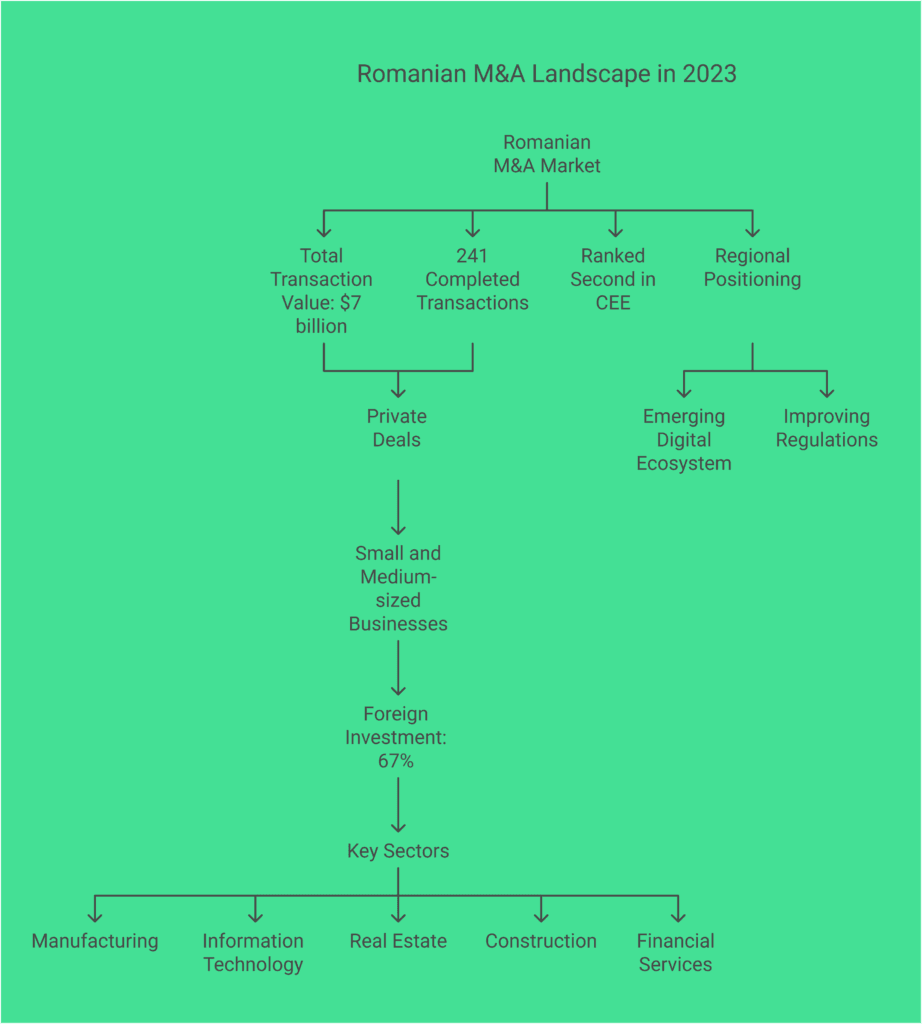
In 2023, the Romanian M&A market showed it’s strong.

Key signs point to its bright future:

  • Total transaction value reached approximately 7 billion dollars;
  • 241 completed ownership transition transactions;
  • Ranked second in Central and Eastern European M&A activity.

Market Dynamics and Trends

Most deals in Romania are private. Small and medium-sized businesses lead the way.

About 67% of deals come from outside, showing investors’ keen interest.

Sectoral Breakdown

The top sectors for mergers and acquisitions in Romania are:

  1. Manufacturing;
  2. Information Technology;
  3. Real Estate;
  4. Construction;
  5. Financial Services.

Regional Positioning

Romania is a major player in Central and Eastern Europe’s M&A scene.

Its location, emerging digital ecosystem, and improving rules attract investors.

They see great chances for restructuring their businesses here.

Legal Framework Governing Business Transfers in Romania

Romanian Business Transfer Legal Framework

Understanding the legal side of business transfers in Romania is key.

The rules are based on both national laws and EU directives.

This makes the process for handing over a business in Romania quite detailed.

Important legal parts of business transfers in Romania include:

  • Directive (EU) 2017/1132 on company law aspects;
  • Directive (EU) 2019/2121 addressing cross-border conversions;
  • Romanian Companies Law (Law 31/1990);
  • Financial Services Authority Regulation No. 5/2018.

Your plan for transferring a business must follow certain rules.

The Romanian laws set important rules and steps for business deals:

  1. Controlling interest is defined as holding 50% plus one voting right;
  2. Public takeovers become mandatory when an investor holds over 33% voting rights;
  3. Shareholders with more than 5% ownership can propose valuation methods;
  4. Mandatory notifications are required at specific ownership thresholds.

When you plan to transfer a business, you must follow strict rules.

Filings related to business combinations must be submitted within 24 hours of triggering events.

Also, merger plans need to be published in the Official Gazette of Romania.

International investors should know about recent changes.

Government Emergency Ordinance No. 108/2023 has made rules for foreign direct investment clearer.

This adds more complexity to business transfers in Romania.

Types of Business Transfers and Acquisitions

When thinking about company ownership changes in Romania, it’s key to know the different ways to transfer businesses.

Business leaders face complex choices between mergers, acquisitions, and other transfer methods.

These choices can greatly affect their business strategies.

In Romania, business succession planning mainly focuses on two main types: share deals and asset deals.

Each type has its own legal, financial, and operational implications for corporate transfers.

Mergers and Their Characteristics

Mergers are a complex way to join two companies into one. In Romania, mergers often mean:

  • Combining corporate structures;
  • Shared leadership and strategy;
  • Benefits in taxes and operations.

Acquisition Structures

Acquiring a business in Romania can be complex, with many strategies for different goals.

The main acquisition types are:

  1. Buying the whole target company;
  2. Buying a part of it;
  3. Making a strategic minority investment.

Asset vs. Share Deals

CharacteristicAsset DealsShare Deals
Transferable ElementsSpecific assets and some liabilitiesWhole company ownership
Tax ImplicationsSeller pays taxes16% capital gains tax for locals
ComplexityMore complex due to asset-by-asset transfersSmaller complexity in ownership change

For commercial enterprise transfer in Romania, knowing these detailed strategies helps businesses pick the best one.

This choice should match their goals and the market situation.

Foreign Direct Investment Regulations

Romania is a great place for business ownership change.

It has a solid framework for foreign direct investment (FDI).

This framework helps attract international investors.

It also guides foreign buyers on how to start or grow their business here.

Here are some important points about Romania’s FDI rules:

  • Mandatory screening for investments over €2 million;
  • Comprehensive national security and public order checks;
  • Environmental protection compliance requirements;
  • Specific sector-specific investment scrutiny.

Foreign investors need to understand Romania’s detailed rules when considering a business transfer here.

The investment screening process makes sure investments fit with national interests.

At the same time, it keeps the country open to investors.

FDI Regulation HighlightsKey Details
Screening Fee€10,000 (refundable under certain conditions)
Maximum Review Duration135 days
Penalty for Unauthorized InvestmentsUp to 10% of worldwide turnover

The Romanian FDI regime strikes a good balance.

It attracts foreign investments while safeguarding national interests.

Investors need to look closely at sector-specific rules, like in energy, telecommunications, and critical infrastructure.

Foreign investors should know about the detailed screening process for ownership changes.

The rules ensure transparency and national security.

They don’t block international business investments.

Business Transfer in Romania: Process and Requirements

Starting a commercial enterprise succession in Romania needs careful planning.

The process involves many important steps.

These steps focus on legal and financial details.

Understanding the framework for business transfers in Romania is key.

The process aims for transparency, legal compliance, and a smooth transfer of ownership.

Pre-Transfer Assessment

The first step is a detailed pre-transfer evaluation.

This phase is critical and includes:

  • Comprehensive financial review;
  • Valuation of company assets;
  • Identification of legal risks;
  • Verification of contracts.

Documentation Requirements

Business transfers need careful documentation.

You’ll need:

  1. Detailed financial statements;
  2. Shareholder agreements;
  3. Corporate registration documents;
  4. Tax compliance certificates.
Document TypeLegal RequirementProcessing Time
Share Transfer Approval75% Share Capital Consent7-14 Days
Registration CertificateRomanian Companies Law10 Days
Tax ClearanceMandatory Verification5-7 Days

Legal Compliance Steps

Legal compliance is essential for a smooth transfer.

Key steps are:

  • Notifying authorities;
  • Getting Competition Council approvals;
  • Completing registration processes.

Seeking expert legal advice is recommended.

For professional help, call our recommended Romanian legal experts at +40765366887.

Due Diligence in Romanian Business Transfers

When buying a company in Romania, due diligence is key.

It helps lower risks and makes sure the transfer goes well.

This step checks the investment in many ways.

When planning mergers and acquisitions in Romania, focus on several important areas:

  • Financial review of historical performance;
  • Legal compliance verification;
  • Operational infrastructure assessment;
  • Commercial and market analysis.

Business sales in Romania need careful checking.

Investors should look closely at financial reports, legal papers, and any rules that might affect the business.

Due Diligence CategoryKey Focus AreasPotential Risks
FinancialRevenue streams, profit marginsHidden liabilities
LegalContractual obligationsPending litigation
OperationalTechnology infrastructureInefficient processes

Experts say using new tech and getting help from experts is smart.

Good planning can really cut down on risks.

With a thorough due diligence, you’ll have a better shot at making a successful deal in Romania’s fast-changing market.

Tax Implications and Fiscal Considerations

Understanding tax laws in Romania is key for corporate transactions.

When you’re handling ownership changes, you’ll face many financial issues.

These can greatly affect your business strategy.

Romanian tax laws are complex for financial transfers.

Knowing the main tax points is vital.

It helps avoid risks and get the best financial results from your deal.

Transfer Pricing Requirements

The Romanian Fiscal Code requires strict rules for deals between related parties.

There’s been a rise in tax audits on these issues.

  • Mandatory documentation for related-party transactions;
  • Comprehensive reporting requirements;
  • Potential penalties for non-compliance.

VAT Implications

VAT is a big deal in business transfers.

Romania has its own VAT rules that businesses must follow:

  1. Standard VAT rate: 19%
  2. Reduced VAT rates: 9% and 5% for specific supplies
  3. VAT registration threshold: RON 300,000 annually

Corporate Tax Aspects

Corporate tax strategies are important for business transfers.

You need to think about tax liabilities, exemptions, and new laws.

Tax planning is essential to optimize your financial position during ownership transitions in Romania.

Strategic Sectors and Special Regulations

When you’re doing commercial transfers in Romania, knowing about strategic sectors is key.

The Romanian government watches business deals in important areas closely.

These areas affect national security and public order.

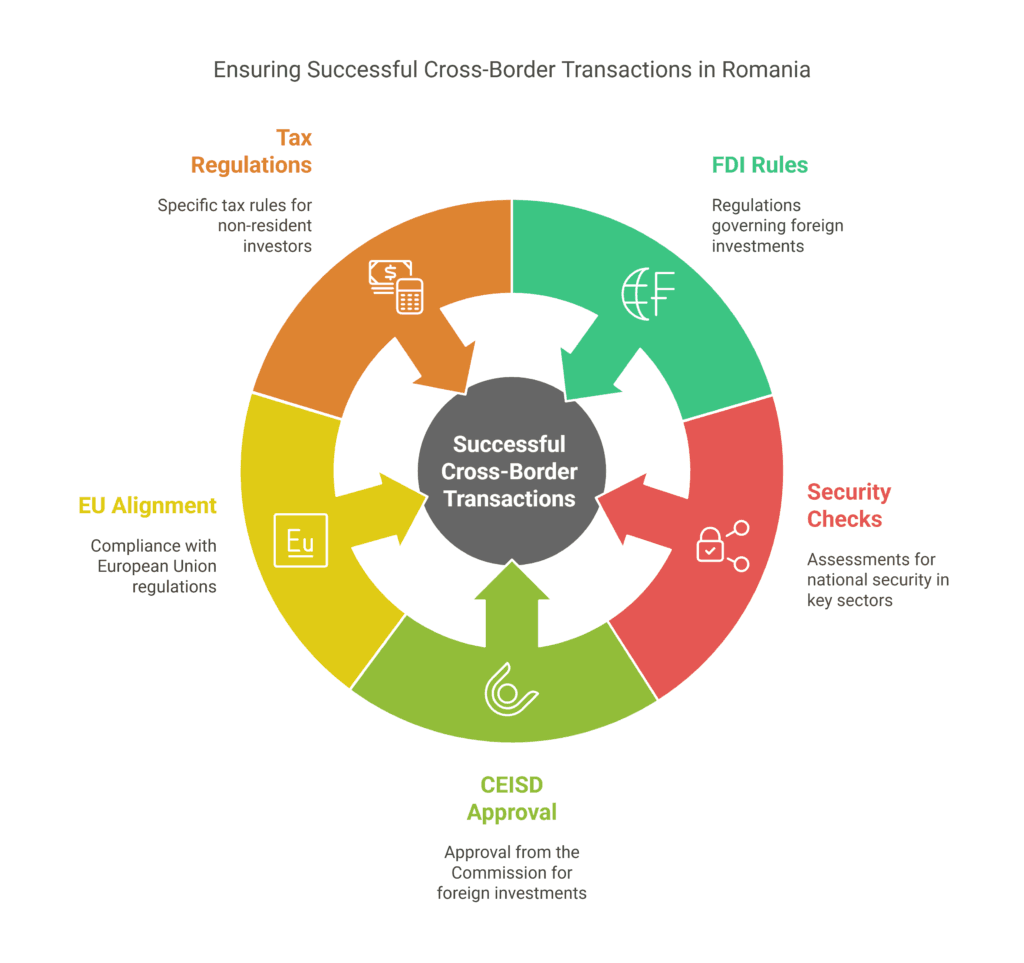
Foreign investors face a tough approval process in sensitive sectors.

The Commission for the Examination of Foreign Direct Investments (CEISD) checks these deals carefully.

Key Strategic Sectors Requiring Special Approval

  • Energy infrastructure;
  • Transport systems;
  • IT and communication networks;
  • Financial and banking services;
  • Critical national infrastructure;
  • Security-related industries.

For sales of companies in these key sectors, investors need special approvals.

The rules require a close look at deals over 2 million euros.

Recently, laws have changed, like the updates to Emergency Ordinance 46/2022.

These changes help protect national interests but also keep the investment climate good.

Investment Approval Considerations

  1. Comprehensive security assessment;
  2. Evaluation of national security risks;
  3. Check on the investor’s background;
  4. Look at how the deal affects key sectors.

Knowing these rules is vital for smooth business transfers in Romania’s strategic sectors.

Investors should team up with local legal advisors to get through these complex steps.

Role of Regulatory Bodies and Authorities

When you transfer business ownership in Romania, knowing the role of key regulatory bodies is key.

Your journey in corporate restructuring will meet several important authorities.

They oversee and validate business transactions.

Romanian business transfers need several regulatory frameworks for transparency and compliance.

These key institutions are vital in monitoring and approving corporate changes.

Competition Council Oversight

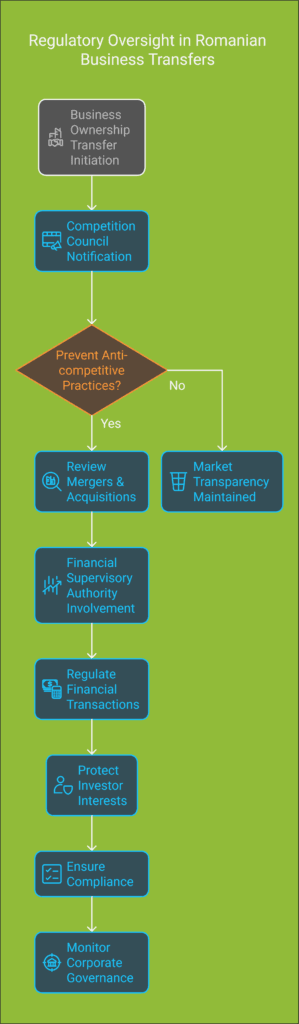
The Competition Council is a key watchdog in firm handovers. It has main duties:

  • Preventing anti-competitive market practices;
  • Reviewing merger and acquisition impacts;
  • Evaluating economic concentration transactions;
  • Protecting fair market competition.

When you transfer business ownership in Romania, you must tell the Competition Council for certain transactions.

This keeps the market transparent and stops monopolies.

M&A Regulatory

Financial Supervisory Authority Functions

The Financial Supervisory Authority (ASF) is key in corporate restructuring in Romania, mainly for financial institutions and listed companies. Its main tasks are:

  1. Regulating financial market transactions;
  2. Protecting investor interests;
  3. Ensuring compliance with financial regulations;
  4. Monitoring corporate governance standards.

Your business transfer plan must meet these regulatory needs for smooth, legal transactions in various sectors.

Knowing these regulatory frameworks helps you confidently and strategically navigate Romanian business transfers.

Cross-Border Transaction Considerations

Foreign investors must grasp the complex world of corporate takeovers in Romania.

The country has a strong legal setup to help with ownership changes.

It also protects national interests.

Key points for cross-border deals include:

The Romanian government has rules to attract foreign investment safely.

Foreign buyers need to know a few important things:

  1. They must report investments in sensitive areas;
  2. There could be a 5-8 month wait for FDI approval;
  3. They need to show detailed ownership details.

Taxes are very important in cross-border deals. Non-resident investors should know about specific tax rules:

Transaction TypeWithholding Tax RateSpecial Conditions
Dividends8%0% for EU companies with 10%+ shareholding
Interest16%Potential exemptions under EU directives
Royalties16%Reduced rates for specific agreements

It’s vital to understand these detailed rules for successful deals in Romania.

You must look at legal, financial, and regulatory aspects.

This ensures a smooth change in ownership.

Cross Border Transaction Romania

Recent Legislative Changes and Future Outlook

Romania’s business world is changing a lot in 2024.

This brings new chances for selling businesses and changing how companies work.

The rules for buying and selling companies are getting clearer.

Important changes are making the Romanian business scene different.

These changes affect how businesses operate:

  • Government Decision 300/2024 makes it easier to invest;
  • Emergency Ordinance 32/2024 changes how money is handled;
  • New rules for foreign investments.

2024 Regulatory Updates

Romania wants to make it easier for investors to come in.

If you’re thinking about selling your business in Romania, you’ll find it easier to start a new one.

The rules are clearer now.

Anticipated Changes

Romania’s economy is looking good, with a 3% GDP growth forecast for 2024-2025.

The government plans to make things better for businesses by:

  1. Making it easier to transfer businesses;
  2. Following EU rules;
  3. Welcoming more foreign investments.

If you’re looking to buy a business in Romania, now is a great time.

The mix of EU money and economic changes makes it a good place to invest.

Conclusion

Business divestment in Romania is complex and needs careful planning and legal knowledge.

When looking at corporate acquisitions, you must understand the detailed rules for business ownership changes in Romania.

This process includes legal steps, financial checks, and making strategic choices.

Your success in Romanian business transfers depends on thorough preparation and expert advice.

With about 690,000 small and medium-sized enterprises possibly changing hands soon, knowing the legal details is key.

The rules, like Law no. 31/1990, require focus on things like share transfer agreements and shareholder approvals.

Getting professional legal help is vital for these complex deals.

Romanian corporate law asks for accurate documents, like share transfer agreements and updated Articles of Association.

Working with skilled corporate lawyers can help avoid risks and make sure your business moves smoothly and legally.

For expert help with your business transfer, call Romania business transfer expert at tel. +40765366887.

Your careful planning will be key to the success of your corporate deal or business sale in Romania’s fast-changing market.

FAQ

What are the main types of business transfers in Romania?

In Romania, you can transfer businesses through mergers, acquisitions, asset deals, or share deals.

Mergers combine two companies into one.

Acquisitions mean one company buys another.

Asset deals transfer specific business assets, and share deals change who owns the company.

What are the key regulatory bodies involved in business transfers in Romania?

Several key groups watch over business transfers in Romania.

The Competition Council stops unfair competition.

The Financial Supervisory Authority looks after financial sector deals.

The Commission for the Examination of Foreign Direct Investments (CEISD) checks foreign investments.

What additional requirements exist for foreign investors in Romanian business transfers?

Foreign investors face extra rules, like national security checks under Emergency Ordinance 46/2022.

They must get extra approvals in key areas like energy and IT.

The CEISD reviews these deals to protect Romania’s interests and welcome foreign money.

How important is due diligence in Romanian business transfers?

Due diligence is very important in Romanian business transfers.

It checks the target business’s finances, laws, operations, and sales.

A good due diligence helps avoid risks and makes the transfer smooth.

It’s best to get experts to do a detailed check.

What tax considerations are critical in Romanian business transfers?

Important tax issues include following the arm’s length principle, VAT, and corporate taxes.

With more audits on transfer pricing, it’s key to document and justify prices.

You should also think about tax breaks, delays, and new tax laws that might affect your deal.

What are the primary challenges in cross-border business transfers in Romania?

Dealing with international rules is a big challenge in cross-border transfers in Romania.

You face issues like currency, legal systems, security checks, and taxes.

Getting help from Romanian legal and financial experts  is vital for these complex deals.

How has the Romanian M&A landscape changed in recent years?

The Romanian M&A market has seen big changes, like the COVID-19 pandemic and global tensions.

Romania is a strong player in Central and Eastern Europe, with more interest in tech, green energy, and finance.

New laws aim to make it easier for foreign investors to come in.

What documentation is typically required for a business transfer in Romania?

You’ll need lots of documents for a business transfer in Romania.

These include financial statements, legal papers, shareholder agreements, and tax certificates.

Depending on the deal, you might also need environmental reports, security clearances, and more.


creditors rights in Romania

Creditors Rights in Romania: Legal Protections

Creditors Rights in Romania: Legal Protections

Ever wondered how creditors protect their interests in Romania’s financial world?

With debt recovery and insolvency proceedings changing, knowing about creditors’ rights is key for everyone.

Romania’s laws give strong protection to creditors, based on Civil Law.

The country has updated its rules to match EU directives, like the Recast Directive 2011/7/EU on late payments.

This change aims to make things fair for both sides and encourage honest business.

Creditors in Romania have many legal tools to protect their interests.

They can use personal guarantees, warranties, and collateral rights.

The laws in Romania balance things out, letting creditors chase debt while keeping things fair for everyone.

Listen to our newest Podcast on Creditor`s Rights in Romania:


creditors rights in romania

It’s important for creditors to understand Romania’s debt collection laws.

They have many ways to recover debt, from friendly talks to legal actions.

Insolvency proceedings in Romania also affect creditors’ rights, offering both challenges and chances to get paid back.

Key Takeaways

  • Romania’s creditor protection aligns with EU directives;
  • Personal guarantees and collateral rights are available to creditors;
  • Debt recovery options include amicable settlements and legal processes;
  • Insolvency proceedings significantly impact creditors’ rights;
  • Understanding Romanian debt collection laws is crucial for creditors.

Overview of Creditor Protection in Romania

Romania has a strong legal system for protecting creditors.

The Civil Code, Civil Procedure Code, and Law 72/2013 are key.

They help ensure lenders are treated fairly and businesses operate smoothly.

Legal Framework for Creditor Rights

Romania offers several ways to protect creditors.

Personal guarantees, autonomous warranties, and collateral are available.

For example, fideiusion lets a third party promise to pay a debt.

Letters of guarantee are another tool, making promises to pay third parties.

Importance of Understanding Creditor Protections

It’s vital for businesses to understand creditor protection in Romania.

The average time to pay bills is 65 days, with delays up to 25 days.

Knowing this helps creditors set realistic expectations and plan better.

creditor protection romania

Recent Developments in Romanian Creditor Laws

New laws in Romania have made creditor rights stronger.

Law 72/2013 requires payments within 30 days after receiving an invoice.

Payments can take up to 60 days.

Late payments now charge a 6% interest rate plus at least 8 percentage points.

Creditors can also claim a flat EUR 40 for minimum damages.

These changes aim to better enforce judgments and protect secured creditors’ rights.

AspectProvision
Payment Term30-60 days
Late Payment Interest6% + 8 percentage points
Minimum DamagesEUR 40

Types of Creditors in Romania

Romanian law has different types of creditors.

Each has its own rights and priorities.

Knowing these is key for effective debt recovery and protecting your interests in Romania.

Types of creditors romania

Secured creditors in Romania have rights over specific assets, like mortgages or pledges.

They get paid first in insolvency, using the sale of collateral.

The minimum debt to start insolvency is EUR 8,800, balancing creditor and debtor rights.

Unsecured creditors in Romania don’t have specific assets to claim.

Yet, they are crucial in insolvency. They must register their claims within 45 days, with a EUR 50 stamp duty.

Creditor priorities in Romania are set by law.

Secured creditors rank higher than unsecured ones.

This order is important when assets are sold, following the Insolvency Code’s rules.

Foreign creditors in Romania have the same rights as local ones.

They get equal treatment in insolvency, including voting on plans.

Creditor TypePriority LevelKey Rights
SecuredHighPriority in asset liquidation, specific collateral rights
UnsecuredLowerClaims on general assets, voting rights in reorganization
ForeignEqual to domesticEqual participation in proceedings, non-discriminatory treatment

Secured Creditors Rights

In Romania, secured transactions are key to protecting creditors.

The laws here offer strong ways to enforce collateral.

This helps lenders keep their investments safe.

Mortgages and Pledges

Secured deals in Romania often include mortgages and pledges.

A mortgage can be placed on real estate by registering it in the land book.

For movable goods, pledges are used.

These give lenders a clear claim on the assets.

Priority in Insolvency Proceedings

When a company goes bankrupt, secured creditors get a special advantage.

They get paid first from the collateral’s value.

This makes lending safer and boosts the economy.

Enforcement of Security Interests

Enforcing collateral in Romania has its own rules.

Creditors can go to court or use direct methods.

The steps are:

  • Notify the debtor of default;
  • Start the enforcement process;
  • Value and sell the assets;
  • Share the money with creditors.

Knowing these steps is vital for creditors in Romania.

It helps them protect their interests when debts are not paid or a company goes bankrupt.

Security TypeRegistration RequiredValidity Period
Immovable MortgageLand Book15 years (renewable)
Movable MortgageNational Register for Movable Publicity5 years
PledgeElectronic Archive5 years

Unsecured Creditors Rights

In Romania, unsecured creditors face unique challenges when trying to get back debts.

The legal rules, mainly from Law 85/2014, offer several ways for creditors to make claims.

Knowing these rights is key for successful debt collection.

Unsecured creditors must file their claims within 45 days after the insolvency starts.

This tight deadline shows how crucial quick action is.

To start insolvency, a claim must be over €8,800 and unpaid for more than 60 days.

In debt restructuring, unsecured creditors join meetings and vote on plans.

They get paid after secured creditors.

Though, they can use legal tools like promissory notes to improve their standing.

The time for liquidation varies.

Voluntary liquidation might last three months, but other cases can take years.

Unsecured creditors must stay involved to protect their interests.

Trade credit insurance adds extra protection, especially in IT.

It helps reduce risks for unsecured creditors in Romania, offering a safety net if the debtor goes bankrupt.

Creditors Rights in Romania: Legal Protections

Romania has laws to protect lenders’ interests.

These include personal guarantees, autonomous warranties, and collateral.

It’s important for creditors to know about these legal safeguards.

Personal Guarantees

Personal guarantees in Romania are key for creditor protection.

They add an extra layer of security.

If the borrower defaults, creditors can go after the guarantor for payment.

Autonomous Warranties

Autonomous warranties in Romania are independent promises to pay.

They include letters of guarantee and comfort letters.

Unlike personal guarantees, they stand on their own, giving creditors more confidence.

Privileges and Collateral

Collateral in Romania is vital for creditor protection.

It can be mortgages, pledges, or retention rights.

Privileges give some creditors priority in debt recovery.

These tools help secure loans and influence terms.

Protection TypeDescriptionBenefit to Creditors
Personal GuaranteesAncillary obligation by guarantorAdditional repayment source
Autonomous WarrantiesIndependent payment commitmentsSeparate assurance from primary obligation
CollateralAssets pledged as securityReduces risk of non-payment

Creditor protection laws in Romania are changing.

Recent updates include limits on default interest rates and rules for debt collection in Romania.

These changes aim to balance creditor rights with consumer protection, creating a more stable financial environment.

Debt Recovery Procedures in Romania

Debt recovery in Romania has several paths for creditors to get back unpaid debts.

The first step is usually amicable settlements.

This method is quick and effective for solving disputes.

Amicable Settlements

Creditors often start with amicable settlements in Romania.

This way, they can negotiate and agree without going to court. It saves time and money.

Legal Dunning Process

If talks fail, creditors can start a legal dunning process.

They send a formal Summons Letter to the debtor.

This letter asks for payment and outlines the debt.

This process lets creditors show evidence and ask for expert opinions.

It helps support their claims.

Payment Order Procedure

The payment order procedure in Romania is fast for undisputed debts. It’s called “ordonanta de plată.”

It’s for debts from agreements that are clear and need to be paid right away. The cost for this is about €40.

For debts under €2,000, there’s a special small claim procedure.

The cost for this is between €10 and €50.

For bigger debts, the common procedure is used.

Claims up to €45,000 are handled by the first court.

Debt collection in Romania can be tricky. But knowing these steps can help creditors succeed.

The right strategy can lead to successful debt recovery in Romania.

Insolvency Proceedings and Creditor Rights

Insolvency proceedings in Romania are complex.

They balance protecting creditors with trying to save businesses.

It’s key for creditors to understand these steps in bankruptcy procedures in Romania.

Creditors’ Role in Insolvency Procedures

Creditors are crucial in insolvency proceedings in Romania.

They can start the process if a debt is over 50,000 lei and is late by more than 60 days.

Employees can also be creditors if their claim is more than 6 average salaries.

Creditors get to vote on important decisions.

This helps shape the outcome of the proceedings.

Reorganization Plans and Creditor Approval

Reorganization plans are part of corporate restructuring in Romania.

These plans aim to save the debtor’s business.

They need creditor approval.

The time to carry out these plans can’t be longer than 3 years.

Creditors’ opinions are vital in making these plans fair and effective.

Liquidation Proceedings

If reorganization fails, liquidation proceedings in Romania take over.

In this step, the debtor’s assets are sold to pay off creditors. The order of payment follows a set priority.

Creditors with over 30% of the debts can take legal action against those responsible for the insolvency.

Those found guilty can’t hold administrative roles for 10 years.

AspectDetail
Minimum Debt Threshold50,000 lei
Employee Claim Threshold6 average gross salaries
Observation PeriodMaximum 20 days
Reorganization Plan DurationUp to 3 years
Liability Action Threshold30% of total debts

Cross-Border Debt Recovery in Romania

Romania’s EU membership has made it easier to recover debts across borders.

Foreign creditors have the same rights as local ones in Romanian courts.

This makes it simpler for creditors to get back what they’re owed, no matter where they are.

Cross-border debt recovery in Romania covers a few important areas:

  • Recognition of foreign insolvency proceedings;
  • Determination of center of main interests;
  • Cooperation with foreign courts;
  • Time frames for debt collection.

Romania offers several ways for effective cross-border debt recovery.

The European Payment Order and European Small Claims Procedure help EU creditors.

These EU rules make it easier for foreign creditors to collect debts in Romania.

AspectDetails
Informal out-of-court collectionUp to 60 days
General limitation period3 years (extendable)
International sale of goods4 years limitation (UN Convention)
Court hearing schedulingApproximately 100 days

But, collecting debts in Romania can still be tough.

Language issues and not knowing local rules can make things harder for foreign creditors.

Getting help from a local lawyer in Romania is usually a good idea to deal with these problems.

Legal Remedies for Creditors in Romania

In Romania, creditors have many ways to get back what they’re owed.

The key step is enforcing judgments.

This means using court bailiffs to seize assets and sell them off.

Laws in Romania let creditors attach a debtor’s property to pay off debts.

Enforcement of Judgments

There are several ways to enforce debts in Romania.

The Payment Ordinance is fast, taking just 30 days.

It’s great for speeding up getting your money back.

For debts under RON 10,000, the small claims procedure is quicker and cheaper.

Asset Seizure and Litigation

Creditors can use different legal actions to get what they’re owed.

If talking things out doesn’t work, you might need to go to court.

Our team of Romanian Lawyers in Bucharest can help with this.

Our lawyers can assist with gathering evidence, going to court, and enforcing judgments.

Getting a judgment is important, but it’s not the end.

The process in Romania can be long and complex.

Keeping good records and trying to settle out of court first is wise.

With the right help and knowledge of Romanian law, you can overcome these hurdles.

FAQ

What is the legal framework for creditor rights in Romania?

Romania’s laws for creditor rights include the Civil Code and the Civil Procedure Code.

Also, the Law 72/2013 on late payments is part of it.

The country has updated its laws to follow EU directives, like the Recast Directive 2011/7/EU on late payments.

What are the different types of creditors recognized in Romania?

Romania’s law divides creditors into secured and unsecured.

Secured creditors have rights to specific assets, like mortgages.

Unsecured creditors rely on the debtor’s general assets.

The law also sets a priority order for creditors in insolvency.

What rights do secured creditors have in Romania?

Secured creditors in Romania have strong legal rights.

They can secure mortgages on real estate or pledges on movable property.

In insolvency, they get paid first from the value of their collateral.

How are unsecured creditors’ rights protected in Romania?

Unsecured creditors in Romania have legal options like litigation and joining insolvency proceedings.

They can use documents like promissory notes to strengthen their claims.

In insolvency, they are paid after secured creditors and priority claims.

What forms of creditor protection are available in Romania?

Romania offers creditor protection through personal guarantees, warranties, and privileges.

Collateral can be in the form of mortgages, pledges, or retention rights.

What are the common debt recovery procedures in Romania?

Debt recovery in Romania starts with trying to settle the debt amicably.

If that fails, creditors can start legal action with a Summons Letter.

The Payment Order procedure is a fast way to collect undisputed debts.

How do insolvency proceedings work in Romania, and what is the role of creditors?

Romania’s insolvency law includes reorganization and liquidation.

Creditors are key, attending meetings and voting on decisions.

Reorganization plans need creditor approval.

In liquidation, assets are sold to pay creditors in a set order.

What are the options for cross-border debt recovery in Romania?

As an EU member, Romania uses EU rules for cross-border debt recovery.

This includes the European Payment Order and the European Small Claims Procedure.

Foreign creditors have the same rights as local ones in Romanian proceedings.

What legal remedies are available for creditors in Romania?

Creditors in Romania have many legal options.

They can enforce judgments, seize assets, and use special procedures.

These include regular court actions, the Payment Order procedure, and others for specific claims.