Data Processing Agreement in Romania for GDPR controller and processor compliance

Data Processing Agreement Romania: GDPR Guide

A data processing agreement is required when a company engages another party to process personal data on its documented instructions. The label used in the commercial contract is not decisive: the parties must first classify their actual GDPR roles, then align the agreement with the service, security model, subprocessor chain and any international transfers.

In brief

For a Romanian or foreign business subject to the General Data Protection Regulation (GDPR), an Article 28 data processing agreement (DPA) is not a generic confidentiality annex. It must describe the processing and impose specific duties on the processor. A processor DPA is not required where the supplier acts as an independent controller, although controller-to-controller data-sharing provisions may still be appropriate; joint controllers need an Article 26 arrangement. If personal data is transferred outside the European Economic Area, the DPA alone does not provide a Chapter V transfer mechanism, even where transfer clauses are integrated into the same contractual document.

When is a data processing agreement required?

The general rule is that a written DPA is required when one party processes personal data on behalf of another party. Article 28 GDPR requires the controller to appoint only processors that provide sufficient guarantees and to govern the processing through a binding contract or other legal act, in writing, including electronically.

The practical starting point is the service, not the supplier’s preferred contract label. Payroll providers, cloud hosting companies, customer-support platforms, outsourced IT administrators, email delivery services and some marketing vendors commonly act as processors because they handle data for purposes defined by their customer. The same vendor may nevertheless be a controller for separate activities, such as its own billing, fraud prevention or legally required records.

Before signing, map each processing activity and ask who decides why the data is processed and who makes the key decisions regarding the means of processing. Certain non-essential practical means may be left to the processor. The European Data Protection Board’s Guidelines 07/2020 on controller and processor concepts are the relevant official interpretative reference.

Role map

Choose the relationship that best describes the processing

Select a card to see the usual document and the main classification test.

Controller and processor: use an Article 28 DPA.

The controller determines the purposes and makes the key decisions regarding the means of processing; the processor handles data on documented instructions and may decide certain non-essential practical means. Describe the service-specific processing and all mandatory Article 28 controls.

RelationshipMain testUsual documentFrequent mistake
Controller–processorThe supplier processes personal data for the customer’s purposes and on its documented instructions.Article 28 DPA, usually attached to the services agreement.Using a one-page confidentiality clause with no processing details or security annex.
Independent controllersEach party determines its own purposes and makes the key decisions regarding the means of its processing.Controller-to-controller data-sharing terms, transparency allocation and lawful-disclosure provisions.Forcing a processor DPA onto a professional adviser or platform acting for its own lawful purposes.
Joint controllersThe parties jointly determine the purposes and key decisions regarding the means of processing.Transparent Article 26 arrangement allocating responsibilities.Calling one party a processor even though both designed the relevant processing.
Mixed rolesThe role changes by processing activity.Activity-specific clauses covering each role.Applying one label to the entire commercial relationship.

What must an Article 28 DPA contain?

A compliant DPA must identify the processing and include every mandatory control listed in Article 28(3) GDPR. It should specify the subject matter and duration, nature and purpose, types of personal data, categories of data subjects, and the controller’s rights and obligations. It must then translate the statutory requirements into workable contractual duties.

Clause control room

Test the operational core of the DPA

Each control needs both contractual wording and evidence that it can work in practice.

Instructions must be documented and specific enough to control use.

Define permitted purposes, operations, users and transfer instructions. The processor must alert the controller if it considers an instruction unlawful.

Mandatory controlWhat the DPA should settleUseful evidence or annex
Documented instructionsPurposes, permitted operations, access, disclosure, locations and transfers; process for changing instructions.Processing schedule, service description, authorised-user model and change log.
ConfidentialityAuthorised personnel must be bound by contractual or statutory confidentiality.Role-based access, confidentiality undertakings and training records.
Article 32 securityMeasures proportionate to the processing risk, not merely “industry standard security”.Technical and organisational measures annex, certifications, test summaries and remediation process.
SubprocessorsPrior specific or general written authorisation, change notice, objection process and equivalent downstream duties.Current subprocessor list, service and country details, due-diligence records and flow-down terms.
AssistanceSupport for data-subject requests and controller obligations under Articles 32–36.Request workflow, responsibility matrix, response contacts and DPIA support process.
End of serviceController’s choice between return and deletion, copy deletion and lawful-retention exceptions.Export format, deletion timetable, backup treatment and deletion certificate.
Information and auditsEvidence needed to demonstrate compliance and a workable audit or inspection mechanism.Audit reports, questionnaires, certification scope, remediation plan and escalation rights.

The European Commission has adopted optional standard contractual clauses for controllers and processors under Article 28. The parties may adopt the 2021/915 standard clauses or negotiate their own Article 28 terms. Where the standard clauses are used, additional clauses should not directly or indirectly contradict them or prejudice the fundamental rights and freedoms of data subjects.

Why a generic security clause is not enough

The security schedule should describe controls that match the actual data, systems and risks. Article 32 GDPR requires appropriate technical and organisational measures, taking account of the state of the art, implementation cost, processing context and risks to individuals. Depending on the service, relevant controls may include encryption, access management, logging, vulnerability management, backups, resilience, testing, staff controls and incident response.

A clause stating only that the supplier will apply “appropriate” or “industry standard” security gives the controller little evidence and may leave important assumptions unresolved. The annex should also distinguish controls included in the standard service from optional configurations that the customer must activate.

How should subprocessors be managed?

A processor cannot appoint a subprocessor without the controller’s prior specific or general written authorisation. Under a general authorisation, the processor must notify intended additions or replacements in time for the controller to object. The processor must impose equivalent data-protection obligations downstream and remains fully liable to the controller for the subprocessor’s performance of those obligations.

The contract should state what information accompanies a change notice, how long the objection window lasts, what constitutes a reasonable objection and what happens if the parties cannot resolve it. A nominal right to object is of limited value if the controller receives only a company name, with no service description, processing location or transfer information.

The European Data Protection Board’s Opinion 22/2024 on processors and subprocessors is an important due-diligence reference. Controllers should be able to identify the entire processing chain, including relevant subprocessors and, where appropriate, further sub-processing layers, and obtain enough information to assess whether sufficient guarantees exist.

Does a DPA cover international data transfers?

No. A DPA regulates processing on behalf of a controller, but the DPA alone does not provide a Chapter V transfer mechanism. If data moves to, or is remotely accessed from, a country outside the European Economic Area, the parties must separately establish whether an adequacy decision or another valid safeguard applies. The relevant Article 28 clauses and transfer safeguards may nevertheless be integrated into a single contractual document.

This distinction is easy to miss because two different EU instruments are commonly called “SCCs”. Commission Decision (EU) 2021/915 concerns standard clauses for the Article 28 controller–processor relationship. Commission Decision (EU) 2021/914 contains standard contractual clauses for transfers to third countries. Where the transfer clauses apply, the parties must select the correct module, complete the annexes and assess the destination-country context and any necessary supplementary measures.

How quickly must a processor report a data breach?

The GDPR requires the processor to notify the controller without undue delay after becoming aware of a personal data breach. The familiar 72-hour period applies to the controller’s notification to the competent supervisory authority where the legal conditions are met; it is not the processor’s default reporting deadline.

The DPA should therefore set a fast contractual notification route that gives the controller time to investigate and decide whether regulatory or data-subject communications are required. It should define the incident contact, initial information, phased updates, evidence preservation, cooperation, remediation and post-incident report. A fixed period can be useful, but it should not dilute the statutory “without undue delay” standard.

For the controller’s incident process, see our practical GDPR data breach guide for Romania.

What should the controller check before signing?

The controller should test both the contract and the processor’s ability to perform it. Article 28 requires sufficient guarantees, so signature alone is not the end of the due-diligence exercise.

  1. Confirm the role for each activity. Separate processor functions from any independent or joint-controller processing.
  2. Map the data and people involved. Record data categories, data subjects, purposes, systems, locations, retention and sensitive-data elements.
  3. Review the mandatory clauses. Check every Article 28 requirement and remove conflicts with the main services agreement.
  4. Test the security annex. Align the written controls with the service configuration and the risk level.
  5. Identify all relevant subprocessors. Verify functions, locations, change procedure, downstream obligations and transfer safeguards.
  6. Plan incidents and rights requests. Agree contacts, response steps, information fields and internal escalation.
  7. Set the exit route. Define return, export, deletion, backups, certification and any lawful retention.
  8. Retain accountability evidence. Keep the assessment, negotiated terms, approvals, notices and review dates.

Illustrative vendor scenarios

These examples are simplified and do not replace a factual role analysis.

SaaS provider hosting a customer database

The Romanian customer decides why client records are stored and how staff use them. The SaaS provider hosts and supports the database on the customer’s instructions. An Article 28 DPA is normally required, together with a security schedule and a review of hosting and support subprocessors.

Professional adviser receiving matter information

A lawyer, auditor or other regulated adviser may independently determine certain purposes and make key decisions regarding the means of processing because of professional duties and legal obligations. It may be incorrect to classify every such activity as processor work. The engagement terms should describe the actual roles and disclosures.

Cloud subprocessor with access outside the EEA

The immediate processor uses a support provider in a third country. The controller–processor DPA remains necessary, but it is not sufficient. The parties must also examine the relevant transfer mechanism, complete the required documentation and assess whether supplementary safeguards are needed.

How should the DPA interact with the main services agreement?

The documents should work as one contract set. The services agreement, DPA, security schedule, service levels and subprocessor information should use consistent definitions, liability rules, notice mechanisms, termination rights and order-of-precedence clauses.

Commercial limits on liability require particular attention. A DPA cannot remove statutory obligations or the rights of data subjects, while the allocation of contractual risk between the parties depends on the negotiated agreement and applicable law. Audit rights also need balance: the controller requires meaningful evidence, but the process should protect the processor’s security, confidentiality and other customers.

For a wider commercial review, use our contract review checklist for Romania. Technology businesses may also find our IT and SaaS contract services relevant.

Frequently asked questions

Is a DPA required with every service provider?

No. It is required where the provider processes personal data on behalf of the controller. An independent controller relationship may require data-sharing terms instead, while joint controllers need an Article 26 arrangement. The correct classification depends on the actual purposes, decision-making and degree of instruction for each processing activity.

Can the DPA be an annex to the services agreement?

Yes. The GDPR requires a binding written contract or other legal act but does not require a separate standalone document. An annex is common and can be efficient, provided the main agreement and DPA are consistent and the processing description, security measures and subprocessor terms are complete.

Does an Article 28 DPA replace international transfer SCCs?

No. The Article 28 relationship and the Chapter V transfer basis are separate legal questions. Commission Decision 2021/915 contains controller–processor clauses, while Decision 2021/914 contains transfer clauses for third-country transfers. Depending on the data flow, both sets of requirements may be relevant.

Must the controller approve every subprocessor?

The processor needs prior specific or general written authorisation. Under general authorisation, the controller must be informed of intended additions or replacements and given an opportunity to object. The DPA should make that process meaningful by defining the notice content, timing, objection grounds and consequences.

Must a processor report a breach within 72 hours?

The processor’s statutory duty is to notify the controller without undue delay after becoming aware of a personal data breach. The 72-hour rule concerns the controller’s notification to the supervisory authority where notification is legally required. The DPA should set an incident process that allows the controller to meet its own deadline.

Can a processor use personal data for its own product improvement?

Only if the relevant role, purpose and legal basis support that use. A processor cannot simply expand its instructions into an independent purpose. If the provider determines its own purpose and makes the key decisions regarding the means of a separate activity, it may act as a controller for that activity and must satisfy the corresponding GDPR duties.

Review the DPA against the real data flow

A targeted legal review can classify the parties’ roles, check the mandatory Article 28 terms, identify transfer issues and align the DPA with the services agreement, security evidence and subprocessor chain.

Discuss a data processing agreement

Disclaimer: This article provides general information and does not constitute legal advice. It reflects the law and official guidance available as of the date of publication. The correct analysis depends on the actual processing activities, contractual roles, data flows, security measures and jurisdictions involved.

AI Notice: AI-assisted content, reviewed and approved by a qualified Romanian lawyer.

Corporate data breach response centre managing a GDPR incident in Romania

GDPR Data Breach in Romania: 72-Hour Guide

A GDPR data breach in Romania creates an immediate legal decision window. The company must contain the incident, determine whether personal data were compromised, assess the risk to individuals and decide whether the Romanian supervisory authority, the ANSPDCP, must be notified within 72 hours.

GDPR data breach response and personal data security in Romania

What companies should know immediately:

  • The 72-hour period runs from the controller’s awareness of the breach, not necessarily from the moment the incident first occurred.
  • Every personal data breach must be documented, even when notification is not required.
  • The ANSPDCP must be notified unless the breach is unlikely to create a risk to individuals’ rights and freedoms.
  • Affected individuals must also be informed without undue delay when the breach is likely to create a high risk.
  • An incomplete investigation does not justify silence. GDPR permits information to be submitted in phases.

This guide is designed for Romanian companies, foreign investors, directors, compliance teams and data protection officers responding to an actual or suspected incident. It should be used together with an incident-specific legal and technical assessment. For preventive support and breach response, see our data protection services in Romania.

What qualifies as a personal data breach?

Article 4(12) of the General Data Protection Regulation defines a personal data breach as a security breach leading to accidental or unlawful destruction, loss, alteration, unauthorised disclosure of or access to personal data. The concept is wider than a cyberattack and covers confidentiality, integrity and availability incidents.

Breach typeWhat it meansCommon exampleImmediate check
ConfidentialityPersonal data are accessed or disclosed without authorisation.An email with customer files is sent to the wrong recipient, credentials are stolen or an attacker exfiltrates a database.Who received or accessed the data, and can further access be stopped?
IntegrityPersonal data are altered without authorisation or by accident.Payroll details are changed, records are corrupted or an unauthorised user modifies a customer account.Which records changed, can the original data be restored, and were decisions made using incorrect data?
AvailabilityPersonal data become unavailable or are destroyed.Ransomware encrypts files, a database is deleted or a lost device contains the only copy of records.Are reliable backups available, how long will services be disrupted, and could the loss harm individuals?

A security event that does not involve personal data is not a personal data breach under GDPR. Conversely, a small incident can still be a breach. Under the data protection rules applicable in Romania, the number of affected people matters, but so do the sensitivity of the data, the ease of identification, the possible consequences and the vulnerability of the people concerned.

When does the 72-hour notification period start?

Article 33 requires notification without undue delay and, where feasible, no later than 72 hours after the controller becomes aware of the breach. According to the EDPB breach-notification guidelines, awareness exists when the controller has a reasonable degree of certainty that a security incident occurred and led to personal data being compromised.

A brief initial investigation may be necessary to determine whether personal data were actually affected. That does not permit an organisation to delay investigation or postpone escalation. Once there is reasonable certainty, the clock runs even if the full cause, exact number of records or final consequences are still being investigated.

72-hour incident clock
From awareness to notification

Select a stage to see the priority. The timetable is operational guidance, not a replacement for immediate action.

Confirm awareness

Record when the controller first reached a reasonable degree of certainty that personal data had been compromised. Preserve the facts supporting that timestamp.

Do not wait for a final forensic report before making the legal notification decision. Article 33 expressly permits phased notification when all information cannot be provided at the same time.

Must every breach be notified to the ANSPDCP?

No. Every breach must be recorded internally, but not every breach must be reported to the authority. The controller must assess the likely impact on the rights and freedoms of natural persons. The result falls into one of three practical levels.

Notification decision matrix
Choose the response level

Select a risk level to see the corresponding GDPR response. The conclusion must be supported by documented facts.

Document internally

If the breach is unlikely to result in a risk to individuals, authority notification is not required. The breach, assessment, effects and remedial action must still be recorded.

Assessment resultRequired actionTypical considerations
Unlikely to create riskDocument the breach and the reasons for not notifying.Strong effective safeguards, limited data, verified recovery, no realistic adverse effect and reliable containment.
Likely to create riskNotify the competent supervisory authority without undue delay and, where feasible, within 72 hours.Possible identity theft, fraud, loss of confidentiality, discrimination, financial loss, reputational harm or loss of control over data.
Likely to create high riskNotify the authority and communicate with affected individuals without undue delay, unless an Article 34 exception applies.Special-category data, credentials or financial data, vulnerable people, large-scale exposure, easy identification or serious likely consequences.

Risk is not determined by a single formula. The company should consider the type of breach, nature and volume of data, identifiability, severity and likelihood of consequences, number and characteristics of affected people, and the effectiveness of safeguards such as encryption. The EDPB’s practical breach examples are useful benchmarks, but the actual incident must be assessed on its own facts.

What must an ANSPDCP notification contain?

Article 33(3) establishes the minimum information. The ANSPDCP’s current online notification form requests additional operational details that allow the authority to understand the incident and the controller’s response.

Notification fieldWhat the company should prepare
Nature of the breachA concise incident summary, whether confidentiality, integrity or availability was affected, and the relevant systems and processing operations.
People and recordsCategories and approximate number of affected data subjects, plus categories and approximate number of personal data records.
Contact pointName and contact details of the DPO or another person able to provide further information.
Likely consequencesThe realistic adverse effects for individuals, including how they could occur and which groups face the greatest exposure.
MeasuresContainment and remediation already performed, further measures proposed, and actions intended to mitigate adverse effects.
TimelineIncident date and time where known, detection, awareness, response milestones and reasons for any notification made after 72 hours.
Additional contextProcessors involved, security measures, cross-border aspects, other authorities notified and whether the filing is initial or supplemental.

If exact figures are not yet available, provide reasonable estimates and state that the investigation continues. Under Article 33(4), missing information may be supplied in phases without undue further delay. If the filing occurs after 72 hours, it must include reasons for the delay.

How is a breach notified in Romania?

The ANSPDCP maintains a dedicated personal data breach notification page with access to its online form. Before submission, the company should identify the correct controller, confirm whether the incident also affects other group entities or joint controllers, and determine whether the ANSPDCP is the competent or lead supervisory authority for any cross-border processing.

The notification should be consistent with the internal breach register, technical evidence, communications plan and any supplemental filing. A company should not understate confirmed facts, speculate beyond the evidence or present an incomplete notification as final.

Enforcement point: the ANSPDCP has publicly reported sanctions for failure to notify a personal data breach within the 72-hour period. Breach-notification obligations under Articles 33 and 34 also fall within the GDPR administrative-fine tier of up to EUR 10 million or, for an undertaking, up to 2% of total worldwide annual turnover for the preceding financial year, whichever is higher. The actual measure depends on the Article 83 assessment and the circumstances of the case.

Who should be involved in the response?

A data breach cannot be handled by IT alone. The legal assessment depends on verified technical facts, while technical containment must preserve evidence and avoid creating inconsistent records. A small decision team should be activated immediately, with clear authority and one incident chronology.

Response team
Four connected workstreams

Select a workstream to see its principal responsibility. All teams should work from the same verified timeline.

Security and IT

Contain the incident, preserve logs and forensic evidence, confirm affected systems and data, remove persistence, restore safely and record every material action.

  • Security and IT: containment, forensic preservation, affected-system analysis, eradication, recovery and evidence of technical safeguards.
  • DPO and legal counsel: awareness timestamp, controller or processor status, risk assessment, authority competence, notification drafting and privilege strategy where applicable.
  • Management and communications: decision authority, resources, operational continuity, messaging and escalation to insurers or relevant corporate bodies.
  • Processors and vendors: incident facts, contractual notification, audit cooperation, subprocessor information and coordinated remedial action.

What is the difference between a controller and a processor?

The controller decides why and how personal data are processed and carries the Article 33 duty to notify the competent supervisory authority. A processor must notify the controller without undue delay after becoming aware of a personal data breach. GDPR does not give processors a separate 72-hour period for notifying the controller.

Data processing agreements should therefore establish an immediate escalation channel, minimum incident information, continuous updates, preservation duties and cooperation with notifications and communications. A processor’s delayed or incomplete report does not remove the controller’s obligation once the controller becomes aware.

RolePrimary breach dutyContractual control
ControllerAssess risk, document every breach, notify the competent authority where required and communicate with individuals where high risk is likely.Maintain response governance and require processors to provide prompt, usable incident information.
ProcessorNotify the controller without undue delay and assist with the controller’s Article 32–36 obligations.Define rapid reporting, evidence preservation, subprocessor escalation, investigation access and update frequency.
Joint controllersAllocate responsibilities transparently, while each remains accountable for the GDPR obligations applicable to it.Agree in advance who leads investigation, authority contact and data-subject communication.

Vendor and technology contracts should be reviewed before an incident occurs. Our IT law services in Romania cover data-processing terms, security obligations, audit rights and incident-response clauses.

When must affected individuals be informed?

Under Article 34, the controller must communicate the breach to affected individuals without undue delay when it is likely to result in a high risk to their rights and freedoms. This obligation is separate from the 72-hour authority-notification rule. The communication must use clear and plain language and explain the nature of the breach, the contact point, likely consequences and measures taken or proposed.

Communication is not required when one of the Article 34(3) conditions applies:

  • appropriate protection measures applied to the affected data and made them unintelligible to unauthorised persons, such as effective encryption;
  • subsequent measures ensure that the high risk is no longer likely to materialise; or
  • individual communication would involve disproportionate effort, in which case a public communication or similarly effective measure is required.

The message should help people protect themselves. Depending on the incident, practical steps may include changing credentials, enabling multi-factor authentication, contacting a bank, monitoring accounts, watching for targeted phishing or using a dedicated support contact. Avoid minimising the event or overwhelming recipients with technical detail.

How should breach risk be assessed?

The legal threshold concerns risk to people, not only damage to the company. Business interruption, contractual liability and reputational harm matter to the response, but they do not replace the individual-rights analysis required by Articles 33 and 34.

Breach risk map
Where can harm materialise?

Select a risk area to review typical consequences. More than one area may apply to the same incident.

Identity fraud and impersonation

Identification data, credentials, signatures or financial information may enable account takeover, fraudulent transactions or convincing social-engineering attacks.

High-risk indicators include sensitive or criminal-offence data, authentication credentials, detailed financial or identity information, data concerning children or other vulnerable people, large-scale exposure, malicious exfiltration, weak safeguards and consequences that are difficult for individuals to reverse. Effective encryption, rapid verified retrieval from a trusted recipient and prompt credential revocation may reduce risk, but each control must be tested against the facts.

What evidence and documentation should be preserved?

Article 33(5) requires the controller to document every personal data breach, including the facts, effects and remedial action. The record must allow the supervisory authority to verify compliance. A defensible incident file should include:

  • the original alert, detection data and a precise incident chronology;
  • the awareness timestamp and the facts supporting it;
  • affected systems, processing activities, data categories, people and record estimates;
  • logs, forensic images, access records, emails, vendor reports and chain-of-custody information where relevant;
  • containment, eradication, recovery and mitigation actions;
  • the risk and high-risk assessments, including reasons and assumptions;
  • the decision to notify or not notify, approvals and any delay explanation;
  • copies of the initial and supplemental ANSPDCP filings;
  • data-subject communications or the documented Article 34 exception; and
  • post-incident findings, corrective actions and responsibility for completion.

Records should distinguish confirmed facts from estimates and hypotheses. The company should also consider cybersecurity, contractual and insurance requirements, DORA and other sector-specific reporting duties, and criminal-law reporting duties. These may use different thresholds and deadlines from GDPR.

A practical 72-hour response checklist

  1. Activate the incident team. Establish one decision lead, secure communications and a contemporaneous chronology.
  2. Contain without destroying evidence. Isolate affected resources, revoke compromised access and preserve logs and forensic material.
  3. Confirm whether personal data are involved. Identify the controller, processor, systems, processing activities and data flows.
  4. Record the awareness timestamp. Explain when reasonable certainty was reached and what facts supported it.
  5. Map the scope. Identify data categories, affected people, approximate record volumes, jurisdictions and vulnerable groups.
  6. Assess risk to individuals. Analyse likelihood, severity, safeguards, realistic misuse and reversibility of harm.
  7. Decide on authority notification. Notify unless the breach is unlikely to create risk. Use phased notification if necessary.
  8. Assess high risk separately. Decide whether individuals must be informed and prepare clear protective guidance.
  9. Coordinate other duties. Review processors, insurers, contractual partners, cybersecurity rules and sector regulators.
  10. Continue and close the response. Supplement filings, verify recovery, complete remediation and retain the breach record.

For a broader preventive review, use our GDPR compliance checklist for Romanian companies. Even though the checklist was published earlier, the core governance controls remain relevant and should be checked against current processing and security practices.

Frequently asked questions

Does the 72-hour period start when IT sees the first suspicious alert?

Not necessarily. The EDPB treats a controller as aware when it has a reasonable degree of certainty that a security incident occurred and compromised personal data. A short initial investigation may establish whether a breach occurred, but it must begin promptly and cannot be used to delay awareness artificially.

Must every ransomware incident be notified to the ANSPDCP?

Not automatically, but ransomware often creates availability, integrity and possibly confidentiality risks. The controller must determine whether personal data were affected, whether exfiltration or unauthorised access occurred, whether reliable backups exist and what consequences are likely for individuals. The conclusion and supporting facts must be documented.

Is an email sent to the wrong recipient a reportable breach?

It is normally a confidentiality breach if personal data were disclosed without authorisation. Whether ANSPDCP notification is required depends on the risk assessment, including the data involved, recipient, ability to retrieve or delete the message, evidence of access and possible consequences. The incident must still be recorded internally.

Can a company notify before the investigation is complete?

Yes. Article 33 permits phased notification when all required information cannot be provided at the same time. The initial notification should contain the available facts and make clear what remains under investigation. Additional information must be supplied without undue further delay.

Does a processor notify the ANSPDCP directly?

The processor’s express Article 33 duty is to notify the controller without undue delay. The controller assesses and makes the supervisory-authority notification. Separate duties may arise from the processor’s own role in other processing, contractual arrangements, cross-border circumstances or sector-specific law.

Must affected people always be informed?

No. Direct communication is required when the breach is likely to result in a high risk, unless an Article 34(3) exception applies. Authority notification uses the lower threshold of likely risk. A breach may therefore require ANSPDCP notification without requiring direct communication to individuals.

What happens if the 72-hour deadline is missed?

The company should notify without further delay and explain why the filing is late. A missed deadline does not remove the notification obligation. The authority may consider the delay, cooperation, mitigation, severity and other Article 83 factors when deciding on corrective measures or a fine.

Need urgent advice on a GDPR data breach in Romania?

We help companies assess notification thresholds, prepare ANSPDCP filings, coordinate processor responses and draft communications to affected individuals.

Book a consultation

Legal disclaimer: This article provides general information and does not constitute legal advice. The applicable response depends on the facts, the company’s role, the data and individuals affected, the competent authority and any sector-specific obligations. Obtain advice for the specific incident.

AI Notice: AI-assisted content, reviewed and approved by a qualified Romanian lawyer.

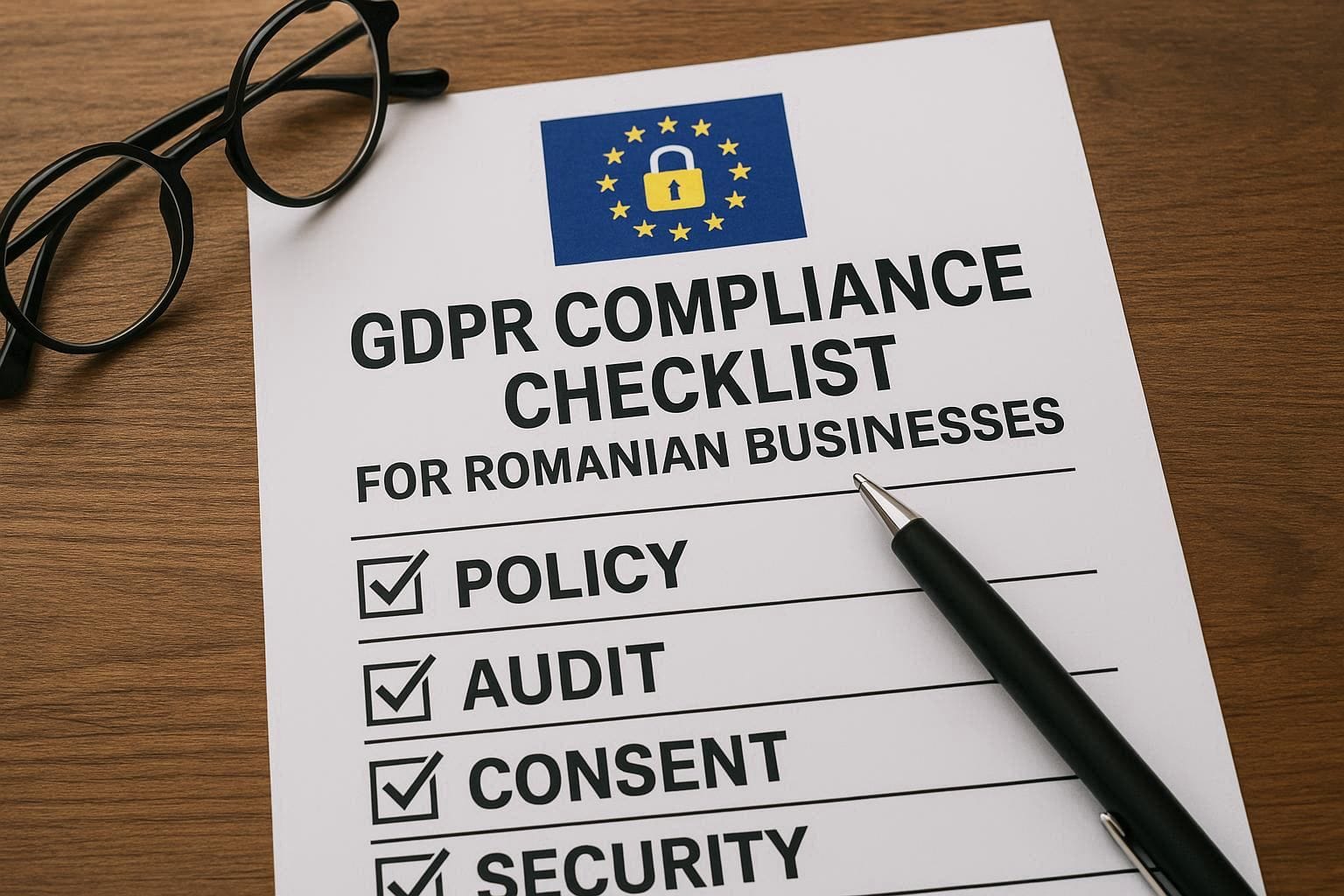
Romanian business professional reviewing GDPR compliance checklist on laptop in Bucharest office

GDPR Compliance Checklist for Romanian Companies 2025

Play

GDPR Compliance Checklist for Romanian Companies

What crucial step could protect your business from devastating fines while building customer trust?

Many organizations underestimate how Europe’s strict data protection laws apply to their operations.

While GDPR penalties can reach €20 million or 4% of global revenue, Romanian enforcement authorities have imposed fines ranging from €3,000 to €130,000 for violations, demonstrating that penalties scale with the severity of breaches and organizational size.

GDPR compliance checklist for Romanian companies

Romania’s evolving digital economy demands proactive measures to align with rigorous privacy standards.

Legal experts emphasize that proper adherence involves more than basic policy updates—it requires systematic data governance.

Companies must address consent protocols, breach response plans, and cross-border data flows to avoid regulatory scrutiny.

Specialized legal guidance helps businesses transform compliance into strategic advantages.

Firms adopting privacy-first approaches often see improved client relationships and operational resilience.

Those delaying action risk not only financial consequences but also long-term reputational damage in competitive markets.

For tailored strategies meeting international standards, contact our data protection lawyers in Bucharest.

Our team of legal professionals provide actionable frameworks to navigate complex requirements while prioritizing business growth.

Key Takeaways

  • Data protection laws apply regardless of a company’s physical location if EU resident information is processed,
  • Penalties can reach €20 million or 4% of global revenue, emphasizing the need for preventive measures,
  • Building customer trust through transparent data practices creates market differentiation,
  • Legal experts offer customized solutions to align business operations with regulatory demands,
  • Compliance involves continuous monitoring, not just one-time adjustments.

Understanding GDPR and Its Impact on Romanian Businesses

How can organizations in Romania turn regulatory demands into strategic opportunities?

The General Data Protection Regulation (GDPR) reshapes how businesses manage information, particularly for entities handling EU residents’ data.

Its extraterritorial scope means even non-EU-based firms must adhere to strict standards when processing personal details of European citizens.

Core Regulatory Foundations

The regulation establishes six foundational principles for data handling, plus an overarching accountability principle.

These mandate that organizations:

  • Process information lawfully and transparently,
  • Collect only necessary data for specific purposes,
  • Maintain accuracy and limit storage durations.

Such requirements demand technical safeguards like encryption and operational protocols for accountability.

Privacy-by-design methodologies ensure protections are embedded in all systems.

Strategic Advantages for Local Entities

Adhering to these standards transforms obligations into opportunities.

Firms prioritizing data protection report:

  • Enhanced client confidence through transparent practices,
  • Reduced breach-related costs and operational disruptions,
  • Differentiation in markets where privacy concerns influence decisions.

For tailored strategies aligning Romanian operations with these regulations, consult our team of Romanian Lawyers.

Proactive adaptation not only mitigates risks but positions businesses as trustworthy data stewards.

Exploring Key GDPR Roles and Terminology

Who holds ultimate accountability in data governance frameworks?

Clarifying responsibilities under privacy regulations helps organizations establish clear operational boundaries.

Three critical roles form the foundation of proper data management practices.

data protection officer

Data Controllers, Processors, and Data Subjects

Data controllers determine why and how personal information is handled.

They bear legal responsibility for compliance across all processing activities.

Third-party processors execute tasks under controller directives but must independently meet security standards.

Individuals whose data is collected, known as data subjects, retain rights to access or delete their information.

Organizations must implement systems to honor these requests efficiently.

The Essential Role of the Data Protection Officer (DPO)

A data protection officer oversees compliance strategies and acts as the regulatory liaison.

This role is mandatory for entities processing sensitive data or conducting large-scale monitoring.

Under Romanian Law 190/2018, organizations processing national identification numbers (CNP) based on legitimate interest must also appoint a DPO, even if they don’t meet the standard GDPR thresholds.

This additional requirement reflects Romania’s enhanced protection for sensitive national identifiers.

Romanian businesses uncertain about role allocations should consult office@theromanianlawyers.com.

Proper classification prevents overlapping liabilities and ensures alignment with cross-border standards.

Conducting a Comprehensive Data Audit and Mapping

Organizations handling personal information must first establish clarity in their data ecosystems.

A systematic audit reveals how data flows through operations, exposing vulnerabilities while ensuring alignment with legal obligations.

This foundational step transforms raw information into actionable insights for risk management.

data audit and mapping

Identifying What Personal Data You Collect

Begin by cataloging every category of personal data your organization processes.

Common examples include:

  • Contact details (names, email addresses).
  • Digital identifiers (IP addresses, device information).
  • Sensitive records (financial data, health information).

Document each data point’s purpose, collection method, and retention timeline.

Assess whether processing activities rely on valid legal grounds like contractual necessity or explicit consent.

Storage locations demand equal scrutiny—identify physical servers, cloud platforms, and third-party repositories holding sensitive materials.

Access controls form another critical audit component.

Map which employees or systems interact with personal data and verify authorization protocols.

This process highlights potential exposure points while streamlining responses to information requests.

Romanian entities seeking structured frameworks for these assessments may contact our data protection legal specialists.

Expert guidance ensures audits meet regulatory expectations while supporting operational efficiency.

GDPR Compliance Checklist for Romanian Companies

Businesses handling EU data face operational complexity when aligning processes with privacy standards.

Structured frameworks simplify adherence while minimizing risks of non-conformance.

Effective strategies combine procedural clarity with technological safeguards to meet evolving requirements.

data protection checklist steps

Actionable Protocols for Information Security

Organizations should prioritize these critical measures:

Action ItemResponsible PartyDeadline
Complete data flow mappingIT & Legal Teams30 Days
Implement encryption protocolsSecurity Department45 Days
Update third-party contractsCompliance Officer60 Days

Consent Management Best Practices

Valid authorization requires unticked checkboxes and separate permissions for distinct processing purposes.

Confirmation emails enhance verification, while centralized logging systems track user agreements with timestamps and purpose details.

Organizations must honor withdrawal requests without undue delay and provide confirmation within one month, as required by GDPR Article 12(3).

Automated systems should flag outdated records immediately upon withdrawal, ensuring ongoing alignment with transparency obligations and ceasing processing activities promptly.

Regular audits verify adherence to storage limitation principles and access controls.

Local enterprises seeking customized frameworks may contact office@theromanianlawyers.com.

Specialized guidance helps establish resilient processes that satisfy regulatory expectations while supporting operational scalability.

Ensuring Website Security and Transparent Privacy Policies

How do modern businesses balance robust security with user transparency?

Websites storing personal information require layered defenses against cyber threats.

Organizations must adopt technical safeguards while clearly communicating data handling practices to users.

website security and privacy policies

Implementing SSL, Strong Passwords, and Anti-Virus Measures

HTTPS encryption via SSL certificates forms the first line of defense.

Multi-factor authentication and complex passwords prevent unauthorized account access.

Regular vulnerability scans and firewall updates address emerging threats.

Advanced protections include:

  • Content Delivery Networks (CDNs) to mitigate DDoS attacks,
  • Intrusion detection systems monitoring server activity,
  • Automated backups stored in geographically separate locations.

Designing Clear and Accessible Privacy Notices

Privacy policies must explain data collection purposes in plain language.

Every page should feature a visible link to these documents. Essential disclosures include:

  • Types of information gathered (contact details, device data)
  • Legal basis for processing activities
  • Third-party data sharing arrangements

Entities developing their online platforms should consult office@theromanianlawyers.com for policy reviews.

Proper alignment with privacy standards builds credibility while reducing legal exposure.

Managing Third-Party Vendors and International Data Transfers

How can businesses ensure their partners meet strict data protection standards?

Organizations relying on external vendors must verify their adherence to privacy regulations.

This requires thorough evaluations and contractual safeguards to maintain accountability across supply chains.

Evaluating Vendor Requirements and Contracts

Entities handling personal information must catalog all service providers processing data.

This includes cloud platforms, payment systems, and marketing tools.

Assessments should examine vendors’ security certifications, breach response plans, and documentation of regulatory alignment.

Legally binding agreements define responsibilities between controllers and processors.

These contracts specify permitted activities, retention timelines, and security protocols.

Subcontractor arrangements require explicit approval to maintain oversight.

RequirementActionMechanism
Vendor AccountabilityReview security auditsAnnual assessments
Data TransfersImplement SCCsContractual clauses
Risk MitigationConduct impact analysesTransfer evaluations

Cross-border data flows demand additional precautions.

Companies must confirm whether recipient countries have EU adequacy status.

For other regions, standardized contractual clauses or binding corporate rules become mandatory safeguards.

Romanian enterprises navigating these complexities should seek specialized Romanian Lawyer.

Proactive vendor management frameworks prevent regulatory violations while fostering trust with European partners.

Contact office@theromanianlawyers.com for tailored strategies addressing cross-border operational challenges.

Preparing for Data Breaches and Facilitating Data Subject Rights

What separates resilient organizations from vulnerable ones when cyber threats strike?

Proactive preparation for security incidents and efficient handling of individual rights form the backbone of modern data governance.

Organizations must balance rapid response capabilities with systematic processes to address user inquiries.

Developing a Robust Breach Response Plan

Effective incident management requires predefined protocols.

Immediate detection mechanisms trigger containment procedures within one hour of identifying unauthorized data access.

Forensic teams analyze breach scope while legal advisors determine notification obligations to authorities within 72 hours.

Regular simulation exercises test communication channels between IT, legal, and PR departments.

Documentation templates for breach reports ensure regulatory requirements are met without delays.

Continuous monitoring systems flag unusual activity patterns to prevent escalation.

Streamlining Data Subject Access Requests

Individuals increasingly exercise their right to review or delete personal information.

Centralized portals allow users to submit requests through secure authentication methods.

Automated workflows verify identities and route inquiries to appropriate teams within 24 hours.

Response templates maintain consistency while adhering to legal timelines.

Secure delivery channels protect sensitive information during transmission.

Audit trails demonstrate compliance with access rights obligations during regulatory inspections.

Entities requiring customized frameworks for incident management or user rights processes should contact office@theromanianlawyers.com.

Structured approaches transform regulatory demands into operational strengths while maintaining stakeholder trust.

FAQ

When must Romanian businesses appoint a data protection officer?

Organizations must designate a data protection officer if they systematically monitor individuals on a large scale or process sensitive categories like health records.

Public authorities in Romania also require this role regardless of data volume.

How long can companies retain customer information under EU regulations?

Storage periods must align with the original purpose for collection.

For example, transaction records may be kept for tax compliance periods specified by ANAF (Romania’s tax authority), while marketing contact lists require periodic reviews for relevance.

What technical safeguards are mandatory for website security?

Essential measures include SSL encryption, multi-factor authentication, regular penetration testing, and documented patch management processes.

Organizations should implement security measures proportionate to the risk level of data processing, following GDPR Article 32 requirements for appropriate technical and organizational measures.

Are international cloud providers like AWS or Microsoft Azure GDPR-compliant for Romanian data?

Providers operating under EU-approved mechanisms like Standard Contractual Clauses (SCCs) or binding corporate rules generally meet requirements.

However, companies must verify current certifications and update Data Processing Agreements (DPAs) annually.

What penalties apply for violating data subject rights in Romania?

The National Supervisory Authority for Personal Data Processing (ANSPDCP) can impose fines up to €20 million or 4% of global turnover.

Recent enforcement actions targeted improper consent practices and delayed breach notifications.

How should organizations handle data access requests from employees?

Businesses must respond within 30 days, providing free electronic copies of records.

Implement automated DSAR workflows in platforms like Microsoft 365 or specialized tools such as OneTrust to track and fulfill requests efficiently.