Open office door representing employee dismissal and professional transition in Romania

Employee Dismissal in Romania: Employer Guide

Employee dismissal in Romania is lawful only when the employer relies on a ground recognised by the Labour Code and follows the procedure attached to that specific ground. A genuine business reason is not enough if the required notice, investigation, evaluation, consultation or written decision is defective.

What Romanian employers should know:

  • First identify the correct termination route; dismissal is only one way an employment contract may end.
  • Match the evidence and procedure to the legal ground before communicating a decision.
  • A minimum 20-working-day notice applies to certain dismissals, not to every dismissal.
  • Procedural breaches can lead to absolute nullity, salary compensation and, if requested, reinstatement.
  • The employer normally carries the burden of proving the legality and factual basis of the measure in court.

This guide is intended for Romanian companies, foreign investors, HR teams and managers considering an individual or collective dismissal. It reflects the structure of the Romanian Labour Code and highlights the points that most often create litigation risk. For advice on a particular case, see our Romanian employment law services.

Employment dismissal documents reviewed in a Romanian corporate office
A defensible dismissal decision begins with the correct legal ground, evidence and procedure.

Is every employment termination a dismissal?

No. Under Article 58 of the Romanian Labour Code, dismissal is the termination of an individual employment contract at the employer’s initiative. It may be based on reasons related to the employee or on reasons unrelated to the employee.

Dismissal should not be confused with termination by mutual agreement, resignation, expiry of a fixed-term contract, termination by operation of law or written termination during or at the end of a probationary period under Article 31(3). Termination during the probationary period is a distinct mechanism, separate from dismissal. Each route has different conditions. Relabelling a unilateral dismissal as a “mutual termination” does not make it consensual; genuine agreement must exist.

Practical point: decide the legal route before drafting documents. Mixing several grounds in one decision, or changing the ground after litigation begins, can undermine the defence.

Route selector
Choose the correct termination route

Select a route to see its legal character. The route must be identified before documents are drafted.

Dismissal

Employer-initiated termination under Article 58. It requires a statutory ground and the procedure attached to that ground.

Legal grounds for employee dismissal in Romania

The main grounds are divided between reasons related to the employee and reasons unrelated to the employee. The required evidence and procedure differ substantially.

GroundCore legal testKey procedural safeguard
Disciplinary misconductA serious breach or repeated breaches of work discipline, the employment contract, collective agreement, internal regulations or lawful managerial orders.Prior disciplinary investigation, except for a written warning.
Preventive arrest or house arrestThe measure lasts for more than 30 days, under the conditions of the Criminal Procedure Code.Written and reasoned decision within the applicable statutory period.
Medical unfitnessPhysical or mental unfitness is established by a decision of the competent medical bodies.Consideration and offer of compatible vacant positions under Article 64.
Professional inadequacyThe employee is professionally unfit for the position held.Prior evaluation under the procedure in the applicable collective agreement or internal regulation, plus Article 64 vacancy steps.
RedundancyThe position is effectively eliminated for a real and serious cause unrelated to the employee.Documented reorganisation and at least 20 working days’ notice; collective rules may also apply.

When is dismissal prohibited?

Before any employee dismissal in Romania, the employer should check both Articles 59 and 60 of the Labour Code. Article 59 prohibits dismissal on protected grounds, including protected characteristics, trade-union membership or activity, lawful participation in a strike and the exercise of specified employment rights. Article 60 creates temporary prohibitions during specified periods, including certified temporary incapacity for work, quarantine, maternity leave, parental leave, leave to care for a sick child, annual leave, paternity leave, caregiver leave and certain emergency family absences. A pregnant employee is protected if the employer knew of the pregnancy before issuing the decision. Separate anti-discrimination and retaliation rules may also apply under Law no. 202/2002 and the Whistleblower Protection Law no. 361/2022.

The protected-period analysis should be made immediately before the dismissal decision is issued and communicated. Article 60 also contains an exception linked to judicial reorganisation, bankruptcy and dissolution of the employer, but it should be applied only after checking the employer’s precise legal status and the special insolvency rules.

Does every dismissed employee receive 20 working days’ notice?

No. Article 75 grants a minimum notice period of 20 working days for dismissal due to medical unfitness, professional inadequacy and redundancy under Articles 65 and 66. It does not create a universal notice period for every type of dismissal. In particular, disciplinary dismissal does not carry the same statutory notice entitlement.

The notice period and its start date should be documented clearly. Employers should not assume that paying an equivalent amount automatically remedies a failure to observe the statutory notice period. If the parties want a negotiated exit with compensation, that should be structured separately as a genuine mutual termination agreement.

How does disciplinary dismissal work?

Employee dismissal in Romania based on misconduct is the most procedure-sensitive route. Before imposing it, the employer must ordinarily conduct the prior disciplinary investigation regulated by Article 251. The process should include a written summons specifying the subject, date, time and place of the meeting, a real opportunity for the employee to present explanations and evidence, and a documented assessment of the defence.

The sanction must also be proportionate. Article 250 requires the employer to consider factors such as the circumstances of the misconduct, degree of fault, consequences, the employee’s general conduct and any previous disciplinary sanctions. A finding that misconduct occurred does not automatically justify dismissal if a lesser sanction is proportionate.

The disciplinary decision must be issued in writing within 30 calendar days from the date the employer became aware of the misconduct, but no later than six months from the date of the act. It must contain all mandatory elements under Article 252 and be communicated within five calendar days of issue. Read our dedicated guide to the disciplinary procedure in Romania.

Evidence that usually matters

  • the internal regulation, policies and lawful instructions allegedly breached;
  • proof that the employee received or could access those rules;
  • emails, access logs, reports, witness statements or other lawfully obtained evidence;
  • the summons, interview record, employee’s written defence and supporting documents;
  • a reasoned proportionality assessment; and
  • proof of issuing and communicating the final decision within the statutory periods.

How should professional inadequacy be documented?

Professional inadequacy concerns the employee’s ability to meet the professional requirements of the role; it is not a disciplinary accusation. Article 61(d) provides the legal ground for dismissal, while Article 63(2) requires the employee to undergo a prior evaluation under the procedure established by the applicable collective labour agreement or, in its absence, the internal regulation.

The evaluation should rely on objective, role-related standards communicated in advance. The job description, performance objectives, prior reviews, training records and concrete work results should tell a consistent story. A hastily created evaluation standard or a process designed around one predetermined outcome is vulnerable to challenge.

Before dismissal, Article 64 requires the employer to offer available positions compatible with the employee’s professional training or, where relevant, work capacity. If no suitable vacancy exists, the employer must seek the support of the territorial employment agency. The employee has three working days to express written consent to an offered position.

What is required for medical-unfitness dismissal?

Medical unfitness under Article 61(c) cannot rest on a manager’s impression or an ordinary performance assessment. It must be established through a decision of the competent medical bodies. The employer must then follow the compatible-vacancy process under Article 64 and grant the minimum statutory notice.

This ground should also be kept distinct from disability discrimination and reasonable workplace accommodation issues. Medical information must be handled with particular attention to confidentiality and data-protection requirements.

When is redundancy lawful?

Employee dismissal in Romania for redundancy is governed principally by Article 65. It is lawful when the employee’s position is effectively eliminated and the elimination has a real and serious cause unrelated to that employee. The employer does not have to prove that dismissal was the only imaginable business choice, but it should be able to show that the reorganisation is genuine and that the eliminated role no longer exists in substance.

A defensible file commonly includes the competent corporate decision, the business rationale, organisational charts before and after implementation, the updated headcount and job descriptions, financial or operational supporting material where relevant, and evidence that the employee’s duties were genuinely removed or redistributed.

A changed job title alone is not decisive. Courts can examine whether a supposedly eliminated position continues in substance or is promptly refilled under a different label.

Where only some identical or comparable positions are removed, the selection issue requires particular care. In Decision no. 30/2020, the High Court declined to rule on the merits and dismissed the recurs în interesul legii as inadmissible. It held that the question concerned applying the law to specific facts rather than resolving a genuine issue of legal interpretation. The decision therefore did not unify the divergent lower-court approaches described in the referral on whether selection criteria are required when an employer eliminates only some positions from a group of identical or similar positions. As a risk-management measure, any criteria used should be objective, consistently applied and supported by evidence.

Employers planning a broader reorganisation may also consult our guide to employee rights during company restructuring in Romania.

When do collective-dismissal rules apply?

A redundancy programme can become a collective dismissal if, within a period of 30 calendar days, the statutory thresholds in Article 68 are reached.

Employer workforceCollective-dismissal threshold within 30 calendar days
More than 20 and fewer than 100 employeesAt least 10 employees
100–299 employeesAt least 10% of employees
300 or more employeesAt least 30 employees
Live threshold check
Collective dismissal threshold check

Enter the employer’s total workforce and the dismissals planned within 30 calendar days.

Enter both figures, then select “Check threshold”.

This is a preliminary numerical check. Article 68 aggregation and the treatment of other employer-initiated terminations must still be reviewed.

For threshold calculations, certain other employer-initiated terminations for reasons unrelated to the employee may also be counted when the statutory conditions are met. Fragmenting one programme into several documents or dates does not necessarily prevent the collective rules from applying.

The employer must begin consultations with the trade union or employee representatives in good time, provide the written information required by Article 69 and genuinely examine ways to avoid or reduce dismissals and mitigate their consequences. If the programme proceeds, the territorial labour inspectorate and territorial employment agency must receive the statutory notification at least 30 calendar days before dismissal decisions are issued, subject to the detailed Labour Code procedure.

What must the written dismissal decision contain?

The applicable deadline and the mandatory content should be analysed separately. Article 62 establishes the deadline for issuing decisions based on Article 61(b)–(d) and also requires the decision to state its factual and legal reasons, the challenge period and the competent court. Article 76 sets out the other mandatory elements applicable to dismissal decisions, while Article 252 contains the specific requirements for disciplinary decisions. Depending on the case, the written decision should include:

  • the factual and legal reasons for dismissal;
  • the duration of the notice period, where applicable;
  • the collective-dismissal selection criteria, where applicable;
  • the list of available positions and the Article 64 response period, where applicable;
  • for a disciplinary sanction, the mandatory elements in Article 252, including why the employee’s defence was rejected; and
  • the statutory challenge period and competent court, where required.

The decision produces effects from communication to the employee. Communication should therefore be provable. The employer cannot ordinarily defend the case by introducing new dismissal reasons that were absent from the decision.

What are the main employer risks if the dismissal is unlawful?

A failure to comply with the legally required procedure results in absolute nullity under Article 78. Under Article 80, if the court cancels the dismissal, it orders compensation equal to the indexed, increased and updated salaries and the other entitlements the employee would have received. At the employee’s request, the court also restores the parties to the position existing before dismissal by ordering reinstatement.

Employment disputes move quickly and the employer bears the burden of proof under Article 272. A disciplinary decision may be challenged within 30 calendar days of communication under Article 252(5). For most other dismissal-related employment disputes, employees generally have 45 calendar days to challenge the measure under Article 268, calculated from the date on which the person concerned became aware of it, subject to the specific provisions applicable to the type of claim.

Risk map
Employer risk map

Select a consequence to see where the principal exposure arises.

Nullity

A dismissal ordered without observing the statutory procedure is affected by absolute nullity under Article 78.

Additional exposure may arise from discrimination, whistleblower retaliation, unpaid rights, data-protection violations, collective consultation failures or inconsistent treatment of comparable employees.

A practical pre-dismissal checklist for employers

Legal roadmap
Pre-dismissal legal roadmap

Select each step to review the purpose of the control before moving forward.

Legal ground

Identify the exact statutory route first. The evidence, notice and procedure depend on this classification.

  1. Identify the legal route. Confirm whether the case is dismissal, mutual agreement, resignation, expiry, probationary termination or another statutory form.
  2. Check protected status. Verify leave, medical incapacity, pregnancy notifications, representative status, whistleblowing and discrimination risks.
  3. Confirm decision-making authority. Make sure the correct corporate or managerial body approves the measure.
  4. Audit governing documents. Review the employment contract, job description, internal regulation, policies and collective agreement.
  5. Build the evidence file. Preserve documents lawfully and avoid post-hoc rationales.
  6. Run the ground-specific procedure. Investigation, professional evaluation, medical decision, vacancy search or reorganisation documentation cannot be interchanged.
  7. Check collective thresholds. Look at the complete 30-day programme, not only one employee or one department.
  8. Calculate notice correctly. Apply it only where legally required, but do not shorten it.
  9. Draft and quality-check the decision. Confirm every mandatory element, factual statement, date and attachment.
  10. Plan communication and litigation readiness. Retain proof of delivery and a complete, chronological file.

If employment status itself is uncertain, first review our analysis of employee versus contractor risks in Romania. For prevention at the hiring stage, see our guidance on employment contracts in Romania.

Frequently asked questions

Can an employee be dismissed while on sick leave?

As a rule, dismissal cannot be ordered during certified temporary incapacity for work. The employer should verify the medical certificate and the timing of both issuance and communication of the decision. The Labour Code contains a limited exception linked to judicial reorganisation, bankruptcy or dissolution.

Is 20 working days’ notice required for every dismissal?

No. The statutory minimum applies to dismissal for medical unfitness, professional inadequacy and redundancy under Articles 65 and 66. It does not generally apply to disciplinary dismissal.

Can the employer pay salary instead of granting notice?

The Labour Code grants a working notice period in the situations covered by Article 75. An employer should not assume that unilateral payment cures failure to grant it. A separately negotiated mutual termination may include compensation, but it must reflect genuine consent and should be documented accordingly.

Is severance pay mandatory in Romania?

There is no universal statutory severance amount for every redundancy. Article 67 states that affected employees may benefit from compensation under the law and the applicable collective labour agreement. The employment contract, internal policies and established practice should also be checked.

Can an employer eliminate a position and later hire someone else?

Hiring for a materially similar role soon after dismissal may suggest that the original elimination was not effective. The legal assessment turns on substance: duties, organisational need, timing and evidence—not the title alone.

How long does an employee have to challenge dismissal?

A disciplinary sanction may be challenged within 30 calendar days from communication. For other unilateral measures concerning termination, the Labour Code generally provides 45 calendar days from the date the employee became aware of the measure. Case-specific verification is advisable.

Planning or defending employee dismissal in Romania?

We assist employers with dismissal strategy, disciplinary investigations, performance procedures, redundancy documentation, collective consultation and employment litigation.

Discuss the case with a Romanian employment lawyer

Disclaimer: This article provides general information and does not constitute legal advice. The correct procedure depends on the dismissal ground, employment documents, employee status and facts of the case.

AI Notice: AI-assisted content, reviewed and approved by a qualified Romanian lawyer.

Diverse non-EU professionals and a Romanian legal adviser illustrating international recruitment, work visa procedures and employer compliance in Romania in 2026.

Recruiting Non-EU Personnel in Romania in 2026: Legal Update for Employers

Immigration and employment guide · 2026

Recruiting Non-EU Personnel in Romania in 2026: Legal Update for Employers

A practical overview for Romanian employers and foreign professionals: when work authorisation may be required, how the employment visa and single permit fit together, and which compliance points should be checked before the employee starts work.

Rules can depend on nationality, residence status, role, employer and route. Check the current procedure with the General Inspectorate for Immigration (IGI).

Do non-EU employees need a work permit in Romania?

Often, yes. A non-EU national generally needs an applicable right to work before beginning employment in Romania, unless an exemption or a different immigration route applies. The analysis starts with nationality, current residence document, proposed role and the Romanian employer’s situation.

Work authorisation

For the standard route, the Romanian employer addresses the employment authorisation process and supports the employee’s immigration file.

Employment visa

Where required, the employee applies for a Romanian long-stay visa for employment after the relevant authorisation or supporting route is available.

Single permit

After entering Romania, the employee normally applies for a single permit or, where conditions are met, an EU Blue Card.

Important: a work permit, a long-stay visa and a residence document are different steps. Treating them as interchangeable can delay onboarding or create employment-compliance risk.

From recruitment decision to lawful onboarding

This visual map shows the four points that should be resolved before the next stage.

01Classify the routeNationality, status, role and employer.
02Prepare the fileContract, qualifications and supporting documents.
03Arrange entryEmployment visa or applicable alternative.
04Maintain statusSingle permit, renewals and later changes.

Common routes for foreign employees

SituationIssue to resolveCheckpoint
Standard employment with a Romanian companyWhether the employer must obtain employment authorisation and which category applies.Match the role, qualifications and contract to the current IGI procedure.
Highly qualified employmentWhether the EU Blue Card conditions are satisfied.Check the contract, qualification, salary and vacant-position evidence.
Posting or intra-company transferWhether the arrangement is posting, ICT or another regulated route.Review the foreign employment relationship, posting documents and Romanian beneficiary.
Exempt categoryWhether the person can work without a separate work permit.Document the exemption and verify its limits.

IGI lists, among others, certain long-term residents, family members of Romanian citizens, students subject to working-time limits, beneficiaries of protection, some posted workers and nationals of Moldova, Ukraine and Serbia in specific full-time arrangements as categories that may work without a work permit. The exemption must be checked against the exact status.

Documents and employer compliance

The file is not limited to the foreign employee’s passport. Depending on the route, the employer may need to coordinate the contract, qualifications, criminal record, insurance, proof of accommodation, means of subsistence and evidence connected with the vacant position.

Contract and registration

The employment contract must be prepared and registered in the applicable employee register procedure. IGI’s current visa guidance refers to REGES-ONLINE under Government Decision no. 295/2025.

Qualification evidence

Check whether professional training, work experience, study recognition or an occupation-specific authorisation is required before filing.

Ongoing deadlines

Track visa validity, residence expiry, renewals and any change of employer, role or working arrangement before the change takes effect.

What the employer should resolve before filing

The most common delays arise before the application reaches the authorities. The employer should first establish whether the proposed role is compatible with the foreign national’s route, whether the person satisfies the professional requirements and whether the employment documents are consistent across the work-authorisation, visa and residence stages.

For highly qualified employment, the analysis may also involve the contract term, the required level of qualification, the salary conditions and evidence that the employer took the required steps concerning the vacant position. For posting and intra-company transfer, the documents must reflect the foreign employer, the Romanian beneficiary and the actual relationship between the entities.

Before recruitment

Classify the worker, role, nationality and proposed Romanian activity before promising a start date.

Before filing

Reconcile the employment contract, qualifications, translations, legalisations and supporting evidence.

Before onboarding

Confirm the right to work, visa and residence conditions, then record the relevant expiry dates.

How the standard recruitment route works

For a standard non-EU recruitment, the Romanian employer usually begins by identifying a genuine vacancy and confirming that the proposed employment fits one of the categories recognised by Romanian immigration rules. The employer should not assume that a candidate’s previous residence in another European country gives the person an automatic right to work in Romania. Residence rights, labour-market access and the right to perform a particular job are separate questions.

The employer then prepares the employment documentation and the evidence required for the relevant employment or posting notice. This may include information about the company, the position, the candidate’s education and experience, the employment contract, medical capacity and the candidate’s criminal record. The exact list depends on the category and on the documents requested by the competent authority.

After the work authorisation or applicable employment route is confirmed, the foreign national may need to apply for a long-stay visa for employment through the Romanian diplomatic mission or consular office with jurisdiction. The visa stage is not simply an administrative formality. The application must reflect the same employer, job, contract and legal route that supported the earlier filing.

After entering Romania, the employee generally applies for a single permit or EU Blue Card through the territorial structure of IGI responsible for the place of residence. The employer should plan this stage before the visa period approaches its expiry and should keep a record of every document and deadline.

Work authorisation, employment visa and residence document

These documents serve different legal functions. A work authorisation or employment notice concerns the foreign national’s access to employment under the relevant Romanian route. A long-stay visa allows the foreign national to enter and remain in Romania for the purpose stated in the visa. A single permit or EU Blue Card confirms the right to stay and, depending on the route, the right to work under the applicable conditions.

This distinction matters for employers because a candidate may have one document without having completed the entire process. For example, an employer may have obtained an employment notice, but the candidate may still need the long-stay visa before travelling to Romania. Conversely, a foreign national may already be present in Romania with a residence document for another purpose, but that does not necessarily mean that the person can start a new job without checking the labour-market access rules.

The safest onboarding process is therefore document-based. Before the first working day, the employer should identify the document that creates or confirms the right to work, check its validity and scope, and retain the evidence required by the applicable rules. HR records should also distinguish the expiry date of the residence document from the expiry date of the employment contract and from any deadline for renewal.

Who may work without a separate work permit?

Romanian immigration rules provide exemptions for specific categories of foreign nationals. IGI identifies, among others, certain long-term residents, some family members of Romanian citizens, beneficiaries of protection in Romania, asylum seekers who have received access to the labour market, tolerated foreigners and certain students. Students may be subject to a working-time limit, so the exemption should not be read as unrestricted access to any full-time position.

IGI also identifies specific situations involving religious activities, nationals of the Republic of Moldova, Ukraine and Serbia employed under the stated full-time and duration conditions, and some holders of EU Blue Cards or long-term residence documents issued by another EU Member State. The relevant facts must be documented. Nationality alone may not be enough if the exemption also depends on residence status, contract type, hours, duration or the nature of the activity.

An employer should request and review the document on which the exemption is based before treating the person as authorised to work. If the person changes employer, job, working hours or residence status, the original exemption may no longer apply in the same way. A copy of the supporting residence document or other evidence should be kept with the employment records, subject to data-protection requirements.

Highly qualified workers and the EU Blue Card

Highly qualified employment follows a more specific route. The current IGI guidance refers to a full-time employment contract for an indefinite period or for a fixed period of at least six months, together with the required professional skills and any occupation-specific authorisation. The contract must satisfy the applicable salary condition, and the employer may need evidence concerning the availability of the vacant position.

The EU Blue Card route can be attractive for international businesses recruiting senior specialists, but it should not be selected merely because the candidate has a university degree or a senior job title. The role, qualification, contract, salary and employer evidence must be tested against the legal conditions in force at the time of filing. The analysis should also cover whether the worker already holds a Blue Card or residence right in another EU Member State and whether a mobility rule applies.

Where the professional activity is regulated, recognition of studies or a professional authorisation may be required. The employer should identify this issue before signing a start-date commitment. If the qualification evidence is incomplete, the immigration process and the employment onboarding may be delayed even where the commercial recruitment decision is sound.

Posting and intra-company transfer

A foreign group may send an employee to Romania without using the same route as a Romanian company hiring a new employee. Posting and intra-company transfer require the parties to establish who remains the employer, who receives the services in Romania and what legal relationship connects the entities. The posting act, foreign employment contract, residence document and Romanian activity should tell the same story.

For an ICT worker, the Romanian beneficiary generally needs to be a branch, subsidiary, representative office or another entity belonging to the same group as the foreign undertaking. The transfer may involve a manager, specialist or trainee and is subject to specific duration and professional-experience conditions. The documents should address the period of transfer, position, salary, working conditions and the obligation to reinstate the worker after the transfer where required.

EU and EEA posting situations can involve different documentary rules from a posting from a third country. The fact that a foreign employer is established in the EU does not remove the need to check Romanian labour, immigration, social-security and notification requirements. Before the worker arrives, the beneficiary should confirm the applicable route and whether the assignment also engages rules on posted workers and Romanian employment conditions.

Documents commonly required for the immigration file

The precise checklist depends on the route, but employers and candidates should expect to coordinate several categories of documents:

Identity and status

Passport or other travel document, residence documents, visa material and evidence of the person’s current immigration status.

Employment evidence

Employment contract, job description, organisational information, posting act or group-company documents, depending on the selected route.

Personal evidence

Criminal record, medical insurance, proof of means of subsistence, accommodation evidence and translated or legalised documents where required.

IGI’s current long-stay visa guidance refers to travel medical insurance with minimum coverage of EUR 30,000 for the relevant visa period, criminal record documents translated and legalised under the applicable rules, and an employment contract registered in REGES-ONLINE for the categories listed on that guidance. These requirements should be checked again against the exact route and the live application platform before filing.

Employer obligations after the employee arrives

The employer’s role does not end when the employee receives a visa. The company should ensure that the employment contract, employee-register entries, payroll information and actual working arrangements remain aligned with the approved route. The foreign national should not be placed in a different position, assigned to a different employer or moved into a different working arrangement without checking whether a new authorisation or notification is required.

IGI states that employers must keep the work or posting permit for the period of employment or posting and must keep a copy of the residence permit or travel document showing the foreign national’s lawful stay. The company should also maintain a practical compliance calendar covering document expiry, renewal windows, passport renewal, changes of address and any planned change in role or employer.

Employment termination creates a separate immigration issue. The work or posting permit may be cancelled when the individual employment contract or posting ends, and the employee’s residence position may need to be reassessed. HR should therefore involve legal counsel before communicating termination dates or signing a settlement where the employee’s right to stay depends on the employment route.

Processing times, fees and practical planning

IGI’s current Employment and Posting guidance states that work or posting permit applications are generally processed within 30 days from registration, with a possible extension of 15 days when further checks are required. The same guidance identifies a shorter period for certain EU Blue Card situations. These are administrative processing references, not a guarantee that the whole recruitment process will finish within that period.

The complete timeline may also include document collection, qualification recognition, translations, legalisation, employer-side corrections, visa appointment availability, travel and the later single-permit application. Employers should therefore avoid promising a fixed start date until the route and documents have been checked. The cost also depends on the category. IGI currently lists different notice fees for permanent, seasonal and other categories, so a fee should be verified from the current official instructions before payment.

Where an application is refused, delayed or returned for correction, the employer should identify whether the issue concerns eligibility, missing evidence, payment identification, translation, the position or the foreign national’s status. Re-submitting documents without resolving the underlying issue can create further delay.

Common mistakes when hiring non-EU personnel

Starting work too early

A signed contract or a visa appointment does not by itself prove that the person can begin the proposed activity in Romania.

Using the wrong route

Recruitment, posting and ICT have different legal facts. Choosing a route based only on the candidate’s nationality can produce an incomplete file.

Ignoring later changes

A change of employer, job, hours, address or group-company assignment may require a new assessment before implementation.

Other recurring problems include relying on an old checklist, assuming that a residence permit issued for studies gives unrestricted access to full-time work, overlooking qualification recognition, submitting inconsistent translations and failing to track the renewal window. Employers should also avoid treating the work permit as a substitute for the employment contract, the residence document or the employment-register obligations.

Frequently asked questions

Can a non-EU employee start work after receiving the visa?

Not automatically. Confirm that the relevant work authorisation, visa and residence conditions are satisfied for the specific route before work begins.

Does every foreign national need a work permit?

No. Romanian rules identify exemptions and special routes. The exact residence status and conditions matter.

What happens after the employee enters Romania?

The employee generally applies to IGI for a single permit or EU Blue Card and should submit the application at least 30 days before the visa-based right to stay expires, subject to the applicable route.

Can an employer change the role or employer freely?

Immigration and employment documents may be tied to the approved route, employer or position. Obtain a route-specific legal assessment before implementing a material change.

Need to assess a Romanian work-permit route?

A Romanian business lawyer can coordinate the employment, immigration and corporate documents before onboarding and help the employer track later changes.

Contact Atrium Romanian Lawyers

This page provides general information only and does not constitute legal advice, a legal opinion or the creation of a lawyer-client relationship. Legal solutions depend on the specific facts and documents involved.

AI Notice: AI-assisted content, reviewed by a qualified Romanian lawyer.

Employment contract being signed in a bright Romanian office

Employment Contracts in Romania: Mandatory Clauses and Employer Checklist

Employment contracts in Romania must be concluded in writing and in Romanian, signed using wet-ink or a legally valid electronic signature, contain the mandatory information required by the Labour Code and be recorded in REGES-ONLINE before the employee starts work. A compliant template is only the starting point: the contract must also match the actual role, schedule, workplace, pay structure and working arrangement.

In brief: The employer is responsible for the written contract, pre-contract information, medical fitness check, delivery of a signed copy and timely REGES-ONLINE registration. An indefinite full-time contract is the default. Fixed-term, part-time, mobile and telework arrangements require additional wording. Clauses on probation, confidentiality, mobility, training and non-compete protection must be drafted within statutory limits. Changes to core terms generally require an addendum before they take effect, while REGES reporting follows separate deadlines.

This guide is written for foreign companies, founders, HR teams and managers hiring personnel in Romania. It explains what the contract should contain, which clauses require special care and how contract execution connects with the employer’s registration and personnel-file obligations.

Employment contract and employer checklist prepared in a Romanian office
Employment documentation and onboarding checklist prepared for a new employee in Romania.

Must an employment contract be in writing in Romania?

Yes. Article 16 of the Romanian Labour Code requires the individual employment contract to be concluded in writing and in Romanian. Written form is mandatory under the Labour Code and must be completed before work begins. The employer bears responsibility for concluding the document.

The contract must be signed using wet ink or a legally valid electronic signature, provided to the employee and entered in REGES-ONLINE before work begins. Where electronic signing is used, the parties must use the same type of signature for the document. Registration alone does not replace the signed contract, and a signed contract does not excuse late registration. Foreign-language versions may be used for convenience, but the Romanian version should control or the documents should state clearly how inconsistencies are resolved.

Contract route
Which employment contract fits the role?

Select a route to see the main drafting consequence.

Indefinite full-time

This is the statutory default and usually the simplest route when the business need is ongoing and the normal schedule is eight hours per day and 40 hours per week.

Contract typeWhen it may be usedDrafting control
IndefiniteDefault route for an ongoing role.State start date, role, workplace, schedule, salary and all Article 17 information.
Fixed-termOnly in cases permitted by the Labour Code.State the legal basis and exact duration or objective end event. General maximum: 36 months.
Part-timeWhere the agreed normal hours are below full time.State hours, distribution, change conditions and the statutory overtime restriction.
TeleworkRegular voluntary work outside employer premises using ICT.Include the additional clauses required by Law no. 81/2018.
Mobile workThe duties are not performed at a stable workplace.Define the mobility area and any cash or in-kind mobility benefit.

What mandatory clauses must Romanian employment contracts contain?

The contract must cover the information required by Article 17 of the Labour Code and the applicable framework employment-contract model. The employer should not merely copy headings. Each field must describe the real employment arrangement.

Clause map
Map the mandatory terms to the real job

Select a clause group to review the main control.

Identity and employer

Use the correct legal employer, registered details and authorised signatory. A group brand or foreign parent is not a substitute for identifying the employing entity.

Clause groupWhat should be statedFrequent error
Parties and workplaceIdentity, employer headquarters, workplace or absence of a fixed workplace.Naming a business unit without identifying the legal employer.
Role and dutiesCOR occupation, job description, duties, professional-evaluation criteria and job-specific risks.Using a generic job description unrelated to actual authority or tasks.
Duration and startStart date; indefinite or fixed duration; fixed-term basis and end point where applicable.Using a fixed term without a statutory case supporting it.
Working timeHours per day/week, schedule distribution and conditions for changing the schedule.Using an unequal schedule without expressly providing for it.
PayGross base salary, allowances, bonuses, benefits and payment frequency.Calling a recurring salary component discretionary while administering it as guaranteed.
Leave and noticeAnnual leave, applicable notice conditions and duration, probation period.Contractual notice exceeding the legal maximum for resignation.
Other informationCollective agreement, training rights, employer-provided benefits and applicable procedures.Referring to policies that were not communicated or do not exist.

What must be completed before the employee starts work?

The employer should treat hiring as a controlled sequence. Before the first working day, it must verify identity and work entitlement, obtain the medical fitness certificate, complete the required information process, sign the contract, provide the employee’s copy and transmit the required data to REGES-ONLINE.

Pre-hire control
Employer checklist before work begins

Select each control to see why its order matters.

Identity and status

Verify the person’s identity, qualifications and any immigration or work-authorisation condition before promising a start date that cannot legally be met.

A non-EU national may require a work authorisation and immigration steps before employment can lawfully begin. The employment document should align with the approved position, salary and working conditions. See our guide to recruiting non-EU personnel in Romania.

How does REGES-ONLINE connect with the employment contract?

REGES-ONLINE is the statutory employee register governed by Government Decision no. 295/2025. From 2026, employers should use the online register for new hires and subsequent reportable events. The register reflects the legal documents; it does not create or amend the parties’ agreement by itself.

Reporting calendar
When should the employer report an event?

Select an event to review the general reporting rule.

Before work begins

The new employment contract and required employee data must be transmitted no later than the day before activity starts, including when that day is not a working day.

EventGeneral reporting deadlineInternal control
New employmentNo later than the day before activity starts.Do not permit access to work until signature and transmission are confirmed.
Function, contract type, duration, workplace or working timeGenerally no later than the day before the change takes effect.Align the addendum date, effective date and register entry.
Salary, allowances, bonuses and other additionsWithin 20 working days from the change under Article 5(4) of Government Decision no. 295/2025.Reconcile contract/addendum, payroll and REGES; verify any special rule applying to the source of the change.
TerminationGenerally no later than the termination date or the applicable date of knowledge.Record the correct legal ground and retain the supporting document.

The table states the main operational rules. For salary changes, Article 5(4) of Government Decision no. 295/2025 provides a 20-working-day deadline; a change resulting from a court judgment is subject to the specific 10-working-day rule calculated from the employer’s knowledge of the judgment. Particular suspensions, transfers and corrections also have specific rules. Employers should verify the current REGES-ONLINE guidance for the event concerned.

2026 salary note: Government Decision no. 146/2026 set the national gross minimum base salary at RON 4,325 per month from 1 July 2026. This is a dated statutory amount verified in the official legislation portal. Employers should nevertheless recheck the minimum immediately before implementation, together with sector-specific rules and the 24-month limitation applicable to keeping an employee at the general minimum level.

How should probation, confidentiality and non-compete clauses be drafted?

Optional clauses are enforceable only within the Labour Code. They should solve a real business need and should not attempt to remove statutory employee rights.

ClauseLegal controlDrafting point
ProbationGenerally up to 90 calendar days for execution roles and 120 for management roles.State the period clearly. Probation operates inside a signed employment contract.
ConfidentialityMay protect confidential information during and after employment.Define protected information and permitted disclosures; do not obstruct statutory rights.
Non-competeRequires prohibited activities, third parties, geographic area, duration and monthly indemnity.A generic ban is insufficient. Post-termination effect cannot generally exceed two years.
MobilityApplies where duties are not performed at a stable workplace.Describe the area and the additional cash or in-kind benefits.
TrainingTraining costs and retention consequences require lawful, proportionate wording.Use a separate addendum for significant employer-funded training where appropriate.

A post-employment non-compete obligation requires payment of a monthly non-compete indemnity. The contract must identify the activities prohibited, relevant third parties, geographic area and period. It cannot impose an absolute ban on the employee’s profession. Confidentiality and intellectual-property provisions should also distinguish employee-created works, employer resources, trade secrets and lawful whistleblowing or regulatory disclosures.

What additional clauses are required for telework and part-time work?

Telework and part-time arrangements require more than changing the workplace or number of hours in a standard form.

Under Law no. 81/2018, telework must be expressly agreed. The contract or addendum should address the periods spent at employer premises, how activity may be checked, the method for recording daily start and end working hours in line with Article 119 of the Labour Code, health and safety responsibilities, equipment, data protection, measures against isolation and the treatment of telework expenses.

A part-time contract must state the duration and distribution of hours, the conditions under which the schedule may be changed and the restriction on overtime, subject to narrow statutory emergencies. Omitting mandatory part-time elements may expose the employer to the risk of reclassification and labour-inspector sanctions.

Can the employer change the contract unilaterally?

As a rule, no. Core terms such as role, workplace, salary, working time and contract duration are modified by agreement, normally through a written addendum concluded before the change takes effect. The Labour Code provides narrow exceptions. In addition to delegation and secondment, Article 48 permits the employer temporarily to modify the workplace and type of work without consent in cases of force majeure, as a disciplinary sanction or as a measure to protect the employee, only in the cases and under the conditions provided by law.

Telework under Law no. 81/2018 remains, as a rule, consensual. An employer should not rely on Article 48 as a general power to impose remote work. Any exceptional unilateral remote-work measure must have a specific legal basis applicable at that time.

A policy cannot silently rewrite a contractual benefit or core term. Before changing a package, the employer should classify each item as statutory, contractual, collectively agreed, policy-based or genuinely discretionary. The correct document and employee-consent requirement follow from that classification.

Employer checklist for Romanian employment contracts

  1. Identify the real employer. Confirm the Romanian employing entity and authorised signatory.
  2. Classify the role. Select the correct COR occupation and align it with the job description.
  3. Choose the lawful contract type. Document any fixed-term or part-time basis and special clauses.
  4. Verify the employee. Check identity, qualifications, medical fitness and work authorisation.
  5. Define the workplace. Distinguish office work, mobility, homeworking and telework.
  6. State working time precisely. Include distribution, unequal schedules, shifts or part-time restrictions where relevant.
  7. Map compensation. Separate base salary, allowances, bonuses, benefits and reimbursement of expenses.
  8. Review optional protections. Tailor confidentiality, IP, non-compete, mobility and training clauses.
  9. Sign and deliver the contract. Complete this before the employee starts work, using wet-ink signatures or the same legally valid electronic-signature type for both parties.
  10. Transmit REGES data. Preserve proof and reconcile the register with payroll and personnel-file documents.

Risk: A contract can appear complete and still fail in practice when the job description, actual schedule, payroll treatment and REGES record contradict it. Employers should audit the whole employment file, not only the signature page.

Frequently asked questions

Can a Romanian employment contract be signed only in English?

No. The Labour Code requires the individual employment contract to be concluded in Romanian. A bilingual version may be used for a foreign employee or group process, but the Romanian text must be included and the parties should address which version prevails if wording differs.

When must a new employment contract be registered in REGES-ONLINE?

The required employee and contract data must generally be transmitted no later than the day before the employee starts activity, even if that preceding day is not a working day. The employer should complete registration only after the contract reflects the terms agreed and has been signed.

Is an indefinite employment contract mandatory?

An indefinite contract is the statutory default. A fixed-term contract is lawful only in the situations listed by the Labour Code and must state its duration or objective end point. The general maximum duration is 36 months, subject to the specific rules governing successive contracts.

Can an employee work during the probation period without a contract?

No. Probation takes place within an employment contract. The document must be signed, using wet ink or a legally valid electronic signature, and registered before work starts. The general maximum is 90 calendar days for execution positions and 120 calendar days for management positions, with special rules for certain categories and fixed-term contracts.

Does every remote employee qualify as a teleworker?

Not necessarily. Legal classification depends on how and where work is organised and whether information and communication technology is used regularly outside the employer’s workplace. Where Law no. 81/2018 applies, telework must be expressly agreed and the contract must contain its additional mandatory elements.

Does a salary increase always require an addendum?

A negotiated salary change normally requires a written addendum before it takes effect. Where the change follows directly from legislation, the Labour Code exception to the addendum rule may apply. The employer must still update payroll and transmit the reportable salary data to REGES-ONLINE within the applicable deadline.

Hiring employees or reviewing employment contracts in Romania?

We assist Romanian and international employers with employment-contract drafting, HR documentation, telework arrangements, REGES compliance and cross-border hiring.

Book a Consultation

Disclaimer: This article provides general information and does not constitute legal advice. Contract requirements depend on the role, working arrangement, applicable collective rules and the employee’s status.

AI Notice: AI-assisted content, reviewed and approved by a qualified Romanian lawyer.

Navigating Collective Labor Agreements in Romania

Navigating Collective Labor Agreements in Romania

Collective Labor Agreement Romania

In 2023, Romania’s labor laws changed a lot.

More than 67% of businesses were affected by new rules on collective bargaining.

These changes have made a big difference in how jobs are set up and managed.

To understand collective bargaining in Romania, you need to know about the latest laws.

These laws have made it clearer and more organized for workers to negotiate at work.

The Ministry of Labor and Social Solidarity made big changes with Order no. 798/2023.

This order sets up a clear way to group businesses and handle negotiations at the sector level.

It’s all about making sure everyone follows the same rules in different industries.

Key Takeaways

  • New legislative framework implemented in 2023;
  • Enhanced transparency in collective bargaining;
  • Standardized classification of business units;
  • Improved protection of employee rights;
  • Sector-level negotiation opportunities expanded;
  • Clear guidelines for employment contracts.

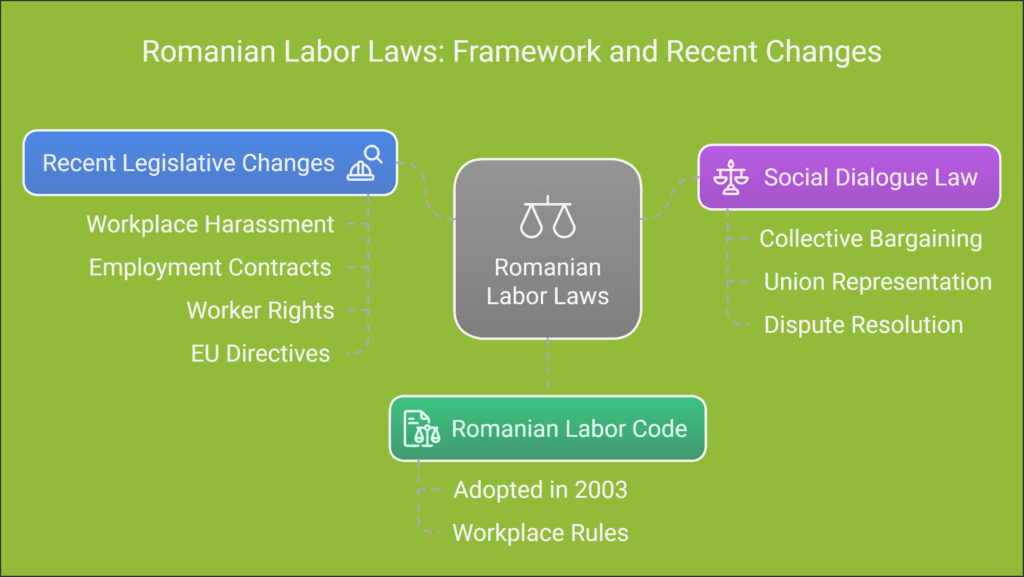
Understanding the Legal Framework of Romanian Labor Laws

 Legal Framework of Romanian Labor Laws


Understanding Romanian labor laws is complex.

The Romanian labor code is key, guiding employers and employees. It sets the rules for the workplace.

Recently, employment laws in Romania have changed a lot.

New rules aim to protect workers better and improve talks between employers and employees.

Key Legislation Governing Labor Relations

Romania’s labor laws are based on several important laws:

  • The Romanian Labor Code (adopted in 2003);
  • Social Dialogue Law (Law No. 367/2022);
  • Constitutional provisions;
  • European Union employment directives;
  • International Labor Organization (ILO) standards.

Social Dialogue Law Overview

The Social Dialogue Law is a big step forward.

It makes sure employers and workers talk openly.

It helps solve problems and negotiate better.

Legislative AspectKey Requirement
Collective BargainingMandatory for companies with 10+ employees
Union RepresentationMinimum 35% employee membership for company-level recognition
Dispute ResolutionStructured mediation processes established

Recent Legislative Changes in 2023-2024

Romania’s labor laws keep changing. Recent updates focus on:

  1. Stopping workplace harassment better;
  2. Making employment contracts clearer;
  3. Protecting workers’ rights more;
  4. Following EU employment rules.

It’s vital for businesses in Romania to know these laws.

This ensures they follow the rules and have good relationships with workers.

Mandatory Collective Bargaining Requirements

It’s important for employers and employees in Romania to know about collective bargaining rules. New laws have changed how labor talks work. It’s key to keep up with these changes.

Collective Bargaining Romania

Now, companies with 10 or more workers must do collective bargaining.

This is a big change from the old rule of 21 workers.

The government wants to protect workers more and improve work agreements.

  • Collective bargaining is now compulsory for companies employing 10+ workers;
  • Written agreements must be registered with the Territorial Labor Inspectorate;
  • Negotiation period cannot exceed 60 days without mutual agreement.

Employers must follow certain steps when starting labor talks.

They need to start talks at least 45 days before the current contract ends.

If they don’t, workers or unions can ask for talks in writing within 10 days.

Important things about union talks in Romania include:

  1. Collective agreements must be written and registered officially;
  2. Agreement duration ranges from 12 to 24 months;
  3. One-time extension of 12 months is permitted;
  4. Parties must document each negotiation meeting with signed minutes.

Trade unions are very important in these talks.

A union can start at a company with 15 members and get recognized with 35% of the workers.

This helps workers have a say in their rights and work conditions.

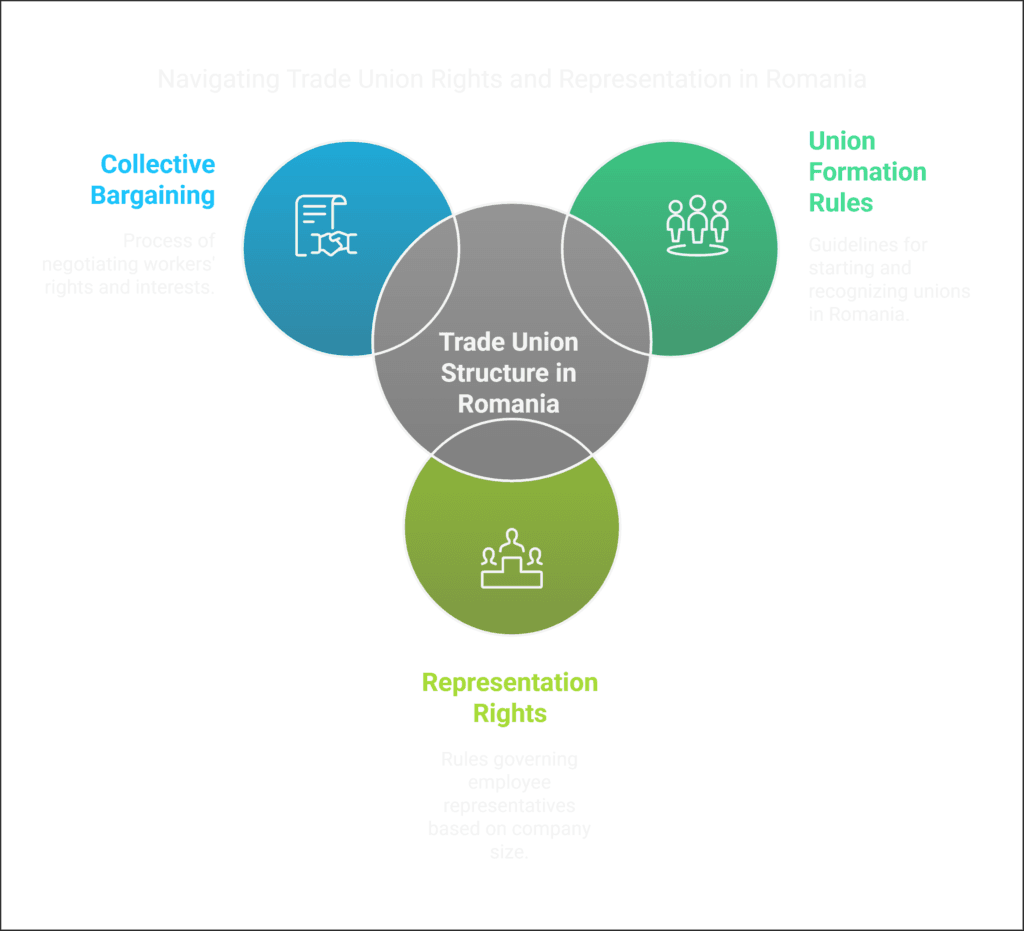
Role of Trade Unions and Employee Representatives

Role of Trade Unions and Employee Representatives

It’s important to know how workers are represented in Romania.

Trade unions play a big role in protecting workers’ rights.

They help with negotiations in many industries.

Labor unions in Romania have rules for starting and representing workers.

Here are the main steps to form workers’ associations:

  • At least 10 employees in the same company can start a union.
  • 20 employees from different companies in the same sector can also start a union.
  • A union must have at least 35% of company employees to be recognized.

Union Formation and Representation Rights

The rules for union representation in Romania are clear.

Companies have specific rules for choosing representatives based on their size:

Company SizeMaximum Representatives
Less than 100 employees2 representatives
101-500 employees3 representatives
501-1000 employees4 representatives
1001-2000 employees5 representatives
Over 2000 employees6 representatives

Collective Bargaining Priority

Workers’ voices are important in negotiations in Romania.

Representatives need at least 50% + 1 vote from employees.

They can only represent workers for two years.

Non-representative unions can also join negotiations if they have at least 7% of sector employees.

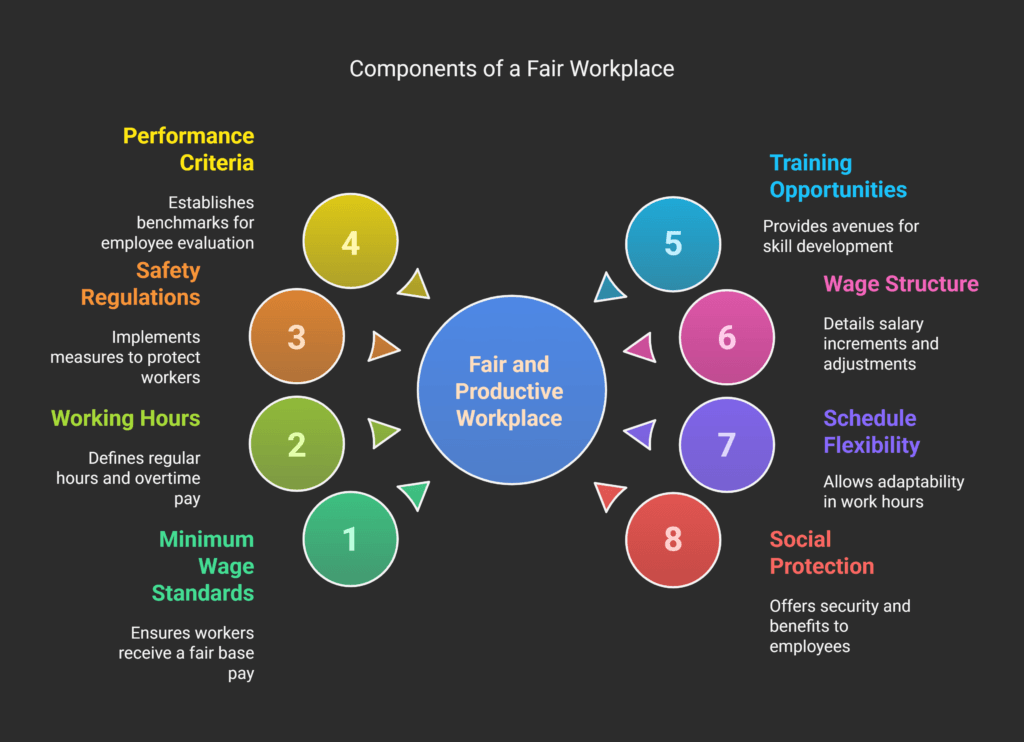
Collective Labor Agreement Romania: Essential Components

Collective Labor Agreement Romania Essential Components

Understanding the key parts of collective labor agreements in Romania is vital for protecting workers’ rights.

These agreements are detailed plans that cover important aspects of work and employee safety.

The main parts of these agreements focus on several key areas.

They affect how workers are treated and what benefits they get:

  • Minimum wage standards for different job categories;
  • Detailed working hours and overtime compensation;
  • Workplace safety regulations;
  • Performance evaluation criteria;
  • Employee training and development opportunities.

Romanian labor laws have specific rules for these agreements.

Since 2011, changes have made it easier for workers to talk about their jobs.

Now, only 10 employees are needed to start collective negotiations.

Important parts of these agreements include:

  1. Wage structure and salary increments;
  2. Work schedule flexibility;
  3. Social protection mechanisms;
  4. Dispute resolution procedures;
  5. Professional development pathways.

Employers need to see these agreements as more than just paperwork.

They are essential for keeping workplaces fair and productive.

By negotiating and implementing strong agreements, companies can build better relationships with their employees.

They also make sure they follow Romania’s changing labor laws.

Negotiation Process and Procedures

Negotiating collective bargaining in Romania needs a smart plan.

It’s about structured talks between employers and unions.

This ensures rules in the workplace are followed well.

Knowing the legal rules for labor talks is key.

Romanian laws set out clear steps for both sides to follow.

Initiating Collective Bargaining

Starting collective bargaining involves several important steps:

  • Employers with over 10 workers must start talks;
  • They must tell employees 15 days before talks begin;
  • Talks should start 60 days before the current deal ends.

Documentation Requirements

Keeping detailed records is vital in Romanian labor talks. The negotiation process needs accurate and formal documents.

DocumentPurposeCopies Required
Collective Labor AgreementFormal negotiation outcome3 copies (company, employees, Labor Inspectorate)
Negotiation MinutesRecord of discussions2 copies (each party)
Representative Voting RecordsValidate employee representation1 copy (company)

Timeline and Deadlines

Romanian rules set strict times for bargaining:

  1. Maximum negotiation time: 45 days;
  2. Extension possible: Up to 12 months with agreement;
  3. Deal length: 12-24 months.

Ignoring these rules can lead to big fines.

Fines can be between 5,000 to 20,000 RON.

Sector-Level Collective Bargaining

Sector-level collective bargaining is now key in Romania’s industrial relations.

New laws have changed how employers and workers make agreements in different sectors.

Key features of sector-level collective bargaining include:

  • Mandatory bargaining for employers with at least 10 employees;
  • Recognition of unions representing 35% of workers at sector level;
  • Potential extension of agreements to entire sectors under specific conditions.

The new rules change how workplace disputes are solved.

They make it clear what employer groups in Romania must do.

Companies now have to follow more detailed rules for bargaining, focusing on workers’ voices.

Notable developments in sector-level collective bargaining include:

  1. Reduced union establishment thresholds;
  2. Simplified negotiation timelines;
  3. Enhanced protections for employee representatives.

Romania is leading the EU in changing collective labor agreements.

The goal is to get workers more involved and make industrial relations clearer in various sectors.

Employers must now get ready for detailed negotiations at the sector level.

These agreements will influence industry standards for jobs, pay, and work conditions.

Implementation and Compliance Measures

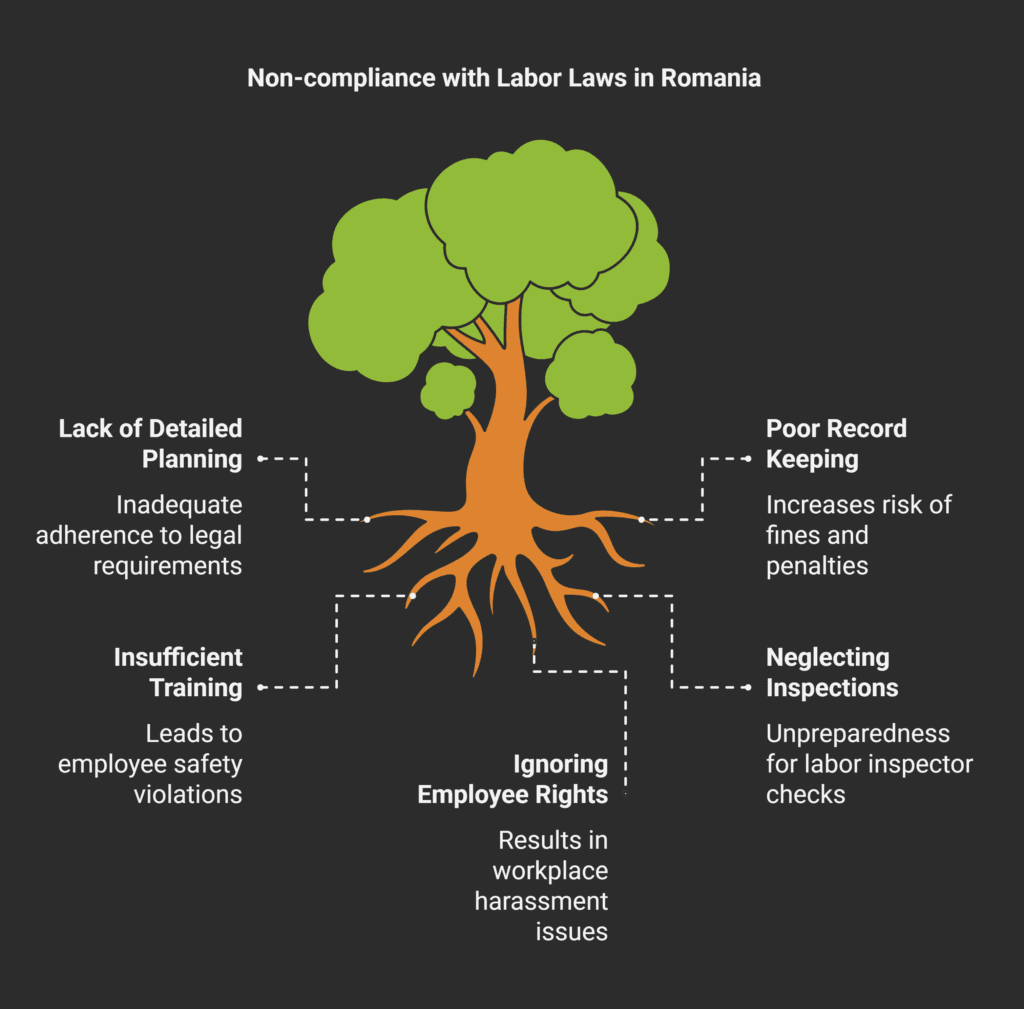
Non-compliance Labor Laws Romania

To follow labor laws in Romania, employers need a detailed plan.

They must carefully follow collective labor agreements and legal rules.

It’s important to handle work regulations in Romania with great care.

Here are some key steps for employers:

  • Register all employment contracts in the electronic Revisal system;
  • Do mandatory risk assessments for employee health and safety;
  • Give the right protective gear and training;
  • Keep accurate records of employee information;
  • Set up systems for handling employee complaints.

Labor inspectors are key in checking if employee protection standards are met.

They do deep checks to make sure workers’ compensation rules are followed.

Your company should be ready for inspections by keeping detailed records and fixing any issues early.

Important compliance rules cover many areas of employee rights and duties.

This includes:

  1. Keeping all employment contracts on file;
  2. Updating payroll statements regularly;
  3. Telling labor authorities about service contracts;
  4. Having rules against workplace harassment;
  5. Ensuring fair chances in hiring and promotions.

Not following the rules can lead to big fines.

Fines can be between RON 5,000 and RON 100,000, based on the violation.

It’s crucial to manage well and do regular checks to avoid problems and keep the workplace legal.

Legal Support and Professional Assistance

Understanding collective labor agreements in Romania needs the help of a professional Romanian law office.

A skilled lawyer in Bucharest can guide you through the complex legal landscape of employment disputes in Romania.

We will make sure your organization follows strict labor regulations.

Legal consultants are key in managing collective bargaining processes and help prepare documents, understand Social Dialogue Law, and avoid legal risks.

With fines up to RON 20,000 for mistakes, having expert lawyers in Bucharest is vital for your business.

Role of Legal Consultants

Your Romanian lawyer will explain the rules for collective bargaining, especially for companies with 10 or more employees.

Our Law firm offers strategic advice on negotiations, documents, and ensuring your organization meets Romanian Labor Code standards.

Documentation Requirements

Getting professional legal help is important for employment documents.

Bucharest lawyers can create detailed collective labor agreements, handle employee representation, and keep up with Romanian labor laws.

For specialized legal help, contact us.

FAQ

What is a Collective Labor Agreement in Romania?

A Collective Labor Agreement is a legal document.

It’s made by employers and trade unions.

It sets rules for work, rights, and duties for employees in a company or sector.

It covers important things like pay, hours, benefits, and how to solve problems.

Who is required to participate in collective bargaining in Romania?

Companies with 10 or more employees must bargain collectively.

Employers and trade unions must both take part.

New laws have made it easier for smaller groups to bargain.

How do I form a trade union in Romania?

To start a trade union, you need 10 workers from the same field.

You must register with the court and show you’re independent from employers.

The union must also have a fair structure.

What are the key components of a Collective Labor Agreement?

A Collective Labor Agreement in Romania has many parts.

It includes the minimum wage, work conditions, and benefits.

It also covers hours, overtime, training, health, and how to solve problems.

These parts are talked about to protect both workers and employers.

What is sector-level collective bargaining?

Sector-level bargaining makes agreements for whole industries.

These agreements set rules for wages, work, and benefits for all in a sector.

It makes work rules the same for everyone in that field.

What happens if an employer does not comply with a Collective Labor Agreement?

If an employer breaks a Collective Labor Agreement, they could face fines or lawsuits.

They might have to fix the problem, pay for it, or get in trouble with labor authorities.

How long are Collective Labor Agreements valid in Romania?

Collective Labor Agreements last 12 to 24 months.

After that, the parties must talk about new terms.

The old agreement stays in place until a new one is made or until it’s decided to end it.

Can individual employment contracts deviate from the Collective Labor Agreement?

No, individual contracts can’t be worse than the Collective Labor Agreement.

Employers must make sure individual contracts are at least as good as the agreement.

What role do legal consultants play in collective bargaining?

Legal consultants help with labor laws and making agreements.

They check if rules are followed, help in talks, and solve disputes.

Their knowledge is key in understanding labor laws in Romania.

How are disputes resolved in Collective Labor Agreements?

Disputes are usually solved through talking, mediation, or arbitration.

If that doesn’t work, they can go to court.

The agreement usually says how to solve problems between employers and employees.