Two corporate professionals reviewing AI transparency controls, compliance dashboards, and synthetic content verification tools on screens in an office setting.

EU AI Act in Romania: 2026 Guide for Foreign Companies

EU AI Act compliance representation with glowing neural networks in a modern legal setting
Preparing for the EU AI Act: foreign companies operating in Romania must align their AI deployment with the new regulatory framework starting August 2026.

The compliance question is no longer whether a business “uses AI”. Most international groups do. The practical questions are which legal entity controls each use, whether the system affects people in Romania, and whether the company is a provider, deployer, importer or distributor for that system.

This guide is written for foreign companies, investors and employers with Romanian operations. It reflects legislation and official information available on 31 July 2026 and explains the rules applicable from 2 August 2026.

What Changes on 2 August 2026?

The immediate operational change is the application of Article 50 transparency duties, not the full high-risk regime for HR and other Annex III systems.

Regulation (EU) 2026/1744, the AI Omnibus, entered into force on 27 July 2026. It moved the Annex III high-risk deadline to 2 December 2027 and the deadline for high-risk AI embedded in regulated products to 2 August 2028. The European Commission’s updated AI Act timeline confirms these dates.

DateRulePractical consequence
2 February 2025Prohibited AI practices and AI literacyCompanies must stop prohibited uses and support AI literacy for personnel and other people operating AI on their behalf.
2 August 2025General-purpose AI model rules and parts of the enforcement frameworkMainly relevant to model providers; ordinary business users are usually deployers, subject to role-specific duties.
2 August 2026Article 50 transparency obligationsCertain AI interactions and AI-generated or manipulated outputs require disclosure, marking or labelling.
3 August 2026Supervision and enforcement of AI literacyThe Commission states that Article 4 supervision and enforcement rules apply from this date.
2 December 2026Limited legacy grace periodProviders of generative systems placed on the market before 2 August 2026 must meet the machine-readable marking duty from this date.
2 December 2027Annex III high-risk rulesCovers listed uses in employment, education, credit, biometrics, essential services and other areas.
2 August 2028Annex I product-related high-risk rulesCovers qualifying AI safety components or AI products under listed EU product legislation.

The original Artificial Intelligence Act remains Regulation (EU) 2024/1689, but it must now be read together with the enacted AI Omnibus.

Minimalist representation of AI transparency and regulation
Understanding the core boundaries: the AI Act imposes tiered obligations depending on the specific use case and risk level.

Does the AI Act Apply to a Foreign Company Operating in Romania?

Yes, potentially even when the provider or parent company is outside the EU. Location alone does not remove a business from scope.

The Act applies to providers that place AI systems or general-purpose AI models on the EU market, deployers established or located in the EU, importers and distributors, and certain product manufacturers. It can also apply to providers and deployers outside the EU where the system’s output is used in the Union. The Commission’s AI Act scope page sets out the territorial rules.

A foreign group should map the role of each entity rather than treat “the company” as a single actor.

Business positionTypical example in RomaniaCore question
ProviderA group develops a recruitment tool and releases it under its own name.Who controls development, intended purpose and market placement?
DeployerA Romanian subsidiary uses a third-party CV-screening or productivity tool under its authority.Who decides how the system is used and on whom?
ImporterAn EU entity first places a third-country AI system on the Union market.Who brings the system into the EU supply chain?
DistributorA reseller makes an AI system available in the EU without being the provider or importer.Does the reseller alter the system, branding or intended purpose?
Provider by reclassificationA business substantially modifies a system, changes its intended purpose or markets it under its own name.Has the business assumed provider obligations despite buying the original tool?

Contracting with a US or other non-EU vendor does not automatically transfer the Romanian deployer’s responsibilities. Conversely, white-labelling, materially modifying or repurposing a tool may move a company into the provider role.

Which AI Uses Should a Company Classify First?

Start with the intended use and its effect on people, then identify the company’s role. Product labels such as “AI-powered” or “assistant” are not a legal classification.

An operational inventory can use four screening groups, but the legal analysis should remain tied to the Act:

  • Prohibited practices: uses that must not be deployed, subject to narrow statutory exceptions.
  • High-risk systems: Annex III uses and certain AI safety components or regulated products, subject to the revised future dates.
  • Article 50 systems: interactive or generative uses and certain emotion-recognition, biometric or synthetic-content uses with transparency duties.
  • Other AI systems: systems outside those rules may still be subject to AI literacy, GDPR, consumer, employment, intellectual-property, confidentiality and sector-specific law.

This last point matters. “Minimal risk” does not mean “no compliance”. A low-impact writing assistant may still require staff guidance, data controls and human review.

Which Workplace AI Uses Are Already Prohibited?

An employer must not infer workers’ emotions through AI except where a narrow medical or safety exception applies. Other Article 5 prohibitions may also affect workplace or customer systems.

The Commission identifies prohibited practices including manipulative or exploitative AI, certain social scoring, certain biometric categorisation, untargeted facial-image scraping, individual predictive policing based solely on profiling, and emotion recognition in workplaces and education, subject to specific exceptions. The AI Omnibus also added a prohibition targeting AI that generates non-consensual sexually explicit or intimate content and child sexual abuse material. See the Commission’s prohibited-practices guidance.

For employers, the label used by a vendor is not decisive. A video-interview tool, wellness platform or workforce-monitoring service may claim to detect engagement, stress, attitude or sentiment without calling the function “emotion recognition”. Review the actual inputs, inferences and purpose.

A professional contract signing session in a modern office
Structuring vendor relationships: clear contracts and allocation of roles are essential for compliance when using third-party AI tools.

What Transparency Duties Apply from 2 August 2026?

Article 50 applies to specified uses regardless of whether the system is high-risk. The duty depends on whether the company is the provider or deployer and on the type of interaction or output.

The Commission published final Article 50 transparency guidance in July 2026.

SituationResponsible actorRequired control
AI system directly interacts with a personProviderDesign the system so the person is informed from the first interaction, unless the AI interaction is obvious under the restrictive exception.
Generative AI produces synthetic text, image, audio or videoProviderApply effective, interoperable, robust and reliable machine-readable marking, subject to statutory exceptions and technical feasibility.
Emotion recognition or biometric categorisation is used lawfullyDeployerInform exposed natural persons at first exposure and comply with applicable data-protection law.
AI generates or manipulates a deepfakeDeployerClearly disclose that the content is artificially generated or manipulated; a machine-readable mark alone is insufficient.
AI-generated text informs the public on a matter of public interestDeployerLabel the text unless it received substantive human review or editorial control and a person holds editorial responsibility.

Does a Customer-Facing Chatbot Need a Disclosure?

Usually, the system should inform a person at the start of the first interaction that they are interacting with AI, unless this is obvious to a reasonably well-informed, observant and circumspect person. The provider bears the design obligation. A business deploying a third-party chatbot should nevertheless verify that the notice is implemented in its actual interface and allocate responsibility in the contract.

Must AI-Assisted Business Content Be Labelled?

Not every AI-assisted text requires a public label. Article 50 focuses on text published to inform the public on matters of public interest. The Commission states that substantive human review or editorial control, together with editorial responsibility, can qualify for an exemption. Spell-checking, formatting or superficial approval is not enough.

For images, audio and video, a deployer must separately assess whether the output is a deepfake. Where disclosure is required, it must be clear to people at first exposure; embedded technical metadata alone does not satisfy the deployer’s obligation.

Is There a Grace Period?

The Commission confirms a narrow grace period only for providers’ machine-readable marking obligation for generative AI systems placed on the market before 2 August 2026. Those systems must comply from 2 December 2026. Content generated before 2 August 2026 need not be labelled retroactively. Other Article 50 duties do not receive a general grace period.

Legal compliance documents and checklists on a desk
Detailed documentation is key: companies must keep records of AI literacy programs and Article 50 transparency notices.

What Must Employers Know About Recruitment and Employee-Management AI?

Recruitment and worker-management AI remains a priority compliance area, but the principal Annex III high-risk duties now apply from 2 December 2027.

The AI Act’s Annex III lists systems intended to:

  • place targeted job advertisements;
  • analyse and filter applications;
  • evaluate candidates;
  • make decisions affecting work terms, promotion or termination;
  • allocate tasks based on behaviour, traits or characteristics; or
  • monitor and evaluate worker performance or behaviour.

Some listed systems may fall outside high-risk treatment if they do not create a significant risk and satisfy Article 6(3), for example because they perform a narrow procedural or preparatory task and do not materially influence a decision. Systems that profile natural persons remain high-risk. Providers relying on an exclusion must document the assessment. As of 31 July 2026, the Commission’s detailed high-risk classification guidelines were still in draft following consultation.

What Duties Arrive in December 2027?

Depending on role and use, the high-risk regime includes risk management, data governance, technical documentation, record-keeping, information for deployers, human oversight, accuracy, robustness, cybersecurity, quality management, conformity assessment, registration, post-market monitoring and incident reporting.

Deployers must follow instructions, assign competent human oversight, monitor operation, retain logs under their control, and use relevant and sufficiently representative input data where they control those inputs. Employer deployers must inform workers’ representatives and affected workers before putting a high-risk workplace system into service or use, in accordance with applicable law.

The delay should be used to obtain the documentation and contractual rights that cannot be created at the end of procurement.

What Does AI Literacy Require After the AI Omnibus?

AI literacy remains a legal obligation. The AI Omnibus removed the idea that every person must reach a prescribed “sufficient” level, but providers and deployers must still take measures that support staff and other operators in using AI appropriately.

Article 4 has applied since 2 February 2025. The Commission’s updated AI literacy questions and answers recommend a risk-based approach that considers the organisation’s role, the systems used, staff knowledge and the people affected.

There is no mandatory certificate or prescribed course. A defensible programme may include:

  • an approved-AI-tools register;
  • role-based training for management, HR, procurement, IT, marketing and ordinary users;
  • rules on personal, confidential and privileged information;
  • verification requirements for AI output;
  • escalation for high-impact decisions;
  • specific human-oversight training for high-risk systems; and
  • internal records of training and guidance.

Reading a vendor’s instructions may be insufficient, particularly where human oversight or affected persons’ rights are at stake. The Commission states that supervision and enforcement of Article 4 begins on 3 August 2026.

How Does the AI Act Interact with GDPR and Employment Law?

AI Act compliance does not replace data-protection or employment compliance. The same project can trigger several legal regimes at once.

Where an AI system processes candidate, worker, customer or other personal data, the GDPR continues to apply. The company must identify a lawful basis, provide transparent information, observe purpose limitation and data minimisation, manage processors and international transfers, protect data, and assess automated decision-making. A data protection impact assessment may be required where processing is likely to create a high risk.

The European Data Protection Board’s Opinion 28/2024 addresses anonymity, legitimate interests and the consequences of unlawfully processed training data. For a Romania-specific overview, see our guide to GDPR compliance when using AI.

Employment projects also require review of discrimination, monitoring, employee information and consultation, collective arrangements and the validity of decisions under Romanian law. A human approval click does not automatically remove automated-decision or discrimination risk if the human reviewer cannot meaningfully change the outcome.

What Should a Foreign Investor Check in AI Due Diligence?

AI due diligence should test legal role, actual use and evidence—not only whether the target has an “AI policy”.

An investor or buyer of a Romanian business should request:

  1. the AI systems inventory and owners;
  2. provider, deployer, importer and distributor role assessments;
  3. the prohibited-practices review;
  4. Article 50 notices, labels and technical marking evidence;
  5. AI literacy materials and attendance records;
  6. vendor contracts, data-processing agreements, audit rights and change notices;
  7. GDPR records, data protection impact assessments and automated-decision analysis;
  8. the roadmap for Annex III and Annex I systems;
  9. complaints, incidents, regulator correspondence and known bias issues; and
  10. insurance coverage, warranties, indemnities and remediation budgets.

Representations should be tied to disclosed systems and evidence. A generic warranty that the target “complies with all AI laws” is unlikely to identify which party must remediate a specific tool or fund a delayed conformity project.

Who Supervises the AI Act in Romania?

Romania has proposed a multi-authority model, but the final national implementing framework should be checked before any filing or regulator engagement.

In March 2026, the Romanian Government approved a memorandum proposing the National Authority for Management and Regulation in Communications (ANCOM) as market-surveillance authority and single point of contact, with sectoral roles for other bodies including the National Bank of Romania, the Financial Supervisory Authority, the national data-protection authority and the Authority for the Digitalisation of Romania.

ANCOM’s own June 2026 notice describes ANCOM as proposed for that role. The national implementing law was therefore still a point to verify as of this guide’s preparation. GDPR matters remain within the competence of the Romanian data-protection authority, while financial and product-sector regulators may have parallel powers.

What Penalties Can Apply?

The AI Act sets high maximum ceilings, but the actual measure must be effective, proportionate and dissuasive and must reflect the circumstances of the infringement.

The Article 99 penalty framework includes:

  • up to EUR 35 million or 7% of worldwide annual turnover for prohibited practices, whichever is higher for undertakings;
  • up to EUR 15 million or 3% for specified operator obligations, including Article 50 transparency duties, whichever is higher for undertakings; and
  • up to EUR 7.5 million or 1% for incorrect, incomplete or misleading information supplied to competent authorities or notified bodies, whichever is higher for undertakings.

For SMEs, including start-ups, the applicable ceiling is the lower of the fixed amount and percentage. Authorities must consider factors such as gravity, duration, harm, company size, cooperation, responsibility, mitigation and intent. These are maximum ceilings, not automatic fines.

A lawyer explaining compliance steps to a client
Developing a strategic roadmap: proactive compliance helps foreign investors mitigate risks under the new enforcement regime.

A Practical Compliance Checklist for August 2026

  1. Inventory every AI system used or supplied by the Romanian business, including embedded features in HR, CRM, finance, security, marketing and productivity tools.
  2. Map the provider, deployer, importer, distributor and product-manufacturer role for each legal entity.
  3. Screen intended and actual uses against Article 5, with specific attention to workplace emotion inference and manipulative functions.
  4. Implement Article 50 notices, labels and marking controls for systems in scope from 2 August 2026.
  5. Document the narrow legacy grace period separately; do not treat it as a general Article 50 delay.
  6. Support AI literacy with risk-based policies, role-specific guidance and internal records.
  7. Review HR tools against Annex III and create a 2 December 2027 readiness plan.
  8. Align vendor contracts on role, intended purpose, documentation, changes, audit, logs, incidents, cooperation and exit.
  9. Integrate the AI review with GDPR, employment, consumer, intellectual-property, confidentiality and sector requirements.
  10. Verify the final Romanian competent-authority and penalty implementation framework before notification or regulator contact.
  11. Assign an accountable business owner and legal escalation path for every material system.
  12. Reassess systems after material updates, new use cases or changes in provider instructions.

The Bottom Line

The 2 August 2026 milestone is narrower than many early compliance plans assumed, but it is not optional. Article 50 transparency controls must work, prohibited uses must remain excluded, and AI literacy must be demonstrable. The AI Omnibus gives companies additional time for the high-risk regime; it does not remove the need to classify HR and other Annex III systems, secure vendor evidence and build human oversight.

A targeted legal review can map the group’s roles, identify the controls required now and convert the 2027 high-risk deadline into a procurement and governance plan.

Frequently Asked Questions

Does the AI Act apply if our parent company is outside the EU?

It can. The Act covers providers placing systems or general-purpose models on the EU market, deployers located in the EU, and certain non-EU providers and deployers where AI output is used in the Union. A foreign parent and Romanian subsidiary may have different roles for the same system, so the assessment should be performed entity by entity.

Are AI recruitment tools high-risk from 2 August 2026?

Recruitment and worker-management uses remain listed in Annex III, but the enacted AI Omnibus moved the application of the relevant high-risk rules to 2 December 2027. Existing obligations under GDPR, discrimination, employment and Article 5 continue to apply, and Article 50 may apply to particular features before then.

Must employees disclose every use of ChatGPT or another writing assistant?

The AI Act does not impose a general public disclosure for every AI-assisted internal document. The employer should nevertheless control approved tools, confidential and personal data, verification and human responsibility. Article 50 labelling may apply to public-interest text without substantive human review, while AI literacy applies more broadly to professional use.

Is an AI officer mandatory in Romania?

The AI Act does not generally require every company to appoint an AI officer or AI governance board. A company should still assign accountable owners for inventory, legal classification, procurement, security, data protection and human oversight. The most suitable structure depends on the organisation’s size, systems and risk profile.

Does using a human reviewer remove AI Act and GDPR risk?

No. Human oversight must be meaningful. If the reviewer lacks information, authority, time or competence to challenge the output, the review may not address the risk. Under GDPR, a nominal human step may also be insufficient where a decision is effectively determined by automated processing.

Can we rely entirely on the AI vendor’s compliance statement?

No. A vendor statement is evidence, not a substitute for the deployer’s own assessment. The customer should verify the system’s intended purpose, instructions, data and logging controls, Article 50 implementation, prohibited features, changes, incident cooperation and the documentation needed for future high-risk obligations.

Featured image illustrating dual employment in Romania, showing a professional working two jobs with symbols for legal rights, taxation, and employment rules.

Dual Employment in Romania: Legal & Tax Rules Explained


Dual Employment in Romania: Legal & Tax Rules Explained

Dual employment is legal in Romania under Article 35 of the Romanian Labour Code.

Employees may hold multiple employment contracts at the same time, either with different employers or, in certain cases, with the same employer, provided work schedules do not overlap and no statutory incompatibility applies.

As a rule, employers are prohibited from penalizing employees solely for holding another job.


Play


1. What Is Dual Employment Under Romanian Law?

Dual employment (cumul de funcții) refers to the situation in which an individual holds two or more individual employment contracts (contracte individuale de muncă – CIM) simultaneously.

These contracts may be concluded with different employers or, subject to stricter conditions, with the same employer.

Romanian labour law adopts a contract-based approach, meaning each employment relationship is assessed independently.

There is no legal requirement for an employee to obtain consent from one employer in order to work for another, nor is there a general obligation to disclose all other employment relationships, except where disclosure is required for fiscal or compliance purposes.

The legal basis for this principle is found in the Romanian Labour Code, particularly the rules governing freedom of work and contractual autonomy.


2. Is Dual Employment Legal in Romania?

Yes. Dual employment is expressly legal under Article 35 of the Labour Code, which enshrines the employee’s freedom to work for multiple employers.

This means that Romanian law does not impose:

  • A numerical limit on employment contracts;
  • A hierarchy between jobs; or
  • A requirement to designate a “main employer” for labour-law purposes.

3. Can an Employer Forbid an Employee From Having a Second Job?

As a general rule, no. Employers may not forbid employees from having a second job solely because they wish to work elsewhere.

Romanian law is aligned with EU standards on transparent and predictable working conditions.

These rules prohibit employers from applying unfavorable treatment—such as dismissal, demotion, or harassment—simply because an employee exercises their right to work elsewhere.

Clauses that broadly prohibit “any other paid activity” are, in most cases, unenforceable unless they are justified by a real and specific conflict of interest and are linked to a valid non-compete clause.


4. Independence of Employment Contracts

Each individual employment contract operates as a separate legal relationship.

This has several important consequences:

  • Salary entitlement arises independently under each contract;
  • Annual leave accrues separately for each contract;
  • Social contributions are calculated per contract, subject to tax rules;
  • Disciplinary liability is assessed independently by each employer.

5. Salary and Annual Leave in Dual Employment

Salary Entitlement

An employee holding multiple contracts is entitled to receive the full negotiated salary under each contract, regardless of income earned elsewhere.

Romanian labour law does not permit salary reductions based on the existence of other employment relationships.

Annual Leave

Paid annual leave is earned separately under each employment contract.

Each employer must grant leave proportionally to the duration and workload of the respective contract.


6. Loyalty, Confidentiality, and Non-Compete Obligations

Dual employment does not eliminate loyalty or confidentiality obligations.

Employees must continue to:

  • Protect confidential information belonging to each employer;
  • Avoid unfair competition;
  • Comply with any valid non-compete clauses.

Under Romanian law, a non-compete clause is enforceable only if it is paid and proportionate.

Courts frequently invalidate unpaid or overly broad clauses.


7. Working Time Limits and Rest Periods

General Working Time Rule

Romanian labour law sets a general maximum of 48 working hours per week, including overtime.

According to current practice of the Labour Inspectorate (Inspecția Muncii), this limit is generally applied per contract, not per individual, when different employers are involved.

As a result, under current national practice, an employee may lawfully hold two full-time contracts with different employers, provided work schedules do not overlap.

Same Employer vs. Different Employers

When multiple contracts exist with the same employer, the rules are stricter. In such cases:

  • Roles must be distinct;
  • Schedules must not overlap;
  • Total daily working time may not exceed 12 hours;
  • The mandatory 12-hour daily rest period must be respected cumulatively.

European Perspective

EU case law, including decisions of the Court of Justice of the European Union on rest periods, increasingly emphasizes cumulative rest protection.

While Romanian law has not yet fully adopted this approach across different employers, future alignment cannot be excluded.


8. Special Rules for Minors

For employees aged 15 to 18, the law is strict:

  • Maximum 6 working hours per day;
  • Maximum 30 working hours per week;
  • Limits apply cumulatively across all contracts.

These protections are mandatory and reflect Romania’s obligations under EU and international labour standards.


9. Fiscal Framework for Dual Employment

Minimum Wage Threshold

As of 2026, the gross minimum wage in Romania is 4,050 RON, according to regulations issued by the Romanian Government and Ministry of Labour.

This threshold is central to the taxation of part-time contracts and the calculation of social contributions.


10. Part-Time Over-Taxation: The Core Issue

Under Romanian fiscal rules introduced through tax emergency ordinances adopted by the Ministry of Finance, part-time contracts with salaries below the minimum wage are generally subject to social contributions calculated at the full minimum-wage level.

This rule was designed to discourage artificial fragmentation of employment but has significant implications for dual-employed individuals.


11. How to Avoid Part-Time Over-Taxation

An exemption applies where the employee’s total gross income across all contracts reaches at least the minimum wage.

To benefit from this exemption:

  • The employee must submit a declaration on own responsibility;
  • The declaration must be submitted monthly;
  • According to current fiscal regulations issued by the Romanian Ministry of Finance, the deadline is generally the 5th day of the following month;
  • The declaration must be submitted to each employer.

If the declaration is not submitted on time, the employer is generally required to calculate and pay full social contributions.


12. Categories Automatically Exempt From Over-Taxation

Certain categories benefit from automatic exemption under Romanian tax law, including:

  • Students and pupils under 26;
  • Apprentices under 18;
  • Parents or legal guardians of at least two children;
  • Persons with recognized disabilities;
  • Old-age pensioners.

13. The “Base Function” (Funcția de Bază)

Every employee must designate one and only one employment contract as their base function.

The base function determines:

  • Entitlement to personal income-tax deductions;
  • Eligibility for meal tickets.

The employee may change the base function at any time by notifying employers in writing. Receiving base-function benefits from more than one employer constitutes a fiscal irregularity.


14. Sector-Specific Restrictions and Incompatibilities

Public Sector

Civil servants are subject to strict incompatibility rules under Romanian public integrity legislation, with limited exceptions for teaching, research, or artistic activities. Contractual staff in public institutions generally enjoy greater flexibility.

Medical Professionals

Doctors frequently combine public hospital work with private practice. However, private activity must not overlap with public schedules, and leaving a hospital during mandatory on-call shifts is prohibited under healthcare-specific regulations.

Company Administrators

In joint-stock companies, an administrator cannot simultaneously be an employee of the same company under Romanian company law. Such contracts are null and void from the outset.


15. Administrative Monitoring and Transparency

All employment contracts must be registered in the national employee registry system administered by the Labour Inspectorate. Employees may access their registry extract to verify registered contracts, salaries, and seniority.

This transparency significantly reduces the risk of undeclared or overlapping work.


16. Impact on Pension Rights

Overlapping employment periods count once toward seniority in years. However, social contributions paid on multiple incomes increase pension points, which may result in a higher future pension.


17. Employer Risk Management in Dual Employment

Employers hiring dual-employed workers should, as part of their general health-and-safety and compliance obligations:

  • Verify that work schedules do not overlap;
  • Monitor fatigue risks;
  • Ensure accurate registry reporting;
  • Properly remunerate any non-compete clauses.

Failure to manage these aspects may expose employers to sanctions during inspections by the Labour Inspectorate or to liability in the event of workplace incidents.


Frequently Asked Questions

Q: Is dual employment legal in Romania?

Yes, provided work schedules do not overlap and no statutory incompatibility applies.

Q: Can my employer fire me for having a second job?

As a rule, no, unless a valid non-compete clause or a statutory incompatibility is breached.

Q: Can I receive meal tickets from two employers?

No. Meal tickets may be granted only by the base-function employer.

Q: Does dual employment increase my pension?

Generally, yes, because contributions are paid on multiple incomes, increasing pension points.


Key Compliance Rule: Transparency. Employees must declare their base function and applicable tax exemptions correctly, employers must register contracts accurately, and work schedules must never overlap.


Disclaimer: This article is for general informational purposes only and does not constitute legal advice. Specific situations may require individual legal assessment. Professional legal guidance should be obtained before taking action based on this content.

Navigating Collective Labor Agreements in Romania

Navigating Collective Labor Agreements in Romania

Collective Labor Agreement Romania

In 2023, Romania’s labor laws changed a lot.

More than 67% of businesses were affected by new rules on collective bargaining.

These changes have made a big difference in how jobs are set up and managed.

To understand collective bargaining in Romania, you need to know about the latest laws.

These laws have made it clearer and more organized for workers to negotiate at work.

The Ministry of Labor and Social Solidarity made big changes with Order no. 798/2023.

This order sets up a clear way to group businesses and handle negotiations at the sector level.

It’s all about making sure everyone follows the same rules in different industries.

Key Takeaways

  • New legislative framework implemented in 2023;
  • Enhanced transparency in collective bargaining;
  • Standardized classification of business units;
  • Improved protection of employee rights;
  • Sector-level negotiation opportunities expanded;
  • Clear guidelines for employment contracts.

Understanding the Legal Framework of Romanian Labor Laws

 Legal Framework of Romanian Labor Laws


Understanding Romanian labor laws is complex.

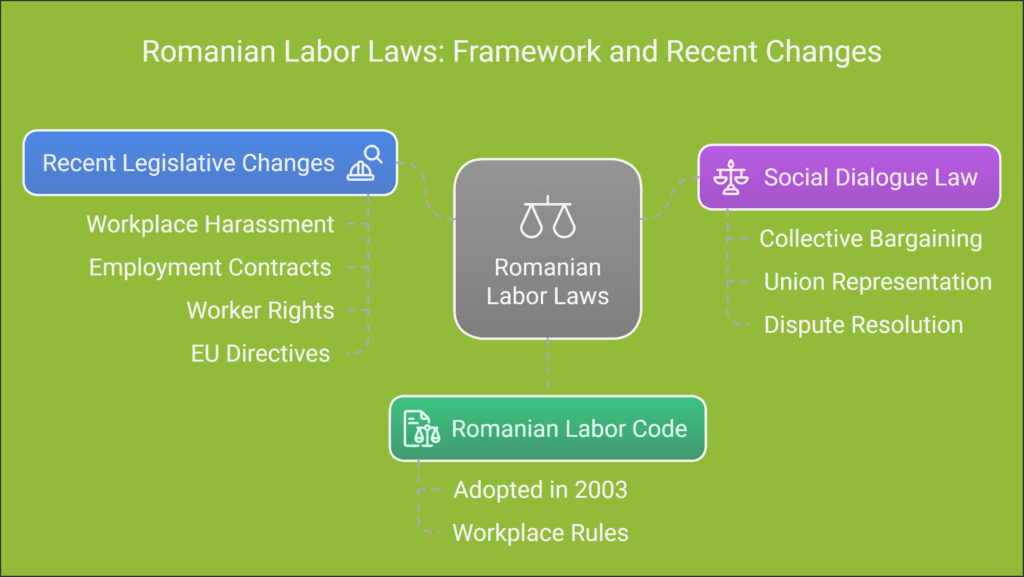
The Romanian labor code is key, guiding employers and employees. It sets the rules for the workplace.

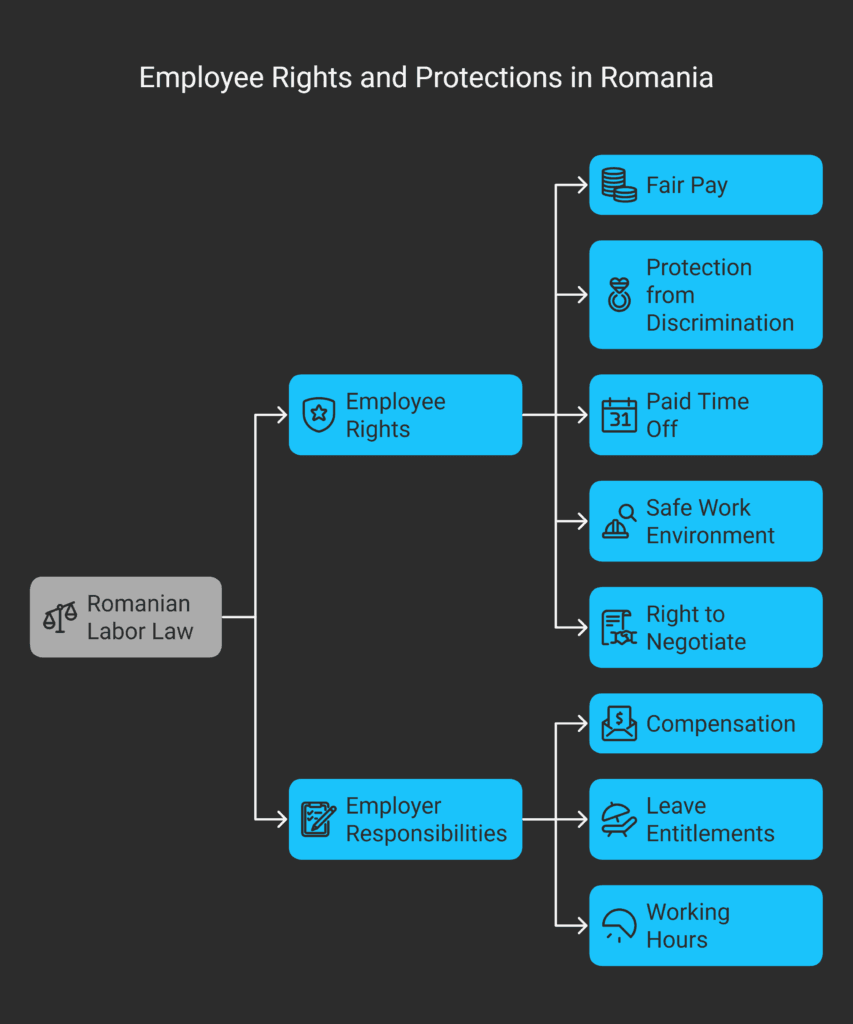
Recently, employment laws in Romania have changed a lot.

New rules aim to protect workers better and improve talks between employers and employees.

Key Legislation Governing Labor Relations

Romania’s labor laws are based on several important laws:

  • The Romanian Labor Code (adopted in 2003);
  • Social Dialogue Law (Law No. 367/2022);
  • Constitutional provisions;
  • European Union employment directives;
  • International Labor Organization (ILO) standards.

Social Dialogue Law Overview

The Social Dialogue Law is a big step forward.

It makes sure employers and workers talk openly.

It helps solve problems and negotiate better.

Legislative AspectKey Requirement
Collective BargainingMandatory for companies with 10+ employees
Union RepresentationMinimum 35% employee membership for company-level recognition
Dispute ResolutionStructured mediation processes established

Recent Legislative Changes in 2023-2024

Romania’s labor laws keep changing. Recent updates focus on:

  1. Stopping workplace harassment better;
  2. Making employment contracts clearer;
  3. Protecting workers’ rights more;
  4. Following EU employment rules.

It’s vital for businesses in Romania to know these laws.

This ensures they follow the rules and have good relationships with workers.

Mandatory Collective Bargaining Requirements

It’s important for employers and employees in Romania to know about collective bargaining rules. New laws have changed how labor talks work. It’s key to keep up with these changes.

Collective Bargaining Romania

Now, companies with 10 or more workers must do collective bargaining.

This is a big change from the old rule of 21 workers.

The government wants to protect workers more and improve work agreements.

  • Collective bargaining is now compulsory for companies employing 10+ workers;
  • Written agreements must be registered with the Territorial Labor Inspectorate;
  • Negotiation period cannot exceed 60 days without mutual agreement.

Employers must follow certain steps when starting labor talks.

They need to start talks at least 45 days before the current contract ends.

If they don’t, workers or unions can ask for talks in writing within 10 days.

Important things about union talks in Romania include:

  1. Collective agreements must be written and registered officially;
  2. Agreement duration ranges from 12 to 24 months;
  3. One-time extension of 12 months is permitted;
  4. Parties must document each negotiation meeting with signed minutes.

Trade unions are very important in these talks.

A union can start at a company with 15 members and get recognized with 35% of the workers.

This helps workers have a say in their rights and work conditions.

Role of Trade Unions and Employee Representatives

Role of Trade Unions and Employee Representatives

It’s important to know how workers are represented in Romania.

Trade unions play a big role in protecting workers’ rights.

They help with negotiations in many industries.

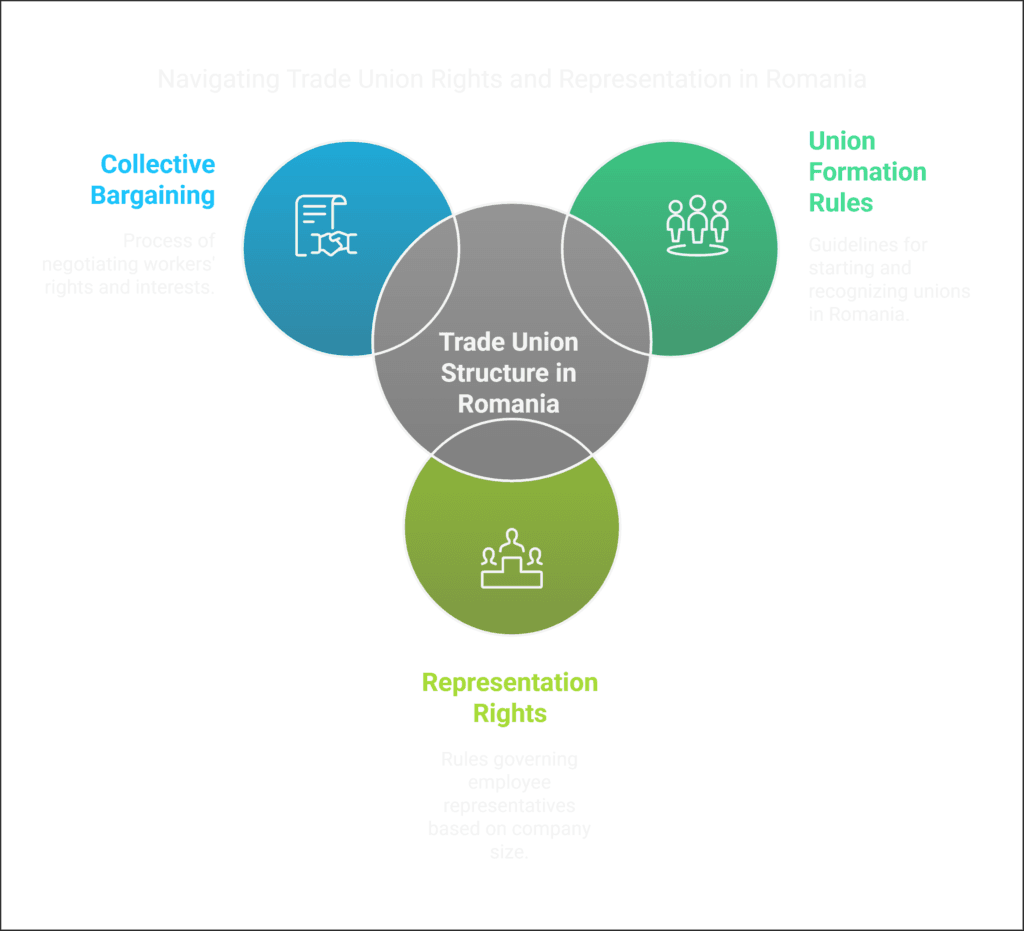
Labor unions in Romania have rules for starting and representing workers.

Here are the main steps to form workers’ associations:

  • At least 10 employees in the same company can start a union.
  • 20 employees from different companies in the same sector can also start a union.
  • A union must have at least 35% of company employees to be recognized.

Union Formation and Representation Rights

The rules for union representation in Romania are clear.

Companies have specific rules for choosing representatives based on their size:

Company SizeMaximum Representatives
Less than 100 employees2 representatives
101-500 employees3 representatives
501-1000 employees4 representatives
1001-2000 employees5 representatives
Over 2000 employees6 representatives

Collective Bargaining Priority

Workers’ voices are important in negotiations in Romania.

Representatives need at least 50% + 1 vote from employees.

They can only represent workers for two years.

Non-representative unions can also join negotiations if they have at least 7% of sector employees.

Collective Labor Agreement Romania: Essential Components

Collective Labor Agreement Romania Essential Components

Understanding the key parts of collective labor agreements in Romania is vital for protecting workers’ rights.

These agreements are detailed plans that cover important aspects of work and employee safety.

The main parts of these agreements focus on several key areas.

They affect how workers are treated and what benefits they get:

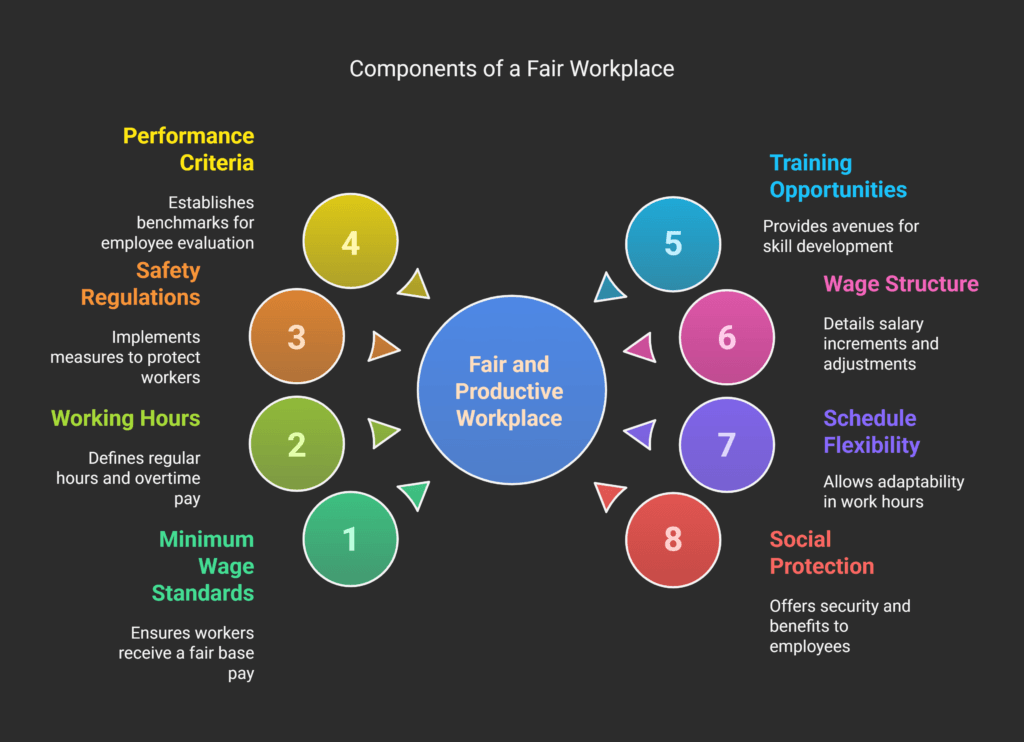
  • Minimum wage standards for different job categories;
  • Detailed working hours and overtime compensation;
  • Workplace safety regulations;
  • Performance evaluation criteria;
  • Employee training and development opportunities.

Romanian labor laws have specific rules for these agreements.

Since 2011, changes have made it easier for workers to talk about their jobs.

Now, only 10 employees are needed to start collective negotiations.

Important parts of these agreements include:

  1. Wage structure and salary increments;
  2. Work schedule flexibility;
  3. Social protection mechanisms;
  4. Dispute resolution procedures;
  5. Professional development pathways.

Employers need to see these agreements as more than just paperwork.

They are essential for keeping workplaces fair and productive.

By negotiating and implementing strong agreements, companies can build better relationships with their employees.

They also make sure they follow Romania’s changing labor laws.

Negotiation Process and Procedures

Negotiating collective bargaining in Romania needs a smart plan.

It’s about structured talks between employers and unions.

This ensures rules in the workplace are followed well.

Knowing the legal rules for labor talks is key.

Romanian laws set out clear steps for both sides to follow.

Initiating Collective Bargaining

Starting collective bargaining involves several important steps:

  • Employers with over 10 workers must start talks;
  • They must tell employees 15 days before talks begin;
  • Talks should start 60 days before the current deal ends.

Documentation Requirements

Keeping detailed records is vital in Romanian labor talks. The negotiation process needs accurate and formal documents.

DocumentPurposeCopies Required
Collective Labor AgreementFormal negotiation outcome3 copies (company, employees, Labor Inspectorate)
Negotiation MinutesRecord of discussions2 copies (each party)
Representative Voting RecordsValidate employee representation1 copy (company)

Timeline and Deadlines

Romanian rules set strict times for bargaining:

  1. Maximum negotiation time: 45 days;
  2. Extension possible: Up to 12 months with agreement;
  3. Deal length: 12-24 months.

Ignoring these rules can lead to big fines.

Fines can be between 5,000 to 20,000 RON.

Sector-Level Collective Bargaining

Sector-level collective bargaining is now key in Romania’s industrial relations.

New laws have changed how employers and workers make agreements in different sectors.

Key features of sector-level collective bargaining include:

  • Mandatory bargaining for employers with at least 10 employees;
  • Recognition of unions representing 35% of workers at sector level;
  • Potential extension of agreements to entire sectors under specific conditions.

The new rules change how workplace disputes are solved.

They make it clear what employer groups in Romania must do.

Companies now have to follow more detailed rules for bargaining, focusing on workers’ voices.

Notable developments in sector-level collective bargaining include:

  1. Reduced union establishment thresholds;
  2. Simplified negotiation timelines;
  3. Enhanced protections for employee representatives.

Romania is leading the EU in changing collective labor agreements.

The goal is to get workers more involved and make industrial relations clearer in various sectors.

Employers must now get ready for detailed negotiations at the sector level.

These agreements will influence industry standards for jobs, pay, and work conditions.

Implementation and Compliance Measures

Non-compliance Labor Laws Romania

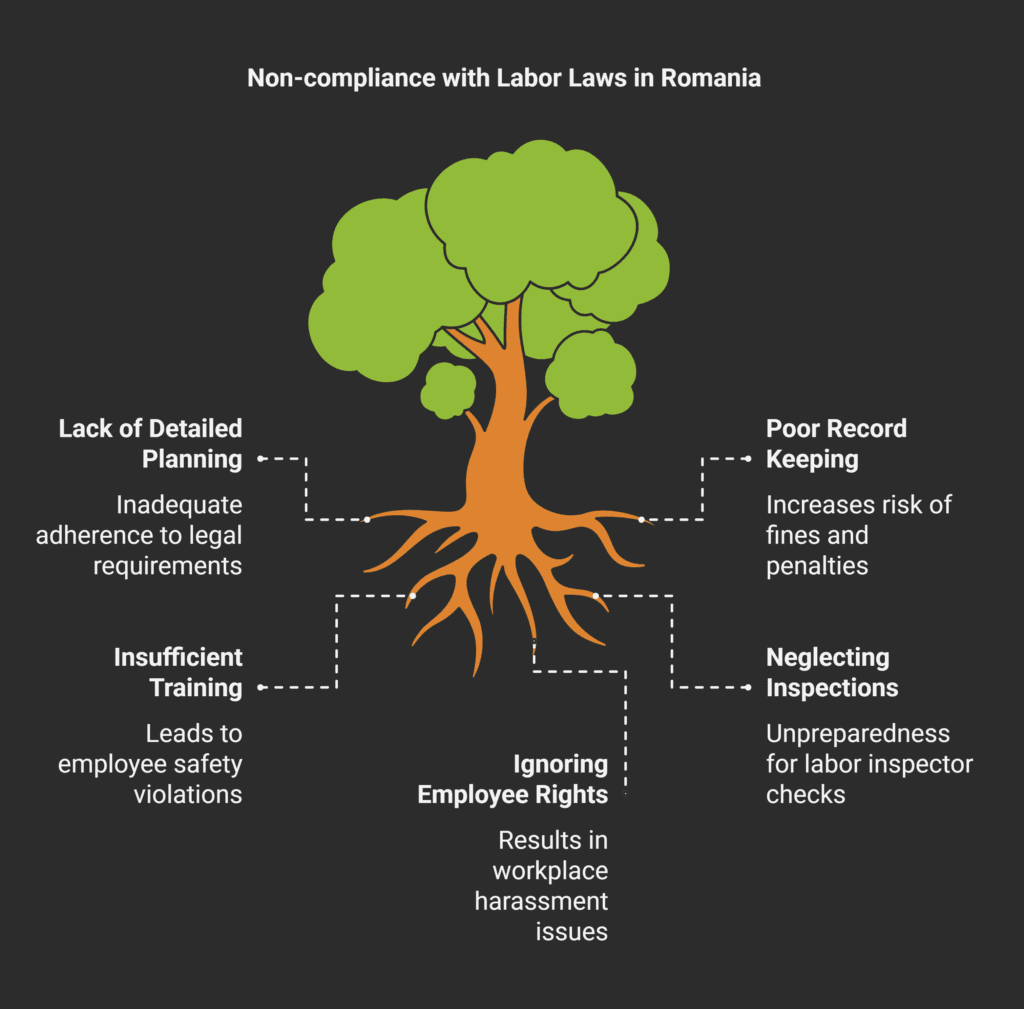
To follow labor laws in Romania, employers need a detailed plan.

They must carefully follow collective labor agreements and legal rules.

It’s important to handle work regulations in Romania with great care.

Here are some key steps for employers:

  • Register all employment contracts in the electronic Revisal system;
  • Do mandatory risk assessments for employee health and safety;
  • Give the right protective gear and training;
  • Keep accurate records of employee information;
  • Set up systems for handling employee complaints.

Labor inspectors are key in checking if employee protection standards are met.

They do deep checks to make sure workers’ compensation rules are followed.

Your company should be ready for inspections by keeping detailed records and fixing any issues early.

Important compliance rules cover many areas of employee rights and duties.

This includes:

  1. Keeping all employment contracts on file;
  2. Updating payroll statements regularly;
  3. Telling labor authorities about service contracts;
  4. Having rules against workplace harassment;
  5. Ensuring fair chances in hiring and promotions.

Not following the rules can lead to big fines.

Fines can be between RON 5,000 and RON 100,000, based on the violation.

It’s crucial to manage well and do regular checks to avoid problems and keep the workplace legal.

Legal Support and Professional Assistance

Understanding collective labor agreements in Romania needs the help of a professional Romanian law office.

A skilled lawyer in Bucharest can guide you through the complex legal landscape of employment disputes in Romania.

We will make sure your organization follows strict labor regulations.

Legal consultants are key in managing collective bargaining processes and help prepare documents, understand Social Dialogue Law, and avoid legal risks.

With fines up to RON 20,000 for mistakes, having expert lawyers in Bucharest is vital for your business.

Role of Legal Consultants

Your Romanian lawyer will explain the rules for collective bargaining, especially for companies with 10 or more employees.

Our Law firm offers strategic advice on negotiations, documents, and ensuring your organization meets Romanian Labor Code standards.

Documentation Requirements

Getting professional legal help is important for employment documents.

Bucharest lawyers can create detailed collective labor agreements, handle employee representation, and keep up with Romanian labor laws.

For specialized legal help, contact us.

FAQ

What is a Collective Labor Agreement in Romania?

A Collective Labor Agreement is a legal document.

It’s made by employers and trade unions.

It sets rules for work, rights, and duties for employees in a company or sector.

It covers important things like pay, hours, benefits, and how to solve problems.

Who is required to participate in collective bargaining in Romania?

Companies with 10 or more employees must bargain collectively.

Employers and trade unions must both take part.

New laws have made it easier for smaller groups to bargain.

How do I form a trade union in Romania?

To start a trade union, you need 10 workers from the same field.

You must register with the court and show you’re independent from employers.

The union must also have a fair structure.

What are the key components of a Collective Labor Agreement?

A Collective Labor Agreement in Romania has many parts.

It includes the minimum wage, work conditions, and benefits.

It also covers hours, overtime, training, health, and how to solve problems.

These parts are talked about to protect both workers and employers.

What is sector-level collective bargaining?

Sector-level bargaining makes agreements for whole industries.

These agreements set rules for wages, work, and benefits for all in a sector.

It makes work rules the same for everyone in that field.

What happens if an employer does not comply with a Collective Labor Agreement?

If an employer breaks a Collective Labor Agreement, they could face fines or lawsuits.

They might have to fix the problem, pay for it, or get in trouble with labor authorities.

How long are Collective Labor Agreements valid in Romania?

Collective Labor Agreements last 12 to 24 months.

After that, the parties must talk about new terms.

The old agreement stays in place until a new one is made or until it’s decided to end it.

Can individual employment contracts deviate from the Collective Labor Agreement?

No, individual contracts can’t be worse than the Collective Labor Agreement.

Employers must make sure individual contracts are at least as good as the agreement.

What role do legal consultants play in collective bargaining?

Legal consultants help with labor laws and making agreements.

They check if rules are followed, help in talks, and solve disputes.

Their knowledge is key in understanding labor laws in Romania.

How are disputes resolved in Collective Labor Agreements?

Disputes are usually solved through talking, mediation, or arbitration.

If that doesn’t work, they can go to court.

The agreement usually says how to solve problems between employers and employees.

Accidents at Work in Romania: Insights from Bucharest Lawyers

Accidents at Work in Romania: Insights from Bucharest Lawyers

accidents at work in Romania

Did you know Romania sees over 4,000 workplace accidents every year?

The construction and industrial sectors have the most incidents.

Knowing your rights and the legal protections is key to staying safe at work.

It’s important to understand the occupational hazards in Romania.

This knowledge helps protect you and your career.

Whether you work in construction, energy, or IT, knowing your rights is vital for safety and compensation.

Workplace safety in Romania is governed by strict laws.

These laws aim to prevent industrial accidents and protect workers.

The Romanian Labor Code outlines the rules employers must follow to keep workers safe.

Key Takeaways:

  • Romania has specific legal protections for workplace safety;
  • Construction and industrial sectors face higher accident risks;
  • Employers must establish health and safety committees;
  • Comprehensive documentation of workplace incidents is mandatory;
  • Employees have specific rights in case of workplace accidents.

If you need expert legal advice on workplace accidents in Romania, contact an Employment Lawyer in Bucharest.

Our team offer professional support and advice.

Understanding Workplace Safety in Romania: Legal Framework

Romanian Workplace Safety Regulations

Working in Romania means knowing the laws that keep everyone safe.

The laws are strong, making sure everyone follows the rules.

This is true for all kinds of jobs.

Key Labor Law Regulations

The laws in Romania are clear about keeping workers safe.

The main laws are:

  • Law No. 53/2003 (Labor Code)
  • Law 319/2006 on safety and health at work
  • OUG 137/2000 on prevention and discrimination
  • Law No. 202/2002 on equal opportunities

Employer Obligations Under Romanian Law

Employers in Romania must do a lot to keep the workplace safe.

They must:

  1. Do detailed workplace inspections Romania to find dangers;
  2. Give all workers the safety training they need;
  3. Give out free personal protective equipment (PPE);
  4. Tell the labor inspectorates about serious accidents within 24 hours.

Employee Rights and Protections

Romanian law gives workers big rights.

They have the right to:

  • Say no to unsafe work without getting in trouble;
  • Get the safety training they need;
  • Get compensation for work injuries;
  • Be safe from workplace discrimination.

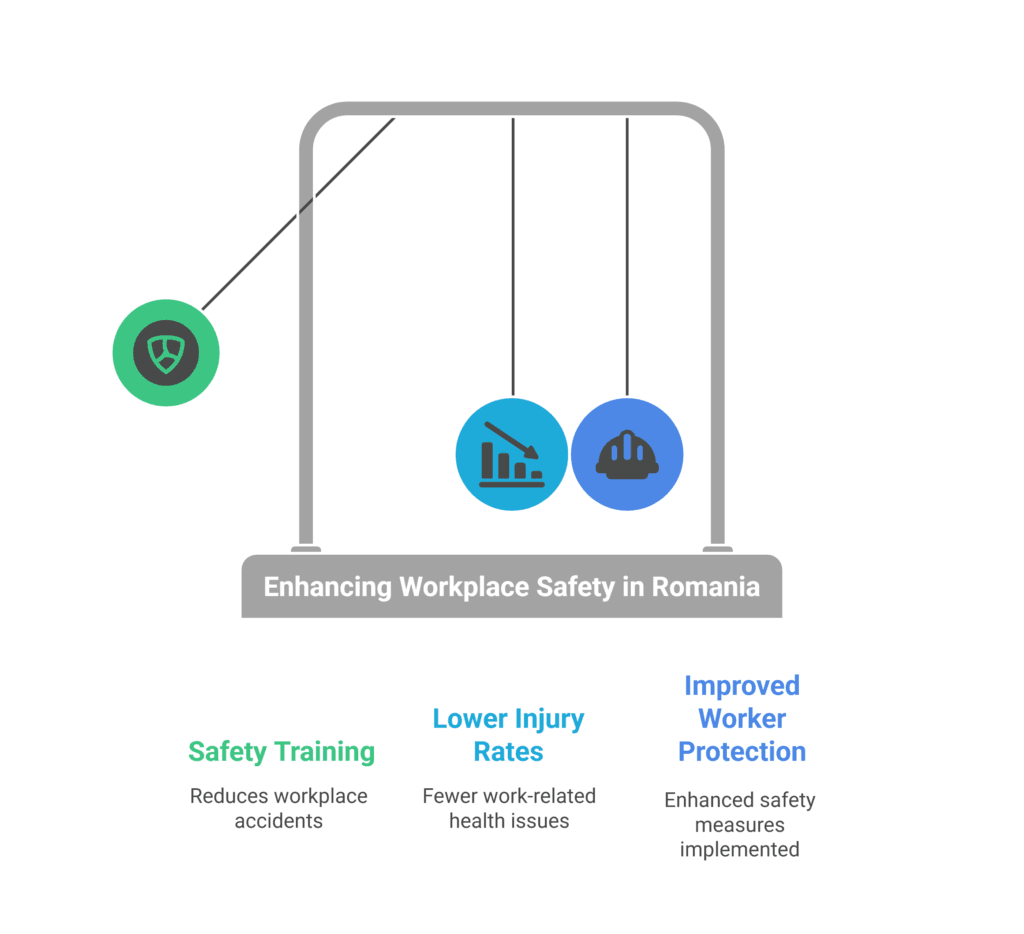
Knowing these laws helps make a safer work place.

It makes sure everyone is treated fairly and safely.

Common Types of Workplace Accidents in Romania

Workplace Injuries in Romania

Exploring workplace injuries in Romania is key for keeping employees safe.

Knowing the most common accidents helps prevent them in different industries.

Romania’s workplace accident statistics show clear patterns in various sectors.

These patterns highlight the daily risks workers face.

This makes it vital for employers to assess risks in Romania.

  • Manufacturing sector experiences high accident rates;
  • Construction industry shows significant workplace injury risks;
  • Transportation and storage sectors report frequent incidents.

Romania’s safety laws require detailed accident reports.

By analyzing these, employers can create better prevention plans.

SectorMost Common Accident TypesInjury Percentage
ManufacturingMachine-related accidents29.4%
ConstructionFalls and tool-related injuries19.5%
TransportationMovement-related incidents12.1%

Workers’ compensation in Romania is vital for understanding these injury trends.

Losing control of machines is the top cause of accidents, making up 20.3% of non-fatal incidents.

By grasping these patterns, you can improve workplace safety.

This helps reduce risks in Romanian industries.

Legal Requirements for Workplace Safety Measures

Workplace safety in Romania

In Romania, protecting workers is a top priority.

The laws are strong, making sure everyone is safe at work.

Law No. 319/2006 sets clear rules for keeping workers safe and what employers must do.

Romanian labor laws require specific safety steps.

These rules help keep workers safe from harm.

They aim to reduce risks and protect employees.

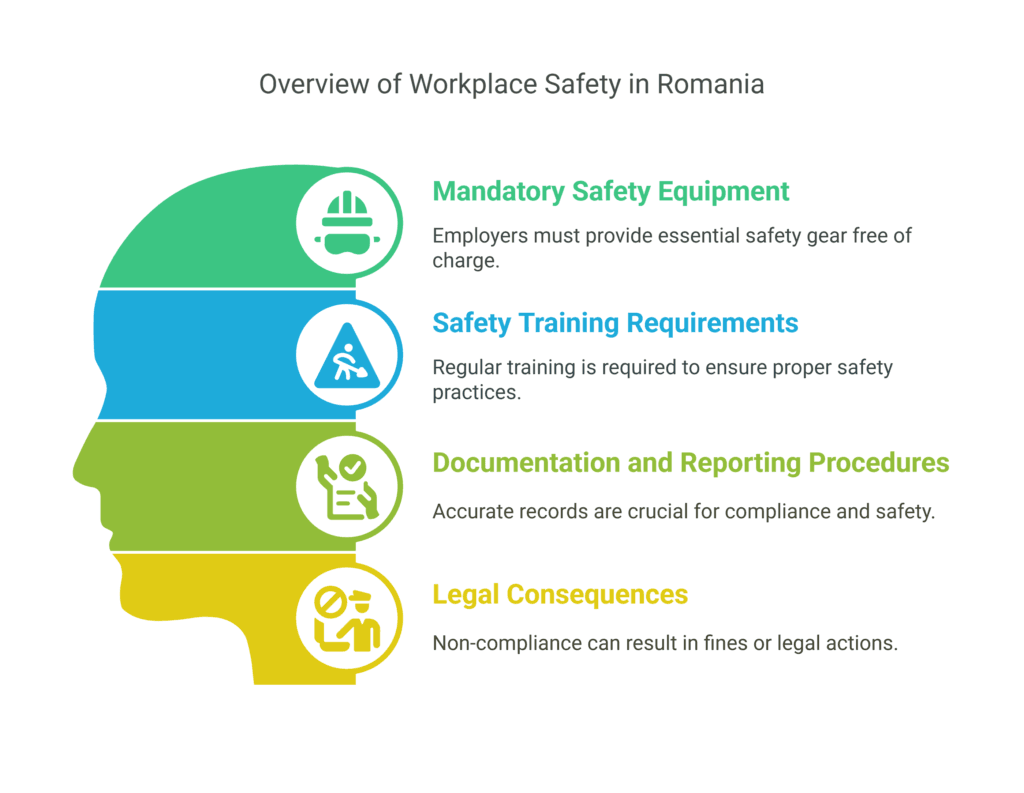
Mandatory Safety Equipment

Employers must give workers the safety gear they need for free.

This includes:

  • Personal Protective Equipment (PPE);
  • Protective clothing for job risks;
  • Safety helmets for construction;
  • Special gear for dangerous places.

Safety Training Requirements

Good safety training is key for workers’ rights.

Employers need to offer regular training. It should cover:

  1. Finding and dealing with hazards;
  2. Using safety gear right;
  3. What to do in emergencies;
  4. How to lower risks.

Documentation and Reporting Procedures

Keeping accurate records is vital for safety.

Employers must keep up with:

  • Workplace risk checks;
  • Training logs;
  • Accident reports;
  • Records of safety equipment checks.

The Labor Inspectorate checks these rules.

Breaking them can lead to fines up to 10,000 RON.

Serious cases might even mean stopping work or facing criminal charges.

This shows how important safety at work is.

Worker Compensation and Benefits in Romania

Worker Compensation and Benefits in Romania

It’s important to know about worker compensation laws in Romania.

These laws protect your rights at work.

They ensure you get the help you need after an accident.

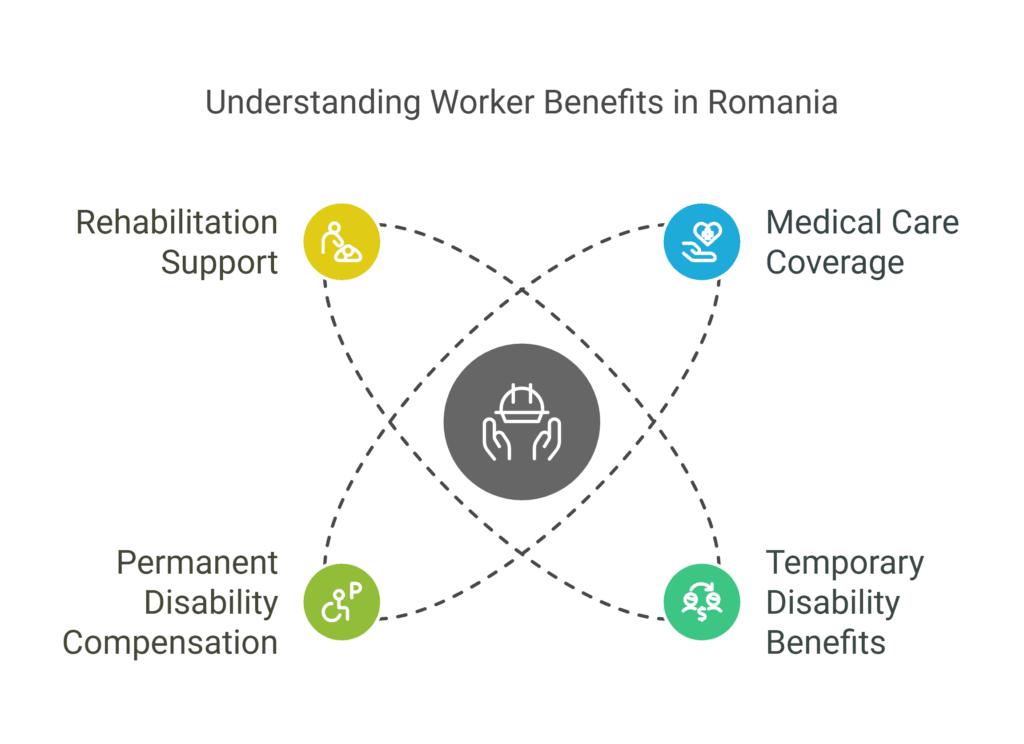
Here are some key benefits you get:

  • Medical care coverage for work-related injuries;
  • Temporary disability benefits;
  • Permanent disability compensation;
  • Rehabilitation support.

The laws in Romania have clear rules for compensation.

If you get hurt at work, you get money based on how bad the injury is.

Benefit TypeCoverage PercentageDuration
Temporary Disability75-100% of average salaryUp to 180 days
Permanent DisabilityVaries by disability gradeLong-term support
Medical ExpensesFull coverageAs needed

To get these benefits, you need to follow certain steps.

It’s important to report accidents quickly to get your rights.

Assessments help figure out how much you should get.

Money for these benefits comes from both employers and employees.

Accidents at Work in Romania: Statistics and Trends

Accidents at Work in Romania_ Statistics and Trends

Workplace safety is key, and Romania offers insights into job site inspections and preventing accidents.

This knowledge helps employers and employees make workplaces safer.

In 2020, Romania had some of the lowest rates of work-related health problems in the EU.

Only 3.0% of workers faced such issues.

This shows the value of safety training and accident reporting in Romania.

Industry-Specific Accident Rates

Workplace risks vary by industry.

Recent data shows:

  • Agriculture and forestry: 15.8% work-related health problems;
  • Construction: 76.3% exposure to physical risk factors;
  • Manufacturing: High incidents of musculoskeletal disorders.

Most Common Causes of Workplace Injuries

Claims for worker compensation in Romania highlight key injury causes:

  1. Musculoskeletal disorders (6.0% of workers affected);
  2. Physical risk factor exposure;
  3. Psychological stress and work pressure.

Annual Trends and Analysis

Romania’s workplace safety is improving.

By 2035, it aims to cut down fatal accidents significantly.

This shows a strong commitment to protecting workers and preventing incidents.

Workplace Safety MetricRomania’s Status
Work-Related Health Problems3.0% (Lowest in EU)
Fatal Accident ProjectionExpected to end by 2035
Expected Workplace Deaths (2021-2029)1,136

These statistics highlight the need for better workplace safety strategies and ongoing protection of workers.

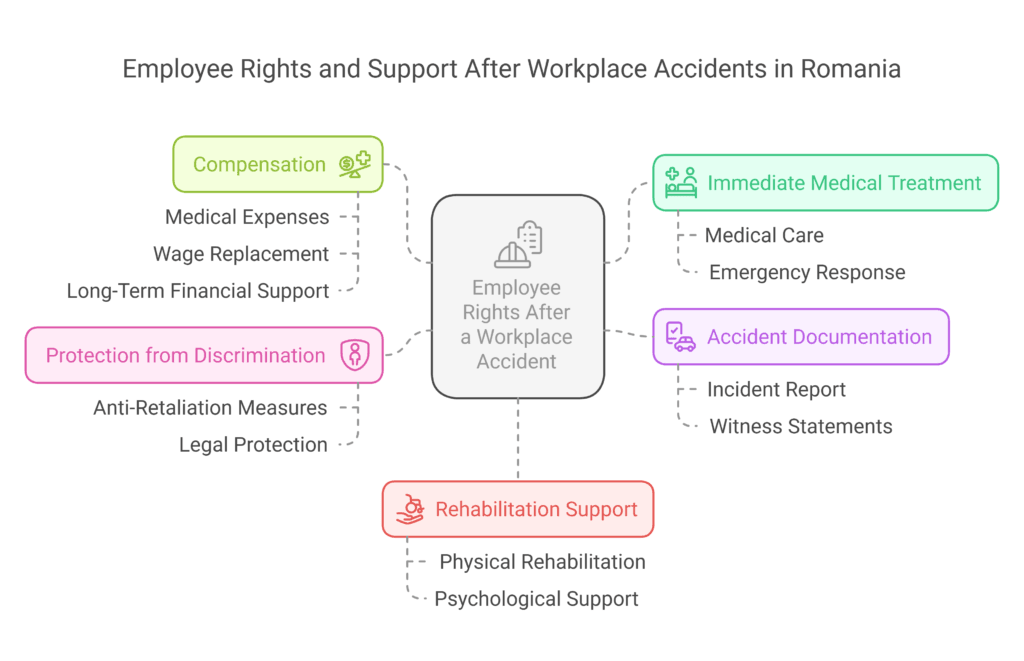
Employee Rights After a Workplace Accident

Employee Rights After a Workplace Accident

When a workplace accident happens in Romania, knowing your rights is key.

It helps protect your health and job future.

Employers must support and protect you after an accident.

Your main rights after an accident include:

  • Immediate medical treatment and care;
  • Full documentation of the accident;
  • Compensation for injuries;
  • Protection from workplace discrimination;
  • Potential rehabilitation support.

Occupational safety Romania laws let you report incidents in many ways.

You can tell your boss, contact the Labor Inspectorate, or get a lawyer if needed.

The workplace risk management Romania system offers support for injured workers.

Here’s what you can expect:

Accident TypeCompensation CoverageLegal Timeframe
Minor InjuryMedical ExpensesImmediate – 30 Days
Temporary DisabilityWage ReplacementUp to 180 Days
Permanent DisabilityLong-Term Financial SupportOngoing Assessment

Guidelines for preventing industrial accidents in Romania stress your right to refuse unsafe work.

They also protect you from being punished for reporting safety issues.

Legal Procedures for Filing Workplace Accident Claims

Dealing with workplace hazards in Romania can be tough.

But knowing how to file accident claims is key to protecting your rights.

If you get hurt at work, knowing the right steps can help a lot with your compensation and recovery.

Romania’s labor laws give clear rules for workers to seek justice after an accident.

The process has important steps that need careful attention and documentation.

Required Documentation for Your Claim

To file a workplace accident claim, you’ll need some key documents:

  • Detailed medical reports of your injury;
  • Incident reports from your employer;
  • Statements from coworkers who saw the accident;
  • Records of employee safety training in Romania;
  • Photos of the accident site and your injuries.

Timeline for Legal Actions

Knowing the timeline is key for construction site accidents in Romania.

You should:

  1. Tell your employer about the accident right away;
  2. File a claim with the Labor Inspectorate within 30 days;
  3. Start legal action within 2 years of the accident;
  4. Gather all needed safety regulations documents.

Role of Legal Representatives

Legal experts are very important in workplace accident claims.

They can:

  • Help understand complex legal papers;
  • Talk to insurance companies for you;
  • Speak for you in court;
  • Make sure you get fair compensation.

Remember, every workplace accident is different. Getting professional legal help can greatly improve your chances of a successful claim.

Employer Liability in Workplace Accidents

Employer Liability in Workplace Accidents

It’s important to know about employer liability in Romania.

The laws make employers responsible for keeping workers safe.

They must prevent injuries and handle hazards.

Romanian law sets rules for employers in industrial accidents.

Law no. 319/2006 says employers must keep their workers safe.

This is true even if they hire outside safety services.

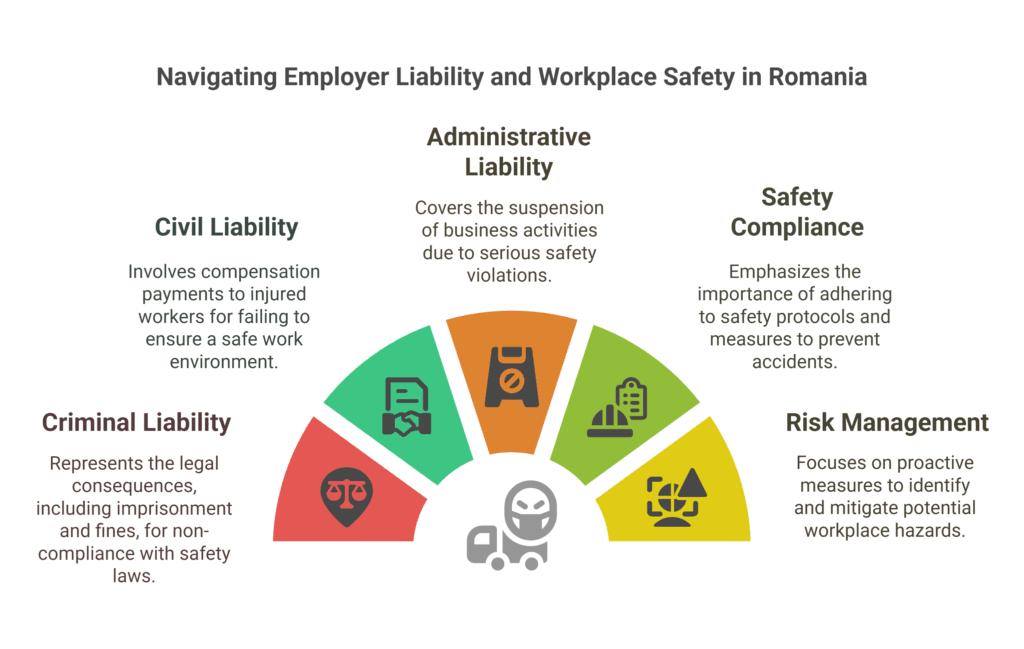
Key Aspects of Employer Liability

  • Criminal liability can be applied to both legal entities and individual managers;
  • Penalties range from LEI 12,000 to LEI 1,200,000 for non-compliance;
  • Potential imprisonment from six months to three years for serious violations.

The Romanian Criminal Code has two main offenses for employee protection:

  1. Failure to implement mandatory health and safety measures;
  2. Failure to observe established safety protocols.

Employers need to act to lower their risks in workplace safety.

They should:

  • Give clear safety instructions;
  • Choose people to watch over safety;
  • Check for risks often.
Liability TypePotential Consequences
Criminal LiabilityImprisonment, fines
Civil LiabilityCompensation to injured workers
Administrative LiabilityBusiness activity suspension

Employers can be blamed even if no accident happens.

The causal link between their actions and risks is important.

It helps decide if they are legally at fault.

Prevention Strategies and Risk Management

Job site risks in Romania need a proactive approach to safety.

The European Union has a strong legal framework for workplace safety.

This framework requires employers to manage risks well.

By doing so, your organization can lower workplace accidents.

Risk assessments are key to spotting hazards early.

Romanian law demands detailed checks of work conditions.

These checks cover physical and mental risks.

They help prevent worker compensation claims by tackling dangers early.

Best Practices for Safety Compliance

Effective safety starts with training and awareness.

Regular safety checks, teaching employees, and detailed accident reports in Romania can cut down on incidents.

It’s important to build a safety culture.

This culture lets workers speak up about risks before they get worse.

Risk Assessment Protocols

Need help with workplace safety? Contact an Employment Lawyer in Bucharest at office@theromanianlawyers.com.

They offer advice on Romania’s safety laws.

We can help create strategies that protect everyone in the workplace.

FAQ

What are the most common types of workplace accidents in Romania?

In Romania, falls from heights and injuries from machinery are common.

Construction site accidents, transportation incidents, and accidents with heavy equipment also happen often.

Construction, manufacturing, and transportation have the most incidents.

What should I do immediately after a workplace accident in Romania?

First, get medical help right away.

Tell your employer about the accident within 24 hours.

Take photos and get witness statements.

Keep all medical records.

Also, tell the local labor inspectorate and save evidence for compensation claims.

Am I entitled to compensation if I’m injured at work?

Yes, Romanian labor laws say you can get compensation for work injuries.

This includes medical costs, disability benefits, and costs for rehabilitation.

You might also get damages for pain and suffering.

The amount of compensation depends on the injury’s severity and how it affects your work.

What safety equipment must employers provide in Romania?

Employers must give you the right PPE for your job.

This includes helmets, protective clothes, gloves, safety glasses, and more.

The equipment must meet Romanian safety standards and be kept in good condition.

How long do I have to file a workplace accident claim?

In Romania, you have 2 years to file a claim after the accident or when you knew about the injury.

It’s important to report the accident to your employer quickly and get medical help soon to support your claim.

What are my rights if my employer doesn’t provide a safe working environment?

You can refuse unsafe work, ask for a safety check, and report unsafe conditions to the labor inspectorate.

If your employer doesn’t keep the workplace safe, you might get compensation and can take legal action.

Do temporary workers have the same workplace safety protections?

Yes, temporary and contract workers have the same safety protections as permanent employees in Romania.

Employers must give them the same safety training, equipment, and measures.

How are workplace accidents reported in Romania?

Accidents must be told to the employer right away and documented in an official report.

You also need to notify the local labor inspectorate.

The report should have all the details of the incident, witnesses, and medical treatment.

What types of industries have the highest workplace accident rates?

Construction, manufacturing, transportation, agriculture, and mining have the most accidents in Romania.

These jobs involve a lot of physical work and dangerous conditions, so they need extra safety steps.

Can I be fired for reporting a workplace safety concern?

No, Romanian laws protect you from being fired for reporting safety issues.

If you’re fired or treated unfairly for raising safety concerns, you can file a complaint and might get legal help.