Bucharest business district illustrating a share purchase agreement in Romania

Share Purchase Agreement in Romania: Due Diligence, Warranties and Closing Risks

A share purchase agreement in Romania should do more than record the number of shares and the price. It must connect the buyer’s due diligence findings with the conditions for closing, the seller’s warranties, specific indemnities, price mechanics and the corporate and regulatory steps needed to transfer control safely.

In brief: In a Romanian share deal, the buyer acquires the company with its assets, contracts, employees, licences, debts and historical exposure. The SPA therefore allocates risk between buyer and seller. Due diligence identifies the issues; the contract decides whether they must be corrected before closing, reflected in the price, disclosed against warranties, covered by an indemnity or accepted by the buyer. Romanian corporate approvals, ANAF formalities, merger control and investment screening must be tested early because they can change the signing and closing timetable.

This guide is written for foreign investors, international groups, founders and business owners negotiating the acquisition or sale of a Romanian company. It focuses on private acquisitions of shares or social parts, particularly Romanian limited liability companies (SRLs). Listed-company rules, regulated-sector acquisitions, privatisations and public takeovers require additional analysis.

The article complements our procedural guide to changing shareholders in a Romanian company. That guide covers the Trade Register implementation. This one explains how the commercial acquisition should be investigated, negotiated and protected contractually.

What does a share purchase agreement do in Romania?

A share purchase agreement, commonly called an SPA, is the principal contract under which the seller agrees to transfer and the buyer agrees to acquire shares or social parts in a Romanian company. It identifies the securities, price, conditions, closing process and allocation of risk between the parties.

The agreement operates within Romanian contract law and the mandatory rules applicable to the target’s corporate form. For an SRL, the transfer mechanics must be aligned with Articles 202 and 203 of Company Law no. 31/1990 and the applicable registration formalities before the National Trade Register Office (ONRC).

Deal structure
What does the buyer actually acquire?

Select a route to see how the risk profile changes.

Share deal

The buyer acquires the target entity itself. Contracts and assets generally remain with that entity, but so do its historical liabilities and compliance exposure.

Decision pointShare dealAsset deal
What transfersOwnership of the target company.Identified assets, contracts, liabilities or business components.
Historic liabilitiesRemain inside the acquired company and therefore affect the buyer economically.Generally remain with the seller unless assumed by contract or transferred by law.
Contracts and permitsUsually remain with the same legal entity, subject to change-of-control clauses and regulatory rules.May require individual assignment, consent, novation or reissuance.
EmployeesRemain employed by the target.A business transfer may trigger employee-transfer rules and information or consultation duties.
Core documentShare purchase agreement.Business or asset transfer agreement plus asset-specific instruments.

Why must legal due diligence come before the SPA is finalised?

Due diligence should identify the matters that can change the decision to buy, the valuation, the deal timetable or the contractual protection. A report that merely lists documents does not complete the task. Each material finding should be converted into a transaction response.

Share purchase agreement Romania due diligence represented by a green maze with a clear route
Legal due diligence helps the buyer identify risks and determine the appropriate route to a protected transaction. AI-generated illustration.

The scope normally covers corporate title and governance, financing and security, material contracts, real estate, employment, tax, disputes, permits, regulatory compliance, intellectual property, IT, data protection, environmental matters and beneficial ownership. Sector, size and business model determine the emphasis.

Due diligence map
Convert each finding into a deal response

Select a finding to see the appropriate contractual response.

Remediation

Require the seller or target to correct a curable defect before closing and deliver objective evidence that the correction is complete.

WorkstreamKey questionsPossible SPA response
Corporate and titleDoes the seller own the shares? Do the articles of association create pre-emption rights, and are there pledges, options, capital defects or approval restrictions?Title warranty, release condition, shareholder waiver, completion deliverable.
Material contractsDo customers, lenders or suppliers have termination, consent or change-of-control rights?Consent condition, covenant, retention or price adjustment.
EmploymentAre remuneration, dismissals, contractors, collective arrangements and key-person dependencies compliant?Remediation, employment warranty, specific indemnity, retention plan.
TaxAre filings complete? Are there audits, arrears, related-party risks or unsupported tax treatments?Tax covenant, tax warranty, escrow, special indemnity.
IP, technology and dataDoes the target own or validly license critical IP? Are cybersecurity and GDPR controls adequate?Assignment, licence cure, warranty, remediation plan, indemnity.
Disputes and regulationAre there claims, investigations, licences, sanctions, environmental or sector-specific risks?Regulatory condition, conduct covenant, indemnity or exclusion from the deal.

Which clauses matter most in a Romanian share purchase agreement?

The SPA should describe the transaction as one coherent mechanism. Definitions, price, conditions, warranties, disclosure, indemnities, limitations, covenants and closing deliverables must work together. Imported English-law wording should not be used without checking how it operates under the chosen governing law and Romanian mandatory rules.

Clause navigator
How does each protection work?

Select a clause family to see its transaction function.

Warranties

Contractual statements about the target, shares and business. Their value depends on scope, disclosure, knowledge qualifiers, repetition, claim rules and available recovery.

ProtectionPrincipal functionDrafting question
WarrantyAllocates risk if a contractual statement about the target or business is inaccurate.What is warranted, when is it true, and how do disclosure and seller knowledge qualify it?
Specific indemnityAllocates a defined known or identified exposure.What event triggers payment, which losses are covered and do general limitations apply?
Condition precedentPrevents closing until a necessary event, consent or approval occurs.Who controls satisfaction, what evidence is required, and when may either party terminate?
Pre-closing covenantControls how the target operates between signing and closing.Which actions need buyer consent without giving the buyer unlawful premature control?
Limitation regimeSets time limits, thresholds, caps, exclusions and claim procedure.Which claims are carved out, and does the recovery structure match the seller’s credit risk?

How should the purchase price be structured?

The price clause should explain both the headline value and the route from that value to the amount paid. A fixed price is not necessarily simple if debt, cash, working capital, leakage, earn-outs, holdbacks or currency conversion remain unresolved.

MechanismHow it worksMain negotiation risk
Locked-boxPrice is based on historic accounts at an agreed date, protected by a no-leakage covenant.Reliability of the accounts, leakage definition and permitted payments.
Completion accountsPrice adjusts after closing by reference to closing debt, cash, working capital or other metrics.Accounting policies, hierarchy of rules, timetable and expert determination.
Earn-outPart of the consideration depends on future performance or milestones.Control of the business, metric manipulation, extraordinary items and information rights.
Escrow or holdbackPart of the price is retained or deposited to support identified obligations or claims.Release triggers, duration, permitted deductions and insolvency protection.

A buyer should not treat escrow as a substitute for a coherent claims regime. The SPA should state whether recovery is limited to the escrow, whether the buyer may set off, how competing claims are handled and what happens when the escrow expires.

What is the difference between signing and closing?

Signing creates the contractual commitment. Closing completes the agreed transfer and payment once the applicable conditions are satisfied or waived. They may occur on the same day in a simple transaction, but regulatory approvals, third-party consents, financing or restructuring often require a split process.

Transaction roadmap
From exclusivity to effective control

Select a stage to review the principal legal control.

Term sheet

Align structure, valuation, exclusivity, confidentiality, process and principal conditions before the parties spend heavily on diligence and drafting.

Which Romanian approvals and filings can affect closing?

The regulatory analysis should begin before the SPA timetable is agreed. A condition drafted after signing cannot restore leverage or time already lost.

Corporate approval and ONRC registration

For an SRL transfer to an outside buyer, Article 202 of Company Law no. 31/1990 applies together with the target’s articles of association. The parties should verify statutory approval thresholds and any pre-emption or consent rights created by the articles of association, as well as pledges and other restrictions. The applicable ONRC registration formalities and the update of the company’s shareholder register should be built into the completion process.

ANAF notification and tax-debt safeguards

The practical scope of Article V of Law no. 239/2025, as amended by Government Emergency Ordinance no. 13/2026, should be verified in light of the transaction structure and current ONRC and ANAF practice. Although the regime was introduced in the context of transfers affecting company control, registration practice during 2026 has raised questions regarding its application to a broader range of SRL share transfers, as discussed in this analysis of emerging ONRC practice. The parties should confirm the current notification, tax-certificate, guarantee and registration requirements before signing and again before filing.

Merger control

An acquisition of sole or joint control may constitute an economic concentration. Under Competition Law no. 21/1996, the Romanian thresholds are generally met where the combined worldwide turnover of the undertakings concerned exceeds EUR 10 million and at least two undertakings concerned each achieved Romanian turnover exceeding EUR 4 million in the previous financial year. The EU Merger Regulation may apply instead where its thresholds are met. Closing before the required clearance can expose the parties to gun-jumping risk.

Investment screening

Romania’s investment-screening regime under Government Emergency Ordinance no. 46/2022 was substantially amended by Government Emergency Ordinance no. 17/2026. The general value threshold is now EUR 5 million, but a transaction below the threshold may still be examined if it may affect security, public order or EU projects or programmes. The rules can apply to EU and non-EU investors, and the filing contribution is EUR 5,000 where an authorisation application is required. Sector, investor, control, value and transaction structure must be screened early.

Sector approvals, lender consents, foreign-subsidy review or contractual change-of-control notices may also be relevant. The SPA should allocate responsibility, information, cooperation, remedies and the long-stop date for each approval.

What should happen at closing?

Closing should be a coordinated exchange, not a loose collection of signatures. The SPA should identify every deliverable, who provides it, its agreed form and whether all actions are deemed simultaneous.

  1. Confirm conditions. Record satisfaction or valid waiver of every closing condition.
  2. Approve the transfer. Deliver the required shareholder and corporate resolutions.
  3. Transfer the shares. Execute the required instruments and update the shareholder register.
  4. Pay the consideration. Follow the funds flow, escrow and debt repayment arrangements.
  5. Release security. Deliver releases of share pledges, guarantees or target security where agreed.
  6. Change governance. Coordinate resignations, appointments, powers of attorney and bank mandates.
  7. Deliver control items. Transfer corporate books, credentials, keys, seals and agreed records.
  8. Complete filings. Submit ONRC and ANAF documents, together with beneficial-owner filings where required under the applicable transparency rules, within the relevant timetable.

What limitations should apply to seller liability?

Seller limitations often include a de minimis threshold, basket, aggregate cap, time limits, mitigation, exclusion of double recovery and a formal claim procedure. Tax, title, authority, fraud and specific indemnities may have different limits. The commercial result depends on how these provisions interact, not on any one headline cap.

The buyer should also test recoverability. A contractual claim against a seller with no accessible assets may provide little protection. Escrow, holdback, bank security, parent guarantee or warranty and indemnity insurance may be considered depending on transaction size and risk.

A buyer’s pre-signing checklist

  1. Define the acquisition perimeter. Confirm percentage, target entities, securities and excluded items.
  2. Verify title and authority. Check ownership, encumbrances, approvals and signatory powers.
  3. Complete risk-focused due diligence. Prioritise issues that affect value, continuity or closing.
  4. Translate findings into protections. Allocate each material issue to remediation, price, condition, warranty, indemnity or withdrawal.
  5. Select the price mechanism. Define accounting rules, leakage, debt, cash, working capital and dispute resolution.
  6. Screen regulatory approvals. Review merger control, investment screening, sector approvals and third-party consents.
  7. Align signing and closing. Specify conditions, conduct rules, long-stop date, termination and closing deliverables.
  8. Test recovery. Check caps, time limits, exclusions, seller credit and available security.
  9. Plan filings and integration. Prepare ONRC and ANAF filings, beneficial-owner filings where required under the applicable transparency rules, governance steps and day-one actions.

The bottom line

A Romanian SPA should be the final expression of the buyer’s investigation and the parties’ negotiated risk allocation. The strongest agreement is not the longest. It is the one that identifies what is being bought, states how price is calculated, prevents closing before essential approvals, allocates known and unknown risks clearly and gives the parties an executable closing process.

Planning the acquisition or sale of a Romanian company?

A focused transaction review can cover deal structure, legal due diligence, SPA negotiation, regulatory screening, signing, closing and Romanian corporate implementation.

Book a Consultation

Frequently asked questions

Is a share purchase agreement mandatory in Romania?

A written transfer instrument is normally required to document and implement the transaction. In a negotiated acquisition, the SPA is the central agreement because it also records price mechanics, conditions, warranties, indemnities and closing. The required form and supporting corporate documents depend on the target’s legal form and transaction structure.

What is the difference between an SPA and a shareholders’ agreement?

The SPA governs the acquisition of shares and the allocation of transaction risk between buyer and seller. A shareholders’ agreement governs the continuing relationship among shareholders after the investment, including governance, reserved matters, funding, transfers, deadlock and exit. A minority investment may require both documents.

Can signing and closing occur on the same day?

Yes, where no unsatisfied conditions or approvals require a split process. If merger control, investment screening, financing, third-party consent or pre-closing remediation is required, signing normally precedes closing and the SPA must regulate the interim period and long-stop date.

Does due diligence remove the need for warranties?

No. Due diligence and warranties serve different functions. Diligence helps the buyer identify and evaluate risk. Warranties allocate contractual risk for inaccurate statements, subject to disclosure and limitations. Known issues may require remediation, a price adjustment or a specific indemnity rather than reliance on a general warranty.

When is Romanian investment-screening approval required?

The analysis depends on the investor, target activity, transaction structure, control or durable participation, sensitive sector and investment value. The general threshold is EUR 5 million after OUG no. 17/2026, but lower-value transactions may still be examined where security, public-order or relevant EU interests may be affected.

What happens after the SPA closes?

The parties must complete the agreed corporate, Trade Register and ANAF steps, as well as beneficial-owner filings where required under the applicable transparency rules. They must also release or retain escrow as applicable, implement governance changes and perform post-closing covenants. Price-adjustment, earn-out, indemnity and integration obligations may continue long after legal ownership changes.

Disclaimer: This article provides general information and does not constitute legal or tax advice. The correct structure, approvals, tax treatment and contractual protections depend on the parties, target, sector and facts of each transaction.

AI Notice: AI-assisted content, reviewed and approved by a qualified Romanian lawyer.

Corporate Restructuring Options Under Romanian Law: Mergers, Divisions, and Transformations

Corporate Restructuring Options Under Romanian Law: Mergers, Divisions, and Transformations

Did you know that Romania has seen a big rise in corporate restructuring?

This includes more mergers and acquisitions in 2025.

These changes are key for companies to stay competitive and efficient in a fast-changing market.

It’s important to know how these restructuring processes work.

This knowledge helps companies follow Romanian laws well.

This article will dive deep into the restructuring options in Romania.

It will show how these options can help your business grow.

corporate restructuring options under romanian law

Key Takeaways

  • Corporate restructuring is increasingly vital for businesses in Romania.
  • Mergers, divisions, and transformations are the key options available for restructuring.
  • Compliance with Romanian corporate laws is essential for successful restructuring.
  • Understanding the legal framework can guide effective restructuring strategies.
  • The Romanian market experiences dynamic changes impacting restructuring processes.

Understanding Corporate Restructuring in Romania

Types of Corporate Restructuring Options Under Romanian Law

In Romania, corporate restructuring is key for companies facing challenges.

It helps solve financial issues and opens up growth chances.

By restructuring, companies can improve operations, cut debts, and boost their competitive edge.

Definition and Importance of Restructuring

Corporate restructuring means changing a company’s financial or operational setup to tackle challenges or seize new chances.

It’s vital for boosting efficiency, managing debts, and aligning resources with market needs.

Companies that restructure can cut their debt by about 40%, helping them through tough times.

Context Within Romanian Corporate Law

In Romania, the legal framework for restructuring is clear.

The law provides ways for companies to reorganize, like voluntary liquidations and preventive compositions.

It sets rules for businesses, ensuring creditors can start legal actions if needed.

On average, restructuring in Romania takes about 12 months due to its complexity.

Romanian Legal experts are key in guiding companies through this process.

They help reduce risks and ensure compliance with current corporate laws.

understanding corporate restructuring

Types of Corporate Restructuring Options Under Romanian Law

Businesses in Romania can improve their efficiency and competitiveness through various restructuring options.

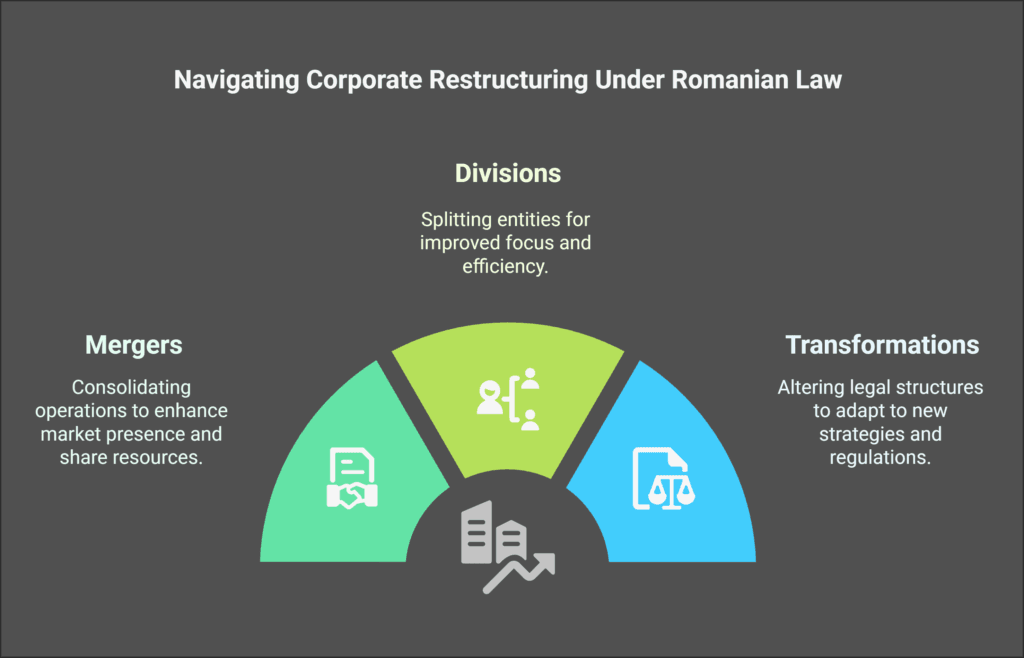
Mergers, divisions, and transformations are key strategies.

Each has its own purpose and must be carefully considered under Romanian law.

A thorough approach helps companies adapt well to market changes and operational needs.

Mergers: Consolidating Business Operations

Mergers combine two or more companies to make operations smoother and boost market presence.

This method can lead to bigger market shares and shared resources.

Romanian law requires detailed planning and negotiations to follow merger and acquisition rules.

Divisions: Splitting Companies for Increased Efficiency

Divisions let companies split into separate entities for better focus and efficiency.

Assets can be fully or partially transferred to new or existing companies.

Romanian law demands a structured spin-off process, including a detailed plan for asset distribution.

This plan must be decided within three months by the companies involved.

types of corporate restructuring options

Transformations: Altering the Legal Structure

Transformations change a company’s legal structure to fit new strategies and market conditions.

This strategy is vital for adapting to regulatory changes and operational needs.

Whether it’s changing corporate form or adjusting governance, transformations can greatly affect a company’s future success.

Legal Framework for Corporate Restructuring in Romania

The legal framework for corporate restructuring in Romania is based on several laws.

These laws outline the processes and protections for companies going through big changes.

Knowing the key laws helps companies understand their changes better.

Key Romanian Legislation on Corporate Reorganization

The main laws for restructuring include the Romanian Company Law no. 31/1990 and insolvency rules.

These laws protect creditors and help businesses reorganize.

The Company Law sets the rules for mergers and divisions, including what’s needed for these steps.

It’s important for companies to follow these rules.

This ensures their restructuring is legal.

Regulations Affecting Restructuring Processes

There are more rules for restructuring in Romania.

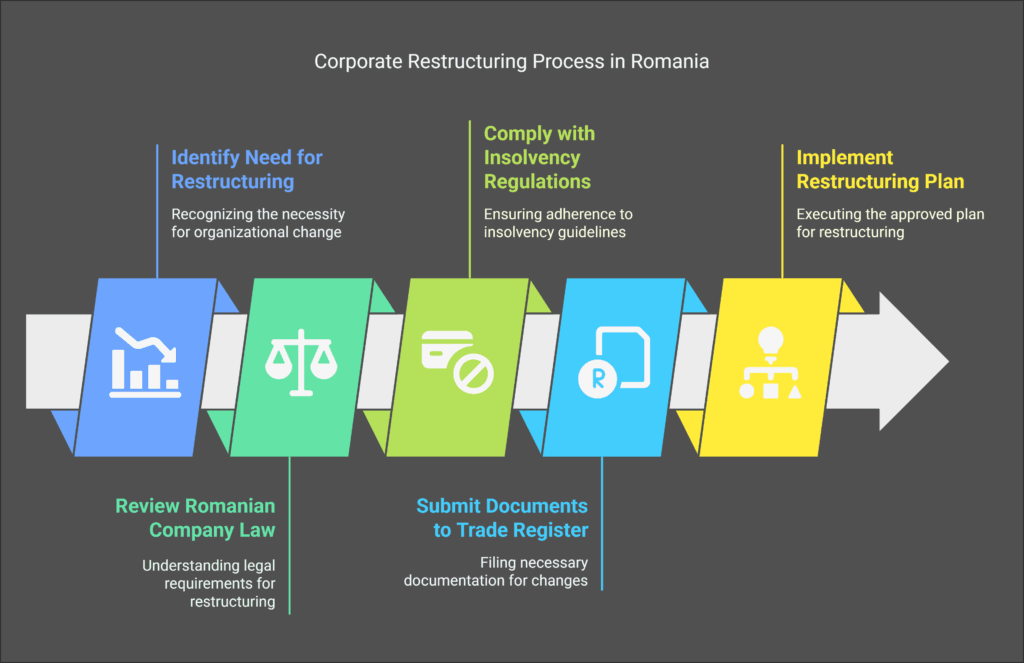
The Romanian Trade Register requires companies to submit detailed documents, like changes to their articles of association.

Changes to the Fiscal Code can also impact a company’s financial plans during restructuring.

Legislation or RegulationKey Provisions
Romanian Company Law no. 31/1990Outlines processes for mergers and divisions, and protects shareholder rights.
Insolvency RegulationsOffers guidelines on restructuring processes, ensuring fair treatment of creditors.
Romanian Trade RegisterMandates documentation requirements for altering company structures.

Restructuring Strategies for Businesses in Romania

Understanding and using effective restructuring strategies is key for businesses in Romania.

Companies facing financial issues find that strategic planning helps.

It aligns goals with legal needs and boosts efficiency.

By making a detailed plan, businesses can tackle their financial challenges.

This plan helps them overcome unique obstacles.

Corporate Restructuring Romania

Strategic Planning for Effective Restructuring

Strategic planning is the core of restructuring.

Businesses need to create a plan that shows why restructuring is needed.

It should outline how to reach the desired outcomes.

This plan must include how to involve stakeholders, set a timeline, and allocate resources.

It’s vital to get approval from shareholders for any job changes.

Clear communication and alignment among stakeholders are key for success.

Addressing Financial Challenges and Optimizing Operations

Dealing with financial issues in Romania needs careful attention and flexibility.

Companies should review their operations to find ways to improve.

This helps make smart decisions about cutting jobs while following local laws.

If restructuring means laying off workers, companies must follow legal steps.

This includes giving enough notice and telling the labor authorities.

Knowing labor laws well and planning for layoffs helps avoid problems and keeps employees happy.

The Restructuring Process in Romania

The restructuring process in Romania involves several steps for businesses to follow.

A step-by-step guide to corporate restructuring is essential for firms looking to improve their operations.

Working with corporate restructuring specialists can offer valuable insights and expertise.

The Restructuring Process in Romania

Step-by-Step Guide to Corporate Restructuring

The first step is to assess your business’s current state.

This includes looking at its financial health, operational efficiency, and market position.

After identifying the need for restructuring, you can start the next steps.

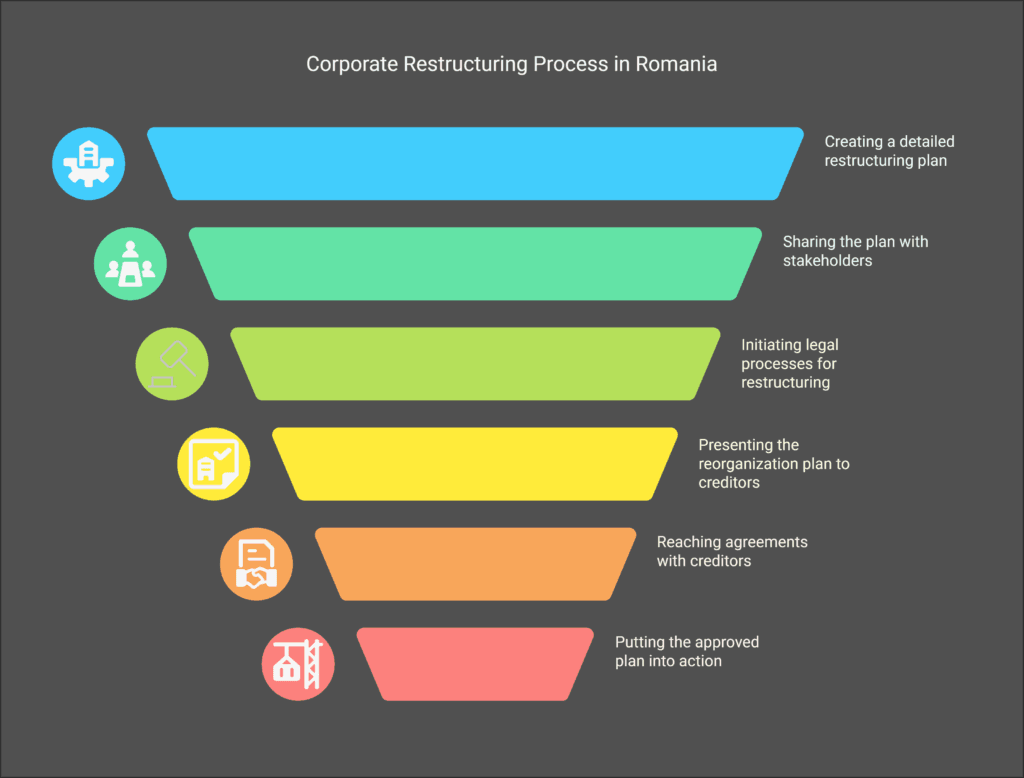
  • Developing a detailed restructuring strategy;
  • Sharing the plan with all stakeholders;
  • Starting legal procedures, like submitting a restructuring agreement;
  • Proposing a reorganization plan to creditors within set timeframes;
  • Negotiating with creditors to get a fair agreement;
  • Putting the approved restructuring plan into action and tracking progress;

Engaging Corporate Restructuring Specialists

Corporate restructuring specialists play a key role in guiding businesses through the restructuring process in Romania.

Our team of Romanian Lawyers can help you:

  • Understand the legal rules for restructuring;
  • Prepare the necessary documents for filing;
  • Negotiate with creditors to avoid conflicts;
  • Make sure you follow all legal rules during restructuring;
  • Keep an eye on how well the restructuring plan is working.

Working with specialists can increase your chances of success.

It also helps you prepare for future challenges.

The right guidance can make the restructuring journey smoother.

Benefits of Corporate Restructuring Under Romanian Law

Benefits of Corporate Restructuring Under Romanian Law

Corporate restructuring is key for companies in Romania to tackle challenges.

It can help your business grow and stay ahead.

By restructuring, you can improve your finances and how you operate, making your company more adaptable to market changes.

Improving Financial Performance and Competitiveness

One big plus of restructuring in Romania is better finances.

Companies often struggle with money due to market shifts or poor management.

A good restructuring plan can help use resources better and make operations smoother.

This can lead to more money for your business and make you more competitive.

Enhancing Operational Efficiency

Another big benefit is making your operations more efficient.

Restructuring helps find and fix problems in how you work.

This makes your company stronger and encourages ongoing improvement.

Your business will be quicker to respond to new needs or rules.

Legal Implications of Corporate Restructuring in Romania

Understanding the legal side of corporate restructuring in Romania is key.

It involves looking at creditors’ rights and the liabilities that come with them.

Knowing this helps protect your interests and ensures a smooth transition during restructuring.

Dealing with Creditors’ Rights and Liabilities

In Romania, creditors’ rights are shaped by Law No 85/2014.

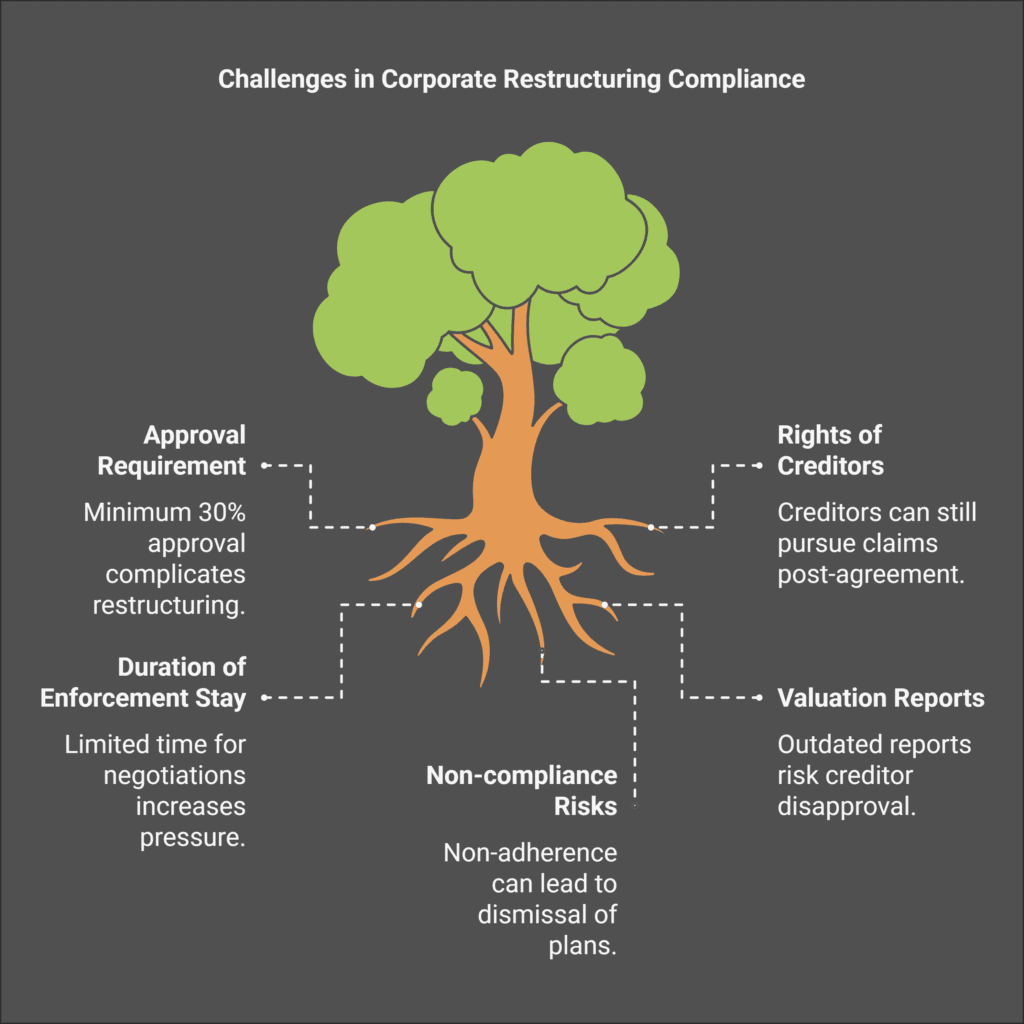
Any restructuring plan needs approval from creditors who hold at least 30% of the affected receivables.

Creditors can keep pursuing claims against co-debtors or guarantors, even if they agree to a plan.

This shows how important it is to keep in touch with creditors during this time.

Compliance with Corporate Insolvency Procedures

Following corporate insolvency procedures in Romania is vital to avoid legal issues.

The restructuring process needs careful planning and must follow strict rules.

For example, the temporary stay of enforcement actions can last from three to 12 months, giving time for negotiations.

Also, a creditor arrangement must offer prospects that allow creditors to get at least what they would in bankruptcy, based on a recent valuation report.

Not following these rules can lead to the court dismissing the restructuring or creditors not approving it, which could harm the restructuring efforts.

AspectDescription
Approval RequirementMinimum 30% of affected receivables must approve the restructuring agreement.
Rights of CreditorsCreditors can pursue claims against co-debtors and guarantors despite agreeing to restructuring.
Duration of Enforcement StayStay lasts from 3 to a maximum of 12 months.
Valuation ReportsMust be no older than 6 months for ensuring creditor agreements in reorganizational plans.
Non-compliance RisksCan lead to dismissal of proceedings or disapproval by creditors.

Best Practices for Corporate Restructuring in Romania

Effective corporate restructuring in Romania needs careful planning and following best practices.

Businesses should focus on strategies that reduce legal risks.

Working with experienced professionals is key to success.

Strategies to Minimize Legal Risks

To lower legal risks, conducting independent business reviews (IBRs) is essential.

These reviews check financial, operational, and strategic performance.

They help find the best ways forward.

Pre-lending reviews also help set financial limits.

This impacts overall strategies.

It shows the need for legal solutions that match business goals.

Collaborating with Legal and Financial Experts

Working with financial experts in Romania can improve restructuring.

Firms like Atrium Romanian Lawyers are great examples.

They offer a team approach to handle various issues.

This way, companies can deal with complex laws better.

They can also aim for better results.

Conclusion

Understanding corporate restructuring in Romania is key.

You have options like mergers, divisions, and transformations.

Each one has legal aspects that affect your business’s health.

Delaying these steps can harm your business.

It can lead to lower sales and more debt.

This article shows why businesses need to think about restructuring early.

Working with experts can help you understand Romanian law better.

This way, you can use your resources wisely and stay up-to-date with new laws.

Thinking about restructuring can help your business.

It can make your operations better and save jobs.

It’s a chance to get through tough times and come out stronger.

FAQ

What is corporate restructuring?

Corporate restructuring means a company changes how it works, its money setup, or its legal form.

This can be through mergers, divisions, or changes in legal status.

It aims to make the company more efficient, financially stable, and competitive.

What are the primary options for corporate restructuring in Romania?

In Romania, companies can choose from mergers, divisions, or transformations.

Mergers combine companies to simplify operations.

Divisions split companies to boost performance.

Transformations change a company’s legal form.

How do Romanian laws govern corporate restructuring?

Romanian laws, like the Companies Law and insolvency rules, guide corporate restructuring.

These laws set the rules for mergers, divisions, or transformations.

They protect everyone involved legally.

What are the benefits of corporate restructuring?

Restructuring can make a company’s finances better, more competitive, and efficient.

It helps companies adjust to market changes, cut costs, and get stronger in the market.

What are the legal implications of restructuring for creditors?

When restructuring, it’s key to think about creditors’ rights and duties.

Following insolvency rules helps avoid legal issues and ensures fairness for everyone.

Why is strategic planning important in corporate restructuring?

Strategic planning is vital.

It makes sure restructuring goals match legal needs.

This helps companies tackle financial issues and improve operations during restructuring.

How can businesses ensure compliance during restructuring?

Working with restructuring experts and lawyers is helpful.

They offer advice and detailed checks.

This ensures the restructuring follows Romanian laws and rules.

What are best practices for corporate restructuring in Romania?

Good practices include carefully checking what restructuring is needed.

Working with legal and financial experts is also key.

Using strategies that reduce legal risks helps achieve success while following the law.

What are the main types of restructuring and insolvency procedures in Romania?

In Romania, there are several key restructuring and insolvency procedures available:

1. Preventive composition: This is a restructuring procedure aimed at companies facing financial difficulties but not yet insolvent.

It involves negotiations with creditors to reach a restructuring agreement.

2. Ad-hoc mandate: A confidential procedure where a mandatary is appointed to negotiate with creditors to overcome financial distress.

3. Insolvency proceedings: This is the main procedure for companies unable to pay its debts.

It can lead to reorganization or liquidation.

4. Simplified insolvency proceedings: A faster procedure for certain categories of debtors, typically leading to liquidation.

5. Restructuring procedure: Introduced by the implementation of the restructuring directive, this procedure aims to help companies in financial difficulties or facing imminent insolvency.

Each of these procedures has specific requirements and outcomes under Romanian insolvency law.

How does the new restructuring procedure work in Romania?

The new restructuring procedure in Romania, introduced through the implementation of the restructuring directive, works as follows:

1. Eligibility: The debtor must be facing financial difficulties or imminent insolvency but still be viable.

2. Initiation: The debtor proposes a restructuring and applies to the court.

3. Restructuring practitioner: The court appoints a restructuring practitioner.

Business Transfers in Romania: Fiscal and Legal Insights

Business Transfers in Romania: Fiscal and Legal Insights

business transfer in Romania

In Romania, only 14 Advance Pricing Agreements (APAs) were active by the end of 2020.

This shows how complex business transfers can be.

To navigate these, you need to understand the legal and fiscal rules well.

Thinking about buying a company in Romania?

You’ll face a complex set of rules.

Romania doesn’t have one law for all mergers and acquisitions.

Instead, it uses the civil code and many special laws.

To smoothly transfer ownership in Romania, you must know the local laws, taxes, and strategies.

Getting help from experts is key to understanding the complex world of Romanian business transfers.

Key Takeaways

  • Romanian business transfers require sophisticated legal and fiscal expertise;
  • No uniform M&A regulation exists in Romanian legislation;
  • Civil code serves as primary legal framework for transactions;
  • Complex tax and pricing documentation is mandatory;
  • Professional consultation is essential for successful transfers.

Understanding the Romanian M&A Landscape

M&A Romania


The Romanian mergers and acquisitions scene is growing fast.

It’s becoming a top spot for companies looking to change their structure.

The market is full of chances for growth and strategic moves.

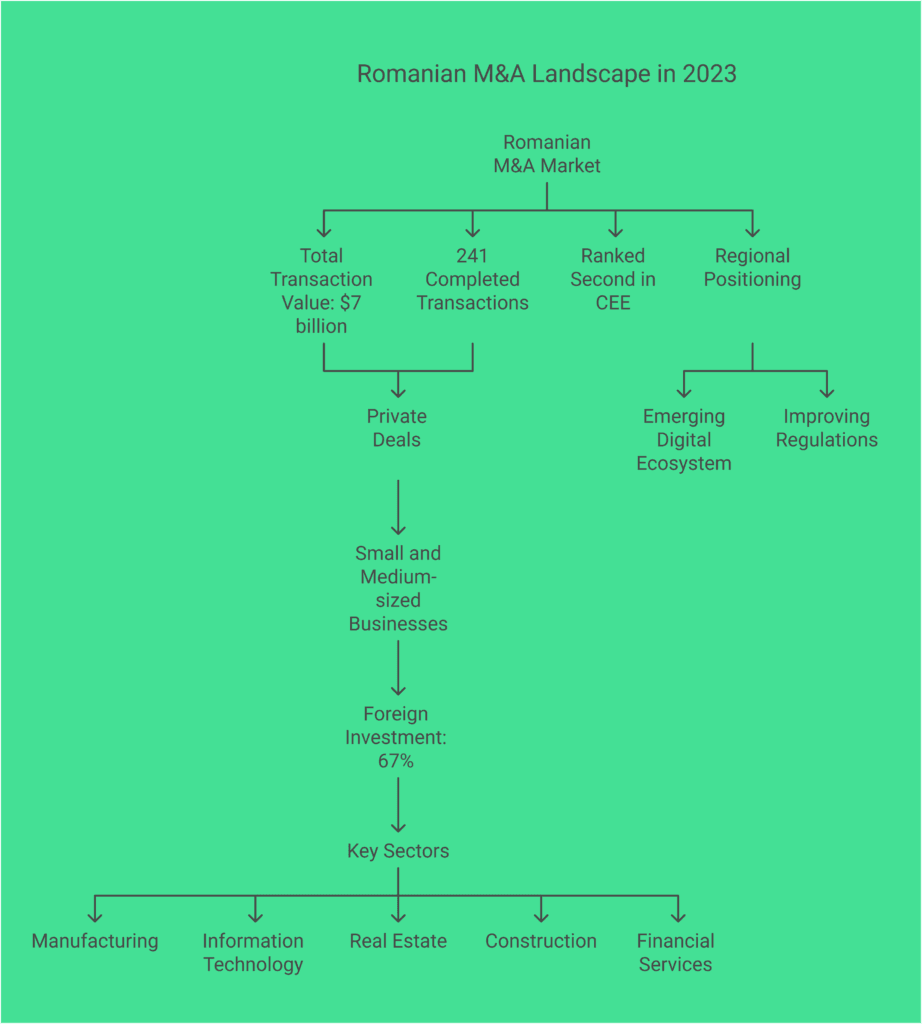
In 2023, the Romanian M&A market showed it’s strong.

Key signs point to its bright future:

  • Total transaction value reached approximately 7 billion dollars;
  • 241 completed ownership transition transactions;
  • Ranked second in Central and Eastern European M&A activity.

Market Dynamics and Trends

Most deals in Romania are private. Small and medium-sized businesses lead the way.

About 67% of deals come from outside, showing investors’ keen interest.

Sectoral Breakdown

The top sectors for mergers and acquisitions in Romania are:

  1. Manufacturing;
  2. Information Technology;
  3. Real Estate;
  4. Construction;
  5. Financial Services.

Regional Positioning

Romania is a major player in Central and Eastern Europe’s M&A scene.

Its location, emerging digital ecosystem, and improving rules attract investors.

They see great chances for restructuring their businesses here.

Legal Framework Governing Business Transfers in Romania

Romanian Business Transfer Legal Framework

Understanding the legal side of business transfers in Romania is key.

The rules are based on both national laws and EU directives.

This makes the process for handing over a business in Romania quite detailed.

Important legal parts of business transfers in Romania include:

  • Directive (EU) 2017/1132 on company law aspects;
  • Directive (EU) 2019/2121 addressing cross-border conversions;
  • Romanian Companies Law (Law 31/1990);
  • Financial Services Authority Regulation No. 5/2018.

Your plan for transferring a business must follow certain rules.

The Romanian laws set important rules and steps for business deals:

  1. Controlling interest is defined as holding 50% plus one voting right;
  2. Public takeovers become mandatory when an investor holds over 33% voting rights;
  3. Shareholders with more than 5% ownership can propose valuation methods;
  4. Mandatory notifications are required at specific ownership thresholds.

When you plan to transfer a business, you must follow strict rules.

Filings related to business combinations must be submitted within 24 hours of triggering events.

Also, merger plans need to be published in the Official Gazette of Romania.

International investors should know about recent changes.

Government Emergency Ordinance No. 108/2023 has made rules for foreign direct investment clearer.

This adds more complexity to business transfers in Romania.

Types of Business Transfers and Acquisitions

When thinking about company ownership changes in Romania, it’s key to know the different ways to transfer businesses.

Business leaders face complex choices between mergers, acquisitions, and other transfer methods.

These choices can greatly affect their business strategies.

In Romania, business succession planning mainly focuses on two main types: share deals and asset deals.

Each type has its own legal, financial, and operational implications for corporate transfers.

Mergers and Their Characteristics

Mergers are a complex way to join two companies into one. In Romania, mergers often mean:

  • Combining corporate structures;
  • Shared leadership and strategy;
  • Benefits in taxes and operations.

Acquisition Structures

Acquiring a business in Romania can be complex, with many strategies for different goals.

The main acquisition types are:

  1. Buying the whole target company;
  2. Buying a part of it;
  3. Making a strategic minority investment.

Asset vs. Share Deals

CharacteristicAsset DealsShare Deals
Transferable ElementsSpecific assets and some liabilitiesWhole company ownership
Tax ImplicationsSeller pays taxes16% capital gains tax for locals
ComplexityMore complex due to asset-by-asset transfersSmaller complexity in ownership change

For commercial enterprise transfer in Romania, knowing these detailed strategies helps businesses pick the best one.

This choice should match their goals and the market situation.

Foreign Direct Investment Regulations

Romania is a great place for business ownership change.

It has a solid framework for foreign direct investment (FDI).

This framework helps attract international investors.

It also guides foreign buyers on how to start or grow their business here.

Here are some important points about Romania’s FDI rules:

  • Mandatory screening for investments over €2 million;
  • Comprehensive national security and public order checks;
  • Environmental protection compliance requirements;
  • Specific sector-specific investment scrutiny.

Foreign investors need to understand Romania’s detailed rules when considering a business transfer here.

The investment screening process makes sure investments fit with national interests.

At the same time, it keeps the country open to investors.

FDI Regulation HighlightsKey Details
Screening Fee€10,000 (refundable under certain conditions)
Maximum Review Duration135 days
Penalty for Unauthorized InvestmentsUp to 10% of worldwide turnover

The Romanian FDI regime strikes a good balance.

It attracts foreign investments while safeguarding national interests.

Investors need to look closely at sector-specific rules, like in energy, telecommunications, and critical infrastructure.

Foreign investors should know about the detailed screening process for ownership changes.

The rules ensure transparency and national security.

They don’t block international business investments.

Business Transfer in Romania: Process and Requirements

Starting a commercial enterprise succession in Romania needs careful planning.

The process involves many important steps.

These steps focus on legal and financial details.

Understanding the framework for business transfers in Romania is key.

The process aims for transparency, legal compliance, and a smooth transfer of ownership.

Pre-Transfer Assessment

The first step is a detailed pre-transfer evaluation.

This phase is critical and includes:

  • Comprehensive financial review;
  • Valuation of company assets;
  • Identification of legal risks;
  • Verification of contracts.

Documentation Requirements

Business transfers need careful documentation.

You’ll need:

  1. Detailed financial statements;
  2. Shareholder agreements;
  3. Corporate registration documents;
  4. Tax compliance certificates.
Document TypeLegal RequirementProcessing Time
Share Transfer Approval75% Share Capital Consent7-14 Days
Registration CertificateRomanian Companies Law10 Days
Tax ClearanceMandatory Verification5-7 Days

Legal Compliance Steps

Legal compliance is essential for a smooth transfer.

Key steps are:

  • Notifying authorities;
  • Getting Competition Council approvals;
  • Completing registration processes.

Seeking expert legal advice is recommended.

For professional help, call our recommended Romanian legal experts at +40765366887.

Due Diligence in Romanian Business Transfers

When buying a company in Romania, due diligence is key.

It helps lower risks and makes sure the transfer goes well.

This step checks the investment in many ways.

When planning mergers and acquisitions in Romania, focus on several important areas:

  • Financial review of historical performance;
  • Legal compliance verification;
  • Operational infrastructure assessment;
  • Commercial and market analysis.

Business sales in Romania need careful checking.

Investors should look closely at financial reports, legal papers, and any rules that might affect the business.

Due Diligence CategoryKey Focus AreasPotential Risks
FinancialRevenue streams, profit marginsHidden liabilities
LegalContractual obligationsPending litigation
OperationalTechnology infrastructureInefficient processes

Experts say using new tech and getting help from experts is smart.

Good planning can really cut down on risks.

With a thorough due diligence, you’ll have a better shot at making a successful deal in Romania’s fast-changing market.

Tax Implications and Fiscal Considerations

Understanding tax laws in Romania is key for corporate transactions.

When you’re handling ownership changes, you’ll face many financial issues.

These can greatly affect your business strategy.

Romanian tax laws are complex for financial transfers.

Knowing the main tax points is vital.

It helps avoid risks and get the best financial results from your deal.

Transfer Pricing Requirements

The Romanian Fiscal Code requires strict rules for deals between related parties.

There’s been a rise in tax audits on these issues.

  • Mandatory documentation for related-party transactions;
  • Comprehensive reporting requirements;
  • Potential penalties for non-compliance.

VAT Implications

VAT is a big deal in business transfers.

Romania has its own VAT rules that businesses must follow:

  1. Standard VAT rate: 19%
  2. Reduced VAT rates: 9% and 5% for specific supplies
  3. VAT registration threshold: RON 300,000 annually

Corporate Tax Aspects

Corporate tax strategies are important for business transfers.

You need to think about tax liabilities, exemptions, and new laws.

Tax planning is essential to optimize your financial position during ownership transitions in Romania.

Strategic Sectors and Special Regulations

When you’re doing commercial transfers in Romania, knowing about strategic sectors is key.

The Romanian government watches business deals in important areas closely.

These areas affect national security and public order.

Foreign investors face a tough approval process in sensitive sectors.

The Commission for the Examination of Foreign Direct Investments (CEISD) checks these deals carefully.

Key Strategic Sectors Requiring Special Approval

  • Energy infrastructure;
  • Transport systems;
  • IT and communication networks;
  • Financial and banking services;
  • Critical national infrastructure;
  • Security-related industries.

For sales of companies in these key sectors, investors need special approvals.

The rules require a close look at deals over 2 million euros.

Recently, laws have changed, like the updates to Emergency Ordinance 46/2022.

These changes help protect national interests but also keep the investment climate good.

Investment Approval Considerations

  1. Comprehensive security assessment;
  2. Evaluation of national security risks;
  3. Check on the investor’s background;
  4. Look at how the deal affects key sectors.

Knowing these rules is vital for smooth business transfers in Romania’s strategic sectors.

Investors should team up with local legal advisors to get through these complex steps.

Role of Regulatory Bodies and Authorities

When you transfer business ownership in Romania, knowing the role of key regulatory bodies is key.

Your journey in corporate restructuring will meet several important authorities.

They oversee and validate business transactions.

Romanian business transfers need several regulatory frameworks for transparency and compliance.

These key institutions are vital in monitoring and approving corporate changes.

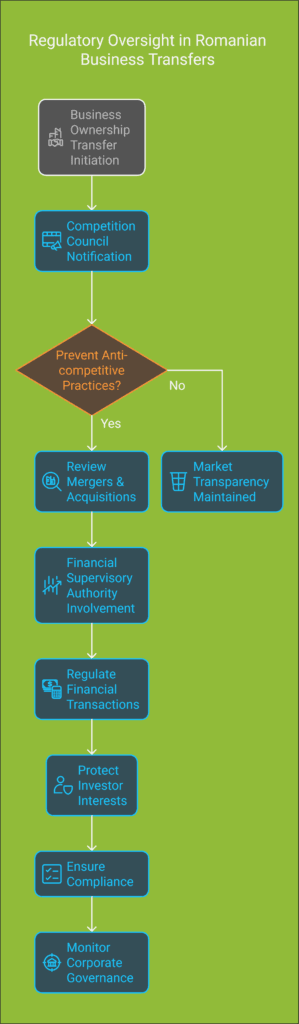
Competition Council Oversight

The Competition Council is a key watchdog in firm handovers. It has main duties:

  • Preventing anti-competitive market practices;
  • Reviewing merger and acquisition impacts;
  • Evaluating economic concentration transactions;
  • Protecting fair market competition.

When you transfer business ownership in Romania, you must tell the Competition Council for certain transactions.

This keeps the market transparent and stops monopolies.

M&A Regulatory

Financial Supervisory Authority Functions

The Financial Supervisory Authority (ASF) is key in corporate restructuring in Romania, mainly for financial institutions and listed companies. Its main tasks are:

  1. Regulating financial market transactions;
  2. Protecting investor interests;
  3. Ensuring compliance with financial regulations;
  4. Monitoring corporate governance standards.

Your business transfer plan must meet these regulatory needs for smooth, legal transactions in various sectors.

Knowing these regulatory frameworks helps you confidently and strategically navigate Romanian business transfers.

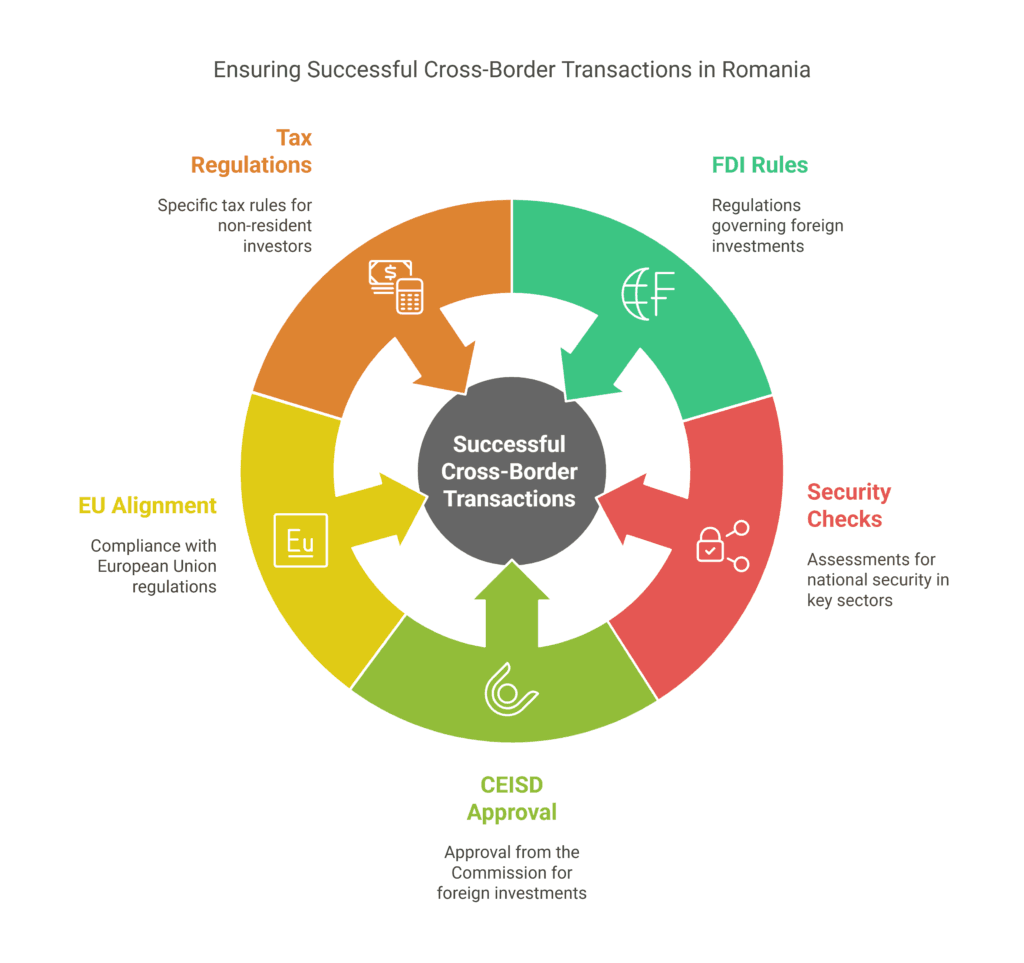
Cross-Border Transaction Considerations

Foreign investors must grasp the complex world of corporate takeovers in Romania.

The country has a strong legal setup to help with ownership changes.

It also protects national interests.

Key points for cross-border deals include:

The Romanian government has rules to attract foreign investment safely.

Foreign buyers need to know a few important things:

  1. They must report investments in sensitive areas;
  2. There could be a 5-8 month wait for FDI approval;
  3. They need to show detailed ownership details.

Taxes are very important in cross-border deals. Non-resident investors should know about specific tax rules:

Transaction TypeWithholding Tax RateSpecial Conditions
Dividends8%0% for EU companies with 10%+ shareholding
Interest16%Potential exemptions under EU directives
Royalties16%Reduced rates for specific agreements

It’s vital to understand these detailed rules for successful deals in Romania.

You must look at legal, financial, and regulatory aspects.

This ensures a smooth change in ownership.

Cross Border Transaction Romania

Recent Legislative Changes and Future Outlook

Romania’s business world is changing a lot in 2024.

This brings new chances for selling businesses and changing how companies work.

The rules for buying and selling companies are getting clearer.

Important changes are making the Romanian business scene different.

These changes affect how businesses operate:

  • Government Decision 300/2024 makes it easier to invest;
  • Emergency Ordinance 32/2024 changes how money is handled;
  • New rules for foreign investments.

2024 Regulatory Updates

Romania wants to make it easier for investors to come in.

If you’re thinking about selling your business in Romania, you’ll find it easier to start a new one.

The rules are clearer now.

Anticipated Changes

Romania’s economy is looking good, with a 3% GDP growth forecast for 2024-2025.

The government plans to make things better for businesses by:

  1. Making it easier to transfer businesses;
  2. Following EU rules;
  3. Welcoming more foreign investments.

If you’re looking to buy a business in Romania, now is a great time.

The mix of EU money and economic changes makes it a good place to invest.

Conclusion

Business divestment in Romania is complex and needs careful planning and legal knowledge.

When looking at corporate acquisitions, you must understand the detailed rules for business ownership changes in Romania.

This process includes legal steps, financial checks, and making strategic choices.

Your success in Romanian business transfers depends on thorough preparation and expert advice.

With about 690,000 small and medium-sized enterprises possibly changing hands soon, knowing the legal details is key.

The rules, like Law no. 31/1990, require focus on things like share transfer agreements and shareholder approvals.

Getting professional legal help is vital for these complex deals.

Romanian corporate law asks for accurate documents, like share transfer agreements and updated Articles of Association.

Working with skilled corporate lawyers can help avoid risks and make sure your business moves smoothly and legally.

For expert help with your business transfer, call Romania business transfer expert at tel. +40765366887.

Your careful planning will be key to the success of your corporate deal or business sale in Romania’s fast-changing market.

FAQ

What are the main types of business transfers in Romania?

In Romania, you can transfer businesses through mergers, acquisitions, asset deals, or share deals.

Mergers combine two companies into one.

Acquisitions mean one company buys another.

Asset deals transfer specific business assets, and share deals change who owns the company.

What are the key regulatory bodies involved in business transfers in Romania?

Several key groups watch over business transfers in Romania.

The Competition Council stops unfair competition.

The Financial Supervisory Authority looks after financial sector deals.

The Commission for the Examination of Foreign Direct Investments (CEISD) checks foreign investments.

What additional requirements exist for foreign investors in Romanian business transfers?

Foreign investors face extra rules, like national security checks under Emergency Ordinance 46/2022.

They must get extra approvals in key areas like energy and IT.

The CEISD reviews these deals to protect Romania’s interests and welcome foreign money.

How important is due diligence in Romanian business transfers?

Due diligence is very important in Romanian business transfers.

It checks the target business’s finances, laws, operations, and sales.

A good due diligence helps avoid risks and makes the transfer smooth.

It’s best to get experts to do a detailed check.

What tax considerations are critical in Romanian business transfers?

Important tax issues include following the arm’s length principle, VAT, and corporate taxes.

With more audits on transfer pricing, it’s key to document and justify prices.

You should also think about tax breaks, delays, and new tax laws that might affect your deal.

What are the primary challenges in cross-border business transfers in Romania?

Dealing with international rules is a big challenge in cross-border transfers in Romania.

You face issues like currency, legal systems, security checks, and taxes.

Getting help from Romanian legal and financial experts  is vital for these complex deals.

How has the Romanian M&A landscape changed in recent years?

The Romanian M&A market has seen big changes, like the COVID-19 pandemic and global tensions.

Romania is a strong player in Central and Eastern Europe, with more interest in tech, green energy, and finance.

New laws aim to make it easier for foreign investors to come in.

What documentation is typically required for a business transfer in Romania?

You’ll need lots of documents for a business transfer in Romania.

These include financial statements, legal papers, shareholder agreements, and tax certificates.

Depending on the deal, you might also need environmental reports, security clearances, and more.