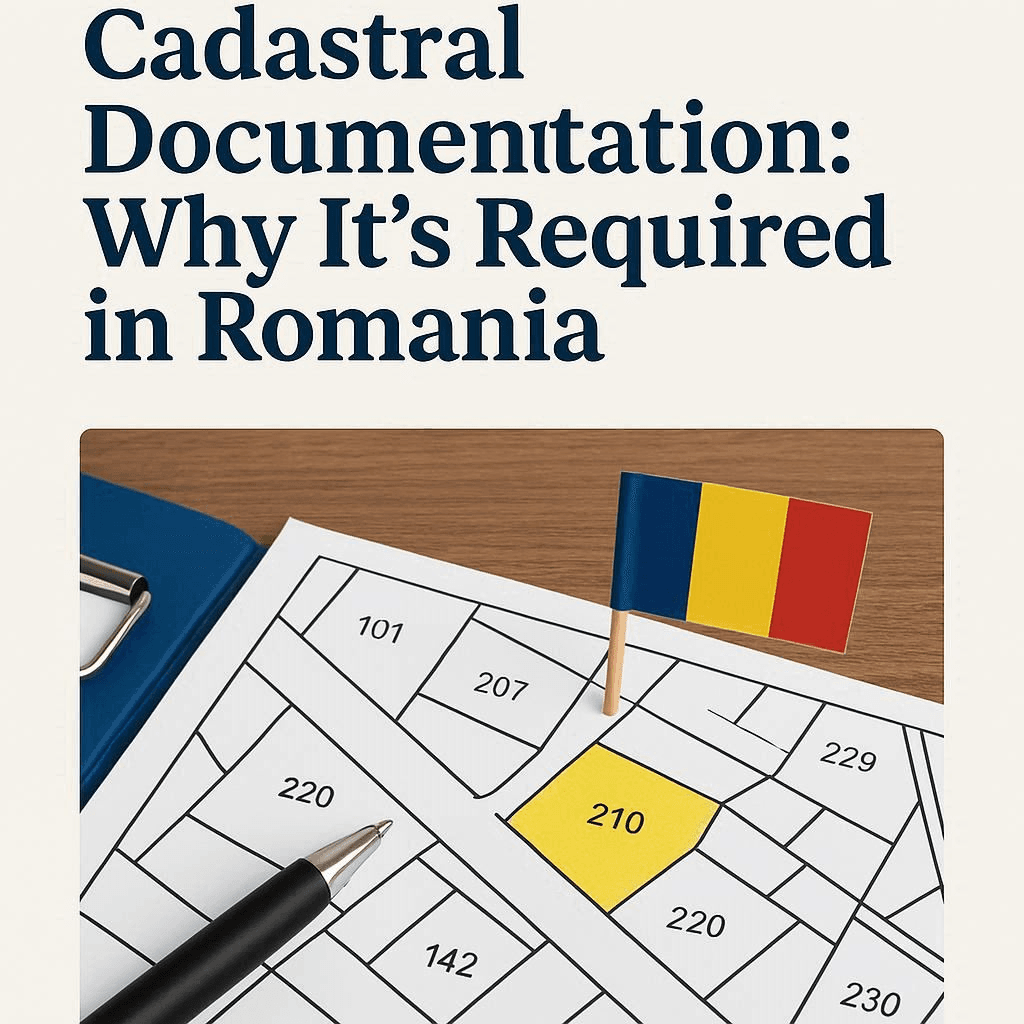
Cadastral Documentation: Why It’s Required in Romania
What if the key to securing your property rights in Romania isn’t just about owning land—but proving it in a way the law recognizes?
For buyers, sellers, and investors, this question underscores a critical reality: formalized records are the backbone of legally binding transactions.

Romania’s integrated framework merges technical and legal processes to ensure accuracy in ownership details.
Every parcel undergoes rigorous verification before entering the national registry.
This system prevents disputes by creating an immutable record that shields owners from unauthorized claims.
The process involves collaboration between cadastral offices and real estate departments.
Technical surveys and legal validations occur simultaneously, streamlining approvals.
Delays in documentation can derail sales or financing, making compliance non-negotiable for smooth transactions.
For tailored guidance, contact office@theromanianlawyers.com.
Our team navigates these requirements daily, ensuring clients meet all obligations efficiently.
Key Takeaways
- Romania’s property system requires precise technical and legal alignment for valid ownership,
- Integrated workflows prevent errors and accelerate registration timelines,
- Third-party claims lose validity without proper cadastral verification,
- Delays in documentation expose owners to financial and legal risks,
- Professional support minimizes hurdles in complex cases.
Understanding Cadastral Documentation in Romania
Romania’s property system relies on a structured framework where technical precision meets legal validity.
This foundation ensures every land registry entry reflects accurate ownership details and physical characteristics.
Definition and Key Components
Cadastral files combine technical surveys with legal descriptions.
They include boundary markers, exact surface measurements, and unique identification numbers assigned during registration.
These documents also contain geospatial plans that map the estate’s layout.
Authorized surveyors and legal experts collaborate to verify each detail.
Errors in boundary data or ownership records can invalidate transactions.
Professionals ensure compliance with national legislation to prevent disputes.
Historical Context and Evolution
Romania’s modern cadastral system has evolved through various historical influences, with significant development occurring during different administrative periods.
The current integrated system represents decades of modernization efforts to align with European Union standards.
Contemporary reforms integrated digital mapping with established processes.
Today’s estate records blend historical archives with real-time updates.
This evolution maintains continuity while addressing modern ownership complexities.
Cadastral Documentation and Why is It Required in Romania
Romanian legislation mandates strict protocols for validating property boundaries and ownership transfers.
These protocols serve as the foundation for all real estate transactions, ensuring every modification aligns with national standards.
Key Legal Requirements and Registration Effects
Under Romanian law, formalizing land divisions or mergers requires comprehensive technical verification.
This process applies during initial registrations and subsequent changes like boundary adjustments.
Authorized surveyors must validate measurement accuracy and confirm the credentials of involved professionals.
Each submission undergoes a multi-step review.
Inspectors cross-reference graphic databases to locate the site and ensure surface calculations match physical dimensions.
Discrepancies between descriptive details and visual representations trigger immediate revisions.
Upon approval, properties receive unique identifiers that lock their status in the national system.
These codes become critical references for future transactions or legal disputes.
Properly executed registrations grant owners enforceable rights against third-party claims.
They also activate the property’s eligibility for entries in Romania’s land book—a decisive factor in securing financing or completing sales.
Non-compliant submissions face rejection, requiring costly resubmissions.
Errors in surface data or boundary markers can delay land development projects significantly, emphasizing the need for precision from the outset.
Integration of Cadaster and Land Registry Systems
Romania’s property governance model eliminates bureaucratic silos through a cohesive institutional design.
The Romanain land registry and cadaster operate under one administrative umbrella, merging technical precision with legal validation.
This structural integration accelerates decision-making while maintaining rigorous standards.
Unified Workflow in Land Book Registrations
Applications for property registration follow a synchronized process.
Technical surveys and legal validations are processed within the same department, removing redundant steps.
A single documentation file combines geospatial maps, boundary certifications, and ownership proofs.
The system routes files between cadastral inspectors and real estate publicity teams automatically.
Technical specialists verify measurement accuracy, while legal experts confirm compliance with ownership transfer rules.
Approved data flows directly into Part A of the land book, ensuring alignment between physical boundaries and registered rights.
Key advantages of this approach include:
- Reduced processing times through parallel technical-legal reviews,
- Eliminated discrepancies between registry entries and physical sites,
- Centralized access to updated property information.
This integration minimizes errors that traditionally arise when separate institutions handle cadastral and registry tasks.
Real estate professionals benefit from predictable timelines, while owners gain enforceable rights backed by unified records.
Process and Legal Considerations for Cadastral Documentation
Navigating Romania’s property registration framework demands strict adherence to sequential technical and legal phases.
This structured approach protects ownership rights while maintaining alignment with national standards.
Steps from Technical Verification to Legal Registration
The procedure unfolds through six critical stages:
- Preparer validation: Confirm credentials of professionals who drafted the documents,
- Database cross-check: Locate property in the national graphics system using coordinates,
- Surface verification: Audit mathematical accuracy of land measurements,
- Attribute correlation: Match written descriptions with graphical representations,
- Number assignment: Issue unique identifiers for unregistered properties,
- Final review: Cadastral inspector approves or flags discrepancies.
Ensuring Compliance with Romanian Law
Authorities reject submissions failing these legal benchmarks:
| Requirement | Complete Documentation | Incomplete Cases |
|---|
| Technical Acts | Precision-matched data | Surface calculation errors |
| Legal Standards | Ownership chain verified | Missing notarized signatures |
| Time Impact | Processing varies by complexity | Extended delays and resubmissions |
Non-compliant cases trigger detailed deficiency reports.
These outline exact corrections needed for resubmission.
Proper execution prevents third-party claims and ensures enforceable rights under Romanian statutes.
Implications for Real Estate and Property Transactions
Romania’s real estate market operates on a simple principle: no valid registration equals no enforceable rights.
The land registry acts as the ultimate authority for verifying ownership before any transaction closes.
This system protects buyers from inheriting unresolved disputes or hidden claims.
Impact on Land Sale and Ownership Proof
Without registry entries, sellers cannot legally prove they own the property.
Notaries refuse to authenticate sales contracts for unregistered parcels, blocking transfers entirely.
Banks similarly reject mortgage applications tied to undocumented estates.
Common scenarios demonstrate these consequences:
| Scenario | With Proper Documents | Missing Documents |
|---|
| Residential Sale | Processing within standard timeframes | Contract voided |
| Land Development | Financing approved | Bank refusal |
| Inheritance Transfer | Smooth ownership change | Extended court proceedings |
Proper registration creates a public record accessible to buyers, lenders, and authorities.
This transparency accelerates due diligence and reduces fraud risks.
Updated entries also increase property values by confirming marketability.
Maintaining current records helps avoid transaction delays and ensures compliance as boundaries or zoning laws change.
Legal Solutions and Alternative Approaches
When traditional property registration isn’t an option, Romanian law offers alternative pathways to secure ownership rights.
These mechanisms address complex scenarios where standard documentation remains unavailable or incomplete.
Noting Possession and Alternative Procedures
Individuals using land without formal ownership documents can request a notation of possession.
This legal step initiates a period during which third parties may contest the claim.
If no disputes arise, property rights may be formally registered through court proceedings.
Usucapion and Property Acquisition
Romanian law recognizes usucapion (adverse possession) as a method of acquiring property rights through prolonged possession.
Under current legislation, individuals who can demonstrate continuous, uninterrupted, and public possession for specified periods may acquire ownership rights.
The Civil Code establishes that those who possessed property for 10 years may become owners through adverse possession (extratabulară).
For situations involving longer periods, 30-year usucapion (acquisitive prescription) may apply depending on specific circumstances and legal requirements.
Resolving Complex Ownership Scenarios
Successful usucapion requires proving public, peaceful, and uninterrupted control of the land.
Authorized companies handle complex procedures for cases involving partial deeds or indirect evidence.
This process often becomes critical during inheritance disputes involving properties with unclear documentation.
Multiple heir situations demand specialized strategies to prevent prolonged litigation.
Legal professionals help owners navigate these complexities while protecting against future obstacles in mortgage or sale processes.
Consulting experienced attorneys ensures compliance with evolving registration standards.
Their guidance minimizes risks in both standard and alternative ownership validation processes.
Expert Insights and Best Practices in Cadastral Documentation
Navigating property records demands precision only specialists can deliver.
Romania’s framework assigns distinct roles to owners, professionals, and regulators to maintain system integrity.
Expert Guidance and the Role of Authorized Professionals
Licensed surveyors and legal practitioners handle technical evaluations under the National Agency for Cadaster and Land Registration.
These experts:
- Verify boundary markers using GPS technology,
- Cross-reference historical maps with current site conditions,
- Certify that legal descriptions match physical characteristics.
Property owners must identify and preserve their boundaries.
Professionals bear responsibility for measurement accuracy, while inspectors validate data before issuing registration numbers.
Ensuring Data Accuracy and Timely Updates
Regular updates prevent conflicts during sales or inheritance transfers.
Key maintenance practices include:
| Action | Frequency | Responsible Party |
|---|
| Boundary checks | Every 5 years | Owner |
| Record audits | Post-construction | Authorized surveyor |
| System updates | Real-time | Cadastral office |
Disputed cases require immediate legal intervention.
For complex scenarios like overlapping estate claims, contact office@theromanianlawyers.com.
Professional legal teams specialize in resolving boundary disputes efficiently.
Proactive monitoring of zoning changes safeguards rights.
Specialists recommend digital alerts for land registration amendments affecting your assets.
Conclusion
Securing property rights in Romania hinges on meticulous adherence to legal frameworks governing land records.
The integrated system combining technical precision with legal validation ensures transparent transactions while preventing ownership disputes.
From standard registrations to resolving complex cases, compliance protects all involved parties.
Authorized professionals play a critical role in verifying boundaries and maintaining error-free documentation.
Their expertise streamlines the process, whether handling routine updates or alternative acquisition methods.
Proactive management of real estate records remains essential for financing eligibility and conflict prevention.
Regular audits and immediate corrections uphold the integrity of Romania’s land registry framework.
For tailored guidance on navigating these requirements, contact office@theromanianlawyers.com.
Professional legal teams provide comprehensive support to ensure your assets remain protected under national law.
FAQ
What legal effects does land registration have in Romania?
Registration in the Land Book grants enforceable rights against third parties and validates ownership transfers.
It serves as the primary proof of legal title under Romanian law, ensuring transparency in transactions like sales or mortgages.
How does the cadaster system integrate with property registration?
Romania’s unified system combines cadastral data (physical boundaries, area) with the Land Registry’s legal records.
This integration streamlines workflows, reduces errors, and ensures accurate verification during transactions.
What steps are involved in obtaining cadastral documentation?
The process includes technical verification by licensed surveyors, boundary confirmation with neighbors, submission to the Cadaster Office, and final Land Book registration.
Compliance with zoning laws and notarization of legal acts is mandatory.
Why is cadastral documentation critical for real estate sales?
It confirms lawful ownership, clarifies boundaries, and identifies encumbrances like mortgages.
Buyers require this data to assess risks, secure financing, and complete transactions recognized by Romanian authorities.
Can property rights be established without full registration?
Temporary possession claims may be noted in the Land Book, but usucapion (adverse possession) or specialized procedures are required for full rights.
These alternatives involve court validation and strict evidence standards.
How do professionals ensure cadastral data accuracy?
Authorized surveyors, notaries, and lawyers cross-check records, resolve boundary disputes, and update entries for new constructions or subdivisions.
Regular audits by the National Agency for Cadaster prevent discrepancies.
What happens if a property has unresolved boundary issues?
Transactions may be delayed until disputes are settled via mediation or court rulings.
The Cadaster Office flags such cases, requiring updated technical plans and neighbor agreements before registration.