Business lawyer assisting foreign company with branch office registration in Romania

How to Register a Branch Office of a Foreign Company in Romania


How to Register a Branch Office of a Foreign Company in Romania

Setting up a branch office in Romania offers foreign companies a strategic foothold in the European market. This comprehensive guide provides an overview of the process to register a branch in Romania, ensuring compliance with Romanian regulations and maximizing your business potential. From understanding the nuances of Romanian law to navigating the National Trade Register Office, we’ll walk you through each step.


Need Professional Help?

At our law firm, Atrium Romanian Lawyers, we assist clients with corporate & commercial law, branch registration, and investor-friendly advisory services.


Understanding Branch Offices in Romania

A receptionist welcoming visitors at the front desk of the office.

What is a Branch Office?

A branch office in Romania serves as an extension of the parent company, allowing it to conduct activities in Romania without creating a separate legal personality. Essentially, registering a branch is establishing a physical office in Romania that operates under the umbrella of the existing foreign company. Unlike a Romanian subsidiary, the branch office shares the same legal entity as its parent company, simplifying administrative processes while expanding its reach.

Branch vs. Subsidiary: Key Differences

TypeDescription
Branch OfficeExtension of parent company without separate legal personality; parent is directly liable
SubsidiaryDistinct legal entity with own capital; provides liability protection to parent

Benefits of Establishing a Branch in Romania

  • Test the Romanian market and gain insights before committing to a full-fledged subsidiary
  • Simpler and faster registration process compared to forming a new Romanian legal entity
  • Lower initial setup costs and reduced administrative burden
  • Leverage the established brand and resources of the parent company
  • Direct representation in the European Union market

Legal Framework for Foreign Companies

A close-up of legal documents and a pen on a desk.

Romanian Companies Law 31/1990

The Romanian Companies Law 31/1990 is the cornerstone of corporate governance in Romania, influencing how foreign companies can establish a branch. This law defines the legal entities permitted to operate in Romania and outlines the requirements for company formation, including registering a branch. Understanding this legislation is vital for foreign investors aiming to register a branch in Romania, ensuring compliance with local regulations.

Foreign Branch Legal Requirements

To register a branch in Romania, foreign companies must meet specific legal requirements:

  • Submit parent company’s registration documents, translated and notarized, to the National Trade Register Office (ONRC)
  • Ensure the branch representative has power of attorney to register and legally bind the company
  • Provide a registered office address in Romania with proof of occupancy
  • Define the scope of activities through CAEN codes

Registration with ONRC Romania

The National Trade Register Office (ONRC) is the central authority for registering a branch in Romania. The process involves filing necessary documents, including the parent company’s details, the decision to open a branch, and the appointment of the branch representative. Once approved, the branch office receives a unique registration number and tax identification code, allowing it to operate legally.

Atrium Romanian Law Office is an expert legal services provider based in Romania, specifically in Bucharest. The firm’s team of experienced Romanian lawyers and professionals are equipped to resolve any legal issue in a timely manner. They offer guidance through the branch registration process, ensuring full compliance with Romanian law.


Step-by-Step Registration Process

A checklist with steps for registration is pinned on a bulletin board.

Phase 1: Preparation of Required Documents

  • Parent company’s articles of association and certificate of incorporation
  • Board resolution authorizing the establishment of the branch
  • Proof of legal existence of the parent company
  • Details of the branch representative and their power of attorney
  • Business plan detailing planned activities in Romania

All foreign documents must be officially translated into Romanian and notarized. This preparation is crucial for avoiding delays with ONRC.

Phase 2: Branch Registration with ONRC

  • Submit all prepared registration documents to ONRC (in person or online)
  • Pay the registration fee (typically €50-€100)
  • ONRC reviews documents for compliance with Romanian legal requirements
  • Upon approval, receive registration certificate and unique fiscal code
  • Branch receives official publication in the Commercial Register

Phase 3: Tax Registration with ANAF

Phase 4: Post-Registration Formalities

  • Open business bank account in Romania
  • Register for social security and employment purposes
  • Apply for sector-specific licenses or permits if required
  • Notify relevant authorities of branch operations

Key Responsibilities After Registration

A computer screen displaying a business registration form.

Role of the Branch Representative

The branch representative holds significant responsibilities:

  • Acts on behalf of the parent company in all matters related to the branch
  • Is authorized to make decisions and enter into contracts
  • Must be a resident of Romania or an EU citizen with valid residence permit
  • Ensures compliance with all Romanian legal and regulatory requirements
  • Serves as the main point of contact with Romanian authorities

Parent Company Obligations

The parent company maintains certain obligations:

  • Remains ultimately liable for all activities conducted by the Romanian branch
  • Must ensure the branch adheres to Romanian legal standards
  • Is responsible for financial reporting and tax compliance
  • Must promptly communicate changes to structure or articles of association
  • Must maintain adequate insurance coverage for branch operations

Common Pitfalls & How to Avoid Them

Two people are discussing documents in a meeting room.
  • Incomplete translations — Ensure all documents are properly translated and notarized by qualified professionals
  • Inadequate branch representative — Choose a qualified individual familiar with Romanian business practices
  • Tax compliance issues — Establish robust accounting and tax reporting procedures from the start
  • Incorrect CAEN codes — Define business activities carefully to match registration requirements
  • Delayed bank account opening — Prepare all documentation in advance to expedite the process
  • Missing sector licenses — Identify and obtain all required permits before commencing operations

Useful Resources & Links


FAQ – Branch Registration in Romania

Q: What is a branch office of a foreign company in Romania?

A: A branch office is an extension of the parent company located abroad. It operates under Romanian laws while representing the foreign legal person and can engage in various business activities.

Q: How long does it take to register a branch in Romania?

A: The registration process typically takes 2-4 weeks, depending on the completeness of submitted documents and ONRC processing time.

Q: What are the registration costs?

A: Costs typically range from €500-€1,500, including ONRC fees, translation and notarization services, publication fees, and optional legal advisory services.

Q: Can a foreign company open multiple branches in Romania?

A: Yes, a foreign company can open multiple branches. However, each branch must be registered separately and comply with local laws and regulations.

Q: What is the difference between a branch and a representative office?

A: A branch can engage in commercial activities and generate revenue, while a representative office is limited to promoting the parent company’s interests without engaging in direct business activities.

Q: Is the branch representative required to be Romanian?

A: The branch representative must be a resident of Romania or an EU citizen with a valid residence permit. They don’t need to be Romanian by nationality.

Q: What are the tax implications for a branch?

A: A branch is subject to corporate income tax on income generated within Romania. It must register for VAT if annual turnover exceeds EUR 88,500 and comply with Romanian tax regulations.

Q: What documents are required to register a branch?

A: Required documents include the parent company’s incorporation certificate, articles of association, proof of legal existence, branch representative details, power of attorney, and information about planned activities.

Q: Can changes be made to the branch after registration?

A: Yes, changes such as branch representative, registered office, or scope of activities must be reported to ONRC. The parent company must ensure all modifications are properly documented and filed.


Disclaimer: This article is for general information only and does not constitute legal advice. Please consult with a qualified Romanian corporate lawyer to verify current laws and regulations before proceeding with branch registration. Laws and procedures are subject to change, and individual circumstances may vary.

Romanian Company Capital Increase 2025

Romanian Company Capital Increase: Streamlined Processes 2025

Romanian Company Capital Increase: Streamlined Processes 2025

Recent draft reforms on Romanian company capital increase 2025 have reshaped foundational requirements for Romanian companies, requiring both entrepreneurs and established firms to act quickly to stay compliant and maintain operational continuity.

capital increase procedures Romanian Company

Recent proposed changes in corporate legislation will require soon a minimum financial commitment, times higher than before, significantly impacting how companies, especially limited liability companies, operate.

Proposed changes are still in draft form and have not been enacted.

The current minimum capital requirement is 1 RON, and the proposal would increase it to variable amounts (500-90,000 RON).

The draft of law links financial obligations to company size, establishing specific compliance tiers across industries.

These changes will come with tight deadlines, enhanced reporting for banking activities, and stricter registry submissions.

Non-compliance could lead to severe penalties like operational suspension or dissolution.

Seeking professional advice is important, particularly for Romanian company formation or making structural adjustments.

Key Takeaways

  • Romania’s draft of corporate laws will enforce significantly higher minimum financial commitments,
  • Three-tier compliance system will align obligations with business size and revenue,
  • Mandatory banking protocols will affect entity registration and reporting,
  • Legal expertise ensures adherence to strict deadlines and documentation requirements,
  • Non-compliance may result in operational restrictions or business dissolution.

Navigating Romanian Corporate Regulations

The recent legislative draft introduces structured financial benchmarks for commercial entities.

These changes will create clear financial parameters tied to operational scale, ensuring alignment between resources and business activities.

bank account setup requirements

Updated Financial Benchmarks for Businesses

The revised draft establishes three financial tiers based on annual revenue.

Microenterprises with earnings below 395,000 RON must maintain 500 RON in reserves.

Mid-sized organizations generating up to 7 million RON require 5,000 RON.

Larger enterprises surpassing this threshold need 90,000 RON in available funds.

Business SizeRevenue RangeFinancial Reserve
MicroUnder 395k RON500 RON
Medium395k – 7M RON5,000 RON
LargeOver 7M RON90,000 RON

Banking Compliance Essentials

Under recent reforms in Romanian company law, newly incorporated businesses will be required to open and maintain a bank account within 30 days of registration, with banks permitted to refuse only on grounds related to anti-money laundering compliance under Law 129/2019.

Companies that fail to comply risk being declared fiscally inactive by ANAF, a status that suspends tax rights and may trigger fines of up to RON 10,000 for related non-compliance.

In parallel, the draft law increases the minimum share capital for limited liability companies (SRL) in Romania to RON 8,000, obliging existing SRLs to align either at the first amendment of their articles of association or within two years of the law’s entry into force.

Legal specialists recommend that entrepreneurs and investors prepare early to ensure smooth company formation, compliance, and business continuity in Romania.

Step-by-Step: capital increase procedures Romanian Company

Strategic documentation preparation forms the foundation of successful compliance.

Organizations must balance legal precision with operational agility when modifying foundational documents to meet revised standards.

trade register documentation process

Drafting Constitutive Acts and Submissions

Modifying Articles of association requires shareholder approval through formal resolutions.

Romanian lawyers must draft updated Articles reflecting adjusted financial commitments while maintaining alignment with existing operational parameters.

Completed documentation packages must include shareholder agreements and bank deposit confirmations.

The trade register mandates electronic submission of these materials within 15 days of approval.

Common errors in draft versions often delay processing timelines.

Timelines and Compliance Deadlines

Compliance timelines under the proposed Romanian company law reforms focus on SRL share capital increases and related corporate compliance filings.

All limited liability companies (SRL) will be required to raise their minimum share capital to RON 8,000, either at the first amendment of their articles of association or within two years of the law’s entry into force.

Once approved, the shareholder resolution must be registered with the Romanian Trade Register within 15 days, with late submissions leading to administrative penalties.

Although no official deadlines apply to POS installation or payment infrastructure upgrades, businesses should align their banking arrangements and capital adjustments early to avoid being declared fiscally inactive by ANAF and facing operational delays.

Engaging professional legal and accounting services in Romania is strongly recommended to ensure smooth compliance and safeguard business continuity.

Professional guidance helps navigate overlapping requirements efficiently.

Managing Compliance and Fiscal Transparency for Business Success

Effective governance in Romania’s business environment requires close monitoring of regulatory updates and proactive adjustment to new fiscal rules.

The latest company law and tax reforms introduce obligations that connect corporate governance, banking compliance, and shareholder transactions, making coordinated management essential for business stability.

compliance risk management

Mitigating Risks and Avoiding Administrative Blockages

Under the draft reforms, share transfers involving controlling shareholders must be reported to the tax authorities within 15 days.

Where companies have outstanding debts to the state, the Romanian Trade Register may require financial guarantees from the company or incoming shareholders before registering the transfer.

At the same time, failure to maintain an active bank account or to meet the new minimum capital thresholds for SRLs may result in a declaration of fiscal inactivity by ANAF.

Companies declared inactive face serious tax consequences: they must continue paying taxes but lose the right to deduct expenses and face restrictions on VAT claims.

To prevent these risks, businesses should adopt three practical safeguards:

  • Regular audits of banking documentation and shareholder records

  • Immediate updates to Trade Register filings following ownership changes

  • Preemptive resolution of outstanding state debts before major corporate transactions

Specialized legal and accounting advisors in Romania provide real-time monitoring, representation during ANAF audits, and strategic planning to maintain compliance.

Prompt action is also critical when receiving notices from fiscal authorities: while deadlines vary by procedure, some ANAF processes grant only 30 days to submit corrective documentation, and missed deadlines may trigger enforcement measures such as account freezes or asset seizures.

Conclusion

Navigating Romania’s revised corporate framework demands strategic adaptation.

Limited liability companies in Romania face permanent operational changes rather than temporary fixes.

Successful adaptation requires proactive planning with legal specialists.

Organizations prioritizing these measures secure long-term viability in Romania’s transformed business environment.

Romanian legal expertise remains critical for interpreting evolving requirements while safeguarding growth opportunities.

FAQ – Romanian Company Law and Compliance (2025)

What is the minimum share capital for a limited liability company (SRL) in Romania?


Under the draft reforms to Law 31/1990, the minimum share capital for an SRL will increase from 1 RON to 8,000 RON.

Existing companies must align either at the first amendment of their articles of association or within two years of the law’s entry into force.

Certain regulated industries (e.g. banking, insurance) still require much higher thresholds under sector-specific rules.

How long does it take to open a bank account for a capital increase?


Romanian banks usually process share capital deposit accounts within 3–5 business days, provided that the company submits incorporation documents, shareholder identification, and complies with anti-money laundering (AML) checks under Law 129/2019.

What penalties apply for missing compliance deadlines during share transfers?


Failure to submit share transfer documentation to the Trade Register or ANAF within 15 days may result in fines of up to 5,000 RON.

Persistent non-compliance can also expose companies to fiscal inactivity status, which restricts VAT deductions and expense claims, though dissolution is not an automatic sanction.

Do constitutive acts and amendments require notarization?


Notarization is no longer mandatory for standard SRL incorporation or simple amendments since the 2020 simplification of Romanian company law.

However, notarization may still be required in special cases, such as share transfers involving real estate contributions or when parties choose additional contractual safeguards.

What tax obligations follow a capital increase?


Companies must notify ANAF and the Trade Register of any capital increase within 15 days.

While capital injections themselves are not subject to taxation, incomplete or incorrect documentation may trigger tax audits or reclassification of funds.

Can foreign shareholders participate in increasing share capital?


Yes. Foreign investors may contribute capital under the same conditions as Romanian nationals.

For cross-border transfers, companies must comply with AML documentation requirements, and transactions above €10,000 are subject to reporting obligations under Law 129/2019.

Romanian Company Board Meetings

Navigating Romanian Company Board Meetings: Key Insights

Navigating Romanian Company Board Meetings: Key Insights

A group of people sits around a large conference table with papers and laptops in front of them.

Understanding the nuances of Romanian company board meetings is important for anyone involved in the management of companies in Romania.

This article provides key insights into the structure, legal requirements, and best practices for conducting effective board meetings in accordance with Romanian company law.

We will explore the roles and responsibilities of directors, shareholders, and other key stakeholders in the Romanian corporate governance landscape.

Understanding the Structure of Romanian Companies

A projector displays a presentation on the wall with graphs and charts.

Overview of Atrium Romanian Lawyers

Romanian company law dictates the formation, operation, and governance of various types of companies in Romania.

The type of company significantly impacts its organizational structure and the regulations governing its board meetings.

Atrium Romanian Law Office, an expert legal services provider, highlights that Romanian lawyers must navigate these regulations meticulously.

The Articles of Association define the company’s internal rules, complementing the broader legal framework and influencing how the board of directors operates and how resolutions of the general meetings are implemented.

Types of Romanian Companies

Romania provides various legal entity options, each possessing unique attributes.

Two frequently chosen forms are:

  1. Limited liability companies (SRL), which are often preferred by smaller businesses due to their simpler organizational structures.
  2. Joint-stock companies (SA), designed for larger enterprises and characterized by more complex governance procedures.

Ultimately, the selection between these legal structures will influence the company’s meeting and decision-making protocols.

Legal Entities and Their Responsibilities

As legal entities, Romanian companies bear specific responsibilities under Romanian law.

The board of directors, or the management board, plays a pivotal role in overseeing the company’s operations and ensuring compliance.

Members of the board are entrusted with representing the company, and their actions must align with both the law and the company’s articles of association.

The company is managed in accordance with the law, and the directors or the management board are responsible for preparing financial statements of the company and filing them with the Trade Registry.

Shareholder Meetings in Romania

A clock on the wall shows the time during the meeting.

Types of Shareholder Meetings

Under Romanian company law, various types of shareholder meetings serve distinct purposes.

These meetings are critical for the management of companies, ensuring transparency and shareholder involvement.

For example:

  1. The annual general meeting is a mandatory gathering where shareholders review the financial statements of the company and elect the board of directors or supervisory board.
  2. Extraordinary general meetings are convened to address specific, urgent issues such as amending the articles of association, increasing the share capital of the company, or approving significant transactions.

Convene Procedures for Shareholder Meetings

To convene a shareholder meeting, Romanian companies must adhere to specific procedures.

The board of directors, or in some cases, the supervisory board, must issue a notice to all shareholders, detailing the meeting’s agenda, date, time, and location.

This notice must be sent within the timeframe prescribed by Romanian company law and the company’s articles of association.

Failing to follow these procedures may invalidate the resolutions of the general meetings passed during the meeting, potentially leading to legal challenges.

Amending Resolutions in Shareholder Meetings

Shareholders can amend resolutions during the shareholder meeting under Romanian law, provided the proposed amendments are within the scope of the original agenda.

The process typically involves a motion to amend, followed by a vote among the shareholders.

For significant amendments, such as those affecting the articles of association, a supermajority vote may be required, and the amended resolution must be filed with the Trade registry.

Understanding these procedures is vital for effective corporate governance in Romanian companies.

The Role of the Board of Directors

A woman presenting a report on a screen in front of the board.

Composition of the Board of Directors

The composition of the board of directors is a critical element in the management of the company.

Under Romanian company law, the Articles of association of Romanian companies will specify the number of members of the board, their qualifications, and the process for their appointment.

In joint stock companies, the shareholder structure dictates that some directors or the management board are appointed by the general meeting of shareholders, ensuring the shareholder interests are adequately represented.

This structure aims to balance expertise and shareholder oversight.

Duties and Responsibilities of Board Members

Members of the board have extensive duties and responsibilities under Romanian law.

They are entrusted with the strategic direction of the company in Romania, ensuring compliance with regulations, and safeguarding the interests of all shareholders.

The board of directors is responsible for overseeing the financial statements of the company, ensuring their accuracy and timely filing with the trade registry.

In joint stock companies, the board also manages risk, sets policy, and monitors the performance of the management board, upholding their fiduciary duty to the company.

Decision-Making Processes in Board Meetings

Effective decision-making in board meetings is crucial for the success of Romanian companies.

The process typically involves presenting agenda items, facilitating discussion, and voting on resolutions.

The Articles of association often prescribe specific voting thresholds for different types of decisions.

For significant matters, such as amending the Articles of Association or increasing the share capital of the company, a qualified majority or even unanimous consent may be required.

Proper documentation of these decisions in the meeting minutes is essential for transparency and accountability, and the minutes should be filed with the trade registry as appropriate.

General Meetings: Best Practices

Several individuals are engaged in discussion, with some taking notes.

Planning and Conducting General Meetings

Effective planning is essential for successful general meetings in Romanian companies.

The board of directors must meticulously plan the agenda, ensuring all relevant items are included and clearly defined.

Romanian company law mandates that the Articles of Association dictate the specific procedures for these meetings.

As an expert legal services provider, we emphasize that proper notice must be given to all shareholders, and the meeting should be convened in a manner that promotes transparency and active participation, whether for limited liability companies or joint stock companies.

We are dedicated to helping our clients navigate these processes smoothly.

Legal Requirements for General Meetings

Adherence to legal requirements is paramount for general meetings in Romania.

Romanian law stipulates specific rules for voting, quorum, and documentation of resolutions of the general meetings.

The board of directors must ensure that all procedures align with both Romanian company law and the articles of association.

Members of the board must understand that failure to comply can invalidate the meeting’s outcomes, potentially leading to legal challenges.

Our firm provides expert guidance to Romanian companies in navigating these complex legal obligations, ensuring compliance and protecting shareholder interests.

Best Practices for Effective Communication

Effective communication is a cornerstone of successful general meetings.

Members of the board should ensure that information is presented clearly and concisely, allowing all shareholders to understand the issues at hand.

In Romanian companies, this includes providing materials in Romanian and, potentially, other languages if international shareholders are involved.

Encouraging open dialogue and addressing shareholder concerns promotes trust and transparency.

As a client-focused firm, we emphasize the importance of proactive communication to facilitate productive and legally sound board meetings.

Recent Developments in Romanian Company Law

Documents and folders are neatly arranged on the table for review.

Changes Impacting Board Meetings

Recent changes in Romanian company law have significantly impacted board meetings.

Amendments related to corporate governance and shareholder rights necessitate that directors or the management board stay informed and adapt their practices accordingly.

These changes may affect procedures for votes, the handling of resolutions, and the overall management of the company.

As an expert team of Romanian lawyers, we closely monitor these developments and provide timely advice to our clients, ensuring their companies remain compliant and competitive.

These updates are particularly relevant for both limited liability companies and joint stock companies.

Emerging Trends in Corporate Governance

Emerging trends in corporate governance are reshaping how Romanian companies conduct board meetings.

There is a growing emphasis on transparency, accountability, and environmental, social, and governance (ESG) factors.

Companies are increasingly adopting digital solutions to streamline meeting processes and enhance shareholder engagement.

The articles of association of Romanian companies are evolving to reflect these trends, often requiring more detailed reporting and greater shareholder involvement.

We assist our clients in integrating these best practices to enhance their corporate governance frameworks and attract investment.

Case Studies of Successful Board Practices

Examining case studies of successful board practices provides valuable insights for Romanian companies.

Instances where board meetings effectively addressed critical challenges, implemented innovative strategies, or improved shareholder relations offer practical lessons.

These examples often highlight the importance of diverse members of the board, robust decision-making processes, and proactive risk management.

We leverage our experience and expertise to help clients implement similar strategies, fostering a culture of excellence and driving sustainable growth for Romanian companies across various sectors, including both limited liability and joint stock companies.

FAQ:

What are the requirements for conducting board meetings in Romania?

In Romania, board meetings must comply with the applicable legislation, which includes the requirements set forth by the Romanian legislation.

Companies are required to convene meetings in accordance with their articles of association, which dictate the procedures shareholders must follow.

Additionally, the meeting must be held at the registered office or another location specified in the convening notice.

How can shareholders participate and vote in general shareholder meetings?

Shareholders can participate and vote in general shareholder meetings either in person or through electronic means.

The recent legal framework removes the requirement for companies to include identification data in the meeting notice, making it easier for shareholders to engage in the voting process, including the use of electronic voting in general.

What is the role of the supervisory board in Romanian companies?

The supervisory board is responsible for overseeing the management of the company and may appoint one or more directors.

Members of the supervisory board are appointed either directly by shareholders or through the general shareholder meeting, which can delegate this authority.

Their role is crucial in ensuring that the company adheres to the current legal framework concerning operational and strategic decisions.

How does electronic communication impact board meetings in Romania?

Electronic communication has transformed the way board meetings are conducted in Romania.

Companies may now utilize electronic means to convene meetings, allowing for greater flexibility and accessibility.

This shift aligns with the needs of the business, enabling stakeholders to participate remotely while ensuring compliance with the legal requirements set forth in the recent amendments to Romanian law.

What happens if a company fails to comply with the legal framework during a board meeting?

If a company fails to comply with the legal framework concerning board meetings, it may face legal repercussions, including invalidation of decisions made during the meeting.

The current legal framework emphasizes the importance of adhering to the stipulated procedures, such as ensuring that the convening notice is published at least 30 days prior to the meeting and that all necessary documentation is submitted.

Can a company hold a general shareholder meeting without the presence of all shareholders?

A general shareholders’ meeting may proceed without the attendance of all shareholders, as long as the required quorum is met.

Shareholders representing the absolute majority of the share capital must be present, either in person or via electronic means, for decisions to be valid.

The company’s articles of association typically specify the exact quorum requirements.

What are the implications of the deadline of 6 December 2024 for Romanian companies?

The deadline of 6 December 2024 is significant as it marks the date by which companies must comply with the new legal framework concerning board meetings and shareholder communications.

Companies that fail to meet these requirements may face penalties or other legal consequences.

It is essential for companies to stay informed and adjust their procedures accordingly to ensure compliance with the amended legislation.

How do secondary offices relate to board meetings in Romania?

Board meetings are generally held at the registered office.

Secondary offices may play a role in the operations of a company, particularly for those with representative offices in different locations.

However, companies may also convene them at secondary offices, provided this is specified in the articles of association.

This allows for greater flexibility in operations and can help accommodate shareholders who may be located in various regions.

Inheritance Rights for Children and Spouses in Romania

Inheritance Rights for Children and Spouses in Romania

Many of probate conflicts in Romania feature disputes over a child’s or spouse’s reserved share.

This figure highlights the vital role forced heirship plays in estate protection.

You gain peace of mind when you understand how Romanian law safeguards close relatives.

Children and the surviving spouse cannot be fully left out of a valid will.

Your rights stand firm, even if the deceased tried to omit you.

You may reach office@theromanianlawyers.com if you have questions about interpreting these rules. 

Guidance from a knowledgeable source keeps your inheritance plan on the right track.

Legal Inheritance Rights for Children and Spouses in Romania

Legal Inheritance Rights for Children and Spouses in Romania

Key Takeaways

  • Children and spouses are protected by law under forced heirship;
  • Joint wills are not permitted in Romania;
  • Reserved shares prevent unfair disinheritance;
  • Probate disputes often involve unclear inheritance planning;
  • Professionals can guide you through legal obligations.

Overview of Inheritance Laws in Romania

The Romanian Civil Code outlines the rules for passing on property when someone dies.

It allows you to decide how your assets are divided through a will.

A valid will must be registered correctly.

If you don’t have a will, the law decides who gets what.

Children usually get first dibs, and the surviving spouse is protected by law.

You might need to go through official steps to confirm who inherits what.

Overview of Inheritance Laws in Romania

Overview of Inheritance Laws in Romania

For help with disputes or understanding your duties, reach out to office@theromanianlawyers.com.

They can offer you the advice you need and help you meet important deadlines.

Key AspectPurpose
Romanian Civil CodeDefines inheritance laws and clarifies distribution
Testamentary DispositionsCreate a valid will that outlines asset sharing
Intestate SuccessionAllocates estates when no official will is in place

Importance of Romanian Family Law for Estate Distribution

In Romania, you have a strong legal system that protects your family’s future.

The law makes sure parents, spouses, and children get a fair share of the estate.

This ensures no one is left out unfairly.

Romanian family law

Romanian family law

People in Romania use these laws to make sure their wishes are respected.

They want to protect their loved ones from being left without support.

 For more information, you can contact office@theromanianlawyers.com for help.

Key Components of the Succession System

Understanding inheritance in Romania means knowing about different types of heirs.

Children and a surviving spouse get priority.

This helps avoid fights over who gets what.

This system makes sure everyone gets a fair share.

It respects family ties and the wishes of the person who passed away.

Why Romanian Family Law Protects Heirs

Child inheritance laws in Romania help keep families together.

They make sure young heirs are taken care of.

Spousal inheritance rights also provide financial security for partners.

These laws strengthen family bonds.

They create a legacy of care and stability that lasts for generations.

How Children’s Inheritance Is Determined

You might wonder how the Romanian Civil Code affects your kids’ inheritance.

In Romania, children are first-order heirs.

This means they get a share, even if there’s a will.

The law makes sure minors and adult children get a part, so trying to leave them out usually doesn’t work.

A forced share can protect your family’s line.

Probate can confirm your child’s right to a part of the estate.

This is true even if it seems like they’ve been left out.

Your child can fight unfair wills through official channels.

How Children’s Inheritance Is Determined

How Children’s Inheritance Is Determined

Here are the main points:

Child StatusInheritance Entitlement
MinorReserved portion cannot be excluded
AdultProtected share applies if disinheritance is challenged

You can fight for these rights or stand up for your child.

For help, email office@theromanianlawyers.com.

This can secure your family’s future.

Securing Spousal Inheritance Rights in Romania

Understanding spousal inheritance is key to protecting your family’s future.

Romanian law, as stated in the Civil Code, gives each spouse unique rights.

These rights ensure your share is safe, even with children or other relatives involved.

Securing Spousal Inheritance Rights in Romania

Securing Spousal Inheritance Rights in Romania

Rights of the Surviving Spouse under Romanian Law

Your inheritance rights depend on who else lives after the deceased.

If children are alive, you usually get one-quarter of the estate.

This share can change if parents or other relatives join the family.

These rules show Romania’s law aims to protect your interests, making sure you’re not left out or without important assets.

Common Misconceptions about Spousal Inheritance

Some think you only inherit if there are no children.

But, the Civil Code clearly states otherwise.

You are a rightful heir, protected by laws against being left out.

In Romania, spousal inheritance stands, even without a will.

Questions about fair shares among heirs are common.

For clear guidance, talk to a legal team at office.

They can help secure your financial future.

Exploring Legal Inheritance Rights for Children and Spouses in Romania

These laws aim for fairness in asset distribution, ensuring peace in your family.

They protect each family member and the spouse’s share.

This approach helps avoid conflicts and promotes harmony.

Legal Heirs Defined

Children, surviving spouses, and parents are usually legal heirs.

If there are no direct descendants, relatives get the assets.

This ensures that each generation’s rights are protected, keeping child and spousal inheritance rights strong.

Ensuring Equitable Distribution

Rules prevent unfair disinheritance and ensure equal shares.

You can get clear guidance by planning early or contacting office@theromanianlawyers.com.

Working together helps maintain stability for your heirs, keeping assets safe.

Romanian lawyers in Bucharest can help you meet all the necessary legal steps.

Addressing Intestate Succession in Romania

Without a will, the inheritance process in Romania follows a specific order.

It aims to protect the assets for family members.

Children are first in line, followed by parents and siblings.

Spousal rights play a key role in this process.

A surviving spouse gets to share in the estate.

They can inherit alongside children or other legal heirs if there are no children.

This ensures that the closest family members are taken care of.

  • Children (first rank) receive the primary portion;
  • Parents and siblings (second rank) follow in line;
  • The spouse holds a consistent share in each scenario.

If you need help understanding your rights, contact office@theromanianlawyers.com.

Legal experts can guide you.

We will help you navigate Romanian inheritance laws and protect your family’s interests.

Practical Steps to Navigate Romanian Probate Procedures

To start, gather certified documents that show your connection to the deceased.

These might include birth certificates, marriage certificates, or name change records.

A public notary in Romania will check these documents before looking at the national succession registry.

Spousal and child rights are key in estate matters.

If there’s no will, the notary picks legal heirs.

If there is a will, the notary makes sure it’s real and registered.

Being prepared helps you handle Romanian probate smoothly.

Keeping in touch with experts is important.

Our specialized lawyers in Bucharest can help with documents, tax rules, and solving disputes among heirs.

Filing Your Inheritance Claim

Start by filing a formal notice at the notary’s office.

You need to prove your connection to the deceased.

This can be through civil status documents or other validated records.

Clear paperwork makes getting your share faster.

Working with a Romanian Inheritance Lawyer

A Romanian lawyer can guide you through complex estates and legal duties.

They help divide assets fairly and follow succession rules.

They also prevent delays if heirs can’t agree on how to split things.

Key StepBenefit
Document VerificationEstablishes your legitimate claim
Notary RegistrationSecures official recognition of heirs
Legal RepresentationFacilitates fair division and dispute resolution

Common Challenges in Romanian Estate Distribution

Trying to settle an inheritance can be tough.

You might face missing recordswill disputes, or undiscovered heirs.

Large estates often lead to tense negotiations, especially if property is split among many relatives.

Forced heirship laws require that children, spouses, and sometimes parents get a share.

This can lead to extra paperwork and court procedures that take a lot of time.

Common pitfalls include:

  • Failing to gather essential legal documents;
  • Overlooking inheritance taxation on valuable holdings;
  • Neglecting to account for forced heirs in the planning phase;
  • Delaying communication between multiple interested parties.

Plan ahead with a valid will and clear discussions.

A well-crafted will tells everyone who gets what.

Encourage all heirs to provide necessary documents quickly.

If problems continue, contact office@theromanianlawyers.com for help.

Early action can reduce tension and make the legal process smoother in Romania.

When to Seek Professional Legal Advice

You might face tricky situations when dividing up assets or figuring out forced heirship shares.

Conflicts often pop up in big estates or when wills are unclear.

This leads to disputes that need expert help.

Lawyers in Romania can help write wills, support families in probate fights, and handle taxes.

They can avoid expensive delays and protect your rights if disputes get worse.

Signs You Need a Law Firm in Bucharest

You might need a Romanian lawyer if you’re dealing with:

  • Many heirs with different claims;
  • Complicated estate taxes or hidden costs;
  • Quick deadlines for legal paperwork.

Working with a Bucharest law firm gives you practical advice that fits Romanian family law.

Using Atrium Romanian Lawyers  for Assistance

Talking directly to a legal team can clear things up and ease your mind.

Our legal experts can create documents, explain your rights, and offer advice on tricky estate issues.

Legal ServiceDescription
Will DraftingPreparing valid documents that respect forced heirship rules
Probate RepresentationManaging court filings, negotiations, and legal disputes
Tax GuidanceEnsuring compliance with inheritance-related obligations

Conclusion

You have many ways to protect your family’s future under Romanian inheritance law.

Forced heirship helps children, spouses, and sometimes parents, whether the estate is left in a will or not.

Knowing these rules can make planning your estate easier.

Specialized Romanian law offices can help you through the process.

You can contact a Romanian law firm in Bucharest for strong support.

This approach avoids conflicts and builds trust at every step.

Start planning your legacy to safeguard your loved ones.

 For direct help, email office@theromanianlawyers.com

Every step you take can ensure your heirs’ rights and keep your family financially stable.

FAQ

Are children automatically entitled to an inheritance in Romania?

Yes, children in Romania have a right to inherit. 
The Romanian Civil Code makes sure they get a share. 
If you’re dealing with inheritance in Romania, a specialized lawyer can protect your children’s rights.

How do spouse inheritance rights in Romania work if there is no will?

Without a will, the surviving spouse gets a certain share. 
Romanian law protects them and children.
 For more details, it’s wise to get legal advice on inheritance in Romania.

Can children be disinherited under Romanian law?

Generally, no. Children have a reserved share in Romania.
 They get at least a minimum share, no matter what the deceased wanted. 
If you think someone is trying to disinherit you, you can fight for your share.

What if I share assets with stepchildren in Romania?

Stepchildren aren’t automatically heirs in Romania unless adopted. 
But, a will can include them.
 For help with estate planning, contact a Romanian law firm in Bucharest.

How do I begin the Romanian probate process if my loved one passed without a will?

Start by filing an inheritance claim at a notary’s office. 
The notary will figure out who the rightful heirs are. 
For help with paperwork and disputes, talk to an inheritance lawyer in Romania.

Does the surviving spouse inherit everything when there are no children?

If there are no children, the spouse gets a bigger share.
 But, other relatives might still inherit.
 Check the Romanian succession laws or talk to a legal expert to know your rights.

Are there inheritance taxes in Romania?

Yes, there are inheritance taxes in certain situations.
 If the value of assets is high, you might have to pay taxes.
 Check with a Romanian inheritance lawyer to avoid unexpected costs.

How do forced shares protect family inheritance rights in Romania?

Forced shares ensure children and spouses get a share of the estate.
 This is a key part of the Romanian Civil Code.
 It helps prevent unfair inheritance.

When should you consider seeking assistance from a Romanian law office?

If the estate is complex or has international assets, seek help. 
Email office@theromanianlawyers.com for guidance on succession laws.
 They can also help with drafting wills and resolving disputes.

What are the general principles of inheritance law in Romania?

The Romanian inheritance law is primarily governed by the Romanian Civil Code, which establishes a comprehensive framework for succession.

In Romania, inheritance follows both testamentary and legal paths.

The testamentary inheritance occurs when the deceased has left a valid last will and testament, whereas legal inheritance (or intestate succession) applies when there is no will or when the will does not cover all assets.

Romanian law provides strong protection for certain categories of legal heirs, particularly children and spouses, through a system of forced heirship.

This means that regardless of the deceased’s wishes expressed in a will, certain relatives are entitled to a minimum share of the estate.

The inheritance procedure in Romania typically involves a notary who oversees the distribution of assets according to legal provisions or the deceased’s will.

It’s important to note that Romania is governed by EU Succession Regulation 650/2012, which provides clarity in cross-border inheritance cases.

What rights do children have in Romanian inheritance cases?

Children are considered privileged heirs under Romanian inheritance law.

They are entitled to a reserved portion of the deceased’s estate, which cannot be disposed of freely by will.

According to the Romanian Civil Code, when the deceased is survived by descendants, they are entitled to at least half of the value of the estate that they would have received in case of intestate succession.

This reserve increases to three-quarters if there are two or more children.

It’s important to understand that Romanian legislation makes no distinction between legitimate and illegitimate children, provided paternity has been legally established.

Adopted children have identical inheritance rights to biological children.

Additionally, in cases of intestate succession, when there is no will, children inherit equally, sharing the estate in equal parts, potentially alongside the surviving spouse.

Children with disabilities may have additional protections under Romanian law to ensure their financial security.

Understanding Child Support Obligations in Romania

Understanding Child Support Obligations in Romania

In Romania, up to 50% of a parent’s income can go to child support.

This shows how critical child support is.

If you’re going through a divorce, knowing these laws is vital for your child’s care.

Child support in Romania is more than just money.

It’s a promise to your child’s future, no matter who they live with.

The Romanian laws make sure both parents help with their child’s needs.

Child Support Obligations in Romania

Understanding how to handle child support is essential.

The Romanian Civil Code has rules for child support.

These rules help balance what the child needs with what the parents can afford.

Exploring child support in Romania can be complex.

But, getting help from a legal expert can make a big difference.

For advice tailored to your case, contact office@theromanianlawyers.com.

Key Takeaways

What is Child Support Under Romanian Law

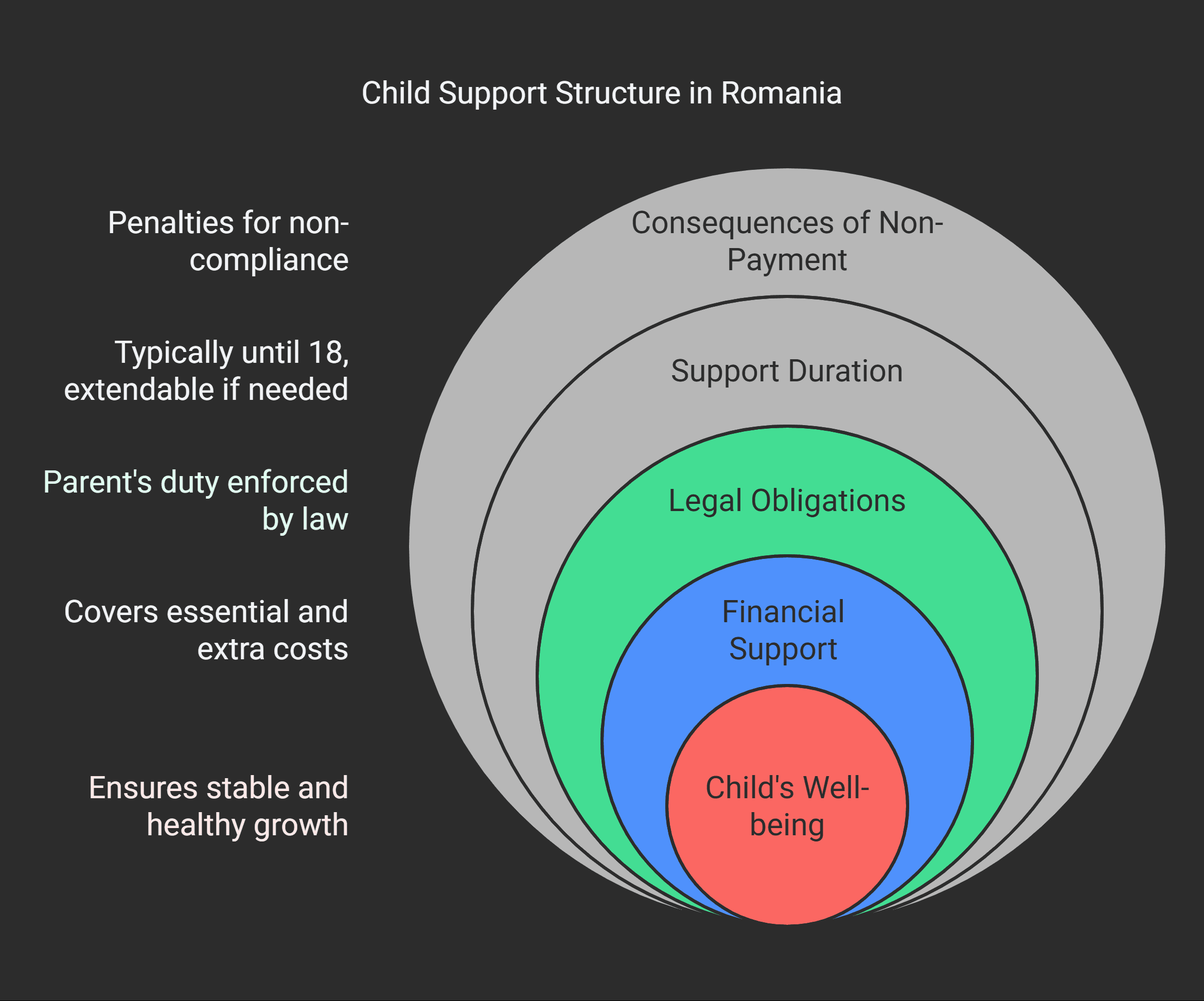
Child support in Romania is a key part of family law.

It makes sure parents take care of their kids, even if they’re not together.

The law says child support is money for kids’ basic needs and to help them grow well.

Child Support Under Romanian Law

Legal Definition and Purpose

The Romanian Civil Code says child support is a parent’s duty.

It covers things like food, clothes, and education.

The main aim is to keep the child’s life stable and help them grow right.

Scope of Financial Support

Child support includes many costs for a child’s care.

These are:

  • Housing costs;
  • Educational expenses;
  • Medical care;
  • Extracurricular activities;
  • Clothing and personal items.

Child support under Romanian law

Duration of Support Obligations

Support usually lasts until the child is 18.

But, it can go longer if the child keeps studying or has special needs.

The exact time depends on the situation and what the Court decides.

Child Support Obligations in Romania

In Romania, laws clearly state that parents must support their children.

Both custodial and non-custodial parents have specific duties.

These laws help ensure kids get the financial support they need for their upbringing and education.

Child support in Romania is based on the non-custodial parent’s income.

Here’s how it works:

Number of ChildrenPercentage of Net Monthly Income
1 childUp to 25%
2 childrenUp to 33%
3 or more childrenUp to 50%

Parents must support their children until they are 18.

If a child goes to college, support can last until they are 26.

Romanian laws also cover extra costs like education, medical bills, and activities outside school.

Child support obligations in Romania

If a parent doesn’t pay child support, they could face serious penalties.

Not paying for three months or more can lead to jail time or fines.

Courts can also take money from wages or seize assets to make sure kids get the support they need.

Calculating Child Support Payments

Understanding child support in Romania is key for parents.

The Romanian legal system has a clear way to figure out fair payments.

This ensures kids get the financial help they need.

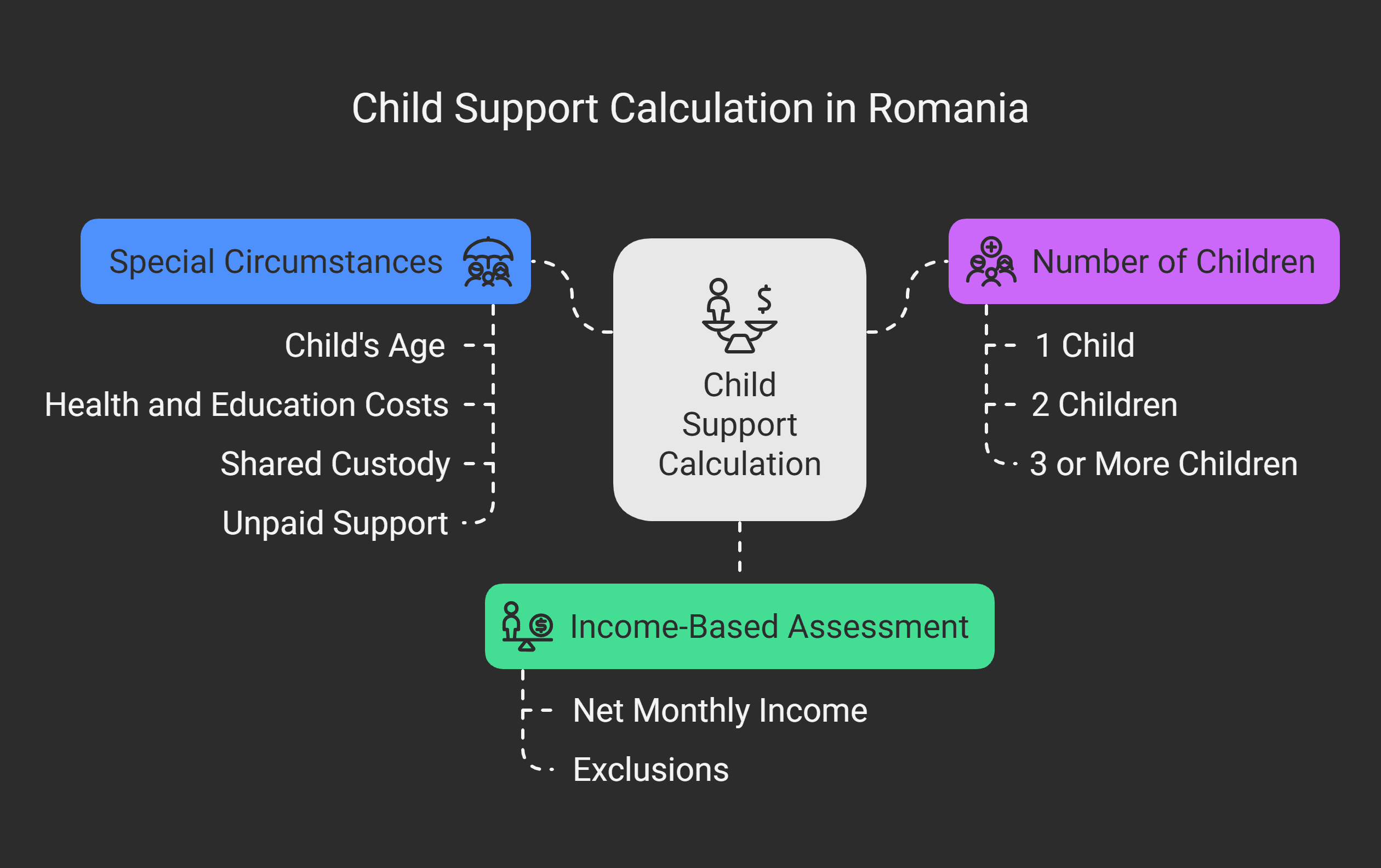
Income-Based Assessment

Child support starts with looking at the paying parent’s income.

Courts check the net monthly income, including salaries and permanent benefits.

But, they don’t count occasional incomes.

They usually look at the income over the past year.

Number of Children and Payment Percentages

The number of kids affects child support in Romania.

Here’s how it works:

Number of ChildrenMaximum Percentage of Net Income
1 childUp to 25%
2 childrenUp to 33%
3 or more childrenUp to 50%

It’s important to remember.

The total support a debtor owes can’t be more than 50% of their income.

Child support calculation Romania

Special Circumstances

Courts look at special situations when setting child support in Romania.

Things like the child’s age, health, and education costs matter.

They also consider the child’s standard of living.

If there’s shared custody or special needs, the court might change the percentages.

child support calculations romania

For unpaid child support in Romania, legal steps can be taken.

This could mean taking money from wages or seizing assets.

Keep in mind, child support orders don’t go back in time.

The obligation starts from when the court order was made or the support request was filed.

Legal Framework for Child Maintenance

Romania has a strong legal system for child support.

It’s based on Romanian family law and international agreements.

This ensures fair child support and allows for changes when needed.

Romanian Civil Code Provisions

The Romanian Civil Code is key for child support rules.

It explains who must support whom in families.

Article 513 talks about legal support duties, and Article 519 shows who comes first.

The code says child support lasts until the child is 26.

This ensures they are financially secure for a long time.

Family Law Statutes

Family laws in Romania add more details to child support rules.

They cover important points like:

  • Non-transferability of maintenance obligations;
  • Inclusion of essentials like food, clothing, and healthcare in support;
  • Responsibilities of heirs in continuing support for minors.

International Agreements

Romania is part of important international child support agreements.

The 2007 Hague Protocol helps decide which laws apply for support in EU countries.

This makes sure support is enforced across borders.

The European Judicial Network has created standard forms for maintenance issues.

These forms are in 23 languages.

They help make recovering support easier and more efficient for everyone.

Rights and Responsibilities of Parents

Parent rights and responsibilities in Romanian Law

In Romania, parents have more than just financial duties.

The law, mainly Law no. 272/2004, puts the child’s needs first.

This rule applies to all kids with Romanian citizenship, both in Romania and abroad, and to non-citizen kids living in Romania.

Parents must work together to care for their child.

This includes helping with their health and growth.

Even if they live apart, both parents are responsible for the child’s upbringing.

When parents split up, they must agree on where the child will live.

If they can’t agree, a court will decide what’s best for the child.

Parents also have to pay for things like school, medical bills not covered by insurance, and activities outside of school.

The law makes sure they do this.

It also says kids should keep in touch with both parents, unless it’s not good for them.

  • Parents must register children immediately after birth;
  • Birth certificates must be issued within 24 hours;
  • Parents must notify police within 24 hours if a child goes missing;
  • Both parents have the right to participate in decisions affecting the child.

Knowing these rights and duties helps parents meet their obligations.

It’s important for both parents to be involved in their child’s life and financial support, no matter who has custody.

Enforcement of Child Support Orders

Romania takes child support very seriously.

The country has strong laws to make sure parents pay up.

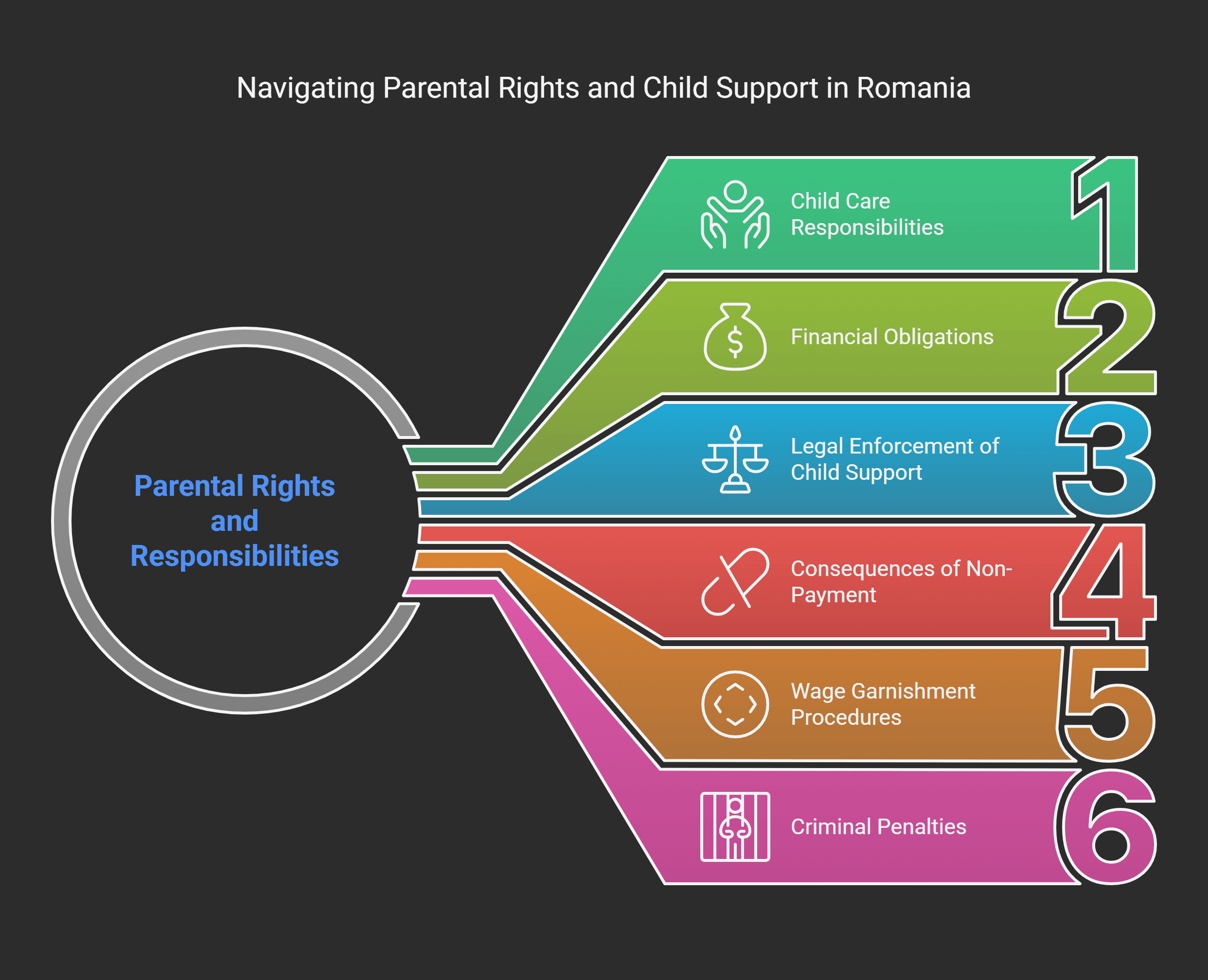
This part talks about how Romania enforces child support orders, including legal actions, wage garnishment, and criminal penalties.

Legal Consequences of Non-Payment

If a parent doesn’t pay child support in Romania, they face big problems.

The laws allow for strict measures.

Parents who don’t pay can get sued and have to pay fines.

Wage Garnishment Procedures

Wage garnishment is a common way to enforce child support.

Courts can tell employers to take money from the non-paying parent’s paycheck.

The amount taken depends on how many kids there are:

  • 25% of net monthly income for one child;
  • 33% for two children;
  • 50% for three or more children.

Criminal Penalties

For those who keep not paying, Romania has harsh penalties.

Article 305 of the Romanian Penal Code says parents who don’t pay for three months can get jailed for 6 months to 3 years or fined.

This shows how serious Romania is about child support.

Number of ChildrenMaximum GarnishmentCriminal Penalty for Non-Payment
One25% of net income6 months – 3 years imprisonment or fine
Two33% of net income6 months – 3 years imprisonment or fine
Three or more50% of net income6 months – 3 years imprisonment or fine

These steps help make sure kids get the money they need.

Romania’s efforts to enforce child support show its commitment to kids’ rights and well-being.

Modification of Support Orders

Child support orders in Romania can change.

Life events can affect your financial duties.

It’s important to know when and how to update these orders.

Changed Circumstances

Big life changes can mean you need to adjust child support payments.

Losing a job, getting a new one, or changes in your child’s needs can all require updates.

For example, if you lose your job, you might ask for lower payments.

Court Petition Process

To change a support order, you must ask the court.

You’ll need to show evidence of your new situation.

The court will look at your income and your child’s needs.

Documentation Requirements

Having the right documents is essential when asking for changes.

You’ll need to show proof of income changes, like pay stubs or tax returns.

For shared custody, you might also need to prove changes in parenting time or expenses.

Remember, not paying child support in Romania can lead to serious penalties.

This includes fines or even jail time.

It’s better to handle changes legally than to stop payments yourself.

Even with international child support, you can make changes with the right documents and legal advice.

Cross-Border Child Support Cases

Cross-border child support cases in Romania are complex.

They happen when one parent lives outside Romania.

This makes it hard to enforce child support orders.

Romania works with other countries to help with this through international agreements.

Romania is part of global treaties that make handling child support easier.

These agreements help make sure children get the financial support they need, no matter where their parents are.

The Romanian legal system helps keep child custody and support orders in place, even across international borders.

Family law in Romania understands the challenges of these cases.

It offers ways for parents to deal with legal systems in other countries.

Romanian courts can make orders that work in other countries, and they can also enforce orders from other countries.

Parents in cross-border cases should get legal advice to know their rights.

Romanian authorities make sure a child’s right to support is not affected by distance.

They always focus on what’s best for the child in legal matters.

Conclusion

Understanding child support in Romania is key for parents going through divorce or unmarried parents wanting to know their rights.

The Romanian legal system puts children’s well-being first.

It has clear rules for what parents owe their kids.

Romanian law says child support is money parents give to their kids until they’re 18.

How much they pay depends on their income, how many kids they have, and other special cases.

The laws in the Romanian Civil Code and Family Law make sure child support is fair and the same for everyone.

Not paying child support in Romania is taken very seriously.

If someone doesn’t pay, they might have their wages taken or face criminal charges.

Parents can ask to change how much they pay if their situation changes.

But, they must go through the right court steps and show the needed documents.

If you’re dealing with child support in Romania and it’s complicated, getting help from a lawyer is a good idea.

For expert advice on child support in Romania, email office@theromanianlawyers.com.

They can help based on your specific situation.

FAQ

What is the legal definition of child support in Romania?

In Romania, child support means the money parents must give to their kids for basic needs.

This includes food, clothes, and education.

It’s part of the family law to help kids grow up well.

How long do child support obligations typically last in Romania?

In Romania, child support usually lasts until a child is 18.

But, if a child keeps studying or has special needs, support can go longer.

How are child support payments calculated in Romania?

Payments in Romania depend on how much the paying parent earns.

The court looks at income, how many kids there are, and what the kids need.

Payments are usually 16% to 25% of the parent’s income, based on the number of kids.

Can child support orders be modified in Romania?

Yes, orders can change in Romania if things like income or needs change.

To ask for a change, a court petition is needed.

What are the consequences of not paying child support in Romania?

Not paying child support in Romania can lead to big problems.

You might face wage garnishment, fines, or even jail.

The law takes child support very seriously.

How are cross-border child support cases handled in Romania?

Romania deals with child support across borders through treaties.

Courts try to enforce orders, but it can be tricky because of legal and money differences.

What rights do non-custodial parents have regarding child support in Romania?

Non-custodial parents in Romania can ask for support changes if their situation changes.

They also have the right to be involved in their child’s life and have a relationship with them.

Are there special considerations for child support in cases of shared custody?

Yes, shared custody changes how child support is figured out in Romania.

The court looks at how much time each parent spends with the child.

But, the main goal is to make sure the child’s needs are met.

How does Romanian law handle child support for children with special needs?

Romanian law knows kids with special needs might need more money.

The court might order more support or keep it going longer to meet their needs.

Can parents make their own child support agreements in Romania?

Parents in Romania can make their own agreements, but the court must approve it.

The court checks if it’s good for the child and follows the law before saying yes.

What are the basic child support laws in Romania?

In Romania, child support (known as “pensie de întreținere” in Romanian) is regulated by the Romanian Civil Code and family law provisions.

According to Romanian law, both parents have a legal obligation to provide financial support for their minor child, regardless of whether they have child custody.

The Romanian Civil Code (Law no. 287/2009) specifically addresses child support obligations in Articles 499-531, emphasizing that supporting one’s children is both a moral and legal duty.

The principle underlying child support in Romania is always the best interests of the child, ensuring their proper development and well-being.

This obligation to provide financial support continues until the child reaches 18 years of age, but may extend if the child continues their education or has special needs.

Even when parents divorce or separate, their financial responsibilities toward their children remain unchanged under Romanian family law.

How is the amount of child support calculated in Romania?

The amount of child support in Romania is determined based on several factors, primarily the child’s needs and the parents’ financial circumstances.

Generally, the Romanian Civil Code establishes that child support payments should be approximately 1/4 of the paying parent’s net income for one child, 1/3 for two children, and 1/2 for three or more children.

However, these percentages are not strictly binding, as courts have discretion to adjust the amount of child support based on specific circumstances.

When determining the appropriate amount, courts consider the child’s age, educational needs, health requirements, and standard of living before the parents’ separation.

Additionally, the courts examine both parents’ income, earning capacity, and other financial obligations.

A child support lawyer in Romania can help navigate these calculations and ensure that the support order reflects fair consideration of all relevant factors.

The court may also periodically review and adjust the amount of child support if there are significant changes.