Do you need a lawyer to start a business in Romania illustration with legal scales, Romanian flag, and company registration document

Do You Need a Lawyer to Start and Run a Business in Romania?

Do You Need a Lawyer to Start and Run a Business in Romania? (Complete 2026 Guide for Entrepreneurs)

TL;DR: You don’t legally need a lawyer to start a business in Romania, but hiring one reduces legal risks, ensures compliance, and protects your business long-term.

Starting a business in Romania is one of the fastest and most affordable in the EU—but that doesn’t mean it’s risk-free. Many entrepreneurs underestimate legal complexity, only to face costly issues later.

Starting a business in Romania legal planning

This guide explains when you need a lawyer, when you don’t, and how to make the smartest decision for your business.


Do You Need a Lawyer to Start a Business in Romania?

No, you do not legally need a lawyer to start a business in Romania. However, hiring one helps prevent legal mistakes, ensures compliance, and protects long-term business growth.

Romania has simplified company registration through the ONRC (National Trade Register Office), allowing entrepreneurs to register businesses quickly—often within a few days.

  • You can submit documents yourself;
  • You can use standard templates;
  • You are not required to hire legal representation.

However, this simplicity applies only to registration—not to running a compliant and scalable business.


What Is Required to Start a Business in Romania?

To start a business in Romania, you must register with ONRC, choose a legal structure, set up accounting, and comply with Romanian and EU regulations.

Company registration documents Romania ONRC

The most common structure is an SRL (limited liability company), preferred for its flexibility and low startup costs.

  • Register company with ONRC (full guide)
  • Choose company structure (SRL)
  • Open business bank account
  • Hire accountant
  • Ensure compliance with GDPR regulations
  • Follow Romanian business law and contract law

While these steps are straightforward, mistakes in any of them can lead to long-term consequences.


Why Do Entrepreneurs Hire a Business Lawyer in Romania?

Entrepreneurs hire business lawyers to avoid costly mistakes, structure their company correctly, and ensure legal protection from the start.

Business lawyer consultation Romania startup

Most successful founders don’t wait for problems—they prevent them.

  • Correct legal structure from day one
  • Strong, enforceable contracts
  • Compliance with Romanian and EU law
  • Protection against disputes

Legal mistakes made early often become expensive problems later.


What Are the Risks of Starting Without a Lawyer?

Without legal guidance, businesses face risks such as incorrect structure, weak contracts, compliance violations, and disputes.

Legal risks for startups Romania

1. Incorrect Company Structure

The wrong structure can affect taxes, liability, and investment potential.

2. Weak Contracts

Generic templates often fail to protect your business. Learn more about contract drafting in Romania.

3. Compliance Issues

Ignoring GDPR or labor law can result in fines and penalties.

4. Business Disputes

Poor agreements lead to shareholder conflicts and legal disputes.


When Can You Start a Business Without a Lawyer?

You can start without a lawyer if your business is simple, low-risk, and has a single founder.

Many entrepreneurs begin this way and add legal support later.


When Should You Hire a Business Lawyer in Romania?

You should hire a lawyer when your business involves partners, employees, contracts, or legal complexity.

Signing business contracts Romania legal support
  • Multiple shareholders
  • Foreign investors
  • Hiring employees
  • Complex contracts
  • Regulated industries

Explore our corporate legal services for full support.


What Does a Business Lawyer Do?

A business lawyer structures your company, drafts contracts, ensures compliance, and prevents legal issues.

  • Company formation
  • Contract drafting
  • Legal compliance
  • Dispute resolution

They act as a strategic partner—not just a problem solver.


How Much Does a Business Lawyer Cost in Romania?

Costs typically range from €50–€150 per consultation and €200–€800 for company setup.

  • Consultation: €70–€250
  • Setup: €200–€800
  • Contracts: €100–€500
  • Ongoing: €50–€200/hour

Many businesses use legal subscriptions to reduce costs.


Is It Better to Start With or Without a Lawyer?

Starting with a lawyer reduces risk and builds a strong foundation, while starting without one saves money but increases long-term risk.

  • Without lawyer → cheaper, riskier
  • With lawyer → safer, scalable

Lawyer vs Accountant: What’s the Difference?

A lawyer handles legal matters, while an accountant manages taxes and financial reporting.

  • Lawyer → contracts, compliance
  • Accountant → taxes, bookkeeping

Business Startup Checklist in Romania

To start a business legally, follow these steps: register, structure, comply, and protect your company.

  1. Choose SRL structure
  2. Register with ONRC (guide)
  3. Draft agreements (contracts)
  4. Hire accountant
  5. Ensure GDPR compliance
  6. Prepare contracts

Common Legal Mistakes Entrepreneurs Make

Most business owners repeat the same legal mistakes, which can be avoided with proper planning.

  • Using generic contracts
  • Ignoring GDPR
  • No shareholder agreements
  • Mixing personal and business finances
  • Delaying legal advice

The Bottom Line

You can start a business in Romania without a lawyer, but hiring one significantly reduces risk and supports long-term success.

If your business is simple, you can start alone. If it involves growth, investment, or complexity, legal guidance is essential.

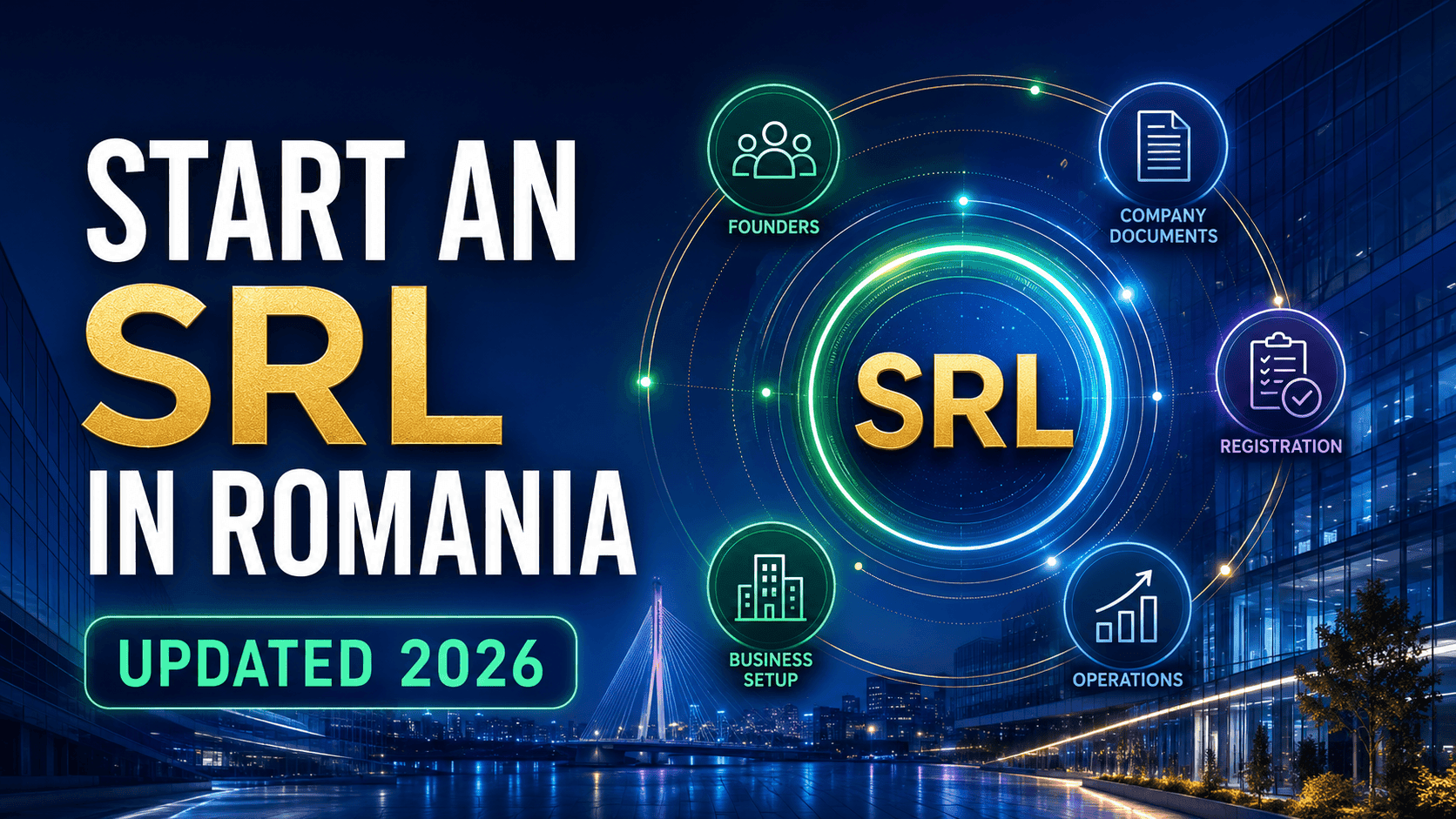
Start an SRL in Romania – Updated 2026

How to Start a Limited Liability Company (SRL) in Romania – Updated for 2026

How to establish a Romanian SRL in 2026

A Romanian limited liability company is not created by completing one standard form. The founders must settle the ownership, management, registered office, activities, capital and beneficial ownership before filing a consistent incorporation application with the Trade Register.

Romanian SRL formation ecosystem An animated orbital map showing the founders, registered office, company documents, capital, Trade Register and operational setup surrounding a Romanian SRL. ROMANIAN SRL • 2026 SRLROMANIA Foundersownership & control Capitalfunding structure ONRC filingregistration decision Operationsbank • tax • licences
A reliable incorporation file starts with coherent founder decisions and ends with the operational steps required after registration.

Short answer: an SRL is the most common Romanian company form for startups, SMEs and foreign-owned subsidiaries. In 2026, a newly incorporated SRL must have share capital of at least RON 500. Registration is only the first stage: banking, accounting, tax, employment and sector-specific requirements must be addressed separately.

What is a Romanian SRL?

An SRL, or societate cu răspundere limitată, is a Romanian legal entity whose share capital is divided into participation interests. As a general rule, the shareholders’ exposure is limited to their agreed contributions, while the company owns its assets and assumes its own contractual obligations.

Limited liability is not absolute protection against every personal risk. A shareholder or administrator may still face exposure under personal guarantees, director-liability rules, tax or insolvency provisions, unlawful distributions or abusive conduct. Governance and signing authority therefore matter from the incorporation stage.

This guide focuses only on the SRL. Foreign investors comparing an SRL with an SA, branch or representative office should first review our main page on company formation in Romania for foreign founders.

Which decisions must the founders make before filing?

OwnershipIdentify the shareholders, participation percentages, capital contributions and ultimate beneficial owners.
ManagementAppoint the administrator or administrators and define whether they represent the company separately or jointly.
ActivitiesSelect the principal and secondary activities under the official CAEN Rev.3 classification and check whether the proposed activity needs a Romanian business permit or licence.
Registered officeSecure a Romanian address and a legally valid document proving the company’s right to use it. Review the available registered-office options in Romania.
GovernanceAgree voting rules, reserved matters, profit distribution and procedures for conflicts. A 50/50 structure should include a workable shareholder-deadlock mechanism.
FundingSet the share capital and distinguish it from shareholder loans, future investment and working capital.
Common formation riskUsing a standard articles-of-association template without adapting representation powers, voting rules or transfer restrictions. Registration may succeed while the company is left with avoidable governance problems.

What is the minimum share capital for an SRL in 2026?

Following Law no. 239/2025, the minimum share capital for a newly incorporated SRL is RON 500. Older references stating that an SRL may be incorporated with RON 1 or without an effective minimum are no longer current.

Law no. 239/2025 also establishes a minimum share capital of RON 5,000 for an SRL whose reported net turnover for the previous financial year exceeds RON 400,000. Existing companies falling within that rule must observe the statutory adjustment period. The applicable amount should therefore be checked both at incorporation and when the company’s turnover changes. The implementation steps are discussed separately in our guide to a Romanian company capital increase.

SituationMinimum capitalPractical consequence
Newly incorporated SRLRON 500The articles of association and capital structure must reflect at least this amount.
SRL with reported net turnover above RON 400,000RON 5,000The company must bring its capital into line with the statutory rule within the applicable period.
Additional business fundingCommercial decisionShare capital should not be confused with shareholder loans or the actual operating budget.

Under Law no. 31/1990, an SRL must pay at least 30% of the subscribed capital no later than three months after registration and before commencing operations in its own name. The remaining cash contribution is payable within 12 months after registration, while the remaining in-kind contribution is payable within no more than two years.

Capital is not the complete formation budgetFounders should separately budget for translations, apostilles or legalisation, registered-office arrangements, professional fees, banking, accounting, publication charges and any licences required for the intended activity.

What documents are generally required?

The precise filing depends on the founders, administrator, office and activities. A standard SRL incorporation usually requires or relies on:

  • the Trade Register incorporation application;
  • proof of company-name reservation;
  • the articles of association;
  • documents proving the right to use the registered office;
  • identity documents for individual shareholders and administrators;
  • current registry extracts, constitutional documents and corporate approvals for a corporate shareholder;
  • statutory declarations concerning operating conditions and other legally required matters;
  • beneficial-owner information or a separate declaration, where required;
  • evidence of authority for the person signing or filing the application; and
  • any approvals, opinions or documents required by the proposed name or regulated activity.

The official list and current forms should be checked on the National Trade Register Office website immediately before filing. A missing mandatory element may result in rejection rather than an informal opportunity to complete the file. Founders can prepare the file using our separate checklists for reserving a Romanian company name and drafting Romanian articles of association.

What changes when a shareholder is foreign?

Foreign individuals and companies may generally hold participation interests in a Romanian SRL. Romanian citizenship or residence is not, by itself, a general ownership condition. However, foreign documents must be assessed for validity, authority, legalisation or apostille and authorised Romanian translation.

A foreign corporate shareholder may need a recent registry extract, its constitutional documents, a resolution approving the Romanian investment and evidence that the signatory can bind it. The exact formalities depend on the issuing state, applicable treaties and the document used. Our document checklist for foreign founders explains the preparation issues in more detail.

The ownership chain must also be traced to the natural persons who ultimately own or control the company. The applicable tests and filing deadlines are explained in our updated guide to the beneficial owner declaration in Romania.

Company ownership is not immigration statusIncorporating or owning an SRL does not automatically grant a foreign founder the right to enter, reside or work in Romania. Immigration and work-authorisation requirements require a separate analysis.

How does the Romanian SRL formation process work?

Formation map

From founder decisions to operational setup

Romanian SRL formation roadmap An animated six-card roadmap from company structure and documents through ONRC filing, registration and operational activation. SRL FORMATION ROADMAPROMANIA • 2026 01StructureOwnership • managementactivities • capital 02Name & officeName reservationregistered-office title 03DocumentsArticles • identitiesforeign formalities 04ONRC filingPortal • counterlawyer representation 05RegistrationRegistrar decisioncompany certificate 06ActivationBank • tax • accountinglicences • contracts
Trade Register approval creates the company, but banking, tax, accounting and operational compliance continue after registration.
Define the structureSet ownership, management, activities, capital, governance and the post-registration plan.
Reserve the nameSubmit suitable alternatives and obtain proof of availability through ONRC.
Secure the registered officePrepare the lease, loan-for-use agreement or other valid title to the premises.
Prepare the incorporation fileDraft the articles and collect the founder, administrator, corporate and beneficial-owner documents.
Submit the applicationFile at the counter, by post or courier, or electronically under the signature and format rules.
Complete operational setupAddress capital payment, bank onboarding, accounting, tax registrations, authorisations, contracts and employment.

Can the SRL application be submitted online or through a lawyer?

Yes. Under Law no. 265/2022 on the Trade Register, an incorporation application may be filed at the counter, through post or courier, or electronically. Electronic documents must comply with the qualified-electronic-signature requirements. A lawyer may sign or submit the application on the basis of a legal-services mandate and may transmit documents prepared by the lawyer under the statutory procedure.

The available electronic services can be accessed through ONRC MyPortal. Remote incorporation is possible in many cases, but foreign-document formalities, bank identification, regulated activities and immigration matters may require additional steps.

How long does SRL registration take?

The Trade Register states that a complete registration application is generally resolved by the registrar within one working day after registration of the application. This procedural period is not a guaranteed end-to-end formation time.

Name reservation, document preparation, foreign legalisation, translations, correcting inconsistent information, obtaining a registered office and responding to registrar requirements may extend the project. Bank onboarding and licences also occur outside the basic incorporation decision.

Use a two-part timelineSeparate the time required to obtain the Trade Register decision from the total time required for the company to become operational. A registered SRL may not yet be ready to invoice, employ staff or perform a regulated activity.

What does it cost to establish an SRL?

There is no reliable universal package price. The total depends on the founders and documents involved. A realistic budget may include:

  • the subscribed share capital;
  • official publication or registration-related charges generated for the file;
  • translations, apostilles, legalisation or notarial formalities;
  • legal assistance and representation;
  • registered-office costs;
  • bank, accounting and tax-advisory services; and
  • licensing or sector-specific costs.

According to the ONRC information published on 30 April 2026, the tariff for publication in the Official Gazette is calculated and paid after the registration application is admitted. A generic statement that every SRL has a fixed “state fee of EUR 50” should therefore not be used.

What must be done after the SRL is registered?

The registration certificate does not complete every business requirement. Depending on the project, the founders should address:

Post-registration areaQuestions to resolveMain risk if ignored
Capital and bankingCapital payment, operating account, signatories, bank KYC and the steps for a Romanian business bank account for a non-residentThe company cannot use the intended banking arrangements or misses a statutory contribution deadline.
Accounting and taxAccounting engagement, tax vector, VAT analysis, reporting calendar and ongoing Romanian tax registration and complianceLate filings, incorrect invoicing or unsuitable tax treatment.
Activity authorisationWhether the declared CAEN activities may be performed at the office, third-party sites or outside a fixed locationThe company is registered but not authorised to conduct the intended activity.
Contracts and governanceCustomer, supplier, employment, administrator and shareholder arrangementsOperational exposure and internal disputes begin before protections are documented.
Regulated sectorsLicences, notifications, professional requirements or foreign-investment screeningThe business starts an activity before regulatory clearance.

Tax positions should be checked against the current ANAF guidance and electronic services. VAT registration, payroll reporting and the applicable corporate or microenterprise regime depend on facts that are not resolved merely by incorporating the SRL.

Which SRL formation mistakes cause delays or future disputes?

  • choosing CAEN codes without checking whether the activity is regulated or may be authorised at the selected location;
  • submitting foreign documents that are outdated, improperly legalised or inconsistently translated;
  • using unclear joint or separate representation powers for multiple administrators;
  • treating share capital as the complete operating budget;
  • failing to identify indirect beneficial owners;
  • assuming that incorporation grants immigration or work rights;
  • using generic voting clauses in a 50/50 company without a workable deadlock solution; and
  • waiting until after registration to address banking, accounting, tax or licensing requirements.

Where there are several founders, the articles should be coordinated with a properly drafted Romanian shareholder agreement. Administrators should also understand the exposure explained in our guide to Romanian company director liability.

Need assistance establishing an SRL in Romania?

Atrium Romanian Lawyers assists Romanian and foreign founders with company structuring, articles of association, beneficial ownership, registered-office documentation, Trade Register filings and post-incorporation corporate work.

Frequently asked questions

What is the minimum share capital for a new Romanian SRL in 2026?

The minimum share capital for a newly incorporated SRL is RON 500. A separate RON 5,000 minimum applies to SRLs whose reported net turnover for the previous financial year exceeds RON 400,000, subject to the statutory adjustment rules.

Can a foreigner own 100% of a Romanian SRL?

In general, yes. Romanian citizenship or residence is not a general condition for owning an SRL. The founder’s documents, beneficial ownership, applicable foreign-investment rules and any regulated-sector restrictions must still be checked.

Can an SRL have one shareholder and one administrator?

Yes. An SRL may generally have a sole shareholder, who may also be appointed administrator. The articles should still regulate the company’s activities, capital, representation and beneficial-owner information correctly.

Is a Romanian bank account required before incorporation?

The banking sequence must be coordinated with the applicable capital-payment rules and the chosen bank. The company must pay the required portion of subscribed capital within the statutory period and before commencing operations in its own name.

Can the SRL be incorporated remotely?

Often, yes. The application may be submitted through an authorised representative or electronically where the signature and document-format requirements are met. Foreign formalities, bank KYC, licences or immigration steps may still require separate action.

Does Trade Register registration mean the SRL can immediately perform every declared activity?

No. Certain activities require additional authorisation, licences, notifications, qualified personnel or suitable premises. Registration and operational authorisation must be checked separately.

Disclaimer: This article provides general information and does not constitute legal or tax advice. The correct formation process depends on the founders, ownership structure, activities, documents and legislation in force when the application is prepared.

AI Notice: AI-assisted content, reviewed and approved by a qualified Romanian lawyer.

Essential Documents for Foreign Founders Starting a Business in Romania

Essential Documents for Foreign Founders Starting a Business in Romania

Play

Essential Documents for Foreign Founders Starting a Business in Romania

What if the fastest way to launch a European business isn’t where you’d expect?

Romania’s streamlined corporate framework allows entrepreneurs to establish an SRL company in just three working days with current minimum capital requirements that have recently undergone significant changes in 2025.

A stack of official documents and forms on a desk.

But beneath this efficiency lies a critical question:

How can international investors avoid hidden pitfalls in documentation processes that could derail their ambitions?

Romania’s open-market policies permit full foreign ownership without local partnership mandates, creating attractive opportunities for global entrepreneurs.

However, the registration process demands precise adherence to legal standards.

Corporate filings must align with Trade Register specifications, including certified translations into Romanian or bilingual formats.

Strategic document preparation forms the backbone of successful incorporation.

Errors in paperwork often lead to delays, financial penalties, or rejected applications.

Professional legal guidance from lawyers in Romania ensures compliance with corporate law frameworks while maintaining operational legitimacy from day one.

Investors benefit from understanding how each document interacts with regulatory systems.

Properly structured articles of association, shareholder agreements, and notarized identification papers establish transparent governance structures.

These elements collectively safeguard business interests within Romania’s evolving economic landscape.

Key Takeaways

  • Romania permits 100% foreign-owned companies with fast 3-day Trade Register approval timelines,
  • Document preparation requires strict compliance with Romanian language standards,
  • Legal expertise minimizes risks of administrative delays or non-compliance penalties,
  • Corporate filings must align with Trade Register specifications for approval,
  • Precise paperwork establishes long-term operational legitimacy,
  • VAT rate increased to 21% in August 2025, with registration threshold at RON 395,000,
  • Minimum capital requirements are undergoing reform, with new tiered structure proposed.

Introduction to Business Registration in Romania

A businessman reviewing papers at a desk.

Romania’s economic landscape presents a compelling proposition for global enterprises seeking competitive positioning in Europe.

As an EU member state, the country serves as a strategic crossroads connecting major continental markets.

This geographic advantage, combined with progressive regulatory frameworks, creates fertile ground for sustainable business growth.

Overview of the Romanian Market

A group of diverse business people reviewing documents around a table.

The local market distinguishes itself through a growing pool of skilled workforce, particularly in technology and engineering sectors.

Romania produces approximately 18.6 STEM graduates per 1,000 people aged 20-29, though this remains below the EU average of 23.0.

The country is actively working to expand its technical education programs.

Operational costs remain 34-51% lower than Western European averages without compromising service quality, with Romanian developer salaries approximately 40% below comparable Western rates.

Infrastructure development continues accelerating across transportation and digital networks.

Modern highways connect major cities to EU trade routes, while digital coverage expands nationwide.

These advancements enable companies to maintain efficient supply chains and regional operations.

Benefits for Foreign Entrepreneurs

Several colorful flags are displayed on a desk next to business papers.

Romania offers foreign investors streamlined processes through recent legal reforms.

The elimination of redundant permits and digital filing systems reduces Trade Register approval to approximately three working days.

EU membership guarantees alignment with continental standards while preserving local cost advantages.

Investors benefit from tax incentives for research-driven business initiatives and export-oriented activities.

Cultural adaptability further enhances market entry, with English widely spoken in professional environments.

These factors position the country as an attractive destination for scalable international ventures.

Why Start a Business in Romania?

A close-up of a business plan document with charts and graphs.

Romania’s tax and regulatory systems create a unique value proposition for commercial ventures targeting European markets.

Strategic fiscal policies combine with progressive legislative changes to support both startups and established enterprises.

Attractive Tax Environment

A smiling business person holding a briefcase and standing in front of a modern office building.

The country maintains one of Europe’s most competitive tax frameworks, though recent changes require careful attention.

Microenterprises benefit from a 1% revenue tax when employing at least one worker and earning up to €60,000 annually.

For revenues above €60,000 or for specific sectors like IT services (CAEN codes 6210, 6290) and restaurants, a 3% rate applies.

Traditional corporations face a flat 16% profit tax.

Tax TypeRateConditions
Microenterprise1%Revenue under €60K with 1+ employee
Microenterprise3%Revenue €60K-€250K (€100K from 2026) or IT/restaurant activities
Corporate Profit16%Standard companies
Dividends10%Increased from 8% in January 2025
Standard VAT21%Increased from 19% in August 2025
Reduced VAT11%Consolidated rate from August 2025

Favorable Legal Reforms

Recent legislative updates streamline operations for international investors.

Digital registration systems cut Trade Register processing times to 3 working days, while revised thresholds for micro-tax status continue until 2026, though the revenue limit decreases from €250,000 to €100,000 starting January 2026.

Enhanced transparency measures reduce bureaucratic hurdles.

Special support programs assist startups in navigating compliance requirements, ensuring smooth market entry.

However, investors must stay updated on frequent tax law changes, including the August 2025 VAT increase from 19% to 21%.

Understanding Legal Structures for Foreign Founders

Selecting the optimal legal framework forms the cornerstone of successful business operations.

Romania offers multiple corporate formats, each aligning with specific operational scales and strategic objectives.

Three primary options dominate commercial registrations, balancing legal safeguards with administrative practicality.

Limited Liability Company (SRL)

An open laptop displaying a business registration website.

The Societate cu Răspundere Limitată (SRL) remains the preferred choice for most ventures.

This structure provides limited liability protection, shielding personal assets from business debts.

Requirements include:

  • 1–50 shareholders
  • Minimum share capital currently ranges from RON 1 to RON 200 (sources vary), with a new tiered proposal for 2025-2026: RON 500 for new companies, increasing to RON 5,000 for revenues between RON 395,000-7 million, and RON 90,000 for revenues exceeding RON 7 million,
  • Simplified management structures.

Governance flexibility allows swift decision-making, ideal for small-to-medium enterprises. Annual reporting obligations remain manageable compared to complex entities.

StructureShareholdersCurrent CapitalProposed Capital (2025-2026)Best For
SRL1–50RON 1-200RON 500-90,000 (tiered)Startups/SMEs
SAUnlimitedRON 90,000RON 90,000 (€25,000)Large enterprises


Joint-Stock Company (SA) and Other Options

A group of diverse people discussing papers around a table.

The Societate pe Acțiuni (SA) suits ventures planning IPOs or major investments.

Key features include:

  • Minimum capital: RON 90,000 (approximately €25,000),
  • Public share trading capability,
  • Formal governance requirements.

Alternative structures like branches or partnerships serve niche scenarios.

Professional guidance ensures alignment between legal frameworks and long-term growth strategies, particularly given the evolving minimum capital requirements.

Required Documents for Foreign Founders in Romania

A person holding a passport and a business plan.

Navigating corporate registration demands meticulous attention to foundational paperwork.

Seven core submissions form the basis of compliant filings, supported by supplementary materials that address cross-border complexities.

The application form and tax annex require detailed operational data, including management structures and activity codes.

Identity verification for administrators ( directors) necessitates certified copies of passports or national IDs, translated into Romanian by authorized professionals.

Shareholder affidavits confirm tax status for individuals lacking local fiscal identification.

These declarations prevent delays during fiscal authority reviews.

Articles of Association drafted in Romanian establish governance protocols, requiring alignment with national corporate law frameworks.

Proof of registered office ranges from property deeds to virtual office contracts, validating a physical business address.

Beneficial ownership disclosures meet EU anti-money laundering directives, tracing control chains for transparency.

Optional apostille certifications authenticate foreign-signed documents.

While not mandatory, these additions streamline verification processes across jurisdictions.

Professional legal review ensures technical accuracy before Trade Register submission, particularly important given recent regulatory changes.

Preparing Your Articles of Association and Registered Office

A person is typing on a laptop with documents spread out on a table.

The foundation of a compliant Romanian enterprise lies in two critical components: constitutional documents and physical establishment.

These elements define operational boundaries while meeting legal obligations under national corporate frameworks.

Drafting the Articles of Association

A person reviews a document with a focused expression while sitting at a table.

Articles of Association act as a company’s operational blueprint.

This legally binding document must specify shareholder voting rights, capital distribution models, and decision-making hierarchies.

Romanian law mandates inclusion of NACE codes to classify business activities accurately.

Management roles require precise definitions of authority limits and appointment procedures.

Provisions for General Meetings must outline resolution processes and quorum requirements.

Legal professionals recommend embedding flexibility clauses to accommodate future growth scenarios, including provisions for the new tiered minimum capital requirements expected to phase in through 2026.

Establishing a Proof of Registered Office

All entities must maintain a verifiable registered office within Romania.

Valid proof includes notarized lease agreements or property ownership documents.

Virtual office contracts have gained traction for cost efficiency while fulfilling legal address requirements.

Service providers offering virtual solutions must issue compliance certificates recognized by the Trade Register.

Physical locations require utility bills or municipal confirmations.

Consistent address details across all filings prevent administrative delays during registration.

Steps in the Company Registration Process

A person filling out forms with a pen.

Establishing a corporate entity in Romania follows a precise sequence of regulatory actions.

This systematic approach ensures compliance while maintaining operational efficiency for new market entrants.

Name Reservation and Document Filing

The initial company name reservation occurs through the National Trade Register Office (ONRC) portal.

This free digital service verifies name availability against existing registrations within minutes.

Approved reservations remain valid for 30 calendar days, creating urgency for subsequent filings.

Document preparation requires alignment with ONRC specifications.

Essential materials include translated identification papers and notarized corporate agreements.

Submissions can occur physically at regional offices or digitally using qualified electronic signatures.

Processing with the Trade Register

Officials typically complete company registration reviews within three working days for the Trade Register approval.

This period allows thorough verification of statutory documents and legal compliance checks.

Delays usually stem from incomplete filings or translation discrepancies.

Successful applicants receive three critical identifiers: the Certificate of Incorporation, CUI tax code, and Certificat Constatator.

These enable immediate banking operations and contractual engagements across Romania.

Note that while Trade Register approval is fast, the complete registration process including VAT registration and full operational readiness typically takes 7-10 working days.

Navigating Tax and VAT Registration in Romania

An open laptop displaying a tax registration website with a cup of coffee nearby.

Understanding fiscal obligations marks a critical phase for enterprises establishing operations in emerging markets.

Romania’s integrated tax system combines automatic corporate registration with strategic VAT options, creating adaptable frameworks for diverse commercial needs.

Corporate and Microenterprise Tax Details

Newly registered companies receive tax IDs during incorporation, enabling immediate financial operations.

Important Update for 2025-2026:

Microenterprises benefit from preferential tax rates when maintaining at least one employee:

  • 1% tax rate on revenue up to €60,000
  • 3% tax rate on revenue from €60,000 to €250,000 (2025) or €100,000 (from January 2026)

Special activities including IT services (CAEN codes 6210, 6290), restaurants, and mobile food services are subject to the 3% rate regardless of revenue level.

Standard corporate tax applies at 16% for profits when companies exceed micro-company thresholds or don’t qualify for the regime.

The dividend withholding tax increased to 10% as of January 1, 2025 (previously 8%) for all recipients.

VAT Registration Requirements

Critical 2025 Updates:

Businesses must register for VAT when exceeding RON 395,000 annual turnover (effective September 1, 2025, increased from RON 300,000).

The standard VAT rate is 21% (increased from 19% in August 2025), with a consolidated reduced rate of 11% replacing the previous 5% and 9% rates.

Voluntary VAT registration remains available for smaller enterprises seeking input tax recovery.

Sector-specific rules apply, with businesses engaged in EU trade requiring VAT registration regardless of turnover thresholds.

FAQ

What legal structure is most common for foreign entrepreneurs in Romania?

The limited liability company (SRL) is preferred due to its flexibility and simplified compliance requirements.

Current minimum share capital varies between RON 1-200, with a new tiered proposal being implemented: RON 500 for new companies, increasing based on revenue thresholds to RON 5,000 (for revenues RON 395,000-7 million) and RON 90,000 (for revenues exceeding RON 7 million).

It allows full foreign ownership and limits liability to invested capital.

How does Romania’s tax environment benefit startups?

Romania offers a 16% corporate tax rate, one of the lowest in the EU.

Microenterprises with at least one employee pay only 1% on turnover up to €60,000 and 3% from €60,000 to €250,000 (reducing to €100,000 threshold from January 2026), making it ideal for early-stage businesses.

However, IT services and certain other sectors pay 3% regardless of revenue level.

Can a virtual office serve as proof of registered office?

Yes, foreign founders can use virtual office services compliant with Romanian law.

The address must be verifiable and included in the Articles of Association during company registration.

What are the VAT registration requirements for new businesses?

Updated for 2025: Companies must register for VAT if annual turnover exceeds RON 395,000 (effective September 1, 2025).

The standard VAT rate is 21% (increased from 19% in August 2025), with a reduced rate of 11%.

Voluntary registration is permitted, allowing input tax recovery.

Non-EU businesses require a fiscal representative for compliance.

How long does the company registration process take?

The Trade Register approval typically takes 3 business days with complete documentation.

However, the full registration process including VAT registration and complete operational setup takes 7-10 working days.

Delays often arise from incomplete documents or translation issues.

Are foreign shareholders required to visit Romania during incorporation?

No. A local lawyer can handle filings via power of attorney.

Notarized documents and apostilled/legalized identification (e.g., passports) must be submitted electronically or by courier.

What post-registration obligations apply to Romanian companies?

Firms must file annual financial statements, maintain accounting records, and submit monthly/quarterly tax declarations.

Important: As of 2025, the dividend tax is 10% (increased from 8%).

Companies must monitor the microenterprise revenue threshold, which decreases from €250,000 to €100,000 on January 1, 2026.

Hiring employees triggers additional labor law and social security compliance.

What are the current VAT rates in Romania?

Updated August 2025: The standard VAT rate is 21% (increased from 19%), and the reduced rate is 11% (consolidating the previous 5% and 9% rates).

These changes took effect August 1, 2025.

What documents are required to register a company in Romania as a foreigner?

To register a company in Romania, foreigners need to prepare and submit several necessary documents.

These include identification documents such as a valid passport, proof of address in Romania, and incorporation documents specific to the type of business structure chosen, whether it be a joint stock company or a limited liability company (SRL).

Additionally, an application for registration must be completed, and the unique company name must be verified through the trade registry.

How does the company registration process work for foreign entrepreneurs?

The company registration process for foreign entrepreneurs in Romania involves several key steps.

First, you must select a business structure and prepare the necessary documents.

Then, you will need to submit these documents to the trade registry for approval.

Following this, you will need to register your business office in Romania and meet the minimum share capital requirement.

Finally, once all documents are approved and the company is registered, you will receive a registration certificate, allowing you to start your business operations in Romania.

What are the benefits of starting a business in Romania as a foreigner?

Starting a business in Romania offers numerous benefits for foreign entrepreneurs.

Romania is situated in a strategic location within the European Union, providing access to a vast market.

The business environment is continually improving, with various incentives for foreign investment.

Additionally, the country offers a range of business structures available, allowing entrepreneurs to select the type of company that best fits their business needs.

This makes Romania an attractive destination for foreign founders looking to expand their operations in Europe.

 
Romanian Company Board Meetings

Navigating Romanian Company Board Meetings: Key Insights

Navigating Romanian Company Board Meetings: Key Insights

A group of people sits around a large conference table with papers and laptops in front of them.

Understanding the nuances of Romanian company board meetings is important for anyone involved in the management of companies in Romania.

This article provides key insights into the structure, legal requirements, and best practices for conducting effective board meetings in accordance with Romanian company law.

We will explore the roles and responsibilities of directors, shareholders, and other key stakeholders in the Romanian corporate governance landscape.

Understanding the Structure of Romanian Companies

A projector displays a presentation on the wall with graphs and charts.

Overview of Atrium Romanian Lawyers

Romanian company law dictates the formation, operation, and governance of various types of companies in Romania.

The type of company significantly impacts its organizational structure and the regulations governing its board meetings.

Atrium Romanian Law Office, an expert legal services provider, highlights that Romanian lawyers must navigate these regulations meticulously.

The Articles of Association define the company’s internal rules, complementing the broader legal framework and influencing how the board of directors operates and how resolutions of the general meetings are implemented.

Types of Romanian Companies

Romania provides various legal entity options, each possessing unique attributes.

Two frequently chosen forms are:

  1. Limited liability companies (SRL), which are often preferred by smaller businesses due to their simpler organizational structures.
  2. Joint-stock companies (SA), designed for larger enterprises and characterized by more complex governance procedures.

Ultimately, the selection between these legal structures will influence the company’s meeting and decision-making protocols.

Legal Entities and Their Responsibilities

As legal entities, Romanian companies bear specific responsibilities under Romanian law.

The board of directors, or the management board, plays a pivotal role in overseeing the company’s operations and ensuring compliance.

Members of the board are entrusted with representing the company, and their actions must align with both the law and the company’s articles of association.

The company is managed in accordance with the law, and the directors or the management board are responsible for preparing financial statements of the company and filing them with the Trade Registry.

Shareholder Meetings in Romania

A clock on the wall shows the time during the meeting.

Types of Shareholder Meetings

Under Romanian company law, various types of shareholder meetings serve distinct purposes.

These meetings are critical for the management of companies, ensuring transparency and shareholder involvement.

For example:

  1. The annual general meeting is a mandatory gathering where shareholders review the financial statements of the company and elect the board of directors or supervisory board.
  2. Extraordinary general meetings are convened to address specific, urgent issues such as amending the articles of association, increasing the share capital of the company, or approving significant transactions.

Convene Procedures for Shareholder Meetings

To convene a shareholder meeting, Romanian companies must adhere to specific procedures.

The board of directors, or in some cases, the supervisory board, must issue a notice to all shareholders, detailing the meeting’s agenda, date, time, and location.

This notice must be sent within the timeframe prescribed by Romanian company law and the company’s articles of association.

Failing to follow these procedures may invalidate the resolutions of the general meetings passed during the meeting, potentially leading to legal challenges.

Amending Resolutions in Shareholder Meetings

Shareholders can amend resolutions during the shareholder meeting under Romanian law, provided the proposed amendments are within the scope of the original agenda.

The process typically involves a motion to amend, followed by a vote among the shareholders.

For significant amendments, such as those affecting the articles of association, a supermajority vote may be required, and the amended resolution must be filed with the Trade registry.

Understanding these procedures is vital for effective corporate governance in Romanian companies.

The Role of the Board of Directors

A woman presenting a report on a screen in front of the board.

Composition of the Board of Directors

The composition of the board of directors is a critical element in the management of the company.

Under Romanian company law, the Articles of association of Romanian companies will specify the number of members of the board, their qualifications, and the process for their appointment.

In joint stock companies, the shareholder structure dictates that some directors or the management board are appointed by the general meeting of shareholders, ensuring the shareholder interests are adequately represented.

This structure aims to balance expertise and shareholder oversight.

Duties and Responsibilities of Board Members

Members of the board have extensive duties and responsibilities under Romanian law.

They are entrusted with the strategic direction of the company in Romania, ensuring compliance with regulations, and safeguarding the interests of all shareholders.

The board of directors is responsible for overseeing the financial statements of the company, ensuring their accuracy and timely filing with the trade registry.

In joint stock companies, the board also manages risk, sets policy, and monitors the performance of the management board, upholding their fiduciary duty to the company.

Decision-Making Processes in Board Meetings

Effective decision-making in board meetings is crucial for the success of Romanian companies.

The process typically involves presenting agenda items, facilitating discussion, and voting on resolutions.

The Articles of association often prescribe specific voting thresholds for different types of decisions.

For significant matters, such as amending the Articles of Association or increasing the share capital of the company, a qualified majority or even unanimous consent may be required.

Proper documentation of these decisions in the meeting minutes is essential for transparency and accountability, and the minutes should be filed with the trade registry as appropriate.

General Meetings: Best Practices

Several individuals are engaged in discussion, with some taking notes.

Planning and Conducting General Meetings

Effective planning is essential for successful general meetings in Romanian companies.

The board of directors must meticulously plan the agenda, ensuring all relevant items are included and clearly defined.

Romanian company law mandates that the Articles of Association dictate the specific procedures for these meetings.

As an expert legal services provider, we emphasize that proper notice must be given to all shareholders, and the meeting should be convened in a manner that promotes transparency and active participation, whether for limited liability companies or joint stock companies.

We are dedicated to helping our clients navigate these processes smoothly.

Legal Requirements for General Meetings

Adherence to legal requirements is paramount for general meetings in Romania.

Romanian law stipulates specific rules for voting, quorum, and documentation of resolutions of the general meetings.

The board of directors must ensure that all procedures align with both Romanian company law and the articles of association.

Members of the board must understand that failure to comply can invalidate the meeting’s outcomes, potentially leading to legal challenges.

Our firm provides expert guidance to Romanian companies in navigating these complex legal obligations, ensuring compliance and protecting shareholder interests.

Best Practices for Effective Communication

Effective communication is a cornerstone of successful general meetings.

Members of the board should ensure that information is presented clearly and concisely, allowing all shareholders to understand the issues at hand.

In Romanian companies, this includes providing materials in Romanian and, potentially, other languages if international shareholders are involved.

Encouraging open dialogue and addressing shareholder concerns promotes trust and transparency.

As a client-focused firm, we emphasize the importance of proactive communication to facilitate productive and legally sound board meetings.

Recent Developments in Romanian Company Law

Documents and folders are neatly arranged on the table for review.

Changes Impacting Board Meetings

Recent changes in Romanian company law have significantly impacted board meetings.

Amendments related to corporate governance and shareholder rights necessitate that directors or the management board stay informed and adapt their practices accordingly.

These changes may affect procedures for votes, the handling of resolutions, and the overall management of the company.

As an expert team of Romanian lawyers, we closely monitor these developments and provide timely advice to our clients, ensuring their companies remain compliant and competitive.

These updates are particularly relevant for both limited liability companies and joint stock companies.

Emerging Trends in Corporate Governance

Emerging trends in corporate governance are reshaping how Romanian companies conduct board meetings.

There is a growing emphasis on transparency, accountability, and environmental, social, and governance (ESG) factors.

Companies are increasingly adopting digital solutions to streamline meeting processes and enhance shareholder engagement.

The articles of association of Romanian companies are evolving to reflect these trends, often requiring more detailed reporting and greater shareholder involvement.

We assist our clients in integrating these best practices to enhance their corporate governance frameworks and attract investment.

Case Studies of Successful Board Practices

Examining case studies of successful board practices provides valuable insights for Romanian companies.

Instances where board meetings effectively addressed critical challenges, implemented innovative strategies, or improved shareholder relations offer practical lessons.

These examples often highlight the importance of diverse members of the board, robust decision-making processes, and proactive risk management.

We leverage our experience and expertise to help clients implement similar strategies, fostering a culture of excellence and driving sustainable growth for Romanian companies across various sectors, including both limited liability and joint stock companies.

FAQ:

What are the requirements for conducting board meetings in Romania?

In Romania, board meetings must comply with the applicable legislation, which includes the requirements set forth by the Romanian legislation.

Companies are required to convene meetings in accordance with their articles of association, which dictate the procedures shareholders must follow.

Additionally, the meeting must be held at the registered office or another location specified in the convening notice.

How can shareholders participate and vote in general shareholder meetings?

Shareholders can participate and vote in general shareholder meetings either in person or through electronic means.

The recent legal framework removes the requirement for companies to include identification data in the meeting notice, making it easier for shareholders to engage in the voting process, including the use of electronic voting in general.

What is the role of the supervisory board in Romanian companies?

The supervisory board is responsible for overseeing the management of the company and may appoint one or more directors.

Members of the supervisory board are appointed either directly by shareholders or through the general shareholder meeting, which can delegate this authority.

Their role is crucial in ensuring that the company adheres to the current legal framework concerning operational and strategic decisions.

How does electronic communication impact board meetings in Romania?

Electronic communication has transformed the way board meetings are conducted in Romania.

Companies may now utilize electronic means to convene meetings, allowing for greater flexibility and accessibility.

This shift aligns with the needs of the business, enabling stakeholders to participate remotely while ensuring compliance with the legal requirements set forth in the recent amendments to Romanian law.

What happens if a company fails to comply with the legal framework during a board meeting?

If a company fails to comply with the legal framework concerning board meetings, it may face legal repercussions, including invalidation of decisions made during the meeting.

The current legal framework emphasizes the importance of adhering to the stipulated procedures, such as ensuring that the convening notice is published at least 30 days prior to the meeting and that all necessary documentation is submitted.

Can a company hold a general shareholder meeting without the presence of all shareholders?

A general shareholders’ meeting may proceed without the attendance of all shareholders, as long as the required quorum is met.

Shareholders representing the absolute majority of the share capital must be present, either in person or via electronic means, for decisions to be valid.

The company’s articles of association typically specify the exact quorum requirements.

What are the implications of the deadline of 6 December 2024 for Romanian companies?

The deadline of 6 December 2024 is significant as it marks the date by which companies must comply with the new legal framework concerning board meetings and shareholder communications.

Companies that fail to meet these requirements may face penalties or other legal consequences.

It is essential for companies to stay informed and adjust their procedures accordingly to ensure compliance with the amended legislation.

How do secondary offices relate to board meetings in Romania?

Board meetings are generally held at the registered office.

Secondary offices may play a role in the operations of a company, particularly for those with representative offices in different locations.

However, companies may also convene them at secondary offices, provided this is specified in the articles of association.

This allows for greater flexibility in operations and can help accommodate shareholders who may be located in various regions.

Play