Green TM symbol inside a transparent glass sphere, with a pencil-drawn path around an amber obstacle, illustrating OSIM trademark refusal in Romania.

OSIM Trademark Refusal in Romania: Review the Notice and Response Options

Intellectual property · Trademark examination · Romania

An OSIM trademark refusal in Romania can arrive when packaging, a website or a product launch is already under way.

Before changing the brand or sending a quick reply, establish exactly what the office has communicated, what it objects to and which procedural step remains available.

This guide is for businesses and foreign applicants responding to objections in a Romanian national trademark application.

It focuses on OSIM’s examination response and the next steps after refusal.

The legislative references below use Law no. 84/1998 as republished in Official Gazette no. 277 of 7 April 2026.

In this national procedure, “provisional refusal” refers to the examination objection notice called aviz de refuz provizoriu in Article 17¹(4) of the implementing regulation.

A third-party opposition, an EUIPO refusal and a Madrid-system notification need their own procedural assessment.

For the initial filing process, see our separate guide to registering a trademark in Romania.

What should you check first in the OSIM communication?

Identify the document and procedural stage before drafting the reply.

Collect every page and attachment, the envelope or electronic delivery record, the application number and earlier correspondence.

A screenshot of the first page can omit the objection’s reasoning, a request for documents or the relevant instructions.

Separate a request to correct missing application information from a provisional refusal following examination and from a reasoned refusal decision.

Record the issuing date and the evidence of communication separately.

Ask who received it: the applicant, an existing representative or an address previously designated for the proceedings.

Internal forwarding to a manager should not be treated as automatically starting a fresh period.

Then check whether the objection concerns the whole specification or particular goods or services.

Compare the communication with the actual filed wording and representation of the mark.

The name used in advertising may differ from the sign submitted to OSIM.

A response prepared for the marketing version can leave the filed application’s problem unanswered.

OSIM Refusal Response Navigator

Select the communication type, then confirm the ground, affected specification and applicant profile to organise a review brief.

Answer the examination objection while the application is pending

A provisional refusal notice gives an opportunity to address OSIM’s examination grounds. Review each objection against the filed sign and goods or services, then decide whether arguments, evidence or an admissible restriction can help.

  • Map each objection to the goods or services it concerns.
  • Verify the response deadline and whether a timely extension request is needed.
  • Prepare a reasoned response with indexed evidence and a precise request.

Your response-file review

  • Confirm the communication type and details before choosing a response.

This navigator organises questions for review. It does not classify your actual notice, calculate deadlines, validate evidence or determine whether a response will succeed.

Which deadline applies to an examination response?

The examination response period and the challenge period are separate.

Under Article 17¹(4)–(5) of the implementing regulation, a provisional refusal invites a response within 30 days.

The procedure provides one additional 30-day period on request with the statutory fee; the request and payment evidence must be filed before the initial period expires under the applicable submission rules.

It does not provide automatic or successive rolling extensions.

Article 25(2) of Law no. 84/1998 is the corresponding statutory provision.

Under Article 8(1)–(4) of the implementing regulation, the period runs from receipt of the communication by the applicant or representative, as applicable, rather than simply from the notice’s issue date.

Day-based periods count calendar days, excluding the starting and expiry days; an expiry falling on a public holiday or non-working day moves to the end of the next working day.

For procedural documents sent by post, Article 8(4) treats handover to the post office before expiry as timely submission.

Keep proof of receipt and timely filing, and check the rules for the submission channel actually used.

Ask for a written deadline assessment tied to the actual communication and the applicable calculation rules.

Distinguish the last day for filing from the internal date for approving arguments, arranging translations and obtaining a mandate.

A notice period can be consumed quickly if the applicant and its records are in different countries.

Do not treat a telephone discussion, an informal request for clarification or a message saying that evidence will follow as an extension.

Confirm the proper submission route and preserve the filing acknowledgement.

If time is already short, send the complete notice for review immediately rather than waiting to assemble a perfect commercial history.

Under Article 17¹(6)–(8), a missing or unsuccessful response may lead to admission with a restricted specification or refusal, depending on the grounds and file.

If a response period has already been missed, obtain an urgent assessment of the procedural position and any available remedy.

Different communications require different review steps
CommunicationReview firstDo not assume
Missing information or formal deficiencyThe requested item, applicable provision, payment records and filing-date position.That the provisional-refusal extension rule applies to every notice.
Provisional examination refusalEach ground, affected goods or services, response period and any timely extension request.That the application is already finally lost or extra time is automatic.
Communicated refusal decisionThe reasons, communication evidence and administrative challenge requirements.That another informal examiner reply replaces a challenge.
Commission decision after challengeThe operative decision, communication evidence and court-review route.That the initial examination timetable controls this later stage.

This comparison is a reading aid, not a deadline calculator.

Review the complete document and applicable law before deciding what to file.

Why can the office object to the proposed mark?

Start with the exact ground cited in the notice.

Article 5 of the Trademark Law covers absolute refusal grounds, including lack of distinctiveness, customary or descriptive signs, deception and protected symbols.

The appropriate response depends on the ground and requested goods or services.

Third-party observations concern absolute grounds and do not make their author a party to examination, under Article 20.

An opposition based on relative grounds follows the separate Articles 26–28 opposition procedure.

For descriptive wording, examine what the expression communicates to the relevant customers in relation to the specified activity.

A term can describe a feature, intended purpose or geographic origin for one product while raising a different question for another.

Explain that relationship precisely; stating that the brand is important to the business does not address the examiner’s reasoning.

Read the sign as filed.

If the application contains both wording and graphical elements, identify what the overall presentation contributes to the argument.

An intention to introduce a distinctive design later does not supply a graphical element missing from the pending application.

Keep proposed future branding separate from the assessment of the existing file.

Do not reduce every refusal to a distinctiveness dispute.

An objection concerning a misleading claim, a protected designation or an official symbol requires a different analysis and potentially different evidence.

A response should address every outstanding ground, rather than concentrating on the easiest paragraph in the notice.

Will the company name, domain or foreign registration help?

Those records can provide context, but they do not settle Romanian trademark registrability.

OSIM’s trademark guidance distinguishes company-name and domain registration from trademark protection.

A name accepted for a company can still encounter a trademark objection.

If you have a foreign registration, give counsel the actual certificate or registry extract, the representation of the sign and its goods or services.

Identify whether the Romanian application concerns the same wording and scope.

Present the record as part of the factual background and assess its relevance to the particular ground; avoid presenting it as automatic approval for the Romanian file.

For brand teams, this distinction helps separate two decisions: whether to pursue the requested registration and whether to keep using the commercial name.

Launch expenditure, distributor commitments and domain ownership matter to the business choice, but should be set out in a separate commercial note alongside the legal arguments.

Can evidence of use support a distinctiveness argument?

Potentially, where the statutory route applies.

Article 5(2)–(3) allows acquired distinctiveness for Article 5(1)(b), (c) and (d): lack of distinctiveness, customary signs and descriptive signs.

The provisions cover distinctiveness acquired before filing and, under Article 5(3), after filing but before registration.

Its relevance and proof require a file-specific assessment; use does not cure every refusal ground.

That route does not cure the shape or characteristic exclusions in Article 5(1)(e), deception under (f), or public-order and morality objections under (m).

Build an evidence index explaining what each record demonstrates.

Useful material to assess may include dated packaging, catalogues, sales records, advertising campaigns, geographical distribution and reliable information about customer recognition.

These are potential evidence categories, not a statutory checklist or an assurance that a particular document will be sufficient.

For each item, identify the date, territory, goods or services, applicant or user of the sign and version of the mark shown.

Separate activity outside Romania from evidence relevant to the Romanian assessment.

Explain gaps rather than combining unrelated screenshots into a large attachment and expecting their significance to be obvious.

Trading under a name and showing that customers identify it as a commercial origin are different evidential questions.

A large turnover figure may need context, such as the products concerned and how the sign appeared to buyers.

Ask counsel to assess the argument before commissioning research or collecting sensitive business records at considerable cost.

Can narrowing the specification resolve the objection?

A restriction is worth assessing if it leaves useful commercial protection.

Article 30 permits restrictions and limited corrections, while substantial changes require a new application.

Review the proposed wording before filing it.

Under Article 7(2), an absolute refusal ground affecting only some goods or services leads to refusal for those goods or services.

Map the affected terms before treating an objection as covering the whole application.

Article 22 also addresses an OSIM-requested declaration disclaiming exclusivity in a nonessential nondistinctive element where its statutory conditions are met.

Such a declaration is not a universal cure for descriptive branding, and a voluntary declaration is disregarded where those conditions are absent, under Article 17¹(13).

Prepare a comparison showing the original specification, affected terms, proposed wording and business activities that would remain covered.

Avoid casually removing an entire class when the real issue concerns a narrower activity.

Conversely, do not retain broad wording merely because it was inexpensive to include if it keeps the objection unresolved.

Ask the operational team which products are already sold, which are about to launch and which are speculative future plans.

A restriction can be commercially sensible for one applicant and unacceptable for another.

The instruction should make those priorities visible before a representative submits wording that changes the protection sought.

A new name, a redesigned logo or an expanded goods list belongs in a separate filing assessment where the changes exceed the pending application’s limits.

Compare the new sign, scope, filing date, applicable priority position and fresh costs.

Refiling should never be described as automatically carrying forward the old application’s position.

How should the response be organised?

Use a reasoned response that answers the notice point by point.

Begin with the applicant and application identifiers, the communication being answered and a clear statement of the requested outcome.

Follow the examiner’s grounds in a consistent order so each argument can be connected to the relevant part of the file.

Separate legal analysis from evidence and commercial background.

Where the response proposes an admissible restriction, reproduce the exact revised specification and explain its relationship to the objection.

Where it relies on existing use, cross-reference the evidence index rather than repeating unsupported claims about reputation.

Check names, application numbers, the filed representation, dates, attachments, signatures and mandate details before submission.

Resolve language and translation needs early.

Retain the final submitted version, proof of payment where required and the acknowledgement of filing together, so a later review does not rely on an unsubmitted draft.

Use the builder below to distinguish records already available from questions still open.

Its output is a preliminary brief for counsel.

Marking an item documented does not establish its authenticity, legal relevance or sufficiency, and selecting a notice category does not classify the actual OSIM document.

Trademark Refusal File Builder

Mark the records available for review. “Documented” describes availability; it does not confirm legal sufficiency.

Selected communication: Provisional refusal.

Complete communication, attachments and evidence of when it was received.

Application number, exact mark representation and filed specification.

Earlier replies, examiner communications, fees and filing acknowledgements.

Dated material relevant to the particular objection, if that argument is available.

Applicant identity, signatory capacity and any relevant mandate.

Essential products, launch plans, acceptable restrictions and alternative names.

0 of 6 review areas documented.

Records to examine

  • No area marked documented yet.

Questions still open

  • Which document was received, and when was it communicated?
  • Which sign and goods or services are actually under examination?
  • What has already been submitted, paid, accepted or left unresolved?
  • Which argument does each document support, for which goods and period?
  • Who may respond or challenge the decision for this applicant?
  • Which protection matters most, and what would narrowing or refiling change?

Selections remain on this page. This tool sends no documents to Atrium. A record marked outside scope still needs its applicability checked.

What changes after OSIM issues a refusal decision?

Review the decision as a new procedural step.

Article 106(1) provides a 30-day challenge to OSIM from communication, with the statutory fee.

Under Article 108(1), the commission’s decision can be challenged at the Bucharest Tribunal within 30 days of communication.

The Tribunal’s judgment may be challenged by an ordinary appeal to the Bucharest Court of Appeal.

Article 50 of the implementing regulation addresses the written Romanian-language challenge, grounds, signature, supporting documents, fee evidence and relevant mandate.

Check the applicable requirements against the file.

An informal disagreement with an examiner is not a substitute for preparing the appropriate challenge.

Compare the refusal’s reasons with the response actually filed.

Identify which arguments were considered, which points remain disputed and whether the application’s commercially essential scope can still be defended.

A challenge assessment should explain the available case and its evidential limits, together with the cost and commercial consequences of proceeding.

The OSIM Trademark Appeals Commission page publishes procedural information about its work.

Check the actual file and official communications for your case.

Public schedules do not replace communication evidence or establish that a filing deadline has been preserved.

What should foreign applicants and brand teams prepare?

Confirm the applicant and authorised representation before the deadline becomes urgent.

Under Article 15(2), representation is compulsory when the applicant has no domicile, registered office or effective and functioning industrial or commercial establishment in the EU or EEA, except for filing the registration application.

Law no. 30/2024 amended Article 3(j) so that an authorised representative includes a lawyer or an industrial-property adviser.

Under Article 6(2) of the implementing regulation, an unrepresented applicant without the relevant domicile, office or establishment in Romania must designate a correspondence address in Romania.

Check mandates, signatory authority, language and communication arrangements early.

Identify the legal entity that owns the application, even if a different group company markets the products.

Give counsel the entity’s accurate name and registration details, the person providing instructions and any existing representative.

Avoid parallel submissions by the marketing team, headquarters and a local adviser without an agreed lead for the file.

Assign internal responsibility for approving the response, obtaining records, paying confirmed fees and monitoring further communications.

A practical timetable should show dependencies and leave time for a final consistency check.

The legal route and evidence should be settled before arranging optional specialist work.

Check OSIM’s official trademark legislation and fee resources for the applicable charge and payment instructions.

Separate official fees from professional fees, translations and evidence preparation.

Under Article 7 of Government Ordinance no. 41/1998, Romanian natural and legal persons pay the statutory fees in lei, foreign natural and legal persons pay in euros, and fees jointly owed by Romanian and foreign applicants or holders are paid in euros.

Confirm the applicable payment currency and current OSIM instructions for the applicant before paying.

A fee table’s description should not be used by itself to determine a statutory response period.

Response Budget Planner

Enter your own quotes and confirmed fees in euros, using the same VAT basis throughout. Calculate a planning total once the proposed scope is clear.

Entered costs€0.00
Contingency€0.00
Planning total€0.00

No estimate calculated yet.

This planner uses euros only as a common budgeting unit and supplies no rates, exchange rates or official fees. Convert any lei-denominated estimate yourself using a stated planning rate. Confirm the actual payment currency and amount separately. Unknown costs left at zero are excluded. The total is not an Atrium quote or a prediction of litigation costs.

Illustrative scenario: descriptive wording and a planned launch

How Atrium can assist with an OSIM refusal review

A defined review through our Romanian trademark legal services can connect the notice, procedural stage, filed sign and commercial priorities.

The scope may cover the objections, available arguments and evidence, an admissible specification change, a response or challenge, and the representation needed for submission.

Send the full communication and attachments, delivery evidence, application, goods or services list, earlier submissions and relevant payments.

Identify any known deadline immediately.

Add a short note explaining what the business needs to protect and whether alternative wording or a new design is commercially acceptable.

Sensitive records should follow an agreed sharing channel.

Sending a notice or using the contact form does not suspend or extend any procedural deadline.

Responsibility for a filing or deadline must be expressly agreed when Atrium accepts the engagement and confirms its scope.

Agree the scope and fee before work begins.

A useful work product is a document-specific assessment and an action sequence showing what the applicant, counsel and internal team each need to do.

A review cannot guarantee registration, success in a challenge or a particular completion date.

Frequently Asked Questions

Does an OSIM provisional refusal mean my application has already been finally rejected?

A provisional refusal notice invites an examination response.

Check its grounds and deadline before assuming the application is lost.

A subsequent refusal decision calls for a separate challenge assessment.

Can I request more time to answer a provisional refusal?

The examination procedure permits a further 30 days on request with payment of the statutory fee.

The extension request and proof of payment must be filed before the initial period expires, in accordance with the applicable submission and time-limit rules.

Keep evidence of timely submission.

Do not assume an informal email extends time.

Will an ONRC company name or domain registration overcome the objection?

Company-name and domain registrations serve different purposes.

They do not establish that the filed sign meets trademark registration requirements.

A response should address the actual examination ground and affected goods or services.

Can I replace my filed word mark with a new logo?

A substantial change to the filed mark requires a new application.

Assess any proposed correction against the statutory limits before submitting it.

A new logo may also protect a different sign from the wording originally requested.

Which documents should I send for a refusal review?

Send the full notice or decision, attachments, delivery evidence, application, exact filed sign, goods or services list, earlier correspondence and payments.

Add relevant dated evidence, applicant details and commercial priorities.

Is a third-party opposition the same as an examiner’s refusal notice?

No.

An opposition based on earlier rights has a separate procedure.

Check whether OSIM is communicating its examination objection, a third-party observation or an opposition before selecting the response route.

Does continuing to use the brand guarantee registration?

No.

Continued use does not guarantee registration or freedom from third-party claims.

Discuss the objection, any evidence-based argument and the separate risks of use before committing to further launch expenditure.

Review the notice before choosing the next move

Bring the complete OSIM communication, delivery evidence and application together first.

Atrium can assess the procedural stage, objections and response options against the protection your business needs, then define the documents and decisions required for the next step.

AI-assisted content.

IP protection for creators and startups in Romania, illustrated by a shield with the Romanian map, technology and innovation icons

IP Protection in Romania for Startups & Creators | Legal Guide


IP Protection for Creators & Startups in Romania


IP Protection for Creators & Startups in Romania

Beyond Registration – A Strategic Legal Perspective

Romanian intellectual property law is aligned with EU legislation and protects patents, trademarks, copyrights, industrial designs, and trade secrets through distinct legal regimes. Trademark and patent protection require registration with the Romanian State Office for Inventions and Trademarks (OSIM) or relevant EU authorities. Copyright protection arises automatically upon the creation of an original work and does not require registration, although voluntary evidentiary deposit may be used.

Ownership of intellectual property depends on the type of right and contractual arrangements. Software created by employees generally vests in the employer unless otherwise agreed, while other copyrighted works require explicit assignment. Contractors do not transfer intellectual property rights automatically.


Play

Why Intellectual Property Is No Longer a Formality in Romania

For many founders and creators entering the Romanian market, intellectual property is still perceived as a bureaucratic checkbox: register a trademark, maybe file a patent, move on. This mindset is outdated and increasingly dangerous.

In today’s Romanian and EU business environment, IP is not merely a legal formality. It is a strategic asset, a valuation driver, and often a risk factor capable of blocking investment, scaling, or exit. For startups, creative professionals, and technology-driven companies, intellectual property is no longer something you “deal with later”—it is something that shapes the business from day one.

Romania offers a robust, EU-aligned IP framework. Yet many disputes, failed funding rounds, and blocked transactions stem not from lack of law, but from poor IP decisions made early. This guide explains how IP actually works in Romania, where founders make mistakes, and how a strategic approach changes outcomes.


Understanding Intellectual Property in Romania: The Practical Reality

At a conceptual level, intellectual property refers to creations of the mind: inventions, software, brands, designs, artistic works, and confidential know-how. In practice, Romanian IP law divides these creations into distinct legal regimes, each with its own logic, risks, and enforcement mechanisms.

A recurring mistake among startups is treating IP as a single category. It is not. A trademark does not behave like copyright. Software is not treated like a patent. Trade secrets disappear the moment confidentiality is lost. Understanding these differences is essential, because the law applies differently depending on the asset. For expert guidance on intellectual property protection in Romania, consult with experienced legal advisors.

Key Institutions in Romanian IP

  • OSIM – State Office for Inventions and Trademarks, responsible for patents, trademarks, and industrial designs
  • ORDA – Romanian Copyright Office, administers copyright registration and evidentiary matters
  • Romanian Courts – enforce IP rights through civil and criminal proceedings
  • EUIPO – European Union Intellectual Property Office, handles EU trademark and design registrations

Startups and IP: Where Strategy Matters More Than Law

The Early-Stage IP Trap

Most Romanian startups fail to address IP strategically at the incorporation or MVP stage. Founders focus on product-market fit and funding, assuming legal structuring can wait. In reality, early IP decisions determine whether later protection is even possible.

Common irreversible mistakes include:

  • Public disclosure before patent assessment
  • Launching under an unprotected or unregistrable brand
  • Using contractors without IP assignment clauses
  • Mixing open-source code without license control

These are not technicalities. They directly affect ownership, enforceability, and valuation.

IP as an Investment Filter

From an investor’s perspective, IP is not about certificates—it is about control and exclusivity. During due diligence, investors focus on:

  • Who owns the code
  • Whether trademarks are registered or merely used
  • Whether patents are filed or still possible
  • Whether key assets can be legally transferred

A startup with weak IP rarely fails because of infringement; it fails because no one is willing to invest in legally uncertain assets. For a deeper analysis of IP due diligence in startup funding, see our comprehensive IP protection guides.


Trademarks in Romania: Brand Protection as Market Control

In Romania, trademarks protect signs capable of distinguishing goods or services: names, logos, slogans, and sometimes non-traditional marks. Protection is obtained only through registration—use alone offers limited and risky protection.

Strategic Timing of Trademark Registration

Many founders wait until traction appears. Legally, this is a mistake. Romania applies a first-to-file system, meaning that the party who files first acquires rights, regardless of who used the mark first.

Delays can result in:

  • Forced rebranding
  • Opposition proceedings
  • Loss of domain or social media alignment

National vs EU Trademark Protection

Romanian businesses may choose:

  • National registration via OSIM: Focused protection with faster enforcement locally
  • EU-wide registration via EUIPO: Broader coverage but higher risk of opposition

Copyright in Romania: Automatic Protection, Complex Ownership

Copyright Exists Without Registration—But Ownership Is Not Automatic

Under Romanian law, copyright arises automatically upon creation of an original work. No registration is required. This includes software, written content, designs, audiovisual works, and databases.

However, ownership and economic rights are frequently misunderstood.

Employees vs Contractors: A Legal Fault Line

Romanian law draws a sharp distinction:

Software created by employees: Economic rights generally belong to the employer, unless otherwise agreed

Other copyrighted works: Economic rights remain with the author unless expressly assigned

Contractors: Nothing transfers automatically. Without a written assignment, the company may lawfully use the work—but does not own it

This distinction becomes critical in litigation, exits, and acquisitions.

Evidentiary Registration and ORDA

Romania allows voluntary deposit or registration of works with ORDA for evidentiary purposes. This does not create rights, but it can significantly strengthen proof of authorship and creation date in disputes.


Patents in Romania: Powerful, Rare, and Often Misused

Patent protection in Romania follows EU standards: novelty, inventive step, and industrial applicability.

Software and Patents: The Hard Truth

Software as such is not patentable. Patent protection is available only where software contributes to a technical solution producing a technical effect.

Many startups assume their algorithm is patentable. Most are wrong. A proper patentability assessment must be conducted before disclosure, or the opportunity is permanently lost.

National vs European Patents

Romanian inventors may file:

  • National patents via OSIM: Lower cost, focused protection
  • European patents via the European Patent Office: Broader coverage, higher cost

The choice depends on commercial scope, budget, and enforcement strategy.


Trade Secrets: The Most Fragile IP Asset

Trade secrets protect confidential business information with economic value, provided reasonable secrecy measures are in place.

In practice, Romanian courts examine:

  • Confidentiality clauses
  • Access limitations
  • Internal security measures

Once information becomes public, protection is lost—irreversibly. Protect your trade secrets with proper legal frameworks. Learn more about confidentiality agreements and trade secret protection.


Licensing and Monetization: Turning IP into Revenue

IP has little value if it cannot be commercialized.

Licensing allows IP owners to retain ownership while granting usage rights. Romanian law recognizes exclusive and non-exclusive licenses, sublicensing, and cross-licensing arrangements.

These contracts must be carefully drafted to avoid antitrust, tax, and enforcement issues. For startups, licensing is often the bridge between innovation and market entry.


Enforcement of IP Rights in Romania: What Actually Works

Enforcement options include:

  • Civil litigation: Injunctions and damages
  • Criminal proceedings: For counterfeiting and piracy
  • Customs measures: Seizure of infringing goods at the border

In practice, early intervention and evidence preservation matter more than aggressive litigation. Many disputes are resolved through injunction pressure rather than final judgments.


IP Audits: The Missing Discipline in Romanian Businesses

Regular IP audits are still rare in Romania, yet they are one of the most effective risk management tools.

An IP audit clarifies:

  • Ownership of all IP assets
  • Validity and enforceability
  • Licensing obligations
  • Exposure to infringement claims

Audits are essential before funding, mergers, or international expansion.


The Future of IP in Romania: From Formal Rights to Strategic Assets

As Romania’s startup ecosystem matures, IP disputes are shifting from registration issues to ownership, valuation, and enforcement complexity.

AI-generated content, software licensing conflicts, and cross-border enforcement will dominate future litigation.

Businesses that treat IP strategically—not administratively—will have a decisive advantage. For guidance on developing a comprehensive IP strategy, consult with our IP and technology law team.


Final Thoughts: IP as Business Infrastructure

In Romania, intellectual property is not just about protecting ideas. It is about controlling risk, enabling growth, and securing value.

The law provides the tools, but strategy determines outcomes.

For creators and startups, the question is no longer whether to protect IP—but whether your IP strategy is strong enough to support your ambitions. Schedule a consultation with our legal team to assess your IP position and develop a protection strategy tailored to your business.


Frequently Asked Questions

Q: What types of intellectual property can be protected in Romania?▼

Romanian law protects patents, trademarks, industrial designs, copyrights, and trade secrets. Each category follows a different legal regime, registration logic, and enforcement mechanism. Choosing the correct form of protection is essential for enforceability and valuation.

Q: Is trademark registration mandatory in Romania?▼

Yes, effective trademark protection requires registration. Romania applies a first-to-file system, meaning prior use alone offers limited protection and does not prevent third parties from registering identical or similar marks.

Q: Can startups rely only on EU trademark or patent registration?▼

EU registrations provide broader territorial coverage, but national Romanian enforcement, local language proceedings, and procedural rules still apply. Many businesses use a combined national and EU IP strategy.

Q: Is software protected by copyright or patent law in Romania?▼

Software is automatically protected by copyright as an original work. Patent protection is available only when software forms part of a technical invention that produces a technical effect and meets patentability criteria.

Q: Who owns intellectual property created by employees in Romania?▼

Ownership depends on the IP type. For employee-created software, economic rights generally vest in the employer unless otherwise agreed. For other works, rights remain with the author unless expressly assigned by contract.

Q: Are contractors’ works automatically owned by the company?▼

No. Romanian law does not provide automatic transfer of IP rights from contractors. Without a written assignment, the contractor usually retains ownership, even if the company paid for the work.

Q: Do I need to register copyright in Romania?▼

No registration is required for copyright protection. Voluntary deposit or registration with ORDA is available for evidentiary purposes only and does not create rights.

Q: How long does IP protection last in Romania?▼
IP TypeDuration
Trademarks10 years, renewable indefinitely
PatentsUp to 20 years
CopyrightGenerally 70 years after the author’s death
Industrial DesignsUp to 25 years
Q: How are IP rights enforced in Romania?▼

Rights can be enforced through civil litigation, criminal proceedings in cases of counterfeiting or piracy, and customs measures to stop infringing goods at the border.

Q: What is an IP audit and why is it important?▼

An IP audit reviews ownership, registrations, licenses, and risks related to intellectual property. It is essential before investment, mergers, international expansion, or restructuring.

Q: When should a startup involve an IP lawyer in Romania?▼

Ideally before public disclosure, branding decisions, fundraising, or signing development contracts. Early legal input prevents irreversible IP loss and costly disputes.

Q: Can foreign companies protect IP in Romania?▼

Yes. Foreign companies may register and enforce IP rights in Romania directly or through EU mechanisms, subject to the same legal standards and enforcement rules.

Q: How do trade secrets differ from other IP rights?▼

Trade secrets are protected only as long as confidentiality is maintained. Once information becomes public, protection is permanently lost, unlike registered IP rights.

Q: Are domain names and social media handles protected as IP?▼

Domain names and handles are not IP rights themselves but may infringe trademarks or be protected indirectly through trademark enforcement and unfair competition law.

Q: Does Romanian IP law apply to AI-generated content?▼

Romanian law currently protects works created by human authors. AI-generated content raises unresolved legal questions, particularly regarding authorship and ownership, and should be assessed case by case.


Disclaimer: This article is provided for general informational purposes only and does not constitute legal or intellectual property advice. The analysis is based on Romanian IP law and EU legislation as of January 2026. Application of the law may vary depending on individual circumstances, administrative practice, and subsequent guidance or case law. Professional advice should be obtained before taking any action based on this content.

How to Register a Trademark in Romania 2025

How to Register a Trademark in Romania 2025

Are you thinking about registering a trademark in Romania to safeguard your brand?

This process gives you exclusive rights to your trademark.

It also protects you from infringement and lets you license your trademark.

The law in Romania, as stated in Law No. 84/1998, allows for the registration of any sign that distinguishes your products or services from others.

Understanding the trademark registration process in Romania is key.

You can reach out to a lawyer in Romania at tel. no. (004) 0765366887 for help.

Registering your trademark in Romania protects your brand and intellectual property.

It also helps you grow your business with a secure trademark.


trademark in Romania


Introduction to Trademark Registration

Registering a trademark in Romania is vital for protecting your brand and intellectual property.

You need to submit an application to the Romanian State Office for Inventions and Trademarks (OSIM).

They check if your application meets the trademark law in Romania.

With a registered trademark, you can confidently protect your brand and expand your business.

Key Takeaways

  • Registering a trademark in Romania provides exclusive rights to use the trademark.
  • The trademark law in Romania allows for the registration of any sign capable of distinguishing products or services.
  • A lawyer in Romania can assist with the registration process.
  • The benefits of trademark registration in Romania include protection against infringement.
  • Registering a trademark in Romania is a critical step in safeguarding your company’s brand and intellectual property.
  • The Romanian trademark registration process involves submitting an application to the Romanian State Office for Inventions and Trademarks (OSIM).

Understanding Trademark Protection in Romania

Trademark in Romania

In Romania, trademark protection is key.

The law says a trademark can be a word, symbol, or design.

It makes a product or service stand out from others.

Trademarks in Romania last 10 years and can be renewed every 10 years.

There are many types of trademarks in Romania.

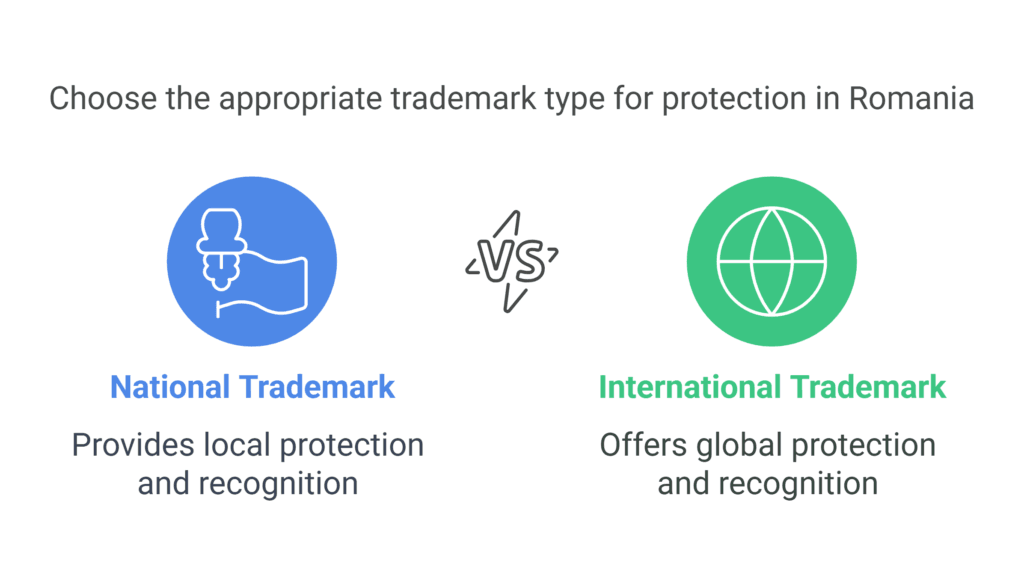
These include national, international, and EU trademarks.

Here are some examples:

  • Verbal trademarks: words or phrases that identify a product or service;
  • Figurative trademarks: symbols, logos, or designs that identify a product or service;
  • Three-dimensional trademarks: shapes or designs that identify a product or service.

trademark protection in Romania

Applying for a trademark in Romania starts with a check by the State Office for Inventions and Trademarks (SOIT).

This check happens within six months after the first publication.

The length of protection and the variety of trademarks show how important they are for businesses.

Type of TrademarkDuration of ProtectionRenewal Period
National Trademark10 years from registration date10 years
International Trademark10 years from registration date10 years
EU Trademark10 years from registration date10 years

Benefits of Registering a Trademark in Romania

Registering a trademark in Romania offers many advantages. It gives you exclusive rights to use the trademark.

It also protects you from infringement and lets you license the trademark to others.

The Romanian State Office for Inventions and Trademarks (OSIM) handles applications quickly, usually within 7 days.

Some of the key benefits of trademark registration in Romania include:

  • Exclusive rights to use the trademark;
  • Protection against infringement;
  • Ability to license the trademark to others;
  • Enhanced business development and market distinction.

The Romanian Law No. 84/1998 on Trademarks and Geographical Indications gives legal protection.

This helps prevent counterfeiting and ensures your rights are respected.

For businesses, trademark registration in Romania is key to building a strong brand.

trademark registration in Romania

Preparing for Your Trademark Application

Before you apply for a trademark in Romania, it’s key to know what you need.

The Romanian State Office for Inventions and Trademarks (OSIM) asks for a few things.

You’ll need a filled-out application form, a mark of your trademark, and a list of goods and services.

It’s also important to understand the trademark classification system.

This system helps place your trademark in the right category.

It’s a big part of making sure your trademark is registered and protected.

Key Documents Needed

  • Completed application form;
  • Representation of the trademark;
  • List of goods and services for which the trademark is to be registered.

Having the right documents and knowing the trademark system will help you.

It makes your trademark application strong.

This way, you can protect your brand and get your trademark registered.

Conducting a Trademark Search in Romania

Before you register a trademark in Romania, it’s key to do a deep search.

This step checks if your mark might clash with others, avoiding legal issues.

The Romanian State Office for Inventions and Trademarks (OSIM) offers tools and advice for this search.

You can search trademarks in Romania through the OSIM database or with a lawyer’s help.

This search usually takes about 2 hours.

It’s important to check if your trademark is free to avoid extra costs if it’s already taken.

Some important things to think about in a trademark search in Romania are:

  • Risks of already registered trademarks;
  • Infringement of a trademark is a crime;
  • Non-reimbursable fees if a trademark is already registered;
  • Free availability check option.

Doing a detailed trademark search in Romania helps make sure your application goes smoothly.

It also helps avoid problems with trademarks already in use.

It’s wise to talk to a lawyer in Bucharest or Romanian expert in intellectual property to help you through this process.

Trademark TypeRegistration CostRenewal Cost
Verbal trademark1,947 Lei1,780 Lei
Black-and-white trademark2,096 Lei1,929 Lei
Color trademark2,843 Lei2,327 Lei

The Romanian Trademark Registration Process

Registering a trademark in Romania is a key step.

It involves several steps like filing an application and going through an examination period.

You can get more details from the Romanian State Office for Inventions and Trademarks (OSIM).

The first step is filing an application.

You need to submit a graphic of the trademark and details about it.

This includes the applicant’s information and a list of goods and services.

The application must be in Romanian and include fees for filing and publication.

Filing Your Application and Examination Period

After you file, your application will be published online within 7 days.

Then, the OSIM will examine it.

This can take up to 6 months if fees are paid on time.

The fee for an individual word mark is 547 lei, and for a figurative mark, it’s 696 lei.

The costs for trademark registration in Romania are as follows:

  • Filing fee for a trademark application: 50 lei;
  • Publication fee for black-and-white trademarks: 149 lei;
  • Publication fee for colored trademarks: 498 lei.

Publication and Opposition

After the examination, your application will be published.

You can receive feedback for 2 months.

If no one opposes, your trademark will be registered.

A certificate will be issued within 30 days, for a fee of 249 lei.

Costs and Timeframes for Trademark Registration

Understanding the costs and time needed for trademark registration in Romania is key.

The fees include the filing, examination, and registration costs.

The Romanian State Office for Inventions and Trademarks (OSIM) sets these fees.

For a word mark, it’s about €200. For a mark with a black-and-white logo, it’s €230.

And for a color logo, it’s €380.

The time it takes to register a trademark varies.

Generally, it could take 9 to 11 months.

This includes the time from filing to getting the registration certificate.

The application is first published for observation and then for opposition, each for two months.

  • Examination of trademark applications occurs within 7 days from the filing date.
  • The substantive examination decision is issued within 6 months from the publication date in the Official Bulletin.
  • The opposition period for third parties is 2 months from the second publication in the Official Bulletin.

Objections or formal issues can add 2 to 4 months.

Oppositions can add 6 to 12 months.

Knowing these costs and timeframes helps you prepare for the trademark registration in Romania.

Common Challenges and How to Overcome Them

When you try to register a trademark in Romania, you might face some common problems.

It’s important to know these challenges and how to deal with them.

The Romanian State Office for Inventions and Trademarks (OSIM) says these issues include application rejections, opposition handling, and administrative appeals.

To beat these challenges, get help from a lawyer in Romania who knows trademark law.

They can guide you and help solve any problems.

Also, make sure your trademark doesn’t step on anyone else’s toes by doing a deep search.

  • Make sure your trademark application is right and complete to avoid being rejected.
  • Do a thorough search of existing trademarks to avoid opposition handling.
  • Get advice from a Romanian lawyer to help with administrative appeals.

Knowing these common challenges and how to tackle them can help you succeed in trademark registration in Romania.

Stay updated and adjust to any changes in the process to make your application a success.

International Trademark Protection from Romania

If you own a trademark in Romania, you might want to protect it worldwide.

You can do this through the Madrid System or the European Union Trademark Extension.

The World Intellectual Property Organization (WIPO) helps trademark owners expand their protection across borders.

The Madrid System, as WIPO explains, lets trademark owners protect their marks in many countries.

You can file one application with the Romanian State Office for Inventions and Trademarks (OSIM).

This way, you can get protection in countries that are part of the Madrid System.

  • Protection of your trademark in multiple countries;
  • Increased brand recognition and credibility;
  • Prevention of unauthorized use of your trademark.

To get international trademark protection, you have a few choices:

  • Madrid System registration: This lets you file one application with OSIM. It extends your protection to countries in the Madrid System.
  • European Union Trademark Extension: This option gives you protection in all European Union member states.

It’s wise to talk to a lawyer in Romania.

They can help you choose the best option for your needs.

They also make sure you follow all the rules for international trademark protection.

Maintaining and Renewing Your Trademark in Romania

Keeping your trademark safe in Romania is key to its ongoing protection and value.

The Romanian State Office for Inventions and Trademarks (OSIM) says you need to renew every 10 years to keep it valid.

This renewal keeps your exclusive rights to the mark, helping you make the most of your investment and brand.

When it’s time to renew, you must apply six months before your current registration ends.

There’s a grace period of six months for late applications, but you’ll face an extra fee.

It’s important to keep track of this to avoid losing your trademark rights.

To maintain your trademark, you must use it in business in Romania.

Not using the mark can risk losing its protection.

Working with a trademark lawyer in Romania can make keeping your brand safe easier and more efficient.

FAQ

What is the process for registering a trademark in Romania?

To register a trademark in Romania, you need to apply to the Romanian State Office for Inventions and Trademarks (OSIM).

They check if your application meets the legal standards.

For help, you can reach out to a lawyer in Romania at tel. no. (004) 0765366887.

What are the benefits of registering a trademark in Romania?

Registering a trademark in Romania gives you exclusive rights to use it.

It also protects you from infringement and lets you license the trademark to others.

What types of trademarks are available in Romania?

Romania’s Law No. 84/1998 on Trademarks and Geographical Indications allows for different types.

These include verbal, figurative, and three-dimensional trademarks.

How long does a trademark registration last in Romania?

A trademark in Romania is protected for 10 years from registration.

It can be renewed for another 10 years.

What documentation is required for a trademark application in Romania?

To apply for a trademark in Romania, you need certain documents.

These include a completed application form, a trademark representation, and a list of goods and services.

How do I conduct a trademark search in Romania?

Searching for trademarks in Romania is key.

You can get more information on how to do this by contacting a lawyer in Romania.

What are the steps in the trademark registration process in Romania?

The process in Romania includes several steps.

These are filing an application, an examination period, publication and opposition, and getting a registration certificate.

What are the costs and timeframes for trademark registration in Romania?

The costs for trademark registration in Romania include filing, examination, and registration fees.

The timeframes vary based on application complexity. For more details, contact a lawyer in Romania.

What are some common challenges in trademark registration in Romania?

Challenges in Romania include application rejections, opposition handling, and administrative appeals.

A lawyer in Romania can help you navigate these issues.

How can I achieve international trademark protection from Romania?

You can get international protection through the Madrid System or the European Union Trademark Extension.

A lawyer in Romania can guide you on these options.

What is the process for maintaining and renewing a trademark in Romania?

To keep your trademark in Romania, use it in commerce and renew it every 10 years.

A lawyer in Bucharest, Romania can provide more information on this process.