AI due diligence checklist for foreign investors assessing a Romanian company

AI Due Diligence in Romania: What Foreign Investors Should Check

Foreign investment • AI governance • Romania

AI due diligence in Romania asks whether a target company’s AI use, data, contracts and public claims support the investment case. It is not a technical demonstration of a model and it is not a generic AI policy review. For a buyer, investor or lender, the question is whether the target has identified the systems it uses, can lawfully operate them, owns or can use the assets it relies on, and has a credible plan for the risks that will remain after closing.

What is AI due diligence in a Romanian transaction?

AI due diligence is a transaction-focused legal and commercial review. It identifies whether the target’s use of AI creates liabilities, restrictions, missing rights or implementation costs that could affect price, risk allocation or post-closing operations.

For a Romanian target, the review should cover the target’s Romanian operations and any AI outputs used in the European Union. The EU AI Act is directly applicable across the EU and operates alongside the GDPR where personal data is processed. A seller’s statement that it uses only a third-party AI tool does not end the inquiry: the target may still be a deployer, customer, controller, employer or regulated business with its own duties.

This guide has a different purpose from our analysis of AI vendor contracts in Romania, which focuses on the agreement with a supplier, and from DPIA vs FRIA in Romania, which focuses on assessment triggers for a deployment. Here, the investor is deciding what must be verified before, at and after a deal.

Start with the target’s actual AI footprint

Do not begin with a broad question such as “Does the company use AI?” Ask what system or model is used, for which decision, with which data, by whom, and whether the target sells, deploys, develops, fine-tunes or merely accesses the tool.

A useful data-room request separates customer-facing products from internal tools. It should identify models, APIs, software providers, hosting and cloud dependencies, integrations, datasets, prompts or knowledge bases, material outputs, users and the decisions influenced by each use case. The inventory should also record planned products or features that have not yet launched but are material to the investment thesis.

Deal-side navigator

Select a deal question to see the first evidence to request

Click or tap a card. Keyboard users can Tab to a card and press Enter or Space. Each selection stays visible until you choose another one.

Business model and footprint

Request a system inventory, product descriptions, roadmaps, supplier contracts, architecture summary and evidence of the target’s material AI claims. Compare marketing language with the technology and operating model actually in use.

Which legal and commercial issues should an investor test?

Click or tap a row to highlight the diligence takeaway. On a small screen, swipe the table sideways.

AI due diligence matrix for a Romanian target
Review areaWhat to testPossible deal response
Whether the target’s product, sales material and internal inventory describe the same systems, functions, limits and dependencies.Correct the diligence scope, ask for technical confirmation and qualify representations that are broader than the evidence.
Whether a use case may be prohibited, high-risk, subject to transparency rules or linked to a general-purpose AI model supply chain.Obtain a classification record, identify compliance timing and budget for any remediation or implementation work.
Data flows, controller/processor roles, legal bases, Article 22 issues, DPIA screening, security measures and cross-border transfers.Require a privacy remediation plan, review the DPA and test whether the target can continue the relevant processing after closing.
Whether datasets, prompts, files or customer information may lawfully be used for development, fine-tuning, testing or supplier improvement.Limit or stop impermissible use, obtain consents or contractual permissions where appropriate, and reserve a specific risk allocation.
Ownership and licences for software, open-source components, models, training materials, brand assets, output and third-party claims.Confirm chain of title, address licence conflicts and tailor warranties or indemnities to the assets that support the valuation.
Model, cloud and subprocessor dependencies, location, termination, audit evidence, model changes and service continuity.Seek consent, amendment, transition assistance or a post-closing migration plan if a dependency cannot support the buyer’s intended use.
Policies, ownership, AI literacy, logs, testing, monitoring, incident response, complaint handling and escalation records.Set a post-closing governance plan with owners, deadlines and evidence requirements rather than relying on a generic policy.

The European Commission describes the AI Act as a risk-based framework for developers and deployers. It identifies employment, credit scoring and access to essential services among the examples that may be high-risk. See the Commission’s AI Act overview and application timetable.

AI Act review: classify before you value the risk

Do not treat “AI Act compliant” as a sufficient diligence answer. Contractual, sector-specific, data-protection and AI Act obligations must be assessed separately. The investor should identify the system, its intended purpose, the target’s role and the rules that apply now or later. The relevant date can affect both risk allocation and integration planning.

The AI Act’s prohibitions, AI literacy obligations, governance rules, GPAI-model obligations and transparency rules have different application dates from the rules for high-risk systems. The Commission states that Annex III high-risk use cases, including employment and credit-scoring examples, are scheduled to apply from 2 December 2027, while high-risk systems embedded in regulated products have a later date of 2 August 2028. A diligence report should distinguish obligations already applicable from future obligations that could require a funded implementation plan. At the time of publication, the applicable AI Act timetable should be verified against the latest EU legislation and implementation guidance, including the official AI Act Service Desk timeline.

The analysis should also ask whether the target is developing an AI system, placing it on the market, deploying it in its own business, importing it, distributing it or using a third-party service. These labels are not interchangeable with GDPR controller and processor roles. For the contract-facing part of that review, see AI Vendor Contracts in Romania.

GDPR and data review: look beyond the privacy policy

The decisive question is what happens to personal data at each stage of the AI lifecycle. A target may process personal data in training, testing, deployment, monitoring, logs, prompts, support and human review, even where the product is marketed as automated or anonymised.

The review should map the data categories, purposes, retention, recipients, access, transfer mechanisms and contractual roles. Where the use involves profiling, recruitment, credit, insurance, pricing or decisions that may significantly affect individuals, check the actual decision flow and safeguards rather than relying on a generic human-review statement. Article 35 GDPR requires a DPIA where processing is likely to result in a high risk to the rights and freedoms of natural persons; Article 22 has separate rules for certain solely automated decisions.

The European Data Protection Board has also confirmed that the anonymity of an AI model trained with personal data must be assessed case by case. That matters for a target relying on a statement that a model, dataset or output is anonymous. Read EDPB Opinion 28/2024. For the broader framework, see our guide to GDPR compliance when using AI in Romania.

Data, intellectual property and contract rights

AI value is often dependent on rights that sit outside the target’s own code. The investor should trace the legal basis for using data, third-party models, cloud infrastructure, open-source components, output and confidential information.

Review the complete contract suite, not only the signed master agreement. Order forms, online terms, acceptable-use policies, data-processing agreements, security schedules, open-source notices and API terms can all affect the target’s rights. In particular, check whether a provider can use customer or target data for model training, whether the provider can change the model or service unilaterally, and whether the target can export its data and configurations on exit.

Ownership language for AI-generated output should be read carefully. A contractual promise may create a licence or allocation between the parties, but it does not necessarily guarantee exclusivity or copyright protection in every output. The copyright status of AI-generated content may vary depending on the level of human creative input and the applicable jurisdiction. The review should identify the use the target needs to make of the output and whether third-party rights, human authorship requirements, confidentiality or contractual restrictions could limit that use.

What should the investor request in the data room?

  1. Request a current AI inventory. Include internal tools, customer-facing products, models, APIs, plugins, fine-tuning, integrations and material planned features.
  2. Obtain a use-case map. Record intended purpose, users, affected people, decisions, data inputs, outputs, human review and country of deployment.
  3. Collect AI governance records. Ask for role assessments, policies, training records, system documentation, risk logs, testing, monitoring and incident procedures.
  4. Review AI Act screening. Identify prohibited practices, potential high-risk systems, transparency obligations, GPAI dependencies and the applicable timetable.
  5. Map personal-data processing. Review privacy notices, legal bases, Article 22 analysis, DPIAs, processor arrangements, security controls and transfers.
  6. Trace data rights. Check source, licence, consent or other permission for data used in development, testing, fine-tuning and ongoing service delivery.
  7. Review the contract stack. Read supplier, customer, cloud, API, DPA, security, outsourcing and change-control documents together.
  8. Confirm IP and open-source position. Request code provenance, licences, notices, ownership assignments, third-party claims and output-use restrictions.
  9. Test material statements. Compare product marketing, investor materials and customer commitments against the available technical and legal evidence.
  10. Assign the deal response. Separate issues requiring price, warranty, indemnity, condition, remediation, disclosure or post-closing integration action.

How should findings affect the transaction documents?

Translate each material finding into an owner, timing and remedy. A diligence report is useful only if the SPA, investment agreement, disclosure process and integration plan reflect the issues that have been identified.

The appropriate response will depend on the transaction structure and the seller’s ability to remediate. A buyer may need targeted warranties concerning data rights, AI-related regulatory compliance, ownership, contract compliance, absence of claims or material incidents. Confirmed gaps may justify a specific indemnity, a pre-closing remediation covenant, a post-closing plan, a condition or a tailored disclosure. The drafting should not assume that a general compliance warranty captures the actual issue.

Post-closing planning is equally important where the buyer will integrate systems, move data, introduce a new group policy, change suppliers or expand the target’s use case. These changes can alter the GDPR and AI Act analysis. If an assessment is required, the timing should be addressed before the relevant processing or deployment begins. Our DPIA vs FRIA guide explains why those two assessment routes must be screened separately.

When does a separate specialist review become necessary?

A focused AI legal review should be coordinated with corporate, technical, information-security, employment and commercial due diligence when the target develops AI products, relies on proprietary datasets, makes regulated-sector decisions, uses AI in recruitment or credit processes, processes sensitive personal data, markets compliance claims, or has important dependencies on a small number of providers. The workstreams should share the same factual inventory, but each should retain its own legal questions and conclusions.

How Atrium Romanian Lawyers can assist

Atrium Romanian Lawyers can coordinate the legal workstream for AI-related due diligence in a Romanian investment, acquisition or internal reorganisation. The review can cover AI Act role and use-case screening, GDPR and data-contract questions, supplier and customer terms, intellectual property, employment and operational governance, and the translation of findings into transaction documents or an integration plan.

Client experience

AI due diligence during the acquisition of a Romanian technology company

An international investor considered acquiring a Romanian technology company that relied extensively on AI-enabled software products and third-party AI services.

During the due diligence process, the buyer requested confirmation regarding AI Act compliance, data rights, intellectual-property ownership and the target’s dependencies on external AI providers.

The review identified gaps between the target’s public marketing materials and its internal documentation, uncertainties regarding the scope of rights over certain datasets, and contractual limitations affecting the use of third-party AI services after closing.

Atrium Romanian Lawyers coordinated the legal review of the AI use cases, supplier contracts, GDPR implications and intellectual-property position. The findings were translated into targeted warranties, disclosure items and a post-closing remediation plan.

The transaction proceeded with a clearer allocation of regulatory, contractual and operational risks and with a structured roadmap for post-closing compliance measures.

This example has been anonymised and simplified for publication. The appropriate legal analysis depends on the system, data, contract structure and facts of each matter.

Frequently asked questions

Does every investment in a Romanian company need AI due diligence?

No. The scope should be proportionate to the target’s actual use of AI and the importance of that use to the transaction. A company using a limited internal tool may require a focused review. A target selling AI-enabled products, using sensitive data or making decisions affecting people may need a deeper legal and technical workstream.

Is AI due diligence the same as an AI Act compliance audit?

No. AI Act compliance is one part of the review. Transaction diligence also considers ownership, licences, customer commitments, personal data, confidentiality, technical dependencies, product claims, change control and what the buyer will need after closing. The correct scope follows the investment thesis and the target’s operating reality.

Can a seller rely on a supplier’s AI compliance statement?

Supplier information can be relevant evidence, but it does not by itself establish that the target’s own deployment is compliant. The investor should check whether the statement identifies the actual system, model, purpose, data, users, territory, contract terms and responsibilities relevant to the target’s use case.

Should a buyer ask for the target’s DPIAs?

Where the target operates AI systems involving personal data and has conducted or screened for a DPIA, the relevant material should be reviewed subject to confidentiality controls. The question is not simply whether a document exists, but whether it reflects the current processing, risks, safeguards, changes and any residual issues requiring follow-up.

Can AI findings be addressed after closing?

Sometimes. The decision depends on the nature of the issue, legal exposure, urgency, operational dependency and the buyer’s ability to control remediation. A defensible post-closing plan should identify the owner, evidence, budget, deadlines and the effect on continued use. Some issues may need to be resolved before closing or before a planned deployment.

What is the most common gap in AI diligence?

A frequent gap is that the target has a high-level AI policy or vendor contract but no reliable inventory linking systems, use cases, data, roles, evidence and decision owners. The first practical step is usually to build that factual map before drawing legal conclusions or negotiating transaction protection.

DPIA and FRIA assessment paths for an AI project in Romania

DPIA vs FRIA in Romania: Which Assessment Does Your AI Project Need?

AI governance • Romania • Assessment decisions

DPIA vs FRIA in Romania is a question of two different legal tests. A data protection impact assessment (DPIA) addresses risks arising from personal-data processing under the GDPR. A fundamental rights impact assessment (FRIA) under the AI Act applies to specified deployers of certain high-risk AI systems. Your project may require one, both, or neither mandatory assessment.

When do these obligations apply?

The GDPR assessment requirements already apply. Under the AI Act’s consolidated timetable, Chapter III Sections 1–3, including Article 27, apply to Annex III high-risk systems from 2 December 2027. The corresponding date for Article 6(1)/Annex I product systems is 2 August 2028; that does not extend Article 27 to every product system.

Article 111 contains separate transition provisions for existing systems. A project review should record when the system was placed on the market or put into service and whether subsequent design changes affect its treatment. The future FRIA timetable does not postpone GDPR duties. Source: consolidated AI Act, Articles 111 and 113.

DPIA vs FRIA: the differences that change your project

Both assessments examine potential harm to people. A DPIA is not limited to confidentiality or cybersecurity: it also examines other rights and freedoms affected by personal-data processing. FRIA addresses the impact of the specified AI deployment on fundamental rights.

Click or tap a row to reveal its practical takeaway. Keyboard users: Tab to a green label and press Enter or Space. Swipe the table sideways on a small screen.

Two assessments, separate applicability tests
Decision pointDPIA: GDPR Article 35FRIA: AI Act Article 27
Personal-data processing likely to create high risks to individuals, assessed in its context.A covered deployer using an in-scope Article 6(2)/Annex III high-risk system.
The controller, with DPO advice where a DPO is designated and relevant processor assistance.The deployer covered by Article 27.
Processing, necessity, proportionality, risks to people and safeguards.Deployment context, affected groups, risks of harm, human oversight and responses.
Before the relevant processing begins; review when risk changes.Before first use where the obligation applies; update changed or outdated elements.
Prior consultation when the Article 36 threshold is met; no universal filing requirement for every DPIA.Notify results to the market surveillance authority under Article 27(3), subject to its exception.
Shared evidence can support the assessment of the actual processing.Relevant DPIA sections may be cross-referenced or incorporated; remaining requirements still need coverage.

GDPR Articles 28, 35–36 and 39; AI Act Article 27.

When does an AI project need a DPIA?

AI use alone does not automatically trigger a DPIA. The controller must assess whether the nature, scope, context and purposes of the processing make a high risk to people likely. Article 35 expressly recognises the relevance of new technologies.

The GDPR identifies particular situations, including systematic and extensive automated evaluation underpinning decisions with legal or similarly significant effects, large-scale processing of special-category or criminal-offence data, and large-scale systematic monitoring of publicly accessible areas. Applicable supervisory-authority lists must also be checked.

For a Romanian deployment, the file should therefore address the applicable requirements and guidance of the Romanian data protection authority, ANSPDCP, alongside Article 35. Record the reasons for a negative screening conclusion too. A supplier’s description of a product as “low risk” is not an assessment of your processing.

Where required, the DPIA must describe the processing and purposes, assess necessity and proportionality, evaluate risks to individuals and specify safeguards. This is a substantive project assessment, not simply a signed template. Source: GDPR Article 35.

For the broader data-protection framework, see our guide to GDPR compliance when using AI in Romania.

Who needs a FRIA under the AI Act?

The Article 27 obligation does not cover every business using high-risk AI. It concerns Article 6(2) high-risk systems and specified categories of deployer, with an exclusion for the critical-infrastructure area in Annex III point 2.

  • Bodies governed by public law deploying qualifying systems.
  • Private entities providing public services deploying qualifying systems. This status requires analysis; it is not synonymous with every company selling services to the public.
  • Deployers of qualifying creditworthiness or credit-scoring systems for natural persons under Annex III point 5(b), which excludes systems used to detect financial fraud.
  • Deployers of qualifying life and health insurance risk-assessment or pricing systems for natural persons under Annex III point 5(c).

Classification under Article 6 must be checked first, including the conditions of any applicable exception. The exact intended purpose matters. A financial-sector tool is not automatically a creditworthiness system, and a medical product is not automatically within the Article 27 FRIA route. Source: AI Act Articles 6 and 27 and Annex III.

Explore four deployment scenarios

These hypothetical examples explain the screening logic. They assume the stated facts and do not replace an assessment of the actual system, applicable dates or transition rules.

Candidate ranking: DPIA and FRIA can diverge

A private manufacturer uses extensive automated applicant evaluation to support hiring decisions. These facts point to a DPIA requirement under Article 35(3)(a), even if a person makes the final decision. Recruitment may also fall within Annex III. However, on the assumption that the manufacturer is neither a public-law body nor a private public-service provider, its employer status alone does not trigger Article 27 FRIA.

Consumer credit: prepare for both assessments

A lender uses an in-scope high-risk system to score individuals for loan eligibility. Systematic and extensive profiling with significant consequences can trigger a DPIA. Article 27 separately covers qualifying deployers under Annex III point 5(b). Address the applicable FRIA timetable and any transition provisions, rather than assuming both duties started on the same date.

Public benefits: assess deployment and processing together

A public body uses a qualifying high-risk system to assess eligibility for essential assistance benefits. Its status and use case bring Article 27 into the analysis. The personal-data processing needs separate DPIA screening, including relevant public-task legislation and any Article 35(10) position. One completed assessment does not automatically discharge the other.

Drafting assistant: examine the actual workflow

A team drafts generic product descriptions without personal data or decisions about people. On those narrow facts, the workflow does not itself establish a DPIA or Article 27 FRIA requirement. Check account data, logs and supplier processing separately. Introducing customer records, employee evaluation or regulated decisions changes the analysis. Other duties may still apply.

Can one assessment document cover DPIA and FRIA?

A coordinated file can reduce duplicated work, provided each legal requirement remains identifiable. The consolidated Article 27(4) expressly allows relevant DPIA sections to be cross-referenced or incorporated into FRIA where they already meet the corresponding obligations.

Start with a shared description of the system, purposes, data flows, affected people and safeguards. Then keep a requirement map showing which sections satisfy GDPR Article 35 and which satisfy AI Act Article 27. Identify gaps rather than renaming a DPIA “FRIA”. Source: AI Act Article 27(4)–(5).

As a practical drafting approach, include a separate deployment chapter addressing who may be affected beyond the immediate users, how mistakes influence access to opportunities or services, who can intervene, and how complaints lead to corrective action. Avoid treating GDPR as only a privacy checklist: the DPIA itself must consider risks to rights and freedoms.

What the FRIA needs to address

Article 27 requires the deployment process and intended use, duration and frequency, affected people and groups, specific risks of harm, implementation of human oversight, and measures if risks materialise, including governance and complaint mechanisms. Reusing a supplier assessment in similar cases is permitted, but the deployer must check its fit and update changed or outdated elements. Source: AI Act Article 27(1)–(2).

Who prepares, reviews and owns the decision?

The controller remains responsible for the DPIA; the covered deployer remains responsible for FRIA. A consultant, DPO or supplier can contribute without taking over the organisation’s statutory role.

For the DPIA, seek the designated DPO’s advice and preserve their independent advisory and monitoring function. Obtain relevant processor assistance. For the deployment review, involve the business owner, technical team and people responsible for oversight and complaints. A useful internal decision records outstanding conditions, the person accountable for each safeguard and the circumstances requiring a fresh review. Source: GDPR Articles 28(3)(f), 35(2) and 39; AI Act Article 27.

Contractual cooperation should cover the evidence you need to assess the deployment. Our AI vendor contracts guide addresses information rights, changes and supplier responsibilities.

Must the assessment be sent to an authority?

A DPIA and a FRIA follow different authority procedures. Under GDPR Article 36, prior consultation is required where high residual risk remains that cannot be sufficiently mitigated. There is no general GDPR obligation to submit every DPIA for approval.

Article 27(3) provides for notification of FRIA results to the market surveillance authority using the relevant template, subject to the Article 46(1) exception. That notification is not the GDPR prior-consultation procedure and should not be described as automatic permission to deploy. Confirm the competent authority and operational submission arrangements for the specific deployment. GDPR Article 36; AI Act Article 27(3).

A practical assessment file before deployment

  1. Define the use case. Identify the system, version, intended purpose, users, affected people and decisions it informs.
  2. Map roles separately. Record GDPR controller/processor roles and the relevant AI Act roles.
  3. Screen the legal route. Check prohibited practices, AI classification, DPIA triggers and Article 27 deployer coverage.
  4. Record timing. Distinguish existing GDPR duties from future AI Act requirements and applicable transition provisions.
  5. Collect evidence. Obtain data-flow information, supplier instructions, meaningful performance limitations, oversight arrangements and relevant testing.
  6. Assess harms and safeguards. Describe how the actual deployment may affect people and how controls reduce those risks.
  7. Map shared sections. Make each DPIA and FRIA requirement traceable, retaining any necessary separate analysis.
  8. Resolve escalation. Identify prior consultation, notification, unresolved risks and conditions preventing launch.
  9. Assign review triggers. Consider changes in purpose, model, data, affected groups or decision authority, and evidence from incidents or complaints.

How Atrium Romanian Lawyers Assisted an International Manufacturing Group

Anonymised client matter. The description below omits identifying information and focuses on the legal work performed.

Questions examined

  • Whether the candidate-data processing required a DPIA;
  • Whether the use of the system could trigger a FRIA under the AI Act;
  • What human-oversight and documentation measures were needed before implementation.

Legal analysis

Our review of the recruitment process identified extensive automated evaluations of candidates with a significant impact on access to employment opportunities. The company therefore decided to complete a DPIA before implementation.

We also carried out a separate analysis of the system’s classification under the AI Act, including the organisation’s status and the obligations applicable to the deployer. The review confirmed that the DPIA and any FRIA analysis had to be treated separately because their legal triggers differ.

Measures adopted

  • Documentation of the decision logic and system limitations;
  • Mandatory stages of human verification;
  • Internal procedures for challenging results and handling complaints;
  • Updated contractual documentation and AI-governance workflows.

Practical result

Following the project, the company was able to continue the implementation on the basis of stronger documentation concerning compliance and risk management.

A focused consultation can clarify which assessment route applies and what your team needs before making deployment commitments.

Frequently asked questions

Does every AI project need both a DPIA and a FRIA?

No. Screen personal-data processing under GDPR Article 35 and, separately, the system and deployer under AI Act Article 27. One assessment may be mandatory while the other is not. A negative screening result does not remove other applicable legal obligations.

Does human review remove the need for a DPIA?

Not automatically. Article 35 has its own risk test, and its automated-evaluation category is not confined to solely automated decisions. Genuine human oversight can affect risks and safeguards, but a human signature does not by itself settle DPIA applicability.

Does a private employer need a statutory FRIA for recruitment AI?

Not solely because it is an employer using high-risk recruitment AI. Article 27 covers specified deployers and uses. Check whether the organisation is a public-law body or private public-service provider, while independently assessing its GDPR and other AI Act obligations.

Can we rely on the supplier’s impact assessment?

Supplier evidence can support the work, and Article 27 permits reliance on existing assessments in similar cases. The organisation still needs to check whether the document addresses its actual deployment, affected groups, safeguards and applicable obligations. A generic assurance is insufficient evidence of that fit.

Can we wait until the FRIA application date to conduct a DPIA?

No, if GDPR already requires a DPIA for the proposed processing. The DPIA must precede that processing. The AI Act timetable and transition provisions must be analysed separately and do not suspend GDPR requirements.

Does completing an assessment authorise the project?

No. An assessment documents analysis and safeguards; it does not supply a missing legal basis, legalise prohibited AI or override unresolved legal restrictions. Complete any required consultation or notification procedure and resolve conditions that prevent lawful deployment.

GDPR Compliance for AI-Powered Tools

GDPR Compliance for AI-Powered Tools

As Romanian businesses use more AI, knowing how to follow GDPR for AI tools is key.

Did you know AI can make compliance work 50 times faster than old methods?

This shows how AI can change the game in data privacy rules.

The General Data Protection Regulation (GDPR) changed how we handle personal data in 2018.

AI’s fast growth brings new chances for growth, but also new challenges in following GDPR and AI rules.

In Romania, getting good at GDPR for AI tools is more than just avoiding trouble.

It’s about winning customer trust and using privacy-friendly AI to stay ahead.

Let’s see how you can handle these rules and use AI’s power.

GDPR Compliance for AI-Powered Tools

Key Takeaways

  • AI can speed up compliance efforts by 50 times compared to manual methods;
  • GDPR outlines 6 legal grounds for processing personal data;
  • AI systems require large volumes of data, necessitating careful dataset compilation;
  • Data retention periods must be proportional and not indefinite;
  • Continuous learning AI systems raise questions about data protection;
  • Transparency in AI processing is key for GDPR compliance;
  • Organizations can save time by using AI for regulatory research and compliance mapping.

Understanding GDPR and Its Impact on AI Technologies

The General Data Protection Regulation (GDPR) sets strict guidelines for data handling in the European Union.

It was enacted on May 25, 2018.

It shapes how organizations collect, store, and process personal information.

This framework has significant implications for AI technologies, which often rely on vast amounts of data.

Definition and Scope of GDPR

GDPR aims to protect individual privacy rights and ensure responsible data practices.

It applies to any organization processing EU residents’ personal data, regardless of the company’s location.

The regulation grants individuals rights such as data access, erasure, and informed consent.

AI Processing Under GDPR Framework

AI systems face unique challenges under GDPR.

The regulation’s emphasis on data minimization conflicts with AI’s need for large datasets.

About 70% of AI projects struggle to comply with this principle.

GDPR also requires transparency in automated decision-making, impacting AI applications in finance, healthcare, and hiring.

AI governance framework

Key GDPR Principles Affecting AI Systems

Several GDPR principles directly influence AI development and deployment:

  • Data minimization and purpose limitation;
  • Transparency and accountability;
  • Secure data processing;
  • Algorithmic bias mitigation.

Organizations must implement robust AI governance frameworks to ensure compliance.

This includes adopting data anonymization techniques and prioritizing ai transparency and accountability.

By focusing on these areas, businesses can navigate the complex landscape of GDPR and AI integration effectively.

GDPR PrincipleImpact on AICompliance Strategy
Data MinimizationLimits dataset sizeImplement data anonymization techniques
TransparencyRequires explainable AIDevelop ai transparency measures
ConsentAffects data collectionDesign clear consent mechanisms
SecurityMandates data protectionEmploy secure data processing methods

GDPR Compliance for AI-Powered Tools

AI tools must follow GDPR when handling EU citizen data or working in the EU.

Not following this can lead to big fines, up to €10 million or 2% of annual income.

Businesses in Romania need to grasp the details of GDPR for their AI systems.

Starting with data minimization is key to responsible AI. GDPR says only use data needed for specific tasks.

AI systems should use methods like anonymization and pseudonymization to keep data safe while gaining insights.

Algorithmic fairness is critical in AI decision-making.

AI systems must let people see their data, understand how decisions were made, and have the right to be forgotten.

This openness is essential for trust and meeting GDPR standards.

GDPR compliance for AI-powered tools

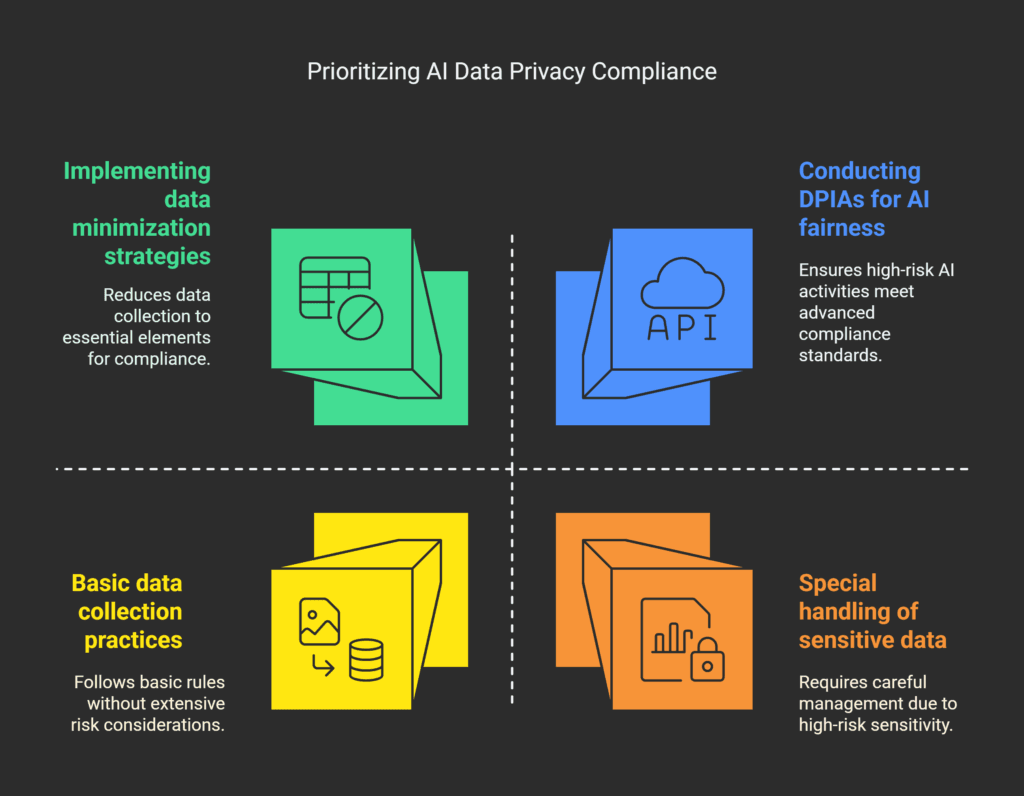
Data protection impact assessments are needed for risky AI activities.

These assessments help spot and fix privacy risks.

Companies must do regular checks and use strong security to avoid data leaks.

GDPR RequirementAI Implementation
Explicit ConsentClear, specific consent for AI data processing
Data MinimizationUse only necessary data for AI models
TransparencyExplainable AI decision-making processes
Right to ErasureAbility to remove personal data from AI systems

To uphold artificial intelligence ethics, companies must train staff on privacy, bias, and ethics.

Using access controls and a privacy-first design are key to integrating data protection into AI tools.

Data Privacy Requirements for AI Systems

AI systems must follow strict data privacy rules under GDPR.

These rules protect personal info and let AI tech grow.

It’s key for Romanian businesses using AI tools to know these rules.

AI Data Privacy Compliance

Data Minimization and Purpose Limitation

GDPR says organizations should only collect data needed for specific tasks.

This rule, data minimization, is key for AI systems that need lots of data.

You must figure out the least amount of personal data your AI tools need.

Purpose limitation means data can only be used for its original purpose.

Your AI rules should make sure data isn’t misused.

This makes AI more trustworthy and ethical.

Special Categories of Personal Data

AI systems handling sensitive data, like health info or biometrics, need extra care.

You must have strong security and get clear consent for these data types.

Data Protection Impact Assessments (DPIAs)

DPIAs are needed for high-risk AI activities.

They help spot and fix data protection risks.

Your DPIA should check on AI fairness and GDPR compliance.

Doing DPIAs shows you’re serious about safe AI use.

It protects people’s rights and makes sure your AI meets legal and ethical standards.

AI Transparency and Accountability Measures

AI Transparency and Accountability Measures

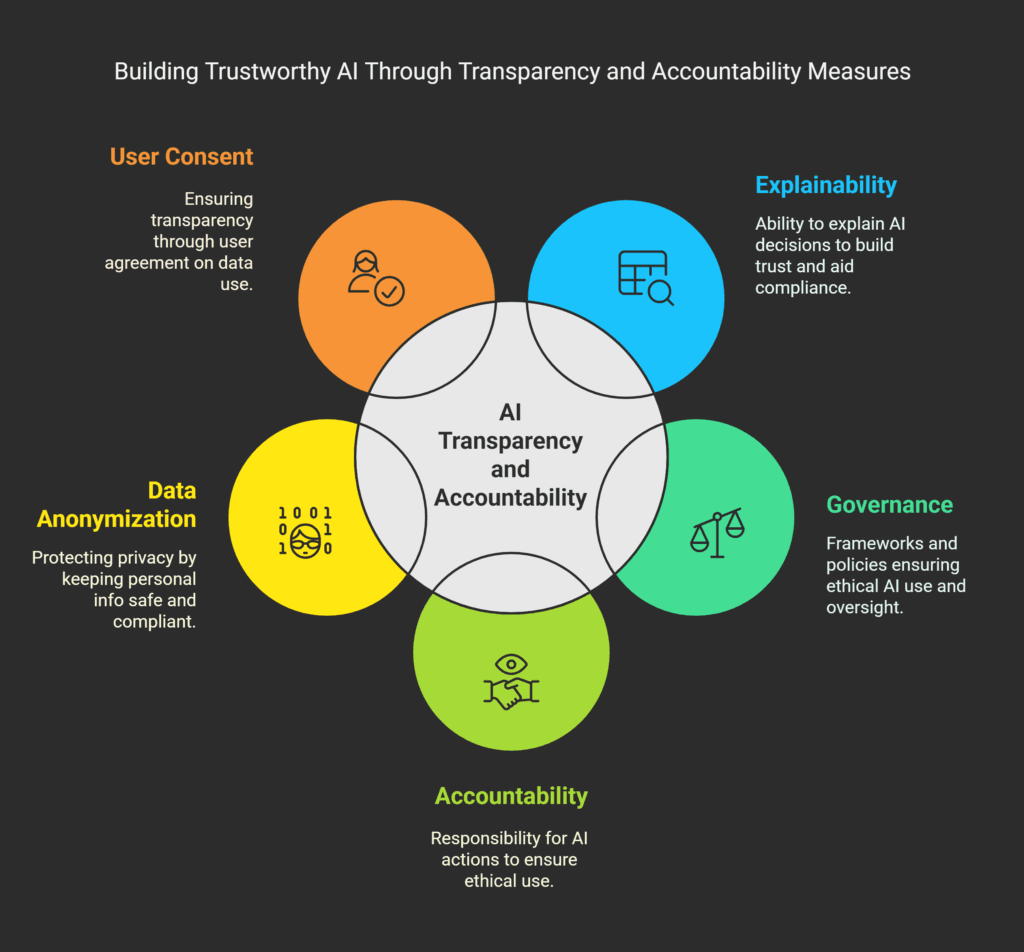
AI transparency is key to trustworthy AI systems.

It includes explainability, governance, and accountability.

As AI models grow more complex, keeping things transparent gets harder.

Data anonymization is vital for privacy in AI.

It keeps personal info safe while AI works well.

This helps Romanian businesses meet GDPR rules.

User consent is essential for AI transparency.

Companies must tell users how data is used and get their okay.

This builds trust and follows data protection laws.

Companies can use many tools for AI transparency:

  • Explainability tools;
  • Fairness toolkits;
  • Auditing frameworks;
  • Data provenance tools.

These tools help with different parts of AI transparency.

They help businesses make AI systems more accountable.

Transparency RequirementDescriptionImportance
ExplainabilityAbility to explain AI decisionsBuilds trust, aids compliance
InterpretabilityUnderstanding how AI worksEnhances user confidence
AccountabilityResponsibility for AI actionsEnsures ethical use of AI

By using these steps, Romanian businesses can make trustworthy AI.

They will follow GDPR and keep user trust and privacy safe.

Automated Decision-Making and Profiling Rights

AI tools have made automated decision-making and profiling big issues in data protection.

GDPR has strict rules for these, focusing on ethics and clear AI systems.

Automated Decision-Making and Profiling Rights

Individual Rights Under GDPR

GDPR gives you rights over automated processing of your data.

You can ask to see your data, stop its use, or fix or delete it.

AI must protect these rights, mainly with sensitive info.

Automated Processing Restrictions

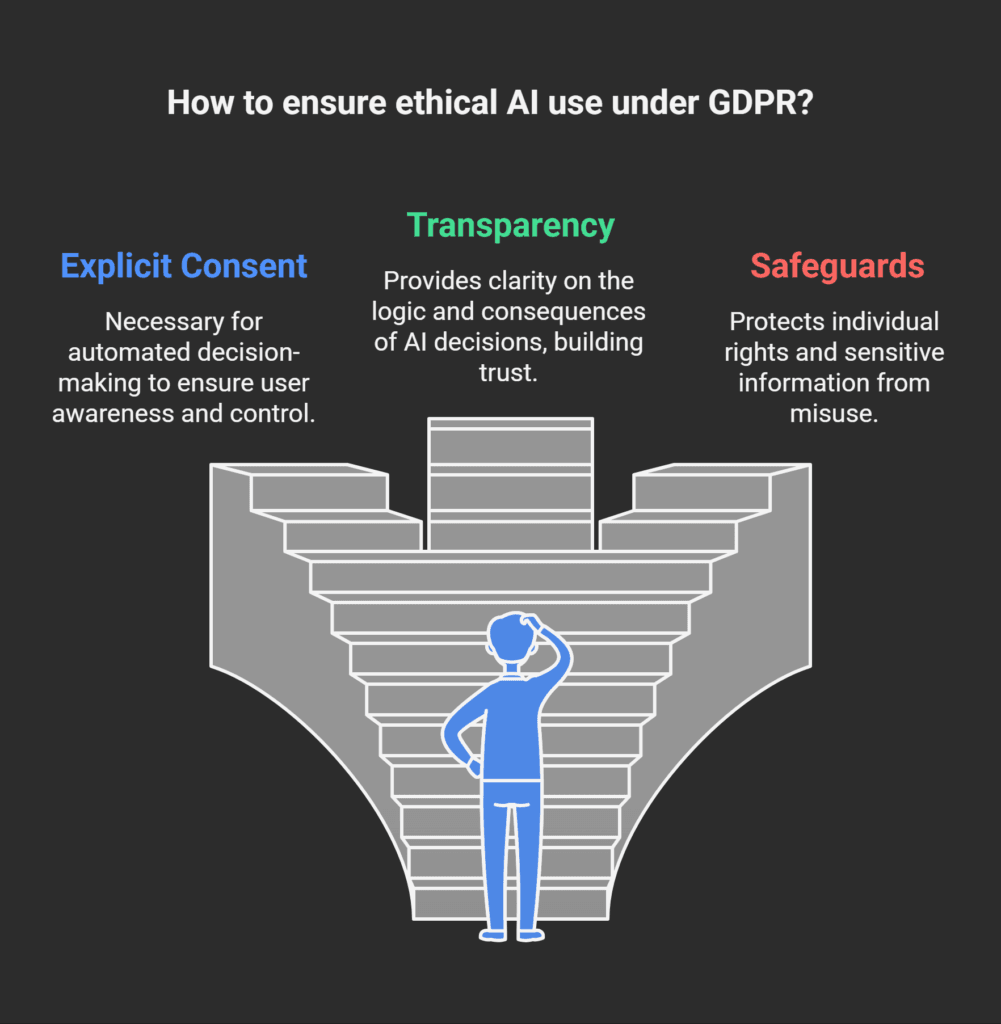
Companies need your clear consent for automated decisions on personal data.

They must tell you the reasons and possible outcomes.

This makes AI trustworthy and keeps data protection key.

RequirementDescription
Explicit ConsentMandatory for automated decision-making
TransparencyInform about logic and consequences
SafeguardsImplement measures to protect rights
DPIAsRegular assessments to mitigate risks

Right to Human Intervention

GDPR gives you the right to human review in automated decisions.

This means AI can’t decide everything important in your life.

Companies must let you share your views and challenge automated decisions.

Following these rules, Romanian businesses can use AI responsibly.

They keep ethics and protect individual rights.

The aim is to make AI that’s efficient yet respects human values and privacy.

Data Security and Risk Management for AI Tools

AI tools introduce new security and risk challenges.

In Romania, companies must focus on secure data handling and managing AI risks to follow GDPR.

They need to use strong technical and organizational controls.

Data Privacy Requirements for AI Systems

Technical Security Measures

Companies should use encryption, access controls, and security tests.

These steps protect AI system data from unauthorized access and breaches.

Organizational Security Controls

Good data governance is key.

This means having clear policies, procedures, and training for employees.

A solid framework helps keep compliance and lowers AI risks.

Breach Notification Requirements

GDPR requires quick breach reports. Companies must have systems for fast detection and notification.

This is very important for AI systems that handle lots of personal data.

Risk Management AspectImportance
AI Accountability75% of CROs see AI as a reputational risk
Consent Management70% of consumers concerned about data use
Data Governance2.5x more likely to achieve compliance

By focusing on these areas, Romanian businesses can improve their GDPR compliance for AI tools.

Proper risk management not only avoids fines but also builds customer trust and protects your reputation.

Privacy by Design in AI Development

Privacy by Design is key in AI under GDPR.

It means building data protection into AI systems from the start.

This way, you protect data rights while using AI.

To start Privacy by Design, do data protection impact assessments.

These help spot and fix risks early. 92% of companies see the need for new risk handling with AI.

AI governance frameworks are vital for Privacy by Design.

They guide AI development and use, ensuring GDPR rules are followed.

They help with the 69% of companies facing legal issues with AI.

Algorithmic transparency is also important.

It makes AI decisions clear and fair. This builds trust and stops AI bias.

AI bias mitigation strategies are key too.

They make sure AI is fair and unbiased.

Regular checks and reviews can find and fix biases.

By using these steps, you can make AI systems that respect privacy.

This not only follows GDPR but also builds trust in your AI tools.

Cross-Border Data Transfers for AI Processing

AI tools often use data from different countries.

This creates legal challenges under GDPR.

Romanian businesses using AI must follow strict rules for moving data across borders.

Cross-Border Data Transfers for AI Processing

International Data Transfer Mechanisms

GDPR restricts data transfers outside the EU to protect privacy.

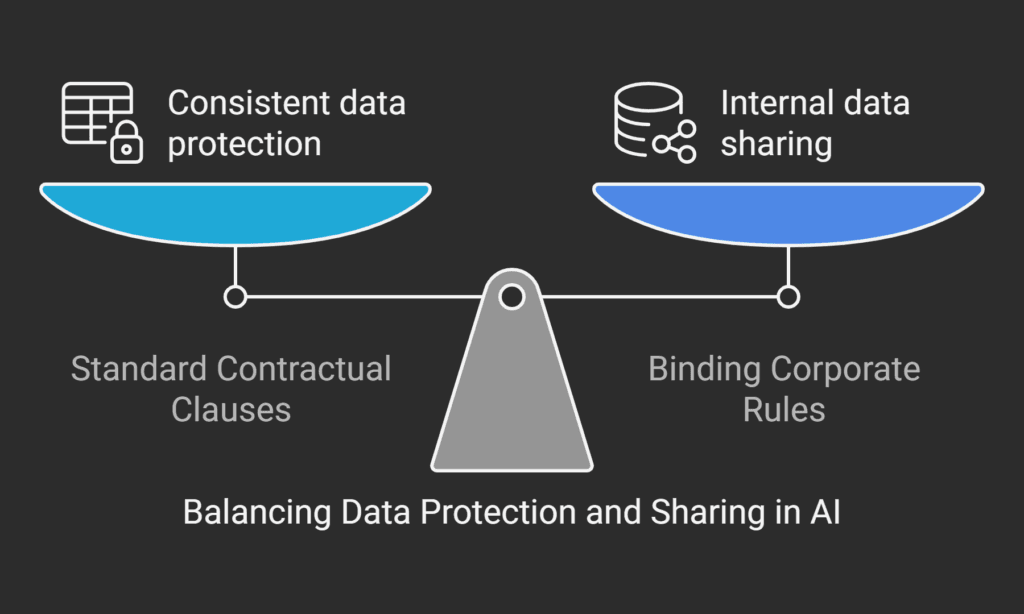
Companies can use approved methods like Standard Contractual Clauses (SCCs) or Binding Corporate Rules (BCRs).

These ensure data stays safe during transfers.

Proper use of these tools is key for ethical AI governance.

Standard Contractual Clauses

SCCs are pre-approved contracts that set rules for data transfers.

They’re a popular choice for Romanian firms working with non-EU partners.

SCCs spell out data protection duties and rights.

This helps maintain AI accountability measures across borders.

Adequacy Decisions

Some countries meet EU privacy standards through adequacy decisions.

This allows easier data flows.

For AI projects, working with adequate countries can simplify compliance.

It supports AI transparency and explainability by ensuring consistent rules.

Cross-border transfers pose unique challenges for AI systems.

Data anonymization and privacy-preserving machine learning techniques are vital.

They help protect personal data while allowing AI to learn from global datasets.

Romanian companies must balance innovation with strict GDPR compliance in their AI strategies.

Transfer MechanismKey FeatureBenefit for AI Processing
Standard Contractual ClausesPre-approved legal agreementsEnsures consistent data protection across borders
Binding Corporate RulesInternal company policiesFacilitates data sharing within multinational AI companies
Adequacy DecisionsEU-approved countriesSimplifies data transfers for AI training and deployment

Documentation and Record-Keeping Requirements

GDPR compliance for AI tools requires detailed records.

You need to document data processing, impact assessments, and security steps.

This helps show you’re following the rules and improves data handling.

To manage AI risks well, keep detailed logs of AI system use.

Record data flows, why you’re processing it, and how long you keep it.

Also, track user consent and data access requests.

These steps are key for following privacy and AI rules.

Explainable AI is very important.

You must document how AI makes decisions to be clear.

This should include how you avoid bias, showing you use AI fairly and ethically.

  • Data Protection Impact Assessments: Update before major changes;
  • Processing Activities Records: Monitor continuously;
  • Security Measure Documentation: Outline quarterly;
  • User Consent Records: Update in real-time.

Not following GDPR can lead to big fines, up to €20 million or 4% of your yearly sales.

Good documentation helps avoid these fines and makes your work smoother.

In fact, 31% of companies say they work better after keeping good records.

Conclusion

GDPR compliance is key for Romanian businesses using AI.

Ethical AI principles are the base for responsible AI.

They make sure AI respects privacy while pushing innovation.

Regular checks on AI models and privacy risk assessments are vital.

They help spot weaknesses and keep AI in line with data protection rules.

Also, clear machine learning models build trust and show a commitment to ethical AI.

Data protection by design is a big part of GDPR for AI tools.

Adding privacy safeguards early on helps avoid risks and boosts competitiveness.

The AI-enabled e-commerce market is expected to grow to $16.8 billion by 2030.

This shows how important GDPR-compliant AI is.

GDPR Compliance ElementAI Implementation
Data MinimizationAI algorithms identify essential data
TransparencyAI-generated plain language notices
Consent ManagementAI-powered platforms automate processes
Risk AssessmentAI conducts efficient DPIAs

By following these GDPR-compliant AI practices, Romanian businesses can innovate while protecting individual rights in the digital world.

Contact: office@theromanianlawyers.com

FAQ

Understanding GDPR for AI tools in Romania can be tough.

This FAQ tackles main worries about ai explainability and data protection.

We’ll look at how to make AI decisions clear while following responsible ai rules.

AI audits and monitoring are key for GDPR. Regular checks help ensure AI uses only needed data.

This follows the data minimization rule. Also, GDPR says no decisions can be made just by AI that affect people.

So, add human checks and explain AI choices clearly.

Being open about ai and data handling is essential for GDPR. You must tell people how their data is used by AI.

Think about doing Data Protection Impact Assessments (DPIAs) for risky AI projects.

These help spot and fix privacy risks, making sure your AI meets GDPR standards.

For help on GDPR for AI tools in Romania, email office@theromanianlawyers.com.

Keep up with the latest in AI explainability to stay compliant and gain customer trust.

FAQ

What are the key GDPR principles that affect AI systems?

GDPR principles for AI systems include data minimization and purpose limitation.

These mean AI systems should only collect and use data needed for their purpose.

They should also keep data only as long as necessary.

How can Romanian businesses ensure algorithmic fairness in their AI systems?

Romanian businesses should use bias mitigation techniques and audit AI models regularly.

They should also use diverse training data and transparent machine learning models.

This helps ensure fairness in AI systems.

What is a Data Protection Impact Assessment (DPIA) and when is it required for AI systems?

A DPIA is a process to identify and minimize data protection risks in AI systems.

It’s needed when an AI system poses a high risk to individuals’ rights and freedoms.

This includes systems that make automated decisions or handle sensitive data on a large scale.

How can businesses implement privacy-preserving machine learning techniques?

Businesses can use data anonymization, differential privacy, federated learning, and secure multi-party computation.

These methods help protect individual privacy while allowing AI processing to comply with GDPR.

What are the requirements for obtaining valid user consent for AI processing under GDPR?

To get valid consent for AI processing, businesses must ensure it’s freely given and specific.

Users must be clearly told how their data will be used in AI systems.

Consent should be given through a clear affirmative action.

How can Romanian businesses ensure AI transparency and accountability?

Romanian businesses can ensure AI transparency by using explainable AI and maintaining detailed documentation.

Regular audits of AI systems and clear communication to data subjects are also key.

This helps maintain accountability.

What are the restrictions on automated decision-making under GDPR?

GDPR limits automated decision-making that affects individuals legally or significantly.

Such processing needs explicit consent, is necessary for a contract, or is authorized by law.

Individuals have the right to human intervention and to contest decisions.

What security measures should be implemented to protect personal data processed by AI systems?

AI systems should have data encryption, access controls, and regular security testing.

Robust policies and procedures are also essential.

Businesses should protect against adversarial attacks and ensure training data integrity.

How can Privacy by Design be incorporated into AI development?

Privacy by Design should be considered from the start of AI system design.

This includes minimizing data collection and implementing strong security measures.

It also involves ensuring data accuracy and limiting retention.

Features that support individual rights are also important.

What are the implications of cross-border data transfers for AI processing under GDPR?

Cross-border data transfers for AI processing must follow GDPR rules.

This might involve using Standard Contractual Clauses or obtaining Adequacy Decisions.

Businesses must ensure the recipient country’s data protection is similar to the EU’s.

What documentation should Romanian businesses maintain for their AI systems to demonstrate GDPR compliance?

Romanian businesses should keep records of processing activities, Data Protection Impact Assessments, and security measures.

They should also document consent, data breaches, and AI governance frameworks.

This includes AI risk management, bias mitigation, and measures for transparency and accountability.

EU AI Act for Small Businesses: Staying Compliant

EU AI Act for Small Businesses: Staying Compliant

EU AI Act Compliance for Small Businesses

Are you ready to navigate the complex landscape of AI regulation for small businesses in Romania?

The EU AI Act is set to change how SMEs use artificial intelligence.

It presents both challenges and opportunities for startups and small firms.

As the digital world grows, machine learning compliance for small firms is key.

The EU AI Act introduces a detailed framework.

This framework directly affects how small businesses use and manage AI technologies.

For Romanian entrepreneurs and tech innovators, knowing the EU artificial intelligence rules for startups is essential.

The new rules require a strategic approach to AI use. This balance is between innovation and following the rules.

Key Takeaways

  • The EU AI Act creates a detailed framework for AI regulation in SMEs;
  • Small businesses must prepare for different risk classifications of AI systems;
  • Compliance requires strategic planning and possible technology changes;
  • Penalties for not following the rules can be big for unprepared businesses;
  • Regulatory sandboxes offer help for small businesses dealing with AI rules.

Understanding the EU AI Act’s Impact on SMEs

The European Union’s AI Act is a big step in regulating AI.

It affects small and medium enterprises (SMEs) in Romania and the EU.

This act is the first global law for AI, bringing important rules for businesses using AI.

EU AI Act Impact on Small Businesses

The AI regulation in EU  aims to make sure SMEs are fair and accountable.

It’s important for your business to understand this law for planning.

Definition of Small and Medium Enterprises

EU standards define SMEs as follows:

  • Fewer than 250 employees;
  • Annual turnover less than €50 million;
  • Annual balance sheet total less than €43 million.

Scope of Application for Small Businesses

The European AI rules for smes cover all businesses in the EU.

This includes those that develop, use, import, or distribute AI systems.

Even small businesses need to be ready.

Timeline for Implementation

Important dates for ai governance Smbs include:

  1. 2 February 2025: First big rules start;
  2. 2 August 2025: Penalties for not following rules start;
  3. Transition periods of 6, 12, and 24 months for different rules.

Knowing these ai ethics small enterprises rules helps you get ready for the new rules.

Risk Classification System for AI Technologies


The EU AI Act has a new risk classification system for small businesses.

It divides AI systems into four risk levels.

This helps small firms manage AI better and follow rules.

Knowing these risk levels is key for your AI strategy.

The system makes it easier for small companies to handle AI.

AI Risk Classification Small Businesses Romania

It brings more confidence and clarity to AI use.

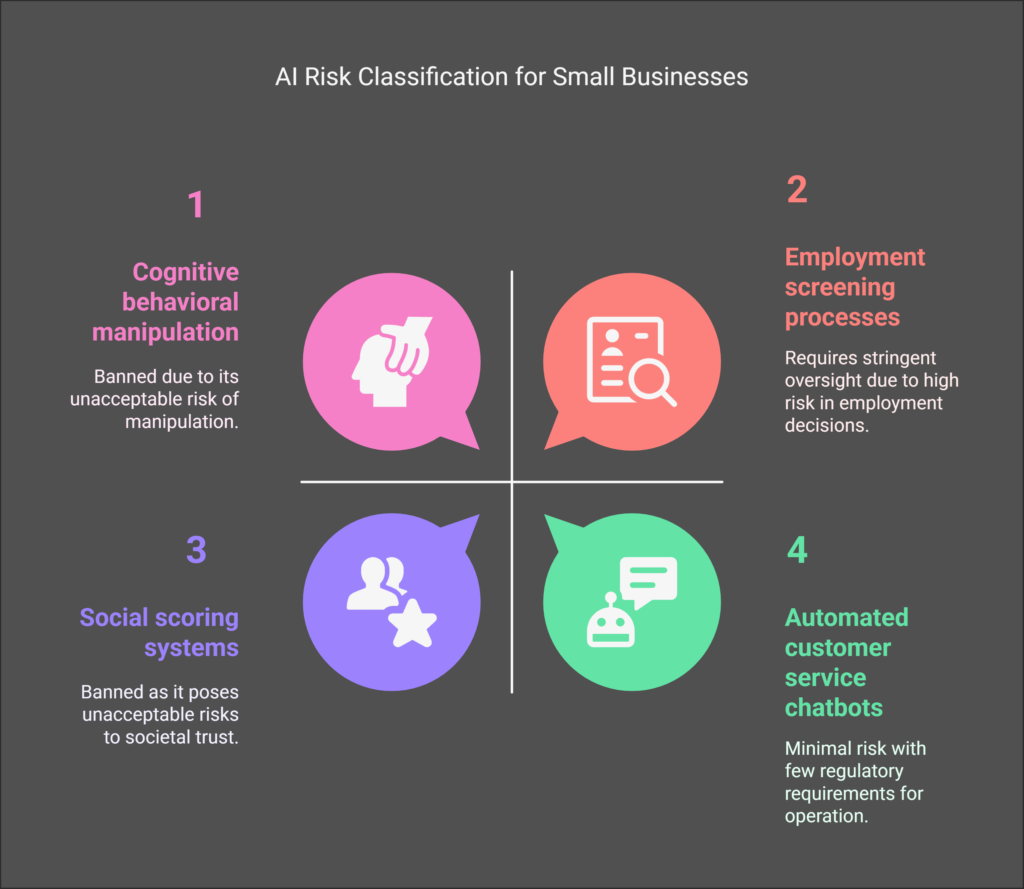
  • Unacceptable Risk: AI systems completely banned, including:
    • Cognitive behavioral manipulation;
    • Social scoring systems;
    • Biometric identification technologies.
  • High Risk: AI systems needing careful checks, such as:
    • Critical infrastructure applications;
    • Employment screening processes;
    • Credit scoring systems;
    • Automated insurance claims processing.
  • Limited Risk: Applications needing clear rules;
  • Minimal Risk: Systems with few rules.

In Romania, small businesses must watch AI closely.

High-risk AI needs detailed records and checks.

This means you’ll need to track your AI’s actions and effects.

By following these risk levels, your small business can use AI wisely.

It also meets the EU AI Act’s strict rules.

EU AI Act Small Businesses: Key Compliance Requirements

For small businesses, following the EU AI Act can be tough.

It’s key to know the main rules to use AI right and stay legal and ethical.

The EU AI Act has clear guidelines for small businesses.

EU AI ACT Compliance Small Businesses Romania

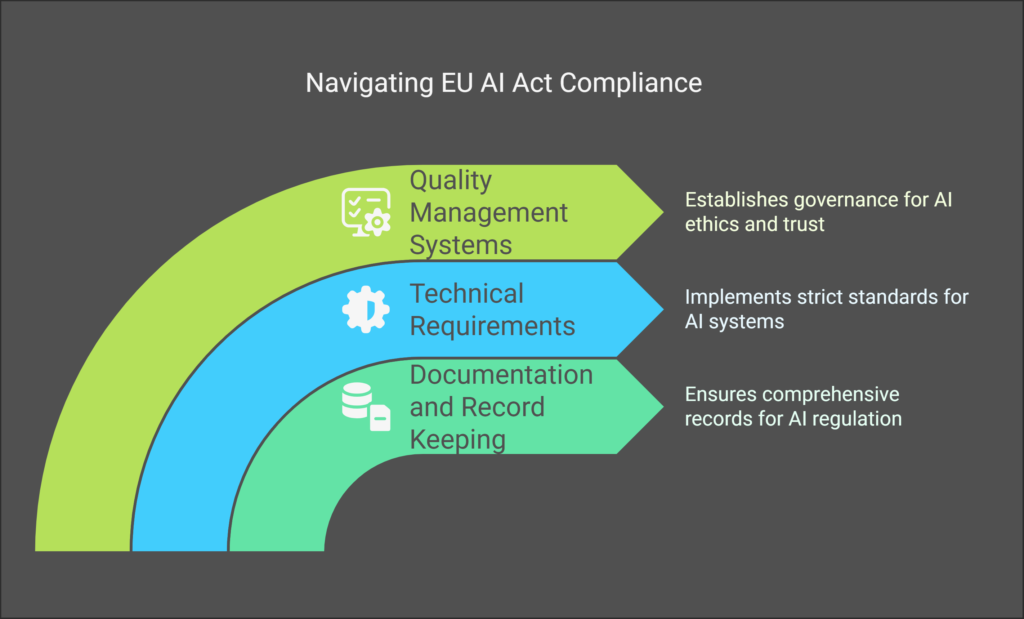
Your plan should cover three main points:

Documentation and Record Keeping

Keeping good records is vital for AI Regulation.

You must keep detailed records that show:

  • Comprehensive risk assessments;
  • System design and development processes;
  • Training data quality and selection criteria;
  • Performance monitoring logs.

Technical Requirements

AI in small businesses must meet strict standards.

Your ai rules for startups should include:

  1. Implementing risk management systems;
  2. Establishing human oversight mechanisms;
  3. Ensuring system transparency;
  4. Maintaining cybersecurity protocols.

Quality Management Systems

AI governance needs a solid quality management framework.

This means creating a system for:

  • Continuous risk assessment;
  • Performance monitoring;
  • Regular system audits;
  • Compliance documentation.

By focusing on ai ethics, you meet rules and gain trust.

The EU AI Act helps you use AI responsibly.

This keeps your business innovative and ethical.

Special Considerations and Exemptions for SMEs

The EU AI Act understands the challenges small and medium enterprises (SMEs) face.

It offers exemptions to help with artificial intelligence rules.

This makes it easier for SMEs to manage AI risks.

Small businesses get several benefits in the EU’s AI rules:

  • Simplified consultation requirements for impact assessments;
  • More flexible technical documentation standards;
  • Proportional compliance cost calculations;
  • Reduced administrative documentation needs.

The Act also helps with AI transparency for small businesses.

SMEs can submit alternative documentation that meets key goals.

National authorities can approve these alternatives, helping startups and small businesses with AI accountability.

The exemptions aim to balance AI oversight for small businesses.

They recognize the limited resources of smaller companies.

This way, the EU lets innovative companies develop AI without too many rules.

Key benefits for SMEs include:

  1. Lower-cost conformity assessments;
  2. Streamlined documentation processes;
  3. Proportional financial penalties;
  4. Access to regulatory support mechanisms.

These special considerations show the EU’s support for innovation.

It ensures responsible AI development for all business sizes.

Regulatory Sandboxes and Innovation Support

The EU AI Act brings new ways to help small businesses with AI technology.

For Romanian startups and small enterprises, these sandboxes are a big chance.

They can work on AI solutions and handle risks.

Regulatory sandboxes are special places for AI companies to test and improve their tech.

They are watched by experts.

This helps small firms manage risks and test new AI ideas safely.

Access to Testing Facilities

SMEs get first chance to use these special testing areas.

The main benefits are:

  • Free entry to regulatory sandboxes;
  • Guidance on compliance requirements for AI businesses;
  • Opportunity to validate ethical AI guidelines for SMEs;
  • Reduced financial barriers to AI technology development.

Financial Support Mechanisms

The EU knows small businesses face big challenges in AI.

So, the Act offers financial help:

Support TypeDetails
Reduced Compliance FeesLower costs for conformity assessments
Sandbox AccessFree entry for qualifying AI startups
Technical GuidanceSpecialized support for AI accountability for small enterprises

Guidance and Resources

Small businesses get lots of help for AI development.

The Act makes sure there are special channels for SMEs.

This way, you always have the latest info and support for your AI projects.

Using these new support tools, your business can dive into AI safely.

You can stay in line with rules and handle risks well.

Cost Implications and Financial Planning

Understanding AI regulations can be tough for small businesses.

The EU AI Act brings big costs that need careful planning.

Small and medium enterprises must get ready for expenses linked to ai transparency and risk management.

High-risk AI systems come with big compliance costs.

Cost Implications and Financial Planning EU AI ACT

Businesses might spend between €9,500 to €14,500 per system.

The European Commission says only 10% of AI systems will face these costs, which helps SMEs a bit.

  • Estimated compliance costs for high-risk systems: €6,000 – €7,000;
  • Conformity assessment expenses: €3,500 – €7,500;
  • Potential total compliance costs: €9,500 – €14,500 per system.

When planning for trustworthy ai governance, consider a few things.

The Act looks at your business size and market share when assessing costs.

Setting up a Quality Management System could cost between €193,000 to €330,000. You’ll also need €71,400 for yearly upkeep.

Not following the rules can cost a lot.

Fines can go up to €35 million or 7% of your global sales.

This shows how important it is to plan ahead and know the AI rules.

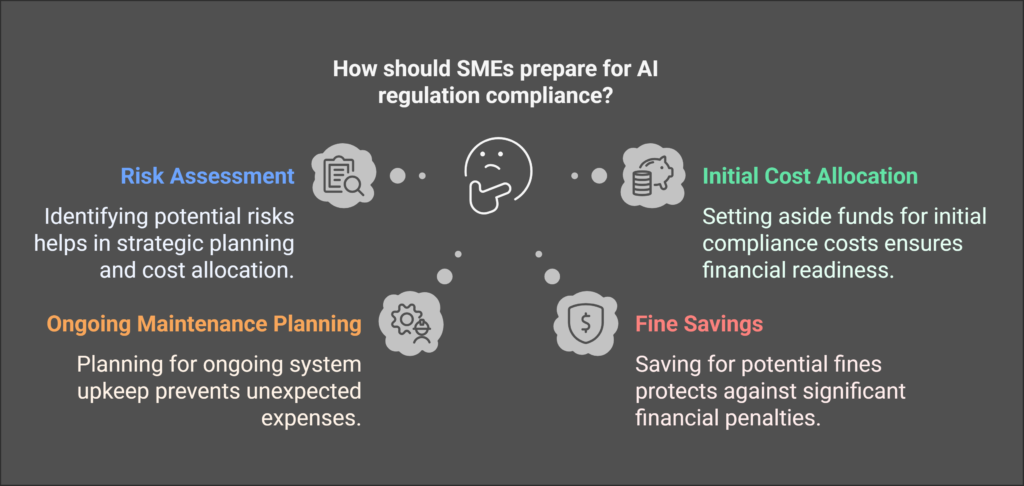
Here are some steps for SME financial planning:

  1. Do a full risk assessment;
  2. Set aside money for initial costs;
  3. Plan for ongoing system upkeep;
  4. Save for possible fines.

Though the start might look expensive, planning early can help control costs.

It also keeps your business competitive in the changing AI world.

Compliance Strategy and Implementation Steps

Small businesses need a smart plan to follow the EU AI Act.

This ensures they use AI ethically and protect data.

The steps are designed to make sure your AI is transparent and safe.

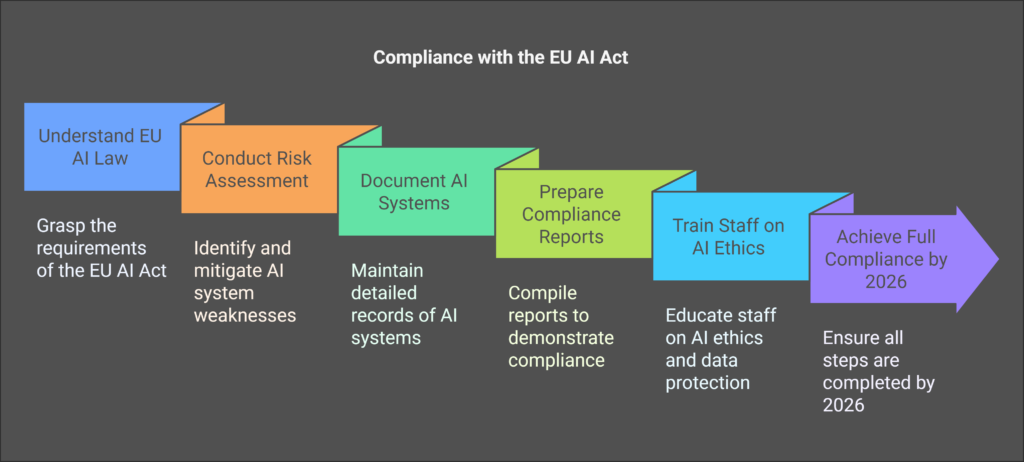
To make a strong compliance plan, you must understand the EU AI law well.

Compliance Strategy and Implementation Steps EU AI ACT

The steps to follow are key to meeting the rules.

Risk Assessment Protocol

Your AI risk plan should find and fix weaknesses in your systems.

Important steps include:

  • Do deep risk checks for each AI use;
  • Write down any ethical AI issues;
  • Make plans to fix found risks;
  • Set up clear who’s responsible.

Documentation Requirements

Keeping detailed records is vital for SMEs to follow AI rules.

Your records should have:

  1. Full details of your AI systems;
  2. Risk assessment reports;
  3. Proof you’re following the rules;
  4. Logs of incidents and how your AI performs.

Staff Training Needs

Getting your team ready is key for success.

Focus on:

  • Training on AI ethics;
  • Workshops on following the rules;
  • Improving technical skills;
  • Learning about data protection.

By 2026, your business must follow the EU AI Act fully.

Start these steps now to adapt smoothly and avoid big fines.

Penalties and Enforcement Measures

The EU AI Act has strict rules for small firms.

If they don’t follow these rules, they could face big fines.

It’s key for startups to know these rules to avoid financial trouble.

Penalties for not following ai transparency and accountability rules vary.

They depend on how serious the violation is:

  • Severe violations can result in fines up to €35 million;
  • Moderate infractions may incur penalties around €15 million;
  • Minor non-compliance could trigger €7.5 million in penalties.

For small businesses and startups, the risks are higher.

The fines are based on a company’s total yearly sales.

This can be a big hit for them.

Violation CategoryMaximum FinePercentage of Turnover
Prohibited AI Practices€35,000,0007%
Specific Operational Violations€15,000,0003%
Incorrect Information Submission€7,500,0001%

The rules start on August 2, 2025. This gives businesses time to get ready.

Romanian startups need to plan well to avoid big fines.

The European Commission has strong powers to check on businesses.

They can take documents and do deep audits.

Keeping good records and being open is key to avoiding trouble.

Support Resources and Available Assistance

For small businesses in Romania, the EU AI Act can be tough to handle.

But, there are many support resources to help with ai governance and compliance.

This ensures you follow ai risk management and ai ethics for SMEs.

The European landscape has a lot to offer entrepreneurs with EU artificial intelligence rules.

Businesses can use different channels to make their AI compliance easier.

Government Support Programs

Romanian small businesses can find help through government support programs.

These programs are made for SMEs to understand ai ethics for Smes.

They offer:

  • Free consultation services for AI regulation compliance;
  • Workshops on ai transparency for small firms;
  • Online guidance materials and webinars;
  • Direct communication channels with national supervisory authorities.

Industry Networks and Associations

Professional networks are key for small businesses in the AI regulatory world.

They provide:

  1. Peer knowledge sharing;
  2. Regular compliance update seminars;
  3. Access to expert consultation;
  4. Collaborative learning platforms.

Professional Services

Specialized consulting firms offer specific support for AI Act compliance.

They help with:

Creating risk assessment strategies, necessary documentation, and AI governance frameworks.

With the right help, Romanian small businesses can tackle the EU AI Act’s challenges and turn them into advantages.

Conclusion

The EU AI Act is set to be fully implemented in 2026.

Romanian entrepreneurs need to focus on ai oversight and understand AI ethics well.

It’s important for your startup to follow the new rules for using AI technologies.

The EU policy brings both challenges and chances for SMEs.

By focusing on ai transparency, your business can turn legal issues into advantages.

Being compliant is not just about avoiding fines.

It’s about gaining trust and showing you’re committed to innovation.

Embracing ai accountability means knowing the risks and preparing your tech.

Small businesses that focus on ethical AI will do well in the changing rules.

For help or questions about the EU AI Act, contact our expert team at office@theromanianlawyers.com.

Being proactive with AI rules can make your Romanian business stand out.

Stay updated, be flexible, and see these changes as a chance to show your commitment to leading-edge tech.

FAQ

What is the EU AI Act and how does it affect small businesses in Romania?

The EU AI Act is a set of rules for artificial intelligence.

It helps small businesses in Romania by focusing on safety and ethics.

It also gives special help to small and medium-sized enterprises (SMEs).

How are small and medium enterprises (SMEs) defined under the EU AI Act?

SMEs in the EU are companies with 250 employees or less.

They also have to make less than €50 million a year or have a balance sheet under €43 million.

The Act helps these businesses by making rules easier for them.

What are the risk categories for AI systems under the Act?

The Act divides AI systems into four risk levels.

These are unacceptable risk, high risk, limited risk, and minimal risk.

Each level has its own rules for how businesses must use AI.

What are the key compliance requirements for small businesses?

Small businesses must keep detailed records and manage risks well.

They also need to have people check AI systems and keep logs of how they work.

They must be clear about how AI makes decisions.

Are there any exemptions or special considerations for small businesses?

Yes, the Act has special rules for SMEs.

These include easier record-keeping, access to testing areas, and financial help.

This makes it easier for small businesses to follow the rules without spending too much money.

What are regulatory sandboxes, and how can they benefit my business?

Regulatory sandboxes are places where businesses can test AI safely.

They help businesses innovate and learn about rules.

This can make it easier to understand and follow the Act.

What are the possible financial costs of following the Act?

The cost of following the Act depends on your AI systems.

You might need to do risk assessments, keep records, and train staff.

But the Act tries to make sure these costs are fair for small businesses.

What penalties exist for non-compliance?

If you don’t follow the Act, you could face big fines.

These fines can be up to €30 million or 6% of your yearly sales.

The size of the fine depends on how serious the problem is.

What support resources are available for Romanian small businesses?

There are many resources to help small businesses in Romania.

These include government help, industry groups, and online guides.

The Romanian government and the EU are working together to support SMEs.

When does the EU AI Act come into full effect?

The Act will be fully in place by 2025.

But it’s a good idea to start getting ready now.

This will help you adjust smoothly and follow the rules.

How can small businesses start preparing for the EU AI Act?

Start by checking your AI systems and planning how to follow the Act.

Train your staff and keep records of your AI processes. Also, stay up to date with new rules.

You might want to get advice from experts in AI compliance.

What is the EU AI Act and how does it affect small and medium-sized enterprises?

The EU AI Act, formally known as the European Union Artificial Intelligence Act, is the world’s first comprehensive legislative framework designed to regulate artificial intelligence systems across the European Union.

Enacted in 2024 with a phased implementation approach continuing into 2025 and beyond, the Act categorizes AI systems based on their risk levels and imposes varying requirements accordingly.

For SMEs and small and medium-sized enterprises, the EU AI Act provides some tailored provisions that recognize their limited resources while still ensuring they meet necessary safety and ethical standards.

Notably, the Act includes specific exemptions and support mechanisms for SMEs, such as reduced fees, simplified compliance procedures for lower-risk applications, and access to regulatory sandboxes where innovations can be tested in controlled environments.

However, even with these accommodations, small and medium-sized enterprises must understand their obligations under the Act, particularly if they develop or deploy high-risk AI systems that might impact fundamental rights or safety of EU citizens.

When will small and medium-sized enterprises need to comply with the EU AI Act?

The EU AI Act follows a gradual implementation timeline that gives businesses time to adjust their operations.

After its formal adoption in 2024, different provisions will become applicable at various stages throughout 2025 and beyond.

For SMEs, the key implementation dates are particularly important to note.

The prohibited practices provisions will apply six months after the Act enters into force, while regulations for general-purpose AI models with systemic risk will apply nine months after entry into force.

Most other provisions, including those for high-risk AI systems, will become applicable 24 months after entry into force, likely in 2025 or early 2026.

The European Commission and member states have acknowledged the potential burden on small and medium-sized enterprises and have indicated that additional guidance resources

Best Practices for Ensuring AI Compliance in European Businesses

Best Practices for Ensuring AI Compliance in European Businesses

A staggering €35 million or 7% of a company’s worldwide annual turnover – that’s the maximum fine for violating AI rules under the EU AI Act.

This law, signed on August 1st, 2024, will change how European businesses handle AI.

Companies have until 2026 to make sure their AI practices meet these new standards.

The EU AI Act sets up a detailed framework for AI rules.

It divides AI systems into four risk levels: unacceptable, high, limited, and minimal.

This system is key to managing AI risks, making companies review their AI use and ensure they follow the rules.

AI Compliance in European Businesses

For European businesses, like those in Romania, it’s vital to understand and follow these rules.

The Act affects any company whose AI systems touch EU residents.

This shows how important it is to have strong AI compliance measures, not just to avoid fines but to promote responsible innovation.

Key Takeaways

  • EU AI Act enforces strict penalties for non-compliance, up to €35 million or 7% of annual turnover;
  • Full implementation expected by 2026, requiring immediate action from businesses;
  • AI systems categorized into four risk levels, with specific requirements for each;
  • Global impact: regulations apply to all AI systems affecting EU residents;
  • Emphasis on transparency, accountability, and ethical AI development.

Understanding the EU AI Act Framework and Scope

EU AI Act framework

The EU AI Act is a big step in regulating AI in Europe.

It aims to make AI trustworthy and encourage innovation.

Let’s explore its main points and how it affects businesses.

Key Objectives and Principles

The AI Act focuses on making AI accountable and transparent.

It uses a risk-based approach, dividing AI systems into four levels.

This balance aims to protect safety and rights while allowing innovation.

  • Unacceptable risk: 8 prohibited practices;
  • High risk: Strict obligations for critical applications;
  • Limited risk: Transparency requirements;
  • Minimal risk: No specific rules.

Stakeholders Affected by the Regulation

The EU AI Act affects many in the AI field.

Providers, deployers, importers, and distributors must follow rules based on their role and AI’s risk level.

This ensures AI is used responsibly.

Timeline for Implementation

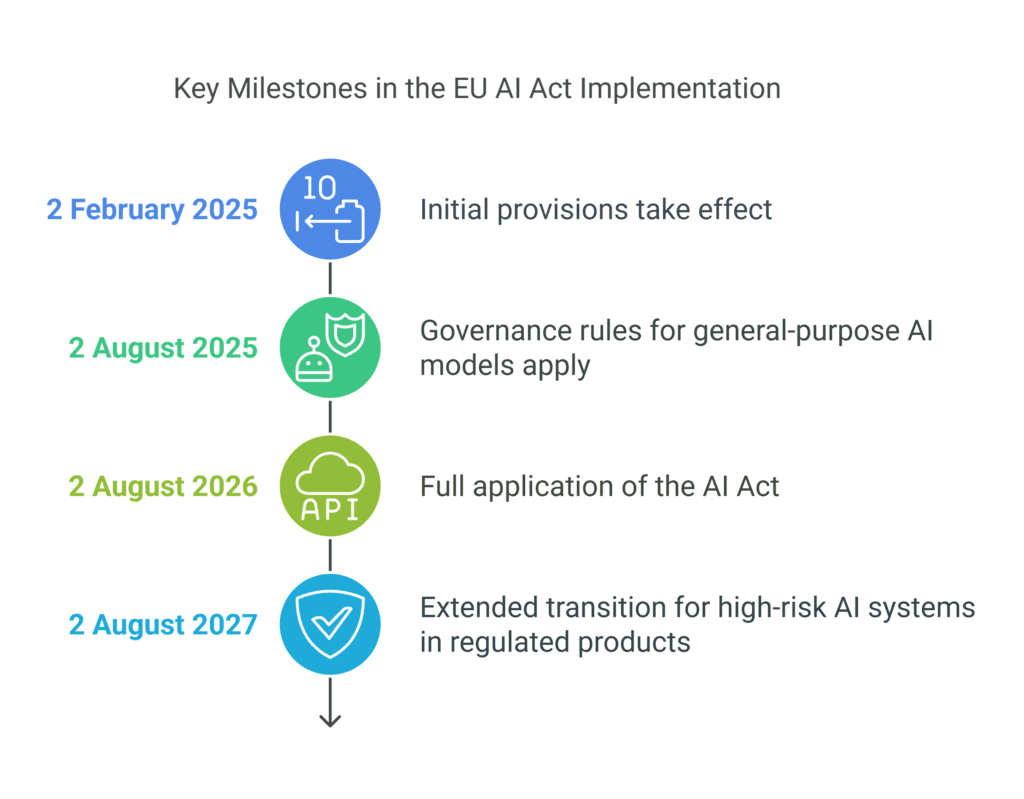
The EU AI Act will be implemented in phases:

  • 2 February 2025: Initial provisions take effect;
  • 2 August 2025: Governance rules for general-purpose AI models apply;
  • 2 August 2026: Full application of the AI Act;
  • 2 August 2027: Extended transition for high-risk AI systems in regulated products.

This timeline helps businesses adjust and meet the new AI rules.

It supports the growth of reliable AI systems.

EU AI Act Framework

AI Compliance in European Businesses: Risk Classification System

The European AI strategy has a detailed risk classification system for AI.

It aims to ensure ai fairness and ethics.

It also promotes responsible ai deployment in different sectors.

Prohibited AI Practices

The EU AI Act bans some AI uses.

These include systems for controlling behavior, social scoring, and real-time biometric identification.

This rule helps protect fundamental rights, as part of the European AI strategy.

High-Risk AI Systems

High-risk AI systems have strict rules.

They are used in critical areas like infrastructure, education, and law enforcement.

These systems need thorough ai audits and must pass conformity assessments before they can be used.

AI compliance risk classification

Limited and Minimal Risk Categories

AI systems with lower risks have less strict rules.

They don’t have to follow specific laws but are encouraged to follow voluntary guidelines.

This balance allows for innovation while keeping ethics in mind.

Risk CategoryExamplesRegulatory Approach
ProhibitedSocial scoring AIBanned
High-RiskAI in critical infrastructureStrict regulations
Limited RiskChatbotsTransparency requirements
Minimal RiskAI-enhanced video gamesVoluntary guidelines

Essential Requirements for AI System Providers and Deployers

The EU AI Act has strict rules for AI system providers and deployers.

These rules aim to make AI trustworthy and follow ethical practices.

Providers must prepare AI systems carefully before they hit the market.

Deployers focus on using these systems safely and legally.

AI providers must take strong steps to protect privacy and manage data well.

They also need to keep detailed records for 10 years after the system is introduced.

This helps follow AI regulation and improve data privacy.

Deployers are key to keeping AI trustworthy.

They must keep system logs for at least six months.

They also need to report serious incidents within 15 days.

For big disruptions, they have only two days to report.

RequirementProvidersDeployers
Documentation Retention10 years6 months (logs)
Incident Reporting15 days15 days
Critical Incident Reporting2 days2 days
CE MarkingRequiredNot applicable

Providers must put CE markings on high-risk AI systems.

They also need to have an EU representative if they’re outside the union.

These steps help meet AI regulation standards in the European market.

Data Governance and Privacy Requirements

As AI Regulation in Europe evolves, businesses face complex data governance and privacy rules.

The EU AI Act, set to take effect in 2026, brings new challenges.

It works with GDPR to ensure strong AI ethics and governance.

GDPR Alignment with AI Systems

AI systems must follow GDPR principles like lawfulness, fairness, and transparency.

You must ensure your AI practices meet these standards, mainly for high-risk areas like finance and healthcare.

Do Data Protection Impact Assessments for high-risk activities to stay compliant.

Data Quality and Management Standards

High-quality data is vital for ai bias mitigation and following rules.

The EU AI Act stresses strict data management, mainly for high-risk AI systems.

You need to have strong data governance to avoid penalties and keep client trust.

This includes managing various data sources well and ensuring data minimization.

Documentation and Record-Keeping

Keeping detailed records is essential to show you’re following the rules.

Keep records of AI training data, biases, and system performance.

For high-risk AI systems, log activity and do regular checks.

Also, remember, importers must keep EU declarations of conformity and technical documentation for ten years after market placement.

By focusing on these data governance and privacy needs, you’ll be ready for the changing AI regulation in Europe.

This will help you develop ethical and responsible AI.

Transparency and Explainability Obligations

The EU AI Act makes it clear how AI systems must be transparent and explainable.

These rules help make sure AI is fair and protects privacy.

Companies need to tell users when they’re dealing with AI, unless it’s very obvious or used for legal reasons like catching criminals.

For AI systems that are very high-risk, providers must give ‘instructions for use’.

These instructions should include details on how the system works, its accuracy, and its security.

The Act also requires detailed technical documents for audits and ongoing checks.

AI-generated content, like deepfakes, must be labeled as artificial.

This helps stop fake information and protects people.

The Act also creates a database for high-risk AI systems.

This makes it easier for the public to learn about these technologies.

  • High-risk AI systems need to be transparent so users understand how they work;
  • AI companies must tell users when they’re not talking to a human;
  • Providers must make sure their AI solutions are effective, work well together, are strong, and reliable.

These rules help follow ethical AI guidelines and support AI governance.

By being open and clear, businesses can gain trust and follow the EU AI Act.

This could lead to more people using AI and feeling confident about it.

Risk Management and Compliance Monitoring

European businesses need strong risk management and compliance monitoring to follow the EU AI Act.

These steps help make sure AI is trustworthy and keeps data safe.

Risk Assessment Frameworks

Businesses must create detailed risk assessment frameworks for AI accountability.

These frameworks spot risks, check their impact, and plan how to fix them.

Regular checks help companies stay on top of new challenges and follow rules.

Continuous Monitoring Systems

It’s key to have systems that watch AI all the time.

These systems check how AI is doing, find odd things, and make sure it follows rules.

By always watching AI, companies can catch and fix problems early.

Incident Response Protocols

Having clear plans for AI problems is very important.

These plans should say how to find, report, and fix issues.

Quick action helps reduce harm and shows a company’s commitment to AI safety.

ComponentPurposeKey Benefits
Risk AssessmentIdentify and evaluate AI risksProactive risk mitigation
Continuous MonitoringTrack AI system performanceEarly issue detection
Incident ResponseAddress AI-related issuesMinimize possible damages

By using these risk management and compliance monitoring steps, European businesses can make sure their AI systems follow rules.

This keeps trust with everyone involved.

Penalties and Enforcement Measures

The EU AI Act has strict penalties for not following the rules.

It focuses on making sure AI is transparent and private.

Businesses need to know these rules to avoid fines and stay in line with GDPR and AI laws.

Financial Penalties Structure

The Act has a system of fines based on how serious the violation is:

  • Up to €35 million or 7% of global annual turnover for prohibited AI practices;
  • Up to €15 million or 3% for violations of specific provisions;
  • Up to €7.5 million or 1% for providing misleading information.

Small businesses are capped at lower fines to help them stay afloat while keeping the rules strict.

Compliance Violations Categories

Violations are split into levels based on their impact on AI safety and ethics.

Serious violations include banned AI practices.

Less serious ones might be not monitoring AI well or not keeping proper records.

Enforcement Mechanisms

Here’s how the AI Act will be enforced:

  • Member States report to the European Commission every year;
  • The new AI Office will watch over General-Purpose AI Models;
  • Authorities can investigate and take documents.

These steps help keep AI safe and transparent across the EU.

Violation TypeMaximum FineEffective Date
Prohibited AI Practices€35M or 7% of turnoverAugust 2, 2025
Other Obligations€15M or 3% of turnoverAugust 2, 2025
Misleading Information€7.5M or 1% of turnoverAugust 2, 2025

Implementation Strategies for Business Compliance

The EU AI Act will start in August 2026. Businesses need to act fast to follow the rules.

They must set up strong ai governance frameworks.

These should cover risk assessment, quality management, and cybersecurity to protect data and avoid risks.

Companies should keep a list of their AI use cases and systems.

This list helps them know where they need to focus on compliance.

They also need to do regular checks and audits to make sure AI systems are fair and transparent.

Building trustworthy AI is key to following the rules.

This means adding privacy and ethics into AI development from the start.

Companies should also have clear rules with AI vendors and check AI systems often for fairness and accuracy.

Training programs are important for AI risks.

Employees working with critical systems, like those making credit decisions, need more training.

This is different from those doing less sensitive tasks.

If you need help with these strategies, contact our lawyers in Romania at office@theromanianlawyers.com.

Our Romanian law office can offer great advice on AI compliance for European businesses.

Challenges and Considerations for Global Companies

Global companies face unique challenges in implementing responsible AI deployment strategies that comply with the EU AI Act.

They must harmonize international AI regulations with robust ai risk mitigation strategies.

Companies need to navigate diverse regulatory landscapes while keeping up with EU standards.

A key challenge is conducting thorough ai bias and fairness audits across different cultural contexts.

They need to develop culturally sensitive evaluation methods.

This ensures AI systems remain unbiased and fair in various global markets.

Implementing AI transparency and accountability measures on a global scale is another hurdle.

Companies must create standardized processes for explaining AI decisions to stakeholders from diverse backgrounds.

This may involve developing multilingual explainability tools and adapting communication strategies to local norms.

ChallengeImpactMitigation Strategy
Regulatory HarmonizationIncreased compliance costsDevelop unified global compliance framework
Cross-cultural Bias AuditsPotential market exclusionCulturally-sensitive AI evaluation methods
Global TransparencyTrust issues in local marketsMultilingual explainability tools

While challenging, early compliance with the EU AI Act can provide a strategic advantage.

As other regions look to the EU as a model for AI regulations, companies that adapt now may find themselves better positioned in the global market.

AI Deployment

Future Trends and Evolving Regulatory Landscape

The AI regulatory scene is changing fast. By 2026, the EU AI Act will fully come into play.

It will bring a new risk-based system for AI apps.

This means companies will need to update their privacy and security measures.

Recent stats show AI governance is becoming more critical:

  • 56% of organizations plan to use Generative AI in the next year;
  • 72% of companies already use AI, seeing improvements in many areas;
  • Only 18% of organizations have a council for responsible AI governance.

As rules get stricter, companies could face big fines.

The EU AI Act might fine violators up to €35 million or 7% of their global income.

To keep up, companies need to train their AI teams and follow strict ethics guidelines.

The future of AI rules will include more audits and risk checks.

Healthcare and finance will need special plans to use AI ethically and follow the law.

Conclusion: Embracing Ethical AI for Sustainable Growth

The EU AI Act is a big change in artificial intelligence.

It got 523 votes in favor, setting a new AI governance standard.

Your business needs to follow these rules to avoid fines up to 7% of global turnover.

It’s important to have a good ai risk assessment strategy.

The Act covers all AI systems in the EU market, no matter where they are.

High-risk AI systems must go through checks and be registered in an EU database.

This ensures AI systems are safe and trustworthy.

It also makes sure they respect basic rights.

Ai fairness testing is now a must for following the rules.

The European AI Office will make sure everyone follows the Act.

There’s also an AI Sandbox for testing within ethical limits.

These rules start on August 1, 2024, with most parts taking effect on August 2, 2026.

Understanding the EU AI regulation can be tough.

For help with compliance, contact our lawyers in Romania at office@theromanianlawyers.com.

By using ethical AI, your business can grow sustainably in this new AI world.

FAQ

What is the EU AI Act and why is it important for European businesses?

The EU AI Act is a new rule for AI in the European Union.

It helps businesses by setting rules for ethical AI use.

It also makes sure AI is governed well and meets certain standards.

How does the EU AI Act classify AI systems based on risk?

The Act sorts AI systems into four risk levels.

There are banned practices, high-risk systems, systems with limited risk, and those with minimal risk.

Each level has its own rules. Knowing this helps businesses understand their duties.

What are the essential requirements for AI system providers and deployers under the EU AI Act?

Providers and deployers must focus on data quality and system reliability.

They also need to ensure human oversight and transparency.

These steps are key from start to finish to follow the Act’s rules.

How does the EU AI Act intersect with existing data protection regulations like GDPR?

The Act works with the GDPR to protect data.

Businesses must follow GDPR rules for AI use.

Keeping data safe and well-documented is essential for following both laws.

What are the transparency and explainability requirements under the EU AI Act?

The Act requires clear information about AI systems.

Businesses must make AI decisions clear and explainable.

This builds trust and follows the regulation.

What risk management and compliance monitoring measures are required by the EU AI Act?

The Act demands good risk management and constant checks.

Businesses need to have plans for risks and keep an eye on their AI systems.

This keeps them in line with the Act.

What are the penalties for non-compliance with the EU AI Act?

Breaking the Act can cost up to €30 million or 6% of global sales.

The fine depends on the violation’s impact.

This shows how serious following the Act is.

How can businesses implement AI compliance measures in line with the EU AI Act?

Businesses can start by making AI inventories and doing impact assessments.

They should also think about privacy and ethics in AI.

Keeping AI systems up to date is key.

For complex issues, getting legal advice is a good idea.

What challenges do global companies face in complying with the EU AI Act?

Global companies must align with many AI rules worldwide.

They need a global plan for AI compliance.

This means adjusting their current systems to fit EU rules.

What future trends are expected in AI regulation?

We might see more AI offices and independent bodies.

The rules will likely change, so businesses need to stay updated.

Being ethical and flexible in AI compliance is important for growth.