
Online company registration in Romania represented by incorporation documents, an international globe and a modern Bucharest office building

Online Company Registration in Romania: Electronic Signature and ONRC Filing

Online company registration in Romania is available for many founders, including non-residents. The filing can be submitted electronically or through an authorised representative, but a valid electronic signature is only one part of the route. The documents, signing authority, identity checks and ONRC platform requirements must also align.

Documents required for online company registration in Romania including identification, electronic signature, power of attorney and ONRC filing
Remote incorporation depends on coordinating the founder’s identification, electronic signature, power of attorney, company documents and ONRC filing.

This guide explains the online filing route for foreign individuals, overseas companies and Romanian founders. It focuses on the relationship between electronic signatures, filing authority, documents and the National Trade Register Office platform. For the broader choice of entity, capital and corporate structure, see our company formation in Romania guide.

Can you register a Romanian company online?

Often yes, but online registration is not the same as an automatic paper-free process. The ONRC application can be filed electronically, while foreign-document formalities, identity verification, representation and bank onboarding may follow separate rules.

Romania’s National Trade Register Office online portal offers services including company-name reservation and incorporation. Law No. 265/2022 also regulates online company formation and electronic communication with the Trade Register.

Under Article 105 of Law No. 265/2022, the registrar may exceptionally request physical presence if there is a suspicion of identity falsification. The same provision states that physical presence is not required when the incorporation application and supporting documents, including the articles of association, were prepared by a public notary or lawyer. If presence is exceptionally requested during online formation, the remaining stages may still be completed electronically.

StageCan it be handled remotely?Important qualification
Name reservationNormally yesThe proposed name must satisfy Trade Register availability and naming rules.
Preparation of incorporation documentsYesThe documents must reflect the chosen structure, activities, management and registered office.
Signing and representationOften yesThe route may use a qualified electronic signature or a compliant power of attorney, depending on the document and filing method.
Trade Register filingYesElectronic filing must meet the portal’s technical and signature requirements.
Bank account onboardingBank-dependentBanks apply their own know-your-customer, beneficial-owner and risk procedures.
Sector permitsDepends on the activityRegulated activities may require separate authorisations before or after incorporation.

What are the steps for remote company formation in Romania?

The legal sequence is straightforward, but the filing route should be chosen before documents are signed. Select each step below to see its practical purpose.

Online filing roadmap
From signature to registration

Select a step to review what must be resolved before the next stage.

Confirm the structure

Choose the company type, shareholders, directors, activities, decision rules and capital before preparing the filing documents.

  1. Confirm the company structure. Decide the entity type, ownership, administrators, business activities and signing authority. An SRL is common, but it should not be selected automatically when investment, governance or regulated activities require another structure. See our 2026 guide to Romanian limited liability companies.
  2. Reserve the company name. Submit alternatives that comply with the Trade Register rules. Our separate guide explains how to register a company name in Romania.
  3. Establish the registered office. Every Romanian company needs a valid registered office and supporting title to use the address. For the documents commonly used in an incorporation file, see our foreign-founder document checklist.
  4. Prepare, formalise and translate the documents. Coordinate the articles of association, identity or corporate records, declarations, beneficial-owner information, office evidence and powers of attorney. Foreign public documents may require apostille, legalisation or an applicable exemption, depending on the issuing state, bilateral treaties, EU legislation and the nature of the document, followed by an authorised Romanian translation where required.
  5. Sign and file through the selected route. If the electronic filing route is used, the signature and submission must satisfy the applicable ONRC technical and procedural requirements. A properly authorised representative may provide an alternative route, provided that the authority granted complies with the requirements applicable to the filing.
  6. Complete post-registration onboarding. After incorporation, organise accounting, tax registrations or options, bank onboarding, employment setup and any permits required for the actual activity.

Which documents do foreign founders usually need?

The exact file depends on whether the shareholder is an individual or a foreign company, the founder’s country, the administrators, the registered office and the intended activities. Do not sign foreign documents until their Romanian formality and translation route has been checked.

Founder or issueTypical documents or informationRemote-formation check
Foreign individual shareholderValid identity document, personal details, declarations and specimen/signing information as applicableConfirm legibility, validity, signature method and whether additional identification evidence is required.
Foreign corporate shareholderRecent company extract, constitutional documents, representation evidence and corporate approvalConfirm issue date, competent signatory, apostille or legalisation and Romanian translation.
AdministratorIdentity data, acceptance and statutory declarationsCheck eligibility, tax-identification implications and the signing route.
Company constitutionArticles of association specifying ownership, management, activities, capital and governanceAlign every translated or signed version. See our articles of incorporation guide.
Registered officeDocument proving the right to use the Romanian address and any required supporting recordsConfirm permitted use, term and consistency with the filing.
Beneficial ownerBeneficial-owner information and any declaration required under the legislation applicable at the time of filingTrace the ownership chain and identify the natural persons who ultimately own or control the company.
RepresentativePower of attorney or lawyer’s authority, depending on the routeMatch the scope, form and authentication requirements to the acts the representative will perform.

Do founders need a qualified electronic signature?

A qualified electronic signature may support electronic filing, but its legal validity does not, by itself, make it sufficient for every ONRC submission. A founder may instead use a properly authorised representative, provided that the power of attorney complies with the form requirements applicable to the specific filing and the jurisdiction where it is executed.

The signature route should be tested before execution. Romania’s framework includes Law No. 214/2024 on electronic signatures and trust services, while the Trade Register procedure is governed specifically by Law No. 265/2022 and the portal’s filing requirements. The availability of electronic filing depends not only on the legal validity of the electronic signature but also on the technical and procedural requirements imposed by the National Trade Register Office.

Remote identity checks may also involve regulated identification services. The Romanian Authority for Digitalisation publishes information on remote identification by video means, but the availability and acceptance of a particular method still depend on the institution and transaction.

Is a Romanian notary always required?

No. Notarial involvement is not a universal requirement for every remote Romanian incorporation. It may nevertheless be necessary or useful for a particular power of attorney, foreign public document, contribution, identity issue or transaction-specific formality.

The correct answer depends on the document, the country where it is issued and the chosen filing route. For foreign founders, the practical question is usually not “Do I need a notary for the company?” but “Which document, if any, needs notarisation, apostille or legalisation, and in which country?”

How long does remote incorporation take?

Romanian law provides a short decision period for a complete Trade Register application, but that is not a guaranteed end-to-end formation time. Document collection, foreign formalities, translations, corrections, registered-office arrangements and bank checks sit outside that narrow decision window.

Under Articles 105 and 107 of Law No. 265/2022, the registrar generally resolves complete applications on documents within one working day and, when the legal requirements are met, orders registration according to the statutory procedure. Procedural exceptions, requests for additional evidence or a need to remedy the file may affect this stage. The one-working-day period should not be advertised as the total time needed by a foreign founder.

If the file is incomplete or does not meet the legal requirements, Article 106 allows a remedy or completion period of up to 15 calendar days. The practical schedule should therefore separate:

  • preparation time for the corporate structure and registered office;
  • time for foreign documents, apostille or legalisation and translation;
  • the Trade Register review of a complete filing;
  • time needed to cure any filing defect; and
  • post-incorporation bank, accounting, tax and licensing steps.

Is the bank account part of the online incorporation?

No. Company registration and bank onboarding are separate processes. Incorporation by the Trade Register does not compel a bank to open an account remotely or remove its customer due-diligence requirements.

Each bank decides what identification, beneficial-owner, source-of-funds and business-model evidence it needs. Some institutions offer remote onboarding in eligible cases; others may request a video identification, additional documents or physical attendance. Founders should compare banking routes early, especially where the ownership chain is international or the activity carries heightened compliance risk. See our guide to opening a Romanian business bank account as a non-resident.

What most often delays a remote filing?

Common error 1

Signing before the route is confirmed. The founder signs documents that later require a different form, signature or authentication.

Common error 2

Using inconsistent identity or corporate data. Names, addresses, registration numbers or signatory capacities differ across extracts, translations and the articles of association.

Common error 3

Treating the bank as part of ONRC registration. The company is incorporated, but operations are delayed because bank onboarding was not planned separately.

Common error 4

Choosing activities without checking authorisations. A company may be registered while its actual regulated activity still requires a permit, approval or professional condition.

Remote formation checklist for a foreign founder

  1. Confirm the Romanian entity, ownership, administrators and business activities.
  2. Choose the online filing or legal-representation route before signing documents.
  3. Check each foreign document for issue date, apostille or legalisation and Romanian translation.
  4. Secure a compliant registered office and align the supporting document with the intended filing.
  5. Map the beneficial owners through the complete international ownership chain.
  6. Verify the signature and authority of every shareholder, administrator and representative.
  7. Submit one consistent, complete file through the National Trade Register Office route.
  8. Plan banking, accounting, tax and sector-specific compliance as separate workstreams.

The bottom line

Remote company formation in Romania is a workable route for many foreign founders, but it is not a single universal online form. The successful approach coordinates Romanian incorporation requirements with the founder’s home-country documents, a valid signing or representation route, registered-office evidence and separate post-registration onboarding.

Frequently asked questions

Can a foreigner open a company in Romania without travelling there?

Often yes. The filing can be completed electronically or through a properly authorised representative. The final route depends on the founder’s documents, their country of issue, the signing method, identity checks and the requirements of any bank or regulated authority involved after incorporation.

Does every foreign founder need a Romanian electronic signature?

No. A qualified electronic signature may support electronic filing, but acceptance also depends on the technical and procedural requirements imposed by the National Trade Register Office. Legal representation can provide another remote option, provided that the power of attorney satisfies the requirements applicable to the filing and place of execution.

Does a remote incorporation always require a notarised power of attorney?

No universal rule applies to every file. The required form depends on the representative’s acts, the document, the country of execution and applicable Romanian and international formalities. Some powers or foreign documents may require notarisation, apostille or legalisation; others may follow a different route.

Can the Romanian Trade Register ask a founder to appear in person?

Exceptionally, yes. Article 105 of Law No. 265/2022 permits a request for physical presence where there is a suspicion of identity falsification. The law also provides that presence is not required when the application and supporting documents, including the articles of association, were drawn up by a public notary or lawyer.

Is a Romanian bank account opened automatically after registration?

No. The Trade Register incorporates the company, while the chosen bank conducts its own onboarding and compliance review. Remote availability varies by bank and case, especially for non-resident founders, foreign corporate shareholders and complex beneficial-ownership structures.

How long does remote company formation in Romania take?

The registrar’s statutory decision period for a complete application is not the same as the total project time. Foreign-document formalities, translations, registered-office arrangements, corrections and bank onboarding can extend the schedule. A realistic estimate requires review of the specific founders and documents.

Planning to establish a Romanian company remotely?

Atrium Romanian Lawyers assists foreign individuals and international companies with structuring, document preparation, powers of attorney, Trade Register filings and coordinated post-incorporation steps.

Discuss your remote formation route

AI Notice: AI-assisted content, reviewed by a qualified Romanian lawyer.
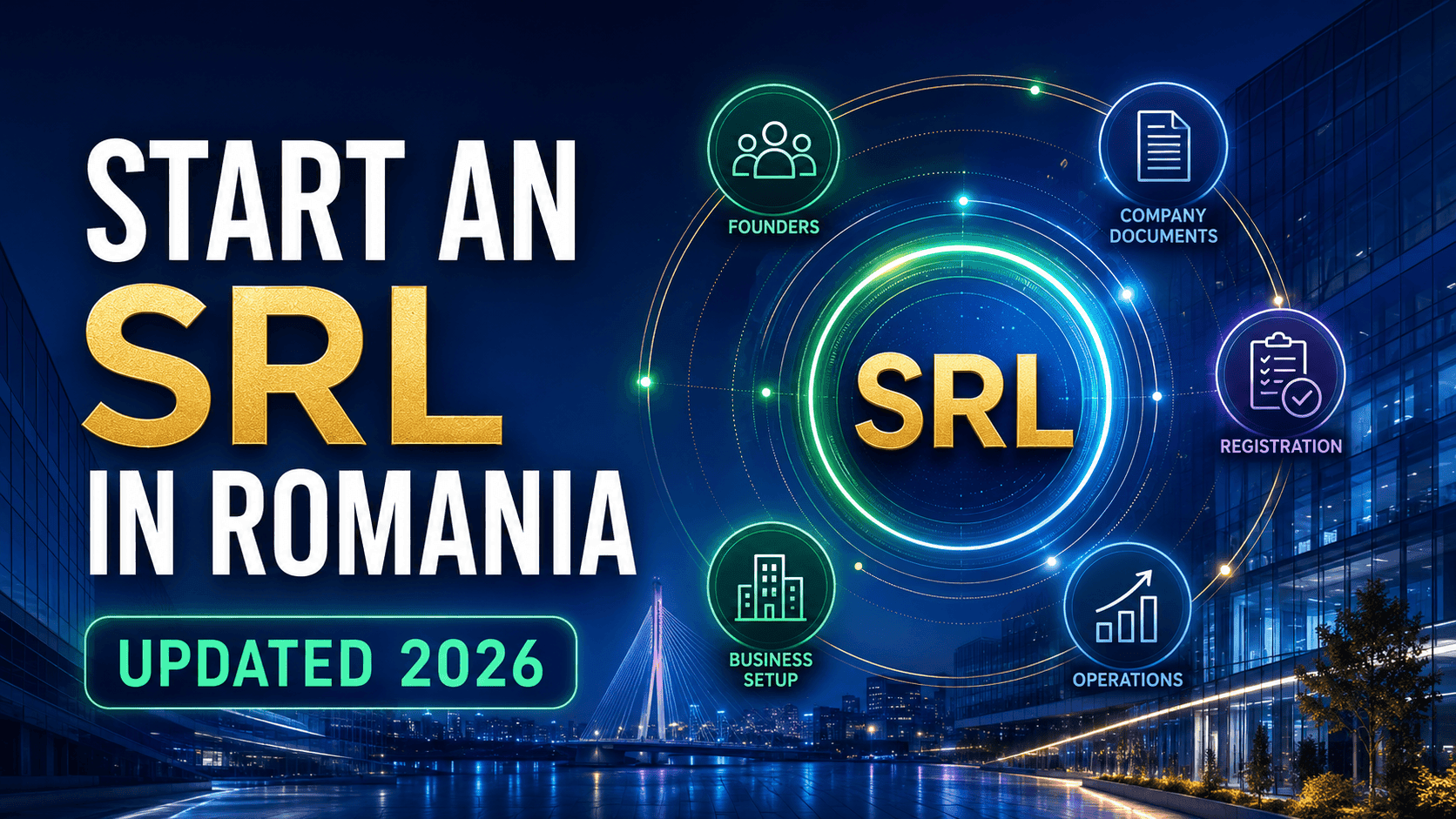
Start an SRL in Romania – Updated 2026

How to Start a Limited Liability Company (SRL) in Romania – Updated for 2026

How to establish a Romanian SRL in 2026

A Romanian limited liability company is not created by completing one standard form. The founders must settle the ownership, management, registered office, activities, capital and beneficial ownership before filing a consistent incorporation application with the Trade Register.

Romanian SRL formation ecosystem An animated orbital map showing the founders, registered office, company documents, capital, Trade Register and operational setup surrounding a Romanian SRL. ROMANIAN SRL • 2026 SRLROMANIA Foundersownership & control Capitalfunding structure ONRC filingregistration decision Operationsbank • tax • licences
A reliable incorporation file starts with coherent founder decisions and ends with the operational steps required after registration.

Short answer: an SRL is the most common Romanian company form for startups, SMEs and foreign-owned subsidiaries. In 2026, a newly incorporated SRL must have share capital of at least RON 500. Registration is only the first stage: banking, accounting, tax, employment and sector-specific requirements must be addressed separately.

What is a Romanian SRL?

An SRL, or societate cu răspundere limitată, is a Romanian legal entity whose share capital is divided into participation interests. As a general rule, the shareholders’ exposure is limited to their agreed contributions, while the company owns its assets and assumes its own contractual obligations.

Limited liability is not absolute protection against every personal risk. A shareholder or administrator may still face exposure under personal guarantees, director-liability rules, tax or insolvency provisions, unlawful distributions or abusive conduct. Governance and signing authority therefore matter from the incorporation stage.

This guide focuses only on the SRL. Foreign investors comparing an SRL with an SA, branch or representative office should first review our main page on company formation in Romania for foreign founders.

Which decisions must the founders make before filing?

OwnershipIdentify the shareholders, participation percentages, capital contributions and ultimate beneficial owners.
ManagementAppoint the administrator or administrators and define whether they represent the company separately or jointly.
ActivitiesSelect the principal and secondary activities under the official CAEN Rev.3 classification and check whether the proposed activity needs a Romanian business permit or licence.
Registered officeSecure a Romanian address and a legally valid document proving the company’s right to use it. For the documents commonly used in the incorporation file, see our foreign-founder document checklist.
GovernanceAgree voting rules, reserved matters, profit distribution and procedures for conflicts. A 50/50 structure should include a workable shareholder-deadlock mechanism.
FundingSet the share capital and distinguish it from shareholder loans, future investment and working capital.
Common formation riskUsing a standard articles-of-association template without adapting representation powers, voting rules or transfer restrictions. Registration may succeed while the company is left with avoidable governance problems.

What is the minimum share capital for an SRL in 2026?

Following Law no. 239/2025, the minimum share capital for a newly incorporated SRL is RON 500. Older references stating that an SRL may be incorporated with RON 1 or without an effective minimum are no longer current.

Law no. 239/2025 also establishes a minimum share capital of RON 5,000 for an SRL whose reported net turnover for the previous financial year exceeds RON 400,000. Existing companies falling within that rule must observe the statutory adjustment period. The applicable amount should therefore be checked both at incorporation and when the company’s turnover changes. The implementation steps are discussed separately in our guide to a Romanian company capital increase.

SituationMinimum capitalPractical consequence
Newly incorporated SRLRON 500The articles of association and capital structure must reflect at least this amount.
SRL with reported net turnover above RON 400,000RON 5,000The company must bring its capital into line with the statutory rule within the applicable period.
Additional business fundingCommercial decisionShare capital should not be confused with shareholder loans or the actual operating budget.

Under Law no. 31/1990, an SRL must pay at least 30% of the subscribed capital no later than three months after registration and before commencing operations in its own name. The remaining cash contribution is payable within 12 months after registration, while the remaining in-kind contribution is payable within no more than two years.

Capital is not the complete formation budgetFounders should separately budget for translations, apostilles or legalisation, registered-office arrangements, professional fees, banking, accounting, publication charges and any licences required for the intended activity.

What documents are generally required?

The precise filing depends on the founders, administrator, office and activities. A standard SRL incorporation usually requires or relies on:

  • the Trade Register incorporation application;
  • proof of company-name reservation;
  • the articles of association;
  • documents proving the right to use the registered office;
  • identity documents for individual shareholders and administrators;
  • current registry extracts, constitutional documents and corporate approvals for a corporate shareholder;
  • statutory declarations concerning operating conditions and other legally required matters;
  • beneficial-owner information or a separate declaration, where required;
  • evidence of authority for the person signing or filing the application; and
  • any approvals, opinions or documents required by the proposed name or regulated activity.

The official list and current forms should be checked on the National Trade Register Office website immediately before filing. A missing mandatory element may result in rejection rather than an informal opportunity to complete the file. Founders can prepare the file using our separate checklists for reserving a Romanian company name and drafting Romanian articles of association.

What changes when a shareholder is foreign?

Foreign individuals and companies may generally hold participation interests in a Romanian SRL. Romanian citizenship or residence is not, by itself, a general ownership condition. However, foreign documents must be assessed for validity, authority, legalisation or apostille and authorised Romanian translation.

A foreign corporate shareholder may need a recent registry extract, its constitutional documents, a resolution approving the Romanian investment and evidence that the signatory can bind it. The exact formalities depend on the issuing state, applicable treaties and the document used. Our document checklist for foreign founders explains the preparation issues in more detail.

The ownership chain must also be traced to the natural persons who ultimately own or control the company. The applicable tests and filing deadlines are explained in our updated guide to the beneficial owner declaration in Romania.

Company ownership is not immigration statusIncorporating or owning an SRL does not automatically grant a foreign founder the right to enter, reside or work in Romania. Immigration and work-authorisation requirements require a separate analysis.

How does the Romanian SRL formation process work?

Formation map

From founder decisions to operational setup

Romanian SRL formation roadmap An animated six-card roadmap from company structure and documents through ONRC filing, registration and operational activation. SRL FORMATION ROADMAPROMANIA • 2026 01StructureOwnership • managementactivities • capital 02Name & officeName reservationregistered-office title 03DocumentsArticles • identitiesforeign formalities 04ONRC filingPortal • counterlawyer representation 05RegistrationRegistrar decisioncompany certificate 06ActivationBank • tax • accountinglicences • contracts
Trade Register approval creates the company, but banking, tax, accounting and operational compliance continue after registration.
Define the structureSet ownership, management, activities, capital, governance and the post-registration plan.
Reserve the nameSubmit suitable alternatives and obtain proof of availability through ONRC.
Secure the registered officePrepare the lease, loan-for-use agreement or other valid title to the premises.
Prepare the incorporation fileDraft the articles and collect the founder, administrator, corporate and beneficial-owner documents.
Submit the applicationFile at the counter, by post or courier, or electronically under the signature and format rules.
Complete operational setupAddress capital payment, bank onboarding, accounting, tax registrations, authorisations, contracts and employment.

Can the SRL application be submitted online or through a lawyer?

Yes. Under Law no. 265/2022 on the Trade Register, an incorporation application may be filed at the counter, through post or courier, or electronically. Electronic documents must comply with the qualified-electronic-signature requirements. A lawyer may sign or submit the application on the basis of a legal-services mandate and may transmit documents prepared by the lawyer under the statutory procedure.

The available electronic services can be accessed through ONRC MyPortal. Remote incorporation is possible in many cases, but foreign-document formalities, bank identification, regulated activities and immigration matters may require additional steps.

How long does SRL registration take?

The Trade Register states that a complete registration application is generally resolved by the registrar within one working day after registration of the application. This procedural period is not a guaranteed end-to-end formation time.

Name reservation, document preparation, foreign legalisation, translations, correcting inconsistent information, obtaining a registered office and responding to registrar requirements may extend the project. Bank onboarding and licences also occur outside the basic incorporation decision.

Use a two-part timelineSeparate the time required to obtain the Trade Register decision from the total time required for the company to become operational. A registered SRL may not yet be ready to invoice, employ staff or perform a regulated activity.

What does it cost to establish an SRL?

There is no reliable universal package price. The total depends on the founders and documents involved. A realistic budget may include:

  • the subscribed share capital;
  • official publication or registration-related charges generated for the file;
  • translations, apostilles, legalisation or notarial formalities;
  • legal assistance and representation;
  • registered-office costs;
  • bank, accounting and tax-advisory services; and
  • licensing or sector-specific costs.

According to the ONRC information published on 30 April 2026, the tariff for publication in the Official Gazette is calculated and paid after the registration application is admitted. A generic statement that every SRL has a fixed “state fee of EUR 50” should therefore not be used.

What must be done after the SRL is registered?

The registration certificate does not complete every business requirement. Depending on the project, the founders should address:

Post-registration areaQuestions to resolveMain risk if ignored
Capital and bankingCapital payment, operating account, signatories, bank KYC and the steps for a Romanian business bank account for a non-residentThe company cannot use the intended banking arrangements or misses a statutory contribution deadline.
Accounting and taxAccounting engagement, tax vector, VAT analysis, reporting calendar and ongoing Romanian tax registration and complianceLate filings, incorrect invoicing or unsuitable tax treatment.
Activity authorisationWhether the declared CAEN activities may be performed at the office, third-party sites or outside a fixed locationThe company is registered but not authorised to conduct the intended activity.
Contracts and governanceCustomer, supplier, employment, administrator and shareholder arrangementsOperational exposure and internal disputes begin before protections are documented.
Regulated sectorsLicences, notifications, professional requirements or foreign-investment screeningThe business starts an activity before regulatory clearance.

Tax positions should be checked against the current ANAF guidance and electronic services. VAT registration, payroll reporting and the applicable corporate or microenterprise regime depend on facts that are not resolved merely by incorporating the SRL.

Which SRL formation mistakes cause delays or future disputes?

  • choosing CAEN codes without checking whether the activity is regulated or may be authorised at the selected location;
  • submitting foreign documents that are outdated, improperly legalised or inconsistently translated;
  • using unclear joint or separate representation powers for multiple administrators;
  • treating share capital as the complete operating budget;
  • failing to identify indirect beneficial owners;
  • assuming that incorporation grants immigration or work rights;
  • using generic voting clauses in a 50/50 company without a workable deadlock solution; and
  • waiting until after registration to address banking, accounting, tax or licensing requirements.

Where there are several founders, the articles should be coordinated with a properly drafted Romanian shareholder agreement. Administrators should also understand the exposure explained in our guide to Romanian company director liability.

Need assistance establishing an SRL in Romania?

Atrium Romanian Lawyers assists Romanian and foreign founders with company structuring, articles of association, beneficial ownership, registered-office documentation, Trade Register filings and post-incorporation corporate work.

Frequently asked questions

What is the minimum share capital for a new Romanian SRL in 2026?

The minimum share capital for a newly incorporated SRL is RON 500. A separate RON 5,000 minimum applies to SRLs whose reported net turnover for the previous financial year exceeds RON 400,000, subject to the statutory adjustment rules.

Can a foreigner own 100% of a Romanian SRL?

In general, yes. Romanian citizenship or residence is not a general condition for owning an SRL. The founder’s documents, beneficial ownership, applicable foreign-investment rules and any regulated-sector restrictions must still be checked.

Can an SRL have one shareholder and one administrator?

Yes. An SRL may generally have a sole shareholder, who may also be appointed administrator. The articles should still regulate the company’s activities, capital, representation and beneficial-owner information correctly.

Is a Romanian bank account required before incorporation?

The banking sequence must be coordinated with the applicable capital-payment rules and the chosen bank. The company must pay the required portion of subscribed capital within the statutory period and before commencing operations in its own name.

Can the SRL be incorporated remotely?

Often, yes. The application may be submitted through an authorised representative or electronically where the signature and document-format requirements are met. Foreign formalities, bank KYC, licences or immigration steps may still require separate action.

Does Trade Register registration mean the SRL can immediately perform every declared activity?

No. Certain activities require additional authorisation, licences, notifications, qualified personnel or suitable premises. Registration and operational authorisation must be checked separately.

Disclaimer: This article provides general information and does not constitute legal or tax advice. The correct formation process depends on the founders, ownership structure, activities, documents and legislation in force when the application is prepared.

AI Notice: AI-assisted content, reviewed by a qualified Romanian lawyer.