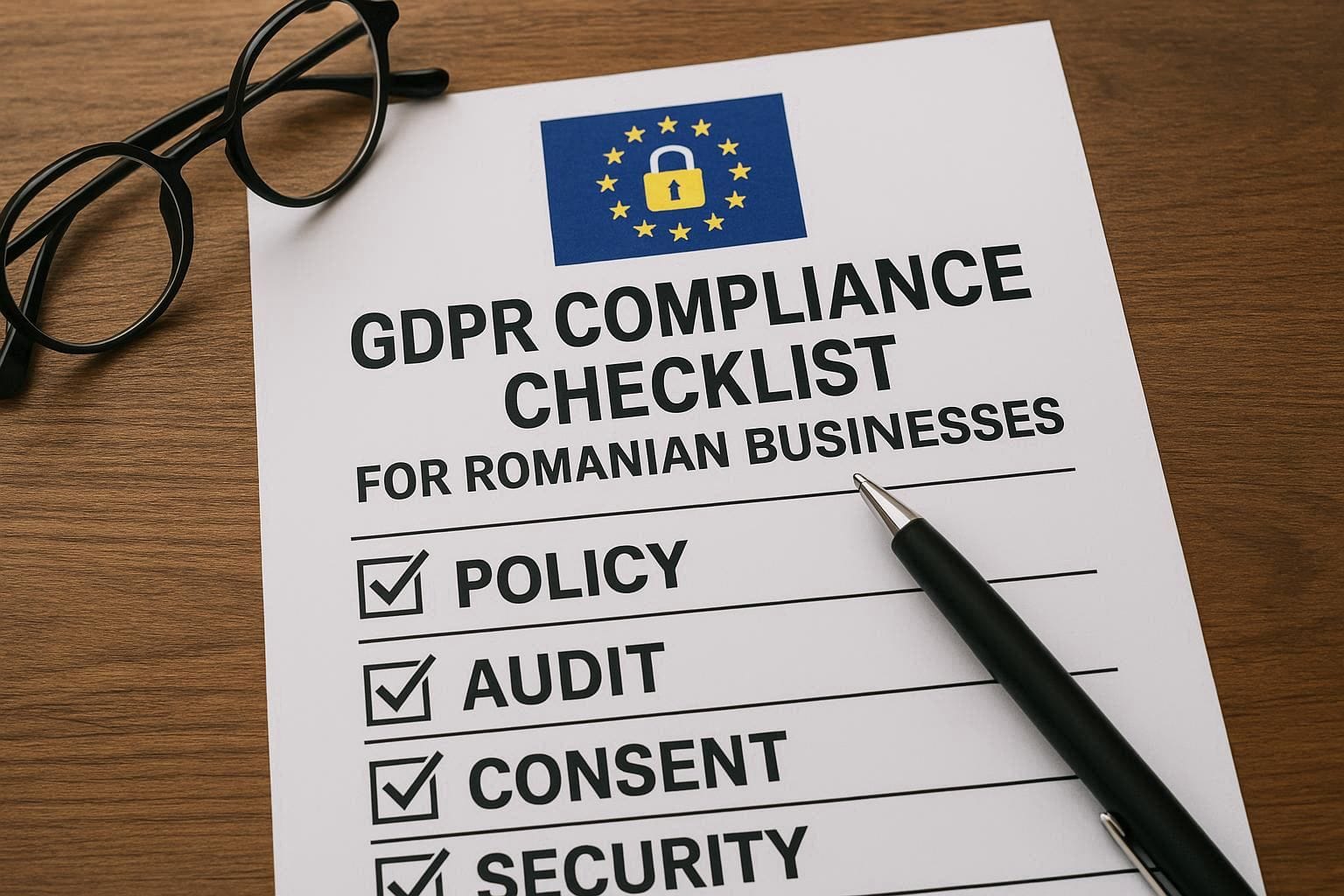
Romanian business professional reviewing GDPR compliance checklist on laptop in Bucharest office

GDPR Compliance Checklist for Romanian Companies 2025

GDPR Compliance Checklist for Romanian Companies

What crucial step could protect your business from devastating fines while building customer trust?

Many organizations underestimate how Europe’s strict data protection laws apply to their operations.

While GDPR penalties can reach €20 million or 4% of global revenue, Romanian enforcement authorities have imposed fines ranging from €3,000 to €130,000 for violations, demonstrating that penalties scale with the severity of breaches and organizational size.

GDPR compliance checklist for Romanian companies

Romania’s evolving digital economy demands proactive measures to align with rigorous privacy standards.

Legal experts emphasize that proper adherence involves more than basic policy updates—it requires systematic data governance.

Companies must address consent protocols, breach response plans, and cross-border data flows to avoid regulatory scrutiny.

Specialized legal guidance helps businesses transform compliance into strategic advantages.

Firms adopting privacy-first approaches often see improved client relationships and operational resilience.

Those delaying action risk not only financial consequences but also long-term reputational damage in competitive markets.

For tailored strategies meeting international standards, contact our data protection lawyers in Bucharest.

Our team of legal professionals provide actionable frameworks to navigate complex requirements while prioritizing business growth.

Key Takeaways

  • Data protection laws apply regardless of a company’s physical location if EU resident information is processed,
  • Penalties can reach €20 million or 4% of global revenue, emphasizing the need for preventive measures,
  • Building customer trust through transparent data practices creates market differentiation,
  • Legal experts offer customized solutions to align business operations with regulatory demands,
  • Compliance involves continuous monitoring, not just one-time adjustments.

Understanding GDPR and Its Impact on Romanian Businesses

How can organizations in Romania turn regulatory demands into strategic opportunities?

The General Data Protection Regulation (GDPR) reshapes how businesses manage information, particularly for entities handling EU residents’ data.

Its extraterritorial scope means even non-EU-based firms must adhere to strict standards when processing personal details of European citizens.

Core Regulatory Foundations

The regulation establishes six foundational principles for data handling, plus an overarching accountability principle.

These mandate that organizations:

  • Process information lawfully and transparently,
  • Collect only necessary data for specific purposes,
  • Maintain accuracy and limit storage durations.

Such requirements demand technical safeguards like encryption and operational protocols for accountability.

Privacy-by-design methodologies ensure protections are embedded in all systems.

Strategic Advantages for Local Entities

Adhering to these standards transforms obligations into opportunities.

Firms prioritizing data protection report:

  • Enhanced client confidence through transparent practices,
  • Reduced breach-related costs and operational disruptions,
  • Differentiation in markets where privacy concerns influence decisions.

For tailored strategies aligning Romanian operations with these regulations, consult our team of Romanian Lawyers.

Proactive adaptation not only mitigates risks but positions businesses as trustworthy data stewards.

Exploring Key GDPR Roles and Terminology

Who holds ultimate accountability in data governance frameworks?

Clarifying responsibilities under privacy regulations helps organizations establish clear operational boundaries.

Three critical roles form the foundation of proper data management practices.

data protection officer

Data Controllers, Processors, and Data Subjects

Data controllers determine why and how personal information is handled.

They bear legal responsibility for compliance across all processing activities.

Third-party processors execute tasks under controller directives but must independently meet security standards.

Individuals whose data is collected, known as data subjects, retain rights to access or delete their information.

Organizations must implement systems to honor these requests efficiently.

The Essential Role of the Data Protection Officer (DPO)

A data protection officer oversees compliance strategies and acts as the regulatory liaison.

This role is mandatory for entities processing sensitive data or conducting large-scale monitoring.

Under Romanian Law 190/2018, organizations processing national identification numbers (CNP) based on legitimate interest must also appoint a DPO, even if they don’t meet the standard GDPR thresholds.

This additional requirement reflects Romania’s enhanced protection for sensitive national identifiers.

Romanian businesses uncertain about role allocations should consult office@theromanianlawyers.com.

Proper classification prevents overlapping liabilities and ensures alignment with cross-border standards.

Conducting a Comprehensive Data Audit and Mapping

Organizations handling personal information must first establish clarity in their data ecosystems.

A systematic audit reveals how data flows through operations, exposing vulnerabilities while ensuring alignment with legal obligations.

This foundational step transforms raw information into actionable insights for risk management.

data audit and mapping

Identifying What Personal Data You Collect

Begin by cataloging every category of personal data your organization processes.

Common examples include:

  • Contact details (names, email addresses).
  • Digital identifiers (IP addresses, device information).
  • Sensitive records (financial data, health information).

Document each data point’s purpose, collection method, and retention timeline.

Assess whether processing activities rely on valid legal grounds like contractual necessity or explicit consent.

Storage locations demand equal scrutiny—identify physical servers, cloud platforms, and third-party repositories holding sensitive materials.

Access controls form another critical audit component.

Map which employees or systems interact with personal data and verify authorization protocols.

This process highlights potential exposure points while streamlining responses to information requests.

Romanian entities seeking structured frameworks for these assessments may contact our data protection legal specialists.

Expert guidance ensures audits meet regulatory expectations while supporting operational efficiency.

GDPR Compliance Checklist for Romanian Companies

Businesses handling EU data face operational complexity when aligning processes with privacy standards.

Structured frameworks simplify adherence while minimizing risks of non-conformance.

Effective strategies combine procedural clarity with technological safeguards to meet evolving requirements.

data protection checklist steps

Actionable Protocols for Information Security

Organizations should prioritize these critical measures:

Action ItemResponsible PartyDeadline
Complete data flow mappingIT & Legal Teams30 Days
Implement encryption protocolsSecurity Department45 Days
Update third-party contractsCompliance Officer60 Days

Consent Management Best Practices

Valid authorization requires unticked checkboxes and separate permissions for distinct processing purposes.

Confirmation emails enhance verification, while centralized logging systems track user agreements with timestamps and purpose details.

Organizations must honor withdrawal requests without undue delay and provide confirmation within one month, as required by GDPR Article 12(3).

Automated systems should flag outdated records immediately upon withdrawal, ensuring ongoing alignment with transparency obligations and ceasing processing activities promptly.

Regular audits verify adherence to storage limitation principles and access controls.

Local enterprises seeking customized frameworks may contact office@theromanianlawyers.com.

Specialized guidance helps establish resilient processes that satisfy regulatory expectations while supporting operational scalability.

Ensuring Website Security and Transparent Privacy Policies

How do modern businesses balance robust security with user transparency?

Websites storing personal information require layered defenses against cyber threats.

Organizations must adopt technical safeguards while clearly communicating data handling practices to users.

website security and privacy policies

Implementing SSL, Strong Passwords, and Anti-Virus Measures

HTTPS encryption via SSL certificates forms the first line of defense.

Multi-factor authentication and complex passwords prevent unauthorized account access.

Regular vulnerability scans and firewall updates address emerging threats.

Advanced protections include:

  • Content Delivery Networks (CDNs) to mitigate DDoS attacks,
  • Intrusion detection systems monitoring server activity,
  • Automated backups stored in geographically separate locations.

Designing Clear and Accessible Privacy Notices

Privacy policies must explain data collection purposes in plain language.

Every page should feature a visible link to these documents. Essential disclosures include:

  • Types of information gathered (contact details, device data)
  • Legal basis for processing activities
  • Third-party data sharing arrangements

Entities developing their online platforms should consult office@theromanianlawyers.com for policy reviews.

Proper alignment with privacy standards builds credibility while reducing legal exposure.

Managing Third-Party Vendors and International Data Transfers

How can businesses ensure their partners meet strict data protection standards?

Organizations relying on external vendors must verify their adherence to privacy regulations.

This requires thorough evaluations and contractual safeguards to maintain accountability across supply chains.

Evaluating Vendor Requirements and Contracts

Entities handling personal information must catalog all service providers processing data.

This includes cloud platforms, payment systems, and marketing tools.

Assessments should examine vendors’ security certifications, breach response plans, and documentation of regulatory alignment.

Legally binding agreements define responsibilities between controllers and processors.

These contracts specify permitted activities, retention timelines, and security protocols.

Subcontractor arrangements require explicit approval to maintain oversight.

RequirementActionMechanism
Vendor AccountabilityReview security auditsAnnual assessments
Data TransfersImplement SCCsContractual clauses
Risk MitigationConduct impact analysesTransfer evaluations

Cross-border data flows demand additional precautions.

Companies must confirm whether recipient countries have EU adequacy status.

For other regions, standardized contractual clauses or binding corporate rules become mandatory safeguards.

Romanian enterprises navigating these complexities should seek specialized Romanian Lawyer.

Proactive vendor management frameworks prevent regulatory violations while fostering trust with European partners.

Contact office@theromanianlawyers.com for tailored strategies addressing cross-border operational challenges.

Preparing for Data Breaches and Facilitating Data Subject Rights

What separates resilient organizations from vulnerable ones when cyber threats strike?

Proactive preparation for security incidents and efficient handling of individual rights form the backbone of modern data governance.

Organizations must balance rapid response capabilities with systematic processes to address user inquiries.

Developing a Robust Breach Response Plan

Effective incident management requires predefined protocols.

Immediate detection mechanisms trigger containment procedures within one hour of identifying unauthorized data access.

Forensic teams analyze breach scope while legal advisors determine notification obligations to authorities within 72 hours.

Regular simulation exercises test communication channels between IT, legal, and PR departments.

Documentation templates for breach reports ensure regulatory requirements are met without delays.

Continuous monitoring systems flag unusual activity patterns to prevent escalation.

Streamlining Data Subject Access Requests

Individuals increasingly exercise their right to review or delete personal information.

Centralized portals allow users to submit requests through secure authentication methods.

Automated workflows verify identities and route inquiries to appropriate teams within 24 hours.

Response templates maintain consistency while adhering to legal timelines.

Secure delivery channels protect sensitive information during transmission.

Audit trails demonstrate compliance with access rights obligations during regulatory inspections.

Entities requiring customized frameworks for incident management or user rights processes should contact office@theromanianlawyers.com.

Structured approaches transform regulatory demands into operational strengths while maintaining stakeholder trust.

FAQ

When must Romanian businesses appoint a data protection officer?

Organizations must designate a data protection officer if they systematically monitor individuals on a large scale or process sensitive categories like health records.

Public authorities in Romania also require this role regardless of data volume.

How long can companies retain customer information under EU regulations?

Storage periods must align with the original purpose for collection.

For example, transaction records may be kept for tax compliance periods specified by ANAF (Romania’s tax authority), while marketing contact lists require periodic reviews for relevance.

What technical safeguards are mandatory for website security?

Essential measures include SSL encryption, multi-factor authentication, regular penetration testing, and documented patch management processes.

Organizations should implement security measures proportionate to the risk level of data processing, following GDPR Article 32 requirements for appropriate technical and organizational measures.

Are international cloud providers like AWS or Microsoft Azure GDPR-compliant for Romanian data?

Providers operating under EU-approved mechanisms like Standard Contractual Clauses (SCCs) or binding corporate rules generally meet requirements.

However, companies must verify current certifications and update Data Processing Agreements (DPAs) annually.

What penalties apply for violating data subject rights in Romania?

The National Supervisory Authority for Personal Data Processing (ANSPDCP) can impose fines up to €20 million or 4% of global turnover.

Recent enforcement actions targeted improper consent practices and delayed breach notifications.

How should organizations handle data access requests from employees?

Businesses must respond within 30 days, providing free electronic copies of records.

Implement automated DSAR workflows in platforms like Microsoft 365 or specialized tools such as OneTrust to track and fulfill requests efficiently.

Essential Documents for Foreign Founders Starting a Business in Romania

Essential Documents for Foreign Founders Starting a Business in Romania

Essential Documents for Foreign Founders Starting a Business in Romania

What if the fastest way to launch a European business isn’t where you’d expect?

Romania’s streamlined corporate framework allows entrepreneurs to establish an SRL company in just three working days with current minimum capital requirements that have recently undergone significant changes in 2025.

A stack of official documents and forms on a desk.

But beneath this efficiency lies a critical question:

How can international investors avoid hidden pitfalls in documentation processes that could derail their ambitions?

Romania’s open-market policies permit full foreign ownership without local partnership mandates, creating attractive opportunities for global entrepreneurs.

However, the registration process demands precise adherence to legal standards.

Corporate filings must align with Trade Register specifications, including certified translations into Romanian or bilingual formats.

Strategic document preparation forms the backbone of successful incorporation.

Errors in paperwork often lead to delays, financial penalties, or rejected applications.

Professional legal guidance from lawyers in Romania ensures compliance with corporate law frameworks while maintaining operational legitimacy from day one.

Investors benefit from understanding how each document interacts with regulatory systems.

Properly structured articles of association, shareholder agreements, and notarized identification papers establish transparent governance structures.

These elements collectively safeguard business interests within Romania’s evolving economic landscape.

Key Takeaways

  • Romania permits 100% foreign-owned companies with fast 3-day Trade Register approval timelines,
  • Document preparation requires strict compliance with Romanian language standards,
  • Legal expertise minimizes risks of administrative delays or non-compliance penalties,
  • Corporate filings must align with Trade Register specifications for approval,
  • Precise paperwork establishes long-term operational legitimacy,
  • VAT rate increased to 21% in August 2025, with registration threshold at RON 395,000,
  • Minimum capital requirements are undergoing reform, with new tiered structure proposed.

Introduction to Business Registration in Romania

A businessman reviewing papers at a desk.

Romania’s economic landscape presents a compelling proposition for global enterprises seeking competitive positioning in Europe.

As an EU member state, the country serves as a strategic crossroads connecting major continental markets.

This geographic advantage, combined with progressive regulatory frameworks, creates fertile ground for sustainable business growth.

Overview of the Romanian Market

A group of diverse business people reviewing documents around a table.

The local market distinguishes itself through a growing pool of skilled workforce, particularly in technology and engineering sectors.

Romania produces approximately 18.6 STEM graduates per 1,000 people aged 20-29, though this remains below the EU average of 23.0.

The country is actively working to expand its technical education programs.

Operational costs remain 34-51% lower than Western European averages without compromising service quality, with Romanian developer salaries approximately 40% below comparable Western rates.

Infrastructure development continues accelerating across transportation and digital networks.

Modern highways connect major cities to EU trade routes, while digital coverage expands nationwide.

These advancements enable companies to maintain efficient supply chains and regional operations.

Benefits for Foreign Entrepreneurs

Several colorful flags are displayed on a desk next to business papers.

Romania offers foreign investors streamlined processes through recent legal reforms.

The elimination of redundant permits and digital filing systems reduces Trade Register approval to approximately three working days.

EU membership guarantees alignment with continental standards while preserving local cost advantages.

Investors benefit from tax incentives for research-driven business initiatives and export-oriented activities.

Cultural adaptability further enhances market entry, with English widely spoken in professional environments.

These factors position the country as an attractive destination for scalable international ventures.

Why Start a Business in Romania?

A close-up of a business plan document with charts and graphs.

Romania’s tax and regulatory systems create a unique value proposition for commercial ventures targeting European markets.

Strategic fiscal policies combine with progressive legislative changes to support both startups and established enterprises.

Attractive Tax Environment

A smiling business person holding a briefcase and standing in front of a modern office building.

The country maintains one of Europe’s most competitive tax frameworks, though recent changes require careful attention.

Microenterprises benefit from a 1% revenue tax when employing at least one worker and earning up to €60,000 annually.

For revenues above €60,000 or for specific sectors like IT services (CAEN codes 6210, 6290) and restaurants, a 3% rate applies.

Traditional corporations face a flat 16% profit tax.

Tax TypeRateConditions
Microenterprise1%Revenue under €60K with 1+ employee
Microenterprise3%Revenue €60K-€250K (€100K from 2026) or IT/restaurant activities
Corporate Profit16%Standard companies
Dividends10%Increased from 8% in January 2025
Standard VAT21%Increased from 19% in August 2025
Reduced VAT11%Consolidated rate from August 2025

Favorable Legal Reforms

Recent legislative updates streamline operations for international investors.

Digital registration systems cut Trade Register processing times to 3 working days, while revised thresholds for micro-tax status continue until 2026, though the revenue limit decreases from €250,000 to €100,000 starting January 2026.

Enhanced transparency measures reduce bureaucratic hurdles.

Special support programs assist startups in navigating compliance requirements, ensuring smooth market entry.

However, investors must stay updated on frequent tax law changes, including the August 2025 VAT increase from 19% to 21%.

Understanding Legal Structures for Foreign Founders

Selecting the optimal legal framework forms the cornerstone of successful business operations.

Romania offers multiple corporate formats, each aligning with specific operational scales and strategic objectives.

Three primary options dominate commercial registrations, balancing legal safeguards with administrative practicality.

Limited Liability Company (SRL)

An open laptop displaying a business registration website.

The Societate cu Răspundere Limitată (SRL) remains the preferred choice for most ventures.

This structure provides limited liability protection, shielding personal assets from business debts.

Requirements include:

  • 1–50 shareholders
  • Minimum share capital currently ranges from RON 1 to RON 200 (sources vary), with a new tiered proposal for 2025-2026: RON 500 for new companies, increasing to RON 5,000 for revenues between RON 395,000-7 million, and RON 90,000 for revenues exceeding RON 7 million,
  • Simplified management structures.

Governance flexibility allows swift decision-making, ideal for small-to-medium enterprises. Annual reporting obligations remain manageable compared to complex entities.

StructureShareholdersCurrent CapitalProposed Capital (2025-2026)Best For
SRL1–50RON 1-200RON 500-90,000 (tiered)Startups/SMEs
SAUnlimitedRON 90,000RON 90,000 (€25,000)Large enterprises


Joint-Stock Company (SA) and Other Options

A group of diverse people discussing papers around a table.

The Societate pe Acțiuni (SA) suits ventures planning IPOs or major investments.

Key features include:

  • Minimum capital: RON 90,000 (approximately €25,000),
  • Public share trading capability,
  • Formal governance requirements.

Alternative structures like branches or partnerships serve niche scenarios.

Professional guidance ensures alignment between legal frameworks and long-term growth strategies, particularly given the evolving minimum capital requirements.

Required Documents for Foreign Founders in Romania

A person holding a passport and a business plan.

Navigating corporate registration demands meticulous attention to foundational paperwork.

Seven core submissions form the basis of compliant filings, supported by supplementary materials that address cross-border complexities.

The application form and tax annex require detailed operational data, including management structures and activity codes.

Identity verification for administrators ( directors) necessitates certified copies of passports or national IDs, translated into Romanian by authorized professionals.

Shareholder affidavits confirm tax status for individuals lacking local fiscal identification.

These declarations prevent delays during fiscal authority reviews.

Articles of Association drafted in Romanian establish governance protocols, requiring alignment with national corporate law frameworks.

Proof of registered office ranges from property deeds to virtual office contracts, validating a physical business address.

Beneficial ownership disclosures meet EU anti-money laundering directives, tracing control chains for transparency.

Optional apostille certifications authenticate foreign-signed documents.

While not mandatory, these additions streamline verification processes across jurisdictions.

Professional legal review ensures technical accuracy before Trade Register submission, particularly important given recent regulatory changes.

Preparing Your Articles of Association and Registered Office

A person is typing on a laptop with documents spread out on a table.

The foundation of a compliant Romanian enterprise lies in two critical components: constitutional documents and physical establishment.

These elements define operational boundaries while meeting legal obligations under national corporate frameworks.

Drafting the Articles of Association

A person reviews a document with a focused expression while sitting at a table.

Articles of Association act as a company’s operational blueprint.

This legally binding document must specify shareholder voting rights, capital distribution models, and decision-making hierarchies.

Romanian law mandates inclusion of NACE codes to classify business activities accurately.

Management roles require precise definitions of authority limits and appointment procedures.

Provisions for General Meetings must outline resolution processes and quorum requirements.

Legal professionals recommend embedding flexibility clauses to accommodate future growth scenarios, including provisions for the new tiered minimum capital requirements expected to phase in through 2026.

Establishing a Proof of Registered Office

All entities must maintain a verifiable registered office within Romania.

Valid proof includes notarized lease agreements or property ownership documents.

Virtual office contracts have gained traction for cost efficiency while fulfilling legal address requirements.

Service providers offering virtual solutions must issue compliance certificates recognized by the Trade Register.

Physical locations require utility bills or municipal confirmations.

Consistent address details across all filings prevent administrative delays during registration.

Steps in the Company Registration Process

A person filling out forms with a pen.

Establishing a corporate entity in Romania follows a precise sequence of regulatory actions.

This systematic approach ensures compliance while maintaining operational efficiency for new market entrants.

Name Reservation and Document Filing

The initial company name reservation occurs through the National Trade Register Office (ONRC) portal.

This free digital service verifies name availability against existing registrations within minutes.

Approved reservations remain valid for 30 calendar days, creating urgency for subsequent filings.

Document preparation requires alignment with ONRC specifications.

Essential materials include translated identification papers and notarized corporate agreements.

Submissions can occur physically at regional offices or digitally using qualified electronic signatures.

Processing with the Trade Register

Officials typically complete company registration reviews within three working days for the Trade Register approval.

This period allows thorough verification of statutory documents and legal compliance checks.

Delays usually stem from incomplete filings or translation discrepancies.

Successful applicants receive three critical identifiers: the Certificate of Incorporation, CUI tax code, and Certificat Constatator.

These enable immediate banking operations and contractual engagements across Romania.

Note that while Trade Register approval is fast, the complete registration process including VAT registration and full operational readiness typically takes 7-10 working days.

Navigating Tax and VAT Registration in Romania

An open laptop displaying a tax registration website with a cup of coffee nearby.

Understanding fiscal obligations marks a critical phase for enterprises establishing operations in emerging markets.

Romania’s integrated tax system combines automatic corporate registration with strategic VAT options, creating adaptable frameworks for diverse commercial needs.

Corporate and Microenterprise Tax Details

Newly registered companies receive tax IDs during incorporation, enabling immediate financial operations.

Important Update for 2025-2026:

Microenterprises benefit from preferential tax rates when maintaining at least one employee:

  • 1% tax rate on revenue up to €60,000
  • 3% tax rate on revenue from €60,000 to €250,000 (2025) or €100,000 (from January 2026)

Special activities including IT services (CAEN codes 6210, 6290), restaurants, and mobile food services are subject to the 3% rate regardless of revenue level.

Standard corporate tax applies at 16% for profits when companies exceed micro-company thresholds or don’t qualify for the regime.

The dividend withholding tax increased to 10% as of January 1, 2025 (previously 8%) for all recipients.

VAT Registration Requirements

Critical 2025 Updates:

Businesses must register for VAT when exceeding RON 395,000 annual turnover (effective September 1, 2025, increased from RON 300,000).

The standard VAT rate is 21% (increased from 19% in August 2025), with a consolidated reduced rate of 11% replacing the previous 5% and 9% rates.

Voluntary VAT registration remains available for smaller enterprises seeking input tax recovery.

Sector-specific rules apply, with businesses engaged in EU trade requiring VAT registration regardless of turnover thresholds.

FAQ

What legal structure is most common for foreign entrepreneurs in Romania?

The limited liability company (SRL) is preferred due to its flexibility and simplified compliance requirements.

Current minimum share capital varies between RON 1-200, with a new tiered proposal being implemented: RON 500 for new companies, increasing based on revenue thresholds to RON 5,000 (for revenues RON 395,000-7 million) and RON 90,000 (for revenues exceeding RON 7 million).

It allows full foreign ownership and limits liability to invested capital.

How does Romania’s tax environment benefit startups?

Romania offers a 16% corporate tax rate, one of the lowest in the EU.

Microenterprises with at least one employee pay only 1% on turnover up to €60,000 and 3% from €60,000 to €250,000 (reducing to €100,000 threshold from January 2026), making it ideal for early-stage businesses.

However, IT services and certain other sectors pay 3% regardless of revenue level.

Can a virtual office serve as proof of registered office?

Yes, foreign founders can use virtual office services compliant with Romanian law.

The address must be verifiable and included in the Articles of Association during company registration.

What are the VAT registration requirements for new businesses?

Updated for 2025: Companies must register for VAT if annual turnover exceeds RON 395,000 (effective September 1, 2025).

The standard VAT rate is 21% (increased from 19% in August 2025), with a reduced rate of 11%.

Voluntary registration is permitted, allowing input tax recovery.

Non-EU businesses require a fiscal representative for compliance.

How long does the company registration process take?

The Trade Register approval typically takes 3 business days with complete documentation.

However, the full registration process including VAT registration and complete operational setup takes 7-10 working days.

Delays often arise from incomplete documents or translation issues.

Are foreign shareholders required to visit Romania during incorporation?

No. A local lawyer can handle filings via power of attorney.

Notarized documents and apostilled/legalized identification (e.g., passports) must be submitted electronically or by courier.

What post-registration obligations apply to Romanian companies?

Firms must file annual financial statements, maintain accounting records, and submit monthly/quarterly tax declarations.

Important: As of 2025, the dividend tax is 10% (increased from 8%).

Companies must monitor the microenterprise revenue threshold, which decreases from €250,000 to €100,000 on January 1, 2026.

Hiring employees triggers additional labor law and social security compliance.

What are the current VAT rates in Romania?

Updated August 2025: The standard VAT rate is 21% (increased from 19%), and the reduced rate is 11% (consolidating the previous 5% and 9% rates).

These changes took effect August 1, 2025.

What documents are required to register a company in Romania as a foreigner?

To register a company in Romania, foreigners need to prepare and submit several necessary documents.

These include identification documents such as a valid passport, proof of address in Romania, and incorporation documents specific to the type of business structure chosen, whether it be a joint stock company or a limited liability company (SRL).

Additionally, an application for registration must be completed, and the unique company name must be verified through the trade registry.

How does the company registration process work for foreign entrepreneurs?

The company registration process for foreign entrepreneurs in Romania involves several key steps.

First, you must select a business structure and prepare the necessary documents.

Then, you will need to submit these documents to the trade registry for approval.

Following this, you will need to register your business office in Romania and meet the minimum share capital requirement.

Finally, once all documents are approved and the company is registered, you will receive a registration certificate, allowing you to start your business operations in Romania.

What are the benefits of starting a business in Romania as a foreigner?

Starting a business in Romania offers numerous benefits for foreign entrepreneurs.

Romania is situated in a strategic location within the European Union, providing access to a vast market.

The business environment is continually improving, with various incentives for foreign investment.

Additionally, the country offers a range of business structures available, allowing entrepreneurs to select the type of company that best fits their business needs.

This makes Romania an attractive destination for foreign founders looking to expand their operations in Europe.