Romanian company director liability and corporate governance risk assessment

Romanian Company Director Liability: Duties and Risks

When can Romanian company director liability arise?

The company is a separate legal person, but that shield is not absolute. A director may face personal exposure for breach of corporate duties, insolvency misconduct, bad-faith tax conduct, a personal guarantee or other unlawful acts.

COMPANYSEPARATE LEGAL PERSONLiability shield BREACH OF DUTYloss + causationINSOLVENCYArticle 169 conductTAX LIABILITYbad-faith conductPERSONAL GUARANTEEcontractual exposure AI-generated illustration

Romanian company director liability does not arise automatically from the company’s debts. Personal liability requires a separate legal basis, such as a damaging breach of the director’s mandate or statutory duties, conduct that contributed to insolvency, bad-faith conduct connected with unpaid taxes, or a personal contractual commitment. Foreign directors should verify their registered powers, keep an evidence trail for material decisions and escalate financial distress early.

Accepting a director appointment in Romania is more than an administrative formality. Understanding Romanian company director liability requires reviewing both the legal mandate and the director’s actual decision-making role. The director may represent the company, commit it contractually, manage assets and supervise accounting, tax, employment and regulatory processes. Those powers carry duties to the company under the articles of association, shareholder resolutions, the rules on mandate and Romanian company law.

The exact framework depends on the company form and governance structure. The Romanian term administrator may refer to an administrator of a limited liability company (SRL) or a member of the board of directors of a joint-stock company (SA). An SA may also use a two-tier system with a management board and supervisory board. The appointment document and the articles of association should therefore be read before applying any general rule.

Is a Romanian company director personally liable for company debts?

Generally, no. An ordinary supplier, landlord or lender claim is normally against the company. The director becomes personally exposed only where the creditor or another claimant can rely on a distinct statutory, contractual or delictual basis and prove the elements required for that route.

This distinction matters. A company’s inability to pay does not, by itself, transfer every unpaid invoice to its director. Equally, the words “limited liability” do not protect a director from consequences of their own conduct.

SituationUsual starting pointPotential director exposure
Ordinary commercial debtThe company is the contracting party and primary debtor.No automatic personal liability merely because the company does not pay.
Breach of mandate or company-law dutyThe company may have suffered loss through the director’s act or omission.Liability may arise if breach, damage and causation are established under the applicable rules.
Insolvency misconductThe company enters insolvency with unpaid liabilities.The insolvency court may order persons who contributed to insolvency through conduct listed in Article 169 to bear part or all of the liabilities, within the causally connected loss.
Unpaid tax obligationsThe company remains the tax debtor.Joint liability may be established in the bad-faith situations listed in Article 25 of the Fiscal Procedure Code.
Personal guaranteeThe company receives finance, a lease or credit.The director may be liable under the separate guarantee they signed, according to its terms.
Separate unlawful actThe director acts personally as well as for the company.Civil, administrative or criminal consequences may apply depending on the specific act and statute.

Do not confuse shareholder liability with director liability. A shareholder’s exposure as an investor and a director’s exposure as a manager are different questions. One person may hold both roles, but each potential claim needs its own legal basis.

What are the core duties of a Romanian company director?

Articles 72 and 73 of Romanian Companies Law no. 31/1990 connect administrators’ obligations and liability to the rules on mandate and the special provisions of the Companies Law. They also identify responsibility toward the company for matters including the reality of capital contributions, the actual existence of distributed dividends, legally required registers, implementation of shareholder resolutions and strict performance of duties imposed by law and the articles of association.

Duty areaPractical meaningUseful evidence
Act within authorityFollow the law, articles of association, appointment terms and valid shareholder or board resolutions.Current constitutional documents, authority matrix, registered representation powers and written approvals.
Protect company interestsUse management powers for the company rather than for an undisclosed personal or third-party benefit.Conflict disclosures, abstentions, independent valuations and documented commercial rationale.
Make informed decisionsObtain information proportionate to the value, urgency and risk of the decision.Board packs, forecasts, legal and financial advice, alternatives considered and minutes.
Supervise records and complianceEnsure required registers and accounting records exist and that delegated functions are reasonably monitored.Compliance calendar, management reports, tax confirmations, audit trails and escalation logs.
Implement corporate decisionsCarry out valid shareholder decisions accurately and within the company’s legal powers.Signed resolutions, implementation plans, filings and completion records.
Preserve confidentialityProtect confidential information and business secrets during and, where applicable, after the mandate.Access controls, confidentiality undertakings and documented return or deletion of company information.

For SA board members, Article 1441 of Romanian Companies Law no. 31/1990 expressly requires prudence and diligence of a good administrator, loyalty in the company’s interest and confidentiality. It also recognises an informed-business-decision protection where the director was reasonably entitled to believe that the decision served the company and relied on adequate information. That provision should not be copied mechanically into an SRL analysis; the SRL’s own statutory rules, mandate and constitutional documents must be assessed.

Decision record

A defensible director decision has four layers

1AUTHORITYWho may decide?Which approval?2INFORMATIONFacts and forecastsProfessional advice3CONFLICTSDisclose interestsManage participation4MINUTESRationale and voteActions and follow-up AI-generated illustration
The file should show how the decision was authorised, informed, conflict-checked and implemented—not merely its eventual outcome.

How do SRL and SA director duties differ?

An SRL is usually managed by one or more administrators appointed through the articles of association or by the shareholders. Article 197 contains SRL-specific administration rules and refers expressly to Articles 75, 76, 77(1) and 79. Articles 72 and 73 remain central to the mandate-based duties and liability framework, but the articles of association are also essential because they define individual or joint representation, reserved matters, term of office and internal approval limits.

An SA has a more prescriptive governance framework. In the one-tier system, a board of directors may delegate management to directors; in the two-tier system, the management board operates under a supervisory board. Duties, delegation, conflicts, meeting procedure and the mechanics of corporate liability actions can therefore differ materially from an SRL.

Foreign group policy is not enough. A director of a Romanian subsidiary must apply the subsidiary’s Romanian-law documents and duties. Instructions from the parent company, investor or beneficial owner do not automatically excuse an act outside authority or against the Romanian company’s interests.

Before accepting or using the mandate, confirm the director provisions in the Romanian articles of incorporation. Where governance rights are also allocated between investors, coordinate those documents with the shareholder agreement while recognising that a private agreement does not replace mandatory corporate rules or Trade Register formalities.

When can the company claim against a director?

A corporate claim typically focuses on whether the director breached an applicable duty and caused quantifiable loss to the company. The decision and representation mechanics depend on the company form, the alleged conduct and the applicable articles of the Companies Law. Article 155 contains the general-meeting mechanism for an SA action against directors for damage caused to the company through breach of their duties.

Approval by shareholders should not be treated as a universal release. The legal effect depends on what was disclosed, the nature of the decision, the company form, mandatory law, third-party rights and whether the approving body had authority. A director should still require accurate materials and record concerns.

Unauthorised transaction

A director signs beyond registered or internal powers and the company suffers loss. Liability, enforceability and internal recourse require separate analysis of the authority documents and third-party circumstances.

Related-party benefit

Company assets or opportunities are directed to a connected party without transparent approval, adequate information or defensible commercial terms.

Ignored compliance warning

Management receives a specific accounting, tax or regulatory warning but takes no proportionate action, allowing avoidable loss to increase.

When can insolvency create personal exposure?

Financial distress is a critical turning point. Article 66 of Romanian Insolvency Law no. 85/2014 generally requires an insolvent debtor to apply to the tribunal within a maximum of 30 days from the onset of insolvency, subject to the statute’s rules for good-faith restructuring negotiations. The competent tax authority must be notified of the intended insolvency application 15 days before filing, and proof of that notification must be attached to the application. A legal entity’s application is signed by the persons authorised to represent it under its constitutional documents; a shareholder resolution is not required by Article 66(5).

Under Article 169, the insolvency court may order management or supervisory members, any individual or legal entity exercising control over the debtor’s financial or operational decisions regardless of formal title, and other persons who contributed to insolvency through listed conduct to bear part or all of the debtor’s liabilities, without exceeding the loss causally connected to that conduct.

Article 169 risk categoryExamples of evidence reviewed
Using company assets or credit for personal or third-party benefitRelated-party payments, asset transfers, undocumented loans and non-commercial terms.
Conducting personal business under cover of the companyRevenue diversion, overlapping contracts, beneficial ownership and use of company resources.
Continuing activity in personal interest when cessation of payments was clearly approachingCash-flow forecasts, creditor ageing, director benefits and the rationale for continued trading.
Fictitious, unlawful or missing accountingLedgers, source documents, backups, handover records and access to accounting systems.
Diverting or concealing assets, or fictitiously increasing liabilitiesAsset registers, disposals, inventory movements, invoices and connected-party balances.
Transferring assets or a significant part of the business to a closely related personTransfers made while the debtor is in financial difficulty, compliance with Article 73(2¹) of the Companies Law, the relationship between the parties, continuation of the business through the new entity and evidence of an intention to shield assets from creditors.
Ruinous financing used to delay cessation of paymentsPricing, security, repayment prospects, alternatives considered and decision minutes.
Preferential payment to one creditor shortly before cessationPayment sequence, creditor relationship, maturity dates and justification.
Other intentional conduct contributing to insolvencyThe specific act, intent, resulting loss and causal connection to insolvency.

Law no. 239/2025 inserted Article 169(1)(e1), which specifically targets the transfer of assets or a significant part of the business of a debtor in financial difficulty to a person closely related to the debtor, where the obligations imposed by Article 73(21) of the Companies Law are breached and the transfer is intended to continue the activity through the new entity while shielding assets from the debtor’s creditors.

A final Article 169 liability judgment now has consequences beyond the payment order. Under Article 169(10), the person may not be appointed as a company administrator and, if already serving as an administrator elsewhere, loses that right for 10 years from the date the judgment becomes final. The person is also barred for 5 years from founding companies or acquiring a controlling participation in a new company.

Distress response

The evidence trail becomes more important as liquidity deteriorates

1MONITORCash and arrears2VERIFYSolvency status3ADVISELegal and financial4DECIDERestructure or file5PRESERVERecords and handoverAI-generated illustration
Early monitoring and documented advice help directors distinguish temporary pressure from statutory insolvency and respond within the applicable deadline.

Failure to hand over accounting records can create a rebuttable presumption of fault and causation under Article 169. For collegial management or supervisory bodies, a member who opposed the relevant act and recorded the opposition may have a specific defence under Article 169(5). A silent disagreement is therefore much weaker than a properly documented one.

When can a director become jointly liable for Romanian tax debts?

Article 25 of Romanian Fiscal Procedure Code no. 207/2015 creates specific joint-liability routes for overdue tax obligations. They are not triggered merely by holding office. The relevant provisions require the statutory circumstances and, for the principal director-related routes, bad faith.

Potential cases include administrators or other persons who, in bad faith:

  • caused the debtor’s insolvency by transferring or concealing its assets;
  • failed during their mandate to request the opening of insolvency proceedings for tax obligations from that period that remained unpaid when insolvency was declared;
  • caused the non-declaration or non-payment at maturity of tax obligations;
  • caused an unjustified tax refund or reimbursement; or
  • caused tax debts to accumulate and prevented their payment in the circumstances covered by Article 25(21).

A tax assessment against the company and a decision establishing the director’s joint liability are different acts. The facts, legal basis, procedural steps and challenge deadlines should be reviewed immediately when a director receives a Romanian tax notice.

Can delegation, resignation or shareholder instructions remove liability?

Delegation

Delegating finance, tax or operations does not necessarily eliminate a director’s own supervision duties. The appropriate level of oversight depends on the company form, governance structure, importance of the function, warning signs and the director’s legal powers. A clear written delegation and regular reporting are stronger than an informal assumption that “the accountant handles it.”

Resignation

Resignation can end future management authority once effective and properly implemented, but it does not erase possible liability for earlier acts or omissions. The director should document the handover, return company property, preserve relevant records and ensure required Trade Register formalities are handled.

Shareholder or parent-company instructions

A shareholder instruction does not automatically legalise conduct that breaches mandatory law or the director’s duties to the Romanian company. Material instructions should be checked against reserved matters, representation rules, corporate benefit, conflicts and insolvency considerations.

Directors’ and officers’ insurance

D&O insurance may fund defence costs or certain covered claims, but wording, exclusions, notification duties, deductibles and Romanian mandatory law matter. It cannot be assumed to cover fraud, intentional misconduct, all tax exposure, fines or every insolvency claim.

Practical checklist for foreign directors of Romanian companies

  1. Verify the mandate. Obtain the current articles of association, appointment decision and Trade Register extract.
  2. Map authority. Distinguish individual representation, joint signatures, shareholder reserved matters and internal approval thresholds.
  3. Build a reporting pack. Receive timely cash-flow, tax, accounting, litigation, employment and regulatory information.
  4. Document material decisions. Record information reviewed, options, conflicts, rationale, vote and follow-up responsibility.
  5. Control related-party dealings. Disclose interests and obtain the approvals and supporting valuation appropriate to the transaction.
  6. Supervise filings and records. Use a compliance calendar and require evidence of submission and payment—not verbal confirmation alone.
  7. Escalate warnings. Investigate missed tax payments, unpaid salaries, creditor enforcement, deteriorating liquidity and missing records promptly.
  8. Record disagreement. Use the legally appropriate board record and written notification; do not rely on an informal objection.
  9. Assess distress early. Seek Romanian insolvency and tax advice before the statutory filing window is lost, allow for the 15-day advance tax-authority notification and scrutinise transfers to closely related persons.
  10. Plan the exit. Coordinate resignation, handover, registrations, access removal, record preservation and insurance notification.

The bottom line

Romanian company director liability is conduct-based, not an automatic consequence of a company debt. The strongest protection is disciplined governance: understand the mandate, obtain adequate information, act within authority and in the company’s interest, manage conflicts, preserve reliable records and respond quickly to tax or insolvency warning signs.

Foreign directors should not wait for a dispute to reconstruct the decision process. A focused Romanian-law governance review can identify gaps in signing authority, reserved matters, minutes, compliance reporting and distress procedures before they create personal exposure.

Frequently asked questions

Is an SRL administrator automatically liable for the company’s unpaid debts?

No. The SRL is normally the debtor. Personal liability requires a separate legal or contractual basis, such as breach of the administrator’s duties causing loss, Article 169 insolvency conduct, Article 25 bad-faith tax conduct or a personal guarantee.

Does being a shareholder change a director’s liability?

Shareholder and director exposure are separate. A person who holds both roles may face different claims in each capacity, but liability must be analysed under the legal basis applicable to that role and conduct.

Can shareholder approval protect a Romanian director?

Approval can be relevant, but it is not a universal defence. Its effect depends on the company form, authority of the approving body, quality of disclosure, mandatory law, third-party rights and the conduct involved.

Does resignation end a director’s potential liability?

Resignation can end future authority once effective, but it does not erase potential liability for earlier conduct. Proper handover, registration, preservation of records and insurance notification remain important.

What should a director do if they disagree with a board decision?

Obtain advice on the correct procedure, state the reasons clearly and ensure the opposition is recorded and notified in the form required by the applicable governance rules. This is particularly important for collegial bodies and insolvency-related decisions.

Can D&O insurance eliminate personal liability?

No. It may cover certain defence costs and claims, but policy terms, exclusions, notice requirements and mandatory law apply. Fraud, intentional conduct, fines, tax exposure and insolvency claims may be excluded or limited.

Disclaimer: This article provides general legal information and does not constitute legal, tax or insolvency advice. Director duties and liability depend on the company form, constitutional documents, appointment terms, decision-making process, actual conduct and the law applicable to the specific facts.

AI Notice: AI-assisted content, reviewed by a qualified Romanian lawyer.

Articles of Incorporation Romania

Articles of Incorporation in Romania: How to Draft the Constitutive Act in 2026

For foreign founders, investors and international companies

Articles of Incorporation in Romania: the document that sets the company’s legal foundation

Romanian business lawyers advising foreign founders on the company’s ownership, activities, management, representation and registration documents.

The Articles of Incorporation should reflect the business structure the shareholders actually intend to operate. We review the document, supporting records and filing route before the incorporation application is submitted.

Bucharest-based Romanian counsel. Many incorporation matters can begin online, subject to the founders, documents, signatures and procedure involved.

Business lawyers in Romania advising international founders on a corporate structure

What are the Articles of Incorporation in Romania?

Articles of Incorporation is the practical English description of the founding document submitted when a Romanian company is established. Romanian company law commonly identifies this document as the company’s constitutive act. It records the company’s legal identity, ownership, activities, capital, management and representation arrangements.

The document is not simply a formality. It becomes the starting point for determining who owns the company, who may bind it, what activities it may carry on and how important shareholder decisions are adopted.

Legal identity

The company name, legal form, registered office, duration and business activities are recorded in the founding document.

Ownership and capital

The document identifies the shareholders, contributions, share capital, number of shares and ownership percentages.

Governance and authority

Management, representation, shareholder decisions, profit distribution and core amendment rules should be aligned with the intended operation.

What should the document contain?

The exact requirements depend on the legal form. For an SRL, the Articles of Incorporation should normally address the following matters:

Management and representation

Directors, mandates, authority to sign, individual or joint representation and any approval limits that should be documented.

Shareholder decisions

Voting arrangements, meeting and decision rules, reserved matters and the process for amending the company’s constitutional document.

Beneficial ownership

Ownership and control should be traced through corporate shareholders and reflected consistently in the beneficial-owner filing.

Profit and exit rules

Profit distribution, loss allocation, share transfers, dissolution and liquidation provisions should be checked against the commercial plan.

Business lawyer reviewing company formation and Articles of Incorporation documents in Romania
Illustration: reviewing the legal and corporate documents used to establish a company in Romania.

What is the minimum share capital for an SRL in 2026?

For a newly incorporated Romanian SRL, the minimum share capital is generally RON 500 under the rules introduced by Law no. 239/2025.

The capital is divided into shares held by the shareholders. It is not the same as the company’s operating budget, and the Articles of Incorporation must state the subscribed capital, the number of shares, their nominal value and each shareholder’s contribution.

Law no. 239/2025 also introduced a higher capital threshold for SRLs whose net turnover exceeds RON 400,000 and transition rules for existing companies. The applicable requirement and deadline should be checked against the company’s financial information and the current Trade Register guidance before an amendment is filed.

Do not use an old template

Older documents may refer to RON 1, RON 200 or no minimum capital requirement. The incorporation document should be updated to reflect the rules applicable on the filing date.

SRL or SA: which Articles of Incorporation apply?

An SRL generally has a simpler governance structure, while an SA requires more formal provisions concerning capital, shareholder rights and management. The legal form should be selected before the founding document is drafted.

Romanian SRL

Often used for private businesses, subsidiaries and SMEs. Drafting focuses on shareholders, directors, representation, transfers and practical decision-making.

Romanian SA

Designed for more formal share-based structures. The document must address the applicable capital and governance framework in greater detail.

Foreign company route

A branch or other establishment route is not the same as incorporating a Romanian subsidiary. Liability, control, funding and tax consequences should be compared first.

How the incorporation document is prepared

Interactive incorporation route

Select a stage to see what should be resolved before the Articles of Incorporation are filed.

Choose the legal route

Confirm whether the business requires a Romanian subsidiary, branch or another structure before the founding document is drafted.

What documents are filed with the Articles of Incorporation?

The supporting file depends on the shareholders, business activity, registered office and filing method. It may include:

  • the incorporation application and required declarations;
  • proof of company-name availability;
  • the Articles of Incorporation;
  • identity documents for shareholders and directors;
  • corporate documents and proof of existence for corporate shareholders;
  • proof of the right to use the registered office;
  • beneficial-owner information or declaration;
  • evidence concerning capital contributions, where required;
  • powers of attorney and certified translations, where applicable; and
  • authorisations required for regulated activities.

Foreign documents may require an apostille, legalisation, certified translation or other formalities depending on the issuing country and document. Current requirements should be confirmed before filing with the National Trade Register Office.

What are the common drafting risks?

Outdated capital

An old capital figure can make the document inconsistent with the current incorporation rules and the filing application.

Incorrect activities

Activity codes should reflect the business model and any licences or approvals needed for the intended operations.

Unclear authority

Vague signing and representation rules can create uncertainty for banks, counterparties, shareholders and directors.

Unmapped control

Corporate ownership chains and beneficial-owner information must be analysed consistently across the incorporation file.

Template dependence

A standard form cannot replace decisions about funding, shareholder rights, transfers, deadlock and exit arrangements.

Wrong establishment route

Incorporating a subsidiary when a branch or another structure was intended can create avoidable governance and compliance work.

Why should a Romanian lawyer review the document?

A focused legal review can test whether the Articles of Incorporation match the commercial structure, identify missing supporting documents, clarify representation powers and coordinate the filing with registered-office, beneficial-owner and activity requirements.

A review is particularly useful where there are

  • foreign individual or corporate shareholders;
  • several ownership layers or nominee arrangements;
  • unequal contributions or more than one director;
  • regulated business activities;
  • an intended investment, transfer, exit or restructuring plan.

Related company formation guides

These resources address the surrounding decisions that may affect the Articles of Incorporation.

Frequently asked questions

What are Articles of Incorporation called in Romania?

The official Romanian company-law document is commonly identified as the company’s constitutive act. “Articles of Incorporation” is the practical English description used in this guide for the founding document filed when a company is incorporated.

What is the minimum share capital for an SRL in Romania in 2026?

For a newly incorporated Romanian SRL, the minimum share capital is generally RON 500 under the rules introduced by Law no. 239/2025. Existing companies and later amendments may be subject to separate transition rules.

Can a foreign person establish a company in Romania?

Foreign individuals and companies can generally establish or hold shares in a Romanian company, subject to the proposed activity, ownership documents, beneficial-owner analysis and any sector-specific restrictions.

Can the Articles of Incorporation be prepared in English?

The founders may work from an English draft, but documents submitted to the Romanian Trade Register must comply with the applicable Romanian-language, translation, signature and authentication requirements.

Is a shareholders’ agreement also necessary?

It is not automatically mandatory, but it can provide private arrangements concerning voting, funding, deadlock, transfers, investor rights and exit mechanisms that should not all be placed in the registered Articles of Incorporation.

Can incorporation be handled without travelling to Romania?

Many matters can begin online or be handled through an authorised representative, but the route depends on the founders’ documents, signatures, powers of attorney, translations, identity checks and the requirements of the relevant authority.

Planning to establish a company in Romania?

Send the proposed ownership structure, business activities, registered-office information and available documents. We can identify the initial legal questions, likely scope and next practical step.

office@theromanianlawyers.com

Romanian Company Board Meetings

Navigating Romanian Company Board Meetings: Key Insights

Navigating Romanian Company Board Meetings: Key Insights

A group of people sits around a large conference table with papers and laptops in front of them.

Understanding the nuances of Romanian company board meetings is important for anyone involved in the management of companies in Romania.

This article provides key insights into the structure, legal requirements, and best practices for conducting effective board meetings in accordance with Romanian company law.

We will explore the roles and responsibilities of directors, shareholders, and other key stakeholders in the Romanian corporate governance landscape.

Understanding the Structure of Romanian Companies

A projector displays a presentation on the wall with graphs and charts.

Overview of Atrium Romanian Lawyers

Romanian company law dictates the formation, operation, and governance of various types of companies in Romania.

The type of company significantly impacts its organizational structure and the regulations governing its board meetings.

Atrium Romanian Law Office, an expert legal services provider, highlights that Romanian lawyers must navigate these regulations meticulously.

The Articles of Association define the company’s internal rules, complementing the broader legal framework and influencing how the board of directors operates and how resolutions of the general meetings are implemented.

Types of Romanian Companies

Romania provides various legal entity options, each possessing unique attributes.

Two frequently chosen forms are:

  1. Limited liability companies (SRL), which are often preferred by smaller businesses due to their simpler organizational structures.
  2. Joint-stock companies (SA), designed for larger enterprises and characterized by more complex governance procedures.

Ultimately, the selection between these legal structures will influence the company’s meeting and decision-making protocols.

Legal Entities and Their Responsibilities

As legal entities, Romanian companies bear specific responsibilities under Romanian law.

The board of directors, or the management board, plays a pivotal role in overseeing the company’s operations and ensuring compliance.

Members of the board are entrusted with representing the company, and their actions must align with both the law and the company’s articles of association.

The company is managed in accordance with the law, and the directors or the management board are responsible for preparing financial statements of the company and filing them with the Trade Registry.

Shareholder Meetings in Romania

A clock on the wall shows the time during the meeting.

Types of Shareholder Meetings

Under Romanian company law, various types of shareholder meetings serve distinct purposes.

These meetings are critical for the management of companies, ensuring transparency and shareholder involvement.

For example:

  1. The annual general meeting is a mandatory gathering where shareholders review the financial statements of the company and elect the board of directors or supervisory board.
  2. Extraordinary general meetings are convened to address specific, urgent issues such as amending the articles of association, increasing the share capital of the company, or approving significant transactions.

Convene Procedures for Shareholder Meetings

To convene a shareholder meeting, Romanian companies must adhere to specific procedures.

The board of directors, or in some cases, the supervisory board, must issue a notice to all shareholders, detailing the meeting’s agenda, date, time, and location.

This notice must be sent within the timeframe prescribed by Romanian company law and the company’s articles of association.

Failing to follow these procedures may invalidate the resolutions of the general meetings passed during the meeting, potentially leading to legal challenges.

Amending Resolutions in Shareholder Meetings

Shareholders can amend resolutions during the shareholder meeting under Romanian law, provided the proposed amendments are within the scope of the original agenda.

The process typically involves a motion to amend, followed by a vote among the shareholders.

For significant amendments, such as those affecting the articles of association, a supermajority vote may be required, and the amended resolution must be filed with the Trade registry.

Understanding these procedures is vital for effective corporate governance in Romanian companies.

The Role of the Board of Directors

A woman presenting a report on a screen in front of the board.

Composition of the Board of Directors

The composition of the board of directors is a critical element in the management of the company.

Under Romanian company law, the Articles of association of Romanian companies will specify the number of members of the board, their qualifications, and the process for their appointment.

In joint stock companies, the shareholder structure dictates that some directors or the management board are appointed by the general meeting of shareholders, ensuring the shareholder interests are adequately represented.

This structure aims to balance expertise and shareholder oversight.

Duties and Responsibilities of Board Members

Members of the board have extensive duties and responsibilities under Romanian law.

They are entrusted with the strategic direction of the company in Romania, ensuring compliance with regulations, and safeguarding the interests of all shareholders.

The board of directors is responsible for overseeing the financial statements of the company, ensuring their accuracy and timely filing with the trade registry.

In joint stock companies, the board also manages risk, sets policy, and monitors the performance of the management board, upholding their fiduciary duty to the company.

Decision-Making Processes in Board Meetings

Effective decision-making in board meetings is crucial for the success of Romanian companies.

The process typically involves presenting agenda items, facilitating discussion, and voting on resolutions.

The Articles of association often prescribe specific voting thresholds for different types of decisions.

For significant matters, such as amending the Articles of Association or increasing the share capital of the company, a qualified majority or even unanimous consent may be required.

Proper documentation of these decisions in the meeting minutes is essential for transparency and accountability, and the minutes should be filed with the trade registry as appropriate.

General Meetings: Best Practices

Several individuals are engaged in discussion, with some taking notes.

Planning and Conducting General Meetings

Effective planning is essential for successful general meetings in Romanian companies.

The board of directors must meticulously plan the agenda, ensuring all relevant items are included and clearly defined.

Romanian company law mandates that the Articles of Association dictate the specific procedures for these meetings.

As an expert legal services provider, we emphasize that proper notice must be given to all shareholders, and the meeting should be convened in a manner that promotes transparency and active participation, whether for limited liability companies or joint stock companies.

We are dedicated to helping our clients navigate these processes smoothly.

Legal Requirements for General Meetings

Adherence to legal requirements is paramount for general meetings in Romania.

Romanian law stipulates specific rules for voting, quorum, and documentation of resolutions of the general meetings.

The board of directors must ensure that all procedures align with both Romanian company law and the articles of association.

Members of the board must understand that failure to comply can invalidate the meeting’s outcomes, potentially leading to legal challenges.

Our firm provides expert guidance to Romanian companies in navigating these complex legal obligations, ensuring compliance and protecting shareholder interests.

Best Practices for Effective Communication

Effective communication is a cornerstone of successful general meetings.

Members of the board should ensure that information is presented clearly and concisely, allowing all shareholders to understand the issues at hand.

In Romanian companies, this includes providing materials in Romanian and, potentially, other languages if international shareholders are involved.

Encouraging open dialogue and addressing shareholder concerns promotes trust and transparency.

As a client-focused firm, we emphasize the importance of proactive communication to facilitate productive and legally sound board meetings.

Recent Developments in Romanian Company Law

Documents and folders are neatly arranged on the table for review.

Changes Impacting Board Meetings

Recent changes in Romanian company law have significantly impacted board meetings.

Amendments related to corporate governance and shareholder rights necessitate that directors or the management board stay informed and adapt their practices accordingly.

These changes may affect procedures for votes, the handling of resolutions, and the overall management of the company.

As an expert team of Romanian lawyers, we closely monitor these developments and provide timely advice to our clients, ensuring their companies remain compliant and competitive.

These updates are particularly relevant for both limited liability companies and joint stock companies.

Emerging Trends in Corporate Governance

Emerging trends in corporate governance are reshaping how Romanian companies conduct board meetings.

There is a growing emphasis on transparency, accountability, and environmental, social, and governance (ESG) factors.

Companies are increasingly adopting digital solutions to streamline meeting processes and enhance shareholder engagement.

The articles of association of Romanian companies are evolving to reflect these trends, often requiring more detailed reporting and greater shareholder involvement.

We assist our clients in integrating these best practices to enhance their corporate governance frameworks and attract investment.

Case Studies of Successful Board Practices

Examining case studies of successful board practices provides valuable insights for Romanian companies.

Instances where board meetings effectively addressed critical challenges, implemented innovative strategies, or improved shareholder relations offer practical lessons.

These examples often highlight the importance of diverse members of the board, robust decision-making processes, and proactive risk management.

We leverage our experience and expertise to help clients implement similar strategies, fostering a culture of excellence and driving sustainable growth for Romanian companies across various sectors, including both limited liability and joint stock companies.

FAQ:

What are the requirements for conducting board meetings in Romania?

In Romania, board meetings must comply with the applicable legislation, which includes the requirements set forth by the Romanian legislation.

Companies are required to convene meetings in accordance with their articles of association, which dictate the procedures shareholders must follow.

Additionally, the meeting must be held at the registered office or another location specified in the convening notice.

How can shareholders participate and vote in general shareholder meetings?

Shareholders can participate and vote in general shareholder meetings either in person or through electronic means.

The recent legal framework removes the requirement for companies to include identification data in the meeting notice, making it easier for shareholders to engage in the voting process, including the use of electronic voting in general.

What is the role of the supervisory board in Romanian companies?

The supervisory board is responsible for overseeing the management of the company and may appoint one or more directors.

Members of the supervisory board are appointed either directly by shareholders or through the general shareholder meeting, which can delegate this authority.

Their role is crucial in ensuring that the company adheres to the current legal framework concerning operational and strategic decisions.

How does electronic communication impact board meetings in Romania?

Electronic communication has transformed the way board meetings are conducted in Romania.

Companies may now utilize electronic means to convene meetings, allowing for greater flexibility and accessibility.

This shift aligns with the needs of the business, enabling stakeholders to participate remotely while ensuring compliance with the legal requirements set forth in the recent amendments to Romanian law.

What happens if a company fails to comply with the legal framework during a board meeting?

If a company fails to comply with the legal framework concerning board meetings, it may face legal repercussions, including invalidation of decisions made during the meeting.

The current legal framework emphasizes the importance of adhering to the stipulated procedures, such as ensuring that the convening notice is published at least 30 days prior to the meeting and that all necessary documentation is submitted.

Can a company hold a general shareholder meeting without the presence of all shareholders?

A general shareholders’ meeting may proceed without the attendance of all shareholders, as long as the required quorum is met.

Shareholders representing the absolute majority of the share capital must be present, either in person or via electronic means, for decisions to be valid.

The company’s articles of association typically specify the exact quorum requirements.

What are the implications of the deadline of 6 December 2024 for Romanian companies?

The deadline of 6 December 2024 is significant as it marks the date by which companies must comply with the new legal framework concerning board meetings and shareholder communications.

Companies that fail to meet these requirements may face penalties or other legal consequences.

It is essential for companies to stay informed and adjust their procedures accordingly to ensure compliance with the amended legislation.

How do secondary offices relate to board meetings in Romania?

Board meetings are generally held at the registered office.

Secondary offices may play a role in the operations of a company, particularly for those with representative offices in different locations.

However, companies may also convene them at secondary offices, provided this is specified in the articles of association.

This allows for greater flexibility in operations and can help accommodate shareholders who may be located in various regions.

Play

Romania’s Administrative Fines: What You Need to Know Before You Pay

Romania’s Administrative Fines: What You Need to Know Before You Pay

Ever get a notice to pay for a rule you didn’t know about?

Dealing with fines can be tough, even more so if you don’t know the rules.

In Romania, fines follow rules set by Government Ordinance No. 2/2001.

This law outlines what fines are for and how much they cost.

It’s very important for both people and businesses in the country to understand this.

Romania’s Administrative Fines

Romania’s Administrative Fines

The way fines work in Romania has changed a lot.

Now, fines are the main way authorities make sure everyone follows the rules.

This is a big change from when fines were mostly for serious crimes.

If you get a fine, knowing your rights can help a lot.

The rules tell you how to figure out, pay, and even fight fines that seem unfair.

In this guide, you’ll learn all you need to know about fines in Romania.

This is true whether you live, work, or run a business here.

Key Takeaways

  • Government Ordinance No. 2/2001 establishes the framework for contraventional offenses in Romania;
  • Administrative penalties evolved from being part of the Criminal Code to administrative law;
  • Understanding the regulatory framework is essential for both individuals and businesses;
  • Legal sanctions serve as enforcement mechanisms to ensure compliance with regulations;
  • Specific procedures exist for calculation, payment, and contesting administrative fines;
  • Knowing your rights regarding regulatory penalties can save time, money, and stress.

Understanding Romania’s Administrative Fines

Getting to know Romania’s fine system is key.

It’s based on laws and the groups that enforce them.

If you live or work in Romania, you might face Romanian administrative sanctions.

These fines are different from criminal penalties and help keep things in order.

Definition and Legal Basis

In Romania, fines for small mistakes are called contraventional sanctions.

They’re not as serious as crimes.

The rules for these fines come from Government Ordinance No. 2/2001.

This ordinance says a contravention is a small mistake done on purpose or by accident.

It must be listed as a contravention in the law. And it’s not as big of a deal as a crime.

These fines are meant to help people follow the rules, not to punish them.

They’re not like criminal fines.

Instead, they aim to fix the problem and make sure everyone follows the rules.

Romanian administrative sanctions framework

Romanian administrative sanctions framework

There are also laws for specific areas that add to the main rules.

These laws list what’s wrong and what the fines are for those mistakes.

Key Regulatory Authorities in Romania

Many government groups watch over the rules and give out Romanian corporate compliance fines when needed.

Each group looks after a certain area.

The National Authority for Consumer Protection (ANPC) checks on the market and protects consumers.

They deal with unsafe products, false ads, and unfair business practices.

They focus on businesses that don’t follow the rules for consumers.

The National Environmental Guard and local agencies handle environmental issues.

They make sure companies follow the rules about pollution and waste.

Breaking these rules can lead to big fines.

The Labor Inspectorate (Inspecția Muncii) looks after work places.

They make sure employers follow the rules about safety, fair pay, and working hours.

If employers don’t follow these rules, they can face big fines.

Tax authorities, like the National Agency for Fiscal Administration (ANAF), deal with tax issues.

They handle things like not reporting income or keeping bad records.

This can lead to fines and extra taxes.

Local police and special teams enforce local rules and handle small public order issues.

They deal with things like noiseunauthorized building, and breaking local rules.

Knowing who to talk to when you get a fine in Romania is important.

Each group has its own way of doing things, but they all follow the main rules set by Government Ordinance No. 2/2001.

Common Types of Administrative Violations in Romania

Knowing the common administrative infractions in Romania can save you from big fines and legal trouble.

The country has rules for both businesses and individuals.

Knowing these rules helps you stay compliant and avoid penalties.

Romanian compliance violations

Romanian compliance violations

Corporate and Business Infractions

Businesses in Romania must follow strict rules to avoid Romanian corporate fines.

These fines help keep businesses in line and protect everyone involved.

Labor law violations are a big problem.

Issues like bad employment contracts, too many working hours, and safety problems are common.

The Romanian Labor Inspectorate checks these and fines can be from 1,500 to 20,000 RON.

Consumer protection infractions are also a big deal.

This includes false ads, unfair contracts, and not honoring warranties.

The National Authority for Consumer Protection is getting tougher on these issues.

Tax reporting mistakes are a top concern for Romanian authorities.

This includes late tax filings, wrong revenue reports, and VAT issues.

These mistakes can lead to fines and extra taxes with penalties.

Business Infraction TypeRegulatory AuthorityTypical Fine Range (RON)Common Examples
Labor Law ViolationsLabor Inspectorate1,500 – 20,000Undocumented workers, safety violations
Consumer ProtectionANPC2,000 – 50,000Misleading advertising, unfair terms
Tax ComplianceANAF5,000 – 100,000Late filings, incorrect reporting
EnvironmentalEnvironmental Guard30,000 – 80,000Waste disposal violations, emissions

Individual Administrative Offenses

People in Romania face their own set of rules that can lead to fines.

Knowing these can help you avoid trouble.

Traffic violations are a big issue.

This includes speedingillegal parking, and not wearing seatbelts.

Fines can be from 290 to 2,900 RON, with serious cases leading to losing your license.

Public disturbance offenses are another common problem.

This includes loud noise, bad waste disposal, and acting out in public.

Local police can fine you from 100 to 500 RON for these.

Age matters when it comes to fines in Romania.

Kids under 14 can’t be fined.

Those 14 to 18 face smaller fines than adults, showing Romania’s approach to responsibility.

GDPR and Data Protection Violations

With the GDPR in place, data protection is a big deal in Romania.

Both businesses and public bodies must follow strict rules to avoid fines.

Processing data without permission is a serious mistake.

This includes collecting data without consent, using it for the wrong reasons, or keeping it too long.

The National Supervisory Authority for Personal Data Processing can fine up to 20 million euros or 4% of global turnover for the worst cases.

Not telling people about data breaches fast enough is another big no-no.

Companies must tell the authority and those affected within 72 hours if data is at risk.

Not protecting data well enough is also a big problem.

Companies must have good security measures to keep data safe, based on the risk involved.

Not respecting people’s data rights is another common issue.

This includes not giving access to data, not fixing wrong data, erasing data, and not letting people take their data with them.

Companies must respond to these requests within a month, with some exceptions.

Knowing about these common violations helps with business risk management and personal compliance in Romania.

By spotting problems before they happen, you can avoid fines and protect your business’s reputation.

The Romanian Regulatory Framework

Romania has a detailed legal system for handling administrative offenses.

It combines general rules with specific ones for different areas.

Knowing these rules is key for businesses and residents, as they cover everything from traffic rules to corporate rules.

 Romanian Regulatory Framework Fines

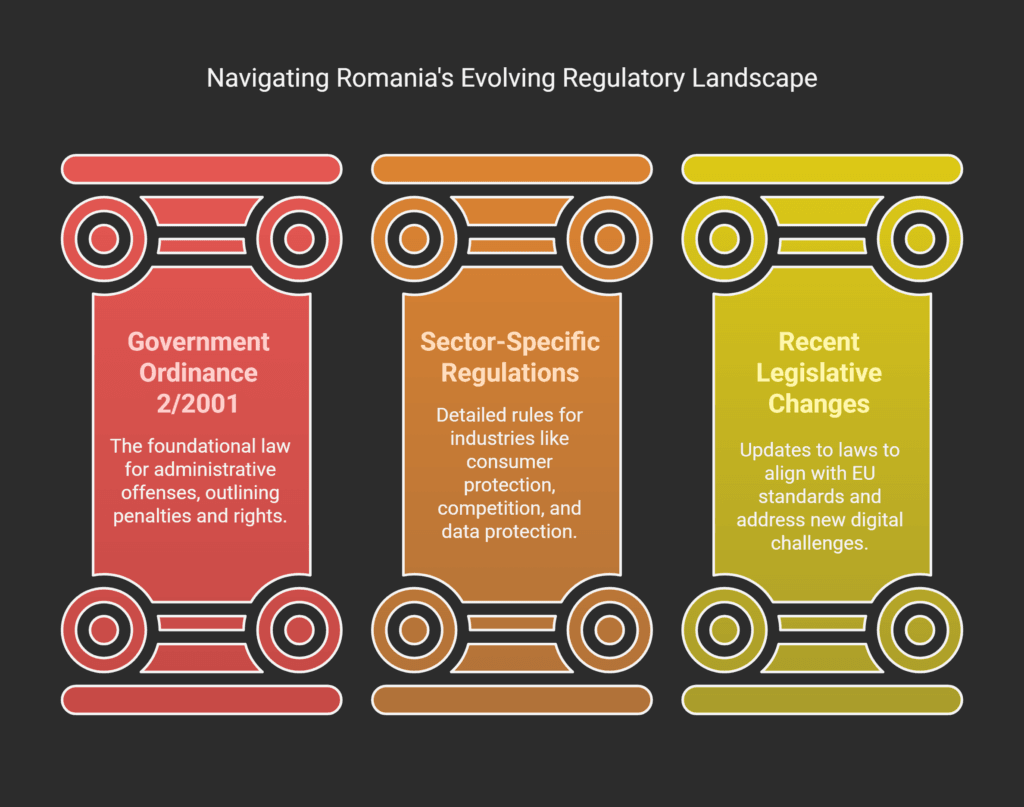
Government Ordinance No. 2/2001

At the heart of Romania’s administrative offenses legislation is Government Ordinance No. 2/2001.

It’s the main law for handling contraventions.

This ordinance is as important as laws passed by parliament, but it comes from the government.

GO 2/2001 sets up three main types of punishments for contraventions:

  • Warnings (verbal or written cautions);
  • Contraventional fines (monetary penalties);
  • Community service (remedial work for the public benefit).

This ordinance makes contraventions a separate category from crimes.

It outlines how fines are given, sets rules for penalties, and protects the rights of those facing charges.

Sector-Specific Regulations

While GO 2/2001 is the base, many specific rules add complexity to the Romanian regulatory framework.

These rules cover different industries and activities.

Traffic laws, for example, have detailed rules on driving and vehicle requirements.

Consumer protection laws set rules for businesses on product safety and advertising.

SectorPrimary LegislationKey Regulatory AuthorityCommon Violations
Consumer ProtectionLaw No. 296/2004National Authority for Consumer ProtectionMisleading advertising, unfair contract terms
CompetitionLaw No. 21/1996Competition CouncilCartel formation, abuse of dominant position
Data ProtectionLaw No. 190/2018National Supervisory AuthorityGDPR violations, data breaches
EnvironmentalGEO No. 195/2005Environmental GuardPollution, waste management failures

Environmental laws are strict about pollution and waste.

The GDPR compliance fines in Romania can be up to 4% of global turnover for big violations.

Financial laws, overseen by the National Bank of Romania and the Financial Supervisory Authority, have their own penalties.

These rules work with GO 2/2001 for matters not covered in specific laws.

Recent Legislative Changes

Romania’s fine system has changed a lot in recent years.

Fine amounts have gone up in many areas, showing a focus on stopping violations.

In 2021, changes to GO 2/2001 gave more rights to those accused of offenses.

New EU rules have also led to updates in areas like unfair competition and consumer protection.

The rise of digital services has brought new violations, like in ecommerce and online marketing.

Romania has updated laws to handle these new challenges.

Romania’s laws are getting closer to EU standards, making it easier for businesses in Europe.

This means new rules but also a more stable environment for international companies.

It’s important to keep up with these changes to avoid fines.

Romania’s laws are always evolving, so staying informed is key for everyone.

How Administrative Fines Are Calculated and Imposed

Knowing how Romanian authorities set and apply fines is key for individuals and businesses.

The Romanian legal system has a clear method to make sure fines match the violation’s severity.

This helps you understand and avoid risks, and prepare for compliance.

Penalty Assessment Criteria

Romanian agencies look at several factors to decide on fines.

These penalty assessment criteria make sure fines are fair based on the violation’s impact.

The main things considered are:

  • The seriousness of the violation and its impact;
  • If the violation was intentional or by mistake;
  • The offender’s history of following rules;
  • The economic gain from the violation;
  • The harm caused to others or public interests.

Fines are set based on the violation’s seriousness.

For example, a small paperwork mistake gets a lower fine than a serious violation.

Also, extra sanctions might be added based on the violation’s severity.

It’s important to know that for one offense, there’s one main penalty and one or more extra sanctions if needed.

Fine Calculation Methods

 Administrative Fines in Romania

The fine calculation methods in Romania follow strict rules.

The system sets both a minimum and a maximum for fines, guiding how fines are applied.

The smallest fine for any violation is 25 lei (about 6 Euros).

But, the maximum fine varies based on who set the rule:

Authority LevelMaximum Fine (Lei)Maximum Fine (Euros)Typical ApplicationLegal Basis
Law or Government Ordinance100,00025,000Serious national violationsPrimary legislation
Government Decision50,00012,500Significant regulatory breachesSecondary legislation
County Authorities5,0001,250Regional administrative violationsCounty regulations
Municipal/Communal Authorities2,500600Local ordinance violationsLocal council decisions

For repeat offenders, fines get higher with each offense.

Young offenders (ages 14-18) usually get lower fines than adults for the same violations.

Notification Process

After finding a violation and calculating the fine, Romanian authorities send a formal notice.

This step is key in administrative proceedings and must follow legal rules.

The notice, called a “Proces-Verbal de Contravenție” (contravention report), must include important details:

  • The date, time, and place of the violation;
  • A detailed description of the violation;
  • The laws broken;
  • The fine amount and how to pay;
  • Info on appealing and deadlines;
  • Details of the offender and the authority.

This document is usually given in person at the time of the violation.

If not possible, it’s sent by registered mail with proof of delivery.

You have the right to receive this notice within 30 days of the violation being found.

The notice will tell you when to pay the fine, usually 15 days after getting it.

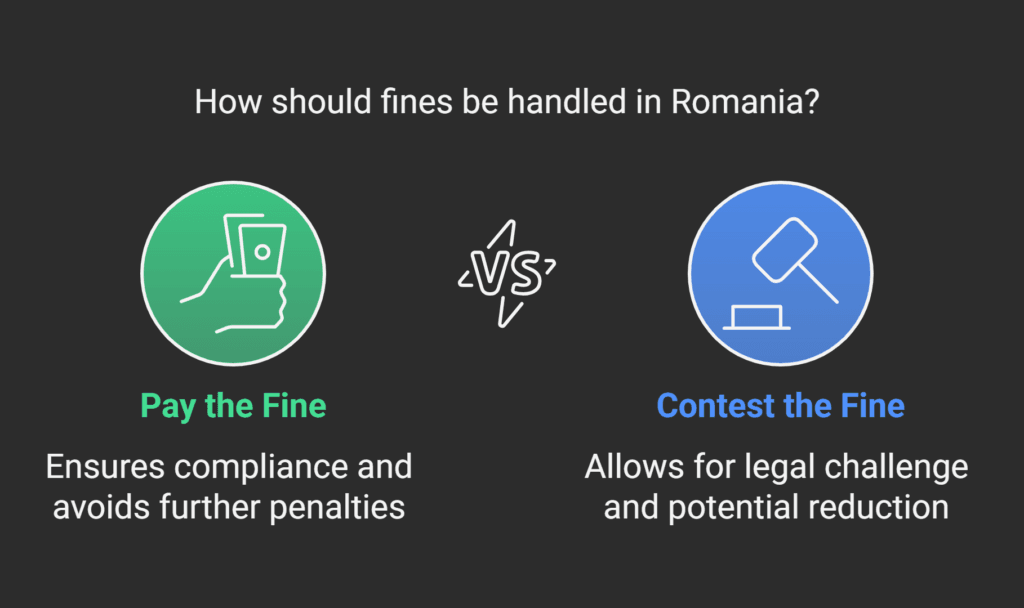
You can either pay the fine or contest it legally during this time.

Ignoring this can lead to more penalties and actions.

Knowing about assessment criteria, calculation methods, and the notification process helps you understand Romania’s fine system.

This knowledge helps you avoid penalties and follow Romanian laws correctly.

The Payment Process for Romanian Administrative Fines

When you get an administrative fine in Romania, knowing how to pay it is key.

It saves you money and avoids legal trouble.

Romania has clear steps for paying fines, important for both individuals and businesses.

The Romanian system has standard payment ways and chances for lower payments.

But, these benefits need you to follow the rules on time.

Let’s look at how to handle administrative sanctions in Romania.

Payment Deadlines and Options

Payment Romania Fine

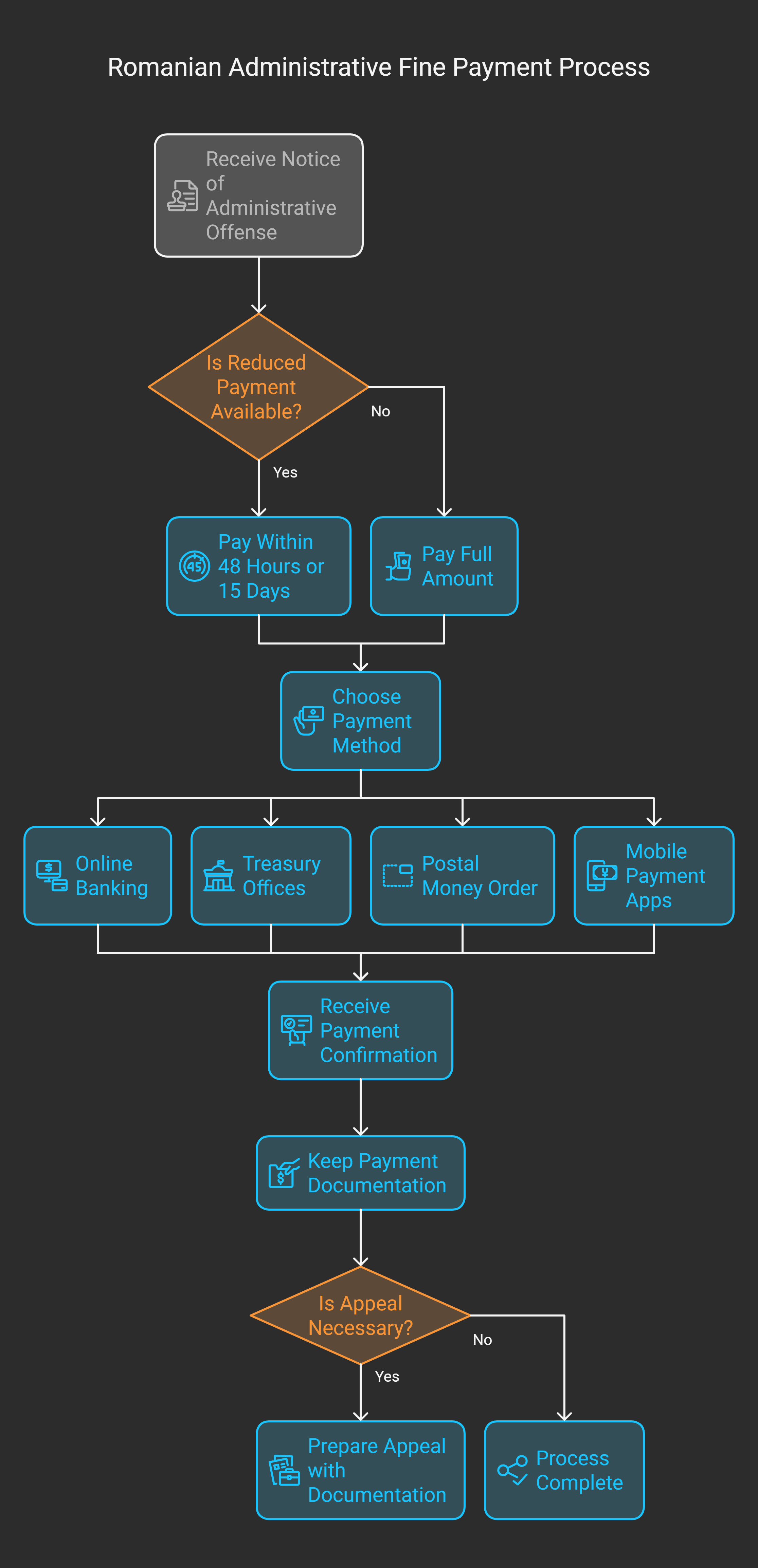
When you get a notice of an administrative offense, you have 15 to 30 days to pay.

The exact time depends on the violation and who issued it.

Always check the deadline on your notice to avoid trouble.

Romania has many ways to pay penalty fees.

You can use online banking, visit a bank, send a postal money order, or use mobile apps.

Each method has its own time, which might affect your deadline.

If you miss the payment deadline, the authorities can take action.

They might take your money directly from your accounts.

This can add extra fees and interest, making the fine even higher.

Payment MethodProcessing TimeAdvantagesDocumentation Provided
Online Banking1-2 business daysConvenient, accessible 24/7Electronic receipt, transaction ID
Treasury OfficesImmediateOfficial confirmation, guidance availableOfficial stamped receipt
Postal Money Order3-5 business daysNo bank account neededPostal receipt with tracking number
Mobile Payment Apps1-3 business daysConvenience, digital recordDigital receipt, confirmation code

Reduced Payment Opportunities

Romanian law gives big savings for quick payment of fines.

For many fines, you can pay half the amount if you pay within 48 hours or 15 days.

This depends on the type of violation.

Not all fines offer this chance.

Minor and some moderate infractions qualify, but serious ones don’t.

Your notice will say if you can pay less.

To get the reduced payment, follow the steps in your notice carefully.

Use the right payment details and pay on time.

Any mistake or delay means you can’t get the reduced payment.

Documentation Requirements

Keeping the right documents is key when dealing with fines in Romania.

Always save the original notice.

It has important details about the fine, payment, and deadlines.

After paying, keep all payment receipts safe.

Include the date, amount, payment reference, and confirmation from the authority.

For online payments, save electronic receipts and bank statements.

For in-person payments, ask for a stamped receipt.

Documentation is vital if you need to appeal a fine or if there’s a payment mistake.

Romanian authorities might not always record payments correctly.

Having all your documents ready helps solve problems fast and avoids legal trouble.

If you’re a business, organize all fine-related documents well.

This includes letters from authorities, payment records, and any supporting evidence.

Good organization helps with penalty appeals and shows you’re following the law.

Contesting Administrative Fines in Romania

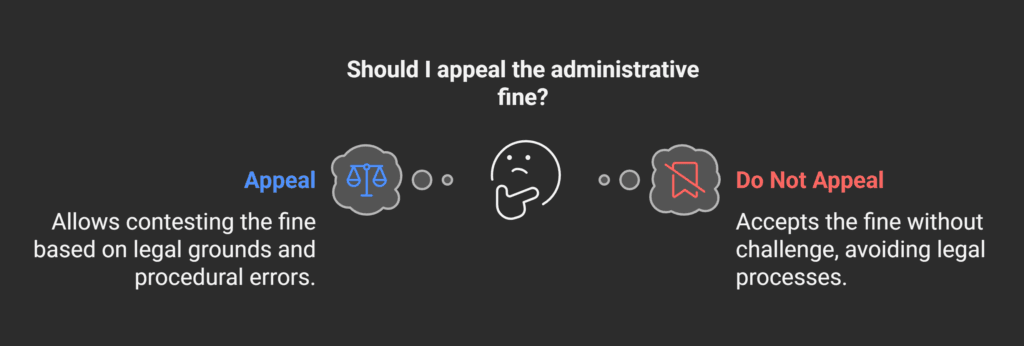
If you get an administrative fine in Romania, you can fight it under certain conditions.

The legal system in Romania uses civil procedure for these challenges.

But, some fines might need criminal law if they seem too harsh.

Knowing your rights and the right steps can really help your appeal.

Contesting Administrative Fines in Romania

Legal Grounds for Appeals

There are several good reasons to appeal an administrative fine in Romania.

It’s important to know which one fits your situation best.

Procedural errors are a common reason.

This includes wrong noticeswrong info, or not following due process when the fine was given.

Also, if the fine report got the facts wrong, you can appeal.

If you have evidence that shows the report was wrong, you can use it to challenge the fine.

Another reason is if the fine is too big for the crime.

Romanian laws say fines should match the crime.

If your fine seems too high, you can appeal based on this.

The European Court of Human Rights has set important rules for fines in Romania.

They’ve said Romania can’t ignore the idea that you’re innocent until proven guilty.

These rules help if you’re appealing because of rights issues.

The Appeals Process Timeline

Time is key when you’re appealing a fine in Romania.

You have 15 days from when you get the fine notice to appeal.

If you miss this, you can’t appeal anymore.

The appeal process has a clear schedule:

1. Within 15 days of getting the notice: Send your appeal in writing to the fine issuer or the court.

2. Within 5 days after you send it: The court will register your appeal and give it a number.

3. 20-30 days later: You’ll have your first court hearing (estimated).

4. 1-3 months: The first court decision will take this long, depending on the case (estimated).

5. Within 30 days of the first decision: You can appeal to a higher court if you need to (estimated).

For simple cases, the whole process can take 3-6 months.

But, if it’s more complicated, it might take longer.

Required Documentation for Appeals

Having the right documents is key for a good appeal.

Get everything ready before you start.

This will help your case and avoid delays.

Here’s what you need for an appeal in Romania:

Document TypePurposeRequired CopiesSpecial Requirements
Original Fine NotificationShows why you’re appealing1 original + 2 copiesMust include all pages and attachments
Written Appeal StatementExplains why you’re appealing3 copiesMust say what you want to happen
Supporting EvidenceBacks up your appeal3 copies of each documentTranslated if not in Romanian
Power of AttorneyAllows someone to represent you1 original + 2 copiesNotarized if represented by attorney
Proof of Payment (court fees)Shows you’ve paid to appeal1 original + 2 copiesFee amount varies by fine value

Your appeal statement should clearly say why you’re appealing.

Include any witness statements that support your side, if you’re questioning the facts of the violation.

Reports from experts can be very helpful, too.

They’re good for fines in areas like construction or environmental rules.

These reports give a third view that courts often find convincing.

When you appeal, you can send it to the fine issuer or the court.

For most fines, you should appeal to the local court (Judecătoria) where the fine was given or where you live.

Remember, all documents must be in Romanian or have a certified translation if they’re not.

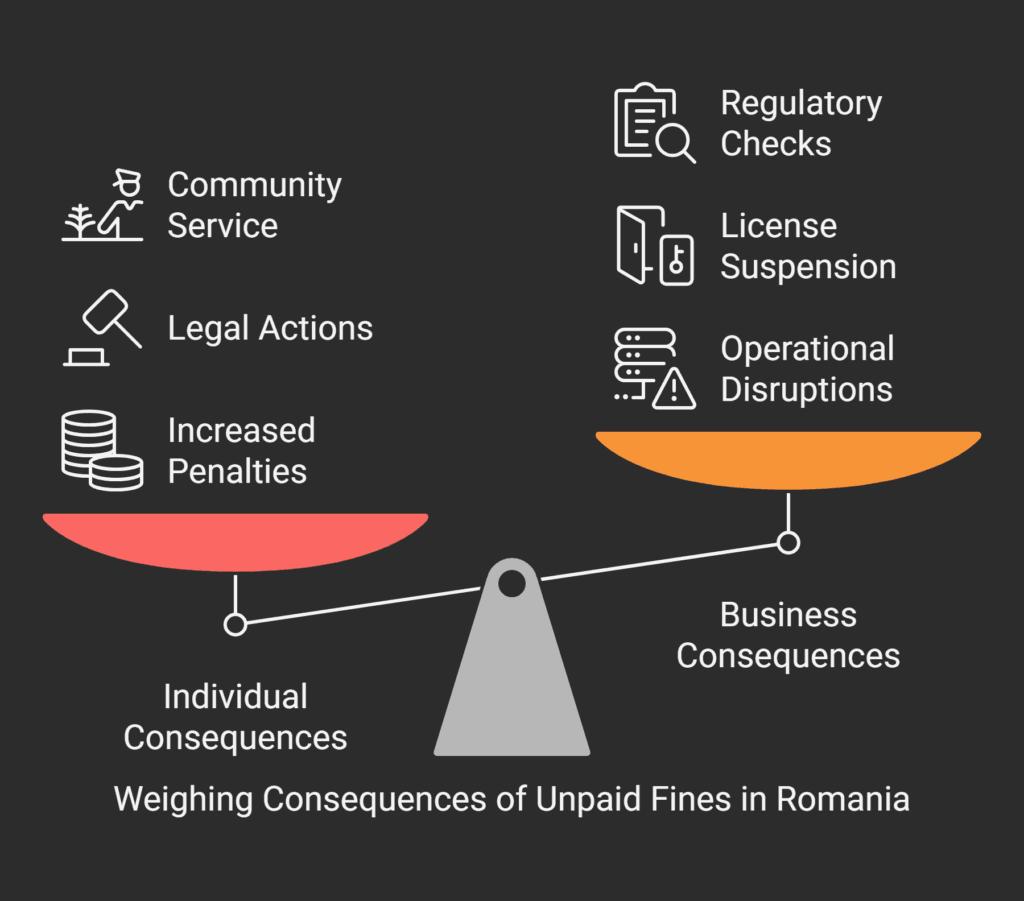
Consequences of Non-Payment

Not paying Romanian administrative fines can lead to bigger problems.

You could face more penaltieslegal actions, and even disruptions to your business.

It’s important to manage risks in Romania well, whether you’re an individual or a company.

The Romanian legal system is strict about fines.

They have rules to make sure everyone follows the law.

Consequences of Non-Payment of Fines in Romania

Legal Enforcement Actions

If you don’t pay your fine in 30 days, Romanian regulatory authorities will start legal actions.

They will send you a writ of execution.

This is the first step in enforcing the fine.

Authorities have several ways to enforce fines:

  • They can seize your property, both movable and immovable.
  • They can take money directly from your wages.
  • They can freeze your bank accounts and take money from them.
  • They can make you do community service instead of paying the fine.

If you can’t pay the fine and don’t have property, you can ask the court for community service.

You can also ask for more time to pay the fine at your first court appearance.

Doing community service can mean up to 300 hours of work.

Before, you had to agree to this.

But now, the court can decide it’s necessary to enforce the law.

Additional Penalties and Interest

Not paying your fine adds more costs.

You’ll have to pay interest every day.

The rate depends on the type of fine.

These extra costs can add up:

  • Penalties for late payment get higher over time.
  • There are costs for the enforcement officers.
  • You’ll have to pay court fees for the enforcement process.
  • Legal fees if you fight the enforcement in court.

For example, a 5,000 RON fine can grow to over 7,500 RON in six months.

This is a 50% increase. Paying on time is usually the best option.

Impact on Business Operations

Unpaid fines can hurt businesses a lot.

They can disrupt operations and affect your reputation.

Romania’s corporate governance requires following the law, including paying fines on time.

Businesses that ignore fines might face:

  • Their licenses or permits could be suspended or taken away.
  • They might not be able to get government contracts.
  • They could face more checks from regulators.
  • They might be listed as non-compliant in public records.
  • They could lose clients and partners because of bad publicity.

Financial institutions are hit hard too.

Unpaid fines for anti-money laundering or other financial rules can lead to more checks.

This includes more audits, programs to fix problems, and more reports.

Companies should have plans for dealing with fines.

This can stop small problems from becoming big issues.

It’s part of following Romanian business regulations.

Ignoring fines can hurt your business’s credit score, relationships with suppliers, and even employee morale.

For companies outside Romania, ignoring fines can make dealing with Romanian authorities harder in the future.

Compliance Strategies to Avoid Romanian Administrative Fines

Businesses in Romania need to be proactive about following the rules.

The rules are getting more complex, and companies must find ways to avoid fines.

It’s cheaper and better for your reputation to prevent problems than to fix them after they happen.

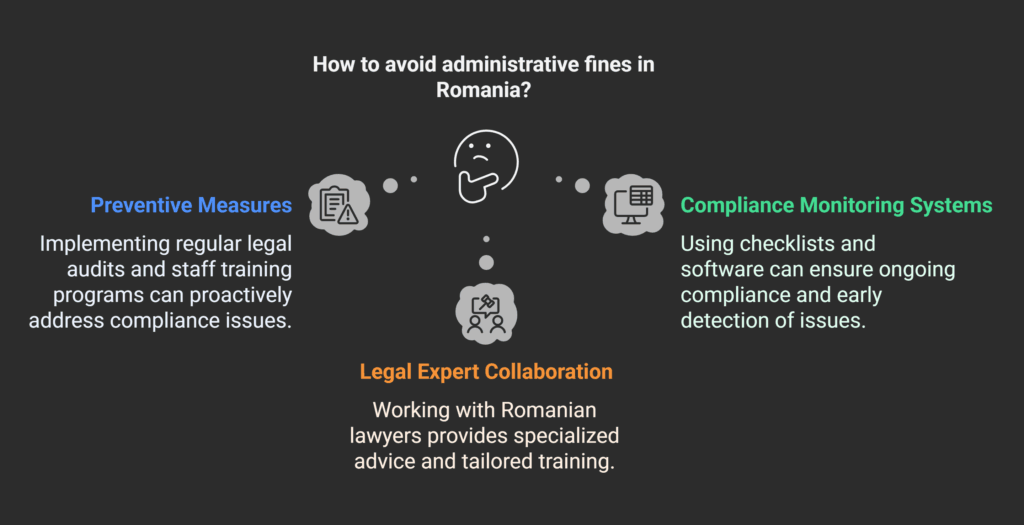
Compliance Strategies to Avoid Romanian Administrative Fines

Preventive Measures for Businesses

Start by knowing what laws you must follow.

Regular legal audits help find and fix problems before they become big issues.

These audits check if your business is following the latest laws.

Make clear rules for your team based on Romanian laws.

These rules should cover specific areas and be updated when laws change.

Staff training programs are key to avoiding fines.

Make sure your team knows the basics and the specific rules for their jobs.

Training should happen often, like when laws change or new people join.

Keep up with new laws in Romania.

Sign up for updates from the government and industry groups.

This way, you’ll know about changes that might affect your business.

Compliance Monitoring Systems

Use strong systems to check if you’re following the rules.

Compliance checklists are a good way to make sure you’re doing things right.

They should be easy to use but cover all important points.

Do regular checks to find and fix problems early.

Look at both your documents and how things are done to make sure they match the laws.

Use software to help with monitoring.

It can check things automatically and alert you to any problems.

This is really helpful for keeping up with Romania’s changing rules.

Make it easy for employees to report any issues.

A culture that encourages openness helps find problems early, when they’re easier to fix.

Keep good records of your compliance efforts.

This is important if someone says you’re not following the rules.

Keep track of training, policy updates, and any fixes you’ve made.

Working with Legal Experts in Romania

Working with Romanian lawyers can really help.

They know the local laws well and can give advice that fits your business.

Legal experts can do special audits to find and fix problems before they cost you money.

They often spot things that regular checks miss.

They can also create training that’s just right for your business.

This kind of training is usually more effective than general courses.

Good legal advisors in Romania offer practical solutions that work for your business.

Work closely with your legal team all the time, not just when you have a problem.

Regular talks help keep your business in line with the rules as they change.

This is really important for dealing with Romania’s complex rules.

By following these strategies, your business can avoid fines and run smoothly in Romania.

Remember, staying on top of compliance is an ongoing job that needs constant attention and changes as the rules do.

International Context: Romania vs. EU Administrative Penalties

It’s important to know how Romania’s fines compare to other EU countries.

Romania’s EU membership has shaped its rules, but it also keeps its own way of handling fines.

This helps you understand Romania’s place in the EU’s rules better.

International Context_ Romania vs. EU Administrative Penalties

Comparative Severity of Romanian Fines

Looking at administrative sanctions in Romania shows some patterns.

In some areas, Romania’s fines are not as high as Western Europe’s.

But in others, they can be strict.

In data protection, Romania’s fines for GDPR breaches are lower than France or Germany’s.

But, Romania has been getting tougher, with more investigations.

For environmental rules, penalties in Romania are about average in the EU.

But how they enforce these rules can vary.

Romania’s fines for pollution are similar to Hungary and Bulgaria’s but less than Austria or Sweden’s.

Regulatory AreaRomania (Average Fine)Western EU (Average Fine)Eastern EU (Average Fine)
Data Protection10,000-20,000 EUR50,000-200,000 EUR5,000-15,000 EUR
Consumer Protection2,000-10,000 EUR15,000-50,000 EUR1,000-8,000 EUR
Environmental5,000-50,000 EUR25,000-100,000 EUR3,000-30,000 EUR
Labor Law1,500-7,500 EUR10,000-40,000 EUR1,000-5,000 EUR

One key thing about government fines in Romania is the process.

While fines might be lower, the rules can be stricter.

This includes shorter appeal times and more detailed paperwork.

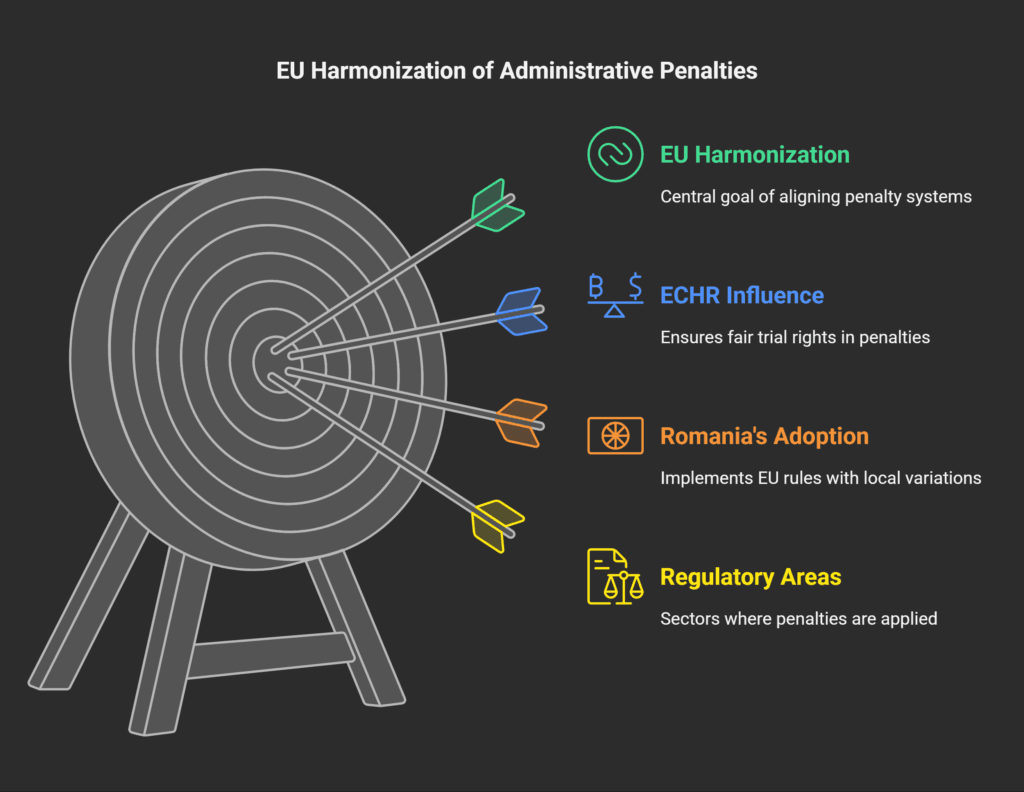
EU Harmonization Efforts

The EU wants all countries to have similar rules for fines.

This helps businesses in different countries know what to expect.

Romania has followed EU rules in areas like consumer protection and financial services.

For example, it adopted a new law on unfair business practices in 2018.

But, how strictly these rules are enforced can vary.

The European Court of Human Rights (ECHR) has also played a big role.

It says some fines in Romania are like criminal penalties.

This means certain rights must be respected, even if the fine is called administrative.

This includes the right to a fair trial, being presumed innocenthaving a lawyer, and seeing witnesses.

Romania’s Competition Council has started to follow these rules more closely.

This means better protection during investigations.

This process of making rules more similar is both a challenge and an opportunity.

It might make things more complicated for a while.

But in the long run, it should make things clearer for everyone.

Knowing about these international aspects is key to dealing with Romania’s fine system.

As Romania works to meet EU standards, staying up to date is important.

This helps you avoid fines and stay on the right side of the law.

Conclusion

Understanding Romania’s fine system is key for businesses and individuals.

Government Ordinance No. 2/2001 sets the rules for fines.

This knowledge helps you handle fines better.

Paying fines on time can lower the cost.

You can also appeal if a fine was wrongly given.

Keeping good records is your strongest defense.

Using smart compliance strategies can prevent fines.

By taking steps to avoid violations, businesses can save a lot.

This is cheaper than paying fines later.

For complex rules, get help from a Romanian administrative law expert.

A good law firm knows the system well.

They can guide you through it, even as Romania meets EU standards.

Whether you run a business or are an individual, a Bucharest lawyer is very helpful.

They know local laws and EU rules. Many law offices also do audits to find and fix problems before fines are issued.

Stay up to date with rules and get help when you need it.

This way, you can deal with Romania’s fine system well.

And you’ll reduce your chances of getting fined.

FAQ

What is an administrative fine in Romania?

An administrative fine in Romania is a fine for minor offenses.

It’s not as serious as a criminal act.

These fines are based on Government Ordinance No. 2/2001.

They are for breaking laws or decisions made by the government or local councils.

Which authorities can issue administrative fines in Romania?

Many bodies in Romania can give out fines.

This includes the National Authority for Consumer Protection (ANPC) and environmental agencies.

Also, labor inspectoratestax authorities (ANAF), and local police can issue fines.

Each one deals with different types of violations.

What are the most common business violations that result in administrative fines?

Businesses often face fines for labor law issues and unfair practices.

They can also get fined for not following consumer protection laws or tax rules.

Environmental and GDPR breaches, as well as competition law issues, are also common.

Not having the right licenses can lead to fines too.

What are the typical administrative violations for individuals in Romania?

Individuals might get fined for traffic offenses or disturbing the peace.

Not reporting personal status changes is also a violation.

Minor property issues and littering can lead to fines.

Local ordinances are another area where fines can be given.

How are administrative fine amounts determined in Romania?

The amount of a fine depends on several things.

This includes how serious the offense is and if it was intentional.

The offender’s history and any benefits from the violation also play a part.

There are minimum and maximum fines based on who made the rule.

What is the deadline for paying an administrative fine in Romania?

You usually have 15 days to pay a fine. But this can change based on the rule broken.

If you don’t pay on time, the fine can be collected by the authorities.

This might cost you more money.

Can I pay a reduced amount for an administrative fine in Romania?

Yes, you can pay less for many fines.

You can pay half the minimum fine within 48 hours or 15 days.

This chance is available for many fines but not all.

You need to pay on time and keep proof of payment.

What payment methods are available for administrative fines in Romania?

There are several ways to pay fines in Romania.

You can use online platforms, bank transfers, postal money orders, or pay in person.

The details for payment will be on your fine notice.

Always save your payment receipt.

What are valid grounds for appealing an administrative fine in Romania?

You can appeal a fine for several reasons.

This includes mistakes in the fine notice or if the fine is too high.

You can also appeal if there’s no legal basis for the fine.

The European Court of Human Rights has also set rules for fair fines.

What is the process for contesting an administrative fine in Romania?

To appeal a fine, you need to file a complaint within 15 days.

You’ll need the fine notice and any evidence you have.

The court will hold a hearing.

You can represent yourself or get a lawyer.

You can appeal the court’s decision to a higher court within 30 days.

What happens if I don’t pay an administrative fine in Romania?

If you don’t pay, the authorities can take action.

They might seize your property or garnish your wages.

You could also be ordered to do community service.

Unpaid fines can also cost you more money.

Can administrative fines in Romania be converted to community service?

Yes, fines can be turned into community service.

The court can order up to 300 hours of service.

This is usually based on the minimum wage.

It’s a way to avoid paying the fine.

How can businesses prevent administrative fines in Romania?

Businesses can avoid fines by being proactive.

They should check their compliance regularly and train staff.

They should also have systems in place to monitor and report any issues.

Working with legal experts is also helpful.

Keeping records of compliance efforts is important.

How do Romania’s administrative fines compare to those in other EU countries?

Romania’s fines vary compared to other EU countries.

For GDPR, Romania’s fines are often lower.

But for consumer and environmental issues, fines can be higher.

Romania is trying to align its fines with EU standards.

The European Court of Human Rights has also influenced Romania’s approach to fines.

Are there special provisions for foreign individuals or companies facing administrative fines in Romania?

Foreigners face the same fine system as locals.

But they might find it harder due to language barriers.

Foreign companies should have a local representative.

Enforcement against foreign entities might involve extra steps.

What documentation should I keep related to an administrative fine in Romania?

Keep all documents related to a fine.

This includes the fine notice, any evidence, payment proof, and court documents.

Keep these for at least 5 years.

They might be needed to prove payment or to address any errors.

Corporate documentation requirements in Romania for company governance and compliance

Corporate Documentation Requirements in Romania

Corporate law guide · Romania

Corporate Documentation Requirements in Romania

A practical guide to the documents that establish, govern and evidence a Romanian company, with specific points for foreign shareholders, directors and international groups.

The correct document set depends on the legal form, ownership structure, activity, transaction and filing route. Current forms and procedural requirements should be checked with the National Trade Register Office (ONRC).

In short: corporate documentation in Romania is not limited to the incorporation file. A company should maintain a coherent record of its constitutional documents, shareholder and director decisions, ownership and beneficial-owner information, powers of representation, material contracts and filings made when its structure or registered information changes.

What counts as corporate documentation in Romania?

Corporate documentation is the connected set of records that shows how a company was formed, who owns or controls it, who may represent it, how decisions are adopted and which changes have been registered or implemented. It includes the constitutional documents, meaning the articles of association and their amendments, together with the records that support the company’s ongoing operation.

The phrase covers more than documents sent to the Trade Register. Some records create or modify the company’s legal position. Others prove that a decision was properly authorised, that a director had signing power, or that the company reviewed a matter before entering into a material transaction.

For a foreign founder or international group, the practical issue is consistency. The company name, legal form, shareholders, capital, registered office, administrators, beneficial-owner information and activity should not appear differently across the articles of association, shareholder resolutions, powers of attorney, registry extracts, banking documents and commercial contracts.

Constitutional documents

The articles of association, amendments and registered information define the company’s identity, ownership, activities, capital and representation framework.

Decision records

Shareholder resolutions, general meeting minutes and management decisions evidence approvals, appointments, transactions and changes that require internal authority.

Compliance records

Beneficial-owner information, filings, registers, powers of attorney and supporting evidence help the company demonstrate an accurate and current corporate position.

Which documents belong in the company’s core file?

The core file should be organised around the company’s legal identity, ownership, authority and ongoing decisions. The exact documents vary, but the categories below are a reliable starting point.

Document categoryWhat it establishes or provesWhen to review itTypical responsibility
Constitutional fileLegal form, company name, registered office, activities, capital, shareholders and core representation rules.Incorporation, amendment, restructuring or change of registered information.Shareholders, administrators and filing representative.
Ownership and control fileShareholder identity, ownership percentages, control arrangements and beneficial-owner information.Share transfer, restructuring, new investor, control change or identification-data change.Shareholders and legal representative.
Authority fileAppointment, mandate, signing power, joint or individual representation and powers of attorney.Appointment, expiry, resignation, delegation or material change in authority.Shareholders, directors and authorised representatives.
Decision fileApprovals for reserved matters, capital operations, contracts, appointments, filings and transactions.Before and after each material corporate decision.Shareholders, board or administrator, depending on the legal form and articles.

A document may be retained internally even where it is not filed with ONRC. Filing requirements and internal approval requirements are related but not identical questions.

What should be resolved at incorporation?

At incorporation, the documents should reflect the business structure the founders actually intend to operate, not only the minimum wording needed to obtain registration.

The incorporation file commonly includes the application, proof of company-name availability, the articles of association, identification documents, declarations, evidence concerning the registered office, information about shareholders and administrators, beneficial-owner information and documents required for the proposed activities.

Where a shareholder is a foreign company, the file may also require a current registry extract or equivalent evidence of legal existence, corporate approvals evidencing the decision to establish or invest in the Romanian entity where required by the foreign company’s constitutional documents or governing law, proof of the signatory’s authority and a power of attorney for the Romanian filing representative. The issuing jurisdiction determines whether apostille, legalisation, authentication or a particular translation format is required.

A representative office operates under a different legal regime and typically does not conduct commercial trading activities in the same manner as a Romanian subsidiary. The chosen structure should therefore be reflected consistently in the incorporation documents, the activity description and the filing strategy.

The articles should also be reviewed as an operating document. Shareholder percentages, voting arrangements, administrator powers, representation, profit distribution, transfer mechanics and decision rules should be aligned with the commercial plan. Private arrangements may additionally belong in a shareholders’ agreement rather than in the public constitutional document.

Select the document stage to see the question that should be resolved before moving forward.

Choose the structure

Confirm whether the project requires a Romanian subsidiary, branch, representative office or another establishment route before drafting the corporate documents.

What are the current SRL capital and formation-document issues?

According to the framework introduced by Law no. 239/2025, newly incorporated Romanian SRLs are generally required to have a minimum share capital of RON 500, while separate capital requirements may apply to existing SRLs depending on statutory turnover thresholds.

That figure should not be copied into every corporate document without checking the company’s status. A new incorporation, an amendment to an existing SRL and a company whose turnover has crossed the statutory threshold may raise different questions.

The share capital is also only one element of the corporate documentation. The file should state the subscribed capital, contributions, number and nominal value of the shares, and each shareholder’s participation. Those details must match the application, the articles and any later shareholder resolution.

Tip: Before filing, reconcile the capital figure, shareholder percentages and number of shares across every document. An outdated template can create an avoidable inconsistency even where the founders’ commercial agreement is clear.

Current capital rules, forms and implementation details should be checked against the legislation in force and the live ONRC procedure at the time of filing. Do not rely on old references to RON 1, RON 200 or a general statement that no minimum capital applies.

Which governance documents should a Romanian company maintain?

A company should be able to show who made a decision, under which authority, on what information and with what effect on the company’s records.

For an SRL, the central governance records are usually the articles of association, shareholder resolutions, administrator decisions, management records and other internal approvals. The precise approval route depends on the legal form, the articles and the nature of the decision. A document should not describe a board structure that the company does not actually have.

For an SA, the governance structure is more formal and may involve a board of directors or a two-tier system, depending on the applicable model. The documents should reflect the selected structure and the mandates actually granted. The rules that apply to an SA should not be presented as universal requirements for every SRL.

Select the governance issue that most often creates a documentation gap.

Authority

Check the articles, appointment decision, mandate and any power of attorney before a director, employee or external representative signs for the company.

Governance recordQuestion it should answerTypical triggerControl to apply
Shareholder resolutionWhich shareholders approved the matter and with what voting basis?Appointment, capital operation, amendment, major transaction or reserved matter.Check quorum, majority and wording against the articles and applicable law.
Administrator decisionWas the decision within the administrator’s mandate and signing authority?Operational contract, delegation, bank instruction or implementation step.Match the decision to the registered representation rules and mandate period.
Power of attorneyWho may act, for which purpose and for how long?Remote filing, foreign shareholder representation or a specific transaction.State scope, duration, signatory authority and any authentication or translation requirement.
Corporate register copyWhat information is currently registered and available to third parties?Banking, contracting, due diligence, investment or authority check.Obtain a current extract before relying on historic company information.

What must foreign shareholders and international groups prepare?

Foreign corporate documents should prove existence, authority and the decision to participate in the Romanian structure. A translation alone cannot cure a missing corporate approval or an expired registry extract.

The document chain commonly includes the foreign shareholder’s registry evidence, constitutional or equivalent records, a resolution approving the investment, the appointment of a representative and proof that the person signing the Romanian documents has authority to do so.

The form of each document depends on the country of issue, the document type, applicable treaties and the current ONRC procedure. Some documents may be accepted without apostille or legalisation. Others may require authentication, apostille, legalisation or a specific certified translation. The correct answer should be checked document by document.

International groups should also distinguish the Romanian company’s documents from the parent company’s documents. A Romanian subsidiary has its own legal personality and corporate records. A branch is not a separate legal person in the same way, so the foreign parent’s authority and responsibility become central to the file.

Foreign registry evidence

Use a current official extract or equivalent evidence showing the foreign company’s legal existence, registered office and relevant representatives.

Corporate approval

Record the parent company’s decision to invest, establish the Romanian presence, appoint representatives and approve the necessary documents.

Formalities and translation

Check authentication, apostille, legalisation and Romanian translation requirements before the filing package is assembled.

When must corporate documentation be updated?

Review the corporate file whenever a change affects ownership, control, representation, registered information, activities or a decision that requires formal approval or registration.

  • Shareholder change: update the transfer or subscription documents, resolutions, articles and relevant ownership and beneficial-owner information.
  • Administrator change: record the appointment, mandate, representation rules and any related Trade Register filing.
  • Registered-office change: retain the new right-to-use document and complete the applicable registration steps.
  • Activity change: verify the current CAEN classification and whether the activity requires licences, approvals or professional authorisation.
  • Beneficial-owner change: review whether a beneficial-owner declaration, notification or update filing is required under the legislation in force at the time of the change.
  • Capital or governance change: align the resolution, amended articles, shareholder register and public filing with the decision actually adopted.
Risk: an internal decision does not automatically replace a registration, notification or filing required by law. Before implementing a material change, identify which record must be signed, which authority must approve it and which authority must receive it.

Can corporate documents be signed and filed electronically?

Electronic filing may be available, but the accepted signature, document format, representation route and platform requirements must be checked for the specific filing.

Law no. 265/2022 and the current ONRC procedures provide the framework for registration applications and electronic interaction with the Trade Register. The fact that a document is a PDF or carries an electronic signature does not by itself answer whether it is accepted for every corporate act or filing.

For a remote filing, confirm who is signing, whether the person has authority, whether a qualified electronic signature is required, whether the underlying corporate document needs a particular form and whether foreign documents require separate formalities. Keep the submitted version, proof of transmission and any correction request with the corporate file.

Remote incorporation, bank onboarding, tax registration, immigration status and authorisation to conduct a regulated activity are separate questions. Incorporating a company does not automatically give a founder a right to reside or work in Romania, and filing electronically does not remove the substantive requirements of the transaction.

Common corporate-documentation mistakes

Using an old template

Historic capital figures, outdated activity classifications or obsolete forms can make an otherwise coherent file inconsistent with current requirements.

Confusing public and private documents

The articles and Trade Register extract do not replace a private shareholders’ agreement, and a private agreement does not replace a mandatory filing.

Assuming a title proves authority

A person described as director, manager or representative still needs the mandate and signing power required for the act in question.

Ignoring the ownership chain

Foreign corporate shareholders and indirect control require a documented analysis, not only the name of the immediate shareholder.

Mixing legal forms

Rules for an SA, SRL, branch and representative office are not interchangeable. The document set must follow the selected structure.

Keeping no decision trail

A signed contract may not show whether the right company body approved it. Retain the resolution, decision or delegation that supports the act.

Corporate documentation checklist

Before incorporation, investment, restructuring or a material contract, use the following review sequence.

  1. Confirm the legal form and whether the Romanian presence will be a subsidiary, branch or another establishment route.
  2. Identify all shareholders, administrators, representatives and the natural persons who ultimately own or control the company.
  3. Check the current articles, registered information, capital, activity codes, office evidence and representation rules.
  4. Collect foreign registry extracts, any corporate approvals required by the foreign company’s constitutional documents or governing law, powers of attorney, translations and required legalisation formalities.
  5. Match each proposed decision to the correct company body, voting rule, signature and registration or notification requirement.
  6. Retain the signed documents, submitted versions, proof of filing, authority responses and the dates for the next review.

Frequently asked questions

What is the most important corporate document in Romania?

The articles of association are the central constitutional document, but they are not sufficient on their own. The company also needs accurate shareholder and beneficial-owner information, resolutions, administrator records, authority documents and filings connected with later changes.

Does every corporate document have to be filed with ONRC?

No. Some documents are filed or registered because the law requires public disclosure. Others, such as internal decisions, delegations and private shareholder arrangements, may need to be retained by the company without being filed in full. The applicable requirement depends on the document and event.

What documents does a foreign shareholder usually need?

A foreign corporate shareholder may need current registry evidence, a corporate approval, proof of signatory authority, a power of attorney and a Romanian translation. Apostille or legalisation requirements depend on the issuing country, document and applicable procedure.

Is the minimum capital for a new Romanian SRL RON 500?

According to the framework introduced by Law no. 239/2025, newly incorporated Romanian SRLs are generally required to have a minimum share capital of RON 500. Existing SRLs and companies affected by statutory turnover thresholds should be analysed separately, and the position should be checked against the current filing requirements.

Can a Romanian company use electronic corporate documents?

Electronic documents and electronic filing may be available, subject to the applicable signature, format, representation and platform requirements. A qualified electronic signature or a PDF alone does not automatically satisfy every corporate formality.

When should a lawyer review the corporate file?

A targeted review is particularly useful before incorporation by foreign founders, an investment, a share transfer, a director change, a restructuring, a material contract or a filing involving several ownership layers and cross-border documents.

Need to review a Romanian corporate file?

A focused legal review can map the documents, authority, ownership information and filing steps before the company signs, invests, restructures or submits an application.

Book a consultation

Disclaimer: This article provides general information only and does not constitute legal advice, a legal opinion or the creation of a lawyer-client relationship. Romanian corporate, Trade Register, tax, electronic-signature and document-formality requirements may change and depend on the company, transaction, documents and circumstances involved.

AI Notice: AI-assisted content, reviewed by a qualified Romanian lawyer.

Permits and Licenses Business in Romania

Types of Permits and Licenses for Business in Romania

Types of Permits and Licenses for Business in Romania

When starting a business in Romania, it is crucial to be aware of the various permits and licenses required by the country’s legislation.

Ensuring compliance with these requirements is not only important for legal reasons but also for the smooth operation of your business.

Each type of business activity has its specific set of permits and licenses, issued by different competent authorities.

Knowing the requirements and procedures can save you time, effort, and potential legal issues in the long run.

Key Takeaways:

  • Understanding the specific permits and licenses required for your business activity is crucial for legal compliance in Romania.
  • Permits and licenses are issued by different competent authorities, each with its own conditions and documentation requirements.
  • Some common types of permits and licenses in Romania include those for banking operations, insurance companies, financial investment services, retail and import-export activities, firearms and ammunition manufacturing, and the construction sector.
  • Environmental authorizations, transportation permits, and work agency licenses are also required for certain business activities.
  • Working with experienced Romanian lawyers or law offices can provide valuable guidance and assistance in navigating the permit and license application process.

Banking Sector Permits and Licenses

In order to operate in the banking sector in Romania, credit institutions and other legal entities must obtain authorization from the Romanian National Bank.

This authorization ensures the safety of operations, protection of clients and creditors, and compliance with banking regulations.

The authorization cannot be transferred to another entity, and the Romanian National Bank notifies the European Commission about granted authorizations.

Insurance Sector Permits and Licenses

Insurance companies operating in Romania must obtain authorization from the Commission of Insurance Supervising.

This authorization is granted based on the fulfillment of certain conditions, and it allows companies to provide insurance/re-insurance services.

A feasibility study is required as part of the authorization process, which includes information on legal engagements or risks, calculation methods, reinsurance programs, safety funds, and financial resources.

Additionally, insurance companies must have an appropriate information technology system to ensure efficient operations and data management.

Actuaries, who analyze and assess potential risks, are also required to be employed by insurance companies to ensure compliance with regulatory guidelines and best practices.

Requirements for Insurance Sector Permits and LicensesDetails
Authorization from the Commission of Insurance SupervisingObtain authorization based on fulfilling specific conditions
Feasibility StudySubmit a comprehensive feasibility study including legal engagements or risks, calculation methods, re-insurance program, safety fund, and financial resources
Information Technology SystemHave an appropriate information technology system to support insurance operations and data management
Employment of ActuariesEmploy actuaries to ensure compliance with regulatory guidelines and best practices

Financial Investment Services Permits and Licenses

Companies operating in the financial investment sector in Romania must obtain the necessary permits and licenses from the National Commission of Movable Valuables (CNVM).

This regulatory authority is responsible for authorizing and overseeing financial investment services in the country.

The CNVM grants licenses to companies to offer a wide range of financial services related to instruments such as stocks, bonds, and derivatives.

These services may include the execution of orders, trading of financial instruments, administration of portfolios, and more.

To obtain the required permits and licenses, companies must meet specific criteria and demonstrate their qualifications, expertise, and financial resources.

The CNVM evaluates various factors, including the company’s financial stability, compliance with regulatory requirements, and the qualifications of its employees.

It is crucial for companies operating in the financial investment sector to ensure that they comply with all applicable regulations and possess the necessary permits and licenses.

Failure to do so can result in severe penalties and legal consequences.

Financial Investment Services Permits and Licenses

Permit/LicenseDescription
Main Service LicenseAuthorization for offering primary financial investment services, such as execution of orders and transaction of financial instruments.
Related Service LicenseAuthorization for providing related financial investment services, such as administration of portfolios and investment advice.
Qualification RequirementsDemonstration of necessary experience, knowledge, and qualifications in financial investment services.
Financial StabilityEvidence of financial stability, including sufficient capital and risk management systems.
Compliance with RegulationsDemonstration of compliance with all regulatory requirements and guidelines set by the CNVM.

Companies that offer financial investment services in Romania can operate legally and confidently by obtaining the required permits and licenses from the National Commission of Movable Valuables.

It is advisable to seek the assistance of legal professionals experienced in navigating the regulatory landscape to ensure a smooth and compliant process.

Retail, Import-Export, Firearms, and Ammunition Permits

Businesses in Romania involved in retail activities, import-export operations, firearms manufacturing, or ammunition manufacturing are required to obtain specific permits.

These permits are issued by the General Inspectorate of the Romanian Police, either through the central structure or the local branches.

The application process for these permits entails submitting various documents, including identification and certificates of criminal records for shareholders and administrators, medical approvals, and certificates of practical and theoretical training for firearms and ammunition.

These requirements aim to ensure the safe and responsible operation of businesses within these sectors.

Required Documents for Retail Permits

For retail permits, businesses need to provide the following documents:

  • Identification documents of shareholders and administrators
  • Certificates of criminal records for shareholders and administrators
  • Proof of ownership or lease agreement for the retail premises
  • Information on the types of products to be sold and the storage facilities available

Required Documents for Import-Export Permits

For import-export permits, businesses need to provide the following documents:

  • Identification documents of shareholders and administrators
  • Certificates of criminal records for shareholders and administrators
  • Proof of registration for taxation purposes
  • Customs documents, including invoices, bills of lading, and import-export licenses

Required Documents for Firearms and Ammunition Manufacturing Permits

For firearms and ammunition manufacturing permits, businesses need to provide the following documents:

  • Identification documents of shareholders and administrators
  • Certificates of criminal records for shareholders and administrators
  • Medical approvals for shareholders and administrators involved in the manufacturing process
  • Certificates of practical and theoretical training for firearms and ammunition

Businesses need to ensure that they have all the necessary permits and comply with the regulations set forth by the General Inspectorate of the Romanian Police. Failure to obtain the required permits can lead to legal complications and penalties.

Therefore, business owners are advised to consult with legal professionals to ensure a smooth and lawful operation within these sectors.

Permits and Licenses in the Construction Sector

Construction projects in Romania require various permits and licenses from local institutions before commencement.

These clearances, permits, certificates, or business licenses ensure compliance with regulations and ensure the proper execution of construction activities.

Companies need to understand the specific requirements and procedures for obtaining these permits to avoid delays and penalties.

The application process for construction permits involves submitting the necessary documents to the respective local institutions.

These documents typically include project plans, architectural and engineering designs, proof of ownership or lease agreements, and environmental impact assessments.

Additionally, companies may be required to undergo inspections on the construction site to ensure compliance with safety and building regulations.

Table: Requirements for Construction Permits

Permit TypeDocumentation RequiredInspections
Building PermitProject plans, architectural and engineering designs, proof of ownership or lease agreementsInspection of construction site for compliance with safety and building regulations
Environmental PermitEnvironmental impact assessmentInspection of construction site for compliance with environmental regulations
Occupancy PermitCompletion certificate, compliance with building codes and regulationsFinal inspection of construction site

Each type of construction permit has its own set of requirements and processing times.

Companies need to consult with local institutions and engage professional consultants or lawyers for guidance throughout the permit application process.

Environmental Authorization for Business Activities

Business activities in Romania that have a significant impact on the environment require an Environmental Authorization.

This authorization is granted by the Competent authority for the protection of the environment, ensuring that companies comply with environmental regulations to minimize their ecological footprint.

Environmental authorization is particularly necessary for the retail sale of automotive fuel, wholesale activities, and certain types of retail sales.

By obtaining this authorization, businesses can demonstrate their commitment to sustainable practices.

Benefits of Environmental Authorization

  • Compliance with environmental regulations and laws
  • Reduced environmental impact through stricter control measures
  • Improved public image and reputation as an environmentally responsible business
  • Enhanced trust and credibility with stakeholders

The application process for environmental authorization involves submitting the necessary documentation to the Competent authority for the protection of the environment.

It typically includes environmental impact assessments, waste management plans, and measures for pollution prevention and control.

Timeline for Environmental Authorization

The Competent authority for the protection of the environment aims to issue the environmental authorization within 90 working days from the date of submission.

However, the timeline may vary depending on the complexity of the project and the completeness of the documentation provided.

StepDuration
Submission of application and required documentationDay 1
Review and assessment of environmental impactWithin 60 working days
Public consultation (if required)Within 7 working days
Decision and issuance of environmental authorizationWithin 30 working days

It is important for businesses to plan ahead and allow sufficient time for the environmental authorization process to ensure compliance with regulatory requirements.

By obtaining environmental authorization, businesses can demonstrate their commitment to environmental sustainability and responsible business practices.

This not only ensures compliance with environmental regulations but also enhances their reputation and credibility in the marketplace.

Transportation Permits and Licenses

Businesses involved in the transportation of cargo over 3.5 tons or passengers in Romania require transportation permits and licenses.

The Romanian Road Authority (ARR) is responsible for issuing these licenses and ensuring compliance with regulations and safety standards.

Required Documentation for Transportation Permits and Licenses

To obtain transportation permits and licenses, applicants must submit the following specific documentation to the Romanian Road Authority:

  1. Certificates of Company Establishment: Proof of legal establishment and registration of the business entity.
  2. Documentation on the Condition of Vehicles: Detailed information about the vehicles used for transportation, including technical specifications, registration documents, and maintenance records.
  3. Certificates of Clean Criminal Records: Verification that the managers and key personnel involved in the transportation operations have no criminal record.
  4. Proof of Financial Abilities: Financial statements, bank guarantees, or other documents demonstrating financial stability and capacity to cover operational costs.
  5. Certificates of Professional Qualifications for Managers: Evidence of the managers’ professional qualifications and competency in overseeing transportation activities.

Different Requirements for Specific Transport Activities

Various types of transport activities in Romania may have additional requirements on top of the general documentation listed above.

These additional requirements depend on the nature of the transportation, such as:

  • Freight Transport: Documentation related to the nature of the cargo, its handling, and transportation requirements.
  • Transportation of Dangerous Goods: Compliance with specific regulations and safety measures to ensure the proper handling and transportation of hazardous materials.

Meeting all the necessary requirements and submitting complete documentation will help streamline the permit and license application process.

Transportation companies in Romania need to adhere to these regulations to ensure the safety of passengers and cargo, as well as to maintain compliance with the legal framework established by the Romanian Road Authority.

Required DocumentationTransportation Permits and Licenses
Certificates of Company EstablishmentProof of legal establishment and registration of the business entity
Documentation on the Condition of VehiclesDetailed information about the vehicles used for transportation, including technical specifications, registration documents, and maintenance records
Certificates of Clean Criminal RecordsVerification that the managers and key personnel involved in the transportation operations have no criminal record
Proof of Financial AbilitiesFinancial statements, bank guarantees, or other documents demonstrating financial stability and capacity to cover operational costs
Certificates of Professional Qualifications for ManagersEvidence of the managers’ professional qualifications and competency in overseeing transportation activities

Businesses engaged in transportation activities in Romania must ensure they possess the necessary transportation permits and licenses.

By fulfilling the documentation requirements set out by the Romanian Road Authority, companies can operate legally and uphold the safety and regulatory standards of the industry.

Work Agency and Employment Licenses

Establishing a work agency in Romania requires obtaining the necessary licenses and authorizations.

To begin the process, you must establish a company with the main activity object of employment agencies.

This involves meeting specific conditions, such as having the required space, employees with experience in the field of the labor force, and a database of job offers and applicants’ qualifications.

Once your company is set up, you will need to obtain authorization from the Ministry of Labor and Social Solidarity through the labor inspectorate.

This authorization is crucial for legally operating as a work agency in Romania, and it ensures compliance with labor laws and regulations.

In addition to the work agency license, entrepreneurs planning to post workers to other EU member states must obtain an A1 Certificate for obligatory social security.

This certificate validates the social security coverage of posted workers and ensures compliance with the regulations of the destination country.

Conclusion

Obtaining the necessary permits and licenses is crucial for businesses operating in Romania.

Whether you are in the banking, insurance, financial investment, retail, import-export, firearms, ammunition, construction, or transportation sector, each type of business activity has its specific requirements and competent authorities responsible for issuing the permits and licenses.

To ensure the smooth operation and legality of your business venture in Romania, it is essential to comply with all legal and regulatory requirements.

This includes submitting the required documentation, meeting specific criteria, and undergoing inspections or assessments as necessary.

Working with experienced Romanian lawyers or law offices can provide valuable guidance and assistance throughout the process of obtaining permits and licenses for your business operations in Romania.

They can help navigate the complex legal landscape, ensure compliance, and expedite the application procedures, saving you time and effort.

FAQ

What types of permits and licenses are required for starting a business in Romania?

The permits and licenses required for starting a business in Romania depend on the specific commercial field you operate in.

Some common permits and licenses include those for banking operations, insurance companies, financial investment services, retail and import-export activities, firearms manufacturing, ammunition manufacturing, and the construction sector.

How do I obtain authorization for banking operations in Romania?

In order to operate in the banking sector in Romania, you must obtain authorization from the Romanian National Bank.

This authorization ensures the safety of operations, protection of clients and creditors, and compliance with banking regulations.

The authorization cannot be transferred to another entity, and the Romanian National Bank notifies the European Commission about granted authorizations.

What permits and licenses are required for insurance companies in Romania?

Insurance companies operating in Romania need to obtain authorization from the Commission of Insurance Supervising.

This authorization is granted based on the fulfillment of certain conditions and allows companies to provide insurance/reinsurance services.

A feasibility study and an appropriate information technology system, among other requirements, are necessary for obtaining the authorization.

How can I provide financial investment services in Romania?

Companies providing financial investment services in Romania need to be authorized by the National Commission of Movable Valuables (CNVM).

The CNVM authorizes companies to offer services related to financial instruments, such as the execution of orders, transaction of financial instruments, administration of portfolios, and more.

Different licenses and permits are required for main services and related services.

What permits do I need for retail, import-export, and firearms manufacturing in Romania?

Businesses involved in retail activities, import-export operations, firearms manufacturing, and ammunition manufacturing in Romania need to apply for specific permits.

These permits are obtained from the central or local structure of the General Inspectorate of the Romanian Police.

The application process requires the submission of various documents, including ID and certificates of criminal records for shareholders and administrators, medical approvals, and certificates of practical and theoretical training for firearms and ammunition.

What permits and licenses are required for the construction sector in Romania?

The construction sector in Romania requires permits and licenses for construction projects.

Companies must obtain clearances, permits, certificates, or business licenses from local institutions before starting construction activities.

The application process involves submitting the necessary documents and undergoing inspections on the construction site.

How do I obtain an Environmental Authorization for business activities in Romania?

Business activities in Romania that have a significant impact on the environment require an Environmental Authorization.

This authorization is issued by the Competent authority for the protection of the environment.

The application process involves submitting the required documentation, and the authorization is typically issued within 90 working days.

What permits and licenses are required for transportation in Romania?

Businesses involved in the transportation of cargo or passengers in Romania require transportation permits and licenses.

These permits are issued by the Romanian Road Authority (ARR) and require the submission of specific documentation, including certificates of company establishment, documentation on the condition of vehicles, certificates of clean criminal records, proof of financial abilities, and certificates of professional qualifications for managers.

How do I obtain licenses for a work agency and employment in Romania?

Establishing a work agency in Romania requires obtaining the necessary licenses and authorizations.

The process involves establishing a company with the main activity object of employment agencies, obtaining authorization from the Ministry of Labor and Social Solidarity through the labor inspectorate, and meeting specific conditions, including having the necessary space, employees with experience in the field of labor force, and a database of job offers and applicants’ qualifications.

How important are permits and licenses for operating a business in Romania?

Obtaining the necessary permits and licenses is crucial for businesses operating in Romania.

Each type of business activity has its own specific requirements and competent authorities responsible for issuing the permits and licenses.

It is essential to comply with all legal and regulatory requirements to ensure the smooth operation and legality of the business venture in Romania.

Working with experienced Romanian lawyers or law offices can provide valuable guidance and assistance throughout the process of obtaining permits and licenses for business operations in Romania.