ITM Labour Inspection in Romania: What an Employer Should Prepare
Romanian employment law · Employer inspection guide
An ITM inspection can begin with an unannounced workplace visit, a targeted request for records, a worker complaint or a safety incident. An employer needs an accurate picture of who is working, on what terms, when and where, and a controlled way to produce the records that support that picture.
What can the Romanian Labour Inspectorate inspect?
ITM, the territorial labour inspectorate, may inspect employment relations and occupational safety and health. The scope of a particular visit is determined by the inspectors’ mandate and the facts under examination.
Law no. 108/1999 on the Labour Inspection gives labour inspectors powers to enter employers’ premises and workplaces without prior notice, identify persons found there, request information and relevant documents, obtain copies and written statements, order corrective measures and impose contravention sanctions within their competence. Under Article 19(k), stopping an activity or work equipment is tied to a finding of serious and imminent danger of an accident or occupational illness, under the conditions provided by occupational health and safety legislation. A business should therefore be prepared even when no formal appointment has been made.
An inspection of employment relations typically looks at the written employment contracts, transmitted employee-register data, actual working hours, pay, leave and the people physically carrying out work. A safety inspection may concentrate on risk assessments, preventive arrangements, training, equipment, occupational health and an accident record. A visit can cover both strands. It is useful to ask the inspectors to identify the topics and period under review, while ensuring the company cooperates with a lawful inspection.
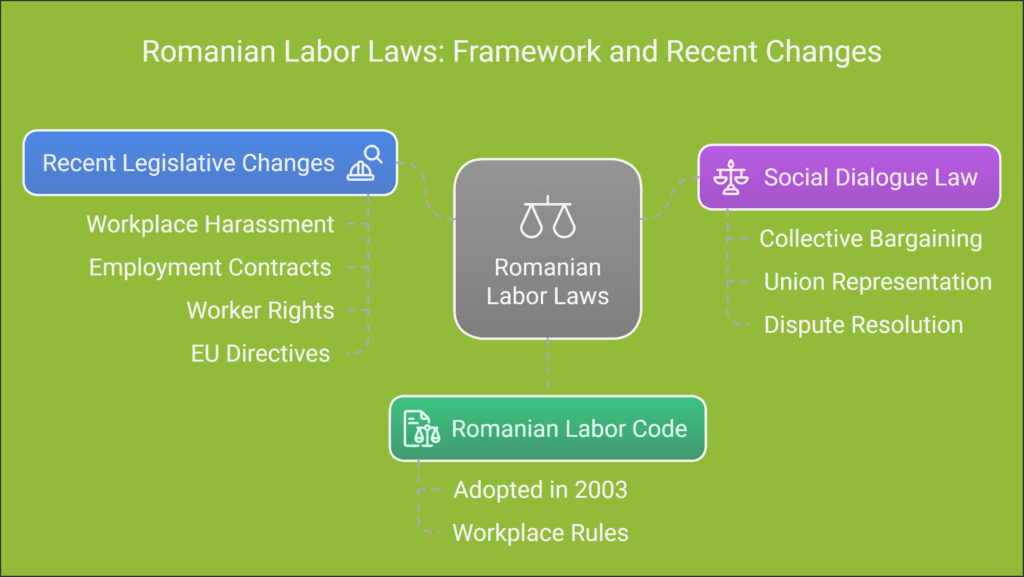
The relevant framework includes the Romanian Labour Code, Law no. 53/2003, the REGES-ONLINE rules in Government Decision no. 295/2025 and, for safety matters, Law no. 319/2006 on occupational safety and health with its implementing rules in Government Decision no. 1425/2006. Sector-specific requirements may add another layer.
Which inspection route is the company facing?
Identify the immediate trigger before assembling a large and unfocused folder. The four common starting points below call for different first documents and operational contacts; the selection is a planning aid, not a legal classification of the inspection.
Inspection route selector
Select a route to see the first response priority.
Immediate priority: a reliable workforce snapshot
Confirm the inspectors’ credentials, inform the responsible HR and site managers, identify each person working at the location and preserve the contemporaneous attendance, rota, contract and register evidence. Do not coach workers or retrospectively rewrite a time sheet. If the visit extends to safety, bring the designated prevention and protection contact into the response.
Immediate priority: a controlled production log
Record the exact documents, employees, period, format and deadline requested. Name an owner for each record set, keep a copy of what is handed over and seek clarification if a description is ambiguous. Provide relevant information through a secure channel, without silently changing the original file.
Immediate priority: reconcile the real arrangement
Compare the employee’s signed contract and addenda, REGES-ONLINE history, time records, rota, payslips and payment evidence against the allegation. A contract that looks compliant on paper does not answer a factual question about hours actually worked or a person working during a registered suspension.
Immediate priority: prevent further harm
Deal with an immediate danger, notify the relevant internal safety personnel and follow the applicable event-reporting rules. Preserve the accident scene and evidence where required, subject to the statutory exceptions necessary to protect people or avoid further accidents. Separate urgent protective action from a later assessment of the legal findings.
What should an employer do during the first hours?
Cooperate, preserve evidence and centralise communications. A written record of the inspection is often as important as the document bundle itself.
Confirm the inspection team and assign a coordinator
Ask to see official identification and record the inspectors’ names, territorial office and arrival time. Inform a designated HR or legal coordinator and, where needed, the site manager or occupational safety specialist. One coordinator should track requests and answers so that different departments do not give contradictory versions of the same fact. The inspection can lawfully be unannounced; an employer cannot insist on a prior appointment as a condition of access.
Preserve the original records and document lawful corrections
Export or make a reliable copy of the register extracts, employment files, attendance logs and relevant correspondence as they stood when the inspection began, before routine systems overwrite them. Preserve creation dates and version history where available. Subsequent corrections remain possible when the applicable law and system procedure permit them; record the reason, supporting document, operator and date, while retaining the original state. If records are held by a payroll provider, an outsourced HR service or a group company abroad, identify who can retrieve them promptly. A missing file at the moment of the visit and a document that never existed are different factual problems; neither is solved by backdating paperwork.
Log questions, interviews and handovers
Record which persons were present, what period the inspectors asked about, which copies were provided and when. Inspectors have statutory powers to seek statements and information from workers. Do not instruct employees to provide a prepared answer or interfere with an interview. If a factual explanation requires access to a record, say so and identify when that record can be produced. For a digital handover, use a secure, documented method and retain an identical copy of the submission.
During an accident or an imminent safety risk, protective obligations have priority. Law no. 319/2006 requires employers to provide relevant records and explanations and implement measures ordered by inspectors. Its special rule on preserving the state of a fatal or collective accident must be read with the exceptions for preventing further accidents or protecting lives. The applicable reporting, investigation and preservation rules depend on the event; involve the responsible specialist immediately.
Which documents does ITM commonly request?
The request depends on the inspection. A company should maintain a current internal index showing who holds each document, which entity it belongs to and how it can be retrieved. This map helps HR, payroll, operations and the safety team answer the same question consistently.
| Record set | Compare it with | Why the comparison matters |
|---|---|---|
| Start date, job, workplace, schedule and amendments | A signed file must match the work actually carried out. | |
| Contract file, start, changes, suspension and termination | Transmission and underlying documents form separate evidence. | |
| Rota, access logs, overtime and part-time terms | Article 119 requires a daily record of working time. | |
| Contract terms, payroll, payment and leave approvals | Payment and entitlement issues cannot be judged from one file alone. | |
| Visitor list, service contracts and worker identity | Misclassification and unrecorded work are fact-sensitive. | |
| Risk assessment, training, health and equipment records | Safety duties depend on the actual workplace and risks. |
Keep the request itself next to the response map. A worker complaint about wages may not require every safety record, while a machine incident may put risk assessments and equipment controls first. Where an inspector lawfully requests further relevant documents, update the map and preserve a copy of each additional handover.
What changed with REGES-ONLINE in 2026?
The current employee-register workflow is REGES-ONLINE under Government Decision no. 295/2025. Employers should inspect the data and operation history in the current system rather than rely on an old Revisal-only checklist.
The new decision governs recording and transmitting employment-contract data, changes, suspensions and endings through REGES-ONLINE. Emergency Ordinance no. 46/2025 extended certain transition obligations to 31 December 2025. In a 2026 inspection, check the position under the current rules and the employer’s actual transition history; do not assume every historical field was due on the same day or that an old export by itself demonstrates compliance.
The Labour Inspectorate’s own employer extract guidance explains how to generate a report listing registered employees, while its employer journal guidance covers recorded actions over a chosen period. A useful inspection pack therefore includes the current extract, relevant history and the signed source documents that explain the entries. The journal is an audit aid, not a substitute for the underlying contract or evidence of work actually performed.
For every person in the inspected sample, compare the contractual start, location, duration, schedule and salary terms with the register’s entries and effective dates. Compare suspension or termination records with the underlying decisions and with the person’s actual site or system access. If an inconsistency appears, preserve the original records, identify the cause and use the lawful correction route with an auditable explanation. Quietly editing the system after an inspector has asked for evidence can make the chronology harder to establish.
Outsourcing entry or payroll work does not remove the employer’s need to understand its own records. Confirm who holds administrator access, who approved each transmission and how the company receives proof of submission. A foreign parent company may run a central HR platform, but the Romanian employing entity still needs to produce the records relevant to its workforce.
Where do inspections most often become legally sensitive?
Undeclared work and the first day of employment
The Labour Code requires the written employment contract to be concluded and the required register data to be transmitted no later than the day before the employee starts work. Article 151 of the Labour Code defines several forms of undeclared work, including work without the written contract, work before the required register transmission, work performed during suspension and work by a part-time employee beyond the contractual duration of working time, subject to the statutory exception. These are distinct factual routes. The company should identify which route is actually alleged instead of answering only with a signed contract.
Temporary workers, contractors, agency personnel, trainees and visitors should be identified accurately on site. A services invoice does not alone decide whether a natural person is working in a genuinely independent capacity. Our employee versus contractor guide explains the wider classification issue. If a person works for another employer, retain the arrangement and identify the actual employer and the basis for work at this site.
Hours, rest and part-time schedules
Under Article 119 of the Labour Code, employers keep daily records of each employee’s working time, with the start and end of the programme, and make them available to inspectors. The statute contains rules about how records can be agreed for mobile and home-based workers; verify the actual arrangement and the version of the law applicable to the period examined. A monthly total without a credible daily basis may leave an important evidential gap.
Compare rosters, customer service logs, access systems and manager approvals with the time record. If shifts were exchanged or remote work changed the place and timing of work, keep the underlying approval. For part-time employees, distinguish a changed schedule from work exceeding the contracted duration: Article 151 addresses the latter, with a statutory exception. Overtime, rest days and annual leave also need a coherent record; avoid assuming a fixed salary automatically resolves all working-time questions.
Pay, leave and personnel files
Payroll must be traced to the applicable contractual terms and actual period worked. A payroll export can show calculation; payment evidence shows whether and when sums were transferred. Leave approvals and balances explain absence, but an employee who is shown as absent in one system and working in another requires a factual investigation. Preserve the relevant records before changing the entry, and document any correction as a correction.
Occupational safety and health
Law no. 319/2006 places preventive duties on employers, including measures adapted to the risks of the actual workplace. The implementing rules address the organisation of prevention and protection, training and related documentation. A signed generic training sheet is weak evidence if the instruction did not address the equipment or tasks in use. Review risk assessments, worker training, designated responsibilities, protective equipment, health surveillance and incident evidence in the context of the site being inspected.
Can undeclared work stop activity at the inspected workplace?
Undeclared-work risk: Under Article 260(4) of the Romanian Labour Code, an inspector orders the cessation of activity at the inspected workplace when one of the contraventions in Article 260(1)(e)–(e2) is established: receiving someone to work without an employment contract, without the required prior transmission to the employee register, or while their contract is suspended. This is a separate measure from stopping dangerous activity under workplace safety legislation. Under Article 260(5), activity may resume only after the employer meets the statutory conditions, including payment of the fine as required by law, remedying the relevant employment or register deficiency and presenting proof of payment of the applicable social contributions and income tax for the undeclared-work period. Resuming activity in breach of these conditions constitutes a criminal offence under Article 260(6). The excess-hours breach involving a part-time contract under Article 260(1)(e3) is not listed in Article 260(4). Identify each worker and complete the written contract and required register transmission no later than the day before work starts.
Can an employer refuse a document request or limit access?
Labour inspectors have broad statutory powers under Law no. 108/1999, including the powers listed in Article 19, and the inspected entity must provide documents and information necessary for the control. Commercial confidentiality alone is not an automatic reason to refuse a relevant lawful request. At the same time, the GDPR’s data-minimisation principle continues to apply to the employer’s handling of personal data. Clarify the requested employees, period and purpose, use a secure handover and restrict unnecessary circulation inside the company.
Where a document contains unrelated personal details, consider whether a partial redaction or a narrower extract is legally appropriate without obscuring information the inspector is entitled to examine. Explain any proposed redaction and be ready to supply the relevant unredacted material if lawfully required. Do not anonymise employee identity, hours or other facts central to the control merely because they are personal data. If the request is ambiguous or unusually broad, seek clarification promptly and document the response rather than silently withholding relevant evidence.
Keep a copy of every file supplied, the version date, the recipient and the delivery method. If an original is taken or a copy certified, retain the acknowledgment. A parent company or external adviser may help prepare the response, but inspectors may still require information from management or workers on site. Employee statements should be allowed to proceed without intimidation, retaliation or a fabricated script.
Legal counsel can help formulate an accurate response to a disputed factual allegation while the inspection continues. The employer should correct an immediately dangerous condition and meet an applicable remedial deadline even if it disagrees with a legal conclusion. Keep remedial action separate from any admission about what happened previously.
What happens after the inspection?
Read every document delivered by ITM as a separate instrument. Identify factual findings, legal provisions, required measures, proof of communication and the available response route.
At the close of the visit or afterwards, the company may receive a proces-verbal de control (control report) recording findings and mandatory corrective measures, sometimes with an annex or plan of measures and specified deadlines. A separate proces-verbal de constatare și sancționare a contravenției records an alleged contravention and its warning or fine. Occupational safety and health controls may generate their own findings and measures, including an order concerning dangerous activity or equipment where the statutory conditions are met. The Labour Inspectorate’s control guidance distinguishes the control report from the contravention report. Create a document register with the date of handover or communication, a responsible person, the deadline stated and the evidence needed to answer each finding.
Start with the factual allegations. Which worker, location, date, period and underlying record are at issue? Then check the cited legal provision and whether the available evidence supports that characterization. A procedural defect can matter, but not every typographical error invalidates a report. A sound review considers both formal requirements and the substance of the finding, the sanction’s proportionality and any applicable special statutory rules.
For a contravention report, Article 31 of Government Ordinance no. 2/2001 generally provides 15 days from handover or communication for a complaint. Confirm the starting date from the actual service evidence. Territorial jurisdiction and the effect of a complaint should be checked against the current Article 32 and any special law relevant to the alleged infringement. Do not conflate that procedural route with a separate order requiring correction or stopping an unsafe activity.
Does a control measure follow the same challenge route as an ITM fine?
No. Article 20(3) of Law no. 108/1999 directs challenges against contravention reports to the procedure under Government Ordinance no. 2/2001. Article 20(2) provides that challenges against acts of an administrative nature issued by labour inspectors are resolved under Law no. 554/2004 on administrative litigation. Whether a particular measure can be challenged separately under that law depends on its legal nature and effects. A mandatory measure in a control report may therefore require an administrative-law analysis, including whether the particular measure is an administrative act, whether a prior complaint is needed and which filing and court deadlines apply. Its wording, legal basis and effect must be assessed individually.
A challenge to a control report or measure does not, by itself, suspend its mandatory obligations, unless the applicable law or a court order provides otherwise. If immediate compliance would cause a serious dispute or operational impact, examine the separate conditions for interim relief under administrative law while managing safety and remediation obligations. Do not apply the 15-day contravention deadline or the procedural effects of a fine complaint automatically to every measure in the control report.
If the company accepts a factual deficiency, assign the corrective work, preserve evidence of the fix and answer the authority by the specified deadline where required. If it disputes the allegation, collect contemporaneous documents and record who can explain them. A business may need to comply operationally while evaluating a challenge. Paying a fine, lodging a complaint and completing a corrective measure can have different consequences; decide from the exact papers, not from a generic template.
Illustrative scenario: responding to an employment compliance inspection
Consider a Romanian subsidiary of an international group operating across several locations. ITM inspectors arrive unannounced and focus on working-time records, employment documentation and REGES-ONLINE compliance. The document request covers employment files, register evidence, attendance records and payroll-related documentation for a defined review period.
In the first 48 hours, a well-organised response would start by appointing a single internal coordinator and creating a document map covering HR, payroll and operational records. Copies of the relevant records would be preserved in their original state, a handover log would be kept and responsibility for each requested document category would be assigned.
The review could then reveal inconsistencies between contractual working arrangements, REGES-ONLINE entries and operational attendance records affecting a limited number of employees. The company should not alter records retroactively. It should document each discrepancy, preserve the original evidence and record any correction as a correction, through the applicable legal and administrative procedure.
Legal support in a scenario like this would typically involve reconciling the relevant records, preparing explanatory submissions and organising the supporting evidence. The aim is a consistent chronology supported by contemporaneous documents, rather than isolated records viewed separately.
The end result of such a process would normally be an inspection-response file, a deadline register, a remediation plan and an employee-sample audit designed to identify similar issues before a future inspection.
Practical lesson: in many inspections, the decisive question is not only whether a document exists, but whether contracts, REGES-ONLINE records, payroll data, working-time records and the reality of workplace operations align with one another.
This is a hypothetical scenario prepared for educational purposes. It does not describe a real client matter, and it does not guarantee any inspection, administrative or court outcome.
What should go into an ITM defence and compliance file?
Keep a single indexed file that can support a legal assessment and a practical remediation plan. The buttons below are a local planning aid: they do not upload or save company information.
Click each card as the file is assembled.
Not every record is required in every inspection, and a complete defence may need documents not listed here. Match the file to the authority’s precise allegations. Organise a chronology of the employee’s actual work, changes and communications; record the source and custodian of each document. If a witness has first-hand knowledge of an event, preserve their account without coaching or changing it to fit a theory of the case.
How can management prepare before the next visit?
A short internal audit is more useful than a generic binder assembled on the day of control. Sample a few active employees, a recent starter, a part-time worker, a person with a suspension or amendment and, where relevant, an external worker present on site. For each person, trace the signed agreement to the register, the actual hours, payroll and site access. The purpose is to identify a mismatch while the underlying evidence is still available.
Set a clear process for pre-start onboarding: conclude the written contract and transmit the required register data no later than the day before work starts. Manage schedule approvals, working-time records and subsequent REGES-ONLINE updates within their applicable deadlines. Verify that the manager who knows the operational facts can communicate them to HR, and that the service provider responsible for transmission can produce a reliable audit trail. In multi-site or foreign-owned groups, specify which legal entity employs each person and who owns the local compliance task.
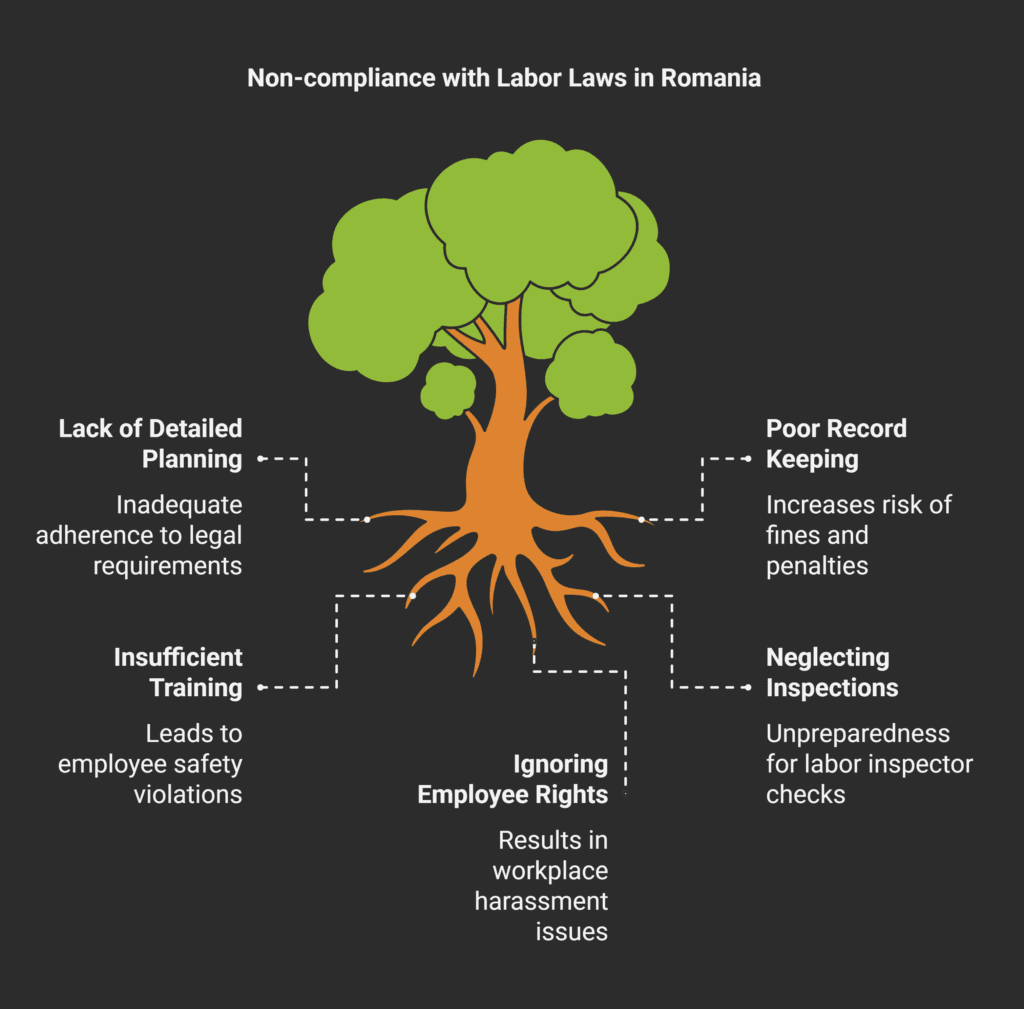
For safety, inspect the workplace rather than relying only on forms: compare the risk assessment and training record with tasks and equipment in use. Assign a named person to keep preventive documentation current and to escalate incidents. Follow up on prior ITM measures with dated proof of implementation. Repeat the sample periodically, particularly after opening a new site, changing shifts, adopting a new HR system or bringing in a new labour supplier.
How Atrium assists with an ITM inspection
Atrium can review the inspection request and the employer’s document map, align HR, payroll and operational evidence, assess a disputed factual or legal finding and prepare the response to a contravention report or corrective measure where appropriate. The work begins with the company’s actual records and deadlines, including any safety issues requiring immediate action.
For an international group, the legal review can also clarify which Romanian entity employs the worker, what the local register shows, how foreign-managed systems record time and who is authorised to respond on behalf of the employer. An early document chronology helps management decide which records to produce, which corrections are required and whether a challenge is justified.
This describes a service process and does not report a particular client matter or promise an inspection, sanction or court outcome.
Related Guides
Frequently asked questions
Can ITM arrive without advance notice?
Yes. Law no. 108/1999 gives labour inspectors a statutory right to enter workplaces without prior notice in the exercise of their duties. Verify official identification, involve the responsible company contact and keep a record of requests and copies supplied.
Is a signed employment contract enough to answer an undeclared-work allegation?
Not necessarily. The legal question may concern the date of signing, timely register transmission, work during suspension or a part-time employee exceeding the contracted duration of work, subject to the statutory exception. Compare the contract with the register and evidence of the work actually performed.
Does an employer still need Revisal documents in 2026?
The current workflow is REGES-ONLINE under Government Decision no. 295/2025, following the transition extended to the end of 2025. Historical exports may help explain older events, but prepare current extracts, relevant operation history and the signed source documents for the inspected period.
How quickly must an ITM fine be challenged?
Article 31 of Government Ordinance no. 2/2001 generally gives 15 days from handover or communication of the contravention report. Confirm the service date, the cited law, the competent court and any special procedural rule before filing. A separate corrective or safety measure may require a different analysis.
Does challenging the contravention report stop a safety measure?
Do not assume so. Identify the precise instrument and its statutory basis. A complaint about the sanction and an order to stop dangerous activity or implement corrective work may follow different routes and have different effects. Take immediate safety obligations seriously while legal options are assessed.
What should a foreign-owned Romanian company prepare first?
Identify the Romanian employing entity and local contact, then retrieve the active employee list, signed contracts, REGES-ONLINE data, daily time records and relevant payroll evidence. If the visit concerns workplace safety, involve the designated local safety specialist and collect the site-specific records.
Respond to an ITM inspection with a documented plan
Send the inspection request or report, the documents served, the relevant employee and register records, and any approaching measure or complaint deadline. Atrium can help identify the legal issues, organise the evidence and plan an appropriate employer response.
Contact Atrium about an ITM inspectionAI Notice: AI-assisted content, reviewed by a qualified Romanian lawyer.