Romanian company director liability and corporate governance risk assessment

Romanian Company Director Liability: Duties and Risks

When can Romanian company director liability arise?

The company is a separate legal person, but that shield is not absolute. A director may face personal exposure for breach of corporate duties, insolvency misconduct, bad-faith tax conduct, a personal guarantee or other unlawful acts.

COMPANYSEPARATE LEGAL PERSONLiability shield BREACH OF DUTYloss + causationINSOLVENCYArticle 169 conductTAX LIABILITYbad-faith conductPERSONAL GUARANTEEcontractual exposure AI-generated illustration

Romanian company director liability does not arise automatically from the company’s debts. Personal liability requires a separate legal basis, such as a damaging breach of the director’s mandate or statutory duties, conduct that contributed to insolvency, bad-faith conduct connected with unpaid taxes, or a personal contractual commitment. Foreign directors should verify their registered powers, keep an evidence trail for material decisions and escalate financial distress early.

Accepting a director appointment in Romania is more than an administrative formality. Understanding Romanian company director liability requires reviewing both the legal mandate and the director’s actual decision-making role. The director may represent the company, commit it contractually, manage assets and supervise accounting, tax, employment and regulatory processes. Those powers carry duties to the company under the articles of association, shareholder resolutions, the rules on mandate and Romanian company law.

The exact framework depends on the company form and governance structure. The Romanian term administrator may refer to an administrator of a limited liability company (SRL) or a member of the board of directors of a joint-stock company (SA). An SA may also use a two-tier system with a management board and supervisory board. The appointment document and the articles of association should therefore be read before applying any general rule.

Is a Romanian company director personally liable for company debts?

Generally, no. An ordinary supplier, landlord or lender claim is normally against the company. The director becomes personally exposed only where the creditor or another claimant can rely on a distinct statutory, contractual or delictual basis and prove the elements required for that route.

This distinction matters. A company’s inability to pay does not, by itself, transfer every unpaid invoice to its director. Equally, the words “limited liability” do not protect a director from consequences of their own conduct.

SituationUsual starting pointPotential director exposure
Ordinary commercial debtThe company is the contracting party and primary debtor.No automatic personal liability merely because the company does not pay.
Breach of mandate or company-law dutyThe company may have suffered loss through the director’s act or omission.Liability may arise if breach, damage and causation are established under the applicable rules.
Insolvency misconductThe company enters insolvency with unpaid liabilities.The insolvency court may order persons who contributed to insolvency through conduct listed in Article 169 to bear part or all of the liabilities, within the causally connected loss.
Unpaid tax obligationsThe company remains the tax debtor.Joint liability may be established in the bad-faith situations listed in Article 25 of the Fiscal Procedure Code.
Personal guaranteeThe company receives finance, a lease or credit.The director may be liable under the separate guarantee they signed, according to its terms.
Separate unlawful actThe director acts personally as well as for the company.Civil, administrative or criminal consequences may apply depending on the specific act and statute.

Do not confuse shareholder liability with director liability. A shareholder’s exposure as an investor and a director’s exposure as a manager are different questions. One person may hold both roles, but each potential claim needs its own legal basis.

What are the core duties of a Romanian company director?

Articles 72 and 73 of Romanian Companies Law no. 31/1990 connect administrators’ obligations and liability to the rules on mandate and the special provisions of the Companies Law. They also identify responsibility toward the company for matters including the reality of capital contributions, the actual existence of distributed dividends, legally required registers, implementation of shareholder resolutions and strict performance of duties imposed by law and the articles of association.

Duty areaPractical meaningUseful evidence
Act within authorityFollow the law, articles of association, appointment terms and valid shareholder or board resolutions.Current constitutional documents, authority matrix, registered representation powers and written approvals.
Protect company interestsUse management powers for the company rather than for an undisclosed personal or third-party benefit.Conflict disclosures, abstentions, independent valuations and documented commercial rationale.
Make informed decisionsObtain information proportionate to the value, urgency and risk of the decision.Board packs, forecasts, legal and financial advice, alternatives considered and minutes.
Supervise records and complianceEnsure required registers and accounting records exist and that delegated functions are reasonably monitored.Compliance calendar, management reports, tax confirmations, audit trails and escalation logs.
Implement corporate decisionsCarry out valid shareholder decisions accurately and within the company’s legal powers.Signed resolutions, implementation plans, filings and completion records.
Preserve confidentialityProtect confidential information and business secrets during and, where applicable, after the mandate.Access controls, confidentiality undertakings and documented return or deletion of company information.

For SA board members, Article 1441 of Romanian Companies Law no. 31/1990 expressly requires prudence and diligence of a good administrator, loyalty in the company’s interest and confidentiality. It also recognises an informed-business-decision protection where the director was reasonably entitled to believe that the decision served the company and relied on adequate information. That provision should not be copied mechanically into an SRL analysis; the SRL’s own statutory rules, mandate and constitutional documents must be assessed.

Decision record

A defensible director decision has four layers

1AUTHORITYWho may decide?Which approval?2INFORMATIONFacts and forecastsProfessional advice3CONFLICTSDisclose interestsManage participation4MINUTESRationale and voteActions and follow-up AI-generated illustration
The file should show how the decision was authorised, informed, conflict-checked and implemented—not merely its eventual outcome.

How do SRL and SA director duties differ?

An SRL is usually managed by one or more administrators appointed through the articles of association or by the shareholders. Article 197 contains SRL-specific administration rules and refers expressly to Articles 75, 76, 77(1) and 79. Articles 72 and 73 remain central to the mandate-based duties and liability framework, but the articles of association are also essential because they define individual or joint representation, reserved matters, term of office and internal approval limits.

An SA has a more prescriptive governance framework. In the one-tier system, a board of directors may delegate management to directors; in the two-tier system, the management board operates under a supervisory board. Duties, delegation, conflicts, meeting procedure and the mechanics of corporate liability actions can therefore differ materially from an SRL.

Foreign group policy is not enough. A director of a Romanian subsidiary must apply the subsidiary’s Romanian-law documents and duties. Instructions from the parent company, investor or beneficial owner do not automatically excuse an act outside authority or against the Romanian company’s interests.

Before accepting or using the mandate, confirm the director provisions in the Romanian articles of incorporation. Where governance rights are also allocated between investors, coordinate those documents with the shareholder agreement while recognising that a private agreement does not replace mandatory corporate rules or Trade Register formalities.

When can the company claim against a director?

A corporate claim typically focuses on whether the director breached an applicable duty and caused quantifiable loss to the company. The decision and representation mechanics depend on the company form, the alleged conduct and the applicable articles of the Companies Law. Article 155 contains the general-meeting mechanism for an SA action against directors for damage caused to the company through breach of their duties.

Approval by shareholders should not be treated as a universal release. The legal effect depends on what was disclosed, the nature of the decision, the company form, mandatory law, third-party rights and whether the approving body had authority. A director should still require accurate materials and record concerns.

Unauthorised transaction

A director signs beyond registered or internal powers and the company suffers loss. Liability, enforceability and internal recourse require separate analysis of the authority documents and third-party circumstances.

Related-party benefit

Company assets or opportunities are directed to a connected party without transparent approval, adequate information or defensible commercial terms.

Ignored compliance warning

Management receives a specific accounting, tax or regulatory warning but takes no proportionate action, allowing avoidable loss to increase.

When can insolvency create personal exposure?

Financial distress is a critical turning point. Article 66 of Romanian Insolvency Law no. 85/2014 generally requires an insolvent debtor to apply to the tribunal within a maximum of 30 days from the onset of insolvency, subject to the statute’s rules for good-faith restructuring negotiations. The competent tax authority must be notified of the intended insolvency application 15 days before filing, and proof of that notification must be attached to the application. A legal entity’s application is signed by the persons authorised to represent it under its constitutional documents; a shareholder resolution is not required by Article 66(5).

Under Article 169, the insolvency court may order management or supervisory members, any individual or legal entity exercising control over the debtor’s financial or operational decisions regardless of formal title, and other persons who contributed to insolvency through listed conduct to bear part or all of the debtor’s liabilities, without exceeding the loss causally connected to that conduct.

Article 169 risk categoryExamples of evidence reviewed
Using company assets or credit for personal or third-party benefitRelated-party payments, asset transfers, undocumented loans and non-commercial terms.
Conducting personal business under cover of the companyRevenue diversion, overlapping contracts, beneficial ownership and use of company resources.
Continuing activity in personal interest when cessation of payments was clearly approachingCash-flow forecasts, creditor ageing, director benefits and the rationale for continued trading.
Fictitious, unlawful or missing accountingLedgers, source documents, backups, handover records and access to accounting systems.
Diverting or concealing assets, or fictitiously increasing liabilitiesAsset registers, disposals, inventory movements, invoices and connected-party balances.
Transferring assets or a significant part of the business to a closely related personTransfers made while the debtor is in financial difficulty, compliance with Article 73(2¹) of the Companies Law, the relationship between the parties, continuation of the business through the new entity and evidence of an intention to shield assets from creditors.
Ruinous financing used to delay cessation of paymentsPricing, security, repayment prospects, alternatives considered and decision minutes.
Preferential payment to one creditor shortly before cessationPayment sequence, creditor relationship, maturity dates and justification.
Other intentional conduct contributing to insolvencyThe specific act, intent, resulting loss and causal connection to insolvency.

Law no. 239/2025 inserted Article 169(1)(e1), which specifically targets the transfer of assets or a significant part of the business of a debtor in financial difficulty to a person closely related to the debtor, where the obligations imposed by Article 73(21) of the Companies Law are breached and the transfer is intended to continue the activity through the new entity while shielding assets from the debtor’s creditors.

A final Article 169 liability judgment now has consequences beyond the payment order. Under Article 169(10), the person may not be appointed as a company administrator and, if already serving as an administrator elsewhere, loses that right for 10 years from the date the judgment becomes final. The person is also barred for 5 years from founding companies or acquiring a controlling participation in a new company.

Distress response

The evidence trail becomes more important as liquidity deteriorates

1MONITORCash and arrears2VERIFYSolvency status3ADVISELegal and financial4DECIDERestructure or file5PRESERVERecords and handoverAI-generated illustration
Early monitoring and documented advice help directors distinguish temporary pressure from statutory insolvency and respond within the applicable deadline.

Failure to hand over accounting records can create a rebuttable presumption of fault and causation under Article 169. For collegial management or supervisory bodies, a member who opposed the relevant act and recorded the opposition may have a specific defence under Article 169(5). A silent disagreement is therefore much weaker than a properly documented one.

When can a director become jointly liable for Romanian tax debts?

Article 25 of Romanian Fiscal Procedure Code no. 207/2015 creates specific joint-liability routes for overdue tax obligations. They are not triggered merely by holding office. The relevant provisions require the statutory circumstances and, for the principal director-related routes, bad faith.

Potential cases include administrators or other persons who, in bad faith:

  • caused the debtor’s insolvency by transferring or concealing its assets;
  • failed during their mandate to request the opening of insolvency proceedings for tax obligations from that period that remained unpaid when insolvency was declared;
  • caused the non-declaration or non-payment at maturity of tax obligations;
  • caused an unjustified tax refund or reimbursement; or
  • caused tax debts to accumulate and prevented their payment in the circumstances covered by Article 25(21).

A tax assessment against the company and a decision establishing the director’s joint liability are different acts. The facts, legal basis, procedural steps and challenge deadlines should be reviewed immediately when a director receives a Romanian tax notice.

Can delegation, resignation or shareholder instructions remove liability?

Delegation

Delegating finance, tax or operations does not necessarily eliminate a director’s own supervision duties. The appropriate level of oversight depends on the company form, governance structure, importance of the function, warning signs and the director’s legal powers. A clear written delegation and regular reporting are stronger than an informal assumption that “the accountant handles it.”

Resignation

Resignation can end future management authority once effective and properly implemented, but it does not erase possible liability for earlier acts or omissions. The director should document the handover, return company property, preserve relevant records and ensure required Trade Register formalities are handled.

Shareholder or parent-company instructions

A shareholder instruction does not automatically legalise conduct that breaches mandatory law or the director’s duties to the Romanian company. Material instructions should be checked against reserved matters, representation rules, corporate benefit, conflicts and insolvency considerations.

Directors’ and officers’ insurance

D&O insurance may fund defence costs or certain covered claims, but wording, exclusions, notification duties, deductibles and Romanian mandatory law matter. It cannot be assumed to cover fraud, intentional misconduct, all tax exposure, fines or every insolvency claim.

Practical checklist for foreign directors of Romanian companies

  1. Verify the mandate. Obtain the current articles of association, appointment decision and Trade Register extract.
  2. Map authority. Distinguish individual representation, joint signatures, shareholder reserved matters and internal approval thresholds.
  3. Build a reporting pack. Receive timely cash-flow, tax, accounting, litigation, employment and regulatory information.
  4. Document material decisions. Record information reviewed, options, conflicts, rationale, vote and follow-up responsibility.
  5. Control related-party dealings. Disclose interests and obtain the approvals and supporting valuation appropriate to the transaction.
  6. Supervise filings and records. Use a compliance calendar and require evidence of submission and payment—not verbal confirmation alone.
  7. Escalate warnings. Investigate missed tax payments, unpaid salaries, creditor enforcement, deteriorating liquidity and missing records promptly.
  8. Record disagreement. Use the legally appropriate board record and written notification; do not rely on an informal objection.
  9. Assess distress early. Seek Romanian insolvency and tax advice before the statutory filing window is lost, allow for the 15-day advance tax-authority notification and scrutinise transfers to closely related persons.
  10. Plan the exit. Coordinate resignation, handover, registrations, access removal, record preservation and insurance notification.

The bottom line

Romanian company director liability is conduct-based, not an automatic consequence of a company debt. The strongest protection is disciplined governance: understand the mandate, obtain adequate information, act within authority and in the company’s interest, manage conflicts, preserve reliable records and respond quickly to tax or insolvency warning signs.

Foreign directors should not wait for a dispute to reconstruct the decision process. A focused Romanian-law governance review can identify gaps in signing authority, reserved matters, minutes, compliance reporting and distress procedures before they create personal exposure.

Frequently asked questions

Is an SRL administrator automatically liable for the company’s unpaid debts?

No. The SRL is normally the debtor. Personal liability requires a separate legal or contractual basis, such as breach of the administrator’s duties causing loss, Article 169 insolvency conduct, Article 25 bad-faith tax conduct or a personal guarantee.

Does being a shareholder change a director’s liability?

Shareholder and director exposure are separate. A person who holds both roles may face different claims in each capacity, but liability must be analysed under the legal basis applicable to that role and conduct.

Can shareholder approval protect a Romanian director?

Approval can be relevant, but it is not a universal defence. Its effect depends on the company form, authority of the approving body, quality of disclosure, mandatory law, third-party rights and the conduct involved.

Does resignation end a director’s potential liability?

Resignation can end future authority once effective, but it does not erase potential liability for earlier conduct. Proper handover, registration, preservation of records and insurance notification remain important.

What should a director do if they disagree with a board decision?

Obtain advice on the correct procedure, state the reasons clearly and ensure the opposition is recorded and notified in the form required by the applicable governance rules. This is particularly important for collegial bodies and insolvency-related decisions.

Can D&O insurance eliminate personal liability?

No. It may cover certain defence costs and claims, but policy terms, exclusions, notice requirements and mandatory law apply. Fraud, intentional conduct, fines, tax exposure and insolvency claims may be excluded or limited.

Disclaimer: This article provides general legal information and does not constitute legal, tax or insolvency advice. Director duties and liability depend on the company form, constitutional documents, appointment terms, decision-making process, actual conduct and the law applicable to the specific facts.

AI Notice: AI-assisted content, for review by a qualified Romanian lawyer.

Corporate Restructuring Options Under Romanian Law: Mergers, Divisions, and Transformations

Corporate Restructuring Options Under Romanian Law: Mergers, Divisions, and Transformations

Did you know that Romania has seen a big rise in corporate restructuring?

This includes more mergers and acquisitions in 2025.

These changes are key for companies to stay competitive and efficient in a fast-changing market.

It’s important to know how these restructuring processes work.

This knowledge helps companies follow Romanian laws well.

This article will dive deep into the restructuring options in Romania.

It will show how these options can help your business grow.

corporate restructuring options under romanian law

Key Takeaways

  • Corporate restructuring is increasingly vital for businesses in Romania.
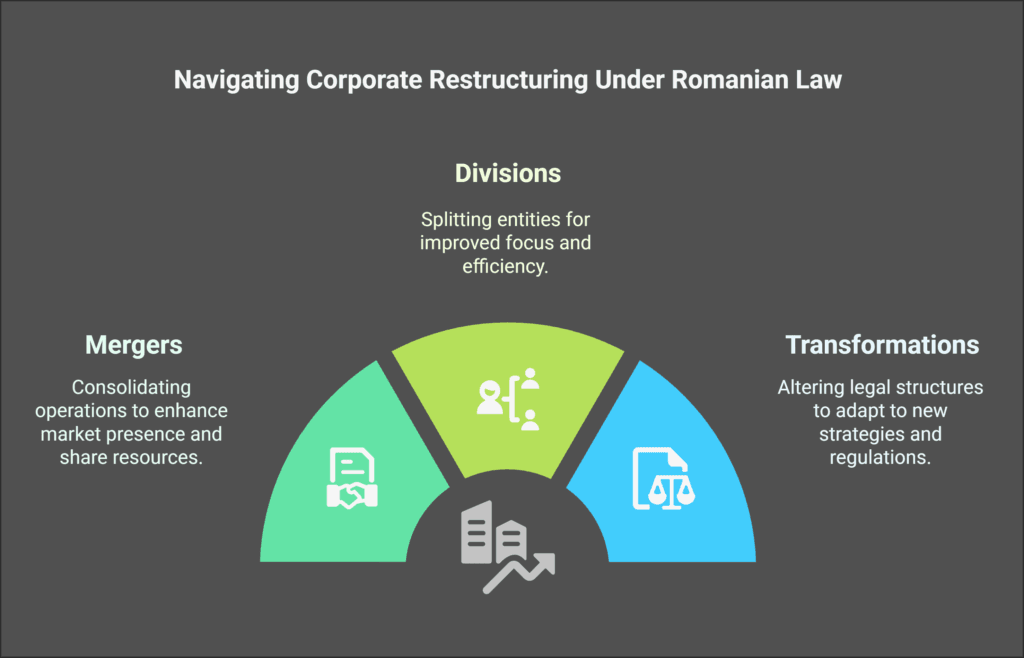
  • Mergers, divisions, and transformations are the key options available for restructuring.
  • Compliance with Romanian corporate laws is essential for successful restructuring.
  • Understanding the legal framework can guide effective restructuring strategies.
  • The Romanian market experiences dynamic changes impacting restructuring processes.

Understanding Corporate Restructuring in Romania

Types of Corporate Restructuring Options Under Romanian Law

In Romania, corporate restructuring is key for companies facing challenges.

It helps solve financial issues and opens up growth chances.

By restructuring, companies can improve operations, cut debts, and boost their competitive edge.

Definition and Importance of Restructuring

Corporate restructuring means changing a company’s financial or operational setup to tackle challenges or seize new chances.

It’s vital for boosting efficiency, managing debts, and aligning resources with market needs.

Companies that restructure can cut their debt by about 40%, helping them through tough times.

Context Within Romanian Corporate Law

In Romania, the legal framework for restructuring is clear.

The law provides ways for companies to reorganize, like voluntary liquidations and preventive compositions.

It sets rules for businesses, ensuring creditors can start legal actions if needed.

On average, restructuring in Romania takes about 12 months due to its complexity.

Romanian Legal experts are key in guiding companies through this process.

They help reduce risks and ensure compliance with current corporate laws.

understanding corporate restructuring

Types of Corporate Restructuring Options Under Romanian Law

Businesses in Romania can improve their efficiency and competitiveness through various restructuring options.

Mergers, divisions, and transformations are key strategies.

Each has its own purpose and must be carefully considered under Romanian law.

A thorough approach helps companies adapt well to market changes and operational needs.

Mergers: Consolidating Business Operations

Mergers combine two or more companies to make operations smoother and boost market presence.

This method can lead to bigger market shares and shared resources.

Romanian law requires detailed planning and negotiations to follow merger and acquisition rules.

Divisions: Splitting Companies for Increased Efficiency

Divisions let companies split into separate entities for better focus and efficiency.

Assets can be fully or partially transferred to new or existing companies.

Romanian law demands a structured spin-off process, including a detailed plan for asset distribution.

This plan must be decided within three months by the companies involved.

types of corporate restructuring options

Transformations: Altering the Legal Structure

Transformations change a company’s legal structure to fit new strategies and market conditions.

This strategy is vital for adapting to regulatory changes and operational needs.

Whether it’s changing corporate form or adjusting governance, transformations can greatly affect a company’s future success.

Legal Framework for Corporate Restructuring in Romania

The legal framework for corporate restructuring in Romania is based on several laws.

These laws outline the processes and protections for companies going through big changes.

Knowing the key laws helps companies understand their changes better.

Key Romanian Legislation on Corporate Reorganization

The main laws for restructuring include the Romanian Company Law no. 31/1990 and insolvency rules.

These laws protect creditors and help businesses reorganize.

The Company Law sets the rules for mergers and divisions, including what’s needed for these steps.

It’s important for companies to follow these rules.

This ensures their restructuring is legal.

Regulations Affecting Restructuring Processes

There are more rules for restructuring in Romania.

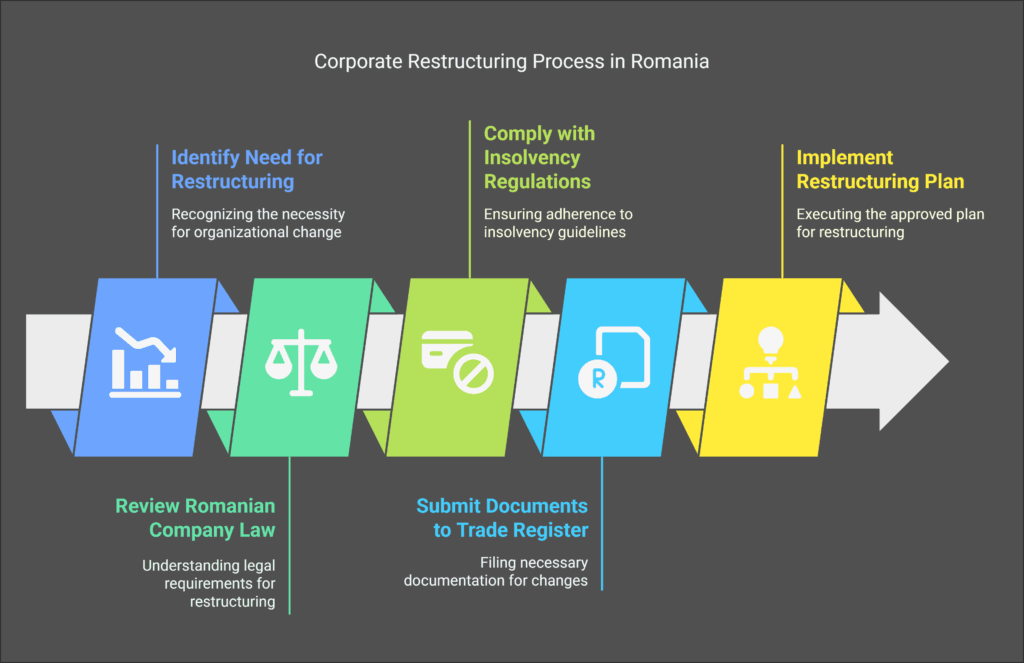
The Romanian Trade Register requires companies to submit detailed documents, like changes to their articles of association.

Changes to the Fiscal Code can also impact a company’s financial plans during restructuring.

Legislation or RegulationKey Provisions
Romanian Company Law no. 31/1990Outlines processes for mergers and divisions, and protects shareholder rights.
Insolvency RegulationsOffers guidelines on restructuring processes, ensuring fair treatment of creditors.
Romanian Trade RegisterMandates documentation requirements for altering company structures.

Restructuring Strategies for Businesses in Romania

Understanding and using effective restructuring strategies is key for businesses in Romania.

Companies facing financial issues find that strategic planning helps.

It aligns goals with legal needs and boosts efficiency.

By making a detailed plan, businesses can tackle their financial challenges.

This plan helps them overcome unique obstacles.

Corporate Restructuring Romania

Strategic Planning for Effective Restructuring

Strategic planning is the core of restructuring.

Businesses need to create a plan that shows why restructuring is needed.

It should outline how to reach the desired outcomes.

This plan must include how to involve stakeholders, set a timeline, and allocate resources.

It’s vital to get approval from shareholders for any job changes.

Clear communication and alignment among stakeholders are key for success.

Addressing Financial Challenges and Optimizing Operations

Dealing with financial issues in Romania needs careful attention and flexibility.

Companies should review their operations to find ways to improve.

This helps make smart decisions about cutting jobs while following local laws.

If restructuring means laying off workers, companies must follow legal steps.

This includes giving enough notice and telling the labor authorities.

Knowing labor laws well and planning for layoffs helps avoid problems and keeps employees happy.

The Restructuring Process in Romania

The restructuring process in Romania involves several steps for businesses to follow.

A step-by-step guide to corporate restructuring is essential for firms looking to improve their operations.

Working with corporate restructuring specialists can offer valuable insights and expertise.

The Restructuring Process in Romania

Step-by-Step Guide to Corporate Restructuring

The first step is to assess your business’s current state.

This includes looking at its financial health, operational efficiency, and market position.

After identifying the need for restructuring, you can start the next steps.

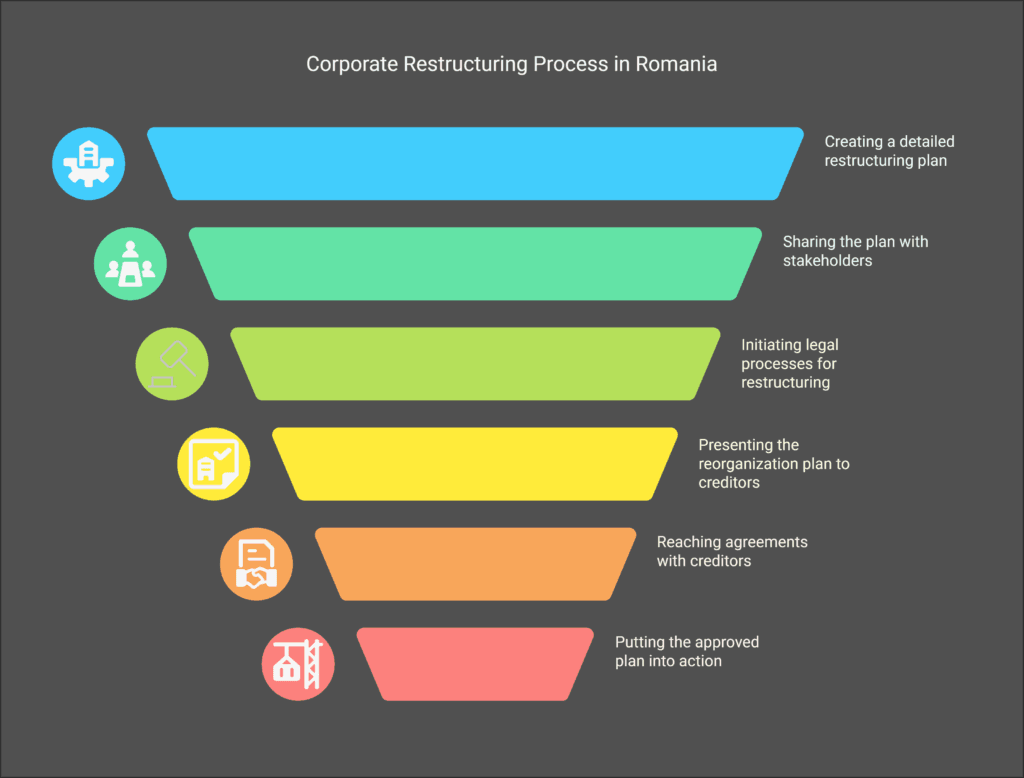
  • Developing a detailed restructuring strategy;
  • Sharing the plan with all stakeholders;
  • Starting legal procedures, like submitting a restructuring agreement;
  • Proposing a reorganization plan to creditors within set timeframes;
  • Negotiating with creditors to get a fair agreement;
  • Putting the approved restructuring plan into action and tracking progress;

Engaging Corporate Restructuring Specialists

Corporate restructuring specialists play a key role in guiding businesses through the restructuring process in Romania.

Our team of Romanian Lawyers can help you:

  • Understand the legal rules for restructuring;
  • Prepare the necessary documents for filing;
  • Negotiate with creditors to avoid conflicts;
  • Make sure you follow all legal rules during restructuring;
  • Keep an eye on how well the restructuring plan is working.

Working with specialists can increase your chances of success.

It also helps you prepare for future challenges.

The right guidance can make the restructuring journey smoother.

Benefits of Corporate Restructuring Under Romanian Law

Benefits of Corporate Restructuring Under Romanian Law

Corporate restructuring is key for companies in Romania to tackle challenges.

It can help your business grow and stay ahead.

By restructuring, you can improve your finances and how you operate, making your company more adaptable to market changes.

Improving Financial Performance and Competitiveness

One big plus of restructuring in Romania is better finances.

Companies often struggle with money due to market shifts or poor management.

A good restructuring plan can help use resources better and make operations smoother.

This can lead to more money for your business and make you more competitive.

Enhancing Operational Efficiency

Another big benefit is making your operations more efficient.

Restructuring helps find and fix problems in how you work.

This makes your company stronger and encourages ongoing improvement.

Your business will be quicker to respond to new needs or rules.

Legal Implications of Corporate Restructuring in Romania

Understanding the legal side of corporate restructuring in Romania is key.

It involves looking at creditors’ rights and the liabilities that come with them.

Knowing this helps protect your interests and ensures a smooth transition during restructuring.

Dealing with Creditors’ Rights and Liabilities

In Romania, creditors’ rights are shaped by Law No 85/2014.

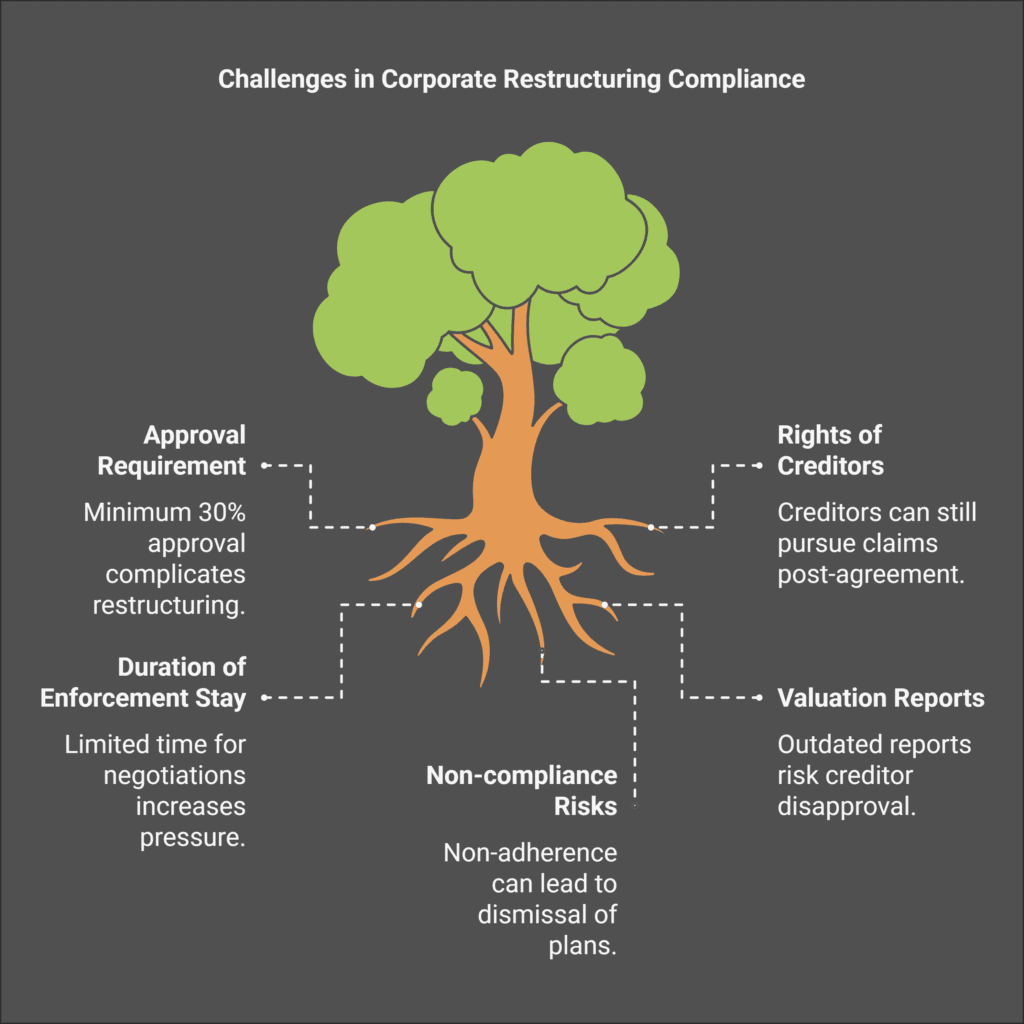
Any restructuring plan needs approval from creditors who hold at least 30% of the affected receivables.

Creditors can keep pursuing claims against co-debtors or guarantors, even if they agree to a plan.

This shows how important it is to keep in touch with creditors during this time.

Compliance with Corporate Insolvency Procedures

Following corporate insolvency procedures in Romania is vital to avoid legal issues.

The restructuring process needs careful planning and must follow strict rules.

For example, the temporary stay of enforcement actions can last from three to 12 months, giving time for negotiations.

Also, a creditor arrangement must offer prospects that allow creditors to get at least what they would in bankruptcy, based on a recent valuation report.

Not following these rules can lead to the court dismissing the restructuring or creditors not approving it, which could harm the restructuring efforts.

AspectDescription
Approval RequirementMinimum 30% of affected receivables must approve the restructuring agreement.
Rights of CreditorsCreditors can pursue claims against co-debtors and guarantors despite agreeing to restructuring.
Duration of Enforcement StayStay lasts from 3 to a maximum of 12 months.
Valuation ReportsMust be no older than 6 months for ensuring creditor agreements in reorganizational plans.
Non-compliance RisksCan lead to dismissal of proceedings or disapproval by creditors.

Best Practices for Corporate Restructuring in Romania

Effective corporate restructuring in Romania needs careful planning and following best practices.

Businesses should focus on strategies that reduce legal risks.

Working with experienced professionals is key to success.

Strategies to Minimize Legal Risks

To lower legal risks, conducting independent business reviews (IBRs) is essential.

These reviews check financial, operational, and strategic performance.

They help find the best ways forward.

Pre-lending reviews also help set financial limits.

This impacts overall strategies.

It shows the need for legal solutions that match business goals.

Collaborating with Legal and Financial Experts

Working with financial experts in Romania can improve restructuring.

Firms like Atrium Romanian Lawyers are great examples.

They offer a team approach to handle various issues.

This way, companies can deal with complex laws better.

They can also aim for better results.

Conclusion

Understanding corporate restructuring in Romania is key.

You have options like mergers, divisions, and transformations.

Each one has legal aspects that affect your business’s health.

Delaying these steps can harm your business.

It can lead to lower sales and more debt.

This article shows why businesses need to think about restructuring early.

Working with experts can help you understand Romanian law better.

This way, you can use your resources wisely and stay up-to-date with new laws.

Thinking about restructuring can help your business.

It can make your operations better and save jobs.

It’s a chance to get through tough times and come out stronger.

FAQ

What is corporate restructuring?

Corporate restructuring means a company changes how it works, its money setup, or its legal form.

This can be through mergers, divisions, or changes in legal status.

It aims to make the company more efficient, financially stable, and competitive.

What are the primary options for corporate restructuring in Romania?

In Romania, companies can choose from mergers, divisions, or transformations.

Mergers combine companies to simplify operations.

Divisions split companies to boost performance.

Transformations change a company’s legal form.

How do Romanian laws govern corporate restructuring?

Romanian laws, like the Companies Law and insolvency rules, guide corporate restructuring.

These laws set the rules for mergers, divisions, or transformations.

They protect everyone involved legally.

What are the benefits of corporate restructuring?

Restructuring can make a company’s finances better, more competitive, and efficient.

It helps companies adjust to market changes, cut costs, and get stronger in the market.

What are the legal implications of restructuring for creditors?

When restructuring, it’s key to think about creditors’ rights and duties.

Following insolvency rules helps avoid legal issues and ensures fairness for everyone.

Why is strategic planning important in corporate restructuring?

Strategic planning is vital.

It makes sure restructuring goals match legal needs.

This helps companies tackle financial issues and improve operations during restructuring.

How can businesses ensure compliance during restructuring?

Working with restructuring experts and lawyers is helpful.

They offer advice and detailed checks.

This ensures the restructuring follows Romanian laws and rules.

What are best practices for corporate restructuring in Romania?

Good practices include carefully checking what restructuring is needed.

Working with legal and financial experts is also key.

Using strategies that reduce legal risks helps achieve success while following the law.

What are the main types of restructuring and insolvency procedures in Romania?

In Romania, there are several key restructuring and insolvency procedures available:

1. Preventive composition: This is a restructuring procedure aimed at companies facing financial difficulties but not yet insolvent.

It involves negotiations with creditors to reach a restructuring agreement.

2. Ad-hoc mandate: A confidential procedure where a mandatary is appointed to negotiate with creditors to overcome financial distress.

3. Insolvency proceedings: This is the main procedure for companies unable to pay its debts.

It can lead to reorganization or liquidation.

4. Simplified insolvency proceedings: A faster procedure for certain categories of debtors, typically leading to liquidation.

5. Restructuring procedure: Introduced by the implementation of the restructuring directive, this procedure aims to help companies in financial difficulties or facing imminent insolvency.

Each of these procedures has specific requirements and outcomes under Romanian insolvency law.

How does the new restructuring procedure work in Romania?

The new restructuring procedure in Romania, introduced through the implementation of the restructuring directive, works as follows:

1. Eligibility: The debtor must be facing financial difficulties or imminent insolvency but still be viable.

2. Initiation: The debtor proposes a restructuring and applies to the court.

3. Restructuring practitioner: The court appoints a restructuring practitioner.

Debt Collection in Romania

Debt Collection in Romania: How to Protect Your Interests and Rights as a Creditor

Debt Collection in Romania: Protect Your Interests and Rights as a Creditor

Debt collection in Romania is the process of pursuing and collecting unpaid debts from delinquent debtors, either through extrajudicial or judicial means. It is a vital part of credit management and risk mitigation for any business.

Sometimes your customers or clients may fail to pay their invoices on time, or even refuse to pay at all. This can cause serious cash flow problems, damage your reputation, and affect your relationships with other stakeholders. If you are a business owner or manager, you know how important it is to get paid for your products or services. That’s why you need to know how to recover your debts effectively and efficiently.

However, debt recovery can also be challenging and complex, especially if you are dealing with debtors in a different country, such as debt collection in Romania. Romania is a member of the European Union, but it has its own legal system, culture, and business practices that may differ from yours. You need to be aware of the regulations, procedures, and best practices for debt recovery in Romania, as well as the potential risks and opportunities involved.

In this article, we will provide you with the ultimate guide to debt recovery in Romania. We will cover the following topics:

  • The legal framework and regulations for debt recovery in Romania
  • The extrajudicial phase of debt recovery in Romania
  • The judicial phase of debt recovery in Romania
  • The best practices and tips for debt recovery in Romania

Debt collection in Romania: By the end of this article, you will have a better understanding of how to recover your debts in Romania effectively and efficiently. You will also learn how to avoid common pitfalls and mistakes, and how to protect your interests and rights as a creditor.

The Legal Framework and Regulations for Debt Collection in Romania

The first thing you need to know about debt collection in Romania is the legal framework and regulations that govern it. There are several sources of law that apply to debt recovery in Romania, such as:

  • The Romanian Civil Code: This is the main source of law for civil matters, including contracts, obligations, and liabilities. It defines the rights and obligations of creditors and debtors, as well as the remedies available for breach of contract or non-payment of debts.
  • The Romanian Civil Procedure Code: This is the main source of law for civil litigation, including debt collection lawsuits. It regulates the jurisdiction, competence, procedure, and enforcement of court judgments and orders.
  • The Romanian  Insolvency Law: This is the main source of law for insolvency and bankruptcy cases, including those involving debtors who are unable to pay their debts. It establishes the conditions, procedure, and effects of insolvency proceedings, as well as the rights and obligations of creditors, debtors, and insolvency practitioners.
  • The Romanian Consumer Protection Law: This is the main source of law for consumer protection matters, including those involving consumer debts. It sets out the rules and principles for fair trade practices, consumer rights, and consumer disputes.

These sources of law are supplemented by various secondary legislation, such as decrees, orders, regulations, guidelines, and codes of conduct issued by relevant Romanian authorities or professional bodies.

As a creditor, you need to be familiar with these sources of law and how they apply to your specific case. You also need to comply with them when pursuing your debts in Romania.

Failure to do so may result in legal consequences, such as invalidity of your claim, dismissal of your lawsuit, or sanctions by the court or regulators.

The Extrajudicial Phase of Debt Collection in Romania

The second thing you need to know about debt collection in Romania is the extrajudicial phase. This is the phase where you try to recover your debts without involving the courts or other formal institutions. It is also known as the amicable phase or the pre-litigation phase.

The extrajudicial phase of debt recovery in Romania usually involves the following steps:

  • Sending reminders: This is the first step you should take when your debtor fails to pay their invoice on time. You should send them a friendly reminder by email or phone call, informing them about their overdue payment and requesting them to pay as soon as possible. You should also keep a record of your communication with them.
  • Sending demand letters: This is the second step you should take if your debtor does not respond to your reminders or still refuses to pay. You should send them a formal demand letter by registered mail or courier service, stating the amount and details of your claim, the deadline for payment (usually 15 days), and the consequences of non-payment (such as interest charges, legal action, or reporting to credit bureaus). You should also attach a copy of your invoice and any relevant documents (such as contracts or agreements) to support your claim.
  • Sending notices of default: This is the third step you should take if your debtor does not comply with your demand letter or still disputes your claim. You should send them a notice of default by registered mail or courier service, declaring that they are in default of their obligation and that you reserve your right to take further action against them (such as initiating a lawsuit or an insolvency proceeding). You should also inform them about the possibility of reaching an amicable settlement or a payment plan, if you are willing to do so.
  • Negotiating with the debtor: This is the fourth and final step you should take before resorting to judicial action. You should try to negotiate with your debtor in good faith and reach a mutually acceptable solution, such as a partial payment, a discount, a waiver, or a rescheduling of the debt. You should also document any agreement or arrangement you make with your debtor in writing and have it signed by both parties.

The extrajudicial phase of debt recovery in Romania is usually faster, cheaper, and more flexible than the judicial phase. It also helps you preserve your relationship with your debtor and avoid unnecessary conflicts. However, it also depends on the cooperation and willingness of your debtor to pay their debts. If your debtor is unresponsive, dishonest, or insolvent, you may need to escalate your case to the judicial phase.

The Judicial Phase of Debt Collection in Romania

The third thing you need to know about debt collection in Romania is the judicial phase. This is the phase where you involve the courts or other formal institutions to recover your debts. It is also known as the contentious phase or the litigation phase.

The judicial phase of debt recovery in Romania usually involves the following steps:

  • Filing a lawsuit: This is the first step you should take if you decide to pursue your claim through legal action. You should file a lawsuit against your debtor at the competent court, depending on the amount and nature of your claim. You should also pay the court fees and attach all the relevant documents and evidence to support your claim.
  • Obtaining a court order: This is the second step you should take after filing your lawsuit. You should wait for the court to examine your case and issue a court order, either granting or rejecting your claim. The court order may be issued after a hearing or without a hearing, depending on the type and complexity of your case.
  • Enforcing the court order: This is the third and final step you should take after obtaining a court order. You should enforce the court order against your debtor, either by yourself or with the help of a bailiff or an enforcement agent. You should also monitor the enforcement process and collect your debt from your debtor’s assets or income.

The judicial phase of debt recovery in Romania is usually more effective, reliable, and enforceable than the extrajudicial phase. It also helps you protect your interests and rights as a creditor and obtain legal recognition for your claim. However, it also involves more time, money, and resources than the extrajudicial phase. It also exposes you to more risks and uncertainties, such as procedural delays, appeals, counterclaims, or insolvency proceedings.

The Best Practices and Tips for Debt Recovery in Romania

The fourth and final thing you need to know about debt recovery in Romania is the best practices and tips for debt collection in Romania. These are some of the recommendations and suggestions that can help you recover your debts in Romania more effectively and efficiently:

  • Choose the right Romanian debt collection law office or Romanian attorney: If you need professional assistance or representation for debt recovery in Romania, you should choose a reputable and experienced debt collection attorney near you that can handle your case properly. You should also check their credentials, references, fees, and success rate before hiring them.
  • Use online platforms and tools: If you want to save time and money for debt recovery in Romania, you should use online platforms and tools that can facilitate your communication, documentation, and verification of your claims. For example, you can use e-invoicing, e-signature, e-delivery, e-payment, or e-verification services that are available in Romania.
  • Maintain good communication and documentation: If you want to avoid misunderstandings and disputes for debt collection in Romania, you should maintain good communication and documentation with your debtor throughout the process. You should also keep copies of all your correspondence, invoices, contracts, agreements, receipts, and evidence for future reference.
  • Avoid common pitfalls and mistakes: If you want to prevent problems and complications for debt recovery in Romania, you should avoid common pitfalls and mistakes that can jeopardize your claim or lawsuit. For example, you should not send abusive or threatening messages to your debtor, ignore their legitimate complaints or objections, violate their privacy or data protection rights, or act in bad faith or dishonesty.

Debt collection in Romania can be challenging and complex, but it can also be rewarding and satisfying if you know how to do it properly. By following this ultimate guide to debt recovery in Romania, you will be able to recover your debts effectively and efficiently.