
online surveillance in Romania

Legal Aspects of Online Surveillance in Romania

Legal Aspects of Online Surveillance in Romania

Exploring online surveillance in Romania is complex.

The country’s history deeply affects its laws and how it handles intelligence.

After 1989, Romania’s Securitate was broken up.

This move marked the start of its modern surveillance and data privacy rules.

Legal Aspects of Online Surveillance in Romania

Now, Romania’s laws on online surveillance are guided by cybersecurity regulations and data privacy laws.

These rules try to keep the country safe while also protecting people’s privacy.

For more details on Romania’s online surveillance laws, email office@theromanianlawyers.com.

Key Takeaways

  • Romania’s history influences its current surveillance laws.
  • Cybersecurity regulations play a key role in online surveillance.
  • Data privacy laws are vital for balancing security and privacy.
  • Romania’s intelligence community was reformed after 1989.
  • Understanding Romanian data privacy laws is key for following the rules.

The Current State of Online Surveillance in Romania

To understand online surveillance in Romania, we must look at its history and recent changes.

Romania’s surveillance has grown a lot, shaped by both national security and EU rules.

Historical Development of Surveillance Laws

The history of surveillance laws in Romania has seen big changes, mainly after communism fell.

Post-Communist Era Reforms

After communism ended, Romania made big legal changes.

These aimed to protect privacy while keeping the country safe.

Recent Legislative Changes

In recent years, Romania’s laws on surveillance have changed a lot.

Now, electronic surveillance needs court approval, which helps protect people’s rights.

For more details on Romania’s surveillance laws and their impact, email office@theromanianlawyers.com.

Key Government Agencies Involved in Surveillance

In Romania, three main agencies handle surveillance: the Romanian Intelligence Service (SRI), the Foreign Intelligence Service (SIE), and the Protection and Security Service (SPP).

Each agency does different things, working together to keep the country safe.

AgencyPrimary Responsibilities
SRI (Romanian Intelligence Service)Domestic intelligence and security
SIE (Foreign Intelligence Service)International intelligence gathering
SPP (Protection and Security Service)Protection of high-ranking officials and security for critical infrastructure

surveillance technology usage in romania

Knowing about these agencies helps us understand how surveillance works in Romania.

It’s important to know the laws and who does what to keep your online privacy safe.

Legal Framework Governing Online Surveillance in Romania

To understand online surveillance laws in Romania, we need to look at both local laws and EU rules.

The country’s laws on surveillance are based on its constitution, national security laws, and EU rules.
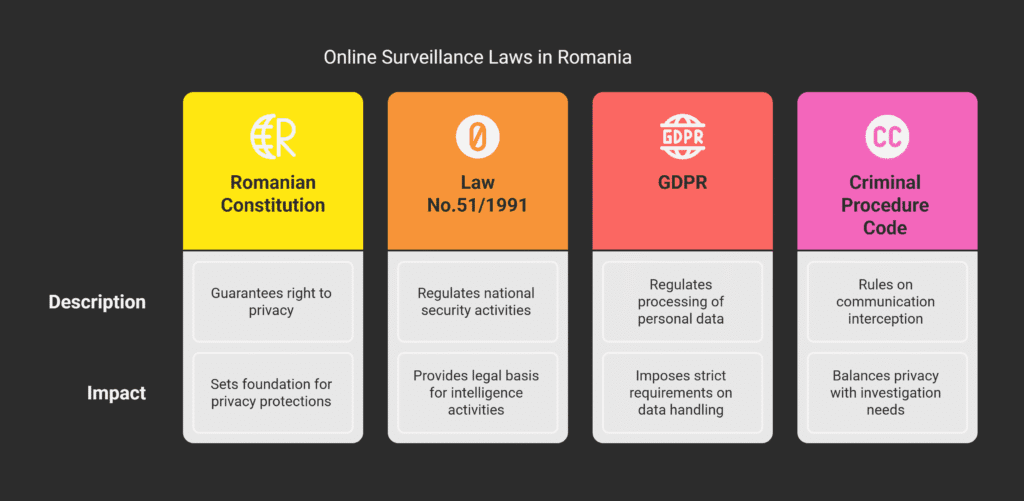
Legal Framework Governing Online Surveillance in Romania

Romanian Constitution and Privacy Protections

The Romanian Constitution is key to understanding privacy rights.

Article 26 of the Constitution protects privacy.

This right is important for online surveillance laws.

National Security Laws

National security laws in Romania are important for online surveillance.

They balance national security with privacy rights.

Law No.51/1991 on National Security

Law No.51/1991 is a major law on national security. It sets rules for intelligence work, including online surveillance.

This law makes sure surveillance respects privacy rights.

Criminal Procedure Code Provisions

The Criminal Procedure Code has rules on communication interception.

This is a form of online surveillance.

It needs court approval to balance privacy with investigation needs.

European Union Regulations Applicable in Romania

As an EU member, Romania follows EU rules on online surveillance.

The General Data Protection Regulation (GDPR) is a big rule for personal data handling.

The GDPR has strict rules for personal data, including online surveillance.

Companies in Romania must follow these rules.

They must handle personal data in a way that is open, safe, and respects individual rights.

RegulationDescriptionImpact on Online Surveillance
Romanian ConstitutionGuarantees the right to privacySets the foundation for privacy protections in online surveillance
Law No.51/1991Regulates national security activitiesProvides the legal basis for intelligence activities, including online surveillance
GDPRRegulates the processing of personal dataImposes strict requirements on the handling of personal data in online surveillance

For more information on online surveillance laws in Romania, email office@theromanianlawyers.com.

Data Protection and Privacy Legislation in Romania

Romania’s data protection laws come from both national rules and EU regulations.

This has led to a detailed framework to safeguard personal data.
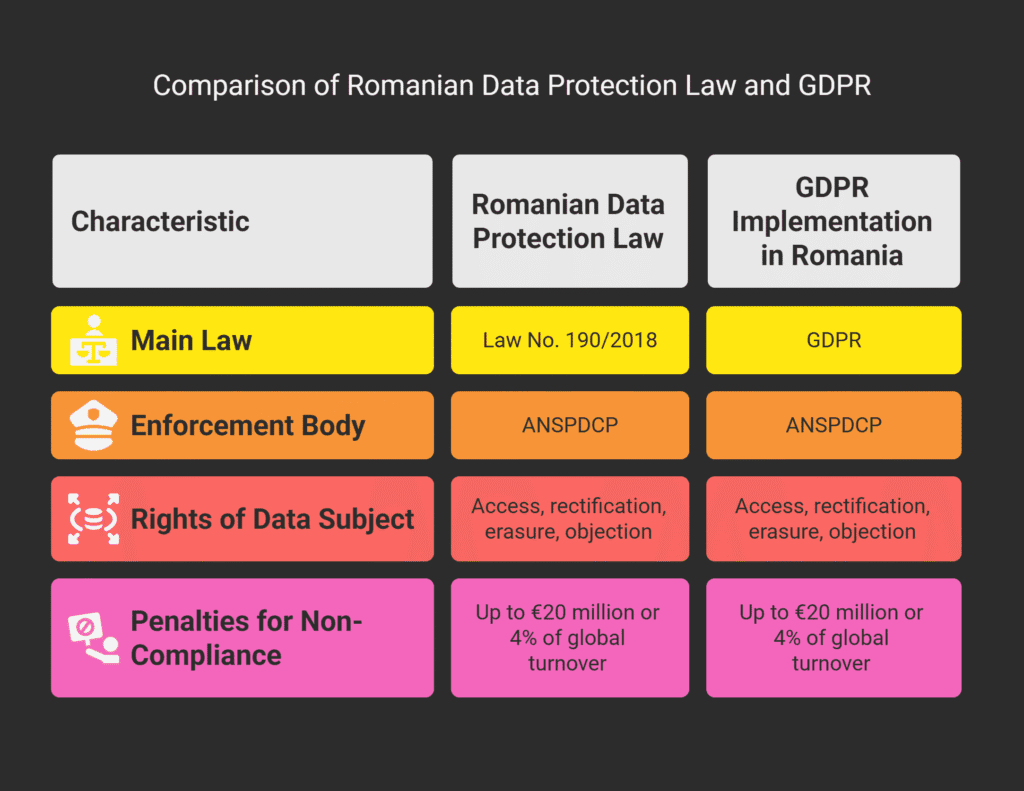
Data Protection and Privacy Legislation in Romania

Romanian Data Protection Law

Romania has its own data protection law, working alongside the EU’s GDPR.

Law No. 190/2018 is the main law for data protection in Romania.

It makes sure Romanian laws match EU standards.

Key aspects of the Romanian Data Protection Law include:

GDPR Implementation in Romania

Romania, as an EU member, has fully adopted the GDPR.

The GDPR sets a common data protection level across the EU.

Romania’s adoption ensures it meets these standards.

Local Enforcement Mechanisms

The ANSPDCP enforces data protection laws in Romania.

It looks into complaints, does audits, and can impose penalties for breaking the rules.

Penalties for Non-Compliance

Companies that don’t follow data protection rules in Romania face big penalties.

The ANSPDCP can fine up to €20 million or 4% of the company’s global turnover, whichever is higher.

The following table summarizes the penalties for non-compliance with GDPR in Romania:

ViolationMaximum Fine
Failure to implement adequate security measures€10 million or 2% of global turnover
Non-compliance with data subject rights€20 million or 4% of global turnover
Failure to report data breaches€10 million or 2% of global turnover

Rights of Data Subjects Under Romanian Law

Data subjects in Romania have several rights under the GDPR and national law, including:

  • The right to access their personal data;
  • The right to rectify or erase their personal data;
  • The right to restrict or object to processing;
  • The right to data portability.

For more information on data protection and privacy legislation in Romania, you can contact office@theromanianlawyers.com.

Legal Aspects of Online Surveillance in Romania: Permitted Practices

Romania has clear rules for online surveillance.

It’s important for people and businesses to know these rules.
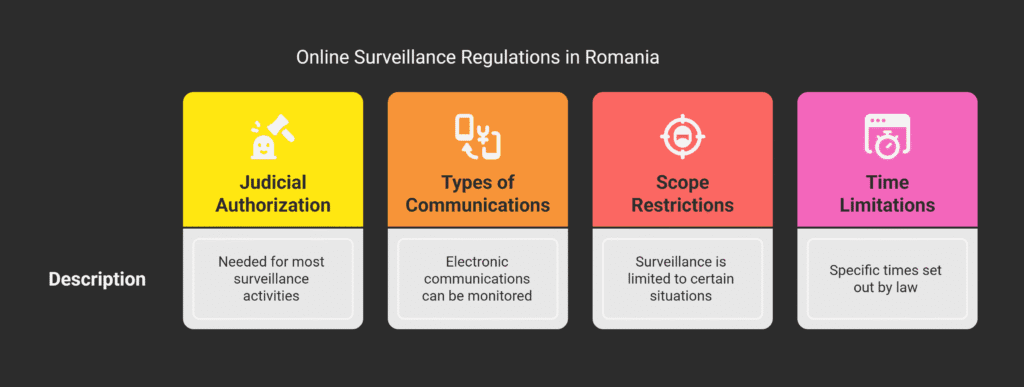
Legal Aspects of Online Surveillance in Romania

Lawful Interception Requirements

Lawful interception in Romania has strict rules.

To do surveillance, you must meet certain conditions.

Necessary Conditions for Surveillance

To start surveillance, you need judicial authorization.

This makes sure surveillance is legal and watched over.

  • Judicial authorization is needed for most surveillance;
  • The process checks the surveillance request carefully.

Types of Communications Subject to Monitoring

Many communications can be monitored, like electronic ones.

The law says which ones can be tapped.

Key aspects of lawful interception include:

  • Electronic communications can be monitored;
  • You need specific judicial authorization.

Judicial Authorization Process

The judicial authorization process is key in Romania’s surveillance laws.

It makes sure surveillance is legal and watched.

For more details on the judicial authorization process, email office@theromanianlawyers.com.

AspectDescription
Judicial AuthorizationNeeded for most surveillance activities
Types of CommunicationsElectronic communications can be monitored
Scope RestrictionsSurveillance is limited to certain situations

Time Limitations and Scope Restrictions

Surveillance in Romania has time limits and scope rules.

These rules make sure surveillance is fair and needed.

Knowing these rules is key for following the law.

The law sets out specific times and areas for surveillance.

Cybersecurity Regulations and Their Impact on Surveillance

The cybersecurity scene in Romania is changing fast.

New rules are shaping how we watch and record things.

Romania has set up a detailed plan to tackle cyber threats.
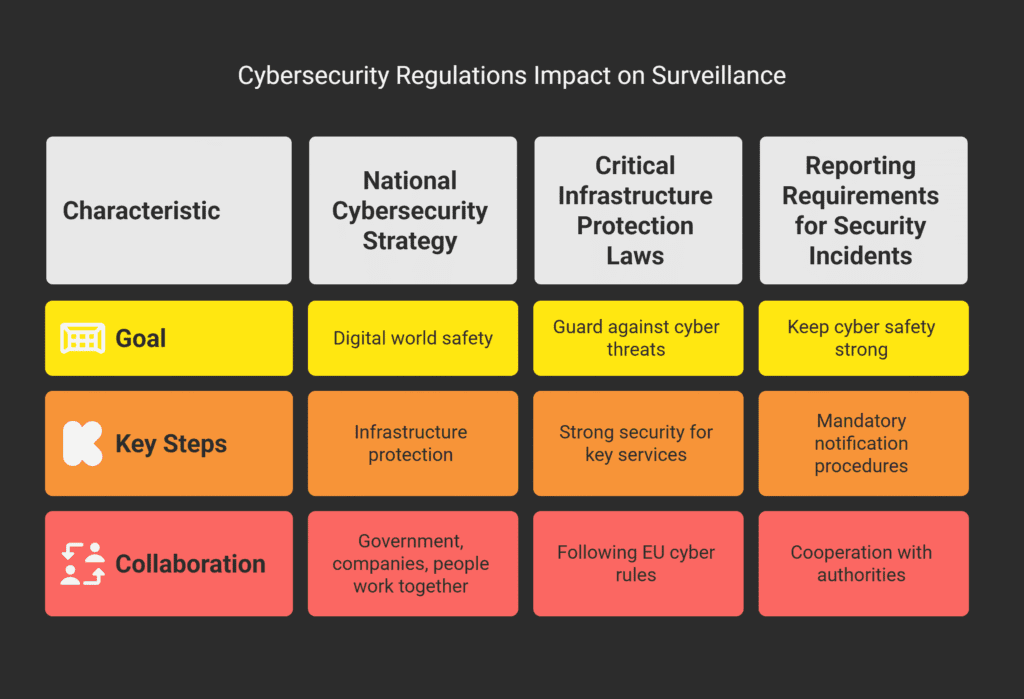
Cybersecurity Regulations and Their Impact on Surveillance

National Cybersecurity Strategy

Romania’s National Cybersecurity Strategy aims to keep its digital world safe.

It involves the government, private companies, and people working together.

Key parts of the strategy are:

  • Protecting key infrastructure;
  • Getting better at handling cyber attacks;
  • Teaching everyone about staying safe online.

Critical Infrastructure Protection Laws

Keeping critical infrastructure safe is a big part of Romania’s cyber plan.

Laws are in place to guard against cyber threats.

Some key steps are:

  1. Using strong security for key services;
  2. Doing regular checks for risks;
  3. Following EU cyber rules..

Reporting Requirements for Security Incidents

Romania has rules for reporting cyber attacks quickly.

This helps keep the country’s cyber safety strong.

Mandatory Notification Procedures

Companies must tell the right people fast if they spot a cyber attack.

This quick action helps fix problems fast.

Cooperation with Authorities

Working well with authorities is key to handling cyber attacks.

It helps share info and learn from each other.

For more on cybersecurity laws in Romania and how they affect watching and recording, email office@theromanianlawyers.com.

Electronic Communications Monitoring: Legal Boundaries

In Romania, there are clear legal rules for monitoring electronic communications.

ISPs and users must follow these rules to stay legal.

Internet Service Provider Obligations

ISPs in Romania must work with law enforcement under certain rules.

They need to have the right setup to intercept communications legally when asked.

For more details on ISP duties and their impact, email office@theromanianlawyers.com.

Data Retention Requirements

Data retention is key in monitoring electronic communications.

ISPs must keep certain data for a set time.

Types of Data Subject to Retention

The data ISPs must keep includes:

  • Subscriber information;
  • Traffic data;
  • Location data.

Storage Duration and Security Standards

Data is kept for 6 months to 2 years, depending on the type.

ISPs must follow strict security rules to keep data safe.

Encryption and Anonymity Regulations

Romania has rules on encryption and anonymity in online communications.

Encryption is usually okay, but there are times when decryption is needed by law.

Users have the right to stay anonymous, but this right can be limited.

This is true in cases like criminal investigations.

For advice on how these rules affect you, talk to legal experts in Romanian telecom law.

Practical Implications for Businesses and Individuals

It’s important for foreign companies to know about Romania’s online surveillance rules.

This knowledge helps them stay in line and avoid risks.

If you’re a business in Romania, you need to understand the country’s data protection and online surveillance laws.
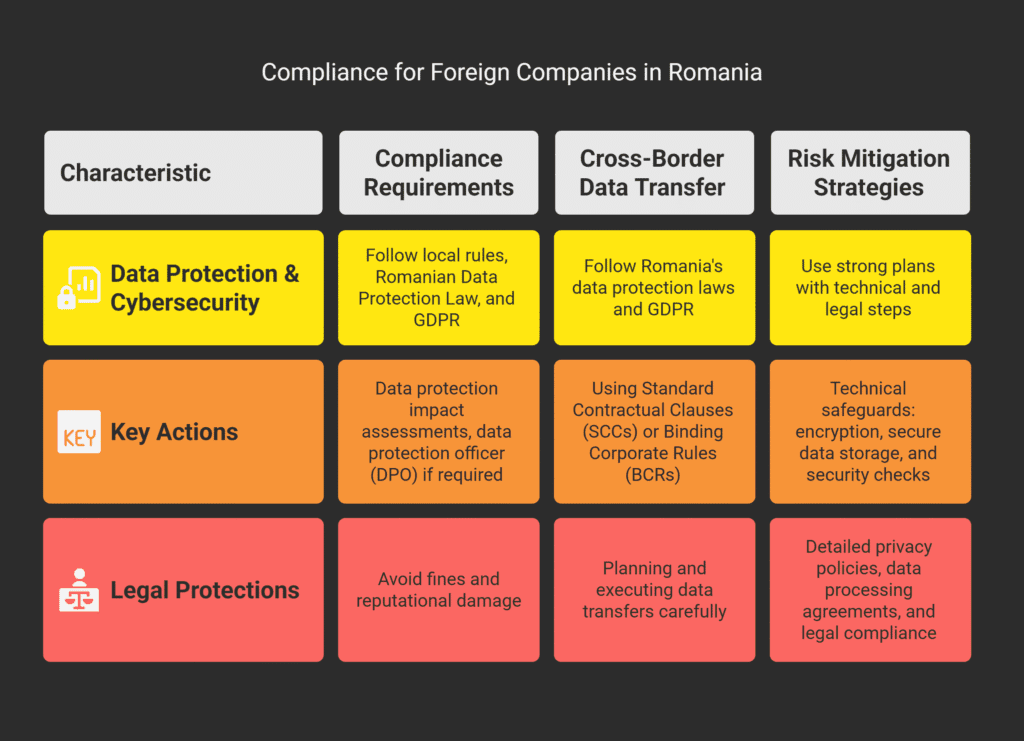
Practical Implications for Businesses and Individuals

Compliance Requirements for foreign Companies Operating in Romania

Foreign companies in Romania must follow local data protection and cybersecurity rules.

This means they must stick to the Romanian Data Protection Law and the GDPR in Romania.

Following these rules is key to avoid big fines and harm to your reputation.

To meet these requirements, you should:

  • Do regular data protection impact assessments;
  • Use the right technical and organizational steps to keep data safe;
  • Have a Data Protection Officer (DPO) if the law says you must.

Cross-Border Data Transfer Considerations

When moving data across borders, foreign companies must follow Romania’s data protection laws and the GDPR.

This might mean using Standard Contractual Clauses (SCCs) or Binding Corporate Rules (BCRs) to protect data transfers.

Planning and executing cross-border data transfers carefully is essential for compliance.

You need to pick the best data transfer method for your business.

Risk Mitigation Strategies

To lower risks from online surveillance and data protection, foreign businesses in Romania should use strong risk mitigation plans.

These plans should include both technical and legal steps.

Technical Safeguards

Technical safeguards are key to protecting your business from data breaches and cyber threats.

Using encryption, secure data storage, and regular security checks can greatly reduce risks.

Legal Protections

Legal protections are also essential.

This includes having detailed privacy policies, data processing agreements, and making sure your business follows all relevant laws and regulations.

For more details on compliance and risk mitigation, reach out to a legal expert at office@theromanianlawyers.com.

Your Rights and Protections Against Unlawful Surveillance

In Romania, you have rights that protect you from unwanted spying.

Knowing these rights is key to keeping your privacy safe.

Constitutional Safeguards

The Romanian Constitution has strong protections against spying.

Article 30 guards your freedom of speech.

Article 26 protects your right to privacy.

These laws are the foundation of Romania’s rules on surveillance.

Legal Remedies for Privacy Violations

If you think your privacy has been broken, you have legal options. You can go to court for help with privacy issues.

Legal RemedyDescription
Judicial RecourseSeeking legal action through the courts for privacy violations.
Complaint to National Data Protection AuthorityFiling a complaint with the National Data Protection Authority for violations of data protection laws.

How to File Complaints with Romanian Authorities

If you think your privacy has been broken, you can report it to the right Romanian authorities.

National Data Protection Authority Process

The National Data Protection Authority watches over data protection laws in Romania.

To report a problem, write or use their online portal.

Judicial Recourse Options

You can also go to court for help.

A judge will look at your case and decide.

For more on your rights against spying in Romania, email a Romanian lawyer at office@theromanianlawyers.com.

Conclusion

You now know a lot about the laws that govern online surveillance in Romania.

The country’s laws on online surveillance, data protection, and cybersecurity are very important.

They shape how we use the internet.

Online surveillance laws in Romania are shaped by both national and European Union rules.

The data protection laws in Romania follow the General Data Protection Regulation (GDPR).

This means people’s personal data is well-protected.

Cybersecurity laws in Romania focus on keeping critical infrastructure safe and ensuring secure online communication.

If you’re doing business or living in Romania, it’s key to understand these laws.

This helps you stay in line with regulations and protect your rights.

For more details or help with these laws, you can reach out to the Romanian lawyers at office@theromanianlawyers.com.

FAQ

What is the current state of online surveillance in Romania?

Online surveillance in Romania is managed by a mix of laws.
These laws balance national security with privacy rights.
The country has laws like the Romanian Constitution and EU rules to oversee surveillance.

How does Romanian law protect individual privacy in the context of online surveillance?

Romanian law defends privacy in several ways.
It includes the Romanian Constitution and the GDPR.
People have the right to manage their data and seek help if their privacy is broken.

What are the requirements for lawful interception in Romania?

To legally intercept communications in Romania, a court order is needed.
The interception must be necessary and not too broad.
It must also be in line with a valid reason.

How do cybersecurity regulations in Romania impact online surveillance?

Romania’s cybersecurity laws aim to keep digital spaces safe.
They include the National Cybersecurity Strategy and laws for critical infrastructure.
These laws also affect surveillance by setting rules for data sharing and encryption.

What are the obligations of Internet Service Providers (ISPs) in Romania regarding online surveillance?

ISPs in Romania must help law enforcement get user data with a court order.
They also have to keep user data for a certain time.

How do online surveillance laws in Romania affect foreign businesses and individuals?

Foreign companies and people in Romania must follow the country’s surveillance laws.
They need to know the risks and take steps to protect themselves.

What are the rights and protections available to individuals against unlawful surveillance in Romania?

People in Romania have many rights against illegal surveillance.
These include constitutional protections and legal ways to fight privacy breaches.
They can also complain to Romanian authorities.

What is the role of the Romanian Constitution in protecting individual privacy?

The Romanian Constitution is key in protecting privacy.
It ensures the state respects privacy and sets rules for surveillance.

How does the GDPR apply in Romania?

The GDPR directly applies in Romania.
It offers strong data protection and strict rules for those handling personal data.

What are the key government agencies involved in online surveillance in Romania?

Important agencies for online surveillance in Romania are the Romanian Intelligence Service and the Ministry of Internal Affairs.
The National Authority for Management and Regulation in Communications also plays a role.
They enforce surveillance laws.
preliminary sale agreement

Secure Your Apartment with a Preliminary Sale-Purchase Agreement

Secure Your Apartment with a Preliminary Sale-Purchase Agreement

Are you sure your new apartment is safe from unexpected problems?

Top notaries in France and Italy push for early agreements.

These agreements lock in key terms before the final deal.

A good preliminary agreement follows Romanian rules and cuts down on costly fights.

For personalized advice, email us at office@theromanianlawyers.com.

preliminary sale-purchase agreement for apartment

Key Takeaways

  • Sets clear expectations for both buyer and seller;
  • Outlines payment obligations and property details;
  • Reduces risk of financial loss or withdrawal;
  • Reflects Romanian legal procedures and best practices;
  • Prevents misunderstandings through written commitments;
  • Offers peace of mind for a smooth apartment acquisition.


Why You Need a Binding Agreement Before Finalizing Your Apartment Purchase

Many real estate deals are uncertain without a solid agreement.

A binding contract builds trust by setting clear payment plans and key terms.

Romanian law backs these early deals, giving both sides peace of mind. For more info, email office@theromanianlawyers.com.

Ensuring Financial Safety

A clear agreement protects against unexpected price hikes or hidden costs.

It keeps buyers’ deposits safe and sellers know the offer is real.

It outlines payment and escrow details, making the deal smoother and avoiding delays.

Preventing Legal Complications

Writing down each party’s duties helps avoid costly legal fights.

Everyone knows what to expect about the property and timeline.

This approach stops contract breaches and makes the sale process clear under Romanian laws.

Key Clauses to Protect Your Interests in an Apartment Purchase

In France and Italy, contracts often include conditions for mortgage approval and keeping deposits.

These clauses protect both sides from risks.

In Romania, similar clauses are used, with clear deadlines and property details.

Contracts that cover any issues and penalties help avoid expensive disputes.

Penalty clauses keep everyone honest and prevent sudden deal cancellations.

Clear descriptions of the apartment’s condition build trust and confidence.

Loan-related clauses protect buyers from too much debt if financing fails.

An agreed deposit shows serious intent to buy.

For detailed advice, email office@theromanianlawyers.com to create a contract that follows Romanian laws.

ClausePurpose
Suspensive ConditionsAllows the buyer to exit if financing is refused
Deposit RetentionEncourages genuine commitment by holding initial funds
Penalty ProvisionsPrevents unjustified withdrawal by setting monetary consequences
Detailed Property DescriptionOutlines exact features and encumbrances for clarity

How a Preliminary Sale-Purchase Agreement for Apartment Secures Your Investment

In many EU countries, a clear first contract is key.

It sets the main terms, avoiding surprises and keeping trust.

Romanian real estate experts say a solid preliminary agreement can boost your position before signing.

Establishing the Purchase Price

Setting the final price gives certainty and lowers dispute risks.

Buyers can plan their finances better knowing their costs.

Sellers feel secure knowing the deal is serious and will go through once conditions are met.

Defining Property Specifications

Clear details on size, boundaries, and key features prevent confusion.

Specifics on fixtures, shared areas, and co-ownership are vital.

This ensures a strong agreement that follows Romanian laws and protects your interests.

For help with these agreements, email office@theromanianlawyers.com.

Role of a Real Estate Attorney in Drafting Your Agreement

real estate attorney

A real estate attorney makes sure every part of the agreement is clear.

They make sure it follows Romanian property laws.

This helps avoid legal problems.

Our team of real estate lawyers in Bucharest do a deep check to find any hidden issues.

This helps protect both sides from unexpected costs.

Some important things a real estate attorney checks include:

Getting good advice can prevent legal fights in the future.

It keeps everyone’s interests safe.

For help and advice, email office@theromanianlawyers.com.

Avoiding Common Pitfalls in Apartment Sales Agreements

Looking closely at every detail in an apartment deal can save a lot of trouble.

Contracts that miss checks on taxes or permits can lead to big problems.

By carefully checking each part, you make sure your money is safe before you sign.

Common mistakes include:

  • Unclear municipal tax obligations;
  • Undefined co-ownership contributions;
  • Inaccurate or missing building permits.

Having clear records of property lines and proof of compliance makes talks smoother.

Legal advice can prevent issues with shared costs or maintenance fees.

When everyone knows what they owe, things go more smoothly.

Hidden Fees and Penalties

Hidden charges can pop up after you sign.

Clauses that aren’t clear can lead to long fights.

Checking the building’s condition and local rules can avoid extra costs.

Buyers should make sure all terms are clear and fair.

It’s key to review contracts well when buying an apartment in Romania.

For help with sales papers or making your own, email office@theromanianlawyers.com.

This way, you protect your financial and legal rights.

Protecting Your Down Payment in a Condo Sale Agreement

When you buy a condo, keeping your down payment safe is key.

Many places in the EU use escrow or notarial deposits.

This keeps your money safe until certain things happen.

In Romania, if the deal falls through, you get your money back fast.

This makes both sides feel secure.

It shows the buyer is serious and the seller is ready to go through with it.

Protecting Your Down Payment in a Condo Sale Agreement

The agreement has clear rules to avoid confusion.

Every part of it helps make sure the money is released right.

This builds trust and makes the deal go smoothly.

It also shows that everything is above board, which is good for business.

If you need help or advice, email office@theromanianlawyers.com.

This way, you protect your investment and make sure your condo deal goes well in Romania.

Tips for Negotiating an Apartment Purchase Contract

Effective negotiations start with a clear plan.

This plan should cover financial terms and any post-purchase improvements.

In other EU countries, talks often include phased payments, renovation timelines, and firm due dates.

These are key to protect everyone involved, just like in Romania.

A detailed approach can prevent disputes before they start.

Getting advice from a legal expert can add extra security.

For any questions, email office@theromanianlawyers.com.

Key Negotiation ElementMain Advantage
Phased PaymentsReduces financial strain at signing
Renovation SchedulesConfirms proper authorization for each step
Precise DeadlinesPrevents disputes over completion dates

Setting a Realistic Timeframe

Having a clear schedule for getting funds and checking building plans is beneficial.

It helps reduce stress and builds trust between the buyer and seller.

Clarifying Renovation Protocols

An organized renovation plan outlines expected costs and legal duties.

Recording every update in the contract helps maintain trust and accountability.

Legal Implications of a Residential Real Estate Agreement

A formal contract is key for safe property transfers.

In France and Italy, making the agreement official is a must.

Romania also follows this rule.

This step helps protect everyone if someone doesn’t follow through.

residential real estate agreement

Having a solid agreement is important for shared ownership, getting a mortgage, or dealing with international issues.

A notarized deed is strong evidence in Romania.

It helps avoid long legal battles.

Following local rules builds trust and makes owning property smoother.

When to Seek a Notary or Lawyer

It’s wise to get help from a pro before things get complicated.

Getting advice early helps understand who does what and when.

You can choose a public notary or a lawyer in Romania.

Both options mean your deal will be checked carefully and legally.

For more information, email office@theromanianlawyers.com.

Securing Your Transaction with Complete Paperwork

Every serious real estate deal needs accurate documents.

Buyers in Romania should check official records.

They must ensure the correct owner is listed and there are no outstanding liens or legal disputes.

This process includes registering with local authorities and checking the seller’s ID.

Tax clearances and official property plans are also key for clarity.

Romanian law follows European guidelines, requiring honest disclosures from sellers.

Buyers do their homework to protect themselves.

They verify proof of ownership, cadastral details, and any co-ownership agreements to avoid hidden problems.

Experts suggest registering documents offline or online.

This way, both parties can move forward with confidence.

Property inspections should also confirm the residence meets local standards.

For personalized advice and a secure closing process, contact office@theromanianlawyers.com.

Finalizing the Real Estate Sales Contract

The final step in a Romanian real estate contract is all about precision.

Buyers and sellers should check important details like financing and permits before signing.

This step follows global standards and helps avoid last-minute problems.

an office with people working

It’s important for both sides to get their documents ready and meet their obligations.

Understanding Contingencies

Contingencies protect both sides from unexpected issues.

Getting financing approval and checking local zoning rules are key.

These steps ensure everything is in order, building trust and clarity.

ContingencyDescription
Financing ApprovalSecures a valid mortgage or loan guarantee
Municipal PermitsConfirms local compliance for zoning and construction

Scheduling the Closing Date

Having a clear timeline is essential to avoid delays.

The seller and buyer make final payments and hand over the property on time.

A well-set closing date helps keep everything running smoothly under Romanian law.

Where to Get Expert Advice and Support in Romania

Seasoned Romanian attorneys are ready to help at every step of buying or selling property.

They guide on local laws, mortgage procedures, and final paperwork.

This helps protect your rights and avoid legal issues.

For personalized help, email office@theromanianlawyers.com.

Legal experts in Bucharest and other areas check contracts, do risk reviews, and help until the property is fully recorded.

Their help ensures legal certainty for both local and foreign investors.

A well-drafted preliminary agreement makes negotiations easier and ensures a smooth closing.

With the right support, any sale meets Romanian standards and follows international best practices.

Conclusion

A preliminary sale-purchase agreement for an apartment in Romania brings stability from the start. It makes sure everyone knows the property details and when things need to happen. This helps avoid surprises before the final contract.

Working with a real estate attorney in Bucharest or elsewhere is very helpful. They make sure all documents follow Romanian property law. This means every part of the agreement is clear and meets legal standards.

Having legal advice makes sure there are no misunderstandings. It helps everyone talk clearly and avoid problems. This makes the investment safe and meets both local and international standards.

If you want more peace of mind, you can email office@theromanianlawyers.com. This connects you with experts who handle all the details. They make sure everything goes smoothly from start to finish.

FAQ

What is the main purpose of a preliminary sale-purchase agreement for an apartment in Romania?

A preliminary sale-purchase agreement is key. It outlines important details like payment plans and property specifics. It also includes legal terms before the final contract is signed. This ensures both sides are committed and reduces the chance of backing out without penalty.

How does this agreement protect my down payment?

This agreement often includes special clauses to protect your down payment. For example, escrow or holdback arrangements can keep your funds safe. If the seller doesn’t follow through, you can get your money back, keeping your investment secure.

Are there standard purchase agreement terms in Romanian real estate?

Yes, Romanian property law follows European standards. It requires clear details on payment schedules, property issues, and shared ownership. Including these in your agreement helps avoid misunderstandings and keeps things legal.

What clauses are essential to include in a property pre-sale contract?

Important clauses include penalties for backing out without reason and detailed property specs. They also cover what’s included in the sale and financing options. These ensure both sides know their responsibilities in the deal.

Is it mandatory to have a lawyer in Bucharest or another Romanian city draft the contract?

While not required by law, hiring a lawyer is highly advised. They can check if the contract follows local laws and explain any legal documents. This helps prevent legal issues and makes the agreement strong.

What if financing is not secured in time?

Many agreements have clauses about loans. These say the buyer’s commitment depends on getting financing by a certain date. If the buyer can’t get a mortgage, the agreement might let them out without big penalties, depending on the contract.

How do penalty clauses work in an apartment negotiation agreement?

Penalty clauses charge a fee or penalty if someone backs out without a good reason. This discourages unnecessary withdrawals and helps the other party if there are delays or losses.

Are property inspections and disclosures mandatory?

Yes, Romanian law requires full disclosure about property issues and shared ownership. While not always needed, inspections and detailed records are key. They help confirm the property’s condition, which is vital in any sale agreement.

How does scheduling the closing date help finalize the real estate sales contract?

Setting a closing date helps both sides prepare. It ensures they have all necessary documents and permits ready. A clear date in the agreement helps avoid last-minute problems and makes the transfer of ownership smooth.

What resources exist for further guidance on an apartment investment agreement?

For more help, buyers and sellers can talk to law offices in Bucharest or Romania. These experts can review documents, handle negotiations, and create a contract that follows local and international standards.

What is a Preliminary Sale-Purchase Agreement in Real Estate Transactions?

A preliminary agreement, also known as a preliminary contract or preliminary real estate purchase and sale document, is a legally binding document that precedes the final contract in real estate transactions. This document establishes the intention of the buyer and the seller to conclude a transaction involving property. The preliminary purchase and sale agreement outlines the essential terms upon which the parties involved agree to proceed with the sale of the property. Unlike the final agreement, which transfers ownership, the preliminary sale document creates mutual obligations between the two parties to execute the actual purchase and sale at a later date under the conditions stipulated in the agreement. It serves as protection for both the buyer and seller by establishing their rights and obligations before the notarial deed is executed.

What Should Be Included in a Preliminary Real Estate Purchase Agreement?

A comprehensive preliminary purchase agreement should include several key elements to protect both parties. First, it must clearly identify the parties involved with their full legal names and addresses. The document should contain a detailed description of the property being sold, including its address, size, and registration details. The price of the property must be explicitly stated, along with payment terms and schedule. Additionally, the preliminary agreement should specify the deadline for signing the preliminary contract of sale and completing the real estate purchase and sale. It should outline conditions under which either party may terminate the agreement and any penalties for non-performance. The document should also address how deposits will be handled, whether the sale of real estate is contingent on mortgage approval, and any additional conditions important to the parties to sell and purchase. Finally, it should include signatures of both parties and preferably be notarized to enhance its legal standing.

Play
remote regulations romania

Remote Work in Romania: What Employers Need to Know

Employment law · Romania

Remote Work in Romania: What Employers Need to Know

Remote work can improve recruitment, retention and business continuity, but the arrangement should be classified correctly and documented before it begins. Romanian employers should distinguish telework from work at home and mobile work, then align the employment contract, working-time records, health and safety measures, data protection and cross-border analysis.

This guide is intended for Romanian employers, foreign-owned companies, HR teams and employees working remotely from Romania. The correct solution depends on the role, the location, the technology used, the contract and the facts of each arrangement.

Practical rule: if an employee regularly performs work outside the employer’s premises using information and communications technology, the arrangement may fall under Romania’s telework framework. Telework is based on the parties’ agreement and must be expressly included in the individual employment contract or an amendment. A company should not rely on an informal “work from home” email when the legal arrangement is actually telework.

What is remote work in Romania?

“Remote work” is a useful business expression, but it is not a single legal category. The first step is to identify how, where and with what technology the work is performed. The classification affects the contract, the employer’s control methods, working-time records, occupational safety, data security and, in some cases, tax, social-security and immigration obligations.

Romania’s Law no. 81/2018 regulates telework. In broad terms, telework is a form of work organisation in which an employee regularly and voluntarily performs duties in a place other than the employer’s premises, using information and communications technology, under conditions agreed with the employer. The statutory definition refers to activity performed at least one day per month in such a location.

Telework is different from a general flexible-hours arrangement. A flexible schedule changes when the employee works. Telework changes, at least in part, where the employee works and how the employer manages the activity. The two arrangements can coexist, but they should not be treated as interchangeable.

Telework

Regular and voluntary work outside the employer’s premises using information and communications technology, expressly agreed in the employment contract.

Work at home

A distinct Labour Code arrangement in which the employee performs work at home and may organise the schedule under the applicable legal and contractual conditions.

Mobile work

Work performed at changing locations because the nature of the job requires mobility. It is not automatically telework simply because a laptop or phone is used.

Do not conflate categories: the phrase “remote employee” does not determine the legal regime. Review the actual work pattern, the employment contract and the reason why work is performed away from the employer’s premises.

Which legal route fits the arrangement?

Select the closest description to see the main legal question. The selector is a practical classification aid, not a substitute for reviewing the contract and actual working pattern.

Choose the work arrangement that best describes the facts.

Telework

Check whether the employee regularly works outside the employer’s premises with ICT and document the arrangement expressly in the employment contract or amendment.

ArrangementCore questionContract focusAdditional risk
TeleworkIs work regularly performed elsewhere using ICT?Express telework clause and statutory telework particulars.Unclear place of work, monitoring, working time or H&S controls.
Work at homeIs the employee working at home under the Labour Code’s home-work rules?Home address, schedule and applicable contractual conditions.Using a telework template for a legally different arrangement.
Mobile workDoes the job inherently require changing work locations?Mobility, travel, records and expenses.Failure to distinguish mobility from voluntary telework.
Cross-border remote workWhere is the work physically performed and for how long?Country, duration, reporting and applicable employment terms.Tax, social security, immigration and permanent-establishment exposure.

When must telework be included in the employment contract?

Under Law no. 81/2018, telework is based on the agreement of the parties and is expressly provided in the individual employment contract for a new employee or by an amendment for an existing employee. The employer should complete this step before the employee begins working under the telework arrangement.

A general remote-work policy may be useful, but it does not replace an express contractual provision where the statutory telework regime applies. The policy can explain approval workflows, equipment, security, availability and office attendance. The contract or amendment should still contain the legally relevant terms for the individual arrangement.

Any later change to an essential contractual element should be reviewed before implementation. For example, a material change to the place of work, the number of remote days, the schedule, the applicable reporting method or the employee’s cross-border location may require an updated contract, amendment, employee-register transmission or separate legal analysis.

Before recruitment

Decide whether the role can lawfully and operationally be performed by telework, at home, through mobility or through a mixed arrangement.

Before the first remote day

Sign the employment contract or amendment, communicate the rules and provide the equipment, instructions and training required for the role.

Before changing the model

Review whether the change affects the contract, working-time records, H&S assessment, data security or another jurisdiction.

What should a Romanian telework clause contain?

The contract should be drafted for the actual arrangement, not copied from a generic remote-work policy. Law no. 81/2018 identifies specific matters to be included in the individual employment contract or amendment. The drafting should also remain consistent with the Labour Code, internal regulations, occupational safety documents and data-protection information.

Depending on the role and arrangement, the clause should address the days or periods when the employee works at the employer’s premises, the place or places from which telework may be performed, how the employer checks activity and how the employee reports, the method for recording the beginning and end of working time, the responsibilities for occupational safety, the equipment and maintenance arrangements, data-protection requirements and measures designed to prevent professional isolation.

The agreement should be sufficiently practical. If the employer expects attendance at meetings, access to confidential information, use of specific devices, availability during fixed hours or periodic office attendance, the clause and related policy should say so clearly. Vagueness can create disputes about supervision, performance, overtime, expenses and whether an employee was authorised to work from a particular location.

Select a drafting control before approving the clause.

Location and office days

State the permitted place or places and the days or periods when the employee is expected to work at the employer’s premises, where applicable.

Employer obligations for equipment, health and safety and data

Remote work does not remove the employer’s responsibility to organise work lawfully. The employer should identify the equipment needed for the role, define who provides and maintains it, establish a secure method for access to company systems and communicate rules for confidential information, personal data and incident reporting.

Occupational safety measures should reflect the place and manner in which the work is performed. The employer should provide the information and training required by the applicable health and safety rules, establish how compliance is checked within the legal limits and document the employee’s responsibilities. A remote arrangement should not be approved without considering ergonomics, electrical safety, working conditions, emergency reporting and the practical limits of inspecting a private home.

Data protection requires more than telling employees to use a password. The organisation should apply appropriate technical and organisational measures, including access control, device security, authentication, secure connections, rules for printing or storing documents, restrictions on family or third-party access, incident reporting and secure return or deletion of company data. Monitoring should be necessary, proportionate, transparent and consistent with employment and data-protection requirements.

Control areaEmployer should defineEvidence to retainTypical failure
EquipmentDevices, software, maintenance, replacement and permitted personal-device use.Handover record, policy acknowledgement and support process.Unsecured personal devices or unclear responsibility for repairs.
Working timeSchedule, availability, start and end records, breaks and overtime approval.Time records, instructions and approved exceptions.Assuming remote work means unlimited availability or no overtime.
Health and safetyRisk information, training, workstation expectations and incident reporting.Training record, risk assessment and reported-incident file.No practical safety process because work occurs at home.
Data protectionAccess, storage, confidentiality, monitoring, breach reporting and retention.Policy, privacy information, access logs and incident record.Using screenshots, keystroke tools or broad monitoring without a lawful basis.

Working time, availability and the right to disconnect

A remote employee remains protected by the applicable working-time rules. The employer should define the schedule or availability windows, the method for recording the start and end of work, the approval process for overtime and the arrangements for rest breaks and daily and weekly rest. Remote work is not a waiver of these protections.

The employer should also avoid confusing performance measurement with permanent availability. Clear objectives, deliverables, communication windows and escalation channels are usually more defensible than constant surveillance. If the company expects an employee to answer messages outside working hours, it should assess whether this creates overtime, rest-period or health concerns.

Flexible schedules may be agreed alongside telework. They should be documented in a way that makes the employee’s actual working time capable of being recorded. The contract, internal rules and remote-work policy should not contradict each other, particularly where one document promises flexibility and another imposes fixed availability without explaining the relationship.

Practical safeguard: define when the employee must be reachable, how urgent work is escalated and how time outside the normal schedule is authorised and recorded. This protects both the employee and the employer’s evidence in a later dispute.

Employees with children and special remote-work requests

Article 118^1 of the Labour Code currently provides that, on request, employees who have children in their care up to the statutory age may benefit from four days per month of work at home or telework, except where the nature or type of work does not permit it. The provision should be checked against the current wording and the facts of the individual role before an employer accepts or rejects a request.

The employer should examine the nature of the work, the employee’s role, the requested days, operational requirements and any contractual or internal rules. A request should not be rejected by simply stating that the company does not generally offer remote work if the statutory conditions are potentially met. Conversely, a role that requires physical presence, equipment, customer contact or secure on-site activity may need a documented assessment of why the arrangement is not workable.

This statutory right should also be distinguished from a general policy allowing occasional home working. The documents may overlap operationally, but the legal basis and the employer’s assessment are not necessarily identical.

Cross-border remote work from Romania

An employee who works remotely from Romania for an employer established elsewhere may trigger issues that do not arise in an ordinary domestic telework arrangement. The physical location of the work, the employee’s residence, the length and regularity of the presence, the employer’s business activity and the applicable international and EU rules all matter.

The review may involve Romanian employment law, social-security coordination, payroll withholding, tax residence, permanent-establishment risk, immigration status, data transfers and local registration or notification requirements. A foreign employer should not assume that a Romanian employee can work indefinitely from Romania merely because the work is performed online and the salary is paid from abroad.

Likewise, a Romanian employer sending an employee to work from another country should establish the country, duration, reporting line, employer instructions, local mandatory employment protections and social-security position before the arrangement begins. Article 18 of the Labour Code may require specific information where the employee is to perform work abroad, and separate rules may apply to posted workers or other assignments.

The digital nomad visa, where relevant, is an immigration route and does not automatically settle employment, payroll, tax or social-security questions. Immigration permission, employment-law compliance and tax treatment should be analysed separately and then reconciled.

Location

Identify the country where the employee is physically working, not only the country where the employer or client is incorporated.

Duration

Record the start date, expected duration, travel pattern and whether the work is occasional, regular or permanent.

Employer exposure

Check payroll, social security, immigration, data transfer and possible permanent-establishment consequences before approval.

Tax, social security and immigration checks

Remote work can change the compliance profile even where the employment contract remains unchanged. Tax treatment may depend on residence, the place where work is performed, treaty rules, employer obligations and the facts of the assignment. Social-security coverage may depend on the applicable EU coordination rules, certificates, posting status or another international instrument.

Immigration status is a separate question. A foreign national may have permission to stay in Romania without having an unrestricted right to work for a particular employer. A Romanian employee working abroad may also need local work authorisation or registration even if the employee remains on the Romanian payroll.

Employers should obtain advice before treating a remote arrangement as tax-neutral, payroll-neutral or immigration-neutral. The prudent approach is to prepare a short country-and-facts memo that records the proposed location, duration, employing entity, reporting line, customer contact, equipment, travel and intended end date.

Use this order when reviewing a new remote-work request.

Employment route

Classify the arrangement and confirm whether the contract or amendment contains the required place-of-work, control and working-time terms.

Remote work policies and internal governance

A good remote-work policy translates the contract into an operating system. It should identify who approves remote work, which locations are permitted, how office attendance is scheduled, how equipment is used, who may access confidential information, how incidents are reported and what happens when the arrangement no longer works operationally.

The policy should also explain performance expectations, communication standards, working-time recording, overtime approval, absence reporting, leave, business travel, return of equipment and the procedure for changing or ending the remote arrangement. If monitoring is used, the employer should explain its purpose, scope, legal basis, retention and access in the appropriate privacy information and employment documents.

Managers should receive guidance as well. Inconsistent treatment between teams can create discrimination, equal-treatment or employee-relations risks. A manager should not impose an informal rule that conflicts with the contract, statutory working-time protections, a collective agreement or a documented company policy.

Common employer mistakes

Informal approval only

The employee works remotely under an email or chat message even though the statutory telework terms were never added to the contract.

One template for everything

The company uses the same document for telework, work at home, mobile work and cross-border assignments.

Permanent availability

The employer measures commitment by response speed and overlooks working-time records, rest and overtime controls.

Unlawful monitoring

The company introduces screenshots, webcam checks or keystroke monitoring without a prior necessity and proportionality assessment.

Unsecured data

Employees use personal devices, public networks or shared rooms without adequate access, confidentiality and incident rules.

Cross-border assumption

The parties assume that online work from another country has no payroll, tax, social-security or immigration consequence.

Other recurring problems include failing to record the permitted work location, omitting the method for recording working time, not updating REGES-ONLINE where a reportable contractual change occurs, overlooking occupational safety training and allowing a remote arrangement to continue after its factual conditions have changed.

Practical checklist for Romanian employers

  • Identify whether the arrangement is telework, work at home, mobile work, flexible scheduling or cross-border work.
  • Confirm that the role can be performed safely and effectively from the proposed location.
  • Check the employee’s contract, job description, collective rules and internal regulations.
  • Include the telework arrangement expressly in the contract or amendment where Law no. 81/2018 applies.
  • State permitted locations, office days, reporting lines, working-time records and availability windows.
  • Define equipment, software, maintenance, expenses, security and return arrangements.
  • Provide occupational safety information and training appropriate to the remote work model.
  • Apply proportionate data-security controls and communicate the privacy and monitoring rules.
  • Define how overtime, rest, leave, absence, incidents and business travel are handled.
  • Check whether the change must be transmitted in REGES-ONLINE before it takes effect.
  • For cross-border work, review tax, payroll, social security, immigration, data and permanent-establishment issues.
  • Keep a record of approvals, amendments, training, equipment handover and later changes.

Frequently asked questions

Does Romanian telework have to be written into the employment contract?

Yes, where the statutory telework regime applies, the arrangement is expressly included in the individual employment contract for a new employee or by an amendment for an existing employee. A general policy or informal email should not be treated as a substitute.

Is working from home the same as telework?

Not necessarily. Work at home and telework are distinct legal arrangements. The correct classification depends on the statutory conditions, the place and manner of work, the use of ICT and the agreed contractual terms.

Can an employer monitor a remote employee’s computer?

Monitoring may be possible in limited circumstances, but it should be necessary, proportionate, transparent and consistent with employment and data-protection requirements. The employer should review prior information, lawful access, purpose, retention and the impact on privacy before using monitoring tools.

Who pays for equipment used during telework?

The contract and applicable rules should address the equipment, installation, checking and maintenance responsibilities. Employers should define the position clearly and avoid relying on an informal assumption that employees will permanently use personal devices for company work.

Can an employee work remotely from another country?

Possibly, but the request requires a separate cross-border assessment. Tax, social security, immigration, employment law, data protection and permanent-establishment issues may arise depending on the country, duration, role and business activity.

Do remote employees have normal working-time protections?

Yes. Remote work does not by itself remove working-time, rest, overtime, leave or health and safety protections. The employer should define and retain a reliable method for recording working time and managing availability.

Need to review a remote-work arrangement?

A Romanian employment lawyer can assess the correct work model, contract wording, internal policy and cross-border risks before the arrangement is implemented.

Book a consultation

Disclaimer: This article provides general information only and does not constitute legal advice or the creation of a lawyer-client relationship. The correct solution depends on the role, location, contract, working pattern and current Romanian and cross-border rules. Obtain a case-specific assessment before implementing or changing a remote-work arrangement.

AI Notice: AI-assisted content, reviewed by a qualified Romanian lawyer.