Essential Documents for Foreign Founders Starting a Business in Romania

Essential Documents for Foreign Founders Starting a Business in Romania

Essential Documents for Foreign Founders Starting a Business in Romania

What if the fastest way to launch a European business isn’t where you’d expect?

Romania’s streamlined corporate framework allows entrepreneurs to establish an SRL company in just three working days with current minimum capital requirements that have recently undergone significant changes in 2025.

A stack of official documents and forms on a desk.

But beneath this efficiency lies a critical question:

How can international investors avoid hidden pitfalls in documentation processes that could derail their ambitions?

Romania’s open-market policies permit full foreign ownership without local partnership mandates, creating attractive opportunities for global entrepreneurs.

However, the registration process demands precise adherence to legal standards.

Corporate filings must align with Trade Register specifications, including certified translations into Romanian or bilingual formats.

Strategic document preparation forms the backbone of successful incorporation.

Errors in paperwork often lead to delays, financial penalties, or rejected applications.

Professional legal guidance from lawyers in Romania ensures compliance with corporate law frameworks while maintaining operational legitimacy from day one.

Investors benefit from understanding how each document interacts with regulatory systems.

Properly structured articles of association, shareholder agreements, and notarized identification papers establish transparent governance structures.

These elements collectively safeguard business interests within Romania’s evolving economic landscape.

Key Takeaways

  • Romania permits 100% foreign-owned companies with fast 3-day Trade Register approval timelines,
  • Document preparation requires strict compliance with Romanian language standards,
  • Legal expertise minimizes risks of administrative delays or non-compliance penalties,
  • Corporate filings must align with Trade Register specifications for approval,
  • Precise paperwork establishes long-term operational legitimacy,
  • VAT rate increased to 21% in August 2025, with registration threshold at RON 395,000,
  • Minimum capital requirements are undergoing reform, with new tiered structure proposed.

Introduction to Business Registration in Romania

A businessman reviewing papers at a desk.

Romania’s economic landscape presents a compelling proposition for global enterprises seeking competitive positioning in Europe.

As an EU member state, the country serves as a strategic crossroads connecting major continental markets.

This geographic advantage, combined with progressive regulatory frameworks, creates fertile ground for sustainable business growth.

Overview of the Romanian Market

A group of diverse business people reviewing documents around a table.

The local market distinguishes itself through a growing pool of skilled workforce, particularly in technology and engineering sectors.

Romania produces approximately 18.6 STEM graduates per 1,000 people aged 20-29, though this remains below the EU average of 23.0.

The country is actively working to expand its technical education programs.

Operational costs remain 34-51% lower than Western European averages without compromising service quality, with Romanian developer salaries approximately 40% below comparable Western rates.

Infrastructure development continues accelerating across transportation and digital networks.

Modern highways connect major cities to EU trade routes, while digital coverage expands nationwide.

These advancements enable companies to maintain efficient supply chains and regional operations.

Benefits for Foreign Entrepreneurs

Several colorful flags are displayed on a desk next to business papers.

Romania offers foreign investors streamlined processes through recent legal reforms.

The elimination of redundant permits and digital filing systems reduces Trade Register approval to approximately three working days.

EU membership guarantees alignment with continental standards while preserving local cost advantages.

Investors benefit from tax incentives for research-driven business initiatives and export-oriented activities.

Cultural adaptability further enhances market entry, with English widely spoken in professional environments.

These factors position the country as an attractive destination for scalable international ventures.

Why Start a Business in Romania?

A close-up of a business plan document with charts and graphs.

Romania’s tax and regulatory systems create a unique value proposition for commercial ventures targeting European markets.

Strategic fiscal policies combine with progressive legislative changes to support both startups and established enterprises.

Attractive Tax Environment

A smiling business person holding a briefcase and standing in front of a modern office building.

The country maintains one of Europe’s most competitive tax frameworks, though recent changes require careful attention.

Microenterprises benefit from a 1% revenue tax when employing at least one worker and earning up to €60,000 annually.

For revenues above €60,000 or for specific sectors like IT services (CAEN codes 6210, 6290) and restaurants, a 3% rate applies.

Traditional corporations face a flat 16% profit tax.

Tax TypeRateConditions
Microenterprise1%Revenue under €60K with 1+ employee
Microenterprise3%Revenue €60K-€250K (€100K from 2026) or IT/restaurant activities
Corporate Profit16%Standard companies
Dividends10%Increased from 8% in January 2025
Standard VAT21%Increased from 19% in August 2025
Reduced VAT11%Consolidated rate from August 2025

Favorable Legal Reforms

Recent legislative updates streamline operations for international investors.

Digital registration systems cut Trade Register processing times to 3 working days, while revised thresholds for micro-tax status continue until 2026, though the revenue limit decreases from €250,000 to €100,000 starting January 2026.

Enhanced transparency measures reduce bureaucratic hurdles.

Special support programs assist startups in navigating compliance requirements, ensuring smooth market entry.

However, investors must stay updated on frequent tax law changes, including the August 2025 VAT increase from 19% to 21%.

Understanding Legal Structures for Foreign Founders

Selecting the optimal legal framework forms the cornerstone of successful business operations.

Romania offers multiple corporate formats, each aligning with specific operational scales and strategic objectives.

Three primary options dominate commercial registrations, balancing legal safeguards with administrative practicality.

Limited Liability Company (SRL)

An open laptop displaying a business registration website.

The Societate cu Răspundere Limitată (SRL) remains the preferred choice for most ventures.

This structure provides limited liability protection, shielding personal assets from business debts.

Requirements include:

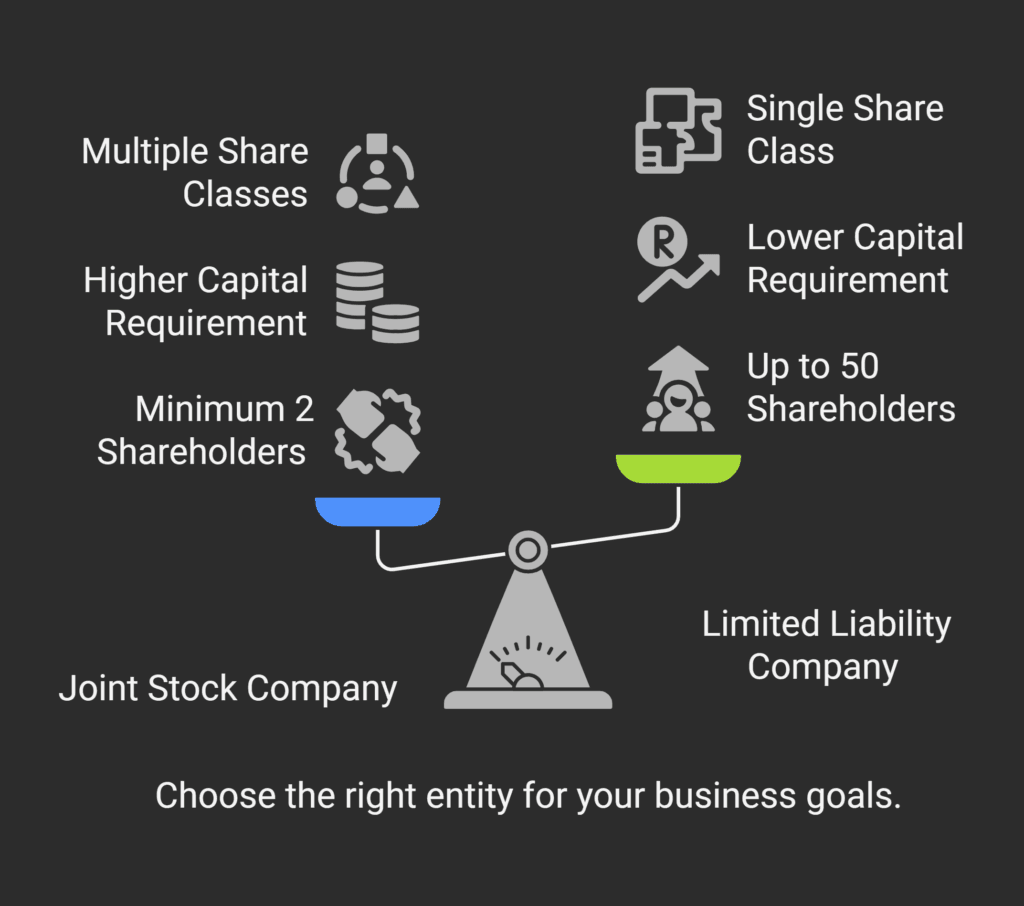
  • 1–50 shareholders
  • Minimum share capital currently ranges from RON 1 to RON 200 (sources vary), with a new tiered proposal for 2025-2026: RON 500 for new companies, increasing to RON 5,000 for revenues between RON 395,000-7 million, and RON 90,000 for revenues exceeding RON 7 million,
  • Simplified management structures.

Governance flexibility allows swift decision-making, ideal for small-to-medium enterprises. Annual reporting obligations remain manageable compared to complex entities.

StructureShareholdersCurrent CapitalProposed Capital (2025-2026)Best For
SRL1–50RON 1-200RON 500-90,000 (tiered)Startups/SMEs
SAUnlimitedRON 90,000RON 90,000 (€25,000)Large enterprises


Joint-Stock Company (SA) and Other Options

A group of diverse people discussing papers around a table.

The Societate pe Acțiuni (SA) suits ventures planning IPOs or major investments.

Key features include:

  • Minimum capital: RON 90,000 (approximately €25,000),
  • Public share trading capability,
  • Formal governance requirements.

Alternative structures like branches or partnerships serve niche scenarios.

Professional guidance ensures alignment between legal frameworks and long-term growth strategies, particularly given the evolving minimum capital requirements.

Required Documents for Foreign Founders in Romania

A person holding a passport and a business plan.

Navigating corporate registration demands meticulous attention to foundational paperwork.

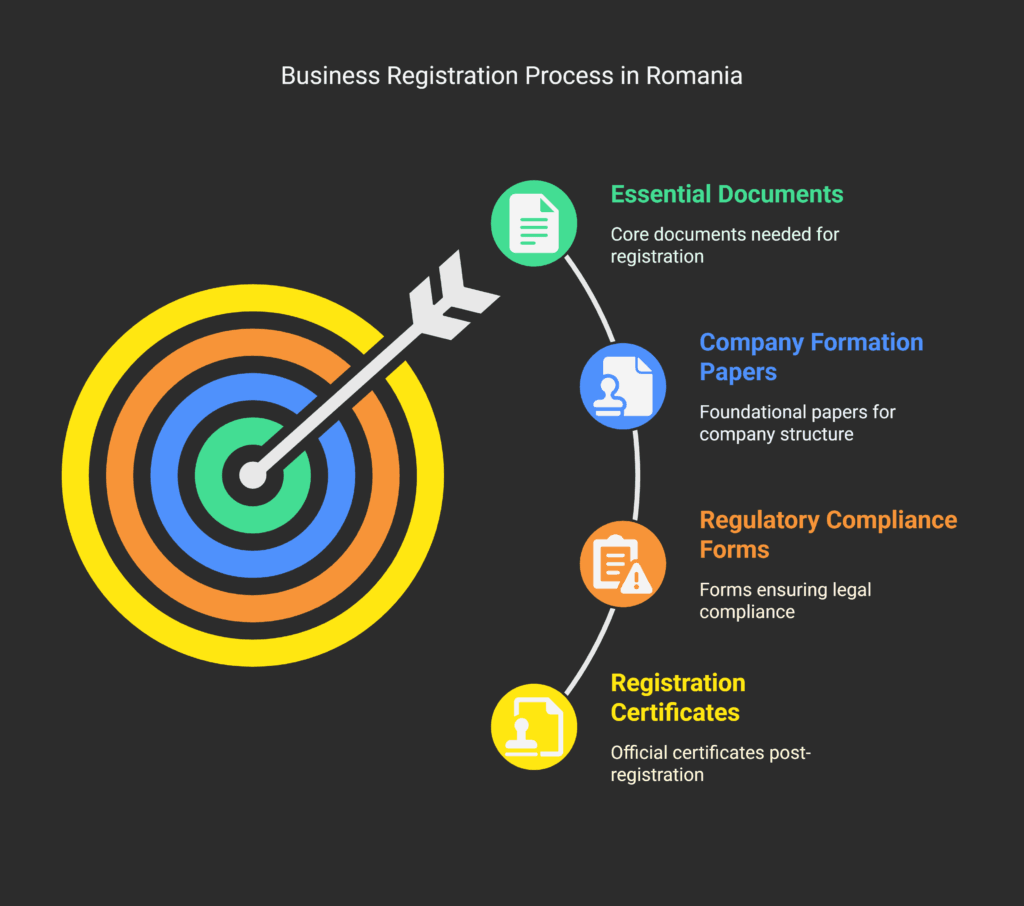
Seven core submissions form the basis of compliant filings, supported by supplementary materials that address cross-border complexities.

The application form and tax annex require detailed operational data, including management structures and activity codes.

Identity verification for administrators ( directors) necessitates certified copies of passports or national IDs, translated into Romanian by authorized professionals.

Shareholder affidavits confirm tax status for individuals lacking local fiscal identification.

These declarations prevent delays during fiscal authority reviews.

Articles of Association drafted in Romanian establish governance protocols, requiring alignment with national corporate law frameworks.

Proof of registered office ranges from property deeds to virtual office contracts, validating a physical business address.

Beneficial ownership disclosures meet EU anti-money laundering directives, tracing control chains for transparency.

Optional apostille certifications authenticate foreign-signed documents.

While not mandatory, these additions streamline verification processes across jurisdictions.

Professional legal review ensures technical accuracy before Trade Register submission, particularly important given recent regulatory changes.

Preparing Your Articles of Association and Registered Office

A person is typing on a laptop with documents spread out on a table.

The foundation of a compliant Romanian enterprise lies in two critical components: constitutional documents and physical establishment.

These elements define operational boundaries while meeting legal obligations under national corporate frameworks.

Drafting the Articles of Association

A person reviews a document with a focused expression while sitting at a table.

Articles of Association act as a company’s operational blueprint.

This legally binding document must specify shareholder voting rights, capital distribution models, and decision-making hierarchies.

Romanian law mandates inclusion of NACE codes to classify business activities accurately.

Management roles require precise definitions of authority limits and appointment procedures.

Provisions for General Meetings must outline resolution processes and quorum requirements.

Legal professionals recommend embedding flexibility clauses to accommodate future growth scenarios, including provisions for the new tiered minimum capital requirements expected to phase in through 2026.

Establishing a Proof of Registered Office

All entities must maintain a verifiable registered office within Romania.

Valid proof includes notarized lease agreements or property ownership documents.

Virtual office contracts have gained traction for cost efficiency while fulfilling legal address requirements.

Service providers offering virtual solutions must issue compliance certificates recognized by the Trade Register.

Physical locations require utility bills or municipal confirmations.

Consistent address details across all filings prevent administrative delays during registration.

Steps in the Company Registration Process

A person filling out forms with a pen.

Establishing a corporate entity in Romania follows a precise sequence of regulatory actions.

This systematic approach ensures compliance while maintaining operational efficiency for new market entrants.

Name Reservation and Document Filing

The initial company name reservation occurs through the National Trade Register Office (ONRC) portal.

This free digital service verifies name availability against existing registrations within minutes.

Approved reservations remain valid for 30 calendar days, creating urgency for subsequent filings.

Document preparation requires alignment with ONRC specifications.

Essential materials include translated identification papers and notarized corporate agreements.

Submissions can occur physically at regional offices or digitally using qualified electronic signatures.

Processing with the Trade Register

Officials typically complete company registration reviews within three working days for the Trade Register approval.

This period allows thorough verification of statutory documents and legal compliance checks.

Delays usually stem from incomplete filings or translation discrepancies.

Successful applicants receive three critical identifiers: the Certificate of Incorporation, CUI tax code, and Certificat Constatator.

These enable immediate banking operations and contractual engagements across Romania.

Note that while Trade Register approval is fast, the complete registration process including VAT registration and full operational readiness typically takes 7-10 working days.

Navigating Tax and VAT Registration in Romania

An open laptop displaying a tax registration website with a cup of coffee nearby.

Understanding fiscal obligations marks a critical phase for enterprises establishing operations in emerging markets.

Romania’s integrated tax system combines automatic corporate registration with strategic VAT options, creating adaptable frameworks for diverse commercial needs.

Corporate and Microenterprise Tax Details

Newly registered companies receive tax IDs during incorporation, enabling immediate financial operations.

Important Update for 2025-2026:

Microenterprises benefit from preferential tax rates when maintaining at least one employee:

  • 1% tax rate on revenue up to €60,000
  • 3% tax rate on revenue from €60,000 to €250,000 (2025) or €100,000 (from January 2026)

Special activities including IT services (CAEN codes 6210, 6290), restaurants, and mobile food services are subject to the 3% rate regardless of revenue level.

Standard corporate tax applies at 16% for profits when companies exceed micro-company thresholds or don’t qualify for the regime.

The dividend withholding tax increased to 10% as of January 1, 2025 (previously 8%) for all recipients.

VAT Registration Requirements

Critical 2025 Updates:

Businesses must register for VAT when exceeding RON 395,000 annual turnover (effective September 1, 2025, increased from RON 300,000).

The standard VAT rate is 21% (increased from 19% in August 2025), with a consolidated reduced rate of 11% replacing the previous 5% and 9% rates.

Voluntary VAT registration remains available for smaller enterprises seeking input tax recovery.

Sector-specific rules apply, with businesses engaged in EU trade requiring VAT registration regardless of turnover thresholds.

FAQ

What legal structure is most common for foreign entrepreneurs in Romania?

The limited liability company (SRL) is preferred due to its flexibility and simplified compliance requirements.

Current minimum share capital varies between RON 1-200, with a new tiered proposal being implemented: RON 500 for new companies, increasing based on revenue thresholds to RON 5,000 (for revenues RON 395,000-7 million) and RON 90,000 (for revenues exceeding RON 7 million).

It allows full foreign ownership and limits liability to invested capital.

How does Romania’s tax environment benefit startups?

Romania offers a 16% corporate tax rate, one of the lowest in the EU.

Microenterprises with at least one employee pay only 1% on turnover up to €60,000 and 3% from €60,000 to €250,000 (reducing to €100,000 threshold from January 2026), making it ideal for early-stage businesses.

However, IT services and certain other sectors pay 3% regardless of revenue level.

Can a virtual office serve as proof of registered office?

Yes, foreign founders can use virtual office services compliant with Romanian law.

The address must be verifiable and included in the Articles of Association during company registration.

What are the VAT registration requirements for new businesses?

Updated for 2025: Companies must register for VAT if annual turnover exceeds RON 395,000 (effective September 1, 2025).

The standard VAT rate is 21% (increased from 19% in August 2025), with a reduced rate of 11%.

Voluntary registration is permitted, allowing input tax recovery.

Non-EU businesses require a fiscal representative for compliance.

How long does the company registration process take?

The Trade Register approval typically takes 3 business days with complete documentation.

However, the full registration process including VAT registration and complete operational setup takes 7-10 working days.

Delays often arise from incomplete documents or translation issues.

Are foreign shareholders required to visit Romania during incorporation?

No. A local lawyer can handle filings via power of attorney.

Notarized documents and apostilled/legalized identification (e.g., passports) must be submitted electronically or by courier.

What post-registration obligations apply to Romanian companies?

Firms must file annual financial statements, maintain accounting records, and submit monthly/quarterly tax declarations.

Important: As of 2025, the dividend tax is 10% (increased from 8%).

Companies must monitor the microenterprise revenue threshold, which decreases from €250,000 to €100,000 on January 1, 2026.

Hiring employees triggers additional labor law and social security compliance.

What are the current VAT rates in Romania?

Updated August 2025: The standard VAT rate is 21% (increased from 19%), and the reduced rate is 11% (consolidating the previous 5% and 9% rates).

These changes took effect August 1, 2025.

What documents are required to register a company in Romania as a foreigner?

To register a company in Romania, foreigners need to prepare and submit several necessary documents.

These include identification documents such as a valid passport, proof of address in Romania, and incorporation documents specific to the type of business structure chosen, whether it be a joint stock company or a limited liability company (SRL).

Additionally, an application for registration must be completed, and the unique company name must be verified through the trade registry.

How does the company registration process work for foreign entrepreneurs?

The company registration process for foreign entrepreneurs in Romania involves several key steps.

First, you must select a business structure and prepare the necessary documents.

Then, you will need to submit these documents to the trade registry for approval.

Following this, you will need to register your business office in Romania and meet the minimum share capital requirement.

Finally, once all documents are approved and the company is registered, you will receive a registration certificate, allowing you to start your business operations in Romania.

What are the benefits of starting a business in Romania as a foreigner?

Starting a business in Romania offers numerous benefits for foreign entrepreneurs.

Romania is situated in a strategic location within the European Union, providing access to a vast market.

The business environment is continually improving, with various incentives for foreign investment.

Additionally, the country offers a range of business structures available, allowing entrepreneurs to select the type of company that best fits their business needs.

This makes Romania an attractive destination for foreign founders looking to expand their operations in Europe.

 
open a Romanian business bank account

How to open a Romanian business bank account as non-resident

How to open a Romanian business bank account as non-resident


What if accessing European markets through a strategic financial gateway required fewer hurdles than commonly assumed?

With over 40 financial institutions and seamless connectivity to 500 million EU consumers, Romania presents a compelling proposition for international entrepreneurs.

Romanian business bank account as non-resident


Establishing corporate financial operations here involves navigating specific regulatory frameworks distinct from other EU jurisdictions.

Over 70% of newly registered entities prioritize this step within their first operational month, leveraging the country’s extensive ATM networks and multi-currency solutions.

The process demands precise alignment with local compliance standards and EU banking directives.

Professional guidance proves critical when addressing documentation protocols, language considerations, and cross-border transaction requirements.

Key Takeaways:

  • Romania’s financial infrastructure supports access to expansive EU markets through 40+ institutions,
  • Successful account establishment requires understanding dual compliance with national and EU regulations,
  • Most new Romanian enterprises complete this process within their initial operational phase,
  • Multi-currency capabilities streamline international transactions for cross-border operations,
  • Expert assistance mitigates challenges related to documentation and institutional procedures.

Understanding the Requirements and Romanian Banking Regulations

Financial institutions maintain rigorous protocols to align with evolving European standards.

Companies must navigate dual-layer compliance systems that combine local laws with EU directives.

This layered approach ensures transparency while facilitating cross-border economic activities.

banking regulations and compliance


Overview of Local Financial Regulations

The regulatory landscape requires adherence to three core pillars:

Requirement TypeKey ComponentsFrequency
AML VerificationSource of funds analysisInitial setup + annual reviews
Ownership DisclosureBeneficiary identificationDuring registration
Tax ComplianceVAT registration proofOngoing

Financial authorities mandate transaction monitoring systems for all corporate entities.

These systems track cross-border payments and flag unusual activity patterns.

Compliance and Legal Considerations

Documentation requirements vary by industry sector.

Companies in regulated fields like finance or energy face additional licensing steps.

Essential materials include:

  • Certified articles of incorporation,
  • Shareholder structure diagrams,
  • Tax identification certificates.

Quarterly financial reporting remains mandatory for maintaining active status.

Institutions may request updated operational data during periodic audits.

Eligibility and Key Documentation for Non-Residents

Establishing financial operations in this EU jurisdiction requires precise preparation of foundational materials.

Authorities mandate comprehensive verification processes to confirm organizational legitimacy and stakeholder identities.

eligibility documentation for non-residents


Personal Identification Protocols

Legal representatives and shareholders must submit valid passports or national ID cards.

Non-EU nationals often need supplementary residence permits, which require apostille certification.

All foreign-issued identification requires notarized translations into the local language.

Corporate Formation Evidence

Authenticated Articles of Association and Trade Register certificates prove a company’s legal standing.

Financial institutions require proof of registered office addresses through utility bills or lease agreements.

Minimum capital deposits of 200 RON (€45) must be verified through bank transfer receipts.

Document TypeSpecificationsSpecial Notes
Passport/IDValid for 6+ monthsNon-EU requires apostille
Articles of AssociationNotarized copyTranslated version mandatory
Capital ProofBank deposit receiptMinimum 200 RON
Address VerificationRecent utility documentUnder company name

Third-country entities should anticipate extended processing times for document legalization.

Mismatched signatures or expired certifications remain primary causes for application rejections.

Romanian business bank account as non-resident

Efficient setup of financial infrastructure abroad requires understanding sequential protocols.

Institutions prioritize structured workflows that balance regulatory compliance with operational efficiency.

Digital solutions now enable remote completion of most stages, accelerating market entry timelines.

process and documentation checklist


Essential Steps of the Process

The procedure follows five distinct phases:

  1. Provider selection (1-2 days): Evaluate institutions based on transaction capabilities, digital tools, and cross-border support,
  2. Document preparation (3-5 days): Organize materials requiring translation, notarization, or apostille certification,
  3. Application submission (1 day): Utilize online portals with video identity confirmation features,
  4. Compliance review (5-10 days): Undergo anti-fraud checks and operational legitimacy assessments,
  5. Account activation (1-2 days): Finalize initial deposits and receive digital access credentials.

Important Documentation Checklist

Prepare these critical materials to ensure smooth processing:

Document TypeSpecificationsProcessing Tip
Company CharterNotarized translationInclude shareholder signatures
Identity ProofValid passport copiesNon-EU requires apostille
Address EvidenceRecent utility billIssued within 90 days
Capital ProofBank transfer receiptMinimum €45 equivalent

Maintain digital copies of all submissions for quick reference during follow-ups.

Institutions may request additional verification for complex ownership structures.

Choosing the Right Bank or Fintech Provider

Selecting appropriate financial partners significantly influences operational success in cross-border ventures.

Institutions vary in their capabilities, with distinct advantages for different organizational needs.

financial partners selection


Established Financial Institutions

Major domestic institutions provide comprehensive infrastructure through physical networks and localized expertise.

ING offers English-language digital platforms with fee-free debit cards, ideal for tech-driven enterprises.

Banca Transilvania specializes in SME support through tailored loan packages and insurance products.

BCR maintains the largest branch network nationwide, while BRD delivers multilingual mobile banking interfaces.

These organizations excel in regulatory compliance and long-term financial planning.

Modern Financial Technology Solutions

Digital platforms streamline operations with rapid onboarding and multi-currency management.

Wise Business supports transactions in 50+ currencies with API integrations for automated workflows.

Revolut provides real-time expense tracking across 30 currencies through intuitive dashboards.

Provider TypeKey AdvantageIdeal For
TraditionalRegulatory expertiseComplex compliance needs
FintechCost efficiencyStartups & remote teams

Hybrid approaches combining institutional stability with fintech agility are gaining popularity among scaling enterprises.

Decision-makers should evaluate transaction volumes, currency requirements, and growth timelines when selecting services.

Navigating Fees, Charges, and Exchange Rates

Financial efficiency depends on understanding how institutional pricing models impact cross-border operations.

Service providers employ diverse fee architectures that directly affect profitability, particularly for enterprises handling frequent international money movements.

fee structures and exchange rates


Understanding Fee Structures

Traditional institutions typically impose initial setup charges ranging from €50 to €200.

Monthly maintenance costs average €10-€30, with domestic transactions costing 0.15% (minimum 5 RON) at major providers.

International transfers often carry higher percentages and fixed minimums.

Modern fintech solutions disrupt this model through transparent pricing.

Platforms like Wise apply flat 1% fees for currency conversions, eliminating hidden markups.

This approach can reduce transfer costs by 80-85% compared to conventional banking margins.

Fee TypeTraditional BanksFintech ProvidersSavings Potential
Setup€50-€200€0100%
Monthly Maintenance€10-€30€0-€1550-100%
International Transfer0.1% + 15 EUR1% flat80-85%
Exchange Rate Margin3-10%0.5-1%70-90%

Comparing International Transfer Costs

Cross-border transfers outside Europe reveal stark contrasts between providers.

Traditional banks often add 10%+ through inflated exchange rates. For a €10,000 payment, this could mean €1,000 in hidden fees.

Digital alternatives use real-time mid-market rates with clear percentage-based charges.

This transparency enables accurate forecasting of money movement costs.

Businesses processing high volumes should prioritize providers offering bulk discount rates.

Regular audits of transaction statements help identify unnecessary charges.

Combining multiple services often optimizes payment processing expenses across different currency zones.

Securing Your Funds and Banking Services

Modern financial infrastructure prioritizes both asset protection and value-added solutions to support organizational growth.

Institutions deploy layered security frameworks while offering diverse tools to optimize capital utilization.

Data Protection and Security Measures

Advanced encryption protocols safeguard sensitive information across all digital platforms.

Multi-factor authentication remains mandatory for high-value transactions, with biometric verification options gaining traction.

Continuous monitoring systems analyze 100+ risk indicators to detect anomalies in real time.

Financial partners implement tokenization for payment cards and API integrations.

Below shows key security features:

FeatureFunctionBenefit
256-bit EncryptionData transmission securityMilitary-grade protection
Behavioral AnalyticsUser pattern trackingFraud prevention
Automated AlertsSuspicious activity notificationsImmediate response

Additional Financial Services Offered

Beyond core accounts, institutions provide tailored solutions for capital growth.

Credit lines with revolving limits help manage cash flow fluctuations.

Merchant services enable seamless e-commerce transactions through integrated POS systems.

Key offerings include:

  • Short-term financing with competitive interest rates,
  • Customized payroll management platforms,
  • High-yield savings instruments for idle funds.

Investment advisory services assist in portfolio diversification, while trade finance solutions reduce import/export risks.

These tools collectively enhance financial efficiency for enterprises and individuals alike.

Challenges for Non-Resident Entrepreneurs

Establishing financial operations in a foreign country presents unique obstacles requiring strategic navigation.

International entrepreneurs often encounter systemic friction points that demand careful resource allocation and expert guidance.

Many financial branches operate with limited English-speaking personnel, complicating basic inquiries and documentation processes.

Document Translation and Legalization Hurdles

Certification requirements add layers to administrative workflows.

Official papers demand notarized translations and apostille stamps, with processing often taking multiple weeks.

Common pitfalls involve:

  1. Incomplete certification chains for foreign-issued documents,
  2. Mismatched formatting between international and local standards,
  3. Delays in obtaining ministry approvals for specialized sectors.

Proactive planning mitigates these obstacles.

Engaging certified translation services early and verifying requirements through official channels prevents costly revisions.

Many institutions now provide digital checklists to streamline submission processes.

Leveraging Technology for a Seamless Process

Modern financial operations increasingly rely on digital solutions to bridge geographical gaps.

Institutions now deploy advanced systems that simplify complex procedures while maintaining strict compliance standards.

Remote Authentication Methods

Video verification has revolutionized account establishment processes.

BRD and other providers enable identity confirmation through secure live calls, reducing setup timelines by 40-60%.

This approach maintains regulatory requirements while eliminating travel obligations.

Digital submission portals allow instant upload of certified documents.

Applicants receive real-time updates through automated tracking systems.

Key advantages include:

  • 24/7 application progress monitoring,
  • Secure cloud storage for sensitive files,
  • Automated error detection in submissions.

Digital Management Capabilities

Mobile platforms provide comprehensive control over financial operations.

Users execute cross-border payments, monitor balances, and generate reports through intuitive interfaces.

API integrations connect banking data with accounting software for seamless reconciliation.

FeatureTraditional ProvidersFintech Solutions
Verification ProcessIn-person meetingsBiometric video calls
Document SubmissionPhysical deliveryEncrypted uploads
24/7 AccessLimited branch hoursMobile app availability
Third-Party IntegrationManual data entryAutomated API sync

Automated payment scheduling reduces administrative workloads for growing enterprises.

Batch processing handles multiple transactions simultaneously, improving operational efficiency by up to 70% compared to manual methods.

Comparing Banks and Fintech Solutions for Business Accounts

Financial service providers now offer diverse pathways for managing corporate funds, each with distinct operational benefits.

Decision-makers must weigh institutional stability against technological agility when structuring financial operations.

Traditional Institutions: Stability vs Flexibility

Established financial organizations provide local expertise through physical branches and personalized support.

Their comprehensive service portfolios often include specialized lending products and long-term investment strategies.

Processing timelines may extend due to manual verification steps and complex approval hierarchies.

Digital Platforms: Speed and Innovation

Modern financial technology solutions excel in transaction efficiency and cost management.

Leading providers support multi-currency operations across 50+ denominations with real-time exchange tools.

Automated compliance checks and API integrations reduce administrative burdens for cross-border enterprises.

While digital services lack physical locations, their 24/7 accessibility and transparent pricing models address core operational needs.

Hybrid approaches combining institutional credibility with fintech flexibility are emerging as strategic solutions for scaling ventures.

FAQ

What financial regulations apply to non-residents opening corporate accounts in Romania?

Non-residents must comply with Romania’s Anti-Money Laundering (AML) laws and EU banking directives.

Institutions require proof of business legitimacy, source of funds, and adherence to local tax reporting standards.

Which documents are mandatory for non-resident entrepreneurs?

Essential documents include valid passports, proof of address, company registration certificates, and share capital confirmation.

Translated and notarized versions may be required for non-English paperwork.

What steps are involved in opening an account remotely?

The process includes selecting a financial provider, submitting digital copies of identification and company documents, completing video verification, and depositing minimum capital if applicable.

Are fintech platforms legally recognized for corporate banking in Romania?

Yes.

Licensed electronic money institutions like Revolut Business or Wise offer compliant services, often with faster onboarding and multi-currency features compared to traditional banks.

How do exchange rates impact international transactions?

Banks and fintech providers apply varying margins to currency conversions.

Comparing real-time rates and transfer fees can reduce costs for cross-border payments.

What security measures protect account holders?

Institutions implement GDPR-compliant data encryption, two-factor authentication, and transaction monitoring systems.

Clients also receive guarantees under the EU Deposit Insurance Scheme up to €100,000.

Do Romanian banks provide services in English?

Major banks like Banca Transilvania and Raiffeisen Bank offer English-speaking support.

However, legal documents may require certified translations for compliance.

Can non-residents access credit or overdraft facilities?

Credit approvals depend on the company’s financial history and collateral.

Fintech solutions often provide quicker access to flexible credit lines than traditional lenders.

What are the advantages of digital onboarding tools?

Remote video verification, e-signatures, and automated document checks streamline approvals, often reducing processing times to under 10 business days.

How does share capital affect account eligibility?

Romanian LLCs must demonstrate a minimum share capital deposit.

Banks require notarized bank statements or auditor confirmations as proof during applications.

🏦 Romanian Business Banking Quiz

Test your knowledge about opening a business account in Romania


digital products and subscriptions Romania

Selling Digital Products and Subscriptions in Romania: Legal Steps & Compliance Tips

Selling Digital Products and Subscriptions in Romania: Legal Steps & Compliance Tips

A person sits at a desk with a laptop, looking at digital product listings.

Selling digital products and subscriptions in Romania requires careful planning and legal know-how.

Are you ready to start a digital business in Romania?

It’s a big step, but you can avoid legal issues if you follow the right procedures.

Romania’s digital market offers great opportunities for entrepreneurs.

As an EU member state, Romania strictly enforces e‑commerce and VAT regulations.

You’ll need to manage VAT correctly, protect consumers, and adhere to e‑commerce rules.

Selling digital products and subscriptions in Romania provides growth opportunities for SaaS platforms, creators, e‑learning providers, and other online businesses.

Key Takeaways

  • Understand Romania’s digital product sales regulations,

  • Comply with EU and Romanian VAT registration requirements,

  • Learn essential legal steps for Romanian e‑commerce platforms,

  • Develop strategic digital product marketing approaches,

  • Recognize consumer protection and documentation standards.

For personalized legal advice on selling digital products in Romania, email our expert team of Romanian Lawyers at office@theromanianlawyers.com.

Understanding Digital Product Sales Regulations in Romania

A stack of digital devices, like tablets and smartphones, displaying various digital products.

Starting a digital business in Romania means knowing the laws well.

If you sell eBooks or other digital goods, there are specific regulations you must follow.

These ensure a fair and safe market for everyone.

Key Legal Requirements for Digital Sellers

Digital sellers in Romania must:

  • Register for VAT if you cross the turnover threshold.

  • Apply correct VAT rates on digital product sales.

  • Classify products properly to comply with tax rules.

  • File VAT returns and maintain records as required.

Romanian E‑commerce Framework Overview

Romania enforces EU-aligned rules for digital downloads and services, which include VAT compliance and invoicing standards.

Digital Product Categories and Classifications

Digital products are grouped into categories, each with distinct tax and legal implications.

Proper classification helps avoid issues.

Main categories include:

  • Software and apps,

  • E‑books and digital publications,

  • Online courses and e-learning,

  • Digital media and streaming services.

Stay updated on legal changes and retain comprehensive records to operate smoothly.

VAT Registration and Compliance for Digital Products

A calendar marked with important tax deadlines and reminders.

Understanding VAT rules is essential for digital product sellers in Romania.

VAT Thresholds & Registration

Registration Steps

  • Register within 10 days after you exceed the turnover threshold.

  • Non‑EU businesses must appoint a fiscal (tax) representative.

Registration TypeKey RequirementsProcessing Time
Resident CompaniesLocal VAT registration if turnover > RON 300,0005–7 business days*
Non‑Resident CompaniesLocal VAT representative required~10–14 business days*
Digital Product Sellers*Provide product documentation and VAT forms~7–10 business days*

*Times are estimations for context.

VAT Returns & Reporting Deadlines

  • File VAT returns monthly or quarterly (if turnover below RON 300,000 or €88,500).

  • Return and payment deadline is the 25th of the month following the fiscal period.

Accurate record-keeping of invoices, VAT reports, and sales data is vital.

E‑Invoicing Requirements and Documentation

Romania mandates electronic invoicing (e‑invoicing) for B2B and public sector invoices via the national RO e‑Factura (RO_CIUS format) system.

  • B2B and B2G invoices must be sent within 5 working days of issuance via RO e‑Factura.

  • Since January 2025, B2C e‑invoice submissions to RO e‑Factura became mandatory (with exceptions for simplified invoices).

Invoices require digital signatures and must follow RO_CIUS XML format.

Romania also enforces SAF‑T reporting (standardized tax control file).

Non-resident taxpayers must submit SAF‑T starting January 2025.

Digital Subscription Models and Legal Framework

A group of diverse individuals discusses digital sales strategies around a table.

Subscription services in Romania must include:

This ensures trust and regulatory compliance in subscription offerings.

Payment Gateway Integration and Compliance

A close-up of a credit card being inserted into a card reader.

When integrating payment gateways in Romania, ensure:

Payment Gateway FeatureCompliance RequirementImportance Level
GDPR Data ProtectionEU regulatory complianceHigh
Anti‑Money LaunderingFinancial regulationCritical
VAT Auto‑CalculationTax complianceEssential

Select platforms compliant with both Romanian and EU regulations, and consider transaction fees, ease of use, and coverage.

Cross‑border Digital Sales and EU Regulations

A group of people discussing digital marketing strategies in a bright office.

Cross-border digital sales benefit from OSS:

  • OSS lets sellers centralize VAT registration and reporting across the EU WikipediaSovos.

  • Romania can serve as primary OSS registration country Sovos.

  • Applies to B2C digital services exceeding €10,000.

Implement strategies such as multilingual support and transparent currency pricing for effective international operations.

Digital Rights Management and Copyright Protection

O persoană stând la birou cu un laptop, analizând datele despre vânzările de produse digitale.

To protect digital content in Romania:

Protection MethodEffectivenessComplexity
Digital WatermarkingHighMedium
Content EncryptionVery HighHigh
Legal RegistrationHighLow

Keep documentation like contracts and licensing agreements for at least 10 years.

Marketing Digital Products in the Romanian Market

Un site de piață digitală afișat pe un ecran de computer.

To thrive in Romania, tailor your marketing:

Digital Marketing Channels:

  • Social media (Facebook, Instagram),

  • Local marketplaces,

  • Professional networks and Romanian ad platforms.

Comply strictly with GDPR in ads and influencer campaigns.

Marketing ChannelEffectivenessCompliance Level
Social Media AdvertisingHighStrict GDPR enforcement
Content MarketingMediumModerate regulation
Influencer PartnershipsHighRequires disclosure

Blend storytelling and creative localization with legal compliance for compelling promotion.

Conclusion

Selling digital products in Romania demands a solid grasp of legal frameworks, especially around VAT, e‑invoicing, consumer protections, and marketing.

A balanced strategy that combines compliance with innovation can help your digital venture succeed in Romania’s thriving online economy.

For tailored legal guidance, reach out to Atrium Romanian Lawyers at office@theromanianlawyers.com.


FAQ

What are the primary legal requirements for selling digital products in Romania?
Businesses must register for VAT if exceeding the threshold, use e‑invoicing, keep documentation, and follow EU consumer protection rules.

How does VAT registration work for digital product sellers?
Resident sellers register when turnover passes ~RON 300,000. Non‑resident sellers must register immediately.

Registration is done via the ANAF portal.

What digital product categories are most popular in Romania?
E‑books, online courses, software, digital design assets, and training materials are in high demand.

What is the standard VAT rate for digital products in Romania?
Typically 21%, though some categories may benefit from reduced rates (e.g., eBooks; check with a tax professional).

Are there specific e‑invoicing requirements?
Yes—B2B/B2G invoices must be sent via RO e‑Factura.

From 2025, B2C e‑invoices are also mandatory in many cases.

How do cross‑border digital sales work from Romania?
Use the EU OSS to streamline VAT collection and reporting across EU member states.

What payment gateways are recommended?
Use GDPR‑compliant platforms that support VAT auto‑calculation and meet AML standards; choose based on fees and local support.

How can creators protect their intellectual property?
Register copyrights, use DRM measures like watermarking and encryption, and keep legal records for at least 10 years.

What marketing strategies work best?
Localized content, compliant social media campaigns, influencer marketing (with disclosures), and channel-specific ads that respect GDPR.

What are the key considerations for subscription models?
Ensure clarity in terms, pricing, renewal, cancellation, and refunds, aligned with EU law for digital content.

Which platforms are good for digital product sales?
Use platforms like Shopify, WooCommerce, or specialized course LMSs that support Romanian VAT, multichannel localization, and secure delivery.

How can I automate email marketing?
Integrate with services like Mailchimp or ActiveCampaign that sync with your store, segment customers, and send follow-up or upsell campaigns.

How do I comply with VAT obligations?
Register appropriately, charge correct VAT, file returns on schedule, and maintain detailed records to mitigate risks.

How can I create standout digital products?
Offer high‑quality content tailored to Romanian needs, competitive pricing, and effective messaging—possibly via TikTok or other trending platforms.

What upselling strategies work?
Offer complementary products at checkout, use “pay‑what‑you‑want” models, or implement personalized onboarding to increase average order value.

Foreign Divorce Recognition in Romania 2025

Foreign Divorce Recognition in Romania (2025)

Foreign Divorce Recognition in Romania (2025)

A couple stands in front of a courthouse, looking confused.

Global mobility has transformed personal relationships.

Each year, thousands of Romanian citizens discover that divorcing abroad doesn’t automatically update their marital status in Romania.

Without official recognition, they face legal and administrative obstacles affecting property rights, remarriage plans, and identity documents.

This comprehensive guide explains how to recognize a foreign divorce in Romania, covering:

  • Legal framework under the Romanian Civil Code,

  • Differences between EU and non-EU divorce recognition,

  • Document requirements and apostille procedures,

  • Judicial process (exequatur) for non-EU divorces,

  • Common challenges and how to overcome them,

  • Practical steps for registration with Romanian authorities,

  • Legal support options for citizens in Romania and abroad.

For those considering marriage, reviewing prenuptial agreements in Romania can help avoid future legal complications in cross-border cases.


Why is foreign divorce recognition necessary in Romania?

A couple is sitting at a table with documents in front of them.

If you were married in Romania or are a Romanian citizen, foreign divorces are only valid where issued—unless formally recognized by Romanian authorities.

Without recognition:

Recognition aligns your legal records with your actual marital status, ensuring compliance with Romanian law.


What laws govern foreign divorce recognition in Romania?

A stack of international law books on a table.

The Romanian Civil Code and Civil Procedure Code regulate this process.

Recognition depends on the divorce’s origin:

  • EU Member States – benefit from simplified recognition under Regulation (EC) 2201/2003,

  • Non-EU Countries – require judicial recognition via the exequatur process,

  • Special Bilateral Treaties – may simplify or alter standard requirements.

The Romanian Civil Code also addresses related matters such as the recognition of paternity when relevant to family status updates.


How does automatic vs. judicial recognition work?

Two people are shaking hands in front of a courthouse.

Romania applies two distinct mechanisms:

Type of RecognitionUsed ForProcedure
Automatic recognition (de plin drept)Personal status matters of Romanian citizens abroadNo court proceedings required; administrative registration only
Judicial recognition (pe cale judecătorească)Complex cases involving property or custody, and most non-EU divorcesCourt validation through exequatur

What’s the difference between EU and non-EU divorce recognition?

A person reads a legal book titled

EU divorces

  • Governed by Regulation (EC) 2201/2003,

  • Recognition is automatic with a standardized certificate,

  • No apostille or legalization required,

  • Saves time and avoids lengthy court proceedings.

Non-EU divorces

  • Require exequatur judicial process,

  • Must prove decision aligns with Romanian public policy,

  • Need apostille certification (if from Hague Convention country),

  • Must submit certificate of finality from issuing court.


What documents are required for foreign divorce recognition?

A folder labeled

Document TypeEU DivorceNon-EU Divorce
Divorce DecreeOriginal or certified copyOriginal with Apostille
Birth CertificatesRequiredRequired with Apostille
Marriage CertificateRequiredRequired with Apostille
Certificate of FinalityEU regulation certificateCertificate of Non-Appeal
Power of AttorneyIf representedIf represented

Additional rules:

  • All foreign judgments must be translated by an authorized Romanian translator,

  • Translations must be notarized in Romania,

  • Some cases require a statement on post-divorce name change.


What is the exequatur procedure for non-EU divorces?

A couple sitting at a table with a lawyer discussing papers.

The exequatur process ensures a foreign divorce decree meets Romanian enforcement standards.

When required:

  • Divorce from a non-EU country,

  • Applicant did not have dual citizenship at time of divorce.

Jurisdiction:

  • File at the tribunal where the opposing party lives,

  • If no jurisdiction, file at the Bucharest Tribunal.

Documents needed:

  • Certified copy of foreign decision,

  • Proof it’s final and binding,

  • Proof both parties were legally notified,

  • Documents under Article 1096 Civil Procedure Code.

Processing time:

  • Standard cases: 3–6 months,

  • Complex cases: 6–9 months,

  • Missing documentation: up to 12 months.


What are the apostille requirements?

A person is filling out a form at a desk with a pen.

Countries in the Hague Convention must issue an apostille confirming the authenticity of your divorce documents.

  • Obtain from the competent authority in the country of issuance,

  • Required for divorce decree and certificate of non-appeal,

  • After apostille, documents must be translated and notarized in Romania.


Step-by-step process for registering a foreign divorce in Romania

Two people discussing papers at a desk.

  1. Collect required documents (see above),

  2. Authenticate documents – apostille or legalization as applicable,

  3. Translate via authorized Romanian translator,

  4. Notarize translations in Romania,

  5. Submit application:

    • In person at the local Mayor’s Office – Vital Statistics Department,

    • Or via Romanian Consulate if abroad,

  6. Update civil status registry to reflect new marital status.


What challenges might you face?

A person looks confused while holding a stack of legal documents.

  • Reciprocity rule – Some countries require mutual recognition agreements,

  • Notification proof – Courts demand proof the other spouse was properly informed,

  • Document compliance – Incorrect apostille or missing translations cause delays,

  • Family changes like modifying child custody arrangements can be harder without updated civil status.


How can a Romanian family lawyer help?

A Romanian lawyer sits at a desk with legal books and documents.

Benefits:

  • Navigating complex administrative & judicial requirements,

  • Avoiding document rejection due to technical errors,

  • Faster processing via correct submissions,

  • Representation via power of attorney for citizens abroad.

Typical lawyer timelines:

  • Document preparation: 3–5 days,

  • Court representation: 2–4 months,

  • Authority liaison: 1–2 weeks.

What is the recognition of foreign divorce in Romania?

The recognition of foreign divorce in Romania refers to the process by which a divorce judgment issued by a foreign court is acknowledged as valid within Romanian territory.

This involves ensuring that the foreign divorce decree meets the necessary legal standards set by Romanian law, allowing it to be enforced and registered in Romania.

How can I register a foreign divorce in Romania?

To register a foreign divorce in Romania, you must present the divorce judgment to a Romanian court along with required documents, such as a translation of the judgment into Romanian.

The court will review the case to ensure that the foreign divorce complies with Romanian legal standards before issuing a registration of the divorce.

What are the procedures for recognition of a foreign judgment in Romania?

The procedure for recognition of a foreign judgment in Romania typically involves filing a petition with a Romanian court, providing the foreign judgment, and any necessary translations.

For instance, the court will assess whether the judgment can be recognized based on criteria such as jurisdiction and compliance with Romanian laws regarding family matters.

Do I need a lawyer to help with the recognition of foreign divorce judgments?

While it is possible to navigate the recognition process independently, hiring a lawyer in Romania who specializes in family law can be beneficial.

Romanian lawyers can guide you through the legal intricacies, ensuring that all documentation is properly prepared and submitted, which can significantly expedite the process.

What happens if the foreign divorce decree is not recognized in Romania?

If a foreign divorce decree is not recognized in Romania, it means the dissolution of the marriage is not legally valid within Romanian jurisdiction.

This could lead to complications, particularly with matters such as property division or custody arrangements.

It may be necessary to initiate divorce proceedings in a Romanian court to achieve a valid legal dissolution.

Can a foreign citizen file for divorce in Romania?

Yes, a foreign citizen can file for divorce in Romania if they meet certain criteria, such as having residence in Romania or if the marriage was performed in Romania.

The divorce procedure in Romania will depend on various factors, including the couple’s last domicile and the jurisdiction of the Romanian court.

What are the obligations regarding the recognition and enforcement of foreign court decisions in Romania?

Obligations regarding the recognition and enforcement of foreign court decisions in Romania include ensuring that the judgment does not violate Romanian public policy and that it is enforceable in the issuing state.

Parties seeking enforcement must follow the proper legal channels to ensure compliance with Romanian law.

What is the role of Romanian attorneys in the recognition of foreign divorce decrees?

Romanian attorneys play a crucial role in the recognition of foreign divorce decrees by providing legal advice, preparing necessary documentation, and representing clients in court proceedings.

They help ensure that the foreign divorce is recognized according to Romanian legal standards and assist in navigating the complexities of family law.

What is the process for the recognition of foreign divorce in Romania?

The recognition of foreign divorce in Romania involves several steps.

First, the foreign divorce decree must be translated into Romanian and then apostilled if it was issued in a country that is part of the Hague Convention.

Once the divorce decree is properly translated and apostilled, the Romanian citizen must submit an application for recognition to the competent Romanian municipality.

The recognition of the foreign court’s divorce decision is crucial, as it allows for the enforcement in Romania.

This process may require the assistance of a law firm in Romania to navigate the legalities and ensure compliance with Romanian legislation.

How can a Romanian citizen enforce a foreign divorce decree in Romania?

To enforce a foreign divorce decree in Romania, the Romanian citizen must first ensure the decree is recognized by the Romanian courts.

This involves an application for recognition of the foreign judgment, which must demonstrate that the divorce was pronounced according to the laws of the foreign country .

Also, the applicant’s last domicile was in Romania at the time of the divorce.

The enforcement in Romania typically follows an exequatur process, where the foreign divorce decree is formally recognized.

It is advisable to engage attorneys in Romania to facilitate the registration of this divorce and to guide through the court proceedings in Romania.

Minority Shareholder Rights in Romanian Companies

Minority Shareholder Rights in Romanian Companies: Legal Protections and Limits

Minority Shareholder Rights in Romanian Companies: Legal Protections and Limits

Can minority shareholders in Romanian companies protect their investments against decisions by controlling shareholders?

This question is vital for thousands of investors who contribute capital and oversight but own less than fifty percent of shares.

Minority shareholder rights in Romanian companies are a delicate balance between business efficiency and investor protection.

The legal framework, including Law No. 31/1990 on Commercial Companies, the Civil Code, and court precedents, offers safeguards.

These protections are for investors without voting control but with essential capital and market credibility.

Minority Shareholder Rights in Romanian Companies

Shareholder protection laws in Romania acknowledge the unique vulnerabilities of minority investors.

Majority shareholders might pursue strategies that benefit them at the expense of smaller shareholders.

The legal system counters these risks with mandatory information rights, judicial remedies, and procedural safeguards for fair treatment within corporate structures.

EU standards significantly influence Romanian legislation on minority investor rights. European directives dictate how Romanian companies must treat all shareholders, regardless of ownership percentage.

These protections go beyond basic voting rights to include access to corporate information, dividend distributions, and legal recourse against decisions harming minority interests.

A Romanian law office specializing in corporate matters offers critical guidance for minority shareholders.

Professional assistance helps investors understand their rights, evaluate corporate actions, and pursue remedies when necessary.

For expert legal services combining Romanian expertise with international standards, contact office@theromanianlawyers.com.

Key Takeaways

  • Romanian law defines minority shareholders as those holding less than 50% of company shares with specific legal protections
  • Law No. 31/1990 on Commercial Companies provides the primary framework for shareholder rights and corporate governance,
  • Minority investors possess information rights, voting privileges, and access to judicial remedies against unfair treatment,
  • EU directives strengthen minority investor protections through enhanced transparency and governance standards
  • Professional legal counsel helps minority shareholders understand and exercise their rights effectively,
  • Romanian courts offer multiple remedies including resolution annulment, compensation, and forced company dissolution.

Understanding the Legal Framework for Minority Shareholders in Romania

The protection of minority shareholders in Romania is rooted in detailed business legislation.

This legislation sets out clear guidelines for corporate governance.

It ensures that even those with smaller stakes receive fair treatment and have a say in company decisions.

The level of protection depends on the company type and the percentage of shares held.

Law No. 31/1990 on Commercial Companies as the Primary Legislation

Law 31/1990 is the cornerstone of corporate law in Romania, covering all private companies and outlining fundamental shareholder rights.

This legislation, backed by the  Civil Code, strikes a balance in corporate governance.

It deals with essential topics like shareholder meetings, voting, access to information, and legal recourse for minority shareholders.

Romanian companies law framework

Distinction Between Limited Liability Companies (SRL) and Joint Stock Companies (SA)

Romanian companies law 31/1990 distinguishes between two main types of commercial entities.

Each has its own governance structure:

Company TypeMinimum CapitalShareholder RightsMeeting Requirements
SRL (Limited Liability)1 RONAll shareholders can propose agenda itemsSimple majority decisions
SA (Joint Stock)90,000 RON5% threshold for special rightsQualified majority for major decisions

Definition and Thresholds for Minority Shareholders

In Romania, minority shareholders are those with less than 50% of shares.

The law sets specific thresholds for enhanced rights.

In joint stock companies, those with at least 5% can call for a general meeting and suggest agenda items.

Even single-share owners in SRLs have significant rights, including the right to challenge unlawful decisions in court.

Fundamental Information Rights and Corporate Transparency

Information access is key to protecting shareholders in Romania.

The Romanian Company Law outlines detailed rights for shareholders.

These rights allow them to track company activities and make informed choices.

This ensures that even small investors can monitor their investments and hold management accountable.

Access to Financial Statements and Corporate Records

Romanian law ensures all shareholders can access critical company documents.

This includes annual financial statements, board meeting minutes, and corporate registers.

It’s vital for protecting minority shareholders to review balance sheets, profit and loss statements, and audit reports.

Companies must keep these records at their registered office and make them available during business hours.

minority shareholder protection documents

Rights to Request Explanations from Directors

Shareholders also have the right to ask directors for explanations.

They can pose questions about business operations, financial transactions, or strategic decisions.

Directors must respond clearly within 15 days.

This strengthens shareholder protection in Romania by ensuring management is accountable.

Notification Requirements for Shareholders’ Meetings

Meeting notification is another essential aspect of protecting minority shareholders in Romania.

Companies must announce general meetings at least 30 days in advance through official channels.

Notifications must include:

  • Complete meeting agenda,
  • Proposed resolutions text,
  • Voting procedures,
  • Documentation access details.

These rules prevent majority shareholders from making surprise decisions that could harm minority shareholders.

Courts actively enforce these rules, often annulling resolutions passed without proper notification.

Minority Shareholder Rights in Romanian Companies

Romanian corporate law offers vital mechanisms for minority shareholders to protect their interests.

These legal safeguards are key in preventing corporate abuse and ensuring fairness for all shareholders.

This fairness is not based on the size of their ownership stake.

Challenging Unlawful Resolutions Under Article 132

Article 132 of Law No. 31/1990 gives shareholders the power to challenge decisions that break the law or company statutes. This provision is a cornerstone in Romania’s fight against minority shareholder oppression.

Shareholders can seek court annulment of resolutions under these conditions:

  • Decisions breach Romanian commercial law
  • Articles of association are violated
  • Individual shareholder rights face infringement
  • Private interests override company welfare

Legal Standing and Time Limits for Court Actions

Any shareholder can challenge board decisions in Romanian courts.

The law sets a strict deadline—actions must be filed within 15 days from the date the resolution is published in the Monitorul Oficial al României, Part IV .

This tight timeframe demands constant vigilance and quick action against minority shareholder oppression.

shareholder remedies romania

Protection Against Abusive or Self-Interested Decisions

Romania’s corporate abuse protection goes beyond just procedural issues.

Courts also look at the substance of decisions affecting minority shareholders:

Type of AbuseExamplesAvailable Remedies
Financial OppressionWithholding dividends despite profitabilityCourt-ordered distributions
Dilution TacticsUnjustified share capital increasesResolution annulment
Exclusion PracticesBarring minorities from strategic decisionsGovernance reforms
Self-DealingUndisclosed related-party transactionsTransaction reversal

Romanian courts are active in reviewing cases of challenging majority decisions.

Judges determine if resolutions are for legitimate business reasons or just to benefit the majority at the expense of minorities.

Voting Rights and Meeting Participation

Protecting voting rights for minority shareholders is key in corporate governance in Romanian companies.

Romanian corporations must follow specific legal rules to ensure all shareholders, regardless of their share percentage, have a say in corporate decisions.

The law on voting rights in Romanian corporations sets clear thresholds.

This allows minority groups to influence major decisions.

Shareholders with at least 5% of shares can call for general meetings.

This ensures minority shareholders’ rights are protected, even without a majority.

voting rights shareholders romania

Voting rights in Romanian corporations vary between Limited Liability Companies (SRL) and Joint Stock Companies (SA).

In SRLs, every shareholder has more rights. They can:

  • Propose agenda items for general meetings,
  • Contest decisions deemed unlawful,
  • Exercise corporate voting rights Romania guarantees by statute.

Shareholders in Romania face some limitations.

Amendments to Law 31/1990 now allow electronic or correspondence voting, particularly in joint-stock companies (SAs)—especially when listed or when permitted under the articles of association.

For SRLs, remote voting remains subject to stricter interpretation and typically requires express provisions in the company statute.

Major corporate decisions need qualified majorities to protect minority shareholders’ rights.

Changes to company charters, liquidation, and major asset sales need at least three-quarters of voting shares approval.

Recent reforms have introduced cumulative voting.

Cumulative voting (permitting concentration of votes on a single board candidate) remains entirely optional, made possible only where provided in the articles of association.

While corporate governance codes for listed companies might encourage it, no legal mandate exists.

This strengthens minority shareholders’ voting power in board elections and improves their role in corporate governance.

Legal Remedies for Minority Oppression and Abuse

In Romanian companies, minority shareholders facing corporate minority oppression have legal recourse.

The courts aim to safeguard small investor rights from majority abuse.

This includes withholding dividends, excluding from decision-making, and unfair share dilution.

Remedies span from financial compensation to restructuring the company.

Financial Compensation and Annulment of Resolutions

Romanian courts can annul resolutions that harm minority investors.

Claims often stem from preferential treatment of directors through secret deals.

Shareholders receive financial compensation when corporate governance is breached.

oppression remedies romania

Company Dissolution and Enforced Exit Mechanisms

In severe cases, courts may dissolve the company.

They assess if operations are justified amidst ongoing conflicts.

Fair compensation is ensured in minority squeeze-out procedures, with judicial oversight.

Exit MechanismTrigger ConditionsCourt Requirements
Forced BuyoutSystematic exclusion from managementFair market valuation
Company DissolutionIrreparable deadlockNo viable alternatives
Squeeze-Out Rights95% ownership threshold (for listed companies) | Independent price assessment.
In unlisted companies, squeeze-out rights are not statutory and must be defined through shareholder agreements or pursued through court action in cases of abuse
Independent price assessment

Judicial Administrator Appointments in Governance Deadlocks

Courts appoint judicial administrators in governance deadlocks.

This addresses conflicts where squeeze-out procedures fail.

Administrators have temporary power to resolve issues, ensuring compliance with regulations.

Dividend Rights and Corporate Distribution Policies

Minority shareholder rights in Romanian companies are crucial for ensuring equitable treatment and protection against potential abuses by majority shareholders.

Under Romanian company law, minority shareholders often face challenges related to voting influence, dividend distribution, and participation in corporate governance.

The articles of association play a central role in defining the procedures for passing shareholder resolutions and transferring shares, which can significantly affect minority influence in the general meeting of shareholders.

In mergers, demergers, or corporate reorganizations, minority shareholders are entitled to receive fair treatment, including compensation where applicable, particularly if their shareholding is affected by structural changes or exit scenarios.

 Although share buybacks are legally permitted under strict conditions, they are not a typical tool for minority exits.

The Romanian courts have acknowledged the importance of safeguarding minority shareholder rights, and affected shareholders may bring legal actions to challenge unlawful decisions or seek remedies under Law No. 31/1990 on Companies.

The Trade Register (ONRC) ensures public access to essential information such as company capital, registered shareholders, and changes to governing documents, contributing to transparency for both limited liability companies (SRL) and joint stock companies (SA).

As Romania continues to align its corporate governance framework with EU directives and international standards, the development of more effective enforcement mechanisms remains key.

Ensuring meaningful participation and protection for minority shareholders is essential to building trust and accountability in the Romanian business environment.

Shareholder Agreements and Contractual Protections

Shareholders’ agreements in Romania offer vital protections beyond what’s mandated by law.

These agreements fortify minority positions with specific clauses addressing common issues in Romanian business structures.

Tag-Along Rights and Cumulative Voting Provisions

Tag-along rights safeguard minority investors during majority shareholder sales.

They ensure minority shareholders can sell at the same price and terms as the majority.

Cumulative voting rights, on the other hand, boost board representation by allowing concentrated voting on certain candidates.

Protection TypeKey BenefitsApplication in Romania
Tag-Along RightsEqual sale conditionsCommonly included in Romanian shareholder agreements—especially in joint ventures, private equity deals, or closely held companies—to protect minority investors during ownership changes
Cumulative VotingEnhanced board representationMandatory for listed companies
Drag-Along RightsFacilitates complete salesStandard in PE investments

Preemptive Rights in Share Transfers and Capital Increases

Preemptive rights in Romania safeguard shareholders from dilution.

These rights apply during capital increases and share transfers, ensuring ownership percentages remain proportional.

Exit Options for Minority Investors

Minority investors have exit options, including mandatory buyouts triggered by certain events.

Romanian agreements typically include valuation mechanisms for fair pricing.

Derivative Actions and Corporate Litigation Rights

Romanian law empowers minority shareholders to defend corporate interests through derivative actions.

These actions allow shareholders to sue on behalf of the company when directors act against its best interests.

This is a key part of resolving disputes in corporate settings, ensuring management is held accountable.

Derivative actions in Romania have strict rules.

Shareholders must prove that directors have not pursued rightful claims against wrongdoers.

The law allows for actions against directors for breaches of duty, conflicts of interest, and transactions that favor certain shareholders over the company.

Romanian courts assess both the process and fairness of minority shareholder lawsuits.

They check if claims are for the company’s benefit or personal gain.

This ensures only valid disputes are addressed, preventing frivolous lawsuits.

Type of ClaimLegal Standing RequirementsTime Limits
Breach of Fiduciary Duty5% ownership in SA, 10% in SRL3 years from discovery
Conflict of Interest TransactionsAny shareholder regardless of stake6 months from transaction
Corporate Asset Misappropriation5% ownership minimum5 years from occurrence

Despite its benefits, enforcing these rights in Romania is challenging.

Courts demand robust evidence and legal expertise in local commercial law.

Success in shareholder disputes hinges on grasping procedural details and presenting strong cases that clearly show corporate harm.

Evolution of Romanian Corporate Governance Standards

Corporate governance in Romania has seen major changes with the shift to a market economy.

The reopening of the Bucharest Stock Exchange in 1995 was a key moment.

It opened up the Romanian capital markets after a 50-year hiatus.

This event laid the groundwork for modern shareholder protection laws and opened doors for both local and international investors.

Impact of EU Directives on Shareholder Protection

Romania’s path toward European Union membership led to significant legislative improvements.

The Pistor index, a measure of investor protection, jumped from 13 points in 1996 to 17.75 between May 2002 and November 2006.

EU directives brought in essential protections for minority shareholders in Romanian joint stock companies:

  • Mandatory takeover bid thresholds protecting minority investors,
  • Independent share registries ensuring transparent ownership records,
  • Strict insider trading prohibitions,
  • Enhanced disclosure obligations for major transactions.

Bucharest Stock Exchange Requirements for Listed Companies

The exchange introduced a three-tier listing system with increasing strictness.

First-tier companies face the most demanding corporate governance standards.

These standards aim to boost transparency and accountability.

They also enhance minority protections through mandatory disclosure and regular financial reports.

Recent Legislative Developments and Reform Initiatives

Law No. 441/2006 brought significant changes to minority protections in Romanian Companies.

It reduced the quorum needed for certain decisions to one-quarter.

This change slightly lowered the protection index to 17.25.

Yet, recent reforms have tackled key areas like cumulative voting, compulsory takeover offers, and detailed transaction disclosure.

These steps reflect the growing demand for better governance from investors in Romania.

Conclusion

Romanian corporate law, as outlined in Law No. 31/1990, provides a robust framework for minority shareholder rights.

This legislation ensures that minority shareholders have access to corporate information and can participate in meetings.

They also have the right to challenge unfair resolutions and seek judicial remedies when their rights are violated.

These protections align with EU standards, solidifying Romania’s standing in the global business arena.

Despite these legal safeguards, minority shareholders face practical hurdles in Romanian corporate governance.

Companies often distribute minimal dividends, limiting returns for minority investors.

Share issuance restrictions also hinder market oversight, which could discipline management decisions.

Minority shareholders must remain vigilant, documenting governance failures and asserting their statutory rights.

The dynamic nature of shareholder protection laws in Romania necessitates ongoing monitoring of legislative changes and court interpretations.

Seeking professional legal representation is essential for minority shareholders facing complex corporate disputes.

A skilled Romanian lawyer is well-versed in both the statutory framework and practical strategies to protect minority interests.

Whether it’s pursuing annulment actions, seeking compensation, or negotiating exit arrangements, experienced counsel is vital.

For expert guidance on shareholder disputes and protection strategies, contact a reputable Romanian law office at office@theromanianlawyers.com.

The future of minority shareholder protection hinges on ongoing legislative refinement and judicial enforcement.

As Romania’s corporate landscape evolves, the balance between majority control and minority rights must be constantly adjusted.

Collaborating with knowledgeable lawyers in Romania ensures minority shareholders can effectively exercise their rights.

This contributes to enhanced corporate governance standards.

For tailored advice and protection strategies for your investments, contact experienced Romanian lawyers at office@theromanianlawyers.com.

FAQ

What percentage of shares qualifies someone as a minority shareholder under Romanian law?

Romanian corporate law defines minority shareholders as those owning less than 50% of shares.

This rule applies to both Limited Liability Companies (SRLs) and Joint Stock Companies (SAs).

Specific rights and thresholds can differ between these company types.

How long do minority shareholders have to challenge unlawful corporate resolutions in Romania?

Article 132 of Law No. 31/1990 states that minority shareholders must start legal actions within 15 days after a resolution is adopted.

This tight deadline is critical for shareholders to act quickly when they spot legal breaches or decisions that harm their rights.

What information rights do minority shareholders have in Romanian companies?

Romanian Company Law ensures minority shareholders can access corporate records like financial statements and meeting minutes.

They have the right to ask directors about company operations and must be informed about shareholders’ meetings and decisions.

Denying access to this information can lead to legal action.

Can minority shareholders in Romanian SRLs propose agenda items for general meetings?

Yes, in Limited Liability Companies (SRLs), any shareholder can suggest agenda items and challenge decisions, regardless of their shareholding percentage.

This gives them more participation rights than in Joint Stock Companies (SAs), where at least 5% is needed to request a general meeting.

What remedies exist for minority shareholders facing dividend withholding in profitable Romanian companies?

Romanian courts can order financial compensation or annul abusive resolutions.

In extreme cases, they might dissolve the company if majority shareholders consistently withhold dividends despite profitability.

Studies show companies with majority shareholders over 50% pay lower dividends, making judicial remedies key for minority protection.

How do tag-along rights protect minority shareholders in Romania?

Tag-along rights in shareholder agreements allow minority shareholders to sell their shares at the same price and conditions as majority stakeholders.

Can minority shareholders bring derivative actions against directors in Romanian companies?

Yes, Romanian law allows minority shareholders to take legal action on behalf of the company against directors who fail to pursue claims.

They can seek compensation for damages caused by directors’ breach of duties or conflicts of interest.

Courts assess both procedural and substantive fairness.

What voting threshold is required for fundamental corporate decisions affecting minority shareholders?

Romanian law demands a 3/4 qualified majority for key decisions like charter changes, liquidation, and major asset sales.

This supermajority ensures minority shareholders can block significant corporate changes that might harm their interests.

How has EU membership affected minority shareholder protections in Romania?

Romania’s EU accession boosted corporate governance standards, with the Pistor index increasing from 13 in 1996 to 17.25 in 2008.

EU directives introduced takeover bid thresholds, independent registries, insider trading bans, and enhanced disclosure, strengthening minority investor rights.

What are preemptive rights and how do they protect minority shareholders from dilution?

Preemptive rights prevent dilution by allowing minority shareholders to buy new shares proportional to their existing holdings during capital increases or share transfers.

Romanian courts uphold these rights, ensuring that minority positions are not unfairly diluted without participation opportunities.

What are the rights of minority shareholders in Romanian companies?

Minority shareholders in Romanian companies have several rights established by law that provide them protection in the company’s governance.

These rights include the ability to attend and vote in the general meetings of shareholders, access to the company’s financial information, and the right to propose resolutions.

Additionally, minority shareholders may request the court to intervene if their rights are violated or if they believe the company is not acting in its best interests.

How does the law protect minority shareholders during a merger?

The law provides specific protections for minority shareholders during a merger in Romania.

Minority shareholders have the right to fair compensation for their shares if they do not agree with the merger.

The company must publish the merger details in the official gazette and provide adequate information to all shareholders, ensuring transparency throughout the process.

Furthermore, minority shareholders may challenge the merger in court if they believe it violates legal provisions or the company’s articles of association.

Can minority shareholders influence decisions made at the general meeting of shareholders?

Yes, minority shareholders have the right to influence decisions made at the general meeting of shareholders.

They can vote on shareholder resolutions and may request to hold extraordinary general meetings if they hold at least a certain number of shares as established by the articles of association.

This ensures that even minority shareholders can contribute to significant decisions affecting the company, including changes in the share capital or the transfer of shares.

What is the significance of the trade registry for minority shareholders?

The trade registry plays a crucial role in protecting the rights of minority shareholders in Romanian companies.

It serves as the official record of the company’s structure, including the number of shareholders, their contributions to the share capital, and any changes to the company’s articles of association.

Minority shareholders can verify the company’s compliance with corporate governance rules and ensure that any resolutions or actions taken are legally binding and in their best interests.

What legal forms of companies exist that impact minority shareholder rights?

In Romania, there are two main types of companies that impact minority shareholder rights: joint-stock companies and limited liability companies.

Each legal form has specific regulations regarding shareholder rights, governance, and share capital.

For instance, in a joint-stock company, minority shareholders may have greater rights to information and participation in decision-making compared to a limited liability company.

Understanding these distinctions is essential for minority shareholders to navigate their rights effectively.

Key Clauses Romanian Labor Law

Key Clauses in Romanian Employment Contracts

Key Clauses in Romanian Employment Contracts

What makes a Romanian employment contract legally binding and compliant with local labor regulations?

The answer lies in understanding the intricacies of Romanian labor law and the essential clauses that protect both employers and employees.

Romanian employment legislation mandates specific protocols that distinguish valid contracts from those destined for legal challenges.

The Contract Individual de Muncă (CIM Romania) serves as the foundation of every employment relationship.

Each contract must be drafted in Romanian and registered through the Reges electronic system before the first day of work.

Special clauses in Romanian employment contracts go beyond basic terms to address unique workplace scenarios and protect business interests.

These provisions require careful consideration.

They often benefit from guidance by experienced Romanian lawyers who understand the nuances of local employment practices.

Without proper medical certification confirming fitness for the specific role, even the most detailed contract becomes null and void under Romanian law.

The complexity of Romanian employment contracts demands professional expertise during negotiation and drafting phases.

An employment lawyer in Romania can ensure compliance with mandatory requirements.

They can also incorporate protective clauses that serve both parties’ interests.

For specialized assistance with employment contract matters, interested parties may contact office@theromanianlawyers.com.

special clauses in Romanian Employment Contracts

special clauses in Romanian Employment Contracts

Key Takeaways

  • Romanian employment contracts must be written in Romanian language and registered with Reges before work begins,
  • Medical certificates confirming job fitness are mandatory for valid employment contracts,
  • The Contract Individual de Muncă (CIM) establishes fundamental rights and obligations under Romanian Labor Code,
  • Special contractual clauses address specific workplace scenarios beyond standard employment terms,
  • Professional legal assistance ensures compliance with Romanian employment legislation requirements,
  • Invalid contracts lacking proper documentation face nullification under Romanian law.

Understanding Romanian Employment Contract Requirements

Romanian workplace regulations set strict rules for employment contracts.

These rules protect both employers and employees.

They ensure that all employment relationships adhere to specific legal standards.

This brings transparency and legal certainty to all parties involved.

Mandatory Written Form and Romanian Language

Employment contracts in Romania must be concluded in written form and in the Romanian language, regardless of the employee’s nationality or the employer’s origin.

This requirement ensures clarity and helps prevent any misunderstandings regarding the terms and conditions of employment.

Before signing, employers must inform candidates about key contract details.

This includes salary, working hours, job duties, and location.

Employers can assess professional abilities beforehand but must inform applicants first.

They must also notify applicants before contacting previous employers for references.

Registration with REGES Electronic System

Employers must register employment contracts with Reges, Romania’s electronic employee registry.

This must happen before the employment starts.

The system tracks compliance with Romanian labor law and employment regulations.

Romanian employment contract requirements

Romanian employment contract requirements

Registration RequirementDeadlinePenalty for Non-Compliance
New Employment ContractBefore first working day5,000 – 10,000 RON
Contract ModificationsWithin 3 working days3,000 – 5,000 RON
Contract TerminationWithin 24 hours3,000 – 5,000 RON

Medical Certificate Requirements

Medical certificates are a must under Romanian workplace regulations.

Employers need these certificates before finalizing contracts.

The medical exam confirms the candidate’s fitness for the job.

Without a valid medical certificate confirming the employee’s fitness for the job, the employer may not legally allow the employee to begin work.

According to Article 31(1) of the Romanian Labor Code, the employment contract is deemed null and void.

Essential Mandatory Clauses Under Romanian Labor Code

The Romanian labor code outlines key requirements for employment contracts.

These are designed to safeguard both employers and employees.

Mandatory clauses are essential for legal compliance and clarity in the employment relationship.

Party Identification and Workplace Details

Employment contracts must clearly list all parties involved.

This includes the full legal names of employer and employee, along with the employer’s headquarters.

The workplace location is also specified, with details on transportation if there are multiple sites.

Romanian labor code special provisions emphasize the need for precise documentation of work locations.

Job Description and COR Classification

Each job must be classified using the Romanian Classification of Occupations (COR) system.

The contract must detail the job description, outlining duties and responsibilities.

Professional evaluation criteria should be clearly stated to set performance expectations.

Risk factors associated with the job must also be documented for safety compliance.

Mandatory clauses Romanian labor law requirements

Mandatory clauses Romanian labor law requirements

Salary Components and Payment Terms

Salary compensation clauses in Romania require detailed information on base salary and payment frequency.

Bonuses, allowances, and additional compensation must be clearly outlined.

The payment method, whether bank transfer or cash, must be documented.

Overtime compensation clauses should detail rates and conditions for extra hours.

Salary ComponentRequired DetailsPayment Frequency
Base SalaryGross amount in RONMonthly
Performance BonusPercentage or fixed amountQuarterly/Annual
Meal VouchersDaily valueMonthly
Transportation AllowanceFixed amount or reimbursementMonthly

Working Hours and Annual Leave Entitlements

Standard working hours are capped at 40 hours weekly, as per Romanian regulations.

The contract must outline daily and weekly schedules, including shift arrangements if necessary.

Annual paid leave entitlements start at 20 working days minimum.

Employment termination clauses must include notice period requirements based on position type and length of service.

Special Clauses in Romanian Employment Contracts

Romanian employment agreements go beyond the basics.

They include special clauses that address specific workplace needs.

These provisions create a detailed framework for both employers and employees.

They establish clear expectations for various work situations.

Professional Training Provisions

Professional training clauses are key for workforce development in Romania.

They outline the rights and obligations of both parties regarding skill enhancement.

Employers can specify training requirements, cost-sharing, and retention periods after educational investments.

Employees gain clear development opportunities.

They also understand their commitments after receiving company-sponsored training.

special clauses in romanian employment contracts

special clauses in romanian employment contracts

Mobility Clauses and Geographic Flexibility

Mobility clauses in Romania offer employers operational flexibility while protecting employee interests.

These clauses specify conditions for changes in workplace locations.

The mobility clause must detail geographic boundaries, compensation for relocation, and notice periods.

Romanian law requires these provisions to be reasonable and clearly defined.

This ensures they are enforceable.

Additional Benefits and Compensation

Salary and benefits clauses go beyond basic wage agreements.

They include performance bonuses, profit sharing, or commission structures.

Variable compensation arrangements require precise calculation methods and payment schedules.

Common additional benefits include:

  • Private medical insurance coverage,
  • Company car or transportation allowances,
  • Meal vouchers and daily allowances,
  • Private pension contributions,
  • Flexible working arrangements.

These provisions boost employee satisfaction.

They also help companies attract and retain talent in competitive markets.

Non-Compete Agreements and Restrictive Covenants

In Romania, non-compete provisions must be carefully crafted to be legally valid.

Employment law allows for restrictive covenants under certain conditions.

These conditions aim to safeguard employer interests while respecting employee rights.

The key is to find a balance between protection and fair compensation for restricted workers.

Maximum Duration and Geographic Limitations

The Labor Code sets strict time limits for non-compete clauses in Romania.

Agreements can last up to 24 months after employment ends.

The geographic scope must be reasonable, reflecting the employer’s legitimate business interests.

Courts assess if the territorial restrictions are proportionate to the employer’s concerns.

Non-compete agreements in Romania legal framework

Non-compete agreements in Romania legal framework

Mandatory Compensation Requirements

For a non-compete clause to be valid, it must include monthly payments to the restricted employee.

To be legally valid, a non-compete clause must include financial compensation for the employee.

According to Article 21(3) of the Romanian Labor Code, this compensation must amount to at least 50% of the average gross monthly income the employee personally earned in the six months prior to contract termination.

This payment is required throughout the restriction period.

Compensation ElementLegal RequirementPayment Frequency
Minimum Amount50% of employee’s average gross monthly incomeMonthly
Calculation PeriodLast 6 months of employee’s own incomeThroughout restriction
Payment CessationEnds clause validityImmediate effect

Enforceability Conditions Under Romanian Law

Several factors determine if a non-compete clause is enforceable in Romania.

Agreements must clearly outline prohibited activities, geographic scope, duration, and compensation terms.

If any of these are missing, the agreement is void.

Courts evaluate if the restrictions are reasonable and do not unfairly restrict career paths.

Confidentiality Provisions and Trade Secret Protection

Confidentiality clauses in Romanian labor law are vital for safeguarding sensitive business information.

These clauses set clear limits on what employees can share during and after their employment.

Employers in Romania use these clauses to keep their competitive edge and safeguard their proprietary knowledge.

Employers must clearly outline what information is confidential under Romanian labor law.

This includes trade secrets, client databases, financial data, business strategies, and technical processes.

The confidentiality clause in a contract must differentiate between truly confidential information and public knowledge.

Confidentiality provisions cover several critical areas that need protection:

  • Customer lists and contact information,
  • Pricing strategies and profit margins,
  • Manufacturing processes and formulas,
  • Marketing plans and business development strategies,
  • Research and development projects,
  • Salary confidentiality provisions between employees.

Confidentiality agreements in Romania remain binding even after employment ends, if they meet legal standards.

The length of these obligations must be reasonable and clearly outlined in the employment contract.

The Labor Code does not set legal maximum time limits, but judicial practice favors reasonable durations (1–2 years).

For longer periods (e.g., 5 years), a clear justification and the express agreement of the parties are required.

Information TypeProtection PeriodBreach Consequences
Trade SecretsUnlimited durationCivil damages and criminal liability
Client Lists2-5 years post-employmentMonetary compensation
Business Strategies1-3 years post-employmentInjunctive relief and damages
Technical Information3-5 years post-employmentLegal action and compensation

Confidentiality clauses in Romania must strike a balance between protecting business interests and respecting employee rights.

Courts assess their enforceability based on clarity, reasonableness, and the legitimate need for protection.

Probationary Period Regulations

The probation period in Romania is a critical evaluation phase for employers and employees.

It is governed by clear guidelines that protect both parties and ensure fair job performance assessment.

Understanding these regulations is essential for companies to establish effective employment relationships from the start.

Duration Limits by Position Type

Probationary period contracts in Romania have strict duration limits, depending on the position and contract length.

The terms for probation periods vary widely:

  • Standard positions: maximum 90 calendar days,
  • Managerial positions: maximum 120 calendar days,
  • Disabled employees: maximum 30 calendar days.

For fixed-term contracts, the probation period rules differ.

Contracts under three months allow only 5 working days of probation.

Also, contracts between three and six months permit 15 working days.

Contracts exceeding six months allow 30 working days, extending to 45 days for executive positions.

Termination Rights During Probation

Probationary period conditions offer both parties significant flexibility.

Either party can terminate the employment relationship with written notice.

No motivation or advance notice is required during this evaluation phase.

This approach balances the need for assessment with individual rights.

Special Provisions for Disabled Employees

Probationary period restrictions ensure fair treatment for disabled workers.

The reduced 30-day maximum acknowledges their unique circumstances while maintaining evaluation opportunities.

Employers cannot extend this period or impose different probationary period provisions for disabled staff.

Each person can undergo probation only once for the same position with the same employer.

Fixed-Term vs. Open-Ended Contract Distinctions

Understanding contract types in Romania requires grasping the key differences between temporary and permanent employment.

Open-ended contracts are the core of Romanian employment, providing indefinite agreements without set end dates.

They offer stability and are the standard in many industries.

Romanian fixed-term contracts meet specific business needs but are subject to strict legal limits.

Employers can only use these contracts in certain situations:

  • Replacing employees on maternity leave or sick leave,
  • Covering seasonal business peaks in tourism or agriculture,
  • Completing specific projects with defined timelines,
  • Filling temporary skill gaps during organizational transitions.

Fixed-term contract limitations safeguard workers from being stuck in temporary roles.

Romanian law caps any single fixed-term contract at 36 months.

Employers and employees cannot have more than three consecutive contracts with the same parties.

Once these limits are hit, the contract automatically converts to an open-ended one.

Fixed-term contract restrictions demand employers to justify temporary hiring in writing.

Each contract must outline the legal basis, explain the need for temporary employment, and state exact start and end dates.

Without proper justification, labor authorities might classify it as permanent employment.

These measures ensure fixed-term contracts in Romania balance business needs with worker security.

Companies gain flexibility through temporary staffing, while employees are protected from endless precarious employment.

Contract Modification and Termination Procedures

Romanian labor law outlines strict rules for altering and ending employment contracts.

Both employers and employees must adhere to these legal guidelines when making contract changes or ending employment.

These rules aim to safeguard both parties and ensure fair treatment during employment transitions.

Written Addendum Requirements

In Romania, contract addendums must be in writing and signed by both employer and employee.

Any changes to critical contract elements require formal agreement through these addendums. Key elements include:

  • Salary and compensation packages,
  • Working hours and schedules,
  • Job title and responsibilities,
  • Workplace location.

Employers cannot unilaterally alter these terms.

The only exception is in cases of force majeure, as defined by Romanian law.

Notice Period Obligations

The length of notice periods in Romania depends on who initiates the termination and the employee’s position.

Termination conditions in employment contracts set a minimum:

  • Employer dismissals: minimum 20 working days,
  • Employee resignations: maximum 20 days for standard positions,
  • Management resignations: maximum 45 days.

Disciplinary dismissals and terminations due to arrest exempt employers from notice obligations.

Employers can choose to waive employee notice periods.

Dismissal Procedures and Employee Rights

Employers must follow strict procedures for termination.

Valid reasons for dismissal include professional misconduct, incompetence, or redundancy.

Each reason requires specific documentation and notification processes for employees.

Mutual Agreement and Resignation Protocols

Romanian labor law recognizes several termination methods.

Mutual agreement is the simplest, requiring only written consent from both parties.

Resignations must meet notice requirements unless the employer waives them.

Automatic termination can occur due to retirement age or contract expiration.

Conclusion

Creating compliant Romanian work contracts demands meticulous attention to legal specifics.

A well-crafted employment agreement safeguards both parties and sets clear expectations.

Romanian labor laws dictate essential elements for every contract’s validity and enforceability.

Engaging with seasoned employment lawyers in Romania is critical for tackling these complexities.

Their expertise helps avoid pitfalls that could result in disputes or penalties.

A Romanian law office focused on employment can guarantee all necessary clauses adhere to current legal standards.

  • Proper registration in the Reges electronic system,
  • Clear salary structures and payment terms,
  • Appropriate probationary period definitions,
  • Valid non-compete and confidentiality clauses,
  • Correct termination procedures and notice periods.

Compliance with Romanian labor law goes beyond initial contract creation.

Laws evolve, necessitating regular review of agreements.

A skilled Romanian lawyer keeps you updated on employment law changes.

This proactive stance averts compliance issues before they occur.

For assistance with employment contracts, turn to specialists well-versed in local and international regulations.

Professional legal advice ensures contracts fulfill all requirements while aligning with business goals.

For expert guidance on Romanian employment law, contact office@theromanianlawyers.com.

FAQ

What are the specific clauses in Romanian employment contracts?

Specific clauses in Romanian employment contracts include provisions related to work hours, remuneration, job responsibilities, and termination conditions.

The Romanian Labor Code mandates that certain information must be included to ensure clarity and compliance with the law.

How do collective bargaining agreements affect employment contracts in Romania?

Collective bargaining agreements can influence employment contracts in Romania by establishing minimum standards for wages, working conditions, and additional benefits.

Employers and employees must adhere to these agreements when drafting individual employment contracts.

What types of employment are recognized under Romanian labor law?

Romanian labor law recognizes various types of employment including full-time, part-time, temporary, and apprenticeship contracts.

Each type has specific regulations and requirements that must be adhered to in the employment contract.

What must an individual employment contract contain according to Romanian legislation?

An individual employment contract must contain specific information such as the type of work, place of work, working hours, and remuneration details.

These elements are essential to ensure the contract is valid and enforceable under Romanian law.

What is the probationary period in Romanian employment contracts?

The probationary period in Romanian employment contracts may last up to 90 days, during which both the employer and employee can assess the suitability of the employment relationship.

This period should be clearly stated in the contract.

How is the termination of the employment contract regulated in Romania?

Termination of the employment contract in Romania is regulated by the Labor Code, which specifies the grounds for dismissal and the required notice period.

Employers must follow legal procedures to avoid potential disputes or claims.

What are the legal provisions regarding overtime work in Romania?

Legal provisions regarding overtime work in Romania stipulate that employees are entitled to additional compensation for hours worked beyond the standard working hours.

Overtime must be agreed upon in the individual employment contract and cannot exceed certain limits set by law.

Can an employment contract be concluded in writing for temporary work in Romania?

Yes, an employment contract may be concluded in writing for temporary work in Romania.

Such contracts must specify the duration of employment, the type of work, and comply with provisions set forth in the Labor Code.

What role does the Ministry of Labor play in employment contracts in Romania?

The Ministry of Labor oversees the implementation of labor laws in Romania, ensuring that employment contracts comply with national regulations.

They also provide guidance on drafting work contracts and resolving disputes between employers and employees.

Romanian Criminal Code

Penalties and Sentences in Romanian Criminal Law

Penalties and Sentences in Romanian Criminal Law

A judge in a courtroom reviewing legal documents.

Romanian criminal law, like any legal system, relies on a structured framework of penalties and sentences to address criminal offenses.

Understanding how these elements function within the Romanian legal system is crucial for both legal professionals and the general public.

This article provides an overview of the penalties and sentences stipulated in the Romanian Criminal Code, examining their application and enforcement.

Overview of Romanian Criminal Law

A gavel rests on a wooden table in a courtroom.

Introduction to Romanian Legal System

The Romanian legal system is based on civil law traditions, with a codified body of laws governing various aspects of society, including criminal law.

The Criminal Code of Romania outlines the range of offenses and corresponding penalties.

It’s imperative that the legal system ensure a transparent criminal procedure, in accordance with the law, for every criminal case.

Key Principles of Criminal Law in Romania

Romanian criminal law operates on fundamental principles such as legality, culpability, and proportionality.

These principles dictate that a person convicted can only be sentenced for an offense explicitly defined in the law, that the penalty must be commensurate with the gravity of the offense, and that the offender’s culpability must be established beyond a reasonable doubt.

The importance of the Romanian criminal law office is to enforce these key principles.

Importance of Understanding Penalties and Sentences

Understanding the nuances of penalties and sentences is essential for ensuring fair and effective enforcement of sentences.

This knowledge enables legal professionals to advocate for their clients effectively, allows for informed public discourse on criminal justice issues, and ensures that the sentenced person receives appropriate treatment for the execution of penalties of detention.

The effective enforcement of penalties depends on a solid understanding of what the penal code stipulates.

Main Types of Penalties in Romania

A judge's robe hangs on a coat rack, indicating authority.

Criminal Penalties Explained

In Romania, the criminal code outlines a range of criminal penalties applicable to various offenses.

These penalties are designed to deter crime, punish offenders, and rehabilitate persons convicted where possible.

The Romanian criminal law provides for both principal and complementary penalties, ensuring a comprehensive approach to criminal justice.

The penalties aim to reflect the severity of the offense and the offender’s culpability, ensuring proportionality in sentencing.

Imprisonment and Its Implications

Imprisonment is a severe criminal penalty in Romania, involving the deprivation of liberty for a specified period.

The sentence of imprisonment shall vary depending on the offense, with maximum penalties ranging from several years to life detention for the most serious crimes.

The Romanian criminal law office recognizes that jail time has significant social and personal implications for the convict, impacting their employment, family, and future prospects.

Mihaela Botezatu is a noted Romanian expert in this area.

Fines and Other Financial Penalties

A criminal fine is a common penalty in Romania, particularly for less serious offenses.

These fines are intended to punish the offender financially and deter future criminal behavior.

Besides fines, the Romanian criminal law also provides for other financial penalties, such as asset forfeiture and compensation orders, which may be imposed alongside or in lieu of imprisonment.

The convicted offender may receive working hours for community service.

Sentencing Framework in Romanian Criminal Law

A gavel rests on a wooden bench in a courtroom.

Factors Influencing Sentences

Several factors influence the sentencing process in Romania.

These include the severity of the offense, the offender’s criminal history, mitigating circumstances, and aggravating factors. The court considers all relevant information to determine a fair and proportionate sentence.

The age and background of the sentenced person are also considered, to allow for a more personalized treatment for the execution of penalties of detention.

Guidelines for Sentencing Offenses

While Romania does not have a rigid guideline sentencing system, the Romanian criminal law provides guidance to judges in determining appropriate sentences.

Judges must consider the principles of proportionality, fairness, and individualization when sentencing offenders.

This ensures that the sentence aligns with the offense and the specific circumstances of the offender, considering factors like remorse and cooperation with the criminal procedure.

Comparison of Sentences for Different Offenses

Sentences for different offenses in Romania vary significantly depending on the nature and severity of the crime.

The criminal code establishes different penalties for offenses such as theft, assault, fraud, and murder. A suspended sentence might be granted.

More serious crimes, such as murder, rape, or drug trafficking, typically carry heavier sentences, including lengthy imprisonment.

The effective enforcement of sentences ensures law and order in Romania.

Special Types of Sentences

A person reads a legal document in a quiet room.

Suspended Sentences: Definition and Conditions

A suspended sentence is a type of sentence in Romanian criminal law where the court orders a penalty, often imprisonment, but suspends its execution.

This means the sentenced person does not have to serve jail time immediately, provided they meet specific conditions.

Typically, these conditions include not committing another offense during a probationary period.

The Romanian criminal law grants suspended sentences based on factors like the offender’s background and the nature of the offense.

Probation as an Alternative to Imprisonment

Probation serves as an alternative to imprisonment within the Romanian legal system, allowing a convict to remain in the community under supervision.

The offender is required to adhere to certain conditions, such as regular reporting to a probation officer, maintaining employment, and participating in rehabilitation programs.

A suspended sentence frequently includes probation, aiming to facilitate the person convict’s reintegration into society.

The effective enforcement of sentences through probation hinges on the offender’s compliance.

Community Service and Other Non-Custodial Options

Romanian criminal law offers community service and other non-custodial options as penalties, particularly for less serious offenses.

Community service involves the offender performing unpaid working hours for the benefit of the community.

Other options may include fines, restrictions on movement, or participation in specific treatment programs.

These penalties seek to rehabilitate the offender while avoiding the negative impacts of imprisonment.

The execution of the penalty of community service is overseen by the Romanian criminal law office.

Impact of Penalties on Offenders

A prison cell door stands open, indicating the consequences of crime.

Rehabilitation and Reintegration into Society

The ultimate goal of penalties in Romania is not only to punish but also to rehabilitate offenders and reintegrate them into society.

The Romanian criminal law emphasizes providing opportunities for education, vocational training, and psychological support during and after serving a sentence.

Successful rehabilitation reduces recidivism and promotes public safety.

Mihaela Botezatu’s expertise sheds light on the importance of tailored programs for each person convicted, and the treatment for the execution is different for each person.

Legal Consequences Beyond Sentencing

Beyond the immediate sentence, there are broader legal consequences for offenders in Romania.

A criminal record can impact various aspects of life, including:

  • Employment opportunities,
  • Travel.

Certain offenses may lead to additional restrictions, such as the loss of professional licenses or the inability to hold public office.

The Romanian criminal law recognizes the long-term implications of a criminal conviction, and the sentenced person, after detention, will be under surveillance.


Public Perception of Criminal Penalties in Romania

Public perception of criminal penalties in Romania significantly influences the criminal justice system.

There are ongoing debates about the appropriateness and effectiveness of various penalties, especially concerning serious crimes.

Public opinion often shapes legislative reforms and the enforcement of sentences.

Understanding public views helps ensure that the criminal legal system maintains legitimacy and aligns with societal values.

The Romanian criminal law office is influenced by the public perception.

FAQ:

What are the main types of penalties under Romanian criminal law?

The main types of penalties in Romanian criminal law include imprisonment, fines, and other measures such as community service.

Imprisonment can be further categorized into strict imprisonment and severe detention, with the maximum penalty of severe detention being life detention.

Additionally, there are complementary penalties such as the interdiction of rights.

How does the enforcement of a sentence work in Romania?

The enforcement of a sentence in Romania involves executing the penalties ordered by the court.

Depending on the type of sentence, this may include the execution of penalties of detention, where imprisonment shall be served in called prisons, or the application of fines.

The law on penalty execution outlines the procedures for how these penalties shall execute, including the conditions for probation and early release.

What is a suspended sentence in Romanian criminal law?

A suspended sentence in Romanian criminal law refers to a court decision where the execution of a penalty is postponed, provided that the convict does not commit another offense during a specified probation period.

If the convict complies with the conditions set by the court, the sentence may not be executed, allowing for an alternative to the fine or imprisonment.

What are the penalties for individuals involved in a criminal offense?

Individuals involved in a criminal offense may face various penalties, including imprisonment, fines, and other sanctions. Depending on the severity of the offense, penalties may range from a suspended sentence to life detention.

The law specifies that penalties shall execute these penalties separately based on the circumstances of the case.

Can a fine be replaced with another penalty in Romania?

Yes, in certain cases, a fine can be replaced with an alternative to the fine, such as community service or a suspended sentence.

If a convict fails to pay the fine, the court may impose additional penalties or convert the fine into a detention sentence, as outlined in articles 60-66 of the Romanian Criminal Code.

What is the role of probation in Romanian criminal law?

Probation serves as a measure for convicts who have demonstrated a willingness to accept their sentence and rehabilitate.

Under Romanian law, probation allows individuals to remain in the community while complying with specific conditions set by the court.

This alternative may be part of a suspended sentence or as a condition of early release from detention.

What happens when a convict reaches the age of 60 in relation to their sentence?

When a convict reaches the age of 60, Romanian law provides for certain considerations regarding the execution of their sentence.

For example, life detention shall be replaced or reconsidered based on health and age factors.

Courts may take these aspects into account when determining the continuation or modification of penalties.

What are the complementary penalties in Romanian criminal law?

Complementary penalties in Romanian criminal law include measures that accompany the main penalty, such as the interdiction of rights or specific obligations imposed on the convict.

These penalties aim to ensure rehabilitation and prevent future offenses while allowing the convict to reintegrate into society under supervision.

Inheritance in Romania: Succession, Tax, and Navigating Romanian Law

Inheritance in Romania: Succession, Tax, and Navigating Romanian Law

Ever thought about how inheritance laws in Romania could affect your family’s future?

Understanding Romanian inheritance laws can be tough, even for those who know the country well.

It’s key to grasp succession laws and estate planning to protect your assets and make sure your wishes are followed.

Starting in 1990, Romania has seen more people asking about inheritance laws.

This change, along with the EU Regulation 650/2012 in 2015, has made Romanian succession laws more complex.

Whether you live in Romania or own property there, knowing these laws is vital for planning your estate.

Inheritance in Romania

Romanian inheritance laws follow a civil law system, focusing on statutory rights for heirs.

This means children and spouses have guaranteed shares, even if a will says differently.

Without a will, the estate goes to relatives in a specific order, as the Romanian Civil Code dictates.

Getting help from a legal expert is often necessary when dealing with inheritance in Romania.

The rules for cross-border inheritance, taxes, and property transfers can be very complex.

An expert can guide you through your rights, legal steps, and ensure your assets are passed on smoothly to your loved ones.

Key Takeaways

  • Romanian inheritance laws prioritize statutory rights and forced heirship;
  • EU Regulation 650/2012 impacts succession rules for cases after August 17, 2015;
  • Intestate succession follows a predetermined order established by the Romanian Civil Code;
  • Professional legal assistance is key for complex inheritance procedures;
  • Regular updates to estate plans are recommended to align with changing laws and personal circumstances.

Understanding Romanian Inheritance Law Framework

The Romanian Civil Code is key to understanding inheritance laws in Romania.

It outlines the rules and procedures for succession rights.

It covers testamentary dispositions and intestate succession, providing a clear framework for inheritance.

Legal Basis and Civil Code Provisions

Romanian inheritance law is based on the Civil Code.

It defines legal heirs and their rights.

The code gives priority to family members, like children, spouses, and parents.

It also sets a hierarchy for succession without a will.

This includes descendants, ascendants, and collaterals.

Romanian inheritance law framework

Jurisdiction and Applicable Laws

Inheritance laws in Romania apply to both residents and non-residents with assets here.

The Romanian legal system has jurisdiction over all property within its borders.

This ensures consistent handling of succession matters for Romanian-based assets.

Key Legal Principles in Romanian Succession

Several key principles guide succession rights in Romania.

These include the recognition of three types of testaments: holographic, notarial, and secret.

For a will to be valid, it must be written, signed, and dated by the testator.

The law also protects certain heirs through reserved portion rights.

This limits a testator’s freedom to dispose of their entire estate.

Understanding these legal principles is vital for anyone dealing with inheritance in Romania.

They provide a solid foundation for navigating succession complexities and ensuring compliance with Romanian law.

Types of Succession Under Romanian Law

Romanian inheritance law has two main types: testamentary and intestate succession.

Knowing these is key for handling inheritance in Romania.

Types of inheritance romania

Testamentary succession in Romania happens with a valid will.

It lets people decide how their assets are shared after they pass away.

Wills in Romania can be handwritten, notarized, or made in special cases.

Intestate succession in Romania is for when there’s no will.

The law then decides how assets are split, usually favoring family first.

This means children, spouses, and parents get priority.

Succession TypeKey Features
TestamentaryBased on a valid will, allows personal asset distribution choices
IntestateFollows legal provisions, prioritizes family members

Both types of succession in Romania have rules.

For example, children and spouses have guaranteed shares of the estate.

Inheritance tax is low, at 1% if the transfer is after two years of the decedent’s death.

Knowing about these succession types helps you understand Romanian inheritance law better.

It ensures your estate is planned and distributed correctly.

Legal Heirs and Their Rights in Romania

It’s important to know about legal heirs in Romania and their rights.

Romanian law has four classes of legal heirs.

Each class has its own rights and order in the inheritance process.

Classes of Legal Heirs

The Romanian Civil Code clearly lists the order of inheritance:

  • First Class: Descendants (children, grandchildren);
  • Second Class: Parents and siblings;
  • Third Class: Grandparents and other ascendants;
  • Fourth Class: Extended family members.

Heirs in higher classes get priority over those in lower classes.

Closer relatives get more than distant ones within each class.

Legal heirs romania

Reserved Portion Rights

Reserved portion rights in Romania protect some heirs from being left out.

These rights make sure close family members get a fair share of the estate.

This is true even if the deceased wanted to leave them out.

HeirReserved Portion
Children1/2 of legal share
Surviving Spouse1/4 of estate
Parents1/4 of estate (if no children)

Disinheritance Rules

Disinheritance rules in Romania let testators exclude heirs under certain conditions.

Reasons include serious wrongs against the deceased or their family.

Courts can check these cases to make sure they follow the law.

Inheritance in Romania: Process and Procedures

The inheritance process in Romania is detailed and follows the Civil Code.

It involves notaries and courts working together.

This ensures assets are passed on to the right heirs.

Knowing the steps can help you understand this complex journey.

Opening the Succession

The first step is opening the succession.

A notary public must start this in the court area where the deceased lived.

The notary checks the family situation and verifies property documents and any will.

Notarial Proceedings

Notarial proceedings are key in the probate process in Romania.

The notary’s office is in the court area where the deceased lived.

Heirs have choices during these proceedings:

  • Accept the inheritance;
  • Accept under the benefit of inventory;
  • Renounce the inheritance.

Inheritance procedure in Romania

Required Documentation

To finish the inheritance process in Romania, you need certain documents.

These include:

  • Death certificate of the deceased;
  • Proof of kinship for heirs;
  • Property ownership documents;
  • The will, if one exists.

Heirs have one year to claim their inheritance after it’s opened.

If there are disputes, the court may step in.

Getting legal help can make navigating the process easier in Romania.

Romanian Testament Requirements

Romanian will and testament requirements

Making a valid will in Romania is key to passing on your assets as you wish.

Romanian laws allow for three types of wills: holographic, notarial, and secret.

Each has its own rules for being valid in Romania.

A holographic will is handwritten, dated, and signed by you.

It’s simple to make but less secure.

Notarial wills, made by a public notary, are safer.

Secret wills mix both, keeping your wishes private but legal.

When making a Romanian will, keep these points in mind:

  • Be clear about who gets what;
  • Choose someone to handle your estate;
  • Follow rules for spouses and children;
  • Make sure it’s dated and signed right.

Don’t think a printed document with a signature is enough under Romanian law.

For a will that’s legally sound, get help from a professional.

This can prevent arguments and make sure your wishes are followed.

Intestate Succession Rules

Intestate succession in Romania means how assets are shared when someone dies without a will.

The law has rules for who gets what and how much.

This ensures a fair split among family members.

Order of Inheritance

In Romania, the order of inheritance is clear.

First, children and spouses get the assets.

If there are no children, then parents, siblings, and more distant relatives get a share.

This way, everyone gets a fair piece of the estate.

Distribution of Assets

The rules for dividing up an estate are strict.

If there are multiple heirs in the same class, they get an equal share.

For example, if a person leaves a spouse and two kids, the estate is split into three parts.

The 2009 civil code also allows for dealing with heirs who don’t want to claim their share.

State’s Rights in Vacant Succession

If there are no legal heirs or they don’t claim the inheritance, the state takes it.

This is called vacant succession.

It makes sure that unclaimed assets benefit the public, not just sit idle.

Heir ClassInheritance ShareConditions
ChildrenEqual partsFirst in line
SpouseEqual to child’s shareInherits alongside children
ParentsEqual partsIf no children
SiblingsEqual partsIf no children or parents
StateEntire estateIf no legal heirs

Inheritance Tax Obligations in Romania

In Romania, the inheritance tax is quite low.

This makes the country a good place for passing on wealth.

It’s important to know about the tax rules to plan your estate well.

The tax rate on inheritance in Romania is 1% of the estate’s value.

This rule applies to assets received after two years of the person’s death.

If you settle the inheritance within two years, you won’t have to pay this tax.

When you claim your inheritance can affect your taxes.

There’s no strict deadline to start the process.

But, settling within two years can save you a lot of money.

This gives heirs more control over their inheritance.

Time FrameTax Rate
Within 2 years0%
After 2 years1%

For court procedures, you’ll need to pay a judicial stamp duty of 5% of the estate’s value.

Notarial procedures are quicker but cost more based on the estate’s value.

The authority for notarial procedures depends on the deceased’s last home or where the assets are if they lived abroad.

Getting professional help is key when dealing with inheritance taxes in Romania.

The rules can be tricky, and experts can guide you.

They help you manage your inheritance legally and efficiently.

Cross-Border Inheritance Issues

Handling international inheritance in Romania can be tricky.

The EU Succession Regulation makes things easier for EU citizens.

But, those outside the EU might face different rules.

It’s key to know these rules when dealing with Romanian assets or heirs.

EU Succession Regulation

The EU Succession Regulation lets people choose the law of their nationality for inheritance.

This rule applies in the EU and some non-EU countries, except for Denmark and Ireland.

Romanian authorities can reject rules that go against local policies, like discrimination.

International Property Rights

Cross-border inheritance in Romania includes all assets, no matter where they are.

This means cars, bank accounts, and houses are all covered.

The law of the deceased’s last home decides who gets what, who can’t be left out, and special shares for family members.

Conflict of Laws

Conflicts can happen when different laws apply to inheritance.

The EU Succession Regulation tries to reduce these by using the law of the deceased’s last home.

But, things like inheritance tax, marital status, and property rules are not covered by EU rules.

This makes international inheritance in Romania more complex.

For smooth asset transfers in cross-border inheritance, getting legal advice is vital.

It helps follow both Romanian and international laws.

This protects your rights and makes the inheritance process easier.

Role of Public Notaries in Romanian Inheritance

Public notaries are key in the Romanian inheritance process.

They manage notarial proceedings and help people through the complex probate process.

Their knowledge ensures wills are executed correctly, assets are distributed fairly, and disputes are solved.

In Romania, notaries are vital for many life events, including inheritance.

They help protect the rights of minors and the elderly during succession.

Public notaries in Romania verify and authenticate legal documents like wills and contracts.

AspectNotarial ServicesLitigation
Cost0.5% – 1% of transaction valueSeveral times higher
TimeFew hours to several daysMonths to years
Legal CertaintyHighUncertain

For help with notarial proceedings in Romanian inheritance, contact office@theromanianlawyers.com.

They can guide you through the probate process, ensuring a smooth and legal inheritance.

Inheritance Disputes and Resolution

Inheritance disputes in Romania can be complex and emotionally charged.

Understanding the common causes, legal remedies, and court procedures can help you navigate these challenging situations more effectively.

Common Causes of Disputes

Inheritance disputes in Romania often arise from contested wills, disagreements over asset valuation, or conflicts between heirs.

These disputes can strain family relationships and complicate the mourning process.

Legal Remedies

When facing inheritance disputes in Romania, you have several legal options.

Mediation offers a less adversarial approach to resolving conflicts.

If mediation fails, you may need to pursue court proceedings.

Consulting with a specialist in probate and estate planning is key for understanding your rights and the best course of action.

Court Procedures

Court procedures for inheritance disputes in Romania involve filing a claim with the competent court.

The court can intervene to pronounce the opening of inheritance and resolve disputes between heirs.

It’s important to maintain detailed records of all communications and decisions related to the estate, as these can be key in court proceedings.

If you’re facing inheritance disputes in Romania, seeking professional legal assistance is essential.

Contact our team of lawyers in Bucharest for expert guidance in navigating the complexities of Romanian inheritance law and resolving disputes effectively.

Property Transfer and Registration

Handling property transfer in Romania can be tricky.

There are several ways to transfer assets, like agreements or court decisions.

Knowing these options is key for a smooth process.

Legal succession follows Romanian law if there’s no will.

Testamentary succession follows the will of the deceased.

Both need careful legal handling.

The Romanian Law Firm Atrium Romanian Lawyers advises getting a real estate lawyer. Our team of Romanian lawyers guide through property acquisition and transfer.

We make sure everything follows the law and help with reports.

Important points for property registration in Romania include:

  • Heir Certificates from the old Civil Code need the succession author’s property title for first-time land book registration.
  • New Civil Code Heir Certificates serve as property titles themselves.
  • Registration rejections can occur due to missing Land Book Extracts or unpaid property transfer fees.
  • Certificates of Heir must be issued by Romanian Public Notaries.
  • Successors are registered as joint owners with shared quotas in land books.

Remember, the official language for submissions in public institutions is Romanian.

This affects how foreign documents are processed in property transfer Romania cases.

Acquisition MethodDescription
AgreementMutual consent between parties
Legal InheritanceDistribution according to law
Testamentary InheritanceDistribution as per will
AccessionNatural or artificial attachment
Usucaption30-year possession minimum
Court DecisionsLegal rulings on ownership

Special Rules for Agricultural Land Inheritance

In Romania, inheriting agricultural land has its own set of rules.

The country’s land registry and rules on foreign ownership play a big role.

It’s important to know these rules to make the inheritance process smooth.

Land Registry Requirements

To inherit agricultural land in Romania, you must register it with the land registry.

You’ll need to provide certain documents to prove the transfer of ownership.

The registry keeps detailed records of the property, like its size and location.

Foreign Ownership Restrictions

Romania has rules on who can own agricultural land.

If you’re not from Romania, inheriting farmland might be harder.

The goal is to protect local farming interests.

Foreigners and companies need to meet specific conditions to own land in Romania.

Here are some important things to remember about agricultural land inheritance in Romania:

  • Heirs must register inherited land within specific timeframes;
  • Non-EU citizens face stricter regulations on agricultural land ownership;
  • Unclaimed agricultural land may revert to local authorities after a set period.

Understanding these rules is key.

You’ll need to pay close attention to legal details and deadlines.

Getting help from a professional Romanian Lawyer can make sure you follow Romania’s inheritance laws for agricultural land.

Rights of Surviving Spouses

In Romania, surviving spouse rights are key in marital inheritance.

The Romanian Civil Code has rules for spousal inheritance rights.

These rules make sure widows and widowers are treated fairly.

Surviving spouses in Romania get a share of the estate.

This share depends on the number of other heirs.

They inherit alongside the deceased’s relatives, based on kinship and inheritance rules.

If there are children, the surviving spouse gets a quarter of the estate.

Without descendants, the spouse’s share can grow.

It might reach half the estate when inheriting with the deceased’s parents.

ScenarioSurviving Spouse’s ShareOther Heirs’ Share
With children1/4 of estate3/4 divided among children
With parents, no children1/2 of estate1/2 to parents
No children or parents3/4 of estate1/4 to other relatives

Marital inheritance in Romania also gives special rights to surviving spouses.

They can live in the marital home for a year after their spouse’s death.

This is true even if other heirs want to claim it.

It’s important to understand spousal inheritance rights in Romania for estate planning.

Couples might make wills or prenuptial agreements.

These help clarify how assets will be divided and protect their partner’s interests after death.

Time Limits and Deadlines

Knowing the time limits in Romanian inheritance law is key for heirs.

The inheritance acceptance period in Romania is very important.

Heirs must choose to accept or renounce their inheritance within a certain time.

Acceptance Period

In Romania, heirs have a short time to accept their inheritance.

This time is usually one year from when the person who died passed away.

You must tell the court you want to accept the inheritance during this time.

If you don’t, you might lose your right to the estate.

Renunciation Terms

If you decide to give up your inheritance in Romania, you must do it within one year.

You need to make a formal statement in front of a notary public.

After renouncing, you can’t claim your inheritance rights again.

Statute of Limitations

The time limit for inheritance claims in Romania is three years.

This means you have three years from the date of death to take legal action for your inheritance.

But, some situations might change this time, so it’s wise to talk to a lawyer.

It’s very important to meet these deadlines.

Missing them can mean losing your inheritance rights.

If you’re dealing with Romanian inheritance law, getting help from a Romanian legal expert can make sure you follow all the rules and deadlines.

Professional Legal Assistance

Understanding inheritance laws in Romania can be tough.

That’s why getting legal help is key.

Inheritance lawyers in Romania guide you through the complex process, making sure your rights are looked after.

A law firm in Romania focuses on inheritance law.

They help with making wills, preparing documents, and representing you in legal proceedings.

They know both Romanian and EU laws, including human rights and the Charter of Fundamental Rights.

The Romanian Law Firm Atrium Romanian Lawyers offers full support in the inheritance process.

We are experts in:

  • Drafting and contesting wills;
  • Handling cross-border inheritance issues;
  • Resolving inheritance disputes;
  • Managing property transfers and registration.

Getting professional legal help can prevent problems and make the inheritance process smoother.

For expert advice, email office@theromanianlawyers.com.

Remember, good legal advice is vital for protecting your inheritance rights and solving disputes fairly.

Conclusion

Understanding the Romanian inheritance process is key.

The Civil Code outlines the rules for succession and estate distribution.

Knowing these basics is essential for estate planning in Romania.

The process includes several steps, like opening succession and transferring property.

It’s important to recognize legal heirs and follow testament rules.

Also, remember you have one year to accept or decline an inheritance.

Estate planning in Romania is more than just making a will.

It involves understanding taxes, cross-border issues, and rules for agricultural land.

Getting legal help is vital.

It helps avoid disputes and ensures your legacy is protected.

FAQ

What are the main types of succession under Romanian law?

Romanian law has two main types of succession.

The first is testamentary succession, which is based on a valid will.

The second is intestate succession, where assets are divided by law if there’s no will.

Who qualifies as a legal heir in Romania?

In Romania, legal heirs are based on their relationship to the deceased.

They are divided into classes.

This includes spouses, descendants, ascendants, and collateral relatives.

Closer relations get priority.

What is the reserved portion in Romanian inheritance law?

The reserved portion is a protected part of the estate.

It must go to certain heirs, usually close family.

This part can’t be freely given away by the testator in their will.

How long do heirs have to accept or renounce an inheritance in Romania?

Heirs have one year from the succession’s start to accept or renounce an inheritance in Romania.

It’s important to meet this deadline to keep inheritance rights.

Is there an inheritance tax in Romania?

Romania doesn’t have a specific inheritance tax.

But, there might be other taxes and fees when transferring inherited assets.

For example, property transfer taxes.

How does the EU Succession Regulation apply to inheritance cases in Romania?

As an EU member, Romania follows the EU Succession Regulation.

This regulation lets EU citizens choose the law of their nationality for their succession.

It makes handling cross-border inheritance simpler.

What role do public notaries play in the Romanian inheritance process?

Public notaries are key in Romanian inheritance.

They manage notarial proceedings, verify documents, and ensure assets are distributed correctly.

This is based on the will or intestate rules.

How are inheritance disputes typically resolved in Romania?

In Romania, inheritance disputes can be solved through mediation or court.

The choice depends on the dispute’s nature and if the parties want to negotiate.

Are there special rules for inheriting agricultural land in Romania?

Yes, there are special rules for agricultural land in Romania.

These include specific land registry rules and restrictions on foreign ownership.

These rules can make inheriting agricultural land complex.

What rights do surviving spouses have in Romanian inheritance law?

Surviving spouses in Romania have strong rights.

They get a share of the estate, which changes based on other heirs.

Sometimes, they have priority over others.

How can I get professional legal assistance for inheritance matters in Romania?

For help with Romanian inheritance, contact our law firm that specializes in this area.

You can reach out to office@theromanianlawyers.com for expert advice and services.

What are the succession rules in Romania and how does Romanian law govern inheritance?

In Romania, succession is governed by the Civil Code which sets out a comprehensive framework for inheritance.

According to Romanian law, there are two types of succession:

-legal succession (when there is no will) and

-testamentary inheritance (when there is a valid will).

Romanian inheritance laws establish a hierarchy of heirs who are entitled to inherit, with priority given to close family members.

The inheritance procedure in Romania follows specific rules where the deceased’s assets are transferred to their legal heirs or beneficiaries named in the will.

Romanian succession law recognizes four classes of heirs:

  • descendants (children, grandchildren),
  • privileged ascendants and privileged collaterals (parents, siblings),
  • ordinary ascendants (grandparents), and ordinary collaterals (uncles, aunts, cousins).

The first existing class excludes the subsequent ones.

It’s important to note that inheritance in Romania is governed by the principle of universal succession, meaning heirs inherit both assets and liabilities.

The Romanian inheritance system also provides for reserved portions (legitim) of the estate that must go to certain heirs regardless of the deceased’s wishes, thus limiting the freedom to dispose of one’s property through a will.

Is there an inheritance tax in Romania and how is it calculated?

One of the most favorable aspects of inheritance in Romania is that there is effectively no inheritance tax as understood in many other countries.

Instead, heirs are required to pay a notary fee and a property transfer tax when finalizing the inheritance process.

The notary fee is calculated based on the value of the estate and typically ranges from 0.5% to 1% of the estate’s value, with some fixed fees for lower-value estates.

Additionally, there is a 1% tax for the transfer of real estate properties within the 2 year term.

Corporate Restructuring Options Under Romanian Law: Mergers, Divisions, and Transformations

Corporate Restructuring Options Under Romanian Law: Mergers, Divisions, and Transformations

Did you know that Romania has seen a big rise in corporate restructuring?

This includes more mergers and acquisitions in 2025.

These changes are key for companies to stay competitive and efficient in a fast-changing market.

It’s important to know how these restructuring processes work.

This knowledge helps companies follow Romanian laws well.

This article will dive deep into the restructuring options in Romania.

It will show how these options can help your business grow.

corporate restructuring options under romanian law

Key Takeaways

  • Corporate restructuring is increasingly vital for businesses in Romania.
  • Mergers, divisions, and transformations are the key options available for restructuring.
  • Compliance with Romanian corporate laws is essential for successful restructuring.
  • Understanding the legal framework can guide effective restructuring strategies.
  • The Romanian market experiences dynamic changes impacting restructuring processes.

Understanding Corporate Restructuring in Romania

Types of Corporate Restructuring Options Under Romanian Law

In Romania, corporate restructuring is key for companies facing challenges.

It helps solve financial issues and opens up growth chances.

By restructuring, companies can improve operations, cut debts, and boost their competitive edge.

Definition and Importance of Restructuring

Corporate restructuring means changing a company’s financial or operational setup to tackle challenges or seize new chances.

It’s vital for boosting efficiency, managing debts, and aligning resources with market needs.

Companies that restructure can cut their debt by about 40%, helping them through tough times.

Context Within Romanian Corporate Law

In Romania, the legal framework for restructuring is clear.

The law provides ways for companies to reorganize, like voluntary liquidations and preventive compositions.

It sets rules for businesses, ensuring creditors can start legal actions if needed.

On average, restructuring in Romania takes about 12 months due to its complexity.

Romanian Legal experts are key in guiding companies through this process.

They help reduce risks and ensure compliance with current corporate laws.

understanding corporate restructuring

Types of Corporate Restructuring Options Under Romanian Law

Businesses in Romania can improve their efficiency and competitiveness through various restructuring options.

Mergers, divisions, and transformations are key strategies.

Each has its own purpose and must be carefully considered under Romanian law.

A thorough approach helps companies adapt well to market changes and operational needs.

Mergers: Consolidating Business Operations

Mergers combine two or more companies to make operations smoother and boost market presence.

This method can lead to bigger market shares and shared resources.

Romanian law requires detailed planning and negotiations to follow merger and acquisition rules.

Divisions: Splitting Companies for Increased Efficiency

Divisions let companies split into separate entities for better focus and efficiency.

Assets can be fully or partially transferred to new or existing companies.

Romanian law demands a structured spin-off process, including a detailed plan for asset distribution.

This plan must be decided within three months by the companies involved.

types of corporate restructuring options

Transformations: Altering the Legal Structure

Transformations change a company’s legal structure to fit new strategies and market conditions.

This strategy is vital for adapting to regulatory changes and operational needs.

Whether it’s changing corporate form or adjusting governance, transformations can greatly affect a company’s future success.

Legal Framework for Corporate Restructuring in Romania

The legal framework for corporate restructuring in Romania is based on several laws.

These laws outline the processes and protections for companies going through big changes.

Knowing the key laws helps companies understand their changes better.

Key Romanian Legislation on Corporate Reorganization

The main laws for restructuring include the Romanian Company Law no. 31/1990 and insolvency rules.

These laws protect creditors and help businesses reorganize.

The Company Law sets the rules for mergers and divisions, including what’s needed for these steps.

It’s important for companies to follow these rules.

This ensures their restructuring is legal.

Regulations Affecting Restructuring Processes

There are more rules for restructuring in Romania.

The Romanian Trade Register requires companies to submit detailed documents, like changes to their articles of association.

Changes to the Fiscal Code can also impact a company’s financial plans during restructuring.

Legislation or RegulationKey Provisions
Romanian Company Law no. 31/1990Outlines processes for mergers and divisions, and protects shareholder rights.
Insolvency RegulationsOffers guidelines on restructuring processes, ensuring fair treatment of creditors.
Romanian Trade RegisterMandates documentation requirements for altering company structures.

Restructuring Strategies for Businesses in Romania

Understanding and using effective restructuring strategies is key for businesses in Romania.

Companies facing financial issues find that strategic planning helps.

It aligns goals with legal needs and boosts efficiency.

By making a detailed plan, businesses can tackle their financial challenges.

This plan helps them overcome unique obstacles.

Corporate Restructuring Romania

Strategic Planning for Effective Restructuring

Strategic planning is the core of restructuring.

Businesses need to create a plan that shows why restructuring is needed.

It should outline how to reach the desired outcomes.

This plan must include how to involve stakeholders, set a timeline, and allocate resources.

It’s vital to get approval from shareholders for any job changes.

Clear communication and alignment among stakeholders are key for success.

Addressing Financial Challenges and Optimizing Operations

Dealing with financial issues in Romania needs careful attention and flexibility.

Companies should review their operations to find ways to improve.

This helps make smart decisions about cutting jobs while following local laws.

If restructuring means laying off workers, companies must follow legal steps.

This includes giving enough notice and telling the labor authorities.

Knowing labor laws well and planning for layoffs helps avoid problems and keeps employees happy.

The Restructuring Process in Romania

The restructuring process in Romania involves several steps for businesses to follow.

A step-by-step guide to corporate restructuring is essential for firms looking to improve their operations.

Working with corporate restructuring specialists can offer valuable insights and expertise.

The Restructuring Process in Romania

Step-by-Step Guide to Corporate Restructuring

The first step is to assess your business’s current state.

This includes looking at its financial health, operational efficiency, and market position.

After identifying the need for restructuring, you can start the next steps.

  • Developing a detailed restructuring strategy;
  • Sharing the plan with all stakeholders;
  • Starting legal procedures, like submitting a restructuring agreement;
  • Proposing a reorganization plan to creditors within set timeframes;
  • Negotiating with creditors to get a fair agreement;
  • Putting the approved restructuring plan into action and tracking progress;

Engaging Corporate Restructuring Specialists

Corporate restructuring specialists play a key role in guiding businesses through the restructuring process in Romania.

Our team of Romanian Lawyers can help you:

  • Understand the legal rules for restructuring;
  • Prepare the necessary documents for filing;
  • Negotiate with creditors to avoid conflicts;
  • Make sure you follow all legal rules during restructuring;
  • Keep an eye on how well the restructuring plan is working.

Working with specialists can increase your chances of success.

It also helps you prepare for future challenges.

The right guidance can make the restructuring journey smoother.

Benefits of Corporate Restructuring Under Romanian Law

Benefits of Corporate Restructuring Under Romanian Law

Corporate restructuring is key for companies in Romania to tackle challenges.

It can help your business grow and stay ahead.

By restructuring, you can improve your finances and how you operate, making your company more adaptable to market changes.

Improving Financial Performance and Competitiveness

One big plus of restructuring in Romania is better finances.

Companies often struggle with money due to market shifts or poor management.

A good restructuring plan can help use resources better and make operations smoother.

This can lead to more money for your business and make you more competitive.

Enhancing Operational Efficiency

Another big benefit is making your operations more efficient.

Restructuring helps find and fix problems in how you work.

This makes your company stronger and encourages ongoing improvement.

Your business will be quicker to respond to new needs or rules.

Legal Implications of Corporate Restructuring in Romania

Understanding the legal side of corporate restructuring in Romania is key.

It involves looking at creditors’ rights and the liabilities that come with them.

Knowing this helps protect your interests and ensures a smooth transition during restructuring.

Dealing with Creditors’ Rights and Liabilities

In Romania, creditors’ rights are shaped by Law No 85/2014.

Any restructuring plan needs approval from creditors who hold at least 30% of the affected receivables.

Creditors can keep pursuing claims against co-debtors or guarantors, even if they agree to a plan.

This shows how important it is to keep in touch with creditors during this time.

Compliance with Corporate Insolvency Procedures

Following corporate insolvency procedures in Romania is vital to avoid legal issues.

The restructuring process needs careful planning and must follow strict rules.

For example, the temporary stay of enforcement actions can last from three to 12 months, giving time for negotiations.

Also, a creditor arrangement must offer prospects that allow creditors to get at least what they would in bankruptcy, based on a recent valuation report.

Not following these rules can lead to the court dismissing the restructuring or creditors not approving it, which could harm the restructuring efforts.

AspectDescription
Approval RequirementMinimum 30% of affected receivables must approve the restructuring agreement.
Rights of CreditorsCreditors can pursue claims against co-debtors and guarantors despite agreeing to restructuring.
Duration of Enforcement StayStay lasts from 3 to a maximum of 12 months.
Valuation ReportsMust be no older than 6 months for ensuring creditor agreements in reorganizational plans.
Non-compliance RisksCan lead to dismissal of proceedings or disapproval by creditors.

Best Practices for Corporate Restructuring in Romania

Effective corporate restructuring in Romania needs careful planning and following best practices.

Businesses should focus on strategies that reduce legal risks.

Working with experienced professionals is key to success.

Strategies to Minimize Legal Risks

To lower legal risks, conducting independent business reviews (IBRs) is essential.

These reviews check financial, operational, and strategic performance.

They help find the best ways forward.

Pre-lending reviews also help set financial limits.

This impacts overall strategies.

It shows the need for legal solutions that match business goals.

Collaborating with Legal and Financial Experts

Working with financial experts in Romania can improve restructuring.

Firms like Atrium Romanian Lawyers are great examples.

They offer a team approach to handle various issues.

This way, companies can deal with complex laws better.

They can also aim for better results.

Conclusion

Understanding corporate restructuring in Romania is key.

You have options like mergers, divisions, and transformations.

Each one has legal aspects that affect your business’s health.

Delaying these steps can harm your business.

It can lead to lower sales and more debt.

This article shows why businesses need to think about restructuring early.

Working with experts can help you understand Romanian law better.

This way, you can use your resources wisely and stay up-to-date with new laws.

Thinking about restructuring can help your business.

It can make your operations better and save jobs.

It’s a chance to get through tough times and come out stronger.

FAQ

What is corporate restructuring?

Corporate restructuring means a company changes how it works, its money setup, or its legal form.

This can be through mergers, divisions, or changes in legal status.

It aims to make the company more efficient, financially stable, and competitive.

What are the primary options for corporate restructuring in Romania?

In Romania, companies can choose from mergers, divisions, or transformations.

Mergers combine companies to simplify operations.

Divisions split companies to boost performance.

Transformations change a company’s legal form.

How do Romanian laws govern corporate restructuring?

Romanian laws, like the Companies Law and insolvency rules, guide corporate restructuring.

These laws set the rules for mergers, divisions, or transformations.

They protect everyone involved legally.

What are the benefits of corporate restructuring?

Restructuring can make a company’s finances better, more competitive, and efficient.

It helps companies adjust to market changes, cut costs, and get stronger in the market.

What are the legal implications of restructuring for creditors?

When restructuring, it’s key to think about creditors’ rights and duties.

Following insolvency rules helps avoid legal issues and ensures fairness for everyone.

Why is strategic planning important in corporate restructuring?

Strategic planning is vital.

It makes sure restructuring goals match legal needs.

This helps companies tackle financial issues and improve operations during restructuring.

How can businesses ensure compliance during restructuring?

Working with restructuring experts and lawyers is helpful.

They offer advice and detailed checks.

This ensures the restructuring follows Romanian laws and rules.

What are best practices for corporate restructuring in Romania?

Good practices include carefully checking what restructuring is needed.

Working with legal and financial experts is also key.

Using strategies that reduce legal risks helps achieve success while following the law.

What are the main types of restructuring and insolvency procedures in Romania?

In Romania, there are several key restructuring and insolvency procedures available:

1. Preventive composition: This is a restructuring procedure aimed at companies facing financial difficulties but not yet insolvent.

It involves negotiations with creditors to reach a restructuring agreement.

2. Ad-hoc mandate: A confidential procedure where a mandatary is appointed to negotiate with creditors to overcome financial distress.

3. Insolvency proceedings: This is the main procedure for companies unable to pay its debts.

It can lead to reorganization or liquidation.

4. Simplified insolvency proceedings: A faster procedure for certain categories of debtors, typically leading to liquidation.

5. Restructuring procedure: Introduced by the implementation of the restructuring directive, this procedure aims to help companies in financial difficulties or facing imminent insolvency.

Each of these procedures has specific requirements and outcomes under Romanian insolvency law.

How does the new restructuring procedure work in Romania?

The new restructuring procedure in Romania, introduced through the implementation of the restructuring directive, works as follows:

1. Eligibility: The debtor must be facing financial difficulties or imminent insolvency but still be viable.

2. Initiation: The debtor proposes a restructuring and applies to the court.

3. Restructuring practitioner: The court appoints a restructuring practitioner.

Corporate Documentation Requirements in Romania

Corporate Documentation Requirements in Romania

Corporate Documentation in Romania

Did you know Romania lets companies be fully owned by foreigners?

This shows how welcoming Romania is to businesses.

Knowing the legal documents and rules is key for any company wanting to start here.

Getting through Romania’s business laws needs careful focus.

The process includes setting up a company and following rules.

Your success relies on knowing all the details of doing business here.

Whether you’re new or already big, learning the law is vital.

Romania has great chances for those willing to learn its business rules.

Key Takeaways

  • Romania supports 100% foreign company ownership;
  • Company incorporation typically takes 5-10 working days;
  • Minimum share capital varies by company type;
  • All companies must have a registered Romanian office;
  • Comprehensive documentation is critical for legal compliance.

Understanding Legal Entity Types in Romania

In Romania, you’ll find two main types of legal entities for starting a business:

Joint Stock Companies (JSC) and Limited Liability Companies (LLC).

These options differ in how they handle corporate governance.

They also offer flexibility for those setting up businesses in Romania.

Legal Entity Types in Romania


Romania’s business scene is diverse, with JSCs and LLCs being the top choices for investors.

Knowing what each offers is key to choosing the right structure for your business.

Joint Stock Companies (JSC)

Joint Stock Companies are known for their strength and several important features:

  • Minimum of 2 shareholders with no maximum limit;
  • Limited personal liability for shareholders;
  • Fiscal registration through the Trade Registry;
  • Potential for public trading of shares.

Limited Liability Companies (LLC)

Limited Liability Companies are known for their simplicity and benefits:

  • Up to 50 shareholders possible;
  • Simplified management structure;
  • Lower minimum capital requirements;
  • Faster incorporation process.

Key Differences Between Entity Types

CharacteristicJoint Stock CompanyLimited Liability Company
Minimum Shareholders2 shareholders1 shareholder
Minimum CapitalRON 90,000RON 200
Maximum ShareholdersUnlimited50
Share ClassesMultiple possibleSingle class only

Choosing between a JSC and LLC depends on your business goals, available capital, and future plans.

Each type has its own advantages for managing documents and corporate governance in Romania.

Corporate Documentation Requirements Under Romanian Law

Corporate Documentation in Romania

Understanding corporate law in Romania is key.

You must know the legal rules to follow.

When  starting a business in Romania, you’ll need to gather important documents that follow Romanian laws.

The process of getting these documents involves several steps.

These steps make sure your company follows all the rules.

Romanian law has specific rules for different types of businesses.

It’s important to know these rules well.

  • Prepare detailed company formation documents;
  • Get the needed registration certificates;
  • Follow local legal rules;
  • Keep your corporate records up to date.

Foreign investors need to grasp legal rules in Romania.

The process includes at least six important documents.

These include articles of association and financial statements.

Each document must be carefully made to meet Romanian rules.

Key documentation needs change based on your business type and goals.

Here are some specific documents you’ll need:

  1. Company incorporation papers;
  2. Tax identification documents;
  3. VAT registration forms;
  4. Records of shareholder information.

The Law No. 265/2022 on the Trade Registry has brought changes.

From November 26, 2022, companies must follow new rules.

These include easier ways to start and updated business registration rules.

Essential Business Registration Documents

Starting a business in Romania is complex.

You need to know a lot about company formation paperwork and corporate rules.

You’ll have to prepare important documents to follow the law and start your business smoothly.

Registering your business means filling out several key documents.

These documents are the base of your company’s policies and structure.

Business Registration Documents Romania

Company Formation Papers

Here are the documents you’ll need for your business registration:

  • Articles of Incorporation;
  • Shareholder Agreement;
  • Proof of Initial Capital Deposit;
  • Company Bylaws.

Regulatory Compliance Forms

You’ll also need to fill out important compliance forms:

  1. Trade Registry Registration Form;
  2. Tax Registration Application;
  3. Social Security and Health Insurance Registration;
  4. Employment Documentation.

Registration Certificates

Once you’ve submitted your documents, you’ll get important certificates:

Certificate TypePurposeProcessing Time
Trade Registry CertificateOfficial Business Registration5-7 Business Days
Tax Identification NumberTax Authority Registration3-5 Business Days
VAT RegistrationEnable Legal Business Transactions2-4 Business Days

It’s important to keep these documents in order.

Getting help from a professional can make this process easier.

Management Structure Documentation

Starting a company in Romania means you need to know about management structure documents.

These are key for following the law and keeping your business in order.

Romanian company law is strict about how your business is set up.

Romanian Management Hierarchy Romania

Romanian companies usually have one of two main management systems:

  • One-Tier Management System;
  • Two-Tier Management System.

The one-tier system has one board that does everything.

This board is chosen by the shareholders.

They can also pass on some tasks to others.

One-Tier Management Structure Characteristics

ComponentAppointment MethodKey Responsibilities
DirectorsAppointed by ShareholdersStrategic Decision Making
ManagersAppointed by Board of DirectorsOperational Management

The two-tier system splits the work into two boards.

The supervisory board, chosen by shareholders, watches over the executive board.

This board is picked by the supervisory board.

It adds more control and balance in how the company is run.

Proper documentation of management structures is essential for ensuring Romanian corporate compliance and maintaining transparent business operations.

Your legal papers in Romania must clearly show who does what in each management level.

This is a big part of following the law and keeping your business clear.

Corporate Governance and Compliance Standards

Getting to know corporate governance in Romania means dealing with many rules and documents.

Companies here must follow strict standards.

These ensure their management is clear and works well.

The laws that guide corporate governance come from two main sources.

Companies Law No. 31/1990 and Trade Registry Law No. 26/1990 set the rules.

They cover what each business type needs and how they should be managed.

Corporate Governance & Compliance Structure in Romania

Board of Directors Requirements

Setting up a Board of Directors in Romania comes with important rules. Companies must follow these to stay legal:

  • Minimum board size varies depending on company type;
  • Joint-stock companies typically require at least three directors;
  • Independent board members are key for clear management;
  • Professional liability insurance is a must for board members.

Supervisory Board Documentation

The Supervisory Board is vital in a two-tier management system.

It needs to keep detailed records.

This includes:

  1. Detailed meeting minutes;
  2. Annual performance reports;
  3. Compliance verification documents;
  4. Risk management assessments.

Executive Management Papers

Executive management in Romania has its own set of rules.

You must keep detailed records.

These show you’re responsible and strategic.

By following these corporate governance rules, your Romanian business can stay legal.

It also keeps things transparent and has a strong management system.

Single Administrative Document (SAD) Requirements

Understanding the Single Administrative Document (SAD) is key for businesses in international trade.

The SAD is a standardized customs declaration form used in many places, including the European Union and some partner countries.

Your business needs to know how important the SAD is in legal and corporate law in Romania.

It’s vital for tracking and managing goods, mainly for deals outside the EU or with non-EU goods.

  • Covers multiple customs procedures including export and transit;
  • Consists of eight distinct copies with specific functions;
  • Used for trade with non-EU countries and movement of non-EU goods;
  • Essential for proving goods origin during customs clearance.

Business documentation laws demand careful filling out of the SAD.

The form needs to have all the details about the goods, their origin, and the customs procedure.

Being accurate is key for easy customs processing and following Romanian and EU rules.

Businesses bear ultimate responsibility for the accuracy and completeness of customs declarations submitted on their behalf.

There’s a move towards fully electronic customs declarations.

Your business must get used to new digital submission rules.

Knowing these changes helps keep your international trade smooth and legal.

Economic Operator Registration and Identification (EORI)

Understanding the Economic Operator Registration and Identification (EORI) system is key in Romania.

If your business wants to do customs work in the European Union, you need an EORI number.

It’s important for managing your corporate documents.

The EORI system started in Romania on July 1, 2009.

It helps identify economic operators in international trade.

Your business must follow these rules for easy customs dealings.

Application Process

To get your EORI number, follow these steps:

  • Register with your national customs authority;
  • Prepare necessary business documentation;
  • Submit your application electronically;
  • Receive your unique EORI identifier.

Required Supporting Documents

You’ll need these documents for legal compliance in Romania:

  1. Company registration certificate;
  2. VAT registration proof;
  3. Identification documents for company representatives;
  4. Proof of business address.

Registration Timeline

The EORI registration is quick.

Romanian customs usually process applications in two days.

And it’s free.

Your EORI number is good for 10 years for businesses, keeping you in line with EU customs rules.

Knowing and following EORI rules helps your business with international trade.

It reduces customs problems.

Record-Keeping and Documentation Maintenance

Keeping records well is key for businesses in Romania.

Your company needs to keep detailed records to follow the law and work smoothly.

The National Trade Register Office gives important rules for keeping business documents.

Record-Keeping and Documentation Maintenance in Romania

Romanian laws require keeping documents in order across many areas.

Your company’s rules should cover:

  • Financial records retention;
  • Meeting minutes documentation;
  • Employee file management;
  • Compliance documentation.

Digital storage is now vital in Romania.

The Ministry of Communications and Information Society says companies need special approvals for digital documents.

You must tell the authorities 30 days before starting digital archiving.

Your systems must also meet strict rules.

Proper documentation is not just a legal requirement, but a strategic asset for your business.

Important steps for good documentation include:

  1. Use safe digital storage systems;
  2. Make clear filing rules;
  3. Check and update records often;
  4. Train staff on document handling.

By focusing on keeping good records, you help your business avoid legal problems.

You also make your operations clear and efficient.

Conclusion

Mastering corporate record keeping in Romania is complex.

It requires a deep understanding of legal frameworks.

Your business’s success depends on following corporate compliance rules and keeping accurate records.

The Romanian business world needs strict paperwork management.

This must follow national legal standards.

Effective business paperwork in Romania does more than follow rules.

It protects your company, sets clear rules, and makes communication clear.

Getting help from legal experts can guide you through this complex area.

They ensure your business stays compliant and competitive.

Keeping up with Romanian business laws is key for growth.

Work with legal pros who know Romanian corporate rules well.

They can give you specific advice, explain complex laws, and reduce risks from mistakes.

For help with your corporate documents, contact Romanian legal experts.

They can help with creating, checking, and keeping your documents up to date.

Reach out to our Romanian Law Office to make sure your documents are top-notch and effective.

FAQ

What are the main legal entity types in Romania?

In Romania, there are two main types of legal entities.

Joint Stock Companies (JSC) are for bigger businesses with many shareholders.

Limited Liability Companies (LLC) are better for smaller businesses with fewer shareholders.

What essential documents are required for business registration in Romania?

You’ll need several important documents for business registration.

These include articles of incorporation and shareholder agreements.

You’ll also need a company registration certificate, tax number (CUI), and proof of a registered office.

Depending on your business type, you might need more documents.

How long must I retain corporate documents in Romania?

Romanian law says you must keep most corporate documents for at least 10 years.

This includes financial records and meeting minutes.

Keeping these documents well is key for audits and following the law.

What is the Single Administrative Document (SAD), and why is it important?

The SAD is a key document for international trade.

It’s used for customs declarations when moving goods in or out.

It gives detailed info about the goods, their value, and where they’re going.

This helps with smooth customs clearance in Romania and the EU.

What is an EORI number, and do I need one?

An EORI number is vital for EU customs operations.

If your business trades internationally, you’ll need one.

It helps with customs procedures and tracking your trade activities.

What are the management structure documentation requirements in Romania?

Romanian businesses must keep detailed records of their management structure.

This includes documents for directors and board members.

You’ll need meeting minutes and records of shareholder decisions for both one-tier and two-tier systems.

How difficult is it to set up a company in Romania?

Setting up a company in Romania is relatively easy but needs careful attention to legal details.

You’ll need to prepare incorporation documents and register with local authorities.

You’ll also need to get business permits and a tax ID.

What are the key compliance standards for corporate governance in Romania?

Romanian corporate governance requires detailed documentation.

This includes annual reports and meeting minutes.

Companies must show they follow local and EU rules through transparent records.

Are there specific documentation requirements for foreign investors?

Foreign investors need extra documents.

This includes translated and apostilled corporate documents and proof of registration in their home country.

It’s wise to work with a local legal expert to ensure you meet all requirements.

What penalties exist for non-compliance with documentation requirements?

Not following the rules can lead to big fines and even business suspension.

Penalties can be financial or more severe, like canceling your business registration for serious breaches.

What are the main documents required for incorporating a Romanian company (SRL)?

To incorporate a limited liability company (SRL) in Romania, you need to prepare and submit several documents required to the Trade Register.

The primary documents include:

1. Articles of Association

2. Proof of registered office;

3. Shareholder identification documents;

4. Criminal record certificates for company representatives;

5. Specimen signatures of company representatives;

6. Proof of share capital deposit;

7. Company name reservation certificate;

8. Declaration of honor from company representatives;

9. Power of attorney (if applicable);

10. Fiscal record certificate;

These necessary documents are crucial for setting up a company in Romania and ensuring compliance with Romanian law.

How do I prepare the Articles of Association for a Romanian company?

The Articles of Association is a fundamental document for company formation in Romania.

It should include:

1. Company name and type of company (SRL);

2. Registered address;

3. Object of activity (using NACE codes);

4. Share capital amount and distribution;

5. Shareholder information;

6. Administrator details and responsibilities;

7. Duration of the company (if not indefinite);

8. Profit distribution method;

9. General meeting of shareholders procedures;

The document must be submitted to the Trade Register Office and should be drafted according to the Romanian legislation.

It’s advisable to seek legal assistance to ensure all legal requirements are met.