Property Taxes in Romania: A Helpful Overview

Property Taxes in Romania: A Helpful Overview

Ever thought about how property taxes affect your investments in Romania’s lively real estate market?

Knowing about property taxes in Romania is key for following the law and making smart money choices.

As a property owner, you help fund local services by paying taxes each year.

These taxes are based on your property’s value in your town.

The rules for property taxes in Romania are complex.

It can be hard to understand the system, with different rates for homes and businesses.

For example, property taxes usually range from 0.08% to 0.2% of your property’s value, depending on its type.

Also, dealing with property taxes in Romania can be tricky.

Getting help from real estate lawyers is a good idea.

They can make sure you pay the right amount of taxes and avoid any problems.

This guide is a starting point for understanding the big responsibilities and chances that come with owning property in Romania.

property taxes in Romania

Key Takeaways

  • Property taxes in Romania are essential for local budgets and community services.
  • The property tax rates can vary significantly between residential and non-residential properties.
  • Understanding Romanian real estate tax laws is critical for compliance and investment success.
  • Expert guidance can assist in accurately assessing and paying your property taxes.
  • Tax obligations are based on the municipal value of your property, which is periodically evaluated.

Introduction to Property Taxes in Romania

Property taxes in Romania are a key part of the country’s finances.

They are collected every year based on a property’s value.

All property owners, individuals or businesses, need to know about these taxes to follow the law.

Property taxes help fund local services like roads and government offices.

They are a big source of money for local governments.

This money helps them meet the needs of their communities.

The tax rates vary based on the property type and where it’s located.

Homes usually pay between 0.1% and 0.3% of their value each year.

For example, a 100,000 lei home might pay around 100 to 300 lei annually.

This shows how property taxes can affect homeowners.

introduction to Romanian property taxes

Understanding Property Tax Laws in Romania

Property tax laws in Romania are key for both property owners and local governments.

These laws have changed over time, keeping up with the real estate market and economy.

Knowing these laws is important for following rules and understanding your rights and duties as a taxpayer.

The current laws set maximum tax rates.

Residential properties can’t be taxed more than 0.2%.

Non-residential buildings face a maximum of 1.3%.

Starting in 2023, there are new minimum rates: 0.1% for homes and 0.5% for businesses.

Local governments can raise these rates by up to 50%, so it’s vital to keep up with local changes.

Property values depend on several factors, like size, type of building, and specific laws.

For homes owned by individuals, the value is based on documented features.

For businesses, it’s based on construction costs or recent valuations.

Knowing how values are set is key to understanding your tax bill.

Also, you must pay property taxes twice a year.

The first payment is due by March 31, and the second by September 30.

This helps fund local projects and services, showing the importance of paying on time.

Looking into these laws, we see how they balance the duties of taxpayers and local governments.

This balance helps support community growth.

Romanian property tax laws

Romanian Property Tax Rates

It’s important to know the property tax rates in Romania.

The tax system has two main parts: residential and non-residential properties.

The government keeps changing these rates to make taxes fairer and address regional differences.

Residential Property Tax Rates

The tax on homes in Romania is set up to be affordable.

The rates range from 0.08% to 0.2% of the property’s value.

In January 2023, the top rate was lowered to 0.1%.

Local areas can also change these rates a bit.

This means taxes can vary in different places.

Non-residential Property Tax Rates

Non-residential properties have different tax rates.

These rates depend on the property’s type and how much it contributes to the economy.

The rates start at 0.2% and can reach up to 1.3%.

Starting in January 2023, the maximum rate was set at 0.5%.

This change aims to help the commercial property market grow.

It also lets local governments adjust taxes as they see fit.

How to Calculate Property Taxes in Romania

Calculate Property Taxes in Romania

Figuring out property taxes in Romania is complex.

It depends on several factors.

Local authorities use the property’s taxable value to calculate taxes.

This value is based on the property’s type, location, and size.

This section will explain how property taxes are assessed.

We will also look at the key factors that affect these assessments.

Methods of Property Tax Calculations

There are a few main ways to calculate property taxes in Romania:

  • Market Value Assessment: This method looks at the property’s market value. It considers recent sales in the area.
  • Cost Approach: It calculates the cost to replace the property, adjusted for wear and tear.
  • Income Approach: For rental properties, it looks at the property’s income. This helps determine the tax.

Getting the taxable value right is key.

It ensures accurate property tax calculations in Romania.

Factors Affecting Property Tax Assessment

Several factors can change how much you pay in property taxes.

Here are some important ones:

  • Property Type: Homes are taxed less than commercial buildings.
  • Location: Taxes can be higher in cities than in the countryside.
  • Building Age and Condition: The age and condition of a building affect depreciation. For example, industrial buildings depreciate faster.

Knowing these factors helps you understand how property values can change. This way, you can adjust your budget for local trends.

Property TypeDepreciation Range (Years)Current Tax Rate Range
ResidentialN/A0.1% – 0.2%
Non-ResidentialN/A0.5% – 1.3%
Industrial40 – 60N/A
Warehouse32 – 48N/A
Lightweight Constructions16 – 24N/A

Property Taxes in Romania: Legal Framework

The Romanian property tax legal framework is made up of many laws and rules.

These laws help make sure everyone follows the same rules about property taxes.

The Constitution of Romania protects private property and lets local governments tax it.

Important laws like Law No. 71/2011 help with property deals and rights.

Laws No. 7/1996 and No. 50/1991 deal with property records and building permits.

These laws together help guide property owners and those interested in Romania’s real estate.

Local councils decide how much property tax to charge.

This means tax rates can vary based on property value.

This approach helps local areas set taxes that fit their needs.

Legal changes keep happening to make taxes more efficient.

They also help keep everyone in line and adjust to changes in the market.

This makes the rules around property taxes in Romania strong and reliable.

How to Pay Property Taxes in Romania

Knowing how to pay property taxes in Romania is key for homeowners.

It’s important to pay on time to avoid fines.

The tax is split into two parts, with the first due by March 31st and the second by September 30th.

Payment Deadlines

Property owners must pay their taxes by specific dates.

The first part is due by March 31st, and the second by September 30th.

Staying on schedule helps you avoid penalties and keeps your finances in order.

Payment Methods Available

There are many ways to pay property taxes in Romania.

You can pay online, by bank transfer, or in person at tax offices.

Online platforms like Ghiseul.ro make digital payments easy.

These options make paying your taxes simpler and more convenient.

Property Tax Exemptions in Romania

Property Tax Exemptions in Romania

Knowing about property tax exemptions in Romania can help property owners a lot.

These exemptions can reduce financial stress, making owning property more attractive.

To get these exemptions, owners need to meet certain rules set by local laws.

There are different exemptions for various situations and groups of people.

Eligibility for Property Tax Exemptions

Property owners need to look at several key points to qualify for exemptions.

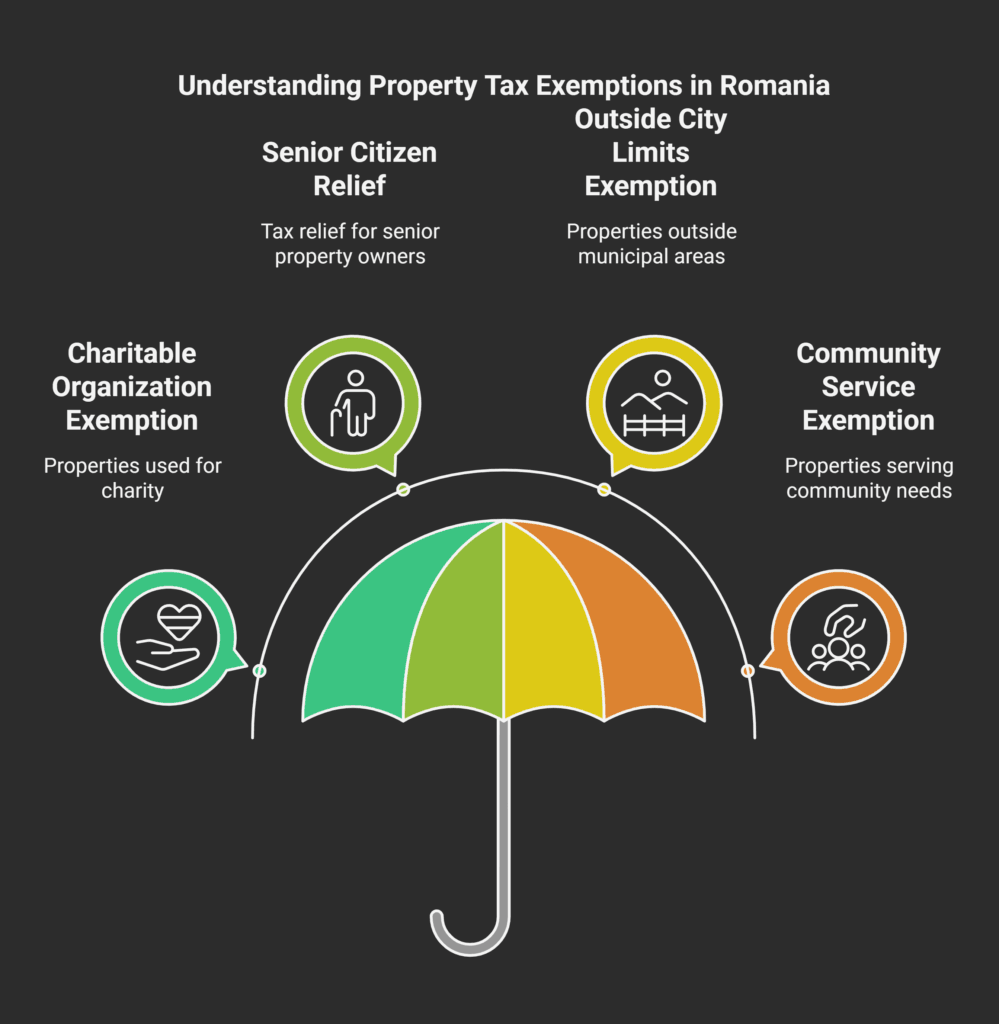
Properties used for charity or outside city limits often get special treatment.

Senior citizens might also get help due to their age.

Knowing these rules can help figure out if your property qualifies.

You’ll need to gather documents like property deeds and proof of usage.

Types of Exemptions Available

There are many types of property tax exemptions in Romania.

These include:

  • Charitable organization exemptions;
  • Senior citizen property tax relief;
  • Exemptions for properties outside city limits;
  • Special provisions for community service properties.

Each exemption has its own rules for applying, documents needed, and deadlines.

It’s important to check with local authorities for the latest on exemptions.

This way, you can make sure you’re taking advantage of any exemptions you’re eligible for.

Type of ExemptionEligibility CriteriaDocumentation Required
Charitable Organization ExemptionProperty used exclusively for charitable purposesProof of charity registration
Senior Citizen ReliefProperty owned by individuals above a specific ageIdentification and proof of age
Outside City Limits ExemptionProperties not within municipal boundariesDocumentation verifying location
Community Service ExemptionProperties serving community needsProof of usage for communal services

Understanding property tax exemptions in Romania is key for property owners.

Being aware and prepared can greatly impact your financial situation.

Working with local authorities and knowing the details of each exemption is essential.

Property Tax Deductions in Romania

Property Tax Deductions in Romania

Property owners in Romania can find relief in property tax deductions.

These deductions help lower taxable income.

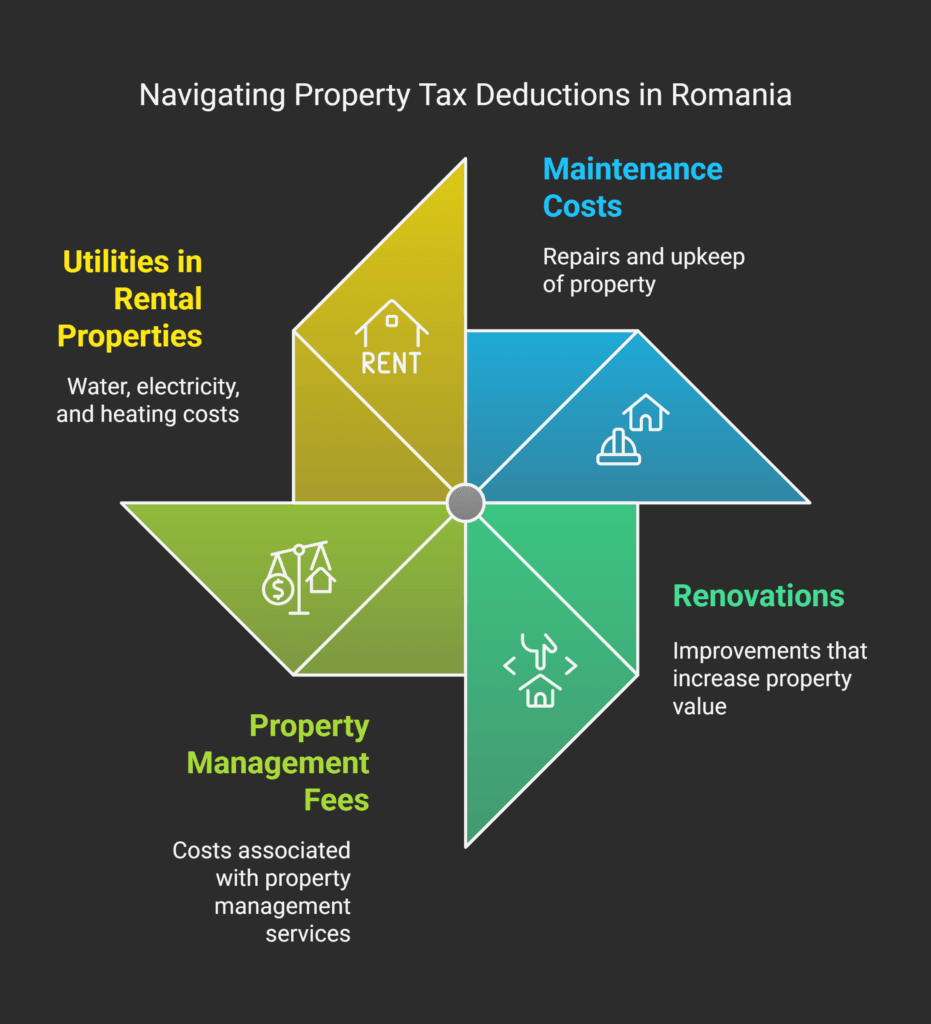
They include maintenance costs, improvements, and other eligible expenses.

Maintenance costs, like repairs and updates, are often deductible.

To get these benefits, owners must meet certain criteria and keep detailed records.

These records are needed to prove expenses are eligible for deductions.

Calculating these deductions can be tricky.

It may require the help of a tax professional.

To illustrate, the table below outlines common deductions available:

Deduction TypeEligible ExpensesDocumentation Required
Maintenance CostsRepairs and upkeep of propertyReceipts and invoices
RenovationsImprovements that increase property valueBefore and after valuations
Property Management FeesCosts associated with property management servicesContract and payment proof
Utilities in Rental PropertiesWater, electricity, and heating costsPayment statements

Understanding property tax deductions in Romania can help owners save money.

It might seem complicated, but with the right guidance, it can be done.

By planning ahead, you can reduce your taxes and save a lot in the long run.

Understanding Property Tax Appeals in Romania

Appeal Property Tax Assessment Romania

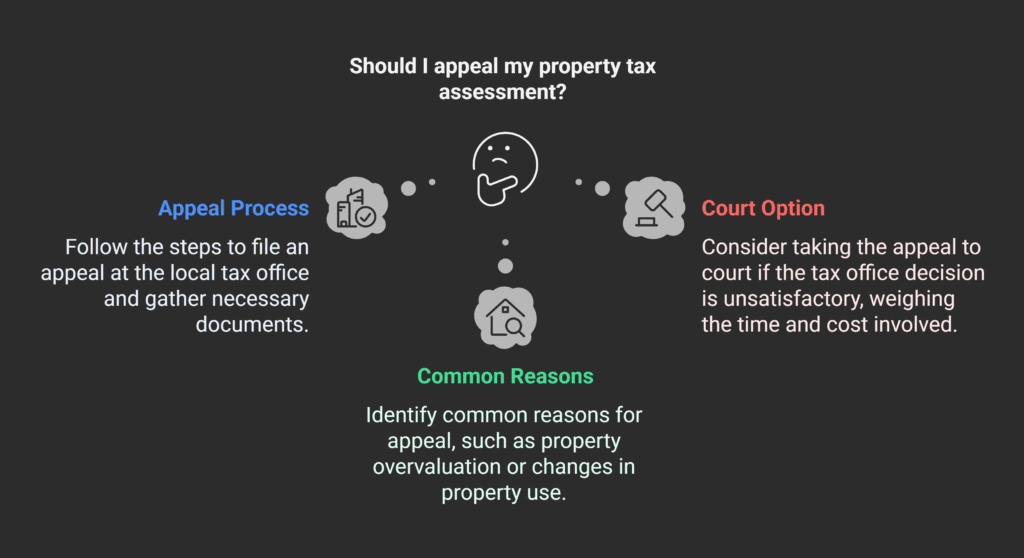
If you disagree with your property tax in Romania, knowing how to appeal is key.

Start by filing your appeal at the local tax office where your property is listed.

You have 30 days from when you get the tax notice to appeal.

You’ll need your tax notice, proof of ownership, and any evidence to support your appeal.

Process for Filing a Property Tax Appeal

The appeal process in Romania might change depending on where you are.

But, it usually goes like this: after you appeal, the local tax office will look at your case.

They might ask for more info or documents. If you’re not happy with the outcome, you can take it to court.

But, think carefully about this step because it can take more time and money.

Common Reasons for Appeals

Many people appeal their property taxes in Romania for a few reasons.

One big reason is if your property is overvalued.

Assessments can be wrong if they’re based on old or wrong data.

Also, if you’ve changed how you use your property, like turning a house into a business, you might need to appeal.

Knowing these reasons can help you fight your tax assessment better.

FAQ

What are property taxes in Romania?

Property taxes in Romania are yearly taxes on property owners.

They depend on the property’s location and value.

These taxes help fund local budgets.

How are property tax rates determined in Romania?

Local authorities set property tax rates in Romania.

Rates can differ by region.

Usually, homes have a lower tax rate than business properties.

What is the process for calculating property taxes in Romania?

Local authorities calculate property taxes in Romania.

They use the property’s taxable value.

This value is based on size, location, and market trends.

What deadlines should I be aware of for paying property taxes?

In Romania, property taxes are due in two parts.

The first is by March 31st.

The second is by September 30th each year.

What payment methods are available for property taxes in Romania?

You can pay property taxes in Romania online, by bank transfer, or in person.

You can visit local tax offices.

Are there any exemptions available for property owners in Romania?

Yes, some property owners in Romania may get tax breaks.

This includes properties used for charity or by senior citizens.

How can I reduce my property taxes in Romania?

You might lower your property taxes by claiming deductions.


For example, for maintenance costs. It’s wise to get professional help.

What is the appeal process for property tax assessments in Romania?

If you disagree with your tax assessment, you can appeal.

Do this at local tax offices.

You’ll need to provide evidence like if your property was overvalued.

What is the basic structure of property tax in Romania?

The property tax system in Romania is primarily based on the ownership of immovable property.

The tax is levied annually and is calculated based on several factors, including the value of the building or land, its location, and its purpose (residential, commercial, or agricultural).

The Romanian tax system distinguishes between building tax and land tax, both of which fall under the broader category of property tax.

These taxes are typically administered by local councils and form a significant part of local government revenue.

The rates and specific regulations may vary depending on the municipality, as local authorities have some discretion in setting tax rates within limits established by national legislation.

How is building tax calculated for residential buildings in Romania?

For residential buildings, the building tax is typically calculated as a percentage of the value of the building.

As of 2023, the standard tax rate for residential properties ranges from 0.08% to 0.2% of the taxable value, which is determined by factors such as the building’s size, location, and construction materials.

The specific rate within this range is set by the local council.

It’s important to note that the taxable value is not necessarily the market value or purchase price of the property. Instead, it’s often based on a standardized valuation system that takes into account various characteristics of the building.

Property owners are required to pay this tax annually, and the tax is due typically in two equal installments, by March 31 and September 30 of each year.


Tax Benefits for Startups in Romania: Incentives, Grants, and R&D Deductions

Tax Benefits for Startups in Romania: Incentives, Grants, and R&D Deductions

Did you know Romania has one of Europe’s lowest corporate income tax rates at just 16%?

This is just the beginning of the tax benefits for startups in Romania.

The country is dedicated to supporting entrepreneurship and innovation, offering many opportunities for new businesses.

Romania’s tax system has many startup tax incentives to help businesses grow and attract investors.

There are tax options based on revenue for small businesses and big R&D deductions.

These benefits make Romania a great place for startups, especially in tech and innovation.

tax benefits for startups in romania

Knowing about these benefits is key to growing your business in Romania.

Whether you’re starting a business here or investing from abroad, understanding taxes is crucial.

For advice on using these incentives, contact expert legal counsel at office@theromanianlawyers.com.

Key Takeaways

  • Romania offers a competitive 16% corporate tax rate;
  • Micro-enterprises can benefit from revenue-based tax rates as low as 1%;
  • R&D expenses qualify for an additional 50% tax deduction;
  • IT sector enjoys specific tax advantages, including potential VAT exemptions;
  • Various EU funding opportunities are available for innovative startups;
  • Local tax benefits exist in tech parks and free economic zones.

Overview of Romanian Corporate Taxation System

Romanian Corporate Taxation System

Romania’s corporate tax system is good for both startups and established businesses.

It aims to attract foreign investment and boost the economy.

Knowing these policies is key for startups wanting to start in Romania.

Standard Corporate Tax Rate and Structure

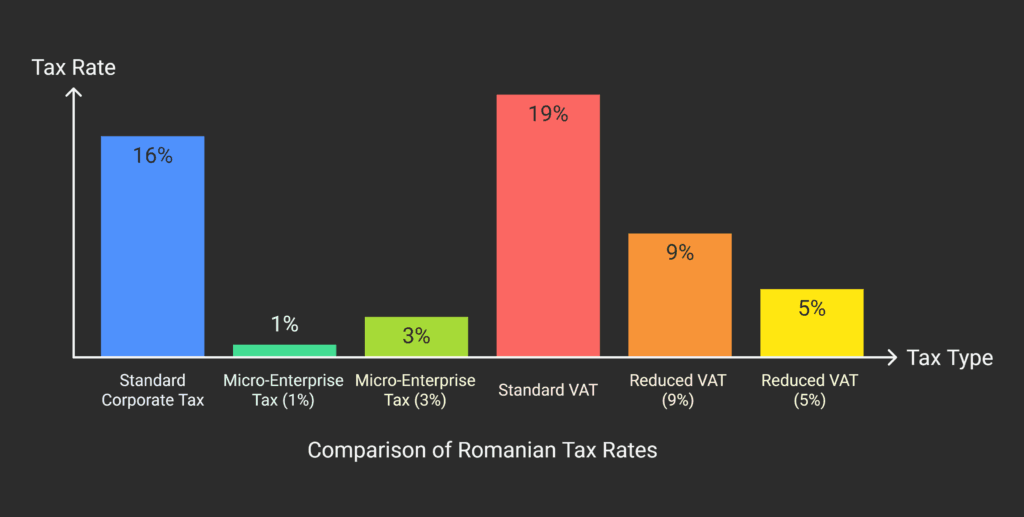
Romania has a flat corporate tax rate of 16%. This is lower than many European countries.

All companies pay this rate, no matter their size or industry. For startups, this makes planning finances easier.

Micro-Enterprise Tax Framework

The micro-enterprise tax is great for Romanian startups.

Companies with less than €500,000 in annual revenue can pay 1% or 3% tax.

This helps startups keep more of their earnings, especially when they’re growing fast.

VAT Regulations and Thresholds

Romania’s VAT system has benefits for startups.

The standard VAT rate is 19%, but there are lower rates for some goods and services.

Startups need to know the VAT registration threshold, which is €88,500 in annual turnover.

If they’re below this, they might not have to pay VAT, which helps with finances.

Tax TypeRateApplicability
Standard Corporate Tax16%All companies
Micro-Enterprise Tax1% or 3%Revenue up to €500,000
Standard VAT19%General goods and services
Reduced VAT9% or 5%Specific goods and services

corporate tax benefits romania

Romanian tax policies for startups aim to boost entrepreneurship and innovation.

They offer lower tax rates for micro-enterprises and VAT benefits.

This creates a good environment for new businesses to grow and help the economy.

Tax Benefits for Startups in Romania

Tax Benefits for Startups in Romania

Romania has a great tax setup for startups.

It offers many benefits to help entrepreneurs grow.

These advantages make Romania a great place for startups to start.

First-Year Tax Advantages

New businesses in Romania get big tax breaks in their first year.

They might not have to pay corporate income tax or pay less.

This lets them put more money into growing and improving.

Revenue-Based Tax Options

Romania has a special tax for small businesses.

If a company makes less than 1 million euros a year, it pays just 1% tax.

This is good for businesses that make a lot but don’t make much profit.

tax advantages for new businesses romania

Special Economic Zone Benefits

Startups in special economic zones get even more benefits.

They might pay less tax, get customs duty breaks, and more.

These perks make these zones even more appealing for new businesses.

Benefit TypeDescriptionEligibility
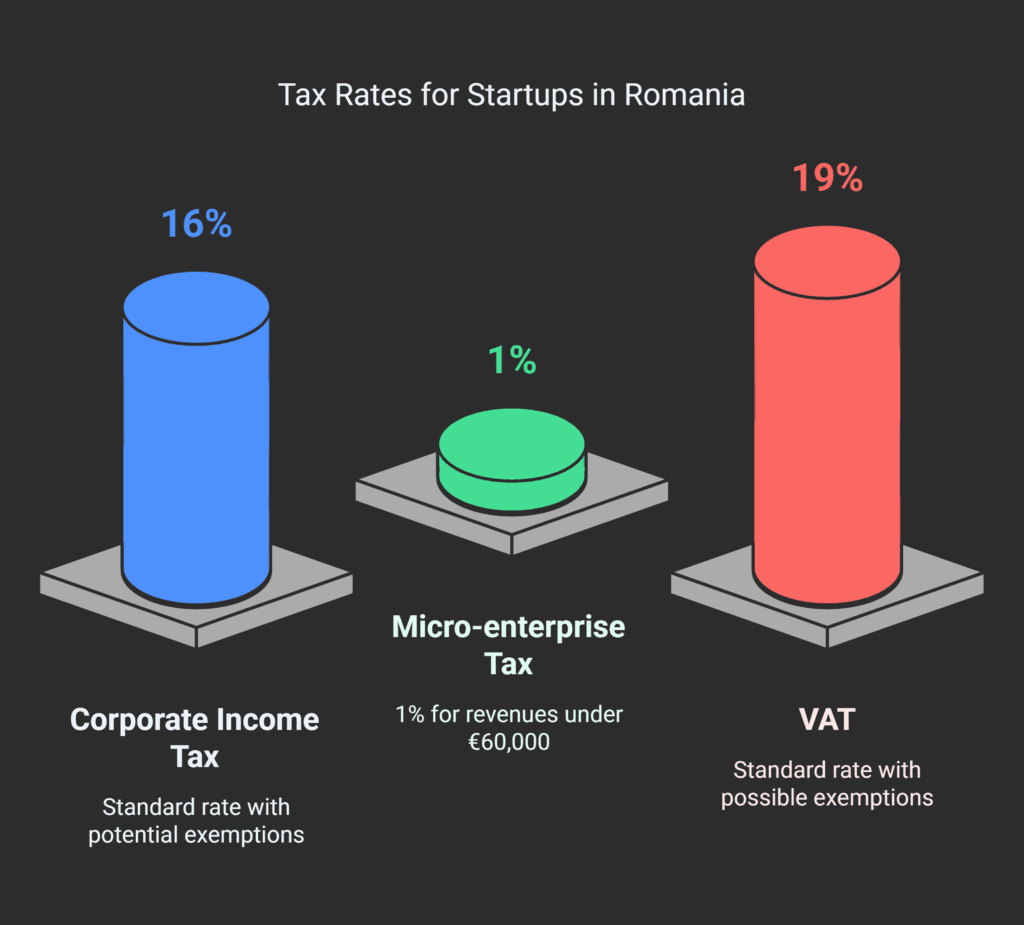
Corporate Income Tax16% standard rate, potential exemptions for startupsAll registered businesses
Micro-enterprise Tax1% on turnover for revenues up to €60,000Companies with revenues under €500,000
VAT19% standard rate, exemptions availableBased on turnover thresholds

Romania’s tax benefits, growing startup scene, and EU funding make it great for new businesses.

Cities like Bucharest, Cluj-Napoca, and Timișoara are especially good for startups.

They offer lots of resources and chances for entrepreneurs.

Research and Development Tax Incentives

Romania offers great R&D tax incentives to boost innovation and tech growth.

These incentives make Romania a top spot for startups and tech companies.

They focus on research and development.

50% Extra Deduction on R&D Expenses

Companies investing in R&D can get a 50% extra deduction on eligible expenses.

This R&D tax relief for startups in Romania cuts down the cost of innovation projects.

Eligible costs include salaries for R&D staff, equipment, and materials for research.

Accelerated Depreciation for R&D Equipment

Romania also offers accelerated depreciation for R&D equipment.

This helps startups by reducing taxable income early on.

The rate of depreciation depends on the equipment type and its lifespan.

Innovation-Related Tax Credits

Romania has various innovation tax credits to boost tech advancement.

These credits can be applied to corporate tax, lowering the tax burden.

The credit amount varies based on the project’s nature and scale.

Tax IncentiveBenefitEligibility
R&D Expense Deduction50% extra deductionAll companies with eligible R&D expenses
Accelerated DepreciationFaster write-off of R&D equipmentCompanies using equipment for R&D activities
Innovation Tax CreditsReduction in corporate tax liabilityCompanies engaged in innovative projects

These tax incentives make Romania a great place for tech startups and innovation companies. By using these benefits, businesses can lower their taxes. This lets them focus more on research and development.

Government Grants and Financial Support Programs

Romania has many government programs to help startups.

The StartUp Nation 2025 program gives non-refundable grants of 250,000 RON.

This helps create two jobs over two years.

It’s part of the broader support for startups in Romania.

Seed funding tax deductions in Romania are also supported by EU funds.

The Innovation Romania program has 106.7 million EUR for startups and SMEs.

Micro-enterprises in Bucharest-Ilfov can get grants from €25,000 to €300,000.

Venture investment tax credits in Romania get a boost from programs like SME Eco-Tech.

It has a budget of 53,924,286 CHF. Grants up to 50,000 CHF cover 40% of eligible costs.

This support is for sustainability and digital projects.

ProgramBudgetGrant AmountFocus Area
StartUp Nation 2025295,750,000 EUR250,000 RONJob Creation
Innovation Romania106.7 million EURVariesInnovation
SME Eco-Tech53,924,286 CHFUp to 50,000 CHFSustainability
PNRR28.5 billion EURVariesDigital & Green Transition

IT Sector-Specific Tax Advantages

Romania offers great tax benefits for tech startups and software companies.

These benefits make it a top spot for digital innovation and IT growth.

Software Development Tax Exemptions

Romania has tax breaks for software companies.

They don’t have to pay corporate tax if they make enough from software.

Companies need to make at least 10,000 EUR per employee each year.

New startups get a break.

They don’t have to meet the revenue rule for their first two years.

Tech Industry Employee Benefits

There are tax perks for tech employees in Romania too.

Until recently, IT pros got a 10% tax break. Jobs like database admins, IT managers, and software engineers were eligible.

Both Romanian and foreign workers could get this benefit.

They just had to meet certain education standards.

Digital Innovation Incentives

Romania is serious about digital innovation.

It offers many incentives to grow its digital economy.

This economy is still behind the EU’s average.

Only 31% of Romanians have basic digital skills, compared to the EU’s 56%.

These incentives are key to closing this gap.

The government is really pushing for digital innovation in Romania.

Despite being last in the 2021 Digital Economy and Society Index, Romania does well in some areas.

For example, its fixed very high capacity network coverage is 76%, higher than the EU’s 59%.

Investment and Capital Gains Tax Benefits

Romania offers great tax breaks for startup investments.

The corporate income tax rate is 16%, but there are incentives to lower this for new companies.

Angel investor tax breaks in Romania make early funding more attractive, helping startups grow.

Capital gains tax in Romania is 16%, which is good compared to the EU.

Sometimes, dividend income can be tax-free, boosting investor returns.

New companies in Romania can use fiscal losses for up to 7 years.

This lets startups use future profits to cover early losses, giving them financial breathing room.

Romania has about 87 tax treaties to avoid double taxation.

This makes it a great place for foreign investors.

These treaties can reduce withholding taxes and offer other financial perks for international deals.

Tax BenefitRate/Provision
Standard Corporate Income Tax16%
Capital Gains Tax16%
Micro-company Tax (Revenue ≤ €60,000)1%
Micro-company Tax (Revenue > €60,000)3%
Loss Carry-forwardUp to 7 years

Employment-Related Tax Incentives for New Businesses

Employment Tax Incentives for New Businesses in Romania

Romania has great payroll tax incentives for startups and new businesses.

These incentives help boost employment and support workforce development.

Let’s look at the main employment-related tax benefits for entrepreneurs in Romania.

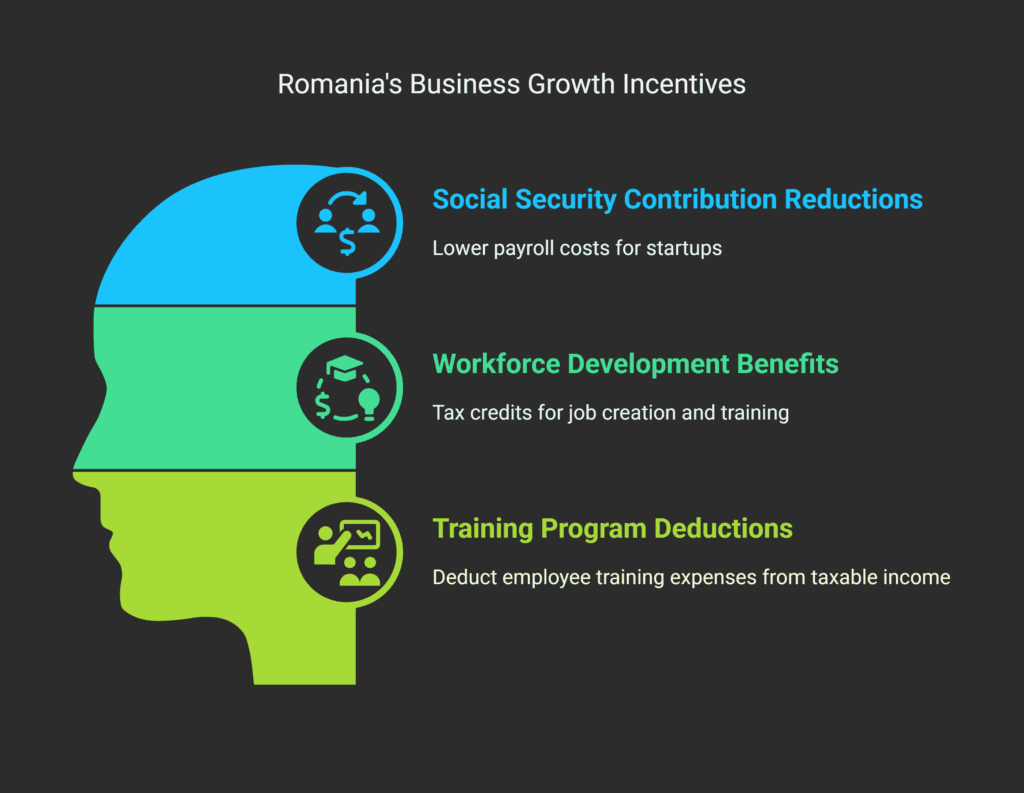
Social Security Contribution Reductions

Startups in Romania can enjoy lower social security contributions.

This helps new businesses cut their payroll costs and invest more in growth.

The exact reduction depends on company size and industry sector.

Workforce Development Benefits

Romania offers benefits to encourage hiring and training new employees.

There are tax credits for job creation and deductions for employee training.

These incentives help startups build strong teams while keeping costs down.

Training Program Deductions

Investing in your workforce is key for business success.

Romania has deductions for training programs to support this.

Startups can deduct training expenses from their taxable income.

This encourages continuous learning and skill development.

Employment-Related Tax IncentiveBenefit
Social Security Contribution ReductionsLower payroll costs for startups
Workforce Development BenefitsTax credits for job creation and training
Training Program DeductionsDeduct employee training expenses from taxable income

These employment-related tax incentives in Romania make it great for startups to grow their teams.

By using these benefits, new businesses can cut costs, attract skilled workers, and encourage innovation.

Regional Development Incentives and Local Tax Benefits

Romania has many incentives and tax benefits to draw new businesses and boost the economy.

These benefits vary by region, helping entrepreneurs get the most out of their finances.

The Romanian government gives tax breaks to new businesses in key areas.

These breaks can cut down on taxes, letting startups focus more on growing and innovating.

Local governments also offer extra perks to bring businesses to their areas, like lower property taxes.

When picking a place for your startup in Romania, look into the local incentives.

Some places have lower tax rates or tax exemptions.

These can greatly help your company’s finances, especially when you’re just starting out.

  • Standard corporate income tax rate: 16%;
  • Micro-enterprise tax rates: 1% or 3% (based on annual turnover);
  • VAT rates: 19% standard, 9% and 5% reduced rates.

To make the most of these incentives in Romania, compare what different places offer.

Think about things like infrastructure, the local workforce, and how close you are to markets.

Choosing the right location can help your business grow strong from the start.

European Union Funding and Tax Advantages

Romania’s EU membership brings big benefits.

It offers financial help and tax breaks for startups.

This mix of EU grants and Romanian tax laws makes starting a business easier.

EU Grant Programs Integration

Romanian startups can get into various EU grant programs Romania.

Horizon Europe supports research and innovation. Startups working on digital and green projects can get help from structural funds.

These programs often come with tax breaks.

This makes them even more attractive for new businesses.

Cross-Border Tax Benefits

Romania’s tax benefits are a big plus for startups.

With Romania joining the Schengen Area, travel and trade will get easier.

This will help businesses grow across the EU.

Romania’s 16% corporate tax rate is also good.

It’s lower than the EU average of 21%.

European Investment Initiatives

European investment in Romania is key for startups.

Romania will get almost 80 billion euros from the EU Resilience Fund.

This money will go to projects like infrastructure, digitalization, and green initiatives.

Startups that fit these areas can get a lot of funding.

Funding SourceFocus AreaPotential Benefits
Horizon EuropeResearch and InnovationGrants, Tax Incentives
EU Structural FundsDigital Transformation, SustainabilityFinancial Support, Tax Benefits
EU Resilience FundInfrastructure, Digitalization, Green ProjectsLarge-scale Funding, Growth Opportunities

Conclusion

Romania’s startup scene is booming, with VC funding hitting €101.7M in 2022.

This is a 54.3% jump from 2021.

The country is now the 5th biggest in CEE for VC funding.

This shows how attractive Romania is for entrepreneurs.

Romania has many tax perks for startups.

For example, there’s a 50% extra deduction on R&D expenses.

There are also tax breaks for software development.

The corporate tax rate is 16%, and personal tax is 10%, both of which are low in the EU.

A Romanian tax specialist can guide you through these benefits.

They help your startup get the most out of these advantages.

Romania’s location and growing economy make it great for new businesses.

It has a good tax environment too. If you’re looking into IT or regional incentives, a Romanian tax lawyer can offer great advice.

For more on Romanian tax law and startup benefits, email a lawyer in romania at office@theromanianlawyers.com.

Romania is working to cut its budget deficit and introduce new tax reforms.

Keeping up with these changes is key.

A trusted Romanian law office can help you stay on top of regulations.

With the right help, your startup can do well in Romania’s lively business world.

FAQ

What is the standard corporate tax rate in Romania?

In Romania, the standard corporate tax rate is 16%.

This rate is quite competitive when compared to other European countries.

How does the micro-enterprise tax framework benefit startups in Romania?

The micro-enterprise tax framework in Romania offers lower tax rates based on turnover.

This is very beneficial for small businesses and startups in their early stages.

Are there any first-year tax advantages for new businesses in Romania?

Yes, Romania provides tax benefits for new companies in their first year.

These benefits may include exemptions or reductions in corporate income tax.

What R&D tax incentives are available for startups in Romania?

Romania offers several R&D tax incentives for startups.

These include a 50% extra deduction on R&D expenses and accelerated depreciation for R&D equipment.

There are also innovation-related tax credits to encourage research and development.

Are there any government grants available for startups in Romania?

Yes, Romania has various government grants and financial support programs.

These include state aid schemes and EU-funded programs to support startups and innovative businesses.

What tax benefits are available for the IT sector in Romania?

The IT sector in Romania enjoys several tax benefits.

These include income tax exemptions for IT professionals and corporate tax exemptions for software development companies that meet specific criteria.

Are there any tax incentives for reinvesting profits in Romania?

Yes, Romania offers exemptions for reinvested profits.

This allows startups to grow while reducing their tax burden.

What employment-related tax incentives are available for new businesses in Romania?

New businesses in Romania can benefit from several employment-related tax incentives.

These include reductions in social security contributions, tax credits for hiring and training new employees, and deductions for training programs.

Are there regional tax benefits for startups in Romania?

Yes, Romania offers regional development incentives and local tax benefits.

These may include reduced tax rates, exemptions, or other fiscal advantages depending on the startup’s location.

How can Romanian startups benefit from European Union funding?

Romanian startups can access various EU grant programs.

They can also leverage cross-border tax benefits and take advantage of European investment initiatives.

These can provide significant financial and tax advantages.

Employment Contracts in Romania: Tips for Drafting Work Contracts


Employment Contracts in Romania: Tips for Drafting Work Contracts

Drafting Work Contracts in Romania

Ever thought about what makes a Romanian employment contract legally strong?

Knowing the details of labor contracts in Romania can help avoid legal issues.

Creating work contracts in Romania needs careful focus on legal rules in the Romanian Labor Code.

As an employer or professional, you must understand complex employment laws in Romania.

This ensures your contracts follow all rules.

The Romanian Standard Individual Employment Contract offers a clear structure.

It protects both employers and employees.

Your contract must be carefully made to meet Romanian labor laws’ strict standards.

Key Takeaways

  • Romanian employment contracts must be written in Romanian and registered before work begins;
  • Contracts are governed by Law No. 53/2003, with the latest republication in November 2024;
  • Employment agreements must cover both private and public sector employees;
  • Contracts require specific mandatory elements and legal compliance;
  • Professional guidance is key for creating strong employment agreements.

For personalized legal help in making your Romanian employment contracts, contact our expert team at office@theromanianlawyers.com.

Understanding Romanian Employment Contract Requirements

Romanian Employment Contract Legal Framework

Getting to know the rules for employment contracts in Romania is key.

The Romanian Labor Code sets out the rules for making and using these contracts.

When you make employment contracts in Romania, you must follow important legal points.

These points help you meet the national standards for contracts.

Legal Framework and Basic Requirements

The Labor Code of 2003 is the base for Romania’s employment contract rules.

It has been updated several times. Employers must follow strict rules to start work relationships.

  • Minimum working age is 16 years;
  • Written contracts are mandatory;
  • Contracts must be in Romanian language;
  • Registration with ReviSal is required before work begins.

Mandatory Contract Elements

Your employment contracts in Romania must have certain key parts to be valid.

These parts help protect both sides by clearly outlining the work relationship.

  1. Job description and responsibilities;
  2. Exact remuneration details;
  3. Working hours and schedule;
  4. Location of work;
  5. Start date of employment.

Language and Registration Requirements

When drafting contracts in Romania, pay close attention to language and registration rules.

Contracts must be in Romanian.

They also need to be registered online through ReviSal before the first day of work.

Knowing these rules for contracts in Romania helps ensure your agreements follow the law.

This protects both your company and your employees’ rights.

Types of Employment Contracts in Romania

Types of Employment Contracts in Romania

It’s key for businesses and workers to know about the different employment contracts in Romania.

The law here offers many contract options for various work setups.


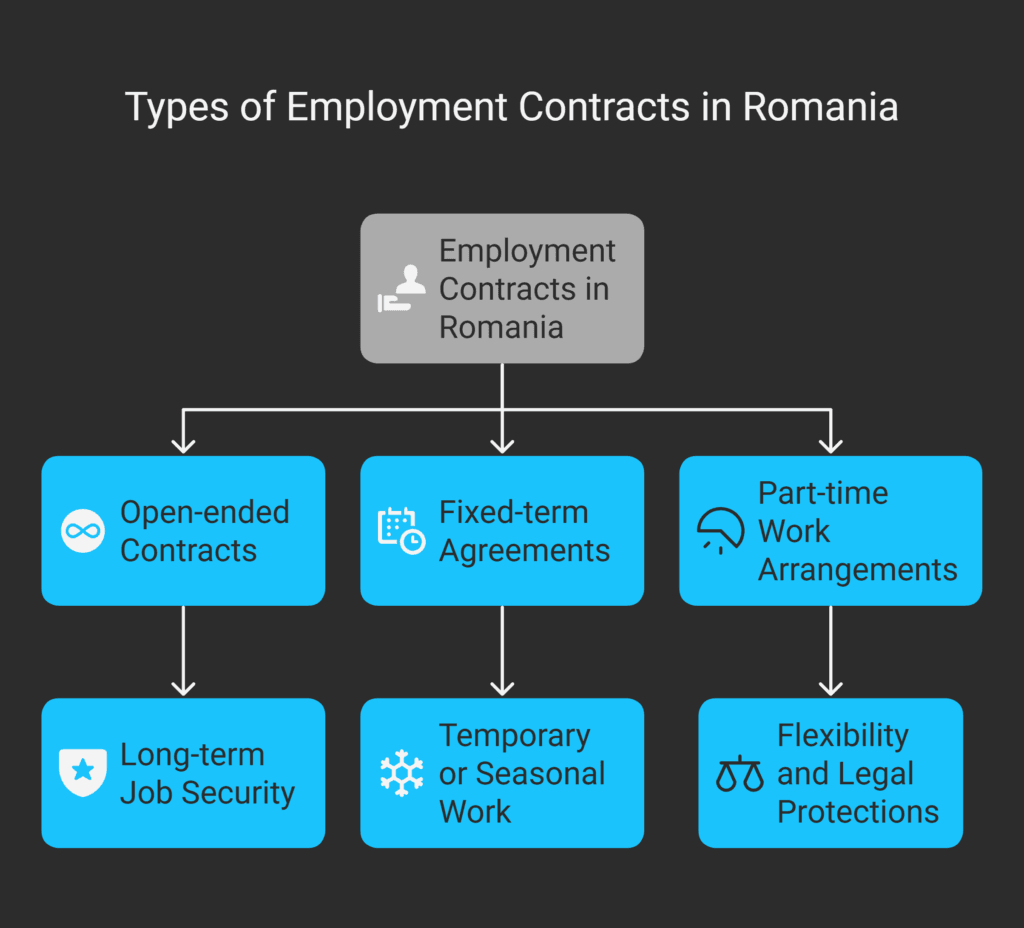
Romania has six main types of employment contracts.

Each is made for different work needs.

These contracts help with agreements for independent contractors, temporary jobs, and freelancers.

Open-ended Contracts

Open-ended contracts are the most common in Romania.

They offer long-term job security with no end date.

They include:

Fixed-term Agreements

Fixed-term contracts are for temporary jobs or seasonal work.

Romanian laws have rules for these contracts:

  1. Maximum contract duration: 36 months;
  2. Maximum of three contract renewals;
  3. Specific conditions for temporary work contracts;
  4. Detailed documentation requirements.

Part-time Work Arrangements

Part-time contracts offer flexibility.

They allow for fewer working hours while keeping legal protections.

They include:

  • Flexible working hours;
  • Proportional salary and benefits;
  • Suitable for freelance work contracts;
  • Clearly defined work schedules.

Choosing the right employment contract in Romania is vital.

It should match your business needs and workforce requirements.

Essential Components of Romanian Work Contracts

Creating a strong employment contract needs careful focus on key details.

These details protect both employers and employees.

Knowing how to draft contracts well is very important in Romania.

Your contract must have several important parts to follow the law and be clear.

These parts are the foundation of the employment agreement.

  • Employee and employer full identification details;
  • Precise job title and detailed job description;
  • Exact workplace location;
  • Detailed working hours specification;
  • Complete salary and compensation structure;
  • Contract duration and termination conditions;
  • Notice periods for contract termination.

The terms and conditions should be clear to avoid confusion.

Romania’s labor laws require certain things in employment contracts.

For example, contracts must be registered within a day before starting work.

Don’t forget about pay details.

Your contract must say how much you’ll earn in Romanian lei.

It should also cover any raises, bonuses, or extra pay.

By focusing on these key points, you’ll make a detailed employment agreement.

This agreement will meet legal standards and protect both sides.

Drafting Work Contracts in Romania

Creating strong employment contracts in Romania needs careful attention to legal details.

Your contract services must understand Romanian employment laws well.

This ensures both employer and employee are protected.

Creating a good contract means knowing the legal templates Romania offers.

It’s important to get professional legal advice to avoid mistakes in the drafting process.

Contract Structure and Format

Romanian employment contracts have a specific structure.

They must include important elements:

  • Detailed job description;
  • Compensation and benefits information;
  • Work location and responsibilities;
  • Duration of employment.

Legal Compliance Considerations

When making employment agreements, you must follow Romanian labor laws closely. Key compliance points include:

  1. Written confirmation of all contract terms;
  2. Precise job role definition;
  3. Clear compensation structure;
  4. Adherence to mandatory social protections.

Common Pitfalls to Avoid

When drafting contracts, knowing common mistakes is important. Key areas to watch out for include:

PitfallPotential Consequence
Vague Job DescriptionsLegal disputes and unclear expectations
Incomplete Compensation DetailsPotential salary conflicts
Missing Mandatory ClausesContract invalidity

Using professional legal templates from Romania can help avoid these issues.

Working with experienced contract drafting services ensures your agreements are solid and legally correct.

This protects both your organization and your employees.

Employee Rights and Protections

Employee Rights and Protections

It’s important to know about employee rights and protections in Romania.

The Romanian labor law has rules to protect workers’ rights.

These rules help make sure workplaces are fair and follow the law.

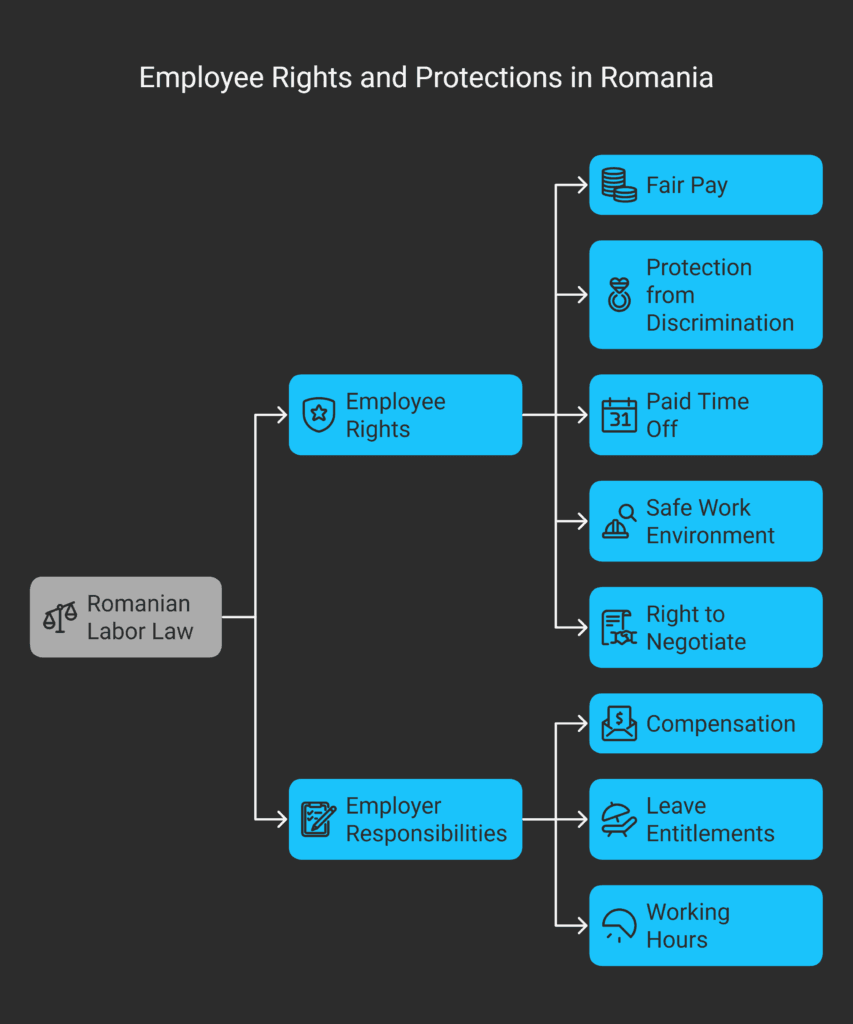
Some main employee rights in Romania include:

  • Fair pay and a minimum wage;
  • Protection from workplace discrimination;
  • Paid time off and vacation days;
  • A safe place to work;
  • The right to negotiate with employers.

Employers need to follow certain rules when making employment contracts.

These rules help make sure workers are treated fairly in all industries.

Right CategoryKey ProvisionsLegal Protection
CompensationMinimum monthly wage of 3,700 RONLabor Code Article 39
Leave EntitlementsMinimum 20 paid vacation days annuallyNational Labor Regulations
Working HoursMaximum 40-hour workweekEmployment Protection Laws

When following employer guidelines in Romania, companies should be open and respect workers’ rights.

This not only keeps them legal but also makes the workplace better for everyone.

By focusing on these rights, you can make your workplace more welcoming, productive, and legally correct in Romania.

Working Hours and Compensation Structures

Understanding wage regulations in Romania is key.

You need to know about employment law and workplace compliance.

This includes working hours, pay, and benefits.

Knowing these details helps avoid labor disputes.

Romanian work contracts outline the rules for work hours.

The standard week is 40 hours over five days.

Workers get fair pay and benefits.

Standard Working Hours

  • Maximum 40 hours per week;
  • 8-hour daily work limit;
  • Minimum rest period of 12 consecutive hours between work shifts.

Overtime Regulations

Overtime pay in Romania is clear.

Workers get 75% more than their regular pay for extra hours.

There are rules for overtime:

  1. Overtime must be approved in advance;
  2. Maximum 48 hours per week, including overtime;
  3. Compensation can be monetary or time off.

Salary and Benefits Requirements

As of January 2025, the minimum wage is RON 4,050 monthly.

Employers must also offer benefits and pay social security.

Important pay elements include:

  • Mandatory social security contributions;
  • Minimum 20 paid vacation days annually;
  • 15 public holidays with paid time off;
  • Non-taxable benefits like voluntary pension fund contributions.

Knowing these rules keeps your company legal and competitive in Romania.

Focus on fair pay and benefits to attract and keep good workers. This way, you avoid legal issues.

Probationary Periods and Contract Termination

Understanding termination clauses in Romania is key for employers and employees.

The Romanian Labor Code outlines rules for probation and contract end.

It protects both sides.

Probationary periods are a big part of jobs in Romania.

Here’s what you need to know:

  • Non-managerial jobs have a 90-day probation period.
  • Managerial jobs have a 120-day probation period.
  • Probation lets both sides check if they fit well together.

When it comes to contract termination in Romania, there are important points to remember:

  1. Termination is allowed for reasons like:
    • Company closure;
    • Redundancy;
    • Performance problems;
    • Major misconduct.
  2. Termination is not allowed during:
    • Pregnancy;
    • Maternity leave;
    • Parental leave.

Severance pay in Romania applies in certain cases:

Termination ScenarioSeverance Pay Requirement
Company CessationMinimum one month’s salary
Role RedundancyMinimum one month’s salary
Company RelocationMinimum one month’s salary

When ending a contract, follow the notice rules.

For regular jobs, it’s 20 working days.

For management roles, it’s 45 working days.

Always stick to the Romanian Labor Code to safeguard rights.

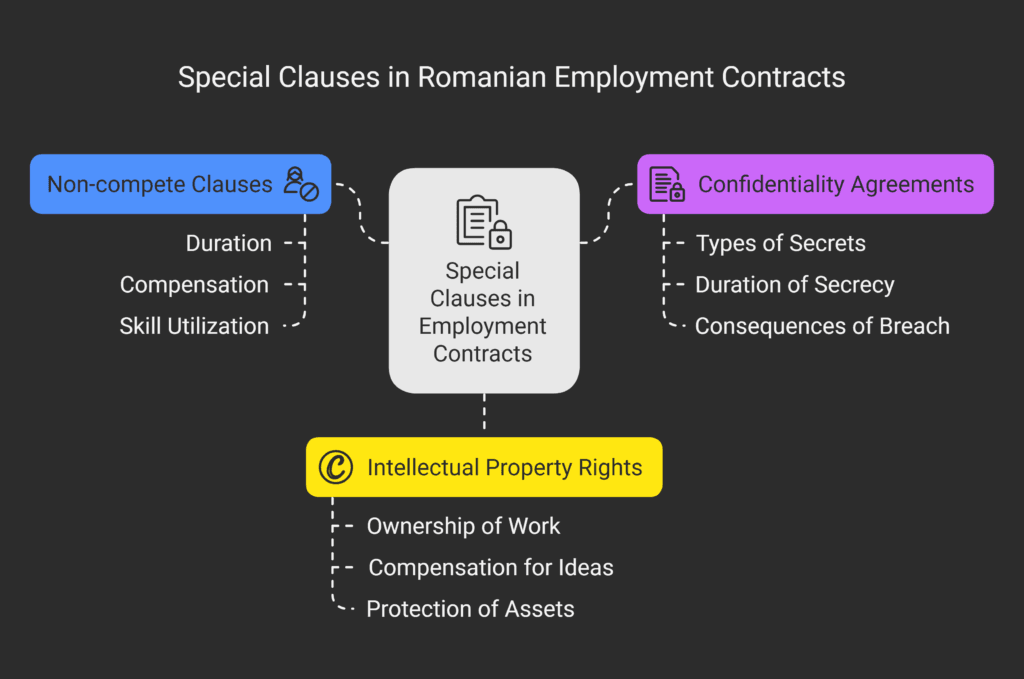
Special Clauses and Additional Provisions

Special Clauses and Additional Provisions

When making employment contracts in Romania, special clauses are key.

They protect both the employer and the employee.

Knowing these clauses helps manage workplace relationships and follow the law.

Non-compete Clauses in Romania

Non-compete clauses in Romania are important.

They stop employees from working for competitors after they leave.

These clauses have specific rules:

  • They can last up to 2 years after the contract ends;
  • The employee must get at least 50% of their average salary each month;
  • They can’t completely stop the employee from using their skills.

Confidentiality Agreements Romania

Confidentiality agreements in Romania keep business secrets safe.

You need to make sure:

  1. The types of secrets are clear;
  2. How long the secrecy lasts;
  3. What happens if someone breaks the agreement.

Intellectual Property Rights

Intellectual property in Romania needs careful planning.

Your contracts should cover:

  • Who owns work done while employed;
  • How to pay for new ideas;
  • How to protect creative assets.

By using these special clauses, you can make strong contracts.

They protect your business and follow Romanian laws.

Remote Work and Teleworking Agreements

Romania has changed its work policies to welcome digital nomads.

The country’s telework scene has grown a lot.

This change started in July 2017, when the Ministry of Labor suggested new rules for remote work.

It’s important to know the visa rules for digital nomads in Romania.

The new work laws offer a clear guide for remote work agreements.

They ensure both flexibility and legal safety.

  • Telework is defined as work done outside the usual office using technology;
  • Employees must sign a special agreement or addendum to work remotely;
  • Remote workers get the same rights as those in the office.

When making a remote work contract in Romania, you need to think about a few things.

The new work rules require specific details.

These include:

  1. What equipment is provided;
  2. How flexible work hours can be;
  3. How work performance is checked;
  4. How communication should happen.

Remote work is appealing because of the financial benefits.

Employers save on office space, utilities, and travel costs.

Employees enjoy better work-life balance and save time.

The pandemic made Romania adopt remote work faster.

About 50% of workers started teleworking during this time.

Now, digital nomads and local workers have clear, safe work rules.

Collective Bargaining Agreements and Their Impact

Collective bargaining agreements are key in Romania’s workforce rules.

They set out detailed rules for work and employee rights.

This is important for labor contracts in Romania.

To understand these agreements in Romania, you need to know their legal side and real-world effects.

Employers must see how these agreements can change individual work contracts.

  • Employers with 10 or more employees must engage in collective bargaining;
  • Negotiations must start 45 calendar days before the current agreement expires;
  • Collective agreements typically last between 12-24 months.

Following workplace rules in Romania means paying close attention to collective bargaining.

Important things to think about include:

RequirementSpecification
Minimum Negotiation MeetingsThree face-to-face meetings
Maximum Negotiation Period60 calendar days
Penalty for Non-ComplianceRON 5,000 to RON 10,000 fine

Your company needs to get ready well for collective bargaining.

Make a detailed first proposal, know the law, and negotiate smartly.

This helps protect both employer and employee interests.

Legal Consultation and Contract Review

Professional legal consulting in Romania is key to protecting your business.

When making employment contracts, getting help from experienced legal services in Romania can lower risks.

Studies show that companies with legal help in contract talks are 50% more likely to get good terms.

Contract review in Romania can spot unclear parts that might cause future problems.

About 60% of contract issues come from unclear terms.

Working with a specialized team of lawyers in Romania can make sure your contracts are clear, legal, and fit your business needs.

Understanding Romania’s legal system is complex.

With 80% of companies seeing regulatory changes as big risks, getting legal advice is vital.

Our team of Romanian Lawyers can craft contracts that cover important points like how to end a contract, who owns what, and how to deal with market changes.

For personalized advice and expert contract review, contact our team at office@theromanianlawyers.com.

We offer detailed legal services to safeguard your business and ensure you follow Romanian employment laws.

FAQ

What is the primary legal document governing employment contracts in Romania?

The Labor Code (Codul Muncii) is the main law for employment contracts in Romania.

It sets the rules for making, following, and ending employment agreements.

This ensures everyone follows the national labor laws.

Are written contracts mandatory in Romania?

Yes, written contracts are a must in Romania.

Every job must have a written contract (contract individual de muncă).

It must be in Romanian and registered with ReviSal, the online employee registry.

What are the main types of employment contracts in Romania?

Romania has three main types of employment contracts.

These are open-ended contracts, fixed-term agreements, and part-time work.

Each type has its own rules about how long it lasts and if it can be renewed.

What mandatory elements must be included in a Romanian work contract?

A Romanian work contract must have key details. These include:

– Who the employer and employee are;

– What the job is and what’s expected;

– Where the job is;

– How many hours to work;

– How much money is paid;

– How long the contract lasts;

– How much notice is needed to end the contract.

How long can probationary periods last in Romania?

In Romania, probationary periods depend on the job’s complexity.

– Up to 30 days for simple jobs;

– Up to 90 days for professional jobs;

– Up to 120 days for management jobs.

Are non-compete clauses legal in Romanian employment contracts?

Yes, non-compete clauses are legal in Romania.

But they must follow certain rules:

– The agreement must be in writing

– It must have reasonable limits in time and place

– The employee must get paid for it

– It must protect the employer’s real business interests

What are the rules for overtime in Romania?

Romanian laws say overtime can’t be more than 8 hours a week.

It must be:

– Agreed to by the employee

– Paid extra (usually 75% more than normal pay)

– Documented and approved by the employer

How does Romania handle remote work contracts?

Romania has rules for remote work under Law No. 81/2018.

It requires:

– A detailed remote work agreement;

– Clear ways to check work;

– Equipment and pay for remote work;

– Flexible hours.

What is the minimum wage in Romania for 2024?

In 2025, the minimum wage in Romania is  4,050 RON (about €814.18).

This must be in the contract and paid on time.

Can foreign companies hire employees in Romania?

Yes, foreign companies can hire in Romania.

They must:

– Set up a legal entity;

– Register with local authorities;

– Follow Romanian labor laws;

– Make contracts in Romanian;

– Pay all social contributions.

What protections exist for employees during contract termination?

Romanian laws protect employees when contracts end.

They include:

– Required notice periods;

– Possible severance pay;

– Protection from unfair dismissal;

– Right to appeal in court.

What are the key elements that must be included in an employment contract in Romania?

In Romania, an individual employment contract must contain several essential elements as per the Romanian Labor Code.

These include:

1. The identities of the parties

2. The workplace

3. Job description and duties

4. Working conditions and occupational hazards

5. Working hours

6. Holiday entitlements

7. Base salary and other compensation elements

8. Notice period for termination

9. The applicable collective labor agreement, if any 10.

Probationary period, if applicable the employment contract must be concluded in writing, in the Romanian language, before the employee starts work.

Both the employer and employee should sign the contract, with each party receiving a copy.

What are the different types of employment contracts available under Romanian law?

Romanian employment law recognizes several types of employment contracts:

1. Indefinite-term contracts: The most common type, with no specified end date;

2. Fixed-term contracts: Limited to a maximum of 36 months, with specific conditions for use;

3. Part-time contracts: For work less than 8 hours per day or 40 hours per week;

4. Temporary work contracts: For employees hired through temporary work agencies;

5. Home-based work contracts: For employees working from home;

6. Apprenticeship contracts: For professional training purposes Each type of contract has specific regulations and limitations under the Romanian Labour Code, and employers must ensure compliance with the relevant provisions when drafting these agreements.

How should the job description be formulated in a Romanian employment contract?

The job description is a crucial element of any employment contract in Romania.

It should be detailed and specific, outlining the employee’s main responsibilities, tasks, and duties.

Evaluating the Cost of Non-Compliance with AI Laws in the EU

Evaluating the Cost of Non-Compliance with AI Laws in the EU

 Cost of Non-Compliance with AI Laws in the EU

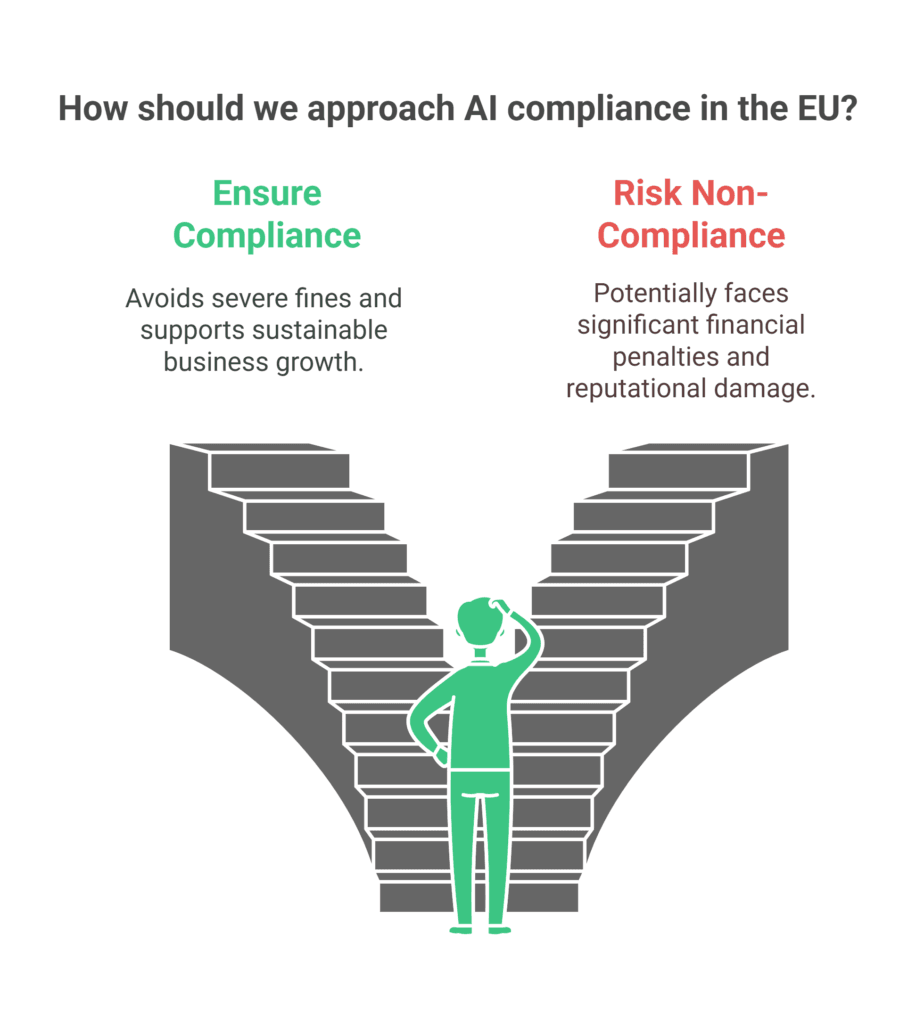
Are you ready for huge financial hits for ignoring AI rules in the European Union?

The EU Artificial Intelligence Act brings a complex set of rules.

These rules could hurt your business’s profits a lot.

Understanding non-compliance with AI laws in the EU is key.

The rules are strict for AI development and use.

If you break them, you could face fines up to €35 million or 7% of your global sales.

Businesses in Romania and companies worldwide in the EU must take these AI rules seriously.

The financial risks are big. So, following these rules is not just a must, but a smart move.

Key Takeaways

  • Maximum fines can reach €35 million or 7% of global turnover;
  • Three-tiered penalty system based on violation severity;
  • High-risk AI systems face stringent compliance requirements;
  • Penalties designed to be effective and dissuasive;
  • Compliance costs estimated at 17% overhead on AI spending.

Understanding the EU AI Act’s Penalty Framework

EU AI Act Regulatory Enforcement

The European Union has created a detailed plan to tackle algorithmic bias and ai accountability lapses with its AI Act.

As AI grows, from 58% use in 2019 to 72% by 2024, strong rules are needed.

Regulatory Authority Overview

The AI Act sets up a detailed system to handle AI transparency and oversight failures.

Key parts of this system include:

  • Comprehensive risk assessment methodology;
  • Proactive monitoring of AI system implementations;
  • Stringent compliance requirements.

Key Stakeholders and Enforcement Bodies

Many groups are key in making sure AI rules are followed across Europe. The main players are:

StakeholderResponsibility
European CommissionOverall regulatory supervision
National AuthoritiesLocal implementation and enforcement
AI ProvidersCompliance and risk mitigation

Scope of Application

The EU AI Act covers a wide range of AI system providers, including:

  1. Providers within the EU market;
  2. Importers and distributors;
  3. Product manufacturers using AI technologies.

The Act starts on 1 August 2024 and will be fully in place by 2 August 2026.

Companies must get ready for strict rules to avoid fines.

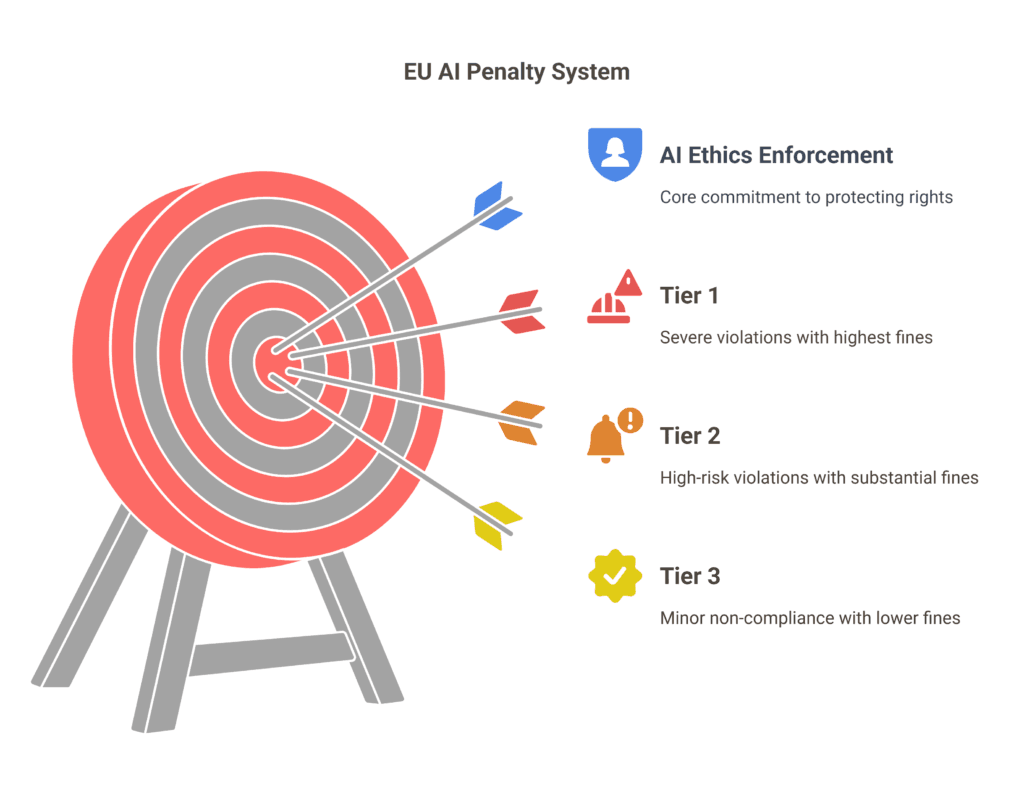
The Three-Tier Penalty System for AI Violations

EU AI Penalty


The European Union has a detailed three-tier penalty system for AI ethics and accountability.

This system ensures penalties match the severity of violations.

It’s part of the European AI governance framework.

The penalty tiers are designed to handle different levels of non-compliance:

  • Tier 1 (Severe Violations): Fines up to €35 million or 7% of global turnover;
  • Tier 2 (High-Risk Violations): Fines up to €20 million or 4% of global turnover;
  • Tier 3 (Minor Non-Compliance): Fines up to €10 million or 2% of global turnover.

Your organization needs to know these AI liability frameworks to avoid big financial risks.

The system targets specific problematic practices, including:

  1. Subliminal manipulation techniques;
  2. Exploitation of vulnerable populations;
  3. Unauthorized biometric identification systems;
  4. Social scoring mechanisms.

AI ethics enforcement is key as these penalties show the EU’s commitment to protecting individual rights.

Organizations must have strong risk management strategies to meet these complex regulatory needs.

By 2026, member states will have solid AI governance systems in place.

This makes proactive compliance a legal must and a strategic move for businesses in the European market.

Maximum Penalties and Financial Implications

The EU AI Act has a strict penalty system.

This could greatly affect your company’s money.

It’s key to know these fines to keep your AI transparent and avoid big money losses.

Penalties vary based on how well your AI follows the rules.

If your AI doesn’t meet standards, you could face big money penalties.

Calculation Methods for Fines

The EU has a clear way to figure out fines for AI mistakes.

They look at several things:

  • How bad the AI mistake is;
  • Your company’s yearly income;
  • What kind of AI mistake it is;
  • How much harm the AI could cause.

Impact on Company Revenue

The money impact can be huge.

For the worst AI mistakes, fines can be up to €40 million or 7% of your company’s yearly income.

These big fines show how important it is to check your AI well and be ready for problems.

Special Considerations for SMEs

The EU AI Act helps small businesses.

It has smaller fines for Small and Medium Enterprises.

This way, it keeps the rules strict but also considers if a small business can afford it.

Violation TypeMaximum Penalty
Prohibited AI Practices€40 million or 7% of turnover
High-Risk AI System Non-Compliance€20 million or 4% of turnover
Providing False Information€5 million or 1% of turnover

Being proactive about following the rules can help avoid these money problems.

It shows you care about using AI the right way.

Non-Compliance with AI Laws in the EU: A Detailed Look

The European Union’s rules on AI mark a big step towards responsible AI use.

It’s key for companies in the EU to understand these rules well.

The AI Act sets up a system to check AI systems based on their risks and how they affect society.

Some main reasons for not following EU AI laws include:

  • Not doing thorough risk checks;
  • Not being clear about how AI works;
  • Ignoring rules for AI accountability;
  • Not following ethical AI guidelines.

The rules vary based on the AI’s risk level.

High-risk AI systems have the toughest rules.

Companies need to be very careful to avoid big fines.

Risk CategoryCompliance RequirementsPotential Penalties
Unacceptable RiskComplete ProhibitionUp to €35 million
High-Risk SystemsExtensive DocumentationUp to 7% of Global Turnover
Limited RiskTransparency ObligationsUp to €15 million

Your company should focus on AI ethics and make strong plans for following the rules.

The EU AI Act asks for careful handling of AI, with a big focus on areas like education and law.

Also, 60% of companies don’t know the AI rules that apply to them.

This lack of knowledge is a big risk, with fines up to €30 million or 6% of global sales.

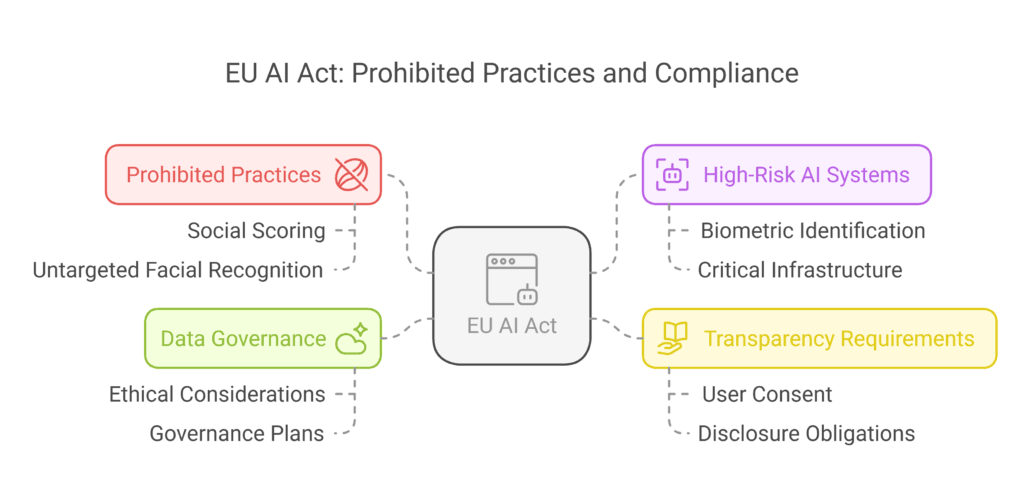
Prohibited AI Practices and Associated Penalties

Prohibited AI Practices and Associated Penalties

The European Union’s AI Act sets strict rules for using AI.

It aims to protect human rights and ensure AI is used responsibly.

Knowing what’s banned is key for companies to stay compliant and avoid big fines.

The EU has set limits for AI systems that could harm people or values.

These rules focus on practices that might hurt users or go against ethics.

High-Risk AI Systems: Complete Check

Companies need to check their AI systems carefully.

The rules highlight certain high-risk uses that need extra attention:

  • Biometric identification systems;
  • Critical infrastructure management;
  • Employment and workforce screening;
  • Educational assessment technologies;
  • Access to essential public and private services.

Transparency Violations and Consequences

Being open about AI use is critical.

Companies must tell people when they’re dealing with AI.

This ensures people know what’s happening and can give their consent.

Violation TypeMaximum Penalty
Prohibited AI Practices€35,000,000 or 7% global turnover
Specific Provision Breaches€15,000,000 or 3% global turnover
Misleading Information€7,500,000 or 1% global turnover

Data Governance and Ethical Considerations

AI must be developed with ethics in mind.

Certain activities are banned, including:

  1. Social scoring systems;
  2. Untargeted facial recognition;
  3. Emotional manipulation;
  4. Exploitative AI targeting vulnerable populations.

Your company needs to have strong AI governance plans.

This is to meet the complex rules and avoid legal trouble.

Impact on Business Operations and Compliance Costs

Dealing with AI legal risks is a big challenge for European businesses.

The EU AI Act brings new rules that affect how you run your business and your budget.

Small businesses find it hard to meet the new AI rules.

EU studies say one high-risk AI product could cost up to €400,000 to comply with.

These costs cover many areas:

  • Quality management system implementation;
  • Risk assessment documentation;
  • Transparency reporting;
  • Ongoing compliance monitoring.

Breaking AI rules in Europe can be very costly.

Fines can be up to 7% of global sales or €35 million.

Breaches of AI ethics also have serious effects beyond money.

Companies need to check their AI systems carefully.

They should:

  1. Do thorough risk assessments;
  2. Keep detailed records;
  3. Have clear AI rules;
  4. Keep checking for compliance.

Even though following these rules costs money, it can help you stay ahead.

Companies that follow these rules will earn more trust from customers.

They will also show they are responsible in the changing European rules.

Requirements for High-Risk AI Systems and Transparency Obligations

Requirements for High-Risk AI Systems and Transparency Obligations

The EU AI Act sets clear rules for managing high-risk AI systems.

It focuses on AI accountability EU and artificial intelligence governance.

These rules aim to stop unethical AI use by requiring clear transparency and documentation.

Understanding AI regulations is key for companies working with high-risk AI systems.

It’s important to know the main rules to follow.

Documentation Requirements

Your company must keep detailed records of AI system development.

These records should cover the whole life cycle of the AI.

They should include:

  • Comprehensive system description;
  • Development methodology;
  • Training data verification;
  • Performance metrics;
  • Risk assessment records.

Risk Management Systems

Having a strong risk management system is vital for ai accountability.

Your system should find, check, and lower risks in AI use.

Risk Management ComponentKey Requirements
IdentificationComprehensive risk assessment
EvaluationQuantitative and qualitative risk analysis
MitigationProactive risk reduction strategies

Quality Management Standards

The EU AI Act requires strict quality standards for high-risk AI systems.

Your quality system must keep checking, validating, and improving AI tech.

Following these rules shows your dedication to ethical AI development.

It also protects your company from fines under the eu ai act.

Compliance Strategies and Risk Mitigation

Understanding AI legal frameworks is complex.

Your company needs to act early to meet the EU AI Act’s standards by 2026.

This is key to avoiding legal issues.

Effective AI risk management strategies include:

  • Conduct thorough risk assessments for all AI systems;
  • Implement robust AI transparency protocols;
  • Develop detailed records of AI development processes;
  • Set up ongoing checks and evaluations.

AI oversight needs a detailed plan.

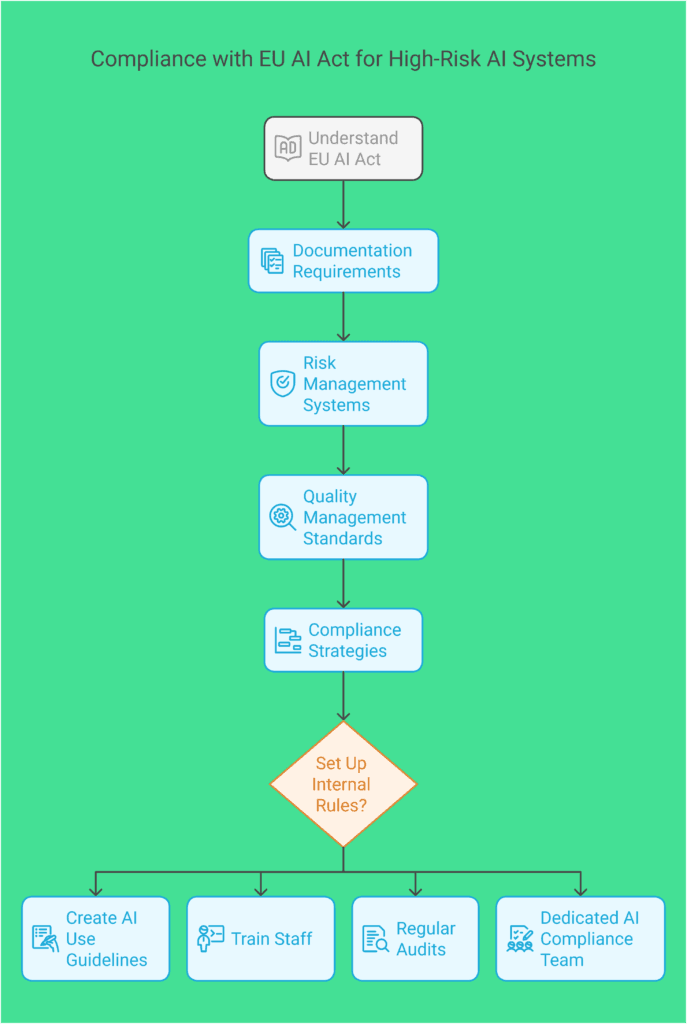
You must set up internal rules that follow the EU AI Act.

This means:

  1. Creating clear AI use guidelines;
  2. Training staff on legal rules;
  3. Carrying out regular audits;
  4. Having a dedicated AI compliance team.

There are big financial risks.

Fines can be up to €35 million or 7% of global sales.

Small businesses need to watch out for special penalty rules.

For expert advice on these rules, reach out to our Romanian Law Office.

Economic Impact of AI Regulation in the European Union

The European Union’s approach to AI governance is changing the digital world.

It has big economic effects.

Your business needs to get how the EU AI Act works.

This Act sets strict rules for AI.

It aims to make AI trustworthy while keeping innovation alive.

It’s all about finding a balance.

Experts say there will be big economic hurdles for EU businesses.

The Act’s rules will cost companies up to €36 billion.

Small businesses might struggle the most, needing to invest in complex risk management.

The impact goes beyond just the cost.

The EU is becoming a leader in responsible tech.

Your company can stand out by using ethical AI.

This could give you an edge in markets that value transparency.

Adapting to these new rules is key.

Companies that plan well for AI compliance will do better.

The rules push for tech that’s more responsible and focused on people.

FAQ

What are the key financial risks of non-compliance with the EU AI Act?

Not following the EU AI Act can lead to big fines.

These fines can be up to 7% of your global sales or €35 million, whichever is more.

These fines are meant to make companies follow AI rules in Europe.

How does the EU AI Act categorize AI systems for regulatory purposes?

The Act sorts AI systems by risk level.

High-risk systems, like those in critical areas, have strict rules.

The level of risk decides the rules and fines for each AI system.

What constitutes a transparency violation under the EU AI Act?

Not being clear when using an AI system is a big no-no.

It’s also wrong to hide how an AI works or what it can do.

These mistakes can lead to big fines and show the EU’s focus on AI fairness.

How will the EU AI Act impact small and medium-sized enterprises (SMEs)?

SMEs get special help under the Act.

They get easier ways to follow the rules and might get support.

But, they must also make sure their AI systems are up to par.

What are the primary prohibited AI practices under the regulation?

The Act bans AI that’s too risky.

This includes systems that identify people in real-time, score people, or manipulate them.

Breaking these rules can lead to the biggest fines.

How can businesses prepare for compliance with the EU AI Act?

To get ready, do a thorough AI check, set up good risk management, and be open about AI development.

Also, train staff on AI ethics and keep an eye on compliance.

Getting legal advice can also help a lot.

What are the key documentation requirements for high-risk AI systems?

High-risk AI systems need lots of records.

This includes risk checks, how well the AI works, and data used to train it.

These records help keep AI use honest and open.

How does the EU AI Act compare to other global AI regulations?

The EU AI Act is the most detailed AI rule globally.

It’s known for its focus on risk, ethics, and big fines for breaking the rules.

It might set a standard for AI rules around the world.

What are the possible long-term economic benefits of these regulations?

At first, following these rules might cost a lot.

But, they aim to make AI trustworthy.

This could give European companies an edge.

The EU wants to encourage innovation and trust in AI.

How will penalties be calculated under the EU AI Act?

Fines will depend on how serious the mistake is.

They could be a percentage of sales or a fixed amount.

The exact fine will look at the mistake, if it was on purpose, and how much harm it caused.

What is the EU AI Act?

The EU AI Act is a comprehensive regulatory framework designed by the European Union to govern the use and development of artificial intelligence within its member states.

This act categorizes ai systems into different risk levels, ensuring that high-risk AI systems are subject to strict compliance measures.

The AI Act aims to promote innovation while safeguarding fundamental rights and societal values, reflecting the EU’s commitment to ethical AI governance.

What are high-risk ai systems?

High-risk AI systems are defined under the EU AI Act as those that can significantly impact people’s lives, such as systems used in critical infrastructure, education, employment, law enforcement, and biometric identification.

These systems must comply with rigorous standards of transparency, accountability, and ethical considerations to mitigate potential risks to fundamental rights and ensure public safety.

What are the penalties for non-compliance with the EU AI Act?

The EU AI Act outlines significant penalties for non-compliance, which can include fines based on the annual turnover of the offending organization.

For serious violations, the penalties can reach up to 6% of the global revenue or €30 million, whichever is higher.

This stringent approach underscores the importance of adhering to the regulations set forth to promote safe and responsible AI practices.

What is considered non-compliance with the prohibition?

Non-compliance with the prohibition refers to the failure to adhere to specific restrictions imposed by the EU AI Act, particularly those regarding prohibited ai practices.

Examples include the use of social scoring systems or deploying AI models without sufficient transparency measures.

Organizations found in violation may face severe penalties, emphasizing the need for strict compliance with the regulatory framework.

What types of ai practices are prohibited under the EU AI Act?

The EU AI Act identifies several prohibited AI practices that pose a threat to fundamental rights and public safety.

These include systems that manipulate human behavior, exploit vulnerabilities.

Business Transfers in Romania: Fiscal and Legal Insights

Business Transfers in Romania: Fiscal and Legal Insights

business transfer in Romania

In Romania, only 14 Advance Pricing Agreements (APAs) were active by the end of 2020.

This shows how complex business transfers can be.

To navigate these, you need to understand the legal and fiscal rules well.

Thinking about buying a company in Romania?

You’ll face a complex set of rules.

Romania doesn’t have one law for all mergers and acquisitions.

Instead, it uses the civil code and many special laws.

To smoothly transfer ownership in Romania, you must know the local laws, taxes, and strategies.

Getting help from experts is key to understanding the complex world of Romanian business transfers.

Key Takeaways

  • Romanian business transfers require sophisticated legal and fiscal expertise;
  • No uniform M&A regulation exists in Romanian legislation;
  • Civil code serves as primary legal framework for transactions;
  • Complex tax and pricing documentation is mandatory;
  • Professional consultation is essential for successful transfers.

Understanding the Romanian M&A Landscape

M&A Romania


The Romanian mergers and acquisitions scene is growing fast.

It’s becoming a top spot for companies looking to change their structure.

The market is full of chances for growth and strategic moves.

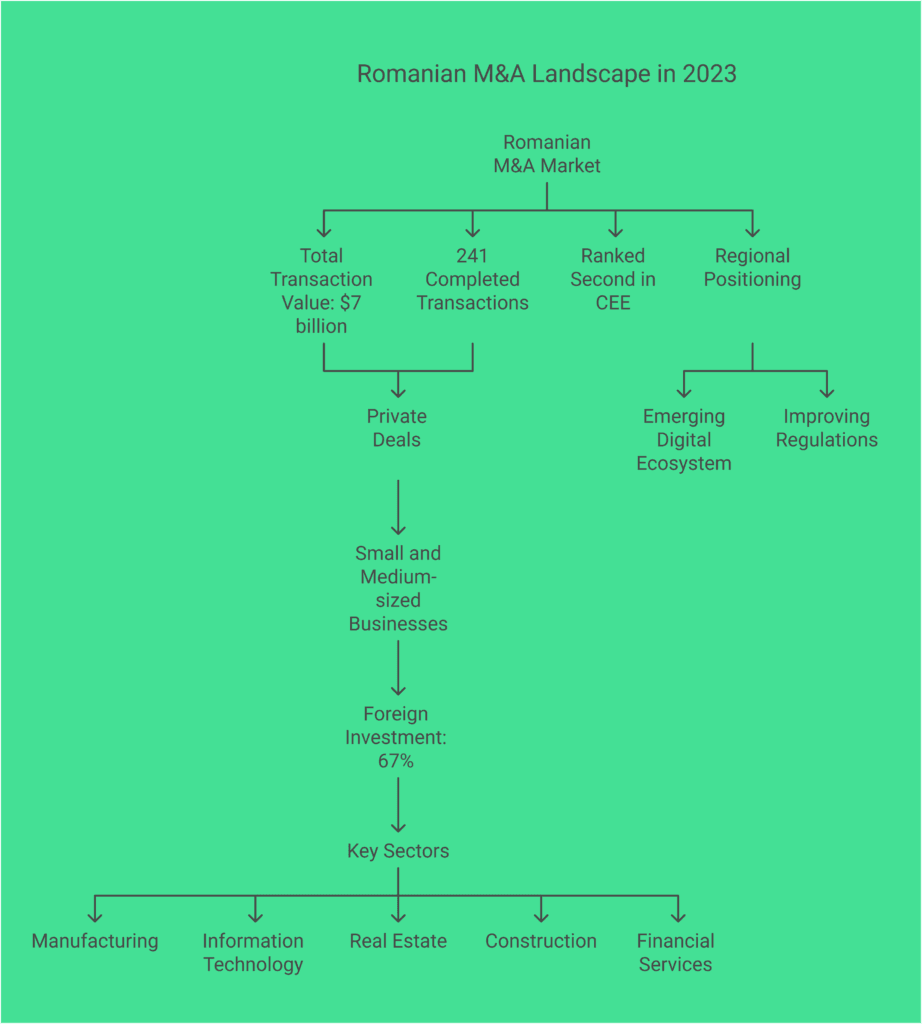
In 2023, the Romanian M&A market showed it’s strong.

Key signs point to its bright future:

  • Total transaction value reached approximately 7 billion dollars;
  • 241 completed ownership transition transactions;
  • Ranked second in Central and Eastern European M&A activity.

Market Dynamics and Trends

Most deals in Romania are private. Small and medium-sized businesses lead the way.

About 67% of deals come from outside, showing investors’ keen interest.

Sectoral Breakdown

The top sectors for mergers and acquisitions in Romania are:

  1. Manufacturing;
  2. Information Technology;
  3. Real Estate;
  4. Construction;
  5. Financial Services.

Regional Positioning

Romania is a major player in Central and Eastern Europe’s M&A scene.

Its location, emerging digital ecosystem, and improving rules attract investors.

They see great chances for restructuring their businesses here.

Legal Framework Governing Business Transfers in Romania

Romanian Business Transfer Legal Framework

Understanding the legal side of business transfers in Romania is key.

The rules are based on both national laws and EU directives.

This makes the process for handing over a business in Romania quite detailed.

Important legal parts of business transfers in Romania include:

  • Directive (EU) 2017/1132 on company law aspects;
  • Directive (EU) 2019/2121 addressing cross-border conversions;
  • Romanian Companies Law (Law 31/1990);
  • Financial Services Authority Regulation No. 5/2018.

Your plan for transferring a business must follow certain rules.

The Romanian laws set important rules and steps for business deals:

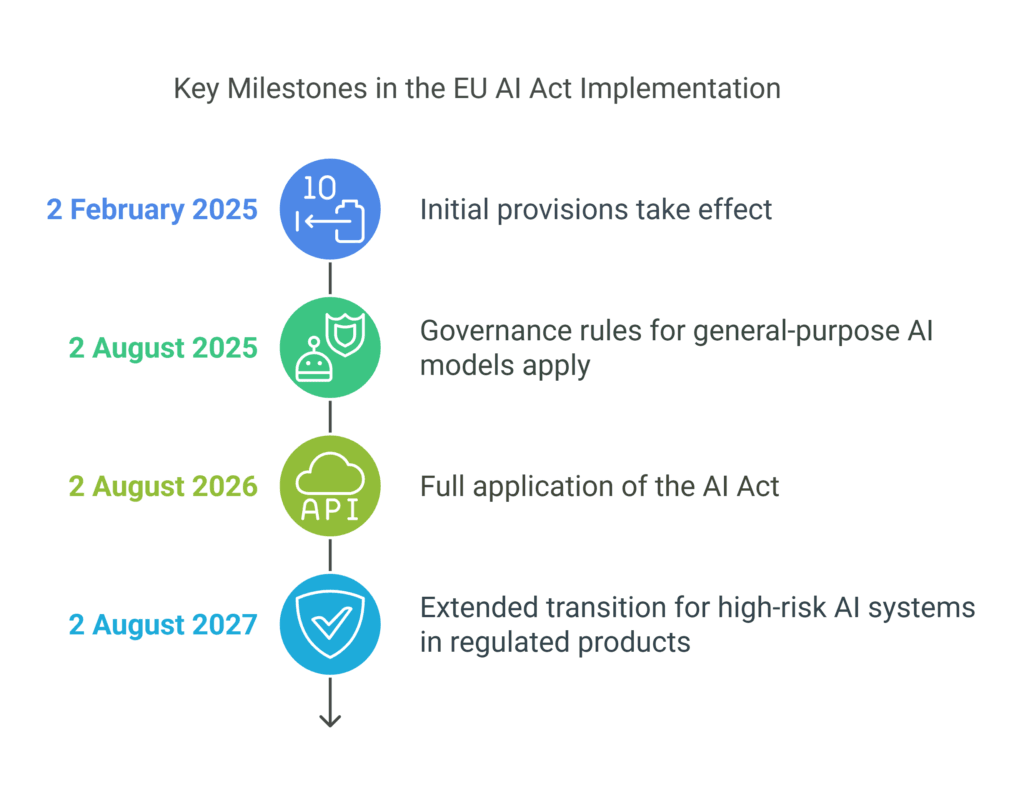
  1. Controlling interest is defined as holding 50% plus one voting right;
  2. Public takeovers become mandatory when an investor holds over 33% voting rights;
  3. Shareholders with more than 5% ownership can propose valuation methods;
  4. Mandatory notifications are required at specific ownership thresholds.

When you plan to transfer a business, you must follow strict rules.

Filings related to business combinations must be submitted within 24 hours of triggering events.

Also, merger plans need to be published in the Official Gazette of Romania.

International investors should know about recent changes.

Government Emergency Ordinance No. 108/2023 has made rules for foreign direct investment clearer.

This adds more complexity to business transfers in Romania.

Types of Business Transfers and Acquisitions

When thinking about company ownership changes in Romania, it’s key to know the different ways to transfer businesses.

Business leaders face complex choices between mergers, acquisitions, and other transfer methods.

These choices can greatly affect their business strategies.

In Romania, business succession planning mainly focuses on two main types: share deals and asset deals.

Each type has its own legal, financial, and operational implications for corporate transfers.

Mergers and Their Characteristics

Mergers are a complex way to join two companies into one. In Romania, mergers often mean:

  • Combining corporate structures;
  • Shared leadership and strategy;
  • Benefits in taxes and operations.

Acquisition Structures

Acquiring a business in Romania can be complex, with many strategies for different goals.

The main acquisition types are:

  1. Buying the whole target company;
  2. Buying a part of it;
  3. Making a strategic minority investment.

Asset vs. Share Deals

CharacteristicAsset DealsShare Deals
Transferable ElementsSpecific assets and some liabilitiesWhole company ownership
Tax ImplicationsSeller pays taxes16% capital gains tax for locals
ComplexityMore complex due to asset-by-asset transfersSmaller complexity in ownership change

For commercial enterprise transfer in Romania, knowing these detailed strategies helps businesses pick the best one.

This choice should match their goals and the market situation.

Foreign Direct Investment Regulations

Romania is a great place for business ownership change.

It has a solid framework for foreign direct investment (FDI).

This framework helps attract international investors.

It also guides foreign buyers on how to start or grow their business here.

Here are some important points about Romania’s FDI rules:

  • Mandatory screening for investments over €2 million;
  • Comprehensive national security and public order checks;
  • Environmental protection compliance requirements;
  • Specific sector-specific investment scrutiny.

Foreign investors need to understand Romania’s detailed rules when considering a business transfer here.

The investment screening process makes sure investments fit with national interests.

At the same time, it keeps the country open to investors.

FDI Regulation HighlightsKey Details
Screening Fee€10,000 (refundable under certain conditions)
Maximum Review Duration135 days
Penalty for Unauthorized InvestmentsUp to 10% of worldwide turnover

The Romanian FDI regime strikes a good balance.

It attracts foreign investments while safeguarding national interests.

Investors need to look closely at sector-specific rules, like in energy, telecommunications, and critical infrastructure.

Foreign investors should know about the detailed screening process for ownership changes.

The rules ensure transparency and national security.

They don’t block international business investments.

Business Transfer in Romania: Process and Requirements

Starting a commercial enterprise succession in Romania needs careful planning.

The process involves many important steps.

These steps focus on legal and financial details.

Understanding the framework for business transfers in Romania is key.

The process aims for transparency, legal compliance, and a smooth transfer of ownership.

Pre-Transfer Assessment

The first step is a detailed pre-transfer evaluation.

This phase is critical and includes:

  • Comprehensive financial review;
  • Valuation of company assets;
  • Identification of legal risks;
  • Verification of contracts.

Documentation Requirements

Business transfers need careful documentation.

You’ll need:

  1. Detailed financial statements;
  2. Shareholder agreements;
  3. Corporate registration documents;
  4. Tax compliance certificates.
Document TypeLegal RequirementProcessing Time
Share Transfer Approval75% Share Capital Consent7-14 Days
Registration CertificateRomanian Companies Law10 Days
Tax ClearanceMandatory Verification5-7 Days

Legal Compliance Steps

Legal compliance is essential for a smooth transfer.

Key steps are:

  • Notifying authorities;
  • Getting Competition Council approvals;
  • Completing registration processes.

Seeking expert legal advice is recommended.

For professional help, call our recommended Romanian legal experts at +40765366887.

Due Diligence in Romanian Business Transfers

When buying a company in Romania, due diligence is key.

It helps lower risks and makes sure the transfer goes well.

This step checks the investment in many ways.

When planning mergers and acquisitions in Romania, focus on several important areas:

  • Financial review of historical performance;
  • Legal compliance verification;
  • Operational infrastructure assessment;
  • Commercial and market analysis.

Business sales in Romania need careful checking.

Investors should look closely at financial reports, legal papers, and any rules that might affect the business.

Due Diligence CategoryKey Focus AreasPotential Risks
FinancialRevenue streams, profit marginsHidden liabilities
LegalContractual obligationsPending litigation
OperationalTechnology infrastructureInefficient processes

Experts say using new tech and getting help from experts is smart.

Good planning can really cut down on risks.

With a thorough due diligence, you’ll have a better shot at making a successful deal in Romania’s fast-changing market.

Tax Implications and Fiscal Considerations

Understanding tax laws in Romania is key for corporate transactions.

When you’re handling ownership changes, you’ll face many financial issues.

These can greatly affect your business strategy.

Romanian tax laws are complex for financial transfers.

Knowing the main tax points is vital.

It helps avoid risks and get the best financial results from your deal.

Transfer Pricing Requirements

The Romanian Fiscal Code requires strict rules for deals between related parties.

There’s been a rise in tax audits on these issues.

  • Mandatory documentation for related-party transactions;
  • Comprehensive reporting requirements;
  • Potential penalties for non-compliance.

VAT Implications

VAT is a big deal in business transfers.

Romania has its own VAT rules that businesses must follow:

  1. Standard VAT rate: 19%
  2. Reduced VAT rates: 9% and 5% for specific supplies
  3. VAT registration threshold: RON 300,000 annually

Corporate Tax Aspects

Corporate tax strategies are important for business transfers.

You need to think about tax liabilities, exemptions, and new laws.

Tax planning is essential to optimize your financial position during ownership transitions in Romania.

Strategic Sectors and Special Regulations

When you’re doing commercial transfers in Romania, knowing about strategic sectors is key.

The Romanian government watches business deals in important areas closely.

These areas affect national security and public order.

Foreign investors face a tough approval process in sensitive sectors.

The Commission for the Examination of Foreign Direct Investments (CEISD) checks these deals carefully.

Key Strategic Sectors Requiring Special Approval

  • Energy infrastructure;
  • Transport systems;
  • IT and communication networks;
  • Financial and banking services;
  • Critical national infrastructure;
  • Security-related industries.

For sales of companies in these key sectors, investors need special approvals.

The rules require a close look at deals over 2 million euros.

Recently, laws have changed, like the updates to Emergency Ordinance 46/2022.

These changes help protect national interests but also keep the investment climate good.

Investment Approval Considerations

  1. Comprehensive security assessment;
  2. Evaluation of national security risks;
  3. Check on the investor’s background;
  4. Look at how the deal affects key sectors.

Knowing these rules is vital for smooth business transfers in Romania’s strategic sectors.

Investors should team up with local legal advisors to get through these complex steps.

Role of Regulatory Bodies and Authorities

When you transfer business ownership in Romania, knowing the role of key regulatory bodies is key.

Your journey in corporate restructuring will meet several important authorities.

They oversee and validate business transactions.

Romanian business transfers need several regulatory frameworks for transparency and compliance.

These key institutions are vital in monitoring and approving corporate changes.

Competition Council Oversight

The Competition Council is a key watchdog in firm handovers. It has main duties:

  • Preventing anti-competitive market practices;
  • Reviewing merger and acquisition impacts;
  • Evaluating economic concentration transactions;
  • Protecting fair market competition.

When you transfer business ownership in Romania, you must tell the Competition Council for certain transactions.

This keeps the market transparent and stops monopolies.

M&A Regulatory

Financial Supervisory Authority Functions

The Financial Supervisory Authority (ASF) is key in corporate restructuring in Romania, mainly for financial institutions and listed companies. Its main tasks are:

  1. Regulating financial market transactions;
  2. Protecting investor interests;
  3. Ensuring compliance with financial regulations;
  4. Monitoring corporate governance standards.

Your business transfer plan must meet these regulatory needs for smooth, legal transactions in various sectors.

Knowing these regulatory frameworks helps you confidently and strategically navigate Romanian business transfers.

Cross-Border Transaction Considerations

Foreign investors must grasp the complex world of corporate takeovers in Romania.

The country has a strong legal setup to help with ownership changes.

It also protects national interests.

Key points for cross-border deals include:

The Romanian government has rules to attract foreign investment safely.

Foreign buyers need to know a few important things:

  1. They must report investments in sensitive areas;
  2. There could be a 5-8 month wait for FDI approval;
  3. They need to show detailed ownership details.

Taxes are very important in cross-border deals. Non-resident investors should know about specific tax rules:

Transaction TypeWithholding Tax RateSpecial Conditions
Dividends8%0% for EU companies with 10%+ shareholding
Interest16%Potential exemptions under EU directives
Royalties16%Reduced rates for specific agreements

It’s vital to understand these detailed rules for successful deals in Romania.

You must look at legal, financial, and regulatory aspects.

This ensures a smooth change in ownership.

Cross Border Transaction Romania

Recent Legislative Changes and Future Outlook

Romania’s business world is changing a lot in 2024.

This brings new chances for selling businesses and changing how companies work.

The rules for buying and selling companies are getting clearer.

Important changes are making the Romanian business scene different.

These changes affect how businesses operate:

  • Government Decision 300/2024 makes it easier to invest;
  • Emergency Ordinance 32/2024 changes how money is handled;
  • New rules for foreign investments.

2024 Regulatory Updates

Romania wants to make it easier for investors to come in.

If you’re thinking about selling your business in Romania, you’ll find it easier to start a new one.

The rules are clearer now.

Anticipated Changes

Romania’s economy is looking good, with a 3% GDP growth forecast for 2024-2025.

The government plans to make things better for businesses by:

  1. Making it easier to transfer businesses;
  2. Following EU rules;
  3. Welcoming more foreign investments.

If you’re looking to buy a business in Romania, now is a great time.

The mix of EU money and economic changes makes it a good place to invest.

Conclusion

Business divestment in Romania is complex and needs careful planning and legal knowledge.

When looking at corporate acquisitions, you must understand the detailed rules for business ownership changes in Romania.

This process includes legal steps, financial checks, and making strategic choices.

Your success in Romanian business transfers depends on thorough preparation and expert advice.

With about 690,000 small and medium-sized enterprises possibly changing hands soon, knowing the legal details is key.

The rules, like Law no. 31/1990, require focus on things like share transfer agreements and shareholder approvals.

Getting professional legal help is vital for these complex deals.

Romanian corporate law asks for accurate documents, like share transfer agreements and updated Articles of Association.

Working with skilled corporate lawyers can help avoid risks and make sure your business moves smoothly and legally.

For expert help with your business transfer, call Romania business transfer expert at tel. +40765366887.

Your careful planning will be key to the success of your corporate deal or business sale in Romania’s fast-changing market.

FAQ

What are the main types of business transfers in Romania?

In Romania, you can transfer businesses through mergers, acquisitions, asset deals, or share deals.

Mergers combine two companies into one.

Acquisitions mean one company buys another.

Asset deals transfer specific business assets, and share deals change who owns the company.

What are the key regulatory bodies involved in business transfers in Romania?

Several key groups watch over business transfers in Romania.

The Competition Council stops unfair competition.

The Financial Supervisory Authority looks after financial sector deals.

The Commission for the Examination of Foreign Direct Investments (CEISD) checks foreign investments.

What additional requirements exist for foreign investors in Romanian business transfers?

Foreign investors face extra rules, like national security checks under Emergency Ordinance 46/2022.

They must get extra approvals in key areas like energy and IT.

The CEISD reviews these deals to protect Romania’s interests and welcome foreign money.

How important is due diligence in Romanian business transfers?

Due diligence is very important in Romanian business transfers.

It checks the target business’s finances, laws, operations, and sales.

A good due diligence helps avoid risks and makes the transfer smooth.

It’s best to get experts to do a detailed check.

What tax considerations are critical in Romanian business transfers?

Important tax issues include following the arm’s length principle, VAT, and corporate taxes.

With more audits on transfer pricing, it’s key to document and justify prices.

You should also think about tax breaks, delays, and new tax laws that might affect your deal.

What are the primary challenges in cross-border business transfers in Romania?

Dealing with international rules is a big challenge in cross-border transfers in Romania.

You face issues like currency, legal systems, security checks, and taxes.

Getting help from Romanian legal and financial experts  is vital for these complex deals.

How has the Romanian M&A landscape changed in recent years?

The Romanian M&A market has seen big changes, like the COVID-19 pandemic and global tensions.

Romania is a strong player in Central and Eastern Europe, with more interest in tech, green energy, and finance.

New laws aim to make it easier for foreign investors to come in.

What documentation is typically required for a business transfer in Romania?

You’ll need lots of documents for a business transfer in Romania.

These include financial statements, legal papers, shareholder agreements, and tax certificates.

Depending on the deal, you might also need environmental reports, security clearances, and more.


Best Practices for Ensuring AI Compliance in European Businesses

Best Practices for Ensuring AI Compliance in European Businesses

A staggering €35 million or 7% of a company’s worldwide annual turnover – that’s the maximum fine for violating AI rules under the EU AI Act.

This law, signed on August 1st, 2024, will change how European businesses handle AI.

Companies have until 2026 to make sure their AI practices meet these new standards.

The EU AI Act sets up a detailed framework for AI rules.

It divides AI systems into four risk levels: unacceptable, high, limited, and minimal.

This system is key to managing AI risks, making companies review their AI use and ensure they follow the rules.

AI Compliance in European Businesses

For European businesses, like those in Romania, it’s vital to understand and follow these rules.

The Act affects any company whose AI systems touch EU residents.

This shows how important it is to have strong AI compliance measures, not just to avoid fines but to promote responsible innovation.

Key Takeaways

  • EU AI Act enforces strict penalties for non-compliance, up to €35 million or 7% of annual turnover;
  • Full implementation expected by 2026, requiring immediate action from businesses;
  • AI systems categorized into four risk levels, with specific requirements for each;
  • Global impact: regulations apply to all AI systems affecting EU residents;
  • Emphasis on transparency, accountability, and ethical AI development.

Understanding the EU AI Act Framework and Scope

EU AI Act framework

The EU AI Act is a big step in regulating AI in Europe.

It aims to make AI trustworthy and encourage innovation.

Let’s explore its main points and how it affects businesses.

Key Objectives and Principles

The AI Act focuses on making AI accountable and transparent.

It uses a risk-based approach, dividing AI systems into four levels.

This balance aims to protect safety and rights while allowing innovation.

  • Unacceptable risk: 8 prohibited practices;
  • High risk: Strict obligations for critical applications;
  • Limited risk: Transparency requirements;
  • Minimal risk: No specific rules.

Stakeholders Affected by the Regulation

The EU AI Act affects many in the AI field.

Providers, deployers, importers, and distributors must follow rules based on their role and AI’s risk level.

This ensures AI is used responsibly.

Timeline for Implementation

The EU AI Act will be implemented in phases:

  • 2 February 2025: Initial provisions take effect;
  • 2 August 2025: Governance rules for general-purpose AI models apply;
  • 2 August 2026: Full application of the AI Act;
  • 2 August 2027: Extended transition for high-risk AI systems in regulated products.

This timeline helps businesses adjust and meet the new AI rules.

It supports the growth of reliable AI systems.

EU AI Act Framework

AI Compliance in European Businesses: Risk Classification System

The European AI strategy has a detailed risk classification system for AI.

It aims to ensure ai fairness and ethics.

It also promotes responsible ai deployment in different sectors.

Prohibited AI Practices

The EU AI Act bans some AI uses.

These include systems for controlling behavior, social scoring, and real-time biometric identification.

This rule helps protect fundamental rights, as part of the European AI strategy.

High-Risk AI Systems

High-risk AI systems have strict rules.

They are used in critical areas like infrastructure, education, and law enforcement.

These systems need thorough ai audits and must pass conformity assessments before they can be used.

AI compliance risk classification

Limited and Minimal Risk Categories

AI systems with lower risks have less strict rules.

They don’t have to follow specific laws but are encouraged to follow voluntary guidelines.

This balance allows for innovation while keeping ethics in mind.

Risk CategoryExamplesRegulatory Approach
ProhibitedSocial scoring AIBanned
High-RiskAI in critical infrastructureStrict regulations
Limited RiskChatbotsTransparency requirements
Minimal RiskAI-enhanced video gamesVoluntary guidelines

Essential Requirements for AI System Providers and Deployers

The EU AI Act has strict rules for AI system providers and deployers.

These rules aim to make AI trustworthy and follow ethical practices.

Providers must prepare AI systems carefully before they hit the market.

Deployers focus on using these systems safely and legally.

AI providers must take strong steps to protect privacy and manage data well.

They also need to keep detailed records for 10 years after the system is introduced.

This helps follow AI regulation and improve data privacy.

Deployers are key to keeping AI trustworthy.

They must keep system logs for at least six months.

They also need to report serious incidents within 15 days.

For big disruptions, they have only two days to report.

RequirementProvidersDeployers
Documentation Retention10 years6 months (logs)
Incident Reporting15 days15 days
Critical Incident Reporting2 days2 days
CE MarkingRequiredNot applicable

Providers must put CE markings on high-risk AI systems.

They also need to have an EU representative if they’re outside the union.

These steps help meet AI regulation standards in the European market.

Data Governance and Privacy Requirements

As AI Regulation in Europe evolves, businesses face complex data governance and privacy rules.

The EU AI Act, set to take effect in 2026, brings new challenges.

It works with GDPR to ensure strong AI ethics and governance.

GDPR Alignment with AI Systems

AI systems must follow GDPR principles like lawfulness, fairness, and transparency.

You must ensure your AI practices meet these standards, mainly for high-risk areas like finance and healthcare.

Do Data Protection Impact Assessments for high-risk activities to stay compliant.

Data Quality and Management Standards

High-quality data is vital for ai bias mitigation and following rules.

The EU AI Act stresses strict data management, mainly for high-risk AI systems.

You need to have strong data governance to avoid penalties and keep client trust.

This includes managing various data sources well and ensuring data minimization.

Documentation and Record-Keeping

Keeping detailed records is essential to show you’re following the rules.

Keep records of AI training data, biases, and system performance.

For high-risk AI systems, log activity and do regular checks.

Also, remember, importers must keep EU declarations of conformity and technical documentation for ten years after market placement.

By focusing on these data governance and privacy needs, you’ll be ready for the changing AI regulation in Europe.

This will help you develop ethical and responsible AI.

Transparency and Explainability Obligations

The EU AI Act makes it clear how AI systems must be transparent and explainable.

These rules help make sure AI is fair and protects privacy.

Companies need to tell users when they’re dealing with AI, unless it’s very obvious or used for legal reasons like catching criminals.

For AI systems that are very high-risk, providers must give ‘instructions for use’.

These instructions should include details on how the system works, its accuracy, and its security.

The Act also requires detailed technical documents for audits and ongoing checks.

AI-generated content, like deepfakes, must be labeled as artificial.

This helps stop fake information and protects people.

The Act also creates a database for high-risk AI systems.

This makes it easier for the public to learn about these technologies.

  • High-risk AI systems need to be transparent so users understand how they work;
  • AI companies must tell users when they’re not talking to a human;
  • Providers must make sure their AI solutions are effective, work well together, are strong, and reliable.

These rules help follow ethical AI guidelines and support AI governance.

By being open and clear, businesses can gain trust and follow the EU AI Act.

This could lead to more people using AI and feeling confident about it.

Risk Management and Compliance Monitoring

European businesses need strong risk management and compliance monitoring to follow the EU AI Act.

These steps help make sure AI is trustworthy and keeps data safe.

Risk Assessment Frameworks

Businesses must create detailed risk assessment frameworks for AI accountability.

These frameworks spot risks, check their impact, and plan how to fix them.

Regular checks help companies stay on top of new challenges and follow rules.

Continuous Monitoring Systems

It’s key to have systems that watch AI all the time.

These systems check how AI is doing, find odd things, and make sure it follows rules.

By always watching AI, companies can catch and fix problems early.

Incident Response Protocols

Having clear plans for AI problems is very important.

These plans should say how to find, report, and fix issues.

Quick action helps reduce harm and shows a company’s commitment to AI safety.

ComponentPurposeKey Benefits
Risk AssessmentIdentify and evaluate AI risksProactive risk mitigation
Continuous MonitoringTrack AI system performanceEarly issue detection
Incident ResponseAddress AI-related issuesMinimize possible damages

By using these risk management and compliance monitoring steps, European businesses can make sure their AI systems follow rules.

This keeps trust with everyone involved.

Penalties and Enforcement Measures

The EU AI Act has strict penalties for not following the rules.

It focuses on making sure AI is transparent and private.

Businesses need to know these rules to avoid fines and stay in line with GDPR and AI laws.

Financial Penalties Structure

The Act has a system of fines based on how serious the violation is:

  • Up to €35 million or 7% of global annual turnover for prohibited AI practices;
  • Up to €15 million or 3% for violations of specific provisions;
  • Up to €7.5 million or 1% for providing misleading information.

Small businesses are capped at lower fines to help them stay afloat while keeping the rules strict.

Compliance Violations Categories

Violations are split into levels based on their impact on AI safety and ethics.

Serious violations include banned AI practices.

Less serious ones might be not monitoring AI well or not keeping proper records.

Enforcement Mechanisms

Here’s how the AI Act will be enforced:

  • Member States report to the European Commission every year;
  • The new AI Office will watch over General-Purpose AI Models;
  • Authorities can investigate and take documents.

These steps help keep AI safe and transparent across the EU.

Violation TypeMaximum FineEffective Date
Prohibited AI Practices€35M or 7% of turnoverAugust 2, 2025
Other Obligations€15M or 3% of turnoverAugust 2, 2025
Misleading Information€7.5M or 1% of turnoverAugust 2, 2025

Implementation Strategies for Business Compliance

The EU AI Act will start in August 2026. Businesses need to act fast to follow the rules.

They must set up strong ai governance frameworks.

These should cover risk assessment, quality management, and cybersecurity to protect data and avoid risks.

Companies should keep a list of their AI use cases and systems.

This list helps them know where they need to focus on compliance.

They also need to do regular checks and audits to make sure AI systems are fair and transparent.

Building trustworthy AI is key to following the rules.

This means adding privacy and ethics into AI development from the start.

Companies should also have clear rules with AI vendors and check AI systems often for fairness and accuracy.

Training programs are important for AI risks.

Employees working with critical systems, like those making credit decisions, need more training.

This is different from those doing less sensitive tasks.

If you need help with these strategies, contact our lawyers in Romania at office@theromanianlawyers.com.

Our Romanian law office can offer great advice on AI compliance for European businesses.

Challenges and Considerations for Global Companies

Global companies face unique challenges in implementing responsible AI deployment strategies that comply with the EU AI Act.

They must harmonize international AI regulations with robust ai risk mitigation strategies.

Companies need to navigate diverse regulatory landscapes while keeping up with EU standards.

A key challenge is conducting thorough ai bias and fairness audits across different cultural contexts.

They need to develop culturally sensitive evaluation methods.

This ensures AI systems remain unbiased and fair in various global markets.

Implementing AI transparency and accountability measures on a global scale is another hurdle.

Companies must create standardized processes for explaining AI decisions to stakeholders from diverse backgrounds.

This may involve developing multilingual explainability tools and adapting communication strategies to local norms.

ChallengeImpactMitigation Strategy
Regulatory HarmonizationIncreased compliance costsDevelop unified global compliance framework
Cross-cultural Bias AuditsPotential market exclusionCulturally-sensitive AI evaluation methods
Global TransparencyTrust issues in local marketsMultilingual explainability tools

While challenging, early compliance with the EU AI Act can provide a strategic advantage.

As other regions look to the EU as a model for AI regulations, companies that adapt now may find themselves better positioned in the global market.

AI Deployment

Future Trends and Evolving Regulatory Landscape

The AI regulatory scene is changing fast. By 2026, the EU AI Act will fully come into play.

It will bring a new risk-based system for AI apps.

This means companies will need to update their privacy and security measures.

Recent stats show AI governance is becoming more critical:

  • 56% of organizations plan to use Generative AI in the next year;
  • 72% of companies already use AI, seeing improvements in many areas;
  • Only 18% of organizations have a council for responsible AI governance.

As rules get stricter, companies could face big fines.

The EU AI Act might fine violators up to €35 million or 7% of their global income.

To keep up, companies need to train their AI teams and follow strict ethics guidelines.

The future of AI rules will include more audits and risk checks.

Healthcare and finance will need special plans to use AI ethically and follow the law.

Conclusion: Embracing Ethical AI for Sustainable Growth

The EU AI Act is a big change in artificial intelligence.

It got 523 votes in favor, setting a new AI governance standard.

Your business needs to follow these rules to avoid fines up to 7% of global turnover.

It’s important to have a good ai risk assessment strategy.

The Act covers all AI systems in the EU market, no matter where they are.

High-risk AI systems must go through checks and be registered in an EU database.

This ensures AI systems are safe and trustworthy.

It also makes sure they respect basic rights.

Ai fairness testing is now a must for following the rules.

The European AI Office will make sure everyone follows the Act.

There’s also an AI Sandbox for testing within ethical limits.

These rules start on August 1, 2024, with most parts taking effect on August 2, 2026.

Understanding the EU AI regulation can be tough.

For help with compliance, contact our lawyers in Romania at office@theromanianlawyers.com.

By using ethical AI, your business can grow sustainably in this new AI world.

FAQ

What is the EU AI Act and why is it important for European businesses?

The EU AI Act is a new rule for AI in the European Union.

It helps businesses by setting rules for ethical AI use.

It also makes sure AI is governed well and meets certain standards.

How does the EU AI Act classify AI systems based on risk?

The Act sorts AI systems into four risk levels.

There are banned practices, high-risk systems, systems with limited risk, and those with minimal risk.

Each level has its own rules. Knowing this helps businesses understand their duties.

What are the essential requirements for AI system providers and deployers under the EU AI Act?

Providers and deployers must focus on data quality and system reliability.

They also need to ensure human oversight and transparency.

These steps are key from start to finish to follow the Act’s rules.

How does the EU AI Act intersect with existing data protection regulations like GDPR?

The Act works with the GDPR to protect data.

Businesses must follow GDPR rules for AI use.

Keeping data safe and well-documented is essential for following both laws.

What are the transparency and explainability requirements under the EU AI Act?

The Act requires clear information about AI systems.

Businesses must make AI decisions clear and explainable.

This builds trust and follows the regulation.

What risk management and compliance monitoring measures are required by the EU AI Act?

The Act demands good risk management and constant checks.

Businesses need to have plans for risks and keep an eye on their AI systems.

This keeps them in line with the Act.

What are the penalties for non-compliance with the EU AI Act?

Breaking the Act can cost up to €30 million or 6% of global sales.

The fine depends on the violation’s impact.

This shows how serious following the Act is.

How can businesses implement AI compliance measures in line with the EU AI Act?

Businesses can start by making AI inventories and doing impact assessments.

They should also think about privacy and ethics in AI.

Keeping AI systems up to date is key.

For complex issues, getting legal advice is a good idea.

What challenges do global companies face in complying with the EU AI Act?

Global companies must align with many AI rules worldwide.

They need a global plan for AI compliance.

This means adjusting their current systems to fit EU rules.

What future trends are expected in AI regulation?

We might see more AI offices and independent bodies.

The rules will likely change, so businesses need to stay updated.

Being ethical and flexible in AI compliance is important for growth.


Payment Ordinance Procedure in Romania – Bucharest Lawyers

Payment Ordinance Procedure in Romania – Bucharest Lawyers

Are you having trouble getting debts paid back in Romania?

You might want to know about the payment ordinance procedure.

It’s fast, with debtors needing to pay within 15 days after getting a notice.

Lawyers in Bucharest can guide you through this process, helping you understand the rules and laws.


payment ordinance procedure in Romania


Introduction to Payment Ordinance Procedure

The payment ordinance procedure in Romania helps creditors get their money back.

It starts with filing a payment ordinance with the court.

Then, the court sends a payment order to the debtor.

Our Lawyers in Bucharest can help you with this, making sure you follow the rules and laws.

Key Takeaways

  • The payment ordinance procedure in Romania is a fast method for debt recovery.
  • The debtor must pay the debt within 15 days of receiving the payment notice, as per the payment rules in Romania.
  • Lawyers in Bucharest, Romania can provide expert guidance on the payment ordinance procedure.
  • The payment ordinance procedure involves filing a payment ordinance with the court.
  • The court issues a payment order to the debtor, who must comply with the payment laws in Romania.
  • creditors can navigate the payment rules in Romania with the help of lawyers in Bucharest, Romania.

Understanding the Payment Ordinance Framework in Romania

To understand the payment ordinance procedure in Romania, knowing the legal basis is key.

The framework is based on the Romanian Civil Procedure Code.

It’s part of the broader laws on payments in Romania, aimed at making debt recovery efficient.

The payment ordinance procedure only applies to certain debts.

Not all debts can be recovered this way.

It’s important to know if a claim fits within this framework.

The laws and regulations in Romania help shape this framework, ensuring it meets European standards.

The payment ordinance framework is based on the Romanian Civil Procedure Code.

It applies to specific claims.

This makes it a simpler way to recover debts for individuals and businesses in Romania.

Understanding this framework helps in navigating debt recovery processes better.

payment ordinance framework

The payment ordinance procedure is governed by specific rules in the Romanian Civil Procedure Code.

This ensures it follows the payment legislation in Romania.

This framework is vital for the procedure’s integrity and effectiveness, providing a clear process for debt recovery.

Essential Requirements for Filing a Payment Ordinance

To file a payment ordinance, you need to follow certain rules.

The Romanian Civil Procedure Code outlines these rules.

You must show proof of the debt, like a written contract.

It’s important to know the Romanian payment laws and regulations.

This helps ensure the payment ordinance is filed right.

The payment legislation in Romania has specific rules.

The creditor must offer guarantees that cover the debt and any future interests.

Taxpayers have 30 days to provide these guarantees after agreeing to the payment plan.

Some key points to consider when filing a payment ordinance include:

  • Providing evidence of the debt, such as a written contract or agreement;
  • Meeting the requirements specified in the Romanian Civil Procedure Code;
  • Understanding the payment regulations in Romania and the payment legislation in Romania.


payment ordinance requirements

By following these essential steps, you can file the payment ordinance correctly.

This helps you recover the debt effectively.

Knowing the payment ordinance requirements and Romanian payment laws is key to success.

The Payment Ordinance Procedure in Romania: Step-by-Step Guide

The process begins with a formal demand letter to the debtor.

This letter asks for payment within 15 days.

The payment ordinance procedure has several steps.

These include preparing documents, filing them, going to court, and enforcing the order.

Following the Romanian payment laws is vital for a smooth process.

A well-drafted payment notice can greatly help in recovering debts.

payment ordinance procedure in Romania

  • Document preparation: The creditor must prepare the necessary documents, including the payment ordinance and supporting evidence.
  • Filing process: The creditor files the documents with the court, and the court issues a payment order to the debtor.
  • Court proceedings: If the debtor fails to pay, the creditor can initiate enforcement proceedings.
  • Enforcement mechanisms: The payment ordinance can be enforced if the debtor fails to comply within a specified period, usually 30 days.

Getting professional legal help is advised for the payment ordinance procedure.

A step-by-step guide can help creditors.

It ensures they follow the Romanian payment laws and payment legislation in Romania to recover debts effectively.

Payment Ordinance Romania

Legal Timeframes and Deadlines

Knowing the payment ordinance deadlines is key for both creditors and debtors in Romania.

The payment ordinance has specific times and deadlines.

For example, debtors have a certain time to pay their debts.

If they don’t, creditors can start enforcement actions.

The rules in Romania help the payment ordinance work well.

They make sure creditors can get their money back.

It’s important to know the rules, like when to file a payment ordinance and how long debtors have to respond.

These deadlines help keep the process fair and quick.

Some important deadlines include:

  • The timeframe for the debtor to pay the debt;
  • The deadline for the creditor to initiate enforcement proceedings;
  • The timeframe for the debtor to respond to the payment ordinance.

payment ordinance deadlines

Understanding the payment ordinance deadlines and rules in Romania helps both sides.

It’s vital to follow the law and meet deadlines for a good outcome.

Common Challenges in Payment Ordinance Cases

Dealing with payment ordinance cases in Romania can be tough.

Creditors often face hurdles in getting their debts back.

This is due to the complex Romanian payment laws and regulations.

Some common problems include issues with documents, procedural hurdles, and trouble enforcing payments.

Creditors must provide detailed documents to support their claims.

Any mistakes can cause delays or even stop the case.

Procedural issues, like problems with serving the debtor, can also happen.

Enforcement can be hard when debtors don’t follow the payment plan.

In these cases, creditors might need to take extra steps to get their money back.

To tackle these issues, creditors can get help from a law firm.

A Romanian law firm with experience in payment ordinance cases can guide them.

They can help understand the payment laws and regulations in Romania.

By getting professional help, creditors can improve their chances of recovering debts.

This way, they can also reduce the risks of facing payment ordinance challenges.

Some important statistics to keep in mind for payment ordinance cases in Romania include:

  • 6,022 undertakings filed for insolvency in Romania by the end of November 2022, representing a 10.64% increase compared to the previous year.
  • 143,828 legal entities or authorized natural persons registered with the Trade Registry as of November 2022, indicating a growth of 2.99% from 2021.
  • challenges debt collection

Role of Legal Representation in Payment Ordinance Procedures

Understanding the role of legal representation is key when dealing with payment ordinance procedures in Romania.

The process can be complex.

Creditors often find it helpful to get expert advice to make sure they’re on the right path.

Romanian payment laws and regulations can be hard to grasp, making legal help essential.

Lawyers who specialize in payment ordinance legal representation offer great support.

They help creditors understand the process and ensure they follow the right steps.

This way, creditors can avoid mistakes and make the most of their rights under Romanian payment laws.

Here are some benefits of getting professional legal help in payment ordinance procedures:

  • Expert guidance on payment regulations in Romania;
  • Assistance with navigating payment legislation in Romania;
  • Representation in court proceedings;
  • Help with enforcing payment ordinances.

Seeking advice from a Romanian law firm like Atrium can be very helpful.

Our debt collection Romanian Lawyers have deep knowledge of Romanian payment laws and regulations.

This means creditors can be confident their case is in capable hands.

Cost Considerations and Financial Implications

When dealing with the payment ordinance in Romania, costs are a big factor.

You’ll face court fees and enforcement costs.

Knowing the payment laws can help you save money.

The laws aim to help creditors get their money back, but be ready for the costs.

The economic growth in Romania, about 2% in 2023, might influence the payment process.

The country’s current account deficit went down from 9.3% of GDP in 2022 to 7.0% in 2023.

This change could affect the financial side of things. Getting advice from experts is key to understanding these costs.

Here’s a quick look at the main costs for the payment ordinance in Romania:

  • Court fees: These vary by court and procedure.
  • Enforcement costs: This includes fees for bailiffs, lawyers, and more.
  • Legal fees: A lawyer can be expensive but helps save money in the long run.

Knowing the payment rules in Romania and the costs can help you make smart choices.

It’s important to get advice to save money and get the best results.

Conclusion: Securing Your Interests Through Professional Legal Support

When dealing with the payment ordinance in Romania, getting professional legal help is key.

Lawyers in Bucharest, Romania, who know about Romanian payment laws, payment regulations, and payment legislation can guide you.

They help you recover your debts effectively.

The payment ordinance process is complex.

Creditors who get legal advice are more likely to get good results.

Experienced Romanian attorneys protect your rights and interests.

Our specialized team of Romanian Lawyers explain the payment ordinance procedure, help you follow the right steps, and solve any problems.

This helps you protect your financial interests and get the money you’re owed.

FAQ

What is the payment ordinance procedure in Romania?

In Romania, the payment ordinance procedure helps creditors get their money back from debtors.

It starts with filing a payment ordinance with the court.

The court then sends a payment order to the debtor.

The debtor must pay the debt within a certain time.

If they don’t, the creditor can start enforcement actions.

What is the legal basis for the payment ordinance procedure in Romania?

The payment ordinance process in Romania is based on the Romanian Civil Procedure Code.

This code gives the legal foundation for the process.

What are the key requirements for filing a payment ordinance in Romania?

To file a payment ordinance, the creditor needs to show proof of the debt.

This can be a written contract or agreement.

They must also follow the rules in the Romanian Civil Procedure Code.

What are the steps involved in the payment ordinance procedure in Romania?

The payment ordinance process in Romania has several steps.

First, the creditor prepares the necessary documents.

Then, they file these documents with the court.

The court issues a payment order to the debtor after this.

This order tells the debtor to pay the debt.

What are the legal timeframes and deadlines for the payment ordinance procedure in Romania?

The payment ordinance process in Romania has specific time limits.

The debtor has a certain time to pay the debt.

If they don’t, the creditor can start enforcement actions.

What are the common challenges in payment ordinance cases in Romania?

In Romania, common challenges in payment ordinance cases include issues with documents and procedural obstacles.

Enforcement difficulties are also common.

How can legal representation benefit creditors in the payment ordinance procedure in Romania?

Legal help is very important in the payment ordinance process in Romania.

Lawyers can guide creditors through the process.

They can also help creditors understand their rights and obligations.

Lawyers can make navigating the legal system easier for creditors.

What are the cost implications of the payment ordinance procedure in Romania?

The payment ordinance process in Romania can be costly.

There are court fees and enforcement costs.

Creditors should get expert advice to reduce these costs.

What is the Payment Ordinance procedure in Romania?

The Payment Ordinance procedure in Romania is a special legal procedure designed for debt recovery.

It is governed by the Romanian Civil Procedure Code and allows creditors to obtain a court decision for the payment of a debt in a faster and more efficient manner compared to regular litigation.

This procedure is particularly useful for undisputed debts and aims to simplify the debt collection process in Romania.

Who can use the Payment Ordinance procedure in Romania?

The Payment Ordinance procedure can be used by both individuals and legal entities acting as creditors.

It is available for creditors seeking to recover monetary debts that are certain, liquid, and due.

This procedure is particularly useful for businesses, including those represented by Bucharest lawyers, seeking to recover outstanding payments from their debtors.

What are the main advantages of using the Payment Ordinance procedure?

The main advantages of the Payment Ordinance procedure include:

1. Faster resolution compared to standard litigation;

2. Simplified procedure with less formal requirements;

3. Lower legal fees and court fees;

4. Possibility to obtain an enforceable court decision in a shorter timeframe;

5. Applicable for both domestic and cross-border debt recovery cases within the EU.

Criminal Defence Attorney for Drug Charges in Romania

Criminal Defense Attorney for Drug Charges in Romania

When faced with serious accusations for  criminal defense drug charges Romania , do you know what steps to take to protect your rights?

Many people underestimate the complexity of legal systems, especially when dealing with high-stakes cases.

Acting quickly and decisively can make all the difference in the outcome.

Understanding your rights is crucial.

You deserve expert guidance to navigate the criminal legal process effectively.

Our team is dedicated to providing the support you need to safeguard your freedom and ensure fair treatment.

criminal defense attorney for drug charges Romania

If you find yourself in a challenging situation, don’t wait.

Immediate legal advice is essential.

Call us at (004) 0765366887 for a consultation.

We’re here to help you understand the law and take the right steps forward.

Key Takeaways

  • Act quickly to protect your rights in serious legal situations.
  • Expert guidance is essential for navigating complex legal processes.
  • Understanding the law can significantly impact your case’s outcome.
  • Immediate legal advice ensures you take the right steps from the start.
  • Our team of Romanian Lawyers is dedicated to safeguarding your freedom and rights.

Overview of Drug Laws in Romania

Romania’s drug laws are strict, and knowing their specifics can significantly impact your legal strategy.

The primary legislation governing these offenses is Law No. 143/2000.

This law outlines the definitions, penalties, and procedures related to controlled substances.

drug laws in Romania

Key Provisions of Law No. 143/2000

Law No. 143/2000 classifies controlled substances into three categories based on their potential for abuse and medical use.

The law defines illegal activities such as possession, trafficking, and production.

It also sets clear guidelines for law enforcement and judicial procedures.

  • Definitions: The law specifies what constitutes a controlled substance, including cannabis, cocaine, and synthetic drugs.
  • Scope: It covers both personal use and large-scale trafficking, with varying degrees of penalties.
  • Enforcement: Law enforcement agencies are empowered to investigate and prosecute violations effectively.

Penalties and Consequences

Penalties under Law No. 143/2000 range from fines to imprisonment, depending on the severity of the offense.

For example, possession can lead to 6 months to 3 years in prison, while trafficking may result in sentences of 2 to 12 years.

These penalties are designed to deter illegal activities and protect public safety.

  • Fines: Monetary penalties are imposed for minor offenses, often accompanied by community service.
  • Imprisonment: Serious violations, such as trafficking, carry long-term prison sentences.
  • Long-term Impacts: A conviction can affect employment, travel, and personal reputation.

Understanding these laws and their enforcement is crucial.

Local legal nuances can influence case outcomes, making it essential to work with a knowledgeable lawyer in Romania or Romanian Law firm.

Their expertise ensures you navigate the system effectively and protect your rights.

penalties in Romanian Laws


Understanding Drug Charges in Romania

Navigating the legal landscape of drug-related activities requires a clear understanding of the charges you may face.

The types of offenses vary widely, and each carries distinct legal consequences.

Knowing these differences is crucial for building a strong defense.

drug charges in Romania

Drug offenses are categorized based on the nature of the activity.

Personal use, trafficking, and manufacturing are the most common charges.

Each category has specific legal implications and understanding them can help you prepare for your case.

Types of Drug Offenses

Personal use charges typically involve possession of small quantities for individual consumption.

Trafficking, on the other hand, involves the sale or distribution of controlled substances.

Manufacturing charges apply to the production or cultivation of illegal drugs.

  • Personal Use: Often involves smaller quantities and may result in lighter penalties.
  • Trafficking: Includes selling, delivering, or transporting illegal substances, leading to severe consequences.
  • Manufacturing: Covers the production or cultivation of drugs, with penalties varying based on the substance and scale.

Prosecution trends in Romania show a focus on trafficking and large-scale operations.

Authorities prioritize these cases due to their impact on public safety.

Understanding these trends can help you anticipate the legal challenges you may face.

Each type of offense requires a tailored defense strategy.

Whether you’re dealing with personal use or trafficking charges, knowing the nuances of criminal law is essential.

This knowledge ensures you can navigate the system effectively and protect your rights.

drug offences Romania

When You Need a Criminal Defense Lawyer

Legal challenges can arise unexpectedly and knowing when to seek professional help is critical.

Recognizing the signs that you need legal representation can save you from long-term consequences.

Early action ensures you’re prepared to face the complexities of the legal system.

Indicators You Should Seek Help

Certain situations clearly signal the need for legal intervention.

If you’re being questioned by law enforcement, it’s time to consult a professional.

Even minor accusations can escalate quickly without proper guidance.

  • Questioning by Authorities: Being interviewed or detained is a clear sign to seek help.
  • Formal Charges: Once charges are filed, immediate legal advice is essential.
  • Complex Cases: If your case involves multiple parties or serious allegations, expert support is crucial.

Benefits of Early Legal Consultation

Consulting a Romanian lawyer early can significantly improve your case’s outcome.

They can help you understand your rights and build a strong defense strategy.

Delays in seeking help can complicate your situation and limit your options.

  • Protecting Your Rights: Early intervention ensures your rights are safeguarded from the start.
  • Strategic Planning: A lawyer can help you anticipate challenges and prepare accordingly.
  • Local Expertise: Working with a professional familiar with Bucharest’s legal system can be a game-changer.

Don’t wait until it’s too late.

Seeking legal advice early can make all the difference in navigating the complexities of the legal system.

Protect your future by acting decisively and consulting a trusted professional.

Criminal defense attorney for drug charges Romania

Facing legal challenges related to controlled substances requires immediate and expert guidance.

A specialized Romanian law firm can make all the difference in navigating these complex situations.

Their experience ensures you’re prepared for the evolving legal landscape each year brings.

Every year, new legal trends and challenges emerge.

A trusted law firm stays updated on these changes, providing you with the most effective strategies.

Their deep understanding of current laws ensures your case is handled with precision and care.

Timely legal intervention is crucial. Recent trends in Romania highlight the importance of acting quickly.

A professional law firm can help you understand your options and protect your rights from the start.

Here’s why choosing the right law firm matters:

  • They offer expert advice tailored to your unique situation.
  • Their strategic planning ensures you’re prepared for every step of the process.
  • Client success stories demonstrate their ability to deliver results.

Don’t face these challenges alone.

Partnering with a specialized Romanian law firm ensures you have the support and expertise needed to navigate the legal system effectively.

Act now to protect your future.

Local Legal Framework and Law no. 143/2000

Understanding the local legal framework is essential for navigating drug-related cases.

Law No. 143/2000 serves as the cornerstone of Romania’s approach to controlled substances.

This legislation outlines the rules and penalties for various offenses, ensuring a structured legal process.

Regulations Specific to Drug Crimes

drug charges in Romania

Law No. 143/2000 categorizes drug offenses based on severity and intent.

It distinguishes between personal use, trafficking, and production, each with specific legal consequences.

This framework ensures that penalties are proportional to the offense.

Recent cases have shaped how this law is applied.

For example, courts have emphasized the importance of intent in determining penalties.

This interpretation highlights the need for a tailored legal strategy in every case.

  • Regulatory Framework: The law defines controlled substances and outlines penalties for possession, trafficking, and production.
  • Application in Cases: Courts use this law to assess intent and determine appropriate penalties.
  • Recent Interpretations: Legal precedents have influenced how the law is enforced, particularly in cases involving intent.

A lawyer’s experience is invaluable in navigating these complexities.

They can help you understand how the law applies to your situation and build a strong defense.

Without expert guidance, you risk facing severe consequences.

Failing to comply with regulatory measures can lead to significant penalties.

These include fines, imprisonment, and long-term impacts on your personal and professional life.

Acting quickly and seeking legal advice can help mitigate these risks.

How a Professional Defense Team Can Help You

Having a skilled legal team by your side can significantly improve your case’s outcome.

A professional defense team of lawyers in Bucharest, Romania ensures your rights are protected throughout the legal process.

They provide personalized strategies tailored to your unique situation, helping you navigate the complexities of the court system effectively.

Tailored Legal Strategies

Every case is different, and a professional team understands this.

They analyze the details of your situation to create a defense strategy that fits your needs.

This personalized approach ensures that every aspect of your case is addressed, from evidence review to witness preparation.

Strategic planning is a key component of their work.

They anticipate potential challenges and prepare accordingly, ensuring you’re ready for every step of the process.

This proactive approach can make a significant difference in the outcome of your case.

Representing You as an Individual

A professional team recognizes the importance of treating you as a person, not just a case.

They prioritize your rights and work tirelessly to ensure you’re treated fairly.

This individual focus helps build trust and ensures your voice is heard throughout the legal process.

Their expertise in handling complex cases is invaluable.

Specializing in drug-related litigation, they understand the nuances of the law and how to apply them effectively.

This specialization ensures you receive the best possible representation.

Collaboration and Efficiency

A cohesive team works together to cover every aspect of your defense.

Collaboration ensures that no detail is overlooked, and every angle is explored.

This teamwork enhances the efficiency of your defense, saving time and resources while maximizing results.

AdvantageBenefit
Personalized StrategiesTailored to your unique situation
Strategic PlanningAnticipates challenges and prepares accordingly
Individual RepresentationFocuses on your rights and fair treatment
Specialized ExpertiseHandles complex cases with precision
Team CollaborationEnsures no detail is overlooked

Partnering with a professional defense team ensures you have the support and expertise needed to navigate the legal system effectively.

Their dedication to your case can make all the difference in achieving a favorable outcome.

Strategies for Navigating Drug Charges Cases

Effective strategies can make a significant difference in handling legal challenges related to controlled substances.

Knowing how to build a strong defense and negotiate effectively ensures you’re prepared for every step of the process.

These strategies not only protect your rights but also improve the overall service you receive.

Building a Strong Defense

A strong defense starts with understanding the details of your case.

Gather all relevant evidence and ensure it’s presented clearly.

This includes witness statements, documentation, and any other materials that support your position.

Work closely with your legal team to identify weaknesses in the prosecution’s case.

Challenging evidence or questioning its validity can significantly impact the outcome.

A well-prepared defense ensures your rights are safeguarded throughout the process.

Negotiating Plea Deals

Negotiating a plea deal can be a strategic option in certain situations.

This involves working with prosecutors to reach an agreement that reduces penalties or charges.

It’s essential to understand the terms and ensure they align with your best interests.

Your legal team can guide you through the negotiation process, ensuring you receive fair treatment.

This approach often results in a more favorable outcome, saving time and resources while maintaining the quality of service you deserve.

  • Gather Evidence: Collect all relevant materials to support your case.
  • Challenge Weaknesses: Identify and address flaws in the prosecution’s arguments.
  • Negotiate Fairly: Work with prosecutors to reach a beneficial agreement.
  • Protect Your Rights: Ensure your legal rights are upheld at every stage.
  • Strategic Planning: Tailor your approach to the specifics of your case for the best results.

Common Defenses in Drug Crime Cases

Understanding common defense strategies can be a game-changer in legal battles.

When facing accusations, knowing how to challenge evidence effectively can turn the tide in your favor.

A well-prepared approach ensures your rights are protected and strengthens your position.

Challenging Evidence and Testimonies

One of the most effective strategies is contesting the evidence presented against you.

This includes questioning the validity of forensic analysis or highlighting procedural errors.

For example, if evidence was obtained through an unlawful search, it can be excluded from the case.

Disputed testimonies can also be challenged.

Cross-examining witnesses to uncover inconsistencies or biases can weaken the prosecution’s argument.

In recent cases in Bucharest, such tactics have led to favorable outcomes for the accused.

  • Forensic Evidence: Analyze the methods used to ensure accuracy and legality.
  • Procedural Errors: Identify mistakes in how evidence was collected or handled.
  • Witness Credibility: Scrutinize testimonies for inconsistencies or biases.

Another key aspect is leveraging expert witnesses.

Their insights can provide a deeper understanding of complex evidence, such as lab results or technical data.

This approach has been instrumental in several successful cases in Romania.

Finally, detailed case analysis is essential.

Reviewing every aspect of the case helps identify weaknesses in the prosecution’s argument.

This thorough approach ensures no detail is overlooked, strengthening your defense.

Steps to Take Immediately if Arrested

Being arrested can be overwhelming, but knowing the right steps can make a significant difference.

Acting quickly and strategically ensures your rights are protected and sets the foundation for a strong case.

Here’s what you need to do:

Securing Legal Representation

The first step is to contact a qualified team of professionals.

Legal representation is essential to navigate the complexities of the system.

A skilled team can guide you through the process, ensuring your rights are upheld.

In Bucharest and surrounding areas, specialized legal professionals are available to assist.

They understand local laws and can provide tailored advice.

Immediate consultation ensures you’re prepared for every step of the legal process.

Communicating with Law Enforcement

When dealing with authorities, remain calm and assertive.

You have the right to remain silent and request a lawyer.

Avoid making statements without legal counsel present.

This protects you from potential misunderstandings or misrepresentations.

If detained, ensure you’re aware of your rights.

For example, detention periods cannot exceed 72 hours for adults.

A lawyer must be appointed within one hour of arrest.

Knowing these details helps you stay informed and prepared.

Long-Term Benefits of Early Action

Taking immediate action safeguards your future.

Early legal intervention can lead to better outcomes, such as reduced penalties or dismissed charges.

It also ensures you’re treated fairly throughout the process.

  • Contact a Lawyer: Secure professional help without delay.
  • Know Your Rights: Stay informed about legal protections.
  • Communicate Wisely: Avoid statements without legal advice.
  • Act Quickly: Early intervention improves case outcomes.
  • Local Expertise: Work with professionals familiar with your area.

By following these steps, you can protect your rights and build a strong defense.

Immediate action ensures you’re prepared for the challenges ahead.

Importance of Evidence and Case Preparation

The foundation of a strong legal strategy lies in meticulous evidence gathering and case preparation.

Thorough preparation ensures your defense is robust and well-supported.

It also helps your legal team build a compelling narrative that can influence the outcome of your case.

Collecting evidence is a pivotal step in your defense.

This includes gathering documents, witness statements, and any other materials that support your position.

Organized documentation allows your team to present a clear and coherent case, increasing your chances of success.

Your cooperation as a client is essential.

Providing accurate information and timely responses helps your legal team work efficiently.

This collaboration ensures no detail is overlooked, strengthening your defense strategy.

Well-prepared cases often lead to more successful negotiations.

When your team has all the necessary information, they can present a strong argument, potentially reducing penalties or charges.

This approach also ensures you’re ready for courtroom presentations, where every detail matters.

StepBenefit
Evidence CollectionBuilds a strong foundation for your defense
Organized DocumentationEnsures clarity and coherence in your case
Client CooperationExpedites the preparation process
Strategic PlanningImproves negotiation and courtroom outcomes

In legal practice, preparation is key.

It not only safeguards your rights but also enhances the quality of representation you receive.

By focusing on these steps, you can navigate the legal system with confidence and achieve the best possible outcome.

Insights from Leading Criminal Law Practitioners

Gaining insights from top legal experts can transform your approach to complex cases.

The experience and knowledge of seasoned practitioners provide a solid foundation for building confidence in your legal representation.

Here, we share the expertise of two leading professionals in the field.

Experience from Mihaela Botezatu, Romanian Lawyer

Mihaela Botezatu, Head of the Criminal Law Department at our Romanian Law Office, brings decades of experience to the table.

Her expertise in handling intricate cases has earned him a reputation as a trusted advisor.

Mihaela deep understanding of the Romanian legal system ensures clients receive tailored strategies for their unique situations.

With a focus on complex litigation, Mihaela has successfully navigated high-stakes cases.

Her academic contributions and practical insights make him a sought-after professional in the field.

Clients benefit from his strategic planning and commitment to safeguarding their rights.

Expert Views from Mihaela Botezatu

Mihaela`s ability to analyze complex evidence and craft compelling arguments has led to numerous successful outcomes for her clients.

Here’s why their expertise matters:

  • Decades of experience in handling high-stakes cases.
  • Deep understanding of the Romanian legal system.
  • Tailored strategies for unique client needs.
  • Proven track record of successful outcomes.
  • Commitment to safeguarding client rights and interests.

Partnering with a reputable law office ensures you have access to top-tier professionals like ours.

Legal Representation in Bucharest and Beyond

Navigating the legal system in Bucharest requires a deep understanding of local procedures and expertise.

Whether you’re dealing with personal matters or complex business disputes, having the right legal support is crucial.

Local representation ensures you’re prepared for every step of the process, from filing documents to courtroom appearances.

Bucharest’s legal environment is unique, with specific rules and practices that can influence your case.

Working with a local office provides you with insights into these nuances.

Their familiarity with the system helps streamline proceedings and reduces potential delays.

Navigating Local Courts and Procedures

Understanding local court procedures is essential for a smooth legal experience.

In Bucharest, cases often follow a structured timeline, and missing deadlines can have serious consequences.

A local office ensures you meet all requirements and present your case effectively.

Here’s what to expect during legal proceedings:

  • Initial Filings: Proper documentation is submitted to initiate the case.
  • Hearings: Scheduled appearances where arguments are presented.
  • Judgments: Final decisions are made based on evidence and arguments.

Local expertise simplifies these steps, ensuring you’re well-prepared for each stage.

Their knowledge of local judges and procedures can also provide a strategic advantage.

Benefits of Working with an Established Law Office

Partnering with a well-established office offers numerous advantages.

Their experience in handling diverse cases, from business disputes to personal matters, ensures you receive comprehensive support.

They bring a wealth of knowledge and resources to your case.

Here’s why local representation matters:

AdvantageBenefit
Local ExpertiseDeep understanding of Bucharest’s legal system
Efficient ProcessesStreamlined procedures to save time and resources
Strategic InsightsKnowledge of local judges and court practices
Comprehensive SupportHandles all aspects of your case with precision

Leveraging local connections ensures swift resolutions and expert guidance.

Whether you’re in Bucharest or beyond, having a trusted Romanian Law Firm by your side makes all the difference.

Alternative Programs and Plea Negotiations

Exploring alternative sentencing options can provide a path to reduced penalties and a fresh start.

In certain cases, programs like community service or rehabilitation may be available as alternatives to imprisonment.

These options not only help you avoid jail time but also offer opportunities for personal growth and reintegration into society.

Community Service and Rehabilitation Options

Community service and rehabilitation programs are designed to address the root causes of legal issues.

These programs focus on education, skill-building, and personal development.

By participating, you demonstrate a commitment to positive change, which can influence the outcome of your case.

In some instances, courts may consider these programs as part of a plea agreement.

This approach benefits both the individual and the community, offering a constructive resolution to legal challenges.

Negotiating Lesser Charges

Negotiating with prosecutors can lead to reduced charges or penalties.

A skilled attorney can advocate on your behalf, presenting evidence and arguments to support a favorable outcome.

This process often involves discussing alternative sentencing options, such as community service or rehabilitation.

Successful negotiations require a thorough understanding of the legal field and strong communication skills.

Your legal team will work to ensure your rights are protected while striving for the best possible resolution.

  • Alternative Programs: Explore options like community service or rehabilitation to avoid imprisonment.
  • Negotiation Tactics: Work with an experienced attorney to secure reduced charges or penalties.
  • Personal Commitment: Demonstrate a willingness to change through participation in these programs.
  • Legal Expertise: Rely on professionals familiar with the legal field to guide you through the process.

By understanding these alternatives and working with a skilled attorney, you can navigate the legal system more effectively.

These options not only reduce penalties but also provide a chance for a brighter future.

Understanding the Court Process in Drug-related Cases

Navigating the court system can feel overwhelming, but understanding the process can ease your journey.

When facing legal challenges, knowing what to expect at each stage is crucial.

This guide will walk you through the steps, from initial hearings to trial proceedings, ensuring you’re prepared for every matter.

Walkthrough of Court Procedures

The court process begins with the initial hearing, where charges are formally presented.

During this stage, your legal partner will review the evidence and advise you on the best course of action.

This is a critical step, as it sets the tone for the rest of the proceedings.

Next, pre-trial motions may be filed to address any procedural issues or evidence disputes.

Your lawyer in Romania will ensure your rights are protected and challenge any inadmissible evidence.

This phase can significantly influence the case’s outcome.

The trial itself involves presenting evidence, cross-examining witnesses, and making legal arguments.

Having a skilled legal partner by your side ensures every detail is addressed, from witness preparation to courtroom strategy.

Their expertise can make a substantial difference in the final verdict.

Impact of Procedural Steps

Each step in the court process can have a profound impact on your case.

For example, a successful pre-trial motion can weaken the prosecution’s argument, while a well-prepared defense can sway the judge or jury.

Understanding these nuances is essential for a favorable outcome.

Here’s what to focus on:

  • Initial Hearings: Ensure charges are accurate and evidence is properly reviewed.
  • Pre-Trial Motions: Address procedural issues and challenge inadmissible evidence.
  • Trial Preparation: Work closely with your legal team to build a strong defense.
  • Courtroom Strategy: Present your case effectively to influence the verdict.

By staying informed and working with a trusted Romanian Law Office, you can navigate the court system with confidence.

Preparation and understanding are key to managing every matter efficiently and achieving the best possible outcome.

Experience and Expertise of Our Criminal Defense Team

Our legal team’s proven track record ensures you’re in capable hands when it matters most.

With decades of combined experience, we’ve successfully handled a wide range of cases, from minor disputes to complex legal challenges.

Our dedication to achieving justice sets us apart, providing you with the confidence and support you need.

Spotlight on Our Top Professionals

Our team includes highly skilled professionals with specialized expertise in various areas of law.

Recognized by top publications and legal organizations, our attorneys bring a wealth of knowledge to every case.

Their commitment to excellence ensures you receive the best possible representation.

We pride ourselves on our ability to adapt to the unique needs of each client.

Whether it’s a straightforward matter or a complex case, our team is equipped to handle it with precision and care.

This adaptability is key to our success in achieving favorable outcomes.

Case Studies and Success Stories

Our portfolio includes numerous success stories that highlight our ability to deliver results.

For example, we’ve successfully defended clients in high-stakes cases, securing reduced penalties and even dismissals.

These outcomes reflect our team’s dedication and strategic approach.

One notable case involved a client facing serious allegations.

Through meticulous preparation and a tailored defense strategy, we achieved a positive resolution.

This case underscores our commitment to justice and our ability to navigate even the most challenging situations.

Here’s what sets our team apart:

  • Extensive Experience: Decades of combined knowledge in handling a wide range of cases.
  • Proven Results: A track record of successful outcomes in complex legal matters.
  • Team Collaboration: A cohesive team that works together to ensure every detail is addressed.
  • Personalized Solutions: Tailored strategies that meet the unique needs of each client.

When you choose our team, you’re choosing a group of professionals dedicated to your success.

We combine expertise, teamwork, and a commitment to justice to provide you with the best possible legal representation.

Conclusion

Taking the right steps now can shape the outcome of your legal situation.

Understanding the level of complexity in these cases is crucial.

Immediate action ensures your rights are protected and strengthens your position.

Navigating legal challenges requires expert guidance.

A skilled team of Romanian Lawyers can help you address the issue effectively, providing tailored strategies for your unique case.

Their experience ensures you’re prepared for every step of the process.

Don’t wait to seek professional help.

Delays can complicate your situation and limit your options.

Call us at (004) 0765366887 for a consultation or write us an e-mail at office@theromanianlawyers.com.

Our team is ready to assist you in resolving your issue with confidence and care.

Act now to secure the support you need.

Quality legal representation can make all the difference in achieving a favorable outcome.

Let us help you navigate this challenging time with expertise and dedication.

FAQ

What are the key provisions of Law No. 143/2000 in Romania?

Law No. 143/2000 outlines the legal framework for drug-related offenses in Romania.

It defines illegal substances, possession limits, and trafficking regulations.

The law also specifies penalties based on the severity of the crime.

What types of drug offenses are recognized in Romania?

Romania categorizes drug offenses into possession, trafficking, and production.

Each type carries distinct penalties, depending on factors like quantity, intent, and prior convictions.

When should you seek legal help for drug charges?

You should consult a lawyer immediately if you’re arrested or charged.

Early legal advice can help protect your rights, build a strong case, and explore potential defenses.

How can a professional legal team assist you in drug-related cases?

A skilled team can craft tailored strategies, challenge evidence, and negotiate plea deals.

They ensure your case is handled effectively, from investigation to court proceedings.

What are common defenses in drug crime cases?

Common defenses include challenging the legality of searches, disputing evidence authenticity, and proving lack of intent.

Your lawyer in Romania will identify the best approach based on your case details.

What steps should you take if arrested for a drug offense?

Remain calm, exercise your right to remain silent, and request legal representation immediately.

Avoid discussing the case until your Romanian lawyer is present to guide you.

How important is evidence in drug-related cases?

Evidence is critical in determining the outcome of your case.

Proper collection, analysis, and presentation can strengthen your defense or challenge the prosecution’s claims.

What are the benefits of plea negotiations in drug cases?

Plea negotiations can lead to reduced charges, lighter sentences, or alternative programs like community service.

Your lawyer in Bucharest can negotiate terms that minimize the impact on your life.

What should you expect during the court process for drug charges?

The process includes arraignment, pre-trial motions, trial, and sentencing.

Understanding each stage helps you prepare and work effectively with your legal team.

How does local expertise in Bucharest benefit your case?

Lawyers familiar with Bucharest courts and procedures can navigate the system efficiently.

Their local knowledge ensures your case is handled with precision and insight.
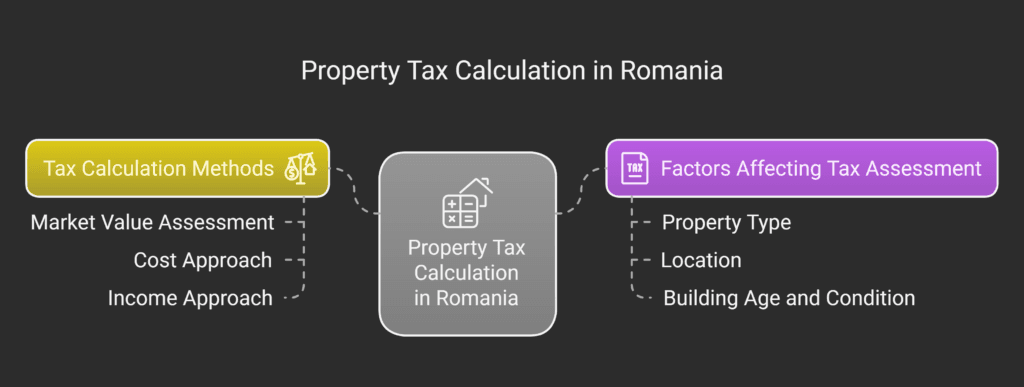
Simplified Cross-Border Debt Collection in Romania

Simplified Cross-Border Debt Collection in Romania

Are you having trouble getting debts back from clients or customers in Romania?

The process of debt collection in Romania can seem hard.

But, with the right help, it can be easier.

A professional cross-border debt lawyer in Bucharest can guide you through it.

For expert advice, reach out to a lawyer in Romania at (004) 0765366887.

They know the local laws and can help you.

A cross-border debt collection Romanian Law Office offers support and guidance every step of the way.


Cross-Border Debt Collection in Romania


Key Takeaways

  • Debt collection in Romania can be a complex process, but it can be simplified with the right guidance.
  • A professional cross-border debt collection agency can help you navigate the complexities of debt collection in Romania.
  • International debt recovery services can provide you with the necessary support and guidance throughout the process.
  • A cross-border debt collection agency can help you recover your debts and provide you with the necessary support and guidance.
  • The average timeline for the payment ordinance procedure in Romania is approximately 3 months.
  • The stamp duty for filing a payment ordinance is RON 200 (approximately EUR 40).
  • Courts are required to issue a decision within 45 days from the filing of the application for a payment ordinance.

debt collection in Romania

Understanding Cross-Border Debt Collection in Romania

Dealing with debt collection in Romania requires knowing the laws and process.

Debt recovery across countries can be tricky.

But, understanding local laws helps you manage the process better.

In Romania, debts can’t be collected after 3 years, as debtors can claim “prescription.”

But, you can stop or reset this time limit.

This includes written confirmations from debtors, starting legal actions, or making partial payments.

Romania’s debt collection process is governed by many laws.

Often, debts are settled outside of court.

debt collection laws in Romania

Success rates for enforcing judgments in Romania vary.

To boost success chances, get help from specialized lawyers in Romania, Bucharest.

Knowing Romania’s debt laws and process can help in recovering debts across countries.

Debt Collection StageSuccess RateCost
Out-of-court settlement70%5-10% of claim amount
Legal proceedings50%10-15% of claim amount

Legal Framework for International Debt Recovery

Understanding the legal framework is key when dealing with cross-border debt recovery.

In Romania, the rules are complex but manageable with the right help.

A debt collection law firm in Europe can offer valuable support.

The European Union’s rules greatly influence debt recovery laws.

For example, the European small claims procedure helps recover debts up to EUR 2,000 across EU countries.

A Romanian debt collection company can assist in using this procedure to efficiently collect debts.

Important aspects of Romania’s debt recovery laws include:

  • The new Romanian Civil Procedure Code, which updated debt collection rules;
  • The option to start debt recovery through common law trial, Ordinance of Payment, or a special low-value claim procedure;
  • The need to know about stamp duty and court fees for different recovery methods.


cross-border debt recovery services


In summary, Romania’s debt recovery laws are detailed, and businesses need expert help.

By understanding these laws and working with a Romanian debt collection Law Office, businesses can increase their chances of successful debt recovery.

Debt Recovery ProcedureApplicable Debt ValueCourt Fees
Common Law TrialNo limitVariable
Ordinance of PaymentNo limitRON 200
Small Claims ProcedureLess than RON 10,000Lower than Common Law Trial

The Romanian Debt Collection Process

Understanding the debt collection process in Romania is key to efficiently recover unpaid debts.

The process includes several steps, from initial assessment to court proceedings.

It’s important to follow the debt collection laws in Romania to recover debts.

The first step is an initial assessment of the debt.

The creditor checks if the debt is valid and if the debtor can pay.

This step helps decide the best way to recover the debt.

Sometimes, pre-legal steps can help without going to court.

Key Steps in the Debt Collection Process

  • Initial assessment and documentation: gathering all relevant information about the debt and the debtor.
  • Pre-legal collection procedures: attempting to recover the debt through negotiation and communication with the debtor.
  • Court proceedings: taking the case to court if the pre-legal procedures are unsuccessful.

The debt collection laws in Romania guide the recovery process.

The European small claims procedure makes cross-border debt recovery easier within the EU.

By following the process and laws, creditors can improve their chances of successful debt recovery.

debt collection process in Romania

Strategic Approaches to Cross-Border Debt Recovery

When dealing with international debt recovery, it’s key to use smart strategies.

This boosts the chances of getting the debt back.

Using cross-border debt recovery services helps tackle the challenges of collecting debts abroad.

A debt collection Law Firm in Romania with international experience is very helpful.

Important strategies include amicable debt recovery and using technology.

Amicable recovery saves money and keeps relationships good.

Knowing the local laws and culture of the debtor’s country is also vital.

international debt recovery

In Romania, for example, there are rules for small claims and common law procedures.

Creditors can join insolvency proceedings by registering assets and liabilities.

With the right strategies and a good debt collection agency, businesses can recover debts more effectively.

Enforcement of Foreign Judgments in Romania

Understanding how to enforce foreign judgments in Romania is key for businesses.

This involves recognizing and executing foreign court decisions.

Romania, being part of the European Union, follows EU rules like Regulation (EU) No 1215/2012.

This makes it easier to enforce judgments across the EU.

For foreign judgments to be recognized in Romania, there must be a mutual agreement.

The Romanian Civil Procedure Code handles judgments from outside the EU.

A court review checks if the judgment was fair and follows Romanian laws.

Key Considerations for Enforcement

  • Reciprocity between Romania and the issuing country;
  • Compliance with Romanian public policy;
  • Procedural fairness in the foreign judgment;
  • Execution procedures, including asset seizure and garnishment of wages.

Enforcing foreign judgments in Romania can help recover debts efficiently.

But, it’s important to know the legal steps well.

Getting legal help in Romania and having all the right documents is vital.

This way, businesses can handle debt collection across borders better and avoid risks.

Out-of-Court Settlement Options

Dealing with debt collection in Romania can be easier without going to court.

Debt settlement options like negotiation and mediation can help.

These methods aim to solve disputes peacefully.

They also reduce the need for long and expensive legal battles.

In Romania, creditors can enforce debts outside of court for non-real estate assets.

This includes things like equipment or inventory.

The process is usually quicker, taking less than a month, making it more efficient.

Out-of-court settlements have many benefits.

They are cheaper, faster, and help keep business relationships strong.

Using negotiation and mediation, creditors can get their money back while keeping things friendly.

This way, they avoid the high costs and time of court cases.

For the best results, creditors should work with a professional debt collection agency or lawyer.

These experts know how to handle the process and talk to debtors.

They help find agreements that work for everyone.

This way, creditors can get their money back quickly and keep their business relationships intact.

Professional Debt Collection Services in Romania

Dealing with unpaid debts in Romania requires professional help.

Debt collection lawyers offer efficient recovery solutions.

They have local knowledge and can handle international cases too.

Professional services bring expertise in local laws and a network of professionals.

They can tackle complex cases.

When using professional debt collection in Romania, consider these points:

* The time limit for business debts is 5 years.

* Late payments can hurt cash flow, affecting growth.

* Romanian companies must file annual accounts within 120 to 150 days after the financial year ends.

Using these services can boost debt recovery chances in Romania.

Preventive Measures for International Business

When you take your business global, it’s key to avoid debt collection problems.

You need to manage risks well.

Debt collection prevention and risk management are vital.

They help keep your cash flow smooth and your business safe.

To prevent debt issues, check your clients’ credit thoroughly.

Make sure payment terms are clear.

Keep an eye on what you’re owed.

Working with a local partner or a debt collection lawyer can also help.

It’s also important to know the local laws and rules.

For example, Romania’s Small Claims Procedure can help you get debts back quickly.

By being proactive, you can protect your business and aim for long-term success.

CountryDebt Recovery Rate
RomaniaApproximately 40%

By using these preventive steps and staying informed, you can lower debt collection risks.

This way, your international business can thrive.

Time Limitations and Statutory Considerations

When dealing with debt collection in Romania, knowing the time limits and laws is key.

You must act quickly to increase your chances of getting the debt back.

In Romania, most debts have a three-year limit to be collected.

It’s vital to start the process within this time to get the best results.

There are other laws you need to know about too.

For example, in Romania, you can only get back legal costs if you’ve already paid them.

The court fees can also be different from what you’re used to.

Many debt collection agencies work in Romania, helping creditors with lots of debts.

Some important things to remember about debt collection in Romania include:

  • Time limitations for debt collection: taking action within the three-year statute of limitations is key for success;
  • Statutory considerations: knowing the legal framework and costs is essential;
  • Documentation requirements: having all the right documents can make the recovery process smoother.

By understanding the time limits and laws for debt collection in Romania, you can act fast to recover your debts.

Knowing the specific rules in Romania is important to get the best outcome.

Technology and Modern Collection Methods

Technology is changing debt collection a lot. New methods are making it faster and better.

Tools like artificial intelligence and data analytics help a lot.

In Romania, digital banking is getting popular.

Now, 60% of banking services are online. This makes talking to creditors and debtors easier and safer.

Modern ways like mobile reminders and push notifications help too.

They make it more likely for people to pay back on time.

Some interesting facts about digital banking in Romania are:

  • 70% of Romanians use contactless bank cards;
  • 65% of Romanians access banking services through mobile banking apps;
  • 53% of Romanians utilize internet banking services.

Technology in debt collection is growing fast.

The global market for debt collection software is expected to double by 2026.

We’ll see even more new ways to make debt recovery better.

Conclusion: Securing Your Cross-Border Debt Recovery in Romania

When dealing with cross-border debt recovery in Romania, a strategic plan is key.

You need to understand the local laws and best practices.

This approach helps in successfully recovering debts.

Romanian law offers several ways for creditors to act.

From early collection efforts to court actions, there are options.

Working with legal experts who know the Romanian legal system well is very helpful.

Also, teaming up with top debt collection agencies in Romania can boost your success rate.

It’s important to watch out for time limits, document needs, and legal rules.

By focusing on these, you can increase your chances of success.

This ensures you get your cross-border debt back in Romania.

FAQ

What is the legal framework for cross-border debt collection in Romania?

Romania’s laws for collecting debts from other countries are complex.

It’s important for businesses to understand these laws to collect debts well.

What are the common challenges in cross-border debt collection in Romania?

Collecting debts across borders in Romania can be tough.

Language and cultural differences, legal system variations, and finding debtors are big challenges.

What is the Romanian debt collection process like?

The process in Romania starts with an initial check.

Then, there are steps before court and possible court actions.

Knowing this helps businesses get their money back.

How can businesses enforce foreign judgments in Romania?

To enforce judgments from other countries in Romania, you need to get the foreign decision recognized.

Then, you follow execution steps, keeping in mind time and cost.

It’s a complex process.

What are the out-of-court settlement options for debt collection in Romania?

Businesses can try mediation or negotiation to solve debt issues without court.

These methods can be effective in Romania.

How can professional debt collection services in Romania assist businesses?

Professional services in Romania offer local knowledge and help with the legal side.

They also find cost-effective ways to help businesses get their money back.

What are the preventive measures for international businesses to avoid debt collection issues?

To avoid debt problems, businesses can take steps like preventing debt and managing risks.

These actions help keep debt issues away.

What are the time limitations and statutory considerations for debt collection in Romania?

Businesses must know the time limits and what documents are needed for debt collection in Romania.

This knowledge helps in recovering debts efficiently.

How can technology and modern collection methods help with cross-border debt recovery in Romania?

Technology and new methods, like AI and data analytics, can make debt recovery in Romania better.

They help businesses get their money back more easily and well.

Navigating 2025 Tax Changes in Romania

Navigating 2025 Tax Changes in Romania

2025 Romanian Tax Reforms

Are you ready for big 2025 tax changes in Romania?

Emergency Ordinance no. 156/2024 brings major updates.

These changes will change how we handle money in 2025.

The 2025 tax news in Romania is key.

It affects everyone, from small businesses to big companies. You’ll need a good plan and expert advice.

Tax lawyers in Romania are getting ready to help.

Our team of Romanian Lawyers and tax consultants is making strategies for clients to deal with these new tax rules.

It’s important to know about these changes to stay in good financial shape.

Key Takeaways

  • Significant tax rate adjustments across multiple sectors;
  • New microenterprise income thresholds implemented;
  • Income tax exemptions eliminated for specific industries;
  • Mandatory contribution rates reset for employees;
  • Construction and dividend taxes experiencing notable changes.

Understanding Romania’s New Tax Landscape for 2025

Romania’s tax scene is changing a lot in 2025.

This brings both challenges and chances for businesses and people.

The new tax rules come from big changes in laws that need smart tax planning and good economic forecasts.

Romania Tax Landscape 2025

The Emergency Ordinance 156/2024 makes big changes.

These changes will change how the government budgets and taxes different areas.

It’s key to understand these changes for good financial planning.

Key Legislative Changes Under Emergency Ordinance 156/2024

  • Two main tax systems for businesses: turnover tax and profit tax;
  • Individual rental income tax is 8%;
  • Investment income tax is between 1% and 3%;
  • 10% tax on deposit interest.

Impact on Businesses and Individuals

Businesses will face big tax changes.

They need to adjust their money plans to follow new rules.

For individuals, tax rates on different incomes will change, so they must plan ahead.

Timeline of Implementation

  1. New tax rules start in January 2025;
  2. Full legal changes needed;
  3. Benefits for different sectors might change.

Dealing with these changes needs expert help and a deep understanding of Romania’s tax world.

Dividend Tax Increase: From 8% to 10%

Romanian Tax Reform Dividend Taxation

The Romanian tax system is changing a lot in 2025.

A big change is the dividend tax rate going up from 8% to 10%.

This is a 25% increase for investors and companies in Romania.

This tax reform Romania introduces will impact various taxpayers, including:

  • Corporate entities distributing dividends;
  • Individual investors;
  • Non-resident shareholders.

Key considerations for the new dividend tax regulation include:

  1. The new 10% rate becomes effective from January 1, 2025;
  2. To benefit from the existing 8% tax rate, dividends must be distributed by December 31, 2024;
  3. Health insurance calculations for dividends will reference the new minimum wage of 4,050 lei.
Tax Parameter2024 Rate2025 RateChange
Dividend Tax Rate8%10%+25%
Health Insurance Base3,300 lei4,050 lei+22.7%

Investors and businesses need to plan their dividend strategies carefully.

This is to make the most of the new tax rules in Romania.

Getting advice from a Romanian tax expert can help you deal with these changes well.

Changes in IT, Construction, and Agricultural Sector Tax Benefits

The Romanian fiscal landscape is changing a lot in 2025, mainly for key sectors.

Your tax planning in Romania needs to keep up with new rules for IT, construction, and agriculture.

The government is making big changes.

These will affect income tax updates and tax compliance in many sectors.

Elimination of Income Tax Exemptions

Starting January 2025, big changes will hit tax incentives in key sectors:

  • Software developers will pay 10% income tax.
  • Construction workers will also pay 10% income tax.
  • Agricultural workers will face the same 10% tax rate.

New Pension Insurance Contribution Rules

New rules for pension insurance contributions are coming:

Contribution TypeRateSector Impact
Pension Contribution25%IT, Construction, Agriculture
Health Insurance10%Targeted Sectors
Work Insurance2.25%Employer Contribution

Salary Thresholds and Implications

New salary rules are being set:

  • Construction workers need a minimum salary of 4,582 lei/month.
  • Agricultural workers need a minimum of 4,050 lei/month.
  • Those earning less than 4,300 lei get a 300 lei tax break each month.

Businesses need to check these changes.

They must stay compliant and plan their finances wisely in Romania’s changing tax scene.

2025 Tax News Romania: Major Reform Overview

Tax changes will affect how we handle personal finance and change economic forecasts.

The government is making big updates to the tax code to improve fiscal compliance and support the economy.

Some major changes include:

  • Dividend tax increase from 8% to 10%;
  • Micro-enterprise tax system restructuring;
  • Introduction of new construction sector taxation;
  • Sector-specific tax modifications.

For businesses and individuals, understanding these changes is key.

Tax lawyers in Romania are ready to help.

They will offer detailed advice on how to deal with the new rules.

Reform AreaKey ChangesImplementation Timeline
Corporate TaxationDividend tax increaseJanuary 1, 2025
Micro-Enterprise SystemNew turnover thresholdsJuly 1, 2025
Sector-Specific ReformsTax benefit adjustmentsPhased implementation

Romania wants to cut its budget deficit to 7% of GDP by 2025.

This goal matches what the European Commission suggests.

These changes are important for Romania’s economic growth and better fiscal management.

Micro-enterprise Tax System Overhaul

Romania’s tax reform for 2025 is making big changes to the micro-enterprise tax system.

These updates will change how small businesses handle their taxes and financial planning.

It’s important for entrepreneurs to understand these new rules to stay on top of their taxes.

The Romanian Government is making big changes to tax services for small businesses.

Businesses need to keep up with these new tax rules to stay financially healthy.

New Turnover Thresholds

One big change is the lower annual turnover thresholds:

  • Current threshold: EUR 500,000;
  • New threshold for 2025: EUR 250,000;
  • Projected threshold for 2026: EUR 100,000.

Changes in Qualification Criteria

The new rules make it harder for businesses to qualify as micro-enterprises.

They need to check if they meet the new criteria to stay compliant.

CriteriaPrevious RuleNew Rule
Annual Turnover LimitEUR 500,000EUR 250,000
Consultancy ServicesDisqualifying ConditionRemoved
Management ServicesDisqualifying ConditionRemoved

Small businesses need to quickly adjust to these changes.

Working with tax advisors can help you understand and plan for these changes.

Introduction of Construction Tax in 2025

Romania is introducing a big change for the construction sector in 2025.

A 1% construction tax will be applied to existing buildings on company balance sheets.

This tax is part of Romania’s fiscal policy for 2025.

It aims to bring in more money and make the tax system clearer.

Key aspects of the construction tax include:

  • Applies to all business entities with construction assets;
  • Tax rate set at 1% of the construction’s balance sheet value;
  • Impacts both domestic and foreign businesses with permanent establishments;
  • Implementation date: January 1, 2025.

This tax will affect many sectors, like real estate and construction.

Companies need to check their asset values.

They must also get ready for this new financial duty in Romania’s tax landscape for 2025.

Entity TypeTax ApplicabilityCalculation Basis
Local CompaniesFull Implementation1% of Balance Sheet Value
Foreign EnterprisesPermanent Establishment1% of Romanian Asset Value
Small and Medium EnterprisesProportional Application1% of Qualifying Assets

Businesses should talk to tax experts.

They need to understand these tax changes fully.

This will help them manage their new tax duties well.

VAT Changes and Future Considerations

There are big updates to the VAT system that will affect both businesses and consumers.

These changes in fiscal policy are very important and need to be watched closely.

New VAT rates and digital reporting rules are coming.

Businesses need to get ready for these changes.

They must make sure they follow the rules to avoid any financial problems.

Potential Rate Adjustments

There are talks about changing the VAT rates in Romania.

The exact changes are not clear yet.

But, experts think these changes could affect how businesses price their products.

  • Potential VAT rate increase under consideration;
  • Alignment with EU fiscal policy recommendations;
  • Possible impact on consumer spending.

E-invoicing Requirements

Romania is starting a new digital invoicing system called RO eVAT.

This change will make businesses use electronic invoices.

It will make things clearer and easier for everyone.

SAF-T Implementation

The Standard Audit File for Tax (SAF-T) will soon be a must for businesses.

This change will help Romania’s tax system work better.

It will make tax compliance easier and more transparent.

Digital Tax FeatureImplementation TimelineBusiness Impact
RO eVAT SystemJanuary 2025Mandatory Electronic Invoicing
SAF-T ReportingQ2 2025Enhanced Tax Transparency

Get your business ready for these changes.

Update your digital setup, train your team, and talk to tax experts.

This will help you deal with the new tax rules smoothly.

Minimum Wage Updates by Sector

The 2025 Romanian tax updates change minimum wages in different sectors.

The government has made new rules for construction, agriculture, and food industries.

These changes will affect workers and businesses.

Here are the main updates for each sector:

  • Construction sector: Minimum wage set at RON 4,582;
  • Food and agricultural industry: Minimum wage established at RON 4,050.

The government wants to help workers and support the economy.

These changes will likely change how companies pay their workers.

It might also change how they hire and what they pay.

SectorMinimum Wage (RON)Key Implications
Construction4,582Higher labor costs, possible better work
Agriculture/Food4,050More money for workers, better competition

The 2025 tax changes aim to grow the economy and pay workers fairly.

Companies in these sectors need to plan their budgets and paychecks.

They must follow the new wage rules and stay financially stable.

Businesses should do the following:

  1. Check their current pay scales;
  2. Update their budget plans;
  3. Make sure they meet the new wage rules;
  4. Look at how they pay their workers overall.

Tax Compliance and Reporting Requirements

The Romanian tax system is changing a lot in 2025.

This change will affect how businesses deal with taxes.

The government’s new tax rules will change how companies report their finances and follow the law.

Digital Transformation in Tax Administration

Your business needs to get ready for big changes in tax laws. The main updates include:

  • Mandatory B2B e-invoicing regime fully implemented;
  • Electronic invoice submissions through eFactura platform;
  • Simplified invoicing for small transactions;
  • SAF-T reporting requirements expanded.

Filing Deadlines and Procedures

The tax system in Romania is getting a big update.

Starting in January 2025, businesses will have to follow new rules for electronic reports.

The main changes are:

  1. Mandatory electronic submission of financial statements;
  2. Monthly trial balance preparations;
  3. Specific submission deadlines for different entity types.

Professional Tax Advisory Support

Understanding the new tax rules in Romania can be hard.

 Romanian Tax lawyers and tax consultants are very important.

They help you with digital reporting, e-invoicing, and avoiding fines.

Businesses in Romania need to get ready for these changes.

They should invest in good tax systems and get help from experts.

This will help them adapt well in 2025.

Impact on Foreign Businesses Operating in Romania

The future tax landscape in Romania is set to pose big challenges for foreign businesses.

They will face changes in tax laws in 2025.

It’s vital for them to stay updated on these changes to keep their operations smooth.

Foreign companies need to get ready for big changes in their financial plans.

The new tax rules in Romania will demand careful planning and expert advice.

  • VAT registration requirements have become more stringent;
  • Tax representative obligations are expanding;
  • Dividend tax increased from 8% to 10%;
  • New reporting and compliance mechanisms introduced.

To tackle these challenges, hiring a tax lawyer in Romania is key.

They can help you:

  1. Understand complex tax rules;
  2. Make sure you follow new laws;
  3. Reduce financial risks;
  4. Find the best tax strategies.
Business Impact AreaKey Changes in 2025Potential Risk Level
VAT RegistrationStricter Non-Resident RequirementsHigh
Dividend Taxation10% Tax RateMedium
Compliance ReportingEnhanced Digital ReportingHigh

Businesses that act early will use tax advisory services to deal with these changes.

By keeping up with Romania’s tax changes, foreign companies can stay competitive and financially stable.

Working with Tax Lawyers in Romania

Understanding Romanian tax laws is tough.

With big changes in 2025, knowing how to comply is key.

Businesses and individuals need tax lawyers to guide them.

Romanian law offices help clients deal with tax rules.

When picking a law firm, look for experts in local and global tax laws.

Legal Assistance for Tax Compliance

Tax lawyers in Romania offer vital help:

  • They explain complex tax laws;
  • They create tax-saving plans;
  • They help in tax disputes;
  • They make sure you follow the law.

Professional Tax Advisory Services

Romanian tax lawyers give strategic advice in many areas:

Service CategoryKey Focus Areas
Corporate Tax PlanningLowering tax bills, smart business deals
Individual Tax ConsultingOptimizing personal taxes, global tax rules
Regulatory ComplianceKeeping up with 2025 tax changes

Choose tax lawyers in Romania who are good at handling tax changes.

They should know Romanian tax laws well.

Conclusion

The 2025 tax news in Romania shows a complex fiscal scene.

It demands smart planning.

Tax reforms will affect businesses and people in many areas.

It’s important to be proactive and well-informed about these changes.

This way, you can handle them better.

Understanding these updates means analyzing new tax rates and rules.

The standard VAT rate is 19%, and company taxes vary from 1% to 3% on turnover.

Businesses need to adjust fast to these changes.

Getting help from tax advisors is key in this changing world.

Romania’s economy is expected to grow by 2.5% in 2025.

Knowing the rules can help you avoid financial risks and stay ahead in the market.

As taxes keep changing, being flexible and ready is essential.

Look for expert advice, keep up with new laws, and be open to changing your financial plans in Romania.

FAQ

What are the most significant tax changes in Romania for 2025?

The main changes include a higher dividend tax of 10% from 8%.

There’s also a new construction tax and rules for micro-enterprises.

These changes aim to update Romania’s tax system.

How will the dividend tax increase affect investors and businesses?

The tax hike on dividends will affect both local and foreign investors.

It might change how they invest and manage money.

Companies and investors will need to adjust their financial plans to the new tax rate.

What changes are happening to the micro-enterprise tax system?

The micro-enterprise tax system is changing a lot.

The turnover limits are dropping from EUR 500,000 to EUR 100,000 (in 2026).

Also, a rule about consultancy and management services income is gone, affecting how businesses are taxed.

Are there new VAT requirements for businesses in Romania?

Yes, Romania is introducing e-invoicing and SAF-T reporting.

Businesses must adapt to these digital systems.

They aim to make tax compliance easier and reduce paperwork.

How will the construction tax work in 2025?

A 1% tax will be applied to the value of existing constructions.

This tax will affect many entities, including foreign ones with permanent setups in Romania.

The rules and exemptions will vary based on the entity and construction type.

What changes are affecting foreign businesses operating in Romania?

Foreign businesses will face new VAT rules and changes to tax representative duties.

The dividend and construction taxes will also impact them.

These changes might force businesses to rethink their strategies in Romania.

Are there changes to minimum wage regulations in specific sectors?

Yes, minimum wages are increasing in construction, food, and agriculture.

These changes will affect labor costs.

They might influence how businesses compete and pay their employees.

How can businesses and individuals navigate these tax changes?

It’s wise to talk to a tax lawyer or advisor who knows Romanian tax law.

They can help with compliance, find tax-efficient ways, and explain the new rules.

When do these tax changes take effect?

The tax reforms from Emergency Ordinance 156/2024 will roll out in 2025.

Some changes start right away, while others will be phased in.

It’s important to know when each rule starts.

What is the purpose of these tax reforms?

The reforms aim to update Romania’s tax system.

They want to improve tax collection, follow EU standards, and make the fiscal environment better for businesses and investors.