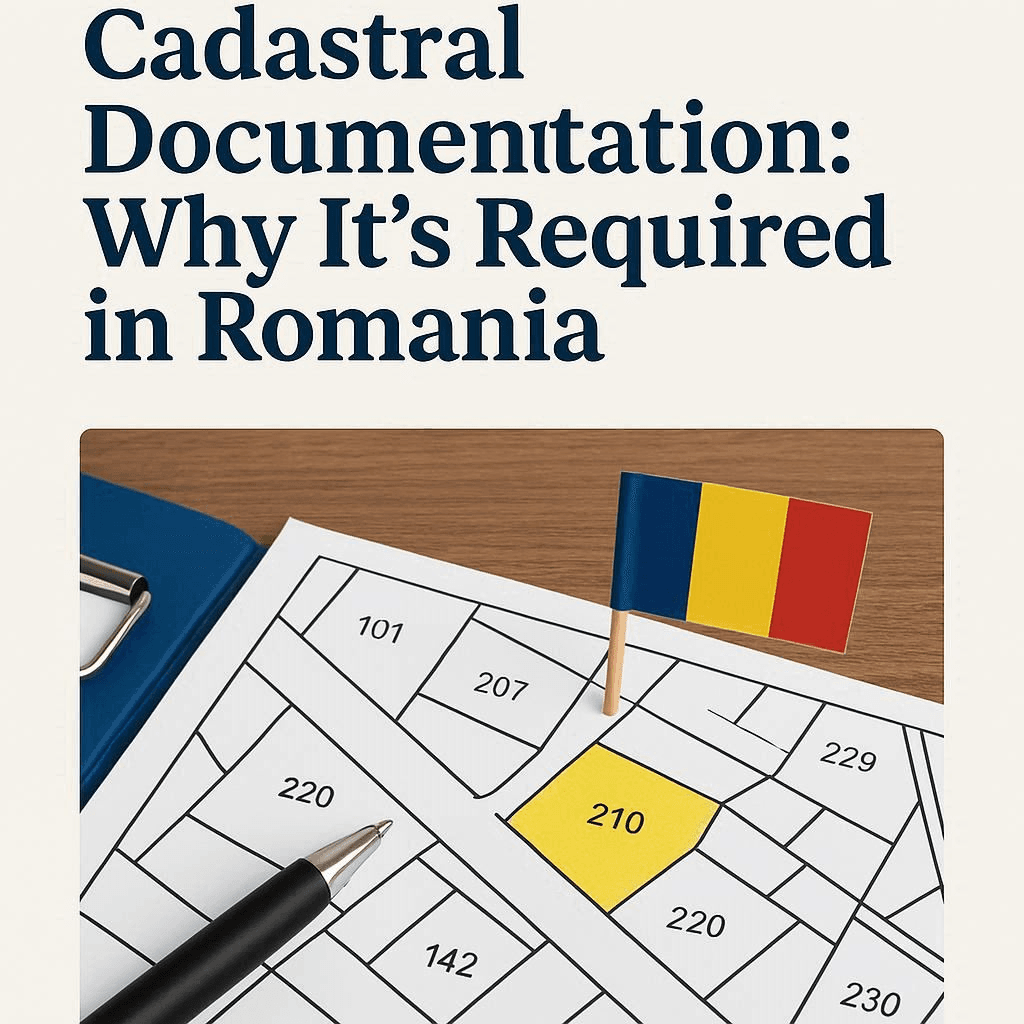
cadastral documentation Romania

Cadastral Documentation: Why It’s Required in Romania

Cadastral Documentation: Why It’s Required in Romania

What if the key to securing your property rights in Romania isn’t just about owning land—but proving it in a way the law recognizes?

For buyers, sellers, and investors, this question underscores a critical reality: formalized records are the backbone of legally binding transactions.

A person is examining a detailed map of land parcels.

Romania’s integrated framework merges technical and legal processes to ensure accuracy in ownership details.

Every parcel undergoes rigorous verification before entering the national registry.

This system prevents disputes by creating an immutable record that shields owners from unauthorized claims.

The process involves collaboration between cadastral offices and real estate departments.

Technical surveys and legal validations occur simultaneously, streamlining approvals.

Delays in documentation can derail sales or financing, making compliance non-negotiable for smooth transactions.

For tailored guidance, contact office@theromanianlawyers.com.

Our team navigates these requirements daily, ensuring clients meet all obligations efficiently.

Key Takeaways

  • Romania’s property system requires precise technical and legal alignment for valid ownership,
  • Integrated workflows prevent errors and accelerate registration timelines,
  • Third-party claims lose validity without proper cadastral verification,
  • Delays in documentation expose owners to financial and legal risks,
  • Professional support minimizes hurdles in complex cases.

Understanding Cadastral Documentation in Romania

Romania’s property system relies on a structured framework where technical precision meets legal validity.

This foundation ensures every land registry entry reflects accurate ownership details and physical characteristics.

A map showing property boundaries and land divisions.

Definition and Key Components

Cadastral files combine technical surveys with legal descriptions.

They include boundary markers, exact surface measurements, and unique identification numbers assigned during registration.

These documents also contain geospatial plans that map the estate’s layout.

Authorized surveyors and legal experts collaborate to verify each detail.

Errors in boundary data or ownership records can invalidate transactions.

Professionals ensure compliance with national legislation to prevent disputes.

Historical Context and Evolution

Romania’s modern cadastral system has evolved through various historical influences, with significant development occurring during different administrative periods.

The current integrated system represents decades of modernization efforts to align with European Union standards.

Contemporary reforms integrated digital mapping with established processes.

Today’s estate records blend historical archives with real-time updates.

This evolution maintains continuity while addressing modern ownership complexities.

Cadastral Documentation and Why is It Required in Romania

A group of people discussing over a table filled with paperwork and charts.

Romanian legislation mandates strict protocols for validating property boundaries and ownership transfers.

These protocols serve as the foundation for all real estate transactions, ensuring every modification aligns with national standards.

Key Legal Requirements and Registration Effects

Under Romanian law, formalizing land divisions or mergers requires comprehensive technical verification.

This process applies during initial registrations and subsequent changes like boundary adjustments.

Authorized surveyors must validate measurement accuracy and confirm the credentials of involved professionals.

Each submission undergoes a multi-step review.

Inspectors cross-reference graphic databases to locate the site and ensure surface calculations match physical dimensions.

Discrepancies between descriptive details and visual representations trigger immediate revisions.

Upon approval, properties receive unique identifiers that lock their status in the national system.

These codes become critical references for future transactions or legal disputes.

Properly executed registrations grant owners enforceable rights against third-party claims.

They also activate the property’s eligibility for entries in Romania’s land book—a decisive factor in securing financing or completing sales.

Non-compliant submissions face rejection, requiring costly resubmissions.

Errors in surface data or boundary markers can delay land development projects significantly, emphasizing the need for precision from the outset.

Integration of Cadaster and Land Registry Systems

Romania’s property governance model eliminates bureaucratic silos through a cohesive institutional design.

The Romanain land registry and cadaster operate under one administrative umbrella, merging technical precision with legal validation.

This structural integration accelerates decision-making while maintaining rigorous standards.

Several colorful folders are neatly organized on a shelf labeled with different property names.

Unified Workflow in Land Book Registrations

Applications for property registration follow a synchronized process.

Technical surveys and legal validations are processed within the same department, removing redundant steps.

A single documentation file combines geospatial maps, boundary certifications, and ownership proofs.

The system routes files between cadastral inspectors and real estate publicity teams automatically.

Technical specialists verify measurement accuracy, while legal experts confirm compliance with ownership transfer rules.

Approved data flows directly into Part A of the land book, ensuring alignment between physical boundaries and registered rights.

Key advantages of this approach include:

  • Reduced processing times through parallel technical-legal reviews,
  • Eliminated discrepancies between registry entries and physical sites,
  • Centralized access to updated property information.

This integration minimizes errors that traditionally arise when separate institutions handle cadastral and registry tasks.

Real estate professionals benefit from predictable timelines, while owners gain enforceable rights backed by unified records.

Process and Legal Considerations for Cadastral Documentation

Navigating Romania’s property registration framework demands strict adherence to sequential technical and legal phases.

This structured approach protects ownership rights while maintaining alignment with national standards.

A close-up of a stamp on a completed application form.

Steps from Technical Verification to Legal Registration

The procedure unfolds through six critical stages:

  1. Preparer validation: Confirm credentials of professionals who drafted the documents,
  2. Database cross-check: Locate property in the national graphics system using coordinates,
  3. Surface verification: Audit mathematical accuracy of land measurements,
  4. Attribute correlation: Match written descriptions with graphical representations,
  5. Number assignment: Issue unique identifiers for unregistered properties,
  6. Final review: Cadastral inspector approves or flags discrepancies.

Ensuring Compliance with Romanian Law

Authorities reject submissions failing these legal benchmarks:

RequirementComplete DocumentationIncomplete Cases
Technical ActsPrecision-matched dataSurface calculation errors
Legal StandardsOwnership chain verifiedMissing notarized signatures
Time ImpactProcessing varies by complexityExtended delays and resubmissions

Non-compliant cases trigger detailed deficiency reports.

These outline exact corrections needed for resubmission.

Proper execution prevents third-party claims and ensures enforceable rights under Romanian statutes.

Implications for Real Estate and Property Transactions

Romania’s real estate market operates on a simple principle: no valid registration equals no enforceable rights.

The land registry acts as the ultimate authority for verifying ownership before any transaction closes.

This system protects buyers from inheriting unresolved disputes or hidden claims.

A computer screen displaying a digital cadastral map with highlighted properties.

Impact on Land Sale and Ownership Proof

Without registry entries, sellers cannot legally prove they own the property.

Notaries refuse to authenticate sales contracts for unregistered parcels, blocking transfers entirely.

Banks similarly reject mortgage applications tied to undocumented estates.

Common scenarios demonstrate these consequences:

ScenarioWith Proper DocumentsMissing Documents
Residential SaleProcessing within standard timeframesContract voided
Land DevelopmentFinancing approvedBank refusal
Inheritance TransferSmooth ownership changeExtended court proceedings

Proper registration creates a public record accessible to buyers, lenders, and authorities.

This transparency accelerates due diligence and reduces fraud risks.

Updated entries also increase property values by confirming marketability.

Maintaining current records helps avoid transaction delays and ensures compliance as boundaries or zoning laws change.

Legal Solutions and Alternative Approaches

When traditional property registration isn’t an option, Romanian law offers alternative pathways to secure ownership rights.

These mechanisms address complex scenarios where standard documentation remains unavailable or incomplete.


Noting Possession and Alternative Procedures

Individuals using land without formal ownership documents can request a notation of possession.

This legal step initiates a period during which third parties may contest the claim.

If no disputes arise, property rights may be formally registered through court proceedings.

Usucapion and Property Acquisition

Romanian law recognizes usucapion (adverse possession) as a method of acquiring property rights through prolonged possession.

Under current legislation, individuals who can demonstrate continuous, uninterrupted, and public possession for specified periods may acquire ownership rights.

The Civil Code establishes that those who possessed property for 10 years may become owners through adverse possession (extratabulară).

For situations involving longer periods, 30-year usucapion (acquisitive prescription) may apply depending on specific circumstances and legal requirements.

Resolving Complex Ownership Scenarios

Successful usucapion requires proving public, peaceful, and uninterrupted control of the land.

Authorized companies handle complex procedures for cases involving partial deeds or indirect evidence.

This process often becomes critical during inheritance disputes involving properties with unclear documentation.

Multiple heir situations demand specialized strategies to prevent prolonged litigation.

Legal professionals help owners navigate these complexities while protecting against future obstacles in mortgage or sale processes.

Consulting experienced attorneys ensures compliance with evolving registration standards.

Their guidance minimizes risks in both standard and alternative ownership validation processes.

Expert Insights and Best Practices in Cadastral Documentation

Navigating property records demands precision only specialists can deliver.

Romania’s framework assigns distinct roles to owners, professionals, and regulators to maintain system integrity.

O persoană arătând cu degetul la un teren pe un document.

Expert Guidance and the Role of Authorized Professionals

Licensed surveyors and legal practitioners handle technical evaluations under the National Agency for Cadaster and Land Registration.

These experts:

  • Verify boundary markers using GPS technology,
  • Cross-reference historical maps with current site conditions,
  • Certify that legal descriptions match physical characteristics.

Property owners must identify and preserve their boundaries.

Professionals bear responsibility for measurement accuracy, while inspectors validate data before issuing registration numbers.

Ensuring Data Accuracy and Timely Updates

Regular updates prevent conflicts during sales or inheritance transfers.

Key maintenance practices include:

ActionFrequencyResponsible Party
Boundary checksEvery 5 yearsOwner
Record auditsPost-constructionAuthorized surveyor
System updatesReal-timeCadastral office

Disputed cases require immediate legal intervention.

For complex scenarios like overlapping estate claims, contact office@theromanianlawyers.com.

Professional legal teams specialize in resolving boundary disputes efficiently.

Proactive monitoring of zoning changes safeguards rights.

Specialists recommend digital alerts for land registration amendments affecting your assets.

Conclusion

Securing property rights in Romania hinges on meticulous adherence to legal frameworks governing land records.

The integrated system combining technical precision with legal validation ensures transparent transactions while preventing ownership disputes.

From standard registrations to resolving complex cases, compliance protects all involved parties.

Authorized professionals play a critical role in verifying boundaries and maintaining error-free documentation.

Their expertise streamlines the process, whether handling routine updates or alternative acquisition methods.

Proactive management of real estate records remains essential for financing eligibility and conflict prevention.

Regular audits and immediate corrections uphold the integrity of Romania’s land registry framework.

For tailored guidance on navigating these requirements, contact office@theromanianlawyers.com.

Professional legal teams provide comprehensive support to ensure your assets remain protected under national law.

FAQ

What legal effects does land registration have in Romania?

Registration in the Land Book grants enforceable rights against third parties and validates ownership transfers.

It serves as the primary proof of legal title under Romanian law, ensuring transparency in transactions like sales or mortgages.

How does the cadaster system integrate with property registration?

Romania’s unified system combines cadastral data (physical boundaries, area) with the Land Registry’s legal records.

This integration streamlines workflows, reduces errors, and ensures accurate verification during transactions.

What steps are involved in obtaining cadastral documentation?

The process includes technical verification by licensed surveyors, boundary confirmation with neighbors, submission to the Cadaster Office, and final Land Book registration.

Compliance with zoning laws and notarization of legal acts is mandatory.

Why is cadastral documentation critical for real estate sales?

It confirms lawful ownership, clarifies boundaries, and identifies encumbrances like mortgages.

Buyers require this data to assess risks, secure financing, and complete transactions recognized by Romanian authorities.

Can property rights be established without full registration?

Temporary possession claims may be noted in the Land Book, but usucapion (adverse possession) or specialized procedures are required for full rights.

These alternatives involve court validation and strict evidence standards.

How do professionals ensure cadastral data accuracy?

Authorized surveyors, notaries, and lawyers cross-check records, resolve boundary disputes, and update entries for new constructions or subdivisions.

Regular audits by the National Agency for Cadaster prevent discrepancies.

What happens if a property has unresolved boundary issues?

Transactions may be delayed until disputes are settled via mediation or court rulings.

The Cadaster Office flags such cases, requiring updated technical plans and neighbor agreements before registration.

 
Romanian Land Registry Process

The Land Registry Process in Romania: A Comprehensive Overview

The Land Registry Process in Romania: A Comprehensive Overview

What if a single oversight in documentation could jeopardize your real estate investment?

This critical question underscores the importance of Romania’s structured approach to property ownership verification.

The system ensures legal certainty through meticulous record-keeping and standardized protocols.

land registry process in Romania

Romania’s framework for validating ownership rights involves coordinated efforts between notariescadastral specialists, and government agencies.

Each transaction requires precise authentication and multi-stage reviews to prevent disputes.

While the system prioritizes accuracy, its complexity demands professional navigation.

Our team of lawyers in Bucharest play a vital role in interpreting regulations and avoiding procedural missteps.

For tailored guidance, contact office@theromanianlawyers.com to ensure compliance with all requirements.

Key Takeaways

  • Romania’s system provides legal security for real estate transactions,
  • Multiple verification stages prevent ownership disputes,
  • Specialized professionals ensure regulatory compliance,
  • Documentation accuracy impacts transaction validity,
  • Updated records maintain market transparency.

Introduction and the Importance of Land Registry in Romania

Accurate records form the backbone of successful real estate dealings.

Romania’s national property registry acts as a legal safeguard, detailing ownership rights, physical boundaries, and existing claims.

This system ensures every transaction meets strict standards for validity and transparency.

Overview of Real Estate Registration

The framework for property validation includes three core elements:

  • Technical specifications outlining exact dimensions and location,
  • Ownership history showing current and previous rights holders,
  • Legal restrictions like mortgages or usage limitations.

Romanian real estate documentation

Mandatory updates to these records occur with any ownership change.

Financial institutions and buyers rely on this data to verify asset legitimacy before approving deals.

How Reliable Documentation Impacts Transactions

Complete paperwork prevents disputes between involved parties.

Missing or conflicting information can:

  • Delay sales by weeks or months,
  • Invalidate purchase agreements,
  • Expose buyers to hidden liabilities.

Romania’s alignment with EU standards offers international investors familiar protections.

For tailored support navigating these requirements, contact office@theromanianlawyers.com to secure your transactions.

Historical Evolution of Land Registration in Romania

Romania’s approach to ownership validation reflects centuries of legal refinement.

The Austro-Hungarian Empire introduced structured cadastral practices in Transylvania during 1849, marking the region’s first standardized public records.

This initiative laid the groundwork for contemporary legal frameworks governing asset transfers.

cadastral records evolution

From Manual Registers to Digital Precision

Early documentation relied on handwritten ledgers detailing boundaries and ownership chains.

By the 20th century, these evolved into legally binding registers with three critical functions:

  • Mapping exact geospatial coordinates,
  • Recording successive titleholders,
  • Highlighting contractual obligations.

The shift to electronic databases after 2000 accelerated verification processes while preserving historical legal principles.

Modern platforms now integrate EU-compliant formats with traditional safeguards.

Continental Foundations and Systemic Reforms

Central European legal traditions heavily influenced Romania’s adoption of public accessibility standards for property books. Key developments include:

  • Harmonization with EU directives on transparency,
  • Digitization of archival records (1850-1950),
  • Nationwide implementation of unified protocols.

These advancements transformed fragmented regional practices into a cohesive framework.

Our team of lawyers in Romania leverage this historical context to interpret current requirements effectively.

For specialized guidance navigating these evolved systems, contact office@theromanianlawyers.com.

Legal Framework and Key Principles

Romanian property validation relies on foundational rules ensuring fairness and transparency.

Five core concepts govern how ownership changes are recorded and enforced under Law 7/1996.

These mechanisms protect both individual rights and public trust in official records.

Romanian legal principles

Opposability, Full Disclosure, and Legality

The principle of opposability ensures registered claims take immediate effect against third parties.

This establishes clear priority when multiple parties assert interests in the same asset.

Full disclosure requirements mandate recording all ownership details and restrictions.

PrincipleLegal BasisPractical Effect
OpposabilityLaw 7/1996 Art.12Immediate enforceability post-registration
Full DisclosureCivil Code Art.881Complete transaction history visibility
Legality ReviewLand Book Reg. §4Document validity verification

Neutrality and Ex Officio Decision Making

Registrars maintain strict neutrality, acting only upon formal requests.

However, they possess authority to independently verify application accuracy.

This ex officio examination ensures system integrity without compromising impartiality.

Legal professionals analyze how these principles interact in specific cases.

For personalized guidance navigating Romania’s property registration framework, contact our team of real estate lawyers in Bucharest at office@theromanianlawyers.com.

Understanding the Land Registry Process in Romania

Navigating property ownership in Romania requires understanding its dual-track validation system.

This framework combines administrative efficiency with judicial safeguards to balance speed and legal protection.

Specialized professionals manage critical approvals while maintaining avenues for dispute resolution.

Romanian administrative judicial system

Administrative Versus Judicial Aspects

The administrative procedure focuses on swift document processing by qualified registrars.

These officials review applications using standardized checklists to ensure compliance.

Key features include:

  • Mandatory legal education for registrars,
  • Predefined timelines for application reviews,
  • Automated validity checks for common documents.

Judicial oversight activates when parties challenge administrative decisions.

Courts examine whether registrars properly applied laws during initial assessments.

This layered approach prevents errors while respecting constitutional rights.

Decision Hierarchies and Professional Qualifications

Romania’s appeal process follows a strict three-step structure:

  1. Re-examination by senior registrars,
  2. District-level judicial review,
  3. Potential appeals to higher courts.

Legal professionals often intervene when technical interpretations affect ownership outcomes.

For tailored assistance navigating these mechanisms, contact office@theromanianlawyers.com to secure your property rights efficiently.

Step-by-Step Guide to Registration and Documentation

Securing property rights in Romania demands strict adherence to official validation protocols.

Three critical phases govern this structured approach: deed authenticationapplication review, and permanent database updates.

Each phase involves specialized professionals ensuring compliance with national standards.

Authentication of Deeds and Preliminary Certification

Public notaries initiate the authentication process by verifying signatures and legal capacity.

They cross-check ownership details against current land book extracts to confirm seller authority.

This step prevents invalid transactions by identifying undisclosed claims or restrictions.

Notaries issue preliminary certificates confirming document validity.

These certificates serve as prerequisites for submitting applications to territorial offices.

Missing this step voids subsequent registration attempts.

Submission, Verification, and Final Registration

Complete documents receive chronological entry numbers during submission, establishing priority for conflicting claims.

Assistant-registrars perform initial checks for completeness before forwarding files to senior officials.

Qualified registrars conduct final reviews within legally mandated timelines:

  • 9 days maximum for ownership transfers,
  • 2 days for mortgage registrations.

Approved applications trigger permanent database updates and automated certificate distribution.

For streamlined procedure navigation, contact office@theromanianlawyers.com for expert documentation support.

Digital Advances: Electronic Submission and Land Books

Romania’s property sector is undergoing a digital revolution while maintaining analog safeguards.

The national land book system now operates through hybrid workflows, combining electronic databases with physical document submissions.

This dual approach balances modernization efforts with traditional verification practices.

Benefits of Electronic Registration

Digital platforms transform how professionals interact with property records.

Key improvements include:

AspectTraditional MethodElectronic System
Processing Timeapp. 2-4 weeksapp. 3-5 business days
Record AccuracyManual entry errorsAutomated validation
AccessibilityIn-person requests24/7 online access

Authorized users retrieve estate data instantly through secure portals.

Integrated databases enable simultaneous updates across multiple agencies, reducing administrative overlaps.

Challenges in Transitioning from Analog Methods

The mixed system creates unique operational hurdles:

  • Physical document scanning delays digital processing,
  • Varied digital literacy among older professionals,
  • Inconsistent formatting of paper submissions.

These issues occasionally extend registration timelines when systems require manual reconciliation.

Legal teams often bridge the gap by cross-verifying electronic and physical records.

For streamlined navigation of Romania’s evolving land book procedures, contact office@theromanianlawyers.com.

Their experts provide tailored solutions for both digital and paper-based requirements.

Roles of Notaries and Legal Experts

Property transactions in Romania require coordinated efforts between specialized professionals to ensure legal compliance.

Notaries and registrars form the backbone of document validation, while legal advisors resolve complex challenges.

The Notary’s Function in Authenticating Documents

Public notaries verify the right of sellers to transfer ownership.

They confirm identities, check signatures, and obtain updated extracts from property records.

This prevents transactions involving disputed titles or hidden claims.

Key responsibilities include:

  • Validating legal capacity of all parties,
  • Ensuring compliance with contractual formalities,
  • Flagging undisclosed restrictions in land book extracts.

The Land Registrar’s Critical Decision Role

Registrars possess exclusive authority to approve or reject applications.

Their technical reviews determine if submissions meet statutory requirements for rights registration.

RoleFocus AreaDecision Impact
NotaryDocument validityTransaction initiation
RegistrarLegal complianceOwnership transfer finality

Romanian Legal professionals bridge gaps between these roles, particularly when multiple parties or cross-border elements complicate matters.

For complex cases involving contested titles, contact our team of specialized lawyers in Bucharest at office@theromanianlawyers.com for tailored solutions.

Overcoming Common Challenges in Real Estate Registration

Navigating property transfers often reveals unexpected hurdles requiring strategic solutions.

Many transactions stall due to incomplete paperwork or conflicting records, particularly in cases involving older assets or informal agreements.

Troubleshooting Missing Documents and Delays

Incomplete ownership chains frequently emerge with inherited estates or properties lacking updated titles.

Common issues include handwritten sale receipts without notary validation or assets listed solely in agricultural registries.

These gaps prevent legal transfers until resolved through archival research or court orders.

Delays often stem from multi-agency coordination requirements.

Cadastral mapping and zoning confirmations must precede notarial acts, creating sequential bottlenecks.

Proactive document preparation reduces waiting periods significantly.

Mitigating Legal and Procedural Pitfalls

Romanian law mandates authenticated ownership proofs for valid sales.

Romanian lawyers address challenges through:

  • Reconstructing historical ownership via court petitions,
  • Validating informal agreements through supplementary evidence,
  • Coordinating parallel approvals across institutions.

Specialized legal support in Romania streamlines these complex processes.

For tailored resolution strategies, contact office@theromanianlawyers.com to secure your transaction’s validity.


FAQ

What legal principles govern real estate registration in Romania?

The process follows three core principles: opposability (rights become enforceable against third parties upon registration), full disclosure (all relevant details must be publicly accessible), and legality (strict compliance with statutory requirements).

These ensure transparency and legal certainty in transactions.

How does electronic submission improve registration efficiency?

Digital platforms reduce processing times by enabling remote document filing, automated validations, and real-time status tracking.

This minimizes errors and accelerates the authentication of deeds while maintaining compliance with EU data standards.

What role do notaries play in property transactions?

Notaries authenticate agreements, verify identities, and confirm the legality of terms.

Their involvement ensures documents meet formal requirements before submission to the Land Book Office, reducing rejection risks during final registration.

Why might a registration request be delayed or rejected?

Common issues include incomplete ownership history, unresolved boundary disputes, or unrecorded encumbrances.

Proactive title searches and professional legal reviews help identify and resolve such gaps before submission.

Can possession alone establish ownership rights in Romania?

No. While long-term possession may support a claim through adverse possession laws, formal recognition requires a court decision and subsequent registration in the Land Book.

Mere occupancy does not guarantee legal rights.

What distinguishes administrative from judicial registration procedures?

Administrative processes handle uncontested applications, while judicial oversight applies when disputes arise over validity or competing claims.

Registrars assess evidence ex officio but may defer to courts in complex cases.

How are third-party rights protected during registration?

The system’s publicity principle mandates that all registered rights are visible to potential buyers or creditors.

This prevents hidden claims and ensures transactions reflect the true legal status of assets.


🏛️ Romanian Land Registry Quiz

Test your knowledge about property registration in Romania


Urban and Agricultural Property Laws in Romania

Differences Between Urban and Agricultural Property Laws in Romania

Ever wondered why owning property in Romania seems like solving a puzzle?

The laws for urban and agricultural properties are different.

These differences affect your rights and duties as a property owner.

It’s key to know these differences if you’re in the Romanian real estate market.

In Romania, property laws have a long history and keep changing. You should know the rules for urban and agricultural lands.

This guide will help you understand these laws better.

It will also give you the tools to deal with these legal areas well.

Urban and Agricultural Property Laws in Romania

Key Takeaways

  • Urban and agricultural property laws differ significantly in Romania.
  • Understanding the legal framework for property in Romania is essential for property ownership.
  • Property regulations in Romania influence rights and responsibilities differently based on land type.
  • Historic legislation shapes current property laws.
  • Awareness of these differences can benefit real estate transactions.

Introduction to Property Laws in Romania

Understanding Romanian property laws is key for investors in Romania.

After communism fell, Romania changed its laws to make real estate more open.

This change aimed to make buying and selling property easier and clearer.

The laws about owning property in Romania come from the Constitution and the Civil Code.

These laws set out what property rights are, how to buy and sell, and what owners must do.

Knowing these property ownership laws in Romania helps you make smart choices when buying property.

Buying property in Romania means you need to know the local laws well.

Knowing your rights and duties can help your investment go smoothly. It also helps avoid legal problems.

Romanian property laws overview

Legal Framework for Property Ownership in Romania

The laws about owning property in Romania are complex.

They are shaped by several important laws.

The Civil Code is at the heart of these rules, explaining key rights and how to transfer property.

There are laws about returning land that was taken during communism.

These laws mix with today’s rules for owning property.

Also, laws about urban development set rules for using and building on land.

This makes sure land use fits with city plans.

In Romania, there’s a big difference between public and private property.

Public property is managed by the state or local governments.

Private property lets owners use, sell, or develop their land as they wish.

Knowing this is key for those looking to buy property in Romania.

These laws help protect property rights.

They create a stable place for investments and deals.

They are important for property owners to know and follow.

land ownership laws in Romania

Urban and Agricultural Property Laws in Romania

It’s key to know the differences in owning and managing land in Romania.

Urban and agricultural laws cover various aspects of land use and ownership.

Each area has its own rules for landowners and investors.

Differences in Ownership Rights

Property rights in Romania change a lot between cities and farms.

Urban laws allow for many uses of land, like homes and businesses.

But, farm laws focus on land for growing crops.

Urban areas have rules on building heights and how close buildings can be.

Farms have rules to keep land good for growing crops.

These rules help keep cities and farms organized.

Property Regulations and Administrative Procedures

Understanding the rules for land is important.

In cities, you need permits for building and follow zoning laws.

These rules help cities grow in an orderly way.

Farms have their own rules, like keeping land good for farming.

You might need to register plans with local officials.

This ensures developments are safe for the environment and farming.

urban property regulations Romania

Types of Property: Urban vs. Agricultural

Knowing the difference between urban and agricultural property in Romania is key.

It affects how you can use and develop your land.

Urban areas include homes, businesses, and factories, each with its own rules.

Residential areas are for living, commercial spaces are for businesses, and industrial areas are for making things.

These rules help keep everything organized and safe.

Agricultural land, like fields, pastures, and forests, is different.

Fields grow crops, pastures are for animals, and forests help the environment. Each has its own role and rules.

In Romania, laws control what you can build on your land.

These laws help keep the environment and community safe.

It’s important to know these rules if you want to invest or develop property here.

types of urban and agricultural property

Property Acquisition Regulations for Foreigners

It’s important to know the rules for buying property in Romania if you’re a foreigner.

The laws in Romania are clear about who can own property.

They treat EU citizens and non-EU citizens differently.

This affects what international buyers can do with urban and agricultural land.

Restrictions on Foreign Ownership

Foreigners face certain rules when buying property in Romania.

EU citizens can buy property like locals.

But, non-EU citizens have to jump through more hoops, like starting a business or following special rules for buying land.

  • EU citizens can buy property without many restrictions.
  • Non-EU citizens might need to start a business or make other legal plans to buy property.
  • Buying agricultural land comes with extra rules that buyers must follow.

Foreign buyers should learn about these rules to buy property smoothly.

Knowing the laws helps avoid problems and makes the buying process easier.

Urban Development Laws and Agricultural Land Regulations

The rules for urban development and agricultural land in Romania are complex.

They greatly affect how land is used and developed.

It’s important for property owners, developers, and farmers to understand these rules well.

Impact of Urban Planning on Property Development

Urban planning laws cover many aspects of property development.

These include zoning, environmental rules, and planning for infrastructure.

These factors are key in deciding how land can be used in cities.

Zoning laws decide what can be built on certain lands.

This affects homes, businesses, and factories.

Environmental rules make sure projects are green and don’t harm nature.

  • Zoning Regulations: Dictate what types of buildings and businesses are allowed.
  • Environmental Policies: Aim to protect natural resources during urban expansion.
  • Infrastructure Planning: Involves ensuring adequate transportation, utilities, and services for new developments.

Distinct Regulatory Frameworks for Agricultural Land Use

Agricultural land in Romania has its own set of rules.

These rules help keep farmland productive and follow certain policies.

There are limits on building on these lands to keep them useful for farming.

Regulation TypeUrban DevelopmentAgricultural Land Use
Zoning PoliciesDefines permissible land uses in urban areasRestricts non-agricultural development
Environmental ReviewsMandatory for urban projectsFocus on soil conservation and sustainable practices
Land Use Change ApprovalStringent for residential and commercial transitionsGuarded against conversion to non-agricultural usage

Expropriation Procedures in Urban and Agricultural Contexts

Expropriation laws in Romania set rules for taking private property for public use.

This is key for urban and agricultural projects.

These laws make sure property owners get fair pay.

They help balance the needs of projects with property rights.

The process starts with a public interest declaration.

This must explain why the property is needed, like for new roads or farms.

Owners must be told and given details about what will happen to their land.

Fair pay is a big part of expropriation. Experts figure out the property’s value to pay owners fairly.

The way properties are valued can change based on their use.

For example, city properties might be valued differently than farm land.

Urban and farm expropriations have their own rules.

This is because of the different types of properties and how they affect people.

The idea is to help the community by using public interest.

Knowing these rules helps property owners protect their rights.

Importance of Land Registration in Romania

Land registration is key in Romania for protecting property rights.

It confirms who owns what, making real estate deals safer.

Knowing the land registration laws in Romania helps users feel secure and clear about their property rights.

Impact of the Land Register on Property Rights

A strong land registration system proves who owns a property.

This is vital for buying, selling, or investing in land.

Without it, property rights are shaky, leading to legal issues.

Land registration laws in Romania make sure ownership is recognized by others.

This makes owning property safer and more secure.

But, dealing with land registration can be tricky.

Owners might run into rules that make it hard to follow the law.

Keeping up with changes in land registration laws in Romania helps avoid problems caused by bad or late registrations.

Conclusion

Property laws in Romania show big differences between city and countryside.

It’s key to know these differences to handle them well.

We’ve looked at how ownership, buying, and rules vary, which is important for understanding city vs countryside property laws in Romania.

Real estate rules in Romania are complex and need careful thought.

As city laws change, they affect property rights and investment chances.

It’s vital to stay updated.

Property owners or investors should work with legal experts to follow rules and make smart choices.

Learning more about laws and duties will help you trust your real estate plans in Romania, no matter if it’s in the city or countryside.

Knowing these differences helps you make better choices and succeed in Romania’s property market.

FAQ

What are the key differences between urban and agricultural property laws in Romania?

Urban and agricultural properties in Romania have different rules.
Urban areas have laws for homes and businesses.
Agricultural lands focus on keeping them productive.

How does post-communism history affect property laws in Romania?

After communism, Romania changed its property laws.
These changes helped return properties taken during the communist era.
Knowing both old and new laws is key for real estate.

What legal documents govern property rights in Romania?

The Constitution and Civil Code are key.
They explain who owns what and how to develop land.
They protect property owners’ rights.

Are there specific regulations for foreign individuals looking to acquire property in Romania?

Yes, there are rules for foreigners.
EU citizens can buy like locals.
But, non-EU citizens face more rules, like limits on owning farmland.

How does urban planning impact property development in Romania?

Urban planning is very important. It decides what you can do with land and how to build.
Following these rules is needed to get permits and meet local policies.

What is the process of expropriation for property in Romania?

Expropriation lets the government take land for public use.
Owners must get fair pay. Rules for taking urban and farmland differ.

Why is land registration important in Romania?

Land registration proves who owns what. It’s key for buying and selling.
But, problems with registration can cause legal issues.

What are the implications of zoning laws in property ownership?

Zoning laws control what you can do with land.
They affect how you can use your property.
Knowing these laws is important to avoid problems.

How can I navigate property disputes in Romania?

To deal with property disputes, you need to know the laws. It’s best to talk to a Romanian lawyer.
They can help with issues like ownership, zoning, or expropriation.

What are the main differences between urban and agricultural property ownership in Romania?

The ownership regime in Romania differs significantly between urban and agricultural properties.

Agricultural land in Romania is subject to special protective regulations that don’t apply to urban real estate.

While urban properties can generally be freely traded on the market, agricultural land transactions are restricted by the pre-emption right system.

This means that when a landowner wants to sell Romanian agricultural land, certain categories of buyers have priority purchase rights before the land can be offered on the open market.

The new law introduced in 2020 has strengthened these restrictions, particularly for agricultural land located outside built-up areas.

Additionally, urban property transactions typically don’t require proof of qualification or intent to use the property for specific purposes, whereas those who want to buy agricultural land must often demonstrate their ability to carry out agricultural activities or have qualifications related to agriculture.

How does the pre-emption right system work for agricultural land sales in Romania?

The pre-emption right system for the sale of agricultural land in Romania is a hierarchical priority system that gives certain categories of buyers the first option to purchase the land before it can be sold on the open market.

According to the new law, when a landowner decides to sell agricultural land, they must first submit a sale offer to the city hall of the administrative-territorial unit where the land is located.

The registration of the sale offer initiates a process where potential buyers with pre-emption rights have 45 days to express their intention to purchase.

The priority order includes: co-owners, tenants, neighboring landowners, young farmers, the Academy of Agricultural and Forestry Sciences, and only then other natural persons or legal entities.

If no pre-emptors exercise their right within the specified timeframe, the seller can proceed with selling to any interested buyer, but at a price no lower than the one stated in the sale offer.

Any attempt to circumvent this procedure can result in the nullity of the sale and purchase agreement.