Archives September 2025

cadastral documentation Romania

Cadastral Documentation: Why It’s Required in Romania

Cadastral Documentation: Why It’s Required in Romania

What if the key to securing your property rights in Romania isn’t just about owning land—but proving it in a way the law recognizes?

For buyers, sellers, and investors, this question underscores a critical reality: formalized records are the backbone of legally binding transactions.

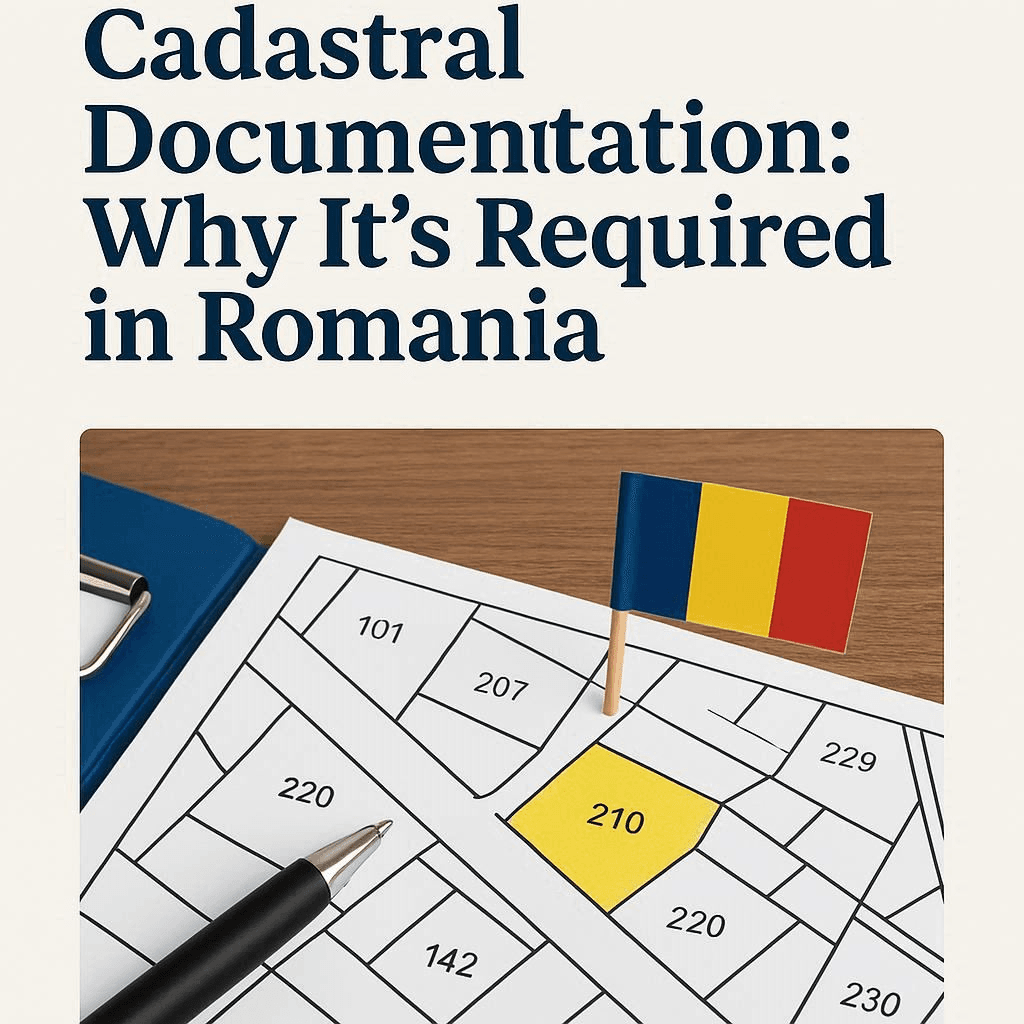
A person is examining a detailed map of land parcels.

Romania’s integrated framework merges technical and legal processes to ensure accuracy in ownership details.

Every parcel undergoes rigorous verification before entering the national registry.

This system prevents disputes by creating an immutable record that shields owners from unauthorized claims.

The process involves collaboration between cadastral offices and real estate departments.

Technical surveys and legal validations occur simultaneously, streamlining approvals.

Delays in documentation can derail sales or financing, making compliance non-negotiable for smooth transactions.

For tailored guidance, contact office@theromanianlawyers.com.

Our team navigates these requirements daily, ensuring clients meet all obligations efficiently.

Key Takeaways

  • Romania’s property system requires precise technical and legal alignment for valid ownership,
  • Integrated workflows prevent errors and accelerate registration timelines,
  • Third-party claims lose validity without proper cadastral verification,
  • Delays in documentation expose owners to financial and legal risks,
  • Professional support minimizes hurdles in complex cases.

Understanding Cadastral Documentation in Romania

Romania’s property system relies on a structured framework where technical precision meets legal validity.

This foundation ensures every land registry entry reflects accurate ownership details and physical characteristics.

A map showing property boundaries and land divisions.

Definition and Key Components

Cadastral files combine technical surveys with legal descriptions.

They include boundary markers, exact surface measurements, and unique identification numbers assigned during registration.

These documents also contain geospatial plans that map the estate’s layout.

Authorized surveyors and legal experts collaborate to verify each detail.

Errors in boundary data or ownership records can invalidate transactions.

Professionals ensure compliance with national legislation to prevent disputes.

Historical Context and Evolution

Romania’s modern cadastral system has evolved through various historical influences, with significant development occurring during different administrative periods.

The current integrated system represents decades of modernization efforts to align with European Union standards.

Contemporary reforms integrated digital mapping with established processes.

Today’s estate records blend historical archives with real-time updates.

This evolution maintains continuity while addressing modern ownership complexities.

Cadastral Documentation and Why is It Required in Romania

A group of people discussing over a table filled with paperwork and charts.

Romanian legislation mandates strict protocols for validating property boundaries and ownership transfers.

These protocols serve as the foundation for all real estate transactions, ensuring every modification aligns with national standards.

Key Legal Requirements and Registration Effects

Under Romanian law, formalizing land divisions or mergers requires comprehensive technical verification.

This process applies during initial registrations and subsequent changes like boundary adjustments.

Authorized surveyors must validate measurement accuracy and confirm the credentials of involved professionals.

Each submission undergoes a multi-step review.

Inspectors cross-reference graphic databases to locate the site and ensure surface calculations match physical dimensions.

Discrepancies between descriptive details and visual representations trigger immediate revisions.

Upon approval, properties receive unique identifiers that lock their status in the national system.

These codes become critical references for future transactions or legal disputes.

Properly executed registrations grant owners enforceable rights against third-party claims.

They also activate the property’s eligibility for entries in Romania’s land book—a decisive factor in securing financing or completing sales.

Non-compliant submissions face rejection, requiring costly resubmissions.

Errors in surface data or boundary markers can delay land development projects significantly, emphasizing the need for precision from the outset.

Integration of Cadaster and Land Registry Systems

Romania’s property governance model eliminates bureaucratic silos through a cohesive institutional design.

The Romanain land registry and cadaster operate under one administrative umbrella, merging technical precision with legal validation.

This structural integration accelerates decision-making while maintaining rigorous standards.

Several colorful folders are neatly organized on a shelf labeled with different property names.

Unified Workflow in Land Book Registrations

Applications for property registration follow a synchronized process.

Technical surveys and legal validations are processed within the same department, removing redundant steps.

A single documentation file combines geospatial maps, boundary certifications, and ownership proofs.

The system routes files between cadastral inspectors and real estate publicity teams automatically.

Technical specialists verify measurement accuracy, while legal experts confirm compliance with ownership transfer rules.

Approved data flows directly into Part A of the land book, ensuring alignment between physical boundaries and registered rights.

Key advantages of this approach include:

  • Reduced processing times through parallel technical-legal reviews,
  • Eliminated discrepancies between registry entries and physical sites,
  • Centralized access to updated property information.

This integration minimizes errors that traditionally arise when separate institutions handle cadastral and registry tasks.

Real estate professionals benefit from predictable timelines, while owners gain enforceable rights backed by unified records.

Process and Legal Considerations for Cadastral Documentation

Navigating Romania’s property registration framework demands strict adherence to sequential technical and legal phases.

This structured approach protects ownership rights while maintaining alignment with national standards.

A close-up of a stamp on a completed application form.

Steps from Technical Verification to Legal Registration

The procedure unfolds through six critical stages:

  1. Preparer validation: Confirm credentials of professionals who drafted the documents,
  2. Database cross-check: Locate property in the national graphics system using coordinates,
  3. Surface verification: Audit mathematical accuracy of land measurements,
  4. Attribute correlation: Match written descriptions with graphical representations,
  5. Number assignment: Issue unique identifiers for unregistered properties,
  6. Final review: Cadastral inspector approves or flags discrepancies.

Ensuring Compliance with Romanian Law

Authorities reject submissions failing these legal benchmarks:

RequirementComplete DocumentationIncomplete Cases
Technical ActsPrecision-matched dataSurface calculation errors
Legal StandardsOwnership chain verifiedMissing notarized signatures
Time ImpactProcessing varies by complexityExtended delays and resubmissions

Non-compliant cases trigger detailed deficiency reports.

These outline exact corrections needed for resubmission.

Proper execution prevents third-party claims and ensures enforceable rights under Romanian statutes.

Implications for Real Estate and Property Transactions

Romania’s real estate market operates on a simple principle: no valid registration equals no enforceable rights.

The land registry acts as the ultimate authority for verifying ownership before any transaction closes.

This system protects buyers from inheriting unresolved disputes or hidden claims.

A computer screen displaying a digital cadastral map with highlighted properties.

Impact on Land Sale and Ownership Proof

Without registry entries, sellers cannot legally prove they own the property.

Notaries refuse to authenticate sales contracts for unregistered parcels, blocking transfers entirely.

Banks similarly reject mortgage applications tied to undocumented estates.

Common scenarios demonstrate these consequences:

ScenarioWith Proper DocumentsMissing Documents
Residential SaleProcessing within standard timeframesContract voided
Land DevelopmentFinancing approvedBank refusal
Inheritance TransferSmooth ownership changeExtended court proceedings

Proper registration creates a public record accessible to buyers, lenders, and authorities.

This transparency accelerates due diligence and reduces fraud risks.

Updated entries also increase property values by confirming marketability.

Maintaining current records helps avoid transaction delays and ensures compliance as boundaries or zoning laws change.

Legal Solutions and Alternative Approaches

When traditional property registration isn’t an option, Romanian law offers alternative pathways to secure ownership rights.

These mechanisms address complex scenarios where standard documentation remains unavailable or incomplete.


Noting Possession and Alternative Procedures

Individuals using land without formal ownership documents can request a notation of possession.

This legal step initiates a period during which third parties may contest the claim.

If no disputes arise, property rights may be formally registered through court proceedings.

Usucapion and Property Acquisition

Romanian law recognizes usucapion (adverse possession) as a method of acquiring property rights through prolonged possession.

Under current legislation, individuals who can demonstrate continuous, uninterrupted, and public possession for specified periods may acquire ownership rights.

The Civil Code establishes that those who possessed property for 10 years may become owners through adverse possession (extratabulară).

For situations involving longer periods, 30-year usucapion (acquisitive prescription) may apply depending on specific circumstances and legal requirements.

Resolving Complex Ownership Scenarios

Successful usucapion requires proving public, peaceful, and uninterrupted control of the land.

Authorized companies handle complex procedures for cases involving partial deeds or indirect evidence.

This process often becomes critical during inheritance disputes involving properties with unclear documentation.

Multiple heir situations demand specialized strategies to prevent prolonged litigation.

Legal professionals help owners navigate these complexities while protecting against future obstacles in mortgage or sale processes.

Consulting experienced attorneys ensures compliance with evolving registration standards.

Their guidance minimizes risks in both standard and alternative ownership validation processes.

Expert Insights and Best Practices in Cadastral Documentation

Navigating property records demands precision only specialists can deliver.

Romania’s framework assigns distinct roles to owners, professionals, and regulators to maintain system integrity.

O persoană arătând cu degetul la un teren pe un document.

Expert Guidance and the Role of Authorized Professionals

Licensed surveyors and legal practitioners handle technical evaluations under the National Agency for Cadaster and Land Registration.

These experts:

  • Verify boundary markers using GPS technology,
  • Cross-reference historical maps with current site conditions,
  • Certify that legal descriptions match physical characteristics.

Property owners must identify and preserve their boundaries.

Professionals bear responsibility for measurement accuracy, while inspectors validate data before issuing registration numbers.

Ensuring Data Accuracy and Timely Updates

Regular updates prevent conflicts during sales or inheritance transfers.

Key maintenance practices include:

ActionFrequencyResponsible Party
Boundary checksEvery 5 yearsOwner
Record auditsPost-constructionAuthorized surveyor
System updatesReal-timeCadastral office

Disputed cases require immediate legal intervention.

For complex scenarios like overlapping estate claims, contact office@theromanianlawyers.com.

Professional legal teams specialize in resolving boundary disputes efficiently.

Proactive monitoring of zoning changes safeguards rights.

Specialists recommend digital alerts for land registration amendments affecting your assets.

Conclusion

Securing property rights in Romania hinges on meticulous adherence to legal frameworks governing land records.

The integrated system combining technical precision with legal validation ensures transparent transactions while preventing ownership disputes.

From standard registrations to resolving complex cases, compliance protects all involved parties.

Authorized professionals play a critical role in verifying boundaries and maintaining error-free documentation.

Their expertise streamlines the process, whether handling routine updates or alternative acquisition methods.

Proactive management of real estate records remains essential for financing eligibility and conflict prevention.

Regular audits and immediate corrections uphold the integrity of Romania’s land registry framework.

For tailored guidance on navigating these requirements, contact office@theromanianlawyers.com.

Professional legal teams provide comprehensive support to ensure your assets remain protected under national law.

FAQ

What legal effects does land registration have in Romania?

Registration in the Land Book grants enforceable rights against third parties and validates ownership transfers.

It serves as the primary proof of legal title under Romanian law, ensuring transparency in transactions like sales or mortgages.

How does the cadaster system integrate with property registration?

Romania’s unified system combines cadastral data (physical boundaries, area) with the Land Registry’s legal records.

This integration streamlines workflows, reduces errors, and ensures accurate verification during transactions.

What steps are involved in obtaining cadastral documentation?

The process includes technical verification by licensed surveyors, boundary confirmation with neighbors, submission to the Cadaster Office, and final Land Book registration.

Compliance with zoning laws and notarization of legal acts is mandatory.

Why is cadastral documentation critical for real estate sales?

It confirms lawful ownership, clarifies boundaries, and identifies encumbrances like mortgages.

Buyers require this data to assess risks, secure financing, and complete transactions recognized by Romanian authorities.

Can property rights be established without full registration?

Temporary possession claims may be noted in the Land Book, but usucapion (adverse possession) or specialized procedures are required for full rights.

These alternatives involve court validation and strict evidence standards.

How do professionals ensure cadastral data accuracy?

Authorized surveyors, notaries, and lawyers cross-check records, resolve boundary disputes, and update entries for new constructions or subdivisions.

Regular audits by the National Agency for Cadaster prevent discrepancies.

What happens if a property has unresolved boundary issues?

Transactions may be delayed until disputes are settled via mediation or court rulings.

The Cadaster Office flags such cases, requiring updated technical plans and neighbor agreements before registration.

 
Romanian Company Capital Increase 2025

Romanian Company Capital Increase: Streamlined Processes 2025

Romanian Company Capital Increase: Streamlined Processes 2025

Recent draft reforms on Romanian company capital increase 2025 have reshaped foundational requirements for Romanian companies, requiring both entrepreneurs and established firms to act quickly to stay compliant and maintain operational continuity.

capital increase procedures Romanian Company

Recent proposed changes in corporate legislation will require soon a minimum financial commitment, times higher than before, significantly impacting how companies, especially limited liability companies, operate.

Proposed changes are still in draft form and have not been enacted.

The current minimum capital requirement is 1 RON, and the proposal would increase it to variable amounts (500-90,000 RON).

The draft of law links financial obligations to company size, establishing specific compliance tiers across industries.

These changes will come with tight deadlines, enhanced reporting for banking activities, and stricter registry submissions.

Non-compliance could lead to severe penalties like operational suspension or dissolution.

Seeking professional advice is important, particularly for Romanian company formation or making structural adjustments.

Key Takeaways

  • Romania’s draft of corporate laws will enforce significantly higher minimum financial commitments,
  • Three-tier compliance system will align obligations with business size and revenue,
  • Mandatory banking protocols will affect entity registration and reporting,
  • Legal expertise ensures adherence to strict deadlines and documentation requirements,
  • Non-compliance may result in operational restrictions or business dissolution.

Navigating Romanian Corporate Regulations

The recent legislative draft introduces structured financial benchmarks for commercial entities.

These changes will create clear financial parameters tied to operational scale, ensuring alignment between resources and business activities.

bank account setup requirements

Updated Financial Benchmarks for Businesses

The revised draft establishes three financial tiers based on annual revenue.

Microenterprises with earnings below 395,000 RON must maintain 500 RON in reserves.

Mid-sized organizations generating up to 7 million RON require 5,000 RON.

Larger enterprises surpassing this threshold need 90,000 RON in available funds.

Business SizeRevenue RangeFinancial Reserve
MicroUnder 395k RON500 RON
Medium395k – 7M RON5,000 RON
LargeOver 7M RON90,000 RON

Banking Compliance Essentials

Under recent reforms in Romanian company law, newly incorporated businesses will be required to open and maintain a bank account within 30 days of registration, with banks permitted to refuse only on grounds related to anti-money laundering compliance under Law 129/2019.

Companies that fail to comply risk being declared fiscally inactive by ANAF, a status that suspends tax rights and may trigger fines of up to RON 10,000 for related non-compliance.

In parallel, the draft law increases the minimum share capital for limited liability companies (SRL) in Romania to RON 8,000, obliging existing SRLs to align either at the first amendment of their articles of association or within two years of the law’s entry into force.

Legal specialists recommend that entrepreneurs and investors prepare early to ensure smooth company formation, compliance, and business continuity in Romania.

Step-by-Step: capital increase procedures Romanian Company

Strategic documentation preparation forms the foundation of successful compliance.

Organizations must balance legal precision with operational agility when modifying foundational documents to meet revised standards.

trade register documentation process

Drafting Constitutive Acts and Submissions

Modifying Articles of association requires shareholder approval through formal resolutions.

Romanian lawyers must draft updated Articles reflecting adjusted financial commitments while maintaining alignment with existing operational parameters.

Completed documentation packages must include shareholder agreements and bank deposit confirmations.

The trade register mandates electronic submission of these materials within 15 days of approval.

Common errors in draft versions often delay processing timelines.

Timelines and Compliance Deadlines

Compliance timelines under the proposed Romanian company law reforms focus on SRL share capital increases and related corporate compliance filings.

All limited liability companies (SRL) will be required to raise their minimum share capital to RON 8,000, either at the first amendment of their articles of association or within two years of the law’s entry into force.

Once approved, the shareholder resolution must be registered with the Romanian Trade Register within 15 days, with late submissions leading to administrative penalties.

Although no official deadlines apply to POS installation or payment infrastructure upgrades, businesses should align their banking arrangements and capital adjustments early to avoid being declared fiscally inactive by ANAF and facing operational delays.

Engaging professional legal and accounting services in Romania is strongly recommended to ensure smooth compliance and safeguard business continuity.

Professional guidance helps navigate overlapping requirements efficiently.

Managing Compliance and Fiscal Transparency for Business Success

Effective governance in Romania’s business environment requires close monitoring of regulatory updates and proactive adjustment to new fiscal rules.

The latest company law and tax reforms introduce obligations that connect corporate governance, banking compliance, and shareholder transactions, making coordinated management essential for business stability.

compliance risk management

Mitigating Risks and Avoiding Administrative Blockages

Under the draft reforms, share transfers involving controlling shareholders must be reported to the tax authorities within 15 days.

Where companies have outstanding debts to the state, the Romanian Trade Register may require financial guarantees from the company or incoming shareholders before registering the transfer.

At the same time, failure to maintain an active bank account or to meet the new minimum capital thresholds for SRLs may result in a declaration of fiscal inactivity by ANAF.

Companies declared inactive face serious tax consequences: they must continue paying taxes but lose the right to deduct expenses and face restrictions on VAT claims.

To prevent these risks, businesses should adopt three practical safeguards:

  • Regular audits of banking documentation and shareholder records

  • Immediate updates to Trade Register filings following ownership changes

  • Preemptive resolution of outstanding state debts before major corporate transactions

Specialized legal and accounting advisors in Romania provide real-time monitoring, representation during ANAF audits, and strategic planning to maintain compliance.

Prompt action is also critical when receiving notices from fiscal authorities: while deadlines vary by procedure, some ANAF processes grant only 30 days to submit corrective documentation, and missed deadlines may trigger enforcement measures such as account freezes or asset seizures.

Conclusion

Navigating Romania’s revised corporate framework demands strategic adaptation.

Limited liability companies in Romania face permanent operational changes rather than temporary fixes.

Successful adaptation requires proactive planning with legal specialists.

Organizations prioritizing these measures secure long-term viability in Romania’s transformed business environment.

Romanian legal expertise remains critical for interpreting evolving requirements while safeguarding growth opportunities.

FAQ – Romanian Company Law and Compliance (2025)

What is the minimum share capital for a limited liability company (SRL) in Romania?


Under the draft reforms to Law 31/1990, the minimum share capital for an SRL will increase from 1 RON to 8,000 RON.

Existing companies must align either at the first amendment of their articles of association or within two years of the law’s entry into force.

Certain regulated industries (e.g. banking, insurance) still require much higher thresholds under sector-specific rules.

How long does it take to open a bank account for a capital increase?


Romanian banks usually process share capital deposit accounts within 3–5 business days, provided that the company submits incorporation documents, shareholder identification, and complies with anti-money laundering (AML) checks under Law 129/2019.

What penalties apply for missing compliance deadlines during share transfers?


Failure to submit share transfer documentation to the Trade Register or ANAF within 15 days may result in fines of up to 5,000 RON.

Persistent non-compliance can also expose companies to fiscal inactivity status, which restricts VAT deductions and expense claims, though dissolution is not an automatic sanction.

Do constitutive acts and amendments require notarization?


Notarization is no longer mandatory for standard SRL incorporation or simple amendments since the 2020 simplification of Romanian company law.

However, notarization may still be required in special cases, such as share transfers involving real estate contributions or when parties choose additional contractual safeguards.

What tax obligations follow a capital increase?


Companies must notify ANAF and the Trade Register of any capital increase within 15 days.

While capital injections themselves are not subject to taxation, incomplete or incorrect documentation may trigger tax audits or reclassification of funds.

Can foreign shareholders participate in increasing share capital?


Yes. Foreign investors may contribute capital under the same conditions as Romanian nationals.

For cross-border transfers, companies must comply with AML documentation requirements, and transactions above €10,000 are subject to reporting obligations under Law 129/2019.

Micro Enterprise in Romania for 2025

Micro Enterprise Eligibility Criteria in Romania for 2025

Micro Enterprise Eligibility Criteria in Romania for 2025

New regulations effective January 2025 will dramatically reshape fiscal strategies for small businesses.

Recent amendments to fiscal legislation through OUG No 156/2024 introduce unprecedented reductions in income thresholds for preferential tax treatment.

The revised framework slashes permitted earnings by 50% compared to prior limits, creating urgent compliance challenges.

micro enterprise eligibility criteria Romania 2025

These adjustments demand immediate attention from company leaders and financial advisors.

Organizations exceeding €250,000 in annual revenue now face critical decisions about restructuring operations or exploring alternative fiscal arrangements.

The changes particularly impact service-oriented businesses and startups scaling toward mid-market positions.

Key Takeaways

  • Income ceilings for a preferential tax treatment drop to €250,000 starting January 2025,
  • Additional reductions to €100,000 planned for 2026 under current legislation,
  • Mandatory operational reviews required for businesses near revised thresholds,
  • Strategic planning essential for maintaining fiscal efficiency,
  • Professional advisory services critical for compliance verification.

This analysis provides actionable insights into navigating the reformed fiscal landscape.

Understanding these modifications enables informed decision-making for sustainable business growth under updated regulatory conditions.

Introduction to Romania’s Fiscal Landscape in 2025

The year 2025 marks a pivotal shift in fiscal policy designed to stabilize national finances while supporting market adaptability.

Government measures prioritize efficient resource distribution through updated tax structures, creating a balanced framework for economic growth.

tax changes 2025

Revised tax laws align with broader EU financial strategies, ensuring competitive positioning within continental markets.

These adjustments focus on sustainable revenue streams without imposing excessive burdens on commercial operations.

Businesses in Romania must recognize these modifications as interconnected components of a long-term economic vision.

Key reforms emphasize strategic alignment between public spending controls and private sector innovation.

The updated law introduces refined compliance standards to enhance fiscal transparency.

This approach maintains investor confidence while addressing budgetary pressures through measured adjustments.

Organizations operating within this jurisdiction should reevaluate financial strategies to align with evolving requirements.

Proactive adaptation ensures continued competitiveness under the restructured fiscal system.

Professional guidance remains critical for navigating these systematic changes effectively.

Overview of the Micro Enterprise Tax Regime in Romania

Romania’s simplified fiscal system offers distinct advantages for qualifying organizations through a structured dual-rate approach.

This model replaces traditional profit-based taxation with turnover-focused calculations, particularly advantageous for ventures with limited operational complexity.

Key Features of the Simplified Structure

The 1% rate applies to entities generating under €60,000 annually, while those exceeding this threshold or operating in designated sectors face a 3% liability.

This tiered system allows precise financial planning while maintaining compliance with national revenue objectives.

Romanian tax regime 2025

Updated Fiscal Parameters

Recent adjustments emphasize stricter revenue monitoring to align with EU economic strategies.

The revised thresholds require businesses to implement enhanced tracking systems for real-time financial oversight.

These modifications aim to preserve the regime’s benefits while preventing misuse through improved accountability measures.

Organizations must now conduct quarterly reviews to verify compliance with updated earning limits.

This proactive approach helps maintain preferential rates while adapting to evolving market conditions.

Professional advisors strongly recommend automated accounting solutions for accurate reporting under the new requirements.

Micro enterprise eligibility criteria Romania 2025

Romanian Businesses seeking preferential fiscal treatment must meet six core conditions under Romania’s updated framework.

These requirements ensure alignment with national economic priorities while preventing system exploitation.

Romanian tax compliance 2025

Legal entities must satisfy these mandatory criteria throughout the fiscal year:

  • Annual revenue below €250,000,
  • Full private ownership of capital shares,
  • Active operational status (not in liquidation),
  • Social security payments for minimum one staff member or executive,
  • Single ownership restriction for major shareholders (25%+ stakes),
  • Annual financial reports submitted before legal deadlines.

The income ceiling forms the primary compliance checkpoint.

Organizations approaching this threshold require monthly monitoring systems to maintain eligibility.

Ownership rules prevent multiple benefit claims through subsidiary structures.

Employment obligations ensure active participation in Romania’s social security framework.

This condition applies even to single-member companies, requiring formal labor contracts for executives.

Late financial disclosures trigger immediate disqualification, regardless of other compliance factors.

Legal advisors recommend implementing automated tracking tools for real-time eligibility verification.

Non-compliance risks retroactive tax adjustments and potential audits.

Professional consultation remains essential for interpreting nuanced requirements.

Detailed Requirements for Qualified Micro Enterprises

Meeting workforce obligations forms a critical pillar of compliance under Romania’s preferential tax system.

Organizations must balance operational needs with strict regulatory mandates to maintain fiscal advantages.

employee documentation 2025

Staff Engagement and Social Security Rules

Companies must formalize employment contracts within 30 days of establishment.

This requirement applies equally to businesses hiring external staff or retaining directors who fulfill social security obligations.

The framework ensures active participation in national social programs.

Minimum gross wage standards (€814/month) apply to traditional employment arrangements.

This dual-path structure supports diverse operational models while maintaining workforce development goals.

Financial Reporting Deadlines

Timely submission of annual financial statements remains non-negotiable for continued eligibility.

Authorities require complete documentation before statutory deadlines to verify operational transparency.

Late filings trigger immediate disqualification from preferential rates.

Automated accounting systems prove vital for meeting these obligations.

Regular internal audits help prevent reporting delays that could jeopardize fiscal status.

Professional advisors emphasize proactive calendar management for critical submission dates.

Corporate Income Tax vs. Turnover Tax Explained

Understanding fiscal obligations requires clear differentiation between profit-based and revenue-based taxation models.

The choice between these systems determines financial planning strategies and compliance requirements for organizations operating under Romanian jurisdiction.

Transition from Turnover Tax to Profit Tax

Organizations exceeding specific operational parameters face automatic conversion to standard corporate income tax rules.

This irreversible transition occurs when companies surpass €250,000 in annual revenue or fail to meet employment requirements within 30 days of registration.

The shift triggers immediate application of a 16% tax rate on net profits.

Unlike the simplified turnover model, this system demands detailed expense tracking and comprehensive financial documentation.

Our team of lawyers in Romania stress the importance of quarterly monitoring to prevent unexpected regime changes.

Methods for Calculating Tax Liabilities

Turnover-based calculations apply fixed percentages to gross revenues, offering predictable fiscal outcomes.

In contrast, profit taxation requires subtracting verified business expenses from total income before applying the statutory corporate income tax rate.

Key differences include:

  • Documentation needs: Profit tax requires expense receipts,
  • Reporting frequency: Monthly vs quarterly declarations,
  • Compliance complexity: Advanced accounting systems recommended.

Financial planners emphasize proactive modeling of both scenarios to optimize fiscal outcomes.

Permanent ineligibility for preferential treatment makes strategic forecasting essential for sustainable operations.

Understanding Income Thresholds and Revenue Monitoring

Strategic revenue tracking becomes paramount for organizations navigating revised fiscal parameters.

The 2025 income ceiling drops to €250,000 – half the previous limit – with a further reduction to €100,000 planned for the following year.

Compliance hinges on annual earnings recorded by December 31, requiring continuous oversight to prevent unexpected tax regime changes.

Quarterly financial reviews now serve as essential safeguards against threshold breaches.

Advanced tracking systems enable businesses to project annual revenues using real-time data, identifying potential compliance risks months in advance.

Many firms implement alerts when reaching 75% of permitted earnings, allowing time for operational adjustments.

Three critical considerations guide effective threshold management:

  • Automated accounting tools for instant revenue visibility,
  • Scenario planning for different growth trajectories,
  • Regular cross-departmental financial reviews.

Organizations surpassing these limits face immediate transition to standard corporate tax rules.

This irreversible shift underscores the need for proactive measures rather than reactive corrections.

Financial teams must balance growth ambitions with strict fiscal boundaries to maintain preferential treatment.

The determination method based on prior-year totals adds complexity to strategic planning.

Companies approaching thresholds often benefit from staggered invoicing or temporary service adjustments to stay within permitted ranges.

Our team of lawyers in Bucharest  increasingly emphasize predictive analytics in maintaining compliance while pursuing sustainable expansion.

Special Industry Considerations in Taxation

Tax obligations under Romania’s updated framework vary significantly across commercial sectors.

Specific activities classified under CAEN codes trigger distinct fiscal treatment, requiring careful operational analysis.

The 3% rate applies regardless of revenue levels for ventures in technology and hospitality fields.

Software development and IT service activities face elevated rates due to their scalability and profit potential.

This includes custom programming solutions (CAEN 6210) and technical support operations (CAEN 6290).

Government policies aim to balance sector growth with equitable revenue collection.

Food-related businesses encounter similar tax treatment.

Restaurants, food trucks, and catering activities (CAEN 5611-5622) operate under the higher rate structure.

These rules reflect market dynamics and operational complexities in hospitality.

Three critical factors influence tax categorization:

  • Primary revenue-generating operations,
  • Secondary commercial engagements,
  • Accurate CAEN code alignment.

Organizations operating across multiple sectors must designate their principal activity through documented revenue analysis.

Our team of Romanian Lawyers play vital roles in verifying classifications and preventing compliance errors.

This structured approach supports strategic planning while meeting fiscal responsibilities.

Businesses offering combined food service activities with retail operations require particular attention.

Clear documentation separating revenue streams ensures proper rate application.

Regular operational reviews help maintain compliance as commercial portfolios evolve.

Impact of Employment and Minimum Wage Rules

Workforce management challenges intensify under updated labor regulations, requiring precise alignment between payroll practices and fiscal compliance.

Businesses must now navigate layered obligations spanning social contributions, sector-specific wage floors, and conditional tax benefits.

Social Contributions and Mandatory Hiring

Romanian Employers face dual responsibilities for health insurance and pension funds.

Construction sector staff require minimum gross wages of RON 4,582 monthly, while agricultural and food industry workers demand RON 4,050.

These figures represent baseline commitments before calculating employer contribution rates.

The RON 300 monthly tax exemption applies when two conditions align:

  • Gross salary matches the legal minimum for the sector,
  • Total employee earnings stay below RON 4,300 monthly.

Strategic Payroll Management

Automated systems prove essential for tracking variable wage thresholds across industries.

Companies combining multiple business activities must implement separate payroll calculations for each operational division.

Errors in contribution allocations risk penalties exceeding 5% of annual turnover.

Human resources teams should prioritize:

  • Monthly verification of sector-specific wage compliance,
  • Integration of tax exemption parameters into payroll software,
  • Cross-departmental audits for social security alignment.

This regulatory framework demands continuous coordination between financial and HR departments.

Our Emplyoment legal specialists in Romania increasingly recommend unified platforms that synchronize labor costs with tax eligibility requirements.

Financial Statement Compliance and Reporting Requirements

Accurate financial documentation serves as the cornerstone of maintaining fiscal benefits under revised regulations.

Organizations must submit annual financial statements by strict deadlines to qualify for preferential treatment.

The updated framework mandates timely preparation and submission of financial statements through authorized platforms.

Late filings trigger automatic disqualification from simplified tax regimes, regardless of operational performance.

This requirement applies even if other compliance standards appear satisfactory.

Effective compliance requires implementing reliable tracking systems to monitor reporting milestones.

Many firms now use automated tools to streamline annual financial documentation processes.

These solutions reduce errors while ensuring alignment with evolving submission protocols.

Our team of tax lawyers in Bucharest emphasize proactive calendar management for declaration deadlines.

Missing these dates risks retroactive tax adjustments and potential audits.

Maintaining eligibility demands continuous attention to both preparation quality and submission timing.

FAQ

What industries qualify for VAT exemptions under Romania’s micro-enterprise regime?

Companies in IT sectors like custom software development may benefit from VAT exemptions if they meet specific turnover thresholds.

Food service activities, including mobile food services, must comply with standard VAT rules unless operating under special fiscal provisions.

How does the 2025 tax rate change affect corporate income calculations?

Starting January 2025, eligible micro-enterprises face a revised corporate income tax rate of 16% on profits.

Businesses previously under the turnover tax system must transition to profit-based calculations, requiring updated financial statements and compliance with revised reporting standards.

What penalties apply for late submission of annual financial statements?

Legal entities failing to submit annual financial statements within 60 days of the fiscal year-end risk fines up to 10,000 RON.

Timely filing ensures eligibility for tax incentives and avoids disruptions to health insurance or social contribution benefits.

Are mobile food service operators subject to the same tax regime as brick-and-mortar businesses?

Mobile food service activities follow the same corporate income tax rules but may face additional municipal fees.

Compliance with hygiene standards and local permits remains critical, regardless of business structure.

How do minimum wage adjustments impact social contributions for micro-enterprises?

Employers must align salaries with Romania’s updated minimum wage RON 4,050/month, directly affecting social security and health insurance contributions.

Non-compliance may disqualify businesses from micro-enterprise benefits under Law No. 346/2004.

Can companies engaged in custom software development retain micro-enterprise status if revenue exceeds thresholds?

No. Firms surpassing 500,000 EUR annual revenue lose micro-enterprise eligibility and must transition to standard corporate taxation.

Regular revenue monitoring is essential to avoid unexpected tax rate changes or compliance audits.

What are the eligibility criteria for a micro-enterprise in Romania?

To qualify as a micro-enterprise in Romania, a company must meet specific criteria defined by the fiscal code.

These include having a turnover not exceeding €1 million, employing at least one full-time employee, and not being part of a larger group of companies.

Additionally, the company must be registered with the trade register and comply with the provisions related to share capital and business law.

What is the tax regime applicable to micro companies in Romania?

The tax regime for micro companies in Romania is quite favorable.

These firms benefit from a reduced tax rate of 1% on revenue if they employ at least one employee.

This micro company tax regime is designed to encourage new business formation and ease the tax burden on small enterprises.

Furthermore, micro-enterprises are generally exempt from corporate income tax and have simplified reporting obligations under the Romanian fiscal code.

How does a Romanian micro company handle dividend tax?

For a Romanian micro company, dividend distributions are subject to a dividend tax.

The standard dividend tax rate in Romania is 5%. However, micro-enterprises can benefit from tax exemptions or reductions under certain conditions, especially if they reinvest their profits into the business.

It’s essential for companies to consult with tax authorities to ensure compliance with current regulations.

What are the necessary steps to open a micro-company in Romania?

To open a micro-company in Romania, foreign investors or natural persons must follow several steps.

First, they need to choose the type of company, usually a limited liability company, and prepare the required documentation for company formation.

This includes drafting the company’s articles of incorporation and securing a corporate bank account.

After that, they must register the company with the trade register and ensure compliance with the fiscal code, including obtaining any necessary tax registrations.

Romanian Land Registry Process

The Land Registry Process in Romania: A Comprehensive Overview

The Land Registry Process in Romania: A Comprehensive Overview

What if a single oversight in documentation could jeopardize your real estate investment?

This critical question underscores the importance of Romania’s structured approach to property ownership verification.

The system ensures legal certainty through meticulous record-keeping and standardized protocols.

land registry process in Romania

Romania’s framework for validating ownership rights involves coordinated efforts between notariescadastral specialists, and government agencies.

Each transaction requires precise authentication and multi-stage reviews to prevent disputes.

While the system prioritizes accuracy, its complexity demands professional navigation.

Our team of lawyers in Bucharest play a vital role in interpreting regulations and avoiding procedural missteps.

For tailored guidance, contact office@theromanianlawyers.com to ensure compliance with all requirements.

Key Takeaways

  • Romania’s system provides legal security for real estate transactions,
  • Multiple verification stages prevent ownership disputes,
  • Specialized professionals ensure regulatory compliance,
  • Documentation accuracy impacts transaction validity,
  • Updated records maintain market transparency.

Introduction and the Importance of Land Registry in Romania

Accurate records form the backbone of successful real estate dealings.

Romania’s national property registry acts as a legal safeguard, detailing ownership rights, physical boundaries, and existing claims.

This system ensures every transaction meets strict standards for validity and transparency.

Overview of Real Estate Registration

The framework for property validation includes three core elements:

  • Technical specifications outlining exact dimensions and location,
  • Ownership history showing current and previous rights holders,
  • Legal restrictions like mortgages or usage limitations.

Romanian real estate documentation

Mandatory updates to these records occur with any ownership change.

Financial institutions and buyers rely on this data to verify asset legitimacy before approving deals.

How Reliable Documentation Impacts Transactions

Complete paperwork prevents disputes between involved parties.

Missing or conflicting information can:

  • Delay sales by weeks or months,
  • Invalidate purchase agreements,
  • Expose buyers to hidden liabilities.

Romania’s alignment with EU standards offers international investors familiar protections.

For tailored support navigating these requirements, contact office@theromanianlawyers.com to secure your transactions.

Historical Evolution of Land Registration in Romania

Romania’s approach to ownership validation reflects centuries of legal refinement.

The Austro-Hungarian Empire introduced structured cadastral practices in Transylvania during 1849, marking the region’s first standardized public records.

This initiative laid the groundwork for contemporary legal frameworks governing asset transfers.

cadastral records evolution

From Manual Registers to Digital Precision

Early documentation relied on handwritten ledgers detailing boundaries and ownership chains.

By the 20th century, these evolved into legally binding registers with three critical functions:

  • Mapping exact geospatial coordinates,
  • Recording successive titleholders,
  • Highlighting contractual obligations.

The shift to electronic databases after 2000 accelerated verification processes while preserving historical legal principles.

Modern platforms now integrate EU-compliant formats with traditional safeguards.

Continental Foundations and Systemic Reforms

Central European legal traditions heavily influenced Romania’s adoption of public accessibility standards for property books. Key developments include:

  • Harmonization with EU directives on transparency,
  • Digitization of archival records (1850-1950),
  • Nationwide implementation of unified protocols.

These advancements transformed fragmented regional practices into a cohesive framework.

Our team of lawyers in Romania leverage this historical context to interpret current requirements effectively.

For specialized guidance navigating these evolved systems, contact office@theromanianlawyers.com.

Legal Framework and Key Principles

Romanian property validation relies on foundational rules ensuring fairness and transparency.

Five core concepts govern how ownership changes are recorded and enforced under Law 7/1996.

These mechanisms protect both individual rights and public trust in official records.

Romanian legal principles

Opposability, Full Disclosure, and Legality

The principle of opposability ensures registered claims take immediate effect against third parties.

This establishes clear priority when multiple parties assert interests in the same asset.

Full disclosure requirements mandate recording all ownership details and restrictions.

PrincipleLegal BasisPractical Effect
OpposabilityLaw 7/1996 Art.12Immediate enforceability post-registration
Full DisclosureCivil Code Art.881Complete transaction history visibility
Legality ReviewLand Book Reg. §4Document validity verification

Neutrality and Ex Officio Decision Making

Registrars maintain strict neutrality, acting only upon formal requests.

However, they possess authority to independently verify application accuracy.

This ex officio examination ensures system integrity without compromising impartiality.

Legal professionals analyze how these principles interact in specific cases.

For personalized guidance navigating Romania’s property registration framework, contact our team of real estate lawyers in Bucharest at office@theromanianlawyers.com.

Understanding the Land Registry Process in Romania

Navigating property ownership in Romania requires understanding its dual-track validation system.

This framework combines administrative efficiency with judicial safeguards to balance speed and legal protection.

Specialized professionals manage critical approvals while maintaining avenues for dispute resolution.

Romanian administrative judicial system

Administrative Versus Judicial Aspects

The administrative procedure focuses on swift document processing by qualified registrars.

These officials review applications using standardized checklists to ensure compliance.

Key features include:

  • Mandatory legal education for registrars,
  • Predefined timelines for application reviews,
  • Automated validity checks for common documents.

Judicial oversight activates when parties challenge administrative decisions.

Courts examine whether registrars properly applied laws during initial assessments.

This layered approach prevents errors while respecting constitutional rights.

Decision Hierarchies and Professional Qualifications

Romania’s appeal process follows a strict three-step structure:

  1. Re-examination by senior registrars,
  2. District-level judicial review,
  3. Potential appeals to higher courts.

Legal professionals often intervene when technical interpretations affect ownership outcomes.

For tailored assistance navigating these mechanisms, contact office@theromanianlawyers.com to secure your property rights efficiently.

Step-by-Step Guide to Registration and Documentation

Securing property rights in Romania demands strict adherence to official validation protocols.

Three critical phases govern this structured approach: deed authenticationapplication review, and permanent database updates.

Each phase involves specialized professionals ensuring compliance with national standards.

Authentication of Deeds and Preliminary Certification

Public notaries initiate the authentication process by verifying signatures and legal capacity.

They cross-check ownership details against current land book extracts to confirm seller authority.

This step prevents invalid transactions by identifying undisclosed claims or restrictions.

Notaries issue preliminary certificates confirming document validity.

These certificates serve as prerequisites for submitting applications to territorial offices.

Missing this step voids subsequent registration attempts.

Submission, Verification, and Final Registration

Complete documents receive chronological entry numbers during submission, establishing priority for conflicting claims.

Assistant-registrars perform initial checks for completeness before forwarding files to senior officials.

Qualified registrars conduct final reviews within legally mandated timelines:

  • 9 days maximum for ownership transfers,
  • 2 days for mortgage registrations.

Approved applications trigger permanent database updates and automated certificate distribution.

For streamlined procedure navigation, contact office@theromanianlawyers.com for expert documentation support.

Digital Advances: Electronic Submission and Land Books

Romania’s property sector is undergoing a digital revolution while maintaining analog safeguards.

The national land book system now operates through hybrid workflows, combining electronic databases with physical document submissions.

This dual approach balances modernization efforts with traditional verification practices.

Benefits of Electronic Registration

Digital platforms transform how professionals interact with property records.

Key improvements include:

AspectTraditional MethodElectronic System
Processing Timeapp. 2-4 weeksapp. 3-5 business days
Record AccuracyManual entry errorsAutomated validation
AccessibilityIn-person requests24/7 online access

Authorized users retrieve estate data instantly through secure portals.

Integrated databases enable simultaneous updates across multiple agencies, reducing administrative overlaps.

Challenges in Transitioning from Analog Methods

The mixed system creates unique operational hurdles:

  • Physical document scanning delays digital processing,
  • Varied digital literacy among older professionals,
  • Inconsistent formatting of paper submissions.

These issues occasionally extend registration timelines when systems require manual reconciliation.

Legal teams often bridge the gap by cross-verifying electronic and physical records.

For streamlined navigation of Romania’s evolving land book procedures, contact office@theromanianlawyers.com.

Their experts provide tailored solutions for both digital and paper-based requirements.

Roles of Notaries and Legal Experts

Property transactions in Romania require coordinated efforts between specialized professionals to ensure legal compliance.

Notaries and registrars form the backbone of document validation, while legal advisors resolve complex challenges.

The Notary’s Function in Authenticating Documents

Public notaries verify the right of sellers to transfer ownership.

They confirm identities, check signatures, and obtain updated extracts from property records.

This prevents transactions involving disputed titles or hidden claims.

Key responsibilities include:

  • Validating legal capacity of all parties,
  • Ensuring compliance with contractual formalities,
  • Flagging undisclosed restrictions in land book extracts.

The Land Registrar’s Critical Decision Role

Registrars possess exclusive authority to approve or reject applications.

Their technical reviews determine if submissions meet statutory requirements for rights registration.

RoleFocus AreaDecision Impact
NotaryDocument validityTransaction initiation
RegistrarLegal complianceOwnership transfer finality

Romanian Legal professionals bridge gaps between these roles, particularly when multiple parties or cross-border elements complicate matters.

For complex cases involving contested titles, contact our team of specialized lawyers in Bucharest at office@theromanianlawyers.com for tailored solutions.

Overcoming Common Challenges in Real Estate Registration

Navigating property transfers often reveals unexpected hurdles requiring strategic solutions.

Many transactions stall due to incomplete paperwork or conflicting records, particularly in cases involving older assets or informal agreements.

Troubleshooting Missing Documents and Delays

Incomplete ownership chains frequently emerge with inherited estates or properties lacking updated titles.

Common issues include handwritten sale receipts without notary validation or assets listed solely in agricultural registries.

These gaps prevent legal transfers until resolved through archival research or court orders.

Delays often stem from multi-agency coordination requirements.

Cadastral mapping and zoning confirmations must precede notarial acts, creating sequential bottlenecks.

Proactive document preparation reduces waiting periods significantly.

Mitigating Legal and Procedural Pitfalls

Romanian law mandates authenticated ownership proofs for valid sales.

Romanian lawyers address challenges through:

  • Reconstructing historical ownership via court petitions,
  • Validating informal agreements through supplementary evidence,
  • Coordinating parallel approvals across institutions.

Specialized legal support in Romania streamlines these complex processes.

For tailored resolution strategies, contact office@theromanianlawyers.com to secure your transaction’s validity.


FAQ

What legal principles govern real estate registration in Romania?

The process follows three core principles: opposability (rights become enforceable against third parties upon registration), full disclosure (all relevant details must be publicly accessible), and legality (strict compliance with statutory requirements).

These ensure transparency and legal certainty in transactions.

How does electronic submission improve registration efficiency?

Digital platforms reduce processing times by enabling remote document filing, automated validations, and real-time status tracking.

This minimizes errors and accelerates the authentication of deeds while maintaining compliance with EU data standards.

What role do notaries play in property transactions?

Notaries authenticate agreements, verify identities, and confirm the legality of terms.

Their involvement ensures documents meet formal requirements before submission to the Land Book Office, reducing rejection risks during final registration.

Why might a registration request be delayed or rejected?

Common issues include incomplete ownership history, unresolved boundary disputes, or unrecorded encumbrances.

Proactive title searches and professional legal reviews help identify and resolve such gaps before submission.

Can possession alone establish ownership rights in Romania?

No. While long-term possession may support a claim through adverse possession laws, formal recognition requires a court decision and subsequent registration in the Land Book.

Mere occupancy does not guarantee legal rights.

What distinguishes administrative from judicial registration procedures?

Administrative processes handle uncontested applications, while judicial oversight applies when disputes arise over validity or competing claims.

Registrars assess evidence ex officio but may defer to courts in complex cases.

How are third-party rights protected during registration?

The system’s publicity principle mandates that all registered rights are visible to potential buyers or creditors.

This prevents hidden claims and ensures transactions reflect the true legal status of assets.


🏛️ Romanian Land Registry Quiz

Test your knowledge about property registration in Romania


open a Romanian business bank account

How to open a Romanian business bank account as non-resident

How to open a Romanian business bank account as non-resident


What if accessing European markets through a strategic financial gateway required fewer hurdles than commonly assumed?

With over 40 financial institutions and seamless connectivity to 500 million EU consumers, Romania presents a compelling proposition for international entrepreneurs.

Romanian business bank account as non-resident


Establishing corporate financial operations here involves navigating specific regulatory frameworks distinct from other EU jurisdictions.

Over 70% of newly registered entities prioritize this step within their first operational month, leveraging the country’s extensive ATM networks and multi-currency solutions.

The process demands precise alignment with local compliance standards and EU banking directives.

Professional guidance proves critical when addressing documentation protocols, language considerations, and cross-border transaction requirements.

Key Takeaways:

  • Romania’s financial infrastructure supports access to expansive EU markets through 40+ institutions,
  • Successful account establishment requires understanding dual compliance with national and EU regulations,
  • Most new Romanian enterprises complete this process within their initial operational phase,
  • Multi-currency capabilities streamline international transactions for cross-border operations,
  • Expert assistance mitigates challenges related to documentation and institutional procedures.

Understanding the Requirements and Romanian Banking Regulations

Financial institutions maintain rigorous protocols to align with evolving European standards.

Companies must navigate dual-layer compliance systems that combine local laws with EU directives.

This layered approach ensures transparency while facilitating cross-border economic activities.

banking regulations and compliance


Overview of Local Financial Regulations

The regulatory landscape requires adherence to three core pillars:

Requirement TypeKey ComponentsFrequency
AML VerificationSource of funds analysisInitial setup + annual reviews
Ownership DisclosureBeneficiary identificationDuring registration
Tax ComplianceVAT registration proofOngoing

Financial authorities mandate transaction monitoring systems for all corporate entities.

These systems track cross-border payments and flag unusual activity patterns.

Compliance and Legal Considerations

Documentation requirements vary by industry sector.

Companies in regulated fields like finance or energy face additional licensing steps.

Essential materials include:

  • Certified articles of incorporation,
  • Shareholder structure diagrams,
  • Tax identification certificates.

Quarterly financial reporting remains mandatory for maintaining active status.

Institutions may request updated operational data during periodic audits.

Eligibility and Key Documentation for Non-Residents

Establishing financial operations in this EU jurisdiction requires precise preparation of foundational materials.

Authorities mandate comprehensive verification processes to confirm organizational legitimacy and stakeholder identities.

eligibility documentation for non-residents


Personal Identification Protocols

Legal representatives and shareholders must submit valid passports or national ID cards.

Non-EU nationals often need supplementary residence permits, which require apostille certification.

All foreign-issued identification requires notarized translations into the local language.

Corporate Formation Evidence

Authenticated Articles of Association and Trade Register certificates prove a company’s legal standing.

Financial institutions require proof of registered office addresses through utility bills or lease agreements.

Minimum capital deposits of 200 RON (€45) must be verified through bank transfer receipts.

Document TypeSpecificationsSpecial Notes
Passport/IDValid for 6+ monthsNon-EU requires apostille
Articles of AssociationNotarized copyTranslated version mandatory
Capital ProofBank deposit receiptMinimum 200 RON
Address VerificationRecent utility documentUnder company name

Third-country entities should anticipate extended processing times for document legalization.

Mismatched signatures or expired certifications remain primary causes for application rejections.

Romanian business bank account as non-resident

Efficient setup of financial infrastructure abroad requires understanding sequential protocols.

Institutions prioritize structured workflows that balance regulatory compliance with operational efficiency.

Digital solutions now enable remote completion of most stages, accelerating market entry timelines.

process and documentation checklist


Essential Steps of the Process

The procedure follows five distinct phases:

  1. Provider selection (1-2 days): Evaluate institutions based on transaction capabilities, digital tools, and cross-border support,
  2. Document preparation (3-5 days): Organize materials requiring translation, notarization, or apostille certification,
  3. Application submission (1 day): Utilize online portals with video identity confirmation features,
  4. Compliance review (5-10 days): Undergo anti-fraud checks and operational legitimacy assessments,
  5. Account activation (1-2 days): Finalize initial deposits and receive digital access credentials.

Important Documentation Checklist

Prepare these critical materials to ensure smooth processing:

Document TypeSpecificationsProcessing Tip
Company CharterNotarized translationInclude shareholder signatures
Identity ProofValid passport copiesNon-EU requires apostille
Address EvidenceRecent utility billIssued within 90 days
Capital ProofBank transfer receiptMinimum €45 equivalent

Maintain digital copies of all submissions for quick reference during follow-ups.

Institutions may request additional verification for complex ownership structures.

Choosing the Right Bank or Fintech Provider

Selecting appropriate financial partners significantly influences operational success in cross-border ventures.

Institutions vary in their capabilities, with distinct advantages for different organizational needs.

financial partners selection


Established Financial Institutions

Major domestic institutions provide comprehensive infrastructure through physical networks and localized expertise.

ING offers English-language digital platforms with fee-free debit cards, ideal for tech-driven enterprises.

Banca Transilvania specializes in SME support through tailored loan packages and insurance products.

BCR maintains the largest branch network nationwide, while BRD delivers multilingual mobile banking interfaces.

These organizations excel in regulatory compliance and long-term financial planning.

Modern Financial Technology Solutions

Digital platforms streamline operations with rapid onboarding and multi-currency management.

Wise Business supports transactions in 50+ currencies with API integrations for automated workflows.

Revolut provides real-time expense tracking across 30 currencies through intuitive dashboards.

Provider TypeKey AdvantageIdeal For
TraditionalRegulatory expertiseComplex compliance needs
FintechCost efficiencyStartups & remote teams

Hybrid approaches combining institutional stability with fintech agility are gaining popularity among scaling enterprises.

Decision-makers should evaluate transaction volumes, currency requirements, and growth timelines when selecting services.

Navigating Fees, Charges, and Exchange Rates

Financial efficiency depends on understanding how institutional pricing models impact cross-border operations.

Service providers employ diverse fee architectures that directly affect profitability, particularly for enterprises handling frequent international money movements.

fee structures and exchange rates


Understanding Fee Structures

Traditional institutions typically impose initial setup charges ranging from €50 to €200.

Monthly maintenance costs average €10-€30, with domestic transactions costing 0.15% (minimum 5 RON) at major providers.

International transfers often carry higher percentages and fixed minimums.

Modern fintech solutions disrupt this model through transparent pricing.

Platforms like Wise apply flat 1% fees for currency conversions, eliminating hidden markups.

This approach can reduce transfer costs by 80-85% compared to conventional banking margins.

Fee TypeTraditional BanksFintech ProvidersSavings Potential
Setup€50-€200€0100%
Monthly Maintenance€10-€30€0-€1550-100%
International Transfer0.1% + 15 EUR1% flat80-85%
Exchange Rate Margin3-10%0.5-1%70-90%

Comparing International Transfer Costs

Cross-border transfers outside Europe reveal stark contrasts between providers.

Traditional banks often add 10%+ through inflated exchange rates. For a €10,000 payment, this could mean €1,000 in hidden fees.

Digital alternatives use real-time mid-market rates with clear percentage-based charges.

This transparency enables accurate forecasting of money movement costs.

Businesses processing high volumes should prioritize providers offering bulk discount rates.

Regular audits of transaction statements help identify unnecessary charges.

Combining multiple services often optimizes payment processing expenses across different currency zones.

Securing Your Funds and Banking Services

Modern financial infrastructure prioritizes both asset protection and value-added solutions to support organizational growth.

Institutions deploy layered security frameworks while offering diverse tools to optimize capital utilization.

Data Protection and Security Measures

Advanced encryption protocols safeguard sensitive information across all digital platforms.

Multi-factor authentication remains mandatory for high-value transactions, with biometric verification options gaining traction.

Continuous monitoring systems analyze 100+ risk indicators to detect anomalies in real time.

Financial partners implement tokenization for payment cards and API integrations.

Below shows key security features:

FeatureFunctionBenefit
256-bit EncryptionData transmission securityMilitary-grade protection
Behavioral AnalyticsUser pattern trackingFraud prevention
Automated AlertsSuspicious activity notificationsImmediate response

Additional Financial Services Offered

Beyond core accounts, institutions provide tailored solutions for capital growth.

Credit lines with revolving limits help manage cash flow fluctuations.

Merchant services enable seamless e-commerce transactions through integrated POS systems.

Key offerings include:

  • Short-term financing with competitive interest rates,
  • Customized payroll management platforms,
  • High-yield savings instruments for idle funds.

Investment advisory services assist in portfolio diversification, while trade finance solutions reduce import/export risks.

These tools collectively enhance financial efficiency for enterprises and individuals alike.

Challenges for Non-Resident Entrepreneurs

Establishing financial operations in a foreign country presents unique obstacles requiring strategic navigation.

International entrepreneurs often encounter systemic friction points that demand careful resource allocation and expert guidance.

Many financial branches operate with limited English-speaking personnel, complicating basic inquiries and documentation processes.

Document Translation and Legalization Hurdles

Certification requirements add layers to administrative workflows.

Official papers demand notarized translations and apostille stamps, with processing often taking multiple weeks.

Common pitfalls involve:

  1. Incomplete certification chains for foreign-issued documents,
  2. Mismatched formatting between international and local standards,
  3. Delays in obtaining ministry approvals for specialized sectors.

Proactive planning mitigates these obstacles.

Engaging certified translation services early and verifying requirements through official channels prevents costly revisions.

Many institutions now provide digital checklists to streamline submission processes.

Leveraging Technology for a Seamless Process

Modern financial operations increasingly rely on digital solutions to bridge geographical gaps.

Institutions now deploy advanced systems that simplify complex procedures while maintaining strict compliance standards.

Remote Authentication Methods

Video verification has revolutionized account establishment processes.

BRD and other providers enable identity confirmation through secure live calls, reducing setup timelines by 40-60%.

This approach maintains regulatory requirements while eliminating travel obligations.

Digital submission portals allow instant upload of certified documents.

Applicants receive real-time updates through automated tracking systems.

Key advantages include:

  • 24/7 application progress monitoring,
  • Secure cloud storage for sensitive files,
  • Automated error detection in submissions.

Digital Management Capabilities

Mobile platforms provide comprehensive control over financial operations.

Users execute cross-border payments, monitor balances, and generate reports through intuitive interfaces.

API integrations connect banking data with accounting software for seamless reconciliation.

FeatureTraditional ProvidersFintech Solutions
Verification ProcessIn-person meetingsBiometric video calls
Document SubmissionPhysical deliveryEncrypted uploads
24/7 AccessLimited branch hoursMobile app availability
Third-Party IntegrationManual data entryAutomated API sync

Automated payment scheduling reduces administrative workloads for growing enterprises.

Batch processing handles multiple transactions simultaneously, improving operational efficiency by up to 70% compared to manual methods.

Comparing Banks and Fintech Solutions for Business Accounts

Financial service providers now offer diverse pathways for managing corporate funds, each with distinct operational benefits.

Decision-makers must weigh institutional stability against technological agility when structuring financial operations.

Traditional Institutions: Stability vs Flexibility

Established financial organizations provide local expertise through physical branches and personalized support.

Their comprehensive service portfolios often include specialized lending products and long-term investment strategies.

Processing timelines may extend due to manual verification steps and complex approval hierarchies.

Digital Platforms: Speed and Innovation

Modern financial technology solutions excel in transaction efficiency and cost management.

Leading providers support multi-currency operations across 50+ denominations with real-time exchange tools.

Automated compliance checks and API integrations reduce administrative burdens for cross-border enterprises.

While digital services lack physical locations, their 24/7 accessibility and transparent pricing models address core operational needs.

Hybrid approaches combining institutional credibility with fintech flexibility are emerging as strategic solutions for scaling ventures.

FAQ

What financial regulations apply to non-residents opening corporate accounts in Romania?

Non-residents must comply with Romania’s Anti-Money Laundering (AML) laws and EU banking directives.

Institutions require proof of business legitimacy, source of funds, and adherence to local tax reporting standards.

Which documents are mandatory for non-resident entrepreneurs?

Essential documents include valid passports, proof of address, company registration certificates, and share capital confirmation.

Translated and notarized versions may be required for non-English paperwork.

What steps are involved in opening an account remotely?

The process includes selecting a financial provider, submitting digital copies of identification and company documents, completing video verification, and depositing minimum capital if applicable.

Are fintech platforms legally recognized for corporate banking in Romania?

Yes.

Licensed electronic money institutions like Revolut Business or Wise offer compliant services, often with faster onboarding and multi-currency features compared to traditional banks.

How do exchange rates impact international transactions?

Banks and fintech providers apply varying margins to currency conversions.

Comparing real-time rates and transfer fees can reduce costs for cross-border payments.

What security measures protect account holders?

Institutions implement GDPR-compliant data encryption, two-factor authentication, and transaction monitoring systems.

Clients also receive guarantees under the EU Deposit Insurance Scheme up to €100,000.

Do Romanian banks provide services in English?

Major banks like Banca Transilvania and Raiffeisen Bank offer English-speaking support.

However, legal documents may require certified translations for compliance.

Can non-residents access credit or overdraft facilities?

Credit approvals depend on the company’s financial history and collateral.

Fintech solutions often provide quicker access to flexible credit lines than traditional lenders.

What are the advantages of digital onboarding tools?

Remote video verification, e-signatures, and automated document checks streamline approvals, often reducing processing times to under 10 business days.

How does share capital affect account eligibility?

Romanian LLCs must demonstrate a minimum share capital deposit.

Banks require notarized bank statements or auditor confirmations as proof during applications.

🏦 Romanian Business Banking Quiz

Test your knowledge about opening a business account in Romania


Romanian Company Board Meetings

Navigating Romanian Company Board Meetings: Key Insights

Navigating Romanian Company Board Meetings: Key Insights

A group of people sits around a large conference table with papers and laptops in front of them.

Understanding the nuances of Romanian company board meetings is important for anyone involved in the management of companies in Romania.

This article provides key insights into the structure, legal requirements, and best practices for conducting effective board meetings in accordance with Romanian company law.

We will explore the roles and responsibilities of directors, shareholders, and other key stakeholders in the Romanian corporate governance landscape.

Understanding the Structure of Romanian Companies

A projector displays a presentation on the wall with graphs and charts.

Overview of Atrium Romanian Lawyers

Romanian company law dictates the formation, operation, and governance of various types of companies in Romania.

The type of company significantly impacts its organizational structure and the regulations governing its board meetings.

Atrium Romanian Law Office, an expert legal services provider, highlights that Romanian lawyers must navigate these regulations meticulously.

The Articles of Association define the company’s internal rules, complementing the broader legal framework and influencing how the board of directors operates and how resolutions of the general meetings are implemented.

Types of Romanian Companies

Romania provides various legal entity options, each possessing unique attributes.

Two frequently chosen forms are:

  1. Limited liability companies (SRL), which are often preferred by smaller businesses due to their simpler organizational structures.
  2. Joint-stock companies (SA), designed for larger enterprises and characterized by more complex governance procedures.

Ultimately, the selection between these legal structures will influence the company’s meeting and decision-making protocols.

Legal Entities and Their Responsibilities

As legal entities, Romanian companies bear specific responsibilities under Romanian law.

The board of directors, or the management board, plays a pivotal role in overseeing the company’s operations and ensuring compliance.

Members of the board are entrusted with representing the company, and their actions must align with both the law and the company’s articles of association.

The company is managed in accordance with the law, and the directors or the management board are responsible for preparing financial statements of the company and filing them with the Trade Registry.

Shareholder Meetings in Romania

A clock on the wall shows the time during the meeting.

Types of Shareholder Meetings

Under Romanian company law, various types of shareholder meetings serve distinct purposes.

These meetings are critical for the management of companies, ensuring transparency and shareholder involvement.

For example:

  1. The annual general meeting is a mandatory gathering where shareholders review the financial statements of the company and elect the board of directors or supervisory board.
  2. Extraordinary general meetings are convened to address specific, urgent issues such as amending the articles of association, increasing the share capital of the company, or approving significant transactions.

Convene Procedures for Shareholder Meetings

To convene a shareholder meeting, Romanian companies must adhere to specific procedures.

The board of directors, or in some cases, the supervisory board, must issue a notice to all shareholders, detailing the meeting’s agenda, date, time, and location.

This notice must be sent within the timeframe prescribed by Romanian company law and the company’s articles of association.

Failing to follow these procedures may invalidate the resolutions of the general meetings passed during the meeting, potentially leading to legal challenges.

Amending Resolutions in Shareholder Meetings

Shareholders can amend resolutions during the shareholder meeting under Romanian law, provided the proposed amendments are within the scope of the original agenda.

The process typically involves a motion to amend, followed by a vote among the shareholders.

For significant amendments, such as those affecting the articles of association, a supermajority vote may be required, and the amended resolution must be filed with the Trade registry.

Understanding these procedures is vital for effective corporate governance in Romanian companies.

The Role of the Board of Directors

A woman presenting a report on a screen in front of the board.

Composition of the Board of Directors

The composition of the board of directors is a critical element in the management of the company.

Under Romanian company law, the Articles of association of Romanian companies will specify the number of members of the board, their qualifications, and the process for their appointment.

In joint stock companies, the shareholder structure dictates that some directors or the management board are appointed by the general meeting of shareholders, ensuring the shareholder interests are adequately represented.

This structure aims to balance expertise and shareholder oversight.

Duties and Responsibilities of Board Members

Members of the board have extensive duties and responsibilities under Romanian law.

They are entrusted with the strategic direction of the company in Romania, ensuring compliance with regulations, and safeguarding the interests of all shareholders.

The board of directors is responsible for overseeing the financial statements of the company, ensuring their accuracy and timely filing with the trade registry.

In joint stock companies, the board also manages risk, sets policy, and monitors the performance of the management board, upholding their fiduciary duty to the company.

Decision-Making Processes in Board Meetings

Effective decision-making in board meetings is crucial for the success of Romanian companies.

The process typically involves presenting agenda items, facilitating discussion, and voting on resolutions.

The Articles of association often prescribe specific voting thresholds for different types of decisions.

For significant matters, such as amending the Articles of Association or increasing the share capital of the company, a qualified majority or even unanimous consent may be required.

Proper documentation of these decisions in the meeting minutes is essential for transparency and accountability, and the minutes should be filed with the trade registry as appropriate.

General Meetings: Best Practices

Several individuals are engaged in discussion, with some taking notes.

Planning and Conducting General Meetings

Effective planning is essential for successful general meetings in Romanian companies.

The board of directors must meticulously plan the agenda, ensuring all relevant items are included and clearly defined.

Romanian company law mandates that the Articles of Association dictate the specific procedures for these meetings.

As an expert legal services provider, we emphasize that proper notice must be given to all shareholders, and the meeting should be convened in a manner that promotes transparency and active participation, whether for limited liability companies or joint stock companies.

We are dedicated to helping our clients navigate these processes smoothly.

Legal Requirements for General Meetings

Adherence to legal requirements is paramount for general meetings in Romania.

Romanian law stipulates specific rules for voting, quorum, and documentation of resolutions of the general meetings.

The board of directors must ensure that all procedures align with both Romanian company law and the articles of association.

Members of the board must understand that failure to comply can invalidate the meeting’s outcomes, potentially leading to legal challenges.

Our firm provides expert guidance to Romanian companies in navigating these complex legal obligations, ensuring compliance and protecting shareholder interests.

Best Practices for Effective Communication

Effective communication is a cornerstone of successful general meetings.

Members of the board should ensure that information is presented clearly and concisely, allowing all shareholders to understand the issues at hand.

In Romanian companies, this includes providing materials in Romanian and, potentially, other languages if international shareholders are involved.

Encouraging open dialogue and addressing shareholder concerns promotes trust and transparency.

As a client-focused firm, we emphasize the importance of proactive communication to facilitate productive and legally sound board meetings.

Recent Developments in Romanian Company Law

Documents and folders are neatly arranged on the table for review.

Changes Impacting Board Meetings

Recent changes in Romanian company law have significantly impacted board meetings.

Amendments related to corporate governance and shareholder rights necessitate that directors or the management board stay informed and adapt their practices accordingly.

These changes may affect procedures for votes, the handling of resolutions, and the overall management of the company.

As an expert team of Romanian lawyers, we closely monitor these developments and provide timely advice to our clients, ensuring their companies remain compliant and competitive.

These updates are particularly relevant for both limited liability companies and joint stock companies.

Emerging Trends in Corporate Governance

Emerging trends in corporate governance are reshaping how Romanian companies conduct board meetings.

There is a growing emphasis on transparency, accountability, and environmental, social, and governance (ESG) factors.

Companies are increasingly adopting digital solutions to streamline meeting processes and enhance shareholder engagement.

The articles of association of Romanian companies are evolving to reflect these trends, often requiring more detailed reporting and greater shareholder involvement.

We assist our clients in integrating these best practices to enhance their corporate governance frameworks and attract investment.

Case Studies of Successful Board Practices

Examining case studies of successful board practices provides valuable insights for Romanian companies.

Instances where board meetings effectively addressed critical challenges, implemented innovative strategies, or improved shareholder relations offer practical lessons.

These examples often highlight the importance of diverse members of the board, robust decision-making processes, and proactive risk management.

We leverage our experience and expertise to help clients implement similar strategies, fostering a culture of excellence and driving sustainable growth for Romanian companies across various sectors, including both limited liability and joint stock companies.

FAQ:

What are the requirements for conducting board meetings in Romania?

In Romania, board meetings must comply with the applicable legislation, which includes the requirements set forth by the Romanian legislation.

Companies are required to convene meetings in accordance with their articles of association, which dictate the procedures shareholders must follow.

Additionally, the meeting must be held at the registered office or another location specified in the convening notice.

How can shareholders participate and vote in general shareholder meetings?

Shareholders can participate and vote in general shareholder meetings either in person or through electronic means.

The recent legal framework removes the requirement for companies to include identification data in the meeting notice, making it easier for shareholders to engage in the voting process, including the use of electronic voting in general.

What is the role of the supervisory board in Romanian companies?

The supervisory board is responsible for overseeing the management of the company and may appoint one or more directors.

Members of the supervisory board are appointed either directly by shareholders or through the general shareholder meeting, which can delegate this authority.

Their role is crucial in ensuring that the company adheres to the current legal framework concerning operational and strategic decisions.

How does electronic communication impact board meetings in Romania?

Electronic communication has transformed the way board meetings are conducted in Romania.

Companies may now utilize electronic means to convene meetings, allowing for greater flexibility and accessibility.

This shift aligns with the needs of the business, enabling stakeholders to participate remotely while ensuring compliance with the legal requirements set forth in the recent amendments to Romanian law.

What happens if a company fails to comply with the legal framework during a board meeting?

If a company fails to comply with the legal framework concerning board meetings, it may face legal repercussions, including invalidation of decisions made during the meeting.

The current legal framework emphasizes the importance of adhering to the stipulated procedures, such as ensuring that the convening notice is published at least 30 days prior to the meeting and that all necessary documentation is submitted.

Can a company hold a general shareholder meeting without the presence of all shareholders?

A general shareholders’ meeting may proceed without the attendance of all shareholders, as long as the required quorum is met.

Shareholders representing the absolute majority of the share capital must be present, either in person or via electronic means, for decisions to be valid.

The company’s articles of association typically specify the exact quorum requirements.

What are the implications of the deadline of 6 December 2024 for Romanian companies?

The deadline of 6 December 2024 is significant as it marks the date by which companies must comply with the new legal framework concerning board meetings and shareholder communications.

Companies that fail to meet these requirements may face penalties or other legal consequences.

It is essential for companies to stay informed and adjust their procedures accordingly to ensure compliance with the amended legislation.

How do secondary offices relate to board meetings in Romania?

Board meetings are generally held at the registered office.

Secondary offices may play a role in the operations of a company, particularly for those with representative offices in different locations.

However, companies may also convene them at secondary offices, provided this is specified in the articles of association.

This allows for greater flexibility in operations and can help accommodate shareholders who may be located in various regions.

divorce Romania

Administrative Divorce in Romania vs Court Divorce: Key Differences

Administrative Divorce in Romania vs Court Divorce: Key Differences

When couples face irreconcilable differences, many assume lengthy court battles are inevitable.

But what if dissolving the marriage in Romania could align with mutual respect and efficiency?

Romanian law offers multiple pathways for spouses to legally separate, each tailored to specific circumstances.

administrative divorce in Romania vs court divorce

The Civil Code recognizes three primary methods: judicial processes, notarial agreements, and administrative solutions. These options vary in complexity, duration, and requirements.

For instance, simplified procedures exist when both parties agree on terms like asset division or child custody.

Choosing the right approach depends on factors such as cooperation levels and family dynamics.

While some cases require judicial oversight, others can resolve through streamlined administrative channels.

Legal professionals often emphasize early consultation to determine eligibility and avoid procedural delays.

Those navigating this process should contact office@theromanianlawyers.com for tailored guidance.

Expert advice ensures compliance with evolving regulations while protecting individual rights throughout the dissolution journey.

Key Takeaways

  • Romanian law provides judicial, notarial, and administrative separation options,
  • Mutual agreement significantly simplifies the process,
  • Child custody arrangements impact procedure selection,
  • Legal consultation helps identify optimal pathways,
  • Document preparation varies between methods,
  • Timelines differ based on case complexity.

Understanding Divorce Procedures in Romania

Three distinct legal avenues exist for couples seeking to dissolve their union.

Each method carries specific eligibility criteria and procedural steps, requiring careful evaluation of family circumstances and mutual agreements between partners.

divorce procedures in Romania

Overview of Judicial Divorce and Its Legal Basis

Courts handle separation requests when spouses cannot reach full consensus or face complex disputes.

This traditional approach demands filing at the district court near the last shared residence, ensuring jurisdictional accuracy.

Both parties must demonstrate unforced consent and legal capacity throughout proceedings.

Judicial oversight becomes mandatory for resolving conflicts involving asset distribution or child support disagreements.

Legal professionals often recommend this route when safeguarding individual rights requires formal adjudication.

The process typically involves multiple hearings and documented evidence submissions.

Administrative and Notarial Divorce Options

Mutually agreed separations without minor children qualify for streamlined civil registry processing.

Partners present a joint declaration alongside necessary documentation, expediting dissolution without court involvement.

This administrative path concludes faster but excludes cases with underage dependents.

Notarial alternatives accommodate parents who establish unified childcare arrangements beforehand.

Public notaries validate agreements covering parental authority and financial responsibilities, permitting separation despite having children.

Both methods prioritize efficiency while maintaining legal validity when all terms receive mutual approval.

Consulting office@theromanianlawyers.com helps determine eligibility and navigate documentation requirements for each procedure.

Expert guidance ensures compliance with evolving regulations while protecting personal interests during marital transitions.

Exploring “administrative divorce in Romania vs court divorce”

Choosing between separation methods depends on multiple factors.

Couples must evaluate their ability to collaborate and resolve disputes independently.

Legal frameworks prioritize efficiency while ensuring fair outcomes for all parties involved.

administrative vs court divorce comparison

Core Differences in Procedures and Requirements

Streamlined civil processes require full consensus between partners.

Both must sign documentation confirming no minor children exist from the union.

A mandatory 30-day reflection period precedes finalization.

AspectCivil Registry ProcessJudicial Process
EligibilityNo children & full agreementChildren or disputes present
Timeline60 days averageapprox. 3-12 months
Required AgreementAll terms settledCourt resolves conflicts
Child InvolvementProhibitedMandatory oversight
Legal OversightCivil officerJudge

When Mutual Agreement Simplifies the Process

Partners who settle financial and parental matters privately qualify for faster resolutions.

Complete alignment on asset division and childcare arrangements avoids courtroom delays.

Legal professionals at office@theromanianlawyers.com often mediate such agreements.

Disputes over property or visitation rights automatically trigger judicial involvement.

Even couples initially aligned on separation may require court intervention for specific disagreements.

Early legal consultation helps identify potential conflicts before filing paperwork.

Key Legal Requirements and Documentation

Legal dissolution of marital bonds demands careful adherence to statutory prerequisites.

Partners must meet specific conditions and submit properly executed paperwork to validate their separation under Romanian law.

divorce documentation requirements

Eligibility Criteria and Grounds for Dissolution

Four legal justifications permit marital termination:

  • Mutual consent with settled financial/parental matters,
  • Irreparable relationship breakdown,
  • Two-year separation for unilateral requests,
  • Severe health conditions preventing marital fulfillment.
RequirementStreamlined ProcessJudicial Process
Child StatusNo underage dependentsAny family situation
Agreement LevelFull consensusPartial or no agreement
Medical RestrictionsProhibited if impaired decision-making exists

Mandatory Cooling-Off Phase

A 30-day reflection period allows partners to reconsider their decision.

This safeguard applies even when both parties initially agree on separation terms.

Exceptions occur if one spouse lacks mental capacity to provide valid consent.

Essential documents include:

  • Original marriage certificate,
  • Valid identification papers,
  • Residency confirmation,
  • Parenting plans (if applicable).

Professional documentation assistance through office@theromanianlawyers.com ensures proper preparation of all required legal forms.

Experts verify compliance with evolving regulations while protecting individual rights throughout dissolution proceedings.

Practical Steps and Expert Advice for a Smooth Divorce Process

A smooth transition from marriage to independence demands careful legal navigation.

Early engagement with qualified professionals helps spouses address financial, parental, and logistical challenges effectively.

Strategic planning reduces conflicts while safeguarding individual rights throughout proceedings.

divorce process guidance

Consulting Legal Professionals

Contacting specialists at the initial stages prevents costly errors.

Romanian Attorneys assess property portfolios, international assets, and childcare arrangements to create tailored strategies.

Our expertise proves vital when drafting enforceable agreements or preparing court submissions.

Managing Financial and Family Matters

Matrimonial property regimes terminate upon filing separation documents.

Couples may choose:

AspectMutual AgreementCourt Decision
Asset DivisionPartners negotiate termsJudge determines split
Child ArrangementsParental plan requiredCourt-approved schedule
CostLower feesHigher expenses

Parental authority agreements must specify education, healthcare, and financial responsibilities.

Our legal teams help draft comprehensive plans prioritizing children’s welfare.

We can also mediate disputes over business interests or inherited properties.

Jurisdiction depends on the last family residence or marriage location.

Proper venue selection accelerates procedures while ensuring legal compliance.

Professional guidance remains essential for navigating bureaucratic requirements and meeting deadlines.

Conclusion

Navigating marital dissolution requires understanding distinct legal pathways tailored to specific circumstances.

Couples with full consensus and no underage children benefit most from streamlined processes, while contested cases demand judicial oversight.

Romanian law accommodates diverse scenarios through three validated methods: court proceedings, notarial settlements, and simplified administrative solutions.

Early consultation with legal experts proves critical for procedure selection.

Professionals assess cooperation levels, childcare needs, and asset complexity to recommend optimal strategies.

Those pursuing mutual agreements save time and resources, whereas disputed separations necessitate structured court interventions.

Finalizing marital termination hinges on precise documentation and statutory compliance.

Partners should prioritize expert guidance to navigate evolving regulations effectively.

For comprehensive support, contact office@theromanianlawyers.com to ensure rights protection throughout the dissolution process.

FAQ

What distinguishes administrative divorce from court divorce in Romania?

Administrative divorce occurs through a notary when spouses mutually agree on all terms, avoiding court.

Judicial divorce requires court intervention if disagreements exist regarding assets, child custody, or other legal matters.

Can spouses finalize a divorce without appearing in court?

Yes, if both parties agree on dissolution terms, they may opt for a notarial procedure.

This streamlined process eliminates court hearings but requires documented consent on parental authority, property division, and financial obligations.

How does mutual consent impact the timeline for dissolving a marriage?

Mutual agreement significantly accelerates proceedings.

Couples completing the mandatory 30-day reflection period can finalize the process within weeks, compared to months or years in contested cases requiring judicial review.

What legal criteria must couples meet for a notarial divorce?

Eligibility requires shared consent, no minor children, and a marital residence registered in Romania.

Spouses must also submit proof of marriage, joint declarations, and settlement agreements to the notary public.

Why is the 30-day reflection period mandatory?

Romanian law mandates this period to allow spouses to reconsider their decision.

It ensures both parties fully understand the implications of dissolution before legally formalizing the separation.

When is consulting a family law attorney advisable?

Legal counsel is critical if disputes arise over asset distribution, child support, or custody arrangements.

Attorneys also ensure compliance with Romanian Civil Code requirements and protect clients’ rights during negotiations.

How are parental responsibilities handled in uncontested cases?

Parents must outline custody terms, visitation schedules, and financial contributions in a joint agreement.

The notary or court validates this plan to safeguard the children’s best interests under Romanian family law.

What documentation is required to initiate proceedings?

Essential documents include marriage certificates, property deeds, child-related agreements, and proof of residence.

Notarial divorces additionally require a mutually signed dissolution contract.