Illustration of employee profiles and a closing checklist moving from a seller to a buyer in a Romanian asset deal.

Transferring Employees in a Romanian Asset Deal: The Implementation File Before Closing

Employment law · Asset deals · Romania

In brief: Where a Romanian asset deal transfers an economic entity that keeps its identity, the employment contracts attached to it pass to the buyer by law, together with the rights and obligations they carry on the transfer date.

Before closing, the seller and the buyer should each inform employee representatives, or the employees directly where there are none, at least 30 days before the transfer, and consult them on the transfer’s implications under Article 174 of the Labour Code and, where measures affecting staff are planned, under Article 11 of Law no. 67/2006.

Check that the implementation file covers the employee list, the seller’s notice of transferred rights, any collective agreement, planned changes, REGES-ONLINE registration, payroll and personal files before the transfer date is fixed.

A foreign buyer acquiring a factory, a service centre or a business line from a Romanian company often expects to choose which staff it takes over.

Romanian law usually takes that choice away, because the employees assigned to the transferred business move with it under the rules on transfers of undertakings, often called a TUPE transfer in English-language deal documents.

This guide is written for buyers, sellers and their HR and finance teams who must turn that rule into a working implementation file before closing.

It covers private-sector asset deals, and our employment due diligence checklist for buyers in Romania covers the workforce review that should come first.

Do employees transfer automatically in a Romanian asset deal?

They do where the deal transfers an undertaking, a unit or part of one that continues as an organised economic activity in the buyer’s hands, and not simply a set of isolated assets.

Under Article 173 of the Romanian Labour Code and Article 5 of Law no. 67/2006 on the protection of employees’ rights in the event of a transfer of an undertaking, the rights and obligations under the employment contracts and the applicable collective agreement existing on the transfer date pass in full to the transferee.

Law no. 67/2006 implements Directive 2001/23/EC on transfers of undertakings and is interpreted consistently with the case law of the Court of Justice of the European Union.

Under Romanian law, Article 5(2) of Law no. 67/2006 expressly excludes the automatic transfer rule where the transferor is subject to judicial reorganisation or bankruptcy proceedings.

The interaction with the narrower insolvency exception under the Directive, the stage of the proceedings and the terms approved in them should nevertheless be assessed in the particular transaction.

Under Article 3, as amended by Law no. 127/2018, the law applies to a maritime vessel transferred as part of an undertaking but not where the transfer consists exclusively of one or more maritime vessels.

The test is whether an economic entity retains its identity, and in Spijkers (Case 24/85) the Court listed the factors to weigh together, including the type of business, the transfer of assets, the takeover of most employees and customers and the similarity of the activity before and after the transfer.

In Süzen (Case C-13/95), the Court added that the mere continuation of a similar activity by a new provider is not, by itself, enough.

The label given to the assets sold is therefore not decisive, and a clause stating that “no employees transfer” does not prevent a transfer that the law treats as one.

SituationLikely positionWhat to check first
Sale of a whole plant or branch with its staff.It is often a transfer of an undertaking if the plant or branch continues as an organised entity.Identify every employee assigned to it on the planned transfer date.
Sale of a business line inside a larger company.It may be a transfer of part of an undertaking if the line is an organised economic entity.Map who works wholly or mainly for that line and how shared staff are allocated.
Sale of equipment or premises only.It may fall outside the rules if no organised activity continues.Check whether customers, know-how or key staff also move.
Purchase from a seller in judicial reorganisation or bankruptcy.Article 5(2) provides an exception under Romanian law, and whether it applies requires an assessment of the proceedings and the Directive’s narrower conditions.Review the stage of the proceedings and the terms set by the practitioner.
Share purchase of the Romanian company.The employer does not change, so these transfer rules are not engaged.Handle employment risks through due diligence and the share purchase agreement.

Which employees transfer?

Most disputes are not about whether a transfer happened but about which employees were assigned to the transferred entity.

Employees who work wholly or mainly in the transferred business should be listed by name, while shared, matrix-reporting, support and management staff need an individual allocation based on what they actually do.

Employees on suspended contracts, for example during parental or long-term sick leave, should be included if they are assigned to the business, and the allocation should be documented before the information letters go out.

What must the seller and the buyer do before the transfer date?

Under Article 6 of Law no. 67/2006, the seller must notify the buyer before the transfer of all rights and obligations that will pass, including contractual terms, collective-agreement provisions, accrued entitlements and pending disputes.

A missing notice does not stop the transfer or reduce the employees’ rights, so the buyer inherits the obligations whether or not it was told about them.

Under Article 12, each party must inform its own employee representatives in writing at least 30 days before the transfer about the date, reasons, consequences, planned measures and working conditions, or inform the employees directly where there are no representatives.

The duty applies even where the decision is taken by a controlling company abroad.

Under Article 11, where either party plans measures affecting its own employees, it must consult the representatives at least 30 days before the transfer with a view to reaching an agreement.

Article 174 of the Labour Code also requires both parties to inform and consult the trade union or employee representatives before the transfer about its legal, economic and social implications, so consultation on those implications is needed even where no specific measures are planned.

ObligationWho and whenEvidence for the file
Notice of transferred rights.The seller notifies the buyer before the transfer.A signed schedule of contracts, pay, benefits, leave and disputes.
Written information.Each party informs its representatives, or its employees, at least 30 days before the transfer.Dated letters and proof of delivery.
Consultation on transfer implications.Both parties consult before the transfer under Article 174 of the Labour Code.Invitations, minutes and the points discussed.
Consultation on planned measures.The party planning measures consults at least 30 days before the transfer.Minutes, written positions and the outcome.
Employee register update.The seller initiates the REGES-ONLINE entry and the buyer accepts it within five working days.Confirmations kept by both parties.

Timing risk: If signing and closing are close together, the 30-day period can delay closing, so it should be built into the timetable from the term sheet onwards.

Decision path: from signing to the transfer date

  1. Does the deal transfer an economic entity that keeps its identity?

    Yes: Treat the assigned employees as transferring by law and build the implementation file.

    No: Document why the rules do not apply, because any hiring by the buyer would need new contracts.

  2. Is the seller in judicial reorganisation or bankruptcy?

    Yes: Review the Article 5(2) exception and the practitioner’s terms before relying on any transfer.

    No: The statutory transfer rule applies to the employees assigned to the entity.

  3. Are there trade unions or elected employee representatives?

    Yes: Inform them in writing at least 30 days before the transfer.

    No: Inform the affected employees directly within the same period.

  4. Does either party plan measures affecting the employees?

    Yes: Consult at least 30 days before the transfer with a view to reaching an agreement.

    No: Record that no measures are planned, while still consulting on the transfer’s implications under Article 174 of the Labour Code.

  5. Is a collective agreement in force?

    Yes: The buyer applies it until it expires or ends, unless the entity loses its autonomy and the buyer’s own agreement is more favourable, and may renegotiate it only after one year.

    No: The individual contracts and the law set the transferred terms.

  6. Fix the transfer date.

    Close only when the information period has run, the file is complete and the buyer can register the transfer and run payroll.

Can the buyer change terms or reduce staff after the transfer?

Under Article 7 of Law no. 67/2006, the transfer itself cannot be a ground for individual or collective dismissal by either party.

Under Article 4(1) of the Directive, this does not stand in the way of dismissals for economic, technical or organisational reasons entailing changes in the workforce, so a genuine reorganisation after the acquisition is not excluded.

Such a dismissal must rest on a Labour Code ground and follow its procedure, as our employer guide to dismissal in Romania explains, and dismissals timed close to closing carry a practical risk of challenge.

Under Article 8, where the transfer involves a substantial change in working conditions to an employee’s detriment, such as relocation or a pay cut, the employer is held responsible for the resulting termination.

Under Article 9, the buyer must respect the collective agreement in force on the transfer date until it expires or ends, and renegotiation by agreement is possible only after at least one year.

Where the transferred entity does not keep its autonomy and the collective agreement applicable at the buyer is more favourable, the buyer’s agreement applies to the transferred employees.

An employee’s consent is not a condition for the statutory transfer of the undertaking, but an employee cannot be required to continue working for the buyer.

In Katsikas (Joined Cases C-132/91, C-138/91 and C-139/91), the Court of Justice left the consequences of such an objection to national law, and because Romanian law sets out no specific procedure, the effect on that employee’s contract must be assessed individually.

Post-closing options for transferred terms

Keep the transferred terms

When it fits: The buyer can run the business on the existing contracts and collective agreement.

What to document: Record the transferred pay, benefits, seniority and leave balances for each employee.

What to watch: Differences with the buyer’s existing staff may create pressure to harmonise later.

Harmonise by agreement

When it fits: The buyer wants common terms and employees accept them through signed individual addenda.

What to document: Keep the signed addenda and note that any collective agreement in force can be renegotiated only after one year.

What to watch: A change that substantially worsens working conditions can make the employer responsible for a resulting termination.

Restructure on a separate ground

When it fits: A genuine economic, technical or organisational reason requires changes to roles or headcount.

What to document: Prepare the business rationale, the selection criteria and the steps of the procedure for the ground relied on.

What to watch: The transfer itself cannot be the reason for dismissal, and every step of the Labour Code procedure must be documented.

Handle an employee objection

When it fits: An employee says that he or she does not wish to work for the buyer.

What to document: Record the objection in writing and the options discussed before the transfer date.

What to watch: The employee cannot be required to work for the buyer, and the effect on that contract must be assessed individually.

What belongs in the implementation file before closing?

The implementation file lets the buyer become the employer on the transfer date without gaps in payroll, records or compliance, and it should be agreed between the parties.

Under Article 5(1)(b) of Government Decision no. 295/2025, transfer data must be submitted to REGES-ONLINE, the general employee register that replaced Revisal, within five working days from the transfer date or the takeover date.

The Labour Inspectorate’s REGES-ONLINE manual describes the seller initiating the transfer entry and the buyer accepting it, so both parties should coordinate and keep their confirmations, although the registration does not itself decide whether the transfer rules apply.

Payroll, social contributions and tax reporting are for the buyer’s accountant or payroll provider, and our overview of tax and legal aspects of business transfers in Romania covers the wider deal context, while health and safety arrangements should continue without interruption.

Personnel data should move only to the extent needed and be documented under the General Data Protection Regulation, which the Romanian data protection authority (ANSPDCP) enforces, and our GDPR lawyers in Romania can review the data-transfer record.

Work permits of non-EU employees may need updating with the General Inspectorate for Immigration because they are linked to the employer, and our work permit and immigration team handles those filings.

File itemWhy it mattersTypical documents
Transferring employee list.It defines who moves and prevents disputes about shared staff.Names, roles, contract type, start date, pay and allocation.
Contracts and entitlements.The buyer inherits the terms applied and any unpaid amounts.Contracts, addenda, internal regulations, leave balances and bonuses due.
Collective agreement.The buyer applies it until it expires or ends, unless the entity loses its autonomy and the buyer’s own agreement is more favourable.The agreement, its registration details and its expiry date.
Disputes and inspections.Liabilities linked to existing employment relationships can follow the employees.Court files, Labour Inspectorate reports and settlements.
Information and consultation record.It shows that both parties met their duties under Articles 11 and 12 of Law no. 67/2006 and Article 174 of the Labour Code.Information letters, delivery proof, minutes and written positions.
Register, payroll and data.They allow the buyer to operate as employer from the first day.REGES-ONLINE confirmations from both parties, payroll set-up and a data-transfer record.

How should the asset purchase agreement deal with employees?

The transfer happens by law, but the asset purchase agreement, which our corporate and M&A lawyers negotiate for buyers and sellers, decides who bears the cost, usually allocating pre-closing liabilities to the seller and post-closing ones to the buyer, backed by indemnities and, for material risks, a retention or escrow.

The seller should warrant the accuracy of the employee list and of the notice of transferred rights, and conditions to closing can include completion of the information and consultation process.

These clauses allocate cost between the parties and do not reduce the employees’ rights, as our guides to the Romanian acquisition term sheet and the share purchase agreement explain for company acquisitions.

What happens if the procedure is not followed?

Under Article 13 of Law no. 67/2006, a breach is a contravention punishable by a fine of RON 1,500 to RON 3,000 applied by labour inspectors, and under Article 15 employees or their representatives may bring a labour dispute before the court.

The larger practical risks are claims for unpaid entitlements, challenges to dismissals linked to the transfer and separate sanctions for missing REGES-ONLINE registrations.

Illustrative scenario: A Dutch group buying the logistics division of a Romanian company identifies 85 transferring employees, sends information letters 35 days before closing, consults on a planned shift-pattern change and, with the seller, completes the REGES-ONLINE transfer entry three working days after closing.

Request a focused review of your transfer file

Atrium Romanian Lawyers advises foreign buyers and Romanian sellers on transfers of undertakings in Romania, from the scope note and timetable to information letters, consultation and the employee clauses of the asset purchase agreement.

Send the draft agreement, the list of assigned employees, any collective agreement and the planned closing date.

Frequently asked questions

Can the buyer choose which employees it takes over in an asset deal?

Not where the deal is a transfer of an undertaking, because the employees assigned to the transferred business move with it by law.

How long before closing must employees be informed?

The seller and the buyer must each inform employee representatives, or the employees where there are none, in writing at least 30 days before the transfer.

Does the buyer have to apply the seller’s collective agreement?

As a rule yes, until it expires or ends, with renegotiation possible only after one year, unless the transferred entity loses its autonomy and the buyer’s own agreement is more favourable.

Can employees be dismissed because of the transfer?

No, although dismissals for economic, technical or organisational reasons entailing changes in the workforce remain possible under the Labour Code procedure.

Where is the transfer recorded after closing?

In REGES-ONLINE, within five working days from the transfer date, with the seller initiating the entry and the buyer accepting it.

Do these rules apply to a share deal?

No, because the employer stays the same, so employment risks are handled through due diligence and the share purchase agreement.

Disclaimer: This article provides general legal information and does not constitute legal advice on a particular transaction or workforce.

The outcome depends on the structure of the deal, the documents and the facts, so verify the law in force and obtain advice before acting.

AI-assisted content.

Business Transfers in Romania: Fiscal and Legal Insights

Business Transfers in Romania: Fiscal and Legal Insights

business transfer in Romania

In Romania, only 14 Advance Pricing Agreements (APAs) were active by the end of 2020.

This shows how complex business transfers can be.

To navigate these, you need to understand the legal and fiscal rules well.

Thinking about buying a company in Romania?

You’ll face a complex set of rules.

Romania doesn’t have one law for all mergers and acquisitions.

Instead, it uses the civil code and many special laws.

To smoothly transfer ownership in Romania, you must know the local laws, taxes, and strategies.

Getting help from experts is key to understanding the complex world of Romanian business transfers.

Key Takeaways

  • Romanian business transfers require sophisticated legal and fiscal expertise;
  • No uniform M&A regulation exists in Romanian legislation;
  • Civil code serves as primary legal framework for transactions;
  • Complex tax and pricing documentation is mandatory;
  • Professional consultation is essential for successful transfers.

Understanding the Romanian M&A Landscape

M&A Romania


The Romanian mergers and acquisitions scene is growing fast.

It’s becoming a top spot for companies looking to change their structure.

The market is full of chances for growth and strategic moves.

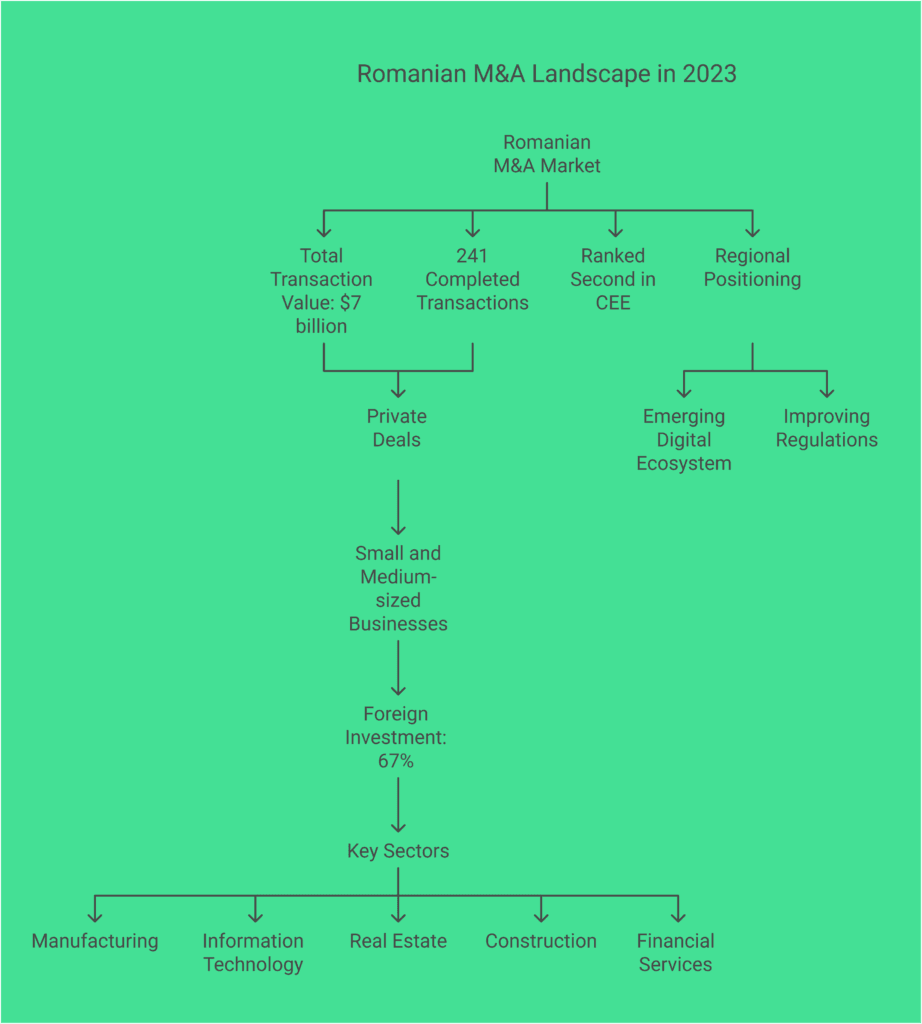
In 2023, the Romanian M&A market showed it’s strong.

Key signs point to its bright future:

  • Total transaction value reached approximately 7 billion dollars;
  • 241 completed ownership transition transactions;
  • Ranked second in Central and Eastern European M&A activity.

Market Dynamics and Trends

Most deals in Romania are private. Small and medium-sized businesses lead the way.

About 67% of deals come from outside, showing investors’ keen interest.

Sectoral Breakdown

The top sectors for mergers and acquisitions in Romania are:

  1. Manufacturing;
  2. Information Technology;
  3. Real Estate;
  4. Construction;
  5. Financial Services.

Regional Positioning

Romania is a major player in Central and Eastern Europe’s M&A scene.

Its location, emerging digital ecosystem, and improving rules attract investors.

They see great chances for restructuring their businesses here.

Legal Framework Governing Business Transfers in Romania

Romanian Business Transfer Legal Framework

Understanding the legal side of business transfers in Romania is key.

The rules are based on both national laws and EU directives.

This makes the process for handing over a business in Romania quite detailed.

Important legal parts of business transfers in Romania include:

  • Directive (EU) 2017/1132 on company law aspects;
  • Directive (EU) 2019/2121 addressing cross-border conversions;
  • Romanian Companies Law (Law 31/1990);
  • Financial Services Authority Regulation No. 5/2018.

Your plan for transferring a business must follow certain rules.

The Romanian laws set important rules and steps for business deals:

  1. Controlling interest is defined as holding 50% plus one voting right;
  2. Public takeovers become mandatory when an investor holds over 33% voting rights;
  3. Shareholders with more than 5% ownership can propose valuation methods;
  4. Mandatory notifications are required at specific ownership thresholds.

When you plan to transfer a business, you must follow strict rules.

Filings related to business combinations must be submitted within 24 hours of triggering events.

Also, merger plans need to be published in the Official Gazette of Romania.

International investors should know about recent changes.

Government Emergency Ordinance No. 108/2023 has made rules for foreign direct investment clearer.

This adds more complexity to business transfers in Romania.

Types of Business Transfers and Acquisitions

When thinking about company ownership changes in Romania, it’s key to know the different ways to transfer businesses.

Business leaders face complex choices between mergers, acquisitions, and other transfer methods.

These choices can greatly affect their business strategies.

In Romania, business succession planning mainly focuses on two main types: share deals and asset deals.

Each type has its own legal, financial, and operational implications for corporate transfers.

Mergers and Their Characteristics

Mergers are a complex way to join two companies into one. In Romania, mergers often mean:

  • Combining corporate structures;
  • Shared leadership and strategy;
  • Benefits in taxes and operations.

Acquisition Structures

Acquiring a business in Romania can be complex, with many strategies for different goals.

The main acquisition types are:

  1. Buying the whole target company;
  2. Buying a part of it;
  3. Making a strategic minority investment.

Asset vs. Share Deals

CharacteristicAsset DealsShare Deals
Transferable ElementsSpecific assets and some liabilitiesWhole company ownership
Tax ImplicationsSeller pays taxes16% capital gains tax for locals
ComplexityMore complex due to asset-by-asset transfersSmaller complexity in ownership change

For commercial enterprise transfer in Romania, knowing these detailed strategies helps businesses pick the best one.

This choice should match their goals and the market situation.

Foreign Direct Investment Regulations

Romania is a great place for business ownership change.

It has a solid framework for foreign direct investment (FDI).

This framework helps attract international investors.

It also guides foreign buyers on how to start or grow their business here.

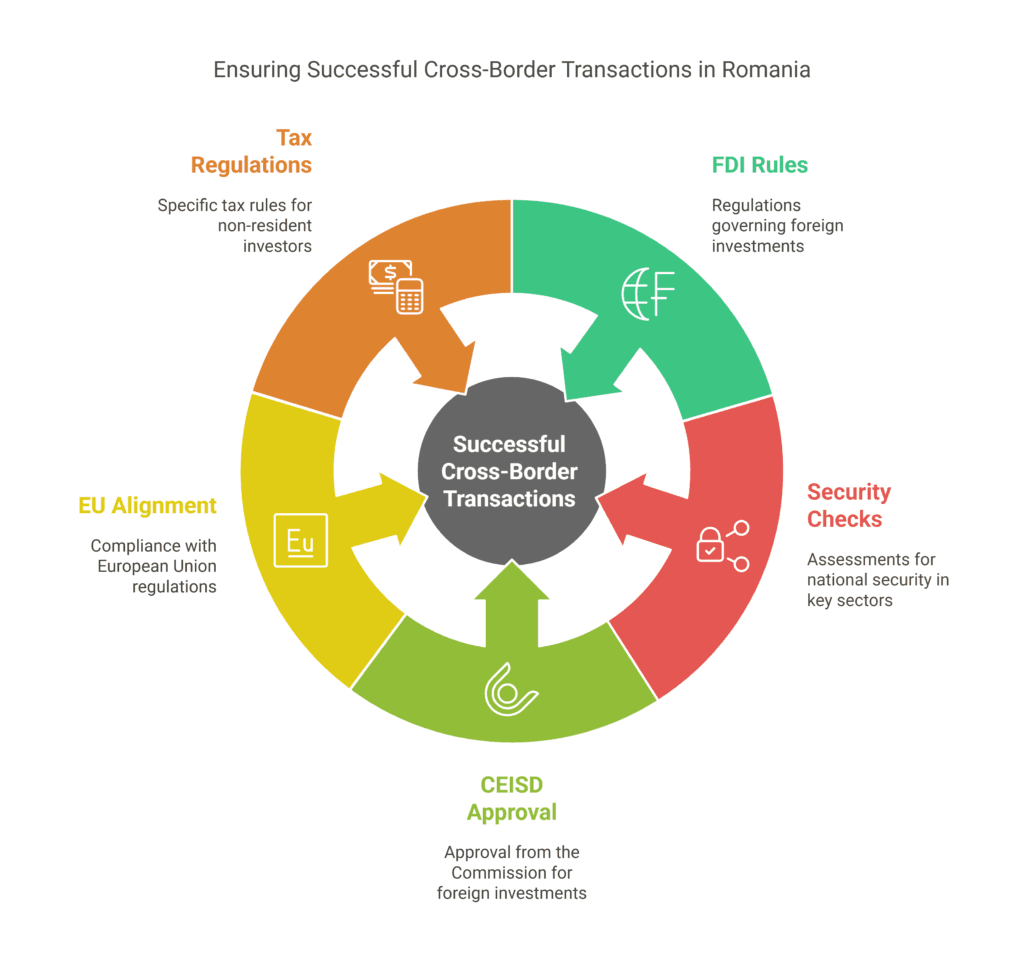
Here are some important points about Romania’s FDI rules:

  • Mandatory screening for investments over €2 million;
  • Comprehensive national security and public order checks;
  • Environmental protection compliance requirements;
  • Specific sector-specific investment scrutiny.

Foreign investors need to understand Romania’s detailed rules when considering a business transfer here.

The investment screening process makes sure investments fit with national interests.

At the same time, it keeps the country open to investors.

FDI Regulation HighlightsKey Details
Screening Fee€10,000 (refundable under certain conditions)
Maximum Review Duration135 days
Penalty for Unauthorized InvestmentsUp to 10% of worldwide turnover

The Romanian FDI regime strikes a good balance.

It attracts foreign investments while safeguarding national interests.

Investors need to look closely at sector-specific rules, like in energy, telecommunications, and critical infrastructure.

Foreign investors should know about the detailed screening process for ownership changes.

The rules ensure transparency and national security.

They don’t block international business investments.

Business Transfer in Romania: Process and Requirements

Starting a commercial enterprise succession in Romania needs careful planning.

The process involves many important steps.

These steps focus on legal and financial details.

Understanding the framework for business transfers in Romania is key.

The process aims for transparency, legal compliance, and a smooth transfer of ownership.

Pre-Transfer Assessment

The first step is a detailed pre-transfer evaluation.

This phase is critical and includes:

  • Comprehensive financial review;
  • Valuation of company assets;
  • Identification of legal risks;
  • Verification of contracts.

Documentation Requirements

Business transfers need careful documentation.

You’ll need:

  1. Detailed financial statements;
  2. Shareholder agreements;
  3. Corporate registration documents;
  4. Tax compliance certificates.
Document TypeLegal RequirementProcessing Time
Share Transfer Approval75% Share Capital Consent7-14 Days
Registration CertificateRomanian Companies Law10 Days
Tax ClearanceMandatory Verification5-7 Days

Legal Compliance Steps

Legal compliance is essential for a smooth transfer.

Key steps are:

  • Notifying authorities;
  • Getting Competition Council approvals;
  • Completing registration processes.

Seeking expert legal advice is recommended.

For professional help, call our recommended Romanian legal experts at +40765366887.

Due Diligence in Romanian Business Transfers

When buying a company in Romania, due diligence is key.

It helps lower risks and makes sure the transfer goes well.

This step checks the investment in many ways.

When planning mergers and acquisitions in Romania, focus on several important areas:

  • Financial review of historical performance;
  • Legal compliance verification;
  • Operational infrastructure assessment;
  • Commercial and market analysis.

Business sales in Romania need careful checking.

Investors should look closely at financial reports, legal papers, and any rules that might affect the business.

Due Diligence CategoryKey Focus AreasPotential Risks
FinancialRevenue streams, profit marginsHidden liabilities
LegalContractual obligationsPending litigation
OperationalTechnology infrastructureInefficient processes

Experts say using new tech and getting help from experts is smart.

Good planning can really cut down on risks.

With a thorough due diligence, you’ll have a better shot at making a successful deal in Romania’s fast-changing market.

Tax Implications and Fiscal Considerations

Understanding tax laws in Romania is key for corporate transactions.

When you’re handling ownership changes, you’ll face many financial issues.

These can greatly affect your business strategy.

Romanian tax laws are complex for financial transfers.

Knowing the main tax points is vital.

It helps avoid risks and get the best financial results from your deal.

Transfer Pricing Requirements

The Romanian Fiscal Code requires strict rules for deals between related parties.

There’s been a rise in tax audits on these issues.

  • Mandatory documentation for related-party transactions;
  • Comprehensive reporting requirements;
  • Potential penalties for non-compliance.

VAT Implications

VAT is a big deal in business transfers.

Romania has its own VAT rules that businesses must follow:

  1. Standard VAT rate: 19%
  2. Reduced VAT rates: 9% and 5% for specific supplies
  3. VAT registration threshold: RON 300,000 annually

Corporate Tax Aspects

Corporate tax strategies are important for business transfers.

You need to think about tax liabilities, exemptions, and new laws.

Tax planning is essential to optimize your financial position during ownership transitions in Romania.

Strategic Sectors and Special Regulations

When you’re doing commercial transfers in Romania, knowing about strategic sectors is key.

The Romanian government watches business deals in important areas closely.

These areas affect national security and public order.

Foreign investors face a tough approval process in sensitive sectors.

The Commission for the Examination of Foreign Direct Investments (CEISD) checks these deals carefully.

Key Strategic Sectors Requiring Special Approval

  • Energy infrastructure;
  • Transport systems;
  • IT and communication networks;
  • Financial and banking services;
  • Critical national infrastructure;
  • Security-related industries.

For sales of companies in these key sectors, investors need special approvals.

The rules require a close look at deals over 2 million euros.

Recently, laws have changed, like the updates to Emergency Ordinance 46/2022.

These changes help protect national interests but also keep the investment climate good.

Investment Approval Considerations

  1. Comprehensive security assessment;
  2. Evaluation of national security risks;
  3. Check on the investor’s background;
  4. Look at how the deal affects key sectors.

Knowing these rules is vital for smooth business transfers in Romania’s strategic sectors.

Investors should team up with local legal advisors to get through these complex steps.

Role of Regulatory Bodies and Authorities

When you transfer business ownership in Romania, knowing the role of key regulatory bodies is key.

Your journey in corporate restructuring will meet several important authorities.

They oversee and validate business transactions.

Romanian business transfers need several regulatory frameworks for transparency and compliance.

These key institutions are vital in monitoring and approving corporate changes.

Competition Council Oversight

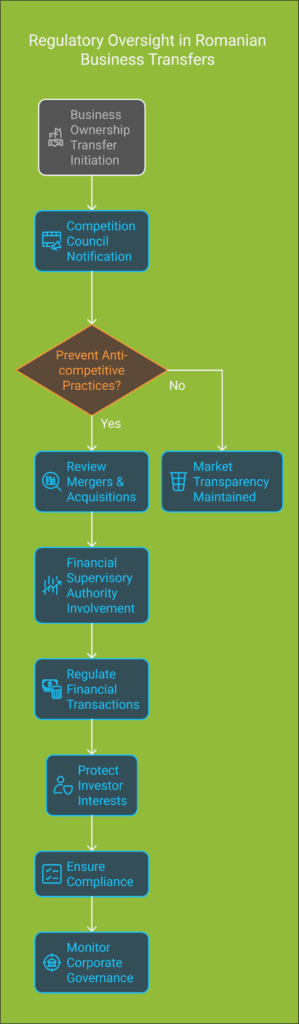
The Competition Council is a key watchdog in firm handovers. It has main duties:

  • Preventing anti-competitive market practices;
  • Reviewing merger and acquisition impacts;
  • Evaluating economic concentration transactions;
  • Protecting fair market competition.

When you transfer business ownership in Romania, you must tell the Competition Council for certain transactions.

This keeps the market transparent and stops monopolies.

M&A Regulatory

Financial Supervisory Authority Functions

The Financial Supervisory Authority (ASF) is key in corporate restructuring in Romania, mainly for financial institutions and listed companies. Its main tasks are:

  1. Regulating financial market transactions;
  2. Protecting investor interests;
  3. Ensuring compliance with financial regulations;
  4. Monitoring corporate governance standards.

Your business transfer plan must meet these regulatory needs for smooth, legal transactions in various sectors.

Knowing these regulatory frameworks helps you confidently and strategically navigate Romanian business transfers.

Cross-Border Transaction Considerations

Foreign investors must grasp the complex world of corporate takeovers in Romania.

The country has a strong legal setup to help with ownership changes.

It also protects national interests.

Key points for cross-border deals include:

The Romanian government has rules to attract foreign investment safely.

Foreign buyers need to know a few important things:

  1. They must report investments in sensitive areas;
  2. There could be a 5-8 month wait for FDI approval;
  3. They need to show detailed ownership details.

Taxes are very important in cross-border deals. Non-resident investors should know about specific tax rules:

Transaction TypeWithholding Tax RateSpecial Conditions
Dividends8%0% for EU companies with 10%+ shareholding
Interest16%Potential exemptions under EU directives
Royalties16%Reduced rates for specific agreements

It’s vital to understand these detailed rules for successful deals in Romania.

You must look at legal, financial, and regulatory aspects.

This ensures a smooth change in ownership.

Cross Border Transaction Romania

Recent Legislative Changes and Future Outlook

Romania’s business world is changing a lot in 2024.

This brings new chances for selling businesses and changing how companies work.

The rules for buying and selling companies are getting clearer.

Important changes are making the Romanian business scene different.

These changes affect how businesses operate:

  • Government Decision 300/2024 makes it easier to invest;
  • Emergency Ordinance 32/2024 changes how money is handled;
  • New rules for foreign investments.

2024 Regulatory Updates

Romania wants to make it easier for investors to come in.

If you’re thinking about selling your business in Romania, you’ll find it easier to start a new one.

The rules are clearer now.

Anticipated Changes

Romania’s economy is looking good, with a 3% GDP growth forecast for 2024-2025.

The government plans to make things better for businesses by:

  1. Making it easier to transfer businesses;
  2. Following EU rules;
  3. Welcoming more foreign investments.

If you’re looking to buy a business in Romania, now is a great time.

The mix of EU money and economic changes makes it a good place to invest.

Conclusion

Business divestment in Romania is complex and needs careful planning and legal knowledge.

When looking at corporate acquisitions, you must understand the detailed rules for business ownership changes in Romania.

This process includes legal steps, financial checks, and making strategic choices.

Your success in Romanian business transfers depends on thorough preparation and expert advice.

With about 690,000 small and medium-sized enterprises possibly changing hands soon, knowing the legal details is key.

The rules, like Law no. 31/1990, require focus on things like share transfer agreements and shareholder approvals.

Getting professional legal help is vital for these complex deals.

Romanian corporate law asks for accurate documents, like share transfer agreements and updated Articles of Association.

Working with skilled corporate lawyers can help avoid risks and make sure your business moves smoothly and legally.

For expert help with your business transfer, call Romania business transfer expert at tel. +40765366887.

Your careful planning will be key to the success of your corporate deal or business sale in Romania’s fast-changing market.

FAQ

What are the main types of business transfers in Romania?

In Romania, you can transfer businesses through mergers, acquisitions, asset deals, or share deals.

Mergers combine two companies into one.

Acquisitions mean one company buys another.

Asset deals transfer specific business assets, and share deals change who owns the company.

What are the key regulatory bodies involved in business transfers in Romania?

Several key groups watch over business transfers in Romania.

The Competition Council stops unfair competition.

The Financial Supervisory Authority looks after financial sector deals.

The Commission for the Examination of Foreign Direct Investments (CEISD) checks foreign investments.

What additional requirements exist for foreign investors in Romanian business transfers?

Foreign investors face extra rules, like national security checks under Emergency Ordinance 46/2022.

They must get extra approvals in key areas like energy and IT.

The CEISD reviews these deals to protect Romania’s interests and welcome foreign money.

How important is due diligence in Romanian business transfers?

Due diligence is very important in Romanian business transfers.

It checks the target business’s finances, laws, operations, and sales.

A good due diligence helps avoid risks and makes the transfer smooth.

It’s best to get experts to do a detailed check.

What tax considerations are critical in Romanian business transfers?

Important tax issues include following the arm’s length principle, VAT, and corporate taxes.

With more audits on transfer pricing, it’s key to document and justify prices.

You should also think about tax breaks, delays, and new tax laws that might affect your deal.

What are the primary challenges in cross-border business transfers in Romania?

Dealing with international rules is a big challenge in cross-border transfers in Romania.

You face issues like currency, legal systems, security checks, and taxes.

Getting help from Romanian legal and financial experts  is vital for these complex deals.

How has the Romanian M&A landscape changed in recent years?

The Romanian M&A market has seen big changes, like the COVID-19 pandemic and global tensions.

Romania is a strong player in Central and Eastern Europe, with more interest in tech, green energy, and finance.

New laws aim to make it easier for foreign investors to come in.

What documentation is typically required for a business transfer in Romania?

You’ll need lots of documents for a business transfer in Romania.

These include financial statements, legal papers, shareholder agreements, and tax certificates.

Depending on the deal, you might also need environmental reports, security clearances, and more.