Two corporate professionals reviewing AI transparency controls, compliance dashboards, and synthetic content verification tools on screens in an office setting.

EU AI Act in Romania: 2026 Guide for Foreign Companies

EU AI Act compliance representation with glowing neural networks in a modern legal setting
Preparing for the EU AI Act: foreign companies operating in Romania must align their AI deployment with the new regulatory framework starting August 2026.

The compliance question is no longer whether a business “uses AI”. Most international groups do. The practical questions are which legal entity controls each use, whether the system affects people in Romania, and whether the company is a provider, deployer, importer or distributor for that system.

This guide is written for foreign companies, investors and employers with Romanian operations. It reflects legislation and official information available on 31 July 2026 and explains the rules applicable from 2 August 2026.

What Changes on 2 August 2026?

The immediate operational change is the application of Article 50 transparency duties, not the full high-risk regime for HR and other Annex III systems.

Regulation (EU) 2026/1744, the AI Omnibus, entered into force on 27 July 2026. It moved the Annex III high-risk deadline to 2 December 2027 and the deadline for high-risk AI embedded in regulated products to 2 August 2028. The European Commission’s updated AI Act timeline confirms these dates.

DateRulePractical consequence
2 February 2025Prohibited AI practices and AI literacyCompanies must stop prohibited uses and support AI literacy for personnel and other people operating AI on their behalf.
2 August 2025General-purpose AI model rules and parts of the enforcement frameworkMainly relevant to model providers; ordinary business users are usually deployers, subject to role-specific duties.
2 August 2026Article 50 transparency obligationsCertain AI interactions and AI-generated or manipulated outputs require disclosure, marking or labelling.
3 August 2026Supervision and enforcement of AI literacyThe Commission states that Article 4 supervision and enforcement rules apply from this date.
2 December 2026Limited legacy grace periodProviders of generative systems placed on the market before 2 August 2026 must meet the machine-readable marking duty from this date.
2 December 2027Annex III high-risk rulesCovers listed uses in employment, education, credit, biometrics, essential services and other areas.
2 August 2028Annex I product-related high-risk rulesCovers qualifying AI safety components or AI products under listed EU product legislation.

The original Artificial Intelligence Act remains Regulation (EU) 2024/1689, but it must now be read together with the enacted AI Omnibus.

Minimalist representation of AI transparency and regulation
Understanding the core boundaries: the AI Act imposes tiered obligations depending on the specific use case and risk level.

Does the AI Act Apply to a Foreign Company Operating in Romania?

Yes, potentially even when the provider or parent company is outside the EU. Location alone does not remove a business from scope.

The Act applies to providers that place AI systems or general-purpose AI models on the EU market, deployers established or located in the EU, importers and distributors, and certain product manufacturers. It can also apply to providers and deployers outside the EU where the system’s output is used in the Union. The Commission’s AI Act scope page sets out the territorial rules.

A foreign group should map the role of each entity rather than treat “the company” as a single actor.

Business positionTypical example in RomaniaCore question
ProviderA group develops a recruitment tool and releases it under its own name.Who controls development, intended purpose and market placement?
DeployerA Romanian subsidiary uses a third-party CV-screening or productivity tool under its authority.Who decides how the system is used and on whom?
ImporterAn EU entity first places a third-country AI system on the Union market.Who brings the system into the EU supply chain?
DistributorA reseller makes an AI system available in the EU without being the provider or importer.Does the reseller alter the system, branding or intended purpose?
Provider by reclassificationA business substantially modifies a system, changes its intended purpose or markets it under its own name.Has the business assumed provider obligations despite buying the original tool?

Contracting with a US or other non-EU vendor does not automatically transfer the Romanian deployer’s responsibilities. Conversely, white-labelling, materially modifying or repurposing a tool may move a company into the provider role.

Which AI Uses Should a Company Classify First?

Start with the intended use and its effect on people, then identify the company’s role. Product labels such as “AI-powered” or “assistant” are not a legal classification.

An operational inventory can use four screening groups, but the legal analysis should remain tied to the Act:

  • Prohibited practices: uses that must not be deployed, subject to narrow statutory exceptions.
  • High-risk systems: Annex III uses and certain AI safety components or regulated products, subject to the revised future dates.
  • Article 50 systems: interactive or generative uses and certain emotion-recognition, biometric or synthetic-content uses with transparency duties.
  • Other AI systems: systems outside those rules may still be subject to AI literacy, GDPR, consumer, employment, intellectual-property, confidentiality and sector-specific law.

This last point matters. “Minimal risk” does not mean “no compliance”. A low-impact writing assistant may still require staff guidance, data controls and human review.

Which Workplace AI Uses Are Already Prohibited?

An employer must not infer workers’ emotions through AI except where a narrow medical or safety exception applies. Other Article 5 prohibitions may also affect workplace or customer systems.

The Commission identifies prohibited practices including manipulative or exploitative AI, certain social scoring, certain biometric categorisation, untargeted facial-image scraping, individual predictive policing based solely on profiling, and emotion recognition in workplaces and education, subject to specific exceptions. The AI Omnibus also added a prohibition targeting AI that generates non-consensual sexually explicit or intimate content and child sexual abuse material. See the Commission’s prohibited-practices guidance.

For employers, the label used by a vendor is not decisive. A video-interview tool, wellness platform or workforce-monitoring service may claim to detect engagement, stress, attitude or sentiment without calling the function “emotion recognition”. Review the actual inputs, inferences and purpose.

A professional contract signing session in a modern office
Structuring vendor relationships: clear contracts and allocation of roles are essential for compliance when using third-party AI tools.

What Transparency Duties Apply from 2 August 2026?

Article 50 applies to specified uses regardless of whether the system is high-risk. The duty depends on whether the company is the provider or deployer and on the type of interaction or output.

The Commission published final Article 50 transparency guidance in July 2026.

SituationResponsible actorRequired control
AI system directly interacts with a personProviderDesign the system so the person is informed from the first interaction, unless the AI interaction is obvious under the restrictive exception.
Generative AI produces synthetic text, image, audio or videoProviderApply effective, interoperable, robust and reliable machine-readable marking, subject to statutory exceptions and technical feasibility.
Emotion recognition or biometric categorisation is used lawfullyDeployerInform exposed natural persons at first exposure and comply with applicable data-protection law.
AI generates or manipulates a deepfakeDeployerClearly disclose that the content is artificially generated or manipulated; a machine-readable mark alone is insufficient.
AI-generated text informs the public on a matter of public interestDeployerLabel the text unless it received substantive human review or editorial control and a person holds editorial responsibility.

Does a Customer-Facing Chatbot Need a Disclosure?

Usually, the system should inform a person at the start of the first interaction that they are interacting with AI, unless this is obvious to a reasonably well-informed, observant and circumspect person. The provider bears the design obligation. A business deploying a third-party chatbot should nevertheless verify that the notice is implemented in its actual interface and allocate responsibility in the contract.

Must AI-Assisted Business Content Be Labelled?

Not every AI-assisted text requires a public label. Article 50 focuses on text published to inform the public on matters of public interest. The Commission states that substantive human review or editorial control, together with editorial responsibility, can qualify for an exemption. Spell-checking, formatting or superficial approval is not enough.

For images, audio and video, a deployer must separately assess whether the output is a deepfake. Where disclosure is required, it must be clear to people at first exposure; embedded technical metadata alone does not satisfy the deployer’s obligation.

Is There a Grace Period?

The Commission confirms a narrow grace period only for providers’ machine-readable marking obligation for generative AI systems placed on the market before 2 August 2026. Those systems must comply from 2 December 2026. Content generated before 2 August 2026 need not be labelled retroactively. Other Article 50 duties do not receive a general grace period.

Legal compliance documents and checklists on a desk
Detailed documentation is key: companies must keep records of AI literacy programs and Article 50 transparency notices.

What Must Employers Know About Recruitment and Employee-Management AI?

Recruitment and worker-management AI remains a priority compliance area, but the principal Annex III high-risk duties now apply from 2 December 2027.

The AI Act’s Annex III lists systems intended to:

  • place targeted job advertisements;
  • analyse and filter applications;
  • evaluate candidates;
  • make decisions affecting work terms, promotion or termination;
  • allocate tasks based on behaviour, traits or characteristics; or
  • monitor and evaluate worker performance or behaviour.

Some listed systems may fall outside high-risk treatment if they do not create a significant risk and satisfy Article 6(3), for example because they perform a narrow procedural or preparatory task and do not materially influence a decision. Systems that profile natural persons remain high-risk. Providers relying on an exclusion must document the assessment. As of 31 July 2026, the Commission’s detailed high-risk classification guidelines were still in draft following consultation.

What Duties Arrive in December 2027?

Depending on role and use, the high-risk regime includes risk management, data governance, technical documentation, record-keeping, information for deployers, human oversight, accuracy, robustness, cybersecurity, quality management, conformity assessment, registration, post-market monitoring and incident reporting.

Deployers must follow instructions, assign competent human oversight, monitor operation, retain logs under their control, and use relevant and sufficiently representative input data where they control those inputs. Employer deployers must inform workers’ representatives and affected workers before putting a high-risk workplace system into service or use, in accordance with applicable law.

The delay should be used to obtain the documentation and contractual rights that cannot be created at the end of procurement.

What Does AI Literacy Require After the AI Omnibus?

AI literacy remains a legal obligation. The AI Omnibus removed the idea that every person must reach a prescribed “sufficient” level, but providers and deployers must still take measures that support staff and other operators in using AI appropriately.

Article 4 has applied since 2 February 2025. The Commission’s updated AI literacy questions and answers recommend a risk-based approach that considers the organisation’s role, the systems used, staff knowledge and the people affected.

There is no mandatory certificate or prescribed course. A defensible programme may include:

  • an approved-AI-tools register;
  • role-based training for management, HR, procurement, IT, marketing and ordinary users;
  • rules on personal, confidential and privileged information;
  • verification requirements for AI output;
  • escalation for high-impact decisions;
  • specific human-oversight training for high-risk systems; and
  • internal records of training and guidance.

Reading a vendor’s instructions may be insufficient, particularly where human oversight or affected persons’ rights are at stake. The Commission states that supervision and enforcement of Article 4 begins on 3 August 2026.

How Does the AI Act Interact with GDPR and Employment Law?

AI Act compliance does not replace data-protection or employment compliance. The same project can trigger several legal regimes at once.

Where an AI system processes candidate, worker, customer or other personal data, the GDPR continues to apply. The company must identify a lawful basis, provide transparent information, observe purpose limitation and data minimisation, manage processors and international transfers, protect data, and assess automated decision-making. A data protection impact assessment may be required where processing is likely to create a high risk.

The European Data Protection Board’s Opinion 28/2024 addresses anonymity, legitimate interests and the consequences of unlawfully processed training data. For a Romania-specific overview, see our guide to GDPR compliance when using AI.

Employment projects also require review of discrimination, monitoring, employee information and consultation, collective arrangements and the validity of decisions under Romanian law. A human approval click does not automatically remove automated-decision or discrimination risk if the human reviewer cannot meaningfully change the outcome.

What Should a Foreign Investor Check in AI Due Diligence?

AI due diligence should test legal role, actual use and evidence—not only whether the target has an “AI policy”.

An investor or buyer of a Romanian business should request:

  1. the AI systems inventory and owners;
  2. provider, deployer, importer and distributor role assessments;
  3. the prohibited-practices review;
  4. Article 50 notices, labels and technical marking evidence;
  5. AI literacy materials and attendance records;
  6. vendor contracts, data-processing agreements, audit rights and change notices;
  7. GDPR records, data protection impact assessments and automated-decision analysis;
  8. the roadmap for Annex III and Annex I systems;
  9. complaints, incidents, regulator correspondence and known bias issues; and
  10. insurance coverage, warranties, indemnities and remediation budgets.

Representations should be tied to disclosed systems and evidence. A generic warranty that the target “complies with all AI laws” is unlikely to identify which party must remediate a specific tool or fund a delayed conformity project.

Who Supervises the AI Act in Romania?

Romania has proposed a multi-authority model, but the final national implementing framework should be checked before any filing or regulator engagement.

In March 2026, the Romanian Government approved a memorandum proposing the National Authority for Management and Regulation in Communications (ANCOM) as market-surveillance authority and single point of contact, with sectoral roles for other bodies including the National Bank of Romania, the Financial Supervisory Authority, the national data-protection authority and the Authority for the Digitalisation of Romania.

ANCOM’s own June 2026 notice describes ANCOM as proposed for that role. The national implementing law was therefore still a point to verify as of this guide’s preparation. GDPR matters remain within the competence of the Romanian data-protection authority, while financial and product-sector regulators may have parallel powers.

What Penalties Can Apply?

The AI Act sets high maximum ceilings, but the actual measure must be effective, proportionate and dissuasive and must reflect the circumstances of the infringement.

The Article 99 penalty framework includes:

  • up to EUR 35 million or 7% of worldwide annual turnover for prohibited practices, whichever is higher for undertakings;
  • up to EUR 15 million or 3% for specified operator obligations, including Article 50 transparency duties, whichever is higher for undertakings; and
  • up to EUR 7.5 million or 1% for incorrect, incomplete or misleading information supplied to competent authorities or notified bodies, whichever is higher for undertakings.

For SMEs, including start-ups, the applicable ceiling is the lower of the fixed amount and percentage. Authorities must consider factors such as gravity, duration, harm, company size, cooperation, responsibility, mitigation and intent. These are maximum ceilings, not automatic fines.

A lawyer explaining compliance steps to a client
Developing a strategic roadmap: proactive compliance helps foreign investors mitigate risks under the new enforcement regime.

A Practical Compliance Checklist for August 2026

  1. Inventory every AI system used or supplied by the Romanian business, including embedded features in HR, CRM, finance, security, marketing and productivity tools.
  2. Map the provider, deployer, importer, distributor and product-manufacturer role for each legal entity.
  3. Screen intended and actual uses against Article 5, with specific attention to workplace emotion inference and manipulative functions.
  4. Implement Article 50 notices, labels and marking controls for systems in scope from 2 August 2026.
  5. Document the narrow legacy grace period separately; do not treat it as a general Article 50 delay.
  6. Support AI literacy with risk-based policies, role-specific guidance and internal records.
  7. Review HR tools against Annex III and create a 2 December 2027 readiness plan.
  8. Align vendor contracts on role, intended purpose, documentation, changes, audit, logs, incidents, cooperation and exit.
  9. Integrate the AI review with GDPR, employment, consumer, intellectual-property, confidentiality and sector requirements.
  10. Verify the final Romanian competent-authority and penalty implementation framework before notification or regulator contact.
  11. Assign an accountable business owner and legal escalation path for every material system.
  12. Reassess systems after material updates, new use cases or changes in provider instructions.

The Bottom Line

The 2 August 2026 milestone is narrower than many early compliance plans assumed, but it is not optional. Article 50 transparency controls must work, prohibited uses must remain excluded, and AI literacy must be demonstrable. The AI Omnibus gives companies additional time for the high-risk regime; it does not remove the need to classify HR and other Annex III systems, secure vendor evidence and build human oversight.

A targeted legal review can map the group’s roles, identify the controls required now and convert the 2027 high-risk deadline into a procurement and governance plan.

Frequently Asked Questions

Does the AI Act apply if our parent company is outside the EU?

It can. The Act covers providers placing systems or general-purpose models on the EU market, deployers located in the EU, and certain non-EU providers and deployers where AI output is used in the Union. A foreign parent and Romanian subsidiary may have different roles for the same system, so the assessment should be performed entity by entity.

Are AI recruitment tools high-risk from 2 August 2026?

Recruitment and worker-management uses remain listed in Annex III, but the enacted AI Omnibus moved the application of the relevant high-risk rules to 2 December 2027. Existing obligations under GDPR, discrimination, employment and Article 5 continue to apply, and Article 50 may apply to particular features before then.

Must employees disclose every use of ChatGPT or another writing assistant?

The AI Act does not impose a general public disclosure for every AI-assisted internal document. The employer should nevertheless control approved tools, confidential and personal data, verification and human responsibility. Article 50 labelling may apply to public-interest text without substantive human review, while AI literacy applies more broadly to professional use.

Is an AI officer mandatory in Romania?

The AI Act does not generally require every company to appoint an AI officer or AI governance board. A company should still assign accountable owners for inventory, legal classification, procurement, security, data protection and human oversight. The most suitable structure depends on the organisation’s size, systems and risk profile.

Does using a human reviewer remove AI Act and GDPR risk?

No. Human oversight must be meaningful. If the reviewer lacks information, authority, time or competence to challenge the output, the review may not address the risk. Under GDPR, a nominal human step may also be insufficient where a decision is effectively determined by automated processing.

Can we rely entirely on the AI vendor’s compliance statement?

No. A vendor statement is evidence, not a substitute for the deployer’s own assessment. The customer should verify the system’s intended purpose, instructions, data and logging controls, Article 50 implementation, prohibited features, changes, incident cooperation and the documentation needed for future high-risk obligations.

Evaluating the Cost of Non-Compliance with AI Laws in the EU

Evaluating the Cost of Non-Compliance with AI Laws in the EU

 Cost of Non-Compliance with AI Laws in the EU

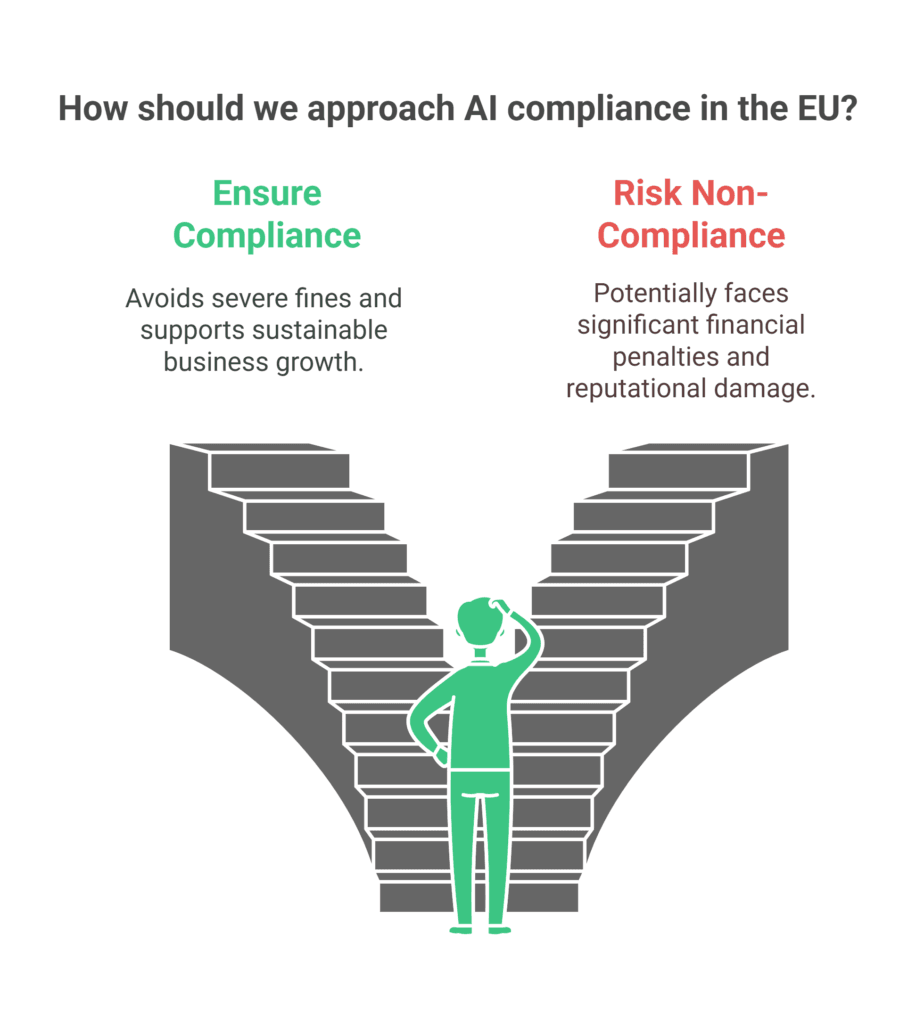
Are you ready for huge financial hits for ignoring AI rules in the European Union?

The EU Artificial Intelligence Act brings a complex set of rules.

These rules could hurt your business’s profits a lot.

Understanding non-compliance with AI laws in the EU is key.

The rules are strict for AI development and use.

If you break them, you could face fines up to €35 million or 7% of your global sales.

Businesses in Romania and companies worldwide in the EU must take these AI rules seriously.

The financial risks are big. So, following these rules is not just a must, but a smart move.

Key Takeaways

  • Maximum fines can reach €35 million or 7% of global turnover;
  • Three-tiered penalty system based on violation severity;
  • High-risk AI systems face stringent compliance requirements;
  • Penalties designed to be effective and dissuasive;
  • Compliance costs estimated at 17% overhead on AI spending.

Understanding the EU AI Act’s Penalty Framework

EU AI Act Regulatory Enforcement

The European Union has created a detailed plan to tackle algorithmic bias and ai accountability lapses with its AI Act.

As AI grows, from 58% use in 2019 to 72% by 2024, strong rules are needed.

Regulatory Authority Overview

The AI Act sets up a detailed system to handle AI transparency and oversight failures.

Key parts of this system include:

  • Comprehensive risk assessment methodology;
  • Proactive monitoring of AI system implementations;
  • Stringent compliance requirements.

Key Stakeholders and Enforcement Bodies

Many groups are key in making sure AI rules are followed across Europe. The main players are:

StakeholderResponsibility
European CommissionOverall regulatory supervision
National AuthoritiesLocal implementation and enforcement
AI ProvidersCompliance and risk mitigation

Scope of Application

The EU AI Act covers a wide range of AI system providers, including:

  1. Providers within the EU market;
  2. Importers and distributors;
  3. Product manufacturers using AI technologies.

The Act starts on 1 August 2024 and will be fully in place by 2 August 2026.

Companies must get ready for strict rules to avoid fines.

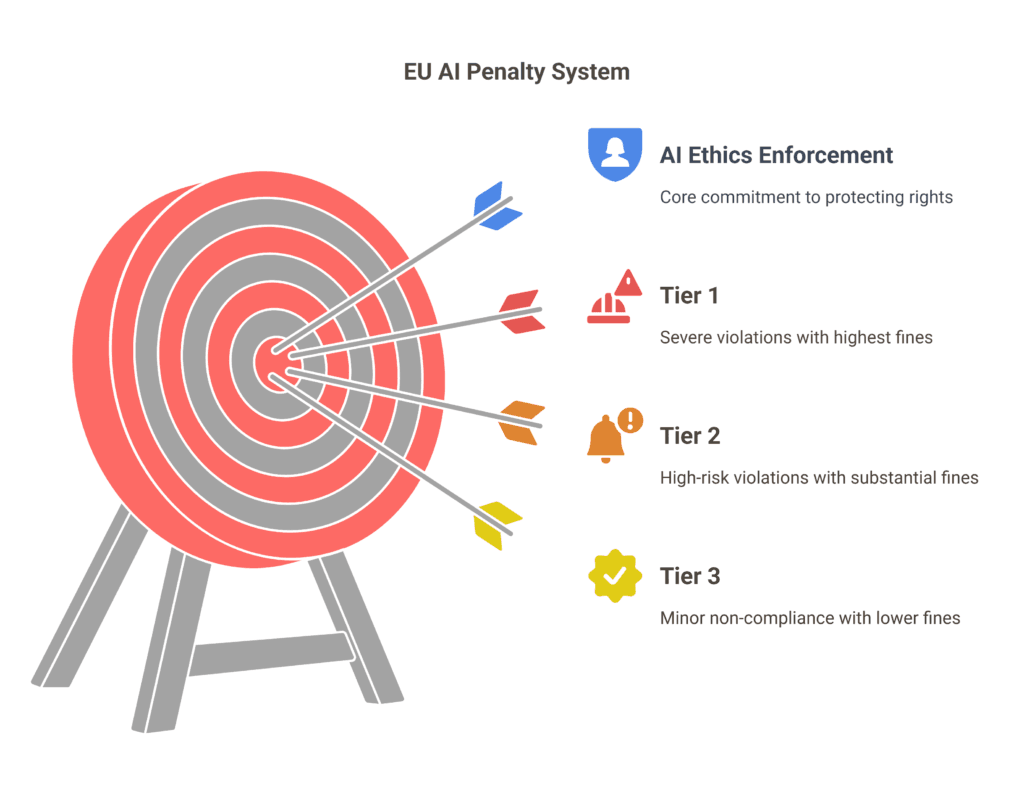
The Three-Tier Penalty System for AI Violations

EU AI Penalty


The European Union has a detailed three-tier penalty system for AI ethics and accountability.

This system ensures penalties match the severity of violations.

It’s part of the European AI governance framework.

The penalty tiers are designed to handle different levels of non-compliance:

  • Tier 1 (Severe Violations): Fines up to €35 million or 7% of global turnover;
  • Tier 2 (High-Risk Violations): Fines up to €20 million or 4% of global turnover;
  • Tier 3 (Minor Non-Compliance): Fines up to €10 million or 2% of global turnover.

Your organization needs to know these AI liability frameworks to avoid big financial risks.

The system targets specific problematic practices, including:

  1. Subliminal manipulation techniques;
  2. Exploitation of vulnerable populations;
  3. Unauthorized biometric identification systems;
  4. Social scoring mechanisms.

AI ethics enforcement is key as these penalties show the EU’s commitment to protecting individual rights.

Organizations must have strong risk management strategies to meet these complex regulatory needs.

By 2026, member states will have solid AI governance systems in place.

This makes proactive compliance a legal must and a strategic move for businesses in the European market.

Maximum Penalties and Financial Implications

The EU AI Act has a strict penalty system.

This could greatly affect your company’s money.

It’s key to know these fines to keep your AI transparent and avoid big money losses.

Penalties vary based on how well your AI follows the rules.

If your AI doesn’t meet standards, you could face big money penalties.

Calculation Methods for Fines

The EU has a clear way to figure out fines for AI mistakes.

They look at several things:

  • How bad the AI mistake is;
  • Your company’s yearly income;
  • What kind of AI mistake it is;
  • How much harm the AI could cause.

Impact on Company Revenue

The money impact can be huge.

For the worst AI mistakes, fines can be up to €40 million or 7% of your company’s yearly income.

These big fines show how important it is to check your AI well and be ready for problems.

Special Considerations for SMEs

The EU AI Act helps small businesses.

It has smaller fines for Small and Medium Enterprises.

This way, it keeps the rules strict but also considers if a small business can afford it.

Violation TypeMaximum Penalty
Prohibited AI Practices€40 million or 7% of turnover
High-Risk AI System Non-Compliance€20 million or 4% of turnover
Providing False Information€5 million or 1% of turnover

Being proactive about following the rules can help avoid these money problems.

It shows you care about using AI the right way.

Non-Compliance with AI Laws in the EU: A Detailed Look

The European Union’s rules on AI mark a big step towards responsible AI use.

It’s key for companies in the EU to understand these rules well.

The AI Act sets up a system to check AI systems based on their risks and how they affect society.

Some main reasons for not following EU AI laws include:

  • Not doing thorough risk checks;
  • Not being clear about how AI works;
  • Ignoring rules for AI accountability;
  • Not following ethical AI guidelines.

The rules vary based on the AI’s risk level.

High-risk AI systems have the toughest rules.

Companies need to be very careful to avoid big fines.

Risk CategoryCompliance RequirementsPotential Penalties
Unacceptable RiskComplete ProhibitionUp to €35 million
High-Risk SystemsExtensive DocumentationUp to 7% of Global Turnover
Limited RiskTransparency ObligationsUp to €15 million

Your company should focus on AI ethics and make strong plans for following the rules.

The EU AI Act asks for careful handling of AI, with a big focus on areas like education and law.

Also, 60% of companies don’t know the AI rules that apply to them.

This lack of knowledge is a big risk, with fines up to €30 million or 6% of global sales.

Prohibited AI Practices and Associated Penalties

Prohibited AI Practices and Associated Penalties

The European Union’s AI Act sets strict rules for using AI.

It aims to protect human rights and ensure AI is used responsibly.

Knowing what’s banned is key for companies to stay compliant and avoid big fines.

The EU has set limits for AI systems that could harm people or values.

These rules focus on practices that might hurt users or go against ethics.

High-Risk AI Systems: Complete Check

Companies need to check their AI systems carefully.

The rules highlight certain high-risk uses that need extra attention:

  • Biometric identification systems;
  • Critical infrastructure management;
  • Employment and workforce screening;
  • Educational assessment technologies;
  • Access to essential public and private services.

Transparency Violations and Consequences

Being open about AI use is critical.

Companies must tell people when they’re dealing with AI.

This ensures people know what’s happening and can give their consent.

Violation TypeMaximum Penalty
Prohibited AI Practices€35,000,000 or 7% global turnover
Specific Provision Breaches€15,000,000 or 3% global turnover
Misleading Information€7,500,000 or 1% global turnover

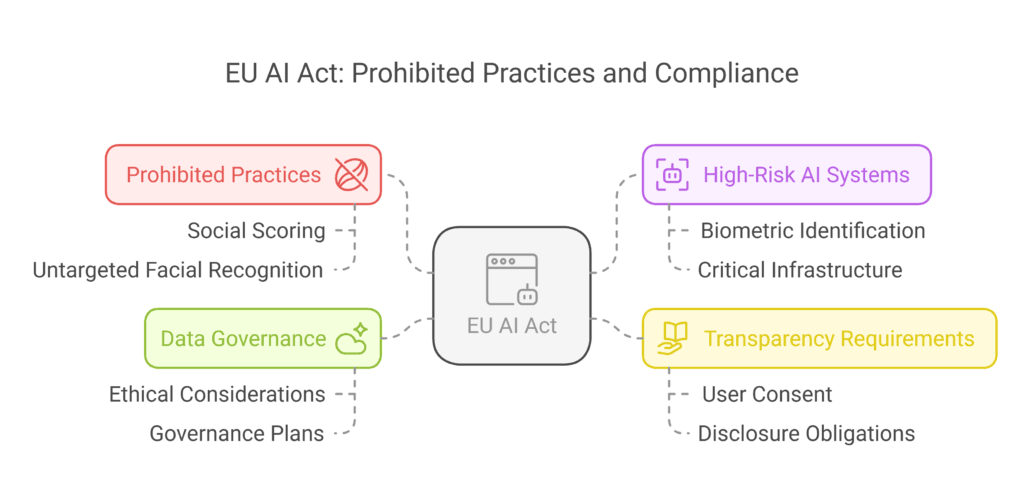
Data Governance and Ethical Considerations

AI must be developed with ethics in mind.

Certain activities are banned, including:

  1. Social scoring systems;
  2. Untargeted facial recognition;
  3. Emotional manipulation;
  4. Exploitative AI targeting vulnerable populations.

Your company needs to have strong AI governance plans.

This is to meet the complex rules and avoid legal trouble.

Impact on Business Operations and Compliance Costs

Dealing with AI legal risks is a big challenge for European businesses.

The EU AI Act brings new rules that affect how you run your business and your budget.

Small businesses find it hard to meet the new AI rules.

EU studies say one high-risk AI product could cost up to €400,000 to comply with.

These costs cover many areas:

  • Quality management system implementation;
  • Risk assessment documentation;
  • Transparency reporting;
  • Ongoing compliance monitoring.

Breaking AI rules in Europe can be very costly.

Fines can be up to 7% of global sales or €35 million.

Breaches of AI ethics also have serious effects beyond money.

Companies need to check their AI systems carefully.

They should:

  1. Do thorough risk assessments;
  2. Keep detailed records;
  3. Have clear AI rules;
  4. Keep checking for compliance.

Even though following these rules costs money, it can help you stay ahead.

Companies that follow these rules will earn more trust from customers.

They will also show they are responsible in the changing European rules.

Requirements for High-Risk AI Systems and Transparency Obligations

Requirements for High-Risk AI Systems and Transparency Obligations

The EU AI Act sets clear rules for managing high-risk AI systems.

It focuses on AI accountability EU and artificial intelligence governance.

These rules aim to stop unethical AI use by requiring clear transparency and documentation.

Understanding AI regulations is key for companies working with high-risk AI systems.

It’s important to know the main rules to follow.

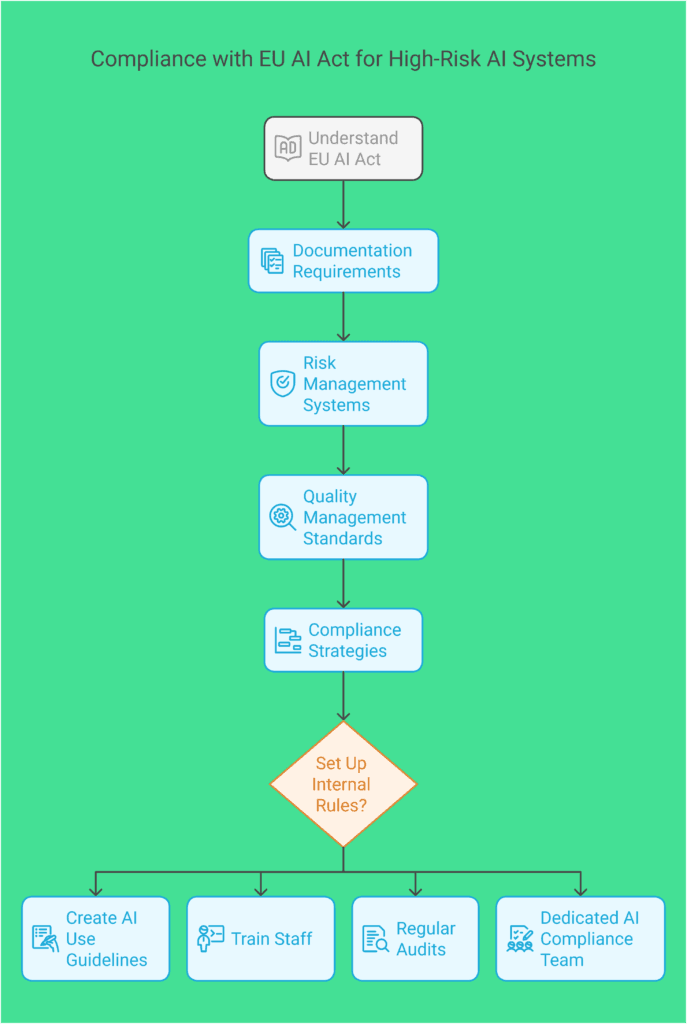
Documentation Requirements

Your company must keep detailed records of AI system development.

These records should cover the whole life cycle of the AI.

They should include:

  • Comprehensive system description;
  • Development methodology;
  • Training data verification;
  • Performance metrics;
  • Risk assessment records.

Risk Management Systems

Having a strong risk management system is vital for ai accountability.

Your system should find, check, and lower risks in AI use.

Risk Management ComponentKey Requirements
IdentificationComprehensive risk assessment
EvaluationQuantitative and qualitative risk analysis
MitigationProactive risk reduction strategies

Quality Management Standards

The EU AI Act requires strict quality standards for high-risk AI systems.

Your quality system must keep checking, validating, and improving AI tech.

Following these rules shows your dedication to ethical AI development.

It also protects your company from fines under the eu ai act.

Compliance Strategies and Risk Mitigation

Understanding AI legal frameworks is complex.

Your company needs to act early to meet the EU AI Act’s standards by 2026.

This is key to avoiding legal issues.

Effective AI risk management strategies include:

  • Conduct thorough risk assessments for all AI systems;
  • Implement robust AI transparency protocols;
  • Develop detailed records of AI development processes;
  • Set up ongoing checks and evaluations.

AI oversight needs a detailed plan.

You must set up internal rules that follow the EU AI Act.

This means:

  1. Creating clear AI use guidelines;
  2. Training staff on legal rules;
  3. Carrying out regular audits;
  4. Having a dedicated AI compliance team.

There are big financial risks.

Fines can be up to €35 million or 7% of global sales.

Small businesses need to watch out for special penalty rules.

For expert advice on these rules, reach out to our Romanian Law Office.

Economic Impact of AI Regulation in the European Union

The European Union’s approach to AI governance is changing the digital world.

It has big economic effects.

Your business needs to get how the EU AI Act works.

This Act sets strict rules for AI.

It aims to make AI trustworthy while keeping innovation alive.

It’s all about finding a balance.

Experts say there will be big economic hurdles for EU businesses.

The Act’s rules will cost companies up to €36 billion.

Small businesses might struggle the most, needing to invest in complex risk management.

The impact goes beyond just the cost.

The EU is becoming a leader in responsible tech.

Your company can stand out by using ethical AI.

This could give you an edge in markets that value transparency.

Adapting to these new rules is key.

Companies that plan well for AI compliance will do better.

The rules push for tech that’s more responsible and focused on people.

FAQ

What are the key financial risks of non-compliance with the EU AI Act?

Not following the EU AI Act can lead to big fines.

These fines can be up to 7% of your global sales or €35 million, whichever is more.

These fines are meant to make companies follow AI rules in Europe.

How does the EU AI Act categorize AI systems for regulatory purposes?

The Act sorts AI systems by risk level.

High-risk systems, like those in critical areas, have strict rules.

The level of risk decides the rules and fines for each AI system.

What constitutes a transparency violation under the EU AI Act?

Not being clear when using an AI system is a big no-no.

It’s also wrong to hide how an AI works or what it can do.

These mistakes can lead to big fines and show the EU’s focus on AI fairness.

How will the EU AI Act impact small and medium-sized enterprises (SMEs)?

SMEs get special help under the Act.

They get easier ways to follow the rules and might get support.

But, they must also make sure their AI systems are up to par.

What are the primary prohibited AI practices under the regulation?

The Act bans AI that’s too risky.

This includes systems that identify people in real-time, score people, or manipulate them.

Breaking these rules can lead to the biggest fines.

How can businesses prepare for compliance with the EU AI Act?

To get ready, do a thorough AI check, set up good risk management, and be open about AI development.

Also, train staff on AI ethics and keep an eye on compliance.

Getting legal advice can also help a lot.

What are the key documentation requirements for high-risk AI systems?

High-risk AI systems need lots of records.

This includes risk checks, how well the AI works, and data used to train it.

These records help keep AI use honest and open.

How does the EU AI Act compare to other global AI regulations?

The EU AI Act is the most detailed AI rule globally.

It’s known for its focus on risk, ethics, and big fines for breaking the rules.

It might set a standard for AI rules around the world.

What are the possible long-term economic benefits of these regulations?

At first, following these rules might cost a lot.

But, they aim to make AI trustworthy.

This could give European companies an edge.

The EU wants to encourage innovation and trust in AI.

How will penalties be calculated under the EU AI Act?

Fines will depend on how serious the mistake is.

They could be a percentage of sales or a fixed amount.

The exact fine will look at the mistake, if it was on purpose, and how much harm it caused.

What is the EU AI Act?

The EU AI Act is a comprehensive regulatory framework designed by the European Union to govern the use and development of artificial intelligence within its member states.

This act categorizes ai systems into different risk levels, ensuring that high-risk AI systems are subject to strict compliance measures.

The AI Act aims to promote innovation while safeguarding fundamental rights and societal values, reflecting the EU’s commitment to ethical AI governance.

What are high-risk ai systems?

High-risk AI systems are defined under the EU AI Act as those that can significantly impact people’s lives, such as systems used in critical infrastructure, education, employment, law enforcement, and biometric identification.

These systems must comply with rigorous standards of transparency, accountability, and ethical considerations to mitigate potential risks to fundamental rights and ensure public safety.

What are the penalties for non-compliance with the EU AI Act?

The EU AI Act outlines significant penalties for non-compliance, which can include fines based on the annual turnover of the offending organization.

For serious violations, the penalties can reach up to 6% of the global revenue or €30 million, whichever is higher.

This stringent approach underscores the importance of adhering to the regulations set forth to promote safe and responsible AI practices.

What is considered non-compliance with the prohibition?

Non-compliance with the prohibition refers to the failure to adhere to specific restrictions imposed by the EU AI Act, particularly those regarding prohibited ai practices.

Examples include the use of social scoring systems or deploying AI models without sufficient transparency measures.

Organizations found in violation may face severe penalties, emphasizing the need for strict compliance with the regulatory framework.

What types of ai practices are prohibited under the EU AI Act?

The EU AI Act identifies several prohibited AI practices that pose a threat to fundamental rights and public safety.

These include systems that manipulate human behavior, exploit vulnerabilities.

Best Practices for Ensuring AI Compliance in European Businesses

Best Practices for Ensuring AI Compliance in European Businesses

A staggering €35 million or 7% of a company’s worldwide annual turnover – that’s the maximum fine for violating AI rules under the EU AI Act.

This law, signed on August 1st, 2024, will change how European businesses handle AI.

Companies have until 2026 to make sure their AI practices meet these new standards.

The EU AI Act sets up a detailed framework for AI rules.

It divides AI systems into four risk levels: unacceptable, high, limited, and minimal.

This system is key to managing AI risks, making companies review their AI use and ensure they follow the rules.

AI Compliance in European Businesses

For European businesses, like those in Romania, it’s vital to understand and follow these rules.

The Act affects any company whose AI systems touch EU residents.

This shows how important it is to have strong AI compliance measures, not just to avoid fines but to promote responsible innovation.

Key Takeaways

  • EU AI Act enforces strict penalties for non-compliance, up to €35 million or 7% of annual turnover;
  • Full implementation expected by 2026, requiring immediate action from businesses;
  • AI systems categorized into four risk levels, with specific requirements for each;
  • Global impact: regulations apply to all AI systems affecting EU residents;
  • Emphasis on transparency, accountability, and ethical AI development.

Understanding the EU AI Act Framework and Scope

EU AI Act framework

The EU AI Act is a big step in regulating AI in Europe.

It aims to make AI trustworthy and encourage innovation.

Let’s explore its main points and how it affects businesses.

Key Objectives and Principles

The AI Act focuses on making AI accountable and transparent.

It uses a risk-based approach, dividing AI systems into four levels.

This balance aims to protect safety and rights while allowing innovation.

  • Unacceptable risk: 8 prohibited practices;
  • High risk: Strict obligations for critical applications;
  • Limited risk: Transparency requirements;
  • Minimal risk: No specific rules.

Stakeholders Affected by the Regulation

The EU AI Act affects many in the AI field.

Providers, deployers, importers, and distributors must follow rules based on their role and AI’s risk level.

This ensures AI is used responsibly.

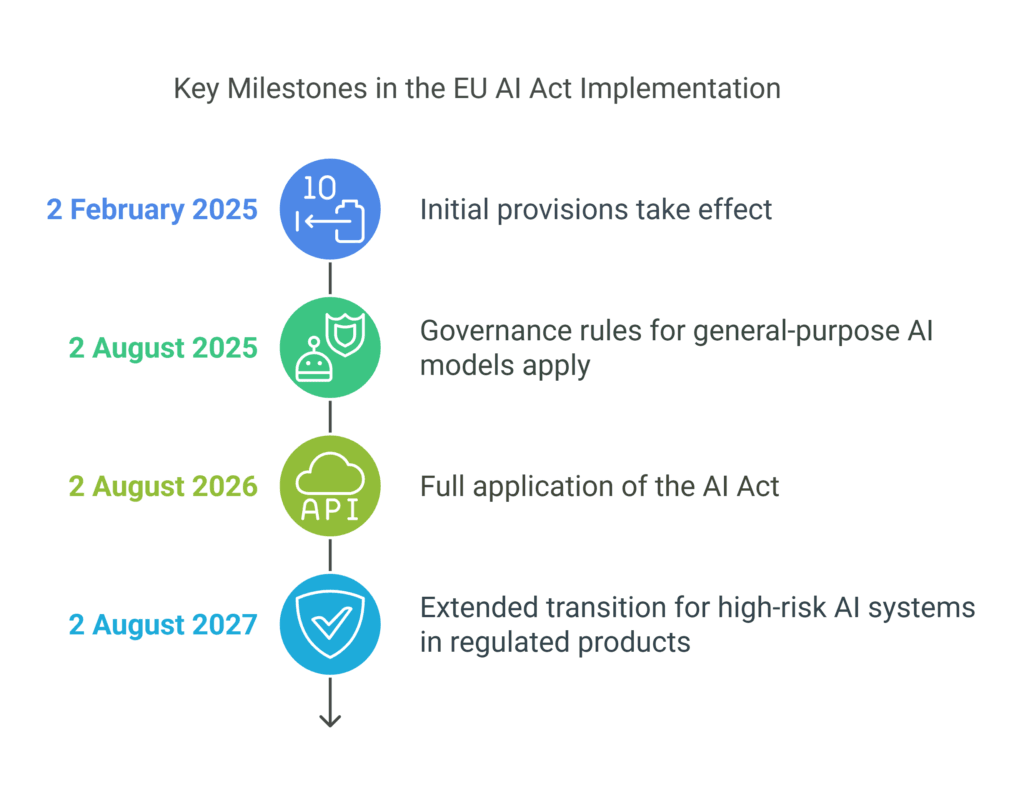
Timeline for Implementation

The EU AI Act will be implemented in phases:

  • 2 February 2025: Initial provisions take effect;
  • 2 August 2025: Governance rules for general-purpose AI models apply;
  • 2 August 2026: Full application of the AI Act;
  • 2 August 2027: Extended transition for high-risk AI systems in regulated products.

This timeline helps businesses adjust and meet the new AI rules.

It supports the growth of reliable AI systems.

EU AI Act Framework

AI Compliance in European Businesses: Risk Classification System

The European AI strategy has a detailed risk classification system for AI.

It aims to ensure ai fairness and ethics.

It also promotes responsible ai deployment in different sectors.

Prohibited AI Practices

The EU AI Act bans some AI uses.

These include systems for controlling behavior, social scoring, and real-time biometric identification.

This rule helps protect fundamental rights, as part of the European AI strategy.

High-Risk AI Systems

High-risk AI systems have strict rules.

They are used in critical areas like infrastructure, education, and law enforcement.

These systems need thorough ai audits and must pass conformity assessments before they can be used.

AI compliance risk classification

Limited and Minimal Risk Categories

AI systems with lower risks have less strict rules.

They don’t have to follow specific laws but are encouraged to follow voluntary guidelines.

This balance allows for innovation while keeping ethics in mind.

Risk CategoryExamplesRegulatory Approach
ProhibitedSocial scoring AIBanned
High-RiskAI in critical infrastructureStrict regulations
Limited RiskChatbotsTransparency requirements
Minimal RiskAI-enhanced video gamesVoluntary guidelines

Essential Requirements for AI System Providers and Deployers

The EU AI Act has strict rules for AI system providers and deployers.

These rules aim to make AI trustworthy and follow ethical practices.

Providers must prepare AI systems carefully before they hit the market.

Deployers focus on using these systems safely and legally.

AI providers must take strong steps to protect privacy and manage data well.

They also need to keep detailed records for 10 years after the system is introduced.

This helps follow AI regulation and improve data privacy.

Deployers are key to keeping AI trustworthy.

They must keep system logs for at least six months.

They also need to report serious incidents within 15 days.

For big disruptions, they have only two days to report.

RequirementProvidersDeployers
Documentation Retention10 years6 months (logs)
Incident Reporting15 days15 days
Critical Incident Reporting2 days2 days
CE MarkingRequiredNot applicable

Providers must put CE markings on high-risk AI systems.

They also need to have an EU representative if they’re outside the union.

These steps help meet AI regulation standards in the European market.

Data Governance and Privacy Requirements

As AI Regulation in Europe evolves, businesses face complex data governance and privacy rules.

The EU AI Act, set to take effect in 2026, brings new challenges.

It works with GDPR to ensure strong AI ethics and governance.

GDPR Alignment with AI Systems

AI systems must follow GDPR principles like lawfulness, fairness, and transparency.

You must ensure your AI practices meet these standards, mainly for high-risk areas like finance and healthcare.

Do Data Protection Impact Assessments for high-risk activities to stay compliant.

Data Quality and Management Standards

High-quality data is vital for ai bias mitigation and following rules.

The EU AI Act stresses strict data management, mainly for high-risk AI systems.

You need to have strong data governance to avoid penalties and keep client trust.

This includes managing various data sources well and ensuring data minimization.

Documentation and Record-Keeping

Keeping detailed records is essential to show you’re following the rules.

Keep records of AI training data, biases, and system performance.

For high-risk AI systems, log activity and do regular checks.

Also, remember, importers must keep EU declarations of conformity and technical documentation for ten years after market placement.

By focusing on these data governance and privacy needs, you’ll be ready for the changing AI regulation in Europe.

This will help you develop ethical and responsible AI.

Transparency and Explainability Obligations

The EU AI Act makes it clear how AI systems must be transparent and explainable.

These rules help make sure AI is fair and protects privacy.

Companies need to tell users when they’re dealing with AI, unless it’s very obvious or used for legal reasons like catching criminals.

For AI systems that are very high-risk, providers must give ‘instructions for use’.

These instructions should include details on how the system works, its accuracy, and its security.

The Act also requires detailed technical documents for audits and ongoing checks.

AI-generated content, like deepfakes, must be labeled as artificial.

This helps stop fake information and protects people.

The Act also creates a database for high-risk AI systems.

This makes it easier for the public to learn about these technologies.

  • High-risk AI systems need to be transparent so users understand how they work;
  • AI companies must tell users when they’re not talking to a human;
  • Providers must make sure their AI solutions are effective, work well together, are strong, and reliable.

These rules help follow ethical AI guidelines and support AI governance.

By being open and clear, businesses can gain trust and follow the EU AI Act.

This could lead to more people using AI and feeling confident about it.

Risk Management and Compliance Monitoring

European businesses need strong risk management and compliance monitoring to follow the EU AI Act.

These steps help make sure AI is trustworthy and keeps data safe.

Risk Assessment Frameworks

Businesses must create detailed risk assessment frameworks for AI accountability.

These frameworks spot risks, check their impact, and plan how to fix them.

Regular checks help companies stay on top of new challenges and follow rules.

Continuous Monitoring Systems

It’s key to have systems that watch AI all the time.

These systems check how AI is doing, find odd things, and make sure it follows rules.

By always watching AI, companies can catch and fix problems early.

Incident Response Protocols

Having clear plans for AI problems is very important.

These plans should say how to find, report, and fix issues.

Quick action helps reduce harm and shows a company’s commitment to AI safety.

ComponentPurposeKey Benefits
Risk AssessmentIdentify and evaluate AI risksProactive risk mitigation
Continuous MonitoringTrack AI system performanceEarly issue detection
Incident ResponseAddress AI-related issuesMinimize possible damages

By using these risk management and compliance monitoring steps, European businesses can make sure their AI systems follow rules.

This keeps trust with everyone involved.

Penalties and Enforcement Measures

The EU AI Act has strict penalties for not following the rules.

It focuses on making sure AI is transparent and private.

Businesses need to know these rules to avoid fines and stay in line with GDPR and AI laws.

Financial Penalties Structure

The Act has a system of fines based on how serious the violation is:

  • Up to €35 million or 7% of global annual turnover for prohibited AI practices;
  • Up to €15 million or 3% for violations of specific provisions;
  • Up to €7.5 million or 1% for providing misleading information.

Small businesses are capped at lower fines to help them stay afloat while keeping the rules strict.

Compliance Violations Categories

Violations are split into levels based on their impact on AI safety and ethics.

Serious violations include banned AI practices.

Less serious ones might be not monitoring AI well or not keeping proper records.

Enforcement Mechanisms

Here’s how the AI Act will be enforced:

  • Member States report to the European Commission every year;
  • The new AI Office will watch over General-Purpose AI Models;
  • Authorities can investigate and take documents.

These steps help keep AI safe and transparent across the EU.

Violation TypeMaximum FineEffective Date
Prohibited AI Practices€35M or 7% of turnoverAugust 2, 2025
Other Obligations€15M or 3% of turnoverAugust 2, 2025
Misleading Information€7.5M or 1% of turnoverAugust 2, 2025

Implementation Strategies for Business Compliance

The EU AI Act will start in August 2026. Businesses need to act fast to follow the rules.

They must set up strong ai governance frameworks.

These should cover risk assessment, quality management, and cybersecurity to protect data and avoid risks.

Companies should keep a list of their AI use cases and systems.

This list helps them know where they need to focus on compliance.

They also need to do regular checks and audits to make sure AI systems are fair and transparent.

Building trustworthy AI is key to following the rules.

This means adding privacy and ethics into AI development from the start.

Companies should also have clear rules with AI vendors and check AI systems often for fairness and accuracy.

Training programs are important for AI risks.

Employees working with critical systems, like those making credit decisions, need more training.

This is different from those doing less sensitive tasks.

If you need help with these strategies, contact our lawyers in Romania at office@theromanianlawyers.com.

Our Romanian law office can offer great advice on AI compliance for European businesses.

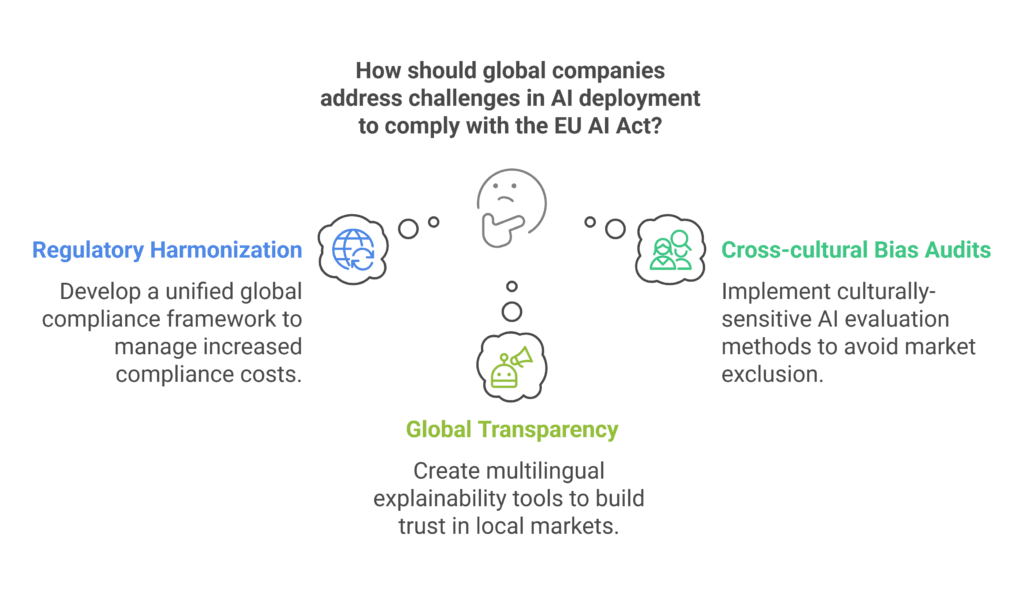
Challenges and Considerations for Global Companies

Global companies face unique challenges in implementing responsible AI deployment strategies that comply with the EU AI Act.

They must harmonize international AI regulations with robust ai risk mitigation strategies.

Companies need to navigate diverse regulatory landscapes while keeping up with EU standards.

A key challenge is conducting thorough ai bias and fairness audits across different cultural contexts.

They need to develop culturally sensitive evaluation methods.

This ensures AI systems remain unbiased and fair in various global markets.

Implementing AI transparency and accountability measures on a global scale is another hurdle.

Companies must create standardized processes for explaining AI decisions to stakeholders from diverse backgrounds.

This may involve developing multilingual explainability tools and adapting communication strategies to local norms.

ChallengeImpactMitigation Strategy
Regulatory HarmonizationIncreased compliance costsDevelop unified global compliance framework
Cross-cultural Bias AuditsPotential market exclusionCulturally-sensitive AI evaluation methods
Global TransparencyTrust issues in local marketsMultilingual explainability tools

While challenging, early compliance with the EU AI Act can provide a strategic advantage.

As other regions look to the EU as a model for AI regulations, companies that adapt now may find themselves better positioned in the global market.

AI Deployment

Future Trends and Evolving Regulatory Landscape

The AI regulatory scene is changing fast. By 2026, the EU AI Act will fully come into play.

It will bring a new risk-based system for AI apps.

This means companies will need to update their privacy and security measures.

Recent stats show AI governance is becoming more critical:

  • 56% of organizations plan to use Generative AI in the next year;
  • 72% of companies already use AI, seeing improvements in many areas;
  • Only 18% of organizations have a council for responsible AI governance.

As rules get stricter, companies could face big fines.

The EU AI Act might fine violators up to €35 million or 7% of their global income.

To keep up, companies need to train their AI teams and follow strict ethics guidelines.

The future of AI rules will include more audits and risk checks.

Healthcare and finance will need special plans to use AI ethically and follow the law.

Conclusion: Embracing Ethical AI for Sustainable Growth

The EU AI Act is a big change in artificial intelligence.

It got 523 votes in favor, setting a new AI governance standard.

Your business needs to follow these rules to avoid fines up to 7% of global turnover.

It’s important to have a good ai risk assessment strategy.

The Act covers all AI systems in the EU market, no matter where they are.

High-risk AI systems must go through checks and be registered in an EU database.

This ensures AI systems are safe and trustworthy.

It also makes sure they respect basic rights.

Ai fairness testing is now a must for following the rules.

The European AI Office will make sure everyone follows the Act.

There’s also an AI Sandbox for testing within ethical limits.

These rules start on August 1, 2024, with most parts taking effect on August 2, 2026.

Understanding the EU AI regulation can be tough.

For help with compliance, contact our lawyers in Romania at office@theromanianlawyers.com.

By using ethical AI, your business can grow sustainably in this new AI world.

FAQ

What is the EU AI Act and why is it important for European businesses?

The EU AI Act is a new rule for AI in the European Union.

It helps businesses by setting rules for ethical AI use.

It also makes sure AI is governed well and meets certain standards.

How does the EU AI Act classify AI systems based on risk?

The Act sorts AI systems into four risk levels.

There are banned practices, high-risk systems, systems with limited risk, and those with minimal risk.

Each level has its own rules. Knowing this helps businesses understand their duties.

What are the essential requirements for AI system providers and deployers under the EU AI Act?

Providers and deployers must focus on data quality and system reliability.

They also need to ensure human oversight and transparency.

These steps are key from start to finish to follow the Act’s rules.

How does the EU AI Act intersect with existing data protection regulations like GDPR?

The Act works with the GDPR to protect data.

Businesses must follow GDPR rules for AI use.

Keeping data safe and well-documented is essential for following both laws.

What are the transparency and explainability requirements under the EU AI Act?

The Act requires clear information about AI systems.

Businesses must make AI decisions clear and explainable.

This builds trust and follows the regulation.

What risk management and compliance monitoring measures are required by the EU AI Act?

The Act demands good risk management and constant checks.

Businesses need to have plans for risks and keep an eye on their AI systems.

This keeps them in line with the Act.

What are the penalties for non-compliance with the EU AI Act?

Breaking the Act can cost up to €30 million or 6% of global sales.

The fine depends on the violation’s impact.

This shows how serious following the Act is.

How can businesses implement AI compliance measures in line with the EU AI Act?

Businesses can start by making AI inventories and doing impact assessments.

They should also think about privacy and ethics in AI.

Keeping AI systems up to date is key.

For complex issues, getting legal advice is a good idea.

What challenges do global companies face in complying with the EU AI Act?

Global companies must align with many AI rules worldwide.

They need a global plan for AI compliance.

This means adjusting their current systems to fit EU rules.

What future trends are expected in AI regulation?

We might see more AI offices and independent bodies.

The rules will likely change, so businesses need to stay updated.

Being ethical and flexible in AI compliance is important for growth.


Incorporation AI Startup in Romania

Legal Requirements for Incorporation of AI Startups in Romania

Legal Requirements for Incorporation of AI Startups in Romania

To successfully incorporate an AI startup in Romania and meet the necessary legal requirements, there are several key considerations you need to keep in mind.

At present, Romania does not have a specific legal framework dedicated to regulating AI or ML.

However, the European Commission is currently working on the Artificial Intelligence Act, which aims to strengthen Europe’s position in promoting human-centric, sustainable, secure, inclusive, and trustworthy AI.

The AI Act covers various aspects such as risk assessment, dataset quality, traceability, documentation, and security.

In addition to complying with the AI Act, it is crucial for AI startups to adhere to the General Data Protection Regulation (GDPR), which addresses data protection and privacy.

When incorporating an AI startup in Romania, it is important to consider additional technical requirements that buyers may have, such as proficiency in programming languages, experience in Big Data Technologies, and familiarity with agile project management.

Furthermore, it is essential to take into account industry-specific standards and regulations when offering AI or ML software services.

To ensure compliance, it is recommended that you stay updated with the development of laws and regulations related to AI in Romania.

By staying informed, you can effectively navigate the legal landscape and establish a legally compliant AI startup in Romania.

ai startup legal services romania

Market Entry Requirements for AI and ML Software Development Services in Europe

To successfully enter the European market for AI and ML software development services, there are specific requirements and certifications that AI startups need to comply with.

While the general market entry requirements for software development can be found in a separate study, it is crucial to consider the unique requirements for AI and ML services.

The upcoming European AI Act, currently being prepared, will play a significant role in regulating AI development in Europe.

This act will provide a legal framework for monitoring and regulating AI, ensuring that it is human-centric, sustainable, secure, inclusive, and trustworthy.

In addition to the legal considerations, buyers in the European market often have additional technical requirements.

These may include knowledge of programming languages, experience in Big Data Technologies, and familiarity with agile project management.

It’s essential to stay updated with industry-specific standards and regulations when offering AI or ML software services.

When planning to enter the European market, it is crucial for AI startups to stay informed about the specific requirements for different industries, segments, and countries within Europe.

Understanding these market entry requirements will help AI startups tailor their strategies and ensure compliance with the legal and technical aspects of operating in the European market.

Table: Market Entry Requirements for AI and ML Software Development Services in Europe

RequirementDescription
Compliance with the European AI ActEnsure adherence to the forthcoming AI Act to meet legal obligations and regulatory requirements.
Technical ExpertisePossess the necessary technical skills, including knowledge of programming languages and experience in Big Data Technologies.
Familiarity with Agile Project ManagementUnderstand and implement agile project management methodologies to effectively deliver AI and ML software development services.
Industry-specific Standards and RegulationsStay updated with the specific standards and regulations relevant to the target industries and segments in the European market.

ai company registration romaniaMarket Channels for AI and ML Software Development Services in Romania

When it comes to entering the market for AI and ML software development services in Romania, there are various market channels that AI startups can utilize.

Understanding and leveraging these channels is essential for a successful market entry strategy.

Some of the key market channels for AI and ML software development services in Romania include:

1. Subcontracting through European service providers:

Subcontracting through established European service providers is a common and realistic market entry channel for AI startups.

This allows startups to tap into the existing networks and expertise of established companies in the industry.

By partnering with these service providers, AI startups can gain access to a wider customer base and benefit from their established reputation and relationships.

2. Online platforms:

Online platforms provide a convenient and accessible market channel for AI and ML software development services.

Platforms such as freelancing websites or dedicated marketplaces for AI services allow startups to showcase their expertise and connect with potential clients.

These platforms often have a large user base and provide opportunities for startups to secure projects and build their portfolio.

3. Direct engagement with end-user industries:

Another market channel for AI startups is to directly engage with specific end-user industries.

By understanding the needs and challenges of these industries, startups can tailor their services to address specific pain points.

This approach requires thorough research and industry knowledge to identify the most relevant industries and establish connections with key stakeholders.

Overall, choosing the right market channel is crucial for the success of AI startups in Romania.

Whether it’s subcontracting through service providers, utilizing online platforms, or directly engaging with end-user industries, each channel offers its own advantages and considerations.

By carefully evaluating these options and selecting the most suitable channels, AI startups can effectively penetrate the Romanian market and establish a strong foothold in the industry.

Market ChannelAdvantagesConsiderations
Subcontracting through European service providers
  • Access to established networks and expertise
  • Leverage reputation and relationships of service providers
  • Competition from other subcontractors
  • Ensuring contractual agreements align with startup’s goals
Online platforms
  • Wide user base and potential for project acquisition
  • Opportunity to build a portfolio and reputation
  • Competition from other AI startups and service providers
  • Platform fees and commission
Direct engagement with end-user industries
  • Customized services to address specific industry needs
  • Opportunity for long-term partnerships and industry expertise
  • Requires significant industry research and knowledge
  • Establishing trust and credibility with industry stakeholders

Incorporation Process for AI Startups in Romania

The process of incorporating an AI startup in Romania involves several important steps and considerations.

To ensure a smooth and compliant incorporation, it is recommended to consult legal or tax advisors who specialize in Romanian business law. Here is an overview of the key aspects:

Choosing the Legal Form

When incorporating an AI startup in Romania, you will need to choose the appropriate legal form for your business.

The most common options are stock companies (SA) and limited liability companies (SRL).

Each legal form has its own advantages and requirements, so it is crucial to assess the specific needs and goals of your AI startup before making a decision.

Name Availability and Reservation

Before moving forward, it is important to check the availability of your desired company name on the Trade Register’s official website.

If the name is available, you can proceed with the name reservation process, which can also be done through the Trade Register.

This step ensures that your chosen name will be reserved for your AI startup during the incorporation process.

Registration and Documentation

Once the name reservation is completed, you will need to establish a registered office for your AI startup and draft a constitutive act.

The Constitutive Act outlines the company’s bylaws, including its purpose, management structure, and shareholder rights.

Additionally, you will be required to prepare declarations and deposit the share capital to a bank.

Finally, you will need to submit all the necessary documents for registration at the National Trade Office to officially incorporate your AI startup.

StepsDescription
Choose the Legal FormDecide between SA and SRL based on your business needs and goals.
Name Availability and ReservationCheck the availability of your desired company name and reserve it through the Trade Register.
Establish Registered Office and Draft Constitutive ActCreate a physical office address and draft the bylaws of your AI startup.
Prepare Declarations and Deposit Share CapitalPrepare the necessary declarations and deposit the required share capital to a bank.
Submit Documents for RegistrationSubmit all the required documents to the National Trade Office for the official registration of your AI startup.

It is important to note that the costs associated with incorporation may vary depending on the legal form chosen and other factors.

Additionally, staying updated with the latest legislative and fiscal news in Romania is essential to ensure compliance with any changes in the legal framework.

Compliance and Risks for AI Companies in Europe

Compliance with AI regulations is of utmost importance for AI companies operating in Europe, including Romania.

The proposed EU AI Act, expected to have a significant impact on AI development, will provide a legal framework for monitoring and regulating AI.

It is crucial for AI companies to understand and adhere to these regulations to avoid potential penalties.

Failure to comply with AI regulations can result in fines of up to €30 million or 6% of the company’s total annual turnover.

To mitigate risks and ensure compliance, AI companies must prioritize data privacy, implement secure machine learning models, and establish robust data governance.

In addition, complying with existing regulations such as the General Data Protection Regulation (GDPR) is essential.

Non-compliance with AI regulations poses financial and reputational risks for AI companies.

It can hinder innovation and collaboration within the AI industry, impacting business growth and opportunities.

Therefore, AI companies should proactively implement solutions that facilitate compliance and stay updated with the evolving regulatory landscape.

To navigate the legal framework and ensure compliance, AI companies operating in Romania should seek legal counsel and stay informed about AI legislation and regulations.

By taking a proactive approach to compliance, AI companies can thrive in the European market while maintaining trust and integrity.

F A Q  about AI Company Registration in Romania

1. What are the requirements for registering an AI company in Romania?

To register an AI company in Romania, you need to comply with the Romanian laws and regulations related to company formation.

You must submit the necessary documentation to the National Trade Register Office and fulfill the capital requirements as per the Company Law in Romania.

2. How can I start a business that is leveraging AI in Romania?

To initiate a startup in Romania that focuses on using artificial intelligence, you should follow the process of incorporation and fulfill the necessary legal requirements.

Pay attention to the specific regulations related to technology startups in the country.

3. What type of company structure can be formed for AI businesses in Romania?

You can establish various types of companies in Romania, including a limited liability company or a joint stock company.

Each structure has its own shareholder requirements and vat implications, so consult with a legal advisor to determine the most suitable structure for your AI business.

4. What are the specific steps for registering an AI company name in Romania?

When choosing a company name for your AI business, ensure that it is unique and complies with the Romanian Company Law.

You need to submit an application to the National Trade Register Office and follow their guidelines for company name registration.

5. How can foreign entrepreneurs establish an AI startup in Romania?

Foreign entrepreneurs intending to set up an AI startup in Romania must first decide on the type of company they wish to form.

They will then need to comply with the regulations set by the authorities regarding capital requirements and other legal aspects.