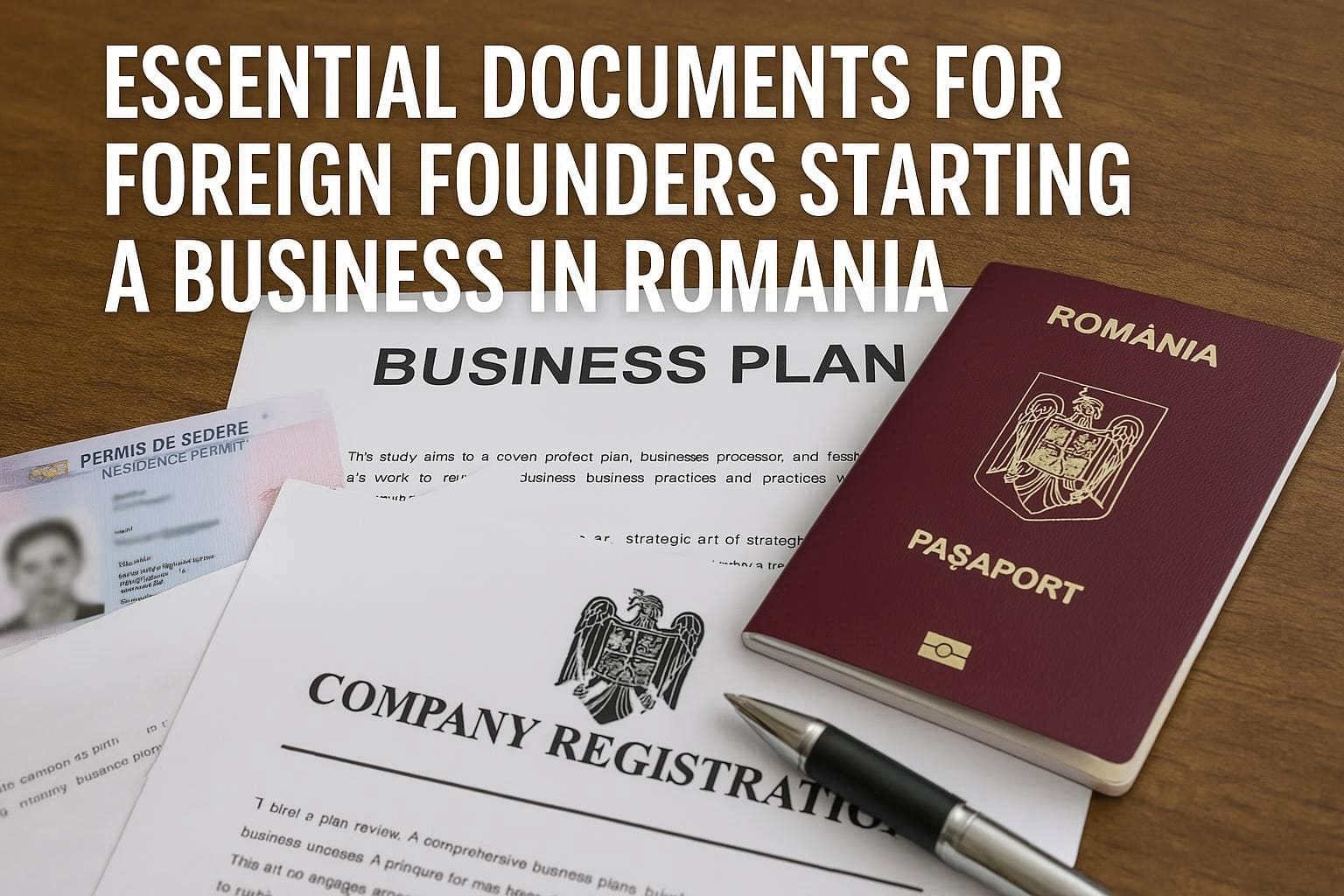
Essential Documents for Foreign Founders Starting a Business in Romania

Essential Documents for Foreign Founders Starting a Business in Romania

Company formation in Romania

Essential Documents for Foreign Founders Starting a Business in Romania

Starting a business in Romania requires more than choosing a company name. The incorporation file must connect the founders, ownership structure, registered office, activities, management and beneficial-owner information in a form accepted by the Trade Register.

This guide explains the documents commonly required for foreign founders and why the correct route depends on the founder’s country, legal form, activity and filing method.

Play
Documents and practical steps for foreign founders entering the Romanian market.

Short answer: the core file usually includes founder and administrator identification, company-name information, proof of the registered office, articles of association, beneficial-owner information and the forms required by the ONRC. Foreign corporate shareholders may need additional registry, authority, translation and legalisation documents.

What Documents Are Needed?

The exact list is not identical for every applicant. An individual founder, a foreign company acting as shareholder, an EU citizen, a non-EU national and a representative acting under a power of attorney may face different document and signing requirements.

Individual founder

Usually needs a valid identity document, personal details, ownership and management information, beneficial-owner information and the declarations required for the application.

Foreign corporate shareholder

Usually needs a current registry extract or equivalent, evidence of legal existence, a corporate approval to invest and appoint representatives, and proof of the signatory’s authority.

Authorised representative

Needs a power of attorney or other authority in the form required for the filing. The document may need authentication, apostille or legalisation and an authorised Romanian translation.

Essential incorporation documents for foreign founders in Romania
Incorporation documents should be checked as one coordinated file.

Core Documents for a Romanian Company Formation File

Identity documents

Passports or identity documents for shareholders, administrators and other relevant persons. The required copy, format and translation depend on the filing route and the document’s origin.

Company name

Prepare several compliant name options and obtain the current ONRC proof or reservation document required for the incorporation route.

Registered office

Provide evidence of the right to use the Romanian premises, such as a lease, ownership document or another legally acceptable document. The arrangement should be checked for the intended activity.

Articles of association

The constitutional document should address the legal form, shareholders, capital, activities, management, representation and decision-making rules required by Romanian company law.

Beneficial-owner information

The ownership and control chain must be identified and reflected in the information or declaration required for the company-formation file.

ONRC forms and declarations

The application, declarations and supporting forms must be completed using the current ONRC requirements. The exact forms depend on the legal form and the requested registrations.

Additional Documents for Foreign Corporate Shareholders

When the shareholder is a company incorporated outside Romania, the Trade Register file normally needs evidence that the shareholder exists and that the persons signing or approving the investment have authority to do so.

Registry evidence

A recent extract or equivalent official document may be needed to show the foreign company’s legal existence, registered office, directors and ownership information.

Corporate resolution

The foreign shareholder may need a resolution approving the Romanian investment, the participation in the Romanian company and the appointment of the relevant representative.

Authority to sign

The file should show who may sign the articles of association, power of attorney and other documents on behalf of the foreign company.

Formalities abroad

Depending on the issuing country and document type, authentication, apostille or legalisation may be required before the document can be used in Romania.

There is no universal rule that every foreign document must be notarised or apostilled. The correct form depends on the issuing state, applicable international instruments, the document and the ONRC filing requirements at the time of submission.

Romanian Translations and Document Formalities

Documents submitted to Romanian authorities generally need to be usable in Romanian. A foreign-language document may require an authorised Romanian translation, and the translation may need to follow the form required for that document and filing route.

Before ordering translations or legalisation, check the complete document chain. A translation cannot cure a missing corporate resolution, an expired registry extract or a signatory who lacks authority.

Choosing the Legal Structure and Current Capital Rules

The documents depend on whether the founder chooses an SRL, an SA, a branch or a representative office. An SRL is often suitable for a privately held operating business, but the right structure depends on ownership, funding, governance, activity and the relationship with any foreign parent.

SRL

For a newly incorporated SRL, the minimum share capital is RON 500 under the current rules introduced by Law No. 239/2025. An existing SRL whose reported net turnover exceeds RON 400,000 may face a separate capital-increase obligation under the applicable timing rules.

SA

An SA has different capital, governance and incorporation requirements. The file should be prepared against the rules applicable to the proposed share structure and offering model.

Branch or representative office

These are not interchangeable with a Romanian subsidiary. The foreign parent’s constitutional documents, registry evidence and authority documents become central to the filing.

The current minimum-capital rules should be checked at the time of filing, especially where the founder is incorporating an SRL or modifying an existing Romanian company. The ONRC identifies Law No. 239/2025 as the source of the current SRL capital changes.

Registered Office and Activity Documents

The registered office requires evidence of the right to use the premises. A domiciliation or virtual-office arrangement may be possible in appropriate circumstances, but the document, provider and intended activity must be checked rather than assumed to be interchangeable with an operating location.

Activity codes should be selected under the current CAEN classification. Regulated activities may require additional approvals, professional qualifications or operating authorisations. Company registration alone does not automatically authorise every activity listed in the articles of association.

How the Documentation Process Works

1

Map the founders and structure

Identify shareholders, administrators, beneficial owners, the legal form and whether a foreign company is involved.

2

Check the activities and office

Confirm the CAEN activities, any special authorisations and the document supporting the Romanian registered office.

3

Collect foreign documents

Obtain current registry evidence, corporate resolutions, signatory authority and any required powers of attorney.

4

Complete formalities

Arrange translations and, where necessary, authentication, apostille or legalisation before the filing is submitted.

5

File and respond

Submit the complete application through an available ONRC route and address any request for correction or additional documents.

Can Foreign Founders Complete the Process Remotely?

Often, yes, but remote handling is document-dependent. A founder may act through an authorised representative where the authority document and filing route meet the applicable requirements. Online submission also depends on the current ONRC platform, signature and document-format rules.

Company formation, bank onboarding, tax registration, immigration status and permission to conduct regulated activities are separate questions. Incorporating a company does not automatically give a founder the right to live or work in Romania.

Tax and VAT: Keep These Questions Separate

The incorporation file and the company’s tax position are related but not identical. Microenterprise eligibility, profit tax, VAT registration, dividend taxation, e-Factura and sector-specific tax rules depend on the company’s facts and the law applicable at the relevant time.

For that reason, this documents guide does not state fixed tax rates or turnover thresholds as permanent formation rules. Those matters should be reviewed separately with the company’s Romanian tax adviser.

How Atrium Romanian Lawyers Can Help

Document mapping

We identify the documents required for the founder, foreign shareholder, administrator, registered office and intended activity.

Cross-border formalities

We help coordinate corporate resolutions, powers of attorney, translations and document-form requirements for foreign founders.

ONRC filing strategy

We prepare the formation route around the ownership structure, governance, activities, capital and post-registration needs.

Frequently Asked Questions

What documents does a foreigner need to start a company in Romania?

The core file commonly includes identity documents, company-name information, registered-office evidence, articles of association, beneficial-owner information, declarations and the current ONRC forms. The exact list depends on the founder and legal structure.

What extra documents are needed if the shareholder is a foreign company?

The file may require a current registry extract or equivalent, a corporate resolution, proof of signatory authority and documents concerning the foreign company’s ownership or control. Translation and legalisation requirements depend on the issuing jurisdiction and document.

Do foreign documents always need an apostille?

No. The requirement depends on the issuing country, applicable treaties or legal rules, the document and the filing route. The document chain should be checked before translation and submission.

Do documents need to be translated into Romanian?

Foreign-language documents used in the Romanian filing generally need to be made available in Romanian in the form accepted for that document and procedure. The required translation and certification should be confirmed case by case.

Can I incorporate a Romanian company without visiting Romania?

Often, yes, through an authorised representative or an eligible online route. Whether this is possible depends on the documents, signatures, powers of attorney, identity checks, banking and any sector-specific requirements.

What is the minimum share capital for a new SRL in 2026?

Under the current rules identified by the ONRC, a newly incorporated SRL has a minimum share capital of RON 500. Existing companies may be subject to separate obligations linked to net turnover and the transition rules in Law No. 239/2025.

Does company registration automatically give me a residence permit?

No. Company ownership or incorporation and the right to enter, reside or work in Romania are separate legal questions. Immigration eligibility should be assessed independently.

Does company registration authorise every activity listed in the articles?

No. Some activities require additional authorisations, professional qualifications, licences or operating conditions. The intended activity should be checked before the articles and filing are finalised.

Related Company Formation Resources

Official reference: Current forms, filing routes and procedural information should be checked on the ONRC website and its online portal. The ONRC lists Law No. 31/1990, Law No. 265/2022 and Law No. 239/2025 among the relevant national legislation. The exact document requirements may vary with the founder, jurisdiction, legal form and proposed activity.

Disclaimer: This page provides general information only and does not constitute legal advice, a legal opinion or the creation of a lawyer-client relationship. Legal solutions depend on the specific facts and documents involved.

AI Notice: AI-assisted content, reviewed by a qualified Romanian lawyer.

open a Romanian business bank account

How to open a Romanian business bank account as non-resident

How to open a Romanian business bank account as non-resident


What if accessing European markets through a strategic financial gateway required fewer hurdles than commonly assumed?

Play

With over 40 financial institutions and seamless connectivity to 500 million EU consumers, Romania presents a compelling proposition for international entrepreneurs.

Romanian business bank account as non-resident


Establishing corporate financial operations here involves navigating specific regulatory frameworks distinct from other EU jurisdictions.

Over 70% of newly registered entities prioritize this step within their first operational month, leveraging the country’s extensive ATM networks and multi-currency solutions.

The process demands precise alignment with local compliance standards and EU banking directives.

Professional guidance proves critical when addressing documentation protocols, language considerations, and cross-border transaction requirements.

Key Takeaways:

  • Romania’s financial infrastructure supports access to expansive EU markets through 40+ institutions,
  • Successful account establishment requires understanding dual compliance with national and EU regulations,
  • Most new Romanian enterprises complete this process within their initial operational phase,
  • Multi-currency capabilities streamline international transactions for cross-border operations,
  • Expert assistance mitigates challenges related to documentation and institutional procedures.

Understanding the Requirements and Romanian Banking Regulations

Financial institutions maintain rigorous protocols to align with evolving European standards.

Companies must navigate dual-layer compliance systems that combine local laws with EU directives.

This layered approach ensures transparency while facilitating cross-border economic activities.

banking regulations and compliance


Overview of Local Financial Regulations

The regulatory landscape requires adherence to three core pillars:

Requirement TypeKey ComponentsFrequency
AML VerificationSource of funds analysisInitial setup + annual reviews
Ownership DisclosureBeneficiary identificationDuring registration
Tax ComplianceVAT registration proofOngoing

Financial authorities mandate transaction monitoring systems for all corporate entities.

These systems track cross-border payments and flag unusual activity patterns.

Compliance and Legal Considerations

Documentation requirements vary by industry sector.

Companies in regulated fields like finance or energy face additional licensing steps.

Essential materials include:

  • Certified articles of incorporation,
  • Shareholder structure diagrams,
  • Tax identification certificates.

Quarterly financial reporting remains mandatory for maintaining active status.

Institutions may request updated operational data during periodic audits.

Eligibility and Key Documentation for Non-Residents

Establishing financial operations in this EU jurisdiction requires precise preparation of foundational materials.

Authorities mandate comprehensive verification processes to confirm organizational legitimacy and stakeholder identities.

eligibility documentation for non-residents


Personal Identification Protocols

Legal representatives and shareholders must submit valid passports or national ID cards.

Non-EU nationals often need supplementary residence permits, which require apostille certification.

All foreign-issued identification requires notarized translations into the local language.

Corporate Formation Evidence

Authenticated Articles of Association and Trade Register certificates prove a company’s legal standing.

Financial institutions require proof of registered office addresses through utility bills or lease agreements.

Minimum capital deposits of 200 RON (€45) must be verified through bank transfer receipts.

Document TypeSpecificationsSpecial Notes
Passport/IDValid for 6+ monthsNon-EU requires apostille
Articles of AssociationNotarized copyTranslated version mandatory
Capital ProofBank deposit receiptMinimum 200 RON
Address VerificationRecent utility documentUnder company name

Third-country entities should anticipate extended processing times for document legalization.

Mismatched signatures or expired certifications remain primary causes for application rejections.

Romanian business bank account as non-resident

Efficient setup of financial infrastructure abroad requires understanding sequential protocols.

Institutions prioritize structured workflows that balance regulatory compliance with operational efficiency.

Digital solutions now enable remote completion of most stages, accelerating market entry timelines.

process and documentation checklist


Essential Steps of the Process

The procedure follows five distinct phases:

  1. Provider selection (1-2 days): Evaluate institutions based on transaction capabilities, digital tools, and cross-border support,
  2. Document preparation (3-5 days): Organize materials requiring translation, notarization, or apostille certification,
  3. Application submission (1 day): Utilize online portals with video identity confirmation features,
  4. Compliance review (5-10 days): Undergo anti-fraud checks and operational legitimacy assessments,
  5. Account activation (1-2 days): Finalize initial deposits and receive digital access credentials.

Important Documentation Checklist

Prepare these critical materials to ensure smooth processing:

Document TypeSpecificationsProcessing Tip
Company CharterNotarized translationInclude shareholder signatures
Identity ProofValid passport copiesNon-EU requires apostille
Address EvidenceRecent utility billIssued within 90 days
Capital ProofBank transfer receiptMinimum €45 equivalent

Maintain digital copies of all submissions for quick reference during follow-ups.

Institutions may request additional verification for complex ownership structures.

Choosing the Right Bank or Fintech Provider

Selecting appropriate financial partners significantly influences operational success in cross-border ventures.

Institutions vary in their capabilities, with distinct advantages for different organizational needs.

financial partners selection


Established Financial Institutions

Major domestic institutions provide comprehensive infrastructure through physical networks and localized expertise.

ING offers English-language digital platforms with fee-free debit cards, ideal for tech-driven enterprises.

Banca Transilvania specializes in SME support through tailored loan packages and insurance products.

BCR maintains the largest branch network nationwide, while BRD delivers multilingual mobile banking interfaces.

These organizations excel in regulatory compliance and long-term financial planning.

Modern Financial Technology Solutions

Digital platforms streamline operations with rapid onboarding and multi-currency management.

Wise Business supports transactions in 50+ currencies with API integrations for automated workflows.

Revolut provides real-time expense tracking across 30 currencies through intuitive dashboards.

Provider TypeKey AdvantageIdeal For
TraditionalRegulatory expertiseComplex compliance needs
FintechCost efficiencyStartups & remote teams

Hybrid approaches combining institutional stability with fintech agility are gaining popularity among scaling enterprises.

Decision-makers should evaluate transaction volumes, currency requirements, and growth timelines when selecting services.

Navigating Fees, Charges, and Exchange Rates

Financial efficiency depends on understanding how institutional pricing models impact cross-border operations.

Service providers employ diverse fee architectures that directly affect profitability, particularly for enterprises handling frequent international money movements.

fee structures and exchange rates


Understanding Fee Structures

Traditional institutions typically impose initial setup charges ranging from €50 to €200.

Monthly maintenance costs average €10-€30, with domestic transactions costing 0.15% (minimum 5 RON) at major providers.

International transfers often carry higher percentages and fixed minimums.

Modern fintech solutions disrupt this model through transparent pricing.

Platforms like Wise apply flat 1% fees for currency conversions, eliminating hidden markups.

This approach can reduce transfer costs by 80-85% compared to conventional banking margins.

Fee TypeTraditional BanksFintech ProvidersSavings Potential
Setup€50-€200€0100%
Monthly Maintenance€10-€30€0-€1550-100%
International Transfer0.1% + 15 EUR1% flat80-85%
Exchange Rate Margin3-10%0.5-1%70-90%

Comparing International Transfer Costs

Cross-border transfers outside Europe reveal stark contrasts between providers.

Traditional banks often add 10%+ through inflated exchange rates. For a €10,000 payment, this could mean €1,000 in hidden fees.

Digital alternatives use real-time mid-market rates with clear percentage-based charges.

This transparency enables accurate forecasting of money movement costs.

Businesses processing high volumes should prioritize providers offering bulk discount rates.

Regular audits of transaction statements help identify unnecessary charges.

Combining multiple services often optimizes payment processing expenses across different currency zones.

Securing Your Funds and Banking Services

Modern financial infrastructure prioritizes both asset protection and value-added solutions to support organizational growth.

Institutions deploy layered security frameworks while offering diverse tools to optimize capital utilization.

Data Protection and Security Measures

Advanced encryption protocols safeguard sensitive information across all digital platforms.

Multi-factor authentication remains mandatory for high-value transactions, with biometric verification options gaining traction.

Continuous monitoring systems analyze 100+ risk indicators to detect anomalies in real time.

Financial partners implement tokenization for payment cards and API integrations.

Below shows key security features:

FeatureFunctionBenefit
256-bit EncryptionData transmission securityMilitary-grade protection
Behavioral AnalyticsUser pattern trackingFraud prevention
Automated AlertsSuspicious activity notificationsImmediate response

Additional Financial Services Offered

Beyond core accounts, institutions provide tailored solutions for capital growth.

Credit lines with revolving limits help manage cash flow fluctuations.

Merchant services enable seamless e-commerce transactions through integrated POS systems.

Key offerings include:

  • Short-term financing with competitive interest rates,
  • Customized payroll management platforms,
  • High-yield savings instruments for idle funds.

Investment advisory services assist in portfolio diversification, while trade finance solutions reduce import/export risks.

These tools collectively enhance financial efficiency for enterprises and individuals alike.

Challenges for Non-Resident Entrepreneurs

Establishing financial operations in a foreign country presents unique obstacles requiring strategic navigation.

International entrepreneurs often encounter systemic friction points that demand careful resource allocation and expert guidance.

Many financial branches operate with limited English-speaking personnel, complicating basic inquiries and documentation processes.

Document Translation and Legalization Hurdles

Certification requirements add layers to administrative workflows.

Official papers demand notarized translations and apostille stamps, with processing often taking multiple weeks.

Common pitfalls involve:

  1. Incomplete certification chains for foreign-issued documents,
  2. Mismatched formatting between international and local standards,
  3. Delays in obtaining ministry approvals for specialized sectors.

Proactive planning mitigates these obstacles.

Engaging certified translation services early and verifying requirements through official channels prevents costly revisions.

Many institutions now provide digital checklists to streamline submission processes.

Leveraging Technology for a Seamless Process

Modern financial operations increasingly rely on digital solutions to bridge geographical gaps.

Institutions now deploy advanced systems that simplify complex procedures while maintaining strict compliance standards.

Remote Authentication Methods

Video verification has revolutionized account establishment processes.

BRD and other providers enable identity confirmation through secure live calls, reducing setup timelines by 40-60%.

This approach maintains regulatory requirements while eliminating travel obligations.

Digital submission portals allow instant upload of certified documents.

Applicants receive real-time updates through automated tracking systems.

Key advantages include:

  • 24/7 application progress monitoring,
  • Secure cloud storage for sensitive files,
  • Automated error detection in submissions.

Digital Management Capabilities

Mobile platforms provide comprehensive control over financial operations.

Users execute cross-border payments, monitor balances, and generate reports through intuitive interfaces.

API integrations connect banking data with accounting software for seamless reconciliation.

FeatureTraditional ProvidersFintech Solutions
Verification ProcessIn-person meetingsBiometric video calls
Document SubmissionPhysical deliveryEncrypted uploads
24/7 AccessLimited branch hoursMobile app availability
Third-Party IntegrationManual data entryAutomated API sync

Automated payment scheduling reduces administrative workloads for growing enterprises.

Batch processing handles multiple transactions simultaneously, improving operational efficiency by up to 70% compared to manual methods.

Comparing Banks and Fintech Solutions for Business Accounts

Financial service providers now offer diverse pathways for managing corporate funds, each with distinct operational benefits.

Decision-makers must weigh institutional stability against technological agility when structuring financial operations.

Traditional Institutions: Stability vs Flexibility

Established financial organizations provide local expertise through physical branches and personalized support.

Their comprehensive service portfolios often include specialized lending products and long-term investment strategies.

Processing timelines may extend due to manual verification steps and complex approval hierarchies.

Digital Platforms: Speed and Innovation

Modern financial technology solutions excel in transaction efficiency and cost management.

Leading providers support multi-currency operations across 50+ denominations with real-time exchange tools.

Automated compliance checks and API integrations reduce administrative burdens for cross-border enterprises.

While digital services lack physical locations, their 24/7 accessibility and transparent pricing models address core operational needs.

Hybrid approaches combining institutional credibility with fintech flexibility are emerging as strategic solutions for scaling ventures.

FAQ

What financial regulations apply to non-residents opening corporate accounts in Romania?

Non-residents must comply with Romania’s Anti-Money Laundering (AML) laws and EU banking directives.

Institutions require proof of business legitimacy, source of funds, and adherence to local tax reporting standards.

Which documents are mandatory for non-resident entrepreneurs?

Essential documents include valid passports, proof of address, company registration certificates, and share capital confirmation.

Translated and notarized versions may be required for non-English paperwork.

What steps are involved in opening an account remotely?

The process includes selecting a financial provider, submitting digital copies of identification and company documents, completing video verification, and depositing minimum capital if applicable.

Are fintech platforms legally recognized for corporate banking in Romania?

Yes.

Licensed electronic money institutions like Revolut Business or Wise offer compliant services, often with faster onboarding and multi-currency features compared to traditional banks.

How do exchange rates impact international transactions?

Banks and fintech providers apply varying margins to currency conversions.

Comparing real-time rates and transfer fees can reduce costs for cross-border payments.

What security measures protect account holders?

Institutions implement GDPR-compliant data encryption, two-factor authentication, and transaction monitoring systems.

Clients also receive guarantees under the EU Deposit Insurance Scheme up to €100,000.

Do Romanian banks provide services in English?

Major banks like Banca Transilvania and Raiffeisen Bank offer English-speaking support.

However, legal documents may require certified translations for compliance.

Can non-residents access credit or overdraft facilities?

Credit approvals depend on the company’s financial history and collateral.

Fintech solutions often provide quicker access to flexible credit lines than traditional lenders.

What are the advantages of digital onboarding tools?

Remote video verification, e-signatures, and automated document checks streamline approvals, often reducing processing times to under 10 business days.

How does share capital affect account eligibility?

Romanian LLCs must demonstrate a minimum share capital deposit.

Banks require notarized bank statements or auditor confirmations as proof during applications.

🏦 Romanian Business Banking Quiz

Test your knowledge about opening a business account in Romania