remote regulations romania

Remote Work in Romania: What Employers Need to Know

Employment law · Romania

Remote Work in Romania: What Employers Need to Know

Remote work can improve recruitment, retention and business continuity, but the arrangement should be classified correctly and documented before it begins. Romanian employers should distinguish telework from work at home and mobile work, then align the employment contract, working-time records, health and safety measures, data protection and cross-border analysis.

This guide is intended for Romanian employers, foreign-owned companies, HR teams and employees working remotely from Romania. The correct solution depends on the role, the location, the technology used, the contract and the facts of each arrangement.

Practical rule: if an employee regularly performs work outside the employer’s premises using information and communications technology, the arrangement may fall under Romania’s telework framework. Telework is based on the parties’ agreement and must be expressly included in the individual employment contract or an amendment. A company should not rely on an informal “work from home” email when the legal arrangement is actually telework.

What is remote work in Romania?

“Remote work” is a useful business expression, but it is not a single legal category. The first step is to identify how, where and with what technology the work is performed. The classification affects the contract, the employer’s control methods, working-time records, occupational safety, data security and, in some cases, tax, social-security and immigration obligations.

Romania’s Law no. 81/2018 regulates telework. In broad terms, telework is a form of work organisation in which an employee regularly and voluntarily performs duties in a place other than the employer’s premises, using information and communications technology, under conditions agreed with the employer. The statutory definition refers to activity performed at least one day per month in such a location.

Telework is different from a general flexible-hours arrangement. A flexible schedule changes when the employee works. Telework changes, at least in part, where the employee works and how the employer manages the activity. The two arrangements can coexist, but they should not be treated as interchangeable.

Telework

Regular and voluntary work outside the employer’s premises using information and communications technology, expressly agreed in the employment contract.

Work at home

A distinct Labour Code arrangement in which the employee performs work at home and may organise the schedule under the applicable legal and contractual conditions.

Mobile work

Work performed at changing locations because the nature of the job requires mobility. It is not automatically telework simply because a laptop or phone is used.

Do not conflate categories: the phrase “remote employee” does not determine the legal regime. Review the actual work pattern, the employment contract and the reason why work is performed away from the employer’s premises.

Which legal route fits the arrangement?

Select the closest description to see the main legal question. The selector is a practical classification aid, not a substitute for reviewing the contract and actual working pattern.

Choose the work arrangement that best describes the facts.

Telework

Check whether the employee regularly works outside the employer’s premises with ICT and document the arrangement expressly in the employment contract or amendment.

ArrangementCore questionContract focusAdditional risk
TeleworkIs work regularly performed elsewhere using ICT?Express telework clause and statutory telework particulars.Unclear place of work, monitoring, working time or H&S controls.
Work at homeIs the employee working at home under the Labour Code’s home-work rules?Home address, schedule and applicable contractual conditions.Using a telework template for a legally different arrangement.
Mobile workDoes the job inherently require changing work locations?Mobility, travel, records and expenses.Failure to distinguish mobility from voluntary telework.
Cross-border remote workWhere is the work physically performed and for how long?Country, duration, reporting and applicable employment terms.Tax, social security, immigration and permanent-establishment exposure.

When must telework be included in the employment contract?

Under Law no. 81/2018, telework is based on the agreement of the parties and is expressly provided in the individual employment contract for a new employee or by an amendment for an existing employee. The employer should complete this step before the employee begins working under the telework arrangement.

A general remote-work policy may be useful, but it does not replace an express contractual provision where the statutory telework regime applies. The policy can explain approval workflows, equipment, security, availability and office attendance. The contract or amendment should still contain the legally relevant terms for the individual arrangement.

Any later change to an essential contractual element should be reviewed before implementation. For example, a material change to the place of work, the number of remote days, the schedule, the applicable reporting method or the employee’s cross-border location may require an updated contract, amendment, employee-register transmission or separate legal analysis.

Before recruitment

Decide whether the role can lawfully and operationally be performed by telework, at home, through mobility or through a mixed arrangement.

Before the first remote day

Sign the employment contract or amendment, communicate the rules and provide the equipment, instructions and training required for the role.

Before changing the model

Review whether the change affects the contract, working-time records, H&S assessment, data security or another jurisdiction.

What should a Romanian telework clause contain?

The contract should be drafted for the actual arrangement, not copied from a generic remote-work policy. Law no. 81/2018 identifies specific matters to be included in the individual employment contract or amendment. The drafting should also remain consistent with the Labour Code, internal regulations, occupational safety documents and data-protection information.

Depending on the role and arrangement, the clause should address the days or periods when the employee works at the employer’s premises, the place or places from which telework may be performed, how the employer checks activity and how the employee reports, the method for recording the beginning and end of working time, the responsibilities for occupational safety, the equipment and maintenance arrangements, data-protection requirements and measures designed to prevent professional isolation.

The agreement should be sufficiently practical. If the employer expects attendance at meetings, access to confidential information, use of specific devices, availability during fixed hours or periodic office attendance, the clause and related policy should say so clearly. Vagueness can create disputes about supervision, performance, overtime, expenses and whether an employee was authorised to work from a particular location.

Select a drafting control before approving the clause.

Location and office days

State the permitted place or places and the days or periods when the employee is expected to work at the employer’s premises, where applicable.

Employer obligations for equipment, health and safety and data

Remote work does not remove the employer’s responsibility to organise work lawfully. The employer should identify the equipment needed for the role, define who provides and maintains it, establish a secure method for access to company systems and communicate rules for confidential information, personal data and incident reporting.

Occupational safety measures should reflect the place and manner in which the work is performed. The employer should provide the information and training required by the applicable health and safety rules, establish how compliance is checked within the legal limits and document the employee’s responsibilities. A remote arrangement should not be approved without considering ergonomics, electrical safety, working conditions, emergency reporting and the practical limits of inspecting a private home.

Data protection requires more than telling employees to use a password. The organisation should apply appropriate technical and organisational measures, including access control, device security, authentication, secure connections, rules for printing or storing documents, restrictions on family or third-party access, incident reporting and secure return or deletion of company data. Monitoring should be necessary, proportionate, transparent and consistent with employment and data-protection requirements.

Control areaEmployer should defineEvidence to retainTypical failure
EquipmentDevices, software, maintenance, replacement and permitted personal-device use.Handover record, policy acknowledgement and support process.Unsecured personal devices or unclear responsibility for repairs.
Working timeSchedule, availability, start and end records, breaks and overtime approval.Time records, instructions and approved exceptions.Assuming remote work means unlimited availability or no overtime.
Health and safetyRisk information, training, workstation expectations and incident reporting.Training record, risk assessment and reported-incident file.No practical safety process because work occurs at home.
Data protectionAccess, storage, confidentiality, monitoring, breach reporting and retention.Policy, privacy information, access logs and incident record.Using screenshots, keystroke tools or broad monitoring without a lawful basis.

Working time, availability and the right to disconnect

A remote employee remains protected by the applicable working-time rules. The employer should define the schedule or availability windows, the method for recording the start and end of work, the approval process for overtime and the arrangements for rest breaks and daily and weekly rest. Remote work is not a waiver of these protections.

The employer should also avoid confusing performance measurement with permanent availability. Clear objectives, deliverables, communication windows and escalation channels are usually more defensible than constant surveillance. If the company expects an employee to answer messages outside working hours, it should assess whether this creates overtime, rest-period or health concerns.

Flexible schedules may be agreed alongside telework. They should be documented in a way that makes the employee’s actual working time capable of being recorded. The contract, internal rules and remote-work policy should not contradict each other, particularly where one document promises flexibility and another imposes fixed availability without explaining the relationship.

Practical safeguard: define when the employee must be reachable, how urgent work is escalated and how time outside the normal schedule is authorised and recorded. This protects both the employee and the employer’s evidence in a later dispute.

Employees with children and special remote-work requests

Article 118^1 of the Labour Code currently provides that, on request, employees who have children in their care up to the statutory age may benefit from four days per month of work at home or telework, except where the nature or type of work does not permit it. The provision should be checked against the current wording and the facts of the individual role before an employer accepts or rejects a request.

The employer should examine the nature of the work, the employee’s role, the requested days, operational requirements and any contractual or internal rules. A request should not be rejected by simply stating that the company does not generally offer remote work if the statutory conditions are potentially met. Conversely, a role that requires physical presence, equipment, customer contact or secure on-site activity may need a documented assessment of why the arrangement is not workable.

This statutory right should also be distinguished from a general policy allowing occasional home working. The documents may overlap operationally, but the legal basis and the employer’s assessment are not necessarily identical.

Cross-border remote work from Romania

An employee who works remotely from Romania for an employer established elsewhere may trigger issues that do not arise in an ordinary domestic telework arrangement. The physical location of the work, the employee’s residence, the length and regularity of the presence, the employer’s business activity and the applicable international and EU rules all matter.

The review may involve Romanian employment law, social-security coordination, payroll withholding, tax residence, permanent-establishment risk, immigration status, data transfers and local registration or notification requirements. A foreign employer should not assume that a Romanian employee can work indefinitely from Romania merely because the work is performed online and the salary is paid from abroad.

Likewise, a Romanian employer sending an employee to work from another country should establish the country, duration, reporting line, employer instructions, local mandatory employment protections and social-security position before the arrangement begins. Article 18 of the Labour Code may require specific information where the employee is to perform work abroad, and separate rules may apply to posted workers or other assignments.

The digital nomad visa, where relevant, is an immigration route and does not automatically settle employment, payroll, tax or social-security questions. Immigration permission, employment-law compliance and tax treatment should be analysed separately and then reconciled.

Location

Identify the country where the employee is physically working, not only the country where the employer or client is incorporated.

Duration

Record the start date, expected duration, travel pattern and whether the work is occasional, regular or permanent.

Employer exposure

Check payroll, social security, immigration, data transfer and possible permanent-establishment consequences before approval.

Tax, social security and immigration checks

Remote work can change the compliance profile even where the employment contract remains unchanged. Tax treatment may depend on residence, the place where work is performed, treaty rules, employer obligations and the facts of the assignment. Social-security coverage may depend on the applicable EU coordination rules, certificates, posting status or another international instrument.

Immigration status is a separate question. A foreign national may have permission to stay in Romania without having an unrestricted right to work for a particular employer. A Romanian employee working abroad may also need local work authorisation or registration even if the employee remains on the Romanian payroll.

Employers should obtain advice before treating a remote arrangement as tax-neutral, payroll-neutral or immigration-neutral. The prudent approach is to prepare a short country-and-facts memo that records the proposed location, duration, employing entity, reporting line, customer contact, equipment, travel and intended end date.

Use this order when reviewing a new remote-work request.

Employment route

Classify the arrangement and confirm whether the contract or amendment contains the required place-of-work, control and working-time terms.

Remote work policies and internal governance

A good remote-work policy translates the contract into an operating system. It should identify who approves remote work, which locations are permitted, how office attendance is scheduled, how equipment is used, who may access confidential information, how incidents are reported and what happens when the arrangement no longer works operationally.

The policy should also explain performance expectations, communication standards, working-time recording, overtime approval, absence reporting, leave, business travel, return of equipment and the procedure for changing or ending the remote arrangement. If monitoring is used, the employer should explain its purpose, scope, legal basis, retention and access in the appropriate privacy information and employment documents.

Managers should receive guidance as well. Inconsistent treatment between teams can create discrimination, equal-treatment or employee-relations risks. A manager should not impose an informal rule that conflicts with the contract, statutory working-time protections, a collective agreement or a documented company policy.

Common employer mistakes

Informal approval only

The employee works remotely under an email or chat message even though the statutory telework terms were never added to the contract.

One template for everything

The company uses the same document for telework, work at home, mobile work and cross-border assignments.

Permanent availability

The employer measures commitment by response speed and overlooks working-time records, rest and overtime controls.

Unlawful monitoring

The company introduces screenshots, webcam checks or keystroke monitoring without a prior necessity and proportionality assessment.

Unsecured data

Employees use personal devices, public networks or shared rooms without adequate access, confidentiality and incident rules.

Cross-border assumption

The parties assume that online work from another country has no payroll, tax, social-security or immigration consequence.

Other recurring problems include failing to record the permitted work location, omitting the method for recording working time, not updating REGES-ONLINE where a reportable contractual change occurs, overlooking occupational safety training and allowing a remote arrangement to continue after its factual conditions have changed.

Practical checklist for Romanian employers

  • Identify whether the arrangement is telework, work at home, mobile work, flexible scheduling or cross-border work.
  • Confirm that the role can be performed safely and effectively from the proposed location.
  • Check the employee’s contract, job description, collective rules and internal regulations.
  • Include the telework arrangement expressly in the contract or amendment where Law no. 81/2018 applies.
  • State permitted locations, office days, reporting lines, working-time records and availability windows.
  • Define equipment, software, maintenance, expenses, security and return arrangements.
  • Provide occupational safety information and training appropriate to the remote work model.
  • Apply proportionate data-security controls and communicate the privacy and monitoring rules.
  • Define how overtime, rest, leave, absence, incidents and business travel are handled.
  • Check whether the change must be transmitted in REGES-ONLINE before it takes effect.
  • For cross-border work, review tax, payroll, social security, immigration, data and permanent-establishment issues.
  • Keep a record of approvals, amendments, training, equipment handover and later changes.

Frequently asked questions

Does Romanian telework have to be written into the employment contract?

Yes, where the statutory telework regime applies, the arrangement is expressly included in the individual employment contract for a new employee or by an amendment for an existing employee. A general policy or informal email should not be treated as a substitute.

Is working from home the same as telework?

Not necessarily. Work at home and telework are distinct legal arrangements. The correct classification depends on the statutory conditions, the place and manner of work, the use of ICT and the agreed contractual terms.

Can an employer monitor a remote employee’s computer?

Monitoring may be possible in limited circumstances, but it should be necessary, proportionate, transparent and consistent with employment and data-protection requirements. The employer should review prior information, lawful access, purpose, retention and the impact on privacy before using monitoring tools.

Who pays for equipment used during telework?

The contract and applicable rules should address the equipment, installation, checking and maintenance responsibilities. Employers should define the position clearly and avoid relying on an informal assumption that employees will permanently use personal devices for company work.

Can an employee work remotely from another country?

Possibly, but the request requires a separate cross-border assessment. Tax, social security, immigration, employment law, data protection and permanent-establishment issues may arise depending on the country, duration, role and business activity.

Do remote employees have normal working-time protections?

Yes. Remote work does not by itself remove working-time, rest, overtime, leave or health and safety protections. The employer should define and retain a reliable method for recording working time and managing availability.

Need to review a remote-work arrangement?

A Romanian employment lawyer can assess the correct work model, contract wording, internal policy and cross-border risks before the arrangement is implemented.

Book a consultation

Disclaimer: This article provides general information only and does not constitute legal advice or the creation of a lawyer-client relationship. The correct solution depends on the role, location, contract, working pattern and current Romanian and cross-border rules. Obtain a case-specific assessment before implementing or changing a remote-work arrangement.

AI Notice: AI-assisted content, reviewed by a qualified Romanian lawyer.

Defense Strategies In Romanian Criminal Law

Winning Strategies for Criminal Defense in Romania

Winning Strategies for Criminal Defense in Romania

What happens when your freedom is at risk in Romania’s complex legal system?

Facing legal charges is one of life’s toughest experiences.

Romania’s legal framework is unique, requiring specialized knowledge and strategic approaches.

Our team has over three decades of experience in economic crime cases.

We know the legal defense tactics that work in Romanian courts.

The system demands knowledge of laws and practical expertise in evidence assessment and procedural nuances.

Criminal Defense Strategies in Romania

Criminal Defense Strategies in Romania

Effective legal representation greatly impacts case outcomes.

Our specialists have developed methods to protect clients’ rights.

They navigate the complexities of criminal proceedings from pre-trial investigations to appeals.

This guide explores proven defense strategies in Romania’s legal framework.

It offers insights for those facing charges.

Understanding these elements is key to developing strong protection strategies and ensuring due process is followed.

For professional legal help, contact office@theromanianlawyers.com.

Talk to attorneys who specialize in Romanian jurisprudence.

Key Takeaways

  • Specialized knowledge of Romanian legal procedures is key for effective defense;
  • Strategic evidence assessment can greatly impact case outcomes;
  • Pre-trial investigation phase needs specific tactical approaches;
  • Understanding procedural timelines affects defense strategy development;
  • Professional legal representation increases the likelihood of favorable results;
  • Each phase of legal proceedings demands different strategic considerations;
  • Early intervention by experienced counsel often leads to better outcomes.

The Romanian Criminal Justice System Overview

The criminal justice system in Romania follows a civil law tradition.

It has safeguards to ensure fair treatment in the legal process.

The Romanian Criminal Code and the Criminal Procedure Code guide all criminal proceedings.

Romania’s justice system balances the state’s need to prosecute crimes with strong protections for defendants.

Understanding this system is key for effective defense strategies.

Legal professionals well-versed in Romanian criminal law are often needed.

Criminal proceedings have a structured progression with safeguards at each stage.

The system focuses on both procedural correctness and substantive justice.

For help navigating these complexities, contact office@theromanianlawyers.com.

Structure of Romanian Courts

The Romanian judicial system has a hierarchical court structure.

It has specialized jurisdictions for criminal matters.

This structure offers multiple chances for case review, which can be used in defense strategies.

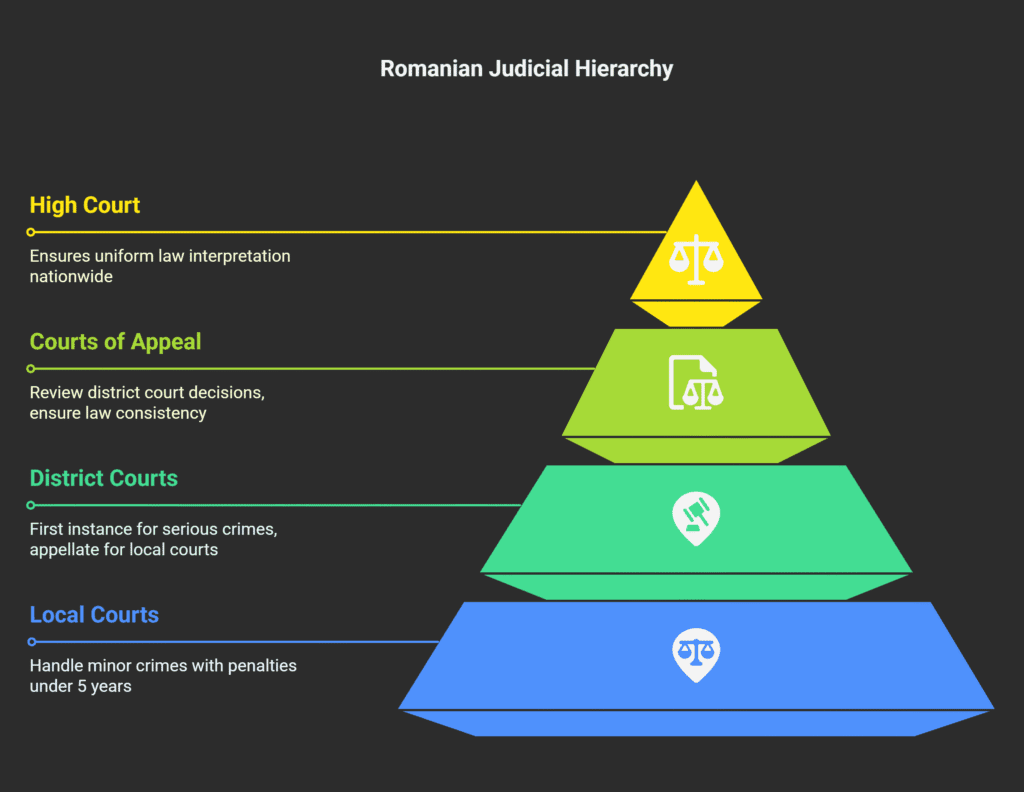
Structure of Romanian Courts

Local courts (Judecătorii) handle less serious crimes with penalties under 5 years.

These courts manage most criminal cases in Romania.

They are the first step for most defendants in the criminal justice system.

District courts (Tribunale) have two roles.

They act as first instance courts for serious crimes and as appellate courts for local court decisions.

Each district has one tribunal, handling complex criminal matters.

Courts of Appeal (Curți de Apel) review district court decisions.

They handle appeals in significant cases and ensure the law is applied consistently.

The High Court of Cassation and Justice is Romania’s highest court.

It ensures uniform law interpretation across the country.

It also handles appeals from Courts of Appeal in major cases.

Each court level has its own procedural rules.

Defense attorneys must navigate these rules strategically.

Knowing the right jurisdiction and procedural requirements is key for effective legal representation.

Key Players in Criminal Proceedings

Romanian criminal proceedings involve several key players.

Each has a distinct role and responsibility.

Their interaction shapes the case’s outcome.

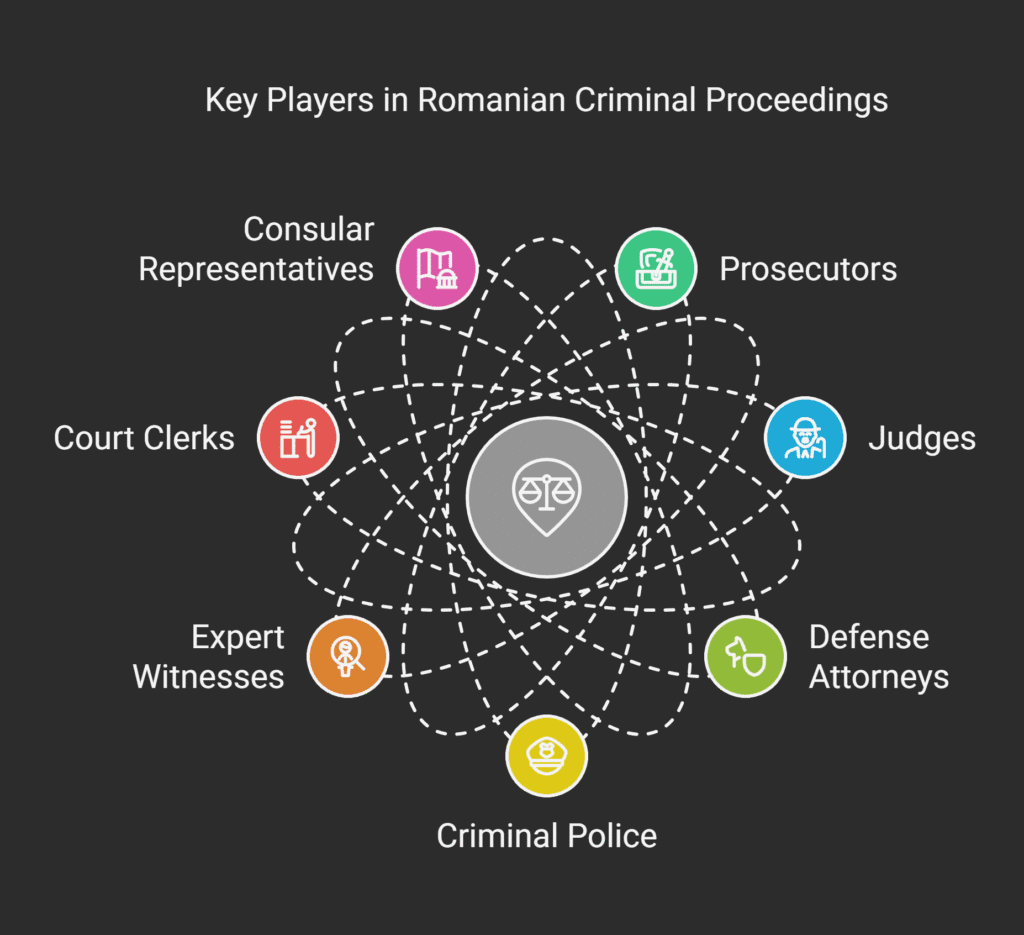
Key Players in Criminal Proceedings

Prosecutors (procurori) lead the prosecution.

They conduct investigations, gather evidence, and represent the state in court.

They make important decisions about charging and case progression under the Romanian Penal Code.

Judges ensure impartiality and procedural fairness.

They evaluate evidence, interpret laws, and make decisions based on the case’s merits.

In Romania, judges actively question witnesses.

Defense attorneys (avocați) defend the accused.

They challenge prosecution evidence and protect their clients’ rights.

Criminal lawyers in Romania develop strategies tailored to each case and guide clients through the process.

The criminal police help prosecutors with investigations.

They collect evidence and interview witnesses.

Expert witnesses provide specialized knowledge, and court clerks manage administrative tasks.

For non-Romanian citizens, consular representatives can help find legal representation.

If you don’t speak Romanian, your embassy can assist in finding a criminal defense lawyer in Romania who speaks your language.

Understanding these roles is vital for effective defense strategies.

Lawyers help and represent you in criminal proceedings.

For professional representation in Romanian criminal proceedings, contact office@theromanianlawyers.com.

Legal Rights of the Accused Under Romanian Law

When you face criminal charges in Romania, knowing your legal rights is key.

The Romanian legal system gives defendants strong protections.

These rights are real and help build a strong defense.

Knowing these rights helps defendants defend themselves better.

It also helps lawyers spot any mistakes that could hurt your case.

Let’s look at the rights you have when accused in Romania.

Constitutional Protections

The Romanian Constitution protects you when you’re charged with a crime.

These guarantees are the foundation of your defense rights.

They keep the government from abusing its power.

The presumption of innocence is a key right.

It means the prosecution must prove your guilt.

This right is vital for your defense in Romania.

Another important right is the protection of personal liberty.

Romanian law limits how long you can be held before trial.

This ensures you’re not unfairly kept in jail before your case is heard.

constitutional protections in romanian criminal law

constitutional protections in romanian criminal law

  • The right to a fair trial before an independent and impartial tribunal;
  • Protection against self-incrimination;
  • The right to legal assistance throughout criminal proceedings;
  • The principle of legality, ensuring criminal liability exists only for acts defined as offenses by law at the time of commission.

These constitutional protections are also backed by international human rights.

This gives you more ways to challenge unfair procedures.

Your Rights During Investigation and Trial

The criminal investigation process in Romania brings specific rights into play.

These rights start when you’re considered a suspect and last through the trial.

When detained, you must be told about the charges against you in a language you understand.

This includes the legal name of the crime and why you’re accused.

One key right is the right to remain silent.

Romanian law says:

  • You have the right to remain silent throughout the criminal investigation.
  • The authorities have to inform you on your right to remain silent, that there will be no negative consequences for your silence, and that anything you do say can be used against you.

This right is like the Miranda rights in other places.

It’s a key part of due process in Romania.

You also have the right to a lawyer.

Romanian law says:

  • Once apprehended, you have the immediate right to appoint a lawyer of your choice or to be assisted by a public defender (avocat din oficiu).
  • The police/prosecutor has to inform you of your right to a lawyer before you give any statement.

This right to counsel is critical. It lets you get legal advice early on.

The attorney-client privilege also protects your talks with your lawyer.

This keeps your defense plans private.

During the investigation, you also have the right to:

  • Examine the case file and evidence against them (though prosecutors may temporarily restrict this access during investigations for up to 10 days after charges are filed);
  • Request and propose evidence collection;
  • Challenge the legality of evidence collection methods;
  • File complaints against investigative measures.

As the case moves to trial, criminal trial procedures in Romania offer more rights.

These include:

  • The right to be present at trial (unless you waive it);
  • The ability to propose witnesses and evidence;
  • The right to challenge prosecution evidence;
  • The opportunity to make final statements before judgment;
  • Access to an interpreter if you don’t speak Romanian;
  • The right to appeal unfavorable decisions.

These safeguards make sure criminal defense rights in Romania meet European justice standards.

But using these rights well needs a lawyer’s help.

They know how to use these rights to defend you.

Understanding your rights is just the first step.

Using them well in your defense needs a lawyer’s help.

A skilled defense attorney can make sure your rights are respected and used to your advantage.

If you’re facing criminal charges, get help from a lawyer who knows Romanian criminal law.

A good lawyer can protect your rights and help you get a better outcome.

Criminal Defense Strategies in Romania

Defending against criminal charges in Romania is complex.

It requires a deep understanding of the law.

Lawyers must tailor their defense to each case, knowing the criminal justice system well.

Defense strategies often involve pointing out legal mistakes and questioning evidence.

Success often depends on the attorney’s ability to identify weaknesses in the prosecution’s case and build a strong defense.

Our law firm specializes in various criminal cases.

We offer detailed legal help from the start to appeals.

This includes cases like financial fraud and intellectual property crimes.

Procedural Defense Approaches

Procedural defense focuses on legal mistakes that can harm the prosecution.

It starts with checking the legality of searches and evidence collection.

One key strategy is to question the court’s jurisdiction.

If successful, this can exclude illegal evidence and weaken the prosecution.

procedural defense strategies in Romanian criminal cases

procedural defense strategies in Romanian criminal cases

During the preliminary chamber phase, defense attorneys can challenge evidence gathering. Successfully contesting these elements can lead to case dismissal before reaching trial on the merits, saving clients time and resources.

Effective procedural defense tactics also include:

  • Challenging the formulation of charges for lack of precision or legal basis;
  • Requesting specialized expert opinions to counter prosecution evidence;
  • Filing interlocutory appeals against adverse procedural rulings;
  • Contesting the validity of witness statements based on procedural irregularities;
  • Challenging the chain of custody for physical evidence.

During trial, it’s important to watch for legal mistakes.

Defense counsel must object to any legal errors to protect the case for appeal.

Substantive Defense Approaches

Substantive defense strategies challenge the prosecution’s story and offer alternative views.

They focus on the crime’s legal elements and defend against guilt.

A key strategy is to question if the prosecution can prove the crime beyond doubt.

Defense attorneys may argue the defendant’s actions don’t meet the crime’s legal definition.

In some cases, defenses like self-defense or necessity can clear the defendant.

Character evidence and reputation witnesses can also help in certain situations, like for first-time offenders.

For financial crimes, defenses often involve complex financial transactions.

Expert witnesses are key in these cases, providing knowledge to counter prosecution claims.

Defense Strategy TypePrimary FocusTypical TimingSuccess Factors
Procedural DefenseLegal protocols and procedural rightsPre-trial and preliminary chamberIdentifying procedural violations and technical errors
Substantive DefenseElements of the offense and factual narrativeTrial on meritsChallenging prosecution evidence and presenting alternatives
Hybrid ApproachCombination of procedural and substantive elementsThroughout all proceedingsComprehensive legal knowledge and strategic flexibility
Negotiation StrategySecuring favorable plea agreementsAny stage before final judgmentUnderstanding prosecution priorities and case weaknesses

We offer legal help for all criminal law matters.

Our attorneys provide strategic advice for each client’s situation.

This includes help during investigations and complex cases before Romania’s top courts.

We’re proud of our successes in tough cases.

Choosing a lawyer from our firm can greatly impact your case’s outcome.

For specialized legal help, contact office@theromanianlawyers.com.

Our experienced criminal defense attorneys are ready to assist.

The Criminal Procedure Timeline in Romania

Understanding the Romanian criminal justice system is key.

It involves knowing the timeline and each stage’s opportunities.

The criminal procedure in Romania has a set sequence, each with its own rules and time limits.

This knowledge helps defendants and their lawyers defend their rights effectively at every step.

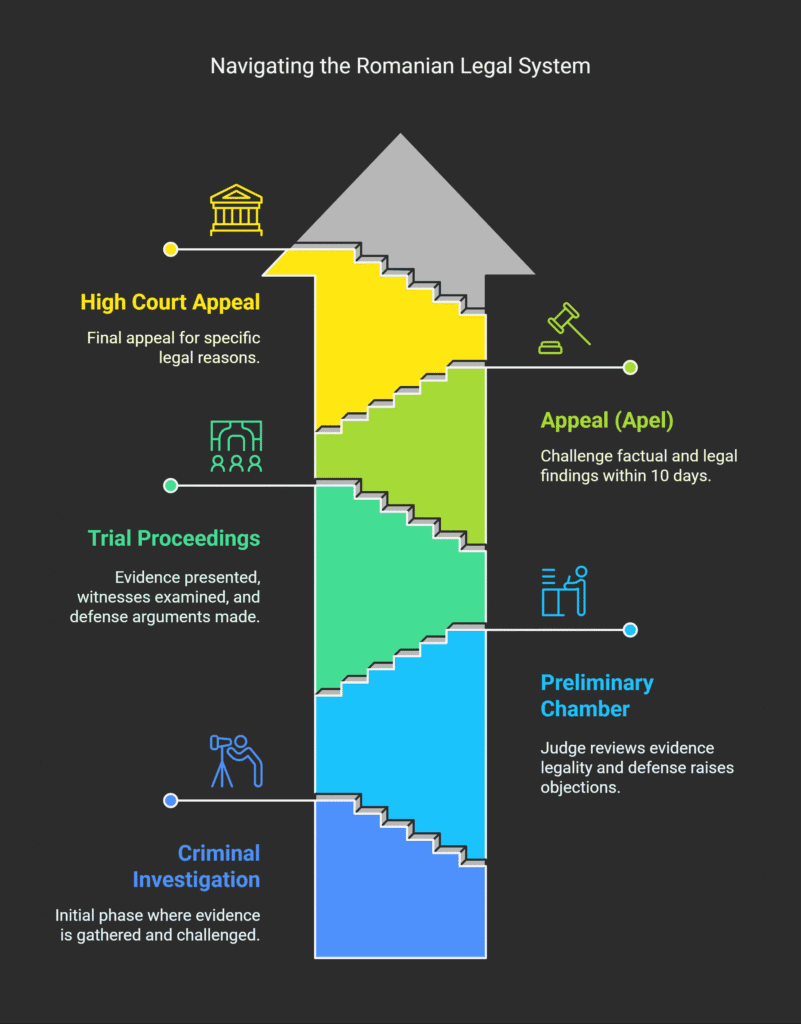
The process includes four main phases: criminal investigation, preliminary chamber, trial, and appeals.

Each phase has its own challenges and opportunities.

Lawyers need to adapt their strategies for each stage.

Pre-Trial Investigation Phase

The pre-trial investigation is the first and most critical phase of criminal proceedings in Romania.

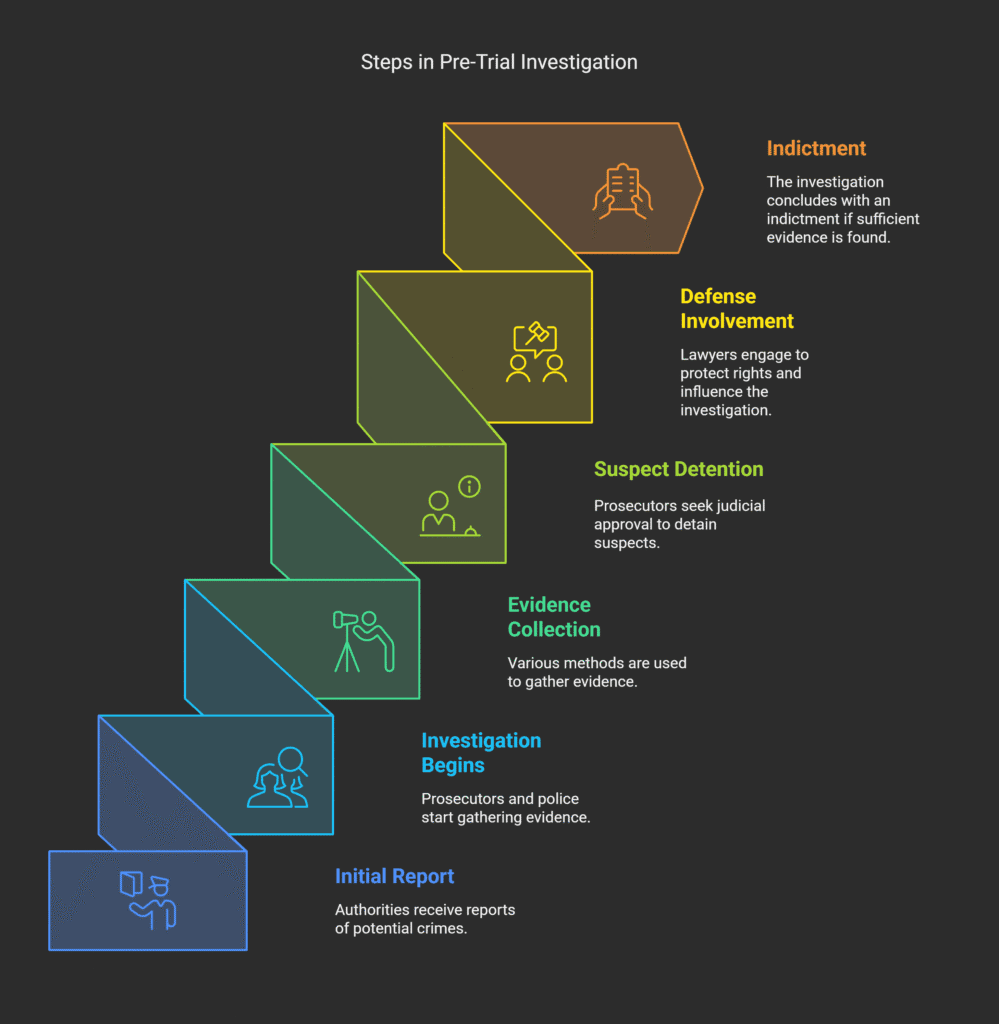
Pre-Trial Investigation Phase Romania

It starts when authorities notice a possible crime.

This can be through direct observation, victim reports, or witness statements.

Prosecutors lead the investigation with help from judicial police.

For certain crimes, like corruption, specific bodies handle the case.

The National Anticorruption Directorate (DNA) deals with corruption, while the Directorate for Investigating Organized Crime and Terrorism (DIICOT) handles organized crime.

During this phase, investigators use many methods to gather evidence.

These include:

  • Interviewing witnesses and suspects;
  • Collecting and analyzing documents;
  • Searching properties and seizing items;
  • Using technical surveillance;
  • Conducting expert examinations and forensic analysis.

If prosecutors want to detain a suspect, they must bring them before a judge.

The judge decides if detention is necessary.

Suspects can challenge this decision within 48 hours, with appeals heard within 5 days.

Suspects usually have the right to see their case file during criminal investigations.

But prosecutors can limit this access for up to 10 days after charges are filed.

Defense lawyers always have access to their clients’ statements, no matter the restrictions.

The investigation ends with an indictment if there’s enough evidence.

Early defense involvement is vital to protect rights and influence the investigation.

Trial Proceedings and Appeals

Trial Proceedings and Appeals Romania

After an indictment, the case goes to the preliminary chamber.

Here, a judge checks if the evidence was gathered legally.

This is a key chance for the defense to challenge any irregularities.

The trial proceedings in Romania follow a set format for fairness.

The trial starts with preliminary matters, then the indictment is read.

Evidence is then presented by both sides.

During the trial, defendants have important rights:

  • They can actively participate;
  • Question witnesses and experts;
  • Present evidence that clears their name;
  • Make statements, though not under oath;
  • Have the last word before the court deliberates.

After evidence is presented, closing arguments are made.

The defendant always gets to speak last before the court decides.

The judgment must explain the court’s reasoning clearly.

If arrested, you can challenge the decision within 48 hours.

The appeal must be heard within 5 days after filing.

The appeals process in Romanian criminal cases protects against judicial mistakes.

After a verdict, parties can appeal within 10 days.

This triggers a thorough review by a higher court.

This appeal is not just a review but a full trial continuation.

The appellate court can re-examine evidence and make new conclusions.

In rare cases, there’s a further appeal called “recurs în casație” before the High Court of Cassation and Justice.

This appeal is for specific legal reasons, not factual reassessment.

Procedural StageKey Defense OpportunitiesTime Limitations
Criminal InvestigationChallenge evidence gathering methods, request additional evidenceVaries by case complexity
Preliminary ChamberContest legality of evidence, raise procedural violations5 days to file objections
Trial ProceedingsPresent defense evidence, cross-examine witnessesDetermined by court schedule
Appeal (Apel)Challenge factual and legal findings10 days from verdict

Effective defense strategies must adapt to each stage while keeping a consistent defense narrative.

Knowing the specific timeframes and requirements at each phase is key to protecting defendants’ rights and achieving good outcomes.

For professional help through criminal proceedings in Romania, from investigation to appeals, contact office@theromanianlawyers.com.

They offer expert legal representation tailored to your case.

Building an Effective Defense Team

Understanding Romania’s criminal justice system is key.

You need a defense team that fits your case perfectly.

The right team can change the outcome of your case, from guilty to not guilty.

They protect your rights and create strategies for Romanian courts.

Finding the right professionals is the first step.

They should know Romanian law well.

In serious cases, teamwork is vital for a strong defense.

criminal defense team in Romania

criminal defense team in Romania

Selecting the Right Criminal Defense Attorney

Choosing a criminal defense lawyer in Romania is critical.

Look for someone with experience in your type of case.

This could be anything from theft to violent crimes.

Lawyers with similar case experience know the law and prosecution tactics.

Their reputation in Romania’s legal world shows their skill.

Peers, judges, and clients can give you a good idea of their ability.

If you’re not from Romania, language is important.

Some criminal defense lawyers in Romania speak multiple languages.

Your embassy can help find a lawyer who speaks your language and knows the law.

Registered lawyers are listed in the Lawyers’ Yearly Register.

You can hire any lawyer in Romania, even if they’re not in your region’s bar association.

Good communication with your lawyer is essential.

They should explain things clearly and keep you updated.

Your lawyer’s strategy should match your goals, whether it’s to win your case or get a good plea deal.

Before choosing, talk to several lawyers.

Discuss your case, how they’ll communicate, and their fees.

For help finding a criminal defense attorney in Romania for your case, email office@theromanianlawyers.com.

Working with Expert Witnesses and Specialists

Expert witnesses are key in criminal defense, for complex cases.

They provide analysis and testimony that can help your case.

This can include challenging evidence or giving new insights.

In Romania, experts can be court-appointed, requested by the defense, or hired privately.

Common experts include:

  • Forensic specialists who analyze physical evidence;
  • Digital forensic experts who examine electronic data;
  • Financial analysts who review complex transactions in economic crime cases;
  • Medical professionals who address issues related to injuries, cause of death, or mental state;
  • Psychological experts who provide insights into a defendant’s mental condition.

Specialized legal assistance is vital for investigations by special directorates.

Working with experienced attorneys is critical, as these investigations can be serious.

Defense attorneys and experts must work well together.

They need to share case details, ask the right questions, and prepare for testimony.

The attorney must choose experts who are qualified, credible, and can explain complex information to judges.

It’s best to get expert witnesses early in your case.

This gives them time to analyze and prepare their findings.

Remember, your lawyer helps and represents you, but they don’t investigate.

Choosing the right experts is key.

Building a strong defense team also means having investigators.

They can find evidence and witnesses that help your case.

For help finding and working with expert witnesses, email office@theromanianlawyers.com.

Evidence Strategies in Romanian Criminal Cases

Effective evidence strategies in Romanian criminal cases need a deep understanding of legal rules and principles.

The way evidence is managed and presented can greatly affect the outcome of a case.

Romanian defense attorneys must create detailed plans to handle both the prosecution’s evidence and the defendant’s exculpatory materials.

In Romanian criminal procedure, evidence must meet strict standards to be allowed in court.

Defense lawyers must carefully analyze all case materials and develop strategies to protect the defendant’s rights.

evidence handling in criminal cases

evidence handling in criminal cases

The Romanian Criminal Procedure Code gives defendants and their lawyers the right to see the entire case file.

Prosecutors can limit this access during investigations, but only for 10 days after charges are filed.

This is a key chance for defense preparation.

Challenging Prosecution Evidence

Challenging Romanian Prosecution Evidence

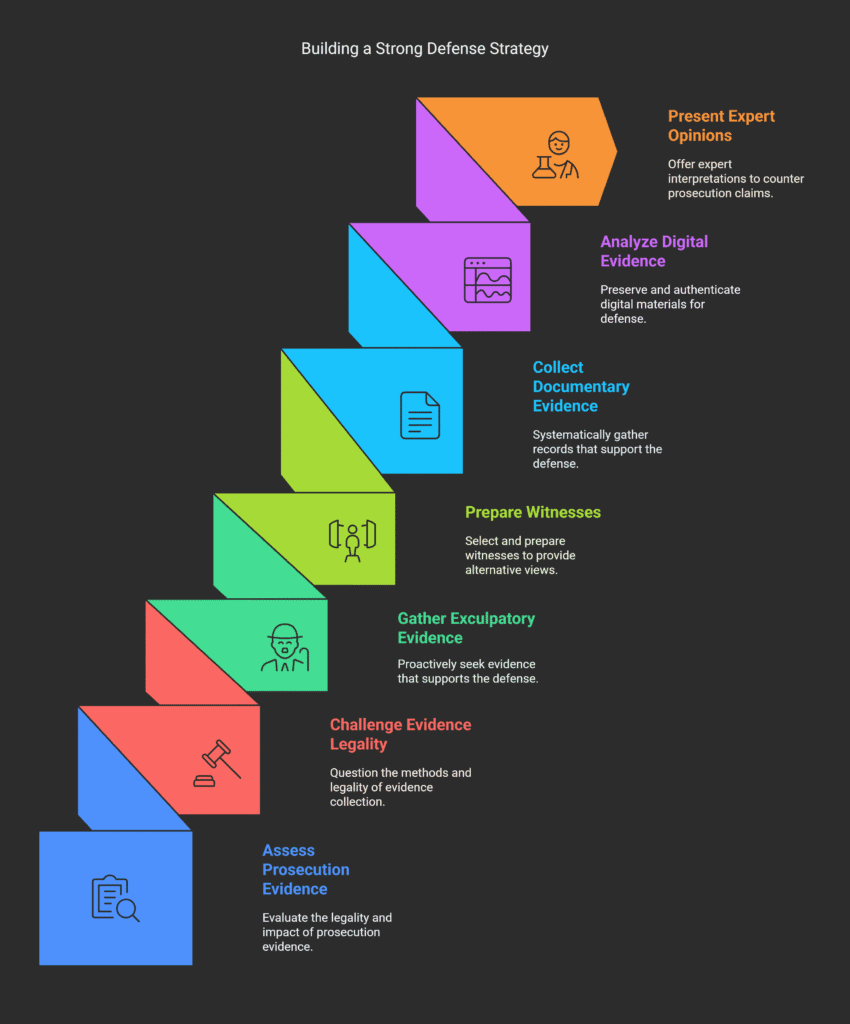
A systematic assessment of prosecution evidence is key to effective defense in Romania.

Defense attorneys must check the evidence’s content and how it was obtained.

They look for ways to exclude or reduce the impact of damaging evidence.

The main challenge is questioning the legality of evidence collection.

Romanian courts can exclude evidence gathered improperly.

If authorities break constitutional or procedural rules, the evidence can be thrown out.

Defense lawyers should also question the chain of custody for physical evidence.

Issues with preservation and contamination can weaken prosecution exhibits.

This is very effective with forensic evidence like fingerprints or DNA samples.

Witness testimony reliability is another key challenge.

Defense attorneys can use cross-examination to show inconsistencies or bias in witness statements.

Romanian courts are starting to recognize the flaws in eyewitness testimony, giving defense teams chances to challenge it.

Prosecution expert testimony needs careful scrutiny.

Defense teams can challenge experts by questioning their qualifications, methods, and findings.

They can also present opposing expert opinions to counter prosecution claims.

The preliminary chamber phase is a critical time to challenge evidence legality before trial.

Defense attorneys must raise objections quickly.

Failing to do so may limit their ability to challenge evidence later.

Gathering Exculpatory Evidence

While prosecutors lead investigations, defense attorneys must actively seek out favorable evidence.

This proactive approach strengthens the defendant’s case.

Defense counsel should ask for specific investigative actions to find exculpatory information.

This can include interviewing witnesses, getting surveillance footage, or electronic records.

Prosecutors have discretion but must consider these requests.

Choosing and preparing witnesses is key to effective evidence gathering.

Defense teams can propose witnesses during investigations and trials.

Strategic witness selection can provide alternative views, alibis, or contradict prosecution claims.

Collecting documentary evidence supporting the defense requires systematic effort.

This includes records that establish alibis, financial documents in economic crimes, communications that contradict prosecution claims, medical records, and employment or educational records.

In some cases, defense-commissioned expert examinations can offer alternative views of technical evidence.

While courts often favor prosecution experts, well-qualified defense experts can challenge prosecution conclusions, which is important in complex cases.

Digital evidence is increasingly important in criminal cases.

Social media, electronic communications, location data, and other digital materials can support defense claims.

Defense teams must know how to preserve and authenticate such evidence.

Evidence StrategyProsecution ApproachDefense ResponseStrategic Timing
Witness TestimonyPresenting multiple corroborating witnessesCross-examination highlighting inconsistenciesPreliminary hearing and trial
Physical EvidenceEstablishing chain of custody and relevanceChallenging collection methods and preservationPreliminary chamber phase
Expert AnalysisPresenting technical findings supporting guiltOffering alternative expert interpretationsPre-trial and trial phases
Documentary EvidenceSelective presentation supporting chargesProviding context and additional documentationThroughout proceedings
Digital EvidenceExtracting incriminating digital materialsAuthentication challenges and contextual analysisPreliminary chamber and trial

Throughout the evidence gathering process, defense attorneys must keep detailed records and ensure evidence is properly authenticated.

Romanian courts have strict standards for evidence admissibility, requiring careful attention to procedural rules.

After reviewing the evidence, defendants can ask for more evidence collection or witness statements.

Prosecutors must consider these requests and decide whether to include them in the case file.

If new evidence is added or charges change, defendants must be informed promptly.

For professional help in creating detailed evidence strategies for your case, contact office@theromanianlawyers.com.

Our experienced team offers expert advice on challenging prosecution evidence and developing strong exculpatory materials.

Negotiation and Plea Bargaining Tactics

In Romania, plea bargaining is a key strategy for defendants and their lawyers.

It’s called “acordul de recunoaștere a vinovăției” in Romanian.

This method is part of recent judicial reforms to make the system more efficient.

Plea bargaining lets defendants talk to prosecutors about charges and sentences in exchange for admitting guilt.

This can lead to better outcomes than going to trial.

It’s a strategic choice to consider.

“Effective plea bargaining requires not just legal knowledge, but strategic foresight—the ability to accurately assess case strengths and weaknesses while understanding the prosecutor’s motivations and constraints.”

Deciding on a plea agreement involves many factors.

These include looking at the evidence, the severity of the charges, and possible sentences.

Getting professional legal advice is key for these negotiations.

Our team of criminal defense attorneys creates custom negotiation plans for each client.

When to Consider a Plea Agreement

Choosing a plea agreement needs careful thought.

It starts with looking at the evidence.

If the prosecution has strong evidence, a plea might reduce the sentence.

But, if the evidence is weak or there were procedural mistakes, going to trial might be better.

The seriousness of the charges also plays a big role.

More serious crimes might offer bigger sentence reductions through negotiation.

A defendant’s criminal history is important in negotiations.

First-time offenders usually get better deals than those with past crimes.

This is true, even in DUI cases, where a clean record can help.

Other things also affect plea decisions.

These include:

  • Emotional and financial costs of long trials;
  • Potential effects of a conviction;
  • The defendant’s personal and work life;
  • When in the process the decision is made.

Romanian law has rules about plea agreements.

They can’t be used for crimes with sentences over 7 years.

Knowing these rules is important when thinking about pleas.

A DUI lawyer in Romania from our team can help decide if a plea is right for you.

We look at all the details to find the best strategy.

For advice, email us at office@theromanianlawyers.com.

Negotiation Strategies with Prosecutors

Good negotiation with prosecutors in Romania needs smart strategies.

Defense attorneys start by preparing well, analyzing the evidence.

This helps them know the prosecution’s weak points.

This prep lets them talk about possible charge reductions or sentences.

Building a good relationship with prosecutors helps negotiations.

Experienced Romanian lawyers can be firm but respectful, fighting for their clients’ best interests.

Good negotiation strategies include:

Mitigating FactorPotential ImpactStrategic Approach
Lack of criminal historySignificant positive influenceEmphasize rehabilitation
Cooperation with authoritiesDemonstrates good faithDocument all cooperative actions
Restitution to victimsShows responsibilityPresent a restitution plan
Personal circumstancesContextualizes behaviorProvide supporting documentation

Defense attorneys use case weaknesses to their advantage.

This includes evidence problems, procedural errors, or different ways to look at the facts.

The timing of negotiations is also key, with different chances at different stages.

During talks, lawyers must keep clients informed about offers and their risks.

They should also be ready for trial, keeping their clients’ options open.

This strengthens their negotiating position.

A crime lawyer in Romania from our team offers tailored legal help for each case.

We focus on getting good results through negotiation when it’s smart.

For help with negotiations in your case, email us at office@theromanianlawyers.com.

Trial Preparation and Courtroom Strategies

Trial Preparation and Courtroom Strategies in Romania

In Romanian criminal trials, the outcome often depends on how well the defense prepares and strategizes.

The trial is the key moment where defense theories face off against prosecution evidence.

Good preparation and smart strategy are key to a successful defense.

Good trial prep means analyzing the case well, organizing evidence, and making strong legal arguments.

Romanian trials have strict rules that defense lawyers must follow.

Successful strategies mix legal knowledge with the ability to persuade, pay attention to details, and be ready for surprises.

In Romanian trials, both sides give their final arguments.

The defendant gets to speak last, which can really sway the judge.

Developing a Compelling Case Theory

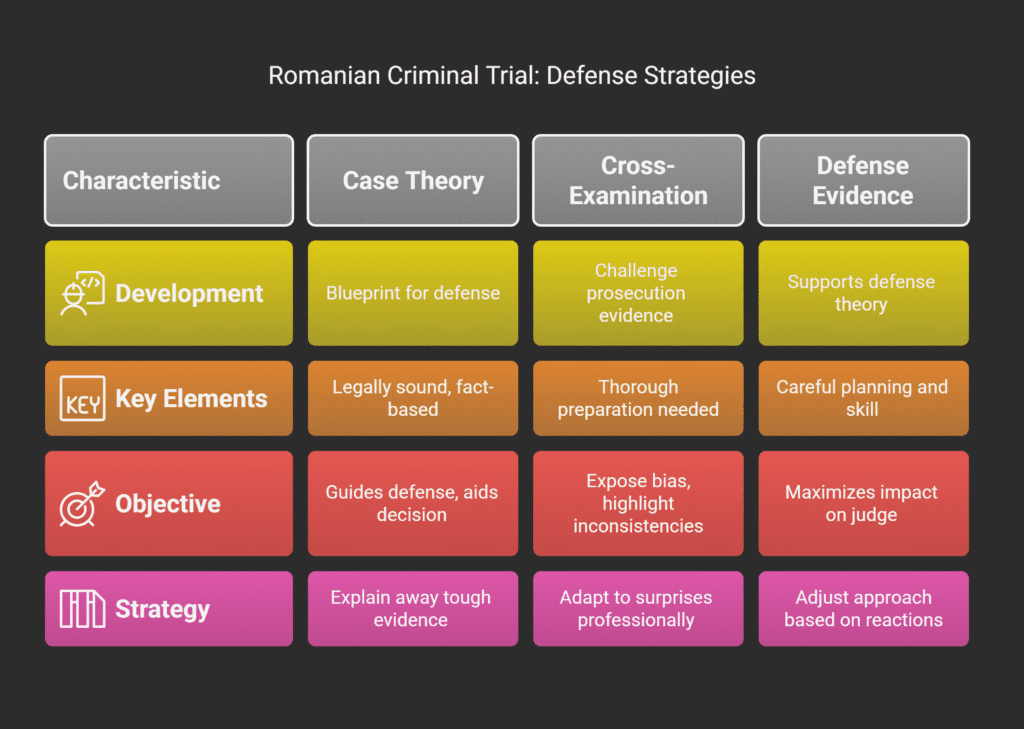
A strong case theory is like a blueprint for your defense.

It organizes your evidence and arguments into a clear story.

This is what guides your defense and helps the judge make a decision.

Good case theories need to be legally sound, based on facts, emotionally engaging, and easy to understand.

They start with a deep look at the prosecution’s evidence and finding weaknesses.

Then, defense lawyers come up with alternative stories that support their side.

Instead of ignoring tough evidence, a good case theory explains it away.

This makes your case stronger and more believable.

The theory should be clear in every part of your defense.

Effective Cross-Examination Techniques

Cross-examination is a chance to challenge the prosecution’s evidence in Romanian trials.

Even though the system is not purely adversarial, defense lawyers can question witnesses and challenge their testimony.

Good cross-examination starts with thorough prep, including looking at past statements and documents.

Defense lawyers plan their questions carefully to achieve their goals.

They use leading questions to guide the witness’s answers.

When questioning prosecution witnesses, defense lawyers should focus on:

  • Highlighting inconsistencies with prior statements;
  • Exposing bias or motivation to testify falsely;
  • Demonstrating perceptual limitations or memory issues;
  • Establishing facts that support the defense theory.

For expert witnesses, defense lawyers should question their qualifications, methods, and the facts behind their opinions.

Good questioning can show the limits of the expert’s analysis or suggest other ways to look at the evidence.

During cross-examination, defense lawyers need to stay professional and adapt to any surprises.

The order and timing of questions are very important.

Save your strongest points for when they will have the most impact.

Presenting Defense Evidence Persuasively

Presenting defense evidence well requires careful planning and skill.

Start by choosing evidence that supports your theory and prepares for challenges from the prosecution.

How you order your evidence can make a big difference.

Use the first and last pieces of evidence to make the biggest impact.

This is because people remember what comes first and last best.

When using witnesses, defense lawyers should ask questions that get clear, helpful answers.

Make sure witnesses stick to their story during cross-examination.

For documents, explain them well and show how they fit into your case.

During trial proceedings, parties present their closing arguments, with the defendant always having the final word before deliberation. The court then issues its judgment, which must contain detailed reasoning for its decision on both factual and legal matters.

Visual aids and demonstrative exhibits can help explain complex evidence when used right.

They’re great for technical or financial evidence that’s hard for judges to understand.

While presenting evidence, defense lawyers should watch how the judge reacts.

Adjust your approach as needed to keep your evidence connected to your theory.

Showing you’ve thought of possible weaknesses makes your case stronger.

A DUI lawyer in Romania or a crime lawyer in Romania from our team offers personalized help for each case.

We focus on professional court work and aim for the best results for our clients through careful prep and strategy.

For help with trial prep and courtroom strategies in your case, email office@theromanianlawyers.com.

Sentencing Mitigation Strategies

In Romania, sentencing mitigation strategies can change harsh penalties into more manageable ones.

Even when a guilty verdict seems likely, skilled lawyers can help.

They do this by using their knowledge of Romanian law and advocating for their clients.

These strategies are key in both plea deals and contested cases.

The goal is to get the best possible sentence under Romanian law.

Factors Affecting Sentencing in Romania

Sentencing Mitigation Strategies Romania

The Romanian Criminal Code sets a framework for sentencing.

It guides judges with specific factors.

For each crime, there are sentencing ranges based on the case’s details.

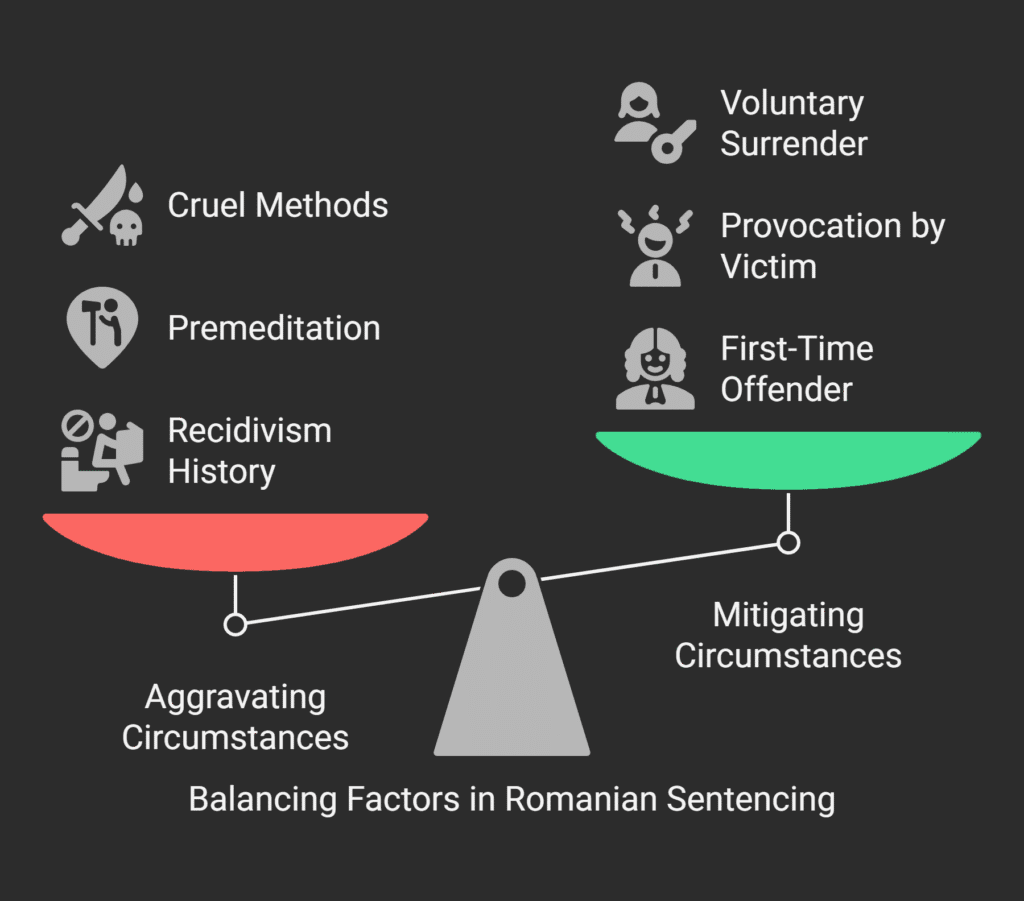
Aggravating circumstances that can increase sentences include:

  • Recidivism or prior criminal history;
  • Commission of multiple offenses;
  • Premeditation or careful planning;
  • Particularly cruel methods of commission;
  • Exploitation of victim vulnerability;
  • Commission by organized criminal groups.

On the other hand, mitigating circumstances that support reduced sentences include:

  • First-time offender status;
  • Provocation by the victim;
  • Exceeding the limits of legitimate self-defense;
  • Voluntary surrender to authorities;
  • Cooperation with investigators;
  • Genuine remorse demonstrated through concrete actions.

Personal circumstances are also considered during sentencing.

Judges look at age, health, family, job history, and community involvement.

These help paint a fuller picture of the defendant.

The way the crime was committed also matters.

Courts look at the defendant’s role and contribution.

A smaller role can lead to a lighter sentence.

Romanian courts aim for sentences that match the crime’s gravity but avoid being too harsh.

They must explain their reasoning in detail.

This makes the sentencing process clear.

Rehabilitation is another key factor.

Judges consider if alternatives to jail might help the defendant more.

This is often the case for first-time offenders or those with strong community support.

Effective Arguments for Reduced Sentences

Creating strong arguments for lighter sentences requires a mix of legal knowledge and persuasive presentation.

Defense lawyers should start by studying the sentencing laws.

They look for minimum penalties and alternatives to jail.

Highlighting the defendant’s limited role in a crime can also help.

This is true in cases where there are multiple people involved.

It shows the defendant’s level of responsibility.

Showing there’s no prior criminal history is another strong point.

It suggests the current crime is an isolated incident.

This makes the defendant seem less of a risk to society.

Remorse shown by the defendant is also important.

This can include:

  1. Public apologies to victims or communities;
  2. Voluntary compensation to those harmed;
  3. Participation in restorative justice programs;
  4. Other concrete actions demonstrating acceptance of responsibility.

Rehabilitation chances are a strong argument.

Defense lawyers should show evidence of:

  • Stable employment history or educational pursuits;
  • Strong family support systems;
  • Willingness to participate in relevant treatment programs;
  • Concrete plans for future law-abiding behavior.

Hardships caused by jail time can also justify alternative sentences.

This includes effects on family members or health issues that worsen in jail.

Defense lawyers should also show the defendant’s positive side.

This can include letters, testimony, and volunteer work.

It helps show the defendant’s value to society.

Highlighting harsh consequences of a conviction can also help.

This includes job loss, license revocation, or immigration issues that add to the punishment.

The court then explains its decision in detail.

This transparency helps defendants understand their sentence.

It also gives grounds for appeals if there were mistakes.

For help with sentencing mitigation strategies in Romania, contact office@theromanianlawyers.com.

Our team can help find and present the best arguments for your case.

Post-Conviction Remedies and Appeals

Post-Conviction Remedies and Appeals Romania

In Romania, understanding the appeals and remedies after a conviction is key.

The legal system offers ways to challenge judgments, fix mistakes, or introduce new evidence.

These steps help ensure justice is served.

After a court makes a decision, there are options.

The Romanian law sets up a clear appeals process and special remedies.

Knowing these can help in planning a strong defense.

Grounds for Appeal in Romanian Law

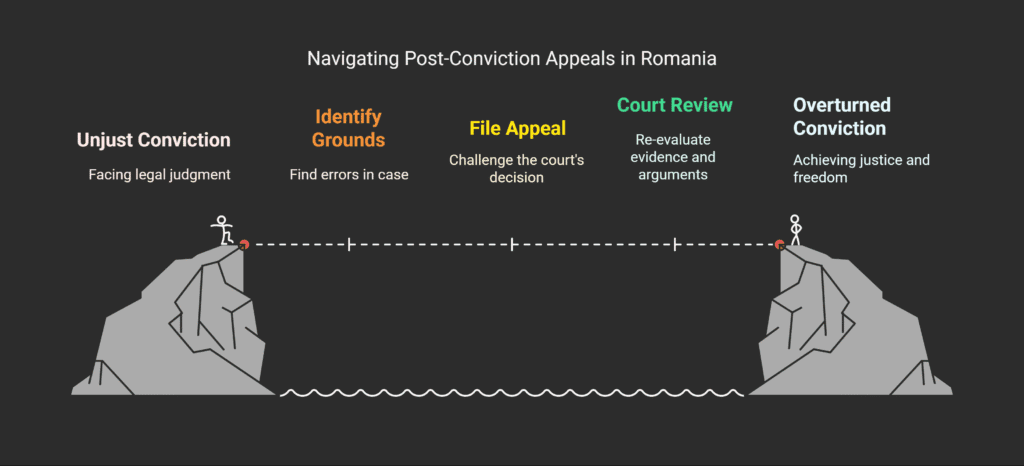
Romanian law lists specific reasons to appeal a court’s decision.

These include mistakes in how the case was handled or errors in the decision itself.

Successful appeals show these mistakes changed the outcome.

Some common reasons for appeal include:

  • Improper court composition or lack of jurisdiction;
  • Violations of public trial requirements;
  • Infringement of defense rights during proceedings;
  • Improper handling or admission of evidence;
  • Failure to address key defense arguments.

Appeals can also challenge how the law was applied or facts were found.

The court checks if the law was correctly applied to the facts.

To appeal, you must do so within 10 days of the judgment.

You need to clearly state what you’re challenging and why.

This helps the court know what to review.

The court will look at all the evidence again.

They might even consider new evidence.

This is a chance to fix mistakes from the first trial.

For help finding grounds for appeal, email office@theromanianlawyers.com.

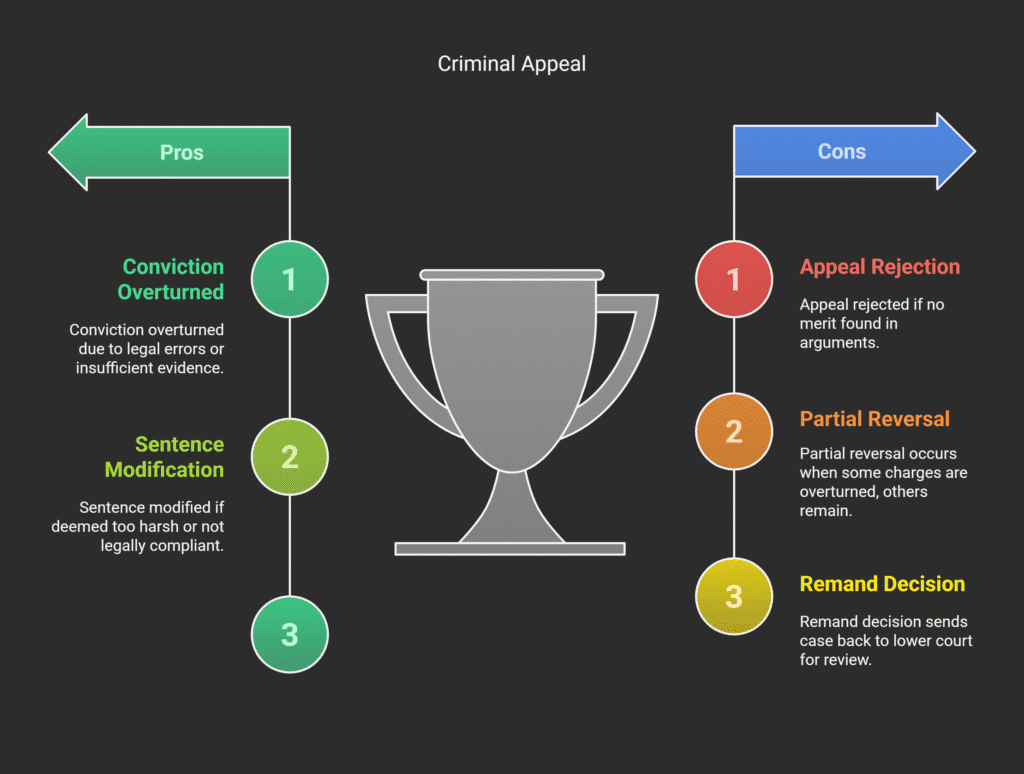
The outcome of an appeal can be:

  • Confirmation of the original decision;
  • Modification regarding legal classification or sentencing;
  • Retrial orders in cases of serious procedural violations;
  • Complete reversal with acquittal.

Extraordinary Legal Remedies

Extraordinary Legal Remedies in Romania

Romania also offers special remedies for challenging final decisions.

These are used when regular appeals are not possible or have failed.

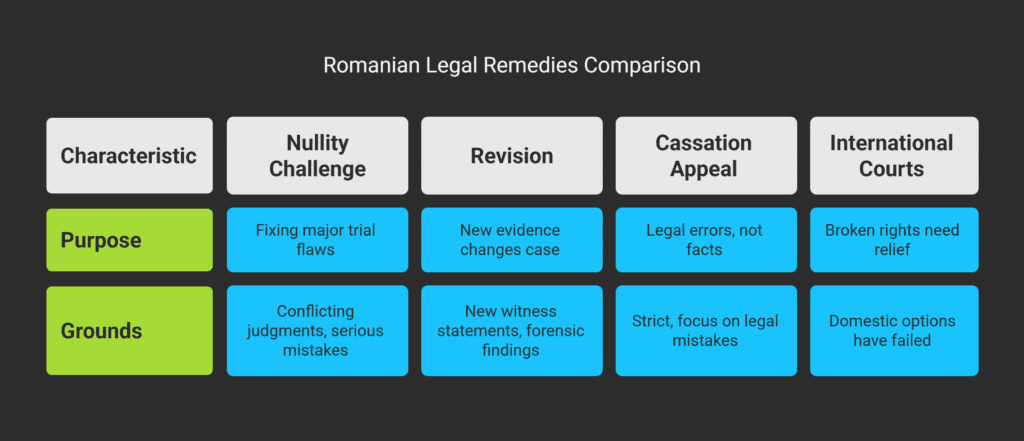
Contestația în anulare (nullity challenge) is for serious mistakes like conflicting judgments.

It’s about fixing major flaws in the trial, not the case itself.

Revizuirea (revision) is for new evidence that could change the case.

This includes new witness statements, forensic findings, or evidence tampering.

Recurs în casație (cassation appeal) is a rare option before the High Court of Cassation and Justice.

It’s for legal errors, not facts.

The grounds are strict and focus on legal mistakes.

Each remedy has its own rules and time limits.

It’s important to get legal advice to see which one fits your case.

International courts can also offer relief.

If rights were broken, you can go to the European Court of Human Rights.

This is a long process but can help if domestic options failed.

Challenging laws through the excepție de neconstituționalitate procedure is another option.

Presidential pardons and amnesty laws can also offer relief, but these are political, not judicial.

Understanding post-conviction remedies in Romania needs legal help.

For advice on appeals or special remedies, email office@theromanianlawyers.com.

Conclusion: Securing the Best Possible Outcome

Understanding the Romanian criminal justice system is complex.

It needs strategic planning and strong legal support.

The defense strategies in this guide are proven to protect defendants’ rights at every step.

Our law firm has a strong track record in complex cases across Romania.

We focus on detailed case preparation, managing evidence, and strong courtroom arguments.

Getting experienced defense counsel early can greatly improve your chances of a good outcome.

Specialized criminal defense lawyers in Romania can change the outcome of a case.

Our team knows the best tactics and Romanian laws well.

This gives clients a big advantage in court, whether it’s dismissing a case, negotiating a plea, or defending at trial.

Each case in Romania needs a custom defense strategy.

Our lawyers are experts in white collar and financial crimes.

They bring up-to-date legal knowledge and experience to each case, helping to improve the outcome.

If you need help with criminal matters in Romania, contact office@theromanianlawyers.com.

Our experienced Romanian attorneys are ready to assist.

FAQ

What are the main courts handling criminal cases in Romania?

Romania has a clear court structure for criminal cases.
Local courts handle minor offenses with penalties under 5 years.
District courts deal with more serious crimes and review local court decisions.
Courts of Appeal review district court decisions. 
The High Court of Cassation and Justice is the top court, ensuring laws are applied uniformly.

What rights do defendants have during criminal investigations in Romania?

Defendants in Romania have key rights.
They must be told of accusations in a language they understand.
Defendants have the right to legal help, to remain silent, and to see case files.
They can propose evidence and witnesses.
Defendants can challenge prosecution evidence and make final statements before judgment.
They also have the right to appeal.

What is the presumption of innocence in Romanian criminal law?

The presumption of innocence is a key principle in Romanian law. It’s in the Constitution.
It means the prosecution must prove guilt, not the defendant.
This principle requires all doubts to be in favor of the accused. 
It stops authorities from treating someone as guilty before a final decision.

What procedural defense strategies are most effective in Romanian criminal cases?

Effective strategies include challenging the legality of searches and seizures.
Contesting court jurisdiction or prosecutorial competence is also key.
Filing motions to exclude illegally obtained evidence is important.
Challenging imprecise charge formulations and questioning evidence legality during the preliminary chamber phase are also effective.
Monitoring procedural compliance, requesting specialized expert opinions, and filing interlocutory appeals are also important.

How can defense attorneys gather exculpatory evidence in Romanian criminal cases?

Defense attorneys can gather exculpatory evidence by submitting specific requests for investigative actions.
They can propose witnesses for examination during both investigation and trial.
Collecting documentary evidence supporting the defense position is also important.
Commissioning independent expert examinations and securing digital evidence are key.
Maintaining records of all evidence gathered is essential.

What is plea bargaining in Romania and when was it introduced?

Plea bargaining in Romania allows defendants to negotiate with prosecutors.
It was introduced recently as part of reforms to increase judicial efficiency.
It’s available for offenses punishable by up to 7 years imprisonment.
It requires judicial approval of all negotiated terms.

When should a defendant consider a plea agreement in Romania?

A defendant should consider a plea agreement when facing strong prosecution evidence.
When the sentence reduction is significant, it’s also a good time.
Being a first-time offender or wanting to avoid the costs of a long trial are reasons.
Personal circumstances that would be worsened by incarceration are also important.
Each case needs a careful assessment with defense counsel.

What negotiation strategies are effective with Romanian prosecutors?

Effective strategies include thorough case preparation and establishing rapport with prosecutors.
Highlighting mitigating factors and leveraging case weaknesses are key.
Timing negotiations strategically and maintaining clear communication are important.
Preparing for trial while negotiating keeps leverage.
Ensuring agreements meet judicial approval requirements is also important.

How should a defense attorney develop a compelling case theory in Romanian criminal proceedings?

A defense attorney should analyze prosecution evidence and identify weaknesses.
Assessing defense evidence and formulating alternative explanations is important.
Ensuring consistency with legal standards and available evidence is key.
Acknowledging problematic evidence and reinforcing the theory consistently are important.
This creates a clear narrative for judges.

What techniques make cross-examination effective in Romanian criminal trials?

Effective techniques include thorough preparation and strategic planning. 
Maintaining control through careful use of leading questions is important.
Employing impeachment techniques and focusing on qualifications and methodology when examining experts are key. 
Adapting to unexpected responses and considering the timing and sequence of questions are important.

What factors affect sentencing decisions in Romanian criminal cases?

Sentencing decisions are influenced by statutory ranges and aggravating circumstances. 
Mitigating circumstances, the defendant’s personal circumstances, and the manner of offense commission are also important.
The consequences and harm caused, proportionality principles, and rehabilitation prospects are also considered.

What arguments are most effective for securing reduced sentences in Romania?

Effective arguments include highlighting the defendant’s limited role in the offense. 
Emphasizing the absence of prior criminal history is also important.
Demonstrating genuine remorse through actions like victim compensation is key. 
Presenting evidence of rehabilitation and personal hardship is also important. 
Highlighting disproportionate collateral consequences of conviction can also be effective.

What are the main grounds for appeal in Romanian criminal cases?

Main grounds for appeal include procedural violations and substantive errors. 
Appeals must be filed within 10 days of judgment communication.
They must specify the challenged decision components and specific grounds for appeal.

What extraordinary legal remedies are available after exhausting ordinary appeals in Romania?

Extraordinary remedies include “contestația în anulare” for serious procedural errors. 
“Revizuirea” is available when new evidence emerges. 
“Recurs în casație” addresses specific legal errors.
Petitions to the European Court of Human Rights for convention rights violations are also available. 
Constitutional challenges and presidential pardons or amnesty laws are sometimes options.

How does the Romanian criminal investigation phase work?

The investigation starts when authorities become aware of a possible offense.
Prosecutors lead investigations with judicial police assistance.
They gather evidence through witness interviews, document collection, searches, surveillance, and expert examinations. 
Suspects have the right to remain silent and to legal representation during questioning.
The investigation concludes with either an indictment if evidence is sufficient or case closure if evidence is insufficient.

What role do prosecutors play in Romanian criminal proceedings?

Prosecutors lead investigations, gather evidence, and determine whether to file charges. 
They prepare indictments and represent the state’s interests in court.
Prosecutors present evidence and arguments during trial, question witnesses and the accused, and respond to defense motions. 
They participate in plea negotiations and file appeals against unfavorable decisions.

What are the most effective strategies for building a strong defense in criminal cases in Romania?

Building a strong defense in criminal cases in Romania requires a comprehensive approach that begins from the moment you’re aware of being under investigation.

First and foremost, securing representation from an experienced criminal defense lawyer or criminal defense attorney familiar with Romanian law is crucial.

The best defense lawyers in Romania will immediately work to analyze the specifics of your case, identify procedural errors, and develop a tailored defense strategy.

One of the most effective strategies involves a thorough examination of evidence gathering procedures.

The Romanian Criminal Procedure Code contains strict rules about how evidence can be collected and what can be admitted in court.

A skilled criminal lawyer in Romania will scrutinize whether your rights were respected during searches, interrogations, and evidence collection.

Any violation of these rules can lead to evidence being excluded, which can significantly weaken the prosecution’s case.

Another winning strategy involves challenging the legal classification of the alleged offense.

Often, criminal charges may be improperly framed under a more serious category than warranted by the facts.

Criminal defense lawyers in Romania with deep legal expertise in the nuances of criminal law can sometimes succeed in having charges reduced to less severe offenses, resulting in lighter penalties.

Additionally, effective defense in the Romanian courts often involves bringing forward expert witnesses, conducting independent investigations, and presenting alternative explanations for the evidence presented by prosecutors.

The most successful criminal defense attorneys in Romania leave no stone unturned when building their clients’ defense cases.

How does the criminal investigation phase work in Romania and what are my rights during this period?

The criminal investigation phase in Romania is a critical period that begins when authorities suspect a crime has been committed. During this phase, the prosecution, led by a prosecutor, collects evidence to determine whether there are grounds to send the case to trial.

Understanding Judicial Control Romania – Legal Insights

Exploring Judicial Control in Romania: What You Need to Know

How did a nation change its legal system from an authoritarian regime to a modern European one in just 30 years?

This journey shows how checks and balances evolved in Romania’s government from 1989.

The fall of communism was a key moment for Romania’s legal system.

The country adopted democratic values, and its courts changed to meet European standards.

The push for EU integration sped up these changes.

judicial control Romania


The system now balances executive power and judicial freedom.

The Constitutional Court is key in keeping this balance.

It makes sure laws respect basic rights and principles.

Key Takeaways

  • Romania’s legal system changed a lot after the 1989 fall of communism;
  • EU integration was a big push for judicial reform;
  • The Constitutional Court checks if laws follow basic principles;
  • Judges faced challenges applying always changing laws during the transition;
  • An independent judiciary is key for democratic checks and balances;
  • The separation of powers is the base of Romania’s legal system.

The Romanian Judicial System: An Overview

The Romanian judicial system is unique and has a rich history.

It follows a civil law system, influenced by France and Italy.

After joining the European Union in 2007, the Romanian judiciary system has seen major changes.

These changes aim to meet European standards while keeping its own identity.

The judiciary is a key part of Romania’s democracy, along with the legislative and executive branches.

Its main job is to ensure justice by applying laws fairly.

It also protects citizens’ rights and solves disputes according to the constitution.

Structure of Courts in Romania

Romanian judicial system structure

Structure of Courts in Romania

The Romanian judicial system has a four-tier structure.

At the base are local courts, dealing with simple cases.

These courts are found in cities and towns, making justice accessible to all.

Next are tribunals, handling more complex cases and appeals from local courts.

Each county has one tribunal, usually in the county capital.

The third level is the courts of appeal, reviewing tribunal decisions and some first-instance cases.

Romania has 15 courts of appeal, covering many counties.

At the top is the High Court of Cassation and Justice.

It ensures laws are applied uniformly across the country.

This court deals with appeals and cases involving high officials.

Court LevelJurisdictionTerritorial CoveragePrimary Function
Local CourtsMinor civil and criminal casesCities and townsFirst instance for common disputes
TribunalsComplex cases, appeals from local courtsCounty levelFirst instance for major cases, appeals
Courts of AppealAppeals from tribunals, specific first instance casesMultiple countiesRegional appellate review
High Court of Cassation and JusticeFinal appeals, cases involving high officialsNationalEnsuring uniform law interpretation

Evolution of the Romanian Legal Framework

After communism fell in 1989, Romania’s legal system changed a lot.

It moved from a totalitarian regime to a democratic state.

This change needed big reforms to make the judiciary independent and meet European standards.

The 1991 Constitution, updated in 2003, laid the groundwork for a democratic judiciary.

It ensured the separation of powers and judicial independence.

Laws passed later organized courts and set up new judicial bodies.

Between 2000 and 2007, Romania’s EU membership pushed for more judicial reforms.

The country made many legal changes to match EU rules.

These changes improved judicial oversight and set up bodies to fight corruption.

European integration has helped Romania uphold judicial independence.

Rule of Law Principles in Romania

The Romanian judiciary is based on key rule of law principles.

Judicial independence is the most important, protected by the constitution and other measures.

This independence lets judges make decisions without outside influence, like from politicians.

Transparency is also key in the Romanian judicial system.

Court proceedings are open, and decisions must be explained and published.

This openness builds trust and allows judicial oversight by the public and civil groups.

The principle of judicial restraint means courts should only decide on legal questions.

They should not get involved in policy matters.

This helps keep the balance of power in Romania’s democracy.

To fight corruption, Romania has special bodies.

The Romanian Anti-corruption Directorate investigates high-level corruption.

The General Anti-corruption Directorate deals with corruption in the Ministry of Internal Affairs.

The Directorate for the Fight against Fraud works on fraud affecting EU money, and the National Integrity Agency checks assets and interests of public officials.

Despite progress, challenges remain.

Political interference, lack of resources, and uneven law application test Romania’s rule of law commitment.

But, ongoing reforms and EU monitoring help the judiciary stay strong in upholding these principles.

Understanding Judicial Control Romania: Fundamental Concepts

It’s key to know the basics of judicial control in Romania to see how it protects people’s rights.

This control uses legal tools to make sure justice follows the law.

It’s a big part of keeping the rule of law and protecting freedom in Romania.

Definition and Purpose of Judicial Control

In Romania, judicial control means courts watch over legal actions.

They check if laws are followed in court cases, government decisions, and laws passed by the government.

The main goal is to stop abuse of power and make sure the government acts legally.

This control does a few important things in Romania’s legal system:

  • It makes sure laws are followed;
  • It protects human rights from being broken;
  • It keeps the separation of powers between government branches;
  • It gives legal help to people whose rights are not respected.

In criminal cases, judicial control helps by watching suspects while they are presumed innocent.

It balances the need to solve crimes with protecting people’s rights.

judicial control romania legal framework

judicial control romania legal framework

Legal Basis for Judicial Control in Romanian Law

The basis of judicial control in Romania comes from several laws.

The Romanian Constitution sets the rules for judicial independence and fair trials.

These are the basics of good judicial control.

The Romanian Criminal Procedure Code (RCPC) is very important.

It sets the rules for all crimes, including corruption, unless there are special laws.

It tells how judicial control works in investigations and trials.

Law no. 78/2000 also plays a big role. It adds specific rules for corruption crimes.

This law helps control judicial actions in corruption cases, which are a big focus for Romania’s justice system.

Other laws also shape judicial control in Romania:

  • Law no. 304/2004 on judicial organization;
  • Law no. 303/2004 on the status of judges and prosecutors;
  • Law no. 317/2004 on the Superior Council of Magistracy.

Distinction Between Judicial Control and Judicial Review

Judicial control and judicial review are not the same in Romania’s legal system.

Knowing the difference is important for understanding how the system works.

Judicial control is about courts watching over legal actions, mainly in criminal cases.

It makes sure rules are followed and everyone’s rights are respected during legal processes.

AspectJudicial ControlJudicial Review
Primary FocusProcedural compliance in specific casesConstitutionality of laws and regulations
Exercised ByRegular courts within their court jurisdictionConstitutional Court mainly
TimingOften preventive or concurrentUsually after laws are made
Legal EffectCase-specific remediesPotential invalidation of laws with wide effect

Judicial review, on the other hand, is about checking if laws follow the Constitution.

It’s a special kind of control that looks at if laws are okay, not just how cases are handled.

Both control and review help keep the law strong and protect people’s rights.

They work together to make sure the law is followed and everyone is treated fairly in Romania.

The Constitutional Framework of Judicial Control

The Romanian Constitution sets up rules to protect democracy and citizens’ rights.

It outlines how the government works and keeps everyone in check.

Knowing these rules helps understand how the courts watch over the government.

It made Romania’s laws stronger, focusing on an independent judiciary.

Constitutional Provisions for Judicial Oversight

Romania’s Constitution has specific articles for judicial oversight.

These articles let courts check laws and government actions.

They make sure everything follows the Constitution.

The Constitution talks about the court system’s structure and what it can do.

It’s all about keeping the law in order.

The key points for judicial oversight are:

  • Article 124 says justice is based on law and judges are independent.
  • Article 126 explains the court system’s setup and what it can do.
  • Article 142 makes the Constitutional Court the top authority on the Constitution.

These rules help courts keep the government in line.

They protect your rights through the legal system.

constitutional framework judicial control romania

constitutional framework judicial control romania

Separation of Powers in the Romanian Constitution

The Romanian Constitution divides power among the legislative, executive, and judicial branches.

This creates a system of checks and balances.

It stops any one branch from getting too much power.

Article 1(4) says the State is organized with these powers.

It makes sure each branch can watch over the others.

The judiciary plays a big role in this.

The judicial branch’s main jobs are:

  • Interpreting laws;
  • Checking if executive actions are legal;
  • Resolving disputes between government bodies;
  • Protecting individual rights.

These jobs help keep the government in balance.

The separation of powers has been made stronger through legal reforms.

Constitutional Safeguards for the Judiciary

The Romanian Constitution protects the judiciary’s independence. This lets judges make decisions based on law, not politics.

Important safeguards include:

  • Judicial tenure security (Article 125);
  • Prohibition against transferring judges without their consent;
  • Financial independence of the judiciary;
  • The Superior Council of Magistracy’s role in protecting judicial independence.

Article 133 makes the Superior Council of Magistracy the guardian of judicial independence.

It oversees judicial appointments and promotions.

This is key for transparency in the judiciary.

Recent judicial reforms have aimed to strengthen these safeguards.

But finding the right balance between independence and accountability is a challenge.

Constitutional SafeguardConstitutional ArticlePurposeImplementation Challenges
Judicial IndependenceArticle 124Ensures judges are subject only to the lawPolitical pressure and media influence
Judicial TenureArticle 125Protects judges from arbitrary removalBalancing security with accountability
Superior Council of MagistracyArticle 133-134Guarantees judicial independenceEnsuring representative composition
Constitutional CourtArticles 142-147Ensures constitutional complianceMaintaining political neutrality

The framework for judicial control in Romania is always changing.

It’s shaped by laws and court decisions.

As Romania gets closer to European legal standards, these rules are key for legal reform.

Knowing these rules helps you see how administrative law in Romania works.

They protect your rights against government overreach.

The safeguards show Romania’s commitment to a balanced democracy.

Key Institutions in Romania’s Judicial Control System

It’s important to know the key institutions in Romania’s judicial control system.

They work together to ensure justice is served and human rights are protected.

Each institution plays a unique role in keeping the legal system in check.

The Role of the High Court of Cassation and Justice

The High Court of Cassation and Justice is at the top of Romania’s judicial system.

As the supreme court of Romania, it makes final decisions on most legal issues.

It ensures laws are applied equally across the country.

This court has different sections for civil, criminal, commercial, and administrative cases.

Its decisions are final for lower courts.

This helps keep legal practices consistent in Romania.

supreme court romania building

supreme court romania building

The High Court also protects fundamental rights.

It reviews cases where legal mistakes might have caused injustice.

Its decisions help develop legal doctrine and protect constitutional values.

The Superior Council of Magistracy

The Superior Council of Magistracy (SCM) protects judicial independence in Romania.

It manages judges’ and prosecutors’ careers, keeping them free from outside influence.

The SCM has judges, prosecutors, and appointed members.

It handles appointments, promotions, and disciplinary actions.

Its structure ensures fair representation from all court levels and prosecutorial offices.

The SCM’s independence is key to preventing political interference in courts.

It ensures judges are impartial and operate within professional standards.

The Prosecutor’s Office and Anti-Corruption Directorate

The Prosecutor’s Office represents the state in criminal cases and protects public interests.

It has specialized units for different crimes.

The Romanian Anti-corruption Directorate (DNA) focuses on fighting corruption.

It deals with significant corruption cases and those involving high-ranking officials.

It’s a key part of anti-corruption efforts in Romania.

Several authorities work together to fight corruption in Romania:

  • The Romanian Anti-corruption Directorate (DNA) – specializes in corruption cases;
  • The General Anti-corruption Directorate (DGA) – focuses on corruption in the Ministry of Internal Affairs;
  • The Directorate for the Fight against Fraud (DLAF) – protects EU financial interests;
  • The National Integrity Agency (ANI) – checks asset declarations and conflicts of interest.

The DNA is part of the Prosecutor’s Office but operates independently.

It investigates corruption, gathers evidence, and brings cases to court.

It’s key in Romania’s transitional justice efforts, tackling corruption from the communist era.

Administrative Courts in Romania

Administrative courts handle disputes between citizens and public authorities.

They review the legality of government actions.

This gives you a way to challenge government actions you think are unlawful.

These courts have specialized sections within tribunals and courts of appeal.

The High Court’s Administrative and Fiscal Section is the highest authority.

They use specific procedures to balance individual rights and administrative efficiency.

Administrative courts are vital for protecting your rights against government overreach.

They enforce constitutional constraints on government power.

InstitutionPrimary FunctionJurisdictionContribution to Judicial Control
High Court of Cassation and JusticeFinal court of appealNationalEnsures uniform interpretation of laws
Superior Council of MagistracyJudicial governanceOversight of all magistratesGuarantees judicial independence
Anti-Corruption DirectorateProsecution of corruptionHigh and medium-level corruptionEnforces accountability of officials
Administrative CourtsReview of administrative actsPublic authority disputesChecks executive power

These institutions form a system of checks and balances in Romania.

Their success depends on their legal powers, independence, and resources.

Knowing how they work helps you understand Romania’s legal system and the protections for your rights.

The Constitutional Court of Romania: Powers and Functions

The Constitutional Court of Romania is key in keeping the country’s laws in line with its constitution.

It was set up after communism fell.

This court helps ensure that the government follows the rules and protects people’s rights.

Jurisdiction and Authority

The Constitutional Court of Romania has a big role in the country’s legal system.

It was founded in 1992. This court can check if the government’s actions are legal, without being part of the government.

The Court has nine judges, each serving nine years.

Three are chosen by the Chamber of Deputies, three by the Senate, and three by the President.

This way, no one branch of government can control the Court.

The Constitutional Court’s main jobs include:

  • Checking if laws are okay before and after they are made official;
  • Fixing disputes between government bodies;
  • Looking at if treaties and international deals are okay;
  • Checking if presidential elections and referendums are fair;
  • Seeing if rules made by Parliament are legal;
  • Looking at if political parties are following the rules.

This Court doesn’t deal with individual cases.

It only looks at big questions about the constitution.

It’s the only one who can explain what the constitution means in Romania.

Constitutional Review Procedures

Constitutional Review Procedures

The Constitutional Court uses special ways to check laws and government actions.

These steps make sure everything is done right and follows the constitution.

This helps keep the legal system fair in Romania.

There are a few main ways the Court checks things.

These include looking at laws before they are made official and after they are.

Each method has its own purpose in making sure things are done right.

Before a law is made official, the Court can check it.

This can be started by the President, Parliament leaders, the government, or others.

It’s like a safety check before a law is put into action.

After a law is made official, the Court can also check it.

This happens when a court asks the Constitutional Court about a big question.

It’s like a second check to make sure everything is okay.

Type of ReviewTimingInitiatorsScopeEffect
A Priori ControlBefore promulgationPresident, Parliament leaders, Government, High Court, Ombudsman, 50+ deputies or 25+ senatorsDraft laws, treatiesPrevents unconstitutional laws from entering force
A Posteriori ControlAfter promulgationSame as aboveLaws in forceRemoves unconstitutional provisions from legal system
Exception of UnconstitutionalityDuring litigationCourts, parties in litigationSpecific provisions affecting a caseSuspends case until constitutional issue resolved
Abstract ReviewAny timeOmbudsmanAny law or ordinanceAddresses systemic constitutional issues

Impact of Constitutional Court Decisions

Decisions by the Constitutional Court are very important in Romania.

If the Court says a law is not okay, that law stops working after 45 days.

But, if the government changes it to fit the constitution, it can keep working.

These decisions are binding for everyone in government.

Parliament or the Government can’t just ignore what the Court says by making the same law again.

Some big decisions have changed Romania’s laws a lot:

  • Decision 356/2007 set limits on emergency laws;
  • Decision 1258/2009 changed the pension system for judges;
  • Decision 766/2011 made judges more independent;
  • Decision 80/2014 made it clearer how to change the constitution;
  • Decision 405/2016 changed how abuse of power is seen in criminal law.

These decisions show how the Court keeps the government in check.

It helps make sure everyone follows the rules by explaining what the constitution means.

Relationship with European Courts

The Constitutional Court of Romania works with European courts too.

It’s important to balance Romania’s own laws with European rules. This can be tricky.

The Court talks to the European Court of Human Rights and the Court of Justice of the European Union.

It often uses European court decisions when it makes its own.

This is true when it’s talking about basic rights.

The Court of Justice tries to respect both national laws and European rules.

This is a delicate balance that national courts have to handle.

When there are problems between Romanian laws and European rules, the Court tries to find a way to make them work together.

This is called harmonious interpretation.

It tries to keep Romania’s laws in line with European values.

But, the Court also says that Romania’s constitution is more important than European rules.

In Decision 668/2011, it said EU rules are more important than national laws, but not the constitution.

This shows Romania’s commitment to its own laws and European values.

This careful approach shows how the Court works in a system that respects both national and European laws.

It’s a way to balance different levels of law and keep things fair.

Types of Judicial Control in the Romanian Legal System

Judicial Independence and Accountability in Romania

The Romanian legal system uses different judicial controls as key accountability tools.

These tools help keep all government branches in line and protect citizens’ rights.

Knowing about these controls helps you understand the Romanian legal system better and see how it keeps things transparent.

Preventive Judicial Control Measures

Preventive judicial control stops legal problems before they start. It keeps Romania’s judicial system strong and fair.

One important step is checking draft laws against the constitution. This makes sure laws are okay before they become law.

It helps avoid laws that go against the constitution.

Courts also give preliminary rulings on legal questions.

This helps clear up complex issues before they cause problems. It makes the legal process clearer.

Repressive Judicial Control

Repressive judicial control deals with legal problems after they happen.

It punishes wrongdoings and stops them from happening again. This strengthens judicial integrity.

Criminal sanctions are a big part of this control. Courts give penalties based on the Criminal Code.

These can be fines or jail time, depending on the crime.

Civil liability is another way to control wrongdoing.

Courts can order those who cause harm to pay for it.

Disciplinary actions for public officials also keep them in check.

Administrative Judicial Control

Administrative judicial control checks on government actions.

It’s key for keeping executive power in check and making sure government acts legally.

As a citizen, you can challenge government actions in administrative courts.

These courts check if government actions are legal and fair.

If government actions are wrong, courts can fix them.

They can cancel illegal acts, order payments for damages, or require specific actions.

This is a big part of keeping government accountable, affecting how citizens and government interact.

Judicial Control in Criminal Proceedings

The Romanian Criminal Procedure Code has special rules for criminal cases.

These rules make sure defendants are treated fairly and their rights are protected.

Prosecutors can use judicial control to keep an eye on defendants.

They can order reports to figure out damages caused by crimes.

This helps decide what actions to take and how to make things right.

Prosecutors can also freeze assets to protect victims’ interests.

This shows how judicial control helps with both fairness and justice.

Courts use different measures like bail, house arrest, or detention.

They consider the crime’s severity, the risk of flight, and the need to protect evidence.

These measures are reviewed often to make sure they’re fair and needed.

Through these controls, Romania’s legal system balances law enforcement and protecting rights.

The system keeps improving through judicial reform to make it more accountable and efficient.

Judicial Independence and Accountability in Romania

Romania’s judicial system is strong because it keeps its independence and follows democratic rules.

This balance is key to the rule of law in Romania.

Knowing how Romania balances judicial freedom with public oversight is important.

It shows how well the country’s democracy works and protects citizens’ rights.

Safeguards for Judicial Independence

Romania has set up many rules to protect the independence of judiciary in Romania.

These rules help judges make decisions based on law, without outside influence.

Key safeguards include:

  • Constitutional rules that keep powers separate;
  • Secure jobs for judges, so they can’t be removed easily;
  • Enough money for judges, so they’re not influenced by it;
  • The Superior Council of Magistracy acts as a shield against political interference;
  • Judges have freedom in how they manage cases and make decisions.

These rules help judges do their jobs without fear.

The Romanian Constitution stops other branches of government from messing with the courts.

This sets clear limits for court jurisdiction in Romania.

But keeping judicial independence is hard. Politics, media, and public opinion can subtly affect judges.

The system must keep evolving to fight new threats while keeping its core protections.

Mechanisms for Judicial Accountability

Romania’s judicial system also has strong ways to check itself. These ways keep the judiciary oversight in Romania strong without hurting judicial freedom.

The main ways to check the judiciary include:

  • The Superior Council of Magistracy can discipline judges and prosecutors
  • Rules and standards for judges’ behavior
  • Regular checks on judges’ performance
  • Appeals that let higher courts review decisions
  • The Constitutional Court can check laws that affect the judiciary

The disciplinary system is a key part of judicial accountability in Romania.

When judges are accused of wrongdoings, the Superior Council investigates and can punish them.

This balance ensures accountability without unfair punishment.

These checks aim to address wrongdoings without interfering with judges’ work.

The system makes a clear difference between holding judges accountable for bad behavior and respecting their role in interpreting the law.

Transparency Initiatives in the Romanian Judiciary

Transparency is key to balancing judicial independence and accountability in Romania.

By making court actions open to the public, transparency strengthens both judicial freedom and public oversight.

Romania has started several transparency efforts:

  • Allowing public to see court hearings and decisions;
  • Online platforms for case info and schedules;
  • Requiring judges and prosecutors to declare their assets;
  • Annual reports from courts and prosecutors;
  • Rules for media access to ensure fairness.

These steps have greatly improved court supervision in Romania.

When people can see court decisions and understand why they were made, it builds trust in the fairness and impartiality of the system.

The Romanian judiciary also works to better communicate with the public.

Through educational programs and media offices, they aim to make legal processes clearer and more accessible to everyone.

Despite progress, challenges in transparency remain.

Some people may face technical barriers to information, and complex legal language can make it hard to understand.

Efforts continue to make judicial transparency more meaningful through simpler language and better digital access.

As Romania works to strengthen its judicial system, the balance between independence, accountability, and transparency will be key.

Challenges and Reforms in Romania’s Judicial Control System

Romania has made good progress in building democratic institutions.

Yet, it faces ongoing challenges in its judicial control system.

These challenges call for continuous reforms.

The journey toward effective judicial reforms in Romania has seen both successes and setbacks.

This journey reflects the complex task of transforming a post-communist legal system into one that meets European standards.

Reforms touch on key governance issues, including checks and balances in Romania and ensuring judicial independence.

Anti-Corruption Efforts and Judicial Reform

Romania’s fight against corruption is a key part of its judicial reform agenda.

The country has a detailed plan to fight corruption, involving many institutions at local and national levels.

This plan uses self-assessments and risk evaluations by institutions.

The National Anti-corruption Directorate (DNA) plays a big role in these efforts.

It has tackled high-profile cases against politicians, judges, and business leaders.

This shows that anti-corruption efforts in Romania can lead to real results with the right support.

But, the anti-corruption strategy’s success has been measured mainly by its implementation level.

This level has dropped significantly after 2019.

The Government set clear goals in August 2016, but progress has been slow.

This slowdown shows the political challenges and resistance to anti-corruption efforts in Romania.

EU Cooperation and Verification Mechanism

When Romania joined the European Union in 2007, the EU set up the Cooperation and Verification Mechanism (CVM).

This tool monitored and guided judicial reforms.

It set specific goals for Romania in judicial independence, integrity, and anti-corruption.

The CVM has been a driving force and a measure for judicial reforms in Romania.

Recent Legislative Changes Affecting Judicial Control

The last decade has seen many changes to Romania’s justice laws and criminal codes.

These changes have sparked debates about their impact on judicial independence and constitutional oversight in Romania.

Between 2017 and 2019, several laws changed how the judiciary works.

Critics say these changes hurt judicial independence and weaken anti-corruption efforts.

The changes affected magistrates’ status, judicial inspection, and prosecutor appointments.

More recent laws aim to address these concerns.

But the legal framework is always changing.

Keeping it stable and coherent is key for effective checks and balances in Romania and public trust in the judiciary.

International Perspectives on Romanian Judicial Reforms

Romania’s judicial reforms have caught the world’s attention.

Many bodies have given their opinions and advice.

The European Commission, through the CVM, has closely watched Romania’s progress in constitutional oversight Romania.

The Venice Commission has also weighed in, stressing judicial independence and checks and balances in Romania.

Their opinions have highlighted both good steps and areas needing more work.

International groups like GRECO and UN bodies have also offered their views.

Their input has shaped the reform agenda and set benchmarks for judicial reforms in Romania.

While outside opinions can be controversial, they are essential for a strong reform process.

They bring independent expertise and keep focus on international standards.

This international view is vital for Romania’s judicial system to grow.

Practical Aspects: How Judicial Control Affects Your Rights in Romania

Judicial control in Romania affects everyone’s rights.

It offers important protections in civil and criminal cases.

Knowing how it works helps you deal with legal issues and keep your rights safe.

Whether you’re in a legal fight, questioning a government decision, or just want to know your rights, Romania’s system has your back.

It offers many ways to seek help.

Protection of Fundamental Rights through Judicial Control

Romania’s courts protect your constitutional rights and freedoms.

They act as guardians when your rights are broken.

The constitutional right to a fair trial is key, ensuring legal processes are fair and respect your rights.

Courts also check if the state acted unfairly.

If a government decision harmed your rights, you can challenge it.

They can cancel bad decisions and order fixes, like paying for damages.

A new law helps those who speak out against wrongdoings.

Law no. 361/2022 on whistleblower protection gives strong support.

It protects those who report corruption or other wrongs from being punished.

Navigating the Court System as an Individual

The Romanian courts system has four levels: local courts, tribunals, courts of appeal, and the High Court of Cassation and Justice.

Knowing which court to go to is the first step.

Civil cases start in local courts, while bigger cases begin at the tribunal.

When you start a legal case, you must follow certain rules and deadlines.

For civil cases, you have three years to act.

Criminal complaints have a two-month limit, but serious crimes give you more time.

Court documents in Romania are standard but hard to understand without a Romanian lawyer.

Your first step, the complaint, must include who you are, what happened, why it’s wrong, and what you want.

If you miss these details, your case might be thrown out.

Legal Remedies Available to Citizens

Romania has many ways to fix rights issues.

Constitutional complaints let you question laws that affect your case.

These complaints start in your court case and then go to the Constitutional Court.

Administrative appeals are another key option.

Before going to court, you must try to fix the problem with the authority first. If they don’t help, you can go to court.

If Romanian courts can’t help, you can try the European Court of Human Rights.

But, you must have tried everything in Romania first.

You also have four months to apply after the last decision in Romania.

Seeking Legal Assistance for Judicial Control Matters

Getting help from a Romanian lawyer for judicial control is often a good idea.

They can help plan your case and speak for you in court.

For criminal cases, a criminal lawyer in Bucharest or Romania can be very helpful.

Legal aid is for those who can’t afford a lawyer.

The National Legal Aid Bureau can assign a lawyer if you qualify. You need to show you can’t afford one.

You can apply at your court or local bar association.

For complex cases, like administrative or constitutional issues, a Romanian law office for judicial control can help.

Services like Atrium Romanian Lawyers (contact: office@theromanianlawyers.com) offer the needed expertise.

The Romanian Criminal Code also protects those who report corruption.

Reporting a bribe before it’s known can give you special protection.

This shows Romania’s commitment to constitutional democracy and the rule of law.

Conclusion: The Future of Judicial Control in Romania

Romania’s judicial control system is changing.

It’s balancing old traditions with new European rules.

To have a clear justice system, everyone in Romania must keep working together.

When dealing with your rights, remember that judicial control is key.

Recent reforms have made public authorities more accountable.

They’ve also tackled some big challenges.

Digital changes offer chances to make justice better in Romania.

These technologies can make justice more accessible.

They also protect human rights, which are vital for democracy.

The success of judicial control relies on public involvement.

Your active role ensures reforms strengthen, not weaken, judicial independence.

If you have legal questions about judicial control in Romania, help is available at office@theromanianlawyers.com.

With active citizens and dedicated Romanian lawyers, Romania’s justice system can protect democracy and rights.

FAQ

What is judicial control in Romania?

Judicial control in Romania means the legal ways courts watch over public and private actions. 
It makes sure everyone follows the law. 
This includes checking laws, watching over government actions, and stopping bad actions before they start.

How is the Romanian court system structured?

Romania’s court system has four main levels. 
These are local courts, tribunals, courts of appeal, and the High Court of Cassation and Justice. 
There are also special courts for certain cases and a Constitutional Court that works on its own.
Each level deals with different cases. 
Higher courts handle more complex cases and appeals from lower courts.

What is the difference between judicial control and judicial review in Romania?

Judicial control is a wide term that covers many ways courts check actions. 
It includes stopping bad actions before they start. 
Judicial review, on the other hand, is about checking if laws and government actions are legal.
While judicial control can stop actions, judicial review checks them after they happen.

What role does the Constitutional Court play in Romania’s judicial control system?

The Constitutional Court is key in Romania. 
It checks if laws and government actions follow the Constitution. 
It can look at laws before they start or after they’re made.
The Court also solves disputes between government bodies and checks if political parties follow the law. 
Its decisions are very important for Romania’s laws and politics.

How does Romania ensure judicial independence?

Romania protects judicial independence in many ways. 
The Constitution guarantees judges’ freedom.
The Superior Council of Magistracy helps manage judges’ careers.
Judges have secure jobs and can’t be removed easily. 
They also get fair pay and can’t be punished for their decisions. 
Laws stop other government bodies from interfering with courts.

What types of judicial control exist in criminal proceedings in Romania?

In criminal cases in Romania, there are several ways to control defendants. 
These include judicial control, which lets defendants stay free but with rules, and house arrest. 
There’s also preventive detention, which is the strictest.
These measures need a judge’s order and have specific rules. 
Defendants can challenge them in court.

How has EU membership influenced Romania’s judicial control system?

Being part of the EU has changed Romania’s courts a lot. 
The European Court of Justice’s decisions are also important for Romanian courts. 
Romania has made many changes to follow European standards, like making courts more independent and efficient.

What is the role of the Superior Council of Magistracy in Romania?

The Superior Council of Magistracy (CSM) is very important in Romania. 
It makes sure judges are independent. 
It manages judges’ careers and proposes new judges to the President.
The CSM also helps judges and prosecutors stay independent. 
It acts as a court for them, making sure they are held accountable.

How can Romanian citizens challenge unconstitutional laws?

Romanian citizens can’t directly ask the Constitutional Court to check laws. 
But, they can say a law is wrong during a court case. 
If the court agrees, it will send the case to the Constitutional Court.
Citizens can also ask the Ombudsman to check laws. 
The Ombudsman can send laws to the Constitutional Court. 
If a law is broken, citizens can go to regular courts or the European Court of Human Rights.

How does administrative judicial control work in Romania?

In Romania, people can challenge government actions in court. 
This is done through special courts or parts of regular courts. 
The law says people can ask for wrong actions to be fixed.
Before going to court, people must ask the government to change the action. 
Courts can stop actions while they decide and can even cancel them if they’re wrong.

What legal assistance is available for judicial control matters in Romania?

There are many ways to get help with judicial control in Romania. 
You can hire a lawyer or get free help from the National Legal Aid Bureau. 
There are also NGOs that help with human rights.
For complex cases, you can find law firms that know a lot about Romanian law. 
For help, you can contact office@theromanianlawyers.com.

How does the Romanian Constitutional Court interact with European courts?

The Romanian Constitutional Court works closely with European courts. 
It follows EU laws and often uses European Court of Justice decisions in its rulings. 
It also looks at European Court of Human Rights standards.
But, the Court also stands up for Romania’s laws and values. 
This creates a balance between European law and Romania’s own laws.

What reforms have been implemented to strengthen judicial control in Romania?

Romania has made many changes to its courts. 
It has set up special anti-corruption bodies and made it easier to choose judges and prosecutors. 
It has also updated its laws and improved court buildings.
Despite these efforts, there is more work to do. 
Romania is working to make its courts more independent and trusted by the public.

How can individuals navigate Romania’s court system effectively?

To get through Romania’s courts, you need to know which court to go to. 
You must follow strict rules and deadlines. 
It’s a good idea to get a lawyer, but you can also do it yourself.
Learn about your case and prepare well. 
Remember, most court work is done in writing, with some oral parts. 
You can find more information on the Romanian Ministry of Justice website and the courts’ portal (portal.just.ro).

What constitutional safeguards protect the judiciary in Romania?

Romania’s Constitution protects judges in many ways. 
It says judges must be independent and follow the law. 
The Constitution also sets up the Superior Council of Magistracy to protect judges.
Judges have secure jobs and can’t be removed easily. 
They get fair pay and can’t be punished for their decisions. 
Laws also protect judges from government interference.

What is judicial control in Romania and how does it function?

Judicial control in Romania represents a system of checks and balances through which the courts oversee the legality of actions taken by public administration and other authorities.

This control mechanism is fundamental to the rule of law in the Romanian legal framework.

At its essence, judicial control ensures that administrative actions comply with the Constitution and applicable laws.

The Romanian system of judicial review operates through specialized administrative courts that have the power to examine and potentially invalidate administrative acts that are found to be contrary to higher legal norms.

This system serves as a guarantee of citizens’ rights against potential abuses by state institutions.


AI Deepfakes: Understanding the Legal Implications.

AI Deepfakes: Understanding the Legal Implications.

Imagine this: by 2025, almost 90% of online deepfake content will be non-consensual pornography.

This is a huge jump in AI misuse.

It has big legal problems that go beyond just privacy.

The fast growth of AI-generated media, like AI deepfakes, is a big challenge for laws.

We need to act fast to deal with these legal issues.

Legal Implications of AI Deepfakes

Legal Implications of AI Deepfakes

“AI deepfakes” means making fake media that looks and sounds like someone else, using AI.

This tech shows how smart AI can be.

But it also brings up big legal problems.

These problems touch on things like defamation, rights to ideas, and privacy.

With more deepfake use, we really need to update our laws to protect everyone.

Key Takeaways

  • AI deepfakes involve replacing a person’s likeness and voice using advanced AI.
  • 90% of deepfake content online in 2023 was non-consensual pornography.
  • The rise in deepfake technology demands new legal frameworks.
  • Key legal challenges include defamation, privacy violations, and intellectual property rights.
  • There’s an urgent need for regulations to combat the misuse of AI-generated media.

Introduction to AI Deepfakes

AI deepfakes are a new technology that changes how we see and interact with media.

They use advanced artificial intelligence to make fake content.

This technology has grown fast, affecting our society in big ways.

Definition of AI Deepfakes

So, what are AI deepfakes? They are fake media that look real, like photos or videos.

They use machine learning to change someone’s image or voice.

This makes it hard to tell what’s real and what’s not, leading to trust issues and fake news.

definition of AI deepfakes

definition of AI deepfakes

Development and Evolution of Deepfake Technology

Deepfake technology has grown fast.

It started in research but now it’s everywhere.

At first, it was simple, but now it’s very realistic.

This fast growth means we need to understand its power and how it can be used wrongly.

Legal Challenges Posed by AI Deepfakes

AI deepfakes raise many legal issues because they can change and fake reality.

They touch on several legal areas, making it hard to find solutions.

New rules are needed to handle these problems.

Defamation Laws and Deepfakes

Deepfake defamation law is a big worry.

These AI-made videos and images can show people in bad situations.

This can hurt someone’s reputation and career.

The law is slow to adapt to deepfake tech.

This makes it hard to get justice for those who have been defamed.

Privacy Violations and Deepfakes

Privacy issues with AI deepfakes are serious.

They often use someone’s image or voice without asking.

This can lead to big privacy problems.

As deepfakes get better, protecting privacy gets harder.

But it’s very important to keep people’s personal info safe.

privacy issues with AI deepfakes

privacy issues with AI deepfakes

Intellectual Property Rights Issues

AI deepfakes also raise concerns about intellectual property.

They can copy or change protected works without permission.

This is a big problem for creators.

Deepfakes are easy to make and share.

This makes it hard to protect original content.

New laws are needed to keep creators’ rights safe.

Impact on the Entertainment Industry

AI deepfakes have changed the entertainment world a lot.

They affect both celebrities and people watching movies and TV.

These fake images and voices challenge stars’ rights and spread false information.

deepfake impact on Hollywood

deepfake impact on Hollywood

Cases Involving Celebrities

Many famous cases show how deepfakes are changing Hollywood.

Stars like Tom Cruise and Scarlett Johansson have seen their images used without permission.

This harms their careers and personal images.

Potential for Misinformation

Deepfakes can make fake videos that look real.

This is a big problem for spreading lies in the entertainment world.

It can confuse fans and journalists, making it hard to know what’s real.

Legal Implications of AI Deepfakes

The rise of deepfake technology has led to a need for new laws worldwide.

Countries are working hard to stop the harm caused by AI deepfakes.

This includes privacy issues and losing trust in digital media.

Regulatory Frameworks Worldwide

Many countries are making new rules to control deepfakes.

In the United States, some states have laws against using deepfakes in politics and explicit content.

The European Union is pushing for the AI Act, which sets strict rules for deepfakes.

China and Australia are also making their own rules to stop deepfakes from being misused.

deepfake regulation worldwide

deepfake regulation worldwide

Country/RegionRegulatory InitiativeFocus Areas
United StatesState LawsPolitical Campaigns, Explicit Content
European UnionAI ActGeneral AI Governance, Deepfake Guidelines
ChinaCountrywide RegulationsContent Authenticity, Media Integrity
AustraliaNational PoliciesDigital Identity, Media Usage

Proposed Legislation and Policies

Many new laws are being made to deal with deepfakes.

These laws aim to stop bad uses of deepfakes and protect people’s digital identities.

The United Kingdom’s Online Safety Bill is an example, aiming to keep harmful deepfakes off the internet.

Japan is also thinking about strong rules for AI-generated content.

These efforts show that countries worldwide agree on the need for action against deepfakes.

Creating strong laws and standards is key to fighting deepfakes.

It helps protect people and ensure justice for those affected.

Ethical Guidelines Surrounding Deepfake Technology

Deepfake technology is advancing fast, raising many ethical concerns.

One big issue is consent.

People often find their images used without their okay, which raises questions about their rights.

Deepfakes can also cause harm, like blackmail and spreading false information, affecting many.

Another concern is the trustworthiness of digital media.

Deepfakes make it hard to know what’s real and what’s not.

This can hurt public trust, democracy, and how we share information.

To tackle these problems, we need clear rules for using AI deepfakes.

These rules should cover getting consent, checking media facts, and holding people accountable for misuse.

By setting global standards, we can manage the ethics of deepfake tech and reduce its harm.

Ethical ConcernsConsiderationsGuidelines for AI Deepfake Use
ConsentEnsure individuals have given explicit permissionImplement stringent consent protocols
Potential for HarmAddress the risks of blackmail, defamation, and misinformationEstablish accountability for misuse
AuthenticityMaintain the integrity of media contentValidate media integrity rigorously
Public TrustPreserve trust in digital informationSet global ethical standards

AI Deepfakes in the Legal Field

AI technology is growing fast, and deepfakes are becoming a big worry in law.

These fake videos and sounds can look very real.

They can make people question the truth of important evidence in court.

This makes legal systems rethink how they check and trust evidence.

It’s a big change needed because of deepfakes.

Impact on Legal Proceedings

Deepfakes in court are a big problem for lawyers.

They can be used to trick people or change what witnesses say.

This makes the legal process harder.

Prosecutors and defense lawyers need to learn more about spotting and checking deepfakes.

Knowing about deepfakes helps keep trials fair.

Use of Deepfakes as Evidence

Using deepfakes as evidence in court is very tricky.

They can look so real that they might fool anyone.

This could ruin fair trials.

Courts need to find ways to check this evidence well.

They need new tools to spot fake content.

Keeping up with tech is key to keeping justice fair.

Protecting Intellectual Property and Publicity Rights

Deepfake technology has become a big worry for protecting rights.

It’s mainly because people’s images and creative work are being used without permission.

This has led to more cases of intellectual property infringement.

High-profile lawsuits have shown how urgent it is to have strong laws.

These laws need to protect people from misuse of their images and work.

Case Studies and Legal Precedents

Celebrities like Scarlett Johansson have faced issues with their images being used without consent.

These cases are important because they show the need for new laws.

They help us understand how courts are trying to protect people’s rights.

Future Legal Trends

Experts think we’ll see better laws to fight deepfake threats in the future.

Lawmakers are working on new rules to handle digital manipulation and unauthorized content.

By looking at current cases, we can see how laws are changing.

It’s important to create strong laws fast because deepfake tech is getting better quickly.

We need to keep working on protecting rights against deepfakes.

New laws will aim to keep up with tech while protecting our rights online.

CaseInvolvementOutcome
Scarlett JohanssonUnauthorized deepfake videosRaised awareness, push for new laws
Tom CruiseDeepfake impersonationIncreased scrutiny on privacy laws
Keanu ReevesMisappropriated likenessLegal action and advocacy for rights

Combating Deepfake Technology

Fighting deepfake technology needs a mix of new tech and strict laws.

We must use advanced tools and strict legal rules to tackle fighting deepfakes.

This is key to stopping the misuse of deepfake tech.

Technological Solutions

New tech is leading the fight against deepfakes.

Tools like deepfake detection algorithms and blockchain help verify digital content.

AI models also help tell real from fake media.

These tools keep getting better, thanks to ongoing updates.

Big tech companies like Google and Microsoft, along with places like MIT, are key players in this fight.

Legal Measures and Enforcement

From a legal standpoint, we need to enforce laws better and create new ones to keep up with deepfake tech.

This is a job for both national and international efforts.

The U.S., EU, and other places are working together to fight deepfakes.

Legal steps include harsh penalties for those who misuse deepfakes.

We also need ways to quickly check if content is real or fake.

And we need laws that can change as tech evolves.

AspectTechnological SolutionsLegal Measures
ToolsDeepfake detection algorithms, Blockchain, AI modelsEnforcement of existing laws, New legislation
Key PlayersGoogle, Microsoft, MITU.S. authorities, EU, International organizations
ApproachProactive, continuous updatesReactive and preventative, international cooperation

Conclusion

AI deepfakes pose big challenges that need a strong and changing legal response.

As this tech grows, so must our laws to fight deepfake risks.

Deepfakes touch many legal areas, like defamation and privacy, making strong rules key.

The future of AI deepfakes in law depends on how well laws can keep up.

Governments need to make clear, forward-looking laws.

This way, deepfakes won’t harm our rights or trust in society.

With the right laws and ethics, we can keep up with tech while protecting our rights.

To tackle deepfake issues, we need both tech and law to work together.

We must keep improving detection tech and have strict laws and enforcement.

Working together, we can protect our digital world and keep laws up to date with tech.

FAQ

What are AI deepfakes?

AI deepfakes are synthetic media that replace a person’s likeness and voice with someone else’s. 
This is done using artificial intelligence and machine learning. 
They are created by superimposing images and videos onto source content with a technique called generative adversarial networks (GANs).

How has deepfake technology evolved?

Deepfake technology has grown from a new idea to a sophisticated tool.
 It can now create very realistic and hard-to-spot media. 
This growth is thanks to advances in machine learning and artificial intelligence, making deepfakes more convincing.

What legal challenges do deepfakes pose?

Deepfakes raise legal issues like defamation, privacy violations, and intellectual property rights. 
They can impersonate people, leading to defamation and damage to reputation. 
Privacy is also at risk from unauthorized use of someone’s likeness. 
Intellectual property rights can be violated too.

How have deepfakes impacted the entertainment industry?

Deepfakes have had a big impact on the entertainment world. 
Unauthorized AI-generated videos and images of celebrities are common. 
These deepfakes can infringe on publicity and image rights, spreading misinformation and causing confusion.

What regulatory frameworks are in place to address deepfake challenges?

Laws to tackle deepfake challenges are being developed worldwide. 
New laws aim to stop malicious use of deepfakes and protect digital identity. 
It’s important to have strong international standards and national policies to fight this issue.

What are the ethical guidelines surrounding deepfake technology?

Ethical guidelines for deepfakes include consent, harm, authenticity, and trust.
 It’s key to set global ethical standards for deepfakes to navigate their moral implications.

How do deepfakes impact the legal field, particular concerning legal proceedings?

Deepfakes pose challenges for the legal field by potentially creating fake evidence. 
This can complicate legal cases and lead to unfair outcomes. 
Courts need to adapt to these new challenges to keep legal processes fair.

How are intellectual property and publicity rights protected against deepfakes?

Protecting against deepfakes involves legal steps to stop unauthorized use of likenesses and creative works. 
Legal cases have shown the need for updated laws to handle deepfakes.

What technological solutions exist to combat deepfakes?

To fight deepfakes, advanced technologies like detection tools and authentication methods are being developed. 
These are key for identifying and stopping harmful deepfake content.

What legal measures can be enforced to combat the misuse of deepfakes?

To fight deepfake misuse, existing laws need to be enforced, and new ones created. 
International cooperation is also vital to address and mitigate deepfake challenges.

What is a deepfake?

A deepfake is a type of synthetic media where a person’s likeness is digitally manipulated using artificial intelligence and deep learning technologies.

The term “deepfake” combines “deep learning” and “fake,” highlighting how these convincing forgeries are created using sophisticated AI algorithms, particularly generative adversarial networks.

Deepfake technology can swap faces in videos, manipulate speech, or create entirely fabricated scenarios that appear authentic.

Since their emergence, deepfakes have evolved from crude manipulations to remarkably realistic fake content that can be difficult to distinguish from genuine online content, raising significant legal and ethical implications for society.

How do deepfakes work?

Deepfakes function through advanced AI technologies known as generative adversarial networks (GANs).

This deepfake technology involves two competing neural networks: one that creates the fake images or videos, and another that tries to detect the forgery.

Through this competitive process, the system continuously improves at creating more convincing fakes.

The technology requires substantial training data—typically numerous images or video frames of the target person—to learn facial expressions, movements, and speech patterns.

Modern deepfake systems powered by artificial intelligence and deep learning can now generate highly convincing deepfake videos with minimal source material, making the distribution of deepfakes increasingly accessible to those using AI without specialized technical expertise.

What are the main legal issues surrounding deepfakes?

The legal issues surrounding deepfakes are complex and evolving.

Current legal challenges include addressing defamation when someone’s likeness is used without consent, particularly in sexually explicit deepfakes.

Privacy laws are often challenged as deepfakes frequently involve the unauthorized use of personal data.

Intellectual property concerns arise with the manipulation of copyrighted images or likenesses.

Key Legislative Changes in Romania’s Energy Sector in 2025

Key Legislative Changes in Romania’s Energy Sector in 2025

Legislative Changes in Romania’s Energy Sector 2025

Legislative Changes in Romania’s Energy Sector 2025

In 2025, Romania’s energy sector is at a turning point.

A surprising fact shows that 42% of energy investments will go to renewable energy projects.

These changes are key for Romania’s energy strategy and green growth.

The Romanian government is making big changes in renewable energy, cutting carbon emissions, and improving energy security.

These updates aim to update the energy system and meet EU standards.

The new laws will change the energy market, open up new investment chances, and boost green tech use.

Companies and investors need to watch these changes closely.

They must plan well to fit into Romania’s changing energy scene.

Key Takeaways

  • Comprehensive legislative reforms targeting renewable energy development;
  • Significant investments in sustainable energy infrastructure;
  • Alignment with EU environmental and energy efficiency standards;
  • Enhanced carbon emissions reduction strategies;
  • New opportunities for energy sector investors.

For more information about these legislative changes, contact our experts at office@theromanianlawyers.com.

Overview of Romania’s Energy Market Structure

Romania’s energy market is changing fast and is key to the country’s growth.

It involves complex interactions between rules, players, and new tech.

Romania Energy Market Structure

Romania Energy Market Structure

Romania is moving towards cleaner energy.

Grid updates are leading the way to a greener future.

Current Energy Composition and Key Market Participants

Romania’s energy mix is diverse.

It includes:

  • Renewable Energy: 42.4%;
  • Fossil Fuels: 37.6%;
  • Nuclear Power: 19.9%.

State and private companies are leading the way.

They innovate and update rules in the energy sector.

Regulatory Landscape and Governance

The Romanian Energy Regulatory Authority (ANRE) oversees the market.

They set policies for cleaner energy and fair competition.

Their goal is a transparent and competitive market.

Market Liberalization Progress

Romania is making its market more open.

This follows EU goals for energy integration.

The aim is to boost competition, lower costs, and support green energy.

Romania is changing its energy sector.

It’s using new ways to modernize grids and move to clean energy.

Legislative Changes in Romania’s Energy Sector 2025

Romania Energy Policy Reform 2025

Romania Energy Policy Reform 2025

Romania is changing its energy policy in big ways.

Important laws are being updated to help the country use more sustainable energy.

These changes aim to make the energy system better and more modern.

These updates focus on making energy use more efficient and supporting renewable energy.

Romania wants to use more clean energy and meet European Union goals.

  • Updates to the Companies Law affecting energy sector governance;
  • New regulations for permanent grasslands management;
  • Revised licensing procedures in the electricity sector;
  • Enhanced support mechanisms for renewable energy projects.

Renewable energy is getting a lot of attention.

New laws will make it easier to start projects and offer financial help.

This will help remove obstacles to clean energy growth.

There are new rules for wind and solar farms, better grid connections, and more money for green projects.

These steps show Romania’s dedication to leading in energy innovation.

These big changes put Romania at the top of sustainable energy.

The new laws will open up more chances for investors, producers, and users to join the green energy shift.

Legislative AreaKey Changes in 2025
Electricity SectorSimplified licensing and grid integration
Renewable EnergyEnhanced financial incentives and project support
Energy EfficiencyStricter standards for infrastructure and buildings

Renewable Energy Policy Framework Updates

Romania is changing its energy scene with new policies.

These aim to cut down on fossil fuels and support green goals.

The country’s plan for renewable energy is strong, helping green projects grow.

Romania Renewable Energy Policy Updates

Romania Renewable Energy Policy Updates

The government has started new programs to boost renewable energy.

These steps are key to meeting big goals on cutting emissions.

They help make energy safer and more reliable.

New Support Mechanisms for Renewable Projects

Romania has a new Contracts for Difference (CfD) scheme to encourage green energy.

This includes:

  • Financial help for onshore wind projects;
  • Support for solar photovoltaic projects;
  • A total of 5,000 MW capacity;
  • Protection for investors in renewable energy.

Changes in Green Certificate System

The green certificate system has been updated.

This makes it easier for renewable energy producers.

Your investment in Romanian green energy will see benefits like:

  1. Easier certification;
  2. Better market clarity;
  3. More financial stability.

Offshore Wind Energy Regulations

Romania is ready to use its Black Sea wind power.

New rules make it easier for developers to start big offshore wind projects.

These policies show Romania’s dedication to a green and secure energy future.

They balance protecting the environment with economic growth.

Grid Modernization and Infrastructure Development

Romania is changing its energy system with new grid modernization plans.

The goal is to use more renewable energy and make the system more reliable.

Key steps include:

  • Upgrading transmission and distribution networks;
  • Implementing smart grid technologies;
  • Expanding interconnections with neighboring European countries;
  • Developing advanced energy storage solutions.

Improving energy efficiency is a big part of these efforts.

The country aims to boost grid capacity.

This will help Romania move towards a greener energy future.

Infrastructure ComponentInvestment FocusExpected Outcome
Smart Grid SystemsDigital monitoring technologiesImproved grid stability
Renewable Energy IntegrationAdvanced grid flexibility solutionsIncreased renewable energy capacity
Energy StorageBattery and pumped hydro storageEnhanced grid resilience

Consumer protection is also a key part of these changes.

It ensures energy is delivered in a clear and reliable way.

Expect more efficient, green, and responsive energy systems in Romania.

Energy Efficiency and Conservation Measures

Romania is setting up a new energy plan for 2025.

It aims to change how we use energy.

The plan includes ways to cut down energy use in different areas.

The government wants to make energy use better.

They are focusing on buildings, industries, and people.

This will help make our energy use more sustainable and efficient.

Building Energy Performance Standards

New rules will make buildings use less energy.

Some key points are:

  • Minimum thermal insulation standards for new constructions;
  • Mandatory energy performance certificates;
  • Required renewable energy integration in residential and commercial buildings.

Industrial Energy Efficiency Requirements

Industries will have to use less energy.

They need to:

  1. Do comprehensive energy audits;
  2. Use advanced monitoring systems;
  3. Meet specific efficiency targets.
SectorEnergy Efficiency TargetImplementation Deadline
Manufacturing15% reductionDecember 2025
Construction20% reductionJune 2026
Transportation10% reductionDecember 2025

Consumer Energy Saving Initiatives

There are programs to help people save energy.

These include:

  • tax credits, rebates for energy-efficient appliances, and free home energy checks.

Natural Gas Market Reforms

Romania is making big changes in its natural gas market.

These changes support its plan to move away from fossil fuels.

They aim to make the energy market more secure and competitive for everyone.

The new rules cover several important areas.

Knowing about these changes will help you understand Romania’s energy future.

  • Liberalization of market access rules;
  • Enhanced pricing transparency mechanisms;
  • Infrastructure development for grid modernization plans;
  • Strengthened consumer protection laws.

The main goals of these reforms are to cut down on fossil fuel use.

The government wants to encourage the use of cleaner energy.

It’s also making it easier for companies to improve their services.

Reform AreaKey ChangesExpected Impact
Market AccessSimplified entry requirementsIncreased competition
Pricing MechanismsMore transparent price settingBetter consumer protection
InfrastructureGrid modernization investmentsImproved energy security

As a consumer or industry player, your support is key.

These changes are a big step towards a better energy future for Romania.

Nuclear Energy Development Framework

Romania’s nuclear energy plan is key to its energy shift and cutting carbon emissions.

It sees nuclear power as a major part of its energy mix.

This helps keep electricity flowing while reducing harmful emissions.

The growth of the Cernavodă nuclear plant is a big step for Romania’s green goals and rule changes.

Adding two new units by 2030-2031 will cut CO2 emissions by about 20 million tons a year.

Safety Regulations Updates

Romania has set strict safety rules, following global and EU standards.

These rules make sure:

  • Reactor monitoring systems are better;
  • Emergency plans are thorough;
  • Radiation protection is top-notch;
  • International safety checks happen regularly.

New Nuclear Project Guidelines

The government has clear rules for starting new nuclear projects.

These rules focus on new tech, being green, and making economic sense.

They help investors and others understand the process.

Waste Management Protocols

Good waste management is essential for nuclear energy to be sustainable.

Romania’s new plans include:

  1. Using the latest storage tech;
  2. Keeping waste safe for a long time;
  3. Reducing harm to the environment;
  4. Following global waste standards.

By using these detailed strategies, Romania is making its nuclear energy better.

It’s working towards a cleaner, greener energy future.

Carbon Emissions and Environmental Compliance

Romania is changing how it handles carbon emissions with new environmental rules.

Being part of the European Union, it’s working hard to cut down its carbon output.

This supports green growth and energy efficiency.

The country has set up a plan to cut down carbon emissions fast.

It includes:

  • Getting more involved in the EU Emissions Trading System (EU ETS);
  • Quickly moving away from fossil fuels;
  • Offering special help for clean tech investments;
  • Requiring more detailed environmental reports.

It’s important to know about these new rules.

Romania aims to cut its carbon emissions by 62% from the start.

This shows a big change in its energy and environmental policies.

Emission Reduction TargetPrimary StrategyInvestment Focus
-62% by 2030Renewable Energy TransitionClean Technology Sector
EU ETS ComplianceCarbon Pricing MechanismsEnergy Efficiency Projects

Energy companies need to adjust to these new rules.

The plan encourages them to invest in new, green technologies.

This helps them stay competitive while cutting down on carbon emissions.

Energy Security and Storage Regulations

Romania is working hard to make its energy system more secure.

It’s doing this by creating strong rules for energy storage.

This plan aims to make energy use cleaner and more reliable.

The country needs to stop using fossil fuels and find new ways to store energy.

Talks with experts have helped shape these new rules.

This ensures a smooth transition to cleaner energy.

Strategic Reserve Requirements

New energy rules in Romania require a lot of energy storage.

This is to keep the power on at all times.

The main points are:

  • Minimum storage capacity levels for different energy sources;
  • Diversification of energy storage technologies;
  • Mandatory reserve maintenance for critical infrastructure.

Emergency Response Protocols

The new rules also focus on quick action during emergencies.

They aim to keep the energy system stable.

The key points are:

  1. Rapid deployment of alternative energy sources;
  2. Coordinated communication channels;
  3. Prioritized critical infrastructure protection.

Storage Capacity Mandates

Energy SourceMinimum Storage RequirementImplementation Deadline
Renewable Energy30% of total productionJanuary 2026
Natural Gas45% of annual consumptionJuly 2025
Nuclear60-day continuous supplyDecember 2025

Romania is serious about having a strong, green energy system.

It’s focusing on building better storage and being ready for emergencies.

This puts Romania at the leading edge of energy change.

Consumer Protection and Market Transparency

Romania’s 2025 laws have made big steps in protecting energy consumers.

Your rights have grown stronger, with clearer rules and market changes.

These aim to give you more power in the electricity market.

The new rules cover important areas of consumer protection.

They make sure the power grid works better for you, with fair prices and better service.

  • Improved billing transparency;
  • Enhanced dispute resolution processes;
  • Digital tools for energy consumption tracking;
  • Clear information about electricity market reforms.

Digital tools are key in these changes.

Smart meters give you real-time info on your energy use.

This helps you make better choices.

Energy storage technologies also help you control your energy costs.

The Romanian energy regulator has set strict rules.

Energy suppliers must:

  1. Give clear, easy-to-understand bills;
  2. Offer easy-to-reach customer support;
  3. Share all pricing details;
  4. Fix complaints fast.

These updates make the energy market clearer and friendlier for consumers.

You can now choose better about your energy use and providers.

This supports Romania’s energy transition goals.

Conclusion: Implications for Businesses and Investors

Romania’s 2025 energy sector updates offer big chances for businesses and investors.

These changes aim to make the energy landscape more dynamic and green.

They focus on growing renewable energy and updating the grid.

It’s key to understand the new green investment incentives.

The Romanian energy market is changing a lot.

It’s opening up to companies ready to invest in clean energy and upgrade infrastructure.

Energy security efforts are leading to big changes.

Companies that quickly adjust to these new rules will have the best shot at new market chances.

The new rules also push for innovation and support sustainable energy plans.

For more detailed insights and legal advice on these changes, reach out to energy sector experts at office@theromanianlawyers.com.

Here we can guide you through Romania’s energy sector shift and our advice will help you make strong investment plans.

FAQ

What are the key legislative changes in Romania’s energy sector for 2025?

Romania is making big changes in its energy sector for 2025.

These changes aim to make the country’s energy use more sustainable.

They include updates to laws, new rules for renewable energy projects, and better energy efficiency standards.

These updates are in line with the EU’s energy and climate goals.

They focus on using less fossil fuel and more renewable energy.

How will the new renewable energy policy framework impact investors?

The new policy framework will help investors in many ways.

It introduces the Contracts for Difference (CfD) scheme and changes to the Green Certificate System.

These changes offer new chances for investors, showing Romania’s commitment to renewable energy.

What are the main grid modernization initiatives for 2025?

Romania is working hard to modernize its grid.

It aims to increase grid capacity, improve connections with other countries, and use smart grid technologies.

The goal is to better handle renewable energy and keep the system stable.

What changes are happening in the natural gas market?

The natural gas market is getting a big overhaul in 2025.

The changes aim to make the market more competitive by introducing new pricing and access rules.

This balance ensures energy security for both businesses and homes.

How are energy efficiency measures being implemented?

Romania is introducing new energy efficiency rules.

These include better building standards, industrial efficiency requirements, and ways for consumers to save energy.

The goal is to meet energy efficiency goals and support the deregulation of the electricity market.

What new consumer protection measures are being introduced?

Consumers will get more protection in 2025.

The changes include better billing, ways to solve disputes, and more market transparency.

These steps aim to make the energy market fairer and more open.

How is Romania addressing carbon emissions in the energy sector?

Romania is taking steps to reduce carbon emissions in the energy sector.

It’s strengthening its role in the EU Emissions Trading System (EU ETS) and introducing new environmental standards.

These efforts aim to cut emissions and meet international climate agreements.

What are the key energy security and storage regulations?

New rules are being set for energy security and storage.

They include updated reserve requirements, emergency plans, and storage mandates for all energy types.

These changes aim to keep the energy supply stable while moving towards a cleaner energy system.

What changes are occurring in nuclear energy development?

Nuclear energy is getting a boost in 2025.

The updates include new safety rules, guidelines for projects, and better waste management.

These changes support the growth of the Cernavodă facility and help integrate nuclear energy into Romania’s green goals.

How can businesses prepare for these energy sector changes?

Businesses need to stay up-to-date with the new rules.

They should look into green investments and get ready for changing standards.

Understanding the new incentives and market reforms is key to success in Romania’s energy transition.

Appealing a Criminal Conviction in Romania: Legal Insights

Appealing a Criminal Conviction in Romania: Legal Insights

Nearly 15% of criminal verdicts in Romania face appeals, showing the importance of this legal path.

If you get a bad verdict in the Romanian justice system, knowing your right to appeal is key.

It helps protect your freedom and future.

Appeal a Criminal Conviction in Romania

Appeal a Criminal Conviction in Romania

The journey to overturn a verdict is complex, following Romanian law’s unique rules.

Courts aim to uncover the truth through strict protocols.

Knowing these rules well is crucial for a successful appeal.

The appeals process offers hope for those wrongly convicted.

But, it requires timely action, proper documents, and strong legal arguments.

Each step must meet specific criteria to increase your chances of winning.

This guide covers the basics of appealing verdicts in Romania’s courts.

While we offer detailed info, your case may need tailored advice.

For specific questions, reach out to our team at office@theromanianlawyers.com.

Key Takeaways

  • Approximately 15% of criminal verdicts in Romania face appeals, showing the system’s active use;
  • Romanian law guarantees the right to challenge court decisions as a safeguard against judicial errors;
  • Strict procedural timelines must be followed when filing appeals;
  • The appeals system operates on multiple levels within the Romanian court hierarchy;
  • Professional legal representation significantly improves chances of a successful appeal;
  • Each case requires a customized legal strategy based on specific circumstances.

Understanding the Romanian Criminal Appeal System

Understanding Romania’s criminal appeal system is key.

It involves knowing the court structure and appeal options.

Success in appealing a verdict depends on choosing the right court and appeal type.

This knowledge is crucial for a strong appeal strategy.

Structure of Criminal Courts in Romania

The Romanian judicial system has a four-tier hierarchy.

Each level has a specific role in criminal cases.

Knowing this structure is essential for determining your appeal path.

At the bottom are the first instance courts (judecătoria).

They handle minor crimes and contraventions.

These courts are found in towns and cities across Romania.

Next are the tribunals (tribunale).

They deal with serious crimes and appeal decisions from the judecătoria.

Each county has one tribunal, usually in the county capital.

romanian criminal appeals process hierarchy

romanian criminal appeals process hierarchy

The courts of appeal (curți de apel) are the third level.

They handle appeals from tribunals.

Romania has 15 courts of appeal, covering several counties each.

At the top is the High Court of Cassation and Justice (Înalta Curte de Casație și Justiție).

It’s Romania’s highest court.

It deals with appeals from the courts of appeal and is the final authority.

Types of Criminal Appeals Available

The Romanian legal system offers two main appeal types:

  • Appeal (Apel) – This is the first appeal against a court decision. It allows a full review of your case. You can present new evidence and challenge the original court’s findings.
  • Second Appeal (Recurs) – This is a further appeal after an unsuccessful first appeal. It focuses on legal matters, not facts. It checks if the law was applied correctly.

In some cases, you can also file an extraordinary appeal.

This includes a request for case review (revizuire) with new evidence or an appeal in the interest of the law (recurs în interesul legii).

However, the latter cannot change the outcome of your case.

Appeal Court Jurisdiction

Knowing which court has jurisdiction over your appeal is vital.

The jurisdiction depends on the original court and the appeal type.

For decisions from first instance courts (judecătoria), appeals go to the county tribunal.

This applies to most minor crimes.

Appeals from tribunals go to the court of appeal (curte de apel) with jurisdiction over the tribunal.

This ensures the right court reviews your case.

For cases tried by courts of appeal, the High Court of Cassation and Justice is the appellate court.

It also handles second appeals against decisions from courts of appeal.

The rules for jurisdiction in Romanian criminal appeals follow a clear hierarchical pattern.

This ensures each case gets the right review efficiently.

Your Romanian lawyer can help choose the correct appeal court for your case.

Legal Grounds for Appeal a Criminal Conviction in Romania

To overturn a criminal conviction in Romania, knowing the legal reasons for appeal is key.

Romanian law doesn’t allow appeals just because you’re not happy with the verdict.

It outlines specific situations where appeals can be made and considered by higher courts.

The Romanian Criminal Procedure Code lists legal grounds for appeals that need solid proof.

If you can’t show at least one of these grounds, your appeal might be dismissed right away.

legal grounds for appeal romania

legal grounds for appeal romania

One common reason for appealing is if there were mistakes during the trial.

These could be wrong court composition, jurisdiction issues, or breaking important rules.

For example, if the court didn’t have the right to hear your case, that’s a big mistake that can make the whole trial invalid.

Another reason is if the law was applied wrongly.

This happens when the trial court got the law wrong or applied it in the wrong way.

To appeal on this, you need to clearly say which law was misused and how it affected your case.

Evidence issues are also a big reason for appeals in Romania.

This includes:

  • Not enough evidence to support the conviction;
  • Conflicting evidence that wasn’t sorted out;
  • Wrongly letting in or keeping out evidence;
  • Not considering important evidence from the trial.

Finding new evidence not seen during the trial is another reason to appeal in Romania.

But this new evidence must be really important and could change the case’s outcome.

You also need to show it couldn’t have been found and used in the original trial, even with hard work.

Violations of defense rights are serious reasons for appeal in Romania.

These could be not being allowed legal help, not having enough time to defend yourself, or not being able to question witnesses.

Romanian courts take these very seriously because they affect the right to a fair trial.

Also, if you think the sentence is too harsh, you can appeal.

If you believe the punishment is too severe compared to the crime, you might have grounds.

You need to show the sentence is not in line with the law or past cases.

When you’re preparing your appeal, just stating the reasons isn’t enough.

You need to back up each reason with details from your case and the law.

Your appeal should clearly show how the mistakes or violations affected your case.

The strength of your appeal grounds is very important.

Romanian appellate courts focus on appeals that show clear legal mistakes or rights violations.

It’s crucial to find the strongest legal arguments for your case.

Successful appeals in Romania often use more than one reason.

For example, showing both procedural errors and wrong application of the law can make a strong case for overturning the conviction.

Knowing the legal grounds for appeals in Romania helps you focus on the best arguments for your case.

With the right legal advice, you can figure out which grounds apply to you and how to support them in your appeal.

Time Limits and Deadlines for Filing Appeals

Knowing the appeal deadlines in Romania is key to protecting your rights.

The Romanian courts have strict rules.

If you miss these deadlines, you might lose your chance to appeal a conviction.

Standard Appeal Filing Deadlines

In Romania, you have a short time to file an appeal.

For ordinary appeals (apel), you have 10 days after the judgment is communicated.

This means you need to act fast.

For second appeals (recurs), the deadline is also 10 days.

But, some cases have different rules.

For example, you have just 48 hours to challenge a pretrial detention order.

appeal deadlines romania timeline

appeal deadlines romania timeline

The court must hold a hearing within 5 days of your appeal.

This shows how crucial it is to prepare your appeal quickly.

Your lawyer in Romania should start working on it right away after a bad verdict.

Extensions and Exceptions

While deadlines are strict, there are exceptions.

These are rare and need strong reasons.

Courts might extend deadlines in cases of:

  • Force majeure – unexpected events that stopped you from filing on time;
  • Serious medical conditions that made it hard to act legally;
  • Documented communication failures in the judicial system;
  • Absence of proper legal notification about your appeal rights.

To ask for an extension, you must file a motion with evidence.

The court will decide if your situation was truly exceptional.

These requests are carefully reviewed, and extensions are rare.

Consequences of Missing Deadlines

Missing appeal deadlines in Romania has serious effects.

If you don’t file on time, you lose your right to appeal.

This makes the original conviction final and unchangeable.

Courts are strict about these deadlines.

If you file late, your appeal is dismissed, no matter its merit.

This means the court won’t look at your case’s arguments.

Having a final conviction can impact your future.

It can affect your job prospects, criminal record, and civil rights.

After missing a deadline, your only option might be an extraordinary remedy like revision, which is rarely successful.

Because of these serious consequences, you must take deadlines very seriously.

Get legal advice quickly after a bad verdict to protect your appeal rights.

Remember, these deadlines are set to keep the justice system efficient, but they require careful attention from defendants and their lawyers.

Essential Documentation for Criminal Appeals

When you want to appeal a criminal conviction in Romania, getting the right documents is key.

The Romanian courts focus a lot on following the rules. So, having the right documents is crucial for your appeal to be considered.

Under Romanian law, all documents need to be made very carefully.

The court will look at these documents closely before they even start on your case.

Here’s what you need for a criminal appeal in Romania.

The Appeal Petition

The appeal petition is the main part of your appeal.

It must follow strict rules under Romanian law.

Your petition should clearly say:

  • The court decision you’re challenging;
  • Why you’re appealing;
  • The legal reasons for your appeal;
  • What you want to happen next;
  • Your name and signature.

Your appeal petition must clearly state what parts of the judgment you’re contesting.

This could be the whole decision or just parts of it.

Court Decision Documentation

You need to include certified copies of the court decision you’re appealing.

This includes:

  • The full text of the judgment;
  • The reasons for the decision;
  • Any dissenting opinions.

Romanian courts need these documents to understand your case fully.

If you can’t get these documents yourself, your lawyer can ask the court for them.

Supporting Evidence

You need to document any evidence that supports your appeal.

This could be:

Type of EvidenceDocumentation RequiredCertification Needed
Witness TestimonyWritten statements or transcriptsNotarized copies
Expert OpinionsFull expert reports with credentialsOriginal or certified copies
Physical EvidenceDetailed descriptions and photographsAuthentication certificates
New EvidenceExplanation of why it wasn’t presented earlierCertification of authenticity

All documents supporting your claims must be given to the court and the other parties in certified copies.

Sometimes, the court might ask for the original documents.

Legal Representation Documentation

If you have a lawyer in Romania, which is recommended, you need to include:

  • A power of attorney (procură) for your lawyer;
  • Proof of your lawyer’s membership in the Romanian Bar Association;
  • Authorization for special procedural acts, if needed.

These documents show your lawyer’s right to represent you in the appeal process.

Document Preparation Requirements

The appeal process in Romania has specific rules for preparing documents.

Each document must be:

  • Written in Romanian or have a certified translation;
  • Certified or notarized when needed;
  • Given in enough copies for the court and all parties;
  • Organized according to court standards.

Documents that don’t follow these rules might be rejected.

This could harm your appeal.

Documents from outside Romania might need extra legalization or apostille certification.

Record Keeping and Filing Proof

Keeping detailed records is important during the appeal process.

Always:

  • Save copies of all documents;
  • Get official proof of filing (dovada depunerii);
  • Keep a record of all submissions in order;
  • Ask for confirmations of receipt for all documents.

This record helps if there are questions about filing or receiving documents.

Accessing Court Records

Getting the right court records can be hard in Romania.

If you’re having trouble, try these:

  • Write a formal request for access;
  • Have your lawyer use legal rules to get access;
  • Ask for judicial help if access is denied;
  • File a complaint with the Superior Council of Magistracy if access is blocked.

You have the right to see the case file (dosar) under Romanian law.

This is key for preparing a strong appeal.

Getting the right documents is not just a formality in Romania’s appeal system.

It’s the base of your appeal.

Making sure all documents are complete, properly prepared, and filed on time can greatly improve your chances of a fair appeal.

Role of Defense Lawyers in the Appeals Process

Defense lawyers are key in criminal appeals in Romania.

They know how to handle legal steps and make strong arguments.

Criminal defense lawyers in Romania help you through tough legal times.

Your lawyer speaks for you in court, making your story sound right in law.

They look for mistakes in the trial and find flaws in the evidence.

They use Romanian law to make your appeal strong.

Selecting an Appeals Attorney

Finding the right lawyer for your appeal is important.

Appeals need special knowledge of court rules and past cases.

Look for someone with experience in appeals courts.

When picking your Romanian lawyer, think about:

  • Experience with cases like yours;
  • Success in changing convictions or sentences;
  • Knowledge of the courts;
  • How they communicate;
  • Clear fees and payment plans.

Ask for a first meeting to see if they understand your case.

Many Romanian criminal lawyers offer free talks to discuss your appeal chances.

Firms like Atrium Romanian Lawyers (office@theromanianlawyers.com) offer advice tailored to you.

Legal Representation Rights

In Romania, you have rights to legal help during appeals.

These rights help ensure you get a fair chance to defend yourself.

You can talk privately with your lawyer from Romania  and have time to plan your defense.

Your rights include:

  • Choosing your lawyer;
  • Private talks with your lawyer;
  • Your lawyer being there for all hearings;
  • Enough time to prepare.

These rights are important from start to finish.

Legal representation in Romania is key to fair justice, especially when appealing court decisions.

Courts usually agree to reasonable requests about your rights.

Public Defender Options

If you can’t afford a lawyer, Romania offers public defenders.

They make sure everyone gets legal help.

Public defenders are crucial in the justice system.

Public defenders are needed in:

  • Minor criminal cases;
  • Detained or arrested people;
  • Crimes that could mean life in prison;
  • Offenses with sentences over 5 years.

To get a public defender, apply to the court handling your appeal.

Show you can’t afford a lawyer.

Public defenders handle many cases, which might mean less time for yours.

Hiring an appeals lawyer in Romania can give you more focus and help.

Whether you choose a private lawyer or a public defender, good legal help is key.

Your lawyer is your advocate and partner in seeking justice.

Evidence Presentation in Appeal Courts

When you appeal a criminal conviction in Romania, knowing how to present evidence is key.

The rules for presenting evidence in appeals are different from the first trial.

They cover what evidence you can show, how to submit it, and when new evidence is considered.

Appeals in Romania mainly review the evidence from the first trial.

Your strategy must focus on this.

The appeals court checks if the lower court applied the law correctly to the evidence.

Key Differences in Evidence Handling

In appeals, you can’t just bring back all the evidence from the first trial.
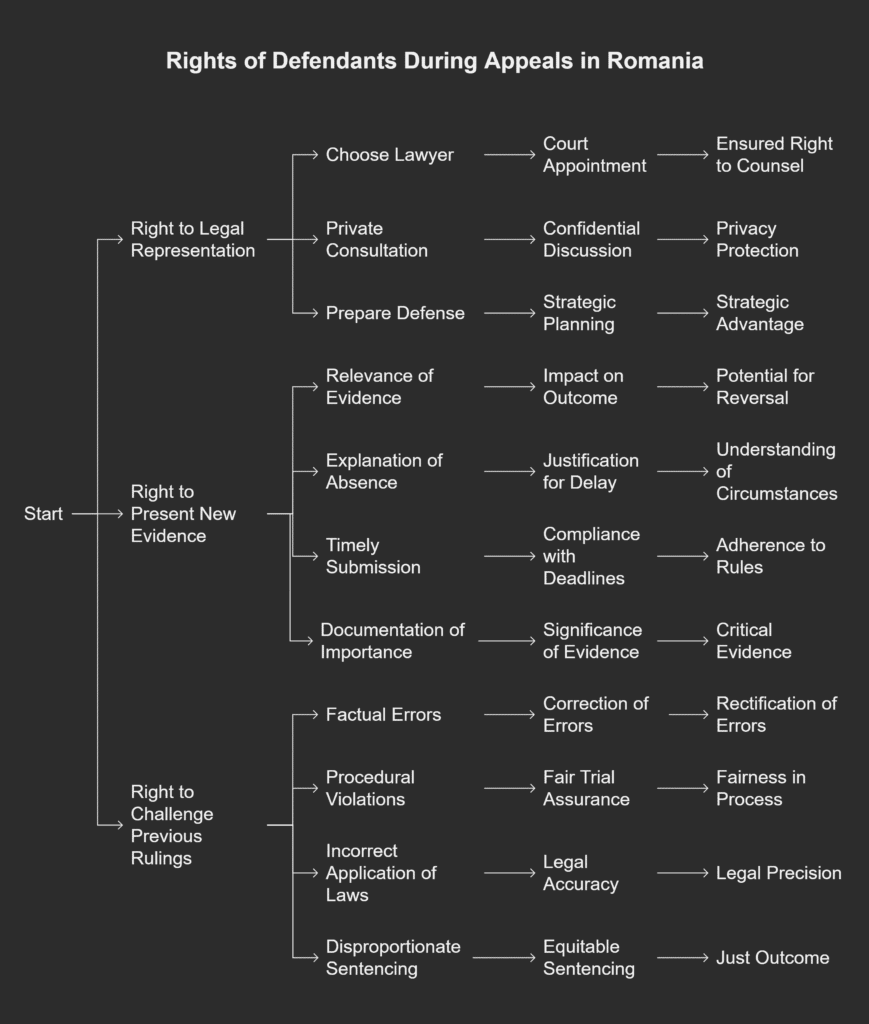
You need to pick and highlight evidence that supports your appeal.
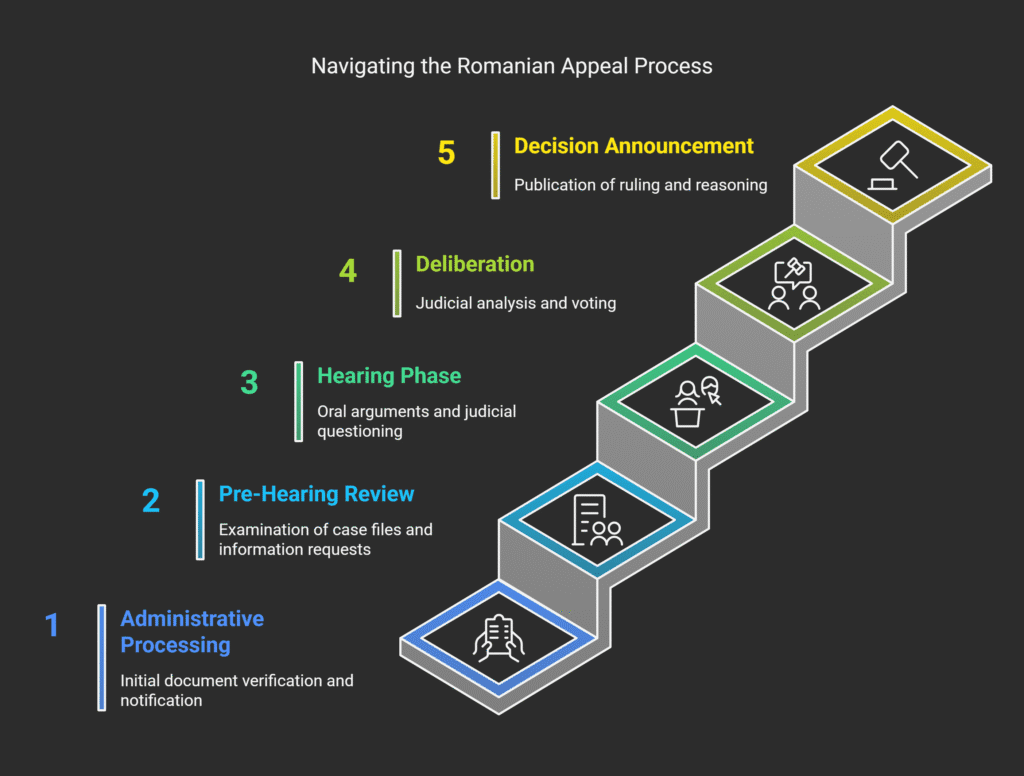
This means analyzing the trial record and finding issues with the evidence.

To challenge evidence, show why the first court made mistakes.

This could be because of evidence that was wrongly admitted or evaluated.

Romanian law allows new evidence in appeals under certain conditions.

But, this right is not unlimited.

To introduce new evidence, you must show it was not available during the first trial.

You also need to explain its relevance and submit it on time.

  • Demonstrate why the evidence couldn’t have been presented during the original trial;
  • Establish clear relevance to your specific grounds for appeal;
  • Submit a formal request to the court explaining the significance of the new evidence;
  • Present the evidence within procedural timeframes established by law.

After looking at the evidence, you can ask for more evidence or statements.

The court will decide if this evidence is relevant and could change the case outcome.

Effective Strategies for Evidence Presentation

To effectively challenge a verdict, make clear summaries of evidence issues.

Your appeal should focus on legal errors that need correction, not just repeat original arguments.

Working with a skilled defense attorney is vital.

They can help you make strong evidence-based arguments that follow Romanian appeal rules.

This increases your chances of winning.

Evidence AspectFirst Instance CourtAppeal CourtStrategic Considerations
New EvidenceBroadly admissibleLimited to unavailable/unknown evidenceMust justify why evidence wasn’t presented earlier
Witness TestimonyPrimary evidence gatheringRarely heard unless newFocus on inconsistencies in original testimony
Expert OpinionsCommissioned by courtNew opinions possible if justifiedChallenge methodology or conclusions of original experts
Documentary EvidenceComprehensive collectionSelective review of key documentsHighlight documents overlooked or misinterpreted

Remember, appeals in Romania are not about retrying your case.

They focus on legal or procedural errors with evidence that affected the verdict.

By understanding these differences and preparing well, you can improve your appeal’s chances of success.

Rights of Defendants During Appeals

Knowing your rights during appeals is key to challenging a criminal conviction in Romania.

The Romanian legal system offers many protections.

These ensure fair proceedings and due process throughout the appeal.

The Romanian Constitution and Criminal Procedure Code outline specific protections for appealing criminal convictions.

Knowing these rights and how to use them can greatly impact your appeal’s outcome.

Let’s look at the main rights you have during this important legal process.

Rights of Defendants During Appeals Romania

Right to Legal Representation

One of the most important defense rights in Romania is having legal representation during appeals.

This right means you get professional help with complex legal steps.

Legal help is crucial during appeals because rules are strict.

You have the right to:

  • Choose your own lawyer or get one from the court if you can’t afford one;
  • Speak privately with your lawyer before and during hearings;
  • Have enough time to prepare your defense with your lawyer;

In serious cases, you must have a lawyer.

The court will appoint one if you don’t have one.

This ensures your right to counsel is protected, no matter your financial situation.

Right to Present New Evidence

You have the right to introduce new evidence during appeals under certain conditions.

This right is key when new evidence was not available or known during the trial.

To use this right, you must meet specific conditions:

  • The new evidence must be relevant and could change the case’s outcome;
  • You must explain why this evidence wasn’t presented in the original trial;
  • The evidence must be submitted on time;
  • You need to document why the new evidence is important.

The appeals court decides if new evidence is accepted.

But, presenting strong reasons for its inclusion can help.

This right is a key way to prevent wrongful convictions in Romania by correcting overlooked facts.

Right to Challenge Previous Rulings

In the Romanian appeals system, you can challenge specific parts of the lower court’s decision.

This is a key right of the accused in appeals and is the basis of the appeals process.

You can challenge rulings on several grounds:

  • Factual errors or misinterpretation of evidence by the lower court;
  • Procedural violations that affected your right to a fair trial;
  • Incorrect application of laws to your case;
  • Disproportionate sentencing compared to similar cases.

When challenging rulings, be specific.

Your appeal should clearly state which parts of the ruling you’re challenging and why.

General complaints without legal grounds are unlikely to succeed.

You also have the right to be present at hearings, speak last before deliberations, and have an interpreter if needed.

These rights ensure you can fully participate in the appeals process.

Understanding and using these rights is crucial for a fair appeal.

The legal system is complex, but these protections are in place to prevent errors and give you a chance to correct unjust outcomes.

Appeal Court Procedures and Hearings

Appeal Court Procedures and Hearings Romania

Understanding the appeal court procedures in Romania is key.

The process is structured to ensure fairness and thorough review.

Knowing these steps can make your appeal journey smoother.

When you file an appeal, the court checks if your documents are complete.

They make sure you’ve included everything needed.

Then, they tell everyone involved in the case about your appeal.

The court’s first step is to review your case.

They look at the main points and see if they need more information.

They might ask for more details or documents from you or the other side before the hearing.

In Romania, appeal panels usually have three judges.

For more complex cases, five judges may be involved.

This way, decisions are made with the input of several judges.

Hearings follow a set format.

The judge checks if everyone is there and gives a quick summary of the case.

You or your lawyer will then explain why you’re appealing.

The prosecutor will argue against your appeal.

You have the right to respond to their arguments.

Judges might ask questions to clarify things.

Most hearings are open to the public.

But, some cases involving minors or national security are closed. Only the parties involved are there.

The time it takes to finish an appeal varies.

Simple cases might take 2-3 months.

More complex ones could take 6 months or more.

Your lawyer can give a better idea of when it might end.

After hearing everything, judges go off to decide.

They vote on the decision, and any dissenting opinions are noted.

The court’s final decision must explain why they accepted or rejected your appeal.

It’s important to know how to act in court.

Wear professional clothes and show respect.

Turn off your phone and only speak when the judge invites you.

Appeal StageKey ActivitiesYour RoleTimeframe
Administrative ProcessingDocument verification, party notificationSubmit complete documentation1-2 weeks
Pre-Hearing ReviewCase file examination, additional information requestsRespond promptly to court inquiries2-4 weeks
Hearing PhaseOral arguments, judicial questioningPresent your case clearly or through counsel1-3 sessions
DeliberationJudicial analysis, voting on decisionAwait ruling1-4 weeks
Decision AnnouncementRuling publication, reasoning providedReceive and review decisionWithin 30 days of deliberation

The appeal process in Romania focuses on being thorough, not fast.

Courts look at all parts of your case to ensure justice.

This careful approach might take longer but helps avoid quick, wrong decisions.

If you can’t make it to a hearing, tell the court right away.

Give a good reason.

Not showing up without a good reason can hurt your appeal.

Your lawyers in Romania can usually represent you.

Keep talking to your lawyer throughout the appeal.

They can explain what’s happening, help you understand the judges’ comments, and prepare you for each step.

Working together can make navigating the appeal system easier.

Possible Outcomes of Criminal Appeals

Understanding the possible results of your criminal appeal in Romania is key.

The appeals court has several options when reviewing your conviction.

The outcome depends on the strength of your legal arguments, the evidence, and your case’s specifics.

When the appeals court makes a decision, it will issue a ruling.

This ruling can be one of several outcomes.

The court’s decision is based on a detailed look at your case’s procedural and substantive aspects.

Possible Outcomes of Criminal Appeals Romania

Conviction Overturned

The most favorable outcome is having your conviction overturned.

This occurs when the appeals court finds significant legal errors in the original trial.

When this happens, the court declares the original judgment flawed.

Several reasons can lead to a conviction being reversed.

These include new evidence, procedural violations, or insufficient evidence to support a guilty verdict.

If a conviction is overturned, the court might declare you not guilty.

Or, it might stop the criminal trial if it shouldn’t have started.

This means you regain your legal presumption of innocence.

If you were in jail, you would likely be released.

This is unless there are other charges or legal reasons for detention.

Sentence Modification

In some cases, the appeals court might keep the conviction but change the sentence.

This happens when the punishment was seen as too harsh or not in line with legal standards.

Sentence modifications can include reducing the prison term, converting a custodial sentence to a suspended one, or adjusting penalties.

  • Reduction in prison term length;
  • Conversion of a custodial sentence to a suspended sentence;
  • Alteration of additional penalties (such as fines or probation terms);
  • Adjustment of legal classification of the offense to a less severe category.

When seeking to modify a sentence, your lawyer will argue the punishment was too harsh.

The appeals court has a lot of discretion in modifying sentences.

They consider the crime’s nature, your personal situation, and similar cases.

A successful sentence modification can greatly improve your situation.

For example, a reduced prison sentence or a change to probation can help you keep your job and family ties.

Appeal Rejection

The least favorable outcome is having your appeal rejected.

This happens when the appeals court finds no merit in your arguments.

When this occurs, the original verdict and sentence remain in effect.

Appeal rejections usually happen when the court sees no procedural errors, the evidence supports the conviction, and the sentence is fair.

The court will explain its reasoning in writing, addressing each of your appeal’s arguments.

After an appeal rejection, you must follow the original sentence.

However, this doesn’t mean you’ve run out of legal options.

You might still have the right to appeal further or explore other post-appeal remedies.

The appeals court can also make more nuanced decisions.

Partial reversals occur when some charges are overturned while others are kept.

This can lead to a revised sentence based on the remaining convictions.

The court might also issue a remand decision, sending your case back to the lower court.

This happens when the appeals court finds procedural errors but can’t make a final decision.

Roughly 30% of criminal appeals in Romania result in some form of modification to the original verdict or sentence.

Complete reversals occur in about 15% of cases.

These figures vary by year and by the type of offense involved.

Regardless of the outcome, the appeals court will provide a detailed written decision.

This document is crucial for understanding the court’s reasoning and determining if further legal action is needed.

Post-Appeal Legal Options

After the usual appeal process, Romania offers special legal paths for those who think justice was not done.

These options help protect against unfair convictions.

But, they have strict rules to follow.

Extraordinary Appeals to the High Court

If regular appeals fail, you can ask Romania’s top court for help.

The High Court of Cassation and Justice looks at special appeals in certain cases:

  • Appeal in Cassation – For serious mistakes in applying the law;
  • Appeal in Annulment – When there were big mistakes in how the case was handled;
  • Review of Final Decisions – For new evidence that changes everything.

These appeals have tight deadlines, from 30 days to 1 year.

Winning is rare, with success rates often under 15%.

Case Revision Based on New Evidence

Case revision is another chance for justice in Romania.

It’s for new evidence that came up after your case was closed.

This includes:

  • New witnesses or evidence;
  • Forensic findings that contradict the trial;
  • Proof that evidence was faked;
  • Proof that judges did something wrong.

Constitutional Court Applications

If you think your conviction was because of bad laws, you can ask the Constitutional Court.

Your lawyer needs to:

  1. Find laws that were wrongly applied;
  2. Show how these laws hurt your case;
  3. Apply within 45 days of your last appeal.

The Constitutional Court only looks at laws, not the facts of your case.

If they agree, your case might be retried without the bad laws.

European Court of Human Rights Applications

After trying everything in Romania, the European Court of Human Rights (ECHR) is an international option.

They check if your rights were broken.

To use this option, you must:

  • Exhaust all domestic remedies – Try all appeals in Romania;
  • File within 4 months – You have 4 months after your last appeal;
  • Identify specific rights violations – Clearly say which rights were broken.

The ECHR process takes 3-5 years.

If they find in your favor, they might give you money and make Romania fix the problem, possibly by reopening your case.

Practical Considerations

Keep these things in mind when thinking about post-appeal options:

  • Winning is rare, with success rates under 10%;
  • You need a lawyer who knows these complex rules;
  • It can cost a lot, especially for international options;
  • It takes a long time, often years.

Recent changes in Romania’s justice system aim to improve these options.

But, winning is still hard.

Your lawyer should tell you the chances before you start.

Remember, these special remedies are not for everyday appeals.

They are for protecting against big mistakes in justice.

Conclusion

The Romanian criminal appeals process gives a second chance to those wrongly convicted.

Appeal success rates in Romania depend on the case’s complexity.

But, with the right preparation, your chances improve a lot.

Looking at successful criminal appeals cases in Romania shows a pattern.

Those with skilled lawyers do much better.

Hiring a criminal appeals lawyer in Romania is key.

They know how to meet deadlines and find good reasons to appeal.

Choosing the right lawyer can change your outcome.

A top Romanian law firm knows the law and how courts work.

Many find that good legal help is worth the investment in appeals.

Every appeal is judged on its own.

Courts look at mistakes in the process and legal issues.

A Romanian law office with experience can create a plan just for you.

If you’re facing a criminal conviction, act fast.

For help with your appeal, contact Atrium Romanian Lawyers at office@theromanianlawyers.com.

They can guide you through your options and what to do next.

FAQ

What is the time limit for filing a criminal appeal in Romania?

In Romania, you have 10 days to file a regular appeal after the judgment is communicated.

For second appeals, the deadline is 30 days.

Missing these deadlines usually means losing your right to appeal.

However, in rare cases like serious illness, you might get an extension.

What are the main grounds for appealing a criminal conviction in Romania?

You can appeal if there were procedural errors or if the law was applied wrongly.

If the evidence was not enough or was contradictory, you can also appeal.

New evidence, violations of your rights, or a harsh sentence are other valid reasons.

Your appeal must clearly state why you’re appealing and provide legal arguments.

Can I present new evidence during my appeal?

Yes, but with some restrictions.

Romanian appeal courts mainly review existing evidence.

New evidence is only accepted if it was not available during the trial.

You must explain why this evidence couldn’t be presented earlier and show its relevance.

Do I need a lawyer to file a criminal appeal in Romania?

While not mandatory, having a lawyer is highly recommended.

Appeals are complex and require specialized knowledge.

A lawyer can help identify strong grounds for appeal, ensure deadlines are met, and present your case effectively.

For serious cases, legal representation is often required.

What documents are required to file a criminal appeal in Romania?

You’ll need the appeal petition, copies of the original judgment, evidence supporting your appeal, and a power of attorney.

All documents must be properly prepared and translated if necessary.

Keeping copies and proof of filing is also important.

What happens during an appeal hearing in Romania?

The hearing starts with verification of the parties and a summary of the case.

Your lawyer will present arguments, and the prosecutor will respond.

Judges may ask questions.

You can make a final statement before the decision is made.

The court may decide immediately or schedule a later date.

What are the possible outcomes of my criminal appeal?

The appeals court can overturn your conviction, modify your sentence, or reject your appeal.

They might also partially reverse the conviction or remand the case for reconsideration.

The outcome depends on the strength of your appeal and the evidence.

If my appeal is rejected, what other legal options do I have?

After exhausting standard appeals, you might consider extraordinary appeals or case revision based on new evidence.

You could also apply to the Romanian Constitutional Court or the European Court of Human Rights.

These options require specialized legal expertise and have high thresholds for acceptance.

How is the jurisdiction determined for my criminal appeal?

The jurisdiction depends on the original court and the offense type.

Appeals from first instance courts go to tribunals, while appeals from tribunals go to courts of appeal.

The High Court of Cassation and Justice hears appeals from courts of appeal and special cases.

This ensures appeals are heard by higher courts.

Can I be released from detention while my appeal is pending?

You can request release, but it’s at the court’s discretion.

The court will consider factors like risk of flight and danger to public safety.

In some cases, they might replace detention with less restrictive measures.

Your lawyer can request these measures on your behalf.

What is the difference between a regular appeal (apel) and a second appeal (recurs) in Romania?

A regular appeal is a comprehensive review of your case.

It allows reassessment of evidence and legal interpretations.

A second appeal focuses more on legal matters and doesn’t reassess evidence.

Regular appeals offer broader grounds for challenging a conviction.

How long does the criminal appeals process typically take in Romania?

The time varies based on case complexity and court workload.

Simple appeals might take 3-6 months, while complex ones can take a year or more.

Factors like additional evidence and court backlog affect the timeline.

Your lawyer can give a more accurate estimate based on your case.

Can I represent myself in a criminal appeal in Romania?

While possible, self-representation is rarely advisable.

Appeals require complex legal procedures and specialized knowledge.

Without proper expertise, you risk procedural errors or failing on substantive issues.

For serious cases, legal representation is often mandatory.

What costs are associated with filing a criminal appeal in Romania?

Costs include court fees, attorney fees, and expenses for documentation and expert opinions.

In cases of financial hardship, reduced fees or public defender representation might be available.

Discuss fees with your attorney before proceeding, as costs vary.

How can I find a qualified criminal appeals lawyer in Romania?

Look for lawyers with experience in criminal appeals, not just general criminal law.

Check their track record, familiarity with courts, and knowledge of appellate procedure.

Contact the Romanian Bar Association for referrals or seek recommendations.

Ask about their experience with similar cases during initial consultations.

What are the grounds for appealing a criminal conviction in Romania?

Under Romanian law, specifically the Criminal Procedure Code, there are several grounds for appealing a criminal conviction.

The main grounds include: errors in the application of substantive law, procedural irregularities, incorrect assessment of evidence, disproportionate sentencing, or new evidence that wasn’t available during the initial trial.

The Romanian Criminal Code of Criminal Procedure provides comprehensive frameworks for these appeals.

It’s important to note that your appeal must clearly specify which aspects of the judgment you’re challenging and provide legal arguments supporting your position.

The appellate court will only examine those aspects of the judgment that you’ve specifically challenged in your appeal.

If you’re considering an appeal based on new evidence, you must demonstrate that this evidence wasn’t available during the original trial and that it could substantively change the outcome of your case.

Under Romanian jurisdiction, the right to appeal is considered fundamental and is protected both by domestic legislation and the European Convention on Human Rights.

What is the time limit for filing an appeal against a criminal conviction in Romania?

In Romania, the time limit for filing an appeal against a criminal conviction is strictly regulated by the Criminal Procedure Code.

Typically, you have 10 days from the communication of the written judgment to file a standard appeal (known as “apel” in Romanian).

For extraordinary appeals (such as “recurs în casație” which goes to the High Court of Cassation and Justice), the timeframe is 30 days from the final decision.

Missing these deadlines can result in your appeal being declared inadmissible, although in exceptional circumstances, you may be able to request reinstatement of the time limit if you can prove that you missed the deadline due to circumstances beyond your control.

Romania’s Administrative Fines: What You Need to Know Before You Pay

Romania’s Administrative Fines: What You Need to Know Before You Pay

Ever get a notice to pay for a rule you didn’t know about?

Dealing with fines can be tough, even more so if you don’t know the rules.

In Romania, fines follow rules set by Government Ordinance No. 2/2001.

This law outlines what fines are for and how much they cost.

It’s very important for both people and businesses in the country to understand this.

Romania’s Administrative Fines

Romania’s Administrative Fines

The way fines work in Romania has changed a lot.

Now, fines are the main way authorities make sure everyone follows the rules.

This is a big change from when fines were mostly for serious crimes.

If you get a fine, knowing your rights can help a lot.

The rules tell you how to figure out, pay, and even fight fines that seem unfair.

In this guide, you’ll learn all you need to know about fines in Romania.

This is true whether you live, work, or run a business here.

Key Takeaways

  • Government Ordinance No. 2/2001 establishes the framework for contraventional offenses in Romania;
  • Administrative penalties evolved from being part of the Criminal Code to administrative law;
  • Understanding the regulatory framework is essential for both individuals and businesses;
  • Legal sanctions serve as enforcement mechanisms to ensure compliance with regulations;
  • Specific procedures exist for calculation, payment, and contesting administrative fines;
  • Knowing your rights regarding regulatory penalties can save time, money, and stress.

Understanding Romania’s Administrative Fines

Getting to know Romania’s fine system is key.

It’s based on laws and the groups that enforce them.

If you live or work in Romania, you might face Romanian administrative sanctions.

These fines are different from criminal penalties and help keep things in order.

Definition and Legal Basis

In Romania, fines for small mistakes are called contraventional sanctions.

They’re not as serious as crimes.

The rules for these fines come from Government Ordinance No. 2/2001.

This ordinance says a contravention is a small mistake done on purpose or by accident.

It must be listed as a contravention in the law. And it’s not as big of a deal as a crime.

These fines are meant to help people follow the rules, not to punish them.

They’re not like criminal fines.

Instead, they aim to fix the problem and make sure everyone follows the rules.

Romanian administrative sanctions framework

Romanian administrative sanctions framework

There are also laws for specific areas that add to the main rules.

These laws list what’s wrong and what the fines are for those mistakes.

Key Regulatory Authorities in Romania

Many government groups watch over the rules and give out Romanian corporate compliance fines when needed.

Each group looks after a certain area.

The National Authority for Consumer Protection (ANPC) checks on the market and protects consumers.

They deal with unsafe products, false ads, and unfair business practices.

They focus on businesses that don’t follow the rules for consumers.

The National Environmental Guard and local agencies handle environmental issues.

They make sure companies follow the rules about pollution and waste.

Breaking these rules can lead to big fines.

The Labor Inspectorate (Inspecția Muncii) looks after work places.

They make sure employers follow the rules about safety, fair pay, and working hours.

If employers don’t follow these rules, they can face big fines.

Tax authorities, like the National Agency for Fiscal Administration (ANAF), deal with tax issues.

They handle things like not reporting income or keeping bad records.

This can lead to fines and extra taxes.

Local police and special teams enforce local rules and handle small public order issues.

They deal with things like noise, unauthorized building, and breaking local rules.

Knowing who to talk to when you get a fine in Romania is important.

Each group has its own way of doing things, but they all follow the main rules set by Government Ordinance No. 2/2001.

Common Types of Administrative Violations in Romania

Knowing the common administrative infractions in Romania can save you from big fines and legal trouble.

The country has rules for both businesses and individuals.

Knowing these rules helps you stay compliant and avoid penalties.

Romanian compliance violations

Romanian compliance violations

Corporate and Business Infractions

Businesses in Romania must follow strict rules to avoid Romanian corporate fines.

These fines help keep businesses in line and protect everyone involved.

Labor law violations are a big problem.

Issues like bad employment contracts, too many working hours, and safety problems are common.

The Romanian Labor Inspectorate checks these and fines can be from 1,500 to 20,000 RON.

Consumer protection infractions are also a big deal.

This includes false ads, unfair contracts, and not honoring warranties.

The National Authority for Consumer Protection is getting tougher on these issues.

Tax reporting mistakes are a top concern for Romanian authorities.

This includes late tax filings, wrong revenue reports, and VAT issues.

These mistakes can lead to fines and extra taxes with penalties.

Business Infraction TypeRegulatory AuthorityTypical Fine Range (RON)Common Examples
Labor Law ViolationsLabor Inspectorate1,500 – 20,000Undocumented workers, safety violations
Consumer ProtectionANPC2,000 – 50,000Misleading advertising, unfair terms
Tax ComplianceANAF5,000 – 100,000Late filings, incorrect reporting
EnvironmentalEnvironmental Guard30,000 – 80,000Waste disposal violations, emissions

Individual Administrative Offenses

People in Romania face their own set of rules that can lead to fines.

Knowing these can help you avoid trouble.

Traffic violations are a big issue.

This includes speeding, illegal parking, and not wearing seatbelts.

Fines can be from 290 to 2,900 RON, with serious cases leading to losing your license.

Public disturbance offenses are another common problem.

This includes loud noise, bad waste disposal, and acting out in public.

Local police can fine you from 100 to 500 RON for these.

Age matters when it comes to fines in Romania.

Kids under 14 can’t be fined.

Those 14 to 18 face smaller fines than adults, showing Romania’s approach to responsibility.

GDPR and Data Protection Violations

With the GDPR in place, data protection is a big deal in Romania.

Both businesses and public bodies must follow strict rules to avoid fines.

Processing data without permission is a serious mistake.

This includes collecting data without consent, using it for the wrong reasons, or keeping it too long.

The National Supervisory Authority for Personal Data Processing can fine up to 20 million euros or 4% of global turnover for the worst cases.

Not telling people about data breaches fast enough is another big no-no.

Companies must tell the authority and those affected within 72 hours if data is at risk.

Not protecting data well enough is also a big problem.

Companies must have good security measures to keep data safe, based on the risk involved.

Not respecting people’s data rights is another common issue.

This includes not giving access to data, not fixing wrong data, erasing data, and not letting people take their data with them.

Companies must respond to these requests within a month, with some exceptions.

Knowing about these common violations helps with business risk management and personal compliance in Romania.

By spotting problems before they happen, you can avoid fines and protect your business’s reputation.

The Romanian Regulatory Framework

Romania has a detailed legal system for handling administrative offenses.

It combines general rules with specific ones for different areas.

Knowing these rules is key for businesses and residents, as they cover everything from traffic rules to corporate rules.

 Romanian Regulatory Framework Fines

Government Ordinance No. 2/2001

At the heart of Romania’s administrative offenses legislation is Government Ordinance No. 2/2001.

It’s the main law for handling contraventions.

This ordinance is as important as laws passed by parliament, but it comes from the government.

GO 2/2001 sets up three main types of punishments for contraventions:

  • Warnings (verbal or written cautions);
  • Contraventional fines (monetary penalties);
  • Community service (remedial work for the public benefit).

This ordinance makes contraventions a separate category from crimes.

It outlines how fines are given, sets rules for penalties, and protects the rights of those facing charges.

Sector-Specific Regulations

While GO 2/2001 is the base, many specific rules add complexity to the Romanian regulatory framework.

These rules cover different industries and activities.

Traffic laws, for example, have detailed rules on driving and vehicle requirements.

Consumer protection laws set rules for businesses on product safety and advertising.

SectorPrimary LegislationKey Regulatory AuthorityCommon Violations
Consumer ProtectionLaw No. 296/2004National Authority for Consumer ProtectionMisleading advertising, unfair contract terms
CompetitionLaw No. 21/1996Competition CouncilCartel formation, abuse of dominant position
Data ProtectionLaw No. 190/2018National Supervisory AuthorityGDPR violations, data breaches
EnvironmentalGEO No. 195/2005Environmental GuardPollution, waste management failures

Environmental laws are strict about pollution and waste.

The GDPR compliance fines in Romania can be up to 4% of global turnover for big violations.

Financial laws, overseen by the National Bank of Romania and the Financial Supervisory Authority, have their own penalties.

These rules work with GO 2/2001 for matters not covered in specific laws.

Recent Legislative Changes

Romania’s fine system has changed a lot in recent years.

Fine amounts have gone up in many areas, showing a focus on stopping violations.

In 2021, changes to GO 2/2001 gave more rights to those accused of offenses.

New EU rules have also led to updates in areas like unfair competition and consumer protection.

The rise of digital services has brought new violations, like in ecommerce and online marketing.

Romania has updated laws to handle these new challenges.

Romania’s laws are getting closer to EU standards, making it easier for businesses in Europe.

This means new rules but also a more stable environment for international companies.

It’s important to keep up with these changes to avoid fines.

Romania’s laws are always evolving, so staying informed is key for everyone.

How Administrative Fines Are Calculated and Imposed

Knowing how Romanian authorities set and apply fines is key for individuals and businesses.

The Romanian legal system has a clear method to make sure fines match the violation’s severity.

This helps you understand and avoid risks, and prepare for compliance.

Penalty Assessment Criteria

Romanian agencies look at several factors to decide on fines.

These penalty assessment criteria make sure fines are fair based on the violation’s impact.

The main things considered are:

  • The seriousness of the violation and its impact;
  • If the violation was intentional or by mistake;
  • The offender’s history of following rules;
  • The economic gain from the violation;
  • The harm caused to others or public interests.

Fines are set based on the violation’s seriousness.

For example, a small paperwork mistake gets a lower fine than a serious violation.

Also, extra sanctions might be added based on the violation’s severity.

It’s important to know that for one offense, there’s one main penalty and one or more extra sanctions if needed.

Fine Calculation Methods

 Administrative Fines in Romania

The fine calculation methods in Romania follow strict rules.

The system sets both a minimum and a maximum for fines, guiding how fines are applied.

The smallest fine for any violation is 25 lei (about 6 Euros).

But, the maximum fine varies based on who set the rule:

Authority LevelMaximum Fine (Lei)Maximum Fine (Euros)Typical ApplicationLegal Basis
Law or Government Ordinance100,00025,000Serious national violationsPrimary legislation
Government Decision50,00012,500Significant regulatory breachesSecondary legislation
County Authorities5,0001,250Regional administrative violationsCounty regulations
Municipal/Communal Authorities2,500600Local ordinance violationsLocal council decisions

For repeat offenders, fines get higher with each offense.

Young offenders (ages 14-18) usually get lower fines than adults for the same violations.

Notification Process

After finding a violation and calculating the fine, Romanian authorities send a formal notice.

This step is key in administrative proceedings and must follow legal rules.

The notice, called a “Proces-Verbal de Contravenție” (contravention report), must include important details:

  • The date, time, and place of the violation;
  • A detailed description of the violation;
  • The laws broken;
  • The fine amount and how to pay;
  • Info on appealing and deadlines;
  • Details of the offender and the authority.

This document is usually given in person at the time of the violation.

If not possible, it’s sent by registered mail with proof of delivery.

You have the right to receive this notice within 30 days of the violation being found.

The notice will tell you when to pay the fine, usually 15 days after getting it.

You can either pay the fine or contest it legally during this time.

Ignoring this can lead to more penalties and actions.

Knowing about assessment criteria, calculation methods, and the notification process helps you understand Romania’s fine system.

This knowledge helps you avoid penalties and follow Romanian laws correctly.

The Payment Process for Romanian Administrative Fines

When you get an administrative fine in Romania, knowing how to pay it is key.

It saves you money and avoids legal trouble.

Romania has clear steps for paying fines, important for both individuals and businesses.

The Romanian system has standard payment ways and chances for lower payments.

But, these benefits need you to follow the rules on time.

Let’s look at how to handle administrative sanctions in Romania.

Payment Deadlines and Options

Payment Romania Fine

When you get a notice of an administrative offense, you have 15 to 30 days to pay.

The exact time depends on the violation and who issued it.

Always check the deadline on your notice to avoid trouble.

Romania has many ways to pay penalty fees.

You can use online banking, visit a bank, send a postal money order, or use mobile apps.

Each method has its own time, which might affect your deadline.

If you miss the payment deadline, the authorities can take action.

They might take your money directly from your accounts.

This can add extra fees and interest, making the fine even higher.

Payment MethodProcessing TimeAdvantagesDocumentation Provided
Online Banking1-2 business daysConvenient, accessible 24/7Electronic receipt, transaction ID
Treasury OfficesImmediateOfficial confirmation, guidance availableOfficial stamped receipt
Postal Money Order3-5 business daysNo bank account neededPostal receipt with tracking number
Mobile Payment Apps1-3 business daysConvenience, digital recordDigital receipt, confirmation code

Reduced Payment Opportunities

Romanian law gives big savings for quick payment of fines.

For many fines, you can pay half the amount if you pay within 48 hours or 15 days.

This depends on the type of violation.

Not all fines offer this chance.

Minor and some moderate infractions qualify, but serious ones don’t.

Your notice will say if you can pay less.

To get the reduced payment, follow the steps in your notice carefully.

Use the right payment details and pay on time.

Any mistake or delay means you can’t get the reduced payment.

Documentation Requirements

Keeping the right documents is key when dealing with fines in Romania.

Always save the original notice.

It has important details about the fine, payment, and deadlines.

After paying, keep all payment receipts safe.

Include the date, amount, payment reference, and confirmation from the authority.

For online payments, save electronic receipts and bank statements.

For in-person payments, ask for a stamped receipt.

Documentation is vital if you need to appeal a fine or if there’s a payment mistake.

Romanian authorities might not always record payments correctly.

Having all your documents ready helps solve problems fast and avoids legal trouble.

If you’re a business, organize all fine-related documents well.

This includes letters from authorities, payment records, and any supporting evidence.

Good organization helps with penalty appeals and shows you’re following the law.

Contesting Administrative Fines in Romania

If you get an administrative fine in Romania, you can fight it under certain conditions.

The legal system in Romania uses civil procedure for these challenges.

But, some fines might need criminal law if they seem too harsh.

Knowing your rights and the right steps can really help your appeal.

Contesting Administrative Fines in Romania

Legal Grounds for Appeals

There are several good reasons to appeal an administrative fine in Romania.

It’s important to know which one fits your situation best.

Procedural errors are a common reason.

This includes wrong notices, wrong info, or not following due process when the fine was given.

Also, if the fine report got the facts wrong, you can appeal.

If you have evidence that shows the report was wrong, you can use it to challenge the fine.

Another reason is if the fine is too big for the crime.

Romanian laws say fines should match the crime.

If your fine seems too high, you can appeal based on this.

The European Court of Human Rights has set important rules for fines in Romania.

They’ve said Romania can’t ignore the idea that you’re innocent until proven guilty.

These rules help if you’re appealing because of rights issues.

The Appeals Process Timeline

Time is key when you’re appealing a fine in Romania.

You have 15 days from when you get the fine notice to appeal.

If you miss this, you can’t appeal anymore.

The appeal process has a clear schedule:

1. Within 15 days of getting the notice: Send your appeal in writing to the fine issuer or the court.

2. Within 5 days after you send it: The court will register your appeal and give it a number.

3. 20-30 days later: You’ll have your first court hearing (estimated).

4. 1-3 months: The first court decision will take this long, depending on the case (estimated).

5. Within 30 days of the first decision: You can appeal to a higher court if you need to (estimated).

For simple cases, the whole process can take 3-6 months.

But, if it’s more complicated, it might take longer.

Required Documentation for Appeals

Having the right documents is key for a good appeal.

Get everything ready before you start.

This will help your case and avoid delays.

Here’s what you need for an appeal in Romania:

Document TypePurposeRequired CopiesSpecial Requirements
Original Fine NotificationShows why you’re appealing1 original + 2 copiesMust include all pages and attachments
Written Appeal StatementExplains why you’re appealing3 copiesMust say what you want to happen
Supporting EvidenceBacks up your appeal3 copies of each documentTranslated if not in Romanian
Power of AttorneyAllows someone to represent you1 original + 2 copiesNotarized if represented by attorney
Proof of Payment (court fees)Shows you’ve paid to appeal1 original + 2 copiesFee amount varies by fine value

Your appeal statement should clearly say why you’re appealing.

Include any witness statements that support your side, if you’re questioning the facts of the violation.

Reports from experts can be very helpful, too.

They’re good for fines in areas like construction or environmental rules.

These reports give a third view that courts often find convincing.

When you appeal, you can send it to the fine issuer or the court.

For most fines, you should appeal to the local court (Judecătoria) where the fine was given or where you live.

Remember, all documents must be in Romanian or have a certified translation if they’re not.

Consequences of Non-Payment

Not paying Romanian administrative fines can lead to bigger problems.

You could face more penalties, legal actions, and even disruptions to your business.

It’s important to manage risks in Romania well, whether you’re an individual or a company.

The Romanian legal system is strict about fines.

They have rules to make sure everyone follows the law.

Consequences of Non-Payment of Fines in Romania

Legal Enforcement Actions

If you don’t pay your fine in 30 days, Romanian regulatory authorities will start legal actions.

They will send you a writ of execution.

This is the first step in enforcing the fine.

Authorities have several ways to enforce fines:

  • They can seize your property, both movable and immovable.
  • They can take money directly from your wages.
  • They can freeze your bank accounts and take money from them.
  • They can make you do community service instead of paying the fine.

If you can’t pay the fine and don’t have property, you can ask the court for community service.

You can also ask for more time to pay the fine at your first court appearance.

Doing community service can mean up to 300 hours of work.

Before, you had to agree to this.

But now, the court can decide it’s necessary to enforce the law.

Additional Penalties and Interest

Not paying your fine adds more costs.

You’ll have to pay interest every day.

The rate depends on the type of fine.

These extra costs can add up:

  • Penalties for late payment get higher over time.
  • There are costs for the enforcement officers.
  • You’ll have to pay court fees for the enforcement process.
  • Legal fees if you fight the enforcement in court.

For example, a 5,000 RON fine can grow to over 7,500 RON in six months.

This is a 50% increase. Paying on time is usually the best option.

Impact on Business Operations

Unpaid fines can hurt businesses a lot.

They can disrupt operations and affect your reputation.

Romania’s corporate governance requires following the law, including paying fines on time.

Businesses that ignore fines might face:

  • Their licenses or permits could be suspended or taken away.
  • They might not be able to get government contracts.
  • They could face more checks from regulators.
  • They might be listed as non-compliant in public records.
  • They could lose clients and partners because of bad publicity.

Financial institutions are hit hard too.

Unpaid fines for anti-money laundering or other financial rules can lead to more checks.

This includes more audits, programs to fix problems, and more reports.

Companies should have plans for dealing with fines.

This can stop small problems from becoming big issues.

It’s part of following Romanian business regulations.

Ignoring fines can hurt your business’s credit score, relationships with suppliers, and even employee morale.

For companies outside Romania, ignoring fines can make dealing with Romanian authorities harder in the future.

Compliance Strategies to Avoid Romanian Administrative Fines

Businesses in Romania need to be proactive about following the rules.

The rules are getting more complex, and companies must find ways to avoid fines.

It’s cheaper and better for your reputation to prevent problems than to fix them after they happen.

Compliance Strategies to Avoid Romanian Administrative Fines

Preventive Measures for Businesses

Start by knowing what laws you must follow.

Regular legal audits help find and fix problems before they become big issues.

These audits check if your business is following the latest laws.

Make clear rules for your team based on Romanian laws.

These rules should cover specific areas and be updated when laws change.

Staff training programs are key to avoiding fines.

Make sure your team knows the basics and the specific rules for their jobs.

Training should happen often, like when laws change or new people join.

Keep up with new laws in Romania.

Sign up for updates from the government and industry groups.

This way, you’ll know about changes that might affect your business.

Compliance Monitoring Systems

Use strong systems to check if you’re following the rules.

Compliance checklists are a good way to make sure you’re doing things right.

They should be easy to use but cover all important points.

Do regular checks to find and fix problems early.

Look at both your documents and how things are done to make sure they match the laws.

Use software to help with monitoring.

It can check things automatically and alert you to any problems.

This is really helpful for keeping up with Romania’s changing rules.

Make it easy for employees to report any issues.

A culture that encourages openness helps find problems early, when they’re easier to fix.

Keep good records of your compliance efforts.

This is important if someone says you’re not following the rules.

Keep track of training, policy updates, and any fixes you’ve made.

Working with Legal Experts in Romania

Working with Romanian lawyers can really help.

They know the local laws well and can give advice that fits your business.

Legal experts can do special audits to find and fix problems before they cost you money.

They often spot things that regular checks miss.

They can also create training that’s just right for your business.

This kind of training is usually more effective than general courses.

Good legal advisors in Romania offer practical solutions that work for your business.

Work closely with your legal team all the time, not just when you have a problem.

Regular talks help keep your business in line with the rules as they change.

This is really important for dealing with Romania’s complex rules.

By following these strategies, your business can avoid fines and run smoothly in Romania.

Remember, staying on top of compliance is an ongoing job that needs constant attention and changes as the rules do.

International Context: Romania vs. EU Administrative Penalties

It’s important to know how Romania’s fines compare to other EU countries.

Romania’s EU membership has shaped its rules, but it also keeps its own way of handling fines.

This helps you understand Romania’s place in the EU’s rules better.

International Context_ Romania vs. EU Administrative Penalties

Comparative Severity of Romanian Fines

Looking at administrative sanctions in Romania shows some patterns.

In some areas, Romania’s fines are not as high as Western Europe’s.

But in others, they can be strict.

In data protection, Romania’s fines for GDPR breaches are lower than France or Germany’s.

But, Romania has been getting tougher, with more investigations.

For environmental rules, penalties in Romania are about average in the EU.

But how they enforce these rules can vary.

Romania’s fines for pollution are similar to Hungary and Bulgaria’s but less than Austria or Sweden’s.

Regulatory AreaRomania (Average Fine)Western EU (Average Fine)Eastern EU (Average Fine)
Data Protection10,000-20,000 EUR50,000-200,000 EUR5,000-15,000 EUR
Consumer Protection2,000-10,000 EUR15,000-50,000 EUR1,000-8,000 EUR
Environmental5,000-50,000 EUR25,000-100,000 EUR3,000-30,000 EUR
Labor Law1,500-7,500 EUR10,000-40,000 EUR1,000-5,000 EUR

One key thing about government fines in Romania is the process.

While fines might be lower, the rules can be stricter.

This includes shorter appeal times and more detailed paperwork.

EU Harmonization Efforts

The EU wants all countries to have similar rules for fines.

This helps businesses in different countries know what to expect.

Romania has followed EU rules in areas like consumer protection and financial services.

For example, it adopted a new law on unfair business practices in 2018.

But, how strictly these rules are enforced can vary.

The European Court of Human Rights (ECHR) has also played a big role.

It says some fines in Romania are like criminal penalties.

This means certain rights must be respected, even if the fine is called administrative.

This includes the right to a fair trial, being presumed innocent, having a lawyer, and seeing witnesses.

Romania’s Competition Council has started to follow these rules more closely.

This means better protection during investigations.

This process of making rules more similar is both a challenge and an opportunity.

It might make things more complicated for a while.

But in the long run, it should make things clearer for everyone.

Knowing about these international aspects is key to dealing with Romania’s fine system.

As Romania works to meet EU standards, staying up to date is important.

This helps you avoid fines and stay on the right side of the law.

Conclusion

Understanding Romania’s fine system is key for businesses and individuals.

Government Ordinance No. 2/2001 sets the rules for fines.

This knowledge helps you handle fines better.

Paying fines on time can lower the cost.

You can also appeal if a fine was wrongly given.

Keeping good records is your strongest defense.

Using smart compliance strategies can prevent fines.

By taking steps to avoid violations, businesses can save a lot.

This is cheaper than paying fines later.

For complex rules, get help from a Romanian administrative law expert.

A good law firm knows the system well.

They can guide you through it, even as Romania meets EU standards.

Whether you run a business or are an individual, a Bucharest lawyer is very helpful.

They know local laws and EU rules. Many law offices also do audits to find and fix problems before fines are issued.

Stay up to date with rules and get help when you need it.

This way, you can deal with Romania’s fine system well.

And you’ll reduce your chances of getting fined.

FAQ

What is an administrative fine in Romania?

An administrative fine in Romania is a fine for minor offenses.

It’s not as serious as a criminal act.

These fines are based on Government Ordinance No. 2/2001.

They are for breaking laws or decisions made by the government or local councils.

Which authorities can issue administrative fines in Romania?

Many bodies in Romania can give out fines.

This includes the National Authority for Consumer Protection (ANPC) and environmental agencies.

Also, labor inspectorates, tax authorities (ANAF), and local police can issue fines.

Each one deals with different types of violations.

What are the most common business violations that result in administrative fines?

Businesses often face fines for labor law issues and unfair practices.

They can also get fined for not following consumer protection laws or tax rules.

Environmental and GDPR breaches, as well as competition law issues, are also common.

Not having the right licenses can lead to fines too.

What are the typical administrative violations for individuals in Romania?

Individuals might get fined for traffic offenses or disturbing the peace.

Not reporting personal status changes is also a violation.

Minor property issues and littering can lead to fines.

Local ordinances are another area where fines can be given.

How are administrative fine amounts determined in Romania?

The amount of a fine depends on several things.

This includes how serious the offense is and if it was intentional.

The offender’s history and any benefits from the violation also play a part.

There are minimum and maximum fines based on who made the rule.

What is the deadline for paying an administrative fine in Romania?

You usually have 15 days to pay a fine. But this can change based on the rule broken.

If you don’t pay on time, the fine can be collected by the authorities.

This might cost you more money.

Can I pay a reduced amount for an administrative fine in Romania?

Yes, you can pay less for many fines.

You can pay half the minimum fine within 48 hours or 15 days.

This chance is available for many fines but not all.

You need to pay on time and keep proof of payment.

What payment methods are available for administrative fines in Romania?

There are several ways to pay fines in Romania.

You can use online platforms, bank transfers, postal money orders, or pay in person.

The details for payment will be on your fine notice.

Always save your payment receipt.

What are valid grounds for appealing an administrative fine in Romania?

You can appeal a fine for several reasons.

This includes mistakes in the fine notice or if the fine is too high.

You can also appeal if there’s no legal basis for the fine.

The European Court of Human Rights has also set rules for fair fines.

What is the process for contesting an administrative fine in Romania?

To appeal a fine, you need to file a complaint within 15 days.

You’ll need the fine notice and any evidence you have.

The court will hold a hearing.

You can represent yourself or get a lawyer.

You can appeal the court’s decision to a higher court within 30 days.

What happens if I don’t pay an administrative fine in Romania?

If you don’t pay, the authorities can take action.

They might seize your property or garnish your wages.

You could also be ordered to do community service.

Unpaid fines can also cost you more money.

Can administrative fines in Romania be converted to community service?

Yes, fines can be turned into community service.

The court can order up to 300 hours of service.

This is usually based on the minimum wage.

It’s a way to avoid paying the fine.

How can businesses prevent administrative fines in Romania?

Businesses can avoid fines by being proactive.

They should check their compliance regularly and train staff.

They should also have systems in place to monitor and report any issues.

Working with legal experts is also helpful.

Keeping records of compliance efforts is important.

How do Romania’s administrative fines compare to those in other EU countries?

Romania’s fines vary compared to other EU countries.

For GDPR, Romania’s fines are often lower.

But for consumer and environmental issues, fines can be higher.

Romania is trying to align its fines with EU standards.

The European Court of Human Rights has also influenced Romania’s approach to fines.

Are there special provisions for foreign individuals or companies facing administrative fines in Romania?

Foreigners face the same fine system as locals.

But they might find it harder due to language barriers.

Foreign companies should have a local representative.

Enforcement against foreign entities might involve extra steps.

What documentation should I keep related to an administrative fine in Romania?

Keep all documents related to a fine.

This includes the fine notice, any evidence, payment proof, and court documents.

Keep these for at least 5 years.

They might be needed to prove payment or to address any errors.

Recognition of Paternity in Romania: Insights into Romanian Civil Law

Recognition of Paternity in Romania: Insights into Romanian Civil Law

Ever wondered how paternity recognition works in Romania?

Romanian laws on paternity are important for families.

They affect child support and who gets what in the future.

Figuring out paternity in Romania might seem hard, but it’s important for kids and parents.

Paternity Recognition in Romania

Paternity Recognition in Romania

Paternity tests in Romania are very accurate.

They help solve family mysteries.

Romanian laws on child support aim to help kids while considering both parents’ roles.

Key Takeaways

  • Romanian paternity laws blend modern practices with cultural traditions;
  • Establishing paternity is key for child support and inheritance rights;
  • Paternity testing in Romania uses advanced methods for accuracy;
  • Legal services are available for international paternity cases;
  • Understanding the process is essential for both mothers and fathers.

Legal experts in Romania can help with paternity cases, even those involving other countries.

They make sure your rights are looked after.

For cases with foreign divorce decisions or marriages with Romanian citizens, they know how to handle it.

Understanding Romanian Paternity Laws and Legal Framework

Romanian family law has clear rules for recognizing paternity.

The new Romanian Civil Code (287/2009) explains how to establish and challenge paternity.

This code impacts the rights of unmarried fathers and the process of acknowledging paternity voluntarily.

Overview of Current Legislation

The Civil Code says the legal conception period is 180 to 300 days before birth.

It allows using DNA tests to challenge paternity.

The law sets time limits for proving or disputing paternity.

Romanian Paternity Laws and Legal Framework

International Treaties and Agreements

Romania follows international agreements that affect paternity cases with foreign citizens.

These agreements help apply paternity laws consistently across borders.

They influence how to challenge paternity in Romania.

Legal Definition of Paternity in Romania

Romanian law has three ways to prove paternity: voluntary, forced, and legal presumptions.

Children born in marriage are presumed to have a father.

Those born out of wedlock need a recognition statement or court order.

The Civil Code also gives rights to children born through assisted reproduction, just like naturally conceived ones.

Paternity Recognition in Romania: Basic Procedures

In Romania, establishing paternity follows certain legal steps.

The 2011 Romanian Civil Code sets out the rules for both married and unmarried couples.

If a child is born within 180 to 300 days of marriage, the husband is usually considered the father.

Unmarried fathers in Romania can also claim their rights.

They can sign a voluntary acknowledgment of paternity with the mother’s consent.

If there’s a dispute, the court may get involved.

Paternity laws Romania

Paternity laws Romania

DNA testing is key in disputed cases.

Romanian Courts often order these tests to confirm paternity.

Two labs perform the tests to ensure they’re accurate.

The results are very important in making legal decisions.

In cases where the father has passed away, courts look at all the evidence.

This might include DNA from relatives or other biological samples.

The Civil Code allows for changes in civil status based on new evidence.

It’s important to understand paternity rights in Romania.

The process can be complex, even more so in international cases.

Getting legal advice is a good idea to make sure parental rights are recognized correctly.

Voluntary Acknowledgment of Paternity Process

In Romania, making a father legally recognized is easy.

This way, dads can officially acknowledge their kids without going to court.

It’s key for the child’s birth record and for figuring out child support.

Voluntary Acknowledgment of Paternity Process Romania

Required Documentation

To begin, you need certain papers.

These are:

  • Valid identification papers for both parents;
  • Child’s birth certificate;
  • Declaration of paternity form.

The form must have the father, mother, and child’s details.

Both parents must sign it.

Filing Procedures

Take your application to the civil status registration authority (RACS).

During martial law, you can even send it remotely.

This makes things easier for parents who are far apart or live abroad.

Timeline and Costs

The time it takes to acknowledge paternity is short.

The costs are low, mostly for administrative fees.

After it’s done, the father’s legal rights are established.

This is important for the child’s birth record and for child support in Romania.

If problems come up later, parents can try mediation or get legal help.

The Brussels IIb Regulation helps with cases across the EU.

It makes sure decisions are followed everywhere.

DNA Testing for Paternity Establishment

DNA testing in Romania is key for proving family ties.

It’s used when someone doubts a parent’s identity or when a court needs to decide.

The European Court of Human Rights sees DNA tests as vital in these cases.

Want to prove who a child’s father is in Romania?

DNA tests can help.

They can be asked for by parents or ordered by judges.

Samples from the child, mother, and alleged father are taken and checked in labs.

For unmarried dads, DNA tests are very important.

A positive test can help prove you’re the father.

This might lead to changes on the child’s birth certificate and legal rights.

The Romanian courts look at DNA tests as strong evidence.

But they also think about what’s best for the child.

If you’re in a dispute, getting legal advice is smart.

It helps understand DNA testing’s role in your rights and duties.

Legal Rights and Responsibilities of Fathers in Romania

Paternity establishment in Romania gives fathers big rights and duties.

Knowing these can help you play your role well.

Legal Rights and Responsibilities of Fathers in Romania

Custody and Visitation Rights

In Romania, courts decide on custody and visits based on what’s best for the child.

They try to keep both parents involved.

If you’re not together, you can ask for custody or visitation rights.

Financial Obligations

By acknowledging paternity in Romania, you must help with your child’s costs.

This includes education, healthcare, and everyday expenses.

Courts will decide how much you should pay based on your income and the child’s needs.

Decision-Making Authority

As a father with established paternity, you get to make big decisions for your child.

This includes education, healthcare, and religious choices.

If you have joint custody, you and the other parent must agree on these decisions.

AspectFather’s Rights/Responsibilities
CustodyRight to seek full or joint custody
VisitationRight to establish visitation schedule
Financial SupportObligation to contribute to child’s upbringing
Decision MakingAuthority in education, healthcare, and religious choices

Remember, DNA paternity testing in Romania is key if there’s doubt.

Once paternity is confirmed, you’ll need to update the birth certificate.

This makes sure your rights and duties are legally recognized.

Challenging Paternity in Romanian Courts

In Romania, the legal process for challenging paternity is complex.

The European Court of Human Rights (ECHR) has made rulings on child support cases.

They stress the importance of fairness between family stability and individual rights.

Grounds for Contesting Paternity

Fathers can challenge paternity by filing a court case.

This usually involves DNA tests to confirm biological ties.

The rules for these challenges are found in Romania’s Civil and Family Codes.

Legal Time Limits

Romania’s new Civil Code says paternity suits can be reopened during the child’s lifetime.

This means cases can be reopened even years after the initial decision.

Court Procedures

The court procedures for challenging paternity are detailed.

They may require affidavits of paternity, DNA test results, and other evidence.

For unmarried parents, the rights can be complex.

It’s wise to get a Romanian lawyer to help with the process.

Remember, challenging paternity can change child support and the rights of the legal father in Romania.

The ECHR has given damages in cases where paternity proceedings were unfairly denied.

This shows the need for fair process in these matters.

International Aspects of Paternity Recognition

Figuring out paternity in Romania gets tricky when there are international ties.

The Romanian Civil Code helps guide these cases.

For married couples, the law of their marriage at the child’s birth decides paternity.

If they were divorced before the child was born, the divorce law applies.

For unmarried parents, the child’s birth country’s law decides paternity.

Romania looks at the child’s citizenship to decide which law is best.

This way, genetic testing and parental rights are fair for everyone.

The laws cover important areas like the child’s name and who pays for their needs.

These rules help with paternity tests, even when countries are involved.

It makes sure everything is clear and fair.

Romanian laws on child custody also think about international cases.

The mother’s country’s law decides who pays for pregnancy and birth costs.

This helps make sure paternity is recognized fairly, even in complicated cases.

Birth Registration and Certificate Amendments

In Romania, registering a birth is key to establishing paternity and securing a child’s legal identity.

The process involves several steps and documents.

If changes are needed, there are specific procedures for amendments.

Birth Registration and Certificate Amendments Romania

Registration Process

You must register your child’s birth within 15 days in Romania.

If you miss this deadline, you’ll need approval from the local mayor.

Delays beyond a year require a court procedure and a medico-legal assessment, which comes with a fee.

This process is part of family law Romania and affects father’s rights Romania.

Required Documents

To register a birth, you’ll need:

  • Parents’ identity documents;
  • Medical certificate of birth;
  • Marriage certificate (if applicable);
  • Declaration of name choice.

Amendment Procedures

If you need to amend a birth certificate, perhaps due to contested paternity Romania or DNA testing paternity Romania, you can request corrections.

The process involves submitting evidence to support the change.

For unmarried fathers rights Romania, establishing paternity after initial registration may require additional steps.

Certificate TypeDescriptionUsage
Birth CertificateOlder versionValid for official purposes
Birth Certificate ExtractNew versionCurrent standard for new registrations

Remember, Romania doesn’t distinguish between legitimate and illegitimate births.

All children are born legitimate, regardless of their parents’ marital status.

This approach simplifies many aspects of family law Romania.

Child Support and Maintenance Obligations

In Romania, child support is key in legal parentage.

It’s based on income, number of kids, and custody.

Single mothers often start with parentage acknowledgment to get support.

DNA testing in Romania proves legal paternity when needed.

It’s very helpful in disputes. After confirming paternity, the court sets child support amounts.

Romania’s laws consider many factors for child support.

The State Allowance for kids is not taken from support. This means kids get both kinds of support.

AspectDetails
Legal FrameworkHague Convention 2007
State AllowanceNot deducted from child support
International CasesDiplomatic channels for non-convention countries
Free Legal AssistanceAvailable for child support cases

For international cases, Romania uses the Hague Convention 2007.

This helps with child support across borders.

For non-convention countries, Romania gets help through diplomatic channels.

Legal Support and Professional Assistance

Understanding paternity in Romania can be tough.

Getting legal help is key to knowing your rights and duties.

Family lawyers in Romania can guide you on paternity, custody, and parental roles.

Finding Legal Representation

For legal aid on paternity in Romania, find lawyers with family law experience.

They can help from starting the affidavit of paternity to custody and child support.

They know about unwed father rights too.

Contact Information

For top legal help on paternity in Romania, reach out to Atrium Romanian Lawyers at office@theromanianlawyers.com.

They focus on international family law and can assist with the paternity process.

Conclusion

Understanding family law in Romania, like establishing paternity rights, can be tricky.

This article has covered the main points of paternity recognition.

It includes voluntary acknowledgment and the rights of unmarried fathers.

Knowing these details is key for parents and kids.

The Romanian Civil Code protects children born in and out of wedlock well.

It outlines clear rules for birth registration and paternity.

This ensures equal rights for all, no matter the birth circumstances.

DNA testing is now a key tool in proving biological paternity, accepted by Romanian courts.

Remember, getting professional help is very important.

Whether you’re acknowledging paternity or fighting it in court, legal advice is vital.

It helps protect your rights and ensures the best outcome for everyone.

Family law in Romania is changing, with new EU rules aiming to make recognizing parenthood easier across borders.

By knowing your rights and duties in paternity cases, you can make choices that are best for your child.

These legal rules aim to give children stability and protection.

They do this, no matter if the parents are married or not, or how the child was conceived.

FAQ

How is paternity legally established in Romania?

In Romania, paternity can be confirmed in a few ways.

The father can acknowledge it voluntarily, the court can order it, or DNA tests can prove it.

If a couple is married, the husband is usually considered the father of any children born during the marriage.

What documents are needed for voluntary paternity acknowledgment in Romania?

To acknowledge paternity voluntarily, you’ll need some documents.

These include ID for both parents, the child’s birth certificate, and a signed declaration of paternity.

The exact documents needed might change, so it’s wise to check with your local civil registry office.

How long does the voluntary paternity acknowledgment process take in Romania?

The time it takes to acknowledge paternity voluntarily in Romania varies.

It usually takes a few weeks after all documents are submitted.

In some cases, there might be a faster option.

Is DNA testing mandatory for establishing paternity in Romania?

DNA testing isn’t always needed but can be required by the court in disputes.

It’s also an option for fathers who want to confirm paternity on their own.

What rights does an unmarried father have in Romania?

Once paternity is confirmed, unmarried fathers in Romania have similar rights to married fathers.

These include custody and visitation rights.

But, they might need to take extra legal steps to claim these rights.

How is child support calculated in Romania?

Child support in Romania is based on the non-custodial parent’s income, the number of children, and the custody arrangement.

The court also considers other factors to ensure the child’s needs are met.

Can paternity be challenged after it has been established in Romania?

Yes, paternity can be challenged in Romanian courts.

There are legal limits and specific reasons for doing so, like fraud or mistaken identity.

How does Romanian law handle international paternity cases?

Furthermore, Romanian law deals with international paternity cases by considering both domestic laws and international treaties.

The process might involve recognizing foreign judgments or applying Romanian law, depending on the case.

Can a birth certificate be amended to add or change paternity information in Romania?

Yes, birth certificates in Romania can be updated to reflect changes in paternity.

You’ll need to submit a request to the civil registry office with the necessary documents.

Where can I find legal assistance for paternity issues in Romania?

For legal help with paternity issues in Romania, you can reach out to specialized family law attorneys.

Our Romanian Law Firm offer help for both Romanian citizens abroad and foreign citizens in Romania.

GDPR Compliance for AI-Powered Tools

GDPR Compliance for AI-Powered Tools

As Romanian businesses use more AI, knowing how to follow GDPR for AI tools is key.

Did you know AI can make compliance work 50 times faster than old methods?

This shows how AI can change the game in data privacy rules.

The General Data Protection Regulation (GDPR) changed how we handle personal data in 2018.

AI’s fast growth brings new chances for growth, but also new challenges in following GDPR and AI rules.

In Romania, getting good at GDPR for AI tools is more than just avoiding trouble.

It’s about winning customer trust and using privacy-friendly AI to stay ahead.

Let’s see how you can handle these rules and use AI’s power.

GDPR Compliance for AI-Powered Tools

Key Takeaways

  • AI can speed up compliance efforts by 50 times compared to manual methods;
  • GDPR outlines 6 legal grounds for processing personal data;
  • AI systems require large volumes of data, necessitating careful dataset compilation;
  • Data retention periods must be proportional and not indefinite;
  • Continuous learning AI systems raise questions about data protection;
  • Transparency in AI processing is key for GDPR compliance;
  • Organizations can save time by using AI for regulatory research and compliance mapping.

Understanding GDPR and Its Impact on AI Technologies

The General Data Protection Regulation (GDPR) sets strict guidelines for data handling in the European Union.

It was enacted on May 25, 2018.

It shapes how organizations collect, store, and process personal information.

This framework has significant implications for AI technologies, which often rely on vast amounts of data.

Definition and Scope of GDPR

GDPR aims to protect individual privacy rights and ensure responsible data practices.

It applies to any organization processing EU residents’ personal data, regardless of the company’s location.

The regulation grants individuals rights such as data access, erasure, and informed consent.

AI Processing Under GDPR Framework

AI systems face unique challenges under GDPR.

The regulation’s emphasis on data minimization conflicts with AI’s need for large datasets.

About 70% of AI projects struggle to comply with this principle.

GDPR also requires transparency in automated decision-making, impacting AI applications in finance, healthcare, and hiring.

AI governance framework

Key GDPR Principles Affecting AI Systems

Several GDPR principles directly influence AI development and deployment:

  • Data minimization and purpose limitation;
  • Transparency and accountability;
  • Secure data processing;
  • Algorithmic bias mitigation.

Organizations must implement robust AI governance frameworks to ensure compliance.

This includes adopting data anonymization techniques and prioritizing ai transparency and accountability.

By focusing on these areas, businesses can navigate the complex landscape of GDPR and AI integration effectively.

GDPR PrincipleImpact on AICompliance Strategy
Data MinimizationLimits dataset sizeImplement data anonymization techniques
TransparencyRequires explainable AIDevelop ai transparency measures
ConsentAffects data collectionDesign clear consent mechanisms
SecurityMandates data protectionEmploy secure data processing methods

GDPR Compliance for AI-Powered Tools

AI tools must follow GDPR when handling EU citizen data or working in the EU.

Not following this can lead to big fines, up to €10 million or 2% of annual income.

Businesses in Romania need to grasp the details of GDPR for their AI systems.

Starting with data minimization is key to responsible AI. GDPR says only use data needed for specific tasks.

AI systems should use methods like anonymization and pseudonymization to keep data safe while gaining insights.

Algorithmic fairness is critical in AI decision-making.

AI systems must let people see their data, understand how decisions were made, and have the right to be forgotten.

This openness is essential for trust and meeting GDPR standards.

GDPR compliance for AI-powered tools

Data protection impact assessments are needed for risky AI activities.

These assessments help spot and fix privacy risks.

Companies must do regular checks and use strong security to avoid data leaks.

GDPR RequirementAI Implementation
Explicit ConsentClear, specific consent for AI data processing
Data MinimizationUse only necessary data for AI models
TransparencyExplainable AI decision-making processes
Right to ErasureAbility to remove personal data from AI systems

To uphold artificial intelligence ethics, companies must train staff on privacy, bias, and ethics.

Using access controls and a privacy-first design are key to integrating data protection into AI tools.

Data Privacy Requirements for AI Systems

AI systems must follow strict data privacy rules under GDPR.

These rules protect personal info and let AI tech grow.

It’s key for Romanian businesses using AI tools to know these rules.

AI Data Privacy Compliance

Data Minimization and Purpose Limitation

GDPR says organizations should only collect data needed for specific tasks.

This rule, data minimization, is key for AI systems that need lots of data.

You must figure out the least amount of personal data your AI tools need.

Purpose limitation means data can only be used for its original purpose.

Your AI rules should make sure data isn’t misused.

This makes AI more trustworthy and ethical.

Special Categories of Personal Data

AI systems handling sensitive data, like health info or biometrics, need extra care.

You must have strong security and get clear consent for these data types.

Data Protection Impact Assessments (DPIAs)

DPIAs are needed for high-risk AI activities.

They help spot and fix data protection risks.

Your DPIA should check on AI fairness and GDPR compliance.

Doing DPIAs shows you’re serious about safe AI use.

It protects people’s rights and makes sure your AI meets legal and ethical standards.

AI Transparency and Accountability Measures

AI Transparency and Accountability Measures

AI transparency is key to trustworthy AI systems.

It includes explainability, governance, and accountability.

As AI models grow more complex, keeping things transparent gets harder.

Data anonymization is vital for privacy in AI.

It keeps personal info safe while AI works well.

This helps Romanian businesses meet GDPR rules.

User consent is essential for AI transparency.

Companies must tell users how data is used and get their okay.

This builds trust and follows data protection laws.

Companies can use many tools for AI transparency:

  • Explainability tools;
  • Fairness toolkits;
  • Auditing frameworks;
  • Data provenance tools.

These tools help with different parts of AI transparency.

They help businesses make AI systems more accountable.

Transparency RequirementDescriptionImportance
ExplainabilityAbility to explain AI decisionsBuilds trust, aids compliance
InterpretabilityUnderstanding how AI worksEnhances user confidence
AccountabilityResponsibility for AI actionsEnsures ethical use of AI

By using these steps, Romanian businesses can make trustworthy AI.

They will follow GDPR and keep user trust and privacy safe.

Automated Decision-Making and Profiling Rights

AI tools have made automated decision-making and profiling big issues in data protection.

GDPR has strict rules for these, focusing on ethics and clear AI systems.

Automated Decision-Making and Profiling Rights

Individual Rights Under GDPR

GDPR gives you rights over automated processing of your data.

You can ask to see your data, stop its use, or fix or delete it.

AI must protect these rights, mainly with sensitive info.

Automated Processing Restrictions

Companies need your clear consent for automated decisions on personal data.

They must tell you the reasons and possible outcomes.

This makes AI trustworthy and keeps data protection key.

RequirementDescription
Explicit ConsentMandatory for automated decision-making
TransparencyInform about logic and consequences
SafeguardsImplement measures to protect rights
DPIAsRegular assessments to mitigate risks

Right to Human Intervention

GDPR gives you the right to human review in automated decisions.

This means AI can’t decide everything important in your life.

Companies must let you share your views and challenge automated decisions.

Following these rules, Romanian businesses can use AI responsibly.

They keep ethics and protect individual rights.

The aim is to make AI that’s efficient yet respects human values and privacy.

Data Security and Risk Management for AI Tools

AI tools introduce new security and risk challenges.

In Romania, companies must focus on secure data handling and managing AI risks to follow GDPR.

They need to use strong technical and organizational controls.

Data Privacy Requirements for AI Systems

Technical Security Measures

Companies should use encryption, access controls, and security tests.

These steps protect AI system data from unauthorized access and breaches.

Organizational Security Controls

Good data governance is key.

This means having clear policies, procedures, and training for employees.

A solid framework helps keep compliance and lowers AI risks.

Breach Notification Requirements

GDPR requires quick breach reports. Companies must have systems for fast detection and notification.

This is very important for AI systems that handle lots of personal data.

Risk Management AspectImportance
AI Accountability75% of CROs see AI as a reputational risk
Consent Management70% of consumers concerned about data use
Data Governance2.5x more likely to achieve compliance

By focusing on these areas, Romanian businesses can improve their GDPR compliance for AI tools.

Proper risk management not only avoids fines but also builds customer trust and protects your reputation.

Privacy by Design in AI Development

Privacy by Design is key in AI under GDPR.

It means building data protection into AI systems from the start.

This way, you protect data rights while using AI.

To start Privacy by Design, do data protection impact assessments.

These help spot and fix risks early. 92% of companies see the need for new risk handling with AI.

AI governance frameworks are vital for Privacy by Design.

They guide AI development and use, ensuring GDPR rules are followed.

They help with the 69% of companies facing legal issues with AI.

Algorithmic transparency is also important.

It makes AI decisions clear and fair. This builds trust and stops AI bias.

AI bias mitigation strategies are key too.

They make sure AI is fair and unbiased.

Regular checks and reviews can find and fix biases.

By using these steps, you can make AI systems that respect privacy.

This not only follows GDPR but also builds trust in your AI tools.

Cross-Border Data Transfers for AI Processing

AI tools often use data from different countries.

This creates legal challenges under GDPR.

Romanian businesses using AI must follow strict rules for moving data across borders.

Cross-Border Data Transfers for AI Processing

International Data Transfer Mechanisms

GDPR restricts data transfers outside the EU to protect privacy.

Companies can use approved methods like Standard Contractual Clauses (SCCs) or Binding Corporate Rules (BCRs).

These ensure data stays safe during transfers.

Proper use of these tools is key for ethical AI governance.

Standard Contractual Clauses

SCCs are pre-approved contracts that set rules for data transfers.

They’re a popular choice for Romanian firms working with non-EU partners.

SCCs spell out data protection duties and rights.

This helps maintain AI accountability measures across borders.

Adequacy Decisions

Some countries meet EU privacy standards through adequacy decisions.

This allows easier data flows.

For AI projects, working with adequate countries can simplify compliance.

It supports AI transparency and explainability by ensuring consistent rules.

Cross-border transfers pose unique challenges for AI systems.

Data anonymization and privacy-preserving machine learning techniques are vital.

They help protect personal data while allowing AI to learn from global datasets.

Romanian companies must balance innovation with strict GDPR compliance in their AI strategies.

Transfer MechanismKey FeatureBenefit for AI Processing
Standard Contractual ClausesPre-approved legal agreementsEnsures consistent data protection across borders
Binding Corporate RulesInternal company policiesFacilitates data sharing within multinational AI companies
Adequacy DecisionsEU-approved countriesSimplifies data transfers for AI training and deployment

Documentation and Record-Keeping Requirements

GDPR compliance for AI tools requires detailed records.

You need to document data processing, impact assessments, and security steps.

This helps show you’re following the rules and improves data handling.

To manage AI risks well, keep detailed logs of AI system use.

Record data flows, why you’re processing it, and how long you keep it.

Also, track user consent and data access requests.

These steps are key for following privacy and AI rules.

Explainable AI is very important.

You must document how AI makes decisions to be clear.

This should include how you avoid bias, showing you use AI fairly and ethically.

  • Data Protection Impact Assessments: Update before major changes;
  • Processing Activities Records: Monitor continuously;
  • Security Measure Documentation: Outline quarterly;
  • User Consent Records: Update in real-time.

Not following GDPR can lead to big fines, up to €20 million or 4% of your yearly sales.

Good documentation helps avoid these fines and makes your work smoother.

In fact, 31% of companies say they work better after keeping good records.

Conclusion

GDPR compliance is key for Romanian businesses using AI.

Ethical AI principles are the base for responsible AI.

They make sure AI respects privacy while pushing innovation.

Regular checks on AI models and privacy risk assessments are vital.

They help spot weaknesses and keep AI in line with data protection rules.

Also, clear machine learning models build trust and show a commitment to ethical AI.

Data protection by design is a big part of GDPR for AI tools.

Adding privacy safeguards early on helps avoid risks and boosts competitiveness.

The AI-enabled e-commerce market is expected to grow to $16.8 billion by 2030.

This shows how important GDPR-compliant AI is.

GDPR Compliance ElementAI Implementation
Data MinimizationAI algorithms identify essential data
TransparencyAI-generated plain language notices
Consent ManagementAI-powered platforms automate processes
Risk AssessmentAI conducts efficient DPIAs

By following these GDPR-compliant AI practices, Romanian businesses can innovate while protecting individual rights in the digital world.

Contact: office@theromanianlawyers.com

FAQ

Understanding GDPR for AI tools in Romania can be tough.

This FAQ tackles main worries about ai explainability and data protection.

We’ll look at how to make AI decisions clear while following responsible ai rules.

AI audits and monitoring are key for GDPR. Regular checks help ensure AI uses only needed data.

This follows the data minimization rule. Also, GDPR says no decisions can be made just by AI that affect people.

So, add human checks and explain AI choices clearly.

Being open about ai and data handling is essential for GDPR. You must tell people how their data is used by AI.

Think about doing Data Protection Impact Assessments (DPIAs) for risky AI projects.

These help spot and fix privacy risks, making sure your AI meets GDPR standards.

For help on GDPR for AI tools in Romania, email office@theromanianlawyers.com.

Keep up with the latest in AI explainability to stay compliant and gain customer trust.

FAQ

What are the key GDPR principles that affect AI systems?

GDPR principles for AI systems include data minimization and purpose limitation.

These mean AI systems should only collect and use data needed for their purpose.

They should also keep data only as long as necessary.

How can Romanian businesses ensure algorithmic fairness in their AI systems?

Romanian businesses should use bias mitigation techniques and audit AI models regularly.

They should also use diverse training data and transparent machine learning models.

This helps ensure fairness in AI systems.

What is a Data Protection Impact Assessment (DPIA) and when is it required for AI systems?

A DPIA is a process to identify and minimize data protection risks in AI systems.

It’s needed when an AI system poses a high risk to individuals’ rights and freedoms.

This includes systems that make automated decisions or handle sensitive data on a large scale.

How can businesses implement privacy-preserving machine learning techniques?

Businesses can use data anonymization, differential privacy, federated learning, and secure multi-party computation.

These methods help protect individual privacy while allowing AI processing to comply with GDPR.

What are the requirements for obtaining valid user consent for AI processing under GDPR?

To get valid consent for AI processing, businesses must ensure it’s freely given and specific.

Users must be clearly told how their data will be used in AI systems.

Consent should be given through a clear affirmative action.

How can Romanian businesses ensure AI transparency and accountability?

Romanian businesses can ensure AI transparency by using explainable AI and maintaining detailed documentation.

Regular audits of AI systems and clear communication to data subjects are also key.

This helps maintain accountability.

What are the restrictions on automated decision-making under GDPR?

GDPR limits automated decision-making that affects individuals legally or significantly.

Such processing needs explicit consent, is necessary for a contract, or is authorized by law.

Individuals have the right to human intervention and to contest decisions.

What security measures should be implemented to protect personal data processed by AI systems?

AI systems should have data encryption, access controls, and regular security testing.

Robust policies and procedures are also essential.

Businesses should protect against adversarial attacks and ensure training data integrity.

How can Privacy by Design be incorporated into AI development?

Privacy by Design should be considered from the start of AI system design.

This includes minimizing data collection and implementing strong security measures.

It also involves ensuring data accuracy and limiting retention.

Features that support individual rights are also important.

What are the implications of cross-border data transfers for AI processing under GDPR?

Cross-border data transfers for AI processing must follow GDPR rules.

This might involve using Standard Contractual Clauses or obtaining Adequacy Decisions.

Businesses must ensure the recipient country’s data protection is similar to the EU’s.

What documentation should Romanian businesses maintain for their AI systems to demonstrate GDPR compliance?

Romanian businesses should keep records of processing activities, Data Protection Impact Assessments, and security measures.

They should also document consent, data breaches, and AI governance frameworks.

This includes AI risk management, bias mitigation, and measures for transparency and accountability.

Protect Yourself from Phishing Scams in Romania

Protect Yourself from Phishing Scams in Romania

Did you know 71% of working adults in Romania have taken risky online actions?

This shocking fact from Proofpoint’s 2024 State of the Phish Report shows we need to know about phishing scams in Romania.

It’s key to understand how to avoid email fraud and identity theft in Romania.

Phishing scams in Romania are getting smarter, targeting both people and businesses.

Scammers use fake emails and social engineering tricks to steal your info.

This guide will teach you how to spot and stop these scams in Romania.

Phishing Scams in Romania

Every time you check your email, browse social media, or shop online, you face phishing threats.

By staying informed and careful, you can lower your risk of falling for these scams.

Let’s explore how to protect your digital world from phishing attacks.

Key Takeaways

  • 71% of Romanian working adults engage in risky online behavior;
  • Nearly 70% of Romanian organizations faced ransomware attacks;
  • Emails are the primary vector for social engineering breaches;
  • Implementing security training reduces phishing vulnerability;
  • Always verify website security before entering personal information;
  • Use two-factor authentication to enhance account security;
  • Stay alert for various phishing types: vishing, smishing, and spear phishing.

Understanding Phishing Scams in Romania

Phishing scams are a big problem in Romania.

Cybercriminals use smart tricks to get your information.

It’s important to know how to protect yourself and stay safe online.

What is Phishing and How it Works

Phishing is when scammers try to trick you into giving them your personal info.

They might pretend to be someone you trust, like a bank.

In Romania, about 1 in 3 people have been targeted by phishing scams in the last year.

Phishing scams in Romania

Common Types of Phishing Attacks in Romania

Email phishing is the most common, making up over 70% of scams.

SMS scams, or “smishing,” have jumped six times in 2023.

The most common scams target banks, followed by courier and telecom services.

Current Threat Landscape

The threat in Romania is changing fast.

Scams about cryptocurrency and investments have caused a 50% rise in financial losses.

Also, 60% of people can’t tell fake banking websites from real ones.

It’s key to be careful and know how to protect yourself online.

Banking and Financial Phishing Threats

Romanian banks are facing big cybersecurity challenges.

Phishers are targeting them, putting your money at risk.

It’s key to prevent online fraud in today’s digital banking world.

Scammers use smart tactics to steal your info.

They make fake bank emails and apps that seem real.

Some even pretend to be financial advisors to trick you.

Banking and financial phishing threats in RomaniaNever give out card numbers, PINs, or activation codes via email.

Always update your info through official channels.

This shows how important email security is.

To protect yourself:

  • Check sender email addresses carefully;
  • Don’t click links in suspicious messages;
  • Use official bank websites and apps only;
  • Enable two-factor authentication on accounts;
  • Report any suspicious activity immediately.

Stay alert and use anti-phishing strategies to keep your money safe.

Cybersecurity in Romania needs banks and customers to work together to stop scams.

Social Engineering Tactics Used by Romanian Scammers

Romanian cybercrime has grown, with scammers using smart social engineering tricks.

These methods are part of the rising phishing attacks in Romania.

It’s key to know how to fight these scams.

Psychological Manipulation Techniques

Scammers try to create urgency or play on emotions to trick victims.

In 2019, they used a tactic called “accident method.”

They called people, pretending their loved ones were in danger.

This method tries to make victims act without thinking.

phishing scam examples in romania

Common Persuasion Methods

Cybercriminals use many ways to trick people:

  • Fake contests: In 2019, they promised iPhone X Max prizes to trick victims.
  • Impersonation: They pretended to be trusted companies like Fan Courier to spread malware.
  • Celebrity exploitation: In 2019, Simona Halep’s Instagram was hacked for scams.
  • Trust exploitation: They made fake identities of famous people to ask for money.

Red Flags to Watch For

To stay safe in Romania, watch out for these signs:

  • Urgent requests for personal or financial info;
  • Suspicious links or attachments in emails;
  • Unwanted calls asking for sensitive data;
  • Messages that push you to act fast;
  • Offers that seem too good to be true.

By spotting these tricks, you can protect yourself from phishing scams.

This helps keep Romania’s cybersecurity strong.

Email-Based Phishing Schemes

Email scams in Romania are a big problem.

Scammers send fake messages that seem real.

They want your personal info. This fraud is getting worse fast.

Phishing emails ask for sensitive information.

They might want your name, CNP, or bank details. Real companies never ask for this by email.

If you get such a request, it’s likely a scam.

Email phishing scams in Romania

  • 90% of data breaches start with a phishing email;
  • 1 in 3 people face a phishing attempt yearly;
  • 60% of scams create false urgency;
  • 70% of phishing emails are generic.

To fight hacking threats in Romania, watch out for urgent emails.

Check the sender’s address well.

Don’t click on links or download files from unknown sources.

These steps help protect you from cybercrime in Romania.

Common Phishing TacticsRed Flags
Fake bank emailsRequests for login info
Humanitarian aid scamsPressure to act fast
Investment fraudPromises of high returns
Copycat websitesSlight URL changes

Stay alert and protect your digital identity.

If you see a suspicious email, report it to your local cybercrime unit.

Your watchfulness helps fight online fraud in Romania.

Mobile Phone and SMS Phishing

Smartphones are now a big part of our lives in Romania.

This has led to a rise in mobile phishing attacks.

In 2023, smishing attacks went up six times from 2022.

This shows we need to be more careful online.

Mobile phone and SMS phishing threats in Romania

SMS Scam Patterns

Cybercrime in Romania often uses fake SMS messages to trick mobile users.

In early 2023, 75% of these scams tried to steal identities. They use tricks to look real.

Scams include fake delivery notices, winning prizes, and urgent account updates.

These messages aim to get your personal info.

Mobile Banking Threats

The banking sector is a big target for mobile phishing.

Over three years, 56% of smishing scams were about banking.

Scammers pretend to be banks to get your info or take you to fake sites.

SIM Card Fraud Prevention

To avoid SIM card fraud, tell your service provider if you notice anything odd.

Use two-factor authentication for all accounts. Also, be careful of messages asking for personal info.

SectorPercentage of Smishing Scams
Banking56%
Courier Industry25%
Telecommunications15%
Other4%

Stay alert and learn about these threats to keep your internet safe in Romania.

Always remember, real companies don’t ask for your info via SMS or email.

E-commerce and Online Marketplace Scams

Online marketplace scams are becoming more common in Romania.

They target sites like Facebook Marketplace, TikTok Shop, and Instagram.

Scammers use advanced methods to steal your personal and financial details.

They often use fake payment confirmation emails to trick sellers.

This makes sellers send items without getting paid.

Another scam involves sellers claiming items have been shipped when they haven’t.

To stay safe, follow these tips:

  • Use secure payment methods;
  • Avoid deals that seem too good to be true;
  • Enable two-factor authentication on your accounts;
  • Be cautious of urgency tactics pressuring you to act quickly.

Romania is working hard to fight these scams.

The government is making new laws and starting education campaigns.

Keep up with these efforts to enjoy safe online shopping.

Identity Theft Prevention Strategies

Identity theft in Romania has jumped by 354% from 2022.

This makes it a big threat online.

With financial fraud losses hitting 1.13 billion euros, keeping your personal info safe is key.

Let’s look at ways to protect your identity from hackers in Romania.

Identity Theft Prevention Strategies Romania

Protecting Personal Information

Keep your data safe.

Don’t share personal details online, and be careful on public Wi-Fi.

Use strong, unique passwords for all accounts.

Try to make them at least 12 characters long, with a mix of letters, numbers, and symbols.

Enable two-factor authentication for extra security.

This adds an extra step to log in.

Secure Document Handling

Handle sensitive documents carefully.

Shred papers with personal info before throwing them away.

Keep important documents in a safe place at home.

When sending sensitive info online, use encrypted connections.

Look for “https://” in website URLs to ensure it’s secure.

Digital Identity Protection

Use strong email security to avoid scams. Install reputable antivirus software to fight malware.

Update your passwords often, but make sure they’re complex.

Consider using a password manager to keep your passwords safe.

This way, you can have complex passwords without having to remember them all.

  • Monitor your credit reports regularly;
  • Place fraud alerts with credit bureaus;
  • Use identity monitoring services;
  • Be cautious of phishing attempts;
  • Limit personal information shared on social media.

By using these strategies, you can lower your risk of identity theft in Romania’s digital world.

Secure Online Banking Practices

Secure Online Banking Practices Romania

In Romania, keeping your online banking safe is key as cyber threats grow.

Banks have rules to protect your money, but you also have a big part to play.

By using smart methods, you can protect yourself from hackers and data breaches.

Only use official banking apps from places like Google Play or Apple’s App Store.

This keeps you away from malware that could steal your info.

Always check the URL for “https” and look for the padlock icon when you’re on your bank’s site.

These signs mean it’s a secure connection.

Turn on two-factor authentication for more security.

This makes it tough for hackers to get into your account, even if they know your password.

Also, don’t do banking on public Wi-Fi.

These networks are not secure and can let cyber criminals see your data.

Keep your devices and banking apps up to date.

These updates often include security fixes that fight off new threats.

Be careful of emails or texts that seem to be from your bank but aren’t.

Scammers often use these to trick people into sharing sensitive info.

Banking Security MeasureEffectivenessUser Adoption Rate
Two-Factor AuthenticationHigh68%
Secure Wi-Fi UsageMedium82%
Regular App UpdatesHigh75%
Phishing AwarenessMedium60%

By being careful and following these steps, you can enjoy online banking safely.

Remember, your bank will never ask for your sensitive info via email or text.

If you’re unsure, always call your bank directly using official channels.

Two-Factor Authentication and Security Measures

In Romania, hacking and cyber fraud are big problems.

Two-factor authentication (2FA) is a key defense against online scams.

It adds an extra layer of protection to your accounts, making it harder for cybercriminals to get in.

Two-Factor Authentication and Security Measures Romania

Setting Up 2FA

To boost your internet security in Romania, set up 2FA on your key accounts.

Most platforms have this feature in their security settings.

You’ll need to give a phone number or email for verification codes.

Some services also support authenticator apps or hardware tokens for more security.

Authentication Best Practices

When using 2FA, follow these best practices to protect against spam emails and online scams in Bucharest and beyond:

  • Use unique, strong passwords for each account;
  • Opt for authenticator apps over SMS when possible;
  • Regularly update your recovery information;
  • Be cautious of phishing attempts disguised as 2FA prompts.

Security Tool Recommendations

To further safeguard against cyber fraud in Romania, consider these security tools:

Tool TypeRecommendationKey Feature
Password ManagerLastPassGenerates and stores strong passwords
Authenticator AppGoogle AuthenticatorProvides time-based one-time passwords
VPN ServiceVPNEncrypts internet connection

By using these security measures, you’ll greatly lower your risk of falling victim to hacking attempts and online scams in Romania.

Stay alert and keep your digital defenses strong.

Recognizing Fraudulent Websites

It’s important to know how to spot fake websites to avoid scams in Romania.

Most people can’t tell if an email is a scam.

Recognizing Fraudulent Websites

Look for signs like bad design, weird URLs, and no security certificates.

Watch out for sites that are new.

Real sites offer many ways to pay, but scams only take bank transfers.

If there’s no “contact us” page, it’s a warning sign.

Also, fake sites often have spelling errors and low-quality images.

To stay safe from scams, check who owns a website.

Real sites feel professional. If you see bad reviews, it might be a scam. Always be careful and listen to your gut when online.

  • Verify the website’s SSL certificate;
  • Check for multiple payment options;
  • Look for a professional design and clear contact information;
  • Use WHOIS lookup to check domain registration details;
  • Be cautious of urgent offers or requests for personal information.

Romanian Cybercrime Reporting Procedures

In Romania, the battle against spam and email fraud never stops.

It’s key to know how to report cybercrime.

This guide will show you how to report and stay safe online.

Official Reporting Channels

The Fight Against Fraud Department (DLAF) leads the fight against cybercrime in Romania.

If you spot suspicious online activity or get caught in a spam trap, tell DLAF right away.

They are experts in keeping the internet safe.

Documentation Requirements

When you report cybercrime, collect all the evidence you can.

This includes:

  • Screenshots of suspicious emails or websites;
  • Transaction records if financial fraud occurred;
  • Any communication with the suspected scammer;
  • Dates and times of incidents.

Having detailed evidence helps authorities tackle spam in Romania better.

Contact Information for Authorities

To report cybercrime or get help with internet security, use these contacts:

AuthorityContact Details
Fight Against Fraud Department (DLAF)Address: Regina Elisabeta no 3, Bucharest 030015, Romania
Website: http://www.antifrauda.gov.ro
Legal AdviceEmail: office@theromanianlawyers.com

Quickly reporting spam emails and cyber threats helps everyone stay safe online in Romania.

Legal Framework and Consumer Protection

Romania has made big strides in protecting consumers.

The country follows EU rules to fight identity theft and social engineering.

This has been the case ever more strictly, thanks to the Consumer Protection Cooperation Regulation from 2020.

Romanian shoppers have strong rights.

You can return items within 14 days for any reason and get your money back.

This rule also applies to online shopping.

If someone tries to force you to buy, you have 14 days to change your mind.

These rules help keep you safe from scams and malicious links by Romanian hackers.

The National Authority for Consumer Protection (ANPC) looks after consumer rights in Romania.

They check out complaints and can fine businesses for unfair practices.

This helps fight hacking across Romania. You can check if a business is okay on the ANPC website.

New EU rules for digital content started in 2022.

These laws aim to protect you from online scams and ensure fair online markets.

They’re part of the ongoing fight against identity theft and phishing.

  • Minimum product warranty: 2 years;
  • Return period for online purchases: 14 days;
  • ANPC authority: Investigate complaints, penalize businesses;
  • EU-wide protection: Covers cross-border transactions.

Know your rights. This knowledge is key to protecting yourself from scams and getting fair treatment online.

Corporate Email Security Guidelines

In Romania, cyber threats and phishing attacks are big risks for businesses.

Malware campaigns and financial cybercrime are increasing.

It’s important to have strong email security to protect your company from these threats.

Corporate Email Security Guidelines

Business Email Compromise Prevention

BEC scams have cost Romanian companies millions.

To protect your business:

  • Use strong email filters to block suspicious messages;
  • Implement multi-factor authentication for all email accounts;
  • Always verify financial transaction requests by phone or in person;
  • Keep your email security software up to date.

Employee Training Protocols

Training is key to fight phishing attacks in Romania.

Create a detailed training program that includes:

  • Regular phishing simulations to test employee awareness;
  • Teach employees how to spot common phishing tactics in Romanian attacks;
  • Provide guidelines for reporting suspicious emails or security breaches;
  • Keep employees updated on the latest malware campaigns and cyber threats in Romania.

Security Policy Implementation

A solid security policy is your first defense against financial cybercrime in Romania.

It should include:

Policy ComponentDescription
Access ControlsLimit email access based on job roles and responsibilities
Email EncryptionProtect sensitive information in transit and at rest
Incident Response PlanDefine steps to take in case of a successful phishing attack
Regular AuditsConduct periodic reviews of email security measures

By following these guidelines, Romanian businesses can improve their email security.

This helps protect against growing cyber threats.

Recovery Steps After a Phishing Attack

If you’ve fallen victim to internet scams in Romania, don’t panic.

Quick action is key to minimizing damage from cyber crimes.

First, isolate the affected device by disconnecting it from the network.

This step in phishing prevention Romania helps contain the threat.

Next, report the incident to your bank and local authorities.

Romania has specific channels for reporting cyber crimes.

Change all your passwords, focusing on financial accounts.

Use strong, unique passwords for each service.

This is a vital anti-phishing measure Romania residents should follow.

Monitor your accounts closely for any suspicious activity.

If you’ve shared sensitive information, consider placing a fraud alert on your credit reports.

Many victims find professional help valuable in navigating the recovery process.

Cybersecurity experts can assess the breach and help secure your systems, improving your protection against phishing Romania.

Remember, recovery is also about learning. Take time to educate yourself and your family about the latest phishing tactics.

Many organizations offer free resources on protecting against phishing Romania.


By staying informed, you’ll be better equipped to spot and avoid future scams, strengthening your overall cybersecurity posture.

FAQ

What are the most common types of phishing attacks in Romania?

In Romania, phishing attacks often target you through email, SMS, social media, and fake banking sites.

Scammers pretend to be real institutions to get your personal info.

How can I spot a phishing email?

Watch out for urgent messages, spelling mistakes, and attachments that seem off.

Always check the sender’s email address.

Hover over links before clicking to see where they lead.

What should I do if I suspect I’ve fallen victim to a phishing scam?

Change your passwords right away. If your financial info was stolen, contact your bank. Report the scam to the Fight Against Fraud Department (DLAF) at http://www.antifrauda.gov.ro.

Freeze your credit and watch your accounts for any odd activity.

How can I protect myself from mobile phishing attacks?

Be careful with texts you didn’t ask for. Only download apps from trusted stores.

Keep your phone’s software up to date and use security apps.

Use two-factor authentication and avoid clicking on links in texts.

What are some effective ways to prevent identity theft in Romania?

Use strong, unique passwords for all accounts.

Enable two-factor authentication.

Check your credit reports often.

Be careful sharing personal info online.

Shred sensitive documents securely.

How can I ensure my online banking activities are secure?

Bank online from a private network.

Keep your device’s software updated. Use multi-factor authentication.

Always check your bank’s official website and app.

Never share your login details or give out financial info to unknowns.

What should I look for to identify a fraudulent website?

Look for https and a padlock in the address bar.

Check for poor design or spelling mistakes.

Verify the URL and use WHOIS lookups.

Be cautious of offers that seem too good to be true.

How can Romanian businesses protect themselves from phishing attacks?

Use strong email security and train employees on cybersecurity.

Implement multi-factor authentication and have clear policies for sensitive info.

Keep all systems and software updated.

What are the legal consequences for phishing in Romania?

Phishing is a serious crime in Romania, leading to fines and jail time.

Penalties vary based on the crime’s severity, following Romanian and EU laws.

How can I report a cybercrime in Romania?

Report cybercrimes to the Fight Against Fraud Department (DLAF) at http://www.antifrauda.gov.ro or the Romanian Police.

Give as much detail as you can, including any evidence of the attack.

What are the most common types of phishing scams targeting Romanian citizens in 2023?

In 2023, Romania has seen a significant rise in various phishing scams.

The most prevalent include banking-related phishing attempts where fraudulent messages claim to be from legitimate Romanian banks requesting verification of account details.

Email address spoofing is particularly common, where scammers create emails that appear to come from trusted organizations.

Online scams involving fake investment opportunities that seem “too good to be true” have also increased, targeting those looking for quick financial gains.

SMS phishing (also known as smishing) has become more sophisticated, with text messages claiming to be from delivery services requesting payment or verification.

Government impersonation scams where fraudsters pretend to be from tax authorities or other official Romanian institutions have also been on the rise.

Cybercriminals are increasingly targeting remote workers through fake collaboration tools, exploiting the continued growth of work-from-home arrangements across Romania.

How can I recognise a phishing attack targeting Romanian consumers?

Phishing attacks targeting Romanian consumers often have several tell-tale signs.

First, look for poor grammar and spelling mistakes, as many scammers use translation tools that produce imperfect Romanian language.

Be wary of communications creating artificial urgency with claims that your account will be suspended or that you’ve won a prize that must be claimed immediately.

Legitimate organizations will never ask for sensitive information or passwords via email.

Suspicious links are another red flag—hover over links without clicking to see if the URL matches the legitimate bank’s website or organization.