Romanian Criminal Code

Penalties and Sentences in Romanian Criminal Law

Penalties and Sentences in Romanian Criminal Law

A judge in a courtroom reviewing legal documents.

Romanian criminal law, like any legal system, relies on a structured framework of penalties and sentences to address criminal offenses.

Understanding how these elements function within the Romanian legal system is crucial for both legal professionals and the general public.

This article provides an overview of the penalties and sentences stipulated in the Romanian Criminal Code, examining their application and enforcement.

Overview of Romanian Criminal Law

A gavel rests on a wooden table in a courtroom.

Introduction to Romanian Legal System

The Romanian legal system is based on civil law traditions, with a codified body of laws governing various aspects of society, including criminal law.

The Criminal Code of Romania outlines the range of offenses and corresponding penalties.

It’s imperative that the legal system ensure a transparent criminal procedure, in accordance with the law, for every criminal case.

Key Principles of Criminal Law in Romania

Romanian criminal law operates on fundamental principles such as legality, culpability, and proportionality.

These principles dictate that a person convicted can only be sentenced for an offense explicitly defined in the law, that the penalty must be commensurate with the gravity of the offense, and that the offender’s culpability must be established beyond a reasonable doubt.

The importance of the Romanian criminal law office is to enforce these key principles.

Importance of Understanding Penalties and Sentences

Understanding the nuances of penalties and sentences is essential for ensuring fair and effective enforcement of sentences.

This knowledge enables legal professionals to advocate for their clients effectively, allows for informed public discourse on criminal justice issues, and ensures that the sentenced person receives appropriate treatment for the execution of penalties of detention.

The effective enforcement of penalties depends on a solid understanding of what the penal code stipulates.

Main Types of Penalties in Romania

A judge's robe hangs on a coat rack, indicating authority.

Criminal Penalties Explained

In Romania, the criminal code outlines a range of criminal penalties applicable to various offenses.

These penalties are designed to deter crime, punish offenders, and rehabilitate persons convicted where possible.

The Romanian criminal law provides for both principal and complementary penalties, ensuring a comprehensive approach to criminal justice.

The penalties aim to reflect the severity of the offense and the offender’s culpability, ensuring proportionality in sentencing.

Imprisonment and Its Implications

Imprisonment is a severe criminal penalty in Romania, involving the deprivation of liberty for a specified period.

The sentence of imprisonment shall vary depending on the offense, with maximum penalties ranging from several years to life detention for the most serious crimes.

The Romanian criminal law office recognizes that jail time has significant social and personal implications for the convict, impacting their employment, family, and future prospects.

Mihaela Botezatu is a noted Romanian expert in this area.

Fines and Other Financial Penalties

A criminal fine is a common penalty in Romania, particularly for less serious offenses.

These fines are intended to punish the offender financially and deter future criminal behavior.

Besides fines, the Romanian criminal law also provides for other financial penalties, such as asset forfeiture and compensation orders, which may be imposed alongside or in lieu of imprisonment.

The convicted offender may receive working hours for community service.

Sentencing Framework in Romanian Criminal Law

A gavel rests on a wooden bench in a courtroom.

Factors Influencing Sentences

Several factors influence the sentencing process in Romania.

These include the severity of the offense, the offender’s criminal history, mitigating circumstances, and aggravating factors. The court considers all relevant information to determine a fair and proportionate sentence.

The age and background of the sentenced person are also considered, to allow for a more personalized treatment for the execution of penalties of detention.

Guidelines for Sentencing Offenses

While Romania does not have a rigid guideline sentencing system, the Romanian criminal law provides guidance to judges in determining appropriate sentences.

Judges must consider the principles of proportionality, fairness, and individualization when sentencing offenders.

This ensures that the sentence aligns with the offense and the specific circumstances of the offender, considering factors like remorse and cooperation with the criminal procedure.

Comparison of Sentences for Different Offenses

Sentences for different offenses in Romania vary significantly depending on the nature and severity of the crime.

The criminal code establishes different penalties for offenses such as theft, assault, fraud, and murder. A suspended sentence might be granted.

More serious crimes, such as murder, rape, or drug trafficking, typically carry heavier sentences, including lengthy imprisonment.

The effective enforcement of sentences ensures law and order in Romania.

Special Types of Sentences

A person reads a legal document in a quiet room.

Suspended Sentences: Definition and Conditions

A suspended sentence is a type of sentence in Romanian criminal law where the court orders a penalty, often imprisonment, but suspends its execution.

This means the sentenced person does not have to serve jail time immediately, provided they meet specific conditions.

Typically, these conditions include not committing another offense during a probationary period.

The Romanian criminal law grants suspended sentences based on factors like the offender’s background and the nature of the offense.

Probation as an Alternative to Imprisonment

Probation serves as an alternative to imprisonment within the Romanian legal system, allowing a convict to remain in the community under supervision.

The offender is required to adhere to certain conditions, such as regular reporting to a probation officer, maintaining employment, and participating in rehabilitation programs.

A suspended sentence frequently includes probation, aiming to facilitate the person convict’s reintegration into society.

The effective enforcement of sentences through probation hinges on the offender’s compliance.

Community Service and Other Non-Custodial Options

Romanian criminal law offers community service and other non-custodial options as penalties, particularly for less serious offenses.

Community service involves the offender performing unpaid working hours for the benefit of the community.

Other options may include fines, restrictions on movement, or participation in specific treatment programs.

These penalties seek to rehabilitate the offender while avoiding the negative impacts of imprisonment.

The execution of the penalty of community service is overseen by the Romanian criminal law office.

Impact of Penalties on Offenders

A prison cell door stands open, indicating the consequences of crime.

Rehabilitation and Reintegration into Society

The ultimate goal of penalties in Romania is not only to punish but also to rehabilitate offenders and reintegrate them into society.

The Romanian criminal law emphasizes providing opportunities for education, vocational training, and psychological support during and after serving a sentence.

Successful rehabilitation reduces recidivism and promotes public safety.

Mihaela Botezatu’s expertise sheds light on the importance of tailored programs for each person convicted, and the treatment for the execution is different for each person.

Legal Consequences Beyond Sentencing

Beyond the immediate sentence, there are broader legal consequences for offenders in Romania.

A criminal record can impact various aspects of life, including:

  • Employment opportunities,
  • Travel.

Certain offenses may lead to additional restrictions, such as the loss of professional licenses or the inability to hold public office.

The Romanian criminal law recognizes the long-term implications of a criminal conviction, and the sentenced person, after detention, will be under surveillance.


Public Perception of Criminal Penalties in Romania

Public perception of criminal penalties in Romania significantly influences the criminal justice system.

There are ongoing debates about the appropriateness and effectiveness of various penalties, especially concerning serious crimes.

Public opinion often shapes legislative reforms and the enforcement of sentences.

Understanding public views helps ensure that the criminal legal system maintains legitimacy and aligns with societal values.

The Romanian criminal law office is influenced by the public perception.

FAQ:

What are the main types of penalties under Romanian criminal law?

The main types of penalties in Romanian criminal law include imprisonment, fines, and other measures such as community service.

Imprisonment can be further categorized into strict imprisonment and severe detention, with the maximum penalty of severe detention being life detention.

Additionally, there are complementary penalties such as the interdiction of rights.

How does the enforcement of a sentence work in Romania?

The enforcement of a sentence in Romania involves executing the penalties ordered by the court.

Depending on the type of sentence, this may include the execution of penalties of detention, where imprisonment shall be served in called prisons, or the application of fines.

The law on penalty execution outlines the procedures for how these penalties shall execute, including the conditions for probation and early release.

What is a suspended sentence in Romanian criminal law?

A suspended sentence in Romanian criminal law refers to a court decision where the execution of a penalty is postponed, provided that the convict does not commit another offense during a specified probation period.

If the convict complies with the conditions set by the court, the sentence may not be executed, allowing for an alternative to the fine or imprisonment.

What are the penalties for individuals involved in a criminal offense?

Individuals involved in a criminal offense may face various penalties, including imprisonment, fines, and other sanctions. Depending on the severity of the offense, penalties may range from a suspended sentence to life detention.

The law specifies that penalties shall execute these penalties separately based on the circumstances of the case.

Can a fine be replaced with another penalty in Romania?

Yes, in certain cases, a fine can be replaced with an alternative to the fine, such as community service or a suspended sentence.

If a convict fails to pay the fine, the court may impose additional penalties or convert the fine into a detention sentence, as outlined in articles 60-66 of the Romanian Criminal Code.

What is the role of probation in Romanian criminal law?

Probation serves as a measure for convicts who have demonstrated a willingness to accept their sentence and rehabilitate.

Under Romanian law, probation allows individuals to remain in the community while complying with specific conditions set by the court.

This alternative may be part of a suspended sentence or as a condition of early release from detention.

What happens when a convict reaches the age of 60 in relation to their sentence?

When a convict reaches the age of 60, Romanian law provides for certain considerations regarding the execution of their sentence.

For example, life detention shall be replaced or reconsidered based on health and age factors.

Courts may take these aspects into account when determining the continuation or modification of penalties.

What are the complementary penalties in Romanian criminal law?

Complementary penalties in Romanian criminal law include measures that accompany the main penalty, such as the interdiction of rights or specific obligations imposed on the convict.

These penalties aim to ensure rehabilitation and prevent future offenses while allowing the convict to reintegrate into society under supervision.

Mapping Romania’s Legal Space: A Close-Up Examination of May 2025


🇷🇴 Romania’s Legal Landscape

Key Developments in May 2025

Impact Overview

5
Major Legal Changes
50,000
New Small Claims Limit (RON)
14
EU States Under Scrutiny
€869M
Suspended EU Funds
May 8
⚖️ Small Claims Revolution
Small claims procedure limit increased from RON 10,000 to RON 50,000 – a 5x expansion to streamline justice and reduce court backlogs.
Judicial Efficiency Business Impact
May 18
🗳️ Presidential Election Rerun
Nicușor Dan defeats George Simion in presidential runoff, following December 2024 court invalidation of first election due to interference concerns.
Democratic Stability Political Legitimacy
May 22
🏛️ Election Results Validated
Constitutional Court unanimously dismisses Simion’s fraud allegations as “unfounded,” affirming Nicușor Dan’s victory and ending electoral uncertainty.
Constitutional Law Rule of Law
May 22
🏥 EU Nursing Qualifications
European Commission launches infringement proceedings against 14 EU states, including Germany and France, over Romanian nursing diploma recognition.
Professional Mobility EU Integration
May 29
🔒 Transparency vs Privacy
Constitutional Court restricts public online access to wealth declarations of officials, citing privacy rights while maintaining filing requirements.
Anti-Corruption Privacy Rights

Ongoing Challenges

💰

Fiscal Reforms

Special pensions reform, public enterprise governance, and tax framework overhaul remain critical for EU funding compliance.

🇪🇺

EU Pressure

Romania faces Excessive Deficit Procedure with suspended PNRR funds pending reform implementation.

⚖️

Institutional Balance

Balancing transparency, privacy, and anti-corruption efforts while maintaining public trust.

Romania’s Legal Landscape in May 2025: Key Decisions and Reforms

Navigating the Currents of Change: A Pivotal Month for Romanian Law and Society

Romania, a nation steadily advancing amidst its unique constitutional principles and the broader European Union legal order, experienced a remarkably dynamic May 2025.

This period was defined by significant rulings from the country’s highest court and crucial legislative shifts that touch upon the core principles of transparency, judicial efficiency, and Romania’s ongoing alignment with European standards.

For citizens, businesses, and legal professionals alike, understanding these developments is not merely an academic exercise but a practical necessity for navigating the contemporary Romanian legal landscape.

This report delves into the five most impactful legal events of May 2025, examining their origins, immediate consequences, and potential long-term repercussions.

From constitutional debates on public officials’ wealth declarations to strategic judicial reforms aimed at reducing court backlogs, and from European Commission interventions on professional recognition to the final validation of presidential election results, May underscored Romania’s continuous journey towards legal refinement and institutional strengthening.

We will also touch upon the persistent efforts in fiscal and economic reforms, essential for the nation’s financial health and its commitments to the European Union.

1. The Constitutional Court and the Shroud of Transparency: Rethinking Public Disclosure of Wealth Statements

Transparency forms the bedrock of any robust democratic institution, particularly concerning the financial integrity of public officials.

Romania has long grappled with a legacy of corruption, a struggle marked by intermittent successes and consistent scrutiny from international bodies.

A key instrument in this fight has been the compulsory filing of asset and interest declarations by government officials, a requirement enshrined in Law 176/2010.

This law aimed to foster accountability by enabling the National Integrity Agency (ANI) and the public to monitor the financial lives of those in power, thereby preventing illicit enrichment and conflicts of interest.

Public access to these statements, typically via dedicated online platforms, has been widely lauded as a vital tool for citizen oversight and investigative journalism, contributing to more informed public discourse.

May 2025, however, introduced a dramatic shift in this ongoing saga.

On May 29, 2025, the Romanian Constitutional Court (CCR) issued a highly anticipated decision that sent ripples through the political and civic spheres.

The Court declared certain provisions of Law 176/2010 unconstitutional, specifically those stipulating the public disclosure of wealth declarations on various websites.

While the fundamental obligation for politicians and government officials to complete and submit these statements to ANI remains, public online access has been curtailed.

The CCR’s reasoning, fully disclosed in the ensuing days, was reportedly grounded in the “right to private life,” arguing that the unrestricted online dissemination of such sensitive financial data, particularly concerning the children and spouses of public officials, constituted a disproportionate interference with this right.

This stance represents a delicate legal balancing act between the broader public interest in openness and individual privacy – a tension not unique to Romania but particularly salient given its recent history.

The ruling elicited a vehement and divided response.

The National Integrity Agency (ANI), the very body tasked with overseeing these declarations, expressed serious reservations.

ANI reiterated that public access to these declarations was crucial for efficient oversight, significantly facilitating their work in detecting potential cases of illicit enrichment and conflicts of interest.

They warned that the decision could jeopardize Romania’s international anti-corruption commitments and be perceived as a setback in the country’s progress toward public integrity.

Furthermore, investigative journalists and civil society organizations, who have extensively relied on this public information to uncover potential wrongdoing, voiced strong dismay.

They emphasized that the decision effectively disables their capacity to act as watchdogs.

Their argument is that while ANI performs a valuable role, its resources are not infinite, and public scrutiny provides an invaluable additional layer of accountability.

Conversely, supporters of the ruling, often citing privacy concerns, hailed the decision as a much-needed rebalancing that safeguards public officials and their families from unwarranted publicity and potential harassment.

The burden now falls on the Romanian Parliament, which must amend the law to comply with the CCR’s ruling while endeavoring to uphold the spirit of transparency.

This legislative tightrope walk will determine whether alternative, equally effective mechanisms for public monitoring can be implemented, or if the process of monitoring public officials’ wealth will, in fact, become less transparent, potentially impacting public confidence and drawing criticism from the international transparency community.

The path chosen will undoubtedly have a profound impact on Romania’s anti-corruption drive and its standing in the European and international community.

2. Streamlining Justice: The Improved Small Claims Procedure

Judicial efficiency is a cornerstone of a harmoniously functioning state and a predictable business climate.

The Romanian judiciary, like many others, has grappled for decades with large caseloads, leading to lengthy proceedings that burden individuals and businesses.

The initial small claims procedure, as part of the Civil Procedure Code (Law 134/2010), represented a preliminary attempt to create a quicker, less onerous path to adjudicating minor disputes.

May 2025 witnessed a significant and widely welcomed amendment designed to boost this efficiency.

On May 8, 2025, President Nicușor Dan enacted Law no. 57/2025, which importantly modified Article 1026 (1) of the Civil Procedure Code.

The flagship alteration: the value limit for actions under the small claims procedure was radically raised from RON 10,000 to RON 50,000.

This five-fold increase signals a strong commitment to expanding the scope of simplified dispute resolution.

The justification for this significant increase is clear: to bring a much broader range of small money claims within an accelerated process, thereby alleviating the load on the general court system.

The advantages of this enhanced small claims procedure are numerous and directly benefit litigants.

The procedure is primarily written, with fewer physical court appearances, saving parties time and travel expenses.

Claims and responses are filed on pre-designed forms, simplifying legal documentation.

Most importantly, the small claims court fee is a flat and much lower fee (RON 200), significantly less than the typically prohibitive value-based fees of regular civil actions.

Additionally, orders passed under this procedure are enforceable at first instance, meaning they can be enforced even if an appeal is made (though enforcement can be stayed on a security deposit).

The absence of a second appeal (recurs) further expedites the ultimate disposal of such cases.

While the ambit of the small claims procedure has been widened, it is noteworthy that some types of cases remain exempted, such as tax, customs, administrative law, labor law, inheritance, insolvency, and family law proceedings.

This ensures that complex legal issues receive the detailed attention they necessitate.

The anticipated effect of this legislative change is overwhelmingly positive.

For small businesses and citizens, it offers the prospect of quicker conflict resolution, reducing the financial and emotional toll associated with protracted litigation.

For the courts, it provides an effective means of improved case management, freeing up judicial resources to concentrate on higher-stakes and more complicated cases.

This reform represents a concrete step forward in Romanian judicial modernization, with a clear intention to enhance access to justice and the efficiency and predictability of its justice system.

Its success will hinge on successful implementation and consistent application by the courts, but the intention to create a more responsive and nimble justice system is undeniable.

3. EU Scrutiny on Professional Qualifications: The Case of Romanian Nurses

The free movement of persons is a foundational principle of the European Union, enabling citizens to live, work, and study in any member state.

A crucial element of this freedom is the mutual recognition of professional qualifications, which allows professionals to practice their profession in another member state after having trained in a different EU state.

For nurses in Romania, this principle has been of particular interest, especially for those who graduated prior to Romania’s EU accession in 2007.

A number of such nurses have undergone specially designed “upgrading programs” to align their qualifications with the minimum standards established by Directive 2005/36/EC on the recognition of professional qualifications.

Despite these initiatives, persistent challenges have emerged in the recognition of these specific Romanian nursing diplomas in some EU Member States.

To overcome these obstacles and further enhance the mobility of these essential healthcare workers, Directive (EU) 2024/505 was passed, including specific amendments designed to facilitate the recognition of nurses who graduated from these upgrading courses.

Member States were required to transpose this directive into national law by March 4, 2025.

On May 22, 2025, the European Commission, as the guardian of the Treaties, took firm action. It launched infringement proceedings against 14 Member States, including prominent ones such as Germany, France, Italy, Spain, and Poland.

The reason for issuing the notices was their failure to fully notify the Commission of their national legislation transposing Directive (EU) 2024/505.

This action reaffirms the Commission’s strong determination to ensure complete compliance and eliminate the remaining hindrances to the recognition of Romanian nursing diplomas.

The concerned Member States have two months to reply and demonstrate full compliance; a negative answer could lead to the launch of subsequent stages in the infringement proceeding, including a reasoned opinion and, if necessary, referral to the Court of Justice of the European Union.

The implications of this move are profound.

For tens of thousands of Romanian nurses, this action by the European Commission offers the prospect of increased professional opportunity and freedom of movement across the EU.

It directly addresses a persistent barrier that, in certain cases, has limited their ability to fully utilize their qualifications and contribute to healthcare systems across the continent.

For the 14 Member States concerned, the application of the directive could help alleviate workforce shortages by facilitating the entry of qualified professionals into the profession.

More broadly, the Commission’s action reaffirms the importance of the free movement of professionals within the single market and the continuous effort required to ensure that EU law is applied uniformly and effectively in all member states.

This is a clear victory for professional mobility and a more integrated European healthcare workforce.

4. Electoral Integrity Preserved: Constitutional Court Affirms Presidential Election

The path to a legitimate and stable political landscape in Romania was strongly established in May 2025, following a period of high electoral instability.

This development was set against the backdrop of a rerun of the presidential election, necessitated by a historic Constitutional Court ruling in December 2024 that invalidated the first presidential ballot amidst severe complaints of electoral manipulation and even external interference.

This earlier invalidation had triggered a unique political crisis in Romania, highlighting the vulnerability of democratic processes to such extreme tests.

The rerun poll, which took place on May 18, 2025, pitted centrist pro-EU Nicușor Dan against far-right George Simion in a runoff.

After the poll, Simion, the defeated candidate, approached the Constitutional Court to request the annulment of the rerun’s outcome.

His case was based on numerous accusations, including purported foreign involvement (with France and Moldova named specifically, along with “other actors”), and unsubstantiated claims of fraud at the voting booth (e.g., “dead people” voting). Simion claimed to possess “irrefutable evidence” for these assertions, none of which was officially submitted to or received by the Court.

On May 22, 2025, the Romanian Constitutional Court issued its unanimous ruling: it dismissed George Simion’s appeal as “unfounded.”

The Court’s ruling was final and binding, effectively denying all claims of massive fraud or outside interference that would have justified another annulment.

Simultaneously, the Court formally legitimized Nicușor Dan’s election as Romania’s new President, validating his win in the May 18 runoff.

This decision was a landmark for Romanian democracy.

It brought an end to a cycle of bitter electoral dispute and uncertainty.

By reaffirming the legitimacy of the May 2025 election, the Constitutional Court ensured the stability of Romania’s democratic institutions and electoral processes.

The speedy validation of President-elect Nicușor Dan’s mandate allowed for a seamless transition of power, enabling him to proceed with the essential task of forming a government and tackling the nation’s pressing issues.

In a region of the continent often susceptible to political instability, the CCR’s strong position served to affirm the supremacy of the rule of law and Romania’s commitment to its constitutional order for resolving electoral controversies.

It was an important move toward restoring public faith in the democratic process following an atypically acrimonious election season.

5. The Way Forward: Unfinished Fiscal and Economic Reforms

Romania’s financial health and adherence to European Union fiscal criteria remain a continuous and challenging area of interest, with May 2025 highlighting persisting pressures and ongoing reform attempts.

The country continues to face one of the largest budget deficits in the EU, operating under an Excessive Deficit Procedure (EDP).

This fiscal imbalance necessitates resolute efforts to achieve fiscal consolidation and long-term economic stability.

One of the main pillars of Romania’s strategy to surmount these challenges and secure much-needed EU funding is the National Recovery and Resilience Plan (PNRR).

The PNRR is a comprehensive list of reforms and investments intended to aid member states in recovering from the pandemic and building more resilient, green, and digital economies, subject to the fulfillment of precise milestones and targets.

In May 2025, Romanian politics were dominated by ongoing negotiations for the formation of a new government following the presidential election.

These discussions were directly linked to the economic agenda, as any incoming government would immediately be confronted with the requirement to push through fiscal reforms.

Urgency was underscored by external pressures; on June 4, 2025, the European Commission adopted a recommendation stating that Romania had not taken effective corrective action by April 30, 2025, regarding its Excessive Deficit Procedure.

This indicates an urgent need for more ambitious and swift implementation of budgetary measures.

Indeed, in May, the European Commission partially suspended a payment of €869 million under the PNRR for unfulfilled reform milestones, namely those related to special pensions and SOE governance.

The suspension, while not the final loss of funds, was a stark reminder of the conditionality of PNRR disbursements and the need for accelerated progress.

The consequences of these ongoing budgetary and financial adjustments are far-reaching.

Advances in these areas are paramount to ensuring Romania’s long-term fiscal sustainability, closing its budget deficit, and maintaining investor confidence.

Most importantly, successful and timely achievement of the PNRR milestones is the doorway to tens of billions of euros of EU recovery funds that are necessary to stimulate economic growth and finance priority investments in infrastructure, digitalization, and green transition.

The May negotiations and legislation highlighted the fraught interplay of economic need, political resolve, and European Union pressure, all of which will remain influential on Romania’s economic path in the coming months and years.

Conclusion

May 2025 was a month of significant legal and political events in Romania, attesting to the dynamic nature of its institutional evolution.

From the Constitutional Court’s historic, and controversial, ruling on the public disclosure of wealth statements, which reignited debate on privacy and transparency, to the strategic legislative modification that dramatically extended the scope of small claims procedures in an attempt to introduce greater efficiency into the national justice system, the month was replete with changes affecting various sectors of Romanian society.

In addition, the swift move by the European Commission to recognize Romanian nursing diplomas helped highlight the ongoing process of EU accession and the importance of guaranteeing free movement of professionals within the EU.

Meanwhile, the quick and unanimous confirmation by the Constitutional Court of the result of the presidential elections offered much-needed stability after a spell of electoral indecision and guaranteed the precedence of democratic processes.

Behind all of these was the determined, but challenging, effort to propel the major fiscal and economic reforms necessary to secure the nation’s financial health and tap into much-needed EU recovery funds through the PNRR.

These discrete legal events, disparate as they may seem, are in fact deeply interrelated. Constitutional decisions on transparency have a direct effect on public trust and anti-corruption efforts, which can, in turn, affect investor confidence and economic stability.

Judicial reforms, aimed at efficiency, help to create a more predictable legal climate for business.

And conformity with EU directives and fiscal guidelines is not merely a matter of compliance but of Romania’s deeper integration within the European family and its long-term prosperity.

As Romania looks to the future, the debates and decisions of May 2025 will undoubtedly shape its legal system for years to come.

The need for a fair balance between public interest and individual rights, the imperative of continued judicial reform, and the unwavering commitment to economic stability and European integration will remain subtextual themes.

Keeping up with such underlying legal evolution is not only for Romanian lawyers; it is vital to all citizens and businesses operating in Romania.

e-commerce Romania

Legal Requirements for E-commerce Stores in Romania

Legal Requirements for E-commerce Stores in Romania

What separates thriving online businesses from those facing legal penalties in Romania’s competitive digital market?

The answer lies in understanding and implementing non-negotiable regulatory standards.

With industry leaders like emag.ro generating $970.5 million in 2024 revenue alone, compliance isn’t optional—it’s the foundation of sustainable success.

E-commerce Stores in Romania

Romania’s top three digital retailers control 31.7% of the market, a statistic underscoring the critical role of adherence to local laws.

Legal frameworks here prioritize consumer rights, payment security, and transparent data practices.

Romanian Businesses must align with these mandates to avoid fines, build trust, and secure long-term growth.

For example, strict data protection rules require retailers to safeguard customer information rigorously.

Payment processing systems must meet EU security standards, while return policies need explicit clarity under national consumer laws.

Professional guidance from experts like office@theromanianlawyers.com ensures seamless compliance across these areas.

This article provides actionable insights into Romania’s regulatory landscape, helping businesses navigate obligations while maximizing opportunities.

From market trends to operational best practices, readers will gain the knowledge needed to operate confidently in this dynamic environment.

Key Takeaways

  • Market leaders demonstrate the revenue potential of compliant operations.
  • Consumer rights and data security form the core of Romania’s digital retail laws.
  • Top-performing businesses allocate resources to legal consultation for risk mitigation.
  • Payment processing standards directly impact customer trust and regulatory standing.
  • Understanding market share dynamics helps shape competitive compliance strategies.

Understanding the Romanian Legal Landscape

Romania’s digital retail sector operates under a precise regulatory framework enforced by multiple oversight bodies.

Three primary authorities govern compliance: the National Authority for Consumer Protection (ANPC), the National Supervisory Authority for Personal Data Processing (ANSPDCP), and the Competition Council.

Romanian online store regulations

Regulatory Authorities and Operational Mandates

ANPC monitors adherence to consumer rights laws, including 14-day return policies and transparent pricing.

ANSPDCP enforces GDPR compliance, requiring businesses to implement robust data encryption and breach notification protocols.

The Competition Council ensures fair market practices, particularly crucial as top platforms collectively hold 27% of the market share.

AuthorityJurisdiction2024 Enforcement Actions
ANPCConsumer rights1,240 resolved complaints
ANSPDCPData protection€3.2M in GDPR fines
Competition CouncilMarket fairness12 antitrust investigations

Legislation Shaping Digital Retail

Law 363/2007 mandates clear product descriptions and delivery timelines, while EU Directive 2019/771 requires warranty transparency.

Non-compliant businesses risk fines up to 4% of annual revenue.

For example, a major electronics store faced €86,000 penalties last year for inadequate return policy disclosures.

Annual legal updates remain critical as platforms evolve.

Consultation with specialists like office@theromanianlawyers.com helps businesses align operations with current standards while optimizing market performance.

Essential Compliance Checklist for E-commerce Stores in Romania

Operating a successful digital retail platform demands more than market awareness—it requires rigorous adherence to legal frameworks.

Leading platforms  demonstrate how compliance fuels growth while securing customer trust.

Romanian online store compliance checklist

Consumer Protection and Data Privacy Regulations

Businesses must implement these critical measures:

  • 14-day return policies with clear instructions per Law 363/2007;
  • GDPR-compliant data encryption for all customer interactions;
  • Detailed product descriptions meeting ANPC transparency standards.

Payment Systems, Security Measures, and Shipping Guidelines

Top performers use this operational blueprint:

  1. PCI DSS-certified payment gateways to prevent fraud;
  2. SSL encryption for transactions exceeding EU Directive 2019/771 requirements;
  3. Tracked shipping with delivery confirmation within 48 hours.

Platforms updating policies quarterly see 23% fewer legal disputes.

Legal specialists like office@theromanianlawyers.com provide tailored audits to align operations with 2024 market shifts.

Regular reviews help maintain 98% compliance rates among top-tier sellers.

Practical Guidance for Navigating Legal and Market Challenges

How can romanian businesses transform regulatory compliance into competitive advantage?

Strategic analysis of market leaders reveals actionable patterns.

Platforms ranking in Romania’s top 10 allocate 15% of annual budgets to compliance infrastructure.

Romanian ecommerce market data analysis

Expert Resources and Legal Consultation

Top performers implement these practices:

  • Quarterly compliance audits with office@theromanianlawyers.com
  • Real-time monitoring of ANPC policy updates;
  • Data-driven adjustments to return policies.

Legal specialists provide tailored frameworks for tax optimization and contract management.

Platforms combining these strategies report 31% faster dispute resolution times.

Conclusion

Navigating Romania’s digital marketplace successfully hinges on merging legal precision with strategic business practices.

Market leaders like emag.ro—with 18.4% market share and $970.5M in annual sales—prove that compliance drives growth.

Strict adherence to consumer protection laws, data privacy standards, and payment security protocols remains non-negotiable for online stores.

Key authorities like ANPC and ANSPDCP enforce regulations requiring transparent return policies and GDPR-compliant data handling.

Platforms ranking in Romania’s top 10 allocate 15% of budgets to compliance, resulting in 23% fewer disputes.

A detailed list of requirements ensures alignment with evolving standards.

Legal experts like office@theromanianlawyers.com provide tailored frameworks to navigate these challenges.

Their guidance helps businesses optimize market performance while building trust with customers.

Regular audits and policy updates position platforms for sustained success in competitive sectors.

Proactive compliance transforms regulatory obligations into opportunities for share expansion.

For actionable strategies and risk mitigation, consult legal professionals to future-proof operations.

FAQ

What legal registrations are required to operate an online store in Romania?

Businesses must register with the Trade Register, obtain a VAT number if applicable, and comply with consumer protection laws.
Sector-specific permits may apply depending on product categories like pharmaceuticals or electronics.

Which authorities oversee compliance for digital retailers in the country?

The National Authority for Consumer Protection (ANPC) monitors adherence to consumer rights, while the National Supervisory Authority for Personal Data Processing (ANSPDCP) enforces GDPR compliance.
Tax obligations fall under ANAF jurisdiction.

How do Romania’s consumer protection laws affect return policies?

Under Law 449/2003, buyers have 14 days to return products purchased online.
Retailers must clearly display return conditions and handle refunds within 14 days of receipt.

Are there specific security standards for payment processing systems?

Online sellers must implement PCI DSS-compliant payment gateways.
Two-factor authentication is mandatory for transactions exceeding €150 under EU Directive 2015/2366 (PSD2).

What penalties apply for non-compliance with data privacy regulations?

GDPR violations can result in fines up to €20 million or 4% of global annual turnover.
ANSPDCP audits frequently target improper cookie consent mechanisms and data storage practices.

Where can businesses access market share data for strategic planning?

The National Institute of Statistics publishes quarterly ecommerce reports.

How can legal experts assist with cross-border shipping compliance?

Specialized firms like Atrium Romanian Lawyers review customs documentation, ensure INCOTERM alignment, and resolve disputes via email consultations at office@theromanianlawyers.com.

What are the primary legal requirements for starting an e-commerce store in Romania in 2024?

Setting up an e-commerce shop in Romania requires compliance with several key legal requirements.

First, you must register your company with the National Trade Register Office (ONRC) and obtain a unique registration code.

For online stores, you need to register as either a limited liability company (SRL) or a sole trader (PFA), depending on your business model.

As of 2024, all e-commerce websites in Romania must clearly display the company‘s identification details, including the company name, registration number, VAT identification number, and physical address.

Additionally, you must register with the National Authority for Consumer Protection (ANPC) before commencing sales.

Romanian law also requires e-commerce operators to obtain specific authorizations depending on the product category they sell – for example, food products require authorization from the National Sanitary Veterinary and Food Safety Authority.

Finally, ensure your website has comprehensive terms and conditions, privacy policies, and cookie policies that comply with both Romanian and European regulations.

How does GDPR affect e-commerce operations in Romania?

The General Data Protection Regulation (GDPR) significantly impacts e-commerce operations in Romania, as it does across the European Union.

As a Romanian online store owner, you must implement comprehensive data protection measures.

This includes obtaining explicit consent before collecting customer data, explaining clearly how the data will be used, and providing options to opt out.

Your e-commerce platform must have a detailed privacy policy accessible from all pages of your website.

Romanian online stores must appoint a Data Protection Officer (DPO).

online surveillance in Romania

Legal Aspects of Online Surveillance in Romania

Legal Aspects of Online Surveillance in Romania

Exploring online surveillance in Romania is complex.

The country’s history deeply affects its laws and how it handles intelligence.

After 1989, Romania’s Securitate was broken up.

This move marked the start of its modern surveillance and data privacy rules.

Legal Aspects of Online Surveillance in Romania

Now, Romania’s laws on online surveillance are guided by cybersecurity regulations and data privacy laws.

These rules try to keep the country safe while also protecting people’s privacy.

For more details on Romania’s online surveillance laws, email office@theromanianlawyers.com.

Key Takeaways

  • Romania’s history influences its current surveillance laws.
  • Cybersecurity regulations play a key role in online surveillance.
  • Data privacy laws are vital for balancing security and privacy.
  • Romania’s intelligence community was reformed after 1989.
  • Understanding Romanian data privacy laws is key for following the rules.

The Current State of Online Surveillance in Romania

To understand online surveillance in Romania, we must look at its history and recent changes.

Romania’s surveillance has grown a lot, shaped by both national security and EU rules.

Historical Development of Surveillance Laws

The history of surveillance laws in Romania has seen big changes, mainly after communism fell.

Post-Communist Era Reforms

After communism ended, Romania made big legal changes.

These aimed to protect privacy while keeping the country safe.

Recent Legislative Changes

In recent years, Romania’s laws on surveillance have changed a lot.

Now, electronic surveillance needs court approval, which helps protect people’s rights.

For more details on Romania’s surveillance laws and their impact, email office@theromanianlawyers.com.

Key Government Agencies Involved in Surveillance

In Romania, three main agencies handle surveillance: the Romanian Intelligence Service (SRI), the Foreign Intelligence Service (SIE), and the Protection and Security Service (SPP).

Each agency does different things, working together to keep the country safe.

AgencyPrimary Responsibilities
SRI (Romanian Intelligence Service)Domestic intelligence and security
SIE (Foreign Intelligence Service)International intelligence gathering
SPP (Protection and Security Service)Protection of high-ranking officials and security for critical infrastructure

surveillance technology usage in romania

Knowing about these agencies helps us understand how surveillance works in Romania.

It’s important to know the laws and who does what to keep your online privacy safe.

Legal Framework Governing Online Surveillance in Romania

To understand online surveillance laws in Romania, we need to look at both local laws and EU rules.

The country’s laws on surveillance are based on its constitution, national security laws, and EU rules.

Legal Framework Governing Online Surveillance in Romania

Romanian Constitution and Privacy Protections

The Romanian Constitution is key to understanding privacy rights.

Article 26 of the Constitution protects privacy.

This right is important for online surveillance laws.

National Security Laws

National security laws in Romania are important for online surveillance.

They balance national security with privacy rights.

Law No.51/1991 on National Security

Law No.51/1991 is a major law on national security. It sets rules for intelligence work, including online surveillance.

This law makes sure surveillance respects privacy rights.

Criminal Procedure Code Provisions

The Criminal Procedure Code has rules on communication interception.

This is a form of online surveillance.

It needs court approval to balance privacy with investigation needs.

European Union Regulations Applicable in Romania

As an EU member, Romania follows EU rules on online surveillance.

The General Data Protection Regulation (GDPR) is a big rule for personal data handling.

The GDPR has strict rules for personal data, including online surveillance.

Companies in Romania must follow these rules.

They must handle personal data in a way that is open, safe, and respects individual rights.

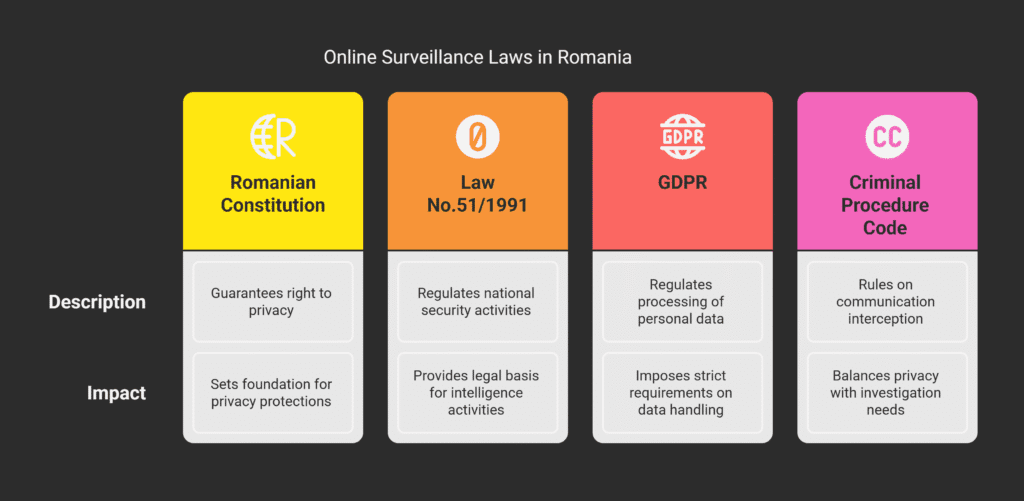
RegulationDescriptionImpact on Online Surveillance
Romanian ConstitutionGuarantees the right to privacySets the foundation for privacy protections in online surveillance
Law No.51/1991Regulates national security activitiesProvides the legal basis for intelligence activities, including online surveillance
GDPRRegulates the processing of personal dataImposes strict requirements on the handling of personal data in online surveillance

For more information on online surveillance laws in Romania, email office@theromanianlawyers.com.

Data Protection and Privacy Legislation in Romania

Romania’s data protection laws come from both national rules and EU regulations.

This has led to a detailed framework to safeguard personal data.

Data Protection and Privacy Legislation in Romania

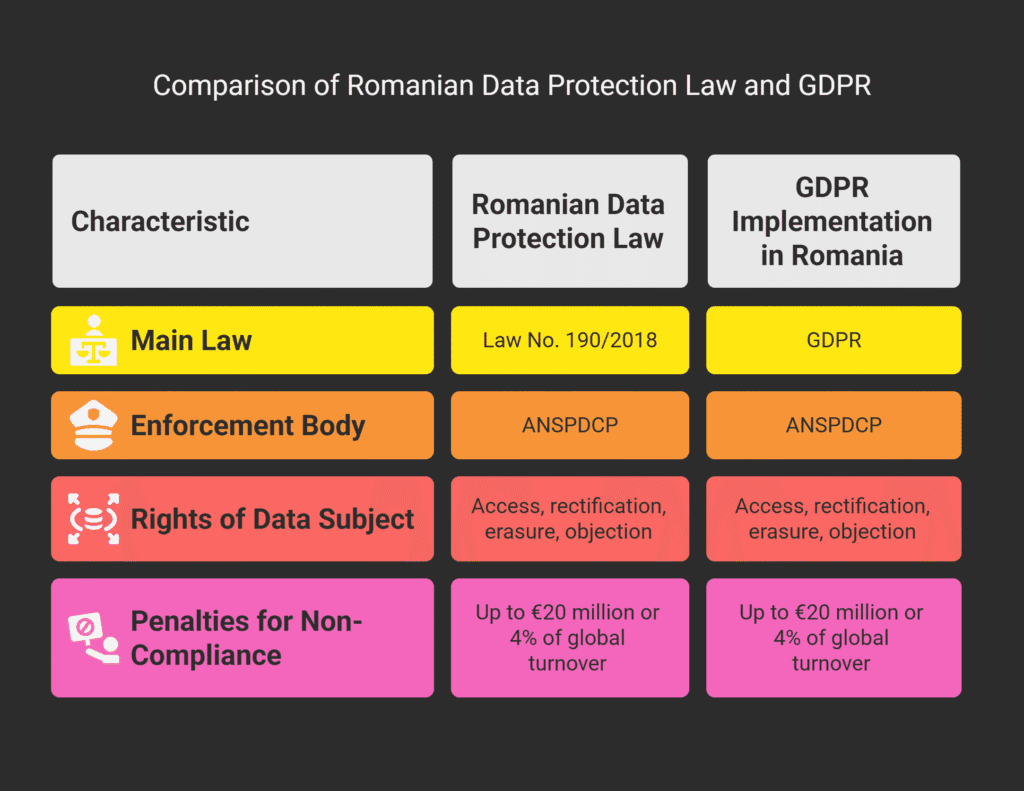
Romanian Data Protection Law

Romania has its own data protection law, working alongside the EU’s GDPR.

Law No. 190/2018 is the main law for data protection in Romania.

It makes sure Romanian laws match EU standards.

Key aspects of the Romanian Data Protection Law include:

GDPR Implementation in Romania

Romania, as an EU member, has fully adopted the GDPR.

The GDPR sets a common data protection level across the EU.

Romania’s adoption ensures it meets these standards.

Local Enforcement Mechanisms

The ANSPDCP enforces data protection laws in Romania.

It looks into complaints, does audits, and can impose penalties for breaking the rules.

Penalties for Non-Compliance

Companies that don’t follow data protection rules in Romania face big penalties.

The ANSPDCP can fine up to €20 million or 4% of the company’s global turnover, whichever is higher.

The following table summarizes the penalties for non-compliance with GDPR in Romania:

ViolationMaximum Fine
Failure to implement adequate security measures€10 million or 2% of global turnover
Non-compliance with data subject rights€20 million or 4% of global turnover
Failure to report data breaches€10 million or 2% of global turnover

Rights of Data Subjects Under Romanian Law

Data subjects in Romania have several rights under the GDPR and national law, including:

  • The right to access their personal data;
  • The right to rectify or erase their personal data;
  • The right to restrict or object to processing;
  • The right to data portability.

For more information on data protection and privacy legislation in Romania, you can contact office@theromanianlawyers.com.

Legal Aspects of Online Surveillance in Romania: Permitted Practices

Romania has clear rules for online surveillance.

It’s important for people and businesses to know these rules.

Legal Aspects of Online Surveillance in Romania

Lawful Interception Requirements

Lawful interception in Romania has strict rules.

To do surveillance, you must meet certain conditions.

Necessary Conditions for Surveillance

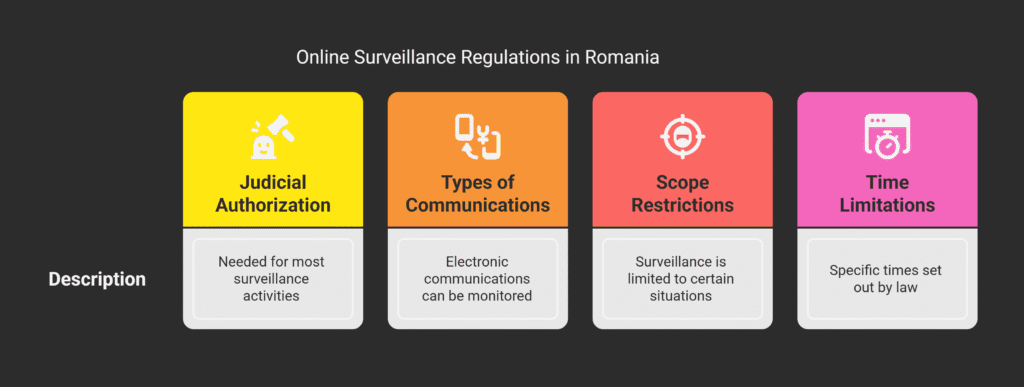
To start surveillance, you need judicial authorization.

This makes sure surveillance is legal and watched over.

  • Judicial authorization is needed for most surveillance;
  • The process checks the surveillance request carefully.

Types of Communications Subject to Monitoring

Many communications can be monitored, like electronic ones.

The law says which ones can be tapped.

Key aspects of lawful interception include:

  • Electronic communications can be monitored;
  • You need specific judicial authorization.

Judicial Authorization Process

The judicial authorization process is key in Romania’s surveillance laws.

It makes sure surveillance is legal and watched.

For more details on the judicial authorization process, email office@theromanianlawyers.com.

AspectDescription
Judicial AuthorizationNeeded for most surveillance activities
Types of CommunicationsElectronic communications can be monitored
Scope RestrictionsSurveillance is limited to certain situations

Time Limitations and Scope Restrictions

Surveillance in Romania has time limits and scope rules.

These rules make sure surveillance is fair and needed.

Knowing these rules is key for following the law.

The law sets out specific times and areas for surveillance.

Cybersecurity Regulations and Their Impact on Surveillance

The cybersecurity scene in Romania is changing fast.

New rules are shaping how we watch and record things.

Romania has set up a detailed plan to tackle cyber threats.

Cybersecurity Regulations and Their Impact on Surveillance

National Cybersecurity Strategy

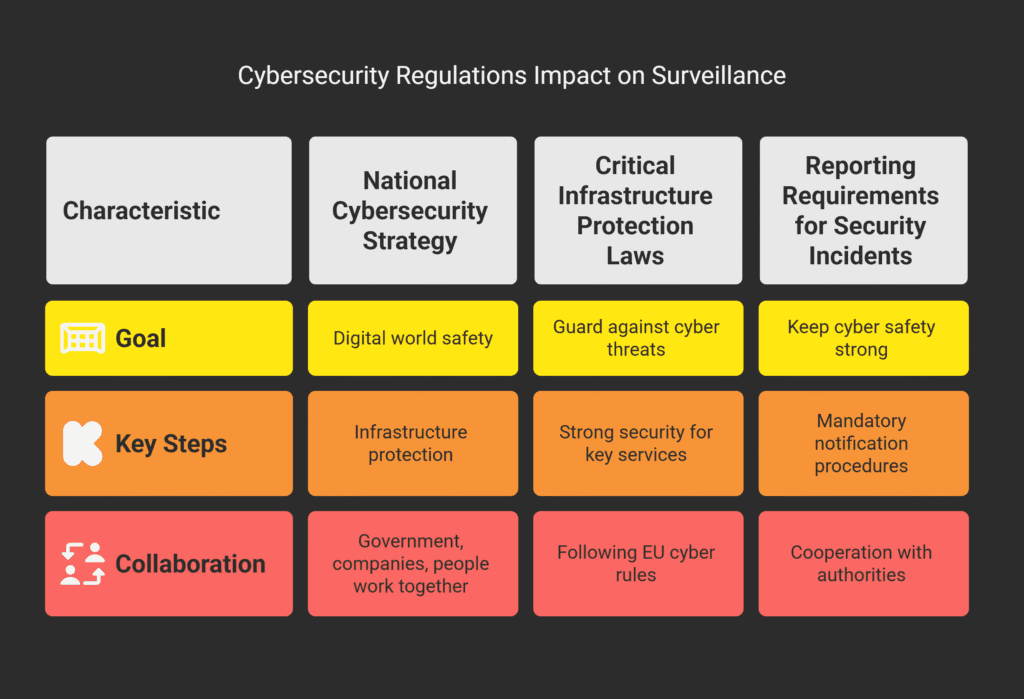
Romania’s National Cybersecurity Strategy aims to keep its digital world safe.

It involves the government, private companies, and people working together.

Key parts of the strategy are:

  • Protecting key infrastructure;
  • Getting better at handling cyber attacks;
  • Teaching everyone about staying safe online.

Critical Infrastructure Protection Laws

Keeping critical infrastructure safe is a big part of Romania’s cyber plan.

Laws are in place to guard against cyber threats.

Some key steps are:

  1. Using strong security for key services;
  2. Doing regular checks for risks;
  3. Following EU cyber rules..

Reporting Requirements for Security Incidents

Romania has rules for reporting cyber attacks quickly.

This helps keep the country’s cyber safety strong.

Mandatory Notification Procedures

Companies must tell the right people fast if they spot a cyber attack.

This quick action helps fix problems fast.

Cooperation with Authorities

Working well with authorities is key to handling cyber attacks.

It helps share info and learn from each other.

For more on cybersecurity laws in Romania and how they affect watching and recording, email office@theromanianlawyers.com.

Electronic Communications Monitoring: Legal Boundaries

In Romania, there are clear legal rules for monitoring electronic communications.

ISPs and users must follow these rules to stay legal.

Internet Service Provider Obligations

ISPs in Romania must work with law enforcement under certain rules.

They need to have the right setup to intercept communications legally when asked.

For more details on ISP duties and their impact, email office@theromanianlawyers.com.

Data Retention Requirements

Data retention is key in monitoring electronic communications.

ISPs must keep certain data for a set time.

Types of Data Subject to Retention

The data ISPs must keep includes:

  • Subscriber information;
  • Traffic data;
  • Location data.

Storage Duration and Security Standards

Data is kept for 6 months to 2 years, depending on the type.

ISPs must follow strict security rules to keep data safe.

Encryption and Anonymity Regulations

Romania has rules on encryption and anonymity in online communications.

Encryption is usually okay, but there are times when decryption is needed by law.

Users have the right to stay anonymous, but this right can be limited.

This is true in cases like criminal investigations.

For advice on how these rules affect you, talk to legal experts in Romanian telecom law.

Practical Implications for Businesses and Individuals

It’s important for foreign companies to know about Romania’s online surveillance rules.

This knowledge helps them stay in line and avoid risks.

If you’re a business in Romania, you need to understand the country’s data protection and online surveillance laws.

Practical Implications for Businesses and Individuals

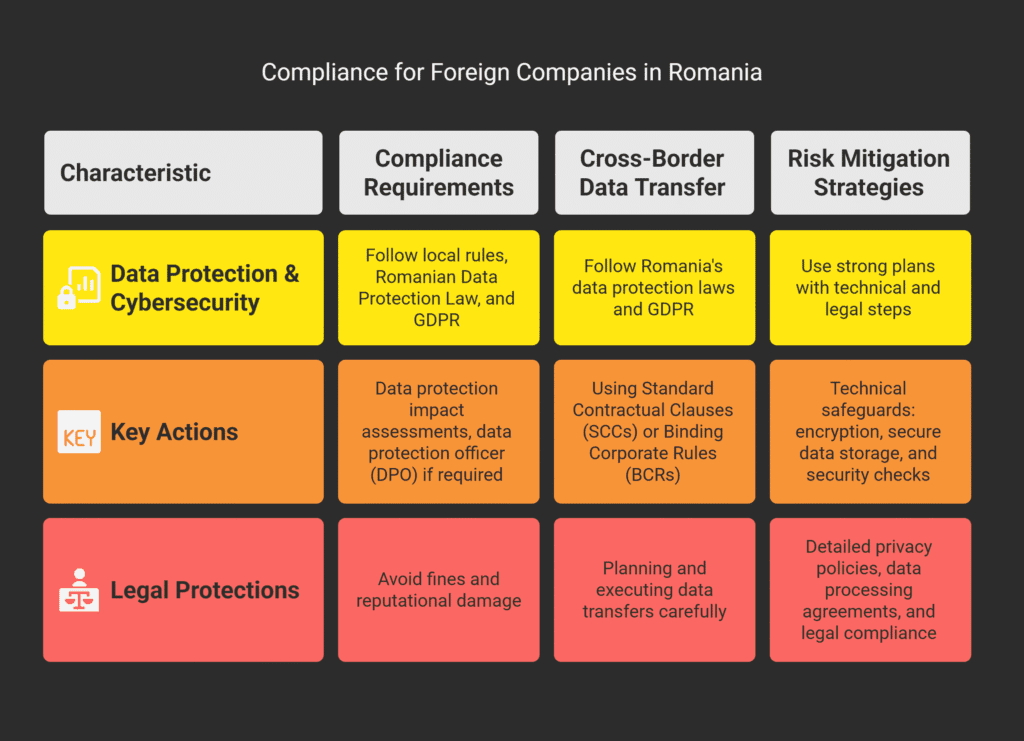
Compliance Requirements for foreign Companies Operating in Romania

Foreign companies in Romania must follow local data protection and cybersecurity rules.

This means they must stick to the Romanian Data Protection Law and the GDPR in Romania.

Following these rules is key to avoid big fines and harm to your reputation.

To meet these requirements, you should:

  • Do regular data protection impact assessments;
  • Use the right technical and organizational steps to keep data safe;
  • Have a Data Protection Officer (DPO) if the law says you must.

Cross-Border Data Transfer Considerations

When moving data across borders, foreign companies must follow Romania’s data protection laws and the GDPR.

This might mean using Standard Contractual Clauses (SCCs) or Binding Corporate Rules (BCRs) to protect data transfers.

Planning and executing cross-border data transfers carefully is essential for compliance.

You need to pick the best data transfer method for your business.

Risk Mitigation Strategies

To lower risks from online surveillance and data protection, foreign businesses in Romania should use strong risk mitigation plans.

These plans should include both technical and legal steps.

Technical Safeguards

Technical safeguards are key to protecting your business from data breaches and cyber threats.

Using encryption, secure data storage, and regular security checks can greatly reduce risks.

Legal Protections

Legal protections are also essential.

This includes having detailed privacy policies, data processing agreements, and making sure your business follows all relevant laws and regulations.

For more details on compliance and risk mitigation, reach out to a legal expert at office@theromanianlawyers.com.

Your Rights and Protections Against Unlawful Surveillance

In Romania, you have rights that protect you from unwanted spying.

Knowing these rights is key to keeping your privacy safe.

Constitutional Safeguards

The Romanian Constitution has strong protections against spying.

Article 30 guards your freedom of speech.

Article 26 protects your right to privacy.

These laws are the foundation of Romania’s rules on surveillance.

Legal Remedies for Privacy Violations

If you think your privacy has been broken, you have legal options. You can go to court for help with privacy issues.

Legal RemedyDescription
Judicial RecourseSeeking legal action through the courts for privacy violations.
Complaint to National Data Protection AuthorityFiling a complaint with the National Data Protection Authority for violations of data protection laws.

How to File Complaints with Romanian Authorities

If you think your privacy has been broken, you can report it to the right Romanian authorities.

National Data Protection Authority Process

The National Data Protection Authority watches over data protection laws in Romania.

To report a problem, write or use their online portal.

Judicial Recourse Options

You can also go to court for help.

A judge will look at your case and decide.

For more on your rights against spying in Romania, email a Romanian lawyer at office@theromanianlawyers.com.

Conclusion

You now know a lot about the laws that govern online surveillance in Romania.

The country’s laws on online surveillance, data protection, and cybersecurity are very important.

They shape how we use the internet.

Online surveillance laws in Romania are shaped by both national and European Union rules.

The data protection laws in Romania follow the General Data Protection Regulation (GDPR).

This means people’s personal data is well-protected.

Cybersecurity laws in Romania focus on keeping critical infrastructure safe and ensuring secure online communication.

If you’re doing business or living in Romania, it’s key to understand these laws.

This helps you stay in line with regulations and protect your rights.

For more details or help with these laws, you can reach out to the Romanian lawyers at office@theromanianlawyers.com.

FAQ

What is the current state of online surveillance in Romania?

Online surveillance in Romania is managed by a mix of laws.
These laws balance national security with privacy rights.
The country has laws like the Romanian Constitution and EU rules to oversee surveillance.

How does Romanian law protect individual privacy in the context of online surveillance?

Romanian law defends privacy in several ways.
It includes the Romanian Constitution and the GDPR.
People have the right to manage their data and seek help if their privacy is broken.

What are the requirements for lawful interception in Romania?

To legally intercept communications in Romania, a court order is needed.
The interception must be necessary and not too broad.
It must also be in line with a valid reason.

How do cybersecurity regulations in Romania impact online surveillance?

Romania’s cybersecurity laws aim to keep digital spaces safe.
They include the National Cybersecurity Strategy and laws for critical infrastructure.
These laws also affect surveillance by setting rules for data sharing and encryption.

What are the obligations of Internet Service Providers (ISPs) in Romania regarding online surveillance?

ISPs in Romania must help law enforcement get user data with a court order.
They also have to keep user data for a certain time.

How do online surveillance laws in Romania affect foreign businesses and individuals?

Foreign companies and people in Romania must follow the country’s surveillance laws.
They need to know the risks and take steps to protect themselves.

What are the rights and protections available to individuals against unlawful surveillance in Romania?

People in Romania have many rights against illegal surveillance.
These include constitutional protections and legal ways to fight privacy breaches.
They can also complain to Romanian authorities.

What is the role of the Romanian Constitution in protecting individual privacy?

The Romanian Constitution is key in protecting privacy.
It ensures the state respects privacy and sets rules for surveillance.

How does the GDPR apply in Romania?

The GDPR directly applies in Romania.
It offers strong data protection and strict rules for those handling personal data.

What are the key government agencies involved in online surveillance in Romania?

Important agencies for online surveillance in Romania are the Romanian Intelligence Service and the Ministry of Internal Affairs.
The National Authority for Management and Regulation in Communications also plays a role.
They enforce surveillance laws.

Urban and Agricultural Property Laws in Romania

Differences Between Urban and Agricultural Property Laws in Romania

Ever wondered why owning property in Romania seems like solving a puzzle?

The laws for urban and agricultural properties are different.

These differences affect your rights and duties as a property owner.

It’s key to know these differences if you’re in the Romanian real estate market.

In Romania, property laws have a long history and keep changing. You should know the rules for urban and agricultural lands.

This guide will help you understand these laws better.

It will also give you the tools to deal with these legal areas well.

Urban and Agricultural Property Laws in Romania

Key Takeaways

  • Urban and agricultural property laws differ significantly in Romania.
  • Understanding the legal framework for property in Romania is essential for property ownership.
  • Property regulations in Romania influence rights and responsibilities differently based on land type.
  • Historic legislation shapes current property laws.
  • Awareness of these differences can benefit real estate transactions.

Introduction to Property Laws in Romania

Understanding Romanian property laws is key for investors in Romania.

After communism fell, Romania changed its laws to make real estate more open.

This change aimed to make buying and selling property easier and clearer.

The laws about owning property in Romania come from the Constitution and the Civil Code.

These laws set out what property rights are, how to buy and sell, and what owners must do.

Knowing these property ownership laws in Romania helps you make smart choices when buying property.

Buying property in Romania means you need to know the local laws well.

Knowing your rights and duties can help your investment go smoothly. It also helps avoid legal problems.

Romanian property laws overview

Legal Framework for Property Ownership in Romania

The laws about owning property in Romania are complex.

They are shaped by several important laws.

The Civil Code is at the heart of these rules, explaining key rights and how to transfer property.

There are laws about returning land that was taken during communism.

These laws mix with today’s rules for owning property.

Also, laws about urban development set rules for using and building on land.

This makes sure land use fits with city plans.

In Romania, there’s a big difference between public and private property.

Public property is managed by the state or local governments.

Private property lets owners use, sell, or develop their land as they wish.

Knowing this is key for those looking to buy property in Romania.

These laws help protect property rights.

They create a stable place for investments and deals.

They are important for property owners to know and follow.

land ownership laws in Romania

Urban and Agricultural Property Laws in Romania

It’s key to know the differences in owning and managing land in Romania.

Urban and agricultural laws cover various aspects of land use and ownership.

Each area has its own rules for landowners and investors.

Differences in Ownership Rights

Property rights in Romania change a lot between cities and farms.

Urban laws allow for many uses of land, like homes and businesses.

But, farm laws focus on land for growing crops.

Urban areas have rules on building heights and how close buildings can be.

Farms have rules to keep land good for growing crops.

These rules help keep cities and farms organized.

Property Regulations and Administrative Procedures

Understanding the rules for land is important.

In cities, you need permits for building and follow zoning laws.

These rules help cities grow in an orderly way.

Farms have their own rules, like keeping land good for farming.

You might need to register plans with local officials.

This ensures developments are safe for the environment and farming.

urban property regulations Romania

Types of Property: Urban vs. Agricultural

Knowing the difference between urban and agricultural property in Romania is key.

It affects how you can use and develop your land.

Urban areas include homes, businesses, and factories, each with its own rules.

Residential areas are for living, commercial spaces are for businesses, and industrial areas are for making things.

These rules help keep everything organized and safe.

Agricultural land, like fields, pastures, and forests, is different.

Fields grow crops, pastures are for animals, and forests help the environment. Each has its own role and rules.

In Romania, laws control what you can build on your land.

These laws help keep the environment and community safe.

It’s important to know these rules if you want to invest or develop property here.

types of urban and agricultural property

Property Acquisition Regulations for Foreigners

It’s important to know the rules for buying property in Romania if you’re a foreigner.

The laws in Romania are clear about who can own property.

They treat EU citizens and non-EU citizens differently.

This affects what international buyers can do with urban and agricultural land.

Restrictions on Foreign Ownership

Foreigners face certain rules when buying property in Romania.

EU citizens can buy property like locals.

But, non-EU citizens have to jump through more hoops, like starting a business or following special rules for buying land.

  • EU citizens can buy property without many restrictions.
  • Non-EU citizens might need to start a business or make other legal plans to buy property.
  • Buying agricultural land comes with extra rules that buyers must follow.

Foreign buyers should learn about these rules to buy property smoothly.

Knowing the laws helps avoid problems and makes the buying process easier.

Urban Development Laws and Agricultural Land Regulations

The rules for urban development and agricultural land in Romania are complex.

They greatly affect how land is used and developed.

It’s important for property owners, developers, and farmers to understand these rules well.

Impact of Urban Planning on Property Development

Urban planning laws cover many aspects of property development.

These include zoning, environmental rules, and planning for infrastructure.

These factors are key in deciding how land can be used in cities.

Zoning laws decide what can be built on certain lands.

This affects homes, businesses, and factories.

Environmental rules make sure projects are green and don’t harm nature.

  • Zoning Regulations: Dictate what types of buildings and businesses are allowed.
  • Environmental Policies: Aim to protect natural resources during urban expansion.
  • Infrastructure Planning: Involves ensuring adequate transportation, utilities, and services for new developments.

Distinct Regulatory Frameworks for Agricultural Land Use

Agricultural land in Romania has its own set of rules.

These rules help keep farmland productive and follow certain policies.

There are limits on building on these lands to keep them useful for farming.

Regulation TypeUrban DevelopmentAgricultural Land Use
Zoning PoliciesDefines permissible land uses in urban areasRestricts non-agricultural development
Environmental ReviewsMandatory for urban projectsFocus on soil conservation and sustainable practices
Land Use Change ApprovalStringent for residential and commercial transitionsGuarded against conversion to non-agricultural usage

Expropriation Procedures in Urban and Agricultural Contexts

Expropriation laws in Romania set rules for taking private property for public use.

This is key for urban and agricultural projects.

These laws make sure property owners get fair pay.

They help balance the needs of projects with property rights.

The process starts with a public interest declaration.

This must explain why the property is needed, like for new roads or farms.

Owners must be told and given details about what will happen to their land.

Fair pay is a big part of expropriation. Experts figure out the property’s value to pay owners fairly.

The way properties are valued can change based on their use.

For example, city properties might be valued differently than farm land.

Urban and farm expropriations have their own rules.

This is because of the different types of properties and how they affect people.

The idea is to help the community by using public interest.

Knowing these rules helps property owners protect their rights.

Importance of Land Registration in Romania

Land registration is key in Romania for protecting property rights.

It confirms who owns what, making real estate deals safer.

Knowing the land registration laws in Romania helps users feel secure and clear about their property rights.

Impact of the Land Register on Property Rights

A strong land registration system proves who owns a property.

This is vital for buying, selling, or investing in land.

Without it, property rights are shaky, leading to legal issues.

Land registration laws in Romania make sure ownership is recognized by others.

This makes owning property safer and more secure.

But, dealing with land registration can be tricky.

Owners might run into rules that make it hard to follow the law.

Keeping up with changes in land registration laws in Romania helps avoid problems caused by bad or late registrations.

Conclusion

Property laws in Romania show big differences between city and countryside.

It’s key to know these differences to handle them well.

We’ve looked at how ownership, buying, and rules vary, which is important for understanding city vs countryside property laws in Romania.

Real estate rules in Romania are complex and need careful thought.

As city laws change, they affect property rights and investment chances.

It’s vital to stay updated.

Property owners or investors should work with legal experts to follow rules and make smart choices.

Learning more about laws and duties will help you trust your real estate plans in Romania, no matter if it’s in the city or countryside.

Knowing these differences helps you make better choices and succeed in Romania’s property market.

FAQ

What are the key differences between urban and agricultural property laws in Romania?

Urban and agricultural properties in Romania have different rules.
Urban areas have laws for homes and businesses.
Agricultural lands focus on keeping them productive.

How does post-communism history affect property laws in Romania?

After communism, Romania changed its property laws.
These changes helped return properties taken during the communist era.
Knowing both old and new laws is key for real estate.

What legal documents govern property rights in Romania?

The Constitution and Civil Code are key.
They explain who owns what and how to develop land.
They protect property owners’ rights.

Are there specific regulations for foreign individuals looking to acquire property in Romania?

Yes, there are rules for foreigners.
EU citizens can buy like locals.
But, non-EU citizens face more rules, like limits on owning farmland.

How does urban planning impact property development in Romania?

Urban planning is very important. It decides what you can do with land and how to build.
Following these rules is needed to get permits and meet local policies.

What is the process of expropriation for property in Romania?

Expropriation lets the government take land for public use.
Owners must get fair pay. Rules for taking urban and farmland differ.

Why is land registration important in Romania?

Land registration proves who owns what. It’s key for buying and selling.
But, problems with registration can cause legal issues.

What are the implications of zoning laws in property ownership?

Zoning laws control what you can do with land.
They affect how you can use your property.
Knowing these laws is important to avoid problems.

How can I navigate property disputes in Romania?

To deal with property disputes, you need to know the laws. It’s best to talk to a Romanian lawyer.
They can help with issues like ownership, zoning, or expropriation.

What are the main differences between urban and agricultural property ownership in Romania?

The ownership regime in Romania differs significantly between urban and agricultural properties.

Agricultural land in Romania is subject to special protective regulations that don’t apply to urban real estate.

While urban properties can generally be freely traded on the market, agricultural land transactions are restricted by the pre-emption right system.

This means that when a landowner wants to sell Romanian agricultural land, certain categories of buyers have priority purchase rights before the land can be offered on the open market.

The new law introduced in 2020 has strengthened these restrictions, particularly for agricultural land located outside built-up areas.

Additionally, urban property transactions typically don’t require proof of qualification or intent to use the property for specific purposes, whereas those who want to buy agricultural land must often demonstrate their ability to carry out agricultural activities or have qualifications related to agriculture.

How does the pre-emption right system work for agricultural land sales in Romania?

The pre-emption right system for the sale of agricultural land in Romania is a hierarchical priority system that gives certain categories of buyers the first option to purchase the land before it can be sold on the open market.

According to the new law, when a landowner decides to sell agricultural land, they must first submit a sale offer to the city hall of the administrative-territorial unit where the land is located.

The registration of the sale offer initiates a process where potential buyers with pre-emption rights have 45 days to express their intention to purchase.

The priority order includes: co-owners, tenants, neighboring landowners, young farmers, the Academy of Agricultural and Forestry Sciences, and only then other natural persons or legal entities.

If no pre-emptors exercise their right within the specified timeframe, the seller can proceed with selling to any interested buyer, but at a price no lower than the one stated in the sale offer.

Any attempt to circumvent this procedure can result in the nullity of the sale and purchase agreement.

Crypto Romania 2025

What is a Beneficial Owner and How to Declare It in Romania

Who is the beneficial owner of a Romanian company?

The beneficial owner is the natural person who ultimately owns or controls a company. Romanian companies must identify that person correctly, record the means of control and update the Trade Register when the relevant information changes.

Shareholder or controller
Romanian company
Ultimate beneficial owner

Select the relevant identification test:

Direct or indirect ownership

A holding of 25% plus one share, or a participation of more than 25% in the capital, is an indication of direct ownership when held by a natural person. Indirect ownership may exist through one or more controlled entities.

Key point: most Romanian companies do not file a beneficial-owner declaration every year. The usual filing moments are incorporation and any later change concerning the beneficial owner or that person’s identification data. Apart from incorporation and subsequent changes, an annual filing obligation applies only to the entities described in Article 56(1³) of Law no. 129/2019.

How is a beneficial owner identified in Romania?

Article 4 of Law no. 129/2019 defines a beneficial owner as any natural person who ultimately owns or controls a legal entity, or the natural person on whose behalf a transaction or activity is conducted.

For a company, identification normally follows three levels:

Direct or indirect ownershipA holding of 25% plus one share, or a participation of more than 25% in the capital, is an indication of direct ownership when held by a natural person. Indirect ownership may exist through one or more controlled entities.
Control through other meansA person may be the beneficial owner even without crossing the ownership threshold if that person ultimately controls the company through voting arrangements, contractual rights or other means.
Senior managing officialIf no natural person is identified after all possible means have been exhausted, and there is no ground for suspicion, the law uses the natural person or persons holding the position of senior managing official as the fallback.
Document the conclusionThe company should be able to explain the ownership chain, the applicable criterion and the manner in which control is exercised. A percentage alone may not answer the question in a complex structure.
Common mistakeTreating every shareholder owning exactly 25% as an automatic beneficial owner. The statutory ownership indicator is 25% plus one share or a capital participation exceeding 25%; control through other means must still be analysed separately.

Which Romanian entities must declare their beneficial owners?

Persons subject to registration with the Romanian Trade Register must provide beneficial-owner information under Article 56 of Law no. 129/2019. At incorporation, the obligation may also be fulfilled by including the required identification data and means of control in the articles of association.

The person making the declaration is the company’s legal representative. The analysis behind the declaration should cover the full ownership and control structure, particularly where the Romanian company has foreign corporate shareholders, nominee arrangements or several intermediate holding companies.

For foreign founders incorporating locally, beneficial-owner identification should be coordinated with the wider Romanian company formation process and the supporting corporate documents collected from each jurisdiction.

When must a beneficial-owner declaration be filed?

Filing eventWho is affected?DeadlinePractical point
IncorporationLegal entities subject to registration with the Trade RegisterAs part of the incorporation filingThe obligation may be fulfilled through the articles of association if all required data and means of control are included.
Change of beneficial owner or identification dataRegistered legal entities affected by the changeWithin 15 days from the date of the changeA share transfer, restructuring or change of personal data should trigger an immediate review.
Annual declarationOnly entities within Article 56(1³)Within 15 days after approval of the annual financial statementsThis is not a universal annual obligation.
Existing companiesAccording to the official ONPCSB guidance, a company that has filed at least one declaration after Law no. 129/2019 entered into force generally files a new declaration only when the beneficial owner or the relevant identification data changes, unless it belongs to the special annual-filing category.

Who has an annual filing obligation?

Apart from the filing required at incorporation and following subsequent changes, the additional annual filing obligation applies only where the registered entity has, in its shareholding structure, entities incorporated, registered or fiscally resident in:

  • non-cooperative jurisdictions for tax purposes;
  • jurisdictions presenting a high money-laundering or terrorist-financing risk; or
  • jurisdictions monitored by relevant international bodies for money-laundering or terrorist-financing risk.

The lists are not static. They are updated by the competent international bodies and published through official channels. Reference should be made to the applicable EU, FATF and Romanian-designated lists in force at the relevant filing date rather than to a fixed list copied from an older source.

Do not assume an annual declaration is requiredA Romanian SRL with a straightforward Romanian or EU ownership structure will not normally fall within the annual-filing rule merely because it has foreign shareholders. The precise jurisdiction and every entity in the shareholding chain must be checked.

What information must the declaration contain?

Article 56(2) and (3) requires the declaration of each beneficial owner’s identification data and the manner in which control is exercised. The information includes:

  • full name;
  • date of birth;
  • personal numerical code, where one has been assigned;
  • series and number of the identity document;
  • citizenship;
  • domicile or residence; and
  • the manner in which the person exercises ultimate ownership or control.

The control description should identify the relevant legal criterion and the ownership chain. Generic wording may be insufficient where control is indirect or based on contractual or voting rights.

How can the declaration be signed and submitted?

At incorporation, Article 56(6) allows the beneficial-owner data and the means of control to be included in the articles of association. Outside that step, Article 56(5) sets the principal form of the declaration. The availability and technical requirements of electronic filing are governed by the current ONRC procedures and online platform requirements, which should always be verified before submission.

Document or signature formAvailable submission routeImportant condition
Declaration made before an ONRC representativeAt the competent Trade Register officeThe declarant follows the current office procedure and uses the applicable form.
Declaration with a certain date from a notary or attested by a lawyerFiled personally or through a representativeThis is the route expressly provided by Article 56(5); the representative’s authority must also be valid for the filing.
Electronic filing through ONRC MyPortalONRC online servicesCheck the live ONRC requirements for the accepted document format, electronic signature and representation route before submission.

ONRC provides electronic filing through ONRC MyPortal. The current form, accepted document format, electronic-signature requirements and filing category should be checked immediately before submission.

Which corporate changes require a new UBO review?

A formal review should take place whenever an event can change ultimate ownership, control or the identification data already recorded. Examples include:

  • a transfer of shares or participation interests;
  • an issue, cancellation or redistribution of shares;
  • a change in the foreign ownership chain;
  • a shareholder agreement changing voting or appointment rights;
  • a merger, demerger or internal group reorganisation;
  • a change concerning the person used as senior managing official; or
  • a change in a beneficial owner’s identity-document, residence or other declared data.

A transaction may therefore require both the corporate registration steps explained in our guide to changing shareholders in a Romanian company and a separate beneficial-owner filing. Rights created in a Romanian shareholder agreement should also be checked for control through other means.

What are the penalties for non-compliance?

Under Article 57 of Law no. 129/2019, failure by the legal representative to submit the declaration constitutes an administrative offence punishable by a fine from RON 5,000 to RON 10,000.

If the declaration is still not submitted within 30 days after the sanction is applied, the competent tribunal may order the company’s dissolution at the request of the National Trade Register Office. The ground for dissolution can be remedied before final submissions on the merits.

Check the applicable sanctionSome online sources refer to higher sanction ranges. However, the specific sanction generally associated with failure to file the beneficial-owner declaration under Article 57(1) is a fine ranging from RON 5,000 to RON 10,000, followed by the possible dissolution procedure described above if non-compliance continues.

Beneficial owner Romania: practical filing workflow

Filing map

From ownership review to Trade Register update

A reliable filing starts with the complete ownership chain, not with the declaration form. Select a stage to see its practical purpose.

Map ownership

Trace each direct and indirect corporate shareholder until the natural persons at the end of the ownership and control chain are identified.

Checklist for foreign-owned Romanian companies

Collect the ownership chartTrace every corporate shareholder to the ultimate natural persons.
Verify current documentsUse up-to-date registry extracts, identity documents and constitutional records.
Calculate direct and indirect holdingsDo not stop at the first foreign holding company.
Review other control rightsCheck voting agreements, vetoes, appointment powers and contractual control.
Check the filing triggerConfirm whether the event is incorporation, a change or the limited annual obligation.
Check current jurisdiction listsDo not rely on an old article or a fixed list copied from another source.
Use consistent dataNames, addresses and identification details should match the supporting records.
Keep evidence of filingRetain the submitted declaration, registration proof and the ownership analysis.

Need assistance with a Romanian beneficial-owner filing?

Atrium Romanian Lawyers assists Romanian companies, foreign founders and international groups with beneficial-owner analysis, declarations, shareholding changes and Trade Register filings.

Frequently asked questions

Does every Romanian company file a beneficial-owner declaration annually?

No. Most companies file at incorporation and when the beneficial owner or the declared identification data changes. Apart from those filing events, an additional annual obligation applies only to the entities described in Article 56(1³) of Law no. 129/2019.

What is the ownership threshold for a beneficial owner in Romania?

Holding 25% plus one share, or a participation exceeding 25% of the capital, indicates direct ownership by a natural person. Indirect ownership and control through other means must also be considered.

What is the deadline after a change?

The declaration must be filed within 15 days from the date on which the beneficial owner or the relevant identification data changes.

Can the declaration be submitted online?

ONRC provides electronic filing through its online services. Before using that route, check the live platform requirements for the applicable form, accepted document format, electronic signature and representation. Article 56(5) also provides for a declaration made before an ONRC representative or filed personally or through a representative with a certain date from a notary or an attorney attestation.

Can a lawyer assist with the declaration?

Yes. A Romanian lawyer can analyse the ownership and control chain, prepare or attest the declaration where appropriate, represent the company in the filing and coordinate it with related corporate registrations.

What happens if the declaration is not filed?

The legal representative may receive a fine from RON 5,000 to RON 10,000. Continued non-compliance for 30 days after the sanction may lead to a court dissolution request by the National Trade Register Office.

Disclaimer: This article provides general information and does not constitute legal advice. Beneficial-owner status and filing obligations depend on the current legislation, ownership structure, control rights and facts of each company.

AI Notice: AI-assisted content, reviewed by a qualified Romanian lawyer.

freelancer Romania

Freelancing vs. Employment Contract in Romania: What’s Better Legally?

Freelancing vs. Employment Contract in Romania: What’s Better Legally?

Freelancing vs. Employment Contract in Romania

Are you trying to figure out the best way to work in Romania?

You might be thinking about freelancing or traditional jobs.

Both have their own legal benefits and financial perks.

Romania’s work scene has changed a lot.

Now, more people are choosing to work for themselves.

This gives them the chance to be more flexible and make choices that fit their career goals.

The job market in Romania is pushing people to think differently about work.

It’s important to know the legal differences between freelancing and traditional jobs.

This helps you understand your rights, duties, and what it might mean for your money.

Key Takeaways

  • Romania’s professional landscape increasingly supports flexible work arrangements;
  • Legal distinctions between freelance and employment contracts significantly impact professional strategies;
  • Financial and regulatory considerations are key when choosing work models;
  • Professional autonomy and risk management differ between employment and freelance status;
  • Understanding legal frameworks is essential for making informed career decisions.

Understanding Legal Status in Romanian Labor Market

Romanian Labor Market Legal Status

The Romanian labor market is complex for those in the gig economy.

It’s important to know the difference between dependent and independent work.

This is key for employers and workers to understand labor laws in Romania.

The Romanian Fiscal Code outlines the rules for different work setups.

It affects employee rights and taxes. This law helps decide who is considered a worker based on certain criteria.

Defining Dependent Activities

Dependent activities have a few main points:

  • Direct subordination to an employer;
  • Fixed working schedule;
  • Predetermined workplace;
  • Employer-provided equipment and resources.

Defining Independent Activities

Independent activities are different, with:

  • Autonomous work arrangement;
  • Flexible working hours;
  • Self-managed professional services;
  • Personal risk and investment.

Key Legal Framework Differences

The legal differences between these types affect work relationships, social security, and taxes.

Workers and businesses must check their work setup to follow Romanian labor laws.

Knowing these legal details helps workers and companies make smart choices in Romania’s labor market.

Freelancing vs. Employment Contract in Romania

Freelance Work in Romania

Understanding the Romanian labor market is key.

It’s important to know the difference between freelancing and traditional jobs.

Romania’s flexible work options let professionals design their careers with more freedom.

Independent contractor laws in Romania give workers a lot of freedom.

Freelancers can use these laws to build careers that fit their skills and lifestyle.

  • Freelancing offers tax benefits;
  • Employment contracts provide more structured social benefits Romania;
  • Independent work allows for greater schedule flexibility;
  • Traditional employment ensures more consistent income streams.

Choosing between freelancing and a job depends on your career goals and how much risk you’re willing to take.

Freelance work in Romania supports entrepreneurship while protecting workers’ rights.

Professionals need to think about several things:

  1. Income stability;
  2. Legal protections;
  3. Tax implications;
  4. Long-term career development.

Freelancing offers flexibility and the chance for higher earnings.

On the other hand, traditional jobs provide steady income and strong social security benefits.

Legal Distinctions Between Contractors and Employees

Understanding employment laws in Romania is key.

It’s important to know the differences between contractors and full-time employees.

Romanian labor laws set clear criteria for these distinctions.

These criteria affect rights, responsibilities, and legal duties.

Romanian Employment Legal Distinctions

The Romanian legal system looks at work relationships closely.

It uses several key factors to decide the type of work arrangement.

Subordination Criteria

Subordination is the main difference between contractors and full-time employees in Romania.

The rights of contractors differ from those of employees.

This is based on several key criteria:

  • Direct management control;
  • Work schedule compliance;
  • Reporting hierarchies;
  • Performance evaluation processes.

Workplace Integration

Workplace integration is also key in determining work relationships.

The following elements help tell if someone is an independent contractor or an employee:

  1. Physical workspace utilization;
  2. Company resource access;
  3. Organizational communication channels;
  4. Team participation requirements.

Risk and Responsibility Distribution

AspectContractorEmployee
Financial RiskHigh Personal RiskMinimal Personal Risk
Equipment ProvisionSelf-FundedEmployer-Provided
Legal LiabilityPersonal ResponsibilityShared Organizational Responsibility

Those working in Romania’s labor market need to understand these legal differences.

This ensures they follow the law and protect their interests.

Tax Implications and Financial Considerations

Romania Freelancing Tax Implications

Understanding taxes for independent contractors in Romania is key.

The country’s tax system has both benefits and challenges for freelancers.

It’s important to know the financial landscape well.

Romania has a flat tax rate of 10% for all income.

This rate is the same for both employees and freelancers.

It makes managing finances easier for freelancers.

  • Flat tax rate of 10% for individual income;
  • Self-employed professionals responsible for personal tax filings;
  • Mandatory social contribution calculations;
  • Potential tax deductions for business expenses.

Freelancers in Romania must register with tax authorities and keep detailed financial records.

They need to know about tax reporting and possible benefits.

Financial planning for freelancers in Romania is different from traditional jobs.

Remote work adds complexity to taxes.

It requires careful financial planning.

Financial AspectEmployee StatusFreelance Status
Tax Rate10% Flat Rate10% Flat Rate
Social ContributionsEmployer ManagedSelf-Managed
Expense DeductionsLimitedMore Flexible

Freelancers need to plan their finances wisely.

This ensures they stay tax-efficient and compliant in Romania’s rules.

Contractual Rights and Obligations

Understanding the legal side of work in Romania is key.

The country has two main work setups: full-time jobs and freelance work.

Each has its own rules to protect workers and employers.

Romanian Employment Contract Rights

The laws around work contracts in Romania are very important.

They help workers feel secure and flexible in their jobs.

Knowing these differences helps people choose the right career path.

Employment Contract Requirements

Full-time jobs in Romania follow strict rules from the Romanian Labor Code.

The main points are:

  • Mandatory written contract detailing job responsibilities;
  • Clear specification of work hours and compensation;
  • Explicit definition of employee rights and obligations;
  • Provisions for social security and benefits.

Freelance Contract Elements

Freelance deals offer more freedom but need to be well-written for legal safety.

Important parts are:

  1. Scope of work and deliverable specifications;
  2. Payment terms and conditions;
  3. Project timeline and milestones;
  4. Intellectual property rights allocation.

Termination Provisions

Tax and work-life balance issues vary between jobs and freelance work.

Termination rules also differ.

Jobs usually have more set rules than freelance work.

It’s important for professionals to know their contract well.

This ensures they are protected and can have a good career.

Social Security and Benefits Comparison

Understanding employee benefits in Romania is key.

It’s important to know the differences between working as an employee and being a freelancer.

The social security system has its own rules for each choice.

Employees in Romania get many benefits.

These include:

  • Mandatory health insurance coverage;
  • Pension fund contributions;
  • Paid annual leave;
  • Sick leave compensation;
  • Maternity and paternity leave benefits.

Freelancers in Romania face different rules.

They must handle their social insurance on their own.

This gives them freedom but also more responsibility.

It’s important to know these rules before deciding how to work.

Freelancers need to plan for their social security:

  1. Registering with local social security authorities;
  2. Making regular self-employed contributions;
  3. Purchasing supplemental health insurance;
  4. Creating personal retirement savings strategies.

Choosing between being an employee or a freelancer affects your future.

You need to think about your risk level and financial goals.

This choice is important in Romania’s changing work scene.

Business Structure Options for Freelancers

Freelancers in Romania have many legal ways to organize their work.

It’s important to know the business structures that fit with labor laws for freelancers in Romania.

The Romanian legal system has three main business structure options for freelancers.

Each has its own tax rules and regulations.

PFA (Persoană Fizică Autorizată): Individual Authorized Person

The PFA is the simplest business structure for solo entrepreneurs. It has key features like:

  • Easy registration process;
  • Low administrative costs;
  • Direct personal tax responsibility;
  • Great for small freelance projects.

SRL (Limited Liability Company): Scalable Business Entity

An SRL offers more legal protection for freelancers who want to grow.

It has benefits such as:

  • Separate legal entity status;
  • Limited personal liability;
  • Potential tax savings;
  • Opportunities for investment and growth.

Civil Contract Options: Flexible Professional Arrangements

Civil contracts give freelancers flexible work arrangements with clients.

They allow professionals to set work terms while keeping their independence under freelance laws in Romania.

Choosing the right business structure needs careful thought.

It depends on your professional goals, financial situation, and future plans.

Intellectual Property Rights and Ownership

Understanding intellectual property (IP) rights in contract work in Romania is key.

The rules on who owns created work vary between employees and independent contractors.

This makes it vital to have clear contracts.

For employees in Romania, the law usually says the employer owns the work done.

Unless a contract says differently, the employer owns what’s created during work hours.

  • Employee IP ownership defaults to the employer;
  • Independent contractors usually retain original IP rights;
  • Explicit contract terms are key for IP protection.

Remote work in Romania adds more complexity to who owns what.

Independent contractors have more protection for their ideas.

When deciding to work as a contractor or employee, it’s important to make detailed agreements.

These should cover who owns what, how it can be used, and any payment for it.

Important steps to protect intellectual property include:

  1. Make sure who owns what is clear in the first contract;
  2. State who can use the work and any limits;
  3. Set out how much to pay for using someone’s ideas;
  4. Add clauses about keeping information secret.

Experts in law should be consulted to make sure all IP is protected.

This helps both sides in professional settings in Romania.

Working Hours and Flexibility Considerations

Freelancing in Romania brings unique benefits in work hours and flexibility.

Unlike regular jobs, freelancers can set their own schedules.

They can work when they’re most productive and feel best.

Freelancing in Romania also means more freedom.

Freelancers can enjoy several key benefits:

  • Complete control over daily work schedule;
  • Ability to work from multiple locations;
  • Potential for increased productivity during peak personal energy times;
  • Opportunity to balance professional and personal commitments.

But freelancing also has its downsides. It can be hard to keep work and personal life separate.

Without set hours, freelancers might work too much and earn irregularly.

They need to be good at managing themselves to avoid burnout.

Freelance taxes in Romania add another layer of complexity.

Freelancers must keep track of their hours, manage projects, and keep accurate records.

This is to follow local tax laws.

Managing work hours as a freelancer requires careful planning.

Here are some tips:

  1. Set clear boundaries between work and personal time;
  2. Create a daily routine;
  3. Use time-tracking tools for project management;
  4. Take regular breaks to stay productive.

Freelancing in Romania needs discipline and planning.

Freelancers must balance their freedom with the need to be professional.

This is key to success in the Romanian market.

Registration and Compliance Requirements

Starting a remote work career in Romania means you need to know the legal rules.

Freelancers and employees have different paths to follow in the Romanian job market.

Freelancers first need to register with the National Trade Register Office (ONRC).

This step sets the legal rules for working on your own.

  • Register as a Persoană Fizică Autorizată (PFA);
  • Get the right business permits;
  • Get a tax ID number;
  • Sign up for social security.

Freelancers need to have certain documents ready.

These include:

  1. Your ID;
  2. Proof of your skills;
  3. A business plan;
  4. Tax compliance papers.

For employees, the rules are different. Employers handle most of the paperwork.

This includes social security and health insurance.

The whole process for freelancers usually takes 3-5 business days.

It’s important to have all your documents in order to follow the law in Romania.

Common Industries for Freelancing in Romania

The Romanian gig economy is growing fast. It offers many flexible work options for freelancers.

This shows how self-employment and full-time jobs are both viable in Romania.

Digital skills and online work have opened new doors.

They let people choose to work as independent contractors in Romania’s changing economy.

IT and Digital Services

Romania’s tech sector is booming for freelancers.

Jobs in software development, web design, cybersecurity, and digital marketing are plentiful.

These roles are perfect for those who want to work on their own terms.

  • Software engineering;
  • Mobile application development;
  • Cloud computing solutions;
  • Digital infrastructure consulting.

Creative Industries

Creative fields in Romania are also ripe for freelancers.

Graphic design, content creation, multimedia production, and digital arts offer flexible careers.

They suit skilled individuals who prefer independent work.

  • Graphic design services;
  • Video production;
  • Digital marketing content;
  • Brand communication strategies.

Professional Services

Consulting, translation, legal advice, and financial services are also good for freelancers.

These areas in Romania’s professional world offer opportunities for independent work.

  • Management consulting;
  • Technical translation;
  • Financial advisory;
  • Legal research services.

Conclusion

Choosing between freelancing and traditional jobs in Romania needs careful thought.

Freelancers face both benefits and challenges, like tax implications.

Knowing your rights is key when deciding your career path.

Freelancing in Romania offers freedom and tax benefits.

But, it also means less job security and fewer social benefits.

Planning well and understanding the law can help manage these risks.

Experts say it’s smart to do your homework and maybe talk to a Romanian lawyer before switching jobs.

Romania’s laws help both freelancers and employees make good choices for their careers and lives.

If you’re unsure about Romania’s job rules, seek advice from Romanian legal experts.

FAQ

What is the difference between a freelancer and an employee in Romania?

In Romania, the main difference is in control and supervision.

Employees work under direct supervision with fixed hours.
Freelancers, on the other hand, work independently, set their own hours, and often work on projects for multiple clients.

How do I choose between freelancing and traditional employment in Romania?

Think about job security, taxes, benefits, and what you prefer.
Employees get stability and benefits.
Freelancers have flexibility and can earn more but handle their own taxes and insurance.

What tax obligations do freelancers have in Romania?

Freelancers in Romania pay a flat tax and social security contributions.
They also need health insurance.
The exact taxes depend on their business type and income, with different rules than for employees.

What business structures are available for freelancers in Romania?

Freelancers can choose from PFA, SRL, or civil contracts.
Each has its own tax rules, paperwork, and liability protection.
It’s important to pick the right one for your business.

How do intellectual property rights work for freelancers in Romania?

Intellectual property rights for freelancers are set in their contracts.
Unlike employees, freelancers must agree on IP rights in their contracts to protect their work.

What are the social security implications for freelancers?

Freelancers in Romania must handle their social security on their own.
This means paying for pension, health insurance, and more.
It’s more complex and can be more expensive than for employees.

What industries are most suitable for freelancing in Romania?

IT, digital services, creative fields, and consulting are best for freelancing in Romania.
These areas offer many opportunities for independent work due to their project-based nature and demand for skills.

What registration requirements exist for freelancers in Romania?

Freelancers need to register with local authorities and get a tax ID.
They must also choose a business structure.
This involves paperwork, fees, and ongoing compliance with Romanian laws.

How do working hours differ between freelancers and employees?

Employees have fixed hours by law, while freelancers set their own.
Freelancers must manage their time well, meet deadlines, and keep professional standards.

What legal protections do freelancers have in Romania?

Freelancers have fewer legal protections than employees.
They must write clear contracts, negotiate terms, and handle legal risks themselves.
Despite this, they have more freedom in choosing projects and managing their work.

What are the main differences between employment contracts in Romania and freelancing arrangements?

In Romania, the distinction between employment contracts and freelancing arrangements is significant from both legal and financial perspectives.

An employment contract (contract individual de muncă) is governed by the Romanian Labor Code and establishes a subordination relationship between the employee and employer.

Freelancers in Romania typically operate as independent contractors, either through a PFA (Persoană Fizică Autorizată) or other legal entity forms.

The key differences include:

1. Legal framework: Employment contracts are strictly regulated by the Romanian Labour Code, while freelancing activities are governed by civil law and tax regulations, often through civil contracts or service agreements.

2. Subordination: An employee works under the direct supervision and control of the employer, following a predetermined schedule and procedures.

An independent contractor in Romania has autonomy regarding how, when, and where they complete their work.

3. Social protection: Employees in Romania are entitled to social benefits including paid vacation, sick leave, maternity leave, and unemployment benefits.

Freelancers must arrange their own social protection.

4. Tax responsibility: For employees, the employer handles tax withholding and social contributions.

Freelancers are responsible for their own tax and social contribution obligations.

traffic offense fines romania

Drive in Romania: Fines & Romanian Traffic Offence Guide

Drive in Romania: Fines & Romanian Traffic Offence Guide

Traffic Fine in Romania

What if avoiding a traffic ticket in Romania requires more than just obeying speed limits?

Navigating the country’s roads demands precise knowledge of local regulations to ensure both safety and compliance.

This guide delivers actionable insights into the legal framework governing drivers, from mandatory equipment to penalty calculations.

Romanian law enforces strict adherence to seat belt usage, winter tire requirements, and first aid kit accessibility.

Violations can result in fines calculated as a percentage of the national minimum wage, alongside penalty points on licenses.

Understanding these rules is critical for avoiding costly delays or legal complications.

This resource outlines essential documentation, regional driving conditions, and strategies to minimize risks.

Timely access to accurate information ensures travelers and professionals can plan efficiently while adhering to legal standards.

Key Takeaways

  • Mandatory equipment includes seat belts, winter tires (seasonal), and a first aid kit.
  • Fines are calculated based on Romania’s minimum wage and may include penalty points.
  • Drivers must carry valid licenses, insurance, and vehicle registration at all times.
  • Appeals against fines must be filed within 15 days of issuance.
  • Local authorities enforce strict speed limits and alcohol consumption thresholds.

Understanding Traffic Fine in Romania: Implications and Regulations

Romanian traffic code regulations

Romania’s legal framework for roadway conduct prioritizes accountability through structured enforcement mechanisms.

Authorities apply penalties proportionally to infractions, ensuring both individual responsibility and public safety.

Core Legal Framework

The Romanian Traffic Code defines mandatory equipment standards, including seat belts and winter tires.

Non-compliance with these rules may lead to fines ranging from 435 to 870 lei ($95–$190).

Drivers must also carry valid vehicle registration and a driver license during transit.

Penalty Structure

Serious violations like speeding beyond 50 km/h over limits incur fines up to 2,610 lei ($570).

Repeat offenders risk temporary license suspension.

Driving under influence carries stricter consequences, including potential imprisonment for blood alcohol levels exceeding 0.8 g/l.

Accountability Mechanism

A 15-point system penalizes infractions such as illegal overtaking or ignoring signals.

Accumulating 15 points within a year triggers mandatory license reevaluation.

Points reset after three violation-free years, incentivizing sustained compliance.

Maintaining updated vehicle documents remains critical.

Missing paperwork during inspections adds administrative penalties, complicating appeals.

Our lawyers in Bucharest recommend digital backups of licenses and insurance to streamline verification processes.

Navigating Romanian Traffic Rules and Speed Limits

Romanian speed limit regulations

Compliance with roadway standards requires awareness of both universal safety practices and region-specific protocols.

Clear distinctions exist between general driving principles and localized enforcement patterns, demanding careful attention from motorists.

Essential Traffic Rules Every Driver Should Know

Mandatory equipment checks remain non-negotiable.

Seat belts must be worn by all occupants, while handheld mobile devices are prohibited during operation.

Dipped headlights are required 24/7 on all roads to enhance visibility.

Speed Limit Regulations and Associated Fines

Designated zones enforce strict velocity thresholds:

Area TypeMaximum SpeedExcess Penalty (per km/h)
Urban zones50 km/h29–58 lei + 1–3 points
Rural roads90 km/h58–116 lei + 2–4 points
Highways130 km/h116–290 lei + 4–6 points

Exceeding limits by 30 km/h in cities triggers fines up to 870 lei ($190).

Highway violations beyond 50 km/h may suspend licenses for 90 days.

Penalties escalate based on severity, with repeat offenders facing doubled sanctions.

Proactive adherence to these standards reduces accident risks by 37% according to national statistics.

Regular speed checks through radar systems reinforce compliance, particularly on mountain routes and near schools.

Preparing for Your Drive in Romania: Documents and Insurance

Romanian traffic documents checklist

Crossing borders requires meticulous preparation to avoid legal complications.

Drivers must verify all paperwork aligns with Romanian law before entering the country.

Missing even one document can lead to delays, fines, or vehicle impoundment during inspections.

Required Documentation Checklist

Authorities mandate four items for foreign motorists:

  • Valid passport or national ID;
  • Driver’s license issued in the operator’s name;
  • Original vehicle registration certificate;
  • Proof of ownership or rental agreement.

Photocopies aren’t accepted during roadside checks.

Digital backups stored securely online provide emergency access if physical copies are lost.

Green Card Insurance Essentials

This international policy serves as proof of third-party liability coverage across 48 countries.

Without it, drivers face penalties up to 1,740 lei ($380) and personal liability for accident damages.

Purchase the Green Card through local insurers at least 72 hours before departure.

Legal Support for Compliance Issues

Unresolved disputes over missing paperwork or insurance validity require immediate action.

Contact office@theromanianlawyers.com within 15 days of violations to initiate appeals.

Specialists assist with translating documents, negotiating fines, and representing clients in regional courts.

Road Conditions and Driver Challenges in Romania

Romanian road conditions comparison

Navigating the country’s diverse landscapes demands awareness of rapidly changing roadway environments.

Urban centers feature modern infrastructure, while rural zones present unique obstacles requiring adaptive strategies.

Comparing Urban and Rural Driving Conditions

City roads typically offer smooth surfaces with clear markings and regulated 50 km/h limits.

However, 43% of rural routes contain potholes or gravel sections according to recent transport ministry data.

These uneven surfaces reduce tire traction, especially during rainy months.

FactorUrban AreasRural Areas
Road SurfacePaved (98%)35% unpaved
LightingFull coverage62% poorly lit
HazardsCongestionLivestock crossings

Adapting to Unpredictable Road Environments

Low-beam headlights become essential when encountering dimly lit vehicles on country roads.

The traffic code mandates winter tires from November to March—critical for mountain passes where black ice forms rapidly.

Drivers must adjust speeds below posted km/h limits when facing mudslides or fallen debris.

A 2023 study showed 71% of collisions occur when operators fail to adapt to sudden surface changes.

Regular vehicle checks prove vital for all road users.

Brake systems require monthly inspections during snowy months to maintain stopping power on steep inclines.

Proactive preparation aligns legal compliance with practical safety needs.

Conclusion

Operating vehicles in compliance with local regulations ensures safety and minimizes legal risks.

This text outlines measures to avoid penalties, from equipment checks to documentation standards.

Safety protocols like seat belt enforcement and alcohol limits are non-negotiable.

Exceeding speed limits incurs fines up to 2,610 lei and penalty points affecting license validity.

Repeat violations may trigger suspension.

Proper paperwork—insurance and registration—prevents disputes during inspections.

Authorities prioritize adherence to roadway rules, especially near stations or construction zones.

Staying informed about regulations helps maintain compliance.

Proactive preparation reduces risks and fosters secure driving.

Review guidelines, verify vehicle conditions, and consult legal experts as needed.

These steps ensure lawful operations across all road environments.

FAQ

What speed limits apply on Romanian roads?

Built-up areas enforce a 50 km/h limit, while national roads permit 90 km/h.
Highways allow speeds up to 130 km/h.
Exceeding these limits incurs fines ranging from 290 to 580 lei for minor violations, with higher penalties for severe breaches.

Which documents must drivers carry while operating a vehicle?

A valid driver’s license, vehicle registration papers, and proof of insurance (including a Green Card for non-EU vehicles) are mandatory. Foreign nationals must also present a passport or national ID.

How are traffic violations penalized under Romanian law?

Penalties include fines (up to 2,500 lei), license suspension, or penalty points.
Severe offenses like drunk driving (over 0.40 mg/L blood alcohol) may lead to criminal charges or imprisonment.

Can foreign drivers pay fines outside Romania?

Non-residents must settle fines within 48 hours through designated payment stations or online portals.
Unresolved penalties may result in vehicle impoundment during future entries.

How does the penalty point system function?

Drivers start with 12 points. Violations deduct 1–9 points depending on severity.
Losing all points triggers a six-month license suspension.
Points reset after three years without offenses.

What blood alcohol level is prohibited?

Romania enforces a zero-tolerance policy for drivers under 24 or professionals.
Others face penalties if blood alcohol exceeds 0.40 mg/L. Fines range from 1,450 to 2,900 lei.

Are speed camera fines enforceable for rental cars?

Rental agencies may charge administrative fees and forward fines to the driver’s address.
Disputes require submitting evidence to local police within 15 days.

Is international insurance valid in Romania?

A Green Card ensures third-party liability coverage.
Drivers without it must purchase border insurance.
Comprehensive policies from EU providers are also accepted.

What challenges exist on rural Romanian roads?

Uneven surfaces, limited signage, and livestock crossings are common.
Drivers should reduce speed and avoid night travel in poorly lit areas.

How can legal disputes over fines be resolved?

Contact office@theromanianlawyers.com for assistance with appeals, payment issues, or court representation.
Documentation must be submitted within the statutory 30-day period.
Play

Inheritance Rights for Children and Spouses in Romania

Inheritance Rights for Children and Spouses in Romania

Many of probate conflicts in Romania feature disputes over a child’s or spouse’s reserved share.

This figure highlights the vital role forced heirship plays in estate protection.

You gain peace of mind when you understand how Romanian law safeguards close relatives.

Children and the surviving spouse cannot be fully left out of a valid will.

Your rights stand firm, even if the deceased tried to omit you.

You may reach office@theromanianlawyers.com if you have questions about interpreting these rules. 

Guidance from a knowledgeable source keeps your inheritance plan on the right track.

Legal Inheritance Rights for Children and Spouses in Romania

Legal Inheritance Rights for Children and Spouses in Romania

Key Takeaways

  • Children and spouses are protected by law under forced heirship;
  • Joint wills are not permitted in Romania;
  • Reserved shares prevent unfair disinheritance;
  • Probate disputes often involve unclear inheritance planning;
  • Professionals can guide you through legal obligations.

Overview of Inheritance Laws in Romania

The Romanian Civil Code outlines the rules for passing on property when someone dies.

It allows you to decide how your assets are divided through a will.

A valid will must be registered correctly.

If you don’t have a will, the law decides who gets what.

Children usually get first dibs, and the surviving spouse is protected by law.

You might need to go through official steps to confirm who inherits what.

Overview of Inheritance Laws in Romania

Overview of Inheritance Laws in Romania

For help with disputes or understanding your duties, reach out to office@theromanianlawyers.com.

They can offer you the advice you need and help you meet important deadlines.

Key AspectPurpose
Romanian Civil CodeDefines inheritance laws and clarifies distribution
Testamentary DispositionsCreate a valid will that outlines asset sharing
Intestate SuccessionAllocates estates when no official will is in place

Importance of Romanian Family Law for Estate Distribution

In Romania, you have a strong legal system that protects your family’s future.

The law makes sure parents, spouses, and children get a fair share of the estate.

This ensures no one is left out unfairly.

Romanian family law

Romanian family law

People in Romania use these laws to make sure their wishes are respected.

They want to protect their loved ones from being left without support.

 For more information, you can contact office@theromanianlawyers.com for help.

Key Components of the Succession System

Understanding inheritance in Romania means knowing about different types of heirs.

Children and a surviving spouse get priority.

This helps avoid fights over who gets what.

This system makes sure everyone gets a fair share.

It respects family ties and the wishes of the person who passed away.

Why Romanian Family Law Protects Heirs

Child inheritance laws in Romania help keep families together.

They make sure young heirs are taken care of.

Spousal inheritance rights also provide financial security for partners.

These laws strengthen family bonds.

They create a legacy of care and stability that lasts for generations.

How Children’s Inheritance Is Determined

You might wonder how the Romanian Civil Code affects your kids’ inheritance.

In Romania, children are first-order heirs.

This means they get a share, even if there’s a will.

The law makes sure minors and adult children get a part, so trying to leave them out usually doesn’t work.

A forced share can protect your family’s line.

Probate can confirm your child’s right to a part of the estate.

This is true even if it seems like they’ve been left out.

Your child can fight unfair wills through official channels.

How Children’s Inheritance Is Determined

How Children’s Inheritance Is Determined

Here are the main points:

Child StatusInheritance Entitlement
MinorReserved portion cannot be excluded
AdultProtected share applies if disinheritance is challenged

You can fight for these rights or stand up for your child.

For help, email office@theromanianlawyers.com.

This can secure your family’s future.

Securing Spousal Inheritance Rights in Romania

Understanding spousal inheritance is key to protecting your family’s future.

Romanian law, as stated in the Civil Code, gives each spouse unique rights.

These rights ensure your share is safe, even with children or other relatives involved.

Securing Spousal Inheritance Rights in Romania

Securing Spousal Inheritance Rights in Romania

Rights of the Surviving Spouse under Romanian Law

Your inheritance rights depend on who else lives after the deceased.

If children are alive, you usually get one-quarter of the estate.

This share can change if parents or other relatives join the family.

These rules show Romania’s law aims to protect your interests, making sure you’re not left out or without important assets.

Common Misconceptions about Spousal Inheritance

Some think you only inherit if there are no children.

But, the Civil Code clearly states otherwise.

You are a rightful heir, protected by laws against being left out.

In Romania, spousal inheritance stands, even without a will.

Questions about fair shares among heirs are common.

For clear guidance, talk to a legal team at office.

They can help secure your financial future.

Exploring Legal Inheritance Rights for Children and Spouses in Romania

These laws aim for fairness in asset distribution, ensuring peace in your family.

They protect each family member and the spouse’s share.

This approach helps avoid conflicts and promotes harmony.

Legal Heirs Defined

Children, surviving spouses, and parents are usually legal heirs.

If there are no direct descendants, relatives get the assets.

This ensures that each generation’s rights are protected, keeping child and spousal inheritance rights strong.

Ensuring Equitable Distribution

Rules prevent unfair disinheritance and ensure equal shares.

You can get clear guidance by planning early or contacting office@theromanianlawyers.com.

Working together helps maintain stability for your heirs, keeping assets safe.

Romanian lawyers in Bucharest can help you meet all the necessary legal steps.

Addressing Intestate Succession in Romania

Without a will, the inheritance process in Romania follows a specific order.

It aims to protect the assets for family members.

Children are first in line, followed by parents and siblings.

Spousal rights play a key role in this process.

A surviving spouse gets to share in the estate.

They can inherit alongside children or other legal heirs if there are no children.

This ensures that the closest family members are taken care of.

  • Children (first rank) receive the primary portion;
  • Parents and siblings (second rank) follow in line;
  • The spouse holds a consistent share in each scenario.

If you need help understanding your rights, contact office@theromanianlawyers.com.

Legal experts can guide you.

We will help you navigate Romanian inheritance laws and protect your family’s interests.

Practical Steps to Navigate Romanian Probate Procedures

To start, gather certified documents that show your connection to the deceased.

These might include birth certificates, marriage certificates, or name change records.

A public notary in Romania will check these documents before looking at the national succession registry.

Spousal and child rights are key in estate matters.

If there’s no will, the notary picks legal heirs.

If there is a will, the notary makes sure it’s real and registered.

Being prepared helps you handle Romanian probate smoothly.

Keeping in touch with experts is important.

Our specialized lawyers in Bucharest can help with documents, tax rules, and solving disputes among heirs.

Filing Your Inheritance Claim

Start by filing a formal notice at the notary’s office.

You need to prove your connection to the deceased.

This can be through civil status documents or other validated records.

Clear paperwork makes getting your share faster.

Working with a Romanian Inheritance Lawyer

A Romanian lawyer can guide you through complex estates and legal duties.

They help divide assets fairly and follow succession rules.

They also prevent delays if heirs can’t agree on how to split things.

Key StepBenefit
Document VerificationEstablishes your legitimate claim
Notary RegistrationSecures official recognition of heirs
Legal RepresentationFacilitates fair division and dispute resolution

Common Challenges in Romanian Estate Distribution

Trying to settle an inheritance can be tough.

You might face missing records, will disputes, or undiscovered heirs.

Large estates often lead to tense negotiations, especially if property is split among many relatives.

Forced heirship laws require that children, spouses, and sometimes parents get a share.

This can lead to extra paperwork and court procedures that take a lot of time.

Common pitfalls include:

  • Failing to gather essential legal documents;
  • Overlooking inheritance taxation on valuable holdings;
  • Neglecting to account for forced heirs in the planning phase;
  • Delaying communication between multiple interested parties.

Plan ahead with a valid will and clear discussions.

A well-crafted will tells everyone who gets what.

Encourage all heirs to provide necessary documents quickly.

If problems continue, contact office@theromanianlawyers.com for help.

Early action can reduce tension and make the legal process smoother in Romania.

When to Seek Professional Legal Advice

You might face tricky situations when dividing up assets or figuring out forced heirship shares.

Conflicts often pop up in big estates or when wills are unclear.

This leads to disputes that need expert help.

Lawyers in Romania can help write wills, support families in probate fights, and handle taxes.

They can avoid expensive delays and protect your rights if disputes get worse.

Signs You Need a Law Firm in Bucharest

You might need a Romanian lawyer if you’re dealing with:

  • Many heirs with different claims;
  • Complicated estate taxes or hidden costs;
  • Quick deadlines for legal paperwork.

Working with a Bucharest law firm gives you practical advice that fits Romanian family law.

Using Atrium Romanian Lawyers  for Assistance

Talking directly to a legal team can clear things up and ease your mind.

Our legal experts can create documents, explain your rights, and offer advice on tricky estate issues.

Legal ServiceDescription
Will DraftingPreparing valid documents that respect forced heirship rules
Probate RepresentationManaging court filings, negotiations, and legal disputes
Tax GuidanceEnsuring compliance with inheritance-related obligations

Conclusion

You have many ways to protect your family’s future under Romanian inheritance law.

Forced heirship helps children, spouses, and sometimes parents, whether the estate is left in a will or not.

Knowing these rules can make planning your estate easier.

Specialized Romanian law offices can help you through the process.

You can contact a Romanian law firm in Bucharest for strong support.

This approach avoids conflicts and builds trust at every step.

Start planning your legacy to safeguard your loved ones.

 For direct help, email office@theromanianlawyers.com. 

Every step you take can ensure your heirs’ rights and keep your family financially stable.

FAQ

Are children automatically entitled to an inheritance in Romania?

Yes, children in Romania have a right to inherit. 
The Romanian Civil Code makes sure they get a share. 
If you’re dealing with inheritance in Romania, a specialized lawyer can protect your children’s rights.

How do spouse inheritance rights in Romania work if there is no will?

Without a will, the surviving spouse gets a certain share. 
Romanian law protects them and children.
 For more details, it’s wise to get legal advice on inheritance in Romania.

Can children be disinherited under Romanian law?

Generally, no. Children have a reserved share in Romania.
 They get at least a minimum share, no matter what the deceased wanted. 
If you think someone is trying to disinherit you, you can fight for your share.

What if I share assets with stepchildren in Romania?

Stepchildren aren’t automatically heirs in Romania unless adopted. 
But, a will can include them.
 For help with estate planning, contact a Romanian law firm in Bucharest.

How do I begin the Romanian probate process if my loved one passed without a will?

Start by filing an inheritance claim at a notary’s office. 
The notary will figure out who the rightful heirs are. 
For help with paperwork and disputes, talk to an inheritance lawyer in Romania.

Does the surviving spouse inherit everything when there are no children?

If there are no children, the spouse gets a bigger share.
 But, other relatives might still inherit.
 Check the Romanian succession laws or talk to a legal expert to know your rights.

Are there inheritance taxes in Romania?

Yes, there are inheritance taxes in certain situations.
 If the value of assets is high, you might have to pay taxes.
 Check with a Romanian inheritance lawyer to avoid unexpected costs.

How do forced shares protect family inheritance rights in Romania?

Forced shares ensure children and spouses get a share of the estate.
 This is a key part of the Romanian Civil Code.
 It helps prevent unfair inheritance.

When should you consider seeking assistance from a Romanian law office?

If the estate is complex or has international assets, seek help. 
Email office@theromanianlawyers.com for guidance on succession laws.
 They can also help with drafting wills and resolving disputes.

What are the general principles of inheritance law in Romania?

The Romanian inheritance law is primarily governed by the Romanian Civil Code, which establishes a comprehensive framework for succession.

In Romania, inheritance follows both testamentary and legal paths.

The testamentary inheritance occurs when the deceased has left a valid last will and testament, whereas legal inheritance (or intestate succession) applies when there is no will or when the will does not cover all assets.

Romanian law provides strong protection for certain categories of legal heirs, particularly children and spouses, through a system of forced heirship.

This means that regardless of the deceased’s wishes expressed in a will, certain relatives are entitled to a minimum share of the estate.

The inheritance procedure in Romania typically involves a notary who oversees the distribution of assets according to legal provisions or the deceased’s will.

It’s important to note that Romania is governed by EU Succession Regulation 650/2012, which provides clarity in cross-border inheritance cases.

What rights do children have in Romanian inheritance cases?

Children are considered privileged heirs under Romanian inheritance law.

They are entitled to a reserved portion of the deceased’s estate, which cannot be disposed of freely by will.

According to the Romanian Civil Code, when the deceased is survived by descendants, they are entitled to at least half of the value of the estate that they would have received in case of intestate succession.

This reserve increases to three-quarters if there are two or more children.

It’s important to understand that Romanian legislation makes no distinction between legitimate and illegitimate children, provided paternity has been legally established.

Adopted children have identical inheritance rights to biological children.

Additionally, in cases of intestate succession, when there is no will, children inherit equally, sharing the estate in equal parts, potentially alongside the surviving spouse.

Children with disabilities may have additional protections under Romanian law to ensure their financial security.

preliminary sale agreement

Secure Your Apartment with a Preliminary Sale-Purchase Agreement

Secure Your Apartment with a Preliminary Sale-Purchase Agreement

Are you sure your new apartment is safe from unexpected problems?

Top notaries in France and Italy push for early agreements.

These agreements lock in key terms before the final deal.

A good preliminary agreement follows Romanian rules and cuts down on costly fights.

For personalized advice, email us at office@theromanianlawyers.com.

preliminary sale-purchase agreement for apartment

Key Takeaways

  • Sets clear expectations for both buyer and seller;
  • Outlines payment obligations and property details;
  • Reduces risk of financial loss or withdrawal;
  • Reflects Romanian legal procedures and best practices;
  • Prevents misunderstandings through written commitments;
  • Offers peace of mind for a smooth apartment acquisition.


Why You Need a Binding Agreement Before Finalizing Your Apartment Purchase

Many real estate deals are uncertain without a solid agreement.

A binding contract builds trust by setting clear payment plans and key terms.

Romanian law backs these early deals, giving both sides peace of mind. For more info, email office@theromanianlawyers.com.

Ensuring Financial Safety

A clear agreement protects against unexpected price hikes or hidden costs.

It keeps buyers’ deposits safe and sellers know the offer is real.

It outlines payment and escrow details, making the deal smoother and avoiding delays.

Preventing Legal Complications

Writing down each party’s duties helps avoid costly legal fights.

Everyone knows what to expect about the property and timeline.

This approach stops contract breaches and makes the sale process clear under Romanian laws.

Key Clauses to Protect Your Interests in an Apartment Purchase

In France and Italy, contracts often include conditions for mortgage approval and keeping deposits.

These clauses protect both sides from risks.

In Romania, similar clauses are used, with clear deadlines and property details.

Contracts that cover any issues and penalties help avoid expensive disputes.

Penalty clauses keep everyone honest and prevent sudden deal cancellations.

Clear descriptions of the apartment’s condition build trust and confidence.

Loan-related clauses protect buyers from too much debt if financing fails.

An agreed deposit shows serious intent to buy.

For detailed advice, email office@theromanianlawyers.com to create a contract that follows Romanian laws.

ClausePurpose
Suspensive ConditionsAllows the buyer to exit if financing is refused
Deposit RetentionEncourages genuine commitment by holding initial funds
Penalty ProvisionsPrevents unjustified withdrawal by setting monetary consequences
Detailed Property DescriptionOutlines exact features and encumbrances for clarity

How a Preliminary Sale-Purchase Agreement for Apartment Secures Your Investment

In many EU countries, a clear first contract is key.

It sets the main terms, avoiding surprises and keeping trust.

Romanian real estate experts say a solid preliminary agreement can boost your position before signing.

Establishing the Purchase Price

Setting the final price gives certainty and lowers dispute risks.

Buyers can plan their finances better knowing their costs.

Sellers feel secure knowing the deal is serious and will go through once conditions are met.

Defining Property Specifications

Clear details on size, boundaries, and key features prevent confusion.

Specifics on fixtures, shared areas, and co-ownership are vital.

This ensures a strong agreement that follows Romanian laws and protects your interests.

For help with these agreements, email office@theromanianlawyers.com.

Role of a Real Estate Attorney in Drafting Your Agreement

real estate attorney

A real estate attorney makes sure every part of the agreement is clear.

They make sure it follows Romanian property laws.

This helps avoid legal problems.

Our team of real estate lawyers in Bucharest do a deep check to find any hidden issues.

This helps protect both sides from unexpected costs.

Some important things a real estate attorney checks include:

Getting good advice can prevent legal fights in the future.

It keeps everyone’s interests safe.

For help and advice, email office@theromanianlawyers.com.

Avoiding Common Pitfalls in Apartment Sales Agreements

Looking closely at every detail in an apartment deal can save a lot of trouble.

Contracts that miss checks on taxes or permits can lead to big problems.

By carefully checking each part, you make sure your money is safe before you sign.

Common mistakes include:

  • Unclear municipal tax obligations;
  • Undefined co-ownership contributions;
  • Inaccurate or missing building permits.

Having clear records of property lines and proof of compliance makes talks smoother.

Legal advice can prevent issues with shared costs or maintenance fees.

When everyone knows what they owe, things go more smoothly.

Hidden Fees and Penalties

Hidden charges can pop up after you sign.

Clauses that aren’t clear can lead to long fights.

Checking the building’s condition and local rules can avoid extra costs.

Buyers should make sure all terms are clear and fair.

It’s key to review contracts well when buying an apartment in Romania.

For help with sales papers or making your own, email office@theromanianlawyers.com.

This way, you protect your financial and legal rights.

Protecting Your Down Payment in a Condo Sale Agreement

When you buy a condo, keeping your down payment safe is key.

Many places in the EU use escrow or notarial deposits.

This keeps your money safe until certain things happen.

In Romania, if the deal falls through, you get your money back fast.

This makes both sides feel secure.

It shows the buyer is serious and the seller is ready to go through with it.

Protecting Your Down Payment in a Condo Sale Agreement

The agreement has clear rules to avoid confusion.

Every part of it helps make sure the money is released right.

This builds trust and makes the deal go smoothly.

It also shows that everything is above board, which is good for business.

If you need help or advice, email office@theromanianlawyers.com.

This way, you protect your investment and make sure your condo deal goes well in Romania.

Tips for Negotiating an Apartment Purchase Contract

Effective negotiations start with a clear plan.

This plan should cover financial terms and any post-purchase improvements.

In other EU countries, talks often include phased payments, renovation timelines, and firm due dates.

These are key to protect everyone involved, just like in Romania.

A detailed approach can prevent disputes before they start.

Getting advice from a legal expert can add extra security.

For any questions, email office@theromanianlawyers.com.

Key Negotiation ElementMain Advantage
Phased PaymentsReduces financial strain at signing
Renovation SchedulesConfirms proper authorization for each step
Precise DeadlinesPrevents disputes over completion dates

Setting a Realistic Timeframe

Having a clear schedule for getting funds and checking building plans is beneficial.

It helps reduce stress and builds trust between the buyer and seller.

Clarifying Renovation Protocols

An organized renovation plan outlines expected costs and legal duties.

Recording every update in the contract helps maintain trust and accountability.

Legal Implications of a Residential Real Estate Agreement

A formal contract is key for safe property transfers.

In France and Italy, making the agreement official is a must.

Romania also follows this rule.

This step helps protect everyone if someone doesn’t follow through.

residential real estate agreement

Having a solid agreement is important for shared ownership, getting a mortgage, or dealing with international issues.

A notarized deed is strong evidence in Romania.

It helps avoid long legal battles.

Following local rules builds trust and makes owning property smoother.

When to Seek a Notary or Lawyer

It’s wise to get help from a pro before things get complicated.

Getting advice early helps understand who does what and when.

You can choose a public notary or a lawyer in Romania.

Both options mean your deal will be checked carefully and legally.

For more information, email office@theromanianlawyers.com.

Securing Your Transaction with Complete Paperwork

Every serious real estate deal needs accurate documents.

Buyers in Romania should check official records.

They must ensure the correct owner is listed and there are no outstanding liens or legal disputes.

This process includes registering with local authorities and checking the seller’s ID.

Tax clearances and official property plans are also key for clarity.

Romanian law follows European guidelines, requiring honest disclosures from sellers.

Buyers do their homework to protect themselves.

They verify proof of ownership, cadastral details, and any co-ownership agreements to avoid hidden problems.

Experts suggest registering documents offline or online.

This way, both parties can move forward with confidence.

Property inspections should also confirm the residence meets local standards.

For personalized advice and a secure closing process, contact office@theromanianlawyers.com.

Finalizing the Real Estate Sales Contract

The final step in a Romanian real estate contract is all about precision.

Buyers and sellers should check important details like financing and permits before signing.

This step follows global standards and helps avoid last-minute problems.

an office with people working

It’s important for both sides to get their documents ready and meet their obligations.

Understanding Contingencies

Contingencies protect both sides from unexpected issues.

Getting financing approval and checking local zoning rules are key.

These steps ensure everything is in order, building trust and clarity.

ContingencyDescription
Financing ApprovalSecures a valid mortgage or loan guarantee
Municipal PermitsConfirms local compliance for zoning and construction

Scheduling the Closing Date

Having a clear timeline is essential to avoid delays.

The seller and buyer make final payments and hand over the property on time.

A well-set closing date helps keep everything running smoothly under Romanian law.

Where to Get Expert Advice and Support in Romania

Seasoned Romanian attorneys are ready to help at every step of buying or selling property.

They guide on local laws, mortgage procedures, and final paperwork.

This helps protect your rights and avoid legal issues.

For personalized help, email office@theromanianlawyers.com.

Legal experts in Bucharest and other areas check contracts, do risk reviews, and help until the property is fully recorded.

Their help ensures legal certainty for both local and foreign investors.

A well-drafted preliminary agreement makes negotiations easier and ensures a smooth closing.

With the right support, any sale meets Romanian standards and follows international best practices.

Conclusion

A preliminary sale-purchase agreement for an apartment in Romania brings stability from the start. It makes sure everyone knows the property details and when things need to happen. This helps avoid surprises before the final contract.

Working with a real estate attorney in Bucharest or elsewhere is very helpful. They make sure all documents follow Romanian property law. This means every part of the agreement is clear and meets legal standards.

Having legal advice makes sure there are no misunderstandings. It helps everyone talk clearly and avoid problems. This makes the investment safe and meets both local and international standards.

If you want more peace of mind, you can email office@theromanianlawyers.com. This connects you with experts who handle all the details. They make sure everything goes smoothly from start to finish.

FAQ

What is the main purpose of a preliminary sale-purchase agreement for an apartment in Romania?

A preliminary sale-purchase agreement is key. It outlines important details like payment plans and property specifics. It also includes legal terms before the final contract is signed. This ensures both sides are committed and reduces the chance of backing out without penalty.

How does this agreement protect my down payment?

This agreement often includes special clauses to protect your down payment. For example, escrow or holdback arrangements can keep your funds safe. If the seller doesn’t follow through, you can get your money back, keeping your investment secure.

Are there standard purchase agreement terms in Romanian real estate?

Yes, Romanian property law follows European standards. It requires clear details on payment schedules, property issues, and shared ownership. Including these in your agreement helps avoid misunderstandings and keeps things legal.

What clauses are essential to include in a property pre-sale contract?

Important clauses include penalties for backing out without reason and detailed property specs. They also cover what’s included in the sale and financing options. These ensure both sides know their responsibilities in the deal.

Is it mandatory to have a lawyer in Bucharest or another Romanian city draft the contract?

While not required by law, hiring a lawyer is highly advised. They can check if the contract follows local laws and explain any legal documents. This helps prevent legal issues and makes the agreement strong.

What if financing is not secured in time?

Many agreements have clauses about loans. These say the buyer’s commitment depends on getting financing by a certain date. If the buyer can’t get a mortgage, the agreement might let them out without big penalties, depending on the contract.

How do penalty clauses work in an apartment negotiation agreement?

Penalty clauses charge a fee or penalty if someone backs out without a good reason. This discourages unnecessary withdrawals and helps the other party if there are delays or losses.

Are property inspections and disclosures mandatory?

Yes, Romanian law requires full disclosure about property issues and shared ownership. While not always needed, inspections and detailed records are key. They help confirm the property’s condition, which is vital in any sale agreement.

How does scheduling the closing date help finalize the real estate sales contract?

Setting a closing date helps both sides prepare. It ensures they have all necessary documents and permits ready. A clear date in the agreement helps avoid last-minute problems and makes the transfer of ownership smooth.

What resources exist for further guidance on an apartment investment agreement?

For more help, buyers and sellers can talk to law offices in Bucharest or Romania. These experts can review documents, handle negotiations, and create a contract that follows local and international standards.

What is a Preliminary Sale-Purchase Agreement in Real Estate Transactions?

A preliminary agreement, also known as a preliminary contract or preliminary real estate purchase and sale document, is a legally binding document that precedes the final contract in real estate transactions. This document establishes the intention of the buyer and the seller to conclude a transaction involving property. The preliminary purchase and sale agreement outlines the essential terms upon which the parties involved agree to proceed with the sale of the property. Unlike the final agreement, which transfers ownership, the preliminary sale document creates mutual obligations between the two parties to execute the actual purchase and sale at a later date under the conditions stipulated in the agreement. It serves as protection for both the buyer and seller by establishing their rights and obligations before the notarial deed is executed.

What Should Be Included in a Preliminary Real Estate Purchase Agreement?

A comprehensive preliminary purchase agreement should include several key elements to protect both parties. First, it must clearly identify the parties involved with their full legal names and addresses. The document should contain a detailed description of the property being sold, including its address, size, and registration details. The price of the property must be explicitly stated, along with payment terms and schedule. Additionally, the preliminary agreement should specify the deadline for signing the preliminary contract of sale and completing the real estate purchase and sale. It should outline conditions under which either party may terminate the agreement and any penalties for non-performance. The document should also address how deposits will be handled, whether the sale of real estate is contingent on mortgage approval, and any additional conditions important to the parties to sell and purchase. Finally, it should include signatures of both parties and preferably be notarized to enhance its legal standing.

Play