Business Transfers in Romania: Fiscal and Legal Insights

Business Transfers in Romania: Fiscal and Legal Insights

business transfer in Romania

In Romania, only 14 Advance Pricing Agreements (APAs) were active by the end of 2020.

This shows how complex business transfers can be.

To navigate these, you need to understand the legal and fiscal rules well.

Thinking about buying a company in Romania?

You’ll face a complex set of rules.

Romania doesn’t have one law for all mergers and acquisitions.

Instead, it uses the civil code and many special laws.

To smoothly transfer ownership in Romania, you must know the local laws, taxes, and strategies.

Getting help from experts is key to understanding the complex world of Romanian business transfers.

Key Takeaways

  • Romanian business transfers require sophisticated legal and fiscal expertise;
  • No uniform M&A regulation exists in Romanian legislation;
  • Civil code serves as primary legal framework for transactions;
  • Complex tax and pricing documentation is mandatory;
  • Professional consultation is essential for successful transfers.

Understanding the Romanian M&A Landscape
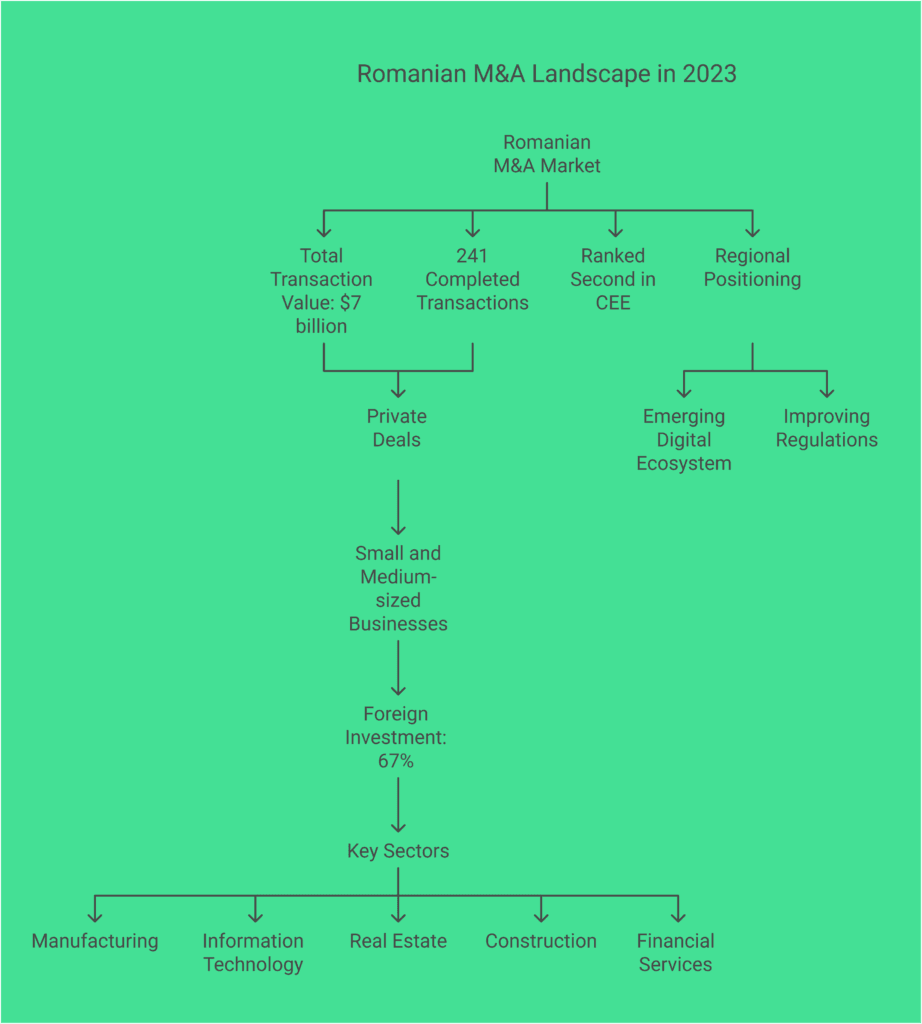
M&A Romania


The Romanian mergers and acquisitions scene is growing fast.

It’s becoming a top spot for companies looking to change their structure.

The market is full of chances for growth and strategic moves.

In 2023, the Romanian M&A market showed it’s strong.

Key signs point to its bright future:

  • Total transaction value reached approximately 7 billion dollars;
  • 241 completed ownership transition transactions;
  • Ranked second in Central and Eastern European M&A activity.

Market Dynamics and Trends

Most deals in Romania are private. Small and medium-sized businesses lead the way.

About 67% of deals come from outside, showing investors’ keen interest.

Sectoral Breakdown

The top sectors for mergers and acquisitions in Romania are:

  1. Manufacturing;
  2. Information Technology;
  3. Real Estate;
  4. Construction;
  5. Financial Services.

Regional Positioning

Romania is a major player in Central and Eastern Europe’s M&A scene.

Its location, emerging digital ecosystem, and improving rules attract investors.

They see great chances for restructuring their businesses here.

Legal Framework Governing Business Transfers in Romania

Romanian Business Transfer Legal Framework

Understanding the legal side of business transfers in Romania is key.

The rules are based on both national laws and EU directives.

This makes the process for handing over a business in Romania quite detailed.

Important legal parts of business transfers in Romania include:

  • Directive (EU) 2017/1132 on company law aspects;
  • Directive (EU) 2019/2121 addressing cross-border conversions;
  • Romanian Companies Law (Law 31/1990);
  • Financial Services Authority Regulation No. 5/2018.

Your plan for transferring a business must follow certain rules.

The Romanian laws set important rules and steps for business deals:

  1. Controlling interest is defined as holding 50% plus one voting right;
  2. Public takeovers become mandatory when an investor holds over 33% voting rights;
  3. Shareholders with more than 5% ownership can propose valuation methods;
  4. Mandatory notifications are required at specific ownership thresholds.

When you plan to transfer a business, you must follow strict rules.

Filings related to business combinations must be submitted within 24 hours of triggering events.

Also, merger plans need to be published in the Official Gazette of Romania.

International investors should know about recent changes.

Government Emergency Ordinance No. 108/2023 has made rules for foreign direct investment clearer.

This adds more complexity to business transfers in Romania.

Types of Business Transfers and Acquisitions

When thinking about company ownership changes in Romania, it’s key to know the different ways to transfer businesses.

Business leaders face complex choices between mergers, acquisitions, and other transfer methods.

These choices can greatly affect their business strategies.

In Romania, business succession planning mainly focuses on two main types: share deals and asset deals.

Each type has its own legal, financial, and operational implications for corporate transfers.

Mergers and Their Characteristics

Mergers are a complex way to join two companies into one. In Romania, mergers often mean:

  • Combining corporate structures;
  • Shared leadership and strategy;
  • Benefits in taxes and operations.

Acquisition Structures

Acquiring a business in Romania can be complex, with many strategies for different goals.

The main acquisition types are:

  1. Buying the whole target company;
  2. Buying a part of it;
  3. Making a strategic minority investment.

Asset vs. Share Deals

CharacteristicAsset DealsShare Deals
Transferable ElementsSpecific assets and some liabilitiesWhole company ownership
Tax ImplicationsSeller pays taxes16% capital gains tax for locals
ComplexityMore complex due to asset-by-asset transfersSmaller complexity in ownership change

For commercial enterprise transfer in Romania, knowing these detailed strategies helps businesses pick the best one.

This choice should match their goals and the market situation.

Foreign Direct Investment Regulations

Romania is a great place for business ownership change.

It has a solid framework for foreign direct investment (FDI).

This framework helps attract international investors.

It also guides foreign buyers on how to start or grow their business here.

Here are some important points about Romania’s FDI rules:

  • Mandatory screening for investments over €2 million;
  • Comprehensive national security and public order checks;
  • Environmental protection compliance requirements;
  • Specific sector-specific investment scrutiny.

Foreign investors need to understand Romania’s detailed rules when considering a business transfer here.

The investment screening process makes sure investments fit with national interests.

At the same time, it keeps the country open to investors.

FDI Regulation HighlightsKey Details
Screening Fee€10,000 (refundable under certain conditions)
Maximum Review Duration135 days
Penalty for Unauthorized InvestmentsUp to 10% of worldwide turnover

The Romanian FDI regime strikes a good balance.

It attracts foreign investments while safeguarding national interests.

Investors need to look closely at sector-specific rules, like in energy, telecommunications, and critical infrastructure.

Foreign investors should know about the detailed screening process for ownership changes.

The rules ensure transparency and national security.

They don’t block international business investments.

Business Transfer in Romania: Process and Requirements

Starting a commercial enterprise succession in Romania needs careful planning.

The process involves many important steps.

These steps focus on legal and financial details.

Understanding the framework for business transfers in Romania is key.

The process aims for transparency, legal compliance, and a smooth transfer of ownership.

Pre-Transfer Assessment

The first step is a detailed pre-transfer evaluation.

This phase is critical and includes:

  • Comprehensive financial review;
  • Valuation of company assets;
  • Identification of legal risks;
  • Verification of contracts.

Documentation Requirements

Business transfers need careful documentation.

You’ll need:

  1. Detailed financial statements;
  2. Shareholder agreements;
  3. Corporate registration documents;
  4. Tax compliance certificates.
Document TypeLegal RequirementProcessing Time
Share Transfer Approval75% Share Capital Consent7-14 Days
Registration CertificateRomanian Companies Law10 Days
Tax ClearanceMandatory Verification5-7 Days

Legal Compliance Steps

Legal compliance is essential for a smooth transfer.

Key steps are:

  • Notifying authorities;
  • Getting Competition Council approvals;
  • Completing registration processes.

Seeking expert legal advice is recommended.

For professional help, call our recommended Romanian legal experts at +40765366887.

Due Diligence in Romanian Business Transfers

When buying a company in Romania, due diligence is key.

It helps lower risks and makes sure the transfer goes well.

This step checks the investment in many ways.

When planning mergers and acquisitions in Romania, focus on several important areas:

  • Financial review of historical performance;
  • Legal compliance verification;
  • Operational infrastructure assessment;
  • Commercial and market analysis.

Business sales in Romania need careful checking.

Investors should look closely at financial reports, legal papers, and any rules that might affect the business.

Due Diligence CategoryKey Focus AreasPotential Risks
FinancialRevenue streams, profit marginsHidden liabilities
LegalContractual obligationsPending litigation
OperationalTechnology infrastructureInefficient processes

Experts say using new tech and getting help from experts is smart.

Good planning can really cut down on risks.

With a thorough due diligence, you’ll have a better shot at making a successful deal in Romania’s fast-changing market.

Tax Implications and Fiscal Considerations

Understanding tax laws in Romania is key for corporate transactions.

When you’re handling ownership changes, you’ll face many financial issues.

These can greatly affect your business strategy.

Romanian tax laws are complex for financial transfers.

Knowing the main tax points is vital.

It helps avoid risks and get the best financial results from your deal.

Transfer Pricing Requirements

The Romanian Fiscal Code requires strict rules for deals between related parties.

There’s been a rise in tax audits on these issues.

  • Mandatory documentation for related-party transactions;
  • Comprehensive reporting requirements;
  • Potential penalties for non-compliance.

VAT Implications

VAT is a big deal in business transfers.

Romania has its own VAT rules that businesses must follow:

  1. Standard VAT rate: 19%
  2. Reduced VAT rates: 9% and 5% for specific supplies
  3. VAT registration threshold: RON 300,000 annually

Corporate Tax Aspects

Corporate tax strategies are important for business transfers.

You need to think about tax liabilities, exemptions, and new laws.

Tax planning is essential to optimize your financial position during ownership transitions in Romania.

Strategic Sectors and Special Regulations

When you’re doing commercial transfers in Romania, knowing about strategic sectors is key.

The Romanian government watches business deals in important areas closely.

These areas affect national security and public order.

Foreign investors face a tough approval process in sensitive sectors.

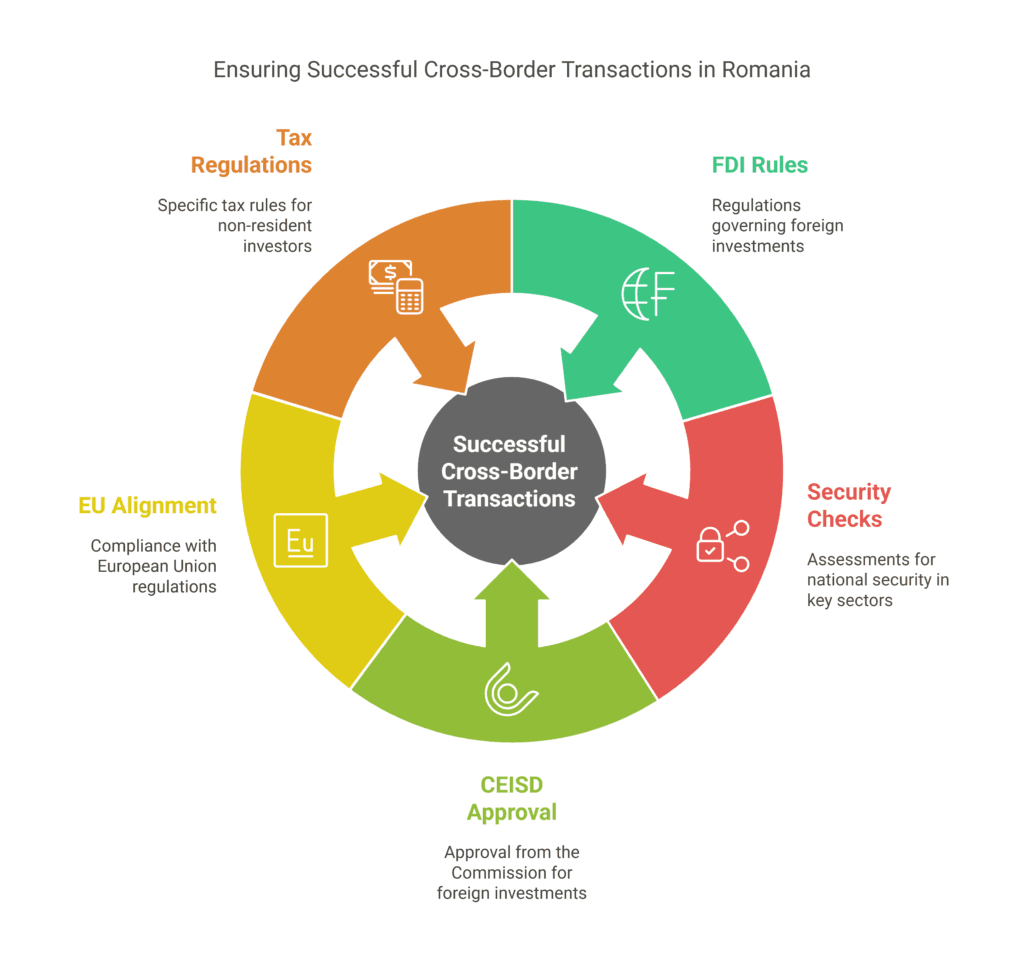
The Commission for the Examination of Foreign Direct Investments (CEISD) checks these deals carefully.

Key Strategic Sectors Requiring Special Approval

  • Energy infrastructure;
  • Transport systems;
  • IT and communication networks;
  • Financial and banking services;
  • Critical national infrastructure;
  • Security-related industries.

For sales of companies in these key sectors, investors need special approvals.

The rules require a close look at deals over 2 million euros.

Recently, laws have changed, like the updates to Emergency Ordinance 46/2022.

These changes help protect national interests but also keep the investment climate good.

Investment Approval Considerations

  1. Comprehensive security assessment;
  2. Evaluation of national security risks;
  3. Check on the investor’s background;
  4. Look at how the deal affects key sectors.

Knowing these rules is vital for smooth business transfers in Romania’s strategic sectors.

Investors should team up with local legal advisors to get through these complex steps.

Role of Regulatory Bodies and Authorities

When you transfer business ownership in Romania, knowing the role of key regulatory bodies is key.

Your journey in corporate restructuring will meet several important authorities.

They oversee and validate business transactions.

Romanian business transfers need several regulatory frameworks for transparency and compliance.

These key institutions are vital in monitoring and approving corporate changes.

Competition Council Oversight

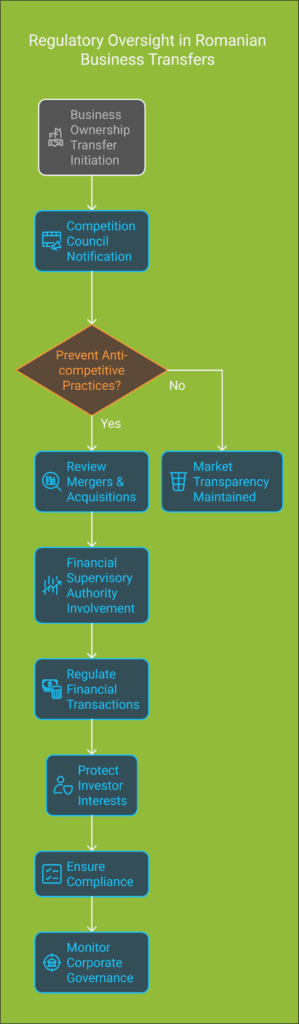
The Competition Council is a key watchdog in firm handovers. It has main duties:

  • Preventing anti-competitive market practices;
  • Reviewing merger and acquisition impacts;
  • Evaluating economic concentration transactions;
  • Protecting fair market competition.

When you transfer business ownership in Romania, you must tell the Competition Council for certain transactions.

This keeps the market transparent and stops monopolies.
M&A Regulatory

Financial Supervisory Authority Functions

The Financial Supervisory Authority (ASF) is key in corporate restructuring in Romania, mainly for financial institutions and listed companies. Its main tasks are:

  1. Regulating financial market transactions;
  2. Protecting investor interests;
  3. Ensuring compliance with financial regulations;
  4. Monitoring corporate governance standards.

Your business transfer plan must meet these regulatory needs for smooth, legal transactions in various sectors.

Knowing these regulatory frameworks helps you confidently and strategically navigate Romanian business transfers.

Cross-Border Transaction Considerations

Foreign investors must grasp the complex world of corporate takeovers in Romania.

The country has a strong legal setup to help with ownership changes.

It also protects national interests.

Key points for cross-border deals include:

The Romanian government has rules to attract foreign investment safely.

Foreign buyers need to know a few important things:

  1. They must report investments in sensitive areas;
  2. There could be a 5-8 month wait for FDI approval;
  3. They need to show detailed ownership details.

Taxes are very important in cross-border deals. Non-resident investors should know about specific tax rules:

Transaction TypeWithholding Tax RateSpecial Conditions
Dividends8%0% for EU companies with 10%+ shareholding
Interest16%Potential exemptions under EU directives
Royalties16%Reduced rates for specific agreements

It’s vital to understand these detailed rules for successful deals in Romania.

You must look at legal, financial, and regulatory aspects.

This ensures a smooth change in ownership.
Cross Border Transaction Romania

Recent Legislative Changes and Future Outlook

Romania’s business world is changing a lot in 2024.

This brings new chances for selling businesses and changing how companies work.

The rules for buying and selling companies are getting clearer.

Important changes are making the Romanian business scene different.

These changes affect how businesses operate:

  • Government Decision 300/2024 makes it easier to invest;
  • Emergency Ordinance 32/2024 changes how money is handled;
  • New rules for foreign investments.

2024 Regulatory Updates

Romania wants to make it easier for investors to come in.

If you’re thinking about selling your business in Romania, you’ll find it easier to start a new one.

The rules are clearer now.

Anticipated Changes

Romania’s economy is looking good, with a 3% GDP growth forecast for 2024-2025.

The government plans to make things better for businesses by:

  1. Making it easier to transfer businesses;
  2. Following EU rules;
  3. Welcoming more foreign investments.

If you’re looking to buy a business in Romania, now is a great time.

The mix of EU money and economic changes makes it a good place to invest.

Conclusion

Business divestment in Romania is complex and needs careful planning and legal knowledge.

When looking at corporate acquisitions, you must understand the detailed rules for business ownership changes in Romania.

This process includes legal steps, financial checks, and making strategic choices.

Your success in Romanian business transfers depends on thorough preparation and expert advice.

With about 690,000 small and medium-sized enterprises possibly changing hands soon, knowing the legal details is key.

The rules, like Law no. 31/1990, require focus on things like share transfer agreements and shareholder approvals.

Getting professional legal help is vital for these complex deals.

Romanian corporate law asks for accurate documents, like share transfer agreements and updated Articles of Association.

Working with skilled corporate lawyers can help avoid risks and make sure your business moves smoothly and legally.

For expert help with your business transfer, call Romania business transfer expert at tel. +40765366887.

Your careful planning will be key to the success of your corporate deal or business sale in Romania’s fast-changing market.

FAQ

What are the main types of business transfers in Romania?

In Romania, you can transfer businesses through mergers, acquisitions, asset deals, or share deals.

Mergers combine two companies into one.

Acquisitions mean one company buys another.

Asset deals transfer specific business assets, and share deals change who owns the company.

What are the key regulatory bodies involved in business transfers in Romania?

Several key groups watch over business transfers in Romania.

The Competition Council stops unfair competition.

The Financial Supervisory Authority looks after financial sector deals.

The Commission for the Examination of Foreign Direct Investments (CEISD) checks foreign investments.

What additional requirements exist for foreign investors in Romanian business transfers?

Foreign investors face extra rules, like national security checks under Emergency Ordinance 46/2022.

They must get extra approvals in key areas like energy and IT.

The CEISD reviews these deals to protect Romania’s interests and welcome foreign money.

How important is due diligence in Romanian business transfers?

Due diligence is very important in Romanian business transfers.

It checks the target business’s finances, laws, operations, and sales.

A good due diligence helps avoid risks and makes the transfer smooth.

It’s best to get experts to do a detailed check.

What tax considerations are critical in Romanian business transfers?

Important tax issues include following the arm’s length principle, VAT, and corporate taxes.

With more audits on transfer pricing, it’s key to document and justify prices.

You should also think about tax breaks, delays, and new tax laws that might affect your deal.

What are the primary challenges in cross-border business transfers in Romania?

Dealing with international rules is a big challenge in cross-border transfers in Romania.

You face issues like currency, legal systems, security checks, and taxes.

Getting help from Romanian legal and financial experts  is vital for these complex deals.

How has the Romanian M&A landscape changed in recent years?

The Romanian M&A market has seen big changes, like the COVID-19 pandemic and global tensions.

Romania is a strong player in Central and Eastern Europe, with more interest in tech, green energy, and finance.

New laws aim to make it easier for foreign investors to come in.

What documentation is typically required for a business transfer in Romania?

You’ll need lots of documents for a business transfer in Romania.

These include financial statements, legal papers, shareholder agreements, and tax certificates.

Depending on the deal, you might also need environmental reports, security clearances, and more.


Navigating 2025 Tax Changes in Romania

Navigating 2025 Tax Changes in Romania

2025 Romanian Tax Reforms

Are you ready for big 2025 tax changes in Romania?

Emergency Ordinance no. 156/2024 brings major updates.

These changes will change how we handle money in 2025.

The 2025 tax news in Romania is key.

It affects everyone, from small businesses to big companies. You’ll need a good plan and expert advice.

Tax lawyers in Romania are getting ready to help.

Our team of Romanian Lawyers and tax consultants is making strategies for clients to deal with these new tax rules.

It’s important to know about these changes to stay in good financial shape.

Key Takeaways

  • Significant tax rate adjustments across multiple sectors;
  • New microenterprise income thresholds implemented;
  • Income tax exemptions eliminated for specific industries;
  • Mandatory contribution rates reset for employees;
  • Construction and dividend taxes experiencing notable changes.

Understanding Romania’s New Tax Landscape for 2025

Romania’s tax scene is changing a lot in 2025.

This brings both challenges and chances for businesses and people.

The new tax rules come from big changes in laws that need smart tax planning and good economic forecasts.

Romania Tax Landscape 2025

The Emergency Ordinance 156/2024 makes big changes.

These changes will change how the government budgets and taxes different areas.

It’s key to understand these changes for good financial planning.

Key Legislative Changes Under Emergency Ordinance 156/2024

  • Two main tax systems for businesses: turnover tax and profit tax;
  • Individual rental income tax is 8%;
  • Investment income tax is between 1% and 3%;
  • 10% tax on deposit interest.

Impact on Businesses and Individuals

Businesses will face big tax changes.

They need to adjust their money plans to follow new rules.

For individuals, tax rates on different incomes will change, so they must plan ahead.

Timeline of Implementation

  1. New tax rules start in January 2025;
  2. Full legal changes needed;
  3. Benefits for different sectors might change.

Dealing with these changes needs expert help and a deep understanding of Romania’s tax world.

Dividend Tax Increase: From 8% to 10%

Romanian Tax Reform Dividend Taxation

The Romanian tax system is changing a lot in 2025.

A big change is the dividend tax rate going up from 8% to 10%.

This is a 25% increase for investors and companies in Romania.

This tax reform Romania introduces will impact various taxpayers, including:

  • Corporate entities distributing dividends;
  • Individual investors;
  • Non-resident shareholders.

Key considerations for the new dividend tax regulation include:

  1. The new 10% rate becomes effective from January 1, 2025;
  2. To benefit from the existing 8% tax rate, dividends must be distributed by December 31, 2024;
  3. Health insurance calculations for dividends will reference the new minimum wage of 4,050 lei.
Tax Parameter2024 Rate2025 RateChange
Dividend Tax Rate8%10%+25%
Health Insurance Base3,300 lei4,050 lei+22.7%

Investors and businesses need to plan their dividend strategies carefully.

This is to make the most of the new tax rules in Romania.

Getting advice from a Romanian tax expert can help you deal with these changes well.

Changes in IT, Construction, and Agricultural Sector Tax Benefits

The Romanian fiscal landscape is changing a lot in 2025, mainly for key sectors.

Your tax planning in Romania needs to keep up with new rules for IT, construction, and agriculture.

The government is making big changes.

These will affect income tax updates and tax compliance in many sectors.

Elimination of Income Tax Exemptions

Starting January 2025, big changes will hit tax incentives in key sectors:

  • Software developers will pay 10% income tax.
  • Construction workers will also pay 10% income tax.
  • Agricultural workers will face the same 10% tax rate.

New Pension Insurance Contribution Rules

New rules for pension insurance contributions are coming:

Contribution TypeRateSector Impact
Pension Contribution25%IT, Construction, Agriculture
Health Insurance10%Targeted Sectors
Work Insurance2.25%Employer Contribution

Salary Thresholds and Implications

New salary rules are being set:

  • Construction workers need a minimum salary of 4,582 lei/month.
  • Agricultural workers need a minimum of 4,050 lei/month.
  • Those earning less than 4,300 lei get a 300 lei tax break each month.

Businesses need to check these changes.

They must stay compliant and plan their finances wisely in Romania’s changing tax scene.

2025 Tax News Romania: Major Reform Overview

Tax changes will affect how we handle personal finance and change economic forecasts.

The government is making big updates to the tax code to improve fiscal compliance and support the economy.

Some major changes include:

  • Dividend tax increase from 8% to 10%;
  • Micro-enterprise tax system restructuring;
  • Introduction of new construction sector taxation;
  • Sector-specific tax modifications.

For businesses and individuals, understanding these changes is key.

Tax lawyers in Romania are ready to help.

They will offer detailed advice on how to deal with the new rules.

Reform AreaKey ChangesImplementation Timeline
Corporate TaxationDividend tax increaseJanuary 1, 2025
Micro-Enterprise SystemNew turnover thresholdsJuly 1, 2025
Sector-Specific ReformsTax benefit adjustmentsPhased implementation

Romania wants to cut its budget deficit to 7% of GDP by 2025.

This goal matches what the European Commission suggests.

These changes are important for Romania’s economic growth and better fiscal management.

Micro-enterprise Tax System Overhaul

Romania’s tax reform for 2025 is making big changes to the micro-enterprise tax system.

These updates will change how small businesses handle their taxes and financial planning.

It’s important for entrepreneurs to understand these new rules to stay on top of their taxes.

The Romanian Government is making big changes to tax services for small businesses.

Businesses need to keep up with these new tax rules to stay financially healthy.

New Turnover Thresholds

One big change is the lower annual turnover thresholds:

  • Current threshold: EUR 500,000;
  • New threshold for 2025: EUR 250,000;
  • Projected threshold for 2026: EUR 100,000.

Changes in Qualification Criteria

The new rules make it harder for businesses to qualify as micro-enterprises.

They need to check if they meet the new criteria to stay compliant.

CriteriaPrevious RuleNew Rule
Annual Turnover LimitEUR 500,000EUR 250,000
Consultancy ServicesDisqualifying ConditionRemoved
Management ServicesDisqualifying ConditionRemoved

Small businesses need to quickly adjust to these changes.

Working with tax advisors can help you understand and plan for these changes.

Introduction of Construction Tax in 2025

Romania is introducing a big change for the construction sector in 2025.

A 1% construction tax will be applied to existing buildings on company balance sheets.

This tax is part of Romania’s fiscal policy for 2025.

It aims to bring in more money and make the tax system clearer.

Key aspects of the construction tax include:

  • Applies to all business entities with construction assets;
  • Tax rate set at 1% of the construction’s balance sheet value;
  • Impacts both domestic and foreign businesses with permanent establishments;
  • Implementation date: January 1, 2025.

This tax will affect many sectors, like real estate and construction.

Companies need to check their asset values.

They must also get ready for this new financial duty in Romania’s tax landscape for 2025.

Entity TypeTax ApplicabilityCalculation Basis
Local CompaniesFull Implementation1% of Balance Sheet Value
Foreign EnterprisesPermanent Establishment1% of Romanian Asset Value
Small and Medium EnterprisesProportional Application1% of Qualifying Assets

Businesses should talk to tax experts.

They need to understand these tax changes fully.

This will help them manage their new tax duties well.

VAT Changes and Future Considerations

There are big updates to the VAT system that will affect both businesses and consumers.

These changes in fiscal policy are very important and need to be watched closely.

New VAT rates and digital reporting rules are coming.

Businesses need to get ready for these changes.

They must make sure they follow the rules to avoid any financial problems.

Potential Rate Adjustments

There are talks about changing the VAT rates in Romania.

The exact changes are not clear yet.

But, experts think these changes could affect how businesses price their products.

  • Potential VAT rate increase under consideration;
  • Alignment with EU fiscal policy recommendations;
  • Possible impact on consumer spending.

E-invoicing Requirements

Romania is starting a new digital invoicing system called RO eVAT.

This change will make businesses use electronic invoices.

It will make things clearer and easier for everyone.

SAF-T Implementation

The Standard Audit File for Tax (SAF-T) will soon be a must for businesses.

This change will help Romania’s tax system work better.

It will make tax compliance easier and more transparent.

Digital Tax FeatureImplementation TimelineBusiness Impact
RO eVAT SystemJanuary 2025Mandatory Electronic Invoicing
SAF-T ReportingQ2 2025Enhanced Tax Transparency

Get your business ready for these changes.

Update your digital setup, train your team, and talk to tax experts.

This will help you deal with the new tax rules smoothly.

Minimum Wage Updates by Sector

The 2025 Romanian tax updates change minimum wages in different sectors.

The government has made new rules for construction, agriculture, and food industries.

These changes will affect workers and businesses.

Here are the main updates for each sector:

  • Construction sector: Minimum wage set at RON 4,582;
  • Food and agricultural industry: Minimum wage established at RON 4,050.

The government wants to help workers and support the economy.

These changes will likely change how companies pay their workers.

It might also change how they hire and what they pay.

SectorMinimum Wage (RON)Key Implications
Construction4,582Higher labor costs, possible better work
Agriculture/Food4,050More money for workers, better competition

The 2025 tax changes aim to grow the economy and pay workers fairly.

Companies in these sectors need to plan their budgets and paychecks.

They must follow the new wage rules and stay financially stable.

Businesses should do the following:

  1. Check their current pay scales;
  2. Update their budget plans;
  3. Make sure they meet the new wage rules;
  4. Look at how they pay their workers overall.

Tax Compliance and Reporting Requirements

The Romanian tax system is changing a lot in 2025.

This change will affect how businesses deal with taxes.

The government’s new tax rules will change how companies report their finances and follow the law.

Digital Transformation in Tax Administration

Your business needs to get ready for big changes in tax laws. The main updates include:

  • Mandatory B2B e-invoicing regime fully implemented;
  • Electronic invoice submissions through eFactura platform;
  • Simplified invoicing for small transactions;
  • SAF-T reporting requirements expanded.

Filing Deadlines and Procedures

The tax system in Romania is getting a big update.

Starting in January 2025, businesses will have to follow new rules for electronic reports.

The main changes are:

  1. Mandatory electronic submission of financial statements;
  2. Monthly trial balance preparations;
  3. Specific submission deadlines for different entity types.

Professional Tax Advisory Support

Understanding the new tax rules in Romania can be hard.

 Romanian Tax lawyers and tax consultants are very important.

They help you with digital reporting, e-invoicing, and avoiding fines.

Businesses in Romania need to get ready for these changes.

They should invest in good tax systems and get help from experts.

This will help them adapt well in 2025.

Impact on Foreign Businesses Operating in Romania

The future tax landscape in Romania is set to pose big challenges for foreign businesses.

They will face changes in tax laws in 2025.

It’s vital for them to stay updated on these changes to keep their operations smooth.

Foreign companies need to get ready for big changes in their financial plans.

The new tax rules in Romania will demand careful planning and expert advice.

  • VAT registration requirements have become more stringent;
  • Tax representative obligations are expanding;
  • Dividend tax increased from 8% to 10%;
  • New reporting and compliance mechanisms introduced.

To tackle these challenges, hiring a tax lawyer in Romania is key.

They can help you:

  1. Understand complex tax rules;
  2. Make sure you follow new laws;
  3. Reduce financial risks;
  4. Find the best tax strategies.
Business Impact AreaKey Changes in 2025Potential Risk Level
VAT RegistrationStricter Non-Resident RequirementsHigh
Dividend Taxation10% Tax RateMedium
Compliance ReportingEnhanced Digital ReportingHigh

Businesses that act early will use tax advisory services to deal with these changes.

By keeping up with Romania’s tax changes, foreign companies can stay competitive and financially stable.

Working with Tax Lawyers in Romania

Understanding Romanian tax laws is tough.

With big changes in 2025, knowing how to comply is key.

Businesses and individuals need tax lawyers to guide them.

Romanian law offices help clients deal with tax rules.

When picking a law firm, look for experts in local and global tax laws.

Legal Assistance for Tax Compliance

Tax lawyers in Romania offer vital help:

  • They explain complex tax laws;
  • They create tax-saving plans;
  • They help in tax disputes;
  • They make sure you follow the law.

Professional Tax Advisory Services

Romanian tax lawyers give strategic advice in many areas:

Service CategoryKey Focus Areas
Corporate Tax PlanningLowering tax bills, smart business deals
Individual Tax ConsultingOptimizing personal taxes, global tax rules
Regulatory ComplianceKeeping up with 2025 tax changes

Choose tax lawyers in Romania who are good at handling tax changes.

They should know Romanian tax laws well.

Conclusion

The 2025 tax news in Romania shows a complex fiscal scene.

It demands smart planning.

Tax reforms will affect businesses and people in many areas.

It’s important to be proactive and well-informed about these changes.

This way, you can handle them better.

Understanding these updates means analyzing new tax rates and rules.

The standard VAT rate is 19%, and company taxes vary from 1% to 3% on turnover.

Businesses need to adjust fast to these changes.

Getting help from tax advisors is key in this changing world.

Romania’s economy is expected to grow by 2.5% in 2025.

Knowing the rules can help you avoid financial risks and stay ahead in the market.

As taxes keep changing, being flexible and ready is essential.

Look for expert advice, keep up with new laws, and be open to changing your financial plans in Romania.

FAQ

What are the most significant tax changes in Romania for 2025?

The main changes include a higher dividend tax of 10% from 8%.

There’s also a new construction tax and rules for micro-enterprises.

These changes aim to update Romania’s tax system.

How will the dividend tax increase affect investors and businesses?

The tax hike on dividends will affect both local and foreign investors.

It might change how they invest and manage money.

Companies and investors will need to adjust their financial plans to the new tax rate.

What changes are happening to the micro-enterprise tax system?

The micro-enterprise tax system is changing a lot.

The turnover limits are dropping from EUR 500,000 to EUR 100,000 (in 2026).

Also, a rule about consultancy and management services income is gone, affecting how businesses are taxed.

Are there new VAT requirements for businesses in Romania?

Yes, Romania is introducing e-invoicing and SAF-T reporting.

Businesses must adapt to these digital systems.

They aim to make tax compliance easier and reduce paperwork.

How will the construction tax work in 2025?

A 1% tax will be applied to the value of existing constructions.

This tax will affect many entities, including foreign ones with permanent setups in Romania.

The rules and exemptions will vary based on the entity and construction type.

What changes are affecting foreign businesses operating in Romania?

Foreign businesses will face new VAT rules and changes to tax representative duties.

The dividend and construction taxes will also impact them.

These changes might force businesses to rethink their strategies in Romania.

Are there changes to minimum wage regulations in specific sectors?

Yes, minimum wages are increasing in construction, food, and agriculture.

These changes will affect labor costs.

They might influence how businesses compete and pay their employees.

How can businesses and individuals navigate these tax changes?

It’s wise to talk to a tax lawyer or advisor who knows Romanian tax law.

They can help with compliance, find tax-efficient ways, and explain the new rules.

When do these tax changes take effect?

The tax reforms from Emergency Ordinance 156/2024 will roll out in 2025.

Some changes start right away, while others will be phased in.

It’s important to know when each rule starts.

What is the purpose of these tax reforms?

The reforms aim to update Romania’s tax system.

They want to improve tax collection, follow EU standards, and make the fiscal environment better for businesses and investors.

Capital Gains Tax in Romania – Key Points to Know

Capital Gains Tax in Romania – Key Points to Know

Are you an investor in Romania?

Do you know how the country’s capital gains tax works?

It has different rates, rules, and special cases.

This guide will help you understand it better and make smart choices.

Capital Gains Tax in Romania

Key Takeaways

  • The flat capital gains tax rate in Romania is 10%, with lower rates for certain asset classes and holding periods.
  • Reporting of capital gains and losses is mandatory through the annual tax return, with a filing deadline of May 25th.
  • Romania’s Fiscal Code and recent legislative changes, such as Law no. 142/2022, govern the taxation of capital gains.
  • Specific rules and exemptions apply to different types of investments, including stocks, bonds, real estate, and derivatives.
  • The role of tax treatment in capital gains tax. authorized intermediaries is crucial in the collection and reporting of capital gains tax.

Understanding Capital Gains Tax Fundamentals in Romania

If you invest or own assets in Romania, knowing about capital gains tax is key.

The tax rates range from 0% to 10%.

This depends on the asset type, how long you held it, and your income.

Basic Tax Rates and Thresholds

The tax on capital gains from the sale of shares and financial instruments through Romanian entities is changing.

It will drop from 10% to 1% or 3%.

This depends on how long you owned the assets.

If you held the assets over 365 days, you pay 1%.

For less than 365 days, it’s 3%.

Who Needs to Pay Capital Gains Tax?

People living in Romania for more than 183 days in a year must pay capital gains tax.

The tax is based on the profit from selling an asset.

If you live in Romania for more than 183 days in a 12-month period, you are generally considered a Romanian tax resident, which means you must pay tax on your worldwide income, including capital gains from selling assets.

However, ANAF also looks at other important criteria, such as whether you have a permanent home in Romania, your center of vital interests (family, job, business, bank accounts), or legal ties like a Romanian domicile, car registration, passport, or health insurance.

Taxable Events and Transactions

Capital gains tax applies to the sale of shares, bonds, real estate, and more in Romania.

Some sales, like inheriting within two years, are tax-free.

You must report your capital gains and income tax by February of the next year.

capital gains tax rates

It’s vital for investors and asset owners in Romania to grasp capital gains tax basics.

Knowing the rates, thresholds, and what triggers tax helps make smart financial plans.

This way, you can follow the rules and get the most from your investments.

Capital Gains Tax in Romania: Current Rates and Regulations

Romania’s capital gains tax rules are detailed in the Fiscal Code and updated by Law no. 142/2022.

It’s key for investors to know the current rates and rules.

This knowledge helps in managing investments and taxes.

The tax rate on capital gains in Romania depends on the asset and how long you hold it.

Securities held over 365 days are taxed at 1%. But, those held for less than 365 days face a 3% rate.

Other capital gains are taxed at 10%.

Also, Romanians must pay a 10% health insurance if their capital gains are over 6 minimum gross wages a year.

This rule helps ensure that those who earn more contribute to the country’s social security.

  • Capital gains tax on securities held for over 365 days: 1%
  • Capital gains tax on securities held less than 365 days: 3%
  • Capital gains tax on other types of assets: 10%
  • Health insurance contribution: 10% on annual capital gains exceeding 6 minimum gross wages

Understanding Romania’s capital gains tax rules is complex.

It requires keeping up with the Fiscal Code and new laws.

Staying informed and following the tax treatment rules is crucial to avoid fines and meet tax duties.

romanian capital gains tax

Securities and Investment Taxation

Capital gains tax in Romania affects securities and investment transactions a lot.

Knowing the details helps investors and traders understand taxes better.

Stock Market Transactions

Stock market deals in Romania face capital gains tax.

The tax rate changes based on how long you hold the stock.

Stocks held for under a year get taxed at 3%.

But, stocks held over a year get taxed at just 1%.

Bond Market Investments

Bond investments in Romania are taxed similarly to stocks.

Bonds held for under a year are taxed at 3%.

Bonds held over a year are taxed at 1%.

Investment Fund Taxation

Investment funds in Romania get a special tax break.

Open-end collective investment funds don’t pay capital gains tax.

This makes them attractive for diversifying and getting professional management.

It’s key to remember that taxes are handled by the people who do the transactions.

Investors should talk to their financial advisors to follow the rules.

Investment TypeTax Rate (HeldTax Rate (Held > 1 year)
Stocks3%1%
Bonds3%1%
Investment Funds0%0%

Knowing the tax rules for different investments in Romania helps investors plan better.

Keeping up with tax changes and getting advice from experts is important for a smooth investment journey.

Real Estate Capital Gains Taxation

In Romania, selling real estate is taxed on capital gains.

If a property sells for over RON 450,000, a 3% tax is applied.

But, there are some exceptions.

If you inherit a property and sell it within two years, no tax is due.

After two years, a 1% tax on the property’s value is charged.

Not all personal items sold are taxed.

There are specific rules for real estate sales.

Knowing about capital gains tax on real estate in Romania, real estate gains tax Romania, and capital gains on property Romania is key for both buyers and sellers.

Transaction TypeCapital Gains Tax Rate
Sale of property valued over RON 450,0003%
Inherited property transferred within 2 years0%
Inherited property transferred after 2 years1%

Capital gains tax on real estate in Romania is a big deal for buyers and sellers.

Knowing the tax rates and exemptions helps make better choices in the real estate market.

Role of Intermediaries in Capital Gains Tax Collection

In Romania, certain groups help with capital gains tax.

These include investment managers, self-managed companies, and fund administrators.

They figure out gains and losses, report to the National Agency for Fiscal Administration (ANAF), and take taxes from their clients’ deals.

Types of Authorized Intermediaries

  • Investment management companies;
  • Self-managed investment companies;
  • Administrators of alternative investment funds.

Reporting Requirements and Deadlines

These groups must send reports to ANAF by May 25th of the next year.

Their reports show the gains and losses for each client, along with the taxes they’ve paid for tax purposes.

Transaction Documentation

They keep detailed records of each deal.

This includes info on buying and selling securities and other investments.

These records help prove the accuracy of the gains and losses reported.

Type of Intermediary for the transfer of securities.Responsibilities
Investment management companiesCalculating gains/losses, reporting to ANAF, and withholding taxes on income obtained.
Self-managed investment companiesCalculating gains/losses, reporting to ANAF, and withholding taxes
Administrators of alternative investment fundsCalculating gains/losses, reporting to ANAF, and withholding taxes

Tax Exemptions and Special Considerations

In Romania, there are tax breaks and special rules for capital gains.

Knowing these can help you save money and follow the law.

It’s key for good financial planning.

One big break is the 0% tax on gains from open-end funds.

This means profits from these investments are tax-free.

Also, gifts and interest from EU pension funds are not taxed in Romania.

  • 0% tax on capital gains from open-end collective investment funds;
  • Exemption for gifts and interest income earned by pension funds within the EU;
  • Employee stock option plans are not taxed when granted or exercised, but the sale of underlying shares is taxable;
  • Gifts of real estate may be exempt if received from relatives up to the third degree.

Employee stock options have special rules. Getting or using them doesn’t trigger taxes.

But selling the shares does.

This can help in planning and saving taxes for both sides.

Also, gifts of real estate might not be taxed if from close relatives.

This is good for family gifts or estate planning.

By knowing these capital gains tax exemptions in Romania, you can lower your taxes.

Talk to a tax experienced lawyer in Romania to use these tax exemptions and capital gains exemptions wisely in your plans.

Non-Resident Taxation and International Aspects

Romania’s capital gains tax affects people and companies from outside the country.

It’s important to understand how taxes work for those doing business across borders.

Double Taxation Treaties

Romania has made deals with over 80 countries to avoid double taxation.

These agreements help prevent too much tax on income earned in Romania.

They can help reduce the tax burden on earnings from abroad.

Cross-Border Transactions

Transactions in Romania can lead to capital gains tax for non-residents.

The tax depends on the type of transaction and the double taxation treaty.

It’s key to follow rules and report income correctly to avoid tax problems.

Key AspectsDetails
Non-Resident Tax Registration for tax purposes.
  • Obtaining a tax identification code
  • Registering in the taxpayers’ registry
  • Obtaining a tax registration certificate for non-resident individuals.
Applicable Tax Rates
Double Taxation Avoidance
  • Over 80 double tax treaties signed by Romania
  • Foreign tax credits available for taxes paid overseas

Understanding non-resident taxation and international rules helps individuals and companies with dividend income.

They can make the most of their business across borders and follow Romania’s tax laws.

Reporting and Compliance Requirements

In Romania, taxpayers must follow specific rules for capital gains tax.

They need to file an annual return by a certain deadline to report their dividend income.

This ensures they meet their tax duties.

People in Romania must submit the “Declaratia unica privind impozitul pe venit si contributiile sociale datorate de persoanele fizice” form by May 25th of the next year.

This form helps them figure out how much capital gains tax they owe.

It’s based on their investments and deals from the past year.

Not just individuals, but also brokers and investment firms have to report too.

They must give detailed info about the deals they handle for tax purposes.

This helps make sure the right amount of capital gains tax is paid to the Romanian government.

Key Compliance DeadlinesReporting Requirements
May 25thFiling of “Declaratia unica privind impozitul pe venit si contributiile sociale datorate de persoanele fizice” form
June 25thDeadline for submitting annual CIT returns and paying related CIT for taxpayers subject to OMF 1802/2014
OngoingIntermediaries must report details of transactions they manage

Not following these rules can lead to penalties and extra charges.

It’s important for everyone to know the rules and deadlines.

This way, they can avoid problems with the Romanian tax authorities.

Conclusion

Romania’s capital gains tax system is both competitive and nuanced.

It balances collecting revenue with incentives for investment, especially in the domestic market.

The tax rates for capital gains in Romania range from 0% to 10%.

Recent changes have made some securities transactions more favorable.

To make the most of Romania’s capital gains tax system, it’s important to understand the rules and exemptions.

Both residents and non-residents need to know about the reporting requirements.

This knowledge is key to leveraging the opportunities in the Romanian market.

Whether you live in Romania or invest from abroad, understanding the capital gains tax in Romania is crucial.

You need to pay close attention to the Romanian capital gains tax rates and regulations.

By staying informed and following the rules, you can plan your taxes better and manage your capital gains in Romania effectively.

The Romanian capital gains tax landscape is always changing.

It’s vital to keep up with the latest news and seek professional advice when needed.

This way, you can make sure your investment plans and transactions fit the current tax environment.

It helps you maximize your returns and reduce your tax liabilities in Romania.

FAQ

What are the capital gains tax rates in Romania?

In Romania, capital gains tax rates range from 0% to 10%.

This depends on the asset type and transaction.

Stocks have a tax rate of 1% to 3% on gains derived, based on how long you held them. For real estate, a 3% tax applies if sold for over RON 450,000.

Who is required to pay capital gains tax in Romania?

People living in Romania for more than 183 days in a year must pay capital gains tax.

This includes taxes on stocks, bonds, real estate, and other assets.

What types of capital gains transactions are taxable in Romania?

In Romania, selling stocks, bonds, real estate, and other assets is taxable.

The tax is based on the sale price minus the purchase price.

Are there any capital gains tax exemptions in Romania?

Yes, some transactions are tax-free.

This includes inheriting property within two years and gifts from relatives up to the third degree.

Also, open-end collective investment funds have a 0% tax rate.

How are stock and bond market transactions taxed in Romania?

Stock and bond market transactions are taxed at 1% or 3%, depending on the holding period.

Losses from these transactions can’t be used to offset future gains.

What are the reporting requirements for capital gains tax in Romania?

You must report capital gains annually to ANAF by May 25th of the next year.

Companies that manage investments are responsible for reporting and withholding taxes.

How does Romania’s capital gains tax system compare to other countries?

Romania’s system offers tax rates from 0% to 10%.

It recently changed to favor certain securities.

The system aims to balance tax collection with investment incentives, especially in the domestic market.

What are the special considerations for non-residents regarding capital gains tax in Romania?

Non-residents may face Romanian capital gains tax on some transactions.

They can claim tax credits for overseas taxes, up to the Romanian tax amount.

Cross-border deals have specific rules based on double taxation treaties.

What is the Capital Gains Tax in Romania?

The Capital Gains Tax in Romania refers to the tax imposed on the profits realized from the sale of assets, such as real estate or stocks.

This tax applies to both Romanian tax residents and foreign companies earning capital gains in the country.

The tax rate on capital gains is typically set at a fixed percentage, which may vary based on the type of asset sold and the duration of ownership.

How is the Capital Gains Tax calculated in Romania?

The tax is calculated by determining the difference between the sale price of the asset and its acquisition cost, adjusted for any allowable expenses related to the transaction.

The resulting amount is termed the taxable income.

The tax rate on capital gains is then applied to this taxable income to determine the final income tax due.

What are the current tax rates for capital gains in Romania?

The current tax rate for capital gains obtained from the sale of real estate in Romania is generally set at 3%, while gains from the sale of stocks are subject to a tax rate of 10%.

However, these rates may be subject to changes for tax purposes, so it is advisable to consult the. Romanian tax authorities for the most up-to-date information.

Do Romanian residents need to file a tax return for capital gains?

Yes, Romanian tax residents are required to report their capital gains in their annual return for dividend income. tax return.

This includes disclosing any income derived from the transfer of assets and ensuring that the correct income tax rate is applied.

Failure to do so may result in penalties or additional tax obligations.

Are there any exemptions on Capital Gains Tax in Romania?

In certain circumstances, exemptions may apply to the capital gains tax.

For instance, if a property has been held for more than 3 years, the gains from its sale may be exempt from taxation.

Additionally, Romanian tax authorities may provide specific exemptions for certain categories of income or for Romanian companies engaging in particular business activities.

New Whistleblowing Law in Romania: Protecting Whistleblowers in Public Interest

New Whistleblowing Law in Romania: Protecting Whistleblowers in Public Interest

Have you ever wondered how Romania is boosting corporate transparency and fighting corruption?

The answer is in its new whistleblower law.

This law is a big change for Romania, giving strong protection to those who report wrongdoings.

Law No. 361/2022 started on December 22, 2022.

It sets up a full system to protect whistleblowers in Romania.

It covers both public and private areas, following EU Directive 2019/1937.

It wants to make it safe for people to report wrongdoings at work.

Now, companies with 50 or more workers must have ways for reporting.

Companies in finance and insurance must do this, no matter their size.

The law also says reports must be kept for five years, keeping things honest and open.

whistleblower law Romania


Not following the law can cost a lot.

Companies might face fines up to EUR 8,000 for not having the right reporting ways.

The law also protects whistleblowers from being unfairly treated, with fines up to EUR 8,000 for things like unfair firing.

These steps show Romania’s strong push for honesty and openness in all areas.

Key Takeaways

  • Law No. 361/2022 applies to both public and private sectors in Romania;
  • Companies with 50+ employees must establish internal reporting channels;
  • Fines up to EUR 8,000 for non-compliance with reporting obligations;
  • Protection against retaliation for whistleblowers;
  • Five-year record-keeping requirement for valid reports;
  • Specific sectors face obligations regardless of company size.

Understanding the Whistleblower Law Romania Framework

Romania has introduced new laws to boost corporate transparency and ethical governance.

Law No. 361/2022 started on December 22, 2022.

It sets up a detailed system for reporting public interest issues in Romania.

Overview of Law No. 361/2022

This law aims to make Romania’s anti-corruption efforts stronger.

It protects those who report wrongdoing in different fields.

It includes workers, freelancers, shareholders, and more.

The law deals with issues like public contracts, finance, product safety, and the environment.

Romanian anti-corruption laws

Implementation Timeline and Scope

Romania is now the tenth EU country to have this law.

The Chamber of Deputies voted 190-0 in favor, showing strong support.

Companies with 50 or more workers must set up reporting systems by December 17, 2023.

Alignment with EU Directive 2019/1937

Law No. 361/2022 follows EU Directive 2019/1937.

It sets up both internal and external reporting paths.

It also explains what retaliation and designated persons mean.

The National Integrity Agency is key in making sure these rules are followed in Romania.

Key AspectDetails
Effective DateDecember 22, 2022
Covered IndividualsWorkers, self-employed, shareholders, administrative personnel, volunteers, trainees
Areas CoveredPublic procurement, financial services, product safety, environmental protection
Reporting ChannelsInternal, external, public disclosure
Key AuthorityNational Integrity Agency

Who Qualifies as a Protected Whistleblower

Romania’s new law, Law No. 361/2022, protects many people.

It makes sure workers and others can speak up without fear.

This law helps keep workplaces honest and fair.

It covers employees, freelancers, and even company owners.

It also protects volunteers, trainees, and those working for contractors.

The goal is to make it safe to report fraud without facing backlash.

Even anonymous tips with solid evidence are okay under this law.

This lets people report wrongdoings without fear of being found out.

It helps create a culture of honesty in Romanian workplaces.

CategoryProtected Under Law 361/2022
EmployeesYes
Self-employedYes
ShareholdersYes
Board MembersYes
VolunteersYes
TraineesYes
Contracted WorkersYes
Job ApplicantsYes
Former EmployeesYes
Anonymous ReportersYes (with substantiated evidence)

Types of Reportable Violations and Breaches

Romania’s whistleblower protection law covers many types of violations.

It aims to find and fix wrongdoings in different areas.

Let’s look at the main categories of violations under this law.

Public Interest Violations

Public interest disclosures are key in Romania’s whistleblower law. These include:

  • Tax fraud and money laundering;
  • Public procurement offenses;
  • Product and road safety issues;
  • Environmental protection breaches;
  • Public health concerns;
  • Consumer and data protection violations.

Corporate Misconduct Categories

The law also deals with corporate misconduct. It covers:

  • Financial irregularities;
  • Corruption and bribery;
  • Fraud;
  • Violations of internal policies;
  • Bullying and harassment;
  • Threats to health and safety.

Legal Framework Violations

The law in Romania also covers breaches of EU and national laws.

Some key areas include:

  • Network security breaches;
  • Data protection violations;
  • Infringements of financial services regulations;
  • Breaches of privacy regulations;
  • Violations of labor laws.

Romania offers protection and rewards for whistleblowers.

This helps keep integrity in many sectors.

It also encourages a culture of responsibility.

Internal Reporting Mechanisms and Requirements

Romania’s new law makes it easier to report wrongdoing.

Companies with 50 or more workers must have a whistleblower hotline.

This is to follow Romanian anti-corruption laws.

Mandatory Reporting Channels

Companies must create internal reporting systems.

Those with 250+ employees had to do this by 2023.

Companies with 50-249 employees have until December 17, 2023.

The law requires different ways to report, like writing, talking, or using digital tools.

Documentation Requirements

Keeping detailed records is key under the new law.

Employers must keep all whistleblower reports for at least five years.

This helps with investigations and keeps things transparent.

Confidentiality Measures

The law stresses keeping reports secret to protect whistleblowers.

Companies must protect data well and only use personal info when needed.

While you can report anonymously, it must clearly show wrongdoing.

RequirementDetails
Reporting ChannelsWritten, oral, digital platforms
Record Keeping5 years minimum
ConfidentialityStrict data protection measures
Anonymous ReportsAllowed, but require clear evidence

External Reporting Procedures and Authorities

Romania’s new law protects whistleblowers who report outside their company.

You can tell the National Integrity Agency or other bodies if your company won’t listen.

This is for when your company’s rules don’t work or aren’t there.

The law says when you can share information publicly.

This is when there’s a big risk to the public or serious harm could happen.

Knowing these rules is key for those who want to protect themselves under Romanian law.

Authorities must follow strict rules to handle reports:

  • They must say they got your report in 7 days;
  • They should tell you what they’re doing about it in 3 months;
  • They must keep your identity secret.

Romania also has strong rules to stop companies from punishing whistleblowers.

These rules help keep things honest in both public and private places.

Reporting ChannelKey Features
InternalMandatory for companies with 50+ employees
ExternalAvailable when internal channels fail or are absent
Public DisclosureAllowed in cases of imminent danger or irreparable harm

Protection Measures Against Retaliation

Romania’s whistleblower law has strong protections against retaliation.

It aims to keep those who report wrongdoings safe from negative outcomes.

This is key to making sure more people speak up.

Employment Safeguards

The law protects whistleblowers from many workplace issues.

You can’t be unfairly fired, suspended, or have your job changed.

Your pay and job tasks can’t be messed with as punishment.

These rules help keep whistleblower rights safe in Romania.

Legal Remedies

If you face backlash, you have legal ways to fight back.

The law gives you immunity from legal trouble because of your report.

This lets whistleblowers speak out without fear of legal problems.

Compensation Rights

Whistleblowers in Romania can get compensation for harm caused by retaliation.

If you’re wrongly fired, you can ask to be rehired.

These rights show Romania’s dedication to protecting those who report wrongdoings.

Protection MeasureDescription
Employment SafeguardsProtection against dismissal, suspension, contract changes
Legal RemediesImmunity from civil, criminal, administrative liability
Compensation RightsRight to seek damages, possibility of reinstatement

Corporate Compliance Obligations

Romanian whistleblower policies are now key to ethical business.

The new law changes how companies handle whistleblowing.

It requires them to improve their integrity.

Implementation Requirements for Companies

Companies with over 249 employees must set up internal reporting channels within 60 days.

Those with 50-249 employees have more time, 1-2 years.

Not following these rules can lead to fines.

The law also points to digital platforms for reporting.

This shows how complex compliance can be.

Record-Keeping Standards

Businesses need to keep records of all valid reports for five years.

This makes things transparent and helps Romanian whistleblower policies work better.

Companies should check their systems or get new ones to meet these standards.

Training and Awareness Programs

Companies must teach employees about their rights and how to report.

These programs help build a culture of ethics.

They encourage reporting of wrongdoings.

Company SizeCompliance DeadlineKey Requirements
250+ employees60 days after publicationInternal reporting channels, record-keeping, training programs
50-249 employees1-2 year extensionSame as above, with extended implementation timeline

Companies can avoid fines by improving their internal procedures.

This not only meets legal requirements but also boosts their integrity.

Penalties and Enforcement Measures

The Romanian whistleblower act has strict penalties to make sure everyone follows the rules.

Companies that don’t set up internal reporting channels can face fines from RON 2,000 to RON 40,000.

This is about EUR 400 to EUR 8,000, showing how important it is to follow corporate governance rules.

Breaking the whistleblower protection rules can lead to big problems.

Trying to stop someone from reporting or sharing confidential information is a serious crime.

The law also has fines for false reporting, from RON 2,500 to RON 30,000 for knowingly lying.

This balance helps protect real whistleblowers and stops others from abusing the system.

Harsh penalties are given to those who retaliate against whistleblowers, up to RON 40,000 (EUR 8,000).

This shows the law’s strong commitment to protecting those who speak out.

Romania’s enforcement measures match EU standards, making a strong system for whistleblower compensation and protection.

With these strict penalties, Romania wants to build a culture of openness and responsibility in both public and private areas.


In conclusion, the implementation of Law No. 361/2022 is a pivotal step for Romania, reinforcing the role of legal professionals in promoting ethical practices within organizations.

Engaging with a knowledgeable lawyer in Romania can empower whistleblowers to take action without fear, ultimately contributing to a more transparent and accountable society.

For individuals seeking legal assistance, a Romanian lawyer can provide invaluable guidance on navigating this new legal landscape. A Romanian law office specializing in whistleblower cases can help clients understand their rights and obligations under this law, ensuring that they are protected when reporting wrongdoing.

The establishment of these legal frameworks not only enhances workplace integrity but also encourages a culture where speaking out against corruption is both safe and supported.

FAQ

What is the main purpose of Romania’s new whistleblowing law?

The new law aims to encourage reporting of wrongdoings in both public and private sectors.

It protects those who report these issues.

This law is meant to increase transparency and fight corruption in Romania.

Who is protected under the new whistleblower law in Romania?

Many people are protected, like workers, self-employed, and volunteers.

Even those in training or after jobs end are covered.

This includes anyone reporting during hiring or after leaving a job.

What types of violations can be reported under this law?

You can report many kinds of wrongdoings.

This includes breaking EU and national laws in areas like finance and health.

Also, corporate wrongdoings like fraud and policy breaches are covered.

Are companies required to establish internal reporting channels?

Yes, companies with 50 or more employees must have these channels.

They need to pick someone or a team to handle reports.

Some sectors, like finance, must follow this rule, no matter the size.

Can whistleblowers report externally if internal channels are ineffective?

Yes, you can report to authorities if internal channels don’t work.

The law says who you can report to and when it’s okay to go public.

What protection measures are in place against retaliation?

The law stops employers from punishing whistleblowers.

This includes not firing or cutting pay.

You’re also safe from legal trouble for your reports.

If fired, you can get your job back and compensation.

Are anonymous reports considered under this law?

Yes, anonymous tips that show wrongdoing are accepted under the law.

What are the penalties for non-compliance with the whistleblower law?

Breaking the law can cost companies up to RON 40,000 (about EUR 8,000).

This includes not having reporting channels or trying to stop reports.

Reporting false info can cost even more.

What are the requirements for internal reporting procedures?

Reporting procedures must keep things confidential and give feedback within three months.

Companies must keep records for five years and train employees on these rules.

When did the new whistleblowing law come into effect in Romania?

The law started on December 22, 2022. Companies with 50 or more employees must set up reporting systems by December 17, 2023.

What is the new whistleblowing law in Romania?

The new whistleblowing law in Romania is a comprehensive legislation designed to protect individuals who report violations of the law in the public interest.

This law on the protection of whistleblowers was adopted to transpose the EU Directive on whistleblower protection.

The Romanian whistleblowing law aims to establish a robust framework for the protection of persons who report breaches of Union law and national legislation, ensuring their safety from retaliation and encouraging transparency in both public and private sectors.

When did the new whistleblowing law in Romania come into effect?

The new law on whistleblowing in Romania was published in the Official Gazette of Romania on 19 December 2022.

It officially entered into force on 22 December 2022.

However, certain provisions of the law, particularly those related to the establishment of internal reporting channels for private sector entities with 50 to 249 employees, have a delayed implementation date of 17 December 2023.

What are the main objectives of the Romanian whistleblowing law?

The primary objectives of the Romanian whistleblowing law include:

1. Enhancing the protection of whistleblowers in the public interest;

2. Encouraging individuals to report violations of the law;

3. Establishing clear procedures for internal reporting channels;

4. Preventing and addressing retaliation against whistleblowers;

5. Ensuring compliance with EU law on whistleblower protection;

6. Promoting transparency and accountability in both public and private sectors.

Closing a Company in Romania | A Complete Overview

Closing a Company in Romania | A Complete Overview

In Romania, having 50,000 RON in unpaid debts can lead to mandatory bankruptcy.

This fact shows how important it is to know how to close a company.

Whether you want to dissolve your business or face liquidation, understanding Romanian laws and finances is key.

Closing a company in Romania takes 3 to 6 months.

It involves important steps and talking to different people.

You’ll need to know about Romanian business laws, taxes, and how to deal with creditors to close your company right.

Closing a Company in Romania

Administrators and directors must watch out for personal debt risks.

If they’re seen as causing bankruptcy, they could be personally liable.

This risk makes it crucial to plan carefully and get professional help.

Knowing the legal and financial steps in Romanian company liquidation helps you avoid problems.

Key Takeaways

  • Outstanding liabilities of 50,000 RON can trigger mandatory insolvency in Romania;
  • Company closure typically takes 3 to 6 months to complete;
  • Administrators may face personal liability for company debts in certain cases;
  • Voluntary dissolution, judicial dissolution, and administrative dissolution are common closure methods;
  • Compliance with tax regulations and employee rights is crucial during the closure process.

Understanding Business Dissolution in Romania

Winding up a business in Romania has its own rules and steps.

The process of dissolving a company can vary.

Each method has its own needs and effects.

Types of Company Closure Methods

There are three main ways to close a business in Romania. Shareholders can choose voluntary dissolution.

Judicial dissolution happens through court orders.

And, administrative dissolution is for non-compliance, enforced by regulatory bodies.

Romanian business closure procedures

Legal Framework and Regulations

The main law for dissolving companies in Romania is Law no. 31/1990.

It explains the steps and what’s needed.

The Civil Code and insolvency rules also affect the process.

Key Stakeholders in the Dissolution Process

Many groups are involved in dissolving a company in Romania.

Shareholders, administrators, creditors, employees, and bodies like the Trade Registry and tax authorities play roles.

Each has their own duties in the closure process.

YearTotal InsolvenciesChange from Previous Year
20216,114–
20226,649+8.22%
20236,650+0.02%
2024 (Jan-Apr)2,526–

Closing a Company in Romania: Step-by-Step Process

Shutting down a company in Romania follows a set of steps to meet legal standards.

These steps protect everyone involved in the process.

Romanian company dissolution procedures

  1. Shareholder decision to dissolve;
  2. Appointment of a liquidator;
  3. Notification of creditors;
  4. Asset liquidation and debt settlement;
  5. Preparation of final balance sheet and liquidation report;
  6. Approval by shareholders;
  7. Filing with the Trade Registry for formal closure.

The liquidation in Romania must finish within a year after the dissolution is registered.

This ensures all steps are handled quickly and efficiently.

Document RetentionTime Period
Payroll documentation50 years
Accounting records and financial documents10 years

It’s important to pay off all taxes and balance the books before starting liquidation.

Cases like VAT refunds or shareholder loans need extra attention.

Prerequisites for Voluntary Company Dissolution

Starting voluntary dissolution in Romania needs certain steps.

Knowing these is key for a smooth process.

Financial Requirements

Your company must have no debts to start dissolution.

This means paying all creditors, settling taxes, and repaying loans to shareholders.

Make sure your finances are clear before moving forward.

prerequisites for closing business Romania

Documentation Checklist

Here’s what you need for dissolution:

  • Latest annual financial statement;
  • Profit and loss account;
  • Verified balance sheet;
  • Asset list;
  • Creditor list;
  • Payment records.

Shareholder Approval Process

Getting shareholder approval is crucial for closing your company in Romania.

Sole proprietors can decide alone.

But, companies with many shareholders need a majority vote.

Your company’s rules might ask for a two-thirds or three-quarters vote.

After approval, write a formal resolution to dissolve.

This starts your journey through voluntary dissolution in Romania.

Legal Requirements and Compliance

Closing a company in Romania has strict rules and steps.

These are set by Law 31/1990 (Companies Law) and Law 85/2006 (Bankruptcy Law).

Knowing these rules is key for a smooth end.

Before starting the closure, companies must pay off all debts.

This includes taxes and other financial obligations. Following these rules is crucial.

Legal requirements company closure Romania

  • Filing final tax returns;
  • Getting approvals from authorities;
  • Settling employee obligations;
  • Completing asset liquidation.

Following corporate governance rules in Romania helps everyone involved.

It makes the company more valuable and trustworthy.

But, breaking these rules can lead to big penalties, even criminal charges.

AspectRequirement
Financial ObligationsSettlement of all outstanding debts and taxes
DocumentationSubmission of final tax returns and closure reports
ApprovalsObtaining clearance from relevant authorities
Employee MattersProper termination and final settlements
Asset ManagementComplete liquidation of company assets

The Role of Trade Registry in Company Closure

The Romanian Trade Registry is key in ending a company’s life.

It started in 1990 and manages the closure process. Knowing its role is vital for businesses planning to close in Romania.

Registration Requirements

To deregister a company in Romania, you must give the Trade Registry certain documents.

These include decisions from shareholders and reports on liquidation.

The Registry checks if everything is right before moving forward.

Document Submission Process

Closing a company involves several steps.

First, you need to collect all needed documents.

Then, you send them to the Trade Registry.

The Registry checks if these documents follow Romanian laws.

Romanian Trade Registry closure process


Timeline for Processing

The time it takes to deregister a company varies.

It usually takes 3-6 months from when you start.

Making sure all documents are correct can make things faster.

StepEstimated TimeKey Actions
Document Preparation1-2 weeksGather all required paperwork
Submission to Trade Registry1 daySubmit documents in person or online
Document Review2-4 weeksTrade Registry examines submitted documents
Processing and Approval1-3 monthsFinal review and company deregistration

Managing Tax Obligations During Closure

When closing a company in Romania, you must handle several tax obligations.

This includes filing final tax returns, deregistering for VAT, and settling outstanding taxes.

The Romanian tax authorities require thorough compliance before approving your business dissolution.

Final Tax Returns

You need to file final tax returns for your company.

Romania has a flat tax system with a 16% corporate income tax rate.

Remember, tax losses can be carried forward for seven years.

Ensure all financial records are accurate and up-to-date before submission.

VAT Deregistration

VAT deregistration in Romania is a crucial step.

The standard VAT rate is 19%, with reduced rates of 9% and 5% for specific goods and services.

You must settle any outstanding VAT liabilities and provide proof of ceased taxable activities to complete the deregistration process.

Settlement of Outstanding Taxes

Settling taxes during business dissolution is mandatory.

This includes corporate income tax, dividend tax (5% or 16%), and any withholding taxes on royalties or interest payments.

The Ministry of Finance may conduct a thorough check of your accounting records, especially in cases of insolvency.

Tax TypeRateNotes
Corporate Income Tax16%Flat rate on taxable profits
Dividend Tax5% or 16%Subject to specific conditions and treaties
VAT19%Standard rate, with reduced rates available

By managing these tax obligations effectively, you’ll ensure a smooth company closure process in Romania.

Remember to maintain all required documentation and seek professional advice if needed.

Insolvency and Bankruptcy Procedures

Romanian insolvency procedures follow strict laws.

Companies in trouble must go through detailed steps to deal with their debts or shut down.

It’s key for business owners and creditors to know the bankruptcy process in Romania.

Corporate insolvency starts when a company owes more than 50,000 RON and can’t pay.

In such cases, the company must file for insolvency.

Creditors with over 50,000 RON owed for more than 60 days can also start the process.

The court is very important in bankruptcy. It picks a liquidator to handle the company’s assets and settle debts.

This can take a long time, often months.

Administrators face big risks in insolvency.

They could be personally responsible for debts if they misuse company assets or conduct personal business under the company’s name.

The court needs clear proof of wrongdoing to hold them liable.

Insolvency TriggerLiability ThresholdCreditor Action Timeframe
Insufficient cash flow50,000 RON60 days

Getting a bankruptcy lawyer in Romania can be very helpful.

They can guide you through the complex process.

They help protect your rights and make sure you follow all legal steps during insolvency.

Administrator Responsibilities and Liabilities

When closing a company in Romania, administrators have big responsibilities and risks.

It’s important to know these duties to protect yourself and make the process smooth.

Legal Obligations

Administrators in Romania have a lot to do when closing a business.

They must start insolvency proceedings, manage assets well, and follow all laws.

Not doing these things can lead to big problems.

Personal Liability Risks

Administrators in Romania can face big personal risks.

If they do something wrong or manage poorly, they could be held personally responsible.

Shareholders can sue them, leading to being fired and facing court.

Protection Measures

To lower personal liability risks, take these steps:

  • Keep detailed records of company activities;
  • Follow all legal steps during closure;
  • Get advice from lawyers who know corporate law;
  • Know your liability for decisions made by shareholders and previous companies.

Atrium Romanian Lawyers provides legal assistance to administrators dealing with risks associated with closure.

Our expertise can protect you from personal liability and ensure you follow Romanian law.

Creditor Rights and Settlement Process

In Romania, creditor rights are key when a company closes.

Creditors must be told and their claims settled during liquidation.

This makes sure everyone is treated fairly and protects their interests.

The settlement process in Romania is well-organized.

A liquidator looks at and settles claims based on legal rules.

This means some creditors might get paid first, based on the law.

For debts over 50,000 RON that are more than 60 days late, creditors can start insolvency proceedings.

This legal step helps recover debts when other ways don’t work.

Debt collection agencies in Romania are skilled in local laws, helping to get debts back.

  • Amicable settlement is the most effective method for recovering unpaid debts;
  • Legal action may be necessary if settlement attempts fail;
  • The debt recovery process involves pre-litigation, litigation, and enforcement phases.

Picking a good debt collection lawyer can really help in Romania to handle all the communication, legal steps, and stress for businesses.

Employee-Related Obligations During Closure

When closing a company in Romania, employers must handle employee-related tasks carefully.

This includes proper termination, final settlements, and following legal rules.

Knowing these steps is key for a smooth closure.

Termination Procedures

Terminating employees in Romania during closure needs specific steps.

Employers must tell workers about the closure and give them notice.

The Labor Code says employers must share important job details before or at the contract signing.

Final Settlements

Final settlements for Romanian employees include unpaid wages, benefits, and vacation pay.

Law 283/2022 updated the Labor Code on payment and work hours.

Employers must pay all financial debts before closing the company.

Legal Requirements

Following legal rules is crucial when closing a business in Romania.

Employment contracts must be written and registered before starting work.

Employers should know about trade union rights, as unions protect employee interests during closure.

AspectRequirement
Minimum annual leaveLegally implied in contracts
Notice periodLegally implied in contracts
Trade union establishmentMinimum 10 employees
Representative trade union35% of company employees

By following these guidelines, employers can meet their duties to employees during closure in Romania.

This respects worker rights and avoids legal problems.

Asset Distribution and Liquidation

When a company in Romania closes, liquidating assets is key.

This means gathering all assets, paying off debts, and sharing what’s left.

It’s a critical step for distributing assets legally and efficiently.

In Romania, a liquidator makes a final balance sheet and report.

Shareholders must agree on these before sharing out the money.

The liquidator makes sure everyone gets what they’re owed fairly.

When sharing out assets, there’s a clear order.

First, creditors get paid, then shareholders if there’s money left.

This can get tricky, especially with many creditors or big assets.

StepDescriptionTimeline
Asset InventoryCollect and value all company assets1-2 weeks
Debt SettlementPay off creditors according to priority2-4 weeks
Shareholder DistributionDistribute remaining funds to shareholders1-2 weeks
Final ReportPrepare and submit liquidation report1 week

The liquidation process in Romania must finish within three years.

Courts might extend this by two years for good reasons.

Handling this well helps close the company smoothly and avoids legal problems.

Post-Closure Compliance Requirements

After closing your company in Romania, you’re not off the hook just yet.

Post-closure compliance is still key.

You must handle record keeping and final reporting carefully to avoid legal trouble later.

Record Keeping Obligations

Keeping records for a dissolved company in Romania is a big job.

You must keep all financial documents, contracts, and letters for at least five years.

This helps you deal with any future questions or audits.

Final Reporting Requirements

The last step in closing your business is to submit important reports.

You must file your approved final balance sheet and liquidation report with the Trade Registry.

This closes your company’s financial chapter and ends its legal life.

DocumentRetention PeriodSubmission Deadline
Financial Records5 yearsN/A
Final Balance SheetPermanentWithin 15 days of approval
Liquidation ReportPermanentWithin 15 days of approval

Remember, not following these post-closure rules can lead to fines.

In Romania, fines for not following the rules can be between 3,000 to 20,000 RON.

Keep up with your duties to ensure a smooth and complete closure of your company.

Common Challenges and Solutions

Closing a company in Romania is not easy.

It takes about 20 days, which is longer than the 9 days average in Southeast Europe.

This long wait can be frustrating for entrepreneurs who want to start something new.

One big challenge is dealing with constant changes in laws.

Many businesses get upset because new rules are introduced without asking them first.

This makes it hard to close down smoothly.

Another problem is finding workers, especially in northern and western areas.

Companies often have to bring in workers from other places.

This makes it hard to settle things with employees when closing down.

  • Seeking expert legal and financial guidance;
  • Maintaining clear communication with all stakeholders;
  • Conducting regular compliance checks;
  • Planning the dissolution process well in advance.

To overcome these challenges, businesses should plan ahead and get help from experts.

Knowing the local laws and market is crucial for a smooth closure in Romania.

ChallengeSolution
Extended closure timelineStart planning early, set realistic timelines
Frequent legislative changesStay informed, consult legal experts regularly
Labor shortagesPlan employee settlements well in advance
Market uncertaintyConduct thorough financial reviews

Conclusion

Closing a Romanian company is a detailed process that needs careful planning.

This summary shows how important it is to know the legal, financial, and administrative steps.

Each step must follow Romanian law closely.

We’ve looked at key parts of the process, like managing taxes, settling debts, and taking care of employees.

Romania protects workers’ rights during closures.

The Labor Code helps guide how to end employment contracts.

When closing your company, check all contracts and agreements.

Atrium Romanian Lawyers can help you.

With our expertise, you can close your company smoothly and follow all laws.

FAQ

What are the main steps to close a company in Romania?

Closing a company in Romania involves several steps.

First, the shareholders decide to dissolve the company.

Then, a liquidator is appointed.

Next, creditors are notified about the closure.

After that, the assets are liquidated and debts are settled.

The company prepares a final balance sheet and liquidation report.

Finally, the shareholders approve the closure, and the company is officially closed with the Trade Registry.

What are the prerequisites for voluntary company dissolution in Romania?

To dissolve a company voluntarily in Romania, certain conditions must be met.

The company must have no outstanding liabilities and no employees.

All debts and taxes must be paid, and shareholder loans must be repaid.

You also need to prepare important documents.

These include the last annual financial statement and a list of assets and creditors.

What role does the Trade Registry play in company closure?

The Trade Registry is key in closing a company in Romania.

It can dissolve companies that don’t meet legal requirements.

For voluntary closures, you must submit documents like shareholder resolutions and liquidation reports.

The processing time is usually 3-6 months.

This allows the Trade Registry to review and approve the closure.

How should tax obligations be managed during company closure?

Managing tax obligations during closure involves several steps.

You need to file final tax returns and deregister for VAT.

All outstanding taxes must be settled.

Clearance from the tax authorities is required before dissolution.

The Ministry of Finance (ANAF) may check your accounting records, especially in cases of insolvency or bankruptcy.

What are the administrator’s responsibilities during company closure?

Administrators have important duties during closure.

They must initiate insolvency proceedings if needed and manage assets properly.

Keeping accurate records and following legal rules is essential.

Seeking professional advice can help avoid personal liability risks during the dissolution process.

How are creditor rights handled during company dissolution?

Creditors are notified of the company’s closure and have their claims settled.

They may have priority over certain assets.

The liquidator assesses and settles claims according to legal priorities.

Creditors can start insolvency proceedings if they have unpaid balances over 50,000 RON for more than 60 days.

What are the employee-related obligations during company closure?

Employee obligations include proper termination procedures and final settlements.

You must respect their rights and settle all outstanding entitlements.

Following labor laws strictly is crucial to avoid disputes or legal issues.

What are the post-closure compliance requirements in Romania?

After closure, you must keep company records for a certain period.

Submit the final balance sheet and liquidation report to the Trade Registry.

Ensure all documents are filed and stored as required, even after closure.

What are common challenges in closing a Romanian company?

Challenges include dealing with debts, complex legal rules, and managing stakeholder interests.

Seeking professional advice and maintaining clear communication can help.

Regular financial reviews and compliance checks can prevent issues.

How long does it typically take to close a company in Romania?

Closing a company in Romania usually takes 3-6 months.

However, the time can vary based on the case’s complexity and the completeness of documents.

Unforeseen issues can also affect the timeline.

Regulations governing foreign investments in Romania

Regulations governing foreign investments in Romania

In 2023, Romania gave 105 clearances for foreign direct investments.

This shows the growing interest in Eastern Europe’s economy.

Knowing the rules for foreign investments in Romania is key for investors.

foreign investments in Romania

Romania’s rules for foreign investment have changed a lot.

This is to balance economic growth with national security.

Stricter rules for non-EU investors started in April 2022.

These changes follow European trends and change the investment landscape in Romania.

Understanding Romania’s investment rules is crucial.

You need to know about the new screening process and how it treats EU and non-EU investors differently.

This guide will help you understand Romania’s foreign investment regulations.

It will aid in making smart investment choices in Romania.

Key Takeaways

  • Romania introduced stricter FDI rules in April 2022, particularly for non-EU investors.
  • A minimum investment value of €2 million triggers mandatory screening in sensitive sectors.
  • The FDI Screening Commission (CEISD) oversees the review process for foreign investments.
  • Strategic sectors under scrutiny include critical infrastructure, national security, and financial systems.
  • EU investors generally face a shorter screening period compared to non-EU investors.
  • Significant penalties can be imposed for non-compliance with FDI regulations.
  • Recent amendments have strengthened the enforcement mechanisms for FDI rules.

Overview of Romania’s Foreign Investment Framework

Romania’s foreign investment framework has changed a lot, shaping its economy.

The country works hard to make it easy for businesses to thrive.

It has a strong legal system and regulatory bodies to support this effort.

Current Investment Climate

Romania’s economy has grown steadily, with a 4.1% increase in 2022 and 2.1% in 2023.

It has a big market with 19 million consumers. In 2022, foreign investment reached $11.2 billion, a 6.6% increase from the year before.

The total foreign investment stock is $116 billion, which is 38.4% of its GDP.

Romania's investment incentives

Key Regulatory Bodies

Several groups watch over Romania’s investment rules:

These bodies make sure investments follow national security and public order rules.

They also follow EU laws.

Historical Development of FDI Regulations

Romania’s FDI rules have changed a lot, especially in 2022 and 2023. Important updates include:

  • Introduction of EU investor definitions;
  • New rules for investment screening;
  • A $2.17 million threshold for investment reviews.

These changes show Romania’s effort to attract foreign investment while protecting its interests.

The rules keep getting better, aiming to attract more investment while keeping things in check.

Legal Foundation for Foreign Investments in Romania

Romania’s laws for foreign investments have changed a lot.

This has made the country more welcoming to foreign investors.

The country’s laws and recent updates show its strong desire to attract foreign investment.

Primary Legislative Acts

The main laws for foreign investments in Romania are Law no. 164/2003 and Government Emergency Ordinance (GEO) no. 46/2022.

These laws set the stage for investment opportunities in Romania.

They also outline the rules for investing abroad.

Romania investment climate

Recent Amendments and Updates

In 2023, Romania made important changes to improve its business environment.

These updates include defining “EU Investors” and giving more power to the FDI Screening Commission.

Now, investments over €2 million must be reviewed under GEO no. 46/2022.

EU Regulation Integration

Romania has made its policies match EU standards by adopting FDI Regulation 2019/452.

This step makes the business environment stronger while following EU rules.

It helps attract investments while protecting Romania’s interests.

Foreign investors should know that not following GEO no. 46/2022 can lead to fines up to 10% of their global turnover.

These rules, in effect since April 18, 2022, show Romania’s dedication to responsible foreign investment.

Foreign Investments in Romania: Screening Process

Romania’s rules for foreign investments have changed a lot.

This affects how companies enter the Romanian market.

A new law, starting on July 18, 2024, now checks both EU and non-EU investors.

This changes the business landscape in Romania.

Now, any investment over €2 million in key sectors must be checked.

The FDI Screening Commission (CEISD) and the Romanian Competition Council are key in this.

Investors must give all needed info in 15 days.

CEISD then has 60 days to give an opinion.

Foreign investments screening process Romania

EU and non-EU investors have different timelines.

The Competition Council can clear EU investments in 10 days. For others, it’s 30 days.

This quick process for EU investors helps balance security with economic growth.

Investor TypeScreening FeeClearance Decision Timeline
EU Investors€10,00010 calendar days
Non-EU Investors€10,00030 calendar days

The screening looks at how investments affect national security and order.

Breaking these rules can lead to fines up to 10% of an investor’s global sales.

This shows how crucial following these rules is for entering the Romanian market.

Strategic Sectors Under Government Scrutiny

Romania closely watches certain sectors for foreign investment.

This helps balance business opportunities with national security.

Investments in key areas are carefully checked to match the country’s goals.

Critical Infrastructure

Romania’s infrastructure is a big focus for foreign investment.

The government keeps a close eye on energy, transport, and communications.

These sectors are crucial for growth and security.

Investors in these projects must follow strict rules.

National Security Sectors

Industries linked to national security get extra attention.

This includes weapons, ammunition, and toxic substances.

Workers in these fields need strict security checks.

Investments in these areas are thoroughly reviewed to protect national interests.

Financial and Banking Systems

The financial sector, like banking and insurance, is very important.

Tax incentives draw foreign investors here.

But, the Government watches these investments closely.

This is to keep the economy stable and secure.

Strategic SectorKey Focus AreasInvestment Scrutiny Level
Critical InfrastructureEnergy, Transport, CommunicationsHigh
National SecurityDefense, Weapons ProductionVery High
Financial SystemsBanking, InsuranceModerate to High

Knowing these strategic sectors is key for foreign investors in Romania.

While welcoming international business, Romania balances investment with national security.

Investment Thresholds and Requirements

Romania, a growing market in Eastern Europe and part of the EU, has clear rules for foreign investments.

These rules help attract investors while protecting the country’s interests.

Minimum Investment Values

The Romanian government has set a EUR 2 million minimum for foreign direct investments (FDI) in certain sectors.

Investments over this amount need government approval.

But, even smaller investments might be checked if they could affect national security or public order.

Documentation Requirements

Investors need to gather detailed documents for FDI screening.

These must be in both Romanian and English for the CEISD (Competition Council and Foreign Investments Screening Directorate).

Important sectors include energy, transport, critical infrastructure, and financial systems.

Compliance Standards

Romania’s FDI rules follow EU standards but also consider national security.

Investors from outside the EU or EU entities controlled by non-EU interests are checked more closely.

It’s important to provide accurate information to avoid big fines.

AspectRequirement
Investment ThresholdEUR 2 million
Application LanguagesRomanian and English
Review TimelineUp to 135 calendar days
Non-compliance FineUp to 10% of worldwide turnover

Review and Approval Procedures

Foreign investors looking to invest in Romania must go through a detailed review process.

This is key for FDI in Romania and helps shape the investment climate.

The review process has three main stages:

  1. Initial filing;
  2. CEISD review;
  3. RCC decision-making.

For simple cases, the timeline depends on where the investor is from.

Non-EU investors might wait up to 135 days, while EU investors could wait 70 days.

More complex cases, like those involving national security, might need extra review by the Romanian Government.

A standstill rule means investors can’t start their projects until they get approval.

As of December 2023, a €10,000 filing fee was introduced.

This fee is refundable if the investment doesn’t fall under the law’s scope.

Investor TypeReview TimelineInvestment Threshold
Non-EUUp to 135 days€2 million+
EUUp to 70 days€2 million+

The review process is for investments over €2 million in sensitive sectors.

These include energy, transport, critical infrastructure, IT, and finance.

Investors get benefits like a quick process for simple cases and clear rules to follow.

Sanctions and Enforcement Measures

Romania’s foreign investment scene has changed, affecting joint ventures and mergers.

The country has put in place strict rules to follow its investment laws.

Penalties for Non-compliance

Investors who break Romania’s investment rules face big penalties.

They can be fined up to 10% of their global sales.

These fines are for breaking rules like finishing deals too early or giving wrong info.

Regulatory Oversight

The FDI Screening Commission watches over foreign investments.

They can suggest canceling deals that might harm national security.

The Romanian Competition Council also checks to make sure the market is fair.

Appeal Procedures

Investors can appeal if they disagree with a decision.

This lets them challenge fines or bad rulings.

It tries to balance what’s good for investors with what’s good for Romania.

InfractionPenalty
Premature deal completionUp to 10% of worldwide turnover
Providing inaccurate informationFines and potential deal nullification
Failing to file for FDI clearanceAgreement considered null and void

Romania’s privatization program has drawn a lot of foreign interest.

But, investing in Romanian businesses means you have to know the rules.

It’s key for doing well in joint ventures and acquisitions in Romania’s changing market.

Special Provisions for EU vs Non-EU Investors

Romania has set up special rules for foreign investors.

These rules differ for EU and non-EU investors.

The goal is to attract more money from abroad while protecting Romania’s interests.

EU Investor Benefits

EU investors get a quick review in Romania.

This is for EU citizens and companies based in EU countries.

It makes it easier for them to invest in Romania.

Non-EU Investor Requirements

Non-EU investors have to go through a tougher check.

Any investment over €2 million in key areas needs a review.

This includes new projects, changes to current investments, and deals in critical areas.

Differential Treatment Aspects

The rules show clear differences in how investors are treated.

EU investors get a quicker review, while non-EU investors face longer waits.

For big investments in key sectors by non-EU investors, the EU Commission must agree first.

AspectEU InvestorsNon-EU Investors
Screening ProcessFast-trackMore stringent
Review PeriodShorterLonger
Investment ThresholdLower scrutiny€2 million in sensitive sectors
Strategic Sector InvestmentLess restrictivePrior consent for €2 billion+

Romania wants to draw in foreign investment but also keep control over important areas.

The rules aim to balance foreign money with national security.

They follow EU rules but also protect Romania’s interests.

Conclusion

Romania’s business climate has seen big changes, affecting its investment policies and chances.

Despite the COVID-19 pandemic, Romania’s economy has bounced back.

In 2021, its real GDP grew by 5.9% after a 3.9% drop in 2020.

This shows Romania’s strong potential for investors looking for new markets.

Romania’s investor relations have improved lately.

The creation of the Romanian Agency for Investment and Foreign Trade (ARICE) in 2023 shows the country’s effort to draw in foreign capital. In 2022, U.S.

Foreign Direct Investment in Romania reached $2.9 billion.

This makes Romania a great choice for international investors.

Romania also gets a lot of EU funding. It’s set to get up to $83.5 billion in EU funds by 2030.

A big part of this will go to green projects and digitalization.

This funding makes it easier for investors to find opportunities in sustainable and tech sectors.

When exploring Romania’s investment scene, keep up with new rules.

Now, investments over $2.17 million need to go through screening reviews.

These rules help protect national interests and ensure clear investor resources.

By staying updated and following the rules, you can make the most of Romania’s growing economy.


Our team of lawyers in Romania has a longstanding history of providing commercial legal services to both companies and individuals.

Our Romanian lawyers boast a robust and successful history of resolving a wide range of commercial legal issues and fulfilling various needs.

Our Romanian Law Office provide guidance to businesses of all sizes, from small and medium enterprises to large corporations.

Whether you require legal support for commercial transactions, dispute resolution, compliance issues, or personal matters, we are here to confidently guide you through the process. Please contact us, directly, for further information.

FAQ

What are the recent changes in Romania’s foreign investment regulations?

Romania made stricter rules for non-EU investors on April 18, 2022.

They introduced a new review process.

This process now covers more types of investments, including new projects and changes to existing ones.

In 2023, they also defined “EU Investors” more clearly.

They gave the FDI Screening Commission more power to review investments.

What are the key regulatory bodies overseeing foreign investments in Romania?

The main bodies are the FDI Screening Commission (CEISD), Romanian Competition Council (RCC), and the Romanian Government.

They work together to check and approve foreign investments, especially in key sectors.

What is the minimum investment value that triggers mandatory screening in Romania?

Investments worth at least €2 million need to be reviewed.

But, even smaller investments might be checked if they could affect national security or public order.

Which sectors are considered strategic and under government scrutiny in Romania?

Key sectors include critical infrastructure, energy, transport, communications, financial services, and national security.

The CSAT Decision lists 13 sensitive areas, like security, border security, and energy security.

How long does the review process typically take for foreign investments in Romania?

For simple cases, it takes up to 135 days for non-EU investors and 70 days for EU investors.

But, if there are national security concerns, it could take longer.

What are the penalties for non-compliance with Romania’s foreign investment regulations?

Breaking the rules can lead to fines up to 10% of the investor’s worldwide turnover.

Penalties apply for several reasons, including providing wrong information.

From July 2024, not filing for FDI clearance makes agreements null and void.

Are there different provisions for EU and non-EU investors in Romania?

Yes, EU investors get a quicker review process.

The definition of EU investors includes EU nationals and companies in EU Member States.

Non-EU investors face stricter checks and longer review times.

What documentation is required for the foreign investment screening process in Romania?

You need to provide detailed info about the investor, the investment, and its impact on sensitive sectors.

Giving accurate and complete information is crucial to avoid fines.

Is there a filing fee for the foreign investment screening process in Romania?

Yes, a €10,000 fee was introduced in December 2023.

This fee is returned if the investment doesn’t need to be reviewed.

How does Romania’s foreign investment framework align with EU regulations?

Romania’s rules now follow EU FDI Regulation 2019/452.

This ensures Romania’s policies match EU standards.

The goal is to attract foreign investment while protecting national interests and following EU directives.

Permits and Licenses Business in Romania

Types of Permits and Licenses for Business in Romania

Types of Permits and Licenses for Business in Romania

When starting a business in Romania, it is crucial to be aware of the various permits and licenses required by the country’s legislation.

Ensuring compliance with these requirements is not only important for legal reasons but also for the smooth operation of your business.

Each type of business activity has its specific set of permits and licenses, issued by different competent authorities.

Knowing the requirements and procedures can save you time, effort, and potential legal issues in the long run.

Key Takeaways:

  • Understanding the specific permits and licenses required for your business activity is crucial for legal compliance in Romania.
  • Permits and licenses are issued by different competent authorities, each with its own conditions and documentation requirements.
  • Some common types of permits and licenses in Romania include those for banking operations, insurance companies, financial investment services, retail and import-export activities, firearms and ammunition manufacturing, and the construction sector.
  • Environmental authorizations, transportation permits, and work agency licenses are also required for certain business activities.
  • Working with experienced Romanian lawyers or law offices can provide valuable guidance and assistance in navigating the permit and license application process.

Banking Sector Permits and Licenses

In order to operate in the banking sector in Romania, credit institutions and other legal entities must obtain authorization from the Romanian National Bank.

This authorization ensures the safety of operations, protection of clients and creditors, and compliance with banking regulations.

The authorization cannot be transferred to another entity, and the Romanian National Bank notifies the European Commission about granted authorizations.

Insurance Sector Permits and Licenses

Insurance companies operating in Romania must obtain authorization from the Commission of Insurance Supervising.

This authorization is granted based on the fulfillment of certain conditions, and it allows companies to provide insurance/re-insurance services.

A feasibility study is required as part of the authorization process, which includes information on legal engagements or risks, calculation methods, reinsurance programs, safety funds, and financial resources.

Additionally, insurance companies must have an appropriate information technology system to ensure efficient operations and data management.

Actuaries, who analyze and assess potential risks, are also required to be employed by insurance companies to ensure compliance with regulatory guidelines and best practices.

Requirements for Insurance Sector Permits and LicensesDetails
Authorization from the Commission of Insurance SupervisingObtain authorization based on fulfilling specific conditions
Feasibility StudySubmit a comprehensive feasibility study including legal engagements or risks, calculation methods, re-insurance program, safety fund, and financial resources
Information Technology SystemHave an appropriate information technology system to support insurance operations and data management
Employment of ActuariesEmploy actuaries to ensure compliance with regulatory guidelines and best practices

Financial Investment Services Permits and Licenses

Companies operating in the financial investment sector in Romania must obtain the necessary permits and licenses from the National Commission of Movable Valuables (CNVM).

This regulatory authority is responsible for authorizing and overseeing financial investment services in the country.

The CNVM grants licenses to companies to offer a wide range of financial services related to instruments such as stocks, bonds, and derivatives.

These services may include the execution of orders, trading of financial instruments, administration of portfolios, and more.

To obtain the required permits and licenses, companies must meet specific criteria and demonstrate their qualifications, expertise, and financial resources.

The CNVM evaluates various factors, including the company’s financial stability, compliance with regulatory requirements, and the qualifications of its employees.

It is crucial for companies operating in the financial investment sector to ensure that they comply with all applicable regulations and possess the necessary permits and licenses.

Failure to do so can result in severe penalties and legal consequences.

Financial Investment Services Permits and Licenses

Permit/LicenseDescription
Main Service LicenseAuthorization for offering primary financial investment services, such as execution of orders and transaction of financial instruments.
Related Service LicenseAuthorization for providing related financial investment services, such as administration of portfolios and investment advice.
Qualification RequirementsDemonstration of necessary experience, knowledge, and qualifications in financial investment services.
Financial StabilityEvidence of financial stability, including sufficient capital and risk management systems.
Compliance with RegulationsDemonstration of compliance with all regulatory requirements and guidelines set by the CNVM.

Companies that offer financial investment services in Romania can operate legally and confidently by obtaining the required permits and licenses from the National Commission of Movable Valuables.

It is advisable to seek the assistance of legal professionals experienced in navigating the regulatory landscape to ensure a smooth and compliant process.

Retail, Import-Export, Firearms, and Ammunition Permits

Businesses in Romania involved in retail activities, import-export operations, firearms manufacturing, or ammunition manufacturing are required to obtain specific permits.

These permits are issued by the General Inspectorate of the Romanian Police, either through the central structure or the local branches.

The application process for these permits entails submitting various documents, including identification and certificates of criminal records for shareholders and administrators, medical approvals, and certificates of practical and theoretical training for firearms and ammunition.

These requirements aim to ensure the safe and responsible operation of businesses within these sectors.

Required Documents for Retail Permits

For retail permits, businesses need to provide the following documents:

  • Identification documents of shareholders and administrators
  • Certificates of criminal records for shareholders and administrators
  • Proof of ownership or lease agreement for the retail premises
  • Information on the types of products to be sold and the storage facilities available

Required Documents for Import-Export Permits

For import-export permits, businesses need to provide the following documents:

  • Identification documents of shareholders and administrators
  • Certificates of criminal records for shareholders and administrators
  • Proof of registration for taxation purposes
  • Customs documents, including invoices, bills of lading, and import-export licenses

Required Documents for Firearms and Ammunition Manufacturing Permits

For firearms and ammunition manufacturing permits, businesses need to provide the following documents:

  • Identification documents of shareholders and administrators
  • Certificates of criminal records for shareholders and administrators
  • Medical approvals for shareholders and administrators involved in the manufacturing process
  • Certificates of practical and theoretical training for firearms and ammunition

Businesses need to ensure that they have all the necessary permits and comply with the regulations set forth by the General Inspectorate of the Romanian Police. Failure to obtain the required permits can lead to legal complications and penalties.

Therefore, business owners are advised to consult with legal professionals to ensure a smooth and lawful operation within these sectors.

Permits and Licenses in the Construction Sector

Construction projects in Romania require various permits and licenses from local institutions before commencement.

These clearances, permits, certificates, or business licenses ensure compliance with regulations and ensure the proper execution of construction activities.

Companies need to understand the specific requirements and procedures for obtaining these permits to avoid delays and penalties.

The application process for construction permits involves submitting the necessary documents to the respective local institutions.

These documents typically include project plans, architectural and engineering designs, proof of ownership or lease agreements, and environmental impact assessments.

Additionally, companies may be required to undergo inspections on the construction site to ensure compliance with safety and building regulations.

Table: Requirements for Construction Permits

Permit TypeDocumentation RequiredInspections
Building PermitProject plans, architectural and engineering designs, proof of ownership or lease agreementsInspection of construction site for compliance with safety and building regulations
Environmental PermitEnvironmental impact assessmentInspection of construction site for compliance with environmental regulations
Occupancy PermitCompletion certificate, compliance with building codes and regulationsFinal inspection of construction site

Each type of construction permit has its own set of requirements and processing times.

Companies need to consult with local institutions and engage professional consultants or lawyers for guidance throughout the permit application process.

Environmental Authorization for Business Activities

Business activities in Romania that have a significant impact on the environment require an Environmental Authorization.

This authorization is granted by the Competent authority for the protection of the environment, ensuring that companies comply with environmental regulations to minimize their ecological footprint.

Environmental authorization is particularly necessary for the retail sale of automotive fuel, wholesale activities, and certain types of retail sales.

By obtaining this authorization, businesses can demonstrate their commitment to sustainable practices.

Benefits of Environmental Authorization

  • Compliance with environmental regulations and laws
  • Reduced environmental impact through stricter control measures
  • Improved public image and reputation as an environmentally responsible business
  • Enhanced trust and credibility with stakeholders

The application process for environmental authorization involves submitting the necessary documentation to the Competent authority for the protection of the environment.

It typically includes environmental impact assessments, waste management plans, and measures for pollution prevention and control.

Timeline for Environmental Authorization

The Competent authority for the protection of the environment aims to issue the environmental authorization within 90 working days from the date of submission.

However, the timeline may vary depending on the complexity of the project and the completeness of the documentation provided.

StepDuration
Submission of application and required documentationDay 1
Review and assessment of environmental impactWithin 60 working days
Public consultation (if required)Within 7 working days
Decision and issuance of environmental authorizationWithin 30 working days

It is important for businesses to plan ahead and allow sufficient time for the environmental authorization process to ensure compliance with regulatory requirements.

By obtaining environmental authorization, businesses can demonstrate their commitment to environmental sustainability and responsible business practices.

This not only ensures compliance with environmental regulations but also enhances their reputation and credibility in the marketplace.

Transportation Permits and Licenses

Businesses involved in the transportation of cargo over 3.5 tons or passengers in Romania require transportation permits and licenses.

The Romanian Road Authority (ARR) is responsible for issuing these licenses and ensuring compliance with regulations and safety standards.

Required Documentation for Transportation Permits and Licenses

To obtain transportation permits and licenses, applicants must submit the following specific documentation to the Romanian Road Authority:

  1. Certificates of Company Establishment: Proof of legal establishment and registration of the business entity.
  2. Documentation on the Condition of Vehicles: Detailed information about the vehicles used for transportation, including technical specifications, registration documents, and maintenance records.
  3. Certificates of Clean Criminal Records: Verification that the managers and key personnel involved in the transportation operations have no criminal record.
  4. Proof of Financial Abilities: Financial statements, bank guarantees, or other documents demonstrating financial stability and capacity to cover operational costs.
  5. Certificates of Professional Qualifications for Managers: Evidence of the managers’ professional qualifications and competency in overseeing transportation activities.

Different Requirements for Specific Transport Activities

Various types of transport activities in Romania may have additional requirements on top of the general documentation listed above.

These additional requirements depend on the nature of the transportation, such as:

  • Freight Transport: Documentation related to the nature of the cargo, its handling, and transportation requirements.
  • Transportation of Dangerous Goods: Compliance with specific regulations and safety measures to ensure the proper handling and transportation of hazardous materials.

Meeting all the necessary requirements and submitting complete documentation will help streamline the permit and license application process.

Transportation companies in Romania need to adhere to these regulations to ensure the safety of passengers and cargo, as well as to maintain compliance with the legal framework established by the Romanian Road Authority.

Required DocumentationTransportation Permits and Licenses
Certificates of Company EstablishmentProof of legal establishment and registration of the business entity
Documentation on the Condition of VehiclesDetailed information about the vehicles used for transportation, including technical specifications, registration documents, and maintenance records
Certificates of Clean Criminal RecordsVerification that the managers and key personnel involved in the transportation operations have no criminal record
Proof of Financial AbilitiesFinancial statements, bank guarantees, or other documents demonstrating financial stability and capacity to cover operational costs
Certificates of Professional Qualifications for ManagersEvidence of the managers’ professional qualifications and competency in overseeing transportation activities

Businesses engaged in transportation activities in Romania must ensure they possess the necessary transportation permits and licenses.

By fulfilling the documentation requirements set out by the Romanian Road Authority, companies can operate legally and uphold the safety and regulatory standards of the industry.

Work Agency and Employment Licenses

Establishing a work agency in Romania requires obtaining the necessary licenses and authorizations.

To begin the process, you must establish a company with the main activity object of employment agencies.

This involves meeting specific conditions, such as having the required space, employees with experience in the field of the labor force, and a database of job offers and applicants’ qualifications.

Once your company is set up, you will need to obtain authorization from the Ministry of Labor and Social Solidarity through the labor inspectorate.

This authorization is crucial for legally operating as a work agency in Romania, and it ensures compliance with labor laws and regulations.

In addition to the work agency license, entrepreneurs planning to post workers to other EU member states must obtain an A1 Certificate for obligatory social security.

This certificate validates the social security coverage of posted workers and ensures compliance with the regulations of the destination country.

Conclusion

Obtaining the necessary permits and licenses is crucial for businesses operating in Romania.

Whether you are in the banking, insurance, financial investment, retail, import-export, firearms, ammunition, construction, or transportation sector, each type of business activity has its specific requirements and competent authorities responsible for issuing the permits and licenses.

To ensure the smooth operation and legality of your business venture in Romania, it is essential to comply with all legal and regulatory requirements.

This includes submitting the required documentation, meeting specific criteria, and undergoing inspections or assessments as necessary.

Working with experienced Romanian lawyers or law offices can provide valuable guidance and assistance throughout the process of obtaining permits and licenses for your business operations in Romania.

They can help navigate the complex legal landscape, ensure compliance, and expedite the application procedures, saving you time and effort.

FAQ

What types of permits and licenses are required for starting a business in Romania?

The permits and licenses required for starting a business in Romania depend on the specific commercial field you operate in.

Some common permits and licenses include those for banking operations, insurance companies, financial investment services, retail and import-export activities, firearms manufacturing, ammunition manufacturing, and the construction sector.

How do I obtain authorization for banking operations in Romania?

In order to operate in the banking sector in Romania, you must obtain authorization from the Romanian National Bank.

This authorization ensures the safety of operations, protection of clients and creditors, and compliance with banking regulations.

The authorization cannot be transferred to another entity, and the Romanian National Bank notifies the European Commission about granted authorizations.

What permits and licenses are required for insurance companies in Romania?

Insurance companies operating in Romania need to obtain authorization from the Commission of Insurance Supervising.

This authorization is granted based on the fulfillment of certain conditions and allows companies to provide insurance/reinsurance services.

A feasibility study and an appropriate information technology system, among other requirements, are necessary for obtaining the authorization.

How can I provide financial investment services in Romania?

Companies providing financial investment services in Romania need to be authorized by the National Commission of Movable Valuables (CNVM).

The CNVM authorizes companies to offer services related to financial instruments, such as the execution of orders, transaction of financial instruments, administration of portfolios, and more.

Different licenses and permits are required for main services and related services.

What permits do I need for retail, import-export, and firearms manufacturing in Romania?

Businesses involved in retail activities, import-export operations, firearms manufacturing, and ammunition manufacturing in Romania need to apply for specific permits.

These permits are obtained from the central or local structure of the General Inspectorate of the Romanian Police.

The application process requires the submission of various documents, including ID and certificates of criminal records for shareholders and administrators, medical approvals, and certificates of practical and theoretical training for firearms and ammunition.

What permits and licenses are required for the construction sector in Romania?

The construction sector in Romania requires permits and licenses for construction projects.

Companies must obtain clearances, permits, certificates, or business licenses from local institutions before starting construction activities.

The application process involves submitting the necessary documents and undergoing inspections on the construction site.

How do I obtain an Environmental Authorization for business activities in Romania?

Business activities in Romania that have a significant impact on the environment require an Environmental Authorization.

This authorization is issued by the Competent authority for the protection of the environment.

The application process involves submitting the required documentation, and the authorization is typically issued within 90 working days.

What permits and licenses are required for transportation in Romania?

Businesses involved in the transportation of cargo or passengers in Romania require transportation permits and licenses.

These permits are issued by the Romanian Road Authority (ARR) and require the submission of specific documentation, including certificates of company establishment, documentation on the condition of vehicles, certificates of clean criminal records, proof of financial abilities, and certificates of professional qualifications for managers.

How do I obtain licenses for a work agency and employment in Romania?

Establishing a work agency in Romania requires obtaining the necessary licenses and authorizations.

The process involves establishing a company with the main activity object of employment agencies, obtaining authorization from the Ministry of Labor and Social Solidarity through the labor inspectorate, and meeting specific conditions, including having the necessary space, employees with experience in the field of labor force, and a database of job offers and applicants’ qualifications.

How important are permits and licenses for operating a business in Romania?

Obtaining the necessary permits and licenses is crucial for businesses operating in Romania.

Each type of business activity has its own specific requirements and competent authorities responsible for issuing the permits and licenses.

It is essential to comply with all legal and regulatory requirements to ensure the smooth operation and legality of the business venture in Romania.

Working with experienced Romanian lawyers or law offices can provide valuable guidance and assistance throughout the process of obtaining permits and licenses for business operations in Romania.

Blockchain regulations in Romania

Top Blockchain Regulations in Romania: Cryptocurrency in 2023


Top Blockchain Regulations in Romania: Cryptocurrency  in 2023

Romania has emerged as a favorable environment for cryptocurrencies and blockchain technology, with a high adoption rate and a positive attitude towards these innovations.

The Romanian fintech industry has witnessed significant growth in recent years, particularly in sectors such as blockchain, crowdfunding, crypto, banking, e-commerce, and insurtech.

The crypto industry in Romania is gaining momentum, with numerous projects and the increasing popularity of non-fungible tokens (NFTs).

While traditional banks still dominate sectors like banking and payments, Romanians have generally embraced fintech solutions.

The COVID-19 pandemic has accelerated the usage of online services, including in the healthcare sector, which has implemented NFT and blockchain-based solutions.

Currently, Romania does not have specific restrictions or prohibitions on fintech businesses, including those based on cryptocurrencies.

However, there are regulatory requirements and licenses for certain banking-related services, electronic money issuance, and crowdfunding platforms.

Cryptocurrencies are not recognized as legal tender in Romania but are increasingly accepted as a form of payment by major retailers.

The country is actively working towards developing tax systems, accounting rules, and guidelines tailored for the digital age.

Although there is no specific regulatory framework for cryptocurrencies in Romania, existing national legislation is used as a reference.

While the Financial Supervisory Authority and the National Bank of Romania oversee the financial market, there is currently no fully enforceable regulation for crypto-related activities.

It’s important to note that the Prospectus Directive, the Alternative Investment Funds Managers Directive, and the European Regulation on pilot DLT market infrastructure also have implications for ICOs and crypto-related activities in Romania.

Despite the lack of specific regulations, Romania has seen the rise in popularity of crypto deposit interest rates and decentralized finance (DeFi) projects.

E-money services, on the other hand, are regulated by private entities under the Romanian licensing regime or by EU-licensed e-money institutions.

In conclusion, Romania offers a favorable environment for cryptocurrencies and blockchain technology, with a high adoption rate and a positive attitude towards these innovations.

To navigate the complex regulatory landscape, seeking legal expertise from a Romanian law office, can be highly beneficial for businesses operating in the blockchain industry.

Regulatory Environment for Blockchain in Romania

The blockchain industry in Romania operates within a regulatory framework that encompasses various aspects of blockchain technology and its applications.

While there are no specific restrictions or prohibitions on fintech businesses, including cryptocurrency-based businesses, there are regulatory requirements and licenses for certain banking-related services, electronic money issuance, and crowdfunding platforms.

It is important for businesses operating in the blockchain sector to understand and comply with these regulations to ensure legal compliance and maintain trust with their customers.

In Romania, cryptocurrencies are not recognized as legal tender but are increasingly accepted as payment by major retailers.

The lack of a specific regulatory framework for cryptocurrencies has led to the use of similar concepts from existing national legislation.

The Financial Supervisory Authority and the National Bank of Romania oversee the financial market, but there is currently no fully enforceable regulation for crypto-related activities.

The Prospectus Directive and the Alternative Investment Funds Managers Directive have implications for initial coin offerings (ICOs) and crypto-related activities in Romania.

Additionally, the European Regulation on pilot DLT market infrastructure is applicable in the Romanian market.

The European Central Bank has stated that cryptocurrencies are not subject to the Payment Services Directive or the E-Money Directive.

Regulatory PointApplicable Directive
Initial coin offerings (ICOs)Prospectus Directive
Investment fundsAlternative Investment Funds Managers Directive
Distributed Ledger Technology (DLT) market infrastructureEuropean Regulation on pilot DLT market infrastructure
Cryptocurrencies as payment services or e-moneyNot subject to Payment Services Directive or E-Money Directive

Despite the lack of fully enforceable regulations, Romania has become a favorable environment for cryptocurrencies and blockchain technology.

The country has a high adoption rate and a positive attitude towards these innovations.

However, businesses operating in the blockchain sector should seek legal expertise from Romanian law office and lawyers to navigate the regulatory landscape effectively and ensure compliance with applicable laws and regulations.

For assistance and guidance on legal matters related to the blockchain industry in Romania, you can reach out to Atrium Romanian Lawyers.

FAQ

Are there any specific restrictions or prohibitions on fintech businesses, including cryptocurrency-based businesses, in Romania?

Romania has no specific restrictions or prohibitions on fintech businesses, including cryptocurrency-based businesses. However, there are regulatory requirements and licenses for certain banking-related services, electronic money issuance, and crowdfunding platforms.

Are cryptocurrencies recognized as legal tender in Romania?

No, cryptocurrencies are not recognized as legal tender in Romania. However, they are increasingly accepted as payment by major retailers.

Is there a specific regulatory framework for cryptocurrencies in Romania?

Currently, there is no fully enforceable regulation for crypto-related activities in Romania. The lack of a specific regulatory framework has led to the use of similar concepts from existing national legislation.

Who is responsible for overseeing the financial market and crypto-related activities in Romania?

The Financial Supervisory Authority and the National Bank of Romania are responsible for overseeing the financial market in Romania. However, there is currently no fully enforceable regulation for crypto-related activities.

What are the implications of the Prospectus Directive and the Alternative Investment Funds Managers Directive on ICOs and crypto-related activities in Romania?

The Prospectus Directive and the Alternative Investment Funds Managers Directive have implications for ICOs and crypto-related activities in Romania. These directives are part of the European regulatory framework.

Are crypto deposit interest rates and decentralized finance (DeFi) projects popular in Romania?

Yes, crypto deposit interest rates and decentralized finance (DeFi) projects have gained popularity in Romania.

How are e-money services regulated in Romania?

E-money services in Romania are regulated by private entities under the Romanian licensing regime or by EU-licensed e-money institutions.

Is Romania a favorable environment for cryptocurrencies and blockchain technology?

Yes, Romania has become a favorable environment for cryptocurrencies and blockchain technology, with a high adoption rate and a positive attitude towards these innovations.

Artificial Intelligence Romania

6 Legal issues related to Artificial Intelligence (AI)

Play

6 Legal Issues Related to Artificial Intelligence (AI)

A robot hand shakes hands with a human hand.

Artificial intelligence (AI) is rapidly transforming various sectors, presenting both unprecedented opportunities and complex legal challenges.

As AI technologies continue to evolve and become more integrated into our daily lives, it is crucial to understand the legal and ethical considerations that arise.

This article explores six significant legal issues related to AI, providing a comprehensive overview of the current landscape and potential future developments.

From data protection to intellectual property, we delve into the key areas that legal professionals and policymakers must address to ensure responsible AI implementation.

Understanding Artificial Intelligence and Its Legal Landscape

A magnifying glass over a circuit board with legal icons.

To navigate the complexities of AI’s legal landscape, it’s essential to first understand what artificial intelligence is.

In essence, artificial intelligence refers to the development of systems capable of performing tasks that typically require human intelligence, such as learning, problem-solving, and decision-making.

Machine learning, a subset of AI, involves algorithms that enable computers to learn from data without explicit programming, further complicating the legal issues related to AI.

Definition of Artificial Intelligence

Artificial intelligence (AI) is not a monolithic entity, rather it encompasses a range of technologies and techniques.

It involves the creation of software and algorithms designed to mimic human cognitive functions.

These functions include perception, reasoning, learning, and decision-making.

AI can be seen as a transformative force, capable of revolutionizing industries and reshaping our interaction with technology.

Generative AI tools like ChatGPT are creating unique outputs every second of the day.

Understanding the various forms and applications of AI is fundamental to addressing the specific legal challenges they present.

The Importance of Legal Frameworks

As the application of AI expands, the importance of establishing robust legal frameworks becomes increasingly evident.

These frameworks are necessary to address potential issues with AI and ensure that using AI aligns with ethical and societal values.

Without clear guidelines, the use of AI may lead to unintended consequences, including breaches of data protection laws, infringement of intellectual property rights, and biased decision-making processes.

Legal frameworks provide a structure for accountability and responsible AI development.

Overview of the Current Legal Environment

The current legal environment surrounding AI is still in its early stages of development.

While some jurisdictions have begun to implement specific regulations related to AI, others are relying on existing laws to address the legal and ethical concerns.

This patchwork approach presents both challenges and opportunities.

There is a growing recognition of the need for comprehensive AI laws and policies that promote innovation while safeguarding against potential risks, emphasizing the importance of legal research in this evolving field.

There is not one definitive answer as AI development continues to outpace the speed of lawmakers.

Key Legal Issues Surrounding AI

A magnifying glass hovers over a printed article about AI regulations on a desk.

Intellectual Property Rights

One of the critical 6 legal issues related to artificial intelligence (AI) revolves around intellectual property.

As AI systems become more sophisticated, the question of who owns the intellectual property created by these AI tools arises.

If an AI algorithm generates a novel invention or artistic work, determining inventorship or authorship can be highly complex.

This challenges traditional intellectual property laws and necessitates the development of new legal frameworks to address the use of AI and protect innovation while ensuring responsible AI development.

Liability and Accountability in AI Systems

Liability and accountability are significant ethical issues within the realm of AI.

When an AI system makes an error that causes harm, determining who is responsible can be difficult.

Is it the developer of the software, the user of the tool, or the AI system itself?

This is one of the AI legal issues that needs to be resolved.

Establishing clear lines of responsibility is essential to ensure that there are consequences for errors and to promote the safe and ethical use of AI, while taking into account the potential impact of AI on society and the economy.

Privacy and Data Protection Concerns

Data protection is an increasingly important area of legal research as AI and big data become more intertwined.

The development of artificial intelligence often requires vast amounts of personal data.

The collection, storage, and use of this data must comply with data protection laws such as GDPR.

There are AI legal issues here: ensuring the ethical use of AI and protecting individuals’ privacy rights.

The use of AI in analyzing personal data raises concerns about potential biases and discrimination, making data protection and compliance a key legal and ethical consideration related to AI applications.

Ethical Issues Related to AI

A person looking at a computer screen with warning signs about AI.

Bias and Discrimination in AI Algorithms

One of the critical ethical issues related to artificial intelligence arises from the potential for bias and discrimination in AI algorithms.

These biases often stem from biased training data, which can perpetuate and amplify existing societal inequalities when using AI tools.

An algorithm trained on data that underrepresents certain demographics may result in discriminatory outcomes.

Addressing these ethical issues requires careful attention to data collection, algorithm design, and ongoing monitoring to ensure fairness and equity in artificial intelligence systems.

Failing to address this risk can lead to legal ramifications and erode public trust in AI applications.

Transparency and Explainability Challenges

Transparency and explainability are significant hurdles in the responsible development of artificial intelligence.

Many AI systems, particularly those employing deep learning, operate as “black boxes,” making it difficult to understand how they arrive at their decisions.

This lack of transparency poses challenges for accountability and trust, especially in sensitive applications such as healthcare and finance.

To mitigate these issues, researchers are actively working on techniques to make AI decision-making processes more transparent and understandable.

Enhancing explainability is crucial for ensuring ethical use of AI and fostering greater confidence in its deployment.

Impact on Employment and Labor Laws

The increasing automation of tasks through AI technologies is raising serious concerns about the impact on employment and labor laws.

As AI systems become more capable, they may displace human workers in various industries, leading to job losses and economic disruption.

This shift necessitates a reevaluation of existing labor laws to address issues such as unemployment, retraining programs, and the changing nature of work.

Furthermore, there are ethical issues related to ensuring a just transition for workers affected by AI-driven automation, emphasizing the need for proactive policies to mitigate potential negative consequences and promote a more equitable distribution of opportunities in the age of artificial intelligence.

Legal research is needed to solve the potential impact of AI.

Generative AI: New Legal Challenges

A courtroom scene shows a judge looking at a holographic AI display while lawyers present their cases.

Copyright Issues with Generated Content

Generative AI presents novel copyright issues that challenge traditional legal frameworks.

When an AI tool creates original content, such as images, music, or text, questions arise about who owns the copyright.

Is it the developer of the software, the user who prompted the AI, or does the AI itself have any claim to ownership?

These questions have significant implications for intellectual property law and require careful consideration to balance the protection of creative works with the promotion of AI innovation.

Establishing clear guidelines on copyright ownership is essential for fostering responsible AI development and preventing potential disputes over generated content.

Regulation of AI-generated Media

The proliferation of AI-generated media, including deepfakes and synthetic content, raises critical concerns about misinformation and manipulation.

Regulating AI-generated media is essential to prevent the spread of false information, protect individuals from defamation, and safeguard democratic processes.

However, any regulatory approach must strike a delicate balance between addressing the potential harms of AI-generated content and protecting freedom of expression.

Developing effective regulations requires careful consideration of technical, legal, and ethical issues, as well as collaboration among stakeholders from various sectors to ensure responsible AI governance in the digital age.

More legal issues are bound to arise.

Ethical Considerations in Creative AI

Creative AI, which involves AI systems generating artistic content, raises profound ethical considerations.

One central question concerns the authenticity and originality of AI-generated art.

Can AI-created works truly be considered “art,” and how do they compare to human-created art in terms of value and meaning?

There are ethical issues related to the potential for AI to devalue human creativity or to perpetuate biases in artistic expression.

Addressing these concerns requires a thoughtful examination of the role of AI in the creative process and a commitment to ensuring that AI is used in a way that enhances, rather than diminishes, human artistic endeavors.

Using AI in a responsible manner is of the utmost importance.

Future Trends in AI Legislation

An infographic poster on a wall highlighting key AI legal issues, with icons and text.

Predicted Legal Developments and Reforms

The rapid advancement of artificial intelligence technologies necessitates continuous adaptation in legal frameworks.

Predicted legal developments and reforms include the establishment of specific AI laws and regulations addressing liability, data protection, and ethical use of AI.

There is also a need for standardization in AI governance to provide clarity for developers and users of AI systems.

These legal research efforts must keep pace with technological advancements to ensure that AI is deployed responsibly and ethically.

As an expert legal services provider, our firm closely monitors these developments to provide informed guidance.

The Role of International Cooperation

Addressing the 6 legal issues related to artificial intelligence requires international cooperation to harmonize regulations and standards.

Given the global nature of AI technologies, consistent legal frameworks across jurisdictions are essential to prevent regulatory arbitrage and ensure responsible AI development.

International agreements can facilitate data sharing, promote ethical guidelines, and establish mechanisms for cross-border enforcement.

The European Union’s AI Act is one example of this cooperation.

Our firm understands the importance of these international efforts and provides expertise in navigating the complexities of global AI law.

Emerging Technologies and Legal Adaptation

Emerging technologies such as generative AI, edge computing, and quantum computing present novel legal challenges that require adaptive legal frameworks.

These technologies raise questions about intellectual property, data security, and accountability.

As AI systems become more integrated into critical infrastructure, ensuring their reliability and resilience is crucial.

Legal adaptation must also consider the potential impact of AI on human rights, privacy, and democratic processes.

As these new issues of AI arise, our firm is dedicated to staying at the forefront of legal research and providing proactive solutions.

Conclusion: Navigating Legal Issues Related to AI

A gavel rests on a stack of law books next to a computer.

Summary of Key Legal Challenges

In summary, the key 6 legal issues related to artificial intelligence encompass a wide range of concerns, including intellectual property rights, liability and accountability, data protection, bias and discrimination, transparency, and the impact on employment.

These challenges require a multifaceted approach involving legal reforms, ethical guidelines, and technological solutions.

Effective AI governance must balance innovation with the need to safeguard individual rights and societal values.

To help with the use of AI, our firm offers comprehensive legal support to navigate these complexities.

Recommendations for Stakeholders

For stakeholders involved in the development and deployment of AI systems, we recommend prioritizing ethical considerations, implementing robust data protection measures, and promoting transparency in AI decision-making processes.

Collaboration between industry, government, and academia is essential to develop effective legal frameworks and standards.

Investing in education and training programs can help ensure that individuals have the skills needed to navigate the changing landscape of work.

As a trusted legal advisor, our firm provides tailored legal solutions to meet the unique needs of each client.

The Path Forward in AI Governance

The path forward in AI governance requires a proactive and adaptive approach.

Continuous monitoring of AI technologies and their potential impact is essential to identify emerging legal and ethical challenges.

Legal frameworks should be flexible enough to accommodate technological advancements while providing clear guidelines for responsible AI development and use.

By fostering collaboration, promoting transparency, and prioritizing ethical considerations, we can harness the benefits of AI while mitigating potential risks.

We are not the largest law firm, but we aim to be the best in handling complex and challenging legal matters related to AI.

Legal Issues Associated with AI

What are the primary legal issues associated with artificial intelligence?

The primary legal issues associated with artificial intelligence include liability issues, privacy concerns, ethical obligations, and challenges related to transparency and accountability.

These issues arise from the development of AI systems and their implications on society, requiring a careful approach to AI practices to ensure compliance with legal and policy frameworks.

How do liability issues affect the development of AI?

Liability issues in AI arise when AI systems cause harm or make erroneous decisions.

Determining who is responsible—whether it be the developer, user, or manufacturer—can be complex.

This complexity necessitates a clear understanding of legal obligations and the ethical framework guiding the use of AI solutions.

What are the security issues linked to AI software?

Security issues linked to AI software include vulnerabilities that can be exploited by malicious actors, leading to data breaches or unauthorized access to sensitive information.

Implementing strong security measures and adhering to privacy by design principles are essential to mitigate these risks and protect the right to privacy.

How does the General Data Protection Regulation (GDPR) impact AI practices?

The General Data Protection Regulation (GDPR) imposes strict requirements on the processing of personal data, impacting AI practices significantly.

It emphasizes the importance of transparency, accountability, and the need for users to have the ‘right to explanation’ regarding automated decisions made by AI systems.

What ethical obligations should developers consider when creating AI solutions?

Developers of AI solutions must consider ethical obligations such as preventing discrimination on the basis of race, gender, or other protected characteristics.

They should also prioritize transparency and accountability in their AI systems to build trust and ensure compliance with legal standards.

How can AI tools be used responsibly to mitigate legal issues?

Popular AI tools can be used responsibly by integrating ethical considerations into their design and implementation.

This includes adhering to guidelines on the use of information, ensuring data privacy, and developing AI systems that are transparent and accountable to users.

What are the implications of AI on privacy and data protection?

The implications of AI on privacy and data protection are significant, as AI systems often process large amounts of data.

This raises concerns about the potential for misuse of personal information and the need for robust safeguards to uphold the right to privacy and comply with legal requirements.

Book a Consultation

Get clear legal answers — fast, online, and confidential!

Start Now