Romanian Criminal Code

Penalties and Sentences in Romanian Criminal Law

Penalties and Sentences in Romanian Criminal Law

A judge in a courtroom reviewing legal documents.

Romanian criminal law, like any legal system, relies on a structured framework of penalties and sentences to address criminal offenses.

Understanding how these elements function within the Romanian legal system is crucial for both legal professionals and the general public.

This article provides an overview of the penalties and sentences stipulated in the Romanian Criminal Code, examining their application and enforcement.

Overview of Romanian Criminal Law

A gavel rests on a wooden table in a courtroom.

Introduction to Romanian Legal System

The Romanian legal system is based on civil law traditions, with a codified body of laws governing various aspects of society, including criminal law.

The Criminal Code of Romania outlines the range of offenses and corresponding penalties.

It’s imperative that the legal system ensure a transparent criminal procedure, in accordance with the law, for every criminal case.

Key Principles of Criminal Law in Romania

Romanian criminal law operates on fundamental principles such as legality, culpability, and proportionality.

These principles dictate that a person convicted can only be sentenced for an offense explicitly defined in the law, that the penalty must be commensurate with the gravity of the offense, and that the offender’s culpability must be established beyond a reasonable doubt.

The importance of the Romanian criminal law office is to enforce these key principles.

Importance of Understanding Penalties and Sentences

Understanding the nuances of penalties and sentences is essential for ensuring fair and effective enforcement of sentences.

This knowledge enables legal professionals to advocate for their clients effectively, allows for informed public discourse on criminal justice issues, and ensures that the sentenced person receives appropriate treatment for the execution of penalties of detention.

The effective enforcement of penalties depends on a solid understanding of what the penal code stipulates.

Main Types of Penalties in Romania

A judge's robe hangs on a coat rack, indicating authority.

Criminal Penalties Explained

In Romania, the criminal code outlines a range of criminal penalties applicable to various offenses.

These penalties are designed to deter crime, punish offenders, and rehabilitate persons convicted where possible.

The Romanian criminal law provides for both principal and complementary penalties, ensuring a comprehensive approach to criminal justice.

The penalties aim to reflect the severity of the offense and the offender’s culpability, ensuring proportionality in sentencing.

Imprisonment and Its Implications

Imprisonment is a severe criminal penalty in Romania, involving the deprivation of liberty for a specified period.

The sentence of imprisonment shall vary depending on the offense, with maximum penalties ranging from several years to life detention for the most serious crimes.

The Romanian criminal law office recognizes that jail time has significant social and personal implications for the convict, impacting their employment, family, and future prospects.

Mihaela Botezatu is a noted Romanian expert in this area.

Fines and Other Financial Penalties

A criminal fine is a common penalty in Romania, particularly for less serious offenses.

These fines are intended to punish the offender financially and deter future criminal behavior.

Besides fines, the Romanian criminal law also provides for other financial penalties, such as asset forfeiture and compensation orders, which may be imposed alongside or in lieu of imprisonment.

The convicted offender may receive working hours for community service.

Sentencing Framework in Romanian Criminal Law

A gavel rests on a wooden bench in a courtroom.

Factors Influencing Sentences

Several factors influence the sentencing process in Romania.

These include the severity of the offense, the offender’s criminal history, mitigating circumstances, and aggravating factors. The court considers all relevant information to determine a fair and proportionate sentence.

The age and background of the sentenced person are also considered, to allow for a more personalized treatment for the execution of penalties of detention.

Guidelines for Sentencing Offenses

While Romania does not have a rigid guideline sentencing system, the Romanian criminal law provides guidance to judges in determining appropriate sentences.

Judges must consider the principles of proportionality, fairness, and individualization when sentencing offenders.

This ensures that the sentence aligns with the offense and the specific circumstances of the offender, considering factors like remorse and cooperation with the criminal procedure.

Comparison of Sentences for Different Offenses

Sentences for different offenses in Romania vary significantly depending on the nature and severity of the crime.

The criminal code establishes different penalties for offenses such as theft, assault, fraud, and murder. A suspended sentence might be granted.

More serious crimes, such as murder, rape, or drug trafficking, typically carry heavier sentences, including lengthy imprisonment.

The effective enforcement of sentences ensures law and order in Romania.

Special Types of Sentences

A person reads a legal document in a quiet room.

Suspended Sentences: Definition and Conditions

A suspended sentence is a type of sentence in Romanian criminal law where the court orders a penalty, often imprisonment, but suspends its execution.

This means the sentenced person does not have to serve jail time immediately, provided they meet specific conditions.

Typically, these conditions include not committing another offense during a probationary period.

The Romanian criminal law grants suspended sentences based on factors like the offender’s background and the nature of the offense.

Probation as an Alternative to Imprisonment

Probation serves as an alternative to imprisonment within the Romanian legal system, allowing a convict to remain in the community under supervision.

The offender is required to adhere to certain conditions, such as regular reporting to a probation officer, maintaining employment, and participating in rehabilitation programs.

A suspended sentence frequently includes probation, aiming to facilitate the person convict’s reintegration into society.

The effective enforcement of sentences through probation hinges on the offender’s compliance.

Community Service and Other Non-Custodial Options

Romanian criminal law offers community service and other non-custodial options as penalties, particularly for less serious offenses.

Community service involves the offender performing unpaid working hours for the benefit of the community.

Other options may include fines, restrictions on movement, or participation in specific treatment programs.

These penalties seek to rehabilitate the offender while avoiding the negative impacts of imprisonment.

The execution of the penalty of community service is overseen by the Romanian criminal law office.

Impact of Penalties on Offenders

A prison cell door stands open, indicating the consequences of crime.

Rehabilitation and Reintegration into Society

The ultimate goal of penalties in Romania is not only to punish but also to rehabilitate offenders and reintegrate them into society.

The Romanian criminal law emphasizes providing opportunities for education, vocational training, and psychological support during and after serving a sentence.

Successful rehabilitation reduces recidivism and promotes public safety.

Mihaela Botezatu’s expertise sheds light on the importance of tailored programs for each person convicted, and the treatment for the execution is different for each person.

Legal Consequences Beyond Sentencing

Beyond the immediate sentence, there are broader legal consequences for offenders in Romania.

A criminal record can impact various aspects of life, including:

  • Employment opportunities,
  • Travel.

Certain offenses may lead to additional restrictions, such as the loss of professional licenses or the inability to hold public office.

The Romanian criminal law recognizes the long-term implications of a criminal conviction, and the sentenced person, after detention, will be under surveillance.


Public Perception of Criminal Penalties in Romania

Public perception of criminal penalties in Romania significantly influences the criminal justice system.

There are ongoing debates about the appropriateness and effectiveness of various penalties, especially concerning serious crimes.

Public opinion often shapes legislative reforms and the enforcement of sentences.

Understanding public views helps ensure that the criminal legal system maintains legitimacy and aligns with societal values.

The Romanian criminal law office is influenced by the public perception.

FAQ:

What are the main types of penalties under Romanian criminal law?

The main types of penalties in Romanian criminal law include imprisonment, fines, and other measures such as community service.

Imprisonment can be further categorized into strict imprisonment and severe detention, with the maximum penalty of severe detention being life detention.

Additionally, there are complementary penalties such as the interdiction of rights.

How does the enforcement of a sentence work in Romania?

The enforcement of a sentence in Romania involves executing the penalties ordered by the court.

Depending on the type of sentence, this may include the execution of penalties of detention, where imprisonment shall be served in called prisons, or the application of fines.

The law on penalty execution outlines the procedures for how these penalties shall execute, including the conditions for probation and early release.

What is a suspended sentence in Romanian criminal law?

A suspended sentence in Romanian criminal law refers to a court decision where the execution of a penalty is postponed, provided that the convict does not commit another offense during a specified probation period.

If the convict complies with the conditions set by the court, the sentence may not be executed, allowing for an alternative to the fine or imprisonment.

What are the penalties for individuals involved in a criminal offense?

Individuals involved in a criminal offense may face various penalties, including imprisonment, fines, and other sanctions. Depending on the severity of the offense, penalties may range from a suspended sentence to life detention.

The law specifies that penalties shall execute these penalties separately based on the circumstances of the case.

Can a fine be replaced with another penalty in Romania?

Yes, in certain cases, a fine can be replaced with an alternative to the fine, such as community service or a suspended sentence.

If a convict fails to pay the fine, the court may impose additional penalties or convert the fine into a detention sentence, as outlined in articles 60-66 of the Romanian Criminal Code.

What is the role of probation in Romanian criminal law?

Probation serves as a measure for convicts who have demonstrated a willingness to accept their sentence and rehabilitate.

Under Romanian law, probation allows individuals to remain in the community while complying with specific conditions set by the court.

This alternative may be part of a suspended sentence or as a condition of early release from detention.

What happens when a convict reaches the age of 60 in relation to their sentence?

When a convict reaches the age of 60, Romanian law provides for certain considerations regarding the execution of their sentence.

For example, life detention shall be replaced or reconsidered based on health and age factors.

Courts may take these aspects into account when determining the continuation or modification of penalties.

What are the complementary penalties in Romanian criminal law?

Complementary penalties in Romanian criminal law include measures that accompany the main penalty, such as the interdiction of rights or specific obligations imposed on the convict.

These penalties aim to ensure rehabilitation and prevent future offenses while allowing the convict to reintegrate into society under supervision.

Defense Strategies In Romanian Criminal Law

Winning Strategies for Criminal Defense in Romania

Winning Strategies for Criminal Defense in Romania

Table of Contents

What happens when your freedom is at risk in Romania’s complex legal system?

Facing legal charges is one of life’s toughest experiences.

Romania’s legal framework is unique, requiring specialized knowledge and strategic approaches.

Our team has over three decades of experience in economic crime cases.

We know the legal defense tactics that work in Romanian courts.

The system demands knowledge of laws and practical expertise in evidence assessment and procedural nuances.

Criminal Defense Strategies in Romania

Criminal Defense Strategies in Romania

Effective legal representation greatly impacts case outcomes.

Our specialists have developed methods to protect clients’ rights.

They navigate the complexities of criminal proceedings from pre-trial investigations to appeals.

This guide explores proven defense strategies in Romania’s legal framework.

It offers insights for those facing charges.

Understanding these elements is key to developing strong protection strategies and ensuring due process is followed.

For professional legal help, contact office@theromanianlawyers.com.

Talk to attorneys who specialize in Romanian jurisprudence.

Key Takeaways

  • Specialized knowledge of Romanian legal procedures is key for effective defense;
  • Strategic evidence assessment can greatly impact case outcomes;
  • Pre-trial investigation phase needs specific tactical approaches;
  • Understanding procedural timelines affects defense strategy development;
  • Professional legal representation increases the likelihood of favorable results;
  • Each phase of legal proceedings demands different strategic considerations;
  • Early intervention by experienced counsel often leads to better outcomes.

The Romanian Criminal Justice System Overview

The criminal justice system in Romania follows a civil law tradition.

It has safeguards to ensure fair treatment in the legal process.

The Romanian Criminal Code and the Criminal Procedure Code guide all criminal proceedings.

Romania’s justice system balances the state’s need to prosecute crimes with strong protections for defendants.

Understanding this system is key for effective defense strategies.

Legal professionals well-versed in Romanian criminal law are often needed.

Criminal proceedings have a structured progression with safeguards at each stage.

The system focuses on both procedural correctness and substantive justice.

For help navigating these complexities, contact office@theromanianlawyers.com.

Structure of Romanian Courts

The Romanian judicial system has a hierarchical court structure.

It has specialized jurisdictions for criminal matters.

This structure offers multiple chances for case review, which can be used in defense strategies.

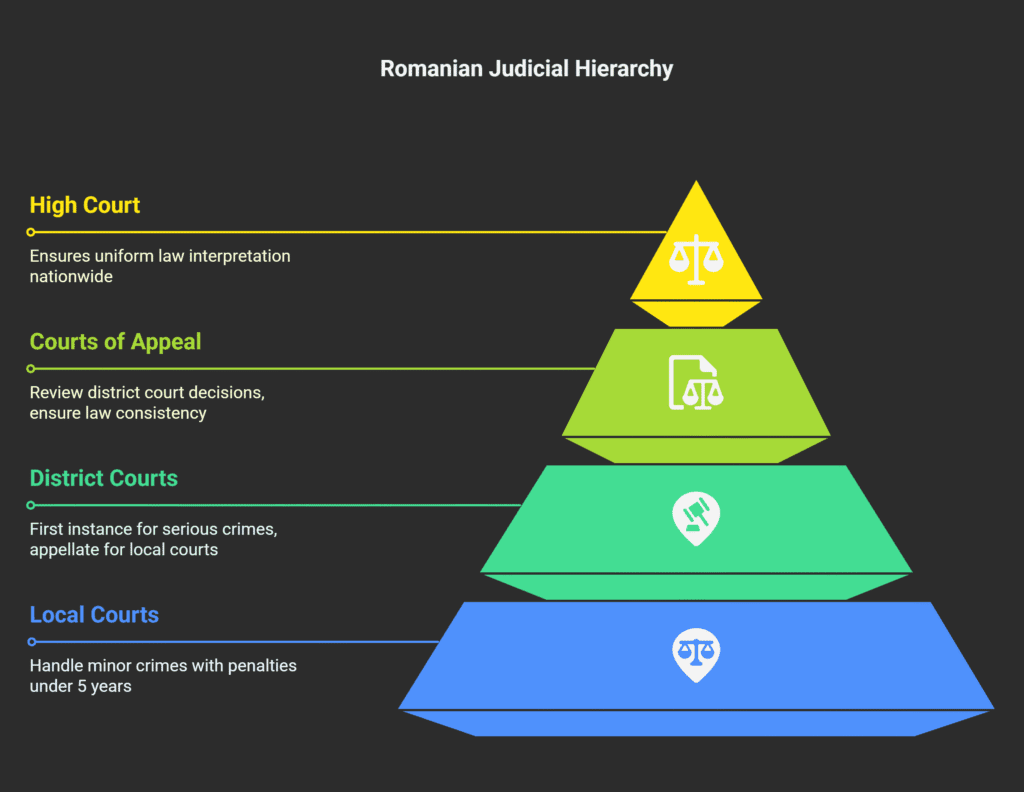
Structure of Romanian Courts

Local courts (Judecătorii) handle less serious crimes with penalties under 5 years.

These courts manage most criminal cases in Romania.

They are the first step for most defendants in the criminal justice system.

District courts (Tribunale) have two roles.

They act as first instance courts for serious crimes and as appellate courts for local court decisions.

Each district has one tribunal, handling complex criminal matters.

Courts of Appeal (Curți de Apel) review district court decisions.

They handle appeals in significant cases and ensure the law is applied consistently.

The High Court of Cassation and Justice is Romania’s highest court.

It ensures uniform law interpretation across the country.

It also handles appeals from Courts of Appeal in major cases.

Each court level has its own procedural rules.

Defense attorneys must navigate these rules strategically.

Knowing the right jurisdiction and procedural requirements is key for effective legal representation.

Key Players in Criminal Proceedings

Romanian criminal proceedings involve several key players.

Each has a distinct role and responsibility.

Their interaction shapes the case’s outcome.

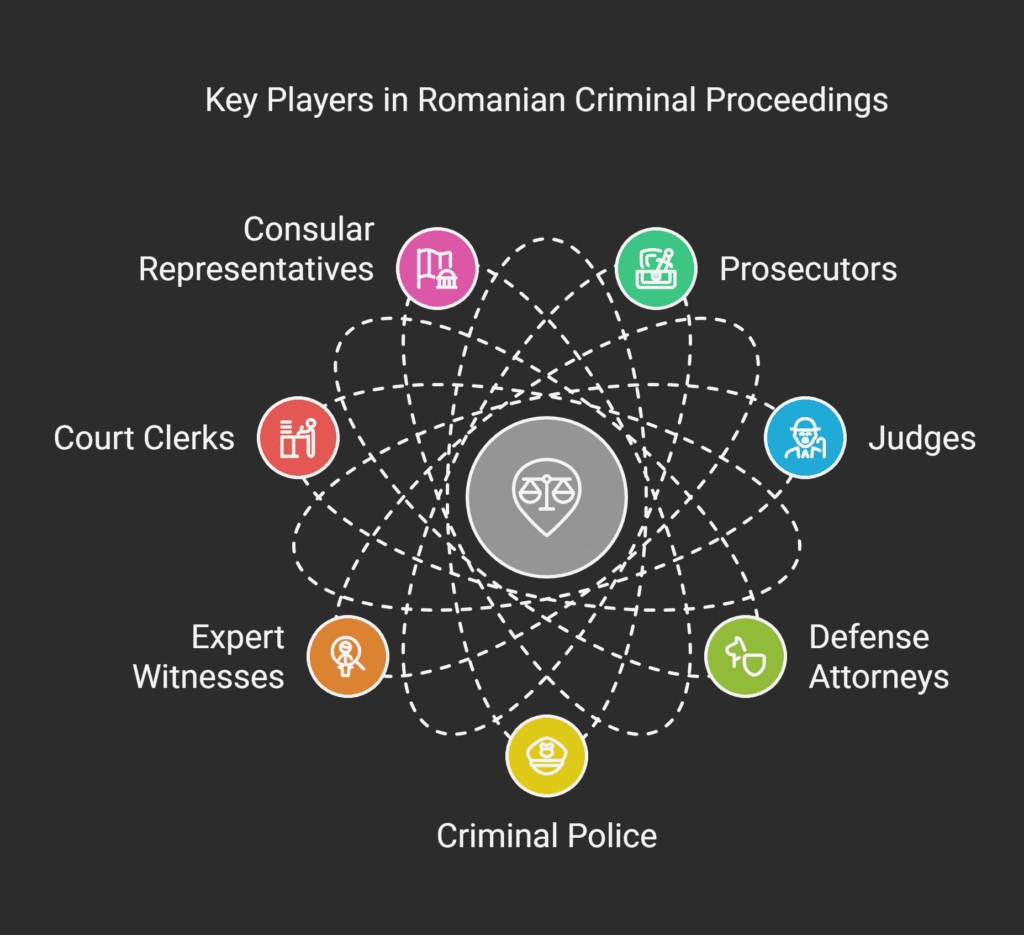
Key Players in Criminal Proceedings

Prosecutors (procurori) lead the prosecution.

They conduct investigations, gather evidence, and represent the state in court.

They make important decisions about charging and case progression under the Romanian Penal Code.

Judges ensure impartiality and procedural fairness.

They evaluate evidence, interpret laws, and make decisions based on the case’s merits.

In Romania, judges actively question witnesses.

Defense attorneys (avocați) defend the accused.

They challenge prosecution evidence and protect their clients’ rights.

Criminal lawyers in Romania develop strategies tailored to each case and guide clients through the process.

The criminal police help prosecutors with investigations.

They collect evidence and interview witnesses.

Expert witnesses provide specialized knowledge, and court clerks manage administrative tasks.

For non-Romanian citizens, consular representatives can help find legal representation.

If you don’t speak Romanian, your embassy can assist in finding a criminal defense lawyer in Romania who speaks your language.

Understanding these roles is vital for effective defense strategies.

Lawyers help and represent you in criminal proceedings.

For professional representation in Romanian criminal proceedings, contact office@theromanianlawyers.com.

Legal Rights of the Accused Under Romanian Law

When you face criminal charges in Romania, knowing your legal rights is key.

The Romanian legal system gives defendants strong protections.

These rights are real and help build a strong defense.

Knowing these rights helps defendants defend themselves better.

It also helps lawyers spot any mistakes that could hurt your case.

Let’s look at the rights you have when accused in Romania.

Constitutional Protections

The Romanian Constitution protects you when you’re charged with a crime.

These guarantees are the foundation of your defense rights.

They keep the government from abusing its power.

The presumption of innocence is a key right.

It means the prosecution must prove your guilt.

This right is vital for your defense in Romania.

Another important right is the protection of personal liberty.

Romanian law limits how long you can be held before trial.

This ensures you’re not unfairly kept in jail before your case is heard.

constitutional protections in romanian criminal law

constitutional protections in romanian criminal law

  • The right to a fair trial before an independent and impartial tribunal;
  • Protection against self-incrimination;
  • The right to legal assistance throughout criminal proceedings;
  • The principle of legality, ensuring criminal liability exists only for acts defined as offenses by law at the time of commission.

These constitutional protections are also backed by international human rights.

This gives you more ways to challenge unfair procedures.

Your Rights During Investigation and Trial

The criminal investigation process in Romania brings specific rights into play.

These rights start when you’re considered a suspect and last through the trial.

When detained, you must be told about the charges against you in a language you understand.

This includes the legal name of the crime and why you’re accused.

One key right is the right to remain silent.

Romanian law says:

  • You have the right to remain silent throughout the criminal investigation.
  • The authorities have to inform you on your right to remain silent, that there will be no negative consequences for your silence, and that anything you do say can be used against you.

This right is like the Miranda rights in other places.

It’s a key part of due process in Romania.

You also have the right to a lawyer.

Romanian law says:

  • Once apprehended, you have the immediate right to appoint a lawyer of your choice or to be assisted by a public defender (avocat din oficiu).
  • The police/prosecutor has to inform you of your right to a lawyer before you give any statement.

This right to counsel is critical. It lets you get legal advice early on.

The attorney-client privilege also protects your talks with your lawyer.

This keeps your defense plans private.

During the investigation, you also have the right to:

  • Examine the case file and evidence against them (though prosecutors may temporarily restrict this access during investigations for up to 10 days after charges are filed);
  • Request and propose evidence collection;
  • Challenge the legality of evidence collection methods;
  • File complaints against investigative measures.

As the case moves to trial, criminal trial procedures in Romania offer more rights.

These include:

  • The right to be present at trial (unless you waive it);
  • The ability to propose witnesses and evidence;
  • The right to challenge prosecution evidence;
  • The opportunity to make final statements before judgment;
  • Access to an interpreter if you don’t speak Romanian;
  • The right to appeal unfavorable decisions.

These safeguards make sure criminal defense rights in Romania meet European justice standards.

But using these rights well needs a lawyer’s help.

They know how to use these rights to defend you.

Understanding your rights is just the first step.

Using them well in your defense needs a lawyer’s help.

A skilled defense attorney can make sure your rights are respected and used to your advantage.

If you’re facing criminal charges, get help from a lawyer who knows Romanian criminal law.

A good lawyer can protect your rights and help you get a better outcome.

Criminal Defense Strategies in Romania

Defending against criminal charges in Romania is complex.

It requires a deep understanding of the law.

Lawyers must tailor their defense to each case, knowing the criminal justice system well.

Defense strategies often involve pointing out legal mistakes and questioning evidence.

Success often depends on the attorney’s ability to identify weaknesses in the prosecution’s case and build a strong defense.

Our law firm specializes in various criminal cases.

We offer detailed legal help from the start to appeals.

This includes cases like financial fraud and intellectual property crimes.

Procedural Defense Approaches

Procedural defense focuses on legal mistakes that can harm the prosecution.

It starts with checking the legality of searches and evidence collection.

One key strategy is to question the court’s jurisdiction.

If successful, this can exclude illegal evidence and weaken the prosecution.

procedural defense strategies in Romanian criminal cases

procedural defense strategies in Romanian criminal cases

During the preliminary chamber phase, defense attorneys can challenge evidence gatheringSuccessfully contesting these elements can lead to case dismissal before reaching trial on the merits, saving clients time and resources.

Effective procedural defense tactics also include:

  • Challenging the formulation of charges for lack of precision or legal basis;
  • Requesting specialized expert opinions to counter prosecution evidence;
  • Filing interlocutory appeals against adverse procedural rulings;
  • Contesting the validity of witness statements based on procedural irregularities;
  • Challenging the chain of custody for physical evidence.

During trial, it’s important to watch for legal mistakes.

Defense counsel must object to any legal errors to protect the case for appeal.

Substantive Defense Approaches

Substantive defense strategies challenge the prosecution’s story and offer alternative views.

They focus on the crime’s legal elements and defend against guilt.

A key strategy is to question if the prosecution can prove the crime beyond doubt.

Defense attorneys may argue the defendant’s actions don’t meet the crime’s legal definition.

In some cases, defenses like self-defense or necessity can clear the defendant.

Character evidence and reputation witnesses can also help in certain situations, like for first-time offenders.

For financial crimes, defenses often involve complex financial transactions.

Expert witnesses are key in these cases, providing knowledge to counter prosecution claims.

Defense Strategy TypePrimary FocusTypical TimingSuccess Factors
Procedural DefenseLegal protocols and procedural rightsPre-trial and preliminary chamberIdentifying procedural violations and technical errors
Substantive DefenseElements of the offense and factual narrativeTrial on meritsChallenging prosecution evidence and presenting alternatives
Hybrid ApproachCombination of procedural and substantive elementsThroughout all proceedingsComprehensive legal knowledge and strategic flexibility
Negotiation StrategySecuring favorable plea agreementsAny stage before final judgmentUnderstanding prosecution priorities and case weaknesses

We offer legal help for all criminal law matters.

Our attorneys provide strategic advice for each client’s situation.

This includes help during investigations and complex cases before Romania’s top courts.

We’re proud of our successes in tough cases.

Choosing a lawyer from our firm can greatly impact your case’s outcome.

For specialized legal help, contact office@theromanianlawyers.com.

Our experienced criminal defense attorneys are ready to assist.

The Criminal Procedure Timeline in Romania

Understanding the Romanian criminal justice system is key.

It involves knowing the timeline and each stage’s opportunities.

The criminal procedure in Romania has a set sequence, each with its own rules and time limits.

This knowledge helps defendants and their lawyers defend their rights effectively at every step.

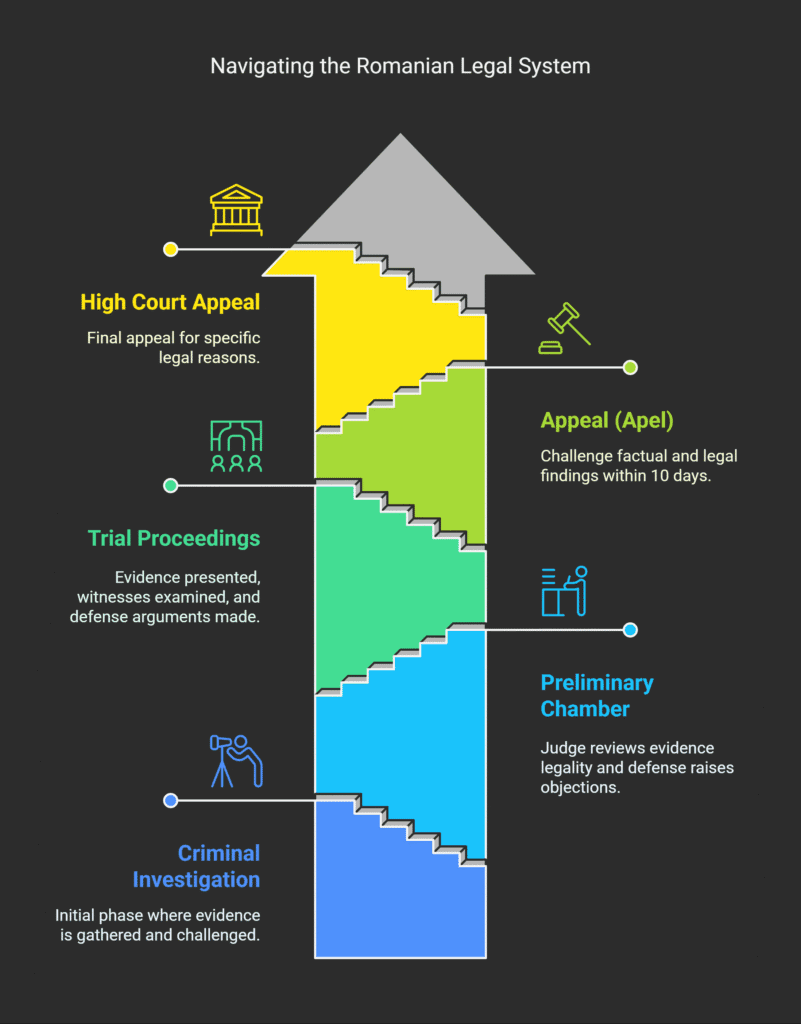
The process includes four main phases: criminal investigation, preliminary chamber, trial, and appeals.

Each phase has its own challenges and opportunities.

Lawyers need to adapt their strategies for each stage.

Pre-Trial Investigation Phase

The pre-trial investigation is the first and most critical phase of criminal proceedings in Romania.

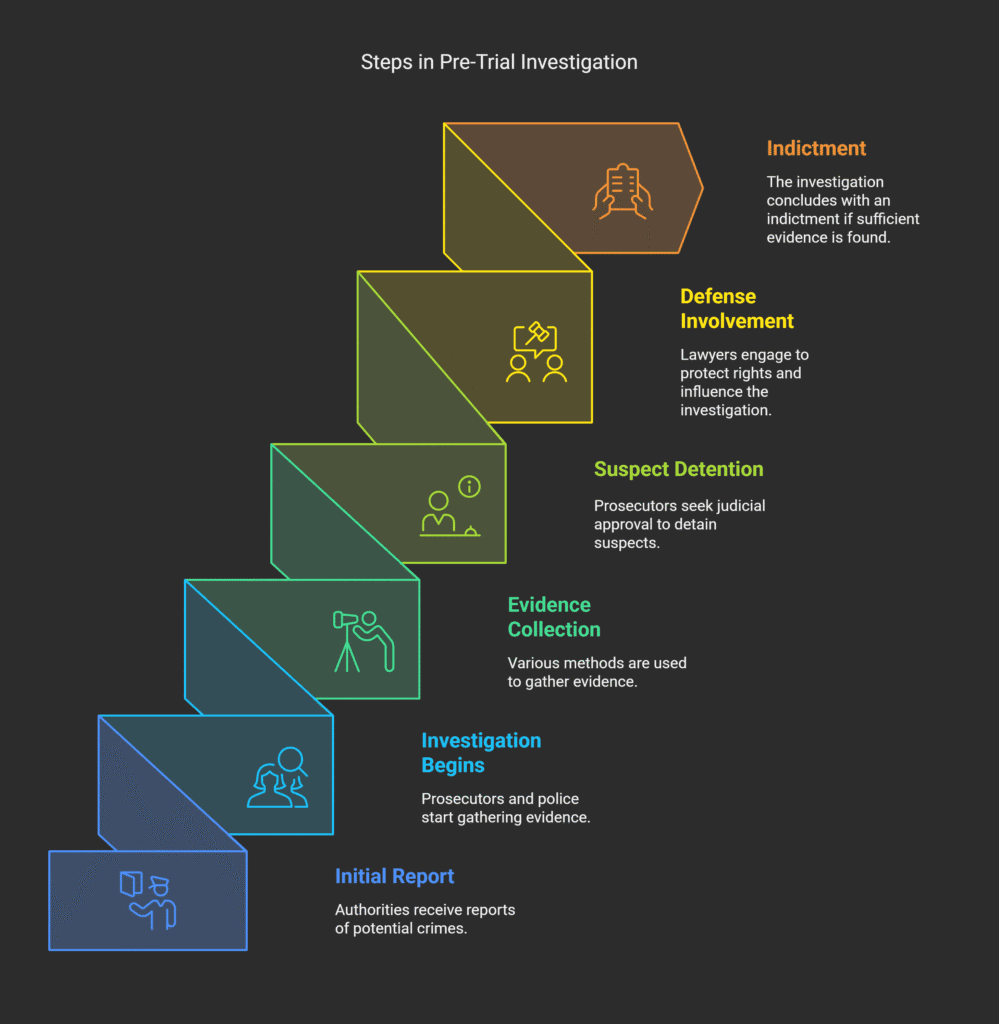
Pre-Trial Investigation Phase Romania

It starts when authorities notice a possible crime.

This can be through direct observation, victim reports, or witness statements.

Prosecutors lead the investigation with help from judicial police.

For certain crimes, like corruption, specific bodies handle the case.

The National Anticorruption Directorate (DNA) deals with corruption, while the Directorate for Investigating Organized Crime and Terrorism (DIICOT) handles organized crime.

During this phase, investigators use many methods to gather evidence.

These include:

  • Interviewing witnesses and suspects;
  • Collecting and analyzing documents;
  • Searching properties and seizing items;
  • Using technical surveillance;
  • Conducting expert examinations and forensic analysis.

If prosecutors want to detain a suspect, they must bring them before a judge.

The judge decides if detention is necessary.

Suspects can challenge this decision within 48 hours, with appeals heard within 5 days.

Suspects usually have the right to see their case file during criminal investigations.

But prosecutors can limit this access for up to 10 days after charges are filed.

Defense lawyers always have access to their clients’ statements, no matter the restrictions.

The investigation ends with an indictment if there’s enough evidence.

Early defense involvement is vital to protect rights and influence the investigation.

Trial Proceedings and Appeals

Trial Proceedings and Appeals Romania

After an indictment, the case goes to the preliminary chamber.

Here, a judge checks if the evidence was gathered legally.

This is a key chance for the defense to challenge any irregularities.

The trial proceedings in Romania follow a set format for fairness.

The trial starts with preliminary matters, then the indictment is read.

Evidence is then presented by both sides.

During the trial, defendants have important rights:

  • They can actively participate;
  • Question witnesses and experts;
  • Present evidence that clears their name;
  • Make statements, though not under oath;
  • Have the last word before the court deliberates.

After evidence is presented, closing arguments are made.

The defendant always gets to speak last before the court decides.

The judgment must explain the court’s reasoning clearly.

If arrested, you can challenge the decision within 48 hours.

The appeal must be heard within 5 days after filing.

The appeals process in Romanian criminal cases protects against judicial mistakes.

After a verdict, parties can appeal within 10 days.

This triggers a thorough review by a higher court.

This appeal is not just a review but a full trial continuation.

The appellate court can re-examine evidence and make new conclusions.

In rare cases, there’s a further appeal called “recurs în casație” before the High Court of Cassation and Justice.

This appeal is for specific legal reasons, not factual reassessment.

Procedural StageKey Defense OpportunitiesTime Limitations
Criminal InvestigationChallenge evidence gathering methods, request additional evidenceVaries by case complexity
Preliminary ChamberContest legality of evidence, raise procedural violations5 days to file objections
Trial ProceedingsPresent defense evidence, cross-examine witnessesDetermined by court schedule
Appeal (Apel)Challenge factual and legal findings10 days from verdict

Effective defense strategies must adapt to each stage while keeping a consistent defense narrative.

Knowing the specific timeframes and requirements at each phase is key to protecting defendants’ rights and achieving good outcomes.

For professional help through criminal proceedings in Romania, from investigation to appeals, contact office@theromanianlawyers.com.

They offer expert legal representation tailored to your case.

Building an Effective Defense Team

Understanding Romania’s criminal justice system is key.

You need a defense team that fits your case perfectly.

The right team can change the outcome of your case, from guilty to not guilty.

They protect your rights and create strategies for Romanian courts.

Finding the right professionals is the first step.

They should know Romanian law well.

In serious cases, teamwork is vital for a strong defense.

criminal defense team in Romania

criminal defense team in Romania

Selecting the Right Criminal Defense Attorney

Choosing a criminal defense lawyer in Romania is critical.

Look for someone with experience in your type of case.

This could be anything from theft to violent crimes.

Lawyers with similar case experience know the law and prosecution tactics.

Their reputation in Romania’s legal world shows their skill.

Peers, judges, and clients can give you a good idea of their ability.

If you’re not from Romania, language is important.

Some criminal defense lawyers in Romania speak multiple languages.

Your embassy can help find a lawyer who speaks your language and knows the law.

Registered lawyers are listed in the Lawyers’ Yearly Register.

You can hire any lawyer in Romania, even if they’re not in your region’s bar association.

Good communication with your lawyer is essential.

They should explain things clearly and keep you updated.

Your lawyer’s strategy should match your goals, whether it’s to win your case or get a good plea deal.

Before choosing, talk to several lawyers.

Discuss your case, how they’ll communicate, and their fees.

For help finding a criminal defense attorney in Romania for your case, email office@theromanianlawyers.com.

Working with Expert Witnesses and Specialists

Expert witnesses are key in criminal defense, for complex cases.

They provide analysis and testimony that can help your case.

This can include challenging evidence or giving new insights.

In Romania, experts can be court-appointed, requested by the defense, or hired privately.

Common experts include:

  • Forensic specialists who analyze physical evidence;
  • Digital forensic experts who examine electronic data;
  • Financial analysts who review complex transactions in economic crime cases;
  • Medical professionals who address issues related to injuries, cause of death, or mental state;
  • Psychological experts who provide insights into a defendant’s mental condition.

Specialized legal assistance is vital for investigations by special directorates.

Working with experienced attorneys is critical, as these investigations can be serious.

Defense attorneys and experts must work well together.

They need to share case details, ask the right questions, and prepare for testimony.

The attorney must choose experts who are qualified, credible, and can explain complex information to judges.

It’s best to get expert witnesses early in your case.

This gives them time to analyze and prepare their findings.

Remember, your lawyer helps and represents you, but they don’t investigate.

Choosing the right experts is key.

Building a strong defense team also means having investigators.

They can find evidence and witnesses that help your case.

For help finding and working with expert witnesses, email office@theromanianlawyers.com.

Evidence Strategies in Romanian Criminal Cases

Effective evidence strategies in Romanian criminal cases need a deep understanding of legal rules and principles.

The way evidence is managed and presented can greatly affect the outcome of a case.

Romanian defense attorneys must create detailed plans to handle both the prosecution’s evidence and the defendant’s exculpatory materials.

In Romanian criminal procedure, evidence must meet strict standards to be allowed in court.

Defense lawyers must carefully analyze all case materials and develop strategies to protect the defendant’s rights.

evidence handling in criminal cases

evidence handling in criminal cases

The Romanian Criminal Procedure Code gives defendants and their lawyers the right to see the entire case file.

Prosecutors can limit this access during investigations, but only for 10 days after charges are filed.

This is a key chance for defense preparation.

Challenging Prosecution Evidence

Challenging Romanian Prosecution Evidence

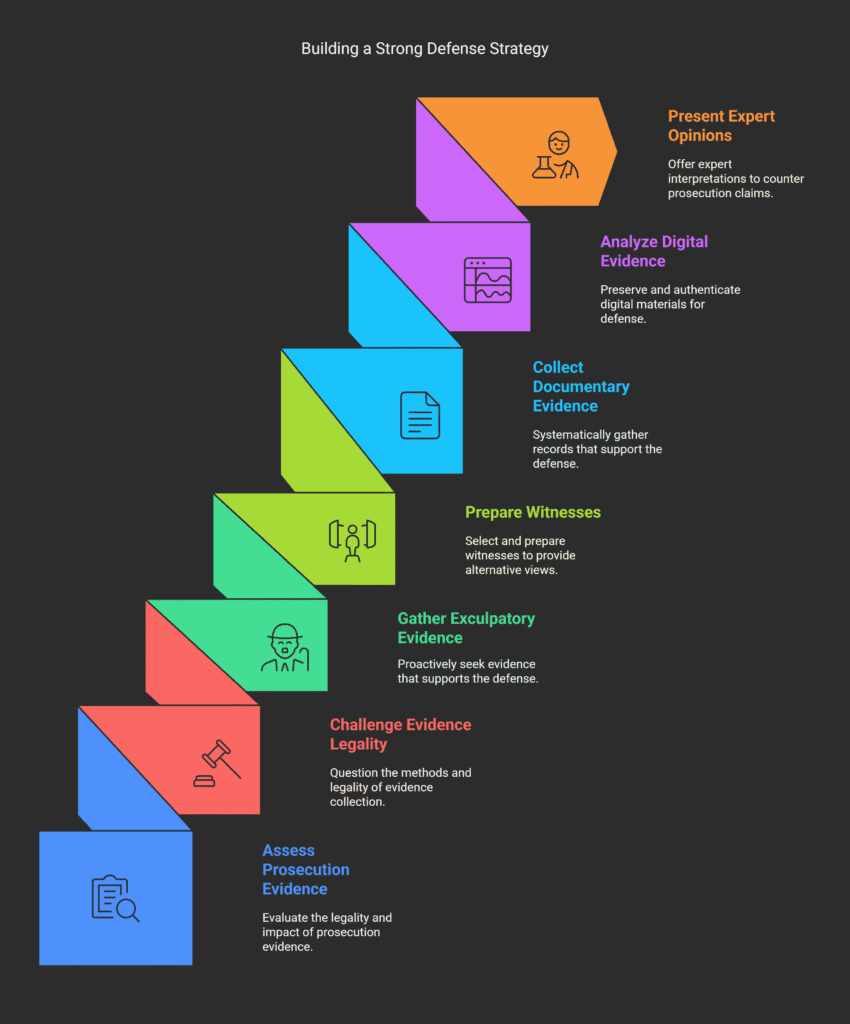
systematic assessment of prosecution evidence is key to effective defense in Romania.

Defense attorneys must check the evidence’s content and how it was obtained.

They look for ways to exclude or reduce the impact of damaging evidence.

The main challenge is questioning the legality of evidence collection.

Romanian courts can exclude evidence gathered improperly.

If authorities break constitutional or procedural rules, the evidence can be thrown out.

Defense lawyers should also question the chain of custody for physical evidence.

Issues with preservation and contamination can weaken prosecution exhibits.

This is very effective with forensic evidence like fingerprints or DNA samples.

Witness testimony reliability is another key challenge.

Defense attorneys can use cross-examination to show inconsistencies or bias in witness statements.

Romanian courts are starting to recognize the flaws in eyewitness testimony, giving defense teams chances to challenge it.

Prosecution expert testimony needs careful scrutiny.

Defense teams can challenge experts by questioning their qualifications, methods, and findings.

They can also present opposing expert opinions to counter prosecution claims.

The preliminary chamber phase is a critical time to challenge evidence legality before trial.

Defense attorneys must raise objections quickly.

Failing to do so may limit their ability to challenge evidence later.

Gathering Exculpatory Evidence

While prosecutors lead investigations, defense attorneys must actively seek out favorable evidence.

This proactive approach strengthens the defendant’s case.

Defense counsel should ask for specific investigative actions to find exculpatory information.

This can include interviewing witnesses, getting surveillance footage, or electronic records.

Prosecutors have discretion but must consider these requests.

Choosing and preparing witnesses is key to effective evidence gathering.

Defense teams can propose witnesses during investigations and trials.

Strategic witness selection can provide alternative views, alibis, or contradict prosecution claims.

Collecting documentary evidence supporting the defense requires systematic effort.

This includes records that establish alibis, financial documents in economic crimes, communications that contradict prosecution claims, medical records, and employment or educational records.

In some cases, defense-commissioned expert examinations can offer alternative views of technical evidence.

While courts often favor prosecution experts, well-qualified defense experts can challenge prosecution conclusions, which is important in complex cases.

Digital evidence is increasingly important in criminal cases.

Social media, electronic communications, location data, and other digital materials can support defense claims.

Defense teams must know how to preserve and authenticate such evidence.

Evidence StrategyProsecution ApproachDefense ResponseStrategic Timing
Witness TestimonyPresenting multiple corroborating witnessesCross-examination highlighting inconsistenciesPreliminary hearing and trial
Physical EvidenceEstablishing chain of custody and relevanceChallenging collection methods and preservationPreliminary chamber phase
Expert AnalysisPresenting technical findings supporting guiltOffering alternative expert interpretationsPre-trial and trial phases
Documentary EvidenceSelective presentation supporting chargesProviding context and additional documentationThroughout proceedings
Digital EvidenceExtracting incriminating digital materialsAuthentication challenges and contextual analysisPreliminary chamber and trial

Throughout the evidence gathering process, defense attorneys must keep detailed records and ensure evidence is properly authenticated.

Romanian courts have strict standards for evidence admissibility, requiring careful attention to procedural rules.

After reviewing the evidence, defendants can ask for more evidence collection or witness statements.

Prosecutors must consider these requests and decide whether to include them in the case file.

If new evidence is added or charges change, defendants must be informed promptly.

For professional help in creating detailed evidence strategies for your case, contact office@theromanianlawyers.com.

Our experienced team offers expert advice on challenging prosecution evidence and developing strong exculpatory materials.

Negotiation and Plea Bargaining Tactics

In Romania, plea bargaining is a key strategy for defendants and their lawyers.

It’s called “acordul de recunoaștere a vinovăției” in Romanian.

This method is part of recent judicial reforms to make the system more efficient.

Plea bargaining lets defendants talk to prosecutors about charges and sentences in exchange for admitting guilt.

This can lead to better outcomes than going to trial.

It’s a strategic choice to consider.

“Effective plea bargaining requires not just legal knowledge, but strategic foresight—the ability to accurately assess case strengths and weaknesses while understanding the prosecutor’s motivations and constraints.”

Deciding on a plea agreement involves many factors.

These include looking at the evidence, the severity of the charges, and possible sentences.

Getting professional legal advice is key for these negotiations.

Our team of criminal defense attorneys creates custom negotiation plans for each client.

When to Consider a Plea Agreement

Choosing a plea agreement needs careful thought.

It starts with looking at the evidence.

If the prosecution has strong evidence, a plea might reduce the sentence.

But, if the evidence is weak or there were procedural mistakes, going to trial might be better.

The seriousness of the charges also plays a big role.

More serious crimes might offer bigger sentence reductions through negotiation.

A defendant’s criminal history is important in negotiations.

First-time offenders usually get better deals than those with past crimes.

This is true, even in DUI cases, where a clean record can help.

Other things also affect plea decisions.

These include:

  • Emotional and financial costs of long trials;
  • Potential effects of a conviction;
  • The defendant’s personal and work life;
  • When in the process the decision is made.

Romanian law has rules about plea agreements.

They can’t be used for crimes with sentences over 7 years.

Knowing these rules is important when thinking about pleas.

DUI lawyer in Romania from our team can help decide if a plea is right for you.

We look at all the details to find the best strategy.

For advice, email us at office@theromanianlawyers.com.

Negotiation Strategies with Prosecutors

Good negotiation with prosecutors in Romania needs smart strategies.

Defense attorneys start by preparing well, analyzing the evidence.

This helps them know the prosecution’s weak points.

This prep lets them talk about possible charge reductions or sentences.

Building a good relationship with prosecutors helps negotiations.

Experienced Romanian lawyers can be firm but respectful, fighting for their clients’ best interests.

Good negotiation strategies include:

Mitigating FactorPotential ImpactStrategic Approach
Lack of criminal historySignificant positive influenceEmphasize rehabilitation
Cooperation with authoritiesDemonstrates good faithDocument all cooperative actions
Restitution to victimsShows responsibilityPresent a restitution plan
Personal circumstancesContextualizes behaviorProvide supporting documentation

Defense attorneys use case weaknesses to their advantage.

This includes evidence problems, procedural errors, or different ways to look at the facts.

The timing of negotiations is also key, with different chances at different stages.

During talks, lawyers must keep clients informed about offers and their risks.

They should also be ready for trial, keeping their clients’ options open.

This strengthens their negotiating position.

A crime lawyer in Romania from our team offers tailored legal help for each case.

We focus on getting good results through negotiation when it’s smart.

For help with negotiations in your case, email us at office@theromanianlawyers.com.

Trial Preparation and Courtroom Strategies

Trial Preparation and Courtroom Strategies in Romania

In Romanian criminal trials, the outcome often depends on how well the defense prepares and strategizes.

The trial is the key moment where defense theories face off against prosecution evidence.

Good preparation and smart strategy are key to a successful defense.

Good trial prep means analyzing the case well, organizing evidence, and making strong legal arguments.

Romanian trials have strict rules that defense lawyers must follow.

Successful strategies mix legal knowledge with the ability to persuade, pay attention to details, and be ready for surprises.

In Romanian trials, both sides give their final arguments.

The defendant gets to speak last, which can really sway the judge.

Developing a Compelling Case Theory

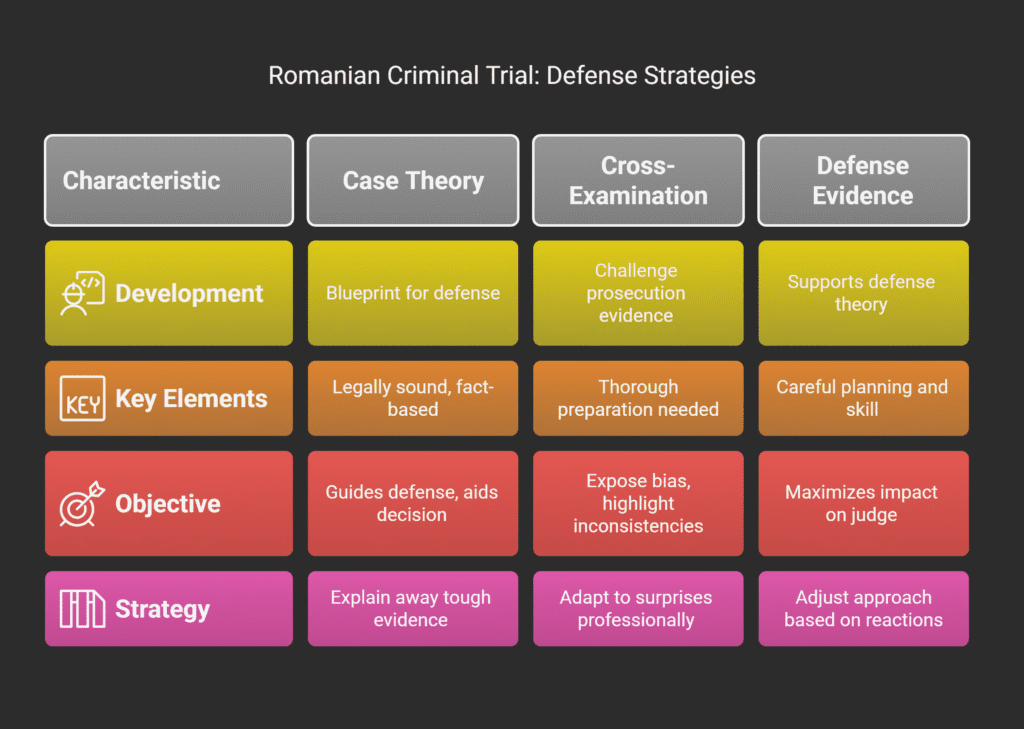
A strong case theory is like a blueprint for your defense.

It organizes your evidence and arguments into a clear story.

This is what guides your defense and helps the judge make a decision.

Good case theories need to be legally sound, based on facts, emotionally engaging, and easy to understand.

They start with a deep look at the prosecution’s evidence and finding weaknesses.

Then, defense lawyers come up with alternative stories that support their side.

Instead of ignoring tough evidence, a good case theory explains it away.

This makes your case stronger and more believable.

The theory should be clear in every part of your defense.

Effective Cross-Examination Techniques

Cross-examination is a chance to challenge the prosecution’s evidence in Romanian trials.

Even though the system is not purely adversarial, defense lawyers can question witnesses and challenge their testimony.

Good cross-examination starts with thorough prep, including looking at past statements and documents.

Defense lawyers plan their questions carefully to achieve their goals.

They use leading questions to guide the witness’s answers.

When questioning prosecution witnesses, defense lawyers should focus on:

  • Highlighting inconsistencies with prior statements;
  • Exposing bias or motivation to testify falsely;
  • Demonstrating perceptual limitations or memory issues;
  • Establishing facts that support the defense theory.

For expert witnesses, defense lawyers should question their qualifications, methods, and the facts behind their opinions.

Good questioning can show the limits of the expert’s analysis or suggest other ways to look at the evidence.

During cross-examination, defense lawyers need to stay professional and adapt to any surprises.

The order and timing of questions are very important.

Save your strongest points for when they will have the most impact.

Presenting Defense Evidence Persuasively

Presenting defense evidence well requires careful planning and skill.

Start by choosing evidence that supports your theory and prepares for challenges from the prosecution.

How you order your evidence can make a big difference.

Use the first and last pieces of evidence to make the biggest impact.

This is because people remember what comes first and last best.

When using witnesses, defense lawyers should ask questions that get clear, helpful answers.

Make sure witnesses stick to their story during cross-examination.

For documents, explain them well and show how they fit into your case.

During trial proceedings, parties present their closing arguments, with the defendant always having the final word before deliberation. The court then issues its judgment, which must contain detailed reasoning for its decision on both factual and legal matters.

Visual aids and demonstrative exhibits can help explain complex evidence when used right.

They’re great for technical or financial evidence that’s hard for judges to understand.

While presenting evidence, defense lawyers should watch how the judge reacts.

Adjust your approach as needed to keep your evidence connected to your theory.

Showing you’ve thought of possible weaknesses makes your case stronger.

A DUI lawyer in Romania or a crime lawyer in Romania from our team offers personalized help for each case.

We focus on professional court work and aim for the best results for our clients through careful prep and strategy.

For help with trial prep and courtroom strategies in your case, email office@theromanianlawyers.com.

Sentencing Mitigation Strategies

In Romania, sentencing mitigation strategies can change harsh penalties into more manageable ones.

Even when a guilty verdict seems likely, skilled lawyers can help.

They do this by using their knowledge of Romanian law and advocating for their clients.

These strategies are key in both plea deals and contested cases.

The goal is to get the best possible sentence under Romanian law.

Factors Affecting Sentencing in Romania

Sentencing Mitigation Strategies Romania

The Romanian Criminal Code sets a framework for sentencing.

It guides judges with specific factors.

For each crime, there are sentencing ranges based on the case’s details.

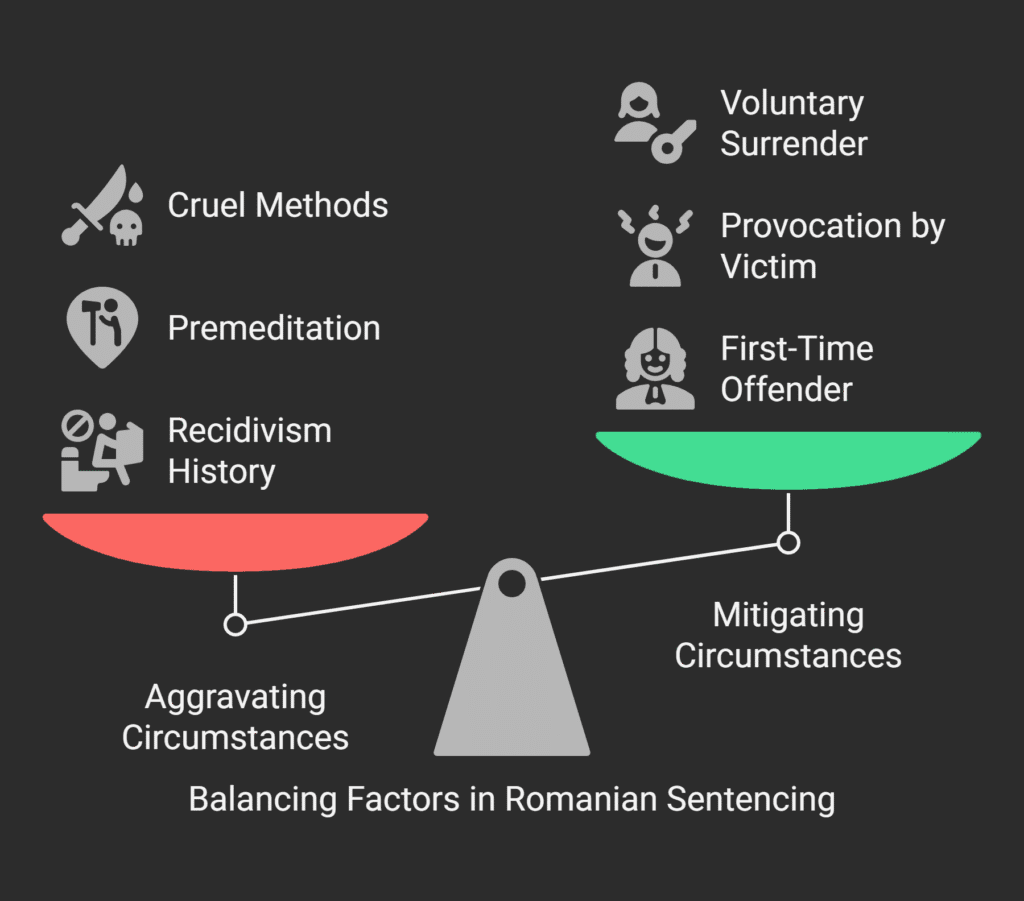
Aggravating circumstances that can increase sentences include:

  • Recidivism or prior criminal history;
  • Commission of multiple offenses;
  • Premeditation or careful planning;
  • Particularly cruel methods of commission;
  • Exploitation of victim vulnerability;
  • Commission by organized criminal groups.

On the other hand, mitigating circumstances that support reduced sentences include:

  • First-time offender status;
  • Provocation by the victim;
  • Exceeding the limits of legitimate self-defense;
  • Voluntary surrender to authorities;
  • Cooperation with investigators;
  • Genuine remorse demonstrated through concrete actions.

Personal circumstances are also considered during sentencing.

Judges look at age, health, family, job history, and community involvement.

These help paint a fuller picture of the defendant.

The way the crime was committed also matters.

Courts look at the defendant’s role and contribution.

A smaller role can lead to a lighter sentence.

Romanian courts aim for sentences that match the crime’s gravity but avoid being too harsh.

They must explain their reasoning in detail.

This makes the sentencing process clear.

Rehabilitation is another key factor.

Judges consider if alternatives to jail might help the defendant more.

This is often the case for first-time offenders or those with strong community support.

Effective Arguments for Reduced Sentences

Creating strong arguments for lighter sentences requires a mix of legal knowledge and persuasive presentation.

Defense lawyers should start by studying the sentencing laws.

They look for minimum penalties and alternatives to jail.

Highlighting the defendant’s limited role in a crime can also help.

This is true in cases where there are multiple people involved.

It shows the defendant’s level of responsibility.

Showing there’s no prior criminal history is another strong point.

It suggests the current crime is an isolated incident.

This makes the defendant seem less of a risk to society.

Remorse shown by the defendant is also important.

This can include:

  1. Public apologies to victims or communities;
  2. Voluntary compensation to those harmed;
  3. Participation in restorative justice programs;
  4. Other concrete actions demonstrating acceptance of responsibility.

Rehabilitation chances are a strong argument.

Defense lawyers should show evidence of:

  • Stable employment history or educational pursuits;
  • Strong family support systems;
  • Willingness to participate in relevant treatment programs;
  • Concrete plans for future law-abiding behavior.

Hardships caused by jail time can also justify alternative sentences.

This includes effects on family members or health issues that worsen in jail.

Defense lawyers should also show the defendant’s positive side.

This can include letters, testimony, and volunteer work.

It helps show the defendant’s value to society.

Highlighting harsh consequences of a conviction can also help.

This includes job loss, license revocation, or immigration issues that add to the punishment.

The court then explains its decision in detail.

This transparency helps defendants understand their sentence.

It also gives grounds for appeals if there were mistakes.

For help with sentencing mitigation strategies in Romania, contact office@theromanianlawyers.com.

Our team can help find and present the best arguments for your case.

Post-Conviction Remedies and Appeals

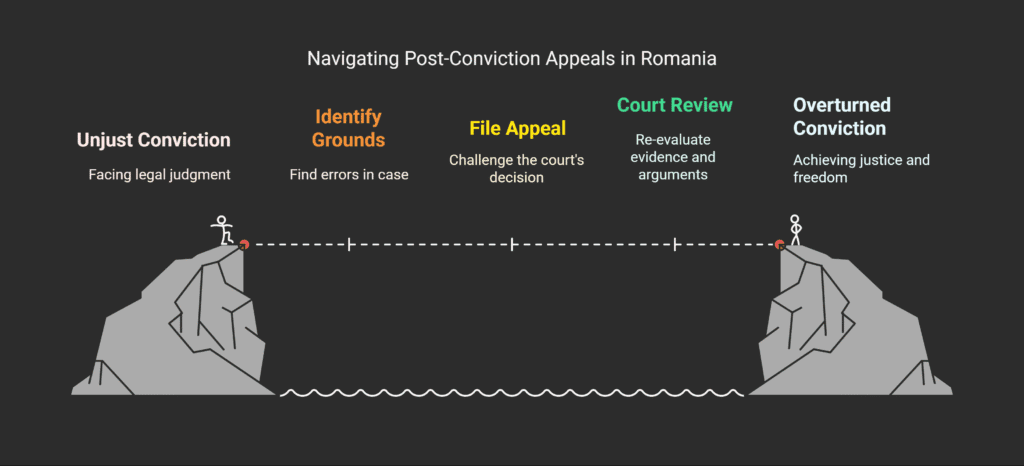
Post-Conviction Remedies and Appeals Romania

In Romania, understanding the appeals and remedies after a conviction is key.

The legal system offers ways to challenge judgments, fix mistakes, or introduce new evidence.

These steps help ensure justice is served.

After a court makes a decision, there are options.

The Romanian law sets up a clear appeals process and special remedies.

Knowing these can help in planning a strong defense.

Grounds for Appeal in Romanian Law

Romanian law lists specific reasons to appeal a court’s decision.

These include mistakes in how the case was handled or errors in the decision itself.

Successful appeals show these mistakes changed the outcome.

Some common reasons for appeal include:

  • Improper court composition or lack of jurisdiction;
  • Violations of public trial requirements;
  • Infringement of defense rights during proceedings;
  • Improper handling or admission of evidence;
  • Failure to address key defense arguments.

Appeals can also challenge how the law was applied or facts were found.

The court checks if the law was correctly applied to the facts.

To appeal, you must do so within 10 days of the judgment.

You need to clearly state what you’re challenging and why.

This helps the court know what to review.

The court will look at all the evidence again.

They might even consider new evidence.

This is a chance to fix mistakes from the first trial.

For help finding grounds for appeal, email office@theromanianlawyers.com.

The outcome of an appeal can be:

  • Confirmation of the original decision;
  • Modification regarding legal classification or sentencing;
  • Retrial orders in cases of serious procedural violations;
  • Complete reversal with acquittal.

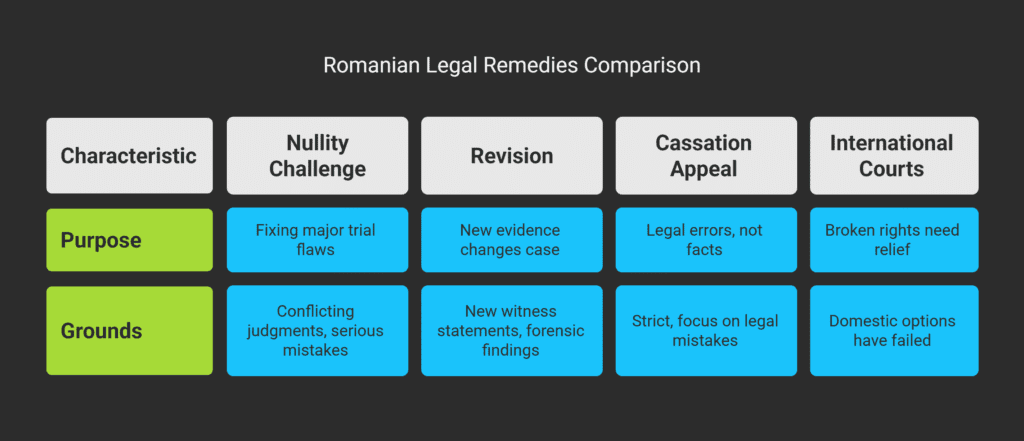
Extraordinary Legal Remedies

Extraordinary Legal Remedies in Romania

Romania also offers special remedies for challenging final decisions.

These are used when regular appeals are not possible or have failed.

Contestația în anulare (nullity challenge) is for serious mistakes like conflicting judgments.

It’s about fixing major flaws in the trial, not the case itself.

Revizuirea (revision) is for new evidence that could change the case.

This includes new witness statements, forensic findings, or evidence tampering.

Recurs în casație (cassation appeal) is a rare option before the High Court of Cassation and Justice.

It’s for legal errors, not facts.

The grounds are strict and focus on legal mistakes.

Each remedy has its own rules and time limits.

It’s important to get legal advice to see which one fits your case.

International courts can also offer relief.

If rights were broken, you can go to the European Court of Human Rights.

This is a long process but can help if domestic options failed.

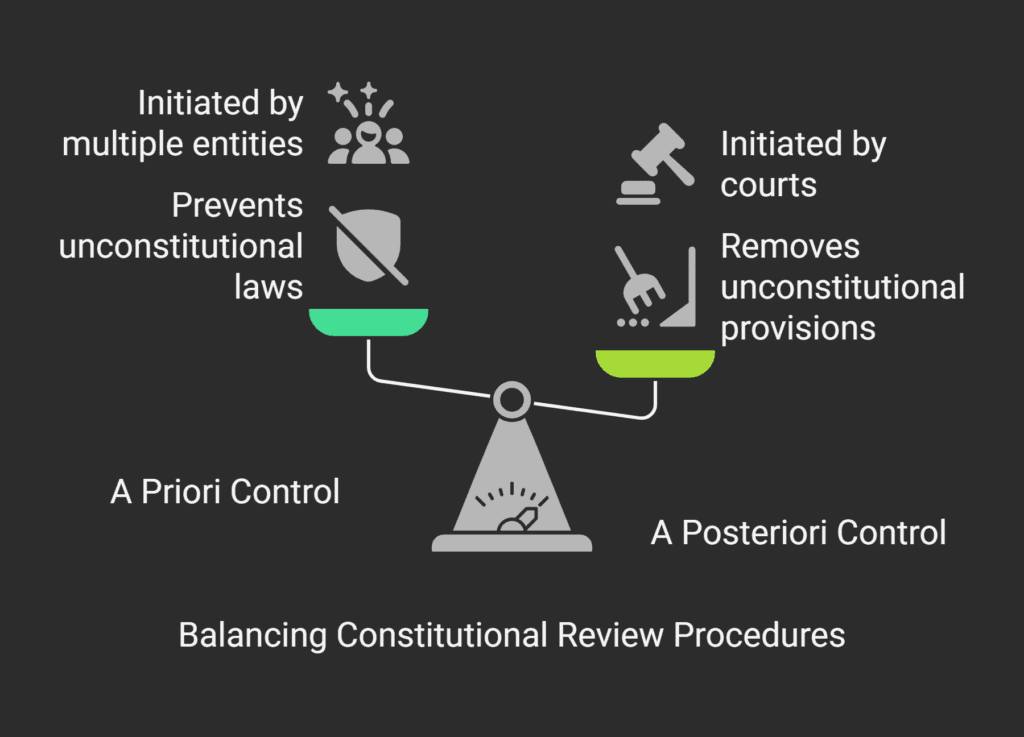
Challenging laws through the excepție de neconstituționalitate procedure is another option.

Presidential pardons and amnesty laws can also offer relief, but these are political, not judicial.

Understanding post-conviction remedies in Romania needs legal help.

For advice on appeals or special remedies, email office@theromanianlawyers.com.

Conclusion: Securing the Best Possible Outcome

Understanding the Romanian criminal justice system is complex.

It needs strategic planning and strong legal support.

The defense strategies in this guide are proven to protect defendants’ rights at every step.

Our law firm has a strong track record in complex cases across Romania.

We focus on detailed case preparation, managing evidence, and strong courtroom arguments.

Getting experienced defense counsel early can greatly improve your chances of a good outcome.

Specialized criminal defense lawyers in Romania can change the outcome of a case.

Our team knows the best tactics and Romanian laws well.

This gives clients a big advantage in court, whether it’s dismissing a case, negotiating a plea, or defending at trial.

Each case in Romania needs a custom defense strategy.

Our lawyers are experts in white collar and financial crimes.

They bring up-to-date legal knowledge and experience to each case, helping to improve the outcome.

If you need help with criminal matters in Romania, contact office@theromanianlawyers.com.

Our experienced Romanian attorneys are ready to assist.

FAQ

What are the main courts handling criminal cases in Romania?

Romania has a clear court structure for criminal cases.
Local courts handle minor offenses with penalties under 5 years.
District courts deal with more serious crimes and review local court decisions.
Courts of Appeal review district court decisions. 
The High Court of Cassation and Justice is the top court, ensuring laws are applied uniformly.

What rights do defendants have during criminal investigations in Romania?

Defendants in Romania have key rights.
They must be told of accusations in a language they understand.
Defendants have the right to legal help, to remain silent, and to see case files.
They can propose evidence and witnesses.
Defendants can challenge prosecution evidence and make final statements before judgment.
They also have the right to appeal.

What is the presumption of innocence in Romanian criminal law?

The presumption of innocence is a key principle in Romanian law. It’s in the Constitution.
It means the prosecution must prove guilt, not the defendant.
This principle requires all doubts to be in favor of the accused. 
It stops authorities from treating someone as guilty before a final decision.

What procedural defense strategies are most effective in Romanian criminal cases?

Effective strategies include challenging the legality of searches and seizures.
Contesting court jurisdiction or prosecutorial competence is also key.
Filing motions to exclude illegally obtained evidence is important.
Challenging imprecise charge formulations and questioning evidence legality during the preliminary chamber phase are also effective.
Monitoring procedural compliance, requesting specialized expert opinions, and filing interlocutory appeals are also important.

How can defense attorneys gather exculpatory evidence in Romanian criminal cases?

Defense attorneys can gather exculpatory evidence by submitting specific requests for investigative actions.
They can propose witnesses for examination during both investigation and trial.
Collecting documentary evidence supporting the defense position is also important.
Commissioning independent expert examinations and securing digital evidence are key.
Maintaining records of all evidence gathered is essential.

What is plea bargaining in Romania and when was it introduced?

Plea bargaining in Romania allows defendants to negotiate with prosecutors.
It was introduced recently as part of reforms to increase judicial efficiency.
It’s available for offenses punishable by up to 7 years imprisonment.
It requires judicial approval of all negotiated terms.

When should a defendant consider a plea agreement in Romania?

A defendant should consider a plea agreement when facing strong prosecution evidence.
When the sentence reduction is significant, it’s also a good time.
Being a first-time offender or wanting to avoid the costs of a long trial are reasons.
Personal circumstances that would be worsened by incarceration are also important.
Each case needs a careful assessment with defense counsel.

What negotiation strategies are effective with Romanian prosecutors?

Effective strategies include thorough case preparation and establishing rapport with prosecutors.
Highlighting mitigating factors and leveraging case weaknesses are key.
Timing negotiations strategically and maintaining clear communication are important.
Preparing for trial while negotiating keeps leverage.
Ensuring agreements meet judicial approval requirements is also important.

How should a defense attorney develop a compelling case theory in Romanian criminal proceedings?

A defense attorney should analyze prosecution evidence and identify weaknesses.
Assessing defense evidence and formulating alternative explanations is important.
Ensuring consistency with legal standards and available evidence is key.
Acknowledging problematic evidence and reinforcing the theory consistently are important.
This creates a clear narrative for judges.

What techniques make cross-examination effective in Romanian criminal trials?

Effective techniques include thorough preparation and strategic planning. 
Maintaining control through careful use of leading questions is important.
Employing impeachment techniques and focusing on qualifications and methodology when examining experts are key. 
Adapting to unexpected responses and considering the timing and sequence of questions are important.

What factors affect sentencing decisions in Romanian criminal cases?

Sentencing decisions are influenced by statutory ranges and aggravating circumstances. 
Mitigating circumstances, the defendant’s personal circumstances, and the manner of offense commission are also important.
The consequences and harm caused, proportionality principles, and rehabilitation prospects are also considered.

What arguments are most effective for securing reduced sentences in Romania?

Effective arguments include highlighting the defendant’s limited role in the offense. 
Emphasizing the absence of prior criminal history is also important.
Demonstrating genuine remorse through actions like victim compensation is key. 
Presenting evidence of rehabilitation and personal hardship is also important. 
Highlighting disproportionate collateral consequences of conviction can also be effective.

What are the main grounds for appeal in Romanian criminal cases?

Main grounds for appeal include procedural violations and substantive errors. 
Appeals must be filed within 10 days of judgment communication.
They must specify the challenged decision components and specific grounds for appeal.

What extraordinary legal remedies are available after exhausting ordinary appeals in Romania?

Extraordinary remedies include “contestația în anulare” for serious procedural errors. 
“Revizuirea” is available when new evidence emerges. 
“Recurs în casație” addresses specific legal errors.
Petitions to the European Court of Human Rights for convention rights violations are also available. 
Constitutional challenges and presidential pardons or amnesty laws are sometimes options.

How does the Romanian criminal investigation phase work?

The investigation starts when authorities become aware of a possible offense.
Prosecutors lead investigations with judicial police assistance.
They gather evidence through witness interviews, document collection, searches, surveillance, and expert examinations. 
Suspects have the right to remain silent and to legal representation during questioning.
The investigation concludes with either an indictment if evidence is sufficient or case closure if evidence is insufficient.

What role do prosecutors play in Romanian criminal proceedings?

Prosecutors lead investigations, gather evidence, and determine whether to file charges. 
They prepare indictments and represent the state’s interests in court.
Prosecutors present evidence and arguments during trial, question witnesses and the accused, and respond to defense motions. 
They participate in plea negotiations and file appeals against unfavorable decisions.

What are the most effective strategies for building a strong defense in criminal cases in Romania?

Building a strong defense in criminal cases in Romania requires a comprehensive approach that begins from the moment you’re aware of being under investigation.

First and foremost, securing representation from an experienced criminal defense lawyer or criminal defense attorney familiar with Romanian law is crucial.

The best defense lawyers in Romania will immediately work to analyze the specifics of your case, identify procedural errors, and develop a tailored defense strategy.

One of the most effective strategies involves a thorough examination of evidence gathering procedures.

The Romanian Criminal Procedure Code contains strict rules about how evidence can be collected and what can be admitted in court.

A skilled criminal lawyer in Romania will scrutinize whether your rights were respected during searches, interrogations, and evidence collection.

Any violation of these rules can lead to evidence being excluded, which can significantly weaken the prosecution’s case.

Another winning strategy involves challenging the legal classification of the alleged offense.

Often, criminal charges may be improperly framed under a more serious category than warranted by the facts.

Criminal defense lawyers in Romania with deep legal expertise in the nuances of criminal law can sometimes succeed in having charges reduced to less severe offenses, resulting in lighter penalties.

Additionally, effective defense in the Romanian courts often involves bringing forward expert witnesses, conducting independent investigations, and presenting alternative explanations for the evidence presented by prosecutors.

The most successful criminal defense attorneys in Romania leave no stone unturned when building their clients’ defense cases.

How does the criminal investigation phase work in Romania and what are my rights during this period?

The criminal investigation phase in Romania is a critical period that begins when authorities suspect a crime has been committed. During this phase, the prosecution, led by a prosecutor, collects evidence to determine whether there are grounds to send the case to trial.

Understanding Judicial Control Romania – Legal Insights

Exploring Judicial Control in Romania: What You Need to Know

Table of Contents

How did a nation change its legal system from an authoritarian regime to a modern European one in just 30 years?

This journey shows how checks and balances evolved in Romania’s government from 1989.

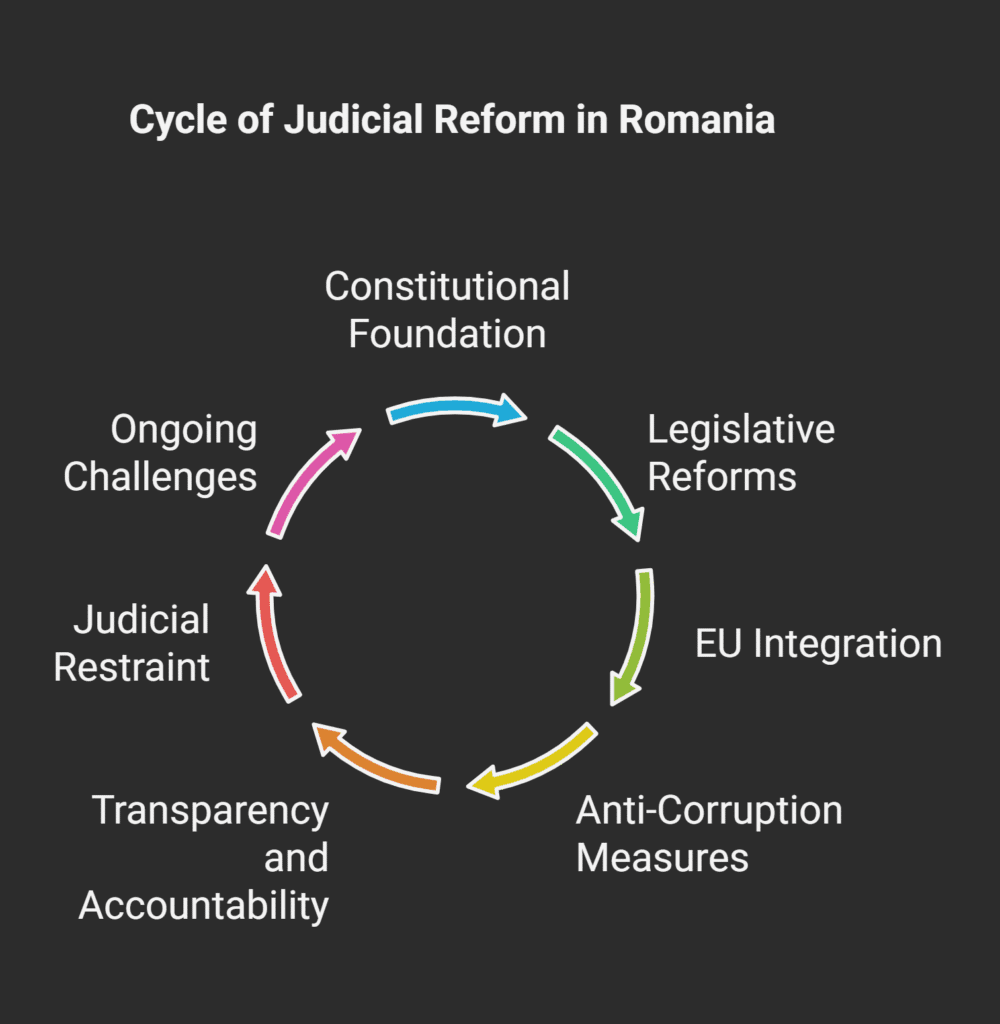
The fall of communism was a key moment for Romania’s legal system.

The country adopted democratic values, and its courts changed to meet European standards.

The push for EU integration sped up these changes.

judicial control Romania


The system now balances executive power and judicial freedom.

The Constitutional Court is key in keeping this balance.

It makes sure laws respect basic rights and principles.

Key Takeaways

  • Romania’s legal system changed a lot after the 1989 fall of communism;
  • EU integration was a big push for judicial reform;
  • The Constitutional Court checks if laws follow basic principles;
  • Judges faced challenges applying always changing laws during the transition;
  • An independent judiciary is key for democratic checks and balances;
  • The separation of powers is the base of Romania’s legal system.

The Romanian Judicial System: An Overview

The Romanian judicial system is unique and has a rich history.

It follows a civil law system, influenced by France and Italy.

After joining the European Union in 2007, the Romanian judiciary system has seen major changes.

These changes aim to meet European standards while keeping its own identity.

The judiciary is a key part of Romania’s democracy, along with the legislative and executive branches.

Its main job is to ensure justice by applying laws fairly.

It also protects citizens’ rights and solves disputes according to the constitution.

Structure of Courts in Romania

Romanian judicial system structure

Structure of Courts in Romania

The Romanian judicial system has a four-tier structure.

At the base are local courts, dealing with simple cases.

These courts are found in cities and towns, making justice accessible to all.

Next are tribunals, handling more complex cases and appeals from local courts.

Each county has one tribunal, usually in the county capital.

The third level is the courts of appeal, reviewing tribunal decisions and some first-instance cases.

Romania has 15 courts of appeal, covering many counties.

At the top is the High Court of Cassation and Justice.

It ensures laws are applied uniformly across the country.

This court deals with appeals and cases involving high officials.

Court LevelJurisdictionTerritorial CoveragePrimary Function
Local CourtsMinor civil and criminal casesCities and townsFirst instance for common disputes
TribunalsComplex cases, appeals from local courtsCounty levelFirst instance for major cases, appeals
Courts of AppealAppeals from tribunals, specific first instance casesMultiple countiesRegional appellate review
High Court of Cassation and JusticeFinal appeals, cases involving high officialsNationalEnsuring uniform law interpretation

Evolution of the Romanian Legal Framework

After communism fell in 1989, Romania’s legal system changed a lot.

It moved from a totalitarian regime to a democratic state.

This change needed big reforms to make the judiciary independent and meet European standards.

The 1991 Constitution, updated in 2003, laid the groundwork for a democratic judiciary.

It ensured the separation of powers and judicial independence.

Laws passed later organized courts and set up new judicial bodies.

Between 2000 and 2007, Romania’s EU membership pushed for more judicial reforms.

The country made many legal changes to match EU rules.

These changes improved judicial oversight and set up bodies to fight corruption.

European integration has helped Romania uphold judicial independence.

Rule of Law Principles in Romania

The Romanian judiciary is based on key rule of law principles.

Judicial independence is the most important, protected by the constitution and other measures.

This independence lets judges make decisions without outside influence, like from politicians.

Transparency is also key in the Romanian judicial system.

Court proceedings are open, and decisions must be explained and published.

This openness builds trust and allows judicial oversight by the public and civil groups.

The principle of judicial restraint means courts should only decide on legal questions.

They should not get involved in policy matters.

This helps keep the balance of power in Romania’s democracy.

To fight corruption, Romania has special bodies.

The Romanian Anti-corruption Directorate investigates high-level corruption.

The General Anti-corruption Directorate deals with corruption in the Ministry of Internal Affairs.

The Directorate for the Fight against Fraud works on fraud affecting EU money, and the National Integrity Agency checks assets and interests of public officials.

Despite progress, challenges remain.

Political interference, lack of resources, and uneven law application test Romania’s rule of law commitment.

But, ongoing reforms and EU monitoring help the judiciary stay strong in upholding these principles.

Understanding Judicial Control Romania: Fundamental Concepts

It’s key to know the basics of judicial control in Romania to see how it protects people’s rights.

This control uses legal tools to make sure justice follows the law.

It’s a big part of keeping the rule of law and protecting freedom in Romania.

Definition and Purpose of Judicial Control

In Romania, judicial control means courts watch over legal actions.

They check if laws are followed in court cases, government decisions, and laws passed by the government.

The main goal is to stop abuse of power and make sure the government acts legally.

This control does a few important things in Romania’s legal system:

  • It makes sure laws are followed;
  • It protects human rights from being broken;
  • It keeps the separation of powers between government branches;
  • It gives legal help to people whose rights are not respected.

In criminal cases, judicial control helps by watching suspects while they are presumed innocent.

It balances the need to solve crimes with protecting people’s rights.

judicial control romania legal framework

judicial control romania legal framework

Legal Basis for Judicial Control in Romanian Law

The basis of judicial control in Romania comes from several laws.

The Romanian Constitution sets the rules for judicial independence and fair trials.

These are the basics of good judicial control.

The Romanian Criminal Procedure Code (RCPC) is very important.

It sets the rules for all crimes, including corruption, unless there are special laws.

It tells how judicial control works in investigations and trials.

Law no. 78/2000 also plays a big role. It adds specific rules for corruption crimes.

This law helps control judicial actions in corruption cases, which are a big focus for Romania’s justice system.

Other laws also shape judicial control in Romania:

  • Law no. 304/2004 on judicial organization;
  • Law no. 303/2004 on the status of judges and prosecutors;
  • Law no. 317/2004 on the Superior Council of Magistracy.

Distinction Between Judicial Control and Judicial Review

Judicial control and judicial review are not the same in Romania’s legal system.

Knowing the difference is important for understanding how the system works.

Judicial control is about courts watching over legal actions, mainly in criminal cases.

It makes sure rules are followed and everyone’s rights are respected during legal processes.

AspectJudicial ControlJudicial Review
Primary FocusProcedural compliance in specific casesConstitutionality of laws and regulations
Exercised ByRegular courts within their court jurisdictionConstitutional Court mainly
TimingOften preventive or concurrentUsually after laws are made
Legal EffectCase-specific remediesPotential invalidation of laws with wide effect

Judicial review, on the other hand, is about checking if laws follow the Constitution.

It’s a special kind of control that looks at if laws are okay, not just how cases are handled.

Both control and review help keep the law strong and protect people’s rights.

They work together to make sure the law is followed and everyone is treated fairly in Romania.

The Constitutional Framework of Judicial Control

The Romanian Constitution sets up rules to protect democracy and citizens’ rights.

It outlines how the government works and keeps everyone in check.

Knowing these rules helps understand how the courts watch over the government.

It made Romania’s laws stronger, focusing on an independent judiciary.

Constitutional Provisions for Judicial Oversight

Romania’s Constitution has specific articles for judicial oversight.

These articles let courts check laws and government actions.

They make sure everything follows the Constitution.

The Constitution talks about the court system’s structure and what it can do.

It’s all about keeping the law in order.

The key points for judicial oversight are:

  • Article 124 says justice is based on law and judges are independent.
  • Article 126 explains the court system’s setup and what it can do.
  • Article 142 makes the Constitutional Court the top authority on the Constitution.

These rules help courts keep the government in line.

They protect your rights through the legal system.

constitutional framework judicial control romania

constitutional framework judicial control romania

Separation of Powers in the Romanian Constitution

The Romanian Constitution divides power among the legislative, executive, and judicial branches.

This creates a system of checks and balances.

It stops any one branch from getting too much power.

Article 1(4) says the State is organized with these powers.

It makes sure each branch can watch over the others.

The judiciary plays a big role in this.

The judicial branch’s main jobs are:

  • Interpreting laws;
  • Checking if executive actions are legal;
  • Resolving disputes between government bodies;
  • Protecting individual rights.

These jobs help keep the government in balance.

The separation of powers has been made stronger through legal reforms.

Constitutional Safeguards for the Judiciary

The Romanian Constitution protects the judiciary’s independence. This lets judges make decisions based on law, not politics.

Important safeguards include:

  • Judicial tenure security (Article 125);
  • Prohibition against transferring judges without their consent;
  • Financial independence of the judiciary;
  • The Superior Council of Magistracy’s role in protecting judicial independence.

Article 133 makes the Superior Council of Magistracy the guardian of judicial independence.

It oversees judicial appointments and promotions.

This is key for transparency in the judiciary.

Recent judicial reforms have aimed to strengthen these safeguards.

But finding the right balance between independence and accountability is a challenge.

Constitutional SafeguardConstitutional ArticlePurposeImplementation Challenges
Judicial IndependenceArticle 124Ensures judges are subject only to the lawPolitical pressure and media influence
Judicial TenureArticle 125Protects judges from arbitrary removalBalancing security with accountability
Superior Council of MagistracyArticle 133-134Guarantees judicial independenceEnsuring representative composition
Constitutional CourtArticles 142-147Ensures constitutional complianceMaintaining political neutrality

The framework for judicial control in Romania is always changing.

It’s shaped by laws and court decisions.

As Romania gets closer to European legal standards, these rules are key for legal reform.

Knowing these rules helps you see how administrative law in Romania works.

They protect your rights against government overreach.

The safeguards show Romania’s commitment to a balanced democracy.

Key Institutions in Romania’s Judicial Control System

It’s important to know the key institutions in Romania’s judicial control system.

They work together to ensure justice is served and human rights are protected.

Each institution plays a unique role in keeping the legal system in check.

The Role of the High Court of Cassation and Justice

The High Court of Cassation and Justice is at the top of Romania’s judicial system.

As the supreme court of Romania, it makes final decisions on most legal issues.

It ensures laws are applied equally across the country.

This court has different sections for civil, criminal, commercial, and administrative cases.

Its decisions are final for lower courts.

This helps keep legal practices consistent in Romania.

supreme court romania building

supreme court romania building

The High Court also protects fundamental rights.

It reviews cases where legal mistakes might have caused injustice.

Its decisions help develop legal doctrine and protect constitutional values.

The Superior Council of Magistracy

The Superior Council of Magistracy (SCM) protects judicial independence in Romania.

It manages judges’ and prosecutors’ careers, keeping them free from outside influence.

The SCM has judges, prosecutors, and appointed members.

It handles appointments, promotions, and disciplinary actions.

Its structure ensures fair representation from all court levels and prosecutorial offices.

The SCM’s independence is key to preventing political interference in courts.

It ensures judges are impartial and operate within professional standards.

The Prosecutor’s Office and Anti-Corruption Directorate

The Prosecutor’s Office represents the state in criminal cases and protects public interests.

It has specialized units for different crimes.

The Romanian Anti-corruption Directorate (DNA) focuses on fighting corruption.

It deals with significant corruption cases and those involving high-ranking officials.

It’s a key part of anti-corruption efforts in Romania.

Several authorities work together to fight corruption in Romania:

  • The Romanian Anti-corruption Directorate (DNA) – specializes in corruption cases;
  • The General Anti-corruption Directorate (DGA) – focuses on corruption in the Ministry of Internal Affairs;
  • The Directorate for the Fight against Fraud (DLAF) – protects EU financial interests;
  • The National Integrity Agency (ANI) – checks asset declarations and conflicts of interest.

The DNA is part of the Prosecutor’s Office but operates independently.

It investigates corruption, gathers evidence, and brings cases to court.

It’s key in Romania’s transitional justice efforts, tackling corruption from the communist era.

Administrative Courts in Romania

Administrative courts handle disputes between citizens and public authorities.

They review the legality of government actions.

This gives you a way to challenge government actions you think are unlawful.

These courts have specialized sections within tribunals and courts of appeal.

The High Court’s Administrative and Fiscal Section is the highest authority.

They use specific procedures to balance individual rights and administrative efficiency.

Administrative courts are vital for protecting your rights against government overreach.

They enforce constitutional constraints on government power.

InstitutionPrimary FunctionJurisdictionContribution to Judicial Control
High Court of Cassation and JusticeFinal court of appealNationalEnsures uniform interpretation of laws
Superior Council of MagistracyJudicial governanceOversight of all magistratesGuarantees judicial independence
Anti-Corruption DirectorateProsecution of corruptionHigh and medium-level corruptionEnforces accountability of officials
Administrative CourtsReview of administrative actsPublic authority disputesChecks executive power

These institutions form a system of checks and balances in Romania.

Their success depends on their legal powers, independence, and resources.

Knowing how they work helps you understand Romania’s legal system and the protections for your rights.

The Constitutional Court of Romania: Powers and Functions

The Constitutional Court of Romania is key in keeping the country’s laws in line with its constitution.

It was set up after communism fell.

This court helps ensure that the government follows the rules and protects people’s rights.

Jurisdiction and Authority

The Constitutional Court of Romania has a big role in the country’s legal system.

It was founded in 1992. This court can check if the government’s actions are legal, without being part of the government.

The Court has nine judges, each serving nine years.

Three are chosen by the Chamber of Deputies, three by the Senate, and three by the President.

This way, no one branch of government can control the Court.

The Constitutional Court’s main jobs include:

  • Checking if laws are okay before and after they are made official;
  • Fixing disputes between government bodies;
  • Looking at if treaties and international deals are okay;
  • Checking if presidential elections and referendums are fair;
  • Seeing if rules made by Parliament are legal;
  • Looking at if political parties are following the rules.

This Court doesn’t deal with individual cases.

It only looks at big questions about the constitution.

It’s the only one who can explain what the constitution means in Romania.

Constitutional Review Procedures

Constitutional Review Procedures

The Constitutional Court uses special ways to check laws and government actions.

These steps make sure everything is done right and follows the constitution.

This helps keep the legal system fair in Romania.

There are a few main ways the Court checks things.

These include looking at laws before they are made official and after they are.

Each method has its own purpose in making sure things are done right.

Before a law is made official, the Court can check it.

This can be started by the President, Parliament leaders, the government, or others.

It’s like a safety check before a law is put into action.

After a law is made official, the Court can also check it.

This happens when a court asks the Constitutional Court about a big question.

It’s like a second check to make sure everything is okay.

Type of ReviewTimingInitiatorsScopeEffect
A Priori ControlBefore promulgationPresident, Parliament leaders, Government, High Court, Ombudsman, 50+ deputies or 25+ senatorsDraft laws, treatiesPrevents unconstitutional laws from entering force
A Posteriori ControlAfter promulgationSame as aboveLaws in forceRemoves unconstitutional provisions from legal system
Exception of UnconstitutionalityDuring litigationCourts, parties in litigationSpecific provisions affecting a caseSuspends case until constitutional issue resolved
Abstract ReviewAny timeOmbudsmanAny law or ordinanceAddresses systemic constitutional issues

Impact of Constitutional Court Decisions

Decisions by the Constitutional Court are very important in Romania.

If the Court says a law is not okay, that law stops working after 45 days.

But, if the government changes it to fit the constitution, it can keep working.

These decisions are binding for everyone in government.

Parliament or the Government can’t just ignore what the Court says by making the same law again.

Some big decisions have changed Romania’s laws a lot:

  • Decision 356/2007 set limits on emergency laws;
  • Decision 1258/2009 changed the pension system for judges;
  • Decision 766/2011 made judges more independent;
  • Decision 80/2014 made it clearer how to change the constitution;
  • Decision 405/2016 changed how abuse of power is seen in criminal law.

These decisions show how the Court keeps the government in check.

It helps make sure everyone follows the rules by explaining what the constitution means.

Relationship with European Courts

The Constitutional Court of Romania works with European courts too.

It’s important to balance Romania’s own laws with European rules. This can be tricky.

The Court talks to the European Court of Human Rights and the Court of Justice of the European Union.

It often uses European court decisions when it makes its own.

This is true when it’s talking about basic rights.

The Court of Justice tries to respect both national laws and European rules.

This is a delicate balance that national courts have to handle.

When there are problems between Romanian laws and European rules, the Court tries to find a way to make them work together.

This is called harmonious interpretation.

It tries to keep Romania’s laws in line with European values.

But, the Court also says that Romania’s constitution is more important than European rules.

In Decision 668/2011, it said EU rules are more important than national laws, but not the constitution.

This shows Romania’s commitment to its own laws and European values.

This careful approach shows how the Court works in a system that respects both national and European laws.

It’s a way to balance different levels of law and keep things fair.

Types of Judicial Control in the Romanian Legal System

Judicial Independence and Accountability in Romania

The Romanian legal system uses different judicial controls as key accountability tools.

These tools help keep all government branches in line and protect citizens’ rights.

Knowing about these controls helps you understand the Romanian legal system better and see how it keeps things transparent.

Preventive Judicial Control Measures

Preventive judicial control stops legal problems before they start. It keeps Romania’s judicial system strong and fair.

One important step is checking draft laws against the constitution. This makes sure laws are okay before they become law.

It helps avoid laws that go against the constitution.

Courts also give preliminary rulings on legal questions.

This helps clear up complex issues before they cause problems. It makes the legal process clearer.

Repressive Judicial Control

Repressive judicial control deals with legal problems after they happen.

It punishes wrongdoings and stops them from happening again. This strengthens judicial integrity.

Criminal sanctions are a big part of this control. Courts give penalties based on the Criminal Code.

These can be fines or jail time, depending on the crime.

Civil liability is another way to control wrongdoing.

Courts can order those who cause harm to pay for it.

Disciplinary actions for public officials also keep them in check.

Administrative Judicial Control

Administrative judicial control checks on government actions.

It’s key for keeping executive power in check and making sure government acts legally.

As a citizen, you can challenge government actions in administrative courts.

These courts check if government actions are legal and fair.

If government actions are wrong, courts can fix them.

They can cancel illegal acts, order payments for damages, or require specific actions.

This is a big part of keeping government accountable, affecting how citizens and government interact.

Judicial Control in Criminal Proceedings

The Romanian Criminal Procedure Code has special rules for criminal cases.

These rules make sure defendants are treated fairly and their rights are protected.

Prosecutors can use judicial control to keep an eye on defendants.

They can order reports to figure out damages caused by crimes.

This helps decide what actions to take and how to make things right.

Prosecutors can also freeze assets to protect victims’ interests.

This shows how judicial control helps with both fairness and justice.

Courts use different measures like bail, house arrest, or detention.

They consider the crime’s severity, the risk of flight, and the need to protect evidence.

These measures are reviewed often to make sure they’re fair and needed.

Through these controls, Romania’s legal system balances law enforcement and protecting rights.

The system keeps improving through judicial reform to make it more accountable and efficient.

Judicial Independence and Accountability in Romania

Romania’s judicial system is strong because it keeps its independence and follows democratic rules.

This balance is key to the rule of law in Romania.

Knowing how Romania balances judicial freedom with public oversight is important.

It shows how well the country’s democracy works and protects citizens’ rights.

Safeguards for Judicial Independence

Romania has set up many rules to protect the independence of judiciary in Romania.

These rules help judges make decisions based on law, without outside influence.

Key safeguards include:

  • Constitutional rules that keep powers separate;
  • Secure jobs for judges, so they can’t be removed easily;
  • Enough money for judges, so they’re not influenced by it;
  • The Superior Council of Magistracy acts as a shield against political interference;
  • Judges have freedom in how they manage cases and make decisions.

These rules help judges do their jobs without fear.

The Romanian Constitution stops other branches of government from messing with the courts.

This sets clear limits for court jurisdiction in Romania.

But keeping judicial independence is hard. Politics, media, and public opinion can subtly affect judges.

The system must keep evolving to fight new threats while keeping its core protections.

Mechanisms for Judicial Accountability

Romania’s judicial system also has strong ways to check itself. These ways keep the judiciary oversight in Romania strong without hurting judicial freedom.

The main ways to check the judiciary include:

  • The Superior Council of Magistracy can discipline judges and prosecutors
  • Rules and standards for judges’ behavior
  • Regular checks on judges’ performance
  • Appeals that let higher courts review decisions
  • The Constitutional Court can check laws that affect the judiciary

The disciplinary system is a key part of judicial accountability in Romania.

When judges are accused of wrongdoings, the Superior Council investigates and can punish them.

This balance ensures accountability without unfair punishment.

These checks aim to address wrongdoings without interfering with judges’ work.

The system makes a clear difference between holding judges accountable for bad behavior and respecting their role in interpreting the law.

Transparency Initiatives in the Romanian Judiciary

Transparency is key to balancing judicial independence and accountability in Romania.

By making court actions open to the public, transparency strengthens both judicial freedom and public oversight.

Romania has started several transparency efforts:

  • Allowing public to see court hearings and decisions;
  • Online platforms for case info and schedules;
  • Requiring judges and prosecutors to declare their assets;
  • Annual reports from courts and prosecutors;
  • Rules for media access to ensure fairness.

These steps have greatly improved court supervision in Romania.

When people can see court decisions and understand why they were made, it builds trust in the fairness and impartiality of the system.

The Romanian judiciary also works to better communicate with the public.

Through educational programs and media offices, they aim to make legal processes clearer and more accessible to everyone.

Despite progress, challenges in transparency remain.

Some people may face technical barriers to information, and complex legal language can make it hard to understand.

Efforts continue to make judicial transparency more meaningful through simpler language and better digital access.

As Romania works to strengthen its judicial system, the balance between independence, accountability, and transparency will be key.

Challenges and Reforms in Romania’s Judicial Control System

Romania has made good progress in building democratic institutions.

Yet, it faces ongoing challenges in its judicial control system.

These challenges call for continuous reforms.

The journey toward effective judicial reforms in Romania has seen both successes and setbacks.

This journey reflects the complex task of transforming a post-communist legal system into one that meets European standards.

Reforms touch on key governance issues, including checks and balances in Romania and ensuring judicial independence.

Anti-Corruption Efforts and Judicial Reform

Romania’s fight against corruption is a key part of its judicial reform agenda.

The country has a detailed plan to fight corruption, involving many institutions at local and national levels.

This plan uses self-assessments and risk evaluations by institutions.

The National Anti-corruption Directorate (DNA) plays a big role in these efforts.

It has tackled high-profile cases against politicians, judges, and business leaders.

This shows that anti-corruption efforts in Romania can lead to real results with the right support.

But, the anti-corruption strategy’s success has been measured mainly by its implementation level.

This level has dropped significantly after 2019.

The Government set clear goals in August 2016, but progress has been slow.

This slowdown shows the political challenges and resistance to anti-corruption efforts in Romania.

EU Cooperation and Verification Mechanism

When Romania joined the European Union in 2007, the EU set up the Cooperation and Verification Mechanism (CVM).

This tool monitored and guided judicial reforms.

It set specific goals for Romania in judicial independence, integrity, and anti-corruption.

The CVM has been a driving force and a measure for judicial reforms in Romania.

Recent Legislative Changes Affecting Judicial Control

The last decade has seen many changes to Romania’s justice laws and criminal codes.

These changes have sparked debates about their impact on judicial independence and constitutional oversight in Romania.

Between 2017 and 2019, several laws changed how the judiciary works.

Critics say these changes hurt judicial independence and weaken anti-corruption efforts.

The changes affected magistrates’ status, judicial inspection, and prosecutor appointments.

More recent laws aim to address these concerns.

But the legal framework is always changing.

Keeping it stable and coherent is key for effective checks and balances in Romania and public trust in the judiciary.

International Perspectives on Romanian Judicial Reforms

Romania’s judicial reforms have caught the world’s attention.

Many bodies have given their opinions and advice.

The European Commission, through the CVM, has closely watched Romania’s progress in constitutional oversight Romania.

The Venice Commission has also weighed in, stressing judicial independence and checks and balances in Romania.

Their opinions have highlighted both good steps and areas needing more work.

International groups like GRECO and UN bodies have also offered their views.

Their input has shaped the reform agenda and set benchmarks for judicial reforms in Romania.

While outside opinions can be controversial, they are essential for a strong reform process.

They bring independent expertise and keep focus on international standards.

This international view is vital for Romania’s judicial system to grow.

Practical Aspects: How Judicial Control Affects Your Rights in Romania

Judicial control in Romania affects everyone’s rights.

It offers important protections in civil and criminal cases.

Knowing how it works helps you deal with legal issues and keep your rights safe.

Whether you’re in a legal fight, questioning a government decision, or just want to know your rights, Romania’s system has your back.

It offers many ways to seek help.

Protection of Fundamental Rights through Judicial Control

Romania’s courts protect your constitutional rights and freedoms.

They act as guardians when your rights are broken.

The constitutional right to a fair trial is key, ensuring legal processes are fair and respect your rights.

Courts also check if the state acted unfairly.

If a government decision harmed your rights, you can challenge it.

They can cancel bad decisions and order fixes, like paying for damages.

A new law helps those who speak out against wrongdoings.

Law no. 361/2022 on whistleblower protection gives strong support.

It protects those who report corruption or other wrongs from being punished.

Navigating the Court System as an Individual

The Romanian courts system has four levels: local courts, tribunals, courts of appeal, and the High Court of Cassation and Justice.

Knowing which court to go to is the first step.

Civil cases start in local courts, while bigger cases begin at the tribunal.

When you start a legal case, you must follow certain rules and deadlines.

For civil cases, you have three years to act.

Criminal complaints have a two-month limit, but serious crimes give you more time.

Court documents in Romania are standard but hard to understand without a Romanian lawyer.

Your first step, the complaint, must include who you are, what happened, why it’s wrong, and what you want.

If you miss these details, your case might be thrown out.

Legal Remedies Available to Citizens

Romania has many ways to fix rights issues.

Constitutional complaints let you question laws that affect your case.

These complaints start in your court case and then go to the Constitutional Court.

Administrative appeals are another key option.

Before going to court, you must try to fix the problem with the authority first. If they don’t help, you can go to court.

If Romanian courts can’t help, you can try the European Court of Human Rights.

But, you must have tried everything in Romania first.

You also have four months to apply after the last decision in Romania.

Seeking Legal Assistance for Judicial Control Matters

Getting help from a Romanian lawyer for judicial control is often a good idea.

They can help plan your case and speak for you in court.

For criminal cases, a criminal lawyer in Bucharest or Romania can be very helpful.

Legal aid is for those who can’t afford a lawyer.

The National Legal Aid Bureau can assign a lawyer if you qualify. You need to show you can’t afford one.

You can apply at your court or local bar association.

For complex cases, like administrative or constitutional issues, a Romanian law office for judicial control can help.

Services like Atrium Romanian Lawyers (contact: office@theromanianlawyers.com) offer the needed expertise.

The Romanian Criminal Code also protects those who report corruption.

Reporting a bribe before it’s known can give you special protection.

This shows Romania’s commitment to constitutional democracy and the rule of law.

Conclusion: The Future of Judicial Control in Romania

Romania’s judicial control system is changing.

It’s balancing old traditions with new European rules.

To have a clear justice system, everyone in Romania must keep working together.

When dealing with your rights, remember that judicial control is key.

Recent reforms have made public authorities more accountable.

They’ve also tackled some big challenges.

Digital changes offer chances to make justice better in Romania.

These technologies can make justice more accessible.

They also protect human rights, which are vital for democracy.

The success of judicial control relies on public involvement.

Your active role ensures reforms strengthen, not weaken, judicial independence.

If you have legal questions about judicial control in Romania, help is available at office@theromanianlawyers.com.

With active citizens and dedicated Romanian lawyers, Romania’s justice system can protect democracy and rights.

FAQ

What is judicial control in Romania?

Judicial control in Romania means the legal ways courts watch over public and private actions. 
It makes sure everyone follows the law. 
This includes checking laws, watching over government actions, and stopping bad actions before they start.

How is the Romanian court system structured?

Romania’s court system has four main levels. 
These are local courts, tribunals, courts of appeal, and the High Court of Cassation and Justice. 
There are also special courts for certain cases and a Constitutional Court that works on its own.
Each level deals with different cases. 
Higher courts handle more complex cases and appeals from lower courts.

What is the difference between judicial control and judicial review in Romania?

Judicial control is a wide term that covers many ways courts check actions. 
It includes stopping bad actions before they start. 
Judicial review, on the other hand, is about checking if laws and government actions are legal.
While judicial control can stop actions, judicial review checks them after they happen.

What role does the Constitutional Court play in Romania’s judicial control system?

The Constitutional Court is key in Romania. 
It checks if laws and government actions follow the Constitution. 
It can look at laws before they start or after they’re made.
The Court also solves disputes between government bodies and checks if political parties follow the law. 
Its decisions are very important for Romania’s laws and politics.

How does Romania ensure judicial independence?

Romania protects judicial independence in many ways. 
The Constitution guarantees judges’ freedom.
The Superior Council of Magistracy helps manage judges’ careers.
Judges have secure jobs and can’t be removed easily. 
They also get fair pay and can’t be punished for their decisions. 
Laws stop other government bodies from interfering with courts.

What types of judicial control exist in criminal proceedings in Romania?

In criminal cases in Romania, there are several ways to control defendants. 
These include judicial control, which lets defendants stay free but with rules, and house arrest. 
There’s also preventive detention, which is the strictest.
These measures need a judge’s order and have specific rules. 
Defendants can challenge them in court.

How has EU membership influenced Romania’s judicial control system?

Being part of the EU has changed Romania’s courts a lot. 
The European Court of Justice’s decisions are also important for Romanian courts. 
Romania has made many changes to follow European standards, like making courts more independent and efficient.

What is the role of the Superior Council of Magistracy in Romania?

The Superior Council of Magistracy (CSM) is very important in Romania. 
It makes sure judges are independent. 
It manages judges’ careers and proposes new judges to the President.
The CSM also helps judges and prosecutors stay independent. 
It acts as a court for them, making sure they are held accountable.

How can Romanian citizens challenge unconstitutional laws?

Romanian citizens can’t directly ask the Constitutional Court to check laws. 
But, they can say a law is wrong during a court case. 
If the court agrees, it will send the case to the Constitutional Court.
Citizens can also ask the Ombudsman to check laws. 
The Ombudsman can send laws to the Constitutional Court. 
If a law is broken, citizens can go to regular courts or the European Court of Human Rights.

How does administrative judicial control work in Romania?

In Romania, people can challenge government actions in court. 
This is done through special courts or parts of regular courts. 
The law says people can ask for wrong actions to be fixed.
Before going to court, people must ask the government to change the action. 
Courts can stop actions while they decide and can even cancel them if they’re wrong.

What legal assistance is available for judicial control matters in Romania?

There are many ways to get help with judicial control in Romania. 
You can hire a lawyer or get free help from the National Legal Aid Bureau
There are also NGOs that help with human rights.
For complex cases, you can find law firms that know a lot about Romanian law. 
For help, you can contact office@theromanianlawyers.com.

How does the Romanian Constitutional Court interact with European courts?

The Romanian Constitutional Court works closely with European courts. 
It follows EU laws and often uses European Court of Justice decisions in its rulings. 
It also looks at European Court of Human Rights standards.
But, the Court also stands up for Romania’s laws and values. 
This creates a balance between European law and Romania’s own laws.

What reforms have been implemented to strengthen judicial control in Romania?

Romania has made many changes to its courts. 
It has set up special anti-corruption bodies and made it easier to choose judges and prosecutors. 
It has also updated its laws and improved court buildings.
Despite these efforts, there is more work to do. 
Romania is working to make its courts more independent and trusted by the public.

How can individuals navigate Romania’s court system effectively?

To get through Romania’s courts, you need to know which court to go to. 
You must follow strict rules and deadlines. 
It’s a good idea to get a lawyer, but you can also do it yourself.
Learn about your case and prepare well. 
Remember, most court work is done in writing, with some oral parts. 
You can find more information on the Romanian Ministry of Justice website and the courts’ portal (portal.just.ro).

What constitutional safeguards protect the judiciary in Romania?

Romania’s Constitution protects judges in many ways. 
It says judges must be independent and follow the law. 
The Constitution also sets up the Superior Council of Magistracy to protect judges.
Judges have secure jobs and can’t be removed easily. 
They get fair pay and can’t be punished for their decisions. 
Laws also protect judges from government interference.

What is judicial control in Romania and how does it function?

Judicial control in Romania represents a system of checks and balances through which the courts oversee the legality of actions taken by public administration and other authorities.

This control mechanism is fundamental to the rule of law in the Romanian legal framework.

At its essence, judicial control ensures that administrative actions comply with the Constitution and applicable laws.

The Romanian system of judicial review operates through specialized administrative courts that have the power to examine and potentially invalidate administrative acts that are found to be contrary to higher legal norms.

This system serves as a guarantee of citizens’ rights against potential abuses by state institutions.


Appealing a Criminal Conviction in Romania: Legal Insights

Appealing a Criminal Conviction in Romania: Legal Insights

Table of Contents

Nearly 15% of criminal verdicts in Romania face appeals, showing the importance of this legal path.

If you get a bad verdict in the Romanian justice system, knowing your right to appeal is key.

It helps protect your freedom and future.

Appeal a Criminal Conviction in Romania

Appeal a Criminal Conviction in Romania

The journey to overturn a verdict is complex, following Romanian law’s unique rules.

Courts aim to uncover the truth through strict protocols.

Knowing these rules well is crucial for a successful appeal.

The appeals process offers hope for those wrongly convicted.

But, it requires timely action, proper documents, and strong legal arguments.

Each step must meet specific criteria to increase your chances of winning.

This guide covers the basics of appealing verdicts in Romania’s courts.

While we offer detailed info, your case may need tailored advice.

For specific questions, reach out to our team at office@theromanianlawyers.com.

Key Takeaways

  • Approximately 15% of criminal verdicts in Romania face appeals, showing the system’s active use;
  • Romanian law guarantees the right to challenge court decisions as a safeguard against judicial errors;
  • Strict procedural timelines must be followed when filing appeals;
  • The appeals system operates on multiple levels within the Romanian court hierarchy;
  • Professional legal representation significantly improves chances of a successful appeal;
  • Each case requires a customized legal strategy based on specific circumstances.

Understanding the Romanian Criminal Appeal System

Understanding Romania’s criminal appeal system is key.

It involves knowing the court structure and appeal options.

Success in appealing a verdict depends on choosing the right court and appeal type.

This knowledge is crucial for a strong appeal strategy.

Structure of Criminal Courts in Romania

The Romanian judicial system has a four-tier hierarchy.

Each level has a specific role in criminal cases.

Knowing this structure is essential for determining your appeal path.

At the bottom are the first instance courts (judecătoria).

They handle minor crimes and contraventions.

These courts are found in towns and cities across Romania.

Next are the tribunals (tribunale).

They deal with serious crimes and appeal decisions from the judecătoria.

Each county has one tribunal, usually in the county capital.

romanian criminal appeals process hierarchy

romanian criminal appeals process hierarchy

The courts of appeal (curți de apel) are the third level.

They handle appeals from tribunals.

Romania has 15 courts of appeal, covering several counties each.

At the top is the High Court of Cassation and Justice (Înalta Curte de Casație și Justiție).

It’s Romania’s highest court.

It deals with appeals from the courts of appeal and is the final authority.

Types of Criminal Appeals Available

The Romanian legal system offers two main appeal types:

  • Appeal (Apel) – This is the first appeal against a court decision. It allows a full review of your case. You can present new evidence and challenge the original court’s findings.
  • Second Appeal (Recurs) – This is a further appeal after an unsuccessful first appeal. It focuses on legal matters, not facts. It checks if the law was applied correctly.

In some cases, you can also file an extraordinary appeal.

This includes a request for case review (revizuire) with new evidence or an appeal in the interest of the law (recurs în interesul legii).

However, the latter cannot change the outcome of your case.

Appeal Court Jurisdiction

Knowing which court has jurisdiction over your appeal is vital.

The jurisdiction depends on the original court and the appeal type.

For decisions from first instance courts (judecătoria), appeals go to the county tribunal.

This applies to most minor crimes.

Appeals from tribunals go to the court of appeal (curte de apel) with jurisdiction over the tribunal.

This ensures the right court reviews your case.

For cases tried by courts of appeal, the High Court of Cassation and Justice is the appellate court.

It also handles second appeals against decisions from courts of appeal.

The rules for jurisdiction in Romanian criminal appeals follow a clear hierarchical pattern.

This ensures each case gets the right review efficiently.

Your Romanian lawyer can help choose the correct appeal court for your case.

Legal Grounds for Appeal a Criminal Conviction in Romania

To overturn a criminal conviction in Romania, knowing the legal reasons for appeal is key.

Romanian law doesn’t allow appeals just because you’re not happy with the verdict.

It outlines specific situations where appeals can be made and considered by higher courts.

The Romanian Criminal Procedure Code lists legal grounds for appeals that need solid proof.

If you can’t show at least one of these grounds, your appeal might be dismissed right away.

legal grounds for appeal romania

legal grounds for appeal romania

One common reason for appealing is if there were mistakes during the trial.

These could be wrong court composition, jurisdiction issues, or breaking important rules.

For example, if the court didn’t have the right to hear your case, that’s a big mistake that can make the whole trial invalid.

Another reason is if the law was applied wrongly.

This happens when the trial court got the law wrong or applied it in the wrong way.

To appeal on this, you need to clearly say which law was misused and how it affected your case.

Evidence issues are also a big reason for appeals in Romania.

This includes:

  • Not enough evidence to support the conviction;
  • Conflicting evidence that wasn’t sorted out;
  • Wrongly letting in or keeping out evidence;
  • Not considering important evidence from the trial.

Finding new evidence not seen during the trial is another reason to appeal in Romania.

But this new evidence must be really important and could change the case’s outcome.

You also need to show it couldn’t have been found and used in the original trial, even with hard work.

Violations of defense rights are serious reasons for appeal in Romania.

These could be not being allowed legal help, not having enough time to defend yourself, or not being able to question witnesses.

Romanian courts take these very seriously because they affect the right to a fair trial.

Also, if you think the sentence is too harsh, you can appeal.

If you believe the punishment is too severe compared to the crime, you might have grounds.

You need to show the sentence is not in line with the law or past cases.

When you’re preparing your appeal, just stating the reasons isn’t enough.

You need to back up each reason with details from your case and the law.

Your appeal should clearly show how the mistakes or violations affected your case.

The strength of your appeal grounds is very important.

Romanian appellate courts focus on appeals that show clear legal mistakes or rights violations.

It’s crucial to find the strongest legal arguments for your case.

Successful appeals in Romania often use more than one reason.

For example, showing both procedural errors and wrong application of the law can make a strong case for overturning the conviction.

Knowing the legal grounds for appeals in Romania helps you focus on the best arguments for your case.

With the right legal advice, you can figure out which grounds apply to you and how to support them in your appeal.

Time Limits and Deadlines for Filing Appeals

Knowing the appeal deadlines in Romania is key to protecting your rights.

The Romanian courts have strict rules.

If you miss these deadlines, you might lose your chance to appeal a conviction.

Standard Appeal Filing Deadlines

In Romania, you have a short time to file an appeal.

For ordinary appeals (apel), you have 10 days after the judgment is communicated.

This means you need to act fast.

For second appeals (recurs), the deadline is also 10 days.

But, some cases have different rules.

For example, you have just 48 hours to challenge a pretrial detention order.

appeal deadlines romania timeline

appeal deadlines romania timeline

The court must hold a hearing within 5 days of your appeal.

This shows how crucial it is to prepare your appeal quickly.

Your lawyer in Romania should start working on it right away after a bad verdict.

Extensions and Exceptions

While deadlines are strict, there are exceptions.

These are rare and need strong reasons.

Courts might extend deadlines in cases of:

  • Force majeure – unexpected events that stopped you from filing on time;
  • Serious medical conditions that made it hard to act legally;
  • Documented communication failures in the judicial system;
  • Absence of proper legal notification about your appeal rights.

To ask for an extension, you must file a motion with evidence.

The court will decide if your situation was truly exceptional.

These requests are carefully reviewed, and extensions are rare.

Consequences of Missing Deadlines

Missing appeal deadlines in Romania has serious effects.

If you don’t file on time, you lose your right to appeal.

This makes the original conviction final and unchangeable.

Courts are strict about these deadlines.

If you file late, your appeal is dismissed, no matter its merit.

This means the court won’t look at your case’s arguments.

Having a final conviction can impact your future.

It can affect your job prospects, criminal record, and civil rights.

After missing a deadline, your only option might be an extraordinary remedy like revision, which is rarely successful.

Because of these serious consequences, you must take deadlines very seriously.

Get legal advice quickly after a bad verdict to protect your appeal rights.

Remember, these deadlines are set to keep the justice system efficient, but they require careful attention from defendants and their lawyers.

Essential Documentation for Criminal Appeals

When you want to appeal a criminal conviction in Romania, getting the right documents is key.

The Romanian courts focus a lot on following the rules. So, having the right documents is crucial for your appeal to be considered.

Under Romanian law, all documents need to be made very carefully.

The court will look at these documents closely before they even start on your case.

Here’s what you need for a criminal appeal in Romania.

The Appeal Petition

The appeal petition is the main part of your appeal.

It must follow strict rules under Romanian law.

Your petition should clearly say:

  • The court decision you’re challenging;
  • Why you’re appealing;
  • The legal reasons for your appeal;
  • What you want to happen next;
  • Your name and signature.

Your appeal petition must clearly state what parts of the judgment you’re contesting.

This could be the whole decision or just parts of it.

Court Decision Documentation

You need to include certified copies of the court decision you’re appealing.

This includes:

  • The full text of the judgment;
  • The reasons for the decision;
  • Any dissenting opinions.

Romanian courts need these documents to understand your case fully.

If you can’t get these documents yourself, your lawyer can ask the court for them.

Supporting Evidence

You need to document any evidence that supports your appeal.

This could be:

Type of EvidenceDocumentation RequiredCertification Needed
Witness TestimonyWritten statements or transcriptsNotarized copies
Expert OpinionsFull expert reports with credentialsOriginal or certified copies
Physical EvidenceDetailed descriptions and photographsAuthentication certificates
New EvidenceExplanation of why it wasn’t presented earlierCertification of authenticity

All documents supporting your claims must be given to the court and the other parties in certified copies.

Sometimes, the court might ask for the original documents.

Legal Representation Documentation

If you have a lawyer in Romania, which is recommended, you need to include:

  • A power of attorney (procură) for your lawyer;
  • Proof of your lawyer’s membership in the Romanian Bar Association;
  • Authorization for special procedural acts, if needed.

These documents show your lawyer’s right to represent you in the appeal process.

Document Preparation Requirements

The appeal process in Romania has specific rules for preparing documents.

Each document must be:

  • Written in Romanian or have a certified translation;
  • Certified or notarized when needed;
  • Given in enough copies for the court and all parties;
  • Organized according to court standards.

Documents that don’t follow these rules might be rejected.

This could harm your appeal.

Documents from outside Romania might need extra legalization or apostille certification.

Record Keeping and Filing Proof

Keeping detailed records is important during the appeal process.

Always:

  • Save copies of all documents;
  • Get official proof of filing (dovada depunerii);
  • Keep a record of all submissions in order;
  • Ask for confirmations of receipt for all documents.

This record helps if there are questions about filing or receiving documents.

Accessing Court Records

Getting the right court records can be hard in Romania.

If you’re having trouble, try these:

  • Write a formal request for access;
  • Have your lawyer use legal rules to get access;
  • Ask for judicial help if access is denied;
  • File a complaint with the Superior Council of Magistracy if access is blocked.

You have the right to see the case file (dosar) under Romanian law.

This is key for preparing a strong appeal.

Getting the right documents is not just a formality in Romania’s appeal system.

It’s the base of your appeal.

Making sure all documents are complete, properly prepared, and filed on time can greatly improve your chances of a fair appeal.

Role of Defense Lawyers in the Appeals Process

Defense lawyers are key in criminal appeals in Romania.

They know how to handle legal steps and make strong arguments.

Criminal defense lawyers in Romania help you through tough legal times.

Your lawyer speaks for you in court, making your story sound right in law.

They look for mistakes in the trial and find flaws in the evidence.

They use Romanian law to make your appeal strong.

Selecting an Appeals Attorney

Finding the right lawyer for your appeal is important.

Appeals need special knowledge of court rules and past cases.

Look for someone with experience in appeals courts.

When picking your Romanian lawyer, think about:

  • Experience with cases like yours;
  • Success in changing convictions or sentences;
  • Knowledge of the courts;
  • How they communicate;
  • Clear fees and payment plans.

Ask for a first meeting to see if they understand your case.

Many Romanian criminal lawyers offer free talks to discuss your appeal chances.

Firms like Atrium Romanian Lawyers (office@theromanianlawyers.com) offer advice tailored to you.

Legal Representation Rights

In Romania, you have rights to legal help during appeals.

These rights help ensure you get a fair chance to defend yourself.

You can talk privately with your lawyer from Romania  and have time to plan your defense.

Your rights include:

  • Choosing your lawyer;
  • Private talks with your lawyer;
  • Your lawyer being there for all hearings;
  • Enough time to prepare.

These rights are important from start to finish.

Legal representation in Romania is key to fair justice, especially when appealing court decisions.

Courts usually agree to reasonable requests about your rights.

Public Defender Options

If you can’t afford a lawyer, Romania offers public defenders.

They make sure everyone gets legal help.

Public defenders are crucial in the justice system.

Public defenders are needed in:

  • Minor criminal cases;
  • Detained or arrested people;
  • Crimes that could mean life in prison;
  • Offenses with sentences over 5 years.

To get a public defender, apply to the court handling your appeal.

Show you can’t afford a lawyer.

Public defenders handle many cases, which might mean less time for yours.

Hiring an appeals lawyer in Romania can give you more focus and help.

Whether you choose a private lawyer or a public defender, good legal help is key.

Your lawyer is your advocate and partner in seeking justice.

Evidence Presentation in Appeal Courts

When you appeal a criminal conviction in Romania, knowing how to present evidence is key.

The rules for presenting evidence in appeals are different from the first trial.

They cover what evidence you can show, how to submit it, and when new evidence is considered.

Appeals in Romania mainly review the evidence from the first trial.

Your strategy must focus on this.

The appeals court checks if the lower court applied the law correctly to the evidence.

Key Differences in Evidence Handling

In appeals, you can’t just bring back all the evidence from the first trial.

You need to pick and highlight evidence that supports your appeal.

This means analyzing the trial record and finding issues with the evidence.

To challenge evidence, show why the first court made mistakes.

This could be because of evidence that was wrongly admitted or evaluated.

Romanian law allows new evidence in appeals under certain conditions.

But, this right is not unlimited.

To introduce new evidence, you must show it was not available during the first trial.

You also need to explain its relevance and submit it on time.

  • Demonstrate why the evidence couldn’t have been presented during the original trial;
  • Establish clear relevance to your specific grounds for appeal;
  • Submit a formal request to the court explaining the significance of the new evidence;
  • Present the evidence within procedural timeframes established by law.

After looking at the evidence, you can ask for more evidence or statements.

The court will decide if this evidence is relevant and could change the case outcome.

Effective Strategies for Evidence Presentation

To effectively challenge a verdict, make clear summaries of evidence issues.

Your appeal should focus on legal errors that need correction, not just repeat original arguments.

Working with a skilled defense attorney is vital.

They can help you make strong evidence-based arguments that follow Romanian appeal rules.

This increases your chances of winning.

Evidence AspectFirst Instance CourtAppeal CourtStrategic Considerations
New EvidenceBroadly admissibleLimited to unavailable/unknown evidenceMust justify why evidence wasn’t presented earlier
Witness TestimonyPrimary evidence gatheringRarely heard unless newFocus on inconsistencies in original testimony
Expert OpinionsCommissioned by courtNew opinions possible if justifiedChallenge methodology or conclusions of original experts
Documentary EvidenceComprehensive collectionSelective review of key documentsHighlight documents overlooked or misinterpreted

Remember, appeals in Romania are not about retrying your case.

They focus on legal or procedural errors with evidence that affected the verdict.

By understanding these differences and preparing well, you can improve your appeal’s chances of success.

Rights of Defendants During Appeals

Knowing your rights during appeals is key to challenging a criminal conviction in Romania.

The Romanian legal system offers many protections.

These ensure fair proceedings and due process throughout the appeal.

The Romanian Constitution and Criminal Procedure Code outline specific protections for appealing criminal convictions.

Knowing these rights and how to use them can greatly impact your appeal’s outcome.

Let’s look at the main rights you have during this important legal process.

Rights of Defendants During Appeals Romania

Right to Legal Representation

One of the most important defense rights in Romania is having legal representation during appeals.

This right means you get professional help with complex legal steps.

Legal help is crucial during appeals because rules are strict.

You have the right to:

  • Choose your own lawyer or get one from the court if you can’t afford one;
  • Speak privately with your lawyer before and during hearings;
  • Have enough time to prepare your defense with your lawyer;

In serious cases, you must have a lawyer.

The court will appoint one if you don’t have one.

This ensures your right to counsel is protected, no matter your financial situation.

Right to Present New Evidence

You have the right to introduce new evidence during appeals under certain conditions.

This right is key when new evidence was not available or known during the trial.

To use this right, you must meet specific conditions:

  • The new evidence must be relevant and could change the case’s outcome;
  • You must explain why this evidence wasn’t presented in the original trial;
  • The evidence must be submitted on time;
  • You need to document why the new evidence is important.

The appeals court decides if new evidence is accepted.

But, presenting strong reasons for its inclusion can help.

This right is a key way to prevent wrongful convictions in Romania by correcting overlooked facts.

Right to Challenge Previous Rulings

In the Romanian appeals system, you can challenge specific parts of the lower court’s decision.

This is a key right of the accused in appeals and is the basis of the appeals process.

You can challenge rulings on several grounds:

  • Factual errors or misinterpretation of evidence by the lower court;
  • Procedural violations that affected your right to a fair trial;
  • Incorrect application of laws to your case;
  • Disproportionate sentencing compared to similar cases.

When challenging rulings, be specific.

Your appeal should clearly state which parts of the ruling you’re challenging and why.

General complaints without legal grounds are unlikely to succeed.

You also have the right to be present at hearings, speak last before deliberations, and have an interpreter if needed.

These rights ensure you can fully participate in the appeals process.

Understanding and using these rights is crucial for a fair appeal.

The legal system is complex, but these protections are in place to prevent errors and give you a chance to correct unjust outcomes.

Appeal Court Procedures and Hearings

Appeal Court Procedures and Hearings Romania

Understanding the appeal court procedures in Romania is key.

The process is structured to ensure fairness and thorough review.

Knowing these steps can make your appeal journey smoother.

When you file an appeal, the court checks if your documents are complete.

They make sure you’ve included everything needed.

Then, they tell everyone involved in the case about your appeal.

The court’s first step is to review your case.

They look at the main points and see if they need more information.

They might ask for more details or documents from you or the other side before the hearing.

In Romania, appeal panels usually have three judges.

For more complex cases, five judges may be involved.

This way, decisions are made with the input of several judges.

Hearings follow a set format.

The judge checks if everyone is there and gives a quick summary of the case.

You or your lawyer will then explain why you’re appealing.

The prosecutor will argue against your appeal.

You have the right to respond to their arguments.

Judges might ask questions to clarify things.

Most hearings are open to the public.

But, some cases involving minors or national security are closed. Only the parties involved are there.

The time it takes to finish an appeal varies.

Simple cases might take 2-3 months.

More complex ones could take 6 months or more.

Your lawyer can give a better idea of when it might end.

After hearing everything, judges go off to decide.

They vote on the decision, and any dissenting opinions are noted.

The court’s final decision must explain why they accepted or rejected your appeal.

It’s important to know how to act in court.

Wear professional clothes and show respect.

Turn off your phone and only speak when the judge invites you.

Appeal StageKey ActivitiesYour RoleTimeframe
Administrative ProcessingDocument verification, party notificationSubmit complete documentation1-2 weeks
Pre-Hearing ReviewCase file examination, additional information requestsRespond promptly to court inquiries2-4 weeks
Hearing PhaseOral arguments, judicial questioningPresent your case clearly or through counsel1-3 sessions
DeliberationJudicial analysis, voting on decisionAwait ruling1-4 weeks
Decision AnnouncementRuling publication, reasoning providedReceive and review decisionWithin 30 days of deliberation

The appeal process in Romania focuses on being thorough, not fast.

Courts look at all parts of your case to ensure justice.

This careful approach might take longer but helps avoid quick, wrong decisions.

If you can’t make it to a hearing, tell the court right away.

Give a good reason.

Not showing up without a good reason can hurt your appeal.

Your lawyers in Romania can usually represent you.

Keep talking to your lawyer throughout the appeal.

They can explain what’s happening, help you understand the judges’ comments, and prepare you for each step.

Working together can make navigating the appeal system easier.

Possible Outcomes of Criminal Appeals

Understanding the possible results of your criminal appeal in Romania is key.

The appeals court has several options when reviewing your conviction.

The outcome depends on the strength of your legal arguments, the evidence, and your case’s specifics.

When the appeals court makes a decision, it will issue a ruling.

This ruling can be one of several outcomes.

The court’s decision is based on a detailed look at your case’s procedural and substantive aspects.

Possible Outcomes of Criminal Appeals Romania

Conviction Overturned

The most favorable outcome is having your conviction overturned.

This occurs when the appeals court finds significant legal errors in the original trial.

When this happens, the court declares the original judgment flawed.

Several reasons can lead to a conviction being reversed.

These include new evidence, procedural violations, or insufficient evidence to support a guilty verdict.

If a conviction is overturned, the court might declare you not guilty.

Or, it might stop the criminal trial if it shouldn’t have started.

This means you regain your legal presumption of innocence.

If you were in jail, you would likely be released.

This is unless there are other charges or legal reasons for detention.

Sentence Modification

In some cases, the appeals court might keep the conviction but change the sentence.

This happens when the punishment was seen as too harsh or not in line with legal standards.

Sentence modifications can include reducing the prison term, converting a custodial sentence to a suspended one, or adjusting penalties.

  • Reduction in prison term length;
  • Conversion of a custodial sentence to a suspended sentence;
  • Alteration of additional penalties (such as fines or probation terms);
  • Adjustment of legal classification of the offense to a less severe category.

When seeking to modify a sentence, your lawyer will argue the punishment was too harsh.

The appeals court has a lot of discretion in modifying sentences.

They consider the crime’s nature, your personal situation, and similar cases.

A successful sentence modification can greatly improve your situation.

For example, a reduced prison sentence or a change to probation can help you keep your job and family ties.

Appeal Rejection

The least favorable outcome is having your appeal rejected.

This happens when the appeals court finds no merit in your arguments.

When this occurs, the original verdict and sentence remain in effect.

Appeal rejections usually happen when the court sees no procedural errors, the evidence supports the conviction, and the sentence is fair.

The court will explain its reasoning in writing, addressing each of your appeal’s arguments.

After an appeal rejection, you must follow the original sentence.

However, this doesn’t mean you’ve run out of legal options.

You might still have the right to appeal further or explore other post-appeal remedies.

The appeals court can also make more nuanced decisions.

Partial reversals occur when some charges are overturned while others are kept.

This can lead to a revised sentence based on the remaining convictions.

The court might also issue a remand decision, sending your case back to the lower court.

This happens when the appeals court finds procedural errors but can’t make a final decision.

Roughly 30% of criminal appeals in Romania result in some form of modification to the original verdict or sentence.

Complete reversals occur in about 15% of cases.

These figures vary by year and by the type of offense involved.

Regardless of the outcome, the appeals court will provide a detailed written decision.

This document is crucial for understanding the court’s reasoning and determining if further legal action is needed.

Post-Appeal Legal Options

After the usual appeal process, Romania offers special legal paths for those who think justice was not done.

These options help protect against unfair convictions.

But, they have strict rules to follow.

Extraordinary Appeals to the High Court

If regular appeals fail, you can ask Romania’s top court for help.

The High Court of Cassation and Justice looks at special appeals in certain cases:

  • Appeal in Cassation – For serious mistakes in applying the law;
  • Appeal in Annulment – When there were big mistakes in how the case was handled;
  • Review of Final Decisions – For new evidence that changes everything.

These appeals have tight deadlines, from 30 days to 1 year.

Winning is rare, with success rates often under 15%.

Case Revision Based on New Evidence

Case revision is another chance for justice in Romania.

It’s for new evidence that came up after your case was closed.

This includes:

  • New witnesses or evidence;
  • Forensic findings that contradict the trial;
  • Proof that evidence was faked;
  • Proof that judges did something wrong.

Constitutional Court Applications

If you think your conviction was because of bad laws, you can ask the Constitutional Court.

Your lawyer needs to:

  1. Find laws that were wrongly applied;
  2. Show how these laws hurt your case;
  3. Apply within 45 days of your last appeal.

The Constitutional Court only looks at laws, not the facts of your case.

If they agree, your case might be retried without the bad laws.

European Court of Human Rights Applications

After trying everything in Romania, the European Court of Human Rights (ECHR) is an international option.

They check if your rights were broken.

To use this option, you must:

  • Exhaust all domestic remedies – Try all appeals in Romania;
  • File within 4 months – You have 4 months after your last appeal;
  • Identify specific rights violations – Clearly say which rights were broken.

The ECHR process takes 3-5 years.

If they find in your favor, they might give you money and make Romania fix the problem, possibly by reopening your case.

Practical Considerations

Keep these things in mind when thinking about post-appeal options:

  • Winning is rare, with success rates under 10%;
  • You need a lawyer who knows these complex rules;
  • It can cost a lot, especially for international options;
  • It takes a long time, often years.

Recent changes in Romania’s justice system aim to improve these options.

But, winning is still hard.

Your lawyer should tell you the chances before you start.

Remember, these special remedies are not for everyday appeals.

They are for protecting against big mistakes in justice.

Conclusion

The Romanian criminal appeals process gives a second chance to those wrongly convicted.

Appeal success rates in Romania depend on the case’s complexity.

But, with the right preparation, your chances improve a lot.

Looking at successful criminal appeals cases in Romania shows a pattern.

Those with skilled lawyers do much better.

Hiring a criminal appeals lawyer in Romania is key.

They know how to meet deadlines and find good reasons to appeal.

Choosing the right lawyer can change your outcome.

A top Romanian law firm knows the law and how courts work.

Many find that good legal help is worth the investment in appeals.

Every appeal is judged on its own.

Courts look at mistakes in the process and legal issues.

Romanian law office with experience can create a plan just for you.

If you’re facing a criminal conviction, act fast.

For help with your appeal, contact Atrium Romanian Lawyers at office@theromanianlawyers.com.

They can guide you through your options and what to do next.

FAQ

What is the time limit for filing a criminal appeal in Romania?

In Romania, you have 10 days to file a regular appeal after the judgment is communicated.

For second appeals, the deadline is 30 days.

Missing these deadlines usually means losing your right to appeal.

However, in rare cases like serious illness, you might get an extension.

What are the main grounds for appealing a criminal conviction in Romania?

You can appeal if there were procedural errors or if the law was applied wrongly.

If the evidence was not enough or was contradictory, you can also appeal.

New evidence, violations of your rights, or a harsh sentence are other valid reasons.

Your appeal must clearly state why you’re appealing and provide legal arguments.

Can I present new evidence during my appeal?

Yes, but with some restrictions.

Romanian appeal courts mainly review existing evidence.

New evidence is only accepted if it was not available during the trial.

You must explain why this evidence couldn’t be presented earlier and show its relevance.

Do I need a lawyer to file a criminal appeal in Romania?

While not mandatory, having a lawyer is highly recommended.

Appeals are complex and require specialized knowledge.

A lawyer can help identify strong grounds for appeal, ensure deadlines are met, and present your case effectively.

For serious cases, legal representation is often required.

What documents are required to file a criminal appeal in Romania?

You’ll need the appeal petition, copies of the original judgment, evidence supporting your appeal, and a power of attorney.

All documents must be properly prepared and translated if necessary.

Keeping copies and proof of filing is also important.

What happens during an appeal hearing in Romania?

The hearing starts with verification of the parties and a summary of the case.

Your lawyer will present arguments, and the prosecutor will respond.

Judges may ask questions.

You can make a final statement before the decision is made.

The court may decide immediately or schedule a later date.

What are the possible outcomes of my criminal appeal?

The appeals court can overturn your conviction, modify your sentence, or reject your appeal.

They might also partially reverse the conviction or remand the case for reconsideration.

The outcome depends on the strength of your appeal and the evidence.

If my appeal is rejected, what other legal options do I have?

After exhausting standard appeals, you might consider extraordinary appeals or case revision based on new evidence.

You could also apply to the Romanian Constitutional Court or the European Court of Human Rights.

These options require specialized legal expertise and have high thresholds for acceptance.

How is the jurisdiction determined for my criminal appeal?

The jurisdiction depends on the original court and the offense type.

Appeals from first instance courts go to tribunals, while appeals from tribunals go to courts of appeal.

The High Court of Cassation and Justice hears appeals from courts of appeal and special cases.

This ensures appeals are heard by higher courts.

Can I be released from detention while my appeal is pending?

You can request release, but it’s at the court’s discretion.

The court will consider factors like risk of flight and danger to public safety.

In some cases, they might replace detention with less restrictive measures.

Your lawyer can request these measures on your behalf.

What is the difference between a regular appeal (apel) and a second appeal (recurs) in Romania?

A regular appeal is a comprehensive review of your case.

It allows reassessment of evidence and legal interpretations.

A second appeal focuses more on legal matters and doesn’t reassess evidence.

Regular appeals offer broader grounds for challenging a conviction.

How long does the criminal appeals process typically take in Romania?

The time varies based on case complexity and court workload.

Simple appeals might take 3-6 months, while complex ones can take a year or more.

Factors like additional evidence and court backlog affect the timeline.

Your lawyer can give a more accurate estimate based on your case.

Can I represent myself in a criminal appeal in Romania?

While possible, self-representation is rarely advisable.

Appeals require complex legal procedures and specialized knowledge.

Without proper expertise, you risk procedural errors or failing on substantive issues.

For serious cases, legal representation is often mandatory.

What costs are associated with filing a criminal appeal in Romania?

Costs include court fees, attorney fees, and expenses for documentation and expert opinions.

In cases of financial hardship, reduced fees or public defender representation might be available.

Discuss fees with your attorney before proceeding, as costs vary.

How can I find a qualified criminal appeals lawyer in Romania?

Look for lawyers with experience in criminal appeals, not just general criminal law.

Check their track record, familiarity with courts, and knowledge of appellate procedure.

Contact the Romanian Bar Association for referrals or seek recommendations.

Ask about their experience with similar cases during initial consultations.

What are the grounds for appealing a criminal conviction in Romania?

Under Romanian law, specifically the Criminal Procedure Code, there are several grounds for appealing a criminal conviction.

The main grounds include: errors in the application of substantive law, procedural irregularities, incorrect assessment of evidence, disproportionate sentencing, or new evidence that wasn’t available during the initial trial.

The Romanian Criminal Code of Criminal Procedure provides comprehensive frameworks for these appeals.

It’s important to note that your appeal must clearly specify which aspects of the judgment you’re challenging and provide legal arguments supporting your position.

The appellate court will only examine those aspects of the judgment that you’ve specifically challenged in your appeal.

If you’re considering an appeal based on new evidence, you must demonstrate that this evidence wasn’t available during the original trial and that it could substantively change the outcome of your case.

Under Romanian jurisdiction, the right to appeal is considered fundamental and is protected both by domestic legislation and the European Convention on Human Rights.

What is the time limit for filing an appeal against a criminal conviction in Romania?

In Romania, the time limit for filing an appeal against a criminal conviction is strictly regulated by the Criminal Procedure Code.

Typically, you have 10 days from the communication of the written judgment to file a standard appeal (known as “apel” in Romanian).

For extraordinary appeals (such as “recurs în casație” which goes to the High Court of Cassation and Justice), the timeframe is 30 days from the final decision.

Missing these deadlines can result in your appeal being declared inadmissible, although in exceptional circumstances, you may be able to request reinstatement of the time limit if you can prove that you missed the deadline due to circumstances beyond your control.

Inheritance in Romania: Succession, Tax, and Navigating Romanian Law

Inheritance in Romania: Succession, Tax, and Navigating Romanian Law

Table of Contents

Ever thought about how inheritance laws in Romania could affect your family’s future?

Understanding Romanian inheritance laws can be tough, even for those who know the country well.

It’s key to grasp succession laws and estate planning to protect your assets and make sure your wishes are followed.

Starting in 1990, Romania has seen more people asking about inheritance laws.

This change, along with the EU Regulation 650/2012 in 2015, has made Romanian succession laws more complex.

Whether you live in Romania or own property there, knowing these laws is vital for planning your estate.

Inheritance in Romania

Romanian inheritance laws follow a civil law system, focusing on statutory rights for heirs.

This means children and spouses have guaranteed shares, even if a will says differently.

Without a will, the estate goes to relatives in a specific order, as the Romanian Civil Code dictates.

Getting help from a legal expert is often necessary when dealing with inheritance in Romania.

The rules for cross-border inheritance, taxes, and property transfers can be very complex.

An expert can guide you through your rights, legal steps, and ensure your assets are passed on smoothly to your loved ones.

Key Takeaways

  • Romanian inheritance laws prioritize statutory rights and forced heirship;
  • EU Regulation 650/2012 impacts succession rules for cases after August 17, 2015;
  • Intestate succession follows a predetermined order established by the Romanian Civil Code;
  • Professional legal assistance is key for complex inheritance procedures;
  • Regular updates to estate plans are recommended to align with changing laws and personal circumstances.

Understanding Romanian Inheritance Law Framework

The Romanian Civil Code is key to understanding inheritance laws in Romania.

It outlines the rules and procedures for succession rights.

It covers testamentary dispositions and intestate succession, providing a clear framework for inheritance.

Legal Basis and Civil Code Provisions

Romanian inheritance law is based on the Civil Code.

It defines legal heirs and their rights.

The code gives priority to family members, like children, spouses, and parents.

It also sets a hierarchy for succession without a will.

This includes descendants, ascendants, and collaterals.

Romanian inheritance law framework

Jurisdiction and Applicable Laws

Inheritance laws in Romania apply to both residents and non-residents with assets here.

The Romanian legal system has jurisdiction over all property within its borders.

This ensures consistent handling of succession matters for Romanian-based assets.

Key Legal Principles in Romanian Succession

Several key principles guide succession rights in Romania.

These include the recognition of three types of testaments: holographic, notarial, and secret.

For a will to be valid, it must be written, signed, and dated by the testator.

The law also protects certain heirs through reserved portion rights.

This limits a testator’s freedom to dispose of their entire estate.

Understanding these legal principles is vital for anyone dealing with inheritance in Romania.

They provide a solid foundation for navigating succession complexities and ensuring compliance with Romanian law.

Types of Succession Under Romanian Law

Romanian inheritance law has two main types: testamentary and intestate succession.

Knowing these is key for handling inheritance in Romania.

Types of inheritance romania

Testamentary succession in Romania happens with a valid will.

It lets people decide how their assets are shared after they pass away.

Wills in Romania can be handwritten, notarized, or made in special cases.

Intestate succession in Romania is for when there’s no will.

The law then decides how assets are split, usually favoring family first.

This means children, spouses, and parents get priority.

Succession TypeKey Features
TestamentaryBased on a valid will, allows personal asset distribution choices
IntestateFollows legal provisions, prioritizes family members

Both types of succession in Romania have rules.

For example, children and spouses have guaranteed shares of the estate.

Inheritance tax is low, at 1% if the transfer is after two years of the decedent’s death.

Knowing about these succession types helps you understand Romanian inheritance law better.

It ensures your estate is planned and distributed correctly.

Legal Heirs and Their Rights in Romania

It’s important to know about legal heirs in Romania and their rights.

Romanian law has four classes of legal heirs.

Each class has its own rights and order in the inheritance process.

Classes of Legal Heirs

The Romanian Civil Code clearly lists the order of inheritance:

  • First Class: Descendants (children, grandchildren);
  • Second Class: Parents and siblings;
  • Third Class: Grandparents and other ascendants;
  • Fourth Class: Extended family members.

Heirs in higher classes get priority over those in lower classes.

Closer relatives get more than distant ones within each class.

Legal heirs romania

Reserved Portion Rights

Reserved portion rights in Romania protect some heirs from being left out.

These rights make sure close family members get a fair share of the estate.

This is true even if the deceased wanted to leave them out.

HeirReserved Portion
Children1/2 of legal share
Surviving Spouse1/4 of estate
Parents1/4 of estate (if no children)

Disinheritance Rules

Disinheritance rules in Romania let testators exclude heirs under certain conditions.

Reasons include serious wrongs against the deceased or their family.

Courts can check these cases to make sure they follow the law.

Inheritance in Romania: Process and Procedures

The inheritance process in Romania is detailed and follows the Civil Code.

It involves notaries and courts working together.

This ensures assets are passed on to the right heirs.

Knowing the steps can help you understand this complex journey.

Opening the Succession

The first step is opening the succession.

A notary public must start this in the court area where the deceased lived.

The notary checks the family situation and verifies property documents and any will.

Notarial Proceedings

Notarial proceedings are key in the probate process in Romania.

The notary’s office is in the court area where the deceased lived.

Heirs have choices during these proceedings:

  • Accept the inheritance;
  • Accept under the benefit of inventory;
  • Renounce the inheritance.

Inheritance procedure in Romania

Required Documentation

To finish the inheritance process in Romania, you need certain documents.

These include:

  • Death certificate of the deceased;
  • Proof of kinship for heirs;
  • Property ownership documents;
  • The will, if one exists.

Heirs have one year to claim their inheritance after it’s opened.

If there are disputes, the court may step in.

Getting legal help can make navigating the process easier in Romania.

Romanian Testament Requirements

Romanian will and testament requirements

Making a valid will in Romania is key to passing on your assets as you wish.

Romanian laws allow for three types of wills: holographic, notarial, and secret.

Each has its own rules for being valid in Romania.

A holographic will is handwritten, dated, and signed by you.

It’s simple to make but less secure.

Notarial wills, made by a public notary, are safer.

Secret wills mix both, keeping your wishes private but legal.

When making a Romanian will, keep these points in mind:

  • Be clear about who gets what;
  • Choose someone to handle your estate;
  • Follow rules for spouses and children;
  • Make sure it’s dated and signed right.

Don’t think a printed document with a signature is enough under Romanian law.

For a will that’s legally sound, get help from a professional.

This can prevent arguments and make sure your wishes are followed.

Intestate Succession Rules

Intestate succession in Romania means how assets are shared when someone dies without a will.

The law has rules for who gets what and how much.

This ensures a fair split among family members.

Order of Inheritance

In Romania, the order of inheritance is clear.

First, children and spouses get the assets.

If there are no children, then parents, siblings, and more distant relatives get a share.

This way, everyone gets a fair piece of the estate.

Distribution of Assets

The rules for dividing up an estate are strict.

If there are multiple heirs in the same class, they get an equal share.

For example, if a person leaves a spouse and two kids, the estate is split into three parts.

The 2009 civil code also allows for dealing with heirs who don’t want to claim their share.

State’s Rights in Vacant Succession

If there are no legal heirs or they don’t claim the inheritance, the state takes it.

This is called vacant succession.

It makes sure that unclaimed assets benefit the public, not just sit idle.

Heir ClassInheritance ShareConditions
ChildrenEqual partsFirst in line
SpouseEqual to child’s shareInherits alongside children
ParentsEqual partsIf no children
SiblingsEqual partsIf no children or parents
StateEntire estateIf no legal heirs

Inheritance Tax Obligations in Romania

In Romania, the inheritance tax is quite low.

This makes the country a good place for passing on wealth.

It’s important to know about the tax rules to plan your estate well.

The tax rate on inheritance in Romania is 1% of the estate’s value.

This rule applies to assets received after two years of the person’s death.

If you settle the inheritance within two years, you won’t have to pay this tax.

When you claim your inheritance can affect your taxes.

There’s no strict deadline to start the process.

But, settling within two years can save you a lot of money.

This gives heirs more control over their inheritance.

Time FrameTax Rate
Within 2 years0%
After 2 years1%

For court procedures, you’ll need to pay a judicial stamp duty of 5% of the estate’s value.

Notarial procedures are quicker but cost more based on the estate’s value.

The authority for notarial procedures depends on the deceased’s last home or where the assets are if they lived abroad.

Getting professional help is key when dealing with inheritance taxes in Romania.

The rules can be tricky, and experts can guide you.

They help you manage your inheritance legally and efficiently.

Cross-Border Inheritance Issues

Handling international inheritance in Romania can be tricky.

The EU Succession Regulation makes things easier for EU citizens.

But, those outside the EU might face different rules.

It’s key to know these rules when dealing with Romanian assets or heirs.

EU Succession Regulation

The EU Succession Regulation lets people choose the law of their nationality for inheritance.

This rule applies in the EU and some non-EU countries, except for Denmark and Ireland.

Romanian authorities can reject rules that go against local policies, like discrimination.

International Property Rights

Cross-border inheritance in Romania includes all assets, no matter where they are.

This means cars, bank accounts, and houses are all covered.

The law of the deceased’s last home decides who gets what, who can’t be left out, and special shares for family members.

Conflict of Laws

Conflicts can happen when different laws apply to inheritance.

The EU Succession Regulation tries to reduce these by using the law of the deceased’s last home.

But, things like inheritance tax, marital status, and property rules are not covered by EU rules.

This makes international inheritance in Romania more complex.

For smooth asset transfers in cross-border inheritance, getting legal advice is vital.

It helps follow both Romanian and international laws.

This protects your rights and makes the inheritance process easier.

Role of Public Notaries in Romanian Inheritance

Public notaries are key in the Romanian inheritance process.

They manage notarial proceedings and help people through the complex probate process.

Their knowledge ensures wills are executed correctly, assets are distributed fairly, and disputes are solved.

In Romania, notaries are vital for many life events, including inheritance.

They help protect the rights of minors and the elderly during succession.

Public notaries in Romania verify and authenticate legal documents like wills and contracts.

AspectNotarial ServicesLitigation
Cost0.5% – 1% of transaction valueSeveral times higher
TimeFew hours to several daysMonths to years
Legal CertaintyHighUncertain

For help with notarial proceedings in Romanian inheritance, contact office@theromanianlawyers.com.

They can guide you through the probate process, ensuring a smooth and legal inheritance.

Inheritance Disputes and Resolution

Inheritance disputes in Romania can be complex and emotionally charged.

Understanding the common causes, legal remedies, and court procedures can help you navigate these challenging situations more effectively.

Common Causes of Disputes

Inheritance disputes in Romania often arise from contested wills, disagreements over asset valuation, or conflicts between heirs.

These disputes can strain family relationships and complicate the mourning process.

Legal Remedies

When facing inheritance disputes in Romania, you have several legal options.

Mediation offers a less adversarial approach to resolving conflicts.

If mediation fails, you may need to pursue court proceedings.

Consulting with a specialist in probate and estate planning is key for understanding your rights and the best course of action.

Court Procedures

Court procedures for inheritance disputes in Romania involve filing a claim with the competent court.

The court can intervene to pronounce the opening of inheritance and resolve disputes between heirs.

It’s important to maintain detailed records of all communications and decisions related to the estate, as these can be key in court proceedings.

If you’re facing inheritance disputes in Romania, seeking professional legal assistance is essential.

Contact our team of lawyers in Bucharest for expert guidance in navigating the complexities of Romanian inheritance law and resolving disputes effectively.

Property Transfer and Registration

Handling property transfer in Romania can be tricky.

There are several ways to transfer assets, like agreements or court decisions.

Knowing these options is key for a smooth process.

Legal succession follows Romanian law if there’s no will.

Testamentary succession follows the will of the deceased.

Both need careful legal handling.

The Romanian Law Firm Atrium Romanian Lawyers advises getting a real estate lawyer. Our team of Romanian lawyers guide through property acquisition and transfer.

We make sure everything follows the law and help with reports.

Important points for property registration in Romania include:

  • Heir Certificates from the old Civil Code need the succession author’s property title for first-time land book registration.
  • New Civil Code Heir Certificates serve as property titles themselves.
  • Registration rejections can occur due to missing Land Book Extracts or unpaid property transfer fees.
  • Certificates of Heir must be issued by Romanian Public Notaries.
  • Successors are registered as joint owners with shared quotas in land books.

Remember, the official language for submissions in public institutions is Romanian.

This affects how foreign documents are processed in property transfer Romania cases.

Acquisition MethodDescription
AgreementMutual consent between parties
Legal InheritanceDistribution according to law
Testamentary InheritanceDistribution as per will
AccessionNatural or artificial attachment
Usucaption30-year possession minimum
Court DecisionsLegal rulings on ownership

Special Rules for Agricultural Land Inheritance

In Romania, inheriting agricultural land has its own set of rules.

The country’s land registry and rules on foreign ownership play a big role.

It’s important to know these rules to make the inheritance process smooth.

Land Registry Requirements

To inherit agricultural land in Romania, you must register it with the land registry.

You’ll need to provide certain documents to prove the transfer of ownership.

The registry keeps detailed records of the property, like its size and location.

Foreign Ownership Restrictions

Romania has rules on who can own agricultural land.

If you’re not from Romania, inheriting farmland might be harder.

The goal is to protect local farming interests.

Foreigners and companies need to meet specific conditions to own land in Romania.

Here are some important things to remember about agricultural land inheritance in Romania:

  • Heirs must register inherited land within specific timeframes;
  • Non-EU citizens face stricter regulations on agricultural land ownership;
  • Unclaimed agricultural land may revert to local authorities after a set period.

Understanding these rules is key.

You’ll need to pay close attention to legal details and deadlines.

Getting help from a professional Romanian Lawyer can make sure you follow Romania’s inheritance laws for agricultural land.

Rights of Surviving Spouses

In Romania, surviving spouse rights are key in marital inheritance.

The Romanian Civil Code has rules for spousal inheritance rights.

These rules make sure widows and widowers are treated fairly.

Surviving spouses in Romania get a share of the estate.

This share depends on the number of other heirs.

They inherit alongside the deceased’s relatives, based on kinship and inheritance rules.

If there are children, the surviving spouse gets a quarter of the estate.

Without descendants, the spouse’s share can grow.

It might reach half the estate when inheriting with the deceased’s parents.

ScenarioSurviving Spouse’s ShareOther Heirs’ Share
With children1/4 of estate3/4 divided among children
With parents, no children1/2 of estate1/2 to parents
No children or parents3/4 of estate1/4 to other relatives

Marital inheritance in Romania also gives special rights to surviving spouses.

They can live in the marital home for a year after their spouse’s death.

This is true even if other heirs want to claim it.

It’s important to understand spousal inheritance rights in Romania for estate planning.

Couples might make wills or prenuptial agreements.

These help clarify how assets will be divided and protect their partner’s interests after death.

Time Limits and Deadlines

Knowing the time limits in Romanian inheritance law is key for heirs.

The inheritance acceptance period in Romania is very important.

Heirs must choose to accept or renounce their inheritance within a certain time.

Acceptance Period

In Romania, heirs have a short time to accept their inheritance.

This time is usually one year from when the person who died passed away.

You must tell the court you want to accept the inheritance during this time.

If you don’t, you might lose your right to the estate.

Renunciation Terms

If you decide to give up your inheritance in Romania, you must do it within one year.

You need to make a formal statement in front of a notary public.

After renouncing, you can’t claim your inheritance rights again.

Statute of Limitations

The time limit for inheritance claims in Romania is three years.

This means you have three years from the date of death to take legal action for your inheritance.

But, some situations might change this time, so it’s wise to talk to a lawyer.

It’s very important to meet these deadlines.

Missing them can mean losing your inheritance rights.

If you’re dealing with Romanian inheritance law, getting help from a Romanian legal expert can make sure you follow all the rules and deadlines.

Professional Legal Assistance

Understanding inheritance laws in Romania can be tough.

That’s why getting legal help is key.

Inheritance lawyers in Romania guide you through the complex process, making sure your rights are looked after.

A law firm in Romania focuses on inheritance law.

They help with making wills, preparing documents, and representing you in legal proceedings.

They know both Romanian and EU laws, including human rights and the Charter of Fundamental Rights.

The Romanian Law Firm Atrium Romanian Lawyers offers full support in the inheritance process.

We are experts in:

  • Drafting and contesting wills;
  • Handling cross-border inheritance issues;
  • Resolving inheritance disputes;
  • Managing property transfers and registration.

Getting professional legal help can prevent problems and make the inheritance process smoother.

For expert advice, email office@theromanianlawyers.com.

Remember, good legal advice is vital for protecting your inheritance rights and solving disputes fairly.

Conclusion

Understanding the Romanian inheritance process is key.

The Civil Code outlines the rules for succession and estate distribution.

Knowing these basics is essential for estate planning in Romania.

The process includes several steps, like opening succession and transferring property.

It’s important to recognize legal heirs and follow testament rules.

Also, remember you have one year to accept or decline an inheritance.

Estate planning in Romania is more than just making a will.

It involves understanding taxes, cross-border issues, and rules for agricultural land.

Getting legal help is vital.

It helps avoid disputes and ensures your legacy is protected.

FAQ

What are the main types of succession under Romanian law?

Romanian law has two main types of succession.

The first is testamentary succession, which is based on a valid will.

The second is intestate succession, where assets are divided by law if there’s no will.

Who qualifies as a legal heir in Romania?

In Romania, legal heirs are based on their relationship to the deceased.

They are divided into classes.

This includes spouses, descendants, ascendants, and collateral relatives.

Closer relations get priority.

What is the reserved portion in Romanian inheritance law?

The reserved portion is a protected part of the estate.

It must go to certain heirs, usually close family.

This part can’t be freely given away by the testator in their will.

How long do heirs have to accept or renounce an inheritance in Romania?

Heirs have one year from the succession’s start to accept or renounce an inheritance in Romania.

It’s important to meet this deadline to keep inheritance rights.

Is there an inheritance tax in Romania?

Romania doesn’t have a specific inheritance tax.

But, there might be other taxes and fees when transferring inherited assets.

For example, property transfer taxes.

How does the EU Succession Regulation apply to inheritance cases in Romania?

As an EU member, Romania follows the EU Succession Regulation.

This regulation lets EU citizens choose the law of their nationality for their succession.

It makes handling cross-border inheritance simpler.

What role do public notaries play in the Romanian inheritance process?

Public notaries are key in Romanian inheritance.

They manage notarial proceedings, verify documents, and ensure assets are distributed correctly.

This is based on the will or intestate rules.

How are inheritance disputes typically resolved in Romania?

In Romania, inheritance disputes can be solved through mediation or court.

The choice depends on the dispute’s nature and if the parties want to negotiate.

Are there special rules for inheriting agricultural land in Romania?

Yes, there are special rules for agricultural land in Romania.

These include specific land registry rules and restrictions on foreign ownership.

These rules can make inheriting agricultural land complex.

What rights do surviving spouses have in Romanian inheritance law?

Surviving spouses in Romania have strong rights.

They get a share of the estate, which changes based on other heirs.

Sometimes, they have priority over others.

How can I get professional legal assistance for inheritance matters in Romania?

For help with Romanian inheritance, contact our law firm that specializes in this area.

You can reach out to office@theromanianlawyers.com for expert advice and services.

What are the succession rules in Romania and how does Romanian law govern inheritance?

In Romania, succession is governed by the Civil Code which sets out a comprehensive framework for inheritance.

According to Romanian law, there are two types of succession:

-legal succession (when there is no will) and

-testamentary inheritance (when there is a valid will).

Romanian inheritance laws establish a hierarchy of heirs who are entitled to inherit, with priority given to close family members.

The inheritance procedure in Romania follows specific rules where the deceased’s assets are transferred to their legal heirs or beneficiaries named in the will.

Romanian succession law recognizes four classes of heirs:

  • descendants (children, grandchildren),
  • privileged ascendants and privileged collaterals (parents, siblings),
  • ordinary ascendants (grandparents), and ordinary collaterals (uncles, aunts, cousins).

The first existing class excludes the subsequent ones.

It’s important to note that inheritance in Romania is governed by the principle of universal succession, meaning heirs inherit both assets and liabilities.

The Romanian inheritance system also provides for reserved portions (legitim) of the estate that must go to certain heirs regardless of the deceased’s wishes, thus limiting the freedom to dispose of one’s property through a will.

Is there an inheritance tax in Romania and how is it calculated?

One of the most favorable aspects of inheritance in Romania is that there is effectively no inheritance tax as understood in many other countries.

Instead, heirs are required to pay a notary fee and a property transfer tax when finalizing the inheritance process.

The notary fee is calculated based on the value of the estate and typically ranges from 0.5% to 1% of the estate’s value, with some fixed fees for lower-value estates.

Additionally, there is a 1% tax for the transfer of real estate properties within the 2 year term.

Understanding Romania’s Protection Order Law: Rights, Procedures, and Challenges

Understand the Protection Order Process in Romania

Table of Contents

Romania’s protection order system has grown a lot in recent years.

It aims to protect victims of domestic violence.

But, how well does it really work?

Knowing about restraining orders and court steps is key when you’re dealing with legal protection in Romania.

The protection order system in Romania is a big help for those facing domestic abuse.

It’s based on Law No. 217/2003.

Recent changes, like Law No. 174/2018, have made it better and more effective.

protection order process in Romania

Victims can get quick safety with provisional protection orders.

These orders can be given fast, even if the aggressor isn’t there.

They last up to five days and can be extended while a longer solution is found.

For longer protection, civil protection orders can be given for up to six months. You can also apply again for more protection.

Romania is serious about stopping domestic violence.

It joined the Istanbul Convention in 2016.

This move has brought in better measures and a plan to fight sexual violence.

But, there are problems with collecting data and digital skills, which are important for good support.

Key Takeaways

  • Provisional protection orders provide immediate safety for up to five days;
  • Long-term protection orders can last up to six months and are renewable;
  • Law No. 174/2018 expanded police authority in domestic violence cases;
  • The Istanbul Convention ratification strengthened Romania’s legal framework;
  • Challenges persist in data collection and digital literacy for effective support.

Introduction to Protection Orders in Romania

Romania has made big steps in stopping abuse and helping victims.

The key law is Law 217/2003.

It sets the rules for protection orders in the country.

Legal Framework and Foundations

Law 217/2003 fights domestic violence in Romania.

It broadened what counts as domestic violence.

This includes words, actions, and even economic harm.

It’s the base for Romania’s safety plans for victims.

Types of Protection Available

Romania has two main protection orders:

  • Provisional Protection Orders: These are quick fixes lasting up to 5 days
  • Long-term Protection Orders: These can last up to 6 months

Both types help keep victims safe. They can mean kicking the aggressor out and stopping contact with the victim.

Protection orders Romania

Recent Legal Developments

In 2018, Law No. 174 updated Romania’s family law.

It brought in provisional protection orders.

This shows Romania’s dedication to better laws and support for victims.

Protection Order Process in Romania

The protection order process in Romania is designed to keep victims of domestic violence safe.

If you’re looking to get a restraining order in Romania, knowing the court steps is key.

The first step is to file a petition at your local court.

Anyone affected by domestic violence can apply for a protection order.

This includes victims, their lawyers, or social workers.

The good news is that there’s no tax on the application, making it free for everyone.

Courts must act fast, issuing orders within 72 hours to protect victims quickly.

restraining order application Romania

In court, judges look at many factors.

They might ask the aggressor to leave the shared home or stop contacting the victim.

These orders can last up to 6 months, giving victims a much-needed break.

Legal aid services in Romania can help you through this tough time.

For specific advice, reach out to Romanian lawyers at office@theromanianlawyers.com.

Also, don’t forget about the victim support and emergency shelters available in Romania.

Protection Order StatisticValue
Maximum duration6 months
Time limit for issuance72 hours
Female petitioners94%
Withdrawal rate10.80%

Eligibility Requirements for Protection Orders

Romania has laws to protect victims of family violence.

It’s important to know who can get help and what situations qualify.

This information is key for those seeking legal aid and support in Romania.

Who Can Apply for Protection

In Romania, anyone affected by family violence can get a protection order.

This includes family members, spouses, ex-spouses, and those living together.

These rules help protect women’s rights in Romania.

Qualifying Circumstances

To get a protection order, you must show you’ve been abused.

This abuse can be physical, verbal, psychological, sexual, or economic.

Support services can help you gather evidence for your case.

Documentation Requirements

When you apply for a protection order, you’ll need to provide certain documents.

These include:

  • Personal identification documents;
  • Evidence of abuse (like medical or police reports);
  • Any previous protection orders;
  • Proof of your relationship to the abuser.
Type of OrderAverage Processing TimeMaximum Duration
Civil Protection Order33.3 days6 months
Emergency Protection OrderSame day (urgent cases)Varies
Criminal Protection OrderUpon conviction2 years

Abuse prevention measures Romania

Remember, there are support services and legal aid in Romania to help you.

These resources are vital for your safety and rights.

Emergency Protection Orders

In Romania, emergency protection orders are key for abuse victims’ safety.

They provide fast help when danger is near.

The process focuses on the victim’s rights and moves quickly through court.

Immediate Safety Measures

Emergency protection orders in Romania aim to keep victims safe fast.

Courts can issue these orders in 72 hours.

In urgent cases, orders can be given the same day.

These measures might include removing the abuser from the home or setting a distance between them.

Emergency protection orders Romania

Police Intervention Process

Police are key in emergency protection.

They can give provisional orders for up to 5 days.

This helps keep victims safe while court actions continue.

Police also watch if the abuser follows the order.

Duration of Emergency Orders

Emergency protection orders in Romania last up to 6 months.

Victims can apply again if needed.

This time lets for long-term safety plans and more support.

During this period, many safety measures stay in place to keep victims safe.

Protection Order TypeDurationIssuing Authority
ProvisionalUp to 5 daysPolice
EmergencyUp to 6 monthsCourt

Civil Protection Orders

Civil protection orders in Romania are key for keeping victims safe from domestic violence.

They offer a legal shield, giving victims a sense of security.

Knowing how to get one can help if you need protection.

Application Procedures

To get a civil protection order in Romania, start by filing at the district court where you live.

The process is easy, with no need for a judicial stamp.

This helps victims get help without worrying about money.

Court Proceedings

After applying for an injunction in Romania, the court moves fast.

Hearings are private to keep your information safe.

The judge will look at your case and might give a temporary order right away.

This ensures you’re safe quickly.

Duration and Renewal

A civil protection order in Romania lasts up to six months.

If you need more protection, you can renew it before it ends.

Remember, while you can’t appeal a protection order, you can challenge a rejection within five days.

Order TypeDurationAppeal Period
Civil Protection OrderUp to 6 monthsNot applicable
Rejected ApplicationNot applicable5 days after notification

Legal Rights and Responsibilities

In Romania, court orders against abuse and legal restraints against harassment are key in protecting against domestic violence.

Both victims and offenders have certain rights and duties during the protection order process.

Victims can get free legal aid to help them in court.

This ensures they have the right support during safety order procedures.

For more legal advice, contact office@theromanianlawyers.com.

Offenders also have rights.

They get free legal aid to ensure they are fairly represented.

This balance helps keep justice while protecting victims.

Important duties for both sides include:

  • Following the protection order’s rules;
  • Telling the truth during court;
  • Going to all court hearings;
  • Telling authorities about any changes.

Knowing these rights and duties is vital for those dealing with domestic violence protection cases.

Getting professional help is key to understanding the complex legal landscape of protection orders in Romania.

Enforcement Mechanisms

Romania uses a mix of laws and practical steps to enforce protection orders.

This system protects victims of domestic violence while also considering the rights of the accused.

Police Enforcement

Police play a key role in enforcing protection orders.

They act fast when a violation happens to keep victims safe.

They can arrest offenders and start criminal cases.

This quick action stops more violence from happening.

Violation Consequences

Breaking a protection order has serious penalties.

Offenders might get fines or even jail time.

The court decides the punishment based on how bad the violation was.

These punishments help keep people safe and show the legal system’s dedication to protecting victims.

Monitoring Systems

Romania uses different ways to check if protection orders are followed.

They do regular visits with victims, use electronic tracking for offenders, and work together with law enforcement and support services.

This helps make protection orders more effective.

Enforcement AspectDescriptionImpact
Police ResponseImmediate intervention upon violation reportIncreased victim safety
Legal ConsequencesFines and potentially imprisonmentDeterrent for possible violators
Monitoring SystemsElectronic tracking and regular check-insImproved order compliance

Support Services for Victims

Romania has many support services for those affected by domestic violence.

These services help those who need emergency protection orders.

They aim to assist those dealing with family law issues in Romania.

Legal Assistance Programs

Free legal aid is available for those with low incomes.

It helps with legal procedures, like getting restraining orders.

For more information, email office@theromanianlawyers.com.

Shelter Services

Romania has 756 places in shelters for adult victims and their kids.

There are 34 emergency centers, 10 rehab centers, and 36 counseling centers.

Victims can find these places through local social services or the police.

Counseling Resources

Law no. 211 of 2004 offers free counseling for victims.

Adults can get up to 3 months of counseling, and minors up to 6 months.

These services are vital for recovery and can be found through local social assistance departments.

The National Agency for Equal Opportunities for Women and Men leads in preventing domestic violence.

They also help victims.

There’s a national helpline for immediate support and help finding protection services.

Special Provisions for Child Protection

Romania’s legal system focuses a lot on protecting children from domestic violence.

The Romanian Law on the protection and promotion of the rights of the child (Law no. 272/2004) is the base for these rules.

It puts the child’s best interests first, making sure kids are safe in court.

Children in Romania get a lot of protection from domestic violence.

The law says local authorities must act fast to protect kids.

Courts can also order special measures, like who gets custody and visitation rules.

Preventing abuse in Romania is a big deal.

The law makes it a must for professionals to report suspected child abuse.

Employers also have to tell the right people if someone who cares for kids is abusing them.

This helps keep kids safe.

Children’s rights in Romania are very important.

They can keep in touch with family members unless it’s not good for them.

A family law lawyer in Bucharest can help make sure the child’s best interests are looked after.

ProvisionRequirement
Age of Child ProtectionUnder 18 years
Reporting Child AbandonmentWithin 24 hours
Police Investigation for Abandoned ChildWithin 30 days
Reporting Missing ChildWithin 24 hours

Temporary and Permanent Orders

In Romania, there are two main types of protection orders: temporary and permanent.

It’s important to know the difference if you’re looking for legal safety.

Lawyers in Romania can help you understand each type better.

Differences Between Order Types

Temporary orders, or provisional protection orders, provide quick safety.

They can be issued in 72 hours and last up to five days.

Permanent orders, or civil protection orders, offer longer protection for up to six months.

Application Requirements

To get a temporary order, you or your representative must show there’s an immediate danger.

For a permanent order, you need to apply to court.

Both steps require help from Romanian law offices for the right paperwork and legal support.

Duration Periods

Temporary orders help until a permanent order is granted.

Permanent orders last up to six months.

You can apply again if you’re in danger.

Romania’s enforcement mechanisms help keep victims safe during these periods.

For advice on protection orders, email office@theromanianlawyers.com.

Romania’s emergency protective measures aim to protect quickly and effectively.

Conclusion

Protection orders are key in keeping victims of domestic violence safe in Romania.

The laws have grown stronger, with both temporary and permanent orders.

These court actions are fast when danger is near.

Child custody is a big part of these orders, keeping kids safe from abuse.

There’s legal aid for those facing abuse, helping them through the legal maze.

Romania’s laws against harassment are getting better, protecting victims more.

If you’re dealing with domestic violence, get help right away.

For advice on protection orders and legal issues, email office@theromanianlawyers.com.

Your safety is the most important thing, and help is out there.

FAQ

Who can apply for a protection order in Romania?

People affected by domestic violence can apply.

This includes spouses, former spouses, partners, and children.

Parents and other family members living together can also apply.

Legal representatives or social workers can apply for victims in some cases.

What types of protection orders are available in Romania?

Romania has several protection orders.

There are emergency, civil, and criminal orders.

Each has its own purpose and process.

How long does it take to obtain a protection order?

The time it takes varies.

Emergency orders are immediate and last 5 days.

Civil orders take up to 72 hours.

Criminal orders can take longer, depending on the case.

What measures can be included in a protection order?

Orders can include several measures.

The abuser might be ordered to leave the home.

Contact with the victim can be prohibited.

Access to certain areas can be restricted.

Counseling and temporary custody arrangements for children are also possible.

Is legal representation required to obtain a protection order?

Legal help is not required but is recommended.

Free legal aid is available for those who qualify.

For professional help, contact office@theromanianlawyers.com.

What happens if someone violates a protection order?

Breaking a protection order is a crime.

Penalties can include fines and jail time.

Victims should report violations to the police.

Can a protection order be extended or renewed?

Yes, orders can be extended or renewed.

The victim or their lawyer must apply before the order ends.

Are there special provisions for protecting children in domestic violence cases?

Yes, there are special measures for children.

Orders can include custody arrangements and visitation restrictions.

Child protection services may also be involved to ensure the child’s safety.

What support services are available for victims seeking protection orders?

Victims have access to various services.

These include free legal aid, emergency shelters, counseling, and advocacy programs.

For more information, contact office@theromanianlawyers.com.

Can non-Romanian citizens apply for protection orders in Romania?

Yes, non-Romanian citizens in Romania can apply.

This includes temporary residents and refugees.

They can apply if they are victims of domestic violence in the country.

What is a Protection Order in Romania and how does it help victims of domestic violence?

A protection order in Romania is a legal document designed to safeguard victims of domestic violence from further harm.

Introduced through Law 217/2003 for preventing and combating domestic violence, it represents a critical tool in fighting domestic violence within the Romanian legal system.

The protection order establishes certain protection measures that restrict the aggressor’s actions and create a safety zone for the victim.

When a protection order is granted, it can include various restrictions such as requiring the aggressor to maintain a minimum distance from the victim, prohibiting any form of contact, temporarily removing the aggressor from the shared residence, or mandating participation in counseling programs.

These protection measures are specifically tailored to address different types of domestic violence, including physical, psychological violence, verbal violence, and sexual violence.

Since Romania’s ratification of the Istanbul Convention in 2016, the country has strengthened its legal provisions regarding protection orders, making them more accessible and effective for victims.

This legal instrument is vital in breaking the cycle of violence in Romania by providing immediate legal protection while giving victims time to seek longer-term solutions.

How can a victim of domestic violence obtain a protection order in Romania?

In Romania, a victim of domestic violence can obtain a protection order through two main pathways, depending on the urgency of the situation.

For standard protection orders, the victim must file a petition to the civil court in their jurisdiction.

This petition can be submitted personally by the victim, by a prosecutor, by representatives from social assistance agencies, or by child protection authorities when minors are involved.

The court will examine evidence including medical records, witness statements, and previous police reports before deciding on the issuing the protection order.

Criminal Defence Attorney for Drug Charges in Romania

Criminal Defense Attorney for Drug Charges in Romania

Table of Contents

When faced with serious accusations for  criminal defense drug charges Romania , do you know what steps to take to protect your rights?

Many people underestimate the complexity of legal systems, especially when dealing with high-stakes cases.

Acting quickly and decisively can make all the difference in the outcome.

Understanding your rights is crucial.

You deserve expert guidance to navigate the criminal legal process effectively.

Our team is dedicated to providing the support you need to safeguard your freedom and ensure fair treatment.

criminal defense attorney for drug charges Romania

If you find yourself in a challenging situation, don’t wait.

Immediate legal advice is essential.

Call us at (004) 0765366887 for a consultation.

We’re here to help you understand the law and take the right steps forward.

Key Takeaways

  • Act quickly to protect your rights in serious legal situations.
  • Expert guidance is essential for navigating complex legal processes.
  • Understanding the law can significantly impact your case’s outcome.
  • Immediate legal advice ensures you take the right steps from the start.
  • Our team of Romanian Lawyers is dedicated to safeguarding your freedom and rights.

Overview of Drug Laws in Romania

Romania’s drug laws are strict, and knowing their specifics can significantly impact your legal strategy.

The primary legislation governing these offenses is Law No. 143/2000.

This law outlines the definitions, penalties, and procedures related to controlled substances.

drug laws in Romania

Key Provisions of Law No. 143/2000

Law No. 143/2000 classifies controlled substances into three categories based on their potential for abuse and medical use.

The law defines illegal activities such as possession, trafficking, and production.

It also sets clear guidelines for law enforcement and judicial procedures.

  • Definitions: The law specifies what constitutes a controlled substance, including cannabis, cocaine, and synthetic drugs.
  • Scope: It covers both personal use and large-scale trafficking, with varying degrees of penalties.
  • Enforcement: Law enforcement agencies are empowered to investigate and prosecute violations effectively.

Penalties and Consequences

Penalties under Law No. 143/2000 range from fines to imprisonment, depending on the severity of the offense.

For example, possession can lead to 6 months to 3 years in prison, while trafficking may result in sentences of 2 to 12 years.

These penalties are designed to deter illegal activities and protect public safety.

  • Fines: Monetary penalties are imposed for minor offenses, often accompanied by community service.
  • Imprisonment: Serious violations, such as trafficking, carry long-term prison sentences.
  • Long-term Impacts: A conviction can affect employment, travel, and personal reputation.

Understanding these laws and their enforcement is crucial.

Local legal nuances can influence case outcomes, making it essential to work with a knowledgeable lawyer in Romania or Romanian Law firm.

Their expertise ensures you navigate the system effectively and protect your rights.

penalties in Romanian Laws


Understanding Drug Charges in Romania

Navigating the legal landscape of drug-related activities requires a clear understanding of the charges you may face.

The types of offenses vary widely, and each carries distinct legal consequences.

Knowing these differences is crucial for building a strong defense.

drug charges in Romania

Drug offenses are categorized based on the nature of the activity.

Personal use, trafficking, and manufacturing are the most common charges.

Each category has specific legal implications and understanding them can help you prepare for your case.

Types of Drug Offenses

Personal use charges typically involve possession of small quantities for individual consumption.

Trafficking, on the other hand, involves the sale or distribution of controlled substances.

Manufacturing charges apply to the production or cultivation of illegal drugs.

  • Personal Use: Often involves smaller quantities and may result in lighter penalties.
  • Trafficking: Includes selling, delivering, or transporting illegal substances, leading to severe consequences.
  • Manufacturing: Covers the production or cultivation of drugs, with penalties varying based on the substance and scale.

Prosecution trends in Romania show a focus on trafficking and large-scale operations.

Authorities prioritize these cases due to their impact on public safety.

Understanding these trends can help you anticipate the legal challenges you may face.

Each type of offense requires a tailored defense strategy.

Whether you’re dealing with personal use or trafficking charges, knowing the nuances of criminal law is essential.

This knowledge ensures you can navigate the system effectively and protect your rights.

drug offences Romania

When You Need a Criminal Defense Lawyer

Legal challenges can arise unexpectedly and knowing when to seek professional help is critical.

Recognizing the signs that you need legal representation can save you from long-term consequences.

Early action ensures you’re prepared to face the complexities of the legal system.

Indicators You Should Seek Help

Certain situations clearly signal the need for legal intervention.

If you’re being questioned by law enforcement, it’s time to consult a professional.

Even minor accusations can escalate quickly without proper guidance.

  • Questioning by Authorities: Being interviewed or detained is a clear sign to seek help.
  • Formal Charges: Once charges are filed, immediate legal advice is essential.
  • Complex Cases: If your case involves multiple parties or serious allegations, expert support is crucial.

Benefits of Early Legal Consultation

Consulting a Romanian lawyer early can significantly improve your case’s outcome.

They can help you understand your rights and build a strong defense strategy.

Delays in seeking help can complicate your situation and limit your options.

  • Protecting Your Rights: Early intervention ensures your rights are safeguarded from the start.
  • Strategic Planning: A lawyer can help you anticipate challenges and prepare accordingly.
  • Local Expertise: Working with a professional familiar with Bucharest’s legal system can be a game-changer.

Don’t wait until it’s too late.

Seeking legal advice early can make all the difference in navigating the complexities of the legal system.

Protect your future by acting decisively and consulting a trusted professional.

Criminal defense attorney for drug charges Romania

Facing legal challenges related to controlled substances requires immediate and expert guidance.

A specialized Romanian law firm can make all the difference in navigating these complex situations.

Their experience ensures you’re prepared for the evolving legal landscape each year brings.

Every year, new legal trends and challenges emerge.

A trusted law firm stays updated on these changes, providing you with the most effective strategies.

Their deep understanding of current laws ensures your case is handled with precision and care.

Timely legal intervention is crucial. Recent trends in Romania highlight the importance of acting quickly.

A professional law firm can help you understand your options and protect your rights from the start.

Here’s why choosing the right law firm matters:

  • They offer expert advice tailored to your unique situation.
  • Their strategic planning ensures you’re prepared for every step of the process.
  • Client success stories demonstrate their ability to deliver results.

Don’t face these challenges alone.

Partnering with a specialized Romanian law firm ensures you have the support and expertise needed to navigate the legal system effectively.

Act now to protect your future.

Local Legal Framework and Law no. 143/2000

Understanding the local legal framework is essential for navigating drug-related cases.

Law No. 143/2000 serves as the cornerstone of Romania’s approach to controlled substances.

This legislation outlines the rules and penalties for various offenses, ensuring a structured legal process.

Regulations Specific to Drug Crimes

drug charges in Romania

Law No. 143/2000 categorizes drug offenses based on severity and intent.

It distinguishes between personal use, trafficking, and production, each with specific legal consequences.

This framework ensures that penalties are proportional to the offense.

Recent cases have shaped how this law is applied.

For example, courts have emphasized the importance of intent in determining penalties.

This interpretation highlights the need for a tailored legal strategy in every case.

  • Regulatory Framework: The law defines controlled substances and outlines penalties for possession, trafficking, and production.
  • Application in Cases: Courts use this law to assess intent and determine appropriate penalties.
  • Recent Interpretations: Legal precedents have influenced how the law is enforced, particularly in cases involving intent.

A lawyer’s experience is invaluable in navigating these complexities.

They can help you understand how the law applies to your situation and build a strong defense.

Without expert guidance, you risk facing severe consequences.

Failing to comply with regulatory measures can lead to significant penalties.

These include fines, imprisonment, and long-term impacts on your personal and professional life.

Acting quickly and seeking legal advice can help mitigate these risks.

How a Professional Defense Team Can Help You

Having a skilled legal team by your side can significantly improve your case’s outcome.

A professional defense team of lawyers in Bucharest, Romania ensures your rights are protected throughout the legal process.

They provide personalized strategies tailored to your unique situation, helping you navigate the complexities of the court system effectively.

Tailored Legal Strategies

Every case is different, and a professional team understands this.

They analyze the details of your situation to create a defense strategy that fits your needs.

This personalized approach ensures that every aspect of your case is addressed, from evidence review to witness preparation.

Strategic planning is a key component of their work.

They anticipate potential challenges and prepare accordingly, ensuring you’re ready for every step of the process.

This proactive approach can make a significant difference in the outcome of your case.

Representing You as an Individual

A professional team recognizes the importance of treating you as a person, not just a case.

They prioritize your rights and work tirelessly to ensure you’re treated fairly.

This individual focus helps build trust and ensures your voice is heard throughout the legal process.

Their expertise in handling complex cases is invaluable.

Specializing in drug-related litigation, they understand the nuances of the law and how to apply them effectively.

This specialization ensures you receive the best possible representation.

Collaboration and Efficiency

A cohesive team works together to cover every aspect of your defense.

Collaboration ensures that no detail is overlooked, and every angle is explored.

This teamwork enhances the efficiency of your defense, saving time and resources while maximizing results.

AdvantageBenefit
Personalized StrategiesTailored to your unique situation
Strategic PlanningAnticipates challenges and prepares accordingly
Individual RepresentationFocuses on your rights and fair treatment
Specialized ExpertiseHandles complex cases with precision
Team CollaborationEnsures no detail is overlooked

Partnering with a professional defense team ensures you have the support and expertise needed to navigate the legal system effectively.

Their dedication to your case can make all the difference in achieving a favorable outcome.

Strategies for Navigating Drug Charges Cases

Effective strategies can make a significant difference in handling legal challenges related to controlled substances.

Knowing how to build a strong defense and negotiate effectively ensures you’re prepared for every step of the process.

These strategies not only protect your rights but also improve the overall service you receive.

Building a Strong Defense

A strong defense starts with understanding the details of your case.

Gather all relevant evidence and ensure it’s presented clearly.

This includes witness statements, documentation, and any other materials that support your position.

Work closely with your legal team to identify weaknesses in the prosecution’s case.

Challenging evidence or questioning its validity can significantly impact the outcome.

A well-prepared defense ensures your rights are safeguarded throughout the process.

Negotiating Plea Deals

Negotiating a plea deal can be a strategic option in certain situations.

This involves working with prosecutors to reach an agreement that reduces penalties or charges.

It’s essential to understand the terms and ensure they align with your best interests.

Your legal team can guide you through the negotiation process, ensuring you receive fair treatment.

This approach often results in a more favorable outcome, saving time and resources while maintaining the quality of service you deserve.

  • Gather Evidence: Collect all relevant materials to support your case.
  • Challenge Weaknesses: Identify and address flaws in the prosecution’s arguments.
  • Negotiate Fairly: Work with prosecutors to reach a beneficial agreement.
  • Protect Your Rights: Ensure your legal rights are upheld at every stage.
  • Strategic Planning: Tailor your approach to the specifics of your case for the best results.

Common Defenses in Drug Crime Cases

Understanding common defense strategies can be a game-changer in legal battles.

When facing accusations, knowing how to challenge evidence effectively can turn the tide in your favor.

A well-prepared approach ensures your rights are protected and strengthens your position.

Challenging Evidence and Testimonies

One of the most effective strategies is contesting the evidence presented against you.

This includes questioning the validity of forensic analysis or highlighting procedural errors.

For example, if evidence was obtained through an unlawful search, it can be excluded from the case.

Disputed testimonies can also be challenged.

Cross-examining witnesses to uncover inconsistencies or biases can weaken the prosecution’s argument.

In recent cases in Bucharest, such tactics have led to favorable outcomes for the accused.

  • Forensic Evidence: Analyze the methods used to ensure accuracy and legality.
  • Procedural Errors: Identify mistakes in how evidence was collected or handled.
  • Witness Credibility: Scrutinize testimonies for inconsistencies or biases.

Another key aspect is leveraging expert witnesses.

Their insights can provide a deeper understanding of complex evidence, such as lab results or technical data.

This approach has been instrumental in several successful cases in Romania.

Finally, detailed case analysis is essential.

Reviewing every aspect of the case helps identify weaknesses in the prosecution’s argument.

This thorough approach ensures no detail is overlooked, strengthening your defense.

Steps to Take Immediately if Arrested

Being arrested can be overwhelming, but knowing the right steps can make a significant difference.

Acting quickly and strategically ensures your rights are protected and sets the foundation for a strong case.

Here’s what you need to do:

Securing Legal Representation

The first step is to contact a qualified team of professionals.

Legal representation is essential to navigate the complexities of the system.

A skilled team can guide you through the process, ensuring your rights are upheld.

In Bucharest and surrounding areas, specialized legal professionals are available to assist.

They understand local laws and can provide tailored advice.

Immediate consultation ensures you’re prepared for every step of the legal process.

Communicating with Law Enforcement

When dealing with authorities, remain calm and assertive.

You have the right to remain silent and request a lawyer.

Avoid making statements without legal counsel present.

This protects you from potential misunderstandings or misrepresentations.

If detained, ensure you’re aware of your rights.

For example, detention periods cannot exceed 72 hours for adults.

A lawyer must be appointed within one hour of arrest.

Knowing these details helps you stay informed and prepared.

Long-Term Benefits of Early Action

Taking immediate action safeguards your future.

Early legal intervention can lead to better outcomes, such as reduced penalties or dismissed charges.

It also ensures you’re treated fairly throughout the process.

  • Contact a Lawyer: Secure professional help without delay.
  • Know Your Rights: Stay informed about legal protections.
  • Communicate Wisely: Avoid statements without legal advice.
  • Act Quickly: Early intervention improves case outcomes.
  • Local Expertise: Work with professionals familiar with your area.

By following these steps, you can protect your rights and build a strong defense.

Immediate action ensures you’re prepared for the challenges ahead.

Importance of Evidence and Case Preparation

The foundation of a strong legal strategy lies in meticulous evidence gathering and case preparation.

Thorough preparation ensures your defense is robust and well-supported.

It also helps your legal team build a compelling narrative that can influence the outcome of your case.

Collecting evidence is a pivotal step in your defense.

This includes gathering documents, witness statements, and any other materials that support your position.

Organized documentation allows your team to present a clear and coherent case, increasing your chances of success.

Your cooperation as a client is essential.

Providing accurate information and timely responses helps your legal team work efficiently.

This collaboration ensures no detail is overlooked, strengthening your defense strategy.

Well-prepared cases often lead to more successful negotiations.

When your team has all the necessary information, they can present a strong argument, potentially reducing penalties or charges.

This approach also ensures you’re ready for courtroom presentations, where every detail matters.

StepBenefit
Evidence CollectionBuilds a strong foundation for your defense
Organized DocumentationEnsures clarity and coherence in your case
Client CooperationExpedites the preparation process
Strategic PlanningImproves negotiation and courtroom outcomes

In legal practice, preparation is key.

It not only safeguards your rights but also enhances the quality of representation you receive.

By focusing on these steps, you can navigate the legal system with confidence and achieve the best possible outcome.

Insights from Leading Criminal Law Practitioners

Gaining insights from top legal experts can transform your approach to complex cases.

The experience and knowledge of seasoned practitioners provide a solid foundation for building confidence in your legal representation.

Here, we share the expertise of two leading professionals in the field.

Experience from Mihaela Botezatu, Romanian Lawyer

Mihaela Botezatu, Head of the Criminal Law Department at our Romanian Law Office, brings decades of experience to the table.

Her expertise in handling intricate cases has earned him a reputation as a trusted advisor.

Mihaela deep understanding of the Romanian legal system ensures clients receive tailored strategies for their unique situations.

With a focus on complex litigation, Mihaela has successfully navigated high-stakes cases.

Her academic contributions and practical insights make him a sought-after professional in the field.

Clients benefit from his strategic planning and commitment to safeguarding their rights.

Expert Views from Mihaela Botezatu

Mihaela`s ability to analyze complex evidence and craft compelling arguments has led to numerous successful outcomes for her clients.

Here’s why their expertise matters:

  • Decades of experience in handling high-stakes cases.
  • Deep understanding of the Romanian legal system.
  • Tailored strategies for unique client needs.
  • Proven track record of successful outcomes.
  • Commitment to safeguarding client rights and interests.

Partnering with a reputable law office ensures you have access to top-tier professionals like ours.

Legal Representation in Bucharest and Beyond

Navigating the legal system in Bucharest requires a deep understanding of local procedures and expertise.

Whether you’re dealing with personal matters or complex business disputes, having the right legal support is crucial.

Local representation ensures you’re prepared for every step of the process, from filing documents to courtroom appearances.

Bucharest’s legal environment is unique, with specific rules and practices that can influence your case.

Working with a local office provides you with insights into these nuances.

Their familiarity with the system helps streamline proceedings and reduces potential delays.

Navigating Local Courts and Procedures

Understanding local court procedures is essential for a smooth legal experience.

In Bucharest, cases often follow a structured timeline, and missing deadlines can have serious consequences.

A local office ensures you meet all requirements and present your case effectively.

Here’s what to expect during legal proceedings:

  • Initial Filings: Proper documentation is submitted to initiate the case.
  • Hearings: Scheduled appearances where arguments are presented.
  • Judgments: Final decisions are made based on evidence and arguments.

Local expertise simplifies these steps, ensuring you’re well-prepared for each stage.

Their knowledge of local judges and procedures can also provide a strategic advantage.

Benefits of Working with an Established Law Office

Partnering with a well-established office offers numerous advantages.

Their experience in handling diverse cases, from business disputes to personal matters, ensures you receive comprehensive support.

They bring a wealth of knowledge and resources to your case.

Here’s why local representation matters:

AdvantageBenefit
Local ExpertiseDeep understanding of Bucharest’s legal system
Efficient ProcessesStreamlined procedures to save time and resources
Strategic InsightsKnowledge of local judges and court practices
Comprehensive SupportHandles all aspects of your case with precision

Leveraging local connections ensures swift resolutions and expert guidance.

Whether you’re in Bucharest or beyond, having a trusted Romanian Law Firm by your side makes all the difference.

Alternative Programs and Plea Negotiations

Exploring alternative sentencing options can provide a path to reduced penalties and a fresh start.

In certain cases, programs like community service or rehabilitation may be available as alternatives to imprisonment.

These options not only help you avoid jail time but also offer opportunities for personal growth and reintegration into society.

Community Service and Rehabilitation Options

Community service and rehabilitation programs are designed to address the root causes of legal issues.

These programs focus on education, skill-building, and personal development.

By participating, you demonstrate a commitment to positive change, which can influence the outcome of your case.

In some instances, courts may consider these programs as part of a plea agreement.

This approach benefits both the individual and the community, offering a constructive resolution to legal challenges.

Negotiating Lesser Charges

Negotiating with prosecutors can lead to reduced charges or penalties.

A skilled attorney can advocate on your behalf, presenting evidence and arguments to support a favorable outcome.

This process often involves discussing alternative sentencing options, such as community service or rehabilitation.

Successful negotiations require a thorough understanding of the legal field and strong communication skills.

Your legal team will work to ensure your rights are protected while striving for the best possible resolution.

  • Alternative Programs: Explore options like community service or rehabilitation to avoid imprisonment.
  • Negotiation Tactics: Work with an experienced attorney to secure reduced charges or penalties.
  • Personal Commitment: Demonstrate a willingness to change through participation in these programs.
  • Legal Expertise: Rely on professionals familiar with the legal field to guide you through the process.

By understanding these alternatives and working with a skilled attorney, you can navigate the legal system more effectively.

These options not only reduce penalties but also provide a chance for a brighter future.

Understanding the Court Process in Drug-related Cases

Navigating the court system can feel overwhelming, but understanding the process can ease your journey.

When facing legal challenges, knowing what to expect at each stage is crucial.

This guide will walk you through the steps, from initial hearings to trial proceedings, ensuring you’re prepared for every matter.

Walkthrough of Court Procedures

The court process begins with the initial hearing, where charges are formally presented.

During this stage, your legal partner will review the evidence and advise you on the best course of action.

This is a critical step, as it sets the tone for the rest of the proceedings.

Next, pre-trial motions may be filed to address any procedural issues or evidence disputes.

Your lawyer in Romania will ensure your rights are protected and challenge any inadmissible evidence.

This phase can significantly influence the case’s outcome.

The trial itself involves presenting evidence, cross-examining witnesses, and making legal arguments.

Having a skilled legal partner by your side ensures every detail is addressed, from witness preparation to courtroom strategy.

Their expertise can make a substantial difference in the final verdict.

Impact of Procedural Steps

Each step in the court process can have a profound impact on your case.

For example, a successful pre-trial motion can weaken the prosecution’s argument, while a well-prepared defense can sway the judge or jury.

Understanding these nuances is essential for a favorable outcome.

Here’s what to focus on:

  • Initial Hearings: Ensure charges are accurate and evidence is properly reviewed.
  • Pre-Trial Motions: Address procedural issues and challenge inadmissible evidence.
  • Trial Preparation: Work closely with your legal team to build a strong defense.
  • Courtroom Strategy: Present your case effectively to influence the verdict.

By staying informed and working with a trusted Romanian Law Office, you can navigate the court system with confidence.

Preparation and understanding are key to managing every matter efficiently and achieving the best possible outcome.

Experience and Expertise of Our Criminal Defense Team

Our legal team’s proven track record ensures you’re in capable hands when it matters most.

With decades of combined experience, we’ve successfully handled a wide range of cases, from minor disputes to complex legal challenges.

Our dedication to achieving justice sets us apart, providing you with the confidence and support you need.

Spotlight on Our Top Professionals

Our team includes highly skilled professionals with specialized expertise in various areas of law.

Recognized by top publications and legal organizations, our attorneys bring a wealth of knowledge to every case.

Their commitment to excellence ensures you receive the best possible representation.

We pride ourselves on our ability to adapt to the unique needs of each client.

Whether it’s a straightforward matter or a complex case, our team is equipped to handle it with precision and care.

This adaptability is key to our success in achieving favorable outcomes.

Case Studies and Success Stories

Our portfolio includes numerous success stories that highlight our ability to deliver results.

For example, we’ve successfully defended clients in high-stakes cases, securing reduced penalties and even dismissals.

These outcomes reflect our team’s dedication and strategic approach.

One notable case involved a client facing serious allegations.

Through meticulous preparation and a tailored defense strategy, we achieved a positive resolution.

This case underscores our commitment to justice and our ability to navigate even the most challenging situations.

Here’s what sets our team apart:

  • Extensive Experience: Decades of combined knowledge in handling a wide range of cases.
  • Proven Results: A track record of successful outcomes in complex legal matters.
  • Team Collaboration: A cohesive team that works together to ensure every detail is addressed.
  • Personalized Solutions: Tailored strategies that meet the unique needs of each client.

When you choose our team, you’re choosing a group of professionals dedicated to your success.

We combine expertise, teamwork, and a commitment to justice to provide you with the best possible legal representation.

Conclusion

Taking the right steps now can shape the outcome of your legal situation.

Understanding the level of complexity in these cases is crucial.

Immediate action ensures your rights are protected and strengthens your position.

Navigating legal challenges requires expert guidance.

A skilled team of Romanian Lawyers can help you address the issue effectively, providing tailored strategies for your unique case.

Their experience ensures you’re prepared for every step of the process.

Don’t wait to seek professional help.

Delays can complicate your situation and limit your options.

Call us at (004) 0765366887 for a consultation or write us an e-mail at office@theromanianlawyers.com.

Our team is ready to assist you in resolving your issue with confidence and care.

Act now to secure the support you need.

Quality legal representation can make all the difference in achieving a favorable outcome.

Let us help you navigate this challenging time with expertise and dedication.

FAQ

What are the key provisions of Law No. 143/2000 in Romania?

Law No. 143/2000 outlines the legal framework for drug-related offenses in Romania.

It defines illegal substances, possession limits, and trafficking regulations.

The law also specifies penalties based on the severity of the crime.

What types of drug offenses are recognized in Romania?

Romania categorizes drug offenses into possession, trafficking, and production.

Each type carries distinct penalties, depending on factors like quantity, intent, and prior convictions.

When should you seek legal help for drug charges?

You should consult a lawyer immediately if you’re arrested or charged.

Early legal advice can help protect your rights, build a strong case, and explore potential defenses.

How can a professional legal team assist you in drug-related cases?

A skilled team can craft tailored strategies, challenge evidence, and negotiate plea deals.

They ensure your case is handled effectively, from investigation to court proceedings.

What are common defenses in drug crime cases?

Common defenses include challenging the legality of searches, disputing evidence authenticity, and proving lack of intent.

Your lawyer in Romania will identify the best approach based on your case details.

What steps should you take if arrested for a drug offense?

Remain calm, exercise your right to remain silent, and request legal representation immediately.

Avoid discussing the case until your Romanian lawyer is present to guide you.

How important is evidence in drug-related cases?

Evidence is critical in determining the outcome of your case.

Proper collection, analysis, and presentation can strengthen your defense or challenge the prosecution’s claims.

What are the benefits of plea negotiations in drug cases?

Plea negotiations can lead to reduced charges, lighter sentences, or alternative programs like community service.

Your lawyer in Bucharest can negotiate terms that minimize the impact on your life.

What should you expect during the court process for drug charges?

The process includes arraignment, pre-trial motions, trial, and sentencing.

Understanding each stage helps you prepare and work effectively with your legal team.

How does local expertise in Bucharest benefit your case?

Lawyers familiar with Bucharest courts and procedures can navigate the system efficiently.

Their local knowledge ensures your case is handled with precision and insight.

Confiscation of Goods under Romanian Law

Confiscation of Goods under Romanian Law

Table of Contents

Recently, Romania’s Tax Reform Law introduced fines up to RON 30,000 for legal entities involved in illegal activities.

This shows how serious asset forfeiture and property seizure are in Romania.

The country’s criminal code now focuses more on recovering illicit gains through legal confiscation.

Confiscation of Goods under Romanian Law

In Romania, confiscating goods is not just a punishment.

It’s also a way to keep society safe, as stated in the Code of Criminal Procedure.

If you commit a crime, you could lose your assets forever.

This helps prevent future crimes and protects everyone.

Not only the person who committed the crime can lose property.

If you can’t show where goods came from, you might get fined up to RON 30,000.

For those who do it again, the fines can double to RON 60,000.

They might also have their business shut down for up to 15 days in a year.

Key Takeaways

  • Fines up to RON 30,000 for illicit economic activities;
  • Confiscation applies to goods used in or resulting from contraventions;
  • Failure to produce origin documents can result in hefty fines;
  • Repeat offenses lead to increased penalties and business suspension;
  • Confiscation is a definitive measure aimed at preventing future crimes;
  • The process affects assets and serves as a societal safety measure.

Understanding Legal Framework of Asset Confiscation in Romania

Romania has strong laws for taking away assets to fight corruption.

The country’s penal code explains how to confiscate assets, including those gained unfairly.

Definition and Types of Confiscation

Romania has two main types of asset confiscation. Special confiscation goes after assets directly tied to crimes.

Extended confiscation takes assets thought to come from illegal sources, even without a clear crime link.

Scope of Romanian Confiscation Laws

Romania’s laws allow for seizing a wide range of assets.

This includes property bought with crime money, income from crimes, and assets that don’t match someone’s legal earnings.

The National Agency for the Management of Seized Assets manages these assets.

Legal Basis and Authority

The laws for confiscating assets in Romania include:

  • Code of Criminal Procedure;
  • Law no. 144/2007 on the National Integrity Agency.
  • United Nations Convention against Corruption (ratified via Law no. 365/2004).

Asset confiscation can happen through criminal or civil court orders.

The Ministry of Justice is key in working with other countries to recover assets.

Asset confiscation legal framework in Romania

AspectDetails
Central Authority (Investigation Stage)Prosecution Office of the High Court of Cassation and Justice
Central Authority (Trial Stage)Ministry of Justice, Directorate for International Law and Judicial Cooperation
Asset Freezing DurationUp to 6 months
Specific Investigative Techniques DurationUp to 120 days
Asset Management AuthorityNational Agency for the Management of Seized Assets

Key Authorities and Institutions Involved in Confiscation

In Romania, several key institutions play crucial roles in the confiscation process.

A Romanian lawyer or Romanian law office can guide you through the complexities of these authorities.

Ministry of Justice Role

The Ministry of Justice’s Directorate for International Law and Judicial Cooperation handles cross-border asset recovery cases.

This department works closely with foreign counterparts to trace and seize criminal assets located abroad.

National Agency for Management of Seized Assets

The National Agency for the Management of Seized Assets (NAMSA) was established by Law 318/2015.

This agency is responsible for managing confiscated assets efficiently.

Between 2016 and 2021, NAMSA conducted over 415 interlocutory sales, generating total revenues of EUR 4,048,676.

national agency for the management of seized assets

Prosecution Office Powers

The Prosecution Office of the High Court of Cassation and Justice plays a vital role during investigation and prosecution stages.

It has the authority to seize assets linked to criminal activities.

In a recent case, prosecutors seized assets totaling EUR 342,667, including real estate, cars, and bank account contents.

InstitutionRoleKey Achievements
Ministry of JusticeInternational cooperationHandles cross-border asset recovery
NAMSAAsset managementGenerated EUR 4,048,676 from sales
Prosecution OfficeAsset seizureSeized EUR 342,667 in one case

If you need assistance navigating these institutions, consult a lawyer in Romania specializing in asset confiscation cases.

Confiscation of Goods under Romanian Law

Romanian law has three types of legal forfeiture: criminal, contraventional, and civil.

Criminal confiscation is a court-ordered measure for criminal acts.

Contraventional confiscation is a part of main offense sanctions.

Civil asset forfeiture targets unexplained wealth of public officials under Law no. 144/2007.

In 2012, Romania’s Constitutional Court introduced extended confiscation of goods from criminal activities.

This method is very effective in fighting economic crime.

It only applies to assets gained after 2012, thanks to changes in the New Criminal Romanian Code.

Criminal penalties can be very harsh.

For example, a former senator was fined €60 million for fraudulent privatization.

His case took 2,238 days from investigation start to sentencing, showing how complex these cases can be.

Romania’s laws on contraband have been made stronger to tackle non-compliance with the RO e-Transport system.

The penalties get worse with each offense:

OffenseNatural Persons Fine (RON)Legal Persons Fine (RON)Additional Penalty
First10,000 – 50,00020,000 – 100,000None
Second10,000 – 50,00020,000 – 100,00015% of undeclared goods value
Third10,000 – 50,00020,000 – 100,00050% confiscation of undeclared goods value
Fourth+10,000 – 50,00020,000 – 100,000100% confiscation of undeclared goods value

Due process rights are safeguarded through appeals and property return procedures.

The Cooperation and Verification Mechanism (CVM) watches over Romania’s judicial reform and anti-corruption efforts.

It makes sure Romania meets EU standards.

Special Confiscation Procedures

Romania has special rules for taking away criminal assets.

These rules help fight organized crime and corruption.

The country uses three main ways to take assets: criminal asset forfeiture, extended confiscation, and civil asset forfeiture.

Criminal Asset Forfeiture

In Romania, criminal asset forfeiture targets goods linked to crimes.

Authorities can take assets proven to be from illegal activities.

Recent laws have made it easier to seize assets, helping fight organized crime.

Extended Confiscation Measures

Extended confiscation measures let Romania seize more assets.

They apply when someone gets at least 4 years in prison.

If there’s doubt about someone’s wealth, assets can be seized.

This has made more crimes eligible for extended confiscation.

Civil Asset Forfeiture

Civil asset forfeiture in Romania targets unjust wealth of public officials.

It’s based on Law 144/2007. If someone’s wealth is more than 10,000 Euros above their legal income, their assets can be taken.

It’s a key tool against corruption in government.

These special confiscation procedures help Romania fight financial crimes.

By having strong asset forfeiture laws, Romania aims to get back stolen money and stop future crimes.

The success of these efforts keeps growing as Romania follows EU rules.

Asset Tracing and Seizure Process

In Romania, many agencies work together to fight illegal activities.

The National Office for the Prevention and Control of Money Laundering is key in finding assets.

Prosecutors and judges then take over to seize these assets during court cases.

The goal of legal property seizure in Romania is to quickly stop threats from illegal items.

Since 2015, the National Agency for the Management of Seized Assets (ANABI) has been a major player in this area.

ANABI has made big progress in taking away illegal goods.

They have taken control of assets worth about EUR 200 million.

They have also sold or reused assets worth around EUR 6 million.

These include shares, big deposits, industrial equipment, and even virtual currency linked to crime groups.

Asset TypeValue (EUR)Outcome
Total Seized Assets200 millionUnder ANABI management
Reused/Sold Assets6 millionFunds generated for state
Confiscated Building3 millionProposed for public institution use

ANABI’s work isn’t just local. They also work with other countries.

They even sent 173,802.35 USD to Romania from a project with the USA.

This shows how far-reaching their efforts are.

Documentation Requirements and Legal Proceedings

Understanding property seizure in Romania means dealing with complex rules and legal steps.

The National Authority for Consumer Protection (NACP) watches over consumer protection and enforces laws.

Origin Documentation Requirements

Romanian customs have strict rules for goods’ origin documents.

You need invoices, accompanying documents, and customs forms.

The Tax Reform Law has made these rules even stricter.

Traders must show proof of their business practices when asked by the authorities.

Legal Time Limits

Romania’s laws set time limits for legal actions.

Complaints must be solved within 30 days, with a 15-day extra for detailed checks.

Seized assets stay frozen until the confiscation request is settled.

Appeals Process

The appeals process for property seizures depends on the confiscation type.

Romanian law allows for international rogatory commissions in criminal cases.

This includes search and seizure of objects.

The execution of these commissions goes through two steps: considering the application and executing it if approved.

Romanian courts follow their laws when handling international rogatory commission requests.

If asked, they’ll tell the requesting state when and where it will happen.

This ensures fairness and follows Romania’s property seizure rules.

International Cooperation in Asset Recovery

Romania is a key player in the fight against financial crimes worldwide.

It works hard to recover assets linked to crime.

This effort is not just for its own benefit but also for the global community.

Mutual Legal Assistance

The Ministry of Justice in Romania leads in mutual legal assistance.

This system helps countries share information and recover assets together.

It makes it easier to freeze assets and enforce confiscation orders in criminal cases.

Cross-Border Cooperation

Romania is part of important European networks for cooperation.

These include the European Judicial Network (EJN) and Eurojust.

These partnerships help Romanian authorities work with others to track and seize assets linked to crime.

Recognition of Foreign Judgments

Romania’s laws allow it to enforce foreign confiscation orders under certain conditions.

This is crucial when assets in Romania come from crimes committed elsewhere.

It ensures that assets can be seized, even if the original judgment was made abroad.

By working together, Romania boosts its fight against money laundering and financial crime.

It plays a big role in the global effort to combat these issues.

Tax Reform Law Impact on Confiscation

Romania’s tax reform law, Law no. 296/2023, has made big changes.

It aims to fight organized crime better and improve how assets are seized.

New Sanctions Framework

The law now has a strong sanctions system for financial crimes.

It has big fines and can take away assets.

This shows Romania’s serious effort to fight financial crimes and boost anti-corruption.

Illicit Economic Activities Definition

The law now defines illicit economic activity more broadly. It includes unregistered businesses and goods without proper documents.

This lets authorities go after more illegal activities, helping to seize assets from organized crime in Romania.

Penalty Structure

The penalties for breaking the law are tough. Companies can get fined up to RON 30,000.

Also, goods and money from crimes can be taken away.

This strict rule aims to stop illegal actions and make recovering assets more effective.

OffensePenalty
Unregistered business operationFine up to RON 30,000
Goods without origin documentsConfiscation of goods
Money from illicit activitiesConfiscation of funds

These updates show Romania’s dedication to fighting financial crimes like the EU.

By making its laws stronger, Romania hopes to get better at recovering assets.

This will help the EU fight organized crime more effectively.

Asset Management and Disposition

Romania has a system for managing and selling seized property.

The National Agency for the Management of Seized Assets (ANABI) is key in this process.

ANABI takes care of the seized assets, from keeping them safe to selling them.

The Criminal Procedure Code in Romania outlines how to handle seized assets.

It allows for selling some assets before they are officially taken.

This helps keep the value high and saves on storage costs.

Seizing property in Romania is a detailed process.

ANABI makes sure the assets stay valuable during legal battles.

They store them well and might even rent them out to make money.

Romania’s asset management meets EU standards.

A 2014 EU report showed different ways to manage assets.

Romania has adopted many of these ideas, making its asset handling better.

The Law no. 129/2019, which started on July 21st, 2019, made Romania’s asset recovery stronger.

It created a system to fight money laundering and terrorism financing.

This law brings together different groups to handle assets linked to crimes.

Rights and Protections of Property Owners

Romania’s laws on confiscation balance state needs with property rights.

Both civil and criminal asset forfeiture systems protect property owners.

Due Process Rights

You have key due process rights in Romania’s confiscation laws.

These include:

  • Right to be informed of confiscation proceedings;
  • Opportunity to present evidence and arguments;
  • 24-hour period to show documentation before seizure;
  • Right to legal representation.

Appeal Mechanisms

If your assets are seized, you can appeal.

The appeal process varies for criminal and civil cases:

TypeAppeal TimelineReviewing Authority
Criminal Confiscation10 days from court rulingHigher Court
Civil Asset Forfeiture15 days from decisionCivil Court

Property Return Procedures

If your property was wrongly taken, Romania has ways to return it or offer compensation.

You must claim within 3 years of the confiscation order.

The National Agency for Seized Assets handles the return process.

Knowing your rights helps safeguard your assets.

If you’re facing confiscation in Romania, seek legal advice.

Conclusion

Romania has made big changes in its laws to fight money laundering and crime.

The country now uses criminal, civil, and administrative steps to tackle organized crime.

These laws aim to make it easier to take back stolen assets and increase transparency in finances.

Recently, Romania’s E-transport System has grown to cover all goods moved internationally.

This change, starting in January 2024, removes old limits on mass and value.

Now, operators must give detailed info about their shipments at least three days before.

This move is part of Romania’s push to improve asset recovery and fight fraud.

Breaking smuggling laws in Romania comes with serious penalties.

Fines and jail time are possible, with the exact punishment depending on the case.

The Romanian government is serious about enforcing these laws.

This is shown by recent court cases against tobacco smuggling.

These steps show Romania’s effort to meet EU standards and strengthen its anti-money laundering laws.

FAQ

What is confiscation under Romanian law?

In Romania, confiscation is a legal action taken when someone commits a crime.

It’s aimed at stopping dangerous situations and preventing future crimes.

It involves taking away someone’s assets to benefit society.

This action is permanent and cannot be undone.

It also doesn’t have a time limit.

What are the types of confiscation in Romania?

Romania has two main types of confiscation.

Special confiscation targets items directly linked to crimes.

Extended confiscation allows for the seizure of more assets.

Which institutions are involved in asset confiscation in Romania?

In Romania, several institutions play a role in confiscating assets.

The Ministry of Justice, the National Agency for the Management of Seized Assets (ANABI), and the Prosecution Office are key.

The Ministry handles international cooperation, ANABI manages seized assets, and the Prosecution Office is involved in investigations and prosecutions.

What are the special confiscation procedures in Romania?

Romania has special procedures for confiscation.

These include criminal asset forfeiture, extended confiscation, and civil asset forfeiture.

Criminal asset forfeiture targets items linked to crimes.

Extended confiscation seizes more assets.

Civil asset forfeiture applies to unjustified wealth of public officials over 10,000 Euros.

How does asset tracing and seizure work in Romania?

Asset tracing and seizure in Romania involve several agencies.

The National Office for the Prevention and Control of Money Laundering (NOPCML) helps trace assets.

Seizure can happen during investigations by prosecutors or in court by judges.

The goal is to quickly remove dangerous items from circulation.

What are the documentation requirements for goods in Romania?

Goods in Romania need proper documentation.

This includes origin documents like invoices and customs papers.

The Tax Reform Law has made these requirements stricter.

Without the right documents, goods can be confiscated.

How does Romania engage in international cooperation for asset recovery?

Romania works with other countries to recover assets.

It uses mutual legal assistance and cross-border cooperation.

The Ministry of Justice is the main point of contact for these efforts.

It also joins EU networks like the European Judicial Network (EJN) and Eurojust for cooperation.

What changes did the Tax Reform Law introduce regarding confiscation?

The Tax Reform Law (Law no. 296/2023) brought new rules for confiscation.

It includes harsh fines and confiscation for illegal economic activities.

It covers unregistered businesses and goods without origin documents.

Penalties can be up to RON 30,000 for companies and confiscation of goods and money from crimes.

Who manages seized assets in Romania?

The National Agency for the Management of Seized Assets (ANABI) manages seized assets in Romania.

ANABI takes care of the assets, including their preservation, valuation, and disposal.

What rights do property owners have in confiscation proceedings?

Property owners have rights in confiscation cases.

They can appeal confiscation decisions.

The law allows for appeals in both criminal and civil cases.

If confiscation was wrong, there are ways to get property back or compensation.

The Tax Reform Law also gives a 24-hour window to present documents before confiscation.

What is confiscation under Romanian law?

Confiscation under Romanian law refers to the legal process by which the state seizes and takes ownership of assets or goods that are connected to criminal activities.

This measure is part of the Romanian Criminal Law and is designed to deprive offenders of the proceeds of their crimes.

The Romanian Criminal Code provides for two main types of confiscation: special confiscation and extended confiscation.

What is the difference between special confiscation and extended confiscation in Romania?

Special confiscation applies to specific goods directly linked to a crime, such as instruments used to commit the offence or direct proceeds.

Extended confiscation, introduced to align with EU legislation, allows for the seizure of assets that are not directly linked to the specific crime for which a person is convicted, but are believed to be derived from other criminal activities.

This measure is applicable in cases of serious offences and aims to more effectively fight against corruption and organized crime.

When can extended confiscation be applied in Romania?

Extended confiscation can be applied when a person is convicted of certain serious offences listed in the Romanian Criminal Code, such as corruption, organized crime, or human trafficking.

The court must be convinced that the value of the assets exceeds the lawfully obtained income of the convicted person over a period of up to five years prior to the crime.

How to Report a Crime in Romania: Guidance from Romanian Lawyers

How to Report a Crime in Romania: Guidance from Romanian Lawyers

Table of Contents

Did you know Romania’s 112 emergency service gets over 20 million calls every year?

This system is always ready to help, day and night.

It quickly sends calls to the police, fire department, and medical services.

It works in many languages, helping everyone in the country.

But what if it’s not an emergency?

If you’ve been a crime victim or saw something illegal in Romania, you need to know how to report it.

In this guide, we’ll show you how to report crimes in Romania.

We’ll use advice from Romanian lawyers to help you do it right.

crime reporting

Key Takeaways

  • Romania’s 112 emergency service provides 24/7 multilingual support for reporting urgent incidents.
  • Non-emergency crimes can be reported to the police or prosecutor’s office in writing or orally.
  • Complaints must include personal details and a description of the incident and can be submitted electronically.
  • Victims have rights before, during, and after criminal trials, including access to case information and court proceedings.
  • Understanding the Romanian criminal justice system is key to effectively reporting crimes and seeking justice.

Understanding the Romanian Criminal Justice System

The Romanian criminal justice system is key to keeping society safe. It includes law enforcement, prosecutors, and courts.

Together, they investigate crimes, build cases, and ensure justice.

Structure of Law Enforcement Agencies

The Romanian Police is the main law enforcement agency.

It works under the Ministry of Internal Affairs.

The police handle emergencies, investigate crimes, and arrest suspects.

There are also specialized units like the Gendarmerie.

They focus on public order and security.

Types of Criminal Proceedings

In Romania, criminal cases go through two main stages: investigation and trial.

During the investigation, police gather evidence. If there’s enough, the case goes to trial.
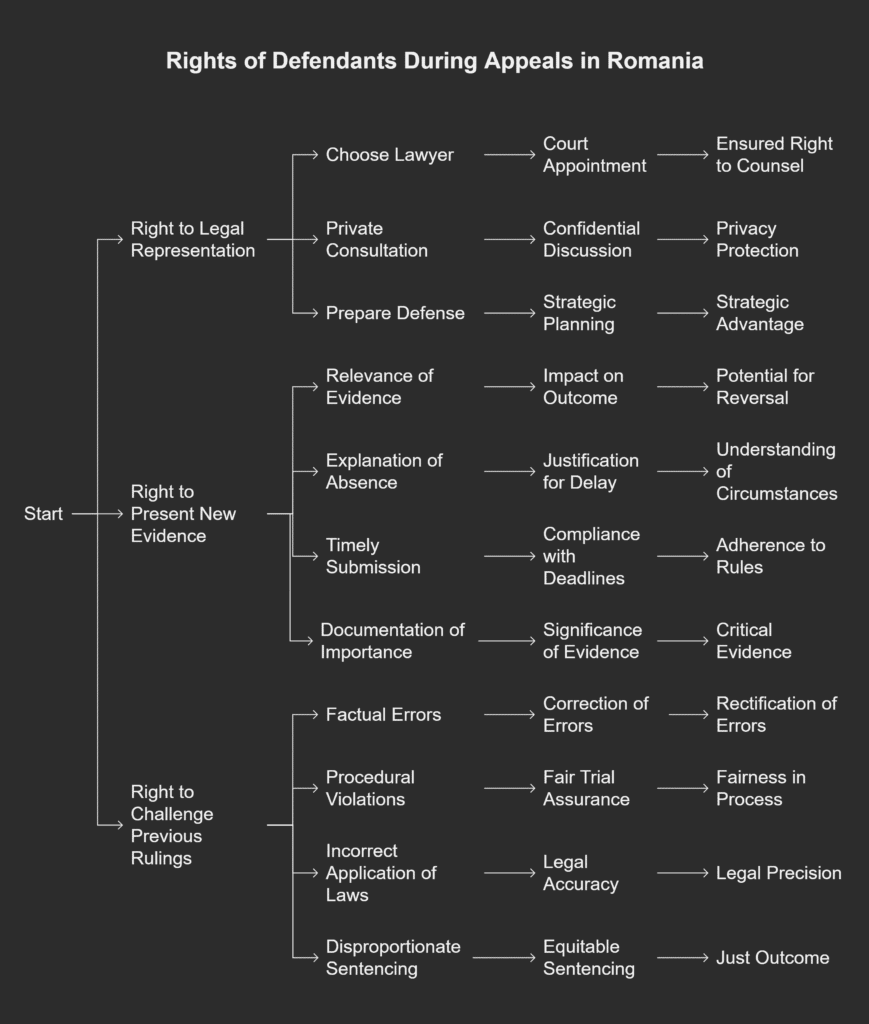
At trial, a judge or panel decides if the defendant is guilty or not.

Role of Prosecutors and Courts

Prosecutors in Romania are very important.

They review evidence and decide if to charge a suspect.

The court system has different levels, from local courts to the High Court of Cassation and Justice.

These courts hear cases and make verdicts.

The system aims to protect citizens and uphold the law.

Knowing how the system works is crucial for understanding justice in Romania.

Romanian criminal justice system

Emergency Response: When to Call 112

In Romania, the 112-emergency service is the main number for emergencies.

It’s run by the Single National Emergency Call System (SNUAU) and the Special Telecommunications Service (STS).

They work around the clock to help people in need.

If you’re facing an emergency, like a medical crisis or a fire, call 112.

The service is available in many languages, including those of national minorities.

This ensures everyone can get help.

They’ll connect you with the right team, like Ambulance or Police, based on your situation.

The 112 service in Romania is key for fast help in emergencies.

Whether it’s a crime, medical issue, or any urgent problem, dialing 112 is the best way to get help.

It ensures your safety and well-being.

Emergency ServiceResponsibility
AmbulanceMedical emergencies
SMURDMobile emergency medical services
PoliceCriminal incidents and public safety
Fire FightersFire-related emergencies
GendarmerieMilitary police and specialized law enforcement
Mountain RescueEmergencies in remote or mountainous areas

emergency number Romania

Alternative Communication Methods for Crime Reporting

In Romania, there are many ways to report crimes or suspicious activities.

These options make it easy for everyone to report incidents.

They work alongside the traditional emergency call service.

SMS Service 113 for Hearing Impaired

The SMS 113 service helps those with hearing or speech issues.

It lets users send texts to report emergencies.

Major telecoms in Romania support this service.

Online Reporting Platforms

Romania has online platforms for reporting non-emergency crimes.

These sites are easy to use.

They let people share details, upload evidence, and check case updates.

Email Submission Options

Some Romanian authorities also take crime reports by email.

This is great for incidents that aren’t urgent.

It’s a convenient way to report crimes when it’s easy for you.

These methods make sure everyone can report crimes their way.

Whether it’s through SMS, online, or email, there’s an option for everyone in Romania.

Alternative Reporting Methods

How to Report Crime Romania: Step-by-Step Process

Reporting a crime in Romania is key to justice and community safety.

If you’ve been a victim or witnessed a crime, you can report it.

The process involves several important steps.

  1. Visit the nearest police station. You can tell a police officer about the crime. They will write down what you say.
  2. You can also write a complaint. It should have your name, address, and a detailed description of the crime. Include the criminal’s name and any evidence you have.
  3. If you don’t speak Romanian, you can still report the crime. It will be translated later.
  4. In Romania, you must report a crime within 3 months. This is for the case to go to trial.
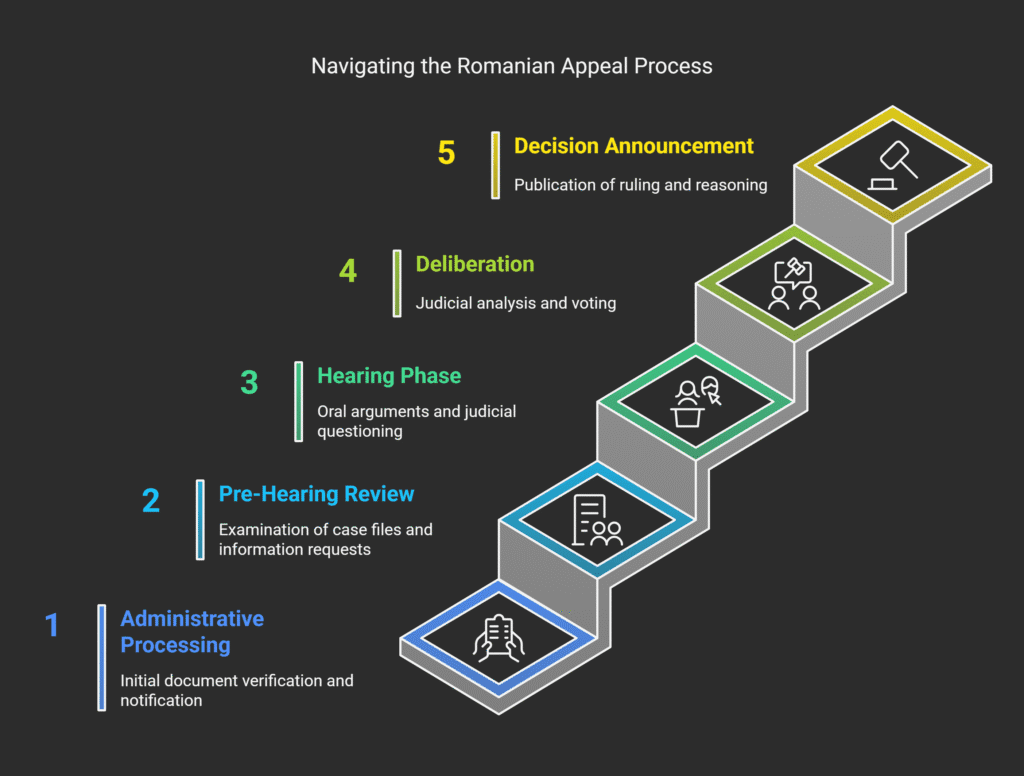
  5. The police can hold a suspect for up to 24 hours. A judge can extend this for up to 30 days, and then up to 180 days.

Reporting a crime in Romania is a vital step in the justice process.

By following these steps, you help the authorities investigate and possibly catch the criminal.

If you have questions, ask local police or legal experts for help.

Key StatisticValue
Reporting Deadline3 months
Maximum Police Detention180 days
Local Police Notification (UK)No

Filing Written Criminal Complaints

In Romania, victims can file written criminal complaints.

These must include personal details, a full account of the incident, and the perpetrator’s name if known.

The victim must sign it and can submit it in person or online.

Required Documentation

Victims must include certain documents when filing a complaint:

  • Personal details: Name, address, contact information
  • Detailed description of the criminal incident
  • Name and identifying information of the perpetrator, if known
  • Signature of the victim

Submission Deadlines

The deadline to file a preliminary criminal complaint is 3 months.

This starts when the victim knows about the crime.

For minors or those legally incapacitated, it starts when their legal guardian finds out.

Legal Requirements for Valid Complaints

To be valid, a complaint must:

  1. Include the victim’s personal details and contact information
  2. Provide a detailed description of the incident
  3. Have the perpetrator’s name and details, if known
  4. Be signed by the victim or their legal representative
  5. Be filed within 3 months.

Rights and Protections for Crime Victims

In Romania, if you’re a victim of crime, you’re recognized and respected.

The law makes sure you get the help and support you need.

You also have the right to financial help and to have your rights restored.

Your rights as a crime victim in Romania include:

  • The right to receive information about your case status and consult court files during the trial phase.
  • The right to legal representation and access to victim support services.
  • The right to request protective measures to safeguard your safety and well-being.
  • The right to receive financial compensation for damages and losses resulting from the crime.

These rights also apply to the families of victims.

The Romanian government works hard to protect and support them.

They want to help victims, and their families recover and move forward.

Key Victim Rights in RomaniaDescription
Right to Recognition and RespectVictims are entitled to be treated with dignity and respect throughout the criminal justice process.
Right to Protection and SupportVictims can request protective measures and access specialized support services to address their needs.
Right to Financial CompensationVictims are eligible for financial compensation to cover damages and losses resulting from the crime.
Right to Legal RepresentationVictims have the right to be represented by a lawyer and receive legal advice during the proceedings.

Knowing and using your rights as a crime victim in Romania helps you in the justice system.

It lets you seek justice and get the support you need.

Remember, you’re not alone, and there are resources to help you through this tough time.

Special Procedures for Reporting Domestic Violence

Victims of domestic violence in Romania have special legal help and support.

They can get a provisional protection order (OPP) from the police or a protection order (OP) from the court.

Protection Orders

To get a protection order, victims can apply to the local court.

They can do this in person or through social services, NGOs, prosecutors, or police.

The court will then decide if a protection order is needed to keep the victim safe.

Emergency Intervention Services

Romania also has emergency services for domestic violence victims.

These services provide quick help like safe shelter, counseling, and medical care.

They help meet the urgent needs of those affected by abuse.

Support Organizations

  • Many support groups in Romania help victims of domestic violence. They offer legal advice, counseling, and programs to help them recover.
  • These groups are key in helping victims through the legal system and getting the help they need to start over.

Knowing about these special procedures and services helps victims of domestic violence in Romania.

They can report the abuse and get the help and protection they need.

Reporting Crimes Against Children

Protecting children from harm is very important in Romania.

If you think a child is being abused, you must report it.

First, call the local Social Assistance and Child Protection Department.

They must look into any abuse claims.

Crimes against children include physical harm, forced work, and neglect.

Teachers and doctors must report any abuse they see.

You can also get help from groups like Save the Children Romania.

Your report can help save a child.

Together, we can keep Romania’s children safe.

Reporting Obligations and Procedures

  • Anyone can report suspected abuse without needing a lawyer in Romania.
  • Teachers must report abuse they know about. Not doing so can lead to trouble.
  • People in charge of childcare places must tell the police about abuse right away.
  • How long you have to report a crime depends on the crime’s severity.

Support Services for Child Victims

Groups like PARADA Foundation help child victims.

They offer:

  • Psychological and legal help for kids and their families;
  • Help during crises and special activities for at-risk families;
  • Free help for kids and families;
  • Respecting the child’s dignity and rights, focusing on protection.

Legal Protections for Minors

The Romanian laws protect child victims.

These include:

  • Children under 14 can’t be charged with a crime. Those 14-16 might be if they knew what they were doing.
  • The Brașov Minors and Family Court handles cases involving minors.
  • A psychologist must be there for minors under 14 in court.
  • Urgent cases involving minors are given top priority.

Knowing how to report and the help available is key.

Our actions can protect Romania’s children.

Your help is crucial in keeping our society’s most vulnerable safe.

Tracking Your Criminal Case

When you report a crime in Romania, you get a unique case number.

This number is key to tracking your case as it goes through the justice system.

Case Number System

The case number system in Romania helps manage criminal cases.

After a complaint is filed, the prosecutor’s office gives a case number.

It usually includes the year, the prosecutor’s office code, and a sequential number.

Keep this number handy for all future case-related communications.

Communication with Authorities

To keep up with your case, it’s vital to stay in touch with the authorities.

When you file a complaint, give a Romanian address or email for updates.

During the trial, you’ll get court summons and can check the court file to see how your case is doing.

Keeping in touch with the prosecutors and courts is key.

It helps you understand the criminal case status Romania and any changes.

This communication is essential for following your case number system Romania and track criminal case Romania.

By actively communicating with authorities Romania, you can stay informed about your criminal case.

This way, you’ll know the status of your case as it moves through the Romanian justice system.

Legal Assistance and Support Services

In Romania, ‘legal aid’ means financial help for civil cases.

If you’re facing criminal charges, you might get a ‘public defender‘ (avocat din oficiu).

This is from the local bar association, asked for by the authorities.

The amount of money you possess is irrelevant when the need for a Romanian lawyer arises.

There are also many groups helping crime victims in Romania.

They offer counseling, a place to stay, and legal advice.

For example, the Sensiblu Foundation works with UNICEF and local groups to help abuse victims.

  • The Romanian legal aid system covers criminal cases through the appointment of public defenders.
  • Victim support services are available from organizations like the Sensiblu Foundation, which collaborates with UNICEF and local authorities.
  • Services can include counseling, temporary shelter, and legal guidance for crime victims in Romania.

If you’ve been a victim of a crime in Romania, you have legal help and support services.

Knowing your rights and the help available can protect you during tough times.

Conclusion

Reporting a crime in Romania is a detailed process that puts victims first.

It includes emergency services and special channels for domestic violence and child abuse.

Knowing about law enforcement, criminal proceedings, and the role of prosecutors and courts helps you navigate it well.

Victims get important rights and protections, like legal counsel and support services.

Romania also focuses on domestic violence and human trafficking.

This shows the country’s dedication to keeping its people and visitors safe.

Whether it’s an emergency, a written complaint, or legal advice, this article helps.

Learning about the Romanian justice system and support networks is key.

It ensures your safety and helps you get the justice you deserve.

FAQ

What is the 112-emergency service in Romania?

The 112-emergency service in Romania is always ready to help.

It answers calls 24/7 and sends help to the right place.

You can call in many languages.

How can I report a crime in Romania if it’s not an emergency?

For non-emergency crimes, you can report them to the police or prosecutor’s office.

You can do this in writing or by talking.

Make sure to give your details and describe what happened.

They also accept reports online.

What are the key components of the Romanian criminal justice system?

The system in Romania includes police, prosecutors, and courts.

First, the police collect evidence.

Then, prosecutors look at the case.

Ultimately, it is the judges who determine an individual’s guilt.

What services does the 112-emergency number provide in Romania?

The 112 service in Romania is always on.

It helps in many languages, including those of national minorities.

It sends calls to Ambulance, Police, and Fire Fighters as needed.

Are there alternative methods to report crimes in Romania besides calling 112?

Yes, there are other ways to report crimes.

The SMS 113 service helps those who can’t speak or hear well. Y

ou can also report online or by email for non-emergencies.

What is the process for filing a crime report in Romania?

To report a crime, you can talk or write to the police or prosecutor’s office.

If you talk, go to a police station. They will write down what you say.

If you write, sign it and include your details and what happened.

What information is required in a written criminal complaint in Romania?

Your complaint should have your details, a full description of what happened, and the person’s name if you know it.

Sign it and can send it in person or online.

You have 3 months to file a preliminary complaint.

What rights do crime victims have in the Romanian criminal justice system?

Victims in Romania have many rights.

They are treated with respect and get help and support.

They can also get financial help and have their rights restored.

Family members also have rights, and victims can ask for updates on their case.

How can I report domestic violence in Romania?

If you’re a victim of domestic violence, you can ask for a provisional protection order from the police.

Or a protection order from the court.

You can apply in person or through social services, NGOs, prosecutors, or police officers.

There are also emergency services available.

How do I report suspected child abuse or exploitation in Romania?

If you think a child is being abused or neglected, report it to the local Social Assistance and Child Protection Department.

People who work with children must also report any suspicions.

Organizations like Save the Children Romania offer help.

How can I track the status of my criminal case in Romania?

After you file a complaint, you’ll get a case number.

To find out what’s happening, ask and give a Romanian address or email.

During the trial, you can see the court file and will be called to court.

What legal assistance and support services are available for crime victims in Romania?

In Romania, ‘legal aid’ means financial help for civil cases.

For criminal cases, you can get a public defender.

Many organizations also help victims with counseling, shelter, and legal advice.

Drug Offences Romania

Romania’s Criminal Code: Penalties for Illicit Drug Offenses and Trafficking

Romania’s Criminal Code: Penalties for Illicit Drug Offenses and Trafficking

Table of Contents

Ever wondered how Romania fights its drug problem?

The Romanian Criminal Code has strict rules for drug crimes.

It aims to stop the spread of illegal drugs, from small amounts to big trafficking cases.

Romania’s drug laws cover all bases, from personal use to big trafficking.

The penalties are tough to scare off both users and sellers.

It’s key to know these laws if you live in or visit Romania.

drug offences Romania

The Romanian criminal code lists drug crimes and their punishments.

These can be fines or long prison times, based on the crime’s severity.

Drug trafficking, for example, gets the toughest penalties.

Police in Romania take drug crimes very seriously.

The laws are strict, with harsh penalties for these crimes.

Each drug crime, like possession, distribution, or making drugs, has its own punishment.

Key Takeaways

  • Romania’s drug laws are outlined in Law No. 143 of 26 July 2000;
  • Penalties for drug offences range from fines to long-term imprisonment;
  • Drug trafficking carries some of the most severe punishments;
  • The law distinguishes between high-risk and risk drugs;
  • Penalties vary based on the type of drug and nature of the offense.

Overview of Romania’s Drug Laws

Romania’s drug laws are key to controlling substances.

The country’s drug policy aims to tackle drug use and trafficking.

Law No. 143 of 26 July 2000 is the main law for drug offenses in Romania.

Law No. 143 of 26 July 2000

This law sets the rules for drug crimes in Romania.

It lists controlled substances and their penalties.

It also has different rules for high-risk and risk drugs.

Substances Subject to National Control

Romania’s laws cover many substances, including:

  • Heroin;
  • Cannabis (herbal and resin);
  • Cocaine;
  • Amphetamines;
  • MDMA.

romanian drug policy substances

Definition of High-Risk and Risk Drugs

The laws in Romania divide drugs into two groups:

CategoryDescriptionExamples
High-risk drugsListed in tables I and II of the lawHeroin, Cocaine
Risk drugsListed in table III of the lawCannabis, MDMA

This system helps decide the penalties for drug crimes. It shows Romania’s effort to control substances effectively.

Drug Possession Penalties in Romania

In Romania, getting caught with illegal drugs can lead to serious penalties.

If you have drugs for personal use, you could face up to 2 years in jail.

The punishment doesn’t change, no matter what drug you have.

Law enforcement in Romania takes drug crimes very seriously.

If you’ve been caught before, the punishment gets even tougher.

Sentences can double if you commit a crime within five years of your first offense.

Drug possession romania penalties

But, the Romanian justice system might offer a break.

Instead of jail, you could get a fine or community service.

This is more likely if you’re a first-time offender or have a small amount of drugs.

Still, don’t think that drug possession is ignored in Romania.

OffensePenalty
Personal Use Possession3 months – 2 years imprisonment or fine
Possession with Intent to Distribute2 – 7 years imprisonment
Repeat Offense (within 5 years)Sentence may double

If you’re facing drug charges in Romania, knowing your rights is key.

A conviction can affect your life in many ways.

So, it’s important to get legal advice.

Trafficking and Distribution of Illicit Drugs

Romania struggles with drug trafficking and distribution.

Its location makes it a key spot for illegal drugs moving between Europe.

This has led to strict laws for drug-related crimes in Romania.

Penalties for Risk Drugs

In Romania, dealing with risk drugs is serious.

If caught, you could get 3 to 15 years in jail.

The courts might also take away some rights.

These rules aim to stop drug distribution in Romania.

Penalties for High-Risk Drugs

High-risk drugs have even tougher penalties in Romania.

Trafficking or distributing them can mean 10 to 20 years in prison.

This shows the government’s strong stance against drug trafficking, especially for dangerous substances.

Aggravating Circumstances

Some factors can make drug sentences worse in Romania.

These include using minors in drug crimes, mixing drugs with other substances, and crimes by medical or public officials.

These cases show how serious drug crimes are and their effect on society.

Drug TypePrison SentenceAdditional Penalties
Risk Drugs3-15 yearsProhibition of certain rights
High-Risk Drugs10-20 yearsProhibition of certain rights

Drug Offences Romania: Cultivation and Manufacturing

Romania’s drug laws are strict against illegal drug making.

The penalties for growing or making drugs are very harsh.

This shows Romania’s strong fight against drug crimes.

For drugs that are risky, people caught can get 3 to 15 years in jail.

Drugs that are even more dangerous can lead to 10 to 20 years in prison.

These crimes also mean losing some rights.

Romania is a key spot for drug smuggling because of its location.

It’s on the Balkan Route, making it a hotspot for drug trafficking.

But, fighting drug smuggling is tough because only a few lorries are checked at borders.

Recently, big drug busts have shown how big the problem is:

  • 1.5 tons of hashish and 751 kg of Captagon pills found in Constanta Port;
  • Estimated value of EUR 80 million;
  • Biggest drug seizure in Romanian history.

These discoveries show the fight against illegal drug making is ongoing.

Romanian authorities team up with the US Drug Enforcement Administration to fight drug trafficking and making.

Importation and Exportation of Illicit Substances

Romania struggles with drug import and export issues.

It’s a key transit point for drug smuggling, especially along the Balkan Route.

This route carries heroin from Afghanistan to Western and Central Europe.

The Constanta port is a major hub for drug trafficking.

It uses Black Sea maritime routes.

Romania’s northern route also helps smuggle heroin from Iran and Turkey to Europe.

Penalties for Risk Drugs

Importing or exporting risk drugs without permission in Romania is very serious.

If you’re caught, you could get 10 to 20 years in prison.

Penalties for High-Risk Drugs

Smuggling high-risk drugs in Romania is even more serious.

Unauthorized trade can lead to 15 to 25 years in prison.

Both crimes also limit your rights.

Drug CategoryPrison SentenceAdditional Penalties
Risk Drugs10-20 yearsRights restrictions
High-Risk Drugs15-25 yearsRights restrictions

Law enforcement finds it hard to catch illegal drug shipments.

Only one in 50 lorries is checked at border crossings in South-Eastern Europe.

This shows the big challenge in fighting drug smuggling in Romania and the area.

Prescription Drug Offenses

Romania is strict about prescription drug offenses.

They aim to stop drug abuse and control controlled substances.

The laws target both doctors and people involved in illegal prescription drug activities.

Doctors can face big penalties for giving out high-risk drugs without a good reason.

This can lead to 1 to 5 years in jail.

The same goes for those who get or give out these drugs with fake or unnecessary prescriptions.

Drug abuse in Romania isn’t just about illegal drugs.

It also includes misusing prescription meds.

In 2016, 5.8% of the population used cannabis at some point in their lives.

This shows the need for strict rules on all addictive substances.

Controlled substances in Romania are under tight rules.

This includes both illegal drugs and some prescription meds with a high risk of abuse.

The goal is to stop these substances from being used illegally instead of for medical reasons.

  • Deliberately prescribing high-risk drugs without medical need: 1-5 years imprisonment;
  • Dispensing or obtaining high-risk drugs with fake prescriptions: 1-5 years imprisonment;
  • Possession of small quantities for personal use: Administrative fine or short-term imprisonment.

These tough rules show Romania’s dedication to fighting prescription drug abuse.

They want to make sure controlled substances are used right in healthcare.

Controlled Delivery and Undercover Operations

Romania fights drug trafficking with smart tactics.

Controlled delivery and undercover work are key.

They help catch drug criminals and break up their networks.

Controlled Delivery in Romania

Controlled delivery in Romania lets drug shipments pass through.

This helps track the supply chain.

Recently, Eurojust helped seize 1,500 kg of heroin across Europe using this method.

Undercover Investigators

Undercover drug operations in Romania are also crucial.
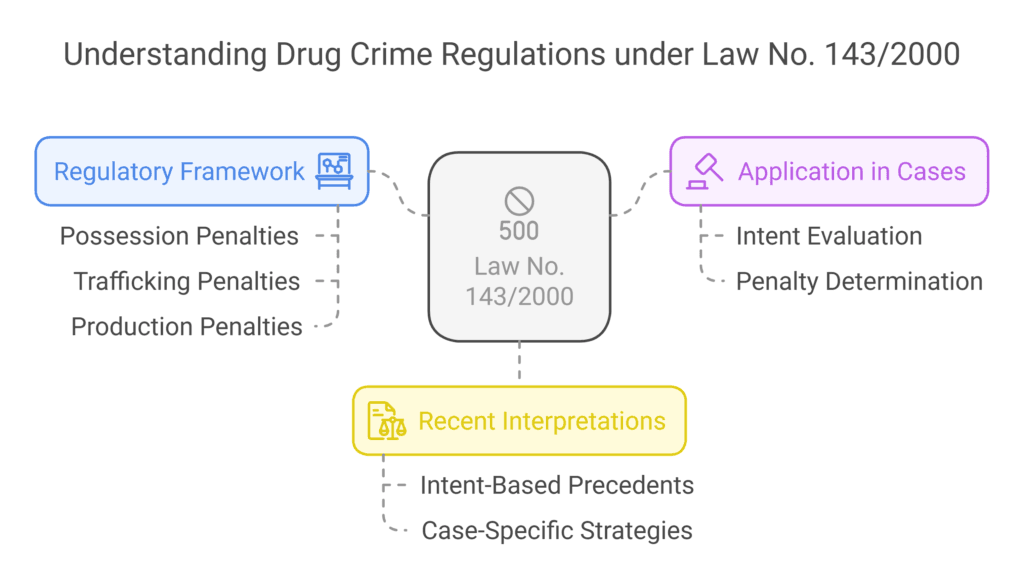
Police officers pretend to be someone else to gather evidence.

This lets them get close to drug groups and gather important info.

MethodDurationAuthorization
Electronic SurveillanceUp to 30 daysJudge approval
WiretappingUp to 48 hoursProsecutor order
Computer Data AccessVariesProsecutorial order

Romania uses many special ways to fight drugs.

These include wiretapping, computer access, and video surveillance.

These methods can last up to 30 days.

After, prosecutors must tell the people involved within 10 days.

Penalties for Drug-Related Organized Crime

Romania is very strict on drug-related organized crime.

The Romanian Criminal Code has tough penalties for drug crimes done by groups.

If you’re caught in a drug crime in Romania with others, you’ll face serious consequences.

A 2017 study looked at drug trafficking laws in 26 European countries.

It found big differences in penalties.

Romania is on the stricter side for organized drug crimes.

For serious drug crimes done by groups of three or more, the penalties are:

  • 15 to 25 years imprisonment;
  • Possible life sentence.

If drug-related organized crime leads to death, the penalties get even tougher:

  • Life imprisonment;
  • 15 to 25 years imprisonment.

These harsh sentences are meant to stop people from getting involved in drug crime in Romania.

The law knows that group drug crimes are more dangerous.

By giving long prison terms, authorities want to break up criminal groups and cut down on drug crimes.

Drug Precursors and Equipment Offenses

Romania is strict about drug precursors and equipment offenses.

Law No. 300 of 17 May 2002 sets the rules for these substances.

It controls substances that could be used in drug making but allows them for legal uses.

Penalties for Precursor-Related Crimes

Penalties for drug precursor crimes in Romania are harsh.

If you’re caught with drug precursors or equipment for illegal drug making, you could face 3 to 10 years in prison.

The law groups precursors into three levels based on how risky they are and how easily they can be replaced in drug making.

Confiscation of Drugs and Related Assets

Asset confiscation is a big part of fighting drug crimes in Romania.

The law says drugs and related assets must be seized.

If they can’t be found, you’ll have to pay their value in cash.

This helps cut off the money that drives drug trafficking.

Precursor ScheduleAuthorization RequiredIssuing Authority
Schedule I and IIYesMinistry of Health and Family
Schedule IIIFunctioning AuthorizationMinistry of Industry and Resources
Export/Import (All Schedules)YesSpecific Procedures

To fight drug equipment offenses in Romania, there are strict rules.

These rules cover how precursors are stored, distributed, and labeled.

Operators must keep records of precursor movements for at least four years.

These steps help stop legal chemicals from being used in illegal drug making.

Conclusion

Romanian drug laws have changed a lot since 1989.

They now deal with many issues, from personal use to organized crime.

It’s important to focus on preventing drug use among young people.

Penalties for substance abuse in Romania are strict.

The Criminal Code lists many drug-related crimes.

These laws aim to reduce criminal behavior linked to drug use.

Romania’s drug crime policies match global efforts.

The 2011 Law no. 194 targets new psychoactive substances.

This shows Romania’s dedication to updating its drug laws.

The country tries to balance strict rules with help for those with addiction.

FAQ

What is the primary legislation governing drug offenses in Romania?

Law No. 143 of 26 July 2000 is the main law for drug offenses in Romania.

It lists controlled substances and divides them into high-risk and risk drugs.

What are the penalties for unlawful possession of drugs for personal use in Romania?

Having drugs for personal use without permission can lead to 2 to 5 years in jail.

The law doesn’t change penalties based on the drug type or amount.

How are trafficking and distribution of drugs penalized in Romania?

Selling or giving out drugs can get you 3 to 15 years in jail and some rights taken away.

For more dangerous drugs, the penalty goes up to 10 to 20 years.

Harsher penalties apply if minors are involved or if you’re a doctor or official.

What are the penalties for cultivation, production, and manufacturing of drugs in Romania?

Making drugs without permission can lead to jail time.

For risk drugs, it’s 3 to 15 years.

For dangerous drugs, it’s 10 to 20 years.

You’ll also lose some rights.

What are the penalties for importing or exporting drugs in Romania?

Bringing in or out risk drugs without permission is a serious crime.

It can get you 10 to 20 years in jail. For dangerous drugs, it’s 15 to 25 years.

You’ll also lose some rights.

How are prescription drug offenses penalized in Romania?

Doctors can face 1 to 5 years in jail for giving out dangerous drugs when not needed.

The same goes for getting or giving out these drugs based on false prescriptions.

What is controlled delivery, and what is the role of undercover investigators in drug enforcement in Romania?

Controlled delivery is a way to catch drug crimes by letting drugs pass through.

Undercover officers pretend to be someone else to gather evidence on drug crimes.

How are drug-related organized crime activities penalized in Romania?

Being part of a drug crime group is punished more severely.

If you’re in a group of three or more, you could face life in jail or 15 to 25 years.

If someone dies because of your actions, you could get life or 15 to 25 years.

What are the penalties for offenses related to drug precursors and equipment in Romania?

Making, bringing in, or having drug-making tools or materials can get you 3 to 10 years in jail.

The law says you must give up any drugs or money you made from them.

What are the main drug-related offences in Romania’s Criminal Code?

The Romanian Criminal Code outlines several drug-related offences.

The primary offenses include drug trafficking, possession of drugs, drug use, and possession of drugs for personal use.

The code also covers offenses related to the cultivation, production, and distribution of illicit drugs.

These offences are considered serious crimes in Romania, and the penalties can be severe, depending on the nature and scale of the offense.

What are the penalties for drug trafficking in Romania?

Drug trafficking is considered one of the most serious drug-related offences in Romania.

The penalties for this offense can be severe, typically ranging from 2 to 7 years in prison.

However, in cases involving large quantities of drugs, high-risk drugs, or organized crime, the prison sentence can be significantly longer, potentially up to 15 years or more.

The exact penalty depends on various factors, including the type of drug, quantity, and the offender’s role in the trafficking operation.

How does Romanian law treat possession of drugs for personal use?

Possession of drugs for personal use is punishable under Romanian law, but the penalties are generally less severe than those for trafficking.

Typically, possession for personal use can result in a prison sentence ranging from months to 2 years or a fine.

Table of Contents

Index