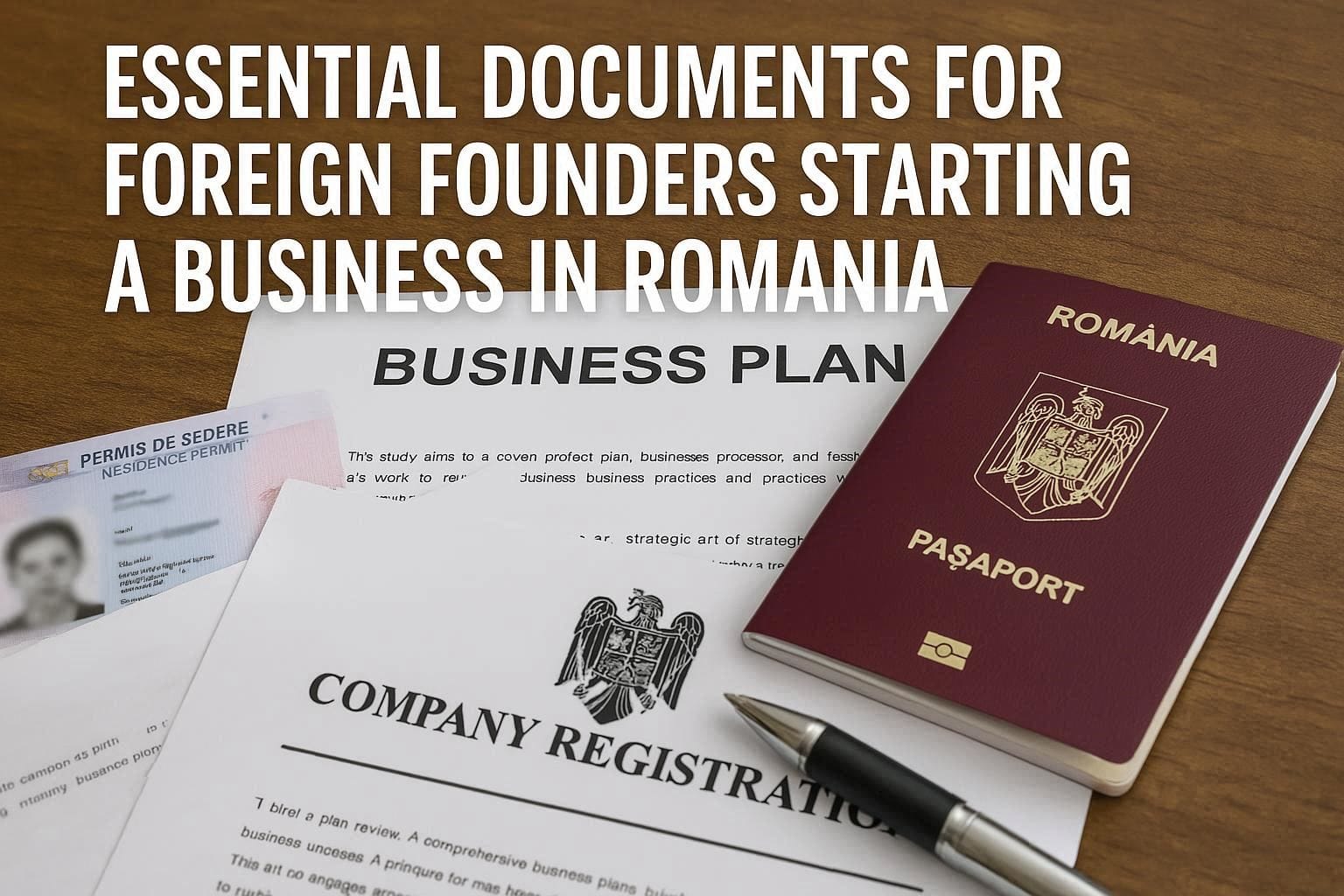
Essential Documents for Foreign Founders Starting a Business in Romania

Essential Documents for Foreign Founders Starting a Business in Romania

Company formation in Romania

Essential Documents for Foreign Founders Starting a Business in Romania

Starting a business in Romania requires more than choosing a company name. The incorporation file must connect the founders, ownership structure, registered office, activities, management and beneficial-owner information in a form accepted by the Trade Register.

This guide explains the documents commonly required for foreign founders and why the correct route depends on the founder’s country, legal form, activity and filing method.

Play
Documents and practical steps for foreign founders entering the Romanian market.

Short answer: the core file usually includes founder and administrator identification, company-name information, proof of the registered office, articles of association, beneficial-owner information and the forms required by the ONRC. Foreign corporate shareholders may need additional registry, authority, translation and legalisation documents.

What Documents Are Needed?

The exact list is not identical for every applicant. An individual founder, a foreign company acting as shareholder, an EU citizen, a non-EU national and a representative acting under a power of attorney may face different document and signing requirements.

Individual founder

Usually needs a valid identity document, personal details, ownership and management information, beneficial-owner information and the declarations required for the application.

Foreign corporate shareholder

Usually needs a current registry extract or equivalent, evidence of legal existence, a corporate approval to invest and appoint representatives, and proof of the signatory’s authority.

Authorised representative

Needs a power of attorney or other authority in the form required for the filing. The document may need authentication, apostille or legalisation and an authorised Romanian translation.

Essential incorporation documents for foreign founders in Romania
Incorporation documents should be checked as one coordinated file.

Core Documents for a Romanian Company Formation File

Identity documents

Passports or identity documents for shareholders, administrators and other relevant persons. The required copy, format and translation depend on the filing route and the document’s origin.

Company name

Prepare several compliant name options and obtain the current ONRC proof or reservation document required for the incorporation route.

Registered office

Provide evidence of the right to use the Romanian premises, such as a lease, ownership document or another legally acceptable document. The arrangement should be checked for the intended activity.

Articles of association

The constitutional document should address the legal form, shareholders, capital, activities, management, representation and decision-making rules required by Romanian company law.

Beneficial-owner information

The ownership and control chain must be identified and reflected in the information or declaration required for the company-formation file.

ONRC forms and declarations

The application, declarations and supporting forms must be completed using the current ONRC requirements. The exact forms depend on the legal form and the requested registrations.

Additional Documents for Foreign Corporate Shareholders

When the shareholder is a company incorporated outside Romania, the Trade Register file normally needs evidence that the shareholder exists and that the persons signing or approving the investment have authority to do so.

Registry evidence

A recent extract or equivalent official document may be needed to show the foreign company’s legal existence, registered office, directors and ownership information.

Corporate resolution

The foreign shareholder may need a resolution approving the Romanian investment, the participation in the Romanian company and the appointment of the relevant representative.

Authority to sign

The file should show who may sign the articles of association, power of attorney and other documents on behalf of the foreign company.

Formalities abroad

Depending on the issuing country and document type, authentication, apostille or legalisation may be required before the document can be used in Romania.

There is no universal rule that every foreign document must be notarised or apostilled. The correct form depends on the issuing state, applicable international instruments, the document and the ONRC filing requirements at the time of submission.

Romanian Translations and Document Formalities

Documents submitted to Romanian authorities generally need to be usable in Romanian. A foreign-language document may require an authorised Romanian translation, and the translation may need to follow the form required for that document and filing route.

Before ordering translations or legalisation, check the complete document chain. A translation cannot cure a missing corporate resolution, an expired registry extract or a signatory who lacks authority.

Choosing the Legal Structure and Current Capital Rules

The documents depend on whether the founder chooses an SRL, an SA, a branch or a representative office. An SRL is often suitable for a privately held operating business, but the right structure depends on ownership, funding, governance, activity and the relationship with any foreign parent.

SRL

For a newly incorporated SRL, the minimum share capital is RON 500 under the current rules introduced by Law No. 239/2025. An existing SRL whose reported net turnover exceeds RON 400,000 may face a separate capital-increase obligation under the applicable timing rules.

SA

An SA has different capital, governance and incorporation requirements. The file should be prepared against the rules applicable to the proposed share structure and offering model.

Branch or representative office

These are not interchangeable with a Romanian subsidiary. The foreign parent’s constitutional documents, registry evidence and authority documents become central to the filing.

The current minimum-capital rules should be checked at the time of filing, especially where the founder is incorporating an SRL or modifying an existing Romanian company. The ONRC identifies Law No. 239/2025 as the source of the current SRL capital changes.

Registered Office and Activity Documents

The registered office requires evidence of the right to use the premises. A domiciliation or virtual-office arrangement may be possible in appropriate circumstances, but the document, provider and intended activity must be checked rather than assumed to be interchangeable with an operating location.

Activity codes should be selected under the current CAEN classification. Regulated activities may require additional approvals, professional qualifications or operating authorisations. Company registration alone does not automatically authorise every activity listed in the articles of association.

How the Documentation Process Works

1

Map the founders and structure

Identify shareholders, administrators, beneficial owners, the legal form and whether a foreign company is involved.

2

Check the activities and office

Confirm the CAEN activities, any special authorisations and the document supporting the Romanian registered office.

3

Collect foreign documents

Obtain current registry evidence, corporate resolutions, signatory authority and any required powers of attorney.

4

Complete formalities

Arrange translations and, where necessary, authentication, apostille or legalisation before the filing is submitted.

5

File and respond

Submit the complete application through an available ONRC route and address any request for correction or additional documents.

Can Foreign Founders Complete the Process Remotely?

Often, yes, but remote handling is document-dependent. A founder may act through an authorised representative where the authority document and filing route meet the applicable requirements. Online submission also depends on the current ONRC platform, signature and document-format rules.

Company formation, bank onboarding, tax registration, immigration status and permission to conduct regulated activities are separate questions. Incorporating a company does not automatically give a founder the right to live or work in Romania.

Tax and VAT: Keep These Questions Separate

The incorporation file and the company’s tax position are related but not identical. Microenterprise eligibility, profit tax, VAT registration, dividend taxation, e-Factura and sector-specific tax rules depend on the company’s facts and the law applicable at the relevant time.

For that reason, this documents guide does not state fixed tax rates or turnover thresholds as permanent formation rules. Those matters should be reviewed separately with the company’s Romanian tax adviser.

How Atrium Romanian Lawyers Can Help

Document mapping

We identify the documents required for the founder, foreign shareholder, administrator, registered office and intended activity.

Cross-border formalities

We help coordinate corporate resolutions, powers of attorney, translations and document-form requirements for foreign founders.

ONRC filing strategy

We prepare the formation route around the ownership structure, governance, activities, capital and post-registration needs.

Frequently Asked Questions

What documents does a foreigner need to start a company in Romania?

The core file commonly includes identity documents, company-name information, registered-office evidence, articles of association, beneficial-owner information, declarations and the current ONRC forms. The exact list depends on the founder and legal structure.

What extra documents are needed if the shareholder is a foreign company?

The file may require a current registry extract or equivalent, a corporate resolution, proof of signatory authority and documents concerning the foreign company’s ownership or control. Translation and legalisation requirements depend on the issuing jurisdiction and document.

Do foreign documents always need an apostille?

No. The requirement depends on the issuing country, applicable treaties or legal rules, the document and the filing route. The document chain should be checked before translation and submission.

Do documents need to be translated into Romanian?

Foreign-language documents used in the Romanian filing generally need to be made available in Romanian in the form accepted for that document and procedure. The required translation and certification should be confirmed case by case.

Can I incorporate a Romanian company without visiting Romania?

Often, yes, through an authorised representative or an eligible online route. Whether this is possible depends on the documents, signatures, powers of attorney, identity checks, banking and any sector-specific requirements.

What is the minimum share capital for a new SRL in 2026?

Under the current rules identified by the ONRC, a newly incorporated SRL has a minimum share capital of RON 500. Existing companies may be subject to separate obligations linked to net turnover and the transition rules in Law No. 239/2025.

Does company registration automatically give me a residence permit?

No. Company ownership or incorporation and the right to enter, reside or work in Romania are separate legal questions. Immigration eligibility should be assessed independently.

Does company registration authorise every activity listed in the articles?

No. Some activities require additional authorisations, professional qualifications, licences or operating conditions. The intended activity should be checked before the articles and filing are finalised.

Related Company Formation Resources

Official reference: Current forms, filing routes and procedural information should be checked on the ONRC website and its online portal. The ONRC lists Law No. 31/1990, Law No. 265/2022 and Law No. 239/2025 among the relevant national legislation. The exact document requirements may vary with the founder, jurisdiction, legal form and proposed activity.

Disclaimer: This page provides general information only and does not constitute legal advice, a legal opinion or the creation of a lawyer-client relationship. Legal solutions depend on the specific facts and documents involved.

AI Notice: AI-assisted content, reviewed by a qualified Romanian lawyer.

Romanian Company Board Meetings

Navigating Romanian Company Board Meetings: Key Insights

Navigating Romanian Company Board Meetings: Key Insights

A group of people sits around a large conference table with papers and laptops in front of them.

Understanding the nuances of Romanian company board meetings is important for anyone involved in the management of companies in Romania.

This article provides key insights into the structure, legal requirements, and best practices for conducting effective board meetings in accordance with Romanian company law.

We will explore the roles and responsibilities of directors, shareholders, and other key stakeholders in the Romanian corporate governance landscape.

Understanding the Structure of Romanian Companies

A projector displays a presentation on the wall with graphs and charts.

Overview of Atrium Romanian Lawyers

Romanian company law dictates the formation, operation, and governance of various types of companies in Romania.

The type of company significantly impacts its organizational structure and the regulations governing its board meetings.

Atrium Romanian Law Office, an expert legal services provider, highlights that Romanian lawyers must navigate these regulations meticulously.

The Articles of Association define the company’s internal rules, complementing the broader legal framework and influencing how the board of directors operates and how resolutions of the general meetings are implemented.

Types of Romanian Companies

Romania provides various legal entity options, each possessing unique attributes.

Two frequently chosen forms are:

  1. Limited liability companies (SRL), which are often preferred by smaller businesses due to their simpler organizational structures.
  2. Joint-stock companies (SA), designed for larger enterprises and characterized by more complex governance procedures.

Ultimately, the selection between these legal structures will influence the company’s meeting and decision-making protocols.

Legal Entities and Their Responsibilities

As legal entities, Romanian companies bear specific responsibilities under Romanian law.

The board of directors, or the management board, plays a pivotal role in overseeing the company’s operations and ensuring compliance.

Members of the board are entrusted with representing the company, and their actions must align with both the law and the company’s articles of association.

The company is managed in accordance with the law, and the directors or the management board are responsible for preparing financial statements of the company and filing them with the Trade Registry.

Shareholder Meetings in Romania

A clock on the wall shows the time during the meeting.

Types of Shareholder Meetings

Under Romanian company law, various types of shareholder meetings serve distinct purposes.

These meetings are critical for the management of companies, ensuring transparency and shareholder involvement.

For example:

  1. The annual general meeting is a mandatory gathering where shareholders review the financial statements of the company and elect the board of directors or supervisory board.
  2. Extraordinary general meetings are convened to address specific, urgent issues such as amending the articles of association, increasing the share capital of the company, or approving significant transactions.

Convene Procedures for Shareholder Meetings

To convene a shareholder meeting, Romanian companies must adhere to specific procedures.

The board of directors, or in some cases, the supervisory board, must issue a notice to all shareholders, detailing the meeting’s agenda, date, time, and location.

This notice must be sent within the timeframe prescribed by Romanian company law and the company’s articles of association.

Failing to follow these procedures may invalidate the resolutions of the general meetings passed during the meeting, potentially leading to legal challenges.

Amending Resolutions in Shareholder Meetings

Shareholders can amend resolutions during the shareholder meeting under Romanian law, provided the proposed amendments are within the scope of the original agenda.

The process typically involves a motion to amend, followed by a vote among the shareholders.

For significant amendments, such as those affecting the articles of association, a supermajority vote may be required, and the amended resolution must be filed with the Trade registry.

Understanding these procedures is vital for effective corporate governance in Romanian companies.

The Role of the Board of Directors

A woman presenting a report on a screen in front of the board.

Composition of the Board of Directors

The composition of the board of directors is a critical element in the management of the company.

Under Romanian company law, the Articles of association of Romanian companies will specify the number of members of the board, their qualifications, and the process for their appointment.

In joint stock companies, the shareholder structure dictates that some directors or the management board are appointed by the general meeting of shareholders, ensuring the shareholder interests are adequately represented.

This structure aims to balance expertise and shareholder oversight.

Duties and Responsibilities of Board Members

Members of the board have extensive duties and responsibilities under Romanian law.

They are entrusted with the strategic direction of the company in Romania, ensuring compliance with regulations, and safeguarding the interests of all shareholders.

The board of directors is responsible for overseeing the financial statements of the company, ensuring their accuracy and timely filing with the trade registry.

In joint stock companies, the board also manages risk, sets policy, and monitors the performance of the management board, upholding their fiduciary duty to the company.

Decision-Making Processes in Board Meetings

Effective decision-making in board meetings is crucial for the success of Romanian companies.

The process typically involves presenting agenda items, facilitating discussion, and voting on resolutions.

The Articles of association often prescribe specific voting thresholds for different types of decisions.

For significant matters, such as amending the Articles of Association or increasing the share capital of the company, a qualified majority or even unanimous consent may be required.

Proper documentation of these decisions in the meeting minutes is essential for transparency and accountability, and the minutes should be filed with the trade registry as appropriate.

General Meetings: Best Practices

Several individuals are engaged in discussion, with some taking notes.

Planning and Conducting General Meetings

Effective planning is essential for successful general meetings in Romanian companies.

The board of directors must meticulously plan the agenda, ensuring all relevant items are included and clearly defined.

Romanian company law mandates that the Articles of Association dictate the specific procedures for these meetings.

As an expert legal services provider, we emphasize that proper notice must be given to all shareholders, and the meeting should be convened in a manner that promotes transparency and active participation, whether for limited liability companies or joint stock companies.

We are dedicated to helping our clients navigate these processes smoothly.

Legal Requirements for General Meetings

Adherence to legal requirements is paramount for general meetings in Romania.

Romanian law stipulates specific rules for voting, quorum, and documentation of resolutions of the general meetings.

The board of directors must ensure that all procedures align with both Romanian company law and the articles of association.

Members of the board must understand that failure to comply can invalidate the meeting’s outcomes, potentially leading to legal challenges.

Our firm provides expert guidance to Romanian companies in navigating these complex legal obligations, ensuring compliance and protecting shareholder interests.

Best Practices for Effective Communication

Effective communication is a cornerstone of successful general meetings.

Members of the board should ensure that information is presented clearly and concisely, allowing all shareholders to understand the issues at hand.

In Romanian companies, this includes providing materials in Romanian and, potentially, other languages if international shareholders are involved.

Encouraging open dialogue and addressing shareholder concerns promotes trust and transparency.

As a client-focused firm, we emphasize the importance of proactive communication to facilitate productive and legally sound board meetings.

Recent Developments in Romanian Company Law

Documents and folders are neatly arranged on the table for review.

Changes Impacting Board Meetings

Recent changes in Romanian company law have significantly impacted board meetings.

Amendments related to corporate governance and shareholder rights necessitate that directors or the management board stay informed and adapt their practices accordingly.

These changes may affect procedures for votes, the handling of resolutions, and the overall management of the company.

As an expert team of Romanian lawyers, we closely monitor these developments and provide timely advice to our clients, ensuring their companies remain compliant and competitive.

These updates are particularly relevant for both limited liability companies and joint stock companies.

Emerging Trends in Corporate Governance

Emerging trends in corporate governance are reshaping how Romanian companies conduct board meetings.

There is a growing emphasis on transparency, accountability, and environmental, social, and governance (ESG) factors.

Companies are increasingly adopting digital solutions to streamline meeting processes and enhance shareholder engagement.

The articles of association of Romanian companies are evolving to reflect these trends, often requiring more detailed reporting and greater shareholder involvement.

We assist our clients in integrating these best practices to enhance their corporate governance frameworks and attract investment.

Case Studies of Successful Board Practices

Examining case studies of successful board practices provides valuable insights for Romanian companies.

Instances where board meetings effectively addressed critical challenges, implemented innovative strategies, or improved shareholder relations offer practical lessons.

These examples often highlight the importance of diverse members of the board, robust decision-making processes, and proactive risk management.

We leverage our experience and expertise to help clients implement similar strategies, fostering a culture of excellence and driving sustainable growth for Romanian companies across various sectors, including both limited liability and joint stock companies.

FAQ:

What are the requirements for conducting board meetings in Romania?

In Romania, board meetings must comply with the applicable legislation, which includes the requirements set forth by the Romanian legislation.

Companies are required to convene meetings in accordance with their articles of association, which dictate the procedures shareholders must follow.

Additionally, the meeting must be held at the registered office or another location specified in the convening notice.

How can shareholders participate and vote in general shareholder meetings?

Shareholders can participate and vote in general shareholder meetings either in person or through electronic means.

The recent legal framework removes the requirement for companies to include identification data in the meeting notice, making it easier for shareholders to engage in the voting process, including the use of electronic voting in general.

What is the role of the supervisory board in Romanian companies?

The supervisory board is responsible for overseeing the management of the company and may appoint one or more directors.

Members of the supervisory board are appointed either directly by shareholders or through the general shareholder meeting, which can delegate this authority.

Their role is crucial in ensuring that the company adheres to the current legal framework concerning operational and strategic decisions.

How does electronic communication impact board meetings in Romania?

Electronic communication has transformed the way board meetings are conducted in Romania.

Companies may now utilize electronic means to convene meetings, allowing for greater flexibility and accessibility.

This shift aligns with the needs of the business, enabling stakeholders to participate remotely while ensuring compliance with the legal requirements set forth in the recent amendments to Romanian law.

What happens if a company fails to comply with the legal framework during a board meeting?

If a company fails to comply with the legal framework concerning board meetings, it may face legal repercussions, including invalidation of decisions made during the meeting.

The current legal framework emphasizes the importance of adhering to the stipulated procedures, such as ensuring that the convening notice is published at least 30 days prior to the meeting and that all necessary documentation is submitted.

Can a company hold a general shareholder meeting without the presence of all shareholders?

A general shareholders’ meeting may proceed without the attendance of all shareholders, as long as the required quorum is met.

Shareholders representing the absolute majority of the share capital must be present, either in person or via electronic means, for decisions to be valid.

The company’s articles of association typically specify the exact quorum requirements.

What are the implications of the deadline of 6 December 2024 for Romanian companies?

The deadline of 6 December 2024 is significant as it marks the date by which companies must comply with the new legal framework concerning board meetings and shareholder communications.

Companies that fail to meet these requirements may face penalties or other legal consequences.

It is essential for companies to stay informed and adjust their procedures accordingly to ensure compliance with the amended legislation.

How do secondary offices relate to board meetings in Romania?

Board meetings are generally held at the registered office.

Secondary offices may play a role in the operations of a company, particularly for those with representative offices in different locations.

However, companies may also convene them at secondary offices, provided this is specified in the articles of association.

This allows for greater flexibility in operations and can help accommodate shareholders who may be located in various regions.

Play