Foreigners’ Fiscal Registration: NIF Code in Romania 2026

Romanian fiscal registration • 2026

NIF code in Romania: the practical guide for foreign individuals

A Romanian NIF is a tax identification number assigned to a natural person who does not hold a Romanian CNP and must be identified in the Romanian tax system. The correct registration route depends on the person, the transaction and the reason Romanian fiscal identification is required.

Romanian NIF fiscal registration ecosystemAn animated visual showing identity, tax reason, Form 030 and ANAF registration around a Romanian NIF. ROMANIAN TAX ID • 2026 NIFROMANIA Identityperson without CNPTax reasontransaction or obligationForm 030correct registration routeANAFregistration certificate
A NIF connects a person without a Romanian CNP to a defined Romanian fiscal reason and ANAF record.

Short answer: the NIF, or număr de identificare fiscală, is the Romanian fiscal identifier used for a natural person who does not have a Romanian personal numerical code (CNP). It is obtained only when a Romanian tax or registration reason exists. A NIF does not itself create tax residence, immigration status, employment rights or a Romanian company.

What is a NIF code in Romania?

Under the Romanian fiscal-registration framework, a natural person who does not hold a CNP may be identified through a fiscal identification number assigned by the tax authority. In practice, this number is commonly called a Romanian NIF or Romanian tax identification number.

The governing framework includes Law no. 207/2015 on the Fiscal Procedure Code and the ANAF orders governing fiscal-registration forms. The NIF should be treated as an identifier within the tax administration system, not as a general identity document.

The decisive distinction is whether the person has a CNPThe current Form 030 is for natural persons who do not hold a Romanian CNP, except individuals carrying on independent economic activities or liberal professions, for whom a different registration route may apply. It is not a form reserved for non-EU citizens.

NIF, CNP, CIF and VAT number: what is the difference?

IdentifierWho or what it identifiesWhat it does not prove
NIFA natural person without a CNP who must be identified for Romanian fiscal purposes.It does not prove Romanian citizenship, residence, work authorisation or tax residence.
CNPA natural person to whom a Romanian personal numerical code has been assigned under the applicable civil or immigration framework.It does not automatically determine the person’s tax residence in a cross-border case.
CIF/CUIA company, organisation or another registered taxpayer or entity, depending on the legal context.It is not the personal NIF of a foreign shareholder or director.
VAT numberA person or entity registered for Romanian VAT under the applicable rules.A NIF does not automatically confer VAT registration.

Foreign founders should also distinguish their personal fiscal identification from the registration number of the Romanian company. The incorporation process is explained separately in our guides to company formation in Romania and starting a Romanian SRL in 2026.

Video guide: Romanian NIF code

A concise introduction to the Romanian tax identification number for foreign individuals and expats.

Who may need a Romanian NIF?

A foreign individual does not need a NIF merely because they visit Romania or communicate with a Romanian business. A concrete Romanian fiscal or registration relationship must be identified first. Depending on the facts, a NIF may be required or requested in connection with:

Romanian-source income

The person receives income that must be reported or administered in Romania and does not already have a CNP.

Property transaction

A non-resident becomes a party to a Romanian property transaction requiring fiscal identification.

Property ownership

The owner must be identified for Romanian tax records, local obligations or a later disposal.

Corporate involvement

A transaction, filing or tax record involving a foreign shareholder, director or beneficiary requires personal fiscal identification.

Bank or payer process

A Romanian credit institution or income payer is legally involved in the fiscal-registration route.

Other tax obligation

A specific Romanian tax rule requires the individual to be registered with ANAF.

These are categories for preliminary assessment, not automatic rules. For example, owning shares in a Romanian company and personally receiving Romanian-source income are different legal events. The relevant transaction and reporting obligation should be identified before a Form 030 file is prepared.

Avoid obtaining a number without defining its purposeA generic request may be delayed if the competent authority, registration reason, supporting documents or representative are not correctly identified. The starting question is not simply “Does a foreigner need a NIF?” but “Which Romanian legal or fiscal event requires this person to be registered?”

When is Form 030 used?

The current ANAF catalogue describes Form 030 as the fiscal-registration, amendment or deregistration declaration for natural persons who do not hold a CNP, other than persons carrying on independent economic activities or liberal professions. The form is governed by ANAF Order no. 2034/2022.

Before filing, use the official ANAF forms catalogue to confirm that the form and instructions have not been replaced. The official Form 030 PDF and instructions should be used rather than an older copy from an unofficial website.

Form 030 has three different functionsIt may be used for initial fiscal registration, for amendments to information already declared, or for deregistration after a CNP is assigned. The appropriate box and supporting information depend on the actual purpose of the filing.

Which documents are normally prepared?

The exact file depends on the applicant, the fiscal reason and who submits the declaration. A practical document review commonly considers:

  • the current Form 030, completed consistently with the supporting documents;
  • a valid passport, identity card or other accepted identity document;
  • the individual’s complete foreign domicile or address information;
  • the tax identification number in the state of residence, if one exists and is relevant to the form;
  • a document showing why Romanian fiscal identification is needed, where requested or useful for establishing the registration basis;
  • the power of attorney or other authority for the person or institution submitting the file;
  • Romanian translations and, where applicable, authentication, legalisation or apostille formalities; and
  • contact details and any additional information requested by the competent tax office.

A Romanian address is not universally required. A person applying under Form 030 may retain a foreign domicile, and the appropriate address evidence depends on the individual file and the tax office’s review. The document supporting the registration reason may be a transaction document, an income-related record or another document appropriate to the case.

How does the Romanian NIF registration process work?

Registration route

From the Romanian fiscal reason to the ANAF record

Romanian NIF registration routeA five-stage case file journey from the Romanian tax reason to the ANAF registration result. NIF REGISTRATION • CASE FILE JOURNEY ROMANIA • 2026 STEP 01Tax reasonDefine the Romanianregistration trigger STEP 02Correct routeCNP status • formcompetent authority STEP 03DocumentsIdentity • reasonauthority • translation STEP 04SubmissionRepresentative • payerbank • notarial route STEP 05ANAF resultFiscal record • NIFcertificate or query A defined fiscal reason leads to the correct filing route and a verified ANAF record.
Stage 01
Tax reason

Define the Romanian income, asset, transaction or obligation that creates the registration need.

The correct route begins with the fiscal reason, not with a generic request for a number. Select a stage to view its role in the file.
Confirm the registration triggerIdentify the income, asset, transaction, corporate event or statutory obligation that requires Romanian fiscal identification.
Check existing identifiersConfirm whether the individual already has a Romanian CNP or NIF and whether Form 030 is the appropriate route.
Identify the competent office and filerDetermine which ANAF office is competent and whether filing is made through an authorised representative, income payer, credit institution or another legally permitted route.
Prepare Form 030 and supporting recordsAlign names, addresses, identity data, foreign tax number, registration reason and authority documents.
Submit and answer queriesKeep proof of submission and respond if ANAF requests clarification, correction or additional documents.
Use and update the record correctlyUse the NIF for the relevant Romanian fiscal matters and submit amendments or deregistration when the legal conditions arise.

Can a lawyer or another representative obtain the NIF?

The Form 030 instructions contemplate filing through an authorised representative or other listed filer rather than treating the application as an unrestricted walk-in request by any person. The authority document and the representative’s capacity must therefore be checked carefully.

A Romanian lawyer may assist with identifying the correct route, preparing the form, reviewing foreign documents, arranging translations and communicating with the competent authority under an appropriate mandate. The scope of the mandate should match the required acts and document formalities.

For clients obtaining a NIF in connection with a company or investment, the fiscal-registration analysis may need to be coordinated with foreign-founder documentation, a Romanian business bank account or the relevant transaction documents.

Can a Romanian notary request fiscal registration?

Yes, in the circumstances covered by the specific procedure approved in 2025. The ANAF procedure for registration requested by public notaries applies where the notary needs the fiscal registration of a non-resident person who does not already have the required Romanian fiscal identifier.

Under that procedure, the notary transmits the required identity, address, foreign tax-number and transaction-reason information through the dedicated system. The competent tax authority checks whether the person is already registered and, if not, assigns the identifier and issues the registration certificate. The stated maximum of five working days applies to requests transmitted under this notarial procedure; it should not be presented as a universal deadline for every NIF application.

Property buyers should coordinate earlyIf a foreign buyer needs a NIF for a Romanian transaction, the lawyer, notary and tax-registration documents should be coordinated before the contractual deadline. Review our Romanian real estate due-diligence checklist and 2026 guide to buying property in Romania.

How long does it take to obtain a NIF?

There is no reliable universal promise of “a few days” for every application. Timing can depend on the filing route, competent office, completeness of the form, identity matching, translations, representative documents and whether ANAF requests clarification.

The special notarial procedure mentioned above provides a maximum five-working-day period for the tax authority to resolve the notary’s transmitted request. A conventional Form 030 file should be planned with a reasonable buffer rather than assuming that the same special deadline automatically applies.

Does a NIF make someone tax resident in Romania?

No. A NIF is an identification number. Romanian tax residence is a separate legal analysis based on the applicable domestic rules, facts and, where relevant, a double-taxation treaty. The number alone neither creates nor prevents Romanian tax residence.

A person who spends time in Romania, moves their centre of vital interests, earns Romanian-source income or maintains connections with several states may require a separate residence review. See our guide to Romanian tax residence and the ANAF materials on double-taxation conventions.

A NIF does not eliminate double taxationTreaty protection depends on residence, source, the type of income, beneficial ownership where relevant, supporting certificates and compliance with the applicable procedure. Merely holding a Romanian NIF does not resolve a treaty claim.

What happens if the person later receives a CNP?

Form 030 also covers deregistration following the assignment of a CNP. The tax record should be aligned so that the same person is not treated inconsistently under separate identifiers. The appropriate amendment or deregistration filing should be made with reference to the new CNP and the existing NIF record.

Changes to declared identity, domicile or contact information may also require an amendment. The correct response depends on the field that changed, the supporting document and the person’s current Romanian registration status.

Which NIF application mistakes cause delays?

  • using Form 030 solely because the applicant is foreign, without checking whether the person already has a CNP;
  • describing citizenship rather than the actual Romanian fiscal-registration reason;
  • using an outdated form or instructions copied from an unofficial source;
  • inconsistent spelling, name order, birth data or addresses across the passport, form and power of attorney;
  • omitting the foreign tax identifier when the form and facts require it;
  • assuming a general or informal authorisation is sufficient for representation;
  • submitting untranslated documents where Romanian translations are required;
  • confusing a NIF with tax residence, VAT registration, immigration status or company registration; and
  • assuming the five-day notarial timeline applies to every registration route.
Use the current official formANAF may update forms and administrative practice. Check the official form catalogue immediately before submission and confirm the competent authority and supporting documents for the particular case.

Need assistance with a Romanian NIF application?

Atrium Romanian Lawyers assists foreign individuals, investors and founders with Romanian fiscal-registration matters connected to property, companies, income and cross-border transactions. We can review the reason for registration, identify the appropriate route, prepare the documentation and coordinate the filing under an agreed legal mandate.

Frequently asked questions about the NIF code in Romania

Is the Romanian NIF only for non-EU citizens?

No. Form 030 is organised around whether a natural person has a Romanian CNP, not whether the person is an EU or non-EU citizen. The applicant must also have a Romanian fiscal-registration reason.

Can I apply for a NIF without travelling to Romania?

Remote handling may be possible through an authorised representative or another legally permitted filing route. The power of attorney, identity documents, translations and submission method must be checked for the specific case.

Does a Romanian NIF allow me to live or work in Romania?

No. A NIF is a fiscal identifier. Visas, residence permits and work authorisation follow separate immigration and employment rules.

Do I automatically need a NIF to own shares in a Romanian SRL?

Not every corporate role creates the same registration requirement. The incorporation, ownership, payment and reporting events should be reviewed to determine whether and when personal fiscal identification is needed.

Can a notary obtain the NIF for a property transaction?

A special procedure allows a Romanian public notary to request fiscal registration for a non-resident who lacks a Romanian fiscal identifier when this is required for the notarial matter. The transaction should be coordinated with the notary in advance.

Is Form 030 used if I already have a CNP?

Generally, Form 030 is intended for natural persons without a CNP. ANAF lists Form 020 for Romanian and foreign natural persons who hold a CNP, subject to the scope and exceptions stated in its instructions.

Does obtaining a NIF make me Romanian tax resident?

No. Tax residence depends on separate legal criteria and any applicable tax treaty. A fiscal identification number is not a tax-residence determination.

What should I do if I later receive a CNP?

The existing fiscal record should be aligned with the CNP. Form 030 includes a deregistration function following assignment of a CNP, but the correct filing and supporting documents should be confirmed for the individual record.

Legal information notice: This article provides general information about Romanian fiscal identification. The correct form, competent authority, documents and tax treatment depend on the person and transaction. Confirm the current ANAF requirements before filing.
AI Notice: AI-assisted content, reviewed and approved by a qualified Romanian lawyer.
+
Remote company formation in Romania represented as a legal gateway to Bucharest

Remote Company Formation in Romania: 2026 Guide for Foreign Founders

Remote company formation in Romania is possible in many cases without the founders travelling to Romania. The incorporation filing can be handled electronically or through an authorised representative, but the correct route depends on how documents are signed, where the founders are based, who provides the registered office and what identification checks apply.

Cross-border legal process for remote company formation in Romania
Remote incorporation requires a coordinated bridge between foreign documents, Romanian registration and post-incorporation requirements.

This guide explains the remote procedure for foreign individuals and overseas companies. It focuses on the digital and cross-border execution issues that arise after the founder has decided to establish a Romanian company. For the broader choice of entity, capital and corporate structure, see our company formation in Romania guide.

Can you form a Romanian company entirely remotely?

Often yes, but “remote” must be assessed step by step. The Trade Register application can be filed online, and a lawyer or another properly authorised representative may handle the procedure, but foreign-document formalities, identity verification and bank onboarding can still create offline or jurisdiction-specific requirements.

Romania’s National Trade Register Office online portal offers services including company-name reservation and incorporation. Law No. 265/2022 also regulates online company formation and electronic communication with the Trade Register.

Under Article 105 of Law No. 265/2022, the registrar may exceptionally request physical presence if there is a suspicion of identity falsification. The same provision states that physical presence is not required when the incorporation application and supporting documents, including the articles of association, were prepared by a public notary or lawyer. If presence is exceptionally requested during online formation, the remaining stages may still be completed electronically.

StageCan it be handled remotely?Important qualification
Name reservationNormally yesThe proposed name must satisfy Trade Register availability and naming rules.
Preparation of incorporation documentsYesThe documents must reflect the chosen structure, activities, management and registered office.
Signing and representationOften yesThe route may use a qualified electronic signature or a compliant power of attorney, depending on the document and filing method.
Trade Register filingYesElectronic filing must meet the portal’s technical and signature requirements.
Bank account onboardingBank-dependentBanks apply their own know-your-customer, beneficial-owner and risk procedures.
Sector permitsDepends on the activityRegulated activities may require separate authorisations before or after incorporation.

What are the steps for remote company formation in Romania?

The legal sequence is straightforward, but the filing route should be chosen before documents are signed. Select each step below to see its practical purpose.

Remote formation roadmap
Six coordinated steps

Select a step to review what must be resolved before the next stage.

Confirm the structure

Choose the company type, shareholders, directors, activities, decision rules and capital before preparing the filing documents.

  1. Confirm the company structure. Decide the entity type, ownership, administrators, business activities and signing authority. An SRL is common, but it should not be selected automatically when investment, governance or regulated activities require another structure. See our 2026 guide to Romanian limited liability companies.
  2. Reserve the company name. Submit alternatives that comply with the Trade Register rules. Our separate guide explains how to register a company name in Romania.
  3. Establish the registered office. Every Romanian company needs a valid registered office and supporting title to use the address. For the documents commonly used in an incorporation file, see our foreign-founder document checklist.
  4. Prepare, formalise and translate the documents. Coordinate the articles of association, identity or corporate records, declarations, beneficial-owner information, office evidence and powers of attorney. Foreign public documents may require apostille, legalisation or an applicable exemption, depending on the issuing state, bilateral treaties, EU legislation and the nature of the document, followed by an authorised Romanian translation where required.
  5. Sign and file through the selected route. If the electronic filing route is used, the signature and submission must satisfy the applicable ONRC technical and procedural requirements. A properly authorised representative may provide an alternative route, provided that the authority granted complies with the requirements applicable to the filing.
  6. Complete post-registration onboarding. After incorporation, organise accounting, tax registrations or options, bank onboarding, employment setup and any permits required for the actual activity.

Which documents do foreign founders usually need?

The exact file depends on whether the shareholder is an individual or a foreign company, the founder’s country, the administrators, the registered office and the intended activities. Do not sign foreign documents until their Romanian formality and translation route has been checked.

Founder or issueTypical documents or informationRemote-formation check
Foreign individual shareholderValid identity document, personal details, declarations and specimen/signing information as applicableConfirm legibility, validity, signature method and whether additional identification evidence is required.
Foreign corporate shareholderRecent company extract, constitutional documents, representation evidence and corporate approvalConfirm issue date, competent signatory, apostille or legalisation and Romanian translation.
AdministratorIdentity data, acceptance and statutory declarationsCheck eligibility, tax-identification implications and the signing route.
Company constitutionArticles of association specifying ownership, management, activities, capital and governanceAlign every translated or signed version. See our articles of incorporation guide.
Registered officeDocument proving the right to use the Romanian address and any required supporting recordsConfirm permitted use, term and consistency with the filing.
Beneficial ownerBeneficial-owner information and any declaration required under Romanian anti-money laundering legislationTrace the ownership chain and identify the natural persons who ultimately own or control the company.
RepresentativePower of attorney or lawyer’s authority, depending on the routeMatch the scope, form and authentication requirements to the acts the representative will perform.

Do founders need a qualified electronic signature?

A qualified electronic signature may support electronic filing, but its legal validity does not, by itself, make it sufficient for every ONRC submission. A founder may instead use a properly authorised representative, provided that the power of attorney complies with the form requirements applicable to the specific filing and the jurisdiction where it is executed.

The signature route should be tested before execution. Romania’s framework includes Law No. 214/2024 on electronic signatures and trust services, while the Trade Register procedure is governed specifically by Law No. 265/2022 and the portal’s filing requirements. The availability of electronic filing depends not only on the legal validity of the electronic signature but also on the technical and procedural requirements imposed by the National Trade Register Office.

Remote identity checks may also involve regulated identification services. The Romanian Authority for Digitalisation publishes information on remote identification by video means, but the availability and acceptance of a particular method still depend on the institution and transaction.

Is a Romanian notary always required?

No. Notarial involvement is not a universal requirement for every remote Romanian incorporation. It may nevertheless be necessary or useful for a particular power of attorney, foreign public document, contribution, identity issue or transaction-specific formality.

The correct answer depends on the document, the country where it is issued and the chosen filing route. For foreign founders, the practical question is usually not “Do I need a notary for the company?” but “Which document, if any, needs notarisation, apostille or legalisation, and in which country?”

How long does remote incorporation take?

Romanian law provides a short decision period for a complete Trade Register application, but that is not a guaranteed end-to-end formation time. Document collection, foreign formalities, translations, corrections, registered-office arrangements and bank checks sit outside that narrow decision window.

Articles 105 and 107 of Law No. 265/2022 provide, in principle, for the registrar to resolve the registration application on documents within one working day and, when the legal requirements are met, for admission within one working day. The entry is then operated according to the statutory procedure. This clock should not be advertised as the total time needed by a foreign founder.

If the file is incomplete or does not meet the legal requirements, Article 106 allows a remedy or completion period of up to 15 calendar days. The practical schedule should therefore separate:

  • preparation time for the corporate structure and registered office;
  • time for foreign documents, apostille or legalisation and translation;
  • the Trade Register review of a complete filing;
  • time needed to cure any filing defect; and
  • post-incorporation bank, accounting, tax and licensing steps.

Is the bank account part of the online incorporation?

No. Company registration and bank onboarding are separate processes. Incorporation by the Trade Register does not compel a bank to open an account remotely or remove its customer due-diligence requirements.

Each bank decides what identification, beneficial-owner, source-of-funds and business-model evidence it needs. Some institutions offer remote onboarding in eligible cases; others may request a video identification, additional documents or physical attendance. Founders should compare banking routes early, especially where the ownership chain is international or the activity carries heightened compliance risk. See our guide to opening a Romanian business bank account as a non-resident.

What most often delays a remote filing?

Common error 1

Signing before the route is confirmed. The founder signs documents that later require a different form, signature or authentication.

Common error 2

Using inconsistent identity or corporate data. Names, addresses, registration numbers or signatory capacities differ across extracts, translations and the articles of association.

Common error 3

Treating the bank as part of ONRC registration. The company is incorporated, but operations are delayed because bank onboarding was not planned separately.

Common error 4

Choosing activities without checking authorisations. A company may be registered while its actual regulated activity still requires a permit, approval or professional condition.

Remote formation checklist for a foreign founder

  1. Confirm the Romanian entity, ownership, administrators and business activities.
  2. Choose the online filing or legal-representation route before signing documents.
  3. Check each foreign document for issue date, apostille or legalisation and Romanian translation.
  4. Secure a compliant registered office and align the supporting document with the intended filing.
  5. Map the beneficial owners through the complete international ownership chain.
  6. Verify the signature and authority of every shareholder, administrator and representative.
  7. Submit one consistent, complete file through the National Trade Register Office route.
  8. Plan banking, accounting, tax and sector-specific compliance as separate workstreams.

The bottom line

Remote company formation in Romania is a workable route for many foreign founders, but it is not a single universal online form. The successful approach coordinates Romanian incorporation requirements with the founder’s home-country documents, a valid signing or representation route, registered-office evidence and separate post-registration onboarding.

Frequently asked questions

Can a foreigner open a company in Romania without travelling there?

Often yes. The filing can be completed electronically or through a properly authorised representative. The final route depends on the founder’s documents, their country of issue, the signing method, identity checks and the requirements of any bank or regulated authority involved after incorporation.

Does every foreign founder need a Romanian electronic signature?

No. A qualified electronic signature may support electronic filing, but acceptance also depends on the technical and procedural requirements imposed by the National Trade Register Office. Legal representation can provide another remote option, provided that the power of attorney satisfies the requirements applicable to the filing and place of execution.

Does a remote incorporation always require a notarised power of attorney?

No universal rule applies to every file. The required form depends on the representative’s acts, the document, the country of execution and applicable Romanian and international formalities. Some powers or foreign documents may require notarisation, apostille or legalisation; others may follow a different route.

Can the Romanian Trade Register ask a founder to appear in person?

Exceptionally, yes. Article 105 of Law No. 265/2022 permits a request for physical presence where there is a suspicion of identity falsification. The law also provides that presence is not required when the application and supporting documents, including the articles of association, were drawn up by a public notary or lawyer.

Is a Romanian bank account opened automatically after registration?

No. The Trade Register incorporates the company, while the chosen bank conducts its own onboarding and compliance review. Remote availability varies by bank and case, especially for non-resident founders, foreign corporate shareholders and complex beneficial-ownership structures.

How long does remote company formation in Romania take?

The registrar’s statutory decision period for a complete application is not the same as the total project time. Foreign-document formalities, translations, registered-office arrangements, corrections and bank onboarding can extend the schedule. A realistic estimate requires review of the specific founders and documents.

Planning to establish a Romanian company remotely?

Atrium Romanian Lawyers assists foreign individuals and international companies with structuring, document preparation, powers of attorney, Trade Register filings and coordinated post-incorporation steps.

Discuss your remote formation route

AI-assisted content, reviewed by a qualified Romanian lawyer.

Recognition of Paternity in Romania: Insights into Romanian Civil Law

Recognition of Paternity in Romania: Insights into Romanian Civil Law

Ever wondered how paternity recognition works in Romania?

Romanian laws on paternity are important for families.

They affect child support and who gets what in the future.

Figuring out paternity in Romania might seem hard, but it’s important for kids and parents.

Paternity Recognition in Romania

Paternity Recognition in Romania

Paternity tests in Romania are very accurate.

They help solve family mysteries.

Romanian laws on child support aim to help kids while considering both parents’ roles.

Key Takeaways

  • Romanian paternity laws blend modern practices with cultural traditions;
  • Establishing paternity is key for child support and inheritance rights;
  • Paternity testing in Romania uses advanced methods for accuracy;
  • Legal services are available for international paternity cases;
  • Understanding the process is essential for both mothers and fathers.

Legal experts in Romania can help with paternity cases, even those involving other countries.

They make sure your rights are looked after.

For cases with foreign divorce decisions or marriages with Romanian citizens, they know how to handle it.

Understanding Romanian Paternity Laws and Legal Framework

Romanian family law has clear rules for recognizing paternity.

The new Romanian Civil Code (287/2009) explains how to establish and challenge paternity.

This code impacts the rights of unmarried fathers and the process of acknowledging paternity voluntarily.

Overview of Current Legislation

The Civil Code says the legal conception period is 180 to 300 days before birth.

It allows using DNA tests to challenge paternity.

The law sets time limits for proving or disputing paternity.

Romanian Paternity Laws and Legal Framework

International Treaties and Agreements

Romania follows international agreements that affect paternity cases with foreign citizens.

These agreements help apply paternity laws consistently across borders.

They influence how to challenge paternity in Romania.

Legal Definition of Paternity in Romania

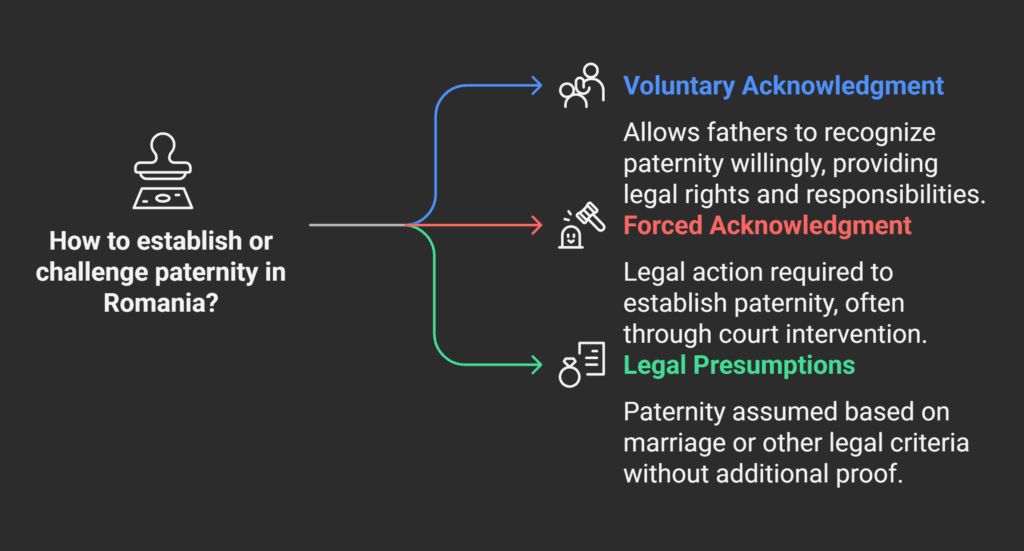
Romanian law has three ways to prove paternity: voluntaryforced, and legal presumptions.

Children born in marriage are presumed to have a father.

Those born out of wedlock need a recognition statement or court order.

The Civil Code also gives rights to children born through assisted reproduction, just like naturally conceived ones.

Paternity Recognition in Romania: Basic Procedures

In Romania, establishing paternity follows certain legal steps.

The 2011 Romanian Civil Code sets out the rules for both married and unmarried couples.

If a child is born within 180 to 300 days of marriage, the husband is usually considered the father.

Unmarried fathers in Romania can also claim their rights.

They can sign a voluntary acknowledgment of paternity with the mother’s consent.

If there’s a dispute, the court may get involved.

Paternity laws Romania

Paternity laws Romania

DNA testing is key in disputed cases.

Romanian Courts often order these tests to confirm paternity.

Two labs perform the tests to ensure they’re accurate.

The results are very important in making legal decisions.

In cases where the father has passed away, courts look at all the evidence.

This might include DNA from relatives or other biological samples.

The Civil Code allows for changes in civil status based on new evidence.

It’s important to understand paternity rights in Romania.

The process can be complex, even more so in international cases.

Getting legal advice is a good idea to make sure parental rights are recognized correctly.

Voluntary Acknowledgment of Paternity Process

In Romania, making a father legally recognized is easy.

This way, dads can officially acknowledge their kids without going to court.

It’s key for the child’s birth record and for figuring out child support.

Voluntary Acknowledgment of Paternity Process Romania

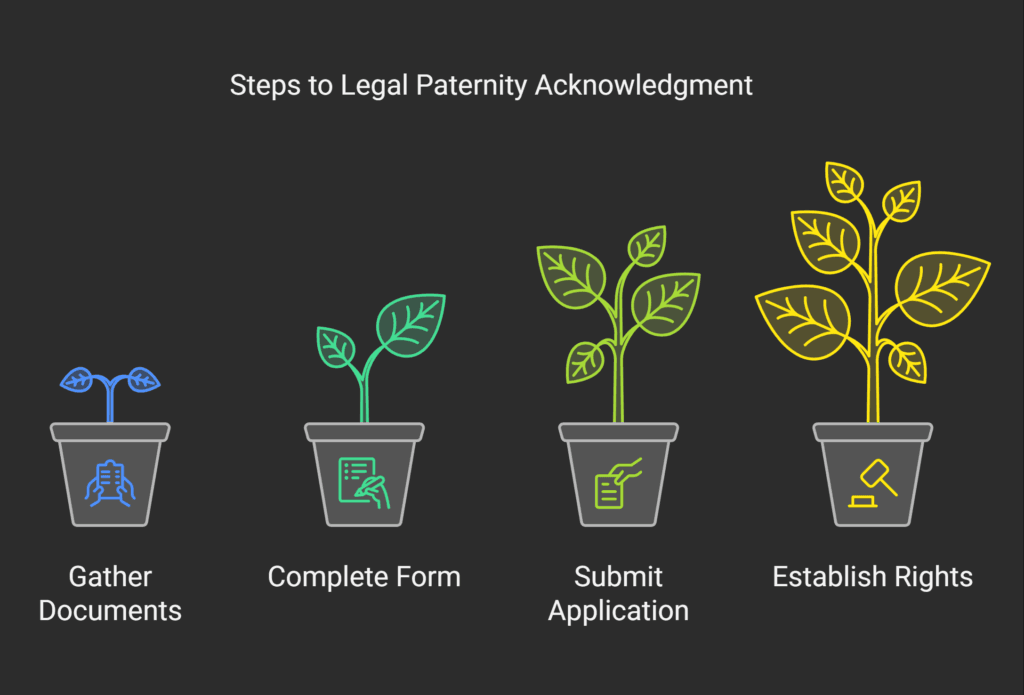
Required Documentation

To begin, you need certain papers.

These are:

  • Valid identification papers for both parents;
  • Child’s birth certificate;
  • Declaration of paternity form.

The form must have the father, mother, and child’s details.

Both parents must sign it.

Filing Procedures

Take your application to the civil status registration authority (RACS).

During martial law, you can even send it remotely.

This makes things easier for parents who are far apart or live abroad.

Timeline and Costs

The time it takes to acknowledge paternity is short.

The costs are low, mostly for administrative fees.

After it’s done, the father’s legal rights are established.

This is important for the child’s birth record and for child support in Romania.

If problems come up later, parents can try mediation or get legal help.

The Brussels IIb Regulation helps with cases across the EU.

It makes sure decisions are followed everywhere.

DNA Testing for Paternity Establishment

DNA testing in Romania is key for proving family ties.

It’s used when someone doubts a parent’s identity or when a court needs to decide.

The European Court of Human Rights sees DNA tests as vital in these cases.

Want to prove who a child’s father is in Romania?

DNA tests can help.

They can be asked for by parents or ordered by judges.

Samples from the child, mother, and alleged father are taken and checked in labs.

For unmarried dads, DNA tests are very important.

A positive test can help prove you’re the father.

This might lead to changes on the child’s birth certificate and legal rights.

The Romanian courts look at DNA tests as strong evidence.

But they also think about what’s best for the child.

If you’re in a dispute, getting legal advice is smart.

It helps understand DNA testing’s role in your rights and duties.

Legal Rights and Responsibilities of Fathers in Romania

Paternity establishment in Romania gives fathers big rights and duties.

Knowing these can help you play your role well.

Legal Rights and Responsibilities of Fathers in Romania

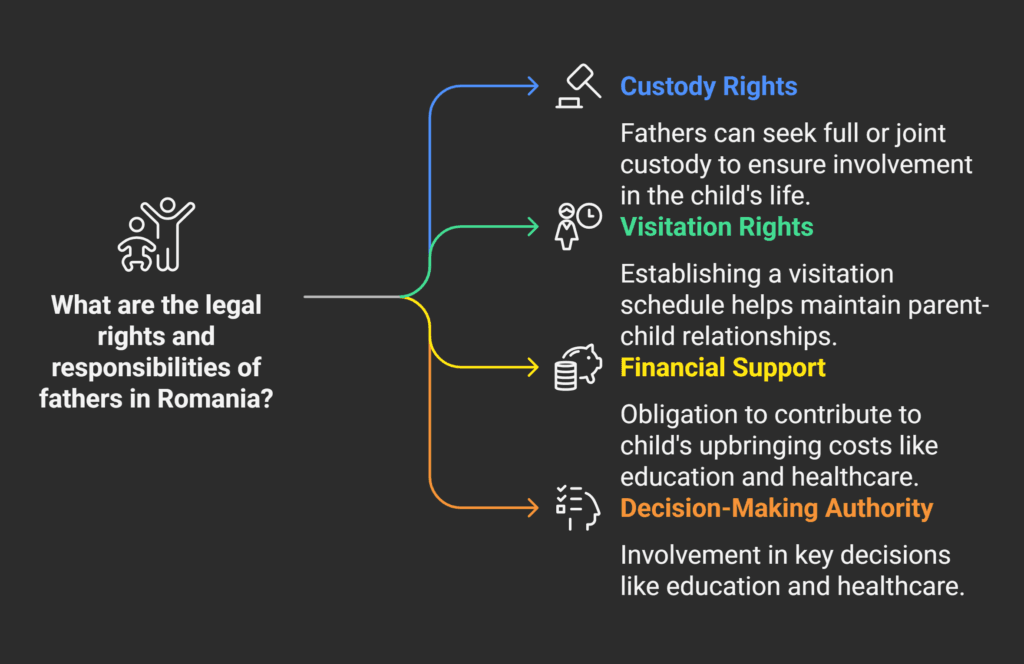
Custody and Visitation Rights

In Romania, courts decide on custody and visits based on what’s best for the child.

They try to keep both parents involved.

If you’re not together, you can ask for custody or visitation rights.

Financial Obligations

By acknowledging paternity in Romania, you must help with your child’s costs.

This includes education, healthcare, and everyday expenses.

Courts will decide how much you should pay based on your income and the child’s needs.

Decision-Making Authority

As a father with established paternity, you get to make big decisions for your child.

This includes education, healthcare, and religious choices.

If you have joint custody, you and the other parent must agree on these decisions.

AspectFather’s Rights/Responsibilities
CustodyRight to seek full or joint custody
VisitationRight to establish visitation schedule
Financial SupportObligation to contribute to child’s upbringing
Decision MakingAuthority in education, healthcare, and religious choices

Remember, DNA paternity testing in Romania is key if there’s doubt.

Once paternity is confirmed, you’ll need to update the birth certificate.

This makes sure your rights and duties are legally recognized.

Challenging Paternity in Romanian Courts

In Romania, the legal process for challenging paternity is complex.

The European Court of Human Rights (ECHR) has made rulings on child support cases.

They stress the importance of fairness between family stability and individual rights.

Grounds for Contesting Paternity

Fathers can challenge paternity by filing a court case.

This usually involves DNA tests to confirm biological ties.

The rules for these challenges are found in Romania’s Civil and Family Codes.

Legal Time Limits

Romania’s new Civil Code says paternity suits can be reopened during the child’s lifetime.

This means cases can be reopened even years after the initial decision.

Court Procedures

The court procedures for challenging paternity are detailed.

They may require affidavits of paternityDNA test results, and other evidence.

For unmarried parents, the rights can be complex.

It’s wise to get a Romanian lawyer to help with the process.

Remember, challenging paternity can change child support and the rights of the legal father in Romania.

The ECHR has given damages in cases where paternity proceedings were unfairly denied.

This shows the need for fair process in these matters.

International Aspects of Paternity Recognition

Figuring out paternity in Romania gets tricky when there are international ties.

The Romanian Civil Code helps guide these cases.

For married couples, the law of their marriage at the child’s birth decides paternity.

If they were divorced before the child was born, the divorce law applies.

For unmarried parents, the child’s birth country’s law decides paternity.

Romania looks at the child’s citizenship to decide which law is best.

This way, genetic testing and parental rights are fair for everyone.

The laws cover important areas like the child’s name and who pays for their needs.

These rules help with paternity tests, even when countries are involved.

It makes sure everything is clear and fair.

Romanian laws on child custody also think about international cases.

The mother’s country’s law decides who pays for pregnancy and birth costs.

This helps make sure paternity is recognized fairly, even in complicated cases.

Birth Registration and Certificate Amendments

In Romania, registering a birth is key to establishing paternity and securing a child’s legal identity.

The process involves several steps and documents.

If changes are needed, there are specific procedures for amendments.

Birth Registration and Certificate Amendments Romania

Registration Process

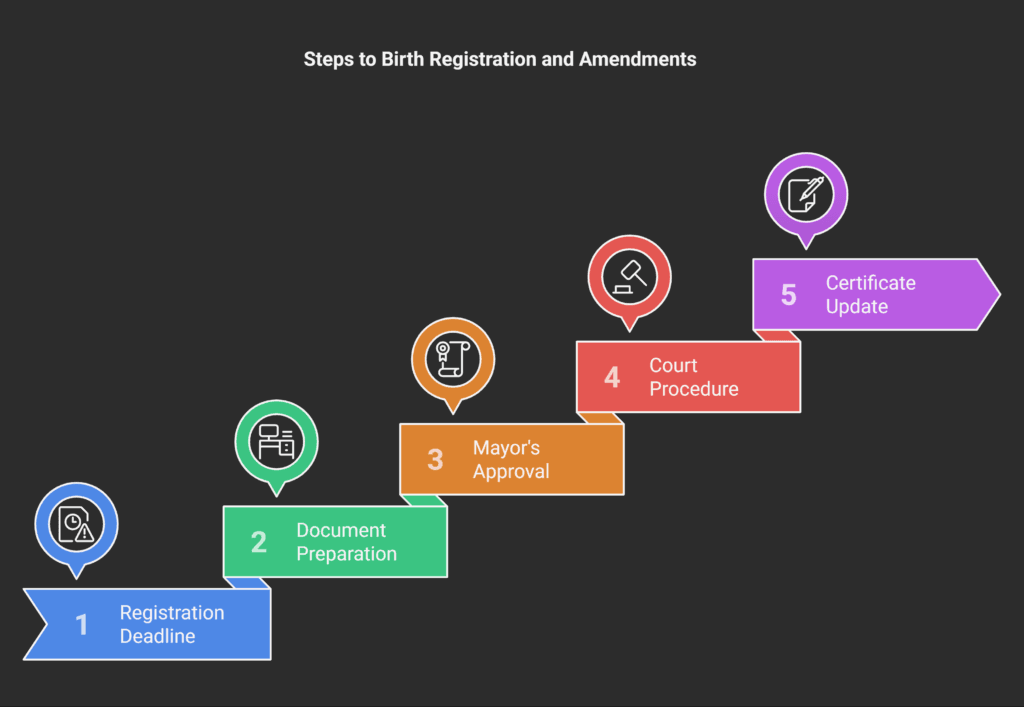
You must register your child’s birth within 15 days in Romania.

If you miss this deadline, you’ll need approval from the local mayor.

Delays beyond a year require a court procedure and a medico-legal assessment, which comes with a fee.

This process is part of family law Romania and affects father’s rights Romania.

Required Documents

To register a birth, you’ll need:

  • Parents’ identity documents;
  • Medical certificate of birth;
  • Marriage certificate (if applicable);
  • Declaration of name choice.

Amendment Procedures

If you need to amend a birth certificate, perhaps due to contested paternity Romania or DNA testing paternity Romania, you can request corrections.

The process involves submitting evidence to support the change.

For unmarried fathers rights Romania, establishing paternity after initial registration may require additional steps.

Certificate TypeDescriptionUsage
Birth CertificateOlder versionValid for official purposes
Birth Certificate ExtractNew versionCurrent standard for new registrations

Remember, Romania doesn’t distinguish between legitimate and illegitimate births.

All children are born legitimate, regardless of their parents’ marital status.

This approach simplifies many aspects of family law Romania.

Child Support and Maintenance Obligations

In Romania, child support is key in legal parentage.

It’s based on income, number of kids, and custody.

Single mothers often start with parentage acknowledgment to get support.

DNA testing in Romania proves legal paternity when needed.

It’s very helpful in disputes. After confirming paternity, the court sets child support amounts.

Romania’s laws consider many factors for child support.

The State Allowance for kids is not taken from support. This means kids get both kinds of support.

AspectDetails
Legal FrameworkHague Convention 2007
State AllowanceNot deducted from child support
International CasesDiplomatic channels for non-convention countries
Free Legal AssistanceAvailable for child support cases

For international cases, Romania uses the Hague Convention 2007.

This helps with child support across borders.

For non-convention countries, Romania gets help through diplomatic channels.

Legal Support and Professional Assistance

Understanding paternity in Romania can be tough.

Getting legal help is key to knowing your rights and duties.

Family lawyers in Romania can guide you on paternity, custody, and parental roles.

Finding Legal Representation

For legal aid on paternity in Romania, find lawyers with family law experience.

They can help from starting the affidavit of paternity to custody and child support.

They know about unwed father rights too.

Contact Information

For top legal help on paternity in Romania, reach out to Atrium Romanian Lawyers at office@theromanianlawyers.com.

They focus on international family law and can assist with the paternity process.

Conclusion

Understanding family law in Romania, like establishing paternity rights, can be tricky.

This article has covered the main points of paternity recognition.

It includes voluntary acknowledgment and the rights of unmarried fathers.

Knowing these details is key for parents and kids.

The Romanian Civil Code protects children born in and out of wedlock well.

It outlines clear rules for birth registration and paternity.

This ensures equal rights for all, no matter the birth circumstances.

DNA testing is now a key tool in proving biological paternity, accepted by Romanian courts.

Remember, getting professional help is very important.

Whether you’re acknowledging paternity or fighting it in court, legal advice is vital.

It helps protect your rights and ensures the best outcome for everyone.

Family law in Romania is changing, with new EU rules aiming to make recognizing parenthood easier across borders.

By knowing your rights and duties in paternity cases, you can make choices that are best for your child.

These legal rules aim to give children stability and protection.

They do this, no matter if the parents are married or not, or how the child was conceived.

FAQ

How is paternity legally established in Romania?

In Romania, paternity can be confirmed in a few ways.

The father can acknowledge it voluntarily, the court can order it, or DNA tests can prove it.

If a couple is married, the husband is usually considered the father of any children born during the marriage.

What documents are needed for voluntary paternity acknowledgment in Romania?

To acknowledge paternity voluntarily, you’ll need some documents.

These include ID for both parents, the child’s birth certificate, and a signed declaration of paternity.

The exact documents needed might change, so it’s wise to check with your local civil registry office.

How long does the voluntary paternity acknowledgment process take in Romania?

The time it takes to acknowledge paternity voluntarily in Romania varies.

It usually takes a few weeks after all documents are submitted.

In some cases, there might be a faster option.

Is DNA testing mandatory for establishing paternity in Romania?

DNA testing isn’t always needed but can be required by the court in disputes.

It’s also an option for fathers who want to confirm paternity on their own.

What rights does an unmarried father have in Romania?

Once paternity is confirmed, unmarried fathers in Romania have similar rights to married fathers.

These include custody and visitation rights.

But, they might need to take extra legal steps to claim these rights.

How is child support calculated in Romania?

Child support in Romania is based on the non-custodial parent’s income, the number of children, and the custody arrangement.

The court also considers other factors to ensure the child’s needs are met.

Can paternity be challenged after it has been established in Romania?

Yes, paternity can be challenged in Romanian courts.

There are legal limits and specific reasons for doing so, like fraud or mistaken identity.

How does Romanian law handle international paternity cases?

Furthermore, Romanian law deals with international paternity cases by considering both domestic laws and international treaties.

The process might involve recognizing foreign judgments or applying Romanian law, depending on the case.

Can a birth certificate be amended to add or change paternity information in Romania?

Yes, birth certificates in Romania can be updated to reflect changes in paternity.

You’ll need to submit a request to the civil registry office with the necessary documents.

Where can I find legal assistance for paternity issues in Romania?

For legal help with paternity issues in Romania, you can reach out to specialized family law attorneys.

Our Romanian Law Firm offer help for both Romanian citizens abroad and foreign citizens in Romania.

Identifying Abusive Clauses in Romanian Consumer Contracts for Better Protection

Identifying Abusive Clauses in Romanian Consumer Contracts for Better Protection

Do you know that hidden, unfair terms in contracts could risk your consumer rights?

In Romania, the fight against these clauses is getting stronger.

Courts are dealing with more cases related to this issue.

This shows how important it is to be careful when signing agreements.

This is true, but even more so in banking and finance.

The Romanian civil code and consumer protection laws protect you from unfair terms.

But, many people don’t know their rights or how to spot these clauses.

Knowing the law is your best defense against unfair practices that could harm your finances.

Abusive Clauses in Romanian Consumer Contracts

Recently, the European Court of Justice made a big change.

Now, Romanian judges must check agreements for unfairness on their own.

This is a big step to make things fairer for consumers.

When dealing with consumer agreements, knowing is key.

By learning about common abusive clauses and your legal rights, you can make better choices.

You can also challenge unfair terms when needed.

For help with consumer rights and contract reviews, contact office@theromanianlawyers.com.

Key Takeaways

  • Romanian courts are seeing an increase in cases related to abusive clauses;
  • The European Court of Justice mandates ex officio assessment of unfair terms;
  • Law no. 193/2000 defines abusive clauses in consumer contracts;
  • Judges are required to restore contractual balance in unfair agreements;
  • Consumers should be aware of their rights under Romanian consumer protection laws;
  • Legal assistance is available for reviewing and challenging unfair contract terms.

Understanding Romanian Consumer Protection Framework

Romania’s consumer protection has grown a lot after joining the EU.

It aims to protect consumers from unfair contracts and ensure clear terms.

Let’s look at the main points of this framework.

Key Legislative Acts and Regulations

The Romanian consumer credit market has seen big changes to protect consumers better.

In 2021, 10 new rules were added to make contracts clearer.

These laws help make sure contracts are fair for everyone.

Scope of Consumer Protection Laws

Consumer laws in Romania cover many areas, like credit and financial services.

Yet, a 2023 survey found that 40% of consumers don’t know their rights.

This shows we need to teach more about the legal help available to consumers.

Romanian consumer protection framework

Regulatory Bodies and Enforcement Agencies

The National Authority for Consumer Protection (ANPC) and the Financial Supervisory Authority (ASF) are key in enforcing laws.

The ANPC said 25% of complaints in 2021 were about unfair contract terms.

The ASF works to prevent and solve problems, helping to educate consumers.

AspectData
Consumers encountering abusive clauses30%
Contracts with unclear terms35%
Consumers seeking legal advice15%
Consumers reading terms before signing20%

Legal Definition of Abusive Clauses under Romanian Law

Romanian law says abusive clauses are terms that make deals unfair.

These clauses often sneak into contracts without the consumer’s say.

The law, no. 193/2000, helps protect consumers from these unfair practices.

Predatory lending often uses these unfair terms.

These terms usually favor the business a lot.

For instance, clauses that let one side change the deal or impose huge penalties are seen as unfair.

Predatory clauses in consumer contracts

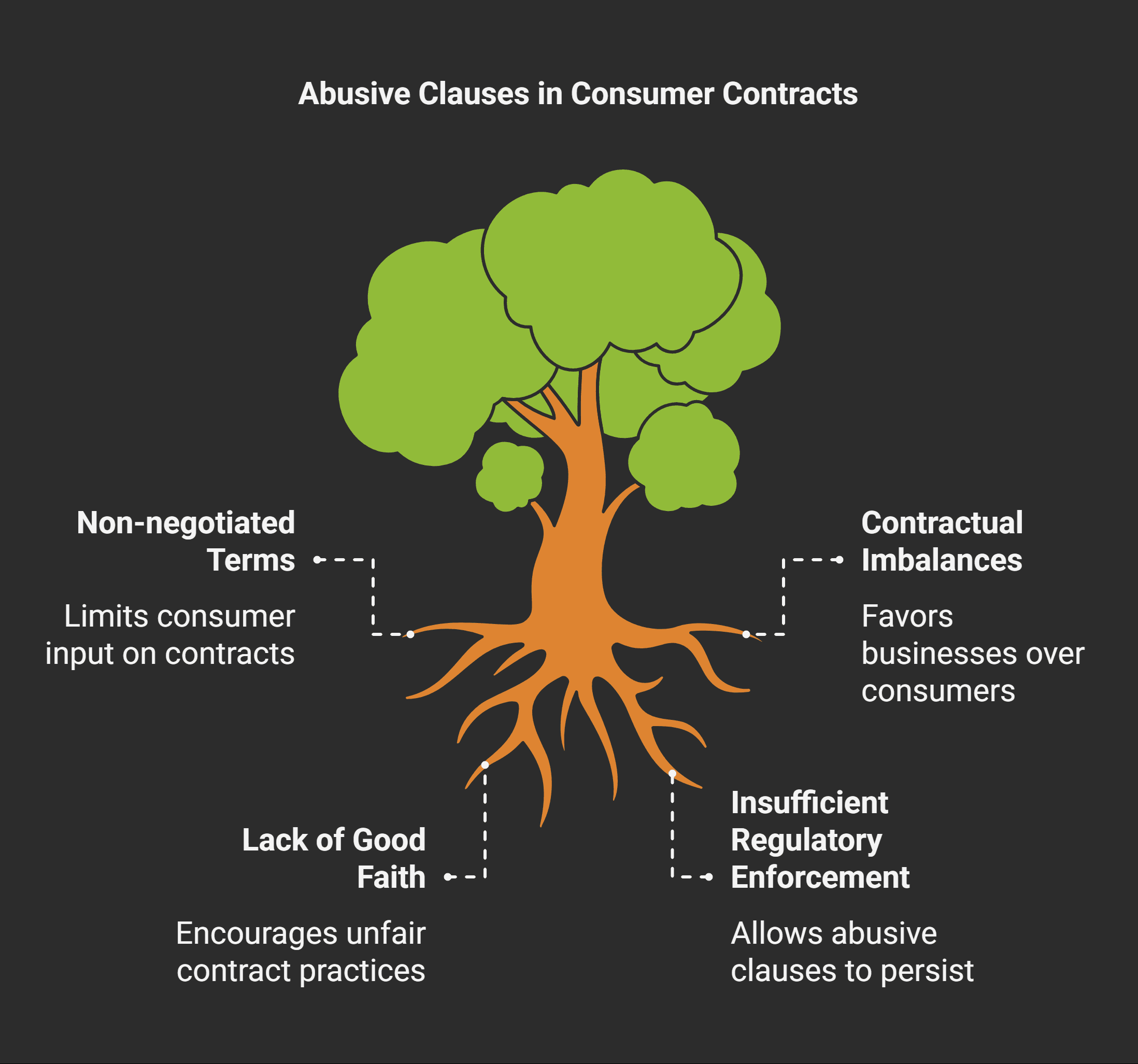
  • Lack of direct negotiation with the consumer;
  • Significant imbalance in rights and obligations;
  • Violation of good faith principles.

Knowing this law helps you spot unfair terms in contracts.

If you find terms that seem unfair or one-sided, they might be abusive.

Always check agreements well and get legal help if you think there are unfair clauses.

Abusive Clauses in Romanian Consumer Contracts

Abusive Clauses in Romanian Consumer Contracts

The Romanian legal system has become tougher on abusive clauses in consumer contracts.

Recent changes aim to protect consumers from unfair practices.

The Emergency Government Ordinance no. 58/2022, which took effect on May 28, 2022, brought significant updates to regulatory enforcement.

Non-negotiated Contract Terms

Non-negotiated terms often appear in standard form contracts.

These clauses can be problematic for consumers who have little say in their content.

The Romanian legal system now requires courts to analyze potentially abusive clauses as soon as they have enough legal and factual evidence.

Significant Contractual Imbalances

Contractual imbalances that heavily favor businesses over consumers are now subject to stricter scrutiny.

Sanctions for abusive clauses range from RON 20,000 to RON 100,000.

For large-scale violations, fines can reach up to 4% of a company’s turnover in Romania.

Good Faith Requirements

Businesses must act in good faith when drafting contracts.

The new regulations address issues like dual-quality products, with fines doubling if more than 100 consumers are affected.

Courts now have the power to order the removal of abusive clauses from all current contracts.

Violation TypeFine Range (RON)Maximum Fine for Large-scale Violations
Abusive Clauses20,000 – 100,000Up to 4% of annual turnover
Dual-quality Products20,000 – 100,000Up to 4% of annual turnover
Non-fulfillment of Court Orders5,000 – 200,000N/A

These changes reflect Romania’s commitment to aligning with EU standards and protecting consumers from unfair practices.

The increased fines and stricter enforcement measures aim to deter businesses from including abusive clauses in their contracts.

Common Types of Predatory Clauses in Consumer Agreements

Predatory Clauses in Consumer Agreements

Many consumer contracts have clauses that are unfair.

These clauses can harm consumer rights and lead to unfair practices.

Let’s look at some common types found in Romanian consumer agreements.

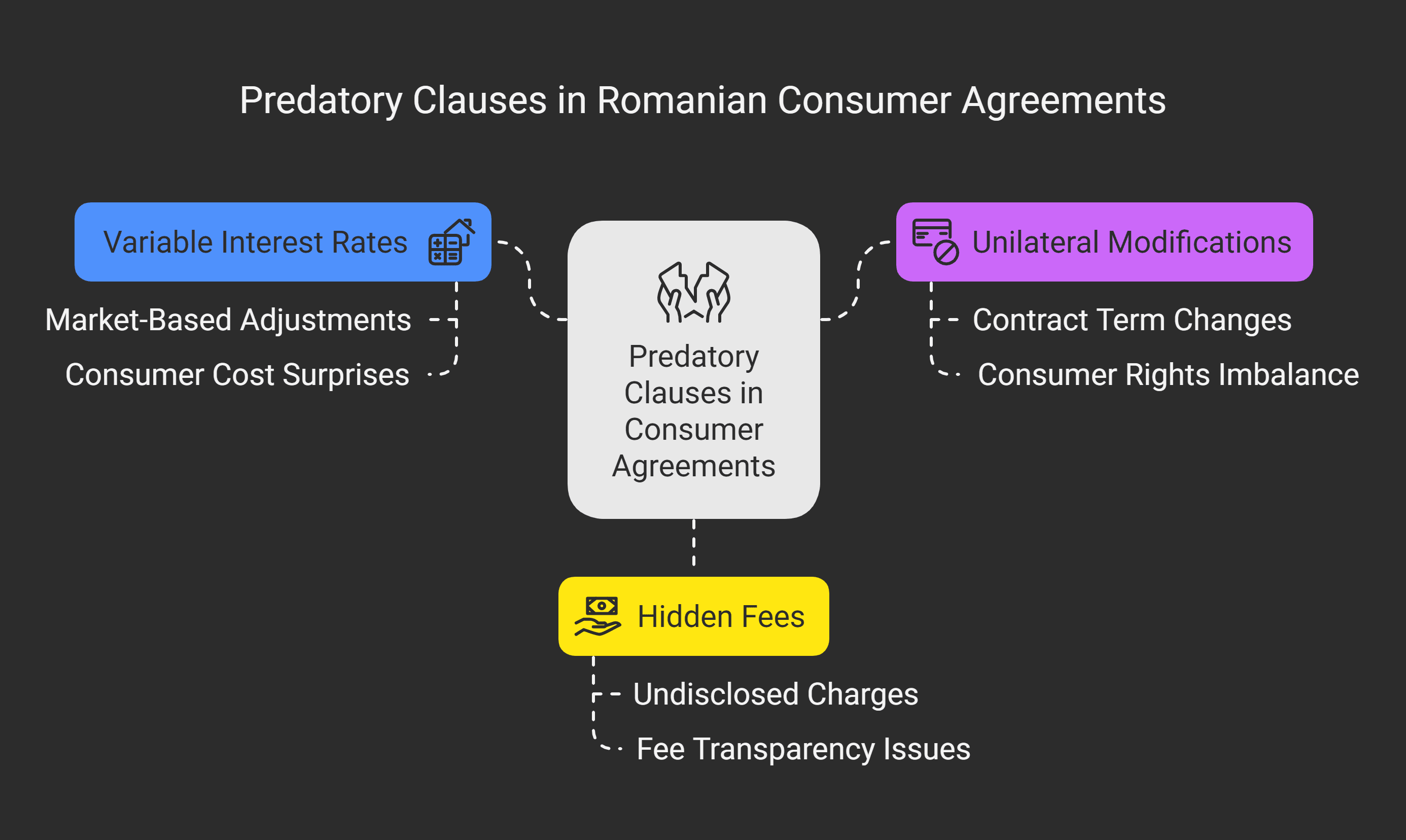
Variable Interest Rate Provisions

Variable interest rate clauses let lenders change rates based on the market.

They seem fair but can surprise consumers with higher costs.

Banks might use this to their advantage, violating consumer rights and needing legal action.

Unilateral Contract Modifications

Some agreements let companies change terms without asking the consumer.

This creates a big imbalance, usually in favor of the business.

It’s important for regulators to watch out for this to protect consumer rights.

Hidden Fees and Charges

Many contracts hide extra costs in small print or hard-to-understand language.

These hidden fees can make things much more expensive.

Consumers should watch out and seek legal help if they find these tricks.

Clause TypePotential ImpactConsumer Protection Measure
Variable Interest RatesUnexpected cost increasesInterest rate caps
Unilateral ModificationsUnfavorable contract changesMandatory notification periods
Hidden FeesHigher than advertised costsClear fee disclosure requirements

The National Authority for Consumer Protection (ANPC) has been cracking down on hidden fees and changes in consumer contracts.

This includes actions in the banking sector.

Their goal is to make sure consumer rights are respected and to fix unfair contract terms in different industries.

Consumer Rights and Legal Protections

Romanian consumers have strong legal protections against unfair terms and predatory practices.

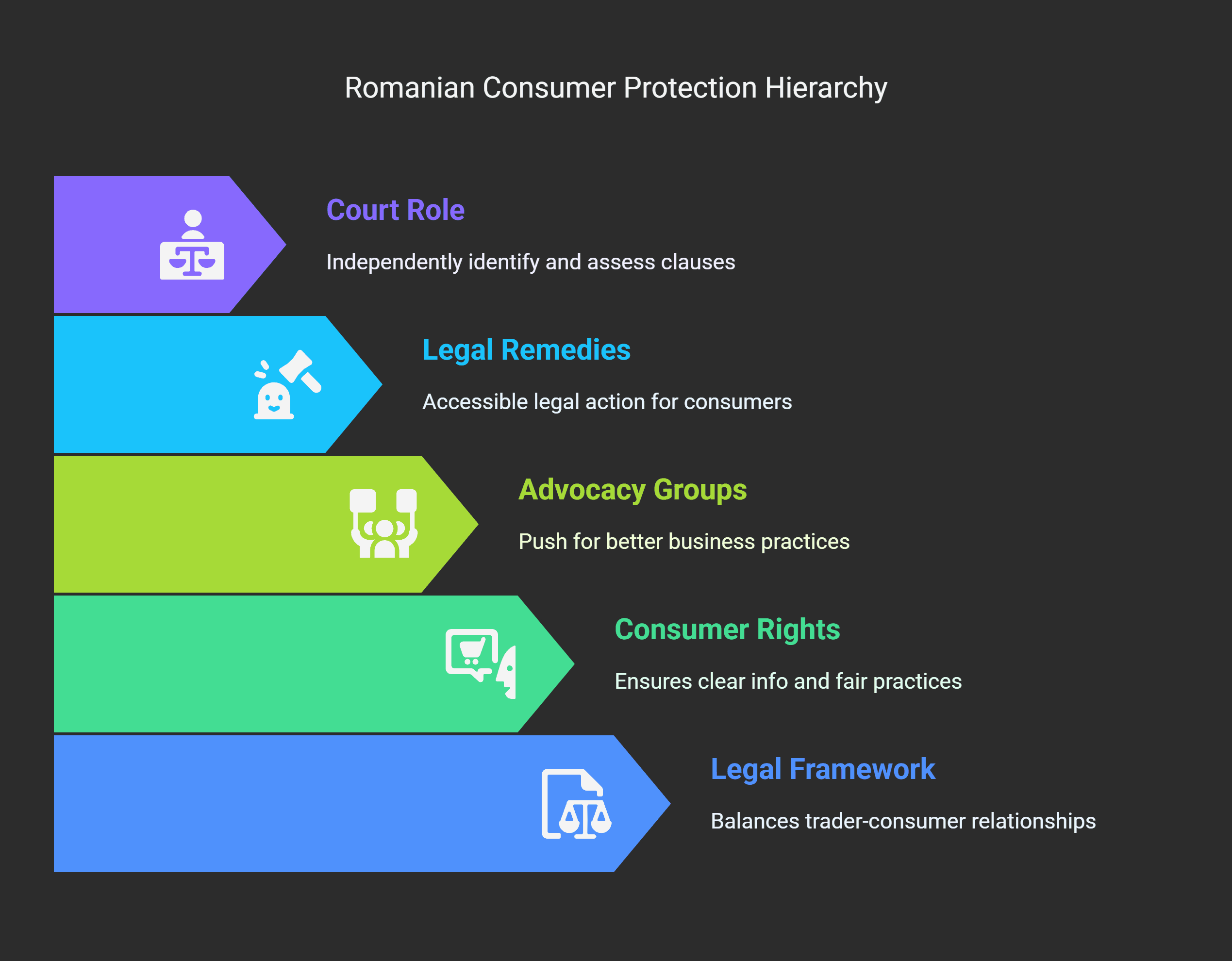
The Consumer Protection Law No. 21/1992 is key to these safeguards.

It aims to balance the relationship between traders and consumers.

Consumer Rights and Legal Protections in Romania

Your rights as a consumer in Romania include:

  • Clear information about products and services;
  • Compensation for damages;
  • Safety from harmful goods;
  • Protection against unfair trading practices;
  • Shield from abusive contract clauses.

Consumer rights advocacy groups are vital in pushing for better business practices.

They offer support and guidance when dealing with unfair contract terms.

Legal remedies for consumers have been improved.

Fines for unfair terms now range from RON 20,000 to RON 100,000.

In cases affecting over 100 consumers, these fines can double.

If you face predatory practices, you can challenge them.

Consumer associations can publish final court judgments within 45 days.

This increases transparency.

You’re also exempt from court bond payments if your monthly income is below two minimum wages.

This makes legal action more accessible.

Consumer RightLegal BasisProtection Offered
Right to InformationLaw No. 21/1992Clear, comprehensible contract terms
Right to NegotiateEmergency Ordinance No. 58/2022Protection against non-negotiated terms
Right to ChallengeLaw No. 193/2000Ability to contest unfair clauses

Role of Courts in Identifying Abusive Clauses

Romanian courts are key in protecting consumers from unfair terms.

They can check if contract clauses are abusive, even if no one complains.

This power comes from EU laws and helps protect consumers.

Ex Officio Assessment Powers

Romanian courts can find and fix unfair terms in contracts on their own.

This helps keep consumers safe, even if they don’t know they’re being taken advantage of.

The courts look closely at contracts to make sure they’re fair.

Judicial Interpretation Guidelines

Romanian courts have rules to follow when checking contracts.

They look at who gets what, if the contract is clear, and how it affects consumers.

They also watch out for clauses that change things without notice and hidden fees.

Legal Precedents and Case Law

Important court decisions guide how Romanian courts deal with contracts. For example, the European Court of Justice said courts must check if terms are unfair on their own. This has made Romanian courts more careful with consumer contracts.

Key AspectCourt’s Role
Ex Officio AssessmentIndependently identify abusive clauses
Interpretation GuidelinesEvaluate balance, clarity, and economic impact
Legal PrecedentsApply ECJ rulings to national cases

Banking and Financial Contract Protections

Romania has strong laws for banking and financial contracts.

These laws protect consumers by making sure contracts are clear and fair.

The Romanian Civil Code and laws like O.U.G. no. 50/2010 and O.U.G. no. 52/2016 are key to these protections.

Foreign Currency Loan Agreements

Foreign currency loans can be risky for consumers.

The Civil Code says borrowers must pay back the full amount, no matter the currency’s value.

This can be tough when currency values change.

The case of Șerban vs. Banca Transilvania SA showed the challenges of foreign currency loans.

It highlighted the need for better consumer protection.

Credit Agreement Safeguards

Credit agreements in Romania must follow strict rules.

O.U.G. no. 50/2010 makes sure interest rates, fees, and repayment terms are fair.

For mortgage loans, O.U.G. no. 52/2016 adds extra protections based on EU rules.

Risk Disclosure Requirements

Transparency is very important in financial contracts.

Banks must tell consumers about the risks of their products.

The Financial Supervisory Authority (A.S.F.) makes sure this happens, so consumers know what they’re getting into.

LawPurposeKey Provisions
Civil CodeGeneral loan regulationNominal amount repayment, interest rules
O.U.G. no. 50/2010Consumer credit agreementsInterest rates, fees, repayment terms
O.U.G. no. 52/2016Mortgage loansResidential property credit protections

Knowing about these protections helps you make better choices when dealing with financial agreements.

Always check the contract terms and ask for help if something is unclear.

This way, you can make sure your rights are looked after under Romanian contract law.

Remedies and Legal Actions Available to Consumers

Remedies and Legal Actions Available to Consumers in Romania

Romanian laws help consumers deal with unfair contract terms.

The National Authority for Consumer Protection (ANPC) is key in keeping things fair.

It protects your rights as a consumer.

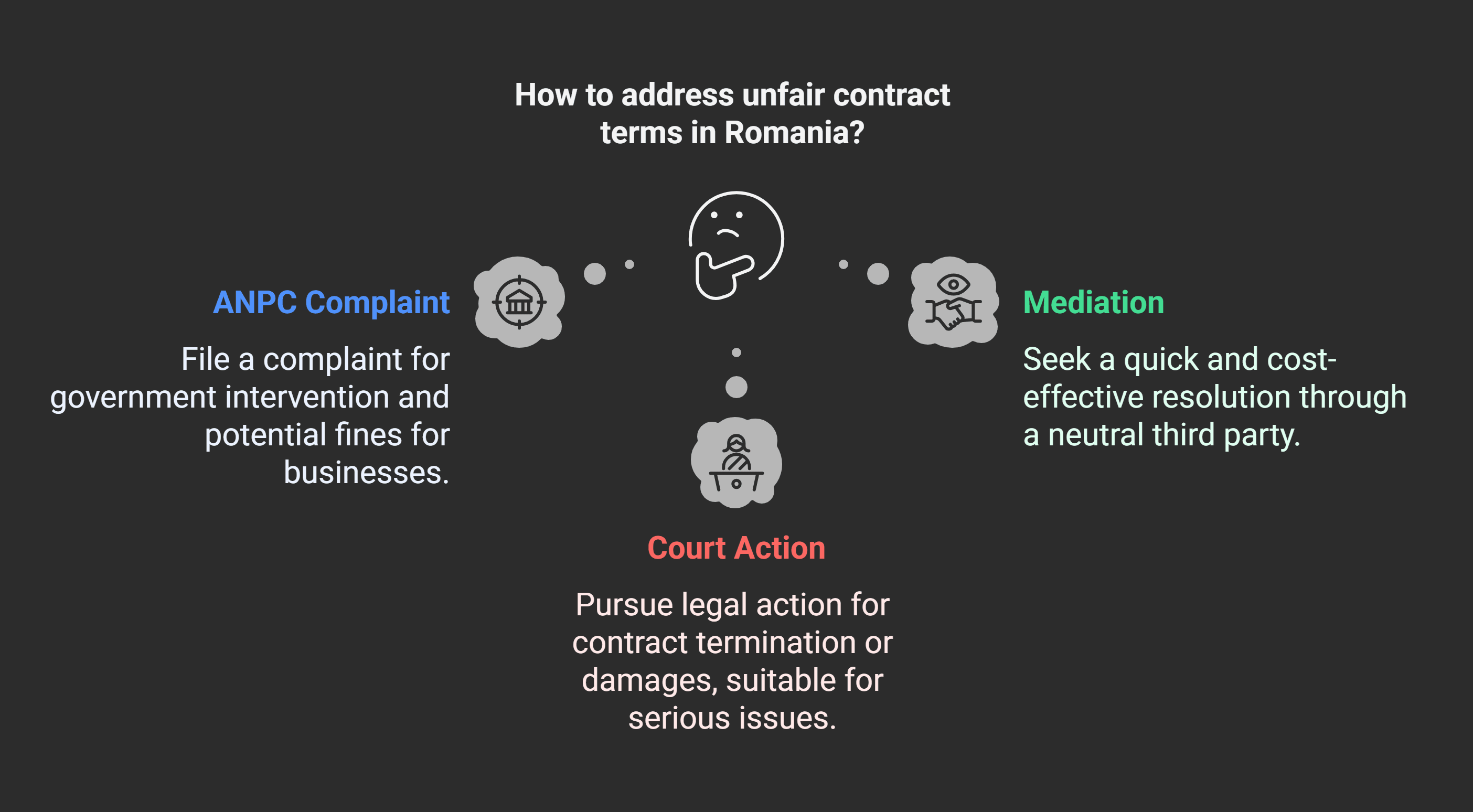
If you find unfair terms, you can report it to ANPC.

They check businesses and can fine them if they break the law.

In 2022, they even fined hotels for not being clean or serving bad food.

Mediation is another way to solve problems without going to court.

It’s quicker and cheaper than legal battles.

For bigger issues, you can go to court.

Romanian law lets you ask for fixes, refunds, or to cancel the contract.

Consumer groups can also sue on your behalf.

RemedyDescriptionTimeframe
ANPC ComplaintFile a complaint with the National Authority for Consumer Protection15-30 days for initial response
MediationSeek resolution through a neutral third partyVaries, typically 1-3 months
Court ActionFile a lawsuit for contract termination or damagesCan take several months to years

Remember, EU law makes unfair contract terms invalid.

This means you keep your rights, even when faced with unfair contracts.

European Union Influence on Romanian Consumer Protection

The European Union has greatly influenced Romania’s consumer protection laws.

This has led to better protection against unfair contract terms and predatory business practices.

EU Directives Implementation

Romania has adopted key EU directives to boost consumer rights.

Law no. 193/2000, for example, makes sure consumer contracts are fair.

It aims to protect consumers from unfair business tactics.

Cross-border Consumer Protection

EU rules also protect Romanian consumers when they deal with businesses from other EU countries.

This safeguard helps prevent unfair treatment in international deals.

Harmonization with EU Standards

The Romanian legal system works closely with the European Court of Justice.

This ensures EU consumer protection laws are applied correctly.

The court’s decisions have been key in clarifying what makes a contract unfair.

EU DirectiveRomanian ImplementationKey Provisions
Directive 2011/83/EC (Consumer Rights)Government Emergency Ordinance no. 34/201414-day withdrawal period for distance contracts
Directive 93/13/EEC (Unfair Terms)Law no. 193/2000Protection against significant contractual imbalances
Directive 2005/29/EC (Unfair Commercial Practices)Law no. 363/2007Regulation of misleading and aggressive practices

These EU laws have made consumer protection in Romania stronger.

They address unfair contract terms and business practices.

The ongoing effort to align with EU standards ensures Romanian consumers get the best legal protection.

Steps to Challenge Abusive Contractual Terms

Dealing with unfair contract terms?

You have rights as a consumer in Romania.

Here’s how to fight back:

  1. Check your contract for any unfair changes, unclear language, or high fees.
  2. Collect all important documents, like emails or letters from the company.
  3. Report the issue to the National Authority for Consumer Protection (ANPC) within 15 days.
  4. If ANPC doesn’t help, you can take legal action in court.
  5. Get advice from a Romanian lawyer who specializes in consumer rights to guide you.

Remember, bank loans often have strict rules.

Watch out for high interest rates, hidden costs, and sudden payment changes.

Knowing your rights under the Romanian Civil Procedure Code is key.

When fighting foreclosure, act fast.

You must defend yourself within 15 days at the local court.

Winning can cancel the foreclosure and refund your costs.

But losing means you’ll have to pay more and court fees.

By acting quickly and getting legal advice, you can defend against unfair contracts.

This way, you make sure your consumer rights are respected.

Conclusion

As Romania gets closer to EU standards, protecting consumers gets even better.

Laws like the one on abusive clauses are being updated.

Keep an eye out, know your rights, and help make sure contracts are fair in Romania.

It’s important to know the laws in Romania about protecting consumers.

You might ask, what are abusive clauses?

These are terms that make it unfair for you and favor the trader too much.

Examples include changes made without your agreement, harsh penalties, and hidden fees.

If you think your contract has unfair terms, get legal help fast.

The Consumer Protection Law No. 21/1992 helps keep you safe from unfair practices.

Also, remember, traders can’t make you agree to terms you don’t understand.

Breaking these rules can lead to big fines.

Companies might have to pay up to 5% of their income.

The ANPC can also fine them and even close their business if they keep breaking the rules.

For expert advice, you can reach out to Atrium Romanian Lawyers.

Our team of lawyers in Romania is known for their business law expertise in Romania.

Romania’s consumer protection laws follow EU standards.

You have 15 days to ask for fixes or new products if something is wrong.

If you need help with unfair liability clauses, there are many legal resources to help protect your rights.

FAQ

What constitutes an abusive clause under Romanian law?

In Romania, an abusive clause is a term in a contract that wasn’t negotiated individually.

It creates a big imbalance in the rights and duties of the parties, hurting the consumer.

These clauses are often in standard contracts and go against the principle of good faith.

How can I identify potentially abusive clauses in my contracts?

Look for terms that limit your rights or impose harsh penalties.

Also, watch out for clauses that let one side change the contract without your consent.

If a term seems unfair or unclear, it might be abusive.

What should I do if I suspect a contract I’ve signed contains abusive clauses?

First, carefully review the contract and find the clauses you think are abusive.

Then, you can file a complaint with the National Authority for Consumer Protection (ANPC) or get legal advice.

You might also challenge the clause in court or through alternative dispute resolution.

Can I negotiate or modify standard form contracts?

Yes, you can ask for changes in standard contracts. Some businesses might agree to modify certain terms.

If they say no and you think the terms are unfair, you can get help from consumer protection agencies or lawyers.

What are the most common types of abusive clauses in Romanian consumer contracts?

Common abusive clauses include terms that let one side change the contract without your consent.

They also include harsh penalties for breaking the contract, limits on the business’s liability, and unfair dispute resolution mechanisms.

Variable interest rates and hidden fees are also often problematic.

How long do I have to challenge an abusive clause after signing a contract?

There’s no time limit in Romania to challenge abusive clauses.

It’s best to act quickly when you find out about the issue.

The time limit for contractual claims is usually three years, but it can vary based on your case.

What are the possible consequences for businesses that use abusive clauses?

Businesses using abusive clauses might face fines from the ANPC.

Courts can also declare these clauses invalid, affecting the whole contract.

Repeated offenses can lead to harsher penalties and harm the company’s reputation.

In some cases, the business might have to pay affected consumers.

How does Romanian consumer protection law compare to EU standards?

Romanian consumer protection laws are mostly in line with EU standards.

Romania has adopted key EU directives, like Directive 93/13/EEC on unfair terms in consumer contracts.

The country keeps aligning its laws with EU regulations, ensuring Romanian consumers get similar protections as those in other EU countries.

Are there any specific industries or sectors where abusive clauses are more common?

Abusive clauses are often seen in banking and financial services, telecommunications, utility contracts, and rental agreements.

These sectors use standard contracts a lot, making them more likely to include unfair terms.

Where can I find legal assistance if I need help with an abusive clause issue?

You can get help from consumer protection associations, legal aid groups, or lawyers who specialize in consumer law.

The National Authority for Consumer Protection (ANPC) also offers support.

Some universities and non-profit groups have free legal clinics for consumer rights issues.

What are abusive clauses in consumer contracts and how are they defined under Romanian law?

In Romania, abusive clauses (also known as unfair terms) in consumer contracts are defined by Law No. 193/2000 regarding unfair terms in consumer contracts.

An abusive clause is a contractual provision that has not been directly negotiated with the consumer and which, contrary to the requirement of good faith, creates a significant imbalance between the rights and obligations of the parties, to the detriment of the consumer.

The Romanian legislation is aligned with the European Union Directive 93/13/EEC. A clause is abusive when it creates this imbalance, giving the professional (seller or service provider) an unfair advantage over the consumer.

It’s important to note that abusive terms are not binding on consumers, even if they have signed the contract.

What is the comprehensive list of abusive clauses recognized under Romanian consumer law?

Romanian Law No. 193/2000 regarding consumer protection against unfair terms provides a non-exhaustive list of abusive provisions.

Some examples of abusive clauses in consumer contracts include:

1. Terms that exclude or limit the legal liability of the professional for damages caused to the consumer

2. Clauses that restrict the consumer’s right to terminate the contract

3. Terms that allow the professional to unilaterally modify the contract terms without a valid reason

4. Clauses that bind the consumer while making the professional’s obligations subject to conditions whose realization depends solely on their will

5. Terms imposing disproportionate penalties on consumers for breach of contractual obligations

6. Clauses allowing professionals to transfer the contract without the consumer’s consent when this might reduce guarantees.

Inheritance in Romania: Succession, Tax, and Navigating Romanian Law

Inheritance in Romania: Succession, Tax, and Navigating Romanian Law

Ever thought about how inheritance laws in Romania could affect your family’s future?

Understanding Romanian inheritance laws can be tough, even for those who know the country well.

It’s key to grasp succession laws and estate planning to protect your assets and make sure your wishes are followed.

Starting in 1990, Romania has seen more people asking about inheritance laws.

This change, along with the EU Regulation 650/2012 in 2015, has made Romanian succession laws more complex.

Whether you live in Romania or own property there, knowing these laws is vital for planning your estate.

Inheritance in Romania

Romanian inheritance laws follow a civil law system, focusing on statutory rights for heirs.

This means children and spouses have guaranteed shares, even if a will says differently.

Without a will, the estate goes to relatives in a specific order, as the Romanian Civil Code dictates.

Getting help from a legal expert is often necessary when dealing with inheritance in Romania.

The rules for cross-border inheritance, taxes, and property transfers can be very complex.

An expert can guide you through your rights, legal steps, and ensure your assets are passed on smoothly to your loved ones.

Key Takeaways

  • Romanian inheritance laws prioritize statutory rights and forced heirship;
  • EU Regulation 650/2012 impacts succession rules for cases after August 17, 2015;
  • Intestate succession follows a predetermined order established by the Romanian Civil Code;
  • Professional legal assistance is key for complex inheritance procedures;
  • Regular updates to estate plans are recommended to align with changing laws and personal circumstances.

Understanding Romanian Inheritance Law Framework

The Romanian Civil Code is key to understanding inheritance laws in Romania.

It outlines the rules and procedures for succession rights.

It covers testamentary dispositions and intestate succession, providing a clear framework for inheritance.

Legal Basis and Civil Code Provisions

Romanian inheritance law is based on the Civil Code.

It defines legal heirs and their rights.

The code gives priority to family members, like children, spouses, and parents.

It also sets a hierarchy for succession without a will.

This includes descendants, ascendants, and collaterals.

Romanian inheritance law framework

Jurisdiction and Applicable Laws

Inheritance laws in Romania apply to both residents and non-residents with assets here.

The Romanian legal system has jurisdiction over all property within its borders.

This ensures consistent handling of succession matters for Romanian-based assets.

Key Legal Principles in Romanian Succession

Several key principles guide succession rights in Romania.

These include the recognition of three types of testaments: holographic, notarial, and secret.

For a will to be valid, it must be written, signed, and dated by the testator.

The law also protects certain heirs through reserved portion rights.

This limits a testator’s freedom to dispose of their entire estate.

Understanding these legal principles is vital for anyone dealing with inheritance in Romania.

They provide a solid foundation for navigating succession complexities and ensuring compliance with Romanian law.

Types of Succession Under Romanian Law

Romanian inheritance law has two main types: testamentary and intestate succession.

Knowing these is key for handling inheritance in Romania.

Types of inheritance romania

Testamentary succession in Romania happens with a valid will.

It lets people decide how their assets are shared after they pass away.

Wills in Romania can be handwritten, notarized, or made in special cases.

Intestate succession in Romania is for when there’s no will.

The law then decides how assets are split, usually favoring family first.

This means children, spouses, and parents get priority.

Succession TypeKey Features
TestamentaryBased on a valid will, allows personal asset distribution choices
IntestateFollows legal provisions, prioritizes family members

Both types of succession in Romania have rules.

For example, children and spouses have guaranteed shares of the estate.

Inheritance tax is low, at 1% if the transfer is after two years of the decedent’s death.

Knowing about these succession types helps you understand Romanian inheritance law better.

It ensures your estate is planned and distributed correctly.

Legal Heirs and Their Rights in Romania

It’s important to know about legal heirs in Romania and their rights.

Romanian law has four classes of legal heirs.

Each class has its own rights and order in the inheritance process.

Classes of Legal Heirs

The Romanian Civil Code clearly lists the order of inheritance:

  • First Class: Descendants (children, grandchildren);
  • Second Class: Parents and siblings;
  • Third Class: Grandparents and other ascendants;
  • Fourth Class: Extended family members.

Heirs in higher classes get priority over those in lower classes.

Closer relatives get more than distant ones within each class.

Legal heirs romania

Reserved Portion Rights

Reserved portion rights in Romania protect some heirs from being left out.

These rights make sure close family members get a fair share of the estate.

This is true even if the deceased wanted to leave them out.

HeirReserved Portion
Children1/2 of legal share
Surviving Spouse1/4 of estate
Parents1/4 of estate (if no children)

Disinheritance Rules

Disinheritance rules in Romania let testators exclude heirs under certain conditions.

Reasons include serious wrongs against the deceased or their family.

Courts can check these cases to make sure they follow the law.

Inheritance in Romania: Process and Procedures

The inheritance process in Romania is detailed and follows the Civil Code.

It involves notaries and courts working together.

This ensures assets are passed on to the right heirs.

Knowing the steps can help you understand this complex journey.

Opening the Succession

The first step is opening the succession.

A notary public must start this in the court area where the deceased lived.

The notary checks the family situation and verifies property documents and any will.

Notarial Proceedings

Notarial proceedings are key in the probate process in Romania.

The notary’s office is in the court area where the deceased lived.

Heirs have choices during these proceedings:

  • Accept the inheritance;
  • Accept under the benefit of inventory;
  • Renounce the inheritance.

Inheritance procedure in Romania

Required Documentation

To finish the inheritance process in Romania, you need certain documents.

These include:

  • Death certificate of the deceased;
  • Proof of kinship for heirs;
  • Property ownership documents;
  • The will, if one exists.

Heirs have one year to claim their inheritance after it’s opened.

If there are disputes, the court may step in.

Getting legal help can make navigating the process easier in Romania.

Romanian Testament Requirements

Romanian will and testament requirements

Making a valid will in Romania is key to passing on your assets as you wish.

Romanian laws allow for three types of wills: holographic, notarial, and secret.

Each has its own rules for being valid in Romania.

A holographic will is handwritten, dated, and signed by you.

It’s simple to make but less secure.

Notarial wills, made by a public notary, are safer.

Secret wills mix both, keeping your wishes private but legal.

When making a Romanian will, keep these points in mind:

  • Be clear about who gets what;
  • Choose someone to handle your estate;
  • Follow rules for spouses and children;
  • Make sure it’s dated and signed right.

Don’t think a printed document with a signature is enough under Romanian law.

For a will that’s legally sound, get help from a professional.

This can prevent arguments and make sure your wishes are followed.

Intestate Succession Rules

Intestate succession in Romania means how assets are shared when someone dies without a will.

The law has rules for who gets what and how much.

This ensures a fair split among family members.

Order of Inheritance

In Romania, the order of inheritance is clear.

First, children and spouses get the assets.

If there are no children, then parents, siblings, and more distant relatives get a share.

This way, everyone gets a fair piece of the estate.

Distribution of Assets

The rules for dividing up an estate are strict.

If there are multiple heirs in the same class, they get an equal share.

For example, if a person leaves a spouse and two kids, the estate is split into three parts.

The 2009 civil code also allows for dealing with heirs who don’t want to claim their share.

State’s Rights in Vacant Succession

If there are no legal heirs or they don’t claim the inheritance, the state takes it.

This is called vacant succession.

It makes sure that unclaimed assets benefit the public, not just sit idle.

Heir ClassInheritance ShareConditions
ChildrenEqual partsFirst in line
SpouseEqual to child’s shareInherits alongside children
ParentsEqual partsIf no children
SiblingsEqual partsIf no children or parents
StateEntire estateIf no legal heirs

Inheritance Tax Obligations in Romania

In Romania, the inheritance tax is quite low.

This makes the country a good place for passing on wealth.

It’s important to know about the tax rules to plan your estate well.

The tax rate on inheritance in Romania is 1% of the estate’s value.

This rule applies to assets received after two years of the person’s death.

If you settle the inheritance within two years, you won’t have to pay this tax.

When you claim your inheritance can affect your taxes.

There’s no strict deadline to start the process.

But, settling within two years can save you a lot of money.

This gives heirs more control over their inheritance.

Time FrameTax Rate
Within 2 years0%
After 2 years1%

For court procedures, you’ll need to pay a judicial stamp duty of 5% of the estate’s value.

Notarial procedures are quicker but cost more based on the estate’s value.

The authority for notarial procedures depends on the deceased’s last home or where the assets are if they lived abroad.

Getting professional help is key when dealing with inheritance taxes in Romania.

The rules can be tricky, and experts can guide you.

They help you manage your inheritance legally and efficiently.

Cross-Border Inheritance Issues

Handling international inheritance in Romania can be tricky.

The EU Succession Regulation makes things easier for EU citizens.

But, those outside the EU might face different rules.

It’s key to know these rules when dealing with Romanian assets or heirs.

EU Succession Regulation

The EU Succession Regulation lets people choose the law of their nationality for inheritance.

This rule applies in the EU and some non-EU countries, except for Denmark and Ireland.

Romanian authorities can reject rules that go against local policies, like discrimination.

International Property Rights

Cross-border inheritance in Romania includes all assets, no matter where they are.

This means cars, bank accounts, and houses are all covered.

The law of the deceased’s last home decides who gets what, who can’t be left out, and special shares for family members.

Conflict of Laws

Conflicts can happen when different laws apply to inheritance.

The EU Succession Regulation tries to reduce these by using the law of the deceased’s last home.

But, things like inheritance tax, marital status, and property rules are not covered by EU rules.

This makes international inheritance in Romania more complex.

For smooth asset transfers in cross-border inheritance, getting legal advice is vital.

It helps follow both Romanian and international laws.

This protects your rights and makes the inheritance process easier.

Role of Public Notaries in Romanian Inheritance

Public notaries are key in the Romanian inheritance process.

They manage notarial proceedings and help people through the complex probate process.

Their knowledge ensures wills are executed correctly, assets are distributed fairly, and disputes are solved.

In Romania, notaries are vital for many life events, including inheritance.

They help protect the rights of minors and the elderly during succession.

Public notaries in Romania verify and authenticate legal documents like wills and contracts.

AspectNotarial ServicesLitigation
Cost0.5% – 1% of transaction valueSeveral times higher
TimeFew hours to several daysMonths to years
Legal CertaintyHighUncertain

For help with notarial proceedings in Romanian inheritance, contact office@theromanianlawyers.com.

They can guide you through the probate process, ensuring a smooth and legal inheritance.

Inheritance Disputes and Resolution

Inheritance disputes in Romania can be complex and emotionally charged.

Understanding the common causes, legal remedies, and court procedures can help you navigate these challenging situations more effectively.

Common Causes of Disputes

Inheritance disputes in Romania often arise from contested wills, disagreements over asset valuation, or conflicts between heirs.

These disputes can strain family relationships and complicate the mourning process.

Legal Remedies

When facing inheritance disputes in Romania, you have several legal options.

Mediation offers a less adversarial approach to resolving conflicts.

If mediation fails, you may need to pursue court proceedings.

Consulting with a specialist in probate and estate planning is key for understanding your rights and the best course of action.

Court Procedures

Court procedures for inheritance disputes in Romania involve filing a claim with the competent court.

The court can intervene to pronounce the opening of inheritance and resolve disputes between heirs.

It’s important to maintain detailed records of all communications and decisions related to the estate, as these can be key in court proceedings.

If you’re facing inheritance disputes in Romania, seeking professional legal assistance is essential.

Contact our team of lawyers in Bucharest for expert guidance in navigating the complexities of Romanian inheritance law and resolving disputes effectively.

Property Transfer and Registration

Handling property transfer in Romania can be tricky.

There are several ways to transfer assets, like agreements or court decisions.

Knowing these options is key for a smooth process.

Legal succession follows Romanian law if there’s no will.

Testamentary succession follows the will of the deceased.

Both need careful legal handling.

The Romanian Law Firm Atrium Romanian Lawyers advises getting a real estate lawyer. Our team of Romanian lawyers guide through property acquisition and transfer.

We make sure everything follows the law and help with reports.

Important points for property registration in Romania include:

  • Heir Certificates from the old Civil Code need the succession author’s property title for first-time land book registration.
  • New Civil Code Heir Certificates serve as property titles themselves.
  • Registration rejections can occur due to missing Land Book Extracts or unpaid property transfer fees.
  • Certificates of Heir must be issued by Romanian Public Notaries.
  • Successors are registered as joint owners with shared quotas in land books.

Remember, the official language for submissions in public institutions is Romanian.

This affects how foreign documents are processed in property transfer Romania cases.

Acquisition MethodDescription
AgreementMutual consent between parties
Legal InheritanceDistribution according to law
Testamentary InheritanceDistribution as per will
AccessionNatural or artificial attachment
Usucaption30-year possession minimum
Court DecisionsLegal rulings on ownership

Special Rules for Agricultural Land Inheritance

In Romania, inheriting agricultural land has its own set of rules.

The country’s land registry and rules on foreign ownership play a big role.

It’s important to know these rules to make the inheritance process smooth.

Land Registry Requirements

To inherit agricultural land in Romania, you must register it with the land registry.

You’ll need to provide certain documents to prove the transfer of ownership.

The registry keeps detailed records of the property, like its size and location.

Foreign Ownership Restrictions

Romania has rules on who can own agricultural land.

If you’re not from Romania, inheriting farmland might be harder.

The goal is to protect local farming interests.

Foreigners and companies need to meet specific conditions to own land in Romania.

Here are some important things to remember about agricultural land inheritance in Romania:

  • Heirs must register inherited land within specific timeframes;
  • Non-EU citizens face stricter regulations on agricultural land ownership;
  • Unclaimed agricultural land may revert to local authorities after a set period.

Understanding these rules is key.

You’ll need to pay close attention to legal details and deadlines.

Getting help from a professional Romanian Lawyer can make sure you follow Romania’s inheritance laws for agricultural land.

Rights of Surviving Spouses

In Romania, surviving spouse rights are key in marital inheritance.

The Romanian Civil Code has rules for spousal inheritance rights.

These rules make sure widows and widowers are treated fairly.

Surviving spouses in Romania get a share of the estate.

This share depends on the number of other heirs.

They inherit alongside the deceased’s relatives, based on kinship and inheritance rules.

If there are children, the surviving spouse gets a quarter of the estate.

Without descendants, the spouse’s share can grow.

It might reach half the estate when inheriting with the deceased’s parents.

ScenarioSurviving Spouse’s ShareOther Heirs’ Share
With children1/4 of estate3/4 divided among children
With parents, no children1/2 of estate1/2 to parents
No children or parents3/4 of estate1/4 to other relatives

Marital inheritance in Romania also gives special rights to surviving spouses.

They can live in the marital home for a year after their spouse’s death.

This is true even if other heirs want to claim it.

It’s important to understand spousal inheritance rights in Romania for estate planning.

Couples might make wills or prenuptial agreements.

These help clarify how assets will be divided and protect their partner’s interests after death.

Time Limits and Deadlines

Knowing the time limits in Romanian inheritance law is key for heirs.

The inheritance acceptance period in Romania is very important.

Heirs must choose to accept or renounce their inheritance within a certain time.

Acceptance Period

In Romania, heirs have a short time to accept their inheritance.

This time is usually one year from when the person who died passed away.

You must tell the court you want to accept the inheritance during this time.

If you don’t, you might lose your right to the estate.

Renunciation Terms

If you decide to give up your inheritance in Romania, you must do it within one year.

You need to make a formal statement in front of a notary public.

After renouncing, you can’t claim your inheritance rights again.

Statute of Limitations

The time limit for inheritance claims in Romania is three years.

This means you have three years from the date of death to take legal action for your inheritance.

But, some situations might change this time, so it’s wise to talk to a lawyer.

It’s very important to meet these deadlines.

Missing them can mean losing your inheritance rights.

If you’re dealing with Romanian inheritance law, getting help from a Romanian legal expert can make sure you follow all the rules and deadlines.

Professional Legal Assistance

Understanding inheritance laws in Romania can be tough.

That’s why getting legal help is key.

Inheritance lawyers in Romania guide you through the complex process, making sure your rights are looked after.

A law firm in Romania focuses on inheritance law.

They help with making wills, preparing documents, and representing you in legal proceedings.

They know both Romanian and EU laws, including human rights and the Charter of Fundamental Rights.

The Romanian Law Firm Atrium Romanian Lawyers offers full support in the inheritance process.

We are experts in:

  • Drafting and contesting wills;
  • Handling cross-border inheritance issues;
  • Resolving inheritance disputes;
  • Managing property transfers and registration.

Getting professional legal help can prevent problems and make the inheritance process smoother.

For expert advice, email office@theromanianlawyers.com.

Remember, good legal advice is vital for protecting your inheritance rights and solving disputes fairly.

Conclusion

Understanding the Romanian inheritance process is key.

The Civil Code outlines the rules for succession and estate distribution.

Knowing these basics is essential for estate planning in Romania.

The process includes several steps, like opening succession and transferring property.

It’s important to recognize legal heirs and follow testament rules.

Also, remember you have one year to accept or decline an inheritance.

Estate planning in Romania is more than just making a will.

It involves understanding taxes, cross-border issues, and rules for agricultural land.

Getting legal help is vital.

It helps avoid disputes and ensures your legacy is protected.

FAQ

What are the main types of succession under Romanian law?

Romanian law has two main types of succession.

The first is testamentary succession, which is based on a valid will.

The second is intestate succession, where assets are divided by law if there’s no will.

Who qualifies as a legal heir in Romania?

In Romania, legal heirs are based on their relationship to the deceased.

They are divided into classes.

This includes spouses, descendants, ascendants, and collateral relatives.

Closer relations get priority.

What is the reserved portion in Romanian inheritance law?

The reserved portion is a protected part of the estate.

It must go to certain heirs, usually close family.

This part can’t be freely given away by the testator in their will.

How long do heirs have to accept or renounce an inheritance in Romania?

Heirs have one year from the succession’s start to accept or renounce an inheritance in Romania.

It’s important to meet this deadline to keep inheritance rights.

Is there an inheritance tax in Romania?

Romania doesn’t have a specific inheritance tax.

But, there might be other taxes and fees when transferring inherited assets.

For example, property transfer taxes.

How does the EU Succession Regulation apply to inheritance cases in Romania?

As an EU member, Romania follows the EU Succession Regulation.

This regulation lets EU citizens choose the law of their nationality for their succession.

It makes handling cross-border inheritance simpler.

What role do public notaries play in the Romanian inheritance process?

Public notaries are key in Romanian inheritance.

They manage notarial proceedings, verify documents, and ensure assets are distributed correctly.

This is based on the will or intestate rules.

How are inheritance disputes typically resolved in Romania?

In Romania, inheritance disputes can be solved through mediation or court.

The choice depends on the dispute’s nature and if the parties want to negotiate.

Are there special rules for inheriting agricultural land in Romania?

Yes, there are special rules for agricultural land in Romania.

These include specific land registry rules and restrictions on foreign ownership.

These rules can make inheriting agricultural land complex.

What rights do surviving spouses have in Romanian inheritance law?

Surviving spouses in Romania have strong rights.

They get a share of the estate, which changes based on other heirs.

Sometimes, they have priority over others.

How can I get professional legal assistance for inheritance matters in Romania?

For help with Romanian inheritance, contact our law firm that specializes in this area.

You can reach out to office@theromanianlawyers.com for expert advice and services.

What are the succession rules in Romania and how does Romanian law govern inheritance?

In Romania, succession is governed by the Civil Code which sets out a comprehensive framework for inheritance.

According to Romanian law, there are two types of succession:

-legal succession (when there is no will) and

-testamentary inheritance (when there is a valid will).

Romanian inheritance laws establish a hierarchy of heirs who are entitled to inherit, with priority given to close family members.

The inheritance procedure in Romania follows specific rules where the deceased’s assets are transferred to their legal heirs or beneficiaries named in the will.

Romanian succession law recognizes four classes of heirs:

  • descendants (children, grandchildren),
  • privileged ascendants and privileged collaterals (parents, siblings),
  • ordinary ascendants (grandparents), and ordinary collaterals (uncles, aunts, cousins).

The first existing class excludes the subsequent ones.

It’s important to note that inheritance in Romania is governed by the principle of universal succession, meaning heirs inherit both assets and liabilities.

The Romanian inheritance system also provides for reserved portions (legitim) of the estate that must go to certain heirs regardless of the deceased’s wishes, thus limiting the freedom to dispose of one’s property through a will.

Is there an inheritance tax in Romania and how is it calculated?

One of the most favorable aspects of inheritance in Romania is that there is effectively no inheritance tax as understood in many other countries.

Instead, heirs are required to pay a notary fee and a property transfer tax when finalizing the inheritance process.

The notary fee is calculated based on the value of the estate and typically ranges from 0.5% to 1% of the estate’s value, with some fixed fees for lower-value estates.

Additionally, there is a 1% tax for the transfer of real estate properties within the 2 year term.

Criminal Defence Attorney for Drug Charges in Romania

Criminal Defense Attorney for Drug Charges in Romania

When faced with serious accusations for  criminal defense drug charges Romania , do you know what steps to take to protect your rights?

Many people underestimate the complexity of legal systems, especially when dealing with high-stakes cases.

Acting quickly and decisively can make all the difference in the outcome.

Understanding your rights is crucial.

You deserve expert guidance to navigate the criminal legal process effectively.

Our team is dedicated to providing the support you need to safeguard your freedom and ensure fair treatment.

criminal defense attorney for drug charges Romania

If you find yourself in a challenging situation, don’t wait.

Immediate legal advice is essential.

Call us at (004) 0765366887 for a consultation.

We’re here to help you understand the law and take the right steps forward.

Key Takeaways

  • Act quickly to protect your rights in serious legal situations.
  • Expert guidance is essential for navigating complex legal processes.
  • Understanding the law can significantly impact your case’s outcome.
  • Immediate legal advice ensures you take the right steps from the start.
  • Our team of Romanian Lawyers is dedicated to safeguarding your freedom and rights.

Overview of Drug Laws in Romania

Romania’s drug laws are strict, and knowing their specifics can significantly impact your legal strategy.

The primary legislation governing these offenses is Law No. 143/2000.

This law outlines the definitions, penalties, and procedures related to controlled substances.

drug laws in Romania

Key Provisions of Law No. 143/2000

Law No. 143/2000 classifies controlled substances into three categories based on their potential for abuse and medical use.

The law defines illegal activities such as possession, trafficking, and production.

It also sets clear guidelines for law enforcement and judicial procedures.

  • Definitions: The law specifies what constitutes a controlled substance, including cannabis, cocaine, and synthetic drugs.
  • Scope: It covers both personal use and large-scale trafficking, with varying degrees of penalties.
  • Enforcement: Law enforcement agencies are empowered to investigate and prosecute violations effectively.

Penalties and Consequences

Penalties under Law No. 143/2000 range from fines to imprisonment, depending on the severity of the offense.

For example, possession can lead to 6 months to 3 years in prison, while trafficking may result in sentences of 2 to 12 years.

These penalties are designed to deter illegal activities and protect public safety.

  • Fines: Monetary penalties are imposed for minor offenses, often accompanied by community service.
  • Imprisonment: Serious violations, such as trafficking, carry long-term prison sentences.
  • Long-term Impacts: A conviction can affect employment, travel, and personal reputation.

Understanding these laws and their enforcement is crucial.

Local legal nuances can influence case outcomes, making it essential to work with a knowledgeable lawyer in Romania or Romanian Law firm.

Their expertise ensures you navigate the system effectively and protect your rights.

penalties in Romanian Laws


Understanding Drug Charges in Romania

Navigating the legal landscape of drug-related activities requires a clear understanding of the charges you may face.

The types of offenses vary widely, and each carries distinct legal consequences.

Knowing these differences is crucial for building a strong defense.

drug charges in Romania

Drug offenses are categorized based on the nature of the activity.

Personal use, trafficking, and manufacturing are the most common charges.

Each category has specific legal implications and understanding them can help you prepare for your case.

Types of Drug Offenses

Personal use charges typically involve possession of small quantities for individual consumption.

Trafficking, on the other hand, involves the sale or distribution of controlled substances.

Manufacturing charges apply to the production or cultivation of illegal drugs.

  • Personal Use: Often involves smaller quantities and may result in lighter penalties.
  • Trafficking: Includes selling, delivering, or transporting illegal substances, leading to severe consequences.
  • Manufacturing: Covers the production or cultivation of drugs, with penalties varying based on the substance and scale.

Prosecution trends in Romania show a focus on trafficking and large-scale operations.

Authorities prioritize these cases due to their impact on public safety.

Understanding these trends can help you anticipate the legal challenges you may face.

Each type of offense requires a tailored defense strategy.

Whether you’re dealing with personal use or trafficking charges, knowing the nuances of criminal law is essential.

This knowledge ensures you can navigate the system effectively and protect your rights.

drug offences Romania

When You Need a Criminal Defense Lawyer

Legal challenges can arise unexpectedly and knowing when to seek professional help is critical.

Recognizing the signs that you need legal representation can save you from long-term consequences.

Early action ensures you’re prepared to face the complexities of the legal system.

Indicators You Should Seek Help

Certain situations clearly signal the need for legal intervention.

If you’re being questioned by law enforcement, it’s time to consult a professional.

Even minor accusations can escalate quickly without proper guidance.

  • Questioning by Authorities: Being interviewed or detained is a clear sign to seek help.
  • Formal Charges: Once charges are filed, immediate legal advice is essential.
  • Complex Cases: If your case involves multiple parties or serious allegations, expert support is crucial.

Benefits of Early Legal Consultation

Consulting a Romanian lawyer early can significantly improve your case’s outcome.

They can help you understand your rights and build a strong defense strategy.

Delays in seeking help can complicate your situation and limit your options.

  • Protecting Your Rights: Early intervention ensures your rights are safeguarded from the start.
  • Strategic Planning: A lawyer can help you anticipate challenges and prepare accordingly.
  • Local Expertise: Working with a professional familiar with Bucharest’s legal system can be a game-changer.

Don’t wait until it’s too late.

Seeking legal advice early can make all the difference in navigating the complexities of the legal system.

Protect your future by acting decisively and consulting a trusted professional.

Criminal defense attorney for drug charges Romania

Facing legal challenges related to controlled substances requires immediate and expert guidance.

A specialized Romanian law firm can make all the difference in navigating these complex situations.

Their experience ensures you’re prepared for the evolving legal landscape each year brings.

Every year, new legal trends and challenges emerge.

A trusted law firm stays updated on these changes, providing you with the most effective strategies.

Their deep understanding of current laws ensures your case is handled with precision and care.

Timely legal intervention is crucial. Recent trends in Romania highlight the importance of acting quickly.

A professional law firm can help you understand your options and protect your rights from the start.

Here’s why choosing the right law firm matters:

  • They offer expert advice tailored to your unique situation.
  • Their strategic planning ensures you’re prepared for every step of the process.
  • Client success stories demonstrate their ability to deliver results.

Don’t face these challenges alone.

Partnering with a specialized Romanian law firm ensures you have the support and expertise needed to navigate the legal system effectively.

Act now to protect your future.

Local Legal Framework and Law no. 143/2000

Understanding the local legal framework is essential for navigating drug-related cases.

Law No. 143/2000 serves as the cornerstone of Romania’s approach to controlled substances.

This legislation outlines the rules and penalties for various offenses, ensuring a structured legal process.

Regulations Specific to Drug Crimes

drug charges in Romania

Law No. 143/2000 categorizes drug offenses based on severity and intent.

It distinguishes between personal use, trafficking, and production, each with specific legal consequences.

This framework ensures that penalties are proportional to the offense.

Recent cases have shaped how this law is applied.

For example, courts have emphasized the importance of intent in determining penalties.

This interpretation highlights the need for a tailored legal strategy in every case.

  • Regulatory Framework: The law defines controlled substances and outlines penalties for possession, trafficking, and production.
  • Application in Cases: Courts use this law to assess intent and determine appropriate penalties.
  • Recent Interpretations: Legal precedents have influenced how the law is enforced, particularly in cases involving intent.

A lawyer’s experience is invaluable in navigating these complexities.

They can help you understand how the law applies to your situation and build a strong defense.

Without expert guidance, you risk facing severe consequences.

Failing to comply with regulatory measures can lead to significant penalties.

These include fines, imprisonment, and long-term impacts on your personal and professional life.

Acting quickly and seeking legal advice can help mitigate these risks.

How a Professional Defense Team Can Help You

Having a skilled legal team by your side can significantly improve your case’s outcome.

A professional defense team of lawyers in Bucharest, Romania ensures your rights are protected throughout the legal process.

They provide personalized strategies tailored to your unique situation, helping you navigate the complexities of the court system effectively.

Tailored Legal Strategies

Every case is different, and a professional team understands this.

They analyze the details of your situation to create a defense strategy that fits your needs.

This personalized approach ensures that every aspect of your case is addressed, from evidence review to witness preparation.

Strategic planning is a key component of their work.

They anticipate potential challenges and prepare accordingly, ensuring you’re ready for every step of the process.

This proactive approach can make a significant difference in the outcome of your case.

Representing You as an Individual

A professional team recognizes the importance of treating you as a person, not just a case.

They prioritize your rights and work tirelessly to ensure you’re treated fairly.

This individual focus helps build trust and ensures your voice is heard throughout the legal process.

Their expertise in handling complex cases is invaluable.

Specializing in drug-related litigation, they understand the nuances of the law and how to apply them effectively.

This specialization ensures you receive the best possible representation.

Collaboration and Efficiency

A cohesive team works together to cover every aspect of your defense.

Collaboration ensures that no detail is overlooked, and every angle is explored.

This teamwork enhances the efficiency of your defense, saving time and resources while maximizing results.

AdvantageBenefit
Personalized StrategiesTailored to your unique situation
Strategic PlanningAnticipates challenges and prepares accordingly
Individual RepresentationFocuses on your rights and fair treatment
Specialized ExpertiseHandles complex cases with precision
Team CollaborationEnsures no detail is overlooked

Partnering with a professional defense team ensures you have the support and expertise needed to navigate the legal system effectively.

Their dedication to your case can make all the difference in achieving a favorable outcome.

Strategies for Navigating Drug Charges Cases

Effective strategies can make a significant difference in handling legal challenges related to controlled substances.

Knowing how to build a strong defense and negotiate effectively ensures you’re prepared for every step of the process.

These strategies not only protect your rights but also improve the overall service you receive.

Building a Strong Defense

A strong defense starts with understanding the details of your case.

Gather all relevant evidence and ensure it’s presented clearly.

This includes witness statements, documentation, and any other materials that support your position.

Work closely with your legal team to identify weaknesses in the prosecution’s case.

Challenging evidence or questioning its validity can significantly impact the outcome.

A well-prepared defense ensures your rights are safeguarded throughout the process.

Negotiating Plea Deals

Negotiating a plea deal can be a strategic option in certain situations.

This involves working with prosecutors to reach an agreement that reduces penalties or charges.

It’s essential to understand the terms and ensure they align with your best interests.

Your legal team can guide you through the negotiation process, ensuring you receive fair treatment.

This approach often results in a more favorable outcome, saving time and resources while maintaining the quality of service you deserve.

  • Gather Evidence: Collect all relevant materials to support your case.
  • Challenge Weaknesses: Identify and address flaws in the prosecution’s arguments.
  • Negotiate Fairly: Work with prosecutors to reach a beneficial agreement.
  • Protect Your Rights: Ensure your legal rights are upheld at every stage.
  • Strategic Planning: Tailor your approach to the specifics of your case for the best results.

Common Defenses in Drug Crime Cases

Understanding common defense strategies can be a game-changer in legal battles.

When facing accusations, knowing how to challenge evidence effectively can turn the tide in your favor.

A well-prepared approach ensures your rights are protected and strengthens your position.

Challenging Evidence and Testimonies

One of the most effective strategies is contesting the evidence presented against you.

This includes questioning the validity of forensic analysis or highlighting procedural errors.

For example, if evidence was obtained through an unlawful search, it can be excluded from the case.

Disputed testimonies can also be challenged.

Cross-examining witnesses to uncover inconsistencies or biases can weaken the prosecution’s argument.

In recent cases in Bucharest, such tactics have led to favorable outcomes for the accused.

  • Forensic Evidence: Analyze the methods used to ensure accuracy and legality.
  • Procedural Errors: Identify mistakes in how evidence was collected or handled.
  • Witness Credibility: Scrutinize testimonies for inconsistencies or biases.

Another key aspect is leveraging expert witnesses.

Their insights can provide a deeper understanding of complex evidence, such as lab results or technical data.

This approach has been instrumental in several successful cases in Romania.

Finally, detailed case analysis is essential.

Reviewing every aspect of the case helps identify weaknesses in the prosecution’s argument.

This thorough approach ensures no detail is overlooked, strengthening your defense.

Steps to Take Immediately if Arrested

Being arrested can be overwhelming, but knowing the right steps can make a significant difference.

Acting quickly and strategically ensures your rights are protected and sets the foundation for a strong case.

Here’s what you need to do:

Securing Legal Representation

The first step is to contact a qualified team of professionals.

Legal representation is essential to navigate the complexities of the system.

A skilled team can guide you through the process, ensuring your rights are upheld.

In Bucharest and surrounding areas, specialized legal professionals are available to assist.

They understand local laws and can provide tailored advice.

Immediate consultation ensures you’re prepared for every step of the legal process.

Communicating with Law Enforcement

When dealing with authorities, remain calm and assertive.

You have the right to remain silent and request a lawyer.

Avoid making statements without legal counsel present.

This protects you from potential misunderstandings or misrepresentations.

If detained, ensure you’re aware of your rights.

For example, detention periods cannot exceed 72 hours for adults.

A lawyer must be appointed within one hour of arrest.

Knowing these details helps you stay informed and prepared.

Long-Term Benefits of Early Action

Taking immediate action safeguards your future.

Early legal intervention can lead to better outcomes, such as reduced penalties or dismissed charges.

It also ensures you’re treated fairly throughout the process.

  • Contact a Lawyer: Secure professional help without delay.
  • Know Your Rights: Stay informed about legal protections.
  • Communicate Wisely: Avoid statements without legal advice.
  • Act Quickly: Early intervention improves case outcomes.
  • Local Expertise: Work with professionals familiar with your area.

By following these steps, you can protect your rights and build a strong defense.

Immediate action ensures you’re prepared for the challenges ahead.

Importance of Evidence and Case Preparation

The foundation of a strong legal strategy lies in meticulous evidence gathering and case preparation.

Thorough preparation ensures your defense is robust and well-supported.

It also helps your legal team build a compelling narrative that can influence the outcome of your case.

Collecting evidence is a pivotal step in your defense.

This includes gathering documents, witness statements, and any other materials that support your position.

Organized documentation allows your team to present a clear and coherent case, increasing your chances of success.

Your cooperation as a client is essential.

Providing accurate information and timely responses helps your legal team work efficiently.

This collaboration ensures no detail is overlooked, strengthening your defense strategy.

Well-prepared cases often lead to more successful negotiations.

When your team has all the necessary information, they can present a strong argument, potentially reducing penalties or charges.

This approach also ensures you’re ready for courtroom presentations, where every detail matters.

StepBenefit
Evidence CollectionBuilds a strong foundation for your defense
Organized DocumentationEnsures clarity and coherence in your case
Client CooperationExpedites the preparation process
Strategic PlanningImproves negotiation and courtroom outcomes

In legal practice, preparation is key.

It not only safeguards your rights but also enhances the quality of representation you receive.

By focusing on these steps, you can navigate the legal system with confidence and achieve the best possible outcome.

Insights from Leading Criminal Law Practitioners

Gaining insights from top legal experts can transform your approach to complex cases.

The experience and knowledge of seasoned practitioners provide a solid foundation for building confidence in your legal representation.

Here, we share the expertise of two leading professionals in the field.

Experience from Mihaela Botezatu, Romanian Lawyer

Mihaela Botezatu, Head of the Criminal Law Department at our Romanian Law Office, brings decades of experience to the table.

Her expertise in handling intricate cases has earned him a reputation as a trusted advisor.

Mihaela deep understanding of the Romanian legal system ensures clients receive tailored strategies for their unique situations.

With a focus on complex litigation, Mihaela has successfully navigated high-stakes cases.

Her academic contributions and practical insights make him a sought-after professional in the field.

Clients benefit from his strategic planning and commitment to safeguarding their rights.

Expert Views from Mihaela Botezatu

Mihaela`s ability to analyze complex evidence and craft compelling arguments has led to numerous successful outcomes for her clients.

Here’s why their expertise matters:

  • Decades of experience in handling high-stakes cases.
  • Deep understanding of the Romanian legal system.
  • Tailored strategies for unique client needs.
  • Proven track record of successful outcomes.
  • Commitment to safeguarding client rights and interests.

Partnering with a reputable law office ensures you have access to top-tier professionals like ours.

Legal Representation in Bucharest and Beyond

Navigating the legal system in Bucharest requires a deep understanding of local procedures and expertise.

Whether you’re dealing with personal matters or complex business disputes, having the right legal support is crucial.

Local representation ensures you’re prepared for every step of the process, from filing documents to courtroom appearances.

Bucharest’s legal environment is unique, with specific rules and practices that can influence your case.

Working with a local office provides you with insights into these nuances.

Their familiarity with the system helps streamline proceedings and reduces potential delays.

Navigating Local Courts and Procedures

Understanding local court procedures is essential for a smooth legal experience.

In Bucharest, cases often follow a structured timeline, and missing deadlines can have serious consequences.

A local office ensures you meet all requirements and present your case effectively.

Here’s what to expect during legal proceedings:

  • Initial Filings: Proper documentation is submitted to initiate the case.
  • Hearings: Scheduled appearances where arguments are presented.
  • Judgments: Final decisions are made based on evidence and arguments.

Local expertise simplifies these steps, ensuring you’re well-prepared for each stage.

Their knowledge of local judges and procedures can also provide a strategic advantage.

Benefits of Working with an Established Law Office

Partnering with a well-established office offers numerous advantages.

Their experience in handling diverse cases, from business disputes to personal matters, ensures you receive comprehensive support.

They bring a wealth of knowledge and resources to your case.

Here’s why local representation matters:

AdvantageBenefit
Local ExpertiseDeep understanding of Bucharest’s legal system
Efficient ProcessesStreamlined procedures to save time and resources
Strategic InsightsKnowledge of local judges and court practices
Comprehensive SupportHandles all aspects of your case with precision

Leveraging local connections ensures swift resolutions and expert guidance.

Whether you’re in Bucharest or beyond, having a trusted Romanian Law Firm by your side makes all the difference.

Alternative Programs and Plea Negotiations

Exploring alternative sentencing options can provide a path to reduced penalties and a fresh start.

In certain cases, programs like community service or rehabilitation may be available as alternatives to imprisonment.

These options not only help you avoid jail time but also offer opportunities for personal growth and reintegration into society.

Community Service and Rehabilitation Options

Community service and rehabilitation programs are designed to address the root causes of legal issues.

These programs focus on education, skill-building, and personal development.

By participating, you demonstrate a commitment to positive change, which can influence the outcome of your case.

In some instances, courts may consider these programs as part of a plea agreement.

This approach benefits both the individual and the community, offering a constructive resolution to legal challenges.

Negotiating Lesser Charges

Negotiating with prosecutors can lead to reduced charges or penalties.

A skilled attorney can advocate on your behalf, presenting evidence and arguments to support a favorable outcome.

This process often involves discussing alternative sentencing options, such as community service or rehabilitation.

Successful negotiations require a thorough understanding of the legal field and strong communication skills.

Your legal team will work to ensure your rights are protected while striving for the best possible resolution.

  • Alternative Programs: Explore options like community service or rehabilitation to avoid imprisonment.
  • Negotiation Tactics: Work with an experienced attorney to secure reduced charges or penalties.
  • Personal Commitment: Demonstrate a willingness to change through participation in these programs.
  • Legal Expertise: Rely on professionals familiar with the legal field to guide you through the process.

By understanding these alternatives and working with a skilled attorney, you can navigate the legal system more effectively.

These options not only reduce penalties but also provide a chance for a brighter future.

Understanding the Court Process in Drug-related Cases

Navigating the court system can feel overwhelming, but understanding the process can ease your journey.

When facing legal challenges, knowing what to expect at each stage is crucial.

This guide will walk you through the steps, from initial hearings to trial proceedings, ensuring you’re prepared for every matter.

Walkthrough of Court Procedures

The court process begins with the initial hearing, where charges are formally presented.

During this stage, your legal partner will review the evidence and advise you on the best course of action.

This is a critical step, as it sets the tone for the rest of the proceedings.

Next, pre-trial motions may be filed to address any procedural issues or evidence disputes.

Your lawyer in Romania will ensure your rights are protected and challenge any inadmissible evidence.

This phase can significantly influence the case’s outcome.

The trial itself involves presenting evidence, cross-examining witnesses, and making legal arguments.

Having a skilled legal partner by your side ensures every detail is addressed, from witness preparation to courtroom strategy.

Their expertise can make a substantial difference in the final verdict.

Impact of Procedural Steps

Each step in the court process can have a profound impact on your case.

For example, a successful pre-trial motion can weaken the prosecution’s argument, while a well-prepared defense can sway the judge or jury.

Understanding these nuances is essential for a favorable outcome.

Here’s what to focus on:

  • Initial Hearings: Ensure charges are accurate and evidence is properly reviewed.
  • Pre-Trial Motions: Address procedural issues and challenge inadmissible evidence.
  • Trial Preparation: Work closely with your legal team to build a strong defense.
  • Courtroom Strategy: Present your case effectively to influence the verdict.

By staying informed and working with a trusted Romanian Law Office, you can navigate the court system with confidence.

Preparation and understanding are key to managing every matter efficiently and achieving the best possible outcome.

Experience and Expertise of Our Criminal Defense Team

Our legal team’s proven track record ensures you’re in capable hands when it matters most.

With decades of combined experience, we’ve successfully handled a wide range of cases, from minor disputes to complex legal challenges.

Our dedication to achieving justice sets us apart, providing you with the confidence and support you need.

Spotlight on Our Top Professionals

Our team includes highly skilled professionals with specialized expertise in various areas of law.

Recognized by top publications and legal organizations, our attorneys bring a wealth of knowledge to every case.

Their commitment to excellence ensures you receive the best possible representation.

We pride ourselves on our ability to adapt to the unique needs of each client.

Whether it’s a straightforward matter or a complex case, our team is equipped to handle it with precision and care.

This adaptability is key to our success in achieving favorable outcomes.

Case Studies and Success Stories

Our portfolio includes numerous success stories that highlight our ability to deliver results.

For example, we’ve successfully defended clients in high-stakes cases, securing reduced penalties and even dismissals.

These outcomes reflect our team’s dedication and strategic approach.

One notable case involved a client facing serious allegations.

Through meticulous preparation and a tailored defense strategy, we achieved a positive resolution.

This case underscores our commitment to justice and our ability to navigate even the most challenging situations.

Here’s what sets our team apart:

  • Extensive Experience: Decades of combined knowledge in handling a wide range of cases.
  • Proven Results: A track record of successful outcomes in complex legal matters.
  • Team Collaboration: A cohesive team that works together to ensure every detail is addressed.
  • Personalized Solutions: Tailored strategies that meet the unique needs of each client.

When you choose our team, you’re choosing a group of professionals dedicated to your success.

We combine expertise, teamwork, and a commitment to justice to provide you with the best possible legal representation.

Conclusion

Taking the right steps now can shape the outcome of your legal situation.

Understanding the level of complexity in these cases is crucial.

Immediate action ensures your rights are protected and strengthens your position.

Navigating legal challenges requires expert guidance.

A skilled team of Romanian Lawyers can help you address the issue effectively, providing tailored strategies for your unique case.

Their experience ensures you’re prepared for every step of the process.

Don’t wait to seek professional help.

Delays can complicate your situation and limit your options.

Call us at (004) 0765366887 for a consultation or write us an e-mail at office@theromanianlawyers.com.

Our team is ready to assist you in resolving your issue with confidence and care.

Act now to secure the support you need.

Quality legal representation can make all the difference in achieving a favorable outcome.

Let us help you navigate this challenging time with expertise and dedication.

FAQ

What are the key provisions of Law No. 143/2000 in Romania?

Law No. 143/2000 outlines the legal framework for drug-related offenses in Romania.

It defines illegal substances, possession limits, and trafficking regulations.

The law also specifies penalties based on the severity of the crime.

What types of drug offenses are recognized in Romania?

Romania categorizes drug offenses into possession, trafficking, and production.

Each type carries distinct penalties, depending on factors like quantity, intent, and prior convictions.

When should you seek legal help for drug charges?

You should consult a lawyer immediately if you’re arrested or charged.

Early legal advice can help protect your rights, build a strong case, and explore potential defenses.

How can a professional legal team assist you in drug-related cases?

A skilled team can craft tailored strategies, challenge evidence, and negotiate plea deals.

They ensure your case is handled effectively, from investigation to court proceedings.

What are common defenses in drug crime cases?

Common defenses include challenging the legality of searches, disputing evidence authenticity, and proving lack of intent.

Your lawyer in Romania will identify the best approach based on your case details.

What steps should you take if arrested for a drug offense?

Remain calm, exercise your right to remain silent, and request legal representation immediately.

Avoid discussing the case until your Romanian lawyer is present to guide you.

How important is evidence in drug-related cases?

Evidence is critical in determining the outcome of your case.

Proper collection, analysis, and presentation can strengthen your defense or challenge the prosecution’s claims.

What are the benefits of plea negotiations in drug cases?

Plea negotiations can lead to reduced charges, lighter sentences, or alternative programs like community service.

Your lawyer in Bucharest can negotiate terms that minimize the impact on your life.

What should you expect during the court process for drug charges?

The process includes arraignment, pre-trial motions, trial, and sentencing.

Understanding each stage helps you prepare and work effectively with your legal team.

How does local expertise in Bucharest benefit your case?

Lawyers familiar with Bucharest courts and procedures can navigate the system efficiently.

Their local knowledge ensures your case is handled with precision and insight.