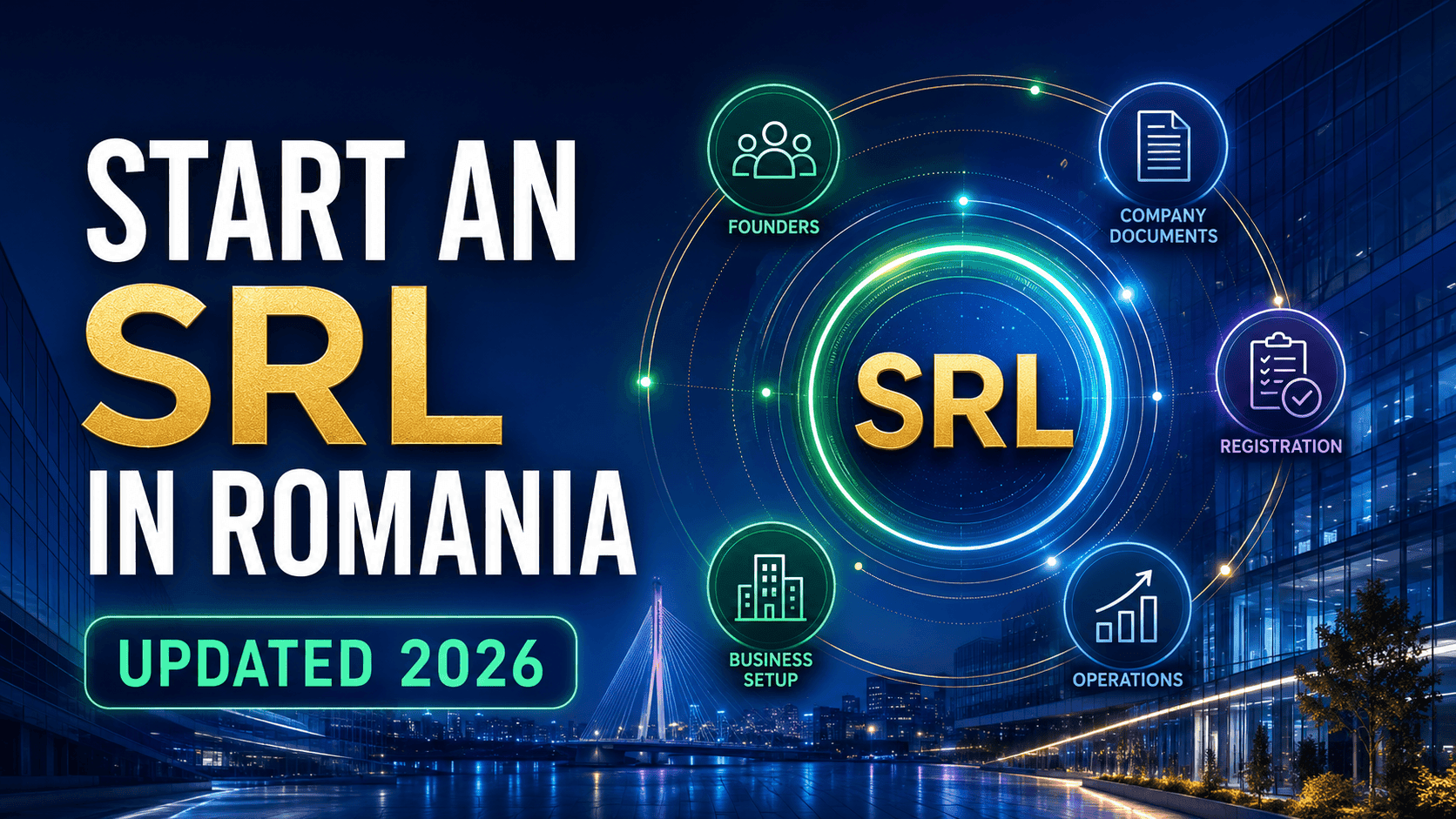
Start a Limited Liability Company (SRL) in Romania 2025

How to Start a Limited Liability Company (SRL) in Romania – Updated for 2025

How to Start a Limited Liability Company (SRL) in Romania – Updated for 2025

How to Start a Limited Liability Company (SRL) in Romania – Updated for 2025

Navigating the intricacies of starting a Limited Liability Company (SRL) in Romania requires a comprehensive understanding of the local legal framework and the specific nuances of Romanian law. This article serves as a guide to help entrepreneurs understand the SRL formation process, explore available options, and ultimately establish their business successfully in Romania.

Understanding SRL Formation in Romania

Successfully navigating the SRL registration process in Romania demands a clear understanding of both local and EU regulations. As an expert legal services provider, we can assist you in understanding the full scope of requirements and procedures. Our goal is to provide the best legal solutions, ensuring effective strategies for company formation in Romania. Learn more about our corporate law services.

What is an SRL?

An SRL (Societate cu Răspundere Limitată), or Limited Liability Company, is a business structure where the liability of shareholders is limited to their capital contribution. This structure is one of the most popular and practical routes for entrepreneurs in Romania, offering both flexibility and legal protection.

The Landscape of Business Formation in Romania

Romania’s economic landscape presents significant opportunities for business formation. Understanding the current trends, regulations, and requirements is crucial for both domestic and international entrepreneurs. The legal framework has been refined for 2025, with greater clarity around capital requirements, registration steps, and foreign investor issues.

Types of Business Structures: SRL vs. SA vs. PFA

In Romania, businesses can be structured in several ways:

  • SRL (Limited Liability Company), which is flexible and suitable for most startups and SMEs.
  • SA (Joint-Stock Company), typically required for large enterprises with minimum capital requirements.
  • PFA (Sole Proprietorship), suited for very small operations but without separate legal entity protection.

The type of business structure influences the registration process and available options, requiring tailored strategies.

Legal Framework for SRL Formation

Key Legislation Governing SRL Registration

The SRL formation process in Romania is governed by a comprehensive set of laws and regulations designed to protect both creditors and shareholders. Key legislation includes the Civil Procedure Code and regulations from the National Register of Commerce (ONRC). Understanding these laws is essential for effective company formation in Romania. For detailed information on procedures, refer to the European e-Justice Portal.

Role of Corporate Law Specialists

A corporate law specialist plays a crucial role in navigating the complexities of SRL formation in Romania.

Atrium Romanian Law Office is an expert legal services provider based in Romania, specifically in Bucharest. Atrium aims to be the best in handling complex and challenging legal matters. The firm’s team of experienced Romanian lawyers and professionals are equipped to resolve any legal issue in a timely manner. They offer guidance through processes related to company formation, compliance, and strategic business planning. The team are members of the Romanian Bucharest Bar.

These legal professionals provide expert guidance on registration procedures, handle ONRC submissions, and develop tailored strategies for company formation. At Atrium Romanian Law Office, experienced lawyers understand the nuances of Romanian law. This ensures that all procedures are both effective and compliant with current regulations, maximizing the chances of successful SRL establishment.

Understanding Capital Requirements

For 2025, the minimum share capital requirement has been effectively abolished for SRLs. Founders can declare any amount they deem appropriate. However, proposed legislative reforms may reintroduce minimum capital thresholds (around 8,000 RON) for new incorporations from January 2026 onwards. Understanding these requirements is crucial for proper company structuring.

Step-by-Step Process to Form an SRL in Romania

The SRL formation process in Romania involves several key phases designed to maximize your chances of successful registration. Whether through streamlined online procedures or in-person submissions, understanding each phase is critical.

Phase 1: Preliminary Planning & Name Reservation

The first step in SRL formation is careful planning and name reservation. This involves:

  • Choosing the SRL form and ensuring it fits your business model
  • Proposing 2–3 name options and checking availability via ONRC portal
  • Reserving the name with the trade-registry
  • Selecting your registered office address and gathering proof
  • Determining business activities (CAEN codes) carefully

Phase 2: Drafting Documents & File Preparation

Once planning is complete, prepare all necessary documentation:

  • Prepare Articles of Association outlining company details
  • For foreign shareholders: prepare apostilled copies and Romanian translations
  • Open a temporary bank account for capital deposit
  • Ensure all documentation is signed, notarized and in correct format

Phase 3: Submission to Trade Registry (ONRC)

Submit your file to ONRC through the following steps:

  • Submit file to ONRC (in person or via online portal)
  • Pay the state registration fee (approximately €50)
  • ONRC reviews file; certificate typically issued within 3 working days
  • Company is legally established; commence business activities (subject to licenses)

Phase 4: Post-Registration Formalities

After registration, complete these essential formalities:

  • Deposit declared capital in bank
  • Register for tax purposes with ANAF
  • Submit VAT registration if turnover exceeds threshold (EUR 88,500)
  • Open regular business bank account
  • Apply for sector-specific licenses/permits if required

Phase 5: Begin Operation & Compliance

Ensure ongoing compliance with:

  • Register for accounting and payroll services
  • File annual financial statements with ONRC
  • Ensure ongoing compliance with statutory deadlines
  • Report any changes in capital, address, administrators or business activity

Timeline & Cost Expectations (2025)

Typical Timeline: 5-10 working days for complete SRL setup

Typical Costs: €300-€800 (varies depending on legal fees, translations, notarization, and sector-specific requirements)

Actual costs vary widely depending on legal advisor fees, translation/notary costs for foreign shareholders, virtual office fees, bank requirements, and regulatory licenses needed.

Advantages of an SRL Structure in Romania

  • Limited Liability Protection – Your personal liability is limited to your contribution
  • Flexibility & Simplicity – Simpler to administer than joint-stock companies
  • Wide Applicability – Suited for startups, SMEs and cross-border businesses
  • Foreign Investor Friendly – Accommodates non-resident shareholders and administrators
  • Access to EU Single Market – With relatively favorable conditions

Common Pitfalls & How to Avoid Them

Protect your SRL formation by avoiding these common mistakes:

  • Incomplete documents — Legal professionals catch naming errors, missing signatures and incorrect forms
  • Foreign-investor documentation — Apostille, translation, notarization requirements vary; each adds time
  • Bank account delays — Budget extra time or use law-firm assisted account opening
  • Incorrect name or CAEN code — Similar names or restricted words trigger extra checks
  • Underestimating permits — Sectors like food, pharma, finance need regulatory checks before operation
  • Ignoring reform changes — Future-proof your structure against 2025/2026 minimum capital reforms

Related Company Formation Resources

To further support your journey in establishing and managing your business in Romania, we’ve compiled a comprehensive cluster of related guides and resources:

Frequently Asked Questions About SRL Formation in Romania

What is the minimum share capital for an SRL in Romania?
For an SRL in 2025, there is no legal minimum share capital required; founders may set the amount they deem appropriate. However, proposed legislative reforms may require higher minimum capital for new SRLs from 2026 onwards.
How long does it take to register an SRL?
If all documents are complete and valid, the trade-registry certificate is typically issued within 3 working days; total company setup often takes 5-10 working days depending on additional requirements.
Can a foreigner be a shareholder or director?
Yes — non-residents can own or manage an SRL; extra documentation may be required including apostille, notarization, and translation into Romanian.
When is VAT registration required?
Mandatory when turnover exceeds the equivalent of EUR 88,500 (in RON) or if opting in earlier. Check the latest ANAF threshold for current requirements.
What if my business activity needs a license?
After SRL registration you may need to apply for sector-specific licenses or permits (e.g., food services, pharmaceutical, financial advice). These can add days or weeks to the launch timeline.
What are the ongoing compliance requirements?
SRLs must file annual financial statements with ONRC, maintain accounting records, register for payroll services, and report any changes in capital, address, or business activities.
Can I use a virtual office for my registered address?
Yes, many foreign-investor SRLs use virtual offices with local law-firm hosting for convenience. The address will be publicly registered and used for all official correspondence.
What role does ONRC play in SRL formation?
ONRC (National Register of Commerce) processes SRL registrations, reviews submitted documents for compliance, issues registration certificates, and maintains the official registry of companies in Romania.
What are the benefits of engaging a law firm for SRL formation?
Engaging a law firm provides expert guidance on requirements, ensures proper document preparation, handles ONRC submissions, navigates foreign investor procedures, and improves chances of smooth registration.

Ready to Start Your SRL?

Setting up an SRL in Romania requires careful planning and professional guidance. Our experienced corporate lawyers ensure proper structure, compliant documentation, and smooth registration. Let us help you navigate the process and establish your business successfully.

Romanian Company Board Meetings

Navigating Romanian Company Board Meetings: Key Insights

Navigating Romanian Company Board Meetings: Key Insights

A group of people sits around a large conference table with papers and laptops in front of them.

Understanding the nuances of Romanian company board meetings is important for anyone involved in the management of companies in Romania.

This article provides key insights into the structure, legal requirements, and best practices for conducting effective board meetings in accordance with Romanian company law.

We will explore the roles and responsibilities of directors, shareholders, and other key stakeholders in the Romanian corporate governance landscape.

Understanding the Structure of Romanian Companies

A projector displays a presentation on the wall with graphs and charts.

Overview of Atrium Romanian Lawyers

Romanian company law dictates the formation, operation, and governance of various types of companies in Romania.

The type of company significantly impacts its organizational structure and the regulations governing its board meetings.

Atrium Romanian Law Office, an expert legal services provider, highlights that Romanian lawyers must navigate these regulations meticulously.

The Articles of Association define the company’s internal rules, complementing the broader legal framework and influencing how the board of directors operates and how resolutions of the general meetings are implemented.

Types of Romanian Companies

Romania provides various legal entity options, each possessing unique attributes.

Two frequently chosen forms are:

  1. Limited liability companies (SRL), which are often preferred by smaller businesses due to their simpler organizational structures.
  2. Joint-stock companies (SA), designed for larger enterprises and characterized by more complex governance procedures.

Ultimately, the selection between these legal structures will influence the company’s meeting and decision-making protocols.

Legal Entities and Their Responsibilities

As legal entities, Romanian companies bear specific responsibilities under Romanian law.

The board of directors, or the management board, plays a pivotal role in overseeing the company’s operations and ensuring compliance.

Members of the board are entrusted with representing the company, and their actions must align with both the law and the company’s articles of association.

The company is managed in accordance with the law, and the directors or the management board are responsible for preparing financial statements of the company and filing them with the Trade Registry.

Shareholder Meetings in Romania

A clock on the wall shows the time during the meeting.

Types of Shareholder Meetings

Under Romanian company law, various types of shareholder meetings serve distinct purposes.

These meetings are critical for the management of companies, ensuring transparency and shareholder involvement.

For example:

  1. The annual general meeting is a mandatory gathering where shareholders review the financial statements of the company and elect the board of directors or supervisory board.
  2. Extraordinary general meetings are convened to address specific, urgent issues such as amending the articles of association, increasing the share capital of the company, or approving significant transactions.

Convene Procedures for Shareholder Meetings

To convene a shareholder meeting, Romanian companies must adhere to specific procedures.

The board of directors, or in some cases, the supervisory board, must issue a notice to all shareholders, detailing the meeting’s agenda, date, time, and location.

This notice must be sent within the timeframe prescribed by Romanian company law and the company’s articles of association.

Failing to follow these procedures may invalidate the resolutions of the general meetings passed during the meeting, potentially leading to legal challenges.

Amending Resolutions in Shareholder Meetings

Shareholders can amend resolutions during the shareholder meeting under Romanian law, provided the proposed amendments are within the scope of the original agenda.

The process typically involves a motion to amend, followed by a vote among the shareholders.

For significant amendments, such as those affecting the articles of association, a supermajority vote may be required, and the amended resolution must be filed with the Trade registry.

Understanding these procedures is vital for effective corporate governance in Romanian companies.

The Role of the Board of Directors

A woman presenting a report on a screen in front of the board.

Composition of the Board of Directors

The composition of the board of directors is a critical element in the management of the company.

Under Romanian company law, the Articles of association of Romanian companies will specify the number of members of the board, their qualifications, and the process for their appointment.

In joint stock companies, the shareholder structure dictates that some directors or the management board are appointed by the general meeting of shareholders, ensuring the shareholder interests are adequately represented.

This structure aims to balance expertise and shareholder oversight.

Duties and Responsibilities of Board Members

Members of the board have extensive duties and responsibilities under Romanian law.

They are entrusted with the strategic direction of the company in Romania, ensuring compliance with regulations, and safeguarding the interests of all shareholders.

The board of directors is responsible for overseeing the financial statements of the company, ensuring their accuracy and timely filing with the trade registry.

In joint stock companies, the board also manages risk, sets policy, and monitors the performance of the management board, upholding their fiduciary duty to the company.

Decision-Making Processes in Board Meetings

Effective decision-making in board meetings is crucial for the success of Romanian companies.

The process typically involves presenting agenda items, facilitating discussion, and voting on resolutions.

The Articles of association often prescribe specific voting thresholds for different types of decisions.

For significant matters, such as amending the Articles of Association or increasing the share capital of the company, a qualified majority or even unanimous consent may be required.

Proper documentation of these decisions in the meeting minutes is essential for transparency and accountability, and the minutes should be filed with the trade registry as appropriate.

General Meetings: Best Practices

Several individuals are engaged in discussion, with some taking notes.

Planning and Conducting General Meetings

Effective planning is essential for successful general meetings in Romanian companies.

The board of directors must meticulously plan the agenda, ensuring all relevant items are included and clearly defined.

Romanian company law mandates that the Articles of Association dictate the specific procedures for these meetings.

As an expert legal services provider, we emphasize that proper notice must be given to all shareholders, and the meeting should be convened in a manner that promotes transparency and active participation, whether for limited liability companies or joint stock companies.

We are dedicated to helping our clients navigate these processes smoothly.

Legal Requirements for General Meetings

Adherence to legal requirements is paramount for general meetings in Romania.

Romanian law stipulates specific rules for voting, quorum, and documentation of resolutions of the general meetings.

The board of directors must ensure that all procedures align with both Romanian company law and the articles of association.

Members of the board must understand that failure to comply can invalidate the meeting’s outcomes, potentially leading to legal challenges.

Our firm provides expert guidance to Romanian companies in navigating these complex legal obligations, ensuring compliance and protecting shareholder interests.

Best Practices for Effective Communication

Effective communication is a cornerstone of successful general meetings.

Members of the board should ensure that information is presented clearly and concisely, allowing all shareholders to understand the issues at hand.

In Romanian companies, this includes providing materials in Romanian and, potentially, other languages if international shareholders are involved.

Encouraging open dialogue and addressing shareholder concerns promotes trust and transparency.

As a client-focused firm, we emphasize the importance of proactive communication to facilitate productive and legally sound board meetings.

Recent Developments in Romanian Company Law

Documents and folders are neatly arranged on the table for review.

Changes Impacting Board Meetings

Recent changes in Romanian company law have significantly impacted board meetings.

Amendments related to corporate governance and shareholder rights necessitate that directors or the management board stay informed and adapt their practices accordingly.

These changes may affect procedures for votes, the handling of resolutions, and the overall management of the company.

As an expert team of Romanian lawyers, we closely monitor these developments and provide timely advice to our clients, ensuring their companies remain compliant and competitive.

These updates are particularly relevant for both limited liability companies and joint stock companies.

Emerging Trends in Corporate Governance

Emerging trends in corporate governance are reshaping how Romanian companies conduct board meetings.

There is a growing emphasis on transparency, accountability, and environmental, social, and governance (ESG) factors.

Companies are increasingly adopting digital solutions to streamline meeting processes and enhance shareholder engagement.

The articles of association of Romanian companies are evolving to reflect these trends, often requiring more detailed reporting and greater shareholder involvement.

We assist our clients in integrating these best practices to enhance their corporate governance frameworks and attract investment.

Case Studies of Successful Board Practices

Examining case studies of successful board practices provides valuable insights for Romanian companies.

Instances where board meetings effectively addressed critical challenges, implemented innovative strategies, or improved shareholder relations offer practical lessons.

These examples often highlight the importance of diverse members of the board, robust decision-making processes, and proactive risk management.

We leverage our experience and expertise to help clients implement similar strategies, fostering a culture of excellence and driving sustainable growth for Romanian companies across various sectors, including both limited liability and joint stock companies.

FAQ:

What are the requirements for conducting board meetings in Romania?

In Romania, board meetings must comply with the applicable legislation, which includes the requirements set forth by the Romanian legislation.

Companies are required to convene meetings in accordance with their articles of association, which dictate the procedures shareholders must follow.

Additionally, the meeting must be held at the registered office or another location specified in the convening notice.

How can shareholders participate and vote in general shareholder meetings?

Shareholders can participate and vote in general shareholder meetings either in person or through electronic means.

The recent legal framework removes the requirement for companies to include identification data in the meeting notice, making it easier for shareholders to engage in the voting process, including the use of electronic voting in general.

What is the role of the supervisory board in Romanian companies?

The supervisory board is responsible for overseeing the management of the company and may appoint one or more directors.

Members of the supervisory board are appointed either directly by shareholders or through the general shareholder meeting, which can delegate this authority.

Their role is crucial in ensuring that the company adheres to the current legal framework concerning operational and strategic decisions.

How does electronic communication impact board meetings in Romania?

Electronic communication has transformed the way board meetings are conducted in Romania.

Companies may now utilize electronic means to convene meetings, allowing for greater flexibility and accessibility.

This shift aligns with the needs of the business, enabling stakeholders to participate remotely while ensuring compliance with the legal requirements set forth in the recent amendments to Romanian law.

What happens if a company fails to comply with the legal framework during a board meeting?

If a company fails to comply with the legal framework concerning board meetings, it may face legal repercussions, including invalidation of decisions made during the meeting.

The current legal framework emphasizes the importance of adhering to the stipulated procedures, such as ensuring that the convening notice is published at least 30 days prior to the meeting and that all necessary documentation is submitted.

Can a company hold a general shareholder meeting without the presence of all shareholders?

A general shareholders’ meeting may proceed without the attendance of all shareholders, as long as the required quorum is met.

Shareholders representing the absolute majority of the share capital must be present, either in person or via electronic means, for decisions to be valid.

The company’s articles of association typically specify the exact quorum requirements.

What are the implications of the deadline of 6 December 2024 for Romanian companies?

The deadline of 6 December 2024 is significant as it marks the date by which companies must comply with the new legal framework concerning board meetings and shareholder communications.

Companies that fail to meet these requirements may face penalties or other legal consequences.

It is essential for companies to stay informed and adjust their procedures accordingly to ensure compliance with the amended legislation.

How do secondary offices relate to board meetings in Romania?

Board meetings are generally held at the registered office.

Secondary offices may play a role in the operations of a company, particularly for those with representative offices in different locations.

However, companies may also convene them at secondary offices, provided this is specified in the articles of association.

This allows for greater flexibility in operations and can help accommodate shareholders who may be located in various regions.